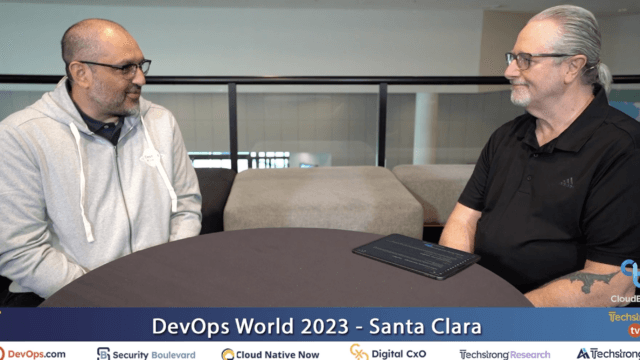
Tara Hernandez, MongoDB | DevOps World 2023
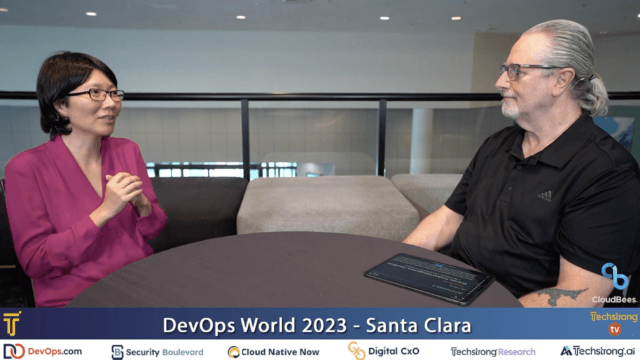
Tara Hernandez, VP of developer productivity at MongoDB, talks with Mitch Ashley about the importance of fostering a culture of investment and innovation in software development infrastructure as a critical value add.
Transcript
This is Textron tv. Hey, everybody. Welcome back to DevOps World here in Silicon Valley, San uh, Santa Clara, uh, 2023.
As I said, we have some fantastic, uh, people that we're talking to in, uh, interviewing. Also, uh, the next guest is part of a panel we're doing in about an hour or so, not too far down the road here. So Tara Hernandez, welcome.
Hello. Good to be chatting with you. Uh, VP product development with Mongo.
Right? Uh, developer, Productivity Developer. Productivity developer.
Thank you very much. Yes. And, uh, of course you have extensive background with Google and Pixar, and lots of great stuff.
I think you're saying I'm old Mitch. No, I didn't say that. I said no, that all happened in the span of three years.
Oh, it's amazing. You did all that. So, uh, I know one of the things you're passionate about is, you know, culture and, and fostering an environment for innovation and, but also around kind of the topic of infrastructure.
I don't know if I would've said that was top of my list, which is okay, it's the top of yours. Why is that a passion of yours? Well, you know, so it's interesting, like when, when I got outta college, I had a bachelor's degree in computer science.
The first job I got was at a company called Borland International. I remember Borland way back in the day. They did compilers the best compiler in the industry at the time and databases.
Uh, and yet my job was as a, as a build engineer. Like I typed make, you know, and I, I, I flipped the floppies around and make the golden masters, and sometimes it would help debug build systems, but it wasn't a particularly profound job, right? Uh, and, and then, uh, I got an opportunity to switch to a startup, Netscape Communications.
A bunch of Borland people had gone over there in addition to the SGI folks that had come over and joined Mark and the, and all the college students who had been working on the various forms of Mosaic and links and Mm-hmm. The early browsers, right? Mm-Hmm.
And in what I found there, and what I got to participate with was the sort of the beginnings of modern infrastructure that is, you know, web-based, right? Um, continuous integration, which had not as a term, had not been coined yet, uh, but became very critical. And you have a single source that needs to be compiling on, you know, dozens, uh, of different platforms.
And we needed tools. And so my, my role, which had started out as a type make right, and maybe debug the, the compile errors turned into development, and, uh, we developed a, a tinderbox tool, um, which, you know, it's like, oh, tinderbox, it was that old thing. Uh, eventually it was replaced primarily by Hudson and Jenkins when, uh, when que did his thing.
We also, you know, had to invent a, a web-based bug tracking system, uh, Bugzilla, which is still being used by some people. 25 years later. We worked on some amazing thing.
Yeah. You know, and so it was that idea of like, okay, yeah, there were commercial products at the time, but they were very tied to the operating system. So that innovation of like actually infrastructure is something that Netscape as a company company realized we needed to invest more in Mm-Hmm.
In order to uplevel the ability to deliver software as quickly as possible. And over the years, um, you know, infrastructure is now its own thing. You have cloud based is I think a very prominent example.
GitHub, uh, you know, circle ci, there's a lot of Git Labs, a lot of companies that this is what they do is they do infrastructure. And so the need to do that implementation in many cases is no longer necessary. Right.
And you shouldn't, but, but at, for a lot of companies, there is that, that special thing that that particular engineering organization for the particular types of products that they're developing, where upleveling that infrastructure, the software development pipeline, is going to bring benefit. So putting in that level of investment, uh, to, to not just say, oh, I'm just gonna install Jenkins and call it a day. No offense to Jenkins, right?
Mm-Hmm. That's like step one mm-Hmm. Right.
Uh, and so one of the things that got me really excited about my current role, you know, I never thought I'd be a vice president, um, uh, an engineering organization, but at the company that I'm now at MongoDB, that understanding of infrastructure as a, as a business, uh, differentiator for, for our ability to, to deliver our software, it has been established for over a decade. Uh, and so the amount of investment that MongoDB puts into, yeah, let us have that infrastructure investment across a breadth of topics and what can we do to push the needle. And so it was an opportunity I could not turn down, and I'm so glad I took it.
But I think other companies, you know, uh, can benefit from having that type of, of, uh, attitude I think around software development. Well, some interesting threads that connect for me in your, in your description, because one, you're, you're successive of, um, kind a series of, of technologies that you've worked on in your career. One thing leads to another, leads to another, and o oftentimes those are the, to use the colloquial term mother of invention, right?
Absolutely. And yeah, necessity is, and so that turns into a product, but that tends into an open source kind of thing. And what you're talking about when you're talking about infrastructure, it's not virtual servers and cloud storage and, you know, kind of hard infrastructure.
Well, That's part of it, but That's part of, it's, you're talking about all of the, uh, kind of glue code and process and what's underpinning a development cycle to be able to get code out the door or to run it in a SaaS environment or run it multi-cloud or what, whatever it is, there's a lot more kind of things that underpin all of that to happen. Some of it may get productized someday in addition to what you do now, but that's what you mean by, am I getting, getting the vibrate? Yeah, Absolutely.
Yeah. And there's a great example of that. You know, there was not an ounce of entrepreneurship in any of my team.
Uh, you know, when, when Netscape started to disperse and the diaspora started, um, you know, none of us considered, uh, taking those tools and doing anything with it. org who was hired to maintain the Mozilla tinderbox, he's like, this is actually a really good idea. You know, Paul Vigor, and then he went off and I think he founded Circle ci, right?
So I mean, that idea of like, everything has a, a an ability to become critical in a broad sense, right? That's, I think that's, uh, and I, I don't think we're in a position now as an industry where we poo poo that idea of infrastructure engineering as somehow being lesser, or at least smart companies do Now. Yeah.
Platform engineering is kind of one aspect. Absolutely. Extremely.
It absolutely is important, right? Yeah. And so I think it's, you know, that idea of innovation, I, my, you know, the engineers that I hire, they're not somehow subpar.
They're top of their game and they're doing cool stuff. They're just not necessarily doing it for immediate business be benefit. It's transitive business benefit, But a lot of it is to, uh, kind of increase flow, reduce friction.
Exactly. Make things easier, maybe faster. Uh, I had, I had my own experience like that, uh, where a developer had written some scripts, this is quite a while back, um, to, um, you know, his IP changed when we saw certain kind of attacks.
He would insert firewall rules to block them, and that turned into a product and turned into a full industry sector of, uh, intrusion prevention, things like that. But that was a pearl script, you know, it started, Pearl was the language of infrastructure for a very long Time. Oh, yeah.
It is the utility knife. Yeah, it is absolutely utility belt now. I think it's Python or, you know, bash and everything else.
Yeah. I mean, there's, everybody's got their favorite thing go, I think is also go. Yeah.
Right. And, and I think the important thing is that it is not useful to say, oh, well, we'll just take a portion of our product developers and have them focus on that stuff, right? It's a specialist, you know, it's a, it's a niche area.
Good product developers can do it, but if you're asking 'em to do that on top of like trying to get features out, you're doing them and your company a disservice. Mm-Hmm. Right.
And so that's where that idea of investment, you know, comes into, when I got to Pixar, um, I was the first, uh, dedicated infrastructure person they hired. This was back in 2002. And previously, uh, there was, you know, it was basically whoever was the last hired was like, okay, here's the, here's the pearl script.
Mm-Hmm. That runs the nightly bills, right? Yeah.
And, you know, they had other things to be doing, and so they put, would put minimum effort because that wasn't their primary, primary job. And you know, at the time it was a 4,000 line pearl script. I think there was one sub-routine in it.
Oh my God. Uh, yeah. I still, every time I run into the guy who, who was like help author that, he's like, cut up, come talk to me.
What were you thinking? No, they're thinking like, this isn't my job, but I need to, to get something out. Right.
So, you know, bringing in a tool that the, their bug tracking system was a, a, a single cybase table, right? Mm-Hmm. Uh, they just, that they didn't have anybody focused on that.
So we were able to one and the, and one of, of the benefits of bringing me in though, that they hope to get to was being able to parallelize software development in a way they hadn't been able to do before. So, you know, they, one piece of com of proprietary software to make the movie, they make one movie at a time, and that's all they can do. It's like, how do we have branches?
How do we parallelize that so we can do multiple productions simultaneously, but still support it technically. That was the thing that I was able to help them, you know, figure out how Do, what a multiplying factor that is. Right.
And, you know, it needed someone full time. And by the time I left Pixar, there was 13 people doing infrastructure, starting from one dedicated, but it was, you know, a mix of engineering documentation testing, I guess there was three. There was one build engineer and two QA engineers.
So yeah. So we, what is that a factor of three something? Mm-Hmm.
Well, and, uh, now, and they could not do it without it, right? I mean that's right. Exactly.
Because they expanded because of that capability. So, so back to, or the origins of fostering a culture to do that, what are your, what are your thoughts on that? How do you, how do you, how do you let people know this is extremely important and it's, you know, we're not hiring you to kind of clean up everybody else's mess.
You're creating part of our product, part of what we do. Yeah. And, you know, the art of writing job descriptions is, uh, is really important there.
And if you look at the MongoDB careers page, you know, you'll see, I think there's a, there's one open developer productivity, uh, role right now. You'll see we talk about exactly what we're trying to do and why it matters. Um, and then I have a philosophy that I share with my team.
I'm, I'm sure you're familiar with, uh, I think, I think this came out of Intuit or Intel, uh, or maybe IBM, uh, the three Horizons of business. Mm-Hmm, right? Mm-Hmm.
So I have a variation of that, which is the three horizons of infrastructure. It's like the things you do that are keeping the lights on, which is helping your developers, answering immediate questions, fixing immediate bugs, making sure your services are up, right? Then there's the projects that you're doing that, that, uh, uh, that you think, oh, this is gonna solve this particular problem.
But then how do you get to those projects? Well, then there's that, that moonshot long-term investment where you make space, you know, I make space for my developers. Go experiment.
You know, go to conferences, be following the open source project, see what's going on industry, get inspired, and then put together a proposal, and then tell us what problem it's gonna solve, and then let's implement, you know, implement that project, create, You know, and it is that, and create system. It's that moonshot. Like you could pick DevOps as an example.
You know, it's origins being, what if we could do multiple deploys a day? Right. That's insane.
How would, why would, how could we ever do that? How could we, what if we could do, you know, five movies at once instead of one? Oh, that's crazy.
We could never do that. Well, yeah, yeah, we can. I mean, that's that inspiration, that creative tension, right?
That kind of draws people to solve that. You don't have to solve the whole problem, but, and you might actually deviate from that moonshot and, and Go, Just go straight to Mars. Yeah.
Well, there, there is that. Yeah. I mean, you think about like what, you know, Hudson and Jenkins back in the early two thousands, what it, what it was doing was basically it was a little wrapper, uh, uh, around resource manager.
Mm-Hmm. Right. Um, and then that expanded out with the plugin ecosystem, which, you know, you could argue good or bad, they're good and bad.
Then that argument's been bad. And Many times, and we'll continue indefinitely, um, but then, you know, into the cloud hosting and the platform and, you know, the software develop delivery platform, and then now the new SaaS-based features of, you know, aggregating data and all those other things, and it's evolved over 20 years. Mm-Hmm.
Right. And it's a beautiful thing. And there's, and now we're bringing AI into it, which I will admit, I'm a little like, uh, we'll see how that goes.
Yeah. But you can't discount the opportunity. Right?
And here's another great example of where you can have innovation infrastructure. So ai, right? Uh, well-established companies with a, with a, a, a strong desire to preserve their corporate ip and a lot of money in the bank might feel a little bit like, well, AI is kind of an untested space.
Legally, we don't wanna get sued, right. With our products, right? 'cause that's attached to revenue.
What if we have the infrastructure people start to experiment in ways that do not create that same risk, right? Who are a bunch of smart people doing cool things. And that's, you know, one of the things that we're working on now, right?
It's, it's, uh, how to bring in this new technology, play with it, explore it, and, uh, not have to worry about, you know, potential impacts on the business until we have a better understanding of what those might be. Mm-Hmm. So, Very cool.
Sounds like you have multiple books in your head to find a way to write it. I'm gonna have to retire before I have time to write books. I've thought about it.
I need to get back to writing my blogs. It's been a while. You should, but yeah, it's, it's fun.
You know, it's, uh, I think, you know, I've never been the best tech person ever, right? Um, and I think that maybe that's one of the reasons I got into management too, so quickly. Um, but the, the ability of technology in conjunction with smart, motivated people to solve interesting problems has always been fascinating to me.
Well, that's what's great about our industry is you have the tools in your hands to create the next set of tools, right? Yeah. So we're already equipped in many ways to, to, and, and we're just naturally inclined and we think that way.
Like, how do I make this easier? This is crazy. Why am I doing this?
Or why are we, and yeah, poof, we've got a new, uh, we've got a 2000 line pearl script instead of 1000 or Python or whatever. It's the 30 line Python script. Yeah, Exactly.
A little lambda here. Yeah. Yeah.
It's, it's, uh, it's really interesting. And I think the thing I love the most about infrastructure also relates to that, which is that the immediate gratification, have I solved your problem? You can tell me we work together, we're coworkers, right?
I don't have to worry about a market fit or go to market strategy or any of those things. It's just like, Hey, my developers are struggling in these areas. We've instrumented some telemetry to help us understand what's going on there.
Alright, let's figure out how to fix that. Boom. Did we do it?
Awesome. Excellent. Well note to personal, thanks.
Other than creating movies for Pixar, almost everything you mentioned I've used. So thank you for all that you've done to, to move us forward. Technology, My Tiny is created, my little piece Of participation in all of those.
I just could kind of check 'em off like, yep, I've done that. I'm creating a movie now. It's not on my bucket list, but I can't draw stick figures, but I can help build Mya Plugins.
I can watch 'em enjoy them. Yes. Well, Tara, Tara, Tara Hernandez, who's with Mongo today, and you heard about, uh, the long list of companies contributions she's made to the industry.
So somebody to follow. Let's get some more stuff out on LinkedIn or whatever you wanna do. I'll Work on that.
I promise There, there's a world that needs to hear from you more. Okay. If that motivates you, I'd love to See that.
I don't know, a little daunting, but Thank you. Appreciate you're busy enough. I get that.
That's tough to fit in. Great. Thank you very much, Tara.
Uh, be stay right there. Same bat channel, same bat station. Uh, we'll be back in just a few with our next interview.