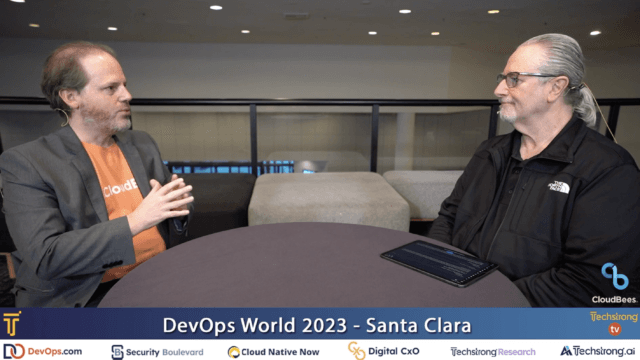
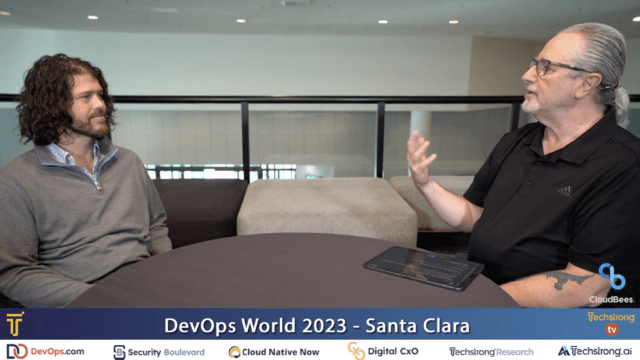
Shawn Ahmed, CloudBees | DevOps World 2023
Platform engineering is a fast-growing trend; it’s all about developer productivity and DevEx — the same premise on which CloudBees was architected. Learn more from Shawn Ahmed and Mitch Ashley.
Transcript
This is Textron tv. Hey. Hey.
Welcome back. We are at DevOps world here in Santa Clara, Silicon Valley. You know, we still have more, a lot more interviews to go, so don't, uh, don't take off.
We've got some great folks and one of the great folks, um, somebody that I've worked with over the years, consider him a friend, a colleague in the industry, as well as, um, you know, an expert in in in his own right. And that's Sean and me. Welcome, Sean.
Oh, thank you so much. I appreciate being here. As always.
It's really fun speaking with you and talking about a variety of topics and so, uh, I'm glad you guys are here and we get to speak about what I assume is a number of really interesting topics. So, oh, yeah. Thanks for Having me.
I'm sure. Well, well, you're doing great, great work and very cool things. And you know, we give a lot of credit to the engineers and the people who release code and test code and get products shipped out the door.
It doesn't, doesn't happen without the right leadership, I can Tell you that. Oh, thanks. I appreciate that.
No, I think this year has been phenomenal for CloudBees, uh, as a company. I think the engineering teams, uh, the product teams, the operations team, I mean, just my whole organization just done such an incredible job in terms of like balancing the careful act of, you know, investments in the present and building for Jenkins and the growth that Jenkins has had over the last decade. And, you know, kind of culminating into some sort of like these capabilities.
We, I love to call them the, the, the quantum leap or the greatest update for Jenkins in a decade. Mm-Hmm. But balancing that against sort of the future of our customers and prospect in terms of like cloud native development of applications and workloads.
What a great job these teams have done. So it's the honor's all mine to be able to, you know, be sometimes like here the face of that. But, but they deserve all the credit.
And I think the playbook that they've put forward for, you know, our, our customers and prospect is just astonishingly interesting and, and fun and amazing. And, and I think our customers are sort of validating a lot of that in, you know, places like this at DevOps world where we get to meet them in person. You know, um, I, I don't get a choice in this, but I think you should have Chief strategy officer too.
Sorry, whoever's Strategy Officer. Any reason why I say that, Sean, is, you know, Strategically Well, I know where you're going with that. I don't.
Okay. There's a balance with open source and the business strategy and you know, the choices that you've made around what investments you come out with for CloudBees and, and continuing to support Jenkins. That's a tough type pro.
I mean, I've been in a software company, uh, in an open source business model, and it's really easy to make some bad mistakes that are tough to recover from. And the fact that, that that's just continues to grow and improve. And I think you've made some really smart choices in, in the releases you've come out with, so.
Well, Thank you. I appreciate that. Yeah.
I'll give you all the credit, you know, CEO, those other roles. They're good too. They're part Of this appreciate, But No, no, nice work.
It's good Stuff. No, no, thanks. I mean, uh, it's always a challenge really, uh, as you said, and, and finding where to draw those lines and when do you develop certain things?
What do you contribute back? What do you put in an enterprise version? You know, what I think I always do is I kind of think about what's most important to the customers that are using Jenkins.
'cause none of our customer begin with CloudBees, right? They begin with Jenkins. But there are certain set of challenges that they will have when they start hitting that kind of enterprise scale.
When you're talking about thousands of controllers, you're talking about, I spoke to one customer just now that said they have 40,000 developers using Jenkins. It is an extraordinary scale. And the questions you start asking yourself at that scale about resiliency, fault tolerance, and things like that, you know, okay.
That presents some real interesting opportunities for us to be able to think about what we can develop and put and support, because that's really important to our customers. Will you be able to build something that you can support that will scale something fails? Where do I go?
Is it secure? Has it passed all the tests? So we've been very lucky to have a phenomenal relationship with Jenkins, the community.
Um, we have been able to contribute so much, uh, back to the c to the community as well over the last decade. And at the same time we've been able to take certain capabilities. We think, you know, when you're starting to hit that kind of scale that our customers really require need and support and need to, you know, sort of have and securitize and be able to scale up and have enterprise support for, and find those sort of nuggets where we can sort of create that.
And we've always had the community be real excited about providing that balance. And, and so I'd say a little bit of luck, a little bit of smarts, a little bit of being here at the right time has given us that opportunity. And our engineers have done a great job with that.
And our product folks. Amazing. Yeah.
You know, I, I, I know you well enough to kind of, you're, you're a product guy. You're a product person. Oh, that's a hundred percent who You've been, and I'm really in interested and curious, share with us a little bit about balancing the interim CMO and product.
Oh, yeah. CPO. 'cause there's, you know, sometimes there's tension between product and marketing and positioning and what things we develop and, you know, there, there, not that it's always contentious, but, um, you know, did you have like that Star Trek inner battle, you know, Kinda episode thing all the time?
Yeah, all the time. All the time. I mean, there were times where, you know, I was like, which cap should I be wearing now?
You know, I'm facing this challenge, I gotta figure out what's the right thing to build, but what's the right thing to position? You build this thing. But now I have to think about the go to market.
Most important to all, if there's any aspiring CPOs out there, if you ever get a chance, you know, to to, to get on the marketing side, attest and try and sort of drive those two functions together. Uh, it's a tremendous experience and I'm honored that, you know, the leadership, the board of cloud-based gave me that opportunity for, for, for, for a time being. And, and I was interim MCMO for so long because I really grew an appreciation for how hard it is to, you know, take something that a product organization built, but then be able to position it in the right way, be able to hit that scale, be able to take it to the market, how you position it, how you sell it.
And when it comes to one area, which is product led growth, which is increasingly now a part of sort of our new platform that we releasing on November 1st, it's a SaaS first solution, and it's a product led growth solution. Yeah. And when we think about that marketing and product kind of become partners, uh, in a very unique way, and being able to sit there and be able to see that from both sides and figure out what strategies we need to apply making product decisions with Go-to market in mind and making go-to market decisions with product decision in mind.
Oh, it was great. It was, it was just a, I learned so much from that experience and, and, and, uh, I, I really appreciate it. Um, you know, this leadership team, the board giving me that opportunity and, and, and that appreciation hopefully translates into how we've built our product Mm-Hmm.
And how we go and, and market it in the future. There are some learnings there that are, are extraordinary. So I will, I will tell you though, the other side of it though was it's freaking hard.
Mm-Hmm. I had not a lot of sleep the last 18 months, so. Well, you and I talked at RSA at DevOps connect, uh, DevSecOps Connect, uh, last RSA not you were sharing any deep secrets with me, but I, you were talking a little bit with me about there's some tough choices and there's some Sleepness nights and there's Oh, yeah.
Because I'll tell you, my, my experience is you can tell when product and marketing are not on the same page. Yeah. Like, you use the product and that is not what was advertised, right?
Yeah. To have that's being positioned or what the benefits are. Yeah.
Uh, who it's for. All those kind of things have to be in alignment with why you're doing, why you're leasing, what you are. Definitely.
And the way you're delivering it to market. Otherwise, it's kinda like, yeah. This is this two, there's two sides of a, a sandwich that haven't been put together yet, right.
One, it's going different directions. Well, one thing, one thing that I've really grown appreciation for based on what you're just saying is that really every company that you, you will ever have the opportunity to work for has these three, what is it called? Three legged stool concept associated with it.
So you got marketing on one side, you got product, and then you got sales. And what I realized is they gotta be sturdy all three legs. They've gotta be sturdy and gotta be in unison, gotta be integrated, gotta be working perfectly unison.
And when they do, and you kind of get that harmony that you hear of a perfectly tuned orchestra at a symphony hall, boy, oh boy, can you perform? But how many companies haven't we seen that didn't achieve that? Right?
They had a great product, but just didn't have the right messaging go to market, so they didn't find success because of it. Or they had a great go to market, but the product couldn't back up the claim. Or you had a sales organization that sold something that wasn't quite what the customer was told it is.
And, and so you can have these sort of combination of this three-legged stool not being in perfect unison and sync. Mm-Hmm. And, and, and so my biggest learning coming out of this experience of being being C interim C-M-O-C-P-O for CloudBees, is that I really gotta see that dynamic work and what doesn't work and what challenges you face in each one of these various different positions, and be able to sort of calibrate our roadmap, calibrate the products we're building, the features we're building in a way that will give, uh, us the best possible, uh, opportunity for sex success moving forward.
And, and that's what I, uh, I really learned from, from this experience. So, yeah. But yes, it was a lot of sleepless nights.
Well, and, and it fits very much. Like occasionally I'll, I'll get to mentors, people who are moving into a c-level role. And what I tell 'em right at, right at the beginning is, the biggest transformation is you're not thinking about your function.
You're thinking about the entire business. That's 80% of how you're gonna make your decisions fine. 20% is what's best for your part of the business, but if it's not best for the entire business, it's not the right decision.
And that's, that the, what's great about the three legged stool analogy, it isn't that you have to have the third leg or it'll fall down. It's like if if the leg short and the other, then the other two are fine, it still falls over. That's right.
It's not gonna stand up. So That's right. I want to take a, take a pivot here.
Let's do It. Uh, let, uh, CloudBees issued a report around, uh, did some research around platform engineering. Yep.
I wouldn't have, you know, I don't think naturally in market, everybody says platform engineering. Let me go to CloudBees and grab their stuff. Why?
Not that it isn't relevant, but there's a reason why you did this study. Why, why is platform engineering important? I think it's really, really, um, an evolution of DevOps.
And for those of us that have been in the dev space or in the ops space, and then eventually the DevOps space, we've all kind of seen how fast the evolution has been, both in terms of process, organization, team responsibilities, and the tool landscapes. You look across all three vector and they've continued to be in constant modernization, change, new practices, and then all of a sudden, you know, cloud native application comes along. And, you know, we see this backlog for our organizations grow to some extraordinary numbers.
There was a study that initially got me thinking about this a couple years ago, I think, or it was last year. IDC released it and talked about, you know, the, the backlog of cloud native application in Fortune 2000 globally. It put the number at something like half a billion applications.
And I'm thinking to myself, wow. So you got applications you're gonna modernize and you got brand new cloud native applications, and yet every organization you talk to says the same thing. You know what?
Cloud native application deployment development, it's so freaking hard and complex. It, it is not for the fate of heart, I'll tell you that. It's not for the fate of heart.
And so how do you deal with that? And what are some, and so before even the tools approaches became there, we started seeing the shift in what the study confirmed was customers started thinking about the evolution or the next step of what DevOps will be. In fact, in that study, we see 80% of organizations that we spoke to would say we're moving towards platform engineering principles, or we're somewhere along that journey.
And that's astonishing high percentage. That's, that's real. It makes, that's a high percentage.
So we really wanted, like, what does it mean then that you're moving there and it's like, well, you know, when it comes to cloud native, we need to have the SREs, we need to have the ops, we need to have the infrastructure people be a part of the process. We need to have the ops folks, the development teams, compliance teams, security teams. These are all aspects of supporting the cloud native applications we're building and releasing and securitizing.
So all these teams need to be a part of that puzzle. And they're all siloed today. So platform engineering, conceptually having all of these people come together into a group that then defines and sets the direction for how cloud native application development should be done, how it should be securitized, how it should be released, that was kind of interesting for us to learn that that percentage was like way up there.
Mm-Hmm. So we asked them, was that, you know, the same study also interesting. We kinda asked, talked to them about it, and we said, well, what is the imperative?
What are you trying to, okay, so you got platform engineering, uh, evolution of this DevOps team. What is the imperative? What's the outcome you're trying to drive?
Mm-Hmm. And you know, normally you and I have spoken about this like three, four years ago, you and I would say, oh, it's the Dora metrics, it's your flow metrics, it's the deployments meantime to, you know, recover and things that have to do with a lot of the automation. But here it's not about that.
Those are all important aspects of it, that's fine. But it's about the developer experience. More than 21% of the customers, uh, responded with that as the top impairment, uh, imperative.
The developer experience with cloud native development cannot be that we make this cognitive shift load occur where like mm-Hmm. You gotta push your, you gotta push your security into the pipeline. You gotta put in compliance in testing, put the infrastructure in there, put the, let's put accounting And finance over there too, While at it, while we're at it.
Let's just put everything in the kitchen sink in there. And now the developer's sitting on the other side going, are you expecting me to know all this stuff? Am I supposed to be an SRE expert?
No, I can't do that. So I think what the platform engineering teams are trying to do and trying to work, and kind of what we've done here in terms of responding to the po, the, the challenge from platform engineering teams is we need a new kind of platform for it. Because the imperative is we want to be able to give the developers the opportunity to take more bites at the Apple.
Mm-Hmm. That's what we wanna do. And that bites outta the apple means they'll have more feedback loops that'll have more opportunities to release, and then they'll innovate more, and they won't have to be hung up on being security experts, having to be the SRE, having to be the release infrastructure expert, and so on and so forth.
Our platform that we release today is really an answer to sort of how platform engineering teams can fundamentally transform that developer experience. Great. I see the connection now.
Yeah. Makes a lot of sense. So another pivot.
You're gonna hop in a car at some point here and head Dover to SFO, hop on a plane, take a short 16 hour plane ride to Singapore Yeah. Or however long it is from San Francisco. Tell us what it's like, um, in, in that market, in that part of the world.
Um, are people dealing with the same kind of questions, same kind of issues? Is it different like in telecom, you know, when I was doing that part of the business, telecom's very different in different parts of the world because they don't have as much legacy telco as we do in the US or vice versa. So do you see some differences in the market, not of those like telco, but, or is it very much the same, same package?
Well, there Are, there's definitely some differences, but I'll start with the similarities first. One of the biggest similarities I see in that market here in the US Europe, no matter where you are on the globe today, holy cow, developers are innovating Mm-Hmm. They're innovating at breakneck speed.
And you gotta love that. You gotta love the fact that developers are, are innovating. They're writing some of the finest code that you're going to see.
Um, you know, and, and I think that we're just at the beginning of it, right? Um, I think some of the finest innovation, the, the human, uh, the human race is gonna see is ahead of it. And, and developers are at the center of this world.
That is something that I believe is similar. So no matter where I go, whether it's Singapore, India, here, you got hungry developers, up and coming developers, you got established developers because all kinds of developers think about how they can innovate the next thing. And that speed and pace, that's very similar now in a more sort of industry way of looking at the world a little bit different.
Right. Um, I think generally speaking, in Singapore, you've got a lot of car manufacturers, you know, uh, not in Singapore, but in that region. In that region.
You got Honda, you got, uh, a number of different car manufacturers, uh, certain things Tesla has done, introduced the world to over here that now taking, uh, super speed over in, in, in that part of the world. And you're seeing manufacturer from the automobile industry, chip manufacturer. Chip manufacturer, to all of those Technology That's there.
Absolutely. Yeah. And you're seeing those particular industries that they're very strong in innovate and outpace competition.
I mean, I, there's cars like Ikea and Hyundai and, and the whole ionic series, uh, iconic or ionic series of cars, I think it's four, five, I mean, what has it been? Two or three years? And they've introduced like five, six new models, extraordinary over the air updates, uh, you know, brand new tech.
And it's all using software, Software platforms on wheels, basically. Yeah. Basically data center on wheels.
And, uh, and on the other hand, we see here in the US financial services, so we see different types of industries here, aeronautics with Boeing, uh, over in France, you see Airbus and you see Daimler, you see other, so there's certain industries that definitely are seeing this kind of transformation that it's really at the forefront doing it. And that's a little different and depending on which region of the area is. But what's similar is that software developers are at the center of it.
Another common thread is competition, whether it's ev in those markets for vehicles. Yep. You move into, you know, those platforms.
Yep. Or it's financial services and the latest, you know, products might be creating outta that. Uh, it's, it's been a pleasure talking with you.
I hope as always hope you, uh, get a little bit of rest on the plane. I've got $60 ahead of B so I'm gonna knock Out, don't just watch movies the whole time. Get some rest.
Take care. I definitely will. I definitely will.
All right, Sean, it's been a pleasure for you, Sean and Matt. Thank you. It was ACPO and interim CMO, uh, lot, lot done.
A lot of great things that, uh, CloudBees and it's great to see your success. So Congratulations. Thanks for having me, as always.
You Bet. Good to chat. We have more interviews.
We're not even close to being done. We're keeping going, going, going. You know, we'll wait till he gets on the plane.
We'll just keep going until he's out of, up in the air. Not quite that long. But anyway, have more interviews coming up.
Stay tuned. We'll be right back in just a minute.