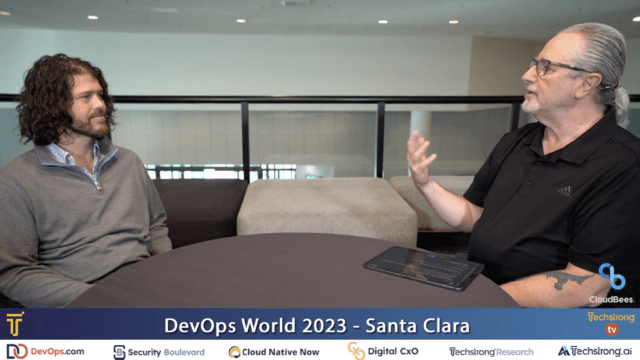
Jenkins the Butler, CloudBees | DevOps World 2023
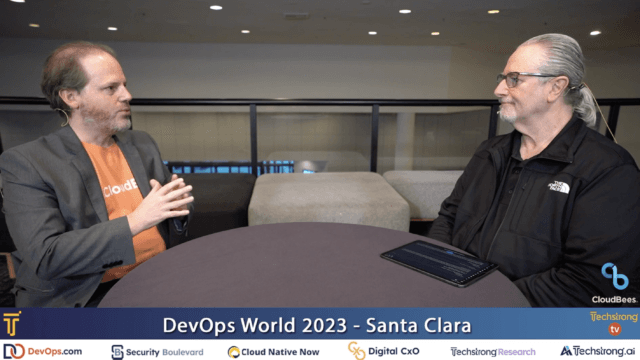
Jenkins the Butler, aka Bill Garrett, principal solutions architect at CloudBees, discusses the state of Jenkins and its momentum, how Jenkins remains the go-to platform for CI/CD and stats from the news release in late August from the CDF, in partnership with CloudBees.
Transcript
This is Textron tv. Hey everybody. Welcome back to DevOps World here in Santa Clara.
We have a scoop. We have a one of a kind interview. You're not gonna get this anywhere else.
This is a rare privilege, a first time for me to, uh, have the privilege of talking to Jenkins, the Butler. Welcome. Thank you, Mitch.
Thanks for inviting me today. Yeah. I'm so excited we get to talk.
You know, I've followed you forever. There's a little bit more of a static form, the logo, not Jenkins, the butler, the person. Um, tell us about who Jenkins is.
Well, Jenkins is two things. Jenkins is, first of all, the name of a very popular open source project that's been around for many years. But I am also Jenkins.
Uh, of course, the me who is Jenkins is the spirit of continuous integration. The, so what does that mean? What is the spirit of continuous integration?
You have a, you know, you, you have a butler persona of course. And in your, in your appearance, The butler is a servant. Yeah, exactly.
And the servant builds and tests people's code to help them ship better code faster. Very cool. And, and that, that persona or that, that, uh, person sonification of the software still it's true today.
I mean, that's how people use it, right? Automation it is does many, many things that we don't have to do for ourselves manually. And at high speeds, high repetition.
Mm-Hmm. And, and in fact, the idea of Jenkins, uh, is, uh, about 18 years old now. It started with a different name.
Originally it was called Hudson. It was created by, uh, Mr. Kowa Gce, it's son Mike, uh, because of some, uh, business dealings, corporate acquisitions and things like that, the code base was forked.
And this was about, uh, 2012, I think. And that's when the name Jenkins was first being used. Most of the open source community followed along with the, uh, renamed forked code base.
And that's how Jenkins got started. But really, the roots of Jenkins go back now 18 years. That's amazing.
Yeah. I, I was, that's kind of where I got introduced right when that fork happened at what's Hudson? What's Jenkins?
Oh, okay. I understand. Well, well, tell us your perspective about, you know, Jenkins being part of that evolution.
I just, uh, you know, there was the eight years or so, or six years before it was j uh, Jenkins. But now that it's been mean, look at this kind of a conference that we're here at DevOps World. There wasn't a DevOps world.
There wasn't a DevOps, Oh. And DevOps world used to be called Jenkins World up until a few years ago. I about, that's kind of a big deal at that point.
Yeah. I forgot it was called Jenkins World. That's a good point.
Um, and like, how many people used to go to that? It was, it was a handful, right? It started small.
Yeah. But, uh, several years ago in San Francisco, we had a crowd of 2000 people in person. Wow.
That was a fun one. Wow. That's, uh, then of course, the, the world changed for a few years, and we met remotely.
Uh, our, our, our attendance numbers went way up once people were freed from the need to have to step on an airplane or take a train and, and stay at a hotel. Mm-Hmm. Uh, but it, it wasn't the same level of engagement when people are more passively participating from behind their computer screen.
Right. Versus when everyone can be in the same room or the same convention hall. What's, what's it like when you walk up to people and, you know, as Jenkins, are they surprised?
Are they shocked? Kinda like the pen and teller when, you know, a teller talks Or, yeah. No, in fact, uh, you bring up a good point about Penn and Teller.
That was one of my inspirations. The first time I put on the tuxedo as I was preparing, I thought to myself, does Jenkins speak? Because you're right, Jenkins is, most people see Jenkins as two D.
Art Jenkins is a logo. The logo doesn't speak, but I'm gonna be Jenkins in the flesh. Do I speak?
And I was inspired by an interview I saw with Teller half of the, the famous pen and teller comedy duo. And he explained that he went through a similar process when he and his partner started performing in Las Vegas. He knew that his character in the, uh, in the stage was silent.
That's a huge part of their act. But he decided early on, when we go to meet the audience in the hall, outside the theater, after the show, people will come up to me and say, Penn Teller, you guys rocked. And he decided at that point, teller the artist is different from teller the character.
And he'd say, thank you. Thank you very much. So I decided an interesting reaction with that.
So my, my inspiration was Teller and I decided that the Butler speaks. Okay. Very good.
Well, I have to ask you there, there's some somebody named Bill Garrett. Who is that? Oh, that's my day job.
That's Your day job. Okay. So your your night job or your, your conference job.
But when, when I'm in, when I'm Clark Kennet, I'm Bill Garrett, my, my old mannered principle solutions architect cloud Based. There you go. What, what is, what, what does Bill Garrett do as the mild-mannered solutions architect at cloud based?
I, I work with people who are looking at becoming CloudBees customers or our customers already. I help understand what are the challenges they face with continuous integration and, you know, other parts of the software delivery process, uh, and help line those up to capabilities that the CloudBees products deliver, and then show them what that business value is for their organization. Wow.
Jenkins Bill has a lot of practical experience using Jenkins. Yeah. Which is actually another funny story.
Uh, the, the first time I, I put on the tuxedo and appeared as Jenkins at a conference, some people came up to me and said, oh, Jenkins, you look so good. I love the jacket, I love the pocket square. I love the bow tie, but I've got some questions about Jenkins.
Could you introduce me to someone who actually knows the software? Mm-Hmm. And at first I was offended.
I thought, these people don't know that I'm actually a Jenkins expert. But then I realized, no, it's a compliment. It's not a criticism, it's a compliment because they thought I was an actor.
Right. But I'd done a good enough job portraying this, that they thought I was a professional actor and, and not just some software guy who has fun with a tuxedo. Mm-Hmm.
Well, you know, and I was thinking about this 'cause I want to compliment you. You, you take this role seriously. I do.
And, and it, and it's not just a, yeah, I'll be the guy in the funny outfit. Right. At the, at the event.
I mean, you really have thought about, how do I want to play portray this persona Mm-Hmm. And, uh, what's the role in the ecosystem? And how do am I gonna interact with people?
And you don't do that unless you care a lot about the image and, you know, the history of Jenkins and the role of that iconic character. Yeah, that's right. There's a, there's a certain passion I bring to it, and I I'm appreciative that you noticed.
Mm-Hmm. Yeah. It's very apparent.
And I think that's why you come off so well. I mean, so, uh, authentically. Thank you.
Very nice. Well, good. I mean, if you, if you had to kind of think forward Jenkins back to Jenkins, uh, kind of think about, you know, there's so much change happening, right?
Where there's this big release for Jenkins with high availability. Um, we just have some conversations about, you know, focusing on developer experience and new things that might come, you know, the usage of Jenkins isn't going down. It's continued to grow.
So many people still use it. What do you, what do you see as the future for Jenkins, the software? Well, what's so exciting to me about the Jenkins project is how extensible it's, and to me, in my personal opinion, this is why Jenkins is still fresh and relevant and so widely used even almost 20 years after it was introduced.
It's because with its very extensible plugin architecture, it integrates with nearly everything. You, you can introduce new features and put them in plugins and it's easy to distribute. It's easy for people to consume if they want to have it.
That is how Jenkins has stayed relevant through that architecture. And the, uh, now over 1900 plugins that exist. Wow.
Right. So if you think about this from the perspective of a, a software team that formed just today, they're trying to think, Hey, what automation tool is best to pick? They might pick a tool that was also just, uh, formed today or shipped six months ago.
But then they look at Jenkins and they say, wait a minute, Jenkins already has integrations with all the bits of technology that we've chosen in our tech stack. And that's why Jenkins stays relevant even 18 years later. Because whether you're doing something where you defined your tech stack 10 years ago or defined your 10 tech stacks 10 days ago, Jenkins fits with that.
And it's no small feat that that's still relevant today. Sometimes those things happen, but you know, it doesn't get maintained. Mm-Hmm.
It kinda ages off and is isn't as helpful. But I think it's just as much the vibrance of Jenkins today as it has been. Well, great.
Um, how about a little bump? Butler? Bump.
Butler bump. Thanks sir. Appreciate you being on and I look forward to next time.
Hope I get to talk with you again, again At another event. Uh, great. Thank you for the opportunity, Mitch.
Tell Bill hello for me too. Thanks Bill. I'll, alright, so we're having a lot of fun here at DevOps world.
I told you we had a scoop. We had a unique, how many times have you got to get a little bit of advice about a Jenkins from Jenkins? Butler?
You outta here. Alright folks, we will see you in a few minutes. Another great interview coming, uh, right up and just, uh, hang out with us.
Same bat channel bat station. We'll be right here.