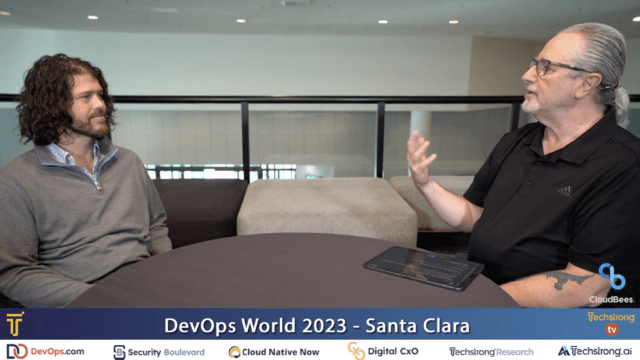
Sacha Labourey, CloudBees | DevOps World 2023
Sacha explores the answers to questions such as: What types of tasks can AI be safely used for today? What types of tasks does AI have the potential to take on, in the future? How can it enable developers to be more productive? What are the gotchas or things to watch out for when using AI? What things do platform engineering and DevOps teams need to do to evolve along with AI?
Transcript
This is Textron tv. Hey there. Welcome everybody.
Welcome back to DevOps World in Santa Clara, Silicon Valley, 2023. Uh, another great interview lined up. It's always a pleasure to talk with Sasha Lare, good to see you again.
Good to see you, Mitch. How are you doing? Very good, very good.
Yeah. Sasha is, um, chief Strategy officer, co-founder, and played some other roles at times in Cloud Beas. Indeed, Everything was legal.
Okay. Everything I've done was always legal. Yeah, I didn't, I didn't find anything to, to kind of throw away.
No, just kidding. Um, you know, there was a press release that's dropped today about some, uh, research, some information that, uh, report that you all created. Tell us a little bit about that and maybe some the things that were interesting to it about It.
Yeah, I think it's, uh, uh, all of the discussion around platform engineering is getting a lot of, uh, a lot of visibility these days, and I think it's a natural progression of, uh, what we're seeing with DevOps with cloud and, and, and all of the progress that's happening so fast. Uh, and so we decided to do a survey, uh, around 221, so it's not around, it's 221 respondent, uh, reply to it. So it's not a hundred thousand, but it's sufficient to start getting trends around what's happening.
And, um, we're seeing that it's real. Right? Uh, uh, I think it's, it's only 17% of, uh, of, of companies not caring or not having plans for, uh, for this.
So it means 83% due. So it's, it's real, uh, and, uh, it's, it's impacting the way, uh, companies operate definitively. Why, why do you think that is?
Because, you know, I have the same observation is it was sort of an interesting thing that's kind of happening and all a sudden sort of like SRE it became real very fast. Yeah. I see it almost as a, a period of cleanse for DevOps, right.
Uh, we came up with CI/CD and it gave us lots of, it was amazing, right? Gave us lots of, uh, uh, velocity. We could go fast.
The notion of a pipeline and, and, and continuously delivering to production all great. And it was so great that we started adding more and more to it because it's tempting when it works, why not? Uh, and, uh, and at the same time, cloud went through I think a similar type of, of, uh, growth, which is you start small, you start easy with, you know, initially it was EC two and S three that set Mm-Hmm.
You add services, services, services, and you end up with lots of complexity. And so if you are a developer, you probably feel like your pipeline, your process got slightly quote unquote hijacked, right? Mm-Hmm.
Now you have Cybersec team who have a very important mission. They added three scanners and maybe two other four binaries, right? To, to your pipeline because hey, it's convenient and if you can fix it early, why not?
Yes. Why not? So every decision taken on its own makes sense.
But when you accumulate them all and you look at the complexity, you realize that people are completely underwater and they can barely spend enough time coding what, which is what they were supposed to do. And I don't want to sound like I'm defending developers more than any other practice, right? Cybersec teams, the number of CVEs you see, like I, I looked 10 years ago, uh, it was, uh, a six, uh, of the cvs we're gonna get this year, right?
So six times more CVEs per year, uh, uh, in, in, in a decade. Um, so every function is trying to find options to find solutions on how to help this. And I think platform engineering is a, is a, is a very sane way to do it.
Yeah. You know, in addition to what you're saying, it seems like the timing is right, because to your point about developers, initially when I heard about platform engineering, it was, it's the response to the forgotten the developer, right? We, we haven't been paying attention to 'em.
We've had adding too many ornaments to the tree and it's gotten too complex, but it's a lot more than that with the, uh, kinda economic turmoil, things like that. People were looking at developer productivity for how, how do we do that? Right?
Right. And I think some of the platform engineering has been able to adapt to, here's some things we can do, uh, internal development or environment, standardized configurations, uh, ready made for development test, uh, on into production. You know, you can kind of customize it to what you need to make things more efficient.
So it seems like this is the perfect time. Maybe that's why it's, come on. You're probably right.
Yeah. Yeah. I think you're making a great point, which is, uh, when you see all of the layoffs that took place in the industry, you were 10 on a team, you're five on that team, how you're gonna do it, right?
So you need to, to, to get smarter at what you do. So I think you have a, you make a great point. Um, interestingly enough, I was trying to make some analogies with the past, right?
And, and I feel we went through that, those type of of things, uh, in the past as well. Um, uh, before my life at Cloud Visa, I was at JBoss and JBoss was an open source application server that John Red Hat at, at some point. And, um, it was, if you think about an application server, right?
It was the internet times. And, uh, the questions then quickly became how can we make developers efficient by making sure they know how to clusterize their environment to, to horizontally scale? How do they make it possible to do transactions, two phase transactions?
How do we make sure they can get security rights and authentication and all of those matters, right? Mm-Hmm. And that's what essentially build the J two E ecosystem, um, for a decade, pretty much you had all of those little specifications, and in some way you can argue that the platform engineering with those catalogs of, of, of Lego blocks, if you will, that you can reuse are a bit like the J two E services from back in the days apply to your own organization, obviously, right?
But you want some to handle storage or access to backend systems or front-end development, or what's the baseline for a mobile application. And all of those core services are ready to be used. And so I, I think we're, where anytime there is complexity, anytime we get to the point where you can't just own it all, but you have to collaborate.
And I, I wanna make it clear, it's still about collaboration. Sometimes it feels like, oh, so we don't do DevOps anymore. No, it's still collaboration, but you need to define how faint grain you want this to be.
Does collaboration means that everybody do does everything? Or does that mean you collaborate and help each other in a way that scales? And I think that's really what it enables here.
Yeah. It's all those complimentary, the the greater whole benefits, right? Yeah.
More than one plus one. Uh, anything else, any other highlights from the, the study from the report that you found interesting? Yeah, I, I think, um, people should, should definitively read it first.
It's, it's short and sweet. Um, but I don't think anybody's gonna be surprised. I think to me it was a lot of confirmation on what we kind of know, which is developers want to be more efficient.
Uh, it's not just their boss who want them to be more efficient, they want to be more efficient because it's a lot more fun. Uh, they want environment that can be self-service. They care, uh, about the experience being better.
They also care about security, but not if it comes at the cost of not doing development, right? It needs to be balanced and so on. So you, you see all of those traits and, and I think a lot of organization will find themselves, uh, will see themselves in the mirror when they read this, uh, this, uh, survey.
I was thinking that exact point is sometimes there aren't like shocking information in a report, but it's validation also. Um, you know, when I read those kind of reports, I'm not doing everything that that talks about. It's kind of taking information from a lot of different companies and environments.
And maybe I'm not worried about developer portals right now, but that actually that should be something we look into. 'cause we've been focusing on, you know, other areas. So it helps kind of break down where you might go next or validate you're doing the things that you're doing around platform Engineering.
Yeah, I think it's important. I think you, you're making a great point, which is it's a journey and you're gonna increase your maturity as you go through it, and you will discover new needs as as you do. So I'm always a bit skeptical when people come at it with, oh, I want the full kit.
I've heard I need X, Y, and Z to be a good citizen, so give it out to me. Yeah. Well, yeah.
But then you don't really know what to do about it, right? So slow down, uh, hurry up slowly as, uh, as we say, right? And, and focus on what needs to be solved first, second.
And at some point you certainly need, uh, a, a portal or catalog and, and so on, but at the right point in time. Uh, and sometimes it can be stressful for organization when they need to absorb too many concepts at once to behave, uh, because they want to behave too well in some way. So hurry up slowly and, and absorb as your, uh, uh, the clock of your system, your own DNA can absorb it.
That's some really good news. So I hijack the schedule you and I have the rest of the day to talk about ai. Nobody else is gonna be here, just you and me so we can, you know, six hours of AI conversation.
Let's do it. Can't I can't say it now. I I wish we could do that.
Um, just a few share in some initial few thoughts. What are you thinking about in the AI domain about either how it affects how we develop software or kind of AppSec that we're doing, or there's so many impacts that we can go down. I'm just curious, what's top of mind for you?
What problems are you thinking about? Yeah, to me it's, it's a, it's a huge acceleration for development. I, I'm not yet seeing right now.
Uh, maybe it's gonna be different in, in 10 years, right? It goes very fast. But I'm not worried as some are about the replacement of developers by ai.
We've heard about this with, uh, uh, no code environment forever. However, can I see a huge speed up and an improvement on what developers can do and should do? Absolutely.
We've seen it with copilot. Um, I think a huge part of what we're not seeing yet, but it completely open to this, is how do you help with security? How do you not just detect that something is wrong, but automate the fixing of this?
And I know some of that makes a lot of people uneasy to have, um, statistical model essentially. Guess what should be the right answer. But what we're seeing is that it, it, it's actually not worse in most situations than what a human being would do, right?
Mm-Hmm. So I, I think we're, we're gonna see a lot of of things done, which in, in three years, five years, we'll, we'll think we were crazy to do manually. Uh, it'll be the punch cards of, uh, of the future, right?
Uh, when, uh, granddad explains to you how he was using uh, punch card, well, people will tell you how they had to review hundreds of CVEs every day, see if they apply how to fix them and, and, and so on. It just feels like, uh, uh, absurd. Um, so I think it's gonna be a very positive journey for, for developers.
Sometimes I'm a bit worried, um, by something else, which is I see that the great developers, I'm not gonna define what it means, but we all have in our environments people where we know like they're a lot more productive. Yeah, yeah, yeah. They're really good.
Sometimes I've observed that they're not necessarily the first one willing to embrace ai 'cause they have such power in some ways, such knowledge, and they know they are overhaul a lot more productive than the average Joe, that they don't really need that. But then we start seeing situations where more average developers can act, actually get to a point where they can be as productive or more productive. And so it's gonna be interesting to see how people evolve and embrace this, uh, change is hard, but in that case it might, um, it might lead some to some interesting social, uh, situations.
We seem to always make it through those, you know, there was gonna eliminate jobs. I don't think anybody's crying about card loaders and picking up punch cards that have dropped on the floor. And, you know, we figured out that, okay, it's okay that that job has changed It seems like else.
So yeah. But we'll definitely pursue this topic some more and I hope we have some time to do that on another day. Another place, uh, another tech strong TV channel, if you will.
Well, Sasha's been great, uh, chatting with you. Um, have a great rest of the, the day here at DevOps World and download the report of Cloud. Yeah, absolutely.
com and enjoy the day. Great. Sasha, it's been, uh, fantastic chatting with you.
Be sure to hang around. We're, uh, just wrapping up this conversation, but we have more coming, so don't go away.