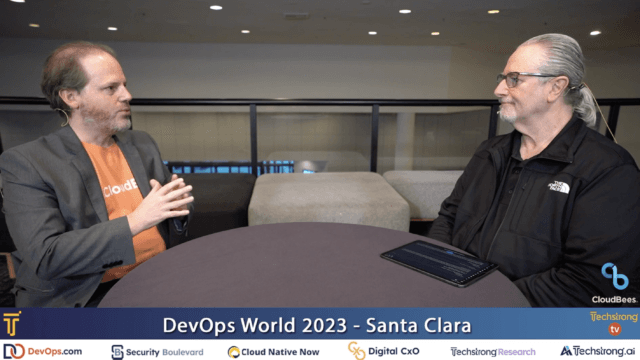
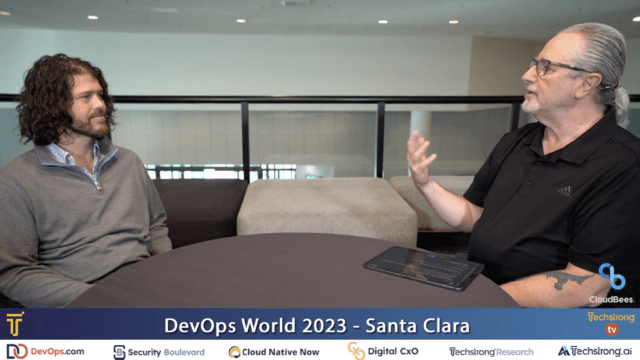
Mark Waite, CloudBees | DevOps World 2023
Mark Waite, Jenkins community team manager at CloudBees, discusses the business benefits of contributing to open source, the organizational challenges that slow or block open source contribution, the dangers of not allowing open source contribution and the benefits of embracing open source contribution.
Transcript
This is Textron tv Everybody. Hey there. Welcome back to DevOps World here in Santa Clara, California 2023.
We're having a great time talking with a lot of great folks, and one of them being is Mark, wait, mark is Jenkins community team manager. There's a lot more to that. We'll dig into what that means.
So, welcome Mark. Good to be talking. We're it's, we're gonna talk to each other.
Don't worry about those cameras. Okay, great. I don't have cracks.
Yeah, They're, they're just in the way. I don't know why we have those things, so, no. Uh, so tell us Jenkins community manager, unpack that.
'cause you have some leadership roles, you have some community roles, you have some software roles. You kinda like do everything. Yeah, so I, so I am, I am, I'm a manager for cloud use and that's, that's my title.
Right. I'm a manager, but in addition to that, I'm also a member of the Jenkins board, the governance board that shepherds the Jenkins project. There are five members of that board.
They're elected every two years. My current elected service actually ends in December, so I hope to be reelected. Mm-Hmm.
But Jenkins board is one of my roles. The other is, I've, over the course of years become a Jenkins core maintainer. So Jenkins has at, at its core, a central component that then we add plugins to, and as a core maintainer, I worry about it keeping stable.
Then I'm the maintainer of the Jenkins Git plugin where people who use GIT for source control use this plugin that I maintain to get their job done. Interesting. So kind of natively have git implemented in their environment.
It does. Right? Yeah, exactly.
Interesting. So, so kind of popping back to the board level, what are some of the things that the board issues or strategies or things the board level works on? Well, so the board, the board worries more about governance kind of topics.
Like are we keeping compliant? Are our licenses that we're using correct and accurate? Do we have the correct funding for our infrastructure that supports the 300,000 Jenkins controllers that are installed around the world?
So board level topics are not, not deep in the sense of heavyweight work, but they are important in the sense of keeping the project itself very healthy. Mm-Hmm. Yeah.
You wanna make sure that, you know, everything is in place to continue not just what you've been doing, but continue to improve and grow and Right. Exactly. The needs of the, You know, the world's changing, I mean, the world of open source has changed.
You think about companies, you know, um, you know, harness has taken some things back in, right. Red Hat has taken some, so there's, there's kind of a, a shift underway at least, at least in some areas. What do you think about those kind of situations where people are taking it back internal less, just kind of, you know, open as in free?
Yeah. Well, and, and I think, I think it's an interesting, it's an interesting shift in the, the open source software market, right? It's an interesting change or mutation as companies find that they're trying to find their path forward and the Jenkins project has chosen a particular path forward that guides it to keep its independence.
Other, other projects are choosing different paths. But I like the way that Jenkins has chosen to do it, specifically because it's safeguarded against some of the things that have happened in other projects. Mm-Hmm.
You know, some of it, maybe a lot of it is to what kind of open source business model, if you want to call it that. Correct. Works with the open source strategy that the, the the code, the, the team, the people Charge it.
Well, and it's a, the, the open source business model is a, a complicated challenge, right? It's, yeah. CloudBees funds my work and CloudBees needs to be profitable.
And so there is a business model that has to happen. I think it's valid. Yeah.
There's, there's always that dilemma of, you know, free version, but it's not ev not it's kind of crippled version versus No, it's free version. And there are other things that we do as a commercial offering, which is, you know Right. I think a good model that CloudBees has.
What, so, so community part of it. What does the community team manager aspect mean? Well, so in my team, we worry about making sure that the Jenkins infrastructure is healthy.
We worry about making sure that people know that they can contribute to Jenkins. So we have a, a developer relations role where we worry about how do we persuade people that they in fact should contribute to Jenkins, and why should they contribute to Jenkins and how can it help them to contribute to Jenkins. So those, those are two parts of my role.
And then I've got another part, a small team that actually does dedicated development. Very cool. Very cool.
Um, so we were kind of analogizing your role as the skipper. You kind of play multiple race is gonna stick, kinda have a little bit of, bit of fun with that, but, you know, there, there is a, because when you think about that kind of a persona Yeah. It's a leader.
It's someone that people are, are, are taking some direction from and following, but, you know, they're on deck. They're, they're part of the part of the crew. You know, they're part of making it happen.
And, and it's not just sitting in your cabin, you know, reading charts. Right. Exactly.
Yep. That's what it sounds like a pretty good description of your role, especially remaining maintaining the GIT plugin. I mean Well, And, and that's okay.
There are, there are different levels to manage that. Right. And I, I happen to like technical things and I've been unwilling to abandon technical things and that, that may not be healthy for a manager to choose to not drop behind their technical.
But for me, it's worked. I enjoy technical, Don't tell my team that, but Right. I, I enjoy technical things and therefore my team puts up with the fact that sometimes I put my hands into things I probably shouldn't.
Well, You know, as long as they help course correct. When you get Too farfield. Right.
Exactly. You're Good. You gotta have a good, good team behind you when you do that or with you.
Um, so how long have you been doing this as part of Jenkins community and ecosystem? Um, let's see. I think I first started contributing to the get plugin in 2007 or 2008.
Wow. And I joined CloudBees about six years ago. So you figure it's been, I've been, I've been involved for a while.
You have been? Yeah. I mean, talk about a lifecycle evolution of Jake Hudson, Jenkins and kind whole thing.
Right. Interesting. What, what do you see as the future for Jenkins?
What's, what's, where's it going next, do you think? I, I think what we're gonna see is continued growth. Just like we've seen, we've seen strong growth steadily for multiple years now of regular growth in terms of the use of Jenkins.
People just keep using it. What we're seeing now is refinements to the user interface. So user experience is increasingly important.
Now, when I first started using Jenkins, the user interface was the thing that actually attracted me because it's competitors at that time had no web interface at all. And here I was with this webpage that I could use and interact with. Well, webpages have gotten a lot more sophisticated as time has gone on.
And now, now we're used to running full apps in our web browser and Jenkins user experience will continue to evolve and improve. We've got some really exciting things coming out of those improvement efforts Back, back in that day. Uh, real developers don't use webpages.
They use command lines. Right? Yeah.
Is that, remember that argument Isn't, isn't that terrifying? Yeah. To think of that and now, and now we talk about, wow, there's an awful lot going on inside that web browser.
And the reality is there is, right. People like Google have revolutionized how we think about applications and where we run them. Yeah.
And think about APIs and how we, you know, leverage tools through APIs, not just scripted batch, you know? Right. Bash and, uh, Pearl Scripts, python scripts, whatever it might be.
Uh, what do you think about, um, it, it seems to me one of the things that will con has helped continue, uh, the kind of the lifeblood of Jenkins is some of the enhancements that CloudBees has come out with around HA and hss. 'cause a lot of organizations who have been using it for a while have grown to a point where they've bumped up against some, how do I, how do I scale this any further? I've got a lot of teams using Jenkins.
Yeah. I need some fail. I mean, this is mission critical, right, right.
And, and, and it's served us well so far, but we have to continue to grow and kind of keep pace with what we're doing. It seems like that helps bring it back up to, or bring it to a place where what, you know, higher end or, or higher usage customers, users need from Jenkins. Yeah.
Well, I, I like the, I like the comment that was made earlier today noting that in many places, Jenkins is critical infrastructure. Right. It's, it's critical.
But wait a sec, it's open source. Ah, yes. It's open source and critical infrastructure.
It's, we could tell the similar story about Linux, right? Mm-Hmm. It's open source, but critical infrastructure.
Right. And so we will see, and I expect to see continued development of supporting that role as critical infrastructure, right? We'll, we'll get more and more things about how do we keep this reliable?
How do we keep it confidently running all the time for these businesses that depend on it, for their deployments, for their integration work, for all sorts of things that they do with Jenkins. So, so kind of thinking back, what do you wish the mark wait of 2007 that started on this journey knew that, you know, now if you could like reverse, you know, pause the tape, roll back and, you know, reverse rewind. Okay.
Start tape over a little bit of a change on path. What would you do differently? I would get involved sooner because I was, I was afflicted by the flawed notion that only gurus contributed to open source.
Oh, Interesting. Yeah. Yeah.
And that only the experts, I was clearly not worthy. You're Not Linus, you can't Do this. I, exactly.
That's the way to say it. I am not Linus. I cannot possibly contribute to open source.
I'm not kosuke, I'm not Jesse, you, you pick the name. Mm-Hmm. I'm not this guru expert.
I can't con as it turns out I was wrong. Right. Mere mortals like me can and do contribute to open source.
In fact, most of the people who contribute are mere mortals like me. Mm-Hmm. But I didn't realize that the 2007 me didn't see that there is in fact an awful lot I can do just by doing little things.
Interesting. And, and from that lesson, now you can help others, right. Who might also have that, you know, imposter syndrome of I can't do this.
I'm not capable actually you are. I well, and I like, I like that phrasing, the imposter syndrome concept. Because far too often we mistakenly sell ourselves beneath what we could do.
And it, it actually harms our own progress and the progress of others. Because there are things that I can do that help. And if I can do them, it's good that I do them.
If people want to get involved with Jenkins, how, how do, how would they, if I'm sitting here watching this, uh, stream or a recording of this saying, I would like to do that. I guess maybe I could, how would they connect and, and pursue that idea? io/participate.
That's a webpage and it's got about 15 or so boxes on it of different ways that you can participate. And what they do then is they choose one of those they think they are interested in, and it's intentional. Don't ask, what's the most important thing I can do, ask what's the thing I am personally interested in doing?
And do that thing because inevitably, yeah, there is something to do in that thing. Maybe you like writing documentation, maybe you want to do UI design in, in, in JavaScript. Maybe you think I'd like to learn more Java.
I learned, learn how to write more tests. Any one of those things I just described is a perfect way to participate and would benefit. Great.
Well, let, let's kinda look forward. What are some things you haven't gotten to do yet in the Jenkins community and working with it? Is there anything you're like still something?
I would love to get a chance to work on this. Yeah. Okay.
So I've not done, I've not personally done any JavaScript work and I'm actually a little bit scared. Okay. It's showing I'm dating.
We all have our own. Yeah, Right. I'm dating, I'm a little bit scared of it.
And, and I think that might be a place that someday I'd like to go wander around in JavaScript. We just did some major, some major work that we just delivered to fix, to remove a particular old library. And that required development of some JavaScript skills from people who didn't do JavaScript before.
And so for me, me personally, I think I may want to try to do some more JavaScript. Interesting. You know what?
There's a webpage, it's slash participate. If you can go to that page and you can Thank you. Thank You.
That's very kind of you. I appreciate that. Why Didn't I think Of that?
Yeah. It took this, this time, this place, this conversation to like light bulb. All right, I got it.
I got it. Well, thank you for all your contributions. Thank you.
And everyone who's contributed to Jenkins and, and not just keep it alive, but thriving, you know, it's such an important part of our ecosystem and, you know, will be, you know, I think it's a, it's a great thing that we get to continue to benefit from all that hard work and contributors and, and leadership like yours. So, and thanks to CloudBees for supporting you and doing That. Thank you.
Alright, Mark. Mark, wait. And by the way, seriously, what was the, uh, web address if you want, if you're like sitting there, I would like to work on some JavaScript.
Maybe I would like to do some testing or write some documentation. What was the u RL again? io/participate.
Great. Go there. Just right.
Mark wait. Sent me and you'll have an in. All right.
Thanks everybody. Thanks Mark, for joining us. We have some more interviews.
This is, we're not even close to done yet, so hang tight. We're gonna be back with more great interviews, more great topics in talking all kinds of great things. Tech.
We'll see you in just a little bit here at uh, DevOps world.