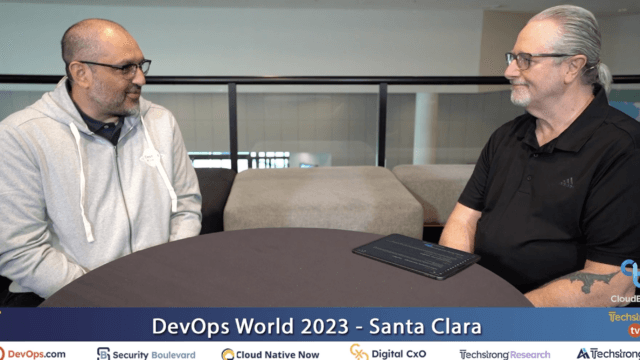
Daniel Ritchie, Brain Wave Collective | DevOps World 2023
AI advancements will wow us and dramatically change our world, but immediate opportunities abound. Daniel Ritchie of Brain Wave Collective discusses with Mitch Ashley.
Transcript
This is Textron tv. Hey, welcome back to DevOps World Mitchell. Ashley here with Techron Research.
You know, we've got a really cool segment here and a guest that I'm, I'm extremely excited talking about and, and kind of going into this conversation, we're gonna test some boundaries. We're gonna test some assumptions and kind of talk about how things might be changing in some pretty fascinating ways. I'm joined by Daniel Ritchie.
He is founder of Brainwave Collective. Mm-Hmm. Right.
Did I get that right? That's right. Excellent.
Well, we'll get to what Brainwave collective is, and I know from chatting with you, so lemme set, set up the conversation this way. My own observation is when something truly disruptive arises on the scene, you talk about AI or generative ai, it, it isn't the job loss or job changes. Yes.
All those things are kind of happening, but when you remove a constraint, something that changes the constraints or moves it to somewhere else, that's when pretty compelling. That's what makes it disruptive. Yes.
Not that just that, you know, I could develop 10 times more code. Mm-Hmm. Well what does that mean if I could do that?
And it seems to me that's, that's why we're kind of curious about generative AI and AI in general, and, and, but not really sure either. So who knows where that constraint will move to. So I'm curious your thinking about how are things changing startup entrepreneurialship, you know, I've started at eight companies done that myself.
And, you know, you would probably wouldn't do it the same way today, you would 10 years ago, 15 years ago. Absolutely. I, I, I think the, the really short version of this is just that the technologies have advanced in such a way that things, which even a year ago were out of reach or impossible for a small business.
You wanted to solve a major problem. Um, turns out we're doing things today that we never dreamed we could do. Uh, I'll give you an example of this with peptides and, you know, insulin was the first solution that we had for how proteins, you know, work within our body and we can affect that in a positive way.
Well, that was a hundred years ago. Uh, we, we maybe figured out a small percentage of proteins within our body and how that works. And then a couple of years ago they released alpha fold, which has pretty much all of them now mapped out.
And, and this is something that happened very quickly. So we may have previously thought of a startup as requiring a, a massive institution that we're gonna have to build out over years, and we're gonna have to leverage all these powers that we're gonna have to put together and assemble. I don't think that's necessary anymore.
I think we can, you know, there's hard things are hard, that's not gonna change. But what we're able to do with the same amount of input, with the same amount of effort is dramatically, dramatically more Interesting. Well, well, let's talk about that.
So what are the, what are the new constraints or what are the things that aren't constraints anymore? And we, we shouldn't go into doing a startup company thinking about these the same way we we did before. Well, you know, generative AI right now is kind of all the rage, right?
We're, we're seeing multimodal generation. It's, it's, it's images, it's voice, it's text, it's, you know, you can sit down in front of chat GPT or one of these, you know, LLMs. You can sit down in front of one of these LLMs and you can just say, I want you to do this.
And it will generate that. And now they're incorporating the multimodal pieces, right? So if you now have the ability to ask a machine to produce something for you, I mean, I feel like code is kind of that way.
Like, you know, the power of technology is we can sit down and develop wonderful things. Well now we don't even have to go through the trouble of developing it. We have a machine that can do that development for us.
So this ability to just ask for something and have a robot create it Mm-Hmm. And have that be accessible to kind of everyone. Right?
This isn't, this isn't something that you have to be one of these well-funded, you know, fully backed, researched institutions. Uh, you know, you, you don't have to be three decades into doing this to have a chance you can go create an account on one of these publicly available models and start doing things immediately. Right?
I mean, that, that ability to tap into that I don't think has ever quite been available Mm-Hmm. In the way that it is today. And certainly not as widespread.
Uh, you know, every, every one worldwide suddenly has access. Not, I should be careful. There is, uh, people that don't all have access to these things for a lot of reasons, and we should acknowledge that.
But, uh, for the people that can access these things, it's, it's whatever you can dream, whatever you can imagine putting together is, is now possible. And it's not just that it affects a certain class or type of person. Um, if you have experience, if you have domain expertise, obviously that gives you a bit of an advantage related to that.
But this is something that, you know, you see benefits from everybody from, you know, the top of the food chain, CEO, all the way down to the lowest level employee or someone that wants to expand their horizons or try new things. It's, it's accessible in a, in a way that I don't think we've really had before. So that, it's Interesting.
We, we created constructs like minimum viable product, right? Mm-Hmm. To try to align what are the most important things to get to market to learn.
And I know my own experiences, oftentimes you have to kind of rebuild the product two or three times before you get it to the point where it's right for the market can scale or whatever. You take that constraint away. Like, maybe I don't need an NBC, I need four of them, right.
Of different parameters, and let me try those. I don't need to rebuild it myself. I can ask it to be rebuilt this way or that way.
Test it. I mean, so those, those are things that, you know, you, you take the time, you know, what would be months and, and how many people worth of effort to rebuild, retest, and to find out that wasn't you learned, but it wasn't the solution or a place that you needed to be. You could make those experiments and days, maybe weeks must be sometimes hours.
Massively. That's Massively, that's huge. That's a major change.
It's exciting. And, and you, you also mentioned the accessibility. Mm-Hmm.
You don't have to be an architect on cloud native microservices, Kubernetes to go figure how to deploy, deploy it in whatever cloud service. Mm-Hmm. You know, you can set up a virtual environment for you to play it for you.
You Know, we're absolutely getting to the point where these things are just gonna magically roll out for us. It's, it's the dream of, I just wish something would happen. And it does.
Uh, I, I, you know, less than 1% of the population knows how to write code, which I, I, I think about that. You know, everything we've ever touched, that's technical, right? These cameras and all the equipment and the iPad and everything else, everything was written by less than 1% of the population.
Mm-Hmm. So now you have something where you don't even have to be technical to have access to create these types of things. Now, you know, if we're talking about large scale production and other things, I mean, there's, there's a gap that we're gonna, There's specialized knowledge for sure, specialized Knowledge.
You're still gonna need people to do that. But what does our, what does our world start to look like when more than 1% of the population is now able to, we could you, You lower the barrier to entry, right? The entry point to do kind of the early things for sure.
Mm-Hmm. So talk about brainwave collective then. I have imagined there, imagine there's a connection between what you're doing with Brainwave Collective and some of these ideas.
You know, that that is, this is a lot of the inspiration. You know, I, I think about the, the traditional approaches that we're familiar with you. You kind of have two options, right?
You, you go get a, a, an hourly wage from an employer and you're contributing for them and, you know, building products that they're interested in. Or you go and you co-found something I'm, I'm inspired by, you know, uh, we'll call it, you know, the Thomas Edison kind of factory model, you know, bell Labs, things like this where you have wildly creative teams that are just en envisioning and inventing things that, and way beyond what we know today. If you were to go back just a couple of years, putting something like that together has to be well-funded.
It has kind of this ambiguous outcome. You're not really sure if it's gonna play out. I'm thinking with the brainwave collective, we get some talent together who understand their domains, domain experts that can produce incredible things.
Now, nights and weekends can be a production product in just a few months. So what if we understand how all of this works, generate the most wild, wonderful creative ideas we can come up with? What, what could we possibly invent if, if we remove the, the limitations, right?
Take those constraints away. And now you don't need to be well funded and spend a year or two building a product out. You can be bootstrapped and just kind of hacking away at something for a few weeks and find out whether or not you've got something that has a chance of being really successful.
Interesting. So I imagine, um, you don't wanna constraint what constraint, what brainwave can elective could be. You want it to evolve to what it's gonna be.
What do you think some of those outcomes might be? Not that you're gonna direct it to that, but what are some things you've thought about in two years or three years? It could look like, you Know, my, my DevOps background plays directly into this.
I think about our DevOps focus on culture, right? Uh, let's create fertile, fertile ground, right? Let's create an environment that's generative, a culture that's generative.
And we encourage people to explore whatever wild ideas they have, whatever's in their heart that they like, oh, I wish I could, et cetera. You know, almost that like childlike, inventive play of discovery and exploration. You know, can, can we create something that says, choose your own adventure, something that you're curious about, something that you're excited about, just go off and build and do and see what happens.
I think the answer is yes. And for me to be able to suggest that I have any idea what's possible when you come up with something like that, I think it's gonna be, I think pe people that maybe don't have those technical backgrounds are gonna come up with amazing solutions. I, I think I want people to explore, you know, the impossible dream about things that can't possibly happen.
And, you know, I'm not, I'm just one mind in all of this, you know, I, I I'm not gonna be, uh, so pretentious as to say I have any idea what that looks like. I hope it's beyond my wildest imagination. Yeah.
I hope it's better than anything you can imagine, right? Absolutely. Absolutely.
Interesting. It, you know, it kind of reminds me of Xerox Park, sort of that kinda laboratory of people with different disciplines and let's see what we can create. And I think all the great things that came out of you, we all user interface that we use today is just one of many, the, the, uh, laptop.
It's an idea that Alan Kay thought of as part of Xerox partner. There's so many inventions that were created just 'cause they were thought of in that kind of environment where we don't have the constraints that we would have if we were part of that product development team, part of that product spec that we're building to the market, you know, analysis and testing and the normal process we would go through. So Humans are capable of incredible things.
So we're, we're not building the solution. We're building the runway and whatever, whatever people wanna do with that, wherever they want to go. Mm-Hmm.
I, I hope, I hope we make magic happen. This is the, this is why this is such an exciting time for me. We now suddenly across so many domains, so many levels, people worldwide are suddenly an and immediately able to, to leverage these, these new technologies.
What, what, what's gonna come outta that? You know, it's, it's going to be something amazing. So why not create an environment that fosters that growth and that creativity and, and watch it, watch it blossom, watch, watch amazing things come out of it.
So let's say somebody listening in, watching in, here's this today, or a recording of it, and it, it's like, I'm, I'm jamming with what you're saying. Like, I, I, I think about that and I want to be part of figuring this out. Can, can other people participate?
How do they join in? How do they connect? Absolutely.
ai. Uh, we do have a website. We are on LinkedIn.
There are other options for participating. That's probably the, the SST safest way to, to reach out at the moment. Uh, we're currently making membership available to the public and uh, that'll be coming very soon.
People can join and it's really contribution based, choose your own adventure. The more you give, the more you get, the more patronage you earn. We can have individuals, we can have businesses, we can have direct contributors, we can also have investors as members.
And this really is a really robust, uh, ecosystem that we wanna want to create. So anyone who's interested, feel free to reach out to me and we'll make that. And they can, with their contribution can be in a lot of different forms, right?
Absolutely. Absolutely. Yep.
Can be technical, non-technical. It can be financial, it can be time, energy products that you're creating. There's in kind contributions that we're talking to some companies about as well.
So a lot of opportunity. Absolutely. Well, good luck.
I'm in Denver too, so we'll keep tabs on looking forward to that, how things are going. And we'll get back together again soon. So, fantastic.
ai, right? Yes Sir. Check it out if this, this pictures your interest and I know there are people out there who will go, like, I've been wondering why somebody hasn't done this yet.
Mm-Hmm. I wanna find out more. Definitely check it out.
Fantastic. Alright, well, good luck. Wish you all the best and let's, thank you so much.
Let's keep tabs. I, I definitely wanna find out how this is going. Awesome.
Thank you. Where you're added. Thank you.
All right. See, I told you this would be different. Not like anything, you don't get this anywhere else but on Techstrong tv.
So we have some more interviews coming. We're not finished yet. We got a lot of great people yet to go.
So please hang in there with us. Stay tuned. Uh, don't go anywhere.
We'll be back in a few minutes.