The Importance of Cyber Resilience with Commvault’s Kevin Zawodzinski | AWS re:Invent 2023
Commvault’s Kevin Zawodzinski discusses the importance of cyber resilience across all hybrid cloud workloads and the best ways to simplify and cost-optimize cyber response and recovery at massive scale in AWS and hybrid cloud environments. In addition, he shares some user best practices for gaining better data visibility and how unified protection, recovery and portability with cloud-native de-duping can dramatically cut TCO in any cloud environment.
Transcript
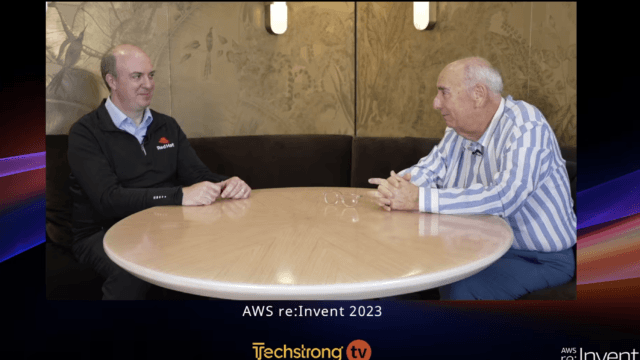
This is Textron tv And we are back streaming live from Amazon Reinvent 2023. I'm she Rubinoff, chief Cybersecurity Officer for Techron, and I'm happy to be joined by Kevin from Commvault. Kevin, a pleasure to be with you here today.
Thank You. Pleasure to be here. Appreciate The time.
Kevin and Kevin, please introduce yourself to our audience. Sure. Tell them who you are and what you do for Commvault.
Yeah. So I'm Kevin Zinsky. I'm the Vice President of Sales Engineering for the Americas for Commvault.
Excellent. So I had the pleasure of being with Commvault at your shift conference in New York City a few weeks ago. Uh, I'd love for you to give our audience a little recap of what the Shift Conference was and what you announced there and what you were able to, uh, get outta the conference.
Yeah, Absolutely. So there's quite a bit we announced, of course, so I won't get into a lot of specifics. Sure.
But ultimately it's really about how we're railing around the cyber resiliency side of things. So as customers look at what they're doing from a risk assessment side of things, how they're gonna respond and how they're gonna recover. So everything there from, how do we do from integration with ai?
Mm-Hmm. Right. So AI driven support, AI driven, uh, understanding of your data and knowledge to also what we're doing from a cloud perspective.
How do we continue to evolve that? So it's really about how ensuring that we have the shift left and the shift right together, uh, and bringing people together to communicate better as well, and leveraging the right tools. Well, it was an excellent conference and quite a bit came out of that, which was well received, that's for sure.
Mm-Hmm. And I know you made some great, uh, announcements here at AWS Yeah. And some co announcements.
Would you like to share that with our audience as well? Absolutely. So the biggest one right, is really around S3 Express one, right?
So we have, uh, excuse me, AWS announced that earlier today. Uh, we're, we announced immediate support with that as well. Mm-Hmm.
So just to showing, uh, our customer base and the industry, you know, as they move and the flexibility and what they need, where they're with them. Mm-Hmm. We're obviously working with AWS and other vendors, uh, all the time to ensure that as they move their technology and their, their posture forward, we're there for 'em.
Very good. And you know, one of the things that, you did talk a lot and you do talk a lot within Commvault, how do you safeguard your data in today's rapidly evolving cyber landscape threat cyber landscape? Yeah.
So part of that, uh, as mentioned back to the risk assessment Mm-Hmm. Understanding, you know, what we're doing around the readiness side of things and recovery, and it's really about how we get into what we consider architecture matters, right? Sure.
So when you start talking to a lot of different customers and everything else, we have tools spread, right? We have a lot of different customers that have looked at how do I solve a problem? And it may be tactical or niche.
And looking at, uh, again, a lot of the tools and with the cyber world, it's even more interesting because it's, it adds not only to what's your threat vector, right? So how much threat do you have in the landscape, but also can be negatively impactful to your recoverability. Right?
So using those tools Yeah. Well Also understanding what your threat vector is. Yeah.
And I know that you're able to, to provide that for your customers as well. Absolutely. So yeah, so looking at things, again, on the risk assessment side of things, mm-Hmm.
What are we doing around anomaly detection, but also about how we can use things to do lures and things of that nature to understand the threat landscape out there. Right. And feed that back into the, the other tools, right.
In the other integrations we have, Well, that's very important since a lot of companies do struggle to really understand what their full threat landscape is, and now it has expanded tremendously. Yeah. And I know you talked about that a lot at the shift conference, and can you give a little more insight into that?
I know that our audience would really appreciate understanding how you're able to give visibility there. Yeah, absolutely. So, so first I would say it starts with communication.
And the biggest piece that we see from a communication perspective within customers is that, uh, there's some breakdowns, frankly, right? 30% of leadership is involved in cyber resiliency planning today, only 30%, right? Yeah.
So big, big exposure there. Sure. While conversely, 60% of them believe that in the next 12 months they're gonna have a data loss problem.
Right? Exactly. So first Ena enabling that communication side of things and then saying, okay, how do we align the data appropriately to make sure it's feeding the right systems at the right time?
Again, even preemptively, as you mentioned, right? Looking at it so we can look at cleanse data, do we have clean data? And then obviously how do we, uh, help them recover?
So it's really about the full gamut of things and making sure that everything's connected there. Well, you're definitely hitting on the ma major pieces in cybersecurity, being proactive as well as reactive and really highlighting the need for being proactive in your cybersecurity posture. And that's something that everybody is taking note of and realizing that they need that.
So certainly what you're doing is very, gonna be very well received and is very well received. Yes. So let's talk a little bit about differentiators within the industry.
You know, mm-Hmm. Different companies will say, why Commvault? How do you stand apart from your competitors?
Yeah, no, thank you. Great question. Sure.
So, so the big piece, uh, one of the largest pieces is our flexibility. Mm-Hmm. Um, so I mentioned the architecture matters a moment ago for us, we're not worried about, um, fitting into our architecture, so to speak.
Again, it allows us to partner with people like AWS like HPE, Dell, vast, pure, many others to say, Hey, if you need the flexibility, depending upon your needs as a customer mm-hmm, we can support you. Right? Yeah.
We're not locking you into a closed architecture. Uh, which also allows us to continue to evolve, right? Again, I mentioned the announcement today, uh, but also even integrations that we announced actually at the shift events like integration with entrust CyberArk things, uh, different organizations like that who, again, from a security perspective, Databricks, how are you going to look at your AI driven data?
How are you going to use your data most effectively? And how do you tie that back into again, the best posture you possibly can have? Oh, very interesting.
I know I always like to ask leadership in, in the cyberspace, what are some tips you have for our audience and really could come from anywhere, but what are some tips that you think about that really people should take note of? Yeah, yeah. I think first it's taking a step back and, and talking about that communication side of things.
Yeah. And we talk a lot about the human aspect of things, understanding first what's important to your business. And sometimes people are surprised when they go through an event what's really important to them, uh, and what's nice to have, right?
So understanding that having good communication with the line of business, but also internally. Uh, and then with that, again, that flexibility side of things, understanding the ecosystem that you have. So if you're using different vendors for a good need, right?
So again, you know, talking about Pam, control with CyberArk and things of that nature, understanding those things and how does it integrate to the ultimate outcome you want? So it's, look at your systems, take a step back, make sure you're communicating effectively and making sure that you're integrating again in a thoughtful way Yep. To reduce that sprawl as well.
Well that's again, hitting on the nail on the head. You're talking about the people, the process and the technology. Exactly.
Having the right technology in there, having the communication, dealing with the people, the human aspect, which is critical, and the glue between the process. And you've covered that as well. So you've also discussed with me earlier that shift is going on the road.
Yes, absolutely. Please, please expand, tell our audience where they could find you, how they could look you up and what they could expect to see. Yeah, absolutely.
So, uh, as we talked about, shift was a, a great event in New York a few weeks ago and we, uh, we had a lot of announcements and everything else. So we do want to take it to the road, we wanna make sure people are able to hear about it. We are launching it coming into January, February timeframe.
I believe the first one in the US is actually Dallas. com. Look that up.
Look for Shift Road events. I'll be at many of them and look forward to meeting many of the people out there. Well, That's wonderful.
And to our audience, please look them up and you'll get to meet Kevin. So you definitely should take a look. Well, Kevin, thank you so much for your time.
Thank you. Thank you. And thank you for our audience to tune in and we'll be back shortly.
Thank you.