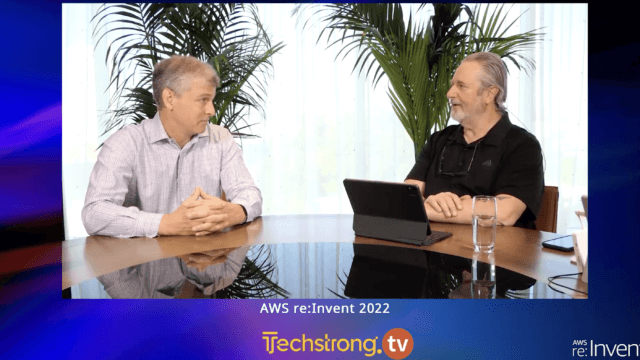
Rik Tamm-Daniels, Informatica | AWS re:Invent 2022
Rik Tamm-Daniels, General Vice President of Ecosystem Alliances and Technology at Informatica, joins Mike Vizard at AWS re:Invent to discuss a new suite of cloud data management tools and services that will democratize data for users within an enterprise. They will also talk about Informatica’s ten-year partnership with AWS and what plans Informatica has going forward.
Transcript
This is texturong TV. Hey folks were the AWS re:invent and we're talking with Rick Tam Daniels whose head of Partnerships in technology for Informatica. They just did some expanded Partnerships with AWS and we're going to dive into that Rick.
Welcome to show great. Thanks for having me. You guys have a long standing partnership with AWS.
So what exactly are you up to now and what's changing? Well, so it Informatica, you know, we as you're right, we've had a long-standing relationship more than 10 years. We've been working with AWS and all our Focus has been about really innovating and helping customers take their data assets turn them into trusted data and and ultimately trust it outcomes.
So we announced this week. We're a bunch of new Innovations with AWS that are really all focused around helping to democratize trusted data to all users in the Enterprise talking line of business users developers data scientists, really taking the power of trusted data out to everyone in the Enterprise. What's your sense of how much data is moving into the cloud or people still have stuff on premises it kind of hybrid because data has gravity, right?
It doesn't necessarily just lift and move by itself. Yeah, absolutely. There's plenty of data still on premises plenty of opportunity to get that data to the cloud.
I think in the early days of cloud, you saw a lot of infrastructure focused shifting of workloads and information today what you're seeing is looking much more at the the value of workloads and the transformational value they can have for a business perspective. So there's a lot of folks on taking core data systems core data warehouses data Lakes bringing into the cloud to create a tremendous amount of agility and ability for customers to kind of Leverage their data which in today's economic climate. It's especially important as well that a lot of companies are finding themselves needing to transform again.
They're facing new challenges new opportunities and data becomes a critical lynchpin and be able to attack those those opportunities and address those challenges. Even before the cloud most organizations were not especially good at managing data few of them would get a Good Housekeeping seal of approval for the way that they manage data. We move a lot of data to the cloud.
We have this notion of warehouses and lakes and then it turns into a swamp. Yeah. What are people missing here?
What's the thing that they should be thinking more about as they kind of think about moving data into the cloud. What's that thing that drives you crazy? Because they just it's a misstep and everybody does the same thing wrong.
I think one of the the biggest things is is look too big points for customers. They understanding first of all, where what end state are they heading towards right where they heading? Where's the vector not just throwing a bunch of stuff into the cloud and hoping magic comes out of it.
It's actually understanding. How am I going to deal with things like data Discovery data cataloging, how am I going to govern all this data and make sure it doesn't become the data swamp and and we had Informatica a lot of those customers you mentioned in the on-premise days. We help those customers really get a handle on their data and really help scale the data we've done the same in the cloud and over the last five years.
We've invested more than a billion dollars with a B billion dollars in R&D Building a fully Cloud native data management capability that helps customers get started quickly that also realize the full supply chain and life cycle of data that they need in their Enterprise to successful with these data-driven initiatives Do you think that we're living in a multi-cloud world or are we moving towards a hybrid Cloud world where we're actually going to build applications that access data that resides in multiple places because it seems to me most people are doing what I would call multi-cloud but they're far from hybrid cloud. I would say yes, we're seeing all the above. Right?
So we do see a lot more customers who are on a multi-cloud journey. They're also they're gonna live in a hybrid state for a long time as well. Right as they start to move systems incrementally and being able to to manage and govern a data environment that is distributed is a critical requirement for almost all of our customers.
Can the day we used to the code would go to where the data was and then seems like for the last 10 years. We just been moving data up into the cloud and kind of hoping that the code will follow suit, but do you think we're gonna see more application development on the cloud itself where the applications are going to reside there where the data is because ultimately, you know, the laws of physics have not been suspended right? We need to be late and season issue and we need the code as close to the date as possible.
Yeah. Absolutely. And you do see a lot of traditional applications being moved to SAS and Cloud native, you know, it's I think it's really important and we see also on the analytics and AI side of things in particular as well that work is happening where the data is.
It's happening in the cloud and actually one of our big announcements we made this week was around taking the data management capabilities of our intelligent data management Cloud platform and bringing them to developers inside of Amazon sagemaker, right? So we're actually bringing the capabilities of data management all cloud. Of making it available to those those users who are actually taking that data and getting results from it.
Right? So it is very important to have these both kind of move at the same time. Same reason.
Also you don't just move your Warehouse that your data management, right? It all needs to become Cloud native. It needs to go to the cloud at the same time to have the best most efficient management model for your data and analytics we hear a lot about data Ops these days or you seeing folks adopting what a peer to be best practices for data management and why now, I mean, we've been having this issue forever.
Well, I think right now the the data Community if you will inside an Enterprise is probably more more expansive and more complex than it's ever been. Right? And so you really need to have a holistic Frameworks that tap that really connect the data producers with the data consumers, but do it in a way that creates governance and efficiency doesn't create a lot of data duplication, right?
You don't want data swamps. You don't want data silos, right? You really want your your Enterprise be able to access.
Its data understand what it has understand what that data means to the business have trust in it and then get access to it. And that's exactly what we're doing with our fully Cloud native data management platform. There's also all these data scientists in the world now and they're trying to manage data.
Where do they fit in with the traditional it organization in terms of how do I bring these cultures together? Well, I think it you kind of tapped on a big team that we see around democratization of data where we do see user personas more personas citizen data integrator citizen data scientists who are out there in line of business. They understand what the data means they're not traditional it central it folks.
And so, you know, they're also very important players in this whole ecosystem and making sure that they can get the benefits of data management and they're not Reinventing the wheel in their tools is really important again this announcement. We made basically takes all the connectivity the the years and years of knowledge about what are common data Transformations. What are common data quality rules and we're putting those directly in the hands of developers where they like to work though where the data scientists like the work.
So they're incredibly important in this transformation affecting it but they also they also need the same kind of data management tools and rigor that the traditionally been needed and with Team developers, of course, they have best devops practices that they are adhered to or hopefully how will the devops teams and the data Ops teams come together and do I just throw them all in a room and lock the door and hope for something good or is there some advice that you can give to Matt put these guys together in a way that's constructive. Well, one of the the big things that this is another part of what we announce this week is around our cloud data Marketplace. So we've created basically think of as a storefront for all the Enterprise data assets and this storefront becomes incredibly important in that data democratization and that it's bringing together the all the knowledge of the data producers the data owners and putting in the hands directly the consumers but also creating the interactions to make sure that we're in compliance with a data privacy policies and things like that and data use is being used correctly.
And so what we announce with Amazon is integration with Amazon AWS data exchange. So awx data exchange is a Marketplace a public data sets about 3,500 different data sets. And so now with this operation customers can look not only their own data through our data Marketplace, but also what's available within AWS data exchange so they can really have a One-Stop shop for all of their data assets, but they have the confidence in where that data came from.
They can see the lineage. They have a lot of trust in the data which becomes fundamental to be able to really use that data as an asset. Are you gonna also work with other Cloud providers?
They would assume that you have relationships with those guys is the relationship different when Amazon versus them or is it all pretty much even kill. Well, you know Informatica occupies a very unique Market position and that we have thousands of thousands of customers. And so all of our customers are across all the clouds.
So we have strategic relationships with actually Four Cloud providers. So, you know AWS, of course and then Azure Google and Oracle Cloud as well most recently and and that's because our customers want to use those different infrastructures and Informatica is uniquely able to go deep into each of those ecosystems which again is part of the announcements these Integrations with AWS to speak to to how much we work closely with AWS product teams to make sure we deliver the Best in Class joint Solutions. And in fact, we were actually awarded this week the 2022 Global design partner of the year for AWS, right?
So that means that we basically engage in the most Integrations Innovations together. So Informatica is able to have strategic Partnerships, but we're also able to go deep in our in those individual ecosystems and optimize data management to align to the strategies and the patterns that are being prescribed in that ecosystem. So ultimately what's your best advice to folks because not only the dealing with excuse me?
Try that again. So once your best advice to folks because not only are they dealing with more data I need water. It's mine.
All right. Well give me that thing there. Can you yeah, one of those will do fine.
Hey guys, I'll just use this Ricola be all right. Sir, the magic of anywhere and you really have alright, this is the last question. You'll be right.
All right, one, two, three, one, two, three, one, two three. All right ready? So what's your best advice to folks?
Holy moly. Don't worry. Let's be All right.
One two three, one, two, three, one, two, three, okay. So what's your best advice to folks who are not only struggling with massive amounts of data, but are also there's more the types of data than ever and it seems like as we go along we keep just adding more and more types of data. We see a lot of video now how folks going to cope with all that what you know, what's the thing that you wish that they would think about now before they get started I'd say two big things one is when they go engage in these initiatives is understanding what business outcomes they're solving for and making sure they're focusing their efforts around their data to drive business outcomes, right?
It's not just data for data sake it's actually to drive the business, right the second thing I think to your point about how do you deal with all this proliferation of data data governance is the lynchpin of that every customer conversation. I have data governance is probably the hottest topic right? But it's how do you achieve data governance a way?
That's not often a silo. That's not one team, but actually truly engages all the stakeholders in the data Community to make sure that again data can be discovered. It can be prepared.
It can be cleansed. It can be Trust. And ultimately delivered to the end users who need it quickly.
Right? I think that's the key here is having that governance to prevent the sprawl prevents a lot of the problems of the past but also as not just a protective measure but also an accelerant something that accelerates the use of data and that's really our focus is helping customers accelerate and and scale the adoption and use of trusted data to transform and drive outcomes. All right as they used to say, you know measure twice cut once it applies to data management.
Hey Rick. Thanks everybody. Thank you so much Mike.
Appreciate it. Thank you.