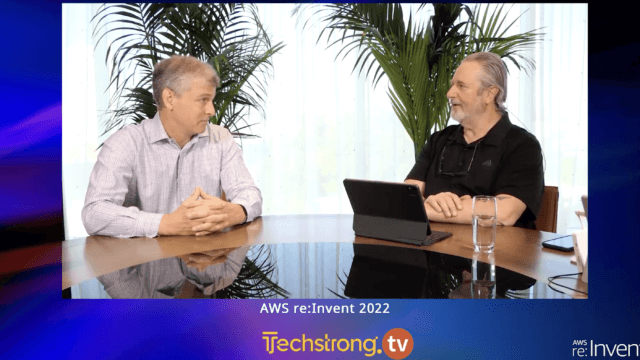
John Willis, Kosli – Damon Edwards, PagerDuty | AWS re:Invent 2022
John Willis of Kosli, and Damon Edwards, Senior Director of Product at Pagerduty, join Mitch Ashley at AWS re:Invent to talk about what the two are up to now as well as how they played a key role in the creation and expansion of DevOps.
Transcript
This is Techron tv. Hey, we are back at AWS Reinvent 2022 here in Las Vegas at the Techron Studios in the Wynn Las Vegas Hotel. They're a really special treat here, and, uh, I feel really honored to be, uh, being part of this conversation, kinda hosting this with some folks who played key role in, uh, the creation and the expansion, growth and definition of DevOps, and the things that, that we just kind of take for everyday normal.
Today I'm joined by John Willis and by Damon Edwards, who you've known each other for a long time. Yeah. And, uh, so let's, per se just say a little bit about what you're up to now.
Mm-Hmm. And Damon, if you do the same, then we're gonna step back and kind of talk a little bit of the origin story of DevOps. Yeah.
Um, yeah. I, um, sort of, uh, I've been working on this sort of, I would call it a pet project for five years now. It's something called automated governance.
And, uh, it turned into originally a paper, and then now it's, uh, actually a bestselling book called Investments Unlimited. And I've been trying to figure out how to turn that into a startup. And, um, and I'm getting too old to do another startup by myself.
And I ran into a company out of Norway that basically had written a product that mirrors the story in the book. So Investment bank fails an audit, and then they sort of DevSecOps their way to sort of improve audit, internal audit, and it risk. The company name is, It's called Costly.
And, uh, and I just, oh my goodness. Like, why do startup, these these people have built? And, and it's very much like, you know, I was early in at Chef, so it was like, I, I'm like the 12th person in, I was ninth at Chef, they had a seed of like 2 million.
These guys have a seed of 3 million. The founder reminds me of Adam Jay. Anyway, long story short, I'm, I'm gonna take one more try at this nice startup game and company costly, and I think it's gonna be a lot of Fun.
Very cool. Look forward to it. Damon, you know, we know you from Rundeck and Yeah.
Yeah. That was one of the, uh, co-founders of Rundeck. Before that, uh, we did kind of operational improvement consulting.
He came DevOps consultants, uh, kind of the origin story that intertwines with John going back to some of the precursors of the DevOps movement, like 2008, some of the early gatherings of people that were, you know, a, along with Patrick's kind of his, one of his impetus is if you ever show up at a, if a dev and an ops person show up at the same conference, one of those people were in the wrong place. Yeah. Right.
Exactly. Remember how crazy is that? Right?
That was natural back then. So we were sort of part of other earlier precursor movements. Somebody did the first DevOps days in the US and all that kind of stuff.
But John and have worked together for years, and we did consulting together. And then, um, uh, Alex Honor and Greg Schuler and I, we founded, uh, Rundeck doing one book automation, which is really about creating self-service, self-service operations. Right.
How do you let people do what previously have to escalate to experts to do, uh, which becomes, you know, it's important enough. And traditional operating models becomes incredibly important in that you build it, you run it sort of cloud native, uh, combined with the intersection of DevOps and SRE, um, organizations. And, um, so yeah, we, uh, built that up pretty quick.
And, um, I got bought by PagerDuty, uh, just about two years ago, um, to really fill out the, the time Flies. That's time flies the automation side of things, right? So PagerDuty is great at letting you know there's a problem, but then where do you go and how do you go do something about it, right?
Mm-Hmm. So we were bringing in the automation to help, uh, that happen. So now I've got a product portfolio strategy role there looking to expand, you know, what PagerDuty does, um, from the signal detection and the AI ops through to the alerting and the schedules and the automation.
But how do you apply that to really all this real time critical work? It's not just incidents that are, you gotta get people together and get the right context and, you know, get things done. And, um, so yeah.
So as the next generation, you know, PagerDuty product line have been worked On. And then let's not forget that from those conversations we had early on, we created, um, a podcast that is still not dead called DevOps Cafe, and I a long hiatus. So you Went on a long Hi Seinfeld.
I think we were trying to set the record for the slowest podcast to get to a hundred episodes. That's the, that's the plaque. We're gonna wait.
It's great. I mean, it's peak we were getting 10,000 Yeah. Mean people, Allen like smacks us around for, you know, your, your fearless text strong founder smacks us around.
Like, you gotta have this thing. Why don't you do more? It?
We're like, uh, It's, it's not dead. When We have something to say, we do it. Yeah.
Yeah. And we try to schedule a third person and then that's impossible. Yeah.
Yeah. Yeah. And, uh, Subtitles like, what's the rush gets?
Or Hey, it's still out there and there's some incredible material over the Years. Well, well, let's talk about the, the, the origin story. You guys go back together, right?
Pre kind of 2010. Um, and you've described to John as you both were kind of searching around for like, what is this and what's going on? And describe that for Us.
We were, you know, there it was this sort of kindred soul thing that was emerged. So we ran this thing called Bar Camp Asem. It's before anybody really to his point, like, how could we get Devon Ops in the same room?
Right. That was like, and so we ran this thing in Austin, and, uh, and I, I just sent it out on the sort of innerwebs, as you will, and not a lot of people showed up maybe under 25, 30 people, but I'd never met, never talked to Damon. And they, they flew in, like these three guys flying, him and Alex, his co-founder flying in, and they're like, Hey, we're here like this.
We want to talk about this. And like that just like set us off for like a beautiful friendship. But also, like right after the gap back, we both like had this kindred spirits, this idea that like, this has gotta be a, he had seen it from like working, I mean, in short, Alex had, I guess said E-Trade had had a dev and ops Yeah.
Early the webscale system management. And he Had built the system that, that, and they were trying to sell this incredible product, pre rundeck control tier. And I don't know, we just, and then we, we'd get on the phone like a lot and we'd just like have our conversations about like, why this is, and then one day I was like, dude, we should be recording this.
Like, and then we started a podcast and just, you know, over the years we've really tried to help shape this. You know, we ran the first DevOps dayss in, in, uh, LinkedIn in the US and, you know, for the first three or four years. Anyway, that's my versions.
Yeah. I mean, pretty, I mean, I think if you think about what it was, everyone was feeling that pressure of, because it's funny at, at a certain point, you know, large, large, like the Lisa Conference large system, I think, I think at one point it started, it was like 200 servers was large, right? Mm-Hmm.
And then it was like a thousand, someone like 2000. Whoa, what's all the big infrastructure, right? I mean, it's, it's funny.
So back then it was just about how do you just scale things up? Yeah. Right?
And then it quickly, it sort of became this, this shift where it scale was no longer the problem. Right? We can, and, you know, you help, you know, Luke ese and infrastructures, you know, Luke and then Adam, puppet founder.
But yeah, all that really kind of helped with this idea that, you know, in fact, Luke's whole speech for the first, I think, you know, kind of year of his public life was if you put a CD in a server, you should be fired, right? And everybody would clap. And so that idea, That idea was like, So we solve the scale problem, then people realize, but wait a minute, the scale problem's not really the problem.
That's table stakes. It's a throughput problem, right? How do you change this stuff?
And how do you get a lot of people to work on it and do it in a high velocity kind of way? And everyone was buttoned up against that problem. And I think we all thought it was a deployment problem at first too, because deployment was like the flash point.
Mm-Hmm mm-hmm. Right? It's where the rubber met the road.
Yeah. And so everybody started to get together to talk about deployment. And that sort of, I think was some of the subtext of early, early, early DevOps about deployment.
Um, um, Well then culture, right? That like we, we, we, I always think it was interesting like years later, um, you know, I say me, but I think a lot of the other community, we didn't realize we were just mirroring lean. Um, and there was some influences, Mary Poppen, Dick's Lean Software development.
But, but it wasn't until like, there was a point in Miami, like where I really dug in into Lean. I'm like, yeah, really? We've been really just doing basic lean for software development, for software deliveries.
So, 'cause Mary, Papa Dick, you know, my friend Mary, you know, but, uh, she is actually a friend, but like, she was trying to take it from software development, right? Lean manufacturing. And she wrote her book, lean Software Development.
Mm-Hmm. We were really, it didn't know it, but we were writing the manifestos or the manifesto for delivery of software. Right.
Interesting. And which then realize it's not a delivery problem. Yeah.
Yeah. It's an organizational problem. That's, it's a holistic problem, becomes Culture.
But that's what I mean, that's the culture. But that was the, the point of like, if you really studied lean, you know, if you went back to Toyota and to, oh no, it was all about culture. I mean, the fact that they delivered 2000 cars, you know, a day was really because that, that there was a culture there that enabled that, Which is how we accidentally came up with the term cams Yeah.
On the podcast. We're like, well, how do you differentiate a DevOps conversation from a non DevOps conversation? From traditional conversation, right.
And we're like, what are the pieces? Right? And we just happened to say culture first, right?
'cause it was like, oh, because, 'cause like, it is a culture thing, right? It's a culture change. There was automation, then it was metrics, and then the last one was sharing.
'cause we're like, 'cause it's like you're this culture of like, you're explaining, and we've noticed that these early DevOps events, people from like, that would be hard core competitors Yeah. Are like huddling on the lunch, on the side, having lunch, talking about these common problems that they're having and sorts the culture of sharing. And then, yeah.
And so then we kind of backed into the, uh, CAMS acronym, and that sort of became like the early DevOps. You remember, like, to me it was, what happened was, we only have guests on our podcast, but every once in a while we'd just sort of banter. And we had just the, the first DevOps days was in Get, you know, I was the only American there.
Um, we, we were, I think we were already doing DevOps Cafe, but we were, we, if we weren't, we were Having, we weren't doing devs, we were doing our conversations. We weren't doing well. We must, must have been.
Well, no, we weren't. That's right. Because I think after that we started doing DevOps Cafe, but I remember coming back and calling Damon like, oh my God, I just experienced this insane, you better Get me to go.
You're like, you gotta go. And I'm like, ah, that's a Lot of money. But, but when we came back, you helped Orchestrate running it at LinkedIn.
Yeah, we found LinkedIn. We were doing some work at LinkedIn, and then we Had like 300, so it was like 50 people, the first one. Now all of a sudden, like six or seven months later, this 300 people and the next week we had a scheduled podcast and we're like, let's just talk about what happened.
You know? And we, in fact, it, it was like, we didn't sit down and say, we're gonna write the Canonical taxonomy. We were just like, what was that?
You're still understanding. Yeah. And we were literally on the podcast, you know, building the like, I think like it's sort of a co and we're like, that's an acronym, you know?
So I dunno if you remember that's like, it was that podcast where we literally came to conclusion. Like there's, there's, there is a loose taxonomy here. Yeah.
It's interesting, the interesting common thread between the camps and what you're talking about is it's storytelling, right? And, and it's not just one community of telling the story, it's the different perspective of ops and deployment That's, and dev and architecture, whatever it might be. Now having these conversations where we would have lunch separately, dev.
Yeah, yeah, That's right. That's the world you were trying to figure out how do we Yeah, It was it, yeah. Exactly what it was.
And I think that's, that's sort of how, and everybody resisted having a firm definition, right? Mm-Hmm. Because it was the Agile to Scrum issue.
Yeah. There's nothing wrong with Scrum, but it was like, it just became, this is agile. So if you're doing, if you're the Agile manifesto, you think about Scrum, you could squint, can kind of see the principles in there, but it's not the same thing.
So it's like, oh, because you have this hard, you know, people, people allowed it become this kinda hard definition. And the idea is we realize that it's a much more, it's like lean, right? You can't, it's, it's, it's a, a total way of thinking and seeing your business that's sort of anti functional silos in pro sort of flow of flow of, of work.
And, you know, whether you're working in doesn't, what kind of business you're in, what kind of technology stack you're running, it's still the same problem. Now you see people in the, you know, full cloud native way of doing things. It's still the same problem.
How do you run a high velocity, high throughput organ org organization that is a full Devon ops, you know, life Cycle. And it was an accidental, I mean, we never set out to, like, people say, oh, yours are kind said, create cams. But like, it wasn't like, after that podcast, we were like, okay, got it.
Joke, let's go tell background, Let's Write a book. You know, like it just emerged that people listened to it. And over the years you'd hear people more like it became a thing as an accident.
You know, it, it is kind of cool. Should Have sold merch. Like We should have got Cams knew.
Dang. What's interesting is, is, you know, I remember the methodology wars, right? Mm-Hmm.
This, and when things are written down in a manifesto or a specific, this what the methodology is, it, it easily becomes dogma That's not real DevOp. 'cause it doesn't meet Well I think Warren's idea just we wanted to make it like a flag for a certain type of conversation. Yeah.
I get That's right. Right? That's kinda what it was.
It was like, hey, and sometimes, because it just started, like, it was literally, it was like, is it chef? Is it Puppet? Like what is the, okay, what is it like that was the answer.
Is it monitoring? What is the DevOps answer? Was it like this?
And it's like, no, no, it's monitoring. So if you think about these things, and then then it expanded to be pipelines, right? Right.
And from pipelines, it was sort of feedback loops and feedback loops as a whole. So like, if you would've just stuck down to it and said, DevOps is like, you know, is automated deployment missed the whole learning. Right.
Missed the whole expansion. The whole expansion of it. So I think that that was the main thing people were trying to avoid by having not having a hard definition is like, it's a co it's a label for you don't wanna limit it.
Well, we just wanna know we're on the same, the same place having a related conversation. And we'll use like the DevOps, you know, the DevOps moniker to know that. Yeah.
I think that was the intention. Then I think some people looked at it as like, oh, you're purposely being obtuse, or something like that. But, you know, It's funny because like, like, I don't know, we want go here, but all the conversations that are going on about like DevOps being dead and all that.
But, but like I go back to the original Adam Jacob definition, and he changed his over the years. But the original one still is the one that sticks for me. It's, it's a, it's a professional, it's, it's a cultural professional movement.
Full stop. Mm-Hmm. You know, it's a collaboration.
You, you know, he didn't say collaboration model. And to the point was, you know, I think you're right. If we were to call it, or some people did just say, oh, DevOps is just, you know, continuous delivery, then like, no.
Then what about all the sort of the, the, the, the, the culture and the collaboration and so it needed to, I, you know, I think one of the things Pat, I, I credit Patrick Debar, he was, I didn't call him a benevolent dictator is wrong. Because I think most decisions that were made by the people that drove DevOps was more like a, what would Patrick think if we did it this way? Like, you didn't, we didn't call Patrick every time, but like, I think in the back of your head, it was like he had, he was a steward of, of this thing.
Very good. And he never, you know, I always say the curse of dev, the, the blessing and the curse of DevOps is the blessing is there was no canonical definition. Mm-Hmm.
The curse of DevOps is, there was no canonical definition. So, And it's interesting 'cause that if you think about how the DevOps days, DevOps days is like the spiritual home of Mm-Hmm. The DevOps movement.
Right? I think it still, it still is. And that's, it's, it's hysterically think about it, it doesn't really, it doesn't exist.
There is no like DevOps days Inc. It's just loose coupling of people that's a volunteer to volunteer. But once they have this sort of philosophy that Patrick kind of laid out Yeah.
Everybody kind of sticks to that. Yeah, yeah, yeah. It's self policing, it's self organizing.
There is no central entity. There's a group of people that have kind of raised their hands say, Hey, I'll take responsibility. Right, right.
To help sort of meet, but nobody standards. And whenever nobody, Nobody, it's all volunteers voting. No, it Doesn't exist.
And it's a fascinating study in sort of That's right. You know, kind of cultural, An emergent like pattern of, Of a movement that people suspect. There's like, you know, somebody write a check to, right.
It's like, doesn't it, doesn't it, it's just a loose coupling of people who've agreed to, I think sort of an ethos in a set of, And there's thousands of been run over the last 10 years. I mean, this is a big, you know, if this, this could rival like O'Reilly or, you know, with their conferences and to your point, it really, there is no, it doesn't exist. There's no corporation, there's no, um, yeah.
It is a phenomenal Movement. You're a old, uh, chef compatriot, uh, this, this expression used to always say all the time, which is there's no limit to what you can do if you don't take credit or compensation. Right.
And I feel like that was kind of petrick. Yeah. Yeah.
He's wanted to see it work. Yeah. Yeah.
And he never really tried to get That's right. A lot of credit for it. He never really, he Tried to, he ownership, Took ownership, never tried to get rich off it.
And, uh, you know, he's, he's a very successful guy, uh, you know, anyways in life. But I think that just shows you like, you know, that that spirit in, in action. And I think, and that's why it doesn't die.
Like a lot of other things. People in technology always wanna move on to a new thing, but it keeps kind of reinvigorating itself. And now you have all these new people that are coming into this DevOps world and, um, it just keeps perpetuating.
It's, yeah. It's what, it's also what, it's what lets it evolve and also reinvent itself, right? Yeah, yeah.
And expand to other domains. And most have no idea who, like John or I, or you know, or Gilda le guys Are, but Chris Byar. Yeah, yeah.
These people, some people, so many people Lindsay home, well all these people that were like early on that helped propel all this, that, You know, at the 10 year anniversary, I think I, I tried to get all those guys get, 'cause everybody there was GaN, Lindsay Homewood left and went to Sydney and created it there. Chris Byt did Europe, uh, Steven Nelson Smith went back to London. You know, I went back, grabbed Damon and said, we gotta do this.
And just that, that 30 to 50 people who were in Gant, it wasn't just that, it was a great thing. The people left there with this like, like when I called Damon, like, dude, we have to do this. But that's what Lindsay Homewood did in, in Australia.
That's what Steven Nelson Smith and a couple other people and Chris Bay did in Europe and like the, the seeds Just, yeah. And then Bridgette took over for Patrick wanted to like go back to being in the startup world. Bridgette kind of stepped in and helped home coordinator of the main of the main.
And then she's core group, you know, then she's handed her off to, uh, Matt, um, Matt, y Stratton, Shannon. Yeah. Matt.
Matt, Matt. Well, we, we could spend a, a whole bunch more time talking about this. Let's sort to turn the time dial to today.
Yeah. And what's your, what's your assessment of DevOps today? Sometimes it's easy to look back and say, God, I don't like what it became, or, Well, It's funny.
It's so much bigger than what it thought it, well, here's Here what's funny, I I I think there's a lot of places where it became a job title and the role, and it sort of became like the new version of release management kind of thing. But I feel like that's sort of being taken over by the platform engineering moniker. Right?
So that's the new kind of the new job title, the new like, if I make that my job, I'm gonna get a raise and you know, get more funding or whatever. So that's taken over that. But I think, I think the word DevOps is sort of falling back into what originally was meant at, which is a conversational level, a conversational label about how do we build and deliver and maintain, you know, high velocity systems.
Right. You know, you know, and, uh, high quality, high vol, high high quality systems, high velocity change. And so I think it's kind of going back into being sort of like a conversation label versus being like, I hope that's right.
But I think there's, and you know, like, I don't wanna waste too. 'cause it's, I think there's much more interesting things to talk about than the debate right now is, is it SRE, is it DevOps? Is it platform engineering?
And, and that's just this like categorization of, you know, I I say like the, the, the comparing, um, DevOps to, is it, is it sort of DevOps or is it platform engineering is like, is it, um, is it Java or is it Jira? You know, I mean, I like, I like, it's just, it's not like they're not the same thing. Yeah.
And when I, I hope you're right, that after all this noise calms down, um, that, that we go back to the fundamentals of what DevOps are, which really is, you know, right. I'm gonna have to say Deming at least once. But, but, but like, it goes back to sort of agile, it goes back to lean.
Like if you look at DevOps, agile and Lean had incredible influence on that, whether we knew it or not. And then you go back to Lean, it's Toyota and Toyota production systems. You go back to Toyota production systems, there's a gentleman, not, he's not the only one.
There were some other influential people, but he goes to Japan after World War II and Seeds, what became the miracle in, uh, you know, in Japan and like, and all of that, like, you know, like just finished a book about the gentleman. Almost all of that is really about the humans. You know, there's little pieces about like the technology part or the analytical statistics and like, that's brilliant stuff.
But if you read the Complete Body of Work of Deming and you see what Toda like turned that into, it was all about understanding, you know, he Deming called a theory of psychology. It is understanding the motivation, the intrinsic versus extrinsic, the biases just completely decoupling the psychology of how humans are different and how they can work. And I think it's interesting, and I see the two, two areas of this, this line of thinking is expanding to, one is, as John's talking about, there's the going deeper into sort of why, like how, how do organizations work?
How do people work? So understanding, I guess organizational psychology and, and, and physics and people in, you know, in uh, um, assembling people to accomplish bigger, you know, bigger tasks. There's, it's go, there's deeper thinking going on in that area.
And then I think the other area is it's going into new realms, right? So it's like, okay, well we gotta pull security into this, right? So the whole dev set box, sec, sec ops movement, there's a whole governance, which near and dear to John John card, right.
com. I'm sorry. Yeah.
So I mean, yeah. So I mean, the point is like, I, I think it's new areas where we need to apply this thinking. Mm-Hmm.
And also there's like, if you go to like the DevOps Enterprise Summit conferences, a lot of like deep thinking by big organizations, um, about why does this stuff work or not work in the first place. So look, understanding coordination costs and silos and, and, uh, you know, principles of flow and queuing theory and all these kinds of like, why does stuff work this way? So it's going deeper in that.
And then I think it's also expanding to new this, this lens of like lean, the lens of thinking, lens of thinking is getting more understood. And it's also being applied to new, you Know, and, and one other thing, I think we'd be remiss to have this whole like, historical conversation and not mention how, you know, Damon and I literally ran into Gene Kim and there was this fusion of what we were trying to do where LA Gene was still trying to figure out, you know, he says this publicly, he had written a Phoenix project and he was trying to, is this a DevOps book? Is not.
And me and Damon helped him, helped him figure that out. But then he just took, he put the stake in the ground that just exploded the conversation. And more around, you know, he's the guy bring in Steven Spear and, and like these unbelievable people, these sort of boundary spanner.
So anyway, so it, it, it's important. I don't see how we have That's well, that's part of that deeper thinking. Yeah.
So Stephen Pierre Spear in the foremost, you know, means that pressed MIT's got every M mi, MIT Sloan, he's got every Fortune 100 CEO on speed dial kind of folks. You know, there was the, you know, a Deming and, and not Demi, um, uh, Decker and Cook Woods and you know, the folks that were safety science, right? You know, aircraft disasters, nuclear power plants, hospital merchant rooms, like, you know, real con high consequent stuff coming into, um, our, our domain, um, our burnout friend, um, I'm drawing a blank.
Christina Maslak. The Maslak, right? So, so it's, that's the deeper side, right?
Taking, you know, those are people that have been, you know, ensconced for decades in how humans perform, how systems and humans interact with each other, the role of tools, the role of culture, the role of measurement. You know, like, like, so taking, that's part of that going deeper side of it, right? And then on the sides, and I think what's kind of interesting is I would put Gene in this camp, or anybody who is early on in this sort of the DevOps movement, I don't feel a lot of, like, I don't feel a lot of like loss or people go, oh, like, you know, DevOps, nobody really cares.
Like if, if the name DevOps lives on or not. Yeah. I know they're not the people that, there's other marketing people down the road that care about that.
I feel like the early, all the early people that I think helped get it off the ground could care less what it's called, could care less, Find me a better name. It's not platform engineering, but find me a better name and I'm all in. Right?
But Just, just keep going. But It's gotta be a name that sort of represents the thing that, like, that name helped get us off the, you know, off the launch pad. Right?
So gimme a better name that sort of takes it to the next 10 years, next 20 years off. Yeah. And I don't, I don't see that one, but me and him, we don't give a rip.
Like, like, oh, if it's not DevOps anymore, we're not gonna be considered lose Our identity. Yeah. Yeah.
Funny, the guy like Patrick could care of the absolute Yeah. He the absolute least. Yeah.
We At least try to make a living around it, make some money, you know, get a nice boat. But like, but yeah. But, but yeah, Patrick is like, you know, yeah.
Because again, it's like, you know, improving human and system, human performance, company performance, which is really the interaction, the intersection of human performance and organizational, you know, design and system structures. Um, you know, that's I think what gets everybody outta bed In, in, In the morning. Right.
Definitely. Uh, I need to wrap, we need to wrap things up. I'd love to have another conversation about this and kind of looking forward to it.
It really is a different world. We are in, in such a different world because of the work in all the people that you mentioned, and, and I think it's representative of you, you found a set of things, a set of beliefs that you thought were important and tried to figure out how do we make, how do you realize those things, whatever form it is, I don't have to be the, the namer of it or the, and And created again, it wasn't an accident that I ran into him, right? Yeah.
It wasn't an accident that when we figured out Gene, in fact, he invited him to the first speak on a panel in the first, and I was on that panel. In fact, I know we gotta wrap up, but like, the funny story was, I ca you know, the Patrick was the sort of moderator and he made a joke about being me, me being old or something. And uh, and, and Gene said something account, he doesn't look that old.
I get off the panel and, and Damon's like, you know who that was on the panel? I'm like, what panel number? Panel guy number five, right?
Yeah. And he's like, no, that's Gene Kim, the guy who wrote the original it ops visible ops, Visible Op ops. I'm like, holy.
Oh no. And then some. And then, and then, then, um, what's his name?
Um, uh, John Alba actually had a copy. Oh, that Was so good. Dog Copy in his pocket.
He's Like, John asked And he, he and he holds it up. And then Gene was like, do, yeah, somebody bought my book. John, You're the one.
No, so John, so John asked if I'd introduced him to Gene and John on his way over to Gene, pull out a coffee stain copy of this. No, he gonna be just carrying around his back. He just, He was, he always kept in his background Gene.
Like, oh my God, you have my, and it's like coffee stained it, dog ear. It's like, it was a real book for a guy who had ran infrastructure who basically, right. One last thing.
He's the guy John Opr, who wrote, basically did the canonical presentation that we used, which was the 10 deploys today at Flickr, which actually just changed everybody's mind about how to do deployment With him. And Paul Hammond, who was his ops counterpart, presented together. Yeah.
And everyone's like, that was was Patrick's idea of like, like, wait a minute. Like not only are they at the same conference, they're on stage finishing each other's sentences. Yeah, not at all.
And doing something that was like insane, which is, oh, we're deploying to production 10 times a day. Back then that was like, that was insane. He calls it immoral, right?
Immoral. Like people were throwing up in their, throwing up in the, I said that I was, in fact, I'm watching the back of the room. I'm like, and I like, I'm using a little license.
People are throwing up. This is destroy me time. Cats.
Alright, we gotta go probably. Okay. Alright gentlemen, thank you so much, dam.
It's privilege was great. It's been a lot fun. Thanks Mitch.
It's all good. And uh, John with you as well. So we're all gonna find a way to continue this conversation may not be here at uh, AWS but we'll do this on predict, right?
You guys are gonna Down down, We're gonna do okay. Predict 2023, which is, uh, January 12th. We'll be having that conversation.
You guys are coming down to Boca. I think we're trying to work that out. Yeah.
Yeah. I think it's gonna be great. Do that.
So thank you so much. Um, I, I'm sure there's many people. I think we answered the question.
DevOps is not a product, right? Yeah. Yeah.
We did nothing. We Got that one. Good.
Yeah. Nailed that. What if you want it to be?
What? If you want, I'll sell you one right now. Go make it.
Make All Righty. Well if you want it to be, make it so all. We'll See you on little bit.
Thanks for joining us. More guests coming up. Please come back and be with us.