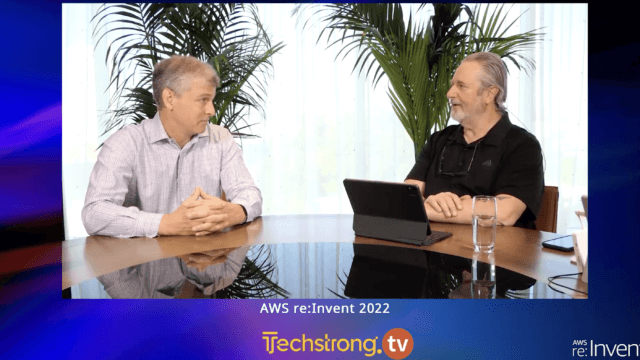
David Klein, Kentik | AWS re:Invent 2022
David Klein, CMO of Kentik, joins Mitch Ashley at AWS re:Invent to talk about network observability, and how to answer any question about your network quickly. They also talk about how Kubernetes fits into the current network and how organizations are transitioning to the cloud.
Transcript
This is texturong TV. Hey, welcome back Mitch Ashley. We are here at AWS re:invent in Las Vegas 2022.
And at the tech Strunk Studios at the win doing many great interviews, and it's been a fantastic day. And I've got another great personal lined up here. I'm joined by David Klein.
Who is CMO with kentik welcome howdy. How's it going? Good, good.
Tell us a little bit about yourself and tell us a little bit about kenting. I didn't know I was gonna get personal questions on here, but that's fair. No, I don't back around.
I don't worry. You're good. I'm just kidding.
I I'm CMO at kentik. I love the concept and space of observerability. I most recently was running marketing for lightstep, which was so hard by service now and application observerability, of course and wonderful product and team.
I joined can't take about six months ago and it's been absolutely fantastic. Very cool. Well we were talking about before about having a little bit of background in the network space and it's it's so interesting how so many things have converged.
We take observability has been high to take that light step in your background and that industry part of our industry, you know, and now we're bringing observability to network network observerability type. What is you would describe it to someone? How would you how would you describe what that means?
Sure. Not a great great question. So network observability is the way is a way to answer any question about your network quickly.
And that's a question that could be around a business outcome. It could be around user experience. It could be security policy compliance, but it's the ability to answer any question of whatsoever.
And what's particularly novel about that for the network is I'm sure you know, and I'm sure many of your audience knows the network is changed dramatically over the course of even the last few years and Not that the routers and switches have gone away. They are still there, but it's so much broader their data centers. They're containers.
There's Cloud. There's multi-cloud. There's how the internet itself impacts performance for for users and for customers and we're able to collect Telemetry from pretty much anything and provide visibility to what's going on in the network.
Not just we but that's the concept of network of network observability. We think about old enough to say this in the old days. It was the mid and that was like our only window and what was really happening other than maybe alerts that are being generated and you think about today in software Define networking virtualize so many components of the network.
So there may be still routers and firewalls and things but they may also be load balancers that are software and firewalls that are all software and the great thing about software is we can either intelligently put Telemetry data that they create or You know, we need sift through the things that aren't that helpful, right and understanding what's going on. And that's what's so fascinating to about Network observability right now is everyone is on a different Journey you have so many organizations that are migrating to the cloud or shifting to multi-cloud or have hybrid networks, and they're trying to make sense of physical infrastructure and virtual infrastructure and there are different teams with different levels of experience and Acumen for these different sort of systems and you have some some certain types of people who are just really about physical infrastructure and understand that and don't really understand how the cloud works and of course you have the opposite with Cloud engineers and Cloud Architects and it's a it's Network observabilities important because at levels the playing field and provides answers and insights and information that teams need regardless of who you are, you know, there's a lot of sort of Legacy npm or network performing performance monitoring technology and you know, we don't go into that but the sort of old way is that all these teams are solid. All the data is siled and you have to you can maybe pull something off a router or a data center, or maybe you have some visibility into your kubernetes and infrastructure and oh You can see what needs to be orchestrated across these different kind of cloud platforms, but Network observability combines all that in one system together so you can finally ask those questions and that's ultimately the goal to know what's going on.
So you can deliver a much better experience for customers and for users, but not a great secret but we've done I think some Yeomans working trying to break down the silos. Yeah to be Network didn't talk to security who didn't talk to development didn't talk to Ops, right and now through observability Network observability. It isn't just about the quote unquote Network the elements that are part of the network whether it be software Hardware, but it's also had gets into this software infrastructure stack you talked about kubernetes or maybe into customer experience information Telemetry.
That's about an EPL API call and application. That's of course going across their Network or other people's Network and that kind of brings a very interesting question. Which what is the network?
You know, I would argue that kubernetes is the network like you Could say yes that that I could see it being argued the other way. But but I like to think of it as part of the network because if you're trying to decide if something breaks or something as lightning and you have an issue with something and one of the first questions is this my fault this my team's fault. Do we do we need to deal with this and oftentimes that question is it the network and if it's not the actual application then you're looking at every other possible component of the infrastructure, you know, kubernetes is part of that and I think it's it's really helpful to be able to provide insights into the health and performance of of course kubernetes clusters and Way Beyond and we're that data is going in context of the network.
So, you know our pods we're a pod sending traffic are they saying traffic to parts of the network or Internet? They shouldn't be touching because that's out of compliance with the policy that all sits in the broader observability Spectrum in my mind. It's interesting because it isn't just a payload that's being wrapped into packets.
Right and we don't really care what the payload is whether it's encrypted or not. Now, it's the network might be API calls, right you're talking about, you know stress smash. and microservices in a kubernetes world That's the network.
Yeah talking within those clusters and that's what's so fascinating is the network evolves is evolved the people supporting the network has evolved and and the the entire makeup of the software that's required to support this architecture in these systems have evolved and it's a really fun place to be because things are moving so quickly. I think we've kind of crossed that threshold where there was the maybe we'll migrate to the cloud or we'll think about it and and we've reached a really interesting space where organizations Enterprise organizations and some that are maybe viewed as more conservative than others have really done a great job moving forward into the cloud and making really good business decisions around performing creating great experiences for their customers and for their engineering teams to move more quickly because again, you know the concept of observability. Yes, you want to have great business outcomes.
And yes, you want to make sure you're even an excellent customer experience but you know originally back in the day when devops was was kind of creating there is this this sort of decoupling with micro services that The purpose was so teams can move faster, right? So Dev teams could develop software and innovate faster and and so with observability you can get that confidence that okay, we're gonna be able to execute on our roadmap and innovate faster than our competitors and deliver really excellent results because we know that if something's breaks will be able to fix it quickly or we'll even have this sort of proactive technology in place to stop something before it breaks and applying that sort of application mindset to the network is really cool and really fun. It's interesting because And think about kind of old school for a moment, you know, it was about in network inventory.
What are the devices? How are they all configured? We now live in a world where all of that can change.
Dynamically, right? I mean, but we may not know it maybe interfaces tour of the third parties maybe a deployment coming out of different Dev teams in a way that's got to be unsettling if we're used to having a fixed thing. Yeah monitoring, right?
We for red blood blue clean, right? That was about to say. Yeah.
That's very good. Okay. And you know those that's a grows over simplification.
So I don't know interface and offend anybody but it was largely driven by alerts and status. And now it's also driven by what does it look like right now? And what did it look like when we need to go back because some things are a pheromo like serverless applications.
Absolutely. So it's in any way one way what I'm trying to say David is it can be unsettling but it also can be comforting now knowing I've got a way to to understand what's what's happening in and what the environment looks like. I completely agree and that but then settling part, you know doesn't go away in that, you know, if you see all the sudden a traffic spike in a region, you know, perfect scenario great.
We have a lot of users doing something but it could be a DDOS attack right? I mean, it's it's I think it's a really I think running a modern Network optimizing a modern Network modern infrastructure is a really hard job because there's so many things that can go wrong at any moment. And even in the perfect scenario things sometimes feel like they're held together by, you know, duct tape and clue and shoe string and that's it and it's just Yeah, so important for to give the confidence to the teams to know that they're able to answer any questions that they need and to ingest any type of telemetry possible so they can then answer those questions and it's it's really cool to be able to see the different teams come together and have conversations with okay.
Here's a network engineer. Here's an infrastructure engineer. Here's a cloud architect.
Here's an SRE and everyone having access to the same data set and be able to get insights and the answers. They need it once rather than you know, the previous world where everyone is in a different place pointing fingers at each other. No one knows even if it's the network or not.
And you know, that just takes a lot of cycles and time and it's not fun for anyone and it doesn't get at the heart of what anyone's trying to do which is build a great products and deliver great experience for customers. Yeah. Well I think sense in you about the excitement if I'm gonna put myself in your shoes like good for a moment, you know coming out of light step and observe ability and in that environment no knowingly, the people that are involved in that and they're contributions to helping with The open Telemetry and and open tracing and from the origins things that are contributing to the whole movement around observability.
I would imagine I don't mean this to be a softball question. I mean, you're not fall question. I'm your shoes.
I mean like I'm excited because I know a lot of s*** about what we can do here and what I can bring to the network world. I mean mine always on track. My knowledge is so limited compared to the Lifest products engineering team.
It's like it's it's it might borderline ignorant would be the word but you know, the difference can mean to customer I do I understand. I mean my eyes were open just just looking at just getting a const getting an understanding originally of microservices and the ability for something like distributed tracing right to cross those service boundaries and really identify dependencies, you know far down the stack you might not even see and I kind of light bulb went off in my head that there are these unknown unknowns out there and there's very few ways to actually connect the dots and dots and solve something quickly and You know when I first learned about kentik and kind of got a deep dive into what they were doing from the network perspective. It was a very similar realization that like, oh there are all these different parts of the network.
They're evolving at different rates have different use cases different people engaging with them and there's such an unbelievably diverse amount of types of telemetry that needs to be then collected and ingested at scale and put into some sort of content adding business context adding context for the devices adding context for the different different use cases and in that's really interesting to me because the problem is really hard and I think hard problems are fun. Yeah, so maybe maybe there's somebody here. There's something wrong with me.
Maybe this softball questions turning into like a deep psychological in that analysis. So you could start a show on that. No.
Yeah. How much are you an hour for this interview? I feel like you know, the first hour is free first that we work on that.
Okay. I'm the least quote by Dale. So well, we need to wrap up.
Our time has been great talking like that working folks find out more about Ken dick and the cool work. All are doing in network observability. So there's this thing called the internet.
com. You can take a look at a variety of solutions. We have and use cases for on-prem to container to multi-cloud and of course Dennis note on there.
We're happy to chat great. There you go your ticket to AWS reinvent was worth it. You just answered got a whole source for new answers to your questions.
So, thank you David David Klein CMO with cantic appreciate it for joining us today. Thanks. We will be back.
We're here today. We have some more interviews. We've got some more tomorrow.
So hang tight. We'll be back in just a little bit.