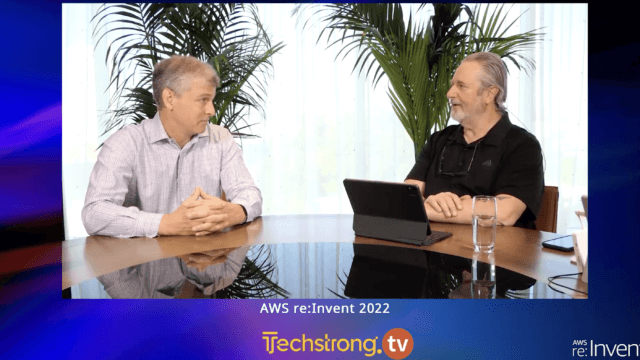
Mike Grever, Cloudforce – Miguel Cervantes, Cloudforce | AWS re:Invent 2022
Mike Grever and Miguel Cervantes, Co-Founders of Cloudforce Networks, join Alan Shimel at AWS re:Invent to discuss the new company which orchestrates fundamental services to fix the skills gap into a no-code SaaS platform.
Transcript
This is texturong TV. Hey everyone. We're back here in Vegas at reinvent.
You know, one of the nice things about coming to a conference with 55,000 of your friends is you get to really see people who really wear your friends one. Oh still are your friends want to introduce you to my friend right here to my right is Mike griever. He's gonna tell you about his new Venture in just a moment, but just some way of introduction as I've said on here many times.
I you know, I've Part of my background is I helped co-founder company called still secure but instead of Boulder, Colorado Mitchell actually our CTO and principal analyst here add texture was one of my co-founders there. Another important piece of the puzzle was this guy right here Mike River Mike. I had the pleasure of working with Mike for a bunch of years.
That's still secure and I I took him from jail team into business development and it I can to think in some small way. It's getting off on his on his path, but he's done a lot more since then. I'll tell you all about it.
Hey, Mike, welcome welcome to text strong TV. Great to be here. Absolutely.
Great to reconnect. Absolutely. I haven't seen Mike.
Well certainly since before covid. But yeah a little bit before that. Sitting to Mike's right is Mike's co-founder at his new company, which we're gonna talk about.
The goat Miguel Cervantes. Yeah. And the goal is is you know, I don't know as much about you because I never worked with you but you're gonna tell us in just a minute.
But before we get into the personal stuff, let's talk about Cloud Force. Yeah, absolutely. So as thanks for the intro.
Thanks for having us. So cloud forest basically came from an idea that Miguel and I had shared we're both EX amazonians at AWS worked on the the networking side and the APN and with Partners building and scaling Cloud platforms and hybrid Cloud a cloud forest was an idea that we got from the field. So our partners our isv partners our customers everyone basically was running into what is commonly known as the skills Gap in the industry.
So basically when you go to set up your Cloud platform, there's certain fundamental services that we think need to be standardized as a utility layer to basically get you to a building state. So whether Doing devops or secops or you're building, you know, 5G applications. What cloudforce does is basically orchestrates these five fundamental services for you and to a no-code SAS platform to get you to innovate faster, basically.
So what we've done is we've taken those Concepts brought them all together and we launched a company called cloudforce and the product we we call it a virtual Cloud architect. So Miguel's position at AWS was a systems architect a lot of the industry terms that could be a cloud architect or a devop engineer or SRE engineer tons of different titles. But basically with the the role of a cloud architect is basically building those Cloud platforms and getting you to build a ready State and a consistent state.
So that's where the virtual Cloud architect comes in is to augment your your team and and your delivery model to to make things work a little bit more smoothly. So one of the emerging roads we're hearing a lot about is this so called platform engineer. Yeah, right.
That's that's the hot thing right now, right this kind of a virtual platform engineer. That's or is it relevant to the platform engineering role? Yeah, I'll take that.
So essentially like Mike was saying right. We're basically building the platform for that for the customer. Right?
So if you look at the the role of the cloud architect, there's kind of two halves. There's taking care of the day-to-day utility layer of the cloud then also helping development teams with their day-to-day. Like hey, I'm going to use a service.
I need this role kind of templated it out for me or any guidance on the service. So that's two halves of the world. So what we did is basically did the first half we built the utility layer which what everyone struggles with and so that's where you would find that platform engineer kind of living.
And so what we're doing in the virtualizing that experience whereas today it's mainly people driven. So we're doing is augmenting that taking away that that half from them and let them work on differentiating work with developers. What we I mean what we found is, you know being in the cloud we joined Amazon in 2014, and you know as the as the explosion of the cloud and the adoption gets a little bit more mature a lot of people don't realize and that's where the term platform engineer, you know, probably the Genesis of is as you actually start maturing the platform and adding applications and users and regions and multi-cloud and you really find out that that utility layer those fundamentals of the platform need to be consistently governed and maintained and right now there's really not a product that does that so that's called Force.
That's what we're focusing on. Actually you mentioned five things. Yeah.
Let's list them out for the audience. What are the fighter? So basically the virtual Cloud architect deploys what we call the cloud platform operating model which consists of Five Pillars.
So the first pillar is orchestration. So right now as we discussed it's mostly a person or you know, a people or an SI or infrastructure as code a manual effort. So the first stage is actually orchestrating it and removing the need for actual code.
So no code orchestration of the platform consistent. The first application would be the accounts. Which basically your account set up your OU your organizational structure your guard rails this the the second aspect of it would be your cost.
So your cost optimization your usage your billing tracking basically automating that so no manual building tags, or if you're using a financial Ops tool something that actually collects all the logs in the data for you makes it easy to consume. The next one would be the security and the identity and access management. So your IM rolls your name and Convention your SSO your security controls your data residency governance all of those guard rails and services making those consistent and the last is really the networking and the connectivity which is often a lot of the sticky point of the cloud and you know building hybrid clouds is standardizing those, you know, vpcs and your ipam and your DNS hosted zones and your private and your public, you know, connectivity and SD Wan and basically packaging those all together to actually create a holistic platform and keep it so I love it.
Yeah good stuff. So look, I want to be clear with the audience right early. You're early and get Five Points.
You just reference customers. Yeah looking for people to you know, potentially use the product feedback. You know, it's not ga.
Yeah. No, we're definitely you know, we we are just launching our public beta right now. So we have you know, a couple reference customers and our Alpha complete but now it's basically time to to start taking it to you know, more of a general audience.
So really targeting, you know, AWS startups mid-to companies as well AWS control tower users terraform users people that need to build consistent accounts and Landing zones. That's really the first stage and then people that actually have, you know have maybe that maturity or have experience in the cloud that's you know, maybe you're you're experiencing some Cloud drift or costs spikes, you know, basically the platform can be cleaned up a little bit. Those are people that actually would use this early as well.
I love it. Someone out here says yeah, that's us. I want to check this out.
How did they go about it? io reach out there. We have a form to kind of just put your information in and we'll get back to you soon as we can.
Yep. We also have we're starting our blog as well. So basically, you know, introducing the concept of the cloud platform operating model and a virtual Cloud architect to augment your team.
There's a lot of cool bits and bits and bites in there for you know in the field traction and and experiences that we have. Well, you know, I think you mentioned that mcdwell was well you both X AWS folks. And so there's a lot of I don't want to say inside knowledge, but there's a lot of You know AWS.
Learn the hard way to have this t-shirts and scars to prove it know-how built into Cloud Force. Absolutely. Be a time where we take this to other cloud or is this strictly in AWS?
Well, I think you know with anyone's Cloud strategy, you know, we discussed this all the time is you have a primary public cloud and then the next step is usually how do we actually you know, maximize, you know in standardizing and get that, you know into a build State and a consistent state for growth and sustain growth. And then we also look at a world that Miguel and I had worked in is really the hybrid space as well. So connecting that to the data center and building that cloud platform down to the the data center.
So if you're using like VMware Cloud on AWS or open shift or direct connects or outposts, that's really kind of the first model that we're concentrating on is let's let's get the primary solid and then figure out how to extend that to hybrid and then from there look at, you know, potentially multi-cloud down the road. Got it. io you go.
Check it out there. Hey Mike. Well, I wish you guys nothing but a lot of success knowing this guy the way I do.
I'm sure there's gonna be a great. Tool a great platform a great company for people out there who you know because we forget right had this discussion a few times you're out here with 55,000 people you think the whole world? Is already, you know, very Advanced on cloud and we're all using devops and all of these things.
There's still more compute on non-cloud. Then there is on cloud, right? So the future here is still ahead of it.
Right that a big chunk of that mainstream audience. It's still migrating and and moving to Cloud. Absolutely.
I mean, I think there's you know, there's a lot of different numbers out there and reports that say there's 10% or 20 percent or seven percent of the IT stand and applications, you know are headed to the cloud. They're still on Prem, you know different analyst firms say that, you know, 20 25 like 90% of you know, new applications will be cloudinator. There's a lot of maturity a lot of growth again, you know, as we say a lot of the block and tackling that still needs to be you know, these people who are transforming migrating.
You know one of the nice things about well. One of the nice things about being a later adopter rather than the earlier doctor is hopefully you've had the chance for for tools like Cloud Force absolutely right to come out and make their life easier instead of having to figure this out the old fashioned way. You know what you find it no matter how big you are as a customer whether you're a big Enterprise or just getting started.
Everyone has the same problems at the platform layer, right? All the same. Everything above is what the companies do, right?
Absolutely. Hey guys. Thanks for stopping by today.
io will will follow Mike and Miguel's story here as they continue to build it out. But for now, we're out. We're here at text.
Oh texturung TV at AWS reinvent. We'll be back in a little bit which is some more guests and interviews.