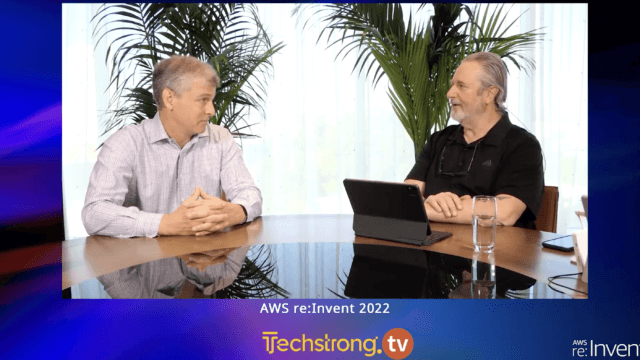
Fleming Shi, Barracuda Networks | AWS re:Invent 2022
Fleming Shi, CTO of Barracuda, joins Mike Rothman at AWS re:Invent to discuss Barracuda’s announcement that Barracuda Email Protection now offers integration with Amazon Security Lake to reduce complexity and costs while also addressing security concerns.
Transcript
This is texturong TV. Hi, this is Mike Rothman. We are here at the tech strong TV studio at the Wynn Hotel for reinvent 2022.
Hi, that's AWS re:invent. So I'm pleased to be here with Fleming. She he is the CTO of Barracuda.
You may have heard of Barracuda. They're slightly small security company here, but Fleming welcome to text on TV good to have you here. I'm having me.
Yeah, yeah, tell me a little bit about you know, kind of why you're here what you're excited about here at AWS reinvent. Absolutely. First of all, it's the first, you know, Revenant coming back after the oh, that's right.
That's right. That's right. Great to be out here seeing people you exist right in my life exist.
Yeah, okay. Not a little Zoom box. Oh, that's right.
Yeah. So super excited. I have been walking the floor and meeting people and everyone is pretty excited about.
Yeah, you've been in person and we're here because we we heard about AWS Focus this year is really really good. I think data let it be, you know enabling people working with data and especially providing all different new services and platforms for for data scientists or data Engineers to work more efficiently. Well, the key thing is cybersecurities want the important I think elements in building any software, of course, so they actually started they start they launched a new service is called a security Lake AWS security Lake and bear could actually really worked with them in the last few months to actually get ready to provide signals.
So the security they can actually offer signals that bear could detects And make it very accessible to our customers our combine customers and I think it's that's why it's exciting for us because this is just the beginning to find ways to collaborate and make sure customers that who utilize AWS or have access to their infrastructuring AWS can utilize these type of information that we're providing security-centric information. Yeah. Yeah.
So that's why we're here. Oh, no that that's great. Obviously, when you think about the criticality of the workloads that are moving into, you know, all Cloud platforms which specifically AWS.
Yeah, and the fact that AWS hasn't really had Market leading security capabilities thus far they may argue with that. Yeah, we we're not gonna debate that today that certainly, you know, kind of my judgment on that front, you know to see them really get into the aggregation business and say listen security and detection really is driven by data. Yeah and to be able to some what scalably and Fully economically, you kind of aggregate a lot of that data for what's happening in AWS.
I think is is really great news on that front. So explain a little bit about how your service is going to integrate in with the data Lake and you mentioned that it was for email specifically exactly. So email Telemetry goes into the data lake or you're there they're Gathering email information or messaging information that then you would you know kind of be able to detect so explain a little bit about how so far from the integration we're doing actually is our SAS offering for email security.
We actually offer protection for your Microsoft Services I've environment what's really good about that is we are able to identify those really critical information or signals That Matters to Security Professionals that be op Center or a Cisco group that does Security in any customers environment or in some cases mssps. We're actually operating on top of aw. Stand and maybe even the tooling they have for their on behalf of their customers in those situations.
Now we're able to ingest our information. It's not just logging. It's actually a signals that that is in a format which is what we call the ocsf which is open source.
They call the open cyber security schema framework, which is co-founded by by AWS. What's neat about that is now we're formulating the email findings. So so customers can utilize those signals and and take action and make sure the software activities are adequate and and respond at the right time and and you know, you kind of take a step back and go.
Okay. So email bot right email continues to be, you know, kind of the tip of the sphere. Absolutely.
Yeah for those actors, you know for the attackers that's really kind of the first effort that they make to break into an environment game persistence and then you know kind of do the environment. So yeah that is a pretty critical kind of signal but you know kind of detection mechanism really understand what would be a multi-faceted attack that's right. In fact email is always the first sort of first wave of things that attackers will try to use the methods they use in a minor attack framework all the different mythologies use utilized.
We believe if we provide the signal to any security teams, and they can actually short circuit potential. Early on instead of waiting for a network traffic to be kind of, you know, start to show some signs of compromise or even web traffic. But before you get out to all that you can you can actually put it put it away early.
So that's why we wanted to make sure we provide that signal earlier detection equals more robust. Yeah Aviation and more rapid response. Yeah, right.
And so yeah, it's pretty exciting for us. We wanted this is just the beginning. Yeah.
We're we have a whole Suite of products close to 18 of them. Right? So yeah email is the first wave of signals.
We're integrating with those CSF and on top of the AWS security Lake, but you already I'm you already have products that run in and support AWS. Absolutely. Yeah, we do and it really what we're trying to do is pick their most important ones and and start.
Yeah moving so make a super accessible customer. So today, I mean that's that's a good question. So yeah love the security data Lake, you know, obviously the email signals on top of that but let's talk Little bit more generically about kind of cloud right you've been with Barracuda for a long time.
That's right. So so, you know swim a little bit about kind of this Evolution, right? You saw obviously a lot of the email protection that you do even web protection.
That's what's happening on-prem. And now all these things are cloud and a bunch of your services are delivered as SATs. I mean, how is that, you know kind of and and as AWS and Azure and all these other, you know hyperscalers are in there.
I mean when you think about building out products, right and and you know kind of provisioning and trying to protect and environment, um, you know across a lot of these different, you know platforms. How does that make your job a little bit, you know, either more challenging easier, you know, I would love to get your perspective on that. Definitely that's actually a really good topic there because when I started at America, everything is you know in close to you, right so you have you actually have a parameter but what we see is now the adoption of SAS applications is rapidly growing and and what's really cool about email.
I was actually a SAS application. Sure, especially in Microsoft 365. It has so many SAS features like sharing files, you know sharing calendars all those things.
What's really interesting is we believe the adoption of Sasa will continue and and our ability to protect customers are gonna get closer and closer to the SAS itself email is just really one area. We actually played really well because we're using apis to talk to the to the backhands actually we do machine learning based on communication patterns identify anomalies when when really bad fishing attacks that doesn't require a malware to be attached to get to people right. So those are things we're doing now, but generally other SAS applications are so becoming more useful everything we touch like work day, you know ourselves Warriors and that's sweet everything right?
So I believe in the future SAS applications gets more mature have more security posture capabilities to allow us to And monitor and tune and close the gaps and making sure the policy drifts or even configuration drifts are taking care of early and we will be closer and and will be able to solve the problem faster for the future for the customer and it really when you think about it. It becomes one really big ecosystem. Right?
So we were just talking about SAS applicable. That's right. Yeah, SAS applications are hosted somewhere.
That's a typically one of the hyperscalers. Absolutely WS or Azure or gcp right so, you know AWS is focused. At least that this reinvent on you know, kind of data helping you manage it helping you protect it Etc kind of you know is then those capabilities are inherited or can be used by the SAS players that are on top of that and then folks like you guys kind of as a third party security gender across a variety of business for an environments can really start to take advantage of both the Fidelity of the data that you know, AWS is gathering the way the SAS players are starting to leverage that you know kind of data and then how you kind of play into the whole thing to protect it across this multi-cloud environment.
I get that kind of right or absolutely but on. Yeah, and I think what I feel about is that AWS or Microsoft Azure all these hyperscalers will offer, you know ability to to build your application and these ass application. We always talk about shift left and shift, right?
Yeah, the builders are gonna need security, but you know, for example barracuda Most of them are SAS users, right? They're actually accessing and consuming saturation. What's neat about that is now if we're plugged into the the ecosystem and these hyperscalers providing things like the AWS security Lake now, we can provide the signal and provide the ability to to respond.
And in that way. I think it's it's really modernized and Cloud native in a way that our you know, customers will be using software in the future. Yeah.
So it's it's pretty pretty awesome to have done. So kind of getting to a point where they're providing these capabilities that we can leverage. Yeah, that's right.
That's right. And it's a drink is that plays into a couple of the trends that we attack strong research are starting to you know, kind of play around with as we head into 2023 that will preview at our predict conference, you know in early January, um one our overall theme for security is yeah security is job one. That's right, and that's and it's not just kind of the security folks anymore, right?
It's devop. Folks it's infrastructure folks. It's SRE.
It's platform engineering. It's all these folks have to really start thinking about security from that standpoint. And and then you mentioned Cloud native as well.
That's another main area of you know Focus for us. And our theme there is we're calling it The Long March, right? And and I remember the lamp stack, right, you know the web applications, you know, yeah Flemington to remember that, you know, it took a decade for you know, kind of us to really adopt the lamp stack and really kind of standardize on that and now, you know kubernetes and a lot of the others.
Yes projects or are starting to become a little bit more established. But now we have to start seeing kind of the breath of Enterprise Services, right both from security reliability backup right kind of resilience. A lot of those capabilities that I get takes time for us to get there.
Right? And again, I think you know you have I think a unique perspective there, you know kind of being CTO not just having to protect customers data, but having actually build these Applications that deliver this stuff so you kind of see it from both sides in absolutely how this evolution is happening. Yeah, and you absolutely right.
I think the software industry is continued to be very robust and it's growing everything we touch touches software and software creates and requires data as well as emits and generates a lot of data. So my thinking here, is that as we work with these hypervisors. Oh, sorry hyperscalers, which do run it's a hyper something hypers out there super bad, but what's really good about these type of integration.
It gives us the ability to to deliver the security people and I believe AWS will be excited in making sure this continuously available made it more efficient and more accessible so reduces cost because otherwise someone has to build a Sim to collect now. That could be very expensive and is yeah following that market for many years is very expensive on that front and every time you look at an industry study or you know survey of organizations inevitably right security compliance, right and and a lot of the operational things are the top two or three concerns that folks have about continuing to move workloads into the cloud. So I I think what AWS and Azure and gcp to be clear what they figured out is that's a major friction point and you know, when you look at what Azure has been able to do with Sentinel right there and that's in they're embedded Sim on that front obviously gcp has Chronicle which they had filmed from Gecko and I'm just didn't really have anything.
Yeah, right. So so security day like, I mean, it really is a clear attempt to fill that huge hole except in their environment. And again, I think that's good for customers.
Yes the end of the day you're all in on customer if you're all in on AWS, right Sentinel Help you too much, right and that one thing I like the approach from AWS. They're using the word Federation. So more of a Federated kind of queries and less about copying data.
When we integrate with security Lake. We're actually delivering actual very usable or actionable signals not just putting logs in there. That's right.
So it's actually a I feel like it's a it's a hence way of actually going about yes. Yeah. It's like what we can't there's too much data and we can't move it all the one place one because you're paying for it, right?
That's one of the things that folks don't realize like, oh, I'm trying to get it my Telemetry that's in the cloud. Well pay me now or pay me later, right? But you're paying me you pay me to store it.
You're paying me to move it. So, um obviously being able to leverage a variety of different Federated data sources and aggregation points is critical on that front. So I think this is great congratulations on you know, kind of getting out ahead of the, you know, kind of yeah ahead of the curve on you know on supporting AWS A lake.
How do folks get in touch. I mean, I mean, I guess they would know how to find Barracuda but let's not make any assumption. So how do we find Barracuda some information on the new email capability?
It's it's our campus. So actually how to use Barracuda email security with the AWS security Lake. And also what's the important is, you know, our website has plenty of other assets to help you understand how to recover from ransomware and a lot of these ransomware attacks are started from our fishing and credential theft and all that.
So, yeah, so go visit our our website and our campus go visit their website. Yeah care that so yeah. Thank you Fleming, you know, really appreciated the conversation always fun.
We're here at reinvent 22 at the text wrong TV studio at the win hotel, and we'll be back soon with another interview from reinvent. Thank you.