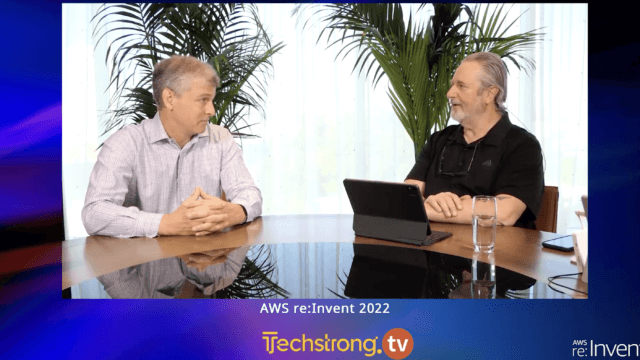
Evan Kaplan, InfluxData | AWS re:Invent 2022
Evan Kaplan, CEO of InfluxData, joins Alan Shimel at AWS re:Invent to talk about InfluxData’s new InfluxDB IOx, its newest storage engine that will allow users to run unlimited time series workloads and contextualize that data across any dimension.
Transcript
This is texturong TV. Hey everyone, we're back. We're back in AWS reinvent with our continuing coverage.
I'm really happy to have our next guest with us in person. I've interviewed them via Zoom. For a long time but I think the first time we're doing it in person.
It's Evan Kaplan Evan is the CEO of influx DB there the people behind the influx DB open source database as well as influx itself and he's gonna tell us more about it Evan a pleasure to have you here in person. Thanks. Hope it's not disappointing see me in person.
Oh let down for people, you know, look truth be told Evan grew up in the town next to where I grew up in and so we probably cross past somewhere along the way and we spent the last 20 minutes reminiscing. when some of our other text drug came and the ties go back and you know what actually before we get into influx give people an idea of your Journey, in in the tech world because it's it's interesting including the felony convictions. Oh, let's keep that one out of it.
But I'm gonna leave it up to you. No, I started out. I was not a tech person.
I started out working for Outward Bound being a climbing guide and an instructor for years really and totally different and then and then got into technology. I worked took an internship at an airspace company doing actually management development and training and after a year doing that. I was like I want to get into the middle of this stuff and I I became a program manager and back to business school and I worked for in the early days of you'll know this tcpip network a company called wrq the maker of Reflections and then you know, the internet had my first email account in 91 or something and so I was the product manager for TCP IP on the desktop.
So just a mentally get that I mean if your It's listening. There was no time when an upgrade system did not come. I was just say that was before TCP IP was built in you had already had to buy it.
It was by the way. It was $499 for a PC. Yeah buy it.
Yeah, it was a great business but the PC was five grand. So yeah or relative. It was a great business and evaporated like in a year when Microsoft took over here on and then I started a company which which you may know about aventail the first slvpn.
Yeah, so ran that through the bubble built it up took it down sold it to Sonic waldell and then took some time off and then ran a public company called iPass turn around Global Wi-Fi around the world. So my background had been security and networking and then I worked at a venture firm for a little while and joined influx in and teamed up with Paul Dix the founder and and it's been a really really great journey. I love it.
Absolutely, you know as I got you in person. We're not in a rush. I've tried in the past because I interview other people from influx as well.
I'd like to you know explain to people the relationship between the open source. DB and then the influx business if you will and we've done a decent job, but you're the CEO. How do you see first of all, let's start with the pieces.
Influx DB the open source, right great database. It's open source. and then the biz the influx business offering built on top of it, right?
What's a Dev? Yeah, so so the open source started we shipped the first version of it like in 2014. It was immediately popular.
It's built a large community of users today. There are roughly 700 plus thousand people who run it every day that we can see in the open source. So the open source is a gigantic Community.
I would guess it's probably in the top six or seven database open source communities out there the differentiation that we started building in 2016 was if you wanted to run the open source, it was very powerful on a single note. You could handle a couple of million points data points a second. It's very powerful people could use it but it was no high availability.
And so what we've sold is the ability to Cluster and Shard the data across multiple things and run it highly available a little bit more UI a little bit more management and that's made the Enterprise product. But then we also have a cloud product where it's dedicated tenant. We'll run it for you and then over the last two years.
We've built a multi-tenant serverless cloud where you just You just pay based on consumption read rights. So we're following kind of a well-worn path. I would say the people who pioneered this path and probably Mongo is on it.
Yeah build an open source platform build a community around it make it easy to use right and then offer an Enterprise and offer a multi-tenant cloud and cloud-based business and eventually your business is it's both but it's more the cloud business grows faster. Well, you know, it's the I've been around as long as you have right it used to be the only business model that ever succeeded in open source was right at Red Hat was like Phil Stein. That was good.
By the way when I went to raise money in 2016, that was the problem people turned me turned us away. Mongo had done it down round because there's and that was the headline. The only people ever made money was red hat.
This is before last deck. This is before confluent this sure for all these companies that absolutely and now but but the world's changed right people Now understand that you build a great business on an open source Foundation like you've done here and it's it's a beautiful model. Yeah, you might have 700,000 people who were running the open source.
I don't need 700,000 people who's paying customers. I need to be nice would be real nice. We can be sitting here.
I'd be in your sweet. But instead. You know, but you a percentage of those will go for the sasp space.
We'll go for the serverless. We'll go for the the more Enterprise High availability Enterprise kind of features. And it's a great business model.
The other thing we didn't mention is look mongodb. Couch piece, couch face. No sequel databases kind of burst on the world.
Really time series data is is something that influx right was? Yeah, we feel like Are You Nero? Yeah, and I would give Paul the credit for that.
We put I'd say we pioneered the modern time series category no doubt about it. Now, you know and what we've watched over over our careers as if you had a database problem and you know and in '98 or something like that it you got Oracle you had informix and yet I've be too right and and whatever eventually Microsoft yeah, whatever whatever your nail look like. That was that was what you're gonna hammer it with.
Yep the um, and what's happened two two broad trends that I think are really fascinating, you know about one is the the general Trend towards open source starting with my Sequel and so the general favorability, you know, and now it's really tough to I think introduce a new database platform that's not built on open source, right? So I think that's first of all the second is then now the taxonomy the categorization is before it was relational everything right now. You've got really big categories and relational document in search.
And graph yeah in Time series. And so, you know in Time series includes real-time analytics and all this capability about working with with stuff in real time and iot and things like that. So it's exciting it is exactly I think the other thing is the explosion of data.
right for you know Yahoo! Would do when that first came out. We started thinking about Big Data as a kind of category if you will today.
Everything's big data, right? I mean, my phone has big data on it it seems so Apple seems they charge me for the extra storage, but You know. And really that that's a piece of this too.
We talk about scalability. Even the open source influx DB the scalability. I mean within within the comments, I think it's a little too scale.
Oh, well, I would imagine if it's not. Yeah. Well listen, we love the fact that we're committed to this open source.
It's part of our core values and a great open source company monetizes 1% of their their Community exceptional is two to three. Yeah. So, you know, you have a very specific offering if you can monetize two to three percent, so I think we have about 15 1600 paying customers or guns of very large community or that's in some ways.
I think our open source is too good, but that's you know, that's fine. But that's part of it. I mean because the good news is if it's not good it'll keep attracting more and more of a base and it gives you more and more of an opportunity to build revenue opportunities it does and you and if they get and since this is a business of design wins people, they're building a service or an application.
They choose their database once they choose it you're kind of in there. So they choose it on Open Source, you're hoping eventually that they get to scales or things where they really want to engage with you commercially. I think it's worth mentioning because especially you because you've tracked the open source world for a long time is I think we've taken a counter position that what most people have done in the open source world.
So we have this new database engine. That's just getting into introduce our commercial products called iox, very popular and GitHub. Built on Apache Arrow parquet data Fusion so really fits into this next generation of data ecosystem.
And we've chosen to MIT licensed open source, great completely permissive which means somebody could take it and compare with us and that and that's not been, you know, if you look at what you know, Mongo's done with a GPL too or three or grafana has done or elastic has done if people have really tried to build these secondary licenses that really ham in where they can be used which is a little bit counter to the open source world and we Paul has a lot of conviction about it and so he's convinced me and we've still clear that we said listen, it's our job to create the differentiation between the open source and the paid commercial back to you earlier point. It's not our job to confuse people about what they can and can't use You know what? I've been involved in open source, so long time and I fought those Wars in security around around GPL lower or higher that all the the MIT and the copyrights versus IP and freezing Freedom versus freeze and beer and all of these things and you know, here's the good news along with the success of Open Source business models and companies.
I see people Don't get quite as hung up about what version of the license until. It's an Enterprise situation. And then yeah and then all you know, then the lawyers come out and and the you know, and they're like hey, what are we doing here?
You know, there's a potential liability. I need license. I need closure and Clarity on my licensing and what part of every procurement Dynamic and there's a whole I don't want to say a cottage industry.
It's bigger than a cottage industry of companies that will police your license thing right so fun. so interesting stuff if you I think we actually did an interview maybe was with your CTO around. This a couple of months ago, but we'll check it out on texture on TV.
It's probably in there. Let's talk a little bit about reinvent. What are you guys doing here?
What are you seeing? What are you thinking? First of all spring encouraging to be honest with you know, only a day into it and last night was the first night.
But but yeah given the The Narrative that we've all heard about the economy and we're all feeling relative to inflation and potential demand sleeking it. People are here thousand people. Yeah, they say, yeah, the people are here like and there are people here and there, you know.
Um, this has become you know, the go-to show. Yeah, certainly anything infrastructure Storage security cloud like it's right. I think it was before covid and it's more so now but I think the other thing is Amazon's timing The messaging is is right on.
Right. Hey, we I think this is I don't want to say cloud 20 or something like that, but the cloud has matured while we've all been stuck in our houses. And having to do these things and and so there's a different cloud.
Yeah, it is a different Cloud. I mean that could be oh, yeah that's actually years ago because I think also, you know the discussion that I'm starting to see at the edge is about repatriation, right? And I don't know if you've covered any of that about people being concerned about their Cloud bills the cost.
Oh, that's a whole other industry, right? Yeah. We'll see I think we'll see.
Listen I think cloud is inevitably the gonna be the primary platform for most Enterprises. We'll see some. Some swinging some swinging back the other way a little bit for as particularly.
Are you think hybrids going away? But I do I think we're also and we just covered this in devops experience of virtual event. We did last month, you know, you've got it at the cloud but you also at the edge is happening.
Yeah, and that's 5G continues to mature you're gonna see more and more of that edge become, you know, the new the new Battleground the new place with stuff is Beyond the Edge. Yeah, so that's exactly so so this is that place is exactly into our some of our thinking, you know, one of our primary competitors for this for the serverless cloud our Amazon's time stream and Azure data Explorer and the advantage we have is we have all three modalities. We have the Enterprise and we have the edge The Edge can store it Forward data, you can downsample at the edge push the data to the cloud that becomes for iot.
That's a standard architecture. You're running a large building a hotel any kind of on-premise factory or things like that. You don't want the louder storage, but you don't want everything going to Cloud you want local storage.
You want down sampling setting up to the cloud maybe for doing AI processing? Yep, and that's a thing that that fundamentally what what's particularly this the people who used to be good at it the Microsoft's of the world, right? It's not been part of their strategory from time.
And so it ends up being a competitive Advantage for for us. I I agree with I mean again at this devops experience. That was the three tracks.
At the cloud at the edge and then beyond iot. Okay, the devops of things right? And and I think that's if you have a an offering that's married to only one of those places or only one of those providers.
I don't think people they may not give a crap about licensing but they care about lock-in. So this is where this is where the strategy you walk around the show floor you look at. The Confluence of the world the mongos are the world the elastics, you know, and to some extent data bricks of the world is you know, you've got this very understood business model where you build the open source platform, you know, cough go or spark or mongodb or elastic right you build a community around that and then you roll into the cloud and you depend on your brand and the people's awareness of what you built to create the competitive area.
And so so the in most cases the cloud native products the ones that come from the CSP. are weaker And less attractive to the customer than having native having confluent or absolutely or inflict would you know do a certain extent that's always been the AWS model too. They would give you 80% of functionality 20% of the pricey.
It wasn't it wasn't even 80% Yeah, definitely not 20% the price. Yeah more. No, not that I changed.
Yeah, but I you know, and that I think that's another thing that's still playing itself out in this Echo System, right? Because you got to give Amazon credit. They've done a great job building a channel partner program here.
What a machine. Yeah, whatever probably one of the best things in an hour, you know remind you just come into the trade show this trade show what it's a gigantic business. If you didn't even have I know well if you build a child like context, right?
Yeah. Anyway, hey, I've been worried about that time but wanted any other news from influx that we didn't hit on the primary thing is discussion is this new database engine I ask which opens us up to a bunch of sequel. To developers.
We're very picked off on a super fast platform. How can people get more info on that one on good influx data. It should be on the front page.
It's in our Cloud native product, you know right there. Oh, you'll tell them all about we probably have multiple stories on it. If not, we'll get one of the mics on it.
But it's good stuff. It's a pleasure. See great seeing that the real place.
All right. We're here at AWS reinvent with Evan Kaplan CEO of influx DB influx data. We'll be back in a minute with some more folks.