Networking (Ir)Relevance – Techstrong Research Review EP 21
In this week’s TSR Review, Mitch and Mike jump in the time machine back to a day when networking was the critical skill in infrastructure. But is the network still relevant in a cloud-native environment? The short answer is… of course networking is still important, but with caveats related to software-defined networking, accessing critical data that remains on-prem and making sure there is still networking know-how available to the app and cloud teams.
Transcript
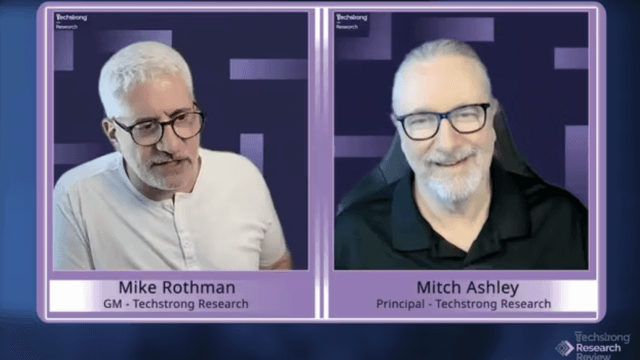
here Hi everybody, Mike Rothman here general manager of textural research with another episode of the tech strong research review just to remind you for those of you that are new around here. This is our weekly research meeting where we pick through the bones to the number of things that we're been working on and ideas that we have and things we want to talk about and things we have that are in our fraud bothering us and you know, pretty much anything else. So it's kind of like our weekly, you know, kind of session with our internal training on that in order to address all of the issues we have on a daily and a weekly based some joint as always by Mitch Ashley my partner and crime and text Norm research Mitch.
How are you today? Always it's always fun. Always good black shirt Friday, I guess might work Friday and and you know, so it does kind of contrast well with our internal coloring we're both fairly pale mostly gray white, dudes.
So, you know, Out it does play that way. So that's what it hides a myriad of sins elsewhere you anyway, I deserve I had last night but we are not gonna go there exactly. All right, so we're gonna talk about today.
So, you know how many folks you know, everybody knows me is kind of like a security guy, you know, you know, he's been doing a security stuff at 30 Years. Everybody know actually started Life as a networking guy, right, you know kind of following this stuff across the floor and you know early Network hubs and you know kind of very early before I ever got pulled into security. I I did, you know a whole mess of networking, you know early hopefully area networking and it's interesting because as we've kind of made this transition to Cloud native infrastructure to you know, devops to all these modern application architectures, we don't really about the Network anymore, right?
You know, hey, it's something that we just clicked and click right with software defined Network. We're kind of programming it we're infrastructure as coding it and therefore we don't have to think about it anymore until you do right. So one of the things I thought would be interesting and we were just discussing this and kind of before we got going.
Is you know really where this networking fit into this kind of structure? You know that I'm old network monitoring guy. You know, where does these things fit into an anomaly detection and some of these other, you know kind of technologies that fit into a broader, you know kind of networking and monitoring concept.
How do they start to play in with the observability piece of it? Right organizationally? How does this shake out?
Because you have a lot of these application groups that are really more affiliated with the business than anything else now taking responsibility for the entire stack. So how does networking stuff happen in that case? I mean they certainly don't have an Excel spreadsheet right with all the IP addressing, you know kind of structure in there to make sure that you don't have overlapping, you know things in there as you're trying to they probably are too familiar with Transit networking architectures or you know, some of these other mechanisms.
So where does the network fit now that we're kind of get not even moving we're moved into this new. World and and I think a lot of the folks that came up through the ranks, you know of you know, kind of making making stuff, you know connect, you know other stuff. Where do they go meaningful?
I mean a few a few SNB traps a couple of meds some netflow data and a beer and we're all good, right? You know what that what happened at all. Just give me my netflow and I'm happy if you like chart of net flow and man I can make the Thing dance on it's here Lincoln down.
Nothing's bouncing. No Jitter. I'm all I'm all ears, you know.
pcap Oh, yeah. Okay and the mid where's that knit at right? Anyway, so yeah, I have I have sort of a middle of my career where I did networking actually built Broadband networks in the DSL age and frame really an ATM and and kind of said, okay.
Let me go do some software stuffing security actually is when I started security after that. It's interesting you you and I go over the past. I don't know month or so been having different conversations some of the same with companies somewhere work with some were, you know, we do we talked with this analysts.
It was just interesting to me that networking Network management monitoring kind of geeking into the APM space was a topic surfacing again and you kind of go that's interesting. Why is this coming up again? Why is this matter and I think the question we're we're wanting to explore is is what's the modernization path for the network and for Network the management of the network, whether that's traditional network monitoring or on one end or on the other end sort of observability with traces and you know logs and all that kind of stuff.
I distributed tracing for cloud native stuff, but we still have a lot of networks just like not everything's in the cloud. There's like I could use a colloquial words. There's a mess of cracks on that that's of networks that are still, you know, wired up Network because you know, I'm into whatever network service mesh that I've got from whatever, you know, multi-homed multi-sourced providers diversity all that stuff.
It's still all there. It's yes, there are companies that are born in the cloud and don't have any of that other than there internet connections in their office if they have that but there's a lot of banks insurance companies a lot of retail organizations. A lot of lot of lot of it's not a lot of network, you know, true true kind of good old Network equipment and Technology.
So I think to me just to kind of start maybe start. The first part of it. Mike is I think the thing that I hear is Network Engineers Network Ops operations are also dealing with the increase in complexity the volume of stuff going on and then the complexity of what they're having to now manage because it's not just the network we've had for years.
It's all this other stuff on top of it. How do I how do I pinpoint what my part of that is and where my issue is or how I work with the Ops of the sres or whatever fancy titles to a network engineer. It's you know, not familiar.
It seems like that's one of the common threads. Are you seeing that too? I am you know it from a couple of different perspectives, right?
So I do think that there is a lot of confusion about where the network fits in and if you're building something from the whole cloth and it's totally new and Innovative and platformed up in the cloud somewhere and you know leveraging the latest and the greatest that's the providers do it decent amount of you know that stuff right? So unless you want to get in a routing tables, you don't have to right you don't have to worry about ACLS and ncls and and a lot of you know kind of the grungees that guys like us grew up, you know doing and you know, the application didn't working like I block this, you know thing man at the NCL level, you know, just Don't have to deal with you know, kind of a lot of those things to the degree that you have all of your data in one place, right or on the other side of an API or an endpoint connection that you you know, kind of tack up on the you know, end of your, you know, Cloud environment or your cloud account on that front. But as you said, right that's not a large portion of the world anymore, right?
We still have a lot of data that's within corporate repository. Some of them, you know Big Iron, right? You know, some of them were doing some some modernization made for modernization research now so you got a lot of folks that are figuring out how to connect to, you know, kind of big mean frames.
You got a lot of organizations that continue to have you know, again sensitive data stores that are on Prime that they have to figure out how to you know leverage on that front. So so we're in this weird like we're not all the way there we still got to deal with the And we've got to do it in a safe fashion. And the reality is that is right the attack.
Surface, right. That's the place that you go. If you're trying to figure out how I can pivot from into the cloud not to on-prem or on-prem into the cloud stuff.
I mean you go after that Transit environment. So the security around there becomes, you know, very important on that front, but organizationally, I think I've always been a big fan of this Center of Excellence concept and and I think that you have to have Knowledge within your organization about how things happen, you know from a technology standpoint faders, but you know develop design patterns. They have to understand, you know, what those structures and constructs need to look like for how you connect things up and they have to be available to a lot of these application teams.
So that one they're not Reinventing the wheel because that's a tremendous waste of resources into they're not doing stupid things. Right? I mean, you know, it's very easy for these folks because they don't know any better to do something that is a very forest and risky way to go about, you know, establishing this connectivity.
So that Center of Excellence thing I think organizationally is is critical and and you know, you got to have networking folks and understand how to bridge the gap between my own Prime networks and my cloud networks and be able to translate that to a lot of these, you know, kind of application teams that are really in need of leveraging, you know this data as they move along with their in Is well, I'm still stuck on routing protocols. I had like an ospf bgp shiver there for a moment everybody stuff in a long time. You know.
Yes, it's it's all there and kind of you mentioned, you know to developer. Something they want to do might be an API, right? But that API is traversing back into whatever data center public or private, you know in the cloud or not and you dumb stuff to do easy things like, you know all let's move all of our video library across that API.
Well, that's a T1, right? That's not kind of prime not gonna go real well or something like that but it seems like one of the common threads is everybody needs context of what things are. What is it?
Whose is it? What does it do and what's dependent upon it right? And you know, we we used to do those kind of things and documents and spreadsheets and Wiki pages and things that we would maintain But a lot of that stuff changes in software in the cloud and in our own data center, it's not all physical connected devices and routing tables that we set up ourselves.
And that's that seems to be an area of I think people there's a lot more to do but people are innovating and trying to work on. I can watch the network. I can see what point connects to to what I can observe what kind of traffic maybe even one applications are talking over those links depending on encryption and things like that to try to glean as much sort of intelligence not intelligent smarts, but intelligence information.
So if you're the network operator network engineer the security engineer, whatever it might be it's a blah happened, you know, they're not just talking about microservices you go. What the heck is that? They're talking about here's where this talks to our Network or service providers Network.
So like that part of it is still I think there's a long ways to go but I think so many things have happened there. Yeah. Yeah, we just you know, there are so many different aspects of it.
It's again, you know, it can be kind of overwhelming right and and we always get back to the whole idea of visibility, right and how do we get that visibility? How do we maintain that visibility? How do we ensure that?
We understand, you know kind of where this traffic is is Flowing, you know back and forth and that's where get some of the research that we're doing into actually shockingly enough networking is durability. Um, you know, really really comes into play because there is some confusion especially within our audience that tends to be, you know, Centric for the most part devops and and obviously the infrastructure he's kind of a cloud native, you know concept where you've got kind of this event and I have grand between what your traditional network monitoring stuff is and you're you know kind of application observerability what I want to use observability or APM or whatever you want to use for that right? There's just such overlap is it China I don't know.
Is it 60% of the day, you know, but when you talk to the folks that say Hey, I'm the application. I'm in charge of making sure this application is available performance and all this other stuff. You know, they have a sense that the network that they're observability tools are actually managing the network right pulling Network Telemetry doing all this other stuff and I assure you that's largely not the case, right?
You know, it's largely not the case. So can you get a little bit of stuff? Yes, but is your reservability platform pulling in, you know again scads and netflow dated try to understand, you know, kind of what the connectivity is and and where some of the issues are and what links, you know, maybe overrun because of poor architecture.
No, no. So, you know, we we do have to figure out how to bridge this gap between you know, what had been a connectivity thing. Right?
And what is really an application stack performance thing and um, you know, figure out a way that we can get kind of a holistic view of the entire environment right and then being a position where you can start to influence and make some changes around those things. So it's really not an either or type thing. It is making sure that you know folks and one of the interesting things is Does that kind of come under the umbrella of something like digital experience?
Right? I'm not quite sure. I understand what digital experience is from that, you know standpoint.
It feels kind of squishy to me. But when you think about hey, I'm on the other end of a of a connection and I'm trying to figure out how my application performs. Well if your network is crap.
Guess what your digital experience is not going to be very good way if your application is crap or there's a huge amount of latency with the back end database or there any number of other architectural things to the user. It's the same impact, right which is my experience is crap. Right?
So I think that may be a better, you know, kind of umbrella to start integrating a lot of these different, you know, kind of aspects of application performance because ultimately what we're trying to engage is is the impact on on that on the cost of right on the end user the way I think of digital experience. I'm going to go reach way back in my career one of the first products I created. Was for PCs.
It was like it was the desktop that visually looked like graphically looked like a desktop with your Rolodex and email and yeah and enrolled this out to the executives action. It was an EDS. At the time and you know some of the first PCS that he Executives had used and we I called it this app the executive Network and that's what that's what the term was.
And then I noticed I started getting calls like Mitch the network is down and well and the issue was the printer was, you know, right you needed or out of paper or and over I put my email in the wrong folder, but the network is down and what so why I say all that is End users they're sort of a line which we all kind of draw naturally below which we don't know anything about we don't care. We think it's this it's everything above that. Whether it's the UI, it's my browser.
It's the button on the screen. It's that's what they think of digital experience. Right and that either goes well or is it doesn't but I'm gonna I want to ask you something that You know, I grew up in the in the days of.
Siled network engineering siled Network Ops security people, you know Ops for the data center servers this admins, you know, everybody had their Lane and you did not Cross Lanes, you know for fear being Roadkill. Are we do you think we're bringing network engineering and Ops into the kind of larger digital? Business digital technology fold or is it still kind of left alone?
As its own thing and we're trying to figure out how to connect the dots when he really did. It depends on the organization. I mean, I think that, you know, some of the more Forward Thinking it leaders have integrated a lot of these Concepts and have largely Blown Away the silence yet.
They're still an infrastructure but you know, they're not necessarily the network infrastructure versus the data center infrastructure versus you know, so I do think some of that stuff is collapsing but I also think that you know, the ongoing March of Technology, right the ongoing progress that we have. Um, we're making a lot of these, you know, kind of that at least the base skills. A non-factor, right?
So I was talking last night. I was having I guess I was meeting with a friend of mine. We're having lunch and we were talking about, you know, kind of the kids.
He was talking about how his son is, you know interested in programming and he's quite good at it. Maybe even better than some of the teachers in his high school and how he's, you know, figure out things and you know, having the whole typical developer experience like Yes, right and and you know just you just Elation when you know, you get it to work as as develop only developers can really appreciate it's very stuff that gratifying. Yes, you know that that level of accomplishment and and you know kind of alation when when something actually works that you you know agonized over for a long time and and we were talking about you know, what's what about you know, kind of is that a skill that you really need, you know a lot of the fundamentals because I mean you're gonna say what what do I want this thing to do?
We copilot or a co-pilot like technology is going to generate your data structures. It's gonna generate, you know, a lot of the code that's there and you're gonna go in and you don't refine it and make it work and trying it together with with other things but a lot of that base level me same stuff that's gonna happen with the network, right? It's gonna be interest structures code.
You're gonna say I need to get from this to this. You're probably gonna have some kind of graphical configurator just you know, click the thing and do things. And then, you know code spits out, you know at the bottom and you actually have you know, some of those things from an infrastructures code standpoint already.
Um, so, you know, I get the sense that this skill set is changing right? I mean, you still need someone kind of like, you know why 2K days right we needed somebody who understood how to get you know, the front processor to work because your friend a processor goes down. Guess what?
You know, you made friends out of business can't get information, you know back at work to it, but I don't think you needed 10 of them. Right? So you you're gonna need somebody that still knows, you know, a lot of that networking stuff, but I think a lot of it is really gonna be baked into, you know, the infrastructure and the stacks and and really the service engine that you have that underly a lot of your infrastructure.
Yeah, I agree and and I don't in this way is. We go through these cycles of fourth generation languages are going to change programming languages forever. Not really there.
Were there were tool in the bag Loco no code when nobody needs to write code anymore. Hey, I nobody needs straight code anymore. Well pick up a python book and I didn't start learning python.
I could tell you learn a lot really grunged low level stuff and there's still a lot of groundwork to do as a groundwork a lab what it call housekeeping let it like stop. I need this exercise. I need to create this.
Why do I have to do all that? My hope is that things like Ai and and co-pilot and others sort of work on that part of it. If you took care of that part of it and let developers run with the rest of it.
I think you'd like have you know, the productivity of developers would increase dramatically So they're sort of the top down view. It's going to create all that for me. And though I think there'll be some of that but I also think there will be some of the take care of some of those details kind of like you're talking about in the network.
For developers and let me go work on the next big thing which probably drop them into the detail stuff again, but essentially we we go through these Cycles where this other than programming in assembly. I probably do a lot of the things today. I still did and just when different languages or platforms or whatever, but I guess even in the software World should you yeah should should you right?
And so and if you got better options, you know shame on you but and again and that's what I think we're kind of on this and is that you know a step function is that incremental thing? I don't know right, but I can tell you in seven years developing, you know applications is gonna look fundamentally different than it does today. You know one we're gonna be seven years, you know past this, you know, seven years further down this, you know, kind of evolution, you know from a platforming, you know, standpoint in terms of on-prem stuff.
We're gonna have, you know, seven more years of assisted development. We're gonna have seven more years of standard Cloud native architecture and a number of the tools that are there. It's just it's gonna be different right?
Is it are you gonna have to go back and do that if you want to right? I mean, I think that there are still folks that manage their Cisco networking environment via CLI. It just to be clear.
That's because they want to not because they have Right. So so I think you're gonna have folks if they want to get into the code. Hey have Adam and if you can do it in a productive way that you know, kind of allows you to meet the goals of the organization from a velocity and and equality standpoint.
I mean, hey all that great more power to you. I got no issue that I'm not an outcome guy. Right?
I need I need outcomes right? I don't I'm not I don't care you get there right? I just think that we have a new generation of folks.
They're gonna grow up with these tools and they're not gonna be Locked into that structure of how you know, we used to do things just because that's the way we used to do things in the interns. I heard today and what they know already is mind-blowing what they're able to do already is my no, that's right it is, you know, I I just You're you're supposed to be the negative Nelly, not me. You know, I just there been so many times when we think a thing is going to change it all and it's never going to be the same.
Well, it's never the same but it doesn't change all of it. Right? So just like the cloud not everything's in the cloud matter of fact most things still aren't in the cloud yet.
Right. It's an evolution and I think the same thing for software and seven years sounds like way too short to me. I think it will be yes, there'll be things that'll be generative be generated with AI tools and they'll be a lot of stuff.
That's not because guess what all that existing apps and code. And generate that code for you. It doesn't understand.
It doesn't matter right code for maybe they'll be really smart AI engines. It's another seven years down the road past that so it to me, it's always an evolution. It's not a Yes, this changes everything and it kind of going forward how we do things that evolves and as additive and gradually changes what we do.
But you know it I can't think of anything that that said we now no longer do anything like that when it when we said this is the Tipping Point it takes this Evolution. So, you know, I'll get off my soapbox. You would say the same thing.
If you you could make this argument too, I and I can make the argument to I just don't think it's right. So that's it and listen about right and that's fine. Right and and I think that you know, what what we have now, I think is an inflection point.
I think that we've got to you know situation where we just don't have the horsepower to do all the stuff that we need to do. We've got it figure out how to do it smarter. We've got to figure out how to do it more fish and we've got to figure out how to make the Junior folks that are coming into the environment much more productive much faster.
And to me that looks like I've got to start breaking things right? I've got to start, you know, just leaving these old constructs behind and is it gonna be messy? Yes is it gonna work is perfectly as we wanted to of course not right, but he's going to happen.
I don't see another option because everything software underlies everything now. Thing right everything and we just don't have enough soccer. But I was talking to somebody I was I was at a forum on Tuesday.
She works for a She was for a self-driving car company rights and builds technology into self-driving. I was just like oh, yeah, you know, we have 375 developers wherever she is, you know kind of geographically what What? All right 375 that's like a not even a midsize.
That's a large software company, right? 375 and this is this is on technology. That's not gonna be there or 10 years, maybe 15 years 375, you know, right they were not enough of these people.
We have to figure out how to you know, kind of crank them out better, you know, stop making them go through for years of largely theoretical b*******, you know and figure out how to get them into the trade a lot faster, you know who camps, you know, things like that. If you can separate out from your need for a piece of paper, I think there are a lot of opportunities for developers that you know, and can be just as talented going through six month boot camp, you know to be again, are they gonna be great? No, but I can make the same statement about folks to come out of a four-year program.
You're not good. Maybe they're a little better. A little bit longer, but they great I'll tell you that.
I'll tell you my view is it ain't about the paper? It's it's about the person because you can bear people that just kick butt whether they have a degree or not and it's just their their pace of learning and applying and using it and keep going going going. That's the kind of person that that's exceeds whether they are money to send my kids to four year, you know college, you know, you there We can go.
On all from that standpoint. Let's just, you know suffice it to say we're in a state of transition. I think network is one of those places where we're gonna start to see, you know, that transition become a lot more apparent, you know sooner rather than later, I think programmability of all this one of the sessions I'm doing at RSA is is on infrastructure's code and you know devops seeing your infrastructure that second obviously your infrastructure.
So I'll be you know, post a bowl on Monday or Tuesday gets a feedback from everybody on on that. Um, but they're gonna be a lot of pieces of that and you know, obviously you can see we've got different views about things you're gonna shake out, you know in in seven and ten years. Um, they're not that different ultimately.
I'm a little bit more, you know optimistic, but I think that's out of necessity rather than anything else. A final thoughts match before we kind of wrap it up. Well, you know, it's it's you know, optimism is the person is based on your perspective.
I'm also very optimistic and you know, we've heard me talk about it. It's all about software, right? I remember mine when my top Network engineers in 2011 came back from Cisco live and said, what should I learn I said python he said what's python besides a snake?
You know it's and it is it is all software and that's the world. We live in doesn't mean everybody has to be a programmer. It doesn't mean everybody have to be even a script or necessarily, you know, write scripts, but you got to be fluent in understanding software and and how apps are built and have been infrastructures built and how the backend that technology works.
So it's it's all an evolution and it's interesting where we are and it's just gonna keep marching where we're Things to March forward whether we like it or not they do so with that we will wrap up another episode of the text wrong research review. We will be back. I think next week.
Are you back next week b****? I think we got when we get them we're and then we won't be recording a week or an RSA. We're at RSA, but we will be back next week to talk about some other intellectually stimulating discussion.
I'm sure see where that one goes be. Well everybody. Take care everybody.