Splunk and Cisco – Techstrong Research Review EP 34
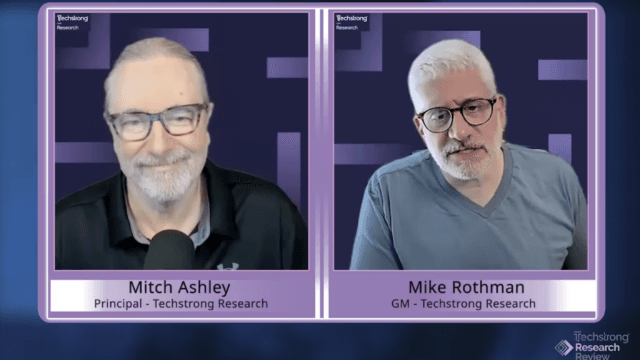
Mitch Ashley, Techstrong Research principal and GM, looks at the Cisco announcement about acquiring Splunk. Mitch discusses why Cisco positions Splunk as a cybersecurity company (not observability), how Splunk’s large data platform could spark and accelerate AI/ML and generative AI innovation and how the acquisition furthers Cisco’s mission to increase reoccurring revenue (at an estimated $4B per year).
Transcript
Hi, and welcome to Textron Research Review. My name is Mitch Ashley. I am principal and general manager, also founder of Textron Research.
Glad you've stopped by to check in and see what's happening. You know, you probably can't turn left or right without hearing or reading or seeing something about the, uh, assistant announcement of acquiring Splunk for 28 billion. And of course, you know, we've all got, uh, interesting thoughts and comments about it.
When, when I heard about it, read about it, et cetera, we immediately went out to come see what the executives were saying. Um, and there were several things that jumped out to me. So a lot of people are talking about, is this the, is this a sign?
Things are turning around. There's gonna, we're gonna see a wave of m and a similar to this one, maybe IPOs even. Who knows?
Maybe, you know, maybe this is the sign of a turn. Uh, I don't necessarily say one event, uh, will cause it, but we'll see. We'll see if that happens.
Um, the, one of the things that jumped out at me, it may seem like a minor thing to others, but the way the executives, even, even the media are presenting it. 'cause that's how Cisco is presenting it as they're acquiring Splunk, a cybersecurity company. Now, I know Splunk since the early two thousands, mid two thousands ran into 'em at a conference and they had a, maybe a 10 by 20 booth, maybe smaller, 10 by 10.
And of course, they were giving away black T-shirts then. And I saw their idea and I said, oh, log aggregation, that's a great idea. I, I can see that, why that would be beneficial.
And of course, there've been success of, as the company has grown and matured and things like that, um, you know, it's gone from log aggregation to really thinking about how you build applications around that data, moving into observability, moving into kind of being a data platform for this. And I think a lot of the observability companies have, have realized and, and grown into security as part of their business. It's not just IT operations, but, uh, the soc the, uh, security organization.
But I think one of the reasons why Splunk is presented as an, as a security company and not an observability company, is 'cause the market will understand that they get Cisco buying a cybersecurity company, and they would value that differently than how would they value an observability company if they don't know that much about that particular segment of the tech sector in it. So interesting that it's positioned that way. I would expect that to continue and maybe that will guide and, and direct a little bit of where Splunk goes next.
We will have to wait and see. So that was interesting. Yeah.
The other is, of course, Cisco's been working on shifting more of their revenue into, uh, annual reoccurring revenue a r r. And according to the executives, that should put about 4 billion a year, uh, on onto the books in a r r. So, not bad, you know, definitely a thing that would move the, the needle.
So they said over the next, you know, over the, over the past several years, they've, you know, kind of been shifting this, I think they mentioned number like 24 billion analyzed revenue, annualized revenue recurring. And, uh, this will co contributed to that. Uh, I did, I did listen to a little bit to, uh, Gary Steele, who's the c e O of Splunk, and also Chuck Robbins, c e o of Cisco.
And you always think about acquisitions with Cisco. Of course, it's, it's a machine. It's been a machine for acquiring companies and technologies and doing it pretty well, having a, a regional track record of it.
A lot of companies fail at m and a. It's hard to acquire a company and retain the talent or the technology or the customers or, or it's, uh, it's easy for kind of the acquiring company just to sort of overtake it, you know, be the immediate that wipes it out. And, uh, Cisco's kind of figured out a formula for not, for not doing it that way, not letting that happening.
But of course, we're always thinking about m and a acquisitions as synergies, meaning cost cutting. You know, you're thinking about marketing and HR and maybe IT sales, et cetera. Uh, that's usually the first place we look when we say there're synergies according to the executives, according to Gary and Chuck, they claim that they're, they're really, what was motivat motivating this deal was top line synergies, meaning revenue.
And if you hear a number like 4 billion a r r added to the bottom line each year, that's significant. I can, I can believe that, I mean, there certainly will be cost cutting synergies, but I think Cisco's going to let Splunk kind of chart its course. Like, don't, don't stop it, keep it going, but let it do what it's gonna do and figure out how, maybe how Cisco can get more of its things behind its products and services behind Splunk, uh, versus the other way around.
We'll see, we'll see if that happens. Um, o of course, you know, in being a data platform, an aggregation point for so many source points of data in such a large, vast amounts of telemetry and other kind of information makes it a great platform for ai. Uh, particularly machine learning, also generative ai.
I mean, that's really what fueled, when I talked kind of back when ML was sort of picking up about five years ago, like, why is this happening? It's the data, it's, there's just so much data available now. And of course this is, you know, five, seven years later since then, the amount of data that we have is, is truly vast.
And that's what makes, uh, unsupervised learning things like that, algorithms and ml, uh, work so well, and of course it does with, uh, with well-trained gender of ai. And so I'm curious to see how that, that data that's, that's collected through Splunk and maybe as other products that Cisco has also, again, added into the mix with that could lead to some really interesting AI applications that maybe they're in a uni unique position to develop. So maybe already we're developing, we'll see.
Uh, so I'm excited to see where that might go. 'cause I think that could be the offspring of a, of some really interesting new waves of what Splunk and Cisco can do together. So even whether it's, you know, generally general purpose security, cybersecurity operations, or maybe it, maybe it's domain specific, you know, in this kind of attack situations, they have so much data available.
Uh, they have a specialized LLM for different domains, things like that. See where it goes. Last thing I do wanna point out in listening to, uh, Chuck and Gary talk, uh, and I don't know these guys, they're talking about it as Chuck and j Jerry, but, um, you know, they were asked on, on one of the programs, you know, is this a good time to do this?
You know, we're in the tech sector is, you know, not, not as healthy as it was a couple of years ago. We've had a pretty significant turn. And is this the right time to be acquiring a company like Splunk?
And I thought the c e o of of Ciscos had a pretty interesting, and I think relevant for all of us way of saying, you know, that the, for them, this was mo mo motivated by top line synergies. Um, but they're still being prudent. You have to be prudent, but you can't stop, uh, what, what, what it takes to continue growing your company.
And, and all of us have to do this. I think if you've been through a, down a downturn or two, you know, yes, you have to pull back, you have to conserve cash, you have to do some things like that. You have to really be tight and, and disciplined and introspective about spending and things like that.
But if that's all you do, you're probably gonna, you know, just kind of turn in like the turtle in its shell and others who are a little bit smarter about it are gonna pass you by. 'cause they're investing in the right ways. And Cisco actually is a very good company about this.
And why bringing this up is in the 2008 downturn, Cisco really remade its manufacturing strategies change. It kind of did a 180, uh, where they were going to very specialized manufacturers who could make these specific products and do 'em in high quality, high volume, et cetera. The technology and the, the capabilities of the market had changed.
And during that downturn, they changed their supplier network, their manufacturing network, to be unable to have multiple sources in their network to provide them the same products in many cases. And you think about that 'cause in a downturn, the people who were there may not be there when you come out of the downturn. The, they may be, they may be there, but they may have a different business model completely.
So you, your suppliers could completely, uh, turnover on their own without you doing anything. So it's a good time to rethink that strategy, and I think that's, that's a good time when, when, when, uh, Chuck talked about, you know, do what it takes. You have to do what it takes, but you don't stop taking your foot off the gas or your, uh, paying attention to what you have to do to grow your business.
And so those changing conditions are a part of rethinking or maybe implementing strategies you've been thinking about, uh, when the opportunities were right, when the conditions have changed. And I think we're certainly in one of those periods where what was true today is not, yesterday wasn't true. Today may not be true tomorrow.
We're seeing so much chain happening, so fast chain AI, chain, AI being just one, you know, recent example. So I think that saying, you know, you have, you can, you can't stop doing what it takes to grow your business is true for all of us. So keep that in mind as you know, we're you're dealing with whatever challenging or difficult kinds of issues you might have, or you're maybe you're enjoying, you know, a really, a really good time during the downturn.
There are companies that do do quite well also. So thanks for stopping by. I wanna take a moment to share those few thoughts both about the acquisition, but also some of the implications and, and things that might come out of that.
And, uh, some past observations and learnings from acquisitions and similar economic conditions. Thanks for joining us on Textron Research Review. We'll see you on our next episode.