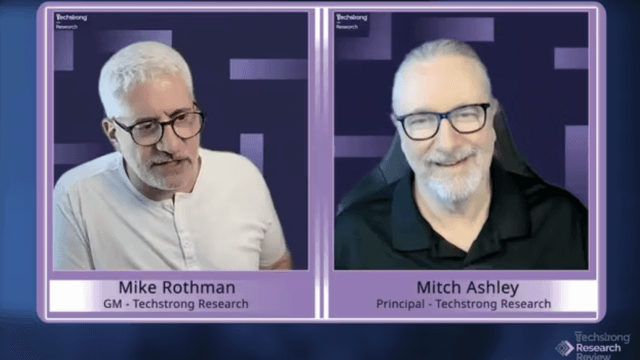
Maturing Cloud-Native – Techstrong Research Review EP 20
This week, Mike and Mitch revisit the TSR Cloud-Native trends released at Predict 2023 and highlight some recent announcements about the maturation of cloud-native management and security capabilities. After taking a victory lap, they dig into why these kinds of enterprise offerings are critical to maintain the pace of adoption of cloud-native tech.
Transcript
here Hey everybody, Mike Rothman here general manager Tech strong research with another edition of the tech strong research review. This is our weekly research meeting where we talk about what's going on things that are timely stuff that's in our craw other General annoyances and you know, sometimes we've been powers on the back, but before we go and do that, let me introduce partner in crime Mitch. How are you Mitch?
I'm doing well always doing well Mike we're just busy with so many projects these days. It's great to just kind of we just recap right before we go. Yeah, you amazing all the stuff.
Okay minutes, just like damn we have a whole mess of stuff going on, but that's not what we want to talk about today. So back in predict 23, so in January, I know it feels like, you know kind of a couple of years. Point and you know kind of Internet time it kind of is but we cannot with all these Trends right for each one of our coverage areas.
We came out with Trends our Cloud natives or second trend for our Cloud native set of Trends right was called kubernetes is not a toy and we really talked about adoption and and some of the things that had to happen in order to really accelerate and continue to accelerate adoption of Open Source Technologies, right Cloud native Technologies. And and the first thing we kind of highlighted in that Trend was the need to improve truly I did and we've got kukon in Amsterdam coming up in a couple weeks. com And and really, you know kind of just dig in a little bit to kind of cloud native.
We fit, you know, the last couple weeks have been all AI all the time, you know, we did it. We're you know, we talked a little bit about RSA and and and data right ahead of our you know, day-to-days conference that we're doing or data. I forget what we'll call that thing.
There are so many but I've been talking too much Mitch. How are you expected from God? Yeah, you know, what do we think is gonna happen out there in Amsterdam, you know, if you've been to Coogan you'll know exactly what I'm talking about.
If you haven't it's it's kind of a sight to see so I'd encourage folks to get a chance to go Europe or North America wherever you know coupon is really part of a big machine and I said it in the positive way. It's kind of like a car on a railroad on a train right? It's one of the bigger cars but everything that's happening around Cloud native kubernetes containers.
Ability for all of that security for all of that service mesh, you know anywhere kind of in the portfolio of we might consider Cloud native and then also kind of supporting things. Now get announced at kubecon and get discussed. There's talks on it.
There's a great there's a great agenda for it. Unfortunately. I'm not making it to this one this year, but I was in the Detroit and I'm excited to see what some of the announcements will be because there's been some interesting things happening already.
I see a lot more this is part of this maturing of kubernetes and the toy, right? It isn't just kubernetes. There's a lot of other things around kubernetes, you know, whether using Spinnaker to do your deploys another open source, or or a lot of I'm seeing a lot more service mesh kinds of announcements istio type things, which says to me you're getting more more into the maturing of the architecture and applications.
Now you've got to okay. I've created a thousand microservices out of heck. Do I manage that part of it right service Smash and then distributed tracing and things like that.
So There are kind of way signs along the way the don't involve AI but where could but I built on chat you like everything in the world supposed to be by now. Sarcasm sarcasm. Yeah.
That to me is one another one of the signs. I think another one too. Mike is how many discussions you are and I are in security discussions that open up into security people starting to think of the network of what's Happening inside of the applications the network across, you know, Cloud native application all the services talk to each other and you know API gateways and all the things that go into doing Cloud native.
So I'm curious to see how security might change or might expand its role at coupon. com, you know, right first they'll point out, you know, and we talked about this, you know the need for better monitoring the need, you know to kind of start to improve and provide some Enterprise type of capabilities stuff and we're really talking about, you know, kind of Kubernetes or whether it's you know kind of other Cloud native projects, but the ability to really start to you know Monitor and then you know manage these types of environments. So we see Noble nine unveiling an open source EKG tool, you know to monitor kubernetes, right?
So again, that's part of the thing. Yes open source, which would kind of makes sense is pretty much everything else is open source on on that front, but what you want are some of these surrounding Technologies to be able to again feel more confident about the workloads that you're putting into these, you know, kind of cloud native environment. So we start to see things like that and other you know, kind of newspago highlight here is is our Pals over Fairwinds.
You should know them pretty well. They are very frequent contributors to a lot of what we're doing here at Tech strong. They just announced remedy automatic remediation of kubernetes misconvigoration.
So we don't think we've seen it yet, but it's just a matter. Time before we have kubernetes posture management. There's a new you know, kind of class of tools that are out.
They really help you understand what your posture is what your configurations are then obviously what our Pals at Fairwinds are doing now is automatically remediating that so so we've got, you know kind of the overall monitoring environment with Noble lines. Do we, you know, the security and automated remediation on that front and the third thing that I'll highlight here is something that yesterday actually will you guys will see this so that should probably refer to specific days and the light but it recently which was VMware, you know in the middle of them being acquired by broadcom like all but their handsome group and they're changing really there container orchestration environment, you know, simplifying kubernetes management. So that's something that they're doing and really the platform level in order to continue to make it more achievable right for organizations.
To really start basing and building these environments on top of kubernetes. com, right? So there's a lot of stuff going on right there.
A lot of companies that are really addressing this issue, which is really what we said needed to happen to continue to gain the confidence that folks need to, you know, start really moving critical workloads to This Cloud native environment. You know we haven't talked about. Cloud native for a while these focused on that in one of my reviews.
So we're bit behind about a month behind. I think it was a 13th of March in 2013 was when Docker well open source was announced debuted shown to the public at pycon. Here's about 10 years of doctor, which is sort of the start of one of the starts to Cloud native containerization.
So all of those resume or those job descriptions out there to say, I need 15 years of doctor experience. Probably not going to find that person but Just shows you in 10 years. It's kind of like when when the iPhone 10 came back came out.
You're like wow earphones been out for 10 years really already doesn't say it seems like a lot longer but that's gone fast. Yeah same thing with remember before those things right and can't remember before and you know, we used to talk about different container things and all that and then you know kubernetes store and now it's really starting to hit that inflection point where it's not a matter of if it's a matter of when and how much for a lot of these, you know organizations that are really revisiting what they're you know application platform looks like and folks were moving again probably two three years ago much more, you know towards thinking about serverless architectures and other you know, kind of mechanisms that would again give them different ways to you know, really provision workloads and manage that but the reality is right, you know, those are very text Kind of Trapped environments, right? I mean if you build something over AWS Lambda, it ain't going anywhere, right same thing for Google functions or Azure functions during these things.
So yeah, there's a place for serverless architecture but we've really seen, you know, kind of kubernetes just because it does provide the myth right or or the promise, I guess promises a better way to put it right the promise of portability that it just makes it a lot more comfortable for organizations not withstanding the complexity of it, but it just makes it more comfortable for you know organizations to really consider that as their base platform for these new modern applications well, and it's, you know, even you've been Docker and containers themselves, I mean we would have the The environment we do today where you know, you can run in the Google environment or you know, Akamai or whoever you're running at AWS. So all that stuff's containerize those environments so that I can spin that stuff up so fast, but also how many applications you know, Enterprise applications or those environments that part of their migration to their Court to the cloud was stick it in a container and then move it to the cloud provider just to kind of isolate as much as you can and put inside the bubble. If you will inside the container to get it moved up there and it's in that's been a key technology and of course kubernetes, you know, moving right along with that for managing your containers and all the microservices that are spread across those.
So yeah, it was it was comfortable. So you didn't have to actually go through a lot of the nastiness of the true refactoring that you could, you know, start to build that in again with you know, or, you know kind of refactoring light right as opposed to full And shift where you know, you're really using your existing architectures, you know containerizing a lot of these things and starting to leverage. Those Services was something another name for refactoring is ripping off the Band-Aid like okay, we're gonna get in there and do some work.
Well, that's right. That's the full moon right when you start doing that and then you got re-architecture, you know, possibly even you know, kind of repurchasing on that front. So so we're actually doing a pulse meter right now.
So, you know by the time you see this the poll may have come and gone but we are doing an application modernization hold to understand where folks are, you know about how much you still live in s*** versus, you know, again refactoring versus actually we architecting some of these things. So this is an area that we are spending a decent amount of time thinking about because again, we you a lot of the surrounding Technologies a lot of the surrounding products as critical success factors to enable the Acceleration for workloads being, you know kind of placed within a kubernetes type of orchestration environment. You know, I have a question get your thoughts on this.
I've been thinking him lately that we hear a lot about application or at modernization. It's in it's not equivalent. But I feel like in some ways that's kind of becoming the replacement term for digital transformation.
We're all kind of tired of that term. So at least for part of the Venn diagram we talked about it in terms of that modernization you You think I'm full of who you're does that make sense? No way.
But I think what you're doing and a lot of that is is you know by proxy of where we sit in the hierarchy and and who talk to most of the time digital transformation kind of happens. If we think of a left of boom right security folks always think it turns of the timeline, you know, when did we get it? You know what happened how quickly until we were mediate.
So if you think about, you know, kind of Shifting laughing, not really sure. Or use it moving earlier in the timeline. You have some kind of business Catalyst that is driving folks to think about, you know, kind of how their applications need to meet those needs.
Right, how are we gonna meet those requirements that out of that discussion comes application modernization, right? Because you either look at your existing things saying I can fix it. I can reply form and I can refactor it and get it to where it needs to be to meet this business requirement or I got to throw it out and then start thinking about really modern adult, you know kind of process which you know gets back to you know, we architecture or repurchase which is I'm going to throw it out.
I'm gonna buy a SAS thing. I'm gonna start from Whole cloth and do it that way. So so I think the answer is both are true.
It really just has to do with it. If you're you know, particularly focused on the text that then you'll hear much more about application modernization. Then you will about business transformation is that tends to happen and a different area of the the exact floor.
Mm-hmm, you know, maybe then it is a product of where we are in the digital transformation life cycle because we built a lot of new things right. We automated a lot of things we now have Curbside delivery or whatever we needed to do. Right whatever.
No new digital experiences that we were creating over the past, you know, two three years and now we're at that place of okay, there's some existing applications. It is time to are we going to replace upgrade? So we're at that modernization phase as well as keeping moving to Cloud native and other things right?
I think that's right. And and I think that, you know again another Catalyst that we kind of forget because I don't think a lot of us want to get back in the time machine to you know, 2020, right but, you know, a lot of new business processes were out of necessity really kind of, you know, duct tape bootstrap, you know kind of rolled out and now you can sit there and look and say hey we got this thing. It worked kind of it meant the need kind of but now you may have an opportunity to revisit, you know, kind of that environment.
Can we optimize that in an environment where we don't have as Resources as we did, you know folks are cutting staff budgets are tighter. So optimizing a lot of these things that may have been done in a sub-optimal fashion. Just due to the time issue under you know, kind of a pandemic type of situation now's about the time right, you know, folks starting to feel comfortable.
We're starting to hear a lot more about, you know, people going back into the office and you know remote work sure if you happen to live somewhere else, but if you're in this city get off your ass and come into the office and collaborate a little bit more on on that front. So I think all these things contribute to this, you know, we feel like a Groundswell of application modernization Concepts, but you know again, we'll kind of get back to the theme here which is it's really an overall in the importance of the maturation all the surrounding capabilities around Cloud native technology specifically, kubern. That I think is enabling a lot of these discussions.
Another sort of signpost along the way of you know maturation of cloud native. There's a great article. I remember who wrote it on container Journal about how do you overcome the challenges of the air gapped kubernetes?
Okay. I remember going to in this early security days of how do we do air gap for right intrusion prevention or for vulnerability management or for whatever so that's kind of a yes eventually have to hit that special, you know selling to the federal government, of course the definitely requirement there. So yeah yet another thing you just kind of see these little reminders popping up saying, okay.
Yep. We're dressing the things that kind of go with maturing broadening. That's right implementing these Technologies.
Yes stuff that we had largely at least I wouldn't say we Master then but kind of started to figure out, you know, kind of a traditional infrastructure and you know, we've gotta go back and start to think about how that works in a cloud hosted. Know kind of kubernetes orchestrated Cloud native, you know type of environment to enable you to get feel comfortable about moving these workloads. And and that's what it's I mean when you think about it, it's psychology, right?
You know, there's not a technology driver. There are technology constraints, right but you're not going to go because you feel like okay the technology is there right? It's an emotional thing saying, you know what I'm willing to bet my job on the fact that these things are already.
You've always have you always have the front end of people who are like, you know, I don't give a rats that's about my job. I want to do cool stuff, right and it goes down in flames, you know, I'll jump out, you know my parachute and land somewhere else and then you need that right? You need the innovators who are gonna push the envelope on that stuff.
But when you get to the mass Market when you get to the you know kind of early and then the late majority if we you know dust off Jeffrey Morris terminology back that that's crossing the Chas Overall you kids out there. Um also guys remember that but you know, some of you kids may not be as familiar with lines actually worse architectures, but as your your early majority as your late, you know kind of majority gets into this it really is about that emotional, you know? Yes, this is established.
Yes. My buddies are doing it. Yes.
I I don't feel a risk to my job security. If you know I start to adopt these Technologies and and that's gonna get that those are kind of the things that we need to see in order to, you know, feel comfortable that we're moving in the right direction and I think we will and and that'll be interesting too again. See what we what we see out of kubernetes or who come in coupon in Amsterdam and in a couple of weeks see, you know to what degree at the RSA conference which is a week after that, you know, we hear a lot about kubernetes security and and see how many of these Cloud native companies are doing both.
Rights to that'll be a little bit of an interesting event diagram in terms of you know, kind of playing in the security audience and to continue to go back and revisit our Trends, you know throughout the year and point out, you know, hey, this was dead on right this maybe a little bit less. So, you know this third thing, you know was kind of getting there. We the jury still out and the good news is we're a third of the way or I guess a quarter of the way through the year.
So we've still got time to be right. Well, that's why you revisit those, you know every so often so you can modify what you meant at the time when we said that prediction, right? You're not supposed to tell folks the oldest.
Well, this is behind, you know inside the brands of the analyst and That's true. If that we're gonna be inside as we should be, you know, just candid and honest about exactly how we do things. That's what we met.
So good. So that's great. So, yeah other announcements we have to think about mentioning stuff.
We need to tell the audience about Yeah, you know we we are we're doing some work can give you a little bit of a preview. We're doing some work with container Journal. You know, that's been one of our that's been I guess the Third site that we set up after devops and Security Boulevard, you know, and it's really much more than containers and taking it's taken on a life as a cloud native kind of focus and so we're going to do some work to really highlight the cloud native aspect of it.
You'll see some announcements about that site and some cool things that we're doing and we're also kind of kicking around what we're gonna do in the AI world. This is something we've been talking about, you know, is this is this the right time to kind of put a focus on that in addition to what we're talking about in the individual sites and things like that. So I think you'll see us do some more there as as Textron group, you know, and we as as research, of course already doing a lot of work and not just containers but Cloud native and yeah, it's a big theme of that as well as long as long as well as data.
So those two things are kind of elevating I think and our psyche our View kind of looking at the Horizon and to see more of that from us and research and And Textron group as a whole you get 100% So so, you know, we've got a whole bunch of cool stuff planned AI has certainly and going to be an area of focus. We want to do kind of a broader research project on that in the near term Edge Computing, you know, when we talk about again Cloud native and how a lot of those Technologies are living out to the edge to really start tracking, you know, some of the use cases and the adoption for you know these Innovations. So we've got a whole mess and a bunch of security things that we think are important for folks to track so we'll be you know, launching a number of cool and issues over the next couple of months on that front, but do stay tuned for the relaunch of container Journal that is gonna happen in the very near term to make it I would say more about Native friendly and yeah, we've got a lot of stuff going on so so it's been great.
So Mitch always good, you know kind of do the research review a little research meeting. I think we Something every time, you know revisit our focus and touch base and all you folks get to get to kind of ride shotgun and and here, you know kind of our internal debates and discussions. And see us at RSA or live streaming on Textron TV in our site.
So that's okay. You're interested in interviews, right? We still have open interview slots at both coupon and RSA.
So reach out to us and as always with any questions or comments or feedback, we are happy to engage and discuss, you know what we're doing and how we can make it better, right the community makes our research product better. So, please let us know what you think at any time. Sounds good until next time.
till next time