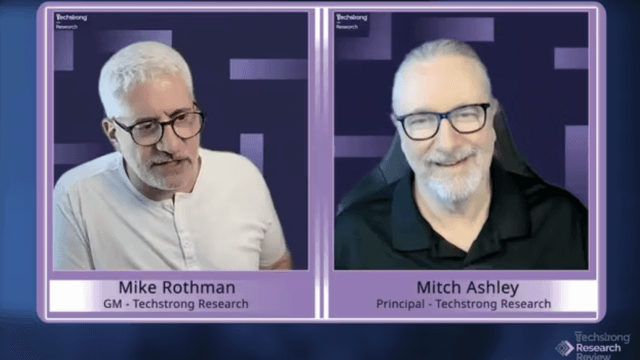
Kubernetes Swings on the Cloud Native Pendulum – Techstrong Research Review EP 25
Mike and Mitch discuss how Kubernetes went from an interesting niche of orchestrating microservices to the center of everything Cloud Native. The long-term answer is somewhere in the middle, so they discuss what that looks like and the impact to other technologies like WASM and Serverless.
Transcript
Hi everybody. Mike Rothman here, general Manager of Techstrong Research with the birthday boy. See, when you, when, when you guys see this, you don't actually know what date we actually recorded.
So I'm not divulging any personal information. Personal information, identity, thiefs go pounce saying Buddy. Um, but I do need to wish my partner in crime, Mitch Ashley, a very, very happy birthday, my friend.
Thanks so much. You know, one, one more revolution around the sun. Congratulations.
That is always a big milestone. Even though we stopped counting after a certain amount, I appreciate I started count counting backwards quite a long time. That's right.
By the way, this is recording. You're about 22 now, right? In January is when we're recording this, just upwards.
Yeah, of course, of course. So you, you, you get the sense it's kind of springtime, but besides that, you don't really know Somewhere in springtime. Yeah, Mike, I appreciate it.
Good to hear text. Yeah. We're here for the text research review, aside from our little birthday greetings for my friend.
Um, today we're actually gonna talk about cloud native, right? We're gonna talk about containers and Kubernetes and, uh, and some of the research that, that Mitch is spearheading, uh, up for us. Because what, what what's interesting is that y you know, the industry is fairly predictable, you know, from the standpoint of you've been around long enough and you've seen enough of these cycles and you can kind of match patterns, right?
You kind of see the same stuff over and over again. And, and, and when containers first appeared, it was really driven towards a standardization. It was driven towards y you know, kind of facilitating, uh, and, and removing friction on the part of, of standing up these new application stacks that had to be done in a much faster, uh, and, and more predictable, uh, way driven by C I C D and a lot of the, you know, these other mechanisms.
And now we've kind of started to see due to the adoption of Kubernetes, and really that that's as much the, the mindset of adoption of Kubernetes as anything else, right? But now it's kind of conflated with Bio native. So you think cloud native and, and you know, automatically you go towards, oh, that's just building infrastructure on top of Kubernetes and nothing else, right?
So all those other use cases we had before, eh, you know, we don't really think about those too much. And, and from an industry standpoint, that's very predictable, right? You know, kind of we get locked into one certain thing.
Mm. The pendulum swings that way. But I guess what we wanna talk about today is really kind of where do we get towards equilibrium, right?
Where there are additional use cases for, you know, kind of containers. Yes, it is the central technology that drives a lot of the cloud native infrastructure and open source projects that we see. Um, but the answer is not either or, right?
The answer is both. So that really relates to some research that you're doing now, Mitch, that, that we'd love to kind of preview a little bit. It's very interesting if I sort of like rewind the tape back to when I got introduced into, into containers and that it was an evolution of, um, virtual machines.
It was VMware and said box and, you know, other things. And it was now, okay, you don't have to include the operating system and all this other stuff. You just put the things that that application needed in its box.
Now, we weren't doing microservices, you know, back then in, you know, 2012 or 13 or whenever it was, I started working with containers. But it was a way of, uh, lighter weight packaging of things and making, you know, those things less bulky. But also one of the things that I learned along the way is it, it also is a way of, you could put an entire application and everything, it needs even a monolith application in a container.
Um, and, and part of managing monolith applications is what does it all touch and what are all the parts and where are they and how do I, how would I get it into one place? I don't even know where they are yet, what database it's using, what calls it's doing to this. Oh, I need these libraries.
I didn't know that. You know, it wasn't how we built things. Like they're all delivered in entire files, right?
It was some script to go push everything everywhere and then we fixed it to make it work. So it, it was just a, um, a simpler way simplification of organizing things. And what's, to your point, we sort of swung the pendulum of, well, what is, what is micro, what is cloud native?
Oh, that's containers Kubernetes, um, microservices service, mass, serverless, yada yada. Um, which is all true, right? It's a collection of things and you don't have to do every one of those things, but probably most, maybe almost all times you're gonna be doing containers, especially you're doing Kubernetes, cuz that's what it's managing, right?
So, but we don't live in a world that everything is, is, uh, is, uh, is cloud native, right? Even though we're doing a cloud native now conference, we live in a world where there's cloud native, there's moving to Cloud Native, there's stuff ha hasn't been touched. Um, and things that might partially mo move.
net app. And we said, God, there's so much of this we can't touch. Cuz we don't know people are all gone that wrote that 12 years ago.
But with this one part, we want to be able to start adding a lot of new things to. So let's move that out, put that, rewrite it, put it into microservices, put it into containers, and do that. And so, you know, it's this continuum idea.
I think there's a lot of our thinking these days, Mike, about let's always don't focus on, you know, the wam, the serverless, the whatever. Lots of great things happening. It isn't just that it's, we live in this world that's connected of all those things at the same time.
It what is, what's the movie? Everything Everywhere, all the time. Yeah, yeah, yeah.
That's kind of where we are. No, and and, and I agree with that. And, and, and you kind of brought up an an interesting point, right?
You know, things like wom, things like serverless that you don't really hear that much about. So, so again, having been a pattern matcher for, you know, the last 25 years and that, you know, could arguably be maybe one of my only, you know, marketable skills. Oh yeah.
You have others, I'm, I know You, I have others. Well, you're, you're much kinder Than I, trust me, Uh, from that standpoint. But you, you know, you look at it and go, when folks stop talking about it, that typically is when people are actually doing it right?
You know, kind of, because the hype definitely kind of, and that was the genius of the Gartner hype cycle, right? The hype definitely, you know, kind of precedes where folks actually make use, uh, of a lot of these things. But what, what what's interesting is, again, kind of the openness aspect of this, and one of the things that I know attracts a lot of folks towards Kubernetes is this idea, however, misplaced that, you know, they can build an environment, you know, in one Kubernetes platform and move it to another.
Is it really that way? Eh, now e concept. Sure.
Right. You know, will you have to do a bunch of refactory and re-engineering, obviously, right? But, but you know, as opposed to a serverless thing where when you start using functions from that standpoint, man, you ain't moving anywhere, right?
Like ever without, you know, totally rebuilding, you know, that thing. So again, for folks that are all in on a certain cloud platform, not a problem, right? But let's say you want to start thinking about how am I gonna move some of this compute to the edge, right?
How am I gonna start to distribute some of that stuff? And you've spent a whole bunch of time architecting in, you know, kind of a server, aa, cloud platform specific serverless environment, you've got a bit of an issue, right? You know, that stuff ain't gonna port, you know, in any way, shape or form.
And then you have wazo, right? And I think it really gets back to understanding the problem you're trying to solve, right? What, what, what is the use case here that we're talking about?
Because clearly you're gonna have a use case for, you know, a fairly built out, you know, hyper scaled type of Kubernetes environment. You're gonna have, you know, certainly something that needs to be a lot more portable and, and available, uh, on a variety of diff different devices. And that's where Wasm comes in.
And then you've got things that are really more ad hoc, right? And that's where something that serverless could, could really come in. So as always, right, it gets back to understanding what problem you're trying to solve and then, you know, choosing and deploying the technology that solves that problem as opposed to jumping on a bandwagon.
And because, you know, you're, you're, you've got a Kubernetes hammer, right? Everything looks like a containerized nail, right? And I think that that's what we have to really be careful of when we're architecting, uh, and conceiving a lot of these application stacks.
I call that management by, we need one of those. What is, we need a Kubernetes, whatever that is. That's right.
Or we need a platform. Yeah. I I just see it, right?
The the the executive are sitting in there and remember they used to have airline magazines, right? Exactly. Yeah.
They're looking at the airline magazine and you'd get a call, Hey, what are we doing about this? Yeah. Where, where are you going to today?
Yeah, exactly. So, all right. Which, which airline this month has something on, you know, technology that everybody's all wrapped up about.
So, So, so what's interesting is Kubernetes is not a thing. Meaning it doesn't do anything in terms of value delivered to the end user. It isn't the, it isn't the code that's the application, right?
That's saying, here's let's, let's you purchase this or watch this movie, or whatever it is. It's the infrastructure to manage, right? Basically a a very kind of small componentized microservices, uh, infrastructure.
That's what it's for. Um, to want to manage large volumes of, of microservices and containers, right? And with the ability to scale up and scale down a, another interesting use case is also, I'm gonna stack back, it's my birthday, so I'll get to reflect You do.
So your show, man, do it. There, Here we go. I'm taking over.
Um, I did a due diligence on an airline reservation system way back when, and I remember walking into the, into the op center, and there was this terminal with these errors just flying across the screen, flying how many database error database, blah. And I was the DBA D B A at the time. So I, I went to the head operations guy, said, I think you got a problem.
Like, this thing is like going and singing over here, but nobody's doing anything. They said, well, let me explain something to you. To get the volume that we do to handle the massive transaction volume.
We basically let errors happen. And when it was database errors happen, usually what the rep does, uh, at the, at the station, we're buying your ticket or checking in, they just hit enter again and try it again. Yep.
So we will tolerate a certain amount of failure to get to, to manage the increase. And there, there's a, there's an aspect of that, of containers, microservices and Kubernetes. You know, provided I don't have a massive critical failure in, you know, some of my code and some microservice, if the thing gets a little wonky, teared down and spin it back up, you know, you can do things like that where resiliency can be by quick response of just bringing it back up.
And then maybe I go decide if it's something I've gotta fix later. Um, or this, this infrastructure that I'm running on here, I have little problems with that service provider. Let me kick some up over here.
So th there's a, uh, counter resiliency aspect I think that's interesting to Kubernetes and, and doing containers and microservices. But my point molded me by my point is, is we talk a lot about Kubernetes, and it is just cuz it's filling in need of how do I manage the complexity of something that I'm creating in a much tiny, tiny, you know, tinier way. I'm, I'm using thousands or tens of thousands of Lego blocks instead of dozen.
Yeah, no, and, and, and, and I think y y you know, that's, that's an an interesting, you know, kind of perspective. And I really like, you know, kind of, again, the idea of understanding the actual user experience is kind of the central point of, of all of that. Because, you know, you would look at that today and go, well, gosh, well just, you can just auto scale the backend, right?
And, and you, you know, kind of have that and you wouldn't have, you know, kind of, or you use a database service, which you, you know, does it on it on its own, um, you know, in order to handle all that stuff and you shouldn't have those issues. But again, you get back to, if the user doesn't perceive that as an issue, is that really an issue that you need to go and spend a crap ton of money or re-architect or do something else? So there are so many different, you know, sides of this that, that we think about.
But I, I, I think the key issues, and again, part of what you're gonna be doing in this, you know, new research that, that we're, uh, undertaking, which, uh, should be done within a couple weeks, right? You know? Mm-hmm.
Max, um, yeah. You know, is, is really to again, understand the specific use case that you have to, you know, address, pick the technology or the aspects of the technology, right? Kubernetes can fit in a lot of different places, right?
But maybe it's K three as opposed to k you know, cuz you're dealing with, uh, you know, an edge type of, of, of use case. But, but really, and again, this kind of always gets back to the same thing that I've been talking about for years, right? It, it it's the continued rise of architecture, right?
The importance of architecture as we're building these things out, because we've got so many different things on the smorgasboard, right? And again, it's kinda like when you go to a fancy, you know, kind of Sunday breakfast buffet and you're like, I don't even know where to start. Um, that's kinda what these architects are looking like.
So it really is about, you know, being very, you know, kind of application centric and, and, and focused on what problems you have to solve because you can, you, there are 10 ways to solve everything pretty much nowadays. Mm-hmm. You really gotta figure out what's gonna be the most strategic, uh, you know, modular, scalable, resilient, you know, all of those things based upon, again, let me highlight this, right, based upon the requirements, right?
Yeah. You certainly can over-engineer everything, but should you, just because you can, doesn't mean you should. And always, you know, again, keep that in mind.
Well, that's a que a question I have for you is, you know, the, the pendulum swinging, you know, it seems like every, I I used to think of it as a back backlash, you know, like, everything, let's go this way, let's do it. Nah, microservices and cloud-native. And at some point they're, you're sort of rebound against hitting the wall of, okay, not everything has to be a hammer and a nail, right?
And the same nail. Um, and maybe that's that equi equilibrium idea. Do you think with cloud native and Kubernetes and microservices are, are we gonna hit or have we hit maybe a hard kung That's okay.
Not, not so fast. Let's step back a minute and kind of balance this with what's going on. Is that, is that the cycle period we're in?
No, no. Uh, and, and, and, and the reason is because Kubernetes is so top of mind. Now you're going to see a lot of folks just rushing there to rush there, right?
Without really a main focus besides that, Hey, I, I need to have one of those, right? I need to have a Kubernetes, I gotta get me one of those. I yeah, I gotta get me some containers on, on that front.
And, and you know, and, and remember there, there's a variety of different, you know, kind of environments within that continuum. For the folks that have been doing containers for a while, they're the ones that are starting to, to moderate on that and starting to figure out, all right, how do I make this into really a productivity tool? Once they've figured out, you know, what they know, right?
You've just got a whole mess of people who don't know what they don't know yet. And, and, you know, basically their cloud provider says A K s or e k s or, you know, g k e and, and, you know, it's like, okay, right. So you then you just, you know, start rushing headlong towards there and, and there really is a long tail here.
So, you know, you like to think that the folks are, that are in the late majority to bring back Jeffrey Moore's terminology that they're able to learn from the other folks and, and have much more pre-packaged type, you know, things for specific use cases. And I do think, you know, you know, we get there, uh, over time, but for those folks that are in the early, you know, kind of majority the late, you know, kind of, uh, uh, adopter, the early adopters and, and, and the early majority, um, they're just, you know, again, oh, you know, full speed ahead, right? You know, kind of elect like the penguins on the, the lemmings, you know, on the iceberg.
You know, they all follow each other, you know, kind of down down the thing. And again, to be honest with you, that's not a terrible thing because they have to learn, right? When you don't know what you don't know, the only way to start to know it is to actually start to do it.
Yeah. So, yes, I mean, playing around with Kubernetes, starting to think about that, starting to introduce y you know, your first set of production applications, all of that is positive, right? And then over time, you need to start to figure out, okay, this is where that fits, right?
This is where serverless fits, right? This is where Waza fits. This is where Kubernetes fits.
This is, you know, how we're gonna build the applications and the pipelines to feed all of those, you know, different environments. And this is how we can standardize what our infrastructure looks like, which is of course, the platform engineering discussion, uh, on Afra. But understand it's a journey.
It's a journey. So if you were at the beginning of that journey, you have no idea where you're going and you shouldn't, right? But if you don't start down that path, you're never gonna get there.
So again, go do it. Just keep in mind that, you know, if you can learn a little bit from where other folks have been, uh, you'll be better for it for sure. Well, good.
I wanted to ask you, and I agree with your perspective on that, but I wanted to ask you, because I think I'm, I'm a little bit more in the middle of the tornado. You're, you're maybe kind in the ring the rings of it somewhere, so you have a better perspective. Either that or I'm getting flopped around a lot more, so I'm, I'm, I'm kinda punch drunk at this point.
Maybe you're getting hit, I'm getting hit by more debris or something. Well, Remember the eye of the hurricane is, is the complex, right? It's, it's Outside Of that.
No, I'm not there. Tornado tell you good stuff. Well, we talked about cloud native now.
Um, I don't remember the date of it. Do you remember right up and when our date, when our date is for that? And I'll look it up here real Quick.
July 11th maybe, I think. Yeah. Child July 11th, I'm pretty sure you're right.
So, but, um, folks can sign up if you go to events. Um, and there's a whole list of them there. Uh, we have other things coming up, um, like data ops, which is by the way, a whole great, on the other topic.
Yes. com and sign up for that. Uh, there's a, it's a great lineup.
Mike, I don't know if you want to say a little bit about what we're gonna do. Yeah, so, so we, we don't, we don't have it on the agenda yet, so if you see it the next day or two, you know, you're probably gonna be like, what the hell is he talking about? Um, but, uh, we're actually gonna, Mitch and I are gonna do a panel.
We're gonna invite, you know, a handful of, of other folks and we're gonna revisit our 2023 cloud native trends. So remember back at Predict, I know it felt like, probably feels like a lifetime ago. It was, you know, kind of back in January.
Uh, we preview trends in our four main coverage area, uh, coverage areas. And, um, we're gonna revisit those because again, we do like to have some measure of accountability. What was right, what was wrong, uh, what did we need to, to really focus on, how would we write them differently if we were making that, you know, kind of call, uh, today as opposed to, uh, back in January.
So it should be an interesting, you know, again, kind of retrospective, but really with a forward-looking thing because the cycle times are so fast in, in today's technology environment. I mean, six months is really, you know, kind of two to three years in, in kind of the old, uh, time. So a lot has changed since then.
And, um, yeah. So we're excited to, to be able to, you know, go through those and, uh, and, and really, you know, get just kind of, uh, put a little bit of fun on at ourselves in terms of, of what we thought was gonna happen versus what really did happen. It's really just our secret way of tweaking the predictions so that we'll be right at the end of the year, by the way, way, but that's a, the secret out.
We just buried them, you know, We just buried. Yeah. That isn't what we meant.
Yeah. The secrets of analyst. So July 11th, good stuff.
Any other announcements We gotta make, Mitch, what? We'll keep wa an eye out for your, you know, emerging, you know, kind of Kubernetes, uh, research. We've, we've got just a bolt load of pulse meters that are gonna hit, you know, kind of all, uh, in the same, you know, timeframe.
So, so keep an eye on the, on the research site, uh, for those new, uh, documents. And, and you'll also see a lot more outta social media. They're starting to highlight some of the pulse meters, so you'll get, uh, uh, a sense of that following Channels.
We, we have some, um, I, I'm not gonna announce it here, but we have some things coming up around people that are kind of the builders of the world creating all these applications and how to get to some really good resources for that. So we'll talk about that on another show. And also an idea that, um, Mike and I are pulling together is I think the area where I'm gonna produce kind of the next substantive research taking kind of forward, what we were just talking about before is, is sort of DevOps outlook, but also incorporating ai, generative ai assisted AI development and how, what kind of an impact it is already having has been already having, right?
We've already been doing this, um, that we haven't talked about like we do now cuz of cuz general of ai, but where is that really going and how's that gonna transform? How's it gonna improve things? How's it gonna make things faster, better, easier, whatever, um, whatever that might be.
So if you have an interest in that, that's a, an area for you, reach out. I'd love to hear your thoughts and ideas as we gather some input on that too. So I'm excited to work on that.
That'll be fun. Good stuff That will, that will be, it's the future. We just don't know whether it's a matter of us living in pods like in the Matrix or, uh, under siege like in Terminator or whether we are all just, you know, kind of sitting around like the Jetsons in our flying cars and you know, going out and doing, doing stuff.
So, Um, future's so bright. You gotta wear shades as the song is Either that or, you know, dig a big hole in your backyard and, and, and bright. So it will be one of those two scenarios Given the smoke in, in the east coast.
You might think it's the apocalypse really. Exactly. Yeah.
It has already taken over. Again, again, just really hope that the Canadians can get those wildfires. Oh man.
Control and, and you know, kind of stop that cuz that's just a terrible Big health hazard too. On that positive note. Yeah.
On that positive note, we'll wrap up another episode of Text from Research Review. Uh, we'll be back next week with, um, some other topic that we'll figure out about three minutes before we record. com, uh, as well as all of our social channels.
Thanks everybody.