AI for Everyone! – Techstrong Research Review EP 19
Mitch and Mike circle back to AI in this week’s Techstrong Research Review. Some parties want to pull back on AI (notably Elon Musk), and good luck to them on that. Pandora is out of the box, so we talk about how AI is impacting day to day jobs and the work Microsoft is doing to integrate AI into all of their major product lines. There are exciting times ahead, and Techstrong will be out front researching and covering it.
Transcript
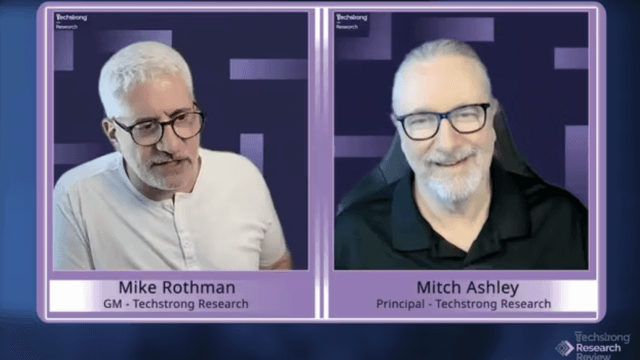
here Hi everybody, Mike Rothman here general manager textural research with yet another episode of text on research review speaking 19 mentioned, maybe 20, I you know, I lose track we keep doing this stuff. Hopefully it's adding some value. Remember you can get it as a podcast as well.
If you want to, you know, kind of check it out when you're on your walk or trying to fall asleep or you know, I don't know whatever it is that that you guys do when you're podcasting. Now you have an option to get the text from research review via podcast. I'm joined as always by Mitch Ashley who is principle at Tech from research as well as our CTO.
So and and that ceoing will come in handy in a couple of minutes when we actually dig into our topic because Mitch has been ceoing and it's been it's helpful from a recycling you I'm doing well. I'm doing well. You can talk about how many episodes I'm running that fingers and toes.
I don't know. I'm gonna do that's true. I mean, we just keep cracking along mostly every week.
We're here chatting it up and and this week we're going to go back to AI why because everybody else is so we've got to do that. We were just joking before, you know, everybody gets an AI. It's like AI Oprah out there, you know, just look under your seat.
There's an AI for you. Yeah, and we all get any everybody gets it AI so hey guys been in the news obviously with chechny PT and now the the emergence of gpt4 which I I use actually quite a bit and and it is you think it really better little slower, you know, but significantly better for the standpoint of kind of results and I'm always double checking what it is that you know, they say I'm not just doing good based on that front, but it is helpful to frame to help frame out, you know things it's helpful to make sure I'm not missing stuff that I already know so so for me in my day to day work it it's actually pretty helpful from that standpoint, but The the naysayers right? The nervous Nellies.
They have emerged this week a number of them sending a letter to open AI with Elon Musk who's actually the first founder of openai or the first funder. So he put the first money in there. So, you know, he does have a long standing opinion as well as relationship with these folks saying we maybe need to pull back on it.
Right. Would you be T4? 5 and and what's you know kind of strapped into or or used by by chat GPT that we just we're not sure of the ramifications.
We don't know like what the what the real risks are and and how to control them and make sure that we're not, you know kind of running head long into our Skynet moment right that I think everybody is is worry about it. And I think you have to be a certain age to understand that and and if you're not look it up Skynet, you know, it'll Re-educational through this podcast called science. What do you think of this?
You know again, you know kind of the backlash has has hit right? Everything's been about, you know catchy BT, you know all over the place for the last, you know, six weeks or so now we're starting to see the backlash. All those things I read.
They're happening, you know the you know, the three rolls of asthma's three rolls of Robotics and and Goliath the computer taking over the you know, war games all that stuff reading books back in the even 60s and before but it's interesting. So we've we we have crossed this Rubicon. We're now ai tools have become general purpose and and now everybody has access to it.
Yeah, they're kind of interesting interesting Novelties for generating images neck and the stuff. I think people are interested in chat GPT so much because it's so easy just to talk to it like a search engine, right and you can kind of see what it does and how I might use it and go crazy about it or not the whole. Yeah.
I saved he is a topic that's been around for a long time matter of fact as I've done my reading about open Ai and Evans from the beginning but that was kind of one of the purposes of it. It was to be more altruistic to create. AI models and do things safely matter of fact once Microsoft did their investment some of the people left because they're unhappy with the commercialism commercialism of it.
But and it's also happening now because Just recently part of Microsoft's layoffs and with their announcement of co-pilot in Office Products chatgypt kind of built into office and some of their ethics in society researchers, you know, they let that group go and they're pushing those issues down into the individual product teams. So we're at this point where okay the financial and the business interests versus the what potentially bad could happen leading up to an AI Apocalypse in the worst case, you know scenario You don't know it's going to happen. So we have to kind of let it out and see what it's going to do.
And of course the concern is well, if you let it out it may get out get so far out. You can't pull it back. There is never any pulling back.
We can't pull the cloud back. Okay, well blockchain back. You can't pull you know, whatever any of that stuff back, right?
It just it's when we create things they tend to get out into the world covid and and other stuff like that's not the great to conspiracy theory here built on me. But anyway, we can get into the details of it. But that's what fascinates me is you we're now in the public Consciousness and then it's coming back AI safety is this been talked about for a long time?
It's not a new topic. I see in some of the concerns. Well, it's not and and I do think that you know, kind of a lot of the issues that folks are are voicing.
Our legitimate issues. I push back a little bit on this idea. Well everybody has It and and the bad folks are gonna get it and and they're gonna use it against us and it's gonna be I mean, I heard the same stuff when when HD Moore open sourced metasployed, you know kind of back in the day, right?
Oh my God, and obviously it was a much smaller community and it was you know, 15 years ago and and we weren't as mature. We weren't as complicated, you know in any aspect of Technology, but I heard the same stuff which is if you give you know, basically amateurs, you know, real hacking tools. They're gonna do a lot of damage.
Well guess what they're gonna do a lot of damage anyway get in the tools. If anything it sets a low bar right a low bar in terms of what your security has to be able to protect and I think this is a similar type of structure right? We have a low bar in terms of what we have to be able to protect against because everybody has access to chat gbt everybody's gonna have access to you know, these, you know voice me and kind of a I voice generator type things, you know, I love That they the picture of the Pope in his you know, big Buffy jacket, of course, it was fake.
Right and and we have what that means is we have to get better at being able to detect a lot of these Faith things like we had to get better at detecting attacks that came from you know, something like like metasployed. So again, I use my little experience back in the day, um, you know, one area to try to extrapolate everything else and obviously we're dealing with a much bigger scale and I'm not gonna say there are no concerns because there are a specialty from an ethic standpoint, but man I'm just I've been doing this too long right you open up Pandora's Box the Box is open man. You can't close the box, right?
You can't say. Oh, hey, we're gonna stop, you know Evolution on this part. I mean, it's just it's in the wild is going to do stuff right people are going to advance it and and you brought up the idea of commercialism.
I think that's actually a really important aspect of this in that Soft and again, they are a for-profit company. They work on the benefit and and advantage to their shareholders as they need to they've invested a significant amount of capital. They're doing a whole bunch of stuff to integrate these capabilities into maybe all of their product lines in some way shape or form.
You can't put that back in the box, right? So now it's really about how can we you know, try it kind of keep Pace from a policy standpoint kind to keep Pace, you know from a threat modeling standpoint. That was one of the things we talked about it textural Con right which was you know, kind of how do you start to evolve your you know, kind of architecture design planning and threat modeling in order to factor in the reality that you know, you're gonna be getting you know, stop problem on human right?
You're gonna be getting AI is gonna be generating aspects of pretty much all of our applications moving forward. So it's not a matter of hey, how do we how do we you know kind of rain this thing and it's Matter of what do we do now that it's on the road, right? How what kind of guard rails can you put up so that it doesn't you know get to that apocalyptic moment which you know again, I just keep getting back with maybe it would be really screwed up.
If you know James Cameron was right all those years ago. Yeah, no doubt. Well, so there's so many parallels or analogs that you can tie back to things that we've been through like You know, how do we tell that?
It's a real person versus an automated bot. Right? We know how to do that.
Now there's a time when we didn't know how that's right. That's right, because same thing with AI, right? How do we know?
This is a real person did this. How do we know it's fake? What if it's built on fake or a false or inaccurate information that's perceived to be accurate and it causes us a cascading series of things to happen all based on bad information, but we think it's good because it sounds like it was it's human or close to human generating.
I think that's the the one variable that's different about AI is is we're at this point. Where can you detect whether it's human created or not? And do you know how it was built in the source aesthetic came from so if you can't tell if it's Mike and Mitch created this right when they're collaboration or it just got created somewhere else and it looks like Mike and Mitch created and there's you can't tell the difference.
That's where I think people are a little concerned about it. So all that to say I'm in total agreement, you know tilting at Windmill spitting in the wind whatever analogy when you want to make of let's all stop for six months. Yeah, well China does this and Russia does that and everybody else in the world?
Does that not there's some interesting things happening that you know, I the stuff I just find fascinating. For example, there were some researchers that Stanford who bought from meta Facebook their own large language model kind of like Chad GPT that their own but they had kind of dumped it down and just provided the model and some of the some of the intelligence built into it from through the data. So they took that model and then they plugged it into getting input output that it was input from Chad GPT and they actually recreated much of the same model using it different AI engine to build.
It's knowledge base. So AI kind of creating AI at least is the source for data, so there's all these things that we're now kind of experimenting with and seeing right? Hey, what's possible?
What's good? And what has Intended consequences and it doesn't matter and just to find the edge cases, right? And that's what hackers do right that's been my world for a long time and I so I thought that Twitter post by my friend.
I may vlasco who's one of the founders of not security. He was one of the founders of alien involved, you know way back one, you know real big brain, you know kind of security guy and and he did experiment to see if he could get chat GPT to I want to say develop malware or you know, kind of put places it was something that was you know, kind of malicious and and you know, he does the first thing in churches I can't do that, you know baseball and he's he sent the instructions in Morse code. And he said send me back the answer in Morse code and that got around, you know, kind of the defenses that you know opening times.
It's speaking to that right? I mean, how do you sit there? Go what if I would have sent it Morse code, you know, it's just again just the Innovation right the creative thinking that you see out of these folks to try to really test the boundaries of that stuff.
That makes it better because I guarantee you somebody open I said, holy crap somebody sent this thing more code and you know, we got to put up a guard rail. And in order to do that and that's how we learn. Right?
So pull back. The reins is not gonna you know, stop the Innovation. It's not gonna stop malicious folks from you know, using it.
Um, so yeah, I think we've beaten this one, you know to to help on that front. There's no way to put it back in the box. So now we got to figure out how to make it work, but what we are focused on and again, you're gonna see a lot of stuff out of text wrong on this over the next six weeks.
It's really the Practical applications of AI and you know, it's interesting right? Sometimes you just see big companies and they Lumber long and you know, and and they never get anywhere real fast. I gotta tell you I'm astounding by what Microsoft is doing and how quickly they are, you know, integrating, you know generative AI into almost everything they're doing right first example of that was copilot within GitHub.
I want you to talk about that a second but they've also recently announced that they're gonna have security copilot along with their you know, kind of Security Suite mostly, you know for Azure and Office 365 to provide a whole mess of stuff. You had just mentioned that they're integrating it into you know, the office suite so it's one of these things where I mean, this is just a huge yes company, right and they are moving as fast as the most Nimble start up to get this thing everywhere right and have it accessing all The thing so so again, we are really at the precipice of this and and I'll tell you in hindsight that 10 billion Microsoft, you know, kind of invested and open AI may turn out to be, you know, just one of the more significant value creating Investments that that we will look back and say wow that they got, you know, pretty decent return on that I turn from it, but tell us a little bit about, you know, kind of you. I know you played around with with copilot in GitHub a bit.
Oh, yeah, I've been you know, I've been using it that for a while on intellisense from in Microsoft Visual Studio both of which are based on the same open AI codecs. Just kind of different flavors of it implemented in and it's always you know for non-programmers think about it as grammar completion of a sentence in an email or in a documentary grammarly kind of thing for programmers and it's been sort of at this code completion stage. For a while.
We're now it's issue begun to use it, you know more recently it's putting in code for you. So for example, I was looking at an example in a book and said I want to try something like that. So I started to actually type in the first couple of commands and it filled out the rest of it for me at new what I was And I just barely given it a information enough information to tell what I was doing and I can't that's actually part of it.
And there's the the you we're getting to the natural language right a subroutine that does the following thing for me and some of those things you could do now, and I think it'll get better and better. Of course, everybody jumps to the well, we're not gonna need developers. Yeah, we still don't need operations people.
We have operations people. We still need security people. We still have lots of security people.
I don't buy into the you know, 80% of our white collar workers are going to be gone and 20 years, but I think the what's important to me about it is it's a productivity tool for software creators and it makes it accessible to more people. You don't have to be a python expert. There's a lot of people by the way co-pilot says 27% of people in using copilot except the recommendation by copilot when they're developing.
Except when using python 40% plus of people except the recommendation I suspect that's because there's a lot of people learning python. It's very popular. Right?
It's kind of an entry point language for us. So I think it's all about productivity of our developers where there's a real questions are it's kind of like back in open source. My like should we use this open source are we allowed to are we licensed to what's gonna happen?
Right? There's all these questions that come from it. We're kind of at that stage now about copilot in intellisense when it's really pulling in code from other places because there's been some instances where the major hand and say that's my project and you didn't attribute it to me, but that's my code showing up through this Auto completion code assist kind of thing.
Yeah, that'll get worked out it you know, it's not gonna give it worked out by stopping back to that topic. So but I'm really positive here. I'm super excited about how this can help.
Do things faster better? Why do I want to write the same crap? I've been writing for 40 years.
Let that go by let that do it for me. I want to work on the next school thing and that's what developers will be able to do. And the thing that's most exciting to me about something like security Copa a couple things one is I've always said we are not gonna get there from the standpoint of bringing up new security folks to meet the Demand right?
We're not gonna get there. Right? So what we need to do is make the folks that we have even though they may not have exactly the skills that they need in order to be fully productive.
We have to figure out how to accelerate their development using technology. Right? It's something like security copilot can do that and you start thinking about that.
I want to tab access to my daily. What is that mean and Microsoft was very clear again to their credit. They were very clear about the fact that all of the Privacy will you know kind of policies that we have in place.
All of those regulations apply just like you're using anything else in Azure, right all that other stuff what you know, what they do with your data in Sentinel there. There's their Azure base in right all those privacy policies are still enforce are still in play on that front. So you don't have to worry about you know, kind of them training up some other machine, you know with your very sensitive data or doing something like that.
So again, they're still there. They're thinking about right they're proactive in terms of trying to head folks off at the past. And listen anything that is going to enrich the data that you see in your security dashboard is going to help folks that haven't been doing this for 20 years don't know how to Pivot in don't know, you know kind of what direction's to go and once these things, you know kind of hit there, you know alert you right anything you can do to reduce the amount of turn they have to help them focus and drive them down a path.
Isolate, you know kind of the issue understanding about proliferation get a sense and validating the attacks. This is good stuff. Right so it's gonna be really interesting to against see how AWS had always been kind of out front in terms of the knobs that they had for security folks to do things.
Right as you're certainly has been well ahead in terms of actually productizing a lot of these things and now you throw security copilot into the mix and you start to say, oh, I know I'm multi-cloud but maybe I just leave the AWS, you know where the gcp stuff, you know kind of over there for the you know, tool belt folks who really know what they're doing and our general purpose stuff. I'm gonna put an Azure because I have all these other security structures. I don't know that that's the case but I could definitely, you know, kind of build a scenario where you know, this continues to solidify Microsoft's position at the center of that text that because what are they doing?
They're helping folks and don't know what Doing be sort of effective right and and that's kind of where we're at, especially in security. I mean, we need to have technology that's going to really impact that favorably. Yeah, we're never gonna hire solved by having more people and teach two more people not to click on things you will doing you to do this, but that didn't get a solve it.
It's interesting too in security copilot. I think one of the smart things and I don't usually say this all the time Microsoft and smart things in the same sentence, but is they said essentially the data the data privacy usage of using copilot is the same as the products that it's getting the data from Microsoft is your products and so we're not adding a oh, yeah, but we're gonna send all your stuff to you know, some other continent and let people analyze it so so that part of the safety your use of my information was I think is gonna be less of an issue folks to say it and the other side of it is what's the first thing you need to do in a security incident. What happened?
Connect the dots of from a to Q of what the sequence of events were what's affected and what do we need then need to take action and understand it. So it I think it will accelerate that greatly for folks using those Microsoft tools and that's that's huge. I think the csos of the world are gonna say that I like I want more like get me to the answer quicker so I can make decisions and respond to the business and you know curb the damage if there is any right and take action to fix it you bet so and again just keep everything clear, right?
This is just a smidging of the smidgeon of stuff that you know, we were gonna need to kind of Hope through and pull through over the next six months as we really start to enter into this age of AI right start to really understand the application of this technology. The use cases that really, you know, impact how it is that we do technology. And again, it's it's really just such Exciting time again.
I feel like it's when we first started doing cloud and people are just like what I don't have to roll out all those servers what I don't know the networks. I programmed them what right, you know, it took folks a little bit of time. This is much more tangible.
Right? I mean you get in there at least generative right? Obviously, you know, iterative and a bunch of other, you know, kind of AI techniques or a little bit, you know far field from you know, General populace, but you know, it's just a very exciting time we could talk about this stuff all day.
Unfortunately, we can't which one we've got day jobs until we also have to you know, kind of wrap things up but at some point but just keep in mind this is yeah, I'm exciting time. And what we do at Tech strong is get out in front of a lot of these, you know, kind of emerging capabilities whether it was devops back in the day, you know, open source stuff obviously security, you know Cloud medium all of these things again act strong. And you know really at the front end of that and AI is something that we buy identified as something we need to be at the front end on and we are going to be so keep an eye on all of that.
I'm in for any of you folks that are going RSA. We just announced our Disaster Recovery breakfast, which is now we text from production. Oh my God Thursday morning, we're doing the security bloggers Meetup as well on Wednesday night.
So just keep an eye on our social feeds because that's where you're gonna get a lot of the latest and greatest updates in terms of where we are and what we're gonna be doing RSA conference happening and if you're concerned no data will be harmed after that's to recover not be sharing. We will not be sharing any day at the disaster. Don't worry good.
Well Mitch always a pleasure again, we could start feeling back this thing and it just like we blinking it's 25 minutes later on the production guys are gonna kick our butt about running too long, but it's okay. And it really is gonna be the first of what are many discussions and many research initiatives that we have a text strong regarding AI so with that have a great week everybody. We will see you next week where maybe we want to talk about AI maybe we will We'll see.
Maybe we are but we'll certainly see you next week and at RSA so looking forward to seeing everybody there.