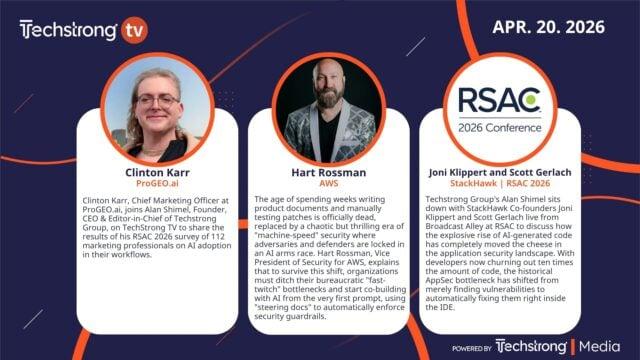
Techstrong TV September 15, 2025
Watch our live stream Monday through Friday, featuring exclusive news, announcements and conversations with IT leaders and experts on topics ranging from digital transformation to #DevOps, #Cybersecurity, #CloudNative, #Containers and deep-dives into specific technologies and best practices. http://techstrong.tv/
Transcript
Hey everyone, it's Alan Shimmer. We're back here and we're back live at Swamp Up in the beautiful Napa Valley. You couldn't ask for a better location.
The sun has come out, you know, it's good for the grapes. They say it gets a little cooler, a little warmer, the sun, the rain. You get good grapes, good wine.
But we're here with really maybe the highlight of our panel today. Um, three, three of the VITs of, of the, uh, event The Man to my immediate le Actually, I'm gonna let you go last. Okay.
Let me start to my far left, I wanna introduce you to Rahul ti. Rahul is the GVP and GM of the ITSM, something I'm a little familiar with business unit at ServiceNow. Rahul, welcome to Tech Drunk tv.
Thank you. Thanks for having me here. Give our audience needs, no introduction to ServiceNow, but give them a little bit of your background maybe and a little bit of what you're doing at ServiceNow.
Yeah, so I'm relatively new to ServiceNow. I joined little over four months back. Oh, Really?
Are new. And I'm running ITSM, which is the bread and butter, the largest business ServiceNow does. That's where ServiceNow was founded.
My background has been building products for a long time for large enterprise companies, but the interesting bit is I switched midway to being a practitioner myself. So I was running DevOps teams in the cloud space in my last startup before I came to ServiceNow. So I've been on both sides of the equation, building products and consuming products.
That's, and that, that's missing in too many of our vendors. As someone who speaks to vendors all the time, you, it's good to have that practitioner side to see what it is they, they're actually feeling. As that goes by, let's introduce Justin Boitano.
Justin is VP of Enterprise AI at Nvidia. Justin, welcome. Thanks for being on text on tv.
Thank you for having us today. Give us a little, maybe a little bit of your background. Yeah.
Well, I've, I've been in Nvidia now, actually for 13 years. I guess a little bit of everything over that time, but, uh, you've Seen it come, it's been go, huh? It it's been, it's been, you know, quite a fun ride, uh, you know, watching us really reinvent how computing is done.
Um, you know, from really the ground up. Uh, and I think it was, uh, when I first joined in 2008, we had just invented Cuda. Nobody knew what it was.
We were going around library by library, trying to port applications onto GPUs. People, you know, thought we were crazy, I guess in the early days. But eventually, you know, every, uh, overnight success is, is 10 years in the making.
Right? And so we've been working, That's exactly the biggest secret in tech, the 10 year overnight success. Yeah.
You know, we had Aon earlier, and we were talking about so many people think of Nvidia and they think GPUs and the hardware, but the real secret sauce here is Cuda and the software and the ecosystem with partners like ServiceNow and Jfr. And, and we had Sonar CEO here as well. Um, and that's really the, the key that's driving all of this is as much as the GPUs do agreed to my immediate left, immediate left, this man needs no introduction to our audience either.
I've had the pleasure of interviewing him for, um, 10 years, 12 years, something long time. He's the CEO co-founder of j Frank Shlomi. Ben Hay Shlomi, welcome.
Pleasure being here again. Again, you, thank you very much for having me. So, look, I was in the keynotes this morning.
It was an amazing keynote. And as one would expect this year in tech, AI was front and center. We've been talking about it all day here.
The thing about this is, look, all of us have been around the block. We've seen technology waves calm and go flow and flow up and down. We've never seen something this disruptive across the entire breath of, of our industry, right?
I, I think Satya Nadella maybe said it best, or the best that I've seen in that we are moving from becoming, you know how Mark Andreessen said every company's a software company. Yeah. We, were all software companies, but we're moving from software companies to intelligence engines.
Right? And what, that's a profound change in our business. Show me if it's okay, I'm gonna ask you to kick it off.
What does that intelligence engine bring that to some of what we talked about today here at Swamp Up, agen, ai, the whole ecosystem, dev gov, ops, all of it kick us off. So, Ellen, I, I, I think we will need two days to cover this, uh, And that some, But, uh, but I, I will touch the immediate things that we see in the market. And this is a, across the board, it goes beyond sectors.
It goes beyond, um, company size. It goes beyond, uh, geographies. What we see is a revolution, a disruption, uh, the changes, everything we knew about the day-to-day practice and a company like Jfr, we are not the native AI company.
We are the infrastructure company. We are the providers of the peak and shovels. We are not the gold miners.
And therefore, we have the privilege to see from below the changes that are happening. So one thing that we see happening across, uh, our portfolio is that consolidation happens not only in terms of technology, but also the inner organization, the CIO and the ciso, the compliance managers. The audit managers, all of them must collaborate in order to overcome the chasm, to bridge it, and to eliminate silos.
Otherwise, they will stay behind. The second thing that we see is that developers that used to build called, used to be called, used to deliver software. And then few years ago, they started to be security experts.
And now they have to be release expert, and they also have to be AI experts. 0. They are changing the world for everyone.
And the last thing that, uh, we see is that if we are not looking at the, uh, opportunity as coexisting, uh, providers, one of us will stay behind. If we go together, we will change the world together. This is not a race.
And, uh, and therefore I'm privileged, I'm honored to work with companies like ServiceNow and Nvidia, um, to give my customers a better experience, an experience that they expect a one platform experience. Absolutely. Rahul, I'd like to come to you, right?
So you think ITSM, is there any sector of our tech world that is more rule bound that you would think needs a little shaking up maybe, or, or maybe doesn't need a shaking up, but it's certainly getting a shaking up with ai. If you don't mind, share with our audience a little bit of the profound impact that AI is having in the world of ITSM. Yeah.
So I think it's getting shaken up. And honestly, we, being the leaders in that segment, we would like it to shake up. Because if, the way I look at it is, it of yesterday has have changed.
Now it is true truly a broker of services, right? They're managing SaaS assets, they're managing cloud assets. So go on as the IT of yesterday.
The service has changed from IT providing services to I want my self service, right? So when Jensen was on stage on knowledge, he's like, his main thing thing was, I want my service now, right? That was his ra.
So people want their service now and management is no longer like, top down, let me tell you what to do, what not to do. People are not used to that kind of thing. So we are gonna reinventing it.
Service management and AI actually helps you really create that agility on top of the more fixed workflows, because now you can do more with AI to create value out of the workflow. So workflows can still exist. Like the example we gave this morning, compliance and regulation is still required because who wants to have an application that is gonna be breached tomorrow?
Right? That's at the same time. Does it take, should it take a week to get approval?
No. Right. So I think we are reinventing those ITSM processes and kind of integration with jfr, looking at the AI patterns and everything else, because the speed has gone whatever, 10 XA hundred x, right?
So things that were taking weeks are taking seconds. So that's where our head is at from an ITS perspective. Absolutely.
It's velocity. It's velocity. Yeah.
You know, talking about the profound change, if we, if I asked a hundred people watching this live right now, what is the AI company? 98 of them are gonna tell us Nvidia, but Justin, you know, this, and even Nvidia, I want to know who are the other two, who the other two, they, they're living somewhere who knows on a, on an island somewhere talking to a volleyball. But, but Justin, even Nvidia knows that as great as Nvidia is, and as they've led the charge, help lead the charge here, you can't do it alone.
You need partners like Jfr, like ServiceNow, like sonar, like, you know, so many. You, I mean, one of the, the real strengths here is NVIDIA's ecosystem. Talk to our audience a little bit about that.
Yeah, I mean, I, I think that's, uh, well, a, a great point. Um, you know, Nvidia forever, honestly, has been an ecosystem led company. And I think honestly, it's, it, it comes top down at Nvidia.
Like Jensen realizes the power of an ecosystem for selling our physical hardware through OEMs and OEMs globally, uh, through infrastructure companies, uh, you know, uh, plumbing, the runtimes of these accelerators, uh, up to the AIOps applications and into the GSIs. So we work across the entire ecosystem to try and provide acceleration to, I'll call it, uh, key, you know, workloads that we know are gonna deliver a lot of productivity or performance gains or, um, you know, really kind of transform the, the business, uh, if you would. Right?
Um, and, uh, you know, this, this latest version of it, I mean, for a long time we did it in high performance computing to, to, uh, deal with F-E-F-E-A and, uh, you know, CAE and like the simulation, uh, of the physical world. 0 where it's the, the reality is it's a probably a $3 trillion industry, you know, a a trillion dollars in, uh, pure software that gets bought per year across enterprises and $2 trillion in services. That entire industry is being rethought now through this, uh, this new way of building software where you've got agentic systems that can break down problems, try and solve the problems on their own, and then reflect on the answers.
And so there's, there's a, a tremendous opportunity, I'd say, for all vendors in this space, really to, to ride that wave with us, uh, in the era of ai. Agreed. If I may add, add to it, uh, Alan, look at, uh, what Nvidia did, um, in, in the history of software, the first thing that they act was a community native company.
They released their software as open source. Yeah. Um, today, um, uh, Justin and his team presented on stage, like everything they build in order to optimize GPU with software is open source available.
That's right. For the community. Open source is not only we build it for you, but we build it with you, with, with the community.
So I, I think it's really speaks for itself. Uh, absolutely. But we are looking at the improvement that software brings to the world of ai.
Yeah. com today, my mom rest it all used to always tell me, show me your friends, I'll show you who you are. Right?
You probably all heard that. Or similar thing from your moms, I'm gonna ask, you already said it, Justin, but Rahul, and then I'll come to you. Shlomi.
What's the importance of your partner ecosystem in this brave new world of ai? So, I think any, anyway, at the core of it, if you look at ServiceNow, it is only about workflows data. So that's what we have built our business on, right?
Because enterprise has front office data, back office data, asset data. And if you don't unify the data, then you can be desperate systems on top of it. You tie it with a workflow.
So now the third leg of the tool is AI for us, because AI helps you do your workflows better and faster, and there is no way we can own all the pieces of the workflow anyway, right? There is the software supply chain that multiple players, including jfr, are there from a hardware perspective or from a software infrastructure perspective. Then we have cloud vendors, there are model vendors.
So at the very heritage of the company, we believe that partner ecosystem is critical to it, because that's what our customers want. They cannot rely on a platform that is closed, monolithic does not allow for partnerships. So I think it's the DNA of the company.
That's why we are so excited to partner with. We call it like any model, any industry, any infrastructure is what our ethos is from. Excellent.
Yeah. Shlomi, I, I believe that, uh, um, what our customers are telling us is the, uh, the honest, true and the pain that they experience. And they also know how to put the volume on this pain.
Is it a major pain or something that we can handle? And, uh, every time that, uh, that the technology company is coming with a piece of innovation, the second question should be, what's my ecosystem? And, uh, some people immediately ask the opposite question of asking, am I overlapping?
Am I competing that we are running a platform? We have, I dunno, thousands and thousands of thousands of logos in, in our joint portfolio. For sure, there will be some overlap, but if the one plus one equals more than two and our customers, um, actually ask for it, how can you go wrong?
And when we presented apras the, um, the, um, dev gov ops solution we discussed today, we didn't present it as an ecosystem tool yet. It was just an idea in the beginning of the year. And our enterprise customers stopped us right there and said, listen, the people who need to use appt trusts the application owner.
They're not coming to jfr, they're going to service now. And, uh, when we started to, to walk with Rahul team, um, and we spoke with the customers, they actually echo that. And, uh, and what we've built together and presented on stage here today is just a representation of our, uh, of our customer's voice.
Uh, I'm, I'm very proud to be part of a company that instead of coming as an arrogant vendor, telling them what is right for them is asking the, the customers, what will be better? How can I make your life better? I love it, guys.
I gotta bring up a difficult one. It's not on our list, but I've gotta ask. I talked to a lot of people about ai, as you would imagine, it's almost impossible to live up to the hype.
The hype, the hype cycle is the right, and there are a lot of people out here who are starting to, you know, the ankle biters. It's not everything we thought it was going to be. It's not.
This is a lot harder than we thought. It's gonna take longer than we thought. I think 'cause the expect we set such expectations of it changing the world so quickly.
And I said this, even if we stop developing AI right now, and we just said, okay, let's digest what we have, it would take seven years to fully integrate it into all of our ecosystems. But what do you say to the naysayers who are saying, we're not going fast enough. It's not good enough yet, we may never get to the holy land to the promised land.
It, Justin, you're, you're Nvidia, I'm laughing and you're gonna go walk A day in my shoes. It's moving really quickly. Yep.
Is all I can say. And I think, you know, in the, the early days of generative ai, uh, you know, people were kind of dabbling. They, they treated it like Java.
It was a new technology. They wanted to upscale themselves, but they didn't know how to apply it to their most pressing business problems. Um, you know, and, and we see now every enterprise really focusing on like, how do I reinvent the core of my business?
Honestly, at Nvidia, we've done it ourselves too. Like Jensen gave us the challenge, you know, double the number of chips that you produce, uh, every other year. So instead of doing a chip every 18 months, do it every year with a design cycle in between.
And the only way to innovate at that pace without obviously exploding your workforce, is by using AI and infusing it into the, the business process of the organization. So we're applying it, you know, to reinvent how we design chips, how we develop software, uh, how we engage customers, you know, through every business function of the company. And we're starting to see that in, in a big way, happen really across every vertical industry, from retail to telecommunications, to healthcare.
Um, and so I, I think it's moving faster than you might think. I think, uh, you know, en uh, enterprise in some regard has always been a slow beast. Um, it's always moved.
The transitions have happened, you know, more slowly than than we would like. Um, but in my conversations with CIOs, I think what they realize now is it's time to make that shift. Instead of reinvesting CapEx in standard data center infrastructure, take the leap to accelerated computing and, you know, and focus on building agents that address your core business.
And, uh, people are seeing, you know, huge, uh, productivity gains and huge improvements to margins that way. Excellent. Guys, I got one more question, and it's for Rahul and Shlomi.
I want each of you to answer this question looking into this camera. Rahul, you're gonna go first for all my friends in ITSM, and I'm very good friends with the folks at ile, my, my friends at people c uh, Demetrius, and they're out in Greece watching this, but talk to all of the ITSM people out there who were worried, is this gonna take my job? Am I gonna have a career?
I just got into this profession five years ago. What is AI going to do my job? So I think my thinking is the train has left the station.
If you get on the train, you will have a job. If you don't get on the train and start kind of on the side kind of okay with naysay, I think you may actually lose your job. The reason is where I've seen the success is people who have embraced, they are having AI do the job they did not want to do in the first place.
Like summarization, after closing every incident, really going after knowledge base updates. Who wants to do it? I've seen people who have started going that direction, then they realize, oh, I've now submitted that knowledge.
Why can't I have agent tech do it for you? So slowly they are getting on the train, and the train has gone to the next station. People who are left behind, is it not good enough and all that?
Sorry, that is not gonna work. So let me talk to the software developers out there. First of all, whatever Raul said, amen.
Uh, no, no, no. Nothing to add. Software developers, if you remember the days of CICD that you doubted building software with some tools and automation, if you remember the days that, uh, you said that developers in order to be faster, they need to be a bit dirty and not secure.
Those who didn't, uh, um, jumped on the train left behind, and they are not software developers anymore. You have more responsibility and the next generation trusts you to build it, right? Because we are changing everyone's world.
Absolutely. I'll end it with this. I said it before, I'll say it again.
You're not gonna lose your job to ai. You're gonna lose your job to someone who uses AI better than you. Right?
And amen to that. We've gotta learn. It's a tool.
It doesn't replace the spark, the spark that's in now all of our brains, right? That cre the creator, but it's a golden age for creators. Absolutely.
And we're lucky to be here. Rahul, Justin Shlomi, thank you. Thank you for watching.
We've got, we've got two more Oh, another day after this. Another half a day here of, uh, uh, JFR Swamp Up coverage. So check it out.
We're on techstrong tv. We'll be right back. Hey everyone, we're back here at Jfr Swamp up in beautiful Napa Valley at the Meritage.
We've had a great day of talking to some really great people, and we're ending it with a really smart lady. I'm gonna introduce you two here in a second. Her name is Jung Lu, and Jung is with Wiz.
And Beyond that Jung, I'm gonna leave it to you to talk to our audience, tell them a little about yourself. Sure. Thank you so much, Alan, for having me.
Um, so Wiz a little bit about Wizz. We do cloud security, and our goal is really to help organizations adopt cloud as well as AI as fast as possible. And I'm the VP of product marketing, so I'm responsible for product go to market strategy as well as execution at Wiz.
Love it. Um, our audience is very familiar with Wiz. Obviously we've been following them for a long time.
Um, I wanted to ask about you though, because people are saying, wow, great, she's, you know, she's got a great job over there. But give people a little bit of sense of your journey in, in the, uh, industry. Yeah.
So I will say I grew up in Silicon Valley. Both of my parents were engineers and, um, I fully rebelled. They expected me to go and be an engineer as well.
I started going down the computer science path, realized I hated it. Uh, and so I fully rebelled into finance. Okay.
Um, and did that for a bit before I saw the error of my ways and realized I need to come back to technology. What's core to me is building cool stuff, right? That actually makes an impact rather than necessarily helping rich people stay rich or get richer.
Oh. Um, and so that, uh, ultimately ended up taking me back into technology, back to Silicon Valley. It was incredibly fortunate to land at Okta.
And so really saw actually for the first time how it became an enabler of the business, right? Because this was the wave where we had SaaS, right? And it could really enable that.
And this was also the time when organizations were really thinking about how authentication, um, can be actually an enabler again, of the applications that they are building for their customers. When you think about identity being so central to the journey that you wanna take a customer on. So that was a phenomenal journey.
Uh, ended up seeing Okta grow from about 400 people to 6,000 people. Very large company at that point decided it was time to get back to that builder route. Um, and Wiz was just by far and away crushing it.
Such an incredible vision that they had as well. Absolutely. Absolutely.
Um, you know, I always said identity, IAM was the killer security app for the clout, right? So I, I grew up in the security before the cloud, and you know, and for us it was the Moton Castle era, right? And cloud changed all that, but IAM became kind of paramount until the Wiz came along.
Well, cloud, cloud, Well, cloud, well, cloud made. Im cloud development, right? Yeah, exactly.
But Wiz came and, and we started looking at cloud security, container security mm-hmm. Cloud native security in, in a different light. Um, you are here, we're at Jfr, obviously you presented today.
If you wouldn't mind share with the audience a little bit about what you presented on. Yeah, So I think one of the key challenges that we see is there's actually been multiple generations of cloud at this point, right? Yeah.
We've had cloud for 20 some, 25 years, years, or five or four. And I think really in the early days, it was a lot more of the lift and shift, right? We could take our on-prem approaches, we could take our workloads, move them into virtual machines.
And really a lot of that has, um, dramatically changed, right? It's changed with cloud native development where every team, every organization is trying to move faster and faster and faster. We have developers that are writing application code, we have infrastructure folks writing infrastructures code, and all of that is being shipped every single day.
So development is incredibly agile and continuous, but the challenge that we have long had in security is our org structures, our workflows, even the tools that we have, right? They're still very vertical and siloed. So application security teams, they run code scanners that look for vulnerabilities just in code, right?
And then we have Dev SecOps teams now that run scanners and pipeline that just look for issues in the pipeline of all dev as code scanning in cloud. We have organizations using tools like Wiz that evolved data CSPM tools that are primarily used by cloud security teams, but increasingly developers. And then in SecOps we have like a whole other completely different Yeah.
Landscape of tools for the runtime. And so all of this is very disjointed, right? It's very fragmented.
How do I actually understand a vulnerability here in code that my SaaS tool found actually is deployed into production and is running on a privileged container in my environment? It's actually very difficult to understand. And I think, you know, when we look at CISOs, when we look at business leaders, even, they ask these horizontal questions like, where are the container images?
Where am I exposing sensitive data of my customer facing applications? What, where, where's my risk? Where is my exposure?
And it's very difficult for security to answer those questions today because it is so silent. So really what I was presenting on is how do we flip that model, right? How does security become horizontal so that we can move at the pace that our development teams and DevOps teams expect for us?
And really the key to do that is in our view, context, right? Understand what's running in the cloud, give you the context for the code that created it, as well as the owner that is responsible, and then give you runtime context what's actually in use, what's loaded into memory that we should prioritize. I love it.
You know, what you just said in a lot of words was why we have 7,600 venture backed public security companies, because it is so fragmented and so siloed and so specialized. Everybody's a specialist. And you know, when the average, not even big enterprise, when the average, like SME enterprise, I forgot what the number was, 18, 17 different security vendors in a relatively small company.
This is, you just hit it on the head, right? You, you imagine, you know, you're a CISO and you are responsible for 17 different security vendors, and you gotta make those all work together, right? It's, it's enough to drive you to drink is what it is.
But, and, and we, we, we try to, we're trying to consolidate, but at the same time, the pressure to keep up with the pace of innovation, with the pace of, of ai, with the pace of how much code we're churning out right now, it's like, you know, it was mission impossible before. This is mission impossible squared. Um, But, uh, what I would, sir, well, but what I would argue is I think we overly focus on tool consolidation, right?
Tool consolidation is an outcome. But I would say the issue is we have a lot of data mm-hmm. But we don't know how to turn it into something that we can action, right?
Every organization, you go to them, they've got their expel Excel spreadsheet of millions of vulnerabilities, right? It's not that we have a problem with finding vulnerabilities. We have a problem with prioritizing and then getting someone to actually fix it.
So I, context for us is how do we really get the insight out of all of this pool of data that we have on what's most critical? And then let's break the silos between our teams so we can actually work together to fix them. Music to my ears, I mean, I'm thinking back.
So I, I started a company called Still Secure in 2001. In 2003, we came out with a vulnerability scanner long time ago. And that, that what you just described was exactly the state of the art.
In 2003, people scanned about once a year, they printed out a telephone book and it was like job security, right? Because you, it took you a year to go through that book and just in time for the next scan for the new book. Um, we've, we've tried to got getting better.
You, you're right. com primarily because I thought it was a better shot at security. Like we could correct some, you know, original sins built into security, really push for the whole DevSecOps thing.
Like at RSA conference, we did the verse DevSecOps conferences there and everything. We've come a long way. But one of the lessons we learned is that developers are not security people.
They wanna develop quality code. Like I've never met a developer who says, I want to develop insecure code. Yes.
Right? They all want do, but I think one of the mistakes that we've made as an industry is thinking that if I only could make them a security person, they develop better code. They're never, they could be a security champion.
They have pride in their product, but you still need security people at some level doing the security and helping them. Yes, I agree with that. But I think, again, for developers, it's not like there was a lack of data.
Like, you know, we tell them all the time, look at all these vulnerabilities. Um, but the issue is, what should I prioritize? Yes.
Right? Again, it's what is the insight? What's the needle in the haystack out of this very long list that you've given to me, security team?
And how do we start giving them that prioritization, actually, again, through context. Yeah. Right?
Instead of saying, Hey, developer, did you know you have hundreds, maybe thousands of exposed secrets or secrets that have to be rotated? Um, instead of saying that, we can say, actually, of all of these, this is the one secret that I need you to focus on, because I actually know that it leads to an admin in our cloud environment that has access to sensitive data, right? We give that developer that information, they're really, they get it, right?
So how do we get the, is that information derived using AI or some sort of automated means? Or does that take the security pro saying that's the one? So I think it's two things, right?
One is you have to correlate the signals together, right? So your secret scanner has to talk to what, uh, the entitlements and the identities that you have in the cloud, right? So your Kim solution, and they have, you have to be able to correlate that together.
So a tool can do that. Security teams can also help you to do that as well. And they can provide the signal of, this is what's most important for you to go fix.
Then we can actually use AI to accelerate that path to remediation, right? Because there's actually a number of ways to resolve that particular issue. You could delete the key might be a little aggressive, you could rotate the key, right?
It's kind of shooting the patient to save them, but, okay. Yeah, No, sometimes Uhhuh. Um, but we can offer all of the different paths to remediation.
And the developer, again, they know what is best for their applications for the, um, repositories that they are working on. So you can give them that and AI can help them actually take, okay, I think this is the best path to then actually getting to a fix. So I've spoken to a lot of security companies recently who are saying Nirvana is, we automate this, we automate prioritization and remediation.
Now look, from my time on the other side of the camera, selling automated remediation was not an easy sell. People are scared to death of that, right? But have we come or are we coming to maybe a point where we can convince a developer or an ops team that hey, it, for, you know, 80% of the garden variety stuff, we see what automated remediation is the way to go?
I think that is a nirvana. Maybe it's not that far off, but from what we've seen, organizations want to automate everything around a decision point and an action that still requires a human in the loop. Um, especially because we started in cloud, right?
Automated re mediation and cloud is a very aggressive right? If we, It's, it's aggressive everywhere. Believe me, it's true.
I, I, I, that's why I'm still doing this and I'm not retired, but yeah. Uh, it, people just don't want, you know, they're afraid that you're gonna break something. Rightfully So.
Yeah. Though, like you could be taking down production workloads, you can, taking down production customer applications, it is, it, it requires you to, to feel that like, impact. And so that's why we think there is a human in the loop still, but as much of everything around it that we can automate as possible, we should.
And I think that does allow us to really start getting out of the continuous patching game and really start burning down these backlogs that we've had forever. Absolutely. Pat patching is, is unfortunately a losing prop.
That's again, something that we've been remediating since 2000 and or trying to do since 2003 and has never gone on. Let me pivot a little bit. We're here at Jfr Swamp Up.
You did present, as I mentioned, and we've been talking about that. What's the connection? Where is Jfr?
Let's talk about that. Yeah, So I'd say overall we share very similar visions, right? When we think about how do we secure development that is happening faster and faster every day, it requires security to move faster, and it requires every team within security to also work together as well.
So at Wiz, um, from actually the pretty early days, we have scanned Jfr Artifactory to bring in their understanding of container images and artifacts into Wiz to give that complete understanding of the cloud environment. Now, what is coming next is we're deepening our integrations because we both believe in that open security ecosystem in order to share context that empowers all of our teams. And so from a Wiz perspective, we have a lot of understanding about the risks associated with cloud.
We understand runtime context, the code context as well. And so we're bringing that prioritization, bringing the risks, and all of that back to Jfr. And similarly, JFR has very deep understandings of packages, right?
And so we can take their reachability analysis that, um, acceptability as well, and we can layer that into Wiz and use that context to also further enrich our prioritization as well as the, uh, the move to actually getting to a fix. I love it. Last question, or last area I want to talk on you.
You know, you can't take two steps without tripping over AI here. What's the AI angle behind all this? Yeah, well, so when we look at ai, there are really two sides of the coin.
One is how do we actually secure the AI infrastructure? And a lot of it is being built on top of cloud. And so for us, it is actually a very natural extension of what we know about cloud environments, right?
We need to understand the configuration, the control plan. We need to understand identities that are associated with it, or non-human identities. In this case, we need to understand the workload layer or the data layer that's being used to train the models and do a complete assessment of the risks that are there.
And from there, we can enable now AI teams bring them into the fold, break the walls and silos with them so that they can actually take ownership and help us to secure those elements of their environment. The other side is around how AI can actually empower all of our defenders, um, to be much smarter to do, to secure things, to take action with less resources. And so we're actually seeing such incredible results there.
Um, as an example, we released a new product today called Wiz Os. It's all about hardened container images. So you can start secure.
And what we're seeing is we can actually use AI to immediately point out to teams. These are the most impactful places for you to start deploying this so that you really start getting value right off the bat. And by the way, here's a migration plan, right?
Here's everything automated delivered into the hands of that DevOps team or DevSecOps team so that they can get going on that journey. Let's talk about that. I'm, I'm sorry, I know I said the last thing, but I got some questions here.
So how, ma how big is the library, if you will, of these mm-hmm. Hardened container images, if we can call it that? Yeah, so for us, we are starting with the set that our customers primarily require.
So it's all of the major languages we've got Ruby, Python, right? We also have FIPs compliant images as well. Oh, we expect to, um, grow the catalog as we continue seeing customer adoption.
But the question that we get from customers, or what we've found through our product development is it's not the number of images, right? Again, it's like the impactfulness, right? Help me cover the most important components of my containerized environment and then help me actually adopt it.
Because that's been one of the key challenges. There are so many container images in an organization. Security oftentimes is very little visibility even into where are all of my container images?
Which ones are validated in runtime, right? Mm-hmm. Which is probably where we should start to focus first.
So we're layering on this element of the product with the overall end-to-end container security approach to help organizations again, prioritize and then actually then swap in where you will have the biggest impact in reducing the number of CBEs. And this was released today, which, so this is not live. People will be watching us ah, in the next couple days.
Yes. But as of September 9th, correct? It's, it's out right Now.
It, it is out in public preview, which means every single one of our customers has access to it and can start adopting it today. I love it. Wiz os Wiz os You heard it here on Text Shock.
Oh. Um, well, John, thank you so much. I thank you.
I know it's kind of the end of the day and you were nice enough to come in. I, oh no, thank you for having me. But keep up the great work.
Van Wiz is doing exciting things in this cloud security and security space in general, so it's great to have you on come back. We do this all the time remotely in person. We'd love to have you back.
Thank you. I appreciate that. Thank you.
Jung Lu, uh, with Wiz here at Jfr Swamp Up, that's gonna wrap up our day one coverage here at Jfr. We'll be back tomorrow. We've got a full day starting, I think at 11 or something, so stay tuned then.
But until then, this is Alan Schmo for Techstrong tv. Thanks everyone. Hey everyone.
Alex Smith here and welcome to Textron tv and I am delighted to be joined by dvu managing director of a Google Cloud marketplace. Dai, thank you for joining the show today. Yeah, great to be here with you, Alex.
So Dai, we at the FU room group did a research study with Google Cloud on the marketplace. We spoke with a ton of your partners, um, earlier on in the year. And, and we'll get to that in a little, in a little bit.
But just to kind of start off, give us a bit of a big picture, you know, for ISVs and channel partners that are new to this, you know, how do you see Google Cloud marketplace, you know, kind of changing the way in which companies ISVs go to market? Yeah, absolutely. So at the core, uh, cloud marketplaces are fundamentally to change the way ISVs and channel partners go to market by shifting this traditional, like, direct sales motion to something that's more digital, online and scalable and also collaborative across the ecosystem.
And so, you know, think of it as, you know, the central hub where customers can search, discover, trial, procure, and deploy software. And for partners it's a great opportunity 'cause it streamlines the sales process. It opens up, uh, new revenue streams and fosters deeper collaboration across the ecosystem.
Yeah, and from our side, you know, our research shows that cloud marketplaces are becoming increasingly major route to market. Um, and in fact, a survey that we conducted at the start of the year, uh, show that 97% of partners are saying that some of their revenue is tied to marketplace. So I, I don't know from your perspective, what, what do you see as some of the driving forces behind this growing shift?
Yeah, I think, uh, I like to kind of start with the customer. So, you know, ultimately partners want to sell where buyers are buying, and increasingly that's marketplace. So, you know, a lot of companies are scaling their usage, but I would say, you know, nearly 90, 95% of customers are actively carrying marketplace in some form.
Mm-hmm. And, uh, you know, with customers, what they're doing is they're making larger and larger cloud commits and marketplace spend helps de-risk that minimum committed spend. Uh, but once they start going on marketplace, our data shows that once they get a few deals under their belt, they scale their usage considerably.
And, uh, you know, customers love the ability to procure very quickly. They can consolidate some of the billing relationships, uh, they can get the value faster. And they know that a lot of the, uh, platform features around like things like governance, customization, and access control can really help manage compliance and, uh, software consumption.
So on the flip side, you know, partners, uh, love marketplace because, you know, it's not just another sales channel, but it becomes this really strategic imperative to stay competitive, unlock new revenue streams, and provide the value of sort of like a modern, uh, sort of distribution channel. And, you know, it's, whether it's the partners getting access to that committed cloud spend or accelerating sales cycle time, or just enabling this sort of co-sell motion with Google Cloud, it's really a great opportunity for them to sort of grow, uh, from a strategic standpoint, uh, the overall opportunity. You know, so the way I think about it's like a partner that's not leveraging cloud marketplace would be the equivalent of like a retail business who is not leveraging an online store in today's digital economy.
So it's just something you just have to do. Yeah. Absolute necessity.
Um, and you know, you, you, you rattled off some of the, the benefits there. Um, the, I slide at the beginning of the conversation, you know, we did a study with Google Cloud and you know, let me just read off some of the stats that we found. Um, in doing this study, ISV seeing, uh, 112% increase in the average deal size, uh, they're also seeing a 14% improvement in customer retention.
Um, uh, again, for the ISPs and across all partners, um, deals are closing faster, up to 50% in time savings, um, and 70% of partners reporting them multi-year deals are more common through the marketplace. So just, those are some of the key stats that we found. Um, you've obviously highlighted some of the data points you have at, uh, at Google Cloud, but, you know, how does, does this all stack up with kind of what you're seeing and hearing every day as you're talking with, uh, partners, uh, engaging in the marketplace?
Yeah, yeah, absolutely. So first of all, amazing stats. I love it.
Um, very consistent with what partners are telling us in terms of the tangible benefits, but let me touch on a few of those. So, you know, on deal sizes, as you know, private offers has provided that sort of seamless transition for many partners to go from that traditional sales led motion and bringing it online. And we are consistently seeing, you know, deal sizes like total contract value of millions and tens of millions of dollars.
In fact, we're doing multiple nine figure deals. So over a hundred million in contract value, uh, over the past year, uh, on faster deal cycle times. I think this is driven by, you know, standardized agreements, simplified negotiations, and really empowering the customers to procure solution without engaging sort of that lengthy procurement and vendor, uh, review cycle time.
So really accelerating time to value for everyone. And then for multi-year deals, you know, we provide, uh, support for up to 10 years upfront, multi-year prepay for five years. And of course, this pricing flexibility aligns with customers who want to have greater discounts and greater cost predictability that comes with these longer term commitments.
And then lastly on the, the retention rates, I think what we're finding is deals that happen on marketplace tend to have better renewal rates and better expansion opportunities because they're kind of deeply integrated into the customer cloud ecosystem and financial commitment. So those opportunities to grow the business is considerably there. So it's no surprise that partners are shifting more and more of their business through marketplaces.
And what we're finding is some of our top partners are driving 50%, 60%, 77% of their business through cloud marketplaces. Yeah, incredible multi, multi-dimensional benefits there. Um, something as well that you touched on earlier is the, this notion of cloud commits, the committed spending that exists and the ability for partners to be able to kind of tap into some of that opportunity.
Um, and I think, you know, we found that in the study that we did, you know, that was a definitely an important factor. Um, I also think historically there that was kind of more of a reactive, um, approach to the market, but you know, now we're seeing partners being more proactive here working with, um, you know, Google, FSR, you know, teams to kind of, you know, help, uh, you know, just maximize those opportunities. So, uh, anything you could share around, you know, what you're doing on that side of things and, and how you're helping partners understand the cloud commit landscape and, you know, working kind of in this co-sell tandem motion there.
Yeah, absolutely. So I would say we're doing a number of things. Lemme just highlight a few.
So I think one is, you know, we're providing, you know, data and visibility and tooling, uh, incentives, uh, various go to market initiatives. So for example, uh, deal registration. So this, uh, our solution connect platform enable ISVs to register deals and basically enable them to connect with, uh, reps, uh, our cloud reps on a particular opportunity.
So this really ensures a very coordinated joint sales efforts. Uh, and of course our reps have quota attainment, uh, for marketplace transactions. So this creates a very powerful alignment and really encourages them to, uh, engage with ISVs and their products because, uh, you know, they're already incented or motivated to engage with ISVs because, you know, it's a critical part of customer workloads.
They can accelerate customer migrations and, uh, sometimes is part of this, uh, you know, this platform consumption capability. Uh, we also provide incentives. Uh, so for example, we have something called the Marketplace Customer Credit Program.
And this gives net new deals to marketplace and customers the equivalent of a 3% first year a CV Google Cloud credit. So this has been very effective to accelerate customers purchasing a specific ISV solution on marketplace for the first time. And then I would say we also are rolling out other tools like propensity to buy tooling.
So this is leveraging our data on customer usage, spending behavior, and effectively partners can give us a list of target accounts and we can generate a propensity score. And this enables them to have a very much more targeted, uh, uh, efforts in terms of their selling efforts and have higher probability conversion. And then last thing I would say is we're doing a bunch of things around marketing as well.
So there's broad, uh, sort of co-marketing, uh, opportunities, whether it's creating co-branded campaigns and taking advantage of incentive funds to create healthy pipeline or dray costs where they can just leverage best practices and go to market guides to help guide, uh, build and grow that marketplace business. So, uh, so it is, they say it's not just a, you know, listing products, but it's really becoming this proactive sales engine. Mm-hmm.
And we're providing the data and tooling to support them. Yeah, lots of great programs and tools there. Um, so now let's talk about the, the channel.
Um, mm-hmm. Obviously Google Cloud has a unique channel centric model with its, um, with its marketplace and especially with the, um, marketplace channel private offer or MCPO program that was launched. Te tell us a little bit about the thinking of putting channel partners, you know, at the core of your strategy and, you know, what are some of the benefits that you see from this model?
Yeah, so, uh, you know, as you know, there's, there's a lot of chatter a few years ago that hey, marketplaces and channel partners, were gonna be competing channels. But what we're finding is a lot of enterprise deals are, they have complex sales processes, negotiations involve multiple partners, and then as customers scale up their usage or marketplace, they're gonna look to their sell and services partners to help them, uh, you know, discover, procure, and deploy a very broad set of technologies. And of course, they're gonna leverage the expertise, the sales and services expertise of the partners, um, as they manage through the customer, uh, lifecycle.
So I believe, and I think it's validated throughout the industry, is that the channel partners are gonna play a critical role in driving marketplace growth. Um, so customers really demand that. And so, you know, when we think about the things that we're doing with resellers, it's very consistent with how we have a very open ecosystem.
So it's whether customers can choose to work with direct or channel partners of their choice or determine whether it's a first party or third party service that they want to, uh, uh, uh, procure at the marketplace to address a particular business challenge. And you know, what we're finding with our, uh, traditional resellers is we're going through a little bit of an evolution. So, you know, as they embrace and work with cloud marketplace, they're not gonna take their traditional sort of resell fulfillment licensing model and bringing that online, but instead they're going to expand their role and value proposition because, you know, what we're doing is we're streamlining some of the billing and operations so they can focus on more higher value added services, right?
Whether it's, uh, bundling services with marketplace solutions or bringing in their own, uh, professional services capability or managing the cloud spending. I think this enables sort of this broader sort of business outcome, uh, and uh, in impact, uh, working with the broader ecosystem, working with our customers. Yeah, I, I totally agree, but at the same time, we also sometimes have to be a little realistic, and there are times when the ISV reseller connection is, you know, just not as, uh, as smooth as, uh, we might want it to be.
Um, it could be an ISB that doesn't really know how to work with resellers, um, or, or vice versa, or reseller that might not be proficient in a particular is B'S technology. So how, how are you thinking about, you know, kind of managing the potential clashes that, you know, might have kind of in this engagement model when you're kind of really now at the, at the center of this ecosystem? Yeah, yeah.
I think we're doing a few things. So I think particularly on a particular deal, I think what we're doing is a bunch of things to enable early engagement in a deal. So, uh, you know, certainly if that engagement happens at the 11th hour where like an ISV is already quoted to the customer, that can cause some friction.
So we're providing some tools, uh, to our partners to enable, you know, telemetry and visibility earlier in the sales cycle. So the ISVs and reseller can align on things like commercials and they can dev jointly develop the opportunity. We're also, you know, doing some things around robust training and enablement.
So like, for example, marketplace, marketplace specific training where both ISVs and resellers can access training that focuses on how to, you know, transact on marketplaces best practices for creating private offers, managing reseller relationships, and navigating the whole entire co-sell programs. And then what I would also say is there's some other things that we're doing like standard reseller agreement. So like for example, if a reseller and ISV haven't worked together, there's an ability to sort of grab standard reseller templates, enable that collaboration and really close deals faster, and it scales in a very efficient way.
And of course, there's a bunch of tools that we're providing the ISVs on the platform, whether it's like granular discounting, uh, you know, enabling entitlement transfers or being able to bring their own channel partners from their own channel network in a very, uh, you know, frictionless way. There's a bunch of tools that we're looking at. Uh, also improving things like enhanced reporting.
So imagine, uh, providing granular reports to both the ISB and the reseller for their respective deals, including customer data, reseller, data consumption details, and progress against committed spend. So I think what we're doing is really create more of a partner centric marketplace. So moving beyond sort of the basic functions of, of, of a storefront, but really enabling that ISV reseller relationship that's not into transaction, but more of a successful collaborative partnership.
Yeah, the Andre the Hood stuff is so critical. Um, now you have a lot of success stories, um, you know, in, in the Google cloud marketplace. I think the one that has got a lot, gotten a lot of air time this year has been Palo Alto Networks.
5 billion in sales through the Google Cloud marketplace. Yeah. Um, what are some of the things that you see, you know, companies like Palo Alto Networks or others doing, you know, to really be successful, uh, in the marketplace?
Yeah, so Palo Alto Networks, specifically the way to think about them is it's a very strategic and collaborative approach they've had from, uh, from going back a number of years. It isn't just sort of simply listing their products on marketplace, but really just integrated their, their business sales motion and technology with Google Cloud. So I think, I think it all starts with co-innovation.
So, you know, we have a number of, uh, solution integrations across a number of different areas and, you know, of course that enables customers to experience solutions that feel very cloud native to their Google Cloud environment. And it really creates a very massive selling point for customers who want a very seamless, non-disruptive security solution. The other thing that they've done is they've leaned in very heavily in terms of, uh, the go-to market and partner ecosystem and creating this sort of co-sell motion that's sort of best in class for us.
So they've embraced marketplace as a sales channel. They have, uh, over 30 listings on the marketplace. They have very comprehensive tech technical documentation and reference architectures to help customers, uh, with seamless deployment.
And of course, um, you know, the way to think about this is that, uh, this was sort of a multi-year journey for, for Palo Alto Networks, which was, you know, getting listed on marketplace was, was relatively easy. But, you know, there is no channel where any partner can just get listed and all of a sudden you get all these deals in pipeline. You had to be very intentional and invest.
And, you know, what we're seeing is, uh, you have to view this as a long-term strategic growth opportunity that may take a couple of years to scale. You know, and what we'll see is, you know, over, over the couple of years partners that are doing it very well, they are doing things like product integration, internal organizational alignment, sales enablement, you know, having the right policies in terms of like pricing and how they comp their reps. They can invest in people, you know, maybe some operational capabilities like a deal desk.
And these are the type of things you have to do to get to your first like 10 deals and get that flywheel going, and then ultimately invest at scale where the marketplace ultimately represents 30, 40, 50% of your business. Yeah. It's like you said a couple times, kinda like anything in life, but it's not just listing on the marketplace in order to, you know, see good results.
You, you, you, you need to invest. Uh, kind of further into that, and you've touched on, um, a lot of the, you know, the good things that you see partners doing there. You know, our research showed things like successful partners at minimum have a dedicated, you know, cloud, uh, deal desk and sales team to kind of help, um, operationalize it.
And even things like comp mutual plans to ensure that the sales organizations are are, are bought in. But, you know, for, for kind of new partners out there, um, what, what would be your kind of one, two pieces of advice for a partner that's kind of just getting started or thinking about, um, you know, new into the marketplace and, you know, how do they think about driving kind of long-term success? Yeah, yeah.
So again, I would point at the foundation has to be this having a very differentiated offering and a very better together story. So what does the joint value proposition, why does your product align well with Google Cloud and how does the marriage between your offering and Google Cloud really provides this great benefits to the end customer? And you know, what seems to go very well is if there are strong integrations with our first party services, whether it's like AI and data and analytics and security, uh, you know, this also drives, uh, a big part of that success.
And, uh, you know, you gotta make sure that once you have this better together story, that it becomes very easily and enabled through not only your own sellers, but our, uh, our sellers as well. Mm-hmm. Uh, the other piece that you mentioned is investing in people, processes, uh, marketing, uh, relationships and enablement, because I think what companies do are, you know, they have to modify maybe their systems and processes to align with marketplace.
We mentioned the, um, the, uh, the deal desk. We have to make sure that you evolve and get more of a sales or revenue leader, uh, function. Maybe as you start, it becomes a little bit more of an alliance led, uh, motion, but over time, as you get more success, you get, uh, executive, uh, uh, a sponsorship with the chief revenue officer or the sales leader in the organization as well.
Yeah. And then from a, from a technical, uh, or tactical standpoint, you know, you gotta register deals, uh, and when you register deals, you know, one of the things I recommended as companies get started is you need to establish that track record of success. So, you know, identify like a, a geography, a customer segment or an industry where you had some early success.
And then once you have a couple of wins underneath your belt, you can work with your advocates and sponsors within Google Cloud to, uh, elevate these, these wins, these win wires. And then what what happens is it becomes a little bit of a self-feeding process where you build momentum, you get some differentiation, and you get some wins, and then you can scale, uh, pretty significantly thereafter. Yeah, absolutely.
That internal selling is so critical and a lot for a lot of these, uh, uh, mm-hmm. Companies like looking to get buy in, like in anything in life. Right.
Um, so now, like, kind of forward casting a little bit. Um, give us a sneak peek. What are some of the things that, um, you know, you and your team are thinking about or, or, or working on?
Any, anything that you know might wanna highlight that you, is, that you're able to share that might be coming down the road that would benefit some of your ISV and channel partners? Yeah, maybe, maybe I'll just highlight a few things we recently launched. So, I mean, certainly one thing we launched was, uh, introduce a new variable rev share model.
So for eligible partners in their deals, rev share can go as low as one point a half percent for things like renewals or large contract, uh, uh, uh, uh, deal sizes. Uh, we, we also, as I mentioned before, we went general availability with this end customer, uh, incenter program, 3% for the first year, a CV. So this has been great to unlock and acquire new customers.
And then earlier this year, we also launched, uh, professional services. Uh, so professional services is a formal solution type on marketplace. So at first, the ability to cross-sell or upsell things like implementation services, training assessments, and managed services.
But I think what this does is it creates a nice building block for us to drive more business outcome and solutions for end customers because, uh, you know, between the ability of a sell and services partners to focus on, uh, solutions between like different ISV solutions, multi-vendor private offers, marketplace becomes this potential connective tissue between the different partners who participate in marketplace delivery and value add. So imagine of shifting from simple products and SKUs to more customer outcomes and complete solutions. And I think marketplace will be a key enabler for that when you think about these multi-vendor private offers.
The other area that I would say that we're investing in quite a bit is, um, activating, uh, product-led growth. So PLG. So, uh, as you can imagine, this is the ability to sort of self-serve.
Uh, this was the original promise of marketplace, but what we're finding is that there are a lot of capabilities between personalization and AI that will make this a little bit more real. So we're improving the search experience, we're gonna improve some analytics so that you can drive a campaign directly to a marketplace listing mm-hmm. And track where they are in the funnel.
And then we'll also surface, uh, third party solutions in context across the broader cloud console. Uh, so for example, if you're a Vertex AI developer, ML practitioner, you should be able to see related solutions from our marketplace within your experience. And then lastly, what I would say is, um, we're gonna do some things to really automate the partner co-selling journey from lead to cash.
So some of the things we're doing around like APIs in terms of like deal registration and private offer creation will create some of the automation, uh, that our partners have been asking for. So a lot of great opportunities and a lot of great areas of innovation that we're driving. Yeah, lots of innovation, both I'd say on the front and back end there, and, uh, and raw expansive of the, of the program.
Uh, that's great though. So look, we're getting close to wrapping up now. Maybe just a final kind of thought, even looking further out and, you know, the, the theme of, uh, this year in the, in the technology industry really has been, um, obviously ai, but I think even more so ag agentic ai.
Yeah. And just want to think about, you know, how do you see, you know, marketplaces playing, you know, an important role in a world of agentic ai? Um, you know, you obviously launched a new category this year, so clearly it's something that, uh, that, uh, is, is, uh, important in the, in, in the halls of Google Cloud marketplace.
Yeah, yeah. So, uh, listen, I, I don't need to tell you that the market opportunity for AG agentic AI is just massive. And, uh, you know, there's a lot of growth.
It's, it's really shifting from this reactive, uh, to something that's a little bit more proactive and goal-oriented solutions. And I think because the AI agents can, they can reason, they can plan, they can act autonomously across a, a complex set of tasks. And I think what we're gonna see is, uh, maybe evolution of AI agents as a solution, right?
So certainly AI models and services has been available in cloud marketplaces for some time now, but AI agents represent that next evolution. So, uh, you know, the simple model performs a single task to an agent of software that could perceive an environment, reason, make decisions, and act autonomously creates a tremendous opportunity. And the reason why I think cloud marketplaces really that go to market and commercialization innovation model is when you think about, um, you know, where's all the innovation gonna happen?
It's all gonna be across the ecosystem. So, you know, we might have, you know, 5,000, 10,000 agents on marketplace within a couple of years where, you know, you need to be able to search and discover and look for business outcomes. You need simplified procurement.
You need quality signals around trust and security. You need scalability capabilities and integration. And, you know, I think all these things come to marketplace as that primary solution and route to market for this, for this, for this area.
Now, in the near term, as you mentioned, we launched an AI agent marketplace, uh, in April. And now partners have the ability to not only list and monetize, uh, their agents, but now potentially integrate into agent space. So agent Space is our solution for the general business and knowledge worker, where you can basically have, uh, business users not only work with agents that are first party custom agents, but also a rich ecosystem of agents that they might acquire through a marketplace.
So it really creates a great opportunity to extend the reach and drive innovation, uh, with, uh, with, with, with Diggen ai undoubtedly. So it's a huge opportunity. Yeah.
Yeah. This space just continues to get more and more exciting. Um, so Dai, thank you so much for, um, you know, hopping on here and talking all, you know, good things, uh, marketplace, um, really, you know, enjoyable conversation.
And I always learn a lot when, uh, when, when speaking with you on this topic. Um, and to all of our, uh, uh, viewers out there, thank you for taking the time and, uh, have a great rest of day. Hello and welcome to the latest edition of a Tank strong AI Leadership Insight series.
I'm your host, Mike Baar. Today we're with Fletcher Keister, chief pr, right? All right.
Actually, I should say it is Keister Kester Fletcher. Keister Fletcher Fletcher Keister is in kink. Got it.
All right. They, Matt. All right.
Um, hello and welcome to the latest edition of the Techstrong Do AI Leadership Insight series. I'm your host, Mike Baard today with Fletcher Keister, who's chief product and Technology Officer for GTT. And we're talking about the three pillars of AI readiness, because, well, it looks like maybe we finally learned a thing or two.
Fletcher, welcome to show. Thank you very much for having me, Mike. Happy to be here.
All right. In some ways, uh, we, we seem like we're incapable of learning. We keep making the same mistakes over again.
And I got a feeling AI is not that much different, but it seems like, well, yes, we need infrastructure, we need data, and we need some actual software. But everywhere you turn, it looks like people are struggling with these issues or they're not quite prepared. So where are we on this journey right now?
And have we got to the point now where maybe everybody's kind of figured out, well, at least I got the core components of something that I need to build with? Yeah, it's a great question. And well, when I step back even a little bit further from that and think about it, where we are in the journey, you know, I think about the, you know, you think about any new technology that's come out or any new promise of a new technology to make life better in some way, shape or form, I think we do fall into that trap of forgetting about, again, those foundational things you have to do to be prepared to leverage that technology to get the outcome you're looking for.
And, you know, a key couple things in that is the technology, you know, the AI technology in and of itself doesn't solve problems from my perspective. It helps accelerate our ability to get to an answer faster, but it still requires all the things you mentioned, uh, you know, that live underneath that in terms of, you know, infrastructure and data. And probably most importantly that I see, uh, we forget most of the time is what are we actually trying to accomplish with this technology?
And if I were to really simplify, hey, that gets lost in excitement, uh, of the new technology, and you have to stay focused on what outcome you're trying to drive and what's the business value you're trying to create. Hmm. And to your point, I've heard these tales where somebody has decided to go build an AI model to automate a process, and then they determine if they put it in production, it's gonna cost millions and millions of dollars to replace a function currently handled by two people who are making, you know, 80 grand a piece.
So I guess the question is, is um, do we really understand the cost of these models and what it's gonna take to run them in production environments? 'cause I think maybe we need to work back from that to get to our use cases. Yeah, it's a great point.
And as we've thought about it, uh, and I've thought about some is the creation of the models themselves, I think are best left to other people to build and develop and to really think about things for us in terms of a framework of capability to where we can use and leverage the models that other people are building. Again, for use case specific business outcome specific drivers that we have where we're trying to produce a very specific business outcome. And I think, you know, our intention to say incredibly focused on, I'll, I'll say over and over the business outcome rather than a science experiment because all of those millions and billions of dollars going into the creation of the next new model, the next new capability, right?
It still has to serve its purpose and serve its function in terms of driving value for somebody. And is, correct me if I'm wrong here, but I also feel like there's a, a new respect for data management. It's not like we haven't been doing it for three or four decades now, but people seem to have a greater appreciation for what it takes to get the right data to the right place and into the right AI model to drive the right output.
So maybe one of the benefits is we're finally learning this lesson. Yeah, I absolutely think so. And you know, back to the point you made earlier, it's like the lessons that we thought that we learned, but somehow we forgot, uh, and not having to relearn again.
And, you know, we've always known the importance of data and there's a lot of work over the course of the last, you know, 10, 15, 20 years to better organize our data and to get them into data lakes to get them into, you know, into the cloud where we can do more things with our data. You know, but again, with the advent of AI and the models that have been created, like we're just talking about, is I think it takes an even el more elevated view of data engineering. Not just do you have someone managing your data, but you're actually thinking about your data and how you're engineering your data and how you're structuring your data and how you're relating your data to other data to give that opportunity for the model to actually go and look for and get the right the answer that you wanted to produce.
I think that's, again, more of an elevated function as we think about data and data engineering versus data management. It also seems to be a fierce debate these days about where these models are gonna run. And on the one hand, we seem to be training the models in the cloud 'cause that's where there's GPUs and makes reasonable assumptions.
But, uh, some folks are saying the cost of running inference engines in the cloud is just too expensive and you're better off doing it on premise. 'cause if you're running in the cloud, you're gonna get hit with token costs on the input and the output and before you know it, uh, things spiral outta control. Yeah.
So it's the, call it the magnified cloud challenge, meaning, you know, again, for the last 10, 15 years, everyone has put, put their data application into the cloud only sometimes to experience a elevated cost. That was more than expected. Now just think about all of that activity that AI is gonna generate.
And the movement of data just really compounds that problem statement. And so, you know, we really take a view, and I've got a perspective that, you know, it's going to be both the best place to run some of these models, you know, from inferencing to training is going to be, you know, whether the application specific and some of it will be better served running on premise, some will be better served, and what's now the growing private cloud function that, you know, carriers like GTT are starting to, you know, bring out, bring to market as well as some things better served running in public cloud or even some of the neo clouds, you know, um, like open, weve, uh, and companies like that who are doing more with GP farming. Right?
And I think as we, as we learn, just like we've gone from LLMs to SLMs, and they'll probably be extra small LLMs, you know, at some point in time is that, you know, the application's gonna drive, how much compute does it need, how much stores it need, how much, you know, heavy weighted model does it need? And what data is required and where's the best place to run that? And, and I think it's gonna be distributed just like cloud is becoming distributed or an AI model is best run is going to be, you know, outcome specific from premise to hosted to public.
Mm-hmm. We also seem to be suffering a little bit from, uh, being overly attached to the latest and greatest GPU processors. And what seems to be happening is everybody says, Ooh, I gotta have the next one.
This is awesome. And then they forget about the previous generations, but I can't find the latest generation 'cause well, there's just not enough of 'em being made and everybody wants one. So, um, do we need to get smarter about what GPUs and for that matter, other processors we might be using to run what?
Yeah, I think so. And that kind of ties into how we thought about it and how we are implementing our, our AI set of capabilities at GTT is really think about things as frameworks and not explicit decisions. And a framework being, you know, we talked about the three pillars of, of data, uh, of AI frameworks and of AI factory.
And all of those really at the end of the day are, are simply models and constructs. And the idea around that you're bringing up relative to GPUs is like, again, what are we trying to accomplish? What are we trying to do as we've deployed an AI factory meaning just, you know, infrastructure and GPUs in a couple of our data centers.
We've done it in a way where the architecture's not dependent upon a particular GP provider, right? Because the very reason you mentioned, you know, some of the higher ends, they're hard to get hold of, right? Because people are, you know, are gobbing 'em up and they're not them in the market.
And other companies outside of Nvidia are bringing more and different chip sets to market. And we want to have the ability and flexibility to say, okay, we're going to use this particular type of GPU for this workload. But you know, guess what?
For some of these smaller, you know, smaller, um, scale applications or inferencing, we don't need all that horsepower, right? So we can plug in, you know, a different GPU into the, into the at AI factory, uh, and to be able to manage costs that way from an infrastructure perspective. Mm-hmm.
The other thing that seems to be an obsession too is, you know, we gotta go big and everybody wants to build LLMs. And I can't help but wonder, sometimes I look at some of these smaller language models and they seem to be more accurate, consume less processing. So maybe we should be thinking maybe be small as beautiful.
I definitely agree with you in, in that regard. And I think about the work it takes to build an LLM and for most enterprises, you know, 'cause we, we may be a service provider, but we are also a large enterprise. You know, one is the, the cost and the time it takes to build an LLM and the expertise it takes in a, in a world where offers for that type of talent resource or off the charts in some cases, right?
And it again, overweighting the problem statement, uh, or overweighting the, the answer to the problem statement by building these large complex models where, you know, again, when you think about it in terms of frameworks, which is how we've tried to, again, to build our, our ai ai uh, architecture is a framework that we can plug in and pull out LLMs or s SLMs or whatever size they take. And with more, with like a, you know, really and LLM gateway sitting on top that really what transacts with it touches that first before it touches an LLM so that you can have flexibility and you're not stuck, oh no, I picked a large scale model and I really just needed a small one. Or I can plug in four more small ones because they're more fit for purpose what I'm trying to accomplish.
And I think we all need to be open-minded that just because the first things we saw come out were LMS doesn't mean that's the, that's always going to be the best tool in the toolkit to pull out to solve a problem. I also feel like we're somehow back in the mainframe era of AI and everybody seems to think that we gotta build some massive data center, but, um, we invented distributed computing for a reason. So do you think that as we go along, we might make greater use of distributed computing?
Both, and not just for training, but for inference and we can get smarter about deployments? I absolutely believe that to be the case, and it goes back to what we were talking about a few minutes ago, is we were going to learn over time called the next six months, 12 months, 24 months. Uh, you know, there are far, there are more places we can deploy these models and run and run our use cases than in, you know, the large, you know, public cloud data centers, you know, at scale.
And that we will see more and more deployments inside of enterprise networks at their premises, in their own data data centers or somewhere that the places that work in between the customer premise and public cloud. I think that will take a little bit of time and a little bit of learning and some trial and error. Uh, I think that's what we, we've seen over and over because, uh, in the pendulum swinging from distributed to centralized back to distributed has taken many forms over the course of, you know, well the last few decades.
I think we probably are in that the pendulum swinging in one direction and we'll probably come back a little bit more. So what's that one thing you see people doing today when they make these AI projects and initiatives go, um, that makes you shake your head and just go, folks, I wish we could be a little bit smarter than that. Uh, I'm gonna answer that question a little bit tongue in cheek, uh, and then I'll try to try to be bit more serious about it.
And I think the mistakes that I see is are when leadership in, in the enterprise, and I say leadership from board level to CEO to executive suite, you know, see all that's happening or, or they hear what's happening in the world of ai and the reaction is we need to have that here, but there's not a clear sense of, well, what are you going to do with it and what outcomes you trying to drive? I don't know, but we need it, right? And it can be that, that, I don't say knee jerk reaction, but that quick reaction to knowing that there's something there, but not having a clear path and a plan, I think no matter what new technology emerges, you know, what, you know, we're now in a, in a, you know, you know, pretty significant seed change of capability and what, and something else will come after this probably.
'cause it always does, you know, it's really staying grounded and focused on, or where people make mistakes, I should say, is they don't stay grounded on those very simple things of what's my vision, what's my strategy, and what's my plan execution for the purpose of the business that they're in, versus simply bringing in a new technology and new capability. I think that's the mistake of, you know, you know, of having, of having an intention before having a strategy. Mm-hmm.
And then I'd love to get your opinion on this, but who's in charge of these AI projects these days? And I asked the question because originally it felt like, you know, somebody put together a TIGER team and they just said, we're gonna run ai. But increasingly, especially with inference engines, and as we try to do this stuff in scale and data engineering, I wonder if this whole thing is just gonna move back to traditional IT and CIOs because well, they have the experience and the knowledge to make it work.
Yeah. This could be a whole hour of conversation in that one question. Uh, and it's a great one of like, you know, how is this going to change the nature of organizational design and structure?
Like is a really interesting question because, and I'll try not to jump around too much, but we'll try to keep it to the point. But, uh, I've always held this belief, you know, just personally is that the most successful future business leaders are going to be the ones who can straddle the worlds of operations and technology, right? And operations being whatever, whatever functional role that may be, from sales to product, to marketing, to, you know, operations to other functions, even, you know, legal and finance.
But to know how to bring those two worlds together and then can use the technology to drive a business outcome. I've always, I've had that view for a long time and even more so now. And I think if we, we broadly allow it to move back into just the technology organization, we will miss the opportunity that this really represents.
Because it's really more about, and I I could also say where I see people making mistakes with this technology is just seen as how do I make my function better and how do I improve and make it, you know, more efficient, more effective, produce more value, when in reality, as I, as I learn and understand more things about, especially like Agen ai, is we should really be rethinking the entire, the entire notions of how organizations are constructed and moving more towards broader generalists that 'cause when you have a world where agents can take action, you know, and are not, and don't have to live inside the boundaries of a organization structure, that opens up your mind to think about very different ways you can deliver your service, your product, uh, what you bring to market differently than what you're doing before. So, um, I co-mingled a couple different ideas or two, so to bring it back to your question is, you know, what I'm hopeful of is that people will be able to work more collaborative collaboratively across functions in an organization to get the most value out of the, the AI capabilities that they're deploying for the company. And to be open-minded enough and mentally agile enough to think about how things work differently.
And I think if the companies that can do that, I think we'll go a lot further and a lot faster in terms of getting value from, uh, the new tools and toolkit that we all have. All right, folks, you heard it here. Two things can be true at the same time, even if they're fundamentally opposites.
One is AI is gonna change everything out related, and we need to rethink our structure. Two, there's no substitute for remembering your IT fundamentals. Hey Fletcher, thanks for being on the show.
Well, you're welcome. Thanks for having me. All right.
ai Leadership Inside series. You can find this episode and others on our website. We invite you to check them all out.
Until then, we'll see you next time. Hey everyone, it's Shimmy. Thanks for joining me for another Shimmy says, you know, I apologize, I was on my way home from being on the West coast all week and I wasn't able to do my usual Thursday live, shimmy says, but I felt what I wanted to say this week was important enough that I'm doing it here on Friday.
And, um, let me just state from the outset, what I'm talking about today is actually taken off of a, an article I put up this morning on Techstrong. It, this is a very personal one for me, and I hope you'll bear with me as I, 'cause I'll probably struggle to get through it to tell you the truth. But I I, I do want to get through it.
And I think it's important. I think it's important for all of us to take to heart. You know, yesterday was the 24th anniversary of nine 11, and you know, for a lot of you people out there, if you weren't alive a lot, and I realize a lot of you weren't alive for 9 11 0 1.
And so, you know, it's about what you heard about in history books or saw on tv or what your parents or friends relatives have told you. But for those of us who were alive, for those of us who were part of it, who were unfortunately touched by it, it is, it is a defining moment in our history, in our lives for my family, probably a little more personal than for a lot of you folks out there. You know, my wife lost her oldest sister on nine 11 in the Towers, and for the last 23 years, this being the 24th anniversary for the last 23 years, her, her sister, the rest of the family, they go up to nine 11, ground zero, uh, uh, to ground zero every year on nine 11.
And they watch the, the procession and the dignitary speak, and it, and it's become both a a celebration and grieving of what was lost. And, you know, so nine 11 will always is a scar from my family. And, and for many families out here, we're not the only ones, obviously.
And as I said earlier, for all of us who were alive and lived through that, it was a defining moment. We always know where you were when, when the towers fell. Um, but here's an interesting thing about 9 11 9 on nine 12, this country came together.
Like it hasn't come together in my lifetime. I, I grew up a child of the sixties and seventies, the Vietnam War, the poverty, civil rights movement. We were never really totally together.
Let's say though, I think they're in the eighties and nineties, things did definitely got better. But nine 11 brought this country together, I I bet like nothing has since maybe Pearl Harbor as a country. We, and I wrote it.
I, it, it's written in my article. My, I put a lot into this article and, um, you know, we, we, we came together like no time. You know, uh, we were one nation indivisible in grief and in purpose.
You know, George Bush, George W. Bush, the la you know, the second bush, you know, he was very eloquent and he was very inspirational during those times, and God bless him for it. But it really brought the company together.
Unfortunately, it didn't last very long as, as we've come to find out. And while my wife Bonnie was on her way to New York City on, uh, on Wednesday to be there for Thursday, I'm, I'm out in Napa Valley at the Jfr Swamp Up conference, and all of a sudden the breaking news is, and my, my phone's blowing up with very different news, right? First of all, another yet another shooting at a high school, a school in Colorado, three dead, you know, parents losing children, family shattered.
And then of course, the shooting of Charlie Kirk out at college in Utah of all places. Now, I'm not here to get into the politics of Charlie Kirk or empathy or anything else. I don't really care what Charlie Kirk's politics were, uh, for this, the thing about it, there was, there was a, these tragedies that we lived through before Charlie Kirk, it was the Minnesota Le State legislature woman and her husband who were brutally murdered, brutally murdered because of their views.
How many school shootings do we have? And we just think of them as, yep, just another school shooting thoughts and prayers and like, we can't do anything about it. They pile a, they pile on top of one another.
And instead of pulling us together, like nine 11 did as one country with one purpose, with one humanity, we're all humans instead, these horrific attacks and violence, it pulls us apart. It makes us more di divisive as others. You know, as I wrote in my article, we don't share collective grief.
We litigate sorrow like partisans keeping score. And that's not what it's about. It's not that your loss is better than or bigger than my loss or my loss is better than your loss, right?
Some, some tragedy spark nationwide mourning, while others barely register. An old man, Pelosi's husband gets beaten with a hammer. People laugh about it.
What, what's funny about that? Right? And, and so I'm not here blaming one side or the other because really, at the end of the day, this isn't about blame.
It's about where is the humanity? Where is, regardless of what side you're on, and and where's the humanity? And, and let me just say, I, I, this whole thing calls me to look at my own views.
'cause I'm guilty as much as the next one. I what about it? What about, what about, what about, but at the end of the day, it's not, what about, it's not about what about it's about what divides us versus what unites us and, and who we let divide us.
Now, at the same time, all this was going on, I'm out in Napa Valley spending three days with my friends at Jfr, as well as folks from Nvidia and ServiceNow and Sonar and so many other companies. I don't know, three, 400 people out there. And you know what, we're just talking about ai.
We're talking about building better software, more secure software, allowing us to do things that we seem fantasm only just a few years ago, you know, people from around the globe with a share from around the globe come together with a shared purpose of building tools, solving problems. Ima imagining a better tomorrow. And you know what?
Nobody cared. Who voted for who, what bathrooms someone used Or how someone, what pronouns they used or whatever. It was really just all about the tech.
And you wanna know what, that's what originally attracted me to technology. It's 'cause in technology, it, I really believed it was a meritocracy. It's about how good can you code?
What great ideas can you come up with? Everybody in tech got into tech because we think that tech is really cool, and in some way, the technology we work on changes the world. It makes the world better.
E every entrepreneur, startup, entrepreneur I know feels that way. And most of the people in tech I know feel that way. It's that spirit that I've always had pride in around tech.
It's that spirit. Um, but contrasting that with, with the reality of what we see, it, it, it, it just, it blows me away, right? Is it human nature that we just divide into tribes?
Are we just truly still a tribal animal, slightly better than, than the apes and, and it's always us versus them. So I, I started really thinking about this, right? I started really thinking about this in terms of ai.
You know, and there's an irony here. The irony is we're trying to make AI more human. We want ar ai to act more like humans.
We want AI to act with empathy. We want AI to act with human-like intelligence. Well, while we're training AI to do that, we ourselves don't act like that.
Maybe there's a lesson. Maybe we should, instead of making AI more human, like, try to make ourselves more human, like, try to take those, make it as a mirror. Because in some ways there are things that technology and AI did, does that are much more that we need to emulate.
We need to make decisions not based upon whether you're red or blue. We need to make decisions that are for the common good. We need to have more empathy.
We need to have more humanity. Instead of trying to make AI more human, let's make ourselves more human. Um, So where, where do we go from here?
You know, I really feel, and I, and it was brought home to me while I was out at, uh, swamp Up. We're on the precipice of, of just amazing things. When you look at what AI's doing, what you look at what the internet and everything has already, you know, technology's already brought and quantum coming on.
We are, we can, we could solve some of our greatest problems that have plagued us forever, right? We could, uh, we could bring opportunity health and dig dignity. We could change so many things, but only if we don't kill ourselves first.
Because our technology is not gonna stop a bullet. It's not gonna comfort a grieving parent who lost a child. It's not gonna parent an orphan child who lost their parent.
It can't rebuild trust that's been shattered by hate and violence. We have to do that. But instead, we treat life like a zero sum game.
Whoever dies with the most marbles wins. But that's not life. Life's not a contest.
The great thing about technology, the great thing about the industrial Revolution was that instead of just giving people smaller slices of a, of a one size pie, we've been able to grow the pie. And that's what we need to do. We need to grow the pie bigger so that everyone has a slice, that everyone has dignity, that everyone can live with.
This, we have to look at our technology not as just tools, but as a mirror that reflect the best of us, not the worst of us. Our collaboration, our creativity. What if AI's pursuit of empathy taught us to rediscover our own empathy?
What if Quantum's process of parallel processing reminded us that multiple truths, multiple lives, multiple futures can't coexist? So my, my, my call out to you is this. Let this week and the craziness of this week in these past few, few months in the world we are living in right now, let this serve as another nine 11 moment, a bookend to say, you know, at the end of the day, we're human.
We shouldn't celebrate someone getting killed or shot violently like that. We shouldn't, um, let us realize we have more in common as humans than the lines that divide us. I'm not saying technology alone will heal all our wounds, but it can be a bridge.
It can give us an opportunity to live longer, healthier lives. And ironically, technology can remind us what it means to be truly human. So I want to get to my end in here.
So let me just end up with this, right? And I'm speaking now for all of us at Techstrong, not just myself. Violence is never the answer.
It wasn't the answer today. It wasn't the answer yesterday. It won't be the answer tomorrow.
It's never gonna be the answer. As I said earlier, most of us are in the tech space because we believe technology can make the world better. And that's just not, not just a tagline, it's a responsibility.
We in the tech space have the opportunity to lead and make this world better. I believe it. It's our job.
And if we can do that, um, as I wrote in my story, maybe the best of times can outweigh the worst peace. That's it for Shimmy Today. Says, Hello everyone.
My name is Vincent Ricchio and I'm a technical marketing, uh, manager here at, uh, Broadcom. And, uh, today what I'm gonna focus on is, uh, what are we doing with VCF nine and how to consume the cloud. So basically what I'm gonna focus on really is the automation of that private cloud investment that you made.
You know, how do you deploy your applications and services? How do you, um, you know, like set up tenancy or different organizations that have different needs, all that kind of stuff. And then how do you consume that ias, right?
That, or how do you use IAS on top of this cloud? Um, as well as maybe some other ways that we can consume, such as, you know, anything as a service and so forth. So really glad to be here with you today.
I've always decided to do these and, um, I'm really looking forward to showing you kind of where we're going, what we've done recently with the product and automation and, uh, and just kind of the overall strategy, uh, that we have to help you really deliver, uh, a private cloud to your organization. So I do wanna go over a couple of things first before I get into the, the meat of the slides. And I also want to, uh, I'm also gonna do a demo.
So I'm gonna go through, uh, just a handful of slides here, and then I'll show you a little bit about, show you in the product and, and, and emphasize some of the things I'm gonna be talking about. Um, but, but this slide is really just kind of an intro slide that I wanted to bring up in a sense of what are some of the newer things that we're kind of doing, or what are some of the areas that we're really kind of focusing on when you, when you think about consuming the private cloud, self-service, um, and, and automation in general. Um, and part of that is, you know, if we look at the bottom down here, we can see that there are services, right?
Those SUDC services, things that we're familiar with, bsphere, uh, vsan, NSX, right? Others, we we're gonna talk about some other services as we go along as well. Um, but, but the, but the reality is that we're still continuing to do that, still continuing to consume that.
But on top of that, what we're doing is we're introducing some new, a new experience in terms of automation, in terms of, uh, consumption. 2 bcf, 5 2 8 point 18, there is still a path for customers to go down where they can continue that experience. And we call that organization type VM Apps organization.
There's two types of organizations in the product that we're gonna talk about, basically, tenant types, if you will. One of them is the VM apps where customers that are existing customers will continue to have that same experience that they have to today when they upgrade. There'll be some consolidation of the UI and some, some minor differences, but functionality will all be there.
But what I'm gonna talk about today really is the new experience. Um, we have a new Oracle an all apps org. This is gonna be, uh, new to VC nine.
And, uh, essentially it's very focused on the supervisor and deploying Kubernetes custom Kubernetes objects, um, onto a supervisor cluster or, uh, a supervisor itself, not necessarily supervisor cluster, sorry. But, um, so, so the idea is you could have multiple clusters and a supervisor, and then you can, uh, start to deploy to that. So we'll get into that.
So when I talk about all these pieces, some of them will bleed over into the other types of orgs, but I'm gonna focus mainly on the new experience, which is the Kubernetes, uh, uh, experience for us. So when we talk about that, one of the main things here is I wanna talk about is the services. So you're gonna see this a lot coming up from our, from not only our marketing, but other things in the product is VCF services and partner services.
So what we mean by that is, um, and you're gonna see it in the demo today, I'm gonna actually deploy using the VM service and vks service. So these services are bubbled up into automation from vSphere. Um, and essentially what we can do is we can consume them and start to deploy our applications and services.
And those services could be, like I mentioned, the VM service, vks service, be like a network service, a storage service. There's other extendable, extensive extended services like, uh, Argo, cd, um, uh, uh, Valero Harbor and so forth for like image registry, cd, continuous delivery, um, things for service meh, things for databases like DSM for databases of service. So all these services bubble up and are easy to consume.
And then partner services allow folks to build out some new stuff. We are actually doing some stuff with a couple of vendors now. Um, so be on the lookout for that.
I'll talk, uh, a little bit about those as we go along. Um, in fact, I have a slide on it and then blueprints. Okay?
So, um, we're continuing on with, with our blueprints. The, the main difference here with the blueprints now is that, uh, in this new experience, it'll be focused on custom resource definition objects, uh, that are based on Kubernetes. So essentially we're gonna take something like, let's say a VM operator, uh, which is a custom resource definition of Kubernetes, and we'll deploy a VM using that.
In fact, we'll show you that in the demo so you can deploy your VMs right alongside, uh, your, your Kubernetes clusters as well as your, your containers. Uh, the other thing is workload operations, visibility. Um, you're gonna notice a lot more of that in the product.
Now, you know, as we've gone to BCF nine, we've, we've really spent a lot of time and effort in merging the products together and causing everything to act, you know, act like a single product as much as we can. And part of that is sort of that workload operations visibility coming from the operations metric metrics and so forth. So, um, you'll see that a little bit, hopefully I have time to demo that at the end as well.
And then one of the bigger new things is the tenancy and project management. Uh, right. So with the tenancy and project management, what we're doing essentially is introducing a new kind of construct that lets us sort of have this tenant methodology, uh, to, to create something that we call organization.
So in the product, they're actually called organizations, but you can treat them like tenants because we can do network isolation, we can do, um, various types of, uh, you know, users, isol, user isolation stores, like all kinds of stuff in there. And, and we'll talk a little about that. And then project management as well to further, uh, isolate, you know, lines of businesses and, uh, and continue on that path of, of, of sort of that tenant methodology, governance and policy still in there.
Approvals, uh, lease times, um, day two action policies. One thing we didn't introduce new, and I don't have a slide on it here, but one thing we did introduce new, uh, in BCF nine automation is, uh, I as policy engine, and that's actually a, a policy as code engine where you can actually use, uh, uh, validation and mission control type stuff from Kubernetes. Like that form.
I think these A CEL language, common expression language to actually build policies. So you could say, you know, the VMs that get deployed have to have a label associated, or, you know, a development, uh, project, can't actually deploy or namespace or project can't deploy, uh, you know, development clusters with more than one node and stuff like that. So there's a number of kind of policies and they can modify those in the code, uh, right there in the product.
So, really interesting. The other big area that we're focused on is content management. Uh, so content management, you're gonna see this in the demo.
And essentially what this is a, this is a really nice way to, uh, distribute content to these different organizations. And there's two content libraries. There's one on what we call provider portal, which manages all your organizations.
So kinda like your service provider type of person or enterprise IT admin that might be going in and managing all these organizations from the top level. Uh, they, they can actually distribute content, their content library, and then each organization can have their own content libraries where they have their own specific content. And we'll take a look at that a bit as well.
And then continuing down the, the event orchestration and extensibility capabilities with Orchestrator, um, and some other capabilities, uh, there as well. And then notice on the left hand side there are personas, uh, and, and one of my slides is focused on that. Um, and also when we get into the product, there's different kind of, uh, you know, experiences that different personas may have.
So for instance, a user will have a different experience than like an advanced user, which will have a different experience than like, let's say the orga admin or the enterprise ITM and, and certain in terms of things that they can do. So one of them is the end user, right? So I'm gonna, I just wanna preface this a bit because as we get into this new experience, uh, different users are gonna have sort of different use cases, right?
And if we start from the left, it's, that's really where we're trying to get to. It's getting these end users and developers a way to self-service the cloud through a catalog or UI and CLI, uh, all available, uh, get those day two operations in their own deployments, et cetera. Now, something that's new here is the organization admin and then the provider or enterprise IT admin, the organization admin is responsible for the tenant organization once it gets created.
So they'll, they will go in and create the policies, they'll go in and set up the projects, and then they'll add the users to the organization. That'll ultimately be those end users on the left. Now the provider or the enterprise IT admin, all the way the right is gonna be mainly responsible for, for, uh, accruing the resources out of vSphere that are needed for these organizations.
So they will provide quotas and resources through the supervisor zones and stuff inside of vSphere to actually say, okay, here's how much CPU, memory and storage you can consume for each organization and so and so forth. Okay, now I wanna just bring up this, I know it's a little bit of an eye chart, but it's a little important to kind of understand how we're really architecting this new solution, uh, in terms of especially consumption and ultimately getting to where folks can start to deploy VMs and V case clusters and then their applications. Now, I'm, I'm bringing up the supervisor, uh, pieces at the bottom here for a reason, because without that, you don't have an all apps experience.
The new experience doesn't work. You have to have that supervisor already created inside of vCenter. And so once you have that, it's gonna show up in VCF automation.
It'll just show up there. And then what you can do is you can start to build out regions, and regions are one or more supervisors, and then you carve out the resources from those zones underneath it. So what you're gonna do is say maybe region US West has access to X amount of compute.
US East has X amount of compute, and those regions span clusters, they span B centers. So it really gives you an abstraction across your VCF fleet to consume resources and deploy onto. Now above that, you can have an organization consuming all that, or just pieces of it.
You can have an organization with one or more regions and essentially, uh, then the organization can, can consume, um, or deploy onto those, uh, using the, the custom deep resource definitions for Kubernetes. Now, one space above it, which we'll get to in the demo as well, is the concept of projects. So each project lab, like users and namespace associated with them, and then those namespace are really ultimately the endpoint or where the user is going to target when they deploy.
So if I'm gonna deploy a virtual machine, I'm gonna pick a namespace and I'm gonna deploy into that namespace. And then what I'm gonna do is I'm gonna be able to go to that namespace using the UI or CLI, and then see that VM and then edit it, make my iterative, you know, changes and stuff like that if I need to in the code. Okay?
And you'll notice a couple different options at the top. There's some where you see a VM next to a, uh, a, a cluster, some that have the dotted line, that basically what you can use is you can create blueprints or even various other ways, but you, you can't create a blueprint, let's say, that can tie your VM to the cluster and you have one single app, uh, and so forth. Uh, so really nice there.
So I wanna just kind of bring that up a bit. I know, uh, I don't wanna spend too much, too, too much time on it. Um, then, uh, real quick, just going back to the services, uh, the services are essentially, uh, something new like I mentioned earlier, but I wanted to bring this up a little bit because one thing that we really wanna start, what we're thinking about in, in, in a broad direction is, hey, this is more than just, you know, let's say deploying a BM or deploying a cluster.
We really wanna make consumption easy for, for our customers. And the one way that we can do that is to bubble up services like database services, load balancer services, um, you know, uh, networking services and stuff like that that customers can consume. So on the left hand side and the upper left, you'll see just sort of, kind of out the box standard services.
And we're gonna look at two of those, or maybe, yeah, just two of those today, which will be the vks and VM service. Now, when I say those services, what I'm meaning is, okay, if you take a traditional Kubernetes, API, we, we pray a bit like a make sure customer resource definition around it. And then the demo, you'll see when I deploy a vm, it's actually the API version for that Kubernetes manifest is called the VM operator.
That's the API version. So it's custom vm, custom, uh, Kubernetes clusters. Uh, and then there's some other services which will actually deploy in the demo too, like a load balancer service, network service.
So it's kind of cool about this as you can expose you know, your application as a load ba using a load balancer. This can use NSX or abi. Um, you know, depending upon how you created or set up your supervisor.
Uh, there's also some additional services on the right, uh, that we see. So we'll see, like Harbor for Image Registry. There's some things for, uh, service mesh, et cetera.
Argo CD for continuous delivery, uh, and, uh, and so forth. And of course, AI services. So we're continuing to, to support, um, our Nvidia ai, uh, GPUs, uh, services and stuff like that.
So a lot, lot of talk about Kubernetes. They're managing within, uh, VCF automation. I work with a number of customers who are various levels of maturity when it comes to Kubernetes adoption.
Some of them may already have a platform that they've, uh, selected. And, uh, I'm wondering, does VCF automation have the ability to manage other, any other Kubernetes platforms that are, you know, upstream compliant via API? Uh, if, if a customer needs to kind of do a crawl, walk, run, in terms of adopting VCF features or, uh, is, uh, Kubernetes management only available for customers using VKS for their Kubernetes runtime?
Yeah. Yeah, great question. And so as far as VC automation, it's only VKS.
Uh, if they have just a standard, you know, just download Kubernetes, uh, version out of the box, they won't really be able to manage it, uh, with the solution. Uh, now they could use some of the built in scripting tools to do some stuff if they need to integrate with it. Uh, but it would be custom, custom stuff, um, at that point, uh, out of the box.
And what we, what we, what we integrate would directly would be the VKS, uh, uh, cluster or the supervisor on top of meet here. So much like the, uh, RA automation of old external integrations are very much possible. It's very extensible, but it's very much a DIY situation when you talk, start talking outside of the, Yeah.
And, and this would probably be even a little more DIY, um, just, just because we are, we are a little more focused now on the, on the supervisor itself. Yeah, a great question though. But yeah, that would be a, that would be a, a custom, uh, kind of thing, uh, if they were to go down that route.
But, um, you know, right outta the box, even on the existing, uh, uh, organization, they won't have that ability to share. Or at this time With looking at those additional services, is that essentially is a bunch of helm charts that I'm, I can then deploy into my environment. Is that a good way of thinking about it?
Or is that Even Yeah, yeah, that's a good way of kind of think about it. But that's not gonna be the process here. Um, there, there is a way to upload some files from the vendors, uh, if you, if you wanted to do that, if we don't have something outta the box.
Um, but generally most of them are going to be appliances, um, or services that will just get installed onto the supervisor. Uh, so the, the supervisor will either come with it, like Valero, there's a couple other ones that just kind of get installed. Some of them will be additional appliances that get installed.
And then some of them will just be services that you enable on the supervisor itself using a YAML and, and, uh, uh, what they call kind of like a response file or something like that. So it's, it's not specifically like a helm chart specifically, but the, the idea is, is somewhat similar, I guess. Good Question.
Um, I see that, um, you introduced the concept of a, of a project. So, um, can you specify better if the project is, uh, a simple, um, resources deployment or environment plus resources deployment, or application plus, uh, environments lifecycle and assist deployments? So, Yeah, good question.
So it's really kind of all, it's a ladder really. Um, so your project is going to be like, let's say the users, uh, the namespace they're gonna deploy to. And then once you create, like, let's say a blueprint, you will tie that to a project or one or more projects that you can share them as well.
Uh, but you could just say, Hey, this is tied to a project. And so everything that kind of then, uh, gets deployed and all of that will be revolving around the project. So once they deploy it, that deployment will be associated with the project.
Um, and then when they take their actions, everything will be kind of in that, in that project from, from just a sort of a, a con like a hierarchical view. Yeah. If that, that helps.
That makes sense. Yeah. Yeah.
When you create your project and then ultimately create your namespace, you're gonna, you're gonna choose, uh, some stuff about, you know, how large the VMs will be and, and you'll be able to choose like, some constraints around sizing and VM PLA stuff and all that. And you'll see that in the demo too. So hopefully they'll, will that be, but, uh, but did that answer your question?
That, that kind of helped a little bit. Alright, well, let's go ahead and get started. So I'm gonna jump into a, an, an organization called Acne Sales.
And I'm gonna, I'm gonna log in here as the organization admin. Now, for the sake of time, I'm gonna skip the provider admin experience. Um, but just know that the provider admin, what they did was they set up the networking, uh, and the region quota and the regions to consume stuff outta the supervisor for this particular organization.
So I'm gonna log in as the organization administrator when I log in. Um, I'm gonna basically just see like, uh, how many projects do you have? We have none right now, right?
And just get a little bit of a overview. But what I'm gonna do is let's go ahead and just start building this out. Uh, so a couple of things, things that we can do here.
When we first log in as the organization admin, I'm probably wind up gonna, gonna wind up realistically going to administer and do my LDAP and bringing in my users and stuff. But what I can start doing is creating things like content. Um, so remember earlier before I mentioned that we had these content libraries.
One is in the provider, one is in organization. When the organization, I can create a content library, and this content library can be used, um, you know, for, for folks that wanna deploy VMs and stuff, this is where the, the VM images will come from. We can subscribe to an external content library if you want to, and that is actually a setting that provider can do.
So if you don't want your organization to be able to do that, you can restrict that. Uh, but essentially we're just gonna connect to this content library. We're gonna pick a region.
So I could pick one or more regions where there are storage classes here for this content. So essentially the storage class is gonna say, how much con consumption, uh, can I, or how much storage can I consume? I can add multiple regions here if I want to.
Um, and then I'll hit confirm. Now, what this is gonna do is this is gonna gimme the ability to publish content to these organizations. Again, I could do this from the provider as well, um, but I could go ahead and do it, uh, from here.
Uh, now the other thing I could do then is go to my images and I can see all my images are here. Uh, so those images could be used, uh, when I go ahead and do all my deployments and stuff like that. Now, before I create my project, okay, I want to define a couple things because I've not done anything in this environment yet, really, except probably my LA stuff, uh, in my content library.
Now I need to go ahead and start building some things out, making sure that's really customized the way I want it. One thing that we can do here is we can create namespace classes. So as we get into this, you're still to see more Kubernetes type type methodology, uh, and, and, and terminology as well.
So a namespace class are essentially templates that will be used inside of the namespace. But these are kind of unique for us because not only can I go in and just say, Hey, we're gonna create a namespace class with certain limit, memory limit, say, you know, you can only consume so many resources out that region. But we can also add VM classes, which can have different capabilities.
So for instance, I may just have one VM class inside of PHE that is GPU enabled, or has other capabilities that you can kind of check box when you create these VM classes inside of the system. And there may have capabilities that I want for that namespace. Um, and usually like, kind of the example we normally give is, you know, GPU enable, like if they're gonna do something with Nvidia, right?
Or some kind of GPU thing, you pick your storage class, you can have more than one. This will just be generally what, how much some, how much space am I gonna give this namespace out of the storage, uh, what are they gonna actually be able to do? So that'll be my default namespace.
There's a few out of the box, but I'm gonna just do de default here. Um, and then what we can do is go up to projects. So you just asked about projects.
So here's where we're gonna create a project. So before we start adding users into the system, I need to go ahead and create a project. So I'm gonna go ahead and do that called customer portal.
I'm gonna add my users. Now notice there's different types of, uh, user types here. I'll just add Connie.
And, and Connie will be a project administrator, meaning Connie can add users to this project. And then we can also add other types of users, like project user, advanced user, advanced user just sees more things to deploy from, like what we call services ui, which I'll show you here in a second, versus just the catalog, okay? Because there's also a catalog, okay?
Now, once I've got the project created and I've got my users in there, I can start creating namespace. So lemme kind of do this, I'm gonna do one real quick, and then I've got another one that gets created. So I'm gonna create this development namespace, and then essentially I'm going to, uh, uh, go in here and just create, pick that default namespace class that I just created.
So what that means is that any of the VM classes that I chose when I, when I picked that namespace class just now, that will show up when folks go to deploy to this namespace. So, like I said, it could be a custom VM class, it could be, you know, something with some properties in it. And so that way I can really, you know, get very granular on what they can do here.
Then that region, like I mentioned that abstraction across my VCF fleet. So they're gonna be able to deploy to all kinds of clusters here. Uh, and then, uh, and then the VPC.
Now, I really didn't talk very much about the VPC. We've had some integrations with the VPC historically, but this is a, a really new in the product in terms of how much we're, uh, using it now. So this is gonna create a lot of isolation from the networking standpoint because this VPC, uh, we could actually connect this, uh, this mainspace this, this particular organization or project to, uh, transit gateways that will go up to maybe like a dedicated provider gateway, which is, you know, can be connected to a T zero and nine x.
So we can really get real network isolation between these organizations. Um, and then we just pick a zone, um, that we wanna consume from and so forth. All right, lemme just do that again.
'cause this one just does two of 'em. Uh, we'll do a production one as well, because you can have multiple name spaces and each one could go to a different VPC if we have multiple VPCs. Um, there's also a little bit more integration with the NSX with automation.
Now, in fact, when you create one of these, uh, when you create an organization inside of automation, it creates an NSX project. So you can go to that project and see all the VPCs that the organization is consuming, uh, from an NSX standpoint. Like, you can go and look at the topology, you know, change your connectivity profiles, and there's some things you can do in here, um, as well around that.
Okay? Then we can get some information here. So let me just kinda show you here, we can go into, uh, uh, the services, and then once we have the services here, we can see that, you know, uh, this namespace is available.
So we just created that namespace. And so now what we can do is we can go in, um, as, uh, the user and then start to consume some of this stuff. So let me just kind of get over there real quick.
Okay. Now, what I'm gonna do is I'm gonna log in sales as a user. So I'm gonna log in, is Mary, who is going to be an advanced user.
And so the advanced user, remember I, me, I mentioned users, advanced users a little bit earlier. The advanced user will see the services and the catalog, uh, capabilities, uh, in here. So when we go to the services, we can see that development, uh, namespace that we created.
I can see all the services available to me, virtual machine, Kubernetes. So let's go ahead and deploy a virtual machine. So when I deploy a virtual machine, again, I'm using that VM operator to deploy this.
I can do this through the CLI as well, using it a Kubernetes manifest and the Cube CTL command. Um, or I can also do this through a, through a blueprint. But if I want to go in and say, Hey, look, I wanna really get very granular in how I do stuff and I want to download the aml, then here's how you can do it.
And what's nice about this interface is that as I go through here and start picking things and changing things, um, I can, uh, we, we'll see the Kubernetes AML manifests change on the right hand side so they can download this, reuse it, um, and, uh, and also, you know, use it as a reference if they're building their own blueprints and so forth. Uh, I'll pick that VM class. Remember earlier we, we chose that, uh, VM class.
So these are the, the, uh, uh, NAYSAY classes, I'm sorry, these are VM classes that are part of that for that namespace. Um, and we'll go ahead and hit next here. And then what's nice about this too, is when I deploy this vm, this is actually a virtual machine.
If you notice the name of it's my sql, um, we're gonna actually install my SQL on this vm. And, but the other thing that I could do with this VM is I can add a persistent volume, just like I, like I would in Kubernetes, right? So I could come in here and add a five gigabyte persistent volume.
Um, I can expose this VM as a service or an application using a load balancer. So I could come in here and say, okay, I'm gonna, I'm gonna, um, um, you know, add SSH in my SQL ports. So now I've got the MySQL 33 0 6 port opened up.
So now I can access this from the outside world as long as I'm on a public subnet, which will change here in a second. And then, uh, we can start to, you know, say, okay, now this, this load analysis server should be out there for us, uh, to consume. Now, the other thing we've done as well is because we're deploying a virtual machine here, using this custom code, like this VM operator code right here that you see, we also have the ability to inject cloud and net scripts.
Now, we could do this before, but we, we do have some nicer ways to do it now. One is, we have some guided inputs, but you can also just like hit raw configuration and then copy and paste your cloud in Nets script here, and then it gets injected into the Kubernetes YAML script. So here I, I'm able to, you know, add users, install my SQL on here, and that's kind of what I'm doing.
And I'm also gonna add a network interface because I want to publicly, uh, uh, expose that load balancer service, right? Using a public subnet. So I'm gonna do that here real quick and just hit save, and then go ahead and hit next.
And, uh, we'll, we can deploy and this VM once we're ready. Now, the thing I can do before that is I could download this. I could go ahead and download the aml, open it up, and a in an editor, um, and so forth.
Um, I can also copy and paste this into a blueprint. The other thing that's really nice about this interface too, from, for me, for someone that uses it, is that when I deploy something after the fact, I can click on that VM and then see the yaml, the deployment yaml, and then edit it. So if I wanna edit like a label or make some change to the Kubernetes Gamble, I can do that, um, later on.
Okay, so let's go ahead and deploy the vm. Uh, once we deploy the vm, we can see that's powered on, and we can get some information about it, um, and so forth. And then if we go over here to the overview, then we can do the same thing with a Kubernetes service.
So I can deploy A-A-A-V-K-S cluster, uh, right from here as well, using this ui. Um, so if I go in here to create, you'll notice, um, I can do a custom configuration, and the YAML also gets built out on the right hand side for me. Um, as well as some changes.
Some things I can do here. So I can pick the cluster class, I can pick the Kubernetes release version that I want. Um, and, uh, so if I just pick like the latest here, uh, yeah, yeah.
And then we can have labels, stuff like that. We can also do like, like interested things like, you know, sort of figure rotation for them so that way they don't have to, you know, rotate their certs, uh, for, for the different services to talk to each other. Um, and then also, uh, just, you know, we'll add a storage class here as well.
Um, so that way when we, when we deploy our worker nodes and our, uh, uh, our, uh, control blade nodes and stuff, we have some, uh, options there. Now, the one thing we wanna do is we'll wanna deploy our control plane nodes. We can do one or three here, and then there's the VM class.
So this'll be your, I'm sorry, not your worker nodes, but your control plane nodes. So that'll be like your CD servers, your cube servers, all that stuff on the backend. Um, and then, uh, we'll pick that, uh, yeah, we'll do that stuff for, okay.
And then our node pools, which is gonna be our worker nodes. So we can pick, you know, multiple worker nodes if we need that capacity. We can also pick what VM class, how big we want these worker nodes to be.
So if we know we're gonna, you know, we, we know, hey, we don't want to have to scale out too much and all that kinda stuff, which you can do after the factory. You can scale up these nodes if you want to. Um, but, uh, or scale out, right?
Um, you know, add more nodes and stuff like that. Um, we can do that. But this is essentially what's going to, uh, be where our pods will live, right?
So we'll change that to two and then we'll finish that. Um, so that's basically deploying the VM and deploying a VKS cluster, uh, using the, the services ui. And I guess I'll pause there for just a second.
I, uh, and then go to the catalog VM plus I could add GPUs into that VM class and have a, an AI application running on this. Um, well, well, not, not the supervisor cluster, obviously, but in the, in the workload nodes, I could have they, uh, GPU added as well and run my ai AI application on this. Yeah.
Yeah, right. So the right, if we need like, like let's say GPU, uh, capabilities or something like that, um, then yeah, that would be an option, right? There's a number of check boxes on those.
Again, there's like a bunch of different things you can do to integrate in with third party or like different stuff. So you'll see all these options in there and they'll be like, okay, you know, connect to this and like, some kind of GPU card or some graphics card or something, you know, so there's all kinds of things you can kind of do in there. I think it connects to different vendors.
And then those capabilities could just be in that class. So you could call that class like, you know, my custom class and it could be inside your namespace class. Um, and then you would just use that if you needed, right?
Um, and, and that could be part of your, your, your application. So it's just a matter of bubbling everything up really, and, and making sure we can consume as much as possible using a DU here. Okay.
So before I end it here, I wanted to, uh, go ahead and go through the catalog service, um, because this is the other way to consume. So there's really kind of three main ways to consume. One is the service UI just showed you.
Um, and now ultimately what I could do with that is I could go on the CLI, I could start doing stuff. I just don't have time to go through the whole process of deploying everything in the CLI right now. But there is an option to do that.
We have the V-C-F-C-L-I, which is a very powerful plugin based system, uh, I think would be great to kind of do almost, uh, uh, uh, uh, love to do a deep dive with anyone on that eventually. 'cause it's really some powerful stuff. Um, but the catalog is also still there.
And we do have the ability to version control blueprints and push them to a catalog. So if your users are not familiar, let's say enough with Kubernetes, or let's say they're not, um, uh, maybe they're maybe a little lower tech users, or you have use cases where you have more of an anything as a service type of thing where maybe these are folks that just need to fill out a form, uh, folks could still go in and, uh, and do that so they can go in and pick their dropdowns and stuff. And we still have things like, you know, conditional dropdowns in the form, custom forms, uh, you know, data grids and all that kind of fun stuff as well, um, that they can do, they bullon values and stuff.
So they can just go in and submit, um, as well. And, uh, and then go ahead and deploy it. Now what we're kind of doing in this particular, uh, scenario is we're deploying into production from the catalog and, and using that services UI for dev.
So it's kinda like, you know, you might have some folks that are in development testing, maybe they go and use the services UI and the V-C-F-C-L-I to de to develop and deploy things or develop and, and kind of test. And, and then you can take your production name space and then, you know, curate all that, throw it into a catalog and folks can just kind of come in and consume that, right? Um, so that's kind of one of the ideas here.
And then what they can do is they can, uh, you know, kind of go into their, um, uh, deployment that they did and see the topology of their deployment. So this is if you went into the catalog, uh, and deployed it from a curated blueprint, uh, and, uh, and, and for more of your just general users. And what's nice about it is they can kind of see all the objects that get deployed, take any potential day two actions, and then see if there was any errors or anything that showed up when it got deployed.
This could Be a, an internal developer platform, uh, kind of u user interface. This, this strikes me as a, a way for a platform engineer to start delivering, um, that IDP environment for their developers. Yeah, for sure.
I, in fact, I see that as probably a, a great use case here as I use vs. Coli, use other things a lot. But I've really, I kinda like this interface.
I've liked the workflows, and it's really nice to be able to switch between namespace, uh, very easily and see all the objects in those namespace. Um, because I have a dropdown there with all the namespace I'm working with versus having to go in and, and, and use commands all the time. Uh, so, so that has been pretty nice.
Um, and then also you like, because we have the different personas, you can curate that content, create that platform, and then users with different roles come in and just request it, right? So that, that is really, uh, in fact, I've, I've had, uh, some customers in the past call this a developer portal, um, because, uh, they're, they're essentially looking at that and, and saying, here's all those services. Now as we introduce all these other things, like I mentioned, Argo, cd, uh, DSM, your database as a service, which you may learn about some of these other sessions potentially.
Um, but, uh, uh, you know, all those things will be bubbled up too and a Guinea bubbled up in the product. Uh, so, so that'll be very interesting too. 'cause then you can really, uh, deal with everything from your infrastructure to your backup, to your security, to your image registry, uh, to your continuous delivery and so forth and so forth.
Um, and so it really does become a, a great way to sort of do that path has and, and, and is type solutions. Uh, where is the, of every action we're doing here in this, um, you know, this automation is inside Platform. Oh, I feel like Is able, okay.
Or we are able to export or integrate with a control version or stuff like that. Yeah, no, great question. Um, so couple things on that.
Um, I guess you're, you're thinking about audit trail or hey, what, what are people doing in the system? How do you track that? How do you track things that happen in the system?
Yeah, yeah. Great, great, great. Uh, great question.
And so there's a couple of points during the setup of all of this where it's gonna ask you where to send logs for like networks and other things. However, there's really nice log insight integration into this. So when you have the whole VCF platform, one is each individual product will have their own events and tasks and audit section usually, right?
Automation does, operations does inside of automation. There's events and tasks, there's audit sections where you can get quite a bit of info in there. But we also send everything to Log Insight.
And Log Insight is one of our log tools that we've had for a long time. Um, but it's a really, really great powerful logging tool, uh, that, you know, can really help you track and trace a lot of things that happen. So for instance, like if you have a service account or anybody going into doing stuff inside of BCF automation, you can track that inside of the Log Insight logs and really do your analysis there.
Um, otherwise, you know, we've been just, we've also, I've also just used the, the internal audit and events and tasks and stuff like that. In fact, each portal type has it. So if you're in the provider section of the product where you're really managing like an enterprise IT admin, managing all the organizations, you have an audit trail events task there with logs going out, and each organization will as well.
So there's quite a bit there from that. And then there's also the integration with the operations tools, um, which also gives you capabilities of like, alerts and, and, uh, config drifts, um, as well as a lot of auditing there as well. Um, and, and especially around compliance and stuff.
So, yeah, I, I, you know, hopefully that answers it, but I, but I, but there are ways to, to do that, um, in, in terms of inside the product as well. Alright, well, if there's no more questions, I appreciate everyone's time. I really thank you for, for, uh, hanging out and hopefully this was helpful for you.
Thanks. I think that cloud consumption model is a really important part of the VCF nine release, and it's great to see the ability to always build your own service catalog or even internal developer platform using Cloud Foundation. Next up we're going to take a look at a unified platform for all of your applications.
And we'll hand over to my friend Katerina. Hey, is the AI wrecking ball wreaking havoc in the workplace? You're watching Techron Gang.
Hey everyone, it's Alan Shimo. Happy Monday. com in 20 13, 20 14.
And here we are, 11 years going on 12 years later, still talking DevOps now with AI and everything else, but whatever we're talking about, I'm just happy to see them and have them be part of it. Of course, Mitch was there too with me. This is even before Mitchell.
Mitchell was still at the Cable Labs company, but that was working DevOps, so it was good stuff. And we got a great, great panel today. They're Andy, Mitch, and Sanje joined by all stars.
Tracy Reagan, Kimberly Bates, Kimberly. It's so good to see you, Mike. And of course, everybody's favorite Yankee fan.
They won last night. Mike. Mike.
There you go, man. There you go. Um, so look, as usual, we've got a lot of AI to talk about today.
You know, I was, I, last week I was out in Napa at this jfr warmup event, and it just, it boggles my mind how quickly this has so deeply rooted into our, into everything we're doing in tech anyway, and, and kind of turned it on its head. I, I use the term AI wrecking ball. 'cause I think in some ways it is a wrecking ball, but sometimes you gotta, you know, it's like when they're building new hotels on the Vegas strip, they gotta implode the old stuff to build that new stuff.
Not a, not the way we usually like to do tech. But Mike, what do, what do we got? All right.
Well there, our folks seem to be pushing the limitations of AI, is the way I would kind of look at it. We have not one, not two, but three separate studies looking at folks who are saying that they keep starting to use some sort of project using ai, but they can't complete it 'cause it doesn't quite fit for purpose or whatever they were trying to do. The AI just wasn't up to the task.
Or it could be they were just didn't have the skills to get there because, well, it turns out you gotta be pretty savvy about how to use this stuff. Andy, I know you've been playing around with this stuff, but a lot of folks I talked to when we've seen them gone from we need you to use AI to now they're using AI and they're reporting that they're slightly disappointed. Yeah, look, I mean, the AI revolution is absolutely upon us.
There's no doubt about it. These surveys are really interesting in some of the stuff they discover. Um, you know, I really, uh, it's non-trivial that we are gonna lose 45% of certain jobs.
Uh, uh, of that 45% of jobs are gonna go away. Types of jobs. Interesting.
I really, you know, when you think about clerical jobs and, and low skill, you know, we can talk about whether that actually a thing or not. Uh, but one of the things that that's gonna happen here is paralegals are gonna go away. This is really interesting to me because it signals that complexity is where we're gonna get a lot of advantage from if we get advantage.
'cause you are right Mike, there's a lot of people trying and failing, but everyone's doing it. Another thing that came out of this rework research was the lack of compliance, governance control. There's a lot of people using it.
Sometimes they're using official, uh, LLMs, sometimes they're not. I mean, I'll tell you mate, I just bought a new laptop. I've got a button here which fires up copilot, right?
What if I, I happen to have a corporate license to copilot, but what if I didn't? Well, all of a sudden, maybe I'm doing strategy work, I'm doing competitive intelligence. Maybe I'm doing product planning and I'm pumping my stuff into a public LLM and I wonder if my competitors can go and ask that LLM what I'm doing.
You know, there's a lot of concern here about the jobs, and I get that there's a lot of concern about trust and using this AI and creating AI slop. Um, and you know, we're seeing this a lot in sort of social media, but when we do this, uh, legal pleadings are being kicked out of court because they're creating cases that don't exist as precedent. And so there's a lot of concern here.
I think we've gotta get a lot more controls around what we're doing. Uh, a lot more understanding of who's doing what with AI ways to build up trust. And we know there are things like, you know, human in the middle and rag and stuff, but we've gotta get ways to address the findings of these surveys.
Um, finally the last thing I think is really cool in this article by John Schwartz is that there are five ways to address this. And some of them are pretty obvious training, but others, you know, there's some good advice in here. So I think we've got a good way out, but I'm very concerned about the swap, about the governance and compliance and about the lack of trust that we have in these, in these tools.
Andy, that is fabulous. What you had to say. Um, I've been traveling a lot the last two months.
Um, personal travel. And in that travel I've been talking to a whole lot of non technologists. So I'm getting, I got outta my bubble.
I've been outta my bubble and I'm talking, and I've been with a lot of Aussies, new Zealanders, um, Canadians, Germans, et cetera. And those conversations, when they have found out that I've been in, I know what I know about ai, which is about this much, but yet I know that much more. Sorry, I'm doing the Italian thing.
I was wasn't even in Italy. Um, I know so much more than the rest of these people. And that's scary.
And so what they globbed onto me to say, well, what does this mean? What does this mean? What does this mean?
I'm a teacher. I'm a I am a, a lawyer. I am a researcher on all these things.
And so when you, when I come from that visual of there, I, and I read this, especially the Audacity research report. I came away with a couple things in those conversations. One, the LMS and all that work is really good at data, memory and recall.
Really, it's good. Well, it's almost really good because it makes stuff up, right? And I disagree with the paralegal thing.
And the reason, we reason is because the next thing it has to do is analysis. And it's, and it needs that systems architect, that senior coder, that expert marketing person, that level of analysis to say, is this right or this wrong? Which is exactly what that data is pointing into.
And then the last thing, which is, I appreciate because I'm, I'm in my sixties guys, and that last thing is called wisdom. And you know, as you get into this stuff, you've been, you've, you've hit your head up against enough things to the point that you kind of go, you sit back and you kind of go, okay, seen this one before. Let me not be a stick in the wood here, but let me have an open mind and think about where this goes.
And so those three levels of knowledge, data, expertise, and how we apply to this, the LLM is just coming outta college with data, memory, memorization and recall. And we're asking it to be a 60-year-old, 70-year-old, 80-year-old wisdom G whatever his name is God fault or whatever. Um, wisdom kind of wi wi that just is not gonna happen overnight, guys.
I'm sorry. Well, you know, the, the AI slot issue that assumed we weren't already producing slow. That's beside the point.
Um, without ai, you know, it, it's, it's, it's the, the whole prediction around jobs always entertains me. 'cause it's kinda like, you know, the weather, nobody's doing anything about it. Nobody's laying off all these people yet, right?
They're just pontificating about what's gonna ma what's gonna matter. And here we're talking about the disruptive nature of ai, but we're not sure what, where to use it and where it's really gonna be effective. So it's a little hard to predict that accurately.
Um, I think to your point, Kimberly, combining AI with someone who has a great knowledge base is powerful. We see that on vibe. We see that in coding, just whether it's vibe or not, Sanjeev can wax on about that.
He's got a ton of experience there. And, uh, but it's also people who have a, a real, really depth in a skill that are used to kind of some structured type of work and, and how to work with a, uh, an LLM or, um, interface like that. Get a lot out of it.
I think the other end of the spectrum is, yeah, there's kind of mi folks in the middle of their career. I think people coming outta college are gonna kick ass with ai. Mm-hmm.
They're growing up with it. They're learning it, they're using it, they're doing it. They're gonna, they're gonna, doesn't matter.
They don't have that huge base. They're gonna have a huge base of how to use ai. 'cause they're, they're playing around with it all the time.
They're using it for all kinds of stuff. We just have to help the middle kind of figure out their transition too. Yeah, I think Some thoughts on this.
Yeah. Yeah. I Go ahead Alan.
No, No. Sanji you go first. Yeah.
Uh, uh, two, two points. I wanna make one on Mitch. I think we are spot on when it comes to what are the college folks going to do?
My son just came outta college and has seen work. My daughter's in college and seeing how she's using or not using ai. I think people panic a little bit saying, Hey, the, the entry level jobs will change or will go away.
I don't think they will go away. They will change. 'cause I remember what the entry-level jobs was when I started, right.
You know, people handing me 64 floppy disks to say, go install this system. You needed to know the, the, the other, the geometry of your hard drive in order to install Linux. Back then that was entry-level job.
Then today it's double click on download now and that's the entry-level job. And then it's configuring and they'll just get elevated beyond where they were the the second. So, so I, I don't think we need to panic.
The second point I wanna make Kimberly, which is, is on what you said. One of the things I'm recommending as I'm traveling, I just came back from the Bay area, met with a bunch of startups, which are in the AI space, dealing with infrastructure or, or with coding. Most of them in, in one of those two spaces.
One of the things I'm recommending all of them do is read the systems thinking book. Uh, by, I think it's by med. I forget the, I'm, I'm, I'm looking around for it.
I can't find it on my desk. It's probably behind me in the bookshelf. 'cause I'm bad with names.
But it's from the, it's a, it's a pretty old book. It's been around forever. But people need to realize that you are inserting something into a system which is already in place.
The system could be a factory, it could be a law firm, it could be a, you know, places where we work could be a household. It's a system which works. It has processes and workflows.
When you bring in something new, all the workflows need to change. And if you don't change them, either the system will fail or whatever you're trying to insert will fail. Which, what the McKensey report showed us, right?
95% of projects are failing because they cannot get integrated into the system without changing the system itself. I, I think we have a lot of thinking we need to do and go back to some fundamental systems thinking, You know, that's interesting because I was reading when in that, um, Udacity report, they talked about the thing that it was lacking in. Or was it that one or something else I was reading that was lacking inducing?
I'm sorry, I'm talking about vibe coding is the lack of the architectural design that goes with that. I, I know that's another topic. So I'll drop.
Did I ever tell about, did I ever tell you about my time in the construction industry? No, I don't think we've heard about, I'm about third year. I'm in third year of college and I come home and tell my mom, mom, I think I'm gonna take, we didn't call it gap years then wasn't, I didn't come from that kind of house, but I said, mom, I'm gonna take a year off and make some money.
I'm gonna talk to my uncle who's in construction and let him get me a job in the construction industry. Mom, my mom being a Jewish mom, three worst words you could say is I'm not finishing school. So they get me a job in construction, my construction, I'll tell you about it another time.
My construction career lasted two days and then I quit after school. But here's what I found out about. That's good.
'cause you don't know the difference between three and four words either. So. Well, exactly.
That was a clue. But I did meet Mike. I gotta tell you the truth.
I met a lot of your friends. They were recently over from Ireland. They took me to the Blarney Stone for lunch.
It was liquid lunches and it was a whole story. But that being said, what I found out about construction, it's messy. There's a reason why they wear those hard hats.
Mm-hmm. Because s**t gets blown up and there's stuff falling and they're, they're breaking down to reconstruct and it's such a mess. It's hard to imagine what a beautiful building or what a beautiful thing they're building in the midst of the construction.
'cause you, you literally, you can't see the forest through the trees because you are in it. You, you, you are working on this little piece and you might be banging and tearing that piece up to make something beautiful, but you don't see it till it's done. That's where we are in ai, that's where we are in ai.
We are in the midst of a major renovation. The likes of which we have not seen before. Not cloud, maybe the internet itself.
Yeah. I you, you are spot on. com era of the, if you want an analogy, right?
com, but done, right. Yeah. com happened during the messy period of the internet.
com is happening now. When the internet is well understood, the systems work, they know how to unplug things. They don't need to go disrupt the system to make the company work.
Yeah. So drawing that Right now, we need a little hard hat around this AI stuff. But, but it will, it will shake itself out.
It will normalize. People aren't going away. I, I've written about this, I've said this, I know Tracy, you're a big fan of ar you can't wait.
But when Did that happen? No, I know, but, but here's the thing. I've been saying, AI will never replace the spark that resides in us.
The creativity that humans bring that have allowed us to evolve over these hundreds of thousands depending who you believe, whatever, not gonna get into it, but has made humans. Humans. Is that spark, is that ability to use tools, is that creativity?
AI is perhaps maybe the greatest tool we've ever invented. So let me just chime in for a minute here. Go ahead.
I don't think that AI is one of the biggest changes that we've ever seen. Hmm. I think it's a change that's happening faster than most changes.
But we have gone through far more disruptive, uh, periods in time. Uh, think about going from when everybody had a green screen in the mainframe and we went to open systems talk about breaking down software. That was a massive overload.
It was a, the every bank, every insurance company, they couldn't find enough people to start writing open systems software. Everybody was trying to get off the mainframe. That allowed us to be where we are today.
So Still on the mainframe, Mainframe is still around and it's safer and a lot of government or will never get off of the mainframe and a lot of banks. But, and it never went away. But what I'm saying was, I would say, and maybe I could be wrong, 90% of of applications now are not running on ZOS now.
Well, No, very few are running on Xerox that I'll give you Exactly. God bless though. These, these are always disrupt, everything is always disruptive in software.
That's what we do. We, uh, we love to disrupt ourselves and the people on the, the users get freaked out every time we do it. Every single time we do it.
People had to learn to use a mouse talk about difficult, I can remember classes for, uh, for organizations te teaching people how to use a mouse. So AI is disruptive, software is disruptive. The difference here is I think the speed and the control, because I believe that a lot of people see that they're losing control.
And that's what freaks 'em out. Even stuck, you know, going through the mainframes of the Computer computer. I still think there is, but there is a lot of frustration out there.
And I was just talking to somebody about this this morning. They said, you know, I use AI to do the first draft of all my posts and everything I do, but I, I do it because it just makes me angry and then I fix it and make it right. And again, it kind of makes it better.
And it, and so he was using it as a motivational tool, but basically he was also saying that this thing doesn't do what it needs to do for him. So I collaborate, I Collaborate with ai, the tool. Don't blame the Tool, blame the tool.
I just, I, I just wanna pick up a little bit what Tracy was laying down there. Um, because I actually am, I'm sort of halfway between you all. Uh, I see the revolution, I see the opportunity.
Uh, I see it certainly for no knowns. And I've talked about this on, on Textron before, the idea of known knowns. Uh, the LLM AI especially is essentially just autocorrect, right?
It has to, it has to know what's right to be able to do the work. There's a lot of management by magazine where people are saying, well, uh, AI is like a human, it knows things and can work things out. And this comes back also to what you were saying, Alan, about the spark, the known knowns.
It's really good at, if I wanted to write a blog about DevOps and value stream management using my content from the last 15 odd years as input, it's gonna do really well. If I want it to create a product vision and roadmap that's gonna create innovative new capabilities in my software, uh, I might give it one pass, but I don't think it's gonna come up with ideas like my team would. And it again, makes me think of a MA's law, the idea that we overestimate the effect of a technology in the short term, but we underestimate the impact on the long term.
So I think we might all be right here. I think we are overestimating what it can do right now. And there's a lot of management by magazine, and this is why we don't trust it, because it's creating slop, because we're overestimating what it can do.
But the things it can do now are amazing. And we'll probably get to a point where it's doing things we didn't even think it would. Like the internet does, like mobile computing does, like distributed computing did.
It got to a point eventually where it's like, oh wow, I never thought we'd get here. But we're overestimating it in the short term. And that's, and that's causing a lot of these problems.
I think, You know, I just, On and what Tracy was saying, I would take, I would say that there's two, there's a couple of other major technological innovations that were much bigger than the mainframe to os and I'm not a programmer, so I don't have that perspective Tracy. Um, and that is the industrial revolution. Um, because I look at that as what that changed is going from a farming community, cities, and we actually moved people because of that technologically or, or personally moving those people.
And that's what we're doing also with ai. We are moving them to other jobs that are not that technology And, and to other ways. I, I mean, I'll tell you.
Right, Right. And the other one was when we went from batch to online transactions, because again, when we went to online transactions, we moved people from what they were doing, let's say inventory management, and they were calculating all the numbers. Now all of a sudden the system is spitting out information about how to manage that or we're actually doing our, using our own ATM so we don't have to walk into the bank.
So that changed with the same thing we started out talking about is how we're disrupting the workplace at the same time. And then there was fear at the same time. There was a amount of fear at the same time on the people.
So to me, those are the two big eras that I see. I think we have to open our apertures a bit. AI is not just for tech folk.
Mm-hmm. AI is going to be civilization wide. It is humanity wide kind of impact.
You know, I I I said at the top of the show, I spent last week out in, uh, Napa Valley at Jfr Swamp up, and we were there with people from Nvidia and ServiceNow and Sonar and, and others and Jfr. And I don't know if I drank too much wine in Napa or the AI Kool-Aid, but between them both. I, I'm all in, I'm all in.
I think I, the things I saw, the things I heard from the Nvidia people, and granted, you know, they, they've got a course in this race, obviously, but it ain't their GPUs, it's their software. It's their software. Um, what ServiceNow is doing, what, what we're seeing every day these giant companies doing.
But Mitch, I'll, I'll, so I'm gonna come back to something you said. The fact of the matter is we've shed over a hundred thousand jobs in the tech sector in the last 18 to 24 months. Well over a hundred thousand jobs.
Mm-hmm. Just like, I'm not, don't even want to get into it, but just like we revised month to month and quarter to quarter, year to year, our, our labor board, you know, job growth here in the us I think we're going need a little perspective to look back and say how many of those hundred thousand jobs plus jobs were actually eliminated, at least partially due to AI or betting on ai, I think right? AI on the cart.
I think Mike said zero. Mike says, giving me a very New York zero. That's how much Is this is like the, uh, I'm gonna jump on the bandwagon and call my project a transformation project.
'cause that's what we're funding right now. That's what, that's what's happened with these job layoffs that we've claimed are because of AI is we read an AI strategy, we won't need all these people, whether it's Zuckerberg or it's, you know, x, y, Z person. They're, they're making those claims.
Part of it is just an excuse to, to manage Wall Street and manage wall expectations. Yes, those changes will come, will come. But I'm with Mike, I'm on the zero scale of Yeah, none of those are, well, No, you gotta go like this.
Mitch. Zero. You mean they Don't wanna stand up in front of you mean they don't wanna stand up in front of Wall Street and say, we sucked at this and we over hired and you know, Ai, we're on bandwagon.
We're, we're, we don't need half those people. Let's, let's do this. So by the way, it really helped our, our, our numbers this Quarter.
Alright. Hey guys, we can talk about this one all day, but we got more to talk about. I'm gonna pull it, call it on this.
We're gonna take a quick break and we're gonna come back. We're gonna talk about the reality of AI coding or is it all a hallucination? You're watching Textron Gang Discover Textron Group, the epicenter of tech innovation.
We are your go-to for reaching IT leaders and practitioners worldwide. Our secret impactful content that sparks awareness, engagement, and top quality leads with us. You'll access editorial websites, streaming videos, virtual events, custom content analyst research and more.
Join our satisfied clients. Let's revolutionize your tech journey. Contact us today and tell your story to the world in the most powerful way with Textron Group.
All right folks, we're back and yes, we are continuing on a theme. There is another report talking about, well, just how are folks using AI specifically when it comes to software engineering? And it kind of suggests that while everybody's all into Alan's point, but they are running into what might be called uhy, systemic issues, things that are bottlenecks and DevOps workflows that AI has not yet addressed and may never address.
And as a result, the amount of software being built isn't all that much faster than it was before. Whereas one of the wags put in, you know, people are running harder into the same walls. They always ran into Mitch.
Um, you know, what's your take here? What's real Well the low hanging fruit of, of AI news is I can generate code with ai. No s**t.
Sherlock, you can generate code with ai. That's not really the big benefit of, of ai. Yes it is.
It's, it, it is helping us generate code. Sometimes a lot of code, sometimes all the code, but the real benefit that that's one person doing one task. And that's what the survey was really showing us is people are thinking beyond just generating code of where AI can help them.
Now it was interesting kinda juxtaposition. This, this, uh, survey was I think done by Uplevel, if I remember the organization. But 87% said that their organization's prepared or very prepared to adopt AI into AI as part of their strategy in, in their software engineering process.
But where they're looking for help. Where they're not seeing it is what I, where I take this from. The survey is helping them fix technical debt.
There's a great place for AI having a clear strategy for how they're going to use ai, um, data security, privacy, kind of the things we would know and expect to be issues. But they also want to use AI to drive operational efficiency, not just development efficiency. They want it also to help them do not just work faster, but uh, innovate faster.
Do do really meaningful things that are gonna be valuable to customers and to the business. So I, I liked this survey both because it wasn't just somebody that had a product to sell. It was, yes, they do.
But it, it's also that it's looking beyond just the developer and the task that a developer does and saying, how does this help us with the entire software development lifecycle, DevOps, operations, you name it. And let's look at where we can get value. com, like while you were at, uh, swamp Up, Alan.
And that's what it's, this is all about is ai. You know, that was every part of the announcement with Splunk, but it was all about operational efficiency and ways that they are starting to use ai. But of course, it's also about the data that drives it.
Anybody, uh, I'll jump in. So, a factoid I picked up while I was out there last week, according to Gartner, according to Gartner, if you believe him or not, Microsoft and Google acknowledge that up to 30% of the software they're pushing right now internally, externally is AI derived code. 40%.
40% of CIOs are asking for more budget because they're being pressured by their boards to do more ai. Mm-hmm. Mm-hmm.
Right? This is, this is not a bottom up, this is a top down, right? The discussion we used to have around DevOps a lot, but it's a top down kind of thing.
Um, I, I don't know this particular survey, but other surveys I've seen, 70 upwards of 75% or higher of organizations are already using AI in coding. The trains left the station. Guys, if you didn't buy your ticket, you better be able to run real fast.
That's Low. I think everybody is in some form or some way they're using AI today, it's, it's 99. Even if they don't have a AI coding tool, they're putting, you know, using chat GPT or perplexity or something to get Shadow, shadow ai.
Question for Out there, uh, on what you said, so, sorry, Kimberly. Um, I want to, uh, uh, Sunar for Google from Google appeared on the Lex Friedman show, and Lex asked him, how is AI coding going? And Sunar was very candid.
He said 30% of the code being generated is from ai, but the caveat that has increased their velocity only by 10%. Mm-hmm. So the rest of the pipeline is still slow.
So is it empty calories? What, what's the story? My wife hates empty calories.
Well, but, but it gets worse than that because a lot of the code being generated is very verbose and very, uh, large, and it winds up increasing the amount of technical debt you gotta service. And then, you know, as Tracy has noted on previous shows, the people who are supposed to debug that code never saw that code in the first place. And so they don't really know how to debug it, and there's no AI agent for them to debug it with.
So they're kind of like, what am I supposed to do with this thing? So I've got a question for you Dev people. How do you define what is technical debt when it comes to the DevOps side of this?
I, I kind of know technical debt on the infrastructure side, but that's you of it. And how will, how do you think, or how could AI assist in fixing technical debt? Think of it as that.
There's gotta be analysis on that. Yeah. Yeah.
There's, There's a lot of studies around this and, and a lot of it falls into maintenance, just kind of keeping things current, upgrading this version of Linux and, and all that things that it, it impacts. It's also the, the, the features of the bugs that you don't get to, that people have asked for that kind of stack up in the back of the room. That we just, other things have taken priority.
Um, and, and a lot of times it doesn't get addressed until something else needs it to change. So in order to get this new feature in, I've gotta upgrade the database. Okay, now I've gotta go back and take the time to do the technical debt work to be able to then go to add this new feature to the database or to the Application.
You know, where else we're seeing technical debt build, building up in the transition from to platform engineering and internal developer platforms. Man, there's a lot of debt sitting on the books right there. Yeah.
Right. And as we, as large organizations, especially technical debt's usually a large company problem. Not that smaller companies don't have it.
Every team has it. It's just Right. But the large companies, they're just wallowing.
We've had Those systems, the bigger the data, let's Put it. Yeah. I mean, they just, you know, Those Large companies did not become large organically.
They usually acquired other companies. They acquired systems. They had somebody else build a system, and none of those projects ever finished.
Right. None of those integrations were finished. They were bandaids and bubble gums sticking them together.
And that's the technical debt which needs to be fixed because it Just, You, you've never seen that sanji any of your stocks at IBM or truist or anything like that. It goes, Yeah. And again, all there known vulnerabilities that we shipped anywhere.
Yep. I, I would personally posit the technical debt is anything I'm not still working on. Right.
Um, anything that's in production is effectively technical debt. You always need to upgrade or, you know, to your point, you're patching and, you know, getting rid of, of, of, of, you know, of libraries that have, you know, got vulnerabilities in them or something like that. But also one of the areas where I see in terms of technical debt, AI could be really good enough, had some personal success with this, is porting to a different platform, a different language.
Um, you know, there's a whole bunch of old stuff written in a bunch of, you know, we talked about mainframe in the earlier block. You know, the idea that we've got a bunch of stuff in Cobolt and we wanna port that onto a distributed system or onto a cloud system language. It's about language.
LLMs are large language models. It's actually a perfect use case for LLM styled AI to do translation from an old language to a new language, from an old platform to a new platform. So that's one example of where technical debt could actually be sold really well by ai.
These known knowns, again, come up that it knows this language, that language, this platform, that platform porting. It would be quite a good use of ai. I think in terms of result.
You'd Probably do it on the new AirPods three. Oh, the, the INEA translation. Yeah.
That's all. Now I'm interested to see whether that, I want them to go to Northern Scotland and see if they can translate Anything. Andy, I was gonna use it for when you and I talk mm-hmm.
Just go to Brooklyn. That, that, so Then more of the issue is prioritizing which technical debt to tax. Yeah.
Well that's, that's the issue. You can't do it all For the purpose of, you know, driving forward the new application environments that the organization says is critical for us to be competitive with. So there's a, so that's kind of part of, is that is a management issue about prioritizing those piece visas.
So it's, We, In some ways we're making this, we're making this a bigger problem. And it will grow to be a bigger problem than it already is for two reasons. One is, and I'm curious your perspective on this Sanjiv use, if you use these tools, whether it's cursor or copilot or whoever it might be to develop code with, it's very anxious to generate, to modify a lot of code for you and generate more code.
It's always offering to, would you like me to do this? Would you like me to do this? It's sort of like that pesky little brother that wants to, you know, wash your car.
So you'll take him to the store and buy 'em some can, would you like, can I, can I, can I, can I, it literally, it is, and you have to stop it from, I actually don't want you to change that. 'cause that's more than I want to change. So one is we're having, I think AI introduces not just a lot of code generated, but a lot of code change, which puts more pressure on better testing quality of code.
The other is, um, it, it, it isn't generating secure code. Some people say it's less secure, more vulnerabilities, whatever. Even if it's the same as what we do today.
If you believe the amount of code we generate, let's say it is 30% more code, A code is being generated by ai, then that means AI is generating 30% more vulnerabilities for if it's only 10% productivity improvement, that means 10%. You know, that we've now carved off to do other things, but we're still generating vulnerabilities and we need somebody, AI people to review that, to fix it. So you get to a point where if a human has to be in the loop to fix what AI does, that's, that's, that's a point where now you can't pass that.
You can't go pass, go and get $200. 'cause there's not enough people entry level or not to fix what I, I think right now humans have to be in the loop. I do.
We do. Yeah, they do. A hundred percent.
We do. And you'll see it. You do today.
You do. We don't wanna get, Tracy started on the, the problems of LLMs. Oh, I was, no, I was just about to turn it up, Tracy.
That's why that I couldn't get to you. LLMs are technical debt themselves. Imagine the amount of data that has to be maintained in those large language models.
The sooner we stop building these, the better off we will be. I am gonna be on record for saying that we need domain specific small language models to get the job done. That's more, that's more accurate, thus hallucinations and less crap on your screen.
Tracy, do you have an AI dooms clock? And are we like three minutes to midnight here? I listen, I love technology and I love ai, but I hate the fact that money has gotten so deep into this particular technology that we can't stop ourselves from writing something that's not gonna work in the long term.
And we keep running down these LLM models and we think they're the best solution, but they're not. We need domain experts. We need domain experts, and we need small language models that are domain experts.
That's what's gonna make us better at u at using ai. That's what's gonna improve the trust. I would love to have a DevOps small language model.
Uh, I mean, imagine what we, what you could do to build that. You should have a small language model for medicine, a small language model for coding. The, the, the way we're implementing.
Um, I mean, I, I use, I use chat GPT when I'm writing, and I, I say I collaborate with it. Sometimes it makes me laugh. I'll crack up with the stuff that it, it, it comes up with.
It's like, boy, you really are, you really like to beef things up and make things. You're a marketing genius in that brain of yours. And I'll say that to it.
Yeah. No, but do you, but let me, do you actually say it to it or you type it to it? I type it back.
So, you know, I had a revelation. I was in the car with Bonnie and last week, last weekend in Napa. And she had, we went hiking, you know, two, two kids we're not kids, but two people from Brooklyn going hiking.
You know, this isn't Prospect Park, but we we're hiking in Napa and we had a question about, you know, proper things to do while hiking. And so I said, Bonnie, let me, let me chat GPT. And she said, you're gonna sit here and start typing?
I said, no, let me show you how it works. And I, you know, I said, chat, GPT. And I asked it the question, and it started, and we got into a conversation.
She had never heard anyone converse with AI before. And someone said before, Kimberly, you are talking to people who are not techie people. The first time they have a conversation with this thing.
It, I, I, I forgot how I take it for granted now. Mm-hmm. She was stunned.
And even that, she started laughing and, and the, and, and, and the AI said, I'm glad you think that's funny. Well, you know What hiking means to someone from Brooklyn, Alan. It's, um, going out to the 10th row of the parking lot parking lot, right?
No, this was seriously hiking. I think I need knee replacement. But anyway, um, but you know, we forget how mind-numbingly kind of earth shattering that kind of, and it maybe it's a cheap parlor trick.
Maybe it's not, but it, it, it, it makes a huge impact on people. Huge impact. We, We, we do need to get to the next topic question.
Alright, we're off. Take a break here. Let me ask that GPT what we should do.
We'll be back in a second. We're gonna, we're gonna talk more about AI vibe coding. Great.
com is the leading resource for news analysis and education on challenges facing the cybersecurity industry. com covers all aspects of cybersecurity, including data security, DevSecOps, cloud security, application security, network security, security threats, and more. com has the largest selection of security content featuring breaking news, blog posts, podcasts, and more.
com to learn more. com. Home of security bloggers network.
Hey folks, we're back in continuing the theme. We're gonna talk a little bit about these vibe coding tools. ServiceNow came out with a set that they're adding to their platform.
And let's start this off with Sanjeev, but, uh, you know, I'll, I'll look at this as the glass is maybe less than half full, but, so we had low-code, no-code tools and end users use those to build applications that, well, they were ugly and they were insecure and they didn't scale. So now we're gonna give them these vibe coding tools that are easier for them to create those same applications and more of them. And this is a good thing, right?
Sanjeev, where are we with this stuff? Yeah, I, I, I, I think the, the hype, uh, let's put it this way. I used to have a boss back in the day who used to say that your PowerPoint is way ahead of your code.
I think that's where we are. The copy from the marketing people is way ahead of reality, right? I mean, these wide coding tools are excellent for building a prototype, for building an MVP to for Wing and giving it to product people to say, Hey, what should this feature look like?
And it reduces the cost of experimentation, right? I can build a hundred prototypes or a hundred versions of a new feature, uh, and then experiment with them, you know, uh, instead of just ab coding, I can do a to zz, uh, you know, testing and figure out what really works. But I wouldn't, I, I don't think we are aware.
I can wipe code my way to a production ready application and run banking transactions, forget banking transactions. I wouldn't trust it to run webcast. So I think we are raised off from there, but it's getting there, right?
I mean, I think people are real, is what we were talking about earlier, right? Long term, it's going to be very important because long term, we, I think the end vision of this is to have a software factory, which you inputs go into, electrons go into, and tokens come out, which is production ready software. We are not there yet.
The, there really a software fact, an AI factory that produces software. And the current model is in a factory. If it produces a bad widget, you change the factory, you change the production system, you don't fix the widget.
Today what we do, we generate code. If it's bad code or if it has bugs in it or vulnerabilities in it, we fix the code. We need to go back and get to a state where we can go fix the models and the processes and the workflows, which produce the code.
That's the whole concept of an AI factory, right? Uh, but we are not there yet, but it's progress. What, uh, you know, ServiceNow has brought out what a few other companies, and I met with a few startups who, which I cannot talk about yet.
They're still in semi stealth mode. Uh, what, what's coming out is impressive. I can't wait to talk about those things and can't wait to use them myself.
I got demos and I got to see a few very interesting things. I like what you're, I like how the way you put that, you don't fix the widget. You fix fix the problem that created the bad widget.
Right? Exactly. Which is very much why we need to get, yeah.
We need to generate secure code or have agents or whatever, fixing that code before it ever comes to us, right? So it has those vulnerabilities taken out of it. Uh, it, it's interesting.
ServiceNow calls this vibe coding because of, you know, it's like DevOps, it's got a million definitions, right? Started as this idea of just leaning into AI to do everything for you to create software like as much as you possibly could use AI for all of it. And that's not really what we're talking about with ServiceNow.
They're talking about adding AI to an existing, uh, no code tool. And I've seen the demo of it, of the ServiceNow announcement, and it's, instead of you laying out the logic of this, great, let's have an agent do that. Let's give it a prompt of what we're gonna do.
So it's in, it's inserting, um, you know, LLMs and, and kind of beginning levels of agents. So is it vibe coding? I wouldn't call it vibe coding, but is it adding AI to a workflow tool?
A service management tool? Yeah, absolutely. And that's, it makes a lot of sense.
That's how to introduce it. You know, you're not gonna, to your point, Sanjeev, you're not gonna throw everything out you've done with ServiceNow today. Say, let's do it all this way now.
No, you're gonna add it and experiment with it and say, that's really good at that task and not so great at that. I don't know if I trust that yet. Let's do more of this over here.
You know, it, it'll help people get an introduction to way to introduce AI into their processes. I talk about technical debt. You just added a whole lot of technical debt when you're using something like vibe coding.
Because not only are you paying for that, you're also having to deal with the maintenance of something you didn't write. You have no idea what it's doing. And then if you wanna change it, are you gonna go back to your vibe coding platform or are you going to, uh, use humans to do that?
And how long it will take for those developers to figure out what the heck it did. I, I mean, some of this code is so spaghetti looking, it's, it, it's not, it's not there yet. Maybe ServiceNow is fixing that, and I hope they can.
So I was, as I was reading through that, again, not being a DevOps person, and Alan, going back to your construction discussion, I kind of, and maybe Sanje versus Tracy, maybe you can visualize this for me, but what I saw this as is, is somebody that's drawing a design of a very attractive office building museum or whatever from an architect standpoint. And after you give that design, you've gotta put all the, the engineering functionality behind that in order to support this thing that is very different looking. It's not the square box or whatever.
It's, you know, it has, there's a lot of things to think about as you structure this building in the way that you wanna design it and whether or not it's gonna sustain and hold up cool heat appropriately, et cetera. So, am I thinking it in the right way? I, I, I, I think you are, Kimberly, that the, the weird analogy falls apart.
And I remember when I was doing architecture work for IBMI remember walk, walking up to a real architect, somebody I knew who was, uh, architected buildings, cities, uh, cityscapes and all, and talking to him about, Hey, let's, why don't we write a blog post about the architecture analogies between real architecture, physical architecture, and, you know, software architecture. The reason we never did it was because analogy falls apart because there are no laws of physics governing software. When an architect is working and he is saying, oh, let's draw this, let's create this overhanging, you know, pool.
He is like, well, wait a minute. You know how much that'll cost because you know how much, how strong that glass and thick will need to be to have this pool that juts out over the balcony, right? What the tensile strength of the steel needs to be.
Those are all driven by physics, which software we don't have that, those laws, people try to write anything, and we can technically write anything. We can write complex software which can drive, you know, uh, you know, quantum mechanic systems. We can write software, which does very complex things.
Heck, we, we, we put a man on the moon, you know, 55, 56 years ago, right? Doing, uh, using a computer, uh, with, with a similar code. So we can do very complex things, but if they are not architected and thought through properly in a systems way, and these systems are very fluid in software, unlike, you know, physical buildings.
I, I think because we don't have those laws of software, we have principles and patterns and, you know, people take liberties and take shortcuts and introduce technical debt. I think that's why it is, the analogy falls apart after a while. And I would love to still write that blog post one day, but, uh, my collaborator ran away when he said how complex and messy, um, writing software was.
Companies like, I'm going to back to the world of construction. Man, that's much simpler. Well, I think that is a fabulous analogy, and I wanna point out that the laws of physics require safety.
Yep. Right? That is the whole point of it.
And we don't think about security and safety too much in software. Yeah. So please, we need to do that more often.
We need to think, pretend, let's pretend that software has physics. That's, that's, that's governing its safety, right? How would we change?
And that would've been interesting to put into a foundation, a model for co you for, um, coding. If you're gonna create a language model for that, it starts, could start with those disciplines and principles about systems thinking that you're talking about Sanjeev. And the second part of that is this is what are the principles, the physics principles for coding that should be in place.
Kimberly, we'll be allowed to wait 56 years for all of us to agree upon what those principles are. That's the problem. You know what I listening, listen, listening to you guys, I'm reminded of Ronald Reagan, right?
And I want you to say, there you go again. There you go again. Just look, just look at what it does already.
The fact that it's allowing you to prototype in a fraction of the time that it used to take you to prototype and, you know, it's doing, it's getting you 50%, 60% of the way there. And, and here we are spoiled little rotten scoundrel saying, well, I want my 95%, I, I want it to work a hundred percent today. Think about that.
You know, and, and, and I, and I get it, we all want to go that last mile, but even if it just stomped where it is today, it's already a tremendous boon. It's already a tremendous help in, in how we approach these things, right? I I I think sometimes we lose sight of that.
And it may not, it may never get to the point Sanjeev, where it's gonna incorporate the laws of physics, physics, and it's gonna write Tracy to your satisfaction, the greatest enterprise code apps that we've ever seen. It may not. But what I do wanna make regarding, uh, what Kimberly, you said of putting these laws in the, in the LLM, I think the LLM is the wrong architecture to put laws in it.
Because LLMs, as we stated earlier, and in fact there was a article come, came out of ThoughtWorks a couple of weeks ago, and the quote in it was, all LMS LLMs do is hallucinate. We've gotta figure out which one, which hallucinations are useful, right? Right.
Or, or maybe we all limit the hallucination red pill blue fill. Very True. I'm actually not here.
This is, you know, an AI bot speaking to you. Uh, but I think, I think where the architecture we are seeing come from agent systems where you can now spawn off thousands of agents, which are challenging all the thousand paths your LLM could take and figuring out where, which, and, and, you know, coming basically converging on a solution which is closer to a law of physics level of, of reality is a better solution than saying, let's put it in the LLM because the LLM is still a probability engine, which is going to ignore the law of physics when it doesn't want to pay attention to it because it believes it's gone down a path probabilistically, which ignores the flaws of physics and the probability engine is taking it there. So the agent way of saying, let's look at all the probability distribution of just not take the highest probability output, but look at the top 10 or top 20% and then converge upon one is a much better solution.
Architecturally, in my, in my opinion, cut based on current technology, we might come with appropriately are different architecture a few years from today. Uh, which, where you can incorporate those laws of physics, uh, equivalent in in software. You know, I'd like, I'd like to bring it back to, to what ServiceNow is doing.
'cause I think there's something really valuable to learn about this. This isn't a vibe coding tool. Here you go.
Create whatever you'd like with it. No, the world is your canvas. This is adding AI to a workflow management system of which major, major enterprises use every day to drive their business.
And you're not gonna stick AI into it in a way that it's gonna screw all that up. That that'll be the last time they use that product, right? They're moving on to somebody that's not gonna tank their business.
'cause they got all experimental with ai. So look, look at what a, what ServiceNow announced. Yes, they announced an agent builder, but they also a announced a way to control agents and know what agents are running and what they're doing.
They also announced what the security model for AI and the machine identity that agents or the AI will have in that. So they're, they're thinking about this very purposely. And and I talked to them before, you know, sometime before this, before this came out.
And, and it's very conscious of we're not just taking what we have and throwing it away. We've gotta figure out a way that AI fits into this. Because you're not just gonna build new things with it.
We want people to use AI in the stuff they're doing now. So it's gotta be added in a way that's safe, that's secure. Now, yes, you could probably put a prompt in there that's not gonna be safe or secure, but you've got some, some guardrails around to control it to your point.
So your, to your point, Sanji, it's not the model that's gonna save your butt, it's, it's guardrails and other things. It's gonna do that, say Agents, right? And those guardrails can be provided by agents and there'll be a planner agent, a designer agent, a validator agent, a judge agent, you know, a quality agent.
So I think, I think that's the way the, where the world is headed and that model is gonna be much, is the future. So, you know, service noy is ought on to do that. And then many other working.
I Wanna give you the last word and then we go to wrap, wrap up. Look, I'm just gonna come back to where we all started. Well, a lot of us were started as DevOps.
We're talking a lot about dev. Where's the ops? Who's running this slot?
Where's the operability, the scalability, the manageability, the supportability? Where are all the illities? Do we have an LLM for the IDE yet?
No. Um, so look, I come at DevOps from an ops perspective, and what I see is a lot of crap getting thrown over the fence again. Did we not solve this problem team?
Oh my God, I'm having a deja vu hell Of a way into the segment. Hey guys, I'm sorry, I gotta pull the plug though 'cause we've got more to do, I'm sure. But people have other stuff to do at their work today.
What an invigorating, stimulating panel discussion. I love all of you for coming on here and talking about it. I hope you've enjoyed this as much as we have.
Um, as usual, we've got a full boat of tech strong TV following the gang today. So check that out. If you're not watching this live, uh, on Monday, you, wherever you are watching it from, we've got a lot more tech strong content there for you as well.
We'll be back tomorrow with another great gang panel. Some of us will be the same, some of us will change. We protect the names to, or we change the names to protect the innocent.
But, uh, Sanjivan, Andy, Tracy, Kimberly, Mitch, Mike, thank you. Thank you for watching. I'm Alan Hummel, we're out.
Hey everyone, it's Alan Hummel and we're back here and we're back live at Swamp Up in the beautiful Napa Valley. You couldn't ask for a better location. The sun has come out, you know, it's good for the grapes.
They say it gets a little cooler, a little warmer, the sun, the rain, you get good grapes, good wine. But we're here with really maybe the highlight of our panel today. Um, Three, three of the VIPs of, of the, uh, event The man to my immediate le actually, I'm gonna let you go last, okay, let me start to my far left.
And I wanna introduce you to Rahul Tripti. Rahul is the GVP and GM of the ITSM, something I'm a little familiar with business unit at ServiceNow. Rahul, welcome to Tech Drunk tv.
Thank you. Thanks for having me here. Give our audience needs, no introduction to ServiceNow, but give them a little bit of your background maybe and a little bit of what you're doing at ServiceNow.
Yeah, so I'm relatively new to ServiceNow. I joined a little over four months back, oh, uh, new. And I'm running ITSM, which is the bread and butter, the largest business ServiceNow does.
That's where ServiceNow was founded. My background has been building products for a long time for large enterprise companies, but the interesting bit is I switched midway to being a practitioner myself. So I was running DevOps teams in the cloud space in my last startup before I came to ServiceNow.
So I've been on both sides of the equation, building products and consuming products. That's, and that, that's missing in too many of our vendors. As someone who speaks to vendors all the time, you, it's good to have that practitioner side to see what it is they, they're actually feeling.
As that goes by. Let's introduce Justin Boitano. Justin is VP of Enterprise AI at Nvidia.
Justin, welcome. Thanks for being on text on tv. Thank you for having us today.
Give us a little, maybe a little bit of your background. Yeah, well, I've, I've been in Nvidia now actually for 13 years, I guess. Wow.
A little bit of everything over that time, but, uh, we've Seen it come go. It's been, it's been, you know, quite a fun ride, uh, you know, watching us really reinvent how computing has done, um, you know, from really the ground up. Uh, and I think it was, uh, when I first joined in 2008, we had just invented Cuda.
Nobody knew what it was. We were going around library by library, trying to port applications onto GPUs. People, you know, thought we were crazy, I guess in the early days, but eventually, you know, every, uh, overnight success is, is 10 years in the making, right?
And so we've been working hard, Hard. That's exactly the biggest secret in tech, the 10 year overnight success. Yeah, you know, we had Avalon earlier and we were talking about so many people think of Nvidia and they think GPUs and the hardware, but the real secret sauce here is Cuda and the software and the ecosystem with partners like ServiceNow and Jfr, and, and that we had Sonar CEO here as well.
Um, and that's really the, the key that's driving all of this is as much as the GPUs do agreed to my immediate left, immediate left, this man needs no introduction to our audience either. I've had the pleasure of interviewing him for, um, 10 years, 12 years, something long time. He's the CEO co-founder of Jfr Shlomi.
Ben Hayo. Shlomi, welcome. Pleasure being here again.
Again, You, thank you very much for having me. So, look, I was in the keynotes this morning. It was an amazing keynote.
And as one would expect this year in tech, AI was front and center. We've been talking about it all day here. The thing about this is, look, all of us have been around the block.
We've seen technology waves calm and go flow and flow up and down. We've never seen something this disruptive across the entire breadth of, of our industry, right? I, I think Satya Nadella maybe said it best, or the best that I've seen in that we are moving from becoming, you know, have Mark Andreesen said, every company's a software company.
Yeah, we were all software companies, but we're moving from software companies to intelligence engines, right? And what, that's a profound change in our business. Show me if it's okay, I'm gonna ask you to kick it off.
What does that intelligence engine bring that to some of what we talked about today here at Swamp Up ai, the whole ecosystem, dev Goops, all of it kick us off. So, Ellen, I, I, I think we will need two days to cover this, uh, And that some, But, uh, but I, I will touch the immediate things that we see in the market. And this is a across all, it goes beyond sectors.
It goes beyond, um, company size. It goes beyond, uh, geographies. What we see is a revolution, a disruption, uh, that changes everything we knew about the day-to-day practice.
And a company like Jfr, we are not the native AI company. We are the infrastructure company. We are the providers of the peak and shovels.
We are not the gold miners, and therefore we have the privilege to see from below the changes that are happening. So one thing that we see happening across, uh, our portfolio is that consolidation happens not only in terms of technology, but also the inner organization, the CIO and the cso, the compliance managers. The audit managers, all of them must collaborate in order to overcome the chasm, to bridge it and to eliminate silos.
Otherwise, they will stay behind. The second thing that we see is that developers, it used to build called, it used to be called, used to deliver software. And then few years ago, they started to be security expert.
And now they have to be release expert and they also have to be AI experts. 0. They are changing the world for everyone.
And the last thing that, uh, we see is that if we are not looking at the, uh, opportunity as coexisting, uh, providers, one of us will stay behind. If we go together, we will change the world together. This is not a race.
And, uh, and therefore I'm privileged, I'm honored to walk with companies like ServiceNow and Nvidia, um, to give my customers a better experience, an experience that they expect a one platform experience. Absolutely. Rahul, I'd like to come to you, right?
So you think ITSM, is there any sector of our tech world that is more rule bound that you would think needs a little shaking up maybe, or, or maybe doesn't need a shaking up, but is certainly getting a shaking up with ai? If you don't mind, share with our audience a little bit of the profound impact that AI's having in the world of ITSM. Yeah, so I think it's getting shaken up.
And honestly, we, being the leaders in that segment, we would like it to shake up because if, the way I look at it is, it of yesterday has have changed. Now it is true truly a broker of services, right? They're managing SaaS assets, they're managing cloud assets.
So go on as the IT of yesterday. The service has changed from IT providing services to I want my self service, right? So when Jensen was on stage on knowledge, he's like, his main thing thing was, I want my service now, right?
That was his ra. So people want their service now and management is no longer like, top down, let me tell you what to do, what not to do. People are not used to that kind of thing.
So we are kind of reinventing it. Service management and AI actually helps you really create that agility on top of the more fixed workflows, because now you can do more with AI to create value out of the workflow. So workflows can still exist.
Like the example we gave this morning, compliance and regulation is still required because who wants to have an application that is gonna be breached tomorrow? Right? That's at the same time.
Does it take, should it take a week to get approval? No. Right.
So I think we are reinventing those ITSM processes and kind of integration with jfr, looking at the AI patterns and everything else because the speed has gone whatever, 10 XA hundred x right? So things that were taking weeks are taking seconds. So that's where our head is at from an ITSM perspective.
Absolutely. It's velocity. It's velocity.
Yeah. You know, talking about the profound change, if we, if I asked a hundred people watching this live right now, what is the AI company? 98 of them are gonna tell us Nvidia, but Justin, you know, this, and even Nvidia, I want to know who all the other two, who the other two, they, they're living somewhere who knows on a, on an island somewhere talking to a volleyball.
But, but Justin, even Nvidia knows that as great as Nvidia is and is, they've led the charge help lead the charge here. You can't do it alone. You need partners like Jfr, like ServiceNow, like sonar, like, you know, so many.
You, I mean, one of the, the real strengths here is NVIDIA's ecosystem. Talk to our audience a little bit about that. Yeah, I mean, I, I think that's, uh, well, a, a great point.
Um, you know, Nvidia forever, honestly, has been an ecosystem led company. And I think honestly it's, it, it comes top down at Nvidia. Like Jensen realizes the power of an ecosystem for selling our physical hardware through OEMs and OEMs globally, uh, through infrastructure companies, uh, you know, uh, plumbing, the runtimes of these accelerators, uh, up to the AIOps applications and into the GSIs.
So we work across the entire ecosystem to try and provide acceleration to, I'll call it, uh, key, you know, workloads that we know are gonna deliver a lot of productivity or performance gains or, um, you know, really kind of transform the, the business, uh, if you would. Right? Um, and, uh, you know, this, this latest version of it, I mean, for a long time we did it in high performance computing to, to, uh, deal with F-E-F-E-A and, uh, you know, CAE and like the simulation, uh, of the physical world.
0 where it's the, the reality is it's a probably a $3 trillion industry, you know, a a trillion dollars in, uh, pure software that gets bought per year across enterprises and $2 trillion in services. That entire industry is being rethought now through this, uh, this new way of building software where you've got agentic systems that can break down problems, try and solve the problems on their own, and then reflect on the answers. And so there's, there's a, a tremendous opportunity, I'd say, for all vendors in this space really to, to ride that wave with us, uh, in the era of ai.
Agreed. If I may add, add to it, uh, Alan, look at, uh, what Nvidia did, um, in, in the history of software, the first thing that they act was, uh, community native company. They released their software as open source.
Yeah. Um, today, um, uh, Justin and his team presented on stage, like everything they build in order to optimize GPU with software is open source available. That's right.
For the community. Open source is not only we build it for you, but we build it with you, with, with the community. So I, I think it really speaks for itself.
Uh, ab absolutely. We are looking at the improvements that software brings to the world of ai. Yeah.
com today, my mom rest it all used to always tell me, show me your friends, I'll show you who you are. Right? You've probably all heard that, or a similar thing from your moms, I'm gonna ask, you already said it, Justin, but Rahul, and then I'll come to you.
Shlomi. What's the importance of your partner ecosystem in this brave new world of ai? So, I think any, anyway, at the core of it, if you look at ServiceNow, it is only about workflows data.
So that's what we have built our business on, right? Because enterprise has front office data, back office data, asset data. And if you don't unify the data, then you can be desperate systems on top of it.
You tie it with a workflow. So now the third leg of this tool is AI for us, because AI helps you do your workflows better and faster, and there is no way we can own all the pieces of the workflow anyway, right? There is the software supply chain that multiple players, including jfr, are there from a hardware perspective or from a software infrastructure perspective.
Then we have cloud vendors, there are model vendors. So at the very heritage of the company, we believe that partner ecosystem is critical to it, because that's what our customers want. They cannot rely on a platform that is closed, monolithic does not allow for partnerships.
So I think it's the DNA of the company. That's why we are so excited to partner with. We call it like any model, any industry, any infrastructure is what our ethos is.
Excellent. Yeah. Shlomi, I I believe that, uh, um, what our customers are telling us is the, uh, the honest truth and the pain that they experience, and they also know how to put the volume on this pain.
Is it a major pain or something that we can handle? And, uh, every time that, uh, that the technology company is coming with a piece of innovation, the second question should be, what's my ecosystem? And, uh, some people immediately ask the opposite question of asking, am I overlapping?
Am I competing that we are running a platform? We have, I dunno, thousands and thousands of thousands of logos in, in our joint portfolio. For sure, there will be some overlap, but if the one plus one equals more than two and our customers, um, actually ask for it, how can you go wrong?
And when we presented apras the, um, the, um, dev gov ops solution we discussed today, we didn't present it as an ecosystem tool yet. It was just an idea in the beginning of the year. And our enterprise customers stopped us right there and said, listen, the people who need to use UPT trusts the application owner.
They're not coming to J Fox, they're going to service now. And, uh, when we started to, to work with Rahul team, um, and we spoke with the customers, they actually echoed that. And, uh, and what we've built together and presented on stage here today is just a representation of our, uh, of our customer's voice.
Uh, I'm, I'm very proud to be part of a company that instead of coming as an arrogant vendor, telling them what is right for them is asking the, the customers what will be better? How can I make your life better? I love it, guys.
I gotta bring up a difficult one. It's not on our list, but I've gotta ask you, I've talked to a lot of people about ai, as you would imagine, it's almost impossible to live up to the hype. The hype, the hype cycle is there, right?
And there are a lot of people out here who are starting to, you know, the ankle biters. It's not everything we thought it was gonna be. It's not.
This is a lot harder than we thought. It's gonna take longer than we thought. I think was the expect we set such expectations of it changing the world so quickly.
And I said this, even if we stop developing AI right now, and we just said, okay, let's digest what we have, it would take seven years to fully integrate it into all of our ecosystems. But what do you say to the naysayers who are saying, we're not going fast enough. It's not good enough yet we may never get to the holy land to the promised land.
Justin, you're, you're Nvidia, I'm laughing and you're gonna go Walk a day in my shoes. It's moving really quickly. Yep.
Is all I can say. And I think, you know, in the, the early days of generative ai, uh, you know, people were kind of dabbling. They, they treated it like Java.
It was a new technology. They wanted to upscale themselves, but they didn't know how to apply it to their most pressing business problems. Um, you know, and, and we've seen now every enterprise really focusing on like, how do I reinvent the core of my business?
Honestly, at Nvidia, we've done it ourselves too. Like Jensen gave us the challenge, you know, double the number of chips that you produce, uh, every other year. So instead of doing a chip every 18 months, do it every year with a design cycle in between.
And the only way to innovate at that pace without obviously exploding your workforce, is by using AI and infusing it into the, the business process of the organization. So we're applying it, you know, to reinvent how we design chips, how we develop software, uh, how we engage customers, you know, through every business function of the company. And we're starting to see that in, in a big way, happen really across every vertical industry, from retail to telecommunications, to healthcare.
Um, and so I, I think it's moving faster than you might think. I think, uh, you know, and, uh, enterprise in some regard has always been a slow beast. Um, it's always moved.
The transitions have happened, you know, more slowly than than we would like. Um, but in my conversations with CIOs, I think what they realize now is it's time to make that shift. Instead of reinvesting CapEx in standard data center infrastructure, take the leap to accelerated computing and, you know, and focus on building agents that address your core business.
And, uh, people are seeing, you know, huge, uh, productivity gains and huge improvements to margins that way. Excellent. Guys, I got one more question, and it's for Rahul and Shlomi.
I want each of you to answer this question looking into this camera. Rahul, you're gonna go first for all my friends in ITSM, and I'm very good friends with the folks at Idol, my, my friends at People Cert and, uh, Demetrius, and they're out in Greece watching this, but talk to all of the ITSM people out there who were worried, is this gonna take my job? Am I gonna have a career?
I just got into this profession five years ago. What is AI gonna do to my job? So I think my thinking is the train has left the station.
If you get on the train, you will have a job. If you don't get on the train and start kind of on the side kind of okay with nay saying, I think you may actually lose your job. The reason is when I've seen the successes, people who have embraced, they are having AI do the job they did not want to do in the first place.
Like summarization after closing every incident, really going after knowledge base updates. Who wants to do it? I've seen people who have started going that direction, then they realize, oh, I have now submitted that knowledge.
Why can't I have agent tech do it for you? So slowly they are getting on the train, and the train has gone to the next station, station, people who are left behind. Is it not good enough and all that?
Sorry, that is not gonna work. So let me talk to the software developers out there. First of all, whatever Raul said, I'm in, uh, no, no, no, nothing to add.
Software developers, if you remember the days of CICD that you doubted building software with some tools and automation, if you remember the days that, uh, you said that developers in order to be faster, they need to be a bit dirty and not secure. Those who didn't, uh, um, jumped on the train left behind, and they're not software developers anymore. You have more responsibility and the next generation trusts you to build it, right?
Because we are changing everyone's world. Absolutely. I'll end it with this.
I've said it before, I'll say it again. You're not gonna lose your job to ai. You're gonna lose your job to someone who uses AI better than you.
Right? And amen to that. We've gotta learn.
It's a tool. It doesn't replace the spark, the spark that's in our, all of our brains, right? That create the creator.
But it's a golden age for creators. Absolutely. And we're lucky to be here.
Rahul, Justin Shlomi, thank you. Thank you for watching. We've got, we've got two more oh, another day after this.
Another half a day here of, uh, uh, JFR Swamp Up coverage. So check it out. We're on Techstrong tv.
We, we'll be right back. Hey everyone, we're back here at Jfr Swamp up in beautiful Napa Valley at the Meritage. We've had a great day of talking to some really great people and we're ending it with a really smart lady.
I'm gonna introduce you two here in a second. Her name is Jung Lu, and Jung is with Wiz. And Beyond that Jung, I'm gonna leave it to you to talk to our audience, tell them a little about yourself.
Sure. Thank you so much, Alan, for having me. Um, so Wiz, a little bit about Wiz.
We do cloud security and our goal is really to help organizations adopt cloud as well as AI as fast as possible. And I'm the VP of product marketing, so I'm responsible for product go to market strategy as well as execution at Wiz. Love it.
Um, our audience is very familiar with Wiz. Obviously we've been following them for a long time. Um, I wanted to ask about you though, because people are saying, wow, great, she's, you know, she's got a great job over there.
But give people a little bit of sense of your journey in, in the, uh, industry. Yeah. So I will say I grew up in Silicon Valley.
Both of my parents were engineers and, um, I fully rebelled. They expected me to go and be an engineer as well. I started going down the computer science path, realized I hated it.
Uh, and so I fully rebelled into finance. Okay. Um, and did that for a bit before I saw the error of my ways and realized I need to come back to technology.
What's core to me is building cool stuff, right? That actually makes an impact rather than necessarily helping rich people stay rich or get richer. Uh, um, and so that, uh, ultimately ended up taking me back into technology, back to Silicon Valley.
It was incredibly fortunate to land at Okta. And so really saw actually for the first time how it became an enabler of the business, right? Because this was the wave where we had sas, right?
And it could really enable that. And this was also the time when organizations were really thinking about how authentication, um, can be actually an enabler again, of the applications that they are building for their customers. When you think about identity being so central to the journey that you wanna take a customer on.
So that was a phenomenal journey. Uh, ended up seeing Okta grow from about 400 people to 6,000 people. Very large company at that point.
Nice. Decided it was time to get back to that builder route. Um, and Wiz was just by far and away crushing it, such an incredible vision that they had as well.
Absolutely. Absolutely. Um, you know, I always said identity, IAM was the killer security app for the clout, right?
So I, I grew up in the security before the clout and you know, and for us it was the Moten Castle era, right? And cloud changed all that, but IAM became kind of paramount until the Wiz came along. Well, cloud, cloud, Well, cloud, well, cloud native I, yeah.
Or cloud development, right? Yeah, exactly. But Wiz came and, and we started looking at cloud security, container security mm-hmm.
Cloud native security in, in a different light. Um, you are here, we're at Jfr, obviously you presented today. If you wouldn't mind share with the audience a little bit about what you presented on.
Yeah, so I think one of the key challenges that we see is there's actually been multiple generations of cloud at this point, right? Yeah. We've had cloud for 20, some, 25 years or two, five or four.
And I think really in the early days, it was a lot more of the lift and shift, right? We could take our on-prem approaches, we could take our workloads, move them into virtual machines. And really a lot of that has, um, dramatically changed, right?
It's changed with cloud native development where every team, every organization is trying to move faster and faster and faster. We have developers that are writing application code, we have infrastructure folks, writing infrastructure as code, and all of that is being shipped every single day. So development is incredibly agile and continuous.
But the challenge that we have long had in security is our org structures, our workflows, even the tools that we have, right? They're still very vertical and siloed. So application security teams, they run code scanners that look for vulnerabilities just in code, right?
And then we have Dev SecOps teams now that run scanners and pipeline that just look for issues in the pipeline, evolved data infrastructure as code scanning in cloud. We have organizations using tools like Wiz that evolved data CSPM tools that are primarily used by cloud security teams, but increasingly developers. And then in SecOps we have like a whole other completely different Yeah.
Landscape of tools for the runtime. And so all of this is very disjointed, right? It's very fragmented.
How do I actually understand a vulnerability here in code that my SAS tool found actually is deployed into production and is running on a privileged container in my environment? It's actually very difficult to understand. And I think, you know, when we look at CISOs, when we look at business leaders, even, they ask these horizontal questions like, where are the container images?
Where am I exposing sensitive data of my customer facing applications? What, where, where's my risk? Where's my exposure?
And it's very difficult for security to answer those questions today because it is so silent. So really what I was presenting on is how do we flip that model, right? How does security become horizontal so that we can move at the pace that our development teams and DevOps teams expect for us?
And really the key to do that is in our view, context, right? Understand what's running in the cloud, give you the context for the code that created it, as well as the owner that is responsible, and then give you runtime context, right? What's actually in use, what's loaded into memory that we should prioritize?
I love it. You know, what you just said in a lot of words was why we have 7,600 venture back public security companies, because it is so fragmented and so siloed and so specialized. Everybody's a specialist.
And you know, when the average, not even big enterprise, when the average, like SME enterprise, I forgot what the number was, 18, 17 different security vendors in a relatively small company. This is, you just hit it on the head, right? You, you imagine, you know, you're a CISO and you're responsible for 17 different security vendors, and you gotta make those all work together, right?
It's, it's enough to drive you to drink is what it is. But, and, and we, we, we try to, we are trying to consolidate, but at the same time, the pressure to keep up with the pace of innovation, with the pace of, of ai, with the pace of how much code we're churning out right now, it's like, you know, it was mission impossible before. This is mission impossible squared.
Um, But what I would, yes, sir. Well, but what I would argue is I think we overly focus on tool consolidation, right? Tool consolidation is an outcome.
But I would say the issue is we have a lot of data mm-hmm. But we don't know how to turn it into something that we can action, right? Every organization, you go to them, they've got their expel Excel spreadsheet of millions of vulnerabilities, right?
It's not that we have a problem with finding vulnerabilities. We have a problem with prioritizing and then getting someone to actually fix it. So I, context for us is how do we really get the insight out of all of this pool of data that we have on what's most critical?
And then let's break the silos between our teams so we can actually work together to fix them. Music to my ears, I mean, I'm thinking back. So I, I started a company called Still Secure in 2001.
In 2003, we came out with a vulnerability scanner long time ago. And that, that what you just described was exactly the state of the art. In 2003, people scanned about once a year, they printed out a telephone book and it was like job security, right?
Because you, it took you a year to go through that book and just in time for the next scan for the new book. Um, we've, we've tried to got getting better. You, you're right.
com primarily because I thought it was a better shot at security. Like we could correct some, you know, original sins built into security, really push for the whole DevSecOps thing, like an RSA conference. We did the first DevSecOps conferences there and everything.
We've come a long way. But one of the lessons we learned is that developers are not security people. They wanna develop quality code.
Like I've never met a developer who says, I want to develop insecure code. Yes. Right?
They all want to, but, but I think one of the mistakes that we've made as an industry is thinking that if I only could make them a security person, they develop better code. They're never, they could be a security champion. They have pride in their product, but you still need security people at some level doing the security and helping them.
Yes, I agree with that. But I think, again, for developers, it's not like there was a lack of data. Like, you know, we tell them all the time, look at all these vulnerabilities.
Um, but the issue was what should I prioritize? Yes. Right?
Again, it's what is the insight? What's the needle in the haystack out of this very long list that you've given to me, security team? And how do we start giving them that prioritization, actually, again, through context.
Yeah. Right? Instead of saying, Hey, developer, did you know you have hundreds, maybe thousands of exposed secrets or secrets that have to be rotated?
Um, instead of saying that, we can say, actually, of all of these, this is the one secret that I need you to focus on, because I actually know that it leads to an admin in our cloud environment that has access to sensitive data, right? We give that developer that information. They're really, they get it, right?
So How do we get the, is that information derived using AI or some sort of automated means? Or does that take the security pro saying that's the one? So I think it's two things, right?
One is you have to correlate the signals together, right? So your secret scanner has to talk to what, uh, the entitlements and identities that you have in the cloud, right? So your Kim solution, and they have, you have to be able to correlate that together.
So a tool can do that. Security teams can also help you to do that as well. And they can provide the signal of, this is what's most important for you to go fix.
Then we can actually use AI to accelerate that path to remediation, right? Because there's actually a number of ways to resolve that particular issue. You could delete the key might be a little aggressive, you could rotate the key, right?
Kind of shooting the patient to save them, but, okay. Yeah, no, sometimes Uhhuh. Um, but we can offer all of the different paths to remedi remediation.
Absolutely. And the developer, again, they know what is best for their applications for the, um, repositories that they are working on. So you can give them that and AI can help them actually take, okay, I think this is the best path to then actually getting to a fix.
So I've spoken to a lot of security companies recently who are saying Nirvana is, we automate this, we automate prioritization and remediation. Now look, from my time on the other side of the camera, selling automated remediation was not an easy sell. People are scared to death of that, right?
But have we come or are we coming to maybe a point where we can convince a developer or an ops team that hey, it, for, you know, 80% of the garden variety stuff, we see what automated remediation is the way to go? I think that is a nirvana. Maybe it's not that far off, but from what we've seen, organizations want to automate everything around a decision point and an action that still requires a human in the loop.
Um, especially because we started in cloud, right? Automated mediation in cloud is a very aggressive, right. If we, It's, it's aggressive everywhere.
Believe you. It's true. I I, I, that's why I'm still doing this and I'm not retired, but yeah.
Uh, it, people just don't want, you know, they're afraid that you're gonna break something. Rightfully so. Yeah, though, like you could be taking down production workloads, you can, taking down production customer applications, it is, it, it requires you to, to feel that like, impact.
And so that's why we think there is a human in the loop still, but as much of everything around it that we can automate as possible, we should. And I think that does allow us to really start getting out of the continuous patching game and really start burning down these backlogs that we've had forever. Absolutely.
Patching is, is unfortunately a losing prop. That's again, something that we've been remediating since 2000 and or trying to do since 2003 and has never gone on. Let me pivot a little bit.
We're here at Jfr Swamp Up. You did present, as I mentioned, and we've been talking about that. What's the connection with Jfr?
Let's talk about that. Yeah, so I'd say overall we share very similar visions, right? When we think about how do we secure development that is happening faster and faster every day, it requires security to move faster, and it requires every team within security to also work together as well.
So, at Wiz, um, from actually the pretty early days, we have scanned Jfr Artifactory to bring in their understanding of container images and artifacts into Wiz to give that complete understanding of the cloud environment. Now, what is coming next is we're deepening our integrations because we both believe in that open security ecosystem in order to share context that empowers all of our teams. And so from a Wiz perspective, we have a lot of understanding about the risks associated with cloud.
We understand runtime context, the code context as well. And so we're bringing that prioritization, bringing the risks, and all of that back to Jfr. And similarly, JFR has very deep understandings of packages, right?
And so we can take their reachability analysis that, um, acceptability as well, and we can layer that into Wiz and use that context to also further enrich our prioritization as well as the, uh, the move to actually getting to a fix. I love it. Last question, or last area I want to talk on you.
You know, you can't take two steps without tripping over AI here. What's the AI angle behind all this? Yeah, well, so when we look at ai, there are really two sides of the coin.
One is, how do we actually secure the AI infrastructure? And a lot of it is being built on top of cloud. And so for us, it is actually a very natural extension of what we know about cloud environments, right?
We need to understand the configuration, the control plane. We need to understand identities that are associated with it, or non-human identities. In this case, we need to understand the workload layer or the data layer that's being used to train the models and do a complete assessment of the risks that are there.
And from there, we can enable now AI teams bring them into the fold, break the walls and silos with them so that they can actually take ownership and help us to secure those elements of their environment. The other side is around how AI can actually empower all of our defenders, um, to be much smarter to do, to secure things, to take action with less resources. And so we're actually seeing such incredible results there.
Um, as an example, we released a new product today called Wiz Os. It's all about hardened container images. So you can start secure.
And what we're seeing is we can actually use AI to immediately point out to teams. These are the most impactful places for you to start deploying this so that you really start getting value right off the bat. And by the way, here's a migration plan, right?
Here's everything automated, delivered into the hands of that DevOps team or DevSecOps team so that they can get going on that journey. Let's talk about that. I'm, I'm sorry, I know I said the last thing, but I, we got some questions here.
So how many, how big is the library, if you will, of these mm-hmm. Hardened container images, if we can call it that? Yeah, So for us, we are starting with the set that our customers primarily require.
So it's all of the major languages we've got Ruby, Python, right? We also have FIPs compliant images as well. Oh, we expect to, um, grow the catalog as we continue seeing customer adoption.
But the question that we get from customers, or what we've found through our product development is it's not the number of images, right? Again, it's like the impactfulness, right? Help me cover the most important components of my containerized environment and then help me actually adopt it.
Because that's been one of the key challenges. There are so many container images in an organization. Security oftentimes is very little visibility even into where are all of my container images?
Which ones are validated in runtime, right? Mm-hmm. Which is probably where we should start to focus first.
So we're layering on this element of the product with the overall end-to-end container security approach to help organizations again, prioritize and then actually then swap in where you will have the biggest impact in reducing the number of CBEs. And this was released today, which, so this is not live. People will be watching ah, in the next couple days.
Yes. But as of September 9th, correct? It's, it's out Right now.
It, it is out in public preview, which means every single one of our customers has access to it and can start adopting it today. I love it. It Wiz os Wiz os you heard it here on Text Trunk.
Oh. Um, well, John, thank you so much. I thank you.
I know it's kind of the end of the day and you were nice enough to come in. I appreciate it. Oh, no, thank you for having me.
But keep up the great work, man. Wiz is doing exciting things in this cloud security and security space in general, so it's great to have you on. Come back.
We do this all the time remotely in person. We'd love to have you back. Thank you.
I appreciate that. Thank you. Jung Lu, uh, with Wiz here at Jfr Swamp Up, that's gonna wrap up our day one coverage here at Jfr.
We'll be back tomorrow. We've got a full day starting, I think at 11 or something, so stay tuned then. But until then, this is Alan Shimel for Techstrong tv.
Thanks everyone. Hey everyone. Alex Smith here and welcome to techron tv and I am delighted to be joined by da Vu, managing director of Google Cloud Marketplace.
Di thank you for joining the show today. Yeah, great to be here with you, Alex. So di we at the Futurum Group did a research study with Google Cloud on the marketplace.
We spoke with a ton of your partners, um, earlier on in the year. And, and we'll get to that in a little, in a little bit. But just to kind of start off, give us a bit of a big picture, you know, for ISVs and channel partners that are new to this, you know, how do you see Google Cloud marketplace, you know, kind of changing the way in which companies ISVs go to market?
Yeah, absolutely. So at the core, uh, cloud marketplaces are fundamentally to change the way ISVs and channel partners go to market by shifting this traditional, like, direct sales motion to something that's more digital, online and scalable and also collaborative across the ecosystem. And so, you know, think of it as, you know, the central hub where customers can search, discover, trial, procure, and deploy software.
And for partners it's a great opportunity 'cause it streamlines the sales process. It opens up, uh, new revenue streams and fosters deeper collaboration across the ecosystem. Yeah, and from our side, you know, our research shows that cloud marketplaces are becoming an increasingly major route to market.
Um, and in fact, a survey that we conducted at the start of the year, uh, showed that 97% of partners are saying that some of their revenue is tied to marketplace. So, I, I don't know from your perspective, what, what do you see as some of the driving forces behind this growing shift? Yeah, I think, uh, I like to kind of start with the customer.
So, you know, ultimately partners want to sell where buyers are buying, and increasingly that's marketplace. So, you know, a lot of companies are scaling their usage, but I would say, you know, nearly 90, 95% of customers are actively recurring marketplace in some form. Mm-hmm.
And, uh, you know, with customers, what they're doing is they're making larger and larger cloud commits and marketplace spend helps de-risk that minimum committed spend. Uh, but once they start going on marketplace, our data shows that once they get a few deals under their belt, they scale their usage considerably. And, uh, you know, customers love the ability to procure very quickly.
They can consolidate some of the billing relationships, uh, they can get the value faster. And they know that a lot of the, uh, platform features around like things like governance, customization, and access control can really help manage compliance and, uh, software consumption. So on the flip side, you know, partners, uh, love marketplace because, you know, it's not just another sales channel, but it becomes this really strategic imperative to stay competitive, unlock new revenue streams, and provide the value of sort of like a modern, uh, sort of distribution channel.
And, you know, it's, whether it's the partners getting access to that committed cloud spend or accelerating sales cycle time, or just enabling this sort of co-sell motion with Google Cloud, it's really a great opportunity for them to sort of grow, uh, from a strategic standpoint, uh, the overall opportunity. And, you know, so the way I think about it's like a partner that's not leveraging cloud marketplace would be the equivalent of like a retail business who is not leveraging an online store in today's digital economy. So it's just something you just have to do.
Yeah. Absolute necessity. Um, and you know, you, you, you rattled off some of the, the benefits there.
Um, the, I cited at the beginning of the conversation, you know, we did a study with Google Cloud and you know, let me just read off some of the stats that we found. Um, in doing this study, ISPs seeing, uh, 112% increase in the average deal size. Uh, they're also seeing a 14% improvement in customer retention.
Um, uh, again, for the ISPs and across all partners, um, deals are closing faster, up to 50% in time savings, um, and 70% of partners reporting that multi-year deals are more common through the marketplace. So just, those are some of the key stats that we found. Um, you've obviously highlighted some of the data points you have at, uh, at Google Cloud, but, you know, how does, does this all stack up with kind of what you're seeing and hearing every day as you're talking with the partners engaging in the marketplace?
Yeah, yeah, absolutely. So first of all, amazing stats. I love it.
Um, very consistent with what partners are telling us in terms of the tangible benefits, but let me touch on a few of those. So, you know, on deal sizes, as you know, private offers has provided that sort of seamless transition for many partners to go from that traditional sales led motion and bringing it online. And we are consistently seeing, you know, deal sizes, like total contract value of millions and tens of millions of dollars.
In fact, we're doing multiple nine-figure deals. So over a hundred million in contract value, uh, over the past year, uh, on faster deal cycle times. I think this is driven by, you know, standardized agreements, simplified negotiations, and really empowering the customers to procure solution without engaging sort of that lengthy procurement and vendor, uh, review cycle time.
So really accelerating time to value for everyone. And then for multi-year deals, you know, we provide, uh, support for up to 10 years upfront, multi-year prepay for five years. And of course, this pricing flexibility aligns with customers who want to have greater discounts and greater cost predictability that comes with these longer term commitments.
And then lastly on the, the retention rates, I think what we're finding is deals that happen on marketplace tend to have better renewal rates and better expansion opportunities because they're kind of deeply integrate into the customer cloud ecosystem and financial commitments. So those opportunities to grow the business is considerably there. So it's no surprise that partners are shifting more and more of their business through marketplaces.
And what we're finding is some of our top partners are driving 50%, 60%, 77% of their business through cloud marketplaces. Yeah, incredible multi multidimensional benefits there. Um, something as well that you touched on earlier is the, this notion of cloud commits, the committed spending that exists and the ability for partners to be able to kind of tap into some of that opportunity.
Um, and I think, you know, we found that in the study that we did, you know, that was a definitely an important factor. Um, I also think historically there that was kind of more of a reactive, um, approach to the market, but you know, now we're seeing partners being more proactive here working with, um, you know, Google, FSR, you know, teams to kind of, you know, help, uh, you know, just maximize those opportunities. So, uh, anything you could share around, you know, what you're doing on that side of things and, and how you're helping partners understand the cloud commit landscape and, you know, working kind of in this co-sell tandem motion there.
Yeah, absolutely. So I would say we're doing a number of things. Lemme just highlight a few.
So I think one is, you know, we're providing, you know, data and visibility and tooling, uh, incentives, uh, various go-to-market initiatives. So for example, uh, deal registration. So this, uh, our solution connect platform enable ISVs to register deals and basically enable them to connect with, uh, reps, uh, our cloud reps on a particular opportunity.
So this really ensures a very coordinated joint sales efforts. Uh, and of course our reps have quota attainment, uh, for marketplace transactions. So this creates a very powerful alignment and really encourages them to, uh, engage with ISVs in their products because, uh, you know, they're already incented or motivated to engage with ISVs because, you know, it's a critical part of customer workloads.
They can accelerate custom migrations and, uh, sometimes it's part of this, uh, you know, this platform consumption capability. Uh, we also provide incentives. Uh, so for example, we have something called the Marketplace Customer Credit Program.
And this gives net new deals to marketplace and customers the equivalent of a 3% first year a CV Google Cloud credit. So this has been very effective to accelerate customers purchasing a specific ISV solution on marketplace for the first time. And then I would say we also are rolling out other tools like propensity to buy tooling.
So this is leveraging our data on customer usage, spending behavior, and effectively partners can give us a list of target accounts and we can generate a propensity score. And this enables them to have a very much more targeted, uh, uh, efforts in terms of their selling efforts and have higher probability conversion. And then last thing I would say is we're doing a bunch of things around marketing as well.
So there's broad, uh, sort of co-marketing, uh, opportunities, whether it's creating co-branded campaigns and taking advantage of incentive funds to create healthy pipeline or defray costs so they can just leverage best practices and go to market guides to help guide, uh, build and grow that marketplace business. So, uh, so it is, they say it's not just a, you know, listing products, but it's really becoming this proactive sales engine. Mm-hmm.
And we're providing the data and tooling to support them. Yeah, lots of great programs and tools there. Um, so now let's talk about the, the channel.
Um, mm-hmm. Obviously Google Cloud has a unique channel centric model with its, um, with its marketplace, and especially with the, um, marketplace channel private offer or MCPO program that was launched. Tell us a little bit about the thinking of putting channel partners, you know, at the core of your strategy and, you know, what are some of the benefits that you see from this model?
Yeah, so, uh, you know, as you know, there's, there's a lot of chatter a few years ago that hey, marketplaces and channel partners, we're gonna be competing channels. But what we're finding is a lot of enterprise deals are, they have complex sales processes, negotiations involve multiple partners, and then as customers scale up their usage or marketplace, they're gonna look to their sell and services partners to help them, uh, you know, discover, procure, and deploy a very broad set of technologies. And of course, they're gonna leverage the expertise, the sales and services expertise of the partners, um, as they manage through the customer, uh, lifecycle.
So I believe, and I think it's validated throughout the industry, is that the channel partners are gonna play a critical role in driving marketplace growth. Um, so customers really demand that. And so, you know, when we think about the things that we're doing with resellers, it's very consistent with how we have a very open ecosystem.
So it's whether customers can choose to work with direct or channel partners of their choice, or determine whether it's a first party or third party service that they want to, uh, uh, uh, procure at the marketplace to address a particular business challenge. And, you know, what we're finding with our, uh, traditional resellers is we're going through a little bit of an evolution. So, you know, as they embrace and work with cloud marketplace, they're not gonna take their traditional sort of resell fulfillment licensing model and bringing that online, but instead they're going to expand their role and value proposition because, you know, what we're doing is we're streamlining some of the billing and operations so they can focus on more higher value added services, right?
Whether it's, uh, bundling services with marketplace solutions or bringing their own, uh, professional services capability or managing the cloud spending. I think this enables sort of this broader sort of business outcome, uh, and, uh, an impact, uh, working with the broader ecosystem, working with our customers. Yeah, I, I totally agree.
But the same time, we also sometimes have to be a little realistic, and there are times when the ISV reseller connection is, you know, just not as, uh, as smooth as, uh, we might want it to be. Um, it could be an ISV that doesn't really know how to work with resellers, um, or, or vice versa, or reseller. It might not be proficient in a particular I svs technology.
So how, how are you thinking about, you know, kind of managing the potential clashes that, you know, might have kind of in this engagement model when you're kind of really now at the, at the center of this ecosystem? Yeah. Yeah.
I think we're doing a few things. So I think particularly on a particular deal, I think what we're doing is a bunch of things to enable early engagement in a deal. So, uh, you know, certainly if that engagement happens at the 11th hour where like an ISV is already quoted to the customer, that can cause some friction.
So we're providing some tools, uh, to our partners to enable, you know, telemetry and visibility earlier in the sales cycle. So the ISVs and reseller can align on things like commercials and they can dev jointly develop the opportunity. We're also, you know, doing some things around robust training and enablement.
So like, for example, marketplace, marketplace specific training where both ISVs and resellers can access training that focus us on how to, you know, transact on marketplaces best practices for creating private offers, managing reseller relationships, and navigating the whole entire co-sell programs. And then what I would also say is there's some other things that we're doing, like standard reseller agreements. So like, for example, if a reseller and ISV haven't worked together, there's an ability to sort of grab standard reseller templates, enable that collaboration and really close deals faster, and it scales in a very efficient way.
And of course, there's a bunch of tools that we're providing the ISVs on the platform, whether it's like granular discounting, uh, you know, enabling entitlement transfers or being able to bring their own channel partners from their own channel network in a very, uh, you know, frictionless way. There's a bunch of tools that we're looking at. Uh, also improving things like enhanced reporting.
So imagine, uh, providing granular reports to both the ISV and the reseller for their respective deals, including customer data, reseller, data consumption details, and progress against committed spend. So I think what we're doing is really create more of a partner centric marketplace. So moving beyond sort of the basic functions of, of, of a storefront, but really enabling that ISV reseller relationship that's not into transaction, but more of a successful collaborative partnership.
Yeah, the under the hood stuff is so critical. Um, now you have a lot of success stories, um, you know, in, in the Google cloud marketplace. I think the one that has gone a lot, gotten a lot of airtime this year has been Palo Alto Networks.
5 billion in sales through the Google Cloud marketplace. Yeah. Um, what are some of the things that you see, you know, companies like Palo Alto Networks or others doing, you know, to really be successful, uh, in the marketplace?
Yeah, so Palo Alto, specifically the way to think about them is it's a very strategic and collaborative approach they've had from, uh, from going back a number of years. It isn't just sort of simply listing their products on marketplace, but really just integrated their, their business sales motion and technology with Google Cloud. So I think, I think it all starts with co-innovation.
So, you know, we have a number of, uh, solution integrations across a number of different areas, and, you know, of course that enables customers to experience solutions that feel very cloud native to their Google Cloud environment. And it really creates a very massive selling point for customers who want a very seamless, non-disruptive security solution. The other thing that they've done is they've leaned in very heavily in terms of, uh, the go-to market and partner ecosystem in creating this sort of co-sell motion that's sort of best in class for us.
So they've embraced marketplaces, the sales channel, they have, uh, over 30 listings on the marketplace. They have very comprehensive tech technical documentation and reference architectures to help customers, uh, with seamless deployment. And of course, um, you know, the way to think about this is that, uh, this was sort of a multi-year journey for, for Palo Alto Networks, which was, you know, getting listed on marketplace was, was relatively easy.
But, you know, there is no channel where any partner can just get listed and all of a sudden you get all these deals in pipeline. You had to be very intentional and invest. And, you know, what we're seeing is, uh, you have to view this as a long-term strategic growth opportunity that may take a couple of years to scale, you know, and what we'll see is, you know, over, over the couple of years partners that are doing it very well, they are doing things like product integration, internal organizational alignment, sales enablement, you know, having the right policies in terms of like pricing and how they comp their reps.
They can invest in people, you know, maybe some operational capabilities like a deal desk. And these are the type of things you have to do to get to your first like 10 deals and get that flywheel going, and then ultimately invest at scale where the marketplace ultimately represents 30, 40, 50% of your business. Yeah.
It's like you said a couple times, kinda like anything in life, but it's not just listing on the marketplace in order to, you know, see good results. You, you, you, you need to invest. Uh, kind of further into that, and you've touched on, um, a lot of the, you know, the good things that you see partners doing there.
You know, our research showed things like successful partners at minimum have a dedicated, you know, cloud, uh, deal desk and sales team to kind of help, um, operationalize it. And even things like comp mutual plans to ensure that the sales organizations are are, are bought in. But, you know, for, for kind of new partners out there, um, what what would be your kind of one, two pieces of advice for a partner that's kind of just getting started or thinking about, um, you know, new into the marketplace and, you know, how do they think about driving kind of long-term success?
Yeah, yeah. So again, I would point at the foundation has to be this having a very differentiated offering and a very better together story. So what is the joint value proposition?
Why does your product align well with Google Cloud? And how does the marriage between your offering and Google Cloud really provides this great benefits to the end customer? And you know, what seems to go very well is if there are strong integrations with our first party services, whether it's like AI and data and analytics and security, uh, you know, this also drives, uh, a big part of that success.
And, uh, you know, you gotta make sure that once you have this better together story, that it becomes very easily and enabled through not only your own sellers, but our, uh, our sellers as well. Mm-hmm. Uh, the other piece that you mentioned is investing in people, processes, uh, marketing, uh, relationships and enablement, because I think what companies do are, you know, they have to modify maybe their systems and processes to align with marketplace.
We mentioned the, uh, the, uh, the deal desk. We have to make sure that you evolve and get more of a sales or revenue leader, uh, function. Maybe as you start, it becomes a little bit more of an alliance led, uh, motion, but over time, as you get more success, you get, uh, executive, uh, uh, a sponsorship with the chief revenue officer or the sales leader in the organization as well.
Yeah. And then from a, from a technical, uh, or tactical standpoint, you know, you gotta register deals, uh, and when you register deals, you know, one of the things I recommended as companies get started is you need to establish that track record of success. So, you know, identify like a, a geography, a customer segment or an industry where you had some early success.
And then once you have a couple of wins underneath your belt, you can work with your advocates and sponsors within Google Cloud to, uh, elevate these, these wins, these wind wires. And then what what happens is it becomes a little bit of a self-feeding process where you build momentum, you get some differentiation, and you get some wins, and then you can scale, uh, pretty significantly thereafter. Yeah, absolutely.
That internal selling is so critical and a lot for a lot of these, uh, uh, companies like looking to get buy in, like in anything in life. Right. Um, so now, like, kind of forecasting a little bit, um, give us a sneak peek.
What are some of the things that, um, you know, you and your team are thinking about or, or, or working on? Any, anything that you know might wanna highlight that you, is, that you're able to share that might be coming down the road that would benefit some of your ISV and channel partners? Yeah, maybe, maybe I'll just highlight a few things we recently launched.
So, I mean, certainly one thing we launched was, uh, introduce a new variable rev share model. So for eligible partners in their deals, rev share can go as low as one point half percent for things like renewals or large contract, uh, uh, uh, uh, deal sizes. Uh, we, we also, as I mentioned before, we went general availability with this end customer, uh, incentive program, 3% for the first year, a CV.
So this has been great to unlock and acquire new customers. And then earlier this year, we also launched, uh, professional services. Uh, so professional services is a formal solution type on marketplace.
So at first, the ability to cross-sell or upsell things like implementation services, training assessments, and managed services. But I think what this does is it creates a nice building block for us to drive more business outcome and solutions for end customers because, uh, you know, between the ability of a sell and services partners to focus on, uh, solutions between like different ISV solutions, multi-vendor private offers, marketplace becomes this potential connective tissue between the different partners who participate in marketplace delivery and value add. So imagine of shifting from simple products and SKUs to more customer outcomes and complete solutions.
And I think marketplace will be a key enabler for that when you think about these multi-vendor private offers. The other area that I would say that we're investing in quite a bit is, um, activating, uh, product-led growth. So PLG.
So, uh, as you can imagine, this is the ability to sort of self-serve. Uh, this was the original promise of marketplace, but what we're finding is that there are a lot of capabilities between personalization and AI that will make this a little bit more real. So we're improving the search experience, we're gonna improve some analytics so that you can drive a campaign directly to a marketplace listing mm-hmm.
And track where they are in the funnel. And then we'll also surface, uh, third party solutions in context across the broader cloud console. Uh, so for example, if you're a Vertex AI developer, ML practitioner, you should be able to see related solutions from our marketplace within your experience.
And then lastly, what I would say is, um, we're gonna do some things to really automate the partner co-selling journey from lead to cash. So some of the things we're doing around like APIs in terms of like deal registration and private offer creation will create some of the automation, uh, that our partners have been asking for. So a lot of great opportunities and a lot of great areas of innovation that we're driving.
Yeah, lots of innovation, both I'd say on the front and back end there, and, uh, and raw expansive of the, of the program. Uh, that's great. That, so look, we're getting close to wrapping up now.
Maybe just a final kind of thought, even looking further out and, you know, the, the theme of, uh, this year in the, in the technology industry really has been, um, obviously ai, but I think even more so ag agentic ai. Yeah. And just wanna think about, you know, how do you see, you know, marketplaces playing, you know, an important role in a world of ag agentic ai.
Um, you know, you obviously launched a new category this year, so clearly it's something that, uh, that, uh, is, is, uh, important in the, in, in the halls of Google Cloud marketplace. Yeah, yeah. So, uh, listen, I, I don't need to tell you that the market opportunity for Gentech AI is just massive.
And, uh, you know, there's a lot of growth. It's, it's really shifting from this reactive, uh, to something that's a little bit more proactive in goal-oriented solutions. And I think because the AI agents can, they can reason, they can plan, they can act autonomously across a, a complex set of tasks.
And I think what we're gonna see is, uh, maybe evolution of AI agents as a solution, right? So certainly AI models and services has been available in cloud marketplaces for some time now, but AI agents represent that next evolution. So, uh, you know, the simple model performs a single task to an agent of software that could perceive an environment, reason, make decisions, and act autonomously creates a tremendous opportunity.
And the reason why I think cloud marketplaces really that go to market and commercialization innovation model is when you think about, um, you know, where's all the innovation gonna happen? It's all gonna be across the ecosystem. So, you know, we might have, you know, 5,000, 10,000 agents on marketplace within a couple of years where, you know, you need to be able to search and discover and look for business outcomes.
You need simplified procurement. You need quality signals around trust and security. You need scalability capabilities and integration.
And, you know, I think all these things come to marketplace as that primary solution and route to market for this, for this, for this area. Now, in the near term, as you mentioned, we launched an AI agent marketplace, uh, in April. And now partners have the ability to not only list and monetize, uh, their agents, but now potentially integrate into agent space.
So agent space is our solution for the general business and knowledge worker, where you can basically have, uh, business users not only work with agents that are first party custom agents, but also a rich ecosystem of agents that they might acquire through a marketplace. So it really creates a great opportunity to extend the reach and drive innovation, uh, with, uh, with, with, with ai undoubtedly. So huge opportunity.
Yeah. Yeah. This space just continues to get more and more exciting.
Um, so d thank you so much for, um, you know, hopping on here and talking all, you know, good things, uh, marketplace, um, really, you know, enjoyable conversation. And I always learn a lot when, uh, when speaking with you on this topic. Um, and to all of our, uh, uh, viewers out there, thank you for taking the time and, uh, have a great rest of the day.
Hello and welcome to the latest edition of the Tank Strong AI Leadership Insights series. I'm your host, Mike Baard. Today we're with Fletcher Keister, who's Chief pr, um, right.
All Right. Actually, I should say it is Keister Kester. All right.
Fletcher Keister Fletcher. Fletcher Kester as in kink. Got it.
All right. They're not. All right.
ai Leadership Insights series. I'm your host, Mike Bazar today with Fletcher Kester, who's chief product and Technology Officer for GTT. And we're talking about the three pillars of AI readiness, because, well, it looks like maybe we finally learned a thing or two, Fletcher, and welcome to show.
Thank you very much for having me, Mike. Happy to be here. All right.
In some ways, uh, we, we seem like we're incapable of learning. We keep making the same mistakes over again. And I got a feeling AI's not that much different, but it seems like, well, yes, we need infrastructure, we need data, and we need some actual software.
But everywhere you turn it looks like people are struggling with these issues or they're not quite prepared. So where are we on this journey right now? And have we got to the point now where maybe everybody's kind of figured out, well, at least I got the core components of something that I need to build with?
Yeah, it's a great question. And well, when I step back even a little bit further from that and think about it, where we are in the journey, you know, I think about the, you know, you think about any new technology that's come out or any new promise of a new technology to make life better in some way, shape or form, I think we do fall into that trap of forgetting about, again, those foundational things you have to do to be prepared to leverage that technology to get the outcome you're looking for. And, you know, a key couple things in that is the technology, you know, the AI technology in and of itself doesn't solve problems from my perspective.
It helps accelerate our ability to get to an answer faster, but it still requires all the things you mentioned, uh, you know, that live underneath that in terms of, you know, infrastructure and data. And probably most importantly that I see, uh, we forget most of the time is what are we actually trying to accomplish with this technology? And if I were to really simplify, hey, that gets lost in the excitement, uh, of the new technology.
And you have to stay focused on what outcome you're trying to drive and what's the business value you're trying to create. Hmm. And to your point, I've heard these tales where somebody has decided to go build an AI model to automate a process, and then they determine if they put it in production, it's gonna cost millions and millions of dollars to replace a function currently handled by two people who are making, you know, 80 grand a piece.
So I guess the question is, is um, do we really understand the cost of these models and what it's gonna take to run them in production environments? 'cause I think maybe we need to work back from that to get through our use cases. Yeah, it, it's a great point and as we've thought about it, uh, and I've thought about it some is the creation of the models themselves I think are best left to other people to build and develop and to really think about things for us in terms of a framework of capability to where we can use and leverage the models that other people are building.
Again, for use case specific business outcome specific drivers that we have where we're trying to produce a very specific business outcome. And I think, you know, our intention to stay incredibly focused on, I'll, I'll say over and over the business outcome rather than a science experiment because all of those millions and billions of dollars going into the creation of the next new model and actually capability, right? It still has to serve its purpose and serve its function in terms of driving value for somebody.
And is, correct me if I'm wrong here, but I also feel like there's a, a new respect for data management. It's not like we haven't been doing it for three or four decades now, but people seem to have a greater appreciation for what it takes to get the right data to the right place and into the right AI model to drive the right output. So maybe one of the benefits is we're finally learning this lesson.
Yeah, I absolutely think so. And you know, back to the point you made earlier is like the lessons that we thought that we learned, but somehow we forgot, uh, and I having to relearn again. And you know, we've always known the importance of data and there's a lot of work over the course of the last, you know, 10, 15, 20 years to better organize our data and to get them into data lakes to get them into, you know, into the cloud where we can do more things with our data.
You know, but again, with the advent of AI and the models that have been created, like we're just talking about, is I think it takes an even more elevated view of data engineering. Not just do you have someone managing your data, but you're actually thinking about your data and how you're engineering your data and how you're structuring your data and how you're relating your data to other data to give that opportunity for the model to actually go and look for and get the right the answer that you wanted to produce. And I think that's again, more of an elevated function as we think about data and data engineering versus data management.
It also seems to be a fierce debate these days about where these models are gonna run. And on the one hand, we seem to be training the models in the cloud 'cause that's where there's GPUs and makes some reasonable assumptions. But, uh, some folks are saying the cost of running the inference engines in the cloud is just too expensive and you're better off doing it on premise.
'cause if you're running the cloud, you're gonna get hit with token costs on the input and the output and before you know it, uh, things spiral outta control. Yeah. So it's the, we call it the magnified cloud challenge, meaning, you know, again, for the last 10, 15 years, everyone has put, put their data application into the cloud only sometimes to experience a elevated cost.
That was more than expected. Now just think about all of that activity that AI is gonna generate. And the movement of data just really compounds that problem statement.
And so, you know, really take a view, and I've got a perspective that, you know, it's going to be both the best place to run some of these models, you know, from inferencing to train is going to be, you know, really the application specific. And some of it will be better served running on premise, some will be better served and what's now the growing private cloud function that, you know, carriers like GTT are starting to, you know, bring out, bring to market as well as some things better serve running in public cloud or even some of the neo clouds, you know, um, like openwave, uh, and companies like that who are doing more with GP farming. Right.
And I think as we, as we learn, just like we've gone from LLMs to S SLMs, and they'll probably be extra small LLMs, you know, at some point in time is that, you know, the application's gonna drive, how much compute does it need, how much stores it need, how much, you know, heavy weighted model does it need? And what data is required and where's the best place to run that? And I think it's gonna be distributed just like cloud is becoming distributed, where an AI model is best run is going to be, you know, outcome specific from premise to hosted to public.
Mm-hmm. We also seem to be suffering a little bit from, uh, being overly attached to the latest and greatest GPU processors. And what seems to be happening is everybody says, Ooh, I gotta have the next one.
This is awesome. And then they forget about the previous generations, but I can't find the latest generation 'cause well, there's just not enough of 'em being made and everybody wants one. So, um, do we need to get smarter about what GPUs and for that matter, other processors we might be using to run what?
Yeah, I think so. And that kind of ties into how we thought about it and how we are implementing our AI set of capabilities at GTT is really think about things as frameworks and not explicit decisions. And the framework being, you know, we talked about the three pillars of, of data, uh, of AI frameworks and of the AI factory.
And all of those really at the end of the day are, are simply models and constructs. And the idea around that you're bringing up relative to GPUs is, okay, again, what are we trying to accomplish? What are we trying to do as we've deployed an AI factory meaning just, you know, infrastructure and GPUs in a couple of our data centers, we've done it in a way where the architecture's not dependent upon a particular GP provider, right?
Because the very reason you mentioned, you know, some of the higher ends, they're hard to get hold of, right? 'cause people are, you know, gobbing 'em up and they're not them in the market. And other companies outside of Nvidia are bringing more and different chip sets to market.
And we want to have the ability and flexibility to say, okay, we're going to use this particular type of GPU for this workload. But you know, guess what? For some of these smaller, you know, smaller, um, scale applications or inferencing, we don't need all that horsepower, right?
So we can plug in, you know, a different GPU into the, into the at AI factory, uh, and to be able to manage costs that way from an infrastructure perspective. Mm-hmm. The other thing that seems to be an obsession too is, you know, we gotta go big and everybody wants to build LLMs and I can't help but wonder, sometimes I look at some of these smaller language models and they seem to be more accurate, consume less processing.
So maybe we should be thinking maybe small is beautiful. I definitely agree with you in, in that regard. And I think about the work it takes to build an LLM and for most enterprises, you know, 'cause we, we may be a service writer, but we are also a large enterprise.
You know, one is the, the cost and the time it takes to build an LLM and the expertise it takes in, in a world where offers for that type of talent resource or off the charts in some cases, right? And it again, overweight the problem statement, uh, or overweighting the, the answer to the problem statement by building these large complex models where, you know, again, when you think about it in terms of frameworks, which is how we've tried to, again, to build our, our ai ai uh, architecture is a framework that we can plug in and pull out LLMs or S SLMs or whatever size they take, you know, with more, with like a, you really an LLM gateway sitting on top that really what transacts with it touches that first before it touches an LLM. So you can have flexibility and you're not stuck, oh no, I picked a large scale model and I really just need a small one.
Or I can plug in four more small ones because they're more fit for purpose what I'm trying to accomplish. And I think we all need to be open-minded that just because the first things we saw come out were LLMs doesn't mean that's the, that's always going to be the best tool in the toolkit to pull out to solve a problem. I also feel like we're somehow back in the mainframe era of AI and everybody seems to think that we gotta build some massive data center, but, um, we invented distributed computing for a reason.
So do you think that as we go along, we might make greater use of distributed computing? Both and not just for training, but for inference and we can get smarter about deployments? I absolutely believe that to be the case, and it goes back to what we were talking about a few minutes ago, is we are going to learn over time called the next six months, 12 months, 24 months, that, you know, there are far, there are more places we can deploy these models and run and run our use cases than in, you know, the large, you know, public cloud data centers, you know, at scale.
And that we will see more and more deployments inside of enterprise networks at their premises, in their own data data centers or somewhere the, the places that live in between the customer premise and public cloud. I think that will take a little bit of time and a little bit of learning and some trial and error. Uh, I think that's what we, we've seen over and over because, uh, and the pendulum swinging from distributed to centralized back to distributed has taken many forms over the course of, you know, well the last few decades I think we probably are in that the pendulum swinging in one direction will probably come back a little bit more.
So what's that one thing you see people doing today when they make these AI projects and initiatives go, um, that makes you shake your head and just go, folks, I wish we could be a little bit smarter than that. Uh, I'm gonna answer that question a little bit tongue in cheek, uh, and then I'll try to try to be a bit more serious about it. And I think the mistakes that I see is are when leadership in, in the enterprise and I say leadership from board level to CEO to executive suite, you know, see all that's happening or, or they hear what's happening in the world of ai and the reaction is we need to have that here.
But there's not a clear sense of, well, what are you going to do with it and what outcomes you trying to drive? I don't know, but we need it, right? And it can be that, that I say knee jerk reaction, but that quick reaction to knowing that there's something there, but not having a clear path and a plan, I think no matter what new technology emerges, you know, what, you know, we're now in a, in a, you know, you know, pretty significant sea change of capability and what, and something else will come after this probably.
'cause it always does, you know, it's really staying grounded and focused on, or where people make mistakes, I should say is they don't stay grounded. I was very simple things of what's my vision, what's my strategy, and what's my plan of execution for the purpose of the business that they're in, versus simply bringing in a new technology, a new capability. I think that's the mistake of, you know, you know, of having, of having an intention before having a strategy.
Mm-hmm. And then I'd love to get your opinion on this, but who's in charge of these AI projects these days? And I asked the question because originally it felt like, you know, somebody put together a TIGER team and they said, we're gonna run ai, but increasingly, especially with inference engines, and as we try to do this stuff at scale and data engineering, I wonder if this whole thing is just gonna move back to traditional IT and CIOs because well, they have the experience and the knowledge to make it work.
Yeah. This could be a whole hour of conversation in that one question. Uh, and it's a great one of like, you know, how is this going to change the nature of organizational design and structure?
Right. Is a really interesting question because, and I'll try not to jump around too much, but we'll try to keep it to the point. But, uh, I've always held this belief, you know, just personally is that the most successful future business leaders are going to be the ones who can straddle the worlds of operations and technology, right?
And operations being whatever, whatever functional role that may be, from sales to product, to marketing, to, you know, operations to other functions, even, you know, legal and finance. But to know how to bring those two worlds together and then can use the technology to drive a business outcome. I've always, I've had that view for a long time and even more so now.
And I think if we, we broadly allow it to move back into just a technology organization, we will miss the opportunity that this really represents. Because it's really more about, and I I could also say where I see people making mistakes with this technology is just seeing it as how do I make my function better and how do I improve and make it, you know, more efficient, more effective, produce more value? But in reality, as I, as I learn and understand more things about, especially like AI, is we should really be rethinking the entire, the entire notions of how organizations are constructed and moving more towards broader generalists that 'cause when you have a world where agents can take action, you know, and are not, and don't have to live inside the boundaries of a organization structure, that opens up your mind to thinking about very different ways you can deliver your service, your product, uh, what you bring to market differently than what you're doing before.
So, um, I co-mingle a couple different ideas or to, so to bring it back to your question is, you know, what I'm hopeful of is that people will be able to work more collaborative collaboratively across functions in an organization to get the most value out of the, the AI capabilities that they're deploying for the company. And to be open minded enough and mentally agile enough to think about how things work differently. And I think if the companies that can do that, I think will go a lot further and a lot faster in terms of getting value from, uh, the new tools and the toolkit that we all have.
All right, folks, you heard it here. Two things can be true at the same time, even if they're fundamentally opposites. One is AI is gonna change everything out related, and we need to rethink our structured two.
There's no substitute for remembering your IT fundamentals. Hey Fletcher, thanks for being on the show. Well, you're welcome.
Thanks for having me. All right. Thank you all for watching the latest episode of the Textron AI Leadership Inside series.
You can find this episode and others on our website. We invite you to check them all out. Until then, we'll see you next time.
Hey everyone, it's Shimmy. Thanks for joining me for another Shimmy says, you know, I apologize. I was on my way home from being on the West Coast all week and I wasn't able to do my usual Thursday live, shimmy says, but I felt what I wanted to say this week was important enough that I'm doing it here on Friday.
And, um, let me just state from the outset, what I'm talking about today is actually taken off of a, an article I put up this morning on Techstrong. It, this is a very personal one for me, and I hope you'll bear with me as I, 'cause I'll probably struggle to get through it to tell you the truth. But I I, I do want to get through it.
And I think it's important. I think it's important for all of us to take to heart. You know, yesterday was the 24th anniversary of nine 11, and you know, for a lot of you people out there, if you weren't alive a lot, and I realize a lot of you weren't a alive for 9 11 0 1.
And so, you know, it's about what you heard about in history books or saw on tv or what your parents or friends, relatives have told you. But for those of us who were alive, for those of us who were part of it, who were unfortunately touched by it, it is, it is a defining moment in our history, in our lives for my family, probably a little more personal than for a lot of you folks out there. You know, my wife lost her oldest sister on nine 11 in the Towers, and for the last 23 years, this being the 24th anniversary for the last 23 years, her, her sister, the rest of the family, they go up to nine 11 ground zero, uh, to ground zero every year on nine 11.
And they watch the, the procession and the dignitary speak, and it, and it's become both a, a celebration and grieving of what was lost. And, you know, so nine 11 will always is a scarf from my family. And, and for many families out here, we're not the only ones, obviously.
And as I said earlier, for all of us who were alive and lived through that, it was a defining moment. We always know where you were when, when the towers fell. Um, but here's an interesting thing about 9 11 9 on nine 12, this country came together.
Like it hasn't come together in my lifetime. I, I grew up a child of the sixties and seventies, the Vietnam War, the poverty, civil rights movement. We were never really totally together.
Let's say though, I think they're in the eighties and nineties, things did, definitely got better. But nine 11 brought this country together. I I bet, like nothing has since maybe Pearl Harbor as a country.
We, and I wrote it. I, it, it's written in my article. My, I put a lot into this article.
And, um, you know, we, we, we came together like no time. You know, uh, we were one nation indivisible in grief and in purpose. You know, George Bush, George W.
Bush, the la you know, the second bush, you know, he was very eloquent and he was very inspirational during those times, and God bless him for it. But it really brought the company together. Unfortunately, it didn't last very long as, as we've come to find out.
And while my wife Bonnie was on her way to New York City on, uh, on Wednesday to be there for Thursday, I'm, I'm out and Napa Valley at the Jfr Swamp Up Conference. And all of a sudden the breaking news is, and my, my phone's blowing up with very different news, right? First of all, another yet another shooting at a high school, a school in Colorado, three dead, you know, chil parents losing children, family shattered.
And then of course, the shooting of Charlie Kirk out at college in Utah of all places. Now, I'm not here to get into the politics of Charlie Kirk or empathy or anything else. I don't really care what Charlie Kirk's politics were for this.
The thing about it, there was, there was a, these tragedies that we lived through before Charlie Kirk, it was the Minnesota Le State legislature woman and her husband who were brutally murdered, brutally murdered because of their views. How many school shootings do we have? And we just think of them as, yep, just another school shooting thoughts and prayers and like, we can't do anything about it.
They pile, they pile on top of one another. And instead of pulling us together, like nine 11 did as one country with one purpose, with one humanity, we're all humans. Instead, these horrific attacks and violence, it pulls us apart.
It makes us more de divisive as others. You know, as I wrote in my article, we don't share collective grief. We litigate sorrow like partisans keeping score.
And that's not what it's about. It's not that your loss is better than or bigger than my loss or my loss is better than your loss, right? Some, some tragedy spark nationwide mourning, while others barely register an old man and Pelosi's husband gets beaten with a hammer.
People laugh about it. What, what's funny about that? Right?
And, and so I'm not here blaming one side or the other, because really, at the end of the day, this isn't about blame. It's about where is the humanity? Where is, regardless of what side you're on, and and where's the humanity?
And, and let me just say, I, I, this whole thing caused me to look at my own views. 'cause I'm guilty as much as the next one. I what about it?
What about, what about, what about, but at the end of the day, it's not, what about, it's not about what about, it's about what divides us versus what unites us and, and who we let divide us. Now, at the same time, all this was going on, I'm out in Napa Valley spending three days with my friends at Jfr, as well as folks from Nvidia and ServiceNow and Sonar and so many other companies. I don't know, three, 400 people out there.
And you know what, we're just talking about ai. We're talking about building better software, more secure software, allowing us to do things that we all seem fantasm. Only just a few years ago, you know, people from around the globe with a share from around the globe come together with a shared purpose of building tools, solving problems, imagining a better tomorrow.
And you know what? Nobody cared. Who voted for who, what bathroom someone used Or how someone, what pronouns they used or whatever.
It was really just all about the tech. And you wanna know what, that's what originally attracted me to technology. It's 'cause in technology, it, I really believed it was a meritocracy.
It's about how good can you code? What great ideas can you come up with? Everybody in tech got into tech because we think that tech is really cool, and in some way, the technology we work on changes the world.
It makes the world better. Every entrepreneur, startup, entrepreneur I know, feels that way. And most of the people in tech I know feel that way.
It's that spirit that I've always had pride in around tech. It's that spirit. Um, but contrasting that with, with the reality of what we see, it, it, it, it just, it blows me away, right?
Is it human nature that we just divide into tribes? Are we just truly still a tribal animal, slightly better than, than the apes? And, and it's always us versus them.
So I, I started really thinking about this, right? I started really thinking about this in terms of ai. You know, and there's an irony here.
The irony is we're trying to make AI more human. We want ar ai to act more like humans. We want AI to act with empathy.
We want AI to act with human-like intelligence. Well, while we're training AI to do that, we ourselves don't act like that. Maybe there's a lesson.
Maybe we should, instead of making AI more human-like, try to make ourselves more human-like, try to take those, make it as a mirror. Because in some ways there are things that technology and AI did, does that are much more that we need to emulate. We need to make decisions not based upon whether you're red or blue.
We need to make decisions that are for the common good. We need to have more empathy. We need to have more humanity.
Instead of trying to make AI more human, let's make ourselves more human. Um, So where, where do we go from here? You know, I really feel, and I, and it was brought home to me while I was out at, uh, swamp Up.
We're on the precipice of, of just amazing things. When you look at what AI's doing, what you look at what the internet and everything has already, you know, technology's already brought and quantum coming on. We are, we can, we could solve some of our greatest problems that have plagued us forever, right?
We could, uh, we could bring opportunity health and dig dignity. We could change so many things, but only if we don't kill ourselves first. Because our technology is not gonna stop a bullet.
It's not gonna comfort a grieving parent who lost a child. It's not gonna parent an orphan child who lost their parent. It can't rebuild trust that's been shattered by hate and violence.
We have to do that. But instead, we treat life like a zero sum game. Whoever dies with the most marbles wins.
But that's not life. Life's not a contest. The great thing about technology, the great thing about the industrial Revolution was that instead of just giving people smaller slices of a, of a one size pie, we've been able to grow the pie.
And that's what we need to do. We need to grow the pie bigger so that everyone has a slice, that everyone has dignity, that everyone can live with. This, we have to look at our technology, not as just tools, but as a mirror that reflect the best of us, not the worst of us.
Our collaboration, our creativity. What if AI's pursuit of empathy taught us to rediscover our own empathy? Thi what if Quantum's process of parallel processing reminded us that multiple truths, multiple lives, multiple futures, can't coexist?
So my, my, my call out to you is this. Let this week and the craziness of this week in these past few, few months in the world we are living in right now, let this serve as another nine 11 moment, a bookend to say, you know, at the end of the day, we're human. We shouldn't celebrate someone getting killed or shot violently like that.
We shouldn't, um, let us realize we have more in common as humans than the lines that divide us. I'm not saying technology alone will heal all our wounds, but it can be a bridge. It can give us an opportunity to live longer, healthier lives.
And ironically, technology can remind us what it means to be truly human. So I want to get to my end in here. So let me just end up with this, right?
And I'm speaking now for all of us at Techstrong, not just myself. Violence is never the answer. It wasn't the answer today.
It wasn't the answer yesterday. It won't be the answer tomorrow. It's never gonna be the answer.
As I said earlier, most of us are in the tech space because we believe technology can make the world better. And that's just not, not just a tagline, it's a responsibility. We in the tech space have the opportunity to lead and make this world better.
I believe it. It's our job. And if we can do that, um, as I wrote in my story, maybe the best of times can outweigh the worst peace.
That's it for Shimmy Today. Says, Hello everyone. My name is Vincent Ricchio and I'm a technical marketing, uh, manager here at, uh, Broadcom.
And, uh, today what I'm gonna focus on is, uh, what are we doing with VCF nine and how to consume the cloud. So basically what I'm gonna focus on really is the automation of that private cloud investment that you made. You know, how do you deploy your applications and services?
How do you, um, you know, like set up tenancy or different organizations that have different needs, all that kind of stuff. And then how do you consume that ias, right? That, or how do you use IAS on top of this cloud?
Um, as well as maybe some other ways that we can consume, such as, you know, anything as a service and so forth. So, really glad to be here with you today. I've always decided to do these and, um, I'm really looking forward to showing you kind of where we're going, what we've done recently with the product and automation and, uh, and just kind of the overall strategy, uh, that we have to help you really deliver, uh, a private cloud to your organization.
So I do wanna go over a couple of things first before I get into the, the meat of the slides. And I also want to, uh, I'm also gonna do a demo. So I'm gonna go through, uh, just a handful of slides here, and then I'll show you a little bit about, show you in the product and, and, and emphasize some of the things I'm gonna be talking about.
Um, but, but this slide is really just kind of an intro slide that I wanted to bring up in a sense of what are some of the newer things that we're kind of doing, or what are some of the areas that we're really kind of focusing on when you, when you think about consuming the private cloud, self-service, um, and, and automation in general. Um, and part of that is, you know, if we look at the bottom down here, we can see that there are services, right? Those SUDC services, things that we're familiar with, vSphere, uh, V Santa N sx, right?
Others, we we're gonna talk about some other services as we go along as well. Um, but, but the, but the reality is that we're still continuing to do that, still continuing to consume that. But on top of that, what we're doing is we're introducing some new, uh, new experience in terms of automation, in terms of, uh, consumption.
2, and eight point 18, there is still a path for customers to go down where they can continue that experience. And we call that organization type VM Apps organization. There's two types of organizations in the product that we're gonna talk about, basically, tenant types, if you will.
One of them is the VM apps where customers that are existing customers will continue to have that same experience that they have today when they upgrade. There'll be some consolidation of the U audience and some minor differences, but functionality will all be there. But what I'm gonna talk about today really is the new experience.
Um, we have a new Oracle called an all apps org. This is gonna be, uh, new to VCF nine. And, uh, essentially it's very focused on the supervisor and deploying Kubernetes custom Kubernetes objects, um, onto a supervisor cluster or, uh, a supervisor itself, not necessarily supervisor cluster, sorry.
But, um, so, so the idea is you could have multiple clusters in a supervisor and then you can, uh, start to deploy to that. So we'll get into that. So when I talk about all these pieces, some of them will bleed over into the other types of orgs, but I'm gonna focus mainly on the new experience, which is the Kubernetes, uh, uh, experience for us.
So when we talk about that, one of the main things here is I wanna talk about is the services. So you're gonna see this a lot coming up from our, from not only our marketing, but other things in the product is DCS services and partner services. So what we mean by that is, um, and you're gonna see in the demo today, I'm gonna actually deploy using the VM service and vks service.
So these services are bubbled up into automation from vSphere. Um, and essentially what we can do is we can consume them and start to deploy our applications and services. And those services could be, like I mentioned, the VM service, bks service, be like a network service, a storage service.
There's other extendable, extensive extended services like, uh, Argo, cd, um, uh, uh, Valero Harbor and so forth for like image registry, cd, continuous delivery, um, things for service mesh, things for databases like DSM for database as a service. So all these services bubble up and are easy to consume. And then partner services allow folks to build out some new stuff.
We are actually doing some stuff with a couple of vendors now. Um, so be on the lookout for that. I'll talk, uh, a little bit about that as we go along.
Um, in fact, I have a slide on it and then blueprints. Okay? So, um, we're continuing on with, with our blueprints.
The, the main difference here with the blueprints now is that, uh, in this new experience, it'll be focused on custom resource definition objects, uh, that are based on Kubernetes. So essentially we're gonna take something like, let's say a VM operator, uh, which is a custom resource definition of Kubernetes, and we'll deploy a VM using that. In fact, I'll show you that in the demo.
So you can deploy your VMs right alongside, uh, your, your Kubernetes clusters as well as your, your containers. Uh, the other thing is workload operations, visibility. Um, you're gonna notice a lot more of that in the product.
Now, you know, as we've gone to BCF nine, we've, we've really spent a lot of time and effort in merging the products together and causing everything to act, you know, act like a single product as much as we can. And part of that is sort of that workload operations visibility coming from the operations metric metrics and so forth. So, um, you'll see that a little bit, hopefully I have time to demo that at the end as well.
And then one of the bigger new things is the tenancy and project management. Uh, right. So with the tenancy and project management, what we're doing essentially is introducing a new kind of construct that lets us sort of have this tenant methodology, uh, to, to create something that we call organization.
So in the product, they're actually called organizations, but you can treat them like tenants because we can do network isolation, we can do, um, various types of, uh, you know, user isol, user isolation stores, like all kinds of stuff in there. And, and we'll talk a little about that. And then project management as well, the further, uh, isolate, you know, lines of businesses and, uh, and continue on that path of, of, of sort of that tenant methodology, governance and policy still in there.
Approvals, uh, lease times, um, day two action policies. One thing we did introduce new, and I don't have a slide on it here, but one thing we did introduce new, uh, in BC F nine automation is, uh, I as policy engine, and that's actually a, a policy as code engine where you can actually use, uh, uh, validation of mission control type stuff from Kubernetes. Like that form.
I think they use A-A-C-E-L language, common expression language to actually build policies. So you could say, you know, VMs that get deployed have to have a label associated, or, you know, a development, uh, project, can't actually deploy or namespace or project can't deploy, uh, you know, development clusters with more than one node and stuff like that. So there's a number of kind of policies, and they can modify those in the code, uh, right there on the product.
So, really interesting. The other big area that we're focused on is content management. Uh, so content management, you're gonna see this in the demo.
And essentially what this is a, this is a really nice way to, uh, distribute content to these different organizations. And there's two content libraries. There's one on what we call provider portal, which manages all your organizations.
So kinda like your service provider type of person or enterprise IT admin that might be going in and managing all these organizations from the top level. Uh, they, they can actually distribute content through a content library. And then each organization can have their own content libraries where they have their own specific content.
And we'll take a look at that a bit as well. And then continuing down the, the event orchestration and the extensibility capabilities with Orchestrator, um, and some other capabilities, uh, there as well. And then notice on the left hand side, there are personas, uh, and, and one of my slides is focused on that.
Um, and also when we get into the product, there's different kind of, uh, you know, experiences that different personas may have. So for instance, a user will have a different experience than like an advanced user, which will have a different experience than like, let's say the orga or the enterprise ITM and, and certain in terms of things that they can do. So one of them is the end user, right?
So I'm gonna, I just wanted preface this a bit because as we get into this new experience, uh, different users are gonna have sort of different use cases, right? And if we start from the left, it's, that's really where we're trying to get to. It's getting these end users and developers a way to self-service the cloud through a catalog or UI and CLI, uh, all available, uh, get those day two operations in their own deployments, et cetera.
Now, something that's new here is the organization admin, and then the provider or enterprise IT admin, the organization admin is responsible for the tenant organization once it gets created. So they'll, they will go in and create the policies, they'll go in and set up the projects, and then they'll add the users to the organization. That'll ultimately be those end users on the left.
Now the provider or the enterprise, it n in all the way the right is gonna be mainly responsible for, for, uh, accruing the resources out of vSphere that are needed for these organizations. So they will provide quotas and resources through the supervisor zones and stuff inside of vSphere to actually say, okay, here's how much CPU, memory and storage you can consume for each organization and so and so forth. Okay, now I wanna just bring up this, I know it's a little bit an eye chart, but it's a little important to kind of understand how we're really architecting this new solution, uh, in terms of especially consumption and ultimately getting to where folks can start to deploy the ends and V case clusters and then their applications.
Now, I'm, I'm bringing up the supervisor, uh, pieces at the bottom here for a reason, because without that, you don't have an all apps experience. The new experience doesn't work. You have to have that supervisor already created inside of vCenter.
And so once you have that, it's gonna show up in VCF automation. It'll just show up there. And then what you can do is you can start to build out regions, and regions are one or more supervisors, and then you carve out the resources from those zones underneath it.
So what you're gonna do is say, maybe region US west has access to X amount of compute. US east has X amount of compute, and those regions span clusters, they span vCenters. So it really gives you an abstraction across your VCF fleet to consume resources and deploy onto.
Now above that, you can have an organization consuming all that, or just pieces of it. You can have an organization with one or more regions, and essentially, uh, then that organization can, can consume, um, or deploy onto those, uh, using the, the custom deep resource definitions for Kubernetes. Now, one space above it, which we'll get to in the demo as well, is the concept of projects.
So each project lab, like users and namespace associated with them, and then those name spaces are really ultimately the endpoint or where the users is going to target when they deploy. So if I'm gonna deploy a virtual machine, I'm gonna pick a namespace and I'm gonna deploy into that namespace. And then what I'm gonna do is I'm gonna be able to go to that namespace using the UI or CLI, and then see that VM and then edit it, make my iterative, you know, changes and stuff like that if I need to in the code.
Okay? And you'll notice a couple different options at the top. There's somewhere you see a VM next to a, a, a, A cluster, some that have the dotted line, that basically what you can do is you can create blueprints or even, uh, various other ways, but you, you can't create a blueprint, let's say, that can tie your VM to the cluster and you have one single app, uh, and so forth.
Uh, so really nice there. So I wanna just kind of bring that up a bit. I know I, I don't wanna spend too much, too, too much time on it.
Um, then, uh, real quick, just going back to the services, uh, the services are essentially, uh, something new like I, I mentioned earlier, but I wanted to bring this up a little bit because one thing that we really wanna start, what we're thinking about in, in, in a broad direction is, hey, this is more than just, you know, let's say deploying a BM or deploying a cluster. We really wanna make consumption easy for, for our customers. And the one way that we can do that is to bubble up services like database services, load balancer services, um, you know, uh, networking services and stuff like that that customers can consume.
So on the left hand side and the upper left, you'll see just sort of, kind of the out the box standard services. And we're gonna look at two of those. Well, maybe, yeah, just two of those today, which will be the v, s, and VM service.
Now, when I say those services, what I'm meaning is, okay, if you take a traditional Kubernetes, API, we, we prayed a bit, like I mentioned earlier, custom resource definition around it. And then the demo, you'll see when I deploy a vm, it's actually the API version for that Kubernetes manifest is called the VM operator. That's the API version.
So it's custom vm custom, uh, Kubernetes clusters. Uh, and then there's some other services which will actually deploy in the demo too, like a load balancer service, network service. So what's kinda cool about this is you can expose, you know, your application as a load balance using a load balancer.
This can use NSX or abi, um, you know, depending upon how you created or set up your supervisor. Uh, there's also some additional services on the right, uh, that we see. So we'll see, like Harbor for Image Registry, there's some things for, uh, service mesh, et cetera, Argo CD for continuous delivery, uh, and, uh, and so forth.
And then of course, AI services. So we're continue to, to support, um, our Nvidia ai, uh, GPUs, uh, services and stuff like that. So, Lot, lot I talk about Kubernetes, they're managing within, uh, VCF automation.
I work with a number of customers who are at various levels of maturity when it comes to Kubernetes adoption. Some of them may already have a platform that they've, uh, selected. And, uh, I'm wondering, does VCF automation have the ability to manage o any other Kubernetes platforms that are, you know, upstream compliant via API?
Uh, if, if a customer needs to kind of do a crawl, walk, run, in terms of adopting VCF features or, uh, is, uh, Kubernetes management only available for customers using VKS for their Kubernetes runtime? Yeah, yeah, great question. And so as far as VCF automation, it's only VKS.
Uh, if they have just a standard, you know, just download a Kubernetes, uh, version out of the box, they won't really be able to manage it, uh, with the solution. Uh, now they could use some of the built in scripting tools to do some stuff if they need to integrate with it. Uh, but it would be custom, custom stuff, um, at that point, uh, out of the box.
And what we, what we, what we integrated would directly would be the VKS, uh, uh, cluster and or the supervisor on top of each Here. So, so much like the, uh, RA automation of old external integrations are very much possible. It's very extensible, but it's very much a DIY situation when you talk, start talking outside of the, yeah, And, and this would probably be even a little more DIY, um, just, just because we are, we are a little more focused now on the, on the supervisor itself.
Yeah, a great question though. But yeah, that would be a, that would be a, a custom, uh, kind of thing, yeah, if they were to go down that route. But, um, you know, right outta the box, even on the existing, uh, uh, organization, they won't have that ability just yet.
Or at this time With looking at those additional services, is that essentially is a bunch of helm charts that I'm, I can then deploy into my environment. Is that a good way of thinking about it? Or is That even, yeah, that's a good way to kind of think about it, but that's not gonna be the process here.
Um, there, there is a way to upload some files from the vendors, uh, if you, if you wanted to do that, if we don't have something outta the box. Um, but generally most of them are going to be appliances, um, or services that will just get installed onto the supervisor. Uh, so the, the supervisor will either come with it, like Valero, there's a couple other ones that just kind, kind of get installed.
Some of them will be additional appliances that get installed. And then some of them will just be services that you enable on the supervisor itself using a YAML and, and, uh, uh, what they call kind of like a response file or something like that. So it's, it's not specifically like a helm chart specifically, but the, the idea is, is somewhat similar.
I guess a good Question. Um, I see that, um, you introduced the concept of a, of a project. So, um, can you specify better if the project is, uh, a simple, um, resources deployment or environment plus resources deployment, or application plus, uh, environment lifecycle and resource deployment?
So, Yeah, good question. So it's really kind of all, it's the latter really. Um, so your project is going to be like, let's say the users, uh, the name spaces they're gonna deploy to, and then once you create, like, let's say a blueprint, you will tie that to a project or one or more projects, so you can share them as well.
Uh, but you could just say, Hey, this is tied to a project. And so everything that kind of then, uh, gets deployed and all of that will be revolving around the project. So once they deploy it, that deployment will be associated with the project.
Um, and then when they take their actions, everything will be kind of in that, in that project from, from just a sort of a, a, like a hierarchical view. Yeah. Yeah.
If that, that helps. That makes sense. Yeah.
Yeah. When you create your project and then ultimately create your namespace, you're gonna, you're gonna choose, uh, some stuff about, you know, how large the VMs will be, and, and you'll be able to choose like, some constraints around sizing and VM plus stuff and all that. And you'll see that in the demo too.
So hopefully that'll, will that be bit, uh, but did that answer your question? That, that kind of helps a little that. Alright, well, let's go ahead and get started.
So I'm gonna jump into a, an, an organization called ACME Sales, and I'm gonna, I'm gonna log in here as the organization admin. Now for the sake of time, I'm gonna skip the provider admin experience. Um, but just know that the provider admin, what they did was they set up the networking, uh, and the region quota and the regions to consume stuff outta the supervisor for this particular organization.
So I'm gonna log in as the organization administrator when I log in. Um, I'm gonna basically just see like, uh, how many projects do you have with, have none right now, right? And just get a little bit of a overview.
But what I'm gonna do is let's go ahead and just start building this out. Uh, so a couple things that we can do here. When we first log as the organization admin, I'm probably wind up gonna, gonna wind up realistically going to administer and doing my LDAP and bringing in my users and stuff.
But what I can start doing is creating things like content. Um, so remember earlier before I mentioned that we had these content libraries. One is in the provider, one is in the organization, one in the organization.
I can create a content library, and this content library can be used, um, you know, for, for folks that wanna deploy VMs and stuff, this is where the, the VM images will come from. We can subscribe to an external content library if you want to, and that is actually a setting the provider can do. So if you don't want your organizations to be able to do that, you can restrict that.
Uh, but essentially we're just gonna connect to this content library. We're gonna pick a region. So I could pick one or more regions where there's storage classes here for this content.
So essentially the storage class is gonna say, how much con consumption, uh, can I, or how much storage can I consume? I can add multiple regions here if I want to. Um, and then I'll hit confirm.
Now, what this is gonna do is this is gonna gimme the ability to publish content to these organizations. Again, I could do this from the provider as well, um, but I could go ahead and do it, uh, from here. Uh, now the other thing I could do then is go to my images and I can see all my images are here.
Uh, so those images could be used, uh, when I go ahead and do all my deployments and stuff like that. Now, before I create my project, okay? I want to define a couple things because I've not done anything in this environment yet, really, except probably my LDA stuff, uh, in my content library.
Now I need to go ahead and start building some things out, making sure that's really customized the way I want it. One thing that we can do here is we can create namespace classes. So as we get into this, you're still to see more Kubernetes type type methodology, uh, and, and, and terminology as well.
So in namespace classes are essentially templates that will be used inside of the namespace. But these are kind of unique for us because not only can I go in and just say, Hey, we're gonna create a namespace class with a certain limit, memory limit, say, you know, you can only consume so many resources out at region, but we can also add VM classes, which can have different capabilities. So for instance, I may just have one VM class inside of vSphere that is g enabled or has other capabilities that you can kind of checkbox when you create these VM classes inside of the system.
And there may have capabilities that I want for that namespace. Um, and usually like, kind of the example we normally give is, you know, GP enabled, like if they're gonna do something with Nvidia, right? Or some kind of GPU thing, then you pick your storage class, you can have more than one.
This will just be generally what, how much consum how much space am I gonna give this namespace out of the storage? Uh, what are they gonna actually be able to do? So that'll be my default namespace.
There's a few out the box, but I'm gonna just do default here. Um, and then what we can do is go up to projects. So you just asked about projects.
So here's where we're gonna create a project. So before we start adding users into the system, I need to go ahead and create a project. So I'm gonna go ahead and do that called customer portal.
I'm gonna add my users. Now notice there's different types of, uh, user types here. I'll just add Connie.
And, and Connie will be a project administrator, meaning Connie can add users to this project. And then we can also add other types of users, like project user, advanced user, advanced user just sees more things to deploy from, like what we call a service use ui, which I'll show you here in a second versus just the catalog, okay? Because there's also a catalog, okay?
Now, once I've got the project created and I've got my users in there, I can start creating namespaces. So lemme kind of do this, I'm gonna do one real quick, and then I've got another one that gets created. So I'm gonna create this development namespace, and then essentially I'm going to, uh, uh, go in here and just create, pick that default namespace class that I just created.
So what that means is that any of the VM classes that I chose when I, when I picked that namespace class just now, that will show up when folks go to deploy to this namespace. So it, like I said, it could be a custom VM class, it could be, you know, something with some properties in it. And so that way I can really, you know, get very granular on what they can do here.
Then that region, like I mentioned that abstraction across my VCF fleet. So they're gonna be able to deploy to all kinds of clusters here. Uh, and then, uh, and then the VPC.
Now, I really didn't talk very much about the VPC. We've had some integrations with the VPC historically, but this is a, a really new in the product in terms of how much we're, uh, using it now. So this is gonna create a lot of isolation from the networking standpoint because this VPC, uh, we could actually connect this, uh, this main space, this this particular organization or project to, uh, transit gateways that will go up to maybe like a dedicated provider gateway, which is de, you know, can be connected to a T zero and a sec.
So we can really get real network isolation between these organizations. Um, and then we just pick a zone, um, that we wanna consume from and so forth. All right, lemme just do that again.
'cause this one just does two of 'em. Uh, we'll do a production one as well, because you can have multiple name spaces and each one could go to a different VPC if we have multiple VPCs. Um, there's also a little bit more integration with the NSX with automation.
Now, in fact, when you create one of these, uh, when you create an organization inside of automation, it creates an NSX project. So you can go to that project and see all the VPCs that the organization is consuming, uh, from an NSX standpoint. Like you can go and look at the topology, you know, change your connectivity profiles, and there's some things you can do in here, um, as well around that.
Okay? Then we can get some information here. So let me just kinda show you here, we can go into, uh, uh, the services, and then once we have the services here, we can see that, you know, uh, this namespace is available.
So we just created that namespace. And so now what we can do is we can go in, um, as, uh, the user and then start to consume some of this stuff. So let me just kind of get over there real quick.
Okay. Now what I'm gonna do is I'm gonna log in at me sales as a user. Someone gonna log in is Mary, who is going to be an advanced user.
And so the advanced user, remember I, me, I mentioned users, advanced users a little bit earlier. The advanced user will see the services and the catalog, uh, capabilities, uh, in here. So when we go to the services, we can see that development, uh, namespace that we created.
I can see all the services available to me, virtual machine, Kubernetes. So let's go ahead and deploy a virtual machine. So when I deploy a virtual machine, again, I'm using that VM operator to deploy this.
I can do this through the CLI as well using a Kubernetes manifest and the QCTL command. Um, or I can also do this through a, through a blueprint. But if I want to go in and say, Hey, look, I wanna really get very granular in how I do stuff and I want to download the aml, then here's how you can do it.
And what's nice about this interface is that as I go through here and start picking things and changing things, um, I can, uh, we'll, we'll see the Kubernetes YAMBLE manifest change on the right hand side so they can download this, reuse it, um, and, uh, and also, you know, use it as a reference if they're building their own blueprints and so forth. Uh, I'll pick that VM class. Remember earlier we, we chose that, uh, VM class.
So these are the, the, uh, uh, NAYSAY class, I'm sorry, these are VM classes that are part of that for that namespace. Um, and we'll go ahead and hit next here. And then what's nice about this too is when I deploy this vm, this is actually a virtual machine.
If you notice the name of it's my sql, um, we're gonna actually install my SQL on this vm. And, but the other thing that I can do with this VM is I can add a persistent volume, just like I, like I would in Kubernetes, right? So I could come in here and add a five gigabyte persistent volume.
Um, I can expose this VM as a service or an application using a load balancer. So I could come in here and say, okay, I'm gonna, I'm gonna, um, um, you know, add SSH and MySQL ports. So now I've got the MySQL 33 0 6 port opened up.
So now I can access this from the outside world as long as I'm on a public subnet, which will change here in a second. And then, uh, we can start to, you know, say, okay, now this, this load analysis server should be out there for us, uh, to consume. Now, the other thing we've done as well is because we're deploying a s machine here using this custom code, like this VM operator code right here that you see, we also have the ability to inject cloud and knits scripts.
Now, we could do this before, but we, we do have some nicer ways to do it now. One is, we have some guided inputs, but you could also just like hit raw configuration and then copy and paste your cloud and knits script here, and then it gets injected into the Kubernetes YAML script. So here I, I'm able to, you know, add users, install my SQL on here, and that's kind of what I'm doing.
And I'm also gonna add a network interface because I want to publicly, uh, uh, expose that load balancer service, right? Using a public subnet. So I'm gonna do that here real quick and just hit save, and then go ahead and hit next.
And, uh, we'll, we can deploy in this VM once we're ready. Now, the thing I can do before that is I could download this. I could go ahead and download the ml, open it up in a, in an editor, um, and so forth.
Um, I can also copy and paste this into a blueprint. The other thing that's really nice about this interface too, from, for me, for someone that uses it, is that when I deploy something after the fact, I can click on that VM and then see the yaml, the deployment yaml, and then edit it. So if I wanna edit like a label or make some change to the Kubernetes yaml, I can do that, that, um, later on.
Okay, so let's go ahead and deploy the vm. Uh, once we deploy the vm, we can see that's powered on and we can get some information about it, um, and so forth. And then if we go over here, the overview, then we can do the same thing with a Kubernetes service.
So I can deploy a, uh, a VKS cluster, uh, right from here as well using this ui. Um, so if I go in here to create, you'll notice, um, I can do a custom configuration and the YAML also gets built out on the right hand side for me. Um, as well as some changes, some things I can do here.
So I can pick the cluster class, I can pick the Kubernetes release version that I want. Um, and, uh, so if I just pick like the latest here, uh, and then we can add labels, stuff like that. We can also do like, like interesting things like, you know, sort of figure rotation for them so that way they don't have to, you know, rotate their certs, uh, for, for the different services to talk to each other.
Um, and then also, uh, just, you know, we'll add a storage class here as well. Um, so that way when we, when we deploy our worker nodes and our, uh, uh, our, uh, control plane nodes and stuff, we have some, uh, options there. Now, the one thing we wanna do is we'll wanna deploy our control plane nodes.
We can do one or three here, and then there's the VM class. So this will be your, I'm sorry, not your worker nodes, but your control plane nodes. So that'll be like your CD servers, your cube servers, all that stuff on the backend.
Um, and then, uh, we'll pick that, uh, yeah, we'll do that stuff for, okay. And then our node pools, which is gonna be our worker nodes. So we can pick, you know, multiple worker nodes if we need that capacity.
We can also pick what VM class, how big we want these worker nodes to be. So if we know we're gonna, you know, we, we know, hey, we don't want to have to scale out too much and all that kinda stuff, which you can do after the factor. You can scale up these nodes if you want to.
Um, but, uh, or scale out, right? Um, you know, add more nodes and stuff like that. Um, we can do that, but this is essentially what's going to, uh, be where our pods will live, right?
So we'll change that to two and then we'll finish that. Um, so that's basically deploying the VM and deploying a VKS cluster, uh, using the, the services ui. And I guess I'll pause there for just a second.
Uh, and then go to the catalog VM plus I could add GPUs into that, be in class, um, have the, an AI application running on this. Um, well, not, not the supervisor cluster, obviously, but then the, then the workload nodes. I could have the, uh, GPU added as well and run my ai AI application on this.
Yeah, yeah, right. So the right, if we need like, like let's say GPU, uh, capabilities or something like that, um, then yeah, that would be an option, right? There's a number of check boxes on those vendors.
There's like a bunch of different things you can do to integrate in with third party or like different stuff. So you'll see all these options in there and they'll be like, okay, you know, connect to this and like some kind of GPU card or some graphics card or something, you know, so there's all kinds of things you can kind of do in there. I think it connects to different vendors, and then those capabilities could just be in that class.
So you could call that class like, you know, my custom class and it could be inside your namespace class. Um, and then you would just use that if you needed it, right? Um, and, and that could be part of your, your, your application.
So it's just a matter of bubbling everything up really, and, and making sure we can consume as much as possible using, uh, d UI here. Okay, so before I end it here, I wanted to, uh, go ahead and go through the catalog service, uh, because this is the other way to consume. So there's really kind of three main ways to consume.
One is the services UI just showed you. Um, and now ultimately what I could do with that is I could go on the CLI, I could start doing stuff. I just don't have time to go through the whole process of deploying everything in the CLI right now.
But there is an option to do that. We have the V-C-F-C-L-I, which is very powerful plugin based system, uh, I think would be great to kind of do almost a, uh, uh, uh, love to do a deep dive with anyone on that eventually, because it's really some powerful stuff. Um, but the catalog is also still there.
And we do have the ability to version control blueprints and push them to a catalog. So if your users are not familiar, let's say enough with Kubernetes, or let's say they're not, um, uh, maybe they're maybe a little lower tech users, or you have use cases where you have more of an anything as a service type of thing where maybe these are folks that just need to fill out a form, uh, folks could still go in and, uh, and do that so they can go in and pick their dropdowns and stuff. And we still have things like, you know, conditional dropdowns in the form, custom forms, uh, you know, data grids and all that kind of fun stuff as well, um, that they can do.
They bull on values and stuff, so they can just go and submit, um, as well. And, uh, and then go ahead and deploy it. Now what we're kind of doing in this particular, uh, scenario is we're deploying into production from the catalog and, and using that surface UI for dev.
So it's kind of like, you know, you might have some folks that are in development testing, maybe they go and use the services UI in the V-C-C-L-I to de to develop and deploy things or develop and, and kind of test and, and then you can take your production name space and then, you know, curate all of that, throw it into a catalog, and folks can just kind of come into consume that, right? Um, so that's kind of one of the ideas here. And then what they can do is they can, uh, you know, kind of go into their, um, uh, deployment that they did and see the topology of their deployment.
So this is if you went into the catalog, uh, and deployed it from a curated blueprint, uh, and, uh, and, and for more of your just general users. And what's nice about it is they can kind of see all the objects that get deployed, take any potential day two actions, and then see if there was any errors or anything that showed up when it got deployed. This could Be a, an internal developer platform, uh, kind of u user interface.
This, this strikes me as a, a way for a platform engineer to start delivering, um, that IDP environment for their developers. Yeah, for sure. I, in fact, I see that as probably a, a great use case here as I use VS.
Coline. I use other things a lot, but I've really like, kind of like this interface. I've liked the workflows and it's really nice to be able to switch between namespace, uh, very easily and see all the objects in those namespace.
Um, because I have a drop down there with all the native spaces I'm working with versus having to go in and, and, and use commands all the time. Uh, so, so that has been pretty nice. Um, and then also you like, because we have the different personas, you can curate that content, create that platform, and then users with different roles come in and just request it, right?
So that, that is really, uh, in fact, I've, I've had, uh, some customers in the past, call this a developer portal, um, because, uh, they're, they're essentially looking at that and, and saying, here's all those services. Now as we introduce all these other things, like I mentioned, Argo, cd, uh, DSM, your database as a service, which you may learn about some of these other sessions potentially. Um, but, uh, uh, you know, all those things will be bubbled up too and getting bubbled up in the product.
Uh, so, so that'll be very interesting too. 'cause then you can really, uh, deal with everything from your infrastructure to your backup, to your security, to your image registry, uh, to your continuous delivery and so forth and so forth. Um, and so it really does become a, a great way to sort of do that task.
Has, and, and, and ISAs type solutions. Uh, where is the source of proof of every action we we're doing here in this, um, you know, this automation is inside Platform. Oh, I feel like an Is able, okay.
Or we are able to export or integrate with a counter version or stuff like that. Yeah, no, great question. Um, so couple things on that.
Um, I guess you're, you're thinking about audit trail or hey, what, what are people doing in the system? How do you track that? How do you track things that happen in the system?
Yeah, yeah. Great, great, great. Uh, great question.
And so there's a couple of points during the setup of all of this where it's gonna ask you where to send logs for like networks and other things. However, there's really nice log insight integration into this. So when you have the whole VCF platform, one is each individual product will have their own events and tasks and audit section usually, right?
Automation does, operations does inside of automation. There's events and tasks, there's audit sections where you can get quite a bit of info in there. But we also send everything to Log Insight.
And Log Insight is one of our log tools that we've had for a long time. Um, but it's a really, really great powerful logging tool, uh, that, you know, can really help you track and trace a lot of things that happen. So for instance, like if you have a service account or anybody going into doing stuff inside of VCF automation, you can track that inside of the Log Insight logs and really do your analysis there.
Um, otherwise, you know, we've been just, we've also, I've also just used the, the internal audit and events and tasks and stuff like that. In fact, each portal type has it. So if you're in the provider section of the product where you're really managing like an enterprise IT admin, managing all the organizations, you have an audit trail and events tasks there with logs going out, and each organization will as well.
So there's quite a bit there from that. And then there's also the integration with the operations tools, um, which also gives you capabilities of like alerts and, and, uh, config drifts, um, as well as a lot of auditing there as well. Um, and, and especially around compliance and stuff.
So, yeah, I, I, you know, hopefully that answers it, but I, but I, but there are ways to, to do that, um, in, in terms of inside the product as well. Alright, well, if there's no more questions, I appreciate everyone's time. I really thank you for, for, uh, hanging out and hopefully this was helpful for you.
Thanks. I think that cloud consumption model is a really important part of the VCF nine release, and it's great to see the ability to almost build your own service catalog or even internal developer platform using Cloud Foundation. Next up, we're going to take a look at a unified platform for all of your applications and we'll hand over to my friend Katerina.