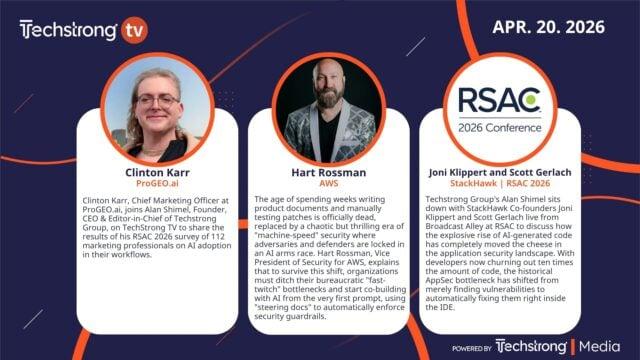
Techstrong TV – May 5, 2025
Watch our live stream on Monday through Friday, featuring exclusive news, announcements and conversations with IT leaders and experts on topics ranging from digital transformation to DevOps, cybersecurity, cloud native, containers and deep-dives into specific technologies and best practices.
Transcript
Hey, everyone. Happy Monday. You know, it's not RSA and you are not there either.
Am I? You're watching Textron Gang. Hi everyone, it's Alan Shimo.
Happy Monday to you. It's good to be back in the office after a oh week in change out in San Francisco for the security industry's annual pilgrimage to RSA conference, RSAC conference, as it's called now. This year's RSAC conference featured everything from goats and puppies to puppy killers, a lot of agentic, AI and other stuff in between.
I'm sure you've probably seen our coverage. If not, you could catch it on techstrong tv, but we're gonna look at some other things today. We're gonna put RSAA little bit in the rear view mirror and, uh, and move on.
Um, let me introduce you to our gang members for today who are gonna be discussing this with us. First of all, she sat while RSA was going on. She manned the, the ship and kept it steady and off the rocks.
One of our editors here, ad Textron, Sona Saha. Hello, Sona. How are you?
Great to have you on, and thank you for manning the ship while all hands were, uh, on deck. It seems like doing things well. Thank you.
Also joining us. Uh, she's a, a new member. Well, this is not her first time on the gang, but she's a relatively new member of the gang, but she's a longtime Textron contributor, one of the most respected cyber journalist I think, in the industry.
Our own Terry Robinson. Hi, Terry. Hi there.
How you doing? Excellent. Excellent.
It's great to have you on. And then joining Sagaria myself, it looks like, I'm gonna guess he's back home in Austin, but he's been over chasing leprechauns in Ireland among some other things. He is gonna give us a report on it.
Uh, uh, Futura Analyst, uh, VI principal Analyst, guy Courier. Hey guy. Good to see you, my friend.
Thank you. Good to be back. Good to be back in the states.
Good to be back on the pod. Um, You didn't pick up a Be good to be starting a whole new week. Yeah, it is good to start a new, a fresh week.
A fresh week. It's a fresh month. Well, yeah, Getting into summer.
Getting into summer. Anyway, let me, let me, let me lead things off with, uh, a recent article over on Techstrong ai about an AI agency showing that AG agentic ai, which by the way, was all the rage at RSA, I mean, the lead of this survey is that 72% of orgs, orgs are using Ag agentic ai, sono. What's this one about?
Um, so according to a research firm, uh, I don't remember the name for it, but they predicted that the growth is projected to be 45% CAGR from 2024 to 2030, which, uh, I think is a pretty steep climb, but not really unrealistic because it's like a magic band in the hands of companies. And also, come to think of it, I cannot really think of one company that has not really joined the AI agent tech fray lately. Like, think of Appian Klarna, Salesforce, ServiceNow, solo, I Zoom.
Pretty much everybody has, uh, ruled out some form of agent tech AI based solution lately. So, uh, I'm don't know about the adoption rate. I I can, I cannot be a hundred percent sure.
It definitely seems like it's on the peak, but, um, I think, uh, I guess in a couple of years we'll come to see how much that has really caught on. There are obviously integration frictions, and, uh, adoption is not as easy as it sounds from these surveys. So we'll see.
I guess, well, A lot of good insights from the survey, Sona, but, um, I feel like you're being a little kinder than I want to be. Um, 72% affirms using something that they'd never heard of, actively using something they never heard of, uh, six months ago, maybe three months ago. I, I, I kind of feel like, and Alan, I I, you know, may maybe, maybe you'd have the same perspective as me.
This reminds me of Cloudification when cloud came out and, um, I was working industry at the time. I was working at Dell and I was working on cloud solutions at Dell, and we would go and talk to customers and they'd say, oh, we already have a cloud. And this is like 2012.
And it turned out what they had was VMware. And I think that that knowing, so, so, you know, I know what the word agent means. Agen sounds like a marketing way of saying a, you know, agent.
And, uh, you know, when I use ai, um, to do something, it's helping me out like an agent does. So I, I just, I kind of feel like this was a little bit of, um, of the current market confusion, let's say, um, that I wasn't really aware of. Uh, but it may be a market confusion that when they're asked if they're using Agentic ai, they just answer if they're using AI that makes more sense, 45% CAGR for a tiny, tiny market that is extremely popular.
Sure. That I can believe. I thought the insights there were a lot more on, on, you know, uh, what they're doing, how they're doing it, having debt, like half of them saying they have a dedicated budget for this sort of thing.
I still think that's a dedicated budget for ai, not agentic ai, but nonetheless, it starts to make sense. You know, you start, start to think about, um, their concerns about security represented in the survey, their secure, their, their concerns about how to integrate properly, um, how to manage the whole thing. That was helpful.
But I dunno, Alan, maybe you disagree, maybe you think 72% of FERBs actually are actively using AI agents right now, do you? No, I don't think there's that many AI agents. I I think people are using agents, but they're not necessarily, I think people are using APIs.
Excuse me. I think that's one of the things here as I think what is a AI agent or what is a agentic AI is not being clearly defined. And I think people are looking at API and API connections integrations as some form perhaps of, of agentic, uh, uh, integration.
And if you want to go that route, then I'd say, yeah, 72% are using APIs and, you know, integrating APIs. However, there's, I I, one other aspect that I, I'll point that, and I think, Sloan, you said it early on, and that is the wish factor, the fomo, right? Everybody, no one wants to say, oh, no, I'm not going to use the latest, greatest thing.
I'm a dinosaur. I want to be obsolete by the time I'm 10. You know, so there are, I I do think most agencies envision using some sort of agentic ai slug, I don't know what you said the timeframe was.
Was it 2030 or 2028? Yes. In 2024 and 2030.
So it's five years from now. Yeah, sure. You know, to quote Frank Pani and, and Godfather part two.
Yeah, sure. But, um, anyway, but today, anyway, I'm sorry. Y It does seem like that number is like sort of more aspirational than anything else.
And this is one of those times that you wish you could actually see the survey and the, how the questions were asked and how the definitions may have been handed to that, you know, population of people who were surveyed. I think that would make a big difference maybe in what we're seeing here. Well, so I looked into this a little bit.
I mean, it's a, it's gravity, um, spelled with EE at the end instead of y. Um, they are an API, uh, uh, an AI focused API management company. Um, and, um, they, it was 300, um, you know, professionals, IT professionals, not super well defined, at least in, in, in their press release about it.
Um, I have no doubt that these are folks who are knowledgeable and involved in some way. Um, and I think that, that, um, you know, we would have to delve deeper. And I, we don't really need to do that or really question.
We, we, we understand their motives, right? And Alan, your point about APIs and our point in general about this being about AI and about interactions between AI services and applications or agents of any kind. I mean, that's where we can get insights from, you know, from, from this data.
And that's in, in general what you wanna do. You don't want to take the numbers necessarily like, you know, at face, at face value. Um, they're more indicative than anything else of, uh, the, you know, this sort of merge of the API economy with the existing AI services.
What's the API economy? The API economy is, uh, exposing services for collection and use by applications of all kinds, um, through standard interfaces or through, you know, well understood interfaces. And why shouldn't, uh, a host of those services be AI services?
They should be. I, I agree. I agree a hundred percent.
Um, look, clearly though, we are going to have, uh, agent ai, agent AI is gonna be widespread agent ai. A lot of people are going to use it. We need, you know, I, so if we sat here in 2029 or 2030 in hindsight, I think we would say, oh yeah, these numbers are about right.
Either even conservative. Um, but as I sit here today, you know, and this was one of the, another theme at RSAI spoke with, with a lot of people is how much of it is really real today? And, and I think that's what we have to look at.
Anyway, the article on this, so is up on Textron ai, I believe, right? And people can check it out there, the link's in the ticker. Um, until next time, well, not until next time.
We're not until Tomorrow when we have the next survey about ai. Yes. Well, we might have one later today, but you know what, let's take a break and move on to our B block.
You're watching Textron Gang. Hey, everyone, you know, before I left for RSA, um, I had a chance to sit down with my friend Patrick dubois if, for those, well, if you're in DevOps, you know who Patrick is, right? Patrick's the man who gave DevOps its name, uh, also started the very first DevOps day.
Some people call him the godfather of DevOps. But Patrick has been someone, a leading light in the DevOps community since there was a DevOps community. com in 20 14, 11, 12 years ago, 2013.
Um, and I know that for the last, let's say between, well, during Covid and immediately after Covid, Patrick's enthusiasm for continuing to work in DevOps was starting to wane. Um, not that he didn't believe in DevOps, he absolutely does. And, and, you know, for all the right things that we believed in it to begin with, but he just felt like he was looking for the next thing already, right?
People like Patrick are like that. And when AI came on the scene, man, it really got his juices flowing right. Him, my friend John Willis, a lot of the DevOps community founders embraced AI and operational AI, as they called it.
We had a hackathon down here with them, and it really reignited their passion for app dev and ops and what's going on in the software world. Um, now, I haven't spoken to Patrick in six or eight months, so I had a chance to catch up with him. And he has hooked into a new community called AI Native Deaf, and it's AI space, native deaf, one word, I I think we may have it wrong on the ticker, I'll correct it, but it's AI native dev, one word, and it's, uh, AI native, dead native dev, I believe AI or io it's, it's in my, in the article.
But this is a community of really some heavyweight people. The community was started by Guy Poney, who's the, uh, founder, CEO of ny. Geico is what most of us call guy Geico.
And, uh, and Simon Maple, another well, well, well known developer, but it's attracted people like Patrick and some other really leading lights from, from the app dev community. And, and really what it's about, it's about pro promotes building software with AI at its core, using AI at its core. com with it, and I have, uh, there's a short 15 minute video of Patrick and I on Techstrong tv.
And then my latest DevOps chat episode is my full, I don't know, 40 minute interview with Patrick on this. And I gotta tell you, he is really pumped about what the potential here is, guy. I don't know if you've had a chance to see this site yet, or found out about this community and movement, but man, this sounds a lawful lot like the early days of DevOps.
Well, yeah. So, no, I didn't know anything about it. Uh, not till the article appeared.
Uh, I think it's your article after your conversation, uh, with DUP Bois. Uh, I don't know. I, I, you know, that I swing wildly from wild optimism to, you know, a deep, dark pessimism.
Um, this is really Spin, Cynical. Yeah. I try not to be, but they keep pulling me back in Uhhuh.
So there's your godfather, my father, that one. Yeah. Um, so, but you know, it's hard not to be wildly optimistic.
Um, let, let me not be wildly optimistic. Let me just say that this was, this was necessary and needed. I don't know if AI native Dev, which is actually three separate words, which is gonna confuse everybody, just like it just confused you.
Um, but, um, it, it, yeah, I pay attention to those things. I'm this kind of word geek type person, but, um, this absolutely needs to happen. They're having a convention, or I don't know if it's digital or, or Person.
It, it's, I believe it's virtual, the conference. It's probably virtual. Yeah.
Um, one of the talks, or maybe it was a related talk, uh, you know, was, um, uh, from one of their contributors, uh, the title of which was something like, uh, the Identity Crisis in, in App Dev right now. And I think that, that, that's really correct. It's like one of those things that like when someone says it, you're like, oh, of course, it's obvious.
Um, we used to, it's, it is only two years ago or something that engineers were judged by lines of code. Now all of a sudden, there's a way to generate thousands of lines of code. Um, and now, you know, ev everyone realized that that was never correct to begin with.
Um, how do you, what, what is your role? And it's far more general than that, obviously, right? What's your role as a lawyer?
What's your role as a doctor, as a human being? When you have one of these, uh, assistants or as you like to call them, I think, you know, tongue in cheek copilots, someone who's gonna help you. And it's not a someone, I already did it.
I did it myself. It's an ai. Um, what, what are your personal, how are you supposed to judge yourself and judge others now as a developer?
Um, and I think setting a paradigm of some kind, just like cloud native as a paradigm, just like DevOps as a paradigm. None of these are technologies. None of these are necessarily tools.
Um, they're kind of cultural, but not, not just cultural. Trying to figure out, okay, what does this look like now? Um, I think this is absolutely right, and whether AI native dev is the thing that's gonna catch on or not, it is definitely the right effort.
And I can understand Dubai's enthusiasm for it as a developer or coder, as someone supporting app development has all of the needs and applications remain the same. They need to perform what they're supposed to perform at the right level of security or, uh, uh, and, uh, uh, and, you know, and reliability and all that other sort of stuff. But not, not an infinite amount of either, because it depends on the purpose of the application and all those other sort of things.
Balancing all of these things. That has not changed. And as far as I can tell, we are not at the stage where any app can be created in minutes at infinite reliability and security.
So human beings need to remain involved. They will remain involved, and they have to learn how to use this new tool, which is extremely helpful, but also has dangers associated with it. They need to learn how to do that.
And I think the idea behind AI native dev is spot on. I, I agree. And, and here's the thing.
Would, and I've said this before too. Ai, AI has the potential to change civilization. The amount of, and maybe it's just because of the bubble that us that we live in, right?
We're techie people. The amount of coverage, the amount of attention, the amount of buzz around what AI is specifically going to do regarding writing software is inordinately greater than I think the potential for AI on humanity in general. AI is gonna do a lot more things than help us write better software.
That being said, this group of folks right here is onto something, right? I think it's the reason why it does get this inordinate amount of coverage. I do think it is going to disrupt the entire software development ecosystem cycle world that we, we know of.
It's going to, you know, as I've said before, it's gonna take the 30 or so million, uh, software developers or 40 million software developers in the world today, and turn that into a half a billion. 'cause everyone will be a software developer. But there will be best practices that emerge.
There will be templates, there will be, I mean, it, it's just like everything else we've ever done in, in technology and software development. You know, there's gonna be structure and process and policy A around these things. Best practices will emerge.
I think this is a group that could really help it. I think with the kind of people involved here, you're gonna start seeing them front and center. Um, I'm, I'm, I'm stoked.
I, you know, I can't wait to see what comes out of this, to tell you the truth. I don't know, Terry, Terry, Bring the doubt or sag, bring the doubt. Bring the, the critique, bring the, bring the criticism.
I, I always have doubt. I mean, honestly, I'm gonna say straight off. I actually do think it's a good idea.
Um, and I'm, I'm kind of excited about it. But I do wanna temper that because, you know, there are issues with AI that, um, uh, that haven't been addressed in its current form, much less in like, the development en environment. But, um, I, I, I'm interested in that sort of human element too.
Um, guy that, that you brought up, it seems like these guys, um, that's one of their guiding principles, is it not, um, that they have the sort of, I think they call it what, human oversight by design. Um, and I think that's gonna play an important role in how this spins out. Um, but yeah, I'm, I'm hopeful, but I have my doubts.
You know what, and, and I will tell you something like, like Guy Geico and, uh, who's one of the founders here. He comes from a security background. So I will tell you that security is a paramount concern.
But, you know, I was in RS as I mentioned, I was in RSA, I was at, at the tech strong DevOps Connect, uh, last Monday a week ago. And the opening keynote was an amazing keynote. I was a panel actually, and, uh, moderated, but actively, uh, saw Rashi, who formerly a WSA AI luminary author, kind of moderated it.
But we had the CSO from Anthropic, we had the CSO from Open ai, we had the security tech lead from Met Lama, and we had the CSO from jfr, ml ops, all that stuff. So, you know, five really bright people who are in on this. And, and I, I think it was Morran, Ashkenazi, the CSO of Jfr who said something that really struck me.
She said, a at this stage of the game, anyway, AI can never be the pilot. AI must be the co-pilot. Oh, that came from her.
I just read your article on it, and I guess I didn't read it thoroughly enough. You Know me, I never come up with anything original guy. I just hear it from other people.
But, um, yes, that was More did Tyler, I let that clip what he just said. That's our producer. Um, but it, I, it was Morran who said it.
And, um, and, and the more you think about it, the more sense it makes. Yes. I don't think, not in my work, you know, uh, runway.
We're gonna just trust AI to just do these things without human oversight. I think you always are gonna have to have human oversight, at least for the foreseeable future. And that AI's role will be as a copilot.
So it's not that it's gonna take jobs away, per se, it's going to enhance the people doing those jobs, jobs. And I, I think that's a, a great kinda way of looking at it. Yeah.
But hang on just a second, because, uh, in, in, in the last segment we were talking about Agentic ai, and you're reminding me this discussion is reminding me about, um, Salesforce Salesforce's activity here. Um, uh, recently, it was just last week or something. They are exposing and building rapidly agenda AI platforms within Salesforce makes a lot of sense because so much of Salesforce and it's, it's, it's connected, you know, applications inherent and its marketplace, and all of this sort of stuff is on process, runs on processes.
Um, wh why do I bring this up? Partly because it amuses me that they're talking about lambs over there, lambs, uh, uh, large action models as opposed to large language models. Um, that's just kind of fun.
Yeah. But, um, no, the reason I'm bringing it up is, I mean, we're talking here right about Alan, about, you know, app dev, the use of AI in app dev, and how that changes the paradigm. And there's, there's a, there's a, a community, a growing community looking at it, which is really good.
Um, but agents, I mean, we didn't define agents in the last segment. AI agents, they are defined by goals. They don't change their programming exactly, but they do modify, um, the, the services that they use, the data sets that they use, they do things that current, uh, you know, AI models that we use, that they don't, that in AI services we use don't do.
They're more active. And that is a form of, um, retreat from Human Oversight. And I don't see how that could not be a, it's not a full retreat.
It's just, it's pulling back from it. There's things it does on its own, and it's intended to, otherwise it wouldn't be, and apply that to apply that to, um, you know, let's say, you know, uh, it doesn't have to be a, an application in production, like sort of an earlier environment, you know, QA stage or something where you have an agent that makes that, that makes fixes or approves them or whatever it might be. There's, there's, there's a little bit of a rabbit hole here, um, that, uh, can, I'm not gonna say it's gonna spin out of control exactly, but can be get pulled out of the, that human oversight control.
What was it, Terry? What was the, uh, uh, that it's, it's not unique to this community, this idea of human, human, uh, intervention in the, that's in human oversight by design. I don't, they're gonna have to figure out how you, yeah.
They're gonna have to figure out how you marry that with Ag Gentech. As far as app dev goes, don't tell me they're not gonna apply AI agents to app dev. It's, it's done already.
I mean, it's as good as done. They're gonna do it. I think, um, like upscaling the frontline workers, uh, is, uh, I mean, basically people who have like a solid grasp on the business goals, customer needs, and the technology on the whole, that can help fine tune them, uh, fine tune the AI models, uh, to eliminate the risk of error and oversight that could possibly help.
But the drawback with any, um, any decision making, uh, system, whether it's just AI or agent take AI definitely has big risks. That's, that's how you play it. Slant.
That's the danger here. We don't want something like, um, and it, it's not their intention, of course, um, AI native dev to almost provide an excuse framework or something, or permission, what they call a permission structure, um, for unleashing, um, or putting, or putting, you know, uh, putting a rosy rosy tint on something potentially dangerous. Um, I haven't read all the reporting yet, Alan, on, on, on, uh, RSA.
I'm very interested in, um, what these folks working in the AI community, um, and Jfr and so forth, um, how they're taking the security, uh, what, how they're putting the security, the security risks into, into practice. You know, one of, one of the areas I've, I've investigated recently for Textron is around code security, application code security. And this is sort of independent of AI to begin with.
It's a, it's a security vulnerability, vulnerability area that is not particularly well understood, but is significant because it bypasses every security control you've ever heard of because it's, it's actually embedded in the code. And, um, if you're not doing a code analysis, you might not notice it. And it, it's already insights.
It's passed all the, passed all the walls, it's operating inside the app with all the rights that the app has. Um, so in a sense, this is, you know, using AI for code, if AI itself gets compromised somehow and starts producing for the developer, uh, as the developer's copilot on producing, uh, uh, risk, you know, like, uh, what would the vulnerabilities in the code because it's compromised. Well, anybody detected well, that human, human intervention do it.
No. The human intervention intervention that will do it, sorry, is code analysis. It's, it remains, the practices remain the same.
The practices remain the same. I guess that's what I'm coming back down to. And so, Lama, I think your comment highlights this, which is, as you push the driving force farther out from the technical and into the business, that has such a compelling, um, uh, value to it, that you can lose sight of how it needs to operate in order to be secure, safe, reliable.
Agreed. Look, I, I think, I think the very core of the mission there at ai, native deaf actually is guy to do exactly what you're saying, is to make it very similar to what you're doing now, right? I mean, you don't throw out the babies with the bath water, hopefully.
And you take your best practices and you try to, you know, just as, just as DevOps kind of extended agile to a certain extent, right? This will extend other best practices. Anyway, we're gonna take a break.
We're gonna come back and, and Guy, you're going to give us, uh, a trip report, like, or a little bit of what you saw while you were in, in, uh, Ireland, and what we might expect out of it. You'll watch, I Mean, it's not about Guinness, what I saw at a technology conference in Ireland. If you wanna add some of the Guinness and Jamison or whatever, I'm, I'm up for that too.
But let's take a break. We'll be back. Guy's gonna give us what he did on his vacation.
You're watching Tech Drug Discover Techron Group, the epicenter of tech innovation. We are your go-to for reaching IT, leaders and practitioners worldwide. Our secret impactful content that sparks awareness, engagement, and top quality leads with us.
You'll access editorial websites, streaming videos, virtual events, custom content analyst research, and more. Join our satisfied clients. Let's revolutionize your tech journey.
Contact us today and tell your story to the world in the most powerful way with Textron Group. Hey, everyone, as I mentioned before the break, our friend guy was out in, uh, Dublin, Ireland area, uh, last week attending a a, uh, conference. He's gonna tell us about it.
And then specifically, there was a, uh, one particular aspect where Google, you know, pigs fly Google Meta and Microsoft joining together on a project to increase, uh, server rack density, which, which look, I think is a bit of a holy grail type for those of you not familiar in the data rack space, we've gotten to the point where you've got these GPU powered, uh, servers, and there's only so much electricity you can force into a set of, you know, space a standard. Is there starting no wonder? Well, we, well, unless we have a breakthrough, maybe, but I, again, to take you from there, run with it.
Yeah. Okay. So first of all, I was at the Open Compute Project Foundation, talked, called OCPI was at their European summit.
Um, the two themes there, for the most part, um, almost exclusively actually, did not have to do directly with what you're talking about, Alan, but I'm gonna get to that in a second. The two themes being number one, ai, big surprise. Um, no surprise at all.
The AI was a huge theme there. Um, and, uh, the other being, um, uh, uh, uh, power and cooling, cooling in particular. Cooling.
Cooling was all over that show. Uh, it, it was all over the global summit last year, but in Europe in particular, it's especially important where space tends to be at a premium. So you're packing a whole lot of systems and compute and such, like, um, when it comes to AI or high performance computing, you're packing them into a data center.
You're packing them onto a rack. Um, but yes, let's get to the Google Meta Microsoft, um, story here. Um, I mean, I'm just gonna cut straight to the big story.
We're talking about a one mega what mega wet megawatt capacity at up to 800 volts of direct current on a single 48 unit rack. Now, 48 units, it's a lot of units. 42 is typical, but the, uh, OCP, so OCP open compute project, right?
These are all open standards. That's a whole purpose of an open standards for data center and rack and infrastructure and all that other sort of stuff. So that they work together well so that, uh, vendors can build more components or servers or whatever they're gonna build, including for really high, like really powerful dents, et cetera, um, uh, uh, systems to, to host ai or the latest in high performance computing workloads, right?
Um, that's what open compute is at Open Compute. OCP is for. Um, so actually Meta already has a half megawatt rack right now that's in that it's either in production or about to be in production, and they're simply contributing that standard, um, to what's called Project Mount Diablo.
5. 'cause guess what folks? Version one is probably gonna be that one megawatt 800 volt rack.
It's a lot of power. Your average dense rack right now in a more average data center, which by, let's face it, like a lot of the cloud providers, Google and everybody else, they don't, they're not filled with, you know, high megawatt, uh, sorry, high kilowatt racks. But, uh, their typical rack, which is very dense, um, is 20 kilowatts, 20 kilowatts, 35 kilowatts, actually I should say is like a, so we're talking like something like 40 x that size.
You're talking about packing a lot of compute. I mean, by my calculation, so the sort of the cutting edge right now of accelerators, GPUs is, uh, 1200 watts per GPU, which is a lot. That's a lot already.
That is a lot. That's a lot of watts. And with a megawatt on a rack, you could put like a couple dozen of those, not on the rack, but a couple dozen of those accelerators on just one sled in the rack, they're building.
This reminds me, we had a conversation about this, I think it was you, Alan, about akame way back in the day, way back during the dotcom bubble when Akamai came out and they said, okay, we're we, we're, we're, we're, we're just gonna, or maybe it was a different company. We're gonna build a whole lot of fiber. We're gonna spread fiber all around the world.
And it's level three. That's right. Level three, and it's dark fiber.
It's gonna be dark fiber. What does dark fiber mean? It's not even gonna be used because they expected demand to go way up.
And eventually it did. Level three had its problems because it was managing a whole lot of fiber that wasn't being used. That's probably not gonna be the case here.
One megawatt, I, can I say it any better? I mean, help me out. That's a lot of power in one rack of which there would be 40 or 80 in a typical data center in Europe.
I mean, 'cause there's much bigger data centers including being built in Europe. I'm just trying to put this in context. This is the vision that they have and the fact that they are contributing this as open specifications.
Google's, uh, uh, contribution, um, is something called Deschutes, which is their cooling technology. I think it's a single phase cooling might be two phase, uh, because they are trying to address this problem themselves. When you have that much wattage and power all happening in such a small place, the only option is electric direct liquid cooling, which means little tubes of liquid running around inside these servers, um, transferring heat and bringing it like to the outside.
And it being Europe. There's sustainability associated with this. So a lot of these cooling systems are now supplying heat to whatever the local village or city or something that then doesn't have to pay for heating in the winter.
Um, of course there's delivery of that much power in the first place to the data center, which is where, at least in the states, or I think it's in the states where they're talking about building nuclear plants or like whatever else. Um, this is a problem with a lot of different elements to it, but if you can't actually get the power to the accelerators on the rack, in short, I think a lot of, uh, what's going on, what was happening at ocp and what I'm seeing at these conferences is, doesn't get the headlines. It's not the one mega megawatt rack, even though, I mean, I just can't stop talking about it.
It's really incredible. It's not the launch of a broad AI enablement initiative by OCP so that you can have a hundred percent open standards around AI clusters and hosting ai. There's also an efficiency movement that does not get the headlines in how to use existing infrastructure or existing technologies and rack capabilities and so forth more efficiently to do the same thing with less.
That's what I'm hoping to see more of in the next year or two. And that's a reason to go to Europe because, um, the general approach to AI so far, I mean, slog nine, I know you've seen this too, probably you too, Terry. The general approach is just to throw more and more and bigger resources at it.
And this one megawatt rack is an example of that. But the other thing is to try and do it smarter, and I saw that too. Memory encryption, um, is just one example.
Probably think of a couple others. This discussion continues where it's packing more, packing bigger models into smaller spaces closer to the processor. And for that you actually wind up needing less power rather than more.
There's also a new kind of magnetic memory called MAM, magnetic based memory called MAM, which is a bit of a tweener memory in the sense that it can be right close to the processor actually inside the processor, but take the place of DRAM five, which is outside the processor and has a slower connection. And so this MRAM is new, but, uh, uh, being able to put it in there and, you know, do more with that CPU or that GPU, um, that is otherwise at a slower clock speed and not as dense and doesn't need as much power. That's the other approach.
And that was really interesting to see at OCP in EMEA and not something that gets talked about quite as much. So that's my initial report. Yep.
So guy, you know, I, I was at Scon at least a month, maybe a month and a half ago. One of Seuss's, uh, key data center partners presented there. They were from Australia, I think it's called AUSSI Servers or something like that, is the name of the company.
And their, uh, it wasn't their CEO, it was like their CTO, I believe did a tremendous, um, presentation on server density and the limits, you know, there's two limits you run into. One is cooling and one is power cooling. He said if you're not, if you're not using liquid cooling, you're just not getting into the major leaks today.
Right? You must use liquid cooling, air cooling alone isn't gonna do it. Um, but from the power point of view, I forgot if he said it was one meg or one and a half, I mean, like theoretical limits to a full rack, you know, of just how much you could bring in there.
And, and, and you also gotta remember that that's just one rack I, Uh, I haven't forgotten. Yeah, It's a whole data center, right? Right.
It's how many racks and, and so, you know, short of, of having a flux capacitate, you know, behind each rack, you know, Dr. Brown is, uh, spinning it up or something with Marty McFly. How, how do you, how do you pump that much juice into a data center to power 60 racks of one megabit each?
Well, let's see, how do they do it in back to the future? A lightning bolt and a cable running from a clock, tower Tower, right? You need to up to the clock tower though, in back to the future three, if you remember, they did have a new improved flux capacitor and you could just put like, uh, post and stuff in.
Yeah. And, and, and it ran that. But I mean, seriously, you know, when you're talking about a $2 trillion, invest 2 trillion with a t $2 trillion investment around the world over the next, I don't know, five years into AI data center construction.
Are we gonna have the juice to run all these things? Or are we just gonna have white elephants? Now, I I think there's one megabit of rack thing is a noble, a noble, uh, thing.
And, and I do, I agree with you that the doing this in an open source kind of model will allow, you know, companies who are otherwise competitors, you know, to Cooper, cooperatively and cooperatively, you know, collaborate here and bring other people in. But Dawn, before you go spend $2 trillion, I probably wanna figure this out. That's just me though.
Conservative, what can I say? Um, I mean, I think it's a bit, I think it's a bit ironical, um, that companies talk about sustainable thermal design and lowering energy footprint. But at the sa in the same breath, they're also talking about greater power delivery.
Like I think that kind of like those two are contradictory things. So yeah, I understand that AI ML workloads would require more than, like Google says that it would require more than 500 kilowatt per rack before 2030. And it's no surprise that they're al already working towards that.
Uh, but the industry, we Already have it just, just to, just so meta already has a 500 kilowatt Rack. Yeah, I mean, yeah. Moving to the one megawatt, um, uh, units.
Yeah. Um, so I think like the industry as a whole, like the, all of the hardware industry, whether it's gpu, SSDs, networking, gears racks, what have you, they're all focused on, um, delivering better barrel thermal design. And there's also the push for densification.
So it'll, at the same time, if you're going to, if they're gonna jack up the pod delivery capabilities of these designs, the data centers at the end of the day will end up consuming a whole lot more power and energy and emissions will ultimately go up. So I, I don't know where this is actually headed. Um, I don't know if it was Europe particularly on, I think it, to some degree it was, but that very question, Sono was on the main stage at the opening keynote on the first day of the conference was, um, uh, and I think it might have been, um, the, the head of the OCP, um, uh, saying it himself, uh, George, um, I remember his last name, sorry, um, at the moment.
But, uh, there, there was that very question, uh, rapid progress in AI and improving data center and it, you know, uh, capacity, um, is that in direct conflict with sustainability goals? This is, this is, I mean, it's, it's the law of the land across the EU and across Europe. So they're looking at it, they're attentive to it.
Terry, I think you, I was just gonna, you were gonna Comment. Yeah, I was just gonna say, I mean, it kind of blows the sustainability thing out of the water a bit, that argument. But also I'm, I, I'm kind of trying to track what's going on in my home state of Louisiana, right?
Because Meta has a huge data center that they're building there in a parish in northeast Louisiana. And this idea of power, uh, has come up a number of times in who's paying for it, how much it's gonna take, you know, I mean, it's there. Mike Johnson has been, um, pumping it a lot, uh, you know, sort of publicly.
Um, but in the discussions down there, there are, you know, there are a lot of, uh, uh, concerns and questions, but also I, I can't help but thinking, I mean, that state is not one that's so big on the environment and sustainability and whatever. So maybe it's actually the perfect place to put something like this because, you know, Yeah, yeah. They can open it next door to a ref, a refinery and, you know, Have the best or the worst of both.
Listen, well, that's problem. There's, there's, there's a Sate down there. There's, you know, for this.
So There's a, there's a problem with this though. Um, and, and that is data gravity. Uh, the pipes are not big enough for the low enough latency required for a service to be in Louisiana.
I mean, I think that would be like the easy button for this whole industry is forget Louisiana, you know? How about the global South? How about, you know, central America, uh, uh, Northern South America, Africa, you know, there's lots of places where we can just dump, you know, all of these, uh, uh, uh, low sustainability, you know, data centers, what have you.
If it weren't for the fact that the data needs to get there and the data needs to get back and the services need to be provided reliably, that's why space is an issue in some parts of the world. Not everywhere, not in Australia, but certainly in some parts of Europe because they wanna put these data centers in all this power and everything really close to major population centers. Agreed.
Agreed. Guys, what started out was gonna be a nice short Monday Tech field, uh, tech Field day, nice short Monday, uh, Textron Ya has, has run a little overtime. So I'm afraid I have to pull this out here so we can play all of the great RSA content we have from last week, as well as some other, uh, great content on text, on tv.
Also a quick announcement. We are sort of beta testing our Textron TV OCC app. So I believe you can get it in the iOS and Google Play Store.
I think you can also get it on the, uh, apple TV app, uh, store as well as the Roku store. And I think Amazon Fire, not everything is up to date. A lot of the tech field days are because our tech field day team was in charge of uploading videos and I guess they focused on Tech Field Day.
But, uh, there's Textron again is only up through the end of the year, for instance. But we will be uploading our entire catalog and not just Textron, we'll have six five Media, we'll have Tech Field Day and Futura, uh, content up there as well. So if you get a chance to download the app, registration is optional.
We'd love for you to register. We have big plans going forward for those people who it's, we're not looking for money, but those people who do subscribe, we'll keep you in the know and get you some premium content. But, um, you don't have to register to enjoy it.
And we'd love your feedback on it. We know it's a better and it's a work in progress, but do check it out until tomorrow though. Guy Terry Sagner, thank you so much for being here.
Thank you so much. Stay tuned. Text Drug tv.
I'm Alan Shimel. We're out. Hey everyone.
Welcome back to Text on TV's live coverage of RSAC from San Francisco Moscone West. We are in Broadcast Alley. This is our 10th year covering RSAC.
And this is where the best of the best experts in cybersecurity and AI are this week. We appreciate you tuning in. I'm very excited for this next conversation.
Sol Rashidi is here. She's the CEO and founder of Executive ai. And you do so many things.
Sol great to have you on text Joint tv. Thank you for joining me. Thank you for having me.
I appreciate, I'm gonna brag on you a bit because I I LinkedIn stalked you. Okay. You have 10 patents.
I do. Working on the 11th one right now. You're a bestselling author.
You're a top 50 women in tech. I love that. I get goosebumps and this is awesome.
Forbes, AI maverick of the 21st century. You're literally a maverick. I've been lucky.
I've been lucky far from it. I think with the pace of change and how everything's going from, like, we're all just barely keeping up. I know.
Um, but I was fortunate enough to get a, a few labels and titles along the way. Well that's fantastic. Talk to me a little bit about executive ai.
You are the founder, you're the managing director and this is a consulting practice. So it was interesting 'cause it happened completely by accident. I've always been a C-Suite, a part of really amazing Fortune 100 companies.
Um, like some of the largest firms that you've ever even heard of. Like I've always represented 'em as the chief data officer, chief data and analytics officer. I was the enterprise's first Chief AI officer appointed back in 2016.
Okay. So I've always served these companies and I've always been brought in to build the capabilities, scale the capabilities. And so that's kind of where a lot of my practitioner experience came from.
And then I left Enterprise and I discovered that, you know, I helped IBM launch Watson back in 2011. Wow. And so from like 11 to 2015, my job was to fly around the world, work with these enterprises, help them establish their AI strategy.
Yeah. Their use cases and help them deploy No different than how everyone started in 2023. So I'm just watching the world kind of go.
I'm like, yeah, we did this and we made that mistake and we did this and we made that mistake. And no one's calling out their mistakes. No one's calling out the lessons learned and they're so valuable.
I always say you learn from the mistakes. Absolutely. And so yeah, fail forward, fail fast.
Yes. But like you learn. So why should people have to go through and repeat what a slew of us, quite frankly went through nearly more than a decade ago?
Yes. So executive AI was created because I think there's a lot of C-suite executives. I think there's a lot of leaders.
I think there's a lot of companies that are learning and earning, meaning they're learning on the fly. Right. But they don't necessarily understand what the bottlenecks are.
Mm-hmm. And I say in the world of ai, you've got data infrastructure and talent. Infrastructure is all the tech stacks, the tools.
Like we've, it's not about GPUs and CPUs and workloads. Like we've solved that. Data security is a major hurdle right now.
Absolutely. And then talent preparation, because the way we're going to market with artificial intelligence, and I saw this back in 2012 and 13, it's, we're gonna do AI to increase productivity and capacity, which by default means we can run leaner. And that is never the case.
So the goal isn't to increase capacity so you can displace employees. Mm-hmm. The entire intention is how do you give them time to reflect and realign on the bigger business problems.
So it was supposed to be kind of a side hustle so that I could actually help other organizations go through workforce preparation and data security that then turned into kind of a thing of its own. I love that. Sometimes serendipity, right?
Yeah. Yeah. I love your mission.
I identify this with this as a market. I was telling you before we went live your mission about bridging the gap between the technical folks, the non-technical worlds helping pivot from this massive AI hype that we're still kind of in. Yeah.
But now it's time to talk about AI results. Share a little bit more about your mission. Why is that so important to you?
It's interesting 'cause for those of us that are in this space, like we are knee deep into it. Yeah. You hear about all the amazing startups and what they're doing and you hear about all the tech companies that we're doing.
But we're missing the point because there's an entire ecosystem around us. Like most of the, if not all of the Fortune five hundreds, they're not tech native. No.
They use technology as an enabler, but they're not tech native. Right. So everyone is constantly in defense versus in offense.
Everyone is reacting versus responding. Yes. And they're just trying to catch up.
Yes. And so I think that's where the bridge really exists is we are in this space and we kind of understand it and we kind of geek out on our own things. But quite frankly, it doesn't matter what amazing tools and tech we build unless there's true adoption.
Yeah. Nothing we do is ever gonna scale. And the adopters happen to be the non-tech native, the non digitally native individuals.
So I always like to say that I'm just a glorified translator. And oddly enough, my first career, my first job outta school, um, I used to be a professional rugby player. And then I was like, okay, time to grow up.
Wow. I need to get like paid for a living so I'm not sleeping on futons and ramen noodles. And so I became a data engineer and six months in my, my boss came to me.
I was like, oh my God, I'm getting fired. I thought I was getting fired. Because he said, so you're never allowed to touch a lick of production code ever again.
You can hack your way through things, but you cannot write production ready code. He said, but for some reason you like the business, you get along with the business and you know how to build relationships. So your job is to talk to them, figure it out what it is that they need, translate it to us.
'cause you know our world, we're gonna build it and then you're gonna go back to them. Because what was happening was is the business would say they would need one thing, they would build it only to find out that's not what they meant. Right.
So I thought, I was like, oh, well I'm not getting fired, but I'm totally getting demoted. But it turned out that playing this translator between the business side and the technical side turned out to be a really, really critical asset. Because most of my positions, it's not 'cause I'm the smartest person in the room.
It's 'cause I'm the only one that understands both sides of the house. You are the bridge and I can find the common ground. So the bridge, you are the bridge.
What is that like culturally to, because you, when we talk about like data stack ops and the developers and security and there's a lot of commonalities that they have, but they struggle to collaborate. How do you see the tactical folks collaborating and cohabitating with the non-technical folks? What some of the magic that you've seen happen and what's essential for that cohabitation?
Yeah. I would say what's essential for that cohabitation is if our technical folks who have tremendous IQ also put just as much emphasis on their eq. Yeah.
Their BQ and their sq. You know, I would say the first big faux pa and mistake I made in my first C-suite role was I leaned and over leaned into my iq. Well they clearly put me in this position 'cause they thought I was smart enough to have the C-suite position.
Right. But I learned that my IQ actually wasn't gonna help me evangelize or scale or help build critical mass in the things that we were building. It was my eq, my ability to read the room and the groups and the teams to understand what they were afraid of or why they were pushing back and resisting so much.
Or my bq, the ability to translate our terms and terminologies and taxonomies, um, and lexicon of language into their language. Yeah. Which we don't do in our world very, very well.
And then the SQ at the end of the day, people still believe into people. They still buy from people. Right.
And so my writing joke was that one of my employers, I went to more happy hours than I could even care for. But it built the trust. Yes.
So I would have one-on-ones with these executives, these presidents and CEOs and saying, listen, I don't get it. I don't understand it, but you do and I trust you, so I'm gonna give you a few of my resources. Go pilot this.
And then if quite frankly, if the response is well, then we will evangelize and scale it. So it was like that's all it took. Yeah.
And so what I always like to say is, you know, technology can scale efficiencies, but relationships are what scale the opportunities. Absolutely. And that's not something we really lean in on too sometimes 'cause we just kinda like geeking out on the tools.
Yeah, we do. But you bring up such a great point that so much of this, even in the age of ai, the era of AI Yeah. Is relationship based.
It still is. And it's, which I, I like that because there are soft skills like empathy for example, you talked about eq, curiosity, the ability to bridge gaps that are so vital to every role that some of them aren't trainable. You're born with it, right?
Yeah. Uh, uh, but you can develop it. Okay.
Like if you put a conscious effort. Yeah. Um, you know, naturally I was always hired to be a bit of a change agent Yeah.
To build capabilities that didn't exist before. And I was in travel and entertainment, I was in music, I was in pharmaceuticals, I was in consumer products. Well consumer products, travel and entertainment and media and entertainment.
Like music industry. They're very, very creative spaces. Mm-hmm.
And so I was always like, well we're building the amazing things. You should use it. You've been asking for this.
Yeah. But it never really cracked the nut. Okay.
And then it was, storytelling helps learning their vote. Language helps. Right.
But then I realized that a lot of this is just fear based and habits. So I'll never forget this, but we went to a leadership conference in one of my, the, the CDO role that I was serving for this company. And I was getting massive resistance even though what I thought we were building was amazing.
And so they had me speak on stage and I said, listen, I'm not here to replace your intuition. Mm-hmm. I'm not here to replace your experience, and I'm not here to replace your relationships.
But you have questions and you're frustrated at getting those answers. Mm. So my job is to make sure that you have those insights and those data points Right.
When you need them. Right. So that you could make those bigger business decisions.
So don't view me as a threat. Yeah. View me as your enabler and supporter so that you could lean in more on your relationships and experiences, but the data points that you need, you're not getting frustrated.
'cause you have to wait days if not weeks, to be able to get them. So I'm here to support you, so consider me a stool, you're here to step on me so that you could elevate your performance and your team's performance. Yep.
And I know my function, it is here to serve you. Yeah. And it was just amazing 'cause the presidents of the divisions and the heads of like the different functional areas, they pause, everyone stopped looking at their phone or doing whatever they were, and then you, like, they were just kind of baffled.
And then the week later, all the one-on-ones I had requested were now accepted. Nice. I was getting the executive assistant saying, Hey, Matt wants to talk to you.
Hey, that thing that you said really resonated. There's some ideas we wanted. Then I started getting invited to the leadership calls.
And so the goal isn't about threatening or displacing. Right. It's about elevating those that create magic.
That's a great word. And I think that's what we technologists do. How do you advise perspective leaders to go from that practitioner role?
Yeah. To leadership. Yeah.
Is I imagine the languages are very different. They're very different. Yes.
You know, I moderated a panel yesterday, which is amazing. We had the CISO of meta, we had the CISO of OpenAI, we had the CISO of Anthropic. Like those are my rock stars, right?
Yes. Me too. In the eighties it was like Bon Jovi Def Lepp.
But now I'm like, oh's, it's Matt. Yeah. Um, and they were on a panel and I asked them a very question and it was interesting to see everyone's responses.
Yeah. But the one thing that they had in common was they never lost their practitioner skill, but they learn how to lead and manage because practitioners, we love geeking out. We love going deep.
We're kind of hard to manage. We're a bit an, we're kind of anarchist. Um, we love our bubble and we wanna stay in it.
Yeah. But when you learn to manage and lead, and I made so many mistakes and I have to apologize to a lot of people who reported into me earlier on, I was learning and earning at the same time. My leadership style is so different than the way it was good for you 10 years ago.
Yeah. Um, that's the biggest thing. You gotta learn how to work with people and not just the people that you manage.
Yeah. Also your peers. Yes.
Also, the people above you. Like, it's kind of like if you're at the middle of the vector, you've got arrows going in all Yes. You've gotta be a compass of influence.
Um, compass that influence that takes a lot of energy and effort. Yes. It's draining.
It's, but if you can do it well, you could leapfrog forward. What, what is a timeframe that you've normally seen practitioners being able to take on the education of management of leadership? This is not, I imagine, an overnight process.
'cause there's behavioral changes that have to happen. And as people change is hard. Change is very hard.
It depends. If you're in a startup, you can do it as early as your late twenties, early thirties. Yeah.
Um, chief product officers, you know, chief revenue officers, head of DevOps and startups like I've met anywhere from like 26 to 34. Yeah. But you're an enterprise.
The risk profile is a lot bigger. Absolutely. The teams are a lot larger.
Yes. The revenues that are being questioned are a lot grander. Yes.
And so there's an element of not only just practitioner maturity, but personality maturity that goes into it that showcases you know, how to navigate this world. And you're not gonna throw a tantrum if you don't get your way. What are some of the soft skills that are essential for this practitioner transformation?
Yeah. Business language. Business language.
We can throw, like in the data space, we could talk about lineage and catalogs and enterprise data management and master data management, data security and InfoSec all day long that does zero for the business. Zero. I don't even use my language in front of them.
Okay. You know, my, my pitch is always like, aren't you frustrated that it takes months rather than minutes to be able to get the information you need? I'll fix that.
Yes. But I'm gonna need six months. I'm gonna need X amount of dollars and I'm gonna need two people from your team because I need them to do X, Y, and Z.
Mm-hmm. And you'll solve that problem in four to five months, and it'll be productionalized in six. I won't even talk about how I'm gonna do it.
Okay. And then if I get asked, then I'm like, all right, lemme break it down for you. Sure.
And then I go into my language. Yeah. Usually they glaze over again.
Okay. That's fine. We'll, I'll be your stakeholder.
Here's the funding that you have approved. Here's the head count, you have approved. Go build.
What's one of your favorite stories of impact that you've made and, and in an, in a, in an in opportunity, like what you just described. Ooh, that's a good one. I'm sure you have many.
I do. Okay. One of my favorite, favorite use cases for artificial intelligence is building what I call an augmented knowledge store.
Yeah. For customers support, whether you're in financial services or commercial banking. Right.
There's warranties, there's offers, there's, there's so much to memorize. Or if you're in consumer products, there's a ton of product SKUs that you have to memorize. It is nearly impossible for anyone to go through and memorize.
Yeah. If they're even documented by the way, in these manuals and PDFs because new service and offerings and, and warranties, like they're constantly being offered day in and day out. And so you're dealing with a group customer support that historically is not tech forward.
Yeah. Not tech centric. They've often been with the company 20 plus years.
There's a lot of fear and resistance towards new tech. Sure. But it also has the most, like, the easiest opportunity because it takes six to seven months to onboard a customer service rep from getting to know the process, memorizing the products and services, shadowing a senior person, then actually to ending calls and being shadowed.
Mm-hmm. It's a long process. Yeah.
That opex cost is massive. Sure. Um, so one of my favorites was one of the companies I'd worked with that I said, listen, why are we having our customer support reps me memorizing 80,000 different SKUs?
Right. The focus should be on answering the question as quickly as possible. Right.
And giving assurance to the person who's calling in to complain, not on trying to recollect and going, um, um, I don't know. Um, um, let me escalate. Um, um, hold please.
Let me ask my manager. So it's the easiest and the most fun. And you get to see the aha moments in the customer service reps of creating this augmented knowledge store where they're like, which one of my products are vegan?
Which one has this ingredient's gonna create an allergic reaction? And they'll get a list. So as the person calling and asks a question, they have this copilot next to them not to be confused with Microsoft.
Sure. But they have this assistant, they type the questions, they get the immediate answers, and then they're able to, to answer and go, and by the way, I completely understand what you're going through. Let me make sure that my response is exhaustive.
Because even though this isn't a primary ingredient in our products, I want you to be aware of the other products that have it as a secondary and tertiary that's building trust. Absolutely. And brands right now, trust is the biggest currency.
It's absolutely so easy, so responsive. Um, and customer service reps, they don't have to understand tech. They just have to know that they don't have to memorize everything.
They're empowered 100%. Which every brand needs to have that last question for you. Yeah.
Here we are at RSAC. The, the cybersecurity landscape changes minute by minute. Okay.
Probably second by second. What encourages you about where we are in this AI era from a cybersecurity perspective? Oh, I pause because if truth be told, I'm a little bit worried.
Yeah. I think we're still very much in a defensive posture Yes. Versus being an offensive posture.
Yes. Agreed. I think there's still a lot that we don't know.
Yes. Um, our surface area of exposure is not doubling or quadrupling like it's beyond Moore's Law as we go from what we call artificial intelligence. But whether it's augmented intelligence or automated intelligence into autonomous agents where the agents are gonna be making the decisions.
We're not there yet. I'll be very honest. We're talking about it.
But by the time enterprise catches up, like the risk profile for that is very, very massive. Um, there's a lot of steps that go into it and folks aren't aware yet. Our surface area just gets vast.
Right. And right now, you know, earlier stats were saying that there was about 23%. If you talk about 2022 of attacks were cyber attacks, it's now gone up to 50%.
But the stats are that by the mid 2026, most of those attacks, it's gonna increase to 75% are actually gonna be machine to machine attacks, not human to machine attacks and the detection levels needed for those. It's just a completely different ballgame. So we're gonna have to rewrite the script fairly shortly.
Yeah. It's challenging to, to think about how to become proactive when there's still so much defense going on, so much defense, and we're all behind. Like, it's impossible to keep up with the pace of change.
It, it's breakneck speed. I know. I feel like I'm under a lake with a straw.
Like just trying to get our gas a little bit, a little bit of air. Yes. I'm in this space.
I can't even imagine what it's gotta be like if you're not. Yeah. Well, it's been so great having you on the program.
Thank you for sharing what you're doing, how you are achieving that mission, how you are the bridge between the technical, the non-technical, and really helping organizations pivot from this AI hype to AI reality. We so appreciate your insights and your time on Textron much. Thank you so much.
My pleasure. Bril Rashidi. I'm Lisa Martin.
You're watching Textron TV live from the show floor of RSAC in broadcast la We'll be back after a short break, so we'll see you soon. Hey, it's Techstrong TV coming to you live day three of our coverage of RSAC here at Moss County West in San Francisco. We've had great conversations with leading cybersecurity firms and experts from across the globe, and I'm pleased to welcome back one of our guests, Anan Swell, who I've had the privilege of interviewing before the SVP and GM of network security at Palo Alto Networks.
Anan, great to have you. Big week for Palo Alto. Great to be here today.
Yes, Lisa, it's so great week. Can't Go to a conference these days without talking about AI and security. It's a stable stakes.
Yeah. But Palo Alto has been really obviously making headlines, especially this week, announcing the acquisition of protect ai, new AI powered security platforms. Because every company has to have an AI story.
Yeah. Talk to us about the impact Yeah. That protect AI will enable Palo Alto to make with its customer base.
Yeah. Yeah. So if you step back, Lisa, you talked about, uh, you cannot talk about ai, uh, you know, a year ago, and we talked about Esic shift that AI was having on businesses.
Yeah. Right. At Palo Alto Networks, we solved two of our most customers more important problems.
How do you have employees access AI applications safely and securely? And as you're building these applications, every organization is building them. Yes.
They wanna change their business. They wanna give new experiences to their customer. How do I deploy these securely?
So with that in mind, we've done, we've done two things. The first is for employees. Look, look, everybody's accessing AI applications.
You are. I am. Our employees are because they want to get more productive.
Yeah. They wanna be more effective. They wanna be more efficient.
Now, all of this is getting access from the browser. The browser is the prominent attack vector. Mm.
So a new secure browser is needed for this new era of ai. And what we launched today is that a secure, we already have a secure browser. We said employees can browse bravely, they can access these applications not worrying about, um, data leaking, et cetera.
Because we are making sure that the organizations, all the tools for them to do it. Advanced threats, advanced malware, which are browser native. But the most important thing also for, for users is that don't compromise my user experience.
Right. So we will enter their web and SaaS applications. You maximum performance reduce the reliance on all this legacy VDI stuff.
Yeah. At the same time have that consistent security. That's what we did for employees accessing AI applications.
The second thing I think you, you touched on protect. Yeah. And, and what we launched is, uh, this week is Prisma airs.
It's the industry's most complete and most comprehensive AI security platform. Look, we look at, um, AI application changing the landscape. Yeah.
Right. You have your app architecture's evolving. Yeah.
You have new types of threats. You can't have point products for different parts of your thing. Right?
No. It all the stitched together delivered comprehensively and solving the entire problem for the customers. Yeah.
Well, doesn't the average organization have seven to 10 plus different security tools in their environment anyway, More than that point solutions average. The average, the average customer has many more than that. But if you look at ai, it is changing the way you build applications.
Now, you and I Right. Been around the block a long time. Yes.
Long, long ago. How applications built a three year model. You, you're at the front end, you're a database and you're a backend on the application.
Yeah. Then key along the cloud, it modernize your application. Microservices, cloud constructs, AI applications are the third wave.
You're bringing in newer things. It's not just an application, a model, and you're done. Yeah.
You're bringing in infrastructure models, data tools, plugins, what happens, increase your attack surface. And the complexity. And the complexity.
Yes. So you can fight those with your point products for model scanning, point products for posture point products for red teaming point products for runtime point products for our agent security. You gotta solve this cohesively and consistently across the entire gamut.
And that's what we announced with Bess Myers. That's fantastic. Because you talked about the attack surface.
It's just gonna continue to spread. And I always think of it as it's really amorphous. There's so many new applications, threat factors, channels, actors, that this problem isn't going away.
Yeah. It's just going to continue at speed and scale. Yeah.
I think we call it the scale, the sophistication and the speed, the three S's. Yes. Yes.
And AI is just turbocharging all of this. Yes. If you think about AI applications, they're bringing in new threats.
Yeah. Attackers are, uh, using prompt injection techniques to get customer data. So they, they pretend that I'm you and they'll get my data.
They're doing, they're making code generate malware. You can do a model dos attack. You can do a simple query to a model.
Like a simple example. We print hello a trillion times. It can make the model spin.
Of course. Those are simple ones that people can block now. Yeah.
But most important, you don't want your sensitive data. You've trained yourself, you've taken your data, you've trained your models. You want that data to leak.
Right. Now the other thing that's interesting, I know you said about ai, the next most famous word is agents. Right.
Especially these days. Every everybody saw. Yes.
So if you think of agents, what does agents do? If LLMs give you answers? Agents give you action.
Action. Right. They plan, they adapt, they execute, act autonomously execute.
Yes. And they re-plan and rea react. Yes.
So now when you're thinking of security, you need to think how the model is thinking, how the model is behaving, what the model architecture, the risks are no longer in just your core and vulnerabilities. And then the training data user train the models. And that's why when we announced PRIs Myers, we said there are five important pillars of AI and time security.
First model scanning. You need, we, we scan code and infrastructure today. Yeah.
So what's different in models? The, the difference is the data user train the model, different model architecture, different model behavior. Then we think of posture.
Posture should not be just for model. Again, like I said, we don't need point products, no network application models, data agents, all this done. Comprehensive posture management.
Then red teaming. What does red teaming do? Red teaming is trying to mimic common adverse things.
So you think of AI and agents, we don't execute code only. We plan, we adapt, we replan. So your AI red team should be autonomous.
You should be able to think how and adverse thinks and be comprehensive to mimic real behaviors. Okay. If You think of the runtime security, you have threats that we know from classical applications, classical threats.
Then you have specific threats for AI application. The one I talked about, prompt injection, model dos, et cetera. But then you have other threats related to agents.
One important one is, look, agents will give you answers short term, but agents wanna be personalized for you or the long term. What if a poison the memory or that agent uses? Now you're gonna, it is gonna change the behavior of the agent.
Okay. Agents have to do autonomous actions. What do they have?
Excessive permissions. Yeah. So all this needs to be thought through comprehensively to make sure that you have security.
And that's what Prisma airs is the most comprehensive platform. Discover your system, assess your risk, and protect your, all your threats in one platform. Single management workflows completely.
Uh, you unified. So it's not dealing with 12 different point products to solve the same problem. Well, the what I'm hearing is massive simplification.
You have to, for CISOs because the landscape, the threat landscape will continue to evolve. The technology will continue to evolve. Yeah.
There's no slowing down. Nobody wants less data. Slower.
We know that. Yes. But something else that you said that I like, because I always think of humans in the cybersecurity chain are often the weakest link, but they can be the biggest asset.
So what you're enabling brave browsing, you're enabling humans to take some of that risk out of the equation. Yeah. Which is essential because employees need to be able to deliver what the customers want.
What do employees want? Employees wanna be productive. Yes.
They wanna look good. They wanna get their work done effect, wanna Look good and They wanna get it done efficiently. Yes.
So they wanna use these tools. The job of the organization is to ensure that, hey, do you have safe and compliant usage of these tools? Yeah.
Can I control what applications are being used and what I don't wanna be used? Can I protect the sensitive data from leaking out the organization? And all these applications, Lisa, they give responses back, but that responses have threats and malware.
Right. Right. Protect you.
That's what you wanna make the, uh, empower the employee to do. Yes. And that's why we say browse bravely.
Love that. Now, if you think the developers, they're building applications because they'll transform your business. AI applications are gonna change every business.
Absolutely. You're gonna change your, uh, your p and l is gonna change the way you think about customer experiences. You're gonna gonna give new experiences.
Now you wanna deploy those applications bravely, but a lot of times if you don't know all the steps that you take to make sure it's done right. Right. You could make a mistake.
Absolutely. 6 million models on hugging face. 6 million.
Yes. Wow. Now, a developer could just download a model, but what if it has vulnerability in it?
It has malicious code inside it. Right. So you'll just scan it.
What, what if your agents have excessive permissions because they are acting, they're acting autonomously. Right. And they have excessive permissions.
And they, and when you do that, something else happens. Yeah. So all that needs to be thought through model scanning, a posture management, red teaming your runtime security and be the platform should be ready for newer things like agents.
Right. But that's coming. The plethora of agents are gonna happen.
It's coming. There's no slowing that train down at all. I, I talk with a lot of CMOs and even in the marketing function, CMOs, part of their KPIs is AI agents acting on their behalf.
Yes. It's it's, everyone's embracing it. It's kinda like, well, I I always feel like when chat GPT was born a couple years ago, this catalyst just went haywire.
'cause AI's been around for a long time. Yes. But suddenly now it's, everyone has to have an AI story.
Yes. Well, there's a lot of opportunity. Oh yeah.
But there's a lot of risk as well. Yeah. How is the CISO role in your experience changing to be able to have this AI platform comprehensive view and also enable those employees Yeah.
To browse the brain. Yeah. Brave of browley.
If, If you look at the organizations, the, the job of the, the security organizations is to of course secure the organization. Yeah. You wanna make sure that the employees, that the sensitive data is not leaked and in many cases is not too malicious intent.
Yeah. Employees may not know you put some things in your AI tool and the data's out. Yeah.
You didn't do it intentionally. No. So how do you have the right controls?
Full visibility. It starts with full visibility. You can only secure something if you see it.
Right. Right. Can't secure what you can't see.
You can't secure what you can't see. So full visibility, then you can decide do you wanna allow it or deny it, or you wanna block all limit usage. Right.
Once you do that, then what? For the applications that allow, how do I ensure the right policies that my sensitive data is not leaking out? That's what you wanna do for, uh, for employees to be productive.
Yes. But at the same time, do it safely and securely. Right.
Right. And the same thing applies to the, the way we approach you building applications for your end customers. Right.
If you're able to use all these tools and make it more efficient, you're able to give new experiences to customers. Yes. Potentially generating new revenue streams.
Absolutely. Producing your cost. You'll do it securely and safely.
And That's business value. That's outcomes to the business. Exactly.
And that's what the, the C-suite wants to achieve. Everybody wants that. Yes.
So, so you just need to make sure that you're thinking through all aspects of security. And it's not an afterthought. Can't be.
I think that's been proven time. But again, because the, the sophistication of the risks and the attack, they're growing, the technology innovation is growing. Is it possible to fight fire with fire?
Are we, are we gonna be able to be proactive here? Yeah, Absolutely. Yes.
The answer is absolutely. That's a good answer. I'm happy to hear it.
Let me, let me give you some data points. Today we are blocking on our platform 31 billion attacks every single day. 31 billion attacks every single day with a B.
With a B. Yes. Wow.
Right now, a small number, 9 million or so unmet new attacks, day zero Attacks every day. Attacks At nobody has ever seen before. 9 million new a day.
Yes. And the reason we are able to do it is because we use what we call precision AI security services. Okay.
It's a combination of machine learning, deep learning, and all the variability we can get through gen ai. Right. Because the days of you getting infected with something, me learning about it, building a signature, patching my system so everybody else is safe mm-hmm.
Are over. Right. I wanna protect things that you have never seen before.
Right. We have over 4,400 deep learning models on a platform that are able to look at, um, content, metadata, real time traffic to stop these Yeah. Right there.
And that's the power of what we can get through AI to solve these things holistically. So Is that where CISOs need to be focusing on all of the day? The, the, the net new attacks to be able to get ahead?
It's both. Right? So it's both.
Of course, you wanna stop all, all the attacks that are, that you know of because it's easier now to get attacks with ai. Yeah. But you also wanna have a system that is able to, uh, to look at all your data, to look at the variability, to look at your behaviors and stop threats that you've not seen before.
You need To be, be doing both simultaneously. 'cause at the end of the day, it, it's not enough to say that you got infected. Everybody else is now secure.
Yeah. Like, I don't want anybody infected. I wanna be able to be proactive Yeah.
Right now. Yes. And that's what we've been working on.
Yes. And that's where we wanna make sure that we are ahead of the game. That proactivity is so critical because of the speed with which everything is, is scaling the good stuff, the bad stuff, the questionable stuff, the opportunities.
What's been the customer and partner feedback this week since the announcement of the acquisition. I've, I've probably met 30 customers also in the, already this week. Yes.
Already. Wow. On a busy week.
Someone, some together. Okay. It's just, it's just, uh, it's a, it's a couple of things that have come out.
Every customer saying the point you said before, I have too many tools. Yep. Too many point products.
I don't know how to make this work. Mm-hmm. Help me.
Right. Uh, I, I can't have a consistent policy across all my infrastructure. This is just becoming to a point where I am not, I need help.
And they're overwhelmed. I'm sure. Yes.
Oh, they're overwhelmed. Yes. The second thing they're saying is that AI is a gate enabler, but how do I make sure I enable it and, and stay safe and secure both for the employees and the business value when I'm building applications.
Yes. And, and the third is that, like, what does it mean for me in terms of how do I ensure that all of these things come together? Yes.
I reduce my operational cost. I am getting more and more efficient, and I'm able to stay the curve or in a simple way of saying, how, how does my organization make more money? How do I save money?
And how do I be outta trouble? So are you seeing more of the CISOs now having to go to the C-suite, to the CEO and, and prove business value and AI spend? I imagine they do.
It's no longer just a, yeah. A lot of the AI spend on building new applications is coming from the business. A lot of the things that you need to do for, for preventing, for security, for, for secure, for se uh, securing usage of AI applications is definitely from security group.
So it's a combination. Yeah. Yeah.
And it varies by organization. Different organizations are structured differently. Right.
So walk Me through some of the plans for existing customers from a migration integration perspective. What can they expect to be able to really capitalize on all of the value that Yeah. That Prisma Airs is gonna deliver?
I think that's a great question. So if you think about our, our network security platform, right? It is comprehensive.
It, it, the whole, the whole idea is any user on any device accessing any application, any data on any network consistently secured. So when you have new use cases like ai, the platform is extensible. So you take the example of employees accessing AI applications is easily enabled on the platform no matter where you are.
You could be in the office going through a firewall. You could be home going to SSE if you think about your developers as they build new applications for the business value we talked about. Yeah.
The existing platform is extensible for me to enable all the capability I talked to you about with Prisma, with the same framework. So now you're leveraging what you have to provide a consistent capability to the Customer. That consistency Is, there's not yet another point product, a new ui, a new tool, a different policy for ai.
Because I mean, if you fast forward a few maybe, I dunno how long it is hard to predict. Every application will be an AI application. Yeah.
There's no distinction anymore. And it's not gonna take too long. Yes.
So you won't have that extensibility of the platform because you'll always have new things, or you look at a secure browser, it plugs in exactly. Into our sass e architecture. So it's not like another solution for something.
It's all integrated and bought together very cohesively for our customers. So easy for them to consume, Easy for them to consume, which is great. What are they looking at timeframe wise to be able to really extract the business value here?
Yeah. And, and also dial down that technical debt of all those extraneous security tools. Yeah.
So I think it, it varies. Every, every customer is in a different journey. Sure.
We have many customers today who are using the complete platform, securing how they have application in the data center, securing their cloud assets, securing their ai, both for employees and applications and the remote workforce. But the platform's modular, you have a, you have a choice to start in a different way, in different journey. Yeah.
So you could start with your, your SAS e customers where your remote workers and remote branches, and then migrate to the other parts. Um, majority of our customers, of course, are using our firewalls hardware and software and the cloud and the data center to protect, and then they're able to move there. So it varies on customers, many Pathways of opportunity, Many pathways to get there.
But the end goal is the same. How do I get a consistent security? How do I reduce the operational costs?
How do I get into the a better ROI for my investment? And I just wanna make sure this security works. I can't be reactive, I wanna be proactive That you can't afford to be pro Yes.
Reactive anymore. We have to be proactive. Yes.
But it's, it's a balance. Yeah. But it's also about, if you see the majority of, of, of, um, issues happen because of manual configurations of misconfigurations.
Yes. Yes. So what we're doing in the platform is easier way for you dynamic determine.
So the example I gave you on red teaming. Yes. After I do my red teaming, the policy recommendations are based on two things.
My best practices and the environment. Yeah. And that's tuned dynamically.
So now you don't need to do the hard work of figuring out what's the right policy. I'm able to recommend that to you and single click apply it. So workflows are getting more streamlined, More streamlined, most simplified.
Yeah. Right. So get I get the value to the business, the value to the, to the cso, the value to the C-suite is this, I always kind of look for what's the bridge between the developers and the security folks.
'cause we know DevSecOps as a concept is, is still kind of in its infancy. Yeah. Is this a facilitator?
Is this that platform, that bridge between the developers having the experience they expect Yeah. And the security folks being able to ensure the security of the environment. Yes.
I think it's a very good question. If you think about the journey of cloud, the developers went there before the security people came in. Yeah.
So what are the first question? The security professional ask? What's running in my cloud?
Right? Is it exposed? Does it have vulnerabilities?
Once you gave them the list, it's like, it's too long. They shorten that list for me. Yeah.
I, I can't deal with all of them. It's overwhelming, Right? Yeah.
Then they say, look, I need to have runtime. The idea is that every, all these pieces, and the same thing is happening with ai. All of these pieces need to be together cohesively.
So you are providing a unified solution, not a piecemeal solution of, Hey, this is my vulnerabilities, this is my posture, this is the results of your red teaming. This is your runtime risks. No, tell me all of them.
Show me a workflow to link them all to gimme the best outcome. Don't show me all this small activities. I'm outcome-based.
That's what they want. You Wanna get rid of that noise Exactly. Through the noise.
Yeah. To elevate the impact. Yeah.
And, and in the end, give and show the outcome. What is happening. Otherwise, I'm dealing with 10 different products, 10 different solutions.
They have 10 different management planes. They don't talk to each other. They don't treat their intelligence.
I'm not getting the outcomes I want. Right. What excites you about where we are in security in 2025, here we are with about 45,000 security professionals and vendors and partners.
What's, you mentioned some good news earlier about we're gonna be able to get proactive. Yeah. Palo Alto is enabling organizations Yeah.
Across industries to get there, which is table stakes these days. Yes. But what excites you about where we are from a, an offensive perspective in cybersecurity?
Are we there yet? Yeah. Look, I think the, the more important factor that I'm excited about is that I think for the first time with, with the advent of ai, you feel that security is solvable.
You can really make sure that you can stitch all these things together cohesively to solve customer problems. But you have to have the right archite, the right approach. Sure.
If you go with the 10 different point products for 10 different point solutions that are not, not talking to each other. No. Not in the, it's very hard.
Yeah. Right. It's very complicated.
So how do you have that consistent policies? I, I could be at home, I could be in the office, I could be on the road. I could be on this device, I could be on my personal device that's owned by me.
I could be accessing an application in my data center, cloud, SaaS, ai, it doesn't Matter. It shouldn't matter risk. And that is exactly what we're solving with the platform.
Yeah. Awesome. What's next for Palo Alto?
Obviously great momentum this week and gonna continue that. What can we, any nuggets you can share with us? Always be new innovation that you'll see from us in cybersecurity.
Cybersecurity, ever evolving field. Yeah. Stay tuned for more information.
I love that. Anna, it's been great having you on text, on tv. Thank you for sharing and really dissecting what's new at Palo Alto, how you're enabling this comprehensive, cohesive view.
You're taking out technical debt, you're simplifying the CISO's workflow, you're simplifying the employee experience in this age of AI that is so incredibly important. And you said, in the age of AI, security is solvable. I love that.
Thank you for all your insights. I appreciate it. We'll be following Palo Alto.
Yeah. Thank you Lisa. Great to have you.
For Anand Oswald, I am Lisa Martin. You're watching Text on TV Live from day three of our coverage of RSAC. Stick around.
We have more great content coming at you on Techstrong tv. We'll see you in a minute. Hello and welcome to the Techstrong AI podcast.
I'm Amanda Ani, and with me today I have Wendy Collins. She is the Chief AI Officer of NTT Data. How are you doing today?
Hi, I am doing really well. Thank you, Amanda. Happy to have you on the show.
Can you share a little bit about NTT data and what do y'all do? Sure. NTT data is a global technology and services firm.
Um, we are headquartered at the global level in Japan. Um, and I am in the North America business entity. And we bring the best of technology, including data and AI to our clients across the globe and to our clients here in North America.
Wonderful. Well, we just had the NTT upgrade conference just few weeks ago. Lots of great information shared there, especially in regard to ai, which is a big topic.
So, um, let's start on, um, what is, uh, from a broad perspective, what are some of the concerns that companies have when it comes to implementing AI technology? Yeah, for sure. Well, um, thank you for mentioning Upgrade.
It's one of my favorite events that NTT sponsors every year. And it really highlights all of the forward thinking research work that we're doing both with, um, academia and other organizations. And what upgrade really does beautifully is it stitches together the research work with what's really happening on the ground with companies and clients all across the globe.
And, you know, you, you can't throw a rock very far without hitting a conversation about ai. And you're absolutely right. One of the questions that a lot of, um, enterprise business executives struggle with is, okay, how do we capture the benefit in our p and l in our competitive landscape of ai?
And I would say, um, one of the challenges is that clients often start with, um, AI implementations that impact operational efficiency. And that's a great place to start. Don't get me wrong, especially if you're very early in your AI journey, that's a great place to dip your toe in the water.
But to be quite frank, it's very hard to actually get measurable benefit in dollars and cents from operational efficiency. Um, and so what we really encourage clients to do is to think bigger in terms of capturing value and value creation by focusing on use cases that are, that are not just operationally efficiency, but can unlock net new revenue streams or that can help you take advantage, uh, of your existing lines of business and drive, um, deeper revenue retention there. Uh, the next level up in terms of value capture and value creation is really around, um, customer engagement.
Or in the case of healthcare patient outcomes. What are you doing to retain customers to prevent them from churning, from acquiring new customers? How do you make it faster, easier, more compelling for customers to come and want to do business with you?
And then the, the top tier in terms of, uh, use cases for AI that we really encourage clients to focus on is how do you gain competitive advantage? How do you leapfrog your competitors? Or if you are the incumbent in terms of your, uh, competitive landscape, how do you strengthen that moat around your competitive advantage by leaning into ai?
So the challenge is, um, to move up the value creation ladder and not just focus on operational efficiency. So then when companies do decide to try to, uh, implement a solution for a certain problem that involves AI technology, from your experience, where are some of the roadblocks on this change journey? Yeah, um, well, so the first one is not recognizing that just because you have the data that you think you need for a particular AI use case, it doesn't mean that it's AI ready data, right?
Um, so this is a conversation I have a lot with, uh, executives who they say, Hey, why can't we just launch into starting this AI engagement? We have the data. And so part of what we have to talk about is what it means to have AI ready data.
Um, and oftentimes, um, what that means is moving it out of your operational systems, the, the systems that run your business every day and move it into an analytics environment and stitch it together in a way that AI models, AI solutions and AI analysis can take advantage of. Um, so I would say that's one of the roadblocks. Another roadblock is when your AI use case is focused, um, really and limited in, in, um, in its, I'll call it buy-in to the technology team, right?
And, um, one of the real hallmarks of success for AI projects is bringing in the people, the individuals oftentimes frontline, uh, individuals in a manufacturing plant, it may be your frontline workers. And if you have a, a back office, um, AI solution, let's say for, um, for your legal department, it may be bringing in the actual attorneys that are working on briefings and working on contracts, bringing them in at the very beginning and making sure that you are thinking through the business problem with them. So that when you design your AI solution, it's really getting at the heart of the problem that your end users care about.
So that's number one. And just as important, it's also about, um, bringing them in early to drive adoption. You know, one of the things that I have, um, discovered as we start really leaning into generative AI and ag agentic solutions is that people who have the exact same experience, background, the exact same education, the exact same lifestyle, may have very different comfort levels with using generative AI and AI agents.
And so identifying what that level of comfort is and leaning into embracing people where they are and bringing them to where you need them to be, um, is a really important step in overcoming that roadblock. Yeah. So communication is really key.
That's exactly right. That's exactly right. Alright, so let's talk about, um, there was a, um, a big discussion around a new group, uh, the physics of artificial intelligence group.
And I would love to hear your thoughts about the importance of this group, um, what you, how you think it will impact the future. And, um, maybe just a little bit about, um, what problems it's, it's hoping to solve. Yeah, for sure.
So what I love about this new group is they are tackling one of the hardest problems in ai. And that is understanding why generative AI models are doing what they do. Why are they making the recommendation?
I mean, at their, at the heart of all generative ai, it's, it's math, it's largely math. Um, but they have gotten so complex in terms of their ability to, um, in some cases reason, uh, and come up with answers and ideas. Um, but we don't have a really solid understanding at the individual problem and question answer of why they're getting to those answers and, uh, responses.
And so this team has taken on, um, a really, I think, important challenge. And when we talk about the physics of ai, what we're really trying to understand is what are all of the steps along the way that get an AI solution to the answer. You know, we, we often use this phrase ai or the, the acronym ai, um, to, to mean specifically generative AI and agen, um, form of the, um, AI continuum.
But the, the AI continuum actually is quite broad. Uh, and so I often use AI to mean the umbrella term that is AI that starts all the way over here on the left hand side as, um, you know, business analytics and insights and descriptive analytics that we've been doing for a long time. And the next step in the continuum is, uh, data science.
So think predictive and prescriptive modeling. And we have machine learning. And as you keep going towards generative ai, the transparency of our models get less and less.
We understand less and less about how the model actually comes up with the answer that it comes up with. So the physics of AI team is really tackling as you move to the right on that continuum, how are we going to be able to understand the why? 'cause that's where the trust comes from.
That's where you get adoption. Going back to the, uh, conversation we just had moments ago, right? Is when users understand the why, that's when they're willing to accept the what.
Absolutely. It sounds like very important research being done in that department. So AI is advancing extremely rapidly.
So what is your advice for how companies can stay ahead of it and get full ad advantages from AI tools? Yeah, so well, thank you for asking that question. Question.
I think it's a really important one, and part of it is an honest understanding of where you are in your AI journey. You know, here at NTT data, we work with clients that are at all different points in their AI journey. We have some clients that are very early, um, they maybe have never even taken advantage of some of those left hand side enterprise AI continuum tools like data science and descriptive analytics.
Um, and then we have some, some, uh, clients and executive teams that have already started making their way into, uh, the far right hand side of the enterprise AI continuum. So, uh, an honest assessment of where you are and an honest assessment of what your internal capabilities are. Um, so, you know, we see clients who, um, they are well set up for success because they have been investing in tools and teams for a long time.
Um, and then they just look to, uh, partners like NTT data, for example, for, um, thought leadership and understanding of where other companies like them are taking advantage of ai. Um, and then there are clients who they need help setting up an AI strategy to really get their AI journey off the ground. I would say the most mature clients understand that they need some form of governance around their AI process, tools and capabilities.
Um, and that's actually what, uh, one of our clients that was on a panel at Upgrade was sharing is how, uh, they at Clario work through how they decide what are the right AI projects to go after, how they decide what are the right AI tools to bring into the environment and how they decide how to early in the process design and, um, determine how they're going to measure success once it goes live. Wonderful. Well, if there was one key takeaway you could leave our audience with today, what would that be?
Um, the key takeaway would be, if you haven't already started, get started, this technical landscape that is AI is moving faster than any, uh, technology breakthrough we've seen in history. It's moving faster than cloud, it's moving faster than the pc, it's moving faster than internet. It is moving so fast that if you don't get started, you will find yourself left behind.
So please don't wait. Thank you so much for coming on the show and sharing your insights with us today. And I agree it's, it's the biggest technology I've heard about in a while.
Yep, exactly. Well, thanks so much made, it's been really fun talking to you. All right.
And thanks to our audience as well. Stay tuned. There's more.
Welcome back to Techstrong tv. This is Lisa Martin coming to you live from the show floor at RSAC in San Francisco when there's about 45,000 folks. This is Techstrong TV's, 10th year of covering this massive event in cybersecurity.
We're having great conversations yesterday, today, which you know, that you've been watching with leading cybersecurity experts. Happy to see one of my old colleagues, Amit Sena here, the CEO of DigiCert. It's so great to see you again.
Great to see you too, Lisa. Yeah, we talked about a year ago, and I'm excited to be back here. I Am too.
I'm gonna brag on you for a minute. Okay. I did some LinkedIn stalking, the author of 50 patents, 34 issued 16 pending, 25 published journal and conference papers, three book chapters, four thesis, dozens of white papers.
How do you find the time to do all this and lead a company That was in the past? I had good mentors, good teammates, right. And, uh, hey, it's a team that makes it happen.
Ultimately. Absolutely. A good, uh, being surrounded by a great team is everything.
But you've been featured on C-N-B-C-C-N-N, here you are with us. What is going on at Digit? Give me kind of the rundown since we last spoke.
Well, since we last spoke a lot has happened in the industry. Lisa. Yes.
Um, you know, dig, as you know, is a global leader in digital trust. And digital trust is foundational infrastructure that makes sure that all our digital interactions are secure, they're trustworthy, they're private. Right?
Um, and this whole industry is going through a massive renaissance. Right. Um, let me give you a few areas where this change is happening.
Just two weeks ago, uh, the browser forum passed a new mandate, which now requires digital certificates, which is kind of the underpinning of all this, uh, trust fabric. Uh, the validity of those certificates will go down from 398 days, just over a year to now, 47 days. It's like eight x reduction.
So think about your passport if it start, you know, instead of a five year validity, if it was expiring every 47 days. Yeah. I mean, that'd be crazy, right?
Yeah. Now it's safe because if someone stole it or, uh, or if it was out in the wild, you don't have to worry about exposure. But what that means is the industry now needs fail safe automation, right?
Yes. Uh, because all of the, you know, think of all the websites, the apps, the software machines, which You're just proliferating exploding. Yes.
We haven't even gone to AI agents and we'll get there. Yes. With all of these non-human identities, you know, using PKI, you need, uh, you need a system that can centrally govern it and provide fail, save automation, right?
Uh, so that's a huge change that's happening. And we're talking to many customers about how do I get command and control over millions of these cryptographic assets that might be within an organization, and they provide you secure communication and authenticated devices. Uh, so that's one huge change.
Um, and writing on top of that is this whole quantum thing, right? Yeah. So the math that secures all the trust fabric is based on these, uh, classical algorithms that are now vulnerable to quantum computers.
And we've known this for a while. Mm-hmm. But what has happened is since we spoke just this earlier this year, Amazon, Microsoft, Google, they're all coming up with their bigger, better, faster versions of their quantum chips.
Yeah. And, uh, I think, you know, we're gonna have a chat GPT like moment where one day we'll wake up and say, wow, these quantum computers are here, and all of our trust fabric based on these math problems that we deemed were secure, suddenly broken. Right.
Wow. So that's a huge, you know, um, um, uh, thing that's happening in the industry Yeah. Where people are preparing for, uh, post quantum cryptography and those standards exist today.
It's just work needs to happen to Right. Go through this upgrade. And How quickly with, based on the acceleration, I mean, and chat.
GPT was born, what, a couple years ago, two and a half years ago, and it just catalyzed this revolution. I mean, AI is not a new concept. It's been around for a long time.
Exactly. And, But once it was launched, every company had a, what's our AI story? Yeah.
We have to have an AI story. Yeah. But the good guys have access to the tools, the bad actors have access to the tools.
It's like fighting fire with fire. Exactly. Exactly.
How do you, how do you conceptually explain digital trust to customers and what does that mean for, for them to be able to deliver the brand value that they expect that they have to deliver? Yeah. So at Digital trust, again, is foundational infrastructure, right?
Yeah. How do you know you're talking to the right bank website? Not a fake one.
How do I know that my app to app communication is secure and private? You know, you sign digital documents. How do you know that the deed on that PDF DocuSign is going to be not tampered with and hold up in a court of law 10 years from now?
Right? Right. Uh, how do you know that the software update you got on your iPhone really came from Apple, right?
All of this is based on the same PKI the same cryptography, right? Yeah. And so that's foundational infrastructure and, and DigiCert, you know, 90% of Fortune 500 use DigiCert, uh, to, uh, to get to that, uh, trust fabric that I talk about As that fabric undergoes changes and upgrades.
How, how do you keep up? I mean the, just the, the speed with which things are going is mind boggling. Exactly.
For organizations that might not have the digital trust fabric or the visibility to understand where are all of our vulnerabilities A hundred percent. And how do You keep up with, with the changes to the fabric? Yeah.
So, so again, step one, you need a system and you need automation, right? Yeah. So I talk to half a dozen customers every week.
Nice. And these conversations are happening where, look, even going from 398 days to 47 days, right? Uh, now you need fail safe automation.
Uh, what does that mean? That means, well, I need to be able to validate in an automatic way. Yeah.
What do I need for validation? First, I need to be able to prove that I control this domain or this machine. So my DNS and my PKI need to work together, right?
Otherwise, what's gonna happen is that two things. You won't have automation. So you'll have humans in the loop and then it'll lead to outages, it'll lead to exposure because you weren't able to update, uh, you know, the PKI on a particular machine because the person was away on vacation or, you know, something else happened.
So you need, uh, these two core systems. I call that electricity and water on the internet, you know, PKI and DNS to work together. Yeah.
What DigiCert one does is gives you a single platform to fully manage and automate these two foundational pieces of digital trust. Right? So now imagine millions of machines, so many domains to manage.
com Yes. Amazon really controls it. Oh, it's 46 days.
Let's go ahead and update the cert and repeat that for millions of private machines that you might have internally. So that's kind of a huge thing that's happening in the industry. And, you know, DigiCert's leading, uh, the way with lots and lots of our customers with a change in, uh, in, uh, in standards.
And that actually prepares you for post quantum cryptography as well. Okay. Because what is post quantum?
It's just new math. Yeah. So think about, you know, back to your passport example, now there's a better passport, right?
Yeah. More tamper proof. Yeah.
You know, but the underlying process hasn't changed, right? You still need to validate, you still need to manage and automate. Uh, But the automation is Critical.
That's the, that's the part that we are driving to. Yes. And DigiCert one now supports all the post quantum standards that have been approved by nist Okay.
As a fall last year. So You're already getting ahead of the curve here. So we are already ahead of the curve and we have many customers who are, you know, leading the way.
Yeah. And you know, we do a survey where we go through the grief cycles, right? 'cause this is once in a third year upgrade.
And two years ago when I used to talk about post quantum cryptography, most people would say, Hey, that's a problem out there down the road. And now, you know, you have CSOs and CXO saying, what's our quantum strategy? Uh, are we prepared?
Do we have, you know, an inventory of all our assets? Do we know what, what are our crown jewels? And what do we need to upgrade first?
So the conversation has gone from what's quantum to what can we do about it? So Getting proactive, A hundred percent. That's Outstanding.
Because I, I always think in cybersecurity, are we always behind? Will we ever be able to be proactive with just how quickly things are transpiring and how the risk surface just continues to expand amorphously? Yeah.
And we have more data, more software, more apps that train isn't slowing down anytime. It isn't. And like, look, when you start adding things like AI agents, right?
I mean, uh, customers are asking, well, you can, you know, you're helping us manage software and devices and machines. Now here's an AI agent. This is a, you know, is it software?
Is it a machine? Is it, you know, how long will it last? Right?
How long will be managed? How will it be managed? So one of the foundational principles in securities to separate identity and authorization from the capabilities of the underlying software or agent, right?
Okay. Yep. So think about it this way, Lisa.
I mean, a year from now, I might have six agents working for me. Mm-hmm. You know, maybe I have a Zoom avatar that shows up, right?
Maybe there's an agent approving expense reports or doing mundane things, but maybe I have an agent that's negotiating a contract. Right? What do I need?
I need a kill switch on the agent, right? I need, uh, I need an audit log of what are the things that it, it did right. Because ultimately it's acting on my behalf.
Right. And so I need to be able to, you know, first have a tamper proof identity. I need to have a tam proof record of what it did.
Right? Right. And if I don't like something, I need a kill switch to be able to say, you're no longer authorized to do that.
Right. Right. What's all that?
That's back to, again, PKI, right. How do I authorize, you know, we know how to authorize a machine. We know how to say this is authentic software.
Uh, you know, there are lifetimes associated with it where you can go and say, well, after 47 days, it's no longer valid. Right? Right.
So we're bringing similar concepts now to AI agent trust. Right. Ah, where, where you can say, look, these agents are very powerful, but identity access Yes.
Authorization is, is, you know, is in my control. Right? Yes.
Versus saying, you know, this agent goes rogue and does whatever. It's Right. Right.
Well, the agentic AI explosion, uh, just another example of this catalyst in every industry, in every vertical, I talk a lot with chief marketing officers, um, and everyone is embracing agentic ai. It's part of their KPIs as integrated marketing organizations. So we're just gonna see that continue to explode.
But being able to, you put the right word control, get control over, it's that a possibility. 'cause it proliferating so fast. Well, look, again, you know, you need to combat AI with ai.
We hear that thing over and over again. Yes. Yes, we do.
Um, but, you know, we need to learn from, from things in the past and be proactive and apply it. Right. The examples I gave about separating identity and access from, uh, and being able to govern it in a way Right, right.
Uh, is very, the governance critical is very, very, very crucial. It's not a nice to have anymore for organizations, right? Yeah.
And it's table stakes. Yeah. And I kind of like your proactive angle, right?
We have customers who are very proactive. Uh, in fact, just a couple of weeks ago I was with Zoom and, uh, you know, we, we work with, uh, AMI, who's the president of Zoom and his team. And, you know, it's a great example of, of a company and a customer that's very proactive about these things.
So let me give you, you know, three, four simple examples. Yeah. We talked about post quantum cryptography.
Mm-hmm. You know, zoom, uh, workspace now supports end-to-end quantum safe encryption. So they're, you know, already ahead of the curve, right?
Yeah. Uh, zoom, uh, when Zoom clients talk to Zoom servers, they use dig PKI to kinda secure, uh, that communication. Um, now other things too, like the industry is moving to 47 day certs.
You know, Zoom's already rotating these certs now on a six month basis, right? Okay. Their code signing certificates are being rotated on a monthly basis, and they're able to, you know, do majority of their digital trust infrastructure on a fully automated basis, you know, with, with integrations and, and, uh, and platform support from DigiCert.
So that's a great example of a, you know, customer who's being proactive Yeah. Who's, uh, uh, who's ahead of the curve. And that's what you need in a, in, in the security industry today.
Absolutely. And like I said, it's not a nice to have anymore. It's essential.
Absolutely not. But so many organizations I think, struggle. And you probably see this in all of your customer conversations.
Where do we start there? It's so overwhelming. But knowing that there is a way with dig cer, for example, to enable organizations across industries, across verticals, to become proactive with something that's coming is enlightening.
Yeah. I'm so glad that you shared that story. Last question for you.
I think I saw that DigiCert is on the track to reach a billion a rrr. That is true. Congratulations.
Thank you. What's next? What can we expect next from DigiCert?
Look, we just want to deliver awesome services and an awesome platform for our customers. I think the next four years, uh, PKI and Digital Trust is going to go through massive renaissance, right? Uh, with Quantum, with the things that we talked about.
Uh, you're right. Many customers say, where do we start? Yeah.
And, uh, you know, I'm doing Trust Summits now. Uh, we've hit three cities. We're gonna go to four more in the next month or so.
Excellent. And, uh, we're just, uh, you know, going and helping customers understand, start their PKI modernization journey. Yeah.
Get prepared for quantum safety. You know, figure out how do we bring digital trust in a, in the real world with AI agents, right? Those are all things.
So, you know, we're very excited. And, uh, uh, look, a billion dollars is, is is just a milestone, right? That's a big milestone.
Uh, but, uh, it's not like it, you know, the race finishes there, right? No. We just want to continue to grow and Absolutely.
And serve our customer and continue to be proactive. I'm, it was so great to have you back on text on tv. I enjoy, I always enjoy our conversations, but thank you for sharing what's going on with Digital Trust, why it's so foundational, how the fabric is changing, but how you're helping organizations actually get ahead of the curve.
Really appreciate your insights. Thank you, Lisa. I always enjoy our Conversation.
Likewise for Robinson. I'm Lisa Martin. You're watching Techstrong TV Live from day two of RSAC.
Come to you from San Francisco. We'll be back with our next guest. So stick around.
Hello from broadcast Alec Text on tv. Lisa Martin here, finishing day three of Wall to Wall coverage from Tech Storm tv. We've had some amazing conversations.
As you know, because you've been tuning in live, all of our content is gonna be available on the socials on demand by at least next week. So if there's anything you loved and you missed it, or you wanna watch it again, no worries. We got you covered.
Our next guest comes back to us. Aron Kin Sprinter is here, the VP of Portfolio Marketing at Check Marks Iran. Great to have you back on text on Gang.
Thank you. Happy to be here again. Uh, an amazing show and, uh, amazing show.
Always love to talk to you guys. Yeah. So give us a recap of RSA.
This is the end of day three. Yep. You got in over the weekend from Boston.
Yep. Your perspective, you're new to check marks, but you're not new to the industry. You're not new to the portfolio.
Yep. You're a veteran of cybersecurity. What have you seen that's really impressed you this week?
So, we have had many, many conversations, some of them, of course, about ai, agenda ai. Some of the conversations were about concerns, especially in the, uh, reality of security cybersecurity. How is AI going to either add more risks while it solves other?
Yeah. So, uh, this adoption of AI within AppSec was a main topic, uh, during this week. Uh, again, good and bad.
Yeah. Uh, at checkbox, we hope that it'll actually go turn to the good side, you know, protecting ai, core generation and, uh, things like that. That was one thing.
The other thing, uh, which was very, very clear, is the shift in power responsibility towards the developers. This shift left that everyone is talking about, that's fine. But there were many domains that shifted left over the past few years.
We believe, and we hear it this week, that security app security, the power, the responsibility, and the concerns as well, is shifting more towards the developers. And these developers are now going to actually be looking for better, more efficient solutions, which enhances the developer experience, but also supports the jobs that needs to be done. Right.
Right. Coding, fast, secure, high quality, high performance. What are some of the concerns?
I wanna talk about the, the optimal developer experience, but what are some of the concerns that you're hearing and how do you respond in your current role with we got this? Yeah. So there are many, many challenges that developers are facing.
So it comes with a few words, scale, trust, and fitness to their workflows. And I'll break this, these downs. So when talking about scale today, everyone is like using tons of open source libraries.
I would say 80 to 90% of the code that developers are using today is not even theirs. Okay. They're using ai, they're using open source libraries, and they're also adding their own proprietary code.
Okay. So the scale and the amount of code that is being added, uh, I I'm aware of about 700,000 new libraries packages on just the NPM, the no js, uh, registry. Okay.
So these are, this is a lot. Yeah. Okay.
So developers are kind of, uh, exposed to way more lines of code and kind of scaled code repositories that they need to protect while they're using it. Yeah. So that's the scale.
The second thing is trust. Can they actually trust the tools, whether they're coming within a platform, engineering portfolio, or they're just tools that are part of their, uh, uh, you know, DevSecOps tech stack. Can they trust what they're actually getting in response?
Like less false, positive, less noise. Yeah. And this kind of thing.
And lastly, as I mentioned, is the fitness to their workflow. Okay. Developers are developers, they're not top security engineers.
Right. And they need everything that serves them to be within their workflow, integrated into their pipelines, integrated into their IDs and so forth. Within check marks.
We actually made a few announcements this week. I'll just give a short recap, and we have them a lot all on our website. But A SPM in the IDE pre-com secret detection integrations with Artifactory from jfr, right out of engineering dashboards.
These are all developer experience, uh, focused enhancements that we have done to actually tackle everything that Jeff just mentioned. High scale code repositories, trust and fitness to the workflows. So that's kind of what we are hearing and how we respond.
And none of those are, are negotiables these days. The scale is continuing to grow. Right.
The trust is absolutely critical for every industry, every organization. Yep. And the ability for them to be able to do their jobs as so much is coming at them is essential for their workflows to be optimal and successful.
I, I, I, I completely agree. And, um, you know, you mentioned scale. You know, many of our customers, huge enterprise customers, you know, they have hundreds of development teams.
Yeah. Okay. And thousands of pipelines.
So just to give you a sense of the scale, right. Check marks is scanning on a given month, about 450 billion lines of code. Wow.
Okay. So I think that kind of gets you the feeling of the scale that we're dealing with. Yes.
Yes. Okay. Yeah.
And that's not gonna go down. That's only gonna go up, right? It Just, it's just going up.
Yes, yes, yes. I saw this really cool LinkedIn post from you, and if you guys check out Aaron's post on LinkedIn, we're gonna break it down. A where you said you're exploring how pre-commit security, and I wanna understand that concept.
Yep. Checks and secrets detection, how that can stop exposed credentials before they even hit a repository. Yeah.
First of all, define pre-commit security checks. Define secrets detection. And why in 2025 is the threat landscape changes so much, it's now more important than it's ever been.
Yep. So, uh, I'll define secret detection secrets are basically anything that kind of developers use to engage or to interact with other, other components. Okay.
Whether it's, uh, API tokens, uh, password usernames, passwords, uh, okay. Whatever access credentials that they need to get to different systems. Okay.
So these are kind of a very high level, like your username and password, your email address that's a secret. This kind of thing. Yeah.
That's a secret. That's a secret. Okay.
Right. And when this is already exposed, that's too late. Okay.
When it's already getting, its kind of way towards a public repository, a shared repository that's already too late, it might be found later on, it might not. Okay. So that's where the pre-commit comes into play.
Okay. We believe, and we actually talk, talk to our, talk to our customers and serves them and serves them. Actually, this feature comes as a request from one of our customers, few of our customers actually.
Yeah. I'm sure. And it actually kind of, uh, gives them a safe way to create a source code.
So every time that actually they run or they write a line of code, if they're exposing a specific secret, okay. This pre-commit mechanism framework, if you like, give them a, a heads up or a trigger alert, and actually gives them the exact file where this secret is being exposed. Okay.
And they can remediate it, remove it before it actually makes its way to the shared repository. Okay. Once they're doing that, it's like win, win, win.
Because A, they're obviously pro protecting their entire code base. Yes. B, they're saving a lot of engineering rework and Sure.
Uh, which costs a lot of money. Right. Because once you need to remediate after it was already in the shared repository, it costs a lot of money.
Yeah. Right. Rebuild, retesting, and rescanning and everything.
So we are trying to prevent and block these secrets at the source. Okay? Mm-hmm.
So as you as a developer is writing his piece of code, we, uh, do this, uh, pre-commit scan and give him, give him the alert. It can save a lot, a lot of headaches, money, and protect the business at the end of the day. Absolutely.
It seems like that's a no-brainer these days, because you, you need to pull this back, secure your code at the source. Yeah. Why are some organizations not doing that yet?
So, uh, awareness. Ah, uh, and that's one thing, but second, developers find it quite, you know, uh, easy to not, uh, hide these secrets because, yeah. It's just, in my local environment, it's very easy for me not to really like, uh, put it outside or hash it or whatever.
So sometimes developers find it very convenient to use or to actually expose the secrets, but it's just in their sandbox. It's just in a pre committee environment. Okay.
And, uh, that's the mistake because you forget about it, and then it just slips to Production. It's too far downstream by that point. Yeah.
And that's one thing. The second is when you are relying on AI core generation. Yeah.
Right? And you are kind of just giving the secret to an AI tool that will generate additional methods, additional source code. Right.
You also rely a lot of, uh, uh, your, you know, that we talk about trust, right? Yeah. You rely on the AI to take care of this recomm, which Right.
Which you shouldn't. So, uh, it's about education, about awareness for developers, and sometimes taking, taking them away from their comfort zone. And this pre-commit thing actually keeps them very comfortable because it's an automated process.
They don't need to do anything manually. They just need to add kind of a line of configuration to the, uh, pre-commit build. Yeah.
And that's, that's it. It's one line check marks does the rest. Okay.
Every after you do this, every new line of code, every secret that is being exposed will be scanned, alerted, and moved away autonomously. Autonomously. So you mentioned the comfort zone thing, and that's one of the things that we talk about with the developers, the security folks, the DevSecOps movement, and how there's a lot of synergies in how they behave, yet there's cultural and behavioral challenges there.
Yes. So check marks has found a way, let's keep this in their comfort zone. So what you're, what I'm hearing is you're empowering developers Yes.
To stay in that comfort zone, but also to become proactive. Yes. Which is critical.
100%. Agreed. And this is exactly why we also announced this week, uh, in addition to our very rich plugin that we have in the id, this A SPM.
So we are trying to serve the developers where they are, where they live. Yeah. And that's the IDE.
Yeah. So many of the components that sometimes were, uh, in the id, and then on our web, uh, check mark one platform mm-hmm. We are bringing them as close as possible to the developers, to your point, to educate them, to empower them to be security, uh, conscious.
And obviously by that prevent security, uh, vulnerabilities from slipping to production. Are you seeing more of an appetite from the developers to embrace this? Yes.
Rather. Because it doesn't sound like you're impeding what they know and what they like to do. You are, like I said earlier, it's it's empowerment.
Yes. So I met one of our, uh, large financial customer this morning, and, you know, and he's the head of engineering. You can get higher than that.
Yeah. And the head of engineering said it very clear he needs, uh, his developers to have as less noise as possible Yeah. To get the job done.
Yes. And when you empower developers, even though they're not security experts, to be well educated, uh, autonomously remediate things that are kind of happening almost every day. We talked about the scale earlier.
Yeah. Right. So when security is a no brainer, and it's part of the flow in a more easy, convenient way for developers, they will adopt it.
They'll become security champions because they see, okay, it's part of like any other automated testing that has been in the market for many years. So it's another validation that we're doing, and it fits in the cycle. It goes within the, uh, CICD pipeline up until production.
So I think as you get more developers, uh, to understand the value of automated application security, shifting it left, making it convenient as autonomous as possible, yeah. You'll get the adoption, you'll get, uh, actually even less cybersecurity attacks at the end of the day. So Helping them get ahead of application risk without slowing down development.
'cause that's what they wanna go fast. That's the most important thing. Yeah.
You know, DevOps just came to solve that, right? Yeah. Quality, velocity value to the, to the market, to the business.
And this security sometimes interrupts this velocity. Sure. So when, when you can, uh, And then you get resistance, right?
Yes. Exactly. Do you see check marks as a facilitator of the DevSecOps movement maturing in the next year or two?
I, I think that with what we are currently bringing to the market, you know, all the dev experience, uh, enhancements and the agenda ai Yeah. Uh, vision that we are actually, we announced it also, uh, this week at RSA, uh, I think this is definitely going to put us in front of more and more developer communities. Okay.
Uh, because we are innovating, we are solving real issues, real challenges that developers face. We, we are meeting with them day in and day out. We actually have one of the biggest databases, uh, of malicious packages that we are scanning.
Okay. Uh, so we are here to sell the developers Yeah. Okay.
And make their lives much easier. Yeah. Well, we talked about the empowerment, but what I'm also sensing is you are bringing in customer feedback, which is always critical.
Yes. Customers saying, Hey, checkbooks, we need this because of these issues. Um, what is that customer feedback loop like?
Because it sounds like, and I know at most organizations, they should be critical to the development of the technologies, especially at, in, in a, in an industry like cybersecurity. So we have, uh, we are truly, uh, believers in the customer engagement. Customer feedback.
Yeah. Okay. We act on all the customer feedback that we are getting.
We run almost on a monthly or bimonthly basis, uh, customer advisory board. Nice. Okay.
Across regions. Across geographies, because each region, each, by the way, even each vertical financial insurance, retail, telco, you name it. Right.
They have their own requirements from an AppSec perspective. So we are actually doing targeted summits for verticals by vertical customers. Oh, excellent.
And collecting a lot of feedback and acting upon that. The product management, the CPO and everyone else is fully involved, fully engaged. So we're collecting feedback.
This week. We did a few Cs already with a segment of customers Yeah. Segments of customers.
And we collected precious feedback that we're going to implement a gent, KI dev experience, shift lift. All these things are actually just going to improve more and, and more as we collect more feedback from customers. And That's, that's just foundational to the businesses that customer feedback.
Yeah. Do you see any, from a vertical perspective, you've got the vertical focus with the cabs. Are they prioritized?
Are they all horizontal in terms of, of prioritization? Because I imagine every industry is v every industry is vulnerable. Yeah.
Nobody's Safe. No one is safe. And, uh, they're all definitely concerned about security, concerned about ai.
So you'll see a lot of, uh, common themes, concerns, challenges, yeah. Across this vertical, A lot of commonalities. Okay.
Yeah. That must help development, product development. Yeah.
We have a, definitely, it helps us focus. Yes. Right?
Yes. But on the other hand, they have different business needs, right? Sure.
Uh, a financial organization will have a different, uh, feature set or different objective, especially when you're dealing with developers, right. Developers want less noise, and they has, they're seeing more noise in the financial, by the way, FIS financial insurance. Why is that?
Uh, they have a lot of exposure of, you know, third party databases. Okay. Tons of APIs and integrations.
So the, the FIS in our mind is the most challenging one. Okay. And the more demanding one.
But, you know, retail, okay. They have their own exposure, right. Open source libraries and the likes.
Right. So SCA is definitely critical for them. And at the end of the day, also, the supply chain, the software supply chain, I think we talked about it earlier this week Yeah.
At text, on tv, software, supply chain today is by far more advanced and more complex, much more complex than what it used to be. More complex. Oh, absolutely.
So when you're just thinking at about code to cloud within a modern software supply chain, it's, it's crazy. You know, compared to few years ago. Yeah.
Right? You have containers, you have infrastructure code. Mm-hmm.
Uh, you have tons of open source libraries, dependencies, right. Runtime, security. You need to take care of everything, every line of code throughout this journey.
Okay. And by the way, in this journey, you have multiple personas as well. Absolutely.
Yeah. It's not just the developers, it's the developers. Imagine to, from a business value perspective.
Yeah. You know, nobody wants to be the next headline. Yep.
The next, the brand reputation brands can be ruined, right. If they're the next headline. Yep.
So from a business impact perspective, how do you enable the CISOs to uplevel the conversation to their CEO and maybe to their board showing the business impact? Maybe it's better p and l revenue streams that check marks technology actually delivers to that business? That, that's a great question.
And CISOs are among our top target, uh, personas, if you like. Yeah. We actually had, uh, a month ago, uh, a very successful webinar with the CISO of Michael's stores, right?
Oh, yeah. Huge retailer. Everyone I knows them.
Yeah, yeah. Knows them. And, uh, what I like about, uh, the CSO of Michael is he said that he's enforcing within his business what he calls the trinity of architects.
Okay. And he is kind of divided that, uh, Trinity, like three Yeah. Into the, uh, developer, architect the solution, and or the security architect and the CISO itself.
Okay. Okay. And when he believes that when every, uh, architect within this trinity engages, kind of is on the same page brought to the table Yes.
Earlier in the development cycle. Okay. They're all aligned.
They're all in sync. And that's why, by the way, that's how they do business. Okay.
They make sure that the development architect, the AppSec architect, the chief security architect, they're all bought into the loop very early in the sort of development lifecycle That must, must be. Yeah. And they, they're actually seeing a great success when they're implementing that.
So, cross team alignment. Yeah. Collaboration, that's what CSO cares about, uh, yeah.
These days. And definitely getting the right tools, uh, in front of these trinity personas, if you like. Yes.
Uh, is also a very key, uh, to the success That Trinity alignment is so important because it's collaboration. Yes. And being able to have that earlier on in the process probably much takes some of the complexity out, because the roles are clearly defined.
They understand how they're each contributing to software development in the way that they're comfortable. Yeah. And the way that they expect the experience will continue to be Yeah.
Less noise, more focused on business values Yeah. Per each of these domains or verticals within the company. Uh, and, you know, when you're dealing with a company like Michael's, they're huge.
Okay. They have Oh, yes. Tens and thousands of stores, you know, through the US and Canada.
Uh, so they have a huge challenge to protect the business. Okay. Yes.
So the, the alignment is a key for them. It Is, it is key. It should be a KPI, it should Be a KPI, I think.
I really think so. Yeah. Gimme your perspectives as we're kind of wrapping up here on the state of cybersecurity.
I, I imagine as an expert, you've been to many RSAs over the years, I think. Yes. Techon has been covering it for 10 years, but I know it goes way back to the early two thousands.
Yep. Um, we recently actually on Techon gang, I, I think it was a couple weeks ago, talked about Mitre and the contract that almost expired Yeah. And the CVE program, thankfully, since I came to the rescue.
Hmm. But I know that checkmark supports the need for Mitre. What do you see as the state of the, of the industry in 2025?
So, uh, I think this was kind of a, a red flag or, uh, a warning sign for many organizations, and it came Up, suddenly, It came aside. And that, that's kind of, uh, when you take a, take a break and reevaluate. Yeah.
Okay. What's your, uh, application security posture, you know, what's your strategy? Who are you working with, okay.
To make sure that okay, if something like that happens, who is who got your back? Okay. Who is covering you from a malicious package cover, uh, coverage protection, you know, this kind of thing.
Secret detection, as I mentioned earlier. Yes, yes. Uh, API security, container security, all these scanners, all these engine engines, you know, and, uh, yeah, we support mi and, uh, we actually came out with our own article, uh, exactly the same day that, uh, this incident happened.
Okay. I'll check Reinsuring, the market and our customers, most importantly, that no matter what, okay. We have, as I mentioned earlier, the biggest database of packages.
We have our own research lab called CX one Zero. Okay. Okay.
For zero day, uh, detection and prevention. So we have our own analysts that are taking care of it. That's their daily job, okay.
Covering NPMs, uh, on no js, uh, you know, uh, dot net packages, Java packages, whatever you name you need. You know, we are covering that as an independent vendor and solution to our enterprise customer. So, again, if something happens, they're, they have, uh, us to depend on, and we're doing the best we can, And they can have the confidence.
We, and I, I, I'm a long time marketer, and I think confidence isn't a marketing fluff term. It's, it's critical. You, you need, Especially today with how fast things are moving.
And you, we talked about scale in the beginning. Yeah. That's not gonna slow down.
I, I, I agree. And, you know, confidence, like you have life insurance, right? When, when everything goes, goes nice, everything is fine.
Yeah. Good. When you have like a bad day, that's when you actually understand who got your back, who is who can, you can, uh, who can, uh, you count on.
Yep. And, uh, we believe within check marks that we have the research lab, we have the, uh, engines, we have the technology and the research and the experience, right, to give our customers what they need. Customers can count on you, and you've going right where the developers are, where they want you to meet them.
Thank you so much around for talking about why this matters more than ever really backing things up, securing code at the source, and why it's just a, an, an essential element these days. We so appreciate your insights and your well your time. And we'll be following check mark, check marks.
Thank you so much for having me. Thank you. Pleasure To have you from my guest.
I'm Lisa Martin. This wraps up day three of RSAC coverage from Text on tv. We had a blast bringing you great content.
We hope you enjoyed all the content we've created. As I mentioned, everything will be available for the socials next week, so if you want to triple watch things or maybe take some notes, you'll have the opportunity. Thank you again for joining us today on day three.
I'll see you tomorrow morning. AI applications have unique requirements for server infrastructure. So a new platform is required.
At the same time, we have to start with the fundamentals. What does the user need? What does the application need?
Instead of just thinking about what the technology can deliver, that's the subject of this episode of utilizing Tech, featuring Mark Klazinski of Peak, A IO, Janice Roski, and myself, Steven Foskett. Welcome to Utilizing Tech, the podcast about emerging technology from Tech Field Day, part of the Futurum Group. This season is presented by our friends from Solid I and focuses on AI and the Edge and other related topics.
I'm your host, Steven Foskett, organizer of the Tech Field Day event series, including AI Field Day and Edge Field Day. And joining me from solid IME as my co-host today is Janice Roski. Welcome to the show, Janice.
Hi, Steven. Thank you for having us. It's good to be back.
It is good to be here as well. Um, and we have been focusing all season long on the sort of unique application requirements for AI servers, for Edge servers, the fact that these are somewhat different than what we found in the conventional data center. Yeah.
And, you know, the world is pretty wrapped up right now around enterprise and all things, you know, power and cooling, but it's, it's really interesting to take a look at how are organizations deploying AI truly at the edge. And so we're, we're delighted to have with us here today. Uh, mark Klazinski from Peak a IO, who's gonna talk a little bit about the unique use cases that they deploy at the Edge.
Welcome to the show, mark. Uh, why don't you introduce yourself quickly. Well, thank you Steven.
And hello Janist. Uh, I'm Mark Klazinski, peak, a IOI am the founder of PKIO, and I have the, uh, good fortune to have worked with soine for a few years now, uh, with a real focus on ai, predominantly in that incubations period and that edge case where it's developing more and more. And hopefully we can discuss some of those, uh, those exciting and up and coming, uh, current and emerging, uh, use cases.
So, mark, uh, tell us a little bit more about, more about, uh, peak a IO specifically. What is it that you're building? So, Steven, let me jump back a few years, you know, pre Covid, which we have almost forgotten now.
Um, I was, I've been in storage, as you can see, I've, I've gone past the gray stage, and I've been in storage for 35 years now. And I was happily consulting to within the Nvidia channel at the time. And at this point, AI was beginning to take off.
This is way before chat, GBT and some of the early pioneers, which were the obvious use cases like healthcare, et cetera. They were, they were moving ahead and piring in some amazing projects. But the challenge was that while NVIDIA had made this new amazing ecosystem and this new market completely, the rest, the rest of the infrastructure hadn't really caught on.
And so, you know, the solutions were going out, but they were really not performing maybe quite as well as they should do, because everybody had really Reba traditional IT products and Met, turned them into AI branded products, but they weren't really working for a whole bunch of reason, technical and, you know, use case bit. So we actually started PPIO, and we, we realized that there was a need. This was not just a new market, uh, that was demanding a completely different level of performance and had a different use case.
It needed a whole different range of, uh, ecosystems and infrastructure. Why would we expect, um, data storage that's being de developed for enterprise use to suddenly working in AI use? That's completely the opposite.
So we really focused on developing, uh, AI storage to accelerate, uh, the use case at the time. And we were really fortunate to work with some of those early pioneers in the healthcare and beyond to allow us to, for the first time, probably in my lifetime, in storage, where we didn't design something and tell the market what they needed. We actually listened to the market and go, Hey, what, what is this new thing?
And what, what challenge do you have? And the challenges were just so fundamentally different. We, we just simply started afresh, luckily enough to, uh, to work with soddy.
And we built from that Soine foundation upwards to deliver what they needed, and it's actually what they needed to achieve the best out of that ai, uh, roadmap. So, so Mark, with that, um, thank you for that introduction. Uh, I just wanna follow up and ask, so is it, is it software that you guys do, or what, how is it that your solution is vastly different than, than others on the market today?
Yeah, it is purely software now. There's nothing necessarily new about software defined storage, as we call it. Um, what is different in our case is we took a step back and we said, Hey, you know, when we were making software de defined storage from 20 years ago, we had hard drives.
We had 10 gig nicks. We had a, a bunch of 20-year-old technology. Today we have amazing MVME from you.
We have amazing networking from others and willful off the shelf servers that are, you know, of the power that we would've only dreamt about. So in this case, what we did is we said, well, let's not take everything we know. Let's just take everything that's available and put it together and get as close to that hardware as we can to make it work in a way that the user needs it.
Nothing more, no smoke, no movers, just deliver exactly what the user needs. And the advantage of that one was that it's a, you know, a different level of simplicity, uh, which is exactly what an AI user needs, because they're often a, you know, clinician, a doctor, a professor, a biochemist, and not an IT specialist, but also that we're so close to the hardware that, you know, I'd love to say it was an amazing strategy, but that meant that when you guys bought out generation five, we just doubled in performance because we were basically taking what you delivered and making it usable. So that's what separates us.
We take off the shelf hardware and turn it into hyper fast AI focused, uh, data acceleration. Now, when you say, uh, AI focused, and, um, you know, what exactly do you mean? I mean, is this, is this for the, the big AI supercomputers in the cloud, or is this for, um, your doctors and engineers mm-hmm.
And so on in the field? Originally it was the doctors and engineers in the field. We, as AI's moved and projects have become more mainstream, then they are getting bigger and they're becoming more known.
But one of the largest challenges, Steven, actually, I mean, it's, it's obvious when you know it, but if you think, if we just simply think about what we had before ai, what we had was an enterprise customer who may have a thousand machines. You know, 500 of them were probably mobile. Uh, you know, you know, laptops.
Uh, 200 of them were probably workstations, 10 servers, you know, an email server, database server. So thousands of connections, but from thousands of machines, none of them demanding ridiculous amounts of performance. Maybe one or two, but all of them just wanting a decent amount.
On the opposite side, you add HPC or still have HPC that generally would have millions of cars over thousands of compute nodes. And so you've now got storage here that's delivering tremendous performance to millions of calls over thousands of networks. Whereas suddenly AI came along and Nvidia said, well, hey, we've got a million calls on two machines.
Well, we've never seen that. You know, we'd never had one machine demand that much performance and be able to, to sort of basically take the entire performance of storage over a protocol and just, you know, we were able to deliver that. But generally, in, in the past, that would be over so many machines.
It was AI fundamentally changed the way we delivered data. And in the beginning, yes, to be fair, there wasn't the giant super pods that we see today. You know, everybody was learning ai, right?
You know, nobody really knew what they were doing, they just knew they needed it. The amounts of conversations I had that were saying, yeah, we we're going down the AI path, and it would be, well, what you're doing with, well, we don't know, but we know we need ai. And, and everybody did that.
I think it was probably some years later before, you know, it became obvious that there was a use case in just about every vertical. So really at the beginning, it was very much smaller, uh, clusters of one to what we call dgx hgx, which is sort of the, the NVIDIA servers. And that would really be, you know, a professor in his team or a company that was testing some AI projects or even, you know, a HPC company that was trying to work out how to use GPUs.
And so they suddenly were a lot smaller, but, you know, they still demanded that amazing performance. So really the difficulty was we'd always had performance. Our, the, the advantage we had was that we, we were able to deliver that to many machines, and it was aggregated, suddenly having demand and to be able to deliver it to one or two was really challenging.
Yeah. And you mentioned Mark, you know, uh, being customer centric and, and really getting in with the customer and listening to what they have, you know, what their challenges are. And, and I think you're right, not everybody gets access to the big, you know, DGX, uh, you know, servers and, uh, let's be honest, who can get their hands on A GPU right now?
Right? So there's, there's lots of challenges, but, you know, your, your solution being that it's true edge, right? It has all that power that you mentioned of some of the big super pods, but you're putting it as close to the patient, if you will, and the physician in, in a, in a hospital environment.
So let's take like an MRA use case, right? I heard you guys once say, you know, someone coming out of that machine before they even tie their shoe laces are able to get their results. And, and tell us a little bit about what, what enables that, what does that look like?
Yeah, I mean, we, we were really fortunate that one of our first encounters in AI was with, um, a large university in the UK called King's College London and Associated universities. And they, they, they were really focused on what they called ai, uh, value based healthcare. Because if you think about healthcare, there's an advantage in at every level to the patient, to the government, to the, in our case, in the uk, the National Health Service, the local authorities to the insurance companies.
There's an advantage in diagnosing or getting, you know, providing a better pathway of outcome quicker. It saves costs, it saves lives, it saves stuff. And so we were really, you know, blessed to, to have worked very close with these guys, and they were doing such tremendous, uh, work.
And I can remember actually one of the lectures that one of the gentlemen was doing, um, he actually said the, the overall goal was, let me try and get this right. It's not for verbatim, so I apologize to George. But he said the overall goal was for them to be able to, to collect the collective intelligence of every radiographer in the entire world that has the knowledge of every rare disease, as well as every other, um, you know, MRI scan output, and be able to put it into a little box and into a model.
So regardless of where you went for an MRI, that could be in the middle of California, Sacramento, or it could be in the Outback in Wales and the uk, you will get the exactly the right person looking over your MRI and being able to make an instantaneous dis uh, decision. Now, the first, the, the difficulty with that, you should, you then learn with ethics. Is that correct?
Should that be right? Uh, but actually, if you twist it around a little bit and say, well, actually, we certainly in the uk and I suspect it's worldwide, we, we have a shortage of radiographers. Not many people grow up, you know, in school today wanting to be a radiographer.
It's not on the curriculum. And so this isn't to replace that. This just helps that workload.
So for instance, it generally, the, the decisions today are often put in three categories. Uh, I've gone in for an MRI, it sees a problem, it sees what is, it is pretty sure it is a problem that needs real investigation. It's not sure or it doesn't see a problem.
And in reality, the, the, they're not sure, or I don't see a problem, they will still go to a radiographer. A human should still see that, that to double check it, obviously. However, if you do see, if it does see a problem with a degree, you know, of, uh, confidence, why not take it straight to the next step?
Why wait in that waiting list for a radiographer to look at it and just take 'em straight to the consultant that's going to overview, yep, this really is a problem, and we're gonna start, you know, some treatment. So we were fortunate to be involved in the early trials of that, and also the development of something called mon ai. And that's become, uh, PCL started this, uh, professor Sebastian and his team.
Uh, and that's become my world standard open source, adopted by Nvidia. Because prior to this time, and I don't wanna re elongate this much, but I remember doing some work, and we looked around the world, and at that moment it was something like 450 individual, uh, healthcare AI projects, or doing something similar, but none of them shared data. None of them had anything in common.
They were all their own teams doing their own work. So one, AI was created to make a common operating system almost for the hospitals. So it gives a basis that then the individuals can write their projects on top of it, which means as we move forward, that there's a common framework that will allow every hospital to, in some way interact and gain from each other, even if they're not sharing data.
It, you know, it's interesting that to hear you speak, because what you're saying is, I think something we don't hear all that often in tech generally, and in AI specifically, which is that you're starting with the application, uh, with the use case, with the need mm-hmm. Rather than starting with the technology. Yes.
You know, you have the basis in technology, but you're saying, first let's think about how this is gonna be used, what it's gonna be used for. Mm-hmm. How will it benefit people?
This is such a contrast from Yeah. What we are hearing, um, in popular culture about ai, you know, the explosion of generative AI apps and chat bots and so on. I think the biggest criticism of most of that is that people are not doing what you're doing.
People are not saying, what are we trying, what is this technology for? What are we trying to achieve? And how can we achieve that?
And instead they're saying, wow, this is cool. How can we push this further and further and further to do something? And, and also everything you're talking about is, is very much not chatting with a large language model.
Yeah. Now, it could be that could be one of the tools you're using. Mm-hmm.
But again, AI applications and productive AI applications, especially at the edge, as we heard about when we talked to Nature Fresh Farms and how they're growing tomatoes with ai, um, you know, the stuff that you're doing is, is a completely different world. And it, and it's, it's really refreshing. Um, you know, how do you bring technology to the problem and vice versa?
And how do you avoid that sort of irrational exuberance for such cool, fun technology as generative ai? No, that's actually a really good question at many levels, because that was one of the big learning curves for me, because clearly, as I said before, I've spent many years in IT and storage, and most businesses, me included in previous storage companies, what we tend to do is we tend to, we think somebody like me designs what we believe is the next generation. We do that in staff mode, then we launch it, and then we go out and evangelize to everybody why they need it.
And the strange thing is, is when we came to AI and everybody, you know, every vendor did pretty much the same things. You know, you need this to make your AI go faster and better, better return investment, other things. And yet you got to the professor and you went, I, I don't understand you and, and I don't need you.
And I don't want that at all. That's all I wanna do is solve a, B, C. And what was really refreshing, I suppose, when you got to my ages, it was actually the first time where the market was so new, it was so, uh, at the edge that nobody really knew where it was gonna go, and still don't, today, we still get surprised by some of the outcomes.
And so I, I initially sat down when we were trying to work out what was going wrong with storage as we had it at the time. And I can clearly remember some of the early conversations with some of the universities that were doing some really pretty cool work. And I remember saying, okay, we we're involving two deject here.
How are we gonna deal with the storage? And they generally turned on to me, says, what do you mean by storage? Because they were looking at this as a problem.
And that specific problem was a medical one, again, where patients who had given birth on a Friday, if it happened to be over five o'clock when the doctors had gotten home, they had to wait till Monday to determine whether or not their baby had a problem, a particular type of problem, because only the doctor ran that test. And so the clinician was saying, Hey, this makes no sense. We could just use AI to do this.
Yet he had absolute no understanding of it, didn't want any understanding of it, he just had a problem and a bunch of tools that could probably make it work. So it was refreshing going back to the question, to, to actually not tell the market what they need and have it people waiting for you to give next generation, but to actually have a market saying, look, we need this to solve this problem. And A, that's profession.
And B, it's just a lot more fun because you're doing some, we've spoke a lot about medical, but we, you know, as you know, you know, we, we've worked a lot with the, um, serological Society of London. And that was just an amazing project because that's dealing with real life worldwide conservation of animals. And to see the impact that they are making and the ability that ai, we would've thought AI would help them help regenerate what would extinct birds and slowly build back populations or keep control and help the growth of populations that are slowly dying out.
But by having the ability to analyze data and see trends in data that was just not possible before, they can run through so many scenarios that allows them to create, uh, conservation plans that we would never have been able to do before. So really Steven, you know, this has been a and eye opener for me, but really a great eye opener because for once in my life, this isn't about, you know, making a company make more profit or run that bit faster or be more productive, which is all excellent and very important. This is actually, the outcome is something that makes you smile often.
I, I couldn't agree more, mark. I mean, to the ability to, you know, save the hedgehog as we've talked about before, right? Or look at the, the ecosystem and the patterns of that, you know, adorable little animal, right?
Is just, is something amazing and, and, uh, you're giving those researchers such more of an, an advantage to do so. Right. So we were talking about, um, the, the London Zoo Project.
Uh, you guys were utilizing, I think I'm forgetting the exact server and I apologize. Um, uh, but, uh, we populated that server with a bunch of 1 22 terabyte SSDs. Um, and, and tell us a little bit about what did that do for that particular researcher?
What was, what was interesting on this, which is, I mean, this is something again, new. If you look at traditional IT, people have data centers. They have, they, they've got nice cooling power and it back and everything you need.
London Sioux had an old office that they put it back in and it was an Nvidia, uh, maybe two Nvidia as, as I'm trying to remember now, um, DGXH one hundreds. And they pretty much stopped every bit of electric power that, that that office could deliver because it isn't a data center. Um, but they've needed immense amount.
I mean, if you imagine that they're doing worldwide projects of animal traps, footage of every tiger and every line and everything, every hoog that's, you know, out there, the amount, the immense amount of data that they have. So they needed to get petabytes of data, but they had no power. So without solid iron's actual big or high capacity drives, we were not able, we just could not make this work.
And there's, there's a sort of a bit of a funny story on this one, because what we don't realize is, you know, with power comes cooling, well with power comes which means cooler. And in their case, they actually had to build like a refrigerator on the outside of this office block, which was right next to the water buffalos. I think they were the Chinese water buffalos.
And, and they actually, the noise that this made, they actually had to relocate they actual Chinese water buffalo. Those is, uh, while they actually installed all this. So the implications that this has a normal people that are using, uh, normal offices to do really remarkable things, actually it is taking a lot of technology and you can't just go in there with the age old approach.
We just put in a lot of storage in, you know, we had to get that, the immense amount of petabytes in about four u uh, it, and deliver a tremendous amount of performance so that they could train these models and learn from these. And on the serious side on that, you know, we, they're only just beginning to realize what they can do with it. Because prior to this, one of the things they do, if we take, if you think about a, you know, a camera trap that you, you often see on tv, it takes photos of animal, anything passing.
They, they generally run this through a, an application first that gets rid, you know, removes anything human-like, or a picnic table, a car, human kid, you know, a ball or whatever. So that you end up with an image that's hopefully got an animal on there. But prior to this box, they could do something like three a minute, I think it was, that's, that's what their, their server would do after this storage and the solid island drives, et cetera.
They, they could do something like over a thousand a minute. So now what they can process now, they've suddenly got those images, now they're beginning to learn what they can do. And just as an example, and I I know we were talking earlier is, I know, you know, the hedgehog is not a, um, you know, it's not a native in America, but in, in the UK we grew up with hedgehogs.
They were, everybody had one in back garden, just trans ing around. Now you rarely see them. And if you think about it, you know, we've urbanized everything.
We've got roads everywhere. Nobody's got much grass in the gardens nowadays. 'cause they've got parking, hedgehogs park get across a bypass to get to another hedgehog.
So they've interbreeding they're not mixing, the colonies are getting smaller. And so they're beginning to use things like AI to actually be able, so when, when they get permission from new developments, use AI to develop pathways for hedgehogs to be able to mingle as they always did, do, yet still allowing us to urbanize and to move forward. Now you take that to, you know, India and the tigers over in India, they, they know every single tiger by its pattern.
So they, they can recognize that within a millisecond, no matter if that, you know, unfortunately ends up in a rug somewhere, which hopefully it never does. They know exactly where it came from. And so what that will end up doing, which is fundamentally a small map in an office, is changing, you know, wildlife around the world.
And we're still learning it. You know, we're still seeing what their next challenge is. Now they can do all these images, what did they do next?
And how did they deal with these? So, you know, they, they learn worldwide and they're opening that service over to, you know, um, you know, conservation experts around the world. It's quite amazing to be involved in and to see the results is something so small, but yet so big in its impact.
When you mentioned, uh, the hedgehogs, uh, and you said they're using ai, I pictured hedgehogs using ai. Yeah. Ling away there.
But, you know, but to be honest, um, you know, not, it shouldn't just be researchers in the ivory tower using ai. Mm-hmm. Now, it probably shouldn't be hedgehogs, but it should be everyone doing tasks that should be able to use this.
Yeah. One of the exciting things that I'm seeing in the AI space is an explosion of, um, I guess you could call it open source. They call it open source.
Mm-hmm. In many cases, even though maybe it's a different type of thing, but just open science, open development, open applications, uh, catalogs full of, of models, again, sort of refuting the, the challenge, the, the, the, the, the challenge that's thrown at AI sometimes that it's just a bunch of chat bots and they're just getting better and better, and all you're trying to do is burn down the rainforest and, and, and make a, a supermind. It's not like that at all.
These researchers can go and they can benefit from each other's work. They can go to a conference and learn about how an image recognition, um, model is able to recognize tigers by their stripes. And somebody else in some other place could say, well, I'm looking at sharks and they have distinctive patterns as well.
I wonder if we could use this same visual model. And similarly on the, the, you know, the hardware and software side, people saying, you know, how can we leverage this technology in another area? That's what makes this whole edge space so interesting too, is because edge is fundamentally a world of constraints.
Mm-hmm. It's, it's, it's not unconstrained data center where you have, you know, an acres and acres of, of, of ultra high performance servers. No.
This is, as you said, the building next to the water buffaloes. And, and we've gotta figure out how we can deploy, um, servers in there that can, that can do the task that we need in this location without just destroying everything. Exactly.
And, and, and in a way I find that positive because when people are faced with constraints, they tend to come up with novel and interesting solutions. When they're faced with no constraints, they tend to just burn everything. Right?
Yeah. You tend to just like, like turn it all the way, turn it to 11. Yeah.
If it only goes to one, you have to figure out how to, how to, how to make it work. And is that your experience kind of trying to deliver these solutions in those environments? Yeah.
And those edge environments, Um, becoming more so, um, and again, one of the products, um, that we've been working with Soine on, uh, over the last, possibly the last year or so is, uh, when we started PKL, we realized that what we needed to do was deliver a six, six times the performance in a sixth space with a sixth of the, the power consumption. So, uh, we, we, we did that, and we did that because that's what the labs, and that's what the people and the users demanded that it wasn't because they were, you know, they, they didn't wanna spend the extra money or, which often helps, but it was because they simply couldn't power it. And, you know, if you look at the way GPU's are going now, you know, a new GPU server probably takes, I don't know, 14 kilowatts.
That's, that's a tremendous amount of power. And I, and I, I think I saw a statement not long ago by Jensen saying that in, you can see a time when every data center has a mini nuclear system, uh, nuclear power plant. I mean, that's scary, right?
And one of the things we've been starting, uh, to work on, likely just about two an ounce is, is, uh, an extension of something we call Apex Drive, which will actually, actually enable us to save 50% power on the MVME drives themselves. So that's, if you're talking about an edge that's not so significant, but if you start talking about a lot of the GPUs, the service providers that are those that are stimulating a lot of the, you know, inception, the new starts, the incubation, they've got thousands and millions of these drives. And if you can, if you can save 12 watts a drive, that's a significant amount of power cooling carbon.
Um, and so it is, you know, it's almost the opposite of what we've always done, which is we've always had space and room. And so, you know, when you want to go bigger and faster, you just add another thing in, just add another widget and it goes faster and everybody's happy. Take away that space, take away that power, and, you know, only allow you to turn up to number one, you've gotta innovate.
You've gotta say, actually, how do I get where they need it to be? But I can't turn this up to two. Uh, do you know, I've gotta stay at one.
So something has to get better. And that in many ways is, is being the, the interesting part of our journey is although we've had, you know, software technology that does similar things for the last 20 years, plus we've had to scrap many of it, which is disappointing. So you wrote it, but you, you know, you know, it's actually because that would've took us to seven, not one.
And you know, now when you've gotta get one, you've gotta get closer. Uh, now the advantage is you've got superstars like Soine who are doing most of the work for you. And I know most of the storage community will probably hate me for this, but storage is, you know, me included, that we've lived on smoke mirrors for, for the last few decades.
We, you know, we've generally lived on, somehow we do witchcraft. We convert these drives that you don't wanna know anything about, and they're not really intelligent, and we make them work for you magically. But the reality is, is most of the work is, you know, over the last decade has been on that NVME side, you know, solid.
I have done the work. Oh, we really need to do, we don't need witchcraft. We've just gotta make them work for a user.
So we've got the advantage that everybody, I think also related to your open source, uh, analogy, it's in many ways the, in many ways, it's the same with the hardware. If, if we truly don't hide and try and disguise everybody's contribution, then collaboratively, we can all create a better solution. If we acknowledge that the, that the advanced nature of solid island and use it what it is and don't send anything other, then we make a better product.
When we start adding smoking mirrors and, you know, coming up with pro names and every other way that we can think of marketing it, we just create confusion and proprietary solutions that are taken us away from what, what, what the new world needs. Now, the enterprise space isn't going, that's, that's the h HPC space isn't going, but AI and GPU workloads, that, that's in completely new market, and probably the most, it's the largest technological shift that I've seen since the day of the personal computer. I can remember sitting, looking at a personal computer thinking, what would anyone want one of these on their desk for until I saw, you know, word perfect or whatever it was in them days.
And you know, now it's the same with ai. It's the most significant shift I've ever seen. And it's time for vendors to stop, um, trying to do it alone and trying to create proprietary solutions and their own standard and only their value.
You know, it's about collaboration now and for the, the better good of, of a movement. Wow. Um, that is a, a, a great way to end the discussion.
I think, I think we should stop there. That was amazing. A lot of good detail.
Uh, thank you so much for the examples. We are, uh, you know, we are delighted to have you here today and to have gone through the level of detail, uh, with Peak is, is eye-opening, and I'm a big believer in your organization. Um, and after talking with multiple customers, I'm excited to see, uh, where Peak will go into the future.
But, um, why don't we tell the audience, though, where, where can folks learn more about your organization? Uh, uh, for those of you that are maybe just seen me being at GTC, uh, over with Western Digital and, and new sales. com and I'm over on LinkedIn with a name like ky, you can find me.
And, and I think, which is what is pretty obvious is, you know, even though I'm the founder, I'm still passionate about what we are learning every day. So, you know, if you are a user and you really wanna get in touch and you wanna influence what we are designing, reach out to me. That's, that's great.
Thank you so much, mark. And, um, thank you also, uh, Janice, for being part of this conversation. And everyone else, thank you for listening, uh, to this episode of the Utilizing Tech podcast.
You'll find this podcast in your favorite podcast applications as well as on YouTube. If you enjoyed this discussion, please do consider leaving a rating and a nice review. We would love to hear from you.
This podcast is brought to you by Soy and by Tech Field Day, part of the Futurum Group. com, or find us on X Twitter, blue sky, and Mastodon at utilizing Tech. Thanks for listening, and we will see you next week.
Hey, everyone, happy Monday. You know, it's not RSA and you are not there either. Am I?
You're watching Textron Gang. Hi everyone, it's Alan Shimo. Happy Monday to you.
It's good to be back in the office after, uh, oh, we can change out in San Francisco for the security industry's annual pilgrimage to RSA conference, RSAC conference, as it's called now, this year's RSAC conference featured everything's from goats and puppies to puppy killers, a lot of agentic, AI and other stuff in between. I'm sure you've probably seen our coverage. If not, you could catch it on techstrong tv, but we're gonna look at some other things today.
We're gonna put RSAA little bit in the rear view mirror and, uh, and move on. Um, let me introduce you to our gang members for today who are gonna be discussing this with us. First of all, she sat while RSA was going on.
She manned the, the ship kept it steady and off the rocks. One of our editors here at Tech Drunk Sag Saha. Hello, Sagner, how are you?
Great to have you on, and thank you for manning the ship while all hands were, uh, on deck. It seems like doing things. Uh, thank you.
Also joining us. Uh, she's a, a new member. Well, this is not her first time on the gang, but she's a relatively new member of the gang, but she's a longtime Textron contributor, one of the most respected cyber journalist I think, in the industry.
Our own Terry Robinson. Hi, Terry. Hi there.
How you doing? Excellent. Excellent.
It's great to have you on. And then joining Ari, myself, it looks like, I'm gonna guess he's back home in Austin, but he's been over chasing leprechauns in Ireland among some other things. He is gonna give us a report on it.
Uh, a Futura analyst, uh, VI principal analyst, guy Courier. Hey guy. Good to see you, my friend.
Thank you. Good to be back. Good to be back in the states.
Good to be back on the pod. Um, You didn't pick up a Be good, be starting a whole new week. Yeah, it is good to start a new, a fresh week.
A fresh week. It's a fresh month. Well, yeah, right.
Getting to summer. Getting into summer. Anyway, let me, let me, let me lead things off with, uh, a recent article over on Techstrong ai about an AI agency showing that a agentic ai, which by the way, was all the rage at RSA, I mean, the lead of this survey is that 72% of orgs, orgs are using Ag agentic, ai, ciag.
What's this one about? Um, so according to a research firm, uh, I don't remember the name for it, but they predicted that the growth is projected to be 45% CHER from 2024 to 2030, which, uh, I think is a pretty steep climb, but not really unrealistic. It's like a magic van in the hands of companies.
And also, come to think of it, I cannot really think of one company that has not really joined the AI agent tech fray lately. Like, think of Appian Klarna, Salesforce, ServiceNow, solo, I Zoom. Pretty much everybody has, uh, rolled out some form of agent AI based solution lately.
So, uh, I'm don't know about the adoption rate. I I can, I cannot be a hundred percent sure. It definitely seems like it's on the peak, but, um, I think, uh, I guess in a couple of years we'll come to see how much that has really caught on.
There are o obviously integration, frictions, and, uh, adoption is not as easy as it sounds from these surveys. So we'll see. I guess, well, A lot of good insights from the survey, Sona, but, um, I feel like you're being a little kinder than I want to be.
Um, 72% of firms using something that they'd never heard of, actively using something they'd never heard of, uh, six months ago, maybe three months ago. I, I, I kind of feel like, and Alan, I, I, you know, may maybe, maybe have the same perspective as me. This reminds me of Cloudification when cloud came out and, um, I was working in industry at the time, I was working at Dell, and I was, was working on cloud solutions at Dell, and we would go and talk to customers and they'd say, oh, we already have a cloud.
And this is like 2012. And it turned out what they had was VMware. And I think that that knowing, so, so, you know, I know what the word agent means, age agent sounds like a marketing way of saying a, you know, agent.
And, uh, you know, when I use ai, um, to do something, it's helping me out like an agent does. So I, I just, I kind of feel like this was a little bit of, um, of the current market confusion, let's say, um, that I wasn't really aware of. Uh, but it may be a market confusion that when they're asked if they're using agent ai, they just answer if they're using AI that makes more sense, 45% CAGR for a tiny, tiny market that is extremely popular.
Sure. That I can believe. I thought the insights there were a lot more on, on, you know, uh, what they're doing, how they're doing it, having debt, like half of them saying they have a dedicated budget for this sort of thing.
I still think that's a dedicated budget for ai, not a agentic ai. But nonetheless, it starts to make sense. You know, you start, start to think about, um, their concerns about security represented in the survey.
There's secure their, their concerns about how to integrate properly, um, how to manage the whole thing. That was helpful. But I dunno, Alan, maybe you disagree, maybe you think 72% of firms actually are actively using AI agents right now, do you?
No, I don't think there's that many AI agents. I, I think people are using agents, but they're not necessarily, I think people are using APIs. Excuse me.
I think that's one of the things here as I think what is a AI agent or what is agentic AI is not being clearly defined. And I think people are looking at API and API connections integrations as some form perhaps of, of ag agentic, uh, integration. And if you want to go that route, then I'd say, yeah, 72% are using APIs and, you know, integrating APIs.
However, there's I one other aspect that I, I'll point that, and I think, so Logman, you said it early on, and that is the wish factor, the fomo, right? Everybody, no one wants to say, oh, no, I'm not going to use the latest, greatest thing. I'm a dinosaur.
I want to be obsolete by the time I'm 10. You know, so there are, I I do think most agencies envision using some sort of agentic AI sl, I don't know what you said the timeframe was. Was it 2030 or 2028?
Yes. In 2024 and 2030. So it's five years from now.
Yeah, sure. You know, to quote Frank Pani and, and Godfather part two. Yeah, sure.
But, um, anyway, but today, anyway, I'm sorry, Yester, I, it does seem like that number is like sort of more aspirational than anything else. And this is one of those times that you wish you could actually see the survey and the, how the questions were asked and how the definitions may have been handed to that, you know, population of people who were surveyed. I think that would make a big difference maybe in what we're seeing here.
Well, so I looked into this a little bit. I mean, it's a, it's a gravity, um, spelled with EE at the end instead of y. Um, they are an API, uh, uh, an AI focused API management company.
Um, and, um, the, it was 300, um, you know, professionals, IT professionals, not super well defined, at least in, in, in their press release about it. Um, I have no doubt that these are folks who are knowledgeable and involved in some way. Um, and I think that, that, um, you know, we would have to delve deeper.
And I, we don't really need to do that or really question. We, we, we understand their motives, right? And Alan, your point about APIs and our point in general about this being about AI and about interactions between AI services and applications or agents of any kind.
I mean, that's where we can get insights from, you know, from, from this data and that in, in general, what you wanna do. You don't want to take the numbers necessarily like, you know, at face, at face value. Um, they're more indicative than anything else of, uh, the, you know, this sort of merge of the API economy with the existing of AI services.
What's the API economy? The API economy is, uh, exposing services for collection and use by applications of all kinds, um, through standard interfaces or through, you know, well understood interfaces. And why shouldn't, uh, a host of those services be AI services?
They should be. I, I agree. I agree a hundred percent.
Um, look clearly though, we are going to have, uh, agentic ai, agent AI is gonna be widespread agent ai. A lot of people are going to use it. We need, you know, I, so if we sat here in 2029 or 2030, in hindsight, I think we would say, oh yeah, these numbers are about right.
They're even conservative. Um, but as I sit here today, you know, and this was one of the, another theme at RSAI spoke with, with a lot of people is how much of it is really real today? And, and I think that's what we have to look at.
Anyway, the article on this soner is up on Textron ai, I believe. Right? And people can check it out there, the link's in the ticker.
Um, until next time, well, not until next time. We're not until tomorrow When we have the next survey about ai. Yes.
Well, we might have one later today, but you know what, let's take a break and move on to our B block. You're watching Textron Gang. Hey, everyone, you know, before I left for RSA, um, I had a chance to sit down with my friend Patrick dubois if, for those, well, if you're in DevOps, you know who Patrick is, right?
Patrick's the man who gave DevOps its name, uh, also started the very first DevOps day. Some people call him the godfather of DevOps. But Patrick has been someone, a leading light in the DevOps community since there was a DevOps community.
com in 20 14, 11, 12 years ago, 2013. Um, and I know that for the last, let's say between, well, during Covid and immediately after Covid, Patrick's enthusiasm for continuing to work and DevOps was starting to wane. Um, not that he didn't believe in DevOps, he absolutely does.
And, and, you know, for all the right things that we believed in it to begin with, but he just felt like he was looking for the next thing already, right? People like Patrick are like that. And when AI came on the scene, man, it really got his juices flowing right.
Him, my friend John Willis, a lot of the DevOps community founders embraced AI and operational AI as they called it. We had a hackathon down here with them, and it really reignited their passion for app dev and ops and what's going on in the software world. Um, now, I haven't spoken to Patrick in six or eight months, so I had a chance to catch up with him, and he has hooked into a new community called AI Native Dev, and it's AI space native dev.
One word, I I think we may have it wrong on the ticker, I'll correct it, but it's AI native dev, one word, and it's, uh, AI native, dead native dev, I believe AI or io it's, it's in my, in the article. But this is a community of really some heavyweight people. The community was started by Guy Charney, who's the, uh, founder, CEO of ny.
Geico is what most of us call guy Geico. And, uh, and Simon Maple, another well, well, well known developer, but it's attracted people like Patrick and some other really leading lights from, from the app dev community. And, and really what it's about, it's about pro promotes building software with AI at its core, using AI at its core.
com with it, and I have a, there's a short 15 minute video of Patrick and I on tech drunk tv. And then my latest DevOps chat episode is my full, I don't know, 40 minute interview with Patrick on this. And I gotta tell you, he is really pumped about what the potential here is, guy.
I don't know if you've had a chance to see this site yet, or found out about this community and movement, but man, this sounds a awful lot, like the early days of DevOps. Well, yeah. So, no, I didn't know anything about it.
Um, not till the article appeared. Uh, I think it's your article after your conversation, um, with DUP Bois. Uh, I don't know.
I, I, you know, that I swing wildly from wild optimism to, you know, a deep, dark pessimism. Um, this is spin really on cynical. Yeah.
I try not to be, but they keep pulling me back in Uhhuh. So there's your godfather reference father for that one. Yeah.
Um, so, but you know, it's hard not to be wildly optimistic. Um, let, let me not be wildly optimistic. Let me just say that this was, this was necessary and needed.
I don't know if AI native dev, which is actually three separate words, which is gonna confuse everybody, just like it just confused you. Um, but, um, it, it, yeah, I pay attention to those things. I'm this kind of word geek type person, but, um, this absolutely needs to happen.
They're having a convention, or I don't know if it's digital or, or I believe it's virtual, the conference. Probably virtual. Yeah.
Um, one of the talks, or maybe it was a related talk, uh, you know, was, um, uh, from one of their contributors, uh, the title of which was something like, uh, the identity Crisis in, in App Dev right now. And they think that, that, that's really correct. It's like one of those things that like when someone says it, you're like, oh, of course, it's obvious.
Um, we used to, it's, it is only two years ago or something that engineers were judged by lines of code. Now all of a sudden, there's a way to generate thousands of lines of code. Um, and now, you know, ev if everyone realized that that was never correct to begin with, um, how do you, what, what is your role?
And it's far more general than that, obviously, right? What's your role as a lawyer? What's your role as a doctor, as a human being?
When you have one of these, uh, assistants or as you like to call them, I think, you know, tongue in cheek copilots, someone who's gonna help you. And it's not a someone, I already did it, I did it myself. It's an ai.
Um, what, what, what are your personal, how are you supposed to judge yourself and judge others now as a developer? Um, and I think setting a paradigm of some kind, just like cloud native as a paradigm, just like DevOps as a paradigm. None of these are technologies.
None of these are necessarily tools. Um, they're kind of cultural, but not, not just cultural. Trying to figure out, okay, what does this look like now?
Um, I think this is absolutely right, and whether AI native dev is the thing that's gonna catch on or not, it is definitely the right effort. And I can understand Dubai's enthusiasm for it as a developer or coder, as someone supporting app development has, all of the needs in applications remain the same. They need to perform what they're supposed to perform at the right level of security or, uh, uh, and, uh, uh, and, you know, and reliability and all that other sort of stuff, but not, not infinite amount of either, because it depends on the purpose of the application and all those other sort of things, balancing all of these things.
That has not changed. And as far as I can tell, we are not at the stage where any app can be created in minutes at infinite reliability and security. So human beings need to remain involved.
They will remain involved, and they have to learn how to use this new tool, which is extremely helpful, but also has dangers associated with it. They need to learn how to do that. And I think the idea behind AI native dev is spot on.
I, I agree. And, and here's the thing. Would, and I've said this before too.
Ai, AI has the potential to change civilization. The amount of, and maybe it's just because of the bubble that us that we live in, right? We're techie people.
The amount of coverage, the amount of attention, the amount of buzz around what AI is specifically going to do regarding writing software is inordinately greater than I think the potential for AI on humanity in general. AI is gonna do a lot more things than help us write better software. That being said, this group of folks right here is onto something, right?
I think it's the reason why it does get this inordinate amount of coverage. I do think it is going to disrupt the entire software development ecosystem cycle world that we, we know of. It's going to, you know, as I've said before, it's gonna take the 30 or so million, uh, software developers or 40 million software developers in the world today and turn that into a half a billion.
'cause everyone will be a software developer, but there will be best practices that emerge. There will be templates, there will be, I mean, it, it's just like everything else we've ever done in, in technology and software development. You know, there's gonna be structure and process and policy A around these things.
Best practices will emerge. I think this is a group that could really help it. I think with the kind of people involved here, you're gonna start seeing them front and center.
Um, I'm, I'm, I'm stoked. I, you know, I can't wait to see what comes out of this, to tell you the truth. I don't know, Terry, Terry, Bring the doubt or gna, bring the doubt.
Bring the, the critique, bring the, bring the c criticism. I always have doubt. I mean, I honestly, I'm gonna say straight off, I actually do think it's a good idea.
Um, and I'm, I'm kind of excited about it, but I do wanna temper that because, you know, there are issues with AI that, um, uh, that haven't been addressed in its current form, much less in like, the development environment. But, um, I, I, I'm interested in that sort of human element too. Um, guy that, that you brought up, it seems like these guys, um, that's one of their guiding principles, is it not, um, that they have the sort of, I think they call it what human oversight by design.
Um, and I think that's gonna play an important role in how this spins out. Um, but yeah, I'm, I'm hopeful, but I have my doubts. You know what, and, and I will tell you something like, like Guy Geico and, uh, who's one of the founders here.
He comes from a security background. So I will tell you that security is a paramount concern. But, you know, I was in R as I mentioned, I was in RSA, I was at, at the tech strong DevOps Connect, uh, last Monday a week ago.
And the opening keynote was an amazing keynote. I was a panel actually, and, uh, moderated, but actively, uh, saw Rashi, who formerly a WSA AI luminary author, kind of moderated it. But we had the CISO from Anthropic, we had the CISO from Open ai, we had the security tech lead from Met Lama, and we had the CISO from jfr, ml ops, all that stuff.
So, you know, five really bright people who are in on this. And, and I, I think it was Morran Ashkenazi, the CSO of Jfr who said something that really struck me. She said, a at this stage of the game, anyway, AI can never be the pilot.
AI must be the copilot. Oh, that came from her. I just read your article on it, and I guess I didn't read it thoroughly enough.
You Know me, I never come up with anything original guy. I just hear it from other people. But, um, yes, that Was Morran did Tyler, I want that clip, what he just said.
Okay, that's our producer. Um, but it, I, it was Morran who said it. And, um, and, and the more you think about it, the more sense it makes.
Yes. I don't think, not in my work, you know, uh, runway. We're gonna just trust AI to just do these things without human oversight.
I think you always are gonna have to have human oversight, at least for the foreseeable future. And that AI's role will be as a co-pilot. So it's not that it's gonna take jobs away, per se, it's going to enhance the people doing those jobs.
And I, I think that's a, a great kinda way of looking at it. Yeah. But hang on just a second because, uh, in, in, in the last segment we were talking about Ag agentic ai, and you're reminding me, this discussion is reminding me about, um, Salesforce Salesforce's activity here.
Um, uh, recently, it was just last week or something. They are exposing and building rapidly agent AI platforms within Salesforce makes a lot of sense because so much of Salesforce and it's, it's, it's connected, you know, applications inherent and its marketplace and all this sort of stuff is on process, runs on processes. Um, why do I bring this up?
Partly because it amuses me that they're talking about lambs over there, lambs, uh, uh, large action models as opposed to large language models. Um, that's just kind of fun. Yeah.
But, um, no, the reason I'm bringing it up is, I mean, we're talking here right about Alan, about, you know, app dev, the use of AI and app dev, and how that changes the paradigm. And there's, there's a, there's a, a community, a growing community looking at it, which is really good. Um, but agents, I mean, we didn't define agents in the last segment.
AI agents, they are defined by goals. They don't change their programming exactly, but they do modify, um, the, the services that they use, the data sets that they use, they do things that current, uh, you know, AI models that we use that they don't, that in AI services we use don't do. They're more active.
And that is a form of, um, retreat from human oversight. And I don't see how that could not be a, it's not a full retreat. It's just, it's pulling back from it.
There's things it does on its own, and it's intended to, otherwise it wouldn't be agentic and apply that to coding, apply that to, um, you know, let's say, you know, uh, it doesn't have to be a, an application in production, like sort of an earlier environment, you know, QA stage or something where you have an agent that makes that, that makes fixes or approves them or whatever it might be. There's, there's, there's a little bit of a rabbit hole here, um, that, uh, can, I'm not gonna say it's gonna spin out of control exactly, but can be get pulled out of the, that human oversight control. What was it, Terry?
What was the, uh, uh, that it's, it's not unique to this community, this idea of human, human, uh, intervention in the, that's a human oversight by design. I don't, they're gonna have to figure out how you, yeah. They're gonna have to figure out how you marry that with a gentech.
As far as app dev goes, don't tell me they're not gonna apply AI agents to optiv. It's, it's done already. I mean, it's as good as done.
They're gonna do it. I think, um, like upscaling the frontline workers, uh, is, uh, I mean, basically people who have like a solid grasp on the business goals, customer needs, and the technology on the whole that can help fine tune them, uh, fine tune the AI models, uh, to eliminate the risk of error and oversight that could possibly help. But the drawback with any, um, any decision making, uh, system, whether it's just AI or agent take AI definitely has big risks.
That's, that's how you play it, Nik. That's the danger here. We don't want something like, um, and it, it's not their intention, of course, um, AI native dev to almost provide an excuse framework or something, or permission, what they call a permission structure, um, for unleashing, um, or putting, or putting, you know, uh, putting a rosy rosy tint on something potentially dangerous.
Um, I haven't read all the reporting yet, Alan, on, on, on, uh, RSA. I'm very interested in, um, what these folks working in the AI community, um, and Jfr and so forth, um, how they're taking the security, uh, what, how they're putting the security, the security risks into, into practice. You know, one of, one of the areas I've, I've investigated recently for Textron is around code security, application code security.
This is sort of independent of AI to begin with. It's a, it's a security vulnerability, vulnerability area that is not particularly well understood, but is significant because it bypasses every security control you've ever heard of because it's, it's actually embedded in the code. And, um, if you're not doing a code analysis, you might not notice it.
And it, it's already insights. So it's passed all the, passed all the walls, it's operating inside the app with all the rights that the app has. Um, so in a sense, this is that you, you know, using AI for code, if the AI itself gets compromised somehow and starts producing for the developer, uh, as the developer's co-pilot on producing, uh, uh, risk, you know, like, uh, what, what the vulnerabilities in the code because it's compromised, will anybody detect it?
Will that human intervention do it? No. The human intervention intervention that will do it, sorry, is code analysis.
It's, it remains, the practices remain the same. The practices remain the same. I guess that's what I'm coming back down to.
And Soma, I think your comment highlights this, which is, as you push the driving force farther out from the technical and into the business, that has such a compelling, um, uh, value to it, that you can lose sight of how it needs to operate in order to be secure, safe, reliable. Agreed. Look, I, I think, I think the very core of the mission there at ai, native deaf actually is guy to do exactly what you're saying, is to make it very similar to what you're doing now, right?
I mean, you don't throw out the babies with the bath water, hopefully, and you take your best practices and you try to, you know, just as, just as DevOps kind of extended agile to a certain extent, right? This will extend other best practices. Anyway, we're gonna take a break.
We're gonna come back and, and Guy you are going to give us, uh, a trip report, like, or a little bit of what you saw while you were in, in, uh, Ireland and what we might expect out of it. You're watching, It's not about Guinness, what I saw at a technology conference in Ireland. If you wanna add some of the Guinness and Jamison or whatever, I'm, I'm up for that too.
But let's take a break. We'll be back. Guy's gonna give us what he did on his vacation.
You're watching techron Discover Techron Group, the epicenter of tech innovation. We are your go-to for reaching IT, leaders and practitioners worldwide. Our secret impactful content that sparks awareness, engagement, and top quality leads with us.
You'll access editorial websites, streaming videos, virtual events, custom content analyst research, and more. Join our satisfied clients. Let's revolutionize your tech journey.
Contact us today and tell your story to the world in the most powerful way with Textron Group. Hey, everyone, as I mentioned before the break, our friend guy was out in, uh, Dublin, Ireland area, uh, last week attending a a, uh, conference. He's gonna tell us about it.
And then specifically, there was a, uh, one particular aspect where Google, you know, pigs fly Google Meta and Microsoft joining together on a project to increase, uh, server rack density, which, which look, I think is a bit of a holy grail tape for those of you not familiar in the data rack space, we've gotten to the point where you've got these GPU powered, uh, servers, and there's only so much electricity you can force into a, a set of, you know, space, a standard. Is there starting No wonder, well, we, well, unless we have a breakthrough, maybe, but Guy Gad, take it from there. Run with it.
Yeah. Okay. So first of all, I was at the Open Compute Project Foundation, talked called OCPI was at their European summit.
Um, the two themes there for the most part, um, almost exclusively actually, did not have to do directly with what you're talking about, Alan, but I'm gonna get to that in a second. The two themes being number one, ai, big surprise. Uh, no surprise at all, that AI was a huge theme there.
Um, and, uh, the other being, um, uh, uh, uh, power and cooling, cooling in particular. Cooling. Cooling was all over that show.
Uh, it, it was all over the global summit last year, but in Europe in particular, it's especially important where space tends to be at a premium. So you're packing a whole lot of systems and compute and such, like, um, when it comes to AI or high performance computing, you're packing them into a data center, you're packing them onto a rack. Um, but yes, let's get to the Google Meta Microsoft, um, story here.
Um, I mean, I'm just gonna cut straight to the big story. We're talking about a one mega mega at up to 800 volts of direct current on a single 48 unit rack. Now, 48 units, it's a lot of units.
42 is typical, but the, uh, OCP, so OCP open compute project, right? These are all open standards. That's the whole purpose of open standards for data center and rack and infrastructure and all that other sort of stuff.
So that they work together well so that, uh, vendors can build more components or servers or whatever they're gonna build, including for really high, like really powerful dents, et cetera. Um, uh, uh, systems to, to host ai or the latest in high performance computing workloads, right? Um, that's what open compute is.
Open compute. OCP is for, um, so actually meta already has a half megawatt rack right now. It's in that it's either in production or about to be in production, and they're simply contributing that standard, um, to what's called Project Mount Diablo.
5. 'cause guess what folks? Version one is probably gonna be that one megawatt 800 volt rack.
I mean, it's a lot of power. Your average dense rack right now in a more average data center, which by, let's face it, like a lot of the top providers, Google and everybody else, they don't, they're not filled with, you know, high megawatt, uh, sorry, high kilowatt racks. But, uh, their typical rack, which is very dense, um, is 20 kilowatts, 20 kilowatts, 35 kilowatts, actually I should say is like a, so we're talking like something like 40 x that size.
You're talking about packing a lot of compute. I mean, by my calculation, sort of the, sort of the cutting edge right now of accelerators, GPUs is, uh, 1200 watts per GPU, which is a lot. That's a lot already.
That is a lot. That's a lot of watts. And with a megawatt on a rack, you could put like a couple dozen of those, not on the rack, but a couple dozen of those accelerators on just one sled in the rack, they're building.
com bubble when Akame came out and they said, okay, we're we, we're, we're, we're, we're just gonna, or maybe it was a different company. We're gonna build a whole lot of fiber, we're gonna spread fiber all around the world. And it's level three.
That's right. Level three, and it's dark fiber, it's gonna be dark fiber. What does dark fiber mean?
It's not even gonna be used because they expected demand to go way up. And eventually it did. Level three had its problems because it was managing a whole lot of fiber that wasn't being used.
That's probably not gonna be the case here. One megawatt, I, can I say it any better? I mean, help me out.
That's a lot of power in one rack of which there would be 40 or 80 in a typical data center in Europe. I mean, 'cause there's much bigger data centers including being built in Europe. I'm just trying to put this in context.
This is the vision that they have and the fact that they are contributing this as open specifications. Google's, uh, uh, contribution, um, is something called the shoots, which is their cooling technology. I think it's a single phase cooling might be two phase, uh, because they are trying to address this problem themselves.
When you have that much wattage and power all happening in such a small place, the only option is electric direct liquid cooling, which means little tubes of liquid running around inside these servers, um, transferring heat and bringing it like to the outside, and it being Europe. There's sustainability associated with this. So a lot of these cooling systems are now supplying heat to whatever the local village or city or something that then doesn't have to pay for heating in the winter.
Um, of course there's delivery of that much power in the first place to the data center, which is where, at least in the states, or I think it's in the states where they're talking about building nuclear plants or like whatever else. Um, this is a problem with a lot of different elements to it, but if you can't actually get the power to the accelerators on the rack, in short, I think a lot of, uh, what's going on, what was happening at ocp and what I'm seeing at these conferences is, doesn't get the headlines. It's not the one mega megawatt rack, even though, I mean, I just can't stop talking about it.
That's really incredible. It's not the launch of a broad AI enablement initiative by OCP so that you can have a hundred percent open standards around AI clusters and hosting ai. There's also an efficiency movement that does not get the headlines in how to use existing infrastructure or existing technologies and rack capabilities and so forth more efficiently to do the same thing with less.
That's what I'm hoping to see more of in the next year or two. And that's a reason to go to Europe because, um, the general approach to AI so far, I mean, gna, I know you've seen this too, probably you too, Terry. The general approach is just to throw more and more and bigger resources at it.
And this one megawatt rack is an example of that. But the other thing is to try and do it smarter, and I saw that too. Memory encryption, um, is just one example.
Probably think of a couple others. This discussion continues where it's packing more, packing bigger models into smaller spaces closer to the processor. And for that you actually wind up needing less power rather than more.
There's also a new kind of magnetic memory called MAM, magnetic based memory called MAM, which is a bit of a tweener memory in the sense that it can be right close to the processor or actually inside the processor, but take the place of DRAM five, which is outside the processor and has a slower connection. And so this MRAM is new, but, uh, uh, being able to put it in there and, you know, do more with that CPU or that GPU, um, that is otherwise at a slower clock speed and not as dense and doesn't need as much power. That's the other approach.
And that was really interesting to see at OCP in EMEA and not something that gets talked about quite as much. So that's my initial report. Yep.
So guy, you know, I, I was at SIC con at least a month, maybe a month and a half ago, one of SUSE's, uh, key data center partners presented there. They were from Australia, I think it's called AUSSI Servers or something like that, is the name of the company. And their, uh, it wasn't their CO it was like their CTO, I believe did a tremendous, um, presentation on server density and the limits, you know, there's two limits you run into.
One is cooling and one is power cooling. He said if you're not, if you're not using liquid cooling, you're just not getting into the major leaks today. Right?
You must use liquid cooling, air cooling alone isn't gonna do it. Um, but from the power point of view, I forgot if he said it was one meg or one and a half, I mean, like theoretical limits to a full rack, you know, of just how much you could bring in there. And, and, and you also gotta remember that that's just one rack I, Uh, I haven't forgotten.
Yeah, It's a whole data center, right? Right. It's how many racks and, and so, you know, short of, of having a flux capacitate, you know, behind each rack, you know, Dr.
Brown is, uh, spinning it up or something with Marty McFly. How, how do you, how do you pump that much juice into a data center to power 60 racks of one megabit each? Well, let's see, how do they do it in back to the future?
A lightning bolt and a cable running from a clock tower, Right? Need to come to the clock tower though, in back to the future three, if you remember, they did have a new improved flux capacitor and you could just put like a post and stuff in. Yeah.
And, and, and it ran that. But I mean, seriously, you know, when you're talking about a $2 trillion, invest 2 trillion with a t $2 trillion investment around the world over the next, I don't know, five years into AI data center construction, are we gonna have the juice to run all these things or are we just gonna have white elephants? Now, I I think there's one megabit of rack thing is a noble, a noble, uh, thing.
And, and I do, I agree with you that the doing this in an open source kind of model will allow, you know, companies who are otherwise competitors, you know, to Cooper, cooperatively and cooperatively, you know, collaborate here and bring other people in. But Dawn, before you go spend $2 trillion, I probably wanna figure this out. That's just me though.
Conservative, what can I say? Um, I mean, I think it's, I think it's a bit ironical, um, that companies talk about sustainable thermal design and lowering energy footprint, but at the sa in the same breadth, they're also talking about greater power delivery. Like I think that kind of like those two are contradictory things.
So yeah, I understand that AI ML workloads would require more than, like Google says that it'll require more than 500 kilowatt per rack before 2030. I was surprised that they're al already working towards that. Uh, but the industry is, We already have it just, just to, just so meta already has a 500 kilowatt Rack.
Yeah, I mean, yeah. Moving to the one megawatt, um, uh, units. Yeah.
Um, so I think like the industry as a whole, like the, all of the hardware industry, whether it's gpu, SSDs, networking, gears racks, what have you, they're all focused on, um, delivering better barrel thermal design. And there's also the push for densification. So it'll, at the same time, if you're going to, if they're gonna jack up the power delivery capabilities of these designs, the data centers at the end of the day will end up consuming a whole lot more power and energy and emissions will ultimately go up.
So I, I don't know where this is actually headed. Um, I don't know if it was Europe particularly. Um, I think it, to some degree it was, but that very question, Sona was on the main stage at the opening keynote on the first day of the conference was, um, uh, and I think it might've been, um, the, the head of the OCP, um, uh, saying it himself, uh, George, um, I remember his last name, sorry, um, at the moment.
But, uh, there, there was that very question, uh, rapid progress in AI and improving data center and it, you know, uh, capacity, um, is that in direct conflict with sustainability goals? This is, this is, I mean, it's, it's the law of the land across the EU and across Europe. So they're looking at it, they're attentive to it.
Yeah. Terry, I think you Well, I was just gonna, you were gonna comment, comment. Yeah.
I was just gonna say, I mean, it kind of blows the sustainability thing out of the water a bit, that argument, but also I'm, I, I'm kind of trying to track what's going on in my home state of Louisiana, right? Because Meta has a huge data center that they're building there in a parish in northeast Louisiana. And this idea of power, uh, has come up a number of times in who's paying for it, how much it's gonna take, you know, I mean, it's there.
Mike Johnson has been, um, pumping it a lot, uh, you know, sort of publicly. Um, but in the discussions down there, there, you know, there are a lot of, uh, uh, concerns and questions, but also I, I can't help but thinking, I mean, that state is not one that's so big on the environment and sustainability and whatever. So maybe it's actually the perfect place to put something like this, because, you know, Yeah, yeah.
They can open it next door to a ref, a refinery and, you know, Have the best or the worst of both. Listen, well, that's, there's, there's a Of sate down there, you know, for this. So yeah, There's a, there's a problem with this though.
Um, and, and that is data gravity. Uh, the pipes are not big enough for the low enough latency required for a service to be in Louisiana. I mean, I think that would be like the easy button for this whole industry is forget Louisiana, you know?
How about the global South? How about, you know, central America, uh, uh, Northern South America, Africa, you know, there's lots of places where we can just dump, you know, all of these, uh, uh, uh, low sustainability, you know, data centers, what have you. If it weren't for the fact that the data needs to get there and the data needs to get back and the services need to be provided reliably, that's why space is an issue in some parts of the world.
Not everywhere, not in Australia, but certainly in some parts of Europe, because they wanna put these data centers and alt this power and everything really close to major population centers. Centers. Agreed, agreed.
Guys, what started out was gonna be a nice short Monday Tech field, uh, tech Field day, nice short Monday, uh, Textron Gang has, has run a little overtime, so I'm afraid I have to pull this out here so we can play all of the great RSA content we have from last week, as well as some other, uh, great content on text, on tv. Also, a quick announcement. We are sort of beta testing our Textron TV o CCC app.
So I believe you can get it in the iOS and Google Play Store. I think you can also get it on the, uh, apple TV app, uh, store as well as the Roku store. And I think Amazon Fire, not everything is up to date.
A lot of the tech field days are, because our Tech Field day team was in charge of uploading videos and I guess they focused on Tech Field Deck, but, uh, there's Textron again only up through the end of the year, for instance. But we will be uploading our entire catalog and not just Textron, we'll have six five Media, we'll have Tech Field Day in future, uh, content up there as well. So if you get a chance to download the app, registration is optional.
We'd love for you to register. We have big plans going forward for those people who it's, we're not looking for money, but those people who do subscribe will keep you in the know and get you some premium content, but, um, you don't have to register to enjoy it. And we'd love your feedback on it.
We know it's a better, and it's a work in progress, but do check it out until tomorrow though, guy Terry Sagner, thank you so much for being here. Thank you so much for watching State Tuned Tech Drug tv. I'm Alan Shimel.
We're out. Hey everyone. Welcome back to Text on TV's live coverage of RSAC from San Francisco Moscone West.
We are in Broadcast Alley. This is our 10th year covering RSAC, and this is where the best of the best experts in cybersecurity and AI are this week. We appreciate you tuning in.
I'm very excited for this next conversation. Sol Rashidi is here. She's the CEO and founder of Executive ai, and you do so many things.
Sol great to have you on text, on tv. Thank you for joining me. Thank you for having me.
I appreciate, I'm gonna brag on you a bit because I I LinkedIn stalked you. Okay. You have 10 patents.
I do. Working on the 11th one right now. You're a bestselling author.
You're a top 50 women in tech. I love that. I get goosebumps and this is awesome.
Forbes, AI maverick of the 21st century. You're literally a maverick. I've been lucky.
I've been lucky far from it. I think with the pace of change and how everything's going from, like, we're all just barely keeping up. I know.
Um, but I was fortunate enough to get a, a few labels and titles along the way. Well, that's fantastic. Talk to me a little bit about executive ai.
You are the founder, you're the managing director. Yeah. And this is a consulting practice.
So it was interesting 'cause it happened completely by accident. I've always been a C-Suite, a part of really amazing Fortune 100 companies. Um, like some of the largest firms that you've ever even heard of.
Like I've always represented 'em as the chief data officer, chief data and analytics officer. I was the enterprise's first Chief AI officer appointed back in 2016. Okay.
So I've always served these companies and I've always been brought in to build the capabilities, scale the capabilities. And so that's kind of where a lot of my practitioner experience came from. And then I left Enterprise and I discovered that, you know, I helped IBM launch Watson back in 2011.
Wow. And so from like 11 to 2015, my job was to fly around the world, work with these enterprises, help them establish their AI strategy. Yeah.
Their use cases, and help them deploy. No different than how everyone started in 2023. So I'm just watching the world kind of go, I'm like, yeah, we did this and we made that mistake and we did this and we made that mistake.
But no one's calling out their mistakes, no one's calling out. The lessons learned and they're so valuable. I always say you learn from the mistakes.
Absolutely. And so, yeah, fail forward. Fail fast.
Yes. But like you learn. So why should people have to go through and repeat what a slew of us, quite frankly went through nearly more than a decade ago.
So executive AI was created because I think there's a lot of C-suite executives. I think there's a lot of leaders. I think there's a lot of companies that are learning and earning, meaning they're learning on the fly.
Right. But they don't necessarily understand what the bottlenecks are. And I say in the world of ai, you've got data infrastructure and talent.
Infrastructure is all the tech stacks, the tools. Like we've, it's not about GPUs and CPUs and workloads. Like we've solved that.
Data security is a major hurdle right now. Absolutely. And then talent preparation, because the way we're going to market with artificial intelligence, and I saw this back in 2012 and 13, it's, we're gonna do AI to increase productivity and capacity, which by default means we can run leaner.
And that is never the case. So the goal isn't to increase capacity. So you can displace employees.
Mm-hmm. The entire intention is how do you give them time to reflect and realign on the bigger business problems. So it was supposed to be kind of a side hustle so that I could actually help other organizations go through workforce preparation and data security that then turned into kind of a thing of its own.
I love that. Sometimes serendipity, right? Yeah.
Yeah. I love your mission. I identify this with this as a market.
I was telling you before we went live your mission about bridging the gap between the technical folks, the non-technical worlds helping pivot from this massive AI hype that we're still kind of in. Yeah. But now it's time to talk about AI results.
Share a little bit more about your mission. Why is that so important to you? It's interesting 'cause for those of us that are in this space, like we are knee deep into it.
Yeah. You hear about all the amazing startups and what they're doing and you hear about all the tech companies that we're doing. But we're missing the point because there's an entire ecosystem around us.
Like most of the, if not all of the Fortune five hundreds. They're not tech native. No.
They use technology as an enabler, but they're not tech native. Right. So everyone is constantly in defense versus in offense.
Everyone is reacting versus responding. Yes. And they're just trying to catch up.
Yes. And so I think that's where the bridge really exists is we are in this space and we kind of understand it. We kind of geek out on our own things.
But quite frankly, it doesn't matter what amazing tools and tech we build unless there's true adoption. Yeah. Nothing we do is ever gonna scale.
And the adopters happen to be the non-tech native, the non digitally native individuals. So I always like to say that I'm just a glorified translator. And oddly enough, my first career, my first job outta school, um, I used to be a professional rugby player.
And then I was like, okay, time to grow up. Wow. I need to get like paid for a living so I'm not sleeping on futons and yeah.
Ramen noodles. And so I became a data engineer and six months in my, my boss came to me. I was like, oh my God, I'm getting fired.
I thought I was getting fired because he said, Sol, you're never allowed to touch a lick of production code ever again. You can hack your way through things, but you cannot write production ready code. He said, but for some reason you like the business, you get along with the business and you know how to build relationships.
So your job is to talk to them, figure it out, what it is that they need, translate it to us. 'cause you know our world, we're gonna build it and then you're gonna go back to them. Because what was happening was is the business would say they would need one thing.
They would build it only to find out that's not what they meant. Right. So I thought, I was like, oh, well I'm not getting fired, but I'm totally getting demoted.
But it turned out that playing this translator between the business side and the technical side turned out to be a really, really critical asset. Because most of my positions, it's not 'cause I'm the smartest person in the room. It's 'cause I'm the only one that understands both sides of the house.
You are the bridge and I can find the common ground. So the bridge, you are the bridge. What is that like culturally to, because when we talk about like DevSecOps and the developers and security and there's a lot of commonalities that they have, but they struggle to collaborate.
How do you see the technical folks collaborating and cohabitating with the non-technical folks? What some of the magic that you've seen happen and what's essential for that cohabitation? Yeah.
I would say what's essential for that cohabitation is if our technical folks who have tremendous IQ also put just as much emphasis on their eq. Yeah. Their BQ and their sq.
You know, I would say the first big faux pot and mistake I made in my first C-suite role was I leaned and over leaned into my iq. Well they clearly put me in this position 'cause they thought I was smart enough to have the C-suite position. Right.
But I learned that my IQ actually wasn't gonna help me evangelize or scale or help build critical mass in the things that we were building. It was my eq, my ability to read the room and the groups and the teams to understand what they were afraid of or why they were pushing back and resisting so much. Or my bq the ability to translate our terms and terminologies and taxonomies, um, and lexicon of language into their language, which we don't do in our world very, very well.
And then the SQ at the end of the day, people still believe into people. They still buy from people. Right.
And so my writing joke was that one of my employers, I went to more happy hours than I could even care. But it built the trust. Yes.
So I would have one-on-ones with these executives, these presidents and CEOs and saying, listen, I don't get it. I don't understand it, but you do and I trust you. So I'm gonna give you a few of my resources.
Go pilot this. And then if quite frankly, if the response is, well, then we'll evangelize and scale it. So I was like, that's all it took.
Yeah. And so what I always like to say is, you know, technology can scale efficiencies, but relationships are what scale the opportunities. Absolutely.
And that's not something we really lean in on too sometimes. 'cause we just kinda like geeking out on the tools. Yeah, we do.
But you bring up such a great point that so much of this, even in the age of ai, the era of AI is relationship based. It still is. And it's, which I, I like that because there are soft skills like empathy for example.
You talked about eq, curiosity, the ability to bridge gaps that are so vital to every role that some of them aren't trainable. You're born with it, right? Yeah.
Uh, uh, but you can develop it. Okay. Like if you put a conscious effort.
Yeah. Um, you know, naturally I was always hired to be a bit of a change agent Yeah. To build capabilities that didn't exist before.
And I was in travel and entertainment. I was in music, I was in pharmaceuticals, I was in consumer products. Well, consumer products, travel, entertainment and media and entertainment.
Like music industry. They're very, very creative spaces. Mm-hmm.
And so I was always like, well we're building the amazing things. You should use it. You've been asking for this.
Yeah. But it never really cracked the nut. Okay.
And then it was, storytelling helps learning their vote. Language helps. Right.
But then I realized that a lot of this is just fear-based and habits. So I'll never forget this, but we went to a leadership conference in one of my, the, the CDO role that I was serving for this company. And I was getting massive resistance, even though what I thought we were building was amazing.
And so they had me speak on stage and I said, listen, I'm not here to replace your intuition. Mm-hmm. I'm not here to replace your experience and I'm not here to replace your relationships.
But you have questions and you're frustrated at getting those answers. Mm. So my job is to make sure that you have those insights and those data points Right.
When you need them. Right. So that you could make those bigger business decisions.
So don't view me as a threat. Yeah. View me as your enabler and supporter.
Yes. So that you could lean in more on your relationships and experiences, but the data points that you need, you're not getting frustrated. 'cause you have to wait days if not weeks, to be able to get them.
So I'm here to support you. So consider me a stool, you're here to step on me so that you could elevate your performance and your team's performance. Yep.
And I know my function, it is here to serve you. Yeah. And it was just amazing 'cause the presidents of the divisions and the heads of like the different functional areas, they pause, everyone stopped looking at their phone or doing whatever they were and then you, like, they were just kind of baffled.
And then the week later, all the one-on-ones I had requested were now accepted. Nice. I was getting the executive assistant saying, Hey, Matt wants to talk to you.
Hey, that thing that you said really resonated. There's some ideas we wanted. Then I started getting invited to the leadership calls.
And so the goal isn't about threatening or displacing. Right. It's about elevating those that create magic.
That's a great word. I do think that's what we technologists do. How do you advise perspective leaders to go from that practitioner role?
Yeah. To leadership. Yeah.
Is I imagine the languages are very different. They're very different. Yes.
You know, I moderated a panel yesterday. Yeah. Which is amazing.
We had the CISO of meta, we had the CISO of open ai, we had the CISO of Anthropic. Like those are my rock stars, right? Yes.
Me too. Like in the eighties it was like Bon Jovi Def Lepp. But now I'm like, oh, it's, it's Matt, Jason, you I wasted.
Yeah. Um, and they were on a panel and I asked them a very question. And it was interesting to see everyone's responses.
Yeah. But the one thing that they had in common was they never lost their practitioner skill, but they learn how to lead and manage because practitioners, we love geeking out. We love going deep.
We're kind of hard to manage. We're a bit an, we're kind of anarchist. Um, we love our bubble and we wanna stay in it.
But when you learn to manage and lead, and I made so many mistakes and I have to apologize to a lot of people who reported into me earlier on, I was learning and earning at the same time. My leadership style is so different than the way it was good for you 10 years ago. Yeah.
Um, that's the biggest thing. You gotta learn how to work with people and not just the people that you manage. Yeah.
Also your peers. Yes. Also, the people above you.
Like, it's kind of like if you're at the middle of this vector, you've got arrows going and all. Yes. You've gotta be a compass of influence.
A compass of of influence. And that takes a lot of energy and effort. Yes.
It's draining. It's, but if you can do it well, you could leapfrog forward. What, what is a timeframe that you've normally seen practitioners being able to take on the education of management.
Of leadership. Yeah. This is not, I imagine an overnight process.
'cause there's behavioral changes that have to happen. And as people change is hard. Change is very hard.
It depends. If you're in a startup, you can do it as early as your late twenties, early thirties. Yeah.
Um, chief product officers, you know, chief revenue officers, head of DevOps and startups like I've met anywhere from like 26 to 34. Yeah. But you're an enterprise.
The risk profile is a lot bigger. Absolutely. The teams are a lot larger.
Yes. The revenues that are being questioned are a lot grander. Yes.
And so there's an element of per not only just practitioner maturity, but personality maturity that goes into it that showcases you know, how to navigate this world. And you're not gonna throw a tantrum if you don't get your way. What are some of the soft skills that are essential for this practitioner transformation?
Yeah. Business language. Business language.
We can throw, like in the data space, we could talk about lineage and catalogs and enterprise data management and master data management, data security and InfoSec all day long that does zero for the business. Zero. Mm.
I don't even use my language in front of them. Okay. You know, my, my pitch is always like, aren't you frustrated that it takes months rather than minutes to be able to get the information you need?
I'll fix that. Yes. But I'm gonna need six months.
I'm gonna need X amount of dollars and I'm gonna need two people from your team because I need them to do X, Y, and Z. Mm-hmm. And you'll solve that problem in four to five months and it'll be productionalized in six.
I won't even talk about how I'm gonna do it. Okay. And then if I get asked, then I'm like, all right, let me break it down for you.
Sure. And then I go into my language. Yeah.
Usually they glaze over again. Okay. That's fine.
We'll, I'll be your stakeholder. Here's the funding that you have approved. Here's the headcount you have approved.
Go build. What's one of your favorite stories of impact that you've made in, in an, in a, in an in opportunity, like what you just described? Ooh, that's a good one.
I'm sure you have many. I do. Okay.
One of my favorite, favorite use cases for artificial intelligence is building what I call an augmented knowledge store. Yeah. For customers support, whether you're in financial services or commercial banking.
Right. There's warranties, there's offers, there's, there's so much to memorize. Or if you're in consumer products, there's a ton of product skews that you have to memorize.
It is nearly impossible for anyone to go through and memorize. Yeah. If they're even documented by the way.
Right. In these manuals and PDFs because new service and offerings and, and warranties, like they're constantly being offered day in and day out. And so you're dealing with a group customer support that historically is not tech forward.
Yeah. Not tech centric. They've often been with a company 20 plus years, there's a lot of fear and resistance towards new tech.
Sure. But it also has the most, like the easiest opportunity because it takes six to seven months to onboard a customer service rep from getting to know the process, memorizing the products and services, shadowing a senior person, then actually to ending calls and being shadowed. Mm-hmm.
It's a long process that opex cost is massive. Sure. Um, so one of my favorites was one of the companies I'd worked with that I said, listen, why are we having our customer support reps me memorizing 80,000 different SKUs?
Right. The focus should be on answering the question as quickly as possible. Right.
And giving assurance to the person who's calling in to complain, not on trying to recollect and going, um, um, I don't know. Um, um, let me escalate. Um, um, hold please.
Let me ask my manager. So it's the easiest and the most fun. And you get to see the aha moments in the customer service reps of creating this augmented knowledge store where they're like, which one of my products are vegan?
Which one has this ingredients gonna create an allergic reaction? And they'll get a list. So as the person calling and asks a question, they have this copilot next to them not to be confused with Microsoft.
Sure. But they have this assistant. Yeah.
They type the questions, they get the immediate answers, and then they're able to answer and go, and by the way, I completely understand what you're going through. Let me make sure that my response is exhaustive. Because even though this isn't a primary ingredient and our products, I want you to be aware of the other products that have it as a secondary and tertiary that's building trust.
Absolutely. And brands right now, trust is the biggest currency. It's currency.
Absolutely. So easy, so responsive. Um, and customer service reps, they don't have to understand tech, they just have to know that they don't have to memorize everything.
Empowered. 100%. Which every brand needs to have that last question for you.
Yeah. Here we are at RSAC. The, the cybersecurity landscape changes.
Yeah. Minute by minute. Okay.
Probably second by second. What encourages you about where we are in this AI era from a cybersecurity perspective? Oh, I pause because if truth be told, I'm a little bit worried.
Yeah. I think we're still very much in a defensive posture Yes. Versus being in an offensive posture.
Yes. Agreed. I think there's still a lot that we don't know.
Yes. Um, our surface area of exposure, it's not doubling or quadrupling like it's beyond Moore's Law as we go from what we call artificial intelligence. But whether it's augmented intelligence or automated intelligence into autonomous agents where the agents are gonna be making the decisions.
We're not there yet. I'll be very honest. We're talking about it.
But by the time enterprise catches up, like the risk profile for that is very, very massive. Um, there's a lot of steps that go into it and folks aren't aware yet. Our surface area just gets vast.
Right. And right now, you know, earlier stats were saying that there was about 23%. If you talk about 2022 of attacks were cyber attacks, it's now gone up to 50%.
But the stats are that by the mid 2026, most of those attacks, it's gonna increase to 75% are actually gonna be machine to machine attacks, not human to machine attacks and the detection levels needed for those. It's just a completely different ballgame. So we're gonna have to rewrite the script fairly shortly.
Yeah. Uh, it, it's challenging to, to think about how to become proactive when there's still so much defense going on, so much defense, and we're all behind. Like, it's impossible to keep up with the pace of change.
It, it's breakneck speed. I know. I feel like I'm under a lake with a straw.
Like just trying to get grass a little bit, a little bit of air. Yes. I'm in this space.
Yeah. I can't even imagine what it's gotta be like if you're not. Yeah.
Well, it's been so great having you on the program. Thank you for sharing what you're doing, how you are achieving that mission, how you are the bridge between the technical, the non-technical, and really helping organizations pivot from this AI hype to AI reality. We so appreciate your insights and your time on Textron much.
Thank you so much. My pleasure. Bril Rashidi.
I'm Lisa Martin. You're watching Textron TV live from the show floor of RSAC and Broadcast Alley. We'll be back after a short break, so we'll see you soon.
Hey, it's Techstrong TV coming to you live day three of our coverage of RSAC here at Moscoe West in San Francisco. We've had great conversations with leading cybersecurity firms and experts from across the globe, and I'm pleased to welcome back one of our guests on an oswell who I've had the privilege of interviewing before the SVP and MF network security at Palo Alto Networks. Anan.
Great to have you. Big week for Palo Alto. Great to be here today.
Yes, Lisa. It's a great week. Can't Go to a conference these days without talking about AI and security.
It's a stable stakes. Yeah. But Palo Alto has been really obviously making headlines, especially this week, announcing the acquisition of protect ai, new AI powered security platforms because every company has to have an AI story.
Yeah. Talk to us about the impact Yeah. That protect AI will enable Palo Alto to make with its customer base.
Yeah. So if you step back, Lisa, you talked about, uh, you can not talk about ai, uh, you know, a year ago a b talked assessment shift that AI was having on businesses. Yeah.
Right. At Palo Alto Networks, we solved two of our most customers more important problems. How do you have employees access AI applications safely and securely and as you're building this application, but every organization is building them.
Yes. They wanna change their business, they wanna give new experiences to their customers. How do I deploy these securely?
So with that in mind, we've done, we've done two things. The first is for employees. Look, look, everybody's accessing AI applications.
You are. I am What employees are because they wanna get more productive. Yeah.
They wanna be more effective. They wanna be more efficient. Now, all of this is getting access from the browser.
The browser is the prominent attack vector. So a new secure browser is needed for this new era of ai. And what we launched today is that a secure, we already have a secure browser.
We said employees can browse bravely, they can access these applications not worrying about, um, data leaking, et cetera. Because we are making sure that the organizations, all the tools for them to do it. Advanced threats, advanced malware, which are browser native.
But the most important thing also for, for users is that don't compromise my user experience. Right. So we will enter their web and SaaS applications.
You maximum performance, reduce your reliance on all this legacy VDI stuff. Yeah. At the same time have that consistent security.
That's what we did for employees accessing AI applications. The second thing I think you, you touched on protect. Yeah.
And, and what we launched is, uh, this week is Prisma airs. It's the industry's most complete and most comprehensive AI security platform. Look, we look at, um, AI application changing the landscape.
Yeah. Right. You have your app architecture's evolving.
Yeah. You have new types of threads. You can't have point products for different parts of your thing.
Right? No. It all this stitched together delivered comprehensively and solving the entire problem for the customers.
Yeah. Well, doesn't the average organization have seven to 10 plus different security tools in their environment anyway? They more than that solutions, the average.
The average, the average customer has many more than that. But if you look at AI is changing the way you build applications right now, you and I been around the block a long time. Yes.
Long, long ago. How applications built a three year model. You at the front end, you're a database and you're a backend on the application.
Yeah. Then came along the cloud, it modernize your application. Microservices, cloud constructs, AI applications are really the third wave.
You're bringing in newer things. It's not just an application, a model and you're done. Yeah.
You're bringing in infrastructure models, data tools, plugins, what happens, it gives you attack surface. And the complexity. And the complexity.
Yes. So you can fight those with your point products for model scanning, point products for posture point products for red teaming point products for runtime point products for our agent security. You gotta solve this cohesively and consistently across the entire gamut.
And that's what we announced with PIs Myers. That's fantastic because you talked about the attack surface. It's just gonna continue to spread.
And I always think of it as it's really amorphous. There's so many new applications, threat factors, channels, actors, that this problem isn't going away. Yeah.
It's just going to continue at speed and scale. Yeah. I think we call it the scale, the sophistication and the speed, the three S's.
Yes. Yes. And AI is just turbocharging all of this.
Yes. If you think about AI applications, they're bringing in new threats. Yeah.
Attackers are, uh, using prompt injection techniques to get customer data. So they, they pretend I'm you and they'll get my data. They're doing, they're making code generate malware.
You can do a model dos attack. You can do a simple query to a model. Like a simple example.
We print hello a trillion times. It can make the model spin. Of course.
Those are simple ones that people can block now. Yeah. But most important, you don't want your sensitive data.
You've trained yourself, you've taken your data, you've trained your models. You want that data to leak. Right.
Now the other thing that's interesting, I know you said about ai, the next most famous word is agents. Right. Especially these days.
Every, everybody starts. So if you think of agents, what does agents do? If LLMs give you answers?
Agents give you action. Action. Right.
They plan, they adapt, they act autonomously execute. Yes. And they re-plan and they react.
Yes. So now when you're thinking of security, you need to think how the model is thinking, how the model is behaving, what the model architecture, the risks are no longer in just your core and vulnerabilities. And then the training data user train the models.
And that's why when we announced PRIs, my airs, we said there are five important pillars, okay. Of AI and time security. First model scanning.
You need, we, we scan code and infrastructure today. Yeah. So what's different in models?
The the difference is the data user train the model, different model architecture, different model behavior. Then we think of posture. Posture should not be just for model.
Again, like I said, we don't need point products, no network application models, data agents, all this done. Comprehensive posture management. Then red teaming.
What does red teaming do? Red teaming is trying to mimic common adversity things. So you think of AI and agents, we don't execute code only.
We plan, we adapt, we re-plan. So your ai, red teaming should be autonomous. It should be able to think how an adverse things, and we comprehensive to mimic real behaviors.
Okay. If you think of a runtime security, you have threats that we know from classical applications, classical threats. Then you have specific threats for AI applications.
What I talked about, prompt injection, model dos, et cetera. But then you have other threats related to agents. One important one is, look, agents will give you answers short term, but agents wanna be personalized for you or the long term.
What if a poison the memory of that agent uses? Now you're gonna, it's gonna change the behavior of the agent. Okay.
Agents have to do autonomous actions. What if they have excessive permissions? Yeah.
So all this needs to be thought through comprehensively to make sure that you have security. And that's what Prisma airs is the most comprehensive platform. Discover your system, assess your risk, and protect your, all your threats in one platform.
Single management workflow is completely, uh, unified. So it's not dealing with 12 different point products to solve the same problem. Well, The what I'm hearing is massive simplification.
You have to, for CISOs because the landscape, the threat landscape will continue to evolve. The technology will continue to evolve. Yeah.
There's no slowing down. Nobody wants less data. Slower.
We know that. Yes. But something else that you said that I like, because I always think of humans in the cybersecurity chain are often the weakest length, but they can be the biggest asset.
So what you're enabling brave browsing, you're enabling humans to take some of that risk out of the equation. Yeah. Which is essential because employees need to be able to deliver what the customers want.
What do the employees want? Employees wanna be productive. Yes.
They wanna look good. They wanna get their work done effect, Wanna look good And they wanna get it done efficiently. Yes.
So they wanna use these tools. The job of the organization is to ensure that, hey, do you have safe and compliant usage of these tools? Yeah.
Can I control what applications are being used and what I don't wanna be used? Can I protect the sensitive data from leaking out the organization? And all these applications, Lisa, they give responses back, but that responses have threats and malware.
Right. Right. Protect you.
That's what you wanna make the, uh, empower the employee to do. Yes. And that's why we say browse bravely.
Now, if you think about developers, they're building applications because they'll transform your business. AI applications are gonna change every business. Absolutely.
You're gonna change your, uh, your p and l is gonna change the way you think about customer experiences. You're gonna gonna give new experiences. Now you wanna deploy those applications bravely, but a lot of times if you don't know all the steps that you take to make sure it's done right.
Right. You could make a mistake. Absolutely.
6 million models on hugging face. 6 million. Yes.
Wow. Now, a developer could just download a model, but what if it has vulnerability in it? It has malicious code inside it.
Right. So you'll just scan it. What, what if your agents have excessive permissions because they are acting, they're acting autonomously.
Right. And they have excessive permissions. And they, and when you do that, something else happens.
Yeah. So all that needs to be thought through model scanning, a posture management, red teaming your runtime security and be the platform should be ready for newer things like agents. Right.
But that's coming. The plethora of agents gonna happen. It's coming.
There's no slowing that train down at all. I, I talk with a lot of CMOs and even in the marketing function, CMOs, part of their KPIs is AI agents acting on their behalf. Yes.
It's it's everyone's embracing it. It's kinda like, well, I I always feel like when chat GPT was born a couple years ago, this catalyst just went haywire. 'cause AI's been around for a long time.
Yes. But suddenly now it's, everyone has to have an AI story. Yes.
Well, there's a lot of opportunity. Oh yeah. But there's a lot of risk as well.
Yeah. How is the CSO role in your experience changing to be able to have this AI platform comprehensive view Yeah. And and also enable those employees Yeah.
To browse brain. Yeah. Brave Browley, If you look at the organizations, the, the job of the, the security organizations is to of course secure the organization, wanna make sure that the employees, that the sensitive data is not leaked.
And in many cases is not to malicious intent. Yeah. Employees may not know you put some things in your AI tool and the data's out.
Yeah. You didn't do it intentionally. No.
So how do you have the right controls? Full visibility. It starts with full visibility.
You can only secure something if you see it. Right. Right.
Can't secure what you can't see. You Can't secure what can see. So full visibility.
Then you can decide do you wanna allow it or deny it, or you wanna block or limit usage. Right. Once you do that, then what?
For the applications that allow, how do I ensure the right policies that my sensitive data is not leaking out? That's what you wanna do for, for employees to be productive. Yes.
But at the same time, do it safely and securely. Right. Right.
And the same thing applies to the, the way we approach you building applications for your end customers. Right. If you're able to use all these tools and make it more efficient, you're able to give new experiences to customers.
Yes. Potentially generating new revenue streams. Absolutely.
Producing your cost. You are do it securely and safely. And That's business value.
That's outcomes to the business. Exactly. And that's what the, the C-suite wants to achieve.
Everybody wants that. Yes. So, so you just need to make sure that you're thinking through all aspects of security.
And it's not an afterthought. Can't be. I think that's been proven time.
But again, because the, the sophistication of the risks and the attack, they're growing, the technology innovation is growing. Is it possible to fight fire with fire? Are we, are we gonna be able to be proactive here?
Yeah, Absolutely. Yes. The answer is absolutely.
That's a good answer. I'm happy to hear it. Let me give you some data points.
Today we are blocking on our platform, 31 billion attacks every single day. 31 billion attacks every single day with a B? With a B.
Yes. Wow. Right now, a small number, 9 million or so unt new attacks, day zero Attacks every day.
Attacks That nobody has ever seen before. 9 million new a day. Yes.
And the reason we are able to do it is because we use what we call precision AI security services. Okay. It's a combination of machine learning, deep learning, and all the variability we can get through gen ai.
Right. Because the days of you getting infected with something, me learning about it, building a signature, patching my system so everybody else is safe mm-hmm. Are over.
Right. I wanna protect things that you have never seen before. Right.
We have over 4,400 deep learning models on a platform that are able to look at, um, content, metadata, real time traffic to stop these Yeah. Right there. And that's the power of what we can get through AI to solve these things holistically.
So is that where CISOs need to be focusing on all of the data, the, the, the net new attacks to be able to get ahead? It's both. Right?
It's both. So of course you wanna stop all, all the attacks that are, that you know of because it's easier now to get attacks with ai. But you also wanna have a system that is able to, to look at all your data, to look at the variability, to look at your behaviors and stop threats that you've not seen before.
You Need to be been doing both simultaneously Because at the end of the day, it, it's not enough to say that you got infected. Everybody else is now secure. Yeah.
Like, I don't want anybody infected. I wanna be able to be proactive Yeah. Right now.
And that's what we've been working on. Yes. And that's where we wanna make sure that we are ahead of the Game.
That proactivity is so critical because of the speed with which everything is, is scaling the good stuff, the bad stuff, the questionable stuff, the opportunities. What's been the customer and partner feedback this week since the announcement of the acquisition? I I probably met 30 customers also in the, already this week.
Yes. Already. Wow.
Online, busy week, some together. Okay. It's just, it's just, uh, it's a, there are a couple of things that have come out.
Every customer saying the point you said before, I have too many tools. Yep. Too many point products.
I don't know how to make this work. Mm-hmm. Help me.
Right. Uh, I, I can't have a consistent policy across all my infrastructure. This is just becoming to a point where I am not, I need help.
And they're overwhelmed, I'm sure. Oh, They're overwhelmed. Yes.
The second thing they're saying is that AI is a good enabler, but how do I make sure I enable it and, and stay safe and secure both for the employees and the business value when I'm building applications. Yes. And, and the third is that, like, what does it mean for me in terms of how do I ensure that all of these things come together?
Yes. I reduce my operational cost. I am getting more and more efficient, and I'm able to stay at the curve or in a simple way of saying, how, how does my organization make more money?
How do I save money? And how do I be outta trouble? So are you seeing more of the CISOs now having to go to the C-suite, to the CEO and, and prove business value and AI spend?
I imagine they do. It's no longer just a, yeah. A lot of the AI spend on building new applications is coming from the business.
A lot of the things that you need to do for, for preventing, for security, for, for secure, for se uh, securing usage of AI applications is definitely from security group. So it's a combination. Yeah.
Yeah. And it varies by organization. Different organizations are structured differently.
Right. So Walk me through some of the plans for existing customers from a migration integration perspective. What can they expect to be able to really capitalize on all of the value that Yeah.
That Prisma Airs is gonna deliver? I Think that's a great question. So if you think about our, our network security platform, right?
It is comprehensive. It, it, the whole, the whole idea is any user on any device accessing any application, any data on any network consistently secured. So when you have new use cases like ai, the platform is extensible.
So you take the example of employees accessing AI applications, it's easily enabled on the platform no matter where you are. You could be in the office going through a firewall, you could be home going to Sassy. If you think about your developers as they build new applications for the business value we talked about.
Yeah. The existing platform is extensible for me to enable all the capability I talked to you about with Prisma, with the same framework. So now you're leveraging what you have to provide a consistent capability to the Customer.
That consistency is, It's not yet another point. Product, a new ui, a new tool, a different policy for ai. Because I mean, if you fast forward a few maybe, I dunno how long it is hard to predict.
Every application will be an AI application. Yeah. There's no distinction anymore And it's not gonna take too long.
Yes. So you Won't have that extensibility of the platform because you always have new things, or you look at a secure browser, it plugs in exactly into our sass e architecture. So it's not like another solution for something.
It's all integrated and bought together very cohesively for our customers. So easy for them to consume, Easy for them to consume, which is great. What are they looking at timeframe wise to be able to really extract the business value here and, and also dial down that technical debt of all those extraneous security tools?
Yeah. So I think it, it varies. Every, every customer is in a different journey.
Sure. We have many customers today who are using the complete platform, securing how they have application in the data center, securing their cloud assets, securing their ai, both for employees and applications and the remote workforce. But the platform's modular, you have a, you have a choice to start in a different way and different journey.
Yeah. So you could start with your, your SASS e customers where your remote workers and remote branches, and then migrate to the other parts. Um, majority of our customers, of course, are using our firewalls hardware and software and the cloud on the data centers to protect, and then they're able to move there.
So it varies on customers, Many pathways of Opportunity, many pathways to get there. But the end goal is the same. How do I get a consistent security?
How do I reduce the operational cost? How do I get into the a better ROI for my investment? And I just wanna make sure this security works.
I can be reactive, I wanna be proactive. That can't afford to be pro Yes. Reactive anymore.
We have to be proactive. Yes. But it's, it's a balance.
Yeah. But it's also about, if you see the majority of, of, of, um, issues happen because of manual configurations of this configuration. Yes.
Yes. So what we're doing in the platform is easier way for you dynamic determine. So the example I gave you on red teaming.
Yes. After I do my red teaming, the policy recommendations are based on two things, my best practices and the environment. Yeah.
And that's tuned dynamically. So now you don't need to do the hard work of figuring out what's the right policy. I'm able to recommend that to you and the single click apply it.
So workflows are getting more streamlined, More streamlined, more simplified. Yeah. Right.
So again, I get the value to the business, the value to the, to the ciso. The value to the C-suite is this, I always kind of look for what's the bridge between the developers and the security folks. 'cause we know DevSecOps as a concept is, is still kind of in its infancy.
Yeah. Is this a facilitator? Is this that platform, that bridge between the developers having the experience they expect?
Yeah. And the security folks being able to ensure the security of the environment. Yes.
I think it's a very good question. If you think about the journey of cloud, the developers went there before the security people came in. Yeah.
So what is the first question? The security professional asked, what's running in my cloud? Right?
Is it exposed? Does it have vulnerabilities? Once you give them the list, it's like, it's too long.
We shorten that list for me. Yeah. I, I can't deal with all of them.
It's overwhelming, Right? Yeah. Then they say, look, I need to have runtime.
The idea is that every, all these pieces, and the same thing is happening with ai. All of these pieces need to be bought together cohesively. So you are providing a unified solution, not a piecemeal solution of, Hey, this is my vulnerability, this is my posture, this is the results of your red teaming, this is your runtime risk.
No, tell me all of them. Show me a workflow to link them all to give you the best outcome. Don't show me all these small activities.
I'm outcome based. That's what they want. You Wanna get rid of that noise Exactly.
Through the noise. Yeah. To elevate the impact.
Yeah. And, and in the end, give and show the outcome. What is happening.
Otherwise, I'm dealing with 10 different products, 10 different solutions. They have 10 different management planes. They don't talk to each other, they don't treat their intelligence.
I'm not getting the outcomes I want. Right. What excites you about where we are in security in 2025, here we are with about 45,000 security professionals and vendors and partners.
What's, you mentioned some good news earlier about we're gonna be able to get proactive. Yeah. Palo Alto is enabling organizations across industries to get there, which is table stakes these days.
But what excites you about where we are from a, an offensive perspective in cybersecurity? Are we there yet? Yeah.
Look, I think the, the more important factor that I'm excited about is that I think for the first time with, with the advent of ai, you feel that security is solvable. You can really make sure that you can stitch all these things together cohesively to solve customer problems. But you have to have the right, right approach.
Sure. If you go with the 10 different point products for 10 different point solutions that are not, not talking to each other. No.
Not sharing the, it's very hard. Yeah. Right.
It's very complicated. So how do you have that consistent policies? I, I could be at home, I could be in the office, I could be on the road, I could be on this device, I could be on my personal device that's owned by me.
I could be accessing an application to my data center cloud SaaS, ai, it doesn't Matter. It shouldn't matter. Yes.
And that is exactly what we're solving with the platform. Yeah. Awesome.
What's next for Palo Alto? Obviously great momentum this week and gonna continue that. What can we, any nuggets you can share with us?
There Always be new innovation that you'll see from us in cybersecurity. Cybersecurity, ever evolving field. Yeah.
Stay tuned for more information. I Love that. Anna, it's been great having you on Textron tv.
Thank you for sharing and really dissecting what's new at Palo Alto, how you're enabling this comprehensive, cohesive view. You're taking out technical debt, you're simplifying the CISO's workflow, you're simplifying the employee experience in this age of AI that is so incredibly important. And you said, in the age of AI, security is solvable.
I love that. Thank you for all your insights. I appreciate it.
We'll be following Palo Alto. Yeah. Thank you Lisa.
Great to have you. For Anand Oswell, I am Lisa Martin. You're watching Text on TV Live from day three of our coverage of RS A C Stick around.
We have more great content coming at you on text on tv. We will see you in a minute. Hello and welcome to the Techstrong AI podcast.
I'm Amanda Ani, and with me today I have Wendy Collins. She is the Chief AI officer of NTT Data. How are you doing today?
Hi, I am doing really well. Thank you, Amanda. Happy to have you on the show.
Can you share a little bit about NTT data and what do y'all do? Sure. NTT data is a global technology and services firm.
Um, we are headquartered at the global level in Japan. Um, and I am in the North America business entity. And we bring the best of technology, including data and AI to our clients across the globe and to our clients here in North America.
Wonderful. Well, we just had the NTT upgrade conference just a few weeks ago. Lots of great information shared there, especially in regard to ai, which is a big topic.
So, um, let's start on, um, what is, uh, from a broad perspective, what are some of the concerns that companies have when it comes to implementing AI technology? Yeah, for sure. Well, um, thank you for mentioning Upgrade.
It's one of my favorite events that NTT sponsors every year. And it really highlights all of the forward thinking research work that we're doing both with, um, academia and other organizations. And what upgrade really does beautifully is it stitches together the research work with what's really happening on the ground with companies and clients all across the globe.
And, you know, you, you can't throw a rock very far without hitting a conversation about ai. And you're absolutely right. One of the questions that a lot of, um, enterprise business executives struggle with is, okay, how do we capture the benefit in our p and l in our competitive landscape of ai?
And I would say, um, one of the challenges is that clients often start with, um, AI implementations that impact operational efficiency. And that's a great place to start. Don't get me wrong, especially if you're very early in your AI journey, that's a great place to dip your toe in the water.
But to be quite frank, it's very hard to actually get measurable benefit in dollars and cents from operational efficiency. Um, and so what we really encourage clients to do is to think bigger in terms of capturing value and value creation by focusing on use cases that are, that are not just operational efficiency, but can unlock net new revenue streams or that can help you take advantage, uh, of your existing lines of business and drive, um, deeper revenue retention there. Uh, the next level up in terms of value capture and value creation is really around, um, customer engagement.
Or in the case of healthcare patient outcomes. What are you doing to retain customers to prevent them from churning, from acquiring new customers? How do you make it faster, easier, more compelling for customers to come and want to do business with you?
And then the, the top tier in terms of, uh, use cases for AI that we really encourage clients to focus on is how do you gain competitive advantage? How do you leapfrog your competitors? Or if you are the incumbent in terms of your, uh, competitive landscape, how do you strengthen that moat around your competitive advantage by leaning into ai?
So the challenge is, um, to move up the value creation ladder and not just focus on operational efficiency. So then when companies do decide to try to, uh, implement a solution for a certain problem that involves AI technology, from your experience, where are some of the roadblocks on this change journey? Yeah, um, well, so the first one is not recognizing that just because you have the data that you think you need for a particular AI use case, it doesn't mean that it's AI ready data, right?
Um, so this is a conversation I have a lot with, uh, executives who they say, Hey, why can't we just launch into starting this AI engagement? We have the data. And so part of what we have to talk about is what it means to have AI ready data.
Um, and oftentimes, um, what that means is moving it out of your operational systems, the the systems that run your business every day and move it into an analytics environment and stitch it together in a way that AI models, AI solutions and AI analysis can take advantage of. Um, so I would say that's one of the roadblocks. Another roadblock is when your AI use case is focused, um, really and limited in, in, um, in its, I'll call it buy-in to the technology team, right?
And, um, one of the real hallmarks of success for AI projects is bringing in the people, the individuals oftentimes frontline, uh, individuals in a manufacturing plant, it may be or frontline workers in, if you have a, a back office, um, AI solution, let's say for, um, for your legal department, it may be bringing in the actual attorneys that are working on briefings and working on contracts, bringing them in at the very beginning and making sure that you are thinking through the business problem with them so that when you design your AI solution, it's really getting at the heart of the problem that your end users care about. So that's number one. And just as important, it's also about, um, bringing them in early to drive adoption.
You know, one of the things that I have, um, discovered as we start really leaning into generative AI and ag agentic solutions is that people who have the exact same experience, background, the exact same education, the exact same lifestyle, may have very different comfort levels with using generative AI and AI agents. And so identifying what that level of comfort is and leaning into embracing people where they are and bringing them to where you need them to be, um, is a really important step in overcoming that roadblock. Yeah.
So communication is really key. That's exactly right. That's exactly right.
Alright, so let's talk about, um, there was a, um, a big discussion around a new group, uh, the physics of artificial intelligence group. And I would love to hear your thoughts about the importance of this group, um, what you, how you think it will impact the future. And, um, maybe just a little bit about, um, what problems it's, it's hoping to solve.
Yeah, for sure. So what I love about this new group is they are tackling one of the hardest problems in ai. And that is understanding why generative AI models are doing what they do.
Why are they making the recommendation? I mean, at their, at the heart of all generative ai, it's, it's math, it's largely math. Um, but they have gotten so complex in terms of their ability to, um, in some cases reason, uh, and come up with answers and ideas.
Um, but we don't have a really solid understanding at the individual problem and question answer of why they're getting to those answers and, uh, responses. And so this team has taken on, um, a really, I think, important challenge. And when we talk about the physics of ai, what we're really trying to understand is what are all of the steps along the way that get an AI solution to the answer.
You know, we, we often use this phrase ai or the the acronym ai, um, to, to mean specifically generative AI and agen x um, form of the, um, AI continuum. But the, the AI continuum actually is quite broad. Uh, and so I often use AI to mean the umbrella term that is AI that starts all the way over here on the left hand side as um, you know, business analytics and insights and descriptive analytics that we've been doing for a long time.
And the next step in the continuum is, uh, data science. So think predictive and prescriptive modeling and we have machine learning. And as you keep going towards generative ai, the transparency of our models get less and less.
We understand less and less about how the model actually comes up with the answer that it comes up with. So the physics of AI team is really tackling as you move to the right on that continuum, how are we going to be able to understand the why? 'cause that's where the trust comes from.
That's where you get adoption. Going back to the, uh, conversation we just had moments ago, right? Is when users understand the why, that's when they're willing to accept the what.
Absolutely. It sounds like very important research being done in that department. So AI is advancing extremely rapidly.
So what is your advice for how companies can stay ahead of it and get full ad advantages from AI tools? Yeah, so well thank you for asking that question. I think it's a really important one and part of it is an honest understanding of where you are in your AI journey.
You know, here at NTT data, we work with clients that are at all different points in their AI journey. We have some clients that are very early, um, they maybe have never even taken advantage of some of those left hand side enterprise AI continuum tools like data science and descriptive analytics. Um, and then we have some, some, uh, clients and executive teams that have already started making their way into, uh, the far right hand side of the enterprise AI continuum.
So, uh, an honest assessment of where you are and an honest assessment of what your internal capabilities are. Um, so, you know, we see clients who, um, they are well set up for success because they have been investing in tools and teams for a long time. Um, and then they just look to, uh, partners like NTT data, for example, for, um, thought leadership and understanding of where other companies like them are taking advantage of ai.
Um, and then there are clients who they need help setting up an AI strategy to really get their AI journey off the ground. I would say the most mature clients understand that they need some form of governance around their AI process, tools and capabilities. Um, and that's actually what, uh, one of our clients that was on a panel at Upgrade was sharing is how, uh, they at Clario work through how they decide what are the right AI projects to go after, how they decide what are the right AI tools to bring into the environment and how they decide how to early in the process design and, um, determine how they're going to measure success once it goes live.
Wonderful. Well, if there was one key takeaway you could leave our audience with today, what would that be? Um, the key takeaway would be, if you haven't already started, get started, this technical landscape that is AI is moving faster than any, uh, technology breakthrough we've seen in history.
It's moving faster than cloud, it's moving faster than the pc, it's moving faster than internet. It is moving so fast that if you don't get started, you will find yourself left behind. So please don't wait.
Thank you so much for coming on the show and sharing your insights with us today, and I agree it's, it's the biggest technology I've heard about in a while. Yep, exactly. Well, thanks so much, Amanda.
It's been really fun talking to you. All right. And thanks to our audience as well.
Stay tuned. There's more. Welcome back to Text on tv.
This is Lisa Martin coming to you live from the show floor at RSAC in San Francisco when there's about 45,000 fs. This is Techstrong TV's, 10th year of covering this massive event in cybersecurity. We're having great conversations yesterday, today, which you know, that you've been watching with leading cybersecurity experts.
Happy to see one of my old colleagues, Amit Sena here, the CEO of Dig dessert. It's so great to see you again. Great to see you too, Lisa.
Yeah, we talked about a year ago, and I'm excited to be back here. I am too. I'm gonna brag on you for a minute.
Okay. I did some LinkedIn stalking, the author of 50 patents, 34 issued 16 pending, 25 published journal and conference papers, three book chapters, four thesis, dozens of white papers. How do you find the time to do all this and lead a company That was in the past?
I had good mentors, good teammates. Right. And, uh, hey, it's a team that makes it happen.
Ultimately. Absolutely. A good, uh, being surrounded by a great team is everything.
But you've been featured on C-N-B-C-C-N-N, here you are with us. What is going on at Digit? Give me kind of the rundown since we last spoke.
Well, since we last spoke a lot has happened in the industry. Lisa. Yes.
Um, you know, DigiCert, as you know, is a global leader in digital trust. And digital trust is foundational infrastructure that makes sure that all our digital interactions are secure, they're trustworthy, they're private. Right.
Um, and this whole industry is going through a massive renaissance. Right. Um, lemme give you a few areas where this change is happening.
Just two weeks ago, uh, the browser forum passed a new mandate, which now requires digital certificates, which is kind of the underpinning of all this, uh, trust fabric. Uh, the validity of those certificates will go down from 398 days, just over a year to now. 47 days.
It's like eight x reduction. So think about your passport if it start, you know, instead of a five year validity, if it was expiring every 47 days. Yeah.
I mean, that'd be crazy, right? Yeah. Now it's safe because if someone stole it or, uh, or if it was out in the wild, you don't have to worry about exposure.
But what that means is the industry now needs fail safe automation, right? Yes. Yes.
Uh, because all of the, you know, think of all the websites, the apps, the software, the machines, Which are only just proliferating exploding, Right? Yes. We haven't even gone to AI agents and we'll get there.
Yes. With all of these non-human identities, you know, using PKI, you need, uh, you need a system that can centrally govern it and provide fail, save automation. Right?
So that's a huge change that's happening. And we're talking to many customers about how do I get command and control over millions of these cryptographic assets that might be within an organization, and they provide you secure communication and authenticated devices. Uh, so that's one huge change.
Um, and writing on top of that is this whole quantum thing, right? Yeah. So the math that secures all the trust fabric is based on these, uh, classical algorithms that are now vulnerable to quantum computers.
And we've known this for a while. Mm-hmm. But what has happened is since we spoke just this earlier this year, Amazon, Microsoft, Google, they're all coming up with their bigger, better, faster versions of their quantum chips.
Yeah. And, uh, I think, you know, we are gonna have a chat GPT like moment where one day we'll wake up and say, wow, these quantum computers are here, and all of our trust fabric based on these math problems that we deemed were secure is suddenly broken. Right.
Wow. So that's a huge, you know, um, um, uh, thing that's happening in the industry where people are preparing for, uh, post quantum cryptography, and those standards exist today. It's just work needs to happen to Right.
Go through this upgrade. And how quickly with, based on the acceleration, I mean, and chat. GPT was born, what, a couple years ago, two and a half years ago, and it just catalyzed this revolution.
I mean, AI is not a new concept. It's been around for a long time. Exactly.
But once it was launched, every company had a, what's our AI story? Yeah. We have to have an AI story.
Yeah. But the good guys have access to the tools, the bad actors have access to the tools. It's like fighting fire with fire.
Exactly. Exactly. How do you, how do you conceptually explain digital trust to customers, and what does that mean for, for them to be able to deliver the brand value that they expect that they have to deliver?
Yeah. So Lisa, digital Trust, again, is foundational infrastructure, right? Yeah.
How do you know you're talking to the right bank website? Not a fake one. How do I know that my app to app communication is secure and private?
You know, you sign digital documents. How do you know that the deed on that PDF DocuSign is going to be not tampered with and hold up in a court of law 10 years from now? Right?
Right. Uh, how do you know that the software update you got on your iPhone really came from Apple? Right?
All of this is based on the same PKI, the same cryptography, right? Yeah. And so that's foundational infrastructure and, and DigiCert, you know, 90% of Fortune 500 use DigiCert, uh, to, uh, to get to that, uh, trust fabric that I talk about, Has that fabric undergoes changes and upgrades?
How, how do you keep up? I mean, the, just the, the speed with which things are going is mind boggling. Exactly.
For organizations that might not have the digital trust fabric or the visibility to understand where are all of our vulnerabilities A hundred percent. And how Do you keep up with, with the changes to the fabric? Yeah.
So, So again, step one, you need a system and you need automation, right? Yeah. So I talk to half a dozen customers every week.
Nice. And these conversations are happening where, look, even going from 398 days to 47 days, right? Uh, now you need fail safe automation.
Uh, what does that mean? That means, well, I need to be able to validate in an automatic way. Yeah.
What do I need for validation? First, I need to be able to prove that I control this domain or this machine. So my DNS and my PKI need to work together, right?
Otherwise, what's gonna happen is that two things. You won't have automation. So you'll have humans in the loop, and then it'll lead to outages.
It'll lead to exposure because you weren't able to update, you know, the PKI on a particular machine because the person was away on vacation or, you know, something else happened. So you need, uh, these two core systems. I call that electricity and water on the internet, you know, PKI and DNS Yeah.
Work together. Yeah. And what DigiCert one does is gives you a single platform to fully manage and automate these two foundational pieces of digital trust.
Right? So now imagine millions of machines, so many domains to manage. com Yes.
Amazon really controls it. Oh, it's 46 days. Let's go ahead and update the cert and repeat that for millions of private machines that you might have internally.
So that's kind of a huge thing that's happening in the industry. And, you know, DigiCert's leading, uh, the way with lots and lots of our customers with a change in, uh, in, uh, in standards. And that actually prepares you for post quantum cryptography as well.
Okay. Because what is post quantum? It's just new math.
Yeah. So think about, you know, back to your passport example, now there's a better passport, right? More tamper proof.
Yeah. You know, but the underlying process hasn't changed. Right?
You still need to validate, you still need to manage and automate. Uh, But the automation is Critical. That's the, that's the part that we are driving to.
And DigiCert one now supports all the post quantum standards that have been approved by nist Okay. As a fall last year. So You're already getting ahead of the curve Here.
So we're already ahead of the curve, and we have many customers who are, you know, leading the way. Yeah. And, you know, we do a survey where we go through the grief cycles, right?
'cause this is once in a third year upgrade. And two years ago when I used to talk about post quantum cryptography, most people would say, Hey, that's a problem out there down the road. And now, you know, we, you have CSOs and CXO saying, what's a quantum strategy?
Uh, are we prepared? Do we have, you know, an inventory of all our assets? Do we know what, what are our crown jewels?
And what do we need to upgrade first? So the conversation has gone from what's quantum to what can we do about it? So getting proactive, A hundred percent, that's Outstanding.
Because I, I always think in cybersecurity, are we always behind? Will we ever be able to be proactive with just how quickly things are transpiring and how the risk surface just continues to expand amorphously? Yeah.
And we have more data, more software, more apps that train isn't slowing down anytime. It isn't. And like, look, when you start adding things like AI agents, right?
I mean, uh, customers are asking, well, you can, you know, you're helping us manage software and devices and machines. Now here's an AI agent. This is a, you know, is it software?
Is it a machine? Is it, you know, how long will it last? Right?
How will Will it be managed? How will it be managed? So one of the foundational principles in security is to separate identity and authorization from the capabilities of the underlying software or agent.
Right? Okay. Yep.
So think about it this way, Lisa. I mean, a year from now, I might have six agents working for me. Mm-hmm.
You know, maybe I have a Zoom avatar that shows up, right? Maybe there's an agent approving expense reports or doing mundane things, but maybe I have an agent that's negotiating a contract, right? What do I need?
I need a kill switch on the agent, right? I need, uh, I need an audit log of what are the things that it, it did, because ultimately it's acting on my behalf. Right?
And so I need to be able to, you know, first have a tam proof identity. I need to have a tam proof record of what it did. Right?
And if I don't like something, I need a kill switch to be able to say, you're no longer authorized to do that. Right. What's all that?
That's back to, again, PKI, right? How do I authorize, you know, we know how to authorize a machine. We know how to say this is authentic software.
Uh, you know, there are lifetimes associated with it where you can go and say, well, after 47 days, it's no longer valid. Right? Right.
So we're bringing similar concepts now to AI agent trust. Right? Ah, where, where you can say, look, these agents are very powerful, but identity access authorization is, is, you know, is in my control.
Right? Yes. Versus saying, you know, this agent goes rogue and does whatever.
It's Right. Right. Well, the agentic AI explosion, uh, just another example of this catalyst in every industry and every vertical, I talk a lot with chief marketing officers, um, and everyone is embracing agentic ai.
It's part of their KPIs as integrated marketing organizations. So we're just gonna see that continue to explode. But being able to, you put the right word control, get control over it.
Is that a possibility? Because it proliferating so fast? Well, look, again, you know, you need to combat AI with ai.
We hear that theme over and over again. Yes, we do. Um, but, you know, we need to learn from, from things in the past and be proactive and apply it.
Right. The examples I gave about separating identity and access from, uh, and being able to govern it in a way, right? Right.
Uh, is very, the governance critical. Very, very crucial. It's not a nice to have anymore for organizations.
Yeah. It's table stakes. Yeah.
And I kinda liked your proactive angle, right? We have customers who are very proactive. Uh, in fact, just a couple of weeks ago I was with Zoom and, uh, you know, uh, we work, we work with, uh, AMI, who's the president of Zoom, uh, and his team.
And, you know, it's a great example of a, of a company and a customer that's, uh, very proactive about these things. So let me give you, you know, three, four simple examples. Yeah.
Um, we talked about post quantum cryptography mm-hmm. You know, zoom, uh, workspace now supports end-to-end quantum safe encryption. So they're, you know, already ahead of the curve.
Yeah. Right? Uh, zoom, uh, when Zoom clients talk to Zoom servers, they use Digi Cert, PKI to kinda secure, uh, that communication.
Um, now other things too, like the industry is moving to 47 day certs, you know, Zoom's already rotating these certs now on a six month basis. Right? Okay.
Uh, they're code signing certificates are being rotated on a monthly basis, and they're able to, you know, do majority of their digital trust infrastructure on a fully automated basis, you know, with, with integrations and, and, uh, and platform support from DigiCert. So that's a great example of a, you know, customer who's being proactive. Yeah.
Who's, uh, uh, who's ahead of the curve. And that's what you need in a, in, in the security industry today. Absolutely.
And like I said, it's not a nice to have anymore. It's essential. Absolutely not.
But so many organizations, I think, struggle. And you probably see this in all of your customer conversations. Where do we start there?
It's so overwhelming. But knowing that there is a way with Digit, for example, to enable organizations across industries, across verticals, to become proactive with something that's coming is enlightening. Yeah.
I'm so glad that you shared that story. Last question for you. I think I saw that digitor is on the track to reach a billion a RR.
That is true. Congratulations. Thank you.
What's next? What can we expect next from Digis Earth? Look, we just want to deliver awesome services and an awesome platform for our customers.
I think the next four years, uh, PKI and Digital Trust is going to go through massive renaissance, right? Uh, with Quantum, with the things that we talked about. Uh, you're right.
Many customers say, where do we start? Yeah. And, uh, you know, I'm doing Trust summits now.
Uh, we've hit three cities. We're gonna go to four more in the next month or so. Excellent.
And, uh, we're just, uh, you know, going and helping customers understand, start their PKI modernization journey. Yeah. Get prepared for quantum safety.
You know, figure out how do we bring digital trust in a, in the real world with AI agents, right? Those are all things. So, you know, we're very excited.
And, uh, uh, look, a billion dollars is, is is just a milestone, right? That's a big milestone. Uh, uh, but, uh, it's not like it, uh, you know, you the race finishes there, right?
No. We just want to continue to grow and Absolutely. And serve our customer and continue to be proactive.
Hundred, it was so great to have you back on text on tv. I enjoy, I always enjoy our conversations, but thank you for sharing what's going on with Digital Trust, why it's so foundational, how the fabric is changing, but how you're helping organizations actually get ahead of the curve. Really appreciate your insights.
Thank you, Lisa. I always enjoy our conversation. Likewise.
For, and I'm Lisa Martin. You're watching Techstrong TV Live from day two of RSAC. Come to you from San Francisco.
We'll be back with our next guest. So stick around. Hello from broadcast Alec Text on tv.
Lisa Martin here, finishing day three of Wall to Wall coverage from Tech on tv. We've had some amazing conversations. As you know, because you've been tuning in live, all of our content is gonna be available on the socials on demand by at least next week.
So if there's anything you loved and you missed it, or you wanna watch it again, no worries. We got you covered. Our next guest comes back to us.
Aaron Kin Sprinter is here, the VP of Portfolio Marketing at Check Marks Iran. Great to have you back on text on Gang. Thank you.
Happy to be here again. Uh, an amazing show. And, uh, amazing, Joe.
Always love to talk to you guys. Yeah. So give us a recap of RSA.
This is the end of day three. Yep. You got in over the weekend from Boston.
Yep. Your perspective, you're new to check marks, but you're not new to the industry. You're not new to the portfolio.
Yep. You're a veteran of cybersecurity. What have you seen that's really impressed you this week?
So, we have had many, many conversations, some of them, of course, about ai, agenda ai. Some of the conversation were about concerns, especially in the, uh, reality of security cybersecurity. How is AI going to either add more risks while it solves other?
Yeah. So, uh, this adoption of AI within AppSec was a main topic, uh, during this week. Uh, again, good and bad.
Yeah. Uh, at checkbox, we hope that it'll actually go turn to the good side, you know, protecting ai, core generation, and, uh, things like that. That was one thing.
The other thing, uh, which was very, very clear, is the shift in power responsibility towards the developers. This shift left that everyone is talking about, that's fine. But there were many domains that shifted left over the past few years.
We believe, and we hear it this week, that security app security, the power, the responsibility, and the concerns as well, is shifting more towards the developers. And these developers are now going to actually be looking for better, more efficient solutions, which enhances their developer experience, but also supports the jobs that needs to be done. Right.
Right. Coding, fast, secure, high quality, high performance. What are some of the concerns?
I wanna talk about the, the optimal developer experience, but what are some of the concerns that you're hearing and how do you respond in your current role with we got this? Yeah. So there are many, many challenges that developers are facing.
So it comes with a few words, scale, trust, and fitness to their workflows. And I'll break this, these down. So when talking about scale today, everyone is like using tons of open source libraries.
I would say 80 to 90% of the code that developers are using today is not even theirs. Okay. They're using ai, they're using open source libraries, and they're also adding their own proprietary code.
Okay. So the scale and the amount of code that is being added, uh, I I'm aware of about 700,000 new libraries packages on just the NPM, the no js, uh, registry. Okay.
So these are, this is a lot. Yeah. Okay.
So developers are kind of, uh, exposed to way more lines of code and kind of scaled code repositories that they need to protect while they're using it. Yeah. So that's the scale.
The second thing is trust. Can they actually trust the tools, whether they're coming within a platform, engineering portfolio, or they're just tools that are part of the, uh, uh, you know, DevSecOps, uh, tech stack. Can they trust what they're actually getting in response?
Like less false, positive, less noise. Yeah. And, uh, this kind of thing.
And lastly, uh, as I mentioned, is the fitness to their workflow. Okay. Developers are developers.
They're not top security engineers. Right. And they need everything that serves them to be within their workflow, integrated into their pipelines, integrated into their IDs and so forth.
Within check marks. We actually made a few announcements this week. I'll just give a short recap, and we have them a lot all on our website.
But A SPM in the IDE pre-commit secret detection integrations with Artifactory from jfr, right. Head of engineering dashboards, these are all developer experience, uh, focused enhancements Okay. That we have done to actually tackle everything that Jeff just mentioned.
High scale code repositories, trust and fitness to the workflows. So that's kind of what we are hearing and how we respond. And none of those are, are negotiables these days.
The scale is continuing to grow. Right. The trust is absolutely critical for every industry, every organization.
Yep. And the ability for them to be able to do their jobs as so much is coming at them is essential for their workflows to be optimal and successful. I, I, I, I completely agree.
And, um, you know, you mentioned scale. You know, many of our customers, huge enterprise customers, you know, they have hundreds of development teams. Yeah.
Okay. And thousands of pipelines. So just to give you a sense of the scale, right.
Check marks is scanning on a given month, about 450 billion lines of code. Wow. Okay.
So I think that kind of gets you the feeling of the scale that we're dealing with. Yes. Yes.
Okay. Yeah. And that's not gonna go down.
That's only gonna go up, right? It's just going up. Yes, yes, yes, yes.
I saw this really cool LinkedIn press from you. And if you guys check out Aaron's post on LinkedIn, we're gonna break it down a where you said you're exploring how pre-commit security, and I wanna understand that concept. Yep.
Checks and secrets detection, how that can stop exposed credentials before they even hit a repository. Yeah. First of all, define pre-commit security checks.
Define secrets detection, and why in 2025, as the threat landscape changes so much, it's now more important than it's ever been. Yep. So, uh, I'll define secret detection secrets are basically anything that kind of developers use to engage or to interact with other, other components.
Okay. Whether it's, uh, API tokens, uh, password usernames, passwords, uh, whatever access credentials that they need to get to different systems. Okay.
So these are kind of a very high level, like your username and password, your email address, that's a secret kind of thing. Yeah. That's fun secret.
That's a secret. Okay. Right.
And when this is already exposed, that's too late. Okay. When it's already getting, its kind of way towards a public repository, a shared repository that's already too late, it might be found later on, it might not.
Yeah. Okay. So that's where the pre-commit comes into play.
Okay. We believe, and we actually talk, talk to our, talk to our customers and serves them, serves them. Actually, this feature comes as a request from one of our customers.
Okay. Few of our customers actually. Yeah, I'm sure.
And it actually kind of, uh, gives them a safe way to create a source code. So every time that actually they run or they write a line of code, if they're exposing a specific secret, okay. This pre-commit mechanism framework, if you like, give them a, a heads up or a trigger alert, and actually gives them the exact file where this secret is being exposed.
Okay. And they can remediate it, remove it before it actually makes its way to the shared repository. Okay.
Once they're doing that, it's like, win, win, win. Yeah. Because A, they're obviously pro protecting their entire code base.
Yes. B, they're saving a lot of engineering rework and Sure. Uh, which costs a lot of money.
Right. Because once you need to remediate after it was already in a shared repository, it costs a lot of money. Yeah.
Right. Rebuild, retesting, and re-scanning and everything. So we're trying to prevent and block these secrets at the source.
Okay? Mm-hmm. So as you as a developer is writing his piece of code, we, uh, do this, uh, pre-commit scan and give him, give him the alert.
It can save a lot, a lot of headaches, money, and protect the business at the end of the day. Absolutely. It seems like that's a no-brainer these days, because you need to pull this back, secure your code at the source.
Yeah. Why are some organizations not doing that yet? So, uh, awareness.
Ah, uh, and that's one thing, but second, developers find it quite, you know, uh, easy to not really, uh, hide these secrets because, yeah. It's just, in my local environment, it's very easy for me not to really like, uh, put it outside or hash it or what, whatever. So sometimes developers find it very convenient to use or to actually expose the secrets, but it's just in their sandbox.
It's just in a pre committee environment. Okay. And, uh, that's the mistake because you forget about it, and then it just slips to production.
It's too far downstream by that point. Yeah. And that's one thing.
The second is when you are relying on AI code generation. Yeah. Right?
And you are kind of just giving the secret to an AI tool that will generate additional methods, additional source code. Right. You also rely a lot of, uh, uh, your, you know, that we talked about trust, right?
Yeah. You rely on the AI to take care of this shouldn pre-commit, which should, right. Which you shouldn't.
No. So, uh, it's about education, about awareness for developers, and sometimes taking, taking them away from their comfort zone. And this pre-commit thing actually keeps them very comfortable because it's an automated process.
They don't need to do anything manually. They just need to add kind of a line of configuration to the, uh, pre-commit build. Yeah.
And that's, that's it. It's one line check marks does the rest. Okay.
Every after you do this, every new line of code, every secret that is being exposed will be scanned, alerted, and moved away autonomously. Autonomously. So you mentioned the comfort zone thing, and that's one of the things that we talk about with the developers, the security folks, the DevSecOps movement, and how there's a lot of synergies in how they behave yet, and there's cultural and behavioral challenges there.
Yes. So, check marks has found a way, let's keep this in their comfort zone. So what you're, what I'm hearing is you're empowering developers to stay in that comfort zone, but also to become proactive, which is critical.
100% agreed. And this is exactly why we also announced this week, uh, in addition to our very rich plugin that we have in the IDE, this A SPM. So we are trying to serve the developers where they are, where they live.
Yeah. And that's the IDE. Yeah.
So many of the components that sometimes were, uh, in the ID and then on our web, uh, check mark one platform mm-hmm. We are bringing them as close as possible to the developers, to your point, to educate them, to empower them to be security, uh, conscious. And obviously by that prevent security, uh, vulnerabilities from sleeping to production.
Are you seeing more of an appetite from the developers to embrace this? Yes. Rather, because it doesn't sound like you're impeding what they know and what they like to do.
You are in, like I said earlier, it's, it's empowerment. Yes. So I met one of our, uh, large financial customer this morning, and, you know, and he's the head of engineering.
You can get higher than that. Yeah. And the head of engineering said it very clear he needs, uh, his developers to have as less noise as possible to get the job done.
Yes. And when you are empower developers, even though they're not security experts, to be well educated, uh, autonomously remediate things that are kind of happening almost every day. We talked about the scale earlier.
Yeah. Right? So when security is a no brainer, and it's part of the flow in a more easy, convenient way for developers, they will adopt it.
Yeah. They will become security champions because they say, okay, it's part of like any other automated testing that has been in the market for many years. So it's another validation that we're doing, and it fits in the cycle.
It goes within the, uh, CICD pipeline up until production. So I think as you get more developers, uh, to understand the value of automated application security, shifting it left, making it convenient as autonomous as possible, yeah. You'll get the adoption, you'll get, uh, actually even less cybersecurity attacks at the end of the day.
So helping them get ahead of application risk without slowing down development. 'cause that's what they wanna go fast. That's the most important thing.
Yeah. You know, DevOps just came to solve that, right? Yeah.
Quality, velocity value Yes. To the, to the market, to the business. And this security sometimes interrupts this velocity.
Sure. So when, when you can, uh, And then you get resistance, right? Yes.
Exactly. Do You see check marks as a facilitator of the DevSecOps movement maturing in the next year or two? I, I think that with what we are currently bringing to the market, you know, all the dev experience, uh, enhancements and the agenda ai Yeah.
Uh, vision that we are actually, we announced it also, uh, this week at RSA, uh, I think this is definitely going to put us in front of more and more developer communities. Okay. Uh, because we are innovating, we are solving real issues, real challenges that developers face.
We, we are meeting with them day in and day out. We actually have one of the biggest databases, uh, of malicious packages that we are scanning. Okay.
Uh, so we are here to serve the developers Okay. And make their lives much easier. Yeah.
Well, we talked about the empowerment, but what I'm also sensing is you are bringing in customer feedback, which is always critical. Yes. Customers saying, Hey, checkbooks, we need this because of these issues.
Um, what is that customer feedback loop like? Because it sounds like, and I know at most organizations, they should be critical to the development of the technologies, especially at, in, in a, in an industry like cybersecurity. So we have, uh, we are truly, uh, believers in the customer engagement.
Customer feedback. Yeah. Okay.
We act on all the customer feedback that we are getting. We run almost on a monthly or bi-monthly basis, uh, customer advisory board. Nice.
Okay. Across regions. Across geographies.
Because each region, each, by the way, even each vertical financial insurance, retail, telco, you name it. Right. They have their own requirements from an AppSec perspective.
So we are actually doing targeted summits for verticals by vertical for customers. Oh, excellent. And collecting a lot of feedback and acting upon that.
The product management, the CPO and everyone else is fully involved, fully engaged. So we're collecting feedback this week. We did a few Cs already with a segment of customers Yeah.
Segments of customers. And we collected precious feedback that we're going to implement Gent, KI dev, experience, shift left. All these things are actually just going to improve more and more as we collect more feedback from customers.
And That's, that's just foundational to the business, is that customer feedback. Yeah. Do you see any, from a vertical perspective, you've got the vertical focus with the cabs.
Are they prioritized? Are they all horizontal in terms of, of prioritization? 'cause I imagine every industry is v every industry is vulnerable.
Yeah. Nobody's Safe. No one is safe.
And, uh, they're all definitely concerned about security, concerned about ai. So you'll see a lot of, uh, common themes, concerns, challenges, yeah. Across this vertical.
A lot of commonalities. Okay. Yeah.
That must help development, product development. Yeah. We have definitely, it helps us focus.
Yes. Right? Yes.
But on the other hand, they have different business needs, right? Sure. A financial organization will have a different, uh, feature set or different objective, especially when you're dealing with developers, right.
Developers want less noise, and they has, they're seeing more noise in the financial, by the way, FIS financial insurance. Why is that? Uh, they have a lot of exposure of, you know, third party databases.
Okay. Tons of APIs and integrations. So the, the FIS in our mind is the most challenging one.
Okay. And the more demanding one. But, you know, retail, okay.
They have their own exposure, right. Open source libraries and the likes. Right.
So SCA is definitely critical for them. Uh, and at the end of the day, also, the supply chain, the software supply chain, I think we talked about it earlier this week. Yeah.
Uh, at text on tv, the software supply chain today is by far more advanced and more complex than what it used to be. Oh, absolutely. When you're just thinking at about code to cloud within, uh, modern software supply chain, it's, it's crazy.
You know, compared to a few years ago. Yeah. Right?
You have containers, you have infrastructure code. Mm-hmm. Uh, you have tons of open source libraries, dependencies, right.
Runtime, security. You need to take care of everything, every line of code throughout this journey. Okay.
And by the way, in this journey, you have multiple personas as well. Absolutely. Yeah.
It's not just the developers, it's the developers you saw, I imagine too, from a business value perspective. Yeah. You know, nobody wants to be the next headline.
Yeah. The next, the brand reputation brands can be ruined. Right.
If they're the next headline. Yep. So from a business impact perspective, how do you enable the CISOs to uplevel the conversation to their CEO and maybe to their board showing the business impact.
Maybe it's better p and l or revenue streams that check marks technology actually delivers to that business? That, that's a great question. And CISOs are among our top target, uh, personas, if you like.
Yeah. We actually had, uh, a month ago, uh, a very successful webinar with the CISO of Michael's stores, right? Oh, yeah.
Huge retailer. Everyone knows them. Yeah, yeah, yeah.
Knows them. And, uh, what I like about, uh, the CISO of, he said that he's enforcing within his business what he calls the trinity of architects. Okay.
And he is kind of divided that, uh, Trinity, like three Yeah. Into the, uh, developer, architect the solution, or the security architect and the CSO itself. Okay.
Okay. And when he believes that when every, uh, architect within this trinity engages, kind of is on the same page brought to the table Yes. Earlier in the development cycle.
Okay. They're all aligned. They're all in sync.
And that's why, by the way, that's how they do business. Okay. They make sure that the development architect, the AppSec architect, the chief security architect, they're all bought into the loop very early in the software development lifecycle.
It must be. Yeah. And they, they're actually seeing a great success when they're implementing that.
So, cross team alignment, collaboration, that's what CSO cares about, uh, these days. And definitely getting the right tools, uh, in front of these trinity personas, if you like. Yes.
Uh, is also a very key, uh, to the success that Trinity alignment is so important because it's collaboration. Yes. And being able to have that earlier on in the process probably much takes some of the complexity out, because the roles are clearly defined.
They understand how they're each contributing to software development in the way that they're comfortable. Yeah. In the way that they expect the experience will continue to be Yeah.
Less noise, more focus on business values Yeah. Per each of these domains or verticals with, in the company. Uh, and, you know, when you're dealing with a company like Michael's, they're huge.
Okay. They have Oh, yes. Tens and thousands of stores, you know, yes.
Thank throughout the US and Canada. Uh, so they have a huge challenge to protect the business. Okay.
Yes. So the, the alignment is a key for them. It is, It is key.
It should be a KPI, it should Be a KPI, I Think. I really think so. Yeah.
Give your perspectives as we're kind of wrapping up here on the state of cybersecurity. I, I imagine as an expert, you've been to many RSAs over the years, I've think. Yes.
Techon has been covering it for 10 years, but I know it goes way back to the early two thousands. Yep. Um, we recently actually on Techon gang, I, I think it was a couple weeks ago, talked about Mitre and the contract that almost expired Yeah.
And the CVE program, thankfully, since I came to the rescue. Hmm. But I know that checkmark supports the need for Mitre.
What do you see as the state of the, of the industry in 2025? So, uh, I think this was kind of a, a red flag or a, a warning sign for many organizations, and it Came up, suddenly, It came aside. And that, that's kind of, uh, when you take a, take a break and reevaluate.
Yeah. Okay. What your, uh, application security posture, you know, what's your strategy?
Who are you working with, okay. To make sure that okay, if something like that happens, who is who got your back? Okay.
Who is covering you from a malicious package? Cov uh, coverage protection, you know, this kind of thing. Secret detection, as I mentioned earlier.
Yes. Uh, API security, container security, all these scanners, all these engine engines, you know, and, uh, yeah, we support mi and, uh, we actually came out with our own article, uh, exactly the same day that, uh, this incident happened. Okay.
I'll check Reinsuring, the market and our customers, most importantly, that no matter what, okay. We have, as I mentioned earlier, the biggest database of packages. We have our own research lab called CX one Zero.
Okay. Okay. For zero day, uh, detection and prevention.
So we have our own analysts that are taking care of it. That's their daily job, okay. net packages, Java packages, whatever you name you need, you know, we are covering that as an independent vendor and solution to our enterprise customer.
So, again, if something happens, they're, they have, uh, us to depend on, and we're doing the best we can, and They can have the confidence. We, and I, I, I'm a long time marketer, and I think confidence isn't a marketing fluff term. It's, it's critical.
You, you, you need, Especially today with how fast things are moving. And you, we talked about scale in the beginning. Yeah.
That's not gonna slow down. I, I, I agree. And, you know, confidence, like you have life insurance, right?
When, when everything goes, goes nice, everything is fine. Yeah. Good.
When you have like a bad day, that's when you actually understand who got your back, who is who can, you can, uh, who can, uh, you count on. Yep. And, uh, we believe within check marks that we have the research lab, we have the, uh, engines, we have the technology and the research and the experience, right, to give our customers what they need.
Customers can count on you, and you've, you're going right where the developers are and where they want you to meet them. Thank you so much, Iran, for talking about why this matters more than ever, really backing things up, securing code at the source, and why it's just an essential element these days. We so appreciate your insights and your, your time, and we'll be following check mark, check marks.
Thank you so much for having me. Thank you. Pleasure to Have you from my guest.
I'm Lisa Martin. This wraps up day three of RSAC coverage from Tech on tv. We've had a blast bringing you great content.
We've hope you enjoyed all the content we've created. As I mentioned, everything will be available for the socials next week. So if you want to triple watch things or maybe take some notes, you'll have the opportunity.
Thank you again for joining us today on day three. I'll see you tomorrow morning. AI applications have unique requirements for server infrastructure.
So a new platform is required. At the same time, we have to start with the fundamentals. What does the user need?
What does the application need? Instead of just thinking about what the technology can deliver, that's the subject of this episode of utilizing Tech, featuring Mark Klazinski of Peak, A IO, Janice Roski, and myself, Steven Foskett. Welcome To Utilizing Tech, the podcast about emerging technology from Tech Field Day, part of the RUM Group.
This season is presented by our friends from Solid I and focuses on AI and the Edge and other related topics. I'm your host, Steven FoST, organizer of the Tech Field Day events series, including AI Field Day and Edge Field Day. And joining me from Solid, I as my co-host today is Janice Roski.
Welcome to the show, Janice. Hi, Steven. Thank you for having us.
It's good to be back. It is good to be here as well. Um, and we have been focusing all season long on the sort of unique application requirements for AI servers, for Edge servers, the fact that these are somewhat different than what we found in the conventional data center.
Yeah. And, you know, the world is pretty wrapped up right now around enterprise and all things, you know, power and cooling, but it's, it's really interesting to take a look at how are organizations deploying AI truly at the edge. And so we're, we're delighted to have with us here today.
Uh, mark Klazinski from Peak a IO, who's gonna talk a little bit about the unique use cases that they deploy at the Edge. Welcome to the show, mark. Uh, why don't you introduce yourself quickly.
Well, thank you Steven. And hello, Jan. Uh, I'm Mark Zelinski, PKIO.
I am the founder of PKIO, and I have the, uh, good fortune to have worked with soine for a few years now, uh, with real focus on ai, predominantly in that incubations period and the edge case where it's developing more and more. And hopefully we can discuss some of those, uh, those exciting and up and coming, uh, current and emerging, uh, use cases. So, mark, uh, tell us a little bit more about, more about, uh, peak a IO specifically.
What is it that you're building? So, Steven, let me jump back a few years, you know, pre Covid, which we have almost forgotten now. Um, I was, I've been in storage, as you can see, I've, I've gone past the gray stage, and I've been in storage for 35 years now.
And I was happily consulting to within the Nvidia channel at the time. And at this point, AI was beginning to take off. This is way before chat, GBT and some of the early pioneers, which were the obvious use cases like healthcare, et cetera.
They were, they were moving ahead and piring in some amazing projects. But the challenge was that while NVIDIA had made this new amazing ecosystem and this new market completely, the rest, the rest of the infrastructure hadn't really caught on. And so, you know, the solutions were going out, but they were really not performing maybe quite as well as they should do, because everybody had really Reba traditional IT products and Met, turned them into AI branded products, but they weren't really working for a whole bunch of reasons, technical and, you know, use case.
But, so we actually started PPIO, and we, we realized that there was a need. This was not just a new market, uh, that was demanding a completely different level of performance and had a different use case. It needed a whole different range of, um, ecosystems and infrastructure.
Why would we expect, um, data storage that's being de developed for enterprise use to suddenly work in an AI use? That's completely the opposite. So we really focused on developing, uh, AI storage to accelerate, uh, the use case at the time.
And we were really fortunate to work with some of those early pioneers in the healthcare and beyond to allow us to, for the first time, probably my lifetime in storage, where we didn't design something and tell the market what they needed. We actually listened to the market and go, Hey, what, what is this new thing? And what, what challenge do you have?
And the challenges were just so fundamentally different. We, we just simply started afresh, luckily enough to, uh, to work with soine. And we built from that Soine foundation upwards to deliver what they needed and exactly what they needed to achieve the best out of that ai, uh, roadmap.
So, so Mark, with that, um, thank you for that introduction. Uh, I just wanna follow up and ask, so is it, is it software that you guys do, or what, how is it that your solution is vastly different than, than others on the market today? Yeah, it is purely software now.
There's nothing necessarily new about software defined storage, as we call it. Um, what is different in our case is we took a step back and we said, Hey, you know, when we were making software defined storage some 20 years ago, we had hard drives. We had 10 gig nicks.
We had a, a bunch of 20 euro old technology. Today. We have amazing MVME from you.
We have amazing networking from others and wonderful off the shelf servers that you know, of the power that we would've only dreamt about. So in this case, what we did is we said, well, let's not take everything we know. Let's just take everything that's available and put it together and get as close to that hardware as we can to make it work in a way that the user needs it.
Nothing more, no smoke, no movers, just deliver exactly what the user needs. And the advantage of that one was that it's a, you know, a different level of simplicity, uh, which is exactly what an AI user needs, because they're often a, you know, clinician, a doctor professor, a biochemist, and not an IT specialist, but also that we're so close to the hardware that, you know, I'd love to say it was an amazing strategy, but that meant that when you guys brought out generation five, we just doubled in performance because we were basically taking what you delivered and making it usable. So that's what separates us.
We take off the shelf hardware and turn it into hyper fast AI focused, uh, data acceleration. Now, when you say, uh, AI focused, and, um, you know, what exactly do you mean? I mean, is this, is this for the, the big AI supercomputers in the cloud, or is this for, um, your doctors and engineers mm-hmm.
And so on in the field? Originally it was the doctors and engineers in the field. We, as AI has moved and projects have become more mainstream, then they are getting bigger and they're becoming more known.
But one of the largest challenges, Steven, actually, I mean, it's, it's obvious when you know it, but if you think, if we just simply think about what we had before ai, what we had was an enterprise customer who may have a thousand machines. You know, 500 of them were probably mobile. Uh, you know, you know, laptops.
Uh, 200 of them were probably workstations, 10 servers, you know, an email server, database server. So thousands of connections, but from thousands of machines, none of them demanded ridiculous amounts of performance. Maybe one or two, but all of them just wanting a decent amount.
On the opposite side, you add HPC or still have HPC that generally would have millions of calls over thousands of compute nodes. And so you've now got storage here that's delivering tremendous performance to millions of calls over thousands of networks. Whereas suddenly AI came along and Nvidia and said, well, hey, we've got a million calls on two machines.
Well, we've never seen that. Do you know, we'd never had one machine demand that much performance and be able to, to sort of basically take the entire performance of storage over a protocol and just, you know, we were able to deliver that. But generally, in, in the past, that would be over so many machines.
It was AI fundamentally changed the way we delivered data. And in the beginning, yes, to be fair, there wasn't the giant super pods that we see today. You know, everybody was learning AI mate.
You know, nobody really knew what they were doing, they just knew they needed it. The amounts of conversations I had that were saying, yeah, we we're going down the AI path, and it would be, well, what you doing? Well, we don't know, but we know we need ai.
And, and everybody did that. I think it was probably some years later before, you know, it became obvious that there was a use case in just about every vertical. So really at the beginning, it was very much smaller, uh, clusters of one to what we call DG X's, HG Xs, which is sort of the, the n video servers.
And that would really be, you know, a professor in his team or a company that was testing some AI projects or even, you know, a HPC company that was trying to work out how to use GPUs. And so they suddenly were a lot smaller, but, you know, they still demanded that amazing performance. So really the difficulty was we'd always had performance, our ability, the, the advantage we had was that we'd, we were able to deliver that to many machines, and it was aggregated, suddenly have it demand, and to be able to deliver it to one or two was really challenging.
Yeah. And you mentioned Mark, you know, uh, being customer centric and, and really getting in with the customer and listening to what they have a, you know, what their challenges are. And, and I think you're right, not everybody gets access to the big, you know, DGX, uh, you know, servers and, uh, let's be honest, who can get their hands on A GPU right now?
Right? So there's, there's lots of challenges, but, you know, your, your solution being that it's true edge, right? It has all that power that you mentioned of some of the big super pods, but you're putting it as close to the patient, if you will, and the physician in, in a, in a hospital environment.
So let's take like an MRA use case, right? I heard you guys once say, you know, someone coming out of that machine before they even tie their shoelaces, are able to get their results. And, and tell us a little bit about what, what enables that, what does that look like?
Yeah, I mean, we, we were really fortunate that one of our first encounters in AI was with, um, a large university in UK Park Kings College, London, and associated universities. And they, they, they were really focused on what they called ai, uh, value based healthcare. Because if you think about healthcare, there's an advantage in at every level to the patient, to the government, to the, in our case, in the uk, the National Health Service, the local authorities to the insurance companies.
There's an advantage in diagnosing or getting, you know, providing a better pathway or outcome quicker. It saves costs, it saves lives, it saves stuff. And so we were really, you know, blessed to, to have worked very close with these guys, and they were doing such tremendous, uh, work.
And I can remember actually in one of the lectures that one of the gentlemen was doing, um, he actually said that the overall goal was, let me try and get this right. It's not for verbatim, so I apologize to George. But it's that the overall goal was for them to be able to, to collect the collective intelligence of every radiographer in the entire world that has the knowledge of every rare disease, as well as every other, um, you know, MRI scan output, and be able to put it into a little box and into a model.
So regardless of where you went for an MRI, that could be in the middle of California, Sacramento, or it could be in the Outback in Wales and the uk, you will get the exactly the right person looking over your MRI and being able to make an instantaneous dis uh, decision. Now, the first, the, the difficulty with that, you should, you then learn with ethics. Is that correct?
Should that be right? Uh, but actually, if you twist it around a little bit and say, well, actually, we suddenly in the uk, and I suspect it's worldwide, we, we have a shortage of radiographers. Not many people grow up, you know, in school today wanting to be a radiographer.
It's not only curriculum. And so this isn't to replace that. This just helps that workload.
So for instance, it generally, the, the decisions today are often put in three categories. Uh, I've gone in for an MRI, it sees a problem. It sees what is, it is pretty sure it is a problem that needs real investigation.
It's not sure or it doesn't see a problem. And in reality, the, the, they're not sure, or I don't see a problem, they will still go to a radiographer. A human should still see that, that to double check it, obviously.
However, if you do see, if it does see a problem with a degree, you know, of, uh, confidence, why not take it straight to the next step? Why wait in that waiting list for a radiographer to look at it and just take 'em straight to the consultant that's going to overview, yep, this really is a problem and we're gonna start, you know, some treatment. So we were fortunate to be involved in the early trials of that, and also the development of something called mon ai.
And that's become, uh, case CL started this, uh, professor Sebastian and his team. Uh, and that's become my world standard open source, adopted by Nvidia. Because prior to this time, and I don't wanna be elongate this much, but I remember doing some work and we looked around the world, and at that moment it was something like 450 individual, uh, healthcare AI projects, or doing something similar, but none of them shared data.
None of them had anything in common. They were all their own teams doing their own work. So one, AI was created to make a common operating system almost for the hospitals.
So it gives a basis that then the individuals can write their projects on top of it, which means as we move forward that there's a common framework that will allow every hospital to, in some way interact and gain from each other, even if they're not sharing data. It, you know, it's interesting that to hear you speak, because what you're saying is, I think something we don't hear all that often in tech generally, and in AI specifically, which is that you're starting with the application, uh, with the use case, with the need rather than starting with the technology. You know, you have the basis in technology, but you're saying, first let's think about how this is gonna be used, what it's gonna be used for.
Mm-hmm. How will it benefit people? This is such a contrast from Yeah.
What we are hearing, um, in popular culture about ai, you know, the explosion of generative AI apps and chat bots and so on. I think the biggest criticism of most of that is that people are not doing what you're doing. People are not saying, what are we trying, what is this technology for?
What are we trying to achieve? And how can we achieve that? And instead they're saying, wow, this is cool.
How can we push this further and further and further to do something? And, and also everything you're talking about is, is very much not chatting with a large language model. Now it could be that could be one of the tools you're using.
Mm-hmm. But again, AI applications and productive AI applications, especially at the edge, as we heard about when we talked to Nature Fresh Farms and how they're growing tomatoes with ai, um, you know, the stuff that you're doing is, is a completely different world. And it, and it's, it's really refreshing.
Um, you know, how do you bring technology to the problem and vice versa? And how do you avoid that sort of irrational exuberance for such cool, fun technology as generative ai? No, that's actually a really good question at many levels, because that was one of the big learning curves for me, because clearly, as I said before, I've spent many years in IT and storage, and most businesses, me included in previous storage companies.
What we tend to do is we tend to, we think somebody like me designs what we believe is the next generation. We do that in staff mode, then we launch it, and then we go out and evangelize to everybody why they need it. And the strange thing is, is when we came to AI and everybody, you know, every vendor did pretty much the same things.
You know, you need this to make your AI go faster and better, better return investment, all the things. And yet you got to the professor and you went, I, I don't understand you and, and I don't need you. And I don't want that at all.
That's all I wanna do is solve a, B, C. And what was really refreshing, I suppose when you got to my ages, it was actually the first time where the market was so new, it was so, uh, at the edge that nobody really knew where it was gonna go, and still don't. Today, we still get surprised by some of the outcomes.
And so I, I initially sat down when we were trying to work out what was going wrong with storage as we had it at the time. And I can clearly remember some of the early conversations with some of the universities that were doing some really pretty cool work. And I remember saying, okay, we we're involving two deject here.
How are we gonna deal with the storage? And they generally turned on to me and says, what do you mean by storage? Because they were looking at this as a problem.
And that specific problem was a medical one, again, where patients who had given birth on a Friday, if it happened to be over five o'clock when the doctors had gotten home, they had to wait till Monday to determine whether or not their baby had a problem, a particular type of problem, because only the doctors run that test. And so the clinician was saying, Hey, this makes no sense. We could just use AI to do this.
Yet he had absolute no understanding of it, didn't want any understanding of it, he just had a problem and a bunch of tools that could probably make it work. So it was refreshing going back to the question, to, to actually not tell the market what they need and have it people waiting for you to give next generation, but to actually have a market saying, look, we need this to solve this problem. And A, that's refreshing.
And b, it's just a lot more fun because you're doing some, we've spoke a lot about medical, but we, you know, as you know, Jean know, we, we've worked a lot with the, um, serological Society of London. And that was just an amazing project because that's dealing with real life worldwide conservation of animals. And to see the impact that they are making and the ability that ai, if we would've thought AI would help them regenerate what would extinct birds and slowly build back populations or keep control and help the growth of populations that are slowly dying out.
But by having the ability to analyze data and see trends in data that was just not possible before, they can run through so many scenarios that allows them to create, uh, conservation plans that we would never have been able to do before. So really Steven, you know, this has been a and eye opener for me, but really a great eye opener because for once in my life, this isn't about, you know, making a company make more profit or run that bit faster or be more productive, which is all excellent and very important. This is actually, the outcome is something that makes you smile often.
I, I couldn't agree more, mark. I mean, did the ability to, you know, save the hedgehog as we've talked about before, right? Or look at the, the ecosystem and the patterns of that, you know, adorable little animal, right?
Is just, is something amazing and, and, uh, you're giving those researchers such more of an, an advantage to do so. Right? So we were talking about, um, the, the London Zoo Project.
Uh, you guys were utilizing, I think I'm forgetting the exact server and I apologize. Um, uh, but, uh, we populated that server with a bunch of 1 22 terabyte sds. Um, and, and tell us a little bit about what did that do for that particular researcher?
What was, what was interesting on this, which is, I mean, this is something again, new. If you look at traditional it, you've got data centers. They have, they, they've got nice cooling power and apps and everything you need.
London Sioux had an old office that they put a rack in, and it was an Nvidia, uh, maybe two Nvidia as I'm trying to remember now. Um, DGXH one hundreds. And they pretty much stopped every bit of electric power that, that that office could deliver because it isn't a data center.
Um, but they've needed immense amount. I mean, if you imagine that they're doing worldwide projects of animal traps, footage of every tiger and every lion and everything, every hedgehog that's, you know, out there, the amount, the immense amount of data that they have. So they needed to get petabytes of data, but they had no power.
So without solid iron's actual big or high capacity drives, we were not able, we just could not make this work. And there's, there's a sort of a bit of a funny story on this one, because what we don't realize is, you know, with power comes cooling, well with power comes here, which means cooling. And in that case, they actually had to build like a refrigerator on the outside of this office block, which was right next to the water buffalos.
I think they were the Chinese water buffalos. And, and they actually, the noise that this made, they actually had to relocate. The actual attorney lost both of those as, uh, while they actually installed all this.
So the implications that this has on normal people that are using, uh, normal offices to do really remarkable things, actually has taken a lot of technology. And you can't just go in there with a, the age old approach. You just put in a lot of storage in.
So, you know, we had to get that, the immense amount of petabytes in about four u uh, it, and deliver a tremendous amount of performance so that they could train these models and learn from these. And on the serious side on that, you know, we, they're only just beginning to realize what they can do with it. Because prior to this, one of the things you do, if you take, if you think about a, you know, a camera trap that you, you often see on tv, it takes photos of animal, anything passing.
They, they generally run this through a, an application first that gets rid, you know, removes anything human-like, or a picnic table, a car, a human, a kid, you know, a bowl or whatever. So that you end up with an image that's hopefully got an animal on there. Uh, prior to this box, they could do something like three a minute, I think it was, that's, that's what their, their server would do after this storage and the solid island drives, et cetera.
They, they could do something like over a thousand a minute. So now what they can process now, they've suddenly got those images, now they're beginning to learn what they can do. And just as an example, and I I know we were talking earlier is I know, you know, the hedgehog is not a, um, you know, it's not a native in America, but in, in the UK we grew up with hedgehogs.
Everybody had one in a back garden just transiently ing around. Now you rarely see them. And if you think about it, you know, we've urbanized everything.
We've got roads everywhere. Nobody's got much grass in the gardens nowadays. 'cause we've got parking hedgehogs aren't get across a bypass to get to another hedgehog.
So they're into breeding, they're not mixing, the colonies are getting smaller. And so they're beginning to use things like AI to actually be able, so when, when they get permission from new developments, they use AI to develop pathways for hedgehogs to be able to mingle as they always did, do, yet still allowing us to urbanize and to move forward. Now you take that to, you know, India and the tigers over in India, they, they know every single tiger by its pattern.
So they, they can recognize that within a millisecond no matter what, if that, you know, unfortunately ends up in a rug somewhere, which hopefully it never does. They know exactly where it came from. And so what that will end up doing, which is fundamentally a small map in an office, is changing, you know, wildlife around the world.
And we're still learning, you know, we're still seeing what their next challenge is. Now they can do all these images, what did they do next? And how did they deal with these?
So, you know, they, they own worldwide and they're opening that service over to, you know, uh, you know, conservation experts around the world. But it's quite amazing to be involved in and to see the resource of something so small, but yet so big in its impact. When you mentioned, uh, the hedgehogs, uh, and you said they're using ai, I pictured hedgehogs using ai.
Yeah. Ling away there, But, you know, but to be honest, um, you know, not, it shouldn't just be researchers in the ivory tower using ai. Mm-hmm.
Now, it probably shouldn't be hedgehogs, but it should be everyone doing tasks that should be able to use this. Yeah. One of the exciting things that I'm seeing in the AI space is an explosion of, um, I guess you could call it open source.
They call it open source. Mm-hmm. In many cases, even though maybe it's a different type of thing, but just open science, open development, open applications, uh, catalogs full of, of models, again, sort of refuting the, the C cha, the, the, the, the, the challenge that's thrown at AI sometimes that it's just a bunch of chat bots and they're just getting better and better, and all you're trying to do is burn down the rainforest and, and, and make a, a supermind.
It's not like that at all. Yeah. These researchers can go and they can benefit from each other's work.
They can go to a conference and learn about how an image recognition, um, model is able to recognize tigers by their stripes. And somebody else in some other place could say, well, I'm looking at sharks and they have distinctive patterns as well. I wonder if we could use this same visual model.
And similarly on the, the, you know, the hardware and software side, people saying, you know, how can we leverage this technology in another area? That's what makes this whole edge space so interesting too, is because edge is fundamentally a world of constraints. Mm-hmm.
It's, it's, it's not unconstrained data center where you have, you know, an acres and acres of, of, of ultra high performance servers. No. This is, as you said, the building next to the water buffaloes, and we've gotta figure out how we can deploy, um, servers in there that can, that can do the task that we need in this location without just destroying everything.
Exactly. And, and, and in a way I find that positive because when people are faced with constraints, they tend to come up with novel and interesting solutions. When they're faced with no constraints, they tend to just burn everything.
Right? Yeah. You tend to just like, like turn it all the way, turn it to 11.
Yeah. If it only goes to one, you have to figure out how to, how to, how to make it work. And is that your experience kind of trying to deliver these solutions in those environments and those edge environments And becoming more so, um, and again, one of the products, um, that we've been working with solid on, uh, over the last, possibly the last year or so is, uh, when we started PKO, we realized that what we needed to do was deliver six, six times the performance in a sixth of the space with a sixth of the, the power consumption.
So, uh, we, we, we did that and we did that because that's what the labs, and that's what the people and the users demanded that it wasn't because they were, you know, they, they didn't wanna spend the extra money or, which often helps, but it was because they simply couldn't power it. And you know, if you look at the way GPUs are going now, you know, a new GPU U server probably takes I know 14 kilowatts. That's, that's a tremendous amount of power.
And I, and I, I think I saw a statement not so long ago by Jensen saying that in, you can see a time when every data center has a mini nuclear system, uh, nuclear power plant. I mean, that's scary, right? And one of the things we've been starting, uh, to work on life in just about to announce is, is, uh, an extension of something we call Apex Drive, which will actually enable us to save 50% power on the MVME drives themselves.
So that's, if you're talking about an edge that's not so significant, but if you start talking about a lot of the GPUs, the service providers that are those that are stimulating a lot of the, you know, inception, the new starts, the incubation, they've got thousands and millions of these drives. And if you can, if you can save 12 watts of drive, that's a significant amount of power cooling carbon. Um, and so it is, you know, it's almost the opposite of what we've always done, which is we've always had space and move.
And so, you know, when you want to go bigger and faster, you just add another thing in, just add another widget and it goes faster and everybody's happy. Take away that space, take away that power, and, you know, only allow you to turn up to number one, you've gotta innovate. You've gotta say, actually, how do I get where they need it to be?
But I can't turn this up to two. Uh, do you know, I've gotta stay at one. So something has to get better, better.
And that in many ways is, is being the, the interesting part of our journey is although we've had, you know, software technology that does similar things for the last 20 years, plus we've had to scrap many of it, which is disappointing The new wrote it, but, but you, you know, you know, it's actually because that would've took us to seven, not one. And you know, now when you've gotta get one, you've gotta get closer. Uh, now the advantage is you've got superstars like Soine who are doing most of the work for you.
And I know most of the storage community will probably hate, hate me for this, but storage is, you know, me included. We've lived on smoke mirrors for, for the last few decades. We, you know, we've generally lived on, somehow we do witchcraft.
We convert these drives that you don't wanna know anything about, and they're not really intelligent and we make them work for you magically. But the reality is, is most of the work is, you know, over the last decade has been on that NVME side, you know, soine have done the work, oh, we really need to do, we don't need witchcraft, we've just gotta make them work for a user. So we've got the advantage that everybody, I think also related to your open source, uh, uh, analogy, it's in many ways the, in many ways, it's the same with the hardware.
If, if we truly don't hide and try and disguise everybody's contribution, then collaboratively we can all create a better solution. If we acknowledge the, the, the, the advanced nature of solid island and use it what it is and not send anything other, then we make a better product. When we start adding smoking mirrors and, you know, coming up with cool names and every other way that we can think of marketing it, we just create confusion and proprietary solutions that are taking us away from what, what, what the new world needs.
Now, the enterprise base isn't growing, that's, that's the h HPC space isn't going going, but AI and GPU workloads, that, that's a completely new market and probably the most, it's the largest technological shift that I've seen since the day of the personal computer. I can remember sitting, looking at a personal computer thinking, what would anyone want one of these on their desk for until I saw, you know, word perfect or whatever it was in them days. And you know, now it's the same with ai.
It's the most significant shift I've ever seen. And it's time for vendors to stop, uh, trying to do it alone and trying to create proprietary solutions and their own standard and only their valued, you know, it's about collaboration now and for the, the better good of, of a movement. Wow.
Um, that is a, a, a great way to end the discussion. I think, I think we should stop there. That was amazing.
A lot of good detail. Uh, thank you so much for the examples. We are, uh, you know, we are delighted to have you here today and to have gone through the level of detail, uh, with Peak is, is eye-opening, and I'm a big believer in your organization.
Um, and after talking with multiple customers, I'm excited to see, uh, where Peak will go into the future. But, um, why don't we tell the audience, though, where, where can folks learn more about your organization? Uh, for those of you that are maybe just seen, we've been at GTC, uh, over with Western Digital and, and new sales.
com and I'm over on LinkedIn with a name like Kki, you can find me. And, and I think, which is what is pretty obvious is, you know, even though I'm the founder, I'm still passionate about what we learning every day. So, you know, if you are a user and you really wanna get in touch and you wanna influence what we're designing, reach out to me.
That's, that's great. Thank you so much, mark. And, um, thank you also, uh, Janice for being part of this conversation.
And everyone else, thank you for listening, uh, to this episode of the Utilizing Tech podcast. You'll find this podcast in your favorite podcast applications as well as on YouTube. If you enjoyed this discussion, please do consider leaving a rating and a nice review.
We would love to hear from you. This podcast is brought to you by Soy and by Tech Field Day, part of the Futurum Group. com, or find us on x Twitter, blue sky, and Mastodon at utilizing Tech.
Thanks for listening, and we will see you next week.