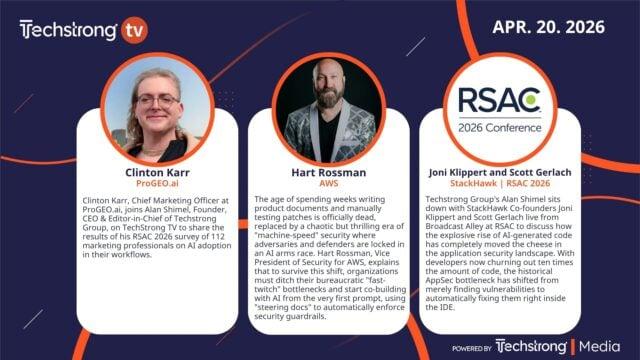
Techstrong TV May 21, 2025
Watch our live stream on Monday through Friday, featuring exclusive news, announcements and conversations with IT leaders and experts on topics ranging from digital transformation to DevOps, cybersecurity, cloud native, containers and deep-dives into specific technologies and best practices.
Transcript
Hey, everybody. Welcome to Techstrong Gang. We're talking AIOps, which is suddenly, well, hopefully everywhere back in a minute.
Hello, everybody. We're back again talking about, well, all things it, and we're gonna lead off the show with a conversation about AIOps in the wake of some mergers and acquisitions. But let me introduce our guests first.
We have Guy Courier. Who Guy, where are you? Are you still in Texas or are you somewhere else right now, Actually, I am back home in Austin, Texas.
Well, that's good because, you know, our, our lead story took place in Austin, Texas. We'll get back to that in a minute. Steven FoST joins us, once again, appears to be in Ohio.
Is this true? Yes. I, um, stole John Oliver's nameless void from the Pandemic.
So here I am in the nameless void of Ohio. All right. Well, you know, it's, it's still the coolest place and every time I turn around somebody's building a data center in Ohio lately.
So there you have it. Yeah. Then finally, once again, is the charming Bonnie Schneider joining us once again to talk about the latest and greatest in it and climate control and all kinds of good stuff like that.
But I think we have something maybe a little bit different this time out. Bonnie, welcome the show. Great, thanks for having me.
Let's get started. I'm gonna go to, um, uh, guy with this first one, but we saw last week Verana acquired a company called Xenos, and they're both in the AIOps space. And we have seen also, HPE has been making a strong push into this whole category.
And BMC talks a lot about it. And what's interesting to me is they all talk about it, not in the context of generative ai, but that's just a piece of a larger puzzle. They have predictive AI models and causal AI models and generative AI models, and they say it's gonna take a village of models to get all this stuff done.
Because I can't just depend on something that's probabilistic for running my IT ops. I can't be wrong. I can't be right eight outta 10 times, 'cause I'll get fired for the other two times.
So, guy, is this world changing in terms of how we think about managing it and age of ai and does it look bigger and broader than just the latest version of chat? GPT Definitely does. Predictive AI predates the big craze.
And generative generative ai, generative ai, generative AI completes your sentences, right? I mean, like, roughly speaking or, or completes a picture. Um, 'cause it doesn't have to just be words and that can be really helpful with thinking, with thinking through things, but it's not analysis in itself.
Predictive AI is more like analysis. Causal AI is more like analysis. I mean, you know, I, I, uh, I'm really amused, Mike, that, uh, you're so optimistic about AI for once when it comes to IT operations, some of the most sensitive, complicated and, uh, really, uh, organization, potential organization shattering, you know, uh, operations in, in, in a company.
Um, so first of all, yes, I do think it's a new world, um, and I'm not given to making statements like that. Why is it a new world? Listen, um, let's, let's talk, let's start, let's talk about verana and, uh, and, and buying Zen os Uh, you call them AIOps companies, but both of them, zens at least, which I'm more familiar with, you know, far predates.
I mean, they've been using machine language algorithm type thingies for some time, but they really predate the whole AI craze. What's the difference between the two? Uh, ANA is cloud infrastructure and ZENS is more like on-prem data center infrastructure.
They're both observability platforms. Um, so why is that significant? Because they started out separately because, uh, observability and monitoring and, and IT operations in cloud environments, especially public cloud versus on-prem, are wildly different in a number of ways.
Mostly having to do with issues of control. You can't go and rip out a server in the cloud if it's problematic. You have to take other measures and you have to measure other things.
So the proverbial pane of glass and hybrid management and all that other sort of stuff has remained continuously elusive over how long, 30 years, however long it's been. As the infrastructure's changed, become more, uh, not just complex, but more capable. So I asked myself could AI in all its forms, especially in I'll say the a word, a gen, the new a word agent AI could v this be the way out of worrying about single panes of class and thinking more about agents and preferred interfaces, um, helping to, uh, you know, look through these masses and masses and metrics and logs and, and traces and so forth, and helping IT shops do what they've always wanted to do, which is to keep the systems running.
It's just the mass quantity of things that an AI of any kind can look at in any one time and come up with an idea or a recommendation that reduces the firing squad from, you know, eight on eight to two on two or something like that. And shorten decision making times in IT shops make their work more responsive to the business. It does, to my mind, show that promise.
Yes, Steven, you've been around this space for a while. I mean, and when I first started covering this space, there was a lot of cynicism about anything related to ai, and most of the people were like, this thing will never learn our systems. They're all unique and they're different.
Um, but now you talk to people and you get this kind of vibe that says, well, I may not be a whole believer, but I kind of recognize maybe I can't manage this level of complexity without some help from ai. Yeah, that's the thing that's interesting here is, um, I think what we found is, is that there are AI models and, and again, as as guy pointed out, we're looking beyond that sort of, uh, lens of just LLMs, you know, it's not just about chatbots, it's about using machine learning models to figure out trends to spot outliers to identify, uh, problems. This is actually a really good use of, of machine learning.
For what it's worth, uh, we launched our utilizing tech podcast before chat, GPT, and the thing that we were expecting AI to have an impact on was this essentially spot the needle in the haystack spot, the trend, help us sift through all this data and figure out where things are going. And to my mind, that's really the core of AIOps. I, it's, it's using ai, not just LLMs, using AI generally to sift through data and come up with valuable insights.
Now, the problem with coming up with valuable insights, and again, this will kind of segue into our next block when we're talking about Qlik, the problem with being analytics and insights and so on, is that you need the data and having, uh, lots and lots of data to process is not the same function as being able to process that data and spot trends and, and make recommendations. And that's why it makes sense to have somebody like Verana looking at something like Zen os. So a as guy like guy, I'm very familiar, uh, with, uh, Zen os, uh, having, you know, been in the IT space for a long time.
I mean, basically this is a company that was founded by nerds like me who wanted to use open source to monitor their infrastructures. They wanted to figure out what, what devices do I have? How are those devices performing?
There's a lot of deep integration with, you know, kind of old school stuff like WMI and SNMP and stuff like that that, you know, predates the modern IT space. But the, but the idea is collect all the data. Well, when, when you collect all the data and when you analyze all the data, then you have, you know, step for profit.
And that's, to me, what's going on here. And, and it makes sense. Every analytics and AIOps provider needs data and they're hungry for it.
And acquisitions like this give them that. I feel maybe I'm wrong, but I think we're approaching the point where the models are almost disposable. Um, you'll have platforms like these, whether it's HPE or verana, or BMC, seem to be able to invoke APIs to call different models as needed for different functions and agents.
And I think swapping those models out is gonna get easier as well going forward. So, I don't know, guy, are we on the verge of disposable AI models? Oh, no, no, you're wrong.
Do you want me to elaborate? Um, I, I think that GPT might give a better answer than chat GUY, but, um, I, I, I just think it's just such early days. We don't really know, um, the, the potential complexity of, uh, how to build train models.
We're just, we're just starting to recognize the fact that the source training data matters, which is kind of absurd that it's not widely recognized from the beginning. Um, that, so there, there's one sense in which, in which I, I do see your point, which is that, um, you wanna train on like the kinds of masses of information and data that A BMC might have or, or, you know, maybe a, an open source project as well might have, but then, um, ensure the results are particular and specific to your own environment. So I think it's in the former realm that the more and more and more you push into, not, not so much the generative as the predictive and causal, um, models, um, the more likely that they will be reflective of like, or they'll make better decisions until you reach a certain point where the marginal benefit of additional investment is low, right?
I think that's kind of what your point is. But I think we are also just sort of upleveling our ability to develop and create agents to develop and create apps thanks to these AI capabilities or workloads like these observability platforms. And so there's a lot of human technique that can still be brought into these things.
We just don't know where it's gonna go. Mike, Bonnie, I was having an interesting conversation with somebody who was talking about the cost of ai, and they were suggesting we're gonna need something that feels like finops for ai because we need to track the amount of energy being generated, the amount of, uh, compute capacity needed for all these things. So, um, you know, I kind of look at all this and I laugh and I go, you know, are all these things gonna converge at the end of the day?
I think so, you know, they, they're calling it green ops when it's a combination of finops and, um, just managing DevOps operations. So yes, that is definitely a trend, and that's also kind of a selling point for a lot of these carbon accounting, uh, companies that are tracking and measuring energy for AI that, um, it can benefit the, the financial operations in a lot of ways. And then they have to, of course, show that through data.
So that is absolutely a movement we're seeing forward. Steven, will people rip and replace their existing IT management platforms to get to these capabilities? Or are they just gonna wait for their existing vendors to kinda add these capabilities over time?
And it's just gonna be in the, you know, an ongoing series of upgrades? Well, there's a hunger for this. Um, as you point out, uh, companies are gonna be looking, uh, at trying to figure out how to optimize their spend on AI and using AI to do that.
And it's kind of a self, uh, referencing thing, right? Maybe you can use some AI to figure out where you're spending too much on ai. Uh, that being said, I think that the nice thing about, uh, platforms like this that can optimize spend is that in many cases, they can pay for themselves, or at least they can promise to in the sales cycle, uh, because essentially they're gonna identify areas of, uh, well to coin a phrase, waste and abuse that, uh, can be eliminated from IT spend.
So this is an area that, uh, we're seeing in the future of intelligence side. Uh, there's a lot of research going on about companies trying to optimize their environments. Um, certainly there's a huge added, uh, uh, demand for that.
Um, I am looking at this number in, uh, in the Textron article here that says that, uh, you know, about 70, 71% of organizations are still, uh, reevaluating where they're running these workloads simply because they need to make sure that they're optimizing spend. That's exactly what a combination like this will do. That's what AIOps should be doing.
And so I, I do, I do think there's a, a, a market for this, and I would like to see it, um, uh, I'd like to see every, every company, uh, investing in this, because frankly, it's good for everybody. If, if we're not wasting, uh, money and wasting resources, here's what I worry about, Steven, is, uh, the US reliving yet again, only now in the IT ops, AKA AIOps realm, reliving the easy button approach of, oh, these things are AI enabled, they can make recommendations, let's just throw it in there and we're gonna save money. And that's it.
Without this recognition, that must always be in the forefront that human beings should be supervising, running, reviewing. These are, you know, kind of like all recommendation entrances. They're your dumb buddies, enthusiastic and can read a million lines of whatever really fast.
But, you know, don't just let it make decisions, right? Mm-hmm. I wonder though, and maybe I'm not sure if this is a good or a bad thing, but I think it might happen, might we see a reorganization of the IT team?
And maybe it's flatter, because today, um, what happens all too often is when there's an issue, there's some sort of gremlin, nobody knows what it is, you know, and we're all sitting in a room and everybody gets invited to come and prove their innocence in something called the war room. Um, and that doesn't seem particularly efficient. It actually seems maybe people wind up being pitted against each other.
So is there another way to think about managing it altogether, guy? Or is this just gonna kinda, you know, be more in the sand? Well, historically, what it has done is add functions.
So now you're gonna have some function within, that's how it'll start within IT ops, IT management, infrastructure management, this additional function, I almost see it as like, call it ops dev, if you like, instead of DevOps, which is, uh, uh, you know, the, there's always lots of coding going on in these, in these teams, but in this case it's more like, you know, platform and AI management, maybe something like that. Um, that's how it tends to start. What you're talking about to me is sort of, you know, it's possible, it's possible for, um, AIOps folks to become more generalistic, um, knowledgeable about more domains, more, uh, types of, you know, workloads and support and that sort of thing, because they will have the agents or agents upon agents that are helping them with the specifics in the particulars.
But I took it a different way. I took it more as, um, these are faster ways for existing teams to identify where possible opportunity or problem places are. And so instead of it being a war room, it's a kangaroo court where the two poor, you know, uh, domain members are dragged in and said, well, it's one of the two of you.
We figured out that much. I think I'm the cynic, I'm the cy of this conversation. You usually are.
Go ahead, Steven. Yeah, well, that's funny that you bring up the ag agentic area too. Um, maybe there is a new operations model like Mike is suggesting, where essentially these AI ops companies incorporate, um, uh, remedial agents that can go and change the configuration because, uh, you know, if you wanna be cynical, what would be better than saying, Hey, ai, go optimize our entire a AWS estate.
I don't know, I think we're gonna see some dramatic changes in, it may not happen overnight, but I would say that, uh, guy, I think you kind of touched on it, we might be looking at the revenge of the generalist any day now, so hold on, we'll see how this all plays out, but we gotta joke through our next flock. We'll be back in a minute. Hey, folks, we're back and we're got another one of those spiel reports where some of us go to an event and we come back and give us our impressions.
Steven was at a click connect event, and they were talking about agentic AI and analytics and all kinds of fun stuff. Steven, bring us up to speed. What's the future look like here when it comes to analytics?
Well, thanks. Yeah, we were at, uh, click connect in Orlando. Uh, somebody named Guy was with me, uh, there at that event.
Um, and so, so you'll hear from him as well, uh, along with Keith Townsend from, uh, our team and a bunch of other folks from the tech field Day side. Uh, this is our second, uh, time going to click connect. Uh, it's a great event because it is extremely end user focused.
That's my favorite thing about it. It it is one of those events where the, the team behind it, I mean, there's always a lot of end users and so on at these conferences, and you can meet up with them if you want, but at least the team, uh, that, that I work with at Qlik is always trying to set up opportunities for us to talk to those people and learn from them. They have an AI council, they've got, uh, you know, end users that they just sort of come up and introduce me to.
Uh, you know, I met a lot of CIOs at this thing, and it was really interesting to see how these people are seeing this new world of ai, uh, ag agentic and, and, and where we're going next. I would say that the, for me, the biggest takeaway was as we spoke about in the first segment here on, uh, Textron Gang, it's all about the data companies need. Uh, if, if you're gonna make use of any kind of ai, especially, uh, if you're gonna have AI agents that give you advice or, uh, help make connections between data sets, you need the data.
And so a lot of the announcements that we saw were, um, I, I'm gonna say nuts and bolts kind of discussions of integrating data in various ways. Uh, whether it's in the, as my dad would say, the comes into side or the Gaza side, uh, you know, you gotta have, uh, data coming into your system from various, uh, third party applications. Uh, we, you know, Qlik made an, uh, an acquisition there of a company that that helps to bring data into a data lake and process that data and organize it.
Um, we also saw a lot of discussion on the, on the data coming out of the other side where, uh, companies are using various analytics platforms they're using. Yes, ai, uh, Amazon AWS was there talking about bedrock, uh, as a way to help process data and, and to make these data lakes more useful. That's really the key that we're seeing emerge right now.
Essentially, if AI is a data superhero, then you need to feed AI the right data. It needs to be vetted, it needs to be processed. You know, one of the things that Qlik impressed us with last year was their talk about an AI quality score, uh, or a data quality score that goes way beyond, you know, your traditional definition of data quality.
Like is it good data? It's a trust score. Trust score, sorry.
Yeah. Yeah. And, and so yeah, maybe you can talk a little bit about that guy because that, that, that thing really, um, kind of opens up your eyes to the fact that there's a lot more aspects of data quality and data trust than just, you know, is it Right.
And, you know, it's funny, for, for a conference that was really built as being focused on agentic, it was really nuts and bolts. It wasn't a, a, you know, a fleet of autonomous bots out there doing things to your data. It was much more prosaic.
It was much more, uh, I don't wanna say clippy, but you know, it was basically you're building an application. You know, you, you're not sure how to query the data. You've got AI there to help you query the data.
You've got AI there to make, uh, sort of up to the minute recommendations or suggestions about how to deal with the business questions that this data raises. Um, definitely not the sort of pie in the sky. AI replaces humans kind of messaging that you might expect.
It was very much AI as an assistant. So what, what do you think, guy? Well, I agree.
Um, so Qlik click, um, you know, I would encourage people to think of Qlik not just as a, as a, you know, for-profit vendor, which they very much are, they're owned by Toma, Bravo and Investment Company. I don't think Toma Bravo's, uh, you know, out to, you know, benefit, uh, you know, um, I mean they're capitalistic, right? Um, but Qlik is also a community and has been almost from the beginning, a very tight community.
Uh, and Qlik, the vendor serves Qlik, the community really well. So, so they're customer focused, value focused. They're very methodical.
You say nuts and bolts. That's a great way to put it. So, um, I mean, they got into AI when they bought, um, uh, uh, big Squid, um, that was in 2020.
So it, it's before, before generative ai, before the AI craze. Um, they've made a lot of acquisitions over the last five years. That was a significant one.
Their AI strategy is just that sort of nuts and bolts, methodical, not generative AI so much as, um, uh, um, predictive AI because that's their business data analytics. That's been their business. That's what they focus on.
I think though, the big theme was trust. In fact, two days before the conference, their first press release time for the conference had to do with the, with a statement from the Qlik AI Council, the Qlik ai. I'll get to that statement in a second.
This council was announced a year ago on stage, I think you were there too, Steven keynote. There's four very impressive members from around the world with varying backgrounds. Um, and you know, it had that feel of this big marketing announcement and you know, we're gonna be building trust and all this stuff.
But since then, not only have has Qlik itself taken various concrete steps in the trust department, the trust score being the main one, but the click AI council also has been pretty active. It has not changed membership. And that first press release was a press release from the click AI council saying that essentially, I'm gonna paraphrase, AI is not going anywhere without trust.
AI cannot scale without trust, I think is roughly the statement they made. Trust, meaning that when you use it, you get the outcomes that you expect and you can understand where those outcomes came from, where those recommendations came from, where those decisions, where recommended decisions came from. The trust score is based on the same thing.
It has to do with the provenance of the data used, both for training and for, you know, if there's rag or some other form in the in inference as well as transparency about it. How not, not is it trans is like how transparent is it? So it's not trust in every sense of the word.
I think there's a lot of nuance there, but exactly these folks click's core business was data analytics, business intelligence from the beginning. And they have exp they expanded forward into AI long before the generative AI craze. And then a couple years back they came backwards with the Talend acquisition that has to do with data quality.
They seem to have recognized the issues and analytics and AI that, you know, we keep harping on what would seem to be fully penetrating in ai, which is the importance of the quality of the data. And I would like to talk about the olver acquisition too, but I'll just, I'll just stop there 'cause I can see Mike's getting ready to scratch a said next ask a question. So can I ask you two questions?
'cause there's been a pet peeve of end users for as long as I can remember. And the first is, you know, you get these analytics reports from it, you don't know where the data comes from. And most people, especially business execs, don't trust the reports they get outta it.
They just look at that and they go, you know, something's wrong here. It doesn't jive with what, how they understand the business. And, and, and you know, we used to generate these stacks of reports that nobody read.
And so I'm wondering, is a that gonna get any better? B is, the other frustration was I'd go ask it a question and you know, they'd get me an answer and they'd be like, well, here's your answer. And it would be like 10 days later.
And it wasn't actionable and I couldn't ask the next question because I'd have to wait another 10 days to get an answer for the previous set of questions. And so the whole thing wound up feeling like an exercise in futility, is this gonna get better? It'd be great if it got better.
Um, I will point out that, uh, your experience is not unusual, uh, from it. And also that your experience rhymes with what happens in the data and analytics space. So analytics is a sort of another world of, uh, of it.
I guess you could think of it as it, but it's really not. Um, unfortunately the truth is that the data analytics folks have been very frustrated over the years because just like what you described, they have a reputation as being sort of inscrutable eggheads essentially. You know, the business will come to them and say, Hey, uh, I need an answer.
Is it A or is it B? And they'll get back reams of data and, and charts and graphs. And a lot of it depends instead of, Hey, is it A or B?
Uh, one of the things that analytics companies are trying to do is sort of democratize access to data so that, you know, they don't have to go through a data scientist to try to figure out the answer, that they can actually go direct to the data themselves and talk to their data. Uh, that's one of those vision sort of things. Um, and hopefully get actionable, uh, information from that instead of, A lot of it depends.
We'll see if that's happening. It, it reminds me so much of AIOps and IT operations, generally IT infrastructure, trying to figure out ways of communicating with the business about what they're doing and what their goals are and, and just, just basically trying to align everything that we're doing over here with what's actually being discussed on the business side. Um, so, so is it changing?
Uh, maybe, uh, that's certainly the goal. I'm not sure if they're achieving that as one of those inscrutable, or at least hopefully former inscrutable eggheads. Um, I have a different take on what you just said, Mike, and I think I, I'd be curious what Bonnie's take is on this as well.
My take is that, um, on the one side, the inscrutable eggheads, um, can't understand how nobody else can understand these reams of things and, and reports and multiple graphs and discussion and stuff that they produce, which is all very accurate and pretty darned impenetrable. But the source of the problem you're describing, Mike, is the fact that business leaders, um, maybe not even even, you know, most of them or, or sorry, all of them, but certainly most of them, um, they actually already know what they want the ANA analysis to say. And what they don't want is to get analysis that does not confirm those priors.
And, uh, there's a real difficulty to stop, look at what you're looking at, ask questions, and listen, especially when you're moving at the speed of business, you know? So that's really been my take on it, is if you're not, you've already made the decision and you want the report to support it. And if you're not getting it, that Venus and Mars miscommunication between the, the data analysts and the business has really nothing to do with any of this technology.
Well, Let's get Bonnie's thoughts in here real quick 'cause we're coming up on time. Yeah, no, I think that that's true. There is kind of a bias where you're looking for the data to support the position that you have, um, with it.
And, and it's very easy to do that, that, um, using ai and of course, as the AI gets to know what your queries are, it's gonna do that for you anyway. So, um, I think there is, um, that bias that, uh, we're, we're talking about, but also, you know, having it, um, having the, uh, user and the company and the business to be honest and more transparent in how they're doing it as well. Yeah, I just gotta say, so often you hear people talking about the bias and AI models and I always look at them and I go, you know, isn't that like the kettle call and the pot Exactly.
Goes Well, it goes two ways. It's true. There you go.
All right. Hey folks, we'll be back in a minute with our next segment from Bonnet Discover Textron Group, the epicenter of tech innovation. We are your go-to for reaching IT leaders and practitioners worldwide.
Our secret impactful content that sparks awareness, engagement, and top quality leads with us. You'll access editorial websites, streaming videos, virtual events, custom content analyst research, and more. Join our satisfied clients, let's revolutionize your tech journey.
Contact us today and tell your story to the world in the most powerful way with Techron Group. Well, recently right here in South Florida Code remix this uh, conference that was really geared towards developers took off with over a hundred attendees that came in from all over the world. And the focus, of course is AI automation.
And I had the chance to speak to the CEO and the person who really put this whole conference together. Jonathan Schneider of Modern. Hi everyone.
I'm at Code remix in Miami with the CEO of modern Jonathan Schneider. Jonathan, it's so great to have you on. Thank You.
It's a pleasure to be here. I'd love to hear some of the themes and why you decided to do it. First of all, I wanna see more developer conferences come to the United States, really like high impact, deep technical where people get hands on and do things.
A lot of conferences in Europe right now in that vein, but just not so many in the us. And so I live in Miami right now and it was important to me to bring our first iteration of this conference here, kind of close to our home in Miami. Moderna is really large scale automated refactoring of source code.
And so, uh, we heard this morning from Dove Cast and Morgan Stanley that they have over 4 billion lines of source code under management to try to keep that stuff up to date, to keep it modern. To keep it secure requires just a ton of manual effort. Um, really kind of not fun work to do when you just have to keep kind of going back and cleaning house.
So we're automating a lot of that work and, and really freeing developers to do the things that they wanna do, which is build that new stuff. And how is AI coming into it? Tell me about your processes there.
Sure, yeah, I think really we have a deterministic system that's gonna go and predictably make the same change over and over again. But we have thousands of what we call recipes that make different kinds of, of changes, and those are hard to discover and understand what's possible. And AI basically is patient to read through all the recipe descriptions and try to find the right ones and apply them.
And once, once it's being applied, it's a deterministic output. So really it's a, the best of both worlds. So tell me about the conference.
You have people here that are from all over, it's global, right? It is, absolutely. We have folks coming in from Europe, from the us, from Canada, Mexico.
These are the ones I've heard so far, but really, like he's mentioned developer focused. We have three tracks, really a developer focused one, a leader track. And the thing that we're really trying out this year is something called a hack track, where we told attendees before they came, Hey, bring your work laptop, bring it with all your code on it, get security to approve it in advance.
Almost like we call the pack for the hack. Get that approval before you come so that when you come here we can do work with you Too often I go to conferences and people bring personal laptops and then, you know, there's not much we can do with them while we're there. So we'll see what kind of work we can get done.
So what do you think is the biggest hottest topic in your space right now? A lot of people are questioning what is the role of a developer in the world way, you know, where AI's also, uh, working with them, how do I use that most effectively? You know, there's a lot of fear I think right now.
And so this is a great time for us to get together as a developer community here and, and talk through some of those things. And finally, you said your company, you're based in Miami, or what, what are your goals for modern going forward? Yeah, we're just continuing to grow.
Just raised a, a $30 million series BA couple months ago. We've hired in go-to market functions, continue to hire in engineering, and, uh, just trying to make work closely with our customers and make, uh, them as successful they possibly can. Jonathan Schneider, CEO of modern, thank you so much for joining me.
Thank You. Pleasure to be here. I also did other interviews with some of the bigger players that were there as well.
And I know we're gonna talk about one, um, in Diff Blue because I spoke to one of the executives that came in from there. Um, it's, uh, it was an interesting mix of people and one of the things as Jonathan mentioned was, is that people were doing real time, I guess hacking with through, through laptops there. He wanted to have this to be a hands-on experience, not just listening to lecture tracks, but really getting that hands-on experience for developers and seemed to be successful.
Now of course, I, I didn't mention that the location was at a beachfront hotel, so I'm sure people enjoyed that as well. But, um, the people I spoke to were very busy, uh, comparing notes, working together and collaborating and I tried to cover some of that in the video and I'm sure I'll show 'em more coming, going forward. Alright, So this is one of those, don't look behind the curtain at the wizard kind of moments.
So here's the real deal with this thing. Every time you hear one of these AI companies start talking about how they created some sort of AI agent to reverse engineer code, um, what they've done actually is modern has an open source platform that turns legacy code into some sort of representation that can be read by an AI agent and most of these folks who are making these claims and just pointing an AI agent at this particular platform to then reverse engineer and, and not telling you that that, that they're using the open source platform underneath. Modern also has its own AI agents for doing similar things and is, you know, offering similar set of services and making an argument that says, well, since we invented this thing we know it better than anybody else.
But I am excited about the idea of being able to do all this because the cost of upgrading and switching things is way too high. And I look at it on two levels. One is we can figure out how to make existing applications more efficient and save some money.
And two is well maybe, you know, I wanna switch vendors. And now it's a lot easier to do that if I can, you know, de configure or reverse engineer the existing code and turn it into something else. So I kinda like this whole thing and I'm hoping that, you know, the cost of switching is gonna drop to zero, but maybe I'm just being overly optimistic.
It's a rare Monday. I'm optimistic a lot of piece to it. Rare indeed.
Not sure what to do with that. Yeah, go ahead Steven. Yeah, I was actually kind of puzzled by this whole statement about bring your work laptops, bring your work code and let's hack on it here.
Um, really, uh, I don't want to be weird, but, uh, ain't no way I'd bring my work code to be hacked on by random people at a conference. Yeah, that seems like a security issue. Uh, I mean he did say, I mean, to his credit he did say get it approved by security before doing this, which I'm definitely on, on board with.
Um, did, was there a lot of that going on? Yes, that's, I I, at least from what I could see because I was, um, shooting the B roll for it and I actually asked some of the guides because they were probably like, why is this, you know, person taking video of us just talking over our laptops? But that's exactly what was happening.
So, um, there was that, that real time, um, collaboration and it was interesting 'cause most of those folks were meeting for the first time that were involved in that. So we'll have to hear how it, how it Went. So let's the, what's the, what's the idea here is is that, uh, you, you can take, um, some, some legacy code that's running in production, um, and uh, parse it for recoding plus replatforming.
Is that what you're thinking, Mike? Yeah, essentially that's what they're thinking. But I wanna get to this coding thing and sharing my code.
'cause we've hosted a hackathon or two. And I'll tell you, it takes about just the first day of everybody going, I don't wanna show my code to anybody else. I'm too embarrassed, I'm too worried about it.
I don't, I don't want to be criticized. I mean, there's all this stuff that goes on that has squat to do with the tech and it's all about the emotions. Yeah, I think, uh, the tech might have something to say after you're done with that recoding and you post it to a staging environment, uh, Mike, um, it's, it's a no doubt helpful and, and useful to be able to do this.
I mean, just imagine combining this with a little MCP or a to a action and, uh, and, and starting, you know, to, uh, deploy some agents to carry out some of the same things using whatever collection of tools you have somewhere else. I mean, there's a lot that can be done, but there's a, I don't think it addresses the root cause of old code through cause of old code. Yeah, go ahead.
I think this is also a chronic issue because the number of developers that are working on greenfield environments is like maybe 20% if we're lucky. And now the rest of us get, you know, and you show up for work and there's some system that's already been running for the last decade, it's probably got all kinds of turds hidden in it, and you're supposed to go fix and run this thing and, you know, it's like, it's really hard and almost impossible to understand the code. So at least, you know, in a mix of tools like this and a little help from Gen ai, maybe we can actually get in there and understand what that code is, Steven.
Yeah, well that's, that's an optimistic assessment. I think that it's a possible one too. I mean, we've seen this, I remember when we were at the share conference last year, uh, mainframe conference, uh, there were companies, I think BMC was one of them, uh, talking about using machine learning to document and untangle old COBAL code.
And, um, because, you know, it's not completely, it, it, it is actually pretty reasonable to think that an ai, uh, could help to figure out what code is doing, uh, could help to spot bugs in code and could help to document code. I really like that about the modern, uh, concept as well. Um, you know, you've got a lot of Java code out there.
Uh, some of it is older, some of it's newer, some of it's better quality than, and, and, and having AI help you with that, you know, it actually makes a lot of sense. Um, frankly, as weird as this sounds, I might trust AI to evaluate my code more than a random dude at a conference. Um, so there's that.
Yeah, That it's So many. So you have to say mainframe, I, it was in my head and I did not want to use this such a easy pick in Steven because much as, yes, you want to be able to ex explainability titanic, huge, especially old mainframe systems, but you're just not gonna wanna mess with that stuff. You wanna explain, you wanna be able to see it, there are opportunities to tweak or what have you.
But the whole purpose of it being on a mainframe is to make it, to give it this sort of inviable a aspect to it. And that, that cuts towards what I was saying before is the root cause of the problem. 'cause it's not just mainframes.
You have something that's working and very little understanding of the, the, the effects that it has throughout your systems. I think unfortunately, and to your point, people are terrified to go take these projects on. I mean, we've all heard the stories about the CIO who lost their gig because they went and hired some global system in integrator to come in and reverse engineer or some application sitting on a mainframe most likely.
And then, you know, when the job got started, some bus full of grad students pulled up and they all piled in and moved in for two years until, and nothing ever got done. And then eventually, you know, the board was like, you're clearly crazy and moved on. And I think there's a certain amount of, I don't know, Steven fear or, or I, I'm just too terrified to touch anything that might be working and I'm just gonna leave it all.
Well, Maybe fear, but also, frankly, a lot of people have been burned by these projects. Like you talked about. There's been a lot of situations where, you know, you call in some kind of, uh, assistance, uh, let's say.
And, uh, the assistance they're providing is not so great. Again, I would trust an AI to help document my code more than a random contractor of a subcontractor, of a subcontractor from who knows where looking at all my enterprise code. So, you know, I'm, I think I'm coming around to this.
I think I like the idea of AI coding assistance and AI coding de describe. Yeah, and I'm, I'm way more on your and Mike's side than I sound. I just, you know, it's like the, you take the, take the, you know, take the first down, you know, just take it.
It's, it's, it's good. It would be enormously helpful. Just we're not throwing touchdown passes just yet.
All right. Bonnie, final thoughts from this conference of yours that you went to? I mean, what was the vibe from the people there?
Were they optimistic or were they kinda, You know? Yes, they definitely were, uh, they were very happy to collaborate. One of the things Jonathan talked about was that he didn't feel that there were enough of those kind of conferences in the us, uh, versus other ones, I guess he attended in Europe.
So he, um, I think this was the first of the first one of the code remixes hoping it's gonna be, you know, one of many. com article, DBL as a Azure all represented there. And I saw some other names in, in the DevOps, uh, world that Techron has worked with before.
So yeah, I would say it was, uh, a definitely positive. Of course, I mentioned the location that doesn't hurt, but it was, um, people seem to be very eager to collaborate All. So you, you should just only go to conferences in nice places though, Right?
Yeah, if you're gonna have nice views, maybe it'll be inspiring people Com coming from a conference at a Disney property, uh, on Disney grounds. Yeah, same kind of thing. A lot of people came in.
I think there's a lot of traction to going to Disney with click and, uh, going to Miami Beach with this. Yeah. All right.
Well, as somebody who was out on his way to when conference in Boston, I don't think I'll be sitting on a beach anytime soon, but, but maybe next time. Hey, I want to thank everybody for sharing their insights and knowledge, and I would just share this final thought maybe when it comes to ai, it's like FDR said, all we gotta do is fear, is fear itself, right? Because ultimately, you know, we're cautious and reasonable.
These things are gonna be good for everybody. Hey, we want you all to stay tuned for the next kind of episodes of Textron tv. They're coming up right behind us, and I'm pretty sure there's more AI in there somewhere.
See you next time. Hey everyone, welcome back here to our live coverage of RSA conference 2025. We are in Moscone West on what they call Broadcast Alley, and we've been doing mostly the interviews of people here at the show, and we're gonna do that today.
But really this is a special edition of our DevSecOps Show, cracking the code, which we do like every other week. Anyway, um, cracking the codes available on your favorite podcast, uh, platform, whatever that may be. Excellent text, drunk tv, YouTube's text, drunk TV channel.
And by the time you watch this, probably our text drum tv OTT channel. So you could watch this on Apple TV or Roku or Amazon or whatever you'd like. The important thing is to watch it on cracking the code.
We explore the frontiers of DevSecOps SecOps. Um, and just yesterday we had our 10th annual DevSecOps event here at the RSA conference, and it was about ai, AppSec and app dev. Great, great show.
We have actually some of our speakers here today, were there yesterday. Um, but let me introduce you to today's panel for this episode of Cracking the Code. I'm gonna start to my far right, this gentleman here, Aaron.
Yeah. Hunsberger. Yes.
Aaron is, um, with Check Marks, who of course is the sponsor of our Cracking the Code show, our partner in producing it. Iran, it's great to have you on in person across the table from me. Yeah.
Thank you for having me. Uh, thank you. Uh, I run the product marketing for check marks and, uh, excited about the show.
We are hearing ama hearing amazing things, uh, at, uh, RSA so far. Good. Happy to share them with you guys.
Absolutely. It's great to have you on. I've said this before, Aaron and I go back a little while, even before check Marks and everything else, so it's great to be working with him again next to her on this little lady right here is a firecracker.
She came to our show yesterday and lit it up at the, on the stage there. And she was up, she was in the panel with the CIO, the CISO CSOs of OpenAI and anthropic and senior Security people from Meta, but she had the most to say her name is Marran Ashkenazi Marran, welcome and thank you. Thank You everyone.
It's pleasure to be here. Thank you for having me yesterday. Pleasure.
It was amazing panel. Super interesting to get everyone's thoughts, so excellent. Happy to be here.
Pleasure Have people a little bit about you. Yeah, so I'm j ffr, chief Security Officer. I'm within Jfr for five and a half years.
It's amazing because we're doing our own journey into the security, and we're a DevOps company and now a DevSecOps company that providing a whole solution for the supply chain and secure with ai. Uh, everything is simple. Absolutely.
Of course, our audience is no stranger to check marks or Jfr for that matter. Well, let me introduce you to our third, third guest. Tyler, I blanked on your last name, Egypt, I apologize.
It's all right. How do you pronounce it? Egypt.
Egypt. Mm-hmm. Tyler, Egypt.
Tyler, why don't you introduce yourself? I Appreciate it. Thanks for having me here.
So my name is Tyler Egypt. I'm our Vice President of Global Enablement at Checkmark. So I work closely with, uh, enabling, uh, not only the field at Checkmarks, but also our customers and partners, bringing awareness around AppSec, uh, and the great capabilities that we have and offer.
So, very excited to talk about DevSecOps and some of the advancements we've seen and, uh, especially at this event of, uh, learning more and more about trends across the products. Absolutely. So let me kick things off.
You know, as I mentioned yesterday was our 10th annual DevSecOps Connect here. I remember 10 years ago it was like having a wedding where the in-laws didn't get along, right? Yeah.
So on one side of the audience sat, the security people on one side of the audience sat the DevOps people. And I like, I could build a wall in the middle. Yeah, right?
True. You could. They just wouldn't come together.
A lot's happened in 10 years. They have come together. DevSecOps is real.
We all realize that we all want to have better code, more secure code. I've never met one developer who raised their hand and said, I don't care about the security of my code. They all care.
It's quality. They have pride in what they do. Security people, they're the old, and I'm a security person, I should say.
We used to say, no one cares about security, but us, excuse me, only we can care about security. But we realize now everyone cares about security from the highest levels of, of our companies are down. So we made a lot of progress, but we've also made some mistakes.
I think one of those mistakes was like we do with everything else. We, we took our security tools designed by security people and said, here, developer, Good luck, Good Luck, fun. Enjoy.
Yeah. Well, that, that didn't work out so well. Did it.
Right? No, and and the reason is is they're not security people. So a lot of DevSecOps companies died on the side of the road with that.
Right. And it's interesting because we got two different companies here, check Marks. You are an AppSec company from the day you were, I remember when Check Marks was founded.
Yep. Mm-hmm. Jfr, you weren't No, you were a developer company and, and a Artifactory, right?
Right. But you've come, you know, parallel evolution to the same point of what do we need to make developers successful? Yeah.
And so I I'll ask all of you Yeah. What, what is this magic formula? What's the secret sauce to enabling developers to develop more secure code?
And please don't tell me it's ai. No, it's not. Okay.
It's even who wants, who wants not today anyway, yeah. Who wants to go first? Tyler, we're gonna make you go first.
Absolutely. So we, like you said, developers take pride in their work. Uh, they want to deliver code on time, uh, with security in mind, but they need to be empowered to, uh, understand the risk that's involved, and they need to be guided and helped with, uh, how they address those, the risks that's created.
So we found understanding that developer experience, uh, working in their existing workflows within their existing tool set, um, is extremely important. So we're not disrupting their flow. We're giving them the right information at the right time.
So they're the catalyst to change, uh, and, and improve their DevSecOps footprint at the company. So we know they're a key part of DevSecOps and the ones that are gonna be driving the majority of the fixes. So really meeting them where they work is a common theme.
We've seen, um, more codes being generated by AI and productivity's going through the roof right now we're seeing, but that also adds layers of complexity, uh, uncertainty. Um, so we need to really understand, again, how they're writing modern code with modern applications, what risk that presents them, and then let's empower them to, uh, address that risk with the right kind of information and guide us. So that's kind of where we've seen that collaboration come together.
And, uh, yeah, both parties need to work together to make a, you know, advancements within software delivery. So it's, it's their need more on, I think that, uh, we learn from mistakes. That's, uh, that's something that both humans and We learn more from mistakes than we do from success sometimes.
And absolutely. And I think that both side understand that we depends on each other. We cannot do that independently.
Security cannot do anything without the right partners who drive it. We can bring the product, but it's a banner of, uh, uh, democratization. Developers need to have the platforms and choose the right tool that will accelerate their day to day and not like find them, like we're, we're talking about like the shift left.
So it need to be like in their IDE, something very natural, very native, not go to a different interface, try to find a CVE, try the vulnerability, try to fix it, go back to the code, go back to the malicious package, go back. It need to be very na natively, not extra work, and need to be very effective because the, by the end of the day, they want to like focus on releasing a product, a perfect product, an innovative feature, and that's it. They don't care about security.
Yeah. But on the other hand, they do need to like implement that. They need to release secure software, right?
Because it's their, it's your code. You, you own it, you own it. So both side need to come together.
So that's, I think that that's the point. I, I agree. They, they do need to come together and they have let, let's, I don't want to give a false narrative, right?
We've made a tremendous amount of progress. If you were out there yesterday, you couldn't tell who was who, where they were sitting. They're all mixed in, right?
So we've made progress there. I wonder, it's funny. So you come from the security side, you come from the developer side.
When you are talking to security folks, do they say, but you're not a security company, right? And vice versa. Well, you are not a developer tools company.
You're a security company. How do you get credibility across the aisle, Aaron, around any thoughts? Of course.
Uh, so I think, uh, and you mentioned like 10, 10 years ago and now, okay. I think that today you're no longer working in silos. Okay?
So it's not, you're a developer, you are security. They all have the same objectives of releasing high quality software, highly secured. And what is changing is the scale.
Okay? More pipelines, more development teams, higher, higher sized developer teams. Uh, and these guys need to trust what they're using.
Okay? So the word trust here, I think is a key word because these guys, whether it's, uh, they, we, the head of a security or developer or quality engineer or platform engineering leader, they need to have the trust in their tools that will get them towards their objectives. And their objectives are the same.
Zero fibers in production, higher security. Because we know that these guys are dealing with, I dunno, 60, 70, 80, sometimes 90% of open source code. Most of the code that they're using is not even theirs.
Okay? So if they, maybe they don't trust the code that they're using coming from others, they should trust the tools that we are giving them with check marks, with J fog that will get them towards, you know, uh, the finish line successfully. And another keyword is trust and continuously, right?
Okay. What you see today is not what you see tomorrow. Every, like, the minute, the minute I'm speaking with you here, Ellen, someone is working on a new malicious package.
Right? Right. So, uh, it's a moment in time if you like Maran.
Any thoughts on that? Yeah, I think that, uh, totally agree with you. It's about the speed is just, uh, something that we cannot control anymore.
It just, it's, it's there. It's running super fast and you need to have like, automation as part of it. So that's the part of the lifecycle need to go grow and fast.
Therefore, it's like different motivations. I want the security, I want the product to be super secure and r and d want it to be fast and we need to collaborate to make it, to make it happen. So it's different motivation, but single target to get this done.
Uh, and it's okay to have like different motivation in order to, to make it happen. Definitely. Yeah.
I want to talk about another DevSecOps principle that I think has undergone a big change. Yeah. com 20 14, 20 13, actually shift left.
Everything was shift left. Yes. Right.
I gotta tell you the truth. I'm of the opinion now. You gotta shift everywhere.
Mm-hmm. But what do you think about shift left as it was, let's say eight, 10 years ago versus today? I think it has been changed because we understand that it's not just the shift left, it's also shift right to the runtime.
Shift up to the cloud. Yeah. It's like, like Shift out to the us, Turn around and around.
It's all over that the IT shift everywhere. Yeah, it is. And that's the security Yeah.
Mission. Now Every chain in the, the line cycle. Agreed.
Right? So I think we've recognized these things and, and they've manifested themselves into tools, security tools that are easier for the developers to use. Built into the IDE for your instance, I know check marks they made, I think you made an announcement here at R-S-A-I-I got the uh, yes.
Embargo. Yes. You're building, uh, into IDE.
Correct. So we've had, uh, integration in the IDE on understanding risk, whether it's the custom code you wrote, your open source software, infrastructures, codes, that's all been available. What we recently announced was, uh, our application security, posture management, right.
View of results. So now not only do you have this large, uh, list, hopefully that's reducing over time, but this large list of findings, but we're helping the developers prioritize on which actions to take on which items are most critical. So that's, this goes back to balance.
If you look at what we're asking modern developers to do today, their responsibilities have grown. So they need to be understanding way more, you know, whether it's new languages and frameworks, whether it's, uh, cloud native development and understanding how, uh, the application will be deployed. That's, we're getting faster, but we're also adding more complexity as a result of it.
Um, so what we introduced in the, uh, IDE is a giving them the, a very, uh, condensed and focused view so we're not overwhelming them and to what you were alluding to earlier, um, meeting them in the IDE. So it's, there's no context switching. So as a developer, I'm doing my day to day activities trying to produce quality, co quality code quickly.
Um, and this allows me to address risk along that process. So it's not switching to different products or different views logging into different systems. And we've seen as a result of this, that developer time to fix is drastically decreased.
So now we're helping in, uh, not only prioritize, but the speed to fix is a new concern that we're addressing as well. Yeah, Fair, fair. Now, Maran, I, I know, I know j Frog's history and story, right?
You didn't just make a developer tool friendly for security people. You jfr actually acquired several right. Security vendors, correct?
I think you Yeah. Hub for what We acquired Yeah. Vision that became jfr advanced Security, which I'll talk about it.
And also Qua that became J Rog. Ml. Ml.
Yeah. And going back to the shift left, the, the reason that we're, I super like support that it's because it's about efficiency of the software development lifecycle. When it's shift lab, when you identify the true issues that you need to focus on, that will really save the time, right?
So be effective with that and understand the full lifecycle, but as, as, as soon as possible, if it's like malicious package or there is like malicious even model in LLM now. So think about the full dimensions that is, is operating in order to create a new application and try to push it as soon as possible. So it'll be like time, it's time consuming.
So if you can do that as fast as you can, it's a plus for everyone. And developers want it, but it must be very focused and not like spam, uh, different tools on the ID plugin, but consider everything, prioritize that, make sure that it's, validate that it's applicable and save time. Yeah, yeah.
Agreed. If I can just add on top of that, I think, uh, what Tara Moran was saying, it's exactly, you know, we, we are seeing today, uh, with the advancements of technology, uh, developers being overwhelmed with so much findings, okay? They dunno where to start.
Okay? There is too much noise in some cases, a lot of false positives, okay? At the end of the day, they need to get the job done, okay?
They have a feature that they need to fix, they have a bug they need to fix, they need to manage their pipelines. The more you reduce the noise on their end and walk within, of course the ID like serving them where, where they are, you are actually talking, going back to the trust, right? You are building the trust into the workflow of software development.
And that, in my mind, can transform developers into security champions because we know developers are not security champions by definition. Right? But if you feed them with the right amount of security training, security, findings, prioritization, risk management, right?
Uh, with this A SPM and the id, we actually also introduced what, uh, a very, uh, modern scoring, uh, algorithm. So it's not just that you're prioritizing that based on, you know, the severity of any findings, but actually what matters most to the developers so they can actually get their own unique report that they need to take, take care of the most unique CV that they need to take care of and whatever. So, uh, they have experienced user friendly reduction of noise.
These are the things that in my mind matter and allows developers to adopt more these security tools. Yeah. And, uh, the many tools.
And that's the power of platform. I think that is, we're talking about like platform engineering. Yes.
That's the power of platform to unify and give context. So, which will be very clear, very like reside. We're gonna jump into platform engineering in a moment, but I want to focus just on platform for a second.
You know, I, I did an interview, I did a few interviews over the last couple of days, and this whole concept of platform came up. I've been in security 30 plus years. One thing I've learned about the security business is small companies, little fish, they make what they call products, then medium sized companies, they look at those products as features.
Mm-hmm. And they buy the little fish and they roll those products up as features into their products. And they think they have the product and we sell point products, but then the bigger fish, they say, no, we don't want products.
We want platforms. Yes. And my platform has multiple products in it, and not just my products.
We plug in, we connect API, whatever, we connect to other products into this holistic platform. Yeah. And that's really where companies want to be.
And not only vendors. Yeah. But end user companies.
Yeah. Consumers. Yeah.
Consumers. They don't want 27, 36 integrations point products. Yes.
They want a platform that handles this mission for them. And so I think it behooves all of us. You know, of course everybody wants to be the platform.
You're a platform, you're a plat, we're all a platform, right? That doesn't work either. Right.
But we want these tools to work together better. And that's, I think a, a, a key piece of it. I want to turn to platform engineering.
Sure. com about, uh, eight months ago now. org.
Very big. He's A great guy. Yeah.
200, 300,000 members there. Luca and I, and the check marks people do our platform engineering show every other week and round tables and stuff. And we've spoken about this on that show, right?
That if we could give the developers a platform that is both secure, tested, stable, scalable, and just say, developer, do what you like to do. Exactly. Develop us On that.
Just Develop, go code, go as fast as you could go. That's what we need. Right?
That's, and that's, I think at, at the Nugget, that's the appeal of platform engineering. Yeah. I know how check marks is working with them.
How does Rog view that platform engineering? That's the, that's j Rog story. It's about DevSecOps for real, right?
Come from a company that did like DevOps and get into security world, but in a very natural way for the developers. It's bring developers into the security and and really connect, be the glue that connect between them. And that's exactly the power of the, of the platform.
Because you don't need to go to a different, you just got everything on a single place. And that's trusted releases. Um, combine those two together.
Yeah. Around. So I think within platform engineering and what we call an IDP, right?
An internal developer, uh, platform portal, everyone is using the p in a different way, by the way. Uh, so I think if you give these guys the developers, uh, a centralized portfolio, if you like, of the best of breed platform for security, for, uh, I know for cloud, for whatever they need to get the job done. Uh, that's also how you build trust.
But also that's how you take, um, people look at platform engineering as the next level or next evolution of DevOps. Okay? It doesn't replace DevOps.
It's kind of built on top of DevOps to optimize these pipelines to optimize the software development lifecycle. But also, I was spoken with one of the analysts the other day also to put some safeguards on the tools that are being used, uh, and governed and controlled within the, the, you mentioned earlier, Alan, these different point solutions, right? Right.
So with so many platforms, so many different tools, especially when you're dealing with enterprises, you need a governed approach to different tool chains within, uh, the organization. And when you're dealing with, I know, 100 dev teams with thousands of pipelines, what you don't, you do want to give them, uh, the freedom of choice of tools and platforms, but you also want to control that. And platform engineering brings this governance into the software development life cycle.
I think that they're not, you know, dedicated as the knowledge, the right knowledge to do and accelerate that and give them that as a platform. They don't need to be security expert. They don't need to be, uh, even like, uh, legal expert or privacy expert, especially an ILLM.
But they do need to, to just consume it, consume it as a service. And that's the change I think that we are going to See. I think the service, that's the right, the right word here, Right?
The service and application, which is like, it's the higher level. It's not just the DevOps, it's just application that combine everything together. The security, the DevOps.
Let me turn now to another topic. 'cause we are going low on time. But look, we're here at RSA.
You can't walk more than five feet without tripping over ai. There's AI agents, there's generative ai, there's that ai, there's ml, there's everything. Both of your companies at Jfr and Checkmarx have news around ai Yeah.
And have put big bets, right? Uh, JJ Frog's ml, right? You have AI agents.
Yes. I just spoke to Sandeep, the, uh, CEO about. Yeah.
How real, how big is ai? So is AI taking any jobs away here, or is AI making us better? If not, when will it, is it more talk at this point than Rio thoughts?
So, I, I I can start. So ai, uh, serves a specific use case, okay? And each, let's say agent serves a specific use case for the developers, for the security engineers, whatever persona is using that.
So a AI is not going to replace anyone's or take anyone's job. I think that what we're going to see eventually, and we, we need just put it on the table, AI or people that are using AI are going to replace people that are not using ai. Okay?
So if you are today in the software development lifecycle, doing anything like from QA to dev to security, production monitoring, observability, I'm coming also from a previous observability space, they are all looking at ai. So if you're not going to start getting used to the fact that AI is kind of your copilot, your, uh, supporter in everything that you need to do, someone that uses AI will replace you. So AI is going to be driven by engineering, okay.
By engineers, uh, as part of the software development life cycle. Okay? But it's not going to replace jobs for people in my mind.
That's just going to aid, uh, you know, bottlenecks or whatever challenges that these guys have and support them, uh, through their journey. So that's a, a short answer. I think they will replace humans in a lot of, uh, manual work.
People that are, that they're doing it today. It'll get into every position, not just like engineering. It'll replace in every, like, uh, every job in a company.
We're going to see, um, displacement, uh, for sure in the support, uh, chat bot, replace support, you know, humans. So think about what AI will do, uh, about related to documentation. So many different aspects of service providers that will be totally improved and accelerate.
But I said it yesterday, I do think that the human factor is still very strong. And this is like our responsibility to make sure that we're doing the right thing. We're using it carefully, we're putting the right guardrails, we're putting the right foundations.
Um, and it's in every several dimensions. Like the infrastructure need to be like aligned. We have to put the right skeleton, the right model, um, due diligence, the models to make sure there won't be like data exfiltration and data poisoning.
And then it's continue with AI agents, understand what are their guard drills, what is the identity and access management, if it's like something that we implemented, reduce the, the actions that they can do, especially for various critical service and critical commands and operation or with sensitive data limit that align with the regulation. Make sure that we are aligned with the law. Um, if, if autonomous AI agent will share data between us and, and, and, and uk, what about GDPR?
How can I confirm that this identity is doing what it need to be done from legislation perspective? And that's a lot of things to do, or different dimension that will need to take care of them. So we are going to focus on control them, manage it, do it the right thing, take it slowly, but it will run fast.
That's what I think. Fair. Yeah.
Fair. Tyler, what about You? Yeah, I'll just add, so it's gonna, the jury's still out.
It's obviously, uh, a AI's here to stay. So that ship has sailed, but how it's being used, I think we're still waiting to see what's truly, uh, impactful and making a difference. There's a lot of noise around adding AI to certain product capabilities, but it goes back to what problem are we actually trying to solve, and how is it really, uh, empowering, especially in our case, the developers and security teams to work better together and remove a lot of what they call like developer toil or those mundane tasks that, uh, can be easily replaced by something like an agent ai.
So, uh, we're excited to see, and uh, we, we've launched, uh, a concept that we're working with our customers to really fit into their needs and understand their workflows. But it'll be, uh, I think pretty groundbreaking, exciting to see how that plays out. And then, uh, if, if I could boil down, you know, the DevSecOps movement and, and focusing on the people and the processes, uh, AI's really gonna focus on the processes, and I think that's a good movement for understanding, uh, the model of DevSecOps.
So everybody's kind of singing off the same sheet of music and there's alignment as far as how the processes work together and what everybody's role in that is. So, uh, yeah, definitely exciting times and seeing how it plays out though. Fair enough.
So one last question, we'll wrap up as we sit here today, really the first full day of RSAC in terms of keynotes and sessions, expo hall, are you bullish on DevSecOps? Do you think the best is yet to come? Or do we, is there another direction we need to go in?
What's your thought? Uh, I think it's evolutionary. So it, it will build on what we are doing today.
We're learning from what works and where we failed and where we can improve. I think we're only getting faster with the new, uh, AI capabilities and really having us look internally on what is working and what isn't. Um, so I think, uh, it's exciting to see a lot of the consolidation around what's happening in our space.
Um, and a lot of the great insights or context that we can derive from that. Uh, so I do think anytime you can get people together to solve the same types of problems, it's a powerful thing. So I think, uh, I don't think there's a way around it, and I think it's the right trend.
It just will grow and, uh, evolve over time. I, I'm going to give you the last three. Yeah, I don't think we are bullish, but I think we are reacting to the trends for sure.
'cause uh, just like cloud, it just started and everyone just start, you know, syn up and, and, and that, uh, same goes with ai. So everyone are talking about MCP right now, right? Because just started and then it's like a storm.
Everyone are doing it. So I do think that we're reacting to new trends and new technology and that, that makes sense. So reacting to that, just focus on doing the right thing and do, and provide an holistic solution to drive that.
Yeah. Love it. Alright, that's gonna wrap us up here.
You've just watched another episode of cracking the Code, the DevSecOps Show. We'll be back live with more RSA conference coverage in just a moment. If you're not watching this live, you catch it on Apple or Spotify or YouTube or something.
I'm sorry you weren't here to see it live, but we're doing our best to bring it to you. I'm Alan Shimel, we're out. Hello and welcome to the latest edition of the Techstrong AI video series.
Today we're with Mano Swami, nothing who is, uh, general manager and Chief Product Officer for SAP Business Suite, the finance and spend portion of that at least. And we're gonna be talking about, well, what is going on at SAP Sapphire this week? 'cause well, there are agents everywhere.
Manoj, welcome to the show. Thank you so much, Mike, for the opportunity and, uh, really nice talking to you as well. So, SAP has been, you know, driving much of this conversation around AI agents for a while, but this week it seems like you're building out an ecosystem, includes the foundation and all, and a lot of different agents that are already maybe, uh, pre-trained to do certain tasks.
Kind of walk us through this at a high level. Absolutely, Mike. So I think, we'll, we're launching four key things and, uh, you know, what you've heard from us, um, today, I'll quickly touch upon each one of these things.
So the first and foremost is, you know, we've completely reimagined our enterprise applications with omni person business ai, right? And this is intended to actually give every enterprise up to 30% gain in terms of their productivity. So what does omni person business AI really, really mean?
Uh, right? So it's it's omni person dual that puts the power of generative AI in every user's hands. The operating system for AI development is something that we are launching as well as what we call as an AI foundation that transforms the way SSO every engineer within an enterprise would build, deploy, and scale the AI solutions.
And we're also launching a network of autonomous decision making agents. So that can actually work with the real-time business data. And it's also orchestrated by JUUL that turns agentic AI into set a tangible outcomes.
We have these agents across our suite starting from the financials through supply chain, human capital management, as well as our commerce suite of applications as well. And in terms of is how they are prevalently available, supporting the automation of, uh, you know, the set of tasks that what a typical persona could possibly be doing. I think people understand at least the core concept of an AI agent at this point, but people are kind of scratching their head a little bit about, well, how do I kind of craft these things to drive some sort of end-to-end process?
I need something to orchestrate them and I need something to discover them. So how does that all come together? Absolutely, yes.
And I think this is, this is also the way s is how, um, we are actually trying to go do, so the first and foremost, um, and in terms of is what we are doing is, you know, um, the, the way s is how we've actually positioned Juul is to actually democratize access to business AI for every enterprise, right? So this is every user having, you know, their access to and in terms of is how they could interact with the business applications. There's a new action bar that what we are providing that turns JUUL into an always on mode instead of users really in working it.
So that um, no matter what the user is actually trying to go do, they actually have a AI co-pilot that sits alongside with them and anticipate what's the user needs. And it is enabled to be able to provide the right recommendations for what the next step that the user should be performing, depending on what their activity is. And our agents are actually functioning right behind the scenes for, based off of the activity that the users are trying to go do.
And they actually take either based off of a state, based off of, um, you know, in terms of as what the activity that the user is trying to go to should perhaps, possibly be, and they come to life performed by the jewel from an orchestration standpoint. And in terms of driving the end-to-end behavior, the thing that covers all of these things is also the way is, is how we have actually launched what we call as the SAP business wheat, something that we have announced as part of our unleashed event in February. This is coming to life fully this time with the dual natively integrated.
So what this is, is all of our application supporting end-to-end processes, whether you're supporting a source to pay process or you're in the process of doing a record to report, all activities are something that you can harmoniously e execute within the applications. The data underneath that is also harmonized. And it's something that we are able to put to use in real time with the AI foundation that I talked about that is facilitated to be able to orchestrate on a continuous loop if you were to, and in terms of, and that's the true power of suite with this AI activated.
When I'm talk to people about AI agents, they're struggling with a, with one concept essentially, but a lot of business processes are deterministic, right? They're supposed to be done the same way every time, and there's not a lot of room for variance. And with LLMs and AI agents, it's hard sometimes to get them to do the same thing the same way twice.
So how do I kind of marry probabilistic technologies with deterministic applications and how do I kind of stitch that together in a way where, uh, one augments the other? I mean, or how should I think about this? No, this is really great question, right?
And I think this is indeed the challenge and in terms of is what everyone is facing and something that we're simplifying in a way is, is how we are providing this capability as well. So the first off is you, you talked about LLMs, right? So one of the things that what we are doing is we're abstracting the need for the users to having to know any of these large language models complexity.
We're abstracting that, and that is something's very native behavior of the business ai. So that means depending on what the prompt is and what the activity that the user is trying to complete, the system determines the right set of behavior from utilizing the model and it latches to the appropriate model to be able to go in and do that. So we do the heavy lifting for the un that's the fundamental power of business ai, right?
So now the second aspect of this is, you know, you, you are absolutely right in terms of any of these business processes are very deterministic. But that being said, you know, as you are going through any part, any particular process, like if you're in the process of a source to pay, right? I'll use this as an example, depending on what you are trying to go do, our agent as a first aspect of the agent is to be able to go determine based off of your past data as well as from a market insights perspective, do you have the right category strategy?
And this continuously evaluates the market data. And we actually have partnered with external data providers like beos and Moody's who can actually give you some level of data enrichment on top of your business data and helps you to be able to go to the right category strategies if you were to. So we interpret with the data to be able to provide the right set of things, and that's what the power of our agents are able to go do.
And the business AI foundation abstracts these things, if you will. Now the category strategy said you need to actually go invest in this, and based off of what your demand is, you need to go buy this. It is also intelligent enough to be able to go look at how is my supplier strength in some of these things that I intend to go by based off of the demand?
And if the supplier strength is not good, it's intelligent enough to be able to go trigger the right sourcing event. And that triggers the aspect of the sourcing that we need to go to. So that's the way SSO we're enabling the orchestration as well.
So facilitating the user with the right behavior for the right next steps as well. So hopefully that gives you the perspective. And in terms of, so we're abstracting the users from the complexity of not having to go manage any of these things.
So our ways is how we interpret and utilize the prompts. We abstract it and latch to the right model. And we also actually pay attention to it in terms of is how we look at the data and state that in terms of is what it is facilitate the orchestration of the process.
And this is not only limited to the way it is out of the box supported SAP processes because we clearly understand every customer's business is unique and the customers can extend what we ship as the out of the box processes. And it's geared to be able to work with extended process behaviors as well seamlessly. So over time are the LLMs becoming, for lack of a better phrase, disposable in the sense that I will invoke them through an agent depending on the capabilities required, the cost, and um, and, and frankly how smart they are because some of them have better reasoning capabilities than others, but sometimes I may not need that.
And is that all gonna be managed and governed by you guys? So we actually partner with, um, every LLM provider in the market today. So that is one of the fundamental thing that we strongly believe is something that we should go do.
And we provide that. So we, I the complexity of those from the end user standpoint so that the end users don't have to go manage whether you're actually doing an extended development or you are just a simple business user trying to actually go use the application. We hide that complexity from that and we take the burden and in terms of actually providing that, and that's, uh, something that we strongly believe in and hence the Business AI Application Foundation, that what we are providing that paves the path for us people to support these behaviors.
And as these LLM behaviors changes as well, we train our data with across all of these things. And that's why it's a layer on top of any one LLM provider could possibly go in and do. We're able to go do that in a very unique way, supporting our users.
What is the user experience gonna be like in the age of a agentic ai? Because you know, for years we've been kind of navigating various graphical user interfaces, but maybe it's a much narrower experience where I start out with a chat with an agent and then it gets richer and richer depending on how I'm using these things. Or am I still looking at screens and then there's a bunch of agents that are kind of popping up all over the place.
It's a beautiful question and you know, there's three different ways this is how we are approaching this. So I think you're absolutely right. You know, the interface is morphing towards not the traditional persona based set of experiences, is what we used to have.
We have completely reimagined that aspect as well. So it used to be where we, somebody would have to invoke a chat client. There again, we have announced, um, you know, as is what you might have noticed is with the new action bar, which is basically to actually turn JUUL into an always on mode.
So you have this action bar across every experience now that becomes a proactive AI copilot that anticipates user needs before they arise, both in and out of SAP applications universe. And it actually gives you, uh, a much fundamental experience shift than what a traditional user used to in, in terms of, and that paves the path for us to be able to, depending on what the responses are, the prompts are to be able to trigger, um, the right agent. So that's one aspect of it.
The second flavor that what we are seeing is every organization is supported with more than 80% of casual users and about 20% of professional users. So we want to cater towards both of these sets of users. If you were to, so we have what we call as a simplified set of user experiences, things like intake management, as an example, that facilitates asking or providing the users with two to three sets of simple questions that they need to be answering based off of that it's able to actually go ahead and spawn the right set of activities behind the scenes to be able to go complete that task.
So that's fundamentally is another way as SO we are shifting the last but not the least is you're still not out from the perspective of these very rich set of professional user targeted set of experience. We'll continue to have those as well, but we're pivoting more and more towards the first one, Mike, that I mentioned, which is the action bar type experiences where the user just starts with a simple bar. And this is also interesting and in terms of us, what we are trying to go to with the partnerships that what we're doing, and one of the partnership that I'll highlight is the perplexity that we have announced as well.
So think of this as perplexity with SAP's action bar is no more just a simple search. Now you have this infused with our data. So you have a very robust set of a B2B set of a search experience based off of your data right at your fingertips, no matter who you are as a persona within your organization.
That's how we are re-imagining the experience into it. On a very philosophical level, our businesses have always been hampered by all the silos we have. Manufacturing, marketing, sales, um, finance.
Do you think in the age of Gentech ai we might see entire enterprises and organizations get flatter in the sense that the, that I'll be able to navigate these silos a lot more easily using agents? I won't say, I mean, I I won't say flatter. I would probably say seamless.
And in terms of is how it is, is is how we are seeing this. And that statement is absolutely right and true, and that's the way, this is how we see this as well and very simplistically said, and that is the goal of the business suite, uh, right, so that we are able to actually bring our power of, you know, something that we've always had, which is the unparalleled set of applications using the unmatched data in terms of something that we've been in the business for over 50 plus years in terms of is what it is that we have been supporting with this business AI foundation. We're blurring the lines of all of these individual department silos as exactly as what you said.
So that based off of data, based off of activity, we're able to trigger the right set, set of things completely blurring the seams of these sets of, um, departmental functions. If you were to, so that it's more natural flow as is how the process should get executed, you're able to actually understand and orchestrate accordingly. That's exactly as what we are doing.
I'd love get your opinion on this 'cause it seems a little ironic to me, but historically when we see new technologies, it's always driven by startups, and yet it feels like what AgTech ai, the advantage might actually be towards the incumbent vendors that already have all the data that I need to drive the AI agents. It is so fundamental that data plays a key role in all of these things. If you don't have the right data and an ability for you to be able to utilize the data in the best way possible, none of the steps about that, what we just discussed is going to be possible or feasible even for that matter.
And one of the true part of SAP is that we've been in the business solutions for over five decades, and that truly paves the path for us to be able to put that data to use, not just from an individual customer by customer perspective, but with that external set of vendors data that what we have been, uh, partnering with as well over the course of the last couple of decades. We have clearly have, uh, that as a key asset and that is the fundamental transformation opportunity for us to be able to put that to use. And without that data, nobody can actually go ahead and put these things to you, um, a better set of, uh, um, transformation behaviors.
And that's the challenge that every startup is facing because they don't have the underlying data, which is the true power that SAP has the preferring to be able to putting to use. And then that's, uh, something that you would see clearly, um, playing a key role. And that is also what is something that we have announced as with the Business Data Cloud, which brings all of the application silos, that data very harmonized into one consistent place, which becomes a foundation for our business.
A and that's what is enabling the whole transformation, Mike And folks here. And the funny thing about AI is it begins and ends with the data. Hey, Manos, thanks Dean on the show.
Thank you so much, Mike. Absolutely. And thank you all for watching the latest episode of the Techstrong AI series.
You can find this in other episodes on our website. We invite you to check them all out. Until then, we'll see you next Time.
Hello everyone, I'm Alan Shimel of Techstrong Group and you're watching another episode of DevOps Unbound. DevOps Unbound is a, well, it's actually three year plus running a video series where we explore various aspects and topics relevant to DevOps. And as DevOps has grown, so has the scope of our topics and, uh, aspects of DevOps.
com and our good friends at tricentis, the worldwide leader in continuous testing. They've been with us since day one on this journey and, and continue to help us bring the best guests, the best panels, the best topics to you, our audience. Um, speaking of which, let's talk about today's topics and panels.
You know, the last couple months we have been doing, uh, what we call our DevOps building blocks, Terry, and this is actually part five of the DevOps building blocks, and it's around flow bottlenecks and continuous improvement, right? And this is a, I mean, this goes really to the heart of DevOps, but it's also a subject as we were talking off camera that I wanna make sure our audience really understands what we mean when we talk about flow, value stream and stuff like this. Couldn't think of a better, uh, panel to, to have it.
Let me introduce you to our panel. First of all, speaking of flow and value stream, he's Mr. Value Stream to me.
He's helped start the Value Stream consortium. He's worked at several value stream companies, it's our friend joining us from here, Seattle, Jeff Kai. Jeff, welcome to DevOps Unbound.
Thank you. Glad to be here. Jeff.
I I hope I didn't embarrass you, but why don't you fill people in a little bit on your background? Uh, sure. In, in a nutshell, like I started off my career as a developer and, and, uh, you know, was a, a dev manager.
It's kind of funny. I learned all sorts of things about how to do things wrong and made all sorts of mistakes. It made me very passionate by the time I became a product guy, um, I got really frustrated with why aren't things moving faster and what are the issues that we face?
Um, moving into marketing, I got to watch even bigger companies, um, struggle with the same kinds of things when it came around to look at the flow of value and how companies were dealing with that. Um, again, I became really frustrated how, you know, slowly things were going and why did we just put up, up with all these bottlenecks? And so thus, uh, was born this idea of why don't we use metrics to manage our improvement?
And, uh, jumped on board with a, uh, very pivotal piece of value stream management, which was a forestry report, uh, authored by Chris Condo. Uh, and thus the industry was born. So we got into it, people were like, oh yeah, we do that.
I'm like, really? Are you sure you do that? And, and so with that, um, worked, uh, with a, a few vendors and, and companies to help start the value stream management consortium, um, to help standardize the practice of, of what does this actually mean?
You know, moving beyond just metrics, but there's a methodology behind it. Um, and, and, uh, anyways, in my journey now with planview, that's what we have is we have a series of flow advisors and, and, um, we help companies find those bottlenecks and make the improvements they need to make, um, using metrics to, to actually answer the most important question that, you know, agile has always been asking of, of, you know, if, if Agile's intent is to improve, you know, value delivery to customers, the most important question is, well, are we improving? Well, how do you know?
And, and thus, you know, looking at flow from a standardized set of metrics does just that. So anyway, that's my passion around this space. I love it.
Thank you. Thanks, Jeff. Next up is, uh, joining us actually from all the way in Switzerland today, Elle Ruiz.
Elle, welcome, welcome back. If you wouldn't mind giving a little, a bit of your story to our sharing with our audience. Thank you.
Thank you for having me here. And it's a pleasure to be back. And, well, I have also very interesting story, like Jeff.
Um, I come from the developer background, but as him, I joined in two different roles. And my perspective was since the beginning as a developer, we got the features and we have to deliver something, but the process was not always that nice. And so sometimes we did a lot of rework, we spent a lot of time, we didn't meet our, uh, our deadlines, we didn't meet our features.
So there was something wrong in how the entire software development process was happening. And, and don't get me started with how we were in almost silos that we were building something that we never saw it wrong. So there was this need of actually solving a problem, not only in our small sandbox, but seeing this as a part of the long story.
I mean, because at the end of the day, software development, it's written by human at until this point, it's still written by humans and it's going to affect human life. So it's entirely human factor. And we sometimes have this inability to see the big picture.
So in different kind of roles that I have had in the past as a DevOps practitioner, as a manager, as a developer, uh, or even as a developer advocate, I had different perspectives on all this idea of software. How do we build software and what is the flow or the stream or what, how should we drive this creation? Love it.
Thank you. Our third panel member you have been on with us before, um, is Brian Cole. Brian, welcome.
Hi, Mitch. Hi Alan. So my name is Brian Cole.
I am the director of customer engineering for Neo Load here at tricentis. So I work for the vendor. I have been a performance engineer at Heart my entire career.
I was a terrible developer for six months, nearly 30 years ago, and, uh, discovered performance engineering, have never looked back. It's been a fantastic journey and more tellingly, the performance conversation really touches on every single part of the enterprise in a very, uh, almost deep level that you don't get with the traditional quality effort. Uh, perf good performance engineers know a little bit about development, DevOps, tool chains, CI pipelines, operations tools, a PM management, programming structures, quality requirements, backlog management.
You have to be very cross disciplined to be able to be really effective at performance engineering. And that's been my background and my journey for the last 25 years. Excellent, thank you and welcome to the show.
Last but not least is my co-host of DevOps Unbound. He's well as partner in in Techstrong here with me. Uh, he's our CTO and, uh, principal research analyst, GM for our tech strong research division.
Mitch Ashley. Mitch, I'd leave anything else for you to say. I am a developer and occasionally when I don't talk to my sponsor, I slip back and write a few lines of code.
Um, and I hate to think what code I've written is still running somewhere. Thank God I don't bank there, but that's a whole nother problem. Great to be here, great to love this panel, but talk about a passionate panel.
This is probably, I would say up there in the top five of passion around a topic, so I think we'll have a really good discussion. Fantastic. All right.
All right, let's jump into things. You know, as I was saying offline, I think one of the challenges is that a lot of people watching this, a lot of people in the general DevOps audience, they think they know what flow is. They have an idea, they have an inkling.
Some absolutely do know, but like so many things about DevOps, it, you know, sometimes you'll put your thumb on something you squish too hard and it escapes. Um, how would you define flow? You want to call it stream value stream, whatever.
Um, Jeff, I saw that smile. I'm coming to you first though, man. How, how do you define this?
Well, you know, whatever you define it as, you're right, because it's sort of like the blind men trying to describe the elephant. You know, it depends on what part, where's where's your focus and what's your view at, you know, if you, if you talk to, uh, you know, developers, engineers, you're gonna talk about, you know, code flowing to, you know, your Git repository and, um, the artifacts that flow across to the different locations. If you talk to product people, they're gonna talk about the flow of work and, and how the work's actually continuing.
Uh, and yet if you talk to the business side, you'll look at, uh, well, how is value created and, and thought about and how does it actually get to the customer? Well, who's right? Yes, everybody's right.
They're, they're all things to be concerned with. And they're all things to, to look at when you evaluate flow, um, the danger is to think, well, I've got a way of seeing it. And so it's only that way, therefore, the elephant is only the trunk of the ear or the tail or, um, uh, you know, you, there's gotta be a, a, a healthy competition of, of evaluating all work, um, and all kinds of flow, um, when you're one gonna improve it, two, gonna evaluate how are we doing and so forth.
So that's my view. One of the things that I've seen over the years is people tend to look at the whole process and be daunted by it. They're like, well, if I, how do I simultaneously improve the efficiency of code moving through SCM and my CI pipelines and my quality effort and my automated deployment effort and the security checks that I need to put in place, and it's just too much.
Uh, and what they're not thinking through is you don't have to do it all at once. To which they immediately replied, well, won't that cause the bottleneck to move somewhere else? And I'm like, yes, absolutely it will.
And that will put pressure on the team where that bottleneck sits. Now, to act on that, either you are starved for information, you're not getting the throughput from upstream, or you get really efficient and you jam up the downstream elements. Either way, that creates an impetus for organizational change, a demonstration of value and efficiency that you can then begin to help propagate throughout the whole enterprise.
It's, you can't boil the ocean. You can't do everything perfectly. You never wanna let perfect be, get in the way of better.
There is a lot that can be done with existing tool chains. I often tell customers, when you are trying to implement a DevOps tool chain, if you don't own a hundred percent of the technology, you need to do it today, it's because you own 95% of it and you're missing maybe one or two pieces. It's not about brand new tools, it's about using what you have in a different way and getting flow out of those just requires a shift in mindset.
Hmm, Fair. Any other thoughts? Go ahead.
Well, I, I want just to add something. I mean, there, there definition is very complete, but I wanted just to remember that the term was born from another industry where things were more sle. So the entire process was something that you touch like, uh, and, and, and that is interesting because for me, what we are missing is this dual process of having the big picture, but being able to zoom into the different parts.
And as Jeff mentioned, this is a matter of perspective. So each stakeholder in the entire process have a different perspective, have a different language that they are using to analyze the entire, the entire process. But it is a single process.
So what we are aiming here for is to have some unified language so all the stakeholders can communicate in an effective way and then still are their, their knowledge. People in their small domains, like when they zoom in or out, they are still know this whole big process and they can't communicate with the different stakeholders. But then when they go in, they have their own metrics, they have their own goals, they have their own ways of measuring things.
But at the end of the day, everything, every single effort that we are doing should sum up to deliver in some value. This is extremely common in the quality space generally, but in performance engineering in particular. Mm-hmm.
Uh, and I really want to jump on what you said here, Excel, because it's the idea that you need to translate the information so that it's meaningful. If I look at a bunch of performance engineering reports designed for performance engineers and try to just hand those to the developers, expecting them to understand what they're looking at, that's not gonna work. That is not the language or the context that they need to understand this information.
You have to translate the data into the correct context for the different audiences and stakeholders to consume it. But it has to be the same data. Your transformation can't alter reality.
Um, this is one of the biggest hurdles that I see with a lot of technology tools that are out there, that they do not cater to an audience beyond the scope of just the narrow focus that that solution was built for. Um, and we see this a lot when you start looking at industry tools. So true.
Exactly my point. Uh, well, Jeff, I already talked. No, no, I, I, so true.
I kind of, uh, another bent on that too is like, why don't people do more with this? And it, and it feels like the big sticking point is, well, I'm, I'm, I don't want to go boil the ocean. I don't know how this stuff works.
I just gotta get my stuff done here. And once I'm more mature, I'll get to that little bit of evaluating flow and seeing how it's going. I often laugh.
The people, people always ask me, well, how, what is the most effective thing we can do to embed performance engineering as a practice, as part of our DevOps tool chain? And I say, add a task to the backlog, because literally you're not asking anybody to do it. So it's not getting done.
Try maybe making that something that you're, you have in your list of to-do items and see what happens. It's amazing to me how sometimes the simplest steps can lead to transformative results inside. To that point, that point, Brian, it, it, it also helpful and there are methodologies to this, you can just kind of do your own thing, just putting some diagram or visual together about what the process is, what the, what the flow is.
Yep. Because you know, applying, like you mentioned, quality, uh, techniques that we use in DevOps and other disciplines. And then you could see, start to measure where the performance issues are, where the bottlenecks are in the workflow or whatever it is, but at least you kind of have a picture of, it doesn't have to be perfect.
That's 80%, that's 80 more percent than you had before you built the diagram, right. Where some visual understanding, 'cause what happens when you dive into that sort of, the little things pop out and say, oh, I didn't know we did those things. What about that?
What do you So you learn a ton about what's happening. Elle, go ahead, please. No, and I totally, I just want to add onto your idea because yes, we do need how to have this panoramic idea.
So we have an inkling, we, we have developed this gut feeling of this, we are going in the right direction, but also, as we have said, there is a problem sometimes in the communication in what matters to me in the language that I am using and what matters to you in the language that you're used to. Uh, talked about this. Like for example, when marketing comes to a developer and said like, we are not making our KPIs.
And developers are like, and like, I, I don't even know how to translate your KPIs to my, like how, how, how, how I am my, my medium time to the, to whatever it, it, it's, it, it into your license bot or something like that. So there is this miscommunication. So the first thing, as you have said, we all need this big picture to know how do, are we contributing to the entire flow?
And it's not only about our specific part, but it's how we are in the big picture and the small picture. And the other thing that when I, I suggest this, uh, uh, as you have said, like add the task, add the big picture and also explain why it's so important that you provide the information that is required for this flow to actually continuously move forward. Where are you generating the exact information that adds value, that it has meaning and is well defined?
Because that at the end of the day, it's going to be the main characteristics of whatever we are extracting, exposing, or trying to, uh, communicate back to our workflow. Yeah. People, people like feeling their work matters.
They wanna feel like what they're doing as value is an intrinsically important part of the process. And providing that understanding that shouldn't be difficult. I hope.
I, I hope that there's a lot of, uh, managers out there who are able to clearly articulate this is why you're doing the work that you're doing and the value that it provides back to the organization. This is why you matter. And that can be tremendously impactful for getting people motivated to participate in this full transformational effort around lining up all this automation and getting the flow to accelerate.
'cause that's the goal, right? We wanna move stuff from dev to ops. That's it.
That's what we want. How do we do that faster, more efficiently and uh, with greater buy-in from our teams? Yep.
You, you know, though, listening to this though, in many ways, I, I think this is why the whole flow, value stream discussion is such a perfect fit for the DevOps framework, right? Because DevOps is about breaking down silos. Part of it certainly is, right?
That's an important piece of it. And it's not just dev and ops though. That's, you know, the purist will tell you that it still is just about that, but it's breaking down silos between security and testing and you know, all of these different areas that we all play in or we all working and toil it.
And you know, and that really I think is the double-edged sword behind flow, right? Flow is seeking also to cross the silos, to break down the silos and cross through and show the flow of value from left to right as, as things get done. But what happens is, it's like at every border there seems to need, you need a visa or a translation, right?
To make sure what was valuable here is recognized as value here to what these folks do and so on and so on, down, down the stream. And I think sometimes it, it's easy to, for that train to get off its tracks, right? And, and what you may as a developer put a tremendous amount of value, you know, in terms of the flow of, of, of, of, of value from what you're doing the next stop along the river.
There may not necessarily or maybe doesn't understand it. So, and it's fascinating, and I speak to this from the quality perspective that I've lived in. A lot of QA team members that I've worked with over the years feel like the quality engineering effort is important in and of itself.
It is not. The only thing that's really important is getting good software running in production. That's the goal.
Everything else is a means to an end to accomplish that. So getting to that point and understanding the role of quality there, there's so many different things. People will talk about it, especially in the performance space, but what are our performance requirements?
Well, uh, they're gonna be three seconds for whatever this business process is under these load. 01 seconds, let's say with the door, right, nobody's gonna stop it for that hundredth of a second delay. The, these nebulous requirements, this understanding of context needs to be applied to every part of this delivery tool chain.
How do you do that, though? That's, you know, at some level, talk's cheap. How do you make that happen?
So there, there's been a fascinating trend over the last probably 10 years, but it's really picked up over the last six or seven, where the idea of a DevOps tool chain has spread beyond the dev organization in a really compelling way. Um, they created it. They, they had their understanding why they do it.
There's the cynical jokey part of me that says, you know, all the business people figured out what agile is and started going to the Agile conferences. So they created DevOps so they could have a place to go without, uh, all the pmms and everybody showing up. Um, but what it did to the quality organization in particular is really put pressure on them, uh, to change.
There is this whole conversation about shift left, and I keep bumping into people who seem to think that means make the developers do it, which is not what Shift left means. That's not at all correct. They have a job already.
It is about you, the quality engineer, or you, the release, uh, tool chain engineer, whoever your job role is. Learning more about CI systems, learning about workflow code, learning how to incorporate the value that you currently do in the context of this tool chain. And being able to take the output of your information into standardized formats that could be consumed by others.
J unit result files, for example. These are the types of things that a lot of developers are gonna be able to consume very easily in their existing tooling. And that's really the message that we want to drive for a lot of this.
You've got your technology stack. There shouldn't need to be a rip and replace of anything you're currently using. Most everything you've got is gonna be able to output a CSV file or something.
You can then transform that into meaningful reporting. You can transform that into meaningful analytics. There's a ton of things you can do with your existing stack.
You don't need to go and buy a whole new platform to accomplish this. Wanted to jump in, I think, did you have a comment about that? I, I, I do have some comments, but, okay.
So my comments, I agree with Brian. There are a lot of things that you can actually do, uh, not to adopt a new shiny tool. And my, my only suggestion there is that we are as, as good as our tools, like how we manage our tools.
And I agree with Ryan, we should be moving into a standardization. So we have this common language that many of the tools can plug in and to generate this information, this data. At this point, it's only data.
So we, I can actually mine them into information and hopefully an improvements in our process. But I also see, uh, and I also agree with Brian, it's shift left is not like giving more responsibilities to the developers because we have been acquiring. And, and that was, um, one of the burden of, as a developer, suddenly when I go to conferences, it's like, before I, you only need to to know my programming language, my compiler, my IDE, and now I have to learn so many tools like Excel, honestly.
Do you think I have so much time in my hands, not only to deliver quality software, but also learning all these tools that are not under my competence anymore? And I cannot be an expert in everything, and I totally agree with them. So what we are advocating, or I'm advocating is, you know, we have to have a small amount or big amount depending on how you sit of knowledge in so many d different disciplines.
Not to be an expert, but as I like to say, is to know enough to have either an intelligent conversation with your peers in other disciplines, or at least to be very, very dangerous. Uh, so true. I was gonna say yes, and to all of that, I, I, I think a good measuring stick, you know, to find out if you're on the right path is when this conversation gets to either a business level or add at minimum into the hands of your product management team.
Because when product management has visibility into this work, and they start to say, oh, no, let's not focus on this feature because I need my team test and dev to be focusing on building risk or improving infrastructure. Uh, and, and particularly I can now justify fixing my technical debt and, and improving the, the flow. And I'm investing into that because I know this is an area that's gonna be a platform that I'm gonna continue in the future.
That's really starting the foundation for this closed loop planning where I can see what's going in in terms of the artifacts, the investments, I can look at the improvement that's happening in terms of the flow of value, uh, again, using, uh, in, in my language flow, time flow, load flow, throughput, look at how much is going through that whole system, and then decide like, was it worth the investment? I traded off this feature so I can improve the foundation that I'm working on. What's the business value of that?
Well, now I know, because now when I put another feature on, I'm not putting one feature on it, maybe I'm putting four because I can do so much more. That's, that's your measuring stick when the whole team is looking at this from the same light. And you can normalize that thinking.
Now, uh, there's a a, a key secret to this is that you have to have your whole tool chain connected. You have to have a common language that you're using. You know, if, if the foundations of manufacturing produce lean principles, well then use those metrics, you know, uh, throughput, cycle time, lead time, you can apply that to anything.
Um, and then follow those metrics through so that the whole team is aligned on what's intended. This isn't a, once you're mature and once you're done, start with where you are today and make this just be part of your practice. That's the point.
Common sense advice there. So, you know what, Jeff, you mentioned something that's something I wanted to make sure we hit today, and that's this whole concept of bottlenecks, right? Because what's, what's the purpose here?
The purpose is to go more, faster, better, right? And bottlenecks are sort of the scourge of that philosophy. But, you know, one thing we've learned from the lean manufacturing and of course from the goal and the books like that is that, you know, removing bo a bottleneck just sets us up to work on the next bottleneck and mm-hmm.
Um, you know, we, we never achieve a state of nirvana where there's no bottleneck. It was, it's the classic case of, well, great, when is the system gonna be perfect? Right.
Entropy, uh, entropy. Yeah. Well, chupy in every discipline, right?
Uh, when you do audio tuning and you see a big noise spike, if you remediate that, it then covers the two smaller spikes that were being masked by the bigger one. And then you start dealing with those and so on and so on. And you'll never get to true perfection because there's this practical, real world that needs to exist alongside of it.
You can't just spend all of your cycles optimizing your delivery tool chain without actually delivering anything. The, the business kind of requires the software to function in a lot of ways. There's that saying, right?
There's no such thing as a non-software company anymore. Every company is pretty much a software company, uh, that maybe makes things or does healthcare, or flies airplanes, whatever they are that their software companies, first and foremost, that is the trend line that we've certainly seen, and it's getting comprehensively better and more engaged as all these digital systems continuously improve. Um, the interconnectedness of everything is just going up, and it, I'm really excited for what the future's gonna bring.
And, and even our, like our code bases are bigger. Uh, our markets are bigger, are more fragmented. So our necessities, even if we had the perfect machine working like the perfect conservation machine, the environment is not, is not static.
So we will have more demands, and that means that our system has to continue to improve all the time. Even like, it's not only non feasible that we achieve perfection, but also our environment. It's moving towards forcing us to continuously tune it down and find new ways of actually improving it, maybe totally outside the box or maybe just making sure that everything is oiled.
E Exactly. And, and tying back into what Jeff said earlier about successfully measuring this, there, it's great to go through and do an exercise to improve things. It's much better when you have the data to justify that the effort was actually worth it.
And I've seen this countless times. Go ahead, Elle. No, and, and I, that's, that's for me the key, like the, the moment of obstru, because sometimes we are convinced about so many things by only words, and there's a limit of how many things you can do by fate until you lose the fate.
And then you feel like, I mean, I'm in the performance engineering space, right? Uh, human perception is the bane of my existence of, well, it feels slow. Okay, well, that's vague, but unhelpful.
Can you be a more specific, um, yeah, I, I'm with you. Uh, data and evidence are keys to being successful in this enterprise. Yeah.
If we only have opinions, let's go with mine. If not, show me the data. And especially right now in current economic times, I mean, I don't think any of us have ever seen the technology industry be like it is right now.
Um, it's a, a multi-pronged problem where the executive view of, of the engineering teams is like, well, I think they could produce so much more across the board, feel like even one of the surveys I read says, I, we think they could produce twice as much as they're doing. Um, developer productivity is a really hot topic. And I think right now, if, if you're anywhere associated to a development team to not focus on proving and demonstrating that you're focused on improving the value delivery, you're, you're missing the point.
And if you don't do it, somebody else will. So just start where You're now, that that is the mantra, right? It it's 25% more with 25% less correct.
Productivity. Right. And look, you start talking about that.
The next thing is ai, right? Because that's going to be the game changer here. Yeah.
Right? That's gonna allow us to do more with less. How does, uh, you know, it's, it's, look, we made it almost 30, 35 minutes into this thing without discussing it.
Um, how does, how does ai, how does AI play in here? Does that help us do 25% more with 25% less? I mean, yes.
Yes. Absolutely. I would say it's a good analogy would be all of the assembler programmers back in the day looking at the rise of, uh, programming environments like SEA going.
And this thing is just simplifying so much, it's gonna take away our jobs. What are we gonna do? Uh, all right, everybody needs to calm down.
There's gonna be a whole new set of jobs. Just like when I was growing up, if I, somebody had said they wanted to grow up and be a YouTuber, nobody would've known what the heck they were talking about. The same thing is gonna happen in the future.
There will be entirely new jobs like AI Wrangler or something like that, that's going to exist to shepherd these smart systems and help collaborate with them to build the kind of solutions that we're looking for. It's gonna be entirely new careers that nobody knows about today. Um, and I'm fascinated by it.
It's going to be incredibly exciting. It, I already see a ton of transformations across the entire DevOps tool chain. Everything that's happening with all of the smart systems, it's when those systems start talking to each other, that we're really gonna see an explosion in value and an explosion in velocity that's not present today, even though things are moving so much faster than they were even three years ago.
I think there's a another big shift to that. Um, companies are gonna use AI in this hoard of data that has been put into the treasure chest to evaluate the flow of value. You know what, Hey, look at Planview.
I'm also a vendor, right? We, we produce a dashboard that looks at your flow of value. We interconnect your tool chain.
One of the features we're adding is, um, a generative ai, and in fact, just, uh, released it recently, a, a generative AI component to it where you can ask a very complicated dashboard that shows you, you know, lean metrics and flow metrics that take a, a fair amount of know-how, like what does this mean? And you can ask it really simple questions that have deep meanings. Things like, you know, what should I be worried about?
What a fundamental question to ask. Yeah. What should I be worried about?
You know? And apply that to wherever you're at. What we can now do with this prompt is to tell you, well, look, looking at your flow load, this team's overloaded.
We know by benchmarks and your previous history, because we have the data, what's working and what's not. Hey, look, there's another team that's gonna be behind because there's a dependency. They're not gonna get done in time.
You should focus on that. The second thing I think, um, AI plays is it democratizes the expertise. Anybody can ask that question.
They don't have to understand all these metrics. They don't have to understand the flow of value. They don't have to understand performance engineering.
They don't have to understand, um, how quality fits in. You know, it democratizes this expertise. So now you can ask these questions and it'll tell you, it'll teach you to everybody across the whole company.
Everybody knows how this works, And you democratize it or dumb it down. Well, sure. In the eye of the beholder.
Yeah. Yeah. Dumb is in the eye of the beholder.
But I'm With, I'm with Jeff on this point. If you ask the question without really understanding what the underpinnings are and get a response, your follow up question would be, can you explain that to me? Mm-hmm.
And I'm willing to bet that the software's gonna do a really good job doing an explanation of exactly what this means. And it's like falling down that Wikipedia hole. I don't know if anybody else has done that.
You click on one thing and read it, and there's a link. So you click that and then five hours later you're like, how did I end up in Poland or wherever I'm at? So those types of things are gonna be built into the software that we use every day, where it's going to, based on how we react to the explanation, understand how much we understood of what it was telling us, and provide the context that we're missing.
It's gonna be incredibly helpful in a creepy and alarming way that we're not prepared for. I don't think, I don't think a lot of people are ready for just how smart these systems are gonna get. And I think that that's actually my, my take right now.
And it's a slightly different from yours. I mean, for me, it's a tool, and the tool of today has some issues, some wrinkles that we have to still verify and the tool of the future. I think I, I, I'm very optimistic about the capabilities once we are on those wrinkles, that the tool of the present has.
The tool of depressant is still worrying me in some way. Because again, what Jeff mentioned, it's opening more, uh, it's, it's actually opening the doors for people that have expertise and maybe not so much expertise and have context and not so much context. And they are able to interact with this tool.
Now, the answers that this tool provide, most of the times we see, we, we, we think, like even the people with a lot of context and a lot of expertise, they are like, yes, this actually does make sense. And once in a while we are fooled by it. So we actually need to be cautious.
That's my only point. Like the tool of the present, you still have like, yes, play, yes, push, see where it can take you, but don't take it as face value. That will be my advice.
And I still believe that we need a little bit more experience and context even to evaluate the answers before going with the Yes, the tool told me. That's a good reason. Yep.
Yeah. That was one of the use cases and factors we were going through all this is like, you know, hey, what should I worry about? Well, this project's delayed.
You should move it out. Oh, great, do it. But wait a minute, what about all the approval processes and everything else that's got, so, you know, broad implications about what this means and who can see what, and then you end up with people that are worried, well, who all's gonna see that my team moving slow?
And I, I think we're opening the door of gaining visibility into a lot of things that I don't, I don't think we all know the implications of, but Don't get me wrong. That's What we need This tool for. It.
Oh, sorry, sorry. No, go ahead, Sean. This tool for this specific use case, it's magnificent because it detect patterns.
It is aware of patterns that we never have even crossed in our minds. So the amount of inside that we, we can get at different levels, it's surprising. So in this particular use case, I'm super excited, And this is, this is real, but I'm still talking.
Yeah. This is the great strength that I think AI is gonna provide initially, is that pattern recognition, uh, right upfront. That's really what humans are.
We are great pattern recognition, uh, engines. I'm in the performance space, whether I'm correlating a test script, trying to figure out how to get it to work, or whether I'm doing results analysis, looking at server data combined with the response time data, I am looking for patterns in that data. Mm-hmm.
And having this wealth of information that we've been saving up over the years and being able to apply a machine based pattern recognition engine that's capable of doing some very insightful things. Mm-hmm. The next and the next steps are gonna be great.
And one that will sit there and tell you, so you've been doing the same thing and expecting different results. I'm here to tell you, uh, humans are notoriously good at getting feedback that what we've been doing is wrong and we should change our ways. So yeah, that, I don't see any friction with that in the future, but Right.
There's, there's going to be a bit of it. It's gonna be a bumpy road, but it leads to a good destination and it's worth the journey For me. For me, what we now, we will have to go back again, is to identify what are the events?
Where is the information that is actually going to provide us with value and meaning and information. Mm-hmm. Because again, these amazing questions, this pattern find, uh, finding abilities, this ability to actually, uh, analyze an end that mention matrix of different data points in, in so with such an ease, it's only going to be worth it if the data that we have and we are producing it is interesting.
It is important. It provides meaning and value because otherwise Yeah. Sorry, EE exactly.
And it's the tying it to metrics that matter. I vividly remember going to a customer, 'cause they wanted to evaluate all their quality metrics. And I looked at all of 'em.
I said, well, I can propose one simple change that will make all of your quality metrics solidly green all the time. Stop running tests because every single thing you have in here is defect related. If you find no defects, these are all green lights and your dashboard's perfect, and you can ship it into production with confidence.
'cause that's what you just finished telling me matters to you. And that opened their eyes to the fact that maybe they're measuring the wrong things, they're looking at the wrong type of information, that there's something else that's actually important, which is that taking a step back and saying, what I'm doing here isn't important. It's the outcome that matters.
It's not about how many tests I run. It's one of the software is high quality. So these are the types of conversational changes that I'm anticipating these smart systems starting to come to us with, with insight saying this, there's a better way.
Look what you could be getting if you made these types of changes. Love it. Guys.
I'd love to sit and chat with you a little bit more on this, but we're over time already, so we're gonna have to end it here. Um, you know what, this was a great discussion, a great discussion. We started off here and we had just kind of flowed, no pun intended, flowed all the way down and through, right, right into ai.
I was intentional. Well, I try. Um, anyway, Elle, Ryan, Jeff, thank you so much for joining us on DevOps Unbound.
Mitch, I I'm gonna hand it over to you for the last word, but before I do many thanks again to t Tricentis for co-producing and sponsoring DevOps Unbound with us. Check it. You know, there is a DevOps Unbound podcast that you can get on Apple or Spotify or wherever you listen to your podcast.
So you could, it, you could listen and or watch it there, as well as Tech drunk TV and everywhere else along our network. Mitch, I'm gonna give it to you to end, finish up. You bet.
com. There, you'll find it right there available to you. You know, I, I think one of the many things that, that I learned, and it's part of this discussion, one of them is, so don't go, don't get wrapped up in the thing that you're doing, the technique or the process or whatever.
Those are all good and there's a part of the tools, but think about the outcome of what you're trying to achieve, right? Why are you measuring flow? What's important about it?
Is it performance issues? Is it getting software out faster to market? Is it something else?
Maybe it's nothing related to s backlog or security, or whatever it might be. And kinda keep that in the mind for the thing of setting the goals of what you're measuring and improving. And you may move on to the next thing.
Um, but it's a kind of a very heads up exercise or heads up effort, and it's a good chance to really get a, uh, kinda holistic or at least a better understanding of what's happening and what, where you can make improvements to deliver whatever you're doing faster, better, cheaper, better profitable, whatever. Absolutely. Fantastic.
Alright, four. On behalf of Scent de Andex Strong, this is Alan Shimel. You've just watched another episode of DevOps Unbound.
Bye-bye. You've spent all of your money upgrading your wifi gear, but for some reason, things don't seem to be going faster. It doesn't matter if it's at your house or at your office.
The numbers just aren't adding up in this episode of the Tech Field Day podcast. Is wifi fast enough? Welcome to the Tech Field Day podcast, where we bring together a group of influential IT experts from across the industry to discuss a single idea about key concepts.
This podcast features a variety of perspectives from members of our Tech Field Day delegate community, and we often recorded it in association with one of our events. In this case, our upcoming mobility Field Day Tech Field Day is a part of the Futurum Group, and this podcast is also published on our sister side at Techstrong tv. In this episode, we're gonna be talking about wifi, but before we get to that, I'd like to take a moment for our guest to introduce themselves, starting with Keith.
Well, hey, name's Keith Parsons. I, uh, produced A-W-O-P-C conference, the Wireless and Professionals Conference as well. I've been doing wifi for, oh, more than two decades.
So this, this is gonna be fun. Hey, I'm Rocky Gregory. I'm principal architect at eTech.
Previous to that I was global director of Wireless for Nike. Thank you, Tom. I'm Ron Westfall, research director here for Communication Networks at the fu um, group.
Alright, well, thank you all very much for joining us. Let's jump into the premise for today's episode. No doubt you've gone into a store recently and been overwhelmed by the amount of choices that you have when it comes to wifi hardware.
Sure. The wifi alliance has simplified it by adding numbers like six, six, e, and seven. But what you're really interested in is the other numbers on the back of the box, the throughput numbers.
Is this gonna be the magic device that allows me to stream my movies even faster? Is this gonna be the thing that allows me to download those files off of the internet even quicker than I possibly could have? Well, the answer is probably not, because as it turns out, wifi is fast enough.
All right. Before you start a flame, more in the comments, because I've actually been involved in one of those before when I said that the new, uh, radio in the MacBook M1 was fast enough compared to the, uh, radio in the previous generation, even though there was only a hundred, uh, megabits per second difference in the two. I think we need to kind of start off by, by letting people know that, you know, the wifi speed that you see on the back of the box isn't exactly the wifi speed that you're gonna get from the access point.
I'm gonna leave it to my experts out there to maybe explain to our audience real quickly, why is there a disconnect between those two numbers, the, the, uh, perceived throughput versus the actual throughput. I'll, I'll, I'll start. That's it.
That's a pretty easy one because, uh, marketing is the, is the actual answer. Marketing likes to show really big numbers, and the numbers they use are not throughput. They're what's going on at the phi layer, the physical layer.
So the bits are actually going fast, but a whole lot of the bits have nothing to do with carrying your payload. So wifi has, uh, the 8 0 2 11 protocol's a lot of overhead built in, so you'd be lucky to get half of what the bit traffic is, is actual payload. So that's one.
Two, when they are marketing those, they take the best possible technique that could be used with that version. Say wifi seven with eight spatial streams. Well, clients don't have eight spatial streams, so your device will never reach the reach the level that the AP has on its box.
So they're, they're, they're good marking numbers, but in reality, you'll never hit those numbers so that you shouldn't be looking at those numbers. You should be looking at what does your application actually need. And for this one, I'd like to just go back to a simple one.
Uh, the lowest slowest possible wifi today is six megabits. And that's, that's terrible. That's MCS zero.
It's the worst wifi you can have. And it's six meg, which is more than you need to send a YouTube video at 4K. So one user watching one Netflix can work with the worst possible wifi.
So it's not really about throughput. I, I agree with Keith and I, I don't think it's unique to the wifi industry. I mean, marketing is out there across the entire industry.
So we can certainly look at, you know, the routing, switching vendors doing the same kind of thing, et cetera. And what I think is important here is, okay, what is the wifi industry doing to, you know, enhance what is realistically possible in terms of throughput speeds, uh, regardless in the environment, whether it's enterprise, consumer, uh, new deployment, uh, you know, a brownfield deployment, et cetera. And one thing I, uh, shine a spotlight on is, uh, a couple of key takeaways that I saw from the wifi world Congress that was just, uh, completed out there in Mountain View.
And, uh, I think what's interesting is, uh, I've been having these conversations and many of them are wifi centric, but some of them are like, let's look at, you know, the network overall and what's needed. And yes, um, I'm gonna interject AI here because I think it will have a positive impact on what's needed. And that is improving really the quality of experience, uh, for a wifi implementation, you know, at home within the enterprise.
And this includes, uh, players, uh, such as, uh, Qualcomm, uh, media tech as well as AirTies. And what they're looking at is that because wifi is integral, you know, it's an essential connectivity technology for, you know, any, uh, experience that is the AI capabilities can actually improve what's going on at the edge that is implementing, uh, AI at the edge. You know, bringing AI to where, uh, the data is, if you'll, and as such, what I think is going to, uh, happen is we're going to see AI become an ally for improving wifi performance as well as quality of experience.
And, uh, that includes reducing the latency more, just having more intelligence at the edge to, you know, optimize what's going on out there amongst the access points, but also what's going on at the backhaul and o the overall network that is, you know, having more visibility, awareness and intelligence as to what's going on, not just with the wifi portion of the network, but the overall network. Now that's simpler within, you say home environments, but the same principles apply. And so I think that's something that's important that this was getting, I would say, uh, a lot of not just, uh, technical, um, emphasis, but also again, not marketing emphasis.
And so this is gonna help the CSPs out there become, I would say, more proactive at being able to troubleshoot an issue with a, a wifi implementation or telling the customer, Hey, it's not your wifi, it's something else, it's your browser, it's your pc, and so forth. But just having more rapid turnaround and being able to do that and having, uh, just that more capabilities at hand to solve, you know, the, the problem at hand when it comes to performance. I think the other piece is that's an unloaded network that they're talking about when they put the number on the back of the box.
And especially in the enterprise, you know, when you're serving 50,000 clients on a campus, they aren't all gonna get that connection that they had at home. And so there's the expectation setting. And in a lot of enterprises, the, the critical app has become speed test net, right?
So it's the person sits down at their desk, their app is slow, they hit speed test net, and the phone rings at the help desk. The wifi sucks, right? So to Ron's point, there are so many pieces in between the user and Google and the user and Facebook, whatever they're going to, but in the end user's view, it's always the wifi because it's the, the unknown, right?
It's, it's what they see ultimately is their entire connection. So I think there's, um, the, the visibility throughout the network to Ron's point is absolutely critical. It's very critical within the enterprise where, again, there's this perception that if it's not as fast as it is at home, it sucks.
Right? com, whatever, to say, see, it's, it's, it's not what what's the number that they're after? And, and I, I, I had my ISP to my house came by and he's like, what are you complaining for?
And I said, it's not that I'm not getting, I can get 300, 400, 500 some days. net. They're hosting their own server, it's their upstream internet that's slow.
And when you explain all of the parts to them, well, yeah, but, but you got this big number. It's not about the big number. It's kinda like doing wifi surveys and say, Hey, it's all green.
Yeah. That, that doesn't matter. Just because you had a RA signal doesn't mean your WiFi's good.
So there's, there's a lot of things we can do in a troubleshooting sense. One of the things that, that's a good, good answer to this premise we're talking about is how do you measure that quality of experience from the client side? And vendors have been thinking about this for a long time, and they've realized there's a whole bunch of different parts.
The, the wifi is just the, like the last mile. It's from the access point to your client device, but the entire network is being judged from the, and the consumer's standpoint. So we need to have our tools that can look at the wifi portion client to ap, and then the AP through the switch fabric over to the WAN link, and then out to wherever the apps are.
We need to be able to see all those parts. And one of the things that Ron was talking about bringing AI in is a lot of the vendors are now using AI to look at the, that really rich set of data they have collected from how long did DHCP take, how long did it take for a DNS query to come back? Where is the latency in all those little hops and is it affecting an entire building or everyone off one switch or F of one WAN link?
And be able to help identify those problems sooner by looking at that huge set of data that they're collecting. Oh, Sure. Net problem rock.
I'll just make a quick observation here. I think, uh, to Keith's point, and, and your point earlier, Rocky, about, you know, a network wide intelligence is that I think it's fueling the campus network as a service or nas, uh, use case. And I think that was, uh, another important takeaway, uh, from the recent Congress and that I think is being accelerated by, uh, players like Nile that have demonstrated, you know, uh, with, uh, demos like at late 2025 now that they can support up to 2 million square feet, uh, and also show, uh, you know, an implementation of a zero trust, security implementation along with, uh, the other, you know, built in, uh, benefits such as rapid deployment and having just that, that network wide awareness.
And I think this is gonna help, you know, with, uh, the competitive, uh, mix that is, you know, help enterprises with campus or any organization with a campus requirement just have, you know, a more options out there. And yes, folks like Cisco and hp, Aruba and CommScopes, uh, ruckus, all these folks have, uh, these, uh, NAS offerings. But I think that this is aligning with what we're talking about here.
It's fueling, I would say, more interest in that use case. And I anticipate that we'll see more adoption of this approach to solve, you know, some of these problems that we're talking about. Over to you, Rocky.
I was gonna go back to again, the user experience piece and having that end-to-end visibility. You look at a large enterprise and there's the corporate code of arms. I, am I in frame where it's your fault?
No, it's your fault and you've got a switching team, you've got A-D-H-C-P team, you've got a DNS team, you've got a WAN team, and you know, there can be finger pointing. Sometimes everyone's not holding hands and, and singing Kumbaya and, you know, for the wireless professional because we get the blame nine of 10 times. Having that instrumentation in the network, being able to see it from client to end point and, um, being able to find those bottlenecks is, is absolutely critical today.
It's the only way that you're going to be able to suss out in these more and more complex networks exactly where is that bottleneck, where are the issues? So especially in the enterprise and especially for meantime to innocence or, you know, to be nice to find the issue and work as a team and be able to fix it. So I think it's, it's pretty mission critical to have that view at this point.
And, and some of the new technologies that they're bringing into bear with, with not just the artificial intelligence stacking that data, but the ability to, to have synthetic testing that, that your infrastructure can switch roles temporarily and become a client and join and act like a, like a device collect data and report that proactively. So you don't have to wait until the end user's device fails. You have a built in system that will test that, or in, in the case of some of the NAS providers, they have a digital twin, a full copy in digital form of the entire infrastructure that they can run tests against and, and solve the problems before they happen.
So I like the proactiveness that's coming, and yet with all of this, we've been looking at RRM, the radio resource management, trying to solve the RF issues for 20 year plus years now, and it still has issues. So we're, we're, this is an ongoing problem, but it's nice to see that they're, they're pulling all the pieces together. It's not just an RF issue, it's not just A-D-A-C-P issue that they have the ability to see in real time what's going on in the entire network.
And RRM being broken has a title, Keith, it's job security for us, right? I keep it broken. I love being a wireless guy, but in, in truth, that complexity I don't think is really understood even within IT organizations end to end that radio frequency is actually really difficult.
It's only about 20% physics and the rest is black magic, right? So you, you've got a lot of moving parts that people just don't understand outside of the wireless community. So having that instrumentation helps with broken RRM.
Yeah, sometimes it's our fault, sometimes the baby's ugly, right? So it's, it's important to be able to suss all of those individual pieces out and um, to absolutely verifiably be able to say, Hey, we found a bug in the RRM. And I think there's a key too that there's not just the, the infrastructure vendors, there are overlay networks, there are client-based solutions that give an even deeper view that can sit in the background of a client and run synthetic transactions, or you have something third party that sits and runs the synthetic transactions.
And I think those are key force multipliers in the enterprise. And, and those features that you just mentioned can be automatic that when things are happening that they're actually just doing it without any IT person's involvement. It's just there.
And some of the new features that I really like in the, in this, this age of AI and RRM is that some vendors make a change to an RM algorithm implement it, and the value of whether or not it is successful is automatically calculated based on clients. Did the clients see an improvement? And if they did, that was a good choice, if not revert back to what we had before without any end user involvement.
No, it stuff have has to be involved and then it's a self-learning process. And he took the words out of my mouth, Keith, what is going on that can help improve, you know, uh, these challenges and automation I see is making more progress. And it's also not only specific to, you know, the wifi implementation, but I'm, I'm seeing, you know, the, at the, uh, CTO uh, level or the CIO level, the prerogative to implement automation across, again, not just the wifi and, you know, mobility network, but across the entire network.
And that is, I think, uh, re uh, vi invigorating, uh, for example, intent-based networking, uh, principles, but also, uh, more attention as to, you know, how can capabilities like event driven automation can again, uh, compliment and reinforce, you know, that network wide visibility and observability that, you know, folks like Cisco and HPE and Juniper are all, you know, prioritizing in terms of, you know, why go with them in terms of, you know, the wifi network. So I find it encouraging. I think it's something that is, uh, bearing fruit, but also it's showing that, okay, we have to, you know, walk away from, you know, some of the silos in this case, uh, that have, you know, been a, a, a barrier for, uh, get just that, getting more intelligence about what's going on with the, the wifi part of the network.
net is like the ultimate, um, you know, arbiter of how quick a connection is is probably inaccurate. I would go one step further though, in saying that the way that most people interact now with the internet has nothing to do with raw speed. com online or, you know, firing up their favorite mail app or streaming through Netflix.
And when you introduce that kind of barrier, you run into other problems. A, a good example is Netflix, right? Um, the speed of Netflix is impacted by your connection, whether you're using a gigabit wired connection or you're using a, a wifi seven wireless connection.
But what really impacts it is, um, latency in the network connection is the movie that you're looking for preloaded into a content network that is easy to fetch. Um, there there are things outside of the user experience that aren't printed on the back of the box that we have to worry about. And that's one of the things, uh, a recent article that I posted on Techstrong, it talked about user experience monitoring, which is one of the next big phases that we've been hearing about from, from wifi companies where they're saying, you know, we need to look at more than just the raw numbers in the connection.
We need to look at things like retries. We need to look at things like, um, you know, jitter in the connection. So are we, are we kind of hamstring ourselves by focusing too much on that one number without giving our users that holistic expectation?
Or do the users even care at this point? I, I think it's the former. net example is how the end user sees the network, right?
net, and they're getting that much of the picture of what's actually happening. So it, you know, and they're making assumptions based on that. And I don't know that you can educate, again, a campus of 50,000 people, but you end up with 50,000 wireless engineers, right?
Everyone's gonna tell you what's wrong with your wifi, the signal's bad, blah, blah, blah. And to be able to go into a dashboard or to the points earlier, have AI pop up and say, you know, you, you've got a crappy connection here. Um, or to be able to go in and pull a report and say, you know, this was a great connection, but high latency, a lot of jitter in getting to Salesforce that day.
To your point, Tom, luckily though, our, the vendors know this too. And so the vendors, whether it be HP or Juniper or Cisco, they're all working towards that holistic view. Um, but the whole idea that it's about speed is been a fallacy for a very long time, and yet we still revert back to that because it's just, it's a simple, easy little number.
Um, one, one example I can give is at a, uh, airport, there was some people who wanted to download movies, and that's what you get off a plane, you wanna download a movie to go to the next site. Yeah. Uh, and the airport authority wanted to throttle their connection because it's not fair.
One person's taking too much of the bandwidth, and after multiple cycles of testing, it was stop with the bandwidth, just give them everything they want. And when they ran the data, they found that if you, if you throttle it, actually you choose up more airtime. And it's the one thing in wifi we have the least of is airtime.
And you used more of it by putting a bandwidth throttle on, just let them get as fast as they want. If they can download a movie in three seconds, they get off the network and give you back your wifi, give you back your airtime. So I think we need to be looking at a bigger model.
It's not just the number, it's how did that number affect the actual end user experience in an airport? It is, give it to 'em as fast as they can take it, and they'll get off your network. In hotels, it's something different.
So in each environment, we need to understand how the technology works, but also how to fix it in those situations. And it's just comforting me to know, to see the vendors are out there addressing this specific issue, and they're looking at each of the parts and how to, how to tune the middle better, specifically for Zoom calls, uh, WebEx teams, whatever. That's the focus of how do we make those go as fast as possible.
Keith's point, I think what is the good news is like for all of WiFi's challenges, the market is going to continue to grow significantly. And I think we understand, you know, some of the reasons why it's, uh, the, uh, ease of installation and, uh, relative costs compared to some alternatives out there. And I think we're seeing that, you know, with private networks, yes, they have a presence, they're adding, you know, more organizations, but usually they're being implemented in coordination with, you know, the wifi implementation that already exists.
So it's not like, okay, private networks are gonna replace wifi because wifi is well understood. It's, you know, the double that is known, so to speak. And, and if anything, most cases, something like a private network implementation will be a compliment to it.
And I think wifi just has more potential out there because, you know, circling back, you know, to, uh, the of the Congress is that I saw a couple of important takeaways about, hey, can wifi halo be something that will make a difference for, you know, scaling these, you know, billions of iot connections out there and do it, and just that in an affordable and secure way. 3 kilometers now in open environments. And so I think that's something that will be, be a factor in terms of, okay, iot connections don't have these performance demands they have for, you know, high bandwidth intensive applications, you know, like Netflix at the home, but you know, certainly, you know, workloads, uh, you know, at the, uh, enterprise environment.
And so, you know, being able to support, you know, 78 kilobits or, you know, at the very top level, 150 megabits, well, that's something that I think is driving, you know, WiFi's, uh, I would say, um, not just, uh, capabilities, but also, uh, favorability in terms of why it's just gonna get more and more consideration and implementation out there. And, uh, and the ecosystem, as you can see, there's more that goes into speed than just a number. It's the complex interaction of the technology that lies underneath.
And no user is ever going to be truly happy with everything unless it's instantaneous. What you have to do as an IT professional is create a balancing act. You need to invest your money wisely to provide the most utility for your users that you can, while also setting expectations that you're accessing resources that are not directly on your computer.
So you're gonna have to expect a little bit of delay. Now the thing you have to understand about that is, is that no matter what you tell them, and no matter how you try to convince them, they're still gonna complain that it's too slow. So maybe you can convince them that they can upgrade out of their budget instead of yours.
That will just about do it For this episode of the Tech Field Day podcast, I'd like to take a moment for our guests to kind of give you an idea of where to find them. If you wanna learn more about subjects like these and the other things that they talk about, Keith, where can people go to learn more about your writings? com.
And on the other social media, I'm Keith r Parson, I'm at Bionic Rocky on all of the social stuff, and bionic rocky do com. Thank you, Tom. Naturally, there's LinkedIn under, uh, my namesake Ron Westfall.
In addition on XI could be found at r Westfall DX and RUM Group. Uh, please visit the website group, uh, do com. Not only does it include the most valuable tech field day, uh, content, but also our futureum research and Futureum intelligence content, which includes, uh, for example, AI data sets, et cetera.
So that's where I can be found. And we wanna thank each and every one of you for listening to this episode of the Tech Field Day podcast. If you enjoyed this discussion, please make sure that you subscribe on YouTube or use your favorite podcast application so you don't miss an episode, and consider giving us a rating and a review because that really helps people as they're searching out new, uh, podcasts to listen to.
com/podcast or view us on Techstrong tv. Thanks for listening, and we'll be back with another great episode next week. Hey everybody, welcome to Techstrong Gang.
We're talking AIOps, which is suddenly, well hopefully everywhere back in a minute. Hello, everybody. We're back again talking about, well, all things it.
We're gonna lead off the show with a conversation about AIOps in the wake of some mergers and acquisitions. But let me introduce our guests first. We have Guy Courier, who Guy, where are you?
Are you still in Texas or are you somewhere else right now? Actually, I am back home in Austin, Texas. Well, that's good because, you know, our, our lead story took place in Austin, Texas.
We'll get back to that in a minute. Steven Foskett joins us, once again, appears to be in Ohio. Is this true?
Yes. I, um, stole John Oliver's nameless void from the Pandemic. So here I am in the nameless void of Ohio.
All right, well, you know, it's, it's still the coolest place and every time I turn around somebody's building a data center in Ohio lately. So there you have it. Yeah.
Then finally, once again, is the charming Bonnie Schneider joining us once again to talk about the latest and greatest in it and climate control and all kinds of good stuff like that. But I think we have something maybe a little bit different this time out. Bonnie, welcome to show.
Great, thanks for having me. Let's get started. I'm gonna go to, um, uh, guy with this first one, but we saw last week Verana acquired a company called Xenos, and they're both in the AI ops space.
And we have seen also HPE has been making a strong push into this whole category. And BMC talks a lot about it. And what's interesting to me is they all talk about it, not in the context of generative ai, but that's just a piece of a larger puzzle.
They have predictive AI models and causal AI models and generative AI models, and they say it's gonna take a village of models to get all this stuff done, because I can't just depend on something that's probabilistic for running my IT ops. I can't be wrong, I can't be right eight outta 10 times 'cause I'll get fired for the other two times. So guy, is this world changing in terms of how we think about managing it and age of ai and does it look bigger and broader than just the latest version of chat?
GPT Definitely does. Predictive AI predates the big craze. And generative generative ai, generative ai, generative AI completes your sentences, right?
I mean, like roughly speaking or, or completes a picture. Um, 'cause it doesn't have to just be words and that can be really helpful with thinking, with thinking through things, but it's not analysis in itself. Predictive AI is more like analysis.
Causal AI is more like analysis. I mean, you know, I, I, uh, I'm really amused, Mike, that, uh, you're so optimistic about AI for once when it comes to IT operations, some of the most sensitive, complicated and, uh, really, uh, organization, potential organization shattering, you know, uh, operations in, in, in a company. Um, so first of all, yes, I do think it's a new world.
Um, and I'm not given to making statements like that. Why is it a new world? Listen, um, let's, let's talk, let's start, let's talk about verana and, uh, and, and buying Zen os uh, you call them AIOps companies, but both of them, Zen OS at least, which I'm more familiar with, you know, far predates.
I mean, they've been using machine language algorithm type thingies for some time, but they really predate the whole AI craze. What's the difference between the two? Uh, verana is cloud infrastructure and Zen OS is more like on-prem data center infrastructure.
They're both observability platforms. Um, so why is that significant? Because they started out separately because, uh, observability and monitoring and, and it operations in cloud environments, especially public cloud versus on-prem, are wildly different in a number of ways.
Mostly having to do with issues of control. You can't go and rip out a server in the cloud if it's problematic. You have to take other measures and you have to measure other things.
So the proverbial pane of glass and hybrid management and all that other sort of stuff has remained continuously elusive over how long, 30 years, however long it's been. As the infrastructure's changed, become more, uh, not just complex, but more capable. So I ask myself, could AI in all its forms, especially, and I'll say the a word, the new a word agentic, AI could v this be the way out of worrying about single panes of class and thinking more about agents and preferred interfaces, um, helping to, uh, you know, look through these masses and masses of metrics and logs and, and traces and so forth, and helping it shops do what they've always wanted to do, which is to keep the systems running.
It's just the mass quantity of things that an AI of any kind can look at at any one time and come up with an idea or a recommendation that reduces the firing squad from, you know, eight on eight to two on two or something like that. And shorten decision making times in it shops make their work more responsive to the business. It does, to my mind, show that promise.
Yes, Steven, you've been around this space for a while. I mean, and when I first started covering this space, there's a lot of cynicism about anything related to ai and most of the people were like, this thing will never learn our systems, they're all unique and they're different. Um, but now you talk to people and you get this kind of vibe that says, well, I may not be a whole believer, but I kind of recognize maybe I can't manage this level of complexity without some help from ai.
Yeah, that's the thing that's interesting here is, um, I think what we found I, is that there are AI models and, and again, as, as guy pointed out, we're looking beyond that sort of, uh, lens of just LLMs, you know, it's not just about chatbots. It's about using machine learning models to figure out trends to spot outliers to identify, uh, problems. This is actually a really good use of, of machine learning.
For what it's worth, uh, we launched our utilizing tech podcast before chat, GPT, and the thing that we were expecting AI to have an impact on was this essentially spot the needle in the haystack spot, the trend, help us sift through all this data and figure out where things are going. And to my mind, that's really the core of AIOps. I, it, it's, it's using ai, not just LLMs, using AI generally to sift through data and come up with valuable insights.
Now, the problem with coming up with valuable insights, and again, this will kind of segue into our next block when we're talking about Qlik, the problem with being analytics and insights and so on, is that you need the data and having, uh, lots and lots of data to process is not the same function as being able to process that data and spot trends and, and make recommendations. And that's why it makes sense to have somebody like Verana looking at something like Zen os. So a as guy like guy, I'm very familiar, uh, with, uh, Xenos, uh, having, you know, been in the IT space for a long time.
I mean, basically this is a company that was founded by nerds like me, who wanted to use open source to monitor their infrastructures. They wanted to figure out what, what devices do I have? How are those devices performing?
There's a lot of deep integration with, you know, kind of old school stuff, like WMI and SNMP and stuff like that that, you know, predates the modern IT space. But the, but the idea is collect all the data. Well, when, when you collect all the data and when you analyze all the data, then you have, you know, step for profit.
And that's, to me, what's going on here. And, and it makes sense. Every analytics and AIOps provider needs data and they're hungry for it.
And acquisitions like this give them that. I feel maybe I'm wrong, but I think we're approaching the point where the models are almost disposable. Um, you'll have platforms like these, whether it's HPE or verana, or BMC, seem to be able to invoke APIs to call different models as needed for different functions and agents.
And I think swapping those models out is gonna get easier as well going forward. So, I don't know, guy, are we on the verge of disposable AI models? Oh, no, no, you're wrong.
Do you want me to elaborate? Uh, I, I think that, yeah, GPT might give a better answer than chat GUY, but, um, I, I, I just think it's just such early days. We don't really know, um, the, the potential complexity of, uh, how to build train models.
We're just, we're just starting to recognize the fact that the source training data matters, which is kind of absurd that it's not widely recognized from the beginning. Um, that, so that there's one sense in which, in which I, I do see your point, which is that, um, you wanna train on like the kinds of masses of information and data that A BMC might have or, or, you know, maybe an open source project as well might have, but then, um, ensure the results are particular and specific to your own environment. So I think it's in the former realm that the more and more and more you push into, not, not so much the generative as the predictive and causal, um, models, um, the more likely that they will be reflective of like, or they'll make better decisions until you reach a certain point, the marginal benefit of additional investment is low, right?
I think that's kind of what your point is. But I think we are also just sort of upleveling our ability to develop and create agents to develop and create apps thanks to these AI capabilities or workloads like these observability platforms. And so there's a lot of human technique that can still be brought into these things.
We just don't know where it's gonna go. Mike, Bonnie, I was having an interesting conversation with somebody who was talking about the cost of ai, and they were suggesting we're gonna need something that feels like finops for ai because we need to track the amount of energy being generated, the amount of, uh, compute capacity needed for all these things. So, um, you know, I kind of look at all this and I laugh and I go, you know, are all these things gonna converge at the end of the day?
I think so, you know, they, they're calling it green ops when it's a combination of finops and, um, just managing DevOps operations. So yes, that is definitely a trend. And that's also kind of a selling point for a lot of these carbon accounting, uh, companies that are tracking and measuring energy for AI that, um, it can benefit the, the financial operations in a lot of ways.
And then they have to, of course, show that through data. So that is absolutely a movement we're seeing forward. Steven, will people rip and replace their existing IT management platforms to get to these capabilities?
Or are they just gonna wait for their existing vendors to kinda add these capabilities over time? And it's just gonna be in the, you know, an ongoing series of upgrades? Well, there's a hunger for this.
Um, as you point out, uh, companies are gonna be looking, uh, at trying to figure out how to optimize their spend on AI and using AI to do that. And it's kind of a self, uh, referencing thing, right? Maybe you can use some AI to figure out where you're spending too much on ai.
Uh, that being said, I think that the nice thing about, uh, platforms like this that can optimize spend is that in many cases, they can pay for themselves, or at least they can promise to in the sales cycle. Uh, because essentially they're gonna identify areas of, uh, well to coin a phrase, waste and abuse that, uh, can be eliminated from IT spend. So this is an area that, uh, we're seeing in the future of intelligence side.
Uh, there's a lot of research going on about companies trying to optimize their environments. Um, certainly there's a huge added, uh, uh, demand for that. Um, I am looking at this number in, uh, in the tech strong article here that says that, uh, you know, about 70, 71% of organizations are still, uh, reevaluating where they're running these workloads simply because they need to make sure that they're optimizing spend.
That's exactly what a combination like this will do. That's what AIOps should be doing. And so I, I do, I do think there's a, a, a market for this, and I would like to see it, um, uh, I'd like to see every, every company, uh, investing in this, because frankly, it's good for everybody.
If, if we're not wasting, uh, money and wasting resources, here's what I worry about, Steven, is, uh, the US reliving yet again, only now in the IT ops, AKA AI ops realm, reliving the easy button approach of, oh, these things are AI enabled, they can make recommendations, let's just throw it in there and we're gonna save money. And that's it. Without this recognition, that must always be in the forefront that human beings should be supervising, running, reviewing.
These are, you know, kind of like all recommendation engine engines. They're your dumb buddy who's enthusiastic and can read a million lines of whatever really fast. But, you know, don't just let it make decisions, right?
Mm-hmm. I wonder though, and maybe I'm not sure if this is a good or a bad thing, but I think it might happen, might we see a reorganization of the IT team? And maybe it's flatter, because today, uh, what happens all too often is when there's an issue, there's some sort of gremlin, nobody knows what it is, you know, and we're all sitting in a room and everybody gets invited to come and prove their innocence in something called war room.
Um, and that doesn't seem particularly efficient. It actually seems maybe people wind up being pitted against each other. So is there another way to think about managing it altogether, guy?
Or is this just gonna kinda, you know, be more in the same? Well, historically, what it has done is add functions. So now you're gonna have some function within, that's how it'll start within IT ops, IT management, infrastructure management, this additional function.
I almost see it as like, call it ops dev, if you like, instead of DevOps, which is, uh, uh, you know, the, there's always lots of coding going on in these, in these teams, but in this case it's more like, you know, platform and AI management, maybe something like that. Um, that's how it tends to start. What you're talking about to me is sort of, you know, it's possible, it's possible for, um, AIOps folks to become more generalistic, um, knowledgeable about more domains, more, uh, types of, you know, workloads and support and that sort of thing, because they will have the agents or agents upon agents that are helping them with the specifics in their particulars.
But I took it a different way. I took it more as, um, these are faster ways for existing teams to identify where possible opportunity or problem places are. And so instead of it being a war room, it's a kangaroo court where the two poor, you know, uh, domain members are dragged in and said, well, it's one of the two of you.
We figured out that much. I think I'm the cynic, I'm the cy of this conversation. You usually are.
Go ahead, Steven. Yeah, well, that's funny that you bring up the age agentic area too. Um, maybe there is a new operations model like Mike is suggesting, where essentially these AIOps companies incorporate, um, uh, remedial agents that can go and change the configuration because, uh, you know, if you wanna be cynical, what would be better than saying, Hey, ai, go optimize our entire a AWS estate.
I dunno, I think we're gonna see some dramatic changes in, it may not happen overnight, but I would say that, uh, guy, I think you kind of touched on it, we might be looking at the revenge of the generalist any day now, so hold on, we'll see how this all plays out, but we gotta joke through our next flock. We'll be back in a minute. Hey folks, we're back and we're got another one of those field reports where some of us go to an event and we come back and give us our impressions.
Steven was at a click connect event and they were talking about agentic AI and analytics and all kinds of fun stuff. Steven, bring us up to speed. What's the future look like here when it comes to analytics?
Well, thanks. Yeah, we were at, uh, click connect in Orlando. Uh, somebody named Guy was with me, uh, there at that event.
Um, and so, so you'll hear from him as well, uh, along with Keith Townsend from, uh, our team and a bunch of other folks from the tech field Day side. Uh, this is our second, uh, time going to click connect. Uh, it's a great event because it is extremely end user focused.
That's my favorite thing about it. It it is one of those events where the, the team behind it, I mean, there's always a lot of end users and so on at these conferences, and you can meet up with them if you want, but at least the team, uh, that, that I work with at Qlik is always trying to set up opportunities for us to talk to those people and learn from them. They have an AI council, they've got, uh, you know, end users that they just sort of come up and introduce me to.
Uh, you know, I met a lot of CIOs at this thing, and it was really interesting to see how these people are seeing this new world of ai, uh, ag agentic and, and, and where we're going next. I would say that the, for me, the biggest takeaway was as we spoke about in the first segment here on, uh, Textron Gang, it's all about the data companies need. Uh, if, if you're gonna make use of any kind of ai, especially, uh, if you're gonna have AI agents that give you advice or, uh, help make connections between data sets, you need the data.
And so a lot of the announcements that we saw were, um, I, I'm gonna say nuts and bolts kind of discussions of integrating data in various ways. Uh, whether it's in the, as my dad would say, the comes into side or the Gaza side, uh, you know, you gotta have, uh, data coming into your system from various, uh, third party applications. Uh, we, you know, Qlik made an, uh, an acquisition there of a company that that helps to bring data into a data lake and process that data and organize it.
Um, we also saw a lot of discussion on the, on the data coming out of the other side where, uh, companies are using various analytics platforms they're using. Yes, ai, uh, Amazon AWS was there talking about bedrock, uh, as a way to help process data and, and to make these data lakes more useful. That's really the key that we're seeing emerge right now.
Essentially, if AI is a data superhero, then you need to feed AI the right data. It needs to be vetted, it needs to be processed. You know, one of the things that Qlik impressed us with last year was their talk about an AI quality score, uh, or a data quality score that goes way beyond, you know, your traditional definition of data quality.
Like, is it good? It's a trust score. A trust score, sorry.
Yeah. Yeah. And, and so yeah, maybe you can talk a little bit about that guy because that, that, that thing really, um, kind of opens up your eyes to the fact that there's a lot more aspects of data quality and data trust than just, you know, is it Right.
And, you know, it's funny, for, for a conference that was really built as being focused on ag agentic, it was really nuts and bolts. It wasn't a, a, you know, a fleet of autonomous bots out there doing things to your data. It was much more prosaic.
It was much more, uh, I don't wanna say clippy, but you know, it was basically you're building an application. You know, you, you're not sure how to query the data. You've got AI there to help you query the data.
You've got AI there to make, uh, sort of up to the minute recommendations or suggestions about how to deal with the business questions that this data raises. Um, definitely not the sort of pie in the sky. AI replaces humans kind of messaging that you might expect.
It was very much AI as an assistant. So what, what do you think, guy? Well, I agree.
Um, so Qlik click, um, you know, I would encourage people to think of Qlik not just as a, as a, you know, for-profit vendor, which they very much are, they're owned by Tooma Bravo an investment company. I don't think Tooma, Bravo's, uh, you know, out to, you know, benefit, uh, you know, um, I mean they're capitalistic, right? Um, but Qlik is also a community and has been almost from the beginning, a very tight community.
Um, and click the vendor serves, click the community really well. So, so they're customer focused, value focused. They're very methodical.
You say nuts and bolts. That's a great way to put it. So, um, I mean, they got into AI when they bought, um, uh, uh, big Squid, um, that was in 2020.
So it was before, before generative ai, before the AI craze. Um, they've made a lot of acquisitions over the last five years. That was a significant one.
Their AI strategy is just that sort of nuts and bolts, methodical, not generative AI so much as, um, uh, an, um, predictive AI because that's their business, their data analytics. That's been their business. That's what they focus on.
I think though, the big theme was trust. In fact, two days before the conference, their first press release time for the conference had to do with the, with a statement from the Qlik AI Council, the Qlik ai. I'll get to that statement in a second.
This council was announced a year ago on stage. I think you were there too, Steven keynote. There's four very impressive members from around the world with varying backgrounds.
Um, and you know, it had that feel of this big marketing announcement and, you know, we're gonna be building trust and all this stuff. But since then, not only have has Qlik itself taken various concrete steps in the trust department, the trust score being the main one, but the click AI council also has been pretty active. It has not changed membership.
And that first press release was a press release from the click AI council saying that essentially, I'm gonna paraphrase, AI is not going anywhere without trust. AI cannot scale without trust, I think is roughly the statement they made. Trust, meaning that when you use it, you get the outcomes that you expect and you can understand where those outcomes came from, where those recommendations came from, where those decisions or recommended decisions came from.
The trust score is based on the same thing. It has to do with the provenance of the data used, both for training and for, you know, if there's rag or some other form in the in inference as well as transparency about it. How not, not is it trans?
It's like how transparent is it? So it's not trust in every sense of the word. I think there's a lot of nuance there, but exactly these folks click's core business was data analytics, business intelligence from the beginning.
And they have exp they expanded forward into AI long before the generative AI craze. And then a couple years back they came backwards with the Talend acquisition that has to do with data quality. They seem to have recognized the issues and analytics and AI that, you know, we keep harping on what would seem to be fully penetrating in ai, which is the importance of the quality of the data.
And I would like to talk about the olver acquisition too, but I'll just, I'll just stop there 'cause I can see Mike's getting ready to scratch this at next ask a question. So can I ask you two questions? 'cause this bit of pet peeve of end users for as long as I can remember.
And the first is, you know, you get these analytics reports from it, you don't know where the data comes from. And most people, especially business execs, don't trust the reports they get outta it. They just look at that and they go, you know, something's wrong here.
It doesn't jive with what, how they understand the business. And, and, and you know, we used to generate these stacks of reports that nobody read. And so I'm wondering, is a that gonna get any better?
B is, the other frustration was I'd go ask it a question and you know, they'd get me an answer and they'd be like, well, here's your answer. And it would be like 10 days later. And it wasn't actionable and I couldn't ask the next question because I'd have to wait another 10 days to get an answer for the previous set of questions.
And so the whole thing wound up feeling like an exercise in futility, is this gonna get better? It'd be great if it got better. Um, I will point out that, uh, your experience is not unusual, uh, from it.
And also that your experience rhymes with what happens in the data and analytics space. So analytics is a, a sort of another world of, of, uh, of it. I guess you could think of it as it, but it's really not.
Um, unfortunately the truth is that the data and analytics folks have been very frustrated over the years because just like what you described, they have a reputation as being sort of inscrutable eggheads essentially. You know, the business will come to them and say, Hey, uh, I need an answer. Is it A or is it B?
And they'll get back reams of data and, and charts and graphs. And a lot of it depends instead of, Hey, is it A or B? Uh, one of the things that analytics companies are trying to do is sort of democratize access to data so that, you know, they don't have to go through a data scientist to try to figure out the answer, that they can actually go direct to the data themselves and talk to their data.
Uh, that's one of those vision sort of things. Um, and hopefully get actionable, uh, information from that instead of, A lot of it depends. We'll see if that's happening.
It, it reminds me so much of AIOps and IT operations, generally IT infrastructure, trying to figure out ways of communicating with the business about what they're doing and what their goals are and, and just, just basically trying to align everything that we're doing over here with what's actually being discussed on the business side. Um, so, so is it changing? Uh, maybe, uh, that's certainly the goal.
I'm not sure if they're achieving that as one of those inscrutable, or at least hopefully former inscrutable eggheads. Um, I have a different take on what you just said, Mike, and I think I, I'd be curious what Bonnie's take is on this as well. My take is that, um, on the one side, the inscrutable eggheads, um, can't understand how nobody else can understand these reams of things and, and reports and multiple graphs and discussion and stuff that they produce, which is all very accurate and pretty darned impenetrable.
But the source of the problem you're describing, Mike, is the fact that that business leaders, um, maybe not even even, you know, most of them or, or sorry, all of them, but certainly most of them, um, they actually already know what they want the an analysis to say. And what they don't want is to get analysis that does not confirm those priors. And, uh, there's a real difficulty to stop, look at what you're looking at, ask questions, and listen, especially when you're moving at the speed of business, you know?
So that's really been my take on it, is if you're not, you've already made the decision and you want the report to support it. And if you're not getting it, that Venus and Mars miscommunication between the, the data analysts and the business has really nothing to do with any of this technology. Let's get Bonnie's thoughts in here real quick 'cause we're coming Up on that.
Yeah, no, I think that that's true. There is kind of a bias where you're looking for the data to support the position that you have, um, with it. And, and it's very easy to do that, um, using ai.
And of course, as the AI gets to know what your queries are, it, it's gonna do that for you anyway. So, um, I think there is, um, that bias that, uh, we're, we're talking about, but also, you know, having it, um, having the, uh, user and the company and the business to be honest and more transparent in how they're doing it as well. Yeah, I just gotta say, so often you hear people talking about the bias and AI models and I always look at them and I go, you know, isn't that like the kettle call and the pop Exactly.
As well. It goes two ways. It's true.
There you go. All right. Hey folks, we'll be back in a minute with our next segment from Bonnet Discover Textron Group, the epicenter of tech innovation.
We are your go-to for reaching IT leaders and practitioners worldwide. Our secret impactful content that sparks awareness, engagement, and top quality leads with us. You'll access editorial websites, streaming videos, virtual events, custom content analyst research, and more.
Join our satisfied clients, let's revolutionize your tech journey. Contact us today and tell your story to the world in the most powerful way with Textron Group. Well, recently right here in South Florida Code remix, this, uh, conference that was really geared towards developers took off with over a hundred attendees that came in from all over the world.
And the focus, of course is AI automation. And I had the chance to speak to the CEO and the person who really put this whole conference together. Jonathan Schneider of Modern.
Hi everyone. I'm at Code remix in Miami with the CEO of modern Jonathan Schneider. Jonathan, it's so great to have you on.
Thank you. It's a pleasure to be here. I'd love to hear some of the themes and why you decided to do it.
First of all, I wanna see more developer conferences come to the United States, really like high impact, deep technical where people get hands on and do things. A lot of conferences in Europe right now in that vein, but just not so many in the us. And so I live in Miami right now, and it was important to me to bring our first iteration of this conference here, kind of close to our home in Miami.
Moderna is really large scale automated refactoring of source code. And so, uh, we heard this morning from Dove Cast and Morgan Stanley that they have over 4 billion lines of source code under management to try to keep that stuff up to date, to keep it modern. To keep it secure requires just a ton of manual effort.
Um, really kind of not fun work to do when you just have to keep kind of going back and cleaning house. So we're automating a lot of that work and, and really freeing developers to do the things that they wanna do, which is build that new stuff. And how is AI coming into it?
Tell me about your processes there. Sure, yeah, I think really we have a deterministic system that's gonna go and predictably make the same change over and over again. But we have thousands of what we call recipes that make different kinds of changes, and those are hard to discover and understand what's possible.
And AI basically is patient to read through all the recipe descriptions and try to find the right ones and apply them. And once, once it's being applied, it's a deterministic output. So really it's a, the best of both worlds.
So tell me about the conference. You have people here that are from all over, it's global, right? It is, absolutely.
We have folks coming in from Europe, from the us, from Canada, Mexico. These are the ones I heard so far. But really, like you mentioned, developer focused.
We have three tracks, really a developer focused one, a leader track. And the thing that we're really trying out this year is something called a hack track, where we told attendees before they came, Hey, bring your work laptop, bring it with all your code on it, get security to approve it in advance. It's almost like we call the pack for the hack, get that approval before you come so that when you come here, we can do work with you Too often I go to conferences and people bring personal laptops and then, you know, there's not much we can do with them while we're there.
So we'll see what kind of work we can get done. So what do you think is the biggest hottest topic in your space right now? A lot of people are questioning what is the role of a developer in the world way, you know, where AI's also, uh, working with them, how do I use that most effectively?
You know, there's a lot of fear I think right now. And so this is a great time for us to get together as a developer community here and, and talk through some of those things. And finally, you said you're company, you're based in Miami, or what, what are your goals for modern going forward?
Yeah, we're just continuing to grow. Just raised a, a $30 million series BA couple months ago. We've hired in go to market functions, continue to hire in engineering, and, uh, just trying to make work closely with their customers and make, uh, them as successful as they possibly can.
Jonathan Schneider, CEO of Moderna, thank you so much for joining me. Thank You. Pleasure to be here.
I also did other interviews with some of the bigger players that were there as well. And I know we're gonna talk about one, um, in Diff Blue because I spoke to one of the executives that came in from there. Um, it's, uh, it was an interesting mix of people.
It, one of the things as Jonathan mentioned was, is that people were doing real time, I guess hacking with through, through laptops there. He wanted to have this to be a hands-on experience, not just listening to lecture tracks, but really getting that hands-on experience for developers and seemed to be successful. Now, of course, I, I didn't mention that the location was at a beachfront hotel, so I'm sure people enjoyed that as well.
But, um, the people I spoke to were very busy, uh, comparing notes, working together and collaborating, and I tried to cover some of that in the video and I'm sure I'll show 'em more coming, going forward. Alright, so this is one of those, don't look behind the curtain at the wizard kind of moments. So here's the real deal with this thing.
Every time you hear one of these AI companies start talking about how they created some sort of AI agent to reverse engineer code, um, what they've done actually is modern has an open source platform that turns legacy code into some sort of representation that can be read by an AI agent and most of these folks who are making these claims and just pointing an AI agent at this particular platform to then reverse engineer and, and not telling you that, that, that they're using the open source platform underneath. Modern also has its own AI agents for doing similar things and is, you know, offering similar set of services and making an argument that says, well, since we invented this thing, we know it better than anybody else. But I am excited about the idea of being able to do all this because the cost of upgrading and switching things is way too high.
And I look at it in two levels. One is we can figure out how to make existing applications more efficient and save some money. And two is well, maybe, you know, I wanna switch vendors.
And now it's a lot easier to do that if I can, you know, de configure or reverse engineer the existing code and turn it into something else. So I kind of like this whole thing and I'm hoping that, you know, the cost of switching is gonna drop to zero, but maybe I'm just being overly optimistic. It's a rare Monday.
I'm optimistic. A lot of peace to it. Rare indeed.
Not sure what to do with that. Yeah, go ahead Steven. Yeah, I was actually kind of puzzled by this whole statement about bring your work laptops, bring your work code, and let's hack on it here.
Um, really, uh, I don't want to be weird, but, uh, ain't no way I'd bring my work code to be hacked on by random people at a conference. Yeah, that seems like a security issue. Uh, I mean, he did say, I mean, to his security, he did say get approved by security before doing this, which I'm definitely on, on board with.
Um, did, was there a lot of that going on? Yes, that's, I I, at least from what I could see, because I was, um, shooting the B roll for it and I actually asked some of the guides because they were probably like, why is this, you know, person taking video of us just talking over our laptops? But that's exactly what was happening.
So, um, there was that, that real time, um, collaboration and it was interesting 'cause most of those folks were meeting for the first time that were involved in that. So we'll have to hear how, how it went. So let's the, what's the, what's the idea here is is that, uh, you, you can take, um, some, some legacy code that's running in production, um, and, uh, parse it for recoding plus replatforming.
Is that what you're thinking, Mike? Yeah, Essentially that's what they're thinking. But I wanna get to this coding thing and sharing my code.
'cause we've hosted a hackathon or two. And I'll tell you, it takes about just the first day of everybody going, I don't wanna show my code to anybody else. I'm too embarrassed.
I'm too worried about it. I don't, I don't want to be criticized. I mean, there's all this stuff that goes on that has squat to do with the tech, and it's all about the emotions.
Yeah. I think, uh, the tech might have something to say after you're done with that recoding and you post it to a staging environment, uh, Mike, um, it's, it's a no doubt helpful and, and useful to be able to do this. I mean, just imagine combining this with a little MCP or a to a action and, uh, and, and starting it, you know, to, uh, deploy some agents to carry out some of the same things using whatever collection of tools you have somewhere else.
I mean, there's a lot that can be done, but there's a, I don't think it addresses the root cause of old code, the root cause of old code. Yeah, go ahead. I think this is also a chronic issue because the number of developers that are working on greenfield environments is like maybe 20% if we're lucky.
And now the rest of us get, you know, and you show up for work and there's some system that's already been running for the last decade, it's probably got all kinds of turds hidden in it, and you're supposed to go fix and run this thing. And, you know, it's like, it's really hard and almost impossible to understand the code. So at least, you know, in a mix of tools like this and a little help from Gen ai, maybe we can actually get in there and understand what that code is, Steven.
Yeah, well that's, that's an optimistic assessment. I think that it's a possible one too. I mean, we've seen this, I remember when we were at the share conference last year, uh, mainframe conference, uh, there were companies, I think BMC was one of them, uh, talking about using machine learning to document and untangle old COBOL code.
And, um, because, you know, it's not completely, it, it is actually pretty reasonable to think that an ai, uh, could help to figure out what code is doing, uh, could help to spot bugs in code and could help to document code. I really like that about the modern, uh, concept as well. Um, you know, you've got a lot of Java code out there.
Uh, some of it is older, some of it's newer, some of it's better quality than, and, and, and, and having AI help you with that, you know, it actually makes a lot of sense. Um, frankly, as weird as this sounds, I might trust AI to evaluate my code more than a random dude at a conference. Um, so there's that.
Yeah, That it's, You have to say mainframe, I, it was in my head and I did not want to use this such a easy pick in Steven, because much as, yes, you want to be able to expl, explainability, titanic, huge, especially old mainframe systems, but you're just not gonna wanna mess with that stuff. You wanna explain, you wanna be able to see it, there are opportunities to tweak or what have you. But the whole purpose of it being on a mainframe is to make it, to give it this sort of inviable a aspect to it.
And that, that cuts towards what I was saying before is the root cause of the problem. 'cause it's not just mainframes if something that's working and very little understanding of the, the, the effects that it has throughout your systems. I think, unfortunately, and to your point, people are terrified to go take these projects on.
I mean, we've all heard the stories about the CIO who lost their gig because they went and hired some global system integrator to come in and reverse engineer or some application sitting on a mainframe most likely. And then, you know, when the job got started, some bus full of grad students pulled up and they all piled in and moved in for two years until, and nothing ever got done. And then eventually, you know, the board was like, you're clearly crazy and moved on.
And I think there's a certain amount of, I don't know, Steven fear or, or I, I'm just too terrified to touch anything that might be working and I'm just gonna leave it all. Well, Maybe fear, but also, frankly, a lot of people have been burned by these projects. Like you talked about.
There's been a lot of situations where, you know, you call in some kind of, uh, assistance, uh, let's say. And, uh, the assistance they're providing is not so great. Again, I would trust an AI to help document my code more than a random contractor of a subcontractor, of a subcontractor from who knows where looking at all my enterprise code.
So, you know, I'm, I think I'm coming around to this. I think I like the idea of AI coding assistance and AI coding distri this. Yeah.
And I'm, I'm way more on your and Mike's side than I sound. I just, you know, it's like the, you take the, take the, you know, take the first down, you know, just take it. It's, it's good.
It's good. It would be enormously helpful. Just we're not throwing touchdown passes just yet.
All right. Bonnie, final thoughts from this conference of yours that you went to? I mean, what was the vibe from the people there?
Were they optimistic or were they kinda, You know? Yes, they definitely were, uh, they were very happy to collaborate. One of the things Jonathan talked about was that he didn't feel that there were enough of those kind of conferences in the us, uh, versus other ones, I guess he attended in Europe.
So he, um, I think this was the first of the first one of the code remixes hoping it's gonna be, you know, one of many. com article, diff Blue as a Azure all represented there. And I saw some other names in, in the DevOps, uh, world that Techron has worked with before.
So yeah, I would say it was a, a definitely positive. Of course, I mentioned the location, that doesn't hurt, but it was, um, people seemed to be very eager to collaborate. All right, so you, you should just only go to conferences in nice places, though.
Yeah, if you're gonna have nice views, people, maybe they'll be inspired. Well Come coming from a conference at a Disney property, uh, on Disney grounds. Yeah, same kind of thing.
A lot of people came in. I think there was a lot of traction to going to Disney with click and, uh, going to Miami Beach with this. Yeah.
All right. Well, as somebody goes out on his way to a conference in Boston, I don't think I'll be sitting on a beach anytime soon. But, but maybe next time.
Hey, I wanna thank everybody for sharing their insights and knowledge, and I would just share this final thought maybe when it comes to ai, it's like FDR said, all we gotta do is fear, is fear itself, right? Because ultimately, you know, we're cautious and reasonable. These things are gonna be good for everybody.
Hey, we want you all to stay tuned for the next kind of episodes of Techstrong tv. They're coming up right behind us, and I'm pretty sure there's more AI in there somewhere. See you next time.
Hello everyone, and thank you for joining us today. I'm Krista Case, a research director on the team here at the FU and group. I have the pleasure of being joined today by Rob Emsley Dell's, director of product marketing for data protection, as well as Rich Colbert, the Dallas Field CTO, Robin Rich, thank you so much for joining us today.
Yeah, it's great to be here, Krista, good to see you again. Thank you. So we've been hearing a lot about this concept of cyber resilience, and I wanted to sit down to today to have a conversation about how this is translating into best practices for data infrastructure and data protection.
Robin Rich, I was especially interested in sitting down to talk with you both today, because I know that Dell recently introduced a new all-flash power protected data domain appliance. But before we get there, I wanted to take a minute to outline why this is all so timely. So here at rum, we recently fielded some survey work regarding cybersecurity decision maker requirements, and really what they're experiencing on a day-to-day basis.
What we found was that approximately 80% of organizations have experienced what they would deem to be a significant cyber breach over the last 12 months. We also found as we dug a little bit further, that data breaches and data exfiltration as well as ransomware were two of the top three incident types that these respondents most often had experienced. Beyond that, we found that data loss was the most common consequence of these cyber incidents.
So this is all translating into an emphasis on resilience for our data and for our data infrastructure. For me personally, I define cyber resilience based on some of the feedback that I'm hearing from customers as the ability to mitigate data loss and downtime, especially when we think about critical business services and critical data. So, Robin, rich, I'd like to throw this back over to you and get your thoughts and feedback based on what you're hearing from customers.
How do you think about or define cyber resilience these days? Yeah, let me start. And then Rich or, uh, uh, probably add some of his field perspective.
You know, certainly for, for several years, you know, we, you know, we've seen the same data as you've had. Um, you know, certainly, you know, cybersecurity has been around for a long time. I think we all recognize that, that customers have been very focused at preventing bad actors from entering their networks, uh, traversing their networks and, and, you know, generally causing havoc.
Um, I think one of the things that, that we've seen over the last few years is they're starting to realize that there's no such thing as absolute security. Um, and the reality is, is that no matter how good your defenses are, um, bad things can happen to good people, you know, and I think that's where, um, the, uh, the importance of, of having good, good resilience strategy. And as you say, you know, resilience is all about being able to protect yourself, um, and bring the business back, um, when you need it.
In fact, when we think about, um, helping customers become more cyber resilient, we really think about it in three distinct areas. Uh, the first is around, uh, securing your environment, which is really around reducing the attack surface, which really sort of plays to that, that prevention, um, discipline, uh, as it retain pertains to cybersecurity, uh, it involves really hardening your environment. Um, really as well as hardening your environment is it's working with vendors that, that keep the whole path from, um, where, um, infrastructure is manufactured, uh, to where it's deployed as secure as possible.
So the concept of a secure supply chain. So that's really the, the first pillar. The second is to be very vigilant, uh, and to detect and respond to any threats that, uh, that may occur within your environment.
A lot of that is around monitoring. Uh, it's around, uh, uh, identifying when, uh, things change in the environment, uh, and being able to, uh, to really, uh, look at all of the information that you may collect and really boil it down to things that you really need to care about. So detection and, and response becomes, uh, a very critical, uh, pillar within becoming more cyber resilient.
And then last but not least, is really where certainly backup infrastructure has historically been a, uh, a lifesaver, which is the ability to recover from cyber attacks, um, and to ensure that what you are recovering is good known data. So that really, you know, is the, the three pillars that we think about when we think about cyber resilience, secure detect, and recover. Now, to add onto that, i, I, I think, um, we have a director of cyber resiliency, a gentleman by the name of Jim Shook.
And, and he, um, you know, when you get into the definition of cyber resilience, one of the things that he's known to say is it the literal definition is the ability to withstand and recover from a bad incident, right? The ability to be prepared. And, and what he's really driving at is the mindset has shifted over the last few years, um, away from just playing defense, right?
The, the idea, uh, you know, the quote Gardner, you know, embrace the breach is that, like you said, Rob, good, good things, uh, bad things happen to good people. And so people are, are accepting the fact that it's not a matter of, of if, but when and if they're likely to experience something bad along the way. So the posture, like you said, you know, reducing the threat funnel, uh, for an organization, be proactive.
Um, the defense comes up first, but then the ability to respond to withstand and then recover your business, uh, rapidly from a, uh, malicious cyber attack. So this issue of responsiveness leads us back to the commentary regarding all Flash. I think this is a very important piece of the conversation, because when we think about data protection, historically, we haven't always thought about all Flash, because certainly there is a price tag to be associated upfront, and we can certainly have some conversations regarding the overall TCO of the solution.
But I would say this need for cyber resiliency has caused a rethink of the data protection requirements, and it has created a use case for the performance of all flash systems for data protection. And this is because it allows us to do things like take backups more frequently and take them faster and be able to recover much more quickly than perhaps we would've been able to using hard disc based systems. So, Robin, rich, both, I'd love to get your take on this, and from, from the Dell perspective, actually, the value that you see in using all-Flash for data protection for cyber recovery and cyber resiliency, and why Dell chose to make this investment in this new appliance.
Yeah, for sure. Um, so certainly Rich and I have been lucky enough to have worked with, with Dell's, um, backup appliances for, um, almost too many, too many years to to mention. Um, but, um, as you say, stated, uh, historically those backup appliances have been, um, built using hard disk drives to store the backups, store them very efficiently.
Um, but really over probably the last several years, you know, we've, uh, um, enhanced those backup appliances with, um, or flash, uh, for things like caching, uh, to, uh, improve, um, performance, uh, but still storing the actual backups on hard dish rights. Um, so, um, this year, uh, as you mentioned, you know, we've decided to introduce some additional options, uh, into the Power Protect data domain, uh, family of, of appliances, uh, where, um, everything in the appliance is all implemented with, uh, with all flash storage, with, uh, with SSD storage and certainly, um, you know, that provides some real benefits from both the performance and efficiency perspective. On the performance side, you know, one of the things that we see, um, is, uh, backup performance, um, has never really been an issue, an issue for the data domain, you know, based upon the architecture that we have as far as how we ingest data, um, into, uh, the appliance itself using, uh, using memory to, uh, uh, yeah, increase the, the ingest speed.
Um, but restore performance with the new, uh, or flash appliance, uh, is up to four times, uh, what we've been able to achieve with the equivalent, um, capacity, uh, within a hard disc drive option. So that becomes critically important, as you say, when you need to recover a lot of data, um, uh, as fast as you possibly can, and certainly as a result of a cyber attack. That's one of the reasons to do that.
So, uh, restore performance at fourex replication performance, uh, both for a disaster recovery perspective, but also if you are making use of a cyber recovery vault, the ability to replicate data between all Flash, uh, appliances is two times, uh, is fast. And then when you get into the vault, another performance attribute that is be that benefits from all Flash is the ability to analyze your cyber recovery vault data to ensure that what you have in the vault is good and recoverable. So that, uh, has a two point x faster restore performance, a sorry, faster, um, uh, uh, analysis performance.
And then on the efficiency side, um, using, um, SSDs, uh, gives us the ability to deliver more capacity in, uh, less rack space, uh, and more importantly, uh, allows us to dramatically up to 80% reduce the power and cooling that's involved in, uh, using, uh, an all-flash appliance. So certainly in many parts of the world where energy costs are skyrocketing, the ability to move away from implementing hard d drives in the data center, uh, and only implementing, uh, SSDs and all-Flash, um, has become, uh, a requirement of many, uh, uh, customers in certain parts of the world. So certainly, um, Dayton domain, uh, the all-flash appliance that we, uh, recently announced is definitely, uh, a major step forward for us.
Yeah, it, it's always been a question of when, not if, um, you know, I'm looking back through history. EMC, you know, prior to being acquired by Dell, had the year of all flash, uh, in the data center, which is about 10 years ago. Um, about five years prior to that data domain engineering started working on kind of prototypes of what it would look like with all-flash.
The, the challenge was it was prohibitively expensive at the time, and most folks didn't find the value of applying that to operational recoveries. Um, that, that gap has become much, uh, smaller in terms of the difference of the cost between hard disk and all-flash. It's not, it's not zero, but it is significantly smaller.
Um, and what we're finding is the, uh, imperative for customers to have that faster recovery, uh, speed, um, if, if for nothing else than peace of mind organizations look and say, well, what if I have to recover my entire estate in a very short amount of time, um, that restore speed and that, and that, uh, that capability is important to them. And so what we have noticed is that some general purpose, uh, flash arrays have started to encroach and make their way into, uh, the data protection space. And we think that the speed and the performance is, is absolutely, uh, a good thing.
But we also think there's a lot of additional value about durability and security, uh, that come along with a purpose-built protection, uh, device like the power protect data to main system. Uh, and Rob hit exactly on the head, you know, the backups themselves we're pretty much on par with a flash array, even with the hard drive versions of data domain, but it's the, it's the faster restore, the faster replication offsite as well as into a vault. And then of course, the integrity scanning, which can be much faster, uh, with a, um, uh, all flash data domain system.
Yeah, we, we like to talk about, um, the cloud protect data domain platform. Um, and, and you know, we, you know, this is really the essence of, of what makes the data in the main platform, um, so appealing to customers are, uh, the data services that the platform delivers and those data services, whether or not you are using our dish drive options or the all flash appliance are exactly the same. Um, rich mentioned a couple security, um, and efficiency.
Um, the other two are durability and flexibility. This is really, you know, the, uh, all of the capabilities that are delivered by, uh, the data domain, you know, operating environment, uh, that that really goes above and beyond what general purpose or flash storage, uh, can deliver. You know, and I think that, um, I think one of the reasons why, uh, we've endured, uh, so much success, uh, in this particular space, uh, is really driven by those, uh, data domain platform data services, uh, that really, when you try and compare that to general purpose storage, you really don't see the same types of, of capabilities.
Absolutely. I know we were talking off camera before we all started this recording about how not all flash is created equal by any means, and certainly wanna double click on that before we do. You both made a couple of comments that I wanted to underscore, rich.
I was glad you brought up the year of all flash. Um, I remember it well with EMC and it's a good reflection because I think over the last few years as you were referencing, what has it been maybe 10 years or so, we've been tiering and strategically finding ways to introduce all flash performance and capabilities into the environment. And Rob, you were talking about building from using all Flash from a caching perspective, for example, into this full appliance here that that has introduced.
So certainly it's very important to have that steady integration with the eye to some of the things that we've been talking about, including cost efficiencies and cost savings over the lifespan of the technology. And naturally, of course, um, the returns that we're seeing in terms of the recovery speed, of course, being critical here. And Rob, I was glad that you brought up the forensics capabilities and the cyber recovery vaults and the ability within the architecture to do the data scanning and conduct checks to make sure that you do have those clean and recoverable data copies.
Because when we work with customers and practitioners, that is what we hear is that they think they have taken this backup copy and they think it is recoverable, but then they're impacted by a cyber incident and they find that they're unable to recover using that backup copy. So they're then left in a situation where they either end up losing more data or it takes them longer to recover. So certainly all very important points.
I did wanna circle back to this concept that we need to look beyond the raw horse power and really factor in. So of these capabilities that we've been talking about, including the quality checks of the data and the ability to create immutable and air gapped data copies, these have all become table stakes for cyber resiliency and cyber recovery. And I think all of those points have been, you know, very well made.
So anything else either one of you might add in terms of how you've maybe seen the architecture within the Dell portfolio evolve to support some of these additional capabilities, or maybe even the customer perspective in terms of how you've seen customer requirements evolve to have that perspective towards broader cyber resilience cyber? Yeah, why don't you start, Rich? Yeah, I would, I would jump in and say that, um, speed, speed alone is not gonna help if your data isn't secure and validated.
And I think you made that point very well. Uh, I've, you know, experienced customers who have been working on recovering data and they don't get the right data back until the third or the fourth try of the recovery. So at that point, the, the concept of speed has gone out the window is really the accuracy and, and, and the valid validity of the data that needs to be there.
Um, we also talked a little bit about the encroachment of general purpose storage into a backup space. Where you've got perhaps backup software, and then storage just simply looks at it as, Hey, I just, I've got a file or an object, but it's not really deduplication aware of what's going on inside the file. So you've got this really weird, um, contrast between, I, I want, uh, immutability and I want deduplication, but the box doesn't understand everything going on.
So I'm, I'm, now, I'm doing some unnatural things to make my, my data flow in a certain way. Um, you've also got this, this concept of, of cheering where if your, you know, efficiency isn't up to par, you might be storing a very short amount of data on a flash tier and then sending the rest up to the cloud to object storage from a cost perspective. So tiering is okay, but you want to be able to, you know, manage it in such a way that it, it has all the data that you need, uh, rapidly available for recovery, and that you're not pushing things out the, out the door, uh, too quickly from a response perspective.
So we've seen a lot of change and, and a lot of dynamics in the marketplace, and it's, it's become more confusing, I think, for customers as they've been pursuing these kind of one-off all flash arrangements that, that aren't really as, as pure or native or, or kind of cleanly executed as the data demand appliances. Um, you know, the validation of cyber sense is absolutely critical if you want to recover quickly because you know that you're recovering the right copy from day one. Uh, the data and vulnerability architecture on data domain is absolutely critical because you trust, and you know that copy is good and has been kept immutable and is in the exact same condition as when you created that backup.
Um, so all of this kind of interrelates, but what we're seeing in the field is, is as customers have this drive and desire to get a fast recovery experience, they're experimenting with some things. And some of those things are in instructing us that we need to get out to market with a flash appliance. And some things are actually, uh, taking them a step backwards and we're trying to help, you know, kind of mitigate those, those mistakes that are being made in in those architectures.
Yeah, I think, you know, we like to think of, uh, data main appliances is really the foundation to cyber resilience. You know, one of the things that for the longest time, you know, that foundation has not only been, um, uh, used by, uh, our own, um, software solutions, but also, uh, we have an open ecosystem of, uh, partners that have integrated with, with data domain, you know, and certainly, um, you know, we have many customers that, that take advantage of that integration. But certainly, um, you know, one of the things I think you are aware of is that the Power protect portfolio is really, uh, what we have to help customers achieve cyber resilience.
Certainly, you know, data domain has that foundation. Uh, but then Data Manager, uh, is our application that allows customers to, to manage the data that they have within their environment, uh, whether it be on premises at the edge or in the cloud, and certainly, you know, that, uh, uh, pairs with, with data domain to provide a, a full, um, solution to help customers achieve that cyber resilience. You know, when it comes to, uh, customers, uh, that desire a cloud-based capability, you know, then that's where something like Power Protect backup services comes into play.
So the Power Protect portfolio for us is really our end-to-end solution, uh, that allows customers to sort of work with Dell, uh, to, uh, uh, to, uh, implement, uh, and achieve cyber resilience. And that's an important point. I look across the cybersecurity marketplace as a whole, and certainly as you're referencing, the ability to have a more integrated approach and the flexibility to have different consumption models and different offerings with more specific features, depending on the resilience requirements of the particular workload being protected, for example, certainly becomes important.
Well, Rob, rich, thank you so much. We certainly did cover a lot of ground today, and it's a very important conversation. Um, and Dell is doing some very important work in this space, so I know I look forward to, you know, keeping updated, um, on how this story is evolving, you know, within Dell, but also within the industry as a whole, and continuing to work with you both moving forward.
Hey everyone, welcome back here to our live coverage of RSA conference 2025. We are in Moscone West on what they call Broadcast Alley, and we've been doing mostly the interviews of people here at the show, and we're gonna do that today. But really this is a special edition of our DevSecOps Show, cracking the code, which we do like every other week.
Anyway, um, cracking the codes available on your favorite podcast, uh, platform, whatever that may be. Exelon, Textron tv, YouTube's Textron TV channel. And by the time you watch this, probably our Textron TV OTT channel.
So you could watch this on Apple TV or Roku or Amazon or whatever you'd like. The important thing is to watch it on cracking the code. We explore the frontiers of DevSecOps.
Um, and just yesterday we had our 10th annual DevSecOps event here at the RSA conference, and it was about ai, AppSec and app dev. Great, great show. We have actually some of our speakers here today, were there yesterday.
Um, but let me introduce you to today's panel for this episode of Cracking the Code. I'm gonna start to my far right, this gentleman here, Aaron. Yeah.
Hunsberger. Yes. Aaron is, um, with Check Marks who of course is the sponsor of our Cracking the Code show, our partner in producing it around.
It's great to have you on in person across the table from me. Yeah. Thank you for having me.
Uh, thank you. Uh, I run the product marketing for check marks and, uh, excited about the show. We are hearing ama hearing amazing things, uh, at, uh, RSA so far.
Good. Happy to share them with you guys. Absolutely.
It's great to have you on. I've said this before, Iran and I go back a little while, even before check Marks and everything else, so it's great to be working with him again next to Iran. This little lady right here is a firecracker.
She came to our show yesterday and lit it up at the, on the stage there, and she was up, she was in the panel with the CIO, the CISO CSOs of OpenAI and Anthropic and senior Security people from Meta, but she had the most to say her name is Marran Ashkenazi Marran, welcome and thank you. Thank you Everyone. Pleasure to be here.
Thank you for having me. Pleasure. Yesterday.
It was amazing panel. Super interesting to get everyone's thoughts, so excellent. Happy, happy to be here.
Tell people a little bit about you. Yeah, so I'm Jfr, chief Security Officer. I'm within Jfr for five and a half years.
It's amazing because we're doing our own journey into the security, and we're at a DevOps company and out DevSecOps company that's providing a whole solution for the supply chain insecure with ai. Uh, everything is simple. Absolutely.
Of course, our audience is no stranger to check marks or J Rog for that matter. Well, let me introduce you to our third, third guest. Tyler, I blanked on your last name, Egypt.
I apologize. Egypt. It's all right.
How do you pronounce it? Egypt. Egypt.
Mm-hmm. Tyler, Egypt. Tyler, why don't you introduce yourself?
I appreciate it. Thanks for having me here. So, my name is Tyler Egypt.
I'm our Vice President of Global Enablement at Check Mark. So I work closely with, uh, enabling, uh, not only the field at check marks, but also our customers and partners bringing awareness around AppSec, uh, and the great capabilities that we have and offer. So, very excited to talk about DevSecOps and some of the advancements we've seen and, uh, especially at this event of, uh, learning more and more about trends across the products.
Absolutely. So let me kick things off. You know, as I mentioned yesterday was our 10th annual DevSecOps Connect here.
I remember 10 years ago It was like having a wedding where the in-laws didn't get along. Right. So our one side of the audience sat the security people on one side of the audience sat the DevOps people.
And I like, I could build a wall in the middle. Yeah, right? True.
You could. They just wouldn't come together. A lot's happened in 10 years.
They have come together. DevSecOps is real. We all realize that we all want to have better code, more secure code.
I've never met one developer who raised their hand and said, I don't care about the security of my code. They all care. It's quality.
They have pride in what they do, security people, they're the old, and I'm a security person, I should say. We used to say, no one cares about security, but us, excuse me, only we can care about security. But we realize now everyone cares about security from the highest levels of our companies on down.
So we made a lot of progress, but we've also made some mistakes. I think one of those mistakes was like we do with everything else. We, we took our security tools designed by security people and said, here, developer, Good luck, Good luck, Fun.
Enjoy. Yeah. Well, that, that didn't work out so well.
Did it. Right. And and the reason is is they're not security people.
Yeah. So a lot of DevSecOps companies died on the side of the road with that. Right.
And it's interesting because we got two different companies here, check Marks. You are an AppSec company from the day you were, I remember when Check Marks was founded. Yep.
Mm-hmm. J Rog, you weren't No, you were a developer company and, and a Artifactory. Right?
Right. But you've come, you know, parallel evolution to the same point of what do we need to make developers successful? Yeah.
And so I I'll ask all of you Yeah. What, what is this magic formula? What's the secret sauce to enabling developers to develop more secure code?
And please don't tell me it's ai. No, it's not. Okay.
It's AI. Who wants, who wants not today. Anyway, yeah.
Who wants to go first? Tyler, we're gonna make you go first. Absolutely.
So we, like you said, developers take pride in their work. Uh, they want to deliver code on time, uh, with security in mind, but they need to be empowered to, uh, understand the risk that's involved. And they need to be guided and helped with, uh, how they address those, the risks that's created.
So we found understanding that developer experience, uh, working in their existing workflows within their existing tool set, um, is extremely important. So we're not disrupting their flow. We're giving them the right information at the right time.
So they're the catalyst to change, uh, and, and improve their DevSecOps footprint at the company. So we know they're a key part of DevSecOps and the ones that are gonna be driving the majority of the fixes. So really meeting them where they work, a common theme.
We've seen, um, more codes being generated by AI and productivity's going through the roof right now. We're seeing, but that also adds layers of complexity, uh, uncertainty. Um, so we need to really understand, again, how they're writing modern code with modern applications, what risk that presents them, and then let's empower them to, uh, address that risk with the right kind of information and guidance.
So that's kind of where we've seen that collaboration come together. And, uh, yeah, both parties need to work together to make a, you know, advancements within software delivery. So it's, it's, they're needed more on.
I think that, uh, we learn from mistakes. That's, uh, that's something that both humans and We learn more from mistakes than we do from success sometimes. And absolutely.
And I think that both side understand that we depends on each other. We cannot do that independently. Security cannot do anything without the right partners to drive it.
We can bring the product, but it's a banner of, uh, uh, democratization. Developers need to have the platforms and choose the right tool that will accelerate their day to day and not like find them, like we're talking about, like the shift left. So it need to be like in their IDE, something very natural, very native, not go to a different interface, try to find a CVE, try to vulnerability, try to fix it, go back to the code, go back to the malicious package, go back.
It need to be very na natively, not extra work, and need to be very effective. 'cause, uh, by the end of the day, they want to like focus on releasing a product, a perfect product and innovative feature, and that's it. They don't care about security.
Yeah. But on the other hand, they do need to like implement that. They need to really secure software.
Right. Because it's their, it's your code, you own it, you own it. So both side need to come together.
So that's the thing that, that's the point. I, I agree. They do need to come together and they have, let's, I don't want to give a false narrative.
Right. We've made a tremendous amount of progress. If you were out there yesterday, you couldn't tell who was who, where they were sitting.
They're all mixed in. So we've made progress there. I wonder, it's funny.
So you come from the security side, you come from the developer side. When you are talking to security folks, do they say, but you're not a security company, right? And vice versa.
Well, you are not a developer tools company. You're a security company. How do you get credibility across the aisle, Aaron, around any thoughts?
Of course. Uh, so I think, uh, and you mentioned like 10, 10 years ago and now, okay. I think that today you're no longer working in silos.
Okay? So it's not, you're a developer, you are security. They all have the same objectives of releasing high quality software, highly secured.
And what is changing is the scale. Okay? More pipelines, more development teams, higher, higher sized developer teams.
Uh, and these guys need to trust what they're using. Okay? So the word trust here, I think is a key word, because these guys, whether it's, uh, they were the head of a security or developer or quality engineer or platform engineering leader, they need to have the trust in their tools that will get them towards their objectives.
And their objective are the same. Zero fibers in production, higher security, because we know that these guys are dealing with, I dunno, 60, 70, 80, sometimes 90% of open source code. Most of the code that they're using is not even theirs.
Okay. So if they, maybe they don't trust the code that they're using coming from others, they should trust the tools that we are giving them with check marks, with j fog that will get them towards, you know, uh, the finish line successfully. And another keyword is trust and continuously, right.
Okay. What you see today is not what you see tomorrow. Every, like, the minute, the minute I'm speaking with you here, Ellen, someone is working on a new malicious package.
Right? Right. So, uh, it's a moment in time if you like Miranda.
Any thoughts on that? Yeah, I think that, uh, totally agree with you. It's about the speed is just, uh, something that we cannot control anymore.
It just, it's, it's there. It's running super fast and you need to have like, automation as part of it. So that's the part of the lifecycle need to go grow and fast.
Therefore, it's like different motivations. I want the security, I want the product to be super secure, and r and d want it to be fast, and we need to collaborate to make it, to make it happen. So it's different motivation, but single target to get this done.
Uh, and it's okay to have like different motivation in order to, to make it happen. Definitely. Yeah.
I want to talk about another dev ecop principle that I think has undergone a big change. Yeah. com 20 14, 20 13, actually shift left.
Everything was shift left, Right? I gotta tell you the truth. I'm of the opinion now, you gotta shift everywhere.
Mm-hmm. But what do you think about shift left as it was, let's say eight, 10 years ago versus today? I think it has been changed because we understand that it's not just the shift left, it's also shift right to the runtime shift up to the cloud.
Yeah. It's like, like Shift out to the End, turn around and around. It's all over.
Thats the C wrap. Yeah, it is. And that's the security Yeah.
Mission. Now Every chain in the, the lifecycle Agree. Right?
So I think we've recognized these things and, and they've manifested themselves into tools, security tools that are easier for the developers to use. Yes. Built into the IDE.
Yes. For your instance, I know check marks they made, I think you made an announcement here at R-S-A-I-I got the uh, yes. Embargo.
Yes. You're building, uh, into IDE. Correct.
So we've had, uh, integration in the IDE on understanding risk, whether it's the custom code you wrote, your open source software, infrastructures, codes, that's all been available. What we recently announced was, uh, our application security, posture management right. View of those results.
So now not only do you have this large, uh, list, hopefully that's reducing over time, but this large list of findings, but we're helping the developers to prioritize on which actions to take on which items are most critical. So that's, this goes back to balance. If you look at what we're asking modern developers to do today, their responsibilities have grown.
So they need to be understanding way more, you know, whether it's new languages and frameworks, whether it's, uh, cloud native development and understanding how, uh, the application will be deployed. That's, we're getting faster, but we're also adding more complexity as a result of it. Um, so what we introduced in the, uh, IDE is giving 'em the, a very, uh, condensed and focused view so we're not overwhelming them and to what you were alluding to earlier, um, meeting them in the IDE.
So it's, there's no context switching. So as a developer, I'm doing my day-to-day activities trying to produce quality, cook quality code quickly. Um, and this allows me to address risk along that process.
So it's not switching to different products or different views logging into different systems. And we've seen as a result of this, that developer time to fix is drastically decrease. So now we're helping in, uh, not only prioritize, but the speed to fix is a new concern that we're addressing as well.
Yeah, Fair, fair. Now, Maran, I, I know, I know j Frog's history and story, right? You didn't just make a developer tool friendly for security people.
You j rogs actually acquired several right. Security vendors, correct? I think you Yeah.
Come For what we acquired Yeah. Vision that became jfr Advanced Security, which I, I'll talk about it. And also quack that became J Rog.
Ml. Ml. Yeah.
And going back to the shift left, the, the reason that we're, I super like support that is because it's about efficiency of the software development lifecycle. When it's shift lab, when you identify the true issues that you need to focus on, that will really save the time, right? So be effective with that and understand the full lifecycle, but as, as, as soon as possible, if it's like malicious package or there is like malicious even model in LLM now.
So think about the full dimensions that is, is operating in order to create a new application and try to push it as soon as possible. So it'll be like time, it's time consuming. So if you can do that as fast as you can, it's a plus for everyone.
And developers want it, but it must be very focused and not like spam, uh, different tools on the ID plugin, but consider everything, prioritize that, make sure that it's, validate that it's applicable and save time. Yeah, Agreed. If I can just add on top of that, I think, uh, what Tara and Morani was saying, it's exactly, you know, we are seeing today, uh, with the advancements of technology, uh, developers being overwhelmed with so much findings, okay?
They dunno where to start. Okay? There is too much noise in some cases, a lot of false positives, okay?
At the end of the day, they need to get the job done, okay? They have a feature that they need to fix, they have a bug they need to fix, they need to manage their pipelines. The more you reduce the noise on their end and walk within, of course the ID like serving them where, where they are, you are actually talking, going back to the trust, right?
You are building the trust into the workflow of software development. And that, in my mind, can transform developers into security champions because we know developers are not security champions by definition. Right?
But if you feed them with the right amount of security training, security findings, prioritization, risk management, right? Uh, with this A SPM and the ID we actually also introduced protocol, uh, very, very, uh, modern scoring, uh, algorithm. So it's not just that you're prioritizing that based on, you know, the severity of any findings, but actually what matters most to the developers so they can actually get their own unique report that they need to take, take care of the most unique CV that they need to take care of and whatever.
So, uh, they experience user friendly reduction of noise. These are the things that in my mind matter and allows developers to adopt more user security tools. Yeah.
And, uh, the many tools. And that's the power of platform. I think that is, we're talking about like platform engineering.
Yes. That's the power of platform to unify and give a context. So it'll be very clear, very like, precise.
We're gonna jump into platform engineering in a moment, but I want to focus just on platform for a second. Yeah. I, I did an interview, I did a few interviews over the last couple days, and this whole concept of platform came up.
I've been in security 30 plus years. One thing I've learned about the security business is small companies, little fish, they make what they call products, then medium sized companies, they look at those products as features. Mm-hmm.
And they buy the little fish and they roll those products up as features into their products. And they think they have the product and we sell point products, right? But then the bigger fish, they say, no, we don't want products, we want platforms.
Yes. And my platform has multiple products in it, not just my products. We plug in, we connect API, whatever, we connect to other products into this holistic platform.
And that's really where companies wanna be. And not only vendors. Yeah.
But end user companies. Yeah. Consumers.
Yeah. Consumers. They don't want 27, 36 integrations point products.
Yes. They want a platform that handles this mission for them. And so I think it behooves all of us, you know, of course everybody wants to be the platform.
You are a platform, you're a plat, we're all a platform, right? That doesn't work either. Right?
But we want these tools to work together better. And that's, I think a, a, a key piece of it. I want to turn to platform engineering.
Sure. com about, uh, eight months ago now. org.
Very big. He's A great guy. Yeah.
200, 300,000 members there. Luca and I, and the check marks people do our platform engineering show every other week. Yeah.
And round tables and stuff. And we've spoken about this on that show, right? That if we could give the developers a platform that is both secure, tested, stable, scalable, and just say, developer, do what you like to do.
Exactly. Develop, focus on That. Develop, Just develop go code, go as fast as you could go.
Yeah. That's what we need. Right?
That's, and that's, I think at, at the Nugget, that's the appeal of platform engineering. Yeah. I know how check marks is working with them.
How does Jfr view that? Platform engineering? That's Jfr story.
It's about DevSecOps for real, right? Come from a company that did like DevOps and get into security world, but in a very natural way for the developers. It's bring developers into the security and and really connect, be the glue that connect between them.
And that's exactly the power of the, of the platform. Because you don't need to go to a different, you just got everything on a single place. And that's trusted releases.
Um, combine those two together. Yeah, Aaron. So I think within platform engineering and what we call an IDP, right?
An internal developer, uh, platform portal, everyone is using the p in a different way, by the way. Uh, so I think if you give these guys the developers, uh, a centralized portfolio, if you like, of the best of breed platform for security, for, uh, I know for cloud, for whatever they need to get the job done. Uh, that's also how you build trust.
But also that's how you take, um, people look at platform engineering as the next level or next evolution of DevOps. Okay? It doesn't replace DevOps.
It's kind of built on top of DevOps to optimize these pipelines to optimize the software development life cycle. But also, I've spoken with one of the analysts the other day also to put some safeguards on the tools that are being used, uh, and governed and controlled within the, the, you mentioned earlier, Alan, these different point solutions, right? Right.
So with so many platforms, so many different tools, especially when you're dealing with enterprises, you need a governed approach to different tool chains within, uh, the organization. And when you're dealing with, I know, 100 dev teams with thousands of pipelines, what you do, you do want to give them, uh, the freedom of choice of tools and platforms, but you also want to control that. And platform engineering brings this governance into the software development life cycle.
I think that they're not, you know, dedicated as the knowledge, the right knowledge to do and accelerate that and give them that as a platform. They don't need to be security expert. They don't need to be, uh, even like a legal expert or privacy expert, especially in ILLM.
But they do need to, to just consume it, consume it as a service. And that's the change I think that we are going To see. I think the service, that's the right, the right word here, Right?
The service and application, which is like, it's the higher level. It's not just the DevOps, it's just application that combine everything together. The security of the DevOps.
Agreed. Let me turn now to another topic. 'cause we are going low on time.
But look, we're here at RSA. You can't walk more than five feet without tripping over ai. There's AI agents, there's generative ai, there's that ai, there's ml, there's everything.
Both of your companies at Jfr and Checkmarx have news around AI and have put big bets, right? Uh, JI Jfr ml, Right? You have AI agents.
Yes. I just spoke to Sandeep, the, uh, CEO about. Yeah.
How real, how big is ai? So is AI taking any jobs away here, or is AI making us better? If not, when will it, is it more talk at this point than real thoughts?
So, I, I I can start. So ai, uh, serves a specific use case, okay? And each, let's say agent serves a specific use case for the developers, for the security engineers, whatever persona is using that.
So a AI is not going to replace anyone's or take anyone's job. I think that what we're going to see eventually, and we, we need just put it on the table, AI or people that are using AI are going to replace people that are not using ai. Okay?
So if you are today in the software development life cycle, doing anything like from QA to dev to security, production monitoring, observability, I'm coming also from a previous observability space, they are all looking at ai. So if you're not going to start getting used to the fact that AI is kind of your co-pilot, your, uh, supporter in everything that you need to do, someone that uses AI will replace you. So AI is going to be driven by engineering, okay?
By engineers, uh, as part of the software development life cycle. Okay? Right?
It's not going to replace jobs for people in my mind, that's just going to aid, uh, you know, bottlenecks or whatever challenges that these guys have and support them, uh, through their journey. So that's a, a short answer. I think they will replace humans in a lot of, uh, manual work.
People that are, that they're doing it today. It'll get into every position, not just like engineering. It'll replace in every, like, uh, every job in a company.
We're going to see, um, displacement, uh, for sure in the support, uh, chat bot, replace support, you know, humans. So think about what AI will do, uh, about related to documentation. So many different aspects of service providers that will be totally improved and accelerate.
But I said it yesterday, I do think that the human factor is still very strong. And this is like our responsibility to make sure that we're doing the right thing. We're using it carefully, we're putting the right guardrails, we're putting the right F foundations.
Um, and it's in every several dimensions. Like the infrastructure need to be like aligned. We have to put the right skeleton, the right model, um, due diligence, the models to make sure there won't be like data exfiltration and data poisoning.
And then it's continue with AI agents, understand what are their guard drills, what is the identity and access management, if it's like something that we implemented, reduce the, the actions that they can do, especially for various critical service and critical commands and operation or with sensitive data limit that align with the regulation. Make sure that we are aligned with the law. Um, if, if autonomous AI agent will share data between us and, and, and, and uk, what about GDPR?
How can I confirm that this identity is doing what it need to be done from legislation perspective? And that's a lot of things to do, or different dimension that we'll need to take care of them. So we are going to focus on control them, manage it, do it the right thing, take it slowly, but it'll run fast.
That's what I think. Fair. Yeah.
Fair. Tyler, what about you? Yeah, I'll just add, so it's gonna, the jury's still out.
It's obviously, uh, AI's here to stay. So that ship has sailed, but how it's being used, I think we're still waiting to see what's truly, uh, impactful in making a difference. There's a lot of noise around adding AI to certain product capabilities, but it goes back to what problem are we actually trying to solve, and how is it really, uh, empowering, especially in our case, the developers and security teams to work better together and remove a out of what they call like developer toil or those mundane tasks that can be easily replaced by something like an agent ai.
So, uh, we're excited to see and uh, we, we've launched a, a concept that we're working with our customers to really fit into their needs and understand their workflows. But it'll be, uh, I think pretty groundbreaking, exciting to see how that plays out. And then, uh, if, if I could boil down, you know, the DevSecOps movement and, and focusing on the people and the processes, uh, AI's really gonna focus on the processes.
And I think that's a good movement for understanding, uh, the model of DevSecOps. Everybody's kind of singing off the same sheet of music and there's alignment in far as how the processes work together and what everybody's role in that is. So, uh, yeah, definitely exciting times and seeing how it plays out though.
Fair enough. So one last question, we'll wrap up as we sit here today, really the first full day of RSAC in terms of keynotes and sessions, expo haw. Are you bullish on DevSecOps?
Do you think the best is yet to come? Or do we, is there another direction we need to go in? What's your thought?
Uh, I think it's evolutionary. So it, it will build on what we are doing today. We're learning from what works and where we failed and where we can improve.
I think we're only getting faster with the new, uh, AI capabilities and really having us look internally on what is working and what isn't. Um, so I think, uh, it's exciting to see a lot of the consolidation around what's happening in our space. Um, and a lot of the great insights or context that we can derive from that.
Uh, so I do think anytime you can get people together to solve the same types of problems, it's a powerful thing. So I think, uh, I don't think there's a way around it. I think it's the right trend.
It just will grow and, uh, evolve over time. I'm going to give you the last, yeah, I don't think we are bullish, but I think we are reacting to the trends for sure. 'cause uh, just like cloud, it just started and everyone just start, you know, syn up and, and, and that, uh, same goes with ai.
So everyone are talking about MCP right now, right? Because just started and then it's like a storm. Everyone are doing it.
So I do think that we're reacting to new trends and new technology and that, that makes sense. So reacting to that, just focus on doing the right thing and do and provide an holistic solution to drive that. Yeah.
Love it. Alright, that's gonna wrap us up here. You've just watched another episode of cracking the Code, the DevSecOps Show.
We'll be back live with more RSA conference coverage in just a moment. If you're not watching this live, you catch it on Apple or Spotify or YouTube or something. I'm sorry you weren't here to see it live, but we're doing our best to bring it to you.
I'm Alan Shimel, we're out. Hello and welcome to the latest edition of the Techstrong AI video series. Today we're with Manoj Swami Nathan, who is, uh, general manager and Chief Product Officer for SAP Business Suite, the finance and spend portion of that at least.
And we're gonna be talking about, well, what is going on at SAP Sapphire this week? 'cause well, there are agents everywhere. Manoj, welcome to the show.
Thank you so much, Mike, for the opportunity and, uh, really nice talking to you as well. So, SAP has been, you know, driving much of this conversation around AI agents for a while, but this week it seems like you're building out an ecosystem, includes the foundation and a and a lot of different agents that are already maybe, uh, pre-trained to do certain tasks. Kinda walk us through this at a high level.
Absolutely, Mike. So I think, we'll, we're launching four key things and, uh, you know, what you've heard from us, um, today, I, I'll quickly touch upon each one of these things. So the first and foremost is, you know, we've completely reimagined our enterprise applications with omni person business ai, right?
And this is intended to actually give every enterprise up to 30% gain in terms of the productivity. So what does omni person business AI really, really mean? Uh, right?
So it's it's omni person jewel that puts the power of generative AI in every user's hands. The operating system for AI development is something that we are launching as well as what we call as an AI foundation that transforms the way SSO every engineer within an enterprise would build, deploy, and scale the AI solutions. And we're also launching a network of autonomous decision making agents.
So that can actually work with the realtime business data. And it's also orchestrated by JUUL that turns agent AI into set of tangible outcomes. We have these agents across our suite starting from the financials through supply chain, human capital management, as well as our commerce suite of applications as well.
And in terms of is how they are prevalently available supporting the automation of, uh, you know, the set of tasks that water typical persona could possibly be doing. I think people understand at least the core concept of an AI agent at this point, but people are kind of scratching their head a little bit about, well how do I kind of craft these things to drive some sort of end-to-end process? I need something to orchestrate them and I need something to discover them.
So how does that all come together? Absolutely, yes. And I think this is, this is also the way, this is how, um, we are actually trying to go do, so the first and foremost, um, and in terms of is what we are doing is, you know, um, the, the way s is how we have actually positioned JUUL is to actually democratize access to business AI for every enterprise, right?
So this is every user having, you know, their access to and in terms of is how they could interact with the business applications. There's a new action bar that what we are providing that turns JUUL into an always on mode instead of users really invoking it so that um, no matter what the user is actually trying to go do they actually have a AI copilot that sits alongside with them and anticipate what's the user needs. And it is enabled to be able to provide the right recommendations for what the next step that the user should be performing depending on what their activity is.
And our agents are actually functioning right behind the scenes for, based off of the activity that the users are trying to go do. And they actually take either based off of a state, based off of, um, you know, in terms of just what the activity that the user is trying to go do or should perhaps possibly be. And they come to life performed by the jewel from an orchestration standpoint.
And in terms of driving the end-to-end behavior, the thing that powers all of these things is also the way SS how we have actually launched what we call as the SAP business wheat, something that we have announced as part of our unleashed event in February. This is coming to life fully this time with the dual natively integrated. So what this is, is all of our applications supporting end-to-end processes, whether you're supporting a source to pay process or you're in the process of doing a record to report, all activities are something that you can harmoniously e execute within the applications.
The data underneath that is also harmonized. And it's something that we are able to put to use in real time with the AI foundation that I talked about that is facilitated to be able to orchestrate on a continuous loop if you were to. And in terms of, and that's the true power of suite with this AI activated, When I'm talk to people about AI agents, they're struggling with a, with one concept essentially, but a lot of business processes are deterministic, right?
They're supposed to be done the same way every time and there's not a lot of room for variance. And with LLMs and AI agents, it's hard sometimes to get them to do the same thing the same way twice. So how do I kind of marry probabilistic technologies with deterministic applications and how do I kind of stitch that together in a way where, uh, one augments the other?
I mean, or how shall I think about this? No, this is really great question, right? And I think this is indeed the challenge and in terms of is what everyone is facing and something that we're simplifying in a way as is how we are providing this capability as well.
So the first off is you, you talked about LLMs, right? So one of the things that what we are doing is we're abstracting the need for the users to having to know any of these large language models complexity. We're abstracting that, and that is something very native behavior of the business ai.
So that means depending on what the prompt is and what the activity that the user is trying to complete, the system determines the right set of behavior from utilizing the model and it latches to the appropriate model to be able to go in and do that. So we do the heavy lifting for the un, that's the fundamental power of business ai, right? So now the second aspect of this is, you know, you, you are absolutely right in terms of any of these business processes are very deterministic.
But that being said, you know, as you are going through any part, any particular process, like if you are in the process of a source to pay, right? I'll use this as an example. Depending on what you are trying to go do, our agent as a first aspect of the agent is to be able to go determine based off of your past data as well as from a market insights perspective, do you have the right category strategy?
And this continuously evaluates the market data and we actually have partnered with external data providers like BEOS and Moody's who can actually give you some level of data enrichment on top of your business data and helps you to be able to go to the right category strategies if you were to. So we interpret with the data to be able to provide the right set of things and that's what the power of our agents are able to go do. And the business AI foundation abstracts these things, if you were to now the category strategy said you need to actually go invest in this and based off of what your demand is, you need to go buy this.
It is also intelligent enough to be able to go look at how is my supplier strength in some of these things that I intend to go buy based off of the demand. And if the supplier strength is not good, it's intelligent enough to be able to go trigger the right sourcing event and that triggers the aspect of the sourcing that we need to go to. So that's the way SSL we're enabling the orchestration as well.
So facilitating the user with the right behavior for the right next steps as well. So hopefully that gives you the perspective. And in terms of, so we're abstracting the users from the complexity of not having to go manage any of these things.
So our ways is how we interpret and utilize the prompts. We abstract it and latch to the right model and we also actually pay attention to, and in terms of is how we look at the data and state at that and in terms of is what it is facilitate the orchestration of the process. And this is not only limited to the way it is out of the box supported SAP processes because we clearly understand every customer's business is unique and the customers can extend what we ship as the out of the box processes and it's geared to be able to work with extended process behaviors as well seamlessly.
So over time are the LLMs becoming, for lack of a better phrase, disposable in the sense that I will invoke them through an agent depending on the capabilities required, the cost, and um, and, and frankly how smart they are because some of them have better reasoning capabilities than others. But sometimes I may not need that. And is that all gonna be managed and governed by you guys?
So we actually partner with, um, every LLM provider in the market today. So that is one of the fundamental thing that we strongly believe is something that we should go do. And we provide that so we hide the complexity of those from the end user standpoint so that the end users don't have to go manage whether you're actually doing an extended development or you are just a simple business user trying to actually go use the application.
We hide that complexity from that and we take the burden and in terms of actually providing that, and that's, uh, something that we strongly believe in and hence the business AI Application Foundation, that what we are providing that paves the path for us people to support these behaviors. And as these LLM behaviors changes as well, we train our data with across all of these things. And that's why it's a layer on top of any one LLM provider could possibly go in and do.
We're able to go do that in a very unique way, supporting our users. What is the user experience gonna be like in the age of agent ai? 'cause you know, for years we've been kind of navigating various graphical user interfaces, but maybe it's a much narrower experience where I start out with a chat with an agent and then it gets richer and richer depending on how I'm using these things.
Or am I still looking at screens and then there's a bunch of agents that are kind of popping up all over the place. It's a beautiful question and you know, there's three different ways this is how we are approaching this. So I think you're absolutely right.
You know, the interface is morphing towards not the traditional persona based set of experiences is what we used to have. We have completely reimagined that aspect as well. So it used to be where we, somebody would have to invoke a chat client.
There again, we have announced, um, you know, as is what you might have noticed is with the new action bar, which is basically to actually turn JUUL into an always on mode. So you have this action bar across every experience now that becomes a proactive ai co-pilot that anticipates user needs before they arise both in and out of SAP applications universe. And it actually gives you, uh, a much fundamental experience shift than what a traditional user used to in, in terms of, and that paves the path for us to be able to, depending on what the responses are, the prompts are to be able to trigger, uh, the right agent.
So that's one aspect of it. The second flavor that what we are seeing is every organization is supported with more than 80% of casual users and about 20% of professional users. So we want to cater towards both of these sets of users.
If you were to, so we have what we call as a simplified set of user experiences, things like intake management as an example, that facilitates asking or providing the users with two to three sets of simple questions that they need to be answering based off of that it's able to actually go ahead and spawn the right set of activities behind the scenes to be able to go complete that task. So that's fundamentally is another way as how we are shifting. The last but not the least is you're still not out from the perspective of these very rich set of professional user targeted set of experience.
We'll continue to have those as well, but we're pivoting more and more towards the first one, Mike, that I mentioned, which is the action bar type experiences where the usage just starts with a simple bar. And this is also interesting and in terms of as what we are trying to go to with the partnerships that what we're doing, one of the partnerships that are highlight is the perplexity that we have announced as well. Well, so think of this as perplexity with SAP's action bar is no more just a simple search.
Now you have this infused with our data. So you have a very robust set of a B2B set of a search experience based off of your data right at your fingertips, no matter who you are as a persona within your organization. That's how we are re-imagining the experience into it.
On a very philosophical level, our businesses have always been hampered by all the silos we have. Manufacturing, marketing, sales, uh, finance. Do you think in the age of ai we might see entire enterprises and organizations get flatter in the sense that the, that I'll be able to navigate these silos a lot more easily using agents?
I won't say, I mean, I I won't say flatter. I would probably say seamless in, in terms of this, how it is as is how we are seeing this. And that statement is absolutely right and true and that's the way as is how we see this as well.
And very simplistically said, and that is the goal of the business suite, uh, right, so that we are able to actually bring our power of, you know, something that we've always had, which is the unparalleled set of applications using the unmatched data in terms of something that we've been in the business for 50 plus years in terms of is what it is that we have been supporting with this business AI foundation. We're blurring the lines of all of these individual department silos as exactly as what you said. So that based off of data, based off of activity, we're able to trigger the right sets sort of things, completely blurring the seams of these sets of, um, departmental functions.
If you were to, so that it's more natural flow as is how the process should get executed, you are able to actually understand and orchestrate accordingly. That's exactly as what we are doing. I'm loving it in your opinion on this.
'cause it seems a little ironic to me, but historically when we see new technologies, it's always driven by startups and yet it feels like what AgTech ai, the advantage might actually be towards the incumbent vendors that already have all the data that I need to drive the AI agents. It is so fundamental that data plays a key role in all of these things. If you don't have the right data and an ability for you to be able to utilize the data in the best way possible, none of the steps about that, what we just discussed is going to be possible or feasible even for that matter.
And one of the true power of SAP is that we've been in the business solutions for over five decades, and that truly paves the path for us to be able to put that data to use, not just from an individual customer by customer perspective, but with that external set of vendors data that what we have been, uh, partnering with as well over the course of the last couple of decades. We have clearly have, uh, that as our key asset and that is the fundamental transformation opportunity for us to be able to put that to use. And without that data, nobody can actually go ahead and put these things to you, um, a better set of, uh, um, transformation behaviors.
And that's the challenge that every startup is facing because they don't have the underlying data, which is the true power that SAP has the preferring to be able to putting to use. And then that's, uh, something that you would see clearly, um, playing a key role. And that is also what is something that we have announced as with the Business Data cloud, which brings all of the application silos that are data very harmonized into one consistent place, which becomes a foundation for our business.
A and that's what is enabling the whole transformation, Mike. And folks, you heard it here and the funny thing about AI is it begins and ends with the data. Hey Manoj, thanks being on the show.
Thank you so much, Mike. Absolutely. And thank you all for watching the latest episode of the Techstrong Do AI series.
You can find this in other episodes on our website. We invite you to check them all out. Until then, we'll see you next time.
Hello everyone, I'm Alan Shimel of Techstrong Group and you're watching another episode of DevOps Unbound. DevOps Unbound is a, well, it's actually three year plus running a video series where we explore various aspects and topics relevant to DevOps. And as DevOps has grown, so has the scope of our topics and, uh, aspects of DevOps.
com and our good friends at t Tricentis, the worldwide leader in continuous testing. They've been with us since day one on this journey and, and continue to help us bring the best guests, the best panels, the best topics to you, our audience. Um, speaking of which, let's talk about today's topics and panels.
You know, the last couple months we have been doing, uh, what we call our DevOps building blocks series. And this is actually part five of the DevOps building blocks and it's around flow, bottlenecks and continuous improvement, right? And this is a, I mean, this goes really to the heart of DevOps, but it's also a subject as we were talking off camera that I wanna make sure our audience really understands what we mean when we talk about flow, value stream and stuff like this.
Couldn't think of a better, uh, panel to, to have it. Let me introduce you to our panel. First of all, speaking of flow and value stream, he's Mr.
Value Stream to me. He's helped start the Value Stream consortium. He's worked at several value stream companies, it's our friend joining us from here, Seattle, Jeff Kai.
Jeff, welcome to DevOps Unbound. Thank you. Glad to be here.
Jeff. I I hope I didn't embarrass you, but why don't you fill people in a little bit on your background? Uh, sure.
In, in a nutshell, like I started off my career as a developer and, and, uh, you know, was a, a dev manager. It's kind of funny. I learned all sorts of things about how to do things wrong and made all sorts of mistakes.
It made me very passionate by the time I became a product guy, um, I got really frustrated with why aren't things moving faster and what are the issues that we face? Um, moving into marketing, I got to watch even bigger companies, um, struggle with the same kinds of things when it came around to look at the flow of value and how companies were dealing with that. Um, again, I became really frustrated how, you know, slowly things were going and why did we just put up with all these bottlenecks?
And so thus, uh, was born this idea of why don't we use metrics to manage our improvement? And, uh, jumped on board with a, uh, very pivotal piece of value stream management, which was a Forester report, um, authored by Chris Condo. Uh, and thus the industry was born.
So we got into it, people were like, oh yeah, we do that. I'm like, really? Are you sure you do that?
And, and so with that, um, worked, uh, with a, a few vendors and, and companies to help start the value stream management consortium, um, to help standardize the practice of, of what does this actually mean? You know, moving beyond just metrics, but there's a methodology behind it. Um, and, and, uh, anyways, in my journey now with planview, that's what we have is we have a series of flow advisors and, and, um, we help companies find those bottlenecks and make the improvements they need to make, um, using metrics to, to actually answer the most important question that, you know, agile has always been asking of, of, you know, if, if Agile's intent is to improve, you know, value delivery to customers, the most important question is, well, are we improving?
Well, how do you know? And, and thus, you know, looking at flow from a standardized set of metrics does just that. So anyway, that's my passion around this space.
I love it. Thank you. Thanks, Jeff.
Next up is joining us actually from all the way in Switzerland today, Xcel Ruiz X Excel. Welcome, welcome back. If you wouldn't mind giving a little, a bit of your story to our sharing with our audience.
Thank you. Thank you for having me here. And it's a pleasure to be back and well, I have also very interesting story, like Jeff.
Um, I come from the developer background, but as him, I joined into different roles. And my perspective was since the beginning as a developer, we got the features and we have to deliver something, but the process was not always that nice. And some, sometimes we did a lot of rework.
We spent a lot of time, we didn't meet our, uh, our deadlines, we didn't meet our features. So there was something wrong in how the entire software development process was happening. And, and don't get me started with how we were in almost silos that we were building something that we never saw it wrong.
So there was this need of actually solving a problem, not only in our small sandbox, but seeing this as a part of the long story. I mean, because at the end of the day, software development, it's written by human at until this point. It's still written by humans and it's going to affect human life.
So it's entire human factor. And we sometimes have this inability to see the big picture. So in different kind of roles that I have had in the past as a DevOps practitioner, as a manager, as a developer, uh, or even as a developer advocate, I had different perspectives on all this idea of software.
How do we build software and what is the flow or the stream or what, how should we drive this creation? Love it. Thank you.
Our third panel member, he's been on with us before, um, is Brian. Call Brian. Welcome.
Hi, Mitch. Hi Alan. So my name is Brian Cole.
I am the director of customer engineering for Neo Load here at tricentis. So I work for the vendor. I have been a performance engineer at Heart my entire career.
I was a terrible developer for six months, nearly 30 years ago, and, uh, discovered performance engineering and have never looked back. It's been a fantastic journey and more tellingly, the performance conversation really touches on every single part of the enterprise in a very, uh, almost deep level that you don't get with the traditional quality effort. Uh, perf good performance engineers know a little bit about development, DevOps, tool chains, CI pipelines, operations tools, a PM management, programming structures, quality requirements, backlog management.
You have to be very cross disciplined to be able to be really effective at performance engineering. And that's been my background in my journey for the last 25 years. Excellent.
Thank you and welcome to the show. Last but not least is my co-host of DevOps Bound. He's well as partner in in Techstrong here with me.
Uh, he's our CTO and, uh, principal research analyst, GM for our tech strong research division. Mitch Ashley. Mitch, I'd leave anything else for you to say.
I am a developer and occasionally when I don't talk to my sponsor, I slip back and write a few lines of code. Um, and I hate to think what code I've written is still running somewhere. Thank God I don't bank there, but that's a whole nother problem.
Great to be here. Great to love this panel. We talk about a passionate panel.
This is probably, I would say up there in the top five of passion around a topic, so I think we'll have a really good discussion. Fantastic. All right.
All right. Let's jump into things. You know, as I was saying offline, I think one of the challenges is that a lot of people watching this, a lot of people in the general DevOps audience, they think they know what flow is.
They have an idea, they have an inkling. Some absolutely do know, but like so many things about DevOps, it, you know, sometimes you put your thumb on something you squish too hard and it escapes. Um, how would you define flow?
You want to call it stream value stream, whatever. Um, Jeff, I saw that smile. I'm coming to you first though, man.
How, how do you define this? Well, you know, whatever you define it as, you're right, because it's sort of like the blind men trying to describe the elephant. You know, it depends on what part, where's, where's your focus and what's your view at, you know, if you, if you talk to, uh, you know, developers, engineers, you're gonna talk about, you know, code flowing to, you know, your Git repository and, um, the artifacts that flow across to the different locations.
If you talk to product people, they're gonna talk about the flow of work and, and how the work's actually continuing. Uh, and yet if you talk to the business side, you'll look at, uh, well, how's value created and, and thought about? And how does it actually get to the customer?
Well, who's right? Yes, everybody's right. They're, they're all things to be concerned with.
And they're all things to, to look at when you evaluate flow. Um, the danger is to think, well, I've got a way of seeing it. And so it's only that way, therefore, the elephant is only the trunk of the ear or the tail, or, um, uh, you know, you, there's gotta be a, a, a healthy competition of, of evaluating all work, um, and all kinds of flow, um, when you're one gonna improve it, two, gonna evaluate how are we doing and so forth.
So that's my view. One of the things that I've seen over the years is people tend to look at the whole process and be daunted by it. Mm.
They're like, well, if I, how do I simultaneously improve the efficiency of code moving through SCM and my CI pipelines and my quality effort and my automated deployment effort and the security checks that I need to put in place, and it's just too much. Uh, and what they're not thinking through is you don't have to do it all at once, to which they immediately reply, well, won't that cause the bottleneck to move somewhere else? And I'm like, yes, absolutely it will.
And that will put pressure on the team where that bottleneck sits. Now, to act on that, either you are starved for information, you're not getting the throughput from upstream, or you get really efficient and you jam up the downstream elements. Either way, that creates an impetus for organizational change, a demonstration of value and efficiency that you can then begin to help propagate throughout the whole enterprise.
It's, you can't boil the ocean. You can't do everything perfectly. You never wanna let perfect be, get in the way of better.
There is a lot that can be done with existing tool chains. I often tell customers, when you are trying to implement a DevOps tool chain, if you don't own a hundred percent of the technology, you need to do it today. It's because you own 95% of it, you're missing maybe one or two pieces.
It's not about brand new tools. It's about using what you have in a different way. And getting flow out of those just requires a shift in mindset.
Hmm, Fair. Any other thoughts? Go ahead.
Well, I, I want just to add something. I mean, there, there definition is very complete, but I wanted just to remember that the term was born from another industry where things were more physical. So the entire process was something that you touch, like, uh, and, and, and that is interesting because for me, what we are missing is this dual process of having the big picture, but being able to zoom into the different parts.
And as Jeff mentioned, this is a matter of perspective. So each stakeholder in the entire process have a different perspective, have a different language that they are using to analyze the entire, the entire process. But it is a single process.
So what we are aiming here for is to have some unified language so all the stakeholders can communicate in an effective way, and then still are the, their knowledge. People in their small domains, like when they zoom in or out, they are still know this whole big process and they can communicate with the different stakeholders. But then when they go in, they have their own metrics, they have their own goals, they have their own ways of measuring things.
But at the end of the day, everything, every single effort that we are doing should sum up to deliver in some value. This is extremely common in the quality space generally, but in performance engineering in particular. Mm-hmm.
Uh, and I really wanna jump on what you said here, Excel, because it's the idea that you need to translate the information so that it's meaningful. If I look at a bunch of performance engineering reports designed for performance engineers and try to just hand those to the developers, expecting them to understand what they're looking at, that's not gonna work. That is not the language or the context that they need to understand this information.
You have to translate the data into the correct context for the different audiences and stakeholders to consume it. But it has to be the same data. Your transformation can't alter reality.
Um, this is one of the biggest hurdles that I see with a lot of technology tools that are out there, that they do not cater to an audience beyond the scope of just the narrow focus that that solution was built for. Um, and we see this a lot when you start looking at industry tools. So true.
It's exactly my point. Uh, well, Jeff, I already talked. No, no, I, I, so true.
I kind of, uh, another bent on that too is like, why don't people do more with this? And it, and it feels like the big sticking point is, well, I'm, I'm, I don't want to go boil the ocean. I don't know how this stuff works.
I just gotta get my stuff done here. And once I'm more mature, I'll get to that little bit of evaluating flow and seeing how it's going. I often laugh.
People, people always ask me, well, how, what is the most effective thing we can do to embed performance engineering as a practice, as part of our DevOps tool chain? And I say, add attached to the backlog, because literally you're not asking anybody to do it. So it's not getting done.
Try maybe making that something that you're, you have in your list of to-do items and see what happens. It's amazing to me how sometimes the simplest steps can lead to transformative results inside. Yeah.
To that point, that point, Brian, it, it, it also helpful, and there are methodologies to this, you can just kind of do your own thing, just putting some diagram or visual together about what the process is, what the, what the flow is. Yep. Because, you know, applying, like you mentioned, quality, uh, techniques that we use in DevOps and other disciplines.
And then you could see, start to measure where the performance issues are, where the bottlenecks are in the workflow or whatever it is. But at least you kinda have a picture of, it doesn't have to be perfect. That's 80%, that's 80 more percent than you had before you built the diagram, right.
Or some visual understanding. 'cause what happens when you dive into that sort of, the little things pop out and say, oh, I didn't know we did those things. What about that?
What do you, so you learn a ton about what's happening. Elle, go ahead, please. No, and I totally, I just want to add onto your idea, because yes, we do need how to have this panoramic idea.
So we have an inkling. We, we have developed this gut feeling of this. We are going in the right direction.
But also, as we have said, there is a problem sometimes in the communication in what matters to me in the language that I am using and what matters to you in the language that you're used to. Uh, talked about this. Like, for example, when marketing comes to a developer and said like, we are not making our KPIs.
And developers are like, and like, I, I don't even know how to translate your KPIs to my, like, how, how, how, how I am my, my medium time to the, to whatever. It, it, it's a, a equivalent to your license bot or something like that. So there is this miscommunication.
So the first thing, as you have said, we all need this big picture to know how do, are we contributing to the entire flow? And it's not only about our specific part, but it's how we are in the big picture and the small picture. And the other thing that when I, I suggest this, uh, uh, as you have said, like add the task, add the big picture, and also explain why it's so important that you provide the information that is required for this flow to actually continuously move forward.
Where are you generating the exact information that adds value, that it has meaning and is well defined? Because that, at the end of the day, it's going to be the main characteristics of whatever we are extracting, exposing, or trying to, uh, communicate back to our workflow. Yeah.
People, people like feeling their work matters. They wanna feel like what they're doing has value, is an intrinsically important part of the process. And providing that understanding that shouldn't be difficult.
I hope. I, I hope that there's a lot of, uh, managers out there who are able to clearly articulate this is why you're doing the work that you're doing, and the value that it provides back to the organization. This is why you matter.
And that can be tremendously impactful for getting people motivated to participate in this full transformational effort around lining up all this automation and getting the flow to accelerate. 'cause that's the goal, right? We wanna move stuff from dev to ops.
That's it. That's what we want. How do we do that faster, more efficiently, and, uh, with greater buy-in from our teams?
Yep. You, you know, though, listening to this though, in many ways, I, I think this is why the whole flow, value stream discussion is such a perfect fit for the DevOps framework, right? Because DevOps is about breaking down silos.
Part of it certainly is, right? That's an important piece of it. And it's not just dev and ops, though.
That's, you know, the purist will tell you that it's still is just about that, but it's breaking down silos between security and testing and, you know, all of these different areas that we all play in or we all work in and toilet. And, you know, and that really, I think is the double-edged sword behind flow, right? Flow is seeking also to cross the silos, to break down the silos and cross through and show the flow of value from left to right as, as things get done.
But what happens is, it's like at every border there seems to need, you need a visa or a translation, right? To make sure what was valuable here is recognized as value here to what these folks do, and so on and so on, down, down the stream. And I think sometimes it, it's easy to, for that train to get off it's tracks, right?
And, and what you may as a developer put a tremendous amount of value, you know, in terms of the flow of, of, of, of, of value from what you're doing the next stop along the river. There may not necessarily or maybe doesn't understand it. So, and it's fascinating, and I speak to this from the quality perspective that I've lived in.
A lot of QA team members that I've worked with over the years feel like the quality engineering effort is important in and of itself. It is not. The only thing that's really important is getting good software running in production.
That's the goal. Everything else is a means to an end to accomplish that. So getting to that point and understanding the role of quality there, there's so many different things people will talk about, especially in the performance space.
Well, what are our performance requirements? Well, uh, they're gonna be three seconds for whatever this business process is under these load. 01 seconds and say, with the door, right?
Nobody's gonna stop it for that hundreds of a second delay. The, these nebulous requirements, this understanding of context needs to be applied to every part of this delivery tool chain. How do you do that though?
That's, you know, at some level talks cheap. How do you make that happen? So there, there's been a fascinating trend over the last probably 10 years, but it's really picked up over the last six or seven, where the idea of a DevOps tool chain has spread beyond the dev organization in a really compelling way.
Um, they created it. They, they had their understanding why they do it. There's the cynical jokey part of me that says, you know, all the business people figured out what agile is and started going to the agile conferences.
So they created DevOps so they could have a place to go without, uh, all the pmms and everybody showing up. Um, but what it did to the quality organization in particular is really put pressure on them, uh, to change. There is this whole conversation about shift left, and I keep bumping into people who seem to think that means make the developers do it, which is not what shift left means.
That's not at all correct. They have a job already. It is about you, the quality engineer, or you, the release, uh, tool chain engineer, whoever your job role is, learning more about CI systems, learning about workflow code, learning how to incorporate the value that you currently do in the context of this tool chain.
And being able to take the output of your information into standardized formats that could be consumed by others J unit result files, for example. These are the types of things that a lot of developers are gonna be able to consume very easily in their existing tooling. And that's really the message that we want to drive for a lot of this.
You've got your technology stack. There shouldn't need to be a rip and replace of anything you're currently using. Most everything you've got is gonna be able to output a CSV file or something.
You can then transform that into meaningful reporting. You can transform that into meaningful analytics. There's a ton of things you can do with your existing stack.
You don't need to go and buy a whole new platform to accomplish this. Wanted to jump in, I think, did you have a comment about that? She was, I, I, I do have some comments, but, okay.
So my comments, I agree with Brian. There are a lot of things that you can actually do, uh, not to adopt a new shiny tool. And my, my only suggestion there is that we are as, as good as our tools that how we manage our tools.
And I agree with Ryan, we should be moving into a standardization. So we have this common language that many of the tools can plug in and to generate this information, this data, at this point, it's only data. So we, I can actually mind them into information and hopefully an improvements in our work process.
But I also see, uh, and I also agree with Brian, it's shift left is not like giving more responsibilities to developers because we have been acquiring. And, and that was, um, one of the burden of, as a developer, suddenly when I go to conferences, it's like, before I, you only need to to know my programming language, my compiler, my IDE, and now I have to learn so many tools like Excel, honestly. Do you think I have so much time in my hands, not only to deliver quality software, but also learning all these tools that are not under my competence anymore.
And I cannot be an expert in everything, and I totally agree with them. So what we are advocating, or I'm advocating is, you know, we have to have an small amount or big amount depending on how you sit of knowledge in so many d different disciplines. Not to be an expert, but as I like to say, is to know enough to have either an intelligent conversation with your peers in other disciplines, or at least to be very, very dangerous.
Uh, so true. I was gonna say yes, and to all of that, I, I, I think a good measuring stick, you know, to find out if you're on the right path, is when this conversation gets to either a business level or add a minimum into the hands of your product management team. Because when product management has visibility into this work, and they start to say, oh, no, let's not focus on this feature because I need my team test and dev to be focusing on building risk or improving infrastructure.
Uh, and, and particularly I can now justify fixing my technical debt and, and improving the, the flow. And I'm investing into that because I know this is an area that's gonna be a platform that I'm gonna continue in the future. That's really starting the foundation for this closed loop planning where I can see what's going in in terms of the artifacts, the investments, I can look at the improvement that's happening in terms of the flow of value, uh, again, using, uh, in, in my language flow, time flow, load flow, throughput, look at how much is going through that whole system, and then decide like, was it worth the investment?
I traded off this feature so I can improve the foundation that I'm working on. What's the business value of that? Well, now I know, because now when I put another feature on, I'm not putting one feature on, maybe I'm putting four because I can do so much more.
That's, that's your measuring stick when the whole team is looking at this from the same light. And you can normalize that thinking. Now, uh, there's a a, a key secret to this is that you have to have your whole tool chain connected.
You have to have a common language that you're using. You know, if, if the foundations of manufacturing produce lean principles, well then use those metrics, you know, uh, throughput, cycle time, lead time, you can apply that to anything. Um, and then follow those metrics through so that the whole team is aligned on what's intended.
This isn't a, once you're mature and once you're done, start with where you are today and make this just be part of your practice. That's the point. Common sense advice there.
So, you know what, Jeff, you mentioned something that's something I wanted to make sure we hit today, and that's this whole concept of bottlenecks, right? Because what's, what's the purpose here? The purpose is to go more, faster, better, right?
And bottlenecks are sort of the scourge of that philosophy. But, you know, one thing we've learned from the lean manufacturing and of course from the goal and the books like that is that, you know, removing bo a bottleneck just sets us up to work on the next bottleneck and mm-hmm. Um, you know, we, we never achieve a state of nirvana where there's no bottleneck.
It was, it's the classic case of, well, great, when is the system gonna be perfect? Right? Uh, entropy.
Yeah. Well, we seepy, yeah, this in every discipline, right? Uh, when you do audio tuning and you see a big noise spike, if you remediate that, it then covers the two smaller spikes that were being masked by the bigger one.
And then you start dealing with those and so on and so on. And you'll never get to true perfection because there's this practical, real world that needs to exist alongside of it. You can't just spend all of your cycles optimizing your delivery tool chain without actually delivering anything.
The, the business kind of requires the software to function in a lot of ways. There's that saying, right? There's no such thing as a non-software company anymore.
Every company is pretty much a software company, uh, that maybe makes things or does healthcare, or flies, airplanes, whatever they are. But their software companies, first and foremost, that is the trend line that we've certainly seen. And it's getting comprehensively better and more engaged as all these digital systems continuously improve.
Um, the interconnectedness of everything is just going up, and that I'm really excited for what the future's gonna bring. And, and even our, like our code bases are bigger. Uh, our markets are bigger, are more fragmented.
So our necessities, even if we had the perfect machine working like the perfect conservation machine, the environment is not, is not static. So we will have more demands, and that means that our system has to continue to improve all the time. Even like, it's not only non feasible that we achieve perfection, but also our environment.
It's moving towards forcing us to continuously tune it down and find new ways of actually improving it. Maybe totally outside the book, or maybe just making sure that everything is oiled. E Exactly.
And, and tying back into what Jeff said earlier about successfully measuring this, there, it's great to go through and do an exercise to improve things. It's much better when you have the data to justify that the effort was actually worth it. And I've seen this countless times.
Go ahead, Exel. No, and, and I, that's, that's for me the key, like the, the moment of obstru, because sometimes we are convinced about so many things by only words, and there's a limit of how many things you can do by fate until you lose the fate. I mean, I'm In the performance engineering space, right?
Uh, human perceptions the bane of my existence of, well, it feels slow. Okay, well, that's vague, but unhelpful. Can you be a more specific, um, yeah, I'm, I'm with you.
Uh, data and evidence are keys to being successful in this enterprise. Yeah. If we only have opinions, let's go with mine.
If not, show me the data. And, and especially right now in current economic times, I mean, I, I don't think any of us have ever seen the technology industry be like it is right now. Um, it's a, a multi-pronged problem where the executive view of, of the engineering teams is like, well, I think they could produce so much more across the board, feel like even one of the surveys I read says, I, we think they could produce twice as much as they're doing.
Um, developer productivity is a really hot topic. And I think right now, if, if you're anywhere associated to a development team to not focus on proving and demonstrating that you're focused on improving the value delivery, you're, you're missing the point. And if you don't do it, somebody else will.
So just start where You're now, that that is the mantra, right? It it's 25% more with 25% less correct. Productivity.
Right. And look, you start talking about that. The next thing is ai, right?
Because that's gonna be game changer here. Yeah. Right?
That's gonna allow us to do more with less. H how does the, you know, it's, it's, look, we made it almost 30, 35 minutes into this thing without discussing it. Um, how does, how does ai, how does AI play in here?
Does that help us do 25% more with 25% less? Yes. Yes.
Absolutely. I would say it's a good analogy would be all of the assembler programmers back in the day looking at the rise of, uh, programming environments like c going, and this thing is just simplifying so much. It's gonna take away our jobs.
What are we gonna do? Uh, all right, everybody needs to calm down. There's gonna be a whole new set of jobs.
Just like when I was growing up, if I, somebody had said they wanted to grow up and be a YouTuber, nobody would've known what the heck they were talking about. The same thing is gonna happen in the future. There will be entirely new jobs like AI Wrangler or something like that, that's going to exist to shepherd these smart systems and help collaborate with them to build the kind of solutions that we're looking for.
It's gonna be entirely new careers that nobody knows about today. Um, and I'm fascinated by it. It's going to be incredibly exciting.
It, I already see a ton of transformations across the entire DevOps tool chain. Everything that's happening with all of the smart systems, it's when those systems start talking to each other, that we're really gonna see an explosion in value and an explosion in velocity that's not present today, even though things are moving so much faster than they were even three years ago. Fair.
I think there's a another big shift too, that, um, companies are gonna use AI and this hoard of data that has been put into the treasure chest to evaluate the flow of value. You know what, Hey, look at Planview. I'm also a vendor, right?
We, we produce a dashboard that looks at your flow of value. We interconnect your tool chain. One of the features we're adding is, um, a generative ai, and in fact, just, uh, released it recently, a, a generative AI component to it where you can ask a very complicated dashboard that shows you, you know, lean metrics and flow metrics that take a, a fair amount of know-how, like what does this mean?
And you can ask it really simple questions that have deep meanings. Things like, you know, what should I be worried about? What a fundamental question to ask.
Yeah. What should I be worried about? You know?
And apply that to wherever you're at. What we can now do with this prompt is to tell you, well, look, looking at your flow load, this team's overloaded. We know by benchmarks and your previous history, because we have the data, what's working and what's not.
Hey, look, there's another team that's gonna be behind because there's a dependency. They're not gonna get done in time. You should focus on that.
The second thing I think, um, AI plays is it democratizes the expertise. Anybody can ask that question. They don't have to understand all these metrics.
They don't have to understand the flow of value. They don't have to understand performance engineering. They don't have to understand, um, how quality fits in.
You know, it democratizes this expertise. So now you can ask these questions and it'll tell you, it'll teach you to everybody across the whole company. Everybody knows how this works And democratize it or dumb it down.
Well, sure. In the eye of the beholder. Yeah.
Yeah. That is in the eye of the beholder. But I'm with, I'm with Jeff on this point.
If you ask the question without really understanding what the underpinnings are and get a response, your follow up question would be, can you explain that to me? And I'm willing to bet that the software's gonna do a really good job doing an explanation of exactly what this means. And it's like falling down that Wikipedia hole.
I don't know if anybody else has done that. You click on one thing and read it, and there's a link. So you click that and then five hours later you're like, how did I end up in Poland or wherever I'm at?
So those types of things are gonna be built into the software that we use every day, where it's going to, based on how we react to the explanation, understand how much we understood of what it was telling us, and provided the context that we're missing. That's gonna be incredibly helpful in a creepy and alarming way that we're not prepared for. I don't think, I don't think a lot of people are ready for just how smart these systems are gonna get.
And I think that that's actually my, my take right now. And it's slightly different from yours. I mean, for me, it's a tool.
And the tool of today has some issues, some wrinkles that we have to still verify and the tool of the future. I think I, I, I'm very optimistic about the capabilities once we are on those wrinkles, that the tool of the press has, the tool of the present is still worrying me in some way. Because again, what Jeff mentioned, it's opening more, uh, it's, it's actually opening the doors for people that have expertise and maybe not so much expertise and have context and not so much context.
And they are able to interact with this tool. Now, the answers that this tool provide, most of the times we see, we, we, we think, like even the people with a lot of context and a lot of expertise, they are like, yes, this actually does make sense. And once in a while we are fooled by it.
So we actually need to be cautious. That's my only point. Like the tool of the present, you still have like, yes, play, yes, push, see where it can take you, but don't take it as face value.
That will be my advice. And I still believe that we need a little bit more experience and context even to evaluate the answers before going with the Yes, the tool told me. That's a good reason.
Yep. Yeah. That was one of the use cases.
And fact as we were going through all this is like, you know, hey, what should I worry about? Well, this project's delayed. You should move it out.
Oh, great, do it. But wait a minute, what about all the approval processes and everything else? That's gotta, so, you know, broad implications about what this means and who can see what, and then you end up with people that are worried, well, who all's gonna see that my team moving slow?
And I, I think we're opening the door of gaining visibility and a lot of things that I don't, I don't think we all know the implications of, but Don't get me wrong, that's what we need This, This tool for, oh, sorry. Sorry. No, ahead, Sean.
This tool for this specific use case, it's magnificent because it detect patterns. It is aware of patterns that we never have even crossed in our minds. So the amount of insight that we, we can get at different levels, it's surprising.
So in this particular use case, I'm super excited, And this is, this is real, but I'm still talking. Yeah. This is the great strength that I think AI is gonna provide initially, is that pattern recognition, uh, right upfront.
That's really what humans are. We are great pattern recognition, uh, engines. I'm in the performance space, whether I'm correlating a test script, trying to figure out how to get it to work, or whether I'm doing results analysis, looking at server data combined with the response time data, I am looking for patterns in that data.
Mm-hmm. And having this wealth of information that we've been saving up over the years and being able to apply a machine based pattern recognition engine that's capable of doing some very insightful things. Mm-hmm.
The next, the next steps are gonna be great. And one that will sit there and tell you, so you've been doing the same thing and expecting different results. I'm here to tell you, uh, humans are notoriously good at getting feedback that what we've been doing is wrong and we should change our ways.
So yeah, that, I don't see any friction with that in the future, but Right. There's, there's gonna be a bit of it. It's gonna be a bumpy road, but it leads to a good destination and it's worth the journey For me.
For me, what we now, we will have to go back again, is to identify what are the events? Where is the information that is actually going to provide us with value and meaning and information. Mm-hmm.
Because again, this amazing questions, this pattern find, uh, finding abilities, this ability to actually, uh, analyze an end dimension matrix of different data points in, in so with such an ease, it's only going to be worth it if the data that we have and we are producing it is interesting. It is important. It provides meaning and value, because otherwise Yeah.
Sorry, EE exactly. And it's the tying it to metrics that matter. I vividly remember going to a customer, 'cause they wanted to evaluate all their quality metrics.
And I looked at all of 'em. I said, well, I can propose one simple change that will make all of your quality metrics solidly green all the time. Stop running tests because every single thing you have in here is defect related.
If you find no defects, these are all green lights and your dashboards perfect, and you can ship it into production with confidence. 'cause that's what you just finished telling me matters to you. And that opened their eyes to the fact that maybe they're measuring the wrong thing, they're looking at the wrong type of information, that there's something else that's actually important, which is that taking a step back and saying, what I'm doing here isn't important.
It's the outcome that matters. It's not about how many tests I run. It's whether the software is high quality.
So these are the types of conversational changes that I'm anticipating these smart systems starting to come to us with, with insight saying this, there's a better way. Look what you could be getting if you made these types of changes. Love it.
Guys. I'd love to sit and chat with you a little bit more on this, but we're over time already, so we're gonna have to end it here. Um, you know what, this was a great discussion, a great discussion.
We started off here and we just kind of flowed, no pun intended, flowed all the way down and through, right, right into ai. I wasn't intentionally. Well, I try.
Um, anyway, hel Ryan, Jeff, thank you so much for joining us on DevOps Unbound. Mitch, I I'm gonna hand it over to you for the last word, but before I do many thanks again to t Tricentis for co-producing and sponsoring DevOps Unbound with us. Check it.
You know, there is a DevOps Unbound podcast that you can get on Apple or Spotify or wherever you listen to your podcast. So you could, it, you could listen and or watch it there, as well as Techstrong TV and everywhere else along our network. Mitch, I'm gonna give it to you to end, finish up.
You bet. com. There, you'll find it right there available to you.
You know, I, I think one of the many things that, that I learned, and it's part of this discussion, one of them is, so don't go, don't get wrapped up in the thing that you're doing, the technique or the process or whatever. Those are all good and there's a part of the tools, but think about the outcome of what you're trying to achieve, right? Why are you measuring flow?
What's important about it? Is it performance issues? Is it getting software out faster to market?
Is it something else? Maybe it's nothing related. It's s backlog or security, or whatever it might be.
And kind keep that in the mind for the thing of setting the goals of what you're measuring and improving. And you may move on to the next thing. Um, but it's a kind of a very heads up exercise or heads up effort, and it's a good chance to really get a, uh, kinda holistic or at least a better understanding of what's happening and what, where you can make improvements to deliver whatever you're doing faster, better, cheaper, better profitable, whatever.
Absolutely. Fantastic. All right, four, on behalf of Tricent Distech Strong, this is Alan Cheel.
You've just watched another episode of DevOps Unbound. Bye-bye. You've spent all of your money upgrading your wifi gear, but for some reason, things don't seem to be going faster.
It doesn't matter if it's at your house or at your office. The numbers just aren't adding up in this episode of the Tech Field Day podcast. Is wifi fast enough?
Welcome to the Tech Field Day podcast, where we bring together a group of influential IT experts from across the industry to discuss a single idea about key concepts. This podcast features a variety of perspectives from members of our Tech Field Day delegate community, and we often recorded it in association with one of our events. In this case, our upcoming mobility Field Day Tech Field Day is a part of the Futurum Group, and this podcast is also published on our sister site at Struck Techstrong tv.
In this episode, we're gonna be talking about wifi, but before we get to that, I'd like to take a moment for our guests to introduce themselves, starting with Keith. Well, hey, my name's Keith Parsons. I, uh, produced A-W-O-P-C conference, the Wireless Sound Professionals Conference as well.
I've been doing wifi for, oh, more than two decades. So this, this is gonna be fun. Hey, I'm Rocky Gregory.
I'm principal architect at eTech. Previous to that, I was Global Director of Wireless for Nike. Thank you, Tom.
I'm Ron Westfall, research Director here for Communication Networks at the TUM Group. All right, well, thank you all very much for joining us. Let's jump into the premise for today's episode.
No doubt you've gone into a store recently and been overwhelmed by the amount of choices that you have when it comes to wifi hardware. Sure. The wifi alliance has simplified it by adding numbers like six, six and seven.
But what you're really interested in is the other numbers on the back of the box, the throughput numbers. Is this gonna be the magic device that allows me to stream my movies even faster? Is this gonna be the thing that allows me to download those files off of the internet even quicker than I possibly could have?
Well, the answer is probably not, because as it turns out, wifi is fast enough. All right. Before you start a fly, more in the comments, because I've actually been involved in one of those before when I said that the new, uh, radio in the MacBook M1 was fast enough compared to the, uh, radio in the previous generation, even though there was only a hundred, uh, megabits per second difference in the two.
I think we need to kind of start off by, by letting people know that, you know, the wifi speed that you see on the back of the box isn't exactly the wifi speed that you're gonna get from the access point. I'm gonna leave it to my experts out there to maybe explain to our audience real quickly, why is there a disconnect between those two numbers, the, the, uh, perceived throughput versus the actual throughput. I, I'll, I'll, I'll start.
That's a, that's a pretty easy one because, uh, marketing is the, is the actual answer. Marketing likes to show really big numbers, and the numbers they use are not throughput. They're what's going on at the phi layer, the physical layer.
So the bits are actually going fast, but a whole lot of the bits have nothing to do with carrying your payload. So wifi has, uh, the 8 0 12 protocol. It's a lot of overhead built in, so you'd be lucky to get half of what the bit traffic is as actual payload.
So that's one. Two, when they are marketing those, they take the best possible technique that could be used with that version. Say wifi seven with eight spatial streams.
Well, clients don't have eight spatial streams, so your device will never reach the reach the level that the AP has on its box. So they're, they're, they're good marketing numbers, but in reality, you'll never hit those numbers so that you shouldn't be looking at those numbers. You should be looking at what does your application actually need.
And for this one, I'd like to just go back to a simple one. Uh, the lowest slowest possible wifi today is six megabits. And that's, that's terrible.
That's MCS zero. It's the worst wifi you can have. And it's six meg, which is more than you need to send a YouTube video at 4K.
So one user watching, one Netflix can work with the worst possible wifi. So it's not really about throughput. I, I agree with Keith and I, I don't think it's unique to the wifi industry.
I think marketing is out there across the entire industry. So we can certainly look at, you know, the routing, switching vendors doing the same kind of thing, et cetera. And what I think is important here is, okay, what is the wifi industry doing to, you know, enhance what is realistically possible in terms of throughput speeds, uh, regardless of the environment, whether it's enterprise, consumer, uh, new deployment, uh, you know, a ground field deployment, et cetera.
And one thing I wanna like, uh, shine a spotlight on is, uh, a couple of key takeaways that I saw from the wifi world Congress that was just, uh, completed out there in Mountain View. And, uh, I think what's interesting is, uh, I've been having these conversations and many of them are wifi centric, but some of them are like, let's look at, you know, the network overall and what's needed. And yes, um, I'm interject AI here because I think it will have a positive impact on what's needed.
And that is improving really the quality of experience, uh, for a wifi implementation, you know, at home within the enterprise. And this includes, uh, players, uh, such as, uh, Qualcomm, uh, media tech as well as arize. And what they're looking at is that because wifi is integral, you know, it's an essential connectivity technology for, you know, any, uh, experience that is the AI capabilities can actually improve what's going on at the edge that is implementing, uh, AI at the edge.
You know, bringing AI to where, uh, the data is, if you will. And as such, what I think is going to, uh, happen is we're going to see AI become an ally for improving wifi performance as well as quality of experience. And, uh, that includes reducing the latency more, just having more intelligence at the edge to, you know, optimize what's going on out there amongst the access points, but also what's going on at the backhaul and o the overall network that is, you know, having more visibility, awareness, and intelligence as to what's going on, not just with the wifi portion of the network, but the overall network.
Now that's simpler within, you say home environments, but the same principles apply. And so I think that's something that's important that this was getting, I would say a a lot of not just, uh, technical, um, emphasis, but also again, that marketing emphasis. And so this is gonna help the CSPs out there become, I would say, more proactive at being able to troubleshoot an issue with a, a wifi implementation or telling the customer, Hey, it's not your wifi, it's something else.
It's your browser, it's your pc, and so forth. But just having more rapid turnaround and being able to do that and having, uh, just that more capabilities at hand to solve, you know, the, the problem at hand when it comes to performance. I think the other piece is that's an unloaded network that they're talking about when they put the number on the back of the box.
And especially in the enterprise, you know, when you're serving 50,000 clients on a campus, they aren't all gonna get that connection that they had at home. net, right? net, and the phone rings at the help desk.
The wifi sucks, right? So to Ron's point, there are so many pieces in between the user and Google and the user and Facebook, whatever they're going to, but in the end user's view, it's always the wifi because it's the, the unknown, right? It's, it's what they see ultimately is their entire connection.
So I think there's, um, the, the visibility throughout the network to Ron's point is absolutely critical. It's very critical within the enterprise where, again, there's this perception that if it's not as fast as it is at home, it sucks. Right?
com, whatever, to say, see, it's, it's, it's not what, what's the number that they're after? And, and I, I, I had my ISP to my house came by and he's like, what are you complaining for? And I said, it's not that I'm not getting, I can get 300, 400, 500 some days.
net. They're hosting their own server, it's their upstream internet that's slow. And when you explain all of the parts to them, well, yeah, but, but you got this big number.
It's not about the big number. It's kinda like doing wifi surveys and say, Hey, it's all green. Yeah.
That, that doesn't matter. Just because you had a or a signal doesn't mean your WiFi's good. So there's, there's a lot of things we can do in a troubleshooting sense.
One of the things that, that's a good, good answer to this premise we're talking about is how do you measure that quality of experience from the client side? And vendors have been thinking about this for a long time, and they've realized there's a whole bunch of different parts. The, the wifi is just the, like the last mile.
It's from the access point to your client device, but the entire network is being judged from the, and the consumer's standpoint. So we need to have our tools that can look at the wifi portion client to ap, and then the AP through the switch fabric over to the WAN link, and then out to wherever the apps are. We need to be able to see all those parts.
And one of the things that Ron was talking about bringing AI in is a lot of the vendors are now using AI to look at the, that really rich set of data they have collected from how long did DHCP take, how long did it take for a DNS query to come back? Where is the latency in all those little hops and is it affecting an entire building or everyone off one switch or F of one WAN link? And be able to help identify those problems sooner by looking at that huge set of data that they're collecting.
Oh, sure. No problem. Rocky, I'll just make a quick observation here.
I think, uh, to Keith's point, and, and your point earlier, Rocky, about, you know, a network wide intelligence is that I think it's fueling the campus network as a service or nas, uh, use case. And I think that was, uh, another important takeaway, uh, from the recent Congress and that I think is being accelerated by, uh, players like Nile that have demonstrated, you know, uh, with, uh, demos like Elite 2025 now that they can support up to 2 million square feet, uh, and also show, uh, you know, an implementation of a zero trust, security implementation along with, uh, the other, you know, built-in, uh, benefits such as rapid deployment and having just that, that network wide awareness. And I think this is gonna help, you know, with, uh, the competitive, uh, mix that is, you know, help enterprises with campus or any organization with a campus requirement just have, you know, more options out there.
And yes, folks like Cisco and hp, Aruba and CommScopes, uh, ruckus, all these folks have, uh, these, uh, NAS offerings. But I think that this is aligning with what we're talking about here. It's fueling, I would say, more interest in that use case.
And I anticipate that we'll see more adoption of this approach to solve, you know, some of these problems that we're talking about. Over to you, Rocky. I was gonna go back to again, the user experience piece and having that end-to-end visibility.
You look at a large enterprise and there's the corporate code of arms. I, am I in frame where it's your fault? No, it's your fault and you've got a switching team, you've got A-D-H-C-P team, you've got a DNS team, you've got a WAN team, and you know, there can be finger pointing.
Sometimes everyone's not holding hands and, and singing Kumbaya and, you know, for the wireless professional because we get the blame nine of 10 times. Having that instrumentation in the network, being able to see it from client to end point and, um, being able to find those bottlenecks is, is absolutely critical today. It's the only way that you're going to be able to suss out in these more and more complex networks exactly where is that bottleneck, where are the issues?
So especially in the enterprise and especially for meantime to innocence or, you know, to be nice to find the issue and work as a team and be able to fix it. So I think it's, it's pretty mission critical to have that view at this point. And, and some of the new technologies that they're bringing to bear with, with not just the artificial intelligence stacking data, but the ability to, to have synthetic testing that, that your infrastructure can switch roles temporarily and become a client and join and act like a, like a device collect data and report that proactively.
So you don't have to wait until the end user's device fails. You have a built in system that will test that, or in, in the case of some of the NAS providers, they have a digital twin, a full copy in digital form of the entire infrastructure that they can run tests against and, and solve the problems before they happen. So I like the proactiveness that's coming, and yet with all of this, we've been looking at RRM, the radio resource management, trying to solve the RF issues for 20 year plus years now, and it still has issues.
So we're, we're, this is an ongoing problem, but it's nice to see that they're, they're pulling all the pieces together. It's not just an RF issue, it's not just A-D-A-C-P issue that they have the ability to see in real time what's going on in the entire network. And RRM being broken has a title, Keith, it's job security for us, right?
Like keep it broken. I love being a wireless guy, but in, in truth, that complexity I don't think is really understood even within IT organizations. And to end that radio frequency is actually really difficult.
It's only about 20% physics and the rest is black magic, right? So you, you've got a lot of moving parts that people just don't understand outside of the wireless community. So having that instrumentation helps with broken RRM.
Yeah, sometimes it's our fault, sometimes the baby's ugly, right? So it's, it's important to be able to suss all of those individual pieces out and um, to absolutely verifiably be able to say, Hey, we found a bug in the RRM. And I think there's a key too that there's not just the, the infrastructure vendors, there are overlay networks, there are client-based solutions that give an even deeper view that can sit in the background of a client and run synthetic transactions, or you have something third party that sits and runs the synthetic transactions.
And I think those are key force multipliers in the enterprise. And, and those features that you just mentioned can be automatic that when things are happening that they're actually just doing it without any IT person's involvement. It's just there.
And some of the new features that I really like in the, in this, this age of AI and RRM is that some vendors make a change to an RM algorithm implement it, and the value of whether or not it was successful is automatically calculated based on clients. Did the client see an improvement? And if they did, that was a good choice, if not revert back to what we had before without any end user involvement.
No, it stuff have has to be involved and then it's a self-learning process And you took the words outta my mouth, Keith, what is going on that can help improve, you know, uh, these challenges and automation I see is making more progress. And it's also not only specific to, you know, the wifi implementation, but I'm, I'm seeing, you know, the, at the, uh, CTO uh, level or the CIO level, the prerogative to implement automation across, again, not just the wifi and, you know, mobility network, but across the entire network. And that is, I think, uh, re uh, vig invigorating, uh, for example, intent-based networking, uh, principles, but also, uh, more attention as to, you know, how can capabilities like event driven automation can again, uh, compliment and reinforce, you know, that network wide visibility and observability that's, you know, folks like Cisco and HPE and Juniper are all, you know, prioritizing in terms of, you know, why go with them in terms of, you know, the wifi networks.
So I find it encouraging. I think it's something that is, uh, bearing fruit, but also it's showing that, okay, we have to, you know, walk away from, you know, some of the silos in this case, uh, that have, you know, been a, a, a barrier for, uh, get just that getting more intelligence about what's going on with the, the wifi part of the network. net is like the ultimate, um, you know, arbiter of how quick a connection is is probably inaccurate.
I would go one step further though, in saying that the way that most people interact now with the internet has nothing to do with raw speed. com online or, you know, firing up their favorite mail app or streaming through Netflix. And when you introduce that kind of barrier, you run into other problems.
A, a good example is Netflix, right? Um, the speed of Netflix is impacted by your connection, whether you're using a gigabit wired connection or you're using an, uh, wifi seven wireless connection. But what really impacts it is, um, latency in the network.
Connection is the movie that you're looking for preloaded into a content network that is easy to fetch. Um, there there are things outside of the user experience that aren't printed on the back of the box that we have to worry about. And that's one of the things, a, a recent article that I posted on Text Strong dot, it talked about user experience monitoring, which is one of the next big phases that we've been hearing about from, from wifi companies where they're saying, you know, we need to look at more than just the raw numbers in the connection.
We need to look at things like retries. We need to look at things like, um, you know, jitter in the connection. So are we, are we kind of hamstring ourselves by focusing too much on that one number without giving our users that holistic expectation?
Or do the users even care at this point? I, I think it's the former. net example is how the end user sees the network, right?
net, and they're getting that much of the picture of what's actually happening. So it, you know, and they're making assumptions based on that. And I don't know that you can educate, again, a campus of 50,000 people, but you end up with 50,000 wireless engineers, right?
Everyone's gonna tell you what's wrong with your wifi, the signal's bad, blah, blah, blah. And to be able to go into a dashboard or to the points earlier, have AI pop up and say, you know, you, you've got a crappy connection here. Um, or to be able to go in and pull a report and say, you know, this was a great connection, but high latency, a lot of jitter in getting to Salesforce that day.
To your point, Tom, luckily though, our, the vendors know this too, and, and so the vendors, whether it be HP or Juniper or Cisco, they're all working towards that holistic view. Um, but the whole idea that it's about speed is been a fallacy for a very long time, and yet we still revert back to that because it's just, it's, its simple, easy little number. Um, one, one example I can give is at a, uh, airport, there were some people who wanted to download movies, and that's what you get off a plane, you wanna download a movie to go to the next site.
Yeah. Uh, and the airport authority wanted to throttle their connection because it's not fair. One person's taking too much of the bandwidth, and after multiple cycles of testing, it was stop with the bandwidth.
Just give them everything they want. And when they ran the data, they found that if you, if you throttle it, actually you choose up more airtime. And it's the one thing in wifi we have the least of is airtime.
And you used more of it by putting a bandwidth throttle on, just let them get as fast as they want. If they can download a movie in three seconds, they get off the network and give you back your wifi, give you back your airtime. So I think we need to be looking at a bigger model that's not just the number, it's how did that number affect the actual end user experience in airport it is, give it to 'em as fast as they can take it and they'll get off your network.
In hotels, it's something different. So in each environment, we need to understand how the technology works, but also how to fix it in those situations. And it's just comforting me to know, to see the vendors are out there addressing this specific issue and they're looking at each of the parts and how to, how to tune the middle better, specifically for Zoom calls, uh, WebEx teams, whatever.
That's the focus of how do we make those go as fast as possible. Keith's point, I think what is the good news is like for all of WiFi's challenges, the market is going to continue to grow significantly. And I think we understand, you know, some of the reasons why it's, uh, the, uh, ease of installation and, uh, relative costs compared to some alternatives out there.
And I think we're seeing that, you know, with private networks, yes, they have a presence, they're adding, you know, more organizations, but usually they're being implemented in coordination with, you know, the wifi implementation that already exists. So it's not like, okay, private networks are gonna replace wifi because wifi is well understood. It's, you know, the devil that is known, so to speak.
And, and if anything, most cases, something like a private network implementation will be a compliment to it. And I think a wifi just has more potential out there because, you know, circling back, you know, to, uh, the, uh, the Congress is that I saw a, a couple of important takeaways about, hey, can wifi halo be something that will make a difference for, you know, scaling these, you know, billions of iot connections out there and do it in just that, in an affordable and secure way? 3 kilometers now in open environments.
And so I think that's something that will be, be a factor in terms of, okay, iot connections don't have these performance demands they have for, you know, high bandwidth intensive applications, you know, like Netflix at the home, but you know, certainly, you know, workloads, uh, you know, at the, uh, enterprise environment. And so, you know, being able to support, you know, 78 kilobits or, you know, at the very top level, 150 megabits, well, that's something I think is driving, you know, WiFi's, uh, I would say, um, not just, uh, capabilities, but also, uh, favorability in terms of why it's just gonna get more and more consideration in implementation out there. And, uh, in the ecosystem, as you can see, there's more that goes into speed than just a number.
It's the complex interaction of the technology that lies underneath. And no user is ever going to be truly happy with everything unless it's instantaneous. What you have to do as an IT professional is create a balancing act.
You need to invest your money wisely to provide the most utility for your users that you can, while also setting expectations that you are accessing resources that are not directly on your computer. So you're gonna have to expect a little bit of delay. Now the thing you have to understand about that is, is that no matter what you tell them, and no matter how you try to convince them, they're still gonna complain that it's too slow.
So maybe you can convince them that they can upgrade out of their budget instead of yours. That will just about do it For this episode of the Tech Field Day podcast, I'd like to take a moment for our guests to kind of give you an idea of where to find them. If you wanna learn more about subjects like these and the other things that they talk about, Keith working people, go to learn more about your writings.
com and on the other social media, I'm Keith r Parson, I'm at Bionic Rocky on all of the social stuff, and bionic rocky com. Thank you, Tom. Naturally, there's LinkedIn under, uh, my namesake Ron Westfall.
In addition on XI could be found at r Westfall DX and RUM Group. Uh, please visit the website futurum group, uh, do com. Not only does it include the most valuable tech field day, uh, content, but also our futureum research and Futureum intelligence content, which includes, uh, for example, AI data sets, et cetera.
So that's where I can be found. And we wanna thank each and every one of you for listening to this episode of the Tech Field Day podcast. If you enjoyed this discussion, please make sure that you subscribe on YouTube or use your favorite podcast application so you don't miss an episode, and consider giving us a rating and a review because that really helps people as they're searching out new, uh, podcasts to listen to.
This podcast is brought to you by the Tech Field Day Group, which is a home of IT experts from across the enterprise, which is a part of the Futurum Group. com/podcast or view us on Techstrong tv. Thanks for listening, and we'll be back with another great episode next week.