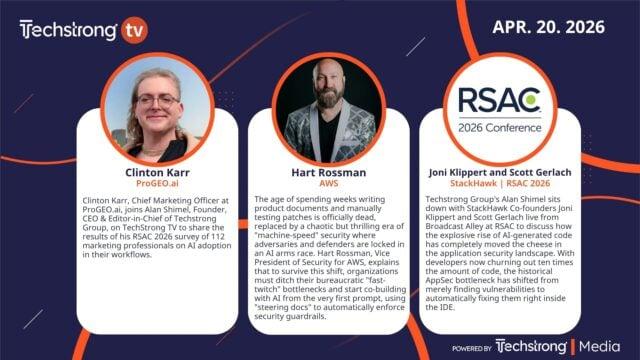
Techstrong TV – March 5, 2025
Watch our live stream on Monday through Friday, featuring exclusive news, announcements and conversations with IT leaders and experts on topics ranging from digital transformation to DevOps, cybersecurity, cloud native, containers and deep-dives into specific technologies and best practices.
Transcript
Send me your poor, your homeless, and your chips. You're watching Text on Gang. Hey everyone.
Happy Wednesday. Welcome here to Textron Gang. We've got a great show to go over with you today.
We're gonna talk about chip, migration, immigration, and everything else to do with chips. We're gonna talk a little bit about the economics of VA agentic AI and digital drag. No, not talking about transgender stuff, though, uh, in that regard though, we've got a great gang to talk to you about it with today, including a brand new gang member making his debut here on Textron Gang.
He's actually no stranger to the Techron family. com 11, 12 years ago, this man was one of the key people helping us get it going. He keynoted for us.
He shielded for us. He wrote for us, spoke for us, and he was one of the biggest names in, in DevOps. Still is my good friend, Andy Mann.
Hey, Andy. How are you? Welcome, Alan.
I'm doing so well. It's so good to be here. Mate, you know what, this is gonna be on the, on the Textron Gang timeline.
This'll be a definite no, a definite mark on the line the day Andy Mann joins the gang. Thank you and welcome, man. Oh, thank you for having me.
It's great to be here. All righty. Joining at Andy's out in Boulder, Colorado, by the way, and way up high up there in the mountains.
Well, it's a little early in the morning. He's not high up in the mountains, but, um, maybe our next guest high up in the mountains is it's the guitar man, Mitch Ashley. Hey, Mitch.
How are you doing? Very good. I I could see Andy from here up there.
Hey, Andy. Yeah, you're doing in Boulder. Can you see Russia is the question.
And don't forget they're your friend. Um, that's what we're told. Anyway, let's move on from Colorado down to San Angelo, Texas, the tech capital of Southwest Texas, and our own editor, AMA Amanda Ani.
Hey, Amanda, how are you? Hello. Good.
Happy to be here as Always. Absolutely. And then from Texas, we'll go to the dean up in Harrison in New York.
Our Chief Content Officer, Mike Ard. Mike, I saw I caught the end of the Yankee game yesterday. Those kids look good.
They do look good. And, and I'm sitting here trying to figure out, you know, where this potato chip crisis is gonna go next. Let's put tariffs on chips.
Um, okay, so our first, our first segment today is on mass chip migration. You know, continuing the, uh, the pilgrimage to dc Now we have the T-S-M-C-C-E-O announcing a hundred billion dollars, US Investment Plan a hundred. We'll add that to the 2 trillion we're already investing.
'cause you can never have enough AI and data centers, it seems, even if you don't have enough electricity. Um, but Mike, what, what's the deal on this one? Well, this is the latest instance of somebody traveling to see the president and bend the knee.
But, um, the Chinese government is also suggesting that basically Taiwan is in the middle of something that feels like a capital flight to the United States, and that they all the chip manufacturing's gonna move here. And maybe this is part of some larger geopolitical deal, but Andy, you have a very interesting perspective coming from, uh, an international background down under, you know, what's the rest of the world saying about all this stuff? Oh, look, I mean, the rest of the world can see that this is, obviously, there's a lot of political and, you know, geopolitical implications around this, right?
And exactly what you said we saw with CHIPS Act and stuff like that. There's obviously a great desire politically on both sides of the aisle to bring manufacturing of chips and especially AI chips into the us, you know, drive the US forward as a, an AI powerhouse. We're a software powerhouse, but so much of the investment is going into hardware now.
And we see for various ship manufacturers pledging a billion couple of billion, a hundred billion, uh, you know, used to be cloud a billion dollars with the entry point, right? Everyone was pledging a billion dollar investment. Now, it seems that a hundred billion is the mark.
Um, you know, from the rest of the world that drains a lot. There's a lot of brain drain has been going on, especially out of Asia, into the us, into Europe for some time. And so for lots of, uh, you know, countries down in Asia Pacific especially, which is where I'm from, you can probably tell from my Colorado accent, um, there's a lot of, of, of concern around what does that, where does that leave those nations?
Where does that leave that region in terms of, uh, innovation and ability to execute on the next biggest trend? So it'll be interesting to see how much of that investment actually does manifest in the us By the way, we always see under various administration's promises of investment, some of which come, some of which don't. 0.
Um, in the first run, there was a massive investment, uh, promise made, uh, for various things, uh, Siemens, uh, air conditioning, other things, which didn't actually happen. So, you know what? I'm gonna sit and wait and see what happens in reality, not just in the newspapers, but yeah, there's a lot of trepidation down under in Asia-Pac around how does that leave Asia prepared to take on This innovation, uh, revolution?
I've got some thoughts. So Andy, I, I think you said some things there that demand a little digging in. First of all, from a geo pure geopolitical strategy here, Taiwan is in a tough place, right?
Sooner or later, the thinking goes, China tries to absorb it peacefully or not. Now, if you're Taiwan and you don't wanna become part of China, even though technically, you know, that's a whole different story, do you say, I wanna keep Taiwan so valuable that the US and the rest of the world cannot let China absorb it, right? I call that the, the Taiwan East Patriot who wants to keep everything in Taiwan to keep Taiwan valuable so that it's too strategic to let the Chinese have it.
Or do you take the selfish oligarch path which says, Hey, I'm gonna get my money outta here and transplant my technology to the US Western Europe, what have you. And this way when the Chi, by the time the Chinese come in, in Taiwan, you know, the Corleone family's outta the olive oil business. And, and that's that.
And, and we're not doing it anymore. Could be a little bit of both. I will caution, as Andy said, in the previous Trump administration, this same company TSMC announced maybe it was 10 billion net for a plant.
I, it was in the Midwest, Wisconsin never got off the ground. I don't know if it'll get off the ground here. Maybe this is just a way to placate the, the big baby in the White House and try to see if they could get a, an escape outta tariffs on this, right?
And, and there could be that as well. The other thing though, is, Andy, to your point about being an Asia-Pac country, and you know, there's an old saying, nature rapports a vacuum, and that giant sucking sound u here of this, all this money being pledged and, and resources being moved out of the region, is that vacuum nature reports it. Someone will come in to fill that vacuum, and we know who that someone is.
What you're doing is you're, you are like pulling back the ocean before the tsunami for the Chinese to come in because the chi China then will be the only game in town, right? And so whether Australia wants to or not, or, or New Zealand or TI or Singapore or any of the Asia Pac region, maybe except for Japan, they're gonna have no choice but to deal with China because they'll be the only game in town, right? And, and with the US erecting more trade barriers and tariffs, all of these other countries are gonna start doing free trade agreements among themselves, including Canada, right?
A Canada Chinese connection. Oh, they already, Canada and Mexico already announced their response. Yeah.
Well, no, that's their response to us by adding tariffs. But they'll do China deals with less tariffs. So what's gonna happen here is, you know, you have, uh, fort us with its own little thing, and the rest of the world's still gonna do business without us perhaps.
And that, that would not be a good result. I'm not sure if this is the best analogy, but if you think about, you know, what, what, one of the things that got the Japanese into the war was the blockade of World War II with the blockade of oil and ai. And whether it's AI software, hardware is kind of the new oil of, of our commerce in our world, and everybody's scrambling to get it right.
They've gotta have some, it can't be solely dependent upon one other organization. So on one hand, we're, you know, that, that game's playing out. The other side of it is, we're paying, playing this game of risk and what, what, what land kind of grab, uh, so we have these two things going on, and it's, it's interesting that this kind of disruption makes for strange bedfellows, people signing up and partnering with China when they were US allies, us partnering with Russia.
It's, it's gonna be turbulent. So to your strange bedfellows comment, um, what are the odds that T-M-T-M-S-C, the CEO and Trump were discussing the partitioning of Intel during their meeting? It seems to me that that's the next part of this conversation where the foundries go one way and the rest of intel go the other way.
And as a lot of folks, especially former Intel executives pushing back hard on this saying, uh, Intel's about to make the turn, and yet they also announced that this manufacturing facility they were gonna build in Ohio is now delayed till 2030. So, you know, Alan Intel for real, or not for real? Again, I have a few thoughts on this one.
First of all, is anyone surprised that that plant is being delayed? Because here, here, let me tell you the real nitty gritty, soft white, 30 secret that underlies all of this $2 trillion in AI investment, we have not proven in this country that we can build, maintain scale chip foundries that are making cutting edge chips, right? The three nanos and two nanos, and all of these and these high-end GPUs, we haven't even proven we could build phones here.
And it's not something that you're gonna snap your fingers and throw $2 trillion at, and it's gonna happen. It's going to take 10 years for us to build those foundries, train those workers, make this stuff at scale. And we're gonna suffer in that meantime, right?
Because I don't think anyone has really proven what, you know, this isn't building cars, right? Building chips, building, you know, high-end chips like this at scale is, is something, there's a reason why TSMC is, is who it is. They've been doing that this for 30 years and they've kind of perfected it.
There's no guarantee you're just going to pop up a factory in, in, you know, Gutenberg, Ohio or wherever the heck it is. And, and, and voila, you're gonna have chips coming out. You know, this ain't Dairy Queen.
So I, I worry about that. The other thing I worry about is, frankly, who the hell is the US government to decide about chopping up intel? I, I'd like to have Intel have a seat at the table.
'cause the last time I checked, the US government doesn't own US industry, even though they're in bed together in today's oligarchy, it's still a private company, and the shareholders of Intel should be the ones who make the decision about what Intel does going forward. So I I'm against that whole thing. Hey, I would, I would, I would beg to differ if we can chop up Ukraine.
What the hell's Intel? Easy. You're right.
But don't, let's not get me started there. Don't even, when was the last time you visited Ukraine? Maybe we should do a show then.
That's A great, tell me you watched it on video. I'm only that's not great. I didn't watch the videos.
Yeah, but no, seriously, I mean, you know, he could talk all he wants with the guy from TSMC, someone Intel. That's an intel decision last I checked. So Andy, when you add all this up though, it doesn't look to me like the cost of semiconductors or GPUs or any of that stuff is coming down anytime soon in the next 10 years.
In fact, it just may get more expensive ultimately. So, um, is this gonna hold back software development because the cost of building all these lovely AI apps is gonna be higher than anybody anticipates? Yeah.
Look, I think this will hold back some development, right? I mean the, we already saw, uh, through say COVID and the supply chain and the, the slowdown in our op in, in, in access to systems and equipment that we saw slower r and d, slower innovation. Uh, and this will absolutely change that.
We've already got, uh, bottlenecks around chips, around server access. Um, everyone wants to put, well, at least 10 billion into r and d on their blue sky projects around ai. Um, you know, maybe some of it might even pay back some revenue at some point.
We'll see how that works out. But yeah, I absolutely believe this will slow down. There are other factors, of course, which may be throttling as well.
You know, uh, energy production is obviously the big one. Uh, and I know in this part of the world here in Colorado, up in Wyoming, um, lots of announcements around data center production and clean energy and all that sort of stuff. So it's gonna be a lot of different things.
But yes, I would absolutely expect this to be a drag. Yeah. To your point, a lot of people are complaining that Microsoft quietly upgraded them and to the higher performing open AI driven version of office and, uh, didn't ask them whether that they wanted to hire a performing more costly version.
And a lot of people are complaining saying, you know what? The ROI on that AI capability isn't worth that, and they wanna go back to their normal license. So I think we're gonna see a lot more of those conversations going forward.
Yeah, I mean, I, I will tell you, the people I talk to in, in leadership roles around, uh, sort of desktop and operating system and so forth, are absolutely ropable about that. Uh, 'cause all of a sudden it's, and it's not just that they're not finding ROI, they're finding negative cost driver because people are, are messing around with this AI on their desktop when they should be getting to work, and they're getting it all wrong because, uh, the AI is still not really up to scratch. I, I was disappointed in the Microsoft copilot features.
I, I got 'em in my office 365, I got that little symbol. I said, let click it. And, uh, disappointed, disappointed in it.
So I have a question. Um, just been quietly listening. So, uh, the question that comes to my mind, something you said, Alan, so we haven't done too well with chip manufacturing here in the US and now this is a big delay.
We're gonna be so behind, is it worth, um, trying to have the chip manufacturing here in the US Because I know price is probably gonna be more expensive here. Is the return on investment gonna be worth it? Or are we gonna be so behind by the time we even, I'm glad you asked this, Amanda.
So for all of those out there with the same question as Amanda, I am, make no mistake, it is a worthy goal and a strategic goal for the US to say we wanna be independent. Like we're energy independent versus any, we wanna be chip independent. We want to control the manufacturer of GPUs, AI chips, every, all semiconductor chips, and we wanna sell them to the rest of the world if they'll take 'em from us.
But there's a, hold on one second, Mitch. There's a gap between wishing it and doing it. And the, and the question is, when the rest of the world is frankly p****d off about it, where, where are you getting that, those chips during those gap?
And that gap might, could be five to 10 years, right? What are you gonna do for the next five to 10 years? Because if you're gonna wait five to 10 years to get your chips game's over, game's over Alan, I think the way to look at it is the, the commodity chips, even if people didn't wanna sell 'em to us, we can get those through back channel.
It's, it's the quantum, it's the AI chips, uh, the, um, things that are cutting edge. That's what we really need to own. Because yes, it's gonna be more expensive to develop it here, but if what we are creating is far superior and only we, you know, have that advantage, whether it's a six or 12 month or whatever, that's what I think we wanna make here because we can get Emory chips from here and, you know, whatever chips from, to build, you know, laptops and et cetera.
I don't think that's where the value is. It's on the cutting edge for the us You know, where this falls apart. There isn't gonna be enough rare metals in Utah to drive all this.
And so if we, so if we don't get some help from overseas in terms of, you know, maybe that's why we wanna do deals with somebody who's in at war with Russia, but, Or take over Greenland or all these other things. Yeah, but this isn't the Dutch East India company and this ain't the 16 hundreds, the imperialist days are over. Forget it.
Forget it. And Mitch, yes, you wanna build, but you gotta start somewhere. And making commodity chips is a start, but it's building those other chips that you're talking about.
I'm telling you, building the fabs for them, getting the knowhow, getting the kinks worked out is a five year minimum. It is, it is. But you have the advantage of, that's where you're starting, as opposed to you have a huge infrastructure built up of doing, you know, current generation and now you've gotta get to the next level to be able to do the GPUs and quantum chips.
So yes, I agree. It's, I mean, it's not, this is not a turnkey operation. Five years would be great if We right.
Five years optimistically. It's optimistic. And, and just, just on that point though, you know, it's not like TMSC has this manufacturing of GPUs down.
The cost of GPUs is high because they can't produce enough of them. So, you know, there's, nobody has a correct answer here on either side of the pond, as it were. It's gonna be an interesting time, you know, but like I opened it up with, under that Statue of Liberty, send me your, your poor, your homeless, whatever, and your chips.
Um, let's see what happens. You're watching Text on Gang. We'll be right back.
Discover Textron Group, the epicenter of tech innovation. We are your go-to for reaching IT leaders and practitioners worldwide. Our secret impactful content that sparks awareness, engagement, and top quality leads with us.
You'll access editorial websites, streaming videos, virtual events, custom content analyst research, and more. Join our satisfied clients. Let's revolutionize your tech journey.
Contact us today and tell your story to the world in the most powerful way with Textron Group. Hey folks, we're back. And as promised, we're talking about the rise of the AI agent economy.
It's still early days, but AI agents will communicate with each other and eventually they will drive transactions and they may decide to do things based on how they're programmed. They're hallucinate depending on how things go. But Mitch, I know that, uh, tuum group is really putting a lot of investment into researching AI agents.
And I know you put out a report recently around Salesforce and what they're doing, and I expect more to come, but is this just the beginning? I, I, well, just a plug, I would really recommend folks follow the analyst at futurum because we're looking at not just the chips, but also agents, software development, infrastructure security, and all the impact that a AI is already having. You know, I'm thinking about Alan's comment of trying co-pilot Microsoft Co-pilot and being disappointed or like I am with Apple Intelligence.
What's happening behind the scenes is people are rushing to figure out how to crude use, uh, use the LLMs and use no code natural language, as well as traditional prog programming languages to create agents and see what we can do. I mean, it is still at the experimental stage, but people are starting to get their legs under them. And, uh, you know, we even see, you know, Lang Lang graph issuing, uh, prebuilt agents that you can use to talk to their models.
Uh, we did this analysis for Salesforce, or I was, uh, sponsored by Salesforce. It's our own independent analysis. But, um, looking at what the ROI and the total cost of ownership, and there's some impressive numbers, you know, it's early.
Um, but I think the thing, the people who win right now are the people that focus on agents that actually are helpful. Not just agents. Like, find a problem that your agent solves and customers who want you to solve it.
And they'll go, this is amazing. When we throw generic tools at people, here you go, here's Chachi pt, here you go. Here's copilot in your Microsoft Word document.
Um, most people are not gonna figure, spend the time to figure out how to make that work for 'em if they can. So the Agentic agent and the agent topic is, it's across the board. I mean, we just had Sonotype announced and, uh, agent capabilities in their tools.
You know, we've, OpenText has, I mean, everybody is announcing, uh, both AI and agent based capabilities. So it's, it's interesting time for sure. Yeah, I, I think every other article in Tech strong AI is about a new AI agent.
There you go. Andy, let me ask you something. So let's say that I have an AI agent and it is optimized for me to buy this thing at the lowest possible cost.
And let's say that you have an AI agent that's optimized to sell this thing at the highest amount of profit. Are two agents gonna meet somewhere in an alleyway and we're gonna have a rumble to sort this out? Or how does that kinda like play out in your mind?
Yeah, look, it's gonna be fun to watch it least as a, as an observer. I don't know if you remember when, um, uh, the personal digital assistants first started to come out. You had your Alexas and you had your Siri stop, stop.
My, my, my, my button just started lighting up. 'cause I said her name didn't it? Uh, anyway, you got all the assistants, and remember at one point they got them talking to each other and they just had a conversation for like three hours.
Uh, and nothing came out. I think there's gonna be a little bit of that. My concern, my biggest concern with the Gentech at the moment is really just about known knowns and unknown unknowns.
Going back to that other Donald, um, the idea of, of, you know, AI's really good at solving known knowns. Humans are a plethora of unknown unknowns. So look, when we, and we all know this, you go online, you go and use the chat agent, and, uh, yesterday I had to do a whole bunch of stuff with my satellite radio.
And I've got, like, I've got two cars and one's active and one's inactive, and I've got a special deal on one. But that's coming to an end. And then I've got another special deal.
I don't know any agent that will deal with that complexity right now, but if all I needed to do was go online and renew my existing subscription AG agentic AI is gonna take care of that. So look, I think there's, there's great opportunity in this. Uh, but I'm looking forward to the hallucinations, um, when age Agentic AI talks to age agentic AI and, uh, no, they're never gonna come to an agreement.
You kidding me? So I'll tell you something. I remember when I first met Andy Mann, he was at ca and I was at a ca world in Las Vegas.
They used to do a nice job at ca World in Las Vegas. And I sat through a session, I'm trying to remember who, it might have been Andy who presented, or maybe it was Eman Zari, uh, who's president at the time. But it was the first time I became familiar with the term the AI economy.
Remember that, Andy? And, and, and this was, so this was 20 13, 20 14, maybe 2015 at the latest. And it was the AI economy in that we're gonna have a whole economy based upon AI's talking to ais, not ais, excuse me, APIs, the API I economy and APIs, talking to APIs.
And I said, wow, you really think so? Oh yeah. No, no doubt about it, mate.
It was Andy who was giving that. And, and I thought it was kind of early. As we sit here today, 57% of all the traffic on the internet is API to API.
There is an API economy might have taken 10 years, same 10 years. It's gonna take us to build those chips. Maybe by the time the chips are built, the agent ai, agentic AI economy will be real as well.
But I had an interesting conversation yesterday. I'm playing with this tool. I, I'm actually paying for it, which goes against my principle, but, um, it's called hoop ai, HOOP.
And it's pretty cool. It, it, it sits on, if you're on a Mac, you could use their app. If not, it has bots that go into Zoom, Google meet your email, slack, all the usuals, and it gathers everything that people are telling you, wanting you.
And from it, the AI pulls out tasks. And then you could decide, is this a real task you want to do, ignore it, whatever. Uh, so they, like all good young companies, and by the way, these are from some of the founders of Trello, okay?
So they, they know a little bit about task management and stuff like that. So they reached out and they said, Hey, you're a beta user. Why are they charging for beta?
But you're a beta user and we'd like to do an interview much like you used to do, Mitch, when we were still secure. And I had a, I spoke to the co-founder, one of the co-founders, a woman named Stella yesterday for about 45 minutes. And the whole agentic ai, I said, look, I'd like not only to do the task, create a task for me, but if it's something sort of run of the mill, can I have an agent that just goes and does it and then crosses it off?
That's where I really wanna be. I don't need 30 new tasks every day. I need something that's going to do the basic task.
And she said, you know, we thought a lot about that. And version two, version three of the product, 'cause version two is gonna be teamwork version three agents. And, um, she said, the problem is, why do you think people are going to use our agent?
Because every, like Mitch said, every piece of software you have today has an agent, or is building an agent. So as part of this agentic AI economy, like the API economy, what agent are you going to use to do the task? Do you want the task manager's agent to do it?
Or does that talk to someone else's agent? How many agents do we need? How many agents do we have?
How do we, you know, I don't want agents just talking to agents for the sake of talking, but let's get something done. And I think that's the problem. I wanna have a secret agent that offloads all my s**t over to your agents.
Well, the upward leafy monkey agent, you know, Alan, this is a good example what I'm talking about, though, you know, 'cause I tried out the hoop. First of all, I looked at what it does after I tried incident. Why the heck would I pay 20 bucks a month for that?
I can't imagine that's worth 20. It's, you know, startups go through these phases of kind of figuring out are we solving a good problem or not? And will the market pay for it?
It, it's a good example of, I don't need another agent to tell me that 20 things that I already know, 18 of them I have to get done. I don't need another barking dog telling me I got work to do. I know I got work to do.
Help me do the work, help me get something done. Um, we, um, Futurum did a, another study, uh, talking to 200 CEOs at, at, uh, very, very large, uh, organizations. And out of the top 200 and, you know, they see ai, their top thing is automation.
That's what they want AI to do for them. They want it to do the, do tasks for them. You know, they're talking about business processes, et cetera.
Not being assistance to people, distracting 'em, maybe decreasing productivity. Now, AI projects internally still have a high failure rate. You know, we're early in this, but I think that's what we all have to have a critical eye towards of is it, is it a novelty?
Is it not really a problem that needs to be solved or that is a problem I need solved? Is this, is this doing something for me, my business, my my operation that actually has an ROI to it? Yeah.
And Mitch, I think there's, there's an aspect here of, um, you know, pilot versus co-pilot. I, I don't need more co-pilots. I need some pilots to what Alan was saying.
Um, so people are actually some, uh, agents that are actually gonna do the job, but we're coming at it from the wrong angle. Well, so many software businesses at least are coming at it, I think from the wrong angle, which is a new set it, Mitch, find a problem, fix a problem. Don't just release AI here, have some ai.
Uh, okay, that, and three bucks 50 gets me a cup of coffee if I'm lucky. Uh, but it doesn't solve a problem. Find a problem, fix a problem.
And that's why I think we're having challenges around, well, AgTech and chat GPT and Gen AI generally as well is too many people are going at the technology going, oh, well this is cool. And it is cool. It does amazing things for playtime.
It doesn't really help me get my job done. Now, I think to, uh, and again, to Alan's point, um, the co-pilot versus pilot, I want AI to be augmentation to start with. I want it to be automation to start with, right?
Automated, intelligent, augmented intelligence. I think it's a stepwise approach to artificial. And we need to get this maturity map going.
And we know this map exists. We've done it with automation before, right? This idea of trust, but verify, put in guardrails, not roadblocks, um, and start to find a problem, fix a problem.
I think there's a lot of ways of gentech can go here, but as long as people are focusing on co-pilots that are AI enabled, and, uh, step three, I don't know, underpants known kind of territory. Now, uh, I think we're not gonna get to a solution that we we're happy with. So I would just say, well, the issue is that those AI models don't do the same thing the same way twice.
And if you're running a business process, you need it to be done the same way every time. And that's where the disconnect is gonna be. So I have two questions.
First of all, um, is there like a catalog of AI agents that people could shop through? So I think that might be helpful, where they can hand select a number of AI agents that work together for their needs. And then number two, has there been any study, like a mass study where people share something they wish they had an AI agent for and they could put that together and determine the most effective AI agents that they should come up with?
Um, it, it's a good, you have the best questions, Amanda. That's why you're such a great interviewer on Textron tv. Um, I don't know of a, of a directory one to have to be updated.
Sounds like a business plan to me. Mitch. There you go.
I, I think even, you know, the second question I really, I think is a great one, which is take it down a level. Let's talk about the problems that we need to solve and can we put AI to it. Um, I, I heard the one, one of the people from the CTO office at Dell talking about how they are tackling, uh, this is a public conversation.
So how they're tackling, using AI and development and, you know, the ideas, their plethora of ideas, but they had a process where they kind of winded them down to like, okay, what are the ones we really think have a, a value to it? And ROI invest some experimentation. And then they, they have a few projects, a few, maybe it's a few dozen or so that are really investing in AI to solve that specific problem.
So it's exactly what you're talking about, Amanda. And I think organizations have to do that for themselves, right? Um, another thing I think we're kind of missing the point on how we're selling agents.
Um, I look at open AI and you have to pay extra for operator. You have to pay at the higher end, you know, what, is it the AI agent or is it the stickiness of the agent? I, if I build a lot of stuff with somebody's agent, I'm not gonna move off of that anytime soon.
If it's bringing value to me, you know, that's the, give it to me free. Get me stuck. I will live with that for a long time, and I'm happy to pay you money when I see value from it.
We don't hear any about any great things happening with people doing things with Cursor or with Cursor we do there, but with operator from Open ai. So that tells me, is it really, is it really that valuable yet? Yeah, like everything else, ai, a lot of it is on the come, Mitch.
Yeah. All right. Um, let's take a break here.
We've got one more great segment left for today's Textron gang talking about digital drag. No, it's not. Some show in Key West.
com is the leading resource for news analysis and education on challenges facing the cybersecurity industry. com covers all aspects of cybersecurity, including data security, DevSecOps, cloud security, application security, network security, security threats, and more. com has the largest selection of security content featuring breaking news, blog posts, podcasts, and more.
com to learn more. com. Home of security bloggers network.
Hey folks, we're back and we're talking about a report from soho where they did an analysis that says, well, how far are people along in their digital business transformation initiatives? And I think it suggested maybe a third are kind of stuck, and it's probably more than that. But Amanda, you run digital CXO for us, and that's where this article is.
What's your assessment of what's going on here? I mean, we seem to be all kind of like enthused and now we're kind of tangled up in each other. Mm-hmm.
Yes. So it was an interesting study because several key points that I noticed. First of all, it's the in-office workers that are, that are lagging behind, um, versus the remote hybrid workers, which seem to be, um, experimenting and taking on, uh, more effective tools.
So that's kind of interesting. Um, uh, secondly is the, the reliance on all these spreadsheets. We were talking about this earlier in the show.
We are still relying on spreadsheets and these old, um, um, methods of just sharing passwords ad hoc and, um, not, not embracing AI for security. Um, whereas they are for other things. Uh, so I found that interesting.
I had, um, typed out a few other key points. Um, oh, it's just the use of shadow IT too is a big one where, um, they're just using all these tools and, and nobody's keeping track. So, um, we're a little behind in digital transformation compared to other countries, um, but primarily in the, um, um, not in the remote and hybrid, but the people who are going to work.
So I, I would also emphasize in that regard, it's not that we're lagging in digital transformation. We do a great job digitally. You could order and get virtually anything you want digitally today.
Anything just about this survey is really for digital transformation in the workplace. So how are workers transforming into digital? And it's not that they're not digital, right?
Using a spreadsheet is still digital. It's are they, are they leveraging digital technologies to improve productivity, I think is a better, but you know, this, I, whenever I get surveys like this, and I'm jaded now from doing this all these years, I look at who put out the survey, what do they sell? And that pretty much will tell you what the survey's gonna say.
And I think there's a case of that. I, I think I'm going blind trying to enter data into this cell over here in this spreadsheet. 'cause it's so small, I cannot see what the hell is going on inside it.
And then if I wanna, well, I can tell you what your vision problems are from Mike, but Person Day goes on. So, So, so I'll jump to Andy and just say, I keep feeling like we're using the wrong tools for the wrong jobs all the time. Yeah.
This is, this is the story of, of tech writ large, right? The, the rush to adoption and then the stall. We see it every single revolution we saw, you know, you remember virtual stall 15 years, 20 years ago when we were first meeting Mike, we were talking about virtual stall.
Yeah. Adoption of virtualization followed the same pattern, big rush to adopt lots of gains. Obvious.
ROI then, well, how are we gonna manage this? How are we gonna secure this? How are we gonna back it up?
How we do good governance compliance? Is it really doing the ROI, the effort, the productivity that we wanted it to? Cloud computing was the same.
Oh, and by the way, all of this was also rogue IT and shadow IT to Amanda's research. Uh, we had rogue IT for, uh, mobile apps. Remember we had rogue IT for virtual services, for cloud services.
I remember standing up in front of a conference, maybe it was one of yours, Alan, and asking the audience, uh, put your hands up if you don't have any of your workers, uh, using SaaS today. This is like in 19 20 14 or something. And a whole bunch of people put their hands up and said, no, put your hands down.
Everyone is using SaaS, right? Look, everyone is using ai. Everyone is using all these technologies.
They're trying to get it right. Um, yeah, they're using spreadsheets, but they're also using Google Sheets and they're doing some predictive and they're using some coyer, but it's stalling out because we're trying to govern, we're trying to manage, we're trying to find better use cases. We've got the obvious ones under control.
We've done the, the, the, it's obviously gonna pay back. Now we're trying to struggle to find the real big, you know, nuts to crack now. So I think Alan's right, we've done a lot of great work on digital transformation as consumers, as enterprises, but we're getting to that store point, and I think this is entirely predictable Crossing the chasm model right there.
But it's a good stuff on digital CXO. Hey, we've got to, uh, pull out of this one. We are a little overtime.
Te apologize. Of course, we still have a full day of text drunk TV immediately following us here on the gang. So stay tuned for that.
And just a quick plug tomorrow, two 30 Eastern Time LinkedIn live. I'll be live. Shimmy says we're talking tariffs in tech.
So if you've got something good to say about it, join me on there. I look forward to it. Um, until tomorrow though, Andy, welcome to the gang, man, you came out with flying colors.
Thank you, Mike Mitchell. Amanda, absolutely. We'll have you back on again real soon.
You'll be in the regular rotation for the rest of us here, thank you for watching Textron Gang. We'll be back tomorrow with more. Stay tuned now for some great Textron tv, This is Strong tv.
Hey everyone, welcome back here to Techstrong tv. We're happy that you, you're with us, our next guest. It's his first time on here, tech Strong tv.
We, we featured this company once before, though, I think it was at a Cube con or something, but we are gonna find, if you didn't see that one, don't worry. I'm not gonna hold it against you. We're gonna bring you up to speed quick.
Let me introduce you to Schmuel. Kleger. Schmuel is the founder of a company called Causley, and he joins us today from New York.
Schmuel, welcome to Text Drug tv. It's nice to have you on. Thank you for having me.
It's a pleasure. Um, so Sel, I always like, you know, I, I founded, co-founded a few companies in my days too, and I always say, you gotta be a little crazy to found your own company, right? It, it's taken a risk.
It's you, you put your, your blood sweat and your tears, your kishka, as they say in, in, uh, New York, in into these things. And the only way you do it is because you're passionate. You, you believe that somehow what you're doing in some way is gonna make the world better for somebody or some people.
What, talk to us about your journey and where your passion came from for cosley. Okay, so before cosley, I founded Cosley is actually my third startup. Uh, before Cosley, I, uh, start, I founded, uh, a company called Omic.
I started omic in 2009, uh, focusing on, uh, application resource management in virtualized and cloud environment. Uh, that company, uh, uh, became, uh, deleting providers of application resource management. And it was acquired by IBM in 2021 for $2 billion.
Prior to that, I was a CTO. At EMC, I was the CTO of the resource management software group. I arrived to EMC in oh five as part of an acquisition of a company called Smarts.
Uh, I was, uh, a CTO and a co-founder of Smarts. We founded Smarts in 93, focused becoming the leading providers of root cause analysis, focusing on networks. And we were acquired by EMC in oh five for $300 million.
Prior to that, I was a researcher at IBM Research in TJ Watson. I arrived there to do my postdoc, I did my PhD in compilation of logic programing, concurrent logic programming languages, which were the foundation of AI during the first type of AI of the, the first type of ai. And, uh, if you go back all the way, I started my career as a system programmer on mainframes in Israel, in the Israeli army.
So now why go? And you ask me, where's my passion to cosley? Because if you look at my entire career with, with the break for my PhD, it's focused on IT management, IT operation.
And in the two startups that I had, uh, focusing on one on the side of how do I automate the troubleshooting? And in the, in the TUR omic, I focused on how to automate the resource allocation. And, but it's all within the same journey of trying.
I always believe that IT operation is a very label intensive, uh, uh, part of the market. And there is room for reducing the label and, and, uh, gets software to do a lot of things that people are doing today. They shouldn't be doing engineers and, and IT operation in general.
And I like to say that both in smarts and in omic, we made some good steps towards that, but we actually didn't get to what I would call the nirvana in which, and still IT operation is still a very labor intensive. Humans are very much involved in every little details of the operating of the IT, and making sure that everything is op, uh, working and applications are delivering on their, uh, goals. And, and, uh, so there is, I like to say there is something left for me to prove that we can do better when it comes to how to operate an environment in a way that applications are performing well.
Excellent. First of all, congratulations. What a great, what a great life arc story, right?
Man, that that is, you know, it's a, for a lot of people out here, it's a dream and it's doesn, I'm sure it doesn't come easy. It comes with hard work, smart being patient and doing and, and working hard. So, congratulations.
Thank you. When, when did you found Causley? We found it causley in, uh, 2222 Because, you know, I, I was listening to you about making things less labor intensive, of course, pretty much since 22, 23, you know, AI comes out, a gen AI burst on the scene, and a lot of, a lot of executives are thinking, how can we do things more in software more with AI and less labor intensive.
Of course, you know, labor probably represents one of the biggest, uh, cogs in, you know, costs in the business. And, um, was, was AI kind of on the radar when you thought about this? Or you were just thinking more software in general?
And automation? I, this is a very good question. Uh, well, AI is there for 30 years.
It's it, and it goes to, to multiple hypes. And, uh, uh, if you look at the, in my first company, uh, the, uh, we also kind of ask ourselves is that AI or not AI in ev and actually in both companies, every time, my view is I am solving, I'm building a company to solve a problem, whatever the problem is. And we can talk about the problem we are solving in Cosby.
And for, to solve that problem, you need to develop some algorithm that solve that problem. Just saying, I'm doing AI is like, it doesn't tell me much. I you have to have some algorithm that solves the problem that you're trying to solve.
And what we are building in Cosley is that a collection of algorithms that works together to solve a problem. You want to label ai, label it ai, uh, are there elements of AI that we are using? Yes.
But I wouldn't call it like, it's not like that what we do in LY is, oh, here is a bunch of data to it into some LLM and the LLM will give you the answer. I don't believe that that's where we have to go. LLM can help in certain areas, or machine learning in general can help in certain areas, but it's not like a magic bullet that you just throw everything to it and it gives you the answer.
Uh, you have to kind of pick and choose where do you use it to improve some of the answers that you are providing. Got it. Excellent.
Um, so give us, you know, so we, we get the reason behind Causley since 22. Give us an idea of the engagement of, you know, what, like typical customer where, where's, what's the problem that the customer comes to you with that your, you know, your typical customer now, kind of the persona, you know, that you causally the great answer for? Right?
So I, so I can, I can answer that in so many levels, but let me be very direct, very, if you are a customer and you try to make sure that the applications are performing, so what do you do? You monitor the environment, you deploy some kind of monitoring, whether it's uh, uh, native stuff that you can get in cloud native environment like so, uh, or things like that. Sure.
Maybe open telemetry, maybe you buy some tools that gives you some, uh, some a PM tools, whatever you are monitoring the environment and okay, what do you monitor you monitoring because you care about the performance, you're monitoring service latency, you are monitoring for the, the error rates and so on and so forth. And now the reality is because especially with cloud native and microservices, that with this complex web of relationship and dependencies is the reality is that when an issue happen in the environment, something doesn't behave, something doesn't go, doesn't operate the way it's supposed to operate, whether it's an API, someone that is, is API, somewhere that is slow, a database that is locked in some, uh, wrong way, uh, know that is overloaded, whatever. When those type of things happening in the environment and you are monitoring the environment, you are not getting one alert, one anomaly, oh, this service is slow or have high latency, you get a flood of alerts, you get all kind of services, uh, having high air weights or high latency, and then you start chasing it and you start firefighting it, you're going to this what we call the troubleshooting process to actually pinpoint what is the root cause of this flood of services that are having high error rates now or, or high latency.
And with Sly, we automating this, we are telling you don't chase those alerts. Causely tells you pinpoint, this is the root cause. You don't have to understand to chase those alerts.
We tell you, this is the root cause. All of those alerts are caused by the, all of those anomalies that you observe are caused by this root cause. Got it.
You know, and, and this, what you just described is the, the poster child for observability, right? We used to call it application performance management and you know, all these other things. But, but this is what, what what people are, are trying to do now and or they've always tried to do it.
But now we call it observability, um, which brings us go ahead. But what they're missing is the key ingredients. They are, they're missing the understanding of what I call causality.
What is the cause and effect relationship between things, what you observe, whatever the things are. And to be honest, there is a lot of hype around in the industry of those cause and effect relationships. I'll give it to LLM and we learn them.
I actually comes from a school that says those cause and effect relationships are not so easily learned by a machine. There is some knowledge and some expertise that someone has to input the machine and let the machine do the less. But the key for what we are doing is start with some understanding of this cause and effect relationship and let them drive that, the algorithms that makes the decisions and pinpoint the root causes.
And without that, uh, people are not really doing root causes in software. The, the best they can do is correlating events, but they leave the human the heavy lifting of really understanding what is the root cause and make the decision of what is the root cause instead of letting the system, the software make that decision. I love it.
In some ways, fmi, let's, we we're coming back full circle, back to root cause analysis to what you did. Yeah. I mean, years And years ago.
Say that I, I like to say that, that this problem exists from the day we invented computers. It, this problem didn't start today. This problem exists, uh, forever.
And we are struggling with that problem forever, if you want, from the day we invented computers. Absolutely. Hey, we're, I gotta pivot a little bit 'cause we'll run outta time before we even talk what we're supposed to talk about, which is, uh, today's topic of discussion.
You just recently, or Causley just recently announced launching integration with the Open Telemetry Project and the Open Telemetry system. Talk to us about that, if you don't mind. Yeah.
So I think Open Telemetry is a, a very, very important paradigm shift that happens in the, uh, in the, if you want, in the observability space. It, it, it sees, uh, shifting the accountability and the ownership of telling me what's going on from the management station on the man, from the management software to the application itself, to the application developer. That if the application needs to, if the application to be properly managed, it needs to be properly instrumented with open Telemetry.
Using Open Telemetry. We are finally putting the burden on the application to tell management, here I am, here is what whom I'm talking to, and here is some metrics about, uh, the characteristics of my conversation with, with things in the environment. And that's a huge paradigm shift and it's a very important paradigm shift because now we have a lot of information, valuable information about the application, the of whom it, whom does it talk to, how does it perform, and things like that.
But I like to say there's no free lunches. This comes with the cost because if I'm going to instrument properly my application now, I'll overwhelm myself with a lot of information, tons of data, which brings with it some challenges. Obviously it brings the challenges of just the bell cost of po uh, processing and storing this data.
But more important, if you think about the problem that we are solving, which is the root cause analysis problem, it's actually make this problem even worse because at some level, root cause analysis at the very fundamental po uh, level of this is like looking for a needle in a haystack. And the open telemetry making the stack much larger, the haystack much larger and much bigger. So look, finding the needle within that haystack becomes much harder.
So, so that's why Open Telemetry brings tremendous amount of value, an important value. It's actually something that I wrote about that in the nineties that we have to shift for the application telling us who they are and what they do. But you need system like Cosley that can make sense, takes what's important and be able to get the insights that you need out of the data that is being collected by Open Ity.
I love it. True. We're almost out of time for people who wanna get more information on Causley, where do you suggest they go?
Well, we have a website obviously, like, uh, which is Coly AI and ai. Yes. Okay.
And that's where you find Coly. What about, you're working with Open Telemetry, you're gonna be a cube con, you're gonna be where, where, where can people be beyond the website? So we are, what's a good way to, to interact?
Actually We are working with Open Telemetry. We actually, uh, contributing to, uh, the Bailer project, which is an open source project that, that, uh, uh, uh, build, uh, that con uh, that provide the information about service dependencies and traces and things like that. Uh, as for Confluence will be in the SL econ will be mm-hmm.
In, uh, uh, human acts, uh, yeah. Things like that. Uh, to be honest, I'm not sure if we are in, you Are not the, you are not the event coordinator.
Yes, I'm sure not. I think other, yeah, Adam probably knows more than me where we are going. We'll, we'll try to put it up there.
Well, listen, it's been a pleasure having you on here. You've got an open invitation. Anytime you want to come on and talk about stuff, what's going on?
I'd love to have you. Maybe next time I'm in New York. We'll, we'll do it in person.
I Would love to. I would love to. Thank you so much.
Thank you. SMI Kleger, founder Causley. That's Causley ai.
Go check it out. They just got a new integration with Open Telemetry. We're gonna take a break here.
On dextron tv, we'll be back in just a moment. Hello and welcome to the Techstrong AI podcast. I'm Amanda Ani, and with me today I have Gurah Al.
He is a data science manager at Thermo Fisher Scientific. How are you doing? Yeah, I'm doing good, Amanda.
Thanks for having me. Happy to have you on the show. Can you share a little bit about your background and experience?
Yeah, sure. Uh, currently I'm working as a data science manager, and, uh, I have sound, I'm a technical person having sound knowledge in A-I-M-L-A-W-S cybersecurity. Uh, I have several articles which have got published and, uh, I love hacking, uh, and participating as a judge in the hackathons.
Uh, like currently in my role and previously in all the organizations, I have been responsible for developing innovative solutions for the organization, which can save, uh, like money as well as time for the whole team. I have written several utilities, uh, which, uh, are a combination of ai, uh, algorithms, deep learning classification regression, along with the automation, utilities, the solutions, what I try to build. They are mostly like, uh, open using open source technologies.
So they go long way. And, uh, that's what I love to do. Wonderful.
Well, you're the person to talk to then today about using AI to combat fraud. That's our topic for today. Yeah, sure.
Frauds are happening everywhere and, uh, AI is also moving very fast in each and every domain and in every, uh, different kind of, uh, industry. And so it's very nice to include AI to combat fraud. I can cite few scenarios like how AI can be helpful.
Yes, absolutely. I think that's my first question is where are some of those fraudulent activities being seen, and if you can give a little bit more detail about how to utilize AI to combat those. Yeah, so, uh, like insurance organization, okay, so what happens, like people, they are trying to file a claim and, uh, this claim process is completely manual, whether it's healthcare domain or it's a phone insurance.
Okay. What happens, like, uh, when the claim person, they try to call it odd timings when the, uh, like the employee, they want to leave, so they are in hurry, and this guy is, they try to make up a story, uh, uh, which, uh, quite emotionally these guys employ fees. Okay, yeah.
He's saying correct and they file a claim, they approve it. In this whole approval process, it's a company who has to bear the loss. For example, like I give you an example, like we have a several algorithm like Sound X, sound X is like, uh, uh, your, your names, they are matching, but you are not the real person who should be filing the claim.
And whether looking over it manually, it's actually quite difficult to figure it out. Oh, yeah. It's a fraudulent claim.
With ai, you can train your model with the past fraudulent claims, and when the new request is coming up, instead of having the manualize on it, AI model can give you an output with a confidence level. Yeah, this is like 70%. Yeah, this guy seems to be a fraud, so it'll give you some checkpoint.
Yeah, I need to pay attention to it. That's how AI is very helpful. So like, uh, another example is like we are receiving several emails like, uh, this insurance companies, they are receiving hundreds of emails on daily basis manually.
It's a very tedious task, but if you are generating, uh, any model, like a named entity recognization model, what it does, it reads the email content and it will give you the output. Okay, yeah, this email is about this, is this an issue or not? So over the voice, you can feed the model, the email, you can feed the model, the model will give you an output according to its confidence level, and, uh, you will get a checkpoint.
Yeah. Whether this is a fraudulent or this seems to be, uh, like, uh, a good, like we are, we are good to approve the claim. So that's how like AI helps, uh, uh, in claim process.
So, you know, we see this technology advancing very rapidly, and while AI can be used, so we're seeing how it can be used to combat fraud, we're also seeing way more evolved and advanced fraudulent activities. So how do you, what advice do you have for leaders as to stay on top of this and the evolving the rapid changes to this technology? See, when we have rapid changes in the technology, the problem whether AI is like, uh, your model is being trained on some specific data, and based on that data, it is giving you the response.
The problem happened. Like tomorrow there is some different use case, which model was not aware of it, and it may give a wrong output. The my advice is like, uh, you have return a model.
Now, it doesn't mean that your work is over. You need to retrain your model on the new upcoming data because the hackers, they are also intelligent. They, they are also getting smarter.
So you also need to be, uh, like you're not retrain yourself like, uh, uh, with new updated data and, uh, uh, like, uh, come up with a diverse data so that your model is intelligent enough to understand any new upcoming requests. So my advice is keep retraining the model. Are there any challenges or limitations to these AI based fraud protection tools?
And if so, what are they and how can organizations mitigate those? So I give you the, uh, example from generative ai. People are liking it.
It's, uh, it works on LLM model. You just, uh, provide your input, uh, in English plain language, and it gives you a response back. Okay?
The problem here is, uh, with this Gen A versus other models, this gen model is not giving away confidence level every model. Like, uh, when they, uh, give you an output, there should be a confidence that okay, model is saying, yeah, I'm 70% confident this answer is correct. Whether gen, ai, uh, the models, this confidence level is missing, they're still in process of implementing it.
So this is one lacking feature. Like you cannot directly deploy the gen AI output to the production because that model itself is not very confident. You don't know what is that percent with respect to other AI ml models like you have for regression classification, where we are predicting something, it gives you a feature of, uh, uh, like a confidence level.
So that helps. So that's why when you are talking about the fraud, it can only give you a, uh, like a sanity check, yes, whether this can be a fraud or this cannot be a fraud, but that does not mean that you avoid the manual activity at all. Frauds are happening all over the place, so please retrain your model again and again so that you can get a better output.
Absolutely. So do business leaders need to consider any laws or regulations when it comes to utilizing AI for this? Yeah, so like, uh, every company, they are coming up with their own RAI, uh, like responsible ai, uh, framework.
So there are rules, like you cannot, uh, because if you are start feeding like your organization personal data, then that is not correct. So you have to abide with the loss, what your organization is giving. You have, if you are building a model internal, uh, model based on the, uh, like company's data.
So it, that model should be consumed internally only. It should not be exposed to the outside world. So this is just one very simple example, but yes, there are rules which business leaders, they need to take care security was there, is there will be there.
So security is still there. AI is something new, which has to go along with the security. So that is a very important aspect and we have to follow, like what uh, organization is coming up with in the rules and regulations.
All right. Is there any issues with skill level? AI is a pretty, um, well, it's been around a while, but the more recent version of AI is a pretty new technology for most people.
So are you seeing that there's a skill level gap? And what advice do you have for business leaders to improve that area? Yeah, so definitely there is a skill level.
Everyone knows what is something is their ai, ai, but they don't know like exactly how it works or how we can, uh, pitch in, how we can use it. So the, luckily there are so many UI platforms like chair, GBT, you don't need to know ai, you just provide your input, it will give you the output. So that is all ai.
So my advice is like, uh, if, uh, like if there is a technical person and he or she wants to learn ai, you don't have to, uh, like, uh, in, uh, like include AI in your code and every phase, no. You just go with the flow. And if, uh, in your project it'll involves ai, you think like when you are, uh, trying to implement something, you Google it and Google is saying, yeah, so this is a protection case.
Use ai, otherwise just stick to your regular work. For the business leaders, like we have process business leaders, they are mostly involved in the process, like how we can make it better. AI is helpful to them in making the process being more innovative or providing some more, uh, use cases so they can use AI or learning how they can improve the existing process.
But that does not mean they have to implement it for guidance, for knowledge, for coming up with new ideas. AI is there if you find something better. Yes, go ahead, use ai.
Wonderful. Well, if there was one key takeaway you could leave our audience with today, what would that be? My key takeaway is like, AI is very good, but it is an artificial assistant.
It does not have its own brain. So even though you are using it, you are getting some output. Please, uh, uh, do do a thorough manual review so that you can look over the answer and then you can implement it in the production.
Just don't directly rely that, okay, it's AI output, it is a hundred percent correct, we are done. No, it is not that. So it's, uh, it's an assistant.
That is my advice. All right, wonderful. Well, thank you so much for coming on the show and sharing your insights with us today.
Yeah, it's a pleasure. Thank you. Thank You.
Great. And thank you to our audience. Stay tuned.
There's more. This is Textron tv. Hey guys, thanks for the throw.
We're here with Brooke Mata, who's the CEO for RAD Security, and they just picked up $14 million in additional funding. And we're gonna talk about with, well, first, how is that funding gonna be applied? And b well, how is security changing in the age of ai?
Brooke, welcome the show. Thank you for having me. It's great to be here.
Well, congratulations on the funding, but um, after, you know, you bought everybody involved a beer, what's the priority here? What's, what are you guys thinking about? Funny enough, we're in New York with one of our series A investors having a beer.
Uh, not right at this moment, but, uh, we did last night. Anyhow, uh, so good question. Um, we, uh, are working with a couple of new investors as part of the round as well as a few of the old ones came in as well.
Um, and so the new investors are political, uh, ventures, which is the investor here in New York that we, um, spent some time with this week, as well as, uh, Cheyenne Ventures, um, which is a west coast based vc. Um, they are our lead in the round. And then we also have an investment from Akamai as well, uh, in terms of answering the question that you brought up earlier, and what are we gonna do with the money that's, um, what our investors would like to know as well.
Um, and so we've had, uh, some success in the early days of Rapid seven post R series, uh, seed funding, and, um, and we want to really start to ramp up the sales and marketing organization, um, as well as hire some additional engineers to help us tackle the problems. Um, with AI that we're tackling today. It seems like cybersecurity is changing in, in a lot of different facets, but the one that seems to keep coming up is this sense of the need to build a platform and the need to centralize more functions inside of a platform.
Is that kind of where we're headed long term, or are we still gonna be wrapped around individual little tool sets that we're trying to stitch together? Yeah, I think for a lot of founders, especially in the past few years, it including, uh, you know, at moments in rad security, there are temptations to chase shiny objects and expand. And so we've been working really hard to stay focused, focused on our area of, um, of cybersecurity and, uh, and to not become too comprehensive as a startup of a platform where we're, uh, you know, a hundred miles wide and not very deep at all.
Um, so we have deeply connected to solving problems with infrastructure security, um, and that now extends into ai. So what specifically is infrastructure security in your mind then? What am my, what kinds of tools?
'cause I mean, it's just an alphabet soup of stuff out there and people get confused. So what exactly do I need to secure infrastructure these days? Well, you need, um, great people.
Uh, uh, you don't always need products, uh, first of all, but as a product vendor, I will tell you that our approach has been to think about in, in the early days, just a trip down memory lane. We started off as a Kubernetes security company. Um, and so Kubernetes is a widely adopted technology.
Um, we then expanded into cloud detection and response. Um, and now what we've discovered is the ability to understand not only what's happening, uh, in your workloads, but also what's happening in AI workloads. And so we started to really think about runtime security, workload protection, and AI security, all sort of under the same, um, uh, delivery mechanism, which for us is looking at behavior and first fingerprinting to identify known good behavior.
And then, uh, looking at drift from, from that known known good behavior to identify anomalies. We've been kind of stumbling our way towards this integrated approach around DevSecOps, and we're trying to secure the platforms and the workloads and the run times. From your perspective, what's been the challenge?
'cause I feel like we keep making fits and starts in that direction. Well, I mean, the world's changing. It's completely different now in terms of infrastructure than it was a year ago.
The dependency on AI for high velocity is, um, is there, and it also introduces new risks to most organizations, and so becomes really hard for, uh, security teams to wrap their brain around what's happening when the world's just changed so fast in a year. From my perspective, And as part of the infrastructure, we're seeing new animals in the proverbial zoo. There are GPUs and different types of platforms that need to be secured.
Are they fundamentally different in terms of the challenges, or are they the same, but they're just kind of a different thing I need, they're a different type of artifact that I need to secure? Or what's the challenge when I think about AI security and infrastructure? So For the, for, from a rad perspective, we were able to use the existing telemetry.
We had to extend our capabilities, uh, in order to detect issues and workloads. And that includes data exfiltration, um, uh, insider threat. Um, and, and so for us it's sort of a similar approach, but for others it's different.
You know, there are tools out there that are doing, uh, pen testing using ai, um, and, uh, lots of other cyber secu. There's probably one a day, maybe more cybersecurity companies that are, uh, created to help solve problems with this new modern infrastructure. But for us, it's largely a similar approach.
Are there workloads that are gonna be deployed on this AI infrastructure richer targets, and or are we gonna need to kind of double down on how we protect those more aggressively than anything else we do because, well, there might be an AI model running on that thing that is critical to the organization. Yeah, that's right. Um, and it starts with knowing what you have.
Um, been talking to a Texas based insurance company a lot lately, and, uh, and it all starts the same way that we approached vulnerability assessment back in the day where you have to first know what you have and do discovery and, uh, know what's out there. And the same thing applies to understanding what your, uh, engineering team is using in terms of, um, ai, uh, not just the engineering team, but especially the engineering team. And then what's happening on those workloads, uh, for, from the case of rad security.
So, um, it is, it is a big problem. And, uh, yeah. And so we're trying to be there at the intersection of, uh, AI and security to help.
So what is the relationship between the security folks in the engineers these days? 'cause a lot of the times it's the engineers who are provisioning all this stuff, and then the security people are trying to figure out what happened, and they don't have visibility into this conversation, and then they are surprised when they wake up one day and find out that everything's misconfigured. I think that that's still the case in some organizations.
Um, our, uh, ICP tends to be organizations where the security team makes a focused effort to be close with the engineering team, and so nothing's happening in a, a silo. Um, but we do talk to lots of different, uh, CISOs and organizations and, um, there are still a lot of siloed organizations out there where, um, the velocity of the engineering team is so fast that security is a serious afterthought. And so, um, uh, yeah, I guess it's very cultural, uh, and, uh, a lot of Uber here in New York meeting with a lot of modern companies that tend to, from the start build with, uh, security and engineering pretty closely aligned.
I think you put your finger on. Part of the problem is the velocity at which we are deploying applications and updating them is a major challenge for the security folks. And near, as I can tell, um, with the rise of AI coding tools, that's only gonna get worse.
So, um, how do we make it all better? How can we help the security people stay current with the pace of change that is just gonna exponentially increase in, I think, in for some organizations, uh, while security and compliance are definitely not the same thing. Um, sometimes compliance as a driver is helping push security initiatives for CISOs.
Um, now nothing or most things are not mandated for security leaders as related to ai. But, um, we do s we are starting to see, um, uh, compliance regulations like ISO 42 0 1 and the EU AI Act coming down. And a lot of security teams are actually choosing to become compliant, not because they have to, but it gives their customers a sense of confidence that they're handling AI in a secure way.
Um, and there are organizations out there who are helping to, uh, helping those companies to become compliant. So, um, that's one thing that we are seeing to address the problem. Uh, I think that the alignment that you brought up earlier between security and engineering is critical in order to make sure that, um, we're solving problems, uh, as, as one team, um, but also not slowing down the engineering organization because, uh, even if the company is huge, they still need to get out and ship quickly and, um, develop new, um, technology.
And so, um, security is trying to find a way, uh, with the help of lots of different vendors, and we hope RAD is one of them, uh, to make sure that we don't slow down velocity of engineering, but also, um, help security gain confidence that what, um, is happening with AI is done in a secure way. So we've seen, uh, more AI workloads as of late, and we're aware that the bad guys are using AI to attack us with greater sophistication and volume. Um, can AI help the good guys and what might that look like?
Yeah, for sure. Uh, so I only talked about one part of what RADS doing. Um, RAD has the ability to do, um, workload detection, uh, and, um, identify issues, uh, in runtime, but also we have an agentic approach to our platform that allows for you to make really efficient decisions as well.
And so, um, our customers are able to, uh, especially GRC teams, uh, are able to quickly understand their highest level of risk to prioritize accordingly and, uh, remediate as well. And so the telemetry and the RAD cloud detection and response platform has allowed for them to, uh, be able to do that pretty well. Um, but it's not just rad.
Uh, there's lots of organizations out there and people who are forward thinking, who are trying to stay ahead of the, um, the bad guys, uh, for lack of a better word, um, uh, in order to keep up with the innovation that doesn't just exist with the, the security teams at the companies that we're talking to. But it also exists in, you know, uh, large organizations who, who are, have huge incentives to, um, exploit these workloads. So as we think this through for a little bit, will agen AI make security more accessible to a broader number of people and help close that skills gap that we've been wrestling with for the last as long as anybody can remember?
That's right. Yeah. Um, and you know, for us it's, uh, we just talked to a company in New York who said that the time it took before using RAD to get to the data that they needed, um, for, uh, governance risk and compliance was 30 days, and now it's three minutes with the RAD platform.
And so, um, you know, the amount of manual work that people were doing historically, um, doesn't, uh, lend to efficiency in a modern organization. And so, uh, we're doing everything we can to help, uh, create time to value and, uh, remove, uh, manual efforts so the security teams can focus on prioritization of real risk and, uh, not, you know, redundant or, um, low level tasks that can be replaced with, um, ai. Rook.
You've been around the cybersecurity block a couple of times now. What's that one thing you see organizations doing that just makes you shake your head and say, folks, we could be better than this? Well, I think you actually made me think of it with the, uh, the security teams being aligned with engineering teams today.
Um, I, I remember 15 years ago walking into, uh, WeWork when WeWork was in its heyday, maybe it was 10 years ago. Um, but, uh, the, there was a person there, his name is Raj, uh, at the time, he's no longer there. Um, but I remember talking to him about how closely he was aligned with engineering, and he was doing some really novel things.
And since then, you know, a lot of organizations have adopted that practice, but you still see some legacy CISOs who, uh, operate in silos. And, um, and the other thing, I'll just have a bonus number two is the legacy approach of managing with a stick. Um, I just don't think that works in 2025 anymore, um, uh, with managing security teams.
And so I still see that in pockets and have talked to a few people who do that this week. So, uh, that's the other thing that sort of makes me, ugh, a little uncomfortable. All right, folks, you heard in here, the game has definitely changed, and the only way to win it is to well lock arms, because otherwise the bad guys are gonna find it ways around anything we do, no matter how advanced technology gets.
Hey, Brooke, thanks for being on the share. Thank you for having me. I appreciate it.
All right, and back to you guys in the studio. Hi, my name is Caroline Wong, and I could not be more delighted then to introduce you to the very first episode of a brand new podcast called the AI Security Edge. Uh, joining me today is my very good friend and colleague, Daniel Mesler.
If you wanna look up Daniel, and you should, you can find all the details that you need to know about him. When I think of Daniel, I think about three things thing. One, Daniel might be the single deepest thinker in our industry, thing.
Two, Daniel is extremely self-aware, particularly of the fact that he is a human, that I'm a human. And thing three, I think he is really good at human. Um, maybe that's an unusual way to introduce a podcast guest, but it is simply the truth.
Uh, and I'm here to speak the truth On this podcast. We're gonna talk about ai, we're gonna talk about cybersecurity, we're gonna talk about how AI is changing cybersecurity, what are the ways in which cybersecurity makes life easier for attackers and harder for defenders, and what are the ways in which AI makes life better for information security professionals, and how does it make it harder? That's what we're talking about.
Daniel, welcome and thank you so much for being here with me. Yeah, thank you for having me, and thank you for that kind intro. I've never had an intro like that.
That was, that was very nice of you. You're so welcome. Daniel, I'd love to start out with, if you could talk to us about your current favorite way to use ai.
Yeah, yeah. So, um, a a lot of people have like a favorite model, um, so an Anthropic model or, um, Chachi Pier Open AI or something. And the way that I think of interacting with AI is, is that we have a integration problem and not a capabilities problem.
So what, what that means to me is like, the AI is already amazing, right? Um, all the different models are great, they're good for different things, uh, depending on how you use them, different use cases. But for me, the problem is, um, w we, like you said, we're humans.
We have human problems, we have things we want to do with ai. And, um, the problem is, when you have a task that needs to be done, the question isn't, is there an AI can that can do this well? 'cause the answer is always yes.
The question is how quickly can I get this problem into AI and get the answer back in a usable way within my workflow of life? So a lot of what I've been working on, um, I came up with this project called Fabric Back in, uh, I, I guess it was right in the beginning of 24, but it's all about this integration. It happens to be command line.
So it's a little bit, um, difficult for some people to get into, but, um, there's also a gooey, so that that helps. But the whole point of that was to have a problem set, which you could bring into that tool and get the problem solved, and then go back to your regular life. So, um, that being said, at the end of last year, uh, I was working on my life optimization workflow, and I decided to double down on a tool called raycast, which is a Mac-based, uh, tool.
It's like the replacement for Spotlight, basically. And also the replacement for, um, excuse me, a previous tool called, um, Alfred. And so what it is, is it's basically an app application launcher, which you open with, uh, command space, and it just pops up this thing.
But what you can do is you can basically bring all of your operating system functions, like into that tool. So, um, you could take screenshots, you can search for your screenshots, you can, um, invoke all sorts of different programs. You can like adjust all the screens on your, uh, computer.
You could search for things, you could open things. Um, and what I did was, I, I just started watching like tens of hours of videos on this thing, and I got most of my life things that I do in my computer calendaring, uh, uh, email, everything all into this one tool. So the tagline for this tool is amazing.
Um, and by the way, uh, it's free. So I'm not like affiliated. I, I'm just, I'm selling an idea and not, not the particular, uh, product.
But, um, the tagline for this tool is action at the speed of thought. So the idea is you basically command space and you just think, and your fingers essentially invoke this thing, whether that's launching an appointment or whatever. Now, the craziest thing, the sickest thing about this is that it is my, to to get your question, it is my on-ramp into ai.
So I can do command space, and then I could type anything. If I press enter with my pinky, it's a Google search. So check this out.
I, I've never seen, I haven't seen the Google website in years. I don't go to the Google website. I used to just do a command l inside of my browser and go and then search.
Yeah, because that'll take you to your URL bar. But now I don't even do that because that requires that I'm in the browser Now. I could be anywhere on my thing.
I do command space, I start typing. I've just done a search. If I do p space, that's a perplexity search.
So that's an AI search. But watch this. If I just start typing, um, any, any query.
Uh, what is Caroline Wong working on these days? Oh, she started a new podcast. You should go check it out.
Um, if I do, uh, option, so my, if my left thumb goes down to option and then I press enter, it calls my ai, the AI that I want to use, it does a search with, um, in this case, uh, SONET three five, which is part of nro. It does a search there, but Raycast also does a live search. So it will literally go crawl social media, it'll crawl your website and everything, and it will find that you just launched a new, uh, podcast.
It will say, Caroline is working on a new podcast. Um, it just launched and there's this many episodes out, and she's working on solving these problems. So not only did you invoke a AI to get you the best answer and the best formulation of the answer, but it's also live, it's a live lookup.
And you did not go to any website. You did not open Claude or anthropic or o uh, chat bt, any of it. Now, here's what's really, really crazy.
So when you're on a website, you can invoke the same thing, um, command space, and you could just ask a question about the webpage, and it will answer about the webpage. And if you do Command J you actually can have a conversation about the webpage. So it's almost like you're asking the author questions, and the, the chat interaction is actually reaching out and interacting with the content.
And if you ask something that's not on the page, it'll go out and search. So, long story short, this is a completely different way of interacting with AI by just doing it directly and not through a tool. You're just thinking of a, an answer you want, and you just on ramp instantly.
And by the way, you could change the AI that you're using. You could, you could use any model that you want on the back end, but you have this really smooth instant interface instead of this clunky one or two steps. 'cause friction is the enemy.
Friction is the enemy. Um, yeah. Gosh, you know, Daniel, I am, um, kind of a, I'm kind of a visual thinker, and when I heard you telling me about this, what I picture is like, you like operating like an enormous robot that you're like sitting in, and it's just like the 2025 version of that.
You know, I, I think a lot about sort of analog life, call it pre-com computing, um, yeah. And our modern lives that we live today. Um, and I think that what's happening is what's been invisible inside of our heads has been taking form via computing.
Um, yeah. And it's also been growing. Um, and, you know, it's like, you know, you went from having one of those grabby tools to like an arm.
Um, and so, yeah. Uh, that's extraordinary. I'm, I'm so happy to hear about it.
Um, I wanna kind of pivot to the second theme of our conversation today, which is we're talking about AI and cybersecurity. I think it's overly simplistic to say there are attackers and defenders, but for the sake of a 20 or 30 minute podcast, let's just go with that model. Sure.
How is AI helping attackers? Yeah, I, I I would say that the, I guess the most encompassing way to think about that is it's taking things that they have always wished they could do and making them possible. And, um, the way I think about this is I have this, uh, I've got this framework I'm working on.
Uh, I would actually love to collaborate with you on it. It, it's called, um, the attacker capabilities framework. And so what, what I'm doing is I'm, I'm putting it down a list of everything that an attacker wishes they could do.
And I'm thinking specifically of attack surface mapping. I'm thinking of, uh, VIP or employee, um, dossier creation, spear phishing creation, um, continuous, um, attack surface monitoring. So like you're, you're getting asset updates of the target, um, and then, uh, automated attacks on top of that.
So now you're doing enumeration, but now you find all the stuff. Now you're doing the actual attacks, then you're doing a ransomware campaign or extortion or whatever it is. So this is a whole lifecycle of things that need to be done.
And so now you're this attacker and you've got, let's say you've got five employees, or let's say you've got a hundred employees and they have various skill levels or whatever, and your, your tam, let's call it that, is like a country, like you're trying to attack Canada, or you're trying to attack the United States, or the entire west, or, or whatever your target market is. The question is, how many companies can you actually do attack surface, um, gathering on, right? How quickly can you get a full asset map of everything they own, all their domains, all their websites, find all their vulnerabilities, and knowing that that will be expired tomorrow, right?
It'll be kind of old. It'll start getting stale the moment you gather it. Well, with ai, and especially going into 25, uh, with, with agents rising up and actually getting quite good, more and more things on this list, in this attacker capabilities framework, they start to go from red x to green check mark.
Okay? Because so what, so watch this. Like, we already know that we can do this attack surface map with an extremely high skilled person who spends three hours, right?
We, we know that's true. Problem is there's a cost associated with it because this is the best tester there. They, they're the best tester, they're the founder of this attacking organization.
They're the best at osint, they're the best at all. This, they wrote all these tools. So that has a cost that costs them three hours, not, not counting the tools that they had to make, right?
So the cost is very high, and the repeatability is very low, right? So you, you add the agents in 2025, and suddenly that cost goes down by not a percentage, but factors of 10, right? So now it's, now it costs 10 cents to keep this updated.
And now instead of that one company, guess what? They launched it on 5,000 companies at the same time. Okay, now you move to the next step.
Now let's do enumeration. Now let's find every single employee inside of the company. How long did that take?
That was also that very skilled person using a different set of skills to find these people, create a dossier on them. Again, the FSB can do this. CIA can do this, but can this 100 person company do it?
Not likely. Well, now they can. So what we, what you're doing is you're taking attackers in a 10 person company, in a hundred person company, you are turning them into an attacking organization that is five levels smarter than them, who is now a 20,000 person company.
And the cost of doing every single task is divided by like a hundred or divided by a thousand. So that is, that's what it's doing to attackers. Whoa.
Yeah. Whoa. There is just so much in there.
What does an attacker want to do? And how can they do it in a fraction of the time, in orders of magnitude less of the time, and and really maximize the impact of whatever limited resources they have. I mean, that sounds like a doomsday scenario, or depending on like, you know, whose side you're on, maybe like very revolutionary, Really exciting, and really, yeah, lucrative.
Yeah. Yeah, exactly. What, what's interesting, which is a theme for AI in general, what it does is it takes people who have really good ideas and it magnifies them.
It turns them into actual superheroes, which means if you have this really smart attacker in some, some country somewhere, and they're like, I have the perfect attack methodology, I only have three people. But if I could just build all this tech, like if I had time to actually write out all this tech, I would become a criminal mastermind. But I can't because it's 2022 and real AI hasn't come out yet.
So I am this three person org, so I'm doing a lot of damage, but only to a tiny number of companies. That person is now be gonna become like Lex Luther. That person is gonna have a 20,000 person company with massive scale and massive capability at low cost.
And there's a total shakeup of the power distribution. Yes. And, and power relies so much less on capacity of human time and yes.
Number of humans and level of skill of those, number of humans. Yes. It's more about the quality of the idea and your ability to explain that idea to ai.
And the better the AI gets, the worse your explanation actually has to be. Because even you'll be like, yeah, and I guess we need to do scent. And it's like, oh, you mean you need to do a scent followed by enumeration?
And it's like, yeah, yeah, yeah. That's what I meant. That's what I meant.
And so it just starts building out these pieces and yeah, it, it's, it, it's really extraordinary. Um, it, it's quite frightening, quite frightening. Daniel, we are starting this particular bit of the conversation with an assumption that you've got an attacker and that that person is brilliant.
Can a person who's not brilliant do the same thing? They can, they can. It, it depends on, um, what their skills are.
Uh, if, if their skill is that they're like really, um, disciplined and smart about how to get resources, they will essentially have the same, um, capabilities as the super brilliant attacker. Because what they will do is just find that person and collaborate, or they will find that tech stack and bring it over. They don't have to invent it.
Uh, the person who won't do well is someone who thinks they're brilliant and isn't oh, and just isn't very disciplined. 'cause they will stay with bad tech. They'll stay at a small scale.
But, um, unfortunately, the way that, uh, attacker ecosystem works, as you know, is like, um, it's very Adam Smithy, uh, in the sense that like, there's whole ecosystems of economy where it's like, Hey, um, I'm really good at getting access, not really good at pivoting once we're inside. So I use a pivoting network. Yeah.
And you have like these brokers, and it's just like, it finds the best service for doing that particular task. So basically committed attackers, even if they're not even programmers, they're, they're gonna be able to maximize their, their capabilities. Yeah.
You know, this, this ties beautifully into a concept that I touched on in your introduction, which is this concept of self-awareness. You know, to the extent that we can be self-aware of ourselves, recognize what our strengths and not strengths are, and then find compensation for our not strengths. Find, find folks whose, whose superpower is my weakness and collaborate Yes.
With that either individual or function or blob. Mm-hmm. Um, well, that, that's good and terrifying, you know, and, and what I want is I want, I want them attackers to have the same values as me, and I want them to have the same objectives as me, right?
Which is delving a little bit into, you know, the, the, the not quite rightness of this model of attackers and defenders. But again, for simplicity, we're gonna go for that. And so how, how does it work on the flip side for a cybersecurity professional that is faced with that level of power on the attacker side?
What do we do? Yeah. Yeah.
I, I think, um, I think there's lots of ways to answer that, but I think the simplest way that, that I'm trying to view this is to simply start with the attacker capabilities framework and just say, okay, well, lots of different things I could do, but let's just start with that capabilities framework. Let's just understand that that is what is coming for me, and let's do that let's us get really, really good at that. So we point it at ourselves.
So essentially, um, both groups need to build this to be the best that they can be. Um, the good news is that if a defender builds this and it's anywhere near as good as the attacker's version, the defender will win. And the reason is they have all the internal data.
They have direct access to AWS, they have direct access to all the assets. So their AI context is just better, uh, because both the attacker and the defender are working off this central concept, which, uh, which is so powerful in this AI thing. I, I kind of think AI context is kind of like the center.
I, I think it replaces all software essentially. So, so essentially, um, AI context is the state of the thing that you care about, the state of the human, the state of the company, the state of the AWS infrastructure. So the question is how quickly can you gather state and how quickly can you update it?
And then you ask that thing questions, and then you take actions based on the answers to the questions. And if you look at the attacker, uh, capabilities framework, that's, that's all it is. Your attack, your gathering, state of your target, you're asking questions of what's vulnerable based on the answer that comes back, you take an action.
So it's just the cycle. And the question is, how good is your state? How much does your model of this thing match the actual thing?
So, so the way to think about this as a defender is to say, I need my model of reality to be better than the attacker's model. It needs to be more updated, updated faster, be, because it comes down to this, the developer gets access, they're super excited, they're very junior. I'm not sure why they got hired, but they're like, Hey, you know, the CEO would be really impressed if I started this new product.
I'm gonna grab a copy of the production data. I'm gonna bring it over into this environment. I'm gonna spin up this box.
Oh, the phone rang. Um, I'm gonna go answer this phone. Oh, it turns out I've gotta take my kids to school, blah, blah, blah.
Meanwhile, they just spun up that box. It's got a copy of the production data on it, it's listening on the Postgres port, that's an open port with the database of the company data facing the internet. And they just ran off and did something else.
So the timer just started. So here's the question. This automated ai, two worlds, the defender world and the attacker world, they are racing to find that open port and exploit it.
So the question is, is the ar is the defender AI system as fast and as good as the attacker one, because we're both racing to the same thing. Wow. You know, 20 years ago, folks used to say and maybe believe that, you know, a defender has limited resources, limited time, you know, they have to protect against every possible attack.
An attacker has maybe infinite resources, infinite time in a certain way, and they only have to find one that works. And so there was this mm-hmm. Concept of like severe asymmetry.
Yeah. Now it seems like we've got sort of like equal capabilities, um, attacker capabilities, framework, attacker capabilities, framework. Is my context better?
Is my context better? Who can figure that out faster? And shadow IQ maybe is like what makes the difference, right?
The fact that technology, and I think you and I happen to have more of a specialization in software. Mm-hmm. And this pro and con of software being so malleable, so fast to fix that.
Culturally, devs thrive on doing whatever they want whenever they want. Yes. And the cybersecurity professional's job to, to try and just like keep their picture accurate, um, and get their model to match as fast as they can.
Um, and the same thing on the other side. Um, yes. Gosh, I am just, I'm so excited to see where this goes.
Um, I am excited, um, to have had all of these different bits of my brain just started racing in different directions. Thanks to my conversation with you today. Um, Daniel, thank you.
Thank you for yeah, your generosity. Um, for folks who, uh, are not yet subscribed to UL Unsupervised Learning, do Yourself an Incredible Favor, sign up right now. Um, I often get asked the question like, Caroline, how do you keep up to date with stuff?
And number one thing I say, Daniel Mesler unsupervised learning. If you are a reading type, you can get emails. If you are a listening or watching type, there are podcasts and YouTube videos.
Um, Daniel, thank you. What a pleasure this has been. Yeah, thank you for having me.
Enjoyed it. This is Textron tv. Hello, my name's Chris Blas.
I am your host once again for another episode of The Inevitability Curve, where we take interesting topics and try to look at where they came from, what they look like now, and perhaps what they look like going, uh, forward, uh, to do this. We bring in interesting folks like we have today. My good friend Peter Dukes.
Peter, how are you? I am well. I'm jealous of your sunshine.
It's now rainy London and summer is over, but that's what the earth does. It tilts and we're hitting the autumn equinox this weekend. So things that can only get darker.
Well, for the record, I miss London. I need to stomp around the streets with you. I, I think there's a scene in Ted Lasso showing some seats that, uh, streets that you and I walked down.
So no, they're often filming around here, just so people dunno. I live, I live by the river, which is a line from London's burning, London's calling mother. And, uh, I live the other South River and near the tape, modern and London Bridge and all that.
And they're often filming around here. And there's a street. There's a great picture of us together, isn't there, um, on America Street, right.
But they're often, all the knives, they're often block off streets around here. 'cause it's got it's sort of gritty, you know, warehouse locations and the must make a fortune just sending off the streets. Anyway, so yes, I live in a photogenic place, but not as photogenic as EU Chris.
Well, and tha and it's, it's all good. But that sort of takes us down the path we to, so in the green room we're talking about, we're talked about today, uh, and you know, you're, you've been involved in communications and theater and drama and media, you know, in many ways. You know, for many years you're currently, uh, you know, founder, co-founder and editor of Byline Times, uh, great newspaper.
Uh, one of the, one of the, the metrics of that, I think I shared this with you. I'm coming back from London some years ago and I'm talking to a person on the seat next to me and they just threw your name out. The only person I'm reading now is is Peter Dukes and Byline.
It's like really? It was fairly early in the Yeah, I think that that $50 I paid in worked. Uh, we were, so we getting quite influential.
We were cited in the FBI warrants, owe the doppelganger thing. So yeah, we are, we're having an impact. So you reached an inter interesting point, and you're also a student in history, you know, like myself and you and I, you know, got involved in p political communication things around 2008, which is another story we may not get into today.
But we live all the way back, like literally all the way back. You know, I love, uh, the cave paintings in ot. I mean, this is one of the wonderful things that we've discovered during my lifetime is that those, those cave paintings that I've seen since a child, amazing records of I think, you know, 26,000 years ago, you know, it was very long ago in human history, but we lit them up with electric lights and then some smart bulb in the last decade said they didn't have electric lights, they had flickering torch light.
And it turns out all those grooves on those cave paintings, you put a flickering light on it and it's animation. There's, they've also three DI think it's Shovey, the other cave where the paintings are done around the shape of the rock. So these animals, and so they're not only into, you know, animation but 3D modeling.
Um, but, uh, the face fascinating. You know, and obviously, you know, we know the culture existed way before that of paintings. There are older paintings.
Uh, but because you know, the way what with the ice age, the retreat of the ice, that, you know, the first Europe, Western Europe has settled where had been settled many times, but after the last ice age 30,000 years ago. And that's where you find in northern Spain and Southern France, all this art by homeo sapiens or whatever. Uh, but there was art.
They now think in neandertal. But I, I just use that example as why I have a problem with information theory and art as just information for start there. You know, often they're just talking about the image, the simplified information is that, uh, you know, antelope is that wolf is that and miss the flickering torch light that actually it's paint.
It's such a way it's animated that with the, the context of, um, you know, the 3D modeling round that rhino and the shape of the rock. But there's something else that's going on there. And that there's lots of information that's passed down archeologically, um, uh, uh, which is not intentional and know there's a lot of old geology.
It's not really intentional unless you believe God did it by the way and put the dinosaurs there. And there is a distinct, to me category difference between, we used to call it, um, uh, between art and artifacts, between significance and meaning, or other meaning and significance. I, there's difference between, you find a footprint in the sand of an early homo sapiens running away.
They, they weren't contemporaneous with T-Rex, they wouldn't be running away from T-Rex, but they might be running away from a saber tooth tiger or woolly mammoth or something that's unintentional. But when in Chave or Las scale, those people, and they were largely women, uh, or a lot of them were women. But you know this at the moment, I'll tell you why.
Uh, they were sending a message. They were, as you say, communicating, but there's an intention. There was an intelligence communicating to another intelligence, which is very different from, you know, just finding out stuff by what people left behind.
Um, why we know they're women is that one of the key things you find in early K paintings, I think going back 80,000 years, even longer, is people stenciling their hats. It's favorite thing to do. And what is being said there is, I was here, you know, it's like graffiti.
I was, I existed. You, you know, there is a shadow of me which will persist. And looking at the structure of those hands and the shape and you know, you can tell sometimes by the length of cone effects of finger length, a lot of them were women, which is rather, you know, counteract our idea of art.
So, I don't know, Chris, you know, when we talk about information theory and there's that James Gly book, which I really admire, then Peters out to me and I think Noah, you know, the guy wrote, um, mankind and you know, ho Deus is written. And the next book is about information theory. That what levels of information are being communicated there.
Digital information, you can, you know, in Turing's machine, it could emulate e every other machine. Um, the universal UTM is that it could emulate everything. Mechanical could be emulated by a computer eventually.
And we see that sort of in our smartphones. But can art be imitated? 'cause art is about the shape of the voc and the flickering light and the intentionality and about atoms rather, election is non-digital as far as it goes.
The brain does not work on off switches, does it? The synapses have three switches that kind of, or off, maybe, you know, and they're networked in a way. And I, I worry that this, I have to think about it more.
I love to write about more that are emphasis on the brain as a computer. Steam pinker used to, uh, make that analogy 20, 30 years ago. Um, and looking at language, information processing in the same way as looking at a machine is a little bit frankensteiny in that, you know, in the early, if you look at 19th century and 20th century literature, it's obsessed by robots looking like humans, right?
That they'll walk around and we know the biggest robots around are, you know, driving cars or dropping bombs on mushrooms. And you know, the robot is nothing like, there's not a human analogy really between these robotized actions, except when you come to accountancy and law. And basically lawyers and accountants are robots anyway.
But, um, uh, and this brings to AI is that this is not, this is the perfection of, or the improvement of information gathering and distribution. I accept that, but it is not the higher level processing information. I always thought of it like primary and tertiary industry.
The, the primary industry, like your oil drilling or your gas extraction is data processing, is getting the information. And then the secondary process is turning that into knowledge. You know, so what, you know, what is this data set?
So what's it, what knowledge does think of human beings? How does that help you cure cancer or, you know, distribute the right amount of supplies one way, but there's a tertiary level which is wisdom and context. And, uh, as a newspaper man who was addressed still am a dramatist, I'm looking at a big drama for Sky tv about Daniel Morgan murder.
That's another the matter. I realized that you need that raw data, you need that information process into knowledge, but who it into wisdom? Um, and if you are looking at the primitive forms of data processing and expression of the cave painters, they have very low level ways of amassing data about herds and, uh, you know, why the sun rose and all that stuff.
But they had amazing tertiary level expression, you know, from the permits to the caves. And I don't think anything in, um, this, I'm sorry, it's a bit of a peon, but I've got half an hour, I'm gonna have a little bit of a peon. Anything in the massive increase of data processing, the revolution in production, distribution, exchange of knowledge of art, of journalism.
That's happened since the, you know, in the last 20 years, 30 years, which I wrote about in 1994. So that's 30 years ago. And this would, I said like, you, we all did.
Chris, this is Rev. This is a revolution, uh, between, you know, it's of production, distribution exchange, very Marxist terms would lead to these, the end of hierarchies and the growth of peer to peer and the rise of democracy. Little realizing that most be used for porn, lows, cats.
And now this information, because that higher level process of the relevance of this, what we're communicating, why we're communicating, uh, you know, is not being looked at. Well, that's a, an amazingly perfect segue. So let me take, uh, you know, porn laws, cats and disinformation, right?
And, and pull us, you know, so we've agreed, I think here that, you know, I think, I think there's arguments to be made. You can go back to early life communicating this with, you know, with chemical signatures and so forth. But, you know, in the, in the human context, we're looking at hundreds of thousands, half a million years, maybe a million years, of people thinking about communicating and doing it in certain ways and developing habits and patterns and results.
And we see this in artifacts in the last couple tens of thousands of years in cave paintings. As, as we're saying here. Then we get to, in those terms, the near recent past, I mean, you're right around the corner from where Shakespeare literally had the globe, and last couple hundred years we've gotten printing presses and, you know, by stages, mass communications that, that the cave painters couldn't have imagined.
And that leads us up to today very directly. These lines, I think, you know, are are, are founded on each other, uh, directly. Mm-hmm.
Yeah. So you go from, yeah, you're right. And I'm, so you used to walk by my street just there, uh, Charles Dickens.
In fact, the pub's called, no, it used to be called the Charles Dickens Little, now called Macin Sons. But he used to walk, his dad was down the road, uh, in Dees prison in Marshall Sea. So he used to walk down my street and you saw the revolution of the, um, Elizabethan era, an early Jacobian era, which was suddenly a working class a a middle class in London who'd pay to go and see shows nightly, which were in the English language, which were both highbrow and accessible at car chases.
And, uh, you know, Quis, uh, that was an amazing moment. And it's a bit like Greek drama, the crystallization around the city, the ability to fund such an organization, get that critical mass of people who are interested, very literate. Britain was very early, quite literate.
Uh, and then with Dickens, you get the, not only the rise of the printing press, which of course 200 years of religious war, you got the daily serial, the author as celebrity, a lot of women now having particularly women, but people having leisure time and literacy to consume this thing called the Weekly chapter of the novel, made him a millionaire. Then he lost his money. They had to go to America and do tours.
So then you go to, of course, which like Shakespeare originated in, around here were the brothels, the stews, and bear baiting pits out of that sort of sort of marginal society, born And walls, cats And love. Yeah. So the, and so out of the Peep Show and End of Peer Entertainment arose cinema and movies, Lumia Brothers, who's the other famous one, who, this name escapes me at the moment.
And they started doing documentaries or weird movies of there's moon smiling and these special effects. There was Lumia and the other people, one went very realistic, you know, train Coming towards You. The other one, uh, did, you know, just weird special effects.
You have both the fantasy and the documentary coming out of a marginal bit of society. Then out of that, obviously you get television and radio a sort of part of the beginning of that mass electronic or, or, or mass production of, um, image and sound. And then you get the other countercultural.
Bill Gates was the act. All these people hanging around with their, you know, that bit overplayed, but the home brew computers, uh, and another marginal technology then becomes central. Um, and, and yeah.
So in that way we, I mean, you know, it, you see it every day. I see it, you know, you sit on the train, everybody's just glued to their phones, whatever they're doing. And somebody once did this funny thing is he'd got all these, uh, Edward Hopper pictures, and instead of books, he put phones and iPads in them.
And so all these sort people, very romantic to us. They're reading a book, they, well, look, they're looking at iPad, how terrible. But is it that different?
Everyone would be reading the newspaper 20 years ago. Now they're on the phones, they're probably reading it. They're probably communicating for their loved ones.
They may be sharing this information. They may be trolling somebody, or, but it's not profoundly different, is it? No.
Right. And this is, you know, one of my favorite, uh, Canadian authors, Donald Jack, you know, has a, a, a historically big fictional series about a World War I, Canadian, Canadian World War I, uh, fighting a and I was these wonderful, you know, historical tropes. But, uh, one of my favorite lines is, you know, talking about how he's, he's, you know, falling into women and alcohol and trying to be a, an upstanding guy.
And he says the next thing he is gonna be reading novels. Yes. Right.
Because, because, you know, pulp fiction, right? And as we look at these spans of time, and, and particularly, you know, you know, we're living in a, in an anglicized post anglicized world, and you're actually English, which oddly, oddly is, uh, sort of related. And we have the Industrial Revolution.
And as I sit here thinking about it, I think you could make any argument, at least for, for conversational purposes, that the Victorian era, you know, leading direct, you know, coming from before and leading directly into the Industrial Revolution, you know, gives us a really good model for really intentionally weaponized influence campaigns, misinformation campaigns that we're still entangling today that probably have a lot to, to say about, you know, the more, more, you know, timely issues people are worried about in this entry. Yeah. I think one good example of that is that looking at Elon Musk and, and, and, and Twitter X is, yeah, here's a rich man wanting to have his say.
Now, every newspaper was a rich man, invariably, maybe the Asto, Nancy Asto was different, wanting to have their say. 'cause they never made many money until a brief window of about a hundred, 150 years. When the time starts selling advertising on the front page, it became independent.
It actually made money. Right. Uh, otherwise journalism, uh, has been funded.
You know, the, the print price never paid anything except the cost of the printing it to pay for the journalism. The writing was advertising. And that's model's been disrupted, ruined by Google and Facebook and others.
So now you've got rich people taking over media organizations here, funding a loss for political influence. In a way, though Elon Musk, you know, is only running a platform. And we are the, we are the authors.
Reality is he's gaming us to have his say. And we're back to quite a historical model. Hearse, Pulitzer, you know, uh, Murdoch, we had Beaver book.
You had, we had two Beaver book in Northcliff was so influential a hundred years ago in the cabinet, in, in, in newspapers. The two newspaper groups. They became members of the cabinet.
You know, so Elon Musk wanting to run this Lord Rockingham. Yeah, yeah, yeah, yeah, yeah. And you know, Rupert Murdoch's dad was called Lord Southcliffe because he was very influential in British papers even then.
So on that score, you're right, there's the PP shows. Um, what I think is slightly different is that when, and I don't know what you feel about this, you have a better answer to me. You know, the classic line, when the product's free, you are the product, what that they could do to a certain extent than they did readers polls and things like that.
Classic, uh, broad channel broadcast for top down. We produced a newspaper, a TV show, radio show, couldn't really gather the data of their readers and listeners. So, and, and viewers.
So what we have now, the BBCC, they do polls. They could do, you know, advertisers wouldn't know their Nielsen ratings and what people liked and which cheeses they liked also. But they couldn't go through every bit of your data and emotionally profile you and sell on that data to third parties, sometimes advertising targeting increasingly for political targeting.
And I think that level of what, um, you know, is called surveillance capitalism. So I think it's the, just to, just to close this, I, I think in a way what we're talking about is, is that while the technology changes and is liberating for a while back to Shakespeare, back to Cape Painting, there's probably a, an oligarch in the Cape painting scenes while, uh, especially with, you know, social media, it becomes liberating and kind of outside and as citizen. And then people realize money is to be made, and then monopoly starts happening.
And, and somehow it's particularly powerful, uh, with anything that's got a network effect is that I'm on blue sky. Right? But how, how do you build an equivalent to Twitter that quickly?
'cause you're only on Twitter, 'cause other people are on Twitter, right? That's the only reason. And, and, and so the peer-to-peer element actually allows this very flat thing, but a very high, at the top of it, one person pushing the algorithm his way.
Um, I think there's a, a, a, a equivalent on that in other sectors. Uh, and, and what, uh, what's his name? Va Farkis calls.
You have surveillance capitalism, which sho off as she talks about. But then what, um, the Greek economist Rif Farkis talks about is cloud capitalism, IE it is nowhere. So the days of standard oil, when, you know, they had that monopoly and, uh, long comes, uh, the other Roosevelt, theor Roosevelt, he does his trust busting standard oil, had its trains going through New York State had its minds in Pennsylvania.
He could do something about it if it's up in the cloud. Where is it? Well, I think, you know, the, the, the classic He, and it is, it is, is one of these, you know, silly quotes that actually is real, you know, the, the classic story of, uh, I think it was an American ambassador asking a Chinese ambassador what they thought of the, the, uh, uh, French Revolution.
And the answer was, it's too early to tell sure and lie. Yes, that's right. And, and I, you know, I, if I worry about anything, it's this one.
You know, I believe that, you know, the arc of history drives towards, you know, uh, democracy and freedoms and in improving, you know, state for human individuals in the world. Right? Um, I could be wrong, maybe, you know, and because when we look at long timeframes, we could be talking about like forever thousands and tens of, thousands of years from now.
It sounds silly, we have a hard time with those timeframes, but tens of, we can look back tens of thousands of years. Sure. Tens of thousands of years from now will happen.
Will we live in a world that is, you know, and it's easy to forecast now is dominated by a handful of rich individuals, that everybody else is a slave. Is that the steady state or we driving any other direction? And this is sort of how I come down with the whole inevitability curve idea.
It's not any one thing. But I think what we see in these patterns from cave paintings through Shakespeare, through, you know, the French Revolution and so forth, is that as information moves around, there's a whole lot of not wanna, that drives things. And when kind of everybody doesn't want to, whatever it is we're talking about, well, all as a population and cultures tend away from it.
So there's so much dystopian stuff. Mm-hmm. Yeah.
It doesn't happen. Yeah. But, and down, down this whole path from, again, Shakespeare, you look at this, at that era and say, oh, I'm a political power.
I have an interest. I will influence that in my own nefarious ways to guide. And then, you know, through the, through, uh, things that we touched on, you know, the, the British expansion, Victorianism and so forth, getting that message uniformly, you know, spread around the world.
You know, the, the early printing and journalism you talked about to the, the empires of today, are we driving continually down that road? And I'll throw out, um, so where are we in time? 20 minutes and we should move into the future?
'cause I have, as a technology person, as a cybersecurity person, given the stuff I'm working on right now with cybersecurity and critical infrastructure and supply chains, I see a future where we have to have technology that makes transparency appropriate, transparency really fast. I'm like, right now, I wanna know right now where my information is, who's touched it, where it's been, is that being handled by all the agreements, all the way up the information chain? You know?
Yes. So you're an actual journalist. I say something to you, we agree, agree on how that information's gonna be handled.
I wanna see that. Or if somebody, uh, I agree to pay my taxes and I, uh, agree that the local city council and the province and the state and the nation get to spend that in various ways, you know, governed by various rules. But I don't wanna have to make a hobby out of it to figure out one piece of that.
I wanna see it all right now. And I think that sort of transparency may on one hand instill the kind of trust I think we need as societies and may also make it harder and harder to get the nefarious benefit by dominating as, as history has shown us, you know, being rich and owning a, a, a channel. That's very good point.
I, you know, and it's generational thing, 2016, you saw it in Brexit and with the Trump vote, it is my generation internet unsavvy or an a disinformation unaware who are most swung by the dis disinformation going around there. Um, so, so this is always a pa a huge paradox to me. Yes, you're right.
As the problem is, as information becomes more of it, right? Who are the trusted gatekeepers? How do you interpret it?
And what happens, and especially happened with Covid, is people can't discriminate between, don't have a scientific training between an interesting story and a complete pack of lies, which will kill them. And why I am more optimi, I'm I side with you on that optimism, is that, uh, actually, I'll tell you an anecdote. Somebody one day, a young female journalist of color rang me, oh, so can I work for B internship?
And I, we spoke on, I said, let's have a chat on the phone about a week ago. And I said, she, I'm really in interested in investigative journalism. I go, that's great, you know, and the story I'm told, I thought you'd say something about racism or somebody said that, I think particularly around the vaccine.
Okay. Uh, what about Bill Geld? Well, I think it's got lots of questions to answer.
And I'm going, and she said, you know, nobody tells these stories. I've done my own research dread words, I've done my own research. Uh, you know, and it was very unusual for a young person because I think, you know, they tend to be a bit more savvy about OCMs razor.
Where's the sourcing? But I tell you this, Chris, I think the thing that always amazes me, I've been on a couple of flights recently, I'm looking out the window. They're building a big skyscraper cantilevered, uh, two blocks.
I wish I could turn the camera around and show you. Shall I do it quickly anyway? Oh, sure, why not?
There you, it's a, alright, can you see through? You see, look. Yeah.
Oh yeah, There it is. Light adjusted. Yep.
And you can see that's the, a lovely building behind it. They're gonna block it out. But the thing about that is, you know, and they're building two more after that.
Every micrometer is measured. Every they come with their surveying things. They, you know, it's gotta be transport on time.
The beams have to, it's made of wood, by the way. It's one of the first buildings in New York think totally made of wood. The floors are made of wood coming from Canada.
The amount of truth of accuracy to get a plane to fly, to get the GPS to work, to get the protocols that I could talk to you down this, a whole world is constructed on millions and millions of agreed truths. You don't have an opinion about an IP protocol. You can't have an opinion about, oh, I wanna cantilever at this world, the glass.
Maybe it's that big. And yet, out of the benefit of all these millions of agreed facts, which allow us to talk, we talk s**t. Um, and so, you know, there is that point, and I've met a lot of covid skeptics.
One used to write for us. I see this, you know, these just lies basically. And you know, when it comes to science and covid, they, you know, you know, it becomes very dangerous.
It's dangerous enough when it's Trump, Russia or someone who's committed atrocity there or whatever. But you can't, you know, we know that, you know, you're gonna die if you eat deadly nightshade rather than blackberries. We know if you go, it's just my opinion as a pilot where the airport is, you're gonna die and kill everybody.
You know it. But I, I do think there is that crucial moments happen. And maybe this transparency helps whereby, you know, you could know your village.
Uh, and we've had this with cities coming. That was a massive happened. Obviously, you know, there was huge cities in, uh, uh, and uh, in, you know, and in Egypt five, 6,000 years ago, London was the biggest city in Europe 500 years ago.
But authority, some, and, and modernly churches, you know, posh people, lords whatever kings, they had authority. And Shakespeare shows, you know, where that goes. And that's probably why it was a radical force for the spread of, and more enlightenment values and certainly getting the English language better did help the empire then helped our colonial cover to do quite well after, after they've peeled away rather, unfortunately.
Um, but that, you know, that sense of, you know, that you can't know anything. Now, one of the votes, uh, in the Brexit referendum, one of the senior leave, um, campaigners who was a minister, said, we've had enough of experts. So that mismatch between, you know, you, I mean, I can vaguely understand how a car works, not anymore, actually used to.
I could change, you can't change the light bulb. I think a lot of people get their heads around a steam engine, certainly know how, uh, ox team would work. You know, as the world gets more complicated, the dangers are that we, we don't grasp it.
We don't see the transplant, we don't see the audit trail of information. We don't trust it. And then we fall into these very simplistic world economic foundation lizards, you know, wokes, uh, that, that, and, And I want space lizards, but I'm pretty sure they're not here.
Yes. Yeah. Yeah.
And, and, and so what are the calculations? So is there a terminal? What's, what's, what's, remind me of the name inevitability, uh, Inevitability curve.
Yes. Is there an inev ability curve of It is a bit of a tongue twister. Yes.
A drink. No, no. But is there of, is there a reverse Moore's law?
Is there a way Moore's law is now, you know, over, it's not accelerating the same rate, you know, getting to the limits of nano computing and quantum computing that you keep on growing the sort of, but um, is there an information overload with empires and Paul Kennedy to talk about this? You know, there's the imperial overstretch, the classic, once they had 40 bases, the Romans collapsed. The America's got 40 bases, you know, you could look at their naval reach their peer reach, and there becomes a point where we get the diseconomies at scale.
Are we getting some huge diseconomy of information? Uh, and would that explain why we're alone in the universe? Because one of the theories is that why we haven't been visited by Indians is obviously impossibility of distance.
You know, you know, the nearest had apo planet is probably too light years away. That's traveling at the speed of a light. And we can travel 30,000 miles an hour, whatever it is, which is way short.
And then still people fall apart. So, but also the coterm the problem of determinism. So what, uh, some people think is yes, you've got these billions of millions, billions of stars, millions of planets.
Now you've got quite a low, you've got chance of life, some kind of replication formula there. Intelligent life, much more difficult. 'cause you tend to have like mitochondria emerging with a meia.
You need sort of some fusion to happen to provide the extra energy. But yeah, that would probably happen in millions of times. The chances us, given the universe is 14 billion years old, are unlikely to be co-term.
Why? Because the estimate of the lifetime of civilization is a maximum, a million years. So 14 billion years.
Right? I know you maybe disagree with this, but the idea that, you know, you let alone have the technology or the space transport to communicate with them. 'cause it's still take, you know, two years to get radio signal back forwards and back.
The, the civilization will be alive at the same time. So that's where the big numbers come in to sort of ask you. And the fact that we haven't been visited by aliens would lend one to the assumption, either through ecological change.
But you would've thought if they were smart enough, intelligent enough and had enough technology, they could overcome that or e colonize. But actually, and I look at Elon Musk's plan for recolonization, and I can see humanity ending quite quickly. Well, you know, the, the, this, this, uh, episode is gonna happen way sooner than I would like it to.
But, you know, this is an interesting one to, to have the last exchange on. 'cause you know, I, I have, I have believed in every step. I, I've believed in a lot of conspiracy theories in my life that makes sense on the, and you get inside them, and you, you know me, I get really enthusiastic and before long I usually find, but, but it doesn't work anymore.
And the, the aliens, you know, obviously it's everything you said, it's big universe. There seem to be amino acids are formed spontaneously and nebulous by high energy particles. And it's, you know, the, the pieces are all around.
But I've, uh, personally, I've been approaching the rare earth hype by hypothesis, regretfully ly. But you know, I think I, you touched on it. We used 80% of the, the habitable time on this planet to get one version of sentience.
Um, if it took 110%, we wouldn't get there. Right? And maybe we, maybe we on average happen fairly quickly.
I think intelligently might be vanishingly rare. It doesn't seem to be any in this galaxy. No sign anywhere else.
And there's, there's, you know, relatively conservative mathematics that can have you say, odds are having two in one visible volume of, of space is probably low, uh, low order. But I think we're gonna find this out. Um, you know, I I, I don't expect to live thousands of years, uh, but I hope to see in a, in a couple thousand years, um, see that, uh, we've sort of figured this one out, right?
And I think this issue is key. 'cause if it is a forever cycle of, you know, Shakespearean drama, where it's just gonna be the Tyra take over. And so that's not sustainable.
And there are lots of, of end points. But I think these, I think we are driving today these conversations. You and I have them all the time.
Lots of folks, not just information geeks like you and I, our friends and family and the quote unquote regular folks. They would be happier with a, a a simpler model, you know, where you can actually have some reasonable trust in the information you actually get. And everybody's grumpy.
All my friends on all the extremes are, would just like to have a little better transparency so they could, you know, get really angry about something or not. Um, And I think that's the cure to the non of it, the inevitability curve is that we inevitably progress, we inevitably decline or blow up. I mean, that's a lot of the interest in Israel Palestine through evangelicals is for the rapture.
A lot of people I wrote, Bob actually didn't end up writing it, but I was going to, after my first book, write about the images at the end. How we all long for the narrative of the end. You know, we'd like to be the last, we'd like nobody to survive after us.
Uh, and what this high of The box, the story, where does this has the story end? Yeah, yeah, Exactly. So there is a, you know, it's up to play for, is it inevitable to survive?
Is it neither, neither. And just back to your main point, that self-correction, I completely agree. And I've seen people deradicalize, when you're told no, this information, they got that fact wrong.
How can all the scientists in the world, 30,000, all agree on a conspiracy to be Bill Gates? They can't agree on lunch. Yeah, exactly.
And sure, one of them told the stories, they'd make a fortune because we'd, we'd publish it, we'd pay them. It's like our famous story about all the, you know, Jewish people in New York on a text not to go into the World Trade Center on nine 11. You know, like, well, I'm sure somebody would leak that text.
Um, uh, so the, you know, if you, somehow that's learning, isn't it? It's error correction. And that only comes from what you're talking about, transparency.
I got, and I've done it. Well, I've retweeted a fake, a fake image, you know, and you go, and it's probably the best moment we can do. I forgot that wrong.
That is not reliable. I got a bit of false information there. I mustn't do that again.
And it's, and, and hopefully eventually when these culture wars decline, it isn't a matter of, oh, you know, maga personal lib, you know, owning them for getting it wrong. It becomes a different process of we all get things wrong, uh, how we all learn and not do it wrong the next time. And, you know, then when I look at this building going up, you know, there, nobody dies anymore.
And construction sites in New York in the thirties around here, people are dying. The drugs, very few. I have a very quiet street, has traffic, calming cars can't go miles.
So they're faster than 30 miles an hour. I drive my bike, everything's got better. I mean, there's no fumes.
'cause we've got ulus thing put in by sunny, calm and, and after smoking's banned indoors or like occasional cigar, don't mind that gonna ban outdoors in pubs. I don't mind that because actually people are living longer and healthier. And science statistics, clarity of information, um, gets us, we've learned how to learn.
And I think we're going to continue to do so. So thank you, Peter, for the time today. Yeah, for all the time over the years for, uh, listening to be sing karaoke in London, I apologize for that.
So thank you for on the brave face. We still haven't recovered actually. No, no.
I, I can only imagine. So thank you everyone else for your time today. Look forward to talking to you next time.
Have a good tomorrow. Hello everybody. Welcome to my presentation.
Uh, I will talk about a greening digital infrastructure, the sustainable architecture design principles. This is what we developed in our current project. It's called Green Digit.
And this product is oriented on primarily to focus on the, uh, greening, uh, research infrastructure for European, uh, research. And, uh, as project that already has a 10 months of development, we came to the, uh, moment that we have some something to propose to wider the community. And this is more, uh, much more, uh, beyond only research infrastructure and research community.
So this, I am happy to present this to wider community, to professional community. And he proposed some, uh, solutions and approaches that they call shared responsibility model for sustainability. And also our steps to define the so-called sustainability by design.
And sustainability, by design is, uh, very well, uh, everywhere used. But we currently approach to the moment that we really can propose sustainability by design. And this project is based on the experience of, um, many partners participating in this, uh, project and from different countries.
So we also follow a standardization and environmental sustainability and transform them to technical requirements and policy decision. So we go to the, uh, what is green digit project and what are objectives. Green digit projects will run from this year, 24 to 27, uh, along three years, and has a wide, wide, uh, range of objectives.
First is, uh, a project is innovative. So nobody run this kind of spectrum of problems that we, uh, uh, try to solve in a project. And we start from assessing the status and trends in, uh, achieving low environmental impact in, uh, digital infrastructures.
And also, this is quite related to the digital infrastructures that are used, uh, in, uh, community and, uh, different, uh, uh, uh, uh, also applications and outcome of this, uh, recommendation. Uh, uh, a landscape analysis is recommendation and roadmap for research infrastructures that can be implemented. Also, we, uh, to do this kind of implementation and recommendation, we develop reference architecture and design principle for research infrastructure.
And the more interesting what is not typically in current research present, that we address the whole research infrastructure lifecycle as any digital infrastructure that, uh, operates. That started from the design, from, uh, deployment and from operation and possibly at the end for the commissioning. And, uh, we also develop, uh, quite innovative technologies that they allow, will allow every, uh, stakeholder in all this environment of providing infrastructure, providing services, and doing research.
And vPro will provide technologies, methods and tools for, uh, making digital services a operating in more green, uh, uh, way. Also a developing tools for researchers and for users in other different digital infrastructure to, uh, achieve controllable and, uh, green and environmental aware, energy aware, uh, a development and execution of their, uh, a, a research, uh, workflow. And not less important is, uh, education, uh, and training for different as, uh, group of users, operators, researchers, and so on, including, uh, uh, addressing this during the whole re research infrastructure or digital infrastructure lifecycle.
Uh, and, uh, there are three sustainability extracts that addressed in this project. And this is also also in e imported to men to mention for everybody who will work on sustainability of, uh, future digital infrastructures. First is, uh, energy efficiency of digital infrastructure.
It includes, uh, a software applications and execution of this software and optimizing execution and aspects that we need to address is actually should be implemented in architecture and design. Recom, uh, recommendations ization of digital infrastructure. This mostly related to operation, operation monitoring and key performance indicators.
We will, uh, uh, try to, uh, connect key, key performance indicators, monitoring and energy efficiency. And, uh, I will show this in the next slides. And another aspect is more wide reducing environmental impact of digital infrastructures.
And this is related, as I mentioned on previous slide. This also related to the lifecycle management and any aspects that related to lifecycle. That includes lifecycle stage.
It includes the idea ideation, uh, design, deployment, and policy policy that is, uh, should be, uh, applied in and compliant by, uh, operators and users of re research infrastructure. And as this is mentioned in the title, uh, a approach in this kind of spectrum of the project of a problem wide spectrum is related to the definition of architecture. Why architecture definition is important, because architecture is a way to coordinate, synchronize, and unite different stakeholders in different activities during the all, uh, stages of, uh, research or digital infrastructure operation.
Each include developers on of infrastructure and services, include operators, users that use these services, policy decision makers, and also, uh, ensure reference to the industry standards on architecture principle for, uh, digital systems, infrastructure, engineering, and software engineering. And also architecture is also allows us link all technical solutions, uh, and operational, uh, process these standards because standards are actually developed, uh, based on architecture that is accepted by industry. And, uh, not less important standards.
Defines and regulations define the auditing and certification for research infrastructures. And, uh, certification in certification and auditing is a important for all, uh, public commercial infrastructures. But this is also approaching the research infrastructure, this new developments in, uh, a European commission and research area of European research area.
So, uh, what are, what is the, uh, green digit project architecture definition methodology? This slides actually contains something what is not related to only research infrastructure. It's can be actually applied to any digital infrastructure.
And this is important for why the community, then what you develop for research community. So, uh, general approach to architecture development architecture need to include, uh, aspects, horizontal, vertical, and lifecycle. What does mean?
Horizontal. Horizontal means that layer at architecture that allows to define, uh, different functions, that specific functional layer and, uh, achieve compatibility and the operation of the distributed, uh, services at the same level. Vertical.
Vertical means that any, uh, final, uh, application or, uh, research process that is designed by, uh, or applied to used in infrastructure need to include all layers included from operators to the researchers and users. And lifecycle. Lifecycle includes very specific aspects of architecture design on infrastructure design that, as I mentioned, it includes also a design process, a, a development deployment operation and modification or including something.
What happens in operational process is a supply chain and upgrade and, uh, evolution of infrastructure. And surely at the end, it should be, uh, decommissioning. So it means that it's infrastructure should be stopped and all aspects, all equipment and, uh, uh, and buildings need to be either decommissioned or, uh, the, the, or a repre rep, rep profiled.
And, uh, what we also as, uh, many, uh, of you may understand that research process sometimes include different aspects from collecting data, collecting data from sensors, uh, connecting them with, uh, the network radio access network, also using edge cloud computing workflow management. And finally, uh, come into research it to make decision or write a paper. What major suggestion manage major proposals that we use in this project and want to propose to your, uh, to, uh, discussion in this, uh, event.
And my presentation is a shared responsibility, uh, model for sustainability. This defines the responsibility of a group of stakeholders that related to users of infrastructure and to the operators and providers of infrastructure, and how to move from shared responsibility model to the sustainability by design. A couple of new concept is in the process of development in our project.
And, uh, in the near future, we expect to really propose principle sustainability of design, uh, mentioned to their, uh, sustainability based design. We also, uh, use, uh, so-called sustainable or durable architecture design principles. This development, uh, took place even before starting the project into 2024.
But we develop a range of different models and aspects that need to be used to develop architecture and infrastructure that, uh, has a long life cycle without any redesign and wasting the, uh, technical solutions, uh, and, uh, software solutions. And this slides pro present you the, what we call shared responsibility model in sustainability that defines the, uh, responsibility of the infrastructure. This is providers and TE operators and responsibility on infrastructure.
This is users that use this infrastructure, and this is more complex. Diagram shows what components of this, uh, user controlled infrastructure, uh, user controlled services and operator controlled services. Uh, you see this is green for, for infrastructure and blue for users.
And this diagram also shows which kind of, uh, services or functional components need to be addressed in design and who is responsible or who is involved into making decision on infrastructure component design. And a, uh, blue, uh, green part of this diagram includes actually data center, but it has used for computational resources and actually overlay infrastructure that create, uh, environment, virtual environment for, uh, a, a different communities researchers and research project to operate their research. And, uh, if you look at this diagram, is diagram is, uh, complex.
Sometimes it's need to be, uh, slightly, uh, a simplified, but it's need to be, go to the, uh, design principles design principle and how it is achieved. Uh, first of all, the, one of the most important part to en ensure that, uh, share responsibility model is that, uh, there should be defined communication and interaction between green part of provider operator and, uh, blue part of the researchers and users. Uh, for this we use a standard KPI, we need to define quite a, a, a complicated or a consistent model for addressing all these, I would say four, uh, components of, uh, of the design principle.
First is architecture. First, that sustainability by design, uh, software and duplication components development that need to make the all, uh, software duplications green aware, using standard existing, uh, API and databases and benchmark and so on, uh, is need to, uh, should not be denied. This area is well developed in some components, but our task is to make this coordinated, uh, integrated and using all components.
Uh, last item is research infrastructure, duplication lifecycle. This is, I mentioned a few times. So, uh, during design and operation and the a monitoring, it should be implemented different components, but not less important.
And sometimes a very missing point in a, a general system and infrastructure and software engineering is existence in definition of the common information and data model for all data that are exchanged. For example, if we move to there this slide, uh, between all this component in this diagram, uh, this is not a entirely new approach because standards that defined environmental sustainability and KPI and, uh, other aspects, they also use, uh, require definition of the information model. This aspect is very important for us, and we also stress that then designing complex infrastructure like was presented at this slide.
We need to define information model for all data and for all diagrams. And now we go to the another, uh, aspect, which was mentioned in the previous slides is a, a compliance this standards. And, uh, we made the extensive analysis of all standards that defined e uh, require the environment, sustainability, energy efficiency monitoring, and so on, is a standards, uh, from the group of ISO European standards.
And the most practical, uh, document that is used for in European community is a so-called EU code of conduct on data center energy efficiency. Uh, this standard defines everything. What is, uh, can be treated as a components of the shared responsibility model.
First of all, it defines the participants, all group of participants and stakeholders, from operators to co-location providers, to the managed services providers and so on. And area of responsibility defined from physical building, mechanical water, uh, and the metrics, IT equipment, uh, software and business practices. Uh, where is a reference at the, uh, bottom of the slide for somebody who is interested, you can look at this or use the name of the a EU EC delegated regulation, uh, that defines necessary reporting from European data centers.
Not only research. And, uh, if you refer to the shean responsibility model, uh, this, uh, diagram mostly related to the operators and a a and providers. And what if we talk about users research, project research infrastructures, their concern of their, uh, actually attention to be, should be, uh, brought to the, this subset of functionalities and how it is achieved.
It's achieved that they need to provide information in the well understand profiles according to information model to make decision and optimize their workflow. So I will continue further, uh, this diagram is more, uh, next step to make the everything a designed and operational. And this provides a mapping between KPI key performance indicators, which is, uh, defined in the standards and audit, uh, documents and metrics.
So how to link metrics that can be collected from the operational data centers infrastructure with A KPI, uh, which we need to, uh, uh, satisfy according to requirements. And all this related to this components of the research infrastructure. And, uh, here the bottom, uh, rectangular shows that who isn't who is responsible and who collect this information and process information.
Okay, so this is almost at the end because this quite technical part. And, uh, uh, I just want to say this, this also, this work is not based just only in the a how's called proposal from the project, but is based on the previous experience of, uh, project partners in particular European grid infrastructure, EGI, uh, federation, that has also developed initial set of, uh, uh, the of requirements and KPI and metrics that need to be collected to, uh, a provide national, national monitoring and sustainability assessment. And, uh, almost final slide is that how we look at the sustainability by design components.
This is the four areas that we need to address, and we look at that, uh, technically for infrastructure, that includes compute, storage, and networking and virtualization process. And also on the top of the general research definition, we do the research infrastructure, uh, a, uh, virtualization, uh, and services definition. And oh, on the top of infrastructure data center, we see we, we have the scientific workflow of an application, research tools and portal.
And finally, researcher who has own terminal and do this, uh, a make the, a environmental aware and a, a design and operation data management, not less important. And all tools that we develop is, uh, uh, support all this kind of functionality for researchers to work this infrastructure. And this slide provide a quite detailed ti uh, means sustainability by design, which components need to be included.
And, uh, this summarizes previous slides. The only, what I want to mention on this slides that, uh, we need to come to the conclusion and possibly invite, uh, community, technical community to define concept of green aware API. There are a lot of standards related to the, uh, okay practices and example of the open, uh, open API as swag, A API and, uh, a recent development.
They are based on the well defined information model. And we will work on the way to propose the green array, API, this addin specific information and a parameters that can be included for AP into standard API or in general, API to make its energy efficient and used in the software for, uh, making its, uh, controllable for energy, uh, a consumption and environmental impact in real applications. And, uh, if we go to the final slides, uh, there something, what, uh, we propose and try to initiate why the, uh, community discussion is about energy efficiency on off research infrastructure.
We need cooperation also. We expect that currently imaging generative AI and LLM uh, a use in science will require to ask slightly to rethink about, uh, energy efficiency for, uh, future infra digital infrastructure. And also work with either controllable, uh, a generative ai, uh, services or make solutions for, uh, them more energy efficiency.
And we will work in other, uh, services to make, uh, wider, uh, participation via, uh, cooperation and come to the so-called co-development process in this project. Okay, this is my final slide, so if there is time for questions, we can do this or we can also make a future discussion based on the conference, uh, block or whatever. Okay.
Thank you. Send me your poor, your homeless, and your chips. You're watching Textron Gang.
Hey everyone, happy Wednesday. Welcome here to Textron Gang. We've got a great show to go over with you today.
We're gonna talk about chip migration, immigration, and everything else to do with chips. We're gonna talk a little bit about the economics of agentic AI and digital drag. No, not talking about transgender stuff, though, uh, in that regard though, we've got a great gang to talk to you about it with today, including a brand new gang member making his debut here on Textron Gang.
He's actually no stranger to the Techron family. com 11, 12 years ago, this man was one of the key people helping us get it going. He keynote it for us, he shielded for us.
He wrote for us, spoke for us, and he was one of the biggest names in, in DevOps. Still is my good friend, Andy Min. Hey, Andy, how are you?
Welcome, Alan. I'm doing so well. It's so good to be here.
Mate, You know what, this is gonna be on the, on the Textron Gang timeline. This will be a definite no, a definite mark on the line the day Andy Mann joins the gang. Thank you and welcome man.
Ah, thank you for having me. It's great to be here. Alrightyy joining it.
Andy's out in Boulder, Colorado, by the way, and way up high up there in the mountains. Well, it's a little early in the morning. He's not high up in the mountains, but, um, maybe our next guest high up in the mountains is it's the guitar man, Mitch Ashley.
Hey, Mitch. How are you Doing? Very good.
I, I could see Andy from here up there. Hey, Andy. Yeah, you're doing in bold.
Can you See Russia is the question. And don't forget they're your friend. Um, that's what we're told.
Anyway, let's move on from Colorado down to San Angelo, Texas, the tech capital of Southwest Texas, and our own editor, AMA, Amanda Ani. Hey, Amanda, how are you? Hello.
Good. Happy to be here as always. Absolutely.
And then from Texas, we'll go to the dean up in Harrison, New York, our Chief Content Officer, Mike Ard. Mike, I saw I caught the end of the Yankee game yesterday. Those kids look good.
They do look good. And, and I'm sitting here trying to figure out, you know, where this potato chip crisis is gonna go next. Let's put tariffs on chips.
Um, okay, so our first, our first segment today is on mass chip migration, you know, continuing the, uh, the pilgrimage to dc Now we have the T-S-M-C-C-E-O announcing a hundred billion dollars, US Investment Plan a hundred. We'll add that to the 2 trillion we're already investing. 'cause you can never have enough AI and data centers, it seems, even if you don't have enough electricity.
Um, but Mike, what, what's the deal on this one? Well, this is the latest instance of somebody traveling to see the president and bend the knee. But, um, the Chinese government is also suggesting that basically Taiwan is in the middle of something that feels like a capital flight to the United States, and that they, all the chip manufacturers gonna move here.
And maybe this is part of some larger geopolitical deal, but Andy, you have a very interesting perspective coming from, uh, an international background down under, you know, what's the rest of the world saying about all this stuff? Oh, look, I mean, the rest of the world can see that this is obviously, there's a lot of political and, and, you know, geopolitical implications around this, right? And exactly what you said we saw with the CHIPS Act and stuff like that, there's obviously a great desire politically on both sides of the aisle to bring manufacturing of chips and especially AI chips into the us, you know, drive the US forward as a, an AI powerhouse where a software powerhouse.
But so much of the investment is going into hardware now. And we see for various ship manufacturers pledging a billion couple of billion, a hundred billion, uh, you know, it used to be cloud a billion dollars worth the entry point, right? Everyone was pledging a billion dollar investment.
Now it seems that a hundred billion is the mark, um, you know, from the rest of the world that drains a lot. There's a lot of brain drain has been going on, especially out of Asia, into the us, into Europe for some time. And so for lots of, uh, you know, countries down in Asia Pacific especially, which is where I'm from, you can probably tell from my Colorado accent, um, there's a lot of, of, of concern of around what does that, where does that leave those nations?
Where does that leave that region in terms of, uh, innovation and ability to execute on the next biggest trend? So it'll be interesting to see how much of that investment actually does manifest at the us By the way, we always see under various administrations promises of investment, some of which come, some of which don't. 0.
Um, in the first run, there was a massive investment, uh, promise made, uh, for various things, uh, Siemens, uh, air conditioning, other things, which didn't actually happen. So, you know what, I'm gonna sit and wait and see what happens in reality, not just in the newspapers, but yeah, there's a lot of trepidation down under in Asia-Pac around how does that leave Asia prepared to take on this innovation revolution? I've got some thoughts.
So Andy, I, I think you said some things there that demand a little digging in. First of all, from a geo pure geopolitical strategy here, Taiwan is in a tough place, right? Sooner or later the thinking goes, China tries to absorb it peacefully or not.
Now, if you're Taiwan and you don't want to become part of China, even though technically, you know, that's a whole different story, do you say, I wanna keep Taiwan so valuable that the US and the rest of the world cannot let China absorb it, right? I call that the, the Taiwanese patriot who wants to keep everything in Taiwan to keep Taiwan valuable so that it's too strategic to let the Chinese have it. Or do you take the selfish oligarch path which says, Hey, I'm gonna get my money outta here and transplant my technology to the US Western Europe, what have you.
And this way when the chi, by the time the Chinese come into Taiwan, you know, the Corleone family's outta the olive oil business, and, and that's that, and, and we're not doing it anymore. Could be a little bit of both. I will caution, as Andy said, in the previous Trump administration, this same company TSMC announced maybe it was 10 billion that for a plant.
I, it was in the Midwest, Wisconsin never got off the ground. I don't know if it'll get off the ground here. Maybe this is just a way to placate the, the big baby in the White House and try to see if they could get a, an escape outta tariffs on this, right?
And, and it could be that as well. The other thing though is, Andy, to your point about being in Asia-Pac country, and you know, there's an old saying, nature rapports a vacuum, and that giant sucking sound u here of this, all this money being pledged and, and resources being moved out of the region, is that vacuum nature rapports it. Someone will come into fill that vacuum and we know who that someone is.
What you're doing is you're, you are like pulling back the ocean before the tsunami for the Chinese to come in because the chi China then will be the only game in town, right? And so whether Australia wants to or not, or, or New Zealand or TI or Singapore or any of the Asia-Pac region, maybe except for Japan, they're gonna have no choice but to deal with China because they'll be the only game in town, right? And, and with the US erecting more trade barriers and tariffs, all of these other countries are gonna start doing free trade agreements among themselves, including Canada, right?
A Canada Chinese connection. Oh, they already, and Canada and Mexico already announced their response. Yeah, well, no, that's their response to us by adding tariffs.
But they'll do China deals with less tariffs. So what's gonna happen here is, you know, you have, uh, fort us with its own little thing, and the rest of the world's still gonna do business without us perhaps. And that, that would not be a good result.
I'm not sure if this is the best analogy, but if you think about, you know what, what, one of the things that got the Japanese into the war was the blockade of World War II with the blockade of oil and ai. And whether it's AI software or hardware is kind of the new oil of, of our commerce in our world, and everybody's scrambling to get right. They've gotta have some, it can't be solely dependent upon one other organization.
So on one hand, we're, you know, that, that game's playing out. The other side of it is, we're paying, playing this game of risk. And what, what, what land can I grab?
Uh, so we have these two things going on, and it's, it's interesting, uh, this kind of disruption makes for strange bedfellows, people signing up and partnering with China when they were US allies, us partnering with Russia, it's, it's gonna be turbulent. So to your strange bedfellows comment, um, what are the odds that T-M-T-M-S-C, the CEO and Trump were discussing the partitioning of Intel during their meeting? It seems to me that that's the next part of this conversation where the boundaries go one way and the rest of intel go the other way.
And there's a lot of folks, especially former Intel executives, pushing back hard on this saying, uh, Intel's about to make the turn. And yet they also announced that this manufacturing facility they were gonna build in Ohio is now delayed till 2030. So, you know, Alan Intel for real, or not for real.
Again, I have a few thoughts on this one. First of all, is anyone surprised that that plant is being delayed? Because here, here, let me tell you the real nitty gritty, soft white, dirty secret that underlies all of this $2 trillion in AI investment, we have not proven in this country that we can build, maintain scale chip foundries that are making cutting edge chips, right?
The three nanos and two nanos, and all of these and these high-end GPUs, we haven't even proven we could build phones here. And it's not something that you're gonna snap your fingers and throw $2 trillion at, and it's gonna happen. It's gonna take 10 years for us to build those foundries, train those workers, make this stuff at scale.
And we're gonna suffer in that meantime, right? Because I don't think anyone who's really proven what, you know, this isn't building cars, right? Building chips, building, you know, highend chips like this at scale is, is something, there's a reason why TSMC is, is who it is they've been doing at this for 30 years, and they've kind of perfected it.
There's no guarantee you're just gonna pop up a factory and, and you know, Gutenberg, Ohio or wherever the heck it is. And, and, and voila, you're gonna have chips coming out. You know, this ain't Dairy Queen.
So I, I worry about that. The other thing I worry about is, frankly, who the hell is the US government to decide about chopping up intel? I, I'd like to have Intel, have a seat at the table.
'cause the last time I checked, the US government doesn't own US industry, even though they're in bed together in today's oligarchy, it's still a private company, and the shareholders of Intel should be the ones who make the decision about what Intel does going forward. So I I'm against that whole thing. Hey, I would, I would, I would beg to differ if we can chop up Ukraine.
What the hell's Intel? Easy You are, right? But don't, let's not get me started there.
Don't even, when was the last time you visited Ukraine? Maybe we should do a show there. That's Great.
Me, you watched it on video. I'm only, that's not great. I didn't watch videos.
Yeah, but no, seriously, I mean that, you know, he could talk all he wants with the guy from TSMC, someone Intel. That's an intel decision. Last I checked.
So Andy, when you add all this up though, it doesn't look to me like the cost of semiconductors or GPUs or any of that stuff is coming down anytime soon in the next 10 years. In fact, it just may it more expensive ultimately. So, um, is this gonna hold back software development because the cost of building all these lovely AI apps is gonna be higher than anybody anticipates?
Yeah. Look, I think this will hold back some development, right? I mean, we already saw, uh, through say Covid and the supply chain and the, the slowdown in our op in, in, in access to systems and equipment that we saw slower r and d, slower innovation.
Uh, and this will absolutely change that. We've already got, uh, bottlenecks around chips, around server access. Um, everyone wants to put, well, at least 10 billion into r and d on their blue sky projects around ai.
Um, you know, maybe some of it might even pay back some revenue at some point. We'll see how that works out. But yeah, I absolutely believe this will slow down.
There are other factors, of course, which may be throttling as well. You know, uh, energy production is obviously the big one. Uh, and I know in this part of the world here in Colorado, up in Wyoming, um, lots of announcements around data center production and clean energy and all that sort of stuff.
So it's gonna be a lot of different things, but yes, I would absolutely expect this to be a drag. Yeah. To your point, a lot of people are complaining that Microsoft quietly upgraded them and to the higher performing open AI driven version of office and, uh, didn't ask them whether that they wanted the higher performing, more costly version.
And a lot of people are complaining saying, you know what? The ROI on that AI capability isn't worth that, and they wanna go back to their normal license. So I think we're gonna see a lot more of those conversations going forward.
Yeah, I mean, I, I will tell you, the people I talk to in, in leadership roles around, uh, sort of desktop and operating system and so forth, are absolutely ropable about that. Uh, 'cause all of a sudden it's, and it's not just that they're not finding ROI, they're finding negative cost driver because people are messing around with this AI on their desktop when they should be getting to work, and they're getting it all wrong because, uh, the AI is still not really up to scratch. I, I was disappointed in the Microsoft copilot features.
I, I got 'em in my office 365, I got that little symbol. I said, let me click it. And, uh, disappointed, disappointed in it.
So I have a question. Um, just been quietly listening. So, uh, the question that comes to my mind, something you said, Alan, so we haven't done too well with chip manufacturing here in the US and now this is a big delay.
We're gonna be so behind, is it worth, um, trying to have the chip manufacturing here in the US Because I know price is probably gonna be more expensive here. Is the return on investment gonna be worth it? Or are we gonna be so behind by the time we even, I'm glad you asked this, Amanda.
So for all of those out there with the same question as Amanda, I am, make no mistake, it is a worthy goal and a strategic goal for the US to say we wanna be independent. Like we're energy independent versus anti, we wanna be chip independent. We want to control the manufacturer of GPUs, AI chips, every, all semiconductor chips, and we wanna sell them to the rest of the world if they'll take 'em from us.
But there's a, hold on one second, Mitch. There's a gap between wishing it and doing it. And the, and the question is, when the rest of the world is frankly p****d off about it, where, where are you getting that, those chips during those gap?
And that gap might, could be five to 10 years, right? What are you gonna do for the next five to 10 years? Because if you're gonna wait five to 10 years to get your chips game's over, game's over, Alan, I think the way to look at it is the, the commodity chips, even if people didn't wanna sell 'em to us, we can get those through back channel.
It's, it's the quantum, it's the AI chips, uh, the, um, things that are cutting edge. That's what we really need to own. Because yes, it's gonna be more expensive to develop it here, but if what we are creating is far superior and only we, you know, have that advantage, whether it's a six or 12 month or whatever, that's what I think we wanna make here because we can get Emory chips from here and, you know, whatever chips from, to build, you know, laptops and et cetera.
I don't think that's where the value is. It's on the cutting edge for the us You know, where this falls apart. There isn't gonna be enough rare metals in Utah to drive all this.
And so if we, so if we don't get some help from overseas in terms of, you know, maybe that's why we wanna do deals with somebody who's in at war with Russia, but, Or take over Greenland or all these other things. Yeah, but this isn't the Dutch East end your company, and this ain't the 16 hundreds, the imperialist days are over. Forget it.
Forget it. And Mitch, yes, you wanna build, but you gotta start somewhere and making commodity chips as a start. But it's building those other chips that you're talking about.
I'm telling you, building the fabs for them, getting the knowhow, getting the kinks worked out is a five year minimum. It is, it is. But you have the advantage of, that's where you're starting, as opposed to you have a huge infrastructure built up of doing, you know, current generation and now you've gotta get to the next level to be able to do the GPUs and quantum chips.
So yes, I agree. It's, I mean, it's not, this is not a turnkey operation. Five years would be great if We were right.
Five years optimistically. It's optimistic. And, and just, just on that point though, you know, it's not like TMSC has this manufacturing of GPUs down.
The cost of GPUs is high because they can't produce enough of them. So, you know, there's, nobody has a correct answer here on either side of the pond as it work. It's gonna be an interesting time, you know, but like I opened it up with, under that Statue of Liberty, send me your, your pour, your homeless, whatever, and your chips.
Uh, let's see what happens. You're watching Textron Gang, we'll be right back. Discover Textron Group, the epicenter of tech innovation.
We are your go-to for reaching IT leaders and practitioners worldwide. Our secret impactful content that sparks awareness, engagement, and top quality leads with us. You'll access editorial websites, streaming videos, virtual events, custom content analyst research, and more.
Join our satisfied clients. Let's revolutionize your tech journey. Contact us today and tell your story to the world in the most powerful way with Textron Group.
Hey folks, we're back. And as promised, we're talking about the rise of the AI agent economy. It's still early days, but AI agents will communicate with each other and eventually they will drive transactions and they may decide to do things based on how they're programmed.
They're hallucinate depending on how things go. But Mitch, I know that, uh, tuum group is really putting a lot of investment into researching AI agents. And I know you put out a report recently around Salesforce and what they're doing, and I expect more to come, but is this just the beginning?
I, I, well, just a plug, I would really recommend folks follow the analyst at futurum because we're looking at not just the chips, but also agents, software development, infrastructure security, and all the impact that a AI is already having. You know, I'm thinking about Alan's comment of trying co-pilot Microsoft Co-pilot and being disappointed, or like I am with Apple Intelligence. What's happening behind the scenes is people are rushing to figure out how to create use, uh, use the LLMs and use no code natural language, as well as traditional pro programming languages to create agents and see what we can do.
I mean, it is still at the experimental stage, but people are starting to get their legs under them. And, uh, you know, we even see, you know, Lang Lang graph issuing, uh, prebuilt agents that you can use to talk to their models. Uh, we did this analysis for Salesforce, or I was, uh, sponsored by Salesforce.
It's our own independent analysis. But, um, looking at what the ROI and the total cost of ownership, and there's some impressive numbers, you know, it's early. Um, but I think the thing, the people who win right now are the people that focus on agents that actually are helpful.
Not just agents. Like, find a problem that your agent solves and customers who want you to solve it. And they'll go, this is amazing.
When we throw generic tools at people, here you go, here's Chachi pt, here you go, here's copilot in your Microsoft Word document. Um, most people are not gonna figure, spend the time to figure out how to make that work for 'em if they can. So the agent, agent and agent topic is, it's across the board.
I mean, we just had Sonatype announced some, uh, agent capabilities in their tools. You know, we've, OpenText has, I mean, everybody is announcing, uh, both AI and agent based capabilities. So it's, it's interesting time for sure.
Yeah, I think every other article in Tech strong AI is about a new AI agent. There you go. Andy, let me ask you something.
So, let's say that I have an AI agent and it is optimized for me to buy this thing at the lowest possible cost. And let's say that you have an AI agent that's optimized to sell this thing at the highest amount of profit. Are two agents gonna meet somewhere in an alleyway and we're gonna have a rumble to sort this out?
Or how does that kinda like play out in your mind? Yeah, look, it's gonna be fun to watch, at least as a, as an observer. I don't know if you remember when, um, uh, the personal digital assistants first started to come out.
You had your Alexas and you had your sir stop, stop. My, my, my, my button just started lighting up. 'cause I said her name didn't.
Uh, anyway, you've got all these assistants, and remember at one point they got them talking to each other and they had just had a conversation for like three hours. Uh, and nothing came out. I think there's gonna be a little bit of that.
My concern, my biggest concern with the Gentech at the moment is really just about known knowns and unknown unknowns. Going back to that other Donald, um, the idea of, of, you know, AI's really good at solving known knowns. Humans are a plethora of unknown unknowns.
So look, when we, and we all know this, you go online, you go and use the chat agent, and, uh, yesterday I had to do a whole bunch of stuff with my satellite radio. And I've got, like, I've got two cars and one's active and one's inactive, and I've got a special deal on one. But that's coming to an end.
And then I've got another special deal. I don't know any agent that will deal with that complexity right now, but if all I needed to do was go online and renew my existing subscription AG agentic AI is gonna take care of that. So look, I think there's, there's great opportunity in this.
Uh, but I'm looking forward to the hallucinations, um, when AG agentic AI talks to Ag agentic ai, and, uh, no, they're never gonna come to an agreement. You kidding me? So I'll tell you something.
I remember when I first met Andy Mann, he was at ca and I was at a ca world in Las Vegas. They used to do a nice job at ca World in Las Vegas. And I sat through a session, I'm trying to remember who, it might have been Andy who presented, or maybe it was Iman Zari, uh, who's president at the time.
But it was the first time I became familiar with the term, the AI economy. Remember that, Andy? And, and, and this was, so this was 20 13, 20 14, maybe 2015 at the latest.
And it was the AI economy in that we're gonna have a whole economy based upon AI's talking to ai, not ais, excuse me, APIs, the API economy and API's, talking to APIs. And I said, wow, you really think so? Oh yeah.
No, no doubt about it, mate. It was Andy who was giving that. And, and I thought it was kind of early.
As we sit here today, 57% of all the traffic on the internet is API to API. There is an API economy might have taken 10 years, same 10 years. It's gonna take us to build those chips.
Maybe by the time the chips are built, the agent ai, agentic AI economy will be real as well. But I had an interesting conversation yesterday. I'm playing with this tool.
I, I'm actually paying for it, which goes against my principle, but, um, it's called hoop ai, HOOP. And it's pretty cool. It, it, it sits on, if you're on a Mac, you could use their app.
If not, it has bots that go into Zoom, Google meet your email, slack, all the usuals, and it gathers everything that people are telling you, wanting you. And from it, the AI pulls out tasks. And then you could decide, is this a real task you want to do, ignore it, whatever.
So they, like all good young companies, and by the way, these are from some of the founders of Trello, okay? So they, they know a little bit about task management and stuff like that. So they reached out and they said, Hey, you're a beta user.
Why are they charging for beta? But you're a beta user and we'd like to do an interview much like you used to do, Mitch, when we were still secure. And I had a, I spoke to the co-founder, one of the co-founders, a woman named Stella yesterday for about 45 minutes.
And the whole agentic ai, I said, look, I'd like not only to do the task, create a task for me, but if it's something sort of run of the mill, can I have an agent that just goes, does it, and then crosses it off? That's where I really want to be. I don't need 30 new tasks every day.
I need something that's going to do the basic task. And she said, you know, we thought a lot about that in version two, version three of the product. 'cause version two is gonna be teamwork version three agents.
And, um, she said, the problem is, why do you think people are going to use our agent? Because every, like Mitch said, every piece of software you have today has an agent, or is building an agent. So as part of this agentic AI economy, like the API economy, what agent are you going to use to do the task?
Do you want the task manager's agent to do it? Or does that talk to someone else's agent? How many agents do we need?
How many agents do we have? How do we, you know, I don't want agents just talking to agents for the sake of talking, but let's get something done. And I think that's the problem.
I wanna have a secret agent that offloads all my s**t over to your agents. Well, the upward leafy monkey agent, you know, Alan, this is a good example what I'm talking about, though, you know, 'cause I tried out the hoop, first of all, I looked at what it does after I tried and said, why the heck would I pay 20 bucks a month for that? I can't imagine that's worth $20.
But it's, you know, startups go through these phases of kind of figuring out are we solving a good problem or not? And will the market pay for it? It, it's a good example of, I don't need another agent to tell me the 20 things that I already know.
18 of them I have to get done. I don't need another barking dog telling me I got work to do. I know I got work to do.
Help me do the work, help me get something done. Um, we, um, Futurum did a, another study, uh, talking to 200 CEOs at, at, uh, very, very large, uh, organizations. And out of the top 200 and, you know, they see ai, their top thing is automation.
That's what they want AI to do for them. They want it to do the, do tasks for them. You know, they're talking about business processes, et cetera, not being assistance to people, distracting 'em, maybe decreasing productivity.
Now, AI projects internally still have a high failure rate. You know, we're early in this, but I think that's what we all have to have a critical eye towards of, is an, is it a novelty? Is it not really a problem that needs to be solved or that is a problem I need solved?
Is this, is this doing something for me, my business by my operation that actually has an ROI to it? Yeah. And Mitch, I think there's, there's an aspect here of, um, you know, pilot versus co-pilot.
I, I don't need more co-pilots. I need some pilots to what Alan was saying. Um, so people are actually some, uh, uh, agents that are actually gonna do the job, but we're coming at it from the wrong angle.
Well, so many software businesses at least are coming at it, I think from the wrong angle, which is a new set it, Mitch, find a problem, fix a problem. Don't just release AI here, have some ai. Uh, okay, that, and three bucks 50 gets me a cup of coffee if I'm lucky.
Uh, but it doesn't solve a problem. Find a problem, fix a problem. And that's why I think we're having challenges around, well, a agentic and chat GPT and Gen AI generally as well is too many people are going at the technology going, oh wow, this is cool.
And it is cool. It does amazing things for playtime. It doesn't really help me get my job done.
Now, I think to, uh, and again, to Alan's point, um, the co-pilot versus pilot, I want AI to be augmentation to start with. I want it to be automation to start with, right? Automated, intelligent, augmented intelligence.
I think it's a stepwise approach to artificial. And we need to get this maturity map going. And we know this map exists.
We've done it with automation before, right? This idea of trust, but verify, put in guardrails, not roadblocks, um, and start to find a problem, fix a problem. I think there's a lot of ways that Gentech can go here, but as long as people are focusing on co-pilots that are AI enabled, and, uh, step three, I don't know, underpants known kind of territory.
Now, uh, I think we're not gonna get to a solution that we we're happy with. So I would just say, well, the issue is that those AI models don't do the same thing the same way twice. And if you're running a business process, you need it to be done the same way every time.
And that's where the disconnect is gonna be. So I have two questions. First of all, um, is there like a catalog of AI agents that people could shop through?
So I think that might be helpful, where they can hand select a number of AI agents that work together for their needs. And then number two, has there been any study, like a mass study where people share something they wish they had an AI agent for, and they could put that together and determine the most effective AI agents that they should come up with? Um, it, it's a good, you have the best questions, Amanda.
That's why you're such a great interviewer on Textron tv. Um, I don't know of a, of a directory one to have to be updated. Sounds like a business plan to me.
Mitch. There you go. I, I think even, you know, the second question I really, I think is a great one, which is take it down a level.
Let's talk about the problems that we need to solve and can we put AI to it. Um, I, I heard the one, one of the people from the CTO office at Dell talking about how they are tackling, uh, this is a public conversation. So how they're tackling, using AI in development and, you know, the ideas, their plethora of ideas, but they had a process where they kind of winded them down to like, okay, what are the ones we really think have an a value to it?
And ROI invest some experimentation. And then they, they have a few projects, a few, maybe it's a few dozen or so that are really investing in AI to solve that specific problem. So it's exactly what you're talking about, Amanda.
And I think organizations have to do that for themselves, right? Um, another thing I think we're kind of missing the point on how we're selling agents. Um, I look at OpenAI and you have to pay extra for operator.
You have to pay at the higher end, you know, what, is it the AI agent or is it the stickiness of the agent? I, if I build a lot of stuff with somebody's agent, I'm not gonna move off of that anytime soon. If it's bringing value to me, you know, that's the, give it to me free.
Get me stuck. I will live with that for a long time, and I'm happy to pay you money when I see value from it. We don't hear any about any great things happening with people doing things with Cursor or with Cursor we do there, but with operator from open ai.
So that tells me, is it really, is it really that valuable yet? Yeah, like everything else, ai, a lot of it is on the come, Mitch. Yeah.
All right. Um, let's take a break here. We've got one more great segment left for today's Textron gang talking about digital drag.
No, it's not. Some show in Key West. com is the leading resource for news analysis and education on challenges facing the cybersecurity industry.
com covers all aspects of cybersecurity, including data security, DevSecOps, cloud security, application security, network security, security threats, and more. com has the largest selection of security content featuring breaking news, blog posts, podcasts, and more. com to learn more.
com. Home of security bloggers network. Hey folks, we're back and we're talking about a report from soho where they did an analysis that says, well, how far are people along in their digital business transformation initiatives?
And I think it suggests that maybe a third are kind of stuck, and it's probably more than that. But Amanda, you run digital CXO for us, and that's where this article is. What's your assessment of what's going on here?
I mean, we seem to be all kinda like enthused and now we're kind of tangled up in each other. Mm-hmm. Yes.
So it was an interesting study because several key points that I noticed. First of all, it's the in-office workers that are, that are lagging behind, um, versus the remote hybrid workers, which seem to be, um, experimenting and taking, taking on, uh, more effective tools. So that's kind of interesting.
Um, uh, secondly is the, the reliance on all these spreadsheets. We were talking about this earlier in the show, we're still relying on spreadsheets and these old, um, um, methods of just sharing passwords ad hoc and, um, not, not embracing AI for security. Um, whereas they are for other things.
Uh, so I found that interesting. I had, um, typed out a few other key points. Um, oh, it's just the use of shadow IT too is a big one where, um, they're just using all these tools and, and nobody's keeping track.
So, um, we're a little behind in digital transformation compared to other countries, um, but primarily in the, um, um, not in the remote and hybrid, but the people who are going to work. So I, I would also emphasize in that regard, it's not that we're lagging in digital transformation. We do a great job digitally.
You could order and get virtually anything you want digitally today. Anything just about this survey is really for digital transformation in the workplace. So how are workers transforming into digital?
And it's not that they're not digital, right? Using a spreadsheet is still digital. It's are they, are they leveraging digital technologies to improve productivity, I think is a better, but you know, this, I, whenever I get surveys like this, and I'm jaded now from doing this all these years, I look at who put out the survey, what do they sell?
And that pretty much will tell you what the survey's gonna say. And I think there's a case of that. I, I think I'm going blind trying to enter data into this cell over here in this spreadsheet.
'cause it's so small, I cannot see what the hell is going on inside it. And then if I wanna, well, I can tell you what your vision problems are from Mike, but So, so I will jump to Andy and just say, I keep feeling like we're using the wrong tools for the wrong jobs all the time. Yeah.
This is, this is the story of, of tech writ large, right? The, the rush to adoption and then the stall. We see it every single revolution we saw you, you remember virtual stall 15 years, 20 years ago when we were first meeting Mike, we were talking about virtual stall, you know, adoption of virtualization followed the same pattern, big rush to adopt lots of gains.
Obvious ROI then, well, how are we gonna manage this? How are we gonna secure this? How are we gonna back it up?
How we do good governance compliance? Is it really doing the ROI, the effort, the productivity that we wanted it to? Cloud computing was the same.
Oh, and by the way, all of this was also rogue IT and shadow IT to Amanda's research. Uh, we had rogue IT for, uh, mobile apps. Remember we had rogue IT for virtual services, for cloud services.
I remember standing up in front of a conference, maybe it was one of yours, Alan, and asking the audience, uh, put your hands up if you don't have any of your workers, uh, using SaaS today. This is like in 19 20 14 or something. And a whole bunch of people put their hands up and said, no, put your hands down.
Everyone is using sas, right? Look, everyone is using ai. Everyone is using all these technologies.
They're trying to get it right. Um, yeah, they're using spreadsheets, but they're also using Google Sheets, and they're doing some predictive and they're using some co-pilot, But It's stalling out because we're trying to govern, we're trying to manage, we're trying to find better use cases. We've got the obvious ones under control.
We've done the, the, the, it's obviously gonna pay back. Now we're trying to struggle to find the real big, you know, nuts to crack now. So I think Alan's right, we've done a lot of great work on digital transformation as consumers, as enterprises, but we're getting to that stall point, and I think this is entirely predictable Crossing the chasm model right there.
But it's a good stuff on digital CXO. Hey, we've got to, uh, pull out of this one. We are a little overtime tell you apologize.
Of course, we still have a full day of tech strung TV immediately following us here on the gang. So stay tuned for that. And just a quick plug tomorrow, two 30 Eastern Time LinkedIn live.
I'll be live. Shimmy says we're talking tariffs and tech. So if you've got something good to say about it, join me on there.
I look forward to it. Um, until tomorrow though, Andy, welcome to the gang, man, you came out with flying colors. Thank you, Mike Mitchell.
Amanda, absolutely. We'll have you back on again real soon. You'll be in the regular rotation for the rest of us here, thank you for watching Textron Gang.
We'll be back tomorrow with more. Stay tuned now for some great Techron tv, This is Textron tv. Hey everyone, welcome back here to Techstrong tv.
We're happy that you, you're with us, our next guest. It's his first time on here, tech Strong tv. We, we featured this company once before, though, I think it was at a CubeCon or something, but we are gonna find, if you didn't see that one, don't worry.
I'm not gonna hold it against you. We're gonna bring you up to speed quick. Let me introduce you to Schmuel.
Kleger. Schmuel is the founder of a company called Causley, and he joins us today from New York. Schmuel, welcome to Text Drug tv.
It's nice to have you on. Thank You for having me. It's a pleasure.
Um, so Schmuel, I always like, you know, I, I founded, co-founded a few companies in my days too, and I always say, you gotta be a little crazy to found your own company, right? It, it's taken a risk. It's, you put your, your blood sweat and your tears, your kishkes, as they say in, in, uh, New York, in into these things.
And the only way you do it is because you're passionate. You, you believe that somehow what you're doing in some ways gonna make the world better for somebody or some people. What, talk to us about your journey and where your passion came from for Cosley.
Okay, so before cosley, I founded Cosley is actually my third startup. Uh, before Cosley, I, uh, start, I founded, uh, a company called Omic. Mm-hmm.
I started Omic in 2009, uh, focusing on, uh, application resource management in virtualized and cloud environment. Uh, that company, uh, uh, became, uh, deleting providers of application resource management. And it was acquired by IBM in 2021 for $2 billion.
Prior to that, I was a CTO. At EMC, I was the CTO of the resource management software group. I arrived to EMC in oh five as part of an acquisition of a company called Smarts.
Uh, I was, uh, a CTO and a co-founder of Smarts. We founded Smarts in 93, focused becoming the wing providers of root cause analysis, focusing on networks. And we were acquired by EMC in oh five for $300 million.
Prior to that, I was a researcher at IBM Research in TJ Watson. I arrived there to do my postdoc, I did my PhD in compilation of logic programming, concurrent logic programming languages, which were the foundation of ai, AI during the first type of AI of the, the first type of ai. And, uh, if you go back all the way, I started my career as a system programmer on mainframes in the Israel, in the Israeli army.
So now why go? And you ask me, where's my passion to Cosley? Because if you look at my entire career with, with the break for my PhD, it's focused on IT management, IT operation.
And in the two startups that I had, uh, focusing on one on the side of how do I automate the troubleshooting? And in the, in the two omic, I focused on how to automate the resource allocation. And, but it's all within the same journey of trying.
I always believe that IT operation is a very label intensive, uh, uh, part of the market. And there is room for reducing the label and, and, uh, get software to do a lot of things that people are doing today. They shouldn't be doing engineers and, and IT operation in general.
And I like to say that both in smarts and into omic, we made some good steps towards that, but we actually didn't get to what I would call the nirvana in which, and still IT operation is still a very labor intensive. Humans are very much involved in every little details of the operating of the IT, and making sure that everything is op, they're working, and applications are delivering on their, uh, goals. And, and, uh, so there is, I like to say there is something left for me to prove that we can do better when it comes to how to operate an environment in a way that applications are performing with.
Excellent. First of all, congratulations. What a great, what a great life arc story, right?
Man, that that is, you know, it's a, for a lot of people out here, it's a dream and it's does, I'm sure it doesn't come easy. It comes with hard work, smart being patient and doing and, and working hard. So, congratulations.
Thank you. When, when did you found Causley? We founded causley in, uh, 2222.
'cause you know, I, I was listening to you about making things less labor intensive, of course, pretty much since 22, 23, you know, AI comes out, a gen AI burst on the scene, and a lot of, a lot of executives are thinking, how can we do things more in software more with AI and less labor intensive. Of course, you know, labor probably represents one of the biggest, uh, cogs in, you know, costs in the business. And, um, was, was AI kind of on the radar when you thought about this?
Or you were just thinking more software in general? And automation? I, this is a very good question.
Well, AI is there for 30 years. It's it, and it goes to, to multiple hypes. And, uh, uh, if you look at the, in my first company, uh, the, uh, we also kind of ask ourself is that AI or not AI in ev and actually in both companies, that every time, my view is I am solving, I'm building a company to solve a problem, whatever the problem is.
And we can talk about the problem we are solving in Cosby. And for, to solve that problem, you need to develop some algorithm that solve that problem. Just saying, I'm doing AI is like, it doesn't tell me much.
I you have to have some algorithm that solves the problem that you're trying to solve. And what we are building in costly is that a collection of algorithms that works together to solve a problem, you want to label ai, label it ai, uh, are there elements of AI that we are using? Yes.
But I wouldn't call it like, it's not like that what we doing Causely is, oh, here is a bunch of data to it into some LLM, and the LLM will give you the answer. I don't believe that that's where we have to go. LLM can help in certain areas, or machine learning in general can help in certain areas, but it's not like a magic bullet that you just throw everything to it and it gives you the answer.
Uh, you have to kind of pick and choose where do you use it to improve some of the answers that you are providing. Got it. Excellent.
Um, so give us, you know, so we, we get the reason behind Causley since 22. Give us an idea of the engagement of, you know, what, like typical customer where, where's, what's the problem that the customer comes to you with, that you're, you know, your typical customer now, kind of the persona, you know, that you causally the great answer for? Right?
So I, so I can, I can answer that in so many levels, but let me be very direct, very, if you are a customer and you try to make sure that the applications are performing, so what do you do? You monitor the environment, you deploy some kind of monitoring, whether it's, uh, uh, native stuff that you can get in cloud native environment like Promeus. So, uh, or things like that.
Sure. Maybe open telemetry, maybe you buy some tools that gives you some, uh, some a PM tools, whatever you are monitoring the environment and okay, what do you monitor you monitoring because you care about the performance, you're monitoring service latency, you are monitoring for the, the error rates and so on and so forth. And now the reality is because especially with cloud native and microservices, that with this complex web of relationship and dependencies is the reality is that when an issue happen in the environment, something doesn't behave, something doesn't go, doesn't operate the way it's supposed to operate, whether it's an API, someone that is, is API, somewhere that is slow, a database that is locked in some, uh, one way, uh, no, that is overloaded, whatever.
When those type of things happening in the environment and you are monitoring the environment, you are not getting one alert, one anomaly, oh, this service is slow or have high latency, you get a flood of alerts, you get all kind of services, uh, having high air rates or high latency, and then you start chasing it and you start firefighting it, it, you are going to this what we call the troubleshooting process to actually pinpoint what is the root cause of this flood of services that are having high error rates now or, or high latency. And with Causley, we are automating this, we are telling you don't chase those alerts. Causley tells you pinpoint, this is the root cause.
You don't have to, to chase those alerts. We tell you, this is the root cause. All of those alerts are caused by the, all of those anomalies that you observe are caused by this root cause.
Got it. You know, and, and this, what you just described is the, the poster child for observability, right? We used to call it application performance management and you know, all these other things.
But, but this is what, what what people are, are trying to do now and or they've always tried to do it, but now we call it observability. Um, but which brings us go ahead. But what they're missing is the key ingredients.
They are, they're missing the understanding of what I call causality. What is the cause and effect relationship between things, what you observe, whatever the things are. And to be honest, there is a lot of hype around in the industry of those cause and effect relationships.
I'll give it to LLM and we learn them. I actually comes from a school that says those cause and effect relationships are not so easily learned by a machine. There is some knowledge and some expertise that someone has to input the machine and let the machine do the less.
But the key for what we are doing is start with some understanding of this cause and effect relationship and let them drive that, the algorithms that makes the decisions and pinpoint the root causes. And without that, uh, people are not really doing root causes in software. The, the best they can do is correlating events, but they leave the human the heavy lifting of really understanding what is the root cause and make the decision of what is the root cause instead of letting the system, the software make that decision.
I love it. In some ways, FIS, we we're coming back full circle, back to root cause analysis To what you did years And years ago. Yeah.
I say that. I, I like to say that, that this problem exists from the day we invented computers. It, this problem didn't start today.
This problem exists, uh, forever. And we are struggling with that problem forever, if you want, from the day we invented computers. Absolutely.
Hey, we're, I gotta pivot a little bit 'cause we'll run outta time. Yeah. Before we even talk what we're supposed to talk about, which is, uh, today's topic of discussion.
You just recently, or causally just recently announced launching integration with the Open Telemetry Project and the Open Telemetry system. Talk to us about that, if you don't mind. Yeah.
So I think Open Telemetry is, uh, a very, very important paradigm shift that happens in the, uh, in the, if you want, in the observability space. It, it, it is, uh, shifting the accountability and the ownership of telling me what's going on from the management station on the man, from the management software to the application itself, to the application developer. That if the application needs to, if the application to be properly managed, it needs to be properly instrumented with open Telemetry.
Using Open Telemetry, we are finally putting the burden on the application to tell management, here I am, here is what whom I'm talking to, and here is some metrics about, uh, the characteristics of my conversation with, with things in the environment. And that's a huge paradigm shift and it's a very important paradigm shift because now we have a lot of information, valuable information about the application, the of whom it, whom does it talk to, how does it perform, and things like that. But I like to say there's no free lunches.
This comes with a cost because if I'm going to instrument properly my application now, I'll overwhelm myself with a lot of information, tons of data, which brings with it some challenges. Obviously it brings the challenges of just the bell cost of PO processing and storing this data. But more important, if you think about the problem that we are solving, which is the root cause analysis problem, it's actually make this program even worse because at some level, root cause analysis at the very fundamental po uh, level of this is like looking for a needle in a haystack.
And the open telemetry making the stack much larger, the haystack much larger and much bigger. So look, finding the needle within that haystack becomes much harder. So, so that's why Open Parameter brings tremendous amount of value and important value.
It's actually something that I wrote about that in the nineties that we have to shift for the application telling us who they are and what they do. But you need system like Cosley that can make sense, takes what's important and be able to get the insights that you need out of the data that is being collected by Open Ity. I love it.
Screw, we're almost out of time. For people who wanna get more information on Causley, where do you suggest they go? ai and, uh, do ai.
Yes. Okay. And that's where you find Causley.
What about, you're working with Open Telemetry, you're gonna be a cube con, you're gonna be where, where, where can people be beyond the website? So we are, what's a good way to interact? We Actually, we are working with Open Telemetry.
We actually, uh, contributing to, uh, the Bailer project, which is an open source project that, that, uh, uh, uh, build that con uh, that provide the information about service dependencies and traces and things like that. Uh, S four confluences will be in the SL econ will be mm-hmm. In, uh, uh, human acts, uh, things like that.
Uh, to be honest, I'm not sure if we are in, you Are not the, you are not the event coordinator. Yes, I'm sure not. I think Adam makes Yeah, Adam probably knows more than me where we are going.
We'll, we'll try to put it up there. Well, listen, it's been a pleasure having you on here. You've got an open invitation.
Anytime you want to come on and talk about stuff, what's going on? I'd love to have you. Maybe next time I'm in New York.
We'll, we'll do it in person. I would Love to. I would love to.
Thank you so much. Thank you. SMI Kleger, founder Causley, that's Causley ai.
Go check it out. They just got a new integration with Open Telemetry. We're gonna take a break here on Textron tv.
We'll be back in just a moment. Hello and welcome to the Techron AI podcast. I'm Amanda Ani, and with me today I have Gura Al.
He is a data science manager at Thermo Fisher Scientific. How are you doing? Yeah, I'm doing good, Amanda.
Thanks for having me. Happy to have you on the show. Can you share a little bit about your background and experience?
Yeah, sure. Uh, currently I'm working as a data science manager and, uh, I have sound, I'm a technical person having sound knowledge in A-I-M-L-A-W-S cybersecurity. Uh, I have several articles which have got published and, uh, I love hacking, uh, and participating as a judge in the hackathons.
Uh, like currently in my role and previously in all the organizations, I have been responsible for developing innovative solutions for the organization, which can save, uh, like money as well as time for the whole team. I have written several utilities, which, uh, are a combination of ai, uh, algorithms, deep learning classification regression, along with the automation, utilities, the solutions, what I try to build. They are mostly like, uh, open using open source technologies.
So they go long way, and that's what I love to do. Wonderful. Well, you're the person to talk to then today about using AI to combat fraud.
That's our topic for today. Yeah, sure. Frauds are happening everywhere and, uh, AI is also moving very fast in each and every domain and in every, uh, different kind of, uh, industry.
And so it's very nice to include AI to combat fraud. I can cite few scenarios like how AI can be helpful. Yes, absolutely.
I think that's my first question is where are some of those fraudulent activities being seen? And if you can give a little bit more detail about how to utilize AI to combat those. Yeah, so, uh, like insurance organization, okay, so what happens, like people, they are trying to file a claim and, uh, this claim process is completely manual, whether it's healthcare domain or it's a phone insurance.
Okay. What happens, like, uh, when the claim person, they try to call it odd timings when the, uh, like the employee, they want to leave, so they are in a hurry. And this guys, they try to make up a story, uh, uh, which, uh, quite emotionally, these guys employee fees, okay, yeah.
He's saying correct and they file the claim, they approve it In this whole approval process, it's a company who has to be, or the loss, for example, like I gave you an example. Like we have, uh, several algorithms like Sound X, sound X is like, uh, uh, your, your names, they are matching, but you are not the real person who should be filing the claim. And whether looking over it manually, it's actually quite difficult to figure it out or yeah, it's a fraudulent claim.
With ai, you can train your model with the past fraudulent claims, and when the new request is coming up, instead of having the manualize on it, AI model can give you an output with a confidence level. Yeah, this is like 70%. Yeah, this guy seems to be a fraud, so it'll give you some, uh, checkpoint.
Yeah, I need to pay attention to it. That's how AI is very helpful. So like, uh, another example is like, we are receiving several emails like, uh, this insurance companies, they are receiving hundreds of emails on daily basis manually.
It's a very tedious task, but if you are generating, uh, any model, like a named entity recognization model, what it does, it reads the email content and it will give you the output. Okay, yeah, this email is about this, is this an issue or not? So over the voice, you can feed the model, the email, you can feed the model, the model will give you an output according to its confidence level, and, uh, you will get a checkpoint.
Yeah. Whether this is a fraudulent or this seems to be, uh, like a, a good, like we are, we are good to approve the claim. So that's how like AI helps, uh, uh, in claim process.
So, you know, we see this technology advancing very rapidly and while AI can be used, so we're seeing how it can be used to combat fraud, we're also seeing way more evolved and advanced fraudulent activities. So how do you, what advice do you have for leaders as to stay on top of this and the evolving the rapid changes to this technology? See, when we have rapid changes in the technology, the problem whether AI is like, uh, your model is being trained on some specific data, and based on that data, it is giving you the response.
The problem happened. Like tomorrow there is some different use case, which model was not aware of it, and it may give a wrong output. The my advice is like, uh, you have written a model now it doesn't mean that your work is over.
You need to retrain your model on the new upcoming data because the hackers, they are also intelligent. They, they are also getting smarter. So you also need to be, uh, like, you know, retrain yourself like, uh, uh, with new updated data and uh, uh, like, uh, come up with a diverse data so that your model is intelligent enough to understand any new upcoming requests.
So my advice is keep retraining the model. Are there any challenges or limitations to these AI based fraud protection tools? And if so, what are they and how can organizations mitigate those?
So I give you the, uh, example from generative ai. People are liking it. It's, uh, it works on LLM model.
You just, uh, provide your input, uh, in English plain language, and it gives you a response back. Okay? The problem here is, uh, with this Gen EA versus other models, this gen model is not giving you a confidence level.
Every model, like, uh, when they, uh, give you an output, they should be a cnce that okay, model is saying, yeah, I'm 70% confident this answer is correct. Whether gene ai, uh, the models, this confidence level is missing, they're still in process of implementing it. So this is one lacking feature.
Like you cannot directly deploy the gene AI output to the production because that model itself is not very confident. You don't know what is that percent with respect to other AI ml models like you have for regression classification, where we are predicting something, it gives you a feature of, uh, uh, like a confidence level. So that helps.
So that's why when you are talking about the fraud, it can only give you a, uh, like a sanity check, yes, whether this can be a fraud or this cannot be a fraud, but that does not mean that you avoid the manual activity at all. Frauds are happening all over the place, so please retrain your model again and again so that you can get a better output. Absolutely.
So do business leaders need to consider any laws or regulations when it comes to utilizing AI for this? Yeah, so like, uh, every company, they are coming up with their own RAI, uh, like responsible ai, uh, framework. So there are rules, like you cannot, uh, because if you are start feeding like your organization personal data, then that is not correct.
So you have to abide with the loss, what your organization is giving. You have if you are building a model internal, uh, model based on the, uh, like company's data. So it's that model should be consumed internally only.
It should not be exposed to the outside world. So this is just one very simple example, but yes, there are rules which business leaders they need to take a security was there is there will be there. So security is still there.
AI is something new, which has to go along with the security. So that is a very important aspect and we have to follow like what uh, organization is coming up with in the rules and regulations. All right.
Is there any issues with skill level? AI is a pretty, um, well, it's been around a while, but the more recent version of AI is a pretty new technology for most people. So are you seeing that there's a skill level gap?
And what advice do you have for business leaders to improve that area? Yeah, so definitely there is a skill level. Everyone knows what is something is their ai, ai, but they don't know like exactly how it works or how we can, uh, pitch in how we can use it.
So the, luckily there are so many UI platforms like chair, GBT, you don't need to know ai, you just provide your input, it will give you the output. So that is all ai. So my advice is like, uh, if, uh, like if there is a technical person and he or she wants to learn ai, you don't have to, uh, like, uh, in, uh, like include AI in your code and every phase, no, you just go with the flow.
And if in your project it'll involves ai, you think like when you are, uh, trying to implement something, you Google it and Google is saying, yeah, so this is a protection case. Use ai, otherwise just stick to your regular work. For the business leaders, like we have process business leaders, they are mostly involved in the process, like how we can make it better.
AI is helpful to them in making the process being more innovative or providing some, uh, use cases so they can use AI for learning how they can improve the existing process. But that does not mean they have to implement it for guidance, for knowledge, for coming up with new ideas. AI is there if you find something better.
Yes, go ahead, use ai. Wonderful. Well, if there was one key takeaway you could leave our audience with today, what would that be?
My key takeaway is like, AI is very good, but it is an artificial assistant. It does not have its own brain. So even though you are using it, you are getting some output.
Please, uh, uh, do do a thorough manual review so that you can, uh, look over the answer and then you can implement it in the production. Just don't directly rely that, okay, it's AI output, it is a hundred percent correct, we are done. No, it is not that.
So it's, uh, it's an assistant. That is my advice. All right, wonderful.
Well, thank you so much for coming on the show and sharing your insights with us today. Yeah, it's a pleasure. Thank you.
Thank you. Great. And thank you to our audience.
Stay tuned. There's more. This is Textron tv.
Hey guys, thanks for the throw. We're here with Brooke Mata, who's the CEO for RAD Security, and they just picked up $14 million in additional funding. And we're gonna talk about with, well, first, how is that funding gonna be applied?
And b well, how is security changing in the age of ai? Brooke, welcome to the show. Thank you for having me.
It's great to be here. Alright, Well congratulations on the funding, but um, after, you know, you bought everybody involved a beer, what's the priority here? What's, what are you guys thinking about?
Funny enough, we're in New York with one of our series A investors having a beer. Uh, not right at this moment, but, uh, we did last night. Anyhow, uh, so good question.
Um, we, uh, are working with a couple of new investors as part of the round as well as a few of the old ones came in as well. Um, and so the new investors are political, uh, ventures, which is the investor here in New York that we, um, spent some time with this week as well as, uh, Cheyenne Ventures, um, which is a west coast based vc. Um, they are our lead in the round.
And then we also have an investment from Akamai as well, uh, in terms of answering the question that you brought up earlier and what are we gonna do with the money that's, um, what our investors would like to know as well. Um, and so we've had, uh, some success in the early days of Rapid seven post our series, uh, seed funding and, um, and we want to really start to ramp up the sales and marketing organization, um, as well as hire some additional engineers to help us tackle the problems. Um, with AI that we're tackling today.
It seems like cybersecurity is changing in, in a lot of different facets, but the one that seems to keep coming up is this sense of the need to build a platform and the need to centralize more functions inside of a platform. Is that kind of where we're headed long term, or are we still gonna be wrapped around individual little tool sets that we're trying to stitch together? Yeah, I think for a lot of founders, especially in the past few years, it including, uh, you know, at moments in rad security, there are temptations to chase shiny objects and expand.
And so we've been working really hard to stay focused, focused on our area of, um, of cybersecurity and, uh, and to not become too comprehensive as a startup of a platform where we're, uh, you know, a hundred miles wide and not very deep at all. So we have deeply connected to solving problems with infrastructure security. Um, and that now extends into ai.
So what specifically is infrastructure security in your mind then? What am I, what kinds of tools? 'cause I mean, it's just an alphabet soup of stuff out there and people get confused.
So what exactly do I need to secure infrastructure these days? Well, you need, um, great people. Uh, uh, you don't always need products, uh, first of all, but as a product vendor, I will tell you that our approach has been to think about in, in the early days, just a trip down memory lane.
We started off as a Kubernetes security company. Um, and so Kubernetes is a widely adopted technology. Um, we then expanded into cloud detection and response.
Um, and now what we've discovered is the ability to understand not only what's happening, uh, in your workloads, but also what's happening in AI workloads. And so we started to really think about runtime security, workload protection, and AI security, all sort of under the same, um, uh, delivery mechanism, which for us is looking at behavior and first fingerprinting to identify known good behavior. And then, uh, looking at drift from that known known good behavior to identify anomalies.
We've been kind of stumbling our way towards this integrated approach around DevSecOps, and we're trying to secure the platforms and their workloads and the runtimes. From your perspective, what's been the challenge? 'cause I feel like we're keep making fits and starts in that direction.
Well, I mean, the world's changing. It's completely different now in terms of infrastructure than it was a year ago. The dependency on AI for high velocity is, um, is there, and it also introduces new risks to most organizations.
And so becomes really hard for, uh, security teams to wrap their brain around what's happening when the world's just changed so fast in a year. From my perspective, And as part of the infrastructure, we're seeing new animals in the proverbial zoo. There are GPUs and different types of platforms that need to be secured.
Are they fundamentally different in terms of the challenges, or are they the same, but they're just kind of a different thing I need, they're a different type of artifact that I need to secure? What's the challenge when I think about AI security and infrastructure? So for the, for, from a rad perspective, we were able to use the existing telemetry.
We had to extend our capabilities, uh, in order to detect issues and workloads. And that includes data exfiltration, um, uh, insider threat. Um, and, and so for us it's sort of a similar approach, but for others it's different.
You know, there are tools out there that are doing, uh, pen testing using ai, um, and, uh, lots of other cyber secu. There's probably one a day, maybe more cybersecurity companies that are, um, created to help solve problems with this new modern infrastructure. But for us, it's largely a similar approach.
Are there workloads that are gonna be deployed on this AI infrastructure richer targets? And what are we gonna need to kind of double down on how we protect those more aggressively than anything else we do? Because, well, there might be an AI model running on that thing that is critical to the organization.
Yeah, that's right. Um, and it starts with knowing what you have. Um, been talking to a Texas based insurance company a lot lately, and, uh, and it all starts the same way that we approached vulnerability assessment back in the day where you have to first know what you have and do discovery and, uh, know what's out there.
And the same thing applies to understanding what your, uh, engineering team is using in terms of, um, ai, uh, not just the engineering team, but especially the engineering team. And then what's happening on those workloads, uh, for, from the case of rad security. So, um, it is, it is a big problem.
And, uh, yeah. And so we're trying to be there at the intersection of, uh, AI and security to help. So what is the relationship between the security folks and the engineers these days?
'cause a lot of the times it's the engineers who are provisioning all this stuff, and then the security people are trying to figure out what happened and they don't have visibility into this conversation, and then they are surprised when they wake up one day and find out that everything's misconfigured. I think that that's still the case in some organizations. Um, our, uh, ICP tends to be organizations where the security team makes a focused effort to be close with the engineering team.
And so nothing's happening in a, a silo. Um, but we do talk to lots of different, uh, CISOs and organizations and, um, there are still a lot of siloed organizations out there where, um, the velocity of the engineering team is so fast that security is a serious afterthought. And so, um, uh, yeah, I guess it's very cultural, uh, and, uh, a lot of, we're here in New York meeting with a lot of modern companies that tend to, from the start build with, uh, security and engineering pretty closely aligned.
I think you put your finger on. Part of the problem is the velocity in which we are deploying applications and updating them as a major challenge for the security folks. And near, as I can tell, um, with the rise of AI coding tools, that's only gonna get worse.
So, um, how do we make it all better? How can we help the security people stay current with the pace of change that is just gonna exponentially increase in, I think, in for some organizations. Uh, while security and compliance are definitely not the same thing, um, sometimes compliance as a driver is helping push security initiatives for CISOs.
Um, now nothing or most things are not mandated for security leaders as related to ai. But, um, we do, we are starting to see, um, uh, compliance regulations like ISO 42 0 1 and the EU AI Act coming down. And a lot of security teams are actually choosing to become compliant, not because they have to, but it gives their customers a sense of confidence that they're handling AI in a secure way.
Um, and there are organizations out there who are helping to, uh, helping those companies to become compliant. So, um, that's one thing that we are seeing to address the problem. Uh, I think that the alignment that you brought up earlier between security and engineering is critical in order to make sure that, um, we're solving problems, uh, as, as one team, um, but also not slowing down the engineering organization because, uh, even if the company is huge, they still need to get out and ship quickly and, um, develop new, um, technology.
And so, um, security is trying to find a way, uh, with the help of lots of different vendors, and we hope RAD is one of them, uh, to make sure that we don't slow down velocity of engineering, but also, um, help security gain confidence that what, um, is happening with AI is done in a secure way. So we've seen, uh, more AI workloads as of late, and we're aware that the bad guys are using AI to attack us with greater sophistication and volume. Um, can AI help the good guys and what might that look like?
Yeah, for sure. Uh, so I only talked about one part of what RADS doing. Um, RAD has the ability to do, um, workload detection, uh, and, um, identify issues, uh, in runtime, but also we have an agentic approach to our platform that allows for you to make really efficient decisions as well.
And so, um, our customers are able to, uh, especially GRC teams, uh, are able to quickly understand their highest level of risk to prioritize accordingly and, uh, remediate as well. And so the telemetry and the RAD cloud detection and response platform has allowed for them to, uh, be able to do that pretty well. Um, but it's not just rad.
Uh, there's lots of organizations out there and people who are forward thinking, who are trying to stay ahead of the, um, the bad guys, uh, for lack of a better word, um, uh, in order to keep up with the innovation that doesn't just exist with the, the security teams at the companies that we're talking to. But it also exists in, you know, uh, large organizations who, who are, have huge incentives to, um, exploit these workloads. So as we think this through for a little bit, will agen AI make security more accessible to a broader number of people and help close that skills gap that we've been wrestling with for the last as long as anybody can remember?
That's right. Yeah. Um, and you know, for us it's, uh, we just talked to a company in New York who said that the time it took before using RAD to get to the data that they needed, um, for, uh, governance risk and compliance was 30 days, and now it's three minutes with the RAD platform.
And so, um, you know, the amount of manual work that people were doing historically, um, doesn't, uh, lend to efficiency in a modern organization. And so, uh, we're doing everything we can to help, uh, create time to value and, uh, remove, uh, manual efforts so that security teams can focus on prioritization of real risk and, uh, not, you know, redundant or, um, low level tasks that can be replaced with, um, ai. Rook.
You've been around the cybersecurity block a couple of times now. What's that one thing you see organizations doing that just makes you shake your head and say, folks, we could be better than this? Well, I think you actually made me think of it with the, uh, the security teams being aligned with engineering teams today.
Um, I, I remember 15 years ago walking into, uh, WeWork when WeWork was in its heyday, maybe it was 10 years ago. Um, but, uh, the, there was a person there, his name is Raj at at the time. He's no longer there.
Um, but I remember talking to him about how closely he was aligned with engineering, and he was doing some really novel things. And since then, you know, a lot of organizations have adopted that practice, but you still see some legacy CISOs who, uh, operate in silos. And, um, and the other thing, I'll just have a bonus number two is the legacy approach of managing with a stick.
Um, I just don't think that works in 2025 anymore, um, uh, with managing security teams. And so I still see that in pockets, and I've talked to a few people who do that this week. So, uh, that's the other thing that sort of makes me, ugh, a little uncomfortable.
All right, folks, you heard, and here the game is definitely changed, and the only way to win it is to well lock arms, because otherwise the bad guys are gonna find ways around anything we do, no matter how advanced technology gets. Hey, Brooke, thanks for being on the chair. Thank you for having me.
I appreciate it. All right, and back to you guys in the studio. Hi, my name is Caroline Wong, and I could not be more delighted then to introduce you to the very first episode of a brand new podcast called the AI Security Edge.
Uh, joining me today is my very good friend and colleague, Daniel Mesler. If you wanna look up Daniel, and you should, you can find all the details that you need to know about him. When I think of Daniel, I think about three things thing.
One, Daniel might be the single deepest thinker in our industry, thing. Two, Daniel is extremely self-aware, particularly of the fact that he is a human, that I'm a human. And thing three, I think he is really good at humoring.
Um, maybe that's an unusual way to introduce a podcast guest, but it is simply the truth. Uh, and I'm here to speak the truth On this podcast. We're gonna talk about ai, we're gonna talk about cybersecurity, we're gonna talk about how AI is changing cybersecurity, what are the ways in which cybersecurity makes life easier for attackers and harder for defenders?
And what are the ways in which AI makes life better for information security professionals? And how does it make it harder? That's what we're talking about.
Daniel, welcome and thank you so much for being here with me. Yeah, thank you for having me, and thank you for that kind intro. I've never had an intro like that.
That was, that was very nice of you. You're so welcome. Daniel, I'd love to start out with, if you could talk to us about your current favorite way to use ai.
Yeah, yeah. So, um, a a lot of people have like a favorite model, um, so an ANTHROPIC model or, um, chat g BT or OpenAI or something. And the way that I think of interacting with AI is, is that we have a integration problem and not a capabilities problem.
So what, what that means to me is like, the AI is already amazing, right? Um, all the different models are great, they're good for different things, uh, depending on how you use them, different use cases. But for me, the problem is, um, we, we, like you said, we're humans.
We have human problems, we have things we want to do with ai. And, um, the problem is, when you have a task that needs to be done, the question isn't, is there an AI can that can do this well? 'cause the answer is always yes.
The question is how quickly can I get this problem into AI and get the answer back in a usable way within my workflow of life? So a lot of what I've been working on, um, I came up with this project called Fabric back in, uh, I, I guess it was right in the beginning of 24, but it's all about this integration. It happens to be command line.
So it's a little bit, um, difficult for some people to get into, but, um, there's also a, so that, that helps. But the whole point of that was to have a problem set, which you could bring into that tool and get the problem solved, and then go back to your regular life. So, um, that being said, at the end of last year, I, I was working on my life optimization workflow, and I decided to double down on a tool called raycast, which is a Mac-based, uh, tool.
It's like the replacement for spotlight, basically. And also the replacement for, um, excuse me, a previous tool called, um, Alfred. And so what it is, is it's basically an app application launcher, which you open with a command space and it just pops up this thing.
But what you can do is you can basically bring all of your operating system functions, like into that tool. So, um, you could take screenshots, you can search for your screenshots, you can, um, invoke all sorts of different programs. You can like adjust all the screens on your, uh, computer.
You could search for things, you could open things. Um, and what I did was, I, I just started watching like tens of hours of videos on this thing, and I got most of my life things that I do in my computer calendaring, uh, uh, email, everything all into this one tool. So the tagline for this tool is amazing.
Um, and by the way, uh, it's free. So I'm not like affiliated. I, I'm just, I'm selling an idea and not, not the particular, uh, product.
But, um, the tagline for this tool is action at the speed of thought. So the idea is you basically command space and you just think, and your fingers essentially invoke this thing, whether that's launching an appointment or whatever. Now, the craziest thing, the sickest thing about this is that it is my, to to get your question, it is my on-ramp into ai.
So I can do command space, and then I could type anything. If I press enter with my pinky, it's a Google search. So check this out.
I, I've never seen, I haven't seen the Google website in years. I don't go to the Google website. I used to just do a command l inside of my browser and go and then search.
Yeah, because that'll take you to your URL bar. But now I don't even do that because that requires that I'm in the browser. Now.
I could be anywhere on my thing. I do command space, I start typing. I've just done a search.
If I do p space, that's a perplexity search. So that's an AI search. But watch this.
If I just start typing, um, any, any query. Uh, what is Caroline Wong working on these days? Oh, she started a new podcast.
You should go check it out. Um, if I do, uh, option, so my, if my left thumb goes down to option and then I press enter, it calls my ai, the AI that I want to use, it does a search with, um, in this case, uh, sonnet three five, which is part of Anthropic. It does a search there.
But Raycast also does a live search. So it will literally go crawl social media, it'll crawl your website and everything, and it will find that you just launched a new, uh, podcast. It will say, Caroline is working on a new podcast.
Um, it just launched and there's this many episodes out. And she's working on solving these problems. So not only did you invoke a AI to get you the best answer and the best formulation of the answer, but it's also live, it's a live lookup.
And you did not go to any website. You did not open Claude or Anthropic or Open, uh, chat ut any of it. Now, here's what's really, really crazy.
So when you're on a website, you can invoke the same thing, um, command space, and you could just ask a question about the webpage, and it will answer about the webpage. And if you do Command J you actually can have a conversation about the webpage. So it's almost like you're asking the author questions, and the, the chat interaction is actually reaching out and interacting with the content.
And if you ask something that's not on the page, it'll go out and search. So, long story short, this is a completely different way of interacting with AI by just doing it directly and not through a tool. You're just thinking of a, an answer you want, and you just on ramp instantly.
And by the way, you could change the AI that you're using. You could, you could use any model that you want on the back end, but you have this really smooth instant interface instead of this clunky one or two steps. 'cause friction is the enemy.
Friction is the enemy. Um, yeah. Gosh, you know, Daniel, I am, um, kind of a, I'm kind of a visual thinker, and when I heard you telling me about this, what I picture is like, you like operating like an enormous robot that you're like sitting in, and it's just like the 2025 version of that.
You know, I, I think a lot about sort of analog life, call it pre-com computing, um, yeah. And our modern lives that we live today. Um, and I think that what's happening is what's been invisible inside of our heads has been taking form via computing.
Um, yeah. And it's also been growing. Um, and, you know, it's like, you know, you went from having one of those grabby tools to like an arm.
Um, and so, yeah. Uh, that's extraordinary. I'm, I'm so happy to hear about it.
Um, I wanna kind of pivot to the second theme of our conversation today, which is we're talking about AI and cybersecurity. I think it's overly simplistic to say there are attackers and defenders, but for the sake of a 20 or 30 minute podcast, let's just go with that model. Sure.
How is AI helping attackers? Yeah, I, I I would say that the, I guess the most encompassing way to think about that is it's taking things that they have always wished they could do and making them possible. And, um, the way I think about this is, I have this, uh, I've got this framework I'm working on.
I would actually love to collaborate with you on it. It, it's called, um, the attacker capabilities framework. And so what, what I'm doing is I'm, I'm putting it down a list of everything that an attacker wishes they could do.
And I'm thinking specifically of attack surface mapping. I'm thinking of, uh, VIP or employee, um, dossier creation, spear phishing creation, um, continuous, um, attack surface monitoring. So like you're, you're getting asset updates of the target, um, and then, uh, automated attacks on top of that.
So now you're doing enumeration, but now you find all the stuff. Now you're doing the actual attacks, then you're doing, uh, ransomware campaign or extortion or whatever it is. So this is a whole life cycle of things that need to be done.
And so now you're this attacker, and you've got, let's say you've got five employees, or let's say you've got a hundred employees and they have various skill levels or whatever, and your, your tam, let's call it that, is like a country, like you're trying to attack Canada, or you're trying to attack the United States, or the entire West, or, or whatever your target market is. The question is, how many companies can you actually do attack surface, um, gathering on, right? How quickly can you get a full asset map of everything they own, all their domains, all their websites, find all their vulnerabilities, and knowing that that will be expired tomorrow, right?
It'll be kind of old. It'll start getting stale the moment you gather it. Well, with ai, and especially going into 25, uh, with, with agents rising up and actually getting quite good, more and more things on this list, in this attacker capabilities framework, they start to go from red x to green check mark.
Okay? Because so what, so watch this. Like, we already know that we can do this attack surface map with an extremely high skilled person who spends three hours, right?
We, we know that's true. Problem is there's a cost associated with it because this is the best tester there. They, they're the best tester, they're the founder of this attacking organization.
They're the best at osint, they're the best at all. This, they wrote all these tools. So that has a cost that costs them three hours, not, not counting the tools that they had to make, right?
So the cost is very high, and the repeatability is very low, right? So you, you add the agents in 2025, and suddenly that cost goes down by not a percentage, but factors of 10, right? So now it's, now it costs 10 cents to keep this updated.
And now instead of that one company, guess what? They launched it on 5,000 companies at the same time. Okay, now you move to the next step.
Now let's do enumeration. Now let's find every single employee inside of the company. How long did that take?
That was also that very skilled person using a different set of skills to find these people, create a dossier on them. Again, the FSB can do this. CIA can do this, but can this 100 person company do it?
Not likely. Well, now they can. So what we, what you're doing is you're taking attackers in a 10 person company, in a hundred person company, you are turning them into an attacking organization that is five levels smarter than them, who is now a 20,000 person company.
And the cost of doing every single task is divided by like a hundred or divided by a thousand. So that is, that's what it's doing to attackers. Whoa.
Yeah. Whoa. There is just so much in there.
What does an attacker want to do? And how can they do it? And a fraction of the time in orders of magnitude less of the time, and, and really maximize the impact of whatever limited resources they have.
I mean, that sounds like a doomsday scenario, or depending on like, you know, whose side you're on, maybe like very revolutionary, Really exciting, and really, yeah, lucrative. Yeah. Yeah, exactly.
And what, what's interesting, which is a theme for AI in general, what it does is it takes people who have really good ideas and it magnifies them. It turns them into actual superheroes, which means if you have this really smart attacker in some, some country somewhere, and they're like, I have the perfect attack methodology, I only have three people. But if I could just build all this tech, like if I had time to actually write out all this tech, I would become a criminal mastermind.
But I can't because it's 2022 and real AI hasn't come out yet. So I am this three person org, so I'm doing a lot of damage, but only to a tiny number of companies. That person is now be gonna become like Lex Luther.
That person is gonna have a 20,000 person company with massive scale and massive capability at low cost. There's a total shakeup of the power distribution. Yes.
And, and power relies so much less on capacity of human time and number of humans and level of skill of those, number of humans. Yes. It's more about the quality of the idea and your ability to explain that idea to ai.
And the better the AI gets, the worse your explanation actually has to be. Because even you'll be like, yeah, and I guess we need to do scent. And it's like, oh, you mean you need to do scent followed by enumeration?
And it's like, yeah, yeah, yeah. That's what I meant. That's what I meant.
And so it just starts building out these pieces, pieces, and yeah, it, it's, it, it's really extraordinary. Um, it is quite frightening, quite frightening. Daniel.
We are starting this particular bit of the conversation with an assumption that you've got an attacker and that that person is brilliant. Can a person who's not brilliant do the same thing? They can, they can.
It, it depends on, um, what their skills are. Uh, if, if their skill is that their, like really, um, disciplined and smart about how to get resources, they will essentially have the same, um, capabilities as the super brilliant attacker. Because what they will do is just find that person and collaborate, or they will find that tech stack and bring it over.
They don't have to invent it. Uh, the person who won't do well is someone who thinks they're brilliant and isn't, and just isn't very disciplined. 'cause they will stay with bad tech.
They'll stay at a small scale. But, um, unfortunately, the way that, uh, attacker ecosystem works, as you know, is like, um, it's very Adam Smithy, uh, in the sense that like, there's whole ecosystems of economy where it's like, Hey, um, I'm really good at getting access, not really good at pivoting once we're inside. So I use a pivoting network.
Yeah. And you have like these brokers, and it's just like, it finds the best service for doing that particular task. So basically committed attackers, even if they're not even programmers, they're, they're gonna be able to maximize their, their capabilities.
Yeah. You know, this, this ties beautifully into a concept that I touched on in your introduction, which is this concept of self-awareness. You know, to the extent that we can be self-aware of ourselves, recognize what our strengths and not strengths are, and then find compensation for our not strengths.
Yeah. Find, find folks whose, whose superpower is my weakness and collaborate Yes. With that either individual or function or blob.
Mm-hmm. Um, well, that, that's good and terrifying, you know, and, and what I want is I want, I want those attackers to have the same values as me, and I want them to have the same objectives as me. Right?
Which is delving a little bit into, you know, the, the, the not quite rightness of this model of attackers and defenders. But again, for simplicity, we're gonna go for that. And so how, how does it work on the flip side for a cybersecurity professional that is faced with that level of power on the attacker side?
What do we do? Yeah. Yeah.
I, I think, um, I think there's lots of ways to answer that, but I think the simplest way that, that I'm trying to view this is to simply start with the attacker capabilities framework and just say, okay, well, lots of different things I could do, but let's just start with that capabilities framework. Let's just understand that that is what is coming for me. And let's do that let's us get really, really good at that.
So we point it at ourselves. So essentially, um, both groups need to build this to be the best that they can be. Um, the good news is that if a defender builds this and it's anywhere near as good as the attackers version, the defender will win.
And the reason is they have all the internal data. They have direct access to AWS, they have direct access to all the assets. So their AI context is just better, uh, because both the attacker and the defender are working off this central concept, which, uh, which is so powerful in this AI thing.
I, I kind of think AI context is kind of like the center. I, I, I think it replaces all software essentially. So, so essentially, um, AI context is the state of the thing that you care about, the state of the human, the state of the company, the state of the AWS infrastructure.
So the question is how quickly can you gather state and how quickly can you update it? And then you ask that thing questions, and then you take actions based on the answers to the questions. And if you look at the attacker, uh, capabilities framework, that's, that's all it is.
You're attack, you're gathering state of your target, you're asking questions of what's vulnerable based on the answer that comes back, you take an action. So it's just the cycle. And the question is, how good is your state?
How much does your model of this thing matched the actual thing? Yeah. So, so the way to think about this as a defender is to say, I need my model of reality to be better than the attacker's model.
It needs to be more updated, updated faster, be, because it comes down to this, the developer gets access, they're super excited, they're very junior. I'm not sure why they got hired, but they're like, Hey, you know, the CEO would be really impressed if I started this new product. I'm gonna grab a copy of their production data.
I'm gonna bring it over into this environment. I'm gonna spin up this box. Oh, the phone rang.
Um, I'm gonna go answer this phone. Oh, it turns out, uh, I've gotta take my kids to school, blah, blah, blah. Meanwhile, they just spun up that box.
It's got a copy of the production data on it. It's listening on the Postgres port, that's an open port with the database of the company data facing the internet. And they just ran off and did something else.
So the timer just started. So here's the question. This automated ai, two worlds, the defender world and the attacker world, they are racing to find that open port and exploit it.
So the question is, is the ar is the defender AI system as fast and as good as the attacker won? Because we're both racing to the same thing. Wow.
You know, 20 years ago, folks used to say and maybe believe that, you know, a defender has limited resources, limited time, you know, they have to protect against every possible attack. An attacker has maybe infinite resources, infinite time in a certain way, and they only have to find one that works. And so there was this mm-hmm.
Concept of like severe asymmetry. Yeah. Now it seems like we've got sort of like equal capabilities, um, attacker capabilities, framework, attacker capabilities, framework.
Is my context better? Is my context better? Who can figure that out faster?
And shadow IQ maybe is like what makes the difference, right? Yeah. The fact that technology, and I think you and I happen to have more of a specialization in software.
Mm-hmm. And this pro and con of software being so malleable, so fast to fix that. Culturally, devs thrive on doing whatever they want whenever they want.
Yes. And the cybersecurity professional's job to, to try and just like keep their picture accurate, um, and get their model to match as fast as they can. Um, and the same thing on the other side.
Um, yes. Gosh, I am just, I'm so excited to see where this goes. Um, I am so excited, um, to have had all of these different bits of my brain just started racing in different directions.
Thanks to my conversation with you today. Um, Daniel, thank you. Thank you for your generosity.
Um, for folks who, uh, are not yet subscribed to UL Unsupervised Learning, do Yourself an Incredible Favor, sign up right now. Um, I often get asked the question like, Caroline, how do you keep up to date with stuff? And number one thing I say, Daniel Messer's unsupervised learning.
If you are a reading type, you can get emails. If you are a listening or watching type, there are podcasts and YouTube videos. Um, Daniel, thank you.
What a pleasure this has been. Yeah, thank you for having me. Enjoyed it.
This is Textron tv. Hello, my name's Chris Blas. I am your host once again for another episode of The Inevitability Curve, where we take interesting topics and try to look at where they came from, what they look like now, and perhaps what they look like going, uh, forward, uh, to do this.
We bring in interesting folks like we have today. My good friend Peter Dukes. Peter, how are you?
I am well. I'm jealous of your sunshine. It's now rainy London and summer is over, but that's what the earth does.
It tilts and we're hitting the autumn equinox this weekend. So things that can only get darker. Well, for the record, I miss London.
I need to stomp around the streets with you. I, I think there's a scene in Ted Lasso showing some seats that, uh, streets that you and I walked down. So Deb, no, they're often filming around here, just so people dunno.
I live, I live by the river, which is a line from London's burning, London's calling mother. And, uh, I live South River and near the Tate Modern and London Bridge and all that. And they're often filming around here.
And there's a street. There's a great picture of us together, isn't there? Um, on America Street, but they're often, all the knives, they're often block you off streets around here.
'cause it's got this sort of gritty, you know, warehouse locations and the must make a fortune just sending off the streets. Anyway, so yes, I live in a photogenic place, but not as photogenic as Eucharist. Well, and tha and it's, it's all good.
But that sort of takes us down the path we're to, so in the Green Room, we're talking about what we're gonna talk about today. Uh, and you know, you're, you've been involved in communications and theater and drama and media, you know, in many ways. You know, for many years you're currently, uh, you know, founder, co-founder and editor of Byline Times, uh, great newspaper.
Uh, one of the, one of the, the metrics of that, I think I shared this with you. I'm coming back from London some years ago, and I'm talking to the person on the seat next to me, and they just threw your name out. The only person I'm reading now is is Peter Dukes and Byline.
It's like, really? It was fairly early in the, yeah, In I think that that $50 I paid in work, uh, we were, so we couldn't quite influential. We were cited in the FBI warrants owe the doppelganger thing.
So yeah, we are, we're having an impact. So you've reached an inter interesting point, and you're also a student in history, you know, like myself and you and I, you know, got involved in p political communication things around 2008, which is another story we may not get into today. But we live all the way back, like literally all the way back.
You know, I love, uh, the cave paintings in lasso. I mean, this is one of the wonderful things that we've discovered during my lifetime is that those, those cave paintings that I've seen since a child, it was amazing records of, I think, you know, 26,000 years ago, you know, it was very long ago in human history, but we lit them up with electric lights and then some smart bulb in the last decade said they didn't have electric lights. They had flickering torch light.
And it turns out all those grooves on those cave paintings, you put a flickering light on it, and it's animation Does, they've also three DI think it's Chave, the other cave where the paintings are done around the shape of the rocks. So these animals, and so they're not only into, you know, animation but 3D modeling. Um, but at the fact that, you know, and obviously, you know, we know that culture existed way before that.
And paintings, there are older paintings. Uh, but because you know, the way what with the ice age, the truth of the ice, that, you know, the first Europe, Western Europe has settled, well, had been settled many times, but after the last ice age 30,000 years ago. And that's where you find in northern Spain and Southern France, all this art by homeo sapiens or whatever.
Uh, but there was art. They now think in neandertal. But I, I just use that example as why I have a problem with information theory and art as just information for start there.
You know, often they're just talking about the image, the simplified information is that, uh, you know, antelope is that wolf is that and miss the flickering torch light that actually it's paint in such a way it's animated the, was the, the context of, um, you know, the 3D modeling round that rhino and the shape of the rock. But there's something else that's going on there. And that there's lots of information that's passed down archeologically, um, uh, uh, which is not intentional.
And you know, there's a lot of old geology. It's not really intentional unless you believe God did it by the way and put the dinosaurs there. And there is a distinct, to me category difference between, we used to call it, um, uh, between art and artifacts, between significance and meaning, or other meaning and significance.
I, there's a difference between, you find a footprint in the sand of an early homo sapiens running away. They, they weren't contemporaneous with T-Rex, they wouldn't be running away from T-Rex, but they might be running away from a saber-tooth tiger or woolly mammoth or something that's unintentional. But when in a sauvey or las scale, those people, and they were largely women, uh, a lot of them were women.
But you know this at the moment, I'll tell you why. Uh, they were sending a message. They were, as you say, communicating, but there's an intention.
There was an intelligence communicating to another intelligence, which is very different from, you know, just finding out stuff by what people left behind. Um, why we know they're women is that one of the key things you find in early K paintings, I think going back 80,000 years, even longer, is people stenciling their hands. It's favorite thing to do.
And what is being said there is, I was here, you know, it's like graffiti. I was, I existed. You, you know, there is a shadow of me which will persist.
And looking at the structure of those hands and the shape, and, you know, you can tell sometimes by the length of cone effects of finger length, a lot of them were women, which rather, you know, counteract idea of art. So, I don't know, Chris, you know, when we talk about information theory and there's that James Gly book, which I really admire, then Peters out to me, and I think Noah, you know, the guy wrote, um, mankind and you know, her Deus has written. And the next book is about information theory.
That what levels of information are being communicated. There's digital information. You can, you know, in Turing's machine, it could emulate e every other machine.
Um, the, that's the universal UTM is the, it could emulate everything. Mechanical could be emulated by a computer eventually. And we see that sort of in our smartphones.
But can art be imitated? 'cause art is about the shape of the rock and the flickering light and the intentionality and about atoms rather election, it is non-digital as far as, because the brain does not work on off switches, does it? The synapses have three switches that kind of, or off, maybe, you know, and they're networked in a way.
And I, I worry that this, I have to think about it more. I love to write about more that our emphasis on the brain as a computer. Steam pinker used to, uh, make that analogy 20, 30 years ago.
Um, and looking at language, information processing in the same way as looking on machine is a little bit frankensteiny in that, you know, in the early, if you look at 19th century and 20th century literature, it's obsessed by robots looking like humans, right? That they'll walk around and we know the biggest robots around them, you know, driving cars or dropping bombs on mushrooms. And, you know, the robot is nothing like, there's not a human analogy really, between these robotized actions, except when you come to accountancy of law.
And basically lawyers and accountants have robots anyway. But, um, uh, and this brings to AI is that this is not, this is the perfection of, or the improvement of information gathering and distribution. I accept that, but it is not the higher level processing information.
I always thought of it like primary and tertiary industry. The, the primary industry, like your oil drilling or your gas extraction is data processing, is getting the information. And then the secondary process is turning that into knowledge.
You know, so what, you know, what is this data set? So what's it, what knowledge does think of human beings? How does that help you cure cancer?
Or, you know, distribute the right amount of supplies one way, but there's a tertiary level, which is wisdom and context. And, uh, as a newspaper man who was a draft, still am a dramatist, I'm looking at a big drama for Sky TV about Daniel Morgan murder, but that's not the matter. I realized that you need that raw data, you need that information processed into knowledge, but who processes it into wisdom?
Um, and if you are looking at the primitive forms of data processing and expression of the cave painters, they had very low level ways of amassing data about herds and, uh, you know, why the sun rose and all that stuff. But they had amazing tertiary level expression, you know, from the permits to the caves. And I don't think anything in, um, this, I'm sorry, it's a bit of a peon, but I've got half an hour, I'm gonna have a little bit of a peon.
Anything in the massive increase of data processing, the revolution in production, distribution, exchange of knowledge of art, of journalism. That's happened since the, you know, in the last 20 years, 30 years, which I wrote about in 1994. So that's 30 years ago.
And this would, I said, like, you, we all did, Chris, this is rev. This is a revolution, uh, between, you know, it's of production, distribution, exchange, very Marxist terms would lead to these, the end of hierarchies and the growth of peer to peer and the rise of democracy. Little realizing that most will be used for porn, lulls, cats.
And now this information, because that higher level process of the relevance of this, what we're communicating, why we're communicating, uh, you know, is not being looked at. Well, that's a, an amazingly perfect segue. So let me take, uh, you know, porn, cats and disinformation, right?
And, and pull us, you know, so we've agreed, I think here that, you know, I think, I think there's arguments to be made. You can go back to early life communicating this with, you know, with chemical signatures and so forth. But, you know, in the, in the human context, we're looking at hundreds of thousands, half a million years, maybe a million years of people thinking about communicating and doing it in certain ways and developing habits and patterns and results.
And we see this in artifacts in the last couple tens of thousands of years in cave paintings. As, as we're saying here. Then we get to, in those terms, the near recent past, I mean, you're right around the corner from where Shakespeare literally had the globe, and last couple hundred years we've gotten printing presses and, you know, by stages, mass communications that, that the cave painters couldn't have imagined.
And that leads us up to today very directly. These lines, I think, you know, are are, are founded on each other, uh, directly. Yeah.
So you go from, yeah, you're right. And I'm, so you used to walk by my street just there, uh, Charles Dickens. In fact, the pub's called, no, it used to be called the Charles Dickens called now called Mac and Sons.
But he used to walk, his dad was down the road, uh, in debtors prison in Marshall Sea. So he used to walk down my street and you saw the revolution of the, um, Elizabethan era, an early jacket ian era, which was suddenly a working class, a a middle class in London who'd pay to go and see shows nightly, which were in the English language, which were both highbrow and accessible at car chases. And, uh, you know, Soli, uh, that was an amazing moment.
And it's a bit like Greek drama, the crystallization around the city, the ability to fund such an organization, get that critical mass of people who are interested, fairly literate. Britain was very early, quite literate. Uh, and then with Dickens, you get the, not only the rise of the printing press, which of course 200 years of religious war, and you got the Daily serial, the author as celebrity, a lot of women now having particularly women, but people having leisure time and literacy to consume this thing called the Weekly chapter of the novel, made him a millionaire.
Then he lost his money. They had to go to America and do tours. So then you go to, of course, which like Shakespeare originated in around here were the brothels, the stews, and bear baiting pits out of that sort of sort of marginal society.
Born And roll Cats. I love. Yeah.
So the, and so out of the Peep Show and End of Peer Entertainment arose cinema and movies, Lumia Brothers, who's the other famous one, who, his name escapes me at the moment, and they started doing documentaries or weird movies of the moon, smiling and these special effects. There was Lumia and the other people, one went very realistic, you know, train Coming towards You. The other one, uh, did, you know, just weird special effects.
You have both the fantasy and the documentary coming out of a marginal bit of society. Then out of that, obviously you get television and radio as sort of part of the beginning of that mass electronic or, or, or mass production of, um, image and sound. And then you get the other counter.
Bill Gates was in the act. All these people hanging around with their, you know, that bit overplayed, but the Homebrew computers, uh, another marginal technology then becomes central. Um, and yeah, so in that way we, I mean, you know it, and you see it every day.
I see it, you know, you sit on the train, everybody's just glued to their phones, whatever they're doing. And somebody wants to do this Funny thing is he'd got all these, uh, Edward Hopper pictures and instead of books, he put phones and iPads in them. And so all these sort people, very romantic to us.
They're reading a book and they're, well, look, they're looking at iPad, how terrible. But is it that different? Everyone would be reading the newspaper 20 years ago.
Now they're on the phones, they're probably reading it, they're probably communicating for their loved ones. They may be sharing disinformation, they may be trolling somebody or, but it's not profoundly different, is it? No.
Right. And this is, you know, one of my favorite, uh, Canadian authors, Donald Jack, you know, has a, a, a historically big official series about a World War I, Canadian, Canadian World War I, uh, fighting a and I was these wonderful, you know, historical tropes. But, uh, one of my favorite lines is, you know, talking about how he's, he's, you know, falling into women and alcohol and trying to be a, an upstanding guy.
And he says the next thing he is gonna be reading novels. Yes. Right?
Because, because, you know, pulp fiction, right? And as we look at these spans at time, and, and particularly, you know, you know, we're living in a, in an anglicized post anglicized world, and you're actually English, which oddly, oddly is, uh, so related. And we have the Industrial Revolution.
And as I sit here thinking about it, I think you could make an argument, at least for, for conversational purposes, that the Victorian era, you know, leading direct, you know, coming from before and leading directly into the Industrial Revolution, you know, gives us a really good model for really intentionally weaponized influence campaigns, misinformation campaigns that we're still untangling today. They probably have a lot to, to say about, you know, the more, more, you know, timely issues people are worried about in this entry. Yeah.
I think one good example of that is that look at Elon Musk and, and, and, and Twitter X is, yeah, here's a rich man wanting to have his say. Now, every newspaper was a rich man, invariably, maybe the Asto, Nancy Asta was different, wanting to have their say. 'cause they never made many money until a brief window of about a hundred, 150 years when the time starts selling advertising on the front page, and it became independent, it actually made money, right?
Uh, otherwise journalism, uh, has been funded. You know, the, the print price never paid anything except the cost of the printing it to pay for the journalism. Writing was advertising.
And that's models being disrupted, ruined by Google and Facebook and others. So now you've got rich people taking over media organizations here funding a loss for political influence. In a way, though Elon Musk, you know, is only running a platform.
And we are the, we are the authors. Reality is he's gaming us to have his say. And we're back to quite a historical model.
Hearst Pulitzer, you know, uh, Murdoch, you, we had Beaver book. He had, we had two Beaver book in Northcliff was so influential a hundred years ago in the cabinet, in, in, in newspapers. The two newspaper groups.
They became members of the cabinet, you know, so Elon Musk wanting to run this Lord Rackham. Yeah, yeah, yeah, yeah, yeah. You know, Rupert Murdoch's dad was called Lord Southcliffe because he was very influential in British papers even then.
So on that score, you're right, there's the, um, what I think is slightly different is that when, and I don't know what you feel about this, you have a better answer to me. You know, the classic line, when the product's free, you are the product. What, though, they could do it to a certain extent, and they did reader's, polls and things like that, a classic, uh, broad channel broadcast for top down.
We produce a newspaper, TV show, radio show, couldn't really gather the data of their readers and listeners. So, and, and viewers. So what we have now, the BBCC, they do polls.
They could do, you know, advertisers would know their Nielsen ratings and what people liked and which cheeses they liked also. But they couldn't go through every bit of your data and emotionally profile you and sell on that data to third parties sometimes for advertising targeting, increasingly for political targeting. And I think that level of what, um, you know, is called surveillance capitalism.
So I think it's the, just to, just to close this, I, I think in a way what we're talking about is, is that while the technology changes and is liberating for a while back to Shakespeare, back to Cape Painting, there's probably a, an oligarch in the Cape painting scenes while, uh, especially with, you know, social media, it becomes liberating and kind of outside and as citizen, and then people realize money is to be made, and then monopoly starts happening. And, and somehow it's particularly powerful, uh, with anything that's got a network effect is that I'm on blue sky, right? But how, how do you build an equivalent to Twitter that quickly?
'cause you're only on Twitter, 'cause other people are on Twitter, right? That's the only reason. And, and, and so the peer to peer element actually allows this very flat thing, but a very high, at the top of it, one person pushing the algorithm his way.
Um, I think there's a, a, a, a equivalent on that in other sectors. Uh, and, and what, uh, what's his name calls you have surveillance capitalism, which sho off, uh, she talks about. But then what, um, the Greek economist very farkis talks about is cloud capitalism, IE it is nowhere.
So the days of standard oil, when, you know, they had that monopoly and, uh, long comes, uh, the other Roosevelt Theor Roosevelt, and it does its trust busting standard oil had its trains going through New York State had its minds in Pennsylvania. He could do something about it if it's up in the cloud. Where is it?
Well, I think, you know, the, the, the classic He and, and it is, is one of these, you know, silly quotes that actually is real, you know, the, the classic story of, uh, I think it was an American ambassador asking a Chinese ambassador what they thought of the, the, uh, uh, French revolution. And the answer was, it's too early to tell Sure and lie. Yes, that's right.
And, and I, you know, I, if I worry about anything, it's this one. You know, I believe that, you know, the arc of history drives towards, you know, uh, democracy and freedoms and in improving, you know, state for human individuals in the world, right? Um, I could be wrong, maybe, you know, and because when we look at long timeframes, we could be talking about like forever thousands and thou, tens of thousands of years from now.
It sounds silly, we have a hard time with those timeframes, but tens of, we can look back tens of thousands of years. Sure. Tens of thousands of years from now will happen.
Will we live in a world that is, you know, and it's easy to forecast now is dominated by a handful of rich individuals and everybody else is a slave. Is that the steady state or are we driving any other direction? And this is sort of how I come down with the whole inevitability curve idea.
It's not any one thing. But I think what we see in these patterns from cave paintings through Shakespeare, through, you know, the French Revolution and so forth, is that as information moves around, there's a whole lot of not wanna, that drives things. And when kind of everybody doesn't wanna, whatever it is we're talking about, well, all as a population and cultures tend away from it.
So there's so much dystopian stuff. Yeah. It doesn't happen.
Yeah. But, and down, down this whole path from, again, Shakespeare, you look at this, at that era and say, oh, I'm a political power. I have an interest.
I will influence that in my own nefarious ways to guide. And then, you know, through the, through, uh, things that we touched on, you know, the, the British expansion, Victorianism and so forth, getting that message uniformly, you know, spread around the world. You know, the, the early printing and journalism you talked about to the, the empires of today, are we driving, continuing down that road?
And I'll throw out, um, so where are we in time? 20 minutes and we should move into the future because I have, as a technology person, as a cybersecurity person, given the stuff I'm working on right now with cybersecurity and critical infrastructure and supply chains, I see a future where we have to have technology that makes transparency appropriate transparency, really fast. I'm like, right now, I wanna know right now where my information is, who's touched it, where it's been, is that being handled by all the agreements, all the way up the information chain?
You know? Yes. So you're an actual journalist.
I say something to you, we agree, agree on how that information's gonna be handled. I wanna see that. Or if somebody, uh, I agree to pay my taxes and I, uh, agree that the local city council and the province and the state and the nation get to spend that in various ways, you know, governed by various rules.
But I don't wanna have to make a hobby out of it to figure out one piece of that. I wanna see it all right now. And I think that sort of transparency may on one hand instill the kind of trust I think we need as societies, and may also make it harder and harder to get the nefarious benefit by dominating as, as history has shown us, you know, being rich and owning a, a, a channel.
That's a very good point. I, you know, and its generational thing, 2016, you saw it in Brexit and with the Trump vote, it is my generation, uh, internet unsavvy or, and a disinformation unaware who are most swung by the disformation disinformation going around there. Um, so, so this is always a pa a huge paradox to me.
Yes, you are right As the problem is, as information becomes more of it, right? Who are the trusted gatekeepers? How do you interpret it?
And what happens, and especially happened with Covid, is people can't discriminate between, don't have a scientific training between an interesting story and a complete pack of lies, which will kill them. And why I am more Optim, I'm, I side with you on that optimism, is that, uh, actually, I'll tell you an anecdote. Somebody one day, a young female journalist of color rang me, oh, said, can I work for bilateral internship?
And I, we spoke on, I said, let's have a chat on the phone. It's about a week ago. And I said, see, I'm really in interested in investigative journalism.
That's great. You know, and the stories I'm told, I thought you'd say something about racism or somebody said that, I think particularly around the vaccine. Okay?
Uh, what about Bill Geld? Well, I think it's got lots of questions to answer. And I'm going, and she said, you know, nobody tells these stories.
I've done my own research dread words. I've done my own research. Uh, you know, and it was very unusual for a young person because I think, you know, they tend to be a bit more savvy about Ocam razor.
Where's the sourcing? But I tell you this, Chris, I think the thing that always amazed me, you've, I been on a cup of flights recently. I'm looking out the window.
They're building a big skyscraper, cantilever, uh, two blocks. I wish I could turn the camera around and show you. Shall I do it quickly anyway?
Oh, It's a, alright, can you see through? You see, look. Yeah.
Oh yeah, there it is. You light adjusted. Yep.
And you can see that's the, a lovely building behind it. They're gonna block it out. But the thing about that is, you know, and they're building two more after that.
Every micrometer is measured. Every they come with their surveying things. The, you know, it's gotta be transport on times.
The beams have to, it's made of wood, by the way. It's one of the first buildings in New York, I think. Totally made of wood.
The floors are made of wood coming from Canada. The amount of truth of accuracy to get a plane to fly, to get the GPS to work, to get the protocols that I could talk to you down this, a whole world is constructed on millions and millions of agreed truths. You don't have an opinion about an IP protocol.
You can't have an opinion about, oh, I wanna cantilever at this world, the glass. Maybe it's that big. And yet, out of the benefit of all these millions of agreed facts, which allow us to talk, we talk s**t.
Um, and so, you know, there is that point, and I've met a lot of covid skeptics. One used to write for us. I see this, you know, these just lies basically.
And you know, when it comes to science and covid, they, you know, you know, it becomes very dangerous. It's dangerous enough when it's Trump, Russia or someone who's committed atrocity there or whatever. But you can't, you know, we know that, you know, you're gonna die if you eat deadly nightshade rather than blackbirds.
We know if you go, it's just my opinion as a pilot where the airport is, you're gonna die and kill everybody. You know it. But I, I do think there is that crucial moments happen.
And maybe this transparency helps whereby, you know, you could know your village. Uh, and we've had this with cities coming. That was a massive happened.
Obviously, you know, there was huge cities in, uh, uh, and uh, in, you know, and in Egypt five, 6,000 years ago, London was the biggest city in Europe 500 years ago. But authority, some, and, and modernly churches, you know, posh people, lords whatever kings. They had authority.
And Shakespeare shows, you know, where that goes. And that's probably why it was a radical force for the spread of more enlightenment values. And certainly getting the English language better did help the empire then helped our colonial cover suit quite well after, after they've peeled away rather, unfortunately.
Um, but that, you know, that sense of, you know, that you can't know anything. Now, one of the votes, uh, in the Brexit referendum, one of the senior leave, um, campaigners, who was a minister, said, we've had enough of experts. So that mismatch between, you know, you, I mean, I can vaguely understand how a car works.
Not anymore, actually used to. I could change, you can't change the light bulb. I think a lot of people get their heads around a steam engine, certainly know how, uh, ox team would work.
You know, as the world gets more complicated, the dangers are that we, we don't grasp it. We don't see the transparency, we don't see the audit trail of information. We don't trust it.
And then we fall into these very simplistic world economic foundation lizards, you know, wokes, uh, that that dis and, And I want space lizards, but I'm pretty sure they're not here. Yes. Yeah.
Yeah. And, and, and so what are the calculations? So is there a terminal?
What's, what's, what's the, remind me of the name inevitability, uh, Inevitability curve. Yes. Is there inev ability curve of It is a bit of a tongue twister.
Yeah. So Drink, no, no. But is there, of ex is there a reverse Moore's law?
Is there a way Moore's law is now, you know, over, it's not accelerating the same rate, you know, getting to the limits of nano computing and quantum computing that you keep on growing the sort of, but um, is there an information overload with empires? And Paul Kennedy used to talk about this. You know, there's the imperial overstretch, the classic, once they had 40 bases, the Romans collapsed.
The America's got 40 bases. You know, you could look at their naval reach, their imperial reach, and there becomes a point where we get the dis diseconomies at scale. Are we getting some huge diseconomy of information?
Uh, and would that explain why we're alone in the universe? Because one of the theories is that why we haven't been evis by Indians is obviously impossibilities of distance. You know, you know, the, you had apul planet is probably too light years away.
That's traveling at the speed of light. And we can travel 30,000 miles an hour, whatever it is, which is way short. And then still people fall apart.
So, but also the coterm the problem of coterm. So what, uh, some people think is yes, you've got these billions of millions and billions of stars, millions of planets. Now you've got quite a low, you've got chance of life, some kind of replication forming there.
Intelligent life, much more difficult. 'cause you tend to have like mitochondria emerging with a meia. You need sort of some fusion to happen, provide the extra energy.
But yeah, that one probably happen in millions of times. The chances are given the universe is 14 billion years old, are unlikely to be co-term. This why?
Because the estimate of the lifetime of civilization is a maximum, a million years. So 14 billion years. Right?
I know you maybe disagree with this, but the idea that, you know, you let alone have the technology or the space transport to communicate with them. 'cause it still take, you know, two years to get radio signaled back forwards and back. The, the civilization will be live at the same time.
So that's where the big numbers come in to sort of ask you. And the fact that we haven't been visited by aliens would lend one to the assumption, either through ecological change. But you would've thought if they were smart enough, intelligent enough and had enough technology, they could overcome that or recolonize.
But actually, and I look at Elon Musk's plan for recolonization, and I can see humanity ending quite quickly. Well, you know, the, the, this, this, uh, episode is gonna happen way sooner than I would like it to. But, you know, this is an interesting one to, to have the last exchange on.
'cause you know, I, I have, I have believed in every step. I, I believed in a lot of conspiracy theories in my life that makes sense on the, and you get inside them, and you, you know me, I get really enthusiastic and before long I usually find. But, but it doesn't work anymore.
And the aliens, you know, obviously it's everything you said, it's a big universe. There seem to be amino acids that are formed spontaneously and nebulous by high energy particles. And it's, you know, the pieces are all around.
But I've, uh, personally I've been approaching the rare earth hypo, but, you know, hypothesis regretfully ly. But you know, I think I, you touched on it. We used 80% of the, the habitable time on this planet to get one version of sentience.
Um, if it took 110%, we wouldn't get there. Right? And maybe we, maybe we on average happen fairly quickly.
I think intelligent life might be vanishingly rare. It doesn't seem to be any in this galaxy. No sign anywhere else.
And there's, there's, you know, relatively conservative mathematics that can have you say, odds are having two in one visible volume of, of space is probably low, uh, low order. But I think we're gonna find this out. Um, you know, I I, I don't expect to live thousands of years, uh, but I hope to see in a, in a couple thousand years, um, see that, uh, we've sort of figured this one out, right?
And I think this issue is key. 'cause if it is a forever cycle of, you know, Shakespearean drama, where it's just gonna be the Tyra take over. And so that's not sustainable.
And there are lots of, of end points. But I think these, I think we are driving today these conversations. You and I have them all the time.
Lots of folks, not just information geeks like you and I, our friends and family and the quote unquote regular folks. They would be happier with, uh, a a simpler model, you know, where you can actually have some reasonable trust in the information you actually get. And everybody's grumpy.
All my friends on all the extremes are, would just like to have a little better transparency so they could, you know, get really angry about something or not. Um, And I think that's the cure to the non of it, the inevitability curve is that we inevitably progress, we inevitably decline or blow up. I mean, that's a lot of the interest in Israel Palestine through evangelicals is for the rapture.
A lot of people already. Bob actually didn't end up writing it, but it was going to, after my first book, write about the images at the end. How we all long for the narrative of the end.
You know, we'd like to be the last, we'd like nobody to survive after us. Uh, and, uh, it is high Of the box, the story. Where does this, how does the story end?
Yes. Yeah, exactly. So there is a, you know, it's up to play for, is it inevitable to survive?
Is it neither, neither. And just back to your main point, that self-correction, I completely agree. And I've seen people deradicalize, when you're told no, this information, they got that fact wrong.
How can all the scientists in the world, 30,000, all agree on a conspiracy to be Bill Gates? They can't agree on lunch. Yeah, exactly.
And surely one of them told the stories, they'd make a fortune because we'd, we'd publish it, we'd pay them. It's like our famous story about all the, you know, Jewish people in New York on a text not to go into the World Trade Center on nine 11. You know, like, well, I'm sure somebody would leak that text.
Um, uh, so the, you know, if you, somehow that's learning, isn't it? It's error correction. And that only comes from what you're talking about, transparency.
I got, and I've done it wrong. I've retweeted a fake, a fake image, you know, and you go, and it's probably the best moment we can do. I forgot that wrong.
That is not reliable. I got a bit of false information there. I mustn't do that again.
And it's, and, and hopefully eventually when these culture wars decline, it isn't a matter of, oh, you know, maga personal lib, you know, owning them for getting it wrong. It becomes a different process of we all get things wrong. Uh, how can we all learn and not do it wrong the next time?
And, you know, then when I look at this building going up, you know, there, nobody dies anymore. And construction sites in New York in the thirties around here, people are dying the dread. Very few.
I have a very quiet street, has traffic, calming cars can't go miles. So they're faster than 30 miles an hour. I try my bike, everything's got better.
I mean, there's no fumes. 'cause we've got ulus thing put in by sunny calm and, and after smoking's banned indoors, I lack occasional cigar. Don't mind that.
Gonna ban it outdoors in pubs. I don't mind that because actually people are living longer and healthier. And science statistics, clarity of information, um, gets us, we've learned how to learn.
And I think we're going to continue to do so. So thank you fear for the time today. Yeah, for all the time over the years for, uh, listening to be sing karaoke in London.
I apologize for that. So thank you. Putting on the brave face.
We still haven't recovered actually. No, no. I, I can only imagine.
So thank you, everyone else with your time today. Look forward to talking to you next time. Have a good tomorrow.
Hello everybody. Welcome to my presentation. Uh, I will talk about a greening digital infrastructure, the sustainable architecture design principles.
This is what we developed in our current project. It's called Green Digit. And this product is oriented on primarily to focus on the, uh, greening, uh, research infrastructure for European, uh, research.
And, uh, as project already has a 10 months of development, we came to the, uh, moment that we have some something to propose to wider the community. And this is more, uh, much more, uh, beyond only research infrastructure, research community. So this, I, I'm happy to present this to wider community, to professional community.
And he propose some, uh, solutions and approaches that they call shared responsibility model for sustainability. And also our steps to define the so-called sustainability by design. And sustainability, by design is, uh, very well, uh, everywhere used.
But we currently approach to the moment that we really can propose sustainability by design. And this project is based on the experience of, um, many partners participating in this, uh, project and from different countries. So we also follow a standardization and environmental sustainability and transform them to technical requirements and policy decision.
So we go to the, uh, what is green digit project and what are objectives. Green digit projects will run from this year, 24 to 27, uh, alone, three years, and has a wide, wide, uh, range of objectives. First is, uh, project is innovative.
So nobody run this kind of spectrum of problems that we, uh, we try to solve in a project. And we start from assessing the status and trends in, uh, achieving low environmental impact in, uh, digital infrastructures. And also, this is quite related to the digital infrastructures that are used, uh, in, uh, community and, uh, different, uh, uh, uh, uh, also applications and outcome of this recommendation, uh, uh, uh, landscape analysis is recommendation and roadmap for research infrastructures that can be implemented.
Also, we, uh, to do this kind of implementation and recommendation, we develop reference architecture and design principle for the research infrastructure. And the more interesting what is not typically in current research present, that we address the whole research infrastructure lifecycle as any digital infrastructure that, uh, operates. That started from the design, from, uh, deployment and from operation and possibly at the end for the commissioning.
And, uh, we also develop, uh, quite innovative technologies that they allow, will allow every, uh, stakeholder in all this environment of providing infrastructure, providing services, and doing research. And vPro will provide technologies, methods and tools for, uh, making digital services a operating in more green, uh, uh, way. Also a developing tools for researchers and for users in other different digital infrastructure to, uh, achieve controllable and a green and environmental aware, energy aware, uh, a development and execution of their, uh, a, a research, uh, workflow.
And not less important is, uh, education, uh, and training for different as, uh, group of users, operators, researchers, and so on, including, uh, uh, addressing this during the whole re research infrastructure or digital infrastructure lifecycle. Uh, and, uh, there are three sustainability extracts that addressed in this project. And this is also, also IIE imported to men to mention for everybody who will work on sustainability of, uh, future digital infrastructures.
First is a energy efficiency of digital infrastructure. It includes, uh, a software applications and execution of this software and optimizing execution and aspects that we need to address is actually should be implemented in architecture and design. Recom, uh, recommendations, the carbonization of digital infrastructure.
This mostly related to operation, operation monitoring and key performance indicators. We will, uh, uh, try to, uh, connect key, key performance indicators, monitoring and energy efficiency. And, uh, I will show this in the next slides.
And another aspect is more wide reducing environmental pact of digital infrastructures. And this is related, as I mentioned on previous slide. This also related to the lifecycle management and any aspects that related to lifecycle that includes lifecycle st includes the idea ideation, uh, design, deployment, and policy policy that is, uh, should be, uh, applied and and complied by, uh, operators and users of res research infrastructure.
And as this is mentioned in the title, uh, a approach in this kind of spectrum of the project of a problem wide spectrum is related to the definition of architecture. Why architecture definition is important, because architecture is a way to coordinate, synchronize, and unite different stakeholders in different activities during the all, uh, stages of, uh, research or digital infrastructure operation. These include developers.
Infra of infrastructure and services include operators, users that use the services policy decision makers, and also, uh, ensure reference to the industry standards on Archite principle for, uh, digital systems, infrastructure, engineering and software engineering. And also architecture is also allows us link all technical solutions, uh, and operational, uh, process these standards because standards are actually developed, uh, based on architecture that is accepted by industry. And, uh, not less important standards.
Defines and regulations define the auditing and certification for research infrastructures. And, uh, certification in certification and auditing is, uh, important for all, uh, public commercial infrastructures. But this is also approaching the research infrastructure, this new developments in, uh, uh, European commission and research area of European research area.
So, uh, what are, what is the, uh, green digit project architecture definition methodology? This slides actually contains something what is not related to only research infrastructure. It's can be actually applied to any digital infrastructure.
And this is important for why the community, then what you develop for research community. So, uh, general approach to architecture development architecture need to include, uh, aspects horizontal, vertical, and lifecycle. What does mean Horizontal.
Horizontal means that layer at architecture that allows to define, uh, different functions at a specific functional layer and a achieve compatibility and it operation of the distributed, uh, services at the same level. Vertical. Vertical means that any, uh, final, uh, application or, uh, research process that is designed by, uh, or applied to used in the infrastructure need to include all layers, including from operators to the researchers and users.
And lifecycle. Lifecycle includes very specific aspect of architecture design on infrastructure design that, as I mentioned, it includes also a design process, a, a development deployment operation and modification or including something. What happens in operational process is a supply chain and upgrade and, uh, evolution of infrastructure.
And surely at the end, it should be, uh, decommissioning. So it means that it's infrastructure should be stopped and all aspects, all equipment and, uh, uh, and buildings need to be either decommissioned, commissioned, or, uh, the, the, or a rep, rep, rep profiled. And, uh, what we also as, uh, many, uh, of you may understand that research process sometimes include different aspects from collecting data, collecting data from sensors, uh, connecting them with, uh, the network radio access network, also using edge cloud computing workflow management.
And finally, uh, coming to research it to make decision or write a paper. What major suggestion manage major proposals that we use in this project and want to propose to your, uh, to, uh, discussion in this, uh, event. And my presentation is a shared possibility, uh, model for sustainability.
This defines the responsibility of a group of stakeholders that related to users of infrastructure and to the operators and providers of infrastructure, and how to move from shared responsibility model to the sustainability by design. A couple of new concept is in the process of development in our project, and, uh, in the near future, we expect to really propose principle sustainability of design, uh, mention to the, uh, sustainability by design. We also, uh, use, uh, so-called sustainable or durable architecture design principles.
This development, uh, took place even before starting the project into 2024. But we develop a range of different models and aspects that need to be used to develop architecture and infrastructure that, uh, has a long life cycle without any redesign and wasting the, uh, technical solutions, uh, and, uh, software solutions. And this slides pro present you the, what we call shared responsibility model in sustainability that defines the, uh, a responsibility of the infrastructure.
This is providers and the e operators and responsibility on infrastructure. This is users that use this infrastructure, and this is more complex. Diagram shows what components of this, uh, user controlled infrastructure, uh, user controlled services and operator controlled services.
Uh, you see this is green for, for infrastructure in blue for users. And this diagram also shows which kind of, uh, services or functional components need to be addressed in design. And who is responsible or who is involved in making decision on infrastructure component design.
And a, uh, blue, uh, green part of this diagram includes actually data center, but it has used for computational resources and actually overlay infrastructure that create, uh, environment, virtual environment for, uh, a, a different communities researchers and research project to operate their research. And, uh, if you look at this diagram, this diagram is, uh, complex. Sometimes it's need to be, uh, slightly, uh, a simplified, but it's need to be, go to the, uh, design principles design principle and how it is achieved.
Uh, first of all, the, one of the most important part to in ensure that, uh, uh, shared responsibility model is that, uh, there should be defined communication and interaction between green part of provider operator and, uh, blue part of the researchers and users. Uh, for this we use a standard KPI, we need to define quite a, a, a complicated or a consistent model for addressing all this. I would say four, uh, components of, uh, of the design principle.
First is architecture for sta sustainability by design, uh, software and duplication components development that need to make the all, uh, software duplications green aware, using standard existing, uh, API and databases and benchmark and so on, uh, is need to, uh, should not be denied. This area is well developed in some components, but our task is to make this coordinated a integrated and using all components. A last item is research infrastructure, duplication lifecycle.
This is, I mentioned a few times. So, uh, during design and operation and the a monitoring it should be implemented different components, but not less imported, and sometimes a very missing point in a, a general system and infrastructure and software engineering is existence in definition of the common information and data model for all data that are exchanged. For example, if we move to the this slide, uh, between all this component in this diagram, uh, this is not a entirely new approach because standards that defined environmental sustainability and KPI and, uh, other aspects, they also use, uh, require definition of the information model.
This aspect is very important for us, and we also stress that then designing complex infrastructure like was presented at this slide. We need to define information model for all data and for all diagrams. And now we go to the another, uh, aspect, which was mentioned in the previous slides is a, a compliance with the standards.
And, uh, we made the extensive analysis of all standards that defined a require the environment, sustainability, energy efficiency, monitoring, and so on is standards, uh, from the group of ISO European standards. And the most practical, uh, document that is used for in European community is a so-called EU code of conduct on data center energy efficiency. Uh, this standard defines everything.
What is, uh, can be treated as a components of the shared responsibility model. First of all, it defines the participants, all group of participants and stakeholders, from operators to co-location providers, to the managed services providers and so on. And area of responsibility defined from physical building, mechanical water, uh, and the e metrics, IT equipment, uh, software and business practices.
Uh, where is the reference at the, uh, bottom of the slide for somebody who is interested, you can look at this or use the name of the a EU EC delegated regulation, uh, that defines necessary reporting from European data centers. Not only research. And, uh, if you refer to the shared trans possibility model, uh, this a diagram mostly related to the operators and a a and providers.
And what if we talk about users research, project research infrastructures, there a concern of their, uh, actually attention to be, should be, uh, brought to the, this subset of functionalities and how it is achieved. It's achieved that they need to provide information in a well understand profiles according to information model to make decision and optimize their workflow. So I will continue further, uh, this diagram is more, uh, next step to make the everything a designed operational.
And this provides mapping between KPI key performance indicators, which is, uh, defined in the standards and audit, uh, documents and metrics. So how to link metrics that can be collected from the operational data centers infrastructure with the KPI, uh, which we need to, uh, uh, satisfy according to requirements and all this related to this components of the research infrastructure. And, uh, here the bottom, uh, rectangular shows that who isn't who is responsible and who collect this information and process information.
Okay, so this is almost at the end because this quite technical part and, uh, uh, I just want to say this, this also, this work is not based just only in the, a house called proposal from the project, but it's based on the previous experience of, uh, project partners in particular European grid infrastructure, EGI, uh, federation that has also developed initial set of, uh, uh, a of requirements and KPI and metrics that need to be collected to, uh, a provide national, national monitoring and sustainability assessment. And, uh, almost final slide is that how we look at the sustainability by design components. This is the four areas that we need to address, and we look at the, uh, technically for infrastructure that includes compute storage in networking and virtualization process.
And also on the top of the general research definition, we do the research infrastructure, uh, a, uh, virtualization, uh, and services definition. And on the top of infrastructure data center, we see we, we have the scientific web flow of an application, research tools and portal. And finally, researcher who has own terminal and do this, uh, a make the, a environmental aware and a, a e design and operation data management, not less important.
And all tools that we develop is, uh, uh, support all this kind of functionality for researchers to work this infrastructure. And this slide provide a quite detailed vti, uh, means sustainability by design, which components need to be included. And, uh, this summarizes previous slides.
The only, what I want to mention on the slides that, uh, we need to come to the conclusion and possibly invite, uh, community, technical community to define concept of green aware API. There are a lot of standards related to the, uh, okay, practice is an example of the open, uh, open API swag, API and, uh, a recent development. They are based on the well defined e information model.
And we will work on their way to propose the green array, API, this add in specific information and a parameters that can be included for AP to standard API or in general API to make its energy efficient and used in the software for, uh, making its, uh, controllable for energy, a, a consumption and environmental impact in real applications. And the, if you go to the final slides, uh, there something, what, uh, we propose and try to initiate why the, uh, community discussion is about energy efficiency on off research infrastructure. We need cooperation also.
We expect that currently imaging generative AI and LLM, uh, uh, use in science will require to us slightly to rethink about, uh, energy efficiency for, uh, future infra digital infrastructure. And also work with either controllable, uh, a generative ai, uh, services or make solutions for, uh, them more energy efficiency. And we will work in other, uh, uh, services to make, uh, wider, uh, participation wider, uh, EE cooperation and come to the so-called co-development process in this project.
Okay, this is my final slide, so if there is time for questions, we can do this or we can also make a future discussion based on the conference, uh, block or whatever. Okay. Thank you.