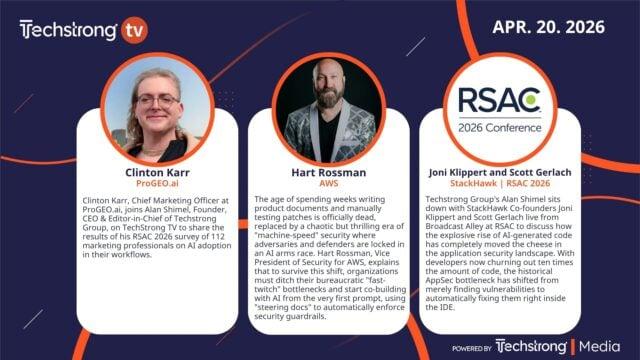
Techstrong TV – March 17, 2025
Watch our live stream on Monday through Friday, featuring exclusive news, announcements and conversations with IT leaders and experts on topics ranging from digital transformation to DevOps, cybersecurity, cloud native, containers and deep-dives into specific technologies and best practices.
Transcript
Hello everybody, and happy St. Patrick's Day in Cade Alta, which is Irish for a hundred thousand welcomes. You're watching Text Day.
Hey folks, welcome back. I'm Mike Vizard. Today we're gonna be talking about well open source AI coding tools around the horizon.
Then we're gonna have a chat about OpenStack is moving over to the Linux Consortium. And then finally, we're gonna talk about, well, what's going on with the Irish and technology? 'cause the president seems to be having an issue.
I want to introduce our guest today, starting with Tracy Ragan, who's joining us once again from New Mexico. Tracy, how you doing? I'm doing great on a St.
Patrick's Day, after all, with a name like Tracy Ragan. I should be doing great on a St. Patrick's Day.
And you know what tra, do you know what Tracy means? It means in Celtic it means brave defender. I always like that.
All Right. Brave defender of open source. Okay, I can go with that.
We shall see Sona. Well, you know, we like to say on St. Patrick's Day, everybody is Irish, but welcome to the show.
How you doing in Ohio? Thank you. Uh, good to be on the show, Mike.
All right, and Guy for the day, O Courier, how are you? Good to see you once again, my friend. Uh, I thank you.
Good to be here again. Uh, on St. Patrick's Day.
Uh, all I've got for you is the usual green wallpaper, which you can see back here. So sorry about that. But I left my green undershirt at home.
No worries. I, I, I can represent for everybody. But let's get started with what's happening with the Club Foundation.
They have launched a project, and it may take a few months yet before we actually see the, the actual ides that they're gonna build, but they're saying that they're gonna deliver open source ides that come embedded with AI coding agents. And, uh, what they're trying to do is have something that feels like a deep seek moment for open source ides instead of getting yourself locked into an IDE provided by OpenAI or Microsoft or whoever it might be. Tracy, I know you've been following this DevOps ai coding space for a while, but what's your take on what's going on here?
Well, you know, I, um, I did help start the Eclipse Foundation back in 2004. I was one of their first board members. Um, and this is something, this does not surprise me.
They have been very, very good at pivoting anytime new technology, uh, is, you know, shows up or is on the horizon, building, um, that platform to make it easier to use these tools has been always been a priority to them. So, yeah, this is, you know, this is, I hate to say it's more of the same, but it's more of the same, of the Eclipse Foundation being able to pivot that IDE so that it can support, uh, new development practices. Um, you know, I don't know exactly how to, what they call their, this AI platform, Thea, I believe, um, you know, and the ability to really develop software without, uh, any kind of lock-in has always been what they've talked about.
I think the only lock-in that they want is the IDE itself, but everything around the IDE should be pretty open. So, you know, being able for developers to be able to continue using an IDE that they have known and loved for 20 years, and be able to start building, um, and integrating LLMs into that, that model and that IDE, that's beautiful. So thank you Eclipse Foundation for doing that.
And that team is an amazing team, and they have stayed relevant for a very long time, so kudos to them. That's what I think. Yeah.
I is, is, I, I thought that, uh, part of what Eclipse does is enable developers to create their own IDs, though, or is that just a, um, a terminology? You, in this case, you can do both, right? They have, um, licensed the core code.
So in a way that if you're a vendor and you want to create your own IDE based on their ID framework, you can do that. Or even if you're an enterprise and you're that ambitious and you want to create your own id, you can do that, or you can download what will be a more, um, ready to use ID provided by them, Which is why it's so, it, the adoption is so strong and it's so sticky, right? That, uh, you know, there used to be several different ides before the Eclipse Foundation, um, came about.
We talked about a lot of different ides, and now, now we talk about too, pretty much Eclipse and Visual Studio. Uh, so, so they, you know, they're staying frosty. They really are.
They're, they're, they're starting to build in, um, the features that developers need and provide a framework for developers to be able to build AI AppSec. And that's what they've always done. And there is also a bunch of other tools that have, uh, come into the market, like, uh, Microsoft Auto Jam, SL Chain, um, there is also Crew ai.
They're all open source, and they are all supposed to help build agent AI applications on them. You know, I've been told that a lot of those tools that have come into the market are essentially forks of BS code, which is open source from Microsoft. And we seem to have tried this MO movement where we were heavily in open source for our IDs, and then when the folks came along with all these AI platforms, they seemed to like, take a lot of open source code, wrap some proprietary code around it, and try to pull developers into their own little ecosystems.
That seems like maybe a replay of a scenario that we saw play out over the course of a decade that's now happening much more rapidly. But I don't know, Tracy, are we past the days where vendors can lock in developers? It, it seems like it's a pointless effort.
I think it depends on what you're talking about, what, you know, what developer tool you're talking about. Um, I don't think we're past those days. Those, no, I would not say that.
Uh, I think there, the, uh, developers, I think what happens is that a culture begins to, uh, is built and an ecosystem is built around these developer tools, and that's what locks them in. I don't necessarily think that they have to stick with them, but I do believe that there is camps, right? There's the eclipse camps, there's the VS camps, and I think we'll see that in, uh, these AI tools as well.
And I think that the Eclipse Foundation is seeing that they need a, they should have a play in that. So, no, we're not past that. I think that's, that's gonna continue.
It's part of the, I think it's part of how developers work it. I was gonna say, it's cultural, right? It's cultural, and you get, I literally, I, I'm not kidding you, I used to carry around a little disc yet in my briefcase.
Well, we used to have to have briefcase that had brief on it. I ha I talked to developers to this day that don't wanna do anything except vi right? The hardcore, really command line types.
So, um, you know, that's a pretty heavy lock in when you carry your own editor around in, in your briefcase, where I would stick it in my purse. So I always had it. Yeah, we, we, we, we talk all the time about, um, quote unquote religion in these, like, you know, the religious, uh, it's cultural, it's really cultural, but this, this idea that, uh, you know, uh, uh, each developer and sometimes developer teams or groups within like Cabals or something within the developer teams have their preferred language platform, you know, et cetera.
Um, I don't think that, I mean, I don't think, uh, you know, the vs versus, you know, eclipse or whatever that it, it, it extends to that. Although, Tracy, you would know better than me. But, um, there, there's real passion around what the right way is to do all of these different elements.
And, you know, my sense is that, um, that it's really, it's more like vs and then everything else. It's more like Microsoft and then everything else. Uh, uh, Microsoft has a very cohesive system in a lot of ways.
I know I talked to a number of customers recently about, um, about, uh, how they're developing and even ones that are going, you know, cloud first open, whatever. Um, if their management has a significant, uh, investment in, in Microsoft from whatever productivity or an enterprise software standpoint, they wind up being Microsoft shops and, uh, um, at development wise. So I think that, uh, uh, what, what's really interesting here, um, is, uh, like you said, the, the quick moves, the swift pivot, um, of this open source community, um, to, let's say, you know, embrace and adopt and enable the use of ai, um, in an open and, uh, unstick way, except for, like you say, the stickiness of, of that particular project.
Yeah. They, they started with, uh, they integrated copilot pretty quickly. They didn't take much time to do that, for example.
Right. So long now, maybe this is just my perception, but I'd love to know what you think. Is the open source community catching up faster to these proprietary platforms?
I mean, historically, we've always seen them kind of catch up and then eventually surpass the proprietary platform that they originally created some version of, but I feel like that's happening much faster in the age of ai. Yeah, definitely open source. This, uh, the drive for AI is troubling, uh, open source even forward.
Uh, it has brought it front and center, uh, especially for developers and, uh, people who are really involved with ai. The development of it and open source going forward is going to play a bigger role than it does right now. 'cause people are tired of proprietary technologies being expensive.
And, uh, as you mentioned, the vendor lock-in is definitely an impairment there. And there are also certain data privacy concerns with, uh, proprietary technologies. And not to mention that open source offers a certain, uh, flexibility and transparency, uh, which are highly coveted, uh, with AI development, It has a cycle, though.
Open source has a cycle, um, and if we go into a recession, open source will be king again, right? Every time we have a a boom and there's a lot of money in the, um, uh, in the sector, o open source tends to be less, um, adopted. And then when the economy goes, starts slowing down, then open source becomes more adopted.
So there is a cycle to it. So the tools that stick like Jenkins are the ones that they're like, okay, we've built, spent all this time building around, we're not going to cha we're, we're not gonna swap it out unless we really have a compelling reason to do so. And it's sort of the same with the, the, uh, developer ID tools.
You really have to have a compelling reason. And that compelling reason may be we are a Microsoft shop, and I do see, you know, if they are, have been buying Microsoft Tools and they paid for a subscription, you're gonna use, uh, you're gonna use Visual Studio. But there are a lot of places that are there, eclipse, they have been for a very long time, and they're using Eclipse, and they're oftentimes an IBM shop.
So, there you go. It, it's an excellent point, Tracy, but I'm, I'm, I'm kind of wondering what's the, what's the consumption model for that open source? Because there's direct use, and then there's via, you know, a partner, you know, I mean, the classic Red Hat example of using Linux, but you're paying Red Hat for, um, for, you know, management and, and, uh, uh, you know, support and all that other sort of stuff.
The reason I ask is, um, direct use of open source may go up in a recession, but there's still a cost. There's a, there's an investment in talent and capability and that sort of thing. Um, and you either invest it directly, um, with hiring and training, or you invest invested indirectly through the, the partner model that I just mentioned.
And I think there's a fair amount of, um, enterprise level, let's call enterprise level activity, um, that doesn't do open source because they don't want to have that, uh, uh, investment burden. What, what, what's your perspective on that? Am I, I, so I think it's who the, who the buyer is, right?
When you're at, if you're, let's just, you know, I'll take the space I know the most development and DevOps, um, when you're at that level, you don't have budget authority, and your director might get money for you to buy additional tools, and you may have submitted for doing some, you know, purchase making these purchases. But if you don't get those, those funds, you're gonna go out and you're gonna start downloading open source tools regardless of what your, at the higher level, what they say. Jenkins is a really good, uh, case study for open source because Jenkins was out there getting implemented while other competing tools that were trying to do.
CI/CD had to go through this full process of being evaluated and having to be looked at by several different, uh, departments. There had to be a budget for it. And in the meantime, they implemented Jenkins, right?
So it, open source gets adopted regardless of what upper management might want to think or do, uh, because of that particular fact. If you don't have the budget and you can find something that will work in the open source world, you're gonna use it. There is definitely a shadow DevOps phenomenon, but I also think that it's not too long before a project, if it gains traction, starts to benefit from that flywheel effect where the number of contributors start to increase, the innovations happen faster, and this single vendor who has, you know, limitations in terms of the number of engineers they can hire eventually falls behind.
And I think that's what we're seeing in Linux, and I think we've seen now in databases, and it, I think that whole scenario is gonna play out in AI as well. But Guy, what do you think? Oh, yeah.
Uh, definitely. I, I, I think you're putting your finger on what was exciting to me about this particular news, um, I couldn't articulate until you just said it, which is, um, the, the, the force on our capability of, uh, a collaborative community. I mean, open source is, is extremely well understood how it works, how it should work, how to govern it, um, how to focus it, so to speak, while enabling all this creativity and everything.
And, uh, now that I think about it, uh, this is a terrific development in the, in the incorporation of use of ai, um, in, in coding, because so many eyes are gonna be on it. And all of these dangers and problems and issues that we've been talking about for what seems like over a year now, um, this is one way to, to address them for sure. Mm-hmm.
That's a really good point. Hmm. And so long, and I could be crazy about this particular point, but I feel like the mystery around AI is starting to fall away.
And I think people are starting to understand how it works, and they're not as shocked at odd. And, and as that happens, more people are comfortable using it and contributing and being part of this community. So, have we crossed some sort of AI Rubicon here, or are we about to, Um, yeah, definitely AI is less mystifying to the people, uh, as it was even a couple years back.
People are starting to understand the way it works, uh, how best to leverage it, and, uh, uh, they're discovering new use cases, enterprise use cases, and how to implement it. It's obviously there is still, uh, work to be done. Uh, but yeah, I feel like people are definitely, uh, have, uh, are crossing a threshold where they understand that AI can be valuable and, uh, the certain ways that it can contribute to business.
Yes. All right, Tracy, last question on this particular topic. Do you think anybody on Wall Street's gonna figure this out?
And there might be some impact on valuations as people start to realize, Hey, this AI stuff, it ain't that magical? Well, I think that they should be worried about the Tesla valuation before the ai, which is, I'm sorry, that's like a 87 to one, right? Their PO their ratio is 87.
That's just ridiculous. I don't know what open, uh, what like chat GPT is, but, um, I believe that the, those valuations will get, will increase as AI becomes more prevalent. And when you have a, uh, these IDs that are coming out to make it easier for developers to start using AI tools within their IDE, I think it's just gonna push the, um, the, the AI industry.
And I think that the AI companies are gonna probably have higher valuations because of it. And there'll be more out there and maybe, uh, fewer electric, electric car companies, they be want fewer anyway. All, all right, folks, you heard it.
Fewer, keep your eyes on this open source space when it comes to ai. 'cause it's gonna do some amazing things in the next couple of years. So Amen brother.
Amen. Just wait, just wait and see, and we'll be back in a minute. Discover Textron Group, the epicenter of tech innovation.
We are your go-to for reaching IT leaders and practitioners worldwide. Our secret impactful content that sparks awareness, engagement, and top quality leads with us. You'll access editorial websites, streaming videos, virtual events, custom content analyst research, and more.
Join our satisfied clients, let's revolutionize your tech journey. Contact us today and tell your story to the world in the most powerful way with Textron Group. Hey folks, we're back.
And we're talking about the move by the open infrastructure, uh, consortium. Our open infra, who was the steward for OpenStack and a couple of other associated projects is now gonna become an arm of the Linux Foundation, which is the steward for, well, not just Linux, but Kubernetes, and of course as Cloud Native Computing Foundation as part of the Linux Foundation, as is the, uh, cloud Foundry folks. So, you know, if you look at the Linux Foundation, it's a, an amalgamation of foundations, as you might say.
But one of the interesting things about all this is that it seems to put the OpenStack community maybe a little more closely aligned to where the maintainers are of Kubernetes and, uh, Linux itself. And so when you look at this so salon and you think we might see a, a resurgence of OpenStack, is something going on here? Is this the early stages of it, or is this just another move to save some cash?
Um, opens, uh, or OpenStack is in fact, uh, experiencing a resurgence, um, right now because of, of Broadcom acquiring VMware and then revising the pricing strategy. So now, once again, people are out looking for open source options. So that caused, opens OpenStack to have, uh, a sort of like a, should I call it a, uh, ssociation of sorts.
And, uh, uh, now that OpenStack projects are going to, uh, likely be a part of the Linux Foundation. And, uh, it'll live more closely with, uh, Linux, Kubernetes and OpenStack. And even with the, when Kubernetes became a huge success, even then, um, it sidelined OpenStack for a while.
So I think living closely with all the other big foundations, like you said, um, Kubernetes, then the CNCF, uh, arch Open search, it'll definitely help bring it back to the front and center of open source. Yes. Tracy, are you seeing any more OpenStack out there as of late?
What, what's, Um, I think it has a defined audience. Um, I'm not sure it's growing, but, uh, you know, I'm not in the platform engineering space too much, so I can't tell you if that's the, that's true or not, but I can tell you that, um, I, it does, this doesn't surprise me. This, uh, this kind of new partnership because it's takes a lot of work to manage an open source, uh, foundation.
It, it's, you know, it's, there's a lot of governance. There's a lot of tooling that has to be done on the backside to make sure that developers are, um, trusted, uh, you know, CLOs and there, it's work. It's a, it's a, it's a ton of work.
I don't think we would've ever pursued an open source project independent of, uh, something like the Apache or the Linux Foundation. So the, but the one thing I can say, and it's a, it's wrong to assume that because it's moves over to the Linux Foundation, that new open source contributors will join the team. And sometimes as these tool, you know, I don't know how old OpenStack is, but it's gotta be 10, 15 years.
I'm not sure It's 15. Roughly. Yeah.
15. Yeah. Rackspace, Rackspace originated it.
So it, it, it, you know, you get a lot of people stop contributing to older projects that tend to be slowing down, right? Uh, and so if they, I think a lot of the believe that they're gonna get more contributors are wrong. Well, that may totally be true.
A lot of the, uh, continuing development of OpenStack has been in, from what I can tell, uh, hidden from the wider community. Uh, OpenStack at one time was, was, you know, the open source rival to, you know, Azure stack, eventually Azure, well, yeah, Azure pack. Azure stack.
So the Azure approach, the Mware approach, these enterprise approaches, um, not to mention, um, you know, that that was pre outpost, you know, before, uh, public cloud vendors started to provide on-prem, um, options. Um, so I'm probably forgetting, well, a major platform, but, you know, Microsoft and VMware were, were, were, were the main ones. Um, and, uh, it, I would say around 2018, 2017, it, it, it underwent a marketing and a positioning shift, and it, it became, you know, so what happened was more or less private enterprise, um, to a large degree, um, went with, you know, sort of turned their backs on an open source approach to a cloud stack, and instead started to use VMware, the, the, the, uh, predecessors to VMware Cloud Foundation, VCF or more typically Microsoft.
Um, so for on-prem class, such as they were doing, the implementations just weren't large enough. The technical, um, the technical, uh, needs were a little high. There were a few vendors, like TIS is the main one I remember, that sort of took the Red Hat role for OpenStack and enabled OpenStack.
They had to shift. So that market went away. But what market stayed, the market that stayed was public, but to a greater degree, the telcos and the telcos have very large cloud implementations, um, where they are extremely technical.
They have very high, uh, very high performance needs, extreme low latency, extremely high availability, all those sorts of things where, um, having an open platform that they could use and, and fuss with and everything was really important. Um, I am not, I don't entirely know how to interpret this, uh, move. I think you have it nailed, probably Tracy, which is, um, running an open source project is hard.
There has been no real vendor side like it vendor sponsor since Rackspace stepped sort of down and away from OpenStack. Um, none of the telcos are really gonna do it. They're rivals anyway.
Um, so in the end, this is probably smart, um, from a, like you say, a management governance tooling point of view. Um, and they can all con, continue to contribute. And it may just be a little bit less public and obvious.
I don't think this signals some kind of, you know, new adoption of OpenStack at all. No, I don't think so either. But it will help them, like you said, the telcos, if the telcos become, you know, premier members of that new foundation and they're on the boards, then they can work together to move, um, you know, OpenStack in a direction that works for them as a, as a consortium.
Um, and the Linux Foundation is a perfect place to do that, Right? I'm gonna argue the opposite of that. And, and here's the three things that I think are gonna change that equation.
One is originally to guy's point, yes, the enterprise turned away from OpenStack. 'cause it was hard, it was complicated and it wasn't as easy to manage as VMware. But to along This's point, VMware pricing's up and people are looking for alternatives.
And OpenStack's gotten easier to manage from the various distributions that are out there. The second thing is the AI community is looking for ways to, uh, maximize utilization rates of GPUs. And one way to do that is to have some sort of framework for managing their usage, whether they're on premise or in the cloud.
And they're not gonna pay for commercial licenses to manage that stuff at the scale that they do. So they're gonna go look for something that's open source. And then finally, there is this whole movement towards, uh, data sovereignty.
And, um, and that's pushing, you know, I wouldn't call it a major trend as yet, but there's a lot of repatriation of workloads around two factors. One is the cost of running them in the cloud, and the second one is a lot of organizations are getting pushed to run more workloads and keep those data that they have in some sort of either VPC that's in a specific geographic region, or heaven forbid, an old fashioned on-premise data center that they run and manage. So I think there's upside here for OpenStack, but remains to be seen.
And I could be crazy. I think You're crazy. I think you're crazy.
So here's the thing. Here's the thing. There is real potential in, uh, vendors that specialize in edge computing in one form another, to utilize this.
I could see that the repatriation, in other words, when we're thinking on a sort of, let's say a cluster level deployment, um, for, uh, uh, an, an enterprise in the scenario you're describing, which is an increasingly common scenario, they wanna bring the, the compute to the data, and they want to have control over the, the data, and especially sort of, let's say it's movement or what have you. That all makes sense. I think that a great deal of that is going to be solved.
Um, you know, using, you know, on-prem, um, and colo, uh, outpost, well, outposts without, without a capital o of, um, public cloud, uh, Microsoft already, this is a huge part of their business model, frankly. But Oracle is getting to this game as well. Um, so that you get, there's, there's this sort of enterprise managed answer to that repatriation problem.
Now, is that a lockin type of scenario? Yes, it is, but we just circle back around to the original reason, um, for OpenStack, you know, pulling back from, you know, general enterprise adoption and use, which is, it's just a really complicated thing to deploy, run, and participate in. And that doesn't change, Mike.
So that I think is a more governing force, and therefore, you're crazy. Ditto guy di Crazy. Come on, take it.
No, I, I, I agree completely with what, what guy just said. Um, we both said you're crazy at the same time. So, So, so an edge.
So an edge vendor is still providing, it's, it's just not lock in into a cloud stack, right? It's not lock in into, they, they can do all the things. They can provide turnkey or, you know, uh, o uh, what's usually called transparent, but frankly is opaque integration.
So integration, you don't have to worry about or see your manage back to all three of the biggies and, you know, other clouds and all that other sort of stuff. The proverbial slide in, you know, switch it on, you know, stack. I mean, Kodi, uh, it's a Kodiak, uh, who is it?
Um, there's a great vendor out in, out on the west coast, I'm gonna remember their name too late, that does this sort of thing. Um, and, uh, uh, you know, they can, all those folks can run OpenStack and, and invest in OpenStack and be part of the OpenStack community and the, the, the, the end customer there doesn't really need to concern themselves with it. Um, uh, oxide computing is the one I'm thinking of.
Um, so that is possible. Um, and I think there probably will be some edge companies that take that approach, but it's not gonna be so significant from a market standpoint. All right.
I, I, yeah, Brian and Tracy are beating me up. Can you help me out here, or no? Well, I'm with you on the fact that, um, yeah, OpenStack, the OpenStack ecosystem itself has like, sort of come into back into focus since, um, especially with the telco companies in the recent years.
Uh, be especially driven by, uh, VMware's price increases. Uh, and, uh, yeah, definitely. Um, it may not necessarily become the thing or, um, you know, like, uh, it's not probably gonna be, um, gonna catapult, uh, in, you know, in a, in a significant way that would, you know, um, get, uh, sidelined other solutions that are out there.
But yes, open source is, is not easy. It is, it is a lot of work. Uh, but I still think, I still believe that, uh, it is, uh, sort of coming into the limelight once again.
And people are looking for alternatives. And either it's driven by, uh, cost concerns or, uh, data privacy. Uh, it is definitely, uh, going to be, uh, more in prominence, uh, especially with, uh, AI being in the mix.
All right, well, hopefully somebody will come along and make OpenStack even easier than it has been of late. Hey, I can see a world where maybe those AI agents are making OpenStack easier to deploy and manage. So who knows?
We'll see what happens. But just Keep getting crazier and crazier. Mike, come on.
It's not, it's possible. I don't know. Would that be so open question?
Would that be a good thing? Do we care to make OpenStack easier? I mean, I, I, I love OpenStack.
I, I, you know, help build and market solutions, um, based on OpenStack, and I loved working with engineers and product managers. It certainly helps some small companies, small. If OpenStack were easier to implement it, It definitely would.
Yeah, definitely Would. So, uh, let me come halfway to Mike. Let's, so let, let's say this, let's say that AWS and Google, and, you know, these cloud providers continue not to help us manage our costs, right?
We've talked about that before on the gang, the hidden costs and how hard it is to manage those costs, be able to figure out what director, you know, is using the funds and more companies start going to privatizing their environment. Then I'll give OpenStack, um, some breathing room, because that would probably be the tool that most people would use if they are not going to an alternative. But I think that this point, the cat's out of the bag, and most companies are going to, uh, use an alternative like AWS or Azure or Google Cloud, and then it's not even a question for them.
As guy pointed out, they're not having to deal with the, you know, their own, I don't know, persistent storage of, you know, for VMs, for example, right? So that's, they don't even have to think about it anymore. And that's kind of the point.
All right, I'm gonna quit while I'm ahead 'cause I'm only half as crazy as I was two minutes ago. So that's, Wait, I have something more to, no, go ahead. All right, folks will be back in a minute.
com is the leading resource for news analysis and education on challenges facing the cybersecurity industry. com covers all aspects of cybersecurity, including data security, DevSecOps, cloud security, application security, network security, security threats, and more. com has the largest selection of security content featuring breaking news, blog posts, podcasts, and more.
com to learn more. com. Home of security bloggers network.
All right, folks, we're back. And we're gonna be talking about, well, there's a big conversation going on in Irish circles these days. And full disclosure, that's Michael Patrick Bazar to you.
So, you know where I might be coming from on this particular topic, but, uh, the president had the t-shirt of, uh, Ireland over T Shook is, uh, Gaelic for Chief, which is their equivalent of a prime minister, and, uh, paraded him along with the rest of Europe for quote unquote stealing US companies and specifically citing, uh, pharmaceutical companies. But tech companies are also in there. Uh, there's a lot of European, uh, operations for US companies where they, uh, store their tax dollars.
4 billion or some big number like that. But, um, the point is, is some people are saying that Ireland is a tax haven. The Irish respectfully disagree.
They're just offering advantage taxes that are at a lower rate, and it's actually US law that enables all these companies to set up these operations in Ireland or elsewhere. And it's not their fault. They say, if you wanna fix it, you gotta fix it.
On the US side, um, this has been going on for a while. Accenture, I don't know if you know this guy, but the worldwide headquarters for Accenture is in Dumbo, and they have like six, Uh, the worldwide headquarters for Dell Technologies, where he used to work, uh, is or, or was quite some time and dealt with as well. Yeah, the, the European headquarters is over there along with Google and everybody else who's got, uh, a US operation or, or US company.
And then what they do is they keep the revenue from Europe there, and they don't repatriate that back to the us. So it's not subject to US taxes. And this is an ongoing conversation.
Now, the Irish have benefited from all of this because there's now a reasonably thriving, uh, software ecosystem of Irish companies. There's at least a couple of hundred out there. They're small, but they're fledgling.
But there, what's your take on all this guy? Are we gonna see the US kind of try to essentially put the screws to the Irish here on St. Patrick's Day?
What's going on? Maybe not on St. Patrick's Day.
Um, maybe tomorrow. Maybe we'll just announce it today and do it tomorrow. Um, the US administration seems to be intent on putting the screws on everybody.
Um, so sure I could see that happening. Um, and, uh, depending on the reaction from, let's say the markets or something like that, or with the specific companies, uh, you know, I could see them withdrawing any screws that they put to, uh, uh, the Irish or the EU in this, in this, with this approach. Um, I have three reactions to this.
Um, the first one is, uh, um, tax Haven or No Tax Haven. That's kind of a semantic discussion. Um, Ireland had three and has three terrific advantages, one of which was a more favorable tax policy to corporations there.
And the lack of a requirement, as you say, to, um, uh, unlike, unlike US citizens who have to report their personal global income, uh, companies who are based out of the United States do not need to do the same. So they didn't need to report revenues and profits from Europe or anywhere else in the world outside of the United States. So that was one advantage.
The second advantage was, uh, at the time that a lot of this investment started, um, the, you know, overall Irish economy and, and, um, I don't remember this economic terms for this, but, uh, the, the, the labor and the various costs were fairly lower than certainly the rest of Europe and less than Canada and the United States. So it was at attract, it was, you get sort of more bang for your buck investment there, whether it was hiring or building or renting office buildings or any of that other sort of things. So that was the second advantage.
And the third advantage was a highly educated pool of, you know, a potential workforce. Um, and Ireland very rapidly, uh, uh, became one of the world leaders, particularly in software development, I think, but also in other areas of tech development as well as in pharma and, and other sectors. So I had all those advantages and the capitalist system, we work in that advantage, those advantages are going to attract investment, but also, uh, because of the first reason, you know, companies went over there.
Um, so if Trump is blaming them for companies, being over there and paying taxes over there and not paying them here, blame the Irish that is guilty is charged, and we should be proud of that. I'm not Irish, but I'm proud of it for the Irish and for you, Tracy, for Salimen, for everybody else who loves Ireland. My, uh, second and third reactions are pretty simple.
The second reaction is, uh, you know, um, our own domestic policy right now, um, doing, for example, threatening the CHIPS Act that was intended to bring a lot of investment onshore and capability onshore in the United States, threatening to bring it to an end one way or another that's gonna push business and work overseas. So we're doing lots of things like that right now that has nothing to do with it's Ireland or China or anybody else. So we are making other places attractive to build and sustain business.
And, uh, the third reaction is, I never really know on, uh, what the current administration means or doesn't mean. Is it messaging? Is it, uh, some, it all has strategy and policy implications, but to say that there's a policy going on here and to make predictions about what the outcomes are gonna be, it seems to me a be a fools there end, at least at this stage.
Maybe later this year or next year or something, things will solidify, but right now things are changing too much. So I wouldn't make any bets one way or the other right now. In fact, I think like a lot of folks in the market right now, I feel like we just sort of need to retreat and protect ourselves.
Yeah, Trump, yeah, Trump himself once said, you know, he was asked, you know, something about the fact that he really didn't pay any taxes. And he said, that's because I'm smart, right? So smart people are just taking advantage of these tax laws and they go between countries and states, right?
States do this. Uh, you know, there's been counties who have have said, we're gonna charge a less tax in our county if you open up a a business here. I am sure that Donald Trump himself have gotten tax breaks from, you know, Chicago and New York when he built, uh, properties there.
So he knows this game and he understands it. And as Guy has pointed out, why is he just not playing the game? Why penalize anybody for playing the game?
Why doesn't he just play the game better? And we already have some, you know, uh, budgeted, uh, policies put in place to better play the game, like the CHIPS act. And he is, he doesn't wanna pursue it.
So it's very, I find it very frustrating. I really do. And, um, you know, maybe island's a good place for deploy, But, but to guy's point, that's a threat.
Tax code's a mess. I mean, that's why there is a game, there's a game in the first place. 'cause the US tax code is a mess.
So why don't we just fix the tax code and then all these other issues will take care of themselves. But we don't seem to have any political will to do that guy. Uh, no, we don't.
I, I comment on that. That's why we obvious. Uh, So, so we'll just keep playing this game with forever because nobody wants to address the core issue.
So lemme ask you something. Do you think that the US is becoming less attractive place for IT professionals to wanna come to work from around the globe? Right?
There's been a history of, uh, people come here to go to college and they get educated and a fair number of them stay and take jobs and generate a lot of taxable income. But I feel like, you know, more and more of those folks are coming to college and going home right after, Right? Um, there's been a lot of tightening of regulations around student visas, what they can or cannot do, or if they can switch over to another kind of visa that would allow them to work in the United States.
So that has definitely dampened the enthusiasm, um, anywhere in the world. And, uh, students who are, who have formally wanted to come to the US study in an US university and then eventually find work here and make a life for themselves. Um, so it's really, it's coming back to the Ireland discussion.
It's really not. Ireland is the same reason any, anywhere in the world. Companies have set up shops.
Uh, ES Island has the lowest, um, uh, corporate tax rates, and then it has, uh, easy availability of, uh, highly skilled, uh, workers. It's the, uh, it's same with, uh, China or India. 'cause for years, uh, companies have, uh, you know, set a basis in those parts of the world where there's easy availability of talent and, uh, the cost is cheaper.
And so, uh, yeah, I feel like there would be, uh, as much as the, uh, attempt is to bring back business, uh, to the US soil, I think, uh, it would, the US would benefit if they, uh, fix their tax, uh, regulations in such a way so that companies find a reason to set up shop here as opposed to going offshore. And, uh, definitely right now, the thing that is happening with all the visas and stuff, it's definitely giving re people less and less reason to come in And less reason to invest here, right? Yeah, yeah, Yeah.
Chaos. You know, there disruption in chaos and, um, the not knowing, uh, is in the future, if we keep up this pace in the next four years, we won't have a lot of new investment coming from outside of the us. There's lack of certainty.
Uh, which is also one of the things that's discouraging a lot of people to really turn to the US as a favorable place to put their money in right now. And meanwhile, if you look over in places like Ireland, they have many, many, many more job openings than they have ability to fill them. So you might see a lot of folks stopping to go work there.
And if I can put a, uh, a, um, a rosy spin on all of this, or, or the silver lining, if you like, um, which is really unusual for me, I don't know why I'm doing it. Um, the, the supply chain problems we experienced during the pandemic that caused this sort of, uh, anti-globalization set of policies and politics too, actually, and it, or at least accelerated those, um, don't apply quite as much to the digital economy, if at all. Um, certainly you need physical cables underneath the ocean to, uh, take the Irish work product, uh, in software, in the software sector, just to take a simple example.
Um, so you need something, but you don't need shipping. You don't need things that are as vulnerable to, um, as vulnerable, not invulnerable, but as vulnerable to things, you know, global disruptions like the pandemic had on global shipping and so forth. So, um, the point is this, this allows, uh, US companies and US organizations and US individuals, even if the investment is not happening here in the us, we can still take advantage of, uh, that work product.
Um, except for one thing, of course, which is tariffs, which just makes me exhausted even say the word. But, uh, the, the, I think the tariff scheme, again, won't know any year what, where that's really gonna shape, uh, shake out. Um, but my point is that, you know, I think slog me, you're, you're perfectly right about like sort of the dangers within the US for vendors, producers of this same kind of service and product, but the consumers of it in the United States, um, are probably going to be able to take advantage, and that's a good thing.
All right, folks, back in the eighties, the Irish government used to run ads in publications like Business Week, and they would have these pictures of these newly minted graduate students and their gowns, and then the, the, the coffee underneath it said, hire the Irish before they hire you. Well, here we are, folks. I wanna thank you all for being on the show, guy.
Thanks for your insights, slog, Sloman, good to see you as always, Tracy. I, I, I don't know about you, but in about 30 minutes, I'm gonna be marching up Fifth Avenue in Manhattan, so I'll see you later. Aw, That sounds like fun.
That's Enjoy your Irish day. All right? And as they say in Ireland, slang goole, which is galing for goodbye, until we see you again, thanks very much.
This is Textron tv. Hey, everyone, we're back here at Shan in sunny Orlando. Welcome to our coverage.
We've been tell you, we've been speaking to some great people here at Shan. We've had some great conversations. I think this next one will be a great one as well.
Let me introduce you to our guests, first of all, on the far right. Uh, it's Javier. I'm gonna mess up your last name, Javier Inti from Inti, Javier Insunati.
We're gonna call him Javier today. And if you couldn't tell from his shirt, Javier is with Hewlett Packard Enterprise, HPE, as we, we call him. And, uh, Javi, welcome and thanks for joining us today to my immediate right.
And how great was this? She wore her green shirt because we're playing this on St. Patrick's dad, uh, Nathalie Herrmann, also of HPE.
Yes. Hi, Natalie. How are you?
Good, how are you? Good. You know what, let's start off.
Let's tell people a little bit about what each of you do at HPE, what your roles are, and then we'll talk about SCON and HPE and what's going on. Avi, why don't you go first? Good.
Sure. So, uh, first thing, I'm, I'm working in EMEA, so I travel all the way here from Cze Republic Ban. Really?
Mm-hmm. Um, what I'm doing is I'm focusing on cloud native computing solutions, and my main focus is, uh, SUSE solutions on the cloud native computing part inside of HPA. It's an exciting time to be.
Did that particular role, Natalie, how about you? Yeah, so I am the Alliance business manager, uh, for Susa and SAP in North America. So I work closely with our MCS team for mission critical solutions around SAP, and then, um, also around rancher, some of our edge opportunities.
So really getting, being the liaison between HP and sussa so we can work, get our teams working closely together with customers. You know, there's been a lot of news here around the sap mm-hmm. Suse relationship, and unfortunately we didn't have anyone from SAP yet.
Yep. So, I'm gonna ask you to kind of carry that baton and, and talk about us a little bit. There's certainly been a lot of news around Cloud native though, right?
I mean, uh, the, the big thing for me was the DevX, uh, kind of framework, you know, prepackaged stuff. Javi. What, what's been your take on, you know, the cloud native scene or the cloud native news here at SUSE Con?
So, one of my main focus on my role is, so you, you know, HP and SUSE have been, uh, in a relationship for 30 years, and that relationship has been focused. You called That a commitment. Yeah, definitely.
I mean, since the beginning, basically. Uh, and that commitment is very, very strong. So, uh, we have, HP has the most performing computing in the world called El Capitan, and it's running, K-O-S-K-O-S is the operating system that we have co-developed with suse.
It's based on SUSE for hp. Really? I didn't know that.
Yeah. So the most performing computing in the world is actually running a co-developed product with HPE and suse. I mean, I know for a long ti, you know, there was that period, and I guess it's still ongoing, but everyone was racing to have the, the, the best supercomputer and, and it was really a lot of parallel processing, and I didn't realize it was, it was SUSE under the covers of the case of the HPEL Capitan.
Yeah. Yeah. Excellent.
Uh, Capitan Frontier, and I forgot the name of the third one, because we have the first three, so very strong relationship, and now we are seeing how the market is moving towards com, uh, Cloudnative Computing, right? And we continue that, uh, collaboration with them. Um, as I said, one of my main focus, I'm a solution architect, is try to enable, uh, the, uh, the HP community, whether they are, uh, pre-sales community inside of hp, but also all the partners to articulate the message from the cloud native computing part.
Because we, we also, we work with many different organizations, uh, and they're, they have all of them, they have different ways to modernize their applications. Some of them are going very, very fast, but many of them are going much slower. So we need to help these organizations make that move and SUSE treats.
Absolutely. Perfect on, on that part. I love it.
Um, what did you think of this architecture? Did you get a chance to look at this new cloud native a, the DevX architecture? I didn't have time, unfortunately.
I've been focusing on, so one of the main focus we have right now is the SAP. Oh, yeah. Obviously, because HP and SUSE have been collaborated a lot, uh, with the SUSE part.
So I've been focusing more on that part because it brings both words together, the SAP business and the SUSE business, and we, we see that this is going to be a great opportunity because we have a big, uh, big amount of customers that are using SAP, and this can be the first step of modernizing part of their, of their stack. Absolutely. Natalie, I'm going to, uh, come to you explain to our audience, because as I said, we haven't really covered the SAP kind of announcements and what Javi here is talking about.
If you can explain this to the audience. Yeah. So there's obviously a lot going on with the SAP landscape right now.
I mean, SAP's main initiative is getting their customers to move to rise. Um, with both HPE and suse, uh, we can definitely support that, but there's a lot of customers that, um, need to do some modernization before getting there. So with HPE GreenLake, um, we're able to help customers move to that RISE model.
Um, of course, with the assistance of suse, um, we've got the LES for SAP that's really going to support those HANA applications. Um, there's, like Javier mentioned that long-term relationship, I mean, SUSE and SAP and HPE have been in toge in bed together for 30 plus years. Um, it's somewhat running itself at this point, but, um, constantly making sure that we're keeping our customers, um, up with what they need for, uh, for SAP, having live patching, having SUSE manager to be able to manage the different oss, um, with the Edge integration cell, that's super interesting to see how we can help customers take their data from, um, offline, putting it back online without too much disruption.
So I think it's constantly improving. Um, those SAP applications are not easy to manage, um, especially when it's a mission critical. Um, so to kind of taking the guesswork out of it, the downtime, the scalability of it, um, all things that we can offer through HPE GreenLake, um, and Susa being under the hood is the main OS for SAP applications.
So I, I'll tell you, people out here say H-P-E-S-A-P, Susa OSA been together for 30 years, and it, you know, it is almost on autopilot. Mm-hmm. But I think at, at the surface, one could say that, but when you peel that onion back a layer or two, there's so much new stuff going on too.
Right. So, for instance, I, I know we covered on Techstrong again a couple weeks ago, you know, SA P'S coming out with agents, ai, AI agents, yep. Right.
To, to start really accelerating some of this stuff. SUSE continues to push the bounds on making cloud native easier to manage. Right.
That whole stack, HPE doesn't sit still either, right? They're also pushing the boundaries every day of whether it's using a AI processing, GPUs and so forth, or just better scalability and maybe taking some of that bump that that lift out of, you know, spinning up an SAP. I mean, it, it's, it's not a trivial thing.
No, it's not that you guys will ever make it not No, but, but still it could be made easier, it could be made better. And, and so there is, it's, it's not static. Mm-hmm.
Right. It is a, a dynamic landscape. I'm wondering, what are you hearing in talking to maybe some of the customers here, the other partners, what, what has been the feedback, if anything, you are hearing maybe some of the other alliance partners or, or some of the end users?
I think a lot of customers, um, are not fully aware of their choices for deployment for their SAP applications. I agree. Um, I mean, whether it's hybrid cloud on-prem, public private, um, it really just depends on which SAP application they're focused in on.
Specifically for HPE, with our mission critical workloads, we have our superdomes that are best in class. No other, um, competitors quite have what we have in terms of the superdomes, especially when it comes to the sizing of it. Um, so I think it's really educating customers on what we coin it within HPE is the power of choice.
Mm-hmm. Um, you have RISE and then you have non rise, right? So from there, that's kind of the first question to answer and which, which direction are you going?
And how can HPE help you? And I think, like I said, the main thing is public and private cloud deciding which workloads you need to keep on prem versus which you can, right. But not after that edge integration cell comes in, So it's not mutually exclusive.
Right. Right. Exactly.
They're Flip flopping. I think that is, I think that was a problem with adoption in cloud in general, is people made an either or bet it had to be one or the other. Yeah.
And it really shouldn't be. Mm-hmm. You know, as I've gotten older, I've learned always use the best tool for the job.
And there are some jobs that lend themselves to a public cloud, some that lend themselves to a private cloud, some, you know, and it's a relatively newer thing where let's run some of this out on the edge. Right. And not everything has to find its way all the way back to the hyperscale center.
Uh, but things that do you, you know, and, and there's a, it's kind of a rhythm to that, if you will. Right. But it, it is hard.
I was talking earlier with some people, you know, look, the cloud native computing foundation has 200 projects that they're managing 200. You look at that landscape and you say, okay, I, I wanna run SAP on a cloud native stack, you know, your eyeballs, like a slot machine, start going. Right.
And that's really what I think they look to HPE for, to come in and say, Hey, we got, we could do this for you. We got this. It's, it's not, don't be fooled by the 200 projects out there.
This is, I don't wanna say prepackaged, but Yeah. You know, we, we build solutions, Right? We build it for you.
We build a solution. And, and also Natalie was mentioning, we build it to the need of the customer. So with GreenLake, what we do is we have a completely hybrid cloud platform in which customers can decide whether they want to have only infrastructure So, uh, for customers like that, uh, today we were presenting, uh, there was a, there is a collaboration with SUSE and Infosys for SUSE ai, but we also have solutions that cover the full, uh, stock.
So you want to have a an RTVI intelligence platform. We have, uh, private cloud for business enterprise for ai. Mm-hmm.
Uh, that we are able to fully manage fully. We will deploy it, we will manage it, and then the customer only needs to care about the application that they will run on top of that artificial intelligence platform that we have already created. So that is, is it brings a lot of, uh, problem free.
So we, we give flexibility as, as you were mentioning, there are going to be best options sometimes in the cloud, sometimes on-prem, and sometimes you are need to have something that is in the middle. Um, yeah. At hp, what we will look is what will be the best for, for these things.
A clear example now is, uh, you, you, you probably heard that there are some people trying to move their VMs somewhere else, right? I don't know what's making them want to do that, but yes, I've heard something about it. Me Neither.
Me neither. And, and this is clearly, this is clearly a, a place where we collaborate a lot with, uh, uh, with suse. Why?
So we, at hp, we have created our own platform for orchestration of, uh, VMs. Mm-hmm. So customers are looking at transactional change.
So they want to move their current VMs to another environment and have their under control reduced maybe the cost. Um, they, they, we have HP VME that allows to, to do that. But what happens to those customers that they want to modernize their applications, that they are already thinking about, okay, so this is a great opportunity for me to change the way I do things.
So I Re architect. Yeah. So I'm, I'm going to re-architect of course.
Obviously you can go to a customer and I say, Hey, modernize your application is a big task because they will need to change the processes the way they do things. But if they're willing to do that move, we'll be able to go with them. Um, in that case, user virtualization will be a referred, uh, fit.
So H-P-V-M-E can help many customers, but we also collaborate with many partners, including to be able to bring to the market products, likes virtualization that fit where we at HP are not able to get there. And another important thing, and, and with that, I let other people talk, is that we don't only have a SUSE products. We provide the support for suse.
So they are our products. We have a lot of, we have people trained, so you have native for, we have native support, level one, level two. So customers rely on a single point of contact.
They call us, Hey, we have a problem here. Is, is it the hardware? Is it the solver?
Don't worry. We'll figure it out. And if we need, then we'll contact suse.
So they do the changes in their code. Well, then that's the essence of a great partnership. But, but I, I wanna come back to the main point you made there, which is, we're at an interesting juncture in time.
A lot of people are looking at choices around stacks around infrastructure. You know, uh, we, we've used hypervisors now 25 years, well, more 26, 27 years. But at the, at the time when you're gonna maybe start changing hypervisors is the perfect opportunity to say, is the architecture of my application forward thinking?
Or is it also 25 years old? And while I'm doing this, this is the time to maybe, uh, uh, not multi mic, to go to a microservices architecture to go to a cloud native architecture. Whether you run it on a hypervisor or you wanna run it on bare metal or, or, you know, something else.
Mm-hmm. You've got choices. We have more choices today than I think we've ever had.
Yep. And that's the key. Now, the flip side is sometimes choices can be overwhelming.
Mm-hmm. Absolutely. Right?
And people say, I just want, what's the best one for me? Mm-hmm. And that's when they look to an HPE, you know, in a deep partnership with an SAP and a suso to say, okay, I want the least painful path.
I want the most scalable, I want the most secure. I want best practices. Right.
I want, and, and that, I think that's the essence of a good partnership, right? Yeah. And as an alliance manager, you, that's exactly what you have to do.
Um, so Scon wraps up tomorrow. What's next for you guys? Oh, we've learned a lot here.
Um, I think my focus, like I said, is between being Alliance Manager is definitely to get these teams a bit closer together. Um, I think that there's work to be done around the Edge Integration cell, um, and broadcasting that message to customers. 'cause it's a new feature that we can offer, um, around SAP, but also virtualization being such a hot topic right now.
Um, HPE just launched VM Essentials, um, SUSE rebranded, uh, their virtualization. We have this AI Infosys emphasis messaging. Um, if we can just tie that all together.
I think I said there's two buckets. The SAP and then the virtualization world. Um, I'm looking forward to working closer with the HPE teams from an edge deployment perspective, um, since that's the new and fun thing, so Well, yeah, it is.
Mm-hmm. There's always something new in fun and tech. Yep.
Javi, how about you? So, on my to-do list, uh, the most important part right now is going to be on the Edge integration itself for SAP. And one of my first goals is going to enable the SAP community inside of HP to understand why Rancher isec create Kubernetes platform.
Um, and, and that, that's gonna be a long trip because, uh, we, we have to, our SAP team is focusing on our more analytic application, and I'll explain them about microservices and how, uh, rancher can help, uh, with the Edge integration platform in. Yeah. Excellent.
Well, guys, thanks for coming on here on Techstrong tv. We appreciate it. Right.
Um, enjoy the rest of scon, enjoy the Orlando weather, and we'll stay in touch. We'd like, we'll get updates on this. Okay.
Sounds Good. Thank you, Avi. Natalie, thank you.
Hey, we're here at Scon. We're gonna have more coming out. You stay tuned.
We'll be back in a moment. This is Textron tv. Hey, everyone.
We're back here at S Secon and man, what a great couple days we're having up in Orlando, meeting a lot of different people. Our next guest is Peter Smails. This is with s Peter.
Welcome to Textron tv. How are you man? I'm doing very well.
Thanks for having me. Absolutely. We Are having you some fun in Orlando.
Yes, we are, man. Peter. Well, let's start with this.
What do you do with suse? So, I'm the general manager of our cloud native business. So essentially I'm the, I'm the, you know, myself and my team wake up every day thinking all things cloud native.
Isn't everything cloud native today? It's, uh, not quite. Not quite.
It's running everywhere. Funny. It is.
It's obviously a very strategic area for, for Susan, for a lot of organizations. It's a fun time to be in Cloud Native because it's, it's all about modernization. It's all about helping organization move forward.
So we're having fun and, and it's been a good week. Absolutely. You know, I was talking to one of your partners last night, Porter Work.
Oh, sure. Yeah. From, uh, pure.
Yeah. They're a part of the announcement. Yeah.
Yeah. And I, I was showing them we, you know, we'll be a cube con next month. Okay.
Yeah. See you there. Been next month, it's like two weeks.
It's Two weeks. No rest for the weary. But then in July, every year we put on a virtual event on cloud native.
This year it's cloud native now, which is our cloud native site. Okay. One for the road.
Because the interesting thing about cloud native now, it's not necessarily even in the cloud anymore. It's everywhere. Yeah.
It's on the edge. It's in the data center. It's, it's everywhere.
Right. You running on bare metal, whatever you, you know, whatever you wanna run it on, you can run. And, and it's not just Kubernetes or even containers per se.
Yeah. It's observability. It's mesh, it's, it's con native security.
There is so many aspects. It, it, it's compute. Yeah.
That's what It's, it is, it is. Today's compute. That, and that, again, Tyler, sort of tying it back to one of the key themes for us this week, you're, you're absolutely correct.
It is, it's ubiquitous. You know, use whatever term you want. Cloud native is everywhere.
People are running mission critical and business critical workloads, multiple data centers, multiple clouds, multiple edges, you know, et cetera, et cetera. So, one of the things I talked about, one of the key themes for us this week is this notion of, it's a computing everywhere. Like, computing everywhere is the new normal.
Yeah. And so for us, what's cool is sort of two themes to take away from that. One is that it's computing everywhere.
Sounds really, really simple, but it's actually complicated. It's sort of one of the cornerstones of our value is that regardless of what you're running, where you're running at, what cloud, what distro, et cetera, we give you that simple single unified management experience. So sort of, you know, theme number one is it's computing everywhere world.
So, you know, the infras there, you can run all this stuff everywhere. The key is simplicity at scale. Okay.
So a lot of that is, is infra, infra, you know, structure centric. And another key theme for us this week is sort of like, now it's actually becoming a lot about, to your point, it's not that it's not about infra, but you know, it's about security. It's an insecure world.
You know, it's about observability. You need problem determin, you know, problem, determination, remediation. It is about workload capture.
So we talked this week about integration with TE certification with temenos. We talked about certification with SAP applications. I mean, talk about convergence of sort of traditional on-prem workloads.
SAP is a hybrid cloud strategy. You know, we play that on-prem part with our SAP applications. So rancher for SAP.
Um, so, and then obviously work a key big workload as well is the VMware migration stuff. So, to your point, infra is kinda like yesterday's news. Yeah.
Because it's ubiquitous. And now it's about workload capture and the security requirements, the observability requirements, the certifications, the GRC to be able to keep driving all of those workloads and consolidate them ultimately on our, this is my pitch. You know, basically we want to be the platform for every organization's cloud native strategy.
So it's all about driving work, capturing those workloads. I'm glad you brought that up though. Cool.
'cause I gotta tell you, last night, well, yesterday evening, I was down in the, uh, solutions. So Yeah. Showcase, they call it, right?
Yeah. And I had, I, I know and Andreas for a Long time. Oh, okay.
Yeah. Cool, cool. So, and Andreas brought me over to some folks and they gave, gave me a demo.
Yeah. Not had a demo. More of a presentation on, let's call it the whole SUSE stack.
Yeah. From the Linux to, to ranches, K eight, to, to the, the, the, was This red validated design. Was this the, you showed you the val.
Okay, cool, Cool, cool. And then everything, I don't know if people out here really realize, 'cause I walked away from there. I was with Mitch Ashley, who's a mm-hmm.
A, a analyst with FU and Yep, sure. Friend of mine for hundred. I said, Mitch, I'm not sure there's not more than one or two companies in the world Mm.
That have this A to Z Mm. Cloud native story. Yeah.
Yeah. I mean, the fact that, and I, you know, I don't know how much of this you're really, I, I bet you are. But you know, like for instance, your own registry, where your containers are not just stuff you're pulling from repos all over, but you're repackaging them.
Mm-hmm. Scanning them, securing them. Oh Yeah.
No, you're, You're making them available. Right. So it's like, it's almost a close.
I know you guys are open, big on open. No, No. But let's, It's a Closed system.
Let's go right down that path, because you're touching on a really important theme for us. Mm-hmm. So, back to the discussion about infra.
So one of our, one of our big themes this week as well, so I talked about compute everywhere. Yep. Check.
Okay. We talk about how it's an insecure world. Yep.
Check, we've already covered the VM modernization move is on. And then we talked a lot about developers need more. Okay.
And so we have always been, Susan has a, you know, we have a huge reputation in develop, in providing developer tools. So rancher, desktop, you know, massive deployments of rancher, desktop fleet. More recently with application collections.
So we, and we, and we added private registry, which is based on harbor. Yep. We added the virtual cluster management.
Yep. Via UI extensions. That's powered by K three K.
So open source heritage, excuse me. But the important related point is, this week we introduced DevX validated designs. Yeah.
Which is where you were going. Yep. That is, you Got it.
Which is a big deal for suse. 'cause Yes, of course, we're choice composability flexibility. Absolutely.
But we can also be opinionated and prescriptive because there are, there are communities of developers, they want an A to Z. And so this was an excellent, for number one, a great forcing function for us. But number two, to your point, it is having exactly the impact that you're talking about right now because people see this.
And Yeah. The first, the first validated design, see if I can remember 'em all. So it's, yes, it is sle, it's based container images based on sle.
Yep. It is a GI ui. Yep.
That has special projects that we built in. It is, um, let me think. We have the, um, we have the OCI artifacts.
Okay. We have the OCR artifacts delivered securely through application collection. So you're talking about zero C-V-E-O-C-I.
So we're protecting those. You have security suse observability built in. Okay.
There's fleet. Yep. There's RK two.
Yep. You put all this stuff together to your point, all of a sudden you tell this story supported by a ref, you know, reference architecture. It's like, that's a really compelling story.
So I think we're, we're pretty excited because we're certainly, uh, it's not that we're against, these don't Work Here. Like, it's not that we're anti opinion. Oh, no.
You, but we've always been choice. So now, but it's like, they're like, look, that doesn't go against our open source ethos or, or our choice ethos. But we can give people a very prescriptive answer.
And it's already the feedback. It's been really positive. So I'm glad you had that.
I, I love it was, it was, it was an a eureka kind of thing. Nice. For me.
And, and I'll tell you something. 'cause Yeah. Here's the other truth that maybe people don't want to talk about.
And that is, you could be open and still be locked in. There are a lot of people, right, who say, well, I believe our primary competitors were all claimed to be open. Right.
And I'm quite confident, but they all lock you in. Yes. So let, well, let's call a spade a spade.
That's, that's, We bring the open. I know we joke about, not joke, but like, we do bring, and I think this starts with DPN down, like we really do put our money where our mouth is in terms of being an open organization, you know, open, transparent. It means a lot of different things.
But I think we really are in a unique position that we make good on that. Call it our, you know, from our discussion, some of our listeners may not remember, but from our speaker yesterday. Yeah.
The Wingman contract, right? Yeah, yeah, Yeah. Kind of thing about, we, I think we deliver on that, on our contract, you know, of being open.
And, and it, it, uh, I can only say that it, from an anecdotal standpoint, it resonates with customers because they, they're, it could be funny, it could be mandate. So like, if you go into mia, there are mandates for multi-vendor. So by definition, you have to do that.
There are mandates where people are just, you know, financially, they don't wanna be tied into a single cloud provider. I mean, there's all these, you Don't be locked in. Yeah.
You don't want, nobody wants to be locked in. And so we're really the only independent non-hyper scaler that, and we partner with all the hyperscalers. Sure.
Hyperscalers will say they're multicloud, but practically speaking, by definition, they're a hyperscaler, you know, kind of thing. And then our, you know, our non, our non, you know, we've got our competitors that will also try to say that. But we really are the only independent, truly open, you know, heterogeneous solution on the market.
That really is, and that resonates. And we've just gotta keep making good. We just, we gotta keep delivering on our promise.
I know you gotta run. I got one more subject I wanna Cool. Turn up with you.
And that's this, you mentioned a little bit about people looking at, for instance, virtualization choices. And, you know, we're outta unique juncture. You know, sometimes it's just, I don't know, last month, I don't know if you saw all the planets lined up above the moon, you could go out and see like, seven of the planets.
Okay. My wife would've known That. My wife too.
I never even made it out. I was like, yeah, let me know how it looks. Uh, but we're at that kind of, we're at a bit of a unique juncture here, right?
Number one, you have the licensing change around VMware, and that's forcing a lot of companies to reevaluate. Number two, they're evaluating, do I even want to go virtual or go right to a cloud native? Yeah.
Cloud native on virtual cloud native without virtual bare metal. What, what have you. Yep.
If I'm doing that, do I wanna move from the data center to the public cloud? How much do I wanna do? What is the right ratio there?
Do I wanna move to more than one public cloud? Yeah. Ai, MLOps and ai.
And, and, you know, do I want to look, as long as I'm moving, is this the time for me to go from monolith to microservices? Yeah, it is. It is.
All of these things are happening right at this moment in time. Yeah. Right.
I don't know if we've ever had that kind of, It's, it is, no, you're, and there's a lot to unpack there. Sort of, my, my, every One of those are major things, Every single one of them. But, but to me, the common theme with all of that, and this has really been so, you know, I've been at this cloud native stuff for a while.
So I've been with Susa for a while. I came to Susa through the, ran the acquisition of Rancher Labs. Sure.
So we know, you know, we've been, yeah. You know, yes. And the gang, and Shannon and everybody, Hey guys.
Mm-hmm. Um, you know, but we, so we've been at this for a while. But, but in the thread, or the theme, I guess I wanna say is that we've always, essentially, our success is essentially riding the wave of cloud native adoption, ultimately, which is a modernization story to all of these different events.
The tides, and this isn't just a Susa thing, but like the, the winds or the tides, if you will, are steering towards this space. Because there are factors that we could never in a million click. We couldn't create what Broadcom has created for the market.
We couldn't market our way into them. Nobody could do that. But you have that convergence going on.
So there are all these different, to your point, AI is, is, is now hitting it front and center. So it's all ultimately about modernization. Yeah.
People are figuring out what their strategies are. And Susa, again, ultimately we're, we're incredibly well positioned. And so, it's a fun time.
It's a fun time to be at Susa. We're having fun in Orlando. That's who we are.
You know, we're having great conversation. It's good Stuff. Not, Hey, for people out there who maybe wanna say, what the heck is he talking about?
I'd like to go see that. com. Okay.
Just Google Scon. com, you'll get the lowdown on the latest announcements, all that kind of stuff. You can also just find Suan, because what you can do after the fact is you're able to register so you can Watch sessions after Back, and this kind of stuff.
So check 'em both out. There's a ton. I mean, we've covered so much ground.
There's a, there's a ton of information that people can internalize and learn more, and then obviously love to chat with 'em. Absolutely. You guys will be a cube con in lunch.
Oh yeah. Oh yeah. We'll See you there.
We'll be there. We'll be there live. Cool.
It'll be fun. Thank you so much. Thank you.
Enjoyed the conversation. All righty. Peter Smails here on Text Drunk tv.
We're gonna take a break. We got more Ic k uh, videos coming at you, so stay tuned. This Is Textron tv.
Hey guys, thanks to the Throne. We're here with Judd Robins as Executive Vice President for consulting Sales for Tech Stream. And we're talking about the shortage of skills in the cybersecurity space, which is chronic, and yet nothing seems to much change.
Hey, Judd, welcome to the show. Thank you for having me. Is there something we're doing wrong here?
'cause is it just a matter of not having enough people? Or is there some other way to think about our approach here? Maybe that makes this career path more accessible to people, increases the pool?
Or can we just get more out of the people we do have? Yeah, I think, I think what we're running into is there's just a shortage across, um, the industry in general. So as anyone can watch the news, they can see that cybersecurity issues are just popping up everywhere.
And again, that's just what's on the news, right? There's, there's all kinds of stuff going online, the scene. So I feel that the need for cybersecurity, uh, talent has increased vastly, especially over the last 10 years.
And we really haven't put a lot of things in place in order to address the growing demand. Uh, I, I believe there's somewhere between 600 to 700,000 open cybersecurity jobs in the United States alone. Uh, and so there's, uh, obviously there's more threats every day.
There's rep, uh, with, uh, introduction of ai. Those threats are be getting, uh, a little bit more complex. And so they're evolving, ra evolving even more rapidly.
So, uh, uh, now is a bigger time than than ever to, to figure out how to grow domestic cybersecurity resources. It's a, it's really a people problem. We can't buy our way out of it.
There's no, Hey, I got a bunch of grant money, or, Hey, we've got some funding from somewhere. Let's just go. There's just no people.
It's a true people problem. Are we looking for the right person? A little bit too much?
And maybe we need to open our minds to, well, if cybersecurity really is about maybe solving puzzles, we just need people who like to solve puzzles. Absolutely. So, fi finding those people, and again, they're not, they don't necessarily have to be it majors as it relates to universities.
They could be any type of major. But, um, finding the right mindset, and with a little bit of honing, uh, it takes us about six weeks to take somebody from zero to awesome as it relates to cybersecurity training. Um, and we're just creating people by the droves.
Now, I think the impact AI is gonna be, 'cause some people would say, well, maybe we need fewer cybersecurity people, but conversely, we might also be able to train them faster. So how do we kind of look at this? So I think AI will have a pretty big impact on, on both sides, not only from a defense side, which is where we come from, um, but also from an offense side, right?
They're gonna get trickier and trickier with the way they're going about attacks, and they can only, um, uh, multiply it to be much, much more sophisticated than it is you enter in quantum computing than it even gets faster, uh, than it was before. So, I, I don't foresee a, uh, situation where there's isn't gonna be a human in the loop, um, in the near, near future. Uh, the, the crisis is kind of here at our doorstep now.
So, uh, we need the people now, 10 years from now, maybe a different story, but for the here and now, um, AI is only exacerbating the problem. Um, as you kind of think all that through for a minute though, um, one of the things you do hear folks saying is that, well, everybody and his brothers jumping into ai, and it's actually decreased the pool of people available for other fields. Uh, that probably is true.
Yes. I mean, when you go to any type of seminar or you go to any of these things, AI is always the number one, uh, thing to talk about. I think people like to talk about, yes, it's a hot topic for sure.
But, um, if you look at, uh, NAS CIO's reports, uh, uh, and NAS CIO's is a, is a consortium of the state CIOs. Uh, if you look at their top three, uh, they list every year their top three main areas of concern. Cybersecurity is on almost every single one of them.
So yes, AI is cool. Yes, it's gonna be very transformative to our industry. Um, but the reality is there's cybersecurity threats out there.
There's bad actors that are using, uh, techniques to get into our information, to do harm to our infrastructure, and to our citizens. Um, so may not be as, uh, as, as sexy or, uh, cybersecurity may not be as sexy as ai, but it's still an absolute reality, uh, today and an absolute need that has to be addressed. Mm-hmm.
Um, so as you kinda look at this, what's your best advice to CISO that are trying to figure out how to strike a balance to all this? Is there something that they should be doing differently? Well, they have to invest in platform, right?
There's a number of platforms out there that you can invest in. Doing nothing is the worst possible option. Just saying, Hey, um, uh, we know we're gonna get, in fact, I was with the customer the other day, and they're like, we know we're gonna get hit.
How much should we budget for the hit? I was like, no, why don't we, why don't we get your security posture up to par with where it needs to be? Do all the patches, uh, put all the firewall, uh, technologies in place to get you to a better spot so you don't have to worry about getting hit.
So, I, I, uh, that type of mentality, a little bit fearful when I hear that, but, um, they getting your security posture up, I mean, it doesn't have to be NIST compliant, but getting your security posture up to some type of level that's acceptable will at least, uh, put you at, uh, uh, less risk than you were before. Yes, it's an investment in technology, but a mix, uh, the right mix of technology, people in process to get your security posture where it needs to be is important. It's the, that the downside of getting hacked and the amount of money that you have to pay, uh, to get your systems back online, or ransomware, or any of the number of, of issues that come along with getting hack, far outweighs any type of investment that you would've made upfront, um, uh, to get those systems in place.
So they need better systems. They need people to run them, and they need to get their processes in order. To that end, how do I have that conversation with the C-level executives that are gonna fund all that?
Because I think a lot of the times the CISO thinks that they're in a rock and a hard place, and they are. And especially the, these times now it's, it's the, the mantra seems to be do more with less. So, um, with less funding, less, uh, money available, yet still having to put up a a a defensible security posture can be tricky.
So one, one of the things that we're doing with our cybersecurity, our whole state cybersecurity approach, is we're going with a co-managed approach instead of a, uh, investment approach. Uh, what I mean by that is an investment approach. Are some of the competitors out there that we work with, or that we see out there in the field?
And yes, you get paid an exorbitant amount of money to bring in their folks, their people, and just kind of get outta the way and they'll handle it for you, and maybe you'll be safe. Our thing is, we are co-managed. In other words, you have resources and tacit knowledge inside of those employees or students, uh, uh, or, uh, or private sector, uh, uh, roles that know about those systems.
It would take me years to figure out everything and get comfortable with everything. So our plan is we go with a co-managed approach where the people at the agency or higher education institution or the company, uh, are a part of the plan. Uh, one, it helps to, um, gel a team, uh, uh, more quickly to get your security posture to where it needs to be.
But it also lowers costs. If your sunk costs of your employees, students, or, um, employees are already there, and we can just retool them in six weeks, uh, to be effective for cybersecurity hunting, it helps you, you have to pay me less, which is a good thing for companies that are budget conscious. I think what we've seen is it's gonna take a village for, to fix cybersecurity and make it work.
And that means we gotta have it operations people involved and developers. And yet a lot of them don't speak cyber security. So how do we kind of have that conversation in a way that they can understand and appreciate, appreciate?
So I, I think there's two folds to it. There's, there's upskilling, and then there's creating those resources using, uh, the whole estate concept. And I'd also add in there that there needs to be glue between, uh, the institutions and the, and the private companies.
So lemme start from the top. So taking, um, students as an example, uh, and taking them, our, or veterans or, or the neuro divor, uh, diverse or, or, uh, folks that are in the community taking this through the same six week process that we take to get, uh, become a, uh, a threat hunter, right? Take someone who didn't know anything into someone who knows something.
So they'll be speaking to speak, uh, soon enough. The other part is upskilling, right? So instead of just creating these people, uh, leveraging students or people outside the organization, let's look inside your organization at the people that, um, uh, that we could re-skill to understand this new language of cybersecurity.
Great example that we see is, uh, in, uh, SLG markets where a person has been working for, uh, a government agency or a state and local agency for 15 years, then you five more years to get their pension. Um, but they're, uh, a database patch manager, which is a job probably of the past or soon will be, right? Um, we could take that person and skill them into a cybersecurity job, get them the new speak that they can, um, they can be effective by the job and increase the agency, institution, or company security posture, um, all while keeping costs low and creating people that are already there.
The relationship between private and, uh, and, uh, public and private are super important. Um, what we mean by whole estate, it's not just, Hey, we're gonna come in here and protect all the agencies and state and local municipality municipalities. We see education as a, as a pillar.
We see private sector as a pillar in addition to the SLG agency pillars, connecting all three of those for interstate, uh, human resiliency. And what I mean by that is, um, taking people, or I want the edu to have a direct pipeline into agencies and into local businesses, the Fortune 1000, generally inside a state, and know that they have a pool that they can draw from cost effectively, right? These are students that are trained for two years that are coming out, um, uh, with great skills, but it's still their first job.
So those first job students can usually fit the budget of a state agency as an example. But if the state agencies and the public, uh, the public or private sector entities know that they have a reliable pool coming from the eds of great cybersecurity talent at a cost effective rate, they're going to be, uh, in a better spot, right? So someone will come from the EDU, move into the agency, work there for two years, move on, but there's 50 more people just like that, that are graduating every single semester inside of that state.
So having a reliable pool of, um, of talent that's already linked to agencies and to, um, uh, the public sector or the private sector rather, is what, what I mean by human resiliency, just a streaming flow of, of very qualified cost, uh, moderate talent. Um, I think we also get it in our heads that once we train somebody, they're good to go. And yet, as you alluded to earlier, that techniques and tactics of the bad guys continue to evolve.
So how do we keep all those skills fresh? Because it seems like every three months or so, there's a whole new attack vector out there. Yep.
So, so welding, we align with, uh, some heavy vendors inside of the cybersecurity world. So, uh, take a, for example, Splunk is one of the leading platforms inside of, uh, of cybersecurity AWS, right? Uh, arguably the, the largest, um, uh, cloud or public cloud or public cloud, um, company on earth, right?
Just using those two as an example. So they are, um, they're frontline putting r and d into their products, adding ai, adding new modules, keeping up with, um, uh, all the local or all the, all the global trends of, uh, uh, cybersecurity, right? So training our students, constantly training 'em on the newer versions of, of the software, will automatically put them in a position to where they're very, very qualified to do that work.
If you look at, um, an example where an EDU has Splunk and AWS deployed, just as an example, and if you look at a, um, public se or private sector entity that has also adopted that same technology. So Splunk running on AWS cloud as an example, when they roll out of that job, it's, so that glue between the EDU and the, uh, private sector entity already being linked, they'll have two years of experience on that specific technology and will roll right into their private sector job and will be effective day one because it's the same technology that they've been trained on for the last two years. Uh, so that, that's an example of why it's important to have that gel between EDU and private sector into why, um, um, they'll, they'll always come out with a fast or the most cutting edge technology because the vendors are keeping their versions up to date.
So what am I gonna do to get this to gel, as it were? Do I just gotta throw all these stakeholders into a room and lock the door until somebody comes up with a plan? Or is there a way to think about this?
I, I would love that if you could, if you could set that up for, there's 50 states out there. We w we, we've got about four of 'em, but, uh, uh, yeah, there's a couple entry points. So there's, you can enter, uh, the, the EDS care the most, right?
Because there's the eds have, um, univer or there, there's a whole army of disenfranchised, uh, kids out there that have gone into university, paid a lot of money to get a, a, a, a high value degree and have no job. The university that have programs like this will be super, super important. So people that care about that, obviously the deans of the ED u, if you've got a cybersecurity program where your sister went to and got a six figure job right out of the chute, you're looking at that university versus another university and your little brother, you're gonna go to the university where your sister found, uh, success immediately.
So these types of programs make edu extremely valuable. So CIOs, CISO of, of ed's care, uh, dean's care, enrollment, people care. The other entry point would be, um, uh, on the state side, right?
So state CISO, state CIOs are continuously being, uh, asked to do more with less and have, are, are the number one targets, right? Because they're typically underfunded, and so they're the easiest ones to pick off. And so their, their big thing is, Hey, how do I get, you know, get my security posture up, um, you know, mission number one, keep the G good guy or the bad guys out, keep the good stuff in.
How do we, mission number two is, how do I get a reliable source of cost effective people that I could put in there aren't gonna break my state budgets? And so that's where the jail comes into play. So people that care about that, um, uh, would be, um, uh, commissioners of education of the state, uh, uh, commission, uh, commissioners of, um, business development inside the state, and the governor cares.
A great example of that is Governor Landry, uh, out of Louisiana is funding, um, the, the Louisiana Whole Estate, uh, security program that we're doing inside of Louisiana. And his big thing is build them here. Keep them here.
So they want people to come out of the Louisiana schools, go into the, uh, the, uh, private sector, into inside the agencies inside of Baton Rouge, but also put them at Fortune 1000 or Fortune, fortune 1000 inside of Louisiana. So those resources that were, um, created in Louisiana, stay inside the state. All right, folks, you're here to hear, at the end of the day, it's about putting your tax dollars to work, because, well, the more of those folks that stay in your state, the more money they make, the more taxes they pay, and everybody kind of benefits in the system.
So there you have it. Judd, thanks for being on the show. Yeah, appreciate it.
Thank you. Proud me. All right, and back to you guys in the studio.
Hi everyone. Welcome to Predict 2025. My name is Mitch Ashley.
I'm VP and practice lead of the DevOps and app dev or application development, a portion of the analyst business within Futurum. So also with Techstrong in my background and being a CTO of the organization as a practitioner, way, way, way back. So, uh, lots of different things, but we're gonna talk about AI and software development, and I'm happy to bring to you my 10 predictions for 2025 and beyond as it relates to how AI is influencing, changing, impacting, transforming, how we develop software.
So, sit tight, uh, we'll get to see when we get back together next year at the 2026 Predict, uh, and see how many of these things came true. Hopefully a few of them do. So let's just started by, uh, thinking about this way.
My first prediction, number 1, 20 25, is go time for AI production. Many AI projects, especially in the generative AI space, have been in kind of this stuck in this perpetual proof of concept, um, experimentation. How do we get this into production that's a little bit new to us, newer than, than our machine learning, uh, types of applications or, or AI models that we have been doing in the past.
This is a year not only for that to get into production, but also within the development environment. And when I say development, I'm talking really not just creating code. I'm talking about the entire software development life cycle.
Where is AI truly gonna make an impact if it's on developer productivity, quality of code security of our code release time, automating task, whatever that is, 2025 is the year where we've gotta see some results, and those results will influence how much budget's gonna be allocated to AI and how fast that's gonna grow. So focusing on moving beyond, uh, maybe the experiment, our experimentation phase, the chat bot phase, really getting into some real benefits that we can get from ai, particularly generative ai. So prediction number 2, 20 25, 20 26, really looking forward.
I think one of the places that Gen AI is gonna make its biggest impact is actually in the no-code, low-code space, where we still kind of fill things out in forms and web pages and flow diagrams, and we're, we're still, you know, we're right building applications, just doing it in a structured way rather than in code or a code plus, you know, and a user interface or a web interface to create that natural language processing. Pro natural language processing is a very great interface to both query, but also describe what you're looking for and iteratively put that together. And I think it's particularly empowering, uh, not just for citizen developers or end users, but also organizations that may not have a large or even any IT kind of team.
So picture building your next spreadsheet through NL NLP, building your next kind of database application or web app with NLP. We see, we see inklings of this in products and services that are available. Now, I, I'm not saying the low-code, no-code solutions of today will go away.
I think they're gonna be transformed, maybe even overtaking overtaken as, uh, NLP being the primary user interface or experience that we used to create that I think it'll make a big productivity boon and how much it's used as well. So let's move on to prediction number three. 2025 is really the rise of specialized LLMs small language models, uh, rather than just the big foundational, very large OpenAI, you know, IBM, excuse me, uh, Microsoft, et cetera, uh, uh, Google, large language models that was used for lots of different applications.
Yes, some of those are starting to be trained on more code oriented and variants of the LLMs are coming out. To do that, I think we're gonna see even more tighter specialized LLMs that are designed for developing software, TE testing software, doing DevOps, analyzing code base, doing system design, optimizing workflows and pipelines, data pipelines, things like that. Not to say we'll have an LLM for every individual task, but I think the more those things get trained on very specific domains, just like they may do in, you know, the medical field or in manufacturing when it comes to developing software, that will be a big plus for us and will actually help us see even greater value from using gen ai.
So let's move on to prediction number four. You know, we're talking a lot about agent ai. We're talking a lot about AI agents.
A lot of announcements happened in late 2024 around AI agents, just like specialized LLMs and SLMs. I think 2025 is the rise of the AI special agent. So think about special agent, you know, Smith or in the FBI or whatever, the matrix and copilots that are built around more specific tasks.
And I think we're gonna see agents, particularly specialized agents, task in individual areas where there are particular problems, media problems, things that we haven't even gotten to yet. For example, addressing this, the technical debt, even the security debt that we have in software and in security for that matter. Doing the upgrades, doing the testing, doing the, you know, the, uh, the tasks that we need to go back and do fixes in software.
Uh, we're already seeing announcements of products that can of course, make, recommend and potentially make in a guided way, changes to code. So upgrades, fixes, but also code reviews, uh, standardizing coding practices, managing agents that can help us to say, well, you know, here's, here's this particular pattern that we're looking to use in those situations. We have some code that's been checked in.
If we adapted this way, it'd be easier to follow, follow our kind of coding practices or patterns that we like to use. Also, a big area is code analysis. We see all this in 2024 around modernization efforts where use gen AI to go in and analyze code bases, for example, even mainframe application code bases, moving them onto different platforms, replatform, uh, rebuilding into other languages and structures, but also on existing software that, you know, maybe in Java or Python or whatever, modern language go, et cetera.
Uh, not just for modernization, but optimization, workload distribution, how we may be able to deploy that more effectively in a Kubernetes environment, whatever it may be. Things like co-pilots for project management, not just for code development, uh, for CSCD pipeline diagnostics and resolution. So I think we'll see some really specialized areas and, and it may be separate products, maybe within product lines or even platforms that we get access to, those kinds of, uh, special agents that are AI based.
So onto prediction number 5, 20 24 was, you know, AI products. Um, 2025 is ai. Those products may be features than other products.
So to the AI products we may have paid for subscribed to used, I know those things are probably gonna be rolled into as features of other products and platforms. So what we think of as, you know, co-generation, co-pilot, maybe that's built into, you know, different way into the IDE. Now, Microsoft and GitHub clearly are playing dominant roles in the copilot space for development, and most likely will for the next two to three years.
I mean, there's some predictions around some pretty heady revenue numbers, you know, in the two to 3 billion mark for those kinds of, of, uh, products. But I think in a way, the co-pilot is the next IDE. Well, today co-pilot fits into an IDE is one of the, you know, extensions that we use.
Uh, certainly happens with the visual code from Microsoft and others. The co-pilot actually may become the IDE and the IDE kind of sits inside of the copilot is, uh, where I think we're probably heading with this as we use more and more copilot ai, generative AI kind of features to guide and, and address the workflows that we're doing. So interesting to see how that comes together, but I think we're headed that direction.
So veering a little bit off the AI conversation. Uh, 2025 is, is is really the year where Kubernetes becomes the dominant workload platform. I have workload port portability, and in some ways that's really already happened or started to happen in 2024.
If you're not aware, Kubernetes isn't just a platform for, for distributing your cloud native application and operationalizing it. It's really for any kind of containerized workload. And for example, you may not know this, the Office 365 runs on Kubernetes, right?
This is happening not just in Linux environments, but also on the Windows stack, et cetera. And that really is the new stack. The new stack is the operating system containers, Kubernetes workloads on top of that, whether they're cloud native or not.
Uh, maybe, uh, they'll also, of course increasingly be AI workloads, whether they're things like large language models or expert systems, uh, code bases for machine learning, et cetera. So the thing that we will see come with that though, is we all know Kubernetes is complex. And while we may have handed a lot of that complexity back to a service provider, a hyperscaler or some service that's run in Kubernetes for us, we still need tools to help us operationalize Kubernetes, make it easier to run, uh, easier to understand what's happening, simplify that for operations organizations, platform engineering organizations to create platforms with et cetera.
So I think we'll see a lot of products around, I call it operationalize Kubernetes, making that easier to run, uh, across any environment, whether it's cloud or on-prem or hybrid, et cetera. Another area kind of getting a little bit of back into the a AI space is we really have separate pipelines for AI kinds of projects and software DevOps kind of projects. And I think we're gonna see more of emerging or efforts to bring those two things together.
Now, they are very different. If you've done, for example, machine learning kinds of AI projects, they're, they're, they're a little different because you're working on not just algorithms for machine learning, but you're preparing data, uh, grooming data to be part of the model that goes with the code into production. And that may be updated in production as well, but oftentimes it's just not code.
It's actually data that you're transforming. And it's a very iterative process to get to the point where prompts and a and an LLM will produce the RA results. Uh, machine learning algorithms produce the kind of results that are helpful for the use cases and applications that they use, and then that gets released into production.
Now, software has its own iterations, but it's not necessarily in the same kind of way. If we've gotta bring those two things together, they may not actually get released together all the time into our production applications and systems, but they, they have to be in the same train. 'cause oftentimes those AI applications may be used by more than one piece of software, more than one Microsoft or service or set of applications, et cetera.
And we have to secure those things as well. So I think you'll see a lot of effort from the DevOps vendors to expand open umbrella, if you will, expand the umbrella to think about AI pipelines and how that fits into our development software. Okay, onto prediction number eight.
Uh, 2025 AI development, inferencing productivity tools will become the fastest rising, greatest, uh, percentage increase in IT budgets and also budgets of the business. If you look at budgets, and we've collected data around this within future interim's intelligence portal within our own research, AI isn't yet a big cost center, a cost item in the IT budget. And a lot of it is, especially for generative ai, is we're still in this experimental phase.
And to be honest with you, with like a lot of software tools, uh, co-pilots, things like that have really entered into the development process by individual development developers and development teams. Not necessarily something the sponsored or even paid for in the IT budget. But as we see, kind of back to that very first prediction that I was talking about, AI gets real, it's go time for, for AI and and development.
As that starts to deliver benefits, we'll see increasing investments in buying team packages, team, uh, or business level type services of ai, uh, productivity development, testing, et cetera, kinds to kinds of tools. And then you'll start to see a pretty big rise in the budget. And of course, that will fuel the market to respond to that rise.
'cause now, you know, there's real budget that's being allocated to it. And, uh, we'll understand where the offsets are. You know, today you have to kind of rob Peter to pay Paul, uh, to do AI kinds of projects because in a large enterprise, you may not have planned in spending the kind of money on generative ai.
We didn't know to do that two years ago, or you're, and it takes a while to, to guide that battleship and turn it a little bit different direction, which instead of kind of stealing money out of other parts of the IT budget, we'll see more direct dollars allocated to that. Now it's not going to, it's not gonna be like the security budget, the cloud, you know, cloud services budget, even networking costs, at least not yet. Those things still dwarf most, uh, it AI types of spending.
But we'll see that tar start to grow, uh, considerably, especially as we, uh, deploy applications into the constant, constant on environment of GPU, uh, workloads that are happening in more AI data centers. Okay, on to prediction number nine. If you're not familiar with it, there's kind of a new emerging area, though it's not new.
It's something's been around quite a while and that's software engineering instrumentation. We've, we've talked about eng instrumenting the workflow and the value stream and all those kind of things, but there's a real emphasis right now, uh, on the engineering of software and the benefits that we're seeing from or potentially are seeing from using AI and other tools in the software they're producing. The great thing is because we're using something pretty common, things like co-pilots in our development environments, the collection and the use of the data, that data from that is much easier to plow into a database, into an instrumentation panel, uh, using some AI of course, to do analysis and processing on that information.
Some of this comes back to the kind of covid area as we exited out of covid and we saw this big emphasis on developer productivity. The problem with it was we didn't have any way of really measuring developer productivity then. So yes, we in invested in platform engineering and kind of taking some tasks off some of the toilet away from developers to try to improve that productivity, but we still didn't have a great way to measure it.
I think for us to spend more dollars on ai, we're not just gonna take it on faith. We've gotta have some proof. We, we've got data that we can, uh, that we can use to, to validate where we're making gains, where the benefits are, are they what we expected?
Where do we invest to get the things that we actually want to gain from AI and development? So software engineering, instrumentation, there's new companies coming out, companies pivoting into the space from other areas. So something I'll be talking about in, uh, in my future research.
Okay, last but not least, sort of my big, big risky, maybe it's not risky, but I think it's a little bit risky. Prediction, prediction number 10, the clone wars are over in 2025. What do I mean by clone wars?
Is the, is DevOps dead the platform engineering, uh, win? Are they both needed? Are they the same thing?
Are they different things? The fact of the matter is they're both needed, they're most valued. A lot of the early DevOps is dead.
Was maybe hard feelings about DevOps not doing what it should have done or not doing. What platforms engineering is done doing. Um, frankly, a lot of it was clickbait.
There's some, you know, articles out there trying to get people to read about it. I think those two things are converging now, whether we will, they technically become, one thing in organizations will be one team, not necessarily all the time, but you think about platform is really the DevOps pipeline, the DevOps tool chains and, and we have to treat DevOps workflows like they're happening on a platform. And very much the same principles that we apply to platform engineering can be applied or have been applied to DevOps.
And as we do more and more workflows together, push those into production environments that are using standard configurations, we have uh, internal developer portals, things like that. There's a natural affinity with DevOps and platform engineering. So I think those things, we'll see 'em converge.
There'll be less contention where there is contention. I don't think it's actually that, that big of a deal out there, uh, maybe with a few communities, but there are a lot of folks that don't kind of see that as an issue. But supporting tool chains, CI/CD, pipelines, platforms, developer tools, you know, really combining those into, you know, working to collaboratively, if not in one group, a team, into an effective, uh, function within the organization.
So that rounds out my top 10 for 2025. Who knows, maybe midyear, I'll be revising him pretty heavily. We'll see.
Things are changing quickly with ai. You know, I thought we wouldn't see agents happening until in 2025, will, those happened in fourth quarter. So I had to quickly kind of change my thinking and think about how that's accelerating.
Some of these things may happen much faster as well, or new, new things enter on the scene. Either way, I'll update 'em. We'll talk about what they are and try to get a look forward.
So, I, I hope that you'll, uh, you've, you've benefited from this conversation. com website and check out the research, not just from myself. There's a lot of great analysts doing work in AI, in CIO insights, in infrastructure chips, all kinds of things.
Of course, you know, software is for me, the center of the universe, but it's tying a lot of things together. And other people have other centers in the universe, whether it's AI or infrastructure or data, whatever, security, whatever that might be. We've got some great folks, analysts that are working in those areas.
We have a great service called Future of Intelligence, which is a subscription service that has a, uh, access to our data that we're collecting. Uh, market data as well as buyer data. Things like that is super valuable to folks as well as the public things that we published, uh, the research system, free and available to everybody else.
So, stay tuned. Thanks for joining us on Predict 2025. I hope you'll follow, um, not only me, but the other Futurum folks that are part of Tech Field Days that are part of Techstrong events, uh, webinars, uh, uh, virtual shows, uh, virtual video shows, things that we do around DevOps and, uh, security DevSecOps platform injuring, a lot of great things happening, and the ecosystem that is now Futurum Group, including techron.
So, thanks for joining me again, Mitch Ashley, appreciate you reading and following and commenting. We'll see you next time. Fast.
New capabilities X gets crossed out. A SML goes East. Druva is helping to secure Azure customers Res spreads AI far and wide.
And we're gonna take a closer look at the latest on the CHIPS Act. Hello everyone, and welcome to the Tech Field Day rundown. My name is Tom Hollingsworth and I am your host.
And joining me, of course, is my co-host, Mr. Steven Foskett. But before we get into our usual witty banter, we wanted to take a moment because Eagle Eared viewers may have noticed in my intro, I used a different name for our weekly podcast here.
This is now the Tech Field Day rundown. Steven, why is it the Tech Field Day rundown? Now, I don't know, this is the first I'm hearing of it, Tom, is what, what's going on here?
You know, I must have typed it whenever I typed up the show notes. I guess we're gonna have to go back and rerecord this whole intro. Oh, we, we actually, um, so we have big news, um, breaking news.
Uh, those of you who've listened to this show or read anything that we've written associated with it for the last, uh, 16, 17 years, have probably heard the name some sort of weird German word that they didn't know what it meant. Gestalt it. Well, guess what?
I got fed up with the fact that people didn't know what that word meant. No, actually, it, it was just never a great name. And so, like Kaiser Soze, it's gone.
Gestalt it is going to be become Textron It, and the news rundown is not going with it. So the news rundown is going to be sitting with us here in the tech tech field day side of the business. So, uh, as you know, so we're all part of the Futureum Group.
Uh, Textron is our sister company that focuses on media. Uh, they're gonna be taking over gestalt it, making it text, strong it, and, uh, galt it, uh, is no more. And that means that the rundown is gonna become the tech Field day rundown.
Did I, did I explain that clearly, Tom? Yeah, I think, I think I got the gist of it, and I know that of course, if I need to find out any more information about that, I can head over to our YouTube channel, which will now be known as Tech Field Day Plus. You'll still have the old handle on it for the time being, but just know that we're bringing you additional content that's all related to Tech Field Day, and that's part of what we do here, and we're very excited to be bringing it to you.
So with that on, with the show, because of course, I must shout out the fact that it is March 12th, and it is a very important day for those of you who love Cookies because it is National Girl Scout Day. So go out and find one of those in entrepreneurial young ladies and, uh, help her meet her cookie goals. Uh, and remember that the serving size for Thin Mints is, is exactly one sleeve, which is half a box.
Um, but if you're, uh, maybe looking for something a little bit more savory, it is of course also National Baked Scallops Day, which I'm not quite sure how those two things go together. But the good news, of course, is that we have a great lineup of news that goes very well together with just about anything, whether you want cookies or scallops or possibly even something vegetarian. And we're gonna jump in with a great story about a friend of Tech Field Day, and that would be our friends over at Bass Data, because a few weeks back, they introduced an event broker to ingest real-time events replacing a Kafka cluster.
They also added block storage support making their platform truly unified. Today, they're adding a whole raft of additional features to build realtime rag pipelines with proper access control. Now, Steven, given that you are the one around here that focuses on storage and ai, we thought it would be awesome to give you the chance to react to this news from our friends over at Vast.
Well, thanks Tom, and thanks for saving the news for me. 3 came out a couple of weeks ago. Uh, that's the next rev of the, uh, vast Operating System.
Now, many of you may be familiar with Vast, but if you're not, uh, let me give you a little bit of background. So Vast is part of this current crop of next generation storage solutions. Essentially, um, as has happened, uh, every decade of my career, everybody in storage realizes that what was going on ain't gonna work going on in the future.
And so they all kind of get together and start a bunch of new companies and develop new storage platforms that do everything different and actually pretty much better. Now, unfortunately, storage is also an industry with a lot of, um, let's say inertia. And so the companies that, uh, back then that did the things that actually don't work all that well anymore, well, they're still here, but the next generation companies actually do a tremendous job.
Vast is basically the 800 pound gorilla of the current crop of next generation storage. They're doing everything better than everyone else, and it's pretty safe to say that everything that they've added in the last couple of years has really just solidified their existing lead in this next generation storage space. Vast is essentially the, uh, storage platform of choice for AI applications, uh, for next generation applications.
Um, and they've added a lot of stuff that has gotten them beyond storage. I'm sure that they're sitting, sitting there listening to this saying Data, data, not storage data. Well, I'm with you guys.
I'm with you. I am always skeptical when companies start basically getting outta their lane. And so when Vast introduced data true database capability in their platform, I was admittedly quite skeptical that this was actually gonna work out.
Well, it's actually worked out really well. Uh, the Vast database platform has enabled the company to basically do the same for data. Real honest to goodness database data that they did for file storage.
And now with this release, they've got block storage as well. So they had Object, they File, they've got Block, they've got actual true database access as mentioned, they've got a a, a real time event broker. Um, it's basically replaces Kafka.
It's API compatible, uh, kind of like some of those other things. They're S3 compatible, that sort of thing. Well, this one, um, essentially, instead of having your own, um, uh, fidgety and ridiculous Kaf Kafka cluster for real-time data, you can just point it at your Vast and say, go to it.
And the, and the thing just does it. Now, uh, they've expanded that with, as I said, block storage. So they're using NVME over TCP.
Uh, they, this is a native capability. It's not just what some unified arrays in the past have done, which is basically, no kidding, this is how they do it. Um, basically making a real big file and then pretending that that's a virtual drive and then letting you kind of access it block wise, but you're actually not, it's actually just a file in the file system.
Well, vast doesn't do that. What they're doing is they've created a first class actual file semantics, a new kind of element within the whole vast system. It supports everything you need.
It is high performance, it's flexible. It supports, uh, VMware, it supports OpenStax sender. It can scale.
It's, it's a really nice, honestly, a really nice block storage offering. And as mentioned today, March 12th, they're adding serverless triggers, um, and functions of vector storage and retrieval, um, fine-grained access control and enabling their database, which is another kind of personality of the vast system to support rag applications. So you can actually have, you know, you can combine this with the Kafka.
You can have real-time data coming in. Uh, the Vast platform will just handle it for you. You can then present that in a Vector database semantics to a RAG application, and do realtime queries against realtime data.
It's pretty solid stuff and, and pretty impressive stuff, um, from the folks at Vast. So essentially, uh, vast has done what very few other companies have achieved. In fact, I can't think of somebody who's actually made the leap from storage to true data in this way, and they just keep stepping on the gas.
It is pretty impressive stuff, and we're gonna keep an eye out. A little Birdie told me that they're gonna have more announcements later this month. Um, so we'll be reporting on that on the Tech Field Day rundown, uh, probably next week or the week after.
If you had trouble getting into X Twitter this week, uh, you're not alone. The social media site experienced issues throughout the day on Monday. Uh, uh, the anonymous aligned hacking group, dark Storm sounds like the next Marvel villain took credit for the distributed denial of service attack that forced the servers offline.
According to reports, the attackers were even able to bypass the initial efforts to move X services to CloudFlare, to blunt the onslaught of packets. The group also took to their Telegram channel to refute attempts to link the attack to Nation states. Sounds like somebody's a little peeved with X Twitter, um, other than me.
Yeah, actually, if you read the statement from Dark Storm, they specifically said they are very peeved at the people who run, uh, the site formerly known as Twitter, because, um, something, something government, something something fascists. I'm just record. I'm, that's what they said in the announcement.
Um, so it's really funny and shout out to Wired who did a really good kind of analysis on this. So here's what happens. Um, sites like Twitter are designed to basically take a lot of traffic, right?
Like, like we've seen Twitter buckle before, uh, under load during things like the Super Bowl. I mean, everyone who was on Twitter back when we still called it Twitter, is, is they remember the Fail Whale when the system got overwhelmed. Well, one of the ways that they were able to fix that problem is they front end most of their servers with CloudFlare access, right?
So CloudFlare is basically a giant proxy server for everything else on the internet. Yeah, except the dark storm guys figured out that there were some backend servers that were not fronted by CloudFlare that, um, had some problems. They were not secured properly with access control lists, you know, like only accept connections coming from CloudFlare.
And so they hit those really hard and knocked them offline, and it took probably, I think they said five or six hours for the engineers over at the, the X building to figure out what was getting hammered and to, uh, nail it shut as it were. Uh, so that was kind of embarrassing. Uh, anybody did try to jump on on Monday, figured that out.
Um, what was even more embarrassing though was, uh, when the, the CEO of the company came out and said, oh, well, um, this, uh, this attack, uh, came from Ukraine. Um, now I am not purporting to be a genius by, by any stretch of the imagination. Uh, but I do need to educate the CEO of the site now called X, um, Mr.
Musk, the d the first D in DDoS stands for distributed meaning not from the same place. Because as an engineer, if I saw all the packets that were hitting my network, coming from one area, say one country, uh, I would create an access control list that would just block all the traffic coming from that country, and I would solve my problem in 10 minutes instead of five hours. However, if the traffic was actually coming from a multitude of places, say, uh, a bunch of DVRs and security cameras that had been compromised as a botnet and was being launched through CNC servers through an anonymous aligned group who prides themselves on not only staying hidden, but by distributing their resources to the point where it's almost impossible to take them down, uh, oh.
And a, a group that purports to be backers of another nation state that is currently under fire from, uh, people that are trying to wipe it out of existence that is not Ukraine. Uh, if, if you'd have noticed that too, you might have not blamed this on someone that you are obviously looking for a reason to blame it on. Uh, but I don't wanna get super political on this.
I just want to educate you, uh, since you know you are a genius, and I'm not, uh, except I'm actually a genius when it comes to networking, and I knew that. So, uh, yeah, this, this is resolved for now until someone leaves the back door open once again. And, uh, people are able to slip in and, uh, you know, a thousand Eyes figured this out because they have some great reporting in the Wired story as well, on, uh, on what exactly happened.
And as we've heard at Tech Field Day before, all you've gotta do, if you have five DDoS scrubbers and four of them work, that means all the traffic goes through the one that doesn't, and, and you get knocked offline. So, uh, here's hoping that, uh, the 28 people that are left at X can, uh, do a better job of securing that infrastructure, because I'd hate to see this thing get knocked offline continuously for the next three and a half years. That would, that would be terrible for, well, somebody, chip Toolmaker, A SML is planning on opening a new recycling center in Beijing.
The odd thing is, is that this comes amid rising tensions between China and the US regarding the sharing of chip making tools and intellectual property. A SML has stated that the facility is designed to refurbish equipment that has been returned from customers and will not be manufacturing net new hardware. Now, the US has been putting its own pressure on companies like A SML to abide by an export restriction list that will prevent advanced semiconductor technology from showing up in China.
And you may not have heard of a SML before, but they are the only supplier of some very advanced lithography equipment, and they are currently being courted by both sides. Uh, there's a lot of money that's being put on the table to make A SML sell exclusively to one side or the other, or possibly ignore sanctions. Steven, do you think that A SML is doing this to say to the, everyone we're gonna abide by what we believe is the best way to do business?
Well, I think it's first, uh, important to make sure that, uh, everyone is clear. Who, who is A SML? Well, A SML is the 800 pound gorilla of, uh, the chip making world.
They make the machines that make the chips. And A SML is really the undisputed champion in this space. They make the most advanced machines.
When you hear about TSMC and Intel and Samsung and all these other companies coming up with new, uh, approaches to chip making and investing billions of dollars into these fabs, all of that, well, not every bit of it, but a lot of that is going to A SML because they're the ones that are making those big machines that go in there and make the chips. So it may surprise you to think that A SML who's on the leading edge here, is investing in China, which is, of course behind the, uh, embargo or, uh, you know, blockade, uh, if you will, from western countries in terms of these advanced machines. So what is A SML doing?
Well, what they're doing is actually pretty clever. They're, uh, recycling and reusing and repairing existing equipment that's in China already, especially older equipment that needs to, or that can be redeployed to manufacture maybe less ma uh, less cutting edge, more mature products. And so, essentially A SML is, they, they, they're certainly not bypassing the embargo.
What they're doing is they are addressing, uh, great market demand for the tooling to make more mature chips. And, um, they're able to take in equipment that's no longer being used at other fabs. They're able to refurbish it, to reuse it, to resell it, perhaps, uh, but probably just to keep it running for a long, long time.
In these, uh, in these other fabs, of course, they will also probably be, uh, working with the, uh, scientists and engineers in China who are working on, uh, their own advanced, uh, chip making nodes. And that's an important aspect because, uh, Chinese researchers are working on alternatives that would get them the kind of, uh, tiny wavelength light that would allow them to compete with the most advanced, uh, Western chip making, uh, in, in a variety of different ways, multi patterning, maybe a new way of producing the light itself instead of EUV, which is what's embargoed. Uh, they're also, um, heavily leaning into these mature process nodes that frankly, um, many of the western companies have given up producing, but are still incredibly important to, to the world.
In fact, the news is that Chinese, uh, fabric fabs are, are actually ramping up production of mature, uh, process node chips that are used to make all those other chips, not the cutting edge stuff, the latest iPhone processor or the latest GPU, but all the other chips that we all rely on every single day. And if China can do that, if they can corner the market for mature node production and, uh, flood the market with, uh, inexpensive, uh, mature node chips, then they can drive competition out and end up with, uh, their own chip making monopoly. And, and of course, all of this requires that their A-S-M-R-A-S-M-L machines, uh, continue to work, and that's what SML is gonna be addressing.
So this is a long way of saying that all of this plays into China's hands in terms of being a powerhouse chip maker, and all of it refutes the attempts of the US government to keep that from happening. So we're gonna be watching this space closely, and, uh, we'll be reporting here in a, in a little bit about some other news related to CHIP making. Druva has announced a strategic partnership with Microsoft to help bring more security options to Azure Cloud users.
Druva has a suite of cloud focused tools to help protect data, including global ddu, uh, unified security views across all platforms, and, uh, scalability to help manage growing workloads. The Druva Data Security Cloud will soon be available in the Microsoft Azure marketplace to help provide ease of installation for customers, looking to increase data security. Tom, uh, we've worked with DVA many times over the years with Tech Field Day.
It's exciting to see them moving forward. It is, and I love the fact that they're kind of rebranding this as a cloud security suite and not just backup and disaster recovery. That's something that the industry, this part of the industry has been going through probably for the last 18 months as this pivot away from BCDR to data protection, to, to really calling it what it is.
And I think that the value here is that, or I'm sorry, the Azure marketplace, Amazon or the other guys, uh, the Microsoft Azure marketplace, uh, inclusion, because think about this. When you were going out and you were trying to stand up net new servers, you need to be able to do everything to them from the beginning, right? Like, Microsoft has done this for years with Windows.
It's like, oh, you, you want to preload antivirus on it? You wanna preload Microsoft Office on it That way, you have all the product productivity tools you need right away. And I think that having the ability to have maybe like a marketplace pop up and say, oh, yeah, well, we're noticing that you're not running any, you know, data protection software.
Um, here are the strategic partners that we partner with in Druva now would be one of those that pops up. And I think that's a great way to kind of create, if not a de Azure secure by default installation, maybe a defacto one. Because, you know, if, if you stand it up and you immediately are told, Hey, you know, it would be great if you install these things, or if you're a company that already utilizes Druva and you know that it's just one or two clicks to get that suite put down on the server so that you're protected automatically, that is a huge step up because we know that we have talked for years about some of the, uh, leaky situations that other cloud providers put themselves in, you know, like, uh, S3 being insecure by default, and that's problematic.
Plus, you know, what happens if I get that thing online and then something catastrophic happens and the server gets knocked offline or, or something gets deleted, or, or worse encrypted. Uh, this is a great way to ensure that you have good, um, reliable data from the point when the installation happened, and you don't have to worry about these problems. You know, it's, it's like buying AppleCare for a phone, right?
As long as I bought AppleCare on it, I walk out without a screen protector or a case and everything feels just fine. This is the software version of that. And the fact that Druva has spent a lot of time building a, a very scalable platform that isn't hardware reliant, means that you don't have to worry about hitting some of those artificial limitations of, oh yeah, you have too many nodes for this, uh, you're gonna have to upgrade to this other version of the suite.
Or worse yet, you spend all of this money, uh, deploying new hardware, and then you find out, oh, actually we are, um, we're short on the, you know, capabilities here, so you're actually gonna have to put in another unit and load share between the two of them, and that won't be in for three more weeks. So we hope that your system can run without any protections for that long. You know, that's not gonna be a problem, is it?
Um, this is the way that software really should be delivered and consumed and, and Bravo to Druva for getting, you know, in close with Microsoft to make this something that is available on Azure very quickly, whenever customers need it. Tech Field Day presenter Cress is starting to deploy more of their AI accelerators and new data centers across the US and France. The latest CS three offering from the company has over 4 trillion transistors, 900,000 cores and 44 gigabytes of sram.
The largest installation of these new CS three clusters is gonna be in Minneapolis, Minnesota, home of the twins, and they're gonna have 512 of those joined together for an aggregate of 64 exa flops of compute power. Now, there are gonna be a couple of sites. One of 'em is gonna be right here around me in Oklahoma City, and the other one's gonna be in Montreal.
Those are gonna be owned directly by Cerus. However, the other sites are gonna be operated in concert with G 42 Cloud. CEUs videos have been some of the most popular ones that we've had on the tech field, a YouTube channel for a number of years, and I think a lot of it comes down to them being on the cutting edge of some of this, of this AI accelerator technology.
Steven, do you see getting these AI accelerators into more data centers as a way for Cerus to kind of lift their customers up and kind of give them more horsepower? Well, this is a pretty clever move, um, by the company, I have to say. Uh, one of the challenges or one of the surprises to me in this AI market is that accelerators haven't been more popular.
I would've predicted that companies would be rapidly adopting products like Ceres, along with a lot of the other accelerators out there, uh, for their, uh, AI needs, especially when it comes to inferencing. So, as a reminder, we hear a lot about the supercomputers that are used for training ai, and those are really impressive clusters, typically of Nvidia hardware, but inferencing happens everywhere on all sorts of different platforms. Surprisingly, to this day, most inferencing is still happening on Nvidia.
In fact, it's happening often on a lot of the same hardware that's used for training. And the reason I say that's surprising is because that stuff's, uh, pretty exotic and pretty expensive and pretty hard to maintain. Many companies, notably Intel, have created really compelling, uh, inferencing accelerators, and, um, many of those have, uh, not really found the traction that we would've thought.
Now, uh, cbrs is probably the coolest chip maker out there just on the face of it, because they're doing what's called wafer scale compute. And, and if you wanna see a bunch of nerds get excited, uh, open up the, uh, men in black, uh, metal suitcase that contains a cress, uh, wafer scale, uh, processor and wave it around, as you said, we're talking 900,000 cores. We're talking in incredible, incredible, uh, amounts of compute on something that's the size of a dinner plate, and you just don't see that every day.
And it's a lot of fun to look at it. That's what, that's what they're making. The problem is that they haven't found much market traction.
They're now on their third generation of processors. They're, uh, they've improved them every single time. They've made them better.
But a lot like, you know, companies like Intel, they just haven't found the traction that we would've predicted that certainly I would've predicted. And so the company is actually moving in a very, very clever direction. They're doing.
You know, there, there is a space where, uh, accelerators have found a niche, and that is as a service. So if you look at, for example, um, Microsoft and Google and Amazon, they're running a lot of AI workloads as a service on in-house or other vendors, um, uh, specialized hardware instead of trying to run it on the conventional Nvidia chips. And that's where service is going here.
So essentially what they're doing is they are deploying data centers full of their, uh, wafer scale compute modules, and, uh, trying to find a good application for them. Is inferencing a good application for them? Well, my friends in the AI space are a little bit concerned because, uh, CBRA doesn't actually have as much memory per accelerator as some competing platforms.
That means that you may need to use more cores than you wanted to in order to access enough memory. Now, the company would contend that that's not really a problem, because they have incredible amounts of memory throughput. In other words, yes, there's not as much memory per accelerator, but there is just an incredible amount of bandwidth that lets you use memory that otherwise wouldn't be used.
And as we know from, uh, the latest research, uh, and future of intelligence, as well as what we're hearing about at AI Field Day, AI accelerators, the cores themselves are actually not all that a hundred, they're not a hundred percent utilized in these environments. In fact, it is practical to borrow memory if you've got enough bandwidth, and that's what Seuss is saying that they can do. Or, uh, they can run smaller models that do fit in their memory footprint.
And many of those have a lot of practical applications. In fact, we have, again, heard from customers of the future and research side as well as, uh, anecdotally at, uh, AI Field Day that many companies are beginning to want to run smaller inferencing instances. Maybe they're not, uh, you know, the latest cutting edge LLM, but maybe they're a different type of AI as a service.
And frankly, the wafer scale, seus compute modules would be a great fit for that. So all of this is to say, I think this is a tremendous idea for the company. Essentially, they've built this thing that is really impressive, but really expensive and a little bit scary.
And instead of asking customers to buy it themselves, they're saying, Hey, just use it. Use it as you need. Run your inferencing here in the cloud and see if it works for you.
I think that could work for all of us, and I think that it's a good move by the company. Um, so we're definitely gonna keep watching. Uh, again, it's, it's a very impressive technology, and I think they may have found the proper niche for a AI accelerator.
We've spoken at length about the CHIPS Act for the past year or so on the rundown, and you know that we've been pretty big proponents of bringing semiconductor manufacturing back to the us. However, the latest news from the federal government isn't quite so rosy. The latest reports say that the current administration is trying to find a way to prevent funding for the act from being dispersed.
Options floated have, including firing all of the people at NIST who are responsible for sending that funding out, because they were all considered to be probationary employees, as well as clawing back the funding for non-performance, which is the only way that that money can be clawed back by the government. Now that news comes, as the administration has said, that they're going to place tariffs on TSMC. And TSMC has announced $100 billion worth of investment in chip making facilities here in the us.
But the CHIPS ACT doesn't just involve TSMC, it involves a number of other industries that were clamoring to get some money from the federal government to offset the large capital gains or capital outlay that was necessary to realize capital gains on chip manufacturing. Steven, we have talked about this at length, but it just seems like this story keeps taking some very weird turns, the every week that we hear about it. I wanna start off with you, how do you feel about this report that the CHIPS Act could have end up being put out to pasture?
And how will that affect the people that were set to receive the money from it? Well, first off, I, I think that a lot of people were stunned while watching the not a State of the Union address. Yes, it was not a State of the Union address, it was just an address, um, by Trump where he suddenly lashed out at the CHIPS Act.
And among those who were reportedly stunned were, uh, the senators and representatives, Republican and Democrat alike in many of the states where that money was going to be dispersed. In fact, that includes a lot of deep red Republican states that would very much like to receive that funding and have those jobs and have all that stuff built out, like so many of the other actions of the Trump administration initially, it wasn't clear that this could even happen, but as you mentioned, they've been finding all sorts of clever ways to stop spending in its tracks. Uh, I heard about, uh, another, another one where they're, uh, setting the, uh, maximum, uh, transaction value on government credit cards to $1.
Uh, that's a good way to not cancel the cards, but also, you know, cancel the spending, as you mentioned, um, having the, uh, the, the folks responsible for dispersing the money, firing those, well, that's another way to keep the money from being spent. All of this is really terrible for the economy and, uh, terrible for the companies that we're planning on building these chips to begin with. And frankly, it's really perplexing because it hurts the very, um, US first anti-China messaging that we've heard from this administration.
Essentially, they're shooting themselves in the feet by trying to cancel this CHIPS Act funding. I think that Trump believes, if you listen to the speech and you heard the sort of, um, positioning of this, I, I think he believes that the companies are gonna spend this money anyway, and maybe TSMC gave him that impression by telling him that they were going to invest an additional a hundred something billion dollars in chip funding in the US without CHIPS ACT funding. But of course, they wouldn't be doing that if it hadn't been for the CHIPS Act funding that they think they already got, that they're waiting to get paid.
So is it really without CHIPS ACT funding? I, I would say that overall this is really puzzling. Um, I don't understand how this makes any sense at all, unless you are an aggrieved person who's mad at the guy who signed that bill and took credit for it, in which case, I guess it makes sense.
That's about the only way that it makes sense to me. Uh, so I'll make a bold statement. It is March the 12th.
Uh, if this happens until Will die, the company will go away and, uh, we will find out that, uh, the chip turns out the CHIPS Act was actually very important after all. Uh, I say that because last week on the rundown, we mentioned the fact that Intel's already pushed back the opening of their Ohio Fab, that they were hop hoping to get open this year. Uh, it's now not gonna open until at least 2030, if not later than that because well, yeah, Intel's going through some financial issues right now, but remember, as we've said repeatedly, uh, you don't just bless people with CHIPS ACT funding, and then tomorrow there's like, you know, a a new dollar store on the corner, like you have to build these facilities.
And, and I get that there's a game of political brinksmanship when it comes to these things. Maybe you don't like the fact that the guy before you was super successful and made things work, and you want everybody to think that you're the one that took credit for it. So maybe what you're gonna do is you're gonna threaten to cancel that funding, but what you're secretly gonna do is renegotiate with all of those other companies to maybe actually give them the money, but you want them to admit that you are the one that did it and not the other guy.
I mean, that wouldn't happen, right? Because that's, that's being really stupid with, um, funds that were already allocated, uh, legally by a legislative body. And, and we wouldn't wanna violate the constitution around here because that's bad.
We also wouldn't want to do something really, really stupid like court a, uh, foreign investor, say a a, a Taiwanese semiconductor manufacturing company into investing a whole lot of money to build facilities in the US because they face an existential threat, uh, being invaded by, uh, another foreign country. And then once that construction starts, I don't know, maybe go to them and say, well, if you're already building 50% of your new facilities over here, why don't you move all of them over here so that they can all be in the us Because I'd hate to cancel any kind of defense pact that I have with your island, uh, because you won't do what I say. Again, nobody would do that, right?
Like, because that is not the way that normal people should behave in society. Uh, but I'm just saying hypothetically, uh, I I'm glad that TSMC kind of stepped up and said, Hey, we are gonna invest here. Um, but I also know that saying that you're going to invest and actually investing are two completely different things as we learned.
All you gotta do is go look up the Foxconn plant in Wisconsin. The other thing, as I mentioned on, uh, the, uh, packet pushers network break that I recorded with Drew Connery Murray last week is one of the reasons why TSMC has been so successful over the years is that they have a pipeline from their university system directly to TSMC. So it's like one of those things, you, you remember how college used to be, right?
Like, you go there, you get a degree, you, you make some connections with people in the industry, and then as soon as you get out of college, you have a job lined up waiting for you because you've basically been studying to do that job the whole time. One of the things the CHIPS Act was supposed to provide was that kind of funding for that kind of education, because I don't know about you, but in a lot of the places where these facilities are being built, they're not exactly known as tech hubs. They're not exactly known for the kinds of education that were, are required for things like, you know, ultraviolet lithography and stuff like that.
So you're gonna have to skill those people up. Or what you end up with is a whole lot of people that live near the facility where it is now being imported into another country because, well, they're the only people we have that can run these things. And I know that we said we were gonna have a lot of jobs for you, because that's what the whole point of this act was.
But really, if we don't have the money to train them, we don't have a lot of jobs for them. Maybe they can sweep the floors or put things in boxes and do kind of manual labor, but the really smart people are the ones that we're training already. And that is probably the biggest casualty of the CHIPS Act, is to create the kinds of jobs that, quite frankly, Americans want to be doing when they think about where's the openings in the job market.
Again, there's, there's a lot of political dimensions to this that unfortunately we can't really separate from this. And we did a great job of reporting on how the CHIPS Act was gonna be great for technology when we were covering it last year, when it was politically neutral and aimed at Micron and Samsung and TSMC and Intel and so many other companies. But now it feels like that it's the carrot that's being dangled in front of these companies, and there's a baseball bat headed towards their heads if they don't play well.
You know, some of the argument that I've heard for canceling the CHIPS Act has been around this whole concept of non-performance, essentially, that these companies are not delivering what they said that they were gonna deliver, and that they're spending all this money, uh, American, you know, taxpayer money building, uh, plants that will never manufacture anything. I wonder about that. First off, I mean, the nature of chip production is that it is a long, long lead time.
It takes a lot of investment, it takes a lot of time to build up, and it also depends on sort of the wind of the market. You know, if you are following this, you wonder, for example, which chips are gonna be manufactured where there are rumors, uh, that this chip or that chip is manufactured in Arizona or in Ohio or in, you know, wherever it is. Is it yet, is it, uh, and what else is needed?
We've talked about this as well, packaging. I'm really glad that you brought up the education portion as well, Tom, because that also shows this long lead time that brings us into the ability to actually manufacture chips in one country versus another. But the thing that really kills me here is, uh, about this and, and so many other stories that were coming, and again, I don't wanna be political about this.
Uh, if you watch me on the Textron Gang, you know that, that I'm kind of the neutral middle of the road guy in a lot of those conversations. Uncertainty is a killer for businesses, especially businesses that are making huge investments. And there frankly is no bigger investment on the planet.
There's no product on the planet that requires a longer lead time and more money and more, um, input as chip making, especially cutting edge chip making. It is literally humanity's most important product. In order to create that, we need certainty.
And unfortunately, what we're seeing outta Washington is not just not certainty, but anti certainty. We're seeing people, uh, you know, we're seeing, uh, commitments pulled back. We're seeing threats, and then take away the threat and then give the threat again, and then take away the threat on a whim, on a daily basis that kills investment.
Absolutely. If I was a, you know, monopoly man, blue blooded, fancy pants investor, there is no way I would invest in an economy that runs at the whim. And, uh, and as the wind blows, like this one, and this is really that, that's why the chips act, uh, pushback from, from Trump was really so damaging because no company in their right mind would put hundreds of billions of dollars behind something that could be shut down on the whim of somebody in such an unpredictable way.
What we need is bipartisan certainty around investment, around commitments, around treaties, around, uh, tariffs, around so many things in order to build the economy and in order to build businesses. And again, this is, this is my, you know, CNBC, Fox News hat on. We need certainty.
If you're making Jim Kramer cry a about whims and, and uncertainty and tariffs, you're doing it wrong. And that's what's happening here. And the Chips Act is the biggest thing that, that, that they're, that they could possibly screw up.
And they're screwing it up, and it's counter to everything that they're saying. It's counter to Trump's stated goals on a, on a global basis. It's counter to what Americans want.
It's counter to what the Western world wants. And frankly, it's a terrible, terrible, terrible situation. And, um, I just hope somebody can convince these people that they're doing completely the wrong thing by disrupting this.
You know, we're gonna be talking about this for a while to come, so you might as well tune into future episodes of the Tech Field Day rundown, but, uh, you should also check out our namesake event series, because we've got a lot of great stuff coming up and headed your way. In fact, next week we have a great event Networking Field. Day 37 is gonna be taking place in Silicon Valley.
I've got two days of great presentations on the 19th and the 20th. Yeah, I know that Nvidia, GTC is going down down the, the, you know, 1 0 1 in Silicon Valley, but you should tune in and watch what I have to say because let's be fair, I look way better in a leather jacket than Jensen Wong ever did. Uh, but coming up just a couple weeks after that, Steven, you have something really cool that people are gonna wanna watch too.
We are taking Tech Field Day on the road to a city I used to live in Houston, Texas. We are gonna be, uh, visiting our friends from Hewlett Packard Enterprise, better known as HPE. And we are going to be diving into something I have wanted to do for a Tech Field Day topic for the longest time, longest, we are doing data center infrastructure and not storage arrays and not network switches.
Well, yeah, there's gonna be a little storage and a little networking. We're doing ProLiant, we're doing ilo, we're doing security, we're doing power and cooling, we're doing data center racks. We've got a whole section on liquid cooling.
We've got a whole section on authorization for out-of-band management, all sorts of like, like stuff that, that nerds like us just love. So keep an eye out for more on the HPE Next Gen Compute event that we're doing as a Tech Field Day exclusive. After that, we are actually coming back with another incredible event.
Now, I have to warn you, uh, this is probably gonna be the largest tech field day event in terms of the number of companies, the number of days, the number of presentations that we've done in years, that is AI infrastructure field day two. Now obviously, AI infrastructure is a huge topic. We are gonna be back at the end of April, April 23rd through the 25th.
Yeah, that's at least three days, probably four days with all sorts of presentations, all sorts of companies, all talking about how they're building out AI infrastructure. Frankly, I don't wanna give anybody short shrift by spending too much time. com and keep an eye on it because we've got contracts coming in.
We're gonna be making announcements of companies presenting at that over the next couple of weeks, and it's gonna blow your mind. And while you're there, make sure you bookmark the, the event coming up after that, which is, of course, mobility Field Day 13, that's gonna be taking place May 7th and eighth. It's gonna be a pretty big event too, because we have a huge lineup of companies that we cannot wait to bring you.
They're gonna be talking about the latest in wifi technology, and I'm not just talking about wifi seven, I'm talking about things like ultra wideband, Bluetooth, low energy, 5G, you name it. They're gonna be talking about it, and we're gonna have a great lineup of delegates there to ask all kinds of questions. And coming up at the end of the month, we're gonna be talking all about security, and it's shaping up to be really interesting.
com, because we're gonna be adding presenters to that page for the next month or so. And I cannot wait to share some of those names with you. I don't wanna tip my hand just yet 'cause spoilers, but trust me, you're gonna want to tune in, just like you tune in every Wednesday for the rundown, whether it's the gestalt it rundown as it was, or the Tech Field Day rundown as it will be.
Um, you can catch every episode on Wednesday. You can head over to the website and check out the show notes and make sure that you are seeing the link stories that we have talked about. You can follow along on the tech field, a plus YouTube channel, which just changed the name.
Uh, the, the handle is the same so far, but if that does change, we'll be sure to let you know. And of course, look for your favorite podcast feed. Um, if you are already subscribed, then there won't be any changes.
You'll just start getting the new podcast. But if in the future, if you wanna find us, look for the Tech Field Day rundown and you won't miss it. And if you do subscribe to us there, leave us a rating interview because we, we love to hear what you have to say.
We love to hear your feedback. We love hearing that this is your favorite way to get the news because Steven and I put a lot of effort into, uh, putting the right amount of snark on the news and not going full snark because nobody should ever go full snark, snark, snark. Steven and Al will be back next week while I'm enjoying the, uh, the, the blustery weather that is San Francisco pretty much every time of the year.
Uh, until then, uh, make sure that you go find that local Girl Scout and buy all the cookies that you can, because let's be fair, you need to put those in the freezer for a rainy day. And we will be back next week with more great rundown action. Until then, take care, stay safe, and we will see you.
Hey Tom, fun fact. Did you know that little Brownie Bakeries is owned by the people who make Nutella? Really?
Yeah, I did not know that. Hello everybody and happy St. Patrick's Day in Cade Alta, which is Irish for a hundred thousand welcomes.
You're watching Text All Day. Hey folks, welcome back. I'm Mike Vizard.
Today we're gonna be talking about well open source AI coding tools around the horizon. Then we're gonna have a chat about OpenStack is moving over to the Linux consortium. And then finally we're gonna talk about, well, what's going on with the Irish and technology?
'cause the president seems to be having an issue. I want to introduce our guest today, starting with Tracy Ragan, who's joining us once again from New Mexico. Tracy, how you doing?
I'm doing great on a St. Patrick's Day, after all, with a name like Tracy Ragan. I should be doing great on a St.
Patrick's Day. And you know what tra do you know what Tracy means? It means in Celtic it means brave defender.
I always like that. All Right, brave defender of open source. Okay, I can go with that.
We shall see. So Longman. Well, you know, we like to say on St.
Patrick's Day, everybody is Irish, but welcome to the show. How you doing in Ohio? Thank you.
Uh, good to be on the show, Mike. All right, and Guy for the day, O Courier, how are you? Good to see you once again, my friend.
Uh, I thank you. Good to be here again. Uh, on St.
Patrick's Day. Uh, all I've got for you is the usual green wallpaper, which you can see back here. So sorry about that.
But I left my green undershirt at home. No worries. I, I, I can represent for everybody.
But let's get started with what's happening with the clubs foundation. They have launched a project, and it may take a few months yet before we actually see the, the actual ides that they're gonna build, but they're saying that they're gonna deliver open source ides that come embedded with AI coding agents. And, uh, what they're trying to do is have something that feels like a deep seek moment for open source ides instead of getting yourself locked into an IDE provided by OpenAI or Microsoft or wherever it might be.
Tracy, I know you've been following this DevOps ai coding space for a while, but what's your take on what's going on here? Well, you know, I, um, I did help start the Eclipse Foundation back in 2004. I was one of their first board members.
Um, and this is something, this does not surprise me. They have been very, very good at pivoting anytime new technology, uh, is, you know, shows up or is on the horizon, building, um, that platform to make it easier to use these tools has been always been a priority to them. So, yeah, this is, you know, this is, I hate to say it's more of the same, but it's more of the same of the Eclipse Foundation being able to pivot that IDE so that it can support, uh, new development practices.
Um, you know, I don't know exactly how to, what they call their, this AI platform, Thea, I believe, um, you know, and the ability to really develop software without, uh, any kind of lockin has always been what they've talked about. I think the only lockin that they want is the IDE itself, but everything around the IDE should be pretty open. So, you know, being able for developers to be able to continue using an IDE that they have known and loved for 20 years, and be able to start building, um, and integrating LLMs into that, that model and that IDE, that's beautiful.
So thank you Eclipse Foundation for doing that. And that team is an amazing team, and they have stayed relevant for a very long time, so kudos to them. That's what I think.
Yeah. I is is, I, I thought that, uh, part of what Eclipse does is enable developers to create their own IDs, though, or is that just a, um, a terminology? You, in this case, you can do both, right?
They have, um, licensed the core code. So in a way that if you're a vendor and you want to create your own IDE based on their ID framework, you can do that. Or even if you're an enterprise and you're that ambitious and you wanna create your own id, you can do that, or you can download what will be a more, um, ready to use ID provided by them, Which is why it's so, it's, the adoption is so strong and it's so sticky, right?
That, uh, uh, you know, there used to be several different ides before the Eclipse Foundation, um, came about. We talked about a lot of different ides, and now, now we talk about too, pretty much Eclipse and Visual Studio. Uh, so, so they, you know, they're staying frosty.
They really are. They're, they're, they're starting to build in, um, the features that developers need and provide a framework for developers to be able to build AI AppSec. And that's what they've always done.
And there's also a bunch of other tools that have, uh, come into the market, like, uh, Microsoft Auto Jam, SL Chain, um, there is also Crew ai. They're all open source and they are all supposed to help build agent AI applications on them. You know, I've been told that a lot of those tools that have come into the market are essentially forks of BS code, which is open source for Microsoft.
And we seem to tried this MO movement where we were heavily into open source for our IDs, and then when the folks came along with all these AI platforms, they seemed to like, take a lot of open source code, wrap some proprietary code around it, and try to pull developers into their own little ecosystems. That seems like maybe a replay of a scenario that we saw play out over the course of a decade that's now happening much more rapidly. But I don't know, Tracy, are we past the days where vendors can lock in developers?
It, it seems like it's a pointless effort. I think it depends on what you're talking about, what, you know, what developer tool you're talking about. Um, I don't think we're past those days.
Those, no, I would not say that. Uh, I think there, the, uh, developers, I think what happens is that a culture begins to, uh, is built and an ecosystem is built around these developer tools, and that's what locks them in. I don't necessarily think that they have to stick with them, but I do believe that there is camps, right?
There's the Eclipse camps, there's the VS camps, and I think we'll see that in, uh, these AI tools as well. And I think that the Eclipse Foundation is seeing that they need a, they should have a play in that. So no, we're not past that.
I think that's, that's gonna continue. It's part of the, I think it's part of how developers work. I was gonna say, it's cultural, right?
It's cultural. And you get, I literally, I, I'm not kidding you, I used to carry around a little DiSette in my briefcase. Well, we used to have to have briefcase that had brief on it.
I, I talked to developers to this day that don't wanna do anything except vi Right? The hardcore, really command line types. So, um, you know, that's a pretty heavy lock in when you carry your own editor around in, in your briefcase, where I would stick it in my purse.
So I always had it. Yeah, we, we, we, we talk all the time about, um, quote unquote religion in these, like, you know, the religious, uh, it's cultural, it's really cultural, but this, this idea that, uh, you know, uh, uh, each developer and sometimes developer teams or groups within like Cabals or something within the developer teams have their preferred language platform, you know, et cetera. Um, I don't think that, I mean, I don't think, uh, you know, the vs versus, you know, eclipse or whatever that it, it, it extends to that.
Although, Tracy, you would know better than me. But, um, there, there's real passion around what the right way is to do all of these different elements. And, you know, my sense is that, um, that it's really, it's more like vs and then everything else.
It's more like Microsoft and then everything else. Uh, uh, Microsoft has a very cohesive system in a lot of ways. I know I talked to a number of customers recently about, um, about, uh, how they're developing and even ones that are going, you know, cloud first open, whatever.
Um, if their management has a significant, uh, investment in, in Microsoft from whatever productivity or an enterprise software standpoint, they wind up being Microsoft shops and, uh, um, at development wise. So I think that, uh, uh, what, what's really interesting here, um, is, uh, like you said, the, the quick moves, the swift pivot, um, of this open source community, um, to, let's say, you know, embrace and adopt and enable the use of ai, um, in an open and, uh, unstick way, except for, like you say, the stickiness of, of that particular project. Yeah.
They, they started with, uh, they integrated copilot pretty quickly. They didn't take much time to do that, for example. Right.
So long now, maybe this is just my perception, but I'd love to know what you think is the open source community catching up faster to these proprietary platforms? I mean, historically we've always seen them kind of catch up and then eventually surpass the proprietary platform that they originally created some version of, but I feel like that's happening much faster in the age of ai. Yeah, definitely open.
So this, uh, the drive for AI is probleming, uh, open source, even forward. Uh, it has brought it front and center, uh, especially for developers and, uh, people who are really involved with ai. The development of it and open source going forward is going to play a bigger role than it does right now.
'cause people are tired of proprietary technologies being expensive. And, uh, as you mentioned, the vendor lock-in is definitely an impediment there. And there are also certain data privacy concerns with, uh, proprietary technologies.
And not to mention that open source offers a certain, uh, flexibility and transparency, uh, which are highly coveted, uh, with AI development, It has a cycle, though. Open source has a cycle, um, and if we go into a recession, open source will be king again, right? Every time we have a a boom and there's a lot of money in the, um, uh, in the sector, o open source tends to be less, um, adopted.
And then when the economy goes, starts slowing down, then open source becomes more adopted. So there is a cycle to it. So the tools that stick like Jenkins are the ones that they're like, okay, we've built, spent all this time building around, we're not going to cha we're, we're not gonna swap it out unless we really have a compelling reason to do so.
And it's sort of the same with the, the, uh, developer IDE tools. You really have to have a compelling reason. And that compelling reason may be we are a Microsoft shop, and I do see, you know, if they are, have been buying Microsoft tools and they paid for a subscription, you're gonna use, uh, you're gonna use Visual Studio.
But there are a lot of places that are there, eclipse, they have been for a very long time, and they're using Eclipse, and they're oftentimes an IBM shop. So, there you go. It, it's an excellent point, Tracy, but I'm, I'm, I'm kind of wondering what's the, what's the consumption model for that open source?
Because there's direct use and then there's via, you know, a partner, you know, I mean, the classic Red Hat example of using Linux, but you're paying Red Hat for, um, for, you know, management and, and, uh, you know, support and all that other sort of stuff. The reason I ask is, uh, direct use of open source may go up in a recession, but there's still a cost. There's a, there's an investment in talent and capability and that sort of thing.
Um, and you either invest it directly, um, with hiring and training, or you invested indirectly through the, the partner model that I just mentioned. And I think there's a fair amount of, um, enterprise level, let's call enterprise level activity, um, that doesn't do open source because they don't want to have that, uh, uh, investment burden. What, what, what's your perspective on that?
Am I, So I think it's who the, who the buyer is, right? When you're at, if you're, let's just, you know, I'll take the space I know the most development and DevOps, um, when you're at that level, you don't have budget authority, and your director might get money for you to buy additional tools, and you may have submitted for doing some, you know, purchase making these purchases. But if you don't get those, those funds, you're gonna go out and you're gonna start downloading open source tools regardless of what your, at the higher level, what they say.
Jenkins is a really good, uh, case study for open source because Jenkins was out there getting implemented while other competing tools that were trying to do. CI/CD had to go through this full process of being evaluated and having to be looked at by several different, uh, departments. There had to be a budget for it.
And in the meantime, they implemented Jenkins, right? So it, open source gets adopted regardless of what upper management might want to think or do, uh, because of that particular fact. If you don't have the budget and you can find something that will work in the open source world, you're gonna use it.
There is definitely a shadow DevOps phenomenon, but I also think that it's not too long before a project, if it gains traction, starts to benefit from that flywheel effect where the number of contributors start to increase, the innovations happen faster, and this single vendor who has, you know, limitations in terms of the number of engineers they can hire eventually falls behind. And I think that's what we're seeing in Lennox, and I think we've seen now in databases, and it, I think that whole scenario is gonna play out in AI as well. But Guy, what do you think?
Oh, yeah. Uh, definitely. I, I, I think you're putting your finger on what was exciting to me about this particular news, um, I couldn't articulate until you just said it, which is, um, the, the, the force on our capability of, uh, a collaborative community.
I mean, open source is, is extremely well understood how it works, how it should work, how to govern it, um, how to focus it, so to speak, while enabling all this creativity and everything. And, uh, now that I think about it, uh, this is a terrific development in the, in the incorporation of use of ai, um, in, in coding, because so many eyes are gonna be on it. And all of these dangers and problems and issues that we've been talking about for what seems like over a year now, um, this is one way to, to address them for sure.
That's a really good point. And so long, and I could be crazy about this particular point, but I feel like the mystery around AI is starting to fall away. And I think people are starting to understand how it works, and they're not as shocked at odd.
And, and as that happens, more people are comfortable using it and contributing and being part of this community. So, have we crossed some sort of AI Rubicon here, or are we about to? Um, yeah, definitely AI is less mystifying to the people, uh, as it was even a couple years back.
People are starting to understand the way it works, uh, how best to leverage it, and, uh, uh, they're discovering new use cases, enterprise use cases, and how do we implement it? It's obviously there is still, uh, work to be done. Uh, but yeah, I feel like people are definitely, uh, have, uh, are crossing a threshold where they understand that AI can be valuable and, uh, the certain ways that it can contribute to business.
Yes. All right, Tracy, last question on this particular topic. Do you think anybody on Wall Street's gonna figure this out?
And there might be some impact on valuations as people start to realize, Hey, this AI stuff, it ain't that magical. Well, I think that they should be worried about the Tesla valuation before the ai just, I'm sorry, that's like a 87 to one, why their PO their ratio is 87. That's just ridiculous.
I don't know what open, uh, which like chat GPT is, but, um, I believe that the, those valuations will get, will increase as AI becomes more prevalent. And when you have a, a, these ides that are coming out to make it easier for developers to start using AI tools within their IDE, I think it's just gonna push the, um, the, the AI industry. And I think that the AI companies are gonna probably have higher valuations because of it.
And there'll be more out there and maybe, uh, fewer electric, electric car companies. Let you want fewer anyway. All, all right folks, you heard fewer keep your eyes on this open source space when it comes to ai, 'cause it's gonna do some amazing things in the next couple of years.
So Amen brother. Amen. Just wait, just wait and see.
We'll be back in a minute. Discover Techron Group, the epicenter of tech innovation. We are your go-to for reaching IT leaders and practitioners worldwide.
Our secret impactful content that sparks awareness, engagement, and top quality leads with us. You'll access editorial websites, streaming videos, virtual events, custom content analyst research, and more. Join our satisfied clients, let's revolutionize your tech journey.
Contact us today and tell your story to the world in the most powerful way with Textron Group. Hey folks, we're back. And we're talking about the move by the open infrastructure, uh, consortium.
Our open infra, who was the steward for OpenStack and a couple of other associated projects is now gonna become an arm of the Linux Foundation, which is the steward for, well, not just Linux, but Kubernetes, and of course as Cloud Native Computing Foundation as part of the Linux Foundation, as is the, uh, cloud Foundry folks. So, you know, if you look at the Linux Foundation, it's a, an amalgamation of foundations, as you might say. But one of the interesting things about all this is that it seems to put the OpenStack community maybe a little more closely aligned to where the maintainers are of Kubernetes and, uh, Linux itself.
And so when you look at this salon and you think we might see a, a resurgence of OpenStack, is something going on here? Is this the early stages of it? Or is this just another move to save some cash?
Um, opens, uh, or OpenStack is in fact, uh, experiencing a resurgence, um, right now because of the, of Broadcom acquiring VMware and then revising the pricing strategy. So now, once again, people are out looking for open source options. So that caused open OpenStack to have, uh, a sort of like a, should I call it a, uh, ssociation of sorts.
And, uh, uh, now that OpenStack projects are going to, uh, likely be a part of the Linux Foundation. And, uh, it'll live more closely with, uh, Linux, Kubernetes and OpenStack. And even with the, when Kubernetes became a huge success, even then, um, it sidelined OpenStack for a while.
So I think living closely with all the other big foundations, like you said, um, Kubernetes, then the CNCF, uh, arch Open search, it'll definitely help bring it back to the front and center of open source. Yes. Tracy, are you seeing any more OpenStack out there as of late?
What's, Um, I think it has a defined audience. Um, I'm not sure it's growing, but, uh, you know, I'm not in the platform engineering space too much, so I can't tell you if that's the, that's true or not. But I can tell you that, um, I, it does, this doesn't surprise me.
This, uh, this kind of new partnership because it takes a lot of work to manage an open source, uh, foundation. It, it's, you know, it's, there's a lot of governance. There's a lot of tooling that has to be done on the backside to make sure that developers are, um, trusted, uh, you know, CLOs and there, it's work.
It's a, it's a, it's a ton of work. I don't think we would've ever pursued an open source project independent of, uh, something like the Apache or the Linux Foundation. So the, but the one thing I can say, and it's a, it's wrong to assume that because it's moves over to the Linux Foundation, that new open source contributors will join the team.
And sometimes as these tool, it, you know, I don't know how old OpenStack is, but it's gotta be 10, 15 years. I'm not sure It's 15. Be roughly, yeah, 15.
Yeah. So Rackspace, Rackspace originated it, So it, it, it, it, you know, you get a lot of people stop contributing to older projects that tend to be slowing down, right? Uh, and so if they, I think a lot of the believe that they're gonna get more contributors are wrong.
Well, that may totally be true. A lot of the, uh, continuing development of OpenStack has been in, from what I can tell, uh, hidden from the wider community. Uh, OpenStack at one time was, was, you know, the open source rival to, you know, Azure stack, eventually Azure, well, yeah, Azure pack.
Azure stack. So the Azure approach, VMware approach, these enterprise approaches. Um, not to mention, um, you know, that that was pre outpost, you know, before, uh, public cloud vendors started to provide on-prem, um, options.
Um, so I'm probably forgetting, well, a major platform, but, you know, Microsoft and VMware were, were, were, were the main ones. Um, and, uh, it, I would say around 2018, 2017, it, it, it underwent a marketing and a positioning shift, and it, it became, you know, so what happened was more or less private enterprise, um, to a large degree, um, went with, you know, sort of turned their backs on an open source approach to a cloud stack, and instead started to use VMware, the, the, the, uh, predecessors to VMware Cloud Foundation, VCF or more typically Microsoft. Um, so for on-prem class, such as they were doing, the implementations just weren't large enough.
The technical, um, the technical, uh, needs were a little high. There were a few vendors, like TIS is the main one I remember, that sort of took the Red Hat role for OpenStack and enabled OpenStack. They had to shift.
So that market went away. But what market stayed, the market that stayed was public, but to a greater degree, the telcos and the telcos have very large cloud implementations, um, where they are extremely technical. They have very high, uh, very high performance needs, extreme low latency, extremely high availability, all those sorts of things where, um, having an open platform that they could use and, and fuss with and everything was really important.
Um, I am not, I don't entirely know how to interpret this, uh, move. I think you have it nailed, probably Tracy, which is, um, running an open source project is hard. There has been no real vendor side like it vendor sponsor since Rackspace stepped sort of down and away from OpenStack.
Um, none of the telcos are really gonna do it. They're rivals anyway. Um, so in the end, this is probably smart, um, from a, like you say, a management governance tooling point of view.
Um, and they can all con, continue to contribute. And it may just be a little bit less public and obvious. I don't think this signals some kind of, you know, new adoption of OpenStack at all.
No, I don't think so either. But it will help them, like you said, the telcos, if the telcos become, you know, premier members of that new foundation and they're on the boards, then they can work together to move, um, you know, OpenStack in a direction that works for them as a, as a consortium. Um, and the Linux Foundation is a perfect place to do that, Right?
I'm gonna argue the opposite of that. And, and here's the three things that I think are gonna change that equation. One is, originally to guy's point, yes, the enterprise turned away from OpenStack.
'cause it was hard, it was complicated and it wasn't as easy to manage as VMware. But to along this point, VMware pricing's up and people are looking for alternatives. And OpenStack's gotten easier to manage from the various distributions that are out there.
The second thing is the AI community is looking for ways to, uh, maximize utilization rates of GPUs. And one way to do that is to have some sort of framework for managing their usage, whether they're on premise or in the cloud. And they're not gonna pay for commercial licenses to manage that stuff at the scale that they do.
So they're gonna go look for something that's open source. And then finally, there is this whole movement towards, uh, data sovereignty. And, um, and that's pushing, you know, I wouldn't call it a major trend as yet, but there's a lot of repatriation of workloads around two factors.
One is the cost of running them in the cloud, and the second one is a lot of organizations are getting pushed to run more workloads and keep those data that they have in some sort of either VPC that's in a specific geographic region, or heaven forbid, an old fashioned on-premise data center that they run and manage. So I think there's upside here for OpenStack, but remains to be seen. And I could be crazy.
I think You're crazy. I think you're crazy. So here's the thing.
Here's the thing. There is real potential in, uh, vendors that specialize in edge computing in one form another, to utilize this. I could see that the repatriation, in other words, when we're thinking on a sort of, let's say a cluster level deployment, um, for, uh, uh, an, an enterprise in the scenario you're describing, which is an increasingly common scenario, they want to bring the, the compute to the data, and they want to have control over the, the data, and especially sort of, let's say it's movement or what have you.
That all makes sense. I think that a great deal of that is going to be solved. Um, you know, using, you know, on-prem, um, and colo, uh, outpost, well, outposts without, without a capital o of, um, public cloud, uh, Microsoft already, this is a huge part of their business model, frankly.
But Oracle is getting to this game as well. Um, so that you get, there's, there's this sort of enterprise managed answer to that repatriation problem. Now, is that a lock-in type of scenario?
Yes, it is, but we just circle back around to the original reason, um, for OpenStack, you know, pulling back from, you know, general enterprise adoption and use, which is, it's just a really complicated thing to deploy, run, and participate in. And that doesn't change, Mike. So that I think is a more governing force, and therefore, you're crazy.
Ditto guy. Ditto Me. Crazy.
Come on, take it. No, I, I, I agree completely with what, what guy just said. Um, we both said you're crazy at the same time.
So, So, so an edge. So an edge vendor is still providing, it's, it's just not locking into a cloud stack, right? It's not lock in into, they, they can do all the things.
They can provide turnkey or, you know, uh, o uh, what's usually called transparent, but frankly is opaque integrations, integration. You don't have to worry about or see your manage back to all three of the biggies and, you know, other clouds and all that other sort of stuff. The proverbial slide in, you know, switch it on, you know, stack.
I mean, Kodi, uh, it's a Kodiak, uh, who is it? Um, there's a great vendor out in, out on the west coast, I'm gonna remember their name too late, that does this sort of thing. Um, and, uh, uh, you know, they can, all those folks can run OpenStack and, and invest in OpenStack and be part of the OpenStack community and the, the, the, the end customer there doesn't really need to concern themselves with it.
Um, uh, oxide computing is the one I was thinking of. Um, so that is possible. Um, and I think there probably will be some edge companies that take that approach, but it's not gonna be so significant from a market standpoint.
All right. I, I, yeah, Brian and Tracy are beating me up. Can you help me out here, or no?
Well, I'm with you on the fact that, um, yeah, OpenStack, the OpenStack ecosystem itself has like, sort of come into back into focus since, um, especially with the telco companies in the recent years. Uh, big, especially driven by, uh, VMware's price increases. Uh, and, uh, yeah, definitely.
Um, it may not necessarily become the thing or, um, you know, like, uh, it's not probably gonna be, um, gonna catapult, uh, in, in a, in a, in a significant way that would, uh, you know, um, get, uh, sidelined other solutions that are out there. But yes, open source is, is not easy. It is, it is a lot of work.
Uh, but I still think, I still believe that, uh, it is, uh, sort of coming into the limelight once again. And people are looking for alternatives. And either it's driven by, uh, cost concerns or, uh, data privacy.
Uh, it is definitely, uh, going to be, uh, more in prominence, uh, especially with, uh, AI being in the mix. All right, well, hopefully somebody will come along and make OpenStack even easier than it has been of late. Hey, I can see a world where maybe those AI agents are making OpenStack easier to deploy and manage.
So who knows? We'll see what happens. But just keep getting Crazier and crazier.
Mike, come on. It's not, it's possible. I don't know, would that So open question, would that be a good thing?
Do we care to make OpenStack easier? I mean, I, I, I love OpenStack. I, I, you know, help build and market solutions, um, based on OpenStack, and I loved working with those engineers and product managers.
It would certainly help some small companies if OpenStack were easier to implement It. It definitely would. Yeah, definitely Would.
So let me come halfway to Mike. Let's, so let, let's say this, let's say that AWS and Google, and, you know, these cloud providers continue not to help us manage our costs, right? We've talked about that before on the gang, the hidden costs and how hard it is to manage those costs, be able to figure out what director, you know, is using the funds and more companies start going to privatizing their environment.
Then I'll give OpenStack, um, some breathing room, because that would probably be the tool that most people would use if they are not going to an alternative. But I think at this point, the cat's out of the bag, and most companies are going to, uh, use an alternative like AWS or Azure or Google Cloud, and then it's not even a question for them. As guy pointed out, they're not having to deal with the, you know, their own, I don't know, persistent storage of, you know, for VMs, for example, right?
So that's, they don't even have to think about it anymore. And that's kind of the point. All right, I'm gonna quit while I'm ahead 'cause I'm only half as crazy as I two minutes ago.
So that's a, Wait, I have something more to, no, go ahead. All right, folks will be back in a minute. com is the leading resource for news analysis and education on challenges facing the cybersecurity industry.
com covers all aspects of cybersecurity, including data security, DevSecOps, cloud security, application security, network security, security threats, and more. com has the largest selection of security content featuring breaking news, blog posts, podcasts, and more. com to learn more.
com, home of security bloggers network. All right, folks, we're back. And we're gonna be talking about, well, there's a big conversation going on in Irish circles these days.
And full disclosure, that's Michael Patrick Bazar to you. So, you know where I might be coming from on this particular topic, but, uh, the president had the t-shirt of, uh, Ireland over T Shook is, uh, Gaelic for Chief, which is their equivalent of a prime minister, and, uh, paraded him along with the rest of Europe for quote unquote stealing US companies and specifically citing, uh, pharmaceutical companies. But tech companies are also in there.
Uh, there's a lot of European, uh, operations for US companies where they, uh, store their tax dollars. 4 billion or some big number like that. But, um, the point is, is some people are saying that Ireland is a tax haven.
The Irish respectfully disagree. They're just operating advantage taxes that are at a lower rate, and it's actually US law that enables all these companies to set up these operations in Ireland or elsewhere. And it's not their fault.
They say, if you wanna fix it, you gotta fix it. On the US side, um, this has been going on for a while. Accenture, I don't know if you know this guy, but the worldwide headquarters for Accenture is in Dumbo, and they have like six, The worldwide headquarters for Dell Technologies, where I used to work, uh, is, or, or was quite some time in Dublin As well.
Yeah, the, the European headquarters is over there along with Google and everybody else who's got, uh, a US operation or, or US company. And then what they do is they keep the revenue from Europe there, and they don't repatriate that back to the us. So it's not subjects to US taxes.
And this is an ongoing conversation. Now, the Irish have benefited from all of this because there's now a reasonably thriving, uh, software ecosystem of Irish companies. There's at least a couple of hundred out there.
They're small, but they're fledgling. But, um, what's your take on all this guy? Are we gonna see the US kind of try to essentially put the screws to the Irish here on St.
Patrick's Day? What's going on? Maybe not on St.
Patrick's Day. Um, maybe tomorrow. Maybe we'll just announce it today and do it tomorrow.
Um, the US administration seems to be intent on putting the screws on everybody. Um, so sure I could see that happening. Um, and, uh, depending on the reaction from, let's say the markets or something like that, or with the specific companies, uh, you know, I could see them withdrawing any screws that they put to, uh, uh, the Irish or the EU in this, in this, with this approach.
Um, I have three reactions to this. Um, the first one is, uh, um, tax Haven or No Tax Haven. That's kind of a semantic discussion.
Um, Ireland had three and has three terrific advantages, one of which was a more favorable tax policy to corporations there. And the lack of a requirement, as you say, to, um, uh, unlike, unlike US citizens who have to report their personal global income, uh, companies who are based out of the United States do not need to do the same. So they didn't need to report revenues, profits from Europe or anywhere else in the world outside of the United States.
So that was one advantage. The second advantage was, uh, at the time that a lot of this investment started, um, the, you know, overall Irish economy. And, and, um, I don't remember the economic terms for this, but, uh, the, the, the labor and the various costs were fairly lower than certainly the rest of Europe and less than Canada and the United States.
So it was at attract, it was, you get sort of more bang for your buck in investment there, whether it was hiring or building or renting office buildings or any of that other sort of things. So that was a second advantage. And the third advantage was a highly educated pool of, you know, a potential workforce.
Um, and Ireland very rapidly, uh, uh, became one of the world leaders, particularly in software development, I think, but also in other areas of tech development as well as in pharma and, and other sectors. So it had all those advantages and the capitalist system we work in that advantage, those advantages are going to attract investment, but also, uh, because of the first reason, you know, companies went over there. Um, so if Trump is blaming them for companies, being over there and paying taxes over there and not paying them here, blame the Irish that is guilty is charged, and we should be proud of that.
I'm not Irish, but I'm proud of it for the Irish and for you, Tracy, for Sage, and for everybody else who loves Ireland. My, uh, second and third reactions are pretty simple. The second reaction is, uh, you know, um, our own domestic policy right now, um, doing, for example, threatening the CHIPS Act that was intended to bring a lot of investment onshore and capability onshore in the United States, threatening to bring it to an end one way or another that's gonna push business and work overseas.
So we're doing lots of things like that right now. It has nothing to do, whether it's Ireland or China or anybody else. So we are making other places attractive to build and sustain business.
And, uh, the third reaction is, I never really know on, uh, what the current administration means or doesn't mean. Is it messaging? Is it, uh, some, it all has strategy and policy implications, but to say that there's a policy going on here and to make predictions about what the outcomes are gonna be, it seems to me a be a fool's errand, at least at this stage.
Maybe later this year or next year or something, things will solidify, but right now things are changing too much. So I wouldn't make any bets one way or the other right now. In fact, I think like a lot of folks in the market right now, I feel like we just sort of need to retreat and protect ourselves.
Yeah, Trump, yeah, Trump himself once said, you know, he was asked, you know, something about the fact that he really didn't pay any taxes. And he said, that's because I'm smart, right? So smart people are just taking advantage of these tax laws, and they go between countries and states, right?
States do this. Uh, you know, there's been counties who have have said, we're gonna charge a less tax in our county if you open up a a business here. I am sure that Donald Trump himself have gotten tax breaks from, you know, Chicago and New York when he built, uh, properties there.
So he knows this game and he understands it. And as Guy has pointed out, why is he just not playing the game? Why penalize anybody for playing the game?
Why doesn't he just play the game better? And we already have some, you know, uh, budgeted, uh, policies put in place to better play the game, like the CHIPS act. And he is, he doesn't wanna pursue it.
So it's ver I find it very frustrating. I really do. And, um, you know, maybe Ireland's a good place for deployed, But, but to guy's point, That's a threat.
Tax codes, I mean, that's why there is a game. There's a game in the first place. 'cause the US tax code is a mess.
So why don't we just fix the tax code and then all these other issues will take care of themselves. But we don't seem to have any political will to do that guy. Uh, no, we don't.
I, I comment on that. That's why we obvious. Uh, So, so we'll just keep playing this game with forever, because nobody wants to address the core issue.
So let me ask you something. Do you think that the US is becoming less attractive place for IT professionals to wanna come to work from around the globe? Right?
There's been a history of, uh, people come here to go to college and they get educated and a, there a number of them stay and take jobs and generate a lot of taxable income. But I feel like, you know, more and more of those folks are coming to college and going home right after, Right? Um, there's been a lot of tightening of regulations around student visas, what they can or cannot do, or if they can switch over to another kind of visa that would allow them to work in the United States.
So that has definitely dampened the enthusiasm, um, anywhere in the world in, uh, students who are, who have formally wanted to come to the US study in an US university, and then eventually find work here and make a life for themselves. Um, so it's really, it's coming back to the Ireland discussion. It's really not Ireland.
It's the same reason any, anywhere in the world. Companies have set up shops. Uh, ES Island has the lowest, um, uh, corporate tax rates, and then it has, uh, easy availability of, uh, highly skilled, uh, workers.
It's the, uh, it's same with, uh, China or India. 'cause for years, uh, companies have, uh, you know, set a basis in those parts of the world where there's easy availability of talent and, uh, the cost is cheaper. And so, uh, yeah, I feel like there would be, uh, as much as the, uh, attempt is to bring back business, uh, to the US soil, I think, uh, it would, the US would benefit if they, uh, fix their tax, uh, regulations in such a way so that companies find a reason to set up shop here as opposed to going offshore.
And, uh, definitely right now, the thing that is happening with all the visas and stuff, it's definitely giving re people less and less reason to come in And less reason to invest here, right? Yeah, yeah, Yeah. Chaos.
You know, there disruption in chaos and, um, the not knowing, uh, is in the future, if we keep up this pace in the next four years, we won't have a lot of new investment coming from outside of the us. There's lack of certainty. Uh, which is also one of the things that's discouraging a lot of people to really turn to the US as a favorable place to put their money in right now.
And meanwhile, if you look over in places like Ireland, they have many, many, many more job openings than they have ability to fill them. So you might see a lot of folks stopping to go work there. And if I can put a, uh, a, um, a rosy spin on all of this, or, or the silver lining, if you like, um, which is really unusual for me, I don't know why I'm doing it.
Um, the, the supply chain problems we experienced during the pandemic that caused this sort of, uh, anti-globalization set of policies and politics too, actually, and it, or at least accelerated those, um, don't apply quite as much to the digital economy, if at all. Um, certainly you need physical cables underneath the ocean to, uh, take the Irish work product, uh, in software, in the software sector, just to take a simple example. Um, so you need something, but you don't need shipping.
You don't need things that are as vulnerable to, uh, as vulnerable, not invulnerable, but as vulnerable to things, you know, global disruptions like the pandemic had on global shipping and so forth. So on. The point is this, this allows, uh, US companies and US organizations and US individuals, even if the investment is not happening here in the us, we can still take advantage of, uh, that work product.
Um, except for one thing, of course, which is tariffs, which just makes me exhausted, even say the word. But, uh, the, the, I think the tariff scheme, again, won't know in a year what, where that's really gonna shape, uh, shake out. Um, but my point is that, you know, I think sagner, you're, you're perfectly right about like, sort of the dangers within the US for vendors, producers of this same kind of service and product, but the consumers of it in the United States, um, are probably going to be able to take advantage.
And that's a good thing. All right, folks, back in the eighties, the Irish government used to run ads in publications like Business Week, and they would have these pictures of these newly minted graduate students and their gowns, and then the, the, the coffee underneath it said, hire the Irish before they hire you. Well, here we are, folks.
I wanna thank you all for being on the show, guy. Thanks for your insights, slog, Sloman, good to see you as always, Tracy. I, I, I don't know about you, but in about 30 minutes, I'm gonna be marching up Fifth Avenue in Manhattan, so I'll see you later.
Aw, That sounds like fun. That's, enjoy your Irish day. All right.
And as they say in Ireland slang, go full, which is ga for goodbye. Until we see you again. Thanks for much.
This is Textron tv. Hey, everyone, we're back here at Shan in sunny Orlando. Welcome to our coverage.
We've been tell you, we've been speaking to some great people here at Shan. We've had some great conversations. I think this next one will be a great one as well.
Let me introduce you to our guests, first of all, on the far right. Uh, it's Javier. I'm gonna mess up your last name, Javier Insti from Insti, Javier Insunati.
We're gonna call him Javier today. And if you couldn't tell from his shirt, Javier is with Hewlett Packard Enterprise, HPE, as we, we call. And, uh, Javi, welcome and thanks for joining us today to my immediate right.
And how great was this? She wore her green shirt because we're playing this on St. Patrick's dad, uh, Nathalie Herrmann, also of HPE.
Yes. Hi, Natalie. How are you?
Good, how are you? Good. You know what, let's start off.
Let's tell people a little bit about what each of you do at HPE, what your roles are, and then we'll talk about SCON and HPE and what's going on. Avi, why don't you go first? Good.
Sure. So, uh, first thing, I'm, I'm working in EMEA, so I travel all the way here from Cze Republic Ban. Mm-hmm.
Um, what I'm doing is I'm focusing on cloud native computing solutions, and my main focus is, uh, SUSE solutions on the cloud native computing part inside of HPA. It's an exciting time to be in that particular role. Natalie, how about you?
Yeah, So I am the Alliance Business manager, uh, for SUSE and SAP in North America. So I work closely with our MCS team for mission critical solutions around SAP, and then, um, also around rancher, some of our edge opportunities. So really getting, being the liaison between HP and susa so we can work, get our teams working closely together with customers.
You know, there's been a lot of news here around the sap mm-hmm. Suse relationship, and unfortunately we didn't have anyone from SAP yet. Yep.
So, I'm gonna ask you to kind of carry that baton and, and talk about us a little bit. There's certainly been a lot of news around Cloud native though, right? I mean, uh, the, the big thing for me was the DevX, uh, kind of framework, you know, prepackaged stuff.
Javi, what, what's been your take on, you know, the cloud native scene or the cloud native news here at SUSE Con? So, one of my main focus on my role is, so you, you know, HP and SUSE have been, uh, in a relationship for 30 years, and that relationship has been focused. We Called that a commitment.
Yeah, definitely. I mean, since the beginning, basically. Uh, and that commitment is very, very strong.
So, uh, we have, HP has the most performing computing in the world called El Capitan, and it's running, K-O-S-K-O-S is the operating system that we have co-developed with suse. It's based on SUSE for hp. Really?
I didn't know that. Yeah. So the most performing computing in the world is actually running a co-developed product with HPE and suse.
I mean, I know for a long time, you know, there was that period, and I guess it's still ongoing, but everyone was racing to have the, the, the best supercomputer and, and it was really a lot of parallel processing, and I didn't realize it was, it was SUSE under the covers of the case of the HPE El Capitan. Yeah. Yeah.
Excellent. Uh, Capitan Frontier, and I forgot the name of the third one, because we have the first three, so very strong relationship, and now we are seeing how the market is moving towards com, uh, Cloudnative Computing, right? And we continue that, uh, collaboration with them.
Um, as I said, one of my main focus, I'm a solution architect, is try to enable, uh, the, uh, the HP community, whether they are, uh, pre-sales community inside of hp, but also all the partners to articulate the message from the cloud native computing part. Because we, we also, we work with many different organizations, uh, and they're, they have all of them, they have different ways to modernize their applications. Some of them are going very, very fast, but many of them are going much slower.
So we need to help these organizations make that move and SUSE treats. Absolutely. Perfect.
On, on, on that part. I love it. Um, what did you think of this architecture?
Did you get a chance to look at this new cloud native a, the DevX architecture? I didn't have time, unfortunately. I've been focusing on, so one of the main focus we have right now is the SAP.
Oh, yeah. Obviously, because HP and SUSE have been collaborated a lot, uh, with the SUSE power. So I've been focusing more on that part because it brings both words together, the SAP business and the SUSE business, and we, we see that this is going to be a great opportunity because we have a big, uh, big amount of customers that are using SAP, and this can be the first step of modernizing part of their, of their stack.
Absolutely. Natalie, I'm going to, uh, come to you explain to our audience, because as I said, we haven't really covered the SAP kind of announcements and what Javi here is talking about. If you can explain this to the audience.
Yeah. So there's obviously a lot going on with the SAP landscape right now. I mean, SAP's main initiative is getting their customers to move to rise.
Um, with both HPE and suse, uh, we can definitely support that, but there's a lot of customers that, um, need to do some modernization before getting there. So with HPE GreenLake, um, we're able to help customers move to that RISE model. Um, of course, with the assistance of suse, um, we've got the LES for SAP that's really going to support those HANA applications.
Um, there's, like Javier mentioned that long-term relationship, I mean, SSA and SAP and HPE have been in toge in bed together for 30 plus years. Um, it's somewhat running itself at this point, but, um, constantly making sure that we're keeping our customers, um, up with what they need for, uh, for SAP, having live patching, having SUSE manager to be able to manage the different oss, um, with the Edge integration cell, that's super interesting to see how we can help customers take their data from, um, offline, putting it back online without too much disruption. So I think it's constantly improving.
Um, those SAP applications are not easy to manage, um, especially when it's a mission critical. Um, so kind of taking the guesswork out of it, the downtime, the scalability of it, um, all things that we can offer through HPE GreenLake, um, and Susa being under the hood is the main OS for SAP applications. So I, I'll tell you, people out here say H-P-E-S-A-P Susa been together for 30 years, and it, you know, it is almost on autopilot.
Mm-hmm. But I think at, at the surface, one could say that, but when you peel that onion back a layer or two, there's so much new stuff going on too. Right.
So, for instance, I, I know we covered on Techstrong again a couple weeks ago, you know, IAP coming out with agents, ai, AI agents, yep. Right. To, to start really accelerating some of this stuff.
SUSE continues to push the bounds on making cloud native easier to manage. Right. That whole stack, HPE doesn't sit still either, right?
They're also pushing the boundaries every day of whether it's using, you know, a, uh, AI processing, GPUs and so forth, or just more, better scalability and maybe taking some of that bump that, that lift out of, you know, spinning up an SAP. I mean, it, it's, it's not a trivial thing. No.
It's thinks you guys will ever make it not No, but, but still it could be made easier, it could be made better. And, and so there is, it's, it's not static. Mm-hmm.
Right. It is a, a dynamic landscape. I'm wondering, what are you hearing in talking to maybe some of the customers here, the other partners, what, what has been the feedback, if anything, you are hearing maybe some of the other alliance partners or, or some of the end users?
I think a lot of customers, um, are not fully aware of their choices for deployment for their SAP applications. I agree. Um, I mean, whether it's hybrid cloud on-prem, public private, um, it really just depends on which SAP application they're focusing on.
Specifically for HPE, with our mission critical workloads, we have our superdomes that are best in class. No other, um, competitors quite have what we have in terms of the superdomes, especially when it comes to the sizing of it. Um, so I think it's really educating customers on what we coin it within HPE is the power of choice.
Mm-hmm. Um, you have rise and then you have non rise. Right?
So from there, that's kind of the first question to answer, and which, which direction are you going? And how can HPE help you? And I think, like I said, the main thing is public and private cloud deciding which workloads you need to keep OnPrem versus which you can, but not after that edge integration cell comes in.
Yeah. It's not mutually exclusive. Right.
Right. Exactly. And they're Flip flopping.
I think that is, I think that was a problem with adoption in cloud in general, is people made an either or bet it had to be one or the other. Yeah. And it really shouldn't be.
Mm-hmm. You know, as I've gotten older, I've learned always use the best tool for the job. And there are some jobs that lend themselves to a public cloud, some that lend themselves to a private cloud, some, you know, and it's a relatively newer thing where let's run some of this out on the edge.
Right. And not everything has to find its way all the way back to the hyperscale center. Uh, but things that do you, you know, and, and there's a, it's kind of a rhythm to that, if you will.
Right. But it, it is hard. I was talking earlier with some people, you know, look, the cloud native computing foundation has 200 projects that they're managing 200.
You look at that landscape and you say, okay, I, I wanna run SAP on a cloud native stack, you know, your eyeballs, like a slot machine start going. Right. And that's really what I think they look to HPE for, to come in and say, Hey, we got, we could do this for you.
We got this. It's, it's not, don't be fooled by the 200 projects out there. This is, I don't wanna say prepackaged, but Yeah.
You Know, we, we build solutions, Right? We build it for you. We build a solution.
And, and as an Natalie was mentioning, we build it to the need of the customer. So with GreenLake, what we do is we have a completely hybrid cloud platform in which customers can decide whether they want to have only the infrastructure. So, uh, for customers like that, uh, today we were presenting, uh, there was a, there is a collaboration with SUSE and Infosys for SUSE ai, but we also have solutions that cover the full, uh, stock.
So you want to have a an RTVI intelligence platform. We have a private cloud for business enterprise for ai. Mm-hmm.
Uh, that we are able to fully manage fully. We will deploy it, we will manage it, and then the customer only needs to care about the application that they will run on top of that artificial intelligence platform that we have already created. So that is, it brings a lot of, uh, it's problem free.
So we, we give flexibility as, as you were mentioning, there are going to be best options sometimes in the cloud, sometimes on premise, and sometimes you are need to have something that is in the middle. Um, yeah. At hp, what we will look is what will be the best for, for these things.
A clear example now is, uh, you, you, you probably heard that there are some people trying to move their VMs somewhere else, right? I don't know what's making them want to do that, but yes, I've heard something about it. Me neither.
Me neither. And, and this is clearly, this is clearly a, a place where we collaborate a lot with, uh, uh, with suse. Why?
So we, at hp, we have created our own platform for orchestration of, uh, VMs. Mm-hmm. So customers are looking at transactional change.
So they want to move their core MDMs to another environment and have them under control, reduced maybe the cost. Um, they, they, we have H-P-V-M-E that allows to, to do that. But what happens to those customers that they want to modernize their applications, that they are already thinking about, okay, so this is a great opportunity for me to change the way I do things.
So I'm buying Way true architect. Yeah. So I'm, I'm going to re-architect of course.
Obviously you can go to a customer and I say, Hey, modernize your application is a big task because they will need to change the processes the way they do things. But if they are willing to do that move, we'll be able to go with them. And in that case, SU virtualization will be a pet, uh, fit.
So H-P-V-M-E can help many customers, but we also collaborate with many partners, including suse, to be able to bring to the market products, likes virtualization that fit where we at HP are not able to get there. And another important thing, and then with that, I, with other people talk, is that we don't only have, uh, SUSE products. We provide the support for suse.
So they're our products. We have a lot of, we have people trained, so you have native support, we have native support, level one, level two. So customers rely on a single point of contact.
They call us, Hey, we have a problem here. Is, is it the hardware? Is it the solver?
Don't worry. We'll figure it out. And if we need, then we'll contact suse.
So they do the changes in their code. Well, that's the essence of a great partnership. But, but I, I wanna come back to the main point you made there, which is we're at an interesting juncture in time.
A lot of people are looking at choices around stacks, around infrastructure. You know, uh, we, we've used hypervisors now 25 years, well, more 26, 27 years. But at the, at the time when you're gonna maybe start changing hypervisors is the perfect opportunity to say, is the architecture of my application forward thinking?
Or is it also 25 years old? And while I'm doing this, this is the time to maybe, uh, uh, not multi mic, to go to a microservices architecture to go to a cloud native architecture. Whether you run it on a hypervisor or you wanna run it on bare metal or, or you know, something else.
Mm-hmm. You've got choices. We have more choices today than I think we've ever had.
Yep. And that's the key. Now, the flip side is sometimes choices can be overwhelming.
Mm, Absolutely. Right. And people say, I just want, what's the best one for me?
Mm-hmm. And that's when they look to an HPE, you know, in a deep partnership with an SAP and a suso to say, okay, I want the least painful path. I want the most scalable, I want the most secure.
I want best practices. Right. I want, and, and that, I think that's the essence of a good partnership, right?
Yeah. As an alliance manager, you, that's exactly what you have to do. Um, so Scon wraps up tomorrow.
What's next for you guys? Oh, we've learned a lot here. Um, I think my focus, like I said, is between being Alliance Manager is definitely to get these teams a bit closer together.
Um, I think that there's work to be done around the Edge Integration cell, um, and broadcasting that message to customers. 'cause it's a new feature that we can offer, um, around SAP, but also virtualization being such a hot topic right now. Um, HPE just launched VM Essentials, um, SUSE rebranded, uh, their virtualization.
We have this AI Infosys messaging. Um, if we can just tie that all together. I think I said there's two buckets.
The SAP and then the virtualization world. Um, I'm looking forward to working closer with the HPE teams from an edge deployment perspective, um, since that's the new and fun thing, so Well, yeah, it is. Mm-hmm.
It's always something new in fun and tech. Yep. Javi, how about you?
So on my to-do list, uh, the most important part right now is going to be on the Edge integration itself for SAP. Um, one of my first goals is going to enable the SAP community inside of HP to understand why Rancher isec create Kubernetes platform. Um, and, and that, that's gonna be a long trip because, uh, we, we have to, our SAP team is focusing on our more analytic application, and I'll explain them about microservices and how, uh, rancher can help, uh, with, uh, the Edge integration platform in.
Yeah. Excellent. Well, guys, thanks for coming on here on Techstrong tv.
We appreciate it. Right. Um, enjoy the rest of kin, enjoy the Orlando weather, and we'll stay in touch.
We'd like, we'll get updates on this. Okay. Sounds Good.
Thank You, Avi. Natalie, thank you. Hey, we're here at Scon.
We get more coming out. You stay tuned. We'll be back in a moment.
This Is Textron tv. Hey everyone. We're back here at S Secon and man, what a great couple days we're having up in Orlando, meeting a lot of different people.
Our next guest is Peter Smails. And is with s Peter. Welcome to Text Strong tv.
How are you man? I'm Doing very well. Thanks for having me.
Absolutely. We are having you Some fun in Orlando. Yes, we are, man.
Peter. Well, let's start with this. What do you do at suse?
So, I'm the general manager of our cloud native business. So essentially I'm the, I'm the, you know, myself and my team wake up every day thinking all things cloud native. Isn't everything cloud native today?
It's, uh, not quite, not quite. It's running everywhere. Funny anywhere.
It is. It's obviously a very strategic area for, for Susan, for a lot of organizations. It's a fun time to be in Cloud Native because it's, it's all about modernization.
It's all about helping organization move forward. So we're having fun and, and it's been a good week. Absolutely.
You know, I was talking to one of your partners last night, Porter Work Port. Oh, sure. Yeah.
From, uh, pure. Yeah. They're a part of the announcement.
Yeah. Yeah. And I, I was showing them, we, you know, we'll be a cube con next month.
Okay. Yeah. See you there.
Next month. It's like two weeks. It's Two weeks.
No rest for the Weary. But then in July, every year we put on a virtual event on cloud native. This year, it's cloud native now, which is our cloud native site.
Okay. One for the road. Because the interesting thing about cloud native now, it's not necessarily even in the cloud anymore.
It's everywhere. It's on the edge, it's in the data center. It's, it's everywhere.
Right. You running on bare metal, whatever you, you know, whatever you wanna run it on, you can run. And, and it's not just Kubernetes or even containers per se.
Yeah. It's observability. It's mesh, it's, it's cloud native security.
There is so many aspects. It, it, it's compute. Yeah.
That's What it's, it is, it is. Today's compute. That, and that, again, Tyler, sort of tying it back to one of the key themes for us this week, you're, you're absolutely correct.
It is, it's ubiquitous. You know, use whatever term you want. Cloud native is everywhere.
People are running mission critical and business critical workloads, multiple data centers, multiple clouds, multiple edges, you know, et cetera, et cetera. So, one of the things I talked about, one of the key themes for us this week is this notion of, it's a computing everywhere. Like, computing everywhere is the new normal.
Yeah. And so for us, what's cool is, sort of two themes to take away from that. One is that it's computing everywhere.
Sounds really, really simple, but it's actually complicated. It's sort of one of the cornerstones of our value is that regardless of what you're running, where you're running at, what cloud, what distro, et cetera, we give you that simple single unified management experience. So sort of, you know, theme number one is it's computing everywhere world.
So, you know, the emphasis there, you can run all this stuff everywhere. The key is simplicity at scale. Okay.
So a lot of that is, is infra, infra, you know, structure centric. And another key theme for us this week is sort of like, now it's actually becoming a lot about, to your point, it's not that it's not about infra, but you know, it's about security. It's an insecure world.
You know, it's about observability. You need problem determin, you know, problem, determination, remediation. It is about workload capture.
So we talked this week about integration with TE certification with temenos. We talked about certification with SAP applications. I mean, talk about convergence of sort of traditional on-prem workloads.
SAP is a hybrid cloud strategy. You know, we play that on-prem part with our SAP applications. So rancher for SAP, um, so, and then obviously work a key big workload as well is the VMware migration stuff.
So, to your point, infra is kinda like yesterday's news. Yeah. Because it's ubiquitous.
And now it's about workload capture and the security requirements, the observability requirements, the certifications, the GRC to be able to keep driving all of those workloads and consolidate them ultimately on our, this is my pitch. You know, basically we want to be the platform for every organization's cloud native strategy. So it's all about driving work, capturing those workloads.
I'm glad you brought that up though. Cool. 'cause I gotta tell you, last night, well, yesterday evening, I was down in the, uh, solution, so Yeah.
Showcase they call it, right? Yeah. And I had, I, I know, and Andreas for A laptop.
Oh, Okay. Yeah. Cool.
Go. So, and Andreas brought me over to some folks, and they gave, gave me a demo, ah, not a demo. More of a presentation on, let's call it the whole SUSE stack.
Yeah. From the Linux to, to ranches, K eight, to, to the, the, the, was This red validated design. Was this the, he showed you the val.
Okay, cool, Cool, cool. And then everything, I don't know if people out here really realize, 'cause I walked away from there. I was with Mitch Ashley, who's a mm-hmm.
A, a analyst with FU and Yep, sure. Friend of mine for hundred. I said, Mitch, I'm not sure there's not more than one or two companies in the world Mm.
That have this A to Z cloud native story. Yeah. I mean, the fact that, and I, you know, I don't know how much of this you're really, I, I bet you are.
But you know, like for instance, your own registry, where your containers are not just stuff you're pulling from repos all over, but you're repackaging them. Mm-hmm. Scanning them, securing them.
Oh yeah. No, you're, you're making them available. Right?
So it's like, it's almost a close. I know you guys are open, big on open. No, No, but let's, It's a closed system.
Let's go right down that path, because you're touching on a really important theme for us. Mm-hmm. So, back to the discussion about infra.
So one of our, one of our big themes this week as well, so I talked about compute everywhere. Yep. Check.
Okay. We talk about how it's an insecure world. Yep.
Check, we've already covered the VM modernization move is on. And then we talked a lot about developers need more. Okay.
And so we have always been, Susan has a, you know, we have a huge reputation in develop, in providing developer tools. So rancher, desktop, you know, massive deployments of rancher, desktop fleet, more recently with application collections. So we, and we, and we added private registry, which is based on harbor.
Yeah. We added the virtual cluster management via UX extensions. That's powered by K three K.
So open source heritage, excuse me. But the important related point is, this week we introduced DevX validated designs. Yeah.
Which is where you were going. Yep. That is, you Got it.
Which is a big deal for suse. 'cause Yes, of course, we're choice composability flexibility. Absolutely.
But we can also be opinionated and prescriptive because there are, there are communities of developers, they want an A to Z. And so this was an excellent, for number one, a great forcing function for us. But number two, to your point, it is having exactly the impact that you're talking about right now because people see this.
And Yeah. The first, the first validated design, see if I can remember 'em all. So it's, yes, it is sle, it's based container images based on s Yep.
It is a GI ui. Yep. That has special projects that we built in.
It is, um, let me think. We have the, um, we have the OCI artifacts. Okay.
We have the OCR artifacts delivered securely through application collection. So you're talking about zero C-V-E-O-C-I. So we're protecting those.
You have security suse observability built in. Okay. There's fleet.
Yep. There's RK two. Yep.
You put all this stuff together to your point, all of a sudden you tell this story supported by a ref, a, you know, reference architecture. It's like, that's a really compelling story. So I think we're, we're pretty excited because we're certainly, uh, not that we're against, these Ideas don't work.
Like, it's not that we're anti opinion. No, no, you won't. But we've always been choice.
So now, but it's like, they're like, look, that doesn't go against our open source ethos or, or our choice ethos. But we can give people a very prescriptive answer. And it's already the feedback.
It's been really positive. So I'm glad you had that. I, I love it was, it was, it was an, a eureka kind of thing.
Nice. And, and I'll tell you something. 'cause Yeah.
Here's the other truth that maybe people don't want to talk about. And that is, you could be open and still be locked in. There are a lot of people, right, who say, well, I believe our primary competitors, we all claim to be open.
Right. And I'm quite confident, but they all lock you in. Yes.
So let, well, let's call a spade a spade. That's, That's, we bring the open. I know we joke about, not joke, but like, we do bring, and I think this starts with DPN down, like we really do put our money where our mouth is in terms of being an open organization, you know, open, transparent.
It means a lot of different things. But I think we really are in a unique position that we make good on that. Call it our, you know, from our discussion, some of our listeners may not remember, but from our speaker yesterday.
Yeah. The Wingman contract, right? Yeah, yeah, Yeah.
Kind of thing about, we, I think we deliver on that, on our contract, you know, of being open. And, and it, it, uh, I can only say that it, from an anecdotal standpoint, it resonates with customers because they, they're, it could be funny, it could be mandate. So like, if you go into mia, there are mandates for multi-vendor.
So number one, by definition, you have to do that. There are mandates where people are just, you know, financially, they don't wanna be tied into a single cloud provider. I mean, there's all these, you Don't be locked in.
Yeah. You don't want, nobody wants to be locked in. And so we're really the only independent non-hyper scaler that, and we partner with all the hyperscalers.
Sure. Hyperscalers will say they're multi-cloud, but practically speaking, by definition, they're a hyperscaler, you know, kind of thing. And then our, you know, our non, our non, you know, we've got our competitors that will also try to say that.
But we really are the only independent, truly open, you know, heterogeneous solution on the market. That really is. And that resonates.
I agree. We've got keep, keep making good. We just, we gotta keep delivering on our promise.
I know you gotta run. I got one more subject I wanna Cool. Turn up with you.
And that's this, you, you mentioned a little bit about people looking at, for instance, virtualization choices. And, you know, we're outta unique juncture. You know, sometimes it's just, I don't know, last month, I don't know if you saw all the planets lined up above the moon.
Okay. You could go out and see like, seven of the planets. Okay.
My wife would've known That. My wife too. I never even made it out.
I was like, yeah, let me know how it looks. Uh, but we're at that kind of, we're at a bit of a unique juncture here, right? Number one, you have the licensing change around VMware, and that's forcing a lot of companies to reevaluate.
Number two, they're evaluating, do I even want to go virtual or go right to a cloud native? Yeah. Cloud native on virtual cloud native without virtual bare metal.
What, what have you. Yep. If I'm doing that, do I wanna move from the data center to the public cloud?
How much do I wanna do? What is the right ratio there? Do I wanna move to more than one public cloud?
Yeah. Ai, MLOps and ai. And, and, you know, do I want to look, as long as I'm moving, is this the time for me to go from monolith to microservices?
Yeah, It is. It is. All of these things are happening right at this moment in time.
Yeah. Right. I don't know if we've ever had that kind of, It's, it is, no, you're, and there's a lot to unpack there, sort of, Mike, Mike, Every one of those are major things, Every single one of them.
But, but to me, the common theme with all of that, and this has really been it. So, you know, I've been at this cloud native stuff for a while. So I've been with Susa for a while.
I came to Susa through the ranch, the acquisition of Rancher Labs. Sure. So we know, you know, we've been, yeah.
You know, yes. And the gang, and Shannon and everybody, Hey guys. Mm-hmm.
Um, you know, but we, so we've been at this for a while. But, but in the thread, or the theme, I guess I wanna say is that we've always, essentially, our success is essentially riding the wave of cloud native adoption, ultimately, which is a modernization story. So all of these different events, the tides, and this isn't justice Susa thing, but like the, the winds or the tides, if you will, are steering towards this space.
Because there are factors that we could never in a million click. We couldn't create what Broadcom has created for the market. We couldn't market our way into them.
Nobody could do that. But you have that convergence going on. So there are all these different, to your point, AI is, is, is now hitting it front and center.
So it's all ultimately about modernization. Yeah. People are figuring out what their strategies are.
And Susa again, ultimately we're, we're incredibly well positioned. And so, it's a fun time. It's a fun time to be at Suzy.
We're having fun in Orlando. Yes, we are. You know, we're having great conversations.
It's, It's super fun. Hey, for people out there who maybe wanna say, what the heck is he talking about? I'd like to go see that.
So, here. No, no. Our auntie, you know, watching this on video at home right now.
com. Okay. Just Google Scon.
com. You'll get the low down on the latest announcements, all that kind of stuff. You can also just find scon, because what you can do after the fact is you're able to register.
Oh. So you can watch sessions after and this kind of stuff. So check 'em both out.
There's a ton. I mean, we've covered so much ground. There's a, there's a ton of information that people can internalize and learn more, and then obviously love to chat with 'em.
Absolutely. You guys will be a cube con and lunch. Oh yeah.
Oh yeah. We'll see you There. We'll be there.
We'll be there live. Cool. It'll be fun.
Thank you so much. Thank you. Enjoyed the conversation.
All righty. Peter Smails here on Text Junk tv. We're gonna take a break.
We got more SK uh, videos coming at you, so stay tuned. This is Textron tv. Hey guys, thanks to the Throne.
We're here with Judd Robins as Executive Vice President for consulting sales for Tech Stream. And we're talking about the shortage of skills in the cybersecurity space, which is chronic, and yet nothing seems to much change. Hey, Judd, welcome to the show.
Thank you for having me. Is there something we're doing wrong here? 'cause is it just a matter of not having enough people?
Or is there some other way to think about our approach here? Maybe that makes this career path more accessible to people, increases the pool? Or can we just get more out of the people we do have?
Yeah, I think, I think what we're running into is there's just a shortage across, um, the industry in general. So as anyone can watch the news, they can see that cybersecurity issues are just popping up everywhere. And again, that's just what's on the news, right?
There's, there's all kinds of stuff going online, the scenes. So I feel that the need for cybersecurity, uh, talent has increased vastly, especially over the last 10 years. And we really haven't put a lot of things in place in order to address the growing demand.
Uh, I believe there's somewhere between 600 to 700,000 open cybersecurity jobs in the United States alone. Uh, and so there's, uh, obviously there's more threats every day. There's rep, uh, with, uh, introduction of ai.
Those threats are be getting, uh, a little bit more complex. And so they're evolving, ra evolving even more rapidly. So, uh, uh, now is a bigger time than than ever to, to figure out how to grow domestic cybersecurity resources.
It's a, it's really a people problem. We can't buy our way out of it. There's no, Hey, I got a bunch of grant money, or, Hey, we've got some funding from somewhere.
Let's just go. There's just no people. It's a true people problem.
Are we looking for the right person? A little bit too much? And maybe we need to open our minds to, well, if cybersecurity really is about maybe solving puzzles, we just need people who like to solve puzzles.
Absolutely. So, fi finding those people, and again, they're not, they don't necessarily have to be it majors as it relates to universities. They could be any type of major.
But, um, finding the right mindset, and with a little bit of honing, uh, it takes us about six weeks to take somebody from zero to awesome as it relates to cybersecurity training. Um, and we're just creating people by the droves. Now, I think the impact AI is gonna be, 'cause some people would say, well, maybe we need fewer cybersecurity people, but conversely, we might also be able to train them faster.
So how do we kind of look at this? So I think AI will have a pretty big impact on, on both sides, not only from a defense side, which is where we come from, um, but also from an offense side, right? They're gonna get trickier and trickier with the way they're going about attacks, and they can only, um, uh, multiply it to be much, much more sophisticated than it is you enter in quantum computing than it even gets faster, uh, than it was before.
So, I, I don't foresee a, uh, situation where there's isn't gonna be a human in the loop, um, in the near, near future. Uh, the, the crisis is kind of here at our doorstep now. So, uh, we need the people now, 10 years from now, maybe a different story, but for the here and now, um, AI is only exacerbating the problem.
Um, as you kind of think all that through for a minute though, um, one of the things you do hear folks saying is that, well, everybody and his brothers jumping into ai, and it's actually decreased the pool of people available for other fields. Uh, that probably is true. Yes.
I mean, when you go to any type of seminar or you go to any of these things, AI is always the number one, uh, thing to talk about. I think people like to talk about, yes, it's a hot topic for sure. But, um, if you look at, uh, NAS CIO's reports, uh, uh, and NAS CIO's is a, is a consortium of the state CIOs.
Uh, if you look at their top three, uh, they list every year their top three main areas of concern. Cybersecurity is on almost every single one of them. So, yes, AI is cool.
Yes, it's gonna be very transformative to our industry. Um, but the reality is there's cybersecurity threats out there. There's bad actors that are using, uh, techniques to get into our information, to do harm to our infrastructure, and to our citizens.
Um, so may not be as, uh, as, as sexy or, uh, cybersecurity may not be as sexy as ai, but it's still an absolute reality, uh, today and an absolute need that has to be addressed. Mm-hmm. Um, so as you kinda look at this, what's your best advice to CISO that are trying to figure out how to strike a balance to all this?
Is there something that they should be doing differently? They have to invest in platform, right? There's a number of platforms out there that you can invest in.
Doing nothing is the worst possible option. Just saying, Hey, um, uh, we know we're gonna get, in fact, I was with the customer the other day, and they're like, we know we're gonna get hit. How much should we budget for the hit?
I was like, no, why don't, why don't we get your security posture up to par with where it needs to be? Do all the patches, uh, put all the firewall, uh, technologies in place to get you to a better spot so you don't have to worry about getting hit. So, I I, that type of mentality, a little bit fearful when I hear that, but, um, they getting your security posture up.
I mean, it doesn't have to be NIST compliant, but getting your security posture up to some type of level that's acceptable will at least, uh, put you at, uh, uh, less risk than you were before. Yes, it's an investment in technology, but a mix, uh, the right mix of technology, people in process to get your security posture where it needs to be is important. It's the, that the downside of getting hacked and the amount of money that you have to pay, uh, to get your systems back online, or ransomware, or any of the number of, of issues that come along with getting hack, far outweighs any type of investment that you would've made upfront, um, uh, to get those systems in place.
So they need better systems. They need people to run them, and they need to get their processes in order. To that end, how do I have that conversation with the C-level executives that are gonna fund all that?
Because I think a lot of the times the CISO thinks that they're in a rock and a hard place, and they are. And especially the, these times now it's, it's the, the mantra seems to be do more with less. So, um, with less funding, less, uh, money available, yet still having to put up a a a defensible security posture can be tricky.
So one, one of the things that we're doing with our cybersecurity, our whole state cybersecurity approach, is we're going with a co-managed approach instead of a, uh, investment approach. Uh, what I mean by that is an investment approach. Are some of the competitors out there that we work with, or that we see out there in the field?
And yes, you get paid an exorbitant amount of money to bring in their folks, their people, and just kind of get outta the way and they'll handle it for you, and maybe you'll be safe. Our thing is, we are co-managed. In other words, you have resources and tacit knowledge inside of those employees or students, uh, uh, or, uh, or private sector, uh, uh, roles that know about those systems.
It would take me years to figure out everything and get comfortable with everything. So our plan is we go with a co-managed approach where the people at the agency or higher education institution or the company, uh, are a part of the plan. Uh, one, it helps to, um, gel a team, uh, uh, more quickly to get your security posture to where it needs to be.
But it also lowers costs. If you are sunk costs of your employees, students or, uh, employees are already there, and we can just retool them and six weeks, uh, to be effective for cybersecurity hunting, it helps you, you have to pay me less, which is a good thing for companies that are budget conscious. I think what we've seen is it's gonna take a village for, to fix cybersecurity and make it work.
And that means we gotta have it operations people involved and developers. And yet a lot of them don't speak cybersecurity. So how do we kind of have that conversation in a way that they can understand and appreciate?
So, I, I think there's twofolds to it. There's, there's upskilling, and then there's creating those resources using, uh, the whole estate concept. And I'd also add in there that there needs to be glue between, uh, the institutions and the, and the private companies.
So let me start from the top. So, taking, um, students as an example, uh, and taking them, our, or veterans or, or the neuro divor, uh, diverse or, or, uh, folks that are in the community taking this through the same six week process that we take to get, uh, become a, uh, a threat hunter, right? Take someone who didn't know anything into someone who knows something.
So they'll be speaking to speak, uh, soon enough. The other part is upskilling, right? So instead of just creating these people, uh, leveraging students or people outside the organization, let's look inside your organization at the people that, um, uh, that we could re-skill to understand this new language of cybersecurity.
Great example that we see is, uh, in, uh, SLG markets where a person has been working for, uh, a government agency or a state and local agency for 15 years, then you five more years to get their pension. Uh, but they're, uh, a database patch manager, which is a job probably of the past or soon will be, right? Um, we could take that person and skill them into a cybersecurity job, get them the new speak that they can, um, they can be effective by the job and increase the agency, institution, or company security posture, um, all while keeping costs low and creating people that are already there.
The relationship between private and, uh, and or public and private are super important. Um, what we mean by whole estate, it's not just, Hey, we're gonna come in here and protect all the agencies and state and local municipality municipalities. We see education as a, as a pillar.
We see private sector as a pillar in addition to the SLG agency pillars, connecting all three of those for interstate, uh, human resiliency. And what I mean by that is, um, taking people, or I want the edu to have a direct pipeline into agencies and into local businesses, the Fortune 1000, generally inside a state, and know that they have a pool that they can draw from cost effectively, right? These are students that are trained for two years that are coming out, um, uh, with great skills, but it's still their first job.
So those first job students can usually fit the budget of a state agency as an example. But if the state agencies and the public, uh, the public or private sector entities know that they have a reliable pool coming from the eds of great cybersecurity talent at a cost effective rate, they're going to be, uh, in a better spot, right? So someone will come from the EDU, move into the agency, work there for two years, move on, but there's 50 more people just like that, that are graduating every single semester inside of that state.
So having a reliable pool of, um, of talent that's already linked to agencies and to, um, uh, the public sector or the private sector rather, is what I mean by human resiliency. Just a streaming flow of, of very qualified cost, uh, moderate talent. Um, I think we also get it in our heads that once we train somebody, they're good to go.
And yet, as you alluded to earlier, the techniques and tactics of the bad guys continue to evolve. So how do we keep all those skills fresh? Because it seems like every three months or so, there's a whole new attack vector out there.
Yep. So, so wilding, we align with, uh, some heavy vendors inside of the cybersecurity world. So, uh, take a, for example, Splunk is one of the leading platforms inside of, uh, of cybersecurity AWS, right?
Uh, arguably the, the largest, um, uh, cloud or public cloud or public cloud, um, company on earth, right? Just using those two as an example. So they are, um, they're frontline putting r and d into their products, adding ai, adding new modules, keeping up with, um, uh, all the local or all the, all the global trends of, uh, uh, cybersecurity, right?
So training our students, constantly training 'em on the newer versions of, of the software, will automatically put them in a position to where they're very, very qualified to do that work. If you look at, um, an example where an EDU has Splunk and AWS deployed, just as an example, and if you look at a, um, public se or private sector entity that has also adopted that same technology. So Splunk running on AWS cloud as an example, when they roll out of that job, it's that glue between the EDU and the, uh, private sector entity already being linked.
They'll have two years of experience on that specific technology and will roll right into their private sector job and will be effective day one because it's the same technology that they've been trained on for the last two years. Uh, so that, that's an example of why it's important to have that gel between EDU and private sector into why, um, um, they'll, they'll always come out with a fast or the most cutting edge technology because the vendors are keeping their versions up to date. So what am I gonna do to get this to gel, as it were?
Do I just gotta throw all these stakeholders into a room and lock the door until somebody comes up with a plan? Or is there a way to think about this? I, I would love that if you could, if you could set that up for, there's 50 states out there.
We, we, we've got about four of 'em, but, uh, uh, yeah, there's a couple entry points. So there's, you can enter, uh, the, the EDS care the most, right? Because there's, the eds have, um, ver or there, there's a whole army of disenfranchised, uh, kids out there that have gone into university, paid a lot of money to get a, a, a high value degree and have no job.
The university that have programs like this will be super, super important. So people that care about that, obviously the deans of the ED u, if you've got a cybersecurity program where your sister went to and got a six figure job right out of the chute, you're looking at that university versus another university and their little brother, you're gonna go to the university where your sister found, uh, success immediately. So these types of programs make extremely valuable.
So, CIOs, CISO of, of ed's care, uh, dean's care, enrollment, people care. The other entry point would be, um, uh, on the state side, right? So state CISO, state CIOs are continuously being, uh, asked to do more with less and have, are, are the number one targets, right?
Because they're typically underfunded, and so they're the easiest ones to pick off. And so their, their big thing is, Hey, how do I get, you know, get my security posture up, um, you know, mission number one, keep the G good guy or the bad guys out, keep the good stuff in. How do we, notion number two is, how do I get a reliable source of cost effective people that I could put in there that aren't gonna break my state budgets?
And so that's where the jail comes into play. So people that care about that, um, uh, would be, um, uh, commissioners of education of the state, uh, uh, commission, uh, commissioners of, um, business development inside the state, and the governor cares. A great example of that is Governor Landry, uh, out of Louisiana is funding, um, the, the Louisiana Whole Estate, uh, security program that we're doing inside of Louisiana.
And his big thing is build them here. Keep them here. So they want people to come out of the Louisiana schools, go into the, uh, the, uh, private sector, into inside the agencies inside of Baton Rouge, but also put them at Fortune 1000, or Fortune, fortune 1000, inside of Louisiana.
So those resources that were, um, created in Louisiana, stay inside the state. All right, folks, you're here to hear, at the end of the day, it's about putting your tax dollars to work, because, well, the more of those folks that stay in your state, the more money they make, the more taxes they pay, and everybody kind of benefits in the system. So there you have it.
Judd, thanks for being on the show. Yeah, appreciate it. Thank you.
Proud me. All right, and back to you guys in the studio. Hi everyone.
Welcome to Predict 2025. My name is Mitch Ashley. I am VP practice, lead of the DevOps and app dev or application development, a portion of the analyst business within Futurum.
So also with Techstrong in my background and being a CTO of the organization as a practitioner, way, way, way back. So, uh, lots of different things, but we're gonna talk about AI and software development, and I'm happy to bring to you my 10 predictions for 2025 and beyond as it relates to how AI is influencing, changing, impacting, transforming, how we develop software. So, sit tight, uh, we get to see when we get back together next year at the 2026 Predict, uh, and see how many of these things came true.
Hopefully a few of them do. So let's get started by, uh, thinking about this way. My first prediction, number 1, 20 25, is go time for AI production.
Many AI projects, especially in the generative AI space, have been in kind of this stuck in this perpetual proof of concept, um, experimentation. How do we get this into production that's a little bit new to us, newer than, than our machine learning, uh, types of applications or AI models that we have been doing in the past? This is a year not only for that to get into production, but also within the development environment.
And when I say development, I'm talking really not just creating code. I'm talking about the entire software development life cycle. Where is AI truly gonna make an impact if it's on developer productivity, quality of code security of our code release time, automating task, whatever that is, 2025 is the year where we've gotta see some results.
And those results will influence how much budget's gonna be allocated to AI and how fast that's gonna grow. So focusing on moving beyond, uh, maybe the experiment, air experimentation phase, the chat bot phase, really getting into some real benefits that we can get from ai, particularly generative ai. So prediction number 2, 20 25, 20 26, really looking forward.
I think one of the places that Gen AI is gonna make its biggest impact is actually in the no-code, low-code space, where we still kind of fill things out in forms and web pages and flow diagrams, and we're, we're still, you know, we're right building applications, just doing it in a structured way rather than in code or a code plus, you know, and a user interface or a web interface to create that natural language processing. Pro natural language processing is a very great interface to both query, but also describe what you're looking for, and then iteratively put that together. And I think it's particularly empowering, uh, not just for citizen developers or end users, but also organizations that may not have a large or even any IT kind of team.
So picture building your next spreadsheet through NL NLP, building your next kind of database application or web app with NLP. We see, we see inklings of this in products and services that are available. Now, I, I'm not saying the low-code, no-code solutions of today will go away.
I think they're gonna be transformed, maybe even overtaking overtaken as, uh, NLP being the primary user interface or experience that we used to create that I think I'll make a big productivity boom and how much it's used as well. So let's move on to prediction number three. 2025 is really the rise of specialized LLMs small language models, uh, rather than just the big foundational, very large OpenAI, you know, IBM, excuse me, uh, Microsoft, et cetera.
Uh, uh, Google, large language models that are used for lots of different applications. Yes, some of those are starting to be trained on more code oriented and variants of the LLMs are coming out. To do that, I think we're gonna see even more tighter specialized LLMs that are designed for developing software, TE testing software, doing DevOps, analyzing code base, doing system design, optimizing workflows and pipelines, data pipelines, things like that.
Not to say we'll have an LLM for every individual task, but I think the more those things get trained on very specific domains, just like they may do in, you know, the medical field or in manufacturing when it comes to developing software, that will be a big plus for us. And what actually help us see even greater value from using gen ai. So let's move on to prediction number four.
You know, we're talking a lot about agen ai. We're talking a lot about AI agents. A lot of announcements happened in late 2024 around AI agents, just like specialized LLMs and s SLMs.
I think 2025 is the rise of the AI special agent. So think about special agent, you know, Smith or in the FBI or whatever, the matrix and copilots that are built around more specific tasks. And I think we're gonna see agents, particularly specialized agents, task in individual areas where there are particular problems, media problems, things that we haven't even gotten to yet.
For example, addressing this, the technical debt, even the security debt that we have in software and in security for that matter. Doing the upgrades, doing the testing, doing the, you know, the, uh, the task that we need to go back and do fixes and software. Uh, we're already seeing announcements of products that can of course, make, recommend and potentially make in a guided way, changes to code.
So upgrades, fixes, but also code reviews, uh, standardizing coding practices, managing agents that can help us to say, well, you know, here's, here's this particular pattern that we're looking to use in those situations. We have some code that's been checked in. If we adapted this way, it'd be easier to follow, follow our kind of coding practices or patterns that we like to use.
Also, a big area is code analysis. We see all this in 2024 around modernization efforts where use gen AI to go in and analyze code bases, for example, even mainframe application code bases, moving them onto different platforms, replatform, uh, rebuilding into other languages and structures, but also on existing software that, you know, maybe in Java or Python or whatever, modern language go, et cetera. Uh, not just for modernization, but optimization, workload distribution, how we may be able to deploy that more effectively in a Kubernetes environment, whatever it may be.
Things like copilots for project management, not just for code development, uh, for CSCD pipeline diagnostics and resolution. So I think we'll see some really specialized areas and, and it may be separate products, maybe within product lines or even platforms that we get access to, those kinds of, uh, special agents that are AI based. So, onto prediction number 5, 20 24 was, you know, AI products.
Um, 2025 is ai. Those products may be features in other products. So to the AI products we may have paid for subscribed to used, I know those things are probably gonna be rolled into as features of other products and platforms.
So what we think of as, you know, co-generation, co-pilot, maybe that's built into, in a different way into the IDE. Now, Microsoft and GitHub clearly are playing dominant roles in the copilot space for development, and most likely will for the next two to three years. I mean, there's some pre predictions around some pretty heady revenue numbers, you know, in the two to 3 billion mark for those kinds of, of, uh, products.
But I think in a way, the co-pilot is the next IDE. Well, today co-pilot fits into an IDE is one of the, you know, extensions that we use. Uh, certainly happens with the visual code from Microsoft and others.
The co-pilot actually may become the IDE and the IDE kind of sits inside of the copilot is, uh, where I think we're probably heading with this as we use more and more copilot ai, generative AI kind of features to guide and, and address the workflows that we're doing. So interesting to see how that comes together, but I think we're headed that direction. So, veering a little bit off the AI conversation.
Uh, 2025 is, is really the year where Kubernetes becomes the dominant workload platform. I have workload port portability, and in some ways that's really already happened or started to happen in 2024. If you're not aware, Kubernetes isn't just a platform for, for distributing your cloud native application and operationalizing it.
It's really for any kind of containerized workload. And for example, you may not know this, the Office 365 runs on Kubernetes, right? This is happening not just in Linux environments, but also on the Windows stack, et cetera.
And that really is the new stack. The new stack is the operating system containers, Kubernetes workloads on top of that, whether they're cloud native or not. Uh, maybe, uh, they'll also, of course, increasingly be AI workloads, whether they're things like large language models or expert systems, uh, code bases for machine learning, et cetera.
So the thing that we'll see come with that though, is we all know Kubernetes is complex. And while we may have handed a lot of that complexity back to a service provider, a hyperscaler or some service that's run in Kubernetes for us, we still need tools to help us operationalize Kubernetes, make it easier to run, uh, easier to understand what's happening, simplify that for operations organizations, platform engineering organizations to create platforms with et cetera. So I think we'll see a lot of products around, I call it operationalize Kubernetes, making that easier to run, uh, across any environment, whether it's cloud or on-prem or hybrid, et cetera.
Another area kind of getting a little bit of back into the a AI space is we really have separate pipelines for AI kinds of projects and software DevOps kind of projects. And I think we're gonna see more of emerging or efforts to bring those two things together. Now, they are very different.
If you've done, for example, machine learning kinds of AI projects, they're, they're, they're a little different because you're working on not just algorithms for machine learning, but you're preparing data, uh, grooming data to be part of the model that goes with the code into production. And that may be updated in production as well, but oftentimes it's just not code. It's actually data that you're transforming.
And it's a very iterative process to get to the point where prompts internet and an LLM will produce the RA results. Uh, machine learning algorithms produce the kind of results that are helpful for the use cases and applications that they use, and then that gets released into production. Now, software has its own iterations, but it's not necessarily in the same kind of way.
If we've gotta bring those two things together, they may not actually get released together all the time into our production applications and systems, but they, they have to be in the same train. 'cause oftentimes those AI applications may be used by more than one piece of software, more than one Microsoft or service or set of applications, et cetera. And we have to secure those things as well.
So I think you'll see a lot of effort from the DevOps vendors to expand open umbrella, if you will, expand the umbrella to think about AI pipelines and how that fits into our development software. Okay, onto prediction number eight. Uh, 2025 AI development, inferencing productivity tools will become the fastest rising, greatest, uh, percentage increase in IT budgets and also budgets of the business.
If you look at budgets, and we've collected data around this within future rooms intelligence portal within our own research, AI isn't yet a big cost center, a cost item in the IT budget. And a lot of it is, especially for generative ai, is we're still in this experimental phase. And to be honest with you, with like a lot of software tools, uh, co-pilots, things like that, have really entered into the development process by individual development developers and development teams.
Not necessarily something the sponsored or even paid for in the IT budget. But as we see, kind of back to that very first prediction that I was talking about, AI gets real, it's go time for, for AI in, in development. As that starts to deliver benefits, we'll see increasing investments in buying team packages, team, uh, or business level type services of ai, uh, productivity development, testing, et cetera, kinds to kinds of tools.
And then you'll start to see a pretty big rise in the budget. And of course, that will fuel the market to respond to that rise. 'cause now they know there's real budget that's being allocated to it.
And, uh, well understand where the offsets are. You know, today you have to kind of rob Peter to pay Paul, uh, to do AI kinds of projects because in a large enterprise, you may not have planned in spending the kind of money on generative ai. We didn't know to do that two years ago or year.
And it takes a while to, to guide that battleship and turn it a little bit different direction, which instead of kind of stealing money out of other parts of the IT budget, we'll see more direct dollars allocated to that. Now it's not going to, it's not gonna be like the security budget, the cloud, you know, cloud services budget, even networking costs, at least not yet. Those things still dwarf most, uh, it AI types of spending.
But we'll see that tar start to grow, uh, considerably, especially as we, uh, deploy applications into the constant, constant on environment of GPU, uh, workloads that are happening in more AI data centers. Okay, on to prediction number nine. If you're not familiar with it, there's, there's kind of a new emerging area, though it's not new.
It's, something's been around quite a while, and that's software engineering instrumentation. We've, we've talked about eng instrumenting the workflow and the value stream and all those kind of things, but there's a real emphasis right now, uh, on the engineering of software and the benefits that we're seeing from or potentially are seeing from using AI and other tools in the software they're producing. The great thing is because we're using something pretty common, things like copilots in our development environments, the collection and the use of the data, that data from that is much easier to plow into a database, into an instrumentation panel, uh, using some ai, of course, to do analysis and processing on that information.
Some of this comes back to the kind of covid area as we exited out of covid, and we saw this big emphasis on developer productivity. The problem with it was we didn't have any way of really measuring developer productivity then. So yes, we in invested in platform engineering and kind of taking some tasks off some of the toilet away from developers to try to improve that productivity, but we still didn't have a great way to measure it.
I think for us to spend more dollars on ai, we're not just gonna take it on faith. We've gotta have some proof. We, we've got data that we can, uh, that we can use to, to validate where we're making gains, where the benefits are, are they what we expected?
Where do we invest to get the things that we actually want to gain from AI and development? So software engineering, instrumentation, there's new companies coming out, companies pivoting into the space from other areas. So something I'll be talking about in, uh, in my future and research.
Okay, last but not least, sort of my big, big risky, maybe it's not risky, but I think it's a little bit risky. Prediction, prediction number 10, the clone wars are over in 2025. What I mean by clone wars is the, is DevOps dead the platform engineering, uh, win?
Are they both needed? Are they the same thing? Are they different things?
The fact of the matter is they're both needed, they're most valued. A lot of the early DevOps is dead. Was maybe hard feelings about DevOps not doing what it should have done or not doing.
What platform engineering is doing. Um, frankly, a lot of it was clickbait. There's some, you know, articles out there trying to get people to read about it.
I think those two things are converging now, whether we will, they technically become one thing, you know, organizations will be one team, not necessarily all the time, but you think about platform is really the DevOps pipeline, the DevOps tool chains, and, and we have to treat DevOps workflows like they're happening on a platform. And very much the same principles that we apply to platform engineering can be applied or have been applied to DevOps. And as we do more and more workflows together, push those into production environments that are using standard configurations, we have, uh, internal developer portals, things like that.
There's a natural affinity with DevOps and platform engineering. So I think those things, we'll see 'em converge. There'll be less contention where there is contention.
I don't think it's actually that, that big of a deal out there, uh, maybe with a few communities, but there are a lot of folks that don't kind to see that as an issue. But supporting tool chains, CI/CD, pipelines, platforms, developer tools, you know, really combining those into, you know, working to collaboratively, if not in one group, a team into an effective, uh, function within the organization. So that rounds out my top 10 for 2025.
Who knows, maybe midyear, I'll be revising him pretty heavily. We'll see things are changing quickly with ai. You know, I thought we wouldn't see agents happening until in 2025, will, those happened in fourth quarter.
So I had to quickly kind of change my thinking and think about how that's accelerating. Some of these things may happen much faster as well, or new, new things enter on the scene. Either way, I'll update 'em, we'll talk about what they are and try to get a look forward.
So I, I hope that you'll, uh, you've, you've benefited from this conversation. com website and check out the research, not just from myself. There's a lot of great analysts doing work in AI and CIO insights and infrastructure chips, all kinds of things.
Of course, you know, software is for me, the center of the universe, but it's tying a lot of things together. And other people have other centers in the universe, whether it's AI or infrastructure or data, whatever, security, whatever that might be. We've got some great folks, analysts that are working in those areas.
We have a great service called Future of Intelligence, which is a subscription service that has a, uh, access to our data that we're collecting. Uh, market data as well as buyer data. Things like that is super valuable to folks as well as the public things that we published, uh, the research system free and available to everybody else.
So stay tuned. Thanks for joining us on Predict 2025. I hope you follow, um, not only me, but the other Futurum folks that are part of Tech Field days that are part of Techstrong events, uh, webinars, uh, virtual shows, uh, virtual video shows, things that we do around DevOps and, uh, security DevSecOps, platform engineering, a lot of great things happening and the ecosystem that is now Futurum Group, including techron.
So thanks for joining me again, Mitch Ashley, appreciate you reading and following and commenting. We'll see you next time. Fast.
New capabilities X gets crossed out. A SML goes East. Druva is helping to secure Azure customers.
CBRA spreads AI far and wide, and we're gonna take a closer look at the latest on the CHIPS Act. Hello everyone and welcome to the Tech Field Day rundown. My name is Tom Hollingsworth and I am your host.
And joining me of course, is my co-host Mr. Steven FoST. But before we get into our usual witty banter, we wanted to take a moment because Eagle eared viewers may have noticed in my intro, I used a different name for our weekly podcast here.
This is now the Tech Field Day rundown. Steven, why is it the Tech Field Day rundown? Now, I don't know, this is the first I'm hearing of it, Tom is what, what's going on here?
You know, I must have typoed it whenever I typed up the show notes. I guess we're gonna have to go back and rerecord this whole intro. Oh, we, we actually, um, so we have big news, um, breaking news.
Uh, those of you who've listened to this show or read anything that we've written associated with it for the last, uh, 16, 17 years, have probably heard the name some sort of weird German word that they didn't know what it meant. Gestalt it. Well, guess what?
I got fed up with the fact that people didn't know what that word meant. No, actually, it, it was just never a great name. And so like Kaiser Soze, it's gone Gestalt, it is going to become Textron It and the news rundown is not going with it.
So the news rundown is going to be sitting with us here in the tech tech field day side of the business. So, uh, as you know, so we're all part of the Futurum Group. Uh, tech Strong is our sister company that focuses on media.
Uh, they're gonna be taking over gestalt it, making it text, strong it, and uh, gestalt it, uh, is no more. And that means that the rundown is gonna become the Tech Field Day rundown. Did I, did I explain that clearly, Tom?
Yeah, I think, I think I got the gist of it, and I know that of course, if I need to find out any more information about that, I can head over to our YouTube channel, which will now be known as Tech Field Day Plus. You'll still have the old handle on it for the time being, but just know that we're bringing you additional content that's all related to Tech Field Day, and that's part of what we do here, and we're very excited to be bringing it to you. So with that on, with the show, because of course, I must shout out the fact that it is March 12th and it is a very important day for those of you who love Cookies because it is National Girl Scout Day.
So go out and find one of those entrepreneurial young ladies and, uh, help her meet her cookie goals. Uh, and remember that the serving size for Thin Mints is, is exactly one sleeve, which is half a box. Um, but if you're, uh, maybe looking for something a little bit more savory, it is of course also National Baked Scallops Day, which I'm not quite sure how those two things go together.
But the good news, of course, is that we have a great lineup of news that goes very well together with just about anything, whether you want cookies or scallops or possibly even something vegetarian. And we're gonna jump in with a great story about a friend of Tech Field Day, and that would be our friends over at Vast Data because a few weeks back, they introduced an event broker to ingest realtime events replacing a Kafka cluster. They also added block storage support making their platform truly unified.
Today, they're adding a whole raft of additional features to build real-time rag pipelines with proper access control. Now, Steven, given that you are the one around here that focuses on storage and ai, we thought it would be awesome to give you the chance to react to this news from our friends over at Vast. Well, thanks Tom, and thanks for saving the news for me.
3 came out a couple of weeks ago. Uh, that's the next rev of the, uh, vasts Operating System. Now, many of you may be familiar with Vasts, but if you're not, uh, let me give you a little bit of background.
So Vasts is part of this current crop of next generation storage solutions. Essentially, um, as has happened, uh, every decade of my career, everybody in storage realizes that what was going on before ain't gonna work going on in the future. And so they all kind of get together and start a bunch of new companies and develop new storage platforms that do everything different and actually pretty much better.
Now, unfortunately, storage is also an industry with a lot of, um, let's say inertia. And so the companies that, uh, back then that did the things that actually don't work all that well anymore, well, they're still here, but the next generation companies actually do it. A tremendous job.
Vast is basically the 800 pound gorilla of the current crop of next generation storage. They're doing everything better than everyone else, and it's pretty safe to say that everything that they've added in the last couple of years has really just solidified their existing lead in this next generation storage space. Vast is essentially the, uh, storage platform of choice for AI applications, uh, for next generation applications.
Um, and they've added a lot of stuff that has gotten them beyond storage. I'm sure that they're sitting, sitting there listening to this saying, data, data, not storage data. Well, I'm with you guys.
I'm with you. I am always skeptical when companies start basically getting outta their lane. And so when Vast introduced data true database capability in their platform, I was admittedly quite skeptical that this was actually gonna work out.
Well. It's actually worked out really well. Uh, the Vast database platform has enabled the company to basically do the same for data.
Real honest to goodness database data that they did for file storage. And now with this release, they've got block storage as well. So they had Object, they had File, they've got Block, they've got actual true database access as mentioned.
They've got a, a, a realtime event broker. Um, it's basically replaces Kafka. It's API compatible, uh, kind of like some of those other things.
They're S3 compatible, that sort of thing. Well, this one, um, essentially, instead of having your own, um, fidgety and ridiculous Kaf Kafka cluster for realtime data, you can just point it at your Vast and say, go to it. And the, and the thing just does it Now, uh, they've expanded that with, as I said, block storage.
So they're using NVME over TCP. Uh, they, this is a native capability. It's not just what some unified arrays in the past have done, which is basically, no kidding, this is how they do it.
Um, basically making a real big file and then pretending that that's a virtual drive and then letting you kind of access it block wise, but you're actually not, it's actually just a file in the file system. Well, vast doesn't do that. What they're doing is they've created a first class actual file semantics, a new kind of element within the whole vast system.
It supports everything you need. It is high performance, it's flexible. It supports, uh, VMware, it supports OpenStax sender.
It can scale. It's, it's a really nice, honestly, a really nice block storage offering. And as mentioned today, March 12th, they're adding serverless triggers, um, and functions of vector storage and retrieval, um, fine-grained access control and enabling their database, which is another kind of personality of the vast system to support rag applications.
So you can actually have, you know, you can combine this with the Kafka. You can have realtime data coming in. Uh, the Vast platform will just handle it for you.
You can then present that in a Vector database semantics to a RAG application, and do realtime queries against realtime data. It's pretty solid stuff and, and pretty impressive stuff, um, from the folks at Vast. So essentially, uh, vast has done what very few other companies have achieved.
In fact, I can't think of somebody who's actually made the leap from storage to true data in this way, and they just keep stepping on the gas. It is pretty impressive stuff, and we're gonna keep an eye out. A little Birdie told me that they're gonna have more announcements later this month.
Um, so we'll be reporting on that on the Tech Field Day rundown, uh, probably next week or the week after. If you had trouble getting into X Twitter this week, uh, you're not alone. The social media site experienced issues throughout the day on Monday.
Uh, uh, the anonymous aligned Hacking group, dark Storm sounds like the next Marvel villain took credit for the distributed denial of service attack that forced the servers offline. According to reports, the attackers were even able to bypass the initial efforts to move X Services to CloudFlare, to blunt the onslaught of packets. The group also took to their Telegram channel to refute attempts to link the attack to Nation states.
Sounds like somebody's a little peeved with X Twitter, um, other than me. Yeah, actually, if you read the statement from Dark Storm, they specifically said they are very peeved at the people who run, uh, the site formerly known as Twitter, because, um, something, something government, something something fascists. I'm just record.
I'm, that's what they said in the announcement. Um, so it's really funny and shout out to Wired who did a really good kind of analysis on this. So here's what happened.
Um, sites like Twitter are designed to basically take a lot of traffic, right? Like, like we've seen Twitter buckle before, uh, under load during things like the Super Bowl. I mean, everyone who was on Twitter back when we still called it Twitter, is, is they remember the Fail Whale when the system got overwhelmed.
Well, one of the ways that they were able to fix that problem is they front end most of their servers with CloudFlare access, right? So CloudFlare is basically a giant proxy server for everything else on the internet. Yeah, except the dark storm guys figured out that there were some backend servers that were not fronted by CloudFlare that, um, had some problems.
They were not secured properly with access control lists, you know, like only accept connections coming from CloudFlare. And so they hit those really hard and knocked them offline, and it took probably, I think they said five or six hours for the engineers over at the, the X building to figure out what was getting hammered and to, uh, nail it shut as it were. Uh, so that was kind of embarrassing.
Uh, anybody did try to jump on on Monday, figured that out. Um, what was even more embarrassing though was, uh, when the, the CEO of the company came out and said, oh, well, um, this, uh, this attack, uh, came from Ukraine. Um, now I am not purporting to be a genius by, by any stretch of the imagination.
Uh, but I do need to educate the CEO of the site now called X, um, Mr. Musk, the d the first D in DDoS stands for distributed meaning not from the same place. Because as an engineer, if I saw all the packets that were hitting my network, coming from one area, say one country, uh, I would create an access control list that would just block all the traffic coming from that country, and I would solve my problem in 10 minutes instead of five hours.
However, if the traffic was actually coming from a multitude of places, say, uh, a bunch of DVRs and security cameras that had been compromised as a botnet and was being launched through CNC servers through an anonymous aligned group who prides themselves on not only staying hidden, but by distributing their resources to the point where it's almost impossible to take them down, uh, oh. And a, a group that purports to be backers of another nation state that is currently under fire from, uh, people that are trying to wipe it out of existence that is not Ukraine. Uh, if, if you'd have noticed that too, you might have not blamed this on someone that you are obviously looking for a reason to blame it on.
Uh, but I don't wanna get super political on this. I just want to educate you, uh, since you know you are a genius, and I'm not, uh, except I'm actually a genius when it comes to networking, and I knew that. So, uh, yeah, this, this is resolved for now until someone leaves the back door open once again.
And, uh, people are able to slip in and, uh, you know, a thousand Eyes figured this out because they have some great reporting in the Wired story as well, on, uh, on what exactly happened. And as we've heard at Tech Field Day before, all you've gotta do, if you have five DDoS scrubbers and four of them work, that means all the traffic goes through the one that doesn't, and, and you get knocked offline. So, uh, here's hoping that, uh, the 28 people that are left at X can, uh, do a better job of securing that infrastructure, because I'd hate to see this thing get knocked offline continuously for the next three and a half years.
That would, that would be terrible for, well, somebody, chip Toolmaker, A SML is planning on opening a new recycling center in Beijing. The odd thing is, is that this comes amid rising tensions between China and the US regarding the sharing of chip making tools and intellectual property. A SML has stated that the facility is designed to refurbish equipment that has been returned from customers and will not be manufacturing net new hardware.
Now, the US has been putting its own pressure on companies like A SML to abide by an export restriction list that will prevent advanced semiconductor technology from showing up in China. And you may not have heard of a SML before, but they are the only supplier of some very advanced lithography equipment, and they are currently being courted by both sides. Uh, there's a lot of money that's being put on the table to make A SML sell exclusively to one side or the other, or possibly ignore sanctions.
Steven, do you think that A SML is doing this to say to the, everyone we're gonna abide by what we believe is the best way to do business, Do business? Well, I think it's first, uh, important to make sure that, uh, everyone is clear. Who, who is A SML?
Well, A SML is the 800 pound gorilla of, uh, the chip making world. They make the machines that make the chips. And A SML is really the undisputed champion in this space.
They make the most advanced machines. When you hear about TSMC and Intel and Samsung and all these other companies coming up with new, uh, approaches to chip making and investing billions of dollars into these fabs, all of that, well, not every bit of it, but a lot of that is going to A SML because they're the ones that are making those big machines that go in there and make the chips. So it may surprise you to think that A SML who's on the leading edge here, is investing in China, which is, of course behind the, uh, embargo or, uh, you know, blockade, uh, if you will, from western countries in terms of these advanced machines.
So what is A SML doing? Well, what they're doing is actually pretty clever. They're, uh, recycling and reusing and repairing existing equipment that's in China already, especially older equipment that needs to, or that can be redeployed to manufacture maybe less ma uh, less cutting edge, more mature products.
And so, essentially A SML is, they, they, they're certainly not bypassing the embargo. What they're doing is they are addressing, uh, great market demand for the tooling to make more mature chips. And, um, they're able to take in equipment that's no longer being used at other fabs.
They're able to refurbish it, to reuse it, to resell it, perhaps, uh, but probably just to keep it running for a long, long time. In these, uh, in these other fabs, of course, they will also probably be, uh, working with the, uh, scientists and engineers in China who are working on, uh, their own advanced, uh, chip making nodes. And that's an important aspect because, uh, Chinese researchers are working on alternatives that would get them the kind of, uh, tiny wavelength light that would allow them to compete with the most advanced, uh, Western chip making, uh, in, in a variety of different ways, multi pattering, maybe a new way of producing the light itself instead of EUV, which is what's embargoed.
Uh, they're also, um, heavily leaning into these mature process nodes that frankly, um, many of the western companies have given up producing, but are still incredibly important to, to the world. In fact, the news is that Chinese, uh, fabric fabs are, are actually ramping up production of mature, uh, process node chips that are used to make all those other chips, not the cutting edge stuff, the latest iPhone processor or the latest GPU, but all the other chips that we all rely on every single day. And if China can do that, if they can corner the market for mature node production and, uh, flood the market with, uh, inexpensive, uh, mature node chips, then they can drive competition out and end up with, uh, their own chip making monopoly.
And, and of course, all of this requires that their A-S-M-R-A-S-M-L machines, uh, continue to work, and that's what SML is gonna be addressing. So this is a long way of saying that all of this plays into China's hands in terms of being a powerhouse chip maker, and all of it refutes the attempts of the US government to keep that from happening. So we're gonna be watching this space closely, and, uh, we'll be reporting here in a, in a little bit about some other news related to CHIP making.
Druva has announced a strategic partnership with Microsoft to help bring more security options to Azure Cloud users. Druva has a suite of cloud focused tools to help protect data, including G Global ddu, uh, unified security views across all platforms, and the scalability to help manage growing workloads. The Druva Data Security Cloud will soon be available in the Microsoft Azure marketplace to help provide ease of installation for customers, looking to increase data security.
Tom, uh, we've worked with DVA many times over the years with Tech Field Day. It's exciting to see them moving forward. It is, and I love the fact that they're kind of rebranding this as a cloud security suite and not just backup and disaster recovery.
That's something that the industry, this part of the industry has been going through probably for the last 18 months as this pivot away from BCDR to data protection, to, to really calling it what it is. And I think that the value here is that, or I'm sorry, the Azure marketplace, Amazon or the other guys, uh, the Microsoft Azure marketplace, uh, inclusion, because think about this. When you were going out and you were trying to stand up net new servers, you need to be able to do everything to them from the beginning, right?
Like, Microsoft has done this for years with Windows. It's like, oh, you, you want to preload antivirus on it? You wanna preload Microsoft Office on it That way, you have all the pro productivity tools you need right away.
And I think that having the ability to have maybe like a marketplace pop up and say, oh, yeah, well, we're noticing that you're not running any, you know, data protection software. Um, here are the strategic partners that we partner with, and Druva now would be one of those that pops up. And I think that's a great way to kind of create, if not a de Azure secure by default installation, maybe a defacto one.
Because, you know, if, if you stand it up and you immediately are told, Hey, you know, it would be great if you install these things, or if you're a company that already utilizes Druva and you know that it's just one or two clicks to get that suite put down on the server so that you're protected automatically, that is a huge step up because we know that we have talked for years about some of the, uh, leaky situations that other cloud providers put themselves in, you know, like, uh, S3 being insecure by default, and that's problematic. Plus, you know, what happens if I get that thing online and then something catastrophic happens and the server gets knocked offline or, or something gets deleted, or, or worse encrypted, uh, this is a great way to ensure that you have good, um, reliable data from the point when the installation happened, and you don't have to worry about these problems. You know, it's, it's like buying AppleCare for a phone, right?
As long as I bought AppleCare on it, I walk out without a screen protector or a case and everything feels just fine. This is the software version of that. And the fact that Druva has spent a lot of time building a, a very scalable platform that isn't hardware reliant, means that you don't have to worry about hitting some of those artificial limitations of, oh yeah, you have too many nodes for this, uh, you're gonna have to upgrade to this other version of the suite.
Or worse yet, you spend all of this money, uh, deploying new hardware, and then you find out, oh, actually we are, um, we're short on the, you know, capabilities here, so you're actually gonna have to put in another unit and load share between the two of them, and that won't be in for three more weeks. So we hope that your system can run without any protections for that long. You know, that's not gonna be a problem, is it?
Um, this is the way that software really should be delivered and consumed and, and Bravo to Druva for getting, you know, in close with Microsoft to make this something that is available on Azure very quickly, whenever customers need it. Tech Field Day presenter Cress is starting to deploy more of their AI accelerators and new data centers across the US and France. The latest CS three offering from the company has over 4 trillion transistors, 900,000 cores and 44 gigabytes of sram.
The largest installation of these new CS three clusters is gonna be in Minneapolis, Minnesota, home of the twins, and they're gonna have 512 of those joined together for an aggregate of 64 exa flops of compute power. Now, there are gonna be a couple of sites. One of them's gonna be right here around me in Oklahoma City, and the other other one's gonna be in Montreal.
Those are gonna be owned directly by Cerus. However, the other sites are gonna be operated in concert with G 42 Cloud. Cerus videos have been some of the most popular ones that we've had on the tech field, a YouTube channel for a number of years, and I think a lot of it comes down to them being on the cutting edge of some of this AI accelerator technology.
Steven, do you see getting these AI accelerators into more data centers as a way for Cerus to kind of lift their customers up and kind of give them more horsepower? Well, this is a pretty clever move, um, by the company, I have to say. Uh, one of the challenges or one of the surprises to me in this AI market is that accelerators haven't been more popular.
I would've predicted that companies would be rapidly adopting products like Ceres, along with a lot of the other accelerators out there, uh, for their, uh, AI needs, especially when it comes to inferencing. So, as a reminder, we hear a lot about the supercomputers that are used for training ai, and those are really impressive clusters, typically of Nvidia hardware, but inferencing happens everywhere on all sorts of different platforms. Surprisingly, to this day, most inferencing is still happening on Nvidia.
In fact, it's happening often on a lot of the same hardware that's used for training. And the reason I say that's surprising is because that stuff's, uh, pretty exotic and pretty expensive and pretty hard to maintain. Many companies, notably Intel, have created really compelling, uh, inferencing accelerators, and, um, many of those have, uh, not really found the traction that we would've thought.
Now, uh, cbrs is probably the coolest chip maker out there just on the face of it, because they're doing what's called wafer scale compute. And, and if you wanna see a bunch of nerds get excited, uh, open up the, uh, men in black, uh, metal suitcase that contains a cress, uh, wafer scale, uh, processor and wave it around, as you said, we're talking 900,000 cores. We're talking incredible, incredible, uh, amounts of compute on something that's the size of a dinner plate, and you just don't see that every day.
And it's a lot of fun to look at it. That's what, that's what they're making. The problem is that they haven't found much market traction.
They're now on their third generation of processors. They're, uh, they've improved them every single time. They've made them better.
But a lot like, you know, companies like Intel, they just haven't found the traction that we would've predicted that certainly I would've predicted. And so the company is actually moving in a very, very clever direction. They're doing.
You know, there, there is a space where, uh, accelerators have found a niche, and that is as a service. So if you look at, for example, um, Microsoft and Google and Amazon, they're running a lot of AI workloads as a service on in-house or other vendors, um, uh, specialized hardware instead of trying to run it on the conventional Nvidia chips. And that's where service is going here.
So essentially what they're doing is they are deploying data centers full of their, uh, wafer scale compute modules, and, uh, trying to find a good application for them. Is inferencing a good application for them? Well, my friends in the AI space are a little bit concerned because, uh, CBRA doesn't actually have as much memory per accelerator as some competing platforms.
That means that you may need to use more cores than you wanted to in order to access enough memory. Now, the company would contend that that's not really a problem because they have incredible amounts of memory throughput. In other words, yes, there's not as much memory per accelerator, but there is just an incredible amount of bandwidth that lets you use memory that otherwise wouldn't be used.
And as we know from, uh, the latest research, uh, and future of intelligence, as well as what we're hearing about at AI Field Day, AI accelerators, the cores themselves are actually not all that a hundred, they're not a hundred percent utilized in these environments. In fact, it is practical to borrow memory if you've got enough bandwidth, and that's what Seuss is saying that they can do. Or, uh, they can run smaller models that do fit in their memory footprint.
And many of those have a lot of practical applications. In fact, we have, again, heard from customers of the future and research side as well as, uh, anecdotally at, uh, AI Field Day that many companies are beginning to want to run smaller inferencing instances. Maybe they're not, uh, you know, the latest cutting edge LLM, but maybe they're a different type of AI as a service.
And frankly, the wafer scale, seus compute modules would be a great fit for that. So all of this is to say, I think this is a tremendous idea for the company. Essentially, they've built this thing that is really impressive, but really expensive and a little bit scary.
And instead of asking customers to buy it themselves, they're saying, Hey, just use it. Use it as you need. Run your inferencing here in the cloud and see if it works for you.
I think that could work for all of us, and I think that it's a good move by the company. Um, so we're definitely gonna keep watching. Uh, again, it's, it's a very impressive technology, and I think they may have found the proper niche for a AI accelerator.
We've spoken at Link about the CHIPS Act for the past year or so on the rundown, and you know that we've been pretty big proponents of bringing semiconductor manufacturing back to the us. However, the latest news from the federal government isn't quite so rosy. The latest reports say that the current administration is trying to find a way to prevent funding for the act from being dispersed.
Options floated have included firing all of the people at NIST who are responsible for sending that funding out, because they were all considered to be probationary employees, as well as clawing back the funding for non-performance, which is the only way that that money can be clawed back by the government. Now that news comes, as the administration has said, that they're going to place tariffs on TSMC. And TSMC has announced $100 billion worth of investment in chip making facilities here in the us.
But the CHIPS ACT doesn't just involve TSMC, it involves a number of other industries that were clamoring to get some money from the federal government to offset the large capital gains or capital outlay that was necessary to realize capital gains on chip manufacturing. Steven, we have talked about this at length, but it just seems like this story keeps taking some very weird turns, the every week that we hear about it. I wanna start off with you, how do you feel about this report that the CHIPS Act could have end up being put out to pasture?
And how will that affect the people that were set to receive the money from it? Well, uh, first off, I, I think that a lot of people were stunned while watching the not a State of the Union address. Yes, it was not a State of the Union address, it was just an address, um, by Trump where he suddenly lashed out at the CHIPS Act.
And among those who were reportedly stunned were, uh, the senators and representatives, Republican and Democrat alike in many of the states where that money was going to be dispersed. In fact, that includes a lot of deep red Republican states that would very much like to receive that funding and have those jobs and have all that stuff built out, like so many of the other actions of the Trump administration initially, it wasn't clear that this could even happen, but as you mentioned, they've been finding all sorts of clever ways to stop spending in its tracks. Uh, I heard about, uh, another, another one where they're, uh, setting the, uh, maximum, uh, transaction value on government credit cards to $1.
Uh, that's a good way to not cancel the cards, but also, you know, cancel the spending, as you mentioned, um, having the, uh, the, the folks responsible for dispersing the money, firing those, well, that's another way to keep the money from being spent. All of this is really terrible for the economy and, uh, terrible for the companies that we're planning on building these chips to begin with. And frankly, it's really perplexing because it hurts the very, um, US first anti-China messaging that we've heard from this administration.
Essentially, they're shooting themselves in the feet by trying to cancel this CHIPS Act funding. I think that Trump believes, if you listen to the speech and you heard the sort of, um, positioning of this, I, I think he believes that the companies are gonna spend this money anyway, and maybe TSMC gave him that impression by telling him that they were going to invest an additional a hundred something billion dollars in chip funding in the US without CHIPS ACT funding. But of course, they wouldn't be doing that if it hadn't been for the CHIPS Act funding that they think they already got, that they're waiting to get paid.
So is it really without CHIPS ACT funding? I, I would say that overall this is really puzzling. Um, I don't understand how this makes any sense at all, unless you are an aggrieved person who's mad at the guy who signed that bill and took credit for it, in which case, I guess it makes sense.
That's about the only way that it makes sense to me. Uh, so I'll make a bold statement. It is March the 12th.
Uh, if this happens until Will die, the company will go away and, uh, we will find out that, uh, the chip turns out the CHIPS Act was actually very important after all. Uh, I say that because last week on the rundown, we mentioned the fact that Intel's already pushed back the opening of their Ohio Fab, that they were hop hoping to get open this year. Uh, it's now not gonna open until at least 2030, if not later than that because well, yeah, Intel's going through some financial issues right now, but remember, as we've said repeatedly, uh, you don't just bless people with CHIPS ACT funding, and then tomorrow there's like, you know, a a new dollar store on the corner, like you have to build these facilities.
And, and I get that there's a game of political brinkmanship when it comes to these things. Maybe you don't like the fact that the guy before you was super successful and made things work, and you want everybody to think that you're the one that took credit for it. So maybe what you're gonna do is you're gonna threaten to cancel that funding, but what you're secretly gonna do is renegotiate with all of those other companies to maybe actually give them the money, but you want them to admit that you are the one that did it and not the other guy.
I mean, that wouldn't happen, right? Because that's, that's being really stupid with, um, funds that were already allocated, uh, legally by a legislative body. And, and we wouldn't wanna violate the constitution around here because that's bad.
We also wouldn't want to do something really, really stupid like court a, uh, foreign investor, say a a, a Taiwanese semiconductor manufacturing company into investing a whole lot of money to build facilities in the US because they face an existential threat, uh, being invaded by, uh, another foreign country. And then once that construction starts, I don't know, maybe go to them and say, well, if you're already building 50% of your new facilities over here, why don't you move all of them over here so that they can all be in the US Because I'd hate to cancel any kind of defense pact that I have with your island, uh, because you won't do what I say. Again, nobody would do that, right?
Like, because that is not the way that normal people should behave in society. Uh, but I'm just saying hypothetically, uh, I I'm glad that TS MC kind of stepped up and said, Hey, we are gonna invest here. Um, but I also know that saying that you're going to invest and actually investing are two completely different things as we learned.
All you gotta do is go look up the Foxconn plant in Wisconsin. The other thing, as I mentioned on, uh, the, uh, packet pushers network break that I recorded with Drew Connery Murray last week is one of the reasons why TSMC has been so successful over the years is that they have a pipeline from their university system directly to TSMC. So it's like one of those things, you, you remember how college used to be, right?
Like, you go there, you get a degree, you, you make some connections with people in the industry, and then as soon as you get out of college, you have a job lined up waiting for you because you've basically been studying to do that job the whole time. One of the things the CHIPS Act was supposed to provide was that kind of funding for that kind of education, because I don't know about you, but in a lot of the places where these facilities are being built, they're not exactly known as tech hubs. They're not exactly known for the kinds of education that were, are required for things like, you know, ultraviolet lithography and stuff like that.
So you're gonna have to skill those people up. Or what you end up with is a whole lot of people that live near the facility where it is now being imported into another country because, well, they're the only people we have that can run these things. And I know that we said we were gonna have a lot of jobs for you, because that's what the whole point of this act was.
But really, if we don't have the money to train them, we don't have a lot of jobs for them. Maybe they can sweep the floors or put things in boxes and do kind of manual labor, but the really smart people are the ones that we're training already. And that is probably the biggest casualty of the CHIPS Act, is to create the kinds of jobs that, quite frankly Americans want to be doing when they think about where's the openings in the job market.
Again, there's, there's a lot of political dimensions to this that unfortunately we can't really separate from this. And we did a great job of reporting on how the CHIPS Act was gonna be great for technology when we were covering it last year, when it was politically neutral and aimed at Micron and Samsung and TSMC and Intel and so many other companies. But now it feels like that it's the carrot that's being dangled in front of these companies, and there's a baseball bat headed towards their heads if they don't play well.
You know, some of the argument that I've heard for canceling the CHIPS Act has been around this whole concept of non-performance, essentially, that these companies are not delivering what they said that they were gonna deliver, and that they're spending all this money, uh, American, you know, taxpayer money building, uh, plants that will never manufacture anything. I wonder about that. First off, I mean, the nature of chip production is that it is a long, long lead time.
It takes a lot of investment, it takes a lot of time to build up, and it also depends on sort of the winds of the market. You know, if you are following this, you wonder, for example, which chips are gonna be manufactured where, uh, there are rumors, uh, that this chip or that chip is manufactured in Arizona or in Ohio or in, you know, wherever it is. Is it yet, is it, uh, and what else is needed?
We've talked about this as well, packaging. I'm really glad that you brought up the education portion as well, Tom, because that also shows this long lead time that brings us into the ability to actually manufacture chips in one country versus another. But the thing that really kills me here is, uh, about this and, and so many other stories that were coming, and again, I don't wanna be political about this.
Uh, if you watch me on the Textron Gang, you know that, that I'm kind of the neutral middle of the road guy in a lot of those conversations. Uncertainty is a killer for businesses, especially businesses that are making huge investments. And there frankly is no bigger investment on the planet.
There is no product on the planet that requires a longer lead time and more money and more, um, input as chip making, especially cutting edge chip making. It is literally humanity's most important product. In order to create that, we need certainty.
And unfortunately, what we're seeing outta Washington is not just not certainty, but anti certainty. We're seeing people, uh, you know, we're seeing, uh, commitments pulled back. We're seeing threats, and then take away the threat and then give the threat again, and then take away the threat on a whim, on a daily basis that kills investment.
Absolutely. If I was a, you know, monopoly man, blue blooded, fancy pants investor, there is no way I would invest in an economy that runs at the whim. And, uh, and as the wind blows, like this one, and this is really that, that's why the chips act, uh, pushback from, from Trump was really so damaging because no company in their right mind would put hundreds of billions of dollars behind something that could be shut down on the whim of somebody in such an unpredictable way.
What we need is bipartisan certainty around investment, around commitments, around treaties, around, uh, tariffs, around so many things in order to build the economy and in order to build businesses. And again, this is, this is my, you know, CNBC, Fox News hat on. We need certainty.
If you're making Jim Kramer cry about whims and, and uncertainty and tariffs, you're doing it wrong. And that's what's happening here. And the Chips Act is the biggest thing that, that, that they're, that they could possibly screw up.
And they're screwing it up and it's counter to everything that they're saying. It's counter to Trump's stated goals on a, on a global basis. It's counter to what Americans want.
It's counter to what the Western world wants. And frankly, it's a terrible, terrible, terrible situation. And, um, I just hope somebody can convince these people that they're doing completely the wrong thing by disrupting this.
You know, we're gonna be talking about this for a while to come, so you might as well tune into future episodes of the Tech Field Day rundown, but, uh, you should also check out our namesake event series, because we've got a lot of great stuff coming up and headed your way. In fact, next week we have a great event Networking Field. Day 37 is gonna be taking place in Silicon Valley.
I've got two days of great presentations on the 19th and the 20th. Yeah, I know that Nvidia, GTC is going down down the, the, you know, 1 0 1 in Silicon Valley, but you should tune in and watch what I have to say because let's be fair, I look way better in a leather jacket than Jensen Wong ever did. Uh, but coming up just a couple weeks after that, Steven, you have something really cool that people are gonna wanna watch too.
We are taking Tech Field Day on the road to a city I used to live in Houston, Texas. We are gonna be, uh, visiting our friends from Hewlett Packard Enterprise, better known as HPE. And we are going to be diving into something I have wanted to do for a Tech Field Day topic for the longest time.
We are doing data center infrastructure and not storage arrays and not network switches. Well, yeah, there's gonna be a little storage and a little networking. We're doing ProLiant, we're doing ilo, we're doing security, we're doing power and cooling, we're doing data center racks.
We've got a whole section on liquid cooling. We've got a whole section on authorization for out-of-band management, all sorts of like, like stuff that, that nerds like us just love. So keep an eye out for more on the HPE Next Gen Compute event that we're doing as a Tech Field Day exclusive.
After that, we are actually coming back with another incredible event. Now, I have to warn you, uh, this is probably gonna be the largest tech field day event in terms of the number of companies, the number of days, the number of presentations that we've done in years, that is AI infrastructure field day two. Now obviously, AI infrastructure is a huge topic.
We are gonna be back at the end of April, April 23rd through the 20, the 25th. Yeah, that's at least three days, probably four days with all sorts of presentations, all sorts of companies, all talking about how they're building out AI infrastructure. Frankly, I don't wanna give anybody short shrift by spending too much time.
com and keep an eye on it because we've got contracts coming in. We're gonna be making announcements of companies presenting at that over the next couple of weeks, and it's gonna blow your mind. And while you're there, make sure you bookmark the, the event coming up after that, which is, of course, mobility Field Day 13, that's gonna be taking place May 7th and eighth.
It's gonna be a pretty big event too, because we have a huge lineup of companies that we cannot wait to bring you. They're gonna be talking about the latest in wifi technology, and I'm not just talking about wifi seven, I'm talking about things like ultra wideband, Bluetooth, low energy, 5G, you name it. They're gonna be talking about it, and we're gonna have a great lineup of delegates there to ask all kinds of questions.
And coming up at the end of the month, we're gonna be talking all about security, and it's shaping up to be really interesting. com, because we're gonna be adding presenters to that page for the next month or so. And I cannot wait to share some of those names with you.
I don't wanna tip my hand just yet 'cause spoilers, but trust me, you're gonna want to tune in, just like you tune in every Wednesday for the rundown, whether it's the gestalt it rundown as it was, or the Tech Field Day rundown as it will be. Um, you can catch every episode on Wednesday. You can head over to the website and check out the show notes and make sure that you are seeing the link stories that we have talked about.
You can follow along on the tech field Day plus YouTube channel, which just changed the name. Uh, the, the handle is the same so far, but if that does change, we'll be sure to let you know. And of course, look for your favorite podcast feed.
Um, if you are already subscribed, then there won't be any changes. You'll just start getting the new podcast. But if in the future, if you wanna find us, look for the Tech Field Day rundown and you won't miss it.
And if you do subscribe to us there, leave us a rating interview because we, we love to hear what you have to say. We love to hear your feedback. We love hearing that this is your favorite way to get the news because Steven and I put a lot of effort into, uh, putting the right amount of snark on the news and not going full snark because nobody should ever go full snark, snark, snark.
Steven and Al will be back next week while I'm enjoying the, uh, the, the blustery weather that is San Francisco pretty much every time of the year. Uh, until then, uh, make sure that you go find that local Girl Scout and buy all the cookies that you can because let's be fair, you need to put those in the freezer for a rainy day. And we will be back next week with more great rundown action.
Until then, take care, stay safe, and we will see you. Hey Tom, fun fact. Did you know that little Brownie Bakeries is owned by the people who make Nutella?
Really? Yeah. I did not know that.