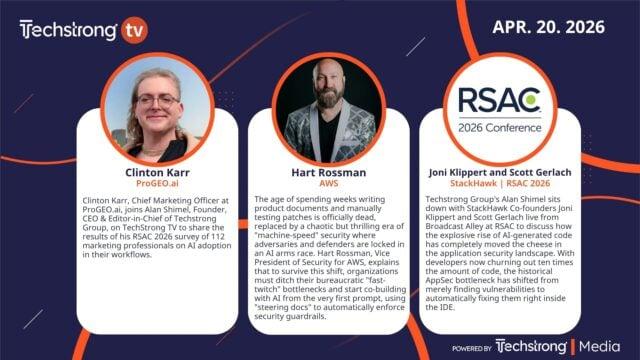
Techstrong TV – March 14, 2025
Watch our live stream on Monday through Friday, featuring exclusive news, announcements and conversations with IT leaders and experts on topics ranging from digital transformation to DevOps, cybersecurity, cloud native, containers and deep-dives into specific technologies and best practices.
Transcript
Hey, everyone over at Intel, there's a new boss. Is it the same as the old boss? We're gonna discuss it.
You're watching Textron Gang. Hi everyone. Happy Friday.
Good morning to you. This is Alan Shimel, and I'm coming to you live, well, semi live. I'm, I'm alive when I did this.
I'm in Orlando. I'm at Scon. I'm gonna be doing a report on it as one of the segments today.
It's been a great week of cloud native and open and all kinds of great stuff, but we've got a lot more than that to talk about. As usual, it's been another busy week and today's a great news day. Let me introduce you to our gang for today.
It's a lot of the regulars. Number one, I guess, as usual, we'll go to the West Coast where we have our roving marketing pro radio host all around knowledgeable person, the one and only Lisa Martin. Hey Lisa, how are you?
Hey, Alan. Doing great. Good.
It's good to have you on joining Lisa out, out in the Valley or the Bay Area, or whatever you want to call it. I know some, some folks are ashamed to be part of the Silicon Valley community these days. Uh, he is our editor at large there.
John Schwartz. Hey, John. How are you?
I'm good. Uh, won't get fooled again. I like the reference.
Glad to be here. Glad to have you on. And then joining us from, it could be a data center, capital of the East Hudson, Ohio, well, near Columbus.
Anyway, he's the, uh, founder, CEO over at Tech Field Day, our friend Steven Foskett. Good morning, Steven. How are you?
Good morning. It's nice to be here on a day that nothing important happened in the tech industry. Yeah.
Like that ever happens. And then from Ohio will continue east to the wilds of Westchester County, way up in Harrison, upstate New York, our Chief Content Officer, Mike Ard, where The resale value of Yankee tickets are dropping By the minute. Like a rock.
Like a rock. Yep. All right.
Well look, injuries happen. Yeah. Mm-hmm.
Um, you could say you guys got a lump of coal. Um, Oh, no, no. Cole had a lump in his elbow.
That was the problem. Mm-hmm. But anyway, let's, let's talk about the news.
'cause sports between that and the Steelers not having a quarterback, I'm depressed. Um, I, I referenced it in the tease. Intel announced him head honcho, a new head honcho today.
I guess the interim Co CEO model did it wasn't going on forever. Mike, why don't you take us here? Yeah.
People have been waiting for this for a while now. It's kind of been roughly equivalent to waiting for the Vatican to elect the new Pope. And since smoke finally came outta the Intel headquarters.
But John, you've been following this. What's going on? Well, um, I've, kudos to you Mike Eagle.
I, Mike Ard finds it on the wire immediately as soon as it happens. So Intel has his fourth CEO in seven years. That doesn't count the co-CEOs, by the way.
So Lip Bouton is the new CEO. He was on the board of a of, of Intel. He quit the board last year.
Now he's back on the board. He is the CEO. He was previously the CEO of Cadence design.
And, um, you know, he takes over, essentially this battered, troubled company. Um, I, you know, I'm writing the story on deadline. I didn't have enough time to, to mention all the problems they're facing right now, but I'll just recap a few of 'em.
Um, they're late and stumbling in the AI market against Nvidia, a MD, Qualcomm, you, you name it. Sales are declining. The stock is badly bruised.
There's threats of killing off the chip acts, chips acts. There's a delay in a major Ohio plant that they, they showed off last, uh, year, I believe with Gelsinger and Joe Biden. They're in the process of laying off 15,000 people, and they're weighing the idea of either spitting off its Foundry business and or selling its products division, which includes the servers and PC chips.
I briefly talked with DA Daniel Newman, and I know Steven talked with them and Steven in Milad even more to, to this. But Daniel says he expects the move to jumpstart discussion of the, the split of the Foundry business, as well as a focus on reduced spending on resources and projects. He mentioned that BU is known to support a split off of the the Foundry.
There's also another interesting thing that Reuters reported late last night, that Intel's Foundry business may be operated by TSMC in a joint venture with Nvidia A MD and Broadcom, whom it is invited take stakes in the business. So there's a lot going on. There's lot to process.
And, uh, this is a company that's clearly in trouble. And, um, I, I don't envy Mr. Tannon the tasky faces.
Steven, I know that you had a podcast about the CHIPS Act, and I know you've been kind of following this whole thing, but what's your take on what's going on here? Yeah, we've been following the Chips Act really closely on the Gest, uh, the Gestalt I two now, now, now called Tech Field Day News Rundown, which is our Wednesday show. Um, and we frankly, uh, the, the, this topic of Yes, of Wednesday, this week's show was what the heck about canceling the Chips act.
Uh, then this comes out and, um, and as you, as John mentioned as well, the rumors of a joint venture. Now, those JV rumors actually hap, uh, came out, um, earlier as well. Dan and, and Pat Morehead were talking about that too.
That, that these rumors have been swirling for a while. But, um, you know, in talking to Dan and, um, you know, kind of catching up on Pat's coverage over overnight of this, there seems to be some, some interesting, um, I dunno, smoke signals here. So, as John mentioned, um, lip Bhutan was, um, on the Intel board.
Uh, the rumor is, and this is something that I learned from Pat Morehead, that, um, lip Bu was specifically had a falling out with Gelsinger in August over the idea of splitting the, um, the, the Intel Foundry business in some way. And, um, lip bu resigned from the board. Um, apparently rumor has it, um, because he, because Pat, uh, stuck in and said, no, we're not spinning it off.
And lip boo said, yes we are. Um, so I think that's a pretty heavy, if that's true, then that's a pretty heavy smoke signal of what's gonna happen next. Uh, the other thing that I learned, um, in talking to Dan Neuman is, um, that, uh, lip Bu is absolutely very, very well respected in the, in the, the industry.
He's maybe not quite as much of a nerd as Pat was in terms of a, uh, you know, real techies tech. But this guy's got an engineering degree from MIT. He's, he's the real deal.
And having been in charge of Cadence for almost two decades, um, you know, if people aren't aware of Cadence, they're, they're the company that makes the, um, the software that people use to design chips. The thing that, um, Intel needed to do to make IDF successful was have companies like Cadence support their, uh, manufacturing processes. So, uh, lip Bhutan would be in a really unique position to understand the, the Intel prospective customers for the Foundry business.
And I think that that is a really, another really key indicator. This is somebody who knows Intel, who absolutely knows the business. Um, he understands the perspective of the customers that would be using the Foundry business.
He also understands the perspective of the other Intel, which is the one that designs and sells, uh, all sorts of different types of chips. Uh, all of this bodes well for Intel and the stock market certainly agrees. Uh, but I would say that combine that with the Trump's surprise in his not State of the Union announcing that he wanted to kill the Chips Act, all of this suggests bye-bye Intel as a unified company.
They've got to split. And I think that what's gonna happen is we're gonna have something like the rumored, um, uh, consortium deal where maybe Intel still holds 51% of it, but, uh, companies like TSMC, like, you know, uh, a MD and, and some of the others, uh, invest in it as well. And it becomes really a separate business.
Whether Intel even remains a majority shareholder or not, it remains to be seen. But I, I see no indication, there's no situation where Intel doesn't split the Foundry business, and Columbus isn't the crown jewel in that, in that business. Okay.
Lisa, what's the mood in the valley out there? 'cause you're out there with John, what are you hearing from folks about, you know, 'cause Intel was always kind of, you know, the Valley, at least the southern part of it for a long time. What's going on?
Yeah, you know, we're hearing, um, just kind of surpr shock and awe yesterday at the announcement of lip Bhutan. Um, you guys had a great job of recapping what's going on, obviously share falling in process of shedding 115,000 rather jobs. One of the things that we know about Lipan is that he has a relentless attention to customers.
Steven, you mentioned at their huge customer base. I wanna understand from Intel customers what they're thinking. If Gelsinger was here, and Lipan is here from a split perspective, where are the customers?
Where are they gonna be supportive? If, if the new CEO coming in the regime is so supportive of customers, then listen to that feedback and help that drive the next steps? I think that's kind of what we're hearing in the Valley right now.
So, so guys, I, I've got some thoughts on this. First of all, Mike, that's smoke you see coming out of the stovepipe. I don't know if it indicates they've elected a new leader or they're just burning the house down.
I, you know, I'm reminded of a, of a cartoon I saw yesterday about, uh, about, uh, homo sapiens, you know, humans having to stop work on the wheel because the Neanderthals are back in power. We gotta wait until their term is over. And, and clearly, you know, this is a regime change and, and it's an anti Gelsinger kind of move.
This seems like Lip Boo was the, the head of the anti Gelsinger, uh, you know, faction on the board that did not, you know, that wanted to break the intel, uh, business into two on the Chips Act. I, Donald Trump can, can bellow and bluster all he wants. I believe that was an act of Congress that created it and allocated the money.
And I believe it's only an act of Congress that'll stop that. And, and because it is financially involved, I don't know if you'd filibuster senate rules come into play, and I, I'd be very interested to see that new senator from Ohio bet against them or vote against them opening that plant up in, in Columbus with the CHIPS Act map. Two new senators from Ohio, because the other guy got a different job.
I'm not sure what he's doing now, but, um, yeah, Okay, so two new senators. So that, that, that's the second thing. Third thing, I, I, I'm listening to that lineup of JV partners there.
What the hell happened to America first? I don't see an American company. Well, Broadcom is a md, theoretically an American company, a MD Nvidia.
They're Broadcom, they're all American companies. Yeah. Hey, You know, wait, didn't you hear that TMSC is an American company now too?
'cause they're, you know, they're moving manufacturing. Oh yeah. They're moving everything to the United States too, as well in Arizona, Right?
Lock, stock, and barrel. You know what, you know, Intel, can I mention something, uh, quickly? So if, if years and years ago, um, one of the questions I always wanted to ask Steve Jobs are what were, who are the companies that you really admire in the Valley?
Intel was usually in that group. There were only about three or four Intel at this point. And I just wanna point that they are kind of considered a shadow.
They are a shadow of what they used to be that didn't used to be Intel. And it, I almost kind of want to see, but what's happening with them and AI is the same thing. And I know you talked about this earlier in the week, is the same thing that's happening with Apple.
These old guard companies that are just not innovative, who can't keep up, who can't pivot. This is what happens to them. And, and this is gonna be a haul out.
Yeah. But John, you know, that's the old story of the tortoise and the hare. It's early in the AI game.
That's True, that's True at this stage, at this stage of the search engine thing, I was betting on Alta Easter and Excited Home, right? I never heard of that other crazy company from Stanford. So All I gotta is say Is where's Lee ACO when you need him?
Because I feel like Uhhuh, this is all gonna be a bell out for the semi. Here's the thing though. If I'm a businessman and I am a businessman, and I look at the, some of the strategic assets that Intel still retains and some of the market share that they retain, and then I would caution or, or send you all over to the Signal 65 website, a futurum company that does lab testing, and take a look at the recent tests they did on the Intel AI chips and how it stacks up to Nvidia, you know, GPUs and stuff.
Don't count Intel out of the AI game. This is a long, it's a marathon, not a sprint. Great point.
And Vitel still has a lot of assets, And you can say the same about Apple. I know they've been getting a lot of bad press about their, uh, Siri, their smart Siri, but it's the same deal. Intel and Apple are right in there.
This is not a, a, a finished space by any means. No. And there's still A lot of, I I would play their hands any day.
I, I'd be happy to have their hands versus some of the others out there. So I, I think that's, that's the, the lesson here. It's a shame to see an American institution like Intel being chopped up this way.
But quite frankly, the foundry, you know, the whole separate foundry from, from, I mean, look, this is a script that Hewlett Packard is played four times, I think, or three times, right? This is right outta Silicon Valley Playbook 1 0 1. Um, you know, we'll split the company in two or six or seven.
Anyway, Hey, we're on a, we're on a short schedule today, so we need to move on. We're gonna take a break here on text on Gang. We'll be back.
I think we're talking nuclear reactors. How exciting. Discover Textron Group, the epicenter of tech innovation.
We are your go-to for reaching IT leaders and practitioners worldwide. Our secret impactful content that sparks awareness, engagement, and top quality leads with us. You'll access editorial websites, streaming videos, virtual events, custom content analyst research, and more.
Join our satisfied clients. Let's revolutionize your tech journey. Contact us today and tell your story to the world in the most powerful way with Textron Group.
Hey folks, we're back in. Just as Alan said, we're gonna talk about nuclear energy. A lot of the big tech companies got together and said that by 2050, I think it is, that they hope to be using nuclear energy to drive all kinds of IT services.
Um, seems like a long, long way off to me. But, um, Steven, what's your take on? Is this really gonna happen or is this kind of like, you know, I'm pounding my chest and I'm gonna go kick some ass as soon as I get off this couch.
Did, did you guys invite me on just to be the punching bag? Because I think you might have, okay. No, this is definitely a hundred percent not happening.
And it is entirely, every aspect of this story is misguided. So, so first off, 2050, no, you have no idea what 2050 is gonna be like number one. Okay.
Um, let's just put that aside. Uh, let's say the 2030s, absolutely not, uh, nuclear energy, unfortunately. Now, here's the thing.
The, the sad thing is that nuclear fission should be powering all of AI with cleanish energy and, and affordable energy and, and, and, and, and reliable energy today. But it's not gonna happen because the 1970s happened, and essentially the entire world has turned against nuclear energy to the, to the extent that even in places like China that are actively building nuclear energy, the permitting process, the, uh, requirements around building large nuclear plants make it much, much, much more expensive than it ought to be. Nuclear energy is literally two or three times more expensive than wind or solar.
Wind or solar is not all, is not a 24 7 energy source, but nuclear is still much more expensive than burning more coal or burning more, um, natural gas. That is a problem for businesses. And it's also a problem for anyone who's interested in reducing the reliance on fossil fuels.
Now, the next part of this story is this whole small modular reactor thing. We heard Trump mention that in, uh, his campaign pitch as that, that SMR was somehow going to be a thing. I'm not sure who told him about it, because I doubt that he knows anything about it.
But here's the problem with small modular reactors, they don't exist. You might as well say that flying cars are gonna si solve our, our traffic problem. And you could say, but Steven, there are flying cars.
There was one at CES. Well, we don't know. Small modular reactors exist as much as that CES flying car exist.
They exist as much as the aptera, the wonderful cool solar powered electric mo like cool thing. It's not flying. But, you know, these are, are theor, uh, almost entirely theoretical.
They're still in the lab. There's no such things. And then this whole idea that there would be micro nuclear reactors that are somehow safe, that is, that is a dream.
Yes, the boring company is gonna solve all the traffic in la. If you buy that, then maybe you buy that. Micro reacts are gonna power these datacenters.
The the bottom line is that none of this is real and none of it is gonna happen because nuclear, okay, now pile on. Okay. No, no, no.
I, I'm gonna just, can I just say one thing really quick? I'll, I'll get outta the way. Go ahead.
2050 was the tell, tell sign for me. Just like Steven, when I saw that, I thought this is total bs this is a marketing kind of a, a, a statements that I read from each of the companies. Google, Amazon, and I believe it was the third one.
Was it Microsoft MI hope I'm not dead by. Oh, I've meta, excuse me, but I might be. It was meta.
Yeah. So we had Amazon, Google, and Meta with these self-serving comments, we're gonna be providing all this clean energy to suck up all these AI energy demands. And we're gonna do it, we're gonna triple it by 2050 as like triple it from what, um, it, the, the whole thing is, is very kind of fishy.
But, you know, I agree with you Steven. I got your back on this one. So let me, let me jump in here.
Oh, go ahead Lisa. I was just gonna say, Microsoft wants to restart three Mile Island. That announcement came out with them partnering with Constellation Energy back in, uh, I believe it was August or September.
And the value's going, oh, we covered it. What? Yep.
And, and, and that's at least reasonable and practical and doable, but the cost that Microsoft is paying for that electricity, no kidding. Two x the prevailing cost for electricity. Yes.
Alright, so guys, a couple things. I, first of all, I think they picked 2050. 'cause it's gonna take us that long to, to start embracing sustainable energy again after the damage that this administration does to the whole concept of sustainable energy.
Well, we, we, hey, we could, we got a guy who can cut down, you know, regulation and stuff like that and make it happen, right? Sell cars on the White House lawn. But I got one word for you folks.
Thorium, thorium China made an announcement yesterday. They fired up their first thorium nuclear reactor. Now this comes on the heels of China announcing that they found enough thorium salt in inner Mongolia to power their energy needs for the next 60,000 years.
You know, who else of the world's leading countries of, of reserves, of thorium deposits the US or Australia, India and Brazil? What's thorium you ask? Well, thorium is a substitute for uranium, right?
It's a salt, it's a molten salt to, to power your nuclear, uh, reaction. You no longer need to cool it with water. It's meltdown proof.
It, it produces a fraction of the radioactive nuclear waste that uranium based, uh, processors do. And you know, what? If China has a, a working model of this, I'm sure we can get together a working model of this.
I, I've always look, not that we didn't have problems in nuclear. I, I, I'm a child of three Mile Island and we saw what happened in Chernobyl in Japan, but just because you didn't get it right then doesn't mean we can't get it right going forward. And thorium could be the answer.
And if so, we could probably generate enough energy without fossil fuels here for most of the industrialized world for the next thousands of years, and it could be viable. I'd say that's a worthy goal and a worthy, uh, project for us to do something here in the US about, 'cause China's doing it. I got, I got 20 bucks that says Elon Musk announce a thorium powered Tesla in four months.
SoftBank's investing in it too, by the way. And, and it goes and it grudges. 4 kilowatts, right?
Come on, Dr. Brown. It really is worth investigating.
And, and again, I'm not, I'm not gonna be a complete Debbie downer on this, because you're right, Alan, theoretically thorium absolutely solves most of the problems that we've had with uranium powered, uh, nuclear reactors. It is absolutely true. And the other truth is that, you know, unexpected science innovations can happen quickly.
You know, look at, um, look at NAND flash. Uh, look at the LED. These things didn't exist the day I was born.
And today they are everywhere and, and we rely on them, you know, quantum, uh, technology, you know, quantum chips haven't worked. But, uh, lemme tell you, quantum photonics is working really, really well. So it is absolutely possible that in 2050 we could be using small modular thorium reactors that sit on top of our Tesla branded cars.
It's also tr uh, likely that Elon Musk could come up with, I don't know, let's call it Nuke X is next to venture and, and making small modular reactors and get a bunch of government funding for that. Um, I just don't see it happening anytime soon, and I don't see it moving the needle. I think this is a scapegoat from the AI companies to offset the fact that they're using too much energy, it's too fossil fuel powered, and they really don't want to invest to do the hard work to use solar, Right?
Steve wanna, are they invest so much billions in like Amazon and Google and Microsoft have invested billions in nuclear energy facilities. So why are they investing that those billions in that if they don't think this is potentially viable? I think it's a backstop.
I think it's a, it's a, it's a, Well, it's, it's good. It's a good story and good gooders. And just Because I said I'm gonna do something doesn't mean I'm actually gonna, Yeah.
Yeah. I think we're the traces of all these, uh, manufacturing facilities that are gonna be built over the next four years, like Stargate and et cetera. You know, they just throw these numbers out.
What, but they actually do is another matter. So guys at one of the keynote here on Tuesday, I think it was, uh, they, they had several data center operators who were Sousa partners come up and they talked about what the energy needs of a, a multi gigawatt data center are, right? Because keep in mind, the average house uses, I think, two kilowatts, uh, a half a rack of moderate Nvidia, not the, not the new, the newest ones, Brook, well, Brookstone, whatever they are.
Um, but the moderate Nvidia, a half a rack of that, if a house uses two kilowatts, a half a rack uses two megawatts of power and generates enough heat, that air alone won't cool it. You need some sort of liquid cooling, forced air, something. Um, and, and it goes up from there, obviously.
So I'm telling you that if, if we have any hope of supplying these data centers that all these people are talking about, and, and, you know, we spoke about the whole data center building, boom, earlier the week, we gotta find something that's gonna do it, right? We, we need some breakthroughs here. We need, you know, the, the, the moon mission resulted in a whole bunch of breakthroughs, the least of which, or maybe not was tagged, uh, but, you know, the instant breakfast rate, but I'm kidding.
But we, we need technology breakthroughs in order to get through that log gym. So where there's a will, there's a way. Necessity is the mother of invention.
And that is what really made America great, because when we have problems like this, we figure out solutions. We don't bluster, we don't nonsense, and all of this other stuff, or try to take over other countries. We innovate, we out-innovate, and we come up with solutions to problems.
And I still think that that's the engine that drives this country. Hey, Steven, before we end this topic, I just wanted to see how, how much it hurts me that you think we might invite you up here to be a punching bag, no matter how true that is. Well, uh, I will be your punching bag any day, uh, especially when it Involves Steven.
We, I never think of you as a punching bag, Steven. I, I know I could always count on you to, to, to toe the line there. Anyway.
Hey, let's take a, a break here on Textron Gang. We're gonna come back with our third, uh, block. And I think I'm gonna talk about Sic Con a little bit.
com is the leading resource for news analysis and education on challenges facing the cybersecurity industry. com covers all aspects of cybersecurity, including data security, DevSecOps, cloud security, application security, network security, security threats, and more. com has the largest selection of security content featuring breaking news, blog posts, podcasts, and more.
com to learn more. com. Home of Security Bloggers Network.
Hey, folks, we're back. And as Alan alluded to, every now and again, we have somebody who goes to one of these shows and Suse Khan is the latest and they give us a feel report of what's going on. Alan, you're the designated attendee at this show for Suse Khan.
So is suse, step it out of the shadow of all these other open source companies? What's going on? So if I'm Des now I know why I haven't been drinking.
I'm the designated attendee. Um, anyway, you know, it, it's a funny thing about Souse, right? So, you know, they, they are, to me, the the stereotypical European country, right?
Very, you know, they're, they're based in Luxembourg, obviously, for tax purposes, but they're a German company and they have that very German stoic sort of way. Their marketing is usually understated, very factual, not flashy or fancy. You could see, I don't know how much you could see of my background here, but you know, their, their slogan is, choice Happens.
And, um, and that's what they've been, they've been a, a, an amazing member of the open source community for many years. Their Linux is a respected, everything they do is res, you know, all of their products are respected, if not market leaders. But I gotta tell you guys, I've been here, I've met with most of their leadership.
I've met with a lot of partners, a lot of customers. We have videos that'll be on text, on TV of this. I'm telling you, suse is positioned to be the cloud made of Powerhouse.
If I'm Red Hat, get, get worried. And, and I'll, I'll tell you why. The last couple years they've done a bunch of different acquisitions starting with Rancher, the Rancher os and the Rancher, Kubernetes, uh, distro, uh, new Vector for security Stack state for observability.
And I saw something, a demo, not really a demo, but a diagram of, uh, what they're calling their dev Dev X design framework. I think it's framework. I I have an article on Cloud native now that you could read about this.
And I felt like Dave Marsh, when he saw Bruce Springsteen in the mid seventies. I've seen the future of Cloud Native and it's suse. They've put together a A to Z soup to nuts package where you've got your underlying Linux, you've got your underlying K eights, you know, Kubernetes, whether you are running it, public cloud, private cloud, V Edge, bare metal.
They, they have the, uh, the other rancher project, not K eights. I think it's K three or K four, whatever, like a, a smaller foot. Yep, a smaller footprint.
They've now married that though, where they're, they've created their own Susa repo or Souse registry. They've taken the most popular open source projects, Sufi them in that. They slimmed down any extra extraneous, unnecessary packages, kept them open.
They check 'em for security, they scan them, repackaged them, and make 'em available to the suer customer base. They're open. Anyone can use me.
You don't have to buy 'em. But now, so now you don't have to worry about the danger of, of downloading apps and components in the wild from a GitHub or whatever. They're, they're securing those really nice thing.
Then on top of that, the whole new Vector piece keeps your, your cloud native infrastructure compliant and secure, of course, with EU regulations as well as just general good security. And the, and the, and then the Stack State piece, which is now Cuse Observability really lets you manage the whole thing. Pre-deployment, post-deployment, e everything you want from a great observability solution, but it's suse.
It's suse still. If any of those parts doesn't tickle your fancy and you wanna replace it with the pure open source or with another solution, you could plug that right in as well. You could plug it right in as well.
Now, I'm telling you, I've been following the cloud native space for many years at Cloud Native Now, before it was called Container Journal. We're doing this, I don't know, 7, 8, 9 years. I've only seen one other company that has this stack A to B, right?
And that's a company that IBM bought, right? And, and since IBM bought them, you know, red Hat is a great tool for the IBM consultants to sell. But, you know, in terms of innovation, well, they're doing some stuff with ai.
I think SUSE is going to give them a run for their money. Um, they know they got the goods too, and I think you're gonna see a very different marketing approach from them going forward. I'm, I'm really bullish on suse.
Let me play devil's advocate here. 'cause one of the criticisms of suse and all those cloud Companies, watch Steve, he wants to make me the punching bag. Go ahead, I'll hold you down.
There you Go. But, but the issue is, like, it's, and it's the CNCF landscape is the physical representation of this issue, right? There's so many pieces and components that you're supposed to stitch together that people get overwhelmed.
And, um, nothing is quite integrated as, as well as it should be. And over time, I wind up, you know, hiring a small army of people to maintain this snowflake of a platform I've created. And then I'm either locked into various components or I'm terrified to replace anything or add anything.
'cause it's gonna break. And, and, but that's the beauty of this DevX platform. You, it, it takes the hard work of going through the 200 CNCF projects.
It works with helm charts, it works, it works with all the usual suspects, but that's all behind the little Green chameleon that is Susa. And you know, I, I think it really does. It, it takes exactly what you're talking about, Mike.
This is the solution for it. But if you still wanna go play in that open source Wonderland, have at it, but you don't have to. Seus has brought it all together for you in a secure, manageable, commercially scalable way.
And I think that's what this market needs. Did you hear anybody talking about platform engineering while you were there? Yes.
Because who is this DevX platform aimed at DevOps team, platform engineers, security people, and of course, developers. And, and this, the platform engineers are gonna love what SUSE has in terms of setting up your platform to go fast and secure. And, and by the way, I, while here, I spoke to HPE and Dell and AWS and, uh, uh, court works and, and a bunch of your other strategic partners, and they, they are also all in on this.
They think, you know, this really is going to be a big deal for, for cloud native. All right? My money says that other people will go build platforms that we're gonna see a rollup of all these companies that are providing these little widgets are on the side of these things and, and will be platform versus platforms, but there'll be more than two.
So I, I don't, you know, there were a few companies that have the breadth to do this at scale. Red Hat, certainly one of them. I think suse.
And also remember suso was a public company that a PE took private, but it wasn't the usual pe Let's take it and sell the parts like Gordon Gecko, right? It, it, they've actually invested a lot into suse and they're doing things that aren't necessarily quarter to quarter that a public company has to live with. And, um, it, look, I I, I'll stand by my words.
I'm bullish. All right? Fair.
All right, Guys. If that's, If, if, If, I'm sorry, Mike, If you could go to Las Vegas and bet on suse, I think, you know, your chips are all in, right? I never go all in on anything.
All right. Uh, if anyone, if no one has anything else, I'm gonna lock this up because I've got people waiting in my green room here to do more videos. I'm, I'll be here through the end of the day doing videos.
I'll be, I will be back on the gang on Monday. I won't be on Friday, Mike, if I don't speak to you before then, have a great St. Patrick's Day.
Will do, man. It's Gonna be you, it's a highlight of the year for you. It's, it's a, it's on a Monday, which is, means it's a three day weekend.
So there you go. Abso you know what, I, I actually, I met the Dell CTO for ea I interviewed, I didn't, I have to introduce to him, really nice fella named, um, uh, I think it's Brian Orion or, or, or Reagan, Brian O. Reagan.
He, he's invited us to Ireland to come see what Dell's doing out there. I said, I just, I got just the guy to do it. I think.
I think we're gonna have to open up the worldwide Irish DevOps chapter And you're the president. Alright? It's the bureau.
Your bureau, Yeah. Alright. Thank you Steve, John, Lisa, Mike, for joining us on a somewhat shortened version of the Gang today.
As usual, we have a full texture on TV lineup following this, so stay tuned for that. We will be back Monday with some really great fresh content. Um, until then, I'm Alan Shimmel.
Everyone have a great weekend. We're out. This is Textron tv.
Hey guys, thanks for the throw. We're here with Jonathan Leor, who's the CTO for Mission Cloud, and we're talking about the rise of AI workloads in the hybrid cloud era. And a lot of it's starting to feel like maybe a case of deja vu, but we'll jump into that in a minute.
Jonathan, welcome to the show. Thank you so much. I appreciate you having me, Michael, looking forward to the conversation.
Well, they say history repeats itself and we seem to be having this conversation about where to run AI workloads after somebody actually builds the model on the inference engine, what to do with that inference engine. And there's a bait about, does it go on premise in the edge in the cloud? Where, and what's your sense of what's going on here?
Yeah, I think it's a, it's a really interesting time. Uh, as you mentioned, you know, the genesis of AI reminds me quite a bit of the early days of public cloud in general. Um, I think just on a very compressed timeline.
And as a result, there's just been a massive amount of activity over the last kind of 18 months. Um, a lot of POCs from a lot of different businesses, um, but also some, you know, real production workloads as well. And that means patterns are starting to emerge, best practices, um, and people are really starting to figure it out.
So they are at that conversation of like, okay, we're going to production. Where do we put this workload? Who's in charge of deploying the AI workloads these days?
And I asked the question because it used to be a data science team kind of built this thing in the corner, and then they got a small team together and deployed it. But I feel like lately the inference engine itself is now being added to the IT operations team. What's going on there?
Yeah, I think you're, you're spot on, right? It's pulling a entire set of workloads, basically into the purview of an IT organization who manages, you know, public cloud estates, they manage the on-prem usage, you know, whatever it is that they, they have from an infrastructure perspective. And the nitty gritty details that typically a data science team would handle, um, are somewhat abstracted in many cases behind, you know, managed services like Amazon Bedrock, right?
Which gives a context for which to run, um, AI workloads. And, you know, in the cloud you have access to very expensive GPUs and, and infrastructure that you may not want to purchase on your own, uh, or maybe can't, right? Because frequently these sort sorts of situations arise where, you know, the hyperscalers are buying up all the capacity and there's nothing you can do about it, right?
So, um, yeah, I think that's sort of my perspective there. And the conversation's a little bit different in the sense that most of the data science teams that I talked to were like, wow, we got a GPU awesome. And the operations people are like, well, how much does it cost?
Where is it? How's it, right? There's a lot more questions that come from that side.
I think so. And it, it's interesting because it's also moving very quickly. As I said over the last 18 months, the sort of cost per token usage, uh, you know, come from a consumption pricing perspective has just absolutely plummeted, right?
You've got all of these different vendors sort of, uh, riding the hype train and trying to be established themselves as the place to go, right? For a model or whatever. It happens to be a service.
Um, and as a result that, you know, price compression has really driven down the cost to a level where if you ask me 18 months ago, is there going to be a cost issue around Gen AI for, um, you know, production workloads, I would've said, yes, it's gonna be pretty significant. But, uh, that competition has really done its job. And, uh, now you can run very sophisticated workflow workloads that are powered by gen AI and not have to break the bank at all.
I think that is a particularly interesting, uh, kind of evolution of, of the market over the last 18 months. Are you worried that some of these deals might be too good to be true and people are trying to buy market share and they might not be around for the long haul? Uh, I think it is entirely fair that, uh, when you have a circumstance like the one we're in now, you have this sort of transformative tech that arrives on the scene.
It is early days, people are trying to figure it out. You're gonna have a lot of activity, a lot of funding flying around, a lot of venture capital, uh, out there saying, Hey, I'm gonna, you know, back a hundred companies and hope that one of them makes it as a unicorn. Um, and so I am a hundred percent think that there's gonna be, uh, some failures in the market.
People are, you know, uh, attempting to make a business work, you know, uh, speculatively around this transformative tech, and some of 'em will get gobbled up by hyperscalers, right? Uh, one of the big jokes I always have at reinvent the a s reinvent conferences, you're out on the show floor, you're looking around on all the exhibitors and saying, which of these is about to be disrupted by a change at AWS? Right?
Maybe, you know, they add something to the AWS console or they launch a service that is directly competitive and it's just, you know, even now that happens in cloud. Uh, and that's gonna happen quite a bit in AI kind of upfront, right? Um, I'll give you an example.
Uh, I am, uh, a programmer, um, since I was very young, I still write code probably more than I should. Um, not for production workloads, don't worry folks. Um, and, uh, I have actually been building something that, you know, basically gives me contextual AI assistance for my project from the command line.
'cause that is where I develop personally. Um, and there weren't really any good products out there that kind of, uh, tickled by funny bone, you know, really were the right thing. Um, and Claude just announced philanthropic.
Claude just announced, uh, Claude for the CLI effectively, or Claude code. And boom, you know, there's this brand new thing. Uh, and that's just an example for me.
Uh, there are going to be dozens, uh, of, of these things that happen, uh, disruptions that, you know, uh, make it such that a particular market maybe closes or the competition gets very, uh, crowded. What makes it different about inference engines and AI models within that DevOps workflow that so many organizations use to build software today? Is that AI model essentially just another type of artifact?
Would, or, or does it behave differently? How should I think about this thing as I go to operationalize AI within the application stack that I'm already deploying? Right.
So I, I think, uh, the interesting thing about AI is that it really emerged from academia, right? And if you actually look at a lot of the classic ml, uh, predictive models and things like that, and the tools they were being developed by, you know, I would call 'em data scientists, not, uh, cloud engineers. And what is going on now is these things are becoming operationalized and now they're hiding behind APIs.
Um, like OpenAI, we'll have some, and, uh, you'll, you'll also find some from philanthropic. And, uh, AWS is providing bedrock where, um, it's effectively like a managed service where you can drop one of these artifacts and have an execution environment for it, and you have a consistent API and all that good stuff. So, um, I feel like a w s's approach there is much more like a typical a w uh, cloud workload, right?
It, it can be controlled with infrastructure as code. Uh, it is run as a managed service on your behalf, uh, integrates nicely with all the other AWS services for sort of that seamless experience versus something like an open AI or an anthropic where it is an API endpoint that you call, and then you have to architect around that. And so to me, it sort of depends a little bit on the approach.
If you're taking that bedrock approach, I think the DevOps kind of cadences and the infrastructures code and all this, it actually a totally reasonable way to approach, you know, kind of operations. Um, if you're using third party API, it really falls more onto the engineers, right? The developers who are consuming that API to make things happen with, uh, with, uh, you know, A NIO modeled somewhere.
Um, and so you have that kind of spectrum that exists. I expect things to settle, um, you know, into a little bit more of a consistent kind of split between those two things. Um, especially as, uh, the market matures and adoption kind of, uh, goes more from a solution, uh, engineering perspective than a, what's our AI strategy, uh, you know, kind of perspective, which a lot of companies are getting asked, What do you think the impact on those DevOps workflow is gonna be?
'cause I talked to some folks and they'll, you know, privately admit that they're fairly brittle as they are, and they, they're stretching their heads going, well, how are we gonna handle all this code that's coming down the pike from these AI coding tools that are being added? Yeah, I do think, uh, you know, it, it is going to challenge a lot of people's, you know, roles in terms of how they they operate, but also, you know, the notion that some of this can be, uh, used to automate away certain aspects of a role. Um, and this is something I'm actually quite passionate about, uh, kind of looking to the future here.
It, you know, the reason, one of the reasons I I compare it to cloud is I disrupted a set of jobs that were either eliminated or enhanced or changed, um, just by the nature of the technology, right? And so if you were a, uh, a network engineer who was managing on-prem Cisco, uh, networking gear, you had your CCIE certification, and then your company says, Hey, we're moving to the cloud. Well, what, what's your job now?
What do you do? And, uh, you know, I saw a lot of those folks embrace, uh, public cloud and found themselves becoming cloud network engineers, cloud architects, and frankly, being quite a lot more valuable to the business to brittleness as you you said around sort of current gen DevOps approaches. I actually really like the fact that this is gonna sort of disrupt there and make, uh, that category of, of sort of job rethink how they do their work, um, in the context of a new transformative technology.
And you either embrace it and, and, you know, some of those folks will become, you know, uh, highly valuable, AI friendly, you know, um, resources for their business and others will become entrenched and decide, no, I don't believe in this and I don't, you know, I'm not, uh, gonna change what I do. And I think that it would be very wise for people to be in the former camp than the latter. What will be the relationship between managed services and what those folks are managing these days, because, um, they're everywhere, rather, AWS has them, third parties have them, A lot of them are exposed via GUIs.
It's not clear how many of them are invoked via CLIs that you can do within a existing workflow. But how's that whole relate dynamic changing between the internal IT teams, the managed service providers, and the cloud service providers? Good question.
So, uh, I would go back to looking at, you know, uh, AWS, um, in terms of what they offer, right? So, uh, many of their services are effectively managed versions of open source software that they operate as a service with some secret sauce and give you APIs that you can then control and use to build out your infrastructure. And, you know, I think, uh, if you look at, and I kind of got to this earlier.
If you look at an open AI or an anthropic, right? Two of the big, um, you know, vendors in the space, their approach to this is, here's our API, right? Here's our managed service for running, you know, an execution, uh, against our set of products and services.
Um, whereas AWS is looking at it more as, hey, here's another thing, right? That has an artifact, that has some piece of, you know, open source software that can be operated as a managed service. And as these new tools kind of evolve, uh, things like a lang chain, for example, um, and, you know, plenty of other sort of, uh, best practice open source platforms that are used, um, in this kind of workload, I've very much anticipate that AWS will launch managed services around those things.
Um, and Bedrock is an example of, uh, their perspective on the challenge and then of the market, Hey, we give you this, you know, common environment for execution. It's a fully managed environment. You pick a model, you bring your own model, you get one from us.
Um, and so I do think that, you know, that complicates the whole situation, uh, as you have an entire spectrum of how people are going to consume either directly or through managed services or, you know, through both through on-prem, through plaid. Like, it's, it's gonna get really, uh, hairy really fast, but that's good for, uh, you know, consulting and managed services providers like me. So, um, uh, that complexity is power and helping customers harness that power is, is, you know, very important for us.
So among the organizations that we see doing well, what are they doing differently than others who are kind of stumbling through this? There is a phenomenon in most tech companies where there is a segment of the business that is, um, several segments I should say, that are really focused on risk management and risk mitigation. Um, and when a new technology comes along, it can be scary.
It can be, Hey, is this thing gonna have access to my data? You know, what's the privacy and security look like? Will it mess with my compliance?
Um, and so there is a, a large number of hurdles to jump over from people who want to say no because you know, it's new. Um, and I'm not saying they're wrong at all. Um, but I do believe that the organizations where it's working, they are, uh, fairly permissive, uh, and smart about, um, guardrails and restrictions that allow for, you know, their business to take full advantage of what's available to them without exposing them to big distractions or issues or whatever.
Um, and so the companies that are not doing so well here are the ones that are effectively waiting and seeing, right? Um, I understand the desire to wait and see, but I also think that there is enough value out there in the market today. We are past wait and see in my opinion.
Um, and, you know, individuals in their roles will get passed by if they take a wait and see for too long. And so will businesses to me embrace, give everything a shot, understand deeply, right? Put in some guardrails that it help ensure that you're doing so in a safe way.
Um, otherwise you're gonna end up with shadow it again, like happened with cloud, uh, where people will be signing up for chat, g PT on the side on their own and using it, even though you're telling them they can't. Um, because at the end of the day, it's valuable to them. And, uh, IT departments, you know, your customer is your team, your your employees, right?
You wanna enable them with technology, not hold them back. Um, and so I do think, you know, the sooner that a business can find a way to enable customer or their, their employees to take advantage of this, the better. Um, and I think we're actively seeing that right now.
All right, folks, you heard in here, it's a quote of president from long ago. It looks like we have nothing to fear but fear itself. One more time.
Hey, Jonathan, thanks for being on the show. Thank you so much, Mike. It was a pleasure.
All right, back to you guys in the studio. Hey everyone. Welcome to our Predict 2025 virtual event.
If you've watched any of this, any of the sessions so far, you know, we've got an amazing lineup of some very, very smart people who are giving us their best guesses, their best feelings about what are the big stories in 2025, what will the big stories be in areas like DevOps and cyber and cloud Native and AI and ITSM, um, technology in general. And it, so speaking of smart people, let me introduce you to what of my FU group partners. Uh, he's also well known as the founder, CEO of Tech Field Day, which is another business unit within futurum, and we work pretty closely together.
I've struck up a great relationship with Steven in a relatively short time. I want to introduce you to Steven Foskett, CEO, founder of Tech Field Day, part of FU Room Group. Stephen, welcome to predict 2025.
It's great to have you here. Well, it's great to be part of Predict 2025. I, I hope I don't have egg on my face at the end of the year.
Well, if you pay us enough, we don't replay this at the end of the year. If you don't, we do. And then I hope your predictions we're, we're good.
Um, but seriously, Steven, 2024 was a, in many ways a watershed year, not just in technology, mind you world events, civilization, uh, technology obviously, but things like climate and, and all sustainability. And there have been so many things on our wars and peace and so many things on the horizon, but it was certainly quite a year in technology. And if there was a technology of the year, it would obviously have to be ai.
So it's easy to say 2024 was the year of ai, but as we sit here now, you know, on the cusp of 2025 already in the beginning of first weeks of 2025, is AI the 2025 story, and if so, what, what, what aspects of it do you think? Yeah, I actually think that 2025 is gonna be the year of AI and not 2024. Um, even though AI was very much in the news and in the public consciousness in 2024, from an enterprise IT perspective, I think 2025 is the year that all this stuff gets real.
I expect companies to be deploying custom models right and left, and not just chatbots that pop up annoyingly in the corner of the screen when you're trying to use their website, but actually useful AI applications. I'm really excited about seeing what happens with agentic ai, um, basically AI agents that talk to each other and have, uh, private, uh, AI to AI conversations on your behalf. And I'm also really excited to see what's going to become of, uh, the transition from focusing on AI as the domain of a few large companies with incredible resources who are developing these foundational models to the, the world of, uh, the Fortune 500, the Fortune 2000, uh, de developing their own fine tuned models, uh, developing their own custom applications built off of AI and broadening beyond the chat and LLM space.
Absolutely. I, I think in many ways we may look back and say 2024 might have been agen, uh, not, not agent, excuse me, generative AI 2023 was too, for that matter, 2025 is where agentic AI really, you know, rubber meets the road. Um, Steven, you made a good point.
Enterprises usually are slow, slow to change budgets, slow to adopt new things. They may dabble, if you will, but to really jump in with both feet, it, it takes them longer. But you know, once they jump in, they jump in and it that, it's like the inertia of moving that big ship.
When do you think I mean, are we, are we looking at the end of 2025 for this, or do you think we'll start seeing things let's say by the spring? I think, I think it's gonna start happening pretty quickly. Um, I'm seeing some really incredible products, uh, coming to market that are essentially AI platforms for the enterprise.
And a lot of the companies that had been previously focused on, for example, process business, process automation, or on, uh, CRM, are building ai, uh, platforms that, you know, if you squint a little bit, you could say this is an agent AI platform. Now, I'm not sure that, uh, tarter term specifically is going to take hold forever, but you know, if you, if you kind of step back and think it, AI agents that are deployed to perform business functions autonomously in the background, uh, those are coming from basically everybody in the space. I mean, certainly the, the, the biggest one is Salesforce, and they have done incredible work to bring AI to their platform.
But essentially every enterprise platform now is building out the, the capability for enterprises to deploy AI that actually does business things. And again, that, that's what I wanna get back to. We're not just talking about LLMs that are generating text or, you know, apple image playground.
We're talking about having a special purpose AI agent that does a thing on your behalf. And one of the ones I think that's gonna come first is normalizing data. Essentially.
I have a strange input of data sets. You know, I'm, I'm a, I'm a lawyer's office and I'm dealing with all this paperwork and forms and stuff, or we're in the medical space and we're dealing with all sorts of doctor notes and reports and so on. And what we need is we need to normalize all that and structure it and build it a, a data system, a data solution out of that.
All of that can make use of ai, uh, models that exist today. And I'm seeing more and more companies that are developing the models that are going to make that happen in the enterprise. And many of these are basically ready to go and, and, and in, in fact, a lot of them are already getting deployed.
So I think that we are gonna start seeing AI agents doing data processing on behalf of companies well, basically now. Excellent. You know, one of the things that scares me though, Steve, is we hear so much about big tech, big tech, right?
Are they a monopoly? And, you know, given the current or the incoming administration and and governments around the world, uh, what kind of appetite is there to keep this curve to keep, keep, you know, a few companies from dominating the, the marketplace? And, and I think this is true in ai, where you see, you know, the hyperscalers who have put their money where their mouth is, and they're investing billions of dollars in, into, you know, some of the leading AI companies.
And is that really, is that raising such a barrier of entry that we're not gonna see sort of a Cambrian explosion, if you will, of AI companies and AI solutions because you're gonna need to be one of the, one of the big boys to play in this game? Well, I can see how it might seem that way, especially with the level of investment that's gone into companies like Open ai, uh, and anthropic, uh, a lot of these, uh, hyperscalers building their own models. But I think that it's gonna be very different than that.
In fact, I'm gonna go out on a limb and say that ultimately companies like OpenAI and Anthropic are gonna have to pivot their bo their model away from focusing on building ever bigger foundational models and toward building, uh, the capability of fine tuning those models to special applications. We've already seen Meta's investments in Lama, uh, kicking off really a Cambrian explosion of AI capabilities from companies that never would've invested the kind of money needed to train the foundational model. But the fact that those models are available to them and open to them licensing wise, they're able to use those models to do things that they could not have done.
That's gonna happen way beyond meta, way beyond llama. And again, I think that's gonna be a big trend in 2025. We're gonna be talking about all the incredible models that we can download and use that we don't have to invest in at all.
Uh, you know, I use the whisper model from OpenAI every single day on my desktop Mac. And, um, it is just an incredible capability for me to have more incredible is the fact that I paid this $0 to use that. Essentially, I have a capability that I never would've had.
And that's, I think, what we're gonna see across the space. If you look at hugging face, if you look at the open models that people are able to download and put into process and use, it really shows that that core development of foundational models. I don't wanna ascribe some sort of, um, uh, I don't know, generous generosity to these, uh, to these big companies because clearly they intend to some, to, to use their foundational models to somehow corner the market for ai.
But at the same time, this whole, um, mindset of openness and open source, open weight, um, the, the, the way that the internet is now, much of this stuff is being given away for free in a way that is causing an explosion of availability, an explosion of interest and explosion of models. And I think that that really is going to lead to AI just infiltrating every portion of modern business in a way that doesn't actually put AI from open AI or Anthropic or Xai or one of these companies in the center of, of, of it. And in fact, almost sidelines them because all the interesting stuff is happening on hugging spa, hugging face.
Agreed. And then, you know, the old, you know, the old adage, nothing, nothing is free in life, right? And, and they all come with a cost.
Well, somebody had pay to develop those models. I'm glad they did. Uh, I'm also glad that we don't need to pay billions of dollars back for it.
Absolutely. But they will, they'll get their pound of flesh one way or the other, Steven, typical tech industry stuff before we even digest what's on our plate Right now, we're already looking at what's next. Right.
And I've heard a lot recently over what they're calling physical ai, right? Jensen Wong was out at CES, uh, last week, and, you know, they, they brought out the robots, the march of the wooden soldiers, the robots came marching out, and some people are calling that now, not robotic ai, but physical AI and that self-driving cars and vehicles and planes and drones and all of this stuff. Do you think that's a 2025 story, or we're just out ahead over our skis on that?
I think that's more of a 20, 28, 20 30 type story, um, really That far out? Yeah. I I think it's gonna take quite a bit of, of development, because essentially, if you think about it this way, what was the, the capability that made LLMs work, essentially, it was that they were able to study the relationship between words to such an extent that maybe there's emergent behavior in terms of, uh, quote, understanding of, of concepts, of written concepts.
But if you look at the generative video, uh, that everyone was going nuts about in 2024, it's terrible. Uh, there's no concept of real world physics, et cetera. It looks beautiful, but the problem is, it, it, it lacks any kind of coherent, um, framework that that matches the real world.
What, uh, Nvidia, what what Jensen was talking about on stage at CES, well, it made a lot of sense that we need to build a, a model of the real world. We need to build a digital twin of physics in order to have things like physical concepts, gravity, inertia, uh, permanence of, um, dimensions and, and, and things like that. All of those things need to be developed in, in a new way so that we can then develop systems that can simulate activities in that real world, and then we can apply them to the real world.
That's a lot of work, that's a lot of money. It's a lot of investment. I, um, suspect that Nvidia is signaling that they stand ready to help fund the development of that and help support the development of that through their hardware and software efforts.
But that's something I think that we're gonna see, uh, the next generation of, of AI giants working on, basically building a, uh, a virtual world that is comprehensible to a different kind of AI model, as you said, like a physical AI model, so that they can then, uh, do things, avoid doing things like the, um, the bicycle that morphs from, from front to back to back to front or the, uh, you know, the, the, the people that, um, have grow magical extra arms or something while they're, while they're walking through space. So that AI will kind of quote, know that that's not possible in the physical world. And only then will we be able to take AI and apply it to physical machines in the real world and have it successfully navigate those machines.
And if, if this sounds like, uh, bad news for, um, autonomous driving and applications like that, I think it is, I think that it's gonna be a while before we are able to have AI acting in, in real space. Absolutely. Steven, I want to turn around a little bit here, or not turn around, but pivot a little bit.
Um, well turn around is sort of pivot, but we could talk about that at another show. Uh, you know, AI was certainly a bright spot in the tech horizon for 2024, but a lot of our colleagues, people, you and I both know, good people were laid off in 2024. We saw companies being sold for way, way below, you know, market cap, uh, capitalizations of monies they had raised.
We, you know, we, we start consolidation, you know, not, not the general oh, UPIA, you know, kinda liquidity event, but hey, we had to do something. Um, um, when we look at the story of 2025, do we, do we get back to a more normal or is this the new normal, are are happy days here again? What, what's your outlook on the tech industry for 2025?
Steven? I, I think the tech industry has been dramatically disrupted. Um, the pandemic certainly had a huge, um, impact on the tech industry, mainly in terms of the, the sort of energy and vibrance of conventional, uh, data center IT companies.
Uh, I think a lot of them really found themselves, uh, you know, parked on the side of the road while smaller, more nimble, cloud focused, cloud first companies, remote first companies, uh, leaped ahead of them. At the same time. We, we've talked about how AI has disrupted the, the market.
Every company is turning toward ai. It's, it's really funny for me to talk to companies that I've known for a decade in networking or storage or security and having them say, no, no, no, we're an AI company now we're a hundred percent in on ai. Some of them, um, have, and even, you know, Rene, their products or, or completely changed their focus to be absolutely, we're an AI company.
That's it, that's our bet, because that's where the money is. Who can blame them? I do think that, uh, everything has changed and it's not going to get back to normal, especially for those companies that really were asleep at the wheel for the last couple of years.
Um, if, if you were, uh, willing to go out there and invest and try to build, uh, sales and build market, uh, you could absolutely succeed as a conventional enterprise IT company. But some of them absolutely didn't. I think some of them really, they had no product announcements.
They had no, uh, marketing exercises. They had no, uh, public presence in the last couple of years. Uh, those companies I don't think are ever gonna find their footing again, because Amazon and Google and others are just waiting eagerly to eat their lunch.
So we are in a really strange position now where companies have laid off people. In fact, some companies have laid off some very good people, either because the company itself is suffering because it can't seem to find its footing in the market, or because there's been a big acquisition as of course, the case with, uh, VMware by Broadcom, or because they simply got left behind as, uh, all the attention and energy and investment dollars turned to ai. But I think that there's a bright spot, which is, uh, we are still seeing companies that having success, companies selling products into the market, uh, the ones who remained focused, the ones who, who saw a market for their products.
Um, you know, for example, in the edge space, there's a lot of companies that are growing rapidly and, and selling a lot. Um, e there's even hardware companies. Uh, you know, one of the most exciting companies we saw this year, oxide computer, uh, a big old fashioned hardware company.
I love it. It's so much fun to see it. Why are they successful and others aren't?
Well, for, for, for one, they're a startup. And, uh, a few sales can make a big difference to a startup, but also because they are energetic and they're committed to the market and they see a need and they're trying to build a product that meets that need. You know, the old fashioned stuff that people used to do before they were just chasing, uh, VC dollars.
So I think that there is the opportunity for startups, for established companies, even some of the biggest companies to be successful in 2025 and beyond. But, uh, frankly, if you've been asleep at the wheel for a couple of years, you're not gonna wake up and find a good situation now. So some of the sleeping giants, well, it's gonna be sad to see them go, but I think we're going to.
Excellent. Steven, you mentioned a few times companies that you had seen this past year, and, and for many of them, that means they presented at one of your Tech Field day conferences, and you did, I forget how many, it was a couple of dozen Tech field day, certainly in in 2024. I'm gonna ask you now a little self-serving, but what do you see specifically for Tech Field Day in 2025?
Give us a preview. Well, we're trying to do some different things with Field Day. First off, uh, we're trying to work with this, uh, tech Strong group.
If you've heard of them, uh, you know, they, they vaguely, they, uh, do a great job, essentially, tech Strong is bringing a lot of the things that we've never been able to do with Field Day, uh, in terms of, of, of audience, in terms of demand gen, in terms of connecting the, uh, very, uh, high level, um, uh, or top of the funnel kind of, uh, activities that we do with Field Day, with the rest of the funnel, with the rest of the sales funnel. And that, frankly, is, is just great for everybody involved because it means that the presentations that are from field that happen at Field Day can then be connected in with, uh, you know, to, to help interested people learn more and connect with these, uh, with these companies. Another thing topically that we're doing is we're, um, looking at new spaces, uh, you know, rather than, you know, doing another com, another event focused on storage arrays or network switches or whatever, uh, we are going to be looking at new topic.
So, for example, we have a proposal out for another data field day. We have a proposal out for a, uh, CRM Field day. We have a proposal out for other topics that you might not have thought you'd see at, uh, tech Field Day events.
Um, but that's because frankly, there's a lot of really exciting technology. There's a lot of companies we haven't spoken with yet, and we're, um, interested in and now able, thanks to the help from the future, uh, team to address these spaces. So I'm pretty excited about where we're going in, in 2025.
Uh, we're doing a lot of different things. Uh, I, I love it when I get to go to a Field Day event, even behind the scenes, you know, I'm standing, uh, you know, behind the table instead of sitting at the table, but I'm able to learn something new. Um, I really enjoyed, uh, going to App Dev Field Day and seeing how modern applications are developed.
I really enjoyed going to a mi, a mainframe focused Field day event, and, and learning how things are doing, uh, you know, in that mainframe world. And, um, I'm really looking forward to being the one to, to stand there and learn about, uh, you know, process automation or CRM or AI or security. So that's really what's driving me in, uh, 2025, uh, with Field Day.
We're also doing a lot more stuff, uh, behind the scenes. So, uh, you know, I'm, I'm gonna be, uh, participating more in, in, in the Textron, um, uh, media activities. Uh, we are participating more in podcasts and so on, essentially to help spread the word about these things that we're learning.
So it's not enough for me to learn it. I wanna be able to help share what I'm learning in real time with the rest of the world. And, uh, Textron gives me that ability.
So it's, uh, it's a really great partnership. And same here. We're, we're excited with that.
So Steven, you know, my, my friend Brad told me that 99% of what we do in tech is evolutionary, not revolutionary. And even with some of these smal kind of things we're talking about with AI and agentic AI and, and, and physical ai, and, you know, we've spoken on text on gang about quantum coming down the pike and quantum computing and all of this. A lot of it is very evolutionary, right?
The, the whole idea of AI taking off seems sort of revolutionary. But when we look over the arc of the next, of the last two, three years going into the next two, three years, we, we see this evolution taking place. But if I had to ask you, Steven, what's the moonshot?
What's a potential moonshot in 2025 from a tech point of view? What, what might be, and, and granted they're long shots, by the very definition, they're moonshots. But if, if you had a, if you were a betting man, what, what are some that may be worthwhile throwing a couple dollars on?
I dunno about, I'm not gonna give you any advice to throw any dollars at anything. Um, okay. I, I'm famous for making poor decisions there, but, um, I will say, uh, there are some really cool transformative things happening in this space.
Now, we're still waiting for quantum. Could quantum happen in 2025? The answer is yes, will it?
Probably not. We're waiting for a breakthrough there, and I think that that could be something that could surprise us. Uh, another area that I am pretty excited about is the potential for, um, alternative energy sources.
Um, I think that despite what it sounds like from Washington and from, um, Canada and Europe and, and the rest of the world, uh, I think the horse, as I've said many times from Textron Group, the horse is out of the barn as, as, as far as solar. And solar is increasing in, um, value per dollar to such an extent that we could see as soon as the end of 2025, uh, solar being suddenly transformative and, uh, massive investments going into farms and fields of solar to power data centers and things like that. I could also see other alternative energy investment, uh, taking hold.
Um, for example, you know, small nuclear reactors. SMR doesn't exist, it's just a concept. But if some of these things can take hold, and they've, uh, attracted the attention of some serious investors and some serious companies, I could see a small modular nuclear reactor being rolled out by the end of the year and having that kick off a, uh, power revolution like we've never seen before.
And if we just look at the technology in front of us, um, there's some really neat things and, and neat possibilities that could happen when we combine, um, IOT devices. Uh, when we have, um, low powered chips from arm, uh, maybe risk five, uh, maybe there'll be a rate breakthrough on a, on a risk five processor, uh, you know, maybe the Raspberry Pie Foundation. Um, even smaller than that, if we look at, um, microcontrollers and what's happening in the ESP 32 market with, uh, MQTT and things like that, if you don't know what these things are, just Google them.
They're very cool. And all of these things could kind of come together to transform everyday life for people. Um, maybe the matter protocol takes off in, uh, home iot, maybe not, uh, um, maybe, you know, uh, we start seeing, uh, low powered, uh, thread routers in everybody's houses and in every, every appliance, uh, things like that can really be transformative and can kick off new industries as well.
So we'll see what happens with all of this. And then one more thing on the energy side. I am, I'm kicking myself for not mentioning it, battery technology.
We are on the cusp of some really big breakthroughs in terms of making, uh, rechargeable battery systems that don't use, um, difficult rare earth that are solid state. Um, there are a lot of patents, there's a lot of companies working on it. There's a lot of investment happening in that space.
And I could absolutely see sometime in 2025 having a solid state, um, maybe an iron based battery or a sodium based battery. Absolutely, uh, seizing the, the news at a very low cost, um, very, you know, high safety, uh, low environmental impact. And that would really transform a lot of the stuff that I've talked about and a lot of the stuff that we look at every single day.
So, uh, there's a lot of exciting tech out there. You sound bullish on 2025, Stephen. I am.
I'm, you know, you, it's easy to, to be disappointed in, uh, in what's going on in the world right now. But there's a lot of cool stuff and there's a lot of people working on neat things. And, uh, I'm excited to see where we go this year.
Fantastic. Hey, I want to thank you for coming on here and sharing with our audience here. Predict 2025, your outlook.
You did not disappoint you. You gave, you gave people something to hang their hats on here, and I appreciate it, and I'm personally looking forward to working with you in 2025 and doing some great things. Thank you very much for coming on here.
Thank you for watching. Uh, by the way, if you're interested, you should go check Ad Tech Field Day. Uh, they, they do do a lot of very cool, uh, events.
And, uh, if you want to get involved, it's a, you can go on their website and check it out. Um, but for now, that's it. Stephen, thank you for joining us.
We've got a full day of Predict 2025 here, including the announcement of the DevOps Dozen award winners. So stay tuned for that. Or for now, this is Alan Shimel, enjoy the rest of Predict 2025.
Hi, my name is Caroline Wong, and I could not be more delighted then to introduce you to the very first episode of a brand new podcast called the AI Security Edge. Uh, joining me today is my very good friend and colleague, Daniel Mesler. If you wanna look up Daniel, and you should, you can find all the details that you need to know about him.
When I think of Daniel, I think about three things. Thing One, Daniel might be the single deepest thinker in our industry, thing. Two, Daniel is extremely self-aware, particularly of the fact that he is a human, that I am a human.
And thing three, I think he is really good at human. Um, maybe that's an unusual way to introduce a podcast guest, but it is simply the truth. Uh, and I'm here to speak the truth.
On this podcast. We're gonna talk about ai, we're gonna talk about cybersecurity. We're gonna talk about how AI is changing cybersecurity.
What are the ways in which cybersecurity makes life easier for attackers and harder for defenders? And what are the ways in which AI makes life better for information security professionals? And how does it make it harder?
That's what we're talking about. Daniel, welcome and thank you so much for being here with me. Yeah, thank you for having me, and thank you for that kind intro.
I've never had an intro like that. That was, that was very nice of you. You're so welcome.
Daniel, I'd love to start out with, if you could talk to us about your current favorite way to use ai. Yeah, yeah. So, um, a a lot of people have like a favorite model, um, so an Anthropic model or, um, Chachi Batier or Open AI or something.
And the way that I think of interacting with AI is, is that we have a integration problem and not a capabilities problem. So what that means to me is like, the AI is already amazing, right? Um, all the different models are great, they're good for different things, uh, depending on how you use them, different use cases.
But for me, the problem is, um, w we, like you said, we're humans. We have human problems. We have things we want to do with ai.
And, um, the problem is, when you have a task that needs to be done, the question isn't, is there an AI can that can do this well? 'cause the answer is always yes. The question is how quickly can I get this problem into AI and get the answer back in a usable way within my workflow of life?
So a lot of what I've been working on, um, I came up with this project called Fabric Back in, uh, I, I guess it was right in the beginning of 24, but it's all about this integration. It happens to be command line. So it's a little bit, um, difficult for some people to get into, but, um, there's also a gui so that that helps.
But the whole point of that was to have a problem set, which you could bring into that tool and get the problem solved, and then go back to your regular life. So, um, that being said, at the end of last year, uh, I was working on my life optimization workflow, and I decided to double down on a tool called raycast, which is a Mac-based, uh, tool. It's like the replacement for Spotlight, basically.
And also the replacement for, um, excuse me, a previous tool called, um, Alfred. And so what it is, is it's basically an Applic application launcher, which you open with, uh, command space, and it just pops up this thing. But what you can do is you can basically bring all of your operating system functions, like into that tool.
So, um, you could take screenshots, you can search for your screenshots, you can, um, invoke all sorts of different programs. You can like adjust all the screens on your, uh, computer. You could search for things, you could open things.
Um, and what I did was, I, I just started watching like tens of hours of videos on this thing, and I got most of my life things that I do in my computer, calendaring, uh, email, everything all into this one tool. So the tagline for this tool is amazing. Um, and by the way, uh, it's free.
So I'm not like affiliated. I, I'm just, I'm selling an idea and not, not the particular, uh, product. But, um, the tagline for this tool is action at the speed of thought.
So the idea is you basically command space and you just think, and your fingers essentially invoke this thing, whether that's launching an appointment or whatever. Now, the craziest thing, the sickest thing about this is that it is my, to to get your question, it is my on-ramp into ai. So I can do command space, and then I could type anything.
If I press enter with my pinky, it's a Google search. So check this out. I, I've never seen, I haven't seen the Google website in years.
I don't go to the Google website. I used to just do a command l inside of my browser and go and then search. Yeah, because that'll take you to your URL bar.
But now I don't even do that because that requires that I'm in the browser. Now. I could be anywhere on my thing.
I do command space, I start typing. I've just done a search. If I do p space, that's a perplexity search.
So that's an AI search. But watch this. If I just start typing, um, any, any query.
Uh, what is Caroline Wong working on these days? Oh, she started a new podcast. You should go check it out.
Um, if I do, uh, option, so my, if my left thumb goes down to option and then I press enter, it calls my ai, the AI that I want to use, it does a search with, um, in this case, uh, sonnet three five, which is part of Anthropic. It does a search there. But Raycast also does a live search.
So it will literally go crawl social media, it'll crawl your website and everything, and it will find that you just launched a new, uh, podcast, say, Caroline is working on a new podcast. Um, it just launched and there's this many episodes out, and she's working on solving these problems. So not only did you invoke a AI to get you the best answer and the best formulation of the answer, but it's also live, it's a live lookup.
And you did not go to any website. You did not open Claude or Anthropic or o uh, chat, bt, any of it. Now, here's what's really, really crazy.
So when you're on a website, you can invoke the same thing, um, command space, and you could just ask a question about the webpage, and it will answer about the webpage. And if you do Command J you actually can have a conversation about the webpage. So it's almost like you're asking the author questions, and the, the chat interaction is actually reaching out and interacting with the content.
And if you ask something that's not on the page, it'll go out and search. So, long story short, this is a completely different way of interacting with AI by just doing it directly and not through a tool. You're just thinking of a, an answer you want, and you just on ramp instantly.
And by the way, you could change the AI that you're using. You could, you could use any model that you want on the back end, but you have this really smooth instant interface instead of this clunky one or two steps. 'cause friction is the enemy.
Friction is the enemy. Um, yeah. Gosh, you know, Daniel, I am, um, kind of a, I'm kind of a visual thinker, and when I heard you telling me about this, what I picture is like, you like operating like an enormous robot that you're like sitting in, and it's just like the 2025 version of that.
You know, I, I think a lot about sort of analog life, call it pre computing, um, yeah. And our modern lives that we live today. Um, and I think that what's happening is what's been invisible inside of our heads has been taking form via computing.
Um, yeah. And it's also been growing. Um, and, you know, it's like, you know, you went from having one of those grabby tools to like an arm.
Um, and so, yeah. Uh, that's extraordinary. I'm, I'm so happy to hear about it.
Um, I wanna kind of pivot to the second theme of our conversation today, which is we're talking about AI and cybersecurity. I think it's overly simplistic to say there are attackers and defenders, but for the sake of a 20 or 30 minute podcast, let's just go with that model. Sure.
How is AI helping attackers? Yeah, I, I I would say that the, I guess the most encompassing way to think about that is it's taking things that they have always wished they could do and making them possible. And, um, the way I think about this is, I have this, uh, I've got this framework I'm working on.
I would actually love to collaborate with you on it. It's called, um, the attacker capabilities framework. And so what, what I'm doing is I'm, I'm putting it down a list of everything that an attacker wishes they could do.
And I'm thinking specifically of attack surface mapping. I'm thinking of, uh, VIP or employee, um, dossier creation, phishing creation, um, continuous, um, attack surface monitoring. So like you're, you're getting asset updates of the target, um, and then, uh, automated attacks on top of that.
So now you're doing enumeration, but now you find all the stuff. Now you're doing the actual attacks, then you're doing a ransomware campaign or extortion or whatever it is. So this is a whole lifecycle of things that need to be done.
And so now you're this attacker and you've got, let's say you've got five employees, or let's say you've got a hundred employees and they have various skill levels or whatever, and your, your tam, let's call it that, is like a country, like you're trying to attack Canada, or you're trying to attack the United States, or the entire west, or, or whatever your target market is. The question is, how many companies can you actually do a attack surface, um, gathering on, right? How quickly can you get a full asset map of everything they own, all their domains, all their websites, find all their vulnerabilities, and knowing that that will be expired tomorrow, right?
It'll be kind of old. It'll start getting stale the moment you gather it. Well, with ai, and especially going into 25, uh, with, with agents rising up and actually getting quite good, more and more things on this list, in this attacker capabilities framework, they start to go from red x to green check mark.
Okay? Because so what, so watch this. Like, we already know that we can do this attack surface map with an extremely high skilled person who spends three hours, right?
We, we know that's true. Problem is there's a cost associated with it because this is the best tester there. They, they're the best tester, they're the founder of this attacking organization.
They're the best at osint, they're the best at all. This, they wrote all these tools. So that has a cost that costs them three hours, not, not counting the tools that they had to make, right?
So the cost is very high, and the repeatability is very low, right? So you, you add the agents in 2025, and suddenly that cost goes down by not a percentage, but factors of 10, right? So now it's, now it costs 10 cents to keep this updated.
And now instead of that one company, guess what? They launched it on 5,000 companies at the same time. Okay, now you move to the next step.
Now let's do enumeration. Now let's find every single employee inside of the company. How long did that take?
That was also that very skilled person using a different set of skills to find these people, create a dossier on them. Again, the FSB can do this. CIA can do this, but can this 100 person company do it?
Not likely. Well, now they can. So what will, what you're doing is you're taking attackers in a 10 person company, in a hundred person company, you are turning them into an attacking organization that is five levels smarter than them, who is now a 20,000 person company.
And the cost of doing every single task is divided by like a hundred or divided by a thousand. So that is, that's what it's doing to attackers. Whoa.
Yeah. Whoa. There is just so much in there.
What does an attacker want to do? And how can they do it in a fraction of the time, in orders of magnitude less of the time, and and really maximize the impact of whatever limited resources they have. I mean, that sounds like a doomsday scenario, or depending on like, you know, whose side you're on, maybe like very revolutionary, Real, really exciting and really, yeah.
Lucrative. Yeah. Yeah, exactly.
What, what's interesting, which is a theme for AI in general, what it does is it takes people who have really good ideas and it magnifies them. It turns them into actual superheroes, which means if you have this really smart attacker in some, some country somewhere, and they're like, I have the perfect attack methodology, I only have three people. But if I could just build all this tech, like if I had time to actually write out all this tech, I would become a criminal mastermind.
But I can't because it's 2022 and real AI hasn't come out yet. So I am this three person org, so I'm doing a lot of damage, but only to a tiny number of companies. That person is now be gonna become like Lex Luther.
That person is gonna have a 20,000 person company with massive scale and massive capability at low cost. And there's a total shakeup of the power distribution. Yes.
And, and power relies so much less on capacity of human time and number of humans and level of skill of those, number of humans. Yes. It's more about the quality of the idea and your ability to explain that idea to ai.
And the better the AI gets, the worse your explanation actually has to be. Because even you'll be like, yeah, and I guess we need to do scent. And it's like, oh, you mean you need to do a osint followed by enumeration?
And it's like, yeah, yeah, yeah. That's what I meant. That's what I meant.
And so it just starts building out these pieces and yeah, it, it's, it, it's really extraordinary. Um, it is quite frightening, quite frightening. Daniel.
We are starting this particular bit of the conversation with an assumption that you've got an attacker and that that person is brilliant. Can a person who's not brilliant do the same thing? They can, they can't.
It, it depends on, um, what their skills are. Uh, if, if their skill is that they're like really, um, disciplined and smart about how to get resources, they will essentially have the same, um, capabilities as the super brilliant attacker. Because what they will do is just find that person and collaborate, or they will find that tech stack and bring it over.
They don't have to invent it. Uh, the person who won't do well is someone who thinks they're brilliant and isn't oh, and just isn't very disciplined. 'cause they will stay with bad tech.
They'll stay at a small scale. But, um, unfortunately the way that, uh, attacker ecosystem works, as you know, is like, um, it's very Adam Smithy, uh, in the sense that like, there's whole ecosystems of economy where it's like, Hey, um, I'm really good at getting access, not really good at pivoting once we're inside. So I use a pivoting network.
Yeah. And you have like these brokers, and it's just like, it finds the best service for doing that particular task. So basically committed attackers, even if they're not even programmers, they're, they're gonna be able to maximize their, their capabilities.
Yeah. You know, this, this ties beautifully into a concept that I touched on in your introduction, which is this concept of self-awareness. You know, to the extent that we can be self-aware of ourselves, recognize what our strengths and not strengths are, and then find compensation for our not strengths.
Find, find folks whose, whose super power is my weakness and collaborate Yes. With that either individual or function or blob, um, mm-hmm. Well, that, that's good and terrifying, you know, and, and what I want is I want, I want those attackers to have the same values as me, and I want them to have the same objectives as me, right?
Which is delving a little bit into, you know, the, the, the not quite rightness of this model of attackers and defenders. But again, for simplicity, we're gonna go for that. And so how, how does it work on the flip side for a cybersecurity professional that is faced with that level of power on the attacker side?
What do we do? Yeah. Yeah.
I, I think, um, I think there's lots of ways to answer that, but I think the simplest way that, that I'm trying to view this is to simply start with the attacker capabilities framework and just say, okay, well, lots of different things I could do, but let's just start with that capabilities framework. Let's just understand that that is what is coming for me, and let's do that let's us get really, really good at that. So we point it at ourselves.
So essentially, um, both groups need to build this to be the best that they can be. Um, the good news is that if a defender builds this and it's anywhere near as good as the attacker's version, the defender will win. And the reason is they have all the internal data.
They have direct access to AWS, they have direct access to all the assets. So their AI context is just better, uh, because both the attacker and the defender are working off this central concept, which, which is so powerful in this AI thing. I, I kind of think AI context is kind of like the center.
I, I think it replaces all software essentially. So, so essentially, um, AI context is the state of the thing that you care about, the state of the human, the state of the company, the state of the AWS infrastructure. So the question is how quickly can you gather state and how quickly can you update it?
And then you ask that thing questions, and then you take actions based on the answers to the questions. And if you look at the attacker, uh, capabilities framework, that's, that's all it is. Your attack, your gathering, state of your target, you're asking questions of what's vulnerable based on the answer that comes back, you take an action.
So it's just the cycle. And the question is, how good is your state? How much does your model of this thing match the actual thing?
So, so the way to think about this as a defender is to say, I need my model of reality to be better than the attacker's model. It needs to be more updated, updated faster, be because it comes down to this, the developer gets access, they're super excited, they're very junior. I'm not sure why they got hired, but they're like, Hey, you know, the CEO would be really impressed if I started this new product.
I'm gonna grab a copy of their production data and bring it over into this environment. I'm gonna spin up this box. Oh, the phone rang.
Um, I'm gonna go answer this phone. Oh, it turns out, uh, I've gotta take my kids to school, blah, blah, blah. Meanwhile, they just spun up that box.
It's got a copy of the production data on it, it's listening on the Postgres port, that's an open port with the database of the company data facing the internet. And they just ran off and did something else. So the timer just started.
So here's the question. This automated AI, two worlds, the defender world and the attacker world, they are racing to find that open port and exploit it. So the question is, is the ai is the defender AI system as fast and as good as the attacker one, because we're both racing to the same thing.
Wow. You know, 20 years ago ago, folks used to say and maybe believe that, you know, a defender has limited resources, limited time, you know, they have to protect against every possible attack. An attacker has maybe infinite resources, infinite time in a certain way, and they only have to find one that works.
And so there was this mm-hmm. Concept of like severe asymmetry. Yeah.
Now it seems like we've got sort of like equal capabilities, um, attacker capabilities, framework, attacker capabilities, framework. Is my context better? Is my context better?
Who can figure that out faster? Yeah. And shadow IQ maybe is like what makes the difference, right?
The fact that technology, and I think you and I happen to have more of a specialization in software. Mm-hmm. And this pro and con of software being so malleable, so fast to fix that.
Culturally, devs thrive on doing whatever they want whenever they want. Yes. And the cybersecurity professionals' job to, to try and just like keep their picture accurate, um, and get their model to match as fast as they can.
Um, and the same thing on the other side. Um, yes. Gosh, I am just, I'm so excited to see where this goes.
Um, I am so excited, um, to have had all of these different bits of my brain just started racing in different directions. Thanks to my conversation with you today. Um, Daniel, thank you.
Thank you for your generosity. Um, for folks who, uh, are not yet subscribed to UL Unsupervised Learning, do Yourself an incredible Favor, sign up right now. Um, I often get asked the question like, Caroline, how do you keep up to date with stuff?
And number one thing I say, Daniel Messer's unsupervised learning. If you are a reading type, you can get emails. If you are a listening or watching type, there are podcasts and YouTube videos.
Um, Daniel, thank you. What a pleasure this has been. Yeah, Thank you for having me.
Enjoyed it. Intel's not quite so fab Nokia's optics look great. Qualcomm and IBM are gonna work together on Gen ai.
Bye-bye. Skype Cloud costs are ballooning viz supports Nvidia Spectrum X, and China's somehow getting their hands on some hot new hardware. In this episode of the Geal It rundown, Hello everyone, and welcome to the gestalt.
It rundown for Wednesday, March the fifth. It is Ash Wednesday to all those that celebrate. Is that what you do?
I don't know. I know there was a lot of celebration yesterday 'cause it was Fat Tuesday and hopefully you didn't partake of the national drink of New Orleans. Well, I guess it'd be the city drink.
Uh, 'cause it's also national. Absent day today, a little hair of the dog never hurts you. But if you start see hallucinating and seeing things you're drinking pure essence of wormwood.
Uh, one person who never hallucinates and is always ready to go with great news stories, of course, is my co-host Alistair Cook. Al, welcome to the show. Thanks, Tom.
As always, it is a pleasure to be here with you. And unlike many generative ai, try to keep the hallucinations to in my sleep, not in my day work. Uh, and consequently, uh, staying away from the, uh, absence seems like a good move.
Uh, and I did have to look up what a cheese doodle is because that's not something we have in New Zealand. So, uh, and where you are, it is National Cheese Doodle day as well. Happy snacking.
Exactly. Well make sure you wipe all the orange off of your fingers because we have a lot of news stories we're gonna cover. And if you're gonna leave a comment on this, we don't want to have your orange fingerprints everywhere.
We're gonna start off with a story about Intel because their future Ohio Fabrication facility looks like it's gonna be pushed out a little bit further. The factory is now projected to be opening sometime in the year 2030 with operations to begin in 2031. Now, if you remember all the way back when this originally was announced, that opening date was supposed to be 2025.
But of course, Intel has faced a number of delays when it comes to getting this thing built and off the ground. Reports about the delay have mentioned some of the recent financial struggles that Intel has been facing as the primary cause for the delay, but there's also a lot of uncertainty around the CHIPS Act and how that could be used, uh, in, in future investments. But also if the Chips Act does end up going away, how that might hamper efforts to get this Ohio Fabrication facility built.
Al do you think Intel's ever gonna get this thing done? Well, I gotta start with Intel's commitment to Ohio is still strong. This is one of the, uh, paraphrased statements in the releases about this.
So Intel is definitely committed to Ohio, so please continue Ohio politicians to support Intel's, uh, desires and intentions. That's the way us, uh, works as I understand it. Uh, yeah, it's, I'm fortunate to see these kinds of delays.
Uh, we would've liked to have seen this, this, uh, new fab up and operational by now. I'm sure Intel would like to have been in the position where they could actually be shipping chips out of it as planned this year. It definitely is a sign then that the headwinds are against Intel at the moment.
We haven't seen, and we've commented on this a couple of times on the rundown, we haven't seen the pace of innovation and the, the leadership that we previously have seen from Intel for a while. And so the commitment quite some time ago to build this fab might have been more about the confidence that that Intel was going to be the business. It used to be.
Um, we're seeing that lunch that Intel used to rely on being eaten by other chip vendors. And I think that definitely is a, a big impact on their ability to execute on building a new fab. These things ain't cheap to build.
There's a pretty serious cost to building out a new fab and building out that process. And of course, like all of these things, you invest that money up front, you don't get any return on it for quite some time. So you have to have a very strong cash flow to weather it out.
Uh, delays in construction aren't unusual though. So let's not frame this as being entirely about Intel and the headwinds for Intel. It's not unusual for construction projects to go over budget and over time, anybody who's done house renovations or house building has experienced this before.
So this is a complex thing. Uh, it is disappointing to see the delays and I think there's a whole host of uncertainties for Intel that would really like to see 'em get back into some leadership and, uh, getting some, some strength back in the business because many of us have a really strong affection for Intel. And, uh, the innovations and the careers that some of us have built around, uh, the prevalence of Intel products.
Nakia has completed the acquisition of Infinera, one of the largest optics companies in the industry. Mm. The team will become part of the optics networks business while former CEO David Hurd will be joining the network infrastructure group as Chief Strategic Growth Officer, is he gonna get taller?
This acquisition was announced back in June, 2024. Tom, what's happening with Nokia? What's, what's changing that they want to acquire an optical business unit?
Well, if you look at some of the stuff that we've been talking about with Nokia over the last, oh, I don't know, six or seven months, they are very strongly trying to build out their data center fabric, uh, portfolio. And I don't know about you, but a lot of data centers that I work in are not running copper cables. I mean, they might run copper, uh, CX four connectors from the top of the rack down to the, the servers.
But realistically speaking, to kind of get the high speed that people really want, that's all optical. And for Nokia, this is kind of like a defensive play, right? By acquiring infinera, they get all of the optical chops that they need to really kind of build this out.
I think what you're gonna start seeing in the near future is more work on doing some really, really creative things. I'm gonna rewind to a previous tech field day session that's actually listed on our best of tech field day playlist. com and, and click on that, uh, from Andy Bettelheim of Arista, where he pointed out that one of the challenges of getting faster network support above 800 gigabits per second is in fact not the quality of the glass and the fiber.
It's the amount of heat that is generated by those optics. And that has been one of the reasons why a lot of companies have started using co packaged optics in their networking gear or even research into things like silicon photonics. Well, if you're Nokia and you just bought one of the largest optical vendors in the world, do you think maybe they're doing some work on co co packaged optics if they haven't already released that?
I'd say they are. Do you think maybe they've done some research into silicon photonics in order to keep growing past that, uh, big heat barrier? Yeah, I'd say they probably have.
So I see this as no Kia's way of really kind of building into the future of what data center fabrics are gonna look like. And, you know, it can't hurt any of their other business too, because they have a very big routing business that's, uh, built a lot of service provider networks. And honestly, when you think about the other side of Nokia with all of the carriers, I mean those towers are linked by fiber too.
Why not buy the optics from the in-house manufacturers as opposed to having to farm them out to some other manufacturer where you might end up getting lower quality hardware that could potentially impact your customer satisfaction scores? I think this is a very smart move and the fact that the acquisition closed in just six months and they've already figured out where everybody's gonna go, bodes well for them in the future. 18 B models on Snapdragon eight elite reference designs and the Qualcomm Dragon wing AI on-prem appliance solution with the Qualcomm AI inference suite.
Al I'm not gonna lie, it took me like three takes to get through all of those things, but here's the question that I've got for you. Is this product named Soup gonna end up being a big deal for IBM and for Qualcomm on? It's an interesting, uh, collection of announcements and this came to us through our good friend Ron Westfall at the Futurum Group.
He was at the Mobile World Congress in Barcelona where this follow on announcement came. So it sits as a, a way of running non-cloud delivered generative AI models and using Qualcomm hardware rather than Nvidia hardware to deliver those. So maybe this is gonna allow us to have, uh, other kinds of accelerators delivering AI models on premises, particularly for those of us who struggle to be able to buy the Nvidia Blackwell, uh, chips that are, are driving some of the, the largest cloud inference environments and, and um, AI environments.
So I think there's some fairly significant things in here. Uh, Qualcomm and IBM aren't the names that come to front of mind when we talk about generative ai, but if we roll back to more conventional ai, Watson was pretty much our defining, here's a whole cap set of capabilities for AI before generative AI became the big thing. And there's some significance there.
Uh, there's these 8 billion parameter models in their graphite, guardian, and graphite. Um, these, these are pretty significant. And being able to run those on a variety of different kinds of chips, particularly things that we can actually deploy on premises now, the reference solution, this dragon wing, um, uh, appliance and the, the, the, uh, AI inference suite that runs on top of it, yeah, reference implementations are really important.
Uh, they're typically not what you end up deploying in the real world. We really want to get all the way through to, to reference architectures fully, um, building out an infrastructure for maybe running multiple racks rather than two or three systems. But we definitely want to have more options when it comes to these hardware accelerators that are gonna make generative AI part of our core applications and to get some of that return from building all of these huge AI models.
So yeah, I think this is a, a fairly significant deal It depends a little bit how the implementation rolls out. So what we really want to see is some customers actually using this, some customers deploying real applications and getting business value out of using different types of accelerator that are more accessible. One of the pioneering internet services is going to be shut down in May.
Microsoft announced that Skype will be sunset on May 5th, 2025. The VoIP tool's been around for over 20 years, and at one time boasted some 300 million users, including me for many years. Microsoft bought the company back in 2011 and has been slowly migrating users and features to their more commercial, uh, offerings, because of course, Skype's business model was about you.
You, uh, get dial in, dial out was what they charge for. But peer to peer communication, well, customers were really paying for that. 'cause it was all peer to peer.
Microsoft's announced that users should begin migrating their contacts and chat data to Microsoft Teams, which itself is a descendant of Microsoft's Skype for Business that had sort of 10 years of play. But is it really time for Skype to hang up? Is this really the end of one of the pioneers of peer to peer internet connected applications?
Tom, Raise your hand if you still had Skype installed anywhere. I don't see a lot of hands. It's really weird.
No, it's actually not really weird. Here's the thing. Microsoft got everything they wanted out of Skype.
Love it or hate it. Teams is, well, honestly, it's more than just the thing you used to call Microsoft employees. They have managed to make teams an integral part of a lot of organizations through, um, clever licensing through Microsoft 365.
And I'll freely admit, when you give it away, it makes it very appealing to people. But what ultimately did Skype in was the pandemic. And, and I know you're sitting there thinking to yourself, well, wait, didn't Microsoft buy them like in 2012?
And, and didn't they start sunset the the Skype services back in 2015? And, and, uh, everybody remember Skype for Business, right? Yeah.
You know what killed Skype? Ultimately this video, if we had stayed a VoIP world with no video calling, I don't think this would've been a problem, because that is what Skype is known for, right? It is the pioneering VoIP application of the internet.
When you look into the way that Skype actually used to operate, where instead of trying to tunnel through firewalls, it would have its client poke itself through on the way back out. That was groundbreaking for the early two thousands. And now we just expect that behavior.
But more importantly, we expect all of our tools to be rich. Communications, chat, video, audio. I, I'll, I'll admit, when we first started doing, uh, the tech field day, uh, stuff, me and Steven and, and our other employees, we were on Skype all day long.
Like we had a chat room on Skype. And when it was time for a phone call, we used Skype phone call, that that's how we worked. But we eventually grew to the point where we didn't need to just go searching through Skype chats to figure out what, what information we needed.
That's when we grew and, and changed and started adopting other tools like Slack as a good example. And now in 2025, most people look at teams as a a Slack competitor. They don't look at it as a super set of Skype.
It's time for this to, to go. I, I, I, let's be fair, nobody uses Skype anymore. There are better tools out there.
There are tools that are free. I mean, yes, if you, if you sat anyone in the millennial generation down and played them the audio of a Skype call ringing in, they'll know what it is. But they'll also be able to recognize the theme from Jeopardy or, uh, a whole bunch of TV shows that are no longer on the air.
So I think that this is a good move ultimately in the long run. And let's be fair, if, if all it means is that Microsoft gets to donate the Skype logo to the computer History Museum, then we'll all be better off for it. If for no other reason, then I don't have to pick up another Skype call.
Alistair Waste seems to be a pretty big buzzword as of wait. And of course, the enterprise cloud market is no stranger to waste. 5 billion that they don't need to in the cloud.
The report says that something like 21% of that spend is from underutilized resources. But in a move that probably doesn't shock anyone, 52% of all that waste was blamed on a lack of synergy between developers and the finops teams. You want to guess why?
Well, developers see cost optimization is somebody else's problem, and then they want to get things done as fast as possible. So they provision the biggest resource they can find and run it until, well, they don't need it anymore. Or maybe they'll just leave it running and it'll just keep racking up bills.
So Al, I, I guess the important question here to ask is how are we gonna be able to balance the needs of our developers with well, reality in the cloud? I think you really hit the key word there as balance. That waste is inevitable.
If you think about any corporate resource, there is always resource that we're paying for that is id, whether it's meeting rooms that are not currently in use, or whether it's, uh, cloud compute instances that are, uh, running at 10% utilization on their resources. So yes, we expect there to be some, some waste and cloud, absolutely. We're gonna see resources that you're paying for that you don't use.
And there is a duty of care for the business, both the developers and the finops teams to make sure that we're using the, the right tools to minimize that waste. I think that disconnect is real, is very real. So the objective for a software developer working in an organization is to innovate, to support business, to get new features out into production as rapidly as possible to allow that business differentiation.
This is the job of a developer. Uh, whereas the operations and the finops teams, yeah, they seem to have a more longer view of it. They tend to have a view that is about optimization over time.
And I definitely see a, a closer interaction between finops teams and operations. But ultimately, in most cloud deployments, it is the developer of the application who's controlling to a certain extent what resources are used. So I think there is definitely a, an important place for cloud finops tooling.
So tooling that allows the finops teams to see what's going on in the cloud and to relate it back to the things that make sense to developers. The sort of disconnect that goes on is where the finops team says, well, we have a problem with, for the sake of argument, AWS is EC2 service. We're, uh, we are running maybe 50% of our EC2 instances are only running at 5% utilization.
Great. So which developers do I talk to? Because EC2 is used by maybe two thirds of the applications that we deploy on AWS.
And so we need that mapping from these underutilized resources through the applications of dev teams. And that's one of the challenges in cloud ops. Uh, the other is that the people who care about the money, the financials team aren't actually able to make changes.
They're not qualified to make changes in the, the infrastructure that's being deployed out. And so there are two constituencies in any cloud financial operations, uh, scenario. One is that the one people with the financial view who know how much money we're spending and hopefully can allocate it back against the teams that are causing the money to be spent.
And really, if they're good, they're also mapping against the value because reducing the amount that we spend. Uh, and then as a result, getting, uh, being less effective in business and getting less revenue in, that's not a positive thing. Uh, one of the biggest challenges is really identifying, we are spending more, actually increases the, our income and increases our revenue and is therefore valuable to the business.
Uh, then that financial analysis needs to push back into the developers towards, as you're building your application, do, do have some consideration of size, uh, do have some consideration in cost. And often that visibility of cost is completely lacking from the developers. So developers may have no idea that there are cost implications to changes that they're making.
Now, it might be that they're running, uh, functions as a service and are optimizing for performance by using large amounts of memory on their, uh, on their functions. And that's leading to higher cost. Uh, they may not have that awareness that to fulfill one of their objectives, they're actually missing another.
So there's definitely a place for far better communication between the, the financials team and the development and production teams or development teams. Uh, but it's a really hard thing because there is such a, a mismatch in the way these teams communicate. So definitely good tooling is gonna be important for us in here.
Wonderful thing about cloud is you only pay for the resources you use, but the terrible thing about cloud is you pay for all of the resources you use, make sure you get value for all of the money you're spending in cloud. Yesterday a vs. Networks announced that they are adding support for Nvidia Spectrum X networking to their open networking enterprise suite owners, or ones on that one.
Uh, this allows Avis to continue to support AR workloads in the networking platforms. Uh, ones was designed to run networking fabrics for AR workloads and seeing adoption of NVIDIA's, uh, premier AI networking technologies, a sign that the industry, we'll be quickly adopting the NVIDIA approach. Hmm, this news comes ahead of the Nvidia GTC conference later this month where the integration is expected to be shown by a vz.
Is networking really that important to ai? And is Nvidia spectrum X thus standard? Well, it's quickly looking like it might be.
I, uh, I had a chance to sit down with Vishal Shukla at, at Avis and kind of talk through some of this stuff. And it's fascinating to see the way that things are stacking up. 'cause if you may recall, last week we talked about the fact that Cisco announced that they're gonna be announcing support for, uh, running Spectrum X in their switches on top of Cisco silicon.
You may also know that Avis Networks has partnered with Cisco to run their operating system on top of Cisco Silicon, as well as on top of Spectrum X. Do you see how the things are all kind of lining up together? This is one of the things that has me so excited about this industry, is that you have to find things that are useful to the industry and build on them.
And Viz did that because they have landed on Sonic. Um, almost everybody in the networking industry knows that Sonic is an open source operating system created initially by Microsoft, but kind of shepherded now by a consortium to, to really create effectively like a, a baseline, right? So think of it like a Linux for the switch, even though yes, there is Linux for switches.
Um, this is really starting to drive innovation. And one of the things that of, of this has kind of stake their claim to is this ability to run, uh, that operating system along with their management framework on just about anybody's hardware. I mean, it, it's, it's a great way to look at it.
And, and there's no bigger market out there right now than Nvidia running Spectrum X, right? Like, like that's one of the things I talked about last week. Now, if you'll remember when I mentioned it last week, my first thought was, oh, well that's kind of neat.
Uh, maybe this is kind of the tat admission from NVIDIA that you, you're not gonna be able to break into Cisco only networks with, you know, hopes of, of putting these things down there. And if that had been the only announcement, that's probably where I would've stayed. But this makes it a little bit more interesting because if they're opening this up to a partner like a, a vz to be able to run, uh, their ONES on top of Spectrum X, that means that they're really kind of focusing on the hardware.
And what they're really wanting is other companies kind of innovate on top of that and to bring that forward to create those kinds of integrations. And that's a big deal because I don't know if you've ever tried to build out an AI network, but it's not easy, even with you having all of the components and things from a company like Nvidia, because, you know, spectrum X uses Bluefield DP use, it uses, uh, custom asics from Nvidia, it uses NV link to get everything running together. Um, spectrum X of course is the, the ethernet technology, but you're gonna be building on that.
You're not gonna be building on bog standard ethernet. And I think that that's an important thing that people need to understand here. But I think what we're gonna see down the road is getting these things to be more compatible with each other.
And that's an important point because when I was talking to Vishal, one of the things he mentioned was that during Nvidia GTC, they're actually gonna be doing a plug fest. They're gonna have people say, well, if you don't believe that Sonic works, bring your stuff and come on in here and let's get it plugged in and make, let's make sure that it all fits together. And I think that that honestly is refreshing.
It goes back to the, the days of interop, right? Where it's like, you know, we are gonna get all this stuff to talk to each other, and there's not gonna be any weirdness and the protocols are gonna work, and, and we're gonna, the proof's in the pudding, right? We need more of that.
I think that that is something that's super valuable to the industry and I applaud of is for, uh, for jumping out there and doing it. So make sure that you check 'em out if you're an Nvidia GTC and stay tuned because something tells me there's gonna be some more news on the horizon that we're definitely gonna be covering here on the rundown. All right, Alistair, we got a closer look that we need to take at something.
And of course, I'm gonna go into the way back machine and I wanna take you back to the Halon days of like just a couple weeks ago. You may remember that we were talking about the fact that Nvidia AI chips were showing up in China, even though there was a US embargo to not let them get that advanced technology. You also may remember if, if you turn your way back machine to January, that one of the reasons for this was because the outgoing Biden administration blocked the Chinese from being able to buy these advanced chips like NVIDIA's.
Well, well, fast forward to today, and now companies like Microsoft are urging the current presidential administration to rescind that ban because boy oh boy, would they like access to that growing AI market in China? Uh, part of the reason that they are really champion at the bit to make that happen is because Chinese authorities are telling their AI researchers, yeah, don't bother going to the US Like, you know, they won't let us play on this stuff when we get back home. So why should we allow you to do that?
And you'll be completely shocked to learn that third party entrepreneurs are finding a way to make a fortune by reshipping shipments of restricted items to China from places like Singapore. Three people in Singapore were just arrested, two Singaporean citizens and one Chinese citizen, uh, charged with running an operation of the, um, ya har har variety to get some of that equipment over there. All right, Al that's a lot.
Where do you wanna start with this? Well, how about we dig into the Singapore arrests a little bit, um, seems like this particular case. So we'll just hit some detail and we'll zoom back out a little later.
Uh, in this case, uh, there were servers that were manufactured by D and uh, that may, may not, uh, probably did contain Nvidia chips, and that was supposed to be being delivered to Malaysia, but ended up probably in mainland China or on their way to mainland China. Um, interesting. That's, uh, both de well Dell has, has responded that they are very careful about making sure they comply with sanctions.
And Malaysia is not a sanctioned country. So they were, uh, absolutely, uh, entitled to ship the, these, uh, servers with these c uh, GPUs in them. Um, yeah, the two parties, Nvidia and, and Super Micro haven't made any particular statements about this yet, but I'd expect them to have the same sort of idea they were in good faith shipping hardware to a location that that is absolutely valid to receive that hardware.
Uh, the thought though then is what percentage of the servers that are being bought by these, um, countries that are possibly being used as, as a sort of transshipment location, uh, what percentage of the service sold to them actually are used in their, their locations? Uh, an interesting thing to start considering whether the purchases by these these countries or by, by people within these countries. Now let's, let's be clear, I'm, I'm not claiming that anybody involved in the governments of these countries is, uh, as doing anything wrong here and believe it's, uh, far more likely to be going under the radar in these places.
But we start looking in the same way that you look to, to find an illegal, uh, grow operation. It's, it's not yet legal here at New Zealand to, uh, grow your own cannabis. Well, you, you look for excessive, uh, power consumption and excessive water consumption is an indicator of an illegal grow operation.
Well, excess purchasing of, uh, high-end GPUs in a country that maybe isn't actually showing any signs that they're using those GPUs might be a symptom of this transship. And this is one of the challenges with all of the restrictions, right? Is that you restrict a particular country and then maybe there's other countries that that have intermediate relationships, conversations around the, this sort of shipments into China, uh, coming through from places like, um, Malaysia, Taiwan, Vietnam, places that are physically very close to China, and where the Chinese influence is very strong.
Uh, so yeah, it's not overly surprising that the sort of ship into one country move into another is is happening for the chips. We're more used to this being the black market for arms. Uh, Tom looking at it from the US perspective, which of course I don't completely have, was this move by Biden to, uh, restrict chip something that's was very popular.
Is it something that the current administration is expected to continue? I really wish I had a good answer for you because there is a very strange disconnect here. The, at least the last two presidential administrations.
'cause let's remember that the current president was also the president from 2016 to 2020, have been very antagonistic toward China. Um, it's, it's been very interesting because I don't, you know, as of the recording of this, uh, episode, uh, the US just announced a, a, a rise in tariffs on things from China. Um, and of course we know that the way global supply chains work, we are very dependent on getting things from China.
But it's funny that, that this was announced like literally with a week to go before the end of the, of the session of the previous presidential administration. So I guess the question is, is the current president gonna come in and lift the res the ban to reverse course that something his predecessor had done, which means that China will be able to get access to these markets, or will he continue the ban in place as is because he has such a distaste for Chinese competition. And, and if you look up anything about anything he's said over the last, you know, 12 years, um, he's, he's been pretty pointed in his comments about China.
So I don't know what the ultimate goal here is. And, and I'm gonna take it one step further because quite honestly, I don't know what Microsoft's ultimate goal is here. I know what Nvidia is, is they wanna sell as much as they can to anybody who will buy it.
But I gotta remind a couple of those companies that you don't just get to do business in China. You, you have to play by their rules. And remember that one of their rules is, is that you actually have to sell through a Chinese subsidiary, that it's 51% owned by a Chinese company.
And, uh, to, uh, to illustrate this point, I'd like to make this the very first episode of, uh, geal. It rundown karaoke. Oh, I never thought the leopards would eat my face because, you know, as soon as Microsoft gets access to sell AI into China, that company that owns 51% of the company that's selling it in China is gonna have access to everything that you have access to.
And then they're gonna reverse engineer it, and then they're going to, um, appropriate it, and then they're gonna kick you outta the country a couple of years later. And yeah, you will have made a lot of money during those two years, or three years or five years, however many years. It's, and then a, uh, suspiciously similar copycat is gonna show up and you will never get access to that market again.
Now, what's the right answer here? Well, unfortunately, I, uh, I slept through international politics and, uh, my political science course is all about Watergate. Boy, I remember those days.
Uh, but like, this is a big massive problem for us companies because we have been slowly restricting all of the pieces to make semiconductors from China. I mean, the, the most of the lithography machines come out of the Netherlands and, and you, those things, those machines can't get anywhere near mainland China right now. And we've heard rumblings that, you know, there's still that situation between China and their rebel province of Taiwan, which could erupt into some other things.
And I was, as I was explaining to a friend of mine the other day, the first thing that happens if there's an invasion of Taiwan as TSMC goes, boom, like they have already said, they will raise those factories to the ground to prevent them from falling into what they consider to be enemy hands. So this could drag out a little further, and I mean, I hate to use the term 'cause it sounds so wrong, but Nvidia really is an arms dealer here. It's just they're not selling guns or missiles or helicopters like in, uh, Lord of War great Nicholas Cage film.
Uh, they're selling GPUs and AI accelerators. So, I mean, do you think that the Chinese are just gonna accept the fact that they can't get ahold of these things or are they gonna continue to do what they've evidently been doing all this time? I think really importantly, we know that the, uh, Chinese view of how the world works is a long game.
It's, as you say, a few years of Western companies making high profits is a justifiable sacrifice to a long game of, of success in China and, and Chinese interests. So we will see this carry on for, for quite some time. This, this won't end rapidly.
Uh, so yeah, I, I think this, this is a watch the space and, and see what's going on. The, uh, innovation in, in China, we saw with deep seek, uh, carries on of let's, let's keep making some noise about these restrictions aren't effective against us. You know, who else plays the long game?
Alistair Tick Field Day. Tick Field Day plays the long game because we actually have some events coming up you're not gonna wanna miss. First one is happening in two weeks.
That's gonna be networking field day 37. We have an exciting lineup of companies that are gonna be joining us, and we might be adding some names to that list very shortly. Uh, but I'm gonna be coming to you from Silicon Valley and we are gonna have a grand old time.
Uh, I know it's the same week as Nvidia, GTC, but you know what? There's only so many weeks in the year and, and we just wanted to be where all the cool kids were. Speaking of which I'm gonna fast forward to April because we have a big announcement.
Tech Field Day is gonna be coming to Houston for HPE. We are gonna be having a special HPE ProLiant compute event that's gonna be hosted by your buddy and mine, Mr. Steven Foskett.
He is gonna be bringing together some great influencers from across the compute space to be talking to our friends over at HPE. And it's gonna be an exciting time. But one person who will not be there is Mr.
Alistair Cook, because Al, you've got something going on. I do have something going on. Uh, the week of April 23rd and 24th is going to be a monstrous week for AI Infrastructure Field Day.
Uh, it really is shaping up to be the biggest Tick Field Day event I personally have been involved in and, um, could not be more excited for having this range of companies that are gonna be with us. Then of course, uh, it becomes a, uh, a Tom show for a little while in May while I get to have a nice quiet may. Tom, you are gonna be here, there and everywhere.
Well, exactly. And in the words of in sync when they wanted to figure out when Tom was gonna be busiest, it's gonna be May because in, uh, May 7th, the eighth, we've gonna, we, we are gonna have Mobility Field Day. Do I even need to say anymore at this point?
You know, it is some of the biggest names in the mobility and wireless space. It is some of the biggest companies in the mobility and wireless space Yeah, even including that one. And, uh, they're all gonna be presenting and it's gonna be fun for everybody.
And then at the end of the month, once, uh, all of the, uh, you know, uh, security risks have died down, it's gonna be time for Security Field Day, uh, gonna be coming to you live once again from Silicon Valley. Uh, we have some great companies that are lined up for that one already. And of course, we're always adding more.
In fact, I just sent out all the information for, uh, our delegate lineup. So you should be seeing names getting added to the website very shortly. com.
That's gonna do it for this episode of the Gestalt It Rundown. com. So you can watch a video along with the show notes and see our funny intros.
You can, uh, check out our YouTube channel if you wanna do away with the funny intros and just get to the, the Talking Heads part. Or if you don't like our heads, you can always listen to us in your favorite podcast application of choice, whether it's, uh, apple Podcast or Spotify or Overcast, or whatever it is you use. And don't forget to subscribe to some of the other Futurum Group podcasts that are going on out there.
Uh, infrastructure Matters or a 5G Factor, or six five Live, uh, whatever it is. Uh, we, we'd love to you for you to check out some of our coworkers, uh, because they work just as hard as we do. And in fact, some cases probably harder than we do.
'cause uh, I know I just kind of show up and say what's on the paper. But, uh, the important thing is, is that we're always gonna be keeping an eye out for news. And I'm sure by next week we're gonna have some, uh, news leading up to Nvidia, GTC.
We're gonna have some, uh, post Mobile World Congress news. I know that we're gonna have some great coverage from the folks that are over there, but the important thing is, is that we'll be bringing it all to you through the magic of the internet and video. So for myself, Alistair Cook, Steven Foskett, and all the wonderful people who do this, gestalt it rundown thing every week.
Thanks for tuning in. Take care of yourself and, uh, let's, uh, let's work off that Fat Tuesday hangover as best we can. We'll see you next week.
Hey, everyone over at Intel, there's a new boss. Is it the same as the old boss? We're gonna discuss it.
You're watching Textron Gang. Hi everyone. Happy Friday.
Good morning to you. This is Alan Shimel and I'm coming to you live, well, semi live. I'm, I'm alive when I did this.
I'm in Orlando, I'm at Han. I'm gonna be doing a report on it as one of the segments today. It's been a great week of cloud native and open and all kinds of great stuff, but we've got a lot more than that to talk about.
As usual, it's been another busy week and today's a great news day. Let me introduce you to our gang for today. It's a lot of the regulars.
Number one, I guess, as usual, we'll go to the West Coast where we have our roving marketing pro radio host all around knowledgeable person, the one and only Lisa Martin. Hey Lisa, how are you? Hey, Alan.
Doing great. Good. It's good to have you on joining Lisa out out in the Valley or the Bay Area, or whatever you want to call it.
I know some, some folks are ashamed to be part of the Silicon Valley community these days. Uh, he is our editor at large there. John Schwartz.
Hey, John, how are you? I'm good. Uh, won't get fooled again.
I like the reference. Glad to be here. It's glad to have you on.
And then joining us from, it could be a data center capital of the East Hudson, Ohio, well, near Columbus. Anyway, he's the, uh, founder, CEO over at Tech Field Day, our friend Steven Foskett. Good morning, Steven.
How are you? Good morning. It's nice to be here on a day that nothing important happened in the tech industry.
Yeah. Like that ever happens. And then from Ohio, we'll continue east to the wilds of Westchester County, way up in Harrison, upstate New York, our Chief Content Officer, Mike Ard, where The resale value of Yankee tickets are dropping by the minute.
Like a rock. Like a rock. Yep.
All right. Well look, injuries happen. Yeah.
Mm-hmm. Um, you could say you Guys got a lump of coal. Um, Oh, no, no.
Cole had a lump in his elbow. That was the problem. Mm-hmm.
But anyway, let's, let's talk about the news. 'cause sports between that and the Steelers not having a quarterback, I'm depressed. Um, I, I referenced it in the tease.
Intel announced the head honcho, a new head honcho today, I guess the interim Co CEO model did it wasn't going on forever. Mike, why don't you take us here? Yeah.
People have been waiting for this for a while now. It's kind of been roughly equivalent to waiting for the Vatican to elect the new Pope. And since smoke finally came outta the Intel headquarters.
But John, you've been following this. What's going on? Well, um, uh, kudos to you Mike Eagle.
I, Mike Vard finds that on the wire immediately as soon as it happens. So Intel has its fourth CEO in seven years. That doesn't count the co-CEOs, by the way.
So Lip Bouton is the new CEO. He was on the board of a of, of Intel. He quit the board last year.
Now he's back on the board. He is the CEO, he was previously the CEO of Cadence design. And, um, you know, he takes over, essentially this battered, troubled company.
Um, I, you know, I was writing the story on deadline. I didn't have enough time to, to mention all the problems they're facing right now, but I'll just recap a few of them. Um, they're late and stumbling in the AI market against Nvidia, a MD, Qualcomm, you, you name it.
Sales are declining. The stock is badly bruised. There's threats of killing off the chip acts, chips acts.
There's a delay in a major Ohio plant that they, they showed off last, uh, year, I believe with Gelsinger and Joe Biden. They're in the process of laying off 15,000 people and they're weighing the idea of either spitting off its Foundry business and or selling its products division, which includes the servers and PC chips. I briefly talked with DA Daniel Newman, and I know Steven talked with them, and Steven even more to, to this.
But Daniel says he expects to move to Jumpstart discussion of the, the split of the Foundry business, as well as a focus on reduced spending on resources and projects. He mentioned that BU is known to support a split off of the the Foundry. There's also another interesting thing that Reuters reported late last night, that Intel's Foundry business may be operated by TSMC in a joint venture with Nvidia A MD and Broadcom, whom it is invited take stakes in the business.
So there's a lot going on. There's lot to process. And, uh, this is a company that's clearly in trouble.
And, um, I, I don't envy Mr. Tanon the task he faces. Steven, I know that you had a podcast about the Chips Act and I know you've been kind of following this whole thing, but what's your take on what's going on here?
Yeah, we've been following the Chips Act really closely on the Gest, uh, the Gestalt I two now, now, now, now called Tech Field Day News Rundown, which is our Wednesday show. Um, and we frankly, uh, the, the this topic of Yes, of Wednesday, this week's show was what the heck about canceling the Chips act. Uh, then this comes out and, um, and as you, as John mentioned as well, the rumors of a joint venture.
Now, those JV rumors actually hap, uh, came out, um, earlier as well. Dan and, and Pat Morehead were talking about that too. That, that these rumors have been swirling for a while.
But, um, you know, in talking to Dan and, um, you know, kind of catching up on Pat's coverage over overnight of this, uh, there seems to be some, some interesting, um, I dunno, smoke signals here. So, as John mentioned, um, lip Bhutan was, um, on the Intel board. Uh, the rumor is, and this is something that I learned from Pat Morehead, that, um, lip Boo was specifically had a falling out with Gelsinger in August over the idea of splitting the, um, the, the Intel Foundry business in some way.
And, um, lip Boo resigned from the board. Um, apparently rumor has it, um, because he, because Pat, uh, stuck in and said, no, we're not spinning it off. And lip boo said, yes we are.
Um, so I think that's a pretty heavy, if that's true, then that's a pretty heavy smoke signal of what's gonna happen next. Uh, the other thing that I learned, um, in talking to Dan Newman is, um, that, uh, lip Boo is absolutely very, very well respected in the, in the, the industry. He's maybe not quite as much of a nerd as Pat was in terms of a, uh, you know, real techies tech.
But this guy's got an engineering degree from MIT. He's, he's the real deal. And having been in charge of Cadence for almost two decades, um, you know, if people aren't aware of Cadence, they're, they're the company that makes the, um, the software that people use to design chips.
The thing that, um, Intel needed to do to make IDF successful was have companies like Cadence support their, uh, manufacturing processes. So, uh, lip Bhutan would be in a really unique position to understand the, the Intel prospective customers for the Foundry business. And I think that that is a really, another really key indicator.
This is somebody who knows Intel, who absolutely knows the business. Um, he understands the perspective of the customers that would be using the Foundry business. He also understands the perspective of the other Intel, which is the one that designs and sells, uh, all sorts of different types of chips.
Uh, all of this bodes well for Intel and the stock market certainly agrees. Uh, but I would say that combine that with the Trump's surprise in his not State of the Union announcing that he wanted to kill the Chips Act, all of this suggests bye-bye Intel as a unified company. They've got to split.
And I think that what's gonna happen is we're gonna have something like the rumored, um, uh, consortium deal where maybe Intel still holds 51% of it, but, uh, companies like TSMC, like, you know, uh, a MD and, and some of the others, uh, invest in it as well. And it becomes really a separate business. Whether Intel even remains a majority shareholder or not, it remains to be seen.
But I, I see no indication, there's no situation where Intel doesn't split the Foundry business and Columbus isn't the crown jewel in that, in that business. Okay. Lisa, what's the mood in the valley out there?
'cause you're out there with John, what are you hearing from folks about, you know, 'cause Intel was always kind, you know, the Valley, at least the southern part of it for a long time. What's going on? Yeah, you know, we're hearing, um, just kind of sur shock and awe yesterday at the announcement of Lip Bhutan.
Um, you guys had a great job of recapping what's going on. Obviously shares falling in process of shutting 115,000 rather jobs. One of the things that we know about Lib Butan is that he has a relentless attention to customers.
Steven, you mentioned at their huge customer base. I wanna understand from Intel customers what they're thinking. If Gelsinger was here and Lipin is here from a split perspective, where are the customers?
Where are they gonna be supportive? If, if the new CEO coming in the regime is so supportive of customers, then listen to that feedback and help that drive the next steps? I think that's kind of what we're hearing in the Valley right now.
So, so guys, I, I've got some thoughts on this. First of all, Mike, that smoke you see coming out of the stove pipe, I don't know if it indicates they've elected a new leader or they're just burning the house down. I, you know, I'm reminded of a, of a cartoon I saw yesterday about, uh, about, uh, homo sapiens, you know, humans having to stop work on the wheel because the Neanderthals are back in power.
We gotta wait until their term is over. And, and clearly, you know, this is a regime change and, and it's an anti Gelsinger kind of move. This seems like Lip Boo was the, the head of the anti Gelsinger, uh, you know, faction on the board that did not, you know, that wanted to break the intel, uh, business into two on the Chips Act.
I, Donald Trump can, can bellow and bluster all he wants. I believe that was an act of Congress that created it and allocated the money. And I believe it's only an act of Congress that'll stop that.
And, and because it is financially involved, I don't know if you'd filibuster senate rules come into play and I, I'd be very interested to see that new senator from Ohio bet against them or vote against them opening that plant up in, in Columbus with the chips, Two new senators from Ohio because the other guy got a different job. I'm not sure what he's doing now, but, um, yeah, Okay, so two new senators. So that, that, that's the second thing.
Third thing, I I, I'm listening to that lineup of JV partners there. What the hell happened to America first? I don't see an American company.
Well, Broadcom is a md, theoretically an American company and video company, a md, Nvidia, they're Broadcom, they're all American companies. Yeah. You Know, wait, didn't you hear that TMSC is an American company now too?
'cause they're, you know, they're moving manufacturing. Oh yeah. They're moving everything to the United States too as well in Arizona, Right?
Yeah. Lock, stock and barrel. You know, what, you Know, install.
Can I mention something, uh, quickly? So if years and years ago, um, one of the questions I always wanted to ask Steve Jobs or what were, who are the companies that you really admire in the Valley? Intel was usually in that group.
There were only about three or four Intel at this point. And I just wanna point that they are kind of considered a shadow. They are a shadow of what they used to be that didn't used to be Intel.
And I almost kind of want see what's happening with them. And AI is the same thing. And I know you talked about this earlier in the week, is the same thing that's happening with Apple.
These old guard companies that are just not innovative, who can't keep up, who can't pivot. This is what happens to them. And, and this is gonna be a fallout.
Yeah. But John, you know, it's the old story of the tortoise in the hare. It's early in the AI game.
That's true, that's true at this stage, at this stage of the search engine thing, I was betting on Al Easter and excited Home, right? I never heard of that other crazy company from Stanford. So all I gotta say is Where's Lee ICO when you need him?
Because I feel like Uhhuh, this is all gonna be a bell out for the semi. Here's the thing though. If I'm a businessman and I am a businessman, and I look at the, some of the strategic assets that Intel still retains and some of the market share that they retain, and then I would caution or, or send you all over to the Signal 65 website, a futurum company that does lab testing and take a look at the recent testing they did on the Intel AI chips and how it stacks up to Nvidia, you know, GPUs and stuff.
Don't count Intel out of the AI game. This is a long, it's a marathon, not a sprint. Great point.
And Intel still has a lot of assets, And you can say the same about Apple. I know they've been getting a lot of bad press about their, uh, Siri, their smart Siri, but it's the same deal. Intel and Apple are right in there.
This is not a a, a finished space by any means. No. And there's still A lot of, I would play their hands any day.
I, I'd be happy to have their hands versus some of the others out there. So I, I think that's, that's the, the lesson here. It's a shame to see an American institution like Intel being chopped up this way.
But quite frankly, the foundry, you know, the whole separate foundry from, from, I mean, look, this is a script that Hewlett Packard has played four times, I think, or three times, right? This is right outta Silicon Valley Playbook 1 0 1. Um, you know, we'll split the company in two or six or seven.
Anyway, Hey, we're on a, we're on a short schedule today, so we need to move on. We're gonna take a break here on Textron gang. We'll be back.
I think we're talking nuclear reactors. How exciting. Discover Textron Group, the epicenter of tech innovation.
We are your go-to for reaching IT leaders and practitioners worldwide. Our secret impactful content that sparks awareness, engagement, and top quality leads with us. You'll access editorial websites, streaming videos, virtual events, custom content analyst research, and more.
Join our satisfied clients. Let's revolutionize your tech journey. Contact us today and tell your story to the world in the most powerful way with Textron Group.
Hey folks, we're back and just as Alan said, we're gonna talk about nuclear energy. A lot of the big tech companies got together and said that by 2050, I think it is, that they hope to be using nuclear energy to drive all kinds of IT services. Um, seems like a long, long way off to me.
But, um, Steven, what's your take on? Is this really gonna happen or is this kind of like, you know, I'm pounding my chest and I'm gonna go kick some ass as soon as I get off this couch. Did did you guys invite me on just to be the punching bag?
Because I think you might have, okay. No, this is definitely a hundred percent not happening, and it is entirely, every aspect of this story is misguided. So, so first off, 2050, no, you have no idea what 2050 is gonna be like number one.
Okay, um, let's just put that aside. Uh, let's say the 2030s, absolutely not, uh, nuclear energy, unfortunately. Now here's the thing.
The, the sad thing is that nuclear fission should be powering all of AI with cleanish energy and, and affordable energy and, and, and, and, and reliable energy to today. But it's not gonna happen because the 1970s happened, and essentially the entire world has turned against nuclear energy to the, to the extent that even in places like China that are actively building nuclear energy, the permitting process, the, uh, requirements around building large nuclear plants make it much, much, much more expensive than it ought to be. Nuclear energy is literally two or three times more expensive than wind or solar.
Wind or solar is not all, is not a 24 7 energy source, but nuclear is still much more expensive than burning more coal or burning more, um, natural gas. That is a problem for businesses. And it's also a problem for anyone who's interested in reducing the reliance on fossil fuels.
Now, the next part of this story is this whole small modular reactor thing. We heard Trump mention that in, uh, his campaign pitch as that that SMR was somehow going to be a thing. I'm not sure who told him about it, because I doubt that he knows anything about it.
But here's the problem with small modular reactors, they don't exist. You might as well say that flying cars are gonna si solve our, our traffic problem. And you could say, but Steven, there are flying cars.
There was one at CES. Well, we don't know, small modular reactors exist as much as that CES flying car exists. They exist as much as the aptera, the wonderful cool solar powered electric mo like cool thing.
It's not flying, but you know, it, these are are theor, uh, almost entirely theoretical. They're still in the lab. There's no such things.
And then this whole idea that there, there would be micro nuclear reactors that are somehow safe. That is, that is a dream. Yes, the boring company is gonna solve all the traffic in la.
If you buy that, then maybe you buy that. Micro reactors are gonna power these datacenters. The the bottom line is that none of this is real and none of it is gonna happen because nuclear, okay, now pile on.
Okay. No, no, no. I, I'm gonna stop.
Just can I just say one thing really quick? I'll, I'll get outta the way. Go ahead.
2050 was the tell, tell sign for me. Just like Steven, when I saw that, I thought this is total bs this is a marketing kind of a, a, a, uh, statements that I read from each of the companies. Google, Amazon, and I believe it was a third one.
Was it Microsoft? I hope I'm not dead by. Oh, I've meta, excuse me, but I might be.
It was meta. Yeah. So we had Amazon, Google, and Meta with these self-serving comments, we're gonna be providing all this clean energy to suck up all these AI energy demands.
And we're gonna do it, we're gonna triple it by 2050 as like triple it from what, um, it, the, the whole thing is, is very kind of fishy. But you know, I agree with you Steven. I got your back on this one.
So let me, let me jump in here. Oh, go ahead Lisa. I was just gonna say Microsoft wants to restart three Mile Island.
That announcement came out with them partnering with Constellation Energy back in, uh, I believe it was August or September. And the value's going, oh, we covered it. What?
Yep. And, and, and that's at least reasonable and practical and doable, but the cost that Microsoft is paying for that electricity, no kidding. Two x the prevailing cost for electricity.
Yes. Alright, so guys, a couple things. I, first of all, I think they picked 2050 'cause it's gonna take us that long to, to start embracing sustainable energy again after the damage that this administration does to the whole concept of sustainable energy.
Well, we, we, hey, we could, we got a guy who can cut down, you know, regulation and stuff like that and make it happen, right? Sell cars on the White House lawn. But I got one word for you folks.
Thorium, thorium China made an announcement yesterday. They fired up their first thorium nuclear reactor. Now this comes on the heels of China announcing that they found enough thorium salt in inner Mongolia to power their energy needs for the next 60,000 years.
You know, who else of the world's leading countries of, of reserves, of thorium deposits the us, Australia, India, and Brazil? What's thorium you ask? Well, thorium is a substitute for uranium, right?
It's a salt, it's a molten salt to, to power your nuclear, uh, reaction. You no longer need to cool it with water. It's meltdown proof.
It, it produces a fraction of the radioactive nuclear waste that uranium based, uh, processors do. And you know what? If China has a, a working model of this, I'm sure we can get together a working model of this.
I, I've always look, not that we didn't have problems in nuclear. I I, I'm a child of three Mile Island and we saw what happened in Chernobyl in Japan, but just because you didn't get it right then doesn't mean we can't get it right going forward. And thorium could be the answer.
And if so, we could probably generate enough energy without fossil fuels here for most of the industrialized world for the next thousands of years, and it could be viable. I'd say that's a worthy goal and a worthy, uh, project for us to do something here in the US about, 'cause China's doing it. I got, I got 20 bucks that says Elon Musk will announce a thorium powered Tesla in four months.
SoftBank's investing in it too, by the way. And it goes and it runs. 4 kilowatts, right?
Come on, Dr. Brown. It Really is worth investigating.
And, and again, I'm not, I'm not gonna be a complete Debbie downer on this, because you're right, Alan, theoretically thorium absolutely solves most of the problems that we've had with uranium powered, uh, nuclear reactors. It is absolutely true. And the other truth is that, you know, unexpected science innovations can happen quickly.
You know, look at, um, look at NAND flash. Uh, look at the LED. These things didn't exist the day I was born.
And today they are everywhere and, and we rely on them, you know, quantum, uh, technology, you know, quantum chips haven't worked. But, uh, lemme tell you, quantum photonics is working really, really well. So it is absolutely possible that in 2050 we could be using small modular thorium reactors that sit on top of our Tesla branded cars.
It's also tr uh, likely that Elon Musk could come up with, I don't know, let's call it Nuke X is next to venture and, and making small modular reactors and get a bunch of government funding for that. Um, I just don't see it happening anytime soon and I don't see it moving the needle. I think this is a scapegoat from the AI companies to offset the fact that they're using too much energy, it's too fossil fuel powered, and they really don't want to invest to do the hard work to use solar, Right?
Invest. Wanna say, are they invest so, so much billions in like Amazon and Google and Microsoft have invested billions in nuclear energy facilities. So why are they investing that those billions in that if they don't think this is potentially viable?
I think it's a backstop. I think it's a, it's a, it's a, well, It's and good do Goodness. Just because I said I'm gonna do something doesn't mean I'm actually gonna do.
Yeah, Yeah. I think we're the traces of all these, uh, manufacturing facilities that are gonna be built over the next four years, like Stargate and et cetera. You know, they just throw these numbers out.
What, but, but they actually do is another matter. So guys at one of the keynotes here on Tuesday, I think it was, uh, they, they had several data center operators who were Sousa partners come up and they talked about what the energy needs of a, a multi gigawatt data center are, right? Because keep in mind, the average house uses, I think two kilowatts, uh, a half a rack of moderate Nvidia, not the, not the new, the newest ones, Brook, well, Brookstone, whatever they are.
Uh, but the moderate Nvidia a half a rack of that, if a house uses two kilowatts, a half a rack uses two megawatts of power and generates enough heat, that air alone won't cool it. You need some sort of liquid cooling, forced air, something. Um, and, and it goes up from there, obviously.
So I'm telling you that if, if we have any hope of supplying these data centers that all these people are talking about, and, and you know, we spoke about the whole data center building, boom, earlier the week, we gotta find something that's gonna do it, right? We, we need some breakthroughs here. We need, you know, the, the, the moon mission resulted in a whole bunch of breakthroughs, the least of which, or maybe not was tagged, uh, but, you know, the instant breakfast rate, but I, I'm kidding.
But we, we need technology breakthroughs in order to get through that log jam. So where there's a will, there's a way. Necessity is the mother of invention.
And that is what really made America great, because when we have problems like this, we figure out solutions. We don't bluster, we don't nonsense and all of this other stuff, or try to take over other countries. We innovate, we out innovate, and we come up with solutions to problems.
And I still think that that's the engine that drives this country. Hey Steven, before we end this topic, I just wanted to see how, how much it hurts me that you think we might invite you up here to be a punching bag, no matter how true that is. Well, uh, I will be your punching bag any day, uh, especially when it Involves Steven.
We, I never think of you as a punching bag, Steven. I, I know I could always count on you to, to, to toe the line there. Anyway.
Hey, let's take a, a break here on Textron Gang. We're going to come back with our third, uh, block. And I think I'm gonna talk about Ichan a little bit.
You're watching Text King. com is the leading resource for news analysis and education on challenges facing the cybersecurity industry. com covers all aspects of cybersecurity, including data security, DevSecOps, cloud security, application security, network security, security threats, and more.
com has the largest selection of security content featuring breaking news, blog posts, podcasts, and more. com to learn more. com.
Home of Security Bloggers Network. Hey folks, we're back. And as Alan alluded to, every now and again, we have somebody who goes to one of these shows and suse KA is the latest and they give us a field report of what's going on.
Alan, you're the designated attendee at this show for S Khan. So is SUSE stepping out of the shadow of all these other open source companies? What's going on?
So if I'm Des now I know why I haven't been drinking. I'm the designated attendee. Um, anyway, you know, it's a funny thing about Souse, right?
So, you know, they, they are, to me, the the stereotypical European country, right? Very, you know, they're, they're based in Luxembourg, obviously, for tax purposes, but they're a German company and they have that very German stoic sort of way. Their marketing is usually understated, very factual, not flashy or fancy.
You could see, I don't know how much you could see of my background here, but you know, their, their slogan is, choice Happens. And, um, and that's what they've been, they've been a, a, an amazing member of the Open Source community for many years. Their Linux is a respected, everything they do is res, you know, all of their products are respected, if not market leaders.
But I gotta tell you guys, I've been here, I've met with most of their leadership. I've met with a lot of partners, a lot of customers. We have videos that'll be on text, on TV of this.
I'm telling you, suse is positioned to be the cloud made of Powerhouse. If I'm Red Hat, get Ro, get worried. And, and I'll, I'll tell you why.
The last couple years they've done a bunch of different acquisitions starting with Rancher, the Rancher Os and the Rancher, Kubernetes, uh, distro, uh, new Vector for security Stack state for observability. And I saw something, a demo, not really a demo, but a diagram of, uh, what they're calling their dev Dev X design framework. I think it's framework.
I I have an article on Cloud native now that you could read about this. And I felt like Dave Marsh, when he saw Bruce Springsteen in the mid seventies. I've seen the future of Cloud Native and it's suse.
They've put together a A to Z Soup to nuts package where you've got your underlying Linux, you've got your underlying K eights, your Kubernetes, whether you are running it, public cloud, private cloud, V Edge, bare metal. They, they have the, uh, the other rancher project, not K eight, I think it's K three or K four, whatever, like a, a smaller foot. Yep.
A smaller footprint. They've now married that though, where they're, they've created their own Souse repo or SUSE registry. They've taken the most popular open source projects, Sufi them in that.
They slimmed down any extra extraneous, unnecessary packages, kept them open. They check 'em for security, they scan them, repackaged them, and make 'em available to the suer customer base. They're open.
Anyone can use me. You don't have to buy 'em. But now, so now you don't have to worry about the danger of, of downloading apps and components in the wild from a GitHub or whatever.
They're, they're securing those really nice thing. Then on top of that, the whole new Vector piece keeps your, your cloud native infrastructure compliant and secure, of course, with EU regulations as well as just general good security and the, and the, and then the Stack State piece, which is now suse Observability really lets you manage the whole thing. Pre-deployment, post-deployment, e everything you want from a great observability solution, but it's suse.
It's suse still. If any of those parts doesn't tickle your fancy and you wanna replace it with the pure open source or with another solution, you could plug that right in as well. You could plug it right in as well.
Now, I'm telling you, I've been following the cloud native space for many years at Cloud Native Now, before it was called Container Journal. We're doing this, I don't know, 7, 8, 9 years. I've only seen one other company that has this stack A to B, right?
And that's a company that IBM bought, right? And, and since IBM bought them, you know, red Hat is a great tool for the IBM consultants to sell. But, you know, in terms of innovation, well, they're doing some stuff with ai, I think is going to give them a run for their money.
Um, they know they got the goods too, and I think you're gonna see a very different marketing approach from them going forward. I'm, I'm really bullish on suse. Let me play devil's advocate here.
'cause one of the criticisms of suse watch this, all those cloud Companies, he wants to make me the punching bag. Go ahead, I'll hold you down. There you go.
But, but the issue is, like, it's, and it's the CNCF landscape is the physical representation of this issue, right? There's so many pieces and components that you're supposed to stitch together that people get overwhelmed. And, um, nothing is quite integrated as, as well as it should be.
And over time, I wind up, you know, hiring a small army of people to maintain this snowflake of a platform I've created. And then I'm either locked into various components or I'm terrified to replace anything or add anything. 'cause it's gonna break.
And, and, but that's the beauty of this DevX platform. You, it, it takes the hard work of going through the 200 CNCF projects. It works with helm charts, it works, it works with all the usual suspects, but that's all behind the little green chameleon that is suse.
And, you know, I, I think it really does. It, it takes exactly what you're talking about, Mike. This is the solution for it.
But if you still wanna go play in that open source Wonderland, have at it, but you don't have to. Seuss has brought it all together for you in a secure, manageable, commercially scalable way. And I think that's what this market needs.
Did you hear anybody talking about platform engineering while you were there? Yes. Because who is this Devex platform aimed at DevOps team, platform engineers, security people, and of course, developers.
And, and thi this, the platform engineers are gonna love what SUSE has in terms of setting up your platform to go fast and secure. And, and by the way, I, while here, I spoke to HPE and Dell and AWS and, uh, uh, port Works and, and a bunch of your other strategic partners, and they, they are also all in on this. They think, you know, this really is going to be a big deal for, for cloud native, All right?
My money says that other people will go build platforms that we're gonna see a rollup of all these companies that are providing these little widgets that are on the side of these things. And it will be platform versus platforms, but there'll be more than two. I I don't, you know, there were a few companies that have the breadth to do this at scale.
Red Hat, certainly one of them I think SUSE is in also, remember, SUSE was a public company that a PE took private, but it wasn't the usual pe Let's take it and sell the parts like Gordon Gecko, right? It, it, they've actually invested a lot into suse and they're doing things that aren't necessarily quarter to quarter that a public company has to live with. And, um, it, look, I I, I'll stand by my words.
I'm bullish. All right, Fair guys. If that's, If, if, If you, I'm sorry, Mike, If you could go to Las Vegas and bet on sause.
I think, you know, you, you chips are all in, right? I never go all in on anything. All right.
Uh, if anyone, if no one has anything else, I'm gonna lock this up because I've got people waiting in my green room here to do more videos. I'm, I'll be here through the end of the day doing videos. I'll be, I will be back on the gang on Monday.
I won't be on Friday, Mike, if I don't speak to you before then, have a great St. Patrick's Day. Will do, man.
It's, it's the highlight of the year for you. It's, it's a, it's on a Monday, which is, means it's a three day weekend. So there you go.
Abso you know what, I, I actually, I met the Dell CTO for ea I interviewed, I didn't, I have to introduce you to him. Really nice fella named, um, uh, I think it's Brian Orion or, or, or Reagan. Brian O'Regan.
He, he's invited us to Ireland to come see what Dell's doing out there. I said, I just, I got just the guy to do it. I think.
I think we're gonna have to open up the worldwide Irish DevOps chapter And you're the president. Alright, Mr. Bureau.
Your bureau, yeah. Alright. Thank you Steve and John, Lisa, Mike, for joining us on a somewhat shortened version of the Gang today.
As usual, we have a full text on TV lineup following this, so stay tuned for that. We will be back Monday with some really great fresh content. Um, until then, I'm Alan Shimmel.
Everyone have a great weekend. We're out. This is Techron tv.
Hey guys, thanks for the throw. We're here with Jonathan Leor, who's the CTO for Mission Cloud, and we're talking about the rise of AI workloads in the hybrid cloud era. And a lot of it's starting to feel like maybe a case of deja vu, but we'll jump into that in a minute.
Jonathan, welcome to the show. Thank you so much. I appreciate you having me, Michael, looking forward to the conversation.
Well, they say history repeats itself and we seem to be having this conversation about where to run AI workloads after somebody actually builds the model and the inference engine, what to do with that inference engine. And there's a bait about, does it go on premise in the edge in the cloud? Where, and what's your sense of what's going on here?
Yeah, I think it's a, it's a really interesting time. Uh, as you mentioned, you know, the genesis of AI reminds me quite a bit of the early days of public cloud in general. Um, I think just on a very compressed timeline.
And as a result, there's just been a massive amount of activity over the last kind of 18 months. Um, a lot of POCs from a lot of different businesses, um, but also some, you know, real production workloads as well. And that means patterns are starting to emerge, best practices, um, and people are really starting to figure it out.
So they are at that conversation of like, okay, we're going to production. Where do we put this workload? Who's in charge of deploying the AI workloads these days?
And I asked the question because it used to be a data science team kind of built this thing in the corner, and then they got a small team together and deployed it. But I feel like lately the inference engine itself is now being added to the IT operations team. What's going on there?
Yeah, I think you're, you're spot on, right? It's pulling a entire set of workloads, basically into the purview of an IT organization who manages, you know, public cloud estates, they manage the on-prem usage, you know, whatever it is that they, they have from an infrastructure perspective. And the nitty gritty details that typically a data science team would handle, um, are somewhat abstracted in many cases behind, you know, managed services like Amazon Bedrock, right?
Which gives a context for which to run, um, AI workloads. And, you know, in the cloud you have access to very expensive GPUs and, and infrastructure that you may not want to purchase on your own, uh, or maybe can't, right? 'cause frequently these sort sorts of situations arise where, you know, the hyperscalers are buying up all the capacity and there's nothing you can do about it, right?
So, um, yeah, I think that's sort of my perspective there. And the conversation's a little bit different in the sense that most of the data science teams that I talked to were like, wow, we got a GPU awesome. And the operations people are like, well, how much does it cost?
Where is it? How's, right? There's a lot more questions that come from that side.
I think so. And it, it's interesting because it's also moving very quickly. As I said over the last 18 months, the sort of cost per token usage, uh, you know, come from a consumption pricing perspective has just absolutely plummeted, right?
You've got all of these different vendors sort of, uh, riding the hype train and trying to be established themselves as the place to go, right? For a model or whatever. It happens to be a service.
Um, and as a result that, you know, price compression has really driven down the cost to a level where if you ask me 18 months ago, is there going to be a cost issue around Gen AI for, um, you know, production workloads, I would've said, yes, it's gonna be pretty significant. But, uh, that competition has really done its job. And, uh, now you can run very sophisticated workflow workloads that are powered by Gen AI and not have to break the bank at all.
I think that is a particularly interesting, uh, kind of evolution of, of the market over the last 18 months. Are you worried that some of these deals might be too good to be true and people are trying to buy market share and they might not be around for the long haul? Uh, I think it is entirely fair that, uh, when you have a circumstance like the one we're in now, you have this sort of transformative tech that arrives on the scene.
It is early days, people are trying to figure it out. You're gonna have a lot of activity, a lot of funding flying around, a lot of venture capital, uh, out there saying, Hey, I wanna, you know, back a hundred companies and hope that one of them makes it as a unicorn. Um, and so I am a hundred percent think that there's gonna be, uh, some failures in the market.
People are, you know, uh, attempting to make a business work, you know, uh, speculatively around this transformative tech, and some of 'em will get gobbled up by hyperscalers, right? Uh, one of the big jokes I always have at reinvent the AWS reinvent conference is you're out on the show floor, you're looking around on all the exhibitors and saying, which of these is about to be disrupted by a change at AWS? Right?
Maybe, you know, they add something to the AWS console or they launch a service that is directly competitive and it's just, you know, even now that happens in cloud. Uh, and that's gonna happen quite a bit in AI kind of upfront, right? Um, I'll give you an example.
Uh, I am, uh, a programmer, um, since I was very young, I still write code probably more than I should. Um, not for production workloads, don't worry folks. Um, and, uh, I have actually been building something that, you know, basically gives me contextual AI assistance for my project from the command line.
'cause that is where I develop personally. Um, and there weren't really any good products out there that kind of, uh, tickled by funny bone, you know, really were the right thing. Um, and Claude just announced anthropic.
Claude just announced, uh, Claude for the CLI effectively, or Claude code. And boom, you know, there's this brand new thing. Uh, and that's just an example for me.
Uh, there are going to be dozens, uh, of these things that happen, uh, disruptions that, you know, uh, make it such that a particular market maybe closes or the compile competition gets very, um, crowded. What makes it different about inference engines and AI models within that DevOps workflow that so many organizations use to build software today? Is that AI model essentially just another type of artifact?
Would, or, or does it behave differently? How should I think about this thing as I go to operationalize AI within the application stack that I'm already deploying? Right.
So I, I think, uh, the interesting thing about AI is that it really emerged from academia, right? And if you actually look at a lot of the classic ml, uh, predictive models and things like that, and the tools they were being developed by, you know, I would call 'em data scientists, not, uh, cloud engineers. And what is going on now is these things are becoming operationalized, and now they're hiding behind APIs.
Um, like open AI will have some, and, uh, you'll, you'll also find some from anthropic. And, uh, AWS is providing bedrock where, um, it's effectively like a managed service where you can drop one of these artifacts and have an execution environment for it, and you have a consistent API and all that good stuff. So, um, I feel like AWS is, there is much more like a typical a w uh, cloud workload, right?
It, it can be controlled with infrastructure's code, uh, it is run as a managed service on your behalf, uh, integrates nicely with all the other AWS services for sort of that seamless experience versus something like an open AI or an anthropic where it is an API endpoint that you call, and then you have to architect around that. And so, to me, it sort of depends a little bit on the approach. If you're taking that bedrock approach, I think the DevOps kind of cadences and the infrastructures code and all this, it actually a totally reasonable way to approach, you know, kind of operations.
Um, if you're using third party API, it really falls more onto the engineers, right? The developers who are consuming that API to make things happen with, uh, with, uh, you know, a NIO model somewhere. Um, and so you have that kind of spectrum that exists.
I expect things to settle, um, you know, into a little bit more of a consistent kind of split between those two things. Um, especially as, uh, the market matures and adoption kind of, uh, goes more from a solution, uh, engineering perspective than a, what's our AI strategy, uh, you know, kind of perspective, which a lot of companies are getting asked, What do you think the impact on those DevOps workflow is gonna be? 'cause I talked to some folks and they'll, you know, privately admit that they're fairly brittle as they are, and now they're stretching their heads going, well, how are we gonna handle all this code that's coming down the pike from these AI coding tools that are being added?
Yeah, I do think, uh, you know, it, it is going to challenge a lot of people's, you know, roles in terms of how they they operate, but also, you know, the notion that some of this can be, uh, used to automate away certain aspects of a role. Um, and this is something I'm actually quite passionate about, uh, kind of looking to the future here. It, you know, the reason, one of the reasons I I compare it to cloud is undisrupted a set of jobs that were either eliminated or enhanced or changed, um, just by the nature of the technology, right?
And so if you were a, uh, a network engineer who was managing on-prem Cisco, uh, networking gear, you had your CCIE certification, and then your company says, Hey, we're moving to the cloud. Well, what, what's your job now? What do you do?
And, uh, you know, I saw a lot of those folks embrace, uh, public cloud and found themselves becoming cloud network engineers, cloud architects, and frankly, being quite a lot more valuable to the business. The brittleness, as you you said around sort of current gen DevOps approaches. I actually really like the fact that this is gonna sort of disrupt there and make, uh, that category of, of sort of job rethink how they do their work, um, in the context of a new transformative technology.
And you either embrace it and, and, you know, some of those folks will become, you know, uh, highly valuable, AI friendly, you know, um, resources for their business and others will become entrenched and decide, no, I don't believe in this, and I don't, you know, I'm not, uh, gonna change what I do. And I think that it would be very wise for people to be in the former camp than the latter. What will be the relationship between managed services and what those folks are managing these days, because, um, they're everywhere, rather, AWS has them, third parties have them, A lot of them are exposed via GUIs.
It's not clear how many of them are invoked via CLI that you can do within our existing workflow. But how's that whole relate dynamic changing between the internal IT teams, the managed service providers, and the cloud service providers? Good question.
So, uh, I would go back to looking at, you know, uh, AWS, um, in terms of what they offer, right? So, uh, many of their services are effectively managed versions of open source software that they operate as a service with some secret sauce and give you APIs that you can then control and use to build out your infrastructure. And, you know, I think, uh, if you look at, and I kind of got to this earlier.
If you look at an open AI or an anthropic, right? Two of the big, um, you know, vendors in the space, their approach to this is, here's our API, right? Here's our managed service for running, you know, an execution, uh, against our set of products and services.
Um, whereas AWS is looking at it more as, Hey, here's another thing, right? That has an artifact, that has some piece of, you know, open source software that can be operated as a managed service. And as these new tools kind of evolve, uh, things like a lang chain, for example, um, and, you know, plenty of other sort of, uh, best practice open source platforms that are used, um, in this kind of workload, I've very much anticipate that AWS will launch managed services around those things.
Um, and Bedrock is an example of, uh, their perspective on the challenge and then of the market, Hey, we give you this, you know, common environment for execution. It's a fully managed environment. You pick a model, you bring your own model, you get one from us.
Um, and so I do think that, you know, that complicates the whole situation, uh, as you have an entire spectrum of how people are going to consume either directly or through managed services or, you know, through both through on-prem, through cloud. Like, it's, it's gonna get really, uh, hairy really fast, but that's good for, uh, you know, consulting and managed services providers like me. So, um, uh, that complexity is power and helping customers harness that power is, is, you know, very important for us.
So among the organizations that see doing well, what are they doing differently than others who are kind of stumbling through this? There is a phenomenon in most tech companies where there is a segment of the business that is, um, several segments, I should say, that are really focused on risk management and risk mitigation. Um, and when a new technology comes along, it can be scary.
It can be, Hey, is this thing gonna have access to my data? You know, what's the privacy and security look like? Will it mess with my compliance?
Um, and so there is a, a large number of hurdles to jump over from people who want to say no, because, you know, it's new. Um, and I'm not saying they're wrong at all. Um, but I do believe that the organizations where it's working, they are, uh, fairly permissive, uh, and smart about, um, guardrails and restrictions that allow for, you know, their business to take full advantage of what's available to them without exposing them to big distractions or issues or whatever.
Um, and so the companies that are not doing so well here are the ones that are effectively waiting and seeing, right? Um, I understand the desire to wait and see, but I also think that there is enough value out there in the market today. We are past wait and see, in my opinion.
Um, and, you know, individuals in their roles will get passed by if they take a wait and see for too long. And so will businesses to me, embrace, give everything a shot, understand deeply, right? Put in some guardrails that it help ensure that you're doing so in a safe way.
Um, otherwise you're gonna end up with shadow IT again, like happened with cloud, uh, where people will be signing up for chacha PT on the side on their own and using it, even though you're telling them they can't. Um, because at the end of the day, it's valuable to them. And, uh, IT departments, you know, your customer is your team, your your employees, right?
You wanna enable them with technology, not hold them back. Um, and so I do think, you know, the sooner that a business can find a way to enable customer or their, their employees to take advantage of this, the better. Um, and I think we're actively seeing that right now.
All right, folks, you heard it here. It's a quote, a president from long ago. It looks like we have nothing to fear, but fear itself.
One more time. Hey, Jonathan, thanks for being on the show. Thank you so much, Mike.
It was a pleasure. All right, back to you guys in the studio. Hey, everyone.
Welcome to our Predict 2025 virtual event. If you've watched any of this, any of the sessions so far, you know, we've got an amazing lineup of some very, very smart people who are giving us their best guesses, their best feelings about what are the big stories in 2025, what will the big stories be in areas like DevOps and cyber and Cloud Native and AI and ITSM, um, technology in general. And it, so speaking of smart people, let me introduce you to one of my FU group partners.
Uh, he's also well known as the founder, CEO of Tech Field Day, which is another business unit within fu and we work pretty closely together. I've struck up a great relationship with Steven in a relatively short time. I wanna introduce you to Steven Foskett, CEO, founder of Tech Field Day, part of Futur Group.
Steven, welcome to predict 2025. It's great to have you here. Well, it's great to be part of Predict 2025.
I, I hope I don't have egg on my face at the end of the year. Well, if you pay us enough, we don't replay this at the end of the year. If you don't, we do.
And then I hope your predictions were, were good. Um, but seriously, Steven, 2024 was a, in many ways, a watershed year, not just in technology, mind you, world event civilization, uh, technology obviously, but things like climate and, and all sustainability. And there have been so many things on our wars and peace and so many things on the horizon, but it was certainly quite a year in technology.
And if there was a technology of the year would obviously have to be ai. So it's easy to say 2024 was the year of ai, but as we sit here now, you know, on the cusp of 2025 already in the beginning of first weeks of 2025, is AI the 2025 story? And if so, what, what, what aspects of it do you think?
Yeah, I actually think that 2025 is gonna be the year of AI and not 2024. Um, even though AI was very much in the news and in the public consciousness, and 2024 from an enterprise IT perspective, I think 2025 is the year that all this stuff gets real. I expect companies to be deploying custom models right and left, and not just chat bots that pop up annoyingly in the corner of the screen when you're trying to use their website, but actually useful AI applications.
I'm really excited about seeing what happens with ag agentic ai, um, basically AI agents that talk to each other and have, uh, private, uh, AI to AI conversations on your behalf. And I'm also really excited to see what's going to become of, uh, the transition from focusing on AI as the domain of a few large companies with incredible resources who are developing these foundational models to the, the world of, uh, the Fortune 500, the Fortune 2000, uh, de developing their own fine-tuned models, uh, developing their own custom applications built off of AI and broadening beyond the chat and LLM space. Absolutely.
I, I think in many ways we may look back and say 2024 might have been a gen agent, excuse me, generative AI 2023 was too, for that matter. 2025 is where agentic AI really, you know, rubber meets the road. Um, Steven, you made a good point.
Enterprises usually are slow, slow to change budgets, slow to adopt new things. They may dabble, if you will, but to really jump in with both feet, it, it takes them longer, but, you know, once they jump in, they jump in and it, that, it's like the inertia of moving that big ship. When do you think, I mean, are we, are we looking at the end of 2025 for this, or do you think we'll start seeing things let's say by the spring?
I think, I think it's gonna start happening pretty quickly. Um, I'm seeing some really incredible products, uh, coming to market that are essentially AI platforms for the enterprise. And a lot of the companies that had been previously focused on, for example, process business process automation, or on, uh, CRM are building ai, uh, platforms that, you know, if you squint a little bit, you could say this is an agentic AI platform.
Now, I'm not sure that, uh, tarter term specifically is going to take hold forever, but you know, if you, if you kind of step back and think it, AI agents that are deployed to perform business functions autonomously in the background, uh, those are coming from basically everybody in the space. I mean, certainly the, the, the biggest one is Salesforce, and they have done incredible work to bring AI to their platform. But essentially every enterprise platform now is building out the, the capability for enterprises to deploy AI that actually does business things.
And again, that, that's what I wanna get back to. We're not just talking about LLMs that are generating text or, you know, apple image playground. We're talking about having a special purpose AI agent that does a thing on your behalf.
And one of the ones I think that's gonna come first is normalizing data. Essentially. I have a strange input of data sets.
You know, I'm, I'm a, I'm a lawyer's office and I'm dealing with all this paperwork and forms and stuff, or we're in the medical space and we're dealing with all sorts of doctor notes and reports and so on. And what we need is we need to normalize all that and structure it and build it a, a data system, a data solution out of that. All of that can make use of ai, uh, models that exist today.
And I'm seeing more and more companies that are developing the models that are going to make that happen in the enterprise. And many of these are basically ready to go and, and, and in, in fact, a lot of them are already getting deployed. So I think that we are gonna start seeing AI agents doing data processing on behalf of companies well, basically now.
Excellent. You know, one of the things that scares me though, Steve, is we hear so much about big tech, big tech, right? Are they a monopoly?
And, you know, given the current, are they incoming administration and, and governments around the world, uh, what kind of appetite is there to keep this curb, to keep, keep, you know, a few companies from dominating the, the marketplace? And, and I think this is true in ai, where you see, you know, the hyperscalers who have put their money where their mouth is, and they're investing billions of dollars in, into, you know, some of the leading AI companies. And is that really, is that raising such a barrier of entry that we're not gonna see sort of a Cambrian explosion, if you will, of AI companies and AI solutions, because you're gonna need to be one of the, one of the big boys to play in this game?
Well, I can see how it might seem that way, especially with the level of investment that's gone into companies like Open ai, uh, anthropic, um, a lot of these, uh, hyperscalers building their own models. But I think that it's gonna be very different than that. In fact, I'm gonna go out on a limb and say that ultimately companies like OpenAI and Anthropic are gonna have to pivot their bo their model away from focusing on building ever bigger foundational models and toward building, uh, the capability of fine tuning those models to special applications.
We've already seen Meta's investments in Lama, uh, kicking off really a Cambrian explosion of AI capabilities from companies that never would've invested the kind of money needed to train the foundational model. But the fact that those models are available to them and open to them licensing wise, they're able to use those models to do things that they could not have done. That's gonna happen way beyond meta, way beyond llama.
And again, I think that's gonna be a big trend in 2025. We're gonna be talking about all the incredible models that we can download and use that we don't have to invest in at all. Uh, you know, I use the whisper model from OpenAI every single day on my desktop Mac.
And, um, it is just an incredible capability for me to have more incredible is the fact that I paid this $0 to use that. Essentially, I have a capability that I never would've had. And that's, I think, what we're gonna see across the space.
If you look at hugging face, if you look at the open models that people are able to download and put into process and use, it really shows that that core development of foundational models. I don't wanna ascribe some sort of, um, uh, OI don't know, generous generosity to these, uh, to these big companies because clearly they intend to, to, to use their foundational models to somehow corner the market for ai. But at the same time, this whole, um, mindset of openness and open source, open weight, um, the, the, the way that the internet is now, much of this stuff is being given away for free in a way that is causing an explosion of availability, an explosion of interest and explosion of models.
And I think that that really is going to lead to AI just infiltrating every portion of modern business in a way that doesn't actually put AI from open AI or philanthropic or Xai or one of these companies in the center of, of, of it. And in fact, almost sidelines them because all the interesting stuff is happening on hugging space, hugging face, Agreed. And then, you know, the old, you know, the old adage, nothing, nothing is free in life, right?
And, and they all come with a cost. Well, Somebody had to pay to develop those models. I'm glad they did.
Mm-hmm. Uh, I'm also glad that we don't need to pay billions of dollars back for it. Absolutely.
But they will, they'll get their pound of flesh one way or the other, Steven, typical tech industry stuff before we even digest what's on our plate right now, we're already looking at what's next. Right? And I've heard a lot recently over what they're calling physical ai, right?
Jensen Wong was out at CES, uh, last week, and, you know, they, they brought out the robots, the march of the wooden soldiers, the robots came marching out, and some people are calling that now, not robotic ai, but physical AI in that of self-driving cars and vehicles and planes and drones and all of this stuff. Do you think that's a 2025 story, or we're just out ahead over our skis on that? I think that's more of a 20, 28, 20 30 type story, um, really That far out?
Yeah. I I think it's gonna take quite a bit of, of development, because essentially, if you think about it this way, what was the, the capability that made LLMs work, essentially, it was that they were able to study the relationship between words to such an extent that maybe there's emergent behavior in terms of, uh, quote, understanding of, of concepts, of written concepts. But if you look at the generative video, uh, that everyone was going nuts about in 2024, let's terrible, uh, there's no concept of real world physics, et cetera.
It looks beautiful, but the problem is, it, it, it lacks any kind of coherent, um, framework that that matches the real world. What, uh, Nvidia, what what Jensen was talking about on stage at CES, what it made a lot of sense that we need to build a, a model of the real world. We need to build a digital twin of physics in order to have things like physical concepts, gravity, inertia, uh, permanence of, um, dimensions and, and, and things like that.
All of those things need to be developed in, in a new way so that we can then develop systems that can simulate activities in that real world, and then we can apply them to the real world. That's a lot of work, that's a lot of money, it's a lot of investment. I, um, suspect that Nvidia is signaling that they stand ready to help fund the development of that and help support the development of that through their hardware and software efforts.
But that's something I think that we're gonna see, uh, the next generation of, of AI giants working on, basically building a, uh, a virtual world that is comprehensible to a different kind of AI model, as you said, like a physical AI model, so that they can then, uh, do things, avoid doing things like the, um, the bicycle that morphs from, from front to back to back to front, or the, uh, you know, the, the, the people that, um, have grow magical extra arms or something while they're, while they're walking through space, so that AI will kind of quote, know that that's not possible in the physical world. And only then will we be able to take AI and apply it to physical machines in the real world and have it successfully navigate those machines. And if, if this sounds like a bad news for, um, autonomous driving and applications like that, I think it is, I think that it's gonna be a while before we are able to have AI acting in, in real space.
Absolutely. Steven, I want to turn around a little bit here, or not turn turnaround, but pivot a little bit. Um, well, turnaround is sort of pivot, but we could talk about that in another show.
Um, you know, AI was certainly a bright spot in the tech horizon for 2024, but a lot of our colleagues, people, you and I both know, good people we're laid off in 2024. We saw companies being sold for way, way below, you know, market cap, uh, capitalizations of monies they had raised. We, you know, we, we saw consolidation, you know, not, not the general oh, UBIA, you know, kinda liquidity event, but hey, we had to do something.
Um, when we look at the story of 2025, do we, do we get back to a more normal or is this the new normal? Are are happy days here again? What, what's your outlook on the tech industry for 2025?
Steven? I, I think the tech industry has been dramatically disrupted. Um, the pandemic certainly had a huge, um, impact on the tech industry, mainly in terms of the sort of energy and vibrance of conventional, uh, data center IT companies.
Uh, I think a lot of them really found themselves, uh, you know, parked on the side of the road while smaller, more nimble, cloud focused, cloud first companies, remote first companies, uh, leaped ahead of them. At the same time. We, we've talked about how AI has disrupted the, the market.
Every company is turning toward ai. It's, it's really funny for me to talk to companies that I've known for a decade in networking or storage or security and having them say, no, no, no, we're an AI company now we're a hundred percent in on ai. Some of them, um, have an even, you know, Rene, their products or, or completely changed their focus to be absolutely where an AI company, that's it, that's our bet, because that's where the money is.
Who can blame them? I do think that, uh, everything has changed and it's not going to get back to normal, especially for those companies that really were asleep at the wheel for the last couple of years. Um, if, if you were, uh, willing to go out there and invest and try to build, uh, sales and build market, uh, you could absolutely succeed as a conventional enterprise IT company.
But some of them absolutely didn't. I think some of them really, they had no product announcements. They had no, uh, marketing exercises.
They had no, uh, public presence in the last couple of years. Uh, those companies I don't think are ever gonna find their footing again, because Amazon and Google and others are just waiting eagerly to eat their lunch. So we are in a really strange position now where companies have laid off people.
In fact, some companies have laid off some very good people, either because the company itself is suffering because it can't seem to find its footing in the market, or because there's been a big acquisition as of course, the case with, uh, VMware by Broadcom or, uh, because they simply got left behind as, uh, all the attention and energy and investment dollars turned to ai. But I think that there's a bright spot, which is, uh, we are still seeing companies that having success, companies selling products into the market, uh, the ones who remain focused, the ones who, who saw a market for their products. Um, you know, for example, in the edge space, there's a lot of companies that are growing rapidly and, and selling a lot.
Um, there's even hardware companies, uh, you know, one of the most exciting companies we saw this year, oxide computer, uh, a big old fashioned hardware company. I love it. It's so much fun to see it.
Why are they successful and others aren't? Well, for, for, for one, they're a startup. And, uh, a few sales can make a big difference to a startup, but also because they are energetic and they're committed to the market and they see a need and they're trying to build a product that meets that need.
You know, the old fashioned stuff that people used to do before they were just chasing, uh, VC dollars. So I think that there is the opportunity for startups, for established companies, even some of the biggest companies to be successful in 2025 and beyond. But, uh, frankly, if you've been asleep at the wheel for a couple of years, you're not gonna wake up and find a good situation now.
So some of the sleeping giants, well, it's gonna be sad to see them go, but I think we're going to. Excellent. Steven, you mentioned a few times companies that you had seen this past year, and, and for many of them, that means they presented at one of your Tech field day conferences, and you did, I forget how many, it was a couple of dozen tech field day, certainly in in 2024.
I'm gonna ask you now a little self-serving, but what do you see specifically for Tech Field Day in 2025? Give us a preview. Well, we're trying to do some different things with Field Day.
First off, uh, we're trying to work with this, uh, tech Strong group. If you've heard of them, uh, you know, they, they vaguely, they, uh, do a great job, essentially, tech Strong is bringing a lot of the things that we've never been able to do with Field Day, uh, in terms of, of, of audience, in terms of demand gen, in terms of connecting the, uh, very, uh, high level, um, uh, or top of the funnel kind of, uh, activities that we do with Field Day, with the rest of the funnel, with the rest of the sales funnel. And that, frankly, is, is just great for everybody involved because it means that the presentations that are from field that ha happen at Field Day can then be connected in with, uh, you know, to, to help interested people learn more and connect with these, uh, with these companies.
Another thing topically that we're doing is we're, um, looking at new spaces. Uh, you know, it rather than, you know, doing another com, another event focused on storage arrays or network switches or whatever, uh, we are going to be looking at new topic. So for example, we have a proposal out for another data field day.
We have a proposal out for a, uh, CRM Field day. We have a proposal out for other topics that you might not have thought you'd see at, uh, tech Field Day events. Um, but that's because frankly, there's a lot of really exciting technology.
There's a lot of companies we haven't spoken with yet, and we're, um, interested in and now able, thanks to the help from the future, uh, team to address these spaces. So I'm pretty excited about where we're going in, in 2025. Uh, we're doing a lot of different things.
Uh, I, I love it when I get to go to a Field Day event, even behind the scenes, you know, I'm standing, uh, you know, behind the table instead of sitting at the table, but I'm able to learn something new. Um, I really enjoyed, uh, going to App Dev Field Day and seeing how modern applications are developed. I really enjoyed going to a, my, a mainframe focused field day event and, and learning how things are doing, uh, you know, in that mainframe world.
And, um, I'm really looking forward to being the one to, to stand there and learn about, uh, you know, process automation or CRM or AI or security. So that's really what's driving me in, uh, 2025, uh, with Field Day. We're also doing a lot more stuff, uh, behind the scenes.
So, uh, you know, I'm, I'm gonna be, uh, participating more in, in, in the Textron, um, uh, media activities. Uh, we are participating more in podcasts and so on, essentially to help spread the word about these things that we're learning. So it's not enough for me to learn it.
I wanna be able to help share what I'm learning in real time with the rest of the world. And, uh, Textron gives me that ability. So it's, uh, it's a really great partnership.
And same here. We're, we're excited with that. So Steven, you know, my, my friend Brad Fel told me that 99% of what we do in tech is evolutionary, not revolutionary.
And even with some of these phal kind of things we're talking about with AI and agent AI and, and, and physical ai, and, you know, we've spoken on text and gang about quantum coming down the pike and quantum computing and all of this, A lot of it is very evolutionary, right? The, the whole idea of AI taking off seems sort of revolutionary, but when we look over the arc of the next, of the last two, three years going into the next two, three years, we, we see this evolution taking place. But if I had to ask you, Steven, what's the moonshot?
What's a potential moonshot in 2025 from a tech point of view? What, what might be, and, and granted they're long shots, by the very definition, they're moonshots. But if, if you had a, if you were a betting man, what, what are some that may be worthwhile throwing a couple dollars on?
I dunno about, I'm not gonna give you any advice to throw any dollars at anything. Um, okay. I, I am famous for making poor decisions there, but, um, I'll say, uh, there are some really Cool Transformative things happening in this space.
Now, we're still waiting for quantum. Could quantum happen in 2025? The answer is yes, will it?
Probably not. We're waiting for a breakthrough there, and I think that that could be something that could surprise us. Uh, another area that I am pretty excited about is the potential for, um, alternative energy sources.
Um, I think that despite what it sounds like from Washington and from, um, Canada and Europe and, and the rest of the world, uh, I think the horse, as I've said many times from Textron Group, the horse is out of the barn as, as, as far as solar and solar is increasing in, um, value per dollar to such an extent that we could see as soon as the end of 2025, uh, solar being suddenly transformative and, uh, massive investments going into farms and fields of solar to power data centers and things like that. I could also see other alternative energy, uh, taking hold. Um, for example, you know, small nuclear reactors.
SMR doesn't exist, it's just a concept. But if some of these things can take hold and, and they've, uh, attracted the attention of some serious investors and some serious companies, I could see a small modular nuclear reactor being rolled out by the end of the year and having that kick off a, uh, power revolution like we've never seen before. And if we just look at the technology in front of us, um, there's some really neat things and, and neat possibilities that could happen when we combine, um, IOT devices, uh, when we have, um, low powered chips from arm, uh, maybe risk five, uh, maybe there'll be a re breakthrough on a, on a risk five processor, uh, you know, maybe the Raspberry Pi Foundation, um, e even smaller than that.
If we look at, um, microcontrollers and what's happening in the ESP 32 market with, uh, MQTT and things like that, if you don't know what these things are, just Google them. They're very cool. And all of these things could kind of come together to transform everyday life for people.
Um, maybe the matter protocol takes off in, uh, home iot, maybe not, uh, um, maybe, you know, uh, we start seeing, uh, low powered, uh, thread routers in everybody's houses and in every, every appliance, uh, things like that can really be transformative and can kick off new industries as well. So we'll see what happens with all of this. And then one more thing on the energy side, I am, I'm kicking myself for not mentioning it, battery technology.
We are on the cusp of some really big breakthroughs in terms of making, uh, rechargeable battery systems that don't use, um, difficult rare earth that are solid state. Um, there are a lot of patents, there's a lot of companies working on it. There's a lot of investment happening in that space.
And I could absolutely see sometime in 2025 having a solid state, um, maybe an iron based battery or a sodium based battery. Absolutely, uh, seizing the, the news at a very low cost, um, very, you know, high safety, uh, low environmental impact, and that would really transform a lot of the stuff that I've talked about and a lot of the stuff that we look at every single day. So, uh, there's a lot of exciting tech out there.
You sound bullish on 2025, Steven. I am, I'm, you know, you, it's easy to, to be disappointed in, uh, in what's going on in the world right now, but there's a lot of cool stuff and there's a lot of people working on neat things, and, uh, I'm excited to see where we go this year. Fantastic.
Hey, I want to thank you for coming on here and sharing with our audience here at Predict 2025, your outlook. You did not disappoint you. You gave, you gave people something to hang their hats on here, and I appreciate it, and I'm personally looking forward to working with you in 2025 and doing some great things.
Thank you very much for coming on here. Thank you for watching. Uh, by the way, if you're interested, you should go check out Tech Field Day.
Uh, they, they do do a lot of very cool, uh, events and, uh, if you want to get involved, it's a, you can go on their website and check it out. Um, but for now, that's it. Steven, thank you for joining us.
We've got a full day of Predict 2025 here, including the announcement of the DevOps Dozen award winners. So stay tuned for that. Or for now, this is Alan Shimel, enjoy the rest of Predict 2025.
Hi, my name is Caroline Wong, and I could not be more delighted then to introduce you to the very first episode of a brand new podcast called the AI Security Edge. Uh, joining me today is my very good friend and colleague, Daniel Mesler. If you wanna look up Daniel, and you should, you can find all the details that you need to know about him.
When I think of Daniel, I think about three things thing One, Daniel might be the single deepest thinker in our industry, thing. Two, Daniel is extremely self-aware, particularly of the fact that he is a human, that I'm a human. And thing three, I think he is really good at human.
Um, maybe that's an unusual way to introduce a podcast guest, but it is simply the truth. Uh, and I'm here to speak the truth. On this podcast, we're gonna talk about ai, we're gonna talk about cybersecurity, we're gonna talk about how AI is changing cybersecurity, what are the ways in which cybersecurity makes life easier for attackers and harder for defenders?
And what are the ways in which AI makes life better for information security professionals, and how does it make it harder? That's what we're talking about. Daniel, welcome and thank you so much for being here with me.
Yeah, thank you for having me, and thank you for that kind intro. I've never had an intro like that. That was, that was very nice of you.
You're so welcome. Daniel, I'd love to start out with, if you could talk to us about your current favorite way to use ai. Yeah, yeah.
So, um, a a lot of people have like a favorite model. Um, so in Anthropic model or, um, chat, Chachi, Batier AI or something. And the way that I think of interacting with AI is, is that we have a integration problem and not a capabilities problem.
So what that means to me is like, the AI is already amazing, right? Um, all the different models are great, they're good for different things, uh, depending on how you use them, different use cases. But for me, the problem is, um, w we, like you said, we're humans.
We have human problems, we have things we want to do with ai. And, um, the problem is, when you have a task that needs to be done, the question isn't, is there an AI can that can do this well? 'cause the answer is always yes.
The question is how quickly can I get this problem into AI and get the answer back in a usable way within my workflow of life? So a lot of what I've been working on, um, I came up with this project called Fabric Back in, uh, I, I guess it was right in the beginning of 24, but it's all about this integration. It happens to be command line.
So it's a little bit, um, difficult for some people to get into, but, um, there's also a gui so that that helps. But the whole point of that was to have a problem set, which you could bring into that tool and get the problem solved, and then go back to your regular life. So, um, that being said, at the end of last year, uh, I was working on my life optimization workflow, and I decided to double down on a tool called raycast, which is a Mac based, uh, tool.
It's like the replacement for Spotlight, basically. And also the replacement for, um, excuse me, a previous tool called, um, Alfred. And so what it is, is it's basically an Applic application launcher, which you open with, uh, command Space and it just pops up this thing.
But what you can do is you can basically bring all of your operating system functions, like into that tool. So, um, you could take screenshots, you can search for your screenshots, you can, um, invoke all sorts of different programs. You can like adjust all the screens on your, uh, computer.
You could search for things, you could open things. Um, and what I did was I, I just started watching like tens of hours of videos on this thing. And I got most of my life things that I do in my computer, calendaring uh, email everything all into this one tool.
So the tagline for this tool is amazing. Um, and by the way, uh, it's free. So I'm not like affiliated.
I, I'm just, I'm selling an idea and not, not the particular, uh, product. But, um, the tagline for this tool is action at the speed of thought. So the idea is you basically command space and you just think, and your fingers essentially invoke this thing, whether that's launching an appointment or whatever.
Now, the craziest thing, the sickest thing about this is that it is my, to, to get to your question, it is my on-ramp into ai. So I can do command space, and then I could type anything. If I press enter with my pinky, it's a Google search.
So check this out. I, I've never seen, I haven't seen the Google website in years. I don't go to the Google website.
I used to just do a command l inside of my browser and go and then search. Yeah, because that'll take you to your URL bar. But now I don't even do that because that requires that I'm in the browser.
Now, it could be anywhere on my thing. I do command space. I start typing.
I've just done a search. If I do p space, that's a perplexity search. So that's an AI search.
But watch this. If I just start typing, um, any, any query. Uh, what is Caroline Wong working on these days?
Oh, she started a new podcast. You should go check it out. Um, if I do, uh, option, so my, if my left thumb goes down to option and then I press enter, it calls my ai, the AI that I want to use, it does a search with, um, in this case, uh, sonnet three five, which is part of Anthropic.
It does a search there. But Raycast also does a live search. So it will literally go crawl social media.
It'll crawl your website and everything, and it will find that you just launched a new, uh, podcast. It will say, Caroline is working on a new podcast. Um, it just launched and there's this many episodes out, and she's working on solving these problems.
So not only did you invoke a AI to get you the best answer and the best formulation of the answer, but it's also live. It's a live lookup. And you did not go to any website.
You did not open Claude or Anthropic or o uh, chat bt, any of it. Now, here's what's really, really crazy. So when you're on a website, you can invoke the same thing, um, command space, and you could just ask a question about the webpage and it will answer about the webpage.
And if you do Command J you actually can have a conversation about the webpage. So it's almost like you're asking the author questions and the, the chat interaction is actually reaching out and interacting with the content. And if you ask something that's not on the, the page, it'll go out and search.
So, long story short, this is a completely different way of interacting with AI by just doing it directly and not through a tool. You're just thinking of a, an answer you want, and you just on ramp instantly. And by the way, you could change the AI that you're using.
You could, you could use any model that you want on the back end, but you have this really smooth instant interface instead of this clunky one or two steps. 'cause friction is the enemy. Friction is the enemy.
Um, yeah. Gosh, you know, Daniel, I am, um, kind of a, I'm kind of a visual thinker, and when I heard you telling me about this, what I picture is like, you like operating like an enormous robot that you're like sitting in, and it's just like the 2025 version of that. You know, I, I think a lot about sort of analog life, call it pre-com computing, um, yeah.
And our modern lives that we live today. Um, and I think that what's happening is what's been invisible inside of our heads has been taking form via computing. Um, yeah.
And it's also been growing. Um, and, you know, it's like, you know, you went from having one of those grabby tools to like an arm. Um, and so, yeah.
Uh, that's extraordinary. I'm, I'm so happy to hear about it. Um, I wanna kind of pivot to the second theme of our conversation today, which is we're talking about AI and cybersecurity.
I think it's overly simplistic to say there are attackers and defenders, but for the sake of a 20 or 30 minute podcast, let's just go with that model. Sure. How is AI helping attackers?
Yeah, I, I I would say that the, I guess the most encompassing way to think about that is it's taking things that they have always wished they could do and making them possible. And, um, the way I think about this is, I have this, uh, I've got this framework I'm working on. I would actually love to collaborate with you on it.
It, it's called, um, the attacker capabilities framework. And so what, what I'm doing is I'm, I'm putting it down a list of everything that an attacker wishes they could do. And I'm thinking specifically of attack surface mapping.
I'm thinking of, uh, VIP or employee, um, dossier creation, spear phishing creation, um, continuous, um, attack surface monitoring. So like you're, you're getting asset updates of the target, um, and then, uh, automated attacks on top of that. So now you're doing enumeration, but now you find all the stuff.
Now you're doing the actual attacks, then you're doing a ransomware campaign or extortion or whatever it is. So this is a whole lifecycle of things that need to be done. And so now you're this attacker and you've got, let's say you've got five employees, or let's say you've got a hundred employees and they have various skill levels or whatever, and your, your tam, let's call it that, is like a country, like you're trying to attack Canada, or you're trying to attack the United States, or the entire west, or, or whatever your target market is.
The question is, how many companies can you actually do a attack surface, um, gathering on, right? How quickly can you get a full asset map of everything they own, all their domains, all their websites, find all their vulnerabilities, and knowing that that will be expired tomorrow, right? It'll be kind of old.
It'll start getting stale the moment you gather it. Well, with ai, and especially going into 25, uh, with, with agents rising up and actually getting quite good, more and more things on this list, in this attacker capabilities framework, they start to go from red x to green check mark. Okay?
Because so what, so watch this. Like, we already know that we can do this attack surface map with an extremely high skilled person who spends three hours, right? We, we know that's true.
Problem is there's a cost associated with it because this is the best tester there. They're, they're the best tester. They're the founder of this attacking organization.
They're the best at osint, they're the best at all. This, they wrote all these tools. So that has a cost that costs them three hours, not, not counting the tools that they had to make, right?
So the cost is very high, and the repeatability is very low, right? So you, you add the agents in 2025, and suddenly that cost goes down by not a percentage, but factors of 10, right? So now it's, now it costs 10 cents to keep this updated.
And now instead of that one company, guess what? They launched it on 5,000 companies at the same time. Okay, now you move to the next step.
Now let's do enumeration. Now let's find every single employee inside of the company. How long did that take?
That was also that very skilled person using a different set of skills to find these people, create a dossier on them. Again, the FSB can do this. CIA can do this, but can this 100 person company do it?
Not likely. Well, now they can. So what we, what you're doing is you're taking attackers in a 10 person company, in a hundred person company, you are turning them into an attacking organization that is five levels smarter than them, who is now a 20,000 person company.
And the cost of doing every single task is divided by like a hundred or divided by a thousand. So that is, that's what it's doing to attackers. Whoa.
Yeah. Whoa. There is just so much in there.
What does an attacker want to do? And how can they do it in a fraction of the time, in orders of magnitude less of the time, and and really maximize the impact of whatever limited resources they have. I mean, that sounds like a doomsday scenario, or depending on like, you know, whose side you're on, maybe like very revolutionary, Really exciting, and really, yeah, lucrative.
Yeah. Yeah, exactly. And what, what's interesting, which is a theme for AI in general, what it does is it takes people who have really good ideas and it magnifies them.
It turns them into actual superheroes, which means if you have this really smart attacker in some, some country somewhere, and they're like, I have the perfect attack methodology, I only have three people. But if I could just build all this tech, like if I had time to actually write out all this tech, I would become a criminal mastermind. But I can't because it's 2022 and real AI hasn't come out yet.
So I am this three person org, so I'm doing a lot of damage, but only to a tiny number of companies. That person is now be gonna become like Lex Luther. That person is gonna have a 20,000 person company with massive scale and massive capability at low cost.
There's a total shakeup of the power distribution. Yes. And, and power relies so much less on capacity of human time and number of humans and level of skill of those, number of humans.
Yes. It's more about the quality of the idea and your ability to explain that idea to ai. And the better the AI gets, the worse your explanation actually has to be.
Because even you'll be like, yeah, and I guess we need to do ascent. And it's like, oh, you mean you need to do a ascent followed by enumeration? And it's like, yeah, yeah, yeah.
That's what I meant. That's what I meant. And so it just starts building out these pieces and yeah, it, it's, it, it's really extraordinary.
Um, it is quite frightening, quite frightening. Daniel. We are starting this particular bit of the conversation with an assumption that you've got an attacker and that that person is brilliant.
Can a person who's not brilliant do the same thing? They can, they can. It, it depends on, um, what their skills are.
Uh, if, if their skill is that they're like really, um, disciplined and smart about how to get resources, they will essentially have the same, um, capabilities as the super brilliant attacker. Because what they will do is just find that person and collaborate, or they will find that tech stack and bring it over. They don't have to invent it.
Uh, the person who won't do well is someone who thinks they're brilliant and isn't, and just isn't very disciplined. 'cause they will stay with bad tech. They'll stay at a small scale.
But, um, unfortunately, the way that, uh, attacker ecosystem works, as you know, is like, um, it's very Adam Smithy, uh, in the sense that like, there's whole ecosystems of economy where it's like, Hey, um, I'm really good at getting access, not really good at pivoting once we're inside. So I use a pivoting network. Yeah.
And you have like these brokers, and it's just like, it finds the best service for doing that particular task. So basically committed attackers, even if they're not even programmers, they're, they're gonna be able to maximize their, their capabilities. Yeah.
You know, this, this ties beautifully into a concept that I touched on in your introduction, which is this concept of self-awareness. You know, to the extent that we can be self-aware of ourselves, recognize what our strengths and not strengths are, and then find compensation for our not strengths. Find, find folks whose, whose superpower is my weakness and collaborate Yes.
With that either individual or function or blob, um, mm-hmm. Well, that, that's good and terrifying, you know, and, and what I want is I want, I want them to attackers to have the same values as me, and I want them to have the same objectives as me, right? Which is delving a little bit into, you know, the, the, the not quite rightness of this model of attackers and defenders.
But again, for simplicity, we're gonna go for that. And so how, how does it work on the flip side for a cybersecurity professional that is faced with that level of power on the attacker side? What do we do?
Yeah. Yeah. I, I think, um, I think there's lots of ways to answer that, but I think the simplest way that, that I'm trying to view this is to simply start with the attacker capabilities framework and just say, okay, well, lots of different things I could do, but let's just start with that capabilities framework.
Let's just understand that that is what is coming for me. And let's do that let's us get really, really good at that. So we point it at ourselves.
So essentially, um, both groups need to build this to be the best that they can be. Um, the good news is that if a defender builds this and it's anywhere near as good as the attacker's version, the defender will win. And the reason is they have all the internal data.
They have direct access to AWS, they have direct access to all the assets. So their AI context is just better, uh, because both the attacker and the defender are working off this central concept, which, which is so powerful in this AI thing. I, I kind of think AI context is kind of like the center.
I, I, I think it replaces all software essentially. So, so essentially, um, AI context is the state of the thing that you care about, the state of the human, the state of the company, the state of the AWS infrastructure. So the question is how quickly can you gather state and how quickly can you update it?
And then you ask that thing questions, and then you take actions based on the answers to the questions. And if you look at the attacker, uh, capabilities framework, that's, that's all it is your attack, you're gathering state of your target, you're asking questions of what's vulnerable based on the answer that comes back, you take an action. So it's just the cycle.
And the question is, how good is your state? How much does your model of this thing match the actual thing? So, so the way to think about this as a defender is to say, I need my model of reality to be better than the attacker's model.
It needs to be more updated, updated faster, be, because it comes down to this, the developer gets access, they're super excited, they're very junior. I'm not sure why they got hired, but they're like, Hey, you know, the CEO would be really impressed if I started this new product. I'm gonna grab a copy of the production data.
I'm gonna bring it over into this environment. I'm gonna spin up this box. Oh, the phone rang.
Um, I'm gonna go answer this phone. Oh, it turns out, uh, I've gotta take my kids to school, blah, blah, blah. Meanwhile, they just spun up that box.
It's got a copy of the production data on it. It's listening on the Postgres port, that's an open port with the database of the company data facing the internet. And they just ran off and did something else.
So the timer just started. So here's the question. This automated AI, two worlds, the defender world and the attacker world, they are racing to find that open port and exploit it.
So the question is, is the ar is the defender AI system as fast and as good as the attacker one, because we're both racing to the same thing. Wow. You know, 20 years ago, folks used to say and maybe believe that, you know, a defender has limited resources, limited time, you know, they have to protect against every possible attack.
An attacker has maybe infinite resources, infinite time in a certain way, and they only have to find one that works. And so there was this mm-hmm. Concept of like severe asymmetry.
Yeah. Now it seems like we've got sort of like equal capabilities, um, attacker capabilities, framework, attacker capabilities, framework. Is my context better?
Is my context better? Who can figure that out faster? And shadow IQ maybe is like what makes the difference, right?
The fact that technology, and I think you and I happen to have more of a specialization in software. Mm-hmm. And this pro and con of software being so malleable, so fast to fix that.
Culturally, devs thrive on doing whatever they want whenever they want. Yes. And the cybersecurity professional's job to, to try and just like keep their picture accurate, um, and get their model to match as fast as they can.
Um, and the same thing on the other side. Um, yes. Gosh, I am just, I'm so excited to see where this goes.
Um, I am so excited, um, to have had all of these different bits of my brain just started racing in different directions. Thanks to my conversation with you today. Um, Daniel, thank you.
Thank you for your generosity. Um, for folks who, uh, are not yet subscribed to UL Unsupervised Learning, do Yourself an incredible Favor, sign up right now. Um, I often get asked the question like, Caroline, how do you keep up to date with stuff?
And number one thing I say, Daniel Messer's unsupervised learning. If you are a reading type, you can get emails. If you are a listening or watching type, there are podcasts and YouTube videos.
Um, Daniel, thank you. What a pleasure this has been. Yeah, thank you for having me.
Enjoyed it. Intel's not quite so fab Nokia's optics look great. Qualcomm and IBM are gonna work together on Gen ai.
Bye-bye. Skype Cloud costs are ballooning Avis supports Nvidia Spectrum X, and China's somehow getting their hands on some hot new hardware. In this episode of the Gestalt, it rundown, hello everyone, and a welcome to the gestalt.
It rundown for Wednesday, March the fifth. It is Ash Wednesday to all those that celebrate. Is that what you do?
I don't know. I know there was a lot of celebration yesterday 'cause it was Fat Tuesday. And hopefully you didn't partake of the national drink of New Orleans.
Well, I guess it'd be the city drink. Uh, 'cause it's also national. Absent day today, a little hair of the dog never hurts you.
But if you start see hallucinating and seeing things, you're drinking pure essence of wormwood. Uh, one person who never hallucinates and is always ready to go with great news stories, of course, is my co-host Alistair Cook. Al, welcome to the show.
Thanks, Tom. As always, it is a pleasure to be here with you. And unlike many generative ai, try to keep the hallucinations to in my sleep, not in my day work.
Uh, and consequently, uh, staying away from the, uh, absence seems like a good move. Uh, and I did have to look up what a cheese doodle is because that's something we have in New Zealand. So, uh, and where you are, it is National Cheese Doodle day as well.
Happy snacking. Exactly. Well make sure you wipe all the orange off of your fingers because we have a lot of news stories we're gonna cover.
And if you're gonna gonna leave a comment on this, we don't want to have your orange fingerprints everywhere. We're gonna start off with a story about Intel because their future Ohio Fabrication facility looks like it's gonna be pushed out a little bit further. The factory is now projected to be opening sometime in the year 2030 with operations to begin in 2031.
Now, if you remember all the way back when this originally was announced, that opening date was supposed to be 2025. But of course, Intel has faced a number of delays when it comes to getting this thing built and off the ground. Reports about the delay have mentioned some of the recent financial struggles that Intel has been facing as the primary cause for the delay.
But there's also a lot of uncertainty around the CHIPS Act and how that could be used, uh, in, in future investments. But also if the Chips Act does end up going away, how that might hamper efforts to get this Ohio Fabrication facility built. Al do you think Intel's ever gonna get this thing done?
Well, I gotta start with Intel's commitment to Ohio is still strong. This is one of the, uh, paraphrased statements in the releases about this. So Intel is definitely committed to Ohio.
So please continue Ohio politicians to support Intel's, uh, desires and intentions. That's the way us, uh, works. As I understand it.
Uh, yeah, it's unfortunate to see these kinds of delays. Uh, we would've liked to have seen this, this, uh, new fab up and operational by now. I'm sure Intel would like to have been in the position where they could actually be shipping chips out of it as planned this year.
It definitely is a sign then that the headwinds are against Intel at the moment. We haven't seen, and we've comment on this a couple of times on the rundown, we haven't seen the pace of innovation and the, the leadership that we previously have seen from Intel for a while. And so the commitment quite some time ago to build this fab might have been more about the confidence that that Intel was going to be the business.
It used to be. Um, we're seeing that lunch that Intel used to rely on being eaten by other chip vendors. And I think that definitely is a, a big impact on their ability to execute on building a new fab.
These things ain't cheap to build. There's a pretty serious cost to building out a new fab and building up that process. And of course, like all of these things, you invest that money up front, you don't get any return on it for quite some time.
So you have to have a very strong cash flow to weather it out. Uh, delays in construction aren't unusual though. So let's not frame this as being entirely about Intel and the headwinds for Intel.
It's not unusual for construction projects to go over budget and over time, anybody who's done house renovations or house building has experienced this before. So this is a complex thing. Uh, it is disappointing to see the delays, and I think there's a whole host of uncertainties for Intel that we'd really like to see them get back into some leadership and, uh, getting some, some strength back in the business because many of us have a really strong affection for Intel.
And, uh, the innovations and the careers that some of us have built around, uh, the prevalence of Intel products. Nakia has completed the acquisition of Infinera, one of the largest optics companies in the industry. The team will become part of the optics networks business while former CEO David Hurd will be joining the network infrastructure group as Chief Strategic Growth Officer.
Is he gonna get taller? This acquisition was announced back in June, 2024. Tom, what's happening with Nokia?
What's, what's changing that they want to acquire an optical business unit? Well, if you look at some of the stuff that we've been talking about with Nokia over the last, uh, I don't know, six or seven months, they are very strongly trying to build out their data center fabric, uh, portfolio. And I don't know about you, but a lot of data centers that I work in are not running copper cables.
I mean, they might run copper, uh, CX four connectors from the top of the rack down to the, the servers. But realistically speaking, to kind of get the high speed that people really want, that's all optical. And for Nokia, this is kind of like a defensive play, right?
By acquiring infinera, they get all of the optical chops that they need to really kind of build this out. I think what you're gonna start seeing in the near future is more work on doing some really, really creative things. I'm gonna rewind to a previous tech field day session that's actually listed on our best of tech field day playlist.
com and, and click on that, uh, from Andy Bechtel chime of Arista, where he pointed out that one of the challenges of getting faster network support above 800 gigabits per second is in fact not the quality of the glass and the fiber. It's the amount of heat that is generated by those optics. And that has been one of the reasons why a lot of companies have started using co packaged optics in their networking gear or even research into things like silicon photonics.
Well, if you're Nokia and you just bought one of the largest optical vendors in the world, do you think maybe they're doing some work on co-pack, co packaged optics that they haven't already released that? I'd say they are. Do you think maybe they've done some research into silicon photonics in order to keep growing past that, uh, big heat barrier?
Yeah, I'd say they probably have. So I see this as Nokia's way of really kind of building into the future of what data center fabrics are gonna look like. And, you know, it can't hurt any of their other business too, because they have a very big routing business that's, uh, built a lot of service provider networks.
And honestly, when you think about the other side of Nokia with all of the carriers, I mean, those towers are linked by fiber too. Why not buy the optics from the in-house manufacturers as opposed to having to farm them out to some other manufacturer where you might end up getting lower quality hardware that could potentially impact your customer satisfaction scores? I think this is a very smart move and the fact that the acquisition closed in just six months and they've already figured out where everybody's gonna go, bodes well for them in the future.
18 B models on Snapdragon eight elite reference designs and the Qualcomm Dragon wing AI on-prem appliance solution with the Qualcomm AI inference suite. Al I'm not gonna lie, it took me like three takes to get through all of those things, but here's the question that I've got for you. Is this product name soup gonna end up being a big deal for IBM and for Qualcomm?
It's an interesting, uh, collection of announcements. And this came to us through a good friend Ron Westfall at the RUM Group. He was at the Mobile World Congress in Barcelona where this follow on announcement came.
So it sits as a, a way of running non-cloud delivered generative AI models and using Qualcomm hardware rather than Nvidia hardware to deliver those. So maybe this is gonna allow us to have, uh, other kinds of accelerators delivering AI models on premises, particularly for those of us who struggle to be able to buy the Nvidia Blackwell, uh, chips that, uh, are driving some of the, the largest cloud inference environments and, and um, AI environments. So I think there's some fairly significant things in here.
Uh, Qualcomm and IBM aren't the names that come to front of mind when we talk about generative ai, but if we roll back to more conventional ai, Watson was pretty much our defining, here's a whole cap set of capabilities for AI before generative AI became the big thing. And there's some significance there. Uh, there's, there's 8 billion parameter models in the graphite, guardian and graphite.
Um, the, these are pretty significant. And being able to run those on a variety of different kinds of chips, particularly things that we can actually deploy on premises. Now, the reference solution, this dragon wing, um, uh, appliance and the, the, the, uh, AI inference suite that runs on top of it, yeah, reference implementations are really important.
Uh, they're typically not what you end up deploying in the real world. We really want to get all the way through to, to reference architectures fully, um, building out an infrastructure for maybe running multiple racks rather than two or three systems. But we definitely want to have more options when it comes to these hardware accelerators that are gonna make generative AI part of our core applications and to get some of that return from building all of these huge AI models.
So yeah, I think this is a, a fairly significant deal. It depends a little bit how the implementation rolls out. So what we really want to see is some customers actually using this, some customers deploying real applications and getting business value out of using different types of accelerator that are more accessible.
One of the pioneering internet services is going to be shut down in May. Microsoft announced that Skype will be sunset on May 5th, 2025. The VoIP tool's been around for over 20 years, and at one time boasted some 300 million users, including me for many years.
Microsoft bought the company back in 2011, and it's been slowly migrating users and features to their more commercial, uh, offerings because of course, Skype's business model was about you, you, uh, get dial in, dial out was what they charge for. But peer to peer communication, well, customers were really paying for that. 'cause it was all peer to peer.
Microsoft's announced that users should begin migrating their contacts and chat data to Microsoft Teams, which itself is a descendant of Microsoft's Skype for Business that had sort of 10 years of play. But is it really time for Skype to hang up? Is this really the end of one of the pioneers of peer to peer internet connected applications?
Tom, Raise your hand if you still had Skype installed anywhere. I don't see a lot of hands. It's really weird.
No, it's actually not really weird. Here's the thing, Microsoft got everything they wanted out of Skype. Love it or hate it.
Teams is, well, honestly, it's more than just the thing you used to call Microsoft employees. They have managed to make teams an integral part of a lot of organizations through, um, clever licensing through Microsoft 365. And I'll freely admit, when you give it away, it makes it very appealing to people.
But what ultimately did Skype in was the pandemic. And, and I know you're sitting there thinking to yourself, well, wait, didn't Microsoft buy them like in 2012? And, and didn't they start sunset the the Skype services back in 2015?
And, and, uh, everybody remember Skype for Business, right? Yeah. You know what killed Skype?
Ultimately this video, if we had stayed a VoIP world with no video calling, I don't think this would've been a problem, because that is what Skype is known for, right? It is the pioneering VoIP application of the internet. When you look into the way that Skype actually used to operate, where instead of trying to tunnel through firewalls, it would have its client poke itself through on the way back out.
That was groundbreaking for the early two thousands. And now we just expect that behavior. But more importantly, we expect all of our tools to be rich.
Communications, chat, video, audio. I, I'll, I'll admit, when we first started doing, uh, the tech field day, uh, stuff, me and Steven and, and our other employees, we were on Skype all day long. Like we had a chat room on Skype, and when it was time for a phone call, we used Skype phone call, that that's how we worked.
But we eventually grew to the point where we didn't need to just go searching through Skype chats to figure out what, what information we needed. That's when we grew and, and changed and started adopting other tools like Slack as a good example. And now in 2025, most people look at teams as a a Slack competitor.
They don't look at it as a super set of Skype. It's time for this to, to go. I, I, I, let's be fair, nobody uses Skype anymore.
There are better tools out there. There are tools that are free. I mean, yes, if you, if you sat anyone in the millennial generation down and played them the audio of a Skype call ringing in, they'll know what it is.
But they'll also be able to recognize the theme from Jeopardy or a whole bunch of TV shows that are no longer on the air. So I think that this is a good move ultimately in the long run. And let's be fair, if, if all it means is that Microsoft gets to donate the Skype logo to the computer History museum, then we'll all be better off for it if for no other reason than I don't have to pick up another Skype call.
Alistair Waste seems to be a pretty big buzzword as of late. And of course, the enterprise cloud market is no stranger to waste. 5 billion that they don't need to in the cloud.
The report says that something like 21% of that spend is from underutilized resources. But in a move that probably doesn't shock anyone, 52% of all that waste was blamed on a lack of synergy between developers and the finops teams. You want to guess why?
Well, developers see cost optimization as somebody else's problem, and then they want to get things done as fast as possible. So they provision the biggest resource they can find and run it until, well, they don't need it anymore. Or maybe they'll just leave it running and it'll just keep racking up bills.
So Al, I, I guess the important question here to ask is how are we gonna be able to balance the needs of our developers with, well, reality in the cloud, And I think you really hit the key word there, is balance. That waste is inevitable. If you think about any corporate resource, there's always resource that we're paying for the IS id, whether it's meeting rooms that are not currently in use, or whether it's, uh, cloud compute instances that are, uh, running at 10% utilization on their resources.
So yes, we expect there to be some, some waste and cloud, absolutely, we're going to see resources that you're paying for that you don't use. And there is a duty of care for the business, both the developers and the finops teams to make sure that we're using the, the right tools to minimize that waste. I think that disconnect is real, is very real.
So the objective for a software developer working in an organization is to innovate, to support business, to get new features out into production as rapidly as possible to allow that business differentiation. This is the job of a developer. Uh, whereas the operations and the finops teams, yeah, they tend to have a more longer view of it.
They tend to have a view that is about optimization over time. And I definitely see a, a closer interaction between finops teams and operations. But ultimately, in most cloud deployments, it is the developer of the application who's controlling to a certain extent what resources are used.
So I think there is definitely a, an important place for cloud ops tooling. So tooling that allows the ops teams to see what's going on in the cloud and to relate it back to the things that make sense to developers. The sort of disconnect that goes on is where the finops team says, well, we have a problem with, for the sake of argument, AWS is EC2 service.
We're, uh, we are running maybe 50% of our EC2 instances are only running at 5% utilization. Great. So which developers do I talk to?
Because EC2 is used by maybe two thirds of the applications that we deploy on AWS. And so we need that mapping from these underutilized resources through the applications that dev teams. And that's one of the challenges in cloud ops.
Uh, the other is that the people who care about the money, the financials team aren't actually able to make changes. They're not qualified to make changes in the, the infrastructure that's being deployed out. And so there are two constituencies in any cloud financial operations, uh, scenario.
One is that the one people with the financial view who know how much money we're spending and hopefully can allocate it back against the teams that are causing the money to be spent. And really, if they're good, they're also mapping against the value because reducing the amount that we spend. Uh, and then as a result, getting, uh, being less effective in business and getting less revenue in, that's not a positive thing.
Uh, one of the biggest challenges is really identifying, we are spending more actually increases the, our income and increases our revenue and is therefore valuable to the business. Uh, then that financial analysis needs to push back into the developers towards, as you're building your application, do, do have some consideration of size, uh, do have some consideration in cost. And often that visibility of cost is completely lacking from the, the developers.
So developers may have no idea that there are cost implications to changes that they're making. Now, it might be that they're running, uh, functions as a service and are optimizing for performance by using large amounts of memory on their, uh, on their functions. And that's leading to higher cost.
Uh, they may not have that awareness that to fulfill one of their objectives that are actually missing another. So there's definitely a place for far better communication between the, the financials team and the development and production teams or development teams. Uh, but it's a really hard thing because there is such a, a mismatch in the way these teams communicate.
So definitely good tooling is gonna be important for us in here. Wonderful thing about cloud is you only pay for the resources you use, but the terrible thing about cloud is you pay for all of the resources you use, make sure you get value for all of the money you're spending in cloud. Yesterday, Avis Networks announced that they were adding support for Nvidia Spectrum X networking to their open networking enterprise suite owners, or ones on that one.
Uh, this allows Avis to continue to support our workloads in the networking platforms. Uh, ones was designed to run networking fabrics for our workloads and seeing adoption of NVIDIA's, uh, premier AI networking technologies is a sign that the industry will be quickly adopting the Nvidia approach. Hmm, this news comes ahead of the Nvidia GTC conference later this month where the integration is expected to be shown by a viz.
Is networking really that important to ai? And is Nvidia Spectrum X the standard? Well, it's quickly looking like it might be.
I, uh, I had a chance to sit down with Vishal Shukla at, at Avis and kind of talk through some of this stuff. And it's fascinating to see the way that things are stacking up. 'cause if you may recall, last week we talked about the fact that Cisco announced that they're gonna be announcing support for, uh, running Spectrum X in their switches on top of Cisco silicon.
You may also know that Avis Networks has partnered with Cisco to run their operating system on top of Cisco Silicon as well as on top of Spectrum X. Do you see how the things are all kind of lining up together? This is one of the things that has me so excited about this industry is that you have to find things that are useful to the industry and build on them.
And Viz did that because they have landed on Sonic. Um, almost everybody in the networking industry knows that Sonic is an open source operating system created initially by Microsoft, but kind of shepherded now by the consortium to, to really create effectively like a, a baseline, right? So think of it like a Linux for the switch, even though yes, there is Linux for switches.
Um, this is really starting to drive innovation. And one of the things that of, of this has kind of staked their claim to is this ability to run that operating system along with their management framework on just about anybody's hardware. I mean, it, it's, it's a great way to look at it.
And, and there's no bigger market out there right now than Nvidia running Spectrum X, right? Like, like that's one of the things I talked about last week. Now, if you'll remember when I mentioned it last week, my first thought was, oh, well that's kind of neat.
Uh, maybe this is kind of the tacit admission from Nvidia that you, you're not gonna be able to break into Cisco only networks with, you know, hopes of, of putting these things down there. And if that had been the only announcement, that's probably where I would've stayed. But this makes it a little bit more interesting because if they're opening this up to a partner, like a, a vis to be able to run, uh, their, uh, ONES on top of Spectrum X, that means that they're really kind of focusing on the hardware.
And what they're really wanting is other companies kind of innovate on top of that and to bring that forward to create those kinds of integrations. And that's a big deal because I don't know if you've ever tried to build out an AI network, but it's not easy even with you having all of the components and things from a company like Nvidia, because, you know, spectrum X uses Bluefield DP use uses, uh, custom asics from Nvidia uses NV link to get everything running together. Um, spectrum X of course is the, the ethernet technology, but you are gonna be building on that.
You're not gonna be building on bog standard ethernet. And I think that that's an important thing that people need to understand here. But I think what we're gonna see down the road is getting these things to be more compatible with each other.
And that's an important point because when I was talking to Vishal, one of the things he mentioned was that during Nvidia GTC, they're actually gonna be doing a plug fest. They're gonna have people say, well, if you don't believe that Sonic works, bring your stuff and come on in here and let's get it plugged in and make, let's make sure that it all fits together. And I think that that honestly is refreshing.
It goes back to the, the days of interop, right? Where it's like, you know, we are gonna get all this stuff to talk to each other and there's not gonna be any weirdness and the protocols are gonna work, and, and we're gonna, the proof's in the pudding, right? We need more of that.
I think that that is something that's super valuable to the industry and I applaud of is for, uh, for jumping out there and doing it. So make sure that you check 'em out if you're an Nvidia GTC and stay tuned because something tells me there's gonna be some more news on the horizon that we're definitely gonna be covering here on the rundown. All right, Alistair, we got a closer look that we need to take at something.
And of course, I'm gonna go into the way back machine and I wanna take you back to the Halon days of like just a couple weeks ago. You may remember that we were talking about the fact that Nvidia AI chips were showing up in China, even though there was a US embargo to not let them get that advanced technology. You also may remember if, if you turn your way back machine to January, that one of the reasons for this was because the outgoing Biden administration blocked the Chinese from being able to buy these advanced chips like Nvidia Haswell.
Well, fast forward to today, and now companies like Microsoft are urging the current presidential administration to rescind that ban because boy oh boy, would they like access to that growing AI market in China? Uh, part of the reason that they are really champion at the bit to make that happen is because Chinese authorities are telling their AI researchers, yeah, don't bother going to the US Like, you know, they won't let us play on this stuff when we get back home. So why should we allow you to do that?
And you'll be completely shocked to learn that third party entrepreneurs are finding a way to make a fortune by reshipping shipments of restricted items to China from places like Singapore. Three people in Singapore were just arrested, two Singaporean citizens and one Chinese citizen, uh, charged with running an operation of the, um, ya har horror variety to get some of that equipment over there. All right, Al that's a lot.
Where do you wanna start with this? Well, how about we dig into the Singapore arrests a little bit, um, seems like this particular case. So we'll just hit some detail and we'll zoom back out a little later.
Uh, in this case, uh, there were servers that were manufactured by Dalan Super Micro, uh, that may, may not, uh, probably did contain Nvidia chips and that were supposed to be being delivered to Malaysia, but ended up probably in mainland China or on their way to mainland China. Um, interesting that, uh, both Dell, well Dell has, has responded that they are very careful about making sure they comply with sanctions. And Malaysia is not a sanctioned country.
So they were, uh, absolutely, uh, entitled to ship the, these, uh, servers with these, uh, GPUs in them. Um, yeah, the two parties, Nvidia and, and Super Micro haven't made any particular statements about this yet, but I'd expect them to have the same sort of idea they were in good faith shipping hardware to a location that that is absolutely valid to receive that hardware. Uh, the thought though then is what percentage of the servers that are being bought by these, um, countries that are possibly being used as as a sort of transshipment location, uh, what percentage of the servers sold to them actually are used in their, their locations?
Uh, an interesting thing to start considering whether the purchases by these these countries or by, by people within these countries. Now let's, let's be clear, I'm, I'm not claiming that anybody involved in the governments of these countries is, uh, is doing anything wrong here and believe it's, uh, far more likely to be going under the radar in these places, but we start looking in the same way that you look to, to find an illegal, uh, grow operation. It's, it's not yet legal here at New Zealand to, uh, grow your own cannabis.
Well, you, you look for excessive, uh, power consumption and excessive water consumption as an indicator of an illegal grow operation. Well, excess purchasing of, uh, high-end GPUs in a country that maybe isn't actually showing any signs that they're using those GPUs might be a symptom of this transship. And this is one of the challenges with all of the restrictions, right?
Is that you restrict a particular country and then maybe there's other countries that that have intermediate relationships and conversations around the, this sort of shipments into China, uh, coming through from places like, um, Malaysia, Taiwan, Vietnam, places that are physically very close to China, and where the Chinese influence is very strong. Uh, so yeah, it's not overly surprising that the sort of ship into one country move into another as as happening for the chips we're more used to this being the black market for arms. Uh, Tom looking at it from the US perspective, which of course I don't completely have, was this move by Biden to, uh, restrict chips, something that's was very popular.
Is it something that the current administration is expected to continue? I really wish I had a good answer for you because there is a very strange disconnect here. The, at least the last two presidential administrations.
'cause let's remember that the current president was also the president from 2016 to 2020, have been very antagonistic toward China. Um, it's, it's been very interesting because I don't, you know, as of the recording of this, uh, episode, uh, the US just announced, uh, uh, a rise in tariffs on things from China. Um, and of course we know that the way global supply chains work, we are very dependent on getting things from China.
But it's funny that, that this was announced like literally with a week to go before the end of the, of the session of the previous presidential administration. So I guess the question is, is the current president gonna come in and lift the res the ban to reverse course that something his predecessor had done, which means that China will be able to get access to these markets, or will he continue the ban in place as is because he has such a distaste for Chinese competition. And, and if you look up anything about anything he's said over the last, well, 12 years, um, is he's been pretty pointed in his comments about China.
So I don't know what the ultimate goal here is. And, and I'm gonna take it one step further because quite honestly, I don't know what Microsoft's ultimate goal is here. I know what Nvidia is, is they wanna sell as much as they can to anybody who will buy it.
But I gotta remind a couple of those companies that you don't just get to do business in China. You, you have to play by their rules. And remember, remember that one of their rules is, is that you actually have to sell through a Chinese subsidiary that is 51% owned by a Chinese company.
And, uh, to, uh, to illustrate this point, I'd like to make this the very first episode of, uh, geal Tea Rundown karaoke. Oh, I never thought the leopards would eat my face because, you know, as soon as Microsoft gets access to sell AI into China, that company that owns 51% of the company that's selling it in China is gonna have access to everything that you have access to. And then they're gonna reverse engineer it, and then they're going to, um, appropriate it and then they're gonna kick you outta the country a couple of years later.
And yeah, you will have made a lot of money during those two years, or three years or five years, however many years. It's, and then a, uh, suspiciously similar copycat is gonna show up and you will never get access to that market again. Now what's the right answer here?
Well, unfortunately, I, uh, I slept through international politics and, uh, my political science course is all about Watergate. Boy, I remember those days. Uh, but like this is a big massive problem for us companies because we have been slowly restricting all of the pieces to make semiconductors from China.
I mean the, the most of the lithography machines come outta the Netherlands and, and you, those thing, those machines can't get anywhere near mainland China right now. And we've heard rumblings that, you know, there's still that situation between China and their rebel province of Taiwan, which could erupt into some other things. And I was, as I was explaining to a friend of mine the other day, the first thing that happens if there's an invasion of Taiwan is TSMC goes, boom.
Like they have already said, they will raise those factories to the ground to prevent them from falling into what they consider to be enemy hands. So this could drag out a little further, and I mean, I hate to use the term 'cause it sounds so wrong, but Nvidia really is an arms dealer here. It's just they're not selling guns or missiles or helicopters like in, uh, Lord of War great Nicholas Cage film.
Uh, they're selling GPUs and AI accelerators. So, I mean, do you think that the Chinese are just gonna accept the fact that they can't get ahold of these things or are they gonna continue to do what they've evidently been doing all this time? I think really importantly, we know that the, uh, Chinese view of how the world works as a long game, it's, as you say, a few years of Western companies making high profits is a justifiable sacrifice to a long game of, of success in China and, and Chinese interests.
So we will see this carry on for, for quite some time. This, this won't end rapidly. Uh, so yeah, I, I think this, this is a watch the space and, and see what's going on.
The, uh, innovation in, in China we saw with deep seek, uh, carries on of let's, let's keep making some noise about these restrictions aren't effective against us. You know, who else plays the long game? Alistair Tech Field Day Tech Field Day plays the long game because we actually have some events coming up you're not gonna wanna miss.
First one is happening in two weeks. That's gonna be networking field day 37. We have an exciting lineup of companies that are gonna be joining us and we might be adding some names to that list very shortly.
Uh, but I'm gonna be coming to you from Silicon Valley and we are gonna have a grand old time. Uh, I know it's the same week as Nvidia, GTC, but you know what, there's only so many weeks in the year and, and we just wanted to be where all the cool kids were. Speaking of which I'm gonna fast forward to April because we have a big announcement.
Tech Field Day is gonna be coming to Houston for HPE. We are gonna be having a special HPE ProLiant compute event that's gonna be hosted by your buddy and mine, Mr. Steven Foskett.
He is gonna be bringing together some great influencers from across the compute space to be talking to our friends over at HPE and it's gonna be an exciting time, but one person who will not be there is Mr. Alistair Cook because Al, you've got something going on. I do have something going on.
Uh, the week of April 23rd and 24th is going to be a monstrous week for AI Infrastructure Field Day. Uh, it really is shaping up to be the biggest tech field day event I personally have been involved in and, um, could not be more excited for having this range of companies that are gonna be with us. Then of course, uh, it becomes a, uh, a Tom show for a little while in May while I get to have a nice quiet may.
Tom, you are gonna be here, there and everywhere. Well, exactly. And in the words of N Sync when they wanted to figure out when Tom was gonna be busiest, it's gonna be May because in, uh, May 7th, the eighth, we've gonna, we, we are gonna have Mobility Field Day.
Do I even need to say anymore at this point? You know, it's some of the biggest names in the mobility and wireless space that is some of the biggest companies in the mobility and wireless space. Yeah, even including that one.
And, uh, they're all gonna be presenting and it's gonna be fun for everybody. And then at the end of the month, once, uh, all of the, uh, you know, uh, security risks have died down, it's gonna be time for Security Field Day, uh, gonna be coming to you live once again from Silicon Valley. Uh, we have some great companies that are lined up for that one already.
And of course we're always adding more. In fact, I just sent out all the information for, uh, our delegate lineup. So you should be seeing names getting added to the website very shortly.
com. That's gonna do it for this episode of the Gestalt It Rundown. com.
So you can watch a video along with the show notes and see our funny intros. You can, uh, check out our YouTube channel if you wanna do away with the funny intros and just get to the, the Talking Heads part. Or if you don't like our heads, you can always listen to us in your favorite podcast application of choice, whether it's, uh, apple Podcast or Spotify or Overcast or whatever it is you use.
And don't forget to subscribe to some of the other Futurum Group podcasts that are going on out there, uh, infrastructure Matters or a 5G Factor or six five live, uh, whatever it is. Uh, we, we'd love to you for you to check out some of our coworkers, uh, because they work just as hard as we do. And in fact, some cases probably harder than we do.
'cause uh, I know I just kinda show up and say what's on the paper. But, uh, the important thing is, is that we're always gonna be keeping an eye out for news. And I'm sure by next week we're gonna have some, uh, news leading up to Nvidia, GTC.
We're gonna have some, uh, post Mobile World Congress news. I know that we're gonna have some great coverage from the folks that are over there. But the important thing is, is that we'll be bringing it all to you through the magic of the internet and video.
So for myself, Alistair Cook, Steven FoST, and all the wonderful people who do this, gestalt it rundown thing every week. Thanks for tuning in. Take care of yourself and, uh, let's, uh, let's work off that Fat Tuesday hangover as best we can.
We'll see you next week.