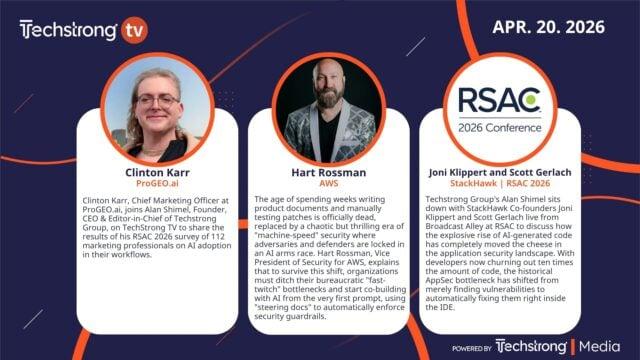
Techstrong TV – March 13, 2025
Watch our live stream on Monday through Friday, featuring exclusive news, announcements and conversations with IT leaders and experts on topics ranging from digital transformation to DevOps, cybersecurity, cloud native, containers and deep-dives into specific technologies and best practices.
Transcript
Hey, everybody. You're watching Techstrong Gang. We got open AI versus Microsoft IDPs, and well, what's gonna make those trains run outta time?
We'll be back in the middle. Hey folks, welcome back to the latest edition of the Textron Gang. We got a new member of the gang we're gonna introduce today, Robert Reeves, who's been in the DevOps space for a long time in the cloud native space.
Robert, welcome to the show. Well, thank you for having me. All right.
And for those who don't know you, give us a little bit of your background there so people know who you, where you are and where you're coming from and what your biases are. Oh, absolutely. Uh, I I have no end of them bias.
Yeah, absolutely. Uh, you know, we hold these truths to be self-evident, that software wants to be free, that developers want to solve hard problems quickly and not deal with human toil. Uh, my entire career has been in service to developers and making certain that, um, they have what they need to live their best lives.
Uh, also, I feel very strongly, um, that, uh, about businesses making choices that don't box them into a corner, uh, whether it's with closed proprietary solutions or opens solutions that aren't quite as open as we think, uh, think that that drives developer productivity and also outstanding ROI for the businesses that, uh, hire and support those developers. All right. So Mel Gibson's gonna play Robert in the movie.
That's how that's gonna work. Right? Wow.
Hopefully that, that, uh, that, that, that shoulder dislocation scene, uh, in Uhh lethal weapon weapon, that's, yeah. Yeah, yeah. That's, that's the one.
I like that, that was pretty hard There. There you go. Also, joining us today is Guy Courier, chief Analyst for, um, the visible impact arm of the Erum Group.
I always find that as a mouthful to say, but Guy, how you doing? Good to see you again. Uh, I'm doing great.
Um, good to be here again on this 88 degree or whatever it is, day in, uh, the, in March in Austin. Uh, Robert, I know you know what I'm talking about, and it is a mouthful. I apologize to everyone.
All right. And speaking of mouthfuls, we have, you know, his Royal Highness Czar, apparently of Silicon Valley, John Schwartz. How you doing, buddy?
Wow. Hey, how's it going everybody? Um, it is, uh, rain and, uh, it's raining, uh, water from the sky, but it's also raining open AI news.
My gosh. They are busy. They're doing a lot of stuff we're gonna talk about.
Yeah, Well, let's jump into that. 9 billion deal for AI infrastructure. Uh, left me scratching my head immediately, 'cause I said, well, doesn't Microsoft have a bunch of infrastructure they could use?
You're closer to this, John, what's going on? Well, I think, you know, what's interesting about that deal, by the way, is that as part of it, um, core Weave is giving OpenAI $350 million stake in the company, and the company Core Weave is gonna go public with a valuation up to $35 billion. So it's a pretty nice deal for OpenAI across the board.
But you're right, it, it kind of points to this fissure between open AI and Microsoft, which I guess was inevitable. I mean, Microsoft works with companies and then they work against them, they compete against them. And there've been a series of moves in the last week, but in particular that kind of show this divergence between the two companies.
You know, Microsoft, they have invested $13 billion in open AI and knowing a significant chunk in the company, which Microsoft will not disclose, but I've heard as size 35, 40%. But in any event, this, this a this, this deal with Coral Reef was just the latest in a series of moves and counter moves. Um, as you recall last week, the information reported that Microsoft is testing AI models to rival those of open ai.
And, um, that could lead to selling to developers and increased competition between the two companies. Tuesday Open AI released new tools to help developers and enterprises build AI agents. So they're, they're fighting back.
I think it's really interesting, and I'll, I'll throw this out to the group, but what, what's going on between Microsoft and Open AI kind of reminded me of their relationship between Microsoft and Apple back in the day, and how Microsoft, remember when, when Steve Jobs came back, Microsoft made this investment in Apple, which turned out to be an incredibly shrewd move based on what happened with Apple Stock after jobs took over and saved the company. And I think in the same way they're doing this with, with OpenAI, they're, they're investing in the company, they're competing against it, but they're also gonna benefit as OpenAI gets larger and maybe has open ai, uh, benefits from the core weave deal. So in a sense, again, it's history repeating itself.
Microsoft is your friend until it becomes your foe. I dunno. Robert, what's your take on this?
'cause, you know, to John's point about Apple, you know, I'm thinking maybe IBM and OS two, so who knows what that relates. Yeah, exactly. Exactly.
Mike, it applies. It goes back, it goes back over and over again. And I'm glad you mentioned that because I was thinking the same thing.
Yeah, it, it's, look, um, AI is, uh, a tool, uh, and we've seen this before, whether it is cloud DevOps, you know, even going back to nascent web, um, there is going to be a lot of, uh, coopetition. Um, but the thing that really jumps out at me with this announcement of this monster deal is that I feel for the CFOs of, you know, uh, uh, fortune 500 global 2000 mid-market companies, because their product teams, their executive leadership, um, are now even more reasons to, uh, to, to adopt AI and to start consuming chips. Uh, it's a lot easier to use that in a cloud like core we provides.
And so I am just really concerned about these runaway AI cloud bills. Um, I'm concerned because I don't see it being tied to the bottom line, uh, for the company. I see a lot of resume driven development.
I see a lot of science projects and, you know, things like this are gonna continue to build this, uh, echo chamber of people, you know, driving people to adopt this technology. And I'm not sure if companies are ready to tie that investment to a return. I'm not sure if they're really, you know, it, it's, it, they're confusing light with heat, and I'm just seeing a lot of heat right now, and I feel for that CFO I'm feeling for 'em.
Wow. That's, that's lovely. Uh, science projects more like science fair projects, if you ask me.
Or maybe, maybe sandcastles, uh, 'cause you know, they're built and they're destroyed. And I, I've been saying lately that, uh, the easiest budget allocation you could get is, uh, the one that requests some kind of AI something or other. Um, not that that means that it's, uh, uh, not gonna be watched and tracked, but, you know, if it doesn't work, I, I don't know, it's like a SpaceX explosion.
It's just like, okay, well, I'll just try another one. Um, I think you're, I think you're, you're spot on, Robert. Um, I, I think that that, well, two, two things.
One is by God, there's so many, there's so much going on all over the place. It's, it's, it's hard to like, keep track of, um, they talk about storming, norming, forming, whatever the, the, those things are, we're, we're, we're an extended storming phase, because like I said, the the money's flowing freely. There's a lot of places people can do all kinds of things.
Um, yeah. John, what was, what, what was the, uh, what was the investment, uh, uh, that, or what was the spending Microsoft had in, uh, core Weave? Um, uh, it was in, in the hundreds of millions of dollars or something like that.
Wasn't that Yeah, Mike, that's pocket change for, for, for, for Microsoft. Uh, there's no reason, uh, they wouldn't just go and spend a whole lot on other infrastructure out of Azure where they have sort of ready made. Who knows?
That's, that might be a sandbox environment for all know, you know, I think that for our audience, you know, keeping, keeping steady and understanding, to Robert's point, what value are you kind trying to drive? Don't just approve and go, um, don't just think that it's, it, you know, AI is this easy button. It, it's not, it requires, uh, whatever you do, it requires curation.
Maybe tuning, maybe some development you're learning, but also in its implementation, whether it's a foundational model or a tuned one or your own little service, um, you, you want human supervision on the whole thing. And all of this stuff that's moving around just points to the fact that there's no one who's found the natural monopoly yet. There's no one who's figured out how to lock in their pet AI model, lock in customers to their pet AI model.
And I think that is the underlying effort here is, is that, uh, whether it's Microsoft, open ai or anybody else, they wanna become the monopoly and they can't figure out how to do it yet. So there's a little bit of paradox happening here, though, because it turns out that the price of AI tokens and GPUs is coming down because of competition. They're just shrinking their margins and NVIDIA's still getting their money for the GPUs.
But the, I've talked to a bunch of people this week who are all saying, you know, prices are starting to drop regardless of the fact that GPUs are hard to find and the pricing from NVIDIA's high, but the rest of the services are dropping. And so they were kind of doing a happy dance. But I looked at it a little bit differently, John, um, are we not buying market share here, essentially?
And maybe people will be underwater, and then the next thing you wake up one morning and discover that, you know, they're broke. Yeah. Yeah.
I know. It's interesting too, the other dynamic, and I I, I don't want to throw this out, but this whole idea, we talk about this AI spending rampant spending, and I wonder if that's gonna continue a pace, given some doubts about the economy. I was gonna throw that out because I think that could throw a wrench into a lot of things.
You know, we've been talking about money as if it's, if it's error, you know, trillions of dollars in these, these budgets or these projects that are being thrown out, bandied about. And the, and the one thing I also wanted to mention though, about open AI and Microsoft, which is kind of interesting, is this whole crazy notion of the $20,000 a month service from an open ai, the PhD level intelligence. And when I was thinking about that, I was also thinking how that relates to Microsoft.
And in a weird way, what OpenAI is trying to do, I think, and I, this is the only explanation I can get from folks they're trying to commoditize and kind of show some sort of independence and show that they can actually bring in revenue because they are burning through cash. I think they burned through $5 billion just last year, according to New York Times, and they're still trying to raise money. So it's, it's, it, it, it, it, there's too much, it's overwhelming.
And I think Robert alluded to it for a CFO or a CIO or, or it decision maker, what do you do in terms of all these options? Did you mix and match? I read similar where they're up to a dozen, uh, AI agents from different companies would be used within, within enterprises.
The whole thing is kind of head spinning, you know, and I, and I think we there, we kind of have to step back and figure out where all this is gonna land. And I Just have no idea. Well, we, you know, the aphorism about the gold rush in, um, California, you know, the people that made the money were not the gold miners.
It were the people selling shovels. Uh, so if I was a finops company right now, I would be very excited, uh, if I could help target, uh, not only, um, assigning, Oh, You know, not just optimizing, uh, cloud performance to lower the spend, but to say, okay, this department spent X, this department spent y and being able to do effective chargebacks, I would wanna make sure if I was a CFO, I'D partner with a finops company right now that could help me point fingers. Because I would like to know if some group has a 30 million cloud and AI bill and then see that they're generating 5 million in revenue.
That's what I would like to know. So, guy, I have another question for you. Um, in effect core, we becomes the infrastructure house organ for OpenAI.
So won't everybody else who provides infrastructure services go rush to every other LLM provider and create some sort of sweetheart deal and say, you know, it's us against them. Uh, you mean like competitors to Core Weave going and trying to do the same thing? The problem is the core weave, uh, started out as a GPQ, um, based instance cloud company.
And that was in, what, 2017 or 2016? Something like that? It, 17, yeah, 17.
It was originally thi this was originally to mine Bitcoin, or, you know, it was for crypto. Um, but lucky them, they could just, uh, adapt the same architectures, wasn't luck, of course, but, uh, they, they could adapt the same architectures, uh, to, um, to, uh, AI training and, uh, to a lesser degree AI inference. Um, so they have pretty deep roots here.
And, you know, I'm sort of hard pressed to think who else does that might be, uh, an open partner other than Oracle, which is already partnering with, um, with, uh, is that open AI or, or Microsoft Open Ai. Uh, yeah. You know, that's Interesting.
Everybody doing that. They're opening that data, right? So Oracle's been investing Yeah, yeah.
Thinking of us considerably for like two years in these same kind of architectures. We know, you know, Microsoft has for Azure, but that's for their own services. Google the same thing.
So Mike, honestly, um, uh, especially given that I, I think John's point about the macroeconomic climate is a really good One there. God, there are at least two startups out there, maybe three with GPU services specific to compete with these guys. And every cloud service provider, whether it's somebody like SIBO or, um, some of the, what do you call them, um, dedicated Racks, dedicated hosters, Dedicated hosters, are all sticking GPUs in places.
So I think, you know, there's plenty of places to go partner with, but, uh, we'll see what the level of competition is from here. John, what is your prediction here as you look at all this stuff? So, you know, one thing I failed to mention is that NVIDIA's in a big investor in Coral Weave, which adds another interesting dynamic, but I also, I wonder if Coral Weave becomes part of this Stargate project that we just, we mentioned earlier, this ridiculously overinflated, over hyped $500 billion project over four years to build out AI infrastructure.
I wonder if they become a key element of this within the open ai, Oracle, SoftBank triumvirate. I think, um, we're gonna continue to see, and, and it happens literally every day. It's probably happening right now, even more moves, uh, down the line between open AI and Microsoft.
It's, it's, it's inev inevitable. And again, we have to look back at history. This is will always happen with Microsoft, but the thing about Microsoft that's, that always impresses me is they, they place their bets and they're pretty, they're pretty shrewd on, and, and they're benefiting in a sense from their partnerships and, and competing with some, with some of these same companies.
Um, they kind of play the whole table. So I think Microsoft comes out as a kind of a big winner as they always do. And they're, they, I mean, they are the most admired company, I think, in the Valley right now, in terms of the way they're run.
Alright, I'm gonna open up that AI sports book in Las Vegas and take some bets and we'll just like, get some odds going and we'll make some serious money. Well, Actually, can I, can I make a prediction and get John's reaction to it? Sure.
Go for it. Yes. Um, I think open AI is the Yahoo of ai.
Wow. I think that's, yeah, I think, Damn, dude. Yeah.
That's a good, that's a good one actually. I, I, you know what? I see that They made the market.
They made the market. They're making the market Well, to some degree still. And, you know, I don't know how long it'll take, but they will didn't Microsoft second Area.
Yeah. Didn't Microsoft try to buy Yahoo? Remember that back in the day?
Oh, yeah, That's right. Yeah. I mean, it could happen again with, yeah.
All right. Well, Robert, since everybody's throwing around predictions, close this out. Well, it, it's, um, I think, um, that whoever is leading right now is not gonna be leading in the future.
I know that, uh, you know, you can be first or you can be best. Um, and it's just the nature of business. Uh, people are gonna see where, um, other startup founders and other organizations are gonna see where there are missteps and they're gonna come in.
I do not think we're at the top of the hype cycle, though. We have a long way to go until the trough of disillusionment. Um, so my prediction, uh, is that there's gonna be a lot of broken hearts, uh, for consumers, uh, people that are in this space that are providing these technologies, whether it's cloud or tooling around ai, they're gonna do well.
Um, it's the people that are gonna be, uh, trying to consume it. I, I, my heart goes out to the, you know, banks and insurance companies and manufacturers that are trying to figure this out, because they're just gonna be dumping money into a dumpster fire. All right.
Robert's got ai, dark horse to win. All right, we'll be back in the morning. Discover Techron Group, the epicenter of tech innovation.
We are your go-to for reaching IT, leaders and practitioners worldwide. Our secret impactful content that sparks awareness, engagement, and top quality leads with us. You'll access editorial websites, streaming videos, virtual events, custom content analyst research, and more.
Join our satisfied clients. Let's revolutionize your tech journey. Contact us today and tell your story to the world in the most powerful way with Techron Group.
Hey, folks, we're back in. I know we've been talking about platform engineering on this show multiple times, but every time I go in and have a chat with somebody about this, they point to this thing called an internal developer platform, an IDP. And to be honest, we've seen these things before.
We kind of like maybe experimented with it, I wanna say, five or six years ago, and then basically forgot about 'em, and then suddenly they made a comeback under the guise of platform engineering. But Robert, I know you follow this space closer than I do, but what's your takeaway? What's driving this IDP conversation?
Is it just like the simplest, easiest thing to do for a platform engineering team and the best place to get started? Or is there something else afoot here? Well, um, I think it's just a natural reaction to how we've evolved as an industry, um, with software engineering.
Um, so whether it is, uh, adopting DevOps Cloud, um, using AI and to support development efforts, um, we are continuing to get more and more efficiencies out of these individual areas. IDP platform engineering, what we're trying to do is offer a catalog, a single place inside that company to speed developers on their way. We wanna make it easy for 'em.
We wanna remove human toil from this process. We wanna, uh, get rid of the stuff that is slowing them down. But at the same time, we wanna also remove the chance for unintentional mischief where we can, uh, maybe fire up environments, uh, for development.
And perhaps they're not the right ones. Uh, perhaps, uh, developers will, uh, start working on the wrong environment, and we wanna be able to direct them to the right place. It's just one example.
Um, it's just a natural extension of, of what we saw with DevOps and, and I'm here for it. Um, I certainly love to see, you know, open source projects like Backstage, uh, you know, uh, uh, remember when that first came out? Very excited to see that.
And I'm happy to see more and more companies adopting it. It's all about making developer, the developer experience, uh, easier, uh, more enjoyable. But at the end of the day, it just makes good business sense.
Every line of code that you write that is not for your application that lowers costs or increases revenue, I believe is wasted code. I think that we need to make sure our developers are spending time writing and improving these applications, building and improving these applications, and not on internal plumbing. Uh, and, and the things that stop them from doing what they wanna do and what made them wanna be developers in the first place.
Well, let me follow up on that. 'cause let me tell, I kind of understand what you're saying, and mathematically I would agree, but then my soul kind of goes like this and says, well, you know, the first reason we embraced DevOps was to get out from underneath the CIO man in the first place. And now we're moving back to some centralized IT thing that kind of feels like the CIO man is coming back.
So how do we do this in a way that Proverbs or preserves, sorry, your freedom, you know, that thing you talked about as being very important. Mm-hmm. Well, I would hope that our DevOps teams, um, our SRE teams, um, would have a key part to play here.
I would hope that this would be driven by internal dev development teams, uh, throughout the life cycle that they would be driving this. I would hope that the CIO would say, we're gonna use an IDP. I hope that's not the case.
I hope that it is driven bottoms up, and that developers are saying, Hey, let's make this easy to onboard our new developers. Let's take care of some of the hassle and heartache that I have to deal with. Uh, I've certainly seen anecdotally where these teams, uh, in internal development teams, not executive leadership, um, saying, we're going to bring in backstage, we're gonna make this easier.
All these little places that we go for CICD, provisioning all points in between. Let's go ahead and put that in one place. Let's have our catalog of instances that we can run, whether containers or cloud instances, and let's just make it easier.
Uh, so I would hope that it would be driven bottoms up, because when you do that in technology, you're going to have success. You're gonna win mindshare, uh, the, the, uh, you know, the whole cathedral and bizarre thing. Uh, and, and I would very much hope that it would be driven bottoms up or from individuals that once you improve their lives and the lives of their fellow developers.
Mike, isn't this the whole problem though? Because I, I think, Robert, you're, you're, you're right. But I think that requires the platform engineering team to start working a lot more like a product team.
And I don't think that's in their, their, you know, their blood. I, I think that, I mean, engineering almost says it all. Um, in, in the phrase platform engineering, what I'm talking about is, um, that, uh, one of the great outcomes of DevOps was a, a slight reorganization of how a software engineering teams worked so that they started to work like product teams.
They had inbound, um, you know, what, what are the needs and requirements? They monitored the user experience. Um, they, you know, tried, you know, uh, uh, types of development, but reacted to usage and all that other sort of stuff.
So a lot closer to the user base considered as a customer. But gosh, like that would be a big change, wouldn't it? In, uh, so that's why I asked Mike, Mike, like, the platform engineering teams don't work this way.
If they started to organize themselves in this way, then this bottom up thing would work because their constituency becomes the developers. But I don't know, I've talked to a lot of ops folks over the years, and they tend to think like, no, we need, we need this engine, this machine that's just humming. And they almost see the developers and users as like, like pesky, like bothersome things that they have to deal with.
And that's not the kind of culture you're talking about, Robert. So Mike, what, what's your perspective? You've been covering this for a while.
I think you're spot on in that they need to come to a mindset where they're treating the developers as their customers and not their hostages. So yes, that has to happen. But, um, you know, to your point though, what happens is, like somebody sits around and says, we need to scale our investment in compute and storage.
And then they just turn everything into this kinda one size fits all approach, and everybody rebels. And the next thing you know, developers who have skills will just go out and do it all over again somewhere else in their basement using a server that they are, have on their own, build their own software, and then they'll bring it to work with them and hand it off to somebody, and we'll be as far off as we ever were. John, I know you've been talking to CIOs for a long time.
Are there kinder, gentler CIOs out there? 'cause you know, when I talk to those people, sometimes I hear phrases like, I hear a lot of I, and not a lot of we, Right, right, right. It's a top 10.
Yeah. Yeah. I think we're talking to the same people, or it's an echo chamber because it's a, basically, it's a top down mentality, right?
It's what they're infatuated with, who they are friends with, who, who they believe in based on their recent biases or their historical biases. And it's not about what the, the vast majority probably are, are pursuing or want. So they kind of foist their decisions onto others, which then creates this bottom up problem, which we continually see.
And then they, they continually make adjustments based off of, uh, the whims of a CIO. So, you're right, Mike. I mean, it's, that's, that's always kind of be inevitably part of the equation and, and a major flaw, flaw in the system, Right?
So Robert, is there some way to kind of bring these ops folks and CIOs together with the developer community? They kind of have a more enlightened conversation, shall we say? Well, it, it's really, uh, the, with em, what's in it for me?
If you are able to identify motivation, uh, for all these parties, what do they hope to accomplish? You can build a coalition of the willing and reach those goals. So for example, are there OKRs, KPIs that our friends over in CIO land are driving toward?
Um, certainly development has theirs, and how can we come together and reach them? Um, you know, it really comes down to, uh, increasing efficiency, lowering costs, increasing time to market for new product. Everybody can agree on that.
And, um, you know, I really believe that they need to sit down and talk, uh, and they need to figure this out. Uh, it, it is top down, just doesn't work anymore. Uh, you will have, um, you know, developers will vote with their feet and they will leave.
And, uh, you know, some folks might say, well, that's great. We can hire, uh, less experienced developers. Um, good luck.
Uh, you know, every time, uh, you know, when the, uh, you know, you shut down work for the day, you know, at my startups, um, I always, you know, I, I I believe that the most valuable asset that I had left the office every single day or left the computer, whatever. Um, and so, um, maintaining, uh, those folks is gonna be key. I think platform engineering, IDP is one of the ways of doing that.
But you have to do that with them. If you're building a tool with them, uh, for them, uh, you have to partner with them, right? I love your Karen, but I'm going describe the stick.
The stick is gonna be the rise of ai. And right now, when you look at all these projects involving ai, I gotta go get developers and data scientists and data engineers and security people, and all kinds of other folks that are hanging around this project, and it takes a frigging village. It's fundamentally inefficient.
So I would say that platform engineering is gonna be required to drive the next wave of AI applications because it's beyond simply a bunch of developers. We need a more, uh, centralized approach. We just need to do it in a way that, you know, is open to innovation, right?
So I don't get locked into a tool, and I don't have a CIO telling me, well, we're an Oracle shop, so we should only use Oracle stuff, or Amazon, or whatever it is, because, you know, then that defeats the purpose. So, guy, can I have my cake and eat it too? No, I don't know.
This is, this is like the oldest story ever, and it's still going on. The ops people hate the devs, the devs people hate the ops people. I mean, you know, hate, it's not really hate, but, um, I, is this yet another cultural shift also?
I, I just, I, I don't mean to be pessimistic. I really don't. I think that there is an opportunity with this platform engineering paradigm to, to sort of change the process and make it more like a product development process.
And that would be a, a cultural shift, but not actually as huge a one. Um, but you know, most of what I've seen around this is, is the usual story of get user-based buy-in and to get management support and work from the top and work from the bottom and come to an agreement and that sort of thing. And those are always worthwhile effort.
That's a perpetual, worthwhile effort. But I think a more fundamental change would have to, would have to take place. And maybe it's not my idea of, um, running platform engineering more on a product basis.
Maybe it's something else. Um, but I, I, I, I, I don't think, um, I don't think that doing the same thing as before is going to do more than keep the cycle going. There will be some kumbaya, there will be some successes.
There will also be failures to Robert's point developers leaving difficulties, um, that that's been going on for decades. And I would love to see that change. Um, is AI the stick to do it?
It could be. It could be. Um, but I think we are aware of the flaws in difficulties with the use of AI to begin with.
And so that'll have its failures. All right, I'm gonna end this conversation here, but point out one thing, what we're currently doing isn't working so well, so maybe we need a different approach. com Is the leading resource for news analysis and education on challenges facing the cybersecurity industry.
com covers all aspects of cybersecurity, including data security, DevSecOps, cloud security, application security, network security, security threats, and more. com has the largest selection of security content featuring breaking news, blog posts, podcasts, and more. com to learn more.
com. Home of security bloggers network. All right, folks, we're gonna talk about something a little bit different here, but it turns out that Google and the MTA runs the trains in New York City have been strapping phones to the train to try to figure out, well, when the train might be the delayed.
I'm long time New Yorker. I kind of scratched my head a little bit and said, this is an interesting way of going about solving a problem. But Guy, I know you two have been in New York when you looked at this, what was your impression?
Uh, well, since I've been, uh, the sad elf for this entire show, uh, let me, uh, change my mood here and say that I love this. This is awesome, and it's awesome in two ways. Um, the first awesomeness is this is a fantastic use of generative AI and of AI in general.
It's a fantastic use. Why? Because it replicates a, a, a, something that maybe the most elite of track inspectors can do.
It doesn't replicate it perfectly. I think what is 89% success rate or something like that? Um, and it does it, you know, uh, using, um, AI to collect, you know, reams and reams of data at the point of, you know, at the edge, um, and, uh, uh, do these kinds of analyses that, uh, the human brain and human ear can do with years and years of training and experience.
So when you get this 89% success rate, that's, that's a terrific accelerator. That's great. Love that.
The other way is, um, it, it, you know, this is edge ai and it's edge computing, and it's really interesting that they didn't use edge devices. They just use smartphones. Everybody needs to remember a smartphone is an edge device.
Why they didn't use, uh, uh, dedicated edge devices is a really interesting question, John, maybe you have some insight into that, um, because that would be a typical approach. But instead, Google just kind of went in and said, I just use smartphones. It's easy off the shelf.
We'll install an app, bang, bang, boom. You know, it's done really quickly as a proof of concept that maybe could turn into edge devices. I mean, I love the idea of these R 46, uh, subway cars, which are 50 years old now, something like that.
I mean, I rode them to, to school when I went to the Bronx High School of Science. Um, I'm really familiar with them. They're, you know, they're not quite buckets of bolts at this point.
They were always pretty good. But we're not talking about some new fangled. This, there's, this is a really great example of agile and quick deployment of an AI application at the edge for an immediate proof of concept, positive outcome, and a reason to invest further.
So, yay. I think one of the reasons they didn't use sensors is because, well, if we've been down in the subways of New York City, somebody probably said, you want me to install what, where have you seen the rats lately? So, Well, yeah.
So it's not a question of sensors because the phones have sensors. They used the microphone to, to, to listen to the sounds of the subways going over the tracks. Mm-hmm.
Um, did they use anything else? I mean, that might have been all they were able to use. Maybe the camera, maybe, you know, you strap it to the front and they use the camera.
What's sort interesting is how they, they, they picked up sounds and other data, and then they fed it into Google Cloud when they were trying to analyze and spot patterns that would indicate track defects before they became an issue. So that was mainly the, the delays had to do with maintenance. And I think it's interesting too, because Google's been working with, um, other transportation agencies over the years.
It's worked with the Chicago Transit Authority. Um, it's worked on, um, with, with a chat box for them. It's worked in, in terms of connecting street parking meters to Google Maps.
And, and, you know, a lot of cities, not just New York, are looking into this. Um, there have been efforts, I think, in, in Beijing for facial recognition systems, in place of transit tickets and carts. You reduce the lines during rush hours.
Um, I believe in Chicago, they were trying to sense or find, um, instances of gun, of gun use of all things. Um, and I think that was something that they, that was tried in New York too, was looked at at least, um, New Jersey Transit system uses AI to analyze customer flow and crowd management. I think it's just, it's just really interesting to me how AI is being used for something that's very practical.
And, and, and when I, I did not realize the scope and the sheer size of MTA, uh, was like 500 stations, you know, hundreds of millions of rides. I mean, it's, you're bound to have delays 24 7. And I think this is an actually a very interesting pilot project.
Now, whether it leads to an actual contract is another thing given budget constraints, but I think it's a positive move in terms of transportation. And God knows we need to look into, um, enhancing our transportation given the state of, of, of the FAA and other, other, other agencies. Right.
Robert, what's your take? I mean, can AI accomplish what even Mussolini couldn't pull off, make the trains run on time? Well, I, I, I think this is an argument, um, on how AI can support humans in what they do.
Uh, so it wasn't AI exactly that said, Hey, let's put a phone. Let's, let's put all these pixels, uh, you know, on, on, on MTA lines that that was not, that was a human that did that. And of course, you gathered data and, and used AI to, to tell us, you know, and pr get some, uh, predictive ai and tell us are, are these running on time?
How can we improve? What is the, uh, expected delays, uh, are they gonna compound? Um, I love it when I see people find new uses for existing technology.
It is, um, you know, I I it winds up being a celebration of human spirit and of solving problems. And that's exactly what our engineers do, uh, make it work. Um, and, and dealing with the resource constraints that you have.
Let's figure this out. I'm sure there were probably cheaper ways of building, uh, these edge devices, guy that you, you were talking about, you could get that price down far less than a phone. But how long would it take to manufacture that?
Well, exactly. Get A box of This just cheap. It was speedy.
It was off the shelf. Yes. And so there's always gonna be that payoff between cost and, and speed.
Um, but you know, I've also seen the same thing, um, with, uh, uh, people building cars. Uh, large European car manufacturers are replacing, uh, $20,000 Windows PCs on the factory that drive, uh, torque wrenches on the factory floor with, uh, little tiny edge devices that are running a container. They're driving that with Kubernetes.
Um, we, they are figuring out how do we use older technology, um, and update it, take advantage of, you know, ease of use for deploying our apps, but also how do we tie this in to get the data to, um, our teams that are trying to build models with ai, either hopefully predictive ai, not generative ai, uh, telling us what's going to happen. Um, another example is a, uh, company that makes, uh, plastic little toys. Uh, maybe you put them together and they have very old injection molding machines, and they're using open telemetry to get data, and they're using that to predict when those machines are going to go down and to get some preventive maintenance in.
I love with old trains, old injection molding, uh, machines, torque wrenches. Uh, you know, we're, we're applying new technology to this to make it, uh, better. Uh, and, and, and it just, it, it makes me happy.
Uh, I like the idea of them sitting around, um, a room somewhere and say, Hey, what if we just use pixels? Oh, that's a great idea. And, and that one team that did it saved them so much time and hassle and heartache and really made this quite an interesting story for the press to pick up win, win, win, Ga.
You know, I've, I've always, I've always complained and bitched and moaned about how tech doesn't address like, real issues in, in real life. And here's an example of, of a practical use of something, a new technology or, or a blend of old and new technology to address a age old problem that actually helps people. So, and, and again, it's kudos to, to Google and others who are, who are looking into these China practical solutions.
Guy, I'll tell you this. My father worked on the trains for 45 years, was, uh, worked for Conrail and all those before that, going all the way back to Grand Central. Um, I'm a little worried from the engineers, is AI gonna start driving the train and do we not need brakemen and brake conductors?
And it's all just gonna go to tech. Yes, AI will start driving the trains. Um, one of the interesting, you just will sort of, uh, uh, example, um, I hadn't really thought about trains so much, but I've been thinking about self-driving cars, uh, for many years.
Um, self-driving vehicles. Um, I don't remember who pointed it out, I didn't come up with it myself, but one of the biggest opportunities is, uh, in, uh, medium haul trucking, um, intermediate trucking. So the most difficult driving, um, issues are like in cities.
And that's where self-driving is being tested. But in fact, the best opportunity probably for removing drivers altogether and using, uh, uh, AI driven vehicles is on medium halls, um, to intermediate, uh, uh, de depots or, you know, what, what, uh, depots that the right depots, depots, intermediate depots on the outskirts of cities, at which point human drivers or human assisted driving at least, uh, there's a human in the cab, uh, in the same way. Um, uh, there's a, it is pretty, it's a pretty controlled environment on tracks, um, you know, by its nature.
Um, so I do think that that is one of the areas of low hanging fruit for, uh, for all, you know, a hundred percent ai. Mm-hmm. I don't know, Robert, will I go to a amusement park someday to drive a train just for fun and 'cause AI's gonna drive him in real life?
What do you think? Well, you know, I'm reminded of the scenes in Tim Burton's, uh, Charlie in the chocolate factory where, uh, you know, Charlie's dad loses his job at the toothpaste factory because he was putting caps on the toothpaste. Uh, and then of course, at the end of the movie, hopefully, I'm not ruining it for you.
Um, he is, uh, because he, his job was taken by a machine that would put the cap on, and then later at the end of the movie, he gets a job repairing the machine. Um, I've also seen this with, uh, the move from, uh, typist to word processors. Uh, we, we've certainly seen this, um, over and over again, um, there, yes, uh, a number of people that, you know, uh, uh, farriers, people that put, uh, shoe horses on shoes, you know, how they kinda lost out with the rise of the internal combustion engine.
Um, but, uh, there is a whole host of other jobs that were created from this. And yes, things will change. Uh, the ch accel change will be accelerated.
Um, and there will be some difficult times ahead. I would hope as a society that we would recognize the innate experience that those train conductors and brake conductors and all those people you mentioned, Mike, that they have, and hopefully use that experience to make it better. Uh, let's use AI as a force multiplier and to scale up.
Uh, but I would hope that with ai, uh, as a consumer, I would get something better, not just the same, but cheaper for the corporation that would bum me out When you make it any nostalgic. 'cause my mom used to be a typist and used to type 90 words a minute on those old manual typewriters. So there you go.
My grandmother was a statistical typist. She worked in the Pan Am building, um, in Midtown Manhattan. She was a statistical typist, and that one went out real fast.
There you go. That particular specialty. What, what is a statistical typist?
What is that? Uh, they, they type, they type spreadsheets on manual or electric typewriter. Okay.
So all the characters On the periphery of the keyboard. Well, yeah. And, and, and putting things in columns.
I mean, it was a, it was a specialized form of typist that could format numbers in grids and put them in the right place and all that sort of thing on a page using, you know, typing. All right. Well, I don't know guys, but it's 2025.
I guess somebody can put together an amusement park from the turn of the century. 'cause everything we knew about two decades ago is already become an obsolete. Hey guys, thanks for being on the show, Robert.
Thanks for joining us. It was a pleasure. Yes, always.
Thank you. So, All right. I want to thank you all for watching this latest episode.
Stay tuned for what's going on in the rest of Techstrong tv. Me, I think I have a bunch of lion old trains up in the attic. I'm gonna go play with.
Let's steal it. This is Techstrong tv. Hi everyone.
Welcome back here to Techstrong tv. My next guest is Danny Allen, chief Technology Officer is sneak, his friends call him Bobby Orr. Actually, Bobby Orr's an old name.
You may not remember Bobby Orr, but anyway, Hey, Danny, welcome to Text Drug tv. You've got some explaining to do. I do, Alan, I do remember Bobby Orr.
He's a hockey player from Boston where I live now. Um, and I love him because I've been playing hockey now for 45 years, but, uh, this past Friday as sometimes happen, it's not the first time I got a stick in the face. And so now I'm sporting a, a nice bright shiner.
A likely story, but a good story. Nevertheless, you know, there's been great hockey players over the years. I had, I grew up in Long Island during the Islanders heyday, and I had a chance to meet most of the Islanders back then.
But, you know, for me, Bobby Yr always epitomized the, the grace of gracefulness of hockey, right? He was like a ballet player out there, but he tough his nails too, right? And, uh, ah, those were great years.
Anyway, I, I'm sorry you took the stick to the face. It could have been worse, as they always say. So.
And I know it won't make you, it won't make you stop playing hockey, so more power to you, man. Absolutely not. It's a great sport.
Absolutely not. Absolutely. Alright, Danny, when you're not playing h Hockey, you're the Chief Technology Officer at sny.
Give us a little bit of your background and then give us some of the sneak background. Sure, yeah. I've been in security space for a very long time.
In fact, application security. I've been interacting and around the world for 25 years now. I started at a company called watchfire, which um, sure started up in Ottawa.
I was playing hockey up there as well 25 years ago. Mm-hmm. But Watchfire acquired a company called Sanctum, and they had a dynamic application security testing tool called OP Scan.
And so for seven years, uh, did a lot of application security. That company ended up being purchased by IBM. So I, I did three years at IBM, but a lot of time over the last 25 years in and around security, starting with dynamic application security testing while I, I was working at Watchfire and, and we acquired this company sanctum.
There's an individual there named Guy pni, who I became very good friends with 20 years ago. And he is the founder of NY Guy po Sure. Guy Po.
So fast forward and 20 years later, I've had interactions with him continuously over the last 20 years, but eventually he convinced me to come over. And so, yes, now I'm Chief Technology Officer at sny and back to doing what I love, which is helping make software more secure. And that's, that's SNYs mission in life.
Fantastic. That's great. It's what a great story.
You know, I'm also involved in the, in the, uh, remediation vulnerabilities space. So I started a company in Colorado in 2001 called Still Secure. In 2003, we came out with our first vulnerability product called van Vulnerability Assessment of Management.
It was, it was scanner under the Hoods, but we were writing our own Nale scripts back then. And then of course, you know, when Nessus stopped being open source, you could, you know, you could still write your own nozzles and, and stuff like that. Um, and we did nac, which to me was always sort of a, I don't know, it was in our growth of vulnerability.
'cause what we were doing, we were testing devices before they got on the network for configuration of vulnerabilities. It's different, you know, same, same mission, different tool. Uh, so I've also been in it that long and it, it certainly, I mean, NYK brought a whole new, they brought AppSec to vulnerability management in my mind.
Right? Because for a while there, we, you know, you had your vulnerability management and then you had your EC scanners and so forth. Yeah.
It's Different in my mind. Come together. Go Ahead.
Yeah. What's different in my mind is BA back, Nessus was an amazing tool, actually, Nessus and Melo. And, and they were tools used by security practitioners.
And what snyk did differently is rather than building a tool for security practitioners, they say, no, no let to build Different, develop developers. Let take it, build it for developers, shift left. Yeah.
Build it into the pipeline and make it really easy for developers to use. And it's been an amazing journey because of that. You know, it's funny.
So for the last 10 years at RSA network, every Monday of RSA week, we always in partnership with them, and the Moscone Center put on our DevSecOps event 10 years ago, you could imagine what I had trying to bring the DevOps people and the security people together, they hated each other. Security people said the developers didn't care about security. The developers had the security people, just the people who say no, and they're difficult.
And it was true. And SNY has sponsored this in the past. They've been sponsors, they've spoken at our event, um, it was through sny really was one of the very first ones that said, wait a second, we could have chocolate in the peanut butter here.
Right? We, we, we could make a security tool for developers that'll allow them to make higher quality code. We'll stay away from the security word, even higher quality code.
And it was a game changer. A game changer. Um, you know, we've learned a lot of lessons, as has snyk.
I've actually spoken to Guy this very, uh, subject, we've learned things along the way, right? Developers don't necessarily want to be security professionals. They do want to develop quality code, right?
Security people grudgingly acknowledge this, right? That developers wanna do it now, of course, two years, whatever it is, two and a half years ago, everything changes with, with, uh, chat GPT and AI and so forth. And, and now we're hearing, you know, woe is me.
We're gonna replace developers with ai. We don't hear that we're gonna replace security people with ai. So, which leads me to leave.
Maybe the security people are behind it, but, you know, what do you think about that? Daddy, you've been around this forever in the day now, are we at a point where we're gonna replace developers with ai? And what does that mean for security?
Yeah, I don't think there's a chance, Alan, that we're gonna replace developers with ai. And I say that, I always use the analogy of autopilots because, you know, the first flight was early 19 hundreds, early at 19 hundreds being 1905 or oh six. Autopilot was actually developed in 1912.
We've had autopilot for a hundred years and we still have pilots in the cockpit. I do think that the role of developers will change. So right now, developers primarily, I shouldn't say primarily, maybe 20% of their time is writing code.
And the other 80% is doing research and evaluation. I think they'll become more prompt engineers over time and, and their, their daily activities will change. But there's no way we're getting rid of developers and anyone who says that doesn't interact with, with development and developers on a daily basis, is my opinion.
No. So I think it's a little more nuanced than that. Right.
Okay. And I've seen this, so you look at like, recent announcements from Salesforce, you know, recently was Dreamforce and, and what did they call it? Agent Force or whatever, where they're putting out all these agents and you know, what would they believe?
And then, you know, Zuckerberg, mark Zuckerberg from Meta said that this year they think that a lot of mid-level developer jobs maybe lost to ai. Uh, the sales force people said it was a lot of lower level developer jobs that'll be lost to ai. No one ever says, sort of master developers, your highest level developers are gonna be replaced by ai.
'cause those people will learn to harness ai. Yeah. And B 10 X more effective.
Yeah, I tend to think of it kind of two different ways. One is the, the lower level technology, the front end. If we talk about the front end, it's more likely that AI is gonna be super helpful in generating the next web interface for me.
Like create the table, do the thing that it needs to do, but it's not going to be nearly as effective at backend. Things like the way that we're writing software, Alan and her, as you might imagine, we're doing static application security testing using AI itself. That's super complex.
Symbolic regression analysis. AI is not gonna pick up and, and do that. So it's gonna be helpful in the front end, but it's not gonna be nearly as effective in the back end.
And it's still not gonna do everything. It's still going to require someone to be there as the guardrails for the software as it's being built. Yeah.
So, you know, I'm reminded, I I remember doing an interview with, um, I'm, I'm drawing a blank on his name. It's one of the, uh, Luke, Luke, Luke Keens, one of the founders of Puppet. Okay?
com 10, 11 years ago. And he said in 2035, software will write software. I'm not saying he's wrong, and he, it may even be before 2035, but I, and I don't think you are not disagreeing with that.
You are not disagreeing with that. That's kind of a double negative. I think we both agree with that, but I think the issue is it won't be exclusively software writing software.
There will be no, I would agree with that. Humans behind it. And, but here's the thing.
You know, we've both been in technology and in security a long time. My advice, and I talk to young people all the time, my advice is you can't bury your head in the sand and make believe this is just of passing fad. 'cause it's not number two, you can't fear it and say, well, I'm gonna go find something else to do, right?
I'm not gonna be a software developer anymore. I'm gonna go be, I don't know, an air conditioning because, uh, AI will never install h HVAC systems, right? I mean, uh, no, you've gotta embrace change.
You've gotta embrace technology. You need to leverage because the people who leverage, you know, I, I do YouTube shorts, I do a lot of videos like this. And we take some and we make short, we make sure it's out of a lot of 'em, you know, to get more views with it.
I did want, about a month ago, about Mark Cuban said the first trillionaire will be the person who figures out a novel way of leveraging ai, not something we're doing now. And that, so it won't be Elon Musk, it won't be Jeff Bezos, it won't be Mark Cuban. It won't be Guy Po po.
But it'll be someone who uses AI in a way that just we haven't quite thought of yet. 2 million views, because people are interested, I guess, in trillionaire stuff. But to me that's, that's really the, the key here, right?
That is key is leveraging it. The key Key. Yeah.
That's where, that's where the industry is going. And I think the, the individuals that embrace AI and figure out how to use it, those are the ones, as you say, that will become the trillionaires. I don't think the money's in the models, or even in the GPUs.
I think it's how do you take AI and use it in a novel way that completely and radically transforms an existing industry or creates a new industry? And we're doing that. We're proving this actually at Snyk.
We, we have a hundred million dollars product. We've announced that publicly. That is AI driven.
Like I think the value that we drive as an industry is going to come from AI within the software that we're building. I, I agree with you. You know, the, there's the old saying about the gold rush, right?
It was the people who sold picks and shovels who really made the money and, um, not, not the people, because, you know, a few people made a lot of money finding gold, but there were many who bought picks and shovels that did find gold. And I think this is the same thing here with, with NY or, you know, tools that are incorporating AI to become better at, at their tools. Now, as I said before, the security's a bit of a different animal.
How do you see AI being used, let's say, in snyk security tools for developers to, to make developers' lives easier, to make better quality software, et cetera? Well, we're using it right now in three very significant ways within the product, but I'll talk about where it's going. One is, we acquired a company called, uh, deep Code back in 2020.
Yes. That did symbolic regression analysis of the code. And, and essentially what that means, sounds technical, takes the code, converts it into an abstract Syntex T tree, a symbolic representation of the code that shows the data flow from source through to sync.
Um, and then it would say, is it going through sanitizers? Is it doing all the right things? And it radically transformed the industry, not because it was using ai, but because rather than taking hours to do analysis, it took seconds.
And because it took seconds, you could do it as part of a PR checker, like really, really quickly. And it radically transform static application security testing. So that's one way that it changed the industry.
The second is, we're using it now to generate fixes. So not only are we doing the security analysis, but we are generating the fixes for the vulnerabilities that we find. And it's doing it in reverse order, actually.
It's, it's taking that abstract syntex tree and it's generating a secure flow, converting that into code, and then inserting it back into the code. And, and the reason that's interesting, Alan, is because it's not just like replace these four lines. It's change these two lines and these 10 lines and these five lines and insert this dependency.
It's a very complex model. The third way that we're doing it is around CVEs. As you know, from the security space, there are tens of thousands of CVEs reported every year.
Last year was 40,000 CVEs. And that was about a 40% increase. One of the things that we do within our product, it was hard for us to keep up with all the common vulnerability enumerated issues happening.
So what we did is we took an LLM and we said, read the descriptions of what's being submitted to discover which function within that, within that open source component actually is vulnerable so that customers know whether they're coloring that vulnerable function. And so, again, just making a developer's life easier, whether it's generating a fix, knowing whether the vulnerable function is called. All of these things we're already doing within our platform, but what gets me outta bed in the morning is not what we have done.
It's all the opportunities to continue to use AI within the platform to make the developers more productive than they are right now. So to me, that's now we're crossing into a Gentech ai, right? Yes.
Where it's, it's not just the gen ai, you know, writing code or what have you, but having agents that actively go out and do these kinds of things that you're talking about autonomously, right? Just, yeah. And I think that's where you start getting a blurry line.
But go ahead. It is. And in fact, the generative AI fixes that we're using, we can package those up and make them completely autonomous.
So now you have AG agentic ai, and what I expect to see over the next little bit is that by policy, because some organizations will say, you know, use the AG agentic AI to fix this class of vulnerability for this type of application or not, or by policy, send it to the AppSec person to review. 'cause I'm not quite comfortable that it's, it's ready to solve that issue. That's where I think we're gonna see all the innovation happen in the next few years.
Absolutely. And you know, it's the same thing I saw in the vulnerability management in NextSpace back in 2003, in 2005. I saw it in the IDS to IPS kind of thing that went down, you know, around the same time when we start automating remediations, people get a little freaky.
I mean, they always wanna have a human set of eyes. I, there must be something in human nature that we do that. Um, but, but yet everyone's phone, I don't have my phone with me.
You know, we're updating our phones multiple times a day. Right. And no one pays attention to that anymore.
Go figure. Yeah. I I think the agent is gonna come into its own over time as people get comfortable with it.
I always say people, you know, I'll turn on self-driving mode in a Tesla, but am I ready to get in a Tesla and tell it to drive me across the country? And no, not quite yet. Right.
I have, say we have, so I have electric BMW, but it has like the self parking and Yep. Scares the hell outta me. I turn it on and I grab, I hold on it.
My knuckles get white. I'm holding that wheel so tight. Yeah.
It, uh, it's scary stuff, man. I, I, it's just, I think it's something in human nature about, and this is where Control this policy comes into play because some organizations will be more comfortable with saying, for this type of thing, my policy is allow it to be completely autonomous for these types of things. No, I want a second set of human eyes on it.
Um, and so I think that the dev set governance impor, uh, mentality will be super important because by organization, by organization, they'll set the policy on what is allowed and not allowed, or what type of agents will be used versus having a human in the loop to verify an action taking place. I love it. io io Yep.
I thought it was IO and I didn't want to mess it up. Um, I, I assume you guys will be at RSA this year. We will definitely be at RSA.
It's one of the big conferences of the year for us, because of course, it's a security conference. Well, we'll be there all week at, uh, uh, broadcast Alley. You know, besides putting on the DevSecOps event Monday, we're all week doing live video at Broadcast Alley.
Come on down. We should get some makeup in case the black guy's still there. We'll make it go away.
And, uh, we'll, we'll continue the conversation. Well, I look forward to it, Alan. It should be a great time.
All right, Mang. Hey, keep playing hockey. Keep doing what you guys do at sncc.
Say hello to Guy for me and thank you for coming on today. Thank you for having me, Allen. I appreciate the conversation.
Alrightyy. Danny Allen, chief Technology Officer. It's Snyk and part-time hockey player talking about AI and developers.
We'll be back with more. You're watching Textron Gang. Hello and welcome to the Techstrong AI Podcast.
I'm Amanda Ani, and with me today is Phil Tomlinson, who is the Senior Vice President of Global Offerings at Task Us. How are you doing today? I'm great, Amanda.
Thank you so much for having me today. It's a pleasure to be here. Yes.
Well, can you share a little bit about TaskUs? What services do you provide? Yeah, uh, I'd be happy to.
So TaskUs are a, uh, US headquartered multinational outsourcing company or A BPO in other terms. Um, we have, uh, sort of a global reach. We have, you know, 55,000 people around the world who do, uh, a whole bunch of really interesting things for our core client set, which is really, you know, high growth tech, I would say is probably where we specialize and have specialized for the last 16 years.
We provide customer care, customer support, which we call DCX, uh, trust and safety, content moderation, fraud risk and compliance, um, sales and lead generation services, AI data labeling, and, and a host of other sort of adjacent services to that cohort of customers. Um, you know, we, uh, publicly listed company, um, since 2021. And, um, you know, we, we've really made our name over the last 16 years, uh, working with high growth tech, as I said, providing what we call specialized and tech enabled services.
So this is a super interesting time to be in that space. Right, Wonderful. Absolutely.
We're gonna be talking about AI, of course, and, uh, trends and the global business impact for this coming year. So one of those trends, we're hearing an awful lot about AI agents. It seems almost every company's, um, trying to provide or work with AI agents to automate a lot of different tasks or help make things more efficient.
So what are you seeing from your end? Yeah, and you're right. Um, you know, agent AI or, or AI agents are the sort of topic of the day with almost every conversation I'm having these days, whether it's with clients or with colleagues or with industry peers.
This, this is coming up. Um, you know, like, like, like most things, you kind of have to cut through a, a little bit of the hype to get to what is actually happening and, and how is it really playing out, out in the wild. Um, you know, TaskUs, as I said, are a, a tech enabled specialized service provider.
Um, we recently announced, uh, our own ag agentic AI consulting practice, um, a couple of weeks back where we are going to take a position as sort of systems integrators or, or, you know, solutions architects. Um, but really partnering with best of breed third party agent AI companies. Um, we think that's the right move for us.
We don't think we can go and build this tech internally and have it be as good as the best stuff out in the market. These are, these are amazing companies founded by folks with, you know, deep experience in the space, and obviously very well funded as well. So we want to, we want to sort of stay in our lane, as it were.
And we think where we can add a lot of value is around that integration piece. Right? The interesting thing about agen ai, people think it's magic.
It really isn't. It takes a lot of prep preparation, it takes a lot of integration, and it takes a lot of maintenance to keep them, uh, to keep it working the way it needs to be. Um, you know, for example, if, if you're a, you know, e-commerce company and you wanna automate a whole bunch of your customer service workflows, you need to make sure that your, um, your knowledge bases, your training material, your workflows, your customer scripts, your decision trees, all of those really need to be locked tight before you can start deploying automation.
'cause if, if, if you deploy that when you're not ready, you're gonna see some outcomes that you didn't intend and, and, you know, maybe at the worst end of the spectrum, you're gonna cause some real pain for your customers, which is really the opposite of what you're trying to do, right? Um, so absolutely we're seeing, uh, our clients, um, lean into the idea of automation, but I would say they're leaning in with some degree of caution with one eye on, I think, customer experience. They really don't want to just automate for the sake of automating.
They wanna make sure that whatever they do brings value and enhances rather than depletes the customer experience, right? So I think that's, that's where we want to focus on being the enabler for our clients to get from good to great so that they can automate absolutely. We, we want them to save money, we want them to be innovative.
Um, and I think this comes to another trend that we're seeing, which is it's sort of the hybrid between humans and technology is really where the magic happens. Technology's gonna be great at automating your, you know, repeatable, well understood, well documented processes. But when something throws an exception, and I'll give, I'll give you an example, right?
Like, you know, if you're, you know, if you're, if you've rented a, a, a car through a, through a car sharing app, right? That's out in the market and you break down in the middle of nowhere, um, you probably wanna speak to a human right. You probably want to be connected with a human being.
If, like, if I'm out with my wife and kids and I'm break down in the, you know, middle of New Mexico or wherever, I, I wanna make sure that I can contact a human being who is not only, um, empowered to solve my problem, but has like empathy and compassion and human experience upon which to draw. That's something that is very, very hard to automate, right? But, you know, the other side of the coin is if I want to change the address on my account or update my credit card, or maybe I want to get a refund for something that hasn't gone, uh, super well, that's probably something where automation can, can really help and remove some of the simpler, repeatable tasks that humans, you know, might, might be doing today.
And it makes sense what you said about, um, the caution, because again, this technology isn't just a magical, you know, technology that can just be left to run on its own and, uh, fix everything. That human in the loop is very important at this time, for sure. Now, maybe down the road in the future, this is gonna be such high tech technology, it's integrated everywhere, and, um, we're using it like we do other things without even thinking about it.
But I think we're pretty far from that right now. Would you agree? I, I would agree.
Um, I think we are some distance from, uh, the kind of wide scale automation, uh, that's been predicted. Um, it is coming in degrees. You know, we, we do see clients and I, you know, think about some of our clients who, who have deployed automation across some of their customer facing flows and, and saw reductions of, you know, upwards of 40% of their volume.
But what's interesting is, you know, as the volume went down in, in, in, you know, call it, you know, Q number one, um, there was new issue types and, and new escalation types and new work that was created in QS number two and three. Now, QS number two and three may need less people, right? You may have had a hundred people working the, the previous line of business, but now you need maybe 75 or 55 or 20.
But those folks are more specialized, they're more super agents. They are, you know, empowered to kind of go beyond the workflow and, and look forensically at a customer's issue and examine metadata from different sources and make sort of judgment calls about an issue. Whether that might be a fraud situation or a, or, or, or a customer care situation.
Like I said, maybe even a safety issue, um, like I was describing earlier, that's where I think the real magic happens, right? Where you're not gonna see, you're not gonna see these workflows go from, you know, a hundred people to zero, but I think you will see some reductions, and I think that's right, right? I mean, if you look back at the history of, of our industry, automation has always been a thing.
You've, you know, whether those are IVR or phone menus or, um, you know, chat bots in the, in the sort of pre generative AI era, the sort of conversational ai, um, that's always happened. Um, but you've always needed human beings. Um, I'll tell you another story.
Just in the last 24 hours, I, I, I, I, I live in Ireland, I came over to the US for some client calls, for some client meetings, and, uh, I left my phone in the Uber coming from the airport to my hotel. Um, I was completely locked outta everything, all my work stuff, all my personal stuff, all my banking, all my passwords, everything was on that phone. So, you know, stupid, my mistake.
But, you know, I had to deal with the ride sharing company. I had to deal with the bank. I had to deal with, uh, getting a new, a new SIM card and activating a new, I didn't buy a new phone.
Um, in all of those interactions, I was immediately first placed onto like a, a, a, a bot in order to, and, and I had very little, um, success. I should, yeah. I'll have to say with the first line of defense there, right?
I had to, in all three of those cases, escalate to a human being to get what I needed. And, you know, this morning, I thankfully have all my access restored, but it was painful. It was like five or five or six hours of my time yesterday, you know, so I, I think companies need to be cautious.
They need to have one eye on the user experience. And, you know, people will ultimately, you know, vote with their feet, right? If they're not getting the customer service, if not, if they're not getting the outcomes that they want, they'll go somewhere else.
And I think that's where companies need to really think about, okay, what problem are we trying to solve? And where is it appropriate to deploy this awesome technology? And then test and iterate, test and iterate, test and iterate, right?
Always just trying to get a little bit better every time. As as you're, as you're learning, as you're going on. Yeah.
And I'm with you. I rarely have a good outcome when I try to solve something, talking to a bot. So there's progress being made, but there we're a long way to go, and I'm, I am glad you got it all solved.
Thank you. So another question, you, you mentioned that when they bring in this technology, it solves one problem, but then it causes a cascade of some other problems. Uh, and of course, companies wanna see a return on that investment.
So to that note, how, uh, when they're in that first planning stage, what advice do you have for them when it comes to integrating new technology? How do they go about making sure, uh, to implement the right technology for their needs so that they get that correct outcome? Yeah, it's, it's such a good question.
I mean, there's so much in there to unpack, and we don't have nearly enough time, but to, but to give you sort of a, a high level view, you know, as product owners or business owners are thinking about deploying this technology, they need to be considering a number of things. So number one, um, does the underlying data support what I'm trying to do? You know, am I examining the metadata around, um, if it's a customer service flow, for example, am I looking at the metadata around what are the, what are the contact drivers?
Are those contact drivers, um, some things that, that we control. IE am I deflecting volume from one channel to another inadvertently? And, and if so, I'm causing a, a, a spike in volume on, on, on one particular workflow.
Um, is my, is my product, um, is the user experience of my product properly configured so that, um, you know, it's optimizing for customers getting to good outcomes quickly. Uh, am I looking at, you know, the existing cu uh, customer satisfaction scores and reading, reading, not just the, the qualitative score, not just the quantitative feedback, but also what customers are writing. You know, what are they, what are they telling me?
Am I running customer surveys and focus groups to understand what the pain points are and incorporating that feedback into my, into my scope? So, you know, I think voice of the customer, both in terms of the data that under that underpins your operations, but also what they're telling you is, is vitally important. Um, secondly, do I have the buy-in?
Do I have my InfoSec team, my tech team, my legal team? Do I have my executive team's buy-in? Or am I just going in a silo and the, the second someone asks me about data privacy, I'm gonna hit a gigantic con concrete wall.
You'd be surprised how often that happens, right? Folks who, who run customer operations are very keen to deploy this stuff, but they haven't, they haven't got the appropriate buy-in internally from their teams that have to sign off on this stuff for, for various reasons of, you know, risk mitigation and, and compliance. Um, so, you know, I would, I would suggest those are really two great places to start.
There are other things, but those are two great places to start. Yeah. So when it comes to employee buy-in on new technology, anytime you have this change management or new tool integration, there is this issue with some of the employees bucking back, um, either sometimes, uh, now it might be due to a skill issue, a skill level issue, or it might be they're just comfortable doing things the way they have been.
So what advice do you have for business leaders for making sure that there's buy-in from everyone? Yeah. Um, again, it's, it's such a big question and, you know, I think you're right.
It, it often you run into challenges around either skill or will, and, um, you know, employees are gonna feel, I think, threatened if, if, if there's no, if there's no transparency from the executive team, from the product owners about what are we doing over what timeframe are we doing it, what is the potential downstream impact on our business and our operations and on our employees, um, but also I think what's expected of our employees in the new era, right? Like, what, what do, what do we need them to know that they dunno today? What do we need them to do that they aren't doing today?
Uh, so I think it starts with transparency. It starts with, um, some degree of emotional intelligence where, where people are prepared to have conversations and get people in the room, um, you know, representatives from the employee group, people from the different operations teams, people who represent multiple stakeholders and, and asking for their input, right? And, and, um, you know, I recognize not every business decision can be, can be made, you know, via democracy.
Some things are mandated, some things are pushed from, from top down. But if you're doing that without at least consulting and certainly communicating to your employees about the potential impact and or expectation shifts that, that, that, that they will experience, I think you'll, you're gonna run into problems. So are there any, um, um, ethical or moral concerns, um, when it comes to integrating AI and, uh, how do companies manage this area?
Yeah, so actually my own personal background is in trust and safety. Um, you know, so that, so the, you know, I've spent almost 20 years building and leading and, and both, both on the buy side and on the sell side of, of content moderation programs. So, um, you know, ethical and moral concerns are really at the heart of how I think about most businesses, uh, business problems.
It's no different with ai, right? Um, this technology is incredibly powerful. Um, it can be weaponized and exploited by bad actors, or even inadvertently by a bad setup or a bad integration.
Um, and, you know, the, the potential downsides are pretty big, right? Like if you, if you've got, for example, a, um, a generative AI model that is integrated with your refund system and a customer comes in and, and is requests a $10 refund, but somehow manages to game the system to get a thousand dollars refund, you know, you imagine the implications for your business, you imagine implications for your, for your brand reputation. Um, so I think absolutely, um, having guardrails in place and having experts who can help you define the policies, define what the exceptions are, define the process of dealing with those exceptions, provide human in the loop maintenance and supervised and unsupervised fine tuning, that's, that work, um, is, is critical to the success of any integration.
And actually, you know, as I was telling you at the top of the call, one of the things cus is doing and has done for, for several years now, is provide that kind of specialized human in the loop, um, uh, human in the loop kind of, uh, feedback for foundational model developers for large enterprise tech companies that are building their own models or deploying things on top of those models. Um, and we're doing red teaming and adversarial testing and prompt writing and, and safety evals. And, and this, there's actually an, you know, there's a huge spike in demand right now.
So, so, you know, another thing that's that I've, that I've really found fascinating to watch over the last 12 to 18 months is as volumes in certain customer operations flows have gone down or maybe plateaued, we've seen a spike on the other side, kind of the flip side of the coin, which is all the work that needs to go into building and deploying and maintaining those models. Um, and there's, there's a ton of, uh, human effort that's required, right? And, um, I think, you know, coming, again, from a trust and safety background, that has always been the case.
The the goal is to automate, but you absolutely have to automate safely, and you have to automate with high quality, and you have to automate with, um, the experience and the safety of your end customers in mind. And, and it's no different with ai. Absolutely.
Well, if there was one key takeaway you could leave our audience with today, what would that be? Yeah, great question. I would say, um, don't be scared of this technology, but do your due diligence.
Um, partner with folks who know what they're doing, partner with folks who understand your business very, very well, and who are prepared to roll up their sleeves with you in the, in the integration and deployment of the technology. Um, and I would say don't remove humans just because you can. Uh, I go back to my example.
There are times, and there will always be times where we need to speak to another person. And that could be a, an issue of safety, it could be an issue of urgency, it could be one where there's enough complexity or nuance. Um, those are, those are not going away.
And I would, you, I would urge all companies to think about where that line is and where across their customer operations it's appropriate for a, a smart, well-trained human being to deal with the issue and where it's appropriate for, for, for technology to pick it up and, and just to constantly monitor where that line is and, and, and, and test and iterate over time. All right. Well, thank you so much for coming on the show and sharing your insights with us today.
It's been my pleasure, Amanda. Thank you so much for having me. All right.
And thank you to our audience. Stay tuned. Here's more.
This is Textron tv. Hey guys, thanks for the throne. We are here with Matt Hogan is Vice President of Growth Marketing for HG Insights, and they have an interesting new report out about the size of the AWS ecosystem.
Matt, welcome to show. Thank you. Yeah, excited to share the story behind the report and HG Insights.
I think everybody understands that there is an ecosystem around any given cloud and that the AWS one is probably the largest of them all, but I'm not sure anybody knows just how big it really is. And I think you have some insights into that regard. So Matt, give us the high points here a little bit.
Yeah, so let me tell you, uh, first a little bit about, uh, the report and why we're even, uh, writing about this HG Insights. They've been around for about 15 years and really pioneered Technographic data. And what that is, is we can identify the technologies that any given company deploys and how much they're spending on it.
And I feel very lucky in the marketing team is because I get to tell stories about this data. And so I've been writing reports on a variety of, uh, topics like AWS Google Security for, uh, nine years. So I think I've done close to a hundred reports.
And the AWS report is one of the most fascinating because it's clearly the behemoth in the market. And with the HG Insights, um, data platform, we are monitoring, at this point, it's over 9 million companies globally, and we could see who's deploying AWS, which product, where in the world is deployed, and how much they're spending on it. So it gives us really unique insight into the adoption of AWS.
Um, and now having done their support of many times, we can start tracking the growth trajectory of AWS as well as comparing that, uh, to Google Cloud, to Azure, to Oracle, you name it. Does that include also all the third party products and services sold around the cloud itself, or is it solely the AWS services? In the report itself, we focused exclusively on AWS services, but any sort of value add reseller, we can track that as well.
Um, and quite frankly, that's the biggest, I would say, the biggest driver of growth for AWS. Um, aside from having a, what is it about a six, seven year headstart on the rest of the market, uh, they've just totally out innovated in how their, their, their distribution strategy of their services, uh, compared to the other providers. What are the perceptions is, is that most of what gets consumed on AWS is a narrow set of services around, you know, highly popular instances of virtual machines, in that there's a lot of, um, ancillary services that don't quite get consumed all that well.
But in your research, is that the case or is the base of services that people are consuming, expanding, and how so? You know, unfortunately, I, I don't, I couldn't tell you if the base is expanding. However, the bread and butter products are the ones that are driving the growth, right?
And that's their, their basic cloud services. Now, AWS has, uh, i, I, I don't even know, but too many to count products that they offer. Uh, and they're obviously continue to innovate, but if you look in the report, you know, the biggest areas of growth is still the sub 50 employee mark.
And so those companies are just, um, using AWS to start their, start their company, right? I mean, that, and that's their, their bread and butter as, you know, you've been doing this for a few years. So is the ecosystem growing exponentially faster the same, or is it starting to slow down a little bit?
I would say what we're seeing is it's growing faster, and which I find shocking, right? Like when, when is there gonna be the diminishing returns? Um, and you know, it's interesting, when you look at a lot of different reports out there, they'll say the cloud war is really close.
They'll say Microsoft and Google, and some will say they're ahead, but those analysts, they're bunching in Microsoft Office, they're bunching in Gmail. And when you factor that in, sure there's, there's, let's say more companies using the product than a OS. But when we look at AWS we're specifically addressing infrastructure, uh, the cash cow of the whole thing, and they are just absolutely light years ahead of the other providers.
And what can we even infer from the data itself about, um, our organizations putting more percentage of their workloads into the cloud and AWS in particular, or are they kinda spreading that around a little bit? What kind of drives the growth of the ecosystem? Well, I think the, one of the biggest drivers is just the lock in that you get as you start using, um, other providers in their, their, their ecosystem, right?
You're, you're working with Snowflake, or you're working with laer, right? There, there's a lot of, uh, phenomenal providers that just add a ton of value when you're on AWS One thing I thought would become more common is just multi-cloud strategy, and it's still not as popular as I thought it would be, right? Companies that are running workloads on AWS and Google Cloud, um, anybody has started business, right?
Google Cloud gives away credits, uh, pretty aggressively, but it's still, you know, AWS is still the leader in the clubhouse. We, of course, live in this age of ai. Uh, it's still early, I'm sure, but are you seeing any signs in the report that says maybe a lot of these workloads are gonna be shifting into the cloud or deployed in the cloud in a way that will accelerate even more consumption?
You know, it certainly will. Um, we didn't analyze AI or at relates to AWS now we do have another report that's coming out next week that's on Gen AI maturity, where we go and analyze, we analyze their tech stack and spend strategy to estimate how mature that company is from an AI standpoint. And one of the things that's interesting is most companies are not in a place to capitalize on, on ai.
So my, I would imagine, going back to your question with a, with AWS's market share, they're gonna have a far easier time going to their client base and getting them, you know, moving them along that path, right? Offering them, uh, access to their AI applications that'll, you know, at a lower cost that'll, since they're already in the ecosystem, and that'll help usher them into the next kind of addition of that business. So you've been doing this report for a while, what surprised you most at it?
I, I'm still constantly surprised just by the dominance, to be honest. Um, because you, you we're all out there. We hear the marketing, we hear the trends, but AWS is still just the behemoth.
Um, and it just shows you how innovative they have been as a company, right? To do this long before the others, and then to continue to retain that market share is truly impressive. I know if you have any thoughts on, uh, the licensing models that AWS uses, but I think they're pretty aggressive on discounting based on volume.
So does that ultimately just keep feeding into the ecosystem? Absolutely. I mean, that's, that's, you know, in the last company I helped start, that's why we were on AWS, right?
It was just, it was too easy to continue using that. Besides the licensing, how much of this is just simple inertia among the developers who are consuming this stuff because, you know, they know how to use AWS, they've already got an account and they just spin up the next workload right along the past one, and they're not really shopping. Yeah, I mean, just from a hypothesis standpoint, I would think that it is the strong case.
AWS is like, we, the, the way we look at it is, it's like the ultimate box of tools. If you know how to do it, you can build anything, right? And then if they make it really easy to go add in any of their other apps, and then they've got this ecosystem, so that inertia is for these developers they've already been building in it, they know they can get to that outcome.
Um, you know, one of their competitors, right, was Heroku, uh, that has, was bought by Salesforce several, many years ago ago now. But they really capitalized on, Hey, we're, we're gonna kind of take the opposite track. We're gonna offer you a product that is a little more outta the box, it's a little bit easier, and they skyrocketed in their market share.
Um, so it's what kind of tail of two points there? A lot of developers and most developers want to have that level of control and customization, and so they're already invested in that ecosystem, and that's gonna draw them to that. So for them to switch to something like Heroku, they're going, this doesn't have what I need.
However, you know, the, in the newcomers, they might go that route because they don't need that complexity. So again, it's just this like never ending, um, you know, self-fulfillment of, of AWS's vision. So if I'm a CIO or an IT leader, um, is there something I should take away from this report that, you know, would be a particular interest to them?
My recommendation would be to go read about what they're doing in ai, machine learning and data security. So we touch on a little bit of those products. And so for those executives, I would read that slide, and then you can actually go to, um, HG Insights website and determine, you can look at peers, right?
You can understand if your competitors are using these products, right? And that helps benchmark if you should be going down that journey. And if you should be doing that with AWS well, folks, you're earning here, we all know that AWS is huge, but it looks like it's only gonna get bigger from here and well, we need to figure out how to negotiate better, I guess.
So we'll see how it goes. Hey, yeah. Hey Matt, thanks for being on the show.
Yeah, thanks for having me. I really appreciate it. All right, I'm back to you guys in studio.
Hey everyone, welcome to the Platform Engineering show. com. org.
So we got all the platform engineering's here for you. What's up Luca? How are you?
I'm good man. How are you doing? I'm good.
Good. I see you're still in Morocco enjoying that Mediterranean lifestyle. Good for you, man.
Yes, yes. Um, goal is, goal is to show up at the Christmas dinner tent, you know, and make everyone else outta all That. Well, you should be.
You should. Well, I would tell you, you could come here and get tanned, but our weather has been so miserable. I forgot what the sun looks like.
We've just really in Florida Cloud. Yeah, it's been very rainy, very cloudy. It's supposed to go down into the fifties this weekend, which is pretty cold for here.
You have, people are freaking out, busting out their coats. They're like, oh, it's nuts. I Don't have the nuts.
Oh my God, it's so cold. They're running to the stores stocking up on water. It's crazy.
Um, anyway, man, welcome. This is episode two of the Platform Engineering Show. If you, if you miss the first one, it's available, it's available on Textron TV or YouTube or, uh, any of your favorite platform platforms of, of podcast platforms.
They got platform on the brain, but you, any of your favorite podcast platforms like, uh, apple Podcast, Spotify, et cetera, um, in today's episode, Luca, what are we discussing? So we're talking about the salary gap between platform engineers and devs engineers, um, where mm-hmm. You know, how real that is, where that might come from, um, and what that might mean, um, for, for where we're going as a space.
Absolutely. So I, I, I told you when we were talking off camera, I have some interesting views here. Yeah.
Um, I'm not surprised that platform engineers are making more money than DevOps engineers. You know, when I, I think saw when I first, I Think this happened already once, right? Yeah.
Well, but here's the deal. com in 2014, there was a huge fight in the community. Like people like Patrick dubois and John Willis and, you know, some of the early a a, uh, Adam Clay Schafer, some of the early people in DevOps who said, there is no such thing as a DevOps engineer.
That's a fallacy. But in spite of that, the, the, the markets kind of decided there was such a thing as a DevOps engineer, right? And, and, and it's funny, Luca, when I first started a DevOps engineer, to be a DevOps engineer, you had to know chef Puppet or Ansible, right?
Maybe a little J and maybe a little Jenkins. That's what a DevOps engineer. That's that was it.
And, and so did that define a DevOps engineer, or did that define what DevOps teams do? No, but yet it became one of the most popular jobs out there. And where, where were most people coming from, um, into the DevOps engineers ranks for like ops, You know, ops and just ops people?
Just the ops people, right? Just Rebranding To DevOps. Yeah.
They, you know, back then, and the DevOps was a different world back then. Back then the devs used to say, you know, why I don't like DevOps too much ops, it's too OP centric. And you talk to the ops people and they'd say, you know, why I don't like DevOps too, dev centric too.
Dev centric, too much Dev. And, and so sometimes that's the, the test of a good compromise when each side thinks the other side got a better deal. Complaining.
Yeah. Uhhuh. Um, but I, you know, and I, I'll be honest, I went to both sides of this argument, and I came to the conclusion that no, there is no such thing as a DevOps engineer that's a unicorn, a mythical creature.
Mm-hmm. That really, they're DevOps teams that are cross-functional, right? That have security engineers and testing engineers and developers and you know, SREs and, and all of that stuff.
Um, so I, I think the jigs up, I I think the market has come to the realization that what exactly is a DevOps engineer and why should we pay them now? Mm-hmm. I know a lot about DevOps engineers.
I don't know a lot about platform engineers though, so tell me why they're real and why you think that's got legs. Yeah, I mean, you know, we spoke about in the first episode last week, right? About this, the, the difference between platform engineers, DevOps, engineers, this like product mindset.
Um, and, and, you know, our platform engineering evolved from DevOps, right? Um, and I think that's really the, the, the, the key lens here, um, uh, to look at this as well, right? Because the way I think about it is this, what we were discussing is platform engineering is like this, you know, industrialization, right?
Of how you, you know, basically build and deliver software. Um, and, and this like DevOp DevOps approach works in smaller, uh, teams in smaller settings, simpler, uh, tool chains, but it doesn't scale really well to like large enterprise, lots of people. Um, and so once you get to that scale, then that's the, that's the key thing, right?
It's really about recognizing, well, we do need the operations of concerns. Like that's a good thing. Um, you know, we had Kelsey Hightower at Recon 24 this year, um, and he did this like far side chat with us, um, and he was saying, you know, if you tell people silos are good, it's a really quick way to get a lot of people in our industry really mad, right?
Um, and, and it, and it shouldn't, and it shouldn't be, right? They shouldn't be the case because silos are good. Um, you know, as long as you have the right, um, you know, the right ways of communicating between things, right?
Um, and, and, and I think that was a very interesting insight for me last week from the conversation, right? Of, of, of, you know, how you framed it, um, from like this historical perspective, Daubs was kind of like this, like revolutionary swing, um, towards like, Hey, everybody needs to do everything and so on. And I think that's really like the frame, the frame of this conversation for me is like, platform engineering is kinda like bringing back a little bit of, you know, silos.
Not to the extent where like, Hey, we just throw over the fence the code and like, we don't care about it. Um, but you need some level of separation of concern to be a productive engineer organization at a certain scale, right? If you're 10 people, great, everybody knows everything you can do.
DevOps fantastic. If you are, you know, 2000 people, you just can't approach, right? Yeah.
10,000 and so, and so that's really the, the, the thing. And then I think, you know, to your point, what we're seeing is, um, and, and so I do think that the platform engineer role is more legitimate, if you will. Um, and I hope people are not gonna clip this, uh, than DevOps than the DevOps engineer role, right?
Because, because ultimately, um, to your point, like DevOps is, is a, is a methodology, is a practice, is something that we do as a team, is not, it shouldn't have been a role, right? That that's just because the market evolved that way. Whereas platform engineer is a very specific role, and I think it's actually very important to, um, define it precisely because, um, one risk is that the same, like a very similar thing happens again, which is like, okay, now the devs engineers rebrand to platform engineers and the non change anything, right?
And they approach building a platform the same way they're used to, you know, uh, uh, building and managing infrastructure, which is a one and done six months infrastructure project. That's not how you are supposed to build a platform. The platform is a, um, you know, something that is a product, it's a, has a life cycle of five plus years in, in most enterprises.
And so that's really how you should approach this as, as a product. Um, and, and so that's one of the, the key differences between DevOps and platform engineers is this like product approach, product mindset. And, and so that means that you have a very differentiated role from, for example, the example INO teams, right?
Like infrastructure and operations teams. Like they're, you still need them, right? You, you need both.
And then of course, you know, in some companies, platform engineering becomes this, like I was just talking to like a large financial institution half an hour ago, you know, where like platform engineering is like this huge umbrella term that has IO teams, that has like cloud ops that has SRE that has everything underneath it. But whether, you know, regardless of what your end, the, the end sort of like org structure looks like on your, on, on your end, it's important that that platform that the platform team has its own sort of like mission and role, which is building a product, is not maintaining the infrastructure that that product runs on, right? And so that's where, you know, INO teams are still necessary.
That's where SRE are still necessary, right? It's not that like platform engineers, uh, replace any of these. It's more augment them, um, and really bring that, uh, product perspective into the, into the equation.
Yep. Few thoughts on that. So first of all, I don't know if you're familiar, there's a show on Apple tv.
It's in its second season now, it's called Silo. Did you ever see this show or hear of it? No, I haven't.
No. You should check it out. It's called Silo.
So it's a sci-fi series, right? Uhhuh. And the idea is something happened on earth, the earth is poisoned, you know, typical sci-fi stuff, the earth is yeah.
Poison, toxic, and people live in a silo. Like there's a silo that goes way underground. And this like whole society lives within this silo, and the silo somehow filters the air and it doesn't, and it's a hundred years or hundreds of years already, and people are just living in this silo.
And then some woman did something wrong and they exile her outta the silo to the wastelands. And she goes out there, you know what, she finds other silos. And so it turns out that there's all of these silos out there where humanity is survived, but they don't communicate other, and they're not Aware of each other.
That is funny. Right? Okay.
And so they don't, and they don't, you know, one silo is all dead 'cause the catastrophe happened, or a something, you know, a virus outbreak, another silo is doing really well, another silo, not people are starving. Where Right. Had they had to communication, you have All the different branches, right, basically.
Right. Yeah. They're all like little Petri dishes.
Yeah. Yeah. But had they had communication, the hole would've been better, right?
Maybe they could have reclaimed the earth or something by then. It's the same thing here, right? When you have silos, it's okay if, if you're a platform engineer and you're doing your job, you're not a developer, you're a platform engineer, and a developer is a developer, it's the communication that's the key.
And that, that was really the part about dev. Like if you speak to Patrick DUIs and, and some of those folks mm-hmm. It was about the communication.
Mm-hmm. It wasn't about the title, it wasn't about being a DevOps engineer, it wasn't about knowing everything. It was about the communication working together, right.
In, in sort of harmony, if you will, to accomplish the common goal. You said something last week too that I thought was, was really dead on, which was we can't expect developers to be responsible for building their own platforms, right? Think about that's like saying, Hey, you wanna live in this house, go build the house, then you could live in the house that might have worked like, you know, in, in the, in the American west in the 18 hundreds or something.
If it's A very simple house Yeah. Like Yeah. Right?
And if it's a locked cabin, yeah. But that's not the way Martin software works, right? You can't tell someone go build their own house and then you can live in the house.
Yeah, exactly. People wanna buy houses. And this communication and this communication thing, I think is super interesting, right?
Because I, you know, we, we spoke about this like product mindset as kind of like one of the key sort of differences between the, you know, this like s approach and like the platform approach. But, and, and one thing that also always comes up is this also like communication thing, right? Um, and I think it's very interesting, and I think it speaks to the fact that like, despite the original, uh, intentions, this, this communication focus was really lost in the, in the, in the, in the, in the, in the DevOps world, right?
Because, you know, now people are looking at platform engineering. And when I, every time I say, yeah, like, you know, one of the key skill sets of a platform engineer is, is communication, right? Why?
Because you need to mediate between all the different, you know, vested interests, basically all, all the distant stakeholder groups. Like you need to make the developers happy. You need to do, you need to make executives happy, you need to make, uh, the IO teams, the security, the architects, everyone happy.
You need to get everybody on board. And you need to be a really strong communicator to do that because the way you speak to the value of the platform, uh, you know, to developers is completely different than when you do it to, um, you know, executives. Like, you know, developers are gonna be about waiting times and security teams are, is gonna be like enforcing compliance.
Automatically. Executives gonna be about time to market. If you talk to developers of downtown to market, they're not gonna care, right?
So, um, and, and so that, and so that's why you need to be a really strong communicator. But I think what's very interesting, you know, on, based on what you just said is, is this right? That, that, like, people are very, like, every time I say this, people are like, yes.
You know, everybody just like nods and is like, wow. Yeah. Like, you know, as if it's like a revolutionary concept, right?
Like except like it was the same thing in DevOps to your point. It's just that it got lost. Yeah.
It, it, it got pushed to the side, you know, with this whole, with people wanting, you know, hire DevOps engineers, frankly, right? Where the real DevOps people knew that a DevOps engineer was kind of a squishy thing at best. Um, but let, let's talk about platform engineers Europe versus North America for a second, right?
Yeah. I mean, yes, the US or North America, you know, meaning Mexico, Canada as well. Um, I mean, generally it's a bigger market than let's say the EU market.
Um, and I I, but there's usually a little parody I I know in like developers, software developers, yeah. If you get big discrepancies, let's say between Eastern Europe and Western Europe, Northern Europe, southern Europe, we have it in the US too. A platform engineer or a developer in the, in the Bay area in San Francisco makes a lot more than one, you know, in Atlanta, let's say, right?
Atlanta has relatively lower level, but is there a big discrepancy in salaries, but still between EU and, and North America for that? Yeah. Yeah.
So we, we ran this survey, um, across hundreds of, of, of platform teams, um, and even more individual contributors. 'cause we both asked DevOps and platform engineers, um, you know, how much we make and the numbers are, um, considerably lower. I wish I could show the slide, maybe like, you know, we can show it later, but, um, yeah.
Or link it somewhere. Yeah. Maybe We could put a link to the, well, what we should do is put a link to the whole report where people can download it.
We'll, we'll, yeah. org, but the, um, you know, what we've seen is, um, there is a, a probably like a 30 40% gap between, uh, sort of like North America and Europe, both in platform engineer and DevOps. Yeah.
And then for example, so consistent. Yeah, consistent. So for example, the baseline for, uh, Europe on platform engineer is 120 grand.
Um, and, and it's about like a hundred for DevOps. Um, on platform engineer is almost 200 grand on, uh, platform engineers, uh, for, for, for North America and for DevOps is 150, um, for, uh, in Europe, right? So, um, apart from engineers is higher on both.
So about like 20, 30% higher than doubts engineers, and then North America is higher on both of those, um, on both of those numbers. Um, and, and, and this is by the way, I don't know if you've seen, like lately there's a lot of, um, like on x there's a lot of people like posting this, um, this delta that developed between like Europe and the United States, because to your point, well actually Europe is a technically a bigger internal marketing internal market, right? Because they have like, it's like 500 million consumers instead of like 300 something.
Uh, but the 30, yep. Yeah. But, but the, but if you look at like post, um, uh, GFC, right?
The, the Great Financial Crisis Institute in, in oa, like, it just, they complete diverged like up until there, you know, in the nineties and so on, were kind of like Europe and, and US were like growing at a similar pace. US was always a little bit higher, but not that much since then, basically Europe flatlined and then, you know, US has gone vertical in the last 10 to 15 years. Um, so it's super interesting to see, um, and, and that, and so, and, and then people kind of like always, you know, and just threats, like break it down in terms of like, even if you look at like, really, like, I think it workers, software engineers, it's so much, it, like they're, they're the, the, the delta is huge, right?
Like we're talking, you know, I was just talking to like a, a really good product team actually in the platform engineering space in, in Portugal. Um, they are prese probably like few million something that they raised. Um, and they have like 15 engineers since like a year, right?
Like, this would be impossible to do in like New York, Or you couldn't do It. Yeah. In way, no way.
And so, and, and so I think like, and so in some sense it's, it's not a bad thing, right? Because from a startup cost perspective, it's, it's, uh, it's easier. But, you know, broadly de definitely you can see there's like a big gap.
And, and I mean, Europe is, is being smoked right now. We're really just being left behind. Well, you know, so I I, I read this whole series of books by a guy named Thomas Friedman who writes for the New York Times.
The whole like, I dunno if you ever heard The World Is Flat, is a book he wrote. Mm-hmm. And then he wrote, yeah, it's a flat hot world and it's flat, this and that.
My my thought is, especially when we're talking western Europe, right, it's not the stone age. There, there is technologically advanced, I think, as most of the us and that's why I'd love to see the, the numbers like is it maybe that platform engineering is a relatively new discipline. And so most of the platform engineers are based like in the Bay Area or New York and Boston where yeah, you gotta make 200 K just to live.
Mm-hmm. Right? 200 K is not living high on the hard new, the geo bias, Right?
The geo distribution bias. Right? Yeah.
That's Interesting, right? Mm-hmm. But what's a, what's a platform engineer in Dallas making, or Atlanta or Charlotte or Miami or, you know, where cost of Living is a little less than New York or Boston or San Francisco.
And, and maybe there's just more platform engineers concentrated there because they're more, um, tech savvy. They're more advanced technologically. You don't have, I mean, heck, I'm trying to get a social media person down here in South Florida who has B2B in tech industry experience, and I can't find one.
I can't find one because they're not, well, I can find, there's there plenty of social media people. There's no tech. Mm-hmm.
Yeah. I've got plenty of social interesting media people applying who have done makeup companies, real estate companies, financial advisors, um, you know, all kinds of crazy stuff like this. But not, not in the tech space.
'cause they're not here. Yeah. Right.
And, and supposedly Florida's getting very tech like Miami, they wanna do Silicon Beach and they're doing all these things. Mm-hmm. But we don't have that community that you have in New York or Boston or San Francisco or Austin.
Right. Uh, and I wonder if that's not part of it. But the other thing from the flat earth stuff is, look, if it's that much cheaper to go to Portugal and get a platform engineering team team, and I'm a startup guy, and I say, okay, I need a platform engineering team.
I could do it in Portugal for half the price. Yeah. I'm gonna do it in Portugal for half the price.
I gotta be stupid not to. Right? Yeah.
It's the whole reason why India has an IT industry. 'cause it was half the price or less. Yeah.
Right? Yeah. To get engineers and, And that's happening, right?
Like if you look at like Eastern Europe, like there's a huge, and there's a, and it's interesting because while to your point earlier, it was, I think it was mostly just like, okay, you know, western Europe more expensive, which is higher in Eastern Europe. I see now a lot of actually US based companies just hiring in Europe and Eastern Europe because, you know, it, it become like, as everybody becomes, you know, more used to the whole remote thing, um, it's, it's like, of course, like why wouldn't I do that? Or, or even Canada, I mean even Canada, you know, you're like, up in Canada from like the West coast is already a lot, a lot cheaper than, than for if you're an sf, right?
Um, sure. So for sure. Um, but, but I think like on the, on the Europe side of things, what's, you know, the problem is, is, is, is is also just like, you know, you know, we, we said like, okay, well this is this this large internal market, but actually it's, it's not true because you need to like re re localize every time your product, your services, whatever you do.
Not just from a language perspective, but from a regulation perspective. And it's really like regulation that's killing it. Right?
Um, so, So that's a whole nother episode we should do, which is, especially with the new administration coming in here in the US and, you know, the, the, the, the government of Germany just had a no confidence vote and got right wingers in Italy and, you know, is the world entering, you know, I grew up in the, we should have no trade barriers. It's a small world after all. Mm-hmm.
And, you know, and we should, and then that, that's the best thing for everyone, right? Mm-hmm. Bring, bring American style, luxury American lifestyle to the whole world.
Let everyone be consumers. And that would be good for everyone. I don't know if it turned out to be so good for everyone, but, but the bottom line is like free trade, right?
Let the best country win. Let the best engineers win. If it's cheaper in Portugal, do it in Portugal.
But now we're entering I think another era where people are putting up tariffs and barriers and it has to be made here and supplied. You know, it's under change security. We're gonna make sure we have the ability to make our own chips here and make our own silicon here and make our own.
I don't know. And it's not the us especially with this new administration, you're gonna see a lot of that. I, but I think you're also gonna start seeing it in Europe too, right?
Yeah. Walls probably more, More silos probably. We, we tend to follow, right?
So it's interesting. Yeah. Going back to The silos.
No, I, I, you know what I, I think it's actually been in the year in this move to the right has been in Europe. I think US is a little later to it, right? If you look, I mean, well, UK went the other way.
UK has a labor government now. But I mean, you go to Greece, you go to Italy, you look at what's going on in Germany now, even in Israel, which you know, is kind of EMEA and I mean, these are right wing governments that yeah, we trade isn't isn't their calling card, it's protect our industry a hundred percent. And so I, I think the whole world's doing that.
The whole world's going this way. Mm-hmm. And what does that mean for us?
I, you know, like I said, that's a whole nother episode we can talk About It's hard topic about, about, it's very interesting, you know, a game theory perspective as well. Like when that, because yeah, like if one starts, then the other one goes like, it's, it's interesting thing. Um, It's for tat Yeah, exactly.
Ed for tat you know, I just, what did I see China just launched this week? The, the first, so basically, you know, Elon Musk satellite, the internet, right? The, I forget the name of it now, his internet.
I have one star, lake China. So China is launching their own starlink. They wanna put 14,000.
Oh, I didn't know. Yeah. They just sent the first batch up this week.
Now. Interesting. They didn't do a lot of publicity around it, probably because they copied some copyrighted stuff or whatever.
Who knows what them, but, you know, but they're, they're, you know, so now you're gonna have competing satellites and they, it's gonna be interesting times over the next 10, 20 years, I think as kind of the world kinda readjust. Readjust. Oh yeah.
Um, so platform engineering salary. What about compared to developers? Yeah, we got, we, we we got astray a little bit.
Um, so, you know, like in general, um, I think, uh, I have an interesting data point here. Um, 'cause we asked people also just like how senior they are, uh, in the survey, uh, which I think was very interesting. Um, and, and this will kind of explain, right?
Like the, the, the gap between the, you know, between platform engineers and developers is pretty high. Um, and the reason is that, you know, platform engineering ultimately is not an entry job. Right.
Whereas developers, it could, you know, normally it is, right? It's, this is where you start and then you're a junior developer and then you go up. Yeah.
Um, and you know, so we, we were breaking it down. Uh, so out of the hundreds of people that we asked, only like less than 5% has less than two years experience. 15% has three to five years experience.
34% has six to 10 years experience. 18% has 11 to 15, and 28% has over 16 years experience. Right?
So like, you know, if you look at this, basically it something like 80% is at least above six, six Years, or six or more years. Yeah. Yeah.
And then basically half of them is more than 10 years. Right? So, so that tells you, So, so how do you grow new platform?
So this raises an interesting question. There's a gap there. Yeah.
Right? There's a, A gap. How do you, how do you, how do you grow new platform engineers, right?
Because the, getting them to that six year mark is, is hard, right? This is the old, you know, I want to get my first job. Well, you gotta have experience before we could give your first job.
Yeah. Yeah. It's a catch 22.
You Know, how do you, how do you overcome that? Or is is that like a cliff we gotta worry about? No, I think that's a great, this is super interesting, right?
Because also, and the other, the, the point that's in the report is like right after that is, is then you look at the, the average age of the Popin teams, and obviously it's way younger, right? So, you know, it's like, it's like 10% is zero to six months. You know, over, over half is like under two years, right?
Um, and only like 10% is over five years. So what that tells you is like these people of course are, um, you know, they have a lot of experience. They don't necessarily have a lot of experience from engineers.
Yeah. They're recycled, right? Right.
So from DevOps, from other CloudOps access, three other things. And so, um, and so I think to your point, to your question, right? Like how, like there's definitely a shortage right now, I think in the market.
I wouldn't say the shortage is, is necessarily in, um, people that are able technically to build a platform. I think the shortage is in this, in people that think with this product mindset, right? Um, and an actual, like, you know, product managers for platforms is a huge shortage.
Like I see it, whether it's on our products pipelines, whether it's on, um, you know, general companies that I consult with. Um, you know, even the very large, you know, people that I partner with like ThoughtWorks and like, you know, very large providers, they even have a shortage internally, right? So they have like all this like pipeline.
Um, there's a lot of demand in general, I think in the, in the, in the market for platform engineering. There's just not enough and there's enough technical people that can build a platform. There's not enough product people that can actually drive the, like, you know, good platforms basically, and not platforms that Right.
Nobody adopts or that they're actually missing the point, right? Um, and, and so, and so I think the solution there is twofold. One is just more education for everybody, right?
This is where why we rolled out the courses and the trainings. And it's really about like raising all boats at the same time. Because, you know, you made a point earlier of this like dos engineers this like, um, you know, unicorn.
Um, I also think this like technical platform product manager is a, is is maybe not a unicorn, but very close, right? It's, yeah, it's very, very hard to do this, right? Like, how can you be like technical enough to, you know, spar with, you know, people that have 16 years experience building these things.
Um, but at the same time have the soft skills to, you know, communicate with like very, um, you know, high level with the, you know, very senior executives because these are very large companies, but also like low level developers and figure out what they like. I this is just like, and then that's a very unique skillset. Yeah.
And you have very few of these people. And then what you see is, uh, enterprises, when they recognize the stallion, they're like, no, no, no, no, you're not gonna work on an internal facing product. You're gonna work on a external facing product.
So I'm not gonna put you on the internal developer platform team, right? Um, and so, and so that's where the shortage comes from. And I think it, and so I think for me is yes, we need to train more of these people and build them up, but I think it's the, the short term solution, short to midterm solution, um, is actually take, you know, all this like existing people that have a lot of experience and make sure that they adopt some basic understanding of this, of this with this product mindset, right?
Um, you don't need to become like a super proficient, you know, technical product manager. You just need to, you know, understand, Hey, what is platform engineering? Why are we doing this?
You know? Uh, and, and, and like, who are our customers? Our customers are developers, right?
You just need to have a bit more, you know, switch a little bit that, that's really like customer centric focus and product centric focus when you, when you build your platform. And I think that's gonna get us 80% of the, of the way there. Agreed.
Hey, as long as we're getting stuff off our chest, I got another type of engineer. I wanna ask your opinion on uhhuh. And that is the, the so-called full stack engineer.
So is there really such a thing as a full stack engineer, have full stack engineers, become platform engineers? Was there ever such thing as a full stack engineer? God knows they were hiring enough of 'em, right?
And they were paying them good money, but what, what's your view on full stack engineers? Well, I think it's, I think it's, from my perspective, it's just interesting, um, to see this industry, um, just how, for how much, you know, developers say they hate marketing, how quickly they fall into marketing things, you know? Um, and I think like full stack is just like another example of this, right?
It's like, you know, the same thing of like, people that create dev said, Hey, there shouldn't be devs engineer, and then everybody falls into the south engineer thing, right? And it's just like, um, I think it's, um, you know, all these titles, you know, I was, I was listening to this podcast like a few months ago where this guy was basically running growth at Facebook back in the days, and he was saying, you know, we needed, um, data scientists except 'cause we had a lot of data to analyze all this thing, except the, like, data scientist wasn't a thing. They created it right before it was called some sort of business analyst.
Like, something that, that sound boring basically, right? And they're like, no, I need this PhDs, right? That, you know, and I'm gonna pay them a lot of money.
But the problem is, if you package this as like, you know, a like a business analyst, nobody's gonna come, right? And so they were like, oh, you know, they all come from like physics and thing, like, they like the science thing. So I just call it data science.
They literally, that's why, and you know, now you have like, you know, all this curriculum in, in curricula in, in, in, in, in universities of like data science. But like the, the actual data science thing Was invented by Facebook as a way, as a hiring tactic, basically. Um, to make it sound sexy.
It's marketing to make it sound sexy. And so, like, you know, a physics PhD would go and like, do become a data scientist because it's cool. Um, and they paid you a lot of money.
Mm-hmm. Um, and, and so I think it's like, this is a bit of the same thing, right? Where like somebody just figured out, you know, I mean, I had the same thing at some point I had to hire, um, somebody for growth as well, and I was, I had this like, demand generation lead and I was getting really bad applications.
And then at some point I just put like, out of growth. And then like, all of a sudden, you know, it's like all this like small tweaks that you make, um, um, um, you know, so maybe there's one for your, uh, for your, uh, for your social media match. Oh, stock.
Um, yeah. Well stock for my, so I making, I've thought about how do I make that social media thing sexy? That's a whole nother story anyway, know, I think it's, it's just about way over time people making sexy.
Hmm. Yeah. It's, it's marketing my friend.
Yeah, it's marketing. We're outta time. Hey, we, we will be, we'll be, this is our last show for 2024.
Our next one will be 2025. Um, we also have some webinars or round tables around the platform engineering show coming up in January. We will be publishing all of that, I guess, in our social, if I could get a social media person publishing all that in our social media, uh, stuff.
But this has been a great conversation, man. Enjoy Morocco. Have a, a happy merry Christmas Luca and a happy new Year.
And to everyone watching or listening to this Merry Christmas, happy New Year to you as well. And we will be back in 2025. We're just getting started with the platform engineering show.
Yes. Thank you. Happy holidays.
Merry Christmas everybody. Thank you, Alan. Bye-bye.
All right. Bye-bye. Hey everyone, welcome back here to our Predict 2025 event.
You know, this is, I think the seventh year that we're doing Predict, and it's always one of the highlights of the year for me, because I love to hear smart people talk about what they think is in store for us next year and what we can do around it. Um, I try to be the least smart person on, on the show, and in years past, it's worked for me. And I think this year definitely is gonna work for me.
Um, I couldn't think of a better person to kick off Predict 2025 with than my next guest. He's my partner, uh, CEO of the Futurum Group. He's on TV a lot.
But more than that, he generally is one of those smarter people that I talk about that I, I like to hear what they have to say because that's how I learn and how I kind of internalize and figure things out. So let me introduce you to Daniel Newman. Daniel is the CEO of Futurum group.
And you know what, again, a great way to kick off 2025 Techstrong is part of Futurum Group, and we are excited by the possibilities and potential. Hey, Daniel, welcome to Predict 2025. It's great to have you on here keynoting and kicking things off for us today.
Alan, it's great to be here with you. I'm so excited for the start of another year. A little bit rested, took a little break, but, uh, not too much of one.
And, uh, you know, we're straight off another hyper intensive year and couldn't be more excited to have techron in into part of the family in the beginning. And Alan, I mean, look, it's not gonna slow down. It is not gonna slow down.
If anything, it's just gonna keep getting faster. I think that's a great tone for the year, right? It's not slowing down the beat goes on, was our, our theme here.
And it's not slowing down. So Daniel, look, 2024 was a year. It, it was quite a year, right?
We, uh, no matter how you wanna slice and dice it from a world history point of view, from the, the economy point of view, from a technology point of view, there was just, it was just crazy. I, I think obviously the big story, the, the technology of the year will be Gen AI for 2024. I don't know if that's true for 2025, but before we, you know, if you don't learn from history, you're doomed to repeat it.
Before we jump into 2025, just real quickly, what's your recap for 2024? What's the big takeaways for you? Yeah, 2024 was a big year of basically taking this technological revolution, this breakthrough, uh, you said generative AI is 24, but generative AI was 22, generative AI was 23, and generative AI was in many ways, 24.
But in 24, I think we started to see some breakthroughs in terms of the usability. We're starting to see the pressure mount on enterprises to adopt, implement, and show results. We're seeing pressure on the software vendors, security vendors, developers, to start to implement the technology into our workflows to show value.
You know, we've seen a multi-year run where it's been a very asymmetric, there's been a few companies that have benefited in a massive way because of generative ai. We all know in late 22, OpenAI kind of rose into the conscience of the world, um, conscious as well, I guess you could say. In 2023, um, we started to see the semiconductor market really explode because you can't train frontier models and massive large language models without a ton of compute horsepower.
And that actually didn't only bring the, you know, the advent of a multi-trillion dollar nvidia, but it really changed the shape of how every chip company and every infrastructure company started thinking about developing products and even building their own semis. And we'll talk more about that. Um, and then, you know, we put all this together, uh, we started to see the kind of flow out where people are like, well, yes, we've seen Nvidia rise to three and a half trillion.
We've seen OpenAI raise money at unprecedented, uh, numbers, and who else benefits? And I spent a ton of my time, Alan, answering that question to the press, to the vendors, um, you know, enterprises, are they adopting it? I remember standing on the rooftop talk, uh, in Davos talking to I-B-M-C-E-O, Arvin Krishna, and, you know, he talked about a $4 trillion economic opportunity.
We're seeing numbers now, we're hearing numbers from, uh, firms and the numbers that we're forecasting, it could be 12, 15 or even $20 trillion of economic value that is created. But this has left us with so many questions, Alan, so many questions. It's questions about, well, if generative AI can do all these tasks that humans do, what does that mean for all of us?
Mm-hmm. Answering questions of are the companies that are considered the, uh, you know, the leaders currently, the incumbents currently in certain markets going to remain the incumbents. We've seen disruption over the last two decades in the internet era, in the mobile era, in the social era, and in the cloud era.
What does disruption in the generative AI era look like? We've seen pressures mounting around the world for regulation policy. How are we setting the tone for who gets access to what data?
We know there's been controversial, uh, statements, Alan and, and everyone that have been made about, well, how did OpenAI train these models? We all remember that interview where Mira Mirati was sitting there in that look that she had knowing or not knowing how to answer that question. And, you know, you step back from open AI and you look across the board, who owns the data?
What precedent is being set? What will the legal future look like? And how does this, you know, how does this materialize?
And then of course, what we all have come to realize, and this was the 24 inflection, Alan is your personal, private, and enterprise data is actually the real gold mine in opportunity for enter, uh, for generative AI and for the future of ai. It's not about these large language models that are all using a roughly sane training set. It's about what can you add, what sits in that customer data that you have?
What sits in that enterprise data that you've been collecting in your Oracle or SAP or in some other database for multiple decades? What sits on the devices and inside the business units of intelligent unstructured data sets the thoughts that go around on Zoom meetings and shared in your Slack chats and, uh, content that gets created when smart people to your earlier point, are sitting around the room together and ideating the future of products and services and business. And then how do you take all that, do it safely and compliantly under the right governance and securely while combining it with these language and video and audio models?
It's incredible and it's gone so quickly, but I could not be, um, more encouraged that we are gonna continue to make progress, that we'll continue to grow the economy and that the tech industry is right for continued innovation. What a year, what a time? Uh, 24 is just another great setup here for what I expect to be an exciting 2025.
Absolutely. I couldn't say it better myself. Let me just quickly mention though, as a content publisher, I do worry about all that IP that they've gathered and sucked into their models that we, I paid for here, right?
That we've paid for. You're my partner. We paid for that.
They're using it. We'll talk about that off camera. But, um, you know, certainly in some respects, more questions have been created than have been answered around, around all of this.
Excitement is 20, 25 a year where we get some answers? And and where might we get, you know, what might some of those answers be, Daniel? Well, I think as you see technological revolutions moving this quickly, you're never gonna quite get to the point where the questions stop coming, right?
We have questions right now about how do we discern good and bad information, right and wrong information. How do we even, how do we even judge that? Uh, we've seen massive risk, uh, created in a world where algorithms have replaced sort of, you know, open prioritization of information where we really don't even know as people anymore.
If the information that's being fed to us is the right information. We have to deal with everything from, you know, what is the stance and lean that might come from a certain publisher in terms of then understanding how content is then derived. And then you have the aggregators and distributors of content, the social platforms that basically most of us use.
I mean, very few of us anymore get a, get a newspaper dropped off in our front door and sit down and read the paper. And in that case, you have to even look under the cover of each, each publisher, each writer to understand positioning and how, and so this is kind of a microcosm of the world that we live in, Alan, is that everything right now that we are looking at is being changed in the era of ai. So we like summaries, summaries, help books, but deciding which summary is the correct summary, and then using that to point a worldview, that's, that's powerful stuff.
And that can shape and that can, you know, that can shape and shift an industry, a business, a political landscape. It could change a, you know, it could change so many different things at one time. And so, you know, I started to allude to this in the end of my kind of look back and, you know, for those out there that are in the business community that are kind of assessing all of the technology that's at your fingertips and deciding what road to go down, um, I think this, this'll be the year where we start to see the scale and the availability and democratization of this technology become much more, um, available to businesses of all sizes and shapes, uh, because of these multi-network effects.
And so, let me tell you what what I mean by that. So I kind of started talking about how we saw this explosion of semiconductor valuations and growth. Gotta put the compute in place.
So you have the companies like Nvidia building, you, you have cloud providers like Microsoft, Google, and Amazon Oracle investing. But at that point, that's just basically, if you think about it through the lens of a plant built to make automotive, automotive, uh, automobiles, that's like a plant. They built their plants.
Now everybody's gotta say, what kind of car do we wanna build here? Do we wanna build a truck? Do we wanna build an SUV?
Do we want to build a a motorcycle? Um, are we gonna build shake spaceships? What are we gonna build in this factory?
And so this is that next stage. So we've got this investment in the cloud providers. You've got infrastructure companies like Dell and Lenovo and all these companies and, and, and, and HPE that are building infrastructure, putting 'em in these tier two tier ones.
Um, they're standing up, they're building their own silicon. But then it's how does this get implemented? And so we have actually seen companies like Accenture explode and into this year, they're exploding because basically most companies, most CEOs like you out there and like me, we're sitting there, we're going, how do we get this stuff done?
It's like, it's great that I bought some instances of GPUs, or it's great, but I gotta train. I gotta implement libraries. I gotta, I gotta develop software.
I've got, well, in this year, what's gonna start to change is the software that we all use every day. If you're using HubSpot for marketing, if you're using Salesforce for CRM, if you're using Oracle or SAP for your ERP, we're gonna see, and we've heard, don't get me wrong, it's not like these companies have done nothing, but we are going to see this next revolution in 2025. We've heard, uh, CEO of Salesforce, mark Benioff talk about agents.
We've heard the infrastructure companies talking about agents. We're gonna start to see this evolution from assistance and AI that's used to sort of make some predictive to more and more intelligent multi-use case agentic AI that essentially can become tens, hundreds, or thousands of workers that can do task specific things concurrently. At the same time.
They're gonna get smarter. And these systems, this is gonna be stuff that you will be able to originate from the software that you use every day, whether it's ServiceNow, whether it's Workday, you're gonna be able to originate and you're gonna orate and you're gonna be able to get these things to do. You know, I always like to use my example of planning a business trip.
Here's a real simple one for everyone out there. You know, historically speaking, if you wanted to plan a business trip, there was 7, 8, 9 different levers. You're pulling, you're trying to find your flights, you're trying to find availability on your calendar.
You're trying to figure out what a hotel you're gonna stay at. You're trying to navigate all the different meetings you want to have while you're there. Um, and you're, and you're trying to put all these things together.
Well, not right now, you have to kind of do these things asynchronously, but at the same time, trying to coordinate them. And even if you have like an assistant, there's still many, many things all at play. But imagine an agent that could actually understand your, your, your travel preferences.
They could say, Hey, I know Alan, that you like to fly on American Airlines. You like an aisle seat, and you always wanna upgrade to premium economy. So right then and there, you could send the agent out to figure out what travel is available for that period of time.
You could have another agent saying, Hey, I know while you're in New York City, you wanna meet with this kind of subset of customers. It knows which customers are based there. It knows which customers are your biggest and most important.
It can actually know which ones you've maybe recently met with. It could see which ones you might need to follow up with, and it could arbitrate, arbitrate between all these different things. And then basically reach out on a priority basis to customers with a very simple, Hey, I'm gonna be in New York.
Here's what my planned days start to aggregate smart emails, smart messaging even knows which channel to send that message in. This customer wants a text, this one likes to want a WhatsApp. This, this is the type of intelligence we can move towards.
And then it could say, Hey, based on my meeting schedule, where should I have a hotel? Where should that hotel be placed? Um, because obviously, you know, I mean, you're a New Yorker, Alan, um, it's very different getting from uptown to downtown, downtown, everywhere in between your, your entire week can be better or worse depending on where you planted yourself.
Um, and then what about booking reservations for a meal? You wanna take a customer to dinner, you wanna, you know, you, you don't want to be in New York with no plan. You don't wanna be wandering around and it could figure all this out.
And then what it could do is these things can all work together in a coordinated fashion and come back to you and give you a really, really airtight or close to airtight agenda. Could you do that yourself? Absolutely.
But imagine if you wanted to send 70 emails to get seven meetings set up. I mean, how much time is your team, your assistant, you, depending on your staffing gonna spend and then figure out the flights, figure out the hotel, figuring out the food, figuring out the meeting, by the way, even setting up meeting agendas, pulling all that pre-work. Where's the he health and, and, and success and recent issues with the customer having the dossiers prepared for you?
All this can be done with ag agentic ai, and this is just one example. That's, and that's just planning a Business trip. Yep.
Right? Who, who trip? Think about what we, you, what else it could do.
This could Be supply chain planning, this could be HR, resource, uh, planning this. And so this is the absolutely, this is this pivotal inflection, Alan, where we're going from a world where everything is done and even assistance can do one thing at a time, to having the ability to have these really helpful automations, these agents that are working in parallel for you with all this information to make your life better and to enable cusp companies to be exponentially more productive. So Daniel, let me ask you some hard question on this.
Now though, you know, I, I Don't like hard questions. Let's go back to easy questions. I, I read an interview about Benioff talking about these, what does he call an agent force or whatever they're calling it.
They're gonna hire 2000 salespeople to sell agent force and the, you know, he's a great salesperson, a great marketer, but the reason he is doing it is he's scared to death. He's scared to death that this will could be the, the, the death nail, if you will, for Salesforce, because a lot of what his present product helps us manage day to day, but doesn't actually do for you, will done perhaps by these agents. So anytime you have disruption like this, it's, it's like, Hey, there's a new, there's room for a new growth in the forest, right?
We have some new, new trees coming up in 2025. I I think one of the questions we face is, is it the Salesforce, Amazon's the same old, same olds, the same old, you know, show guns who control the, the, the territory who will lead on this? Or do we have room for some new growth?
Will there be the, the next Nvidia, the next Salesforce, the next AWS that, or that comes out of this opportunity? Yeah, that's a really thoughtful question, Alan. It's, it's, you know, the great thing about it is, no matter how I answer it, I'm gonna probably be, That's why I say it was a hard question.
But the, the, the fact is, is I think I can give some sort of macro perspectives on the question. I think first and foremost, there are gonna be, you know, part of the rise of new companies has a lot more to do with the regulatory environment, the ability for m and a activity to take place, um, the success and, uh, opportunism of VCs and capital allocators. And then of course, um, you know, these things all come together to kind of make determinations of how long companies remain independent and run after trying to compete into new markets versus how early they maybe get acquired versus which go IPO.
We all know the last several years have been really terrible, IPO environments. So very few companies have gone public. We also know the last few years have been really tough for m and a.
So most larger m and a deals have not really materialized, um, higher, you know, without getting too into the e economics, because I know this is a tech event, but like higher interest and, um, higher inflation leads to a, a tougher, um, you know, discounted cash flow model. So private equity companies are a little bit more cautious in what they buy for, and then companies are a little bit more cautious to grow. But of course, none of these rules apply to the mega cap tech companies.
And I, and I say this with no cynicism, I have the utmost respect for Jensen Wong. I know him very well, I know him personally. Satya, these, these people have done amazing work, built amazing companies that have durability, um, beyond be in, in, and in many ways, they seem to be beyond reproach now.
Ha, having said that, I mean, there, there is some, some other sides and some things that I, i, let me just first say, as a techno optimist, um, Alan, I'm super hopeful to see more breakthrough companies that disrupt le legacy industries, um, and disrupt current innovators. Uh, I'm, I'm concerned about how realistic that is. If I'm being, uh, Frank, I'm very close to these companies.
I'm very close to this technology. Um, first of all, the balance sheets of these companies is larger than many global economies. So they have the money to basically identify any sort of threat to their longevity and, and, and can acquire.
Um, they're very creative companies. Over the last year, one of the trends of 24 was creative deal making that allowed companies to effectively, uh, acquire businesses that probably never would've been acquired via regulatory, but because, um, of creative mechanisms, they were able to to, to do deals to get IP control. We've all seen and heard some of what Satya Nadela from Microsoft has, has said about the relationship with OpenAI.
And we then saw one of the most significant rounds of capital in history raised at a valuation of over $160 billion for a company that's losing $5 billion a year. So this is indicative to me of how important the, in that the technology is, but it's also indicative of how, uh, exuberant in some ways the market is. And of course, just like Bitcoin or any other sort of, um, highly speculative asset class, um, things are worth what someone's willing to pay.
And when the most, uh, valuable capital allocators in the world say it's worth 160 billion, they all put their money in, then chances are it's probably gonna be end up being worth a lot more. So what does that leave? Well, I mean, you've seen some really exciting companies like Palantir come in and break through, um, winning and changing potentially the entire shape of government contracts for, for technology.
That's something that I think we all need. We know that that system is, is at, at at best, um, you know, flawed and at worst completely broken in terms of how government contracts are issued. Will this fix it?
I mean, that's TBD or is it just an will just become a new, um, sort of racket in how that stuff gets done? Um, you know, I do believe I will make a prognostication that I do believe that, um, companies like Meta and NVIDIA will enter the hyperscale cloud business. I think that that will make the big seven.
I mean, we already know XAI is, we won't call it, it's not Tesla, but XAI is a startup that has the backing of a Mag seven and, and Elon Musk. But they will also enter be, because I think the next era we've went from 2021 was a CPU era where in the GPU and accelerated computing era. And now you have companies like Meta, um, that have built mega data centers for their own utilization that could easily be, and they built lama, they built open source models.
You think about all the compute, all the platform and code that they built for lama, why would they not enable businesses? It's been a, an issue where a company like Meta's never been able to fully break through. And then of course, you look at a company like Nvidia and their biggest partners are all set to become their biggest competitors.
That's just the track that it's on. And so if you're Nvidia, you're saying, well, we've already built a cloud with a fully, uh, integrated enterprise solution in nim. Um, and not to get too technical, but they have a fully integrated library frameworks compute, uh, container system that you can basically run all this AI on.
If the data centers, um, and the big hyperscale cloud providers decide that they're going to maybe lead more with their own compute, um, of course Nvidia would be in the right to, uh, more meaningfully move to a situation in which their cloud could be consumed by customers. And of course, with their balance sheet, they could do anything they want. So, you know, roughly anything they want.
So I'll leave you with this thought on that question 'cause it's a great one, Alan, is, it's very difficult if you're a small technology company to break through and compete at the, at the very, very top levels. I expect more m and a, I expect more investment consolidation in certain industries, but I do expect these MEG seven companies, and I do expect, especially in an era where I, I believe there will be less regulation and there will be more, um, exuberance that these companies will have the chance to get bigger and stronger over the next four years. And it is tied to the current political climate.
Um, having said that, this is where I always say, uh, competition and, uh, antitrust are conflicted because antitrust should be about enabling competition, which right now it's very hard to pair that behavior with the desire to limit or to reduce consumer harm because consumers like their Apple experience. They like the integration of Google, they like meta applications that work con you know, consistently with each other. They like ad platforms that are, uh, very data-driven, that are connected all the way from interaction with content to the purchase cycle.
So you have this kind of conflicting, it's not the Mabell days anymore, Alan. Yeah, it's not, you know, one company. So harm and competition are not gonna be spurned.
So another thing I guess I'll predict, we need some real reform in antitrust to enable competition without squashing the experiences that we have all become so fond of. There's also strategic, I mean, speaking as a US citizen here, right? The strategic consequences of if these are world beater companies, you don't want to squash that with, with regulation or antitrust type of activity.
And we're, and we, you know, we saw some noise of that. Daniel, we, we have maybe five, seven minutes left. I want to turn, I want to turn to something else though.
You know, as great as 2024 was, and as exciting and exuberant is the word you used exuberance as it was for our friends in the tech industry. And you and I, we have a lot of friends in the tech industry. It was a year of unprecedented pain in terms of layoffs and job cuts.
And you know what, I, I still know plenty of people who've been out of work now for months. Good talented people. Um, now whether you believe the Department of Labor, uh, stats about what our true unemployment is, I saw an interesting article, I dunno if it was in the journal or the times that it, it's kind of misleading because we saw a lot of people hopping around jobs in 2024 to keep up with inflation, actually, right?
They, they couldn't make a go out of it at their old jobs, so they went to a new job and that counted as, you know, moving towards it. But for our tech workers out there, it's been a tough 2024 for the most part, for many of them anyway. What do you think?
2025. You're an optimist, so I'm hoping it's gonna be optimistic, but give give my, give my folks some something to a life raft here to jump on. Daniel, what do you think?
There's a couple of things that I, I'll say about what to look for ahead. I, I, I will actually agree with you about 24. There's been a lot of layoffs in tech and the quiet conversations, the stuff that I always say, the quiet parts set out loud is that a lot of tech companies are implementing this technology and they're finding efficiencies.
You know, you have the extremes. You have the Elon Musks and hock tans that can cut 50 or 75% of a workforce and get EBITDA growth, profit growth, growth, growth, growth, profit growth. Um, and then you have other companies that have been a little bit more quiet about it, you know, where you've seen, I saw a report just this week, companies like Google and Microsoft, big successful companies that have met numbers, expanded earnings, their darlings of Wall Street, and yet their employment numbers are somewhere around the same level as 2019.
To me, this is kind of, it's a, it's a testament to how well some of the technology works. It's indicative of the fact that companies can be, uh, over overweight on, on, on employees and not implementing and utilizing them well enough. It's also signaled to me of something that, um, I think we all should be paying attention to.
And that's, you know, the continued growth and upskill that we all have in our careers. I think, you know, whether it's been remote work, it's been easy to become a little complacent. Um, you know, the rapid and tectonic shifts that are going on in, in technology itself is, are you staying up to date?
Are you keeping yourself valuable to the, to the organization? And of course, um, you know, I also think that the, you know, evolution of our roles is gonna change. And, and I think I've always said that like, people that are really comfortable with change are gonna always do fine.
And, and this is probably, you know, some people out there, especially people out there that maybe don't feel great about change. You're probably gonna look at me and start throwing tomatoes at the screen, and that's okay. But what I've found in, in, in my career is that there are, there's kind of be kind of, it's like a, it's like a playwright.
There's gonna be multiple acts in your life and in your career and in a business. Um, Alan, before we came together, you've had many acts, we've talked about them. I've had different acts in my career, and the business changes.
And, you know, as a, as a, you know, the future and group as a company that's successfully doubled in size every year since its inception, um, no two years have looked the same. Priorities have changed. And by the way, your ability to sort of look at maybe something you're doing and saying this is the past, and being able to say, now this is the future.
That, that desire to hold on too long, whether you're an entrepreneur, whether you're an executive at a tech company, whether you're a practitioner inside of a tech company out there, that desire to hold on too long puts you at risk. Will generative AI eliminate every programmer? No.
But will it eliminate some? Absolutely. Will AI change the role of a CISO or a security leader?
Absolutely. Uh, we should get to the point where, uh, you know, everyday threats that used to be harder to detect and earlier, you should be able to get ahead of it. It'll also make the nation states, uh, budget, budget supported bad actors.
It'll make them better too. So the pressure will be on you if you are leading a company, is it your job to figure out how to implement AI and put it to work for the benefit of the company? Absolutely.
Now, again, if we can gain $20 trillion of economic growth because of this technological evolution that's going on, then there will be new roles. You know, I wrote a book called, um, uh, human Machine. I forgot my own book title.
You know, one of the things that we looked at was, you know, if you remember back in the day, you know, by the way, this is, it'll make you laugh, laugh. But, you know, we use the term gaslighting a lot. And you know, it actually kind of the term goes back to the day that people used to have their job used to be to go up and down the streets and light lamps, lights mm-hmm.
At night. And they were told, you know, uh, basically the idea that electricity would eliminate all the jobs in the future. Now, again, have, we had not seen the economy grow by thousands and thousands of times since that point.
But whether it's been the assembly line, whether it's been the advent of the internet, we've heard at every revolution there's this fear that it's gonna eliminate every job. And then there's been a boo. Now, having said that, is AI different?
Absolutely. But does that mean everyone's job goes away? Absolutely not.
Does it mean you need to be dynamic? It needs to be constantly thinking about your skillset and changing. Does it need, you need to be consistently learning.
And, and, you know, I'll, I'll say this, and you know, I've been accused of being slightly paranoid at times, but that old phrase about people that are, uh, successful in, in business and, and in life, that only the paranoid survive. I think being a little paranoid right now is okay. And I think if you're a little concerned about your job and its longevity, you should be thinking about where do you add skills?
If you're concerned about how your company stays competitive, you should be looking at new technologies. And how does it change the game? This is all here for you.
I mean, the thing is, is it's, it is pretty democratized. It's super available, whether it's touching, you know, and, and, and using LLMs, a lot of them are free, whether it's using tools. I mean, heck, you can go to a MOOC and, you know, mooc, I know people don't use that word, but you can take any class that m mi teaches online, MIT teaches online for free.
The desire to continuously learn and be part of this shift will put you in a great position. But don't get me wrong, um, it is a time of massive change. Those that embrace it, I think will do really, really well.
And I wish all of you great success in 2025. Daniel, thank you. I got one more question for you, and we'll wrap it, I promise you.
One more. Okay. Okay.
A little self-serving. I, I have invested interest now too. What's your prediction for Futurum Group in 2025?
So, my, my plan, my genuine belief is that in an era where there is exponential information available at our fingertips, who says it will become equally, if not more important than what is said. So now, in an era where we can put a prompt into A GPT and it can create a, an article, we wanna know who writes it, why it's valid, all that is formulated. So we have put a lot of muscle into making sure that we can quantify our, our, our, our foresight that we can provide great inputs to the IT and technology vendors that we support.
And then of course, that we can create content that really helps synthesize a lot of info. So you heard my last, uh, you know, ramble about what to look ahead to. You know, people need to know, can we trust the information that's put in front of us in this era?
I believe that Futurum can become one of the perennial, one of the most valuable sources of meaningful information about the tech industry and what the future looks like for tech. And that we will have the analysts, we will have the distribution, we will have the technology and tools to, to cross the chasm, Alan, from the empirical, the data that sets the markets, the testing and the performance. We do all this to the most ephemeral, which is which podcast you listen to, which platform you read it on, and how you make sure that you out there stay ahead of the curve and connected to the innovation that's taking place right before our eyes.
I love it. Hey, man, Daniel, thank you so much. I appreciate it.
I hope everyone out here appreciates it. Here's to a great 2025, check it out. The futurum Group Techstrong, it's all part of one family.
And thank you for joining us here. We've got a tremendous, uh, schedule of sessions here at Predict 2025. So if you like Daniel and and his session here, stay tuned.
We've got more smart people coming your way, but we're out. Hey, everybody. You're watching Techron Gang.
We got open AI versus Microsoft IDPs, and well, what's gonna make those trains run outta time? We'll be back in the middle. Hey folks, welcome back to the latest edition of the Textron Gang.
We got a new member of the gang we're gonna introduce today, Robert Reeves, who's been in the DevOps space for a long time in the cloud native space. Robert, welcome to the show. Well, thank you for having me.
All right. And for those who don't know you, give us a little bit of your background there so people know who you, where you are and where you're coming from and what your biases are. Oh, absolutely.
Uh, I, I have the bias there. Have no way to them. Yeah, absolutely.
Uh, you know, we hold these truths to be self-evident, that software wants to be free, that developers want to solve hard problems quickly and not deal with human toil. Uh, my entire career has been in service to developers and making certain that, um, they have what they need to live their best lives. Uh, also I feel very strongly, um, that, uh, about businesses making choices that don't box them into a corner, uh, whether it's with closed proprietary solutions or open solutions that aren't quite as open as we think, uh, think that that drives developer productivity and also outstanding ROI for the businesses that, uh, hire and support those developers.
All right, so Mel Gibson's gonna play Robert in the movie. That's how that's gonna work, right? Wow.
Hopefully that, that, uh, that, that, that shoulder dislocation scene, uh, in, uh, lethal weapon, that's Yeah, yeah, yeah. That's, that's the one. I like that.
That was pretty hard There. There you go. Also, joining us today is Guy Courier, chief Analyst for, um, the visible impact arm of the Tuum Group.
I always find that as a mouthful to say, but Guy, how you doing? Good to see you again. Uh, I'm doing great.
Um, good to be here again on this 88 degree or whatever it is, day in, uh, the, in March in Austin. Uh, Robert, I know you know what I'm talking about, and it is a mouthful. I apologize to everyone.
All right. And speaking of mouthfuls, we have, you know, his Royal Highness Czar, apparently of Silicon Valley. John Schwartz.
How you doing, buddy? Wow. Hey, how's it going everybody?
Um, it is, uh, raining and, uh, it's raining, uh, water from the sky, but it's also raining open AI news. My gosh. They are busy.
They're doing a lot of stuff we're gonna talk about. Yeah, Well, let's jump into that. So, open AI partner core.
9 billion deal for AI infrastructure. Uh, left me scratching my head immediately. 'cause I said, well, doesn't Microsoft have a bunch of infrastructure they could use?
But you're closer to this, John, what's going on? Well, I think, you know, what's interesting about that deal, by the way, is that as part of it, um, core Weave is giving OpenAI $350 million stake in the company, and the company Core Weave is gonna go public with a valuation up to $35 billion. So it's a pretty nice deal for open AI across the board.
But you're right, it, it kind of points to this fisure between open AI and Microsoft, which I guess was inevitable. I mean, Microsoft works with companies and then they work against them. They compete against them.
And there've been a series of moves in the last week, but in particular that kind of show this divergence between the two companies. You know, Microsoft, they have the invested $13 billion in open ai and knowing a significant chunk of the company, which Microsoft will not disclose, but I've heard as high 35, 40%. But in any event, this, this act, this, this deal with Coral Reef was just the latest in a series of moves and counter moves.
Um, as you recall last week, the information reported that Microsoft is testing AI models to rival those of open ai. And, um, that could lead to selling to developers and increased competition between the two companies. Tuesday Open AI released new tools to help developers and enterprises build AI agents.
So they're, they're fighting back. I think it's really interesting, and I'll, I'll throw this out to the group, but what, what's going on between Microsoft and Open AI kind of reminded me of their relationship between Microsoft and Apple back in the day, and how Microsoft, remember when, when Steve Jobs came back, Microsoft made this investment in Apple, which turned out to be an incredibly shrewd move based on what happened with Apple stock after jobs took over and saved the company. And I think in the same way they're doing this with, with OpenAI, they're, they're investing in the company, they're competing against it, but they're also gonna benefit as OpenAI gets larger and maybe as OpenAI, uh, benefits from the core weave deal.
So in a sense, again, it's history repeating itself. Microsoft is your friend until it becomes your foe. I dunno.
Robert, what's your take on this? 'cause, you know, to John's point about Apple, you know, I'm thinking maybe IBM and OS two, so who knows what Their relates Yeah, exactly. Exactly.
Mike, it applies. It goes back, it goes back over and over again. And I'm glad you mentioned that because I was thinking the same thing.
Yeah, it's, it's, look, um, AI is, uh, a tool, uh, and we've seen this before, whether it is cloud DevOps, you know, even going back to nascent web, um, there is going to be a lot of, uh, coopetition. Um, but the thing that really jumps out at me with this announcement of this monster deal is that I feel for the CFOs of, you know, uh, uh, fortune 500 global 2000 mid-market companies, because their product teams, their executive leadership, um, are now even more reasons to, uh, to, to adopt AI and to start consuming chips. Uh, it's a lot easier to use that in a cloud like core weve provides.
And so I am just really concerned about these runaway AI cloud bills. Um, I'm concerned because I don't see it being tied to the bottom line, uh, for the company. I see a lot of resume driven development.
I see a lot of science projects and, you know, things like this are gonna continue to build this, uh, echo chamber of people, you know, driving people to adopt this technology. And I'm not sure if companies are ready to tie that investment to a return. I'm not sure if they're really, you know, it, it's, it, they're confusing light with heat, and I'm just seeing a lot of heat right now, and I feel for that CFO I'm feeling for 'em.
Wow, that's, that's lovely. Uh, science projects more like science fair projects if you ask me. Or maybe, maybe sandcastles, uh, 'cause you know, they're built and they're destroyed.
And I, I've been saying lately that, uh, the easiest budget allocation you could get is, uh, the one that requests some kind of AI something or other. Um, not that that means that it's, uh, uh, not gonna be watched and tracked, but, you know, if it doesn't work, I, I don't know, it's like a SpaceX explosion. It's just like, okay, well, we'll just try another one.
Um, I think you're, I think you're, you're spot on, Robert. Um, I, I think that that, well, two, two things. One is by God, there's so many, there's so much going on all over the place.
It's, it's, it's hard to like, keep track of, um, they talk about storming, norming, forming, whatever the, the, those things are, we're, we're, we're an extended storming phase because like I said, the the money's flowing freely. There's a lot of places people can do all kinds of things. Um, John, what was, what, what was the, uh, what was the investment, uh, uh, that, or what was the spending Microsoft had in, uh, core Weave?
Um, uh, it was in, in the hundreds of millions of dollars or something like that. Wasn't that Yeah, Mike, that's pocket change for, for, for, for Microsoft. Uh, there's no reason, uh, they wouldn't just go and spend a whole lot on other infrastructure out of Azure where they have sort of ready made.
Who knows? That's, that might be a sandbox environment for all we know. You know, I think that for our, our audience, you know, keeping, keeping steady and understanding, to Robert's point, what value are you kind, kind trying to drive?
Don't just approve and go, um, don't just think that it's, it, you know, AI is this easy button. It, it's not, it requires, uh, whatever you do, it requires curation. Maybe tuning, maybe some development you're learning, but also in its implementation, whether it's a foundational model or a tuned one or your own little service on you, you want human supervision on the whole thing.
And all of this stuff that's moving around just points to the fact that there's no one who's found the natural monopoly yet. There's no one who's figured out how to lock in their pet AI model, lock in customers to their pet AI model. And I think that is the underlying effort here is, is that, uh, whether it's Microsoft, open ai or anybody else, they wanna become the monopoly and they can't figure out how to do it yet.
Yeah. So there's a little bit of paradox happening here, though, because it turns out that the price of AI tokens and GPUs is coming down because of competition. They're just shrinking their margins and NVIDIA's still getting their money for the GPUs.
But the, I've talked to a bunch of people this week who are all saying, you know, prices are starting to drop regardless of the fact that GPUs are hard to find, and the pricing from Nvidia is high, but the rest of the services are dropping. And so they were kind of doing a happy dance, but I looked at it a little bit differently, John, um, are we not buying market share here, essentially? And maybe people will be underwater, and then the next thing you wake up one morning and discover that, you know, they're broke.
Yeah. Yeah. I know.
It's interesting too, the other dynamic, and I I, I don't want to throw this out, but this whole idea, we talk about this AI spending rampant spending, and I wonder if that's gonna continue a pace, given some doubts about the economy. I was gonna throw that out because I think that could throw a wrench into a lot of things. You know, we've been been talking about money as if it's, if it's error, you know, trillions of dollars in these, these budgets or these projects that are being thrown out, bandied about.
And the, and the one thing I also wanted to mention though, about open AI and Microsoft, which is kind of interesting, is this whole crazy notion of the $20,000 a month service from an open ai, the PhD level intelligence. And when I was thinking about that, I was also thinking how that relates to Microsoft. And in a weird way, what open AI is trying to do, I think, and I, this is the only explanation I can get from folks they're trying to commoditize and kind of show some sort of independence and show that they can actually bring in revenue because they are burning through cash.
I think they burned through $5 billion just last year, according to the New York Times, and they're still trying to raise money. So it's, it's, it, it, it, it, there's too much, it's overwhelming. And I think Robert alluded to it for a CFO or a CIO or, or it decision maker, what do you do in terms of all these options?
Did you mix and match? I read somewhere where they're up to a dozen, uh, AI agents from different companies would be used within, within enterprises. The whole thing is kind of head spinning, you know, and I, and I think we there, we kind of have to step back and figure out where all this is gonna land.
And I just have no idea. Well, we, you know, the aphorism about the gold rush in, um, California, you know, the people that made the money were not the gold miners. It were the people selling shovels.
Uh, so if I was a finops company right now, I would be very excited, uh, if I could help Target, uh, not only, um, assigning, oh, you know, not just optimizing, uh, cloud performance to lower the spend, but to say, okay, this department spent X, this department spent y and being able to do effective chargebacks, I would want to make sure if I was a CFO, I would partner with a finops company right now that could help me point fingers, because I would like to know if some group has a 30 million cloud and AI bill and then see that they're generating 5 million in revenue. That's what I would like to know. So, guy, I have another question for you.
Um, in effect core, we becomes the infrastructure house organ for open ai. So won't everybody else who provides infrastructure services go rush to every other LLM provider and create some sort of sweetheart deal and say, you know, it's us against them. Uh, you mean like competitors to Core Weave going and trying to do the same thing?
The problem is the core weave, uh, started out as a GPU, um, based instance cloud company. And that was in, what, 2017 or 2016? Something like that?
It 17, Yeah. Yeah. 17.
It was originally th this was originally to mine Bitcoin, or, you know, it was for crypto. Um, but lucky them, they could just adapt the same architectures wasn't luck, of course, but, uh, they, they could adapt the same architectures, uh, to, um, to, uh, AI training and, uh, to a lesser degree AI inference. Um, so they have pretty deep roots here.
And, you know, I'm sort of hard pressed to think who else does that might be, uh, an open partner other than Oracle, which is already partnering with, um, with, uh, is that open AI or, or Microsoft Open Ai. Uh, yeah, you know, that's Interesting. Already doing that.
They're opening that data, right? So Oracle's been investing. Yeah.
Yeah. I'm thinking considerably for like two years in these same kind of architectures. We know, you know, Microsoft has for Azure, but that's for their own services.
Google the same thing. So Mike, honestly, um, uh, especially given that I, I think John's point about the macroeconomic climate is really Data one. So there guy, there are at least two startups out there, maybe three with GPU services specific to compete with these guys.
And every cloud service provider, whether it's somebody like SIBO or, um, some of the, what do you call them, um, dedicated Racks, dedicated hosters, Dedicated hosters, are all sticking GPUs in places. So I think, you know, there's plenty of places to go partner with, but, uh, we'll see what the level of competition is from here. John, what is your prediction here as you look at all this stuff?
So, you know, one thing I failed to mention is that Nvidia is in a big investor in Coral Weave, which adds another interesting dynamic, but I also, I wonder if Core we becomes part of this Stargate project that we just, we mentioned earlier, this ridiculously overinflated, over hyped $500 billion project over four years to build out AI infrastructure. I wonder if they become a key element of this within the open ai, Oracle, SoftBank triumvirate. I think, um, we're gonna continue to see, and, and it happens literally every day.
It's probably happening right now, even more moves, uh, down the line between open AI and Microsoft. It's, it's, it's inev inevitable. And again, we have to look back at history.
This is will always happen with Microsoft, but the thing about Microsoft that's, that always impresses me is they, they place their bets and they're pretty, they're pretty shrewd on, and they're benefiting in a sense, from their partnerships and, and competing with some, with some of these same companies. Um, they kind of play the whole table. So I think Microsoft comes out as a kind of a big winner as they always do.
And they're, they, I mean, they are the most admired company, I think, in the Valley right now, in terms of the way they're run. Alright, I'm gonna open up that AI sports book in Las Vegas and take some bets and we'll just like, get some odds going and we'll make some serious money. Well, actually, can I, can I make a prediction and get John's reaction to it?
Sure. Go for it. Yes.
Um, I think open AI is the Yahoo of ai. Wow. I think That's, yeah, I think, Dude, yeah, that's a good, that's a good one actually.
I, I, you know what? I see that They made the market. They made the market.
They're making the market well, to some degree still. And, you know, I don't know how long it'll take, but they will. Didn't Microsoft try to, to buy?
Yeah. It didn't Microsoft try to buy Yahoo. Remember that back in the day?
Oh, yeah, that's right. Yeah. I mean, it could happen again with, yeah.
All right. Well, Robert, since everybody's throwing around predictions, close this out. Well, it, it's, um, I think, um, that whoever is leading right now is not gonna be leading in the future.
I know that, uh, you know, you can be first or you can be best. Um, and it's just the nature of business. Uh, people are gonna see where, um, other startup founders and other organizations are gonna see where there are missteps and they're gonna come in.
I do not think we're at the top of the hype cycle, though. We have a long way to go until the trough of disillusionment. Um, so my prediction, uh, is that there's gonna be a lot of broken hearts, uh, for consumers, uh, people that are in this space that are providing these technologies, whether it's cloud or tooling around ai, they're gonna do well.
Um, it's the people that are gonna be, uh, trying to consume it. I, I, my heart goes out to the, you know, banks and insurance companies and manufacturers that are trying to figure this out, because they're just gonna be dumping money into a dumpster fire. All right.
Robert's got ai, dark horse to win. All right, we'll be back in a moment. Discover Textron Group, the epicenter of tech innovation.
We are your go-to for reaching IT, leaders and practitioners worldwide. Our secret impactful content that sparks awareness, engagement, and top quality leads with us. You'll access editorial websites, streaming videos, virtual events, custom content analyst research, and more.
Join our satisfied clients. Let's revolutionize your tech journey. Contact us today and tell your story to the world in the most powerful way with Textron Group.
Hey folks, we're back in. I know we've been talking about platform engineering on this show multiple times, but every time I go in and have a chat with somebody about this, they point to this thing called an internal developer platform, an IDP. And to be honest, we've seen these things before.
We kind of like maybe experimented with it, I wanna say, five or six years ago, and then basically forgot about 'em, and then suddenly they made a comeback under the guise of platform engineering. But Robert, I know you follow this space closer than I do, but what's your take of what's driving this IDP conversation? Is it just like the simplest, easiest thing to do for platform engineering team and the best place to get started?
Or is there something else afoot here? Well, um, I think it's just a natural reaction to how we've evolved as an industry, um, with software engineering. Um, so whether it is, uh, adopting DevOps Cloud, um, using AI in to support development efforts, um, we are continuing to get more and more efficiencies out of these individual areas.
IDP platform engineering, what we're trying to do is offer a catalog, a single place inside that company to speed developers on their way. We wanna make it easy for 'em. We wanna remove human toil from this process.
We want to, uh, get rid of the stuff that is slowing them down. But at the same time, we wanna also remove the chance for unintentional mischief where we can, uh, maybe fire up environments, uh, for development. And perhaps they're not the right ones.
Uh, perhaps, uh, developers will, uh, start working on the wrong environment, and we wanna be able to direct them to the right place. So, just one example, um, it's just a natural extension of, of what we saw with DevOps and, and I'm here for it. Um, I certainly love to see, you know, open source projects like Backstage, uh, you know, uh, uh, remember when that first came out.
Very excited to see that. And I'm happy to see more and more companies adopting it. It's all about making developer, the developer experience, uh, easier, uh, more enjoyable.
But at the end of the day, it just makes good business sense. Every line of code that you write that is not for your application that lowers costs or increases revenue, I believe is wasted code. I think that we need to make sure our developers are spending time writing and improving these applications, building and improving these applications, and not on internal plumbing.
Uh, and, and the things that stop them from doing what they wanna do and what made them wanna be developers in the first place. Well, let me follow up on that. 'cause let me tell, I kind of understand what you're saying, and mathematically I would agree, but then my soul kind of goes like this and says, well, you know, the first reason we embraced DevOps was to get out from underneath the CIO man in the first place.
And now we're moving back to some centralized IT thing that kind of feels like the CIO man is coming back. So how do we do this in a way that Proverbs or preserves, sorry, your freedom, you know, that thing you talked about as being very important. Mm-hmm.
Well, I would hope that our DevOps teams, um, our SRE teams, um, would have a key part to play here. I would hope that this would be driven by internal dev development teams, uh, throughout the lifecycle, that they would be driving this. I would hope that the CIO would say, we're gonna use an IDP.
I hope that's not the case. I hope that it is driven bottoms up and that developers are saying, Hey, let's make this easy to onboard our new developers. Let's take care of some of the hassle and heartache that I have to deal with.
Uh, I've certainly seen anecdotally where these teams, uh, in internal development teams, not executive leadership, um, saying, we're going to bring in backstage, we're gonna make this easier. All these little places that we go for CICD, provisioning all points in between. Let's go ahead and put that in one place.
Let's have our catalog of instances that we can run, whether containers or cloud instances, and let's just make it easier. Uh, so I would hope that it would be driven bottoms up, because when you do that in technology, you're going to have success. You're gonna win mindshare, uh, the, the, uh, you know, the whole cathedral and bizarre thing.
Uh, and, and I would very much hope that it would be driven bottoms up or from individuals that once you improve their lives and the lives of their fellow developers. Mike, isn't this the whole problem though? Because I, I think, Robert, you're, you're, you're right.
But I think that requires the platform engineering team to start working a lot more like a product team. And I don't think that's in their, their, you know, their blood. I, I think that, I mean, engineering almost says it all.
Um, in, in the phrase platform engineering, what I'm talking about is, um, that, uh, one of the great outcomes of DevOps was a, a slight reorganization of how software engineering teams worked so that they started to work like product teams. They had inbound, um, you know, what, what are the needs and requirements? They monitored the user experience.
Um, they, you know, tried, you know, uh, uh, types of development, but reacted to usage and all that other sort of stuff. So a lot closer to the user base considered as a customer. But gosh, like that would be a big change, wouldn't it?
In, uh, so that's why I asked Mike, Mike, like, the platform engineering teams don't work this way. If they started to organize themselves in this way, then this bottom up thing would work because their constituency becomes the developers. But I don't know, I've talked to a lot of ops folks over the years, and they tend to think like, no, we need, we need this engine, this machine that's just humming.
And they almost see the developers and users as like, like pesky, like bothersome things that they have to deal with. And that's not the kind of culture you're talking about, Robert. So Mike, what, what's your perspective?
You've been covering this for a while. I think you're spot on in that they need to come to a mindset where they're treating the developers as their customers and not their hostages. So yes, that has to happen.
But, um, you know, to your point though, what happens is, like somebody sits around and says, we need to scale our investment in compute and storage. And then they just turn everything into this kinda one size fits all approach, and everybody rebels. And the next thing you know, developers who have skills will just go out and do it all over again somewhere else in their basement using a server that they are, have on their own, build their own software, and then they'll bring it to work with them and hand it off to somebody, and we'll be as far off as we ever were.
John, I know you've been talking to CIOs for a long time. It are there kinder, gentler CIOs out there? 'cause you know, when I talk to those people, sometimes I hear phrases like, I hear a lot of I, and not a lot of we, Right, right, right.
It's a top down. Yeah. I think we're talking to the same people, or it's an echo chamber because it's a, basically, it's a top down mentality, right?
It's what they're infatuated with, who they are friends with, who, who they believe in based on their recent biases or their historical biases. And it's not about what the, the vast majority probably are, are pursuing or want. So they kind of foist their decisions onto others, which then creates this bottom up problem, which we continually see.
And then they, they continually make adjustments based off of, uh, the whims of a CIO. So, you're right, Mike. I mean, it's, that's, that's always kind of be inevitably part of the equation and, and a major flaw, flaw in the system, Right?
So Robert, is there some way to kind of bring these ops folks and CIOs together with the developer community? They kind of have a more enlightened conversation, shall we say? Well, it, it's really, uh, the whiff, em, what's in it for me?
If you are able to identify motivation, uh, for all these parties, what do they hope to accomplish? You can build a coalition of the willing and reach those goals. So for example, are there OKRs, KPIs that our friends over in CIO land are driving toward?
Um, certainly development has theirs, and how can we come together and reach them? Um, you know, it really comes down to, uh, increasing efficiency, lowering costs, increasing time to market for a new product. Everybody can agree on that.
And, um, you know, I really believe that they need to sit down and talk, uh, and they need to figure this out. Uh, it, it is top down, just doesn't work anymore. Uh, you will have, um, you know, developers will vote with their feet and they will leave.
And, uh, you know, some folks might say, well, that's great. We can hire, uh, less experienced developers. Um, good luck.
Uh, you know, every time, uh, you know, when the, uh, you know, shut down work for the day, you know, at my startups, um, I always, you know, I, I I believe that the most valuable asset that I had left the office every single day or left the computer, whatever. Um, and so, um, maintaining, uh, those folks is gonna be key. I think platform engineering, IDP is one of the ways of doing that.
But you have to do that with them. If you're building a tool with them, uh, For them, uh, you have to partner with them, right? I love yours, Karen, but I'm gonna describe the stick.
The stick is gonna be the rise of ai. And right now, when you look at all these projects involving ai, I gotta go get developers and data scientists and data engineers and security people, and all kinds of other folks that are hanging around this project, and it takes a frigging village. It's fundamentally inefficient.
So I would say that platform engineering is gonna be required to drive the next wave of AI applications because it's beyond simply a bunch of developers. We need a more, uh, centralized approach. We just need to do it in a way that, you know, is open to innovation, right?
So I don't get locked into a tool, and I don't have a CIO telling me, well, we're an Oracle shop, so we should only use Oracle stuff, or Amazon, or whatever it is, because, you know, then that defeats the purpose. So, guy, can I have my cake and eat it too? No, I don't know.
This is, this is like the oldest story ever, and it's still going on. The ops people hate the devs, the devs people hate the ops people. I mean, you know, hate, it's not really hate, but, um, I, is this yet another cultural shift also?
I, I just, I, I don't mean to be pessimistic. I really don't. I think that there is an opportunity with this platform engineering paradigm to, to sort of change the process and make it more like a product development process.
And that would be a, a cultural shift, but not actually as huge a one. Um, but you know, most of what I've seen around this is, is the usual story of get user based buy-in and get management support and work from the top and work from the bottom and come to an agreement and that sort of thing. And those are always worthwhile effort.
That's a perpetual, worthwhile effort. But I think a more fundamental change would have to, would have to take place. And maybe it's not my idea of, um, running platform engineering more on a product basis.
Maybe it's something else. Um, but I, I, I, I, I don't think, um, I don't think that doing the same thing as before is going to do more than keep the cycle going. There will be some kumbaya, there will be some successes.
There will also be failures to Robert's point developers leaving difficulties, um, that that's been going on for decades. And I would love to see that change. Um, is AI the stick to do it?
It could be. It could be. Um, but I think we are aware of the flaws in difficulties with the use of AI to begin with.
And so that'll have its failures. All right, I'm gonna end this conversation here, but point out one thing, what we're currently doing isn't working so well, so maybe we need a different approach. com is the leading resource for news analysis and education on challenges facing the cybersecurity industry.
com covers all aspects of cybersecurity, including data security, DevSecOps, cloud security, application security, network security, security threats, and more. com has the largest selection of security content featuring breaking news, blog posts, podcasts, and more. com to learn more.
com. Home of security bloggers network. All right, folks, we're gonna talk about something a little bit different here, but it turns out that Google and the MTA runs the trains in New York City.
Been strapping phones to the train to try to figure out, well, when the train might be delayed. I'm long time New Yorker. I kind of scratched my head a little bit and said, this is an interesting way of going about solving a problem.
But Guy, I know you two have been in New York when you looked at this, what was your impression? Uh, well, since I've been, uh, the sad elf for this entire show, uh, let me, uh, change my mood here and say that I love this. This is awesome, and it's awesome in two ways.
Um, the first awesomeness is this is a fantastic use of generative AI and of AI in general. It's a fantastic use. Why?
Because it replicates a, a, uh, something that maybe the most elite of track inspectors can do. It doesn't replicate it perfectly. I think what is 89% success rate or something like that?
Um, and it does it, you know, uh, using, um, AI to collect, you know, reams and reams of data at the point of, you know, at the edge, um, and, uh, uh, do these kinds of analyses that, uh, the human brain and human ear can do with years and years of training and experience. So when you get this 89% success rate, that's, that's a terrific accelerator. That's great.
Love that. The other way is, um, it, it, you know, this is edge ai and it's edge computing, and it's really interesting that they didn't use edge devices, they just used smartphones. Everybody needs to remember a smartphone is an edge device.
Why they didn't use, uh, uh, dedicated edge devices is a really interesting question, John, maybe you have some insight into that, um, because that would be a typical approach. But instead, Google just kind of went in and said, we just use smartphones. It's easy off the shelf.
Well install an app, bang, bang, boom. You know, it's done really quickly as a proof of concept that maybe could turn into edge devices. I mean, I love the idea of these R 46, uh, subway cars, which are 50 years old now, something like that.
I mean, I rode them to, to school when I went to the Bronx High School of Science. Um, I'm really familiar with them. They're, you know, they're not quite buckets of bolts at this point.
They were always pretty good. But we're not talking about some newfangled, there's, this is a really great example of agile and quick deployment of an AI application at the edge for an immediate proof of concept, positive outcome, and a reason to invest further. So, yay.
I think one of the reasons they didn't use sensors is because, well, if we've been down in the subways of New York City, somebody probably said, you want me to install what? Where have you seen the rats lately? So, Well, yeah.
So it's not a question of sensors. Uh, we, because the phones have sensors, they used the microphone to, to, to listen to the sounds of the subways going over the tracks. Mm-hmm.
Um, do they use anything else? I mean, that might've been all they were able to use. Maybe the camera, maybe, you know, you strap it to the front and they use the camera.
What is really interesting is how they, they, they picked up sounds and other data, and then they fed it into Google Cloud when they were trying to analyze and spot patterns that would indicate track defects before they became an issue. So that was mainly the, the delays had to do with maintenance. And I think it's interesting too, because Google's been working with, um, other transportation agencies over the years.
It's worked with the Chicago Transit Authority. Um, it's worked on, um, with, with a chat box for them. It's worked in, in terms of connecting street parking meters to Google Maps.
And, and, you know, a lot of cities, not just New York, are looking into this. Um, there have been efforts, I think, in, in Beijing for facial recognition systems, in place of transit tickets and cars. So you reduce the lines during rush hours.
Um, I believe in Chicago, they were trying to sense or find, um, instances of gun, of gun use of all things. Um, and I think that was something that they, that was tried in New York too, was looked at at least, um, New Jersey Transit system uses AI to analyze customer flow and crowd management. I think it's just, it's just really interesting to me how AI is being used for something that's very practical.
And, and, and when I, I did not realize the scope and the sheer size of MTA, uh, was like 500 stations, you know, hundreds of millions of rides. I mean, it's, you're bound to have delays 24 7. And I think this is an actually a very interesting pilot project.
Now, whether it leads to an actual contract is another thing given budget constraints, but I think it's a positive move in terms of transportation. And God knows we need to look into, um, enhancing our transportation given the state of, of, of the FAA and other, other, other agencies. Right.
Robert, what's your take? I mean, can AI accomplish what even Mussolini couldn't pull off, make the trains run on time? Well, I, I, I think this is an argument, um, on how AI can support humans in what they do.
Um, so it wasn't AI that said, Hey, let's put a phone. Let's, let's put all these pixels, uh, you know, on, on, on MTA lines that that was not, that was a human that did that. And of course, you gathered data and, and used AI to, to tell us, you know, improve, get some, uh, predictive ai and tell us are, are these running on time?
How can we improve? What is the, uh, expected delays, uh, are they gonna compound? Um, I love it when I see people find new uses for existing technology.
It is, um, you know, I I it winds up being a celebration of human spirit and of solving problems. And that's exactly what our engineers do, uh, make it work. Um, and, and dealing with the resource constraints that you have.
Let's figure this out. I'm sure there were probably cheaper ways of building, uh, these edge devices. Guy that you, you were talking about, you could get that price down far less than a phone.
But how long would it take to manufacture that? Get a box supposed just cheap? It was speedy.
It was off the sheets. Yes. And so there's always gonna be that payoff between cost and, and speed.
Um, but you know, I've also seen the same thing, um, with, uh, uh, people building cars. Uh, large European car manufacturers are replacing, uh, $20,000 Windows PCs on the factory that drive, uh, torque wrenches on the factory floor with, uh, little tiny edge devices that are running a container. They're driving that with Kubernetes.
Um, we, they are figuring out how do we use older technology, um, and update it, take advantage of, you know, ease of use for deploying our apps, but also how do we tie this in to get the data to, um, our teams that are trying to build models with ai, either hopefully predictive ai, not generative ai, uh, telling us what's going to happen. Um, another example is a, uh, company that makes, uh, plastic little toys. Uh, maybe you put them together and they have very old injection molding machines, and they're using open telemetry to get data, and they're using that to predict when those machines are going to go down and to get some preventive maintenance in.
I love with old trains, old injection molding, uh, machines, torque wrenches. Uh, you know, we're, we're applying new technology to this to make it, uh, better. Uh, and, and, and it just, it, it makes me happy.
Uh, I like the idea of them sitting around, um, a room somewhere and say, Hey, what if we just use pixels? Oh, that's a great idea. And, and that one team that did it saved them so much time and hassle and heartache and really made this quite an interesting story for the press to pick up win, win, win, Gaia.
You know, I've, I've always, I've always complained and bitched and moaned about how tech doesn't address like, real issues in, in real life. And here's an example of, of a practical use of something, a new technology or, or a blend of old and new technology to address a age old problem that actually helps people. So, and, and again, it's kudos to, to Google and others who are, are looking into these China practical solutions.
Guy, I'll tell you this, my father worked on the trains for 45 years, was a, worked for Conrail and all those before that, going all the way back to Grand Central, um, I'm a little worried from the engineers, is AI gonna start driving the train and do we not need brakemen and brake conductors? And it's all just gonna go to tech. Yes, AI will start driving the trains.
Um, one of the interesting, you just little sort of, uh, uh, example, um, I hadn't really thought about trains so much, but I've been thinking about self-driving cars, uh, for many years. Um, self-driving vehicles. Um, I don't remember who pointed it out, I didn't come up with it myself, but one of the biggest opportunities is, uh, in, uh, medium haul trucking, um, intermediate trucking.
So the most difficult driving, um, issues are like in cities. And that's where self-driving is being tested. But in fact, the best opportunity probably for removing drivers altogether and using, uh, uh, AI driven vehicles is on medium halls, um, to intermediate, uh, uh, depots or, you know, what, what, uh, depots that the right depots, depots, intermediate depots on the outskirts of cities, at which point human drivers or human assisted driving at least, uh, there's a human in the cab, uh, in the same way.
Um, uh, there's a, it is pretty, it's a pretty controlled environment on tracks, um, you know, by it's nature. Um, so I do think that that is one of the areas of low hanging fruit for, uh, for all, you know, a hundred percent ai. Mm-hmm.
I don't know, Robert, will I go to a amusement park someday to drive a train just for fun and 'cause AI's gonna drive 'em in real life? What do you think? Well, You know, I'm reminded of the scenes in Tim Burton's, uh, Charlie in the chocolate factory where, uh, you know, Charlie's dad loses his job at the toothpaste factory because he was putting caps on the toothpaste.
Uh, and then of course, at the end of the movie, hopefully, I'm not ruining it for you. Um, he is, uh, because he, his job was taken by a machine that would put the cap on, and then later at the end of the movie, he gets a job repairing the machine. Um, I've also seen this with, uh, the move from, uh, typist to word processors.
Uh, we, we've certainly seen this, um, over and over again, um, there, yes, uh, a number of people that, you know, uh, uh, farriers, people that put, uh, shoe horses on shoes, you know, how they kinda lost out with the rise of the internal combustion engine. Um, but, uh, there is a whole host of other jobs that were created from this. And yes, things will change.
Uh, the ch accel change will be accelerated. Um, and there will be some difficult times ahead. I would hope as a society that we would recognize the innate experience that those train conductors and brake conductors and all those people you mentioned, Mike, that they have, and hopefully use that experience to make it better.
Uh, let's use AI as a force multiplier and to scale up. Uh, but I would hope that with ai, uh, as a consumer, I would get something better, not just the same, but cheaper for the corporation that would bum me out, Make it mean nostalgic. 'cause my mom used to be a typist and used to type 90 words a minute on those old manual typewriters.
So there you go. My grandmother was a statistical typist. She worked in the Pan Am building, um, in Midtown Manhattan.
She was a statistical typist, and that one went out real fast. There you go. That particular specialty.
What, what is a statistical typist? What, what is that? They, they type, they type spreadsheets on manual or electric typewriter.
Oh, iWriter. Okay. So all the characters on the periphery of the keyboard.
Well, yeah. And, and, and putting things in columns. I mean, it was a, it was a specialized form of typist that could format numbers in grids and put them in the right place and all that sort of thing on a page using, you know, typing.
All right, well, I don't know guys, but it's 2025. I guess somebody can put together an amusement park from the turn of the century. 'cause everything we knew about two decades ago is already becoming an obsolete.
Hey guys, thanks for being on the show with Robert. Thanks for joining us. It was a pleasure.
Yes, Always. Thank you. So, All right.
I want to thank you all for watching this latest episode. Stay tuned for what's going on and the rest of Techstrong tv. Me, I think I have a bunch of Lionel trains up in the attic.
I'm gonna go play with Steal It. This is Textron tv. Hi everyone.
Welcome back here to Tech Drunk tv. My next guest is Danny Allen, chief Technology Officer is ny, his friends call him Bobby Orr, actually, Bobby or is an old name. You may not remember Bobby Orr, but anyway, Hey Danny, welcome to Tech Drunk tv.
You've got some explaining to do. I do, Alan, I do remember Bobby Orr. He's a hockey player from Boston where I live now.
Um, and I love him because I've been playing hockey now for 45 years, but, uh, this past Friday as sometimes happened, it's not the first time I got a stick in the face. And so now I'm sporting a, a nice bright shiner. A likely story, but a good story.
Nevertheless, you know, there's been great hockey players over the years. I had, I grew up in Long Island during the Islanders heyday, and I had a chance to meet most of the Islanders back then. But, you know, for me, Bobby Yr always epitomized the, the grace of gracefulness of hockey, right?
He was like a ballet player out there, but he tough his nails too, right? And, uh, ah, those were great years. Anyway, I, I'm sorry you took a stick to the face.
It could have been worse, as they always say. So. And I know it won't make you, it won't make you stop playing hockey, so more power to you, man.
Absolutely not. It's a great sport. Absolutely not.
Absolutely. Alright, Danny, when you're not playing h Hockey, you're the Chief Technology Officer at Sneak, give us a little bit of your background and then give us some of the sneak background. Sure, yeah.
I've been in security space for a very long time. In fact, application security. I've been interacting and around the world for 25 years now.
I started at a company called watchfire, which um, sure started up in Ottawa. I was playing hockey up there as well 25 years ago. Mm-hmm.
But Watchfire acquired a company called Sanctum, and they had a dynamic application security testing tool called OP Scan. And so for seven years, uh, did a lot of application security. That company ended up being purchased by IBM.
So I, I did three years at IBM, but a lot of time over the last 25 years in and around security, starting with dynamic application security testing while I, I was working at Watchfire and, and we acquired this company sanctum. There's an individual there named Guy P who I became very good friends with 20 years ago. And he is the founder of ny, GE po.
Sure. GE po. So fast forward and 20 years later, I've had interactions with him continuously over the last 20 years, but eventually he convinced me to come over.
And so, yes, now I'm Chief Technology Officer at snyk and back to doing what I love, which is helping make software more secure. And that's, that's SNYs mission in life. Fantastic.
That's great. It's what a great story. You know, I'm also involved in the, in the, uh, remediation vulnerabilities space.
So I started a company in Colorado in 2001 called Still Secure. In 2003, we came out with our first vulnerability product called van Vulnerability Assessment of Management. It was, it was Nessus Scanner under the hoods, but we were writing our own Nale scripts back then.
And then of course, you know, when Nessus stopped being open source, you could, you know, you could still write your own nozzles and, and stuff like that. Um, and we did nac, which to me was always sort of a, I don't know, it was in our growth of vulnerability. 'cause what we were doing, we were testing devices before they got on the network for configuration of vulnerabilities.
It's different, you know, same, same mission, different tool. Uh, so I've also been in it that long. And, and it certainly, I mean, NYCC brought a whole new, they brought AppSec to vulnerability management in my mind.
Right. Because for a while there, we, you know, you had your vulnerability management and then you had your AppSec scanners and so forth. Yeah.
What's Now d in my mind come together. Go ahead. Yeah.
What's different in my mind is BA back, Nessus was an amazing tool, actually, Nessus and Melo. And, and there were tools used by security practitioners. And what snyk did differently is rather than building a tool for security practitioners, they said, no, no.
To build It for developers, Build it for developers, shift left. Yeah. Build it into the pipeline and make it really easy for developers to use.
And it's been an amazing journey because of that. You know, it's funny. So for the last 10 years at RSA network, every Monday of RSA week, we always in partnership with them, and the Moscone Center put on our DevSecOps event 10 years ago, you could imagine what I had trying to bring the DevOps people and the security people together, they hated each other.
Security people said the developers didn't care about security. The developers had the security people, just the people who say no, and they're difficult. And it was true.
And Snyk has sponsored this in the past. They've been sponsors, they've spoken at our event, um, it was through snyk really was one of the very first ones that said, wait a second, we could have chocolate in the peanut butter here. Right?
We, we, we could make a security tool for developers that'll allow them to make higher quality code. We'll stay away from the security word, even higher quality code. And it was a game changer.
A game changer. Um, you know, we've learned a lot of lessons, as has sny, I've actually spoken to Guy this very, uh, subject, we've learned things along the way, way, right? Developers don't necessarily want to be security professionals.
They do want to develop quality code, right? Security people grudgingly acknowledge this, right? That developers want to do it now, of course, two years, whatever it is, two and a half years ago, everything changes with, with, uh, chat GPT and AI and so forth.
And, and now we're hearing, you know, woe is me. We're gonna replace developers with ai. We don't hear that we're gonna replace security people with ai.
So, which leads me to leave. Maybe the security people are behind it, but, you know, what do you think about that? Daddy, you've been around this forever in the day now, are we at a point where we're gonna replace developers with ai?
And what does that mean for security? Yeah, I don't think there's a chance, Alan, that we're gonna replace developers with ai. And I say that, I always use the analogy of autopilots because, you know, the first flight was early 19 hundreds, early at 19 hundreds being 1905 or oh six.
Autopilot was actually developed in 1912. We've had autopilot for a hundred years, and we still have pilots in the cockpit. I do think that the role of developers will change.
So right now, developers primarily, I shouldn't say primarily, maybe 20% of their time is writing code. And the other 80% is doing research and evaluation. I think they'll become more prompt engineers over time and, and their, their daily activities will change.
But there's no way we're getting rid of developers and anyone who says that doesn't interact with, with development and developers on a daily basis, is my opinion. No. So I think it's a little more nuanced than that.
Right. Okay. And I've seen this, so you look at like, recent announcements from Salesforce, you know, recently was Dreamforce and, and what did they call it?
Agent Force or whatever, where they're putting out all these agents and you know, what, what they believe. And then, you know, Zuckerberg, mark Zuckerberg from Meta said that this year they think that a lot of mid-level developer jobs may be lost to ai. Uh, the Salesforce people said it was a lot of lower level developer jobs that'll be lost to ai.
No one ever says, sort of master developers, your highest level developers are gonna be replaced by ai. 'cause those people will learn to harness ai Yeah. And be 10 x more effective.
Yeah. I tend to think of it kind of two different ways. One is the, the lower level technology, the front end.
If we talk about the front end, it's more likely that AI is gonna be super helpful in generating the next web interface for me. Like create the table, do the thing that it needs to do, but it's not going to be nearly as effective at backend of things like the way that we're writing software. Alan, in her, as you might imagine, we're doing static application security testing using AI itself.
That's super complex. Symbolic regression analysis, AI's not gonna pick up and, and do that. So it's gonna be helpful in the front end, but it's not gonna be nearly as effective in the back end.
And it's still not gonna do everything. It's still going to require someone to be there as the guardrails for the software as it's being built. Yeah.
So, you know, I'm reminded, I I remember doing an interview with, um, I'm, I'm drawing a blank on his name. It's one of the, uh, Luke, Luke, Luke Keynes, one of the founders of Puppet, okay. com 10, 11 years ago.
And he said, in 2035, software will write software. I'm not saying he's wrong, and he, it may even be before 2035, but I, and I don't think you are not disagreeing with that. You're are not disagreeing with that.
That's kind of a double negative. I think we both agree with that, but I think the issue is it won't be exclusively software, writing software. There will be, I would agree with that.
Humans behind it. And I, but here's the thing. You know, we've both been in technology and in security a long time.
My advice, and I talk to young people all the time, my advice is you can't bury your head in the sand and make believe this is just a passing fad. 'cause it's not. Number two, you can't fear it and say, well, I'm gonna go find something else to do.
Right? I'm not gonna be a software developer anymore. I'm gonna go be, I don't know, an air conditioning because, uh, AI will never install h HVAC systems, right?
Yeah. I mean, um, no, you've gotta embrace change. You've gotta embrace technology.
You need to leverage, because the people who leverage, you know, I, I do YouTube shorts, I do a lot of videos like this. And we take some, and we made short, we make shorts out of a lot of them, you know, to get more views with it. I did want, about a month ago, about Mark Cuban said the first trillionaire will be the person who figures out a novel way of leveraging ai, not something we're doing now.
And that, so it won't be Elon Musk, it won't be Jeff Bezos, it won't be Mark Cuban. It won't be Guy po. But it'll be someone who uses AI in a way that just, we haven't quite thought of yet.
2 million views, because people are interested, I guess, in trillionaire stuff. But to me that's, that's really the, the key here, right? That is the key is leveraging it.
The key. Yeah. Yeah.
That's where, that's where the industry is going. And I think the, the individuals that embrace AI and figure out how to use it, those are the ones, as you say, that will become the trillionaires. I don't think the money's in the models or even in the GPUs.
I think it's how do you take I AI and use it in a novel way that completely and radically transforms an existing industry or creates a new industry. And we're doing that. We're proving this actually at Snyk.
We, we have a hundred million dollars product. We've announced that publicly. That is AI driven.
Like, I think the value that we drive as an industry is going to come from AI within the software that we're building. I, I agree with you. You know, there, there's the old saying about the Gold Rush, right?
It was the people who sold picks and shovels who really made the money. And, um, not, not the people you know, because, you know, a few people made a lot of money finding gold, but there were many who bought picks and shovels that did it find go. And I think this is the same thing here with, with Snyk or, you know, tools that are incorporating AI to become better at, at their tools.
Now, as I said before, the security's a bit of a different animal. How do you see AI being used, let's say, in Snyk security tools for developers to, to make developers lives easier, to make better quality software, et cetera? Well, we're using it right now in three very significant ways within the product, but I'll talk about where it's going.
One is, we acquired a company called, uh, deep Code back in 2020. Yes. That did symbolic regression analysis of the code.
And, and essentially what that means, sounds technical, takes the code, converts it into an abstract syntex, tria, a symbolic representation of the code that shows the data flow from source through to sync. Um, and then it would say, is it going through sanitizers? Is it doing all the right things?
And it radically transformed the industry, not because it was using ai, but because rather than taking hours to do analysis, it took seconds. And because it took seconds, you could do it as part of a PR checker, like really, really quickly. And it radically transforms static application security testing.
So that's one way that it changed the industry. The second is we're using it now to generate fixes. So not only are we doing the security analysis, but we are generating the fixes for the vulnerabilities that we find.
And it's doing it in reverse order, actually. It's, it's taking that abstract syntex tree and it's generating a secure flow, converting that into code, and then inserting it back into the code. And, and the reason that's interesting, Alan, is because it's not just like replace these four lines.
It's change these two lines and these 10 lines and these five lines and insert this dependency. It's a very complex model. The third way that we're doing it is around CVEs.
As you know from the security space, there are tens of thousands of CVEs reported every year. Last year was 40,000 CVEs, and that was about a 40% increase. One of the things that we do within our product, it was hard for us to keep up with all the common vulnerability enumerated issues happening.
So what we did is we took an LLM and we said, read the descriptions of what's being submitted to discover which function within that, within that open source component actually is vulnerable so that customers know whether they're coloring that vulnerable function. And so, again, just making a developer's life easier, whether it's generating a fix, knowing whether the vulnerable function is called, all of these things we're already doing within our platform, but what gets me outta bed in the morning is not what we have done. It's all the opportunities to continue to use AI within the platform to make the developers more productive than they are right now.
So to me, that's now we're crossing into agent ai, right? Yes. Where it's, it's not just the gen ai, you know, writing code or what have you, but having agents that actively go out and do these kinds of things that you're talking about autonomously.
Right. Just, yeah. And I think that's where you start getting a blurry line.
But go ahead. It is. And in fact, the generative AI fixes that we're using, we can package those up and make them completely autonomous.
So now you have Agen ai. And what I expect to see over the next little bit is that by policy, because some organizations will say, you know, use the agent AI to fix this class of vulnerability for this type of application or not, or by policy, send it to the AppSec person to review. 'cause I'm not quite comfortable that it's, it's ready to solve that issue.
That's where I think we're gonna see all the innovation happen in the next few years. Absolutely. And you know, it's the same thing I saw in the vulnerability management in NextSpace back in 2003 and 2005.
I saw it in the IDS to IPS kind of thing that went down, you know, around the same time when we start automating remediations, people get a little freaky. I mean, they always wanna have a human set of eyes. I, there must be something in human nature that we do that.
Um, but, but yet everyone's phone, I don't have my phone with me. You know, we're updating our phones multiple times a day. Right.
And no one pays attention to that anymore. Go figure. Yeah.
I I think the agentic is gonna come into its own over time as people get comfortable with it. I always say people, you know, I'll turn on self-driving mode in a Tesla, but am I ready to get in a Tesla and tell it to drive me across the country? Uh, no.
Not quite yet. Right. I have, say we have, so I have electric BMW, but it has like the self parking and Yep.
Scares the hell outta me. I turn it on and I grab, I hold on it. My knuckles get white.
I'm holding that wheel so tight. Yeah. It, um, it's scary stuff, man.
I, it's just, I think it's something in human nature about, and this is where control this, I think policy comes into play because some organizations will be more comfortable with saying, for this type of thing, my policy is allow it to be completely autonomous for these types of things. No, I want a second set of human eyes on it. Um, and so I think that the dev set governance impor, uh, mentality will be super important because by organization, by organization, they'll set the policy on what is allowed and not allowed, or what type of agents will be used versus having a human in the loop to verify an action taking place.
I love it. io io Yeah. I thought it was IO and I didn't want to mess it up.
Um, I, I assume you guys will be at RSA this year. We will definitely be at RSA. It's one of the big conferences of the year for us, because of course, it's a security conference.
Well, we'll be there all week at, uh, uh, broadcast Alley. You know, besides putting on the DevSecOps event Monday, we're all week doing live video at Broadcast Alley. Come on down.
We should get some makeup in case the black guy's still there. We'll make it go away and, uh, we'll, we'll continue the conversation. Well, I look forward to it, Alan.
It should be a great time. All right, man. Hey, keep playing hockey.
Keep doing what you guys do at sncc. Say hello to Guy for me and thank you for coming on today. Thank you for having me, Allen.
I appreciate the conversation. Alrighty. Danny Allen, chief Technology Officer at Snyk and part-time hockey player talking about AI and developers.
We'll be back with more. You're watching Textron Gang. Hello and welcome to the Techstrong AI Podcast.
I'm Amanda Ani, and with me today is Phil Tomlinson, who is the Senior Vice President of Global Offerings at Task Us. How are you doing today? I'm great, Amanda.
Thank you so much for having me today. It's a pleasure to be here. Yes.
Well, can you share a little bit about Task Us? What services do you provide? Yeah, uh, I'd be happy to.
So, task us are a, uh, US headquartered multinational outsourcing company or A BPO in other terms. Um, we have, uh, sort of a global reach. We have, you know, 55,000 people around the world who do a whole bunch of really interesting things for our core client, which is really, you know, high growth tech, I would say is probably where we specialize and have specialized for the last 16 years.
We provide customer care, customer support, which we call DCX, uh, trust and safety, content moderation, fraud risk and compliance, um, sales and lead generation services, AI data labeling, and, and a host of other sort of adjacent services to that cohort of customers. Um, you know, we, uh, publicly listed company, um, since 2021. And, um, you know, we, we've really made our name over the last 16 years, uh, working with high growth tech, as I said, providing what we call specialized and tech enabled services.
So this is a super interesting time to be in that space. Right, Wonderful. Absolutely.
We're gonna be talking about AI, of course, and, uh, trends and the global business impact for this coming year. So one of those trends, we're hearing an awful lot about AI agents. It seems almost every company's, um, trying to provide or work with AI agents to automate a lot of different tasks or help make things more efficient.
So what are you seeing from your end? Yeah, and you're right. Um, you know, agentic AI or, or AI agents are the sort of topic of the day with almost every conversation I'm having these days, whether it's with clients or with colleagues or with industry peers.
This, this is coming up. Um, you know, like, like, like most things you kind of have to cut through a, a little bit of the hype to get to what is actually happening and, and how is it really playing out, out in the wild. Um, you know, TaskUs, as I said, are a, a tech enabled specialized service provider.
Um, we recently announced, uh, our own agentic AI consulting practice, um, a couple of weeks back where we're going to take a position as sort of systems integrators or, or, you know, solutions architects. Um, but really partnering with best of breed third party agent AI companies. Um, we think that's the right move for us.
We don't think we can go and build this tech internally and have it be as good as the best stuff out in the market. These are, these are amazing companies founded by folks with, you know, deep experience in the space and obviously very well funded as well. So we want to, we want to sort of stay in our lane, as it were.
And we think where we can add a lot of value is around that integration piece. Right? The interesting thing about Egen ai, people think it's magic.
It really isn't. It takes a lot of prep preparation, it takes a lot of integration, and it takes a lot of maintenance to keep them, uh, to keep it working the way it needs to be. Um, you know, for example, if, if you're a, you know, e-commerce company and you wanna automate a whole bunch of your customer service workflows, you need to make sure that your, um, your knowledge bases, your training material, your workflows, your customer scripts, your decision trees, all of those really need to be locked tight before you can start deploying automation.
'cause if, if, if you deploy that when you're not ready, you're gonna see some outcomes that you didn't intend and, and, you know, maybe at the worst end of the spectrum, you're gonna cause some real pain for your customers, which is really the opposite of what you're trying to do, right? Um, so absolutely we're seeing, uh, our clients, um, lean into the idea of automation, but I would say they're leaning in with some degree of caution with one eye on, I think, customer experience. They really don't want to just automate for the sake of automating.
They wanna make sure that whatever they do brings value and enhances rather than depletes the customer experience, right? So I think that's, that's where we want to focus on being the enabler for our clients to get from good to great so that they can automate absolutely. We, we want them to save money, we want them to be innovative.
Um, and I think this comes to another trend that we're seeing, which is it's sort of the hybrid between humans and technology is really where the magic happens. Technology's gonna be great at automating your, you know, repeatable, well understood, well documented processes. But when something throws an exception, and I'll give, I'll give you an example, right?
Like, you know, if you're, you know, if you're, if you've rented a, a, a car through a, through a car sharing app, right? That's out in the market and you break down in the middle of nowhere, um, you probably wanna speak to a human right. You probably want to be connected with a human being.
If, like, if I'm out with my wife and kids and I'm break down in the, you know, middle of New Mexico or wherever, I'm, I wanna make sure that I can contact a human being who is not only, um, empowered to solve my problem, but has like empathy and compassion and human experience upon which to draw. That's something that is very, very hard to automate, right? But, you know, the other side of the coin is if I want to change the address on my account or update my credit card, or maybe I want to get a refund for something that hasn't gone, uh, super well, that's probably something where automation can, can really help and remove some of the simpler, repeatable tasks that humans, you know, might, might be doing today.
And it makes sense what you said about, um, the caution because again, this technology isn't just a magical, you know, technology that can just be left to run on its own and, uh, fix everything. That human in the loop is very important at this time, for sure. Now, maybe down the road in the future, this is gonna be such high tech technology, it's integrated everywhere, and, um, we're using it like we do other things without even thinking about it.
But I think we're pretty far from that right now. Would you agree? I, I would agree.
Um, I think we are some distance from, uh, the kind of wide scale automation, uh, that's been predicted. Um, it is coming in degrees. You know, we, we do see clients and I, you know, think about some of our clients who, who have deployed automation across some of their customer facing flows and, and saw reductions of, you know, upwards of 40% of their volume.
But what's interesting is, you know, as the volume went down in, in, in, you know, call it, you know, Q number one, um, there was new issue types and, and new escalation types and new work that was created in QS number two and three. Now, QS number two and three may need less people, right? You may have had a hundred people working the, the previous line of business, but now you need maybe 75 or 55 or 20.
But those folks are more specialized, they're more super agents. They are, you know, empowered to kind of go beyond the workflow and, and look forensically at a customer's issue and examine metadata from different sources and make sort of judgment calls about an issue. Whether that might be a fraud situation or a, or, or, or a customer care situation.
Like I said, maybe even a safety issue, um, like I was describing earlier, that's where I think the real magic happens, right? Where you're not gonna see, you're not gonna see these, um, workflows go from, you know, a hundred people to zero. But I think you will see some reductions, and I think that's right, right?
I mean, if you look back at the history of, of our industry, automation has always been a thing. You've, you know, where those are, IVR phone menus or, um, you know, chat bots in the, in the sort of pre generative AI era, the sort of conversational ai, um, that's always happened. Um, but you've always needed human beings.
Um, I, I'll tell you another story, just in the last 24 hours, I, I, I, I, I live in Ireland, I came over to the US for some client calls, for some client meetings, and, uh, I left my phone in the Uber coming from the airport to my hotel. Um, I was completely locked outta everything, all my work stuff, all my personal stuff, all my banking, all my passwords, everything was on that phone. So, you know, stupid, my mistake.
But, you know, I had to deal with the ride sharing company. I had to deal with the bank. I had to deal with, uh, getting a new, a new SIM card and activating a new, I didn't buy a new phone.
Um, in all of those interactions, I was immediately first placed onto like a, a, a bot in order to, and, and I had very little, um, success. I should, yeah. I'll have to say with the first line of defense there, right?
I had to, in all three of those cases, escalate to a human being to get what I needed. And, you know, this morning, I thankfully have all my access restored, but it was painful. It was like five, five or six hours of my time yesterday, you know, so I, I think companies need to be cautious.
They need to have one eye on the user experience. And, you know, people will ultimately, you know, vote with their feet, right? If they're not getting the customer service, if not, if they're not getting the outcomes that they want, they'll go somewhere else.
And I think that's where companies need to really think about, okay, what problem are we trying to solve? And where is it appropriate to deploy this awesome technology? And then test and iterate, test and iterate, test and iterate, right?
Always just trying to get a little bit better every time. As as you're, as you're learning, as you're going on. Yeah.
And I'm with you. I rarely have a good outcome when I try to solve something, talking to a bot. So there's progress being made, but there we're a long way to go.
And I, I am glad you got it all solved. Thank you. So another question.
You, you mentioned that when they bring in this technology, it solves one problem, but then it causes a cascade of some other problems. Uh, and of course, companies wanna see a return on that investment. So to that note, how, uh, when they're in that first planning stage, what advice do you have for them when it comes to integrating new technology?
How do they go about making sure, uh, to implement the right technology for their needs so that they get that correct outcome? Yeah, it's, it's such a good question. I mean, there's so much in there to unpack, and we don't have nearly enough time, but to, but to give you sort of a, a high level view, you know, as product owners or business owners are thinking about deploying this technology, they need to be considering a number of things.
So number one, um, does the underlying data support what I'm trying to do? You know, am I examining the metadata around, um, if it's a customer service flow, for example, am I looking at the metadata around what are the, what are the contact drivers? Are those contact drivers, um, some things that, that we control.
IE am I deflecting volume from one channel to another inadvertently? And, and if so, I'm causing a, a, a spike in volume on, on, on one particular workflow. Um, is my, is my product, um, is the user experience of my product properly configured so that, um, you know, it's optimizing for customers getting to good outcomes quickly.
Uh, am I looking at, you know, the existing cu uh, customer satisfaction scores and reading, reading, not just the, the qualitative score, not just the quantitative feedback, but also what customers are writing. You know, what are they, what are they telling me? Am I running customer surveys and focus groups to understand what the pain points are and incorporating that feedback into my, into my scope?
So, you know, I think voice of the customer, both in terms of the data that under that underpins your operations, but also what they're telling you is, is vitally important. Um, secondly, do I have the buy-in? Do I have my InfoSec team, my tech team, my legal team?
Do I have my executive team's buy-in? Or am I just going in a silo and the, the second someone asks me about data privacy, I'm gonna hit a gigantic con concrete wall. You'd be surprised how often that happens, right?
Folks who, who run customer operations are very keen to deploy the stuff, but they haven't, they haven't got the appropriate buy-in internally from their teams that have to sign off on this stuff for, for various reasons of, you know, risk mitigation and, and compliance. Um, so, you know, I would, I would suggest those are really two great places to start. There are other things, but those are two great places to start.
Yeah. So when it comes to employee buy-in on new technology, anytime you have this change management or new tool integration, there is this issue with some of the employees bucking back, um, either sometimes, uh, now it might be due to a skill issue, a skill level issue, or it might be they're just comfortable doing things the way they have been. So what advice do you have for business leaders for making sure that there's buy-in from everyone?
Yeah. Um, again, it's, it's such a big question and, you know, I think you're right. It, it often you run into challenges around either skill or will, and, um, you know, employees are gonna feel, I think, threatened if, if, if there's no, if there's no transparency from the executive team, from the product owners about what are we doing over what timeframe are we doing it, what is the potential downstream impact on our business and our operations and on our employees, um, but also I think what's expected of our employees in the new era, right?
Like, what, what do, what do we need them to know that they dunno today? What do we need them to do that they aren't doing today? Uh, so I think it starts with transparency.
It starts with, um, some degree of emotional intelligence where, where people are prepared to have conversations and get people in the room, um, you know, representatives from the employee group, people from the different operations teams, people who represent multiple stakeholders and, and asking for their input, right? And, and, um, you know, I recognize not every business decision can be, can be made, you know, via democracy. Some things are mandated, some things are pushed from, from top down.
But if you're doing that without at least consulting and certainly communicating to your employees about the potential impact and or expectation shifts that, that, that, that they will experience, I think you'll, you're gonna run into problems. So are there any, um, um, ethical or moral concerns, um, when it comes to integrating AI and, uh, how do companies manage this area? Yeah, so actually my own personal background is in trust and safety.
Um, you know, so the, so the, you know, I've spent almost 20 years building and leading and, and both, both on the buy side and on the sell side of, of content moderation programs. So, um, you know, ethical and moral concerns are really at the, the heart of how I think about most businesses, uh, business problems. It's no different with ai, right?
Um, this technology is incredibly powerful. Um, it can be weaponized and exploited by bad actors, or even inadvertently by a bad setup or a bad integration. Um, and, you know, the, the potential downsides are pretty big, right?
Like if you, if you've got, for example, a, um, a generative AI model that is integrated with your refund system and a customer comes in and, and is requests a $10 refund, but somehow manages to game the system to get a thousand dollars refund, you know, you imagine the implications for your business. You imagine the implications for your, for your brand reputation. Um, so I think absolutely, um, having guardrails in place and having experts who can help you define the policies, define what the exceptions are, define the process of dealing with those exceptions, provide human in the loop maintenance and supervised and unsupervised fine tuning, that's, that work, um, is, is critical to the success of any integration.
And actually, you know, as I was telling you at the top of the call, one of the things cus is doing and has done for, for several years now, is provide that kind of specialized human in the loop, um, uh, human in the loop kind of, uh, feedback for foundational model developers for large enterprise tech companies that are building their own models or deploying things on top of those models. Um, and we're doing red teaming and adversarial testing and prompt writing and, and safety evals. And, and this, there's actually an, you know, there's a huge spike in demand right now.
So, so, you know, another thing that's that I've, that I've really found fascinating to watch over the last 12 to 18 months is as volumes in certain customer operations flows have gone down or maybe plateaued, we've seen a spike on the other side, kind of the flip side of the coin, which is all the work that needs to go into building and deploying and maintaining those models. Um, and there's, there's a ton of, uh, human effort that's required, right? And, um, I think, you know, coming, again, from a trust and safety background, that has always been the case.
The the goal is to automate, but you absolutely have to automate safely, and you have to automate with high quality, and you have to automate with, um, the experience and the safety of your end customers in mind. And, and it's no different with ai. Absolutely.
Well, if there was one key takeaway you could leave our audience with today, what would that be? Yeah, great question. I would say, um, don't be scared of this technology, but do your due diligence.
Um, partner with folks who know what they're doing, partner with folks who understand your business very, very well, and who are prepared to roll up their sleeves with you in the, in the integration and deployment of the technology. Um, and I would say don't remove humans just because you can. Uh, I go back to my example.
There are times and there will always be times where we need to speak to another person. And that could be a, an issue of safety, it could be an issue of urgency, it could be one where there's enough complexity or nuance. Um, those are, those are not going away.
And I would you, I would urge all companies to think about where that line is and where across their customer operations it's appropriate for a, a smart, well-trained human being to deal with the issue and where it's appropriate for, for, for technology to pick it up and, and just to constantly monitor where that line is and, and, and, and test and iterate over time. Alright, well, thank you so much for coming on the show and sharing your insights with us today. It's been my pleasure, Amanda.
Thank you so much for having me. All right. And thank you to our audience.
Stay tuned. Here's more. This is Textron tv.
Hey guys, thanks for the throne. We are here with Matt Hogan as Vice President of Growth Marketing for HG Insights, and they have an interesting new report out about the size of the AWS ecosystem. Matt, welcome to show.
Thank you. Yeah, excited to share the story behind the report and HG Insights. I think everybody understands that there is an ecosystem around any given cloud and that the AWS one is probably the largest of them all, but I'm not sure anybody knows just how big it really is.
And I think you have some insights into that regard. So Matt, give us the high points here a little bit. Yeah, so let me tell you, uh, first a little bit about, uh, the report and why we're even, uh, writing about this HG Insights.
Uh, they've been around for about 15 years and really pioneered technographic data. And what that is, is we can identify the technologies that any given company deploys and how much they're spending on it. And I feel very lucky in the marketing team is because I get to tell stories about this data.
And so I've been writing reports on a variety of, uh, topics like AWS Google Security for, uh, nine years. So I think I've done close to a hundred reports. And the AWS report is one of the most fascinating because it's clearly the behemoth in the market.
And with the HG Insights, um, data platform, we are monitoring, at this point, it's over 9 million companies globally, and we could see who's deploying AWS, which product, where in the world it's deployed, and how much they're spending on it. So it gives us really unique insight into the adoption of AWS. Um, and now having done this support of many times, we can start tracking the growth trajectory of AWS as well as comparing that, uh, to Google Cloud, to Azure, to Oracle, you name it.
Does that include also all the third party products and services sold around the cloud itself, or is it solely the AWS services? In the report itself, we focused exclusively on AWS services, but any sort of value add reseller, we can track that as well. Um, and quite frankly, that's the biggest, I would say, the biggest driver of growth for AWS.
Um, aside from having a, what is it about a six, seven year headstart on the rest of the market, uh, they've just totally out innovat in how they're, their, their distribution strategy of their services, uh, compared to the other providers. One of the perceptions is, is that most of what gets consumed on AWS is a narrow set of services around, you know, highly popular instances of virtual machines in that there's a lot of, um, ancillary services that don't quite get consumed all that well. But in your research, is that the case or is the base of services that people are consuming, expanding, and how so?
You know, unfortunately, I I don't, I couldn't tell you if the base is expanding. However, the bread and butter products are the ones that are driving the growth, right? And that's their, their basic cloud services.
Now, AWS has a, i i, I don't even know, but too many to count products that they offer. Uh, and they're obviously continue to innovate, but if you look in the report, you know, the biggest areas of growth is still the sub 50 employee mark. And so those companies are just, um, using AWS to start their, start their company, right?
I mean, and that's their, their bread and butter as you know, you've been doing this for a few years. So is the ecosystem growing exponentially faster the same, or is it starting to slow down a little bit? I would say what we're seeing is it's growing faster, and which I find shocking, right?
Like when, when is there gonna be the diminishing returns? Um, and you know, it's interesting when you look at a lot of different reports out there, they'll say the cloud war is really close. They'll say Microsoft and Google, and some will say they're ahead, but those analysts, they're bunching in Microsoft Office, they're bunching in Gmail.
And when you factor that in, sure there's, there's, let's say more companies using the product than AWS, but when we look at AWS we're specifically addressing infrastructure, uh, the cash cow of the whole thing, and they're just absolutely light years ahead of the other providers. And when can we even infer from the data itself about, um, our organizations putting more percentage of their workloads into the cloud and AWS in particular? Or are they kind of spreading that around a little bit?
What kind of drives the growth of the ecosystem? Well, I think the, one of the biggest drivers is just the lock in that you get is you start using, um, other providers in their, their, their ecosystem, right? You're, you're working with Snowflake, or you're working with right there, there's a lot of, uh, phenomenal providers that just add a ton of value when you're on AWS One thing I thought would become more common is just multi-cloud strategy, and it's still not as popular as I thought it would be, right?
Companies that are running workloads on AWS and Google Cloud, um, anybody who started a business, right? Google Cloud gives away credits, uh, pretty aggressively. But it's still, you know, AWS is still the leader in the clubhouse.
We, of course, live in this age of ai. Uh, it's still early, I'm sure, but are you seeing any signs in the report that says maybe a lot of these workloads are gonna be shifting into the cloud or deployed in the cloud in a way that will accelerate even more consumption? You know, it certainly will.
Um, we didn't analyze ais, or at least to AWS now, we do have another report that's coming out next week that's on Gen AI maturity, where we go and analyze, we analyze their tech stack and spend strategy to estimate how mature that company is from an AI standpoint. And one of the things that's interesting is most companies are not in a place to capitalize on, on ai. So my, I would imagine going back to your question with a, with a W S's market share, they're gonna have a far easier time going to their client base and getting them, you know, moving them along that path, right?
Offering them, uh, access to their AI applications that'll, you know, at a lower cost that'll, since they're already in the ecosystem, and that'll help usher them into the next kind of addition of that business. So you've been doing this report for a while, what surprised you most in it? I, I'm still constantly surprised just by the dominance, to be honest.
Um, because you, you we're all out there. We hear the marketing, we hear the trends, but AWS is still just the behemoth. Um, and it just shows you how innovative they have been as a company, right?
To do this long before the others, and then to continue to retain that market share is truly impressive. I dunno if you have any thoughts on, uh, the licensing models that AWS uses, but I think they're pretty aggressive on discounting based on volume. So does that ultimately just keep feeding into the ecosystem?
Absolutely. I mean, that's, that's, you know, on the last company I helped start, that's why we were on AWS, right? It was just, it was too easy to continue using that.
Besides the licensing, how much of this is just simple inertia among the developers who are consuming this stuff because, you know, they know how to use AWS, they've already got an account and they just spin up the next workload right along the past one, and they're not really shopping. Yeah, I mean, just from a hypothesis standpoint, I would think that it is the strong case. AWS is like, we, the, the way we look at it is, it's like the ultimate box of tools.
If you know how to do it, you can build anything, right? And then if they make it really easy to go add in any of their other apps, and then they've got this ecosystem, so they, that inertia is for these developers they've already been building in it, they know they can get to that outcome. Um, you know, one of their competitors, right, was Heroku, uh, that has, was bought by Salesforce several, many years ago ago now.
But they really, we capitalized on, Hey, we're, we're gonna kind of take the opposite track. We're gonna offer you a product that is a little more outta the box. It's a little bit easier, and they skyrocketed in their market share.
Um, so it's a kind of tale of two points there. A lot of developers and most developers want to have that level of control and customization, and so they're already invested in that ecosystem, and that's gonna draw them to that. So for them to switch to something like Heroku, they're going, this doesn't have what I need.
However, you know, the, in the newcomers, they might go that route because they don't need that complexity. So again, it's just this like never ending, um, you know, self-fulfillment of, of AWS's vision. So if I'm a CIO or an IT leader, um, is there something I should take away from this report that, you know, would be of particular interest to them?
My recommendation would be to go read about what they're doing in ai, machine learning and data security. So we touch on a little bit of those products. And so for those executives, I would read that slide, and then you can actually go to, um, HG Insights website and determine, you can look at peers, right?
You can understand if your competitors are using these products, right? And that helps benchmark if you should be going down that journey. And if you should be doing that with AWS well, folks, you're earning here, we all know that AWS is huge, but it looks like it's only gonna get bigger from here and well, we need to figure out how to negotiate better, I guess.
So we'll see how it goes. Hey, yeah. Hey, Matt, thanks for being on the show.
Yeah, thanks for having me. I really appreciate it. All right, and back to you guys in the studio.
Hey everyone, welcome to the Platform Engineering show. com. org.
So we got all the platform engineering's here for you. What's up Luca? How are you?
I'm good, man. How are you doing? I'm good.
Good. I see you're still in Morocco enjoying that Mediterranean lifestyle. Good for you, man.
Yes, yes. Um, goal is, goal is to show up at the Christmas dinner tant, you know, and make everyone else challenge. All right?
That's Why. Well, you should be. You should.
Well, I would tell you, you could come here and get tanned, but our weather has been so miserable. I forgot what the sun looks like. We've just had really in Florida, rain and cloud.
Yeah. It's been very rainy, very cloudy. It's supposed to go down into the fifties this weekend, which is pretty cold for here.
Yeah. People are freaking out, busting out their coats. They're like, oh, it's nuts.
I Don't have the, oh my God, it's so cold. They're running to the stores, stocking up on water. It's crazy.
Um, anyway, man. Welcome. This is episode two of the Platform Engineering Show.
If you, if you miss the first one, it's available, it's available on Text Drunk TV or YouTube or, uh, any of your favorite platform platforms of, of podcast platforms. They got platform on the branch, but you, any of your favorite podcast platforms like, uh, apple Podcast, Spotify, et cetera, um, in today's episode, Luca, what are we discussing? So We're talking about the salary gap between platform engineers and devs engineers, um, where mm-hmm.
You know, how real that is, where that might come from, um, and what that might mean, um, for, for where we're going as a space. Absolutely. So I, I, I told you when we were talking off camera, I have some interesting views here.
Yeah. Um, I'm not surprised that platform engineers are making more money than DevOps engineers, you know, I think saw first This happen already once, right? Yeah.
Well, but here's the deal. com in 2014, there was a huge fight in the community. Like people like Patrick dubois and John Willis and, you know, some of the early a a, uh, Adam Clay Schafer, some of the early people in DevOps who said, there is no such thing as a DevOps engineer.
That's a fallacy. But in spite of that, the, the, the markets kind of decided there was such a thing as a DevOps engineer, right? And, and, and it's funny, Luca, when I first started a DevOps engine, to be a DevOps engineer, you had to know chef Puppet or Ansible, right?
Maybe a little J and maybe a little Jenkins. That's what a DevOps engineer. That's that was it.
And, and so did that define a DevOps engineer or did that define what DevOps teams do? No, but yet, right. It became one of the most popular jobs out there.
And where, where were most people coming from? Um, into the DevOps engineers rings for like, ops, Ops, ops and just ops Were ops people, Just the ops people, right? Just Rebranding To DevOps.
Yeah. They, you know, back then, and the DevOps was a different world back then. Back then the devs used to say, you know, why I don't like DevOps too much ops, it's too ops centric.
And you talk to the ops people and they say, you know why I don't like DevOps too, dev centric too. Dev centric, too much Dev. And, and so sometimes that's the, the test of a good compromise when each side thinks the other side got a better deal.
Deal complaining. Yeah. Uhhuh.
Um, um, but I, you know, and I, I'll be honest, I went to both sides of this argument, and I came to the conclusion that no, there is no such thing as a DevOps engineer. That's a unicorn, a mythical creature. Mm-hmm.
That really, there are DevOps teams that are cross-functional, right? That have security engineers and testing engineers and developers and you know, SREs and, and all of that stuff. Um, so I, I think the jigs up, I I think the market has come to the realization that what exactly is a DevOps engineer and why should we pay them now?
Mm-hmm. I know a lot about DevOps engineers. I don't know a lot about platform engineers though, so tell me why they're real and why you think that's got legs.
Yeah, I mean, you know, we spoke about in the first episode last week, right? About this, that the difference between platform engineers, devs, engineers, this like product mindset, um, and, and, you know, our platform engineering evolved from DevOps, right? Um, and I think that's really the, the, the, the key lens here, um, uh, to look at this as well, right?
Because the way I think about is this, when we were discussing is platform engineering is like this, you know, industrialization, right? Of how you, you know, basically build and deliver software. Um, and, and this like DevOp DevOps approach works in smaller, uh, teams in smaller settings, simpler, uh, tool chains, but it doesn't scale really well to like large enterprise, lots of people.
Um, and so once you get to that scale, then that's the, that's the key thing, right? It's really about recognizing, well, we do need the operations of concerns. Like that's a good thing.
Um, you know, we had Kelsey Hightower at Con 24 this year, um, and he did this sari side chat with us, um, and he was saying, you know, if you tell people silos are good, it's a really quick way to get a lot of people in our industry really mad, right? Um, and, and it, and it shouldn't, and it shouldn't be, right? They shouldn't be the case because silos are good.
Um, you know, as long as you have the right, um, you know, the right ways of communicating between things, right? Um, and, and, and I think that was a very interesting insight for me last week from the conversation, right? Of, of, of, you know, how you framed it, um, from like this historical perspective, das was kind of like this, like revolutionary swing towards like, Hey, everybody needs to do everything and so on.
And I think that's really like the frame, the frame of this conversation for me is like, platform engineering is kinda like bringing back a little bit of, you know, silos. Not to the extent where like, Hey, we just throw over the fence to code and like we don't care about it. Um, but you need some level of separation of concern to be a productive engineer organization at a certain scale, right?
If you're 10 people, great, everybody knows everything you can do. DevOps, fantastic. If you are, you know, 2000 people, you just can't take the same approach, right?
Yeah. 10,000 and so, and so that's really the, the, the, the thing. And then I think, you know, to your point, what we're seeing is, um, and, and so I do think that the platform engineer role is more legitimate, if you will.
Um, and I hope people are not gonna clip this, uh, than DevOps than the DevOps engineer role, right? Because, because ultimately, um, to your point, like DevOps is, is a, is a methodology, is a practice, is something that we do as a team, is not, it shouldn't have been a role, right? That that's just because the market evolved that way.
Whereas platform engineer is a very specific role, and I think it's actually very important to, um, define it precisely because, um, one risk is that the same, like a very similar thing happens again, which is like, okay, now the doubts engineers rebrand to platform engineers and they not change anything, right? And they approach building a platform the same way they're used to, you know, uh, uh, building and managing infrastructure, which is a one and done six months infrastructure project. That's not how you are supposed to build a platform.
The platform is a, um, you know, something that is a product, it's has a life cycle of five plus years in, in most enterprises. And so that's really how you should approach it as, as a product. Um, and, and so that's one of the, the key differences between DevOps and platform engineers is this like product approach, product mindset.
And, and so that means that you have a very differentiated role from, for example, example IO teams, right? Like infrastructure operations teams, like they're, you still need them, right? You, you need both.
And then of course, you know, in some companies, platform engineering becomes this, like I was just talking to like a large financial institution half an hour ago, you know, where like platform engineering is like this huge umbrella term that has INO teams that has like cloud ops that has SRE that has everything underneath it. But whether, you know, regardless of what your end, that the, the end sort of like org structure looks like on your, on, on your end, it's important that that platform that the platform team has its own sort of like mission and role, which is building a product, is not maintaining the infrastructure that that product runs on, right? And so that's where, you know, INO teams are still necessary.
That's where SRE are still necessary, right? It's not that like platform engineers, uh, replace any of these. It's more augment them, um, and really bring that, uh, product perspective into the, into the equation.
Yep. Few thoughts on that. So first of all, I don't know if you're familiar, there's a show on Apple tv.
It's in its second season now, it's called Silo. Did you ever see this show or hear of it? No, I haven't.
No. No. You should check it out.
It's called Silo. So it's a sci-fi series, right? Uhhuh.
And the idea is something happened on earth, the earth is poisoned, you know, typical sci-fi stuff, the earth is yeah. Poison, toxic, and people live in a silo, right? There's a silo that goes way underground.
And this like whole society lives within this silo, and the silo somehow filters the air and it doesn't, and it's a hundred years or hundreds of years already, and people are just living in this silo. And then some woman did something wrong and they exile her outta the silo to the wastelands. And she goes out there, you know what?
She finds other silos. And so it turns out that there's all of these silos out there where humanity is survived, but they don't communicate other, and they're not aware Of each other, other that is funny. Right?
Okay. And so they don't, and they don't, you know, one silo is all dead 'cause the catastrophe happened or something, you know, a virus outbreak, another silo is doing really well. Another silo, not people are starving.
Where Right. Had they had to, you have all the Different branches, right, basically, right? Yeah.
They're all like little Petri dishes. But had they had communication, the hole would've been better, right? Maybe they could've reclaimed the earth or something by then.
It's the same thing here, right? When you have silos, it's okay if, if you're a five form engineer and you're doing your job, you're not a developer, you're a platform engineer, and a developer is a developer, it's the communication that's the key. And that, that was really the part about dev.
Like if you speak to Patrick Dubois and, and some of those folks mm-hmm. It was about the communication. Mm-hmm.
It wasn't about the title, it wasn't about being a DevOps engineer, it wasn't about knowing everything. It was about the communication working together, right? In, in sort of harmony, if you will, to accomplish the common goal.
You said something last week too that I thought was, was really dead on, which was we can't expect developers to be responsible for building their own platforms, right? Think about that's like saying, Hey, you wanna live in this house, go build the house, then you could live in the house that might have worked like, you know, in, in the, in the American west in the 18 hundreds or something. It's a very Simple house.
Yeah. Like Then Yeah. Right?
And if it's a locked cabin, yeah. But that's not the way modern software works, right? You can't tell someone go build their own house and then you can live in the house.
Yeah, exactly. People wanna buy houses. And this communication and this communication thing, I think is super interesting, right?
Because I, you know, we, we spoke about this like product mindset as kind of like one of the key sort of differences between the, you know, this like doubs approach and like the platform approach. But, and, and one thing that also always comes up is this also like communication thing, right? Um, and I think it's very interesting, and I think it speaks to the fact that like, despite the original, uh, intentions, this, this communication focus was really lost in the, in the, in the, in the, in the, in the DevOps world, right?
Because, you know, now people are looking at platform engineering. And when I, every time I say, yeah, like, you know, one of the key skill sets of a platform engineer is, is communication, right? Why?
Because you need to mediate between all the different, you know, vested interests, basically all, all the distinct stakeholder groups. Like you need to make the developers happy. You need to do, you need to make executives happy, you need to make, uh, the INO teams, the security, the architects, everyone happy.
You need to get everybody on board. And you need to be a really strong communicator to do that because the way you speak to the value of the platform, uh, you know, to developers is completely different than when you do it to, um, you know, executives. Like, you know, developers are gonna be about waiting times and security teams are, is gonna be like enforcing compliance automatically.
Executives are gonna be about time to market. If you talk to developers of downtown to market, they're not gonna care, right? So, um, and, and so that, and so that's why you need to be a really strong communicator.
But I think what's very interesting, you know, on, based on what you just said is, is this right? That, that, like, people are very, like, every time I say this, people are like, yes. You know, everybody just like nods.
And it's like, wow. Yeah. Like, you know, as if it's like a revolutionary concept, right?
Like except, except like it was the same thing in DevOps to your point. It's just that it got lost. Yeah.
It, it, it got pushed to the side, you know, with this whole, with people wanting, you know, hire DevOps engineers, frankly, right? Where the real DevOps people knew that a DevOps engineer was kind of a squishy thing at best. Um, but let, let's talk about platform engineers Europe versus North America for a second, right?
Yeah. I mean, yes, the US or North America, you know, meaning Mexico, Canada as well. Um, I mean, generally it's a bigger market than let's say the EU market.
Um, and I I, but there's usually a little parody I I know in like developers, software developers, yeah. If you get big discrepancies, let's say between Eastern Europe and Western Europe, Northern Europe, southern Europe, we have it in the US too. A platform engineer or a developer in the, in the Bay area in San Francisco makes a lot more than one, you know, in Atlanta, let's say, right?
Atlanta has relatively lower level, but is there a big discrepancy in salaries, but still between EU and, and North America for that? Yeah. Yeah.
So we, we ran this survey, um, across hundreds of, of, of platform teams, um, and even more individual contributors. 'cause we both asked DevOps and platform engineers, um, you know, how much we make and the numbers are, um, considerably lower. I wish I could show the slide, maybe like, you know, we can show it later, but, um, Or link It somewhere.
Yeah. Maybe we can put a link to the, well, what we should do is put a link to the whole report where people can download it. We'll, we'll have that.
Yeah. org. But the, um, you know, what we've seen is, um, there is a, a probably like a 30 40% gap between, uh, sort of like North America and Europe, both in platform engineer and DevOps.
Yeah. And then for example, so consistent. Yeah, consistent.
So for example, the baseline for, uh, Europe on platform engineer is 120 grand. Um, and, and it's about like a hundred for DevOps. Um, on platform engineer is almost 200 grand on, uh, platform engineers, uh, for, for, for North America and for DevOps is 150, um, for, uh, in Europe, right?
So, um, platform engineers is higher on both. So about like 20, 30% higher than Deltas engineers. And then North America is higher on both of those, um, on both of those numbers.
Um, and, and, and this is by the way, interesting. I don't dunno if you've seen, like lately there's a lot of, um, like on x there's a lot of people like posting this, um, this delta that developed between like Europe and the United States, because to your point, well actually Europe is a technically a bigger internal marketing internal market, right? Because they have Right.
Like, it's like 500 million consumers instead of like 300 some, uh, But the three 30. Yep. Yeah.
But, but the, but if you look at like post, um, uh, GFC, right? The, the Great Financial Crisis Institute in, in oa, like, it just, they complete arg like up until there, you know, in the nineties and so on, were kind of like Europe and, and US were like growing at a similar pace. US was always a little bit higher, but not that much since then, basically Europe flatlined and then, you know, US has gone vertical in the last 10, 15 years.
Um, so it's super interesting to see, um, and, and that, and so, and, and then people kind of like always, you know, and these threads like break it down in terms of like, even if you look at like, really, like I think it workers, software engineers, it's so much, it, like they're, they're the, the, the delta is huge, right? Like we're talking, you know, I was just talking to like a, a really good product team actually in the platform engineering space in, in Portugal. Um, they are pre-seed, probably like few million, something that they raised.
Um, and they have like 15 engineers since like a year, right? Like, this would be impossible to do in like New York, Or you couldn't do it. Yeah.
No Way. No way. And so, and, and so I think like, and so in some sense it's, it's not a bad thing, right?
Because from a startup cost perspective, it's, it's, uh, it's easier. But you know, broadly definitely you can see there's like a big gap. And, and I mean, Europe is, is being smoked right now.
We're really just being left behind. Well, you know, so I I, I read this whole series of books by a guy named Thomas Friedman who writes for the New York Times. The whole like, I dunno if you've ever heard The World Is Flat, is a book he wrote.
Mm-hmm. And then he wrote, yeah, it's a flat hot world and it's flat, this and that. My my thought is, especially when we're talking western Europe, right, it's not the stone age.
There, there is technologically advanced, I think as most of the us and that's why I'd love to see the, the numbers, like is it maybe that platform engineering is a relatively new discipline, and so most of the platform engineers are based like in the Bay Area or New York and Boston, where Yeah, you gotta make 200 K just to live. Mm-hmm. Right?
200 K is not living high on the hard, the geo bias. Right. The geo distribution bias.
Right. Yeah. That's interesting.
But what's a, what's a platform engineer in Dallas making, or Atlanta or Charlotte or Miami or, you know, where Mm. Cost of living is a little less than New York or Boston or San Francisco. And, and maybe there's just more platform engineers concentrated there because they're more, um, tech savvy.
They're more advanced technologically. You don't have, I mean, heck, I'm trying to get a social media person down here in South Florida who has B2B in tech industry experience, and I can't find one. I can't find one because they're not.
Well, I can find, there's plenty industry there. Plenty of social media people. There's no tech.
Mm-hmm. Yeah. I've got plenty of social media, interesting media people applying who have done makeup companies, real estate companies, financials advisors, um, you know, all kinds of crazy stuff like this.
But not, not in the tech space. 'cause they're not here. Yeah.
Um, right. And, and supposedly Florida's getting very techs like Miami, they want to do Silicon Beach and they're doing all these things. Mm-hmm.
But we don't have that community that you have in New York or Boston or San Francisco or Austin. Right. Uh, and I wonder if that's not part of it.
But the other thing from the flat earth stuff is, look, if it's that much cheaper to go to Portugal and get a platform engineering team team, and I'm a startup guy, and I say, okay, I need a platform engineering team. I could do it in Portugal for half the price. Yeah.
I'm gonna do it in Portugal for half the price. I gotta be stupid not to. Right.
It's the whole reason why India has an IT industry. 'cause it was half the price or less. Yeah.
Right. Yeah. To get engineers there and, And that's happening, right?
Like if you look at like Eastern Europe, like there's a huge, and there's a, and it's interesting because while to your point earlier, it was, I think it was mostly just like, okay, you know, western Europe more expensive, which is higher in Eastern Europe. I see now a lot of actually US based companies just hiring in Europe and Eastern Europe because, you know, it, it become like, as everybody becomes, you know, more used to the whole remote thing, um, it's, it's like, of course, like, why wouldn't I do that? Or, or even Canada.
I mean, even Canada, you know, you're like, up in Canada from like the west coast is already looked a lot cheaper than, than for if you're an sf, right? Um, sure. So for sure.
Um, but, but I think like on the, on the Europe side of things, what's, you know, the problem is, is, is, is is also just like, you know, you know, we, we said like, okay, well this is this, this large internal market, but actually it's, it's not true because you need to like re re localize every time your product, your services, whatever you do. Not just from a language perspective, but from a regulation perspective. It's really like regulation that's killing it.
Right. Um, so, So that's a whole nother episode we should do, which is, especially with the new administration coming in here in the US and, you know, the, the, the, the government of Germany just had a no confidence vote and got right wingers in Italy and, you know, is the world entering, you know, I grew up in the, we should have no trade barriers. It's a small world after all.
Mm-hmm. And, you know, and we should, and then that, that's the best thing for everyone, right? Mm-hmm.
Bring, bring American style, luxury American lifestyle to the whole world. Let everyone be consumers. And that would be good for everyone.
I don't know if it turned out to be so good for everyone, but, but the bottom line is like free trade, right? Let the best country win. Let the best engineers win.
If it's cheaper in Portugal, do it in Portugal. But now we're entering I think another era where people are putting up tariffs and barriers and it has to be made here and supplied. You know, it's under chain security.
We're gonna make sure we have the ability to make our own chips here and make our own silicon here and make our own. I don't know. And it's not the us especially with this new administration, you're gonna see a lot of that.
I, but I think you're also gonna start seeing it in Europe too, right? Yeah. War probably more S we we tend to follow, right?
So it's interesting. Yeah. Going back To the silos.
No, I, I, you know what I, I think it's actually been in the year and this move to the right has been in Europe. I think US is a little later to it, right? If you look, I mean, well, UK went the other way.
UK has a labor government now. But I mean, you go to Greece, you go to Italy, you look at what's going on in Germany now, even in Israel, which you know, is kind of EMEA and I mean, these are right wing governments that yeah, we trade isn't isn't their calling card, it's protect our industry a hundred percent. And so I I think the whole world's doing that.
The whole world's going this way. And, and what does that mean for us? I, you know, like I said, that's a whole nother episode we could talk About.
It's hard topic about, it's very interesting, you know, a game theory perspective as well. Like when that, because yeah, like if one starts then the other one goes, you're like, it's, its interesting thing It for tat Yeah, exactly. For Todd, you know, I just, what did I see China just launched this week?
The, the first, so basically, you know, Elon Musk satellite, the internet, right? The, I forget the name of it now, his internet. I have one starlink China.
So China is launching their own starlink. They wanna put 14,000. Oh, I didn't know.
Yeah. They just sent the first batch up this week. Now.
Interesting. They didn't do a lot of publicity around it, probably because they copied some copyrighted stuff or whatever, who knows with them. But, you know, but they're, they're, you know, so now you're gonna have competing satellites and they, it's gonna be interesting times over the next 10, 20 years I think as kind of Oh yeah.
The world kinda readjust. Readjust. Oh yeah.
Um, so platform engineering salary. What about compared to developers? Yeah, We got, we, we we got astray a little bit.
Um, so, you know, like in general, um, I think, uh, I have an interesting data point here. Um, 'cause we asked people also just like how senior they are, uh, in the survey, uh, which I think was very interesting. Um, and, and this will kind of explain, right?
Like the, the, the gap between the, you know, between platform engineers and developers is pretty high. Um, and the reason is that, you know, platform engineering ultimately is not an entry job. Right.
Whereas developers, it could, you know, normally it is, right? It's this where you start and then you're a junior Developer And then you go up. Yeah.
Um, and you know, so we, we were breaking it down. Uh, so out of the hundreds of people that we asked, only like less than 5% has less than two years experience. 15% has three to five years experience.
34% has six to 10 years experience. 18% has 11 to 15, and 28% has over 16 years experience. Right?
So like, you know, if you look at this, basically it's something like 80% is at least above six, Six years. Six or more years. Yeah.
Yeah. And then basically half of them is more than 10 years. Right?
So, so that tells You a lot. So how do you, so how do you grow new platform? So this raises an interesting question.
There's a gap there. Yeah. Right?
There's A How do you, how do you, how do you grow new platform engineers, right? Because the, getting them to that six year mark is, is hard, right? This is the old, you know, I want to get my first job.
Well, you gotta have experience before we could give your first job. Yeah. Yeah.
It's a catch 22. You know, how do you, how do you overcome that? Or is is that like a cliff we gotta worry about?
No, I think that's a great, this is super interesting, right? Because also, and the other, the, the point that's in the report is like right after that is, is then you look at the, the average age of the teams, and obviously it's way younger, right? So, you know, it's like, it's like 10% is zero to six months.
You know, over, over half is like under two years, right? Um, and only like 10% is over five years. So what that tells you is like, these people of course are, um, you know, they have a lot of experience.
They don't necessarily have a lot of experience. They're from engineers. Yeah.
They're recycled, right? So from DevOps, from other cloud, CloudOps accessory, other things. And so, um, and so I think to your point, to your question, right?
Like how, like there's definitely a shortage right now, I think in the market. I wouldn't say the shortage is, is necessarily in, um, people that are able technically to build a platform. I think the shortage is in this, in people that think with this product mindset, right?
Um, and an actual like, you know, product managers for platforms is a huge shortage. Like I see it, whether it's on our products pipelines, whether it's on, um, you know, general companies that I consult with. Um, you know, even the very large, you know, people that I partner with like ThoughtWorks and like, you know, very large providers, they even have a shortage internally, right?
So they have like all this like pipeline. Um, there's a lot of demand in general, I think in the, in the, in the market for platform engineering. There's just not enough and there's enough technical people that can build a platform.
There's not enough product people that can actually drive the, like, you know, good platforms basically, and not platforms that nobody adopts or that they're actually missing the point, right? Um, and, and so, and so I think the solution there is twofold. One is just more education for everybody, right?
This is where, where we rolled out the courses and the trainings, and it's really about like raising all boats at the same time. Because, you know, you made a point earlier of this, like dopps engineers this like, um, you know, unicorn. Um, I also think this like technical platform product manager is a, is is maybe not a unicorn, but very close, right?
Yeah. It's very, very hard to do this, right? Like, how can you be like technical enough to, you know, spar with, you know, people that have 16 years experience building these things.
Um, but at the same time have the soft skills to, you know, communicate with like very, um, you know, high level with, you know, very senior executives because these are very large companies, but also like low level developers and figure out what they like. This is just like, and then that's A very unique skillset. Yeah.
And you have very few of these people. And then what you see is, uh, enterprises, when they recognize this stallion, they're like, no, no, no, no, you're not gonna work on an internal facing product. You're gonna work on a external facing product.
So I'm not gonna put you on the internal developer platform team, right? Um, and so, and so that's where the shortage comes from. And I think it, and so I think for me is yes, we need to train more of these people and build them up, but I think it's the, the short term solution, short to midterm solution, um, is actually take you, you know, all this like existing people that have a lot of experience and make sure that they adopt some basic understanding of this, of this with this product mindset, right?
Um, you don't need to become like a super proficient, you know, technical product manager. You just need to, you know, understand, Hey, what is platform engineering? Why are we doing this?
You know? Uh, and, and, and like, who are our customers? Our customers are developers, right?
You just need to have a bit more, you know, switch a little bit that, that's really like customer centric focus and product centric focus when you, when you build your platform. And I think that's gonna get us 80% of the, of the way there. Agreed.
Hey, as long as we're getting stuff off our chest, I got another type of engineer. I wanna ask your opinion on it, Uhhuh. And that is the, the so-called full stack engineer.
So is there really such a thing as a full stack engineer, have full stack engineers, become platform engineers? Was there ever such thing as a full stack engineer? God knows they were hiring enough of 'em, right?
And they were paying them good money, but what, what's your view on full stack engineers? Well, I think it's, I think it's, from my perspective, it's just interesting, um, to see this industry, um, just how, for how much, you know, developers say they hate marketing, how quickly they fall into marketing things, you know? Um, and I think like full stack is just like another example of this, right?
It's like, you know, the same thing of like, people that created that who said, Hey, there shouldn't be a WS engineer, and then everybody falls into the XS engineer thing, right? And it's just like, um, I think it's, um, you know, all these titles, you know, I was, I was listening to this podcast like a few months ago where this guy was basically running growth at Facebook back in the days, and he was saying, you know, we needed, um, data scientists except 'cause we had a lot of data to analyze all this thing, except the, the data scientist wasn't a thing. They created it right before it was called some sort of business analyst.
Like, something that, that sounded boring basically, right? And they're like, no, I need this PhDs, right? That, you know, and I'm gonna pay them a lot of money.
But the problem is, if you package this as like, you know, a like a business analyst, nobody's gonna come, right? And so they were like, oh, you know, they all come from like physics and thing, like, they like the science thing. So I just call it data science.
They literally, that's why, you know, now you have like, you know, all this curriculum in curricula in, in, in, in, in universities of like data science. But like the, the actual data science thing was invented by Facebook as a way, as a hiring tactic, basically, um, to Make it sound sexy. It's Marketing to make it sound sexy.
And so, like, you know, a physics PhD would go and like, do become a data scientist because it's cool. Um, and they paid you a lot of money. Mm-hmm.
Um, and, and so I think it's like, this is a bit of the same thing, right? Where like somebody just figured out, you know, I mean, I had the same thing at some point I had to hire, um, somebody for growth as well, and I was, I had this like, demand generation lead and I was getting really bad applications. And then at some point I just put like, out of growth.
And then like, all of a sudden, you know, it's like all this like small tweaks that you make, um, um, um, you know, and so maybe there's one for your, uh, for your, uh, for your social media badge. Oh, Stock. Um, Yeah.
Yeah. Well Stock for my, so I make, I I've thought about how do I make that social media thing sex? That's a whole nother story.
Yeah. Anyway, That's, I think it's over making it sexy. Hmm.
Yeah. It's, it's marketing my friend. Yeah, it's marketing.
We're outta time. Hey, we, we will be, we'll be, this is our last show for 2024. Our next one will be 2025.
Um, we also have some webinars or round tables around the platform in show coming up in January. We will be publishing all of that, I guess, in our social, if I could get a social media person, we publishing all that in our social media, uh, stuff. But this has been a great conversation, man.
Enjoy Morocco. Have a, a happy merry Christmas Luca and a happy New Year. And to everyone watching or listening to this Merry Christmas, happy new Year to you as well.
And we'll be back in 2025. We're just getting started with the platform engineering show. Yes.
Take care. Thank you. Happy Holidays.
Merry Christmas everybody. Thank you, Alan. Bye-bye.
All righty. Bye-bye. Hey everyone, welcome back here to our Predict 2025 event.
You know, this is, I think the seventh year that we're doing Predict, and it's always one of the highlights of the year for me, because I love to hear smart people talk about what they think is in store for us next year and what we can do around it. Um, I try to be the least smart person on, on the show, and in years past, it's worked for me. And I think this year definitely is gonna work for me.
Um, I couldn't think of a better person to kick off Predict 2025 with. And my next guest, he's my partner, uh, CEO of the Futurum Group. So he's on TV a lot, but more than that, he generally is one of those smarter people that I talk about that I, I like to hear what they have to say because that's how I learn and how I kind of internalize and figure things out.
So let me introduce you to Daniel Newman. Daniel is the CEO of UR group. And you know what, again, a great way to kick off 2025 Techstrong is part of UR Group, and we are excited by the possibilities and potential.
Hey, Daniel, welcome to Predict 2025. It's great to have you on here keynoting and kicking things off for us today. Alan, it's great to be here with you.
I'm so excited for the start of another year. A little bit rested, took a little break, but, uh, not too much of one. And, uh, you know, we're straight off another hyper intensive year and couldn't be more excited to have techron in into part of the family in the beginning.
And Alan, I mean, look, it's not gonna slow down. It is not gonna slow down. If anything, it's just gonna keep getting faster.
I think that's a great tone for the year, right? It's not slowing down the beat goes on, was our, our theme here. And it's not slowing down.
So Daniel, look, 2024 was a year. It, it was quite a year, right? We, uh, no matter how you wanna slice and dice it from a world history point of view, from the, the economy point of view, from a technology point of view, there was just, it was just crazy.
I, I think obviously the big story, the, the technology of the year will be Gen AI for 2024. I don't know if that's true for 2025, but before we, you know, if you don't learn from history, you're doomed to repeat it. Before we jump into 2025, just real quickly, what's your recap for 2024?
What's the big takeaways for you? Yeah, 2024 was a big year of basically taking this technological revolution, this breakthrough, uh, you said generative AI is 24, but generative AI was 22, generative AI was 23, and generative AI was in many ways, 24. But in 24, I think we started to see some breakthroughs in terms of the usability.
We're starting to see the pressure mount on enterprises to adopt, implement, and show results. We're seeing pressure on the software vendors, security vendors, developers, to start to implement the technology into our workflows to show value. You know, we've seen a multi-year run where it's been a very asymmetric, there's been a few companies that have benefited in a massive way because of generative ai.
We all know in late 22, open AI kind of rose into the conscience of the world, um, conscious as well, I guess you could say. In 2023, um, we started to see the semiconductor market really explode because you can't train frontier models and massive large language models without a ton of compute horsepower. And that actually didn't only bring the, you know, the advent of a multi-trillion dollar nvidia, but it really changed the shape of how every chip company and every infrastructure company started thinking about developing products and even building their own semis.
And we'll talk more about that. Um, and then, you know, we put all this together, uh, we started to see the kind of flow out where people are like, well, yes, we've seen Nvidia rise to three and a half trillion. We've seen OpenAI raise money at unprecedented, uh, numbers, and who else benefits?
And I spend a ton of my time, Alan, answering that question to the press, to the vendors, um, you know, enterprises, are they adopting it? I remember standing on the rooftop talk, uh, in Davos talking to I-B-M-C-E-O, Arvin Krishna, and, you know, he talked about a $4 trillion economic opportunity. We're seeing numbers now, we're hearing numbers from, uh, firms and the numbers that we're forecasting, it could be 12, 15 or even $20 trillion of economic value that is created.
But this has left us with so many questions, Alan, so many questions. It's questions about, well, if generative AI can do all these tasks that humans do, what does that mean for all of us? Mm-hmm.
Um, answering questions of, are the companies that are considered the, uh, you know, the leaders currently, the incumbents currently in certain markets going to remain the incumbents. We've seen disruption over the last two decades in the internet era, in the mobile era, in the social era, and in the cloud era. What does disruption in the generative AI era Look like?
We've seen pressures mounting around the world for regulation policy. How are we setting the tone for who gets access to what data? We know there's been controversial, uh, statements, Alan and, and everyone that have been made about, well, how did OpenAI train these models?
We all remember that interview where Mi Mira Mirati was sitting there in that look that she had knowing or not knowing how to answer that question. And, you know, you step back from OpenAI and you look across the board, who owns the data? What precedent is being set?
What will the legal future look like? And how does this, you know, how does this materialize? And then of course, what we all have come to realize, and this was the 24 inflection, Alan is your personal, private, and enterprise data is actually the real goldmine in opportunity for enter, uh, for generative AI and for the future of ai.
It's not about these large language models that are all using a roughly sane training set. It's about what can you add, what sits in that customer data that you have? What sits in that enterprise data that you've been collecting in your Oracle or SAP or in some other database for multiple decades?
What sits on the devices and inside the business units of intelligent unstructured data sets the thoughts that go around on Zoom meetings and shared in your Slack chats and, uh, content that gets created when smart people to your earlier point, are sitting around the room together and ideating the future of products and services and business. And then how do you take all that, do it safely and compliantly under the right governance and securely while combining it with these language and video and audio models? It's incredible and it's gone so quickly, but I could not be, um, more encouraged that we are gonna continue to make progress, that we'll continue to grow the economy and that the tech industry is right for continued innovation.
What a year, what a time? Uh, 24 is just another great setup year for what I expect to be an exciting 2025. Absolutely.
I couldn't say it better myself. Let me just quickly mention though, as a content publisher, I do worry about all that IP that they've gathered and sucked into their models that we, I paid for here, right? That we've paid for.
You're my partner. We paid for that. They're using it.
We will talk about that off camera. But, um, you know, certainly in some respects, more questions have been created than have been answered around, around all of this. Excitement is 20, 25 a year where we get some answers?
And and where might we get, you know, what might some of those answers be, Daniel? Well, I think as you see technological revolutions moving this quickly, you're never gonna quite get to the point where the questions stop coming, right? We have questions right now about how do we discern good and bad information, right and wrong information.
How do we even, how do we even judge that? Uh, we've seen massive risk, uh, created in a world where algorithms have replaced sort of, you know, open prioritization of information where we really don't even know as people anymore. If the information that's being fed to us is the right information.
We have to deal with everything from, you know, what is the stance and lean that might come from a certain publisher in terms of then understanding how content is then derived. And then you have the aggregators and distributors of content, the social platforms that basically most of us use. I mean, very few of us anymore get a, get a newspaper dropped off on our front door and sit down and read the paper.
And in that case, you have to even look under the cover of each, each publisher, each writer to understand positioning and how, and so this is kind of a microcosm of the world that we live in, Alan, is that everything right now that we are looking at is being changed in the era of ai. So we like summaries, summaries, help books, but deciding which summary is the correct summary, and then using that to point a worldview, that's, that's powerful stuff. And that can shape and that can, you know, that can shape and shift an industry, a business, a political landscape.
It could change a, you know, it could change so many different things at one time. And so, you know, I started to allude to this in the end of my kind of look back and, you know, for those out there that are in the business community that are kind of assessing all of the technology that's at your fingertips and deciding what road to go down, um, I think this'll be the year where we start to see the scale and the availability and democratization of this technology become much more, um, available to businesses of all sizes and shapes, uh, because of these multi-network effects. And so, let me tell you what what I mean by that.
So I kind of started talking about how we saw this explosion of semiconductor valuations and growth. Gotta put the compute in place. So you have the companies like Nvidia building, you, you have cloud providers like Microsoft, Google, and Amazon Oracle investing.
But at that point, that's just basically, if you think about it through the lens of a plant built to make automotive, automotive, uh, automobiles, that's like a plant. They built their plants. Now everybody's gotta say, what kind of car do we wanna build here?
Do we wanna build a truck? Do we wanna build an SUV? Do we want to build a a motorcycle?
Um, are we gonna build shape spaceships? What are we gonna build in this factory? And so this is that next stage.
So we've got this investment in the cloud providers. You've got infrastructure companies like Dell and Lenovo and all these companies and, and, and, and HPE that are building infrastructure, putting 'em in these tier two tier ones. Um, they're standing up, they're building their own silicon.
But then it's how does this get implemented? And so we have actually seen companies like Accenture explode and into this year, they're exploding because basically most companies, most CEOs like you out there and like me, we're sitting there, we're going, how do we get this stuff done? It's like, it's great that I bought some instances of GPUs, or it's great, but I gotta train.
I gotta implement libraries. I gotta, I gotta develop software. I've got, well, in this year, what's gonna start to change is the software that we all use every day.
If you're using HubSpot for marketing, if you're using Salesforce for CRM, if you're using Oracle or SAP for your ERP, we're gonna see, and we've heard, don't get me wrong, it's not like these companies have done nothing, but we are going to see this next revolution in 2025. We've heard, uh, CEO of Salesforce, mark Benioff talk about agents. We've heard the infrastructure company's talking about agents.
We're gonna start to see this evolution from assistance and AI that's used to sort of make some predictive to more and more intelligent multi-use case agent AI that es essentially can become tens, hundreds, or thousands of workers that can do task specific things concurrently at the same time. They're gonna get smarter. And these systems, this is gonna be stuff that you will be able to originate from the software that you use every day, whether it's ServiceNow, whether it's Workday, you're gonna be able to originate and you're gonna orate and you're gonna be able to get these things to do.
You know, I always like to use my example of planning a business trip. Here's a real simple one for everyone out there. You know, historically speaking, if you wanted to plan a business trip, there was 7, 8, 9 different levers.
You're pulling, you're trying to find your flights, you're trying to find availability on your calendar, you're trying to figure out what a hotel you're gonna stay at. You're trying to navigate all the different meetings you want to have while you're there. Um, and you're, and you're trying to put all these things together.
Well, not right now, you have to kind of do these things asynchronously, but at the same time trying to coordinate them. And even if you have like an assistant, there's still many, many things all at play. But imagine an agent that could actually understand your, your, your travel preferences.
It can say, Hey, I know Alan, that you like to fly on American Airlines. You like an aisle seat and you always wanna upgrade to premium economy. So right then and there, you could send the agent out to figure out what travel is available for that period of time.
You could have another agent saying, Hey, I know while you're in New York City, you wanna meet with this kind of subset of customers. It knows which customers are based there. It knows which customers are your biggest and most important.
It can actually know which ones you've maybe recently met with. It could see which ones you might need to follow up with, and it could arbitrate, arbitrate between all these different things. And then basically reach out on a priority basis to customers with a very simple, Hey, I'm gonna be in New York.
Here's night planned days. Start to aggregate smart emails, smart messaging even knows which channel to send that message in. This customer wants a text, this one likes to, wants a WhatsApp.
This, this is the type of intelligence we can move towards. And then it could say, Hey, based on my meeting schedule, where should I have a hotel? Where should that hotel be placed?
Um, because obviously, you know, I mean, you're a New Yorker, Alan, um, it's very different getting from uptown to downtown, downtown, everywhere in between your, your entire week can be better or worse depending on where you planted yourself. Um, and then what about booking reservations for a meal? You wanna take a customer to dinner, you wanna, you know, you, you don't want to be in New York with no plan.
You don't wanna be wandering around and it could figure all this out. And then what it could do is these things can all work together in a coordinated fashion and come back to you and give you a really, really airtight or close to airtight agenda. Could you do that yourself?
Absolutely. But imagine if you wanted to send 70 emails to get seven meetings set up. I mean, how much time is your team, your assistant, you, depending on your staffing gonna spend and then figure out the flights, figure out the hotel, figuring out the food, figuring out the meeting, by the way, even setting up meeting agendas, pulling all that pre-work.
Where's the he health and, and, and success and recent issues with the customer having the dossiers prepared for you? All this can be done with agentic ai. And this is just one example.
That's, And that's just planning a business trip. Yep. Right?
Who trip. Think about what we, you know, what else it could do. This could Be supply chain planning, this could be HR, resource, uh, planning this.
And so this is the absolutely, this is this pivotal inflection, Alan, where we're going from a world where everything is done and even assistance can do one thing at a time, to having the ability to have these really helpful automations, these agents that are working in parallel for you with all this information to make your life better and to enable cus companies to be exponentially more productive. So Daniel, let me ask you some hard question on this. Now though, you know, I, I don't Like hard questions.
Let's go back to easy questions. I, I read an interview about Benioff talking about these, what does he call an agent force or whatever they're calling it. They're gonna hire 2000 salespeople to sell agent force and the, you know, he's a great salesperson, a great marketer, but the reason he is doing it is he's scared to death.
He's scared to death that this will could be the, the, the death nail, if you will, for Salesforce, because a lot of what his present product helps us manage day to day, but doesn't actually do for you, will be done perhaps by these agents. So anytime you have disruption like this, it's, it's like, Hey, there's a new, there's room for a new growth in the forest, right? We have some new, new trees coming up in 2025.
I I think one of the questions we face is, is it the Salesforce, Amazon's the same old, same old, the same old, you know, show guns who control the, the, the territory who will lead on this? Or do we have room for some new growth? Will there be the, the next Nvidia, the next Salesforce, the next AWS that, or that comes out of this opportunity?
Yeah, that's a really thoughtful question, Alan. It's, it's, you know, the great thing about it is, no matter how I answer it, I'm gonna probably be, That's why I say it was a hard question. But the, the, the fact is, is I think I can give some sort of macro perspectives on the question.
I think first and foremost, there are gonna be, you know, part of the rise of new companies has a lot more to do with, uh, regulatory environment, the ability for m and a activity to take place, um, the success and, uh, opportunism of VCs and capital allocators. And then of course, um, you know, these things all come together to kind of make determinations of how long companies remain independent and run after trying to compete into new markets versus how early they maybe get acquired versus which go IPO. We all know the last several years have been really terrible, IPO environments.
So very few companies have gone public. We also know the last few years have been really tough for m and a. So most larger m and a deals have not really materialized, um, higher, you know, without getting too into the economics, because I know this is a tech event, but like higher interest and, um, higher inflation leads to a, a tougher, um, you know, discounted cash flow model.
So private equity companies are a little bit more cautious in what they buy for, and then companies are a little bit more cautious to grow. But of course, none of these rules apply to the mega cap tech companies. And I, and I say this with no cynicism, I have the utmost respect for Jensen Wong.
I know him very well, I know him personally. Satya, these, these people have done amazing work, built amazing companies that have durability, um, beyond be in their, and, and in many ways they seem to be beyond reproach. Now, having said that, I mean, there, there is some, some other sides and some things that I, I, let me just first say, as a techno optimist, um, Alan, I'm super hopeful to see more breakthrough companies that disrupt le legacy industries, um, and disrupt current innovators.
Uh, I'm, I'm concerned about how realistic that is. If I'm being, uh, Frank, I'm very close to these companies. I'm very close to this technology.
Um, first of all, the balance sheets of these companies is larger than many global economies. So they have the money to basically identify any sort of threat to their longevity and, and, and can acquire. Um, they're very creative companies.
Over the last year, one of the trends of 24 was creative deal making that allowed companies to effectively, uh, acquire businesses that probably never would've been acquired via regulatory, but because, um, of creative mechanisms, they were able to to, to do deals to get IP control. We've all seen and heard some of what Satya Nadela from Microsoft has, has said about the relationship with OpenAI. And we then saw one of the most significant rounds of capital in history raised at a valuation of over $160 billion for a company that's losing $5 billion a year.
So this is indicative to me of how important the end that the technology is, but it's also indicative of how, uh, exuberant in some ways the market is. And of course, just like Bitcoin or any other sort of, um, highly speculative asset class, um, things are worth what someone's willing to pay. And when the most, uh, valuable capital allocators in the world say it's worth 160 billion, they all put their money in, then chances are it's probably gonna be end up being worth a lot more.
So what does that leave? Well, I mean, you've seen some really exciting companies like Palantir come in and break through, um, winning and changing potentially the entire shape of government contracts for, for technology. That's something that I think we all need.
We know that that system is, is at, at at best, um, you know, flawed and at worst completely broken in terms of how government contracts are issued. Will this fix it? I mean, that's TBD or is it just an, will this become a new, um, sort of racket in how that stuff gets done?
Um, you know, I do believe I will make a prognostication that I do believe that, um, companies like Meta and NVIDIA will enter the hyperscale cloud business. I think that that will make the big seven. I mean, we already know X AI as we won't call, it's not Tesla, but XAI is a startup that has the backing of a Mag seven and, and Elon Musk.
But they will also enter be, because I think the next era we went from 2021 was a CPU era. We're in the GPU and accelerated computing era. And now you have companies like Meta, um, that have built mega data centers for their own utilization that could easily be, and they built lama, they built open source models.
You think about all the compute, all the platform and code that they built for lama, why would they not enable businesses? It's been a, an issue where a company like Meta's never been able to fully break through. And then of course, you look at a company like Nvidia and their biggest partners are all set to become their biggest competitors.
That's just the track that it's on. And so if you're Nvidia, you're saying, well, we've already built a cloud with a fully, uh, integrated enterprise solution in nim. Um, and not to get too technical, but they have a fully integrated library frameworks compute, uh, container system that you can basically run all this AI on.
If the data centers, um, and the big hyperscale cloud providers decide that they're going to maybe lead more with their own compute, um, of course Nvidia would be in the right to, uh, more meaningfully move to a situation in which their cloud could be consumed by customers. And of course, with their balance sheet, they could do anything they want. So, you know, roughly anything they want.
So I'll leave you with this thought on that question 'cause it's a great one, Alan, is, it's very difficult if you're a small technology company to break through and compete at the, at the very, very top levels. I expect more m and a, I expect more investment consolidation in certain industries, but I do expect these MEG seven companies, and I do expect, especially in an era where I, I believe there will be less regulation and there will be more, um, exuberance that these companies will have the chance to get bigger and stronger over the next four years. And it is tied to the current political climate.
Um, having said that, this is where I always say, uh, competition and, uh, antitrust are conflicted because antitrust should be about enabling competition, which right now it's very hard to pair that behavior with the desire to limit or to reduce consumer harm because consumers like their Apple experience. They like the integration of Google, they like meta applications that work con you know, consistently with each other. They like ad platforms that are, uh, very data-driven, that are connected all the way from interaction with content to the purchase cycle.
So you have this kind of conflicting, it's not the mabell any days anymore, Alan. It's not, you know, one company. So harm and competition are not gonna be spurned.
So another thing I guess I'll predict, we need some real reform in antitrust to enable competition without squashing the experiences that we have all become so fond of. There's also strategic, I mean, speaking as a US citizen here, right? The strategic consequences of if these are world beater companies, you don't want to squash that with, with regulation or antitrust type of activity.
And we're, and we, you know, we saw some noise of that. Daniel, we, we have maybe five, seven minutes left. I want to turn, I want to turn to something else though.
You know, as great as 2024 was, and as exciting and exuberant is the word you used exuberance as it was for our friends in the tech industry. And you and I, we have a lot of friends in the tech industry. It was a year of unprecedented pain in terms of layoffs and job cuts.
And you know what, I, I still know plenty of people who've been out of work now for months. Good talented people. Um, now whether you believe the Department of Labor, uh, stats about what our true unemployment is, I saw an interesting article, I dunno if it was in the journal or the times that it, it's kind of misleading because we saw a lot of people hopping around jobs in 2024 to keep up with inflation, actually, right?
They, they couldn't make a go out of it at their old jobs, so they went to a new job and that counted as, you know, moving towards it. But for our tech workers out there, it's been a tough 2024 for the most part, for many of them anyway. What do you think?
2025. You're an optimist, so I'm hoping it's gonna be optimistic, but give, give my, give my folks some something. A, a life raft here to jump on.
Daniel, What do you think? Well, there's a couple of things that I I'll say about what to look for ahead. I, I, I will actually agree with you about 24.
There's been a lot of layoffs in tech and the quiet conversations, the stuff that I always say, the quiet parts said out loud is that a lot of tech companies are implementing this technology and they're finding efficiencies. You know, you have the extremes. You have the Elon Musks and hock tans that can cut 50 or 75% of a workforce and get EBITDA growth, profit growth, growth, growth, growth mm-hmm.
Profit growth. Um, and then you have other companies that have been a little bit more quiet about it, you know, where you've seen, I saw a report just this week, companies like Google and Microsoft, big successful companies that have met numbers, expanded earnings, their darlings of Wall Street, and yet their employment numbers are somewhere around the same level as 2019. To me, this is kind of, it's a, it's a testament to how well some of the technology works.
It's indicative of the fact that companies can be, uh, over overweight on, on, on employees and not implementing and utilizing them well enough. It's also signal to me of something that, um, I think we all should be paying attention to. And that's, you know, the continued growth and upskill that we all have in our careers.
I think, you know, whether it's been remote work, it's been easy to become a little complacent. Um, you know, the rapid and tectonic shifts that are going on in, in technology itself is, are you staying up to date? Are you keeping yourself valuable to the, to the organization?
And of course, um, you know, I also think that the, you know, evolution of our roles is gonna change. And, and I think I've always said that like, people that are really comfortable with change are gonna always do fine. And, and this is probably, you know, some people out there, especially people out there that maybe don't feel great about change.
You're probably gonna look at me and start throwing tomatoes at the screen, and that's okay. But what I've found in, in, in my career is that there are, there's kind of be kind of, it's like a, it's like a playwright. There's gonna be multiple acts in your life and in your career and in a business.
Um, Alan, before we came together, you've had many acts, we've talked about them. I've had different acts in my career, and the business changes. And you know, as a, as a, you know, the future and group as a company that's successfully doubled in size every year since its inception, um, no two years have looked the same.
Priorities have changed. And by the way, your ability to sort of look at maybe something you're doing in saying this is the past and being able to say, now this is the future. That, that desire to hold on too long, whether you're an entrepreneur, whether you're an executive at a tech company, whether you're a practitioner inside of a tech company out there, that desire to hold on too long puts you at risk.
Will generative AI eliminate every programmer? No. But will it eliminate some?
Absolutely. Will AI change the role of a CISO or a security leader? Absolutely.
Uh, we should get to the point where, uh, you know, everyday threats that used to be harder to detect and earlier, you should be able to get ahead of it. It'll also make the nation states, uh, budget, budget supported bad actors. It'll make them better too.
So the pressure will be on you if you are leading a company, is it your job to figure out how to implement AI and put it to work for the benefit of the company? Absolutely. Now, again, if we can gain $20 trillion of economic growth because of this technological evolution that's going on, then there will be new roles.
You know, I wrote a book called, um, uh, human Machine. I forgot my own book title. You know, one of the things that we looked at was, you know, if you remember back in the day, you know, by the way, this is, it'll make you laugh, laugh.
But, you know, we use the term gaslighting a lot. And you know, it actually kind of the term goes back to the day that people used to have their job used to be to go up and down the streets and light lamps, lights mm-hmm. At night.
And they were told, you know, uh, basically the idea that electricity would eliminate all their jobs in the future. Now again, have, we had not seen the economy grow by thousands and thousands of times since that point. But whether it's been the assembly line, whether it's been the advent of the internet, we've heard it every revolution, there's this fear that it's gonna eliminate every job, and then there's been a boom.
Now, having said that, is AI different? Absolutely. But does that mean everyone's job goes away?
Absolutely not. Does it mean you need to be dynamic? It needs to be constantly thinking about your skillset and changing.
Does it mean you need to be consistently learning? And, and, you know, I'll, I'll say this, and you know, I've been accused of being slightly paranoid at times, but that old phrase about people that are, uh, successful in, in business and and in life, that only the paranoid survive. I think being a little paranoid right now is okay.
And I think if you're a little concerned about your job and its longevity, you should be thinking about where do you add skills? If you're concerned about how your company stays competitive, you should be looking at new technologies. And how does it change the game?
This is all here for you. I mean, the thing is, is it's, it is pretty democratized. It's super available, whether it's touching, you know, and, and, and using LLMs, a lot of them are free.
Whether it's using tools. I mean, heck, you can go to a MOOC and you know, mooc, I know people don't use that word, but you can take any class that MI teaches online. MIT teaches online for free.
The desire to continuously learn and be part of this shift will put you in a great position. But don't get me wrong, um, it is a time of massive change. Those that embrace it, I think will do really, really well.
And I wish all of you great success in 2025. Daniel, thank you. I got one more question for you and we'll wrap it, I promise you.
One more. Okay. A little self-serving.
I, I have invested interest now too. What's your prediction for Futur Group in 2025? So my, my plan, my genuine belief is that in an era where there is exponential information available at our fingertips, who says it will become equally, if not more important than what is said.
So now in an era where we can put a prompt into A GPT and it can create a, an article, we wanna know who writes it, why it's valid, all that is formulated. So we have put a lot of muscle into making sure that we can quantify our, our, our, our foresight that we can provide great inputs to the IT and technology vendors that we support. And then of course, that we can create content that really helps synthesize a lot of info.
So you heard my last, uh, you know, ramble about what to look ahead to. You know, people need to know, can we trust the information that's put in front of us in this era? I believe that RUM can become one of the perennial, one of the most valuable sources of meaningful information about the tech industry and what the future looks like for tech.
And that we will have the analysts, we will have the distribution, we will have the technology and tools to, to cross the chasm, Alan, from the empirical, the data that sets the market, the testing and the performance. We do all this to the most ephemeral, which is which podcast you listen to, which platform you read it on, and how you make sure that you out there stay ahead of the curve and connected to the innovation that's taking place right before our eyes. I love it.
Hey man, Daniel, thank you so much. I appreciate it. I hope everyone out here appreciates it.
Here's to a great 2025, check it out, the rum group tech strong, it's all part of one family. And thank you for joining us here. We've got a tremendous, uh, schedule of sessions here at Predict 2025.
So if you like Daniel and and his session here, stay tuned. We've got more smart people coming your way, but we're out.