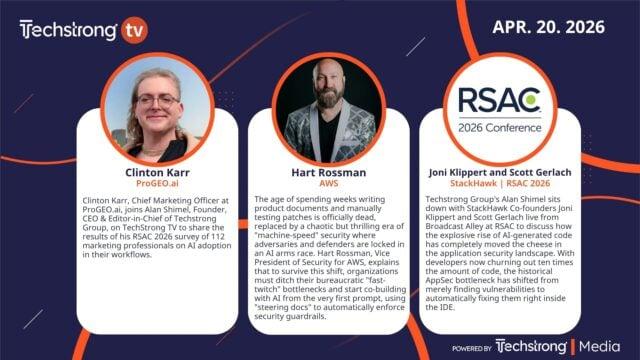
Techstrong TV June 4, 2025
Watch our live stream on Monday through Friday, featuring exclusive news, announcements and conversations with IT leaders and experts on topics ranging from digital transformation to #DevOps, #Cybersecurity, #CloudNative, #Containers and deep-dives into specific technologies and best practices.
Transcript
Hey, everybody. Do you have AI Coding Envy? You're watching Textron Game.
Hey everybody, and welcome back to the Techron Gang. We have our usual lineup of folks talking about three of the most compelling topics of the day. Let me start with our friends from Futurum.
Mitch Ashley is back. It's been a while. It's been a minute since you've been on the show, Mitch, how you doing?
It's been a minute. You know, I, I tackled that guy running outta the seven 11, you know, stealing some stuff and I injured my shoulder. No, I didn't really, it's just, you know, my shoulder and some shoulder surgery.
Nobody believes that story when I tell it anyway, so I'm gonna have to stop telling it, but doing well, doing here. Well, here in Colorado. So are you going in for Tommy John's surgery?
And, you know, when will you be back on the mound? Well, you know, it's supposed to be out there throwing some balls next week, so we'll see. We'll see what my recovery looks like.
I wouldn't count on me up on the mound anytime soon though. Uh, warming up. Also, guy Courier from Futurum joins us once again, guys still in Austin, I believe.
Is this the longest you've been in Austin for a continuous stretch now? It almost feels like it's been like 10 days. Uh, it's, I think it's been over 10 days.
Um, I was actually slated to go, uh, uh, go to a, uh, a vendor conference, uh, this week, and thankfully I was able to cancel that. Um, so yeah, it's, uh, it's, it's been maybe two weeks since I had to go anywhere. And I looked at my June schedule and it looked pretty good, so I'm pretty happy about that.
All right, guy courier breaking vendor hearts once again. So who knows, man. All right.
Usually I break their hearts by working for them, but anyway, There you have it. And also still north of the border. Chris Blas, how you doing?
I'm loving life, Mike. How are you? I'm well, no issues.
I'm also down here in Boca Raton in the studio for one more day. I'll be heading back to New York after this, so tomorrow when you see me, I'll be back at my usual New York environments. But let's start jumping into the topics of the day.
Mitch Ashley, I swear a year ago I was amazed and aw by all this AI coding stuff. Now I wake up every morning and there's another tool, it's just like one right after the other. And I'm trying to figure out if these new tools, these, uh, players and startups are gonna take over this whole app dev DevOps conversation, or will the incumbents win this argument and win the day?
And you have a report that kind of talks about the level of investments that folks are starting to make in agen AI already as far as ab dev is concerned. Anyway, um, walk us through what's going on here, because, um, I also have a third possibility, but let's just go through the report a little bit. Okay, great.
Yeah, no, it's, it's an interesting, actually a fascinating space to cover because I can't write something and have it be current by the time I publish it. It, there's three new announcements that I don't, I should have talked about if I would've waited. But then again, there'd be three more after that.
So it, it, it's, it's pretty fascinating. I mean, you have some very new players, you know, the folks like, um, the code now cursor, uh, products, uh, the windsurf that's gonna be acquired by Open ai, but you have, you know, existing players, Microsoft GitHub of course, combination of that. So it, it's, and then you have no code, low code players.
There's a lot of things happening in this market, but as I looked at it, what I'm telling people right now, telling vendors, if you aren't engaged in figuring out more than just what your AI strategy is, but putting to work and figuring out how you can make it useful, beneficial, maybe improve the work that's being done by whatever your constituent, uh, personas are, whether they're testers or software engineering people, or people doing software security, operations, platform engineer, you name it. Now's the time to engage. Because what I see is the, the level of engagement, especially on the development end where things obviously start, uh, in terms of creating software, is pretty phenomenal.
It, the, the, the iteration cycle from vendors is very short. Kinda like DevOps cycles, you know, they shorten their product cycles so much and they're also doing essentially alpha betas, but they're doing, even earlier they call 'em public previews or research previews. And, you know, even at Microsoft Build a couple weeks ago, you know, they were very upfront and say, we've got, we just GAed this, but we've got these other things that are out there now in public preview.
We wanna hear what you like, we wanna hear what you don't like, tell us. 'cause we'll fix it. There's a lot of in, in-field learning that's happening both by practitioners and vendors at once.
So, number one, get engaged and, and you have to learn by doing this is not, let's lay out a strategy and just kind of, uh, carve the course, you know, keep the situation normal and we'll add this into our product in the next release. Six months from now, there may not be an opportunity for you. I'm not saying panic, but I don't think passively waiting from the vendor standpoint.
Now, the practitioners, not everybody's jumping off the deep end in vibe coding, right? It, there are definitely people on the front end on the leading edge that are leveraging these tools, but there's a lot of people that are benefiting from even just within BS code and code completion and doing some early code generation kind of capabilities. But as more things get automated, especially with agents in the development process and, and expanding down the SDLC, that's when I think we're gonna see the big improvements in productivity.
I'm kind of caught in a couple of different thoughts on this whole thing. So in my mind, every coding tool is gonna have ai, I mean, at some point it's just standard operating procedure becomes a, a core capability. If you don't have it, probably won't exist.
The part I'm trying to figure out is, so will my existing DevOps platforms get these AI agents and then that will become the mechanism that I use to manage all that. Or will there be some sort of like higher level of abstraction of AI agents that leverage across all these different platforms? And that becomes the thing that I'm gonna standardize on.
And I don't know, maybe that thing talks to various AI agents that are made available by the CICD vendor or whoever happens to have a particular agent, but trying to figure out where is that orchestration of the DevOps workflow gonna be? Do you have any thoughts? Yeah, yeah, definitely.
It, it's, you know, that's a big challenging problem to solve, especially across vendor, how you orchestrate agents and how you share data and information. Even with MCP is a, as an open standard that's evolved. Definitely what's happening is every vendor is adding AI agents automation capabilities to their own product, which I think makes sense right now.
It's a little tough for one person to step in and say, we're gonna orchestrate all those things. I think that will happen at some point. But the thing that's also not happening is you don't see the big players saying, if you're gonna be in our ecosystem, say a Microsoft ecosystem or a Google or AWS, you have to use all our stuff, right?
We're gonna, we're, we'll, we'll integrate with other people, but not, not with the same fidelity as our own. No, they're pretty much leaving it very open knowing that they've gotta work in a cross vendor, cross technology world. Whether it's the models that you're using to generate code, the models that are now coming out for automation around what they're calling agentic dev DevOps, you'll see that agentic tied to everything here in product names, um, as well as just AI capabilities with their own tools.
I think the big difference is, you know, the chat bot and the natural language querying stuff and giving some basic instruction to, is kinda the entry level of AI today. We'll see interfaces start to change as you're managing more work that bots are doing, rather than you taking their output and putting it to work yourself. You know, Mitch, your call to vendors to, you know, it's kind of like adopt or die, but maybe even ratchet it up a little bit.
Um, you, you say it in that silky voice of yours, but it really is a, uh, quite a, um, a call to arms. Um, but the other half of it, and you've written about this, you just didn't mention in a moment ago, the other part of it is, you know, don't do it without forethought understanding of how, how, how AI helps and potentially harms. And most importantly, with thoughtful expert human supervision of the whole thing.
That's a key corollary to the, that's, and it's getting Chris all agitated, uh, for those listening. He is been nodding vigorously as I say that. Um, so, you know, that's the, what a, a really interesting twist here is the, the vendors are practitioners as well.
So you, you talked about practitioners, you're talking about, you know, what I would think of as enterprise practitioners, um, although they go, you know, down to like partners and, and even, you know, medium sized businesses or, or the, the, the, uh, service organizations that do development for them, um, that would be pure practitioner, but the vendors are practitioners themselves. There's, there's a lot of, yeah, there's a lot. This, this, this, this has a huge landing zone, not landing zone, what damaged circle or whatever you wanna call It.
Blast radius. Yes. See, blast Radius.
Radius. Thank you. Let's let Chris jump in.
Good. Go ahead. I, I wanna respond to what you're saying, guy, but I wanna hear what Chris is thinking too.
Well, thank you, Mitch, because as guy said, you do in fact to have a silky voice. And I think the thing that, my comment is, I can hear in all of you, you know, there's this confusion, this, you know, this narrative space where we're talking about how we're using AI to develop tools, and with three of the world's leading experts, there's a, how do we actually get there, right? And I think you all touched on points of it, you know, that this isn't just a tooling race, it's a trust war.
And the winners aren't those who ship the most ai. They're the ones who make it safe, visible, and native to the developer's psyche. Right?
Now, these tools will do wonderful things, but if you're not comfortable with doing them, it doesn't really matter. Yeah. I'm actually preparing a piece right now, um, based on, uh, what I've observed of the, the, the, uh, data analytics vendor click over the last year or so.
They created a trust council. I, I'm not, you know, gonna, you know, flog their, their particular strategy. But it was a nice jumping off point for exactly what you're talking about, Chris, uh, which is this visibility side, this transparency side of things, um, critically important.
So Mitch, how long does it take? How long does it take a DevOps team to bring in a new tool and adjust their workflows? 'cause it seems to me it takes a good year to kind of wrap your head around that.
It's not like I go out and buy a tool and just slam it in. At least I don't think so. So, um, what's the curve of actual usage in DevOps workflows, especially with a lot of tools that are quote unquote available in preview?
Well, uh, the way I would think of the progression, Mike, is individual tools. Things that aid you in your IDE that you use as a developer or whatever tool is a, as a tester. So AI is introduced within the tools that you use.
And now we see, um, agents and automations, some agent capabilities that automate more processes than just generating code, generating code's. Actually a small part of developing software, believe it or not, uh, that's probably, I don't know, less than 25%, maybe, maybe even 10 or 15% of the work. So what's happening now is some of those individual tasks are being automated.
The next step is automating workflows across different teams. Um, PL cloud, cloud, for example, uh, and a DevOps automation platform just came up with their, their AI announcement. So you're starting to see more DevOps products introducing it, not just development tool products.
And I think the third step is really true. Pipelines workflows across an entire SS SDLC process. Everything from security to generating code, to testing to scaling and performance, and all those things that go into it, that, that's sort of the nirvana where I think we wanna reach.
We're, we're far, far from that, maybe far six months, no, it's not gonna be six months, but we're, we're not there yet. We're still at the individual tool kind of bumping into the doing automation for individuals and starting to do automation for teams. So to your question, it's really a personal endeavor.
Not to say you don't get support from your management or your company or a team for doing it, but it's, it's a learning curve. It's like, oh, there's this new thing called relational database. How does that work?
Let's figure out how we should use that. As opposed to the other structures of databases we use, oh, there's no code. Now, how do we use that?
It's kind of that process, that kind of adoption curve, but for all of how you create software. So whether you lean into it and do vibe coding, or you kind of just gradually take it on a little bit more and more. Yeah.
And I would say that, uh, that, that, you know, at least from the practitioner slash enterprise side, you know, this is, we're gonna see 80 to 90%, maybe you already had 80%, and I don't remember off from, from the research you've done, um, using these, using ai, but if you think about the application estate, it might only be 5% of it. I mean, this is a whole new, we need a new word for it. It was the digital transformation refactor or reto or whatever.
Um, that's been well underway. And we might have 20% of applications now that are cloud native or cloud native ish in a typical way. And that's a made up number.
But it's, it's, it's the really the minority. So the part of this that, uh, leaves me scratching my head is, so there's a bunch of these startups and historically, you know, venture capitalist port money and startups, and if they made it to an IPO, that was the exception, generally speaking, they got acquired and rolled up and put into some other incumbent vendor. However, when I talk to the incumbent vendors in this space, they're all pretty far along on their own development efforts.
And I have to wonder if a lot of these startups are gonna have the wherewithal to make it long term or even get acquired because the incumbents are moving faster in the age of AI than they have historically. And I think they're not suffering as much of that innovative dilemma. But guy, what's your take?
Well, I'm glad you turned to me because I wanna compliment Mitch on another thing before I attack him. I'll attack him in a minute. Um, the, the listen, um, you have provided, um, a really helpful framework for AI adoption and coding, which is, uh, or in applications, really, which is the AI enhanced app, the, uh, AI driven app and the AI native app.
And when we are talking about development platforms, there are some that are being enhanced. There are some that are agentic relatively new, that's AI driven. That's, that would be maybe the vibe coding concept.
Correct me if I'm wrong. And then lastly, this, uh, this AI native. Um, so Mike, to answer your question, um, to what degree do these incumbents, um, intend to essentially recode all the way down to to, to the silicon actually, um, in order to create something that's AI native, the AI enhanced stuff has, has serious limitations.
They're partially security related, but mostly have to do with scale and volume of data. They run on infrastructure that's not necessarily built, or let alone the size, just the, the data usage patterns that come with ai. Um, so they tend to incorporate services a lot of the times.
These are cloud-based services, which has their, have their own sources of latency or unavailability and all that other sort of thing. Um, my sense is that Microsoft is, is trying to do this with GitHub co copilot, that they're essentially re re both recoding and refactoring that entire platform to turn it into something that's AI native. But my point, Mike, is that not everybody is Microsoft.
There's lots of players here. Maybe Oracle can do it, Microsoft is doing. Um, but otherwise, um, there actually is a fair amount of, of space for like the tab nines of the world or whatever, these more recent, um, AI native code platform companies to follow the exact path you are like, like you laid out sort of classic path.
Um, and also in general in this, you know, hyper capitalistic environment that we are in. Um, which by the way is not an insult. I support this.
Um, we have a great deal of difficulty predicting such things as a change in these models because there are so many, you know, there's plenty of VCs out there, you know, willing to invest. And still in these sort of platforms, you put AI on it, they're willing to invest. So I, I think I see your point, but my guess is that we don't know what we don't know there, and there's gonna be plenty of the same model going on.
Right. Mitch, last word, last Mitch, last word on this subject. Uh, you know, I think there is plenty of room for acquisitions, even though the big guys, well, you know, everybody is starting to address it at different paces.
Um, I think part of that is, you know, fomo, fear being left behind also. But there, there's, so, I mean, take open ai, right? Acquiring windsurf, right?
They had their own Kodaks that they created for developing software, but recognize that, you know, for them to go and, and build a new kind of vibe coding IDE as opposed to a traditional IDE, uh, or AI native IDE, which is kinda where, where the ides are headed. Um, that would be a big lift. So when just by somebody, just bring them into the fold.
Microsoft has required people along the way. So I don't, I don't know that there's any less opportunity. I, I think this normal thing will happen, Mike, of early people into the market.
People are in the top three, you know, as Alan and, and Lex to quote Brad Feld often. Um, but it's the people that come much later that is, is really questionable. Whether what the opportunity to get acquired or go public then is, you know, the, the third generation of startups that kind of solving the same problem, but unique twist on it in some little weight.
Maybe it's interesting. Maybe it's not. All right, ladies and gentlemen, place your bets.
'cause we're about to find out how well this is gonna play out. We'll be back in a minute. Hey folks, we're moving on to the next block in our little trio, and we're talking about a report from our friends over the Futurum group that kind of shows what people are thinking about.
A the level of spending of on cybersecurity is roughly on average, 11% of the IT budget. I think that's pretty standard. I hope that's standard.
Um, but it also finds that about half of the folks are trying to some degree to reduce the number of vendors they have a quarter or however our adding vendors in the s seem to be just standing pat. Chris, we've been talking a lot about the platformization of cybersecurity and this battle between best of breed tools and the centralized platforms and the arguments that go on back and forth in this thing. It would appear that, um, folks kind of at least prefer some centralization, but it doesn't look to me like it was a massive wave.
But what's your take on what's going on here? Or is this just an argument we have every three or four years? Uh, fully start with that one.
I think, yes, this is an argument we have every three or four years. Yeah, let me refer back to what I said in the last segment. You know, this isn't a tooling race, it's a trust race.
And people seek, you know, we like centralized platforms when it can say little confusing because we only turned to one spot. Um, but particularly in this space, as we go on the go, continue on the path of tying, weaving, cybersecurity and and AI together, you know, the, the trust of the human part of it has to be the point. You know, can you, can any of these vendors make the tools?
Yes. In fact, with a $20 a month Chad, TPT license, if you train your engine properly, you know, to to the last segment, you might be able to make the tools. So early movers platform, you know, uh, uh, range anxiety.
Sure. Um, but at the end of the day, the, the vendors or the constellation of providers that will hold the ground are the ones who understand, you know, to actually implement the trust. Mitch, what's your take on the trust factor?
Because to me, part of that trust has been, well, there isn't a lot of trust in these platforms. 'cause everybody complains about the number of false positives and the volume of alerts that they get. So, you know, when I talk to a lot of folks, they have like two of everything just to double check one or the other and see which one they believe in.
It's sort of like the money python, holy grail search for the holy grail of single point of truth or single glass of pain, as I like to say. You know, seeking that sort of nirvana of having one thing, that one ring that rules 'em all that will solve, make it easier. And, and what it's really is, is it's a reflection of the complexity of how difficult it is to bring all those different data sources together.
Um, I was mentioning in the last segment about the development tools of the vendors being much more open to a, a broader ecosystem than just trying to own the customer all on their own platform and their own tools. Even saw this, uh, similar kind of announcement at R-S-A-A-C with, uh, Splunk talking about, you know, we realized we can't put all the, all the data in in our product as much as we, this is my words, like to do that and charge you for it. Um, where they're adding capabilities to go access data, where it is and how it's located.
You can see that in MCP servers and software development. So I think it's all about trying to, first stage is just getting the information you need to understand to triage what's happening, understanding what's the problem is and how to, how to start addressing it. If, if AI is gonna be a part of this role, I think it's, it's gotta take us out of the giving us better and, uh, more, more accurate information to actually helping us do it, do the work.
And, uh, that's I think probably more than the benefit we wanna seek next than just trying to have one thing that's gonna tell us all the, the right answers about everything. I kind of felt like the, um, the, the, the research on both revealed and hid what's going or re revealed the hidden nature of what's going on. That there is investment spending, let's say spending in time.
Uh, people's time is ultimately money. Um, that's that whole, you know, DevSecOps side of things. Take, take, take the software bill of materials.
Um, I, I, I, I applaud, um, the, you know, return of the SBO m and uh, the ability right now of AI to help build SBOs, um, human validated, but to help build them, that's a real step forward. But would you call that a cyber, uh, investment? Not normally.
Yeah. I think part of that is, yeah, or compliance, maybe investment. I don't know.
So it kind of goes both ways. But Chris, I want to get at something. We had, um, Keith Townsend on the show yesterday talking about cybersecurity as it related to a tech field day event.
And one of the things that was posited was, is the future of security. Maybe this whole conversation might be rendered moot because AI is gonna create this kind of chat interface in front of all these cybersecurity engines. So I'm not really gonna care about the centralized platform as much as I'm just gonna have kind of a single interface that plugs and plays with different engines as I see fit.
It may be a little over simplified to put it up that way, but I think that's kind of effectively, right. You know, what you said is that, you know, we're not gonna have to dig around into all the details anymore, so much as have this single, you know, AI interface that's gonna tell us how it all works. Um, I think on an individual level, as you're a stakeholder, a a technologist, an engineer, a decision maker, that may kind of be effectively true, but we're still early in figuring this out, right?
And I think we look at the size and scope of the infrastructures that we're responsible for, whether it's a single server and you have all, all day to do it, you know, we're physically past a point where a human being can read it all a know all anyways. And we haven't yet come to the trust layer where we trust our tools, AI or not to represent it to us. And if we are in the path that we are on of increasing complexity, and we are, then we have to get to that trust layer so that, you know, while it may sound a little silly in 2025, you know, at the beginning of June to say that executives and operators will be literally making decisions and, and, and taking actions based on what some AI told them, um, in the right context.
I think that's essentially exactly right. Mm-hmm. So guy, going back to the previous block, I'm gonna ask you the same question.
What is the level of disruption where we should expect to see among the cybersecurity vendors per se? Will there be a wave of consolidation in the age of ai? And is this gonna be kind of a recurring theme?
That's a really good question. Um, I find cybersecurity, um, and let's put compliance, you know, compliance risk into it, um, to be one of the, the, the most resistant areas of the market to consolidation. Um, the single platform idea, single pane of single, single glass of pane, which I love, is that what it was, Mitch, um, is, you know, I mean, it it remains a unicorn, or not a unicorn, sorry, a, uh, an unreachable a a a windmill to tilt that.
Um, I, I do think though that AI has the opportunity here brings the opportunity for, um, consolidation from a vendor standpoint. Um, there's a lot being done like an observe observability platforms, um, and, uh, certain, you know, um, partnerships like, like, like the one Mitch mentioned at our sac, um, that, you know, help the operators, um, manage this, you know, crazy spaghetti diagram of, um, interdependent, uh, monitors and Asians and so forth. It's just that security does not keep pace with, or doesn't go in lockstep with technological development.
So we were just talking about how, you know, in one sense, we are still at early days with AI and AI based development, very early days. Mitch was very eloquent on that point. Um, as that, that tends to advance first, there is not a security centric development because security is always the punch bowl taker, you know, cup away or whatever.
You know, it's always the one that has to come and say, now, hang on just a second. And it always has to do that in reaction. It, it, it should not be, it should be a driver of innovation, but it does not tend to be looked at that way.
Um, nonetheless, the simpl, the, the simplification that properly used AI can provide in taking very huge, uh, messes, spaghetti diagrams and providing clarity into them could be the opportunity you're talking about. Yeah, I gotta jump into that one because the, the, the, that term, I love that I hadn't heard that before this. I'm surprised it took that long, you know, a class of pane, but this pane of glass, you know, this platform, you we're gonna have to finally solve our, our thing.
I think it's a different way to look at it. And this might be a good context to help us think about it because we're talking about a ai, we're talking about large language models that are for our purposes, effectively holo graphic storage systems a narrative, right? So it's not so much a pane of glass that a company's gonna use, but each stakeholder in different roles has different facets to look into it, right?
And to your point guy, you know, like when you're a security person looking into this, into this, this data space, and you're looking at it from a security perspective, you should be able to see that interwoven and everything else that's going on, not as a separate box that's bolted onto by wires and a conduit process to some other Box called engineering. It also, I think, will enable the, the, you know, really correct approach of two for two, for two of everything, two tools. Um, because now adding things does not actually necessarily change your user experience.
Um, you could have two different agents doing the same thing, two AI interfaces doing the same thing. Um, but the, the, the view of the analyst, the IT analyst expands, um, without having to also expand the number of dials to twiddle or any of that other sort of thing. We just always, of course, have to remember human supervise.
You know, you still need to be an expert in these sort of things. You can't just, you know, put, you know, a newbie or a novice on a complex system on because AI is there. You can't do that.
Mitch, last word on this, but, you know, I seem to remember talking to lots of IT and cybersecurity people and nothing warms their hearts quite so much as waking up one morning to discover that this tool or platform that they really love just got acquired by some stranger. So, Or they gonna ruin it when they acquire it, right? Yeah.
Well, first of all, just a shout out to Krista case. Um, and, uh, Fernando Montenegro, who, who did this research at FU futurum, it, it's a really good, a really good point. I think that's a fair in any, anything that we really enjoy using, right?
Whether it's a great desktop tool or, you know, uh, something on our phones or security, I, I think there's a real possibility we may have. And, uh, something of an inflection point happen in security of, let me overstate it this way. We, we, we essentially kind of passively wait for attacks to happen and either block them or respond to them, or we're, we're waiting for someone to, you know, cross the line and then we're gonna do something about it.
Super, super oversimplification. But it's, it's a defensive and response posture, um, to draw an analog to the software world where software developers, product managers are going, or they're pro, they're gonna be prototyping, they're gonna be using AI to generate new ideas and test concepts without ever deploying it into production as a real app, but maybe deploying it into production as a, you know, as a AB test or something like that. Or maybe even just pursuing ideas.
Think of the same thing in the security world. Um, what if I change my security architecture this way, take the last, um, two years of attacks and analyze that against this approach? And if I add vendor B into it instead of vendor A, how would that change my defense, my response, whatever.
Um, I wanna change the way we structured our identity architecture and now to be able to com accommodate visual voice, natural language, you know, the new, the new modalities of interface. Alright, well, let me use AI to investigate and really prototype, maybe even try out some of those ideas. So instead of we're, we're kind of building it and then trying to keep, keep the fences, you know, secure.
So nothing breaks through until we upgrade 'em to the next level for the next product or, or release is really on the proactive end, be able to, to try ideas and test ideas and test new, new options. And I can imagine that's a world where, you know, I think Chris blast head would explode 'cause he'd had so much fun, but because he's that kind of guy. But I can just imagine that would be like your nirvana, Chris, I I'm having exactly that kind of fun right now, right?
And, and just, and this, we'll get into this more over the coming weeks and so forth, but this is what some of us are working out on, out in the world. You know, a civic AI node is a AI and a human being, you know, so that you have a certain form of trust and you build networks of these and, you know, for, for more discourse in the future, in theory, you can build a trust these this reliable enough to do things with. So I think we're, you know, to our point here about individual companies writing codes and so forth, I, I hate to be this cliche, but yeah, I think things are gonna change an awful lot.
I've already changed for some. And the next year is gonna see dramatic changes for many. Well guys, hey, the quote that great American philosopher, the times are a changing.
So stay tuned 'cause it's just gonna be all kinds of fun in the next weeks, months and years ahead. We'll be back in a minute. Discover Techron group, the epicenter of tech innovation.
We are your go-to for reaching IT leaders and practitioners worldwide. Our secret impactful content that sparks awareness, engagement, and top quality leads with us. You'll access editorial websites, streaming videos, virtual events, custom content analyst research, and more.
Join our satisfied clients. Let's revolutionize your tech journey. Contact us today and tell your story to the world in the most powerful way with Textron Group.
Hey folks, we're back. And guess what? VMware is back in the news.
And it seems like this company just cannot get out from underneath this move that they made. And for better or worse, it's a topic of discussion. Now there's a EU watchdog that is saying, well, basically the VMware changes to their licensing policies have resulted in 800 to 1500% hikes.
And, um, you know, they're basically not saying it's illegal, but they're questioning the morality of this guy. Um, at some point, do we just kind of have to sit back and go, look, Broadcom made a decision, it's their decision to make and everybody else has to make their own decision as a result from that. And maybe it's, I don't know, time to just get on with it.
Well, it's definitely time to just get on with it. When you hear EU and organization, you have a tendency to think that there's something governmental about it or quasi-governmental about it. So I want really be clear here that, um, sis b um, which is the, the governing body, so to speak for this, this, uh, um, echo institution that I hadn't heard of before, uh, that came out with the statement.
This is, this is C stands for cloud and asset for service s sp for service provider in spy. Um, that this is a coalition of European cloud service providers. Private right there, there's nothing quite, you know, I, I so rarely use baseball metaphors, Mike, but I'm gonna try to use one here.
I I know baseball, but I just don't follow it as closely as you do. Um, this is like the players association complaining about the contract negotiation with the owners. Um, uh, and I just don't know the name of the players association for baseball.
It really is, they have, um, banded together. I mean, cspi was created because of a judgment against Microsoft, if I remember right. Uh, that Microsoft start.
And so they just, I think it might have been Microsoft that said, look, I don't want, we don't want to deal with, you know, one of you at a time. You're in all different countries, even if you're all in the eu. That's years ago.
Um, now it's Broadcom's turn. And um, my sense is that they are just publicizing a whole lot of plausible numbers, like 600% higher costs, so on and so forth to try to get Broadcom to come to the table. Um, who doesn't like perpetual licenses?
Well, those are essentially dead. They're a thing of the past forever and ever. And the ones that are left are legacy.
And that's not Broadcom, that's the market. Um, Broadcom probably wants all of these cloud companies to remain profitable and to, to, to, you know, renew after three years. And yeah, well, okay, maybe Broadcom wants to empty the exit the market and, and make as much money, you know, along the way as it can.
That, that, that could be the situation as well. These are cloud providers. These are folks whose core job, unlike your typical enterprise core job, is to build resilient infrastructure and serve it to customers.
They want to keep their costs down, but they need the infrastructure to be performant and to work and do all these things that VMware has been doing for years and years and years. However, Broadcom strategic moves with VMware have made alternatives like Nutanix with, with a DH or with, uh, KVM, OpenStack, um, God help us, maybe even zen real alternatives to virtualized platforms look way more attractive. And, uh, Nutanix in particular is going quite aggressively at existing Broadcom business, doing things like allowing, uh, try before buy experiences and building up a pretty robust, um, migration practice, um, to try to take as much cost as possible out of the switch.
And there's no reason cloud providers can't go in that direction. A HP is based on KDM, it's based on open source. Um, the real question is, uh, I think it comes down to your, your favorite topic, Mike, which is all the personnel, all the people who are actually running all this stuff, who have built their reputations and their careers on VMware.
And this, if anything, this news is, uh, about the players. It's about those players. Not the cloud folks, but all the people in Europe who have been running VMware forever and are crying out for relief at, uh, suddenly seeing their whole life work style threatened.
I mean, I will grant you that. It has unfortunate consequences, but, uh, you know, when I look over at Broadcom, they're not sitting there going, oh, please don't leave me. Please don't leave me.
They're basically saying, you know, pay up or get out. It's, it's, it's, it's, you know, it is not quite an eviction notice, but it's pretty damn close. So, Mitch, is this just, uh, something we need to factor into our thinking?
I mean, did we get overly attached to a single vendor in somehow or other thought that they would be with us forever? And I'll go back and, you know, point to some of the things that Keith Townsend's been writing. It's like pretty clear that VMware is business model is unsustainable, otherwise it wouldn't have been acquired three or four times in the last two decades, right?
Well, I think you, I think you nailed it pretty well. They're a business, they're not, they're not an altruistic organization. They're there to serve their stockholders and make money for the company and return on investment.
And they've got a captured market with VMware and very, very solid, big market. And they didn't raise pro prices because it was easy to move off VMware. They raise prices.
'cause it's very hard to move off of that platform and onto another one. Not impossible can be done, but you don't say, let's schedule, you know, the weekend after Memorial Day to, you know, we'll move off of VMware and move on to the next thing. It's, it's a migration, it's an effort.
It's, it's, uh, it know kin to moving to the cloud, but maybe twice as complex in some ways. 'cause you've gotta unwind all the way down to what do you leave behind? What do you take onto the new platform?
Uh, the, the new platform doesn't do things the way a really mature product like VMware does, but do you still need it done that way? So there's a lot of things to, to consider in moving it. You know, it's, there are a lot of options for moving, but you're not gonna do it solely on the pricing of VMware.
'cause there's a lot more cost into it to moving your infrastructure. Mm-hmm. I do believe it's getting easier to move that infrastructure.
And I'm not just talking about the VMs, but the stack that sits above that. And as time goes on, that may get even easier. So maybe Broadcom might have miscalculated how long or how hard it is to make that migration, but ultimately they still do the math and it comes out with a, this is our new price point and this is what it's gonna be.
So, um, I don't know, Chris, you haven't jumped in on this one, but is this just the world we live in? You know, I'm probably the least qualified to give a, a pointillistic, you know, state of the market one on this one. But I'll tell you what I Yeah, I, in the first segment, Mike, you talked about the big players having a advantages and so forth, and there's a flip side of that as well, when you look at where VM is in the entire space, and yeah, they're huge, but they're also sort of fossilized built in, tied in.
And this, this is a good topic, you know, how with the ransom oak, so sometimes being big and filling the space isn't an, an an advantage, you know, and yeah, and again, I'm not commenting on them, you know, their, their activities, you know, they, but they're, we all know lots of folks that work there, great company. However, you know, without knowing the details that, that you guys probably know exactly where they're right now, I think that's a fair risk comment for them. I think they're, they're not in a, in a spot because they're so huge.
They have, they have all the advantages, probably more the opposite, probably need to think more flexibility than, than than legacy. Here's what I wonder is, is how important to Broadcom, uh, is the cloud provider community? Now, outside hyperscalers, there are tons and tons of, especially in Europe, but you know, it's true around the world.
Tons of cloud providers that are true cloud providers on demand pay as you go, et cetera, et cetera. But for more traditional, let's say, enterprises applications, this coalition in Europe is a great example of it. Um, and a lot of them are regionally based, you know, serving their countries or a few countries or, you know, language groups really, really well.
Um, and they have relied on VMware, VMware's initial play into the cloud going back like 10, 12 years was to try and be a new hyperscale platform that failed utterly. But that's because it just wasn't the smooth move for something like a VMware, um, a closed, highly performant, highly capable and secure proprietary, you know, resource allocation platform resource pooling and allocation platform. But for these cloud providers, it has been terrific.
And, um, I just wonder, seems to me that Broadcom should be most interested in this customer set and least interested in the enterprise customer set. Strateg speaking strategically, not uninterested, especially for large enterprise, but strategically speaking across the broad, when you're gonna try and find the so-called synergies and all that other sort of stuff, I'm gonna add two words to this guy. Two words to this.
One is mainframe and the other one is tariffs. We still have mainframes around, right? We'll still have VMware running in people's data centers forever.
But I'm, I'm gonna draw an a loosely coupled analogy to tariffs. It's the same problem of do we, do we pass on the price increases as a cloud provider to the underlying cost of the infrastructure software VMware that we run in the cloud so that customers can run their VMware in the cloud instead of their own data center? Or do we eat that cost that they don't wanna eat that cost?
So that, that's what's driving this behavior is they're saying, look, our costs are going up. You have a gun to our head. We don't have a choice.
We don't wanna raise prices on our customers. Maybe we're locked in on price for some period of time, and we weren't as, uh, as, uh, you know, as savvy about our contracts with VMware. I'm just, I'm just surmising that That's another analogy to tariffs too.
Yeah. Yeah. So it, it is kind of, it's not a tariff, but it's the same effect where those costs go up that aren't in your control and you've gotta pass 'em on to customers.
So guess who the next group that's not happy is, is your customers. I would, I would take this as a public negotiation over licensing. That's just like, as like the sport analogy, you know, the players association negotiating with the owners, and ultimately through maybe a high stakes, you know, or a very mellow dramatic communications war.
They will come to an agreement Or they could just go to the great mediator area in Mar-a-Lago and he'll help them sort this all out, right? He'll, he'll fix it in, he'll fix it on, on day one. There You go, on day one, it'll be fixed.
All right, I'm going to, I'm gonna leave this here, but I would just point out one thing. Um, decisions that are made in anger usually don't turn out as well as you hope. So take a minute, take a breath, and think about it long and hard before you decide what you're gonna do.
There's no right answer, but just know that there's cost either way you look. Hey, I wanna thank everybody for being on the show today and sharing their insights as always. And I want to thank you all for spending some time with us.
Once again. Please stay tuned. There's some awesome content coming up right behind us on the text drawing TV lineup as always.
Until then, we'll see you tomorrow. ai video series. I'm your host, Mike Zu.
Today we're with Roth Sharad, who is the CEO of Flavor Cloud, and we're talking about how to apply AI to navigate commerce in other countries where there's a lot of complexity. And of course, that's top of mind these days given all the tariff changes that are going on Roth. Now, welcome the show.
Thank you for having me, Mike. I think everybody's kind of basically familiar with the core challenge. Every time I go to do business in another country, there's a different set of regulations, a different set of customs.
Heck, there's even different holidays that I don't even know about. But, um, you guys have trained some AI capability to help navigate all this. So walk us through how that might work.
We, um, are a cross-border enablement platform. And what that means is, um, for D two C, um, so e-commerce as well as B2B, uh, which is wholesale, um, we automate the complexities of cross-border, which is shipping, customs and compliance. Um, as you mentioned, um, you know, each country is different.
We ship to 220 plus countries. So essentially every country around the world has a different set of regulations, um, requirements, um, to, uh, essentially bring products into the country. Um, now these regulations, which come in the form of, um, calculation of duties, taxes, tariffs, and fees, um, is one part of it.
Um, and, um, it's complex because these, uh, regulations are very fluid. Um, they are commodity based. Um, so it depends on what products are in that parcel or in the shipment.
Um, and, um, depending on the composition where these products are manufactured, uh, you can have different regulations and, uh, trade rules apply as well. Um, so given that level of complexity, you've got countries, you've got carriers, you've got, uh, commodity level restrictions. Um, it is one of those, um, really, um, interesting areas to apply ai.
Um, so applying machine learning and ai, and a lot of these, um, capabilities across shipping, customs compliance is what we do at Flavor Cloud. Uh, one of those interesting problems is, um, identifying commodities in themselves. Um, and that is, um, what we call our flash ai.
Uh, it is a product classification methodology that basically says, uh, we're gonna take this commodity. It's a women's, um, cotton dress. Um, it has a certain six digit commodity code.
Um, and that six digit code is understood for trade, um, through a world trade organization. Everyone around the world understands that it is that commodity. And then there's remaining digits, um, that are in place, um, 10 digits, um, in some countries over 10, um, that determine that are very specific to each country that you're importing into that eventually determine these duties, taxes, tariffs, and compliance requirements.
Um, so we have AI for each of these pieces. Um, so there's AI that does the classification. There's AI that actually determines and guarantees these landed costs, which are duties, tariffs, and fees.
And then we have, uh, customs and compliance related AI as well. Um, so this is a really exciting space and application for ai. Are these tools all flavors of generative ai or are some of them more traditional machine learning algorithms that are predictive?
It's both. Um, it, it depends on the application. Um, so a lot of the machine learning and capabilities we were doing, um, long before OpenAI and a lot of the new tools that, um, have, um, nowadays we have access to so many different models, um, and are rag models, um, enable, um, and have enhanced the accuracy and the capability.
So it has made it a lot faster to innovate, um, um, and improve the accuracy because we are dealing with massive amounts of data, um, and, um, complex, uh, data as well. Going back a long time people used to hire manufacturer reps, people who were their agents in different countries. Are those folks still playing a role or will AI agents kind of take over that function?
Uh, it's the latter. So AI agents, um, have already taken over those roles. If you think about, uh, the classification problem, the only way you would solve it is there were these massive books, um, large, um, HS classification books that someone would have to manually go through and classify.
And if you have hundreds, even thousands or hundreds of thousands of SKUs, uh, that is, um, very manual error prone, not scalable. Um, and, um, we essentially have automated brokerage functions. Uh, so what used to be a licensed, uh, agent or a customs broker and capabilities can now be done with higher accuracy through automated, um, technology.
Of course, it feels like this whole space has gotten a lot more dynamic lately. There's a lot of negotiations around tariffs. Um mm-hmm.
How do you keep up with all the changes? Yeah, it's a great question. Um, I mean, um, there has been a fluidity in trade.
It is very complex and it is something that changes all the time, although we've never seen, uh, the back and forth and, um, the immediacy that, um, you know, uh, we've seen in the, in the past, uh, couple months actually. Um, but, um, the systems that we've built are really, um, designed for this. They're designed for, um, ultimately, um, accuracy, um, and understanding the nuances of, you know, what are these tariffs, what are the fees, when do they apply, uh, when do they not?
And really being able to, uh, make dynamic decisions in the checkout so that it's real time and it's guaranteed, um, as we do, um, as well as, uh, protect margins for our brands because ultimately, uh, a tariff change if done incorrectly means somebody needs to pay, um, that, um, additional amount at the border. Um, and that can be very significant. So accuracy, uh, immediacy of, um, implementing changes is very core to how, how our platform is designed.
It is designed to be, um, real time as well. Um, so, um, as soon as, um, not so much the announcement, but really when it gets implemented, uh, and it's official, uh, it becomes law, um, and compliance is really, um, legal requirements that, um, brands, uh, brands and really shippers have to comply. How much are organizations making their supply chains a lot more dynamic in the sense that, um, I might order from a plant in one country one day and then and another from a, a separate day, just because there have been that many changes in a 24 hour cycle or things aren't available, but how, um, is the supply chain kind of evolving?
Yeah, there's, there's a tremendous evolution happening right now. Um, I mean, um, it's a very connected global supply chain, and you kind of are seeing that in motion. Um, one of the things that is happening in terms of, um, not just the dynamicism in, uh, tariffs, uh, but really what you're seeing is sourcing.
So there's, um, you know, alternate sourcing locations, um, often that brands are looking at, or multiple sourcing, really thinking about how do you, your supply chain, um, because it's not a question of, uh, you know, um, what is the next, um, you know, uh, vol volatility that you're gonna be, um, faced with because it's coming, it could be in a different form. And so really being prepared in terms of having alternate sourcing options or multiple sourcing options, being able to, um, second look at regional fulfillment is something that, that we are seeing with our brands. Um, they're looking to have more nearshoring and regional fulfillment in place.
Uh, so that means instead of a central point and then shipping to the rest of the world, really thinking about, um, fulfillment, um, location and APAC that services the entire region. And in eu, for example, uh, in Netherlands servicing all of emea. Um, so these are, um, very, um, uh, fundamental changes to, um, how brands think about global presence.
Um, and that's here to stay as well. Um, the other change, the third one we're seeing is a much more nimble B2B, um, wholesale enablement. Uh, in part it started happening because of the tariffs, um, really, um, differing duties, having better control of, um, uh, you know, the inventory having better visibility.
So it's moving towards a much more agile, um, uh, you know, network. Um, the large, uh, ocean drops, you know, twice a year are no longer, um, you know, sustainable consumers are also, um, very fickle, uh, in the sense that they're, they're demanding, um, you know, stuff, um, to be continuously evolving, uh, stuff goes obsolete by the time it hits the shelves. Um, so it is that cycle.
Um, it's, uh, it's, it's here to stay as well. Um, so we're seeing these three things I think, um, are going to drive how, uh, folks think about supply chain. Well, let's say I'm a brand and I have AI agents now kinda representing me in these various countries, but in those countries, our suppliers who are also gonna have their own AI agents.
So how will they negotiate with each other and what might that look like in the future? Um, so AI agents for nego negotiation, I think is a, is a long ways. Um, it is something that, uh, certainly you need to be able to negotiate with the supplier.
Um, I talked about multi, um, sourcing options, if you will, multiple suppliers around the world. I think that is a great way for brands to also think about competition and getting the best pricing. Um, oftentimes in situations like when tariffs are here, you, you can negotiate, uh, different options to offset tariffs, uh, which a lot of our brands have done.
Um, so there's many different strategies. There's also tariff engineering. Um, so you could change the composition of a product so that it's less impacted, uh, or not impacted, um, by tariffs.
Um, so these are all very nuanced negotiations, so I think people are going to be doing these negotiations and finding the right source. Based on what you've seen from your customers, what's your best advice to folks about how to kinda start this journey with ai? 'cause I think, uh, everybody kind of understands the core idea, but they're a little overwhelmed and sometimes they don't know where to get started.
Yeah, it is overwhelming. There's a lot of, um, you know, folks suddenly claiming, uh, they know the space as well and giving advice. Um, and really what's important is to step back and think long term, I think, um, be less, um, um, influenced by the short term, uh, changes that we're seeing.
But, um, think about how you can build a resilient, um, and agile supply chain, um, that is going to bode well regardless of what the next, um, disruption might be. Um, and so the advice would be to work with a partner that, um, you know, has a lot of this complexity, um, and understands the complexity, but really removes that complexity, abstracts away and creates, uh, a technology, um, and, uh, and keep platform essentially, that allows you to do all of these things. Um, whether it's B2B automation or it's D two C, understanding, um, regional supply chain, um, really allowing you to plug in, um, and, um, uh, ultimately predict, uh, upfront with accuracy so that you're not impacted when these changes happen, uh, from a bottom line standpoint.
So cost benefit analysis, working with you on, um, how to mitigate that and ultimately, um, you know, um, uh, working with you on improving your margins because there's a lot of, uh, international is one of the fastest growing, um, uh, you know, uh, in e-commerce. But also we're seeing, um, that, uh, international is no longer about just having a global footprint. It, it also impacts your wholesale and your overall strategy for domestic.
So really thinking about it as a single, um, you know, uh, supply chain strategy, I think is key. Well, saying you heard in here if there's a large amount of data that you're supposed to constantly weigh through, but the data is, you know, ultimately relatively static, it may change from day to day, but it certainly doesn't change second to second. Mm-hmm.
Maybe AI is your new best friend. Hey Ana, thanks for being on the show. Thank you.
Thank you for having me. All right. And thank you all for watching the latest episode of the Text Drive, that AI video series.
You can catch this episode and others on our website. We invite you to check them all out. Until then, we'll see you next time.
Hey everyone, it's Alan Shimmel for Techstrong and welcome back to another episode of the Platform Engineering Show. org community. Uh, Luca, first of all, man, it's been too long.
I know between Cube Connor that I was at RSA and you were doing your thing. We have been globe traveling, but not had a chance to really sit down and talk for a while. Yes, yes.
It's been a while. Um, yeah, I mean, we've been, we've been really busy heads down. Um, you know, we've, we've just wrapped up the first, um, you know, we have these like two certifications right in the community, um, on platform engineer org.
One is this, this, um, this, the, you know, the, the usual kinda like practitioner, and then you have the professional. Um, and it was the first cohort of the professional that would just wrapped up, which was really, really fun. Uh, so we've been heads down on that.
And then of course, you know, popcorn coin is coming up. So lots of work on that side. You know what, before we even get into what I want to talk about today, let, let's just dig into those two things.
Yeah. 'cause they're important. The certifications very important.
Right. You know, I, I learned this one. I did DevOps Institute in a large part of the world, and in many parts of the world, they don't just take your word for it, right?
It's not just a question of what experience or where you work. They want to know that you have some basic competencies. And so having a certification, especially for younger people out here who are just breaking into industry, getting their first second jobs, it's so important, so important to have that kind of standard behind you, that stamp that says, Hey, it's not just me telling you I know how to do it.
I actually demonstrated some proficiency in this. I, I, yes. Studied on it.
How can people, you know, look into, is this the right certification for them? How do they get started? So, yeah, so yeah, so like CNCF, um, you know, also recently released this, this like, um, platform engineer associate or so, um, and there's like a bunch of other offerings in the market.
And I think like the key thing is that most of those really focus on the tooling bit and the technical side of things. Um, which is of course, like a very important part of platform engineering because platform engineering is a technical thing, right? You're building, you're building stuff, you need to be a developer and so on.
But at the, but at the end of the day, you know, we've talked a lot of times on the show about the fact that, you know, we still have to see apart from engineer initiative really fail because of technical reasons, because somebody put Lummi over Terraform or whatever else. It's almost never a tech challenge. It's like a cultural challenge, right?
Like we said a lot of times. And that's the thing, the thing that we really, you know, we have a lot of hands on labs and, you know, you get your hands dirty. But also we spend a lot of time on the really the cultural bit and how do you actually get stakeholder buy in and you drive an entire initiative end to end in an organization.
Um, which ultimately we believe it's, it's, you know, the applicable stuff and the stuff that we see a lot of people struggle with and a lot of teams struggle with. And in effect, you know, we started this whole thing as, you know, some platform engineering courses like in August last year. Now they've morphed into your typical practitioner and professional, um, things.
And they instructor led eight weeks long. Well, now we're ma we're making the pr the practitioner a little bit shorter, like four to six weeks. Um, you know, and it's more of a hybrid is a constructor led and, and self-paced.
But there are a lot of people, like a lot of, uh, leaders, Paso platforms, platform product managers that have taken the course and they're like, Hey, hold on a second. I need my entire team to go through this. Right?
Um, and that's actually where we've now also in the last few months, rolled out this whole idea of like certify teams, um, which, uh, there's huge demand for both on the kinda like service provider front, um, as well as the, as well as the enterprise front. Um, and so we're actually going onsite for a few days, spending time with 'em, and then they can still take the exam. And so, and so that's been super cool and we've, we've learned a lot.
'cause you actually get to spend like an entire week, you know, deep diving with these people on their setups, what their challenges are, um, you know, and then of course we like cluster those learnings and, and the stuff that we write and so on. But it's, it's, it's super cool. org, people can like see more information, sign up, all that, that Good stuff, everything is there just like certifications.
do org, which is, you know, where we have our learning management system and you can create a user account and access all the courses and excellent's a lot more account. Right? Right.
Now we, we have, and actually it's something that we're gonna announce, um, pheon, uh, in New York where you'll be as well, um, which is, uh, you know, we're gonna move past the core platform engineering track, um, and we're gonna add a lot of, you know, this like specialty courses. Um, there are gonna be deep dives that we do now with like, people like ThoughtWorks on leadership and, um, you know, vendors on specific things like infrastructure code and GitHubs and a bunch of other things. Um, so that people can really have that, those deep ties into the specific technical realm, but then always connect them up into this, you know, broader cultural topic that is platform engineered.
I love it. You mentioned Platform Con, it's coming up, it's like a month away, a little, little more than a month away. Um, yes.
What's the latest give people people the dope here? Yeah, so the latest is, um, the, the agenda is the agenda for the live days is live on the website. So, and there's three main tracks.
Um, there's gonna be the, the main stage track where we have people like Gregor Hoppe, Kelsey Iow, Nikki Watt, uh, Camille Nia. So really the best of the best in platform engineering are in the main stage. Then we have workshops, um, that are gonna be hands-on workshop an hour long.
You actually get to build stuff. And then we have trainings. And the trainings I think are really nice because something that not, I, I, I think like in most conferences, you don't really see that.
And it's really everything that we've learned from all the courses that we just talked about in the last 10 months and repackaged into this kind of like, live trainings in person. They're really designed for teams to do together. Right.
Um, and this is really cool. I think because we're seeing it's no longer just kinda like the platform that's buying a ticket and coming to check on the event, but actually, you know, they're, you know, you have all this like, enterprise teams. You have, you know, Google, NHL, uh, McDonald's, whatever, you know, they're buying like 6, 8, 10 tickets for their, for their entire team.
And they kind of come as a team, which I think is really cool experience. Um, and I think it's gonna create a really nice vibe. Yeah.
Excellent. Excellent, man. I love it.
Yeah. Besides the in-person in New York, I wanna emphasize to people, I, you don't have to, there's an in-person in London, there's an in-person in Paris, an in person in New York, but if you're not in those three cities, it's really a virtual event, right? So you don't, you don't miss anything, right?
You could see all exactly these great, uh, sessions and everything, you know, on the, on the virtual side of it. com. Yeah.
com. Exactly. And, and it's free, you know, you can sign up, uh, you get access to everything.
Um, everything is gonna be on the website, on the YouTube channel, on the platform engineering YouTube channel. Um, and yeah, you know, if, if the, the, the, the, that's free, right? The ticket prices only if you want to come to attend the live days.
'cause of course, you know, we're, we're curating a whole experience. And you know, I'm really excited. 'cause like last year when we did London, it was, you know, like, as it was basically like a very big meetup, you know, two, 300 people, you know, super fun.
But this is like a proper meeting conference, you know, full fledged. Like we're really, we really going all, all out with, you know, with, with the build outs and, and, you know, the, the, you know, there's gonna be some fun surprises and fun formats that we're gonna do there. So I'm excited.
It's gonna be fun. But yeah, so the, uh, popcorn Con is entire week 23rd to 27th of June, and then there's gonna be the two live days, uh, in London on the 25th of June and New York on the 26th. And you mentioned Paris.
Paris is then gonna be a, a post summer kind of like, um, event that we're gonna do in October. Um, and, and that's is just like his own standalone live day as well. Yeah.
Very cool. All right, let's jump into what we want to talk about today. com called, is Platform engineering just for cool Kids, right?
And, and I'll give you my reasoning behind it, and then you are the expert. Yes. Let's hear what you think.
So my friend Mitchell Ashley, who's a future group analyst, recently wrote a report showing that, you know, platform engineering is gaining a lot of traction, especially for organizations where cloud native cybersecurity AI are really important and are being adopted and, you know, and, and worked on. And when, you know, from what I know about platform engineering too, right? A lot of it is, hey, if you've been using DevOps and you ran into scaling problems, or you're not getting the return you were hoping for, it could be that you need platform engineering really to kind of set the, the platform, hence the name, right?
Yeah. To put the platform in so that you can work and go faster and more secure. Or if you are using Kubernetes or a cloud native of microservices architecture, right?
You want your platform engineers to build that platform for your teams to work on. The idea is let's get the developer out of the platform building business and let the developer work on the platform, not build the platform. And that's great, but what about those organizations, Luca, that really, they haven't digitally transformed, they're on legacy infrastructure.
Maybe they're not really much in the cloud, they don't haven't adopted DevOps, they haven't, they might be on monolithic, let alone containers, right? Type of architecture. Does platform engineering make sense for them?
I think it totally does. Um, and, and I think, um, and I think to your point, that's a great misconception. Like, look, like, you know, it's like everything else, right?
Like you have like early adopters and like the, you know, early majority, late majority laggers, whatever. Like, it's a typical thing where like, of course, the teams that are first to like AI and cloud native and all the latest trends, you are gonna look platform engineering as yet another latest trend. And like, okay, like let's check it out.
Let's learn about it. What can you do for us? And so on.
Like, that's in the nature of things, right? And, and if you think about, like, you know, how platform engineering came to exist, right? We, we talked about this, that it was really like 10, 15 years ago, the kind of like leading tech companies, right?
The Googles, the Airbnbs, the Spotifys, they're like, Hey, like this whole devs thing doesn't really scale, right? Like, how do I, I need to build some sort of platform layer in between devs and ops, to your point, so that devs can just do devs work and ops work. Okay, great.
Like, and that's basically how platform engineering started. And then it's been progressively trickling down to the rest of the market. And I think for what I've seen is it's trickled down to yes, kind of like the, the sort of the leading tech organ engineer organizations like below that, right?
Um, and then it's also been trickling down, especially like we've seen like a lot of adoption in the community, in the market, in, in regulated industries, right? Um, because that's where a lot of the, um, you know, effectively the way you can think about powerful engineer is not just like enabling self service, right? And letting developers move faster, but it's also moving faster within the paved roads that we always talk about, right?
Uh, within like specific guardrails so that they can move faster without breaking things. And that's of course something that, uh, you know, insurances, financial services, like, you know, healthcare, all these people, um, government, you know, military, whatever, like, they really, really appreciate that bit, right? Um, and so that's, that's, um, and you know, and, and, and I think in a lot of cases you could look at, you know, insurances and banks, like some of them are still running on like cobol, you know, mainframes, whatever, right?
So you could, you could easily argue, well they're, they're definitely not the cool kids, right? Um, quote unquote, but, but they, um, but they're adopting platform engineering. They're adopting platform engineering practice.
And so I think in some cases what you're seeing is they're even bypassing some of the, you know, the previous cool stuff, right? So, you know, like how it's really interesting 'cause I've lived in Germany for a long time, and not to bad mouth Germany, right? But like the, their, their, their like internet infrastructure is so terrible, right?
Um, and it's just basically because they had this, um, you know, telecom and so on, like really advanced like 40, yeah. 40, 50 years ago they were advanced, right? And then basically their whole, but the way they, they didn't, the, you know, the way they then rolled out like, um, uh, you know, high speed internet and, and it, so like, you know, if you need to get like a new router in Berlin, it takes you like three to four weeks.
It's crazy. Whereas you have like less developed countries that just leave infrastructure bid that just went straight to like 4G, 5G, whatever. And then much better internet is much easier to get set up, right?
And so I think in, in a sense, you are seeing some, you know, some old uncool kids, you know, like fast tracking to some of this like best practice, um, um, without having to necessarily take the whole detour of DevOps, um, which I think is very healthy. So, You know, we have that in the US too, right? We had this legacy copper pots plain telephone service.
Exactly. And, and even, even now, a lot of our country gets their internet via the cable provider, cable TV provider, even though they cut the cable, they're not using cable tv, they just get internet from it. And for a lot of people it's still coaxial, right?
Especially the last mile. It's coaxial. So you may get good download, but you don't get good upload because it, it's not a, as sym asymmetrical like that.
But, you know, and then you go to, you know, especially countries like in Asia, some of the young tiger countries they call it, right? They went right to cellular, they've got 4G, 5G, it does, you know, and so they, you know, it, it's been well known here. Like Korea has amazing bandwidth, right?
The average house in Korea was getting gigabit a long time ago. Where here in the US it's still dicey to get that. I mean, maybe if you're in New York, you are, or you know, Miami, but if you're out in the middle of America, you might still have to do satellite.
That's why the, what do you call it, the Elon Musk thing is is popular out there. Yeah, yeah. They don't have it.
Yeah. But let me ask you this though. Is platform for those legacy providers who are going down the platform engineering route, is it leapfrogging some of the things they're not doing, but still getting to the front of the line, so to speak, to the cutting edge stuff?
Or is it, hey, it's okay not to be on the cutting edge. You don't have to adopt Kubernetes and containers, you don't have to adopt DevOps, but platform engineering can help you just where you are, right? We, we could still make it easier for your team to, to, to write, develop code, deploy code, secure code, right?
Manage applications, even if it's not, you know, in the cloud or, or, you know, in one of these modern kind of architectures, right? So does platform engineering pull you into the modern architecture or it will help you just where you are? No, it totally.
So, so what I meant is, is it pulls you forward into, into best practice, right? Because like we just said, it's really about, you know, buffer engineering is mostly like this, you know, a cultural way of thinking about how your ship software, um, and, and how you innovate as an engineering organization. Um, you can do that on any stack, right?
So you can apply platform engineer and best practices on your existing, you know, uh, VM mainframe stack, whatever, even if you're Yeah. Mainframe, even if you don't have, no, of course, you know, probably a lot of the content that you'll see online, a lot of the content that you see in our community as well is definitely biased towards like cloud stuff and so on. But look, you know, you can think of platform engineer as something that can help you today where you're at, but then it can also get you to where you want to go eventually, right?
Which, you know, and it doesn't have to be like, you know, a hundred percent cloud like we talked about before, the fact that like, you know, 10 years ago, everyone's like, Hey, cloud, everybody, you know? And then it's like, well, hold on a second, maybe we don't wanna do everything on cloud, right? Like more, it's more of a hybrid.
And I think that's actually the reality set for enterprises is a hybrid. Even if you're maybe like, you know, 90%, you know, just like 5% cloud right now, and you wanna go to like 30% out over the next five to 10 years, right? Platform engineering, like is a way of essentially like building an obstruction layer on top of your existing setup that then allows you to plug and play different components underneath, right?
And so the underneath bit can just be your, you know, your bare metal data center, or it could be your, your cloud eventually, right? Um, and so it, it's just in effect, I would say in, in, you know, when we're thinking about how like the old school, like engineering orgs, platform engineering is a very helpful way, uh, like one of the best use cases is migration, right? Um, because it, it actually like helps you structure the way you refactor the way you migrate software and infrastructure, uh, to, to newer setups.
We bring up another kind of thing I wanted to ask you, Luca, according to Mitchell's report, you know, platform engineering is really gaining traction where you see organizations going cloud native or using AI and where, you know, modern or improved cybersecurity practices are in, in, in like, or being deployed is, is to me, is, this is a chicken and egg question. Does platform engineering facilitate those kinds of things happening? Or do those kinds of things happening facilitate platform engineering?
Yeah. Yeah. It's a good question.
I think it's, you know, I think it is, it is a chicken and egg. Like it's both, like I, I would say, I would say certainly, um, the, the, the first thing you said, right? So, so I think like the, the more thing you add and the more things you're trying to do, the more I think you then create the need for this, like centralized, you know, pane of glass and, and, and like orchestrator and, and way of controlling, you know, all those different things that you're doing.
And, you know, especially like as you, I think you're gonna have like an, like an interesting correlation that we'll see in the next few years between like, you know, AI adoption and popular engineer adoption is because you need, like, the more of this, like agents, the more stuff you automated and so on, the, the more need for standardization and, and paved roads in golden paths you have, right? Um, and so I think those things definitely go hand in hand. Um, but I think, you know, like we said so often at the end of the day, it's about what are the internal incentives to do that, right?
Um, and so I think, like you could say, well, you know, in a deal award you will, you would first build a platform and then add all these things on top of it. The reality is like, it actually never works that way. And it's more like, okay, let's actually do all these things and then create all these problems and then figure out that actually the solution is trying to standardize 'em.
So I think it's more like platform engineering kind of follows as like a way of like, okay, let's reorganize all this mass that we've created by, um, either doing, you know, you know, chasing all this new trends, which is not just like franchising. It's like actually you get benefits from it, right? But the problem is that now you have like two AI teams over here, three a cybersecurity teams over there, and they're all working with, with developers in different ways.
And then developers are kind of like stuck in between trying to figure out how, you know, how to make sense of this whole thing. Uh, or even from an organizational growth perspective. Like one of the main use cases of software engineering is also for m and a, right?
Like all this, like engineering, uh, all these companies that growth through m and a. And then of course, you know, the engineering org is basically, you know, keeps eng mating, like, you know, all this new teams and new, uh, setups and infrastructure, and then it just becomes this like, total federated mass, right? Like, okay, how do you, how do you actually make sense of that as well, right?
So, so I think like platform engineering definitely is, um, you know, it is, is something that the more complex you get, the more it's needed. And that is gonna create the forcing function to actually do it. Because again, it's not something that you're just like, snap your fingers and it happens.
Like you actually need to put in the work. And it's, it can be annoying because it does require people, uh, the different stakeholders of the platform to effectively do change the way to do things, right? It's not just about like, oh, you, you know, 'cause 'cause otherwise, it, it also doesn't bring the, about the benefits, right?
That it promises, right? If it's about like, oh, you know, we talked a lot about this idea of like, okay, you just put a portal on top of your existing setup. Well, that's not really doing platform engineering because you just have a different UI on top of the same infrastructure stack, and people are not changing their habits and their workflows and how to do things.
Like, what it really requires is to actually like rebuild, you know, reconfigure the stack and how you do things. Um, but then also it's like driving, you know, best practice and, and how people are interacting with that, right? And, and of course, ultimately that is change.
And you could look at any organization, any enterprise as an organism, right? You know, organisms naturally just like, uh, resist change, right? And, and, and that's, and that's the thing that, that the tricky bit with that.
Um, uh, and so, so I think the TLDR is the, the, the more of these, you know, cybersecurity ai, the more things you're doing, the more complex, you know, the, the, you know, the more clouds you have, or even like if you're, if you're on prem and on your own software, right? But the more complex that you add, the more you're gonna create a forcing function for platform engineering adoption. Agreed.
You know, I'm reminded when it, you know, I'm in security 25 plus years, we used to say in security, if you really wanna reduce all your risk in security, just unplug your router, right? You're not connected out there anymore. You just gotta worry about someone getting in on, you know, plugging a USB thing into your computer or something.
But otherwise, unplug the router. It it, it's the same thing if you just want to like, you know, do computing in a cave or something, right? Well, maybe you don't need platform engineering, but as, as complexity sets in, that's when the need for a platform engineering kind of solution becomes a greater and greater necessity, right?
Yes. The more complex the situation, the more complex the, the, the infrastructure, the more you want platform engineering, whether you are using Kubernetes or, or DevOps or, or whatever, it's really about the complexity of, of your infrastructure, of your it. Yes.
Yes. And I mean, we talked about before, right? This idea of, of like, you know, I think Doops was this like moment in time where, um, you know, like, um, there was this explosion of, of of, of like, you know, development, right?
Of like building software, shipping software. Every, every company became an engineering organization and a, and a tech company in a way, right? Um, but still where the, the degree of complexity was not high enough that, that this, that, that DevOp paradigm could like really become so popular, right?
And I think like in the last like 10, 15 years, the, the degree of complexity, right? Because of things like cybersecurity and ai because of also the just growth, right? Like the fact that you have like no longer just like a hundred people in engineering organization, but you have 10,000 people in engineering organization, right?
And, and, and, and now you need to look at this thing as like, as a factory, right? And it's no longer just like a, like a shop or like a, like a, right? And so, and so I think, I think that that, you know, in that, in through that lens platform engineer really is this, this, this, this kinda like industrialization moment, right?
Um, that, that I think everybody one way at some point needs to go through. Um, as an engineer organization, when the complexity gets there, at some point you need to build the assembly line. I love it.
Hey Luca, thanks for coming out today, and as usual, it's always good to see you, my friend. Good to see. We you, you're in Spain today, right?
You're in Southern Spain. What a life, Luca, I, everybody wants to be Luca. Um, hey, we will, we will get together again on the show before Platform Con, so we will talk more about that for sure.
But until then, hey, if you caught this, I don't know what plat, no pun intended, I don't know what platform you watch this on, whether it was YouTube or Platform Engineering, or Tech Drunk TV or Apple or Spotify or whatever, but you can watch this on all of those as well as our OTT channel is out now. So you can watch it on Amazon, apple tv, uh, Roku, as well as iOS and Android, and it's on the Techstrong tv, uh, OTT app. And we'll have platform engineering, uh, the Platform Engineering Show podcast on there as well.
Luca, be well, enjoy Spain. I'll talk to you soon. We'll see you in New York.
If I hope you've enjoyed this is Alan Shimmel for Techstrong. You've just listened to the Platform Engineering Show. At t acquires CenturyLink, vast Data reveals an AI operating system.
Salesforce buys Informatica for $8 billion to get more ai. Red Hat is pushing Linux for smart vehicles, and Google has a new approach to AI infrastructure. 4 billion?
Get all of the news on the tech field Day rundown. Welcome to the Tech Field Day rundown, where each time we meet, we run down the IT news of the week with a varying degree of sarcasm. I'm your host Alistair Cook, and joining me is my co-host Cory Rugby.
Welcome to the show. Thanks for having me, Alistair. It's a joy to have you here with us on National Hamburger Day, and I hope everybody is going to have a nice feed of hamburgers today.
It's also National Flip Floop Day, or as we would call it here in New Zealand National Jan Day. Um, but it's funny that World Hunger Day is also national Brisket Day. We have the complete set of interesting flavors to find.
Yeah, I, I guess if, uh, if you don't like brisket or hamburgers, it is se it's definitely world hunger day for you, uh, while everyone else is downing brisket and hamburgers. Um, all jokes aside, I think my favorite one is the National Flip Flop Day. I think that's a good excuse to go shopping after this.
Yeah, it's a bit rainy outside at the moment here in New Zealand, so, uh, it may not be the best of Jan days For me. 75 billion in cash. 1 million fiber customers across 11 states, and access to over 4 million fiber enabled locations, significantly expanding at t's fiber footprint in major metro areas like Denver, Seattle, and Orlando.
This acquisition a part of at t's strategy to double its fiber network to reach approximately 60 million locations by 2030. Corey, do you think they're gonna make it? Yeah, I, I think they're gonna make it.
I think this is, you know, a clear acceleration of that strategy of at t's, um, to double their fiber network. You know, they can do it in one of two ways. They can build it or they can buy it in this case, maybe they'll do a little bit of both.
But right now, buying it, um, at t historically has been a Titan. Um, and even has had a few side quests with Media and Warner Media, which they've now divested in. But this seems like a very significant res sharpening of focus, uh, to become the number one broadband buyer provider in America.
1 million customers and 4 million locations, it's definitely gonna bolster their progress to expanding high speed fiber across the nation. Um, like I said, builder to buy it. In this case, they're, they're buying a good, a good portion of it.
So for enterprises, what does this mean? Um, more ubiquitous fiber options into key metro areas, like you mentioned Denver and Orlando. Uh, simplifying support for, for those distributed workforces and solid last mile infrastructure.
On the other side, lumen, uh, many of us still know them as CenturyLink or Quest, um, and even level three before that, uh, seems that they are making a very deliberate, uh, strategic pivot here. Um, they've got a, a very deep history in the enterprise and wholesale networking, particularly with its fast fiber backbone and services geared towards large businesses and government. So by shedding that capital intensive consumer fiber business, you know, I think Lumen ISS going to be able to materially reduce debt and free up some capital to accelerate investments into high growth enterprise solutions.
Um, their CEO explicitly stated that they're sharpening their focus on the enterprise, especially for multi-cloud and everybody's favorite buzzword, AI first world. Um, so I think that means we can expect lum to double down offerings, um, like private connectivity to fabric, cloud on-ramp, stuff like that. So to me, this is, we're seeing a clear delineation at and t solidify, its its position as a broadband provider and aiming for sheer scale and widespread connectivity across the nation.
And Lumen refining itself into more specialized agile enterprise network powerhouse, uh, specifically for this next wave of, of AI infrastructure. So, goodbye by at and t, uh, and if they wanna throw some money my way, you send 'em on over to me. Next, vast data has introduced its AI operating system designed to unify and simplify global scale AI infrastructure by transitioning from traditional application-based systems to agent driven architectures.
The platform incur encompasses a kernel for cloud services, a runtime for deploying AI agents, real-time event processing, messaging infrastructure, and distributed storage for analytics. Additionally, vast unveiled agent engine, a low-code environment for building intelligent workflows, which includes a prebuilt open source agents tailored for various tasks such as data engineering, compliance, and life sciences research Seems an interesting move to lash a, a big pile of AI on top of your storage, but really, what is this progression? So vast data we saw starting out with this, uh, huge scale out all flash array where they said, there's no need to have any tears, just put everything in here, and the the array will look after all.
And then they expanded outwards to being universal storage. So all kinds of data, not just block storage that's being presented out, uh, through file storage objects, and then moving onwards to being a data platform for ai. That was a couple of years ago, they decided that, uh, AI was gonna be good for them, and that all of your AI data types could land on your vast storage platform.
Now, your AI applications themselves can land on the same operating system that's distributed ag agentic computing and AI analytics platform or operating system that they're offering. It's interesting that it's a, a company that we think of as entirely as a storage vendor who is now talking about an operating system for AI and delivering these AI applications easily with low code, no code kind of deployment. And there's some real perspectives around the move to age to a shift away from work being done by humans who are using tens to hundreds of applications and, and an, uh, enterprise to having potentially millions of little, tiny agents doing a large amount of the work, offloading the routine, predictable, repeatable things that we really would like AI to be doing.
And that's what the agent engine is all about. It's the ability to build very simply these agents that will take some task and autonomously complete that task. Going beyond simple automation of, i, I push a button and it does a thing.
Uh, actually having this event driven structure where something occurs in the world, maybe an order comes in, maybe a memo arrives from, uh, my boss and an agent then handles that. Maybe the agent reads the, the memo from my manager or his manager and, uh, identifies whether it should send me a text to tell me I should really read this right now, get up off, off my, uh, uh, off my chair next to the barbecue, uh, or whether I can wait until tomorrow. Maybe that's what the agents doing.
This shift towards lots and lots of very small agents doing a lot of work for us is definitely one of the things we're seeing in the AI industry. And vast as well placed to have all of the inputs and outputs actually residing on their platform. And then much more use of these agents as, as this platform, as this operating system for AI agents, uh, is built out.
I think the agent engine is gonna be interesting to see what actually ends up being what more infrastructure beyond your vast array you need in order to use this, particularly as it scales, because your storage array, your vast array is using quite a lot of CPU power to do all of the smart things with storage. We're probably gonna need some more CPU power to run vast numbers of agents. So it'll be interesting to see as this moves onwards as we see more personal assistance and more prebuilt ais, um, possibly even where we're using vibe coding to create new AI agents.
So having an AI write our AI agent for us, uh, yeah, certainly a, a vast future with, uh, agents. Salesforce is reportedly close to an $8 billion deal to acquire the data management firm. Informatica, according to the Wall Street Journal report, the potential acquisition could mark a significant investment by Salesforce into strengthening its data capabilities, particularly as it continues to integrate and expand its AI offerings.
Buying Informatica as the biggest deal since the, it's nearly 28 billion, uh, dollar acquisition of Slack technologies in 2021. And what helps Salesforce expand its data management tools is it doubles down on AI powered products. The deal would also allow Salesforce to tighten the controller to how business data is managed and used.
An essential step is it races to embed generative AI deeper into its products. And this seems to be a general trend. I think Salesforce has done a couple of AI acquisitions recently.
Corey, Yeah, I mean, who isn't buying into AI right now? Uh, surely Salesforce is, is, uh, putting their money where the trends are and, and where the business is. So for me, I, I think this is a really smart play by Salesforce, especially when we focus on the data management piece.
For years, we've preached garbage and garbage out when it comes to enterprise data management. Um, but with generative AI and larger models, that principle is now staring us straight in the face and simply cannot be ignored. Um, it can't be just a saying anymore.
If an organization has poor data management practices, they're going to have a very steep uphill climb to leverage and innovative AI tools will at least leverage them. Well, they may work, but they may not be, uh, giving you great answers. So you can have the most advanced ai, but if it's fed inconsistent, incomplete, or dirty data, its intelligence is just an illusion.
Um, and it's gonna lead to flood insights, bad decisions, and poor user confidence in an, in, in turn, poor adoption. So Informatica has been a longstanding leader in data management, cleansing, integrating, and governing data across complex enterprise landscapes. So for Salesforce, especially, while they're aggressively pushing the Einstein AI and Data Cloud, this isn't just about more data, it's about injecting trust into their customer data fabric.
So their CRM may be a hub, but customer data lives everywhere. Um, so unifying and purifying that data is going to be paramount to having quality AI solutions and having user confidence in the those answers and, um, and offerings that their AI solutions put out. So this is a massive investment that signals that Salesforce profoundly understands the critical need for robust data foundations.
It's a strategic move to ensure their AI delivers genuine, actionable intelligence and not just automated misinformation. Uh, this deal sets a new benchmark to truly to succeed with ai, you must first conquer your data quality and anything else is just very expensive garbage out. Red Hat believes Linux will play a key role in powering the next generation of software to find vehicles by offering open source platforms.
Red Hat aims to help automakers build more flexible updateable and secure in-car systems. The company is working with industry partners to create standardized cloud connection vehicle architecture. Alistair, what do you think?
I think this is a sign of maturity. One of the things that we see as new technologies get deployed out, they get deployed as a point solution and are very specialized. And then over time some things get standardized.
Underneath the gating factor in here is a thing called the safety element Outta context framework, which is part of the automotive safety integrity level B standard. This is the certification that says you can put the system inside the the car. Now, historically, a car maker, a supply to the car maker would make a custom solution for a specific use for a specific application and get that certified within the framework.
What Red Hat's done now is released a new distribution of Linux called the Red Hat in-Vehicle Operating System. And this is certified to the S-E-O-O-C or suit uh, framework. This allows the systems builders who are putting together a solution to go inside a vehicle to just trust that this lower layer layer is certified and only have to build the certification up above that.
I think it's an awesome thing to enable much simpler creation of new and updated versions of application platforms that run these smart cars. Uh, both electric vehicles and autonomous vehicles both manually operate and autonomous electric vehicles require a whole lot of instrumentation. And we know that increasingly the systems inside our our cars are becoming more complex and more interrelated.
And related to this is the vulnerabilities that we've seen in remote management, remote controller vehicles, and providing a high level of security at, at the lowest level of the operating system is going to be, uh, a great assistance to building more security further up. We've seen remote start, remote stop of unknown vehicles over the internet through the, the remote management interfaces. Uh, getting better security around this is gonna be a good thing.
And having more of a platform that includes that security includes that certainty, um, early on is, is gonna be very beneficial to the car makers and the supplier to those car makers like algae, electronics and Texas Instruments and Auto. Uh, there's a, a whole collection of people who will benefit from having a, a good solid foundation to build upon. Google Cloud is focusing more on building better AI technology by combining special hardware, fast networks, and smart storage into one powerful system.
This AI hyper computer is designed to make developing and running AI easier and faster. It uses important parts from Google's TPU and video GPUs and the Unified storage system to help data, uh, manage data more simply. Uh, we saw this technology at AI infrastructure field day two, and Google is also growing its data centers and plans to spend $75 billion by 2025 to support the rising need for AI and cloud services.
Once again, lots of money being spent on AI Co. They're gonna get a return on this. What is this stuff?
Yeah, uh, I like the tagline and infrastructure gets Google year, or should we say storage, but sexier. Um, to me this is bringing, like you said, bringing the network, the GPUs, the CPUs, CPUs, how many use, uh, storage and everything all together to build a purpose-built solution. So automating and adding intelligence to those storage solutions, uh, this seems like a major strategic move and a good one amidst the AI arms race between major cloud providers.
Uh, I won't name them, but you know who they are. They're all trying to differentiate themselves right now. So from my standpoint, this isn't just about offering more compute with the $75 billion investment.
It's a testament to Google's commitment to deeply integrated purpose-built systems designed to tackle the complexities of modern AI because, you know, everybody wants to do ai, but actually figuring out what does that mean for your enterprise or your business is a completely different ball game. So the core of the hyper computer sounds like is simplicity, rather than providing piecemeal services, even if they're all provided under the Google umbrella, providing them with one name, uh, combining the hardware, the tus Nvidia, GPUs, high speed networks, unified storage, um, combining that all for the sake of simplicity. The unified storage system in particular, in particular is, I, I believe it'll help eliminate data bottlenecks, simplify data management for these petabytes scale data sets, and ensure that those extensive GPUs and TPUs aren't just sitting idle waiting for data.
Um, we know how hard it is to get our hands on those Nvidia GPUs these days. So once you have them, you want to be able to actually start running your workloads and doing what, what they were intended for, and not just sitting collecting dust. So I think this is directly going to address one of the biggest pain point pain points for those ML ops and large scale AI trainings.
And that is the simplification. And how do I get started? Um, on top of that, Google's commitment of 75 billion in 2025 to expanded data centers.
I'll say it's, it's important, but honestly, um, it's just a requirement to be a leader in this space. Uh, AI takes physical infrastructure. Uh, even if you're playing a paying a cloud provider, they have to have the physical infrastructure to support it.
So that seems like a no brainer, a good move by Google, but just something they've gotta do. Um, for AI developers and researchers, I think this is gonna promise a more streamlined experience, experience, uh, extract abstracting away some of that underlying infrastructure complexity is gonna mean faster model training, more rapid experimentation, more efficient inferencing at scale, more science, more cool stuff, uh, faster, simpler, easier Google Ear we'll say. Um, so in essence, sounds like Google's aiming to provide a turnkey supercomputing environment for ai, which is going to allow practitioner practitioners to focus on what matters.
So a good move by Google, and in my book, Datadog is expanding its observability platform to cover more areas of modern IT environments, including user experience, security, and cost optimization. The company aims to give organizations a more unified view across infrastructure, applications, and business metrics. This broader approach is designed to help teams detect issues faster, improve performance, and reduce operational complexity.
And I think there's some really interesting pieces in what's in here. Uh, in particular, I like the toto, uh, AI model that, uh, Datadog is, is brought in here. Uh, this model is trained on time series data, which is quite different from being trained on the general corpus of the, the great internet download.
Uh, and so having the specialized AI that can very rapidly identify anomalies and, uh, capacity issues from that time series data that Datadog's been collecting, is this more than just three linear regressions in a trench coat as, uh, Justin Warren's inclined to say, well, probably there seems to be a little more complexity to this, a little more awareness of, uh, longer term trends rather than just being stuck on the shorter tip trends. Uh, Michael Wetten, who is the vice president of Datadog, uh, product at Datadog, says that in general, they, they're widely used monitoring platforms and they're moving to expand the reach and scope of the things that they're building out. Uh, this includes having some more experimental products, uh, the product analysis suite that they, uh, acquired a little while ago and building out tools to support the, um, data, uh, management and data science teams.
Definitely some tools around looking at, uh, automated analysis of your data and getting good data quality to feed up. Of course, Corey said on the, the essential element of data quality being vital for getting your business data into your AI application and getting good outcomes from this. Uh, it's not the first acquisition.
There's a definitely a bunch of, uh, acquisitions along the way for, for Datadog, uh, others like Meta Plane added in, adding more ai, uh, models into, into the offering, um, and getting more complexity or getting some handling of the greater complexity that we're seeing in applications as, uh, they're being built with AI tools, uh, AI applications, using those sets of data, having very different demands on workload, on, on resources, on networking. Quite different from the applications that we've previously run the enterprises, uh, particularly as we start to see that move towards agent, where it's an agent talking to another agent nearly as often as it's a piece of data or a user talking to the agent. Uh, having observability across these increasingly complex environments is absolutely vital.
And that's where Datadog is been focusing as getting the best telemetry data out of your applications, out of your ai, out of your infrastructure, and getting a holistic view of what's going on, making sure that you are getting the best value for the resources you are using, and that your users are getting the best experience of accessing your application. Now it's time for a little bit of a closer look and open AI has announced its largest acquisition to date, agreeing to acquire io, an AI device startup founded by former Apple executive Johnny I of well known as the, uh, chief designer at Apple. Uh, it's an all equity deal worth approximately six and a half billion dollars.
And Sam and, and Johnny, uh, gotten together and talked about how wonderful everything is working together as part of the merger. Johnny and I will assume a significant creative and design responsibilities across both Open AI and io despite this merger i's design firm love from will continue to operate independently. And that leaves me wondering, hang on, we haven't got the design bit and OpenAI had a lot of ai.
What did they just spend six and a half billion dollars on? Corey, Your guess is as good as mine ster. Um, so Johnny Ives, uh, is the brain behind some of the most iconic products like iPhones, iPads, and, and MacBook errors for Apple.
So, uh, IO is a physical ai, um, a physical AI company. What does that mean? Alistair, I don't think I have the answer for you, but Altman said that their mission would be to figure out how to create a family of devices that would let people use AI to create all sorts of wonderful things, which sounds wonderful to me.
Um, are we, maybe going back to like a handheld for ai, why wouldn't this just sit on our phones? Uh, what do you think ster? Well, it does make me wonder whether Johnny, I've left Apple because of the disarray that's been going on with AI at Apple.
Uh, apple seems not to be able to deliver the sort of AI services that customers are expecting, though the reports I've heard of Apple Intelligence is that it's been underdelivering and maybe Johnny, I saw this coming and actually made a move to leave in order to have better options. 'cause of course, he couldn't go straight from Apple to somewhere like, uh, open ai. So maybe there was some vision from Johnny Ive to get out and that he had ambitions to build much better ais than he felt that Apple were gonna, maybe this is why now he and, uh, Sam Altman have gotten very, very chummy together.
Maybe this is actually the biggest acquihire that we've ever seen of bringing Johnny into to work with Sam. My suspicion is that it's not so much of a hire as a partnership that's going on here. And that's very much the way the, the post from Sam and Johnny, uh, on the, the Open AI page talks about is this, that this partnership to build solutions together.
And so this seems to just be the, the way they could make, make, uh, suite technology together. Cory, do you think that hardware as, as you say, um, this may end up being hardware devices in our hands? 'cause that's what we know Johnny, I for, I don't know.
I mean, when I think of effort, I, when I think of Johnny as legacy, I think of these handheld devices, but who knows? Um, we know it, it's a hardware focus. I don't know where these devices are gonna live.
I'll just a quick anecdote that if you haven't looked at the open AI page and this photo of Sam and Johnny, uh, you have to look. I mean, I think a true partnership, it's gonna be, they look like they could be brothers in the photo. Um, I think they're both very excited for this.
Um, so that was just pretty heartwarming to see a heartfelt photo of the two together on open AIS page. But speaking of EQU hires, this is not the only hire that OpenAI has made. So I think OpenAI is getting serious about this AI hardware because they also hired the former head of Meta's Orion augmented reality glasses in November to lead robotics and consumer hardware efforts.
So, you know, I don't know what it's gonna look like, but open AI is, they're up to something here and I can't wait. I mean, I think about when we had the first iPod, we wouldn't be able to conceptualize that. And are we on the brink of another event like the unveiling of the iPod?
Who knows? And I think that's what the hope is, and I really do hope we get to see something truly innovative and, uh, industry changing come outta this partnership because it's a lot of money to be, uh, putting out on the table to bring a partner into your organization. Well, as we are looking at our wonderful week, this episode is bring coming to you on Wednesday, the 28th of May, which is also the first day of Security Field Day.
Uh, Tom Hollingsworth, my Ural whole, uh, partner in this particular, uh, piece of snark, uh, Tom is, is out in California and has two great days with a, a whole collection of people, uh, both delegates and presenting companies for Security Field Day. Of course, next week is my turn Cloud Field Day returns to the, uh, San Francisco area. We'll be, uh, live streaming as usual on LinkedIn and Techstrong on June the fourth and fifth.
And again, I have some awesome people there. There's gonna be quite a lot of focus on storage as it turns out, and, and object storage and massive scale object storage. In the following week, it's Tom again.
Uh, tech Field Day Extra at Cisco, live US the week, uh, June 10th and 11th. Um, and then Tom is also on, he gets a little bit of a break because it'll be July 9th and 10th from Networking Field, day 38. Thanks for watching The Tick Field Day rundown.
You can catch new episodes every Wednesday as a YouTube video or on your favorite podcast application. The Rundown is also streamed on Techstrong TV as well. You can often catch us on other Techstrong and RUM group programs.
We'll be back next Wednesday to talk about all the IT news of the week. That was until then for myself, for cogi, and for all of us here at Tech Field Day is wishing you and yours a great day. Hello everyone, and thank you for joining us today.
I'm Krista Case, a research director on the team here at the FU and group. I have the pleasure of being joined today by Rob Emsley, dos Director of Product Marketing for data protection, as well as Rich Colbert, the DOS field CTO. Robin Rich, thank you so much for joining us today.
Yeah, it's great to be here, Krista. Good to see you again. Thank you.
So we've been hearing a lot about this concept of cyber resilience, and I wanted to sit to down today to have a conversation about how this is translating into best practices for data infrastructure and data protection. Robin Rich, I was especially interested in sitting down to talk with you both today because I know that Dell recently introduced a new all-flash power protected data domain appliance. But before we get there, I wanted to take a minute to outline why this is all so timely.
So here at futurum, we recently fielded some survey work regarding cybersecurity decision maker requirements and really what they're experiencing on a day-to-day basis. What we found was that approximately 80% of organizations have experienced what they would deem to be a significant cyber breach over the last 12 months. We also found as we dug a little bit further, that data breaches and data exfiltration as well as ransomware were two of the top three incident types that these respondents most often had experienced.
Beyond that, we found that data loss was the most common consequence of these cyber incidents. So this is all translating into an emphasis on resilience for our data and for our data infrastructure. For me personally, I define cyber resilience based on some of the feedback that I'm hearing from customers as the ability to mitigate data loss and downtime, especially when we think about critical business services and critical data.
So, Robin, rich, I'd like to throw this back over to you and get your thoughts and feedback based on what you're hearing from customers. How do you think about or define cyber resilience these days? Yeah, let me start and then Rich will, uh, uh, probably add some of his field perspective.
You know, certainly for, for several years. You know, we, you know, we've seen the same data as you've had. Um, you know, certainly, you know, cybersecurity has been around for a long time.
I think we all recognize that, that customers have been very focused at preventing bad actors from entering their networks, uh, traversing their networks and, and, you know, generally causing havoc. Um, I think one of the things that, that we've seen over the last few years is they're starting to realize that there's no such thing as absolute security. Um, and the reality is, is that no matter how good your defenses are, um, bad things can happen to good people, you know, and I think that's where, um, the, uh, the importance of, of having good, good resilience strategy.
And as you say, you know, a resilience is all about being able to protect yourself, um, and bring the business back, um, when you need it. In fact, when we think about, um, helping customers become more cyber resilient, we really think about it in three distinct areas. Uh, the first is around, uh, securing your environment, which is really around reducing the attack surface, which really sort of plays to that, that prevention, um, discipline, uh, as it retain pertains to cybersecurity, uh, it involves really hardening your environment.
Um, really as well as hardening your environment is it's working with vendors that, that keep the whole path from, um, where, um, infrastructure is manufactured, uh, to where it's deployed as secure as possible. So the concept of a secure supply chain. So that's really the, the first pillar.
The second is to be very vigilant, uh, and to detect and respond to any threats that, uh, that may occur within your environment. A lot of that is around monitoring. Uh, it's around, uh, uh, identifying when, uh, things change in the environment, uh, and being able to, uh, to really, uh, look at all of the information that you may collect and really boil it down to things that you really need to care about.
So detection and, and response becomes, uh, a very critical, uh, pillar within becoming more cyber resilient. And then last but not least, is really where certainly backup infrastructure has historically been a, uh, a lifesaver, which is the ability to recover from cyber attacks, um, and to ensure that what you are recovering is good known data. So that really, you know, is the, the three pillars that we think about when we think about cyber resilience, secure detect, and recover.
Now, to add onto that, i, I, I think, um, we have a director of cyber resiliency, uh, gentleman by the name of Jim Shook. And, and he, um, you know, when you get into the definition of cyber resilience, one of the things that he's known to say is it the literal definition is the ability to withstand and recover from a bad incident, right? The ability to be prepared.
And, and what he's really driving at is the mindset has shifted over the last few years, um, away from just playing defense, right? The, the idea, uh, you know, to quote Gardner, you know, embrace the breach is that, like you said, Rob, good, good things, uh, bad things happen to good people. And so people are, are accepting the fact that it's not a matter of, of if, but when and if they're likely to experience something bad along the way.
So the posture, like you said, you know, reducing the threat funnel, uh, for an organization, be proactive. Um, the defense comes up first, but then the ability to respond to withstand and then recover your business, uh, rapidly from a, uh, malicious cyber attack. So this issue of responsiveness leads us back to the commentary regarding all Flash.
I think this is a very important piece of the conversation because when we think about data protection, historically, we haven't always thought about all flash because certainly there is a price tag to be associated upfront, and we can certainly have some conversations regarding the overall TCO of the solution. But I would say this need for cyber resiliency has caused a rethink of the data protection requirements, and it has created a use case for the performance of all flash systems for data protection. And this is because it allows us to do things like take backups more frequently and take them faster and be able to recover much more quickly than perhaps we would've been able to using hard disc based systems.
So, Robin, rich, both, I'd love to get your take on this and from, from the Dell perspective, actually, the value that you see in using all Flash for data protection for cyber recovery and cyber resiliency, and why Dell chose to make this investment in this new appliance. Yeah, for sure. Um, so certainly Rich and I have been lucky enough to have worked with, with Dell's, um, a backup appliances for, um, almost too many, too many years to to mention.
Um, but, um, as you say, stated, uh, historically those backup appliances have been, um, built using hard disk drives to store the backups, store them very efficiently. Um, but really over probably the last several years, you know, we've, uh, um, enhanced those backup appliances with, um, or flash, uh, for things like caching, uh, to, uh, improve, um, performance, uh, but still storing the actual backups on hard dish rights. Um, so, um, this year, uh, as you mentioned, you know, we decided to introduce some additional options, uh, into the Power protect data domain, uh, family of, of appliances, uh, where, um, everything in the appliance is all implemented with, uh, with all-flash storage, with, uh, with SSD storage and certainly, um, you know, that provides some real benefits from both the performance and efficiency perspective.
On the performance side, you know, one of the things that we see, um, is, uh, backup performance, um, has never really been an issue, an issue for, for data domain, you know, based upon the architecture that we have as far as how we ingest data, um, into, uh, the appliance itself using, uh, using memory to, uh, uh, uh, increase the, the ingest speed. Um, but restore performance with the new, uh, or flash appliance, uh, is up to four times, uh, what we've been able to achieve with the equivalent, um, capacity, uh, within a hard disc drive option. And since that becomes critically important, as you say, when you need to recover a lot of data, um, uh, as fast as you possibly can, and certainly as a result of a cyber attack, that's one of the reasons to do that.
So, uh, restore performance at fourex replication performance, uh, both for a disaster recovery perspective, but also if you are making use of a cyber recovery vault, the ability to replicate data between all flash, uh, appliances is two times, uh, is fast. And then when you get into the vault, another performance attribute that is be that benefits from, or flash is the ability to analyze your cyber recovery vault data to ensure that what you have in the vault is good and recoverable. So that, uh, has a two point x faster restore performance, uh, sorry, faster, um, uh, uh, analysis performance.
And then on the efficiency side, um, using, um, SSDs, uh, gives us the ability to deliver more capacity in, uh, less rack space, uh, and more importantly, uh, allows us to dramatically up to 80% reduce the power and cooling that's involved in, uh, using, uh, an all flash appliance. So certainly in many parts of the world where energy costs are skyrocketing, the ability to move away from implementing hard d drives in the data center, uh, and only implementing, uh, SSDs and all Flash, um, has become, uh, a requirement of many, uh, uh, customers in certain parts of the world. So certainly, um, Dayton Domaine, uh, the all-flash appliance that we, uh, recently announced is definitely, uh, a major step forward for us.
Yeah, it, it's always been a question of when, not if, um, you know, I'm looking back through history. EMC, you know, prior to being acquired by Dell, had the year of all flash, uh, in the data center, which is about 10 years ago. Uh, about five years prior to that data domain engineering started working on kind of prototypes of what it would look like with all flash.
The, the challenge was it was prohibitively expensive at the time, and most folks didn't find the value of applying that to operational recoveries. Um, that, that gap has become much, uh, smaller in terms of the difference of the cost between hard disk and off flash. It's not, it's not zero, but it is significantly smaller.
Um, and what we're finding is the, uh, imperative for customers to have that faster recovery, uh, speed, um, if, if for nothing else than peace of mind organizations look and say, well, what if I have to recover my entire estate in a very short amount of time, um, that restore speed and that, and that, uh, that capability is important to them. And so what we have noticed is that some general purpose, uh, flash arrays have started to encroach and make their way into, uh, the data protection space. And we think that the speed and the performance is, is absolutely, uh, a good thing, but we also think there's a lot of additional value about durability and security, uh, that come along with a purpose-built protection, uh, device like the power protect data domain system.
Uh, and Rob hit exactly on the head, you know, the backups themselves we're pretty much on par with a flash array, even with the hard drive versions of data domain, but it's the, it's the faster restores, the faster replication offsite as well as into a vault. And then of course, the integrity scanning, which can be much faster, uh, with a, um, uh, all flash data domain system. Yeah, we, we like to talk about, um, the power protect data domain platform.
Um, and, and you know, we, you know, this is really the essence of, of what makes the data domain platform, um, so appealing to customers are, uh, the data services that the platform delivers and those data services, whether or not you are using hard dish drive options or the all flash appliance are exactly the same. Um, rich mentioned a couple security, um, and efficiency. Um, the other two are durability and flexibility.
This is really, you know, the, uh, all of the capabilities that are delivered by, uh, the data domain, you know, operating environment, uh, that that really goes above and beyond what general purpose or flash storage, uh, can deliver. You know, and I think that, um, I think one of the reasons why, uh, we've endured, uh, so much success, uh, in this particular space, uh, is really driven by those, uh, data domain platform data services, uh, that really, when you try and compare that to general purpose storage, you really don't see the same types of, of capabilities. Absolutely.
I know we were talking off camera before we all started this recording about how not all flash is created equal by any means, and certainly wanna double click on that before we do. You both made a couple of comments that I wanted to underscore, rich. I was glad you brought up the year of all flash.
Um, I remember it well with EMC and it's a good reflection because I think over the last few years, as you were referencing what has been maybe 10 years or so, we've been tiering and strategically finding ways to introduce all flash performance and capabilities into the environment. And Rob, you were talking about building from using all Flash from a caching perspective, for example, into this full appliance here that, that Dell has introduced. So certainly it's very important to have that steady integration with the eye to some of the things that we've been talking about, including cost efficiencies and cost savings over the lifespan of the technology.
And naturally, of course, um, the returns that we're seeing in terms of the recovery speed, of course, being critical here. And Rob, I was glad that you brought up the forensic capabilities and the cyber recovery vault and the ability within the architecture to do the data scanning and conduct checks to make sure that you do have those clean and recoverable data copies. Because when we work with customers and practitioners, that is what we hear is that they think they have taken this backup copy and they think it is recoverable, but then they're impacted by a cyber incident and they find that they're unable to recover using that backup copy.
So they're then left in a situation where they either end up losing more data or it takes them longer to recover. So certainly all very important points. I did wanna circle back to this concept that we need to look beyond the raw horse power and really factor in some of these capabilities that we've been talking about, including the quality checks of the data and the ability to create immutable and air gapped data copies.
These have all become table stakes for cyber resiliency and cyber recovery, and I think all of those points have been, you know, very well made. So anything else either one of you might add in terms of how you've maybe seen the architecture within the Dell portfolio evolve to support some of these additional capabilities, or maybe even the customer perspective in terms of how you've seen customer requirements evolve to have that perspective towards broader cyber resilience? Yeah, why don't you start, rich?
Yeah, I would, I would jump in and say that, um, speed, speed alone is not gonna help if your data isn't secured and validated. And I think you made that point very well. Uh, I've, you know, experienced customers who have been working on recovering data and they don't get the right data back until the third or the fourth try of the recovery.
So at that point, the, the concept of speed has gone out the window is really the accuracy and, and, and the valid validity of the data that needs to be there. Um, we also talked a little bit about the encroachment of general purpose storage into a backup space where you've got perhaps backup software and then storage just simply looks at it as, Hey, I just, I've got a file or an object, but it's not really deduplication aware of what's going on inside the file. So you've got this really weird, um, contrast between, I, I want, uh, immutability and I want deduplication, but the box doesn't understand everything going on.
So I'm now, I'm doing some unnatural things to make my my data flow it in a certain way. Um, you've also got this, this concept of, of cheering where if you're, you know, efficiency isn't up to par, you might be storing a very short amount of data on a flash tier and then sending the rest up to the cloud to object storage from a cost perspective. So tiering is okay, but you want to be able to, you know, manage it in such a way that it, it has all the data that you need, uh, rapidly available for recovery, and that you're not pushing things out the out the door, uh, too quickly from a response perspective.
So we've seen a lot of change and, and a lot of dynamics in the marketplace, and it's, it's become more confusing, I think for customers as they've been pursuing these kind of one-off all flash arrangements that, that aren't really as, as pure or native or, or, or kind of cleanly executed as the data demand appliances. Um, you know, the validation of cyber sense is absolutely critical if you want to recover quickly because you know that you're recovering the right copy from day one. Uh, the data and vulnerability architecture on data domain is absolutely critical because you trust and you know that copy is good and has been kept immutable and is in the exact same condition as when you created that backup.
Um, so all of this kind of interrelates, but what we're seeing in the field is, is as customers have this drive and desire to get a faster recovery experience, they're experimenting with some things and some of those things are instructing us that we need to get out to market with a flash appliance. And some things are actually, uh, taking them a step backwards and we're trying to help, you know, kind of mitigate those, those mistakes that are being made in in those architectures. Yeah, I think, you know, we like to think of our data main appliances as really the foundation to cyber resilience.
You know, one of the things that for the longest time, you know, that foundation has not only been, um, uh, used by, uh, our own, um, software solutions, but also, uh, we have an open ecosystem of, uh, partners that have integrated with with data domain, you know, and certainly, um, you know, we have many customers that, that take advantage of that integration. But certainly, um, you know, one of the things I think you are aware of is that the power protect portfolio is really, uh, what we have to help customers achieve cyber resilience. Certainly, you know, data domain has that foundation.
Uh, but then Data Manager, uh, is our application that allows customers to, to manage the data that they have within their environment, uh, whether it be on premises at the edge or in the cloud, and certainly, you know, that, uh, uh, pairs with, with data domain to provide a, a full, um, solution to help customers achieve that cyber resilience. You know, when it comes to, uh, customers, uh, that desire a cloud-based capability, you know, then that's where something like Power Protect backup services comes into play. So the Power Protect portfolio for us is really our end-to-end solution, uh, that allows customers to sort of work with Dew, uh, to, uh, uh, to, uh, implement, uh, and achieve cyber resilience.
And that's an important point. I look across cybersecurity marketplace as a whole, and certainly as you're referencing, the ability to have a more integrated approach and the flexibility to have different consumption models and different offerings with more specific features, depending on the resilience requirements of the particular workload being protected, for example, certainly becomes important. Well, Rob, rich, thank you so much.
We certainly did cover a lot of ground today and it's a very important conversation. Um, and Dell is doing some very important work in this space, so I know I look forward to, you know, keeping updated, um, on how this story is evolving, you know, within Dell, but also within the industry as a whole, and continuing to work with you both moving forward.