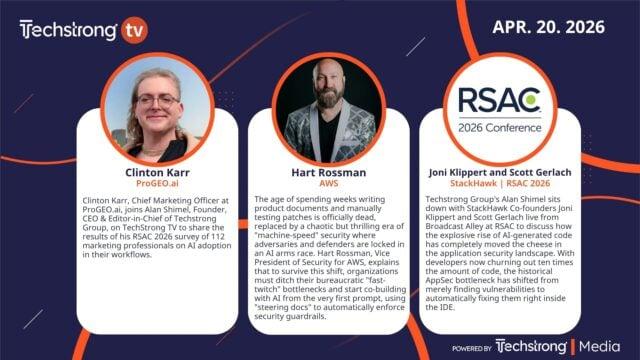
Techstrong TV June 17, 2025
Watch our live stream Monday through Friday, featuring exclusive news, announcements and conversations with IT leaders and experts on topics ranging from digital transformation to #DevOps, #Cybersecurity, #CloudNative, #Containers and deep-dives into specific technologies and best practices. http://techstrong.tv/
Transcript
Hey, everyone, do I have an AI agent for you? You're watching Techstar gang. Happy Tuesday, everyone in Talent.
Shimmel for Tech Strung gang. Glad to have you on. You know, we, we've got a lot to cover today, starting off with some agentic AI information.
I'm starting to feel like I, I remember those people in downtown New York when I first started in tech and I what we called Silicon Alley. There were guys there literally with the, with the coats. And when you'd walk by, they'd open their coat, you wanna watch, and they had all these watches, right?
You could buy, of course, they were real Rolexes. And, um, it's kind of be the same thing with the Agentic ai. Hey, you want an, you want an AI agent?
I got one for you. But, um, we're gonna dive into that and more with our outstanding gang today. Let me introduce you to them.
First of all, she, I, I, from the background, I'm going to guess she's home in, in Colorado, analyst extraordinaire, Kimberly Bates. Hey Cam, how are you? I'm doing great, thanks for I on, uh, next couple weeks.
I'll probably be back on the East Coast, so there you go. Really? Oh, we're looking forward to that.
There might be a, maybe there's a Boca trip in your future. Um, but thanks for joining us. Moving to the East coast, the east coast of Florida, that is in the Space Coast Orlando area.
He is a data ai, uh, IT expert and a long career in it. Uh, my friend JP Morganthal. Hey, jp, how are you?
Good and good. I wanna say good morning, because that's when we're recording, but whoever this could be seen at any time, so hope I'm doing well, and thanks for having me. All Right.
Good day. Does that sound kind of power grid background there? Uh, I, well, I, I had the data center background and, you know, it just looked like you're, and I, and I'm like, that's not me.
We wanted to get something more neural networky. This is kind of, this is what chat GT came up with when I asked for a background for this. Alright.
Hey, appreciate the, uh, honesty. Very cool. Alright, moving along to Hudson, Ohio, the man from Hudson, uh, founder of Tech Field Day, my friend Steven Foskett.
Hey, Steven, It is nice to be here once again. And, uh, by the way, Kimberly, if you, I do recommend taking him up on the offer of a Boca trip. Well, to truth be told, my husband's gonna be down there and I was saying, Hey, could I just get a Bogart on your hotel room?
And he said, no, he's with his brother down there. So he said it was an absolute, it wasn't even a, he wasn't even a question mark, he said, no. Well, hotel rooms are cheap here because it is harder than hell.
Mm-hmm. And, and we have good corporate rates talk. We'll talk.
Mm-hmm. Steven is not a chat g PT generated background for you as well. Yes, I said, uh, generate something that looks boring and brown.
Good for you. It's actually a piece of paper. Here we go.
Bonk. All right. Uh, all right.
Moving from Hudson to Harrisons, but staying in the hs. I guess he's a little, there's no joy in Harrison after the Yankees struck out this weekend, but he's our chief content officer, Mike Ard. That is true.
And as soon as I get off this call, I'm hopping in the car and driving to Philadelphia for AWS Inforce Philly. Very nice. Very nice.
Say hello to all our friends in Philly. Um, alright. Oh, you forgot me again.
I didn't forget you. I was just gonna say, sitting here in, in our studio with me, it's hard to forget. We're only two people on the same screen here.
Yes. Um, she is our Echo Insights analyst and advisor and editor Bonnie Schneider. Hey, Bonnie, how are you?
I'm great. Thanks for having me. Good.
Um, it's good to have you here. Okay, cool. Go forward.
Yes, let's go forward now. Um, so Mike, I I opened things up with yet another agentic ai make it easy to do more AI agent story. Yeah.
So as the song says, there's something happening here, and last week Databricks was talking about how they're gonna make it simpler to create these AI agents. And part of that issue is they have a large pool of data already that enterprises are also using. At the same time, Centra is also talking about a Lego like approach to creating AI agents and stringing them all together.
And what seems to me, at least both these things have in common is they're very enterprise centered approaches to building out AI agents. And they're not dependent upon, you know, outside of the LLMs, but they're not looking towards all these startups to do that. They're kind of looking into their traditional vendors.
Jp I know you follow this space, but is it me or is it gonna be like really simple to create the next AI agent? Well, you know, I was trying to create the picture, uh, from a macro perspective looking at, uh, Accenture dis distill AI distillery and, and the announcements from Databricks kind of in the same context. And, um, you know, they're, they're really a yes at trying to approach the same audience with the same set of, uh, capabilities.
Uh, Databricks though is a product company and in a natural extension of what they do is to help customers leverage the existing investment in their tools and technologies. And then, and, and the, you know, the natural next step is to take that data which is housed in their products and make it available for ai. That to me is a very intuitive step.
It, it would be surprising if they weren't, you know, providing these tools. I think they're in demand. Whereas Accenture, I tried to look into more of this distillery, uh, and refinery concept and, you know, you get to, you know, whereas everybody else is putting out a ton of, go to my GitHub download this, here's the free entry, the free tier.
You go to Accenture. It's like, call us. So, uh, I I, you know, the more I, the, as much as I looked into it, I couldn't help but feel like Accenture is, uh, as many system integrators.
They're not alone in this. They're in a, you know, precarious spot. I think AI is affecting their business, or the belief in AI is affecting their business.
I think they're trying to do everything in their power to pivot and be, uh, you know, to have relevance in this AI world. But I think they're gonna have to, uh, step up and be more of the traditional AI community if they want that. The call me to find out more is not gonna play when you have, you know, the likes of small startups and all the model creators putting out a ton of similar type projects that you can just download either from hugging face or GitHub.
And, uh, so, you know, I, it it's a traditional old world, Accenture, I own it. 0. Um, but as far as the getting people on board, you know, that are not looking at Accenture, you know, I see it as a leap right now for them to get there.
And, and to be relevant, Alan is JP onto something because historically we needed all these consultants to kind of provide the knowledge, where shall we call it, to leverage all the IT technologies. But if I look at these AI agents, it seems like so long as I understand my business processes, I may not need to engage with a consultant so deeply to go build something interesting. You're always gonna need a consultant, Mike.
But honestly, here, here, here's the situation. I think there's a bigger issue. Jp you touched on it around this AI stuff.
Ultimately, is AI gonna be the, the domain of Giants of the, of the big four, the Accentures, the PWCs, et cetera of, of the Mag seven, Google, Amazon Meta, Microsoft Open ai, I guess is part of that royalty as it re re regards ai? Or is there room for new growth forest for a bunch of saplings to come up in here? Is there a place for companies that are going to make easy, easy to distill, easy to deploy agents that are going to do a lot of the grunt work, if you will, that Accenture does for companies, or, you know, a lot of these bigger, uh, uh, you know, consulting companies do?
Because make no mistake, AI agents can really, I mean, you know, digital workers as we're calling them, a lot of, you know, a lot of the businesses of the Accentures and the PWCs, and quite frankly the Beltway mandates as well is body shop business, right? They're putting people in butts, in seats for, for, for the government, for enterprises and charging for it. And a lot of that work could be done by digital workers.
So my experience though, tells me, and much like JP says is, look, you're never gonna eliminate these guys all together. There, there's always gonna be a place in the ecosystem for them. But I really am looking forward to seeing a new crop of AI empowered startups that, that, you know, uh, pushing through the old growth, looking for the rays of the sun and achieve escape velocity.
And that to me is what's, what's gonna be interesting, right? Because nine times outta 10, innovation happens at the, at the new growth layer, not, not the old growth. And any consulting firm worth their salt has gone through already a strategic process at this point in time to say, how do we rearchitect the company?
If, if you're a developer and you're a body shop and your pwc or your Accenture and your business has been development, uh, for these companies, um, if they haven't sat down and gone, okay, what are the scenarios? Let's play the scenarios out from the executive standpoint. Um, because when you have, your entire environment has changed, which fundamentally it seems to have changed for the development.
I'm not a developer, but if you look at you, this is one of the number one places that AI is being implemented, um, in, in full force, is you have to re-look at the business completely from the ground up and where, where is that business and what is our service offering? Um, I'm actually surprised that we haven't heard a lot about layoffs from those companies, and maybe I just haven't been watching for it. But that to me is, you know, that that is super at risk and would be the requirement of any kind of board to say, okay, so what's the strategy here?
I think Deloit and Accenture went through around those layoffs, uh, 20 23, 20 24. I think they went around with some read more recent layoffs as well. But jp, you know what was also interesting at the Databricks conferences, Jamie Diamond showed up, and one of the things that he said was that, at least in their organization, um, AI reports to the CEO and the CEO and directly.
And he said it was too important to have it report up through it. And the perspective was is that, um, AI is gonna drive business process re-engineering all across the bank. And, uh, the question then becomes, you know, what, what is their relationship gonna be between AI and IT going forward?
Are other companies gonna do the same, or is AI part of the IT CIO responsibility? I, I, I just wrote about this, uh, I did a LinkedIn post. Uh, I I made it very clear that, you know, there needs to be a, uh, you can't put this into the realm of it.
You can't just shirk this off as another IT project. Uh, this is, this is, this goes far beyond the, uh, you know, the, the realm of it, and you end up with a different outcome and a different product when you focus, when you just shrug it off that this is just yet another IT responsibility, uh, that, you know, you won't get the, the value out of it that you're expecting because it's, it's girth and it's need for understanding, uh, and what, what feeds it is typically beyond the relationship that it has with the rest of the organization. So what I wrote was about that, you know, what are you missing?
You're missing that bridge. You have your business analyst, right? Which typically does your transcribing from the business requirements into IT requirements, but these people have not been upskilled and they don't understand what it can do.
So how do you translate to a language you don't understand yet? Right? How do you go from English to Greek if you don't know Greek?
Right? So you, so the, so the typical translator can't be your translator here. Your IT people truly understand systems, but the value here is not in the systems, it's in understanding the business.
And so you're, you're, you're missing that critical bridge if you're leading with it in order to do your AI initiatives. And I think that gets back to kind of what our skills are gonna be needed here. I mean, you look at, as you said, jp, it's the business analyst skills.
It's that, and that goes with any kind of discipline you're talking about, whether it's development side of the house, if it's a financial side of the house, if it's a, um, sales kind of sales operations that discip that analyst capability, that, that has that expertise within that field to look at the information that's coming at them from an AI standpoint and do that analysis and provide that information becomes critical. Because we do know where some, you know, we're already, we see where some of the limitations of AI is in terms of its reasoning capability, which we, I talked about on another podcast, um, in terms of the information that it's delivering. So this to me, is a very logical place that we're going in terms of how packaging, new packaging about how we deliver something, but it still needs the expertise of the domain.
I, I personally think thinking about AI just along the lines of it is, is, you know, when you're a hammer, everything's a nail. So of course, we look at it that way, but it's, it's, there's so much more that AI's gonna do here in terms of disruption and effects on civilization than just it, not to minimize the importance of it. But The, the other thing that came out of that conference too is they invited the chief AI and data officer, which I thought was an interesting title in its own right from MasterCard, who said that they are in the process of building, uh, AI agents that are designed to engage with other AI agents that are buying things.
And so people are going to be assigning the authority to an AI agent to go buy something, or at least that's what MasterCard's assuming, and that they will have AI agents negotiating transactions back and forth. So, I don't know, jp, um, if you're comfortable with that notion of assign giving an AI agent, what an allowance to go buy stuff. That's a good point.
Uh, the allowance point, right? I, I assume there are individuals who, uh, are less concerned about the negative downside. Look, it, if you look, if you did a per, if you're a person, you order from Amazon and you don't like what comes, you know, you take it back over to Kohl's or UPS store, you drop it off and you'd get a return if, you know, and there's no cost.
So I, I, I think the risk of, uh, you know, acquiring, uh, goods and that cannot be returned. So it, it depends on where you are from a level of what you're, you know, purchasing. I wouldn't allow it, I wouldn't hook it to my WTI crude, you know, you know, have to, except 20 barrels of crude to my house, which oddly enough I learned earlier in my career, it can happen if you play around in WTI crew trades and you don't trade your, for the execution of your stock, you actually end up having to take delivery.
I'm sure it's happened to people, but, so, so, yeah. So I don't think MasterCard's funding that or, you know, it's not like a new, how did this BMW show up? I love the commercial for this, right?
New BMW shows up in the driveway Who bought this? And the, and, and you hear like a little Alexa thing in the background though I did for you. Yeah.
So I mean, it, it, it, it's, it's, I think visionary. I don't think it's there yet. I I know people are using subscription based models already on Amazon and Chewy and other places like that.
So, um, this is yet possibly a yet another attempt to mitigate or negotiate better pricing your procurement agent, if you will, right? Last week, this was cheaper on Amazon. This week it's cheaper at Chewy.
So instead of me putting the subscription with those services, I am now going to do a, you know, watch the prices and procure for you all that seems very reasonable within the realm of something I would trust AI to deliver today. I agree. I agree.
Alright, my AI agent is telling me we've gone over our allotted time for this and I need to take a break. We're gonna come back and we're gonna talk about what's going on in, uh, in OAA with our sustainability analyst, Bonnie Schneider. You're watching Text Junk Gang.
Join Cruise Con Virtual on June 17th in 2025 for breakthrough strategies to address advanced threat intelligence, proactive incident response, exclusive bonus material and regulatory adaptation. Hear from our keynote speaker, Admiral Michael S. Rogers, former director of the National Security Agencies, and an outstanding lineup of industry experts as they navigate emerging threats.
The core principles of crisis management and the evolution of CISO leadership. Register now for free. Well, uh, across the Atlantic, it is now hurricane season, which began June 1st.
And this isn't really the busiest time of the year. That will come August and September, but already we're thinking about new technology that NOAA is using in the United States to help forecast hurricanes better and track them better. And guess what?
You may be surprised it's ai. So I took, decided to take a closer look at the AI NOA will be implementing this year, how they're doing it, and also the goes 19 satellite, which became, um, effective in, uh, April, and see how that is also gonna come into play, which with what is expected to be a busy hurricane season, Hurricane season 2025, brings major advances in forecasting. Noah is expanding its use of artificial intelligence building on several years of AI integration to test new models alongside traditional methods in real time.
Early research shows AI systems can improve tropical storm tracking by 20 to 25% over two to five day periods. They also work faster. Traditional physics-based models require hours of processing time.
AI delivers the results in under a minute. The National Hurricane Center will use AI tools to supplement, not replace official models. Supporting these improvements is Noah's new goes 19 satellite, which just became operational in April, monitoring tropical regions.
It will provide more detailed and timely data than previous systems. So in terms of tropical activity, what can we expect this year? Noah predicts an above average hurricane season 13 to 19, named storms, including six to 10 hurricanes and three to five major hurricanes.
The integration of AI and advanced modeling systems represents a significant step forward in protecting lives and property from these destructive weather systems. So right now we're looking at an active season, as I mentioned, above average in the forecast. And I think it was important to note that for people that are concerned, because obviously this is the serious stakes here with hurricanes lives property, that AI isn't doing it alone.
It's enhancing existing meteorologists that are there and forecasting, and they're also kind of tracking it real time to see how the AI does versus the human. And I think the outcome of this season will determine a lot of what's gonna happen going forward. You know, they're, they're putting a big bet in here because they've gutted the hurricane, uh, office, you know, outta Miami.
Mm-hmm. You've got a guy running FEMA who didn't know it was hurricane season, so they gotta make it like we're doing something as a resident of Florida. God help us, God help us.
I'm praying that we don't get hit with a hurricane here because we won't know if it's coming and we won't be able to help do anything if it does. You know, I, I hope this AI exceeds, uh, expectations. But realistically speaking, where Ro I know Steven, I think I saw something about Noah was also working with HPE and Google, and they're trying to build some more advanced systems, but this whole weather forecasting thing, I feel like we've been talking about it for a decade now with it and trying to make it all better.
But, um, you know, they still can't tell me if it's gonna rain at three o'clock. Well, it, it's a, honestly, I think a cynical attitude and, uh, out of touch with reality. Um, weather forecasting has actually gotten a lot better in the last few decades, thanks to advances in technology, um, And modeling and so forth.
Yeah. Modeling and satellites. Um, I think it's important as, as you mentioned, Bonnie, this is, uh, goes 19.
Um, this one replaces, uh, goes 16, which was, uh, had been, uh, providing a lot of this data for the last, uh, few decades since about 2000. Um, you know, all of these satellites that go up, I think that this is an example of sort of the quiet advancements in science that don't get a lot of attention, and frankly don't get the, uh, the applause that they should because we, you know, we have scientists working on, you know, basically continually updating these, uh, geostationary, um, weather observation satellites. Uh, for example, uh, goes 17, had a problem with its heat pipe goes 19.
They fixed that. They also added instruments to this, um, for example, to replace the, um, solar wind monitoring that was taken offline, uh, after the soho satellite was retired earlier this year. So again, this is scientists doing science stuff in a way that benefits all of us.
And so I'm really happy to see this stuff move forward. I am very alarmed as you are, uh, Alan, about the, uh, gutting of the science, uh, funding at NOAA and basically every other, uh, part of the federal government because this is an example of, like I said, of of the US government and of science and NASA and NOAA doing good for all people. Hopefully the, uh, predictions from this AI based system will prove, uh, effective, uh, I see no reason to think they won't.
AI has actually shown great promise in, in weather prediction and, and modeling. But, uh, you know, if we don't continue to fund, um, this sort of basic science, uh, earth science geoscience, then frankly, we will be up a creek, as Alan says, when not knowing when the next hurricane is coming. So I'm really glad to see that this satellite went up.
I'm really glad to see that it's coming online, uh, replacing the old satellite, um, replacing the retired, uh, satellite. Hopefully we will continue to fund this sort of work. I'll say something else.
Hold on, Mike. One other thing I want to say to your point, Mike, about whether or not it's gonna rain at three o'clock, and we get that right, let's not confuse that sort of point in time, you know, weather forecasting with the ability to say our climate is changing and what the trends are and what could happen in spite of what you may read on third rate social networks or extreme, extreme tv, 24 hour news cycle TV shows, right? The fact of the matter is our ability to, to predict trends in weather and climate is pretty damn good in getting better.
It it is, it is Alan. Uh, it is. But, and, and whether, and the NFL are probably the two best examples that I know of to demonstrate and talk intelligently about generative ai.
So both of those things that I mentioned are non-deterministic on any given Sunday, you, you're, you're the, the, the team that is picked to win with a, with, with, you know, um, on a blowout. You know, the quarterback gets rolled over in the first play and they bring in the second stringer and lose the game, whether it's a non-deterministic game as well. It's all prob it is, it is.
A transformer is a generative AI transformer in live. What happened 1600 times in the past doesn't happen. 1,601.
Um, these are great examples in the real world of what a generative AI transformer actually is doing. It's, it's non-deterministic. It, it follows and analyzes patterns that we've had in the past that it's seen in the past, at any moment in time, all that could change.
So, having lived in Florida for a few years, speaking on behalf of the great Florida man that you occasionally encounter from time to time, they will say no one ever was surprised by a hurricane. It's not like you don't see this thing coming for a week. And the other thing that they will say is, regardless of how much you tell me that hurricane is coming, I ain't going anywhere anyway.
Well, that, that's, that's all other, that's a whole Florida man thing. The, the, there's more to that. Um, I just wanna add one thing.
It's not just about, um, the, the forecasting of the storms. One of the, the cooler things I think will come out of this is understanding them better, getting closer looks at the, at the rapid intensification when that happens. You know, we've had so many of these category five storms in recent years that it's been unprecedented.
So studying how that happens when that happens, and the, and the mechanics behind it, getting more science and information on that is also gonna be really beneficial. Yep. Jp, you were gonna say something?
Oh, there's a great book about what happened the last time the government gutted Noah, before it was Noah by Eric Larson. Uh, it, it's called Isaac Storm. It's about the 1900 hurricane that took out Galveston.
Uh, yeah. And, and that, so it, it, it, it's, it's relevant because, you know, the, the thinking is that, um, you know, we have technology, we don't need people, and it, it's really the Jesuit priests, priests that were in Puerto Rico who understood the pattern that was coming towards the US based upon the way that the storm came across Puerto Rico, and they ignored Them. Well, there you go.
Mm-hmm. Great way to this way. Yeah.
All right, we're gonna take a break here on the gang. We're gonna come back and we're gonna talk about power politics. We're talking power grid in data centers.
You're watching Textron Gang. Hey, folks, we're back and we're revisiting a subject we've talked about in the past, but it's about data centers, energy consumption, and the grid. I think we've kind of established in some earlier shows that maybe we're gonna get more efficient in the way we build data centers themselves, and we'll get better at running those AI models.
But there's also a question about the grid itself, Steven. And there's a lot of reports now that are suggesting that the grid, as we know it today, just isn't up to the task. 'cause it's not just data centers, it's cars and everything else.
And it might take us a generation to rebuild the grid. Oh, it's gonna take us a generation, we're gonna be continually rebuilding the grid. Yeah.
The, the, the, i, I guess the point at hand here is the 2025 state of reliability assessment from the North American Electric Reliability Corporation, which is, uh, basically an insider, gobbly, good kind of corporation that, uh, studies exactly that question. How are we gonna handle the, uh, demands for electricity going forward? And specifically, how is the growth of data center construction and AI and cryptocurrency affecting the reliability of the grid and the ability of generation to handle that?
So, as you said, uh, we are building more and more and more data centers. I'm certain that, uh, we've, if, if you have watched Textron Gang at all, or if you have paid attention to any of the other, uh, media related to data center construction, you've noticed that we're building a lot of these things and they're getting bigger and they're getting more powerful, uh, and they're demanding more and more electricity to the point that we are seeing, um, organizations like AWS and Microsoft and Google, uh, locating next to nuclear plants to make sure that they have the ability to power these, these things. In fact, another story that we see this week is, um, AWS and a company called Talen, uh, expanding their existing relationship in Pennsylvania, Susquehanna to use, uh, the nation's, I think second largest nuclear plant to power, uh, data centers in Pennsylvania.
And this is the sort of thing that we're seeing happening everywhere, uh, whether it is, uh, in Pennsylvania where a lot of these things are being built because of, uh, good nuclear power and, and plentiful, uh, water, uh, to places like Ohio and, um, Indiana and all over the country. A lot of data centers are also going into places that don't have as strong and reliable power grids like Texas and California. And that's something of a problem going forward, because these data centers are going to need power, as it says in this report, it's not that the number is actually all that great in terms of the overall power usage in the United States.
This is a, you know, two to 3% to 5% increase. The problem is that the grid is not built to handle even increases of that sort, because typically power usage has been pretty steady with slow and predictable ramps. Uh, when you build a new industrial facility, a steel or aluminum processing plant, or a giant factory or something like that, it typically takes five, 10 years to come online so they can build additional, uh, generation capability.
But as we've seen, for example, in Tennessee, uh, AI plants can come online and take a significant portion of the power resources in just a few months or, or, or a year. And that's really what we're seeing now with AI and data centers. Essentially, it's not the fact that we're going from 2% to 3% to 5% growth.
It's the fact that that growth is gonna happen in 25, 26, and 27 when the generation of power just can't keep up. And in reaction, what's happening is companies like Amazon are actually moving to what's called, uh, front of the meter, which essentially says, you know what, instead of getting special deals and special requirements, we're just gonna tell the world that we're buying more electricity and you better be there ready to meet us when we need it. I don't blame Amazon for moving to that market, and I don't blame companies like Talend for, uh, attempting to work with them, but frankly, this is gonna be a big challenge.
It's the quick, uh, uptick of electricity demand that that is really causing problems. And you know, Steven, we talk about nuclear, right? So prior to this AWS talent deal, of course, there was the Microsoft three mile island.
Oh, they don't call it three Mile Island anymore, I don't think. Yeah. Uh, also, you know, buying nuclear and, and, and there's other examples of this, the problem, you know, one may say, wow, this is the greatest thing for nuclear energy we've had in a really long time.
But the problem is the, the lag time in bringing new nuclear energy plants on online. You know, who, who the heck can look seven to 10 years out? We, we need stuff online, as you said, in the next 18 months.
Yeah. And it's not just the lag time, it's the fact that they're just not building these things. I mean, they can ramp them up, and that's what they're trying to do with Susquehanna is ramp up the power output from this existing nuclear plant.
They're not building a new nuclear plan anywhere in the us. Well, they did talk about one of the things that AWS did talk about was the investment into small nuclear power, um, capabilities in that space. So perhaps with that, you know, there's more interest in here.
So there's more research going into this. So it, there is the American ingenuity of going into building out what we're gonna need for energy, um, in this space. But the other thing that you're saying is like, you know, the, the estimates are you, this, they sound small, three to 5% or whatever that increase.
But what it seems to be is that you have these, that that's, that's an average over the United States number as opposed to what I need coming out of Pennsylvania or Tennessee or Texas, or wherever these particular data centers are going in. The number is got to be significantly more than that. And with that kind of big of a jump is where the stress is going to be placed on it.
I, I, I think elections are gonna turn on this issue, and it's happening here in New York already, where, um, the cost of electricity has gone up for everybody in their residences. And, uh, the governor is now pointing the finger at the company that manages the grid in New York State. And part of the issue here is you're gonna have is we're not gonna increase the supply to keep up with the demand.
And what happens then is prices for electricity tend to go up, and then they take it out on politicians. So I think there's gonna be a lot more tension in this system. Jp, what do you think?
I, uh, I, like, first of all, I think that fusion is becoming a po possibility. Uh, and we've had some interesting successes here lately, and I think that there is a ton of money chasing that. I have hope that there is some actual something behind all of that research and that that potential there is real, which would change, I mean, the game significantly.
But, uh, well, this Is the year of Linux desktops Fantastic. We're 10 years behind in actual implementation, right? But, but, you know, I I, when handled properly, you know, I think nuclear is a great option.
I think fear has been holding back, uh, the world, definitely our country for moving forward and taking advantage. Uh, understanding how to deal with the waste has been an issue. Uh, people don't understand that there are actually positive, uh, ways to deal with waste.
Uh, and they do have fears from what happened with meltdowns in the past, even though the technology is, what, 30 years from three Mile Island. Um, and you know, sure, you know, you get an earthquake, you end up with, uh, you know, a, a bad incident, right? So let's not put them in earthquake sensor, earthquake zones, uh, not a good idea.
But, you know, the, the amount of power they generate for the, what they cost is, you know, it needs to be paid attention to, it needs to be given serious attention again in this country, in addition to, uh, you know, the ergonomic ones, the, the solar, the wind. They, uh, I, I, I seen true, so where was I recently? Oh, epic.
The new theme park by, uh, for Universal. Um, they have these garage areas or parking area in the lot where, where they, they have overhangs over them, and the overhangs have solar panels on top of it. And the, those solar panels power the entire parking area and the, and the opening of the, the entrance of the park.
I would be remiss if, as Mr. Solar, if I, I can't let you down. Uh, I, I, I gotta say yes, you're right.
Uh, one of the nice things about solar is that it can be deployed very, very quickly and economically. Uh, the technology is here today, and it's being rapidly deployed everywhere around the world. Unfortunately, solar is, um, not a great match for these AI data centers because it doesn't run 24 7 and, uh, you have to pair it with battery or with, uh, spot production.
I, I will say that although it would be great if fusion, uh, energy would answer this problem, that's certainly not something we're gonna see in the next 24 months. Um, if, if ever and, and small modular reactors, um, talk about American ingenuity. The only place these things have actually been even attempted to be deployed are Russia and China.
Um, America has been messing around with small modular reactors for two decades. We've Got one approved, but it hasn't even been put into production. Uh, if you wanna invest in it, it's SMR on the stock market.
That's how, uh, how hyped this technology is. But it ain't, uh, gone anywhere so far, and the company's managed to go almost bankrupt. I I think part of that is regulation, Stephen, or, or, or fear of nuclear from a, a country and our, our view of it, uh, as a country.
And so it's gonna become, getting back to Mike, where the politic you're talking, the, the politics or regulation or, or government, government oversight on this. It has from us as people of the country having a new view of this. I mean, the French are nuclear.
There's other countries that are nuclear to say, okay, so are we willing to do that? I mean, Japan has done that and they've survived the tsunami. Um, and so there is some proof that this, you know, this can be reliable and that we can look at it from a practical standpoint.
Um, every one of the energy capabilities that we we has has a, a downside to it. I mean, I look at, you know, look at the field of, you know, your wind energy and what that's doing to the environment and the animals that are there, or the, you know, the acres that are in Nevada that cover the desert, that some people believe that there's nothing there. Well, there's a lot there and, and those kind of things.
So those are the downsides to that. So each one of these have downsides to it, and it's a trade off to how we want, you know, how we as a country view it and how we wanna support and deploy these areas. Jp, I gotta go find our college paper that I worked on in 1981 saying Fusion was right around the corner, baby, I'm gonna dust that ba In, in, in the realm of things.
You know, that's a couple of years, man. The realm of the universe. That's, you know, that is right around You should find it and publish it on LinkedIn and see what kind of comments you get on it.
People will say AI wrote it. All right. Um, we gotta pull the plug here on this in edition of Text Drunk Gang, Bonnie, Kimberly, JP Steven, Mike, thanks for joining.
I'm Alan Schmo. Stay tuned for the rest of Text Drunk tv, but we're out. Hey everyone.
Welcome back here to Techstrong tv. I'm happy to be joined by my friend Nick Durkin, field, CTO at Harness. Haven't seen Nick.
Geez, I think the last time I saw you was probably maybe CubeCon. It's been a little bit, uh, you've been working with a lot of my team. So Alan, as always, thank you so much for having us on.
Oh, it's a pleasure. We have been doing a lot of harness. Well, to be fair, I was at RSA la I guess that was last month, it seems like forever ago.
And so we were working with, you know, formerly the Traceable team, which is now part of Harness as well. And, and so it was good, good to, uh, work with them. I, I, I had known the Traceable, uh, since, you know, Jodi launched Traceable, so it was, it wasn't a new entity or a new company to me to, to do, but nevertheless, it's good to have you here, Nick.
Um, for those who maybe aren't familiar with you or maybe even aren't familiar with Harness your field CTO, what's that mean for you, Nick? What does that mean to the audience? Sure.
I work with all of our largest customers. And so these are technology companies, these are financial services customers. These are, uh, all of the hotels and the airlines that you use, all the banks that you use, but really helping them change how they're delivering software and change how they think about what building and deploying software used to be and what it can be now.
And I think when you, when you talk about even the traceable merger, it's bringing, you know, not just the builds and the deploys, but also now as we're operating tools and so into the day two of making sure that everything stays secure, everything stays audited, everything stays compliant, and that you can deliver software, you know, like, uh, the industry's best, but you can do it in regulated, secure environments. I love it, Nick, beyond the, uh, the traceable merger was, was big news of cost, but what else, you know, coming from the harness side of things. Sure.
I think, you know, Alan, you got us on here years ago talking about our ai and that was predictive modeling back in 2018. That was, you know, machine learning, neural networks and clustering. And we've always had a constant understanding of removing the worst part of people's jobs.
And I think that's been core to what we've done with automation, with machine learning, with with ai, and we're doing the same. And so even coming out with our MCP server, making sure that you can interact with harness accordingly, I think it comes down to what we saw at Google from the Dora research. You know, people are getting 25% more from code today, right?
Because of all the ai, but they're not actually able to get it through the system. And so they're actually one to 2% lower, uh, yield into production. And this, this is the problem is if we don't actually automate everything, right, uh, we're not gonna gain the value.
I think it's like putting raw materials. If you put more raw materials in front of a Ford F-150 line, it's not gonna get you any more Ford F fifties. Agreed.
Agreed. io, isn't it? Harness Do io.
Yep. That's where you can look. And, and one of the unique things about Harness is that we do have a, a large set of offerings, but each one of them, uh, it actually integrates with all of our competition.
Uh, you can use what you want when you want it. So although the offering's massive of what we can do for you, you can, you can use the parts and pieces you need now. Right.
Alright, let's talk a little bit about Vibe coding. You know, Nick, I, we were talking off camera. Uh, we, we discussed this on the, uh, tech field, excuse me, on the Techstrong Gang show this morning.
com, basically calling into his vibe coding ready for the enterprise price. And, you know, as part of this, and it was a good conversation with Keith and Mitch Ashley and myself, uh, Anna Aloha Ward and um, uh, Jack Pool security analyst. You know, Nick, I think it was just in January that the, like the term vibe coding kind hit our radar.
And it sounded like, you know, something like surfer hippies in LA Do or something, right? Hey, dude, we're vibe coding, you know, and it, it, it, it seemed, I don't know, childlike toy, like a toy. Uh, no.
And everyone, you know, the, the grownups in the room were saying, oh, this is not good codes, it's not quality, it's not secure, it's not this. But in this AI world that we're living in now, the Time Crunch is so condensed that from January to June, now we're discussing it isn't an enterprise tool or not. And you are, you know, you are positing that how Vibe coding can remove some of the worst part of developers' jobs.
Kumbaya is, are, are we still talking about the surfer dudes? What, what happened between now and January? I think this actually follows the same pattern that we saw with Cloud, but it's doing it infinitely faster.
You know, I always preach if you have to make it easy for people to do the right things, and you have to make it hard for them to do the wrong things. And I know that's a basic statement, but if we made it easy to make VMs right, we wouldn't have the clouds, right? And I think this is where it gets complicated and with vibe coding, it's actually become even a normal practice and a standard of, let's get started, let's try something quickly.
If you look in the startup market, the whole point was let's go find market fit as fast as we can. And if we can do that quickly, if we can do that leveraging any technology, I think that's fine. I think you brought up a point, you know, okay, the code might not be that great.
Well, I hate to tell you the first time I write the, you know, any code, it's not gonna be that great. It takes honing, it takes skill, it takes, you know, actually testing and trying it. So getting to that point faster is actually the advantage.
And we even just had a hackathon and, you know, 35 teams sat there, pretty much all of them were quote unquote vibe coding, what was able to come out of a three day hackathon instead of being, you know, here's 10% of the project delivered, and here's what we wanna do. We have full blown what I would almost consider harness modules built in three days. And they're able to do so because they get those, um, you know, they, they, they remove the empty pallet or the, the, you know, the, the, the empty painting.
They, they get somewhere to start and start kicking it off quickly. That combined with their knowledge of a space or an area is what makes it beneficial. So I think we're absolutely seeing it, uh, coming to the enterprise.
And if we're not, watch these startups move even faster. I, I agree. I agree.
I mean, as I said on the Textron gang this morning, Nick, oftentimes new technologies come into the enterprise via the backpack, meaning the people who bring them in there. We sort, you mentioned the cloud, but the whole shadow IT thing where people would just whip out their credit card and fire up a couple of instances on AWS that was really how the cloud sort of started gaining, you know, critical mass, though I heard an interesting stat today, 70% of workloads are still on private data center, not, not cloud, right? So as hard as those VMs are, as much as they cost, they'll do that for all.
Yeah, 70%, that's still a big number, man. Huge number. But nevertheless, that means 30% isn't, and, and I, as you said, the AI time crunch is exponentially more crunched, it seems, than anything we've seen in the past.
So, um, in six months it went from a joke to real. I can only imagine where we'll be six months from now. But let me ask you, what are the worst part of developer's jobs, Nick?
Sure. I think when you look at most AI and what people have been leveraging it for, it's been around code gen. And to be fair, that's usually some of the best part of people's jobs.
No one loves babysitting deployments. No one loves waiting for tests to run. Uh, no one loves debugging infrastructure.
Or, you know, if they get a security vulnerability, not only figuring out what it was, but actually, you know, writing the code to fix it. And so when you go and you focus your, uh, you know, when you focus ai, when you focus removing the pains, it should be around that. And I think that's where customers right now and companies right now, you can get a ton of code.
You can get great things outta vibe coding, but if you don't have a way that's fully automated to get to production, it doesn't much matter. And so when you can start removing, like I said, I don't wanna write, uh, the pr, uh, to figure out how to go and fix the security vulnerability, let AI handle that for you. I don't want to, to go and figure out, um, you know, what a good deployment looks like and, and have, you know, be up at, at crazy times when we're doing deployments.
Let AI handle those things for you. That's where you actually start gaining people, uh, wanting to come to a platform as opposed to fighting it. If you go and take the best part of someone's job, they'll, they'll fight you tooth and nail, right?
But if you go remove the worst part, they'll gladly come with you. And that's what we're seeing with industries. They want to standardize.
I actually look at, i I, and I know this a little sideways, but I, I actually look at software delivery a little bit like football and, and stick with me for like two minutes, Alan. I hate sports analogies, but we're gonna go with it. Like most people in the world play football with their feet in America.
We play with our hands, I still don't know why we call it football. And in Australia, they bump the ball and they jump all over each other, and it's absolutely amazing to watch. But this is software delivery right now.
Everyone's playing football. We don't know actually the rules. We don't know what a score is worth.
We don't know where the off sides, we don't even know how big the, the field is. And once you can actually put policy in place, once you can have the same rules for everyone, it actually makes the game go faster, right? Everybody knows how they're playing.
They know what they're playing. And this is what gives people that opportunity. If you set those things up, they might be difficult to set up in the first.
Now you actually get that production line moving, right? Everybody's playing the same game. We can operate accordingly.
And I think that's what we're seeing in the industry is people are clamoring for that velocity and they'll move wherever they can to get it. Fair enough. I I, you know, I did, I I won, I saw an Australian, uh, football or Austral rules football game in the Melbourne cricket grounds.
Yes. A hundred thousand people. You got some big people playing football there, man.
No pads. Yeah. That's a whole different, uh, strength.
And, and, and I've been in that exact stadium. I think it's the second largest stadium in the world. Mm-hmm.
Um, absolutely amazing. But I think that's, that's what people are, are actually looking for. It's like, let's find out how we can do this quickly.
Let give me the path to get to production fast so that vibe coating. You know, it might not be perfect and there's things in place that will prevent me from going to production if it isn't. But if I do generate something good, if I do hone it, if I go in and tweak it accordingly and it makes, you know, passes all my security scans, passes all my resiliency tests, now, it can actually make its way to production rapidly.
And so it's actually about building those on-ramps or, you know, some people call it the highway or, or, or the runway. I think it's about making sure that we have those available for our people so that they can actually gain the velocity from vibe coating. Because without it in an enterprise space, I'm still bound to traditional deployment types.
And I think that's a challenge for a lot of enterprises. If we can solve the, if you will, the pipelining issue, then you can actually leverage the, the benefits of vibe coding. Does vibe coating replace junior developers, though?
I think vibe coating in what I've seen it actually, it does a few things. So sure. It enhances and takes the, the, our great engineers and makes them, you know, amazing.
It, I think it actually rises all tides. It does take the junior developer and allows them to quickly, uh, learn and quickly scale. So they might not be used right away for the hard and complex things, but what they can do is actually go from that junior status to a more senior or even staff level in a lot shorter period of time because they're gaining that much more experience If they've never seen these types of things.
It, it gives them that, that visibility quickly. So I think, to me, I've seen it rising all tides. A lot of people talk about it, you know, removing the junior.
The problem is with any, any environment, if we don't have a training ground, if we don't have a way to build people up, then what happens when that group of excellent goes away? And so I'm not actually worried about us losing the junior engineers. I think it's just gonna be a different way of learning.
I dunno if that makes sense, Alan. No, I, I, I happen to agree with you. You know, as a parent, Nick, I talk to my kids and my boys are both done with college now law school, and, and we talk about, you know, how they should incorporate AI into their jobs and into their professions, and you know, what they're doing.
And I, I've told them both you, you can't stick your sand head your head in the sand and ignore it. I think it's gonna go away. You can't fear it either, though.
Sometimes fear is healthy. What you've gotta do though, is learn to leverage it, right? It's a tool.
It makes you more effective. And if you could be more effective, you are more desirable, you're more in demand, and you outlooks better. And I think that's equally true for developers, whether they're juniors or newbies, freshers, whatever you wanna call 'em.
If, if you could harness vibe, coding to become a better developer, faster, more power to you. And I think that's what most people will tell you. Well, I think, I think that's exactly it.
If you can put guardrails in place, Alan, that even if you are a junior engineer and you go make a mistake and you do it wrong, but there's things that stop that from going to production now. There's no fear of failure. It actually makes developing software like a video game, right?
The first time you play Mario, you hit the turtle shell, you died. So what do you do the second time you jump over it, right? Or you jump on it.
Now it's the same thing. Ooh, I hit a security vulnerability, great. The system stops me and says, okay, right, go fix this.
Right? Ooh, okay, it gets you further now. Now the next time you run, it goes further.
Now you know what, it's not resilient. You didn't build it so it can handle failures. Okay, great, now I can go fix that.
And so if the system's in place to actually handle that, it doesn't matter if they're junior, if they're senior, if it's AI code, doesn't matter where the code's coming from, you know that every time it's gonna get better. And failure's not a negative, right? That's just how we learn.
And I think if we set the systems up that way, now, it's a different way. Now it's like playing a video game. So whether you're junior, whether you're senior, if you write good code, whether it's yourself with ai, it's gonna get to production.
And if you don't, it's okay, because then we'll learn from it every time. And I think that's where we're headed. To me, that's like a Nirvana state.
Um, if I had that type of protection to know that if I made a mistake, I wasn't gonna be penalized for it. If I, if I did something wrong, I wouldn't make it to production. I wouldn't be up at three o'clock in the morning.
Uh, heck, that'd be a lot, lot different methodology, uh, than, than, than what I was, was used to, you know, way back when, when I was writing code. Yeah. Yeah.
It's a good place to end. This right there, Nick Vibe. Coating's, your friend.
All right. Hey man, I hope to see you in person soon. Somewhere along the line here.
But until then, come back on. Keep us posted, say hello to everyone at Harness for us, Alan. Appreciate it.
As always, thank you so much and look forward to seeing you soon. All righty. Nick Durkin field, CTO harness here on Techstrong tv, talking vibe, coding.
We're gonna take a break. We'll be back in a bit. Hey guys.
Thanks, Vira. We're here with Odin Haren, who is CEO for a keyless, and we're talking about well, machine identities and secrets, and maybe even how we're gonna maybe no longer need secrets in the future. We'll see how this all plays out.
Hey, ODed, thanks for being on the show. Thank you, Mike. Yeah, good to have you.
Good to, good to, good for you to have me, and thank you for that. All right. A lot of folks are trying to figure this out.
Now. We've just started kind of wrapping our heads around the idea that humans need to be secure because of their identities, and they have multiple identities. And now we're starting to understand that machines and heck, even software components, have identities as well.
Are we able to manage all this, or, I kind of think a lot of people are looking at all this and they're feeling a little overwhelmed. Well, um, I understand why people are overwhelmed, especially within the cybersecurity industry. Things are moving at the speed of light, and it has been only in the last, you know, you've made, say, 10 years now that the industry is talking about human identities and accounts, and what does it mean, right?
Uh, before, um, everyone understood that, you know, that credentials and passwords are need to be secured, and this is a notion that took some time for, uh, professionals to completely understand and for that to be a commodity. Uh, but recent years actually brought a new challenge, which is the machine identities or the non-humans, uh, as a result of the rise of those machines, machine r um, automated processes, the DevOps, CICD processes, services, uh, service accounts, APIs that have been created in the organization, Kubernetes clusters, micro functions, the cloud provided, and basically gained, uh, uh, this whole, uh, motion of breaking the monolith of software. And that brought a lot of different components.
Those are those, those are the machines that need to communicate with each other. Each of those machines have their own digital identity. And it got us, got us up to the fact that last year we all recognized that per one employee, you can, uh, you can find 15 machine identities, five oh.
So that means 10,000 employees, half a million of machine identities. And just to conclude, this year, we're talking about a ratio of one to 82 82 as a result of the AI agents rise. So, uh, as you can see, it's very interesting.
I think you might even be underestimating that number, but we'll see how it comes to be. Um, that also creates all these secrets that need to be managed. And on the other side of that coin, most of the organizations I talked to were already struggling with that side of it.
And now there are secrets, not just for all those people we talked about, but all those machines as well, including the AI agents. So how will we manage those secrets in a way that, 'cause theoretically they're gonna be constantly rotated and well, that's gonna be a headache. So with humans, we were able to leverage, uh, NFA biometric, uh, information and things as such to replace the password.
And that provided us with a passwordless trend. And that is, that is around, uh, for a while with machines. They are leveraging those credentials, certificates, keys, and they cannot use passwordless rather than what we define as ticketless.
Uh, we're helping our customers basically to reduce the number of secrets to the minimum based on just in time credentials, based on just in time certificates and, and short tokens as much as possible. Uh, that is the challenge because each and every one of those, uh, hundreds of thousands and millions of those identities require those secrets. And they are, uh, found within the source code, within the, uh, uh, within different scripts within the DevOps platforms.
Every component require connectivity to different one. And, and as, as we understand in, in a world of connectivity, everyone speaks with everyone. And those machines require those passwords and those credentials and certificates and keys in order to operate.
And that's exactly what we are here to do. A lot of people are already kinda struggling with the whole concept of, uh, rotating out certificates faster. I mean, people are complaining about moving from 60 to 45 days.
You're talking about just in time. What is it gonna take to get people to wrap their heads around this? Well, uh, it's a matter of education.
First of all, they need to change to make the, the change and understand that the time is now. You cannot no longer wait. I know that, uh, you know, we, we see that all around that.
The majority of secrets today, majority of credentials, certificates and keys are pretty much constant. It's static. It's unbelievable.
Uh, like, uh, everyone knows it, but try to deny it. You know, what does it mean for everyone? Because if a hacker finds it, you know, God forbid what things can happen, and we see it happen.
So the previous way to mitigate the risk was to rotate. Now, today, everyone understand that rotation is not enough. Rotation was complicated enough for everyone to do, and, uh, unfortunately, not everyone have been able to do so.
Yet the technology moves much faster and require adaptation, a strong and fast adaptation that the IT teams, the DevOps teams, security teams IM teams, would advocate and implement just in time approach that advocates to zero standing privileges. That's basically the main goal. Think about an entire it, uh, uh, environment, uh, entire IT DevOps the newer environments that basically, uh, uh, not just builds its own on ephemeral resources like in the cloud, like resources are running for short period of time and allocating CPUs and memory and, and men and disc space, et cetera, rather than also the identity and the permissions and entitlement resources.
So whenever a certain machine spins up, it requires a certain account and identity in order to authenticate. When it spins off, then, uh, those identities are being released. This is exactly what is needed.
And, uh, education more than everything. And Gartner is helping, and many other IDC and Forrester, many other understand this concept, co coal, uh, understand this concept, and they help to advocate and to, uh, um, educate the industry. As we kinda move down that path, what is it that creates that moment where people go, aha, we have to change this.
We have to do this. I, I know we're saying we need to do it now, but I feel like people are looking for some sort of catalyst or something that moves this up, their priority list. So the good news with what you're saying is that with what you're asking is that for years we've been waiting for, you know, as a, as security teams, right?
I, I'll speak for the name of security teams and IAM guys, we were waiting for a lot more attention when communicating the needs of security with engineering teams, okay? And it is known that security and engineering right there, you need to find a way to connect between the two because engineering wishes to, uh, wishes to, uh, make the business more happy and to provide whatever deliverables that are being required while security are looking to, you know, basically secure. And that sometimes create a friction, right?
So the good news in that is that the move, the, the shift to DevOps and the shift to containers, Kubernetes, OpenShift, and so on, the, the, the way that those are being architectured is by, um, a ephemeral use of ephemeral slash temporary resources, okay? So that you would find this aha moment actually within engineering and platform teams that understand that they need to allocate resources for temporary usage. So for them, actually, the, the, uh, the quality of, or the benefit of creating credentials and identities on the fly actually makes a lot of sense.
It contributes to the hygiene of the environment, because otherwise it's not even possible to have static credentials for hundreds of thousands and millions of stacks AI agents and workloads. So there is no other way, rather than just cooperate, to get the security and engineering and to point out to the, uh, to the, uh, uh, benefits of having the, the environment to be much more with a higher hygiene. You remind me of the fact that we've spent an inordinate amount of time trying to defend against this piece of malware and protect this network perimeter, but increasingly, it just feels like cyber criminals today, they're just logging in.
They're not really going to a lot of trouble to go right malware and do all this complex stuff when they already have the credentials at hand. So, um, is this kind of where the fight needs to be won and lost? Um, not sure.
Yeah, it needs to be won more than, more than lost, for sure. Mm-hmm. Uh, and you're totally right.
That breaches, um, as it, as it says today within the, uh, accepted literature and reports that we see in the industry, 82% of organizations, they testify that they have experienced an identity related breach. It means that something around the identity have been compromised in most times. Those are credential certificates and keys that either have been found or nont rotated that have been able to be somehow hacked.
Uh, but this is exactly where we find the silent killer. I may call, call it the silent killer, uh, where we see that again and again in, in different breaches. And yet, uh, identity and access management and the just in time approach and zero standing privileges have yet to be mainstream.
We're just starting to educate the market in general. I feel like the process may be a little bit broken because the developers are usually involved in, uh, assigning authentication and identity within their software. Sometimes you hear about them leaving secrets exposed in their software, and the security people are theoretically responsible for ensuring that, you know, the credentials aren't stolen.
Is there another way to think about this that should bring these two motions together a little more cohesively than we've seen in the past? Sure. The whole shift left movement, which is having the engineering to be much, uh, uh, you know, much more in charge of security, we now see today security folks that are within the engineering, like platform security engineering.
You see all kind of positions that have shifted out of the traditional CS organization to, uh, platform organization. Uh, and on the other side, you see more of product security under the CISO that are responsible on the engineering side. So you see more technical folks on the security side and on the other, on the way around, you see more security guys in the engineering.
And those are part of the ways to basically make it, make it closer to invest further in DevSecOps in security engineering, uh, with further having those groups to communicate with each other. But when you ask that, I believe that there is one territory that have not been doing that very well, and I'm speaking as an IAM person as an identity and access management identity and access management, traditionally, were not necessarily related as they should have to, to, uh, engineering. And that's, this is exactly where we need to do as an industry to evolve as the next step to, uh, connect between also the IAM and engineering, and not just with in, in the impact of cloud security, DevOps, security, and so on.
To your point, we hear people throwing around the phrase all the time, secure by design, but a lot of folks nod their head, but I'm not sure we all know exactly what that means. It's a moving target. You know, the world moves so fast and you say security by design, and you can see that in many different aspects.
But the actual component list of what does it include, this is a moving target, so I can definitely understand why people continue to, uh, to use that kind of of phrase. But definitely things are changing. AI agents that we did not discuss AI agents even a year ago, right?
And look how suddenly everyone are talking about it, everyone are using those different tools for ai because it is overwhelming. But what does it mean in terms of the enterprise environment? How are we going to secure the connectivity of those AI agents into the environment?
Uh, let's, let's imagine the next thing that is going to happen. Large vendors are about to offer AI components, AI agents that require an, that are about to perform analysis to the enterprise environment within database that have been considered to be very sensitive. How do you have, how do you now make the power of compute of AI agents to scan very sensitive information and to enable that kind of connectivity?
Okay? And it requires not just, and I'm not talking about just the network, obviously, identity and access management, encryption, decryption, uh, this is about to be the next challenge of, of the industry in terms of security, And the risk levels associated with that are a lot higher. And I'm not sure everybody appreciates that.
But if I have an AI agent that can autonomously manage a process and then go talk to a bunch of other AI agents, I mean, we could see entire workflows hijacked by cyber criminals, right? Yes. And imagine that this AI agent, uh, was compromised, right?
And the authentication has not been properly provided or not properly, uh, engineered. This is a major risk in terms of AI agents and how do they cooperate with each other? You know, just think of a financial, uh, analyst, right?
That used to have, uh, to, to run a query that took that particular analyst because we're human. It took, you know, that person a whole day to scan it, to get to a certain, uh, analysis. Today, you do that with a single prompt of going to the reporting of the company to some, uh, sensitive databases and to, to so many different data sources that are not public, right?
So even the amount of access to different resources is now about to be exponentially regrown. What is that going to do to the size of the logs and the audits and the recording? How do we, how do we monitor this kind of behavior?
That's a major challenge. Uh, and obviously within identity and access management, uh, the use of just in time and, and what we just, you know, I just provided more information about the zero standing privileges. This is just to facilitate, uh, the connectivity of this, this exact orchestra of AI agents.
So, among the folks who you've engaged as customers, what are they doing differently than others are? I mean, how did they get to this aha moment? Again, as, as, as I've mentioned, uh, the I identity management today looks at machine identity is a rising topic given that they're just seeing the number of service accounts and API keys and the number of breaches out there, and the level of them being so exposed.
So for, for human not to be the center is, is already known. Okay? You can see that all around the industry with vendors that secure identity, the big ones, and the one, you know, uh, uh, that cares about innovation, speaks about machine identities and non-human identities.
So again, education is, is there, uh, in terms of meeting the actual, you know, potential customers that we meet and, and professionals that I meet, I'm happy to say that at least they are aware that something is coming. What I'm yet seeing is for them to understand the urgency of that part, because in many cases, they're not familiar with the engineering environments and the great revolution that have happened within engineering in the last 10 years. And again, the next revolution is gonna take much less than 10 years, right?
Uh, going back to 2015 containerization, that was the number one conversation. Kubernetes in the rise, et cetera, um, function as a service that was the rise of, of cloud and, and all across. And whether we're gonna stay on-prem or cloud, that was the question.
But today, 10 years after, there's no question about cloud, but there's a question of how are we going to deal with the next revolution of, of ai, and that's gonna prevent aha moments, whether they will wait for that or not. Folks, you heard in here, history is littered with examples of countries that were, were prepared to win the last war with predictable results. And we're pr pretty much in the same position now in cybersecurity.
It's a whole new battle and whole war, Unfortunately, very difficult as a group to forecast for the next challenge. But I, you know, what, what we can do as, as vendors in this industry is, at least to shout out and to make sure that people, as much as possible understand what's about to come. This is why, you know, that's, that's a reason of us, uh, to make a living and to, for the business to exist.
All right. Hey, I'm Dan, thanks for being on the show. Thank you so much for having me, Mike.
All right. And back to you guys in the studio. We've been hearing a lot about building infrastructure for AI this week, and there seems to be a, a consistent theme around having to build something new, build something flash, build something exciting.
What we're gonna discuss today is the requirement that you need a new kind of data center for ai. Welcome to the Tech Field Day podcast. We, we bring together a panel of experts to discuss a single topic around a key issue in the IT infrastructure will build.
This podcast brings together voices from within the tech field day delegate community, and we often record these podcasts at one of our events. This particular podcast is recorded just as we're closing out AI infrastructure field day. And what we're gonna discuss today is the requirement that you need a new kind of data center for ai.
But before we get into that discussion, let's meet who's on the panel today. Hi, I am Karen Lopez. I'm a data evangelist that specializes in security, privacy, and compliance challenges.
I'm Leon Ra, I'm a platform engineer focused on infrastructure automation and, uh, working for a digital trust company. Hi, I am Denise Donahue. I'm a network architect, And I'm Alistair Cook.
I'm an event lead here at Tech Field Day. And of course, this podcast is also being distributed across the future and group through our tech strong, um, family within, we've been hearing a lot about building infrastructure for AI this week, and there seems to be a, a consistent theme around having to build something new, build something flash, build something exciting, maybe build something completely different from every data center that you've had before. But surely AI is just some computers working with some data on some network, and we've done that before.
So I think the foundation of that's correct. Um, but I would say I'm all about designing to optimize certain workloads. And what we've learned this week, what we know from experience is that AI has some special requirements that are very similar to high performance workloads, but in another way, they use the hardware differently.
They might need different network software or configurations. So that's what I learned this week. Mm-hmm.
And the, the design for a network design, um, typical data center designs can be fairly loose as far as, you know, you might put something here that you want to put, even if you're doing the, the strict leaf spine CLO architecture, then you might decide, well, okay, well, I'm gonna adjust this a little bit here. I'm gonna add this edge here. But the, the, um, backend infrastructure, the GPU to switch infrastructure for ai, it needs to be very specifically designed, needs to be designed for very specific requirements.
It's a lot of that really high bandwidth, really dense bandwidth as well, because we've, we're seeing the GPU in the, in your server has four or eight, uh, a hundred gig, 800 gig, uh, ethernet ports in it, and that's a heck of a lot of bandwidth in a small space. Yeah. And, uh, there is also, um, I think from the platform engineering perspective, while we are, um, creating a new infrastructure that is an high perform performance infrastructure, from one side, we are the networking that must be work really well in order to have this model.
Then for the other side, there, there are some new technologies or technologies that are empowering the, the model, the training on the model. Mm-hmm. And then there is also a word that it's, it is definitely in my space, which is the, the AI L pipeline, which is the new, uh, stage of the automation where you can train the model and then in financing or, um, you know, make some rag or in implementing or be, bring this model for the, um, to be useful for, uh, for the companies that are, uh, adopting these kind of new technologies.
Mm-hmm. And the, well, the other thing too, we have to address it, we have to mention it is power requirements space might not be such a big requirement, but the, you know, not that many racks, but it's kind of like when we went from individual pizza box servers to virtualized servers, and you had much fewer racks, but the power and cooling requirements were much higher. This is that times a thousand a million.
Yeah. We're seeing the power budget in the rack that previously ran the entire rack is now being consumed just for the optical transceivers for the network without even thinking about running the servers, let alone the GPUs. Mm-hmm.
We hear frightening numbers about power density and racks from these reference architectures from Nvidia. Mm-hmm. Mm-hmm.
For sure. Um, and one of the things I like that we heard about from different companies is how they're focusing on even making those power sources from renewable energy or, and consuming wasted power and all of that stuff. Like I've always said, I like that idea of having servers in my basement to heat my home.
That didn't quite pan out, probably 'cause of networking struggles, but I, I really think there's gonna be so much more public focus on, because it's making the regular news about how much, you know, generating these funny cat videos more so in AI is just going to use a lot of power, I mean, to the point where companies are buying nuclear power plants to help back it up. Yeah, for sure. This is another, another thing that, uh, we must consider in order to, uh, optimize the consumption this new platform, because yeah, we, uh, from the plasma, from the ops rephrase, from the platform, again, from the ops, from the platform, uh, perspective, uh, we talk about, um, finops and the, the finops, uh, topic is, uh, essential for, uh, to guarantee that all the business, all the monies that we are spending are, uh, uh, completely fit on the business and without spending any other monies, and here, uh, find new, um, energy suppliers, find new ways to optimize the, uh, power consumption is, uh, fundamentally is a critical part of this.
Uh, Mm-hmm. Yeah. I think we saw, uh, in our last sessions today, we saw the, that that use of reclaimed reused power, power that was, uh, or at least energy sources, it wasn't even, we're gonna hook into the grid to a place necessarily where there's excess power, but we would find places where there is energy waste and consume that.
I think that's a really important part of the equation around here as we look at the stupendous growth in demand. Yeah. But there's Karen's, um, basement has quite good internet connectivity.
It's certainly a lower latency to Karen's basement than it is to Iceland. Yeah. Or I was thinking of, uh, New Zealand, we also have natural gas flares that are burning off excess gas, but network connectivity.
It seems though that the primary network connectivity required for AI is actually inside the data center. It's, it's even more of the east west bandwidth required rather than the north south bandwidth to get outta the data center. Does that open up new options for us?
Yeah, exactly. And that's something you have, well, when, when you decide design any network, whether it's in any part place in the network, whether it's a data center or, or what have you, you have to look at the requirements. Just this is so different from the requirements we've had before.
This is taking the, the requirements that from virtualized between virtualized servers and the three tier applications that we've had before, and just, you know, expanding them. So yeah, you've got to, you've got to look at the, the networking between the, the servers, between the GPUs. It, it has to just, you know, it has to be, so what, what was it not only fast, but not lossless, someone pointed out, but l less loss Because there is no such thing as lossless, um, load latency, just all the things that is, are the hardest to achieve, I would say.
I think the other side of that is too, you've got to be able to measure it. We talked, we talked this week to some companies that are doing really good jobs of not only predictive measuring predictive design did creating digital twins, um, but then measuring the actual real product once it happens. And I think that's something that as network people speaking, as a network person, I don't know about the y'all, but as a network person, that's something that we don't do that well.
We fall down on that, and I think that's something that's gonna be a critical thing to address. Yeah. And one of the things I'm looking forward to that tends to happen with any of these major changes is, you know, I'm looking forward to all the lessons learned we've used to optimize for energy use, optimize for power consumption will trickle back to our other infrastructure needs.
All these tools and lessons learned where, you know, because the, the amount of, the extreme amount of extra power that's required is that we'll bring those back and also help solve some of our usage problems just with run of the day database stuff. Uh, And what we, we are seeing are, um, during this AI infrastructure field, they, uh, some companies are moving on, uh, the integration, deep integration with the, you know, uh, cloud, um, methodologies to consume and to better, um, reorganize the networking east west, but also north south. And, and so the thing is that, uh, um, um, when you, uh, when you try to, uh, put the fingers on networking as, uh, as you mentioned before, is the most important thing is the, uh, mentoring the observability and, uh, to, uh, even better and to fast identify where the problem is.
And this is, uh, the other, the other thing. And, um, it's so important for these companies, the integration, the deep integration with the solution, but also integration with the other, uh, um, observability tools, um, tools and, uh, sorry. Mm-hmm.
And the other observability tools that, uh, companies, um, already are, have implemented in, in inside their, uh, data center. Yeah. So true.
It, that's sort of holistic view of what's going in my, in on, in my data center, what am I changing? What's working correctly, what's working wrong, and then the ability to predict if I make these changes in the future, is something gonna go wrong? I was hoping we would see more of a, that, that data pipeline, that AI pipeline actually looking more like A-C-I-C-D pipeline where I could maybe stand up a test copy of my network in an, well, we did see some test copy and an emulation, and then use that as part of my pipeline to validate that I can actually deploy this out into production.
But that holistic view, I think Leno is, is the thing that is still a long way away. You know, it takes a while for the new innovation to be integrated with the older things, um, seeing open source tools like, um, uh, Prometheus for the instrumentation, and then Grafana for the visualizations. That definitely, those are the, the quick ways to get in there.
Mm-hmm. But how many large organizations are staking all of their operation and all of their, their observability on an, on the open source tools, how much are we actually seeing? They're already staked into a legacy tool, and that in order to build this good AI data center, you're going to need to build a new kind of data center to support these more open source tools.
Because I don't see enterprise organizations that are that keen on using open source everywhere. Yeah. Well, and it doesn't have to be open source.
I mean, you have Nvidia that's, you know, the big dog in this world, and, and they, they're no offense Nvidia, but they're very much not open source. Mm-hmm. They're very, it's fine.
Yeah. Um, so it doesn't have to be, but I, I think that you're right, a lot of people are gonna want to take advantage of that with the, the sonic to tool type setups, et cetera. And I think it'll be just like any other monitoring tool when things come along, is that if those vendors respond in the right way by providing this, the right nuances, the right measurements, the right metrics, the right connectors and sensor readings, then it'll, it'll still be a normal decision between proprietary and open source software.
But we know that the product teams that don't respond to it, probably we'll be, become less and less relevant to an enterprise solution. Yeah. And here another suggestion is to, um, for reference of the product, just stay in, uh, you know, CNCF in so many, um, place where platform engineer can pick up their solution because there is no definitive solution for it.
There are integration with the other solution. This is the reality today. The other place I wanted to circle back, because Leno brought up finops, and that comes back to one of my sort of corner thoughts around this AI infrastructure that we're building, is the whole idea of finops is we're going to spend as much as, as required to get the maximum business value.
And no more, I'm not sure we are anywhere near that as we are building out these new data centers. Because it seems that the number of actual business beneficial value to business delivery other than thought leadership, because we have a, a chat bot on our page, I'm not perceiving that there is that massive benefit that's yet been unlocked. Am I just missing it?
Is it invisible? You mean not the, the demand to have AI within, within your, within The Business, within your business, the business. I, I, I think, and I see, and I, um, that yes, there is, that, that it's, it's very much a tool that is, um, looking for a solution right now.
But I think solutions are, are coming as, you know, it's, or looking for a reason to. Okay. Take that back.
Cut that. What I see, what I think is that is very much a tool that's looking for a reason to exist in a lot of places, a lot of ways right now. But that was, that was because it took so much to, to gather, to create the models, to gather all the data, to train the models.
Now that we have the hyperscalers that have invested the, the time, the energy, the money, and to doing that, you can take one of those models and then customize it, train it for your own data, and then that's going to give you the, the financial reason to do it. That's gonna give you the business benefit in doing it, or the government benefit in being able to serve your constituents better, being able to answer their questions, being able to help them, you know, renew their driver's license or, you know, things like that better. Right.
And I think we focus a lot recently 'cause it's newsy and hypey of new things we can do with ai, but what I'm looking forward to and what I'm currently using it for now is how can I do the things I'm already doing much better, better content, you know, I still have to do validation of all that stuff, but I think a lot of the uses will be more like the volume of uses will be more doing what we currently do just in a different way. Versus there will be companies that'll do brand new things with ai, but your average, what I call regular companies, insurance banks, retailers and everything, they'll probably just use it to do, you know, to be, to build a greater margin, get more customers or save costs just like we do with any tech. Yeah.
Mm-hmm. And, um, yeah, uh, there, there are some, you know, situations that, that I picture in my mind like that you remember in the past when, uh, uh, many companies are moving out outside the front of the data center to the cloud they spend initially. Yeah.
Initially they are spending Yeah. Quite a, yeah, a reasonable account, uh, amount of money. Then they discover year by year that this, uh, this charge was really, really huge.
And then the, uh, uh, and today we are talking about finops, uh, as a, as an answer of this, um, as an answer or as a solution, uh, to, uh, take your, your under control and without waste money for your business because you are focused on your business. Now we are talking about another technologies that yeah, as a an ITCO, but also as an operation cost really, um, yeah, really huge. Uh, we have to find the solution there to better optimize.
But the fi the first thing is what's your business? Do you need 24 hours? Your training model that is running automatic pipeline or as we can see with the fin, and if not wrong, not all the models should run 24 hours, but there are demanding, uh, the run of the model.
So these are several situation that really depends on the business and depends on the money that you want to put on this solution. And I think one of the places we will see, not necessarily direct business value, value, but I'm thinking about as assistive technologies. My, uh, my own father, my, my parents-in-law are in their eighties and their technical literacy is not improving, but their ability to express verbally what they want is still there.
And there's definitely a big opening for assistive technologies where the way you interact and, and the way you work, um, particularly, I mean, my, my parents' generation, uh, are much happier to pick up something that looks like a phone and talk to what seems to be a human who is going to help them and be a heck of a lot more patient than their children are. Yeah. I think, I think it'll, it'll, it will expand.
The use will expand, um, data centers will be either built out adapted pods within a data center to handle the, the private local AI or cloud. The thing that bothers me though, um, about something you said Karen, um, is that, is using it to do the things we do now, and that's the, the privacy and security side Absolutely. Side of that.
Like, do I want some ai, some tool somewhere, a data set somewhere knowing every question I ask or every, um, like, you know, what about this ration? You know? Yeah.
So that's the individual thing. So I'm thinking more of what they used to have to do in Tableau, or Click or Power Bi, write a query or something. Cool.
Now they'll be, they won't have to know all that technical stuff, so they're still asking the questions and the questions are getting recorded. But you're right, as I ask my AI assistant weird questions, the first thing goes through my mind is, oh my gosh, this is being recorded. But also searches happen that way.
I, I wanna say, don't remember this one. Don't report on me. Do not track As a new, yeah.
Do not track for Ai. Do not learn. Okay.
New product idea. Excellent. Well, I think we have been talking about this more or less nonstop for the last four days, which suggests that we could probably talk about it for more time once we've all had some sleep.
Mm-hmm. So if people would like to carry on this conversation, we can, they connect with each of y'all. Mm-hmm.
com and I'm data check almost everywhere, especially Blue Sky. Alright. net, and also I run a Italian podcast for Italian folks that are following this channel, which is the Pipeline, guys.
Ah, yes. Cool. Um, I don't have any place to blog right now, but I'm gonna, so I'm gonna be hitting up the Tech Field Day folks for that.
Um, but you can find me on LinkedIn and you can find me on Blue Sky as Lady Networker. Of course. I'm Alice Cook and you'll find me everywhere that Find Future and Content is created.
com/podcast. So wherever you like to consume your podcast, make sure to go ahead and subscribe, like maybe drop us a review and check out all of the awesome content from AI Infrastructure Field Day on all of our Tick Field Day events. You'll hear our voices from around the world, around the country, and around the industry.
And we will bring another awesome piece of content to you next week. AI's been in the news, it's been in the news way too much. AI should really just be a feature and it should be so boring.
We don't think about it, we just use it. Join me on the Tech Field Day podcast to hear how AI has to become boring. Welcome to the Tech Field Day podcast, where we bring together a group of IT technical experts to discuss a single idea around key concepts in the industry.
This podcast features a variety of perspectives from members of the Tech Field Day delegate community, and is often record an association with one of our events. Tech Field Day is part of the FU group, and this podcast is also published on our sister company's website, tech Strong tv. On this episode, as we head into AI infrastructure field day, we'll be discussing how AI should become boring.
But before the discussion, let's meet who's on today's panel. Hi, I'm Guy, er, I am an analyst at, uh, Futurum Group, um, as well as Chief Analyst for Visible Impact, which is the division of futur. And, uh, I, um, actually read about and, uh, get briefed on and talk a lot about AI and AI infrastructure.
And, uh, so far it hasn't been boring, but I kind of wonder maybe it should be. And I'm Jay er, I'm the Chief Product Officer at N Nexus Tech. I have, uh, done a few of these now.
I think. And not only should AI be boring, it should be boringly available in more places at competitive prices that are affordable for everyone around the family, spending time together, enjoying their ai. Hey, and I'm Max Ro.
I'm, uh, head of research at Osmium Data Group and analyst as well. And I concur on the fact that AI should be boring and possibly transparent and everywhere provided. And of course, I'm Alistair Cook, I'm the event lead for AI infrastructure Field Day at Tick Field Day.
Uh, also have a, a background on infrastructure build out. And that's kind of an interesting thing because infrastructure's supposed to disappear if you're doing infrastructure right, it disappears away and nobody even notices it's there. It's kind of tough when budget time comes around, but really that is the role.
And I guess as we're starting to look at ai, the future of AI where AI is going to be in our lives, um, maybe we want it to disappear, maybe we want it to not be the center of our focus and the center of our cost as it's been for a while, guy, you've seen the sort of, um, excitement in AI that really we'd like to get past. Well, let's start with where infrastructure becomes visible to those not monitoring it. It's typically when there's a problem.
And so one way we definitely would like AI to be boring, and it should be boring, is that its use should, uh, enhance what we're doing, support us do stuff we don't necessarily want to do to help us do more stuff we do wanna do. But if it becomes interesting because it messes with us, I think that's probably a bad thing. One of the other elements, so when you think about, um, whether AI should be boring or not though, is, uh, innovation and development.
I mean, we're really early in ai and so a lot of what makes AI interesting, especially from an infrastructure standpoint is, uh, that much as, uh, the general strategy in AI has been to throw as much as you possibly can at it, starting with as much data as you can, uh, I should add, without necessarily curating that data. Um, but also storage resources, of course, um, bandwidth compute, that's what the GPU's involvement is all about. Um, that's a pretty boring approach.
I think a way more interesting approach can get a lot more out of ai. And that's one way that maybe I should, AI should not be boring, as in if you're hosting and trying to get AI to work within, uh, your organization within applications work for the users. That's actually quite interesting and should be interesting for a while as we figure out all the kinks.
I'll, I'll, I'll jump onto that one. So let's assume that in the past we had business intelligence centers of competency back in the old Gartner days. Um, so we're talking decades and then everyone's, oh, we can do embedded intelligence.
And so that embedded intelligence, we feel like that intelligence word now has this word artificial tacked onto the front of it. And the key question might be for all the wonderful, whether it's a, a beautiful magical donut saying how compliant we are or not compliant we are, whether it's a gauge saying how empty or full we are on our goals or what we're trying to do for the business. Is there anything that, whether it's a agentic or any of these other terms that are coming forward, MCPA to a and other things that purport to help connect all this stuff together towards an outcome, uh, why isn't that happening faster?
You know, what, what, what could be, what could be more beautiful than seeing all that promise of what happened decades ago becoming actually more real with the AI that's available in market right now today? And so that's the part where I think there's a, there's sort of a disconnect. Um, there are CEOs that see this huge opportunity, and maybe they're a little overconfident in that from some of the other future research that we've heard of.
But at the same time, there is, to your point on the infrastructure layers, there's everyone just kind of manically trying to stitch all this stuff together to stay ahead of what they believe this next model's going to require, let alone the application scaffolding on top of it that has a product experience that the users will not only be attracted to but actually adopt, use, and then make that more of the DNA of how business gets done. So that's, again, I think AI needs to be more boring than it is currently. And, and the only way I think to get there is to mature all the people tools and processes around that to where we're going from the possible to the permissible to the repeatable, you know, sustainable, then repeatable, then advisable getting all those ables enables outta the way.
That's when we're cooking with Crisco, uh, to use the old Crisco term. But, um, those, those are just my thoughts because you kind of like guy, you lit me up a little bit. That's that's exactly this, this this point that you made is well taken.
We, we sort of almost had to put away some childish things than get on with the, the, the order of bigger higher order business. Thanks, Jay. Um, I will say, uh, that what you reminded me of is how AI became boring very fast after about three months because everybody was talking about it.
And by everybody, I mean all the vendors, all the vendors were talking about, and they were all saying the same things and they were all incorporating ai. And every now and then you would see something interesting. For the most part, you would see the same thing over and over again, which itself was, I guess, interesting, nonetheless boring.
So I almost feel like you're talking about a cycle, it gets boring and then some, someone does something interesting. I, I think one of the things we're seeing is that it still feels very early in ai. I I still think we're just at the beginning of ai, and maybe it's not time yet for that to be boring.
Maybe this is still the time when we're seeing a lot of innovation and a lot of change. In fact, I'm pretty sure we're getting past the point where you just slap the word AI onto everything and your stock price goes up the same as it it used to be when you slapped crypto on it. Yeah, Absolutely.
Max, are you seeing vendors just actually getting to the point where AI is the thing they're actually doing rather than a label that, uh, that they apply to what they've always done? Yeah, I think that Jay and Guy had really great points at the beginning. The first one was around, you know, getting your data in place.
I think that's, that's the alpha and Omega of starting to do anything with ai. So whenever I hear someone in my organization starting with huge project about, we're gonna do this, we're gonna do that. The thing I'm thinking about first is do we have curated data sets?
Are we able to do something with the data before we start, you know, putting the, the, the, how do you say, the cart ahead of the horse and start, you know, thinking about what infrastructure we're gonna design, what tools we want to use, and so on. The other thing, you know, moving to the part which is a bit more familiar to me, because of course I'm also, uh, looking at what's happening in the AI space using GPTs and whatever you wanna call it. But I try to look at it from a practical perspective.
You know, I think Jay said it before, organizations are trying to, uh, kind of deal with those budgets, which are getting, you know, uh, guch every year, year over year. They're trying to kind of sometimes keep these huge dumpster fire, you know, kind of, uh, preventing it from spreading. And, uh, when, when you hear, you know, some vendors which are talking about AI and slapping AI on whatever product that they have, you are kind of thinking, you know, what the hell is going on here?
I mean, those guys here on the trenches are just trying to, to survive. So to me, uh, it's a long introduction just to get to the point that what people want is boring AI that helps me solve, uh, practical problem. It's where I think that the most, I mean, in my opinion, the most practical, the most successful implementations of AI products are copilots things that help you, you know, accelerate your job, identify what's going on, but also there's enough safety in there so that, you know, the AI is not kind of hallucinating and telling you that everything's fine while you have some major infrastructure problems.
You know, what you guys think about that When we're talking problems means that we have not achieved a level of maturity in a particular, uh, could be a layer in a particular domain. Um, I, I, I think we could be very provocative as a group and say like, oh, networking is the problem. Oh, storage is the problem.
Oh, the compute and the availability of the compute, or what we think we may or may not be experiencing with our supply chains over the next, you know, several years, uh, those might be, oh, no, no, no, it's actually the software, it's the abstraction layer. We don't have a better scheduler, need a better scheduler. We now need the next, next level, which is, oh, we need product engineering.
We need product by design. We need secure by design. We need all these by design things to be baked into all these, and every vendor will be bringing us a, a shiny, shiny, shiny sprocket.
And those shiny, shiny sprockets are amazing. Um, those are great stories and they're small part of the, if you think about like a large epic and the smaller little stories and vignettes that go into it. But what we have to have for a w boring is we have to have that look like a consistent system, a machine that's actually operating for the benefit of those that are gonna be utilizing that machine.
Um, so if, if, if technology is the response to a perceived need to be q, like we need to see more perception within the larger mass of the market, say like, I need my a boring, I need it to talk to other ais. I need it to, uh, just be something I've taken for granted. And I think, uh, some of the challenges we're running through right now is within, uh, whether it's observability, which guy brought up earlier, max, your points around where challenges might be.
I think we still need to progress the art, uh, towards more of a science, you know, a deterministic outcome. Um, so in our data centers right now, we've heard vendors in the networking space, not to pick on networking, by the way. Um, no, no one gets a free lunch in this, but, you know, deterministic power, weight, cooling and geometry, you know, when, when we had Arista in a prior event, tell us about the math, the sheer like terror, terrifying math of what's required for this planet to light up all the things that we required for the AI models and what their hunger is.
Um, we have to do something about that. So whether we're exploring material science, where we're looking, um, at how we could be better at turning things off when they're not in use, um, that, that the promise of that cloud and elasticity, are we bringing that to practice? Um, you know, as, as, as practitioners are, are we embracing that?
So, um, again, between Max Guy and I think Alistair, to your earlier point, there's probably places we could kind of poke at it to say where, where the laggard is, but I think it's still about the system. And so any one thing like a chain, you know, it's, it's that weakest link. I Think that you are reminding me of something I learned a long time, but go, if I remember rightly, it's the work of Carl Pop who said that we build up these structures and, and build up and build up our understanding until we get a point of clarity where we collapse things down and start building another paradigm of, of construction.
Um, I'm hoping, and I've been hoping this for probably the last year, we will build a new, come to a new insight on a new paradigm for building AI because, and models with more and more resource requirements to, to gain a business outcome. Um, I just can't see that being sustainable, continuous growth forever, and particularly ex exponential growth. Continuous is not a sustainable, it's not at tenable situation.
I'm hoping we will have, um, a sort of collapse of technologies into a mature set of top technologies we can simply use and engage with, with far less, um, resources that seem to be being consumed without necessarily a lot of business value. I think Alistair, well, and Jay, I think that's the, that's what something like MCP, the latest craze in MCP and the craze in particular, what it promises MCP is essentially at in spirit, certainly well, in, in, in effect, it's, it's an open system of interconnection and integration, not a to ai to AI or AI to data or, so it's all of the above. And what does that do?
Um, I mean, a to a does something, I, I don't wanna leave that out, but j just taking MCP as an example, um, that makes things boring in a certain way, which is that you can build to the build to MMCP, uh, Alistair, I don't know if you were at the tech field day where I gave a little presentation on the three life cycles, three a three AI life cycles, which was, that was a subject of my, uh, uh, uh, mini talk. Um, but I started with a rant, which I had maintained, started before and maintained ever since then, which is that there's no such thing as an AI application and maybe we'll be allowed to do a podcast with that provocative title. My point was that there is no AI application.
There are AI services, AI services or one AI service may be the service that supports the application, which is a chat application. So 90% of it might be that service, but the chat application, if you're interacting with it, uh, for all, you know, uh, uh, may have an army of people behind it as opposed to an AI service could have, you know, other kinds of services. So what's my point?
My point is, well, you know, first of all, models are getting larger and larger, but now there are small language models, SLMs, and, you know, other small models have existed for a while and an understanding of how those work and where those work, that kind of diversity was completely inevitable. But if you don't have some kind of standard framework in which to, uh, uh, you know, present the AI service, your golden AI service trained however you like, um, then it's too interesting and it's interesting in a bad way. So you would rather have this be boring, which is, oh, that looks interesting, I will deploy it because it's MCP compatible or whatever compatible.
I can simply deploy it, incorporate it. I don't have to worry about the ecosystem. I don't have to worry about the provider.
I don't have to worry about this, that, this, that or the other thing. I can be inventive and keep the interesting part, my application, not the ai. I think we were both discussing all of that, uh, before the fact that you want your AI system or systems to be interacting together.
You want them to be able to talk the same language, to have, you know, some kind of API integrations and to have a way to change the pieces in case something goes wrong. I mean, the current situation in the world is really interesting in terms of, you know, uh, uh, moving from a, um, what say free trade, global, you know, environment to, uh, more, uh, country centric sovereign approaches. So I think that this is also important in terms of what solutions you're, you're selecting.
Of course, this is going towards the use of LLMs or S SLMs, uh, whereas we might be also considering, uh, specific implementations of AI as a feature within some products. Um, the other thing as well, which was really important, what Alistair Alistair said before is that, you know, we, we have very, very complex infrastructure systems, or at least I have this kind of view at the customers who, who might interact. And we're adding yet another layer in the hope of solving that on top of, uh, you know, dozens of other layers, right?
So, and to what, what Jay said before was really interesting to me. It's really how can we use AI in a boring way, which is, how does this helps me simplify, flatten out everything, look at the things, make things simpler, uh, AI that is not here, you know, to generate, you know, stupid pictures, but ai, which is here to help solve the problems of the world, the mathematical problems, how to have cleaner energy, or how to have better sources of energy, how do we optimize our systems, whatever, you know, for me that is the kind of ultimate, you know, value that we get. Not that I don't get a ton of things from chat g pt, right?
But getting something which adds to the greater goods, basically. Yeah. And just to tag onto that, I, you know, I agree.
Us taking all of our pictures here and then avatar us to where we look like, you know, Japanese animation, which is, uh, in, in some ways, if you're part of that, uh, community and you believe in that as an art form, you might believe they're perceived that to be very insulting. And I think even the, the, the, the creator of that, that that style, that form is mortally offended by what, what is actually happening. Um, so when we think about the application of what we'd call this, this new, uh, boring AI that we're waiting for, it, it would be, there's the knowledge worker requirements.
And so, uh, you know, if we, if we said that, like what's the toil in a given day, that by adding this essential boring AI to it, that toil is removed. You know, I've, I've referred to it before as the roofless removal of annoyance. And so in our day-to-day workday, um, if you're in the physical world where AI might be assistive is by combining things like computer vision, other types of remote sensing telemetry, where atoms are involved.
I think we also get heavily rotated around this whole knowledge worker only view of the world where we're just passing around bit. There is absolutely a real world made of atoms out there and how that AI interacts at the edge, where literally most of this data that's meaningful is being created. Those are the things where the boring AI has to be boring.
Ai. Um, I don't want to work with a machine, for example. Uh, that has not become very boring and very well understood.
If I put my hand in there, I want to know that it's going to determine, yes, that's in fact a human hand and not the actual part that needs to be stamped next. So, not to make it awful, but we need to make sure that we're not introducing the worst of the lessons learned from the industrial revolution and the prior industrial revolution. So in this next quote unquote industrial revolution, how can we have the most boring AI possible, all the safeguards in place, all of the other elements that I think we have poked around at the edges of, again, going back to that laggard, settler and pioneer view.
That's, that's why think what's sort of missing. How, how do we, how do we remove the relevant toil of today? And that's because the AI that we're using to solve for some of that has been applied and it's, it's, uh, it's almost defacto.
So, um, anyway, that, that was, that was my thought. Based on what you talked about Max and, and weaving in guy and then thinking about Alistair's earlier points, we have to think about where the use case is that's real world. And it may not be knowledge, it may be actually in the physical world.
And there, there is a huge, uh, existing set of applications where AI is just a feature where, in particular predictive ai, not the generative AI that's gonna create a, a new sentence for you or a new video for you, but the, uh, old fashioned machine learning what we've had for the last 20 years where it's essentially statistically this is the most likely next event in the physical world. If the temperature is changing in this way in our greenhouse, this is the point at which we need to change things to get optimal conditions. So there absolutely is boring AI out there.
Yeah, and I guess that's a good thing is, is, yeah, it's a good thing, is what we're, what we're kind of, you know, AI should be boring. And I'm just wondering though, maybe everything should be boring. Maybe it's a general principle.
I mean, certainly to your point, Alistair, when, when you introduced this topic, um, infrastructure should be boring. Um, I guess, I don't know, like are we talking about for the operator, the creator of AI or infrastructure, or are we talking about for the users of it or for both? If AI gets boring enough, then I guess we'll have AI to run the AI because it will be the boring things AI does for us so that we can do the more interesting things.
I think that it's a good principle in general, are you building infrastructure to support ai? Are you building AI models and seeking infrastructure to run it in the end? Um, what you wanna do is to uncomplicate things for users or, uh, even if the users are operators or the users are developers, uncomplicate things for them, make things simpler and more straightforward.
Allow them to use the tools without struggling with the tools. That's a lot of what AI promises to do. And in that sense, if it just becomes second nature, it's boring and it's helping you.
Well, we are running towards the end of time as always. We could spend a lot more time discussing this, and we probably will spend quite a bit more time discussing this at AI Infrastructure Field Day. By the time you're watching this video, we might already have had that discussion.
And, uh, guy Jay and Max will be part of my delegate panel for the four days of AI Infrastructure Field Day. If people would like to continue that conversation with you, where can they find you to carry on that conversation? com, where you'll see my, uh, research and analysis.
Um, but where you'll, where you will see the most from me, uh, is LinkedIn. You can find J qro at all major retailers. org, which is my newsletter.
com, which is my main website. You can find me on LinkedIn. com and you can find me there.
So you can find me at, uh, oum osmium data group com. Uh, we post regularly on, uh, LinkedIn. So there, again, follow us at osmium Data Group.
Same on YouTube. Uh, social media wise, no, with ai, uh, on Blue Sky at Max Moro, I'm also on Masteron at Max ro, but, uh, seldom there. If you want to read some insights about me renting about stuff, which is non 80, go to kechi com.
I'll send the link towards thank you. And of course, I'm Alice Cook, and you can find me on LinkedIn and across Tick Field Day properties and the wider future on group properties in particular tech. It is one of the places that you'll find things that I've written about.
One of the interesting things we're doing, if you do want to find, uh, your way to Jay Guy and, and Max and all of my other awesome delegate panels for AI Infrastructure Field Day. So get across to the Tech Field Day website and find the event AI infrastructure field. So thank you for listening to this episode of the Tech Field Day podcast.
If you enjoyed the discussion, please subscribe on YouTube or your favorite podcast application so you don't miss an episode. And do consider giving us a rating and a nice review so other people get to find us too. This podcast was brought to you by Tech Field, a home of IT experts from across the enterprise, part of the group for upcoming events, more episode, podcast, or view us on Textron tv.
Thanks for listening, and we will see you next week. Hi, my name is Caroline Wong, and I could not be more delighted then to introduce you to the very first episode of a brand new podcast called the AI Security Edge. Uh, joining me today is my very good friend and colleague Daniel Mesler.
If you wanna look up Daniel, and you should, you can find all the details that you need to know about him. When I think of Daniel, I think about three things thing One, Daniel might be the single deepest thinker in our industry, thing. Two, Daniel is extremely self-aware, particularly of the fact that he is a human, that I'm a human.
And thing three, I think he is really good at human. Um, maybe that's an unusual way to introduce a podcast guest, but it is simply the truth. Uh, and I'm here to speak the truth.
On this podcast. We're gonna talk about ai, we're gonna talk about cybersecurity. We're gonna talk about how AI is changing cybersecurity, what are the ways in which cybersecurity makes life easier for attackers and harder for defenders?
And what are the ways in which AI makes life better for information security professionals, and how does it make it harder? That's what we're talking about. Daniel, welcome and thank you so much for being here with me.
Yeah, thank you for having me, and thank you for that kind intro. I've never had an intro like that. That was, that was very nice of you.
You're so welcome. Daniel, I'd love to start out with, if you could talk to us about your current favorite way to use ai. Ai.
Yeah, yeah. So, um, a a lot of people have like a favorite model, um, so an anthropic model or, um, chat g BT or open AI or something. And the way that I think of interacting with AI is, is that we have a integration problem and not a capabilities problem.
So what, what that means to me is like, the AI is already amazing, right? Um, all the different models are great, they're good for different things, uh, depending on how you use them, different use cases. But for me, the problem is, um, we, we, like you said, we're humans.
We have human problems, we have things we want to do with ai. And, um, the problem is, when you have a task that needs to be done, the question isn't, is there an AI can that can do this well? 'cause the answer is always yes.
The question is how quickly can I get this problem into AI and get the answer back in a usable way within my workflow of life? So a lot of what I've been working on, um, I came up with this project called Fabric Back in, uh, i, I guess it was right in the beginning of 24, but it's all about this integration. It happens to be command line.
So it's a little bit, um, difficult for some people to get into, but, um, there's also a, so that, that helps. But the whole point of that was to have a problem set, which you could bring into that tool and get the problem solved, and then go back to your regular life. So, um, that being said, at the end of last year, uh, I was working on my life optimization workflow, and I decided to double down on a tool called raycast, which is a Mac-based, uh, tool.
It's like the replacement for spotlight, basically. And also the replacement for, um, excuse me, a previous tool called, um, Alfred. And so what it is, is it's basically an Applic application launcher, which you open with a command space and it just pops up this thing.
But what you can do is you can basically bring all of your operating system functions, like into that tool. So, um, you could take screenshots, you can search for your screenshots, you can, um, invoke all sorts of different programs. You can like adjust all the screens on your, uh, computer.
You could search for things, you could open things. Um, and what I did was, I, I just started watching like tens of hours of videos on this thing, and I got most of my life things that I do in my computer, calendaring, uh, email, everything all into this one tool. So the tagline for this tool is amazing.
Um, and by the way, uh, it's free. So I'm not like affiliated. I, I'm just, I'm selling an idea and not, not the particular, uh, product.
But, um, the tagline for this tool is action at the speed of thought. So the idea is you basically command space and you just think, and your fingers essentially invoke this thing, whether that's launching an appointment or whatever. Now, the craziest thing, the sickest thing about this is that it is my, to to get to your question, it is my on-ramp into ai.
So I can do command space and then I could type anything. If I press enter with my pinky, it's a Google search. So check this out.
I, I've never seen, I haven't seen the Google website in years. I don't go to the Google website. I used to just do a command l inside of my browser and go and then search.
Yeah, because that'll take you to your URL bar. But now I don't even do that because that requires that I'm in the browser Now. I could be anywhere on my thing.
I do command space, I start typing. I've just done a search. If I do p space, that's a perplexity search.
So that's an AI search. But watch this. If I just start typing, um, any, any query.
Uh, what is Caroline Wong working on these days? Oh, she started a new podcast. You should go check it out.
Um, if I do, uh, option, so my, if my left thumb goes down to option and then I press enter, it calls my ai, the AI that I want to use, it does a search with, um, in this case, uh, sonnet three five, which is part of Anthropic. It does a search there. But Raycast also does a live search.
So it will literally go crawl social media, it'll crawl your website and everything, and it will find that you just launched a new, uh, podcast. It will say, Caroline is working on a new podcast. Um, it just launched and there's this many episodes out.
And she's working on solving these problems. So not only did you invoke a AI to get you the best answer and the best formulation of the answer, but it's also live, it's a live lookup. And you did not go to any website.
You did not open Claude or anthropic or o uh, chat bt, any of it. Now here's what's really, really crazy. So when you're on a website, you can invoke the same thing, um, command space, and you could just ask a question about the webpage and it will answer about the webpage.
And if you do Command J you actually can have a conversation about the webpage. So it's almost like you're asking the author questions and the, the chat interaction is actually reaching out and interacting with the content. And if you ask something that's not on the page, it'll go out and search.
So, long story short, this is a completely different way of interacting with AI by just doing it directly and not through a tool. You're just thinking of a, an answer you want, and you just on ramp instantly. And by the way, you could change the AI that you're using.
You could, you could use any model that you want on the back end, but you have this really smooth instant interface instead of this clunky one or two steps. 'cause friction is the enemy. Friction is the enemy.
Um, yeah. Gosh, you know, Daniel, I am, um, kind of a, I'm kind of a visual thinker, and when I heard you telling me about this, what I picture is like, you like operating like an enormous robot that you're like sitting in, and it's just like the 2025 version of that. You know, I, I think a lot about sort of analog life, call it pre-com computing, um, yeah.
And our modern lives that we live today. Um, and I think that what's happening is what's been invisible inside of our heads has been taking form via computing. Um, yeah.
And it's also been growing. Um, and, you know, it's like, you know, you went from having one of those grabby tools to like an arm. Um, and so, yeah.
Uh, that's extraordinary. I'm, I'm so happy to hear about it. Um, I wanna kind of pivot to the second theme of our conversation today, which is we're talking about AI and cybersecurity.
I think it's overly simplistic to say there are attackers and defenders, but for the sake of a 20 or 30 minute podcast, let's just go with that model. Sure. How is AI helping attackers?
Yeah, I, I I would say that the, I guess the most encompassing way to think about that is it's taking things that they have always wished they could do and making them possible. And, um, the way I think about this is, I have this, uh, I've got this framework I'm working on. I would actually love to collaborate with you on it.
It, it's called, um, the attacker capabilities framework. And so what, what I'm doing is I'm, I'm putting it down a list of everything that an attacker wishes they could do. And I'm thinking specifically of attack surface mapping.
I'm thinking of, uh, VIP or employee, um, dossier creation, spear phishing creation, um, continuous, um, attack surface monitoring. So like you're, you're getting asset updates of the target, um, and then, uh, automated attacks on top of that. So now you're doing enumeration, but now you find all the stuff.
Now you're doing the actual attacks, then you're doing a ransomware campaign or extortion or whatever it is. So this is a whole life cycle of things that need to be done. And so now you're this attacker and you've got, let's say you've got five employees, or let's say you've got a hundred employees and they have various skill levels or whatever, and your, your tam, let's call it that, is like a country, like you're trying to attack Canada, or you're trying to attack the United States, or the entire west, or, or whatever your target market is.
The question is, how many companies can you actually do attack surface, um, gathering on, right? How quickly can you get a full asset map of everything they own, all their domains, all their websites, find all their vulnerabilities, and knowing that that will be expired tomorrow, right? It'll be kind of old.
It'll start getting stale the moment you gather it. Well, with ai, and especially going into 25, uh, with, with agents rising up and actually getting quite good, more and more things on this list, in this attacker capabilities framework, they start to go from red x to green check mark. Okay?
Because so what, so watch this. Like, we already know that we can do this attack surface map with an extremely high skilled person who spends three hours, right? We, we know that's true.
Problem is there's a cost associated with it because this is the best tester there. They, they're the best tester, they're the founder of this attacking organization. They're the best at osint, they're the best at all.
This, they wrote all these tools. So that has a cost that costs them three hours, not, not counting the tools that they had to make, right? So the cost is very high, and the repeatability is very low, right?
So you, you add the agents in 2025, and suddenly that cost goes down by not a percentage, but factors of 10, right? So now it's, now it costs 10 cents to keep this updated. And now instead of that one company, guess what?
They launched it on 5,000 companies at the same time. Okay, now you move to the next step. Now let's do enumeration.
Now let's find every single employee inside of the company. How long did that take? That was also that very skilled person using a different set of skills to find these people, create a dossier on them.
Again, the FSB can do this. CIA can do this, but can this 100 person company do it? Not likely.
Well, now they can. So what we, what you're doing is you're taking attackers in a 10 person company, in a hundred person company, you are turning them into an attacking organization that is five levels smarter than them, who is now a 20,000 person company. And the cost of doing every single task is divided by like a hundred or divided by a thousand.
So that is, that's what it's doing to attackers. Whoa. Yeah.
Whoa. There is just so much in there. What does an attacker want to do?
And how can they do it? And a fraction of the time in orders of magnitude less of the time, and, and really maximize the impact of whatever limited resources they have. I mean, that sounds like a doomsday scenario, or depending on like, you know, who side you're on, maybe like very revolutionary, Really exciting, and really Yeah, lucrative.
Yeah. Yeah, exactly. And what, what's interesting, which is a theme for AI in general, what it does is it takes people who have really good ideas and it magnifies them.
It turns them into actual superheroes, which means if you have this really smart attacker in some, some country somewhere, and they're like, I have the perfect attack methodology, I only have three people. But if I could just build all this tech, like if I had time to actually write out all this tech, I would become a criminal mastermind. But I can't because it's 2022 and real AI hasn't come out yet.
So I am this three person org, so I'm doing a lot of damage, but only to a tiny number of companies. That person is now be gonna become like Lex Luther. That person is gonna have a 20,000 person company with massive scale and massive capability at low cost.
There's a total shakeup of the power distribution. Yes. And, and power relies so much less on capacity of human time and number of humans and level of skill of those, number of humans.
Yes. It's more about the quality of the idea and your ability to explain that idea to ai. And the better the AI gets, the worse your explanation actually has to be.
Because even, even you'll be like, yeah, and I guess we need to do scent. And it's like, oh, you mean you need to do scent followed by enumeration? And it's like, yeah, yeah, yeah.
That's what I meant. That's what I meant. And so it just starts building out these pieces and yeah, it, it's, it, it's really extraordinary.
Um, it is quite frightening, quite frightening. Daniel. We are starting this particular bit of the conversation with an assumption that you've got an attacker and that that person is brilliant.
Can a person who's not brilliant do the same thing? They can, they can. It, it depends on, um, what their skills are.
Uh, if, if their skill is that their like really, um, disciplined and smart about how to get resources, they will essentially have the same, um, capabilities as the super brilliant attacker. Because what they will do is just find that person and collaborate, or they will find that tech stack and bring it over. They don't have to invent it.
Uh, the person who won't do well is someone who thinks they're brilliant and isn't, and just isn't very disciplined. 'cause they will stay with bad tech. They'll stay at a small scale.
But, um, unfortunately the way that, uh, attacker ecosystem works, as you know, is like, um, it's very Adam Smithy, uh, in the sense that like, there's whole ecosystems of economy where it's like, Hey, um, I'm really good at getting access, not really good at pivoting once we're inside. So I use a pivoting network. Yeah.
And you have like these brokers, and it's just like, it finds the best service for doing that particular task. So basically committed attackers, even if they're not even programmers, they're, they're gonna be able to maximize their, their capabilities. Yeah.
You know, this, this ties beautifully into a concept that I touched on in your introduction, which is this concept of self-awareness. You know, to the extent that we can be self-aware of ourselves, recognize what our strengths and not strengths are, and then find compensation for our not strengths. Yeah.
Find, find folks whose, whose superpower is my weakness and collaborate Yes. With that either individual or function or blob. Mm-hmm.
Um, well, that, that's good and terrifying, you know, and, and what I want is I want, I want those attackers to have the same values as me, and I want them to have the same objectives as me. Right? Which is delving a little bit into, you know, the, the, the not quite rightness of this model of attackers and defenders.
But again, for simplicity, we're gonna go for that. And so how, how does it work on the flip side for a cybersecurity professional that is faced with that level of power on the attacker side? What do we do?
Yeah. Yeah. I, I think, um, I think there's lots of ways to answer that, but I think the simplest way that, that I'm trying to view this is to simply start with the attacker capabilities framework and just say, okay, well, lots of different things I could do, but let's just start with that capabilities framework.
Let's just understand that that is what is coming for me, and let's do that let's us get really, really good at that. So we point it at ourselves. So essentially, um, both groups need to build this to be the best that they can be.
Um, the good news is that if a defender builds this and it's anywhere near as good as the attackers version, the defender will win. And the reason is they have all the internal data. They have direct access to AWS, they have direct access to all the assets.
So their AI context is just better, uh, because both the attacker and the defender are working off this central concept, which, uh, which is so powerful in this AI thing. I, I kind of think AI context is kind of like the center. I, I think it replaces all software essentially.
So, so essentially, um, AI context is the state of the thing that you care about, the state of the human, the state of the company, the state of the AWS infrastructure. So the question is how quickly can you gather state and how quickly can you update it? And then you ask that thing questions, and then you take actions based on the answers to the questions.
And if you look at the attacker, uh, capabilities framework, that's, that's all it is. Your attack, your gathering, state of your target, you're asking questions of what's vulnerable based on the answer that comes back, you take an action. So it's just the cycle.
And the question is, how good is your state? How much does your model of this thing matched the actual thing? Yeah.
So, so the way to think about this as a defender is to say, I need my model of reality to be better than the attacker's model. It needs to be more updated, updated faster, be because it comes down to this, the developer gets access, they're super excited, they're very junior. I'm not sure why they got hired, but they're like, Hey, you know, the CEO would be really impressed if I started this new product.
I'm gonna grab a copy of the production data. I'm gonna bring it over into this environment. I'm gonna spin up this box.
Oh, the phone rang. Um, I'm gonna go answer this phone. Oh, it turns out, uh, I've gotta take my kids to school, blah, blah, blah.
Meanwhile, they just spun up that box. It's got a copy of the production data on it, it's listening on the Postgres port, that's an open port with the database of the company data facing the internet, and they just ran off and did something else. So the timer just started.
So here's the question. This automated AI, two worlds, the defender world and the attacker world, they are racing to find that open port and exploit it. So the question is, is the ar is the defender AI system as fast and as good as the attacker won?
Because we're both racing to the same thing. Wow. You know, 20 years ago, folks used to say and maybe believe that, you know, a defender has limited resources, limited time, you know, they have to protect against every possible attack.
An attacker has maybe infinite resources, infinite time in a certain way, and they only have to find one that works. And so there was this mm-hmm. Concept of like severe asymmetry.
Yeah. Now it seems like we've got sort of like equal capabilities, um, attacker capabilities, framework, attacker capabilities, framework. Is my context better?
Is my context better? Who can figure that out faster? And shadow IQ maybe is like what makes the difference, right?
The fact that technology, and I think you and I happen to have more of a specialization in software. Mm-hmm. And this pro and con of software being so malleable, so fast to fix that.
Culturally, devs thrive on doing whatever they want whenever they want. Yes. And the cybersecurity professional's job to, to try and just like keep their picture accurate, um, and get their model to match as fast as they can.
Um, and the same thing on the other side. Um, yes. Gosh, I am just, I'm so excited to see where this goes.
Um, I am so excited, um, to have had all of these different bits of my brain just started racing in different directions. Thanks to my conversation with you today. Um, Daniel, thank you.
Thank you for your generosity. Um, for folks who, uh, are not yet subscribed to UL Unsupervised Learning, do Yourself an Incredible Favor, sign up right now. Um, I often get asked the question like, Caroline, how do you keep up to date with stuff?
And number one thing I say, Daniel Messer's unsupervised learning. If you are a reading type, you can get emails. If you are a listening or watching type, there are podcasts and YouTube videos.
Um, Daniel, thank you. What a pleasure this has been. Yeah, thank you for having me.
Enjoyed it. Hey everyone, do I have an AI agent for you? You're watching Textron Gang.