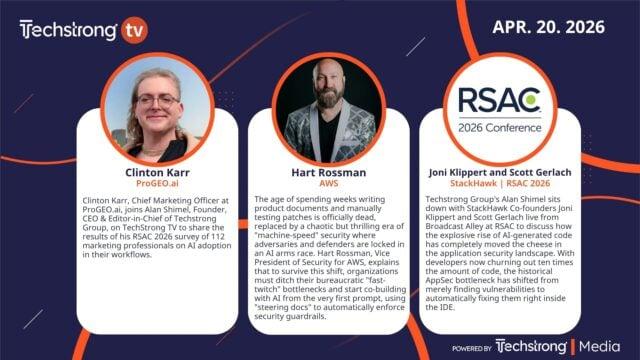
Techstrong TV January 6, 2026
Watch our live stream Monday through Friday, featuring exclusive news, announcements and conversations with IT leaders and experts on topics ranging from digital transformation to #DevOps, #Cybersecurity, #CloudNative, #Containers and deep-dives into specific technologies and best practices. http://techstrong.tv/
Transcript
Hey everyone. Welcome back here to Techstrong tv. You know, I'm really happy to have my next guest and I appreciate him coming on.
He's, he's over in Israel and, uh, you know, we actually recorded this right before Shabbat. So we are grateful to have Elam Milner, co-founder and CTO of Echo here on Techstrong tv. You probably have never heard of Echo.
That's okay. That's why he's here today to tell you about them. It's really a kind of remarkable story.
Elam, welcome to Text Drunk tv. It's great to have you here. Thank you.
I'm excited to be here. So, ELAM, before we even talk about Echo though, let's talk about you. Um, you're a co-founder and the CTO at Echo.
Tell us a little bit of like the lead up. You know, what, what's your story, what's your path been like, and who's your co-founder and why did you guys, you know, no one just found the company. 'cause they feel like it.
They, there's always, you gotta feel it in your, in your gut, right? Passion. So talk to us about that For sure.
So, ELAM, uh, I've been an engineer for, uh, the better part of, uh, over a decade now. So 15 years of engineering, uh, both hands-on engineering and management, uh, and leadership of engineering. Uh, I love it.
It's what I do. Mm-hmm. Um, previously I held the position of a CTO and co-founder for algon, which was the first company that, uh, my co-founder, Alon and myself have founded together.
Uh, Algon was a supply chain security company, one of the first companies to, to speak the supply chain security language before it, it was cool. Uh, mm-hmm. So that was a, uh, that was an interesting time building it, uh, as a solution to help companies secure the way they build, write, and ship code to their production environment.
Uh, we eventually got acquired by another cybersecurity, uh, company named Aqua, uh, where myself, myself and, and Elon and the team, uh, we, uh, created and led, uh, the supply chain security group there. Uh, so then we got other scale up time, right? So, uh, before Algon was a, was a relatively young startup.
Uh, Aqua was working with, uh, some of the greatest Fortune 100 companies, uh, in the world. Uh, and we, we had to hit the ground running. Uh, so scaling up to meet those needs, I led the product and the engineering effort.
Um, so a lot of interesting, uh, learning experience over there. Sure. We did that for the past, uh, few years.
Um, and once, uh, uh, just recently, uh, we founded The Echo. So last year relatively, uh, young and up and coming, uh, company, we stayed in the same space. So I understand a lot of people might not know Echo.
Uh, so, uh, I'm here, I'm here to tell a little bit about the company. Um, great. Essentially what, what we do, um, is we created an operating system that is cloud native.
So meant to run everything that, uh, you run in the cloud today. And it is designed in a way that it comes secure and enterprise ready, and it's automatically hardened and patched and tested for you using ai. Um, so I'll, I'll share a bit about, uh, about that after hitting all the right, uh, key keywords there.
Mm-hmm. For Echo, we've raised, uh, over, uh, $50 million, uh, overall. So both our, uh, we just hit our series A round, uh, just four months after our, our previous round.
Um, so it's, uh, it's an exciting, uh, time here at Echo. Uh, we are rapidly growing. We are working today, uh, with tens of customers, all kind of amazing companies.
Uh, mostly US space enterprises, uh, so companies like you. Some of them might know like UiPath and, and EDB and, uh, vector AI and Varone is, uh, public companies Sure. And, and large enterprises.
Um, we help them kind of ship applications in a secure by design way. Um, and this is briefly about, uh, myself and about Echo. I love it.
All right. Let, let's jump, you know what, before we go any further, for people who maybe are not gonna stay for the whole interview, but they're gonna go check the website or go di dive in later. Where, where, where's, where can they get more?
And for on Echo? ai. That's our main website.
Ai, yeah. You'll find all, all of our story there. Okay.
Now, when we talk about AI native os for the cloud, for cloud apps, are we talking about like a hardened Linux kind of thing? Or does it run on top of Linux or, or what have you? Yeah, for sure.
So, uh, you touched on it, it's the bottom line. It's a, uh, a type of operating system. Specifically.
Most stuff running in the cloud today are, are a Linux based. Yeah. So it is a Linux distribution based wall, uh, in that way.
But not only, um, echo itself is meant to power cloud application. So your, uh, container images, uh, your, uh, virtual machines, even your serverless functions. Uh, essentially everything you run as a company, as an engineering organization in the cloud today, uh, I want you to be able to do it powered by Echo.
And the idea is that today, companies and engineering platform team, DevOps teams, you name it, right? They all have the tedious tasks of manually fixing security issues, uh, applying best standards, uh, as they go, which is definitely not something that they love doing. Right?
Or at least, uh, the vast majority of them because they want to be focused on building new and exciting technologies for the companies they work with. Um, so instead of them having to take care of every new security issue, uh, which we get, unfortunately, we get a lot of those right supply chain attacks, those hai Hulu attacks that we just had, had a couple of them and, and similar attacks, I'm sure you, you got a dedicated episode just for that. Um, so instead of them having to, uh, do the triaging and applying the fix and testing that to make sure that nothing is, uh, was broken, um, we do it for them.
They outsource it, outsource it to echo and echo powering their, uh, cloud workloads come continuously with the relevant fixes in order for them to stay secure and don't have to focus their, uh, mental capacity on applying tedious security, uh, patches. So that's the value proposition. This is how we help the teams.
So it's almost like os as a service, if you will. It Is, it is where we call it autonomous infrastructure. Okay.
You made a good fancy name. OS is a service to me. Yeah.
Um, uh, you know, what, what's the AI native aspect of it? Yeah, for sure. So fortunately we got a chance to found Echo in 2025, right?
Which is like a tipping point in engineering and creating of, of new software in the world. Um, so we knew we had to kind of, uh, go all in. And the only way for us to scale a solution like Echos was using AI hardcore off the gate to create this, uh, continuous flow of, uh, patching, hardening and testing.
Today, we're a a relatively small team. We're a under just under 40 people in the company. Um, but if you check out, for example, our container store where you can use secure containers, we have close to 1000 container images today, uh, managed, operated by the team.
We could not have scaled that in that way, uh, if it wasn't for AI and specifically AI agents, LLM agents technology. So what we do is we operate and manage a fleet of AI agents and they do security research. Every time a new vulnerability, a new type of supply chain issue comes up, an agent goes out, research it, doing the triaging for the team, uh, and finding the relevant fix if it is applicable, if it is not a false positive, finding the fix, applying it to the relevant part of the underlying operating system and running all of the tests to make sure that nothing failed.
This is kind of our autonomous factor that is continuously making sure everything is, is secure and working properly. And again, there's no magic, just a lot of heavy engineering work there, uh, that we do very laser focus instead of the DevOps and platform teams having to do it in-house. I love this idea.
So you, you are maintaining the packages if you're, if it's a cloud native install, you're maintaining the containers and, and, and the continuous updates, the security updates, everything else. Now people out here watching this say, oh, this sounds great, sounds great. I'm on AWS how do I install it?
Is it in the marketplace? Do I go just go to the marketplace and and hit it? Or is it something else involved?
Yeah, you can, we are in the marketplace, but, uh, we are very much like a, a B2B facing enterprise type of company. Mm-hmm. So usually our customers are ones that are very much Yeah, they very, they know the play, right?
They know how to procure software. Um, you can go to our website to check out, uh, the value offering. You can go to the marketplace of the different cloud vendors like AWS, Azure, GCP and check out the offering there.
The implementation itself, it's as easy as just like a single line of code change. So instead of using, let's say as an example, the open source version of Node, if you are a no JS shop and your developer team is, is using heavily no JS as a framework, you switch to echo, uh, echos node, uh, and it comes vulnerability free. Uh, so let me, so let me ask that.
So you don't have to install the Echo os you could just use Echo packages because at the underlying, it's all Linux underlying anyway. Is that, is that what you're saying? Yeah, essentially, we don't install anything specifically directly on the com on the, on the cloud environment of, of our customers.
Its Packages. They, they use, uh, artifact or secure artifact directly. They pull them into the existing like DevOps workflow.
And then, So it, it's a giant, it's a big repo of secure that, that collectively make up this whole AI native os. But it's made up of a thousand containers, I don't know how many hundreds of packages and, and so forth. Yeah.
It's, it's about it, just about Like, yeah. All right, I get it. So it's very modular then It's not, you don't have to swallow the whole thing.
That's if we are doing our job correctly and the underlying operating system and all of the stuff, all of the software that get bundled up into that, we can build a lot of types of, uh, workloads running in your cloud. So that's, that's the, that's the plan. That's what we do.
Beautiful. Now you raised $50 million in 10 months, those people are gonna want their money back, right? They're gonna wanna return.
How do you make money of this? Yeah, so essentially customers who, uh, gain access to a repository of secure software, um, they pay us for that access. Um, but it's, uh, you know, it's, it's a very predictable pricing model.
So we don't want to put in any way the DevOps team in a position where they have to think twice before they use software that is open source. Um, so we price it, you know, we price it per, uh, um, per the, the, the size of the organization usually. And, and they just consume as much, uh, software as they want.
Uh, the effort goes to, oh, that's good. Yeah. So you don't nickel and dime every time they wanna download something.
It's, it's, No, I wouldn't want to do that. I wouldn't want to use something like that as an engineer. So I wouldn't wanna, wanna go that way For sure.
I, I don't disagree with you at all. Okay. So you've done this raise yet, it sounds like you've got product fit.
Right? So I, look, I, I didn't do this my whole life. I, I started four and five companies myself, venture backed and sounds like you've got product fit, right?
What's next? So, when, uh, to touch a little bit on, on our vision, uh, right, so, uh, I believe the future goes in that direction of, of more and more of our infrastructure, specifically our cloud infrastructure becoming autonomous. It doesn't really make a lot of sense for my team to manage underlying infrastructure, kind of like the cloud shift paradigm.
Uh, so the autonomous infrastructures, I believe we receive more and more of, uh, and specifically vulnerability management, which is like the immediate pain point, the headache. Um, I believe this vulnerability management as a manual task will disappear, uh, AI and AI agent as a technology will build, patch and test the underlying components that you need continuously for you, uh, using vendors like Echo. Uh, so the, the platform teams, devs team, and the engineer, they can continue doing innovative work around the focus domain.
I love it. Hey, lab, I wanna thank you for coming on. I, I know time was short.
ai Ai echo ai, yeah. Is the website for people to go get more and, and look, this seems to me, quite frankly, whether you are on an Amazon or, or, or Google or Microsoft, or even if you're just running private cloud in the data center, you could still use Echo. Yep, for sure.
You can, and you should. Excellent. You'll come back on, keep us posted on on progress here, on what's doing.
Okay. Thanks Alan. Thanks for having me.
Okay. Elon Milner, co-founder, CTO of Echo. That's it.
ai. You know what? It's a, uh, uh, think of it as a repo for your Linux, for your cloud os that keeps, you know, helps your software supply chain and your, your packages and your containers.
You're dealing with tested native or tested secure code. Excellent. In today's world, we're gonna take a break on text on tv.
We'll be right back. Welcome to Security Boulevard, the cybersecurity podcast from the Future Room Group. Each episode explores a variety of topics within cybersecurity and the technologies that drive it.
com, the Security Boulevard, YouTube channel, tech Strong tv, and all of your favorite podcast platforms. Before we jump into today's topic, let's meet the panel for today's episode, starting with Fernando, it's good to see you again. Fernando.
Hello everyone. So, Fernando, uh, uh, Fernando, uh, Montenegro, uh, JP cybersecurity lead for Fortu Research. And as we get started on this call, I, I, I do wanna share that my heart is filled with joy by being with this particular two co-hosts, right?
Both of you has been instrumental in my career, and, and I, I, I'm still kicking myself that I get to work with you guys. Well, we appreciate that, Fernando, speaking of sparking joy, uh, we're joined once again this week by Alan Shimmel. Alan, it's good to see you again.
Thank you. And, and Fernando, you know, it, it's, it's funny when, when you came here to fu and reminded me of, of our interaction, and that was 15 plus years ago, it made me realize, and, and it, and it actually goes right into, I think, what we're gonna talk about today. You don't know, you know, a butterfly flaps, it wings on one side of the world, and you don't know how that's gonna affect things years and years later, or who you're gonna work with or what your role's gonna be.
And it never, it never cost anything to do the right thing, I think, right? I, I've, I've learned that. Be nice.
Be a person. So, Tom, I don't know what you've done to help Fernando, but maybe we could explore that or maybe if not on, on our podcast day. But, uh, thank you and I'm happy to be here.
Well, we're happy to have you both. Of course. I'm Tom Hollingsworth event lead for security here at Tech Field Day, and, uh, we've got an interesting episode today.
The, uh, the pre-call was, was filled with a bunch of different ideas that that all kind of coalesced into one area, and it has to do a lot with the way that AG agentic AI is creating some interesting challenges for folks, because if you remember in a previous episode, we talked a little bit about securing agents, meaning kind of a singular agent strategy. How do I make sure that this agent is gonna work? And that's great in theory, but in practice, you're not gonna be securing one or five or 10.
You're gonna be securing dozens or potentially hundreds. How does that scale? And there's a bunch of different things that you have to take into account there, because it's not just a technology challenge.
There's some leadership challenges there as well, because these aren't just software programs anymore, in effect, they're digital coworkers. So, let's kind of talk about this, because there's some other interesting moves that are being made in the industry as well, where people are trying to get ahead of this a little bit. There's, there's a lot of money on the table to do this, either to build out how to make it happen or to offer it as a service to people who are in way over their heads.
So, I wanna start by, you know, kind of talking a little bit about how do we see the, the challenge of scaling being different than just, uh, maybe, uh, securing a singular agent. Why does it matter if we're doing this for 50 instead of one? So, I'll, I'll say this.
I think that scaling happens on two dimensions, right? And this try, and this ties to a trend that we're following in cybersecurity overall, which is the, the expansion of the attack surface. We, I think that scaling happens on a purely numerical thing, right?
So we're seeing, particularly within, uh, SOC automation, we're seeing, Hey, look, I can launch 50, uh, email triage agents that can help you with that. Okay? So one single, one single issue is, okay, what changes if you have 50 little agents that are the same, right?
They're all asking you different things. We talk about the human in the loop. Sometimes if each of those 50 agents, if each of those agents expects a human in the loop, guess what?
You're gonna have 50 interactions in that loop to play with. That's, that's a problem on its own, right? But that's one dimension of scaling.
The other dimension of scaling that I, that I worry about is within your organization, and that's the topic of, uh, of the paper. I'm just writing now on, on something else. But within your organization, you are going to have agents for agents implementing security for ai.
You're gonna have a, an agent that's going to validate that the, that's going to do the, the, the testing of your models. You're gonna have an agent. So you're gonna have little agents securing the ai, right?
You're gonna have agents applying AI for security. In other words, you're going to have little agents on the soc. You're gonna have agents and doing data classification.
You're gonna have agents doing code scanning and so on. You're also going to have agents outside of security in your organization. Your, uh, procurement team might be running an agent that is going to do, uh, price lookups.
Your accounts payable team might have an agent that is doing, uh, uh, uh, pay validation, right? All of those AgTech workflows need security. So I think that you're gonna run into a problem where you need to, this is a call for security teams to be even more deeply entrenched in the business as we, as we say it, right?
You have to understand what your company is doing, and where does, where are they thinking about using AgTech, right? At scale, right? Because they may have coordinated agents.
Oh, they're agents gonna talk about third party. What does that third party agent do? And so on and so forth.
So, you know, this is our first show for 2026, correct? And I think it's a good time to put our stake in the ground that like many things that have taken place in the tech world during my career, during Fernando and Tom, your careers, it's not waiting for security to say, okay, we're ready for this, Craig. It's happening.
It's happening. Agents are being deployed by, by the busload, by the truckloads, by, by the gross, you know, every day. And I think 2026 is gonna be a year where that really hits its stride.
So we can't afford to take a wait and see approach. We can't afford, we, we need to address this. However, I'm a big believer in fate and that nature of pours a vacuum.
All we have heard about for the last, I don't know, five years, 10 years, is we don't have enough workers here in security. We have all these jobs that are going unfulfilled, right? And now, lo and behold, the law comes this agentic.
This is like a fable, an aesop's fable or something. Although comes agentic ai, who says, I can help fill these holes for you, right? Help, you know, take me, use me, help me, let me help you make better security, because everyone's using them every way.
I'm your new digital coworker. And I think it's incumbent upon the security profession on the industry this year to decide do we embrace them and, and leverage them as quickly as we can, or do we do the usual security thing, which is, uh, wait a second here. I, I wanna, let me just make sure this is okay.
Let me dip my toe in the water and, and let's see where we are. 'cause what we decide is gonna make a big difference in the next year and beyond. And so I'll just jump into that.
Uh, I'll jump with the first economics reference for the call, right? Which is, uh, uh, people respond to incentives, right? Uh, there's an up Sinclair quote I quote, sometimes multiple times a day.
It's difficult to get a man to understand something when his salary depends on him not understanding it, right? So if security leadership is gonna tell security teams to behave a certain way, and they're going to be measured that way, that's what they are going to do. So Alan, exactly, to your point, we have to have the, the, the mindset of, yes, there are things we're going to have to navigate traditional security mindset that we do.
We are focused on risk reduction and, and, and, and other things, but we also need that having the, the, the, the broader view of these people are not waiting for us, and if we expect them to wait for us, we're gonna be in trouble. So you're, you're spot on. So I think it's interesting that, that you bring up the way you do, Alan, that, that we've had this problem where we haven't had enough security people for a very long time.
Uh, and I feel like part of it is because security has always been very reactive, right? We, we don't know what the exploit is until we see it. So we're going to attack the things that we've seen before, and, and we're always playing a little bit of catch up.
And one of the things that AI has promised is that we can start to maybe unearth some patterns and see some things that could potentially lead to exploits down the road. I think about like, anytime a new technology comes out, someone's like, well, why didn't you consider that it could be used for this, you know, very evil purpose? Well, because I'm not an evil person, I didn't think about it like that.
You know, think about Reed Richards in the Fantastic four movie. My job is to come up with all these horrible ideas so that I can figure out how to stop them. So we're currently trying to figure out how to train the people that we've got to think in that way.
And we have a crop of people who are probably, you know, later Gen z gen alpha folks that are starting to come near to the workforce. And instead of using cybersecurity as kind of like an adjunct for things that they've been doing, maybe coming from assisted background or a networking background or something, they're focusing primarily on cybersecurity because they see the potential. But at the same time, I've got people on the other side of the fence going, well, if you're gonna have to train these people to learn how to do security, why don't you train these agents to do it instead?
Because one, they're a lot smarter And they can learn faster, and they can start thinking ahead of where the problems are gonna be. And so some people are probably gonna look at this and go, well, if I'm gonna have to train a person or a software construct to do this, why don't I just train the software construct? Because then I can keep deploying it over and over again, and I don't have to pay it benefits, and I don't have to worry about it leaving my company in two years with all of the knowledge that it has to become a consultant somewhere else.
And in a way, we, we've kind of cut off the next generation. And I feel like we do that a lot in technology, right? It's like we get to a point where we think we've solved that problem so that we can start teaching people how to deal with it.
Only then something comes around and, and revolutionizes the problem. So we don't need it anymore. Go ask any telecom engineer how, how that feels, because nobody uses the phone anymore, at least not the way we used to.
You know, Tom, this, this is bigger than security. It's right. This, this is what you just described, right?
Uh, uh, uh, beat, uh, the guy who runs Salesforce, uh, joining big off Mark Benioff said, we're not, we're not gonna hire junior developers. Well, you know, not to do the birds and the bees with you, but if you don't, if you don't bring in junior developers pretty soon, you don't have senior developers either, right? Because that's where the, the seniors come from.
But really, so I, I have a, a more nuanced view of this, which is we still need the junior developer. We still need those cybersecurity people who are, some of, many of them are getting tremendous training in schools and universities. They don't have on job experience, which is tough, but they, they're learning great things in school.
But what it really comes down to is the nature of their role is changing, right? Fernando spoke about it in our green room discussion before coming on. You know, today's security person may find himself more of a security agent manager than what my generation considered a security professional.
I think the same thing is true for developers, by the way. You may have developers who code less, but manage code production more. And, and, and that may not be a bad thing.
Fernando, I I know you have thoughts on it. I do. And and I, we are evolving.
So let me, I'll go back to networking. How many of us hard hardcoded Mac addresses on wifi, right? We don't anymore, right?
Uh, uh, or, or, and, and, uh, because things have evolved. So there are things that we, that we are evolving towards that are perfectly fine. Where I, where I'm concerned, is what happens at the market?
What happens at the edges, at the details? Like the details matter, right? So one of the challenges with outsourcing a lot to that, uh, to that agent capability is that you lose the, the, the, you lose the, the, the, the, the struggle that Taught you something, right?
And, and that is something we're struggling with. And, and Tom, to your point about we're teaching the agent yes and no, because that's where, uh, a lot of the, the agents deployments are actually, like, we're not, we're not teaching the agents. We're typically buying pre-trained agents that do something, right?
And then we have some no-code capability to, to, to, to, but, but we're not teaching an agent as we teach a junior, right? And that is something that managers need to navigate, right? Because like, I think we're, we, were in agreement like the, the, the seniors come from somewhere, right?
And if we're not teaching the juniors, and we're not letting them fail, in some cases, the, the, how are we bringing this up? Like, uh, to bring back to economics, right? The, the, the short term results that we're achieving are, uh, are an externality in the context.
Like someone managing for someone focusing on short term results is not looking into the broader picture. And that's gonna have negative consequences down the line. Economic consequences down the Line.
You could say that about our whole stock market, right? We manage quarter to quarter and not long term, but let me, let me throw another analogy at guys. Please me, what you think.
So I was from the generation, you weren't allowed to bring your calculator into the test with you, you guys maybe too, right? Mm-hmm. And the thought was that by using a calculator, you didn't really learn how to look things up on the co-sign table, or you didn't learn the finer points of, of division or, or whatever calculus or trick.
Now, my children, they, they walked into the, they were allowed to bring scientific calculators, not just pure math calculators, but scientific calculators into their test. Did it make them any less proficient in math than I was because I had to do it by hand? I, I don't know.
Right? When we talk about a, now, let's fast forward to agents. I don't know if agents will learn, Fernando, I think this goes to the, to the very heart of what an agent is.
Is an agent ephemeral? So it does one task and it's disposable like a container is, or is it persistent? If it's persistent, it might learn.
You might be able to train it and teach it. It might have that capacity. I don't know, under today's, you know, current state of things.
But certainly that would be a hope in the future that a persistent agent or a robot for that matter, right, with AI on board, can learn. I don't know. Yeah.
So the counter of that by saying agents can be programmed, but I don't think they're learning. One of the things, and I I realize this because I said it last week, um, is something I say to a lot of people. Experience is what you get when you don't get what you want.
When, when I do something stupid and I go, oh, I shouldn't do that anymore, that's learning, right? Like we, we talk about like, don't touch a hot stove, or I think about, uh, Percy Spencer, if you don't know who that person is, in 1945, he stepped in front of a magnetron with a Snickers bar in his pocket. And that's when he discovered that you can heat things with microwaves.
And that was complete accident. He wasn't looking to patent a away to cook food in 2025. He just happened to accidentally leave something in his pocket.
And that's where I think that humans are always going to have an advantage over ai. We're gonna do dumb things, and then we're gonna step back and go, I shouldn't have done that. And, and Alan, to your point about, you know, learning math the long way, you know, slide rules and mul and memorizing multiplication tables and things like that, yeah.
If someone rattles off to me, you know, what is six times seven? I can pull it up quickly because I had to memorize that as a kid. Whereas nowadays, people need a calculator to, to figure out a tip on a, a meal.
Although now the tip pops up and says, you know, do you want to tip this? Because we're trying to eliminate the fundamentals that we feel are unimportant, but why do we feel they're unimportant? Well, because we already learned them.
Like, like, I don't need to teach people. And this is something that I've told people a lot. We forget what it feels like to be new at something all the time.
And all you've gotta do is go ask that kid or that, that entrant into the job market, what it feels like to be new at something, because they are, and AI agents are just like that. Whether they're ephemeral or more persistent, when they start, they are a blank slate. They will do nothing that you don't tell them to do.
So you can load in everything that you can think of that they're ever gonna need to do, and they will do exactly that because that's all they've been taught to do until they get to a point where they do something they're not supposed to. And that's where we have to step into, tell them, don't do that anymore. Do this instead.
But this is the challenge, right? Because current AgTech technology doesn't have that training, that retraining loop in there, right? Yes.
You can feed, you can feed context to your rag till cows come home, right? Uh, uh, you can see cows come replicating whatever it was supposed to be doing. So let me, you, you brought up a point, and I wanna bring this up because about six or seven years ago, I was trying to explain the difference between what I consider to be AI and machine learning to somebody.
And I use the Hitchhiker's Guide to the Galaxy as an example. Deep thought is a machine learning computer. You feed it a whole bunch of information, and it comes up with an answer 42.
And then you go, what's the context behind the answer? And it goes, I don't know. You didn't ask me for context.
I can't think outside of a bounded solution set. Now, the fact that everything that we talked about there became ai, to me, AI is being able to learn from your mistakes. It is being able to think outside of the bounds of the condition and go, wait a minute, what if we did this instead?
What if this happens? It, it still has to have that element of creativity. That's why we need people.
I, I don't disagree with, with what you're saying, but nevertheless, we have a generation that brought their calculators to the test, right? And the world hasn't fallen apart, though some may argue with that, Right? The world hasn't fallen apart because of it.
But I, I think it goes back to something I said before, is ultimately, what is the nature of the role gonna be in a, an agentic ai, especially of armies, you know, called Sagan, billions and billions of AI agents. What's the role, let's say, of a security person or a developer, or an IT admin or any of us? What is our role gonna be?
Yes, you need, you need to get that cut your teeth experience, but if an AI does it better, cheaper, faster, you do, oh, Different things, right? And, and since we're, since we're on a, on a mask kick, right? I'm gonna use my, my, uh, an expression, I, i, I say a lot.
It's like, it's not precisely completely accurate, but go back to high school calculus, right? Whenever your limits, right? Mm-hmm.
So the, the, I I like to say that the limit, right, for cybersecurity as time moves to infinity, right, is anti-fraud. And what I mean by this is that we take the technology and we abstract it away, right? We, uh, we commoditize it, we industrialize it, we operationalize it, and then we focus on higher level problems.
Right? Now, it does not mean that those technology problems are not important, but we've contained them well enough that a few experts can deal with that problem, problem at scale, and we get to focus on other things, right? And I think that's the answer to your question.
Where do we go in a world where we have agents? Well, we need to go in a world where we have an agent that saves time for a SOC engineer to review an alert. We now go to a world where that SOC engineer can perhaps give a call to the marketing people and say, Hey, whatcha guys doing there?
Like, let me understand what you are doing from a marketing perspective. Let me understand what the initiative, okay, perhaps not the SOC engineer, but you, but we, we move to a world where cybersecurity becomes much more attuned to what's happening in the organization, right? In order to do that, though, we need to train the people to do that, right?
You don't, uh, we have to teach, uh, uh, the juniors, what's a p and l statement, right? What, uh, uh, how does marketing work, right? What is, uh, accounts payable, right?
So that they can have meaningful higher level business conversation. Now, there, it doesn't mean that you're gonna move your so engineer to an accounts payable trainee next, next day, but it's understanding, it's making the connection between, oh, look, this particular system here deals with externals and here's the identity, the, the IDP for those externals and how does it tie into our system? And oh, by the way, they are, a token was just compromised and blah, blah, blah, blah, blah, blah.
So the skills that we're going to need is this kind of systems thinking. How do things connect both as technology as well as quote unquote the business, how it all connects together. That's that, that, as we look into the year, that's, that's what I, I, I hope people take, okay, how do I grow in 2026?
Well, I think that, I hope that one of the areas people grow into, how do I understand the company I'm at? How do the organization I'm at, how do I support their business, their mission In, in a way, fernan, it sounds like what you're saying is that the people that we're hiring can't be only focused on point solutions. They have to be integrated into the business so that they understand the mission of the business, as opposed to, well, I'm just gonna do sales, I'm just gonna do security, I'm just gonna do marketing.
I'm just gonna do accounting. They, they have to have a broader vision. And what agents and what AI and what we're doing here by, to Alan's point, letting them bring their calculators or their agents to class is abstracting away the nuts and bolts to give them the perspective to focus on the bigger picture.
You know? com 12 years ago, about a year or two after with two lovely ladies, I, I founded the DevOps, Probably in the eight to 10 years we were doing DLI, we probably had about 65,000 people take certification under DevOps Institute. One of the things we taught then, and I think it's true and more true today's security as well, is what do you wanna be?
Do you wanna be what we call a t individual where you have one kind of domain that you do and you go deep on it? And how valuable are you in tomorrow's job marketplace? How valuable are you in an AI empowered marketplace as a tea individual versus let's call it a broom, right?
Where you have different expertise, right? And we always taught that the broom, the brew person, was more valuable because they had a, a more rounded, uh, knowledge base of, of expertise. And I think, Fernando, to your point, that's exactly the point.
You gotta know the business you're in to figure out, and it, and it can't just, you can't just know security. Now, paradoxically, that was one of the great things about security when we were coming up, is that no one was just a security person. We were all a network person.
We were all a, a cis admin help desk guy. We've all been there, done that, and we got, you know, forced into security somehow. We weren't just that pure play, if you will.
I don't know, are we dinosaurs when it comes to that? Could be. And, and, but I think that I agree.
Uh, yes, we are ic, right? But I think that it's, there's, we, this is such an important time in society, right? Because, uh, we've reached a point in our evolution.
So another quote that I like to use all the time is, uh, Edward Wilson, a biologist, right? The problem with mankind is that we have lytic brains, medieval institutions, and God-like technology, right? We've reached a point where the technology impact of security is widespread.
Like we've grown out of the, we've moved out of the basements, right? And, and the role that we need to play is to navigate how do you infuse security agentic or not into everything that we're doing? And how do we teach people how to do that, right?
And, and, uh, I, uh, I worry a little bit sometimes about the guidance that, that the juniors are seeing, especially too early on, is very much, oh my God, okay, let's go. You have to go deep into the technology. You have to, to win every CTF that you play in, you have to, to, uh, have so many CVEs to your name or, or, or whatnot.
And we have to help them make this transition from very narrow into something a little bit broader. That's the role that we can play right now, right? And I think that's, uh, uh, I, I encourage people to, it's a one word Shakespeare, right?
Know thyself, right? Where Are you? But go ahead, Tom.
No, No, no, go ahead, Alan. I was just gonna counter in here. Take nothing of what we're saying as a discouragement to enter the cybersecurity field.
There's gonna be plenty of jobs and plenty of roles and plenty of new, new vistas and hills to conquer and climb, right? The job and the function's not going away. And in some ways it's gonna be better than it ever was, because you're gonna have all these digital coworkers at your side and at your beck and call.
So for anyone out there watching this, who's contemplating a career in cyber, by all means we need you. Come on in, come on in the water's fine. Um, and it's gonna be different than it was for me or Fernando, or you, Tom, but it's still gonna be an exciting, rewarding career.
Tom, I'll to you, I'll, I'll just leave you with this thought, because I think about the people who were sailing over the oceans in the 15 hundreds, right? There's this vast ocean in front of them, it's unexplored and nobody knows what's going on out there. And there's a lot of people on the ship that know how the sails work and how the rudder works and all of those other things.
But the job of the captain of the ship is not to focus on those systems, it's to focus on the horizon and chart a course to figure out where to go. If you want to be the rudder operator, that's great. If you wanna be a captain though, you've gotta put your eyes on the horizon and not on the rudder.
Alright, we're gonna go ahead and wrap it up there. This has been a great discussion. I wanna thank you guys for being a part of it.
Uh, since this is the first episode of 2026, um, Fernando, what have you got coming up that people should be checking out in the next couple of months? Because I know you're gonna be super busy. So, uh, it's really interesting.
At Tuum, we have the, the, the signal report that we created for security operations in, uh, in q4. Uh, the Q1 report is, uh, most likely going to be on sassi, and I get the pleasure of working with you on that. So I'm, I'm, I'm looking forward to that report.
And, uh, but In general, right, it's a relatively quiet January in terms of events, but then things pick up a reminder to people that RSA is, I mean, for listening to this in early January, RFA is less than a hundred days away, right? Uh, less than about 90 days away or so, like, so, uh, late March in, uh, in San Francisco. I'm looking forward to seeing, uh, friends all and new there.
And, um, yeah, I think that's the, that's the, the, the, the early start for the year. Awesome. Alan, I know you guys have some exci exciting stuff at Techron coming up in the beginning of the year.
Yes, we, we have our annual predict this year. Of course predict 2026 as one would do in 2026, though we could play 2025 and see how to turn out. But no, we have predict 2026, it is the eighth or ninth year we're doing this virtual event, but this year we're really predict is powered by the FUT analyst team.
So Fernando, Mitch, a bunch of, of the, uh, uh, FU analysts will be presenting at Predict, I believe it's January 15th. It's all day. You can watch it live then, or you can watch it on demand.
Also be announcing live at Predict the winners of the, uh, DevOps Dozen awards for this past year, which is also, I think it's 10th year, um, exciting with that. We had a lot of, a lot of interest in that. And then like Fernando, we are full speed ahead into RSA again, I think the 10th year we'll be putting on our DevSecOps event on Monday of RSA week at Moscone, a partnership with the RSA conference folks this year it's securing ai native Dev.
Fernando will be, uh, chairing a panel as well, Mitch. And we have a full day I've lined up, by the way, David, a very famous sci-fi author, Hugo Ne award-winning author and a PhD from JPL, uh, to Keynote as well as, um, harness CTO and founder gti, ELL and s ncc, co-founder and Teel founder and founder of the AI native dev community. Guy pja guy will be keynoting his and Patrick Dubar who kinda gave DevOps and name will be there as well.
So very excited for the our RSA. And of course we'll be at broadcast Alley all week doing videos. Tom, I'm pretty sure we have a Tech Field day going on that week.
Yep, yep. You're Absolutely right. So I think we'll be all hands on deck in San Francisco for RSA conference.
Absolutely. And I wanna make sure that everybody knows that we do have an event focused on AI infrastructure that'll be going on at the end of January. com has more details.
And as Alan mentioned, we're gonna be at RSA for the first time. We've already got two great presenters lined up and we're looking for more. So, uh, stay tuned for more details on that.
And we also wanna thank you all for listening to this episode of Security Boulevard. If you enjoyed this conversation, please make sure that you subscribe on YouTube or your favorite podcast application so you don't miss any of our episodes throughout 2026. We'd also leave it, if you'd leave a, we'd appreciate it if you'd leave a rating and a review, because that really does help the show grow.
And if you have a fun comment, please leave it below because we love reading those. com and the future and Group. com.
You can also see it on the Techstrong TV website, or make sure you check out the Techstrong TV app. It's available on pretty much every platform that has a screen, and we would love to see you there. Make sure you follow Security Boulevard on X, Twitter and LinkedIn.
Just look for security BLVD and you'll have tons of content to keep you tied it over during the winter. We'll, thank you very much for tuning in. We'll see everybody next week.
Hey, good morning everyone. It's Alan Hummel, and welcome to our day two coverage of AWS Reinvent 2025. We're live at the win, uh, right here in Las Vegas, covering reinvent.
And, uh, I hope you had a chance to look at some of our coverage from yesterday. We had some really great discussions. We had a lot of analysts, a lot of different AWS partners.
We hope to have some AWS people, I think we have scheduled later this afternoon as well. But let's kick off our day with what, for me, personally, is a highlight. If you've ever watched our event coverage in the past, this man may be, uh, familiar to you.
My friend David DeSanto. David, well, if you know David, you know this, but David ran product at GitLab for five years, Uh, three and a half years, three and CPO and years, and yeah, two and a half before that. So you're either there about five and a half, six years.
Um, always a really smart guy. I always a great, I love talking with him, but he's not here. This is not David Desto of GitLab anymore.
This is David DeSanto, I'm proud to say the CEO of Anaconda. David, first of all, congratulations man. Yeah.
I'm really happy for you. Oh, thank you. Yeah, I, uh, truly excited to help Anaconda go into their next chapter.
Absolutely. You know, I, I, I didn't hope didn't embarrass you or anything like that, but I wanted to talk about the GitLab experience because for our audience, which is DevOps and cloud native mm-hmm. And cyber and so forth, that, you know, GitLab is a, is an important company in the ecosystem.
Um, and you were an important person in taking that vision and running with it. Tell us how you wound up at Anaconda. Yeah.
So first, yeah, it was a great run at GitLab. We saw the company grow almost exponentially. It was less than 300 people when I started, and my last day was over 2,600, right?
And so, uh, the journey to Anaconda does start with GitLab. Going to GitLab. I re-embraced the open source community in a way that I hadn't since ICSA labs many years before that.
And that time was great, you know, uh, our first conversation was me coming out and saying like, we are going to add security and compliance to GitLab. I remember that. Yeah.
And then, uh, the last quarter I was at, that's part of the revenues over 53% of it. So it was a really great run, great company cheering them on. Absolutely.
Uh, but yeah, I was ready for my next challenge. And so when thinking about what I would do next, I explored, do I wanna stay in the DevOps space? Do I wanna go back to security?
And I realized I could do security in AI all in one place. And that was Anaconda. Aha.
There's, there's the word, two minutes in, and we've mentioned ai. Yep. Um, Well I think I said this once before, but you can't spell David without ai, so That's true.
So yeah, This is true. You haven't mentioned that one. My, my wife did say, I have to stop telling that joke, but Well, look, we've got a new audience here.
You got a new title. They may not remember it. So David, some people in our audience I'm sure are familiar with Anaconda, but there's plenty of people who aren't.
Let's, let's start real foundational and build our way up. Give us the Anaconda story. Yeah.
So Anaconda came out of a consultancy. The two founders of Anaconda had a company called Continuum Analytics, and they were doing consulting work for data science within the financial services space. And what they found out was that they were building new Python packages to support the work they were doing, and they decided that, hey, this should be a product company.
And so they started Anaconda, the first product's name was Conda. And that's what a lot of people think of that provides thousands of trusted, secure data science and AI packages for Python. Uh, but the company has continued to grow beyond that.
And one of the reasons why I joined is the story that they are currently on. Anaconda can help you with secure python development, but we do so much more than that. Uh, earlier in the year we launched our AI platform that helps you apply security and governance policies to how AI applications are being billed, really.
And, and the, yeah, the most recent, which I'm the most excited about, I cannot take credit for it 'cause it, you know, came out I think three weeks after I started. But, uh, our AI catalyst component of that platform, what it does is provides a curated list of open source models that we have validated or secure. We include the lineage of where they came from, how they were trained.
We Oh, I love that. Yeah. We rate them on performance and that could be in different quant sizes.
And we also then give them the guardrails to make sure that it operates as best as it can. And so what really excites me about it is we already helping people run inference, and it kind of starts a desktop app before we became a platform and now a, a SaaS offering. Mm-hmm.
But the cost to run AI models as part of development is very expensive. Like I learned that when I was at GitLab. Right.
Um, and so what we've done is also make it possible to run a micro in inference on the developer's laptop. Wow. Which then is that same model that needs to get scale so you Don't pay the token penalties.
Exactly. And then when you're ready, we can see what you did with the model locally and tune as it gets deployed into production. So, wow.
Yeah. The best way to describe it is, you know, what a GitLab is for DevOps Anaconda is for AI native development. You know, it's funny you mentioned that term.
I was, I was out in Brooklyn actually a couple weeks ago for this AI native devcon. There's this whole burgeoning community, you're probably aware of AI native development, uh, uh, guy Ani from sny, who's now, I forget, the Tesla is his new company. They're very active in that community.
Um, and I, I went out there, I was blown away. It re it reminded me of going to a DevOps days 10 years ago. Yeah.
Right? That, that same tinkering, geeky we can make, I love playing with it kind of stuff. And it was, it was a, it's a great community.
Um, let me just kind of shimmy eyes this for, if you don't mind. There. There you go.
So we, we've got Anaconda started as a company providing services on Python scripts And helping companies with their data science development. Yep. Hence the Python Anaconda connection.
Exactly. Okay. It then shifts to more of a product model, but it's an open source product model, which is still open source today.
Yes. Oh, correct. Yeah.
We have a very healthy, free offering. Mm-hmm. Uh, it allows people to get in the door using Anaconda and mm-hmm.
One of the things that really blew me away as part of the process to join was that 95% of the Fortune 500 use Anaconda today. Really? Yeah.
And we have over 2 million, uh, community contributors. That's great. And 50 million users.
2 million contributors. Yep. Code, yeah.
Code contributors to the open Source Wow. Components. Wow.
Yeah. It's actually a really great story. Uh, one of the founders is, uh, Peter Wang Uhhuh known very well in the open source community Sure.
And within the data science community. And he's still an active part of the company. Mm-hmm.
Um, you know, he and I talk about what we wanna do next together. Yeah. And that reach that we continue to have is because he is always out meeting with customers, potential customers.
Two weeks he's in Boston for a, uh, meeting around how do you set some AI standards Yeah. As part of development. And so we continue to lean into that because, you know, that is really the core of the company to your point.
Yeah. You know, we started as a package manager condo, but now we have the AI platform and we wanna allow people to still come up, get used to using it, get the value out of it, and then want to come and then join and, and pay for either our starter tier or enterprise tier. I love it.
I'm gonna jump into what the store, the, the different tiers are in a bit. I wanna come back to what you were mentioning this newest offering that you're so jazzed about. Yeah.
The AI catalyst. Yes. The AI catalyst.
Now, look, you mentioned package managers. It's been a rough couple weeks for package managers, hasn't it? It has, with this shy ude and, and all of that.
It sounds like this AI catalyst may be just what the doctor ordered, right? If, if I'm a user mm-hmm. Of, of package, package manage a package packages, I want to make sure that my package manager's giving me something that I'm not Correct.
Introducing malware into my, my ecosystem. This only works though with the AI models that you're using, right? The AI packages, if you Will.
Uh, yeah. That and all of the conduct packages. Okay.
All the kind, Yeah. So because we still use the con package manager, um, we have a very unique build system for building all the packages we provide. And so we're able to actually take things apart, fix a vulnerability, and say in the binary part of the package, put it back together, and then make it available.
And so a lot of people think of Anaconda first as a trusted distribution because we're providing, you know, two thousands of Python packages that we know are secure and are able to scale. Now. I get it.
Yeah. I got it Now. I, it took a little while.
Sometimes I'm slow on the uptake. Oh, no. And, but If you think about it, there's then that natural transition into the platform, right?
It's one thing to start your development, but it's not thing to get that prototype into production. Absolutely. And, and look, I, you know, just quite frankly, it is, you know, we live in a world of, let's call it Frankenstein software, where software is more assembled than code written, if you will, at some level, right?
Mm-hmm. And, you know, and you, you, your security background, you know this, we talk about software, supply chain security all the time and, and how stuff, you know, SBOs mm-hmm. And what have you.
I think the biggest weakness in our system today is the software and packages that we're downloading from all these repos and, and, and depots and what have you. So, you know, the fact that you're do, you're on guard here with the condo packages mm-hmm. Is, is a huge thing.
Give us an idea of scale if, you know, you may not know this off the top of your head, but like, how many downloads a day, a week, a month? Yeah. I don't, don't know that off the top of my head, but Kanda is hit all the time, almost 24 7 with people pulling packages.
So very healthy community. That's how we can have 50 million users really, uh, yeah. Using Anaconda every month.
The thing that is the most incredible to me is what you just touched on, and this is part of that why I joined in the journey. Uh, you can only do so much with the actual packages themselves. Yeah.
But when we're talking about the platform, there's like the starter, which is kind of like, Hey, a team's getting together. Uh, but the business tier actually provides what you're talking about. It provides an AI bill of materials, can track vulnerabilities for you.
Uh, we're working on how to help auto remediate those as well. And so the customers that end up on a thing, like the business tier of the platform, they're getting, uh, full visibility into their AI life cycle. And that's really powerful.
'cause as you said, today, it's very common that vulnerabilities will sneak in some way. And we're heavily reliant on packages that we've not created. We're reliant on our IDs to be secure.
We're, you know, worried about the things that happen after the code is merged. And anacon is just in a really great spot to help with all that. You really are.
You're right, you're right at the, the nexus, if you will, of, of where all these come together. I love it. Now you mentioned different tiers.
Mm-hmm. So obviously there's probably a free open source tier where hey, it's open, it's open source, have at it. Then you have, you mentioned the SaaS model.
Yeah. So the product, uh, you can self-host. Mm-hmm.
com. Mm-hmm. Um, but yeah, the big difference is not necessarily whether you're hosting it yourself or using our, our SaaS offering.
It's really about the free version gets you up and going, if you're an individual developer, provides you a lot of power. If you now wanna operate as a team and start having some structure around it, you go into the starter tier, which starts to introduce a lot of that. Um, but when you're ready to talk about AI, bill, materials, security and governance, and having policies that prevent malicious packages from being installed, then you end up on the business tier.
And that's where all that security and compliance functionality is, including dashboards, policies you can create and so forth. I love it. Um, uh, to, so, so I'm an old school open source guy.
What pers 50 million users is a crazy number. Yeah. You may not know this, you may not be comfortable even saying it.
What percentage of those are just pure free open? I mean, usually it's 98, 90 7%. Yeah.
Yeah. So there, uh, a large percentage of it is that open source community. Sure.
Um, but that's something that's very important to us. Sure. It is.
You know, what I learned, uh, working with Open Source, I'm so excited to be, be, you know, leading a company that has open source first mentality is that like you get more value out of that free tier than you could if you tried to bundle that up and put into a paid tier. And it's ultimately, 'cause you get all those contributions, uh, you actually are able to get onto the community, be it events like reinvent Yep. And have conversations with the actual builders and doers.
And that's not something that commonly happens if you only start with a paid option or you're not open core. I love it. Let's, um, let's talk a little bit about Reinvent.
You mentioned it. Yeah. We're here.
Um, is there like a formal partnership? You know, what, what are you doing at Reinvent? Yeah, so we're in Booth, uh, 1327.
Mm-hmm. So if you're at the show and you wanna check it out, You're watching this live now, you wanna run down there, go run down, Run before we run out of giveaways and swag. Right?
Exactly. Uh, some really great swag. But, uh, in our booth, we're actually demoing the AI Catalyst offering, and we're showing people all the other things that Icon can do that are not just, you know, being a package manager, uh, but to speak to the partnership, AI catalyst this new com Yes.
Part of our platform that launch exclusively on AWS and we joined, announced it yesterday. Oh, great. Uh, and it also included that it's now available in the AWS marketplace.
You can go and buy it yourself. You don't have to go through all the hassles of, like, the steps to get to that point. I love It.
What do, and so yeah, that's a great example of the partnership mm-hmm. And spill right on top of AWS but there's so much more we're looking to do with 'em. Uh, you know, we're looking for better integrations into Bedrock customers, like using Anaconda with SageMaker.
So getting a nice embed story there. Yes. We were just talking about SageMaker this morning on Dextron Gang, And so yeah, the partnership is great, but we're just gonna keep on building on top of it because they're a really good partner.
You know, I've worked with them across multiple companies, and yes, they're always exactly as great as they seem, and that's really great to have a partner like that. Absolutely. You, you know what's interesting is I I, I, we were talking off camera and I, I mentioned, you know, this year's reinvents a little different.
It's very AI focused and everything else, but I'll tell you what it is focused on, it's laser focused on developers. Mm-hmm. Right?
They really are kinda reestablished because when you, you know, you've been around, you know, I know it was the developers who made AWS it was those guys whipping out their credit cards and, you know, building and spinning up instances and, and doing stuff that, that made AWS what it is. And it, there is a renewed focus on the development process. Of course, AI is changing how developers develop.
And it sounds like you're, you're responding to that as well at Anaconda, but make no mistake, that's the focus here. Right? Yeah, no, what I would say is, I, I took away a couple things, uh, just from Matt's opening keynote.
Yes. Uh, the first is, it's all about the hardware. And I think that's something that people don't always think about.
You know, we were talking, Well, that was supposed to be the thing about cloud. You didn't have to worry about the hardware. Yeah, That's a good point.
Uh, but I was gonna say, the, uh, you know, when you're talking about ai, it kind of starts at that, right? Yes. You gotta have the right, It's made hardware sexy.
Yeah. And so to see that lead off with mm-hmm. What they're doing to make it a lot approachable for non-developers to get into an environment and know it can work was really good.
Uh, definitely the AI lean in mm-hmm. Uh, was very, uh, prominent as well. But the one thing I would say, uh, and it, I can't believe I'm saying this, like it's my first reinvent, you know, but what it feels like is like, if you were to take, uh, a cube con, make it si significantly larger, Four times the size, And it's only about the developers.
Yeah. Like that's the, the vibe here. And it's actually great.
Yeah. So this is, I don't know how many, certainly since COVID is the fourth, probably since COVID alone, um, this is pretty much it. It's, it's, it's a, I mean, you know, it's nice.
CubeCon is the, like a perfect size. Mm-hmm. 12,000, 14,000.
It's big, but not too big. It's a, it's kinda like building a company, right? Mm-hmm.
You could build a company that has 10 million, 15 million in revenue, and you have one kind of management team. You go wanna build a company that has 75, a hundred million in revenue. It's a different management team.
Mm-hmm. You want to go build a company that's IPOing, it's a totally different animal. It, it's the same thing with conferences.
You get a conference of 60,000 plus people. Mm-hmm. You, you, you know, hyperscale, it's, it's, it's about scale.
And they do a great job with it, considering everything that's going on Here. Yeah. No, and I would say too, for those who are watching this and are here, but haven't really like, gone over to everything that's going on, it does not feel like there's that many people here.
Like, they've done a really good job keeping Well, it spread, spread out so forth. Yeah. I, I agree with that.
You know what, David, we didn't even mention the website, how to engage. Of course. I mean, obviously it's open source, you can get it, but what, what is the best website?
Yeah. com in there. It'll point to the dis uh, installers.
If you wanna install locally, it can walk you through creating an account for SaaS and getting up and running really quickly. Uh, the other thing is that if you just go to like the doc site as well, to your point, you'll learn about more of the open source focus and how you can contribute code. com.
But ultimately, like what I would say is if you're looking to build ai, and you might not be a developer, or in some cases, you know, I won't say I'm very young, but like I programmed in, you know, c out of college, right? But I don't know how to get into Python. With Python now being the number one language worldwide, Andon can help you with all that helps you build applications even if you're not technical.
Well, AI could help you with it now too, right? Yeah. I would imagine Ana Condo's going to use AI to help.
If you don't know how to develop in Python. You don't know Python. Yeah.
To teach it to you and help you develop it. I mean, it's a crazy world we're coming into. Oh, no, for sure.
And what I would tell people is like, it's so easy to get started. I, as part of the interview process, wanted to play with the product, and you can get a cloud notebook up and running with one or two clicks, really? Uh, yeah.
The a Anaconda AI system is just there, uh, it's front and square. And I was asking it questions of things that I used to do 10 years ago with Anaconda, like, how do I do this today? And it was very easy.
I felt very, uh, productive and able to actually build something without having, you know, a lot of this, the knowledge that was just built into the platform. So, yeah. So Lemme ask you a hard question, David DeSanto, do you still consider yourself a developer?
Yes, I do. Okay. I do.
And and here's why. There, you know, um, Mr. Joel, for a long time as an engineering leader, uh, people say, I went to the dark side to go into product and Uhhuh, I don't think David graduating from college would know that David would be CEO of the company, right.
Company. But those roots are still really important. And so, whether that is me building stuff to play with, uh, me working with our engineering team and finding things that maybe we can make better, you know, it's great to roll up your sleeves and just be in that, especially with a very technical company.
And I won't tell you the apps I built are pretty bad, but, you know, but They don't have to be great. The fact, you know what I am, I said it tongue in cheek. Yeah.
But the fact of the matter is, is it, I always tell my team, you gotta be able to walk the walk, not just talk the talk. And so the fact that you could play with it and make some, it doesn't, doesn't have to be the greatest app in the world, but you could get your fingernails dirty with it gives you a perspective that helps you understand who your customer is, who the users are. Yeah.
It's Important. No, and you're right. And you Can't be too abstracted outta that.
No. And what I tell people is like, even though I'm now CEO of a company that's almost 500 people, when we announce our series C, we're at 150 million in revenue. You know, it's still important to me to be thought of as a developer and like a vulnerability researcher.
Mm-hmm. Because all of that is what has helped me be successful in my career. And so what I'd say to people out there who are like, I dunno what I want to do or do I wanna switch roles, go to a different company, you know, find the thing that you wanna do and just do it as best as you can.
And it's just so rewarding. And, you know, Anaconda is there to help people take that journey for themselves. I love it.
David, man, congratulations. Best of luck at Anaconda. We, you know, I'm sure now that you're there, we'll be talking a lot, doing more, looking forward to hearing great things.
But this sounds like a great opportunity for Anaconda and a great opportunity for you. It's a good match. You know, thank you very much for having me, and I always love the catch up.
Oh, It's a pleasure. All right. com.
Go check it out. We're live at AWS reinvent. We're gonna be back in just a minute.
We've got tons of great stuff coming up. Stay tuned. Hi everyone, I'm Jonathan Bryce.
I'm the Executive Director of the Cloud Native Computing Foundation. Uh, it's great to be able to, uh, speak with you all here at this Cloud Native Now event. Uh, today I want to talk about some of the things that I see happening in the, uh, the landscape of Cloud native and ai, and how those are really starting to intersect in a big way.
Uh, but first, for those of you who aren't familiar with the Cloud Native Computing Foundation, we are an open source nonprofit. Uh, we host a lot of the, uh, most popular, um, cloud native software components and projects that you're familiar with. Things like Kubernetes and Prometheus and Open Telemetry, and, and on and on Argo and others.
Uh, and it's something that is really amazing to be part of because it's a massive global community, uh, hundreds of thousands of contributors from all over the world who are, uh, making code contributions, documentation requirements, helping us to really push the state of the art forward. And, uh, and we see this as, as something that, uh, is coming from every continent and, uh, and many of the countries, uh, companies and, uh, and individuals participating together to just help us build great software that, uh, we can run our businesses and our organizations on. io if you are not already part of the, uh, the Cloud Native Computing Foundation.
And if you are, thank you for, uh, for your work and your contributions. Uh, so I wanted to talk today about how two of the most significant trends in technology are really starting to merge cloud native and ai. And what's interesting to me is, in the tech industry, we have, uh, kind of a proclivity to think of the next thing as, uh, replacing the current thing.
Uh, and in reality, what happens is we're always building on top of what came before, whether that's operating systems or, uh, websites or mobile or cloud. These trends are really additive. And I think that we are at a moment where we are seeing that really come into play with cloud native and artificial intelligence.
Without a doubt, these are two of the biggest trends that, uh, that are in the tech world, uh, both within IT as well as within, uh, the consumer tech world. And why is this happening? What's driving this?
Well, that's what I wanna talk about today. Uh, the way that I think about ai, um, and especially open source ai, um, I see it in three pillars. You know, AI is such a hot topic.
Everybody's talking about it constantly. And we see it not just in the technical press, but also in the mainstream news. And, uh, and AI can mean everything from, from deep learning.
And, uh, and these techniques that have been around for quite a while to, uh, chatbots and, uh, chat GPT and, and these kinds of elements. So I, I needed a framework as I was trying to think about where does this intersect with the world of infrastructure and cloud native? And, uh, and, and the model that I've come up with is to really divide it into three pillars, which are training, inference, and then agents and applications.
So training inference and, and agents and apps, to me, represent three very distinct practices and technology sets within the world of ai. Uh, which means that they have different, uh, different expertise that's required, different kinds of infrastructure, um, really different communities as well in each of these three areas. And, uh, of course, you know, there's always overlap and, and gray areas anytime you try to make a definition.
Uh, but this has been very helpful for me to think about, uh, what are the open source projects that are at play here? Where should we be trying to build strong communities? Where should we be looking for integrations and, and support?
Um, and, and as I think about this, I also think about this kind of as an inverted pyramid, where at the bottom you have training. This is where we take data information. We actually turn it into intelligence through these massive training runs, uh, where we go through the process of, of, uh, taking raw data, um, turning it into something that, uh, that is then a model.
The inference stage is, is, uh, kind of one step above that, where we take these models, we serve them, and we then make predictions. We answer questions. And this is where we take that, uh, that, that intelligent model, um, and start to use it to solve real world issues.
And at the top level, you have agents and applications, and this is where we connect that intelligence to individuals, uh, and to other applications that, that are maybe talking to each other and starting to act autonomously. Um, and combine, uh, you know, the intelligence that exists even across multiple models. And if you look at each of these layers, um, you know, at the very bottom is where we have a lot of the deep, uh, science of artificial intelligence happening.
Uh, the middle layer of inference, I think is where we have a lot of the operational expertise that we need to make this layer the most successful. And the top layer is where we start to have, uh, user experience and developer experience as an important element of what makes a successful application or agent. So, you know, this is kind of of my framework for thinking about it.
And as I walk through this today, I'm gonna refer back to this, uh, to, to, to kind of set the stage on how I think, um, CNCF is, is playing in this world and, and what's, uh, um, kind of what's relevant for the next couple of years. So if we, if we look at the, the, um, the lowest level, if we're talking about the training level, up to now, what I think we have been in is this era of giants. Uh, you know, I, I, uh, I, I titled my presentation training supercomputers.
You know, this is what we've had, or these massive compute clusters that, uh, that have, um, thousands, tens of thousands, even hundreds of thousands of GPUs in them. And these are extremely costly to build out from a capital perspective. Um, they are also time consuming to set up, to maintain and to operate, uh, a training run.
It can take weeks, months, um, you know, a very long time, uh, which just again, increases the cost. So this is really, uh, a, a game right now where we see these frontier labs who are creating massive models, um, that there was a, a quote from Sam Altman where he estimated that, uh, the GPT five training run could cost up to $1 billion. Uh, there was some news, uh, just last week that, uh, that came out about, um, a potential deal that Anthropic is making to acquire a gigawatt of TPU capacity from Google, a gigawatt of capacity, just, and that's in addition to the other, uh, capacity they have, uh, X AI's Colossus supercomputer that they built is now up to 200,000 GPUs in operation.
They say they're gonna continue to expand. And, uh, this is just an incredibly expensive and complicated game that most organizations, uh, are not really gonna be playing in that. But this is what we hear about a lot in the news.
You know, what we have seen in the last couple of years is the chap GPT moment initially, which I think brought ai, um, kind of front and center in a real way for a lot of people. And then we had the deep seek moment at the end of 2024, which brought open source ai, uh, kind of to the forefront. And we've seen so much innovation happening in, in, uh, open model development over this year.
But all of these are really talking about these extremely expensive, large language models, these LLMs that are attempting to capture, uh, frankly, all of human intelligence, put it into a model that we can interact with. And, uh, and that is, is something that I think, you know, it's been very fascinating for, for many, many people to have the opportunity to interact with AI in this, in this way that feels kind of like a human interaction here. You're talking to it, you're asking questions, you're getting feedback on your writing or your ideas.
And so this has been something that where I think a lot of the focus is. But I think that we are at a tipping point where we're going to start to move beyond just LLMs. And even with LLMs, I sometimes think of chat GPT as a proof of concept, not the actual end state of where we will be able to capture and see the most value from artificial intelligence systems.
If we look at how open source has played into this, uh, you know, the, the investments have been largely on the, uh, the, the capital side with, uh, especially all of these specialized GPU components and the hardware necessary there, as well as with the, uh, the humans who are, uh, the, the very highly in demand AI experts. Um, you know, it's a, a scarce resource, um, that's currently, uh, one of the, the highest pain and most lucrative types of, of roles that you can be in. Uh, what's enabled some of that is that the open source ecosystem around training is extremely robust.
Uh, the PyTorch project has achieved huge market share. Uh, if you look at hugging face, it's high. 80% of the models on the hugging face web website are, uh, are optimized and, and, uh, and kind of targeting PyTorch.
And many of the largest labs out there are using cloud native technologies for their orchestration and operations, uh, uh, of these, um, these environments where they're doing the training. And so, up to now, when we talk about cloud native and ai, a lot of times what we've been talking about are, how can we help, um, these labs take advantage of all of this hardware? How do we give them access to the GPUs with features like Dynamic Resource allocation and Kubernetes?
How do we then, um, orchestrate that so that we make the most of those GPUs? We're running them 24 7 and getting the most out of them. Uh, and, and that's really where the focus has been.
But I think that we are at this moment where we're gonna be moving from massive training to actually taking inference to the mainstream. And there are a few elements that are gonna be different as we think about taking inference to the mainstream. Now, when you look at these, these frontier labs and, and the extremely popular large language models, they obviously are running huge inference systems right now to meet the demand, and they're scaling them constantly.
Uh, and, and that is a, that's a, a, a pretty impressive feat of, of operational excellence, um, that we've seen the labs like OpenAI and philanthropic, and obviously Google and others, uh, accomplish as, um, as they have been serving these large language models. But I think that we're going to see inference go even mainstream in the next one to two years. And one of the things that will drive that are specialized models, um, I've got a, a, a screenshot here from a, a headline.
This is a, a blog on, uh, on the Uber blog. And they talk about some of the work that they do, uh, in machine learning and artificial intelligence. And I have this quote here that, uh, that calls out that they do 20,000 model training jobs a month, and they're serving 5,000 models in production.
So they're not attempting to create kind of one model that has all of human knowledge in it to, to serve their needs. They're creating a lot of models that are specialized, and they might be, um, specialized for a city they operate in. It might be specialized for, uh, one particular workload that they're attempting to, um, to serve, such as predictions and recommendations or, uh, drive time estimates.
And they find that that's actually, um, you know, a much more efficient way to be able to serve their needs. And as you can see, you know, it says 20,000, um, 20,000 training runs a month, 5,000 models. So they're training these models in some cases multiple times a month.
And I think this is what we're gonna see is that most enterprises are not going to just count on one giant model that captures all of human intelligence. They're going to use, um, dozens or hundreds, even of smaller fine tuned open source models. Sometimes, uh, sometimes proprietary models, sometimes commercial models that are really good at specific, specific tasks.
You know, it might be contract review, uh, it might be sentiment analysis, it might be, um, something like, uh, insurance adjusting estimation. Um, one that obviously, uh, you know, we see a lot of is, is code generation is, is already a, a, a big use case, and some of the models are better at code generation than others. And, and I think that we're gonna continue to see differentiation and improvements in specialized models.
Um, and, and I think enterprises will start to run these because the cost difference is really going to be significant. If you look at, at, at the, the differences in kind of the, the operational side, um, and the performance side of a specialized model versus a totally generic, generalized model, I think that's where you'll start to see where the, the, the motivation, uh, is going to be to move to this type of, uh, of structure in a lot of enterprises. Um, it can be vastly cheaper, uh, to, to run and, uh, and fine tune a smaller model.
Um, if, if you have a model that is trying to do one specific thing, such as predict the, uh, the, the travel time across the city, uh, it, it's much faster to get a prediction and get an answer out of a model that doesn't include, uh, you know, all, all of the, uh, the history of Europe and, uh, and, and America and, and Eastern Asia and this kind of thing. Obviously, uh, when you're trying to, to, to pull that, that type of information out, um, the performance can also be faster and more accurate within a specific domain. And because the resource requirements are not as high, we see specialized models already being run on less expensive hardware.
So this doesn't have to run on the latest Nvidia GPUs, which are very expensive and scarce. Uh, you know, Jensen is selling as the GPUs as fast as they can make them. And, uh, and those are great for, for these really high end training runs.
But for kind of the day-to-day inference, especially in a specific domain, there are alternatives that can, uh, are more readily available and can be a lot more, um, effective from a, from a cost power and, and operational, uh, perspective. And also, you know, this is a, a, a path to being able to host these models in different environments. And that might be for security reasons.
If you have, um, data that, uh, that really, uh, you don't want to leave your environments, um, you can host this in your own, uh, virtual private clouds, you can host this on premises. Um, so it gives you more flexibility into these types of areas. Now, I think that the, uh, the reality is not going, this is not going to be something that just replaces the LLMs.
The LLMs are going to be a huge part, I think, of, of, uh, of every business going forward. But this is going to be augmentation for, um, specific business value that, uh, that becomes, um, in some cases differentiating for organizations when they can take the data of their organization, the kind of institutional knowledge of that organization, and capture it inside of a special model, um, that they can then scale and, and, uh, and repeat, um, similar to what, uh, what, what you can read about in that, uh, that blog from Uber. So, uh, what's, what are the challenges to doing this?
Well, um, I, uh, a, a couple of weeks ago, we had, um, an open infra summit for the Open Infrastructure Foundation. And this was, uh, just outside of Paris. And I had the opportunity to do a, a keynote interview with Octa kba, who's the, uh, the founder and chairman of OVH Cloud, which is, uh, the biggest, um, European Cloud provider.
Uh, and it is, it's, it's a fascinating story to, to dig into OVH and how they started and where they are. Um, and obviously, you know, Okta and I, we started talking about AI and he had a quote, which, uh, which I loved. He said, at this point, we're all just waiting for tokens.
Um, you know, this is kind of the, the thing that's happened is we love the potential of ai and whether we're doing just, you know, content development or feedback or planning or coding or some specific task, and a lot of cases, uh, we do get to a point where we're waiting on the AI to give us an answer, you know, to, uh, the, the tokens are, are the, uh, the, the kind of request and response, um, uh, nature of, of these, these models that, that we're all interacting with. So we're sitting around, you know, waiting for tokens, and so how can we get more tokens? You know, we all want more tokens.
And there are two ways. One is, uh, to, uh, to add more inference. And the other way is to have faster answers from the models that we are we're serving.
I think, as I said, you know, enterprises are going to take both approaches. Enterprises will continue to use LLMs for, for many use cases. Uh, the, the large scale labs are going to continue to increase their capacity.
Um, the, the, uh, there will be, uh, open models that, that are in the LLM space that get fine tuned and customized and deployed as well. And then I think there are gonna be a lot of specialized models which deliver faster answers and make more efficient use of the inference capacity. But ultimately, we have to have more inference.
Uh, Google has talked about the, their token, um, stats, how many tokens they're creating a month, and they're over a quadrillion tokens a month now, and it's gone up 100 x in the last year. So these are massive numbers, and this is really just the beginning of where we are in the AI adoption curve. So we have to have more inference, whether we're talking about the large labs and kind of the main, um, the, the main AI providers, or if we're talking about enterprises, we have to have more inference.
Someone has to deploy those machines, they have to scale the systems and, uh, the, the inference software, they have to secure it, uh, and we have to observe it and make sure it's performing. How is that going to happen? Who is going to solve this?
Well, I think that there's a pretty clear answer. I think it is going to be, uh, the cloud native community that right now is responsible for deploying, scaling, securing, and observing many enterprise workloads. Uh, you know, these platform engineering teams and the cloud native community and, and across our end users are the ones who are taking existing enterprise workloads.
And they, they're deploying them across public cloud providers, internal infrastructure. Uh, they're handling all of these elements that are necessary to run these workloads really well. And as I have been having conversations with platform engineering teams, there's been a real trend just in the last two months where responsibility for AI systems that are going into production is falling on the platform engineering teams.
And so I think that AI and specifically AI inference really is the next big cloud native workload. This is going to be added to the list of existing apps and microservices and, and databases and the other kinds of workloads the platform engineering teams are responsible for. Because it is going to require the same set of skills.
We're going to need to be able to do standardized deployments of these inference systems so that we can do them reliably and repeatedly. We're gonna need to be able to auto scale them. We're also going to wanna scale them down to zero.
So this is a great cloud native, um, pattern of, of being able to containerize workloads, spin them up and turn them off. Uh, we're gonna need security policies and enforcement with a lot of control and, and in some cases, much more control than, uh, than what we are used to in an organization where that's, uh, where we're just kind of managing human access to these systems. And observability is going to be far more important than ever.
Uh, if, if you have worked with, uh, with, with any of the AI systems out there, um, you can probably see how quickly the usage can skyrocket. And along with that, the costs and the implications of, uh, of, of that usage. So this is, these are the skill sets and the technologies that the cloud native community, uh, has and, uh, and are developing constantly.
And these are the, the things that, uh, that these AI workloads are going to need. As we look at the actual details of this, I wanna talk about two, uh, two example inference platforms. And these are both pretty early, uh, but I think that just to give you some concrete technology that you can go look into and, and poke around with, um, the first one is called AI bricks and these cloud native inference platforms, what they are doing is they're extending the existing cloud native architectures and concepts, and then they are adding in additional networking and especially sophisticated routing to make sure that, um, that requests and queries are, are going to the proper set of hardware, the proper GPUs, the proper caches.
Uh, they also handle things like distributing and horizontal scaling, uh, of the KB cache so that you can scale your GPUs horizontally. Uh, this is gonna be really key to adding inference at a cost effective level. Uh, they, they handle, um, security elements.
Uh, they handle different, uh, different types of workload placement and orchestration, uh, and it's all built around the existing systems. Kubernetes is at the heart of them, but a lot of the other cloud native, uh, cloud native projects are, are used here as well. So, um, AI bricks is the first example.
This is a project that's come out of by dance, and it's based off of, um, the, the production work that they've done for, for TikTok and other platforms like this. So something that's really, uh, battle tested at scale for, for algorithms and, and, uh, and running inference. The other one is called LLMD.
And this is a project that, um, that Red Hat launched along with a number of other companies, uh, earlier this year, I think in, in May at, at Red Hat Summit. And again, it's, uh, built around Kubernetes, and it adds these key elements to, um, to distribute the cache to do horizontal scaling, to do, uh, pre-fill and, and, uh, predictions on where, uh, where a, an AI request should go, where it should land, so it can be answered as quickly as possible. Um, in some of the benchmarks that they've done, they've been able to get much, much more utilization out of the same infrastructure just by the architecture that they've built, uh, and, uh, and, and kind of the, um, the decisions that they're making at request time, uh, so that they're much more efficient.
So these are the things that I think we are going to see emerge as really important technologies in the cloud native community, uh, coming up. So if you want to, uh, want to get started, what are some practical first steps? Um, I think, you know, it's pretty simple.
Experiment, standardize and measure. Uh, deploy a, a single open source model, go to hugging face. There are an unlimited number of models to try.
There are large models, there are small models, there are specialized models. Um, you can pick one, deploy it into your infrastructure, perhaps try it with something like LLMD or AI bricks, uh, but definitely containerize it, standardize how it's, um, packaged and deployed. Uh, because one of the key things that you're gonna want to be able to do is make sure that you can do repeatable deployments of this workload, just like other workloads.
And, uh, and finally, you know, agents, agents are the hottest topic right now out there. And I think the, uh, the reality is we can't have agents without inference. Uh, one of the simple ways to think about an agent is that it's a, uh, it's a loop against one or more AI models.
If we think about our, our kind of most common interaction with an AI model today, a lot of times it's a chat with a chatbot like chat, GPT or cloud code or something like this, and it feels pretty interactive and, and even pretty fast, you know, if I, if I ask for, um, recommendations for, you know, a trip or restaurants or hotels or this kind of thing, it comes back pretty quickly with, with a set of responses. If I say, I want to create this kind of application, and it needs to have these features, it comes back pretty quickly with suggestions for how to create that stub code. You know, uh, I can tell it, okay, flush this out and make all the code needed to work.
And it, and it feels very, uh, very snappy and in that sense. But in reality, that's actually a pretty low volume and pretty low performance type of use case. When we talk about agents, agents are going to be doing that thousands of times, maybe tens of thousands of times more frequently than we do as humans, because we're going to give it a task.
And it might be, uh, you know, put together an itinerary, fine prices and, uh, and hold reservations for a, a trip to London and the second week of November, think about all of the interactions that you would have going back and forth if you were to do that manually. The agent is going to do that, and it's gonna do them much, much faster than we would. So our models are going to need to scale to become much, much more performant.
So we're not going to achieve that kind of agent, uh, nirvana that we, we want to get to unless we first build out massive inference capacity. And so this is, this is where I think all of these, um, elements of training inference and agents and applications tie in. But I think that we will get there.
We're gonna build, uh, an incredible footprint of inference within, uh, all of these enterprises. I think the cloud native community is the one that's gonna do that. And then when we get to enabling AI agents, I think that, again, this is gonna fall on cloud native, uh, and platform engineering teams because these AI agent systems are going to be the next workload after we crack inference, we're gonna have to crack.
How do we run these agent systems in a way that especially takes into account security and scalability? Uh, these agent workflows are going to be, um, so much more complex than, uh, than I think the, the workflows that we're used to now. And we're going to be expecting these agents to have access to, uh, to key data from our personal lives and our work lives and our enterprises.
That's where the real value is going to come in. So we're going to see just an incredible increase in demand on inferenced systems and also incredible complexity that we're gonna need to solve somehow. Um, when we think about the security model, especially, uh, we are gonna want to go beyond the security models that we have that are maybe built around kind of static applications and, uh, human actors within our enterprises.
And we're going to need to be thinking about a much more dynamic environment in some cases. Uh, we already see AI systems that generate code and generate an application just for a single session to accomplish something that has a, uh, a, a special, um, kind of requirement in it, and then that code goes away. So this is disposable software that's being created to solve a need in that moment.
And, uh, and that's going to require much more sophisticated security models. So I wanted to put in a little plug here for another, um, CNCF project, which is open, FGA, uh, this is a fine grain authorization project, and, uh, it's a, it, it's, um, it's an early project, but also quite mature and quite robust. So I'd encourage you to check that out and, uh, and get involved in it.
There's definitely an opportunity to help shape where that goes and, and get involved. And I think it could be one of, um, one of the important components that can bring, uh, this, this world of a agentic AI to reality for us. So to sum up, you know, ultimately I think what we want is we all want productivity.
We want, uh, kind of that autonomous productivity that, that is, uh, the promise of ai. And for that we want agents, but to get agents, we need inference. Um, and we are seeing a shift from this kind of, uh, massive training supercomputers to, I think, the world of production AI systems and widespread adoption.
And what's going to drive that is cloud native expertise and our community and our members. So, dig in. Um, this is gonna be a, an awesome experience for all of us as we get to learn about this and, uh, and deploy these systems.
And if you want to meet other folks who are doing that in just a couple of weeks, we will be in Atlanta at KubeCon Atlanta. Um, Techron will be there as well. So come join us and, uh, let's talk about ai.
Thank you. 2025 was a big year for Hewlett Packard Enterprise and for Juniper Networks, and we finally got to see the merger of these two networking giants. In this episode of the Tech Field Day podcast.
We believe that 2026 is going to be a bright future for HPE and Juniper. Welcome to the Tech Field Day podcast, where we bring together a group of IT technical experts to discuss a single idea about key concepts in the industry. This podcast features a variety of perspectives from members of the Tech Field Day elegant community, and is often associated with one of our events.
Tech Field Day is a part of the Futurum Group, and this podcast is also published on our sister company's website, tech Strong tv. In this episode, we will be discussing the future of HPE and Juniper. But before we get into that, I wanna introduce our guests for today's episode, starting with jd.
Hey folks, Jonathan Davis or JD here. Uh, first of all, happy to be here and, and be part of this. Uh, I, my, in my day job, I am a, uh, senior wireless architect with a, uh, partner.
Uh, and so I spend quite a bit of time working with various customers on their wireless, uh, projects. Hi name's Keith Parsons. I've been doing wifi for Okay, way too long since before my hair was white, and I do wifi all over the globe.
And, uh, happy to be here. And of course, I'm Tom Hollingsworth, the event lead for all things related to wireless and mobility here at Tech Field Day, which is a part of the Futurum Group. Let's jump into today's episode.
The year of 2025 was an exciting one if you were fans of HPE or Juniper, because we finally got official approval from the Department of Justice after a denial to carry forward with the acquisition. And once that happened, they hit the ground running. It took no time at all for them to start looking at how they're going to build a bright future.
And in this episode of the Tech Field, a podcast, our premise is that 2026 is going to be a bright future for HP and Juniper. So I kind of wanna start it off by talking a little bit about what was kind of in the back half of the year, because for everybody who's listening to the podcast, the first half of 2025 was not so bright. Like we got news that DOJ decided they were not going to approve the merger, and then kind of in July, we heard that they would, if there were certain conditions that were met, and there were some questions about that.
But once we kind of got to Q4, we really saw acceleration on that front. I, I got a briefing right before HPE discovered Barcelona about some new access points that were gonna be released, some, uh, new software that was gonna be, uh, developed. But more importantly, I kind of saw the hints of, of the growing together of these two, uh, companies to kind of be a unified front where, you know, before they kind of have been competitors, and now it seems like they've, they've gotten a lot of, um, work done trying to make them one unified system, bringing Marvis into Central and, and things like that.
Is that the perception that you guys have from being in the industry? Well, yeah, I'll gladly jump in on this. I think the perception was two competitors coming together.
They were both pretty strong competitors that, uh, who is, who is gonna win? Well, you know, it, it was thinking the word competi it, this versus that. What I've seen in the last, just in the last 90 days, is the, the teams from both sides are getting along amazingly well.
I, I, I thought to be more of a battle. I think from the top down, there was some, um, pressure to put certain people in charge. And because of that, um, it, it changed the attitudes.
The, the ex Aruba HPE guys who, who basically took on the, the Miss Juniper ones, uh, the Miss Juniper guys are, are in and leading together. They're both saying the same story I've heard, uh, with in customer calls that both sides are like, if you're an Aruba customer, you're gonna still be happy. If you're a missed customer, you're still gonna be happy and the teams are working together.
So, uh, what I've seen actually out in the field is that it, it's far better than I thought it would be. And I think part of that is about the people that they actually are caring about the people that both had, you know, customer first, customer last, and white glove, and they're merging those, those feelings that they want to take care of their customers. And is, if you're a customer of either side, I think you'll still be taken care of.
Well, I think, uh, really kind of going right along with what Keith said there. I think that's the thing that's interesting to see. Um, on one hand, I'm not too surprised, uh, for those who don't know, I, I was a prev previously a Juniper Networks employee, so I've actually worked under Rami.
I have a, I have a quite a bit of respect for the man. Uh, I, I believe in him as a leader, and I'm really happy to see that, that he is leading the networking unit, uh, going forward. I think that's a, a great decision.
Uh, you know, on the part of HPE, um, I do believe in his ability to kind of make this work if anyone can. Um, you know, we have already seen, for example, the announcement that, that there is that kind of dual personality AP that will be able to work in, in a couple of different, um, configurations. And, and, you know, with, with both Mist and with Central, uh, you know, so we're already kind of seeing this alignment of the, the, the companies.
And I think that's key. That's, that's what customers, I think that's kind of like the first speed bump that customers need to get over, right? Um, because if, if on the other hand they in instead saw kind of internal fighting, um, the, um, a misalignment of messaging, I think that would probably ramp up some of those concerns.
Um, but I don't think, honestly, I don't think Romney's gonna allow it. And I think, uh, we, we've already seen exactly what Keith is saying. We've, we've seen this alignment already, and that is, uh, it's certainly looking promising for, for 2026.
I think it's important to bring up the fact that you typically see this in an acquisition scenario where you have, uh, existing product lines that kind of have some development going on on them. And then you have these other product lines, and there's this idea that we're gonna run them in parallel for a little bit, and then we'll start migrating some of these features, we'll pollinate them across. But we've also seen quite a bit where one train seems to be the dominant version that everybody really wants to use, and they kind of neglect the other side when it comes to feature pollination.
And then you run into a roadblock eventually when someone says, oh, well, you have to include all the integration features of this neglected train over here. And a lot of people end up throwing up their hands saying, I, I can't do that integration because there's no way for me to get all of the stuff over here that everybody likes over onto this new code base, under this development system. And that's where we typically see road bumps, uh, or speed bumps in the road, so to speak.
Um, I can go back and think about, you know, trying to move wireless controllers from one code base to another, trying to move SD wan, um, platforms from one code base to another. Uh, I mean, we saw that with, uh, even Apple laptops where it's like, oh, you can run Windows in bootcamp. Well now you can't because our chips don't support bootcamp anymore.
And that kind of a hard cut mentality really irritates customers because like, I liked what I had over here, and now you're telling me I don't have that anymore. Now you're telling me that Nat works differently, or like, this whole thing doesn't work the way I want it to, and it's buggy and it's, it's painful. So I think it's important for ROI and the team that HPE Juniper networking to understand that there are facets of what they want to use that need to be integrated into central sooner rather than later, so that you don't run into one of these dead end code train situations.
I, I, I don't know if you can totally get away from that code, trains are that way because of how they're built, but I, I think that they're heading in, in the correct direction. One of the big things in, in our industry right now is the difference between, uh, onsite gear and some, some geographies, some legal reasons, some, uh, government reasons mean you have to have onsite rather than all in the cloud. And they've already came out and said, we're gonna go this route.
If you're, if you need on-premise equipment, this is what you're gonna use. And if you don't, and you can go with the cloud, you're gonna go with this route. And it supports both the mist side and the Aruba side.
And I think that's really key, right? Um, there is, there, there are reasons to do, uh, either architecture. Um, you know, I've, I've worked in, um, higher ed, for example.
Uh, I have customers who are in higher ed, and it's really difficult in those environments to not have that on-premise architecture when you've got 60,000 clients that are roaming around across, uh, you know, 11,000, uh, access points all within a campus that's, you know, 75 acres or something, right? It's, it, it's kind of, it's a little bit, uh, uh, those environments often need, um, the capabilities that come along with those on-premises environments. And with those, uh, environments, there's, there's a certain strength.
Um, on the other hand, there's also certain features that we, we now realize have to be ran in some type of cloud or, or a large format environment where we can, where we can either scale the AI workloads or, or scale, uh, kind of the services in a manner. Um, so that it really doesn't matter which campus you're at across, across the globe, you get the exact same experience at every one of those, right? Um, so there really is a, there, there's, there's two models here.
I'm really glad to see that they're carrying both forward, and I think that's really important. Uh, and, and I think in, in, uh, you know, there, there are a couple of highlights, I guess, um, that they have between HPE and Juniper. Um, you know, the, the on-premise, uh, product from, from, um, from HPE Aruba, um, you know, a OS eight, uh, however you want to kind of think of that on premises, uh, product.
It's been a, it's been a strong product for very long time, and it has a lot of very loyal customers that, um, in many cases aren't interested in, in, in trying to, uh, migrate to a different, um, platform. At the same point, we've seen some ridiculously, uh, uh, large customers, uh, you know, migrate into the Juniper world, um, because it brought something that, uh, that they needed. Um, so I, I, I think I'm glad to see that both are going, are, are moving forward.
Uh, I am excited about kind of seeing where those kind of features shake out. Um, there is obviously still a little bit of confusion around, okay, well, is it missed or is it central? Um, and, and kind of, you know, so, so there's some overlap there that I think, uh, customers are kind of curious to see how that will shake out.
Um, and then I think the other thing that's, uh, I would say it's gonna be interesting to, to watch as we again, consider, uh, customers is, is, is not only, not only how does, how does HPE, uh, Juniper networking, how do they kind of consolidate their products and their messaging, but also now that they have, or as they develop that consolidated solution, how do they then approach the market with that? Because it, if you read, if you read any of the press releases, if you read any of the, the conversations around this, it's zero. There's zero question that they have.
There's a bullseye on Cisco now, and, and they want to, as quickly as possible, get to a point where they can pursue Cisco, um, with 100% focus. So I'm really, I think, I think 2026 is when we're gonna see that vision develop. And I'm curious to see what that looks like moving forward.
So, I'll, I'll counter your argument here, jd. I don't think there's a question of which platform is going to win. It's central.
That's, that's the end of the discussion. Because no matter what happens Central always wins. All of the features that need to be migrated into Central to make it operate are what is is going on, right?
Like the, I I'm gonna make a whole lot of fanboy out here mad. So if I do, please leave a comment. There's nothing about Mist UI that is magical.
There's nothing that's impressive, there's nothing that's revolutionary or groundbreaking or important. Mist Magic is in the software on the aps, it's in the behind the scenes stuff. It's the stuff that Bob Friday has spent his entire career working on, right?
It is the AI ops part of what HPE really wants for their systems. And we know that because when the acquisition happened with Mist, we started to see that AI ops stuff flowing through all of the campus product lines at Juniper. So everything good about Mist can be extracted and imported into Central.
Central is too big to kill right now. It is an, it is for whatever reason, the platform. So we can integrate those pieces in there and use that going forward, which is a, an asset to a company like HPE because of Cisco works, because of, um, name any one of the management platforms that we've used over the last 15 years.
We keep moving platforms on the other side of the fence, right or wrong, having a unified message out there is the value of a company like HPE, because it's not just Central. It's the fact that central inter interfaces with everything else, oh, you wanna start managing your servers, there's an interface to GreenLake. We can do all of this stuff and integrate it through the whole thing.
And that is what's important. I mean, we saw this at HPE Discover, uh, a couple years ago. They spent a lot of money, uh, kind of doing work inside of Central to make it a little bit more user-friendly.
They're not gonna toss all that out because, well, you know, the Mist portal is a little nicer or a little cleaner or a little faster. So I think that, that whatever, and, and I'll go back to the, the infamous quote that Steven Foskett loves to bring up from Bob Medcalf. Like, I don't know what the future of, of the management system is gonna look like, but we're gonna call it Central because that's what it's gonna be.
I I, and I think that's the key, is no matter what, no matter what is actually running in the back in the background, it's going to be called Central. But Just to counter that, their latest AP that they just announced that it, it's obviously not the flagship ap, but it, it, it's showing where they're headed. It was jointly designed between both hardware teams, uh, kind of, kind of a low end, something you'd put into, into hospitality.
But it has a dual stack built in. It wakes up and it phones home, and if you've claimed it in Mist, it'll become a missed ap. If you claim it in Central, it'll become a central ap.
And so currently the first product that they're putting out still has dual stack. They're still talking about that. I think that could be that they want the missed customers to realize we're still taking care of you in, in the short term.
I don't think that negates your point, Tom, that it's going to be called Central in the end, but I do, I wouldn't do a hard cut today. I I, I agree, Keith. I I like the fact that they developed both of those, but we've seen this from companies like Cisco before, right?
Where you can run a net on the old aps and you can reboot them and re certificate them and everything. 'cause I've done that before. I think that the value is the fact that it's gonna be a quick cut, right?
Like, like right now there is a massive install base of the Mist platform and they can't p**s those customers off because when the, if you make 'em mad and the renewal time comes up, we're gone to whatever. But I think that where the value's gonna be is that rapid migration process, right? Yeah.
You're still running on Mist. It's great. We'll make it really easy for you deploy this script or tell Marvis to do these upgrades, and then in an hour everything will be running on Central and it'll be fine.
It, it worked in the lab. There's no issues. Instead of, you know, having to go out and touch everything or, you know, put this USB stick in it to reboot it or something like that.
'cause I mean, we've seen a lot of that in the past, and today it should be fairly easy, especially if the unified code train does not need to be re reflash or, or config changed beyond pointing it to a different controller this time. Well, part of that's also both companies are, are dealing with microservices that, that are updated quicker. That's not the old monolithic set of, of controlled data that we used to have before.
You know, I think, uh, you, you touched on something there, uh, and kind of blew by it, but I think it's an important point. And one of the things that comes along with both, um, you know, central and the MIS platform and this licensed, um, you know, ongoing cost is the fact that there is a renewal, um, that every one of their customers are approaching. It's not just a support renewal.
Um, it's ultimately a renewal that will decide whether that product continues working. Uh, and that changes the, the schedule that they have to work against, um, for their customers. Because all of those customers that are paying for say, a three or a five year, you know, uh, period of support and, and services, um, that that time is ticking down.
And you can, you better believe that whenever that time ticks down, they're going to want to have a very clear vision and a, like, like, not a, this is the general direction we're going, but this is the, this is the product. You know, this is what you can expect over the next three years. And all of those, uh, all of those customers, um, are going to be hammered by the competition, whether that's Cisco, whether that's extreme, whether you know, whatever with a lot of, um, you know, fud that the general sales and marketing FUD of, uh, you know, you don't know what's coming for, for that product.
And, and, but we, we can share the next three years, we can share the next five years. And so I think in many cases, because they're now selling this licensed, uh, renewal process, that also means that they have a much shorter window to answer questions for customers. Yeah, I would agree.
And that's one of the things that we've seen a lot from other companies of integration strategies and things like that. You have about a year and a half to keep your existing customer base happy, but then we know there has to be a migration. Because one of the things that we see in these big acquisitions is you have to reduce duplicated effort.
You have to merge development and management teams, and you have to come back with a fully, um, realized method of moving forward. Uh, think about, and I'll use this as an example because it's a pretty common one, think about how much, uh, how many things still only ran on Catalyst OS versus iOS. That whole process seemed to take a lot longer than it really should have.
If we're still talking about running things on the missed pro, uh, port. Um, if we're still talking about running things on the missed, uh, platform, uh, uh, in their portal two and a half years from now, then I think that they will have failed in their integration efforts. I don't think that we'll get there, but I'm just saying that if, if it comes to a point where customers are still right or wrong being told you, if you want these three features, you still have to be on mist.
They're going to say, well then I guess I need to figure out how badly I need those three features, because if I don't, I'm gonna move and I may not move to what you want me to move to, because if I'm gonna have to blow things up anyway, now's the time for me to put this back out and decide that I need a different solution. I think, I think you're both right on this, but I don't think they have two and a half years. Part of the problem with the slow acquisition process is both sets of customers were forewarned and 8, 10, 12 months in advance, their customers were already planning on what am I gonna do post acquisition.
So I think the time window might actually be a little shorter. I, I agree. I agree.
I think it is short. I think the problem is, is that when that timeline drags out due to, you know, the usual things outside of my control, I, I don't think that that's how they're looking at it. I think they're realistically saying sometime in mid 2026, we have to have a roadmap by the end of the year that says, we're merging these platforms, we're moving forward.
You know, you now, the the thing is though, you've gotta have that by discover of 2026. So you're thinking June, because if people are going to be making those big decisions about, well, am I migrating off of Mist? Do I need to buy Central?
Is it gonna be a hosted, is it gonna be on-prem? Those decisions take months to figure out. And I know that HPE really wants to get that revenue booked by November 1st because that's the beginning of their year, right?
They really would like to see mo positive movement in that direction to kind of end the, the year on a high note for them so that they're not fighting this battle in January of 27 where people are like, Hey, I got my budget this year and we, if you can't give me good direction, I'm, I'm gonna be making moves somewhere. I think there's that tho those are all true, but specifically in the wireless side, and we're, you know, this is mobility. We're talking about the, the wireless side.
They've already committed that their, their wifi eight AP is going to be a joint project. Uh, mist just announced their new wifi seven aps that are separate, but the team is working together on their wifi eight. So in the, in the generational movements that we normally see, wifi eight will be that answer for the switch platforms.
Uh, we'll see. And that's what you want to hear, right? Like, like we know that the, the reason why the wifi seven aps are a separate offering is because they were basically in the can, right?
Like they were done before this acquisition closed. So that's what I would expect. But yes, going forward development needs to be unified.
And, and I remember like, if, if, okay, I'm gonna date myself, Keith will get this reference, but like, this is the problem that Novell ran into when they try to migrate all of network services from Network Kers onto Linux kernels was the people who were used to writing software for NetWare blew up Linux because they weren't used to Lin Linux memory management systems. It took them a lot longer to figure out how to write NMS that weren't crashing Linux kernels for longer than it should have. And that actually caused a lot of problems.
I don't know if you guys, again, Keith probably knows this, but for all of you NetWare fans out there, both of you, uh, did you notice that it took like eight service packs on Net six five before they were finally satisfied that this thing could run on Linux before they actually released the Enterprise Linux server and not just services running on on SUSE Linux? Um, I'm dating myself, of course I need Metamucil after that reference, because that was a long, long time ago. Well, well, but, but you bring up a, you, you bring up a really important point there and, and that that kind of misstep and, and weakness and, and more importantly frustration that the users felt was the gap that really allowed NT to take off as, as strongly as it did, right?
And, and I think that's, that's the real key here is, um, a again, I have a ton of respect for Rami, but he, he is, he's navigating some treacherous waters over, over this transition period, and they need to shorten that window as quickly as possible because any, any missteps or any issues, just like you were, you were discussing, uh, with, with NetWare, those are can absolutely be the the decision point because someone's uncomfortable that I don't know where things are going, I don't know what the future looks like, and also I'm experiencing these frustrations that can absolutely be the point that even if you don't know, let's be clear, because I was there, NT was not great. It just was different than the problems they were experiencing. You're, You're as old as you actually did, like, what, 3 1 2 on floppy discs feeding it over and over again.
Yeah, we're all old, but, but, but we, we have the scars from those. So we're looking at this new transition with that in mind. How, how did, how do, how do we make it hurt less A a and that's one of the values of keeping old tech heads like us around is we've seen the potholes and we know which ones to drive around.
We also know which ones you have to hit because the alternative sucks even more. What I wanna get from the both of you, what is the one thing if, if you had to boil it down to like a, a single like sentence, what is the one thing that HP and Juniper need to deliver on in 2026 to make sure that this acquisition goes into the positive side of the book and not the negative article that comes out on CRM somewhere? I, I think it's down to the people.
They have to merge the teams of competitors and get them both focused instead of at each other in, in their terms. They're, right now, they're, they're focusing on, on heap Cisco. And if, if your pre-sales teams and your post-sales teams and your support and all of them are, are headed the right direction, and they're, they're focused on the same thing, I think you can get past any of these other, you know, potholes in the road.
Yeah, I, I absolutely agree with that. Um, I think the other thing is, is you've got to, you've gotta have clear, um, uh, a clear roadmap for customers like that has to be, that has to come out hard. And then you have to, like, once you have you establish it, you have to hit your deadlines.
Um, I think that's, that's gonna be the thing that customers are watching the most. Um, they have to trust the process, and that's how you, you convince them to trust the process. Um, and then I think maybe the one outlier, or maybe that one little hand grenade that can be, that could potentially be thrown in the mix is, uh, what Elliot investment happens to do, um, as, as they're involved in all of this, right?
We need consistency. We need to know that things are gonna move forward. We need to know that, that, that roadmap isn't, is gonna be hit.
But if you suddenly throw a new CEO into the mix of that, um, you could really harm the, the trust that customers have in that process. My my point echoes Keith's a little bit. I think that they need to understand that they are no longer playing in the same fields that they've been playing.
They have one competitor, now, it is Cisco. Everybody else is going to come along doing whatever they're gonna do. And I'm not knocking any of these other companies.
I'm saying that, you know, just as Cisco has kind of lived in rarefied air for a while, HPE is now in the same rarefied air and they're playing catch up, and every move that they need to make from this point forward is focused on one goal. How do we be the best in this area at that? And if they can't answer that question, maybe it's time to decide to re that product line or to do whatever it else it is, because I can tell you kind of going to John j D's point, um, somebody will make that decision for you, and they will probably be sitting on a board or have shares of stock or something along those lines, and you can't afford to get distracted because the race is gonna tighten up quite a bit.
Before we head out for today, I wanna make sure that you have an opportunity to find out where to connect with our, uh, guests. So jd, if people wanna follow you and some of the stuff that you do, where can they go to learn that? Uh, you can find me at sub network on most social platforms and LinkedIn.
I am Jonathan A. Davis. com.
And on the socials, I'm Keith R. Parsons, And I will echo that. Uh, if you have the opportunity to attend WPC in February of 2026, if it's not already sold out by the time you listen to this podcast, you definitely should.
I've gone many times. I've had a great experience. And if you want to get heavily involved in the wireless industry, you should, you should also check out all the stuff that we do here at Tech Field Day.
Uh, we have a lot of great videos on the Tech Field Day and Tech Field Day plus YouTube channels, and we are also writing a lot on the futurum group. com for more details. Thank you very much for listening to this episode of the Tech Field Day podcast.
If you enjoyed this discussion, we'd love it if you'd subscribe on YouTube or in your favorite podcast application. We don't want you to miss any episodes in 2026. If you do subscribe, leave us a rating or review and, and a comment because that is a good way for people to discover this podcast.
We are brought to you by Tech Field Day, the home of IT experts from across the enterprise, which is a part of the Futurum Group. com/podcast or check us out on Techstrong tv. Thanks for listening, and we'll see you all next week.
Hey everyone, it's Alan Hummel. We're back here with our continuing live coverage of AWS Reinvent 2025, um, another month. We won't be saying 2025.
It's hard to believe. But anyway, it's day two. We've been having a great time interviewing some really great folks here.
This is a, a, this is probably the biggest panel we've done so far this week, and I'm really excited to introduce you to them. Uh, I'm going to ask actually folks to introduce themselves so I don't mess up names and everything, but we'll start at the far right with Ali. Yeah, my name is Ollie Re and I'm VP of Product Strategy at suse Ali.
Thank you. And thanks for being here with me. Next to Ollie is, man, I'm Mani Jata, I manage strategic alliances at AWS Mani.
Thank you for coming on. I appreciate it. And this young lady is Christine Cio, Christine cio, and I'm VP of our AWS growth strategy at suse.
I love it. So I think just the fact that we have someone who's in charge of the AWS growth strategy at SUSE is a statement about how you view your relationship with AWS. Correct, yeah.
Especially a senior person. So, um, we're gonna dive into that. Uh, good, I'm, I hope we do.
Absolutely. Um, but Monie, if it's okay, I'd like to start with you. It's a great title.
You deal with a lot of the Linux providers, right? And, and look, we all know Linux, it's open source. There's, there's some great companies in the Linux space.
S is one of them. Um, what, what does AWS want from their Linux partners? So, great.
Uh, question Alan, uh, let me start with where this journey started, right? Like SUSE and, uh, AWS have been partnering for more than a decade, right? For context, uh, one of the first Army listings on the AWS marketplace back in the day 10 years ago, was suse, right?
Like we started there. So from there, this journey has grown. So to answer your question about, hey, like how do AWS and SUSE add value to each other?
I feel like we've grown the partnership from day one, right? Like we've added value to each other from a open source perspective, right? Like AWS has leaned on SUSE for so many, so many big initiatives, which we'll dive into.
So, um, really excited to be here to talk about all the work we are doing today. Absolutely. Absolutely.
Um, Christine, I'm gonna ask you, how do you, you know, obviously it's a strategic relationship to Souse. How do you view this, and not just you, but how does Souse look at this relationship? Why is it strategic?
How is it strategic? You know, I'm not even ready to jump into product or re announcements that we've done here this week, but historically, that strategic relationship, Well, going back to what Monty said, it's a a very strong relationship. It's been there for 15 years.
I joined the company actually as a consultant. Um, and that was in April of 23. And at that time, they were just looking to get Marketplace off the ground.
And I was working with the product teams and the engineering teams, and also sales. And it became very evident of the flexibility that AWS brought to the table in order to get a company like suse, who is now taking the products that they had that were traditionally on-prem and how we were going to deliver them through marketplace. We had our, what we call first party, which is more like a, an omni based model that Mony talked about.
But we had to look at how are we looking at operations? How are we looking at the way that we, um, stood up our listings and all that. And I think from then in working with AWS, they provided the most flexibility to meet suse where they're at, at that point in time.
And about a few months later, I was hired in as the VP of Cloud and then managed the, uh, global cloud team. And then we started looking at where the investments were being made within the partnership, who was really making and leaning into that investment. And hands down it was AWS So, um, working with our executive team, um, they said, we really wanna double down on AWS and said, Christine, we would like you to go do that.
So I started working with, um, our office of the CEO and our strategy office, and I started putting down what that longer vision would be with AWS. And there were a couple things that we were working on at the time, um, that we just announced, which was, um, SUSE providing, um, additional packages in Amazon Linux. One thing I really love about the company is choice and flexibility and customers are gonna use of, uh, various amounts of different technology.
And SUSE's very, very open to supporting that. So we, we doubled down on that, uh, project. And then we said, well, what if, what if we took, um, our rancher platform and we looked at and providing a sas?
And then, um, Ollie came in and helped me really shape and define, uh, how that would look. And a year later, here we are. So from a strategy perspective, you know, AWS has been, uh, a leader in the market, period, hands down.
And yeah, with marketplace, they have just innovated and, and the amount of innovation that they do that we will never be able to, to do that on our own. And that was another reason why we really wanted to partner with somebody who had that depth and that breadth in the market. And we had the technology on the other hand.
So it just became a really nice union. I love it. So you mentioned there's a lot packed in, there is A lot, No pun intended.
We had to unpack it starting maybe with sp the, the secure packet for Amazon Secure packets for Amazon Linux. Spoke a little bit about that actually, uh, earlier with, with Margaret. Mm-hmm.
But Ali, you are the, you are the product guy. What are we talking about here? So, from a product perspective, what I'm really excited about is like the launch, um, that we've pulled off together with the help from Amazon for suse, rancher for AWS, um, that's been the products in conception and like being developed for over a year.
We've done a lot of user research and had a lot of good help from, from our friends and partners at AWS understanding what it means to be a product led strategy. Um, you know, how we operationalize SaaS products. 'cause if you think of what SUSE's been doing, right?
Like we're SaaS is not necessarily in our DNA yet, if you look back at what we were doing. And so like that, that modernization right, is super exciting for me personally, um, to help bring this to the company. And, you know, I couldn't have done it without the help from AWS.
Um, and so the product in itself is Rancher is our multi-cloud, multi cluster Kubernetes management platform, right? And, um, SUSE acquired it five years or so ago, and we've, um, have tremendous success. It's highly regarded.
We're Garner and, uh, forest a leader, you know, in multi-cloud, multi cluster management. Um, but it's, that's an on-prem product, and that fits our traditional customer profile of enterprise customers where they like to just have, you know, things on their estate. Um, but, you know, we want to, you know, using some of the AWS technology meeting customers where they are and meeting new customers.
And so with, um, scuse Rancho for AWS we're actually tapping into, um, customer profiles that are EKS users, right? And there's, there's plenty of them. EKS is wildly successful.
It's a great platform, um, for, for any Kubernetes, um, workloads. Sure. Um, and so what we are doing is we're bringing the capabilities from rancher to EKS to their customers.
And one of the feedback that we've heard is that, um, for example, multi-class management, if you have larger state, you know that that's where customers, um, wish they had additional help. And this is one of the strengths of, of rancher. Mm-hmm.
Um, where we have heterogeneity and we support, you know, many clusters across many, um, providers. Now being a AWS and EKS or opinionated product, we've then taken, um, rancher and, and really added additional user experience to it. So, for example, um, identity management is often a problem, you know, for, for enterprises.
'cause there's multiple accounts and different setups and orgs and, you know, IAM it's just, it's very complex because it's a very important topic. And so we take this very serious, but we've implemented features that make it really easy for our customers of SUSE Ranch of AWS to import identities in a safe way by delegating roles so there's no more copy and pasting of passwords and whatnot. So we do this all through off delegation, um, on the IAM side.
And then with, with that in mind, then we all of a sudden have insights into the whole estate that is being managed or run on EKS. And from there on we, um, allow our customers to selectively import specific clusters or all of them create new clusters and use the capabilities that Rancho Manager provides. And then, um, another part of the portfolio that we've baked into suse Rancho for AWS is observability.
That's super critical, right? Like, we need to know and understand what's running, where, you know, how well it is performing are the bottlenecks. And so that, that's another key feature that's available in suse Ranch of AWS.
Love it. Alan, if I may add to what, uh, Ollie is saying, I think this has been a long time in the making, right? Like, we meet the customers where they are.
So AWS customers and rancher customers, uh, have been using both products separately, right? Like, and for us to basically complete the puzzle by saying, Hey, you have a one-stop shop, go to the marketplace. You know, you get observability, you get cost optimization, all of that in one package.
Uh, I think that's a huge value add for customers. And it's, it's, uh, it's a long time in the making. Yeah.
Because customers have asked for it, And we have a, wait, there's one more. Um, so in, so this is just getting out the basic product, right? And then super exciting.
E everybody's talking about AI here, right? You can't walk across the floor, not just Here, everywhere, But billboard. It's, it's very, um, omnipresent, right?
And, and so with the help from, from, um, the AWS teams, we've been able to actually implement one of the first, um, AI agents in the platform, um, within suse within our portfolio to help customers actually ease their SRE burden, right? So Kubernetes is complex. Um, rancher helps already like to, to lower that complexity and make it more accessible.
But now all of a sudden you have a, um, a wingman that helps you understand, you know, what a specific error code or whatever means, and you can actually chat with the system to identify, you know, is this intrinsic? Is this a invasive problem? What are remediation steps?
And we've built this on top of Bedrock and q and the, the way to get there was amazing. And like, the value that it's providing for customers is really astounding. It, it really is.
Again, a lot, a lot of stuff covered there. Ali. Let, let's, you know, rancher, I, I'm Shang the founder of Rancher.
Mm-hmm. It was, I know him from, he's a friend, I know him for many years. Rancher in my mind, was the best multi cluster Kubernetes manager that in the market, right?
I mean, look, I, you, you know, you could go out onto the floor here at AWS reinvent and say, how many of you think Kubernetes management is easy? No one's raising their hands. Right?
It, it's a known thing. This is hard. Yeah.
Multi cluster Kubernetes management is even harder. And that's what made Rancher well, one of the things that made rancher as, as unique as it was, and of course, since it's become part of the Sousa family, you know, the K threes and everything else, we, we added into it. And now AI and, and what that means to it is, has, has made a a huge difference.
I should mention when we say multi cluster, don't be confused with multi-cloud. Mm-hmm. Right?
It doesn't necessarily mean you're on different clouds, though. We can, what happens is at the enterprise level, right, the average enterprise is running multiple clusters of Kubernetes, right? I don't know Muncie if you would have metrics on that, but, Uh, more than metrics, I feel like the customer journey, right?
Like they start with a few clusters and very quickly it expands across regions, across accounts. So the complexity increases so quickly that something like rancher is super critical, uh, for somebody to scale, right? Like for an enterprise customer to scale that happens, that ramp happens very quickly.
To your point. Absolutely. Now, I just wanna make sure I got it straight.
For the people watching this offering with AWS is a SaaS based Offering. It's SaaS based offering, and it's focusing on AWS and the AWS ecosystem and EKS specifically. So as a customer, you won't be able to manage, um, Azure or GCP for example, at this point, because we're targeting, um, that segment of customers that are getting started in, in EKS that are, you know, seeing the increasing complexity.
And this is just single cloud strategy at this point, right? But as, as those customers mature, right? Like, then we might see a multi-cloud strategy, you know, in, in enterprises.
Yeah. Um, but for right now, this is, you know, we're focusing on EKS. I love it.
The, I wanna come back. So I'm a security guy at heart. I've been in security, I was in security a very long time.
I didn't want to tell you how long, but we, we didn't call it cyber, I'll tell you that. Um, secure packages for Amazon Linux, I want to come back to this. This is a major thing, right?
We've seen over the last month or two, uh, you know, the NPM shy ude, the, the worm self propagating malware into packages. It's a problem, right? When, when, when 80% of the software inside of the applications we develop are preexisting components, scripts, packages that we download in, gets into our software supply chain, and then God knows what happens.
It's important and increasingly important that we know that we have confidence. If I'm on Amazon and I'm getting a package from an Amazon partner or a repo, I wanna know that that's not, I'm not downloading malware. I'm not injecting malware into my thing.
And that is, you know, SUSE announced this, I guess it was at Seus K last year. I think Ali, we might have spoken. Mm-hmm.
Um, there. And that's an important thing, right? Yes.
We have SBOs, right? That's, everybody wants to know, you know, bill of materials. That's great.
It's like the tag on your mattress, right? That you don't tear off. It's good to have there, but we, we wanna have confidence in the packages we're putting into play that they're secure.
And that's an important piece of this. It is important. And I think, you know, just even going back to, we talked about complexity.
We're talking about security, um, and we, we, we, um, kind of touched upon the voice of the customer. This, this whole solution started as a concept. It was a concept document.
And we actually talked to over 50 customers. The number one and number two, uh, issue that we were solving for was complexity security. Yeah.
Those are the top two. Uh, we see it too. I mean, you know, we see it across the board.
That's what people are concerned about. And, and when, and when we did that research, it actually kind of parlayed a little bit into what we were doing with Sal, the supplemental packages. Yeah.
Because now AWS can offer their customers a safe environment to create applications without having to pick their own packages that they need. It's all built in that repository. And that's what's really critical.
And that does leak into cluster management and everything else, containerizing applications. But It's a, it's a question of confidence. Mm-hmm.
I, I need to be confident that the software I'm getting from you is, is, is secure that it's not gonna come back to bite me, right? Because this is where, this is where incidents are happening. Third party components into the software supply chain.
Um, and if we're, and if developers are our audience, that's very much on top, as you say, it's on top of their minds. One of the top two that and complexity. Um, if you don't mind, I'd like to come back a little to ai.
We touched on it a bit. Certainly this show is all about ai, right? AWS is re it's come out guns blazing, right?
About Agentic. And it was started with the keynote yesterday, right? Agentic AI developing their own ai, developing their own AI processors, right?
The creating an AI stack, that's really what we're talking about, right? From hardware to software. I know AI is something I've spoken to suer about over the last month's year.
How, how is that manifesting itself in these announcements and partnerships that we've made this week? Well, we did sign a strategic collaboration agreement, and that really was the first kind of thinking of us leaning into the technology that AWS has. And as Ollie pointed out earlier, we in incorporated that into the platform itself.
Yes. Into the SaaS platform. Um, that's our first step.
And we actually are looking at it right now of looking at what we're doing around MCP and seeing how we can actually make the correlation between Amazon q, um, to look at how do we, how do we incorporate these two technologies? 'cause right now Q is predominantly for SaaS. Yes.
Not necessarily on-prem, but there's a lot of data there that actually is beneficial, um, for AWS customers as well. Sure. Is.
So we're, so we're in the infancy of that. So it's kind of it, we, we signed the strategic agreement really thinking that, okay, we're gonna be using it for this, for this SaaS platform. And then as we started deepening the relationship, other product teams, and you'll talk to Rick, I don't know if you've talked to Rick already.
No. Uh, you'll talk to him I think later today. Yes.
He'll tell you a little bit about SLES 16 and all of the, um, all the press and news that we're getting about the operating system because of all the work that we're doing around ai. And he's looking at incorporating that into the platform as well. So it's, uh, and, and we've done our own, we have our own stack, um, for ai.
And so does, so does, um, suse Rancher. Um, and so we're just now trying to look at how do we marry these, both these worlds? Let's talk suse rancher's, AI stack a little bit, Ali.
So we in, in suse, Rancho for AWS, right? We have, um, our agent that I, I mentioned, right? Um, build on Bedrock and q and that helps from an SAE perspective.
Um, but then if you think about it like being the infrastructure for workloads, right? Like there's a lot of intelligence that we actually get through the observability solution, right? Like, so that helps feed and make agents and AI smarter about the, the infrastructure that, that we're operating.
Um, but oftentimes there's, um, not just a Kubernetes estate. And so going back to what Christine said, our, one of our, our products is, um, multi Linux manager, right? And so all of a sudden now when we have systems that can talk to each other in inte intelligently, um, right?
Like, it helps enterprises, it helps customers to better understand their whole estate, not just compartmentalized, you know, by, by the execution platform that's Kubernetes or VMs or whatever. And so I think that's the true power, like getting all those different data sources in and then combining them to, for, you know, to provide meaningful outcome. And, um, on the rancher side, we have, um, the stack that Christine mentioned earlier.
Um, it's called suse ai, um, that helps customers to securely run AI LLMs models and whatnot on-prem, right? Because there's a lot of risk right now that we have to manage, um, you know, with this new technology, uh, in terms of IP and like being, making sure that no data leaks and that models are not tampered with or that we don't have Drift. And Suse AI helps customers actually to manage that complexity and those risk factors.
Love it. Nancy, I want to, from the AWS perspective, you guys have been sort of like the Candy man this week announcing all of these great gifts for, for developers and for partners like Cuse to develop on and build on top of expectations of, you know, Ali mentioned QI didn't hear a lot about Q this year, a lot more last year, I think, but we've heard about, about Bedrock, but we've, we've heard about other, uh, agentic AI programs that a, uh, that, uh, AWS is, is working on that they're either in pre-release or they're released already, but, you know, imminent. What's the, you know, this thing is moving so fast.
What's the timeframe you got a company like suse? Is it gonna be next year that we're using, you know, some of the stuff that we're, we're doing? That's a great question, Alan.
Um, you know, for instance, I'd love to talk about the mental model around how we build with partners like suse, especially from an AI perspective. So Ollie, you can vouch for this, right? Like integrating q the agent into, uh, the suse rancher solution, I think it takes a matter of a few days mm-hmm.
Versus what it would take earlier, a few months, right? Like for the teams to come together, say, let's go innovate, right? Like figure out the architecture now that's out of the window, right?
Like we say we are doing this, and then it happens within days. And then to your question, where is this heading? I would say the days will be cut down into, right, like a few hours, right?
Like that's the speed at which we are moving. And that is, uh, we are seeing the benefits of that across the organization, right? Like from an efficiency perspective, uh, across the board, right?
Like, this is the model we follow with all the partners. We jointly say, Hey, these are the three customer problems we're trying to solve jointly. How can we insert all the AI innovation we are building at the services team, right?
And then we kind of figure out how do, are we solving a real customer problem through this, right? Like, what is the use case? That way it becomes very easy to scale.
And that's how we solve for, uh, you know, a lot of the problems that, uh, suse is atan. I think the, the length of time there for us to get this out was a few things, right? Understanding the customer, looking at a concept document, soliciting that.
Then we actually had, um, folks from AWS come in and do a workshop about how to look at personas in a different way. We were tapping into different personas, a developer persona, right? We we're used to the more of the platform engineer, but how are we going to tailor this offering to a developer, right?
So that took some time. Then we went to, um, work with the PLG team, um, with AWS so getting it, getting the product in a MVP stage. And now we're looking at how do we get better with automation through marketplace.
That's another, that's kind of the next, but now that we have this baseline for the offering, it helps us now go back in and just now, you know, incorporate newer technologies or get, get a more, uh, feature rich roadmap moving forward. So to the bottom of your question, like time to market mm-hmm. And time to adopt.
Um, there's been a lot of announcements around quick and quick suite, right? Mm-hmm. Yes.
You've been in conversations with the teams already for months. Um, and you know, that's something that we have on the roadmap. 'cause that helps, you know, having a in place in product chat bot is fine, but it's table stakes these days, right?
Yes, it is. Um, but like lifting this to the next level where, you know, you have agents facilitated through quick suite, like talk to each other and actually automate business processes, right? Even down to the infrastructure.
Like that's, I think where a lot of innovation can happen. And I'm confident we'll be able to really quickly adopt that with the help from our AWS counterparts. Absolutely.
Um, I wanna make sure if we hit anything I've left out announcement wise. 'cause it's on marketplace trial, it's all, is there market and, uh, just a little plug there. Okay, well, no.
Hey, this is the place to do it checking out on marketplace. Let me ask this then. What's next here?
Vacation. No, no, but I, you and me both, but actually it's gonna be almost Christmas. But, um, no, but in terms of a strategic relationship, where do you see, let's ask the AWS point of view where, you know, where, where can, where's this headed?
So going back to the journey where we started, we started with army based products. Now, uh, to Christine and Ollie's Point, we are almost experts at SaaS building SaaS. So now the next transition is right, like we scale, right?
Like, that's why we see our, uh, I think 2026 is gonna be the inflection point where the, uh, the suse AWS uh, you know, relationship scales because we have so many products on the cart and we are solving real customer problems. Agreed. Christine, this is your baby now.
Yeah, I mean, if I looking into, you know, what we do next, I think automation is really important because the go-to-market aspect of it, engaging with the field and, um, getting feedback from not just the customer, but from AWS themselves, um, and looking at how we're incorporating that into the roadmap, I think will be critical in order to get the scale. So how do we, how do we make the user experience, you know, just a few clicks away, you know, to get access to the Yeah. To the product.
You know, one of the themes that came up in our talk today was, look, suer is undergoing a bit of a transformation from a company where enterprises primarily used it on-prem to this new world that we're all living in now, where, you know, the hyperscalers, the clouds, you know, no one, no one is all in on any one, it seems right. We live in a hybrid world, and, and this is a major focus shift a little bit for suse, right? Because you have to have your AWS offering has to be as good or better than the on-prem offering.
But I think increasingly customers say, look, where I house my stuff, my infrastructure, my data, what have you is not important. I want a solution that runs, right? I don't want a solution for on-prem and a different solution for AWS and a different solution for somewhere else or what have you.
I want a solution. How Ali as a, as a product guy, even at the rancher level, right? This is multi cluster at its, you know, take it to the yeah.
Logical end. So you, you threw me a good bone because what you described is really like one of our key value props to our customers, which is choice, right? And we are not opinionated of where you run, or if you're running, you know, a red stack or a green stack or whatever color, right?
Like you want to use there. Um, we'll support you ar and I think that's, that's one of our strengths and that we've, throughout years, the what we hear from customers is like, we don't lock customers in. And so that, that value prop or that corporate value really like reflects into our portfolio.
Um, you see it with multi Linux manager, right? We support 15 plus operating systems with, um, on the rancher side, right? Multi-cloud heterogeneity, right?
Like is key is a key driver for us. And so that's where we provide customers. That's what customers really enjoy, you know, given, um, reasons, um, market trends that we've seen and, and movements, you know, with customer, uh, with, with other acquisitions, right?
Like customers feel locked in and we're here like to just, you know, cut those shackles and, and give them the freedom that they need. Last question. There's, I don't know, 60,000 people here or something, right?
Running around that show floor and around the area. What are you hearing from real life people about this relationship? About the announcements, you know, feedback.
I don't know if you've had a chance to go talk to real people yet, but I was, well, it was interesting 'cause I was talking to Barry earlier, right? Yes. So, um, he understands the, he, he was really excited to see the, um, the agreement with the SAL packages and Right, because he understood from an AWS viewpoint, like they, they, they have their skillset, we have our skillset, and customers want to build applications.
They don't wanna kind of pick and choose what libraries that they're gonna put into their application. They want it, they want it easy. Mm-hmm.
So I think the excitement that I'm hearing about the relationship is, um, wow, you guys have really done a lot with AWS in this past year, because I think last year we were talking about what we're gonna do, and I think now we're talking about what we are doing, and I think that's the biggest difference. Um, and I, our customers, you know, in the field, you know, with, uh, EKS and then also rancher, we get a lot of questions, uh, from the customer saying, well, I'm, I'm moving to EKS, or I'm an EKS customer, now we have something there to offer that is specific and opinionated for that customer. We don't have to, you know, kind of juggle around that answer.
So that is from true customer feedback. Excellent. K, you'd have it.
I mean, uh, Alan, the energy here, 60,000 people, the number of meetings, the number of customers we meet, uh, the mental model that I think about at reinvent is you come here, you talk to your customers and get six months of work done in one week because you get all that feedback and then you go back into the hog wheel and build. Mm-hmm. Yeah.
Yeah. And that is, it's, it's, you get your, your, your, you know, you got your paddles out here now. Yeah.
10 is then you go home, you take this all back, internalize it and move, Holly, I'm gonna give you last word. So From the show floor, what we hear is just amazing feedback about, you know, not so much new AI features. Again, like that's, that's a commodity already, but like the choice part that I described earlier, like, a lot of people are like, oh, so you're not just managing suse, oh, you're also managing, you know, other Kubernetes, other operating systems.
Like, that's been overwhelming feedback at the booth this week. Mm-hmm. They want one solution rules 'em all.
Yep. Absolutely. Hey, thank you all.
Thank all three of you for coming on here. I know you're all good too. All of us are busy at this show, but thank you for taking time out to come on here.
I hope everyone at home has enjoyed this. Uh, if you're watching this live, you're probably not here. So I hope you brought a little bit of what's going on at Reinvent too.
If you're watching this on demand later, good for you. I, I hope as well that you enjoyed it to mimic Christina, go to the marketplace, check out what's there, and, and you can see a lot of this for yourself. We're gonna be back.
We've got more SUSE coverage, more EWS coverage. We've got a lot of things going on all day today. You're watching Tech Drunk tv.
Hey everyone, are we about to fall in love with our cars again? Maybe if they're AI cars you're watching Text on Gang. Um, for those of you watching live, and I hope you are watching this live, this is our second day experimenting with live text on gangs.
So upfront, let me apologize in case anything doesn't go exactly as we, we hope it would, but that, that is the nature of live tv. Um, we have a great gang. It's, it's kind of our usual.
So this, you may know this as our Wednesday gang because we used to record it on Tuesday and play it on Wednesday, but truth be told, in my mind, it was always our Tuesday gang. Anyway. So let me introduce you to our Tuesday gang.
Uh, their first, well, Mitchell's been here yesterday, but at their first appearance is for the new year. We've got, uh, Dan O'Brien. Dan o looks like he's back home in, in, uh, I'm gonna say it's Chile, Chile, Boston, Dan, happy New Year.
Happy new Allen. And we've got also up, up north, well, I guess we got a lot of Northerners here. We have Kate Scarcella.
Kate, happy New Year to you. Happy new you. Even further up north though, actually New Hampshire may be further north than where Chris is, right?
But North nonetheless. Chris Blas. Chris, happy New Year, my friend.
Happy New Year. Good to see you. And then Colorado's, well, it's not really north, but he's high.
Um, always our Fred, Mitch, Ashley, Mitch, happy New Year. And of course, Mike Ard gang. Welcome Mike.
Let's kick today's, uh, segments off. The first one involves a love affair with cards. That's a long American tradition.
These are AI cars. Maybe it's a little different. Well, the, the CES show is this week, and as usual, they're talking a lot about cars.
And uh, Nvidia kind of took center stage this year and talked about a platform called, I think if I get this right, alpha Mayo or something close to that. And they were talking about that alongside robotics and the fact that they're got a new chip called Vera Rubbin in production. But alongside them, SoundHound was talking about how there's gonna be a new AI interface into your cars.
And we might have AI agents, and this is how we're gonna interact with our cars. And once again, we're kinda reinventing the driving experience and invidious promising us in a bullwinkle moment this time. For sure, we'll get autonomous vehicles absolutely correct because, well, these systems will be able to recognize anomalies.
So for example, if there's a ball bouncing down the street, the system will correlate that to the fact that there's probably a child somewhere nearby. And that's quite something that you can't quite do with existing AI systems. Chris, what's your take on what's going on here?
Different kind of driving experience. It might take a little while before it shows up in a showroom, but what do you think It's You know, it's interesting that this is a sort of the New Year episode. And a year ago, you know, I was on board, you know, mark Twain, Sam Clemens at Alan, you've seen those boats, right?
Mm-hmm. Electric. Mm-hmm.
Autonomous, you know, cybernetic vessels. Yeah. Probably in Boca Raton.
I was finishing up the 5,000 miles of ceiling, a boat down the, the coast at the time. And we had, uh, on the show we were talking about age agent ai. So in my mind, it was early, early last year, we started talking about age, and now we're talking about age AI in autonomous vehicles.
So it's, it's not all that new. And, and, and the B box coming up next, we're talking about lower, lower CPU u GPUs, uh, lower CPU u uh, ais. And these things were all just coming together so short.
Yes. I like the way you introed it, Alan. We're gonna fall in love with our cars.
We already do. You know, it's a high trust environment. Literally, you're inside.
It is moving across the landscape. It's gonna exercise a lot of the topics that a lot of us have been, you know, talking about and engineering around for the last year. So how can we trust this?
Well, we're going to have to, because there are cars and we already have to, and like everything else, we're approaching limits, you know, the existing ways of doing things are getting fragile. So I'll, I'll it, I, I think that my net net is that I'm repeating myself saying this because we've been coming down this path for a while. And this is just a perfect example.
I'm not entirely sure I'm gonna fall in love with my car again though, because I'm not really doing much inside my car anymore, other than maybe reading a book or watching a movie or whatever else is gonna be happening, because, well, it's all autonomous. So at the end of the day, I might be less engaged in my vehicle, and it's certainly not gonna be, you know, some people say you are what you drive. Maybe I'm not anymore.
Maybe it's just this transportation vehicle. Alan, I know that's heresy where you come from, but what do you think, Well, let me, let me, let me pull the gang real quick. How many of you have some kind of autonomous capability in your cars right now?
Anyone? Low level, right? I mean, you know, the, the auto stop detection, you know, in adapt cruise control, right?
You were talking like L one, L two level parking, You know, that kind of thing. Yeah. Yeah.
So, so I have in, well, truth be told, it's my wife's, but Dan, you've been in the vehicle with me, the IX that if you go on the highway, it does, it does, it does do autonomous, I forget what they call it, but you press a button and it keeps you in your lane, it slows up, speeds up based upon traffic. It could change lane if you put your signal on. Let me, Dan, even the limited stuff you have in your car, do you trust it?
I don't think it's something you rely on. It's something where sometimes, you know, an automatic braking thing will kick in a second before I was gonna break. Right.
You know, Massachusetts driver here. So, you know, I, I'm probably a little more aggressive than the, uh, the autonomous machine at this point. But, uh, yeah.
You know, I can say, you know, it's, it's, it's probably, you know, saved me once or twice in terms of, you know, a fender bender or, you know, having to swerve back into my lane. 'cause uh, I didn't see a car in the blind spot or something. Uh, Yeah, no, I think Experience in the car is gonna go kind of the way of the bus, the train the plane, right?
You know, think about all these transportation, you know, kind of mediums that we have where you're kind of not in control of driving the machine. Right. You know, what do we do in those scenarios?
It feels like that's a lot of what we'll do in the car. Um, maybe we'll get more creative. Um, it's maybe more a personal experience.
You know, you're not in a, you know, kind of communal, you know, uh, you know, group transportation set up. But, um, to me, that's where the experience kind of goes here. What exactly are you getting at there, Dan?
I don't know. I wasn't getting an anything out. Maybe If we can't do it in a communal experience we're doing privately, I think you're sending that, uh, we're all probably be just looking at our phones while we're in the car too.
Just like, no, but do you really need your phone if you have a good screen? Well, true, but I don't know if we can separate ourselves from the phone, you know? And I, I think that's this thing with the SoundHound piece of this, and, and some of it is once we get over the trust factor of turning the driving over to the machine, if you will, right?
Like, okay, I trusted it. It's not gonna kill me. Um, and, and that not gonna be an easy thing to get over.
But, um, even if you've ever driven in a Waymo, how many of you can relax in a Waymo, right? Asking people out here live. Uh, and, and you know, the nice thing about live, if you watching this on LinkedIn or something, comment ahead.
Tell us what your experience is. So, so to your point about that though, and I was calculating that in my head the other day. So I drove from New York to Newark and I went to see the New York Sirens, which is a professional women's hockey team.
And I was figuring out the driving there, and I was like, you know, 15 to 20% of the people who were on the road with me are just flat out idiots and more dangerous than a machine. So That's in New York, not Florida, where, Yeah. You know, what I wonder is that if there's an accident, can who, who gets sued?
Does the machine get sued if you're in one of these cars? Mm-hmm. The insurance would be different.
Yeah. I mean, well, The insurance goes, I think with the vehicle. Yeah.
But, you know, I wonder if we could transfer the, the, um, the issue, if you get into an accident to a machine, if it's actually autonomous, you know that The world where, you know, the, you know, if you're on a fully autonomous driving, you'll actually have cheaper insurance than you will on a human. I mean, you know, Musk has pulled out a bunch of stats that kind of show that, you know, there's fewer car accidents when you're an FSD versus, you know, just people driving around on themselves. Right?
The, the biggest problem with the FSDs people drive the other people who do drive. Right? If it was all FSDs, we probably would've little to no accidents.
I'm Sorry, but isn't this, isn't this the, the ultimate car? Too many When I was a kid in the early seventies, looking on the future, you know, I, I would say, well, obviously at some point the cars drive themselves and, you know, when I ongoing, my kids all don't know this, and the oldest is 30. I've been saying it lot since they were born.
At some point we're gonna say, Hey, you know, grandma and grandpa tell me that story of how you used to pilot a vehicle at 70 miles an hour. Right. You know, inches away.
'cause it's insane. And, and, and Musk is, is right on this one. The stats are already, you know, self-driving cars are safer than humans, but we don't trust them.
But we literally have military autonomous, uh, uh, uh, artifacts moving around our space now, and we have to develop the trust model. And this is the point. So it's like so many other things.
This has been coming not just for decades, for centuries. We're at this point right now, cars are the perfect example because while the technology is probably better than almost all drivers, now we have to figure out how to trust them real fast the next couple years. Well, I think that the whole trust issue too, Chris, is really about experience.
It's, it's, once you've experienced it, you've done it a couple times, okay, you're getting accustomed to it. This works. Alright, I'll get onto a bus that maybe doesn't have a bus driver.
I'll let the car do these things for me now that I've seen that I can do it. Or I have controls to take over if I need to. So it's learning, it's learning that through an experience or a series of experiences, that's what builds the trust.
Whether it's AI and we're developing software using it, or is autonomous driving Well, and so much of this is really allowed AI and Hold on, one at a time. Dan, you go first then Chris. No, I was just building on Mitch's point that I think he's right.
Right? Like, I think we actually do experience a fair amount of autonomy. We've just kind of forgotten it and gotten over it, right?
I mean, certainly there's a pilot involved in some elements of flying, but a lot of the flight you take across the country is on autopilot. Right? Well, So, but what Mitch said was, is the key, and this is with AI right now, you know, the state, what we're calling AI and how we're using it, this is the perfect point.
You know, we develop trust over time. I don't trust autonomous cars because I've played them. Yep.
I'll, you said it exactly right. As I get more experience, I'll trust it more. And we flip the tables on this.
We need to allow our systems to, to develop experience as well. And that's the kind of things, you know, we're doing in the world. So we can have some track record in this now that, that, as you let the systems actually have a, a memory effective for the purpose, you can have systems develop trust.
So this is cars and humans is this precursive thing that, like I say, we we're looping in this right now 'cause the cars are coming out that are safer than we are, but we don't trust 'em and we're gonna have to, so Here's what I wanna see. If I wanna have trust though, I wanna, I wanna label on the car that tells me as another driver that that thing is autonomous. And then eventually probably I wanted a label on the car that tells me humans driving it when there's more autonomous vehicles than there are human driven vehicles.
Well, I have that on my boat, for instance, because you may know this, right? So a lot of boats have autopilot or, you know, heading and stuff like that. And if you, if, if the boat's in front of you on the back, they usually have like an LED uh, light that is blinking in some pattern that shows the boat's in auto and, and it helps.
But, you know, I, we'll get over the trust thing. I, I wanna kind of move to another piece of this segment, but before I do, there will be no shortage of smart people who come up with brilliant ideas on how to fill our time up in these vehicles while it's driving itself. Right?
Whether it's shopping, communicating, educating, or even massages or something. Right? Uh, on your seats.
The, they'll, they'll, we will n pours a vacuum. We'll figure out what to do at that time. But Mike, there was also a, a, like a, uh, CES part of this, the CES in astronaut robotics that I don't want to ignore, right?
I, I saw before the holidays, uh, it was I think a show in China with some amazing Chinese robotics. We, we have some good robotics companies here in the US as well, right? Tesla being one of 'em.
Uh, uh, figure being another Boston Dynamics. Another thi this is, this is going to be an age of robotics. And I, I, you know, I'm like a little boy watching, watching these kinds of announcements.
The car is just a robot at this point, but it's a type of robot. Yeah. Mm-hmm.
Yeah, I feel like if we look at the kind of autonomous driving maturity curve, that probably gives us a pretty good sense as to how robotics plays out. Maybe robotics was a little bit faster, you know, off of some of those learnings, but there's a lot of principles that can be, you know, kind of fully carried over there. Absolutely.
I, I worked with, um, with a car company in Detroit, and one of the things that they're predicting is that we won't be buying cars anymore. It's actually just gonna be one big service, um, cars as a service. So it's, uh, interesting to see where this goes.
I'd love with it then, if it's a service. 'cause then I'm just gonna call 'em up and say, you know, I need a, a a a small truck today and then tomorrow I want something really fast. Right?
Yeah. Meanwhile, rent our garages to them to have those place to house all those cars. You know, that's kind of the Uber model.
I remember, you know, when Uber first started, my friend Brad was early money in Uber, and Mitch Raj was as well. And, uh, that was the model you had. Mm-hmm.
You know, originally they were thinking autonomous driving was gonna be a lot sooner, and Yeah. And they were going to get rid of the drivers, basically, and have an Uber fleet. Um, that would take you everywhere.
Anyway, hey, we've gotta move on to our next, uh, segment. And it's kinda related, it's still around autonomy in ai, but we're talking about a i PCs, you know, a lot of people kind of chuckle when they hear about a IPCs. I, I admit a IPCs were a big story last year, but a little short on what, what, what was the beef in there, right?
Where was the beef? But maybe the, we are making some progress on this one. Mike, what do we have?
Well, HP was kind of banging the drum for this the most at the show, but they were talking about a new series of, uh, notebooks that they're coming out with that are based on AI accelerator processors and CPUs. The AI accelerators are from companies like Qualcom and Intel and A MD. But the one thing that was missing was A GPU for these things.
And what they're saying is that for a certain level of performance, at least I can run some of these models locally. If I'm a developer or a data scientist, and I don't need to maybe invoke as many cloud resources to do that, and I can lower the total cost of building AI applications. Dan O'Brien, I know if tuum has a report on this topic and expects that AI PCs in the next few years will become more dominant, but once your take on where are we on this adventure?
Yeah, listen, I I think the, you know, similar to the last segment, we're kind of in the stays of we're planning for the eventuality, right? Like, this is where it's going. And I think, you know, as you look at PC replacement cycles, you know, anywhere, two years probably on the short end, five years on the longer side, you know, people that are buying PCs today are, are really gearing towards the AI pc.
I mean, I think we see about 88% purchase intent for AI PCs as we, uh, you know, interview enterprise decision makers in the future room research. But, um, you know, I, I think as AI becomes more personal, we're gonna see it and really move to the edge. And, you know, for a lot of the workforce that's gonna be, you know, really at the PC side of things, I think you'll see a kind of typical tiering that you see, you know, in the consumer electronic space, the PC space where, you know, at the high end, you'll probably still have a GPU, um, you know, think about, you know, coding laptops that, uh, developers are using where enterprises want to use, you know, fine tuned, you know, kinda local models, uh, for their development efforts.
And then, you know, the kind of more, you know, general purpose worker, you know, probably less compute intensive tasks happening on their, their laptop, you know, the way that we've gotten these models, uh, you know, these small models quantize down, you know, you really don't need all of that compute power that a, a full on Nvidia GPU brings, you know, Qualcomm, Intel, a MD, um, you know, many others are, are gonna be kind of good enough at the, you know, mid-range and lower end of the portfolios. You know, let me make a cheap, just one cheap plug real quick. I had a great discussion on this with Nick Patience, one of the FU research.
Uh, he leads the AI research team at FU group. And, uh, this is a, a session in our Predict 2026 show coming next week, Feb, uh, January 15th. com, click the Predict 2026 and register.
Nick, Nick, I believe kind of led some of the research here and has some great thoughts on, not just on IPCs, but let's call it AI on the Edge and everything else, right? And, um, it, it's great session, don't miss it. Along with that, we have all of, almost all of the futur and research analysts doing sessions at Predict and each in their own specialty.
com. Sorry for the cheap commercial plug, but go ahead, Mitch. No, I, it's, um, it's interesting.
I think everybody expected all of a sudden we were gonna flip over and everything was gonna be an A IPC in 2025, and just the buying cycles, you know, the, the life cycle of how long PCs last within the enterprise and the planning they do for that turnover. But that's very much the data. You know, both Nick and also Olivier, uh, brancher, who heads up the, uh, kinda PC hardware part of our analyst, um, practice, um, has some really good insights.
There's a report that has that staff that Dan was quoting around 88% are planning on including AI as a major factor in their PC purchases over the next two to five years. So it, it's there. And I think most of us are thinking it's, yeah, I don't need the AI data center of the world.
I need something that's doing more inre that agents can use to process, uh, software can run on my locally, I can run models. We see a lot of companies that now, or model makers making versions that you can run locally with, you know, oh lama, but also even that are optimized just to run locally on the device. Same thing's gonna happen or is happening on our phones, uh, doing that there as well.
So I think we're gonna live in a world where AI can run in a lot of places. Maybe it's gonna run in our TV someday. We'll see.
So I, in the world, we live in that world already, right? And I think this is a, a classic example of a huge sort of endemic wave. And we're, we're talking about the enthusiast.
I mean, if you are an AI enthusiast and you say, okay, I wanna do coding on my PC and I wanna do lots of graphic development. That's, that's what all our, our narrative is about. There are infinitely more retail locations.
I mean, we're, we're running a lot of AI right now, not on just on CPUs, old CPUs, because that's perfectly fine for most applications. And this is a iterative theme on our, our weekly conversation here. We sit here and talk about, you know, how we need, you know, a a hundred million dollars worth of GPUs to do our thing.
But almost everyone on earth uses information systems, isn't us. They're using systems that, that the capabilities currently available are perfectly fine for in, in fact, they're fantastic. So it's so yes on this, will we have more, you know, AI built brand new hardware, PCs for first world top end applications?
Absolutely. We'll also see all of this AI moving into existing infrastructure where it already works perfectly fine. I'm pleased to see that the laws of physics have not been suspended, and the last time I checked things that run locally run faster, and if I gotta go across a network, there's more latency.
So this is pretty awesome to me. Yeah, Mike, I totally agree. And it also offers some privacy, right?
That we still freely give up personally from a cybersecurity perspective. I like the idea of running locally. So, so I, I have a confession.
I, it wasn't my Nick patience, uh, session, it was Olivier's session. Mitch, I'm glad you brought that up, but he's also on Predict 2026. So that's you, you're going to get it, you're gonna get more for your money there.
Um, and Olivier did do some great research there, but guys, I think we're missing the story here. The story isn't that we're gonna be using more AI enabled PCs or AI enabled devices. The story is we're gonna be able to do that without having expensive GPUs in them.
And it goes back to something that we talked about at yesterday's show, about we're doing more inferencing than training. And for a lot of this inference stuff, and, and you know, the, the mundane, if you will, uses of what we're gonna do with our ai, we don't necessarily need those high end GP use. Yes, there'll be some corner cases, right?
Where we used to have scientific calculators instead of regular calculators if, if you're of an age, but for the most part, you don't need the GPU to do a lot of this kind of work. And, and I think that's a good thing. Yeah.
And to Dan's point, they're gonna be smaller models that are gonna run locally that are gonna be personalized to you, and it just won't be developers and data scientists. I think ultimately many end users are gonna have their own little personal models that run locally, and they will interact with other models than the cloud, and the whole thing becomes a whole lot more distributed. Oh yeah.
Okay. I think as AI gets cheaper, we're gonna see proliferation continue to expand, right? So all this is a good thing in my mind, in that the more that you don't need to spend up to a certain price point to get AI locally, the more people will be able to afford that and adopt that.
Um, you know, I also think that, you know, if you're a PC maker, how many models in your lineup are gonna be not compatible with an AI world going forward, right? I mean, to me, this is news. Yes.
But, you know, I don't see the P-C-O-E-M space filling their lineup with a lot of PCs that can't handle AI locally over time. So I think we're at the point now where, you know, last year a lot of the portfolio transitioned over this year even more, you know, as we get two, three years out, you know, this, this becomes a standard feature in my mind versus a differentiated feature. Well, I Don't even know if I'd call it a feature.
I think it's just that's how PCs are, right? I would us to doing business just Built in. So would you buy a PC today that didn't have an AI accelerator in it?
Yes. Yes. It, again, everything's an AI accelerator.
It depends what you mean. Like our last segment, we're talking about cars, right? And this is the, it's less about, you know, so local sovereign systems.
I want my car not to be cloud enabled. You know, I will trust it based on its the sensors arrangements and so forth that I can understand myself. But, you know, and this, you know, Kate, Kate, your comment, right?
You know, so I, I'm running a small business and I want my data to stay local, and I want an ai, you know, I want some sort of semantic system to navigate that. And that's all that really matters to me. I don't need huge systems for that, and I don't want to spread that information around that.
I don't wanna trust my business continuity or my operation haven't held me or my ve vehicle that I'm in, you know, need that con that connection. And it is just not really necessary. We're, we're over.
And don't get me wrong, I'm a geek. I love all the super tech, but you can make it really small. It just works without a lot of complexity.
We talk about in shows like this And, and doesn't it go along the same lines of what we spoke about a lot last year about these huge data centers that are being built for something that we don't even know yet? If, I mean, we're building for today, what, what is gonna be happening tomorrow when I think in fact tomorrow, you know, we may actually require less, not more. So, you know, I, and, and I think this is the prime example of, of, of what we talked about last year.
You know, Skynet has to have somewhere to run Kate. So Yeah, I was talking to JLL about that very issue though yesterday. And, um, they were pointing out that while they think that there's gonna be more capacity than ever, they did note that funding for data centers is under pressure now.
Because people are starting to ask that question about, well, do we have enough capacity? And will we get the return on investment on that? Right?
And we have to ask that because I, I really do believe that we have not seen yet this full capacity of what it has to offer. And I, I think we're building way, way too much. And, you know, and You know, this is going back to last year, actually last month, uh, I-B-M-C-E-O, Alvin Krishna, right, came out.
We, we did a show on this. I think I did a show he says on this, on the, the economics of, of AI factories, of AI data centers and, you know, including power and cooling and everything else. But speaking of IBM CEOs, I wanted to spend a little time today, uh, acknowledging the passing of Lou Gerner, who really kind of changed the very fabric of Big Blue.
We've got a few ex IBMers on our panel today, Dan and, and Kate, I believe both of you. I don't know if either one of you were there when Lou was there. Yeah, Kate, you were.
I was, yeah. And, uh, hey, I, I have the, uh, the book that came out, um, that he wrote who says Elephants Can't Dance. And and I joined in, um, 1998.
One of the things that I believe that was extremely controversial, uh, at the time was, and, and even now if you hear it, it almost sounds like crazy. The last thing IBM needs right now is vision. And when you think about that, it's like he was so, right.
It was, it wasn't vision, it was the execution failure that came into, into play with this. Mm-hmm. So IBM already had plenty, plenty of vision bold strategies, future roadmaps and, and really grand plans.
But what it lacked was operational discipline. And so cost control, accountability, um, customer focus and the ability to execute what was already there. So, um, yeah, his insight was phenomenal into services and, and customer services.
And he, he turned around a, a company and he saw that we needed to, you know, stabilize, um, a cultural change, which was, you know, huge. And, and I was there, you know, when you, Hey, I was there with OS two War and Lotus, and then I was there with, with Tivoli, and then I was there, um, you know, I was there for, for over 20 years and, you know, when they bought, um, internet security systems and mm-hmm. You saw a big difference on, um, how you can't have at the time, product and services in the same group competing because it basically, you know, one was gonna win out over the other and services, you know, one, and I personally saw really good products die.
In fact, we used to call it, um, the IBM, um, or the, the Project Witness, uh, protection program, right? Because really phenomenal projects, people from a security perspective. And you saw, um, his vision continue, um, through the, through the next leaders that would come along and, and make some really tough decisions and, and, you know, um, get rid of, not get rid of Tivoli.
But yeah, I mean, they basically got rid of the Tivoli brand and went into IBM security systems and, you know, so phenomenal leadership that continued even after he left. And that's true leadership. I remember two things when I was at Computer World and Infra World during his years there, and, and when he was running IBM and the two things that I remember him doing, one was kind of, everybody kind of remembers, but the IBM brand became about the people, right?
It was the expertise of IBM. And it was a shift away from IBM, the product company more towards IBM, you know, do business with us 'cause we have the best and smartest people. And the whole marketing tenor changed.
And then the second thing that people don't talk a whole lot about, but I do remember is, you know, IBM quietly began funding all kinds of little open source initiatives, and they were moving heavily in the Linux under his watch. And I don't think he necessarily, you know, cared too much about open source of the tech, but he recognized it as a way to drive the services opportunity for IBM in a way that allowed them to compete more aggressively with the likes of a Microsoft. And that bonded leaning actually to things like the acquisition of Red Hat.
But Dan, I know you were inside IBM later, but, you know, how much influence does Lou have to this day in the culture of IBM? Yeah, I joined, uh, you know, at the tail end of Ginny Rami's tenure. Um, and it was there mostly under Arvin Krishna.
Um, but you know, you, you would still hear Lou talked about with reverence, you know, the IBM has a, a lot of long time employees that have been there, you know, 15, 20, 25, 30 years. And, you know, you would certainly hear stories from the, the Lou Gerner days. I mean, I think what, what makes IBM special in a lot of ways is its ability to reinvent itself.
Um, you know, I kind of chalk that up mostly to IBM research in my mind, which is kind of the crown jewel and allows them to avoid missing any of these big, um, you know, kind of revolutions in the tech landscape. But, you know, all of those kind of reinventions require, you know, strong and bold leadership and, you know, certainly I think Lou gets a lot of credit, uh, a lot of credit for that much way. I, you know, that Arvin I think is getting that now, um, you know, interesting Lou driving the shift a little bit more to services, you know, Arvin driving it a little bit more back to product.
Yeah, I think you hit the nail on the head, which is Lou really taught IBM that it can change, that it can reinvent itself. We see it happening right now. They pivot the move back to software, back to software development is a big emphasis for them.
Um, and they know they've got some catch up to do, but they're tackling it. They're going after it. You see in products like Project Bob, uh, you know, their own IDE for doing agentic development, uh, leveraging, you know, things like the research you talked about.
I mean, think about Watson and Watson X and how far that's come along. And that started in the, uh, Gerner era. So a lot of seeds that were planted, um, with him.
So I think we're gonna see a different looking IBM in thought, what it's, No, what was interesting to me about Lou, though, he's the only IBM outsider to become CEO before it was all IBM people. And since Lou, it's been all IBM people. So it's an interesting thing that, you know, if you're gonna make a CEO of IBM, you've gotta be there a long time.
You know, I thought, yeah, go ahead. I'm sorry. No, Kate, you go, They, they thought when Lou came in that he was basically just there to, to watch it die, to slowly die.
And he did quite the opposite. So, You know, I, I think back and, and I'm a child of my times, right? We, I should say that upfront, but there was a, a period of time there in the, in the late eighties and nineties where we saw men for their time.
And unfortunately it was men. We, we didn't have many women CEOs back then, right? But there were men for their time who rose to the occasion that saved iconic companies.
The Lee of Coaches of the world, the Lou Gerner's of the world, Steve Jobs, Steve Jobs coming back to Apple, right? They, they, they, they really put these companies on their back to a certain extent and, and drag, you know, like, you know, that old saying, when the footprint's in the sand there, there's that whole thing, right? It was, that was when I was carrying you, that's these co these men carried these companies through their lowest periods in some ways, and back up, you know, to the incline.
Um, I don't know if we'd have an IBM today, frankly, if not for Lou Gerstner, right? You had, you had antitrust situations going on. They, IBM every division in there was fighting with each other.
If you didn't like the price you got from this group, you went to that group. You know, I remember when we, I sold my first company and I went to work for the company that bought it. And we, we were putting together inter reliant, we were, we were this a big Lotus Notes shop, right?
IBM had bought Lotus at the time, and IBM was an investor. I, I did a $10 million investment with IBM into inter reliant. And, and so we worked really closely at the time was IBM Global Services.
Um, and this is when Lou first came in, this is 98, 99, 2000, and he's changing, he's going to services. We were so afraid that they weren't gonna let us host notes and, and, and let IB m's sales team sell our hosted notes package. But Lou Lou said, we don't care who's hosting it, right?
It's, it's about delivering to the customer what they want. And if you have a good host hosted notes, and at the time, we had built some, look for those of you, you can make fun of notes all you want, but that notes, uh, server was a monster. You could make it do anything.
And we had customized the hell out of it. And we were, we had a whole platform, really a platform that ran on it, and he loved it. And he, he's the one who pushed it through and said, you're gonna sell this.
And that. It, it quickly became 50, 60% of our sales, right? IBM we were a big IBM partner, and they made our company and we did the IPO, and we did the whole thing.
So for that, I'm grateful to him for what he did, and I, you know, it's a huge, huge legacy leaves. I'm sorry to see him pass away. He really looked, go ahead.
Go ahead, Chris. I was just, just gonna say, you know, uh, Allie had touched on this. So 1990, I was a, a General Electric when Jack Walsh was there, right?
And another one, right? And I was running the video conference center, and I literally, I took the job and we were in the office job. So I gotta wear a tie.
We all wore ties, right? And then I always forget his name, the one of the second in commands came in and he sat there for two days, and I ran the conference centers, and he interviewed the executives and the people on the shop floor. And I realized we had a story, gee had a story again, right?
We don't wear ties, we get the work done. You know, we actually fired the most, uh, uh, senior person in the plant in South Carolina and implemented the most Germany person's recommendation because it bloody made sense. And I can tell you across the, the company, we suddenly knew who we were.
And with John Chambers of Cisco in 2000, you see these, you know, it's, it's about giving the group a a story, right? Who are we? Why are we here?
You can feel in the room. We all know that, you know, if, if, if the team of the company knows why we're here and what we're doing, you know, you can, you know, turn, turn the, uh, goat milk into the gasoline. And if you don't, you can get work done.
Maybe that's the difference, Okay? I'm always dubious of the great man of history, theory of life where people look back in time and put it on one person. 'cause I always think it's a combination of, um, events and people, and, you know, somebody's gotta be at the front of that parade.
But I always say, you know, it takes more than one person. And I'll also go back to what Alan was just talking about. So, yes, you know, IBM did hosted notes, uh, then Sam Palmisano came along a few years later and wound up apologizing to all IBM's channel partners for taking business direct.
And that's just the, the wave of cycle and how things go back and forth. And it's funny, I was trying to explain Lou Gerner's impact to somebody who was in their thirties the other day, and they nodded their heads and they said, you know, that's pretty much how all companies now operate these days. So what was the big deal?
How come they couldn't figure out the fact that they needed to kill products that weren't successful? There you go, Kate, I'll give you a last word. Well, to Mike's point, it's what makes sense.
And it's unfortunate that it takes us, you know, that we look at this, the something that can be so simple and that we just can't wrap our hat heads around it. You know? So good, good for simple.
Keep it simple, right? Isn't that our, the, the logo that, you know, yeah. There, there are a few companies out there that need a Lou Gerner that's for, Yeah.
You know, I, I'll throw one last question out at you. Do you think with the, you know, Monday morning quarterback in the lens of history, the current crop of tech CEOs, the, the Jensen Wongs, the, the Sam Altman's, the Elon's, are they in the same category as the Jack Welchs and the Lou Gerner's and the Lee? Well, that's a good point, Chris, but I, I don't see that, and I, I don't see that, those characteristics in this new leadership at all.
So that's, you know, I, I think the book is, the book is still out on Jensen Wong. We'll see how Nvidia becomes, he may widen up being in that class. Mitch, Dan, I'll give you your chance to, I, I'll just check in real quick.
I think, I think we are in an era of a different kind of leader. We're, we're in the, the, uh, influencer, um, kind of accumulating building, building companies in that way. Less about execution, more about vision and, and moving, you know, moving the market.
Um, that's not to say that some or many of them will be viewed as great leaders. It's about building great companies that are built with great people. And the leaders that do that, again, with whatever method, I think will be the ones that stand out.
Whether it's Janssen or you can pick any, you know, Musk or any, any of the other tech bros, uh, company leaders that might be possible to look that in the future. Dan, you got a last word? Yeah, I'll agree with Mitch a little bit in that I think it's a very different job now, right?
You know, it's a lot less about the internal, a lot more about the external. You're much more of the face and the spokesperson of the company. I mean, just think about, you know, how many more different ways we've got to communicate and the frequency at which these leaders are kind of out there for all to see.
Um, you know, I, I think it's shifted to a little bit more, you know, kind of external visionary, um, type of role versus so much that kind of internal, you know, manager. And if I could just add one thing, it, it's a, it's a quote on back of the book that I held up, uh, Gerner says I came to see in my time at IBM. The culture isn't just one aspect of the game.
It is the game in the end. An organization is nothing more than the collective capacity of its people to create value. So it's to niche's point, you know, it's, it's the organization.
So People actually, you guys watch, you folks watching this have the last word. And if you wanna comment in on this while we're here, you try to answer it. But even if you comment after, we do have some of our editors and folks coming in and monitoring the comments and answering them, we hope you like this new live format.
We're gonna try it again tomorrow. We'll keep doing it. It'll get better every day, I hope.
But that's gonna wrap up today's show. Mitch, Dan, Kate, Chris, Mike, thank you. Thank you for watching.
We hope you like Textron Gang live, and, uh, we'll see you tomorrow. Until then, we do have strong TV coming on. com.
Bye-bye everyone. Hey everyone, welcome back here to Techstrong tv. You know, I'm really happy to have my next guest and I appreciate him coming on.
He's, he's over in Israel, and, uh, you know, we actually recorded this right before Shabbat. So we are grateful to have Elon Milner, co-founder and CTO of Echo here on Techstrong tv. You probably have never heard of Echo.
That's okay. That's why he's here today to tell you about them. It's really a kind of remarkable story.
Elam, welcome to Text on tv. It's great to have you here. Thank you.
I'm scared to be here. So, ELAM, before we even talk about Echo though, let's talk about you. Um, you're a co-founder and the CTO at Echo.
Tell us a little bit of like the lead up, you know, what, what's your story, what's your path been like, and who's your co-founder and why did you guys, you know, no one just found the company. 'cause they feel like it, they, there's always, you gotta feel it in your, in your gut, right? Your passion.
So talk to us about that For sure. So, uh, ELAM, uh, I've been an engineer for, uh, the better part of, uh, over a decade now. So 15 years of engineering, uh, both hands-on engineering and management, uh, and leadership of engineering.
Uh, I love it. It's what I do. Mm-hmm.
Um, previously I held the position of a CTO and co-founder for algon, which was the first company that, uh, my co-founder, Alon and myself, a founder together. Uh, Algon was a supply chain security company, one of the first companies to, to speak the supply chain security language before it, it was cool. Mm-hmm.
Uh, so that was a, uh, that was an interesting time building it, uh, as a solution to help companies secure the way they build right. And ship code to their production environment. Uh, we eventually got acquired by another cyber security, uh, company in Aqua, uh, where myself, myself and, and Elon and the team, uh, we, uh, created and led, uh, the supply chain security group there.
Uh, so there we got other scale up time, right? So, uh, before Algon was a, was a relatively young startup. Uh, Aqua was working with the, some of the creative Fortune 100 companies, uh, in the world, uh mm-hmm.
And we, we had to hit the ground running. Uh, so scaling up to meet those needs, I led the product in the engineering effort. Um, so a lot of interesting, uh, learning experience over there.
We did that for the past, uh, few years. Um, and once, uh, uh, just recently, uh, we founded The Echo. So last year, relatively, uh, young and up and coming, uh, company, we stayed in the same space.
So I understand a lot of people might not know Echo. Uh, so, uh, I'm here, I'm here to tell a little bit about the company. Um, great.
Essentially what, what we do, um, is we created an operating system that is cloud native. So meant to run everything that, uh, you run in the cloud today. And it is designed in a way that it comes secure and enterprise ready, and it's automatically hardened and patched and tested for you using ai.
Um, so I'll, I'll share a bit about, uh, about that after hitting all the right, uh, key keywords there. Mm-hmm. For Echo, we've raised, uh, over, uh, $50 million, uh, overall.
So both are, uh, we just, uh, hit our series a round, uh, just four months after our, our previous round. Um, so it's, uh, it's an exciting, uh, time here at Echo. Uh, we are rapidly growing.
We are working today, uh, with tens of customers, all kind of amazing companies. Uh, mostly US space enterprises, uh, so companies like some of them might know like UiPath and, and EDB and, uh, vector AI and wanis, uh, public companies Sure. And large enterprises.
Um, we help them kind of ship applications in a secure by design way. Um, and this is briefly about, uh, myself and about Echo. I love it.
All right, let, let's jump, you know what, before we go any further, for people who maybe are not gonna stay for the whole interview, but they're gonna go check the website or go di dive in later, where, where, where's where? Can they get more info on Echo? Yeah, you can just go to Echo ai.
That's our main echo website. Yeah. You'll find all, all of our story.
Okay. Now, when we talk about AI native os for the cloud, for cloud apps, are we talking about like a hardened Linux kind of thing? Or does it run on top of Linux or, or what have you?
Yeah, for sure. So, uh, you touched on it, it's the bottom line. It's a, uh, a type of operating systems specifically.
Most stuff running in the cloud today are, are a Linux base. So it is a Linux distribution based wall, uh, in that way. But not only, um, echo itself is meant to power cloud application.
So your, uh, container images, uh, your, uh, virtual machines, even your serverless functions. Uh, essentially everything you run as a company, as an engineering organization in the cloud today, uh, I want you to be able to do it powered by Echo. And the idea is that today, companies and engineering platform team, DevOps teams, you name it, right?
They all have the tedious tasks of manually fixing security issues, uh, applying best standards, uh, as they go, which is definitely not something that they love doing, right? Or at least, uh, the vast majority of them because they want to be focused on building new and exciting technologies for the companies they work with. Um, so instead of them having to take care of every new security issue, uh, which we get, unfortunately, we get a lot of those right supply chain attacks, those Hulu, the attacks that we just had, had a couple of them and, and similar attacks, I'm sure you, you got a dedicated episode just for that.
Um, so instead of them having to, uh, do the triaging and applying the fix and testing that to make sure that nothing is, uh, was broken, um, we do it for them. They outsource it, outsource it to echo and echo powering their, uh, cloud workloads come continuously with the relevant fixes in order for them to stay secure and don't have to focus their, uh, mental capacity on applying Ts security, uh, patches. So that's the value proposition.
This is how we help the teams. So it's almost like OS is a service, if you will. It is, it is where we call it autonomous infrastructure.
Okay. You made a good fancy name. OS is a service to me.
Yeah. Um, uh, you know what, what's the AI native aspect of it? Yeah, for sure.
So fortunately we got a chance to found Echo in 2025, right? Which is like a tipping point in engineering and creating of, of new software in the world. Um, so we knew we had to kind of, uh, go all in.
And the only way for us to scale a solution like Echos was using AI hardcore off the gate to create this, uh, continuous flow of, uh, patching, hardening and testing. Today, we're a a relatively small team. We're a under just under 40 people in the company.
Um, but if you check out, for example, our container store where you can use secure containers, we have close to 1000 container images today, uh, managed, operated by the team. We could not have scaled that in that way, uh, if it wasn't for AI and specifically AI agents, LLM agents technology. So what we do is we operate and manage a fleet of AI agents and they do security research.
Every time a new vulnerability, a new type of supply chain issue comes up, an agent goes out, research it, doing the triaging for the team, uh, and finding the relevant fix if it is applicable, if it is not a false positive, finding the fix, applying it to the, the relevant part of the underlying operating system and running all of the tests to make sure that nothing failed. This is kind of our autonomous factory that is continuously making sure everything is, is secure and working properly. And again, there's no magic, just a lot of heavy engineering work there, uh, that we do very laser focus instead of the DevOps and platform teams having to do it in-house.
I love this idea. So you, you are maintaining the packages if you're, if it's a cloud native install, you're maintaining the containers and, and any continuous updates, the security updates, everything else. Now people out here watching this say, oh, this sounds great, sounds great.
I'm on AWS how do I install it? Is it in the marketplace? Do I go just go to the marketplace and and hit it?
Or is it something else involved? Yeah, you can, we are in the marketplace, but uh, we are very much like a, a B2B facing enterprise type of company. Mm-hmm.
So usually our customers are ones that are direct very much. Yeah. They very, they know the play, right?
They know how to procure software. Um, you can go to our website to check out, uh, the value offering. You can go to the marketplace of the different cloud vendors like AWS, Azure, GCP and check out the offering there.
The implementation itself, it's as easy as just like a single line of code change. So instead of using, let's say as an example, the open source version of Node, if you are a no JS shop and your developer team is, is using heavily node js as a framework, you switch to echo, uh, echos node, uh, and it comes vulnerability free. Uh, so let me, so let me ask then, so you don't have to install the Echo os, you could just use Echo packages because at the underlying, it's all Linux underlying anyway.
Is that, is that what you're saying? Yeah, Essentially we don't install anything specifically directly on the com on the, on the cloud environment of, of our customer. It's just packages.
They, they use our artifact or secure artifact directly. They pull them into the existing like DevOps workflow. And then, So it, it's a giant, it's a big repo of secure that, that collectively make up this whole AI native os.
But it's made up of a thousand containers, I don't know how many hundreds of packages and, and so far yeah, It's, it's about, just about Like, all right, I get it. So it's very modular then It's not, you don't have to swallow the whole thing. That's, if we are doing our job collecting and the underlying operating system and all of the stuff, all of the software that get bundled up into that, we can build a lot of types of, uh, workloads running in your cloud.
So that's, that's the, that's the plan. That's what we do. Beautiful.
Now you raised $50 million in 10 months, those people are gonna want their money back, right? They're gonna wanna return. How do you make money out this?
Yeah, so essentially customers who, uh, gain access to a repository of secure software, um, they pay us for that access. Um, but it's, uh, you know, it's, it's a very predictable pricing model. So we don't want to put in any way the DevOps team in a position where they have to think twice before they use software that is open source.
Um, so we price it, you know, we price it per, uh, uh, per the, the, the size of the organization usually, and, and they just consume as much, uh, software as they want. Uh, therefore goes that's to, that's, yeah. So you nickel and dime every time they wanna download something, it's, it's, No, I wouldn't want to do that.
I wouldn't want to use something like that as an engineer. So I wouldn't wanna, wanna go that way For sure. I, I don't disagree with you at all.
Okay. So you've done this raise you, it sounds like you've got product fit, right? So I, look, I, I didn't do this my whole life.
I, I started four or five companies myself, venture back and sounds like you've got product fit, right? What's next? So when, uh, to touch a little bit on, on our vision, uh, right, so, uh, I believe the future goes in that direction of, of more and more of our infrastructure, specifically of cloud infrastructure becoming autonomous.
It doesn't really make a lot of sense for my team to manage underlying infrastructure, kind of like the cloud shift paradigm. Uh, so the autonomous infrastructures, I believe we receive more and more of, uh, and specifically vulnerability management, which is like the immediate pain point, the headache. Um, I believe this vulnerability management as a manual task will disappear.
Uh, AI and AI agent as a technology will build, patch and test the underlying components that you need continuously for you, uh, using vendors like Echo. Uh, so the, the platform teams, deving and the engineer, they can continue doing innovative work around the focused domain. I love it.
Hey Rob, I want to thank you for coming on. I, I know time was short. ai ai echo Ai, yeah.
Is the website for people to go get more and, and look, this seems to me quite frankly, whether you are on an Amazon or, or, or Google or Microsoft, or even if you're just running private cloud in the data center, you could still use Echo. Yeah, for sure. You can and you should.
Excellent. You'll come back on, keep us posted on, on progress here, on what's doing. Okay.
Thanks Alan. Thanks for having me. Okay.
Elon Milner, co-founder, CTO of Echo. That's it. ai.
You know what? It's a, uh, uh, think of it as a repo for your Linux, for your cloud os that keeps, you know, helps your software supply chain and your, your packages and your containers. You're dealing with tested native or tested secure code.
Excellent. In today's world. We're gonna take a break on text on pv.
We'll be right back. Welcome To Security Boulevard, the cybersecurity podcast from the Future Room Group. Each episode explores a variety of topics within cybersecurity and the technologies that drive it.
com, the Security Boulevard, YouTube Channel, tech Strong tv, and all of your favorite podcast platforms. Before we jump into today's topic, let's meet the panel for today's episode, starting with Fernando, it's good to see you again. Fernando.
Hello everyone. So Fernando, uh, gro, uh, JP cybersecurity lead for Fortu Research. And as we get started on this call, I, I, I do want to share that my heart is filled with joy by being with this particular two co-hosts, right?
Both of you have been instrumental in my career, and, and I, I, I'm still kicking myself that I get to work with you guys. Well, we appreciate that, Fernando, speaking of sparking joy, uh, we're joined once again this week by Alan Shimmel. Alan, it's good to see you again.
Thank you. And, and Fernando, you know, it, it's, it's funny when, when you came here to FU and reminded me of, of our interaction, and that was 15 plus years ago, it made me realize, and, and it, and it actually goes right into, I think, what we're gonna talk about today. You don't know, you know, a butterfly flaps, it wings on one side of the world, and you don't know how that's gonna affect things years and years later, or who you're gonna work with or what your role's gonna be.
And it never, it never cost anything to do the right thing, I think, right? I, I've, I've learned that. Be nice.
Be a person. So, Tom, I don't know what you've done to help Fernando, but maybe we could explore that maybe if not on, on our podcast day. But, uh, thank you and I'm happy to be here.
Well, we're happy to have you both. Of course. I'm Tom Hollingsworth event lead for security here at Tech Field Day, and, uh, we've got an interesting episode today.
The, uh, the pre-call was, was filled with a bunch of different ideas that that all kind of coalesced into one area, and it has to do a lot with the way that AG agentic AI is creating some interesting challenges for folks, because if you remember in a previous episode, we talked a little bit about securing agents, meaning kind of a singular agent strategy. How do I make sure that this agent is gonna work? And that's great in theory, but in practice, you're not gonna be securing one or five or 10.
You're gonna be securing dozens or potentially hundreds. How does that scale? And there's a bunch of different things that you have to take into account there, because it's not just a technology challenge.
There's some leadership challenges there as well, because these aren't just software programs anymore, in effect, they're digital coworkers. So, let's kind of talk about this because about, there's some other interesting moves that are being made in the industry as well, where people are trying to get ahead of this a little bit. There's, there's a lot of money on the table to do this, either to build out how to make it happen or to offer it as a service to people who are in way over their heads.
So I wanna start by, you know, kind of talking a little bit about how do we see the, the challenge of scaling being different than just, uh, maybe, uh, securing a singular agent. Why does it matter if we're doing this for 50 instead of one? So I'll, I'll say this, I think that scaling happens on two dimensions, right?
And this try, and this ties to a trend that we're following in cybersecurity overall, which is the, the expansion of the attack surface. We, I think that scaling happens on a purely numerical thing, right? So we're seeing, particularly within, uh, SOC automation, we're seeing, Hey, look, I can launch 50, uh, email triage agents that can help you with that.
Okay? So one single, one single issue is, okay, what changes if you have 50 little agents that are the same, right? They're all asking you different things.
We talk about the human in the loop. Sometimes if each of those 50 agents, if each of those agents expects a human in the loop, guess what? You're gonna have 50 interactions in that loop to play with.
That's, that's a problem in its own right. But that's one dimension of scaling. The other dimension of scaling that I, that I worry about is within your organization, and that's the topic of, uh, of the paper.
I'm just writing now on, on something else. But within your organization, you are going to have agents for agents implementing security for ai. You're going to have a, an agent that's gonna validate the, the, that's gonna do the, the, the testing of your models.
You're gonna have an agent. So you're gonna have little agents securing the ai, right? You are going to have agents applying AI for security.
In other words, you're gonna have little agents on the soc. You're gonna have agents in doing data classification, you're gonna have agents doing code scanning and so on. You are also going to have agents outside of security in your organization.
Your, uh, procurement team might be running an agent that is going to do, uh, price lookups. Your accounts payable team might have an agent that is doing, uh, uh, uh, pay validation, right? All of those agent workflows need security.
So I think that you're gonna run into a problem where you need to, this is a call for security teams to be even more deeply entrenched in the business as we, as we say it, right? You have to understand what your company is doing, and where does, where are they thinking about using AgTech, right? At scale, right?
Because they may have coordinated agents. Oh, they agents gonna talk about third party. What does that third party agent do?
And so on and so forth. So, you know, this is our first show for 2026, correct? And I think it's a good time to put our stake in the ground that like many things that have taken place in the tech world during my career, during Fernando and Tom, your careers, it's not waiting for security to say, okay, we're ready for this, Craig.
It's happening. It's happening. Agents are being deployed by, by the busload, by the truckloads, by, by the gross, you know, every day.
And I think 2026 is gonna be a year where that really hits its stripe. So we can't afford to take a wait and see approach. We can't afford, we, we need to address this.
However, I'm a big believer in fate and that nature of poors a vacuum. All we have heard about for the last, I don't know, five years, 10 years, is we don't have enough workers here in security. We have all these jobs that are going unfulfilled, right?
And now, lo and behold, the Lord comes this, this is like a fable, an Aesop's fable or something. A Lord comes agentic AI who says, I can help fill these holes for you, right? Help, you know, take me, use me, help me, let me help you make better security, because everyone's using them every way.
I'm your new digital coworker. And I think it's incumbent upon the security profession on the industry this year to decide, do we embrace them and, and leverage them as quickly as we can, or do we do the usual security thing, which is, uh, wait a second here. I, I wanna, let me just make sure this is okay.
Let me dip my toe in the water and, and let's see where we are, because what we decide is gonna make a big difference in the next year and beyond. And so, and, uh, I'll just jump into that, uh, I'll jump with the first economics reference for the call, right? Which is, uh, uh, people respond to incentives, right?
Uh, there's an Upton Sinclair quote I quote, sometimes multiple times a day. It's difficult to get a man to understand something when his salary depends on him not understanding it, right? So if security leadership is going to tell security teams to behave a certain way, and they're going to be measured that way, that's what they're gonna do.
So Alan, exactly, to your point, we have to have the, the, the mindset of, yes, there are things we're going to have to navigate traditional security mindset that we do. We are focused on risk reduction and, and, and other things, but we also need that having the, the, the, the broader view of these people are not waiting for us, and if we expect them to wait for us, we're gonna be in trouble. So you're, you're spot on.
So I think it's interesting that, that you bring up the way you do, Alan, that, that we've had this problem where we haven't had enough security people for a very long time. And, and I feel like part of it is because security has always been very reactive, right? We, we don't know what the exploit is until we see it.
So we're going to attack the things that we've seen before, and, and we're always playing a little bit of catch up. And one of the things that AI has promised is that we can start to maybe unearth some patterns and see some things that could potentially lead to exploits down the road. I think about like, anytime a new technology comes out, someone's like, well, why didn't you consider that it could be used for this, you know, very evil purpose?
Well, because I'm not an evil person, I didn't think about it like that. You know, think about Reid Richards in the Fantastic four movie. My job is to come up with all these horrible ideas so that I can figure out how to stop them.
So we're currently trying to figure out how to train the people that we've got to think in that way. And we have a crop of people who are probably, you know, later Gen z gen alpha folks that are starting to come near to the workforce. And instead of using cybersecurity as kind of like an adjunct for things that they've been doing, maybe coming from assisted men background or a networking background or something, they're focusing primarily on cybersecurity because they see the potential.
But at the same time, I've got people on the other side of the fence going, well, if you're gonna have to train these people to learn how to do security, why don't you train these agents to do it instead? Because one, they're a lot smarter And they can learn faster, and they can start thinking ahead of where the problems are gonna be. And so some people are probably gonna look at this and go, well, if I'm gonna have to train a person or a software construct to do this, why don't I just train the software construct?
Because then I can keep deploying it over and over again, and I don't have to pay it benefits, and I don't have to worry about it leaving my company in two years with all of the knowledge that it has to become a consultant somewhere else. And in a way, we, we've kind of cut off the next generation, and I feel like we do that a lot in technology, right? It's like we get to a point where we think we've solved that problem so that we can start teaching people how to deal with it.
Only then something comes around and, and revolutionizes the problem. So we don't need it anymore. Go ask any telecom engineer how, how that feels, because nobody uses the phone anymore, at least not the way we used to.
You know, Tom, this, this is bigger than security. It's right, this, this is what you just described, right? Uh, uh, uh, be, uh, the guy who runs Salesforce, um, joined us, be Benioff, mark Benioff said, we're not, we're not gonna hire junior developers.
Well, you know, not to do the birds and the bees with you, but if you don't, if you don't bring in junior developers pretty soon, you don't have senior developers either, right? Because that's where the, the seniors come from. But really, so I, I have a, a more nuanced view of this, which is we still need the junior developer.
We still need those cybersecurity people who are, some of, many of them are getting tremendous training in schools and universities. They don't have on job experience, which is tough, but they, they're learning great things in school. But what it really comes down to is the nature of their role is changing, right?
Fernando spoke about it in our green room discussion before coming on. You know, today's security person may find himself more of a security agent manager than what my generation considered a security professional. I think the same thing is true for developers, by the way.
You may have developers who code less, but manage code production more. And, and, and that may not be a bad thing. Fernando, I, I know you have thoughts on it.
I do. And, and I, we're evolving. So let me, I, I'll go back to networking.
How many of us hardcoded Mac addresses on wifi, right? We don't anymore, right? Uh, uh, or, or, and, and, uh, because things have evolved.
So there are things that we, that we're evolving towards that are perfectly fine. Where I, where I'm concerned, is what happens at the market? What happens at the edges, at the details?
Like the details matter, right? So one of the challenges with outsourcing a lot to that, uh, to that agent capability is that you lose the, the, the, You Lose the, the, the, the, the struggle that taught you something, right? And, and that is something we're struggling with.
And, and Tom, to your point about we're teaching the agent yes and no, because that's where, uh, a lot of the, the agent deployments are actually, like, we're not, we're not teaching the agents. We're typically buying pre-trained agents that do something, right? And then we have some no-code capability to, to, to, or, but, but we're not teaching an agent as we teach a junior, right?
And that is something that managers need to navigate, right? Because like, I think we, we were in agreement like the, the, the seniors come from somewhere, right? From somewhere.
And if we're not teaching the juniors and we're not letting them fail, in some cases, the, the, how are we bringing this up? Like, uh, to bring back to economics, right? The, the, the short term results that we're achieving, uh, are an externality in the context.
Like someone managing for someone focusing on short term results is not looking into the broader picture. And that's gonna have negative consequences down the line. Economic consequences, You could say that about our whole stock market, right?
We manage quarter to quarter and not long term. But lemme lemme throw another analogy at you guys. Me, what you think.
So I was from the generation, you weren't allowed to bring your calculator into the test with you, you guys maybe too, right? Mm-hmm. And the thought was that by using a calculator, you didn't really learn how to look things up on the co-sign table, or you didn't learn the finer points of, of division or, or whatever calculus or trick.
Now, my children, they, they walked into the, they were allowed to bring scientific calculators, not just pure math calculators, but scientific calculators into their test. Did it make them any less proficient in math than I was because I had to do it by hand? I, I don't know.
Right? When we talk about a, now, let's fast forward to agents. I don't know if agents will learn, Fernando, I think this goes to the, to the very heart of what an agent is.
An agent ephemeral. So it does want ask in its disposable like a container is, or is it persistent? If it's persistent, it might learn.
You might be able to train it and teach it. It might have that capacity. I don't know, under today's, you know, current state of things.
But certainly that would be a hope in the future that a persistent agent or a robot, I don't know. Yeah. So, so I counter that by saying agents can be programmed, but I don't think they're learning.
One of the things, and I I realize this because I said it last week, um, is something I say to a lot of people. Experience is what you get when you don't get what you want. When, when I do something stupid and I go, oh, I shouldn't do that anymore, that's learning, right?
Like we, we talk about like, don't touch a hot stove, or I think about, uh, Percy Spencer, if you don't know who that person is, in 1945, he stepped in front of a magnetron with a Snickers bar in his pocket, and that's when he discovered that you can heat things with microwaves. And that was complete accident. He wasn't looking to patent a way to cook food in 2025.
He just happened to accidentally leave something in his pocket. And that's where I think that humans are always going to have an advantage over ai. We're gonna do dumb things, and then we're gonna step back and go, I shouldn't have done that.
And, and Alan, to your point about, you know, learning math the long way, you know, slide rules and mul and memorizing multiplication tables and things like that, yeah. If someone rattles off to me, you know, what is six times seven? I can pull it up quickly because I had to memorize that as a kid.
Whereas nowadays, people need a calculator to, to figure out a tip on a, a meal. Although now the tip pops up and says, you know, do you want to tip this? Because we're trying to eliminate the fundamentals that we feel are unimportant, but why do we feel they're unimportant?
Well, because we already learned them. Like, like, I don't need to teach people. And this is something that I've told people a lot.
We forget what it feels like to be new at something all the time. And all you've gotta do is go ask that kid or that, that entrant into the job market, what it feels like to be new at something, because they are, and AI agents are just like that. Whether they're ephemeral or more persistent, when they start, they're a blank slate.
They will do nothing that you don't tell them to do. So you can load in everything that you can think of that they're ever gonna need to do, and they will do exactly that because that's all they've been taught to do until they get to a point where they do something they're not supposed to. And that's where we have to step in to tell them, don't do that anymore.
Do this instead. But this is the challenge, right? Because current AgTech technology doesn't have that training, that retraining loop in there, right?
Yes. You can feed, you can feed context to your rag till cows come home, right? Uh, uh, you can feed cows, come home to the rag, right?
Okay. And, uh, but, but, but it's not learning, right? It, it if replicating whatever it was supposed to be doing.
So let me, you, you brought up a point, and I wanna bring this up because about six or seven years ago, I was trying to explain the difference between what I consider to be AI and machine learning to somebody. And I use the Hitchhiker's Guide to the Galaxy as an example. Deep thought is a machine learning computer.
You feed it a whole bunch of information, and it comes up with an answer 42. And then you go, what's the context behind the answer? And it goes, I don't know.
You didn't ask me for context. I can't think outside of a bounded solution set. Now, the fact that everything that we talked about there became ai, to me, AI is being able to learn from your mistakes.
It is being able to think outside of the bounds of the condition and go, wait a minute, what if we did this instead? What if this happens? It, it still has to have that element of creativity.
That's why we need people. I, I don't disagree with, with what you're saying, but nevertheless, we have a generation that brought their calculators to the test, right? And the world hasn't fallen apart, though some may argue with that, Right?
The world hasn't fallen apart because of it. But I, I think it goes back to something I said before, is ultimately, what is the nature of the role gonna be in a, an agent ai, especially armies, you know, call Sagan billions and billions of AI agents. What's the role, let's say, of a security person or a developer, or an IT admin or any of us?
What is our role going to be? Yes, you need, you need to get that cut your teeth experience, but if an AI does it better, cheaper, faster, you do wow. Different things, right?
And, and since we're, since we're on a, on a mask kick, right? I'm gonna use my, my, uh, an expression, I, i, I say a lot. It's like, it's not precisely completely accurate, but go back to high school calculus, right?
Remember your limits, right? Mm-hmm. So the, the, i I like to say that the limit, right, for cybersecurity as time moves to infinity, right, is anti-fraud.
And what I mean by this is that we take the technology and we abstract it away, right? We, uh, we commoditize it, we industrialize it, we operationalize it, and then we focus on higher level problems. Right?
Now, it does not mean that those technology problems are not important, but we've contained them well enough that a few experts can deal with that problem at scale, and we get to focus on other things, right? And I think that's the answer to your question. Where do we go in a world where we have agents?
Well, we need to go in a world where we have an agent that saves time for a SOC engineer to review an alert. We now go to a world where that SOC engineer can perhaps give a call to the marketing people and say, Hey, whatcha you guys doing there? Like, let me understand what you are doing from a marketing perspective.
Let me understand what the initiative, okay, perhaps not the soccer engineer, but you, but we, we move to a world where cybersecurity becomes much more attuned to what's happening in the organization, right? In order to do that, though, we need to train the people to do that, right? You don't, uh, we, we have to teach, uh, uh, the juniors, what's a p and l statement, right?
What, uh, uh, how does marketing work, right? What is, uh, accounts payable, right? So that they can have meaningful higher level business conversations.
Now, there, it doesn't mean that you're gonna move your so engineer to an accounts payable trainee next, next day, but it's understanding, it's making the connection between, oh, look, this particular system here deals with externals, and here's the identity that the IDP for those externals, and how does it tie into our system? And oh, by the way, they, o token was just compromised and blah, blah, blah, blah, blah, blah. So the skills that we're gonna need is this kind of systems thinking.
How do things connect both as technology as well as quote unquote the business, how it all connects together. That's the, the, that, as we look into the year, that's, that's what I, I, I hope people take, okay, how do I grow in 2026? Well, I think that, I hope that one of the areas people grow into, how do I understand the company I'm at?
How do the organization I'm at, how do I support their business, their mission In, in a way, Fernando, hard to, it sounds like what you're saying is that the people that we're hiring can't be only focused on point solutions. They have to be integrated into the business so that they understand the mission of the business, as opposed to, well, I'm just gonna do sales, I'm just gonna do security, I'm just gonna do marketing. I'm just gonna do accounting.
They, they have to have a broader vision. And what agents and what AI and what we're doing here by, to Alan's point, letting them bring their calculators or their agents to class is abstracting away the nuts and bolts to give them the perspective to focus on the bigger picture. You know?
com 12 years ago, about a year or two after with two lovely ladies, I, I founded the DevOps Institute, and we, we probably, in the eight to 10 years we were doing DLI, we probably had about 65,000 people take certification under DevOps Institute. Of the things we taught then, and I think it's true and more true today's security as well, is what do you wanna be? Do you wanna be what we call a t individual where you have one kind of domain that you do and you go deep on it?
And how valuable are you in tomorrow's job marketplace? How valuable are you in an AI empowered marketplace as a tea individual versus let's call it a broom, right? Where you have different expertise, right?
And we always taught that the broom, the broom brew person was more valuable because they had a, a more rounded, uh, knowledge base of, of expertise. And I think, Fernando, to your point, that's exactly the point. You gotta know the business you are in to figure out, and, and it can't just, you can't just know security.
Now, paradoxically, that was one of the great things about security when we were coming up, is that no one was just a security person. We were all a network person. We were all a assist admin, help desk guy.
We've all been there, done that, and we got, you know, forced into security somehow. We weren't just that pure play, if you will. I don't know, are we dinosaurs when it comes to that?
Good? Me? And, and, but I think that I agree.
Uh, yes, we are Ric, right? But I think that it's, there's, we, this is such an important time in society, right? Because, uh, we've reached a point in our evolution.
So another quote I like to use all the time is, uh, Edward Wilson, a biologist, right? The problem with mankind is that we have lytic brains, medieval institutions, and godlike technology, right? We've reached a point where the technology impact of security is widespread.
Like we've grown out of the, the, we've moved out of the basements, right? And, and the role that we need to play is to navigate how do you infuse security or not into everything that we're doing? And how do we teach people how to do that, right?
And, and, uh, I, uh, I worry a little bit sometimes about the guidance that, that the juniors are seeing, especially too early on, is very much, oh my God, okay, let's go. You have to go deep into the technology. You have to, to win every CTF that you play in, you have to, to, uh, have so many CVEs to your name or, or, or whatnot.
And we have to help them make this transition from very narrow into something a little bit broader. That's the role that we can play right now, right? And I think that's, uh, uh, I, I encourage people to, it's a one word Shakespeare, right?
Know thyself, right? Where are you? But go ahead, Tom.
No, no, No, go ahead, Alan. I was just gonna counter in here. Take nothing of what we're saying as a discouragement to enter the cybersecurity field.
There's gonna be plenty of jobs and plenty of roles and plenty of new, new vistas and hills to conquer and climb, right? The job and the functions not going away. And in some ways, it's gonna be better than it ever was, because you're gonna have all these digital coworkers at your side and at your beck and call.
So for anyone out there watching this, who's contemplating a career in cyber, by all means, we need you. Come on in, come on in the water's fine. Um, and it's gonna be different than it was for me or Fernando, or you, Tom, but it's still gonna be an exciting, rewarding career.
Tom, I'll to you, I'll, I'll just leave you with this thought, because I think about the people who were sailing over the oceans in the 15 hundreds, right? There's this vast ocean in front of them, it's unexplored, and nobody knows what's going on out there. And there's a lot of people on the ship that know how the sails work and how the rudder works and all of those other things.
But the job of the captain of the ship is not to focus on those systems, it's to focus on the horizon and chart a course to figure out where to go. If you want to be the rudder operator, that's great. If you wanna be a captain though, you've gotta put your eyes on the horizon and not on the rudder.
All right, we're gonna go ahead and wrap it up there. This has been a great discussion. I wanna thank you guys for being a part of it.
Uh, since this is the first episode of 2026, um, Fernando, what have you got coming up that people should be checking out in the next couple of months? Because I know you're gonna be super busy. So, uh, it's really interesting.
At Tuum, we have the, the, the signal report that we created for security operations in, uh, in q4. Uh, the Q1 report is, uh, most likely going to be on sassi, and I get the pleasure of working with you on that. So I'm, I'm, I'm looking forward to that report.
And, uh, but in general, right? It's a relatively quiet general area in terms of events, but then things pick up a reminder to people that RSA is, I mean, listening this early FA is less than a hundred days away, right? Left about 90 days away or so, like, so, uh, late March in, uh, in San Francisco.
I'm looking forward to seeing, uh, friends old and new there. And, um, yeah, I think that's the, that's the, the, the, the early start for the year. Awesome.
Alan, I know you guys have some exci exciting stuff at Textron coming up in the beginning of the year. Yes, we, we have our annual Predict this year course Predict 2026 as one would do in 2026, but we could play 2025 and see how to turn out. But no, we have Predict 2026, it is the eighth or ninth year we're doing this virtual event.
But this year, what really predict is powered by the RUM analyst team. So Fernando, Mitch, a bunch of, of the, uh, uh, RUM analysts will be presenting at Predict, I believe it's January 15th. It's all day.
You could watch it live then, or you could watch it on demand. We'll also be announcing live at Predict the winners of the, uh, DevOps Dozen awards for this past year, which is also, I think it's 10th year, um, exciting with that. We had a lot of, a lot of interest in that.
And then like Fernando, we are full speed ahead into RSA again, I think the 10th year we'll be putting on our DevSecOps event on Monday of RSA week at Moscone, a partnership with the RSA Conference folks this year it's securing AI Native death. Fernando will be, uh, chairing a panel, as will Mitch, and we have a full day. I've lined up, by the way, David Burin, a very famous sci-fi author, Hugo NE award-winning author, and a PhD from JPL, uh, to Keynote, as well as, um, harness CTO and founder gti ELL and sncc, co-founder and Tessel founder and founder of the AI native Dev community.
Guy PNI guy will be keynoting is and Patrick dubois, who kind gave DevOps and saying will be there as well. So very excited for the our RSA. And of course, we'll be at broadcast Alley all week doing videos.
Tom, I'm pretty sure we have a Tech Field day going on that week. Yep, Yep. You're absolutely right.
So I think we'll be all hands on deck in San Francisco for RSA conference. Absolutely. And I wanna make sure that everybody knows that we do have an event focused on AI infrastructure that'll be going on at the end of January.
com has more details. And as Alan mentioned, we're gonna be at RSA for the first time. We've already got two great presenters lined up, and we're looking for more.
So, uh, stay tuned for more details on that. And we also want to thank you all for listening to this episode of Security Boulevard. If you enjoyed this conversation, please make sure that you subscribe on YouTube or your favorite podcast application so you don't miss any of our episodes throughout 2026.
We'd also leave it, if you'd leave a, we'd appreciate it if you'd leave a rating and a review, because that really does help the show grow. And if you have a fun comment, please leave it below because we love reading those. com in the Futureum group.
com. You can also see it on the Techstrong TV website, or make sure you check out the Techstrong TV app. It's available on pretty much every platform that has a screen, and we would love to see you there.
Make sure you follow Security Boulevard on X, Twitter, and LinkedIn. Just look for security BLVD, and you'll have tons of content to keep you tied it over during the winter. We'll, thank you very much for tuning in.
We'll see everybody next week. Hey, good morning everyone. It's Alan Hummel, and welcome to our day two coverage of AWS Reinvent 2025.
We're live at the win, uh, right here in Las Vegas, covering reinvent. And, uh, I hope you had a chance to look at some of our coverage from yesterday with some really great discussions. We had a lot of analysts, a lot of different AWS partners.
We hope to have some AWS people, I think we have scheduled later this afternoon as well. But let's kick off our day with what, for me, personally, is a highlight. If you've ever watched our event coverage in the past, this man may be, uh, familiar to you.
My friend David DeSanto. David, well, if you know David, you know this, but David ran product at GitLab for five years, Uh, three and a half years, and CPO and yeah, two and a half before that. So you're there about five and a half, six years.
Um, always a really smart guy, always a great interview. He loved talking with him, but he's not here. This is not David Desto of GitLab anymore.
This is David DeSanto, I'm proud to say the CEO of Anaconda. David, first of all, congratulations man. I'm really happy for you.
Oh, thank you. Yeah, I, uh, truly excited to help Anaconda go into their next chapter. Absolutely.
You know, I, I, I didn't hope didn't embarrass you or anything like that, but I wanted to talk about the GitLab experience because for our audience, which is DevOps and Cloud native mm-hmm. And cyber and so forth, that, you know, GitLab is a, is an important company in the ecosystem. Um, and you are an important person in taking that vision and running with it.
Tell us how you wound up at Anaconda. Yeah. So first, yeah, it was a great runick at Lab.
We saw the company grow almost exponentially. Yes. It was less than 300 people when I started, and my last day was over 2,600, right?
And so, uh, the journey to Anaconda does start with GitLab. Going to GitLab. I re-embraced the open source community in a way that I hadn't since ICSA labs many years before that.
And that time was great, you know, uh, our first conversation was me coming out and saying like, we are going to add security and compliance to GitLab. I remember that. Yeah.
And then, uh, the last quarter I was at, that's part of their revenue is over 53% of it. So it was a really great run, great company cheering them on. Absolutely.
Uh, but yeah, I was ready for my next challenge. And so when thinking about what I would do next, I explored, do I wanna stay in the DevOps space? Do I wanna go back to security?
And I realized I could do security in AI all in one place. And that was Anaconda. Aha.
There's a, there's the word, two minutes in, and we've mentioned ai. Yep. Um, Well, I think I said this once before, but you can't spell David without ai.
So That'ss True. So, yeah, This is true. You haven't mentioned that One.
My, my wife did say, I have to stop telling that joke, but Well, look, we've got a new audience here. You got a new title. They may not remember it.
So, David, some of people in our audience I'm sure are familiar with Anaconda, but there's plenty of people who aren't. Let's, let's start real foundational and build our way up. Give us the Anaconda story.
Yeah. So Anaconda came out of a consultancy. The two founders of Anaconda had a company called Continuum Analytics, and they were doing consulting work for data science within the financial services space.
And what they found out was that they were building new Python packages to support the work they were doing, and they decided that, hey, this should be a product company. And so they started Anaconda, the first product's name was Conda. And that's what a lot of people think of that provides thousands of trusted, secure data science and AI packages for Python.
Uh, but the company has continued to grow beyond that. And one of the reasons why I joined is the story that they're currently on. Anaconda can help you with secure python development, but we do so much more than that.
Uh, earlier in the year, we launched our AI platform that helps you apply security and governance policies to how AI applications are being built, really. And, and the, yeah, the most recent, which I'm the most excited about, I cannot take credit for it 'cause it, you know, came out I think three weeks after I started. But, uh, our AI catalyst component of that platform, what it does is provides a curated list of open source models that we have validated or secure.
We include the lineage of where they came from, how they were trained. We Oh, I love that. Yeah.
We rate them on performance, and that could be in different quant sizes. And we also then give them the guardrails to make sure that it operates as best as it can. And so what really excites me about it is we are already helping people run inference, and it kind of starts a desktop app before we became a platform and now a, a SaaS offering.
Mm-hmm. But the cost to run AI models as part of development is very expensive. Like I learned that when I was at GitLab.
Right. Um, and so what we've done is also make it possible to run a micro in inference on the developer's laptop. Wow.
Which then is that same model that needs to scale so You don't pay the token penalties. Exactly. And then when you're ready, we can see what you did with the model locally and tune as it gets deployed into production.
So, wow. Yeah. The best way to describe it is, you know, what a GitLab is for DevOps Anaconda is for AI native development.
You know, it's funny you mentioned that term. I was, I was out in Brooklyn actually a couple weeks ago for this AI native devcon. There's this whole burgeoning community, you're probably aware of AI native development.
Yep. Uh, uh, guy Ani from sny, who's now, I forget, the Tesla is his new company. They're very active in that community.
Um, and I, I went out there, I was blown away. It, it reminded me of going to a DevOps days 10 years ago. Yeah.
Right? That, that same tinkering, geeky, we can make, I love playing with it kind of stuff. And it was, it was a, it's a great community.
Um, let me just kind of shimmy eyes this for, if you don't mind. There. There you go.
So we, we've got Anaconda started as a company providing services on Python scripts And helping companies with their data science development. Yep. Hence the Python Anaconda connection.
This Exactly. Okay. It then shifts to more of a product model, but it's an open source product model, which is still open source today.
Yes. Oh, correct. Yeah.
We have a very healthy, free offering. Mm-hmm. Uh, it allows people to get in the door using Anaconda and mm-hmm.
One of the things that really blew me away as part of the process to join was that 95% of the Fortune 500 use Anaconda today. Really? Yeah.
And we have over 2 million, uh, community contributors. That's great. And 50 million users.
2 million contributors, yep. Code, Yeah. Code contributors to the open.
Wow. Yeah. It's actually a really great story.
Uh, one of the founders is, uh, Peter Wang Uhhuh known very well in the open source community Sure. And within the data science community, and he's still an active part of the company. Mm-hmm.
Um, you know, he and I talk about what we wanna do next together. Yeah. And that reach that we continue to have is because he is always out meeting with customers, potential customers.
Two weeks he's in Boston for a, uh, meeting around how do you set some AI standards Yeah. As part of development. And so we continu to lean into that because, you know, that is really the core of the company to your point.
Yeah. You know, we started as a package manager condo, but now we have the AI platform and we wanna allow people to still come up, get used to using it, get the value out of it, and then want to come and then join and, and pay for either our shorter tier or enterprise tier. I love it.
I'm gonna jump into what the story, the, the different tiers are in a bit. I wanna come back to what you were mentioning this newest offering that you're so jazzed about. Yeah.
The AI catalyst. Yes. The AI catalyst.
Now look, you mentioned package managers. It's been a rough couple weeks for package managers, hasn't it? It has with this shy ude and, and all of that.
It sounds like this AI catalyst may be just what the doctor ordered, right? If, if I'm a user mm-hmm. Of, of package package manage a package packages, I wanna make sure that my package manager's giving me something that I'm not Correct.
Introducing malware into my, my ecosystem. This only works though with the AI models that you're using, right? The AI packages, if you Will.
Uh, yeah. That and all of the con packages. Okay.
All the condu. Yeah. So because we still use the condo package manager, um, we have a very unique build system for building all the packages we provide.
And so we're able to actually take things apart, fix a vulnerability, and say in the binary part of the package, put it back together, and then make it available. And so a lot of people think of anacon to first as a trusted distribution because we're providing, you know, thousands of Python packages that we know are secure and are able to scale. Now.
I get it. Yeah. I got it.
Now. I, it took a little, sometimes I'm slow on the uptake. Oh, no.
And, but Yeah, if you think about it, there's then that natural transition into the platform, right? It's one thing to start your development, but it's not thing to get that prototype into production. Absolutely.
And, and look, I, you know, just quite frankly, it is, you know, we live in a world of, let's call it Frankenstein software, where software is more assembled than code written, if you will, at some level, right? Mm-hmm. And, you know, and you, you, your security background, you know this, we talk about software, supply chain security all the time and, and how stuff, you know, SBOs mm-hmm.
And what have you. I think the biggest weakness in our system today is the software and packages that we're downloading from all these repos and, and, and depots and what have you. So, you know, the fact that you're do, you're on guard here with the condo packages mm-hmm.
Is, is a huge thing. Give us an idea of scale if, you know, you may not know this off the top of your head, but like how many downloads a day, a week, a month? Yeah.
I don't, don't know that off the top of my head, but Kanda is hit all the time, almost 24 7 with people pulling packages. So very healthy community. That's how we can have 50 million users really, uh, yeah.
Using Anaconda every month. The thing that is the most incredible to me is what you just touched on. And this is part of that why I joined in the journey.
Uh, you can only do so much with the actual packages themselves. Yeah. But when we're talking about the platform, there's like the starter, which is kind of like, hey, a team's getting together.
Uh, but the business tier actually provides what you're talking about. It provides an AI bill of materials, can track vulnerabilities for you. Uh, we're working on how to help auto remediate those as well.
And so the customers that end up on a thing like the business tier or the platform, they're getting, uh, full visibility into their AI life cycle. And that's really powerful. 'cause as you said today, it's very common that vulnerabilities will sneak in some way.
And we're heavily reliant on packages that we've not created. We're reliant on our IDs to be secure. We're, you know, worried about the things that happen after the code is merged.
And anacon just in a really great spot to help with all that. You really are, you're right, you're right at the, the nexus, if you will, of, of where all these come together. I love it.
Now you mentioned different tiers. Mm-hmm. So obviously there's probably a free open source tier where hey, it's open, it's open source, have at it.
Then you have, you mentioned the SaaS model. Yeah. So the product, uh, you can self-host.
Mm-hmm. com. Mm-hmm.
Um, but yeah, the big difference is not necessarily whether you're hosting it yourself or using our, our SaaS offering. It's really about the free version gets you up and going, if you're an individual developer, provides you a lot of power. If you now wanna operate as a team and start having some structure around it, you go into the starter tier, which starts to introduce a lot of that.
Um, but when you're ready to talk about AI bill and materials security and governance and having policies that prevent malicious packages from being installed, then you end up on the business tier. And that's where all that security and compliance functionality is, including dashboards, policies you can create and so forth. I love it.
Um, to, so I'm an old school open source guy. What pers 50 million users is a crazy number. Yeah.
You may not know this, you may not be comfortable even saying it. What percentage of those are just pure free open? I mean, usually it's 98, 90 7%.
Yeah. Yeah. So there, uh, a large percentage of it is that open source community.
Sure. Um, but that's something that's very important to us. Sure.
It is. You know, what I learned, uh, working with Open Source, I'm so excited to be, you know, leading a company that has open source first mentality is that like you get more value out of that free tier than you could if you tried to bundle that up and put into a paid tier. And it's ultimately because you get all those contributions, uh, you actually are able to get onto the community, be it events like reinvent Yep.
And have conversations with the actual builders and doers. And that's not something that commonly happens if you only start with a paid option or you're not open core. I love it.
Let's, um, let's talk a little bit about Reinvent. You mentioned it. Yeah.
We're here. Um, is there like a formal partnership? You know, what, what are you doing at Reinvent?
Yeah, so we're in Booth, uh, 1327. Mm-hmm. So if you're at the show and you wanna check out, you're watching This live now, you wanna run down there, go run down Run before we run out of giveaways in swag.
Right, exactly. Uh, some really great swag. But, uh, in our booth we're actually demoing the AI catalyst offering and we're showing people all the other things AI Con can do that are not just, you know, being a package manager, uh, but to speak to the partnership AI catalyst this new com Yes.
Part of our platform that launch exclusively on AWS and we joint announced it yesterday. Oh, great. Uh, and it also included that it's now available in AWS marketplace.
You can go and buy it yourself. You don't have to go through all the hassles of like, the steps to get to that point. I love it.
And so yeah, that's a great example of the partnership mm-hmm. And spill right on top of AWS but there's so much more we're looking to do with them. Uh, you know, we're looking for better integrations into Bedrock customers, like using Anaconda with SageMaker.
So getting a nice embed story there. Yes. We were just talking about SageMaker this morning on Dextron Gang, And so yeah, the partnership is great, but we're just gonna keep on building on top of it because they're a really good partner.
You know, I've worked with them across multiple companies and yes, they're always exactly as great as they seem and that's really great to have a partner like that. Absolutely. You, you know what's interesting is I I I, we were talking off camera and I, I mentioned, you know, this year's reinvents a little different.
It's very AI focused and everything else, but I'll tell you what it is focused on, it's laser focused on developers. Mm-hmm. Right.
They really are kinda reestablished because when you, you know, you've been around, you know, I know it was the developers who made AWS it was those guys whipping out their credit cards and, you know, building and spinning up instances and, and doing stuff that, that made AWS what it is. And it, there is a renewed focus on the development process. Of course, AI is changing how developers develop, and it sounds like you're, you're responding to that as well at Anaconda, but make no mistake, that's the focus here.
Right? Yeah, no, what I would say is, I, I took away a couple things, uh, just from Matt's opening keynote. Yes.
Uh, the first is, it's all about the hardware. And I think that's something that people don't always think about. You know, we were talking, Well, that was supposed to be the thing about cloud.
You didn't have to worry about the hardware. Yeah, That's a good point. Uh, but I was gonna say the, uh, you know, when you're talking about ai, it kind of starts at that, right?
Yes. You gotta have the right Tructure, it's made hardware sexy. Yeah.
And so to see that lead off with mm-hmm. What they're doing to make it a lot approachable for non-developers to get into an environment and know it can work was really good. Uh, definitely the AI lean in mm-hmm.
Uh, was very, uh, prominent as well. But the one thing I would say, uh, and it, I can't believe I'm saying this, like it's my first reinvent, you know, but what it feels like is like if you were to take, uh, a cube con make it significantly larger, Four types the size, and It's only about the developers. Yeah.
Like that's the, the vibe here. And it's actually great. Yeah.
So this is, I don't know how many, certainly since COVID is the fourth, probably yet since COVID alone, um, this is pretty much it. It's, it's, it's a, I mean, I, you know, it's nice. CubeCon is the, like a perfect size.
Mm-hmm. 12,000, 14,000. It's big, but not too big.
It's a, it's kinda like building a company, right? Mm-hmm. You could build a company that has 10 million, 15 million in revenue, and you have one kind of management team.
You go wanna build a company that has 75, a hundred million in revenue. It's a different management team. Mm-hmm.
You wanna go build a company that's IPOing, it's a totally different animal. It, it's the same thing with conferences. You get a conference of 60,000 plus people.
Mm-hmm. You, you, you know, hyperscale, it's, it's, it's about scale and they do a great job with it, considering everything that's going on here. Yeah.
No, and I would say too, for those who are watching this and are here but haven't really like, gone over to everything that's going on, it does not feel like there's that many people here. Like, they've done a really good job. Yeah.
Keeping well, it's spread, spread out and so forth. Yeah. I, I agree with that.
You know what, David, we didn't even mention the website, how to engage. Of course. I mean, obviously it's open source, you can get it, but what, what is the best website?
Yeah. com in there. It'll point to the dis uh, installers.
If you wanna install locally, it can walk you through creating account for SaaS and getting up and running really quickly. Uh, the other thing is that if you just go to like the doc site as well, to your point, you'll learn about more of the open source focus and how you can contribute code. com.
But ultimately, like what I would say is if you're looking to build AI, and you might not be a developer, or in some cases, you know, I won't say I'm very young, but like I programmed in, you know, c out of college, right? But I don't know how to get into Python. With Python now being the number one language worldwide, anacon can help you with all that helps you build applications even if you're not technical.
Well, AI could help you with it now too, right? Yeah. I would imagine Anacon condo's going to use AI to help.
If you don't know how to develop in Python, you don't know Python. Yeah. To teach it to you and help you develop it.
I mean, it's a crazy world we're coming into. Oh, no, for sure. And what I would tell people is like, it's so easy to get started.
I, as part of the interview process, wanted to play with the product and you can get a cloud notebook up and running with one or two clicks, really? Uh, yeah. The a Anaconda AI system is just there, uh, it's front and square.
And I was asking a questions of things that I used to do 10 years ago with Anaconda, like, how do I do this today? And it was very easy. I felt very, uh, productive and able to actually build something without having, you know, a lot of this, the knowledge that was just built into the platform.
So, yeah. Anaconda, so lemme ask you a hard question, David DeSanto, do you still consider yourself a developer? Yes, I do.
Okay. I do. And and here's why.
There, you know, um, was a developer for a long time was an engineering leader. Uh, people say I went to the dark side to go into product and Uhhuh, I don't think David graduating from college would know that David would be a CEO of the company, right. Company.
But those roots are still really important. And so whether that is me building stuff to play with, uh, me working with our engineering team and finding things that maybe we can make better, you know, it's great to roll up your sleeves and just be in that, especially with a very technical company. And I won't tell you the apps I built are pretty bad, but, you know, but They don't have to be great.
The fact, you know what I, I said it tongue in cheek. Yeah. But the fact of the matter is, is it, I always tell my team, you gotta be able to walk the walk, not just talk the talk.
And so the fact that you could play with it and make some, it doesn't, doesn't have to be the greatest app in the world, but you could get your fingernails dirty with it gives you a perspective that helps you understand who your customer is, who the users are. It's Important. No, and you're right.
You Can't be too abstracted outta that. No. And what I tell people is like, even though I'm now CEO of a company that's almost 500 people, when we announced our Series C, we're at 150 million in revenue.
You know, it's still important to me to be thought of as a developer and like a vulnerability researcher. Mm-hmm. Because all of that is what has helped me be successful in my career.
And so what I'd say to people out there who are like, I dunno what I want to do or do I wanna switch roles, go to a different company, you know, find the thing that you wanna do and just do it as best as you can. And it's just so rewarding. And, you know, anacon iss there to help people take that journey for themselves.
I Love it. David. Mad congratulations.
Best of luck at Anaconda. We, you know, I'm sure now that you're there, we'll be talking a lot, doing more, looking forward to hearing great things. But this sounds like a great opportunity for Anaconda and a great opportunity for you.
It's a good match. You know, thank you very much for having me, and I always love the catch up. It Was a pleasure.
All right. com. Go check it out.
We're live at AWS reinvent. We're gonna be back in just a minute. We've got tons of great stuff coming up.
Stay Tuned. Hi everyone, I'm Jonathan Bryce. I'm the Executive Director of the Cloud Native Computing Foundation.
Uh, it's great to be able to, uh, speak with you all here at this Cloud Native Now event. Uh, today I wanna talk about some of the things that I see happening in the, uh, the landscape of Cloud native and ai, and how those are really starting to intersect in a big way. Uh, but first, for those of you who aren't familiar with the Cloud Native Computing Foundation, we are an open source nonprofit.
Uh, we host a lot of the, uh, the most popular, um, cloud native software components and projects that you're familiar with. Things like Kubernetes and Prometheus and Open Telemetry and, and on and on Argo and others. Uh, and it's something that is really amazing to be part of because it's a massive global community, uh, hundreds of thousands of contributors from all over the world who are, uh, making code contributions, documentation requirements, helping us to really push the state of the art forward.
And, uh, and we see this as, as something that, uh, is coming from every continent and, uh, and many of the countries, uh, companies and, uh, and individuals participating together to just help us build great software that, uh, we can run our businesses and our organizations on. io if you are not already part of the, uh, the Cloud Native Computing Foundation. And if you are, thank you for, uh, for your work and your contributions.
Uh, so I wanted to talk today about how two of the most significant trends in technology are really starting to merge cloud native and ai. And what's interesting to me is, in the tech industry, we have, uh, kind of a proclivity to think of the next thing as, uh, replacing the current thing. Uh, and in reality what happens is we're always building on top of what came before, whether that's operating systems or, uh, websites or mobile or cloud.
These trends are really additive. And I think that we are at a moment where we are seeing that really come into play with cloud native and artificial intelligence. Without a doubt, these are two of the biggest trends that, uh, that are in the tech world, uh, both within IT as well as within, uh, the consumer tech world.
And why is this happening? What's driving this? Well, that's what I wanna talk about today.
Uh, the way that I think about ai, um, and especially open source ai, um, I see it in three pillars. You know, know AI is such a hot topic. Everybody's talking about it constantly.
And we see it not just in the technical press, but also in the mainstream news. And, uh, and AI can mean everything from, from deep learning. And, uh, and these techniques that have been around for quite a while to, uh, chatbots and, uh, chat GPT and, and these kinds of elements.
So I, I needed a framework as I was trying to think about where does this intersect with the world of infrastructure and cloud native? And, uh, and, and the model that I've come up with is to really divide it into three pillars, which are training, inference, and then agents and applications. So training inference and, and agents and apps, to me, represent three very distinct practices and technology sets within the world of ai.
Uh, which means that they have different, uh, different expertise that's required, different kinds of infrastructure, um, really different communities as well in each of these three areas. And, uh, of course, you know, there's always overlap and, and gray areas anytime you try to make a definition. Uh, but this has been very helpful for me to think about, uh, what are the open source projects that are at play here?
Where should we be trying to build strong communities? Where should we be looking for integrations and, and support? Um, and, and as I think about this, I also think about this kind of as an inverted pyramid, where at the bottom you have training.
This is where we take data information. We actually turn it into intelligence through these massive training runs, uh, where we go through the process of, of, uh, taking raw data, um, turning it into something that, uh, that is then a model. The inference stage is, is, uh, kind of one step above that, where we take these models, we serve them, and we then make predictions.
We answer questions. And this is where we take that, uh, that, that intelligent model, um, and start to use it to solve real world issues. And at the top level, you have agents and applications, and this is where we connect that intelligence to individuals, uh, and to other applications that, that are maybe talking to each other and starting to act autonomously.
Um, and combine, uh, you know, the intelligence that exists even across multiple models. And if you look at each of these layers, um, you know, at the very bottom is where we have a lot of the deep, uh, science of artificial intelligence happening. Uh, the middle layer of inference, I think is where we have a lot of the operational expertise that we need to make this layer the most successful.
And the top layer is where we start to have, uh, user experience and developer experience as an important element of what makes a successful application or agent. So, you know, this is kind of my framework for thinking about it. And as I walk through this today, I'm gonna refer back to this, uh, to, to, to kind of set the stage on how I think, um, CNCF is, is playing in this world and, and what's, uh, um, kind of what's relevant for the next couple of years.
So if we, if we look at the, the, um, the lowest level, if we're talking about the training level up to now, what I think we have been in is this era of giants. Uh, you know, I, I, uh, I, I titled my presentation training supercomputers, you know, this is what we've had are these massive compute clusters that, uh, that have, um, thousands, tens of thousands, even hundreds of thousands of GPUs in them. And these are extremely costly to build out from a capital perspective.
Um, they are also time consuming to set up, to maintain and to operate, uh, a training run. It can take weeks, months, um, you know, a very long time, uh, which just again, increases the cost. So this is really, uh, a game right now where we see these frontier labs who are creating massive models.
Um, there was a, a quote from Sam Altman where he estimated that, uh, the GPT five training run could cost up to $1 billion. Uh, there was some news, uh, just last week that, uh, that came out about, uh, a potential deal that Anthropic is making to acquire a gigawatt of TPU capacity from Google, a gigawatt of capacity, just, and that's in addition to the other, uh, capacity they have, uh, X's Colossus supercomputer that they built is now up to 200,000 GPUs in operation. They say they're gonna continue to expand.
And, uh, this is just an incredibly expensive and complicated game that most organizations, uh, are not really gonna be playing in that. But this is what we hear about a lot in the news. You know, what we have seen in the last couple of years is the chap GPT moment initially, which I think brought ai, um, kind of front and center in a real way for a lot of people.
And then we had the deep seek moment at the end of 2024, which brought open source ai, uh, kind of to the forefront. And we've seen so much innovation happening in, in, uh, open model development over this year. But all of these are really talking about these extremely expensive, large language models, these LLMs that are attempting to capture, uh, frankly, all of human intelligence, put it into a model that we can interact with.
And, uh, and that is, is something that I think, you know, it's been very fascinating for, for many, many people to have the opportunity to interact with AI in this, in this way that feels kind of like a human interaction here. You're talking to it, you're asking questions, you're getting feedback on your writing or your ideas. And so this has been something that where I think a lot of the focus is.
But I think that we are at a tipping point where we're going to start to move beyond just LLMs. And even with LLMs, I sometimes think of chat GPT as a proof of concept, not the actual end state of where we will be able to capture and see the most value from artificial intelligence systems. If we look at how open source has played into this, uh, you know, the, the investments have been largely on the, uh, the, the capital side with, uh, especially all of these specialized GPU components and the hardware necessary there, as well as with the, uh, the humans who are, uh, the, the very highly in demand AI experts.
Um, you know, it's a, it's a scarce resource, um, that's currently, uh, one of the, the highest paying and most lucrative types of, of roles that you can be in. Uh, what's enabled some of that is that the open source ecosystem around training is extremely robust. Uh, the PyTorch project has achieved huge market share.
Uh, if you look at hugging face, it's high. 80% of the models on the hugging faced web website are, uh, are optimized and, and, uh, and kind of targeting PyTorch. And many of the largest labs out there are using cloud native technologies for their orchestration and operations, uh, uh, of these, um, these environments where they're doing the training.
And so, up to now, when we talk about cloud native and ai, a lot of times what we've been talking about are, how can we help, um, these labs take advantage of all of this hardware? How do we give them access to the GPUs with features like Dynamic Resource allocation and Kubernetes? How do we then, um, orchestrate that so that we make the most of those GPUs?
We're running them 24 7 and getting the most out of them. Uh, and, and that's really where the focus has been. But I think that we are at this moment where we're gonna be moving from massive training to actually taking inference to the mainstream.
And there are a few elements that are gonna be different as we think about taking inference to the mainstream. Now, when you look at these, these frontier labs and, and the extremely popular large language models, they obviously are running huge inference systems right now to meet the demand, and they're scaling them constantly. Uh, and, and that is a, that's a, a, a pretty impressive feat of, of operational excellence, um, that we've seen in the labs like OpenAI and philanthropic, and obviously Google and others, uh, accomplish as, um, as they have been serving these large language models.
But I think that we're going to see inference go even mainstream in the next one to two years. And one of the things that will drive that are specialized models, um, I've got a, a, a screenshot here from a, a headline. This is a, a blog on, uh, on the Uber blog.
And they talk about some of the work that they do, uh, in machine learning and artificial intelligence. And I have this quote here that, uh, that calls out that they do 20,000 model training jobs a month, and they're serving 5,000 models in production. So they're not attempting to create kind of one model that has all of human knowledge in it to, to serve their needs.
They're creating a lot of models that are specialized, and they might be, um, specialized for a city they operate in. It might be specialized for, uh, one particular workload that they're attempting to, um, to serve, such as predictions and recommendations or, uh, drive time estimates. And they find that that's actually, um, you know, a much more efficient way to be able to serve their needs.
And as you can see, you know, it says 20,000, um, 20,000 training runs a month, 5,000 models. So they're training these models in some cases multiple times a month. And I think this is what we're gonna see is that most enterprises are not going to just count on one giant model that captures all of human intelligence.
They're going to use, um, dozens or hundreds, even of smaller fine tune open source models. Sometimes, uh, sometimes proprietary models, sometimes commercial models that are really good at specific, specific tasks. You know, it might be contract review, uh, it might be sentiment analysis, it might be, um, something like, uh, insurance adjusting estimation.
Um, one that obviously, uh, you know, we see a lot of is, is code generation is, is already a, a, a big use case, and some of the models are better at code generation than others. And, and I think that we're gonna continue to see differentiation and improvements in specialized models. Um, and, and I think enterprises will start to run these because the cost difference is really going to be significant.
If you look at, at, at the, the differences in kind of the, the operational side, um, and the performance side of a specialized model versus a totally generic, generalized model, I think that's where you'll start to see where the, the motivation, uh, is going to be to move to this type of, uh, of structure In a lot of enterprises, um, it can be vastly cheaper, uh, to, to run and, uh, and fine tune a smaller model. Um, if, if you have a model that is trying to do one specific thing, such as predict the, uh, the, the travel time across the city, uh, it, it's much faster to get a prediction and get an answer out of a model that doesn't include, uh, you know, all, all of the, uh, the history of Europe and, uh, and, and America and, and Eastern Asia and this kind of thing. Obviously, uh, when you're trying to, to, to pull that, that type of information out, um, the performance can also be faster and more accurate within a specific domain.
And because the resource requirements are not as high, we see specialized models already being run on less expensive hardware. So this doesn't have to run on the latest Nvidia GPUs, which are very expensive and scarce. Uh, you know, Jensen is selling as the GPUs as fast as they can make them.
And, uh, and those are great for, for these really high end training runs. But for kind of the day-to-day inference, especially in a specific domain, there are alternatives that can, uh, are more readily available and can be a lot more, um, effective from a, from a cost power and, and operational, uh, perspective. And also, you know, this is a, a, a path to being able to host these models in different environments.
And that might be for security reasons. If you have, um, data that, uh, that really, uh, you don't want to leave your environments, um, you can host this in your own, uh, virtual private clouds, you can host this on premises. Um, so it gives you more flexibility into these types of areas.
Now, I think that the, uh, the reality is not going, this is not going to be something that just replaces the LLMs. The LLMs are going to be a huge part, I think, of, of, uh, of every business going forward. But this is going to be augmentation for, um, specific business value that, uh, that becomes, um, in some cases differentiating for organizations when they can take the data of their organization, the kind of institutional knowledge of that organization, and capture it inside of a special model, um, that they can then scale and, and, uh, and repeat, um, similar to what, uh, what, what you can read about in that, uh, that blog from Uber.
So, uh, what, what are the challenges to doing this? Well, um, I, uh, a, a couple of weeks ago, we had, um, an open infra summit for the Open Infrastructure Foundation. And this was, uh, just outside of Paris.
And I had the opportunity to do a, a keynote interview with Octa kba, who's the, uh, the founder and chairman of OVH Cloud, which is, uh, the biggest, um, European Cloud provider. Uh, and it is, it's, it's a fascinating story to, to dig into OVH and how they started and where they are. Um, and obviously, you know, Okta and I, we started talking about AI and he had a quote, which, uh, which I loved.
He said, at this point, we're all just waiting for tokens. Um, you know, this is kind of the, the thing that's happened is we love the potential of ai and whether we're doing just, you know, content development or feedback or planning or coding or some specific task, and a lot of cases, uh, we do get to a point where we're waiting on the AI to give us an answer. And, you know, to, uh, the, the tokens are, are the, uh, the, the kind of and response, um, uh, nature of, of these, these models that, that we're all interacting with.
So we're sitting around, you know, waiting for tokens, and so how can we get more tokens? You know, we all want more tokens. And there are two ways.
One is, uh, to, uh, to add more inference. And the other way is to have faster answers from the models that we are we're serving. I think, as I said, you know, enterprises are going to take both approaches.
Enterprises will continue to use LLMs for, for many use cases. Uh, the, the large scale labs are going to continue to increase their capacity. Um, the, the, uh, there will be, uh, open models that, that are in the LLM space that get fine tuned and customized and deployed as well.
And then I think they're gonna be a lot of specialized models which deliver faster answers and make more efficient use of the inference capacity. But ultimately, we have to have more inference. Uh, Google has talked about the, their token, um, stats, how many tokens they're creating a month, and they're over a quadrillion tokens a month now, and it's gone up 100 x in the last year.
So these are massive numbers, and this is really just the beginning of where we are in the AI adoption curve. So we have to have more inference, whether we're talking about the large labs and kind of the main, um, the, the main AI providers, or if we're talking about enterprises, we have to have more inference. Someone has to deploy those machines, they have to scale the systems and, uh, the, the inference software, they have to secure it, uh, and we have to observe it and make sure it's performing.
How is that going to happen? Who is going to solve this? Well, I think that there's a pretty clear answer.
I think it is going to be, uh, the cloud native community that right now is responsible for deploying, scaling, securing, and observing many enterprise workloads. Uh, you know, these platform engineering teams and the cloud native community and, and across our end users are the ones who are taking existing enterprise workloads, and they're deploying them across public cloud providers, internal infrastructure. Uh, they're handling all of these elements that are necessary to run these workloads really well.
And as I have been having conversations with platform engineering teams, there's been a real trend just in the last two months where responsibility for AI systems that are going into production is falling on the platform engineering teams. And so I think that AI and specifically AI inference really is the next big cloud native workload. This is going to be added to the list of existing apps and microservices and, and databases and the other kinds of workloads the platform engineering teams are responsible for.
Because it is going to require the same set of skills. We're going to need to be able to do standardized deployments of these inference systems so that we can do them reliably and repeatedly. We're gonna need to be able to auto scale them.
We're also going to wanna scale them down to zero. So this is a great cloud native, um, pattern of, of being able to containerize workloads, spin them up and turn them off. Uh, we're gonna need security policies and enforcement with a lot of control and, and in some cases, much more control than, uh, than what we are used to in an organization where that's, uh, where we're just kind of managing human access to these systems.
And observability is going to be far more important than ever. Uh, if, if you have worked with, uh, with, with any of the AI systems out there, um, you can probably see how quickly the usage can skyrocket. And along with that, the costs and the implications of, uh, of, of that usage.
So this is, these are the skill sets and the technologies that the cloud native community, uh, has and, uh, and are developing constantly. And these are the, the things that, uh, that these AI workloads are going to need. As we look at the actual details of this, I wanna talk about two, uh, two example inference platforms.
And these are both pretty early, uh, but I think that just to give you some concrete technology that you can go look into and, and poke around with, um, the first one is called AI bricks and these cloud native inference platforms, what they are doing is they're extending the existing cloud native architectures and concepts, and then they are adding in additional networking and especially sophisticated routing to make sure that, um, that requests and queries are, are going to the proper set of hardware, the proper GPUs, the proper caches. Uh, they also handle things like distributing and horizontal scaling, uh, of the KB cache so that you can scale your GPUs horizontally. Uh, this is gonna be really key to adding inference at a cost effective level.
Uh, they, they handle, um, security elements. Uh, they handle different, uh, different types of workload placement and orchestration, uh, and it's all built around the existing systems. Kubernetes is at the heart of them, but a lot of the other cloud native, uh, cloud native projects are, are used here as well.
So, um, AI bricks is the first example. This is a project that's come out of by dance, and it's based off of, um, the, the production work that they've done for, for TikTok and other platforms like this. So something that's really, uh, battle tested at scale for, for algorithms and, and, uh, and running inference.
The other one is called LLMD. And this is a project that, um, that Red Hat launched along with a number of other companies, uh, earlier this year, I think in, in May at, at Red Hat Summit. And again, it's, uh, built around Kubernetes, and it adds these key elements to, um, to distribute the cache to do horizontal scaling, to do, uh, prefill and, and, uh, predictions on where, uh, where, uh, an AI request should go, where it should land, so it can be answered as quickly as possible.
Um, in some of the benchmarks that they've done, they've been able to get much, much more utilization out of the same infrastructure just by the architecture that they've built, uh, and, uh, and, and kind of the, um, the decisions that they're making at request time, uh, so that they're much more efficient. So these are the things that I think we are going to see emerge as really important technologies in the cloud native community, uh, coming up. So if you want to, uh, want to get started, what are some practical first steps?
Um, I think, you know, it's pretty simple. Experiment, standardize and measure. Uh, deploy a, a single open source model.
Go to hugging face. There are an unlimited number of models to try. There are large models, there are small models, there are specialized models.
Um, you can pick one, deploy it into your infrastructure, perhaps try it with something like LLMD or AI bricks, uh, but definitely containerize it, standardize how it's, um, packaged and deployed. Uh, because one of the key things that you're gonna wanna be able to do is make sure that you can do repeatable deployments of this workload, just like other workloads. And, uh, and finally, you know, agents, agents are the hottest topic right now out there.
And I think the, uh, the reality is we can't have agents without inference. Uh, one of the simple ways to think about an agent is that it's a, uh, it's a loop against one or more AI models. If we think about our, our kind of most common interaction with an AI model today, a lot of times it's a chat with a chat bot, like chat GPT or cloud code or something like this.
And it feels pretty interactive and, and even pretty fast, you know, if I, if I ask for, um, recommendations for, you know, a trip or restaurants or hotels or this kind of thing, it comes back pretty quickly with, with a set of responses. If I say, I want to create this kind of application, and it needs to have these features, it comes back pretty quickly with suggestions for how to create that stub code. You know, uh, I can tell it, okay, flush this out and make all the code needed to work.
And it, and it feels very, uh, very snappy in, in that sense. But in reality, that's actually a pretty low volume and pretty low performance type of use case. When we talk about agents, agents are going to be doing that thousands of times, maybe tens of thousands of times more frequently than we do as humans, because we're going to give it a task.
And it might be, uh, you know, put together an itinerary, find prices and, uh, and hold reservations for a, a trip to London. And the second week of November, think about all of the interactions that you would have going back and forth if you were to do that manually. The agent is going to do that, and it's gonna do them much, much faster than we would.
So our models are going to need to scale to become much, much more performant. So we're not going to achieve that kind of agent, uh, nirvana that we, we want to get to unless we first build out massive inference capacity. And so this is, this is where I think all of these, um, elements of training inference and agents and applications tie in.
But I think that we will get there. We're gonna build, uh, an incredible footprint of inference within, uh, all of these enterprises. I think the cloud native community is the one that's gonna do that.
And then when we get to enabling AI agents, I think that, again, this is gonna fall on cloud native, uh, and platform engineering teams, because these AI agent systems are going to be the next workload after we crack inference, we're gonna have to crack. How do we run these agent systems in a way that especially takes into account security and scalability? Uh, these agent workflows are going to be, um, so much more complex than, uh, than I think the, the workflows that we're used to now.
And we're going to be expecting these agents to have access to, uh, to key data from our personal lives and our work lives and our enterprises. That's where the real value is going to come in. So we're going to see just an incredible increase in demand on inference systems and also incredible complexity that we're gonna need to solve somehow.
Um, when we think about the security model, especially, uh, we are gonna want to go beyond the security models that we have that are maybe built around kind of static applications and, uh, human actors within our enterprises. And we're going to need to be thinking about a much more dynamic environment in some cases. Uh, we already see AI systems that generate code and generate an application just for a single session to accomplish something that has a, uh, a, a special, um, kind of requirement in it, and then that code goes away.
So this is disposable software that's being created to solve a need in that moment. And, uh, and that's going to require much more sophisticated security models. So I wanted to put in a little plug here for another, um, CNCF project, which is open, FGA, uh, this is a fine grain authorization project, and, uh, it's a, it, it's, um, it's an early project, but also quite mature and quite robust.
So I'd encourage you to check that out and, uh, and get involved in it. There's definitely an opportunity to help shape where that goes and, and get involved. And I think it could be one of, um, one of the important components that can bring, uh, this, this world of a agentic AI to reality for us.
So to sum up, you know, ultimately I think what we want is we all want productivity. We want, uh, kind of that autonomous productivity that, that is, uh, the promise of ai. And for that we want agents, but to get agents, we need inference.
Um, and we are seeing a shift from this kind of, uh, massive training supercomputers to, I think, the world of production AI systems and widespread adoption. And what's going to drive that is cloud native expertise and our community and our members. So, dig in.
Um, this is gonna be a, an awesome experience for all of us as we get to learn about this and, uh, and deploy these systems. And if you want to meet other folks who are doing that in just a couple of weeks, we will be in Atlanta at Kub Con Atlanta. Um, Techron will be there as well.
So come join us and, uh, let's talk about ai. Thank you. 2025 was a big year for Hewlett Packard Enterprise and for Juniper Networks, and we finally got to see the merger of these two networking giants.
In this episode of the Tech Field Day podcast. We believe that 2026 is going to be a bright future for HPE and Juniper. Welcome to the Tech Field Day podcast, where we bring together a group of IT technical experts to discuss a single idea about key concepts in the industry.
This podcast features a variety of perspectives from members of the Tech Field Day elegant community, and is often associated with one of our events. Tech Field Day is a part of the Futurum Group, and this podcast is also published on our sister company's website, tech Strong tv. In this episode, we will be discussing the future of HPE and Juniper.
But before we get into that, I wanna introduce our guests for today's episode, starting with jd. Hey folks, Jonathan Davis or JD here. Uh, first of all, happy to be here and, and be part of this.
Uh, I, my, in my day job, I am a, uh, senior wireless architect with a, um, partner. Uh, and so I spend quite a bit of time working with various customers on their wireless, uh, projects. Hi, my name's Keith Parsons.
I've been doing wifi for Okay, way too long since before my hair was white, and I do wifi all over the globe. And, uh, happy to be here. And of course, I'm Tom Hollingsworth, the event lead for all things related to wireless and mobility here at Tech Field Day, which is a part of the Futurum Group.
Let's jump into today's episode. The year of 2025 was an exciting one, if you are fans of HP or Juniper, because we finally got official approval from the Department of Justice after a denial to carry forward with the acquisition. And once that happened, they hit the ground running.
It took no time at all for them to start looking at how they're going to build a bright future. And in this episode of the Tech Field Day podcast, our premise is that 2026 is going to be a bright future for HPE and Juniper. So I kind of wanna start it off by talking a little bit about what was kind of in the back half of the year, because for everybody who's listening to the podcast, the first half of 2025 was not so bright.
Like we got news that DOJ decided they were not going to approve the merger, and then kind of in July, we heard that they would, if there were certain conditions that were met, and there were some questions about that. But once we kind of got to Q4, we really saw acceleration on that front. I, I got a briefing right before HPE Discover Barcelona about some new access points that were gonna be released, some, uh, new software that was gonna be, uh, developed.
But more importantly, I kind of saw the hints of, of the growing together of these two, uh, companies to kind of be a unified front where, you know, before they kind of have been competitors, and now it seems like they've, they've gotten a lot of, um, work done trying to make them one unified system, bringing Marvis into Central and, and things like that. Is that the perception that you guys have from being in the industry? Well, yeah, I'll, I'll gladly jump in on this.
I think the perception was two competitors coming together. They were both pretty strong competitors that, uh, who was, who was gonna win? Well, you know, it, it was thinking the word competitor, it's this versus that.
What I've seen in the last, just in the last 90 days, is the, the teams from both sides are getting along amazingly well. I, I, I thought to be more of a battle, I think from the top down, there was some, uh, pressure to put certain people in charge. And because of that, um, it, it changed the attitudes.
The, the ex Aruba HPE guys who, who basically took on the, the missed Juniper ones, uh, the missed Juniper guys are, are in and leading together. They're both saying the same story I've heard, um, with in customer calls that both sides are like, if you're an Aruba customer, you're gonna still be happy. If you're a missed customer, you're still gonna be happy and the teams are working together.
So, uh, what I've seen actually out in the field is that it, it's far better than I thought it would be. And I think part of that is about the people that they actually are caring about the people they both had, you know, customer first, customer last, and white glove. And they're merging those, those feelings that they want to take care of their customers.
And is, if you're a customer of either side, I think you'll still be taking care of. Well, I think, uh, really kind of going right along with what Keith said there. I think that's the thing that's interesting to see.
Um, on one hand, I'm not too surprised, uh, for those who don't know, I, I was a prev previously a Juniper Networks employee, so I've actually worked under Romy. I have a, I have a quite a bit of respect for the man. Uh, I, I believe in him as a leader, and I'm really happy to see that, that he is leading the networking unit, uh, going forward.
I think that's a, a great decision. Uh, you know, on the part of HPE, um, I do believe in his ability to kind of make this work if anyone can. Um, you know, we have already seen, for example, the announcement that, that there is that kind of dual personality AP that will be able to work in, in a couple of different, um, configurations.
And, and, you know, with, with both Mist and with Central, uh, you know, so we're already kind of seeing this alignment of the, the, the companies. And I think that's key. That's, that's what customers, I think that's kind of like the first speed bump that customers need to get over, right?
Um, because if, if on the other hand, they in INS instead saw kind of internal fighting, um, the, um, a misalignment of messaging, I think that would probably ramp up some of those concerns. Um, but I don't think, honestly, I don't think Romney's gonna allow it. And I think, uh, we, we've already seen exactly what Keith is saying.
We've, we've seen this alignment already, and that is, uh, it's certainly looking promising for, for 2026. I think it's important to bring up the fact that you typically see this in an acquisition scenario where you have, uh, existing product lines that kind of have some development going on on them. And then you have these other product lines, and there's this idea that we're gonna run them in parallel for a little bit, and then we'll start migrating some of these features, we'll pollinate them across.
But we've also seen quite a bit where one train seems to be the dominant version that everybody really wants to use, and they kind of neglect the other side when it comes to feature pollination. And then you run into a roadblock eventually when someone says, oh, well, you have to include all the integration features of this neglected train over here. And a lot of people end up throwing up their hands saying, I, I can't do that integration because there's no way for me to get all of the stuff over here that everybody likes over under this new code base, under this development system.
And that's where we typically see road bumps or, or speed bumps in the road, so to speak. Um, I can go back and think about, you know, trying to move wireless controllers from one code base to another, trying to move SD wan, um, platforms from one code base to another. Uh, I mean, we saw that with, uh, even Apple laptops, or it's like, oh, you can run Windows in bootcamp.
Well now you can't because our chips don't support bootcamp anymore. And that kind of a hard cut mentality really irritates customers because like, I liked what I had over here, and now you're telling me I don't have that anymore. Now you're telling me that Nat works differently, or like, this whole thing doesn't work the way I want it to, and it's buggy and it's, it's painful.
So I think it's important for ROI and the team at HPE Juniper networking to understand that there are facets of what they want to use that need to be integrated into central sooner rather than later, so that you don't run into one of these dead end code train situations. I, I, I don't know if you can totally get away from that code, trains are that way because of how they're built, but I, I think that they're heading in, in the correct direction. One of the big things in, in our industry right now is the difference between, uh, onsite gear and some, some geographies, some legal reasons, some, uh, government reasons mean you have to have onsite rather than all in the cloud.
And they've already came out and said, we're gonna go this route. If you're, if you need on-premise equipment, this is what you're gonna use. And if you don't, and you can go with the cloud, you're gonna go with this route.
And it supports both the missed side and the Aruba side. And I think that's really key, right? Um, there is, there, there are reasons to do, uh, either architecture.
Um, you know, I've, I've worked in, um, higher ed, for example. Uh, I have customers who are in higher ed, and it's really difficult in those environments to not have that on-premise architecture when you've got 60,000 clients that are roaming around across, uh, you know, 11,000, uh, access points all within a campus that's, you know, 75 acres or something, right? It's, it, it, it's kind of, it's, it's a little bit, uh, uh, those environments often need, um, the capabilities that come along with those on-premises environments.
And with those, uh, environments, there's, there's a certain strength. Um, on the other hand, there's also certain features that we, we now realize have to be ran in some type of cloud or, or large format environment where we can w where we can either scale the AI workloads or, or scale, uh, kind of the services in a manner, um, so that it really doesn't matter which campus you're at across, across the globe, you get the exact same experience at every one of those, right? Um, so there really is it there, there's, there's two models here.
I'm really glad to see that there're carrying both forward, and I think that's really important. Uh, and, and I think in, in, uh, you know, there, there are a couple of highlights, I guess, um, that they have between HPE and Juniper. Um, you know, the, the on-premise, uh, product from, from, um, from HPE Aruba, um, you know, a OS eight, uh, however you want to kind of think of that on premises, uh, product, it's been a, it's been a strong product for a very long time, and it has a lot of very loyal customers that, um, in many cases aren't interested in, in, in trying to, uh, migrate to a different, um, platform.
At the same point, we've seen some ridiculously, uh, uh, large customers, uh, you know, migrate into the Juniper world, um, because it brought something that, uh, that they needed. Um, so I, I, I think I'm glad to see that both are going, are, are moving forward. Uh, I am excited about kind of seeing where those kind of features shake out.
Um, there is obviously still a little bit of confusion around, okay, well, is it missed or is it central? Um, and, and kind of, you know, so, so there's some overlap there that I think, uh, customers are kind of curious to see how that will shake out. Um, and then I think the other thing that's, uh, I would say it's gonna be interesting to, to watch as we again consider, uh, customers is, is, is not only, not only how does, how does HPE, uh, Juniper networking, how do they kind of consolidate their products and their messaging, but also now that they have, or as they develop that consolidated solution, how do they then approach the market with that?
Because it, if you read, if you read any of the press releases, if you read any of the, the conversations around this, it's zero. There's zero question that they have. There's a bullseye on Cisco now, and, and they want to, as quickly as possible get to a point where they can pursue Cisco, um, with 100% focus.
So I'm really, I think, I think 2026 is when we're gonna see that vision develop, and I'm curious to see what that looks like moving forward. So I'll, I'll counter your argument here, jd. I don't think there's a question of which platform is going to win.
It's central. That's, that's the end of the discussion. Because no matter what happens Central always wins.
All of the features that need to be migrated into Central to make it operate are what is is going on, right? Like, there, I I'm gonna make a whole lot of fanboys out here mad, so if I do, please leave a comment. There's nothing about Mist UI that is magical.
There's nothing that's impressive, there's nothing that's revolutionary or groundbreaking or important. Mist Magic is in the software on the aps, it's in the behind the scenes stuff. It's the stuff that Bob Friday has spent his entire career working on, right?
It is the AI ops part of what HPE really wants for their systems. And we know that because when the acquisition happened with Mist, we started to see that AIOps stuff flowing through all of the campus product lines at Juniper. So everything good about Mist can be extracted and imported into Central.
Central is too big to kill right now. It is an, it is for whatever reason the platform. So we can integrate those pieces in there and use that going forward, which is a, an asset to a company like HPE because of Cisco works, because of, um, name any one of the management platforms that we've used over the last 15 years.
We keep moving platforms on the other side of the fence, right or wrong, having a unified message out there is the value of a company like HPE, because it's not just central, it's the fact that central inter interfaces, everything else. Oh, you wanna start managing your servers, there's an interface to GreenLake. We can do all of this stuff and integrate it through the whole thing.
And that is what's important. I mean, we saw this at HPE Discover, uh, a couple years ago. They spent a lot of money, uh, kind of doing work inside of Central to make it a little bit more user friendly.
They're not gonna toss all that out because, well, you know, the Mist portal is a little nicer or a little cleaner or a little faster. So I think that that whatever, and, and I'll go back to the, the infamous quote that Steven FoST loves to bring up from Bob Metcalf. Like, I don't know what the future of, of the management system is gonna look like, but we're gonna call it Central because that's what it's gonna be.
I, I th and I think that's the key, is no matter what, no matter what is actually running in the back in the background, it's going to be called Central. But Just to counter that, their latest AP that they just announced that it, it's obviously not the flagship ap, but it, it's showing where they're headed. It was jointly designed between both hardware teams, uh, kind of, kind of a low end, something you'd put into, into hospitality.
But it has a dual stack built in. It wakes up and it phones home, and if you've claimed it in Mist, it'll become a missed ap. If you claim it in Central, it'll become a central ap.
And so currently the first product that they're putting out still has dual stack. They're still talking about that. I think that could be that they want the missed customers to realize we're still taking care of you in, in the short term.
I don't think that negates your point, Tom, that it's going to be called Central in the end, But I do, I wouldn't do a hard cut today. I I, I agree, Keith. I I like the fact that they developed both of those, but we've seen this from companies like Cisco before, right?
Where you can run a net on the old aps and you can reboot them and read certificate them and everything. 'cause I've done that before. I think that the value is the fact that it's gonna be a quick cut, right?
Like, like right now there is a massive install base of the missed platform and they can't p**s those customers off because when the, if you make 'em mad and the renewal time comes up, we're gone to whatever. But I think that where the value's gonna be is that rapid migration process, right? Yeah.
You're still running on nist, it's great. We'll make it real easy for you, deploy this script or tell Marvis to do these upgrades and then in an hour everything will be running on Central and it'll be fine. It, it worked in the lab.
There's no issues. Instead of, you know, having to go out and touch everything or, you know, put this USB stick in it to reboot it or something like that. 'cause I mean, we've seen a lot of that in the past, and today it should be fairly easy, especially if the unified code train does not need to be re, re flashed or, or config changed beyond pointing it to a different controller this time.
Well, part of that's also both companies are, are dealing with microservices that, that are updated quicker. That's not a, the old monolithic set of, of controlled data that we used to have before. You know, I think, uh, you, you touched on something there, uh, and kind of blew by it, but I think it's an important point.
And one of the things that comes along with both, um, you know, central and the MISS platform and this licensed, um, you know, ongoing cost is the fact that there is a renewal, um, that every one of their customers are approaching. It's not just a support renewal. Um, it's ultimately a renewal that will decide whether that product continues working.
Uh, and that changes the, the schedule that they have to work against, um, for their customers. Because all of those customers that are paying for say, a three or a five year, you know, uh, period of support and and services, um, that that time is ticking down. And you can, you better believe that whenever that time ticks down, they're going to want to have a very clear vision and a like, like, not a, this is the general direction we're going, but this is the, this is the product, you know, this is what you can expect over the next three years.
And all of those, uh, all of those customers, um, are going to be hammered by the competition, whether that's Cisco, whether that's extreme, whether you know, whatever with a lot of, um, you know, fud that the general sales and marketing FUD of, um, uh, you know, you don't know what's coming for, for that product and, and, but we, we can share the next three years, we can share the next five years. And so I think in many cases, because they're now selling this licensed, uh, renewal process, that also means that they have a much shorter window to answer questions for customers. Yeah, I would agree.
And that's one of the things that we've seen a lot from other companies of integration strategies and things like that. You have about a year and a half to keep your existing customer base happy, but then we know there has to be a migration because one of the things that we see in these big acquisitions is you have to reduce duplicated effort. You have to merge development and management teams, and you have to come back with a fully, um, realized method of moving forward.
Uh, think about, and I'll use this as an example because it's a pretty common one, think about how much, uh, how many things still only ran on Catalyst OS versus iOS. That whole process seemed to take a lot longer than it really should have. If we're still talking about running things on the missed pro, uh, um, we're still talking about running things on the missed, uh, platform, uh, uh, in their portal two and a half years from now.
Then I think that they will have failed in their integration efforts. I don't think that we'll get there, but I'm just saying that if, if it comes to a point where customers are still right or wrong being told you, if you want these three features, you still have to be on mist. They're going to say, well then I guess I need to figure out how badly I need those three features because if I don't, I'm gonna move and I may not move to what you want me to move to, because if I'm gonna have to blow things up anyway, now's the time for me to put this back out and decide that I need a different solution.
I think, I think you're both right on this, but I don't think they have two and a half years. Part of the problem with the slow acquisition process is both sets of customers were forewarned and 8, 10, 12 months in advance, their customers were already planning on what am I gonna do post-acquisition. So I think the time window might actually be a little shorter.
I, I agree. I agree. I think it is short.
I think the problem is, is that when that timeline drags out due to, you know, the usual things outside of my control, I, I don't think that that's how they're looking at it. I think they're realistically saying sometime in mid 2026, we have to have a roadmap by the end of the year that says, we're merging these platforms, we're moving forward. You know, you now, the the thing is though, you've gotta have that by discover of 2026.
So you're thinking June, because if people are going to be making those big decisions about, well, am I migrating off of mist? Do I need to buy Central? Is it gonna be a hosted, is it gonna be on-prem?
Those decisions take months to figure out. And I know that HPE really wants to get that revenue booked by November 1st because that's the beginning of their year, right? They really would like to see mo positive movement in that direction to kind of end the, the year on a high note for them so that they're not fighting this battle in January of 27 where people are like, Hey, I got my budget this year and we, if you can't give me good direction, I'm, I'm gonna be making moves somewhere.
I think there's that, those, those are all true, but specifically in the wireless side, and we're, you know, there's mobility. We're talking about the, the wireless side. They've already committed that their, their wifi eight AP is going to be a joint project.
Uh, miss just announced their new wifi seven aps that are separate, but the team is working together on their wifi eight. So in the, in the, the generational movements that we normally see, wifi eight will be that answer for the switch platforms. Uh, we'll see.
And and that's what you want to hear, right? Like, like we know that the, the reason why the wifi seven aps are a separate offering is because they were basically in the can, right? Like they were done before this acquisition closed.
So that's what I would expect. But yes, going forward development needs to be unified and, and I remember like if, if, okay, I'm gonna date myself, Keith will get this reference, but like, this is the problem that Novell ran into when they try to migrate all of network services from Network Kers onto Linux. Kers was the people who were used to writing software for NetWare blew up Linux because they weren't used to Lin Lennox's memory management systems.
It took them a lot longer to figure out how to write NMS that weren't crashing Linux kernels for longer than it should have. And that actually caused a lot of problems. I don't know if you guys, again, Keith probably knows this, but for all of you NetWare fans out there, both of you, uh, did you notice that it took like eight service packs on Net six five before they were finally satisfied that this thing could run on Linux before they actually released the Enterprise Linux server and not just services running on on SUSE Linux?
Um, I'm dating myself. Of course I need Metamucil after that reference because that was a long, long time ago. Well, well, but, but you bring up a you, you bring up a really important point there.
And, and that that kind of misstep and, and weakness and, and more importantly, frustration that the users felt was the gap that really allowed NT to take off as, as strongly as it did. Right? And, and I think that's, that's the real key here is, um, again, I have a ton of respect for roi, but he, he is, he's navigating some treacherous waters over, over this transition period.
And they need to shorten that window as quickly as possible because any, any missteps or any issues, just like you were, you were discussing, uh, with, with NetWare, those are can absolutely be the, the decision point because someone's uncomfortable that I don't know where things are going, I don't know what the future looks like, and also I'm experiencing these frustrations that can absolutely be the point that even if you don't know, let's be clear, because I was there, NT was not great. It just was different than the problems they were experiencing. You're, you're as old as you actually did, like, what, 3 1 2 on floppy disks feeding it over and over again.
Yeah, we're all old, but, but, but we, we have the scars from those. So we're looking at this new transition with that in mind. How, how did, how do, how do we make it hurt less?
And, and that's one of the values of keeping old tech heads like us around is we've seen the potholes and we know which ones to drive around. We also know which ones you have to hit because the alternative sucks even more. What I wanna get from the both of you, what is the one thing if, if you had to boil it down to like a, a single like sentence, what is the one thing that HP and Juniper need to deliver on in 2026 to make sure that this acquisition goes into the positive side of the book and not the negative article that comes out on CRM somewhere?
I, I think it's down to the people. They have to merge the teams of competitors and get them both focused instead of at each other in, in their terms. They're, right now, they're, they're focusing on, on heap Cisco.
And if, if your pre-sales teams in your post-sales teams, in your support, and all of them are, are headed the right direction, and they're, they're focused on the same thing, I think you can get past any of these other, you know, potholes in the road. Yeah, I, I absolutely agree with that. Um, I think the other thing is, is you've got to, you've gotta have clear, um, uh, a clear roadmap for customers like that has to be, that has to come out hard.
And then you have to, like, once you have you establish it, you have to hit your deadlines. Um, I think that's, that's gonna be the thing that customers are watching the most. Um, they have to trust the process, and that's how you, you convince them to trust the process.
Um, and then I think maybe the one outlier, or maybe that one little hand grenade that can be, that could potentially be thrown in the mix is, uh, what Elliot investment happens to do, um, as, as they're involved in all of this, right? We need consistency. We need to know that things are gonna move forward.
We need to know that, that, that roadmap is, is gonna be hit. But if you suddenly throw a new CEO into the mix of that, um, you could really harm the, the trust that customers have in that process. Uh, my my point echoes Keith's a little bit.
I think that they need to understand that they are no longer playing in the same fields that they've been playing. They have one competitor, now, it is Cisco. Everybody else is going to come along doing whatever they're gonna do.
And I'm not knocking any of these other companies. I'm saying that, you know, just as Cisco has kind of lived in rarefied air for a while, HPE is now in the same rarefied air and they're playing catch up, and every move that they need to make from this point forward is focused on one goal. How do we be the best in this area at that?
And if they can't answer that question, maybe it's time to decide to read that product line or to do whatever it else it is, because I can tell you kind of going to John j D's point, um, somebody will make that decision for you, and they will probably be sitting on a board or have shares of stock or something along those lines. And you can't afford to get distracted because the race is gonna tighten up quite a bit. Before we head out for today, I wanna make sure that you have an opportunity to find out where to connect with our, uh, guests.
So jd, if people wanna follow you and some of the stuff that you do, where can they go to learn that? Learn? Uh, you can find me at sub network on most social platforms and LinkedIn.
I am Jonathan A. Davis. com.
And on the socials, I'm Keith R. Parsons, And I will echo that. Uh, if you have the opportunity to attend WLPC in February of 2026, if it's not already sold out by the time you listen to this podcast, you definitely should.
I've gone many times. I've had a great experience. And if you want to get heavily involved in the wireless industry, you should, you should also check out all the stuff that we do here at Tech Field Day.
Uh, we have a lot of great videos on the Tech Field Day and Tech Field Day plus YouTube channels, and we are also writing a lot on the futurum group. com for more details. Thank you very much for listening to this episode of the Tech Field Day podcast.
If you enjoyed this discussion, we'd love it if you'd subscribe on YouTube or in your favorite podcast application. We don't want you to miss any episodes in 2026. If you do subscribe, leave us a rating or review and, and a comment because that is a good way for people to discover this podcast.
We are brought to you by Tech Field Day, the home of IT experts from across the enterprise, which is a part of the Futureum Group. com/podcast or check us out on Techstrong tv. Thanks for listening and we'll see you all next week.
Hey everyone, it's Alan Humel. We're back here with our continuing live coverage of AWS Reinvent 2025, um, another month. We won't be saying 2025.
It's hard to believe. But anyway, it's day two. We've been having a great time interviewing some really great folks here.
This is a a, this is probably the biggest panel we've done so far this week, and I'm really excited to introduce you to them. Uh, I'm going to ask actually folks to introduce themselves so I don't mess up names and everything, but we'll start at the far right with Ollie. Yeah, my Name is Ollie East and I'm VP of Product Strategy at suse Ali.
Thank you. And thanks for being here with me. Next to Ali is, man, I'm Man Jata, I manage strategic alliances at AWS Mani.
Thank you for coming on. I appreciate it. And this young lady is Christine Pier.
Christine Puer, and I'm VP of our AWS Growth Strategy at suse. I love it. So I think just the fact that we have someone who's in charge of the AWS growth strategy at SUSE is a statement about how you view your relationship with AWS Correct.
Especially a senior person. So, um, we're gonna dive into that. Uh, good, I'm, I hope we do.
Absolutely. Um, but Monty, if it's okay, I'd like to start with you. It's a great title.
You deal with a lot of the Linux providers, right? And, and look, we all know Linux, it's open source. There's, there's some great companies in the Linux space.
Sus is one of them. Um, what, what does AWS want from their Linux partners? So, great.
Uh, question Alan. Uh, let me start with where this journey started, right? Like SUSE and, uh, AWS have been partnering for more than a decade, right?
For context, uh, one of the first Army listings on the AWS marketplace back in the day 10 years ago, was suse, right? Like we started there. So from there, this journey has grown.
So to answer your question about, hey, like how do AWS and SUSE add value to each other? I feel like we've grown the partnership from day one, right? Like we've added value to each other from a open source perspective, right?
Like AWS has leaned on SUSE for so many, so many big initiatives, which we'll dive into. So, um, really excited to be here to talk about all the work we are doing today. Absolutely.
Absolutely. Um, Christina, I'm gonna ask you, how do you know, obviously it's a strategic relationship to suse. How do you view this?
And not just you, but how does SUSE look at this relationship? Why is it strategic? How is it strategic?
You know, I'm not even ready to jump into product or re announcements that we've done here this week, but historically, that strategic relationship, Well, going back to what Cy said, it's a a very strong relationship. It's been there for 15 years. I joined the company actually as a consultant.
Um, and that was in April of 23. And at that time, they were just looking to get Marketplace off the ground. And I was working with the product teams and the engineering teams, and also sales.
And it became very evident of the flexibility that AWS brought to the table in order to get a company like suse, who is now taking the products that they had that were traditionally on-prem and how we were going to deliver them through marketplace. We had our, what we call first party, which is more like a, an omni based model that Monie talked about. But we had to look at how are we looking at operations?
How are we looking at the way that we, um, stood up our listings and all that. And I think from then in working with AWS they provided the most flexibility to meet SSA where they're at, at that point in time. And about a few months later, I was hired in as the VP of Cloud and then managed the, uh, global cloud team.
And then we started looking at where the investments were being made within the partnership, who was really making and leaning into that investment. And hands down it was AWS So, um, working with our executive team, um, they said, we really wanna double down on AWS and said, Christine, we would like you to go do that. So I started working with, um, our office of the CEO and our strategy office, and I started putting down what that longer vision would be with AWS.
And there were a couple things that we were working on at the time, um, that we just announced, which was, um, SUSE providing, um, additional packages in Amazon Linux. One thing I really love about the company is choice and flexibility and customers are going to use of, uh, various amounts of different technology. And SUSE's very, very open to supporting that.
So we, we doubled down on that, uh, project. And then we said, well, what if, what if we took, um, our rancher platform and we looked at in providing a SaaS? And then, um, Ollie came in and helped me really shape and define, uh, how that would look.
And a year later, here we are. So from a strategy perspective, you know, AWS has been, uh, a leader in the market, period, hands down. And yeah, with marketplace, they have just innovated and, and the amount of innovation that they do that we will never be able to, to do that on our own.
And that was another reason why we really wanted to partner with somebody who had that depth and that breadth in the market. And we had the technology on the other hand. So it just became a really nice union.
I love it. So you mentioned there's a lot packed in, there is a lot, no pun intended. We had to unpack it starting maybe with sp the, the secure packet for Amazon packets for Amazon Linux.
Spoke a little bit about that actually, uh, earlier with, with Margaret. Mm-hmm. But Ali, you are the, you are the product guy.
What are we talking about here? So, from a product perspective, what I'm really excited about is like the launch, um, that we've pulled off together with the help from Amazon for suse, rancher for AWS, um, that's been the products in conception and like being developed for over a year. We've done a lot of user research and know, had a lot of good help from, from our friends and partners at AWS understanding what it means to be a product led strategy.
Um, you know, how we operationalize SaaS products. 'cause if you think of what SUSE's been doing, right? Like we're SaaS is not necessarily in our DNA yet, if you look back at what we were doing.
And so like that, that modernization right, is super exciting for me personally, um, to help bring this to the company. And, you know, I couldn't have done it without the help from AWS. Um, and so the product in itself is Rancher is our multi-cloud, multi cluster Kubernetes management platform, right?
And, um, SUSE acquired it five years or so ago, and we've, um, have tremendous success. It's highly regarded. We're, and, uh, forest a leader, you know, in multi-cloud, uh, multi-class management.
Um, but it's, that's an on-prem product, and that fits our traditional customer profile of enterprise customers where they like to just have, you know, things on their estate. Um, but, you know, we want to, you know, using some of the AWS technology meeting customers where they are and meeting new customers. And so with, um, scuse Rancho for AWS we're actually tapping into, um, customer profiles that are EKS users, right?
And there's, there's plenty of them. EKS as well is successful. It's a great platform, um, for, for any Kubernetes, um, workloads.
Sure. Um, and so what we are doing is we're bringing the capabilities from rancher to EKS to their customers. And one of the feedback that we've heard is that, um, for example, multi-class management, if you have larger state, you know that that's where customers, um, wish they had additional help.
And this is one of the strengths of, of Rancher. Mm-hmm. Um, where we have heterogeneity and we support, you know, many clusters across many, um, providers.
Now being a AWS and EKSA opinionated product, we've then taken, um, rancher and, and really added additional user experience to it. So, for example, um, identity management is often a problem, you know, for, for enterprises. 'cause there's multiple accounts and different setups and orgs.
And, you know, IAM is just, it's very complex because it's a very important topic. And so we take this very serious, but we've implemented features that make it really easy for our customers of SUSE Ranch or for AWS to import identities in a safe way by delegating roles so there's no more copy and pasting of passwords and whatnot. So we do this all through off delegation, um, on the IAM side.
And then with, with that in mind, then we all of a sudden have insights into the whole estate that is being managed or run on EKS. And from there on we, um, allow our customers to selectively import specific clusters or all of them create new clusters and use the capabilities that Rancher Manager provides. And then, um, another part of the portfolio that we've baked into Suse Rancher for AWS is observability.
That's super critical, right? Like, we need to know and understand what's running, where, you know, how well it is performing are the bottlenecks. And so that, that's another key feature that's available in suse Ranch for AWS.
Love it. Alan, if I may add to what, uh, Ollie is saying, I think this has been a long time in the making, right? Like, we meet the customers where they are.
So AWS customers and rancher customers, uh, have been using both products separately, right? Like, and for us to basically complete the puzzle by saying, Hey, you have a one-stop shop, go to the marketplace. You know, you get observability, you get cost optimization, all of that in one package.
Uh, I think that's a huge value add for customers. And it's, it's, uh, it's a long time in the making. Yeah.
Because customers have asked for it, And we have a, wait, there's one more. Um, so in, so this is just getting out the basic product, right? And then super exciting.
Everybody's talking about AI here, right? You can't walk across the floor Spot AI everywhere, But billboard, it's, it's very, um, omnipresent, right? And, and so with the help from, from, um, the AWS teams, we've been able to actually implement one of the first, um, AI agents in the platform, um, within suse within our portfolio to help customers actually ease their SRE burden, right?
So Kubernetes is complex. Um, rancher helps already like to, to lower that complexity and make it more accessible. But now all of a sudden you have a, um, a wingman that helps you understand, you know, what a specific error code or whatever means, and you can actually chat with the system to identify, you know, is this intrinsic?
Is this a invasive problem? What are remediation steps? And we've built this on top of Bedrock and q and the, the way to get there was amazing.
And like, the value that it's providing for customers is really astounding. It, it really is. Again, a lot, a lot of stuff covered there.
Ali. Let, let's, you know, rancher, I, I'm angling the founder of Rancher. Mm-hmm.
It was, I know him, he's a friend. I've known him for many years. Rancher, in my mind, was the best multi cluster Kubernetes manager that in the market, right?
I mean, and look, I, you, you know, you could go out onto the floor here at AWS reinvent and say, how many of you think Kubernetes management is easy? No one's raising their hands. Right?
It, it's a known thing. This is hard. Yeah.
Multi cluster Kubernetes management is even harder. And that's what made Rancher, or one of the things that made rancher as, as unique as it was. And of course, since it's become part of the Sousa family, you know, the K threes and everything else, we, we added into it.
And now AI and, and what that means to it is, has, has made a a huge difference. I should mention when we say multi cluster, don't be confused with multi-cloud. Mm-hmm.
Right? It doesn't necessarily mean you're on different clouds, though. We can, what happens is at the enterprise level, right, the average enterprise is running multiple clusters of Kubernetes, right?
I don't know if monsey if you would have metrics on that, but, Uh, more than metrics, I feel like the customer journey, right? Like they start with a few clusters and very quickly it expands across regions, across accounts. So the complexity increases so quickly that something like rancher is super critical, uh, for somebody to scale, right?
Like for an enterprise customer to scale that happens, that ramp happens very quickly, to your point. Absolutely. Yeah.
Now, I just wanna make sure I got it straight. For the people watching this offering with AWS is a SaaS based offering. It's SaaS based offering, and it's focusing on AWS and the AWS ecosystem and EKS specifically.
So as a customer, you won't be able to manage, um, Azure or GCP for example, at this point, because we're targeting, um, that segment of customers that are getting started in, in EKS that are, you know, seeing the increasing complexity. And this is just single cloud strategy at this point, right? But as, as those customers mature, right?
Like, then we might see a multi-cloud strategy, you know, in, in enterprises. Yeah. Um, but for right now, this is, you know, we're focusing on EKS.
I love it. I wanna come back. So I'm a security guy at heart.
I've been in security. I was in security a very long time. I didn't want to tell you how long, but we didn't call it cyber.
I'll tell you that. Um, secure packages for Amazon Linux. I want to come back to this.
This is a major thing, right? We've seen over the last month or two, uh, you know, the NPM shy ude, the, the worm self propagating malware into packages. It's a problem, right?
When, when, when 80% of the software inside of the applications we develop are preexisting components, scripts, packages that we download in, gets into our software supply chain, and then God knows what happens. It's important and increasingly important that we know that we have confidence. If I'm on Amazon and I'm getting a package from an Amazon partner or a repo, I wanna know that that's not, I'm not downloading malware.
I'm not injecting malware into my thing. And that is, you know, SUSE announced this, I guess it was at Seuss Con last year, I think Ali, we might have spoken. Mm-hmm.
Um, there. And that's an important thing, right? Yes.
We have SBOs, right? That's, everybody wants to know, you know, bill of materials. That's great.
It's like the tag on your mattress, right? That you don't tear off. It's good to have there, but we, we wanna have confidence in the packages we're putting into play that they're secure.
And that's an important piece of this. It is important. And I think, you know, just even going back to, we talked about complexity.
We're talking about security, um, and we, we, we, um, kind of touched upon the voice of the customer. This, this whole solution started as a concept. It was a concept document.
And we actually talked to over 50 customers. The number one and number two, uh, issue that we were solving for was complexity security. Yeah.
Those are the top two. Uh, we see it too. I mean, you know, we see it across the board.
That's what people are concerned about. And when, and when we did that research, it actually kind of parlayed a little bit into what we were doing with Sal, the supplemental packages. Yeah.
Because now AWS can offer their customers a safe environment to create applications without having to pick their own packages that they need. It's all built in that repository. And that's what's really critical.
And that does leak into cluster management and everything else, containerizing applications. But It's a, it's a question of confidence. Mm-hmm.
I, I need to be confident that the software I'm getting from you is, is, is secure that it's not gonna come back to bite me. Right? Because this is where, this is where incidents are happening.
Third party components into the software supply chain. Um, and if we're, and if developers are our audience, that's very much on top, as you say, it's on top of their minds. One of the top two that and complexity.
Um, if you don't mind, I'd like to come back a little to ai. We touched on it a bit. It certainly, this show is all about ai, right?
AWS has re has come out guns blazing, right? About Agentic. And it was started with the keynote yesterday, right?
Mag Agentic AI developing their own ai, developing their own AI processors, right? The creating an AI stack, that's really what we're talking about, right? From hardware to software.
I know AI is something I've spoken to suer about over the last month's year. How, how is that manifesting itself in these announcements and partnerships that we've made this week? Well, we did sign a strategic collaboration agreement.
Mm-hmm. And that really was the first kind of thinking of us leaning into the technology that AWS has. And as Ollie pointed out earlier, we in incorporated that into the platform itself.
Yes. Into the SaaS platform. Um, that's our first step.
And we actually are looking at it right now of looking at what we're doing around MCP and seeing how we can actually make the correlation between Amazon q, um, to look at how do we, how do we incorporate these two technologies? 'cause right now Q is predominantly for SaaS. Yes.
Not necessarily on-prem, but there's a lot of data there that actually is beneficial, um, for AWS customers as well. Sure. Is.
So we're, so we're in the infancy of that. So it's kind of, it, we, we signed the strategic agreement really thinking that, okay, we're gonna be using it for this, for this SaaS platform. And then as we started deepening the relationship, other product teams, and you'll talk to Rick.
Yes. I don't know if you've talked to Rick already. No, I have not.
Uh, you, you'll talk to him I think later today. Yes. And he'll tell you a little bit about LES 16 and all of the, um, all the press and news that we're getting about the operating system because of all the work that we're doing around ai.
And he's looking at incorporating that into the platform as well. So it's, uh, and, and we've done our own, we have our own stack, um, for ai. And so does, so does, um, suse rancher.
Um, and so we're just now trying to look at how do we marry these, both these worlds. Let's talk suse rancher's, AI stack a little bit, Ali. So we in, in suse rancher for AWS, right?
We have, um, our agent that I, that I mentioned, right? Um, build on Bedrock and q and that helps from an SOE perspective. Um, but then if you think about it like being the infrastructure for workloads, right?
Like there's a lot of intelligence that we actually get through the observability solution, right? Like, so that helps feed and make agents and AI smarter about the, the infrastructure that, that we're operating. Um, but oftentimes there's, um, not just a Kubernetes estate.
And so going back to what Christine said, our, one of our, our products is, um, multi Linux manager, right? And so all of a sudden now when we have systems that can talk to each other in intelligently, um, right? Like, it helps enterprises, it helps customers to better understand their whole estate, not just compartmentalized, you know, by, by the execution platform that's Kubernetes or VMs or whatever.
And so I think that's the true power, like getting all those different data sources in and then combining them to, for, you know, to provide meaningful outcome. And, um, on the rancher side, we have, um, the stack that Christine mentioned earlier. Um, it's called suse ai.
Um, and that helps customers to securely run AI LLMs models and whatnot on-prem, right? Because there's a lot of risk right now that we have to manage, um, you know, with this new technology, uh, in terms of IP and like being, making sure that no data leaks and that models are not tampered with or that we don't have drift and suse, I helps customers actually to manage that complexity and those risk factors. Love it.
Nancy, I want to, from the AWS perspective, you guys have been sort of like the Candyman this week announcing all of these great gifts for, for developers and for partners like Cuse to develop on and build on top of expectations of, you know, Ali mentioned QI didn't hear a lot about Q this year, a lot more last year, I think. Mm. But we've heard about, about Bedrock, but we've, we've heard about other, uh, agentic AI programs that a, uh, that, uh, AWS is, is working on it.
They're either in pre-release or they're released already, but, you know, imminent. What's the, you know, this thing is moving so fast. What's the timeframe you got a company like suse?
Is it gonna be next year that we're using, you know, some of the stuff that we're, we're doing? That's A great question, Alan. Um, you know, for instance, I'd love to talk about the mental model around how we build with partners like suse, especially from an AI perspective.
So Ollie, you can vouch for this, right? Like integrating q the agent into, uh, the suse rancher solution, I think it takes a matter of a few days mm-hmm. Versus what it would take earlier, a few months, right?
Like for the teams to come together, say, let's go innovate, right? Like figure out the architecture now that's out of the window, right? Like we say we are doing this, and then it happens within days.
And then to your question, where is this heading? I would say the days will be cut down into, right, like a few hours, right? Mm-hmm.
Like that's the speed at which we are moving. And that is, uh, we are seeing the benefits of that across the organization, right? Like from an efficiency perspective, uh, across the board, right?
Like, this is the model we follow with all the partners. We jointly say, Hey, these are the three customer problems we're trying to solve jointly. How can we insert all the AI innovation we are building at the services team, right?
And then we kind of figure out how do, are we solving a real customer problem through this, right? Like, what is the use case? That way it becomes very easy to scale.
And that's how we solve for, uh, you know, a lot of the problems that, uh, suse is atan. I think the, the length of time there for us to get this out was a few things, right? Understanding the customer, looking at a concept document, soliciting that.
Then we actually had, um, folks from AWS come in and do a workshop about how to look at personas in a different way. We were tapping into different personas, a developer persona, right? We we're used to the more of the platform engineer, but how are we going to tailor this offering to a developer, right?
So that took some time. Then we went to, um, work with the PLG team, um, with AWS so getting it, getting the product in a MVP stage. And now we're looking at how do we get better with automation through marketplace.
That's another, that's kind of the next, but now that we have this baseline for the offering, it helps us now go back in and just now, you know, incorporate newer technologies or get, get a more, uh, feature rich roadmap moving forward. So to the bottom of your question, like time to market mm-hmm. And time to adopt.
Um, there's been a lot of announcements around quick and quick suite, right? Yes. Yeah.
We've been in conversations with the teams already for months. Um, and you know, that's something that we have on the roadmap. 'cause that helps, you know, having a in place in product chat bot is fine, but it's table stakes these days, right?
Yes, it is. Um, but like lifting this to the next level where, you know, you have agents facilitated through Quick Suite, like talk to each other and actually automate business processes and even down to the infrastructure, like that's, I think where a lot of innovation can happen. And I'm confident we'll be able to really quickly adopt that with the help from our AWS counterparts.
Absolutely. Um, I wanna make sure if we hit anything I've left out announcement wise, It's on marketplace trial is there, and, uh, just a little plug there. Okay.
Well, no, hey, this is the place to do it checking out on marketplace. Let me ask this then. What's next here?
Vacation. No, no, but I, you and me both, but actually it's gonna be almost Christmas. But, um, no, but in terms of a strategic relationship, where do you see, let's ask the AWS point of view where, you know, where, where can, where's this headed?
So going back to the journey where we started, we started with Army based products. Now, uh, to Christine and Ollie's Point, we are almost experts at SaaS building SaaS. So now the next transition is right, like we scale, right?
Like that's where we see our, uh, I think 2026 is gonna be the inflection point where the, uh, the SSA AWS uh, you know, relationship scales because we have so many products on the cart and we are solving real customer problems. Agreed. Christine, this is your baby now.
Yeah, I mean, if looking into, you know, what we do next, I think automation is really important because the go-to-market aspect of it, engaging with the field and, um, getting feedback from not just the customer, but from AWS themselves, um, and looking at how we're incorporating that into the roadmap, I think will be critical in order to get the scale. So how do we, how do we make the user experience, you know, just a few clicks away, you know, to get access to the Yeah. To the product.
You know, one of the themes that came up in our talk today was, look, suer is undergoing a bit of a transformation from a company where enterprise is primarily used. It OnPrem to this new world that we're all living in now, where, you know, the hyperscalers, the clouds, you know, no one, no one is all in on any one, it seems right. We live in a hybrid world, and, and this is a major focus shift a little bit for suse, right?
Because you have to have your AWS offering has to be as good or better than the on-prem offering. But I think increasingly customers say, look, where I house my stuff, my infrastructure, my data, what have you is not important. I want a solution that runs, right?
I don't want a solution for on-prem and a different solution for AWS and a different solution for somewhere else or what have you. I want a solution. How Ali as a, as a product guy, even at the rancher level, right?
This is multi cluster at its, you know, take it to the yeah. Logical end. So you, you threw me a good bone because what you described is really like one of our key value props to our customers, which is choice, right?
And we are not opinionated of where you run, or if you're running, you know, a red stack or a green stack or whatever color, right? Like you want to use there. Um, we'll support you ar and I think that's, that's one of our strengths and that we've, throughout years, what we hear from customers is like, we don't lock customers in.
And so that, that value prop or that corporate value really like reflects into our portfolio. Um, you see it with multi Linux manager, we support 15 plus operating systems with, um, on the rancher side, right? Multi-cloud heterogeneity, right?
Like is key is a key driver for us. And so that's where we provide customers. That's what customers really enjoy.
You know, given, um, recent, um, market trends that we've seen and, and movements, you know, with customer, uh, with, with other acquisitions, right? Like customers feel locked in and we're here like to just, you know, cut those shackles and, and give them the freedom that they need. Last question.
There's, I don't know, 60,000 people here or something run running around that show floor and around the area. What are you hearing from real life people about this relationship? About the announcements, you know, feedback.
I don't know if you've had a chance to go talk to real people yet, but I was, well, it was interesting 'cause I was talking to Barry earlier, right? Yes. So, um, he understands the, he, he was really excited to see the, um, the agreement with the SAL packages and Right, because he understood from an AWS viewpoint, like they, they, they have their skillset, we have our skillset, and customers want to build applications.
They don't wanna kind of pick and choose what libraries that they're gonna put into their application. They want it, they want it easy. Mm-hmm.
So I think the excitement that I'm hearing about the relationship is, um, wow, you guys have really done a lot with AWS in this past year. 'cause I think last year we were talking about what we're gonna do, and I think now we're talking about what we are doing. And I think that's the biggest difference.
Um, and I, our customers, you know, in the field, you know, with, uh, you EKS and then also rancher, we get a lot of questions, uh, from the customer saying, well, I'm, I'm moving to EKS, or I'm an EKS customer. Now we have something there to offer that is specific and opinionated for that customer. We don't have to, you know, kind of juggle around that answer.
So that is from true customer feedback. Excellent count. You'd have it.
I mean, uh, Alan, the energy here, 60,000 people, the number of meetings, the number of customers we meet, uh, the mental model that I think about at reinvent is you come here, you talk to your customers and get six months of work done in one week. 'cause you get all that feedback and then you go back into the hog wheel and build. Mm-hmm.
Yeah. Yeah. And that is, it's, it's, you get your, your, your, you know, you got your paddles out here now.
Yeah. 10 is then you go home, you take this all back, internalize it and move, Holly, I'm gonna give you last word. So From the show floor, what we hear is just amazing feedback about not so much new AI features.
Again, like that's, that's a commodity already. But like the choice part that I described earlier, like, a lot of people are like, oh, so you're not just managing suse, oh, you're also managing, you know, other Kubernetes, other operating systems. Like, that's been overwhelming feedback at the booth this week.
Mm-hmm. They want one solution rules 'em all. Yep.
Absolutely. Hey, thank you all. Thank all three of you for coming on here.
I know you're all busy. All of us are busy at this show, but thank you for taking time out to come on here. I hope everyone at home has enjoyed this.
Uh, if you're watching this live, you're probably not here. So I hope you brought a little bit of what's going on at Reinvent too. If you're watching this on demand later, good for you.
I, I hope as well that you enjoyed it. To mimic Christina, go to the marketplace, check out what's there. And, and you can see a lot of this for yourself.
We're gonna be back. We've got more SUSE coverage, more EWS coverage. We've got a lot of things going on all day today.
You're watching Text Drunk tv.