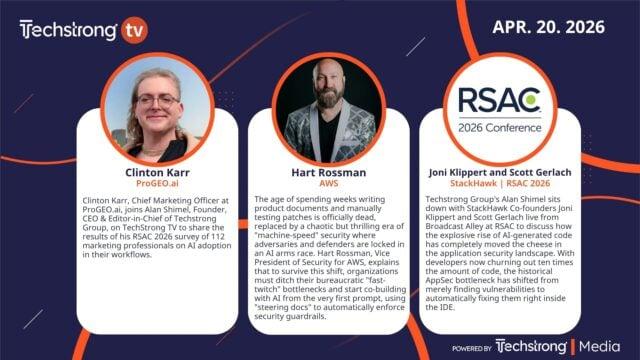
Techstrong TV January 16, 2026
Watch our live stream Monday through Friday, featuring exclusive news, announcements and conversations with IT leaders and experts on topics ranging from digital transformation to #DevOps, #Cybersecurity, #CloudNative, #Containers and deep-dives into specific technologies and best practices. http://techstrong.tv/
Transcript
Hey everyone. Welcome back here to Text Drug tv. Yeah, I haven't had this gentleman on in way too long.
I bet. It's Jesus. Gotta be almost a year.
I'm going to guess. I think so. Yep.
He's my friend, Greg Keller. Greg is a co-founder and the CTO over at JumpCloud, a company I'm been involved with and known of and intimately familiar with, I think since they were founded. Greg, it's good to have you yarn here, man.
It's been a long time. Alan, you don't send me flowers anymore. I was just gonna say, we're going to do the Neil Diamond thing, huh?
Question is, which one of us is Barbara, but, uh, but, but seriously, you know, it could be one of two things. Either you guys had nothing going on worthy to talk about, or you've been so damn busy that you haven't had a chance to catch your breath. I'm gonna bet on so damn busy.
You haven't had a chance to catch your breath, man. We've just been sitting on the couch eating our bonbons and, and you know, just sort of taking it easy. I, I get it.
I get it. I know Raj better than that. I know you better than that.
But anyway, Greg, it, it's great to have you back on. And, um, you know what, for those folks out here maybe who aren't familiar with JumpCloud, let's, let's start there. You know, give them, give them kind of the quick pitch on JumpCloud and what, what you guys are about.
Yeah, I appreciate it. Um, I'll keep it sort of condensed. Um, your folks, uh, are largely our folks, DevOps, it, those that sort of live in this community.
So the, the, the, uh, the, the words that I say and the acronyms I may spill out. Everyone's gonna appreciate they have heard of them. So, what is JumpCloud?
We're an access control platform. What does that mean? It means it provides all of your users.
And here's an interesting part, Alan, both and human and non-human. So all of your users, the right access to the right resources from the right locations with the right entitlements in the case of humans from a known trusted device. So think about that, and then you start to step back.
Okay. Yeah. There's sort of tools that kind of do this.
Yeah. We use active directory and maybe some multifactor like duo and, ah, I've got some MDMs that help me, like Jamf that help me do device trust on Apple. Oh.
And we have Intune for Windows, and you get the soup of products. What we did is wipe away all of that maddening complexity of different types of tools and shrunk it down into an very elaborate, yet elegant access control platform that covers all of that set of needs that I just described. User provisioning, storing and managing the appropriate identity of those users, getting them the right applications, uh, in front of them, managing their devices, all of that.
Um, and that's what, you know, the team and I have built over the last 12, 13 years. Very cool. And, you know, and you, you mentioned human and non-human, you know, Greg, when I used to think about the non-human element three years ago, five years ago, I would, I would think of IOT connected devices, for instance.
Correct? Yeah. Then I started, you know, with Cloud Native, I started thinking if every container has its own unique identity That's right.
Right? And so that was yet another one. But now, you know, that's, that's baby stuff.
Now, right now we've got every agent, every AI agent is a unique identity. MPC servers, uh, excuse me, MCP servers. Yep.
You know, all of the, the whole AI thing is, has added yet another layer. You want to call 'em digital coworkers. I don't really care what you call 'em, but, you know, it's another layer of non-human users.
We're gonna talk a lot more about AI and JumpCloud in a, in a second JumpCloud interview today, though, if you don't mind. I want to zero in on an announcement. You guys may, we've been trying to get, get you on here with the holidays.
It was hard. This announcement, I'm going to guess came out around, I don't know, Thanksgiving time, maybe a little before. Yeah, Roughly.
Yeah. Um, I know it was a, it was a, uh, a project that you'd worked on for some time. Partnering with Google JumpCloud is, now, I don't, you know what?
I don't want to take the words outta your mouth. You tell us what JumpCloud is now regarding Google. Yeah.
Um, thank you for just the airtime to be able to do this. We're obviously extremely excited. Um, and yes, um, this has been a, a sort of buildup for the past, a little over a year working with, uh, very senior Google Leadership, both on the business and the, and the engineering side.
And frankly, both on the workspace side of the Google business, as well as the, uh, Google Cloud side of the business. So, what is it, this announcement by name is called Google's Work Transformation Set, or WTS, it's an interesting name because the whole in inspired thought behind it was to offer technologies that includes Google Workspace and GEM Cloud that would enable companies on legacy software and infrastructure to help transform their IT practices, uh, into a modern cloud version of what they have been using for decades. So if we kind of unpack that and at the expense of, you know, um, going deeper, yet this is, you know, totally public.
What we're really defining here are companies that, in most cases are leveraging extraordinarily old and sticky Microsoft technologies, principally active directory at the core, uh, and other types of products that when you add it all up, make it extremely hard for companies to be as flexible as they need to when they're bringing in other forms of disparate resources, not just Microsoft resources. So, in effect, this helps level the playing field for companies to really think about future proofing the types of technologies they want to bring in, where the future proofing is sort of the foundation, the access control and collaboration, foundation, collaboration being Google Workspace, uh, the access control foundation being, of course, JumpCloud. And everything that integrates with or lays on top of us can be everything, including Microsoft Technologies.
We're just changing the game on the, the, the bedrock by which a company can build a new foundation, a flexible foundation on. And that was really the intention. And guess what, uh, it, it's working, it's working extremely well.
The story resonates, the technology resonates, and the success stories now that we have been in market for quite some time around the globe, where this is available resonates. So people are interested to learn how to, uh, more or less start to transition from the, um, kind of the, the nature of the, uh, the bundle, the Microsoft bundle suite, uh, which from a price point extremely tantalizing, but from a product implementation and ex, excuse me, and a security risk surface standpoint, that is sort of what people are really scratching their heads on, given the numerous, um, well-known, well-publicized vulnerabilities and exploits that, uh, run pervasively throughout the Microsoft backbone. Um, so these are great motivators for companies in this moment to really think about, you know, their pla quote platform, really the foundation of it and how they want to move forward, building out their, um, architecture of it and access control and the types of products that they would like to leverage, uh, across their user base.
So in a, in a nutshell, that's sort of like what's going on, and I'll wrap that part of it up by saying, um, this thing called WTS, the Work Transformation Set is a product, it's a Google product. Google sellers have been trained. They go around the globe, uh, 'cause they have amazing relationships, um, advertising this new concept.
Um, and we are their support arm. They just literally sell our technology underpinning Google Workspace and Cloud. I love it.
So, Greg, let me translate a little bit without, without having to be as diplomatic as you are, you know, working for JumpCloud. You know, you gotta give Microsoft some credit. They did an amazing job transitioning to, I, I guess we call it Office 365 now, which is the SaaS office.
They did a tremendous job of transitioning to a SaaS-based cloud-based office offering while still anchoring it to the on-prem. Though you, I guess you could use it as a SaaS offering too, to the legacy active directory and everything that goes with, with active directory. And in, in kind of true Microsoft fashion, it kept you locked in to that Microsoft stack and, and look there, you know, benign, uh, not benign ignorance, but benign indifference people, some people are okay with that.
But if we've learned anything in today's multi-cloud, multi-polar, you know, world is that people wanna avoid lock in, if at all possible this is true, go for open, they'll pick open over locked in almost every time. And, and what Google's done here is they've tried to give people more of an open standards based solution. So whether you still want to use a little ad here, and as you mentioned a little jammed there and, and what have you, we want, we want something that's standard space and that, that plays into that whole Google mantra, right?
It's, it's not necessarily the do no evil, but it's the whole open piece of it. And I think that's, that's a solution for today. And tomorrow's time not locked into a Wintel arch architecture from 1998, right?
Which is absolutely the reality, I think. Mm-hmm. Um, you know, it's interesting, the lock in.
I don't want to, you know, necessarily create some sort of, you know, arbitrary, fictitious, good versus evil kind of thing. Nothing like that. And listen, Microsoft is, I have so much respect, and I'm in awe of when you look at the $4 trillion in market cap, you know, you know where that's generated by, that's generated by IT revenue and services.
Yep. Even Google can't say that. Um, so I, I had huge respect for that.
But the lock-in is interesting. And it's not just about a monetary component, like a bundle or, or a, a very obscure, very punitive licensing arrangements that are known that, you know, Microsoft doesn't make it easy for you to modify the package that you've bought. You know, things can get bad to me, in my brain, it is about evolving the management of a Microsoft based foundation of an, of a company, which largely is still predicated on buying Windows server licenses to run infrastructure that manages all of this other IT related stuff.
That, to your point, Alan, that is 19 98, 19 99 all over again, or it never left. And the last three companies I've built, while we had some instances of maybe, you know, my finance team uses Windows. They love that.
And, uh, well, I I, I have not hired a DevOps engineer or anyone in, in that family of user persona or worker persona that could tell you anything about a Windows server. These are folks that have cut their teeth in the cloud on Linux, you know, using highly progressive DevOps, you know, uh, methods and practices that have nothing to do with Windows servers, right? So that's one aspect.
Like we, we often very quickly forget, we still have, you know, millions of of workers who are, are at the right now starting to end the tail end of their careers, which started in, uh, the late eighties in most cases. And the period that they cut their teeth and developed their trade craft on was the, the heyday of Microsoft on premise. And it's never left.
But now we're watching the trail off of that generation of employee, uh, in favor of the millennial focused person who, again, they, they, they don't know for Windows other than their gaming machine at home. So this is now about what their work practices are, right? And what Microsoft has very little to do with that.
Well, and again, to give them credit, you know, why Azure has been the success it is. 'cause they recognized it and they went to Linux, honor Azure, and they offer the same kinds of things, whether it's Kubernetes or Absolutely, you know what I mean? Because they recognized that a Windows only cloud was not, it was never gonna be, it wouldn't compete with AWS Google or Oracle or any of those for that matter.
So, you know, I, I think the proof's in the pudding on that. Let's turn now though, Greg, 'cause I don't want to make this about Microsoft and their technology. I want to talk about the JumpCloud and Google technology in here.
So you have to be a Google Workspace customer in order to use this. No. Uh, in fact, um, you can not use any Google or GEM Cloud technology now.
So it, it runs the gamut of those that do have existing Google stuff and they want to upgrade to, you know, hey, we're, we're right at this juncture where it's a good time to rethink the IT architecture. Um, so it doesn't, in, in that way, it doesn't matter. Google's got both ends covered.
Very cool. And whether you're an existing Google Workspace customer, or maybe you're looking at workspace I, and forgive me, I forgot the acronym you used W-T-S-W-T-S. Like how is that presented?
Is it just a checkbox on the install? Is it truly something I gotta go do separate after I've set up? What, what's the user experience to incorporate WTS into, yeah.
Into my Google, Google Works really good question. The, the go-to market motion of Google is very sophisticated. Um, the targets of these are mid-market to, you know, small enterprises and, and large enterprises.
So think of those, uh, those types of, of companies. And most of this is white gloved. Um, so in this particular instance, Google will will advertise and make it known that there is this product.
Uh, and given the complexity of most often removing or migrating away from different older legacy infrastructure, there's usually, and if not exclusively a, uh, a conversation that goes related to how this will go down. Because companies are like, okay, Google, this sounds beautiful. How do we get started?
And you really have to understand the transition. You can't just flip the lights off on a company that is using legacy technology to, for authentication and authorization. That's pretty important, right?
So Google's playbook is very sophisticated on the migration away and the time sequences of moving away from that type of, uh, legacy infrastructure. At the same time, that plays into Google's channel strategy, which is, and again, it's something we don't talk a lot about. Look, Microsoft has a tremendous channel, right?
Huge M MSPs one Of the greatest channels ever created Uhhuh, I totally With that. Yep. But Google has done a hell of a job with their channel, and it's par for the course.
I'm, you know, at reinvent this year. A WSI forgot what they said. They have 140,000 partners or something like that.
Yeah. On AWS I, I haven't seen Google advertise their numbers, but they have a, a robust channel and a robust channel of integrators who help people get up and running on this. Greg, a question that comes to my mind is the linkage between moving to this and Google workspace versus transformation to the cloud, right?
We're, and we don't call it transformation to the cloud anymore. We call it modernization. Yes.
Right? Yes. And so how, how tightly coupled is our, is this to like modernization type of transformations?
And forgive me for using the word, um, where there not only are we moving to a new IAM, right? Not only are we maybe moving off of office to workspace or something like that, or at least giving people choice, but we're also transitioning at least part of our infrastructure to a cloud. Uh, so think of it like this.
There are variety of motivations. Um, the one and the one that you have defined is most often seen and heard by companies that I kind of talked about before that are in this moment. Okay?
We are, we need to modernize to use the, the now new colloquial. Um, and a lot of them are going through what we see most often are applic internal application upgrades. And migrations typically on premise.
Very often they're, they're antiquated code often run on Windows servers, and they're trying to figure out the way forward to lift and shift this and modernize it. And they're picking, you know, a cloud. Sometimes it's Azure.
Very often we see Amazon, uh, which is a likely target, uh, for these kinds of things. And in that moment, um, in that driver, absolutely. Like they're, they're, they really look at everything like, how does our workforce behave and, and authenticate?
Do we want to provide choice? Like, yeah, we've heard from our engineers that they don't want to be on Windows machines using VMs. We want them on Linux hardware that they can take home and is portable or MacBooks or something like that.
Like, companies are going through this transformation process and they look at all those nooks and crannies example, the one that I just mentioned. Um, you know, when you have engineers that are using, you know, their, their hardware is Windows and they need to virtualize or use VDI to enter in, you know, to other, uh, you know, infrastructure for security reasons off a Windows host, um, that's expensive, Alan. And people are really mystified by how they can use Pam or other secure browser type products that abstracts and, uh, uh, basically, you know, reduces the load and predication on, on Microsoft Windows.
So we see all of that. But the other side that we see are, you know, scale ups that are what you and I would refer to as, oh, that is a cloud native company. But guess what?
They're also really examining their cost structures. Yep. Like, how much does it take to run our business on Microsoft E three and E five versus like, what if we were to, you know, think about other solutions that are comparable, more secure and likely more economic.
And those are real motivators too. You know, not, this is, this is not 2021 where capital is free anymore. It's not every dime is, is accounted for in most well run companies.
Yeah. No, look, Don, it's gives rights to the whole finops thing. And then, Greg, we're running outta time, but we'll continue this conversation.
'cause the next consideration for these companies is, well, but I need a new stack. I ha I need an AI stack. Yeah.
Yes. Right? And, and that introduces a whole new level of discuss.
It's so True. It's so true. A and, and the whole ai, you know, which AI are we gonna hang our hat on?
I don't know. For, for us and for Google, this is a total paradigm shift in that very unique and very specific way of ai. And it's like, like when you think about legacy, it, it's all about controlling the user, right?
You know, very explicitly. Um, but when you look at the possibility of WTS and what we are doing with Google is like empowering the user with ai, right? Including the, the, not just Google's own variance of ai, but how ai, I'll be, uh, fully above board here.
We use Gemini underneath the hood of Gem Cloud's platform to power our internal AI capabilities. So how do we reinforce all of that and help leverage ai, um, you know, as a transformative agent, you know, to get it out of the very command control, legacy IT way of controlling user into a much more empowered way of thinking about, um, the end user experience in an organization. And that, my friends, is part two of my interview with Greg Keller.
You're gonna have to stay tuned for that. Hey, Greg, man, thanks for coming on here. I appreciate you, Zoe.
Uh, you too. Uh, Alan, I look forward to our next meetup. All right, man.
Say hello to everyone Too. All right. Greg Keller, co-founder, CTO of JumpCloud here on Techstrong tv.
Go check out the JumpCloud Google Workspace, uh, CTS. How, what? WTS WTS there.
You heard it from him. I get it. Eventually.
We're here on Text Drunk tv. We'll be right back. Hey guys, thanks for the throw.
We're here with em Ked, who is CEO of Blackburn ai. And we're talking about, well, they just raised $28 million in additional funding to help combat misinformation and disinformation. Sem welcome the show.
Thanks For having me. We've been having, I don't know, disinformation and misinformation for as long as anybody can remember. So, um, what's changing now in the age of AI as we look at all this stuff that's making this a little more problematic and maybe something that, you know, is, requires companies to think more about rather than just saying governments and media companies?
Yeah, absolutely. I think the first thing to establish is absolutely disinformation, misinformation and, uh, and, and trying to shift people's narratives, uh, and perception around things. We've been around, um, probably since as long as the, the written language in, in the, in the printed press.
Mm-hmm. Um, you know, about 10 years ago when we really started researching this area and then formed the company about five years ago, um, the idea here was less about, you know, your traditional fake news disinformation that people were talking about, and more about how is the narrative being manipulated to shift people's perception, uh, shift people's ideology, belief systems, and their, and their view and understanding of reality. Right?
Um, and so, you know, we looked into this space through this frame of understanding growing narratives in the information ecosystem, how they spread through networks and, uh, trade craft driven by actors and adversaries behind those narratives for, uh, purpose on the other side, be it, um, financial reputational, uh, or even physical harm. Um, I think in the age of ai, the number one thing is the cost and the effort to build out and distribute those campaigns to build, to, to spread those narratives through networks. The cost has dramatically dropped.
Um, all of these different barriers, cultural language, all of these things have been subverted by the use of generative ai because a small group of people and target almost any topic anywhere in the world, um, and do it much more effectively than they could have even three years ago. Right? Um, and, and now with, uh, ag agentic, uh, technologies, you can not only create that content, audio, video, text, et cetera, but you can also create the network effects by building out bot networks that can operate autonomously without a human operator.
And that's already happening, uh, in the space, which we can see using our technology. I think that's the biggest thing is, is cost compression easier to access technologies that are very powerful, that enable these campaigns to be done with the precision of what used to take a nation state to do with the, with the single actor. And are these campaigns aimed at nation states, like political parties?
We would expect, but I also feel like more of them are being aimed specifically at companies, organizations. Somebody wants to move a stock price, they're getting very subtle in their mission statements, but they have a goal. Absolutely.
So, you know, when I say nation state attacks, sometimes there are, uh, state actors, but they're often also involved in narrative attacks on enterprise organizations. Um, and again, some of that may be financial. It'd be maybe using the organization as almost like a lightning rod to, to prove a point, to drive their narrative home.
Because you can attract more attention if you, if you go kind of through a well-known Fortune 50 or Fortune 100. It's why a lot of the, the companies we speak to today, they feel sideswiped. Like, why is the general population online so interested in this thing that happened?
Well, often thousands of those are actually bought networks trying to decrease stock price while short sell on the other side. Or perhaps that company did something that doesn't align with the adversary's ideology. And so they're making a point, uh, making a statement by attacking that company and, and driving a narrative that can harm it.
Mm-hmm. What is an organization supposed to do about all this? It's one thing to be made aware of it, but what can I do to kind of mitigate it?
Or is it just a matter of, you know, once I'm aware of it, I gotta put out the counter narrative? Yeah. I think one of the first things is understanding, uh, the intent and who's behind it, right?
And, and is a narrative attack actually occurring? Because a lot of people look at these traditional, um, social media insights, so sentiment, keywords, topics, things of that nature. And they may think that the actual population or their audience or their customers are saying and, and feeling these things about the, the thing that they might have done or may have been accused of doing or whatnot, what whatever it might be.
Uh, so being able to understand what's actually happening, like the telemetry behind what's happening within the networks, the contagion, like spread of that narrative. It helps them make strategic decisions. It all comes down to making better decisions in the end.
And once, and those decisions could be, like you said, um, helping to pre bunk something that might be out there. Um, being able to get those people around the table that typically happen during a crisis. So whether that's a chief information security officer, a chief communications officer, of course, the CEO or any board members, investor relations, marketing, all of these people have to go around the table when there is a major, uh, event that impacts the organization today and together, uh, using a lot of the signals that we can provide, being able to understand what's happening and how to mitigate that and run a playbook, understand the techniques and tactics helps you understand what you're actually in for and how to disrupt, um, that potential bad outcome and those bad outcomes.
Today, they might be a shorted stock, a stock price hit, but it might be, um, an attack on an executive like a CEO or someone else on your team or a physical location, um, or, um, it might be something that actually looks to create supply chain damage by driving, you know, activist boycotts against a particular location. Manufacturing a particular ingredient could be a lot of different things. Um, but I will say threat actors are highly opportunistic in looking for that opening.
And that opening could be something very innocuous. It could be as something as simple as a, as an HR statement or policy on a website. And then it's about taking that opportunity, recontextualizing it, and getting it in front of as many people who that recontextualization will get up in arms, right?
And wouldn't have happened without that trade craft. And that's key is seeing that trade craft making strategic decisions based on being able to see what's really happening. To what degree is this becoming a business?
'cause you know, we've seen things like ransomware as a service, and I can't help but wonder if there's gonna be disinformation as a service where somebody has this capability and you can hire them and contract them out to do all kinds of malicious may have, Uh, you mean a, a business on the other side? So, yeah. Are there disinformation for higher, uh, companies and or individuals for sure.
Right? Mm-hmm. Um, and, and there's, there's individuals and there's also entire teams, and they've been around for some time, and they weren't really doing this line of work in the past.
I mean, everyone knows the stories now of like these massive click fraud, um, you know, factories, essentially people, devices, et cetera, in different countries in the world that have been, um, doing that kind of work. And, and you see a lot of those, uh, types of setups for this kind of work as well. Well, you did some years ago.
Now they're able to have gotten smaller because they can use a lot of technologies to do what used to take, you know, dozens and dozens of people, um, to actually do. Mm-hmm. So what exactly does your company do about all this?
I mean, I assume you're listening for signals or aggregating that, but how does that become something that manifests itself as actionable intelligence? Yeah, so what we do, um, talked a little bit about it before, is we look at the data through three lenses. Um, we talked about that it's, uh, it's narratives, networks, actors, and that actually enables you to see a whole host of techniques and tactics that can be tied to response playbooks.
And those two playbooks typically now are usually comms and threat intelligence. That's kind of the, the hybrid, um, you know, people behind the, the keyboards who are looking at these types of problems. And we'll see organizations that are using our technology next to technologies like recorded future and things of that nature, be able to look at a different attack surface and therefore be able to make decisions more holistically.
Um, and they'll also be like an executive view of these things, because every CEO and board, uh, the problems that keep them up at night, um, are a lot of the things that we can help them understand when they look at narratives of, of high risk to them. And then of course, um, you know, one of the really interesting things is going into the next quarter or whatnot, we are actually working on our own automated response playbooks that can recommend exactly what to do based on the signals that our system has been detecting for several years now. That's the natural next extension of the product.
So who in these organizations kind of takes the lead on, uh, adopting a platform like yours who kind of wakes up in the morning and decides that this is their problem? Well, it depends on if they're in the midst of a crisis, in which case they definitely know, uh, who they're gonna, who, whose neck is on the line. Uh, but you know, typically when we're looking at proactive, uh, you know, inbound, let's say, um, again, people who wake up thinking about it, it's usually a chief communications officer or someone who's like a head of crisis comms, or it is someone in the threat intelligence team.
CISOs usually aren't like waking up thinking about this. A few of them are, and, and we work with some great ones, but usually someone in threat intelligence. Um, and it's, we're a new category, right?
Um, you know, so we, we are, we are one of those things that, that people don't really know who's in charge of that particular, um, problem set because it is new, it is hybrid. And, you know, sometimes companies don't know who's on first, you know, and so a a lot of the inbound that we have, which is a lot, it's like, it's during a crisis and it's whoever's been tasked with that thing. But I will just say comms and threat intelligence were the two most common.
We have a lot of people around there that we can expand to everyone from legal compliance to m and a investor relations. Um, but the two most common ones historically, um, are, are the ones I mentioned, CCO and, uh, threat intelligence. With the reporting into the ciso, Can we discover who is actually launching these attacks and maybe, I don't know, get the local authorities to respond in some way or to block their systems?
I mean, how aggressive and offensive can we go? Yeah, yeah. I mean, there, there are likely ways to do that, but it's just not the business that we're in.
I mean, typically what we're doing is we're showing detection within the information ecosystem. Uh, and we don't really bridge to like, you know, who's sitting in that seat at that location. It's just not data that, that we consume.
And it's not really business that we're interested in getting into. We're more about, uh, narrative intelligence, uh, versus take downs, um, take downs. We do partner with some companies that, um, that do that kind of work.
Uh, and so that's usually the approach if a customer really needs it. And that's usually, um, particularly if it's like executive protection and threats on life. Um, you know, not, not the other types of things that we've been talking about.
Um, we started this conversation talking about ai. Is there some way that you'll be applying AI to what you guys do? Or maybe you already do, but, um, you know, there's a lot of different types of ai.
So, you know, where do we go from here as we kind of start 2026? Yeah. You know, we, we got our Blackbird do AI domain before it became trendy to do so, um, you know, way back in like 2016, I think.
Um, but, uh, yeah. So my co-founder and I are both computer scientists, um, specialists in ai. A lot of our early founding teams were, you know, longtime artificial intelligence, uh, specialists at Microsoft and Yahoo, and other research firms nuance.
Um, and so AI has been a core part of everything we do since the very beginning. Um, all of our like actor detection, we've got hundreds and hundreds of, uh, AI models that are, that are tuned and calibrated to that. But more, more recently, um, in the last, uh, year and a half or so, uh, a lot of our stuff is, um, LLM outputs to make human readable reports.
There's a lot of automation. Um, we have, uh, a agent called, uh, compass, and that compass agent is like a context checking agent that goes out and like brings all kinds of relevant information back to you. So I would say AI is infused into every, every bit of the platform, um, today.
And, and as we go into like more of our agentic response playbooks, it's, it's just gonna get more and more, uh, advanced and integrated with some of the newer technologies, national language interface, et cetera. Mm-hmm. So what's your best advice to folks, or kind of, what's that one thing you see organizations do when they get confronted with these situations that just makes you shake your head a little bit and go, eh, guy, I think we need to be a little bit smarter than that.
Yeah, I would say that probably it's pretty simple. Um, it, it's just that people need to have some real awareness around what we call a narrative attack, that they exists and that they're likely gonna happen to them at some point. And a narrative attack, as we defined it, is, is, is kind of this host of different symptoms.
We're trying to find a name for narrative attacks as we define it as trade tradecraft that drives some sort of outcome in the information ecosystem that can cause massive financial, reputational or physical harm in a way that would've never happened organically if someone wasn't making it happen. Right? Manipulating the environment to create an outcome that they want that is going to harm you if people don't understand that that is happening.
That is the one thing I would say is you have to wrap your head around the fact that this is a, a regular occurrence. It's no black swan event now it's happening all the time to our clients. Um, and if unless you can detect them, you, you don't even really have a chance of understanding how to make a strategic move to make the situation better.
So, um, and the only way to do that is to deploy technology and kind of fight fire with fire because, um, the ones who are doing this have been really, really adept at, at adapting to the AI driven world. So, so, you know, the, the customers and leadership teams need to do the same. All right, folks, she in here, sadly, there are people out there who apparently don't have much of a soul, so they got nothing better to do than create narrative attacks.
But to be forewarned, just to be forearm, hey Sem, thanks being on the show. Thank you, Mike. Appreciate it.
All right. And back to you guys in the studio. Have you ever been responsible for modernizing a global data center network while keeping critical apps online?
Nokia's IT team did just that. They performed a brownfield migration from a mixed legacy fabric set up to an automated fabric in multiple data centers, composed with Nokia's Sr. Linux and their event driven automation management system.
Ida, I'm Scott Ban, and in this video, Tom Hollingsworth and I will give you an overview of becoming blog and video series that breaks all this down step by step. I'm Tom Hollingsworth. Scott and I interviewed the Nokia IT team behind the project and dug into their planning and migration materials.
What we're sharing today is how they turn pain points into an automation first operating model and what you can take away from their journey. You'll also hear about the people side of things, why data quality communications and ops discipline matter just as much as the tech choices. So let's set the scene.
You know, over time, Nokia's network and data center environment grew organically, different pods, different tech stacks, different operational patterns, adding stuff here and there over a long period of time. And with that came the usual friction, non-uniform designs, too much manual work, limited traceability or rollback and tools that just didn't talk to each other. This all had impacts on the operations of the business.
If you lost application heartbeats for just a couple of seconds, you'd have a database go down, taking two hours or more to recover. And if you disrupted factory operations, you could easily cause a 500 K or million dollar loss per incident. The biggest challenges were with the infrastructure.
People became afraid to do the simplest things like adding a vlan. They needed to move to a NetOps deployment model with better tooling and observability. This wasn't a buy some switches situation.
They laid out specific requirements that had specific outcomes. It covered hardware, software services and migration execution across multiple dual data centers. The production fabric requirements included API first operations with zero touch provisioning, programmatic overlays, robust routing protocols, jumbo frames, multicast, QOS and dual IPV four, IPV six, stack operations On the management side, small failure domains, programmatic VLANs, strong aaa, and tight integration with ticketing, monitoring and logging.
Okay, so how do you architect for that? Well, the team leaned into leaf spine CLO physical network architecture with a layer three underlay and a programmable overlay using vxlan. They also specified a digital twin requirement to model and test future deployments and pre validate changes and NetOps operations with CICD and using that digital twin for dev and test environments.
SR. Linux and EA are the heart of this new tool set. They opted for IDA via SaaS to keep the infrastructure up and running.
No matter what happens in the environment. IDA is Kubernetes native. You treat your network constructs like resources, you keep the network in a desired state, and then you extend it with custom apps, think connectivity, diagnostics, or related alarms and logs with proactive monitoring and forecast, The team made all these choices to drive programmatic access to the network with a shift to infrastructure as code CICD pipelines and superior observability.
So now let's talk about the migrations themselves. They used a live migration method with VLAN handoffs from the legacy infrastructure to the FMO SR Linux and the E DDA fabric. They rehearsed everything in the EA digital twin and executed changes as code.
The process went a little something like this. One, build layer two VLAN extensions between Legacy and the new SR Linux fabric. Two, make sure that critical loads are dual homed and then swing redundant links in batches.
Three, activate the host on SR. Linux, deactivated on the legacy 'cause your gateways are still on Legacy. Simulate that whole thing and verify that it all works.
Four, move the servers and frames one by one, and lastly, cut the gateways and fabric exits over to the new fabric. And you have quick rollback baked in. Every step in this process had pre-checks, approvals and a clean rollback path.
Post migration is where the winds really show up faster Automated implementations, fewer inconsistencies, fewer outages, and measurable cost and time savings. You want a concrete example? The team saw an 80% reduction in incidents during the initial phase of the migration pilot.
That's, that's striking 80% reduction, that's a big deal. And the human factors investing in high quality network data, keeping communications with the team and motivating strong operations, operational responsibility does not vanish. You still own the outcome.
All those team human factors came into play. So here's what you'll learn about all this, the more detail in the coming series with more detailed videos and posts on interviews with the Nokia IT team. We'll start with the team's pain points and their desired state.
We'll dive into their specific requirements. We'll take a closer look at the target architecture with the Sr. Linux and EA.
We'll walk through the live migration method. And then we'll wrap up with, uh, speaking to the long-term day two ops and desired outcomes. Be on the lookout for posts on Techstrong.
We're gonna look forward to going through all of this with you. I'm Scott Rob, I'm Tom Hollingsworth. Thanks for watching Control.
This is agent dev. I'm in position. Copy that.
Dev. Stand by for go Standing by. Hey everybody.
Welcome. Thank you for joining us on the Agents of Dev podcast. I'm Mitch Ashley.
I lead software lifecycle engineering practice at futur, a practitioner product development, lots of different things in software in my career. And I'm joined by co-host, of course, Brad Shiman. Hey, happy 2026.
Well, welcome to the, uh, the next year, the next era of what's gonna happen in AI next. Yeah, thanks. Thanks a lot, Mitch.
And, uh, yeah, starting off slow, uh, clearly, uh, we're off to a very even slow, slow paced start to the year. Fantastic. Feels good, man.
But I sure to cut you short, let folks know who you are. Oh, yeah. VP practice, lead for data intelligence, analytics, and infrastructure.
Also here, FU and like Mitch, I'm also a practitioner slash analyst slash whatever, uh, tech techno evangelist, uh, despair and, and Reveler, uh, at the same time. I think the term for that is geek, but okay. Yes.
Which we both bought. Wait, not, not the sideshow geek, let's clarify. No, yeah.
Not the Barn and Bailey type, but Yeah, very much so. Well, you know, so lots of things we can talk about. Uh, it's an exciting year and, and we're in the midst of our predictions and getting some things published out that folks will see.
Uh, we're both gonna be on Predict, uh, which is a conference Predict 2026, that conference at Textron puts on, that's on January 15th at 9:00 AM Eastern. com, you'll see, predict right there, uh, easy to sign up for, and a bunch of us from the analyst community are, uh, presenting in. And there's other great presenters there, of course, too.
So, um, you know, the few things happened over the holidays there, uh, a couple things leading, leading into it. One of them was, you were quoted in an article that was making the case that, you know, this Python thing is nice, but it's gonna get taken over by Java. That's really what rules the world.
And, uh, so you, you data scientists go keep playing with Python. If you wanna go, the rest of us will use Java. I think it's a, I'm maybe a little tongue in cheek, but that's essentially what the article said.
Not your quote in it, but what's your thoughts on that? Yeah, I, I, I feel the same way now, and even more so than I did when, when I responded to that, um, request. And, and it's that, um, you know, I think to believe that that Python and Java and C and TypeScript, et cetera, you know, are going to continue as domains of, of expertise that will drive ultimate buying power in the enterprise, I think is a mistake.
Uh, I think that, and I think you, you and I are gonna chat about it on today's episode about trying to to, you know, readjust how we view software development and how we view the, the tools that we use to build software. Mm-hmm. A language is a tool.
It's something you use to imperatively say, here's my recipe, please do the recipe. And some, you know, languages are well-suited to certain tasks, and Java has been well-suited to, uh, backend development. And by and large, because it has a terrific, you know, uh, mechanism for managing large scale projects through its o you know, object oriented programming and through automatic garbage collection.
So you don't end up with the things you run into if you're coding and sea at scale, for example. Um, but it, it's just a language. And at the end of the day, what drives language use isn't so always the, you know, how well suited it is to the environment it's running in or to the task it's supporting, but instead to how low the friction is that developers experience in using the language, how quick they are to solve problems with that language.
And as I started to say a second ago, you know, the further we go with Agentic development, I feel like the less important that becomes because, you know, we're, we're basically seeing a collapse of all of the layers of abstraction that we have built since we were writing in, you know, uh, assembly language. Are we not? Yes, yes.
Our programming, those dip switches on the front of the computer. Let's go back to that. Yeah.
Well, you know, I can remember when Java was taken off and a lot of excitement about it, and it certainly has done extremely well, but I think that's more of a bias of well, and my world, whatever my world is, it's all Java. So the rest of the world, and it is a dominant language, you know? No, no doubt about it.
And environment there has a lot of great strengths. You know, JRE, the runtime that Oh, yeah, executes on the libraries, all of it's very good. But also Python came along for some very good reasons.
And one of it was its usability and easy to learn, and it's very extensible, whether it's PyTorch for machine learning or, you know, whatever library you wanna use. Um, it's extremely extensible and people are writing some low level things in, in it as well as, you know, applications and everything else. So I, I think if anything, I, if, if Java grows one, you could argue cobalt modernization to Java is probably gonna be one of the biggest growth areas.
Well, that, that's, IBM actually coded a or trained a model to do just that task, that one task. Exactly. And that's not a slight to Java in mainframe or whatever, but I think that's probably the biggest growth opportunity, at least right now.
Um, so I, I agree with your point, and this is something we're gonna get into. And so I'll introduce it now. Um, on the 26th of December, right after, uh, Christmas, uh, Andre Pathy put up a post on X basically saying, I'm not sure if I know what I do, what I'm doing anymore with this whole AI using it for development.
And I've sort of kind of reached the point of I keep falling back on essentially what I knew how to do already. And I feel like I'm not really totally leveraging what AI can do for me. That's my summary of it.
It's probably an inaccurate, but it gets a little bit of the, of the spirit of it. And he described it as it's kind of like aliens landed on the planet and dropped off these tools, and we're supposed to figure out what to do with it. Yeah.
So I think it was one of those moments, and, uh, I don't wanna be the old guy too much here, but I've, I've seen this myself when, like in the cloud, when everybody described it as, uh, it's just somebody else's computer. It's just like all the, you know, it's no different. We've been doing that for years.
And then suddenly you realize, well, when you remove a constraint, like I can have how many servers available to me in, you know, seconds, minutes, okay. That I didn't know I could do this, do that. Yeah.
Maybe I can do this. Exactly. And that's kind of, we're in that point.
I think that's, you know, well, this will be, it'll be one of my predictions about this year is kind reaching this tipping point with AI and development where yes, you can do things the way you have been doing it and still be the developer you've been and kind of use it as a tool. You can also, not saying you go and divide coding, which is Andre also coined that, but, um, it's developing software in a different way. And I know you were experiment with some exp spec driven kind of stuff over the holiday Yeah.
That had caused you some questions about, Hmm, this is changing. I am rethinking my rethinking. And maybe maybe Andrea is like, um, going in post vibe, vibe computing, uh, you know, like postmodernism, I, I don't know.
But yeah, I, I'm with him and I, I felt this actually, and I will, I will like put my stake, my flag on the moon saying that, uh, back in 2022 when chat g GT first came out, I said, and ri wrote down the words, you know, it is as though we've been hand, you know, we've discovered a UFO. Um, we know that it works. We don't know how it works.
So we're joy riding around in this machine that we don't know why it does what it does, but by God we love doing it. It's like this alien technology and Superman that humans don't know what to do with, right. Right.
And so we get in trouble and we, we, we do, you know, learn, we learn how to, to run with those tools and how to use them. And I think you could say that with every major advancement, you know, the, think about the punch cards used to program looms, uh, back in the turn of the, the century, uh, not this century, the one before, um, to, to automate, you know, something that we didn't think was a, and do we think that it would work beyond looms at that point? No, No.
Where we're today. Right, Right. So it's the same thing.
And like you said, uh, it, it is forcing us, I think, to reevaluate and to live in sort of a space of uncertainty and a and a shift, much more shifting foundation. And I feel like somehow generative AI and agentic AI right now is simply one of many, uh, unsettling shifting aspects of the reality that we inhabit as a species on this planet at this time. You know what I mean?
It's, it's not the thing. Okay. Sorry.
But There's a really good, a really good point you were making though. And that is, it isn't one thing that's changing. It's many things that are changing, not only how we develop software, how we Think about Yeah, the economics of software, The economics of it, the who can do software, what are the skills required?
How much can you do without having a lot of skills in developing software, you know, using a, uh, how far can you take it? You know, do you believe all the Instagram and TikTok videos or, you know, there's some limitations to those. Yes.
Maybe those aren't, you know, all the cases in the world that can be solved that way. But, uh, But we learned through failure, we learned through, you know, discovery. Uh, and those two go hand in hand.
Do they not? They do. I, I believe, um, you know, the fellow who discovered America, uh, Christopher Columbus went to his deathbed denying the fact that he discovered America.
Yeah. Well, um, and Alan Kay, who, who's an Apple fellow, he was at Zurich Park, and, uh, one of the things he coined was the dyna book with the idea for the laptop. That tells you how bad far back it was.
He had this saying of, I don't dunno who discovered water, but it wasn't a fish. It's like, That's right. We're just swimming in it.
Yeah. That's, It's so, so ever prevalent. And I feel like that's what we change is of like, with It's, and like, like you said, Mitch, it's, it's, um, it's uncomfortable and, and um, uh, for everyone out there, Mitch and I were chatting just before we got on the air about this idea of spectrum development.
And, and it is being touted right now as a means of making vibe, coding more enterprise scale and, and a trusted companion instead of, uh, skunk works. You know, why did you do that? Now we need to port it to something we can manage.
And, um, it was, it, I I had a revelation, uh, actually recently about that. And it was, um, it, it's terrific at basically following the scripts that we've known for the last 60 some odd years. It, it thinks in that paradigm, it's trying to apply a paradigm to, uh, this new way of development that that paradigm itself may no longer be relevant.
I mean, there are aspects of it that are always gonna be relevant. It's like a good practice. But to impose a, a way of thinking about software within an environment that, you know, doesn't recognize that boundary, um, sometimes isn't the best thing.
And I, I ran into that headlong and, and I was, I, I had specked out a, a step change, uh, and it, we had a good plan, you know, with check boxes and everything and, um, got about halfway through it and it occurred to me that, um, I, I wanted to take, take on a task that was not dependent upon it, but was, uh, impactful to it. And it, when I did that, it, it absolutely fell over hard. Oh, interesting.
Interesting. And, and was like, no, we need to finish this. I'm like, no, no, we don't put that aside.
So I, you know, had to basically tell it to just take a pack up shop, do all the commits set up its log. 'cause it's a nice, a nice facet of spectrum and development is that every time you make a change, it will basically not just do the commit with a lovely, you know, commit message, but also log the change in a very programmatic way such that it becomes a part of the living memory for your age agentic system layer, which is chef's kiss. Um, but it, it was like so inflexible, uh, in, in how once one, once it had derived its spec driven plan, it couldn't, it couldn't deviate from it.
It couldn't adapt to new ideas, new thoughts, and those new ideas. By the way, were sort of, you know, arose from the fact that I was using an agentic tool to do this if I was writing code, you know, manually, I would've just seen it through and then gone back and started another path. Well it's interesting.
I mean, 'cause if it, my first reaction when I heard, oh, spec driven development and my one thought was, well, shouldn't we be, have been doing that all along? But Okay, alright. I think that Was part of it.
We should know what we're gonna build before we build it. Yes. Agree.
Yeah. There's, you know, I have this, I have this belief of 50% of planning and designing is doing, you can only plan and define lecture, Laptop. Yeah.
You've gotta, the other part of the learning of is actually doing it, you know, I'm getting in the hands on with it. And it's interesting because the ID tools that have this design mode or requirements mode, development mode, uh, whatever they may term it, are essentially using a different, they're switching context in a major way. This is the new system prompt for design or for specs, and we're gonna work on specs.
And that, I'm guessing that's part of why, you know, you get stuck in the mode of spec and then you switch over into a different system. Prompt development, well, it's, doesn't know how to go back and iterate and, and change to design and adapt, you know, it's, it's been told to follow the spec and maybe a little bit too firmly. So maybe those things should be agency, but we want together.
But, you know, We wanna impose those controls and constraints. We do, but we also want it to challenge and say, you know, now that we're doing this. Yeah.
Now that I see what you're really trying to do as we're building this. Okay. There, there's something, here's what I would do.
You know, it's like you and I would be sitting down developing on a, on a project and say, that was a great idea where we started, but actually, given what we know now, let's do this, let's change Yep. And change the architecture a little bit. You know, add, so add, don't do that functionality first.
Let's do this. That was a mistake. We go back and fix that.
Yeah, Exactly. I used to have this thought belief of it took about three tries to get the software right. Of what you were trying to build.
The first two were just sort of practice attempts. By the third attempt, you're kind of on the right track. Um, so it, I I'm not, when I heard about the spectrum development, I get it.
I'm not, I'm not a believer as in, oh yeah. That's the answer. That's the new paradigm.
That is not the paradigm we're shifting. That isn't what Andre is talking about. Mm-hmm.
This is the No, we're developing software not by just writing spec, not by inspecting code that gets generated or, or tweaking it and modifying it. It's, we're letting code happen. What we're directing is the process of how it gets created and all the inputs going into that.
And so it changes. It's the changing of the job of the developer. Yeah.
Yeah. I mean, I know I've, I've harped on it before. Um, but, but, uh, I firmly believe, and I think Andrea is pointing to this, that what we're seeing is the death of syntax and the emergence of context.
And, and like you just said, you know, you, you need to be able to describe the problem, and that's why, you know, it is speculated. Uh, and, and so commonly seen right now that companies are looking for people who know how to describe problems. They know how to articulate that problem.
They know the co the domain ex, they have the domain expertise to solve that problem, but they may not know how to code, but they know how to manage this, you know, swarm in many ways of, of agents and sub-agents that might be tasked with, with solving that problem. So, it's fascinating. So I'm curious your thoughts about this, what doesn't sort of jive with me about spec driven, that, that it's the answer to everything is software develop is so incremental.
It's one of the reasons why I thought DevOps is such as such a good idea or agile was 'cause you're not trying to tackle everything at once. Right. Um, because frankly, what product spec didn't change along the way.
Right. I think none of them, every one is not what it starts out as. Exactly.
So sort of finding it as a linear process again, and maybe I'm overstating that a bit, but still, it, it sure feels like it's, it's, that doesn't seem that's how we would create software. It's not how I would design a product even if it wasn't gonna be in software. But what are your thoughts?
Am I crazy About this? I don't wanna No, I don't think so at all. And like we're talking about with the spaceship, we're driving around in, you know, this is all about dealing with ambiguities.
And when you're, when you're using a deterministic, you know, paradigm to, to run something that's probabilistic, you know, it's, it's not, it's gonna be a mismatch. It's gonna create a lot of, not just friction, but, uh, I think, you know, paradigm mismatches wherein, you know, people will be disappointed with what they build because they're just trying to turn, you know, waterfall into a new version of waterfall, you know, for the development paradigm with due tools. You know?
No, don't do that. And so, like, like with our example of, of spec development getting frustrating, you know, wouldn't it be great if you, you could have, you know, a swarm of agents and sub-agents that were each tasked with particular roles and, and, and specialties and skills that could work with you to say something to the effect of, you know, Hey Brad, I I know you just, uh, upgraded to the newest, uh, embedding model. Uh, and I see that you, you know, are using, uh, a number of, um, um, sorry, uh, you know, how you have, uh, the length of the, the string that you use, um, for, for that embedding, you know, is just a set of numbers.
And I'm, I'm using a high dimensionality that's gonna cost me an arm and a leg. Maybe you shouldn't do that. For this use case.
I would love it if, if there was, you know, a system that was probabilistic, that watched what was happening, Not Engaged all the time, Hey, this is gonna be high, a high cardinality field. Right? So let's sort of switch approaches here on how we're doing the database 'cause of that.
Right. Right. And maybe I had thought of it and forgot it.
Maybe, uh, I didn't think about it at the outset and so didn't put it in the spec, you know? And so, uh, I do believe that, you know, uh, we do, we have to live within this realm of uncertainty and not just live within it, but embrace it and, and use it itself as a tool that uncertainty to, to allow us to solve problems, um, that we know about and that we don't know about. Um, you know, it's the unknown unknowns as we know.
Yeah. That's Our, are the, the problems. Well, speaking of those, uh, unknowns, and one of the unknowns that I, I think about is I also don't believe the IDE is the ultimate destination of what we're creating here for how to build software.
I think it's an, it's, it's what Andre's talking about, right? It's the extension of how we do things Now. It's the incorporation of, of literally extensions in, in IDs.
And it's part of why you see this dual modality of I'm talking over here and these two windows and with the AI and, uh, here's my code window where I'm kind of living in the world I used to live in only. Um, and, and I've described it as I think the next UI look something like StarCraft, you know, where we're managing resources and agents and tasks. And maybe it's not that fun.
I'd love, I'd love game. I, Maybe it is a game gamified environment. You know, wouldn't that'd be awesome.
Find the best gamer, turn them into a software develop. Hey, we already kind of do that New, new job title. Yeah.
So There, there's a, there's a tipping point where we sort of cross over into, okay, there's a new paradigm, you know, is there another Kubernetes out there for ai Mm. Control planes? Is there something like that that's going to emerge out of either open source or maybe when the vendors become more dominant on the kind of the control plane for managing and governance and security guardrails, all of that.
Yeah. You know, I keep looking for signs of those kinds of things. So, you know, we're gonna make a shift in some of those directions.
Too many of 'em already. Uh, it's the, The swimming and change. Yeah.
It's, it's the orchestration layer, uh, that where a lot of the money is going right now mm-hmm. From every, every model maker and every AI platform player. And, um, and every tool maker as well.
And oh my goodness. And, um, yeah, the reason why there's so much invested in it is that it's an area of difficulty and opportunity. 'cause they do go hand in hand.
And, um, will there be like a Kubernetes idea that comes out of that? I would hope so. Um, because I, I, I'm, I'm a proponent of open source all day long, okay?
Mm-hmm. Especially with an FO in front of it, so free and open source, uh mm-hmm. And, um, yet, you know, it doesn't preclude us from having a dominant player just ask the Apache iceberg team, You know?
Yeah, that's a good point. Whether you hate JSON or not, uh, it, Apache iceberg is the stratum that, that, uh, is now the norm within the decoupled, you know, data lakehouse in the enterprise and mm-hmm. Mm-hmm.
For good reason. Uh, and an ecosystem builds up around it. So, will there be something like that, uh, for, for orchestrating multiple agents and swarms of agents and sub-agents, and even development tooling itself then sort of sits in the background and emerges only when we need it in the context we need it in, and to look and work the way we would want it to for that.
Like, maybe it looks like N eight N today, because I'm just wire framing stuff. Maybe it looks like, uh, you know, one of the cursor, you know, vs code spinoffs, you know, whatever. 'cause you'd like that paradigm, like the one you just described, Mitch, or maybe it's, it's something that's more like opal from Google, which we've talked about, which is like N eight N, but with no code anywhere, you know?
Mm-hmm. Maybe it's all of those. Maybe it's a freaking markdown file.
Um, which I would, I would, I would love that A markdown, Jason, a markdown. We can, we can The world. That's all you need.
And s sorry. Oh goodness. Well, you know, I I, I tend to think that the likelihood is a little bit stronger that it's gonna be some open source type of solution, because I appreciate your feedback on this, Brad.
And that is by being open source, it solves the multi-vendor dominance problem and, and vendor compatibility. You know, it's, it's, one of the things about Kubernetes is yes, it's, it's, it really is vendor independent and, uh, people build ecosystems around that instead of, you know, Microsoft or Google or whoever is the, the dominant player in it. So there's a lot of, I think there's a lot of benefits to that.
I gotta imagine there's, you know, several teams out there, several Brads and Mitch's out there writing the next Kubernetes for agent orchestration platform control plane. There's a Long title for product. You gotta think.
Yeah. Gotta think that's happening. Yeah.
And, and it maybe it is from one of the big players because we, we know that they benefit, you know, tremendously from open sourcing software. Mm-hmm. You know, just look at, you know, what, what Meta did back before it was meta with, you know, uh, AI software.
And so that itself, so Yes. Code, that'd be an open source look, we wouldn't have all these IDs, I don't think FBS code was In open. We would not, no, we would still have Electron, which I, I really still am upset about, but Yeah.
Going back to Ax. That's right. That's right.
But, but yeah, I, I've gotta think it's gonna come. And it's, it's interesting what we, the study we did this summer, past summer, uh, asking, um, data professionals, you know, why they used open source. And the top reason wasn't that it was, you know, free, it was that it was easy to integrate, you know, into their environment, into their stack.
And I think that will always be the case. And that's why we've seen the rise of so many, you know, popular open source projects, even though, you know, sometimes that can be a, a bit of a, a not, I don't wanna say a trap, but maybe it is a trap when you think about, like, Redis as a, as a good example of, of that. Um, and you think about some of the, you know, complexities that when large companies buy open source, the vendors who are behind open source projects, you know, like HashiCorp from IBM.
Yep. There's a, That's a great example. Changing their license to be bought is what my opinion is what happened, you know, That is, that is what happened.
Because it's because it is, that is, you know, the way the companies work is, is by making shareholders happy, not, not, uh, customers all the time. Mm-hmm. Mm-hmm.
So, you know, there, there are tensions in the industry and, and I think that what makes me feel good about ours in particular right now, is that the level of experimentation is, uh, I would say much more accepted and, and much more, you know, uh, supported, uh, within the broader ecosystem of those who would support it and, and drive it. So, you know, 10 years ago, you wouldn't see like the same level of, of like, acceleration for, for building out new frameworks, ideas, and such that we do today. It's incredible.
Yeah. It's happening at breakneck speed. Well, uh, for fear of overstaying, welcome again.
I, we, you probably go to our ending segment for this episode. So Lau let's turn our attention to the next, the closing segment, the drop. Okay.
It's time for the drop. Alright. I'll, uh, I think I kicked off last time with the drop.
You wanna start sort of what's, what's going on with you? What, what, where's your Headspace pointed right now? Yeah, yeah.
For, for me, the, the drop is, um, coming into a new year. We, we, you know, as an analyst, we, we try to put together a set of, um, predictions for what we think is going to happen. And we usually do it annually.
And, um, we've chatted internally about this, uh, and, and I think all agreed that probably six, six months is the maximum window that we can really, two months. Oh my goodness. Yeah, right, man, twice a year.
Twice a year. Oh, okay. I I, I was like quarterly.
At least we should be doing this quarterly. Um, and, uh, you know, I, I think that that's okay. And it goes to what we've been talking about and what Andre, you know, I think really pointed at so well in that, that post is that, you know, we, we are living with, uh, instability and those that can, um, swim in that current meaning.
They, they don't, uh, you know, drown will, will, uh, I, I, I think, you know, benefit the most. And, and I, you know, the, you've, you've heard of like two paths and there's the middle way between them. And this is a, uh, a very old Buddhist idea, uh, that's been across many cultures.
And that is that, uh, you know, the idea of WWE or, or the no way of, of not taking action is sometimes the best action. And I think that, you know, for those building software, maybe the middle way is the way right now, you know, maybe you should just not commit, just accept and use and enjoy and splash around in the, in the eddies the, and the currents and enjoy yourself. Because I don't know if we're gonna see a similar sort of time come again like we are right now in our lifetimes anyway.
Yeah. We've never seen anything like it. It's, it's the, uh, jump in the water's fine, right?
Sort of that, that's, that's strategy. Um, well the drop for me is I'm just getting ready literally to drop in the next few weeks, the next data set for the software lifecycle engineering. And we've expanded that into a couple of areas.
Um, more questions about, uh, the use of AI in development and operations, AI ops, um, in testing the importance of that and what the spending is looking like. And, you know, kind of hint, hint, you can imagine AI I always ask, so over the next 12 to 18 months, whatcha increasing spending on and certainly AI across multiple dimensions and not just development code gen, um, is a big part of it. So, we'll, we'll be able to, uh, share that with folks and, uh, have that come out.
And there's some signals coming up after that. So we'll be doing one on observability too. So that'll, that'll be fun and taking it from there.
But then, you know, two weeks from now, I might say something a little different. Scrap it. Is There any prediction for prediction window?
Two weeks, Indeed. Well, thanks. It is always great fun.
I think one of the things I'm looking forward, I know I'm looking forward to, is more collaboration, doing things with you and with Nick and Keith and all of our analysts and, uh, Alex and Tiffany, the whole team here, as well as the, the, the companies across Futur, uh, which is a lot of fun. So we had a really good last, good 2025, setting us up, going into 2026, and we're ready to rock. Um, it's a lot of fun.
Disrupt. We are ready to disrupt, Disrupt, disrupt the disruptors. Yeah.
That's very star. Tricky. Yeah.
Play. Yay. Oh, wow.
That takes me back. Yeah, There's fantastic film. Fantastic film.
Yeah. Well, uh, thanks for following. Thanks for listening.
Please subscribe. Uh, we're on all kinds of podcast platforms, probably your favorite, also on YouTube. And, uh, we appreciate your feedback.
Just, uh, send us an email at agents of Dev at futurum group do com. There's a topic question, um, something you want to talk to us about work or about the podcast itself. We'd love to hear from you.
Um, I just, if you'd like to join us yesterday, let us know, folks. Yeah. If you wanna join us, you would certainly, we'd love to have some guests on, and we do have people reaching out about doing that.
So, uh, we look forward to kind of, once we get our feet under this, I think we're getting there pretty quick. We'll have some guests come on and subject, subject them to this, which will be fun. We'll enjoy it.
Well, thanks Brad. Uh, we'll, we'll talk again soon on our next episode for sure. If not before.
Thanks Mitch. Bye. Everyone.
Control. This is agent dev. I'm in position.
Welcome everyone. Thank you for joining us today. We're talking about readiness and AI in the mainframe environment.
My name is Mitch Ashley, and I lead the software lifecycle engineering practice at the Future I'm group. Today I am joined by Anthony Desarro, who is senior director architecture of ai. And with the BMC, let me try that again.
Not the BMC. Dang it. My bad.
Alright, starting in 3, 2, 1. Hi, and welcome. Welcome to our conversation about AI readiness in the mainframe environment.
My name is Mitch Ashley, and I lead the software lifecycle engineering practice with the Futur Group. Today I'm joined by Anthony Desaro. Anthony is Senior director of architecture for AI with BMC software.
Welcome, Anthony, Mitch, thanks to having me. You bet. Great to have you.
Now, this is a three part series. Our first part is talking about AI readiness, and the series is, uh, sponsored by BMC software. We appreciate the folks at BMC, uh, putting this on and putting this together.
So, Anthony, let, let's jump right in. So, we hear a lot about organizations needing to be AI ready, especially for the mainframe environment. At the earliest stage, what does AI readiness really mean?
Yeah, Mitch, this question, I can't tell you how many times I get this, whether it's I'm speaking at a conference or customer visit, this always comes up, you know, how do we get going? How do we, we get started with that, and it's so foundational into a successful journey with ai, but yet it's a step that you'd be surprised how many organ organizations just kind of ignore or are not even aware there is a readiness, uh, you know, playbook that, that, that they should be, uh, following. So it all boils down to, uh, from an organization perspective, you know, how do we roll in AI technology?
How do we use AI technology safely within our organization? How do we put guardrails around AI for, uh, you know, for protection against data? Uh, for example, you know, uh, from a, from a legal perspective, you know, uh, what policies and governance that we need to have in place.
Uh, we bring AI into our organization, and there's all kinds of challenges around that. But at the end of the day, you know, that's one part of the organization's gotta deal with that. And then it comes down to the individual, you know, groups and, uh, departments within an organization on how they want to utilize ai.
So the first really good step in that journey is looking at AI as an advisor. Mitch, really look at it as like you would bring in a human into your organization, you know, based on their experiences and, and their background to have a dialogue exchange with them about whatever challenges that you may have. And you're gonna lean on that person for their insights and guidance based on their experience.
Ai, that's a great first step with AI image. Look at AI as an advisor. It's there to explain, it's there to guide, it's there to recommend, et cetera.
It's there to provide knowledge and insights that you may otherwise miss or not know how to surface. So from that perspective, that is a safe AI journey to start moving your organization to. But then the other side of that is the skills of your staff itself.
When you bring AI into an organization, you want to make sure that your SA staff is skilled in AI usage. You want to make sure your staff is skilled and understand on where they should be applying AI within the organization. So there's some education and training that need to be done for your staff.
There's guidelines, uh, uh, and policies that you need to be putting in place, guardrails that you need to be putting in place. And that's all very, very, um, very focused on individual organizations and what that means. But that's the first step, um, to get that, those foundational aspects of AI in place.
That's a really good point about having that kind of direction you want to take with AI versus it's so accessible. We can use it, try it out, but how are we gonna focus and leverage it for the organization. And you mentioned the concept of AI as an advisor, using that as your first entree into ai.
Talk about how that is different than maybe automation, autonomous ai, agent ai, all the terms that we hear about, uh, doing things with ai. Yeah, so what, you know, when you do hear about, uh, autonomous AI and agents that's all around actionability and the AI take, you know, perceiving a situation, making a decision, and taking it in action, jumping into the deep end of the pool when it comes to AI in that regard, that, that, that's concerning to a lot of, a lot, a lot of folks. So when we talk about the advise the advisor part of that, the advisor takes no action, right?
Again, the advisor is there just to guide you, nurture you, and move you along. But it's up to you, the human to actually take those actions. It's up to the team who's using AI to infuse AI with the right pieces of information to get the right types of guidance that they want from that AI system.
But that AI system is benign, right? That again, the AI system is not going to take any actions on your, your, your behalf. It's all back to you.
And what you want to get out of that, that AI system. So if you're a developer, I'm gonna use AI as an advisor to maybe gimme code, recommendations, code, explain, um, maybe to do a best practices analysis on my code, et cetera. That's, that, that's really good.
Maybe from the AI ops space, Mitch, we're gonna use AI as an advisor to oversee my, my dashboard and maybe surface insights to me out of that dashboard that I would otherwise miss. But there's no actionability to it in that regard. It's just providing the insights and information so that that is, that is a part that fits very naturally into the advisor part of it, as opposed to the autonomy part of ai.
It's good you mentioned that. 'cause it is a much more comfortable way to kinda enter into the AI space and start to use it. You don't have to jump right into automation and agents and, you know, doing more of the, you know, advanced things.
If you wanna think of it that way. You'll build trust, you'll learn about AI by using it. And we, and we've done that ourselves, right?
You know, look over the last 18 months, whoever your chat provider of choice may be. But that's how we, we all got into the game of ai. When, when, when, when, uh, you know, chat, GPT was released as an example.
We all went out there and, and started having conversation with AI at that point, whether it was professionally or personally, that experience was an advisor type experience. You know, we sent it a bunch of questions and we got responses back and we had a conversation and a dialogue with it, but nothing happened. There was no actionability to it.
So that was all of our entries into the AI world. And for organizations, for enterprises, that's a great first step also in their, in the start of their AI journey To that point, there are plenty of ways to engage with a AI and query it, use it as a tool. But what do you need to have in place to be an effective advisor role in, in the environment we're talking about?
Yeah. So one of the things that we've learned in our journey with AI so far, and I think as an industry, we've all learned just bringing a large language model into the organization, not enough, right? It's a, it's, that's just, that's the bare minimum entry that you could do.
But the problem with just bringing a large language model into your organization is it doesn't have any context. Those large language models were trained on huge corpus of information. They were targeting the masses of users, where once you get into an organization and you bring AI into an org into an organization, you're, you're in a particular domain.
You're in a particular realm. So now how do you, how do you utilize this large language model that's general purpose for a specific domain that you may be in? Well, the way you do that, and what we've learned o over the past, you know, 12 to 18 months, is you have to augment that large language model.
You have to augment it with real-time product data or whatever data, uh, real-time data that your, your organization is playing in. You also have to augment the language model with additional knowledge, whether that's workflow, knowledge, processes knowledge, best practices, knowledge. It's, it's your enterprise knowledge.
Whatever that means to you in your organization, you want to infuse that into your AI system. So then you have the large language model with your enterprise knowledge, with your real time data access, uh, knowledge. It's a combination of all three of those that brings relevance to AI with an organization because it brings relevant context into your organization and the AI perspective.
And when we're using AI advisors, and I agree with you very much about the point of, you know, contextualizing it with information about your organization. Where do you see the fastest value that can be delivered by using, uh, AI advisor in the mainframe teams today? It's definitely in the DevOps space by far that it, it's the DevOps community that has really opened their arms and embraced ai.
And the mainframe environment is no different, whether, you know, from the cloud environment to a distributed environment in that realm, the developers have accepted AI in the mainframe space. There's a, you see a lot of interest, a lot of adoption AI in the, uh, mainframe space. So that is, to me, has progressed us as an industry in the a those working in the AI space, the work that the development com community has done over the past year, 18 months has really accelerated our journey, uh, with ai.
Now, you also starting to see other areas starting to get really interested in that. The AI ops space, as an example, is getting, getting a lot of traction now when it comes to, uh, to ai. And we're heavily looking into that within our portfolio, in our AI ops, uh, part of it.
But it's the knowledge capture that is what's gonna play the biggest game here, why we're in this massive transition within the mainframe community. We have a lot of folks heading out towards retirement on the tail end of their careers. How do we capture that knowledge and how do we infuse that into our AI system so that next generation coming in has that experience?
They can lean on that they otherwise would not have that person they would go to, you know, Bob, Bob is not here anymore. But if we were able to capture Bob's knowledge in some way, shape, or form, and put that and infuse that into the AI system so that next generation can lean on the AI system and get access to the information that Bob had, that is game changer in our mainframe space. It's really, it's not only helps get that next generation up to speed, Mitch, but here, he, I I just had a conversation yesterday with someone about this AI on the mainframe is making the mainframe sexy and attractive to that next generation coming outta colleges and universities.
We're in the conversation, just like the cloud space and the distributed space when it comes to AI and technology advancements in general, that is really cool. Very much is a sense of excitement in the mainframe environment, particularly with ai. And I, and, and you have a really good point about that knowledge loss, you know, as folks retire, move on, whatever it might be.
So the next generation of people work in a mainframe, have got that information contextually available to them in ai. I can't think of a better application of ai. Yeah, absolutely.
And we hear that from our customers. Our customers are like, you know, we got decades worth of white papers. We got years and years worth of, uh, video recordings, training material, et cetera.
How do we capture that? How do we, how do we get that into an AI system? And that's something with B-M-C-A-E, uh, assistant that we, we, we took very, very serious, right?
So it's like, well, how do we do this? How do we allow our customers to capture this knowledge that they have and get it infused into B-M-C-A-E assistant? And we're delivering to our customers a tool that makes that really easy to do, uh, where they can, uh, manage documents, they can manage videos and build out their own knowledge base that B-M-C-M-E assistant would be totally aware of.
Now, when we ship our solution, we have the large language model. We have an a knowledge base that we ship, the customer can build their knowledge base, and then we have access to all of our product data. So we got got all this information that's available to BMC Amy Assistant, that goes back to what we talked about before about what's relevant context to a customer.
Yeah. We can't talk about AI without talking about trust, and I've heard you discuss the importance of explainability. Talk more about that.
I'd love to hear your thoughts about why that's so important. Oh, yeah, yeah, yeah. So with, with ai, of course, you know, trust always comes up in the conversation from the very beginning.
When we all started working with generative ai, that was the, you know, everybody was talking about trust in that regard. It's multiple ways to answer this. You know, we have some responsibility and the solutions that, um, that we provide our customers.
We gotta give the customers insights into what our AI system is doing. We have to connect our AI system into their workflows of processes around auditing, logging, tracing, et cetera, observability in their organization. So how do we do that?
So as an architect, from the very beginning, foundational, we have to be able to capture everything that is happening through our, uh, our AI system through BMCE Assistant. From a user typing a prompt to us formulating a response, not only did it has to be auditable, but as much insight as we can provide on why we came about a response has to be clearly articulated. And some of that is clearly articulated back in the product experience.
So when we give a response back, we may cite in that response where we, why we came to this conclusion and what pieces of information led us to the, to this conclusion. But it also has to be totally, uh, traceable and auditable behind the curtain so that the administrators of the AI system have full optics into everything that is happening in that system. It cannot be treated as a closed door system.
So it, it, it's the optic optics into the AI system. It's the auditability, traceability, logging, everything has to be done. So if you go into the system, Mitch, and you are working with BMC Amy Assistant day in and day out, the system administrator has, you know, full trans full transparency into all the things that you've done with the AI system.
And when, and, and customers have asked us for that from the very beginning, we started working with our customers in this journey that was foremost right at the top of the list. They need to understand what's happening in the system and why. And we've done that.
That's foundational for us. That was something we had to put in at the lowest level of the architecture. That's not an afterthought.
If, if, if you go with that approach as an afterthought, you'll miss things. It has to be done at the ground level of the system. Yeah.
That explainability of transparency is fundamental, that that builds that experience that you start to build that trust with very much so. And it's that trust that's gonna lead us to, to, to the next part of the AI journey beyond the advisor where you look at AI as a true partner in your daily journey. You look at AI agents and agentic AI as a digital workforce doing work.
And, but we gotta take those steps and build that trust. Speaking of taking those steps for organizations that may be just starting out, thinking about AI readiness, what do you think are the smartest first steps to take? We went through this journey ourselves.
So, so we have a pretty wide and deep portfolio, which within our BMC Amy, uh, product area. So we had to go through this exercise. Where do we find true immediate value that we can deliver to our customers?
The AI journey was new for us too. We had to be very capital, very systematic on how we approached it. So the, the way we approached it was, let's just start looking at the low risk, but high value returns that we can give our customers with our AI infusion within our products, within our portfolio.
And we've been very, very successful at that. But one of the key things, even though it's, you know, it may be a, a low risk, high reward type, um, AI enhancement, we want to be able to also capture and measure that. You have to be able to measure and capture that to make sure you're truly getting your return on your AI investment.
This model worked very well. I, I I, I, I spoke to other architects about this model. I spoke to customers about this model, and this is a really good entry point model.
Start small. Don't try to drink the ocean, as they say. Start small.
Identify those low risk impacts. You don't want anything that's gonna disrupt your business, uh, on a day to day. But then just start taking those steps.
And before you know it, when your organization gets more and more comfortable with AI and you start building the trust with AI, and you start to get a good feel of what you can and cannot do with ai, before you know it, you're starting to take on bigger and bigger and bigger challenges with AI and be, when you look in the mirror, you'll see yourself progress progressing pretty far pretty quickly with AI when you start that way. Those are some great insights and very sage advice, I think. Anthony, thanks for joining us today.
Thanks for being part of this. We really appreciate the BMC software team for sponsoring this kind of event where we can share this information, share some of our experiences, and bring up some of these important questions. So this concludes our first segment that we're doing in this three part series covering AI readiness.
In our second segment, we're gonna be talking about infusing intelligence with ai, using AI as a partner, using generative AI in the mainframe environment. Thanks for joining us. We look forward to seeing you on our next segment.
Perspective Is a leadership skill, and it matters most When success becomes expected and an era quietly ends. Hey everyone, it's Shimmy. Welcome to Shimmy says, look, this week it's going to be a personal shimmy says, and if you're not in a football or sports, I apologize in advance, but I do connect it to technology.
So hang around and listen to what I got to say here this week. You know, for those of you know who know me, I am a amazing Pittsburgh Steelers fan. I live and breathe Steelers football.
And for me, I've been a Pittsburgh Steelers fan almost my whole life. Um, I'm not from Pittsburgh, But I've seen, you know, I started being a Steelers fan. Truth be told, in like 1969, I played peewee football, uh, for the Rosedale Jets, and we wore black and yellow uniforms with lemonhead yellow, uh, helmets.
And I've been a Steelers fan ever since. You know what? And for most of my, for most of my life, it was a great thing.
I've been very fortunate 'cause my team won. The Steelers won. They won a lot.
They were the first team to win six World Championships. And still only them and the Patriots, they've, they've really been a remarkable team. This week was a big week for us.
We just, uh, we haven't won the Super Bowl in a while. And you know what we just lost in the wild card round again, this marked seven straight playoff exits in the wild card round in the first round where we haven't made it. And as a result of that, something happened this Monday.
Coach Mike Tomlin stepped down after 19 years. Tomlin. He wasn't fired like John Harbo over at the Ravens, now maybe with the Giants.
He just, he felt it was time to go that he wasn't doing the team any good. And after 19 sec seasons, he stepped away. We think about that, a football coach with the same team for 19 seasons.
In those 19 seasons, Tomlin never had a losing season. He won a Super Bowl, he lost another. But maybe most important, when you, when you ask the NFL players, where did they wanna play?
What coach did they wanna play for? They all said, most of them anyway, said Tomlin, I want to go play for the Steelers and Coach T. And it's funny, 'cause Pittsburgh, you know, it's not the biggest market out there.
It's not the most glamorous market, but they wanna play for Coach Tomlin. And in today's NFL, that alone says something. It says something about character.
It says something about stability. You haven't won a playoff gaming in years, and still players want to come here. But you know, I get it.
People, patients wear thin, people get frustrated winning records during the regular season alone. They start to feel hollow and they don't turn in the championship rings. I get it as much as the next guy.
I bleed black and gold or black and yellow as the song says. But most Steelers fans today, they that are alive today, they've never really experienced sustained losing. They don't know what it's like to be a Jets fan or a Cleveland Browns fan.
And I mean, no disrespect to the Jetson Browns fans, they're great fans, but you know what? Entire generations of Browns and Jet fans would throw a parade for never having a losing season. And that's why I think perspective matters.
Perspective matters. Think about that. Perspective matters.
And I know what you're saying. All right, shimmy, you talked a lot about football. What's this got to do with tech?
Well, that's where this starts being about something bigger than football. Because I think it, it's, it's the same thing in technology. It's the same thing.
We live in tech, in, in civilization today, all all through it. We live in inherent right now that for our grandparents would've sounded like science fiction. Like something out of some futuristic book.
Think about it. Think about some of the things we take for granted today. We get on a plane, a jet airplane that cruises at 40,000 feet going over 500 miles an hour.
We're in this giant metal tube with wings. And what do we do when we're on there? Well, why we're there if we're not watching TV or a movie, we're scrolling the internet, answering emails, text messaging.
Some of us are even doing Zoom calls. I know you're not supposed to be doing Zoom calls on the plane, but some of us are. And what happens?
Wifi goes down or it gets a little slow. You would think it's the end of the world. We b***h like little babies.
Instead of realizing just how remarkable this really is, we walk around with super computers in our pockets that have more power and more computing potential than the computers that powered the Apollo rockets to the moon. We are con, we are continuously connected to the sum total of all human knowledge at any time at our fingerprints. We don't have to go to the library and look at the card catalog.
We don't have to look stuff up in encyclopedias. We just ask for it. And it's there.
We have AI systems today, I get it. They don't really think, they don't really reason like humans, but man, if we took someone from a couple of a generation or two ago, they wouldn't know the difference. And a lot of us know, know the difference when we're talking to them at two in the morning either.
So I think we're all a little guilty sometimes of losing perspective instead of stepping back and saying, wow, this is just crazy that we happen to be alive at this moment in time where these amazing things are going on. Instead, we complain, right? AI generated code.
Some of people are saying 60% of AI of code today is generated by ai. And what are people saying? Well, this code has some bugs.
It's not perfect, it's not security issues. Or we ask AI a question and we say, well, that answer feels a little shallow, dig a little deeper and it digs a little deeper. Instead of saying, wow, it dug a little deeper, instead of saying, wow, it generated this app.
Maybe there's a mistake here or there that we can fix. We complain about it. We're complaining right now.
You know, it's a funny thing. Human generated code has roughly the same amount of vulnerabilities per x lines of code consistently. Ai, when it first started coding couldn't even get syntax rate, right?
It had a lot more vulnerabilities per X lines of code. But over time, a lot of people say it's about even right now, AI generated code generates the same amount of vulnerabilities as human generated code. But that's not good enough.
That's not good enough. People want better. We want it be perfect code and we'll get it perfect.
But right now, only as good as a human could do is the best we could do. And we, we complain about it. You know, if I told went back to the eighties and we told coders back then what that AI was writing this kind of code on level with humans, they, they would think you're writing some kind of sci-fi movie script.
And here's the other thing about it. AI generated code, just like other technology, cell phones, the internet, it keeps getting better. We keep making improvements.
It may not be revolutionary day to day, it's evolutionary day to day, but it keeps getting better. Don't even get me started on robotics, right? If, if you watched any of the demos or videos or you were lucky enough to be out at CES, you saw the next generations of robots.
They're walking, manipulating objects, interacting with people doing real world jobs, not just task. And I'm not talking about some clunky Robbie, the robot nonsense or robotic dogs that we marvel about not falling over while they're on a treadmill. I'm talking about humanoid robots that can take, can do real jobs today.
Are they perfect? No. Do they walk a little stiffly compared maybe to humans still?
Yes. Are they getting better every day? You betcha, right?
But remember, the internet when it came out, smartphones, when they came out, even airplanes, they all went through this improvement process. Progress is not necessarily linear. It's messy.
It makes great leap, then it slows down. You make a small step forward, two steps back. But when you, when you look at it over the course of time, progress is constant.
And it always has been. That's, that's the nature of the human experience. So as we stand here today, it's the beginning of a new year.
We're standing on the edge on the precipice of technologies that could fundamentally reshape civilization. Talking about things like quantum computing, infusion power. These aren't sci-fi moonshots anymore.
They're engineering problems that very smart people are working on right now. And they're, we're on the, we're on the cusp of just really seeing them commercialized. Is this gonna solve everything?
No. Right? But just like the Steelers aren't guaranteed to win another Super Bowl, we aren't guaranteed to have quantum computing next year or anything else like that.
But the fact that we're even having these conversations should tell us something important. And that is the important thing I want you to take here. Keep your perspective.
Let me mess with you a little bit. Imagine we went back and took like Marty McFly from back to the Future, from the fifties to the sixties, you know, at sixties back here today. McFly jokes aside, you showed them that we talk to people around the world on our cell phones, we go on the web and, and what we can access through it, how we interact with AI assistance.
We don't have, you know, antennas or make our kids make all kinds of different type of, uh, contortions while holding an antenna to get a, to get a, uh, a picture anymore, right? Streaming video on demand. We have navigation apps that we tell it where we're going to, and it tells us where the traffic jams are.
That moment We have grocery stores that don't have cashiers. Well, forget about what are we doing Manipulating crispr, right? Manipulating DNA, editing our d very own DNA, how we work, how we communicate, how we entertain themselves.
I guarantee you, they wouldn't ask what's broken, they'd be overwhelmed by what works. Talk to generation. Talk to programmers from two generations ago.
These people were using slide rules and punch cards today they're asking AI to build applications for them. Dinosaur movies. King Kong, you had people with clay animations filming film by film, 30 frames a second film by filming of a dinosaur walking.
They didn't have a computer or computer generated graphics to do what we're doing. You on our movies today, not alone would freak people out. You took 'em to the movie or watch made 'em watch a movie today.
And yet today everybody wants perfection and they want it. Now it's perspective, my friends, it's perspective. Lemme give you another great example.
Cybersecurity, yes, the threats are real. The bad guys are relentless. They're using ai.
They always seem one step ahead. It's hard. It's hard doing cybersecurity.
But we forget the amount of work that keeps our internet pretty much up minute by minute, second by second five nine's, reliability across the board. That doesn't happen without the work of a lot of people. It doesn't happen without steady improvement.
It doesn't happen without people like Dan Kaminsky, they rest in peace who quietly prevented the whole internet from breaking because of DNS errors and, and structure. Most people don't even know who Dan is and they don't really care. They don't know how, how close it was to the whole internet breaking.
But these are the kinds of things that happen day in and day out when people are working to continuously improve the state, our humanity, the state of our technology. And you know what, just like some Steeler fans didn't appreciate Coach Tomlin or the fact that we had 19 seasons of non losing seasons. We don't as humans don't always appreciate the stability, the, the technology, the state of, of, of our lives today, right?
Coach Mike Tomlin wasn't perfect. No one's perfect and the Steelers aren't perfect, and our technology sure as hell isn't perfect. But perfection has never been the measure of progress.
It's the arc. It's about the arc. You know what they say?
The days may be long and the years are short. Sometimes you gotta step back and look at the arc. You look at the arc of technology.
Progress is undeniable. We're better off today than we were yesterday because of it. And we'll be dramatically better off than we were a generation ago.
And we'll be dramatically better off a generation from now. We're standing on the edge of another leap forward, one that finally may help us tackle and solve some of humanity's hardest, longest problems. I can't promise you that AI is gonna help us cure every single disease.
And I can't promise you that robotics and AI and clean energy, fusion energy are gonna solve poverty no more than I can promise the Steelers are gonna win a seven Super Bowl. But I can promise you this, and this is where I want you to go with this. I said it and I'm gonna say it again.
Perspective matters. Perspective matters. So I salute Coach Mike Tomlin for setting a standard of excellence that few leaders, let alone just football coaches can match.
I marvel at the state of technology today, and I am so darn grateful to be alive at this time, to be able to see it, use it, be part of it, and yeah, complain about it once in a while too, because that is the human condition. Because because complaining from this vantage point is still a pretty amazing place to be. So it's not what Shimmy says, it's what Coach Tomlin says.
The standard is the standard. I'm shimmy, we're out. Shimmy says, says, Hey everyone.
Welcome back here to Text Drug tv. Yeah, I haven't had this gentleman on in way too long. I bet it's Jesus.
It's gotta be almost a year, I'm gonna guess. I think so. Yep.
He's my friend Greg Keller. Greg is a co-founder in the CTO over at JumpCloud, a company I'm been involved with and known of and intimately familiar with, I think since they were founded. Greg, it's good to have you yarn here, man.
It's been a long time. Alan, you don't send me flowers anymore. I was just gonna say we're going to do the Neil Diamond thing, huh?
Question is, which one of us is Barbara, but, uh, but, but seriously, you know, it could be one of two things. Either you guys had nothing going on worthy to talk about, or you've been so damn busy that you haven't had a chance to catch your breath. I'm gonna bet I'm so damn busy you haven't had a chance to catch your breath.
We've just been sitting on the couch eating our bonbons and, and you know, just sort of taking it easy. I I get it. I get it.
I know Raj better than that. I know you better than that. But anyway, Greg, it, it's great to have you back on.
And, um, you know what, for those folks out here maybe who aren't familiar with JumpCloud, let's, let's start there. You know, I, I'll give them, give them kind of the quick pitch on JumpCloud and what, what you guys are about. Yeah, I appreciate it.
Um, I'll keep it sort of condensed. Um, your folks, uh, are largely our folks DevOps, it, those that sort of live in this community. So the, the, the, uh, the, the words that I say and the acronyms I may spill out.
Everyone's gonna appreciate they have heard of them. So what is JumpCloud? We're an access control platform.
What does that mean? It means it provides all of your users. And here's an interesting part, Alan, both human and non-human.
So all of your users, the right access to the right resources from the right locations with the right entitlements in the case of humans from a known trusted device. So think about that, and then you start to step back. Okay?
Yeah, there's sort of tools that kind of do this. Yeah, we use active directory and maybe some multifactor like duo and ah, I've got some MDMs that help me, like Jamf that help me do device trust on Apple. Oh, and we have Intune for Windows and you get the soup of products.
What we did is wipe away all of that maddening complexity of different types of tools and shrunk it down into an very elaborate, yet elegant access control platform that covers all of that set of needs that I just described. User provisioning, storing and managing the appropriate identity of those users, getting them the right applications, uh, in front of them, managing their devices, all of that. Um, and that's what, you know, the team and I have built over the last 12, 13 years.
Very cool. And, you know, and you, you mentioned human and non-human. You know, Greg, when I used to think about the non-human element three years ago, five years ago, I would, I would think of IOT connected devices, for instance.
Yeah. Then I started, you know, with Cloud native, I started thinking if every container has its own unique identity, that's right. Right?
And so that was yet another one. But now, you know, that's, that's baby stuff. Now, right now we've got every agent, every AI agent is a unique identity.
MPC servers, uh, excuse me, MCP servers. Yep. You know, all of the, the whole AI thing has, has added yet another layer.
You wanna call 'em digital coworkers. I don't really care what you call 'em, but you know, its another layer of non-human users. We're gonna talk a lot more about AI and JumpCloud in a, in a second JumpCloud interview today though, if you don't mind.
I want to zero in on an announcement you guys made. We've been trying to get, get you on here with the holidays. It was hard.
This announcement, I'm going to guess came out around, I don't know, Thanksgiving time, maybe a little before. Yeah, Roughly. Yeah.
Um, I know it was a, it was a, uh, a project that you'd worked on for some time. Partnering with Google JumpCloud is now I don't, you know what? I don't want to take the words outta your mouth.
You tell us what Job Cloud is now regarding Google. Yeah. Um, thank you for just the airtime to be able to do this.
We're obviously extremely excited. Um, and yes, um, this has been a, a sort of buildup for the past, a little over a year working with, uh, very senior Google Leadership, both on the business and the, and the engineering side. And frankly, both on the workspace side of the Google business as well as the, uh, Google Cloud side of the business.
So what is it, this announcement by name is called Google's Work Transformation Set, or WTS, it's an interesting name because the whole in inspired thought behind it was to offer technologies that includes Google Workspace and GEM Cloud that would enable companies on legacy software and infrastructure to help transform their IT practices, uh, into a modern cloud version of what they had been using for decades. So if we kind of unpack that and at the expense of, you know, um, going deeper yet this is, you know, totally public. What we're really defining here are companies that in most cases are leveraging extraordinarily old and sticky Microsoft technologies, principally active directory at the core, uh, and other types of products that when you add it all up, make it extremely hard for companies to be as flexible as they need to when they're bringing in other forms of disparate resources, not just Microsoft resources.
So in effect, this helps level the playing field for companies to really think about future proofing the types of technologies they want to bring in. Where the future proofing is sort of the foundation, the access control and collaboration, foundation, collaboration being Google workspace, uh, the access control foundation, being of course JumpCloud and everything that integrates with or lays on top of us can be everything, including Microsoft Technologies. We're just changing the game on the, the, the bedrock by which a company can build a new foundation, a flexible foundation on.
And that was really the intention. And guess what, uh, it, it's working, it's working extremely well. The story resonates, the technology resonates, and the success stories now that we have been in market for quite some time around the globe, where this is available resonates.
So people are interested to learn how to, uh, more or less start to transition from the, um, kind of the, the nature of the, uh, the bundle, the Microsoft bundle suite, uh, which from a price point extremely tantalizing, but from a product implementation and ex, excuse me, and a security risk surface standpoint, that is sort of what people are really scratching their heads on, given the numerous, um, well-known, well-publicized vulnerabilities and exploits that, uh, run pervasively throughout the Microsoft backbone. Um, so these are great motivators for companies in this moment to really think about, you know, their pla quote platform, really the foundation of it and how they want to move forward, building out their, um, architecture of it and access control and the types of products that they would like to leverage, uh, across their user base. So, in a, in a nutshell, that's sort of like what's going on, and I'll wrap that part of it up by saying, um, this thing called WTS, the Work Transformation Set is a product, it's a Google product.
Google sellers have been trained. They go around the globe, uh, 'cause they have amazing relationships, um, advertising this new concept. Um, and we are their support arm.
They just literally sell our technology underpinning Google Workspace and Cloud. I love it. So, Greg, let me translate a little bit without, without having to be as diplomatic as you are, you know, working for JumpCloud, you know, you gotta give Microsoft some credit.
They did an amazing job transitioning to, I, I guess we call it Office 365 now, which is the SaaS office. They did a tremendous job of transitioning to a SaaS-based cloud-based office offering while still anchoring it to the on-prem. Though you, I guess you could use it as a SaaS offering too, to the legacy active directory and everything that goes with, with active directory.
And in, in kind of true Microsoft fashion, it kept you locked in to that Microsoft stack. And, and look, there are, You know, benign, uh, not benign ignorance, but benign indifference people, some people are okay with that. But if we've learned anything in today's multi-cloud, multi-polar, you know, world, is that people wanna avoid lock-in, if at all possible.
This is true. They, for open, they'll pick open over locked in almost every time. And, and what Google's done here is they've tried to give people more of an open standards based solution.
So whether you still want to use a little a d here, and as you mentioned a little jam there and, and what have you, we want, we want something that's standard space. And that, that plays into that whole Google mantra, right? It's, it's not necessarily the do no evil, but it's the whole open piece of it.
And I think that's, that's a solution for today. And tomorrow's time not locked into a Wintel arch architecture from 1998, right? Which is absolutely the reality, I think.
Mm-hmm. Um, you know, it's interesting, the lock-in. I don't want to, you know, necessarily create some sort of, you know, arbitrary, fictitious, good versus evil kind of thing.
Nothing like that. Listen, Microsoft is, I have so much respect and I'm in awe of when you look at the $4 trillion in market cap, you know, you know where that's generated by, that's generated by IT revenue and services. Yep.
Even Google can't say that. Um, so I huge respect for that. But the lock is interesting, and it's not just about a monetary component, like a bundle or, or a, a very obscure, very punitive licensing arrangements that are known that, you know, Microsoft doesn't make it easy for you to modify the package that you've bought it.
You know, things can get bad. To me, in my brain, it is about evolving the management of a Microsoft based foundation of an, of a company, which largely is still predicated on buying Windows server licenses to run infrastructure that manages all of this other IT related stuff. That, to your point, Alan, that is 19 98, 19 99 all over again, or it never left.
And the last three companies I've built, while we had some instances of maybe, you know, my finance team uses Windows. They love that. And, uh, well, I I, I have not hired a DevOps engineer or anyone in, in that family of user persona or worker persona that could tell you anything about a Windows server.
These are folks that have cut their teeth in the cloud on Linux, you know, using highly progressive DevOps, you know, uh, methods and practices that have nothing to do with Windows servers, right? So that's one aspect. Like we, we often very quickly forget, we still have, you know, millions of of workers who are, are at the right now starting to end the tail end of their careers, which started in, uh, the late eighties in most cases.
And the period that they cut their teeth and developed their trade craft on was the, the heyday of Microsoft on premise. And it's never left. But now we're watching the trail off of that generation of employee, uh, in favor of the millennial focused person who, again, they, they, they don't know for Windows other than their gaming machine at home.
So this is now about what their work practices are, right? And what Microsoft has very little to do with that. Well, and again, to give them credit, you know, why Azure has been the success it is.
'cause they recognized it and they went to Linux on Azure, and they offer the same kinds of things, whether it's Kubernetes or, or absolutely. You know what I mean? Because they recognize that a Windows only cloud was not, it was never gonna be, it wouldn't compete with AWS Google or Oracle or any of those for that matter.
So, you know, I, I think the proof's in the pudding on that. Let's turn now though, Greg, 'cause I don't want to make this about Microsoft and their technology. I want to talk about the JumpCloud and Google technology in here.
So you have to be a Google Workspace customer in order to use this. No. Uh, in fact, um, you can not use any Google or GEM Cloud technology now.
So it, it runs the gamut of those that do have existing Google stuff and they want to upgrade to, you know, hey, we're, we're right at this juncture where it's a good time to rethink the IT architecture. Um, so it doesn't, in, in that way, it doesn't matter. Google's got both ends covered.
Very cool. And whether you're an existing Google Workspace customer, or maybe you're looking at workspace I, and forgive me, I forgot the acronym you used W-T-S-W-W-T-S. Like how is that presented?
Is it just a checkbox on the install? Is it truly something I gotta go do separate after I've set up? What, what's the user experience to incorporate WTS into, yeah.
Into my Google workspace? Really good question. The, the go to market motion of Google is very sophisticated.
Um, the targets of these are mid-market to, you know, small enterprises and, and large enterprises. So think of those, uh, those types of, of companies. And most of this is white gloved.
Um, so in this particular instance, Google will will advertise and make it known that there is this product. Uh, and given the complexity of most often removing or migrating away from different older legacy infrastructure, there's usually an if not exclusively a, uh, a conversation that goes related to how this will go down. Because companies are like, okay, Google, this sounds beautiful.
How do we get started? And you really have to understand the transition. You can't just flip the lights off on a company that is using legacy technology to, for authentication and authorization.
That's pretty important, right? So Google's playbook is very sophisticated on the migration away and the time sequences of moving away from that type of, uh, legacy infrastructure. At the same time.
That plays into Google's channel strategy, which is, and again, it's something we don't talk a lot about. Look, Microsoft has a tremendous channel, right? Huge MSPs, One of the greatest channels ever created Uhhuh, maybe Demonstr Cisco.
I Totally agree with that. Yep. But Google has done a hell of a job with their channel, and it's par for the course.
I'm, you know, it reinvent this year. A WSI forgot what they said. They have 140,000 partners or something like that.
Yeah. On AWS I, I haven't seen Google advertise their numbers, but they have a, a robust channel and a robust channel of integrators who help people get up and running on this. Greg, a question that comes to my mind is the linkage between moving to this and Google workspace versus transformation to the cloud, right?
We're, and we don't call it transformation to the cloud anymore. We call it modernization. Yes.
Right. So how, how tightly coupled is our, is this to like modernization type of transformations? And forgive me for using the word, um, where there not only are we moving to a new IAM, right?
Not only are we maybe moving off of office to workspace or something like that, or at least giving people choice, but we're also transitioning at least part of our infrastructure to a cloud. Uh, so think of it like this. There are variety of motivations.
Um, the one and the one that you have defined is most often seen and heard by companies that I kind of talked about before that are in this moment. Okay? We are, we need to modernize to use the, the now new co colloquial.
Um, and a lot of them are going through what we see most often are app internal application upgrades. And migrations typically on premise. Very often they're, they're antiquated code often run on Windows servers, and they're trying to figure out the way forward to lift and shift this and modernize it.
And they're picking, you know, a cloud. Sometimes it's Azure. Very often we see Amazon, uh, which is a likely target, uh, for these kinds of things.
And in that moment, um, and that driver absolutely, like they're, they're, they really look at everything like, how does our workforce behave and, and authenticate? Do we want to provide choice? Like, yeah, we've heard from our engineers that they don't want to be on Windows machines using VMs.
We want them on Linux hardware that they can take home and is portable or MacBooks or something like that. Like, companies are going through this transformation process and they look at all those nooks and crannies example, the one that I just mentioned. Um, you know, when you have engineers that are using, you know, their, their hardware is Windows and they need to virtualize or use VDI to enter in, you know, to other, uh, you know, infrastructure for security reasons off a Windows host, um, that's expensive, Alan.
And people are really mystified by how they can use Pam or other secure browser type products that abstracts and basically, you know, reduces the load and predication on, on Microsoft Windows. So we see all of that. But the other side that we see are, you know, scale ups that are what you and I would refer to as, oh, that is a cloud native company.
But guess what? They're also really examining their cost structures. Yep.
Like, how much does it take to run our business on Microsoft E three and E five versus like, what if we were to, you know, think about other solutions that are comparable, more secure and likely more economic. And those are real motivators too. You know, not, this is, this is not 2021 where capital is free anymore.
It's not every dime is, is accounted for in most well-run companies. Yeah. Now look, Don, it's gives rises to the whole finops thing.
And then Greg, we're running outta time, but we'll continue this conversation. 'cause the next consideration for these companies is, well, but I need a new stack. I ha I need an AI stack.
Yeah. Yes. Right?
And, and that introduces a whole new level of discussion. It's so True. It's so true.
A and, and the whole ai, you know, which AI are we gonna hang our hat on? I don't know. For, for us and for Google, this is a total paradigm shift in that very unique and very specific way of ai.
And it's like leg, when you think about legacy, it, it's all about controlling the user, right? You know, very explicitly. Um, but when you look at the possibility of WTS and what we are doing with Google is like empowering the user with ai, right?
Including the, the, not just Google's own variance of ai, but how ai, I'll be, uh, fully above board here. We use Gemini underneath the hood of Gem Cloud's platform to power our internal AI capabilities. So how do we reinforce all of that and help leverage ai, um, you know, as a transformative agent, you know, to get it out of the very command control, legacy IT way of controlling user into a much more empowered way of thinking about, um, the end user experience in an organization.
And that, my friends, is part two of my interview with Greg Keller. You're gonna have to stay tuned for that. Hey, Greg, man, thanks for coming on here.
I appreciate you, Zoe. Uh, you too. Uh, Alan, I look forward to our next meetup.
All right, man. Say hello to everyone Too. All right.
Greg Keller, co-founder, CTO of JumpCloud here on Techstrong tv. Go check out the JumpCloud Google Workspace, uh, CTS. How W what's the W Ws W WTS There?
You heard it from him? I get it. Eventually.
We're here on text on tv. We'll be right back. Hey, everyone.
Happy Friday. You know, is, is Open AI cranking up the presses again and printing money? I, I don't know.
It, it's crazy. But, uh, we're gonna discuss it that and more on Textron Gang today, as is our new way of doing it. We are live.
So this is live tv. Anything can happen. Stay tuned.
If you're just one of those people who just wanna say, I saw it when it happened. You may see it when it happened. Let me introduce you to our gang members for this frigid Friday down here in Florida, where I saw a Tor the Guana on the street walking my dog this morning.
Uh, I wanna introduce you. Well, he knows from Cold, he's in Boulder, my friend Andy Mann. We have, and I hope I pronounce her name right 'cause I haven't had the pleasure of introducing here before.
Barbara Rus Rus Rose. Rose, okay. Barbara Rose, Barbara welcome, and Jack Poller, as well as the Dean.
Mike Ard, also probably called up in New York today. Um, so gang, you know, the Sam Waltman just have a little money printer downstairs is, you know, I don't know where all this comes from, and I'm not quite sure how they're gonna power an 850 megawatt or whatever it is, uh, installation. But Mike, what are we doing here?
Well, this deal certainly raised a few eyebrows that open. AI is saying that if for $10 billion is gonna have an agreement with Cerebra, that is making a, uh, processor alternative to GPUs that will be used mainly in inference engines. And at the same time, OpenAI is also touting the fact that they're gonna be into robotics and all kinds of things at the network edge that, well, we're gonna require these inference engines.
Now, the part that's raising some eyebrows is it turns out that one of the leading investors in Cerebra is Sam Alman. So some people are starting to say, you know, does this represent some form of double dealing that's going on here? Or what's the case?
And the other side of the coin is people are saying, Hey, you know, open AI is already losing share on the browser side, the Google. So where is actually all the revenue for this thing gonna be funded from? And what is the viability of this whole play to begin with, Barbara, what's your take on OpenAI as you kinda look at this company and say, you know, how, how much of this is real and how much of this might be?
Well, I don't know, Mirage. Oh, um, well, I mean, my first reaction to the news was I was glad to see a little bit of competition for Nvidia. Um, you know, my much of my career was at Intel, and I think it's always healthy to, to see some competition in the market.
Um, you know, the dominance that Nvidia has in this space is not necessarily good for the consumer, but, um, I, I'm not sure about, you know, it, where open AI is going, um, with this expansion into hardware and robotics and devices and everything, I feel like they might be a little over their skis. Um, you know, my experience is hardware is a lot more complicated than software. You know, you can't just release it on a Tuesday and patch it on a Thursday.
Um, there there's bigger implications if, uh, if there are flaws. Um, and, you know, I'm also curious, as they diversify their business, are they gonna have some of the same problems that Intel had when it tried to diversify? You know, um, Andy Grove used to talk about the creosote Bush metaphor.
Um, the idea that the core business is kind of toxic to everything that tries to grow up around it. Um, and, and so it'll be interesting to see what happens to open AI's core business as they try to expand into these new spaces. You know, I, uh, so Barbara, I, I have almost an opposite reaction.
I could, I understand the hardware piece of it, and I'll explain to you why in a moment. I don't get the financial piece of it, but I don't get any of the financial pieces of the deals he does here. There's always, uh, like a little circle jerk kind of thing going on where, let me, let me, you give me something, I give you the same thing under the table.
And the money never really leaves the bank account, but on our spreadsheets, we did a great big billion, multi-billion dollar deal. You know, Sam sits on the board there, or he's an investor in this company. They're giving him, they're buying $10 billion.
What are they getting back? And are they really buying $10 billion? And where I, I think, was it 750 or 850 megawatts?
Not gigawatts, uh, megawatts. Who, where, where's that sitting? Who's, and where's the energy coming to run those things, you know, on top of the 8 trillion that we're already building on AI data centers.
So that piece of it to me just smells, Taha have it. Let me tell you what does make sense to me, though. Didn't they buy, what's his name?
Johnny from Apple? Johnny, ive, they bought his little startup company on lives. Johnny Ives, excuse me.
They, they acquired the Johnny Ives business about, I don't know, less than a year ago. And, and he was supposedly working on consumer hardware, uh, devices, form factors, uh, that would incorporate I AI and bring it to consumers. Johnny Ives is a name.
You know, we all have heard and trust can do something like that. But more than that, you know, after watching the news at CES this week, I am more convinced that it than ever, that the greatest use for generative ai, not agent ai, but for generative ai, is gonna be in what we call physical AI or robotics. And it may not just be the humanoid robot ala, um, um, uh, what's the name with Darrel Haner and, and Harrison Ford Blade Runner.
You know, I'm not just talking about Blade Runner kind of artificial beings. I, I think a lot, there'll be a lot of physical form factors, including maybe the Johnny Ive stuff where we're going to communicate with, whether they're digital coworkers, digital assistants, digital slaves. I don't know what you wanna call 'em or, or what have you, or companions, but there's going to be a huge element of that.
Yeah. I mean, from my perspective, you know, when you got more money than God, why not flood the zone, right? Cannibalize everything.
Profit is meaningless. Uh, you know, it reminds me of when Starbucks tried to go into Australia. Australia's got great coffee culture.
Uh, they put four Starbucks on every corner in Sydney and then just waited to see which one survived. Uh, and then they shut down three. Um, it feels a little bit like that.
This is also not as revolutionary as it maybe sounds you, I'm thinking about the tensor chips that Google has, uh, that was in look like 2021 specifically for ML and AI in their Android phones. Um, but I, I agree with Barbara. I, I want some disruption in this space.
I want, I don't want monopolistic behaviors from an overriding, uh, provider, like an Nvidia or something. I mean, we could absolutely do with disruption in the personal computing market as well. I mean, do we really care about the next new iPhone?
And it's more megapixels and it's ounces light or whatever, doing much the same thing, but interesting devices that could help me in my car at my work. Uh, maybe it's a ring. I don't that we're seeing that glasses are a thing.
Meta is doing glasses. Google did glasses a long time ago. I don't know.
Throw the, throw your money at everything. Try it all out, see what's happening. Well, I love the, i, the disruption of it, But Andy, it's funny money, they print more money than the Fed.
Oh, well, absolutely. I mean, and, and, and this could well be exactly right. That was very perceptive.
This could well just be a swap deal, right? This is very common in software and, and in tech companies. You buy mine, I buy yours.
We both announce a, a big revenue hit and win, uh, and everyone's happy. We go to pr. Could very well be a bit of that.
Um, look, uh, uh, we said the same things about Uber, about Amazon way back in the day. Ah, look, I don't understand this business model either, but apparently if you throw enough money at it for long enough, you are either gonna win everything or lose everything. So I guess we'll see whether they're a DTX or whether they're an Uber.
So how does the losing scenario play out in your mind? Just to be careful about all this stuff? Because if it doesn't play out as, as planned, there's a bunch of investors who have thrown billions of dollars into open ai, and they're all, you know, venture capital funds and all kinds of folks.
And those people are dependent upon funds that they get from, I don't know, pension funds or wherever else they get. So, you know, is this likely to have a cascading effect here in a way that will result in, you know, the United States government having to come in and bail everybody out at the end of the day? I mean, very possibly from my perspective, yes.
This, it's irrational exuberance. It's exactly what we saw before the last couple of bailout, bailouts, right? com, uh, we've seen irrational exuberance before.
I think that was Bernanke's statement from the Fed. No, it wasn't. It was Alan Greenspan Greenspan, it was too.
So we've seen this before and there's no reason to think it's not more irrational exuberance, quite frankly. I would absolutely, I don't know about whether the US federal government's got an appetite to bail out these companies, but given that they're, a lot of them in bed with this administration in various ways, donating to campaigns and, and ballrooms and what have you, maybe there's the quid pro quo there. com, you mentioned, you know, some of the other Fed bailouts, like oh 8, 0 9 of the, of the mortgage.
Basically, mortgage has brought us down. Um, there's always something, uh, there's a common thread that runs through them. Low interest rates.
When when money is cheap, near 0%, you, you can flood the market. You can play with funding money because, you know, the VCs are very open to investing. The PE companies are because the cost of money is near zero.
But in today's market, the cost of money is not near zero. It has come down slightly, but with the risk of inflation, unemployment, whether you believe the numbers or not, I'm not gonna get into it, but unemployment kind of being there, you know, now you start understanding why this government and this administration is pressuring the Fed to lower one of the reasons why they wanna lower the interest rates, why the tech bros are all lined up saying, yeah, yeah, yeah, yeah, let's do that. Because they wanna be able to flood the market with, with, you know, no cost money kind of deals like this.
And, you know, it all starts to make sense now. I see, said the blind man, and it, it, it could very well be that that's part of it. That's certainly part of it.
The other thing is, you know, when there's a gold rush going on, everyone wants to sell, pick and shovels, but other people wanna be, you know, at the riverside doing their thing, looking for the gold. And, and so there, there's that element of it too. And that's the irrational exuberance.
So Alan, let's talk a little bit though about the people who are panning for gold, so to speak, rather than selling the picks and the shovels. Uh, and you know, there's one aspect, there's a whole aspect of vaporware here that I think people are glossing over. One aspect is the lack of power.
And you mentioned a little bit that in order for any of these chips that are being designed to be used, we need to invest massively in power systems that take many, many years to bring online. And I think we're go, we're really ahead over our skis over that one. The other thing is, I'm surprised Barbara didn't bring this up, being an Intel person or former Intel person, is this chip, if that Cerebros is doing is somewhat magical, vaporware, they're building what's called a wafer scale chip, which is basically taking your entire 10 inch platter and making that one single chip rather than cutting up in smaller chips and packaging that.
Now, that's very black magic type stuff that's extremely hard to do. And to date, nobody's really done that, except for maybe Cerebrals, right? So this is very much still vaporware.
Is this thing actually gonna work in volume to be able to do what they wanna do? There's a lot of promises here, not a lot of proof. And so I'm really concerned that along with all of the other vaporware we have, we have this piece too.
And so, you know, what are we doing celebrating this investment into who knows what? Yeah. And, and, and, and as pointed out, you know, inference chips, uh, you know, whether it's Broadcom or, or AWS Tanium or Google's, which I think are made by Broadcom, um, I don't know.
It, it just, I, I will tell you this, I've said it before. I'll say it again. Sam Altman is the biggest pipe piper in texts, and Steve Jobs himself.
And, and he has a way of making sure we all see everything they do and, and talk about it and devote cycles to it. You know, Andy Grove at Intel Barbara, he was a master at it, but he wasn't the, what's the word? He wasn't the carnival barker that Steve Jobs was, and certainly not that Sam Altman is, and we'll see how it works out.
But let, let's hop guys, let's hop to our next segment if we can today. Uh, AI agent insecurity. All right, what do we got?
So Google's the latest to talk about AI agents, and they're talking about this time, personal intelligence using AI agents that are all connected to your email and everything else that you can possibly put together. And at the same time, the cybersecurity community has been researching, well, just what happens is when these agents get compromised, and there's at least two of these instances where, uh, app Omni has one example, and Radware has another example where somebody went in and just commandeered there, or at least they proved that you could commandeer this entire agent, and it creates a new threat vector. And we haven't figured out how to secure any of this stuff, because basically all you gotta do is put together some sort of malicious prompt somewhere, and the AI agent will do what it's told.
Or you can just create your own AI agent and take over the whole thing. But Jack, you wrote about this. What's your assessment of what's going on here?
Well, you know, I wanna take a quick aside, a three second aside to say whoever creates these names for these vulnerabilities, I tip my hat to you, maybe give a cup of coffee or beer. Uh, this not latest one is called Body Snatcher, which is a great name for this, right? Applause to you.
Exactly. Uh, body Snatcher is an attack on, um, an AI agent, uh, actually developed by ServiceNow. And ultimately what happens is you can get access to a ServiceNow elevated account through their system, just by using any particular, any user ID that's any email address registered with ServiceNow would get you to an AI agent with elevated privileges, which then allows you to do anything you want within the system.
3 risk on a 10 scale, zero, a one to 10 scale. So it's very high risk, gives you access to everything, but ultimately it's really a question of, are we moving too fast? People are deploying agent ai.
So AI in general, and particularly AgTech AI systems, without going and talking to their security teams and without really understanding what the risks are or testing what they're doing, and this mad dash to get to market without even thinking about security, is really a problem. And what we've seen now that's hit the surface are things that security researchers are finding and saying, Hey, they just released this thing as a security researcher, let me go in and look at this. Well, if the security guys are doing this, we know the bad guys are doing this, but they're not making PR announcements and trying to get press for it.
They're trying to get the actual data and the money. So we gotta believe that this stuff is already happening and people are getting hit, and we don't know about it yet. And it's really scary.
We're opening ourselves up to this huge, uh, problem because not only do people get access to the, the information, but they can control agents that act autonomously and do things. Uh, so the risk, his profile is much worse. Mm-hmm.
Yeah. I mean, it's, it's yet again, a case of, uh, fire, ready, aim. Yes.
You know, torpedo full speed ahead. Damn, the torpedoes. We're going out with these agents.
We'll figure the security out. Don't worry, we'll figure it out. But, and then the other thing is, I read this, you know, Google, Google's gonna let Gemini jump in to get a little bit more of our private inf like Google doesn't have enough private information about any of us, right?
Already. But now we're gonna put it in this AI agent that's probably not fully tested, vetted as, as hardened, what could go wrong? Mm-hmm.
Hey, hey, hey, Alan. Do you think that their, uh, their solution is gonna have the beta tag for three years too? Yeah.
Well, no. That may scare people away with security concerns. I mean, you know, it's, it's just, it, it, it is, you know.
But if history is a lesson and history, I believe is a lesson and a guide, it never stopped them before. It's not gonna stop 'em now. Thanks.
I, I, and, and Jack, I love your understatement. I love that you are concerned. And this is an issue.
I tell you, mate, AI sec is a nightmare, and a agentic is a damn cesspool. Uh, look, it's an appalling state. Oh, look about picks and shovels, you know?
Oh, the first comes the revolution, then comes the management. Then sometimes later we get police, right? The security is so late to the game in this, it is nuts.
It's so easy to see data loss. PII exposure, IP exposure. Look, execs are plugging strategic plans into open AI systems.
I know they are. Um, ask me how I know not. There's no tracing, right?
There's no audit. It's an absolute nightmare. Um, and these agents, especially prepackaged agents, the the p it's, it's bad enough that I can go into Claude and get it to write some malware for me anyway, but I can go onto some, uh, marketplace and download an a, an AI agent, and I have no idea how to test it, or whether it's full of malware or whether to monitor or anything.
Reminds me of the old V app marketplace, the Docker store, even the Google Play Store. Uh, at some point they were all cesspools of malware. Um, when you get this open system of swapping and sharing, uh, this is always gonna happen.
We've gotta do better on security, we've gotta do better on governance, compliance audit. Uh, I'm surprised we haven't had some significant news event from leaking through ai. Uh, it's really interesting, Jack, to read your article and see these exploits in the wild, um, and see people using Claude to write even more exploits.
I think this is gonna happen more and more until we get a wake up call. There's an old thing, there's an old saying that says, if you can, uh, imagine it in cybersecurity, somebody's trying it. So Barbara, is any of this giving you cause for pause when you think about using AI agents?
Yeah, a hundred percent. I mean, you know, I think we can all see the risk of the over enthusiastic executive and, and moving too fast and all the security risks associated with that. But at the other end of the spectrum, I talk to companies all the time where they've kind of got their head in the sand and, um, and, and they're maybe even a little bit avoiding ai, and, um, but they're overlooking the fact that like anywhere from 55% to upwards of 90%, if you look at the estimates of their employees are using their personal AI tools in their work, they're, they're doing shadow AI that's not sanctioned, that's not, you know, managed by, uh, by IT and security.
And, and that's creating massive exposure that, um, they don't have their arms around because they're not setting a strategy. They're not setting guardrails, they're not looking at the human vulnerabilities that are inherent in this, on top of this new layer of technical vulnerability. Mm-hmm.
It also seems to me they're not conscious of the fact that, you know, if I don't check that user agreement appropriately, somebody might be using that data to train their next AI model, and then there'll be somebody out there kicking off a prompt that'll just say, you know, well, hey, what is the secret formula for Coca-Cola? And it might be there. Well, and, and speaking of user agreements, I mean, what a joke.
Like I saw in one of the articles, Google's safeguard on their, you know, personal intelligence layer is that users have to opt in to connect everything to Gemini. When was the last time anybody actually read what they were opting into or understood it meaningfully? Uh, you know, like for me, hard pass on this, I opt in on the privacy angle.
Barbara, I absolutely agree with you. This is, uh, i, I I will say that if you want an AI personal assistant, you gotta give it access to all your stuff. I wonder, look for a lot of people, uh, privacy is dead already anyway.
Um, you know, Alan, you said it. Google already knows all about us. So does Microsoft, so does open ai, you know, Cambridge Analytica, sort of that we, you know, every, every little detail of our lives exists in, in flock cameras every day.
Uh, I wonder if this is just a way of the world that to get the benefits of the personal ai, you just have to admit, look, whatever privacy is dead, uh, give yourself up to the Borg. Turn me on. So, look, I wanna end this one with my best Roger Daltry imitation here.
Speaking of my mic. Meet the new boss, same as the old boss. You won't get fooled again.
Let's move to the next one. Mike, what's going on at RSA? All right.
Well, kind of related to this whole security conversation anyway, but there's a new boss at RSA conference and Jen Easterly, who was at the CIG head or deputy or chair at some point, um, for the Biden administration, and of course is maybe perceived to be an enemy of the current Trump administration. I don't know if she perceives it that way, but, um, you know, it's kinda interesting to see that these things come full circle and she's likely to take RSA the conference into a whole new era. And I know you have an article about this on security bullet, right, Alan, but what's your take here?
So, Mike, there you go again, politicizing this. Um, so yeah, so let, let me preface this whole thing by saying that, hey, I've been going to RSA for 25 years, and I, I actually have a great relationship with the folks who run RSA from Hugh Thompson to Linda Gray, Martin and Brita Glade, and on down, we partner with RSA for the last 10 years. We put on the DevSecOps event on Monday at the Moscone Center for, I, I think Andy, you've probably been there over the 10 years, once or twice at least.
Um, this year, of course, we're doing it on securing, uh, AI native dev, right? Kind of new DevOps. Um, I got a salute Q Linda Britta and the team.
What a great pick this is, let me tell you why. Jen Easterly, west Point graduate, west Point graduate something like 20 years in our armed services serving in intelligence operations, frontline combat, right? This, this is a veteran, a real veteran came in, continued working for the government when, when Chris Krebs was, was fired from CSA for saying that the 2020 election wasn't fixed or whatever, uh, Jen succeeded him as the head of csa.
And by all accounts of everyone I've spoken to in the industry, did great work. CSA was really, especially during the Biden administration, CSA became a leading light for a, a, a government private industry partnerships. They had a big, they had a decent budget.
Some will say they didn't spend their budget efficiently. I what government agency spends their gov budget efficiently. But by all accounts, she did a great job there.
New administration came in between doge and political considerations. They have cut ceases part of Homeland Security. They have cut CSA to Ribbits, Jen and everyone else there was purged.
And I do mean purged to the point where it, it, it makes for serious doubt on our cybersecurity readiness and posture and the way the government and private industries working together. Mm-hmm. I don't think that's controversial.
It, it is what it is. She was then appointed or offered a, a chair at West Point to teach. And, you know, when you have a vindictive type of administration that is into retribution, they, they pulled it, they, they rescinded the offer to her chair because of her support.
And, and, and for her coming out and saying, the emperor had no clothes in terms of our cybersecurity posture, But she didn't shrink or crawl under a rock or wait three years or however long it'll take for a new administration for whatever. She continued leaving from the field, from front. She kept talking.
She kept speaking, she kept writing. She kept herself at the forefront of this community talking about what our mission is as a community, as an industry, as a market. What, why cyber's important.
At the same time, you got RSA, Hugh Thompson and I, I think it's Crosspoint Capital, um, it's in my article if I, I, if I said the wrong company, I apologize, but it's, Hugh Thompson is the managing partner there. They, they took RSA out as a standalone entity, I don't know, three years ago or so. And they've been on a very clear mission since then that they've really enunciated well.
They wanna be more than the world's biggest security conference. They wanna be a continuous, a 24 by seven worldwide security community. They wanna be the biggest security community in the world.
They want to be the security community in the world. F's a great guy, Linda Brita, they're all great people. I know him a long time, as I said, but they needed a leader, a real leader who's gonna rally the troops, who's going to make this conference into a community.
And I, I couldn't think of a better person than Jen Easterly for a longer. How much pressure will the Trump administration bring to bear as a result of this? Because you could assume that the government officials that used to go to this conference will not be showing up for sure this time.
And they might even extend that out to contractors that do business with the government. I mean, you know, how nasty can this get? Let's go to our man in the beltway, Jack, what do you think?
Uh, well, I think, you Know, know, there's the politics side of it. There's the financial side that government employees aren't traveling as much as they used to and attending conferences. And I think that's an issue.
Uh, in general though, I think this is a great move by RSAI, aal, and I agree a hundred percent with you. RSA needed a leader needed to do something to become more than just a yearly conference. So I think we were talking in the intro beforehand was, you know, RSA is more than just once a year in San Francisco right now, if only move outta San Francisco.
And that's another story, right? Uh, but I think that having somebody who can, that is a personality and well known in the community that is, um, not a figurehead and not a, just a, a functionary or an executive, but is actually a leader that says, understands the cybersecurity security community and has a vision for where things should go and how things should progress, and bringing cybersecurity to the main front of it. And I think all of that is very, very good.
And, you know, whether this administration or any other political factors come into play or not, I would be willing to bet that generally just, just pretty much ignores that and just puts our head down and then, and just marches forward full steam ahead with security rather than full steam ahead without security, Which is refreshing. Yes. A good change of pace.
Um, Mike, I think there will be retribution, there will be repercussions, some of which you've outlined, but Hugh Thompson is no fool. And, and either as partners there, I think they're prepared for that. I, I think, I think the current state of cyber is no government alone can dictate cyber or help us improve cyber.
I think we were onto something with cisa, which was, it's about a private public partnership, and this administration won't be here forever. Mm-hmm. I hope to see us get back to a private public partnership, not a tech bro back deal kind of thing that we see with a lot of the AI stuff.
Cyber's too important to play politics with it, right? It's, it's, it's critical infrastructure. Literally.
It's protecting our critical infrastructure. And, and if you are willing to gamble with that and, and play politics with that, well, that says something that says something about you. You, Yeah.
So, Barbara, let me ask you this. Can we take politics outta cybersecurity? Or is it just, that's just hopeful.
Wishful thinking. You can't take politics outta anything these days. I mean, good luck with that.
There's nothing that can't be politicized. Mm-hmm. Or that is it, right?
Yeah. Yeah. I mean, I I sorry to be cynical and jaded, but you know, when, when Alan's here saying something has to be above politics, I, I just, there's nothing above politics anymore.
Well, I'm, I'm just being politically correct. I know this is going to be pol look, but, so look, again, I, I'm, I'm involved in RSA, I'm saying that upfront. You know what?
Senior Csar and government cyber officials did not come last year for the first time in a very, very, very, very long time. The administration already decided they would withdrawing from that public private partnership on this, right? The money for CSO got put into, I guess, masks for ICE people or whatever they use it for.
There, there is no, you don't hear about CSA anymore. Other than that, the Department of Justice has been instructed to go after Chris GREs Mm-hmm. And stuff like this.
So let me ask you another question. Will the leadership of cybersecurity move to some sort of international body or some other collective thing? Well, I think that's what RSAC wants to be, is an international presence.
They're talking about at one point, like when I first got involved in RSA, there used to be an RSA Europe that was generally in London. And then there was an RSA APAC that was in Singapore as a matter of fact. Uh, even the tech strong here, we, we broadcast live from Singapore a few years when they were doing it.
I was, I was thinking more about an international alternative to CSA itself, because CSA did a lot of good things. But you know, they're not, you know, US might not be the only game in town here. Well, there is, there is the eu, right?
The eu, the, the e the EU legislates. But what the, what's a little different than maybe what we do here in the US is they, they throw stuff out that won't be in effect for two years or three years. And they do try to take in some industry feedback and they'll amend and change and tinkle, you know, tinker with, with the dials.
But I don't know if they have Jack, maybe you would know. Do they have like an equivalent to cisa? I don't know.
I don't think so. But you know, I will, I will put my politic hat on and say that the EU regulations also have their share of cybersecurity regulations, have their share of issues, particularly, they're very big into breaking end-to-end encryption because they want to get access to your, Well, they're trying to, they're Trying to, that that's that big UK more than the eu, Right? But it's, the EU is also into that.
So, you know, unfortunately there is no, uh, utopia, no nirvana available today. And we do have to make compromises in everything that we do. And cybersecurity is a compromise always.
I just wish people would compromise less. So, Jack, do you think that there are, uh, folks sitting in countries like, I don't know, China, Russia, Iran, that are having a good laugh at our fence right now? 'cause they're like, you know, could you guys be any more silly about letting this be become too easy?
I mean, I don't think, I think the part of CISA that sort of disappeared was the public private relationship that, that Alan was talking about. CISA as an entity within the government is still has charter to focus on government security. Um, whether they do that well or not, I don't know.
But I mean, that, you know, that's still their charter and they're still focused on it. Uh, I don't think they have budget, right? And so, you know, but the government, I, you know, we're, we're still, the government operates five years below everybody else in terms of where the their IT stack is, right?
There are still places out there that are using, you know, unpatched old computers from 20 years ago. So there's, you know, we're still, we we're still not covering the basics, regardless of who is leading CISA or what CISA is doing. So I, am I worried about government security?
Yes. Am I worried that you know about this particular administration? Yes.
Am I worried about what's, you know, the effect of which particular leader is at cisa? It doesn't, I don't think it matters because each independent agency runs their own IT system, and almost all of 'em do it horribly, right? Yeah.
You know, you know, I, I would take a a marginally different view on that. Um, you know, I look at where we are as a community in, in SecOps, and there's a vacuum, you know, whether they're paid or not, they're still stripped of people. And their mission to me is now unclear.
The administration at the moment does provide some very questionable numbers on things we've seen in the healthcare business. They've provided some advice that experts in the healthcare industry would reject out of hand. Uh, I wonder at what point do they provide advice in the cybersecurity industry that cybersecurity experts would reject out of hand because they have their own craven desires to promote something else.
And so I think with these esteemed government organs no longer being trustable, fudging numbers, lying from the podium, firing qualified professionals, the industry, our industry needs a SecOps leader. We need independent bodies. We need researchers, advisors, communities.
We see this in the healthcare industry and with California grouping with multiple other states to set up their own sort of shadow. CDCI love this move by RSA because it gives our community some hope that we have independent advisory and research bodies who can actually give us real warnings that we can trust, which frankly, I don't believe from the US government specifically that that exists anymore. No.
I want to borrow Barbara's, uh, skeptical hat and, uh, say, have we ever had a government? We could trust Alan, but here's the other side of that, Nicole, Jack Nicholson. You know, can we handle the truth?
You know, here's Johnny. Um, but let me, let me, let me give you a little good news, little good news. In spite of all of this, in spite of all of this, you know, I did, Mitch and I started up our, uh, still cyber podcast, which is based on our still secure after all these years podcasts that we did in 2004.
We started that. And, um, we had on a lady from Lyle Ventures, you know, 40% of all the world's VC money dedicated to cyber is invested in Israel this past year. One little country the size of New Jersey got 40% of all the cyber VC money.
On top of that, though, over the last month or two, I have seen this is, you know, subjective, not objective, but I have seen six to 10 companies, new cyber companies are merging from stealth with crazy seed rounds. $50 million, a hundred million dollars seed rounds, not a seed rounds, because I think we're on the precipice of an explosion of, of innovation and new product in cyber, or at least repackaging old stuff better. I don't know.
But we, we, we are seeing a lot of new companies, a lot of money getting in here, a lot of fresh ideas, how to defend against AI threats, how to leverage AI against threats, how to develop better code, how to secure our code better AppSec. So in spite of all that trouble with this government private, you know, what have you, the industry is alive. The industry is ablaze with, with new fresh ideas.
One of the things RSA does is their sandbox, their innovation sandbox this year. I think they give it now, and I don't know, $50 million to the finalists and stuff. Um, it's a good indication of, of the health of that industry.
So there you have it. So you're telling me that thin blue line in cybersecurity is in Tel Aviv? Is that where it is?
Pretty much, yeah. Pretty What today? It is, it seems.
Anyway, I mean, uh, if you want to go watch that, uh, the podcast, it's a video webcast with Mitch and I and the lady from Wild Ventures. Some of the numbers are, are just remarkable. I mean, they, they really got it going on.
Um, anyway, we're about outta time folks. We're about outta time. Barbara, thank you so much.
It was a pleasure having you on, Andy. It's always good to see you, Jack. I kind of threw you a curve here, pulling in on this, but I appreciate it as always, Mike, what can I say?
Thank you. Thank you for watching. Have a great weekend, everyone.
I love this live stuff. Hey, chime in with comments and stuff. We're trying to monitor, monitor them here and bring them in.
Uh, we will be at RSA, so stay tuned for that. Also, predict was yesterday, but we have it on demand for you today. You wanna know about cyber?
There's a great session with my friend Fernando Montenegro. com. You could go and watch 'em on demand right now.
Until then, though, everyone have a great weekend. Enjoy text Drunk TV, and we'll see you on Monday. Hey guys, thanks for the throw.
We're here with em, Ked, who is CEO of Blackburn ai. And we're talking about, well, they just raised $28 million in additional funding to help combat misinformation and disinformation. Wassim, welcome to show.
Thanks for having me. We've been having, I don't know, disinformation and misinformation for as long as anybody can remember. So, um, what's changing now in the age of AI as we look at all this stuff that's making this a little more problematic and maybe something that, you know, is, requires companies to think more about rather than just say, governments and media companies.
Yeah, absolutely. I think the first thing to establish is absolutely disinformation, misinformation and, uh, and, and trying to shift people's narratives, uh, and perception around things. We've been around, um, probably since as long as the, the written language in, in the, in the printed press.
Mm-hmm. Um, you know, about 10 years ago when we really started researching this area and then informed the company about five years ago, um, the idea here was less about, you know, your traditional fake news disinformation that people were talking about, and more about how is the narrative being manipulated to shift people's perception, uh, shift people's ideology, belief systems and their, and their view and understanding of reality, right? Um, and so, you know, we looked into this space through this frame of understanding growing narratives in the information ecosystem, how they spread through networks and, uh, trade craft driven by actors and adversaries behind those narratives for, uh, purpose on the other side, be it, um, financial, reputational, uh, or even physical harm.
Um, I think in the age of ai, the number one thing is the cost and the effort to build out and distribute those campaigns to build, to, to spread those narratives through networks. The cost has dramatically dropped. Um, all of these different barriers, cultural language, all of these things have been subverted by the use of generative ai because a small group of people and target almost any topic anywhere in the world, um, and do it much more effectively than they could have even three years ago, right?
Um, and, and now with, uh, a agentic, uh, technologies, you can not only create that content, audio, video, text, et cetera, but you can also create the network effects by building out bot networks that can operate autonomously without a human operator. And that's already happening, uh, in the space, which we can see using our technology. I think that's the biggest thing is, is cost compression easier to access technologies that are very powerful, that enable these campaigns to be done with the precision of what used to take a nation state to do with the, with the single actor.
And are these campaigns aimed at nation states, like political parties? We would expect, but I also feel like more of them are being aimed specifically at companies, organizations. Somebody wants to move a stock price they're getting very subtle in their mission statements, but they have a goal.
Absolutely. So, you know, when I say nation state attacks, sometimes there are, uh, state actors, but they're often also involved in narrative attacks on enterprise organizations. Um, and again, some of that may be financial.
It be maybe using the organization is almost like a lightning rod to, to prove a point, to drive their narrative home. Because you can attract more attention if you, if you go kind of through a well-known Fortune 50 or Fortune 100. It's why a lot of the, the companies we speak to today, they feel sideswiped.
Like, why is the general populate online so interested in this thing that happened? Will often, thousands of those are actually bot networks trying to decrease the stock price while short sell on the other side. Or perhaps that company did something that doesn't align with the adversary's ideology.
And so they're making a point, uh, making a statement by attacking that company and, and driving a narrative that can harm it. Mm-hmm. What is an organization supposed to do about all this?
It's one thing to be made aware of it, but what can I do to kind of mitigate it? Or is it just a matter of, you know, once I'm aware of it, I gotta put out the counter narrative? Yeah.
I think one of the first things is understanding, uh, the intent and who's behind it, right? And, and is a narrative attack actually occurring? Because a lot of people look at these traditional, um, social media insights, so sentiment, keywords, topics, things of that nature.
And they may think that the actual population or their audience or their customers are saying and, and feeling these things about the, the thing that they might have done or may have been accused of doing or whatnot, what, whatever it might be. Uh, so being able to understand what's actually happening, like the telemetry behind what's happening within the networks, the contagion, like spread of that narrative. It helps them make strategic decisions.
It all comes down to making better decisions in the end. And once, and those decisions could be, like you said, um, helping to pre bunk something that might be out there. Um, being able to get those people around the table that typically happen during a crisis.
So whether that's a chief information security officer, a chief communications officer, of course, the CEO or any board members, investor relations, marketing, all of these people have to go around the table when there is a major, uh, event that impacts the organization today and together, uh, using a lot of the signals that we can provide, being able to understand what's happening and how to mitigate that and run a playbook, understand the techniques and tactics helps you understand what you're actually in for and how to disrupt, um, that potential bad outcome and those bad outcomes. Today, they might be a shorted stock, a stock price hit, but it might be, um, an attack on an executive like a CEO or someone else on your team or a physical location, um, or, um, it might be something that actually looks to create supply chain damage by driving, you know, activists, boycotts against a particular location. Manufacturing a particular ingredient could be a lot of different things.
Um, but I will say threat actors are highly opportunistic in looking for that opening. And that opening could be something very innocuous. It could be as something as simple as a, as an HR statement or policy on a website.
And then it's about taking that opportunity, recontextualizing it, and getting it in front of as many people who that recontextualization will get up in arms. Right. And wouldn't have happened without that trade craft.
And that's key is seeing that trade craft making strategic decisions based on being able to see what's really happening. Yeah. To what degree is this becoming a business?
'cause you know, we've seen things like ransomware as a service, and I can't help but wonder if there's gonna be disinformation as a service where somebody has this capability and you can hire them and contract them out to do all kinds of malicious mayhem. Uh, you mean, uh, uh, business on the other side? So yeah.
Are there disinformation for hire, uh, companies and or individuals? For sure. Right.
Um, and, and there's, there's individuals and there's also entire teams, and they've been around for some time and they weren't really doing this line of work in the past. I mean, everyone knows the stories now of like these massive click fraud, um, you know, factories essentially people, devices, et cetera, in different countries in the world that have been, um, doing that kind of work. And, and you see a lot of those, uh, types of setups for this kind of work as well where you did some years ago.
Now they're able to have gotten smaller because they can use a lot of technologies to do what used to take, you know, dozens and dozens of people, um, to actually do. Mm-hmm. So what exactly does your company do about all this?
I mean, I assume you're listening for signals or aggregating that, but how does that become something that manifests itself as actionable intelligence? Yeah, so what we do, um, talked a little bit about it before, is we look at the data through three lenses. Um, and we talked about that It's, uh, it's narratives, networks, actors, and that actually enables you to see a whole host of techniques and tactics that can be tied to response playbooks.
And those two playbooks typically now are usually comms and threat intelligence. That's kind of the, the hybrid, um, you know, people behind the, the keyboards who are looking at these types of problems. And we'll see organizations that are using our technology next to technologies like recorded future and things of that nature, be able to look at a different attack surface and therefore be able to make decisions more holistically.
Um, and they'll also be like an executive view of these things because every CEO and board, um, the problems that keep them up at night, um, are a lot of the things that we can help them understand when they look at narratives of, of high risk to them. And then of course, um, and one of the really interesting things is going into the next quarter or whatnot, we are actually working on our own automated response playbooks that can recommend exactly what to do based on the signals that our system has been detecting for several years now. That's the natural next extension of the product.
So who in these organizations kind of takes the lead on, uh, adopting a platform like yours who kind of wakes up in the morning and decides that this is their problem? Well, it depends on if they're in the midst of a crisis, in which case they definitely know, uh, who they're gonna, who, whose neck is on the line. Uh, but you know, typically when we're looking at proactive, uh, you know, inbound, let's say, um, again, people who wake up thinking about it, it's usually a chief communications officer or someone who's like a head of crisis comms, or it is someone in the threat intelligence team.
CISOs usually aren't like waking up thinking about this. A few of them are, and, and we work with some great ones, but usually someone in threat intelligence. Um, and it's, we're a new category, right?
Um, you know, so we, we are, we are one of those things that, that people don't really know who's in charge of that particular, um, problem set because it is new, it is hybrid, and, you know, sometimes, uh, companies don't know who's on first, you know, and so a a lot of the inbound that we have, which is a lot, it's like, it's during a crisis and it's whoever's been tasked with that thing. But I will just say calms and threat intelligence are the two most common. We have a lot of people around there that we can expand to everyone from legal compliance to m and a investor relations.
Um, but the two most common ones historically, um, are, are the ones I mentioned, CCO and, uh, threat intelligence. With this reporting into the ciso, Can we discover who is actually launching these attacks and maybe, I don't know, get the local authorities to respond in some way or to block their systems? I mean, how aggressive and offensive can we get?
Yeah, Yeah. I mean, there, there are likely ways to do that, but it's just not the business that we're in. I mean, typically what we're doing is we're showing detection within the information ecosystem.
Uh, and we don't really bridge to like, you know, who's sitting in that seat at that location. It's just not data that, that we consume. And it's not really business that we're interested in getting into.
We're more about, uh, narrative intelligence, uh, versus take downs, um, take downs. We do partner with some companies that, um, that do that kind of work. Uh, and so that's usually the approach if a customer really needs it.
And that's usually, um, particularly if it's like executive protection and threats on life. Um, you know, not, not the other types of things that we've been talking about. Um, we started this conversation talking about ai.
Is there some way that you'll be applying AI to what you guys do? Or maybe you already do, but, um, you know, there's a lot of different types of ai. So, you know, where do we go from here as we kind of start 2026?
Yeah. ai domain before became trendy to do so, um, you know, way back in like 2016, I think. Um, but, uh, yeah, so my co-founder and I are both computer scientists, um, specialists in ai.
A lot of our early founding teams were, you know, long time artificial intelligence, uh, specialists at Microsoft and Yahoo and other research firms nuance. Uh, and so AI has been a core part of everything we do since the very beginning. Um, all of our like actor detection, we've got hundreds and hundreds of, uh, AI models that are, that are tuned and calibrated to that.
But more, more recently, um, in the last a year and a half or so, uh, a lot of our stuff is, um, LLM outputs to make human readable reports. There's a lot of automation. Um, we have, uh, a agent called, uh, compass, and that compass agent is like a context checking agent that goes out and like brings all kinds of relevant information back to you.
So I would say AI is infused into every, every bit of the platform, um, today. And, and as we go into like more of our age agentic response playbooks, it's, it's just gonna get more and more, uh, advanced and integrated with some of the newer technologies, natural language interface, et cetera. Mm-hmm.
So what's your best advice to folks, or kind of, what's that one thing you see organizations do when they get confronted with these situations that just makes you shake your head a little bit and go, yeah, guy, I think we need to be a little bit smarter than that. Yeah, I would say that probably it's pretty simple. Um, it, it's just that people need to have some real awareness around what we call a narrative attack, that they exists and that they're likely gonna happen to them at some point.
And a narrative attack, as we defined it, is, is kind of this host of different symptoms. We're trying to find a name for narrative attacks, is we define it as trade craft that drives some sort of outcome in the information ecosystem that can cause massive financial, reputational or physical harm in a way that would've never happened organically if someone wasn't making it happen. Right?
Manipulating the environment to create an outcome that they want that is going to harm you if people don't understand that that is happening. That is the one thing I would say is you have to wrap your head around the fact that this is a, a regular occurrence. It's no black swan event now it's happening all the time to our clients.
Um, and if unless you can detect them, you, you don't even really have a chance of understanding how to make a strategic move to make the situation better. So, um, and the only way to do that is to deploy technology and kind of fight fire with fire because, um, the ones who are doing this have been really, really adept at, at adapting to the AI driven world. So, so, you know, the, the customers and leadership teams need to do the same.
All right, folks, shed in here. Sadly, there are people out there who apparently don't have much of a soul, so they got nothing better to do than create narrative attacks. But to be forewarned, just to be forearm.
Hey, SEM, thanks for being on the show. Thank you, Mike. Appreciate it.
All right. And back to you guys in the studio. Have you ever been responsible for modernizing a global data center network while keeping critical apps online?
Nokia's IT team did just that. They performed a Brownfield migration from a mixed legacy fabric set up to an automated fabric in multiple data centers, composed with Nokia's Sr. Linux and their event driven automation management system.
Ida, I'm Scott Roon, and in this video, Tom Hollingsworth and I will give you an overview of becoming blog and video series that breaks all this down step by step. I'm Tom Hollingsworth. Scott and I interviewed the Nokia IT team behind the project and dug into their planning and migration materials.
What we're sharing today is how they turn pain points into an automation first operating model and what you can take away from their journey. You'll also hear about the people side of things, why data quality communications and ops discipline matter just as much as the tech choices. So let's set the scene.
You know, over time, Nokia's network and data center environment grew organically, different pods, different tech stacks, different operational patterns, adding stuff here and there over a long period of time. And with that came the usual friction, non-uniform designs, too much manual work, limited traceability or rollback and tools that just didn't talk to each other. This all had impacts on the operations of the business.
If you lost application heartbeats for just a couple of seconds, you'd have a database go down, taking two hours or more to recover. And if you disrupted factory operations, you could easily cause a 500 K or million dollar loss per incident. The biggest challenges were with the infrastructure.
People became afraid to do the simplest things like adding a vlan. They needed to move to a NetOps deployment model with better tooling and observability. This wasn't a buy some switches situation.
They laid out specific requirements that had specific outcomes. It covered hardware, software services and migration execution across multiple dual data centers. The Production fabric requirements included API first operations with zero touch provisioning, programmatic overlays, robust routing protocols, jumbo frames, multicast, QOS and dual IPV four, IPV six, stack operations On the management side, small failure domains, programmatic VLANs, strong aaa, and tight integration with ticketing, monitoring and logging.
Okay. So how do you architect for that? Well, the team leaned into leaf spine CLO physical network architecture with a layer three underlay and a programmable overlay using vxlan.
They also specified a digital twin requirement to model and test future deployments and pre validate changes and NetOps operations with CICD and using that digital twin for dev and test environments. Sr. Linux and IDA are the heart of this new tool set.
They opted for EA via SaaS to keep the infrastructure up and running no matter what happens in the environment. EDA is Kubernetes native. You treat your network constructs like resources, you keep the network in a desired state, and then you extend it with custom apps, think connectivity, diagnostics related alarms and logs with proactive monitoring and forecast, The team made all these choices to drive programmatic access to the network with a shift to infrastructure as code CICD pipelines and superior observability.
So now let's talk about the migrations themselves. They used a live migration method with VA handoffs from the legacy infrastructure to the FMO SR Linux and the IDA Fabric. They rehearsed everything in the IDA Digital twin and executed changes as code.
The process went a little something like this. One, build layer two VLAN n extensions between Legacy and the new SR Linux fabric. Two, make sure that critical loads are dual homed and then swing redundant links in batches.
Three, activate the host on Sr. Linux, deactivated on the legacy 'cause your gateways are still on Legacy. Simulate that whole thing and verify that it all works.
Four, move the servers and frames one by one, and lastly, cut the gateways and fabric exits over to the new fabric. And you have quick rollback baked in. Every step in this process had pre-checks, approvals and a clean rollback path.
Post migration is where the winds really show up faster Automated implementations, fewer inconsistencies, fewer outages, and measurable cost and time savings. You want a concrete example? The team saw an 80% reduction in incidents during the initial phase of the migration pilot.
That's, that's striking 80% reduction, that's a big deal. And the human factors investing in high quality network data, keeping communications with the team and motivating strong operations, operational responsibility does not vanish. You still own the outcome.
All those team human factors came into play. So here's what you'll learn about all this, the more detail and the coming series. With more detailed videos and posts on interviews with the Nokia IT team, we'll start with the team's pain points and their desired state.
We'll dive into their specific requirements. We'll take a closer look at the target architecture with SR Linux and EA. We'll walk through the live migration method.
Then we'll wrap up with, uh, speaking to the long-term day two ops and desired outcomes. Be on the lookout for posts on Techstrong. We're gonna look forward to going through all of this with you.
I'm Scott Rob, I'm Tom Hollingsworth. Thanks for watching Control. This is agent dev.
I'm in position. Copy that. Dev.
Stand by for go Standing by. Hey everybody. Welcome.
Thank you for joining us on the Agents of Dev podcast. I'm Mitch Ashley. I lead software lifecycle engineering practice at futur, a practitioner product development, lots of different things in software in my career.
And I'm joined by co-host, of course, Brad Shiman. Hey, happy 2026. Well, welcome to the, uh, the next year, the next era of what's gonna happen in AI next.
Yeah, thanks. Thanks a lot, Mitch. And, uh, yeah, starting off slow, uh, clearly, uh, we're off to a very even slow, slow pace start to the year.
Fantastic. Feels good, man. But I sure to cut you short, let folks know who you are.
Oh, yeah. VP practice, lead for data intelligence, analytics, and infrastructure. Also here for, and like Mitch, I'm also a practitioner slash analyst slash whatever, uh, tech techno evangelist des, uh, despair and, and Reveler, uh, at the same time.
I think the term for that is geek, but okay. Yes. Which we both Wait, not, not the sideshow geek, let's clarify.
No, Yeah. Not the Barn and Bailey type, but Yeah, very much so. Well, you know, so lots of things we can talk about.
Uh, it's an exciting year and, and we're in the midst of our predictions and getting some things published out that folks will see. Uh, we're both gonna be on Predict, uh, which is a conference Predict 2026, that conference at Textron puts on, that's on January 15th at 9:00 AM Eastern. com, you'll see, predict right there, uh, easy to sign up for, and a bunch of us from the analyst community are, uh, presenting in.
And there's other great presenters there, of course, too. So, um, you know, the few things happened over the holidays there, uh, a couple things leading, leading into it. One of them was, you were quoted in an article that was making the case that, you know, this Python thing is nice, but it's gonna get taken over by Java.
That's really what rules the world. And, uh, so do you, you data scientists go keep playing with Python. If you wanna go, the rest of us will use Job.
I think it's a, I'm maybe in a little tongue in cheek, but that's just essentially what the article said. Not your quote in it, but what's your thoughts on that? Yeah, I, I, I feel the same way now, and even more so than I did when, when I responded to that, um, request.
And, and it's that, um, you know, I think to believe that that Python and Java and C and TypeScript, et cetera, you know, are going to continue as domains of, of expertise that will drive ultimate buying power in the enterprise, I think is a mistake. Uh, I think that, and I think you, you and I are gonna chat about it on today's episode about trying to, to, you know, readjust how we view software development and how we view the, the tools that we use to build software. Mm-hmm.
A language is a tool. It's something you use to imperatively say, here's my recipe, please do the recipe. And some, you know, languages are well suited to certain tasks, and Java has been well suited to, uh, backend development.
And by and large, because it has a terrific, you know, uh, mechanism for managing large scale projects through its o you know, object oriented programming and through automatic garbage collection. So you don't end up with the things you run into if you're coding and c at scale, for example. Um, but it, it's just a language.
And at the end of the day, what drives language use isn't so always the, you know, how well suited it is to the environment it's running in or to the task it's supporting, but instead to how low the friction is that developers experience in using the language, how quick they are to solve problems with that language. And as I started to say a second ago, you know, the further we go with Agentic development, I feel like the less important that becomes. Because, you know, we're, we're basically seeing a collapse of all of the layers of abstraction that we have built since we were writing in, you know, uh, assembly language.
Are we not? Yes, yes. Our programming, those dip switches on the front of the computer.
Let's go back to that. Well, you know, I can remember when Java was taken off and a lot of excitement about it, and it certainly has done extremely well, but I think that's more of a bias of well, and my world, whatever my world is, it's all Java. So the rest of the world, and it is a dominant language.
No, no, no doubt about it. And environment, there's a lot of great strengths. You know, JRE, the runtime that it Oh yeah.
Executes on the libraries, all of it's very good. But also Python came along for some very good reasons. And one of it was its usability and easy to learn and very extensible, whether it's PyTorch for machine learning or, you know, whatever library you wanna use.
Um, it's extremely extensible and people are writing some low level things in, in it as well as, you know, applications and everything else. So I, I think if anything I is, if Java grows one, you could argue COBAL modernization to Java is probably gonna be one of the biggest growth areas. Well, that, that's, IBM actually coded a model or trained a model to do just that task.
Exactly. That one task. Exactly.
And that's not a slight to Java and mainframe or whatever, but I think that's probably the biggest growth opportunity, at least right now. Um, so I, I agree with your point, and this is something we're gonna get into. And so I'll introduce it now.
Um, on the 26th of December, right after, uh, Christmas, uh, Andre Pathy put up a post on X basically saying, I'm not sure if I know what I do, what I'm doing anymore with this whole AI using it for development. And I've sort of kind of reached the point of I keep falling back on essentially what I knew how to do already. And I feel like I'm not really totally leveraging what AI can do for me.
That's my summary of it. It's probably an inaccurate, but it gets a little bit of this, of the spirit of it. And he described it as it's kind of like aliens landed on the planet and dropped off these tools, and we're supposed to figure out what to do with it.
Yeah. So I think it was one of those moments, and, uh, I don't wanna be the old guy too much here, but I've, I've seen this myself when, like in the cloud, when everybody described it as, uh, it's just somebody else's computers, just like all the, you know, it's no different. We've been doing that for years.
And then suddenly you realize, well, when you remove a constraint, like I can have how many servers available to me know seconds, minutes, okay, That didn't know I could do this. Now maybe I can do this. Exactly.
And that's kind of, we're in that point. I think that's, you know, well, this will be, it'll be one of my predictions about this year is kind of reaching this tipping point with AI and development where yes, you can do things the way you have been doing it and still be the developer you've been, and kind of use it as a tool. You can also, not saying you go and divide coding, which is, uh, Andre also coined that, but, um, it, it, it's developing software in a different way.
And I know you were experiment with some SPECT driven kind of stuff over the holiday Yeah. That had caused you some questions about, Hmm, this is changing. I am rethinking my rethinking.
And maybe, maybe Andrea's like, um, going in post vibe, vibe computing, uh, you know, like postmodernism, I, I don't know. But yeah, I, I'm with him and I, I felt this actually, and I will, I will like put my stake, my flag on the moon saying that, uh, back in 2022 when chat GT first came out, I said, and writ wrote down the words, you know, it is as though we've been hand, you know, we've discovered, uh, UFO, um, we know that it works. We don't know how it works.
So we're joy riding around in this machine that we dunno why it does what it does, but by God we love doing it. It's like this alien technology and Superman that humans don't know what to do with. Right.
Right. And so we get in trouble and we, we, we do, you know, learn, we'd learn how to, to run with those tools and how to use them. And I think you could say that with every major advancement, you know, the, think about the punch cards used to program looms, uh, back in the turn of the, the century, uh, not the century, the one before, um, to, to automate, you know, something that we didn't think was available.
And do we think that it would work beyond looms at that point? No. Mm-hmm.
No, no. We just, where we today. Yeah.
Right. Right. So it's the same thing.
And like you said, uh, it, it is forcing us, I think, to reevaluate and to live in sort of a space of uncertainty and a and a shift, a much more shifting foundation. And I feel like somehow generative AI and age agentic ai right now, I is simply one of many, uh, unsettling shifting aspects of the reality that we inhabit as a species on this planet at this time. You know what I mean?
It's, it's not Okay. Sorry. But There's a really good, a really good point you were making though.
And that is, it isn't one thing that's changing. It's many things that are changing, not only how we develop software, how we think About Yeah. The economics of software, The economics of it, the who can do software, what are the skills required?
Yeah. How much can you do without having a lot of skills in developing software, you know, using a, uh, how far can you take it? You know, do you believe all the Instagram and TikTok videos or, you know, there's some limitations to those.
Yes. Maybe those aren't, you know, all the cases in the world that can be solved that way. But, uh, But we learned through failure, we learned through, you know, discovery.
Uh, and those two go hand in hand. Do they not? They do.
I, I believe, um, you know, the fellow who discovered America, uh, Christopher Columbus went to his deathbed denying the fact that he discovered America. Well, um, and Alan Kay, who's an Apple fellow, he was at Zurich Park, and, uh, one of the things he coined was the dyna book with the idea for the laptop that tell you how bad far back it was. Oh, yeah.
He had the saying of, I don't know who discovered water, but it wasn't a fish. That's right. We're just swimming in it.
Yeah. It's, It's so, so ever prevalent. And I feel like that's what we change.
I'm like, with some this, It's, and like, like you said, Mitch, it's, it's, um, it's uncomfortable and, and, um, uh, for everyone out there, Mitch and I were chatting just before we got on the air about this idea of spectrum driven development. And, and it is being touted right now as a means of making vibe, coding more enterprise scale and, and a trusted companion instead of, uh, skunkworks. You know, why did you do that?
Now we need to port it to something we can manage. And, um, it was, it, I I had a revelation, uh, actually recently about that. And it was, um, it, it's terrific at basically following the scripts that we've known for the last 60 some odd years.
It, it thinks in that paradigm, it's trying to apply a paradigm to, uh, this new way of development that that paradigm itself may no longer be relevant. I mean, there are aspects of it that are always gonna be relevant. It's like a good practice.
But to impose a, a way of thinking about software within an environment that, you know, doesn't recognize that boundary, um, sometimes isn't the best thing. And I, I ran into that headlong and, and I was, I, I had specked out a, a step change, uh, and it, we had a good plan, you know, with check boxes and everything, and, um, got about halfway through it, and it occurred to me that, um, I, I wanted to take, take on a task that was not dependent upon it, but was, uh, impactful to it. And it, when I did that, it, it absolutely fell over hard.
Oh, Interesting. Interesting. And, and was like, no, we need to finish this.
I'm like, no, no, we don't put that aside. So I, you know, had to basically tell it to just a pack shop, do all the commits set up its log, because it's a nice, a nice facet of development is that, that every time you make a change, it will basically not just do the commit with a lovely, you know, commit message, but also log the change in a very programmatic way such that it becomes a part of the living memory for your age agentic system layer, which is chef's kiss. Um, but it, it was like so inflexible, uh, in, in how once one, once it had derived its spec driven plan, it couldn't, it couldn't deviate from it.
It couldn't adapt to new ideas, new thoughts, and those new ideas, by the way, were sort of, you know, arose from the fact that I was using an agentic tool to do this if I was writing code, you know, manually, I would've just seen it through and then gone back and started another path. Well, it's interesting. I mean, 'cause if it, my first reaction when I heard, oh, spec driven development, my one thought was, well, shouldn't we be, have been doing that all along?
But Okay. Alright. I think that Was part of it.
We should know what we're gonna build before we build it. Yes. Agreed.
Yeah. There, it's, you know, I have this, I have this belief of 50% of planning and designing is doing, you can only plan and define Laptop. Yeah.
You've got a, the other part of the learning of do is actually doing it, you know, I getting the hands on with it. And it's interesting because the ID tools that have this design mode or requirements mode, development mode of whatever they may term it, are essentially using a different, they're switching contexts in a major way. This is the new system prompt for design or for specs, and we're gonna work on specs.
And Beth, I'm guessing that's part of why, you know, you get stuck in the mode of spec and then you switch over into a different system, prompt development. Well, it's, there's a know how to go back and iterate and, and change to design and adapt. You know, it's, it's been told to follow the spec and maybe a little bit too firmly.
So maybe those things should be agents, but we together, but, you know, We want impose those controls and constraints. We do. But we also want it to challenge and say, you know, now that we're doing this.
Yeah. Now that I see what you're really trying to do as we're building this. Okay, there, there's something, here's what I would do.
You know, it's like you and I would be sitting down developing on a, on a project and say, that was a great idea where we started, but actually given what we know now, now let's do this, let's change Yep. And change the architecture a little bit. You know, add, add, don't do that functionality first, let's do this.
Right. That was a mistake. We go back and fix that.
Yep, exactly. I used to have this belief of it took about three tries to get the software right. Of what you were trying to build.
The first two were just sort of practice attempts. By the third attempt, you're kind of on the right track. Um, so it, I I'm not, when I heard about the spectrum development, I get it.
I'm not, I'm not a believer as in, oh yeah, that's the answer. That's the new paradigm. That is not the paradigm we're shifting.
That isn't what Andre is talking about. Mm-hmm. This is the no, we're developing software not by just writing spec, not by inspecting code that gets generated or, or tweaking it and modifying it.
It's, we're letting code happen. What we're directing is the process of how it gets created and all the inputs going into that. And so it changing, it's the changing of the job of the developer.
Yeah. Yeah. I mean, I know I've, I've harped on it before.
Um, but, but, uh, I firmly believe, and I think Andrea is pointing to this, that what we're seeing is the death of syntax and the emergence of context. And, and like you just said, you know, you, you need to be able to describe the problem, and that's why, you know, it is speculated, uh, and, and so commonly seen it right now that companies are looking for people who know how to describe problems. They know how to articulate that problem.
They know the, the domain, they have the domain expertise to solve that problem, but they may not know how to code, but they know how to manage this, you know, swarm in many ways of, of agents and sub-agents that might be tasked with, with solving that problem. So it's fascinating. So I'm curious your thoughts about this, what doesn't sort of jive with me about spec driven, that, that it's, the answer to everything is software development.
So incremental. It's one of the reasons why I thought DevOps is such as such a good idea or agile was 'cause you're not trying to tackle everything at once. Right.
Um, because frankly what product spec didn't change along the way. Right. I think none of them, every one is not what it starts out as.
Exactly. So sort of finding it as a linear process again, and maybe I'm overstating that a bit, but still, it, it sort of feels like it's, it's, that doesn't seem that's how we would create software. It's not how I would design a product.
Agreed. Even if it wasn't gonna be in software. But what are your thoughts?
Am I crazy at This? I don't want to. No, I don't think so at all.
And like we're talking about with the spaceship, we're driving around in, you know, this is all about dealing with ambiguities. And when you're, when you're using a deterministic, you know, paradigm to, to run something that's probabilistic, you know, it's, it's not, it's gonna be a mismatch. It's gonna create a lot of, not just friction, but, uh, I think, you know, paradigm mismatches wherein, you know, people will be disappointed with what they build because they're just trying to turn, you know, waterfall into a new version of waterfall, you know, for development paradigm with due tools.
You know? No, don't do that. And so, like, like with our example of, of spec development getting frustrating, you know, wouldn't it be great if you, you could have, you know, a swarm of agents and subagents that were each tasked with particular roles and, and, and specialties and skills that could work with you to say something to the effect of, you know, Hey Brad, I I know you just, uh, upgraded to the newest, uh, embedding model, uh, and I see that you, you know, are using, uh, a number of, um, sorry, uh, you know, how you have, uh, the length of the, the string that you use, um, for, for that embedding, you know, is just a set of numbers.
And I'm, I'm using a high dimensionality that's gonna cost me an arm and a leg. Maybe you shouldn't do that for this use case. I would love it if, if there was, you know, a system that was probabilistic, that watched what was happening, not engaged all the time, Hey, this is gonna be high, a high cardinality field.
Right? So let's sort of switch approaches here on how we're doing the database 'cause of that. Right.
Right. And maybe I had thought of it and forgot it. Maybe, uh, I didn't think about it at the outset and so didn't put it in the spec, you know?
And so I, I do believe that, you know, uh, we do, we have to live within, in this realm of uncertainty and not just live within it, but embrace it and, and use it itself as a tool that uncertainty to, to allow us to solve problems, um, that we know about and that we don't know about. Um, you know, it's the unknown unknowns as we know Yeah. Are the, the problems.
Speaking of those unknowns, one of the unknowns that I, I think about is I also don't believe the IDE is the ultimate destination of what we're creating here for how to build software. I think it's an, it's, it's what Andre's talking about, right? It's the extension of how we do things Now.
It's the incorporation of, of literally extensions in, in ides. And it's part of why you see this dual modality of I'm talking over here in these two windows and with the AI and uh, here's my code window where I'm kind of living in the world I used to live in only. Um, and, and I've described it as I think the next UI is looks something like StarCraft, you know, where we're managing resources and agents and tasks.
And maybe it's not that fun. I'd lo I'd love Game. I dunno, maybe it is a game gamified environment.
You know, wouldn't that'd be awesome. Find the best gamer, turn them into a software. Hey, we already kind of do that New job title.
Yeah. So there, There's a, there's a tipping point where we sort of cross over into, okay, there's a new paradigm. You know, is there another Kubernetes out there for AI control planes?
Is there something like that that's going to emerge out of either open source or maybe when the vendors become more dominant on the kind of the control plane for managing and governance and security guardrails, all of that. Yeah. You know, I keep looking for signs of those kinds of things.
So, you know, we're gonna make a shift in some of those directions. Too many of 'em already. It's The, it's the, that's the swimming and change.
Yeah. It's, it's the orchestration layer, uh, that where a lot of the money is going right now mm-hmm. From every, every model maker and every AI platform player.
And, um, and every tool maker as well. And oh my goodness. And, um, yeah, the reason why there's so much invested in it is that it's an area of difficulty and opportunity.
'cause they do go hand in hand. And, um, will there be like a Kubernetes idea that comes out of that? I would hope so.
Um, because I, I, I'm, I'm a proponent of open source all day long, okay? Mm-hmm. Especially with an FO in front of it, so free and open source, uh mm-hmm.
And, um, yet, you know, it doesn't preclude us from having a dominant player just ask the Apache iceberg team, you know? Yeah, That's a good point. Whether you hate JSON or not, uh, Apache Iceberg is the stratum that, that, uh, is now the norm within the decoupled, you know, data lakehouse in the enterprise.
Mm-hmm. Mm-hmm. For good reason.
Uh, and, and the ecosystem builds up around it. So will there be something like that, uh, for, for orchestrating multiple agents and swarms of agents and sub-agents and even development tooling itself then sort of sits in the background and emerges only when we need it in the context we need it in and to look and work the way we would want it to for that. Like, maybe it looks like N eight N today, because I'm just wire framing stuff.
Mm-hmm. Maybe it looks like, uh, you know, one of the cursor, you know, vs code spinoffs, you know, whatever. 'cause you'd like that paradigm, like the one you just described, Mitch, or maybe it's, it's something that's more like opal from Google, which we've talked about, which is like NAN but with no code anywhere, you know?
Mm-hmm. Maybe it's all of those. Maybe it's a freaking markdown file.
Um, which I would, I would, I would love that A markdown, Jason, a markdown. We can, we can tackle the world. That's right.
That's all you need. And, and emax and VS. Code and, and sorry, Neo them.
Sorry. Yeah. Not vs code.
Oh goodness. Well, I, you know, I I I tend to think that the likelihood is a little bit stronger that it's gonna be some open source type of solution, because appreciate your feedback on this, Brad. And that is by being open source, it solves the multi-vendor dominance problem.
Compatibility about Kubernetes is, yes. It's, it's, it really is vendor independent and, uh, people build ecosystems around that instead of, you know, Microsoft or Google or whoever is the, the dominant player in it. So there's a lot of, I think there's a lot of benefits to that.
I gotta imagine there's, you know, several teams out there, several Brads and Mitch's out there writing the next Kubernetes for agent orchestration platform control plane. There's a Long title for You Gotta Think. Yeah.
Gotta think that's happening. Yeah. And, and it maybe it is from one of the big players because we, we know that they benefit, you know, tremendously from open sourcing software.
Mm-hmm. You know, just look at, you know, what, what Meta did back before it was meta with, you know, uh, AI software. And so that itself, so Yes.
Code, that'd be an open source look at, we wouldn't have all these IDs, I don't think FBS code wasn't Open. We would not, no, we would still have Electron, which I, I really still am upset about, but Yeah. Going back to emax.
That's right. That's right. But, but yeah, I, I've gotta think it's gonna come.
And it's, it's interesting what we, the study we did this summer, past summer, uh, asking, um, data professionals, you know, why they used open source. And the top reason wasn't that it was, you know, free, it was that it was easy to integrate, you know, into their environment, into their stack. And I think that will always be the case.
And that's why we've seen the rise of so many, you know, popular open source projects, even though, you know, sometimes that can be a, a bit of a, a not, don't wanna say a trap, but maybe it is a trap when you think about like, Redis as a, as a good example of, of that. Um, and you think about some of the, you know, complexities that when large companies buy open source, the vendors who are behind open source projects, you know, like HashiCorp from IBM. Yep.
That's a great example. Changing their license to be bought is what, in my opinion is what happened. You know, That is, that is what happened because it's 'cause it is, that is, you know, the way the companies work is, is by making shareholders happy, not, not, uh, customers all the time.
Mm-hmm. Mm-hmm. So, you know, there, there are tensions in the industry and, and I think that what makes me feel good about ours in particular right now is that the level of experimentation is, uh, I would say much more accepted and, and much more, you know, uh, supported, uh, within the broader ecosystem of those who would support it and, and drive it.
So, you know, 10 years ago you wouldn't see like the same level of, of like acceleration for, for building out new frameworks, ideas, and such that we do today. It's incredible. Yeah.
It's happening at breakneck speed. Well, uh, if for fear of overstaying, welcome again, I wish you probably go to our ending segment for this episode. So Lau let's turn our attention to the next, the closing segment, the drop.
Okay. It's time for the drop. Alright, I'll, uh, I think I kicked off last time with the drop.
You wanna start sort of what's, what's going on with you? What, what, where's your Headspace pointed right now? Yeah, yeah.
For, for me, the, the drop is, um, coming into a new year. We, we, you know, as an analyst, we, we try to put together a set of, um, predictions for what we think is going to happen. And we usually do it annually.
And, um, we've chatted internally about this, uh, and, and I think all agreed that probably six, six months is the maximum window that we can really Two months. Oh my goodness. Yeah, right man.
No, twice a year. Twice a year. Oh, okay.
I I I was like quarterly. At least we should be doing this quarterly. Um, and, uh, you know, I, I think that that's okay.
And it goes to what we've been talking about and what Andre, you know, I think really pointed at so well in that, that post is that, you know, we, we are living with, uh, instability and those that can, um, swim in that current meaning. They, they don't, uh, you know, drown will, will, uh, I, I think, you know, benefit the most. And, and I, you know, you've, you've heard of like two paths and there's the middle way between them.
This is a, a very old Buddhist idea, uh, that's been across many cultures. And that is that, uh, you know, the idea of WWE or, or no, the no way of, of not taking action is sometimes the best action. And I think that, you know, for those building software, maybe the middle way is the way right now you maybe you should just not commit, just accept and use and enjoy and splash around in the, in the eddies the, and the currents and enjoy yourself.
Because I don't know if we're gonna see a similar sort of time come again like we are right now in our lifetimes anyway. Yeah. We never see anything like it.
It's, it's the, uh, jump in the water's fine, right? Sort of that, that strategy. Um, well the drop for me is I'm just getting ready literally to drop in the next few weeks, the next dataset for the software lifecycle engineering.
And we've expanded that into a couple of areas. Um, more questions about, uh, the use of AI in development and operations, AI ops, um, in testing the importance of that and what the spending is looking like. And, you know, kind of hint, hint, you can imagine ai I always ask, so over the next 12 to 18 months, what are increasing spending on and certainly AI across multiple dimensions and not just development code gen, um, is a big part of it.
So, we'll, we'll be able to, uh, share that with folks and, uh, have that come out. And there's some signals coming up after that. So we'll be doing one on observability too.
So that'll, that'll be fun and taking it from there. But then, you know, two weeks from now I might say something a little different. Scrap it.
Is there any prediction for prediction window? Two weeks indeed. Well, thanks.
It is always great fun. I think one of the things I'm looking forward, I know I'm looking forward to, is more collaboration, doing things with you and with Nick and Keith and all of our analysts and, uh, Alex and Tiffany, the whole team here, as well as the, the, the companies across Futurum, uh, which is a lot of fun. So we had a really good last, good 2025, setting us up going into 2026, and we're ready to rock.
Um, it's a lot of fun. Disrupt. We are ready to disrupt, disrupt, disrupt the disruptors.
Yeah. That's very star tricky. Yeah.
Warrior come play. Yay. Uh, oh, wow.
That takes me back. Yeah, there's fantastic film. Fantastic film.
Yeah. Well, uh, thanks for following. Thanks for listening.
Please subscribe. Uh, we're on all kinds of podcast platforms, probably your favorite also on YouTube. And, uh, we appreciate your feedback.
Just, um, send us an email at agents of dev at futur group com. There's a topic question, um, something you want to talk to us about work or about the podcast itself. We'd love to hear from you.
Um, I just didn't, if you'd like to join us, let us know, folks. Yeah, if you wanna join us, you would certainly, we'd love to have some guests on and we do have people reaching out about doing that. So, uh, we look forward to kind of, once we get our feet under this, I think we're getting there pretty quick.
We'll have some guests come on and subject, subject them to this, which will be fun. We'll enjoy it. Well, thanks Brad.
Uh, we'll, we'll talk again soon on our next episode for sure. If not before. Thanks Mitch.
Bye everyone. This is agent dev. I'm in position.
Copy that. Dev. Stand by for go.
Standing by. Welcome everyone. Thank you for joining us today.
We're talking about readiness and AI in the mainframe environment. My name is Mitch Ashley and I lead the software lifecycle engineering practice at the Futurum Group. Today I am joined by Anthony Desaro, who is senior director architecture of ai.
And with the BMC, let me try that again. Not the BMC. Dang it.
My bad. Alright, starting in 3, 2, 1. Hi, and welcome.
Welcome to our conversation about AI readiness in the mainframe environment. My name is Mitch Ashley and I lead the software lifecycle engineering practice with the Futurum Group. Today I'm joined by Anthony Desaro.
Anthony is Senior director of architecture for AI with B NM C software. Welcome, Anthony, Mitch, thanks for having me. You bet.
Great to have you. Now, this is a three part series. Our first part is talking about AI readiness, and the series is, uh, sponsored by BMC software.
We appreciate the folks at BMC, uh, putting this on and putting this together. So, Anthony, let, let's jump right in. So we hear a lot about organizations needing to be AI ready, especially for the mainframe environment.
At the earliest stage, what does AI readiness really mean? Yeah, Mitch, this question, I can't tell you how many times I get this, whether it's I'm speaking at a conference or customer visit, this always comes up, you know, how do we get going? How do we, we get started with that and it's so foundational into a successful journey with ai, but yet it's a step that you'd be surprised how many organ organizations just kind of ignore or are not even aware there is a readiness, uh, you know, playbook that they, that they should be, uh, following.
So it all boils down to, uh, from an organization perspective, you know, how do we roll in AI technology? How do we use AI technology safely within our organization? How do we put guardrails around AI for, uh, you know, for protection against data?
Uh, for example, you know, uh, from a, from a legal perspective, you know, uh, what policies and governance that we need to have in place when, uh, we bring AI into our organization. And there's all kinds of challenges around that. But at the end of the day, you know, that's one part of the organization's gotta deal with that.
And then it comes down to the individual, you know, groups and, uh, departments within an organization on how they want to utilize ai. So the first really good step in that journey is looking at AI as an advisor. Mitch, really look at it as like you would bring in a human into your organization, you know, based on their experiences and, and their background to have an a dialogue exchange with them about whatever challenges that you may have.
And you're gonna lean on that person for their insights and guidance based on their experiences. Ai, that's a great first step with AI image. Look at AI as an advisor.
It's there to explain, it's there to guide, it's there to recommend, et cetera. It's there to provide knowledge and insights that you may otherwise miss or not know how to surface. So from that perspective, that is a safe AI journey to start moving your organization to.
But then the other side of that is the skills of your staff itself. When you bring AI into an organization, you wanna make sure that your SA staff is skilled in AI usage. You want to make sure your staff is skilled and understand on where they should be applying AI within the organization.
So there's some education and training that need to be done for your staff. There's guidelines, uh, uh, and policies that you need to be putting in place, guardrails that you need to be putting in place. And that's all very, very, um, very focused on individual organizations and what that means.
But that's the first step, um, to get that, those foundational aspects of AI in place. That's a really good point about having that kind of direction you want to take with AI versus it's so accessible. We can use it, try it out, but how are we gonna focus and leverage it for the organization.
And you mentioned the concept of AI as an advisor, using that as your first entree into ai. Talk about how that is different than maybe automation, autonomous ai, agent ai, all the terms that we hear about, uh, doing things with ai. Yeah, so what, you know, when you do hear about, uh, autonomous AI and agents that's all around actionability and the AI take, you know, perceiving a situation, making a decision, and taking it in action, jumping into the deep end of the pool when it comes to AI in that regard, that, that, that's concerning to a lot of, a lot, a lot of folks.
So when we talk about the advise the advisor part of that, the advisor takes no action, right? Again, the advisor is there just to guide you, nurture you, and move you along. But it's up to you, the human to actually take those actions.
It's up to the team who's using AI to infuse AI with the right pieces of information to get the right types of guidance that they want from that AI system. But that AI system is benign, right? That again, the AI system is not going to take any actions on or your, your behalf.
It's all back to you. And what you want to get out of that, that AI system. So if you're a developer, I'm gonna use AI as an advisor to maybe gimme code recommendations code explain, uh, maybe to do a best practices analysis on my code, et cetera.
That's, that, that's really good. And maybe from the AI ops space, Mitch, we're gonna use AI as an advisor to oversee my, my dashboard and maybe surface insights to me out of that dashboard that I would otherwise miss. But there's no actionability to it in that regard.
It's just providing the insights and information so that that is, that is a part that fits very naturally into the advisor part of it, as opposed to the autonomy part of ai. It's good you mentioned that. 'cause it is a much more comfortable way to kind of enter into the AI space and start to use it.
You don't have to jump right into automation and agents and, you know, doing more of the, you know, advanced things, if you wanna think of it that way. You'll build trust, you'll learn about AI by using it. And we, and we've done that ourselves, right?
You know, look over the last 18 months, whoever your chat provider of choice may be. But that's how we, we all got into the game of ai. When, when, when, when, uh, you know, chat, GPTU was released as an example.
We all went out there and, and started having conversation with AI at that point, whether it was professionally or personally, that experience was an advisor type experience. You know, we sent it a bunch of questions and we got responses back and we had a conversation and a dialogue with it, but nothing happened. There was no actionability to it.
So that was all of our entries into the AI world. And for organizations, for enterprises, that's a great first step also in their, in their start of their AI journey. To that point, there are plenty of ways to engage with a AI and query it, use it as a tool.
But what do you need to have in place to be an effective advisor role in, in the environment we're talking about? Yeah. So one of the things that we've learned in our journey with AI so far, and I think as an industry, we all learned just bringing a large language model into the organization, not enough, right?
It's a, it's, that's just, that's the bare minimum entry that you could do. But the problem with just bringing a large language model into your organization is it doesn't have any context. Those large language models or trained on huge corpus of information, they were targeting the masses of users.
Where once you get into an organization and you bring AI into an OR, or into an organization, you're, you're in a particular domain. You're in a particular realm. So now how do you, how do you utilize this large language model that's general purpose for a specific domain that you may be in?
Well, the way you do that, and what we've learned o over the past, you know, 12 to 18 months, is you have to augment that large language model. You have to augment it with realtime product data or whatever data, uh, realtime data that your, your organization is playing in. You also have to augment the language model with additional knowledge, whether that's workflow, knowledge, processes knowledge, best practices, knowledge.
It's, it's your enterprise knowledge. Whatever that means to you in your organization, you want to infuse that into your AI system. So then you have the large language model with your enterprise knowledge, with your real time data access, uh, knowledge.
It's a combination of all three of those that brings relevance to AI with an organization because it brings relevant context into your organization and the AI perspective. And when we're using AI advisors, and I agree with you very much about the point of, you know, contextualizing it with information about your organization. Where do you see the fastest value that can be delivered by using, uh, AI advisor in the mainframe teams today?
It's definitely in the DevOps space by far that it, it's the DevOps community that has really opened their arms and embraced ai. And the mainframe environment is no different, whether, you know, from the cloud environment to a distributed environment in that realm, the developers have accepted AI in the mainframe space. There's a, you see a lot of interest, a lot of adoption AI in the, uh, mainframe space.
So that is, to me, has progressed us as an industry in the a those working in the AI space, the work that the development Compu community has done over the past year, 18 months has really accelerated our journey, uh, with ai. Now, you also starting to see other areas starting to get really interested in that. The AI ops space, as an example, is getting, getting a lot of traction now when it comes to, uh, to ai.
And we're heavily looking into that within our portfolio, in our AI ops, uh, part of it. But it's the knowledge capture that is what's gonna play the biggest game here, why we're in this massive transition within the mainframe community. We have a lot of folks heading out towards retirement on the tail end of their careers.
How do we capture that knowledge and how do we infuse that into our AI system so that next generation coming in has that experience? They can lean on that they otherwise would not have that person they would go to, you know, Bob, Bob is not here anymore. But if we were able to capture Bob's knowledge in some way, shape, or form, and put that and infuse that into the AI system so that next generation can lean on the AI system and get access to the information that Bob had, that is game changer in our mainframe space.
It's really, it's not only helps get that next generation up to speed, Mitch, but here, he, I I just had a conversation yesterday with someone about this AI on the mainframe is making the mainframe sexy and attractive to that next generation coming outta colleges and universities. We're in the conversation, just like the cloud space in the distributed space when it comes to AI and technology advancements in general. That is really cool.
It very much is a sense of excitement in the mainframe environment, particularly with ai. And, and, and you have a really good point about that knowledge loss, you know, as folks retire, move on, whatever it might be. So the next generation of people work in a mainframe, have got that information contextually available to them in ai.
I can't think of a better application of ai. Yeah, absolutely. And we hear that from our customers.
Our customers are like, you know, we got decades worth of white papers. We got years and years worth of, uh, video recordings, training material, et cetera. How do we capture that?
How do we, how do we get that into an AI system? And that's something with B-M-C-A-E, uh, assistant that we, we, we took very, very serious, right? So it's like, well, how do we do this?
How do we allow our customers to capture this knowledge that they have and get it infused into B-M-C-A-E assistant? And we're delivering to our customers a tool that makes that really easy to do, uh, where they can, uh, manage documents, they can manage videos and build out their own knowledge base that B-M-C-M-E assistant would be totally aware of. Now, when we ship our solution, we have the large language model.
We have an a knowledge base that we ship, the customer can build their knowledge base, and then we have access to all of our product data. So we got all this information that's available to BMC AMY Assistant. That goes back to what we talked about before about what's relevant context to a customer.
We can't talk about AI without talking about trust. And I've heard you discuss the importance of explainability. Yeah.
Talk more about that. Love to hear your thoughts about why that's so important. Oh, Yeah, yeah, yeah.
So with, with ai, of course, you know, trust always comes up in the conversation from the very beginning. We all started working with generative ai. That was the, you know, everybody was talking about trust in that regard.
It's multiple ways to answer this. You know, we have some responsibility in the solutions that, um, that we provide our customers. We gotta give the customers insights into what our AI system is doing.
We have to connect our AI system into their workflows and processes around auditing, logging, tracing, et cetera, observability in their organization. So how do we do that? So as an architect, from the very beginning, foundational, we have to be able to capture everything that is happening through our, uh, our AI system through BMC Amy assisted, from a user typing a prompt to us formulating a response, not only did it has to be auditable, but as much insight as we can provide on why we came about a response has to be clearly articulated.
And some of that is clearly articulated back in the product experience. So when we give a response back, we may cite in that response where we, why we came to this conclusion and what pieces of information led us to the, to this conclusion. But it also has to be totally, uh, traceable and auditable behind the curtain so that the administrators of the AI system have full optics into everything that is happening in that system.
It cannot be treated as a closed door system. So it, it, it's the optic optics into the AI system. It's the auditability, traceability, logging, everything has to be done.
So if you go into the system, Mitch, and you are working with BMC Amy Assistant day in and day out, the system administrator has, you know, full trans full transparency into all the things that you done with the AI system and with, and, and customers have asked us for that from the very beginning. We started working with our customers in this journey that was foremost right at the top of the list. They need to understand what's happening in the system and why.
And we've done that. That's foundational for us. That was something we had to put in at the lowest level of the architecture.
That's not an afterthought. If, if, if you go with that approach as an afterthought, you'll miss things. It has to be done at the ground level of the system.
Yeah. That explainability of transparency is fundamental, that that builds that experience that you start to build that trust with very much so. And it's that trust that's gonna lead us to, to, to the next part of the AI journey beyond the advisor where you look at AI as a true partner in your daily journey.
You look at AI agents and agent AI as a digital workforce doing work. And, but we gotta take those steps and build that trust. Speaking of taking those steps for organizations that maybe just starting out, thinking about AI readiness, what do you think are the smartest first steps to take?
We went through this journey ourselves. So, so we have a pretty wide and deep portfolio, which within our BMC Amy, uh, product area. So we had to go through this exercise.
Where do we find true immediate value that we can deliver to our customers? The AI journey was new for us too. We had to be very capital, very systematic on how we approached it.
So the, the way we approached it was, let's just start looking at the low risk, but high value returns that we can give our customers with our AI infusion within our products, within our portfolio. And we've been very, very successful at that. But one of the key things, even though it's, you know, it may be a, a low risk, high reward type, um, AI enhancement, we want to be able to also capture and measure that.
You have to be able to measure and capture that to make sure you're truly getting your return on your AI investment. This model worked very well. I, I I, I, I spoke to other architects about this model.
I spoke to customers about this model, and this is a really good entry point model. Start small. Don't try to drink the ocean, as they say.
Start small. Identify those low risk impacts. You don't want anything that's gonna disrupt your business, uh, on a day to day.
But then just start taking those steps. And before you know it, when your organization gets more and more comfortable with AI and you start building the trust with AI, and you start to get a good feel of what you can and cannot do with ai, before you know it, you're starting to take on bigger and bigger and bigger challenges with AI and be, when you look in the mirror, you'll see yourself progressing pretty far pretty quickly with AI when you start that way. Those are some great insights and very sage advice, I think.
Anthony, thanks for joining us today. Thanks for being part of this. We really appreciate the BMC software team for sponsoring this kind of event where we can share this information, share some of our experiences, and bring up some of these important questions.
So this concludes our first segment that we're doing in this three part series covering AI readiness. In our second segment, we're gonna be talking about infusing intelligence with ai, using AI as a partner, using generative AI in the mainframe environment. Thanks for joining us.
We look forward to seeing you on our next segment. Perspective Is a leadership skill, and it matters most When success becomes expected and an era quietly ends. Hey everyone, it's Shimmy.
Welcome to Shimmy says, look, this week, it's gonna be a personal shimmy says, and if you're not into football or sports, I apologize in advance, but I do connect it to technology. So hang around and listen to what I got to say here this week. You know, for those of you know who know me, I am a amazing Pittsburgh Steelers fan.
I live and breathe Steelers football. And for me, I've been a Pittsburgh Steelers fan almost my whole life. Um, I'm not from Pittsburgh, But I've seen, you know, I started being a Steelers fan.
Truth be told, in like 1969, I played peewee football, uh, for the Rosedale Jets, and we wore black and yellow uniforms with lemonhead yellow, uh, helmets. And I've been a Steelers fan ever since. You know what?
And for most of my, for most of my life, it was a great thing. I've been very fortunate 'cause my team won. The Steelers won.
They won a lot. They were the first team to win six World Championships. And still only them and the Patriots, they've, they've really been a remarkable team.
This week was a big week for us. We just, uh, we haven't won the Super Bowl in a while. And you know what we just lost in the wild card round again, this marked seven straight playoff exits in the wild card round in the first round where we haven't made it.
And as a result of that, something happened this Monday. Coach Mike Tomlin stepped down after 19 years. Tomlin.
He wasn't fired like John Harbaugh over at the Ravens, now maybe with the Giants. He just, he felt it was time to go that he wasn't doing the team any good. And after 19 sec seasons, he stepped away.
We think about that, a football coach with the same team for 19 seasons. In those 19 seasons, Tomlin never had a losing season. He won a Super Bowl, he lost another.
But maybe most important, when you, when you ask the NFL players, where did they wanna play? What coach did they wanna play for? They all said, most of them anyway, said Tomlin, I want to go play for the Steelers and Coach T.
And it's funny, 'cause Pittsburgh, you know, it's not the biggest market out there. It's not the most glamorous market, but they wanna play for Coach Tomlin. And in today's NFL, that alone says something.
It says something about character. It says something about stability. You haven't won a playoff game in years, and still players want to come here.
But you know, I get it. People, patients wear thin, people get frustrated winning records during the regular season alone. They start to feel hollow and they don't turn in the championship rings.
I get it as much as the next guy. I bleed black in gold or black in yellow as the song says. But most Steelers fans today, they that are alive today, they've never really experienced sustained losing.
They don't know what it's like to be a Jets fan or a Cleveland Browns fan. And I mean, no disrespect to the Jets and Browns fans, they're great fans, but you know what? Entire generations of Browns and Jet fans would throw a parade for never having a losing season.
And that's why I think perspective matters. Perspective matters. Think about that.
Perspective matters. And I know what you're saying. All right, shimmy, you talked a lot about football.
What's this got to do with tech? Well, that's where this starts being about something bigger than football. Because I think it, it's, it's the same thing in technology.
It's the same thing. We live in tech, in, in civilization today, all all through it. We live in inherent right now that for our grandparents would've sounded like science fiction.
Like something out of some futuristic book. Think about it. Think about some of the things we take for granted today.
We get on a plane, a jet airplane that cruises at 40,000 feet going over 500 miles an hour. We're in this giant metal tube with wings. And what do we do when we're on there?
Well, while we're there, if we're not watching TV or a movie, we're scrolling the internet, answering emails, text messaging. Some of us are even doing Zoom calls. I know you're not supposed to be doing Zoom calls on the plane, but some of us are.
And what happens? Wifi goes down or it gets a little slow. You would think it's the end of the world.
We b***h like little babies, instead of realizing just how remarkable this really is, we walk around with super computers in our pockets that have more power and more computing potential than the computers that powered the Apollo rockets to the moon. We are con, we are continuously connected to the sum total of all human knowledge at any time at our fingerprints. We don't have to go to the library and look at the card catalog.
We don't have to look stuff up in encyclopedias. We just ask for it. And it's there.
We have AI systems today, I get it. They don't really think, they don't really reason like humans, but man, if we took someone from a couple of a generation or two ago, they wouldn't know the difference. And a lot of us know the difference when we're talking to them at two in the morning either.
So I think we're all a little guilty sometimes of losing perspective instead of stepping back and saying, wow, this is just crazy that we happen to be alive at this moment in time where these amazing things are going on. Instead, we complain, right? AI generated code.
Some of people are saying 60% of AI of code today is generated by ai. And what are people saying? Well, this code has some bugs.
It's not perfect, it's not security issues. Or we ask AI a question and we say, well, that answer feels a little shallow, dig a little deeper, and it digs a little deeper. Instead of saying, wow, it dug a little deeper, instead of saying, wow, it generated this app.
Maybe there's a mistake here or there that we could fix. We complain about it. We're complaining right now.
You know, it's a funny thing. Human generated code has code roughly the same amount of vulnerabilities per x lines of code consistently. Ai, when it first started coding couldn't even get syntax rate, right?
It had a lot more vulnerabilities per x lines of code. But over time, a lot of people say it's about even right now, AI generated code generates the same amount of vulnerabilities as human generated code. But that's not good enough.
That's not good enough. People want better. We want it be perfect code and we'll get it perfect.
But right now, only as good as a human could do is the best we could do. And we, we complain about it. You know, if I told went back to the eighties and we told coders back then what that AI was writing this kind of code on level with humans, they, they would think you're writing some kind of sci-fi movie script.
And here's the other thing about it. AI generated code, just like other technology, cell phones, the internet, it keeps getting better. We keep making improvements.
It may not be revolutionary day to day, it's evolutionary day to day, but it keeps getting better. Don't even get me started on robotics, right? If, if you watched any of the demos or videos or you were lucky enough to be out at CES, you saw the next generations of robots.
They're walking, manipulating objects, interacting with people doing real world jobs, not just task. And I'm not talking about some clunky Robbie, the robot nonsense or robotic dogs that we marvel about not falling over while they're on a treadmill. I'm talking about humanoid robots that can take, can do real jobs today.
Are they perfect? No. Do they walk a little stiffly compared maybe to humans still?
Yes. Are they getting better every day? You betcha, right?
But remember, the internet when it came out, smartphones, when they came out, even airplanes, they all went through this improvement process. Progress is not necessarily linear. It's messy.
It makes great leaps, then it slows down. You make a small step forward, two steps back. But when you, when you look at it over the course of time, progress is constant.
And it always has been. That's, that's the nature of the human experience. So as we stand here today, it's the beginning of a new year.
We're standing on the edge on the precipice of technologies that could fundamentally reshape civilization. I'm talking about things like quantum computing and infusion power. These aren't sci-fi moonshots anymore.
They're engineering problems that very smart people are working on right now. And they're, we're on the, we're on the cusp of just really seeing them commercialized. Is this gonna solve everything?
No. Right? But just like the Steelers aren't guaranteed to win another Super Bowl, we aren't guaranteed to have quantum computing next year or anything else like that.
But the fact that we're even having these conversations should tell us something important. And that is the important thing I want you to take here. Keep your perspective.
Let me mess with you a little bit. Imagine we went back and took like Marty McFly from back to the Future, from the fifties to the sixties, you know, at sixties back here today. McFly jokes aside, you showed them that we talk to people around the world on our cell phones.
We go on the web and, and what we can access through it, how we interact with AI assistance. We don't have, you know, antennas or make our kids make all kinds of different type of, uh, contortions while holding an antenna to get a, to get a, uh, a picture anymore, right? Streaming video on demand.
We have navigation apps that we tell it where we're going to, and it tells us where the traffic jams are that moment. We have grocery stores that don't have cashiers. S well, forget about what are we doing?
Manipulating crispr, right? Manipulating DNA, editing our d very own DNA, how we work, how we communicate, how we entertain themselves. I guarantee you, they wouldn't ask what's broken.
They'd be overwhelmed by what works. Irks talk to generation. Talk to programmers from two generations ago.
These people were using slide rules and punch cards. Today they're asking AI to build applications for them. Dinosaur movies.
King Kong, you had people with clay animations filming film by film, 30 frames a second film by filming of a dinosaur walking. They didn't have a computer or computer generated graphics to do what we're doing. You on our movies today, not alone would freak people out.
You took 'em to the movie or watch, made 'em watch a movie today. And yet today everybody wants perfection and they want it. Now it's perspective, my friends, it's perspective.
Let give you another great example. Cybersecurity. Yes, the threats are real.
The bad guys are relentless. They're using ai. They always seen one step ahead.
It's hard. It's hard doing cybersecurity. But we forget the amount of work that keeps our internet pretty much up minute by minute, second by second five nines, reliability across the board.
That doesn't happen without the work of a lot of people. It doesn't happen without steady improvement. It doesn't happen without people like Dan Kaminsky, they rest in peace who quietly prevented the whole internet from breaking because of DNS errors and, and structure.
Most people don't even know who Dan is, and they don't really care. They don't know how, how close it was to the whole internet breaking. But these are the kinds of things that happen day in and day out when people are working to continuously improve the state of our humanity, the state of our technology.
And you know what, just like some Steeler fans didn't appreciate Coach Tomlin or the fact that we had 19 seasons of non losing seasons. We don't as humans don't always appreciate the stability, the, the technology, the state of, of, of our lives today, right? Coach Mike Tomlin wasn't perfect.
No one's perfect and the Steelers aren't perfect, and our technology sure as hell isn't perfect. But perfection has never been the measure of progress. It's the arc.
It's about the arc. You know what they say? The days may be long and the years are short.
Sometimes you gotta step back and look at the arc. You look at the arc of technology. Progress is undeniable.
We're better off today than we were yesterday because of it. And we'll be dramatically better off than we were a generation ago. And we'll be dramatically better off a generation from now.
We're standing on the edge of another leap forward, one that finally may help us tackle and solve some of humanity's hardest, longest problems. I can't promise you that AI is gonna help us cure every single disease. And I can't promise you that robotics and AI and clean energy, fusion energy are gonna solve poverty no more than I can promise the Steelers are gonna win a Southern Super Bowl.
But I can promise you this, and this is where I want you to go with this. I said it and I'm gonna say it again. Perspective matters.
Perspective matters. So I salute Coach Mike Tomlin for setting a standard of excellence that few leaders, let alone just football coaches can match. I marvel at the state of technology today, and I am so darn grateful to be alive at this time, to be able to see it, use it, be part of it, and yeah, complain about it once in a while too, because that is the human condition.
Because, because complaining from this vantage point is still a pretty amazing place to be. So it's not what Shimmy says, it's what Coach Tomlin says. The standard is the standard.
I'm shimmy, we're out. Shimmy says.