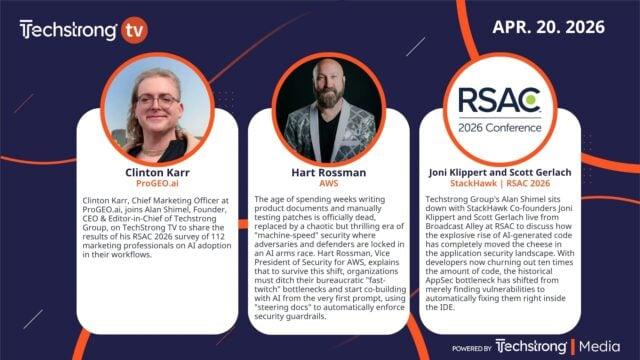
Techstrong TV January 13, 2026
Watch our live stream Monday through Friday, featuring exclusive news, announcements and conversations with IT leaders and experts on topics ranging from digital transformation to #DevOps, #Cybersecurity, #CloudNative, #Containers and deep-dives into specific technologies and best practices. http://techstrong.tv/
Transcript
Hey, everyone. Welcome back to our live coverage day, one of Amazon or AWS Amazon Web Services, reinvent. I am really happy to be joined by this guy here.
You may not recognize him. He looks 10 years younger. Sand's the goatee, he's lost weight.
Come on, he's in fighting shape. My friends, you know, the Steelers could use some players. Maybe you could help us out here.
You could watch that. That they would, they would pitiful. That Was, I was proud of Aaron to come up and basically say no.
Just say, oh, Afterwards, We need to do better. And I'm part of the problem. You know, like that's As there's a leadership message there, right?
I mean, I, I do, I give them credit. It doesn't make it hurt any less. I think there's a lot of parallels.
AWS they're, they're doing that right now. They know that they sort of miss the first wave of this AI pivot. 0.
And they're recognizing the things they need to do, and they're, and I think they're making those pivots this week. They made a really big pivot. I think you're gonna tell me Matt broke his, had bloody notes too, but, no, um, That was good though, right?
Yeah. That was way To get back on track. The way you brought that back in here, it's like, I've been here Before.
Absolutely. So, if you don't know this gentleman, Daniel Newman, CEO Fu group, he's my friend. Um, I'd love working with him and he always has great insights.
Like this little tidbit you just brought us back to AWS So we, I was talking with Mike Ard this morning. Certainly this is all AI all the time this year at Reinvent. Um, what's your take?
I mean, obviously they're making a pivot. They're going hard at ai. Well, I think they recognize, so we are in the era of AI cloud and, you know, future, and we do our signal evaluation.
AWS did not score in top two. Did not. It, it has fallen behind both Google and Microsoft in this era.
Now, AWS has this massive advantage called a humongous customer base. They have a huge customer base from the first cloud era. And by the way, anyone that's worked with CIOs, as long as you have, I mean maybe as long as I have knows that in the enterprise, it's not the same as the consumer, right?
And it's not the same type of pace of sentiment. There isn't a new thing that comes out and everybody just ditches Google for chat. GPT when it comes to cloud.
These companies are deeply integrated in AWS And so while this AI pivot maybe has forced some companies to do more multi-cloud and have seen some workloads go to Google and some, the opportunity is still really in place for AWS. So they had a couple of big things they needed to prove this week. Uh, the first thing they needed to prove is that they really are the place for the enterprise to commit building ai, generative AI applications open up to more developers.
com community knows really well. Sure. Um, that they have infrastructure, that they have an approach both their partnership with Nvidia and making sure the market understood that they have the Nvidia they needed.
That was something that early on, they maybe rotated a little quick to their homegrown TRA chips before it was the right answer for a lot of their customers. And then of course, um, you know, they needed to, to show that they could really open their, um, aperture to the developers of the ai, you know, and I kind of, I kind of g glossed on that. But like, you know, they, they focused on that with their announcements with Kira, what they're announcing there.
Yeah. Um, agent Core with the ability to build agents, they need to be the place where people are building the applications that run their business. So they had that mission this week.
I think Matt Garmin in his keynote, he always gives a good keynote. He's a real product guy. He's, he's a real product guy.
He really is. He, you could see it. And It was a very product kind of That's the AWS y Yeah.
That is the AWS Y. And, and of course, you know, I think the one thing that they, in the last 10 minutes, they did like a speed round of every other announcement that they had, you know, uh, Kubernetes and all their regular instances and CPU instances and storage buckets and everything else they're doing. Mm-hmm.
Um, but like you could tell this was all about being a prove it moment that we are a cloud that's ready for the AI era. And I think they did a good job. Absolutely.
Couple of, you know, plays off of what you said. Number one, you're right, this almost wasn't about cloud. We didn't hear as much about S3 and Lambda and Serverless and all these cool things that AWS pioneered.
We did hear a lot of Agen ai, you mentioned DevOps, actually one of the three main agents that they announced they call the DevOps agent, which we, you know, I thought, you know, tip of the hat to them for that. Um, another thing they announced though, and I don't know, maybe it didn't register on your radar screen, is, um, what's it called? The Forge.
Nova Forge. Nova Forge. So I look at that and say, wow, that gets me excited.
And then I think, well, how many organizations do really want to build their own foundation model? Well, and that's a great point. And, and that was something I probably should have had on my third thing in the first list.
But first of all, Amazon is part of their prove it. So I mentioned, you know, the traum and the vertical stack of infrastructure. They talked a lot about that.
But the other part of the prove it is I talked to, uh, investment, uh, bankers. I talked to other analysts. I talked to media and press regularly of, I talked to enterprise customers.
A lot of 'em didn't even know Amazon built models, right? So, you know, they had Titan originally they did Titan, and then they really went in with Nova. But like really opening the market to understanding that they are in that business.
'cause that really is the complete, we have all the compute mm-hmm. And all the infrastructure. We have all the developer tools and frameworks, and then we have the models, right.
And being able to say, like, and then of course, bedrock, where you can basically bring all these Models, Plug it in, and you, and you deploy the, the, the applications. That is the full stack story. And you know, you saw last week when people started to get the idea that Google and TPU could be a competitive offering to the sort of open GPU era.
Mm-hmm. Um, specifically Nvidia, but it could be a MD, it could be anything. Um, and despite the fact that I would argue that most of what was presented is not quite factual about that, the thing that's made Google so attractive, the reason it's risen to all time high is it's market cap.
So you're Saying what was offered by Google? Not what was offered by AWS or both? No, No.
What I'm saying, well, first of all, I'm, I'm eventually gonna get to my parallel. It just takes me a while. But like, okay, what Google's doing in the full stack mm-hmm.
Has given the market a lot of appreciation for Google. Yes. Now, Google is unique and they were rewarded.
It's corpus of data is unique. It's a little different. But Amazon has quite a bit too, from its ads, from its commerce business, a lot of very unique data.
And of course it has a lot of enterprise data, which is where the majority of data still actually sits. But Google's finally getting credit for being full stack. They're getting credit for saying, Hey, you built TPU, you've built the networking, you've built compute chips, you've built, uh, they Have the vertical stack.
You've built the agent and applications and Vertex and builders. And of course then the models, Gemini proving to be very good. Amazon wants to follow suit.
They want to say, Hey, we got Traum. Hey, we've got Nova. Hey, we've got Agent Core.
Hey, we've got Kira. Hey, we've got like all the things that you that are required for basically an enterprise to say we can run all our AI in one cloud potentially makes it more valuable. Amazon hasn't gotten all of credit for that.
And so this was an important inflection. Now we gotta see how much the market digests that. Yeah.
And how much they believe it. Let me ask you a question, though, at the TRA chips and the Google TV too. Is this really a competitor to Jensen and the NVIDIA people?
Or is Broadcom? Well, Broadcom makes the chips for, for, for Google. So Broadcom is the full end-to-end design.
They do it all. Um, But not for the Amazon tra No, no. TRA is different.
TRA is Marvell. It's all chip. It's actually sourced through a number of different suppliers.
Um, but, but largely Marvell. Um, I think the right question here is are custom AI chips competitive to merchant silicon and specifically the Nvidia ecosystem? And like I said, to a lesser extent, you could argue the A MD ecosystem.
Sure. Well, they, they're the up and calmer. Yeah.
But like, I think the answer is, and I I, I think we've talked about this. We've market modeled it. We do believe the custom chips will actually grow faster towards the end of the decade.
And here's the reason why. There are a small subset of companies that are the largest buyers of infrastructure compute. So there's a benefit.
And the reason Google really invested, and now remember, there's seven generations in. It wasn't like they came out with a new chip and everyone's like, oh, it's gonna replace Nvidia. Seven generations in, I think in their sixth generation, they were able to train a first kind of high performing, large language model, Gemini advanced that was on their own infrastructure, which was a big breakthrough.
'cause obviously before the idea was like, everything has to be trained on Nvidia. So that's, that was a pretty big inflection. But it, but Google, you think about what Google does, it does AI all day.
It's doing massive volumes of infras of, of inference all day long on its own infrastructure. It needs to think about its margins. So a company like Google that's doing that much scale, of course, might look at, Hey, here's three or four specific workloads.
Let's build a custom chip that really works for everything we do for search for recommendation engine. Mm-hmm. We'll build it at scale.
We'll invest big upfront, but our, our, our cogs will get a lot better than when we don't have to pay that 75% margin to nvidia. Having said that, though, like the, they're always, at least as far as we see it gonna be probably one, if not two generations behind in terms of the most advanced NVIDIA chips. So token economics, inference, uh, efficiency, uh, performance, memory, throughput, all those things that are really critical to training, uh, pre-training to doing large models.
Um, but also just a scaling tokens in like agentic eras may or may not be as efficient on those, um, on, on the custom chips when you need the flexibility. And so what I think ends up happening is it's really our, our vision of the AI market is it's all hands on deck. You'll see me say this anytime you see me talk about the bubble.
And social is like right now, every single wafer that TSMC can produce a chip on is being sold. So Nvidia has a certain amount of capacity. Broadcom has a certain amount of capacity.
Broadcom can make a certain amount of units, and every one of them is being built these companies. So you gotta expect, by the way, not just Broadcom, it's others, but Amazon, Google, Microsoft, Oracle, OpenAI, um, they're all meta. They use so much AI that they're gonna use some of their own chips.
And by the way, this isn't new. They've been doing this for a while. We've seen the arm movement with CPUs that moved certain workloads off Intel and off mt.
Right. This is a business decision, but it's not necessarily because they believe it's the most performant of the best technology. They're trying to fill a gap, hit margin levels, understanding that not every workload needs to be on the most advanced chip.
And, and of course in the end, they're looking at delivering EPS value and you know, absolutely. If they're meta and they're doing ads, can we build a lesser priced high performance chip that just focuses on serving ai, AI slop to us all day long? As we, as we, as we run around our meta application, There's, there's a world for AI slop, but you know, it it, but this is not a new strategy.
No. Right? It, it, it was always, it reminds me of when I first got into security 25, 30 years ago, asics, ASIC based security appliances.
Yeah. This was before we had SaaS or NY any of that Stuff. Just asics too.
Right. And, and that's what, and back, basically, it's the same stuff over, you know, history repeats itself. You just, that that's what we're dealing with.
And you know what, for certain security functions, you know, custom made asics still Penny for penny dollar for dollar gave you the best bang for the buck As long as it was for the right use case map. It, it's that narrow use case. Yeah.
But it's the same thing here. Metas serving ads is, is a particular one. Um, I'd still look, if I was a betting person, I like NVIDIA's, you know, seat maybe better than some of the other players.
Yeah. But if, if they could maintain just one or two generations behind Daniel, that's a get a lot of value. Freaking market.
They can get a lot of value. There's a lot of need. There's a lot of, um, you know, sort of deprecated workloads, just like on compute.
Like people didn't just throw their last generation, uh, data center server absolutely CPUs away. They, they use 'em for less important workloads and they would, you know, they would prioritize new workloads and they would upgrade and they would replace, and they would add. Right now most of what's going out is, is is new.
Right. Um, and interestingly enough, like, you know, Nvidia, I say it's three to five years minimum before the custom chips could eat meaningful market share, if ever. And I still think it's more of an and than an or.
And I think there's a lot of kind of the, the biggest risk to, to NVIDIA over time is as these big buyers, the ones that are buying so much of their technology, are able to do more and more on their own chip and with their own margin structure, is will that create any margin pressure On Nvidia? On Nvidia? So it's not so much volume.
I think if anything, the risk is more sits in the margin. But then there's other things too, like that Nvidia does. It's just so unique.
Like their, their entire backbone being optical. Yeah. And you know, like, you know, n they Don't, And Spectrum acts like, you know, but they're, they, the transport that between the GPUs is so efficient and so fast that like the latency issue is, is really, when you talk about clusters of this size, it's, it's, it's really meaningful.
Like until we get co packaged optics on, on all the backends of all these, of, of all these spines and everything, It, look in my day it was the buses. Yeah. Right.
On the, on the motherboards and forth. Well, it's still my, I've had a long day so hard on yourself. It's been a long day, but it, it was the buses and that, you know, that latency in there.
But what I think the other thing is, you know, necessity's, the mother of invention, it keeps Nvidia on its toes to be constantly innovating, to be constantly staying that one or two generations. And they've been great at that talking about, you know, Blackwell three hundreds are, are now ramping shipping and volume. Uh, we already know Ruben's coming, and we know Feynman's gonna come after that.
They're coming out two generations a year. And by the way, it's very hard to do with custom. It's very hard to do.
Like I said, there's a few companies in the world that can do it. And then the thing is, is like it's all run in their cloud. Like I will really, like, I've heard Foxconn's ramping up building servers with the Google TPU chip that could be sold outside.
But like, um, I think there's, you know, like NVIDIA's a merchant silicon company, meaning that enterprises can buy it. Neo clouds can buy it. Like, you know, like, is Amazon gonna really buy a volume of Google chips like ever?
You know, of course not. They're probably gonna build their own. I mean, Meta's unique, Meta's not competing with the hyperscalers, though.
Meta's slightly different. Well, They have a different, they're not the three hyperscalers, They're not the, they're not the selling cloud services in Terms a cloud, but they're a hyperscaler in and of themselves. But like, like the net of it is, is like, I just think it's, it's all hands on deck.
I, I think that, you know, we're hearing by the way, it was $1 trillion of expected AI infrastructure by like 20, 29, 20 30. You got a fancy game Going. We're getting, we're getting a thing going on last here.
I don't know, it's ESPN though. So, but, Uh, but um, now that number's been risen, possibly two to 3 trillion. So what I'm saying is like, look, we do market sizing.
We look at the market and it's kind of simple. There's market size and overall tam, and then of course there's margin in the TAM risk. And so on the, on the market size, it's like the market just keeps getting bigger.
We're building out 65 gigawatts right now of capacity, um, up to 80 here in the us. And I mean, you look at, the numbers are anywhere from 20 to $50 billion of spend per gigawatt on infrastructure. It's massive.
And so, like, they can't build enough TPUs, they can't ramp the supply chain fast enough. And that's another thing is like, we know Intel's on the way up and Intel's going to win, uh, more and more foundry deals. Some percentage of it has to work.
No, it literally has to because there's no other way tsm, we can't build enough fabs fast enough. So, but what I mean is every wafer is gonna be sold. And so right now, the point is, is like every wafer and every chip that that Nvidia can build is gonna be sold their backlog where they have half a trillion for next year, half a trillion order of visibility to next year, not including their open AI deals, not including their open AI deals.
So a lot of people are like, well, it's open AI risk. Well, this isn't, it's $500 billion of potential sales between now and 13 months from now. It's incredible.
Not every vendor has that cushion though. No, Not everyone does. But, but my point is, is like if, if really realistically A TPU or, or a train was a risk to nvidia, you would start to see it show up.
They deal. I I don't think NVIDIA truly has a real risk on the horizon. No, But they're fighting that battle in the market every day.
Absolutely. The market is trying to create the FUD that they do. And what I'm saying is they don't, but it, again, it's not zero sum.
There's so much zero sum thinking. It's not at the cost. Crazy.
Alright. A SEC. Yep.
Let's clean that up, um, at the cost of Nvidia. And that's my big problem is like, look, maybe over three or four or five years, you'll see some maybe Nvidia shed a couple points of market share. Maybe the TPUs and the XPS will gain a few points.
Maybe a MD will get a few points of market share. I expect all these things to happen. Mm-hmm.
I mean, I think That market, Qualcomm and others that are eventually, but the market's huge. There's enough, right? There's enough to lose A few points.
So, so, you know, if you're modeling, and one of my models are all saying is that NVIDIA's gonna be bigger than we thought it was a year ago. It's gonna be bigger than we thought it was six months ago. And even while all this other stuff is starting to take some market share, there's still growing Tam.
It's a problem that, you know, we wish we had in the research business, you know, that there was that much demand, but like to God's ears, you know, the bottom line is, is that I just don't worry about it. The bottom line is Nvidia, the $10 trillion company could be, There's no reason it, I think it'll be six next year though. All right.
You heard it here, Daniel. I want to pivot and switch gears a little bit. I want to talk few terms signal.
Okay. Uh, we've been talking about it here on Techstrong TV and in our tech strong stuff. And you know, look, you and I both know, right?
A good percentage of our market is all about up and to the right. It's just, you know, the, the way we were brainwashed, I guess coming through. Talk signal to our audience a little bit, what makes it so unique and so special and why they, and, and guys, you don't have to buy a subscription for today.
It's available to you right now. You don't need to, you know, all of the other stuff, but Talk. Yeah, I mean, we, we believe there was a fundamental problem with the way technology's evaluated.
You see, uh, models being introduced weekly, monthly with meaningful improvements, scaling laws mostly still intact. But like the improvements you're seeing between GPT-3 and four and five, or Gemini one and two and three, or even just, uh, the, we just talked about Nvidia a whole bunch. Like twice a year, they're able to roll out a major upgrade cycle or release of their stuff.
But yet, right now, if you want to evaluate those technologies, you work with an analyst firm, you, you do a year of interviews and meetings and you fill out forms, and then you, you get a report that comes out and it's six months outdated, maybe a year by the time it gets published. And largely by people who can't touch the stuff regularly. So you've got all kinds of just mismatching now in terms of technology and enterprise decision making with technology.
So the simple question is, do we eat our own dog food? Do we drink our own champagne? Are we in the business?
So we thought we could solve the problem differently? And so the the reality is, can you build a pervasive, autonomous, uh, evaluation platform that really offers true market intelligence, competitive intelligence, that can look at a, in an important, say, agent platform, say Neo Cloud, say, uh, CRM platforms, it can look at it up to the minute, can actually really distinguish, uh, it can look at the voice of the customer. It can look at the market models and growth data.
It can look at CIO decision data and, and it buyer decision data. It can look at the analyst perspective and it can really create this thing on the fly to completely revolutionize how buyers are able to be matched with the right vendors and have the right supporting evidence to make a buying decision. And so we built it and we built it in a way where, look, this thing is completely real time.
This thing has the ability to take every piece of information, hence signal that comes. It could be a S one filing from a acquisition or from any sort of market filing that the company makes a, a report that they put out. It could be earnings, it could be voice of customer data.
We did an exclusive partnership with G two. So every, you know, they have millions and millions of reviews. It could be all the analysts, uh, you know, the FU matters.
Yeah. The briefings, everyone in Futurum it could be, uh, conversations had with Techstrong. Uh, it could be Tech Field days where we bring experts in and, and, uh, advisors in to talk about different products.
It could be the briefings that we take. It could be events and press releases that come out of these. Why can't we use all this signal in real time to help evaluate the technology?
And by the way, I got feedback today. It was great from, you know, from an enterprise buyer. And they basically said it was the, they looked at our age agentic report.
They said it was the best report they'd ever seen in terms of truly comparing all the age agentic offerings. And then they asked me, they go, how much of that was written by people and how much was ai? And I said, it was a hundred percent ai, a hundred percent ai, big prompt, all ai, big prompt.
I mean, there's a human in the loop's. No, there's a ton of work that went into this, but the actual content was written Ai. But using all those inputs, that massive corpus of data, and by the way, this is just for this kind of evaluation, but the beauty of this is this can be for everything we do.
It could be for economic validations, total cost of ownership reports. It could be for insights and, and reports and research. And like, the model is slow.
It's broken, it's not immediate. Like we have to be as fast as the news cycle every week. Like two weeks ago, the TPU wasn't a thing this week, it was a thing.
The analyst has to be able to look at what does all this noise mean? And if you're a buyer, what should you be considering right now, the current way this is done, you won't have anything meaningful from the market. 12 months, three months, six months, 12 months.
12 months, three months to get a paper. Yeah. 12 months to get an evaluation out.
And so we're like, with Signal, what we're really doing is we're saying, Hey, how do we do this faster? How do we make it more accessible? And what we're doing, by the way, is you, you've only seen the beginning.
I mean, you've heard my story in the background, but I truly believe that this is all we're doing right now is the Netflix version of shipping DVDs. Right? We've created, we've shown the market that we can do this much faster.
It can be high quality and it can be a better experience than going into the store and running a video. But realistically, this can be streamed, this can be real time, this can be inter continuous active. This continuous, It's Continuous.
This can be comparative, this can be so many more things. And why in the world would we want to just continue to settle? And why would we wanna allow this industry to continue to evolve at such a slow pace when the stuff that we're evaluating is evolving at such a fast pace?
Is, is lightning speed? One last subject. I'm gonna let you go, please.
No, Please let me, if you like, if you like what Dan, and you know, Daniel knows a thing or two about the market, about, about the CPU market and, uh, the tech markets in general. You recently launched Futurum equities. Yeah.
Uh, I guess it's been six months already, hasn't it? Yeah. For people who, and there are a lot of you out there who follow the markets who are investing, how, what's the best way to follow you on, on future equities?
Yeah, Look, I the real quickly, you know, the, the stocks of the tech companies and the technology itself are inextricably linked. Like, there's this belief that, like industry versus equities is like two different things. It's not, um, the data that feeds decision makers and hedge funds or, or, or, you know, investment banks to buy stocks, uh, is the same data that CIOs are using to decide whether or not to use technology.
I mean, they, they absorb it differently. They read it differently. Maybe the modeling is a little bit more spreadsheet versus a little bit more practitioner.
But like, we basically realize that we have so much insights, so much knowledge, so much signal that we built future home equities to basically do the same thing we do for industry. But just put a little bit of a different lens on it. So mm-hmm.
We built a great team. Uh, you know, we've expanded the, the corpus of data. We've taken a lot of the, the market sizing and modeling that we're doing now to help us sort of assess which companies are, are good investments.
Now, again, we're not advisors, we're not making recommendations. We're providing Signal or Alpha like they like to call it to, to investors. And, you know, we're using that platform and some, you know, platforms like, like Substack and Reddit and, and X where investors sit really heavily.
And we're kind of taking all the great work we're doing in Signal and in our lab, uh, and in, you know, across our, our, our analysis. And we're creating content that's really designed for, for that audience. And, and within the next few months, we'll actually be launching True Sell side research that'll help, um, you know, audiences make, you know, we'll have some, some our opinions, uh, not advice, opinions on whether things are are a good buy, what things should be based on models, what the price is.
And by the way, we're doing this with just like Signal. We're building it completely autonomously. We can create these reports based on all the insights and data, everything we have that's publicly available, very clearly firewall.
Mm-hmm. Put them in different S3 buckets by the way. Okay.
Uh, totally making sure that we're in, That's Ws reinvent kind of hook in there. There you Go. Um, and basically we believe that the, the markets, the media and the, uh, enterprises all are symbiotic.
And we're gonna address all of them. I love it. Daniel, I know you were busy and we pulled you up here.
Nothing to do. I appreciate you always, man. Always.
Alright, thank you. Good to be with you. Futurum equities, Futurum Signal.
We're gonna be, I think this is gonna wrap up our Day one reinvent coverage. We've got a full day tomorrow. A lot of good stuff.
Our friends at Cuse will be back on with us tomorrow too. We've got a lot to cover with them as well as AWS themselves. But for today, hey man, this is Alan Hummel for Techstrong tv.
We're out. Have a great day. Welcome everybody.
I'm Mitch Ashley and I lead the software Lifecycle Engineering practice with Futurum Group. We have a very special video series that we're bringing to you. This is part one of a three-part series about AI readiness, and it's sponsored by BMC software.
I'm joined by Anthony De Starro. He is Senior director of architecture for AI with BMC software. Welcome Anthony.
Thanks for having me here today, Mitch. Well, we're talking about AI readiness, particularly in this, this first segment. You know, hear a lot about organizations needing to be AI ready for the mainframe at, at the earliest stage.
What does AI readiness really mean? So, uh, Mitch, I get this question a lot. I speak a lot of conferences and I do a lot of customer vis visits.
And this is like the first thing that, you know, always comes to the table. So when we talk about AI readiness, especially in the mainframe, it's such a foundational piece that the customers have to understand and, and get right. It's making sure that the organization can safely move into the realm of AI and start looking at AI as a way to maybe perceive it to look at it as an advisor, right?
You wanna have that advisor experience where the advisor comes in. You could use AI to explain maybe what's happening in your, uh, ops environment. Uh, you could use the explain capabilities in your, in your DevOps space with your development community, right?
There's a lot of activity around that. The, the explain code, explain code, recommend, et cetera. AI is a great tool to surface insights that would otherwise go missed.
But a lot of it is around guidance, right? When you have this advisor concept with ai, look at it as a trusted advisor to give you recommendations next, next step, actions, et cetera. But to really do all of this as an organization, you have to prepare yourself skills of your staff and understanding how to utilize ai, but also understanding where to apply AI and where AI fits, right?
You don't want an organization just to try to, you know, drink the ocean as they say, and try to apply AI to many different areas. That's a recipe that's not going, uh, going to work at all. But a lot of it's around setting up proper guardrails, policies and guidance around AI to set that core foundation moving forward and start slowly in your AI journey.
There's a lot of terms that kinda get thrown around with ai. We talk about autonomous AI agents, autonomous ai. How, how is an advisor AI advisor different than those other kinds of ai?
Yeah, and again, starting off in this advisor mindset, it's, it advisors don't take any action, right? Look at it as a human advisor that you would bring into your organization in a particular area or topic that you're bringing them in to explore. They're just getting gauge, you know, feedback and guidance to you based on their experiences, et cetera.
But they're not gonna take any actions, right? It's gonna be up to you to take those actions. And with ai, and that advisement mentality is perfect for that.
It just will give you those, the recommendations, those next steps. But it's up to you, the human to actually execute and do those things. It's not until we start talking about AI agents and agent later on where AI is actually gonna take action and do things on behalf of you.
But right now it's, you know, total human in the loop with the advisor mindset. And, um, it seems to be a very good entry point for a lot of organizations when they're starting to get into ai. Love to have you talk a little bit about what has to be in place for AI to be effective in an advisory role.
Yeah. Um, one of the things that we've learned as an organization and the industry as a whole, when you start to bring AI into your organization, AI, as we know, are driven off language models, in particular large language models. And when you get into that realm, we've learned for enterprise software and enterprise AI advisement, when it comes to an advisor, a large language model alone is not enough, right?
Because those, like large language models are trained on a huge corpus of text, very generalized, and really just doesn't apply on its own naturally into an enterprise. So what we have to do is augment that language model and how do we do that? Well, data access for the AI, given AI access to realtime data, critically important given AI access to internal enterprise knowledge, incredibly important.
So you wanna have the large language model augmented with realtime data, augmented with institutional knowledge that you want to infuse. And it's the three knowledge sources working together. That's what brings that good advisement experience.
'cause it's all about the context. It's all about what's relevant to your organization, to my organization in the domains that our businesses are in. So when we work with the, with, with the knowledge in, in, in that manner, that's what brings context and relevance to ai.
And that's where you get high value return from an advisor type experience with ai And talking about a mainframe environment, where do you see AI advisors delivering the fastest value? So it's been the development community that has been very receptive to the use of ai, large language models in the organization. And where they're getting high value from that is, especially in the mainframe, you know, look at COBAL code and the age of cold ball code.
You got the next generation of main framers coming in to code and work on the mainframe. They could be working code bases that are 20, 30 plus years old AI in that advisement role, in conjunction with the large language model, you get a lot of high value from code explained in that realm. So, I like the, I like the steps that we've taken as an industry on the adoption of AI in the mainframe space, in the area of software development, but we're gonna move well beyond that, obviously, right?
There's a lot of great activity going on in the AIOps space when it, when it comes to that. But here's a really important aspect that we've been seeing. I mentioned that next generation mainframe are coming into the mainframe space.
We could use AI now to capture knowledge of the senior staff that may be heading out in, uh, retirement. How do we capture, you know, decades worth of knowledge? We could use AI to do that.
We could use AI as a tool to help get that next generation mainframer up to speed, very quick, very effect, effectively up to speed. These are game changes in the mainframe environment. So you see the Dev X space, you see the AI ops space making tremendous advancements over this last two years.
We just, in the very beginning of this journey, and then using AI to help with, uh, as a, as a knowledge source or a knowledge base for that next generation mainframer to get answers very quickly, get them up to speed. Those areas are, um, are progressing along very nicely from our perspective and things that we see talking to our customers. Trust comes with a lot in conversations about ai.
So why is explainability so important, do you think, at this stage? So, when, when it comes to that, we explainability, it's about building trust, right? Folks that are using AI today have to establish a level of trust.
That level of trust is built through transparency. So we don't wanna look at AI systems as complete black boxes, right? Where we send inputs in, we get outputs out.
We're not quite sure how it arrived at a given result. So when you build an agen, uh, an AI agent system, you know, you have to have as much transparency into the pipeline from the AI system receiving a prompt to generating the output. Especially as I mentioned earlier, you've got the large language model, you may have some institutional knowledge with real time data, et cetera.
So when AI formulates a response, it has to cite back all the references to where it found this information. It has to give you complete transparency on who the users were, what those questions that they were asking, what those responses came back. And everything along the way in that journey from beginning to end has to be auditable completely.
Every transaction in and out of an AI system has to be, uh, traceable, auditable, and all the details of what happened along the way has to be completely captured. Uh, then once you start establishing trust, because you have that transparency, understanding how the AI system is working, how it c it came about a response. That's where we'll start to grow beyond the advisor part of the AI system.
That's when we start moving into AI agents, autonomy, et cetera, when that trust is established and built, but it's transparency which will build trust, that's what it comes down to. Very good. You know, for organizations that are just starting out, what do you think the smartest first steps are?
They have to do an exercise. And we did the type same type of exercise too, right? With, with, with our solutions at BMC, with BMC, Amy Assistant is our generative AI capabilities.
You know, we had a system systematically approach where we wanted to apply AI capabilities across our a ME portfolio. Customers, first time users, organizations into the AI space have to do the same type of exercise. You have to evaluate, uh, the landscape.
You wanna look for low risk, high impact returns utilizing ai. But the most important part of that is not just identifying those low risk, high return items. You have to also understand how to measure that.
If you can't measure it and you can't capture it, there's no point, uh, uh, moving forward. You have to be able to measure the, the ROI on your investment that you're making in that AI system, uh, that you may be creating in-house or bringing in, uh, from the outside. You have to do that.
So identify low risk items, which with high return, and again, I mentioned this earlier, start very slowly. This is a journey, right? I mean, this is not a sprint, this is a marathon.
And that's the way we're looking at it. Also, I see way, way too many organizations have the hammer and nail, uh, problem. They e every new problem that they're experiencing in the enterprise, they're trying to apply AI to it.
And these projects fail continuously. AI has its space in the spectrum of technology. It's up to us to figure out and understand over time where when problems arise, where does AI truly fit?
And I've had these conversations, even with our engineering teams, Mitch, in-house. They, they, they bring us in to talk to 'em, uh, you know, talk to 'em about some, you know, potential use cases or things they wanna do with ai. And sometimes it's a hard conversation, right?
Uh, at the end of the meeting, it's like, you know what, guys? The way you're doing it today is the best way to do it. Stick with what you're doing.
Don't move to AI if there's no measurable value for our customer in, in, in, in, in that return. But again, start small. Look for those low risk, high value items.
As long as you can measure it. Uh, go for it and see what AI can actually do for you. Well, very sage, insight and adv and advice.
Appreciate it very much. An Anthony, this is our, concludes the first segment of our three part series. Join us for our second video, which is gonna be on infusing intelligence with AI as a partner, generative AI in the mainframe environment.
Thanks for joining us. Welcome to Security Boulevard, the cybersecurity podcast from the Futurum Group. Our episodes explore a variety of topics within cybersecurity and the technologies that drive it.
com, the Security Boulevard, YouTube channel, Textron tv, and all of your favorite podcast platforms. Before we begin, let's meet today's panel, starting with Fernando. Fernando, it's good to see you again.
It's good to see you, sir. Happy New Year. Uh, I, so Fernando Montero, I'm, I, I, I lead cybersecurity research over here at Twitter, so Awesome.
And also joining me on this happiest of New Year's is Mitch Ashley. Mitch, it's good to see you as well. Best way to start off 2026 with a podcast.
Gotta go for that. So, Mitch Ashley, uh, I lead the software lifecycle engineering practice at the Futurum Group. Awesome.
And of course, I'm Tom Hollingsworth event lead for all things related to security at Tech Field Day. Let's jump into today's episode, because one of the things that I thought was kind of interesting is we've seen a rise over the last few months in more targeted offensive style security. Like we, we, when we think of security, you know, we still have maybe that old school mentality of a castle walls with a moat and some alligators, and we're gonna keep the bad people out.
But we've also seen in a way, uh, kind of an expansion of that, whether it's the red teaming of our own assets to make sure that we're being hacked by friendly people. Or in some cases, uh, researchers who said, you know what? I'm just gonna take the war to the bad people out there, or who I perceive to be the bad people.
So I wanted to spend a little bit of time talking with the guests today about that, because I think it's a fascinating way to look at it. When we play on the defensive a lot, it, it feels good, right? Because we, we defeat these attacks.
We make sure that people aren't able to get inside of our organization and steal data, cause chaos, whatever. But let's take it from the red team perspective. Now, why is it important in your mind, to have a group of people inside your organization that's dedicated to, you know, trying to pick the locks and guess the passwords and expose the areas that are maybe appealing to folks who would want to do harm?
Uh, where do we begin? Uh, um, I would argue that this is one of the things that personally attracts me so much to cybersecurity as a topic, which is this notion that I can't think of another technology topic where there is adversarial intent, right? Uh, you, it's not as if one database, uh, is gonna attack you or if, uh, if, uh, an external is going to log in and reconfigure your database because they don't agree with the settings that you've done for your arding or something, right?
Cybersecurity is that area where I, I, you know, how analysts hate the word unique. I can't think of another area in technology where there is adversarial intent, uh, uh, that there is an, there is an intelligent adversary on the other side of this trying to do bad things or trying to do things that you don't want done to your environment, right? And, and this is fascinating because it then introduces, uh, a dynamic that it's not, it, it's about you getting ready for what you think that badness looks like, and then testing it to make sure, right?
Uh, the, the, the thing I used to, I mentioned that many years and many pounds and, and, and better knees ago, I used to do martial arts, right? And in martial arts, one of the things is that we learn not just to hit, we learn to defend. But you know what, at some point you get tested, someone is gonna kick your face, and if you're, and if you're not there, you're gonna get kicked.
Same thing happens here, right? So, uh, there's a few more things, but I don't wanna to monopolize the conversation as usual, and that'll bring economics in a little bit. But What's the phrase is every plan's great until you get kicked in the face or punched Tyson, Everybody has a plan until they get punched in the mouth.
That's what it's, Yeah. Um, just kind of thinking about this, both from a, having been a practitioner and, uh, run red teams before, and also from, uh, an analyst perspective, the, I think one of the best things about doing red teams, and now we can, you know, use this with ai, uh, in addition to help us do this, but it puts our ourselves in the, in the headspace of an attacker and trying to think of novel ways or validating our, do our procedures as our technology is, uh, is our automations, all the things that we think we have in place that are gonna be great when a hurricane comes. Well, let's pretend we have a hurricane so that we can see when it really does happen, or we think it, it, the unexpected happens.
Let's try to think of those unexpected novelty kinds of attacks and situations that we might run into. So it, it's extremely valuable because it's not just saying, okay, we built the walls and the moats and all the things we think are gonna protect us. Let's just wait and see what happens.
You know, it's kinda like you gotta read the play while it's happening during the game. So let's practice some of those situations so that when it comes up, we're ready for it, or at least we think we're ready for it. And usually that'll help us in our response.
So I think it's extremely valuable to do, and I think more mature security teams do. The red teams, not just with themselves, but also with software teams, platform engineers, et cetera. So that's really is a cross-functional activity.
And let's just add one more nuance here that, uh, uh, I think that you, you're absolutely spot on. And we can say that there is a continuum of offensive suit. There's a continuum of testing, right?
Uh, uh, Tom brings up the, the, the red team. So red teaming is, okay, you have people in your organization whose mandate is break in, right? Or, or or under whatever, under whatever rules of engagement they have, right?
Uh, one of the things we've observed in the markets in the past little while is the, the rise in, uh, breach and attack simulation and derive, uh, uh, some people refer to it as integrated security testing as well, right? Uh, it bleeds into control validation, right? Do I have, uh, do I have the right controls deployed the right way, right?
Uh, um, there are vendor like discern security or safe or, or, uh, or others, right? And the notion here being that, okay, you said you did it right. How well did you do it?
Right? And, and I think that red teaming is a phenomenal aspect, but it's just one of those, sorry, ab cough. So I like this idea of the red team in theory, where I tend to fall down with it is it's either too restricted or it's too chaotic.
And, and Fernando, you bring up this really good point about rules of engagement, right? Like, like sometimes you kind of have to set these baselines, and if you've ever listened to, uh, Jack Reciters Darnet Diaries, like every once in a while he'll have like, uh, tales from penetration testers and some of the stuff that they kind of get up to. But like, you know, for me, you know, uh, an easy ground rule is you can't use your employee credentials to do things like access the data center, right?
Like, why would I be able to get that unless I was able to obtain it from like, lifting somebody's key card in a bar or something like that. But I also think that if you set the rules of engagement too narrow, then you're basically what you're doing. 'cause I've seen this in, in print in a lot of other places, it's like, well, you're only allowed to test our security at the gate and you're only allowed to go through this gate and you're only allowed to go through the gate between these two hours.
When I have my best security people working, it's like, yeah, but what if I wanna come in at three in the morning when the guy's half asleep? Like, like that? That's kind of one of those things where you're like, wait a minute, this is not how a real person would would think.
But on the flip side, you cannot let it be too chaotic. 'cause it's like, oh yeah, well I just, you know, uh, broke out a window in the data center and snuck in and the therefore your physical security sucks. It's like, yeah, but the data center was on the sixth floor.
Like, nobody would, somebody would've seen you or like you, you have to kind of play by a certain set of rules because what you're really trying to do is you're trying to improve things. Like, like I think of the scene in the matrix where, you know, where Morpheus is beating up Neo, but it's not because he's trying to win the fight, it's because he's trying to make him a better fighter. It's like, you know, do you really think that's air your breathing?
Like to me, that's the punchline of a red team. It's like, did you not think that I would bring a set of lock picks with me? Hmm.
Or teams don't have to be just a, a wild game of chaotic game of capture the flag. Um, I think you're right. There is a set of scenarios that you run wanna run, and it's a set of things that you want us test.
Now you may end up testing things you didn't plan to in some of those scenarios, but I think that's also a place where you can use AI to feed in your scenarios. We're testing in our red team, what are we not thinking of? So try to think of those things that we're, we aren't, that are, are areas that would be important to test, but you may be interested in response, time of incident response, you may be are instead, are we collecting the right data?
So when we have to diagnose and investigate what is happening, we can actually do that. And where are there gaps in our visibility into it? Is it things that might be in our observability system?
Is it things that it might be in our governance or, uh, other aspects of how you operate? So it's as much a test as the operations, the policies, as it is the people in the process and the technology. So, so I think that we're, we're diverging here.
Uh, like I, I think that there's a nuance here. What we've been describing so far, I agree, uh, is basically a penetration test, right? It's bound, uh, or it, it, it has boundaries, right?
Uh, and red teaming, at least from my perspective, is more, is a little more free flowing, right? It's look inside our organization, let's say that I have a security team of, of, of 20 people, right? And I say, okay, the three of you are my red team, right?
If you remember, um, uh, world War Z or Yvette, I mean Canada, right? Remember the, the, the, they have the, the, the, the odd man out in the group, right? The, the, the, they, they talk about who's thinking about stuff that we're not thinking about, right?
That's the mentality I think about for a red team. It's like, okay, the 17 of us, we're building defensive and, and, and we're doing all these things. The three of you, you tell us where we're wrong, you tell us where we're breaking, what we're missing.
And in that mentality, I would rather have those three people with as much freedom as possible. It's different than a penetration test, which might be a checkbox element, or maybe not just a checkbox might be a, a, a critical step in a pro, in a, in an implementation process where, okay, this thing needs to be validated before the project gets shipped, right? I, I see red teaming as being a little bit more free flowing.
So Tom, I would politely disagree that you can't use internal credentials. It's, look, assuming that somebody has internal credentials, what can they do, right? And then you go from there.
So the, the, the, the boundary between where does a red team, where does a penetration test, a vulnerability assessment, a penetration test, and the red team, uh, it's a continuum. I would say. I, I, I can see your point.
I, I, I think that, you know, a lot of people tend to use that terminology in, in interchangeably, and they shouldn't, you know, they think that a vulnerability assessment is a red team performing a penetration test, but in fact, it's, there's subtle nuance, right? You are, you are attempting, you know, here I'm testing a specific thing. Whereas, you know, maybe in general the, the offensive side's idea is to constantly be on alert to, you know, check things.
I, you know, like the, the Netflix Chaos Monkey, right? I'm always looking to break things to see how well you've built them to make them survivable. But when you get to that point, you know, in the case that it's somebody that's employed by a company, it almost kind of falls over into the other part of offensive security, which is, if I know that I'm being hacked by somebody, or if I know there's a group that's targeting people like me, why don't I go after them?
And that's kind of one of the things we've seen towards the end of 2025 was, you know, some talks that are being given by people at overseas, uh, conferences where it's like, yeah, I, uh, I basically went out and collected a whole bunch of information on SAB individuals, and I'm gonna give it to the FBI and, and, and then I'm gonna delete everything that I did so that, you know, nobody can get ensnared by it. But like, you know, we, we've seen that before, right? Like, um, was it Marcus Hutchins was what was one of the greatest offensive, um, people of all time because he effectively black hole and exploit before it could break wide by registering a domain name that was a kill switch.
Of course, when he did that, that led to a whole bunch of other problems, which is usually what happens to these offensive security researchers is they have to toe a very fine line between I'm doing this for the right reasons, and now I've become an enemy to the people that I'm attacking. And if that's a state sponsored organization, well, now you're on somebody's list. Like, like where is that line for people?
When does the red team for my company become, well, now I'm just gonna go attack people that are the bad guys. Well, I think you have to be very cautious about going and attacking the bad guys. Mm-hmm.
Right? I mean, in NA Nation states can do that. They have the infrastructure, they have the wherewithal to do it.
You as an corporation or enterprise or whatever entity you are, you really wanna go sort of poking the bear. And now, because they're gonna respond, right? If you really do something, are gonna do something serious.
Mm-hmm. You're like to get a response. So I, I'd be very, I'd be very thoughtful about how I would, but Mitch gets you the headlines that, that's the thing, right?
Is I wanna be hacker famous. I wanna be the one who brought down the, you know, fancy gummy bear team this time that was like, you know, stealing Bitcoin from people. Um, like that, that's, how can you avoid the, the lure of that, Meanwhile, while you're fixing your credit report and everything else that, uh, they compromised because you got their attention, you know, it isn't worth it.
True. Yeah. This is where, let's bring in economics.
This is where the, the Dunning Kruger effect comes to mind, right? It's the, the thing that, in the context that I think that I, I I wholeheartedly agree with Mitch, that you need to be exceedingly thoughtful about this, and you need to, uh, because the expectation that you are going to bring down a massive state sponsored, uh, campaign, um, seems, um, ambitious, right? And, uh, I think that there is a, um, uh, yes, the, the, I I think that, that going after, uh, going after, uh, malicious actors, uh, yourself does have benefits in terms of yes, your, your, your attacking, uh, someone who is doing harm to your, to you or your community.
You are learning potentially new techniques, but be very careful about what you're doing because you are stepping into, uh, a world that you may not be ready for to bring my favorite movie quote from, uh, untouchables 1987. You were bringing a knife to a gunfight, right? Uh, we wanna be exceedingly careful with that.
I, I would, uh, this is the kind of thing where we, where we talk with, with, uh, more junior practitioners, Hey, should I be doing this? This is one of the areas where I'm like, you really, really wanna think this through many times over? And that probably the answer should be no.
But that's just be, Might be bringing a knife to it. Rpg Yeah. Fight.
So be careful In today's, well, not only that, but if you're doing it on behalf of a company, you've opened that company up to liability. That's why you typically see these groups, if they're anybody, it's usually single people or, uh, like their own little collective, if you will. Um, simply because, like, they may not be able to shut you down and ruin your credit to Mitch's point, but they can have their government file a, you know, a lawsuit on your behalf against the company that you're working for.
Like, and that's one of those weird things of like, you know, where does the problem actually lie? Because I, look, we've all looked at the firewall logs, like, why is this guy in, in, uh, some eastern European country trying to SSH into my server? I know I'll do this to him.
It's like, no, you can't do that. Or you, you have to think about the rules of engagement for that, because it can escalate very quickly. And, and I think that most people, they, they love the idea of punishing someone.
They do not like the idea of getting punished. And, and that's usually what happens is, is you will, you will turn around like, Hey, take that energy and use it to defend yourself better. Like, like, take what you're doing and turn it on your own firewall and go, okay, I'm gonna find all of the little problems in here and, and you'll, you'll be better off for it.
But yeah, once you've poked the, the bear or the fancy whatever it is this week, like you are in for a world of hurt, I mean, to, to reference that point, that the hacker Martha Root, the reason why they appeared on stage at this conference in a Pink Power Ranger outfit was 'cause they really didn't want people knowing who they were, because it doesn't take much for you to figure that out and start causing all kinds of havoc. You know, one things I wanted to bring up is red teams can also, I, I, I'm sure you're thinking about this, Fernando Red teams can also look ahead and say, Hey, I know we're using AI right, in these productivity tools with 365, and, but we're also, maybe we're doing some experimentation with LLMs. Maybe we're building some early agents, maybe we're really going gung-ho on doing some of those things.
And you can use your red team of like, well, let's, let's take a break from the day to day. Let's talk about new things that we're doing and what that attack surface looks like, and how would we attack it based on what we know? And maybe that'll surface some shortcoming, some big things we need to address now.
So maybe you need to go to the agent control plane and see if that's something you can thwart the guardrails, maybe the kill switch. They're, you need to kill switch for certain kinds of agents. Um, you know, of course.
And then there's prompt injection and prompt poisoning and all kinds of good things to go examine that also educates you, but you gets you thinking ahead of before somebody in leadership says, Hey, now we need a policy for X, Y, and Z with ai. Well, we've already been working on that, you know, we're, we're ahead of the game there, at least we're, we're partially ahead of the game. Whatcha thinking about in that space, Fernando?
Yeah. Well, I, I, I think it's Tuesday, right? I'm thinking it's Tuesday.
Like, okay, we're not recording on a Tuesday, but I think it's a Tuesday, right? In the context of yes, it's now part of the organization's attack surface where I would be, um, where, and, and I, and I think you are right, that red teams need the, they need the skills and the knowledge to know their, their environment and attack their environment with current tech against current, uh, expected threats, but also against, Hey, what else is going on out there? To your point, ai, right?
And the, the, the thing that I would be, um, I would be cautious of is to go back to Tom's point, rules of engagement, right? If, if the, the, the, the red team, if the, the, if the red team is attacking an AI environment, right? And is highlighting all kinds of flaws about that AI environment, right?
But that AI environment is not in production yet, right? That's kind of like a of, of, uh, being not a very good team player. I'm not sure how much we can use, uh, uh, expletives in, in, in this podcast, right?
But, uh, uh, it, it, it's one thing for organizations to have an understanding of the, the, the, the threat environment for what they're building. It's another thing, one, once they put it into production, right? Which brings up the, one of my, the things that I think people should pay particular attention to, which is threat modeling, right?
So, uh, uh, when you think about rules of engagement, I think that one of the key contributors to that, to the, to that set of rules is what is our threat model? What it's, that we're concerned about from one perspective. And that threat model might be, uh, might be guiding what we're doing.
That threat model might be incomplete. And this is where the knowledge from the red team and others about, Hey, look, your threat model worries about A, B, C doesn't worry about D two Z, right? Uh, um, that's an very important contribution that I think red teams can, can, can have an insight on, but at the same time, they should only, uh, uh, do the red teaming stuff in the system that is expecting that, right?
I think that, uh, that, uh, to go back to martial arts, like if I'm, if I'm just practicing a simple block, right? And someone, uh, complains that, look, you're not, uh, you're not protecting, again, you're not protecting your shins, whatever. Look, no, I'm, I'm practicing my blocks, right?
Let's, we'll deal with that later. So yes, I agree with you a hundred percent, uh, with the caveat that people should be nice to each other. I, yes, there has to be kind of that assumed, like, I'm not doing this to be malicious thing.
But at the same time, going back to something that I learned late last year from our friends over at Microsoft, this idea of using graphs to do this, like graphs are the way that people think, right? So when I land on a system and I examine all the ways that I can move off of it, like, what if my extranet provider has an unsecured link? Like, is it my responsibility to report that with the hope that they're gonna fix it?
Or should I probe it to see how far I can get? Because a lot of times that's what happens, right? It's like, oh, well, I found out, like I, it's basically a tell net connection or something stupid like that, and I can get a whole lot of access to your systems that I shouldn't.
Well, why were you doing that? You should have, you should have not told us. And we see that a lot with like vulnerability reporting and bug bounties, right?
It's like, you know, why I reported this six months ago? Why haven't you patched it? Oh, well, it's not a low priority for us, but as soon as you make it go live on the internet, suddenly you know, oh, you're in trouble because you disclosed this and you shouldn't have, like, you, you, you've gotta play within the rules.
But sometimes you have to, to break or bend some of those rules to affect change. I also don't, I think you don't wanna blur the lines between hiring someone to do penetration testing versus doing your red teams. In other words, you're not, you're not the you internal version of an outside group trying to, uh, trying to penetrate somebody else's stuff.
To your point, Fernando, about, um, doing things above board, right? You, you may want to do some testing against a application that's getting ready to go into production, but you pro that probably ought to be at the request of, or in cooperation with the folks that are getting it ready, right? That's part of your security readiness process.
Um, but the, the advantage of an external team is they don't know what, you know, you know, you, it's an advantage of all the stuff you know about your systems and infrastructure, everything else. But that's also a, that's also a liability. 'cause you're stuck in a framework of how you think about those systems and how they're secured versus someone who doesn't know that they're gonna find the things that you're not thinking about.
So I think we need to separate the why use an external penetration pen testing group versus what a red team is doing. It's not to supplant that external function. I, it, it, it's interesting that, uh, I see it as, uh, I agree liability and, and the benefit.
I see the benefit more than the liability in the context that, okay, I know that this particular system was connected to that old project, but you know what? That, that, that project stakeholder, they, they left the company, right? Hmm.
I wonder what's going on with that, uh, with, I wonder who's managing that project now? And then off you go and you find an area that, that is not being observed, and things blow up from there, and, and you were able to, to successfully do that. The, the thing that I, I worry a lot is, is when you cross that boundary between I am testing something that belongs to my organization, I'm testing something that belongs to somebody else, right?
And this blows up in many, many ways. I'm, I'm thinking here about those two pen testers from, uh, that were arrested and, and, uh, were, were trying to physically break into a courthouse under the, the auspices of a, like they had rules of engagement, except that the, the, the organization that contracted them apparently didn't have the, the rights to, to do that. Like, it was, it's like a, uh, me pen testing a building when I'm just a renter at the building, right?
So that was, I think that was the, the, the crux of the problem. So you run into those things with professional pen testing as well. So I think that the guideline for offensive security for an organization should be mind your own stuff.
Don't go too far out. I'm also reminded of, and again, these things come all the time, but the, there was an incident where someone found a, an issue on a public website where they could, uh, enumerate thousands of, of, of, uh, IDs, and they did, right? Well, you should have probably stopped the two or three IDs just to prove the point that you can enumerate and not do all of them, right?
So, do you, I do you remember which one I'm talking about? I forget which, which city it was. But, um, these are all these kinds of problems where now take this one step further.
Oh, I'm going to go after against bad state, state sponsored, uh, group that does that. They're not going to complain about you to your employer. They're not going, no, no, no, no, no.
They're gonna try something more nefarious. Again, exceedingly careful people and just in, in all, like, uh, uh, unless there's an exceedingly good reason, stay stick with, stick within your organization kind of thing. I, I think that that's probably the thing we should take away from this, right?
Is there have to be rules of engagement. And if there are no rules of engagement, you have to start asking yourself what kind of battle you're fighting, because I don't think you're fighting the battle you want to fight. You're picking on somebody that will not hold back from attacking you.
And so if you have clear rules of engagement, you understand the objectives and you understand the purpose behind it, I think you're probably gonna be a little bit better off on the offensive security side. But let's be honest, the people who are really going offensive are probably not listening to podcasts like this. They're probably getting ready to write their own.
So I think we'll go ahead and wrap it up there. Um, and, and, and this is the thing. I just wanna say one thing.
Like I don't want people to miss. There are times when this is necessary, right? And, and here I'm thinking about all the, the, the offensive security that goes on, uh, in the defense of Ukraine, for example, right?
All that they've done with, with, with drones over there, right? That's a different scenario. Like we're, we're, we're talking war fighting here, right?
Uh, that's, uh, that's different than, oh, I'm gonna go after these kind of criminals and see why I can get about them, right? Let, let's, let's, let's keep those things in perspective. Yeah.
Perspective is, is what's important. Um, speaking of perspective, uh, Mitch, what are some things you've got working, uh, now here at the beginning of 2026 that people should be checking out? Well, we're kicking off a whole, whole series of things here.
Fernando and I have been working on predictions for our respective areas and, uh, and planning for our, also for our relative practices. So there's a bunch of writing that I'm doing. Uh, we have videos that are coming out.
We have, uh, predict 2026 that's happening, I think on the 17th of January, if I remember right. Somewhere along the line in a, in a few days, not too far down the road. So we're recording some of those things.
So it's a lot about looking ahead for the rest of the year and taking the lessons of last year of maybe a need to, to be a little more aggressive in some of my predictions. And things are moving pretty dang fast, uh, at least in the area of, of ai. But also, uh, where there areas of collaboration of not just in the practitioner world, but also us looking at it from an analyst perspective.
So doing podcasts and things like this. Maybe collaboration on some reports. I'm working on some ideas for two different new signal reports.
So there's a lot of planning setting the stage for this year, and I think we're gonna get even a lot more done than we did last year. It was a great year, 2025 for us. Awesome.
Fernando, what have you got? I concur. Uh, one of the things that I have is that, uh, I'm not sure when people are listening to this, but we're just putting the final, final touches on the, the cybersecurity decision maker, uh, surveys that we conducted in, in the second, in, in fourth quarter 25, that data for, for, for term subscribers, that data is now live on the platform.
I don't think it's been, uh, uh, I dunno if the press release went out yet, but that, so we have both marketing and, uh, and user sentiment, uh, data out now, which is really cool. I love this about my job, right? And, uh, as Mitch said, I mean, predict 2026 is coming up.
Uh, we have, uh, uh, where things are going, and, um, there is a lot going on, right? And, and the, the, the stakes on cybersecurity keep rising, right? Uh, this is foundational to modern society, right?
And that's what we're seeing impact in many, many, many places. Correction, it's January 15th, is the date, 98 and Eastern. Well, we've also got a lot of stuff going on over at Tech Field Day.
If you wanna check out some of that cool stuff, including, we're gonna be at RSA for the, uh, first time RSA 2026. We already have a page up. We have some great presenters that are getting ready to be there, and we'll be adding more information about some more great presenters in the list, and the delegates who will be joining us there.
com is the place to check that out. We wanna thank you for listening to this episode of Security Boulevard podcast. If you enjoyed this conversation, you know what to do, head over to YouTube or your favorite podcast application of choice, hit the subscribe button, and we don't want you to miss any of the episodes.
We also appreciate it if you'd leave a rating, a review, and a comment that helps the show grow and reach new audiences. com in the Futurum group. com, Textron tv website, or the Textron TV app, which is available on pretty much every smart device, whether it's a tv, phone, tablet, you name it, it's there.
Follow Security Boulevard on X, Twitter, and LinkedIn at security BVD that has all the content you could ever hope for. Thanks for tuning in, and we'll see you all next week. Hey, everyone, welcome back here to Techstrong tv.
I'm so excited to have my next guest on, you know, we were talking for way too long in the green room before we got on, but the first time I, I interviewed my friend, Andreas Prince. It was at a, I, I'm not even sure if it was a DevOps world or a Jenkins world still, but it was in nice France way before COVID. Good times.
And, uh, you know, we've been talking pretty regularly ever since then. So, let me introduce you. If you don't know, to my friend Andreas.
Andreas is the head of Sovereign Solutions at SUSE now, but is, is, oh man, he's had a storied career, and Andrea is welcome. Thank You. Thank you for coming on.
You know, I, I hope I didn't embarrass you, but give people a sense of your journey. Yeah. So our journey, right?
Started indeed in nice, I do think it was the first year they left Jenkins World and called it DevOps world, right? They were really trying to bridge, uh, but I started very much in, um, in actually in digital transformation. So helping organizations to pivot to more agile pho pace ways of working.
Did a lot of CICD automation, release automation type of companies. Uh, and then the last startup was all about observability. And that was acquired tech state by Susan.
And then I joined the bigger family, which is really, really interesting, uh, because all of a sudden there's much more power, right? Than rather having a single product you all of a sudden, uh, can influence platform polio. Um, so I'm now global Head Sovereign solutions and building actually our proposition around sovereignty, taking our products to markets, finding new partnerships, and, uh, yeah, really helping out Europe, middle East, Africa, to become more sovereign and more autonomous, if you like, from a IT perspective.
Yep. Thanks for that. And Andreas, and, and congratulations to you on this role.
I, I couldn't think of a better person for it. You know, Andreas, the whole idea of, uh, it sovereign, uh, sovereignty, data sovereignty, cloud sovereignty is really come to the forefront over the last year or two. We are living in, you know, I wasn't alive then, but in the, in the lead up to World War I, and let's hope that this isn't a lead up to another war.
But in the lead up to World War I, we saw sort of old empires dying out, new nations, emerging new alliances, new new ways of doing business, you know, because there was a bit of an industrial revolution going on there too. You know, the Austria-Hungary empire, the Ottoman Empire, they were breaking up countries like Italy and Germany, you know, were new, new countries back then as modern countries. We, we look around today and we see a little, not exactly that, but we see similar kinds of things the EU arising as, as a, as a power in this multipolar world, right?
It's not just the two superpowers that you and I grew up in a world of, um, technology is just changing our lives and, and the promise of AI and what it can bring. Yep. At the same time, we're also seeing, we're seeing a lot more violence.
We're seeing authoritarianism, we're seeing, you know, uh, different factions fighting for freedom, freedom of the press, freedom of speech, freedom of information. It really is a pivotal moment, I think, in history. I, when we look back at 2025, yeah, in many ways, 2025 is gonna be the first year of this new century.
I think for the first 24 years we were still living in a 20th century world. Yep. It's been changing, but now clearly we're not in the 20th century anymore.
We're in the 21st century. And sovereignty is, is part of that. How do you think, how do you feel about that?
Well, I, couple, couple reflections on that. So, one of them, right, is I do think the first 25 years has helped us to accelerate when it comes down to an innovation perspective, right? So all the cloud native, uh, application landscape, et cetera, right?
Help us now to run AI workloads in a very controlled way, right? So the first few years have been needed to accelerate and innovate where we are right now. So there's definitely a connection.
But I do think we're also entering a very interesting phase, because you could argue the entire sovereignty thinking from an innovation perspective is a bad thing, right? Because Europe is a kind of closing Middle East Africa, right? So we're making the world smaller because all of us are focusing on our own geographical, jurisdictional region, and sometimes even down to a country.
And when you think about innovation, right, where you need mass to really accelerate and experiment and whatever, I do think sovereignty as such might be a bad thing when we look back. However, I do think where it's a really good thing, and that's also what we see happening at our customers, is companies, executives, leaders, they all of a sudden, well wake up, if you like, to understand their dependencies, their dependencies on hyperscalers, their dependencies on the chips. They use their dependencies on the entire software supply chain.
And I do think that awareness is a really good one, because A, you need to determine your levels of business resilience. And it obviously contributes big time to that. So the positive side in my mind of the entire sovereignty movement is that we see a reassessment of risk, um, right?
No longer is a data center, below C level, um, a threat, but it's an opportunity compared to an American hyperscaler. For some companies, they were in the past, we would've made a different choice. Um, so bottom line, right?
I do think it's just the next transformation that will go through in our thinking, and then also followed by our IT choices and implementation in, uh, in engineering. I love it. And I don't disagree with you at all here.
Um, it, some of it makes me sad because I do think, you know, as, as a, not even a child of the internet, I was already an adult when the internet, you know, went public, went commercial, but as, as someone who spent their career in the internet, let's say, um, I love the i the global nature of it Yeah. That we're all one, one community. Yeah.
And, and this sort of thing, you know, building walls, I always like tearing down walls. Yeah. But you know, this, this, this is the, where we find ourselves in Yeah.
Andreas Susa has a, an aggressive sovereign solution product line, if you will, or vision, right? Yeah. It transcends just Linux or rancher, Kubernetes or SUSE software.
Yeah. It, it goes to the heart of the data center and support sovereign in every sense of the word. Yeah.
Expand on that for us, if you don't mind. Well, If you, if you think about it, right? That the world becomes or gets smaller, right?
Or people start to look at their, at their, uh, continents, if you like. Um, then the question is, what is still helping you to cross, uh, to, to, to, to step aside, right? Cloud Act or Cyber Resilience Act here in Europe?
And then I do think there are only a very few elements that are still helping us to build software that can be used across the world, and that's open source, right? So the direct effect of using open source is it gives you the freedom, right? To build it yourself, to create it yourself, to enhance it, and to, to, to use that to your own, um, needs.
And I, what we see happening here at, at SUSE is air opensource was obviously always our top, our top lever. Uh, but today, fascinating enough, all of a sudden, the markets is also requesting IT proprietary software, right? Where they don't, or are not able to assess the risk is no longer suitable for governments, uh, for public sector, for healthcare, for mission critical, um, industries.
So the fact that suse, right, as a firm believer of open source has that at the core of their DNA well, is really beneficial for us. So what we're doing is we're not only bringing our existing products to the market, but we're also rethinking is, hey, but what does it mean that we have features, like, for example, reproducible builds, right? That you can build anywhere across the world in any data center.
You still get the same version of the software out. What does that mean from a sovereignty perspective? Um, and we see and start to learn and have learned in recent months that we have a lot of diamonds in our portfolio that are perfectly suitable and powerful for a, for a sovereign solution.
Um, and then we start announcing that with sovereign support, eh, as an example where we say, Hey, for Europe, if you want to use open source, but you still wanna get enterprise support, we have a solution for you as well, which is sovereign premium support. So that's really what we have. And then we're adding on top new features, new services, uh, new partnerships to, um, to expand.
We're gonna, we're gonna dive into that in a moment. I, I think there's a, there's an interesting or an ironic kind of piece to this, which is at the same time, as you say, we're making smaller, we're putting up these walls, we're also relying on open source, which is the ultimate wall buster, right? The ultimate uniter.
It unites us all. We all can, everybody can use open source. We're using open source to build this sovereign, uh, offering.
And, and that, you know, there's a, there's like a, I forgot, not a dichotomy, but there's a, an interesting paradox there. We're using open to do sovereign get Closed, yeah, yeah, yeah. Make Closed.
Well, and I, I would re I would not use the word closed, I would say to gain control, right? Because ultimately it's about control, right? Knowing what is the software used, what are the packages in there, uh, what are the libraries being used, the vulnerabilities, the license types, right?
And open Source helps you to assess that very quickly and very clearly. Absolutely. Andreas suse recently announced a partnership and alliance with evoc.
So I don't know if everyone in our audience is familiar with evoc and certainly with this recent announcement, why, if you don't mind, give us a little evoc background. Yeah, definitely. So EVOC is a brand new, um, M-S-P-C-S-P really focused on helping governments, public sector, mission critical companies in Europe to increase the level of sovereignty by providing an infrastructure, a modern AI platform that is entirely European.
And when we speak about entirely European, the data centers, uh, the personnel, the type of support that is delivered, um, and that's then bundled with lots of open source software that they can support or are supported by companies like suse to build a stack on top where, um, companies can actually make use of, so imagine, right. Governments, um, that say, Hey, I wanna decrease my dependencies for my crown jewels, my mission critical applications on an hyperscaler, not for all workloads, but for a few other alternatives in Europe, right? Where I can put skill, um, and, and, and put my workloads on.
And that's actually what EVOC is doing. So they have data centers across Europe. Uh, they're continuously expanding, um, but they're really, really sovereign.
So they're founded pretty recently, only a few years ago. So they start building it with sovereignty in mind and with a modern approach in mind. And, um, yeah, that's what goes really well together with, uh, with suse, if you like.
I love it. Um, talk more about the strategic alliance. Yeah.
So imagine, right, a customer who would pick a company like SUSE to say, Hey, I would like to have a, a full stack from a software perspective, Linux virtualization, uh, cloud native rancher management on top, um, without sovereign infrastructure, right? You are as sovereign as the infrastructure. You run it on, on the EVOC side, right?
They could argue saying, Hey, we have a very sovereign infrastructure, but if, uh, the sore on top isn't sovereign, you're still as sovereign as the software that runs there. And that's really what we would like to achieve and have achieved by merging the two, using the infrastructure from frock, and then the software from SUSE on top, the Linux layer, the cloud native layer is really enabling customers to pick an entire sovereign stack and start migrating workloads, uh, head containers or virtual machines towards that stack. And that's then combined, and that's also the strategic element here with sovereign support from both parties.
And because that truly makes the solution, uh, sovereign. So it's infra software and services from both parties combined, which is our sovereign offering that we've brought to the market together with aoc. We love it.
Now, look, I get that a lot of this is aimed primarily at Europe, but you mentioned the Middle East and Africa. Yeah. Um, are there plans for data centers in the Middle East and Africa, people based there, or will they use Europe sovereignty, if you will?
Well, so, um, so a couple, couple very interesting moves going on. So Europe is definitely a trusted body place, country, right? So when software comes from there, it's very often what we see happening, accepted, for example, in Africa as well, right?
So software created here, um, is very useful when it's open source in the other two regions, middle East, Africa, but also countries like Japan, right? So that's, that's why it's really, really global. Now, from a data center perspective, right?
There's another challenge you need to solve, and that is what is your vision or where your data from a jurisdictional, um, perspective needs to be? And what we see happening is that data centers in Europe, right, are not sufficient to host, for example, a South African bank or, uh, whatever bank or insurance company that is out there. So they still pick, um, local data providers and the same to Middle East, right?
Middle East is not a single region, right? There are multiple countries with all their own rules and their own philosophy when it comes down to where the data needs to reside. So although, right, our ever partnership is absolutely the first one, right?
That, that tick all the boxes from a sovereignty perspective, obviously, right? We have partnerships across the world when it comes down to, uh, to data centers. But what we want to do is really help them to increase the levels of sovereignty, um, as such, right?
By, by software and by support that we could, uh, that we could deliver. Yeah, Absolutely. Also an important element, a lot of people think, right, that it's that sovereignty is, is black and white.
So they say, yeah, we now need to leave, all of us need to leave the hyperscaler and move to a party like EVOC or whatever data center here in Europe. And I do think that's a wrong philosophy. You first need to assess what are the most important crown jewels or the mission critical applications.
These are the ones you need to consider and probably still conclude, right? That you can run them on an, on an American hyperscaler because your business simply runs and in the US and runs in Europe, right? So you de-risk Europe, but there's, there's no reason for doing that.
Um, so governments, for example, they can take a bit more an aggressive approach, um, and they're moving, right? Or they're at least decoupling their hard dependencies to the, to the hyperscalers. But I do think people really shouldn't see it as a black and white.
Uh, but really as a nuanced approach, some ordinary workloads, well let them easily scale up and down at an hyperscaler, right? Versus some mission critical ones that you would like to protect with data and whatever you could run on a European data center. And I do think we're quickly losing that balance.
Um, but that's a very important one to, uh, to add to the, to the conversation. I, I agree. A lot of it is about data, right?
Yeah. And, and because that's really, now, yeah, the, the question may become, if that data ran on this application and this application's not in a sovereign, uh, uh, stack, do I have stickiness to go get that data? 'cause it was in that, you know, it ran on this application, and that's where bifurcating data from, from the app really, I think will, will come in.
You know, there's something else I want to state on here. For those of you watching this, this isn't about EU versus us or US versus China, or, or, you know, just nation states like that, even here in the US and js, you know, we have, we have some states where certain medical procedures are illegal, and in other states they're legal and doctors can prescribe medications and so forth that they may not be able to prescribe in a different state. Yeah.
And so some states in the US are looking to have sovereign data that is not subject to the Yeah. The, the prying or discovery by a different state. Yeah.
And those are states within the US even. Yeah. So, you know, this is kind of a worldwide trend that we're seeing where people are saying, Hey, I I want to keep my data private.
Well, I, I, I do think for the US it's certainly the data conversation. Um, right? So when we have conversations on ai, the data security, um, right, is a very, very old topic.
So we barely in the US speak about digital sovereignty, but we speak a lot about data security. So the data perspective is an important one. If you go to, uh, Africa, they speak much more about autonomy.
If you come to a few European countries, they would speak about business resilience, right? So all different angles, autonomy, resilience, sovereignty, data security, that articulate ownership and control of that. What is most precious to you as a company, right?
Because ultimately, why do you wanna protect the data? Well, because right, you run your, your company on it. Uh, one fun fact, I do think not a lot of people know, uh, but the US was the first and foremost country that introduced sovereignty.
Um, right? If you think about FedRAMP for the military, cloud, Cloud FedRAMP, yep. Um, Suzu started, or Rancher started Rancher government services, which is an entirely separate legal entity disconnected from Suzu owned, owned by Suzu, but Right.
We don't know what's happening there. Um, that is, that is sovereignty to the next extreme level. Um, so to us as a company, it's, it's very known how you bring that to the most extreme.
And funny enough, that started in, in the us. So, um, yeah. Yeah.
It's ironic, isn't it? It Is funny stuff. Hey, and Andreas, for people out here, maybe they're in Europe watching this or wherever they are, how can they get more information?
How could they get started? Well, when it comes down to, um, understanding, uh, digital sovereignty, um, right, there's, there's a lot to do when you are in Europe and you want to inform yourself on where do I need to look at when it comes down to sovereignty? The EU published only a six page document.
It's the Cloud sovereignty framework. It's amazing to, to read and to, it gives a really broad perspective. So that's definitely recommended to familiarize yourself with that concept, obviously, right?
com/digital sovereignty, uh, is a lot of information to find on products, on services, how suse can help you out getting more sovereign, uh, and understanding what needs to happen in this transition. I love it. Um, and Andrea, it's best of luck in this new, uh, role.
I hope to see you. Well, we're gonna hopefully be at Scon in Prague. We'll meet in Prague in March.
Absolutely. Uh, or excuse me, that's in April in March. CubeCon is in Amsterdam.
I unfortunately won't be at CubeCon. I'm gonna be at the RSA conference in San Francisco that week. But Mike Ard on our, and our team hopefully will be there.
Nice. So, we'll, we'll, we'll talk more about that then. Um, but look, don't be a stranger.
Come on here and keep us posted on this. I, I think this whole it sovereignty thing is, is a subject that we're gonna really see coming to its own next year. Yep.
Yep. And there's a lot in the pipeline here at suse. So, uh, stay tuned.
We'll definitely come back. I love it. Andreas Prince Head Sovereign Solutions at SUSE here on Textron tv.
We're gonna take a break. We'll be right back. Marvell and Excon, the final data center Frontier, AWS raises the stakes.
We're saying goodbye to Lou Gerstner logging for legal reasons ServiceNow acquires amis, and we should probably talk about A-I-C-E-S in this week's episode of the Tech Field Day Rundown. Hello everyone. Welcome to the first episode of the Tech Field Day rundown.
It is 2026, officially, it is the 7th of January. We're very happy that you are joining us once again, and in the immortal words of Dee Snyder and Twisted Sister, I'm not gonna take it anymore 'cause well, that's what today is. But what I am gonna take is a moment for my co-host to introduce himself.
Al, it's good to see you again. Well, thank you and welcome to 2026. The, uh, 7th of January is indeed a beautiful day here in New Zealand, where it's not currently International Programmers Day, although maybe it should be International Programmers Day, uh, and of course, national Bobblehead Day over there where you're, uh, Tom.
Yeah. You know, the funny thing is, I, I realize that people may not have their own bobblehead. Uh, I actually have a couple of them courtesy of our friends over at SolarWinds many years ago, and it really weirded my kids out that I have my own bottle heads.
But you know what doesn't weird the kids out, or the adults for that matter, is this wonderful lineup of news. We, we were keeping track of it over the holidays so that we didn't miss any of the big exciting stuff. And we're gonna jump right in because our friends over at Marvell have announced that they are going to acquire Excon Technologies for about $540 million.
This, of course, will strengthen their leadership in AI data center connectivity by adding several advanced PCIE and CXL switching silicon, uh, lines and experienced engineering talent. The deal also expands Marvel's UA Link scale up switch capabilities, which positions the company to support next generation multi rack AI systems that require ultra low latency, high bandwidth interconnections, ex con's production, and next generation switching products broaden Marvel's portfolio. And that's going to expand their addressable market.
They're expected to contribute revenue starting in the second half of fiscal year 2027, and transaction is slated to close early in 2026, pending those pesky approvals. Al, did Marvell make a good move here? Absolutely.
I think this is a, a really significant move for them in terms of getting hung density and in, in data center infrastructure. And that's fundamentally what the excon, uh, technology is about, uh, the CXL switch technology with a really high density. And for, for PCI five, uh, switching capability in here.
Uh, if you've been following us for a while, if you've been following tech fields, I, you know, we're big fans of CXL as a technology for being able to disaggregate, being able to compose together the pieces that make up your, your computer, and particularly your large scale, uh, compute environment, being able to have a, a whole, uh, collection of GPUs that you can dynamically attach to a whole collection of servers and dynamically attach a whole collection of storage so that you can rebalance this collection of compute that you have based on the workload that you need at the time. Uh, this kind of technology is absolutely gonna be vital as we're building out bigger and bigger data centers for running ai. And in common with some of the stories we're hearing throughout this news rundown, there'll be a focus on cost and cost efficiency that we maybe didn't see in the rush to get on board with ai.
So I think Marvell is absolutely hitting one of the places that's gonna be very important for customers over the next couple of years of being able to build those composable infrastructures for real using CXL. And, uh, this is gonna be useful for, for end end businesses. Of course, most of the enterprise customers don't buy directly from Marvell.
They'll be buying the package solutions that get shipped out. And again, this is where having that larger organization in Marvell rather than just Excon, uh, brings that economy of scale that will reach out to deliver these solutions to larger numbers of data centers. I think this is a great thing to see.
I'd love to see it happen a little faster, getting more products, uh, shipped out earlier so that we can have, uh, large data center infrastructures for running AI on premises and kind of sitting behind quite a lot of the stories we're also getting is that increased cost in Ram the apocalypse, the months SpaceX is planning to transform some of their starlink version three satellites into orbital data centers, maybe as early as well this year. Uh, leveraging the terabit speeds that they have, the links between those satellites, the fact that they've got a heck of a lot of those satellites up there in this mesh network. Uh, and also using, reusing their low cost launch capacity with Starship, uh, brings back that vision that we had earlier from Jeff Bezos and Eric Schmidt for space-based cloud computing to disrupt conventional terrestrial infrastructure and offering global reach sustainability, Ben benefits, uh, but maybe some challenges around regulation security and that also important engineering of making stuff work.
Um, Tom, time for your soapbox. Oh, man, you got it. It's a small soapbox.
It's easily liftable into orbit. Um, where do I start? Uh, Starship hasn't actually launched yet.
Uh, I, I mean, it's, it's gone off the launchpad, but it, it seems to blow up, but you know, who knew? Uh, space is hard, right? Um, but SpaceX has mostly figured it out.
I, I think, except for all the times that it didn't. And, uh, what are we gonna do? Oh, we're gonna put some data centers in orbit.
Well, why could that be a problem? Hmm. Let's see here.
I've talked about this on a number of occasions. We know cooling, cooling is very hard in space. Um, how are you gonna work on things in space?
Do you, do you remember when we had to work on Hubble? Do you remember how much of a pain in the neck that was? And that was one telescope.
Uh, things have to be bulletproof when you send them up. Uh, how Bulletproof Think Voyager two. Yeah, that thing's still running after doing the math here.
48 years. It's not running well. I mean, it's mostly down to like two instruments, uh, uh, but they keep it running.
Uh, and that was something we built in like 1970 ish with that technology. Uh, this is stuff that breaks every couple of years. So w why exactly do you wanna launch things into space?
Uh, I mean, there's plenty of land around here to build, uh, data centers on, right? Oh, that's right. You have to ask permission from people to build data centers on that land.
You have to repay them for that. And do you think you can just blast some starlink satellites or your, uh, kuper, uh, satellites into orbit and just use them for whatever? Uh, you guys seem to think that there's a lot of data center stuff out there that needs to be built.
Uh, I'm not necessarily a naysayer on the, uh, the level of ed tron, but how about we use what we've got before we start polluting space with junk? Uh, we, we've seen this over and over again. Like, what's gonna happen if they manage to build out space the way they want it to?
Are we gonna be surrounded by some kind of shield of, uh, starlink satellites and, uh, failed, uh, spaceship launch vehicles that that didn't, you know, didn't get it into the right orbit or whatever. Like, there is a lot of reasons to doubt this. And if you or someone in any form of like, I don't know it, or finance or whatever, you should be asking some very serious questions about why we have to put these things in space.
And if the answer doesn't come down to anything other than, well, we can, like, that's the problem. Instead of us saying, wouldn't it be cool to have a data center in space if I was on the board of one of these companies? Well, my question would be, why do we need to have a data center in space?
And if you can't answer that other than, well, it's cool, then don't do it. Uh, but I, I'll have to get off my soapbox yet because it's about to reenter the atmosphere and land at Point Nemo. And, uh, Lord knows I don't want to get stuck out there long ago.
AWS would loudly tell customers that they keep dropping the price of cloud services. But you'll notice that those announcements quietly stopped a few years ago in their place. We get very quiet announcements of price increases.
The latest round of increases. Were about 15% on the hourly costs of everyone's favorite Nvidia, H 200 GPUs. You know, the ones that everybody wants to use for AI training.
Will this drive AI training to other locations? Or is this just the first shoe to drop where everyone is gonna be raising the prices for their AI GPU clusters across the board to kind of drive a little bit more cash out of this market? That's the thing, isn't it?
Uh, are we at the getting to the end of that land grab of we've gotta prove that this is the right place to, uh, run your ai, which when you're doing a land grab into a new space, you don't mind losing some money. 'cause once you grab the land, you can jack up the rentals. Now, to be fair to AWS last year, they did actually reduce the, the cost of these same GPU based, uh, P five E and P five E in, uh, instance types.
These are the really large, uh, EC2 instances that that'll run you $43 an hour now 49, 75 an hour after the price increase. They did drop the prices quite a lot sometime during the, the time last year. So it's not that they haven't been price drops, it's just that there's also quiet price increases.
Uh, as I mentioned in the, the earlier story around Marvel and Excon, the cost of ram, the cost of the, uh, high bandwidth memory is going up. And so maybe this is simply a reflection that AWS has cost to build new, uh, high performance, large instances is going up. Or maybe it is that they've got all of these instances, they're in really high demand because they've done a good job of telling people this is the right place to run your ai.
And now because demand is exceeding supply, price goes up. It may be that simple. Uh, there have been some statements from AWS saying, prices go up and down depending on demand and supply.
And there was a pre-announcement, there was a warning that prices were going to be adjusted. So this was in, uh, last year, late last year. They, uh, AWS announced that prices on some instances were going to be adjusted.
They just didn't say whether it was adjusted up or down. This is kind of that we'll be very quiet when we tell you things are gonna go up in price, but we'll try and tell you very loudly when things are going down. Uh, these particular P five instances, P five E and P five E and with the H 200 gpu, they've been available since September, 2024.
And they're really high performance, uh, instance types. And buying them from AWS and paying only for the time that you use them is probably a good plan. So long as you have that cloud friendly bursty workload where your peak workload is maybe four, five times your average workload.
But as I said, Tom, we might see this driving some return to on-premises. If your workloads are much more even over time, if you don't have big peaks and troughs in utilization, maybe your AI is gonna be better off on-premises. And I think we'll see increasingly the inference component of AI being run on premises, uh, because it's a much more consistent workload, whereas the big thirsty stuff is with training and fine tuning.
And we may well continue to see that running on cloud platforms, and particularly AWS of course, would like you to have all of your cloud applications on the one true cloud. If you remember the way AWS talks about the world, some sad news came in over the break as well. September, uh, December 27th, we got the sad news that Lou Gerstner had passed away.
Lou had been the IBM chairman and CEO from 1993 to 2002. And that's a pretty significant time of change within IBM and his decisive leadership saved IBM from, yeah, being a has been to being a still very relevant to give a company that focused on customers and customer needs rather than just on the, the things that they built themselves and relying on the fact that nobody ever got fired for buying IBM, uh, Lou worked very hard to make sure that that remained true as IBM changed over time. And so his legacy endures within IBM's values and strategy and the global impact of IBM as an organization.
Now, Tom, I believe you, you previously were at IBM. Did you ever get invited up to the boardroom? No, I did not.
Uh, Lou did not sit in the area where I was an intern, uh, but Lou was always there with us. And, and that's one of the things that I think people don't really understand. In 1993, IBM was effectively dying.
John Akers knew that the only way to save the company was to split it up because the only way that IBM could stay relevant was that if you basically took the parts and turned them into their own little organizations and, and tried to get them to, you know, I don't know, fight with everybody else. Uh, remember this is when Microsoft was so big that the US federal government was thinking it was time to break them up. Like, like this was the heyday of all of the upstarts that were fighting against IBM.
All you gotta know is that when Lou took over, they were still making Blue Lightning 4 86 processors and OS two. And when Lou stepped in, first thing he did was say, we're not breaking up IBM. There's no way that having IBM in pieces is going to benefit the company.
And so he quietly went about reversing everything John Akers was trying to do, get rid of Blue Lightning, get rid of OS two focus on this new thing called the internet. And this idea that he came up with called E-Business. And when he did that, that marked two points.
One, the turnaround of IBM. That was the moment when they got off of life support and started growing again. And two, and this is something that I have said for a number of years that in my mind was the end of Tom Watson's, IBM.
And that is something that has, was repeated at the company when I was there. And I know for a fact it's still repeated there today. This entity that you see today is not Tom Watson's, IBM.
It is not the group that made the ass 400 or, um, RDA or any of that other stuff. This was the organization that started turning on IBM Global Services. That was the group that I was actually an intern for.
Even though I worked at the a s 400 manufacturing plant in Rochester, Minnesota, shout out to Mayo, um, I was more, uh, aligned with the IT department. And Lou's changes were radical at the time because there were still a lot of people that worked at IBM who weren't sure that this upstart knew what he was doing. Fast forward now, 24 years after he's gone, I'd say Lou was the reason why we still talk about IBM today in the way that we talk about it and not the way that we talk about something like weighing computers.
He knew what had to be done. He was brave enough to make those changes. And when he finally stepped aside in 2002 and he, he retired, he was not forced out like Aker was, he left the company in better shape than he found it.
com bust area. Like I was there like that quarter when the stock market just started sliding. And, and everyone was like, well, what does this really mean?
Lou Gerstner is one of those people that when we put up the Mount Rushmore of CEOs, people tend to put up the, you know, Lee Cocas and the Jack Welchs of the world. Lou should be on that mountain, and I want the somebody else to keep this in mind. Lou was the fifth person that they asked to be the CEO at IBM.
They were actively trying to unseat acres, and they went through five other people before they got to Lou. He worked at Amex and they're like, well, we need to bring in an outsider. And I think that it worked.
So Lou rest in peace. You, you did a lot to keep it on track. Um, I, I'm, I'm not saying that I got my internship at IBM and launched my official career because of you specifically, but I did it because of the changes and the environment and the culture that you made at IBM.
And for that I'll ever, I'll be eternally grateful. So here's hoping that the current form of IBM sticks around long into the future, and we can talk about the impact that great men like Lou Gerstner and several others have had on the world. There's a group of news organizations who are suing Open AI for copyright infringement, and they just won a judgment that confirms their access to the logs of 20 million.
Sample chat GPT sessions. The group of news organizations wanna show that chat. GPT is reproducing their articles without attribution, while OpenAI claims that their operation is fair use of published content.
This judgment simply gives the news organizations access to the logs and it is not proof of whether or not chat GPT is using their content fairly. With all of the backlash about unscrupulous data harvesting for AI training, is this case the beginning of the end for the current family of LLMs that are being trained on everything that the internet can see? Or is this an opportunity for a group of news organizations to go on a fishing trip?
Yeah, it's kind of hard to tell in here. Certainly there's a threat to the news organizations and, and to most of the ways that consumers access information. Historically, the threat is that they just use chat GPT and ask a, a simple question and get a, what appears to be a conversational, uh, answer that is accurate and, and reasonable may not be either accurate or reasonable, but it's a nice conversational answer.
I get specifics of this particular, um, situation is that, uh, a magistrate had granted the request to say that, uh, these news organizations, uh, led by New York Times can get access to some sample data. Now, this is some sample logs of 20 million interactions with chat GPT and the objective here is to see where the chat GPT is actually using data that was harvested off these new sites and is cleansing out any sign that it came from the new sites and making it appear as if this is information that chat GPT itself knew of without really having to attribute back where it came. Uh, this case, there was a district court, um, Sydney sign who just upheld the previous magistrate's judgment that open AI must release a sample 20 million, uh, set of logs and deliver these so they can be analyzed for whether this is fair use, whether there is any direct attempt to hide the source of the information that is being, being presented out in these results to users.
Uh, it's fun and interesting to see the sort of back and forth fight here. Naturally, OpenAI was trying to minimize the amount of information that they release out. Uh, now there's bits of it where OpenAI looks good.
It's like we don't wanna have to work too hard on compliance for this case because while working compliance and discovery for cases is always an expensive and, uh, not very profitable activity, but there's also some behaviors in open AI where they immediately started deleting more logs after there was a judgment saying, you need to hold onto your logs. Um, because, or at least after the litigation begun and they were supposed to have held, held onto their logs. And so a whole lot of logs got deleted very early in this process, uh, that are therefore not available.
So that unscrupulous of OpenAI not to comply with the best practice of not deleting things that might be relevant to a call case. Yes. Yes, that seems to be a bad thing.
Uh, and then it's taken a long time for this to, to roll through. It's been months, it's been around a year since this began. It is, uh, news organizations just wanted to find out for sure whether the content that they have, uh, created is being misused and whether maybe they could charge open ai.
Just realistically, those news organizations are about generating coverage. Uh, and either they want somebody to pay for the news that they've, uh, they've generated or they want attribution so that people will come back to their own websites and can be shown the ads that historically have always funded our news organizations. Is this gonna run?
Is this, uh, court case gonna be settled quickly? No, no, this is gonna drag on for a long time. OpenAI is gonna continue to follow the same process.
They've gone against all of these copyright infringement cases and that other, uh, ai, um, foundation model builders have also done of let's delay this as much as possible. Let's minimize the information we release. Uh, let's claim that everything is fair use and that if a human had taken exactly the same actions, it would be considered fair use.
Ignoring the fact that they've acted at a scale that is so much vastly larger than any human could act. We'll just have to keep watching this space because the story will continue slowly, slowly unfolding throughout this year. Just before Christmas, ServiceNow announced that they were gonna acquire amis for seven and three quarter billion dollars and add cyber physical security and exposure management.
Uh, this will expand ServiceNow's existing security and risk business and is gonna be a significant focus for ServiceNow as they expand beyond IT service management into managing the IT services that they manage to ServiceNow have a lot of credibility with security Teams to replace the existing tool. I don't know that they have it right now, but I think they're hoping they'll have it pretty soon because if there's one thing that stakeholders love, it is a one stop shop, right? You may have heard it as, you know, one group to yell at one throat to do something with.
Um, this is ServiceNow looking around at everybody going, well, what do they have that we don't, that people are still buying? This is very infamously, you know, like Apple's development mantra, right? Is look at what great third party things are going on out there and integrate those pieces into what we're doing.
It's the infamous sherlocking if you're old enough to remember when that was a thing. But I think what ServiceNow is really hoping for here is they want to add some stickiness to things that will allow them to build credibility in the market, but also allow them to expand what they can offer to people to help raise the the pricing, right? Because one of the things that you run into with a s opportunity is that people really want to use it for what they want to pay for it, right?
Like you have to find ways to continually raise the price. Because if you are working in an organization that is like a restaurant, or if you're working for a company that does a lot of like travel, like raising the cost of something makes a lot of sense, right? Airline tickets aren't getting any cheaper, food costs aren't going down at all.
But if you work in a service where people just kind of look at your dashboard and help you figure out your tickets and stuff like that, other than inflation, why do you raise your prices? Well, in this case, they're raising their prices because they don't have something they can offer you. So if you want to have ServiceNow plus security, then you're gonna pay an extra X number of dollars per seat per month and that makes the investors happy.
But the key there is that you have to be able to integrate what amis is doing quickly into ServiceNow, because what people don't want is to have one company and one bill, but two separate systems. And you know, you'll forgive me for invoking the, the, the pane of single pane of glass, but that's what they want, is they wanna log into one system with one dashboard, see one number that gives them a thumbs up or a thumbs down on what's going on and do that. And I think that this is a great opportunity for ServiceNow to expand their offerings.
But I also think that it's a good opportunity for people in the market who have a more robust directed security offering to kind of jump out in front and say, Hey, just know that we've been doing this for a while and we're gonna continue to do it while they're catching up. So you can either go with what's proven or let them kind of shake out the bugs. Not to say that there's any bugs in arm, but any integration is always going to have friction that you're gonna have to watch out for.
And for almost $8 billion, you hope that the friction is kept to a minimum because they're gonna have to start recouping the costs on that pretty soon. And that's not gonna come from laying off the, the accounting department over there. Alright, we wanted to take a closer look this week at everyone's favorite kickoff for the year, and that would be the consumer electronic show.
And this year, NVIDIA's, CEO and fashion Maven Jensen Wong unveiled a sweeping vision for the future of AI led by their Ruben platform. The company's first extreme co-designed six chip AI architecture designed to dramatically reduce AI computing costs while scaling performance across data centers, enterprises, and devices. Nvidia also introduced a broad portfolio of open models that span healthcare, robotics, climate science, and autonomous driving, which was highlighted by the Alpa Mayo platform delivering AI defined driving in the upcoming Mercedes-Benz CLA from supercomputers to personal AI agents and physical AI systems.
Nvidia positions itself as a full stack AI company driving intelligence into every domain device and industry. And as some of the other news sites have already picked up on, you can't even get away from AI at cs. So Al let's kind of dive into this.
Nvidia uses this as a launching platform for all of their latest announcements with Reuben and Alpa Mayo and so many other things. Is Nvidia basically trying to pull away from the rest of the pack and say, if you're using us, you'll always be on the cutting edge, or are they trying to cover for the fact that people are still a little iffy when it comes to ai? I think fundamentally, uh, NVIDIA's been ahead of the pack for a long time.
Uh, this is reflected by the, the huge number of Nvidia GPUs, the B two hundreds that we've previously seen. Now the, uh, Vera Rubbin combination that we're seeing as the new product, um, huge numbers that isn't being moved, that most of the frameworks that we use for developing AI applications will very easily target these GPUs using the TACU instructions that get the most performance outta them. So, uh, I think this is absolutely Nvidia saying we, we've moved the goalposts even further out in front of where everybody else is, um, when we're seeing them talking about, uh, when we're seeing Jensen talking about reducing the cost per token by a pretty significant factor.
And I don't have the number in front of me. My recollection was there it is five times higher tokens per second, five times better per performance per TCO dollar and five times better power efficiency. This is a, a whole lot of interesting things.
This is in the, uh, AI native storage particularly that he's announced here. Uh, this is just a, a whole set of hero number announcements at the beginning of the hardware that they're shipping because NVIDIA's job and NVIDIA's purpose is to sell you more of their hardware. Uh, it's interesting that alongside it is a whole lot of open models for ai.
So these are models that you can run on your own Nvidia equipment that are being trained on in NVIDIA's own supercomputers, uh, whatever those super computers mean. Uh, these are models that you can use. This is basically to make it easier for you to start using and buying more Nvidia GPUs, whether they're the high performance ones that are sitting in the data center soaking up all of that power and probably requiring liquid cooling because there's so much power density going on.
But, uh, it might also be in the DGX spark the little units that people are putting on their desks if they've got a spare, uh, six to 10 grand to spend on, on a desktop computer. But beyond that, NVIDIA's also looking towards getting these things in embedded location. So there's a lot of dialogue around getting AI out to edge locations, whether those edge locations are autonomous vehicles or manufacturing plants or their retail and commercial locations where Nvidia GPUs are gonna be providing some, uh, some acceleration to those models at the edges.
Uh, I think there's a whole lot of this, which is we've got a lot of technology that that allows you as the end customer to buy more Nvidia GPUs or give away the things that allow us to, to sell you more GPUs. Tom, uh, you planning to upgrade your desktop to A-G-G-D-G-X spark so you can run AI models locally? Oh yeah, totally.
Why not? I mean, it's, it's only six or seven grand. How, how much can that set me back?
I, I think this is Nvidia realizing that they are going to have to start broadening their market, right? You, you see healthcare on the list and you're like, oh, but healthcare should be using AI already, but not for the things that you are thinking they should be using it for. Autonomous driving is another good example.
There is a lot of work that's been done on using AI for autonomous driving, but maybe not with Nvidia because the people who were working on that project were working on it a long time ago. And I, I wanna use an analogy here because I think it might re it might resonate with people. Um, I have a 3D printer that I backed on Kickstarter, uh, a couple years ago, and it's an okay printer.
Um, I probably paid more for it than I should have, but one of the things that holds it back is that a lot of the really cool stuff that runs on it is only enabled in the custom slicer that the company who made it released for it, now they promised that they were gonna release open source slicer support and it's kind of there, but it is like bare bones only. Like it kind of uses the hardware, but not really. And if you wanna do that, why don't you just use our slicer?
The hardware is being driven by the software in the case that we're dealing with here. It's the other way around. The software that Nvidia is releasing works, but it works really well on Nvidia hardware.
It's so much faster, it's so much better. It uses a little less power. I'm sure that's probably in there somewhere and you just need to buy some more GPUs, right?
Just, just buy some more stuff. We got 'em on the truck. We'll, we'll just, we'll, we'll ship 'em out to you today.
And that's really what they want is they want to continue this model where they are selling more and more and more hardware to everybody. And, and like the, the DGX that you mentioned is a perfectly good example. Why do I need a desktop AI system?
Well, to hear Nvidia tell it, it's because it's the future of computing. And I think it's interesting that the way that we've seen kind of the undercurrent in the market, it's being driven to the point where a lot of people are thinking, well, why do you need to have a desktop system at all? Or a laptop or something?
Why can't you just rent your computers from the cloud? You know, we've, we've seen that a lot, right? Remember when VMware Horizon came out and they're like, why don't you just run your desktop on a, on a cloud system somewhere?
And now what they're saying is, well, why don't you run that in our cloud and we'll, and it'll be AI powered and it'll be wonderful and you'll be able to use it. And that's the end goal, right? Is they want to have as much consumption of these things as possible so that people are forced to use them as much as possible, which means they're always gonna be wanting to use new stuff, which means every couple of years they're gonna have to refresh that new stuff.
Because the other thing is the Wiz kids on the r and d side can't stop developing because if they ever stop developing, then that will look like a plateau to people, and that's a bad signal for the stock market. So if you're continually making the systems use more power and have more resources available and do more cool stuff, you constantly have to make them do more cool stuff. Because if you don't, people might sit up and say, well, wait a minute.
The one that I've got now is just as fast as the one that I had last year. I don't need to upgrade now. And that could be a problem.
And that's why I think what you'll see next is Nvidia continuing to offer a lot of these software solutions and man, they're gonna work great on H two hundreds, but if you had a B 200, they'd work even better. Um, I know that this sounds like a lot of hating on Nvidia and well, maybe a little bit it is, but one thing you won't hate is all of the great stuff that we've got coming up with Tech Field Day. Al, you're first up in 2026 with your event this month.
What have you got going on? Well, in three weeks time, you can catch us at AI Infrastructure field. Day four.
Of course, watch us online in all of your favorite locations, but particularly on LinkedIn, where you can find us on the tech field at LinkedIn page. Uh, we've got some great companies coming along. We've got, uh, Cisco, um, good friends, Cisco, uh, other good friends Hammer Space in there as well.
We've got, uh, Ford Networks and exci and Fabrics AI coming in to present. A few of those are companies we've never heard from, from before at Tech Field Day. So I'm looking forward to a pretty packed time at, uh, AI Infrastructure Field Day four.
And it's not too late. There may be a couple more logos added to those companies as well as we get closer. Uh, of course we also have a, a fun Cloud Field Day coming up in March.
That'll be March 11th and 12th. And, uh, we're still a little earlier on the companies for that one. I've got a good group of people though.
It's shaping up to be an event that's certainly gonna be fun when you're, we are not on camera. It should be a lot of fun when we're on camera too and later in March. I'm very jealous of Tom because, um, security conferences, uh, RSA conferences, one of the most interesting conferences that goes on in the industry, um, and are gonna beat there.
Tom, I'm, this is the very first time that we've ever been at RSA officially as part of Tech Field Day. And, and it's exciting, right? Because you, like you said, RSA is probably the biggest thing in the security space right now.
There's 50, 60, 70,000 people that show up for it, and we are gonna be a part of that. com, you can see what we've got going on. Uh, we actually have presentations that are gonna be lined up from Veeam and Object First, and there's more there, there is definitely more on the, the schedule.
We'll be updating that list as soon as we can, and you'll probably see some familiar faces from the security space joining us as delegates there. And honestly, if you're at RSA, we'd, we'd love to meet you. So make sure you reach out to us on social media, uh, let us know.
I know it's still a couple months away, but it's never too late to start booking all those meetings right now. Uh, get 'em in before they release your name to all of the, the people on the floor and they book your calendar full of stuff. But make sure that you leave some time on your calendar for Wednesday, because that of course would be the new episodes of the Tech Field Day rundown that we release as a YouTube video or podcast in your favorite podcast application of choice.
And we stream it on Techstrong TV as well. We wanna make sure that you are following along. So make sure that you are subscribed and you're getting notifications.
Leave us a review, leave us a comment. We'd love to hear what you have to say. And don't, uh, forget that Al and I are also on several other Techstrong and future and group programs throughout the week.
Uh, we have lots of great podcasts and lots of other things that we take part in. We'll be back next Wednesday to talk about all the stuff that happened when everybody got back into their office and finally got done checking all of their email. But until then, for myself, Tom Hollingsworth, for Al and everybody else here at Tech Field Day, thank you very much.
Enjoy the rest of your week and we'll see you soon. Hey everyone, welcome back to our live coverage day, one of Amazon or AWS Amazon Web Services, reinvent. I am really happy to be joined by this guy here.
You may not recognize him. He looks 10 years younger. Sand's the goatee, he's lost weight.
Come on, he's in fighting shape. My friends, you know, the Steelers could use some players. Maybe you can help us out here.
You watch that, that was bad. They would, they would pitiful. That Was, I was proud of Aaron to come up and basically say no, just say, Oh afterwards We need to do better and I'm part of the problem.
You know, like that's As there's a leadership message there, right? I mean, I I do, I give them credit. It doesn't make it hurt any less.
I Think there's a lot of parallels. AWS they're, they're doing that right now. They know that they sort of missed the first wave of this AI pivot.
0. And they're recognizing the things they need to do and they're, and I think they're making those pivots this Week. They made a really big pivot.
I thought you were gonna tell me Matt broke his, had bloody notes too, but No, um, that Was good though, right? Wait, yeah, that was Back track. I track the way you brought that back in you.
It's like, I've been here before. Absolutely. So if you don't know this gentleman, Daniel Newman, CEO Futuro Group, he's my friend.
Um, I love working with him and he always has great insights. Like this little tidbit you just brought us back to AWS So we, I was talking with Mike Ard this morning. Certainly this is all AI all the time this year at Reinvent.
Um, what's your take? I mean, obviously they're making a pivot. They're going hard at ai.
Well, I think they recognize, so we are in the era of AI cloud and, you know, future and we do our signal evaluation. AWS did not score in top two, did not. It, it has fallen behind both Google and Microsoft in this era.
Now, AWS has this massive advantage called a humongous customer base. They have a huge customer base from the first cloud era. And by the way, anyone that's worked with CIOs, as long as you have, I mean maybe as long as I have knows that in the enterprise, it's not the same as the consumer, right?
And it's not the same type of pace of sentiment. There isn't a new thing that comes out and everybody just ditches Google for chat. GPT when it comes to cloud.
These companies are deeply integrated in AWS And so while this AI pivot maybe has forced some companies to do more multi-cloud and have seen some workloads go to Google and some, the opportunity is still really in place for AWS. So they had a couple of big things they needed to prove this week. Uh, the first thing they needed to prove is that they really are the place for the enterprise to commit building ai, generative AI applications open up to more developers.
com community knows really well. Sure. Um, that they have infrastructure, that they have an approach both their partnership with Nvidia and making sure the market understood that they have the Nvidia they needed.
That was something that early on they maybe rotated a little quick to their homegrown TRA chips before it was the right answer for a lot of their customers. And then of course, um, you know, they needed to, to show that they can really open their, um, aperture to the developers of the AI era. You know, and I kind of, I kind of glossed on that.
But like, you know, they, they focused on that with their announcements with Kira, what they're announcing there. Yeah. Agent Core with the ability to build agents, they need to be the place where people are building the applications that run their business.
So they had that mission this week. I think Matt Garmin in his keynote, he always gives a good keynote. He's a real product guy.
Absolute. He's a real product Guy. He really is.
He, you could see It, it was a very product Kind of that's the AWS way that is the AWS way. And, and of course, you know, I think the one thing that they, in the last 10 minutes they did like a speed round of every other announcement that they had, you know, uh, Kubernetes and all their regular instances and CPU instances and storage buckets and everything else they're doing. Mm-hmm.
Um, but like you could tell this was all about being a prove it moment that we are a cloud that's ready for the IR and I think they did a good job. Absolutely. Couple of, you know, plays off of what you said.
Number one, you're right, this almost wasn't about cloud. We didn't hear as much about S3 and Lambda and Serverless and all these cool things that AWS pioneered. We did hear a lot of Agen ai, you mentioned DevOps actually one of the three main agents that they announced they call the DevOps agent, which, you know, I thought, you know, tip of the hat to them for that.
Um, another thing they announced though, and I don't know, maybe it didn't register on your radar screen, is, um, what's it called? The Forge. Nova Forge.
Nova Forge. So I look at that and say, wow, that gets me excited. And then I think, well, how many organizations do really want to build their own foundation model?
Well, and that's a great point. And, and that was something I probably should have had on my third thing in the first list. But first of all, Amazon is part of their prove it.
So I mentioned, you know, the train and the vertical stack of infrastructure. They talked a lot about that. But the other part of the prove it is I talked to, uh, investment, uh, bankers.
I talked to other analysts. I talked to media and press regularly. I talked to enterprise customers.
A lot of 'em didn't even know Amazon built models, right? So, you know, they had Titan originally they did Titan and then they really went in with Nova. But like really opening the market to understanding that they are in that business.
'cause that really is the complete, we have all the compute mm-hmm. And all the infrastructure. We have all the developer tools and frameworks, and then we have the models, right?
And being able to say like, and then of course Bedrock where you can basically bring all these models, plug it in, and you, and you deploy the, the, the applications. That is the full stack story. And you know, you saw last week when people started to get the idea that Google and TPU could be a competitive offering to the sort of open GPU era.
Mm-hmm. Um, specifically Nvidia, but it could be a MD it could be anything. Um, and despite the fact that I would argue that most of what was presented is not quite factual about that, the thing that's made Google so attractive, the reason it's risen to all time high is it's market cap.
So you're saying what was offered by Google, not what was offered by AWS or books? No, no, What I'm saying, well, first of all, I'm, I'm eventually gonna get to my parallel. It just takes me a while.
But like, okay, that what Google's doing in the full stack mm-hmm. Has given the market a lot of appreciation for Google. Yes.
Now Google is unique and they were Rewarded. It's corpus of data is unique. It's a little different.
But Amazon has quite a bit too from its ads, from its commerce business, a lot of very unique data. And of course it has a lot of enterprise data, which is where the majority of data still actually sits. But Google's finally getting credit for being full stack.
They're getting credit for saying, Hey, you built TPU, you've built the networking, you've built compute chips, you've built, They have the vertical stack, You've built the agent and applications and Vertex and builders. And of course then the models Geminis proving to be very good. Amazon wants to follow suit.
They want to say, Hey, we got Traum. Hey, we've got Nova. Hey, we've got Agent Core.
Hey, we've got Kira. Hey, we've got like all the things that you that are required for basically an enterprise to say we can run all our AI in one cloud potentially makes it more valuable. Amazon hasn't gotten a all lot of credit for that.
And so this was an important inflection. Now we had to see how much the market digests that. Yeah.
And how much they believe it. Let me ask you a question, though, at the TRA chips and the Google TV used too, is this really a competitor to Jensen and the Nvidia people? Or is Broadcom?
Well, Broadcom makes the chips for, for, for Google. So Broadcom is the full end-to-end design. They do it all.
Um, But not for the Amazon tra No, no. Traum is different. Traum is Marvell.
It's all Chip. It's actually sourced through a number of different suppliers. Um, but, but largely Marvell.
Um, I think the right question here is are custom AI chips competitive to merchant silicon and specifically the Nvidia ecosystem? And like I said, to a lesser extent, you could argue the a MD ecosystem. Sure.
Well they, they're the up and calmer. Yeah. But like, I think the answer is, and I I I think we've talked about this, we've market modeled it.
We do believe the custom chips will actually grow faster towards the end of the decade. And here's the reason why. There are a small subset of companies that are the largest buyers of infrastructure compute.
So there's a benefit. And the reason Google really invested, and now remember there's seven generations in. It wasn't like they came out with a new chip and everyone's like, oh, it's gonna replace Nvidia.
Seven generations in, I think in their sixth generation, they were able to train a first kind of high performing, large language model, Gemini advanced that was on their own infrastructure, which was a big breakthrough. 'cause obviously before the idea was like, everything has to be trained on Nvidia. So that's, that was a pretty big inflection.
But it, but Google, you think about what Google does, it does AI all day. It's doing massive volumes of infras of, of inference all day long on its own infrastructure. It needs to think about its margins.
So a company like Google that's doing that much scale, of course, might look at, Hey, here's three or four specific workloads. Let's build a custom chip that really works for everything we do for search for recommendation engine. Mm-hmm.
We'll build it at scale. We'll invest big upfront, but our, our, our cogs will get a lot better than when we don't have to pay that 75% margin to Nvidia. Having said that, though, like the, they're always, at least as far as we see it gonna be probably one if not two generations behind in terms of the most advanced NVIDIA chips.
So token economics, inference, uh, efficiency, uh, performance, memory throughput, all those things that are really critical to training, uh, pre-training to doing large models, um, but also just to scaling tokens in like age. Agentic eras may or may not be as efficient on those, um, on, on the custom chips when you need the flexibility. And so what I think ends up happening is that it's really our, our vision of the AI market is it's all hands on deck.
You'll see me say this anytime you see me talk about the bubble. And social is like right now, every single wafer that TSMC can produce a chip on is being sold. So Nvidia has a certain amount of capacity.
Broadcom has a certain amount of capacity. Broadcom can make a certain amount of units, and every one of them is being built these companies. So you gotta expect, by the way, not just Broadcom, it's others, but Amazon, Google, Microsoft, Oracle, OpenAI, um, they're all meta.
They use so much AI that they're gonna use some of their own chips. And by the way, this isn't new. They've been doing this for a while.
We've seen the arm movement with CPUs that moved certain workloads off Intel and off a MT, right? This is a business decision, but it's not necessarily because they believe it's the most performant of the best technology. They're trying to fill a gap, hit margin levels, understanding that not every workload needs to be on the most advanced chip.
And, and of course in the end, they're looking at delivering EPS value. And Absolutely. If they're meta and they're doing ads, can we build a lesser priced high performance chip that just focuses on serving ai, AI slop to us all day long?
As we, as we, as we run around our meta application, There's, there's a world for AI slot. But you know, it it, but this is not a new strategy. No.
Right? It, it, it was al always, it reminds me of when, when I first got into security 25, 30 years ago, asic, ASIC based security appliances. Yeah.
This was before we had SaaS or anyone, any of that Stuff. Just ASIC too. Right?
And, and that's what, and back basically it's the same stuff over, you know, history repeats itself. You just, that that's what we're dealing with. And you know what, for certain security functions, you know, custom made ASIC still penny for penny dollar for dollar gave you the best bang for the buck as long As it was for the right use case.
Matt. It it's that narrow use case. But it's the same thing here.
Metas serving ads is, is a particular one. Um, I'd still look, if I was a betting person, I like NVIDIA's, you know, seat maybe better than some of the other players. Yeah.
But if, if they could maintain just one or two generations behind Daniel, that's a get a lot of value. Freaking market. They Get a lot of value.
There's a lot of need. There's a lot of, um, you know, sort of deprecated workloads, just like on compute. Like people didn't just throw their last generation, uh, data center server or CPUs away.
Absolute. They, they used them for less important workloads and they would, you know, they would prioritize new workloads and they would upgrade and they would replace and they would add. Right now most of what's going out is, is is new.
Right. Um, and interestingly enough, like, you know, Nvidia, I say it's three to five years minimum before the custom chips could eat meaningful market share, if ever. And I still think it's more of an and than an or.
And I think there's a lot of kind of the, the biggest risk to, to NVIDIA over time is as these big buyers, the ones that are buying so much of their technology, are able to do more and more on their own chip and with their own margin structure, is will that create any margin pressure On Nvidia? On Nvidia? So it's not so much volume.
I think if anything, the risk is more sits in the margin. But then there's other things too, like that Nvidia does. It's just so unique.
Like their, their entire backbone being optical. Yeah. And you know, like, you know, n they don't, and Spectrum acts like, you know, but there, there, the transport that between the GPUs is so efficient and so fast that like the latency issue is, is really, when you talk about clusters of this size, it's, it's, it's really meaningful.
Like until we get co packaged optics on, on all the backends of all these, of, of all these spines and everything, it, Look in my day it was the buses. Yeah. Right.
On the, on the motherboards and forth. Still your day, so forth. Well, it's still my day.
I've had a long day so hard on yourself. It's been a long day. But it, it was the buses and that, you know, that latency in there.
But what I think the other thing is, you know, necessity's, the mother of invention, it keeps Nvidia on its toes to be constantly innovating, to be constantly staying that one or two generations. And they've been great at that talking about, you know, Blackwell three hundreds are, are now ramping shipping and volume. Uh, we already know Ruben's coming and we know Feynman's gonna come after that.
They're coming out two generations a year, by the way, that's very hard to do with custom. It's very hard to do. Like I said, there's a few companies in the world that can do it.
And then the thing is, is like it's all run in their cloud. Like I will really, like, I've heard Foxconn's ramping up building servers with the Google TPU chip that could be sold outside. But like, um, I think there's, you know, like NVIDIA's a merchant silicon company, meaning that enterprises can buy it.
Neo clouds can buy it. Like, you know, like, is Amazon gonna really buy a volume of Google chips like ever? You know, of course not.
They're probably gonna build their own. I mean, Meta's unique, Meta's not competing with the hyperscalers though. Meta's slightly different.
Well, They have a different, they're not the three hyperscalers, They're not the, they're not the selling cloud services In terms of a cloud, but they're a hyperscaler in and of themselves. But they, like, the net of it is, is like, I just think it's, it's all hands on deck. I I think that, you know, we're hearing by the way, it was $1 trillion of expected AI infrastructure by like 20, 29, 20 30.
You got a fancy game Going. We're getting, we're getting a thing going on live here. I don't know, it's ESPN though.
So, but, Uh, but um, Now that number's been risen, possibly two to 3 trillion. So what I'm saying is like, look, we do market sizing, we look at the market and it's kind of simple. There's market size and overall tam and then of course there's margin in the TAM risk.
And so on the, on the market size, it's like the market just keeps getting bigger. We're building up 65 gigawatts right now of capacity, um, up to 80 here in the us. And I mean, you look at the numbers are anywhere from 20 to $50 billion of spend per gigawatt on infrastructure.
It's massive. And so, like, they can't build enough TPUs, they can't ramp the supply chain fast enough. And that's another thing is like, we know Intel's on the way up and Intel's going to win, uh, more and more foundry deals.
Some percentage of it has to work. No, it literally has to because there's no other way tsmc, you can't build enough fabs fast enough. So, but what I mean is every wafer is gonna be sold.
And so right now the point is, is like every wafer and every chip that that Nvidia can build is gonna be sold their backlog where they have half a trillion for next year, half a trillion order of visibility to next year, not including their open AI deals, not including their open AI deals. So a lot of people are like, what's open AI risk? Well, this isn't, it's $500 billion of potential sales between now and 13 months from now.
It's incredible. Not every vendor has that cushion though. No, not Everyone does.
But but my point is, is like if, if really realistically A TPU uranium was a risk to nvidia, you would start to see it show up. They have deals. And I don't think NVIDIA truly has a real risk on the horizon.
No, But they're fighting that battle in the market every day. Absolutely. The market is trying to create the FUD that they do.
And what I'm saying is they don't, but it, again, it's not zero sum. There's so much zero sum thinking. It's not at the cost.
Crazy. Alright. A SEC.
Yep. Let's clean that up, um, at the cost of Nvidia. And that's my big problem is like, look, maybe over three or four or five years you'll see some maybe Nvidia shed a couple points of market share.
Maybe the TPUs and the XPS will gain a few points. Maybe a MD will get a few points of market share. I expect that all these things to happen thinks mm-hmm.
I mean, I expect that that Qualcomm and others that are eventually, but the market's huge. There's enough, right? There's enough to lose few.
So, you know, if you're modeling, and one of my models are all saying is that NVIDIA's gonna be bigger than we thought it was a year ago. It's gonna be bigger than we thought it was six months ago. And even while all this other stuff is starting to take some market share, they're still growing.
Tam it's a problem that, you know, we wish we had in the research business, you know, that there was that much demand. But like to God's ear, it's, you know, the bottom line is, is that I just don't worry about it. The bottom line is Nvidia, the $10 trillion company could Be, there's no reason it, I think it'll be six next year though.
All right. You heard it here, Daniel. I want to pivot and switch gears a little bit.
I want to talk fu term signal. Okay. Uh, we've been talking about it here on Techstrong TV and in our tech strong stuff.
And you know, look, you and I both know, right? A good percentage of our market is all about up and to the right. It's just, you know, the way we were brainwashed, I guess coming through.
Talk signal to our audience a little bit, what makes it so unique and so special and why they, and, and guys, you don't have to buy a subscription for today. It's available to you right now. You don't need a, you know, all of the other stuff, but Talk.
Yeah, I mean, we, we believe there was a fundamental problem with the way technology's evaluated. You see, uh, models being introduced weekly, monthly with meaningful improvements, scaling laws mostly still intact. But like the improvements you're seeing between GPT-3 and four and five, or Gemini one and two and three, or even just, uh, the, we just talked about Nvidia a whole bunch.
Like twice a year, they're able to roll out a major release, upgrade cycle or release. So their stuff. But yet, right now, if you want to evaluate those technologies, you work with an analyst firm, you, you do a year of interviews and meetings and you fill out forms and then you, you get a report that comes out and it's six months outdated, maybe a year by the time it gets published.
And largely by people who can't touch the stuff regularly. So you've got all kinds of just mismatching now in terms of technology and enterprise decision making with technology. So the simple question is, do we eat our own dog food?
Do we drink our own champagne? Are we in the business? So we thought we could solve the problem differently?
And so the the reality is, can you build a pervasive autonomous, uh, evaluation platform that really offers true market intelligence, competitive intelligence that can look at a, in an important, say, age agent platform, say Neo Cloud, say, uh, CRM platforms. It can look at it up to the minute, it can actually really distinguish, uh, it can look at the voice of the customer. It can look at the market models and growth data.
It can look at CIO decision data and, and it buyer decision data. It can look at the analyst perspective and it can really create this thing on the fly to completely revolutionize how buyers are able to be matched with the right vendors and have the right supporting evidence to make a buying decision. And so we built it and we built it in a way where, look, this thing is completely real time.
This thing has the ability to take every piece of information, hence signal that comes. It could be a S one filing from a acquisition or from any sort of market filing that the company makes a, a report that they put out. It could be earnings, it could be Voice of Customer Day.
We did an exclusive partnership with G two. So every, you know, they have millions and millions of reviews. It could be all the analysts, uh, you know, the FU map.
Yeah. The briefings, everyone at futurum. It could be, uh, conversations had with Techstrong.
Uh, it could be Tech Field days where we bring experts in and, and, uh, advisors in to talk about different products. It could be the briefings that we take. It could be events and press releases that come out of these.
Why can't we use all this signal in real time to help evaluate the technology? And by the way, I got feedback today. It was great from, you know, from an enterprise buyer.
And they basically said it was the, they looked at our age agentic report. They said it was the best report they'd ever seen in terms of truly comparing all the age agentic offerings. And then they asked me, they go, how much of that was written by people and how much was ai?
And I said, it was a hundred percent ai, a hundred percent ai, big prompt, all ai. I mean, there's a human in the loop loop. No, there's a ton of work that went into this, but the actual content was written by ai.
But using all those inputs, that massive corpus of data, and by the way, this is just for this kind of evaluation, but the beauty of this is this can be for everything we do. It could be for economic validations, total cost of ownership reports. It could be for insights and, and reports and research.
And like, the model is slow. It's broken, it's not immediate. Like we have to be as fast as the news cycle every week.
Like two weeks ago, the TPU wasn't a thing this week, it was a thing. The analyst has to be able to look at what does all this noise mean? And if you're a buyer, what should you be considering right now, the current way this is done, you won't have anything meaningful from the market.
12 months, three months, six months, 12 months. 12 months, three months to get a paper. Yeah.
12 months to get an evaluation out. And so we're like, with Signal, what we're really doing is we're saying, Hey, how do we do this faster? How do we make it more accessible?
And what we're doing, by the way, is you, you've only seen the beginning. I mean, you've heard my story in the background, but I truly believe that this is all we're doing right now is the Netflix version of shipping DVDs. Right?
We've created, we've shown the market that we can do this much faster. It can be high quality and it can be a better experience than going into the store and running a video. But realistically, this can be streamed, this can be real time, this can be inter continuous active.
This is continuous. It's continuous. This can be comparative, this can be so many more things.
And why in the world would we want to just continue to settle? And why would we wanna allow this industry to continue to evolve at such a slow pace when the stuff that we're evaluating is evolving at such a fast pace? Is, is lightning speed?
One last subject. I'm gonna let you go, please. No, please Let me, if you like, if you like what Dan, you know, Daniel knows a thing or two about the market, about, about the CPU market and, uh, the tech markets in general.
You recently launched Futurum equities. Yeah. Uh, I guess it's been six months already, hasn't it?
Yeah. For people who, and there are a lot of you out there who follow the markets who are investing, how, what's the best way to follow you on, on future equities? Yeah, Look, I the real quickly, you know, the, the stocks of the tech companies and the technology itself are inextricably linked.
Like there's this belief that like industry versus equities is like two different things. It's not, um, the data that feeds decision makers and hedge funds or, or, or, you know, investment banks to buy stocks, uh, is the same data that CIOs are using to decide whether or not to use technology. I mean, they, they absorb it differently.
They read it differently. Maybe the modeling is a little bit more spreadsheet versus a little bit more practitioner. But like, we basically realize that we have so much insight, so much knowledge, so much signal that we built future equities to basically do the same thing we do for industry, but just put a little bit of a different lens on it.
So mm-hmm. We built a great team. Uh, you know, we've expanded the, the corpus of data.
We've taken a lot of the market sizing and modeling that we're doing now to help us sort of assess which companies are, are good investments. Now again, we're not advisors, we're not making recommendations. We're providing Signal or Alpha like they like to call it to, to investors.
And, you know, we're using that platform and some, you know, platforms like, like Substack and Reddit and, and X where investors sit really heavily and we're kind of taking all the great work we're doing in Signal and in our lab, uh, and in, you know, across our, our, our analysis. And we're creating content that's really designed for, for that audience. And, and within the next few months, we'll actually be launching true sell side research.
Okay? That'll help, um, you know, audiences make, you know, we'll have some, some our opinions, uh, not advice, opinions on whether things are are a good buy, what things should be based on models, what the price is. And by the way, we're doing this with just like Signal.
We're building it completely autonomously. We, we can create these reports based on all the insights and data, everything we have that's publicly available, very clearly firewall. Mm-hmm.
Put them in different S3 buckets by the way. Okay. Uh, totally making sure that we're in, That's our AWS reinvent kind of hook in there.
There you go. Um, and basically we believe that the, the markets, the media and the, uh, enterprises all are symbiotic and we're gonna address all of them. I love it.
Daniel, I know you were busy and we pulled you up here. Nothing to do. I appreciate you always, man.
Always. All right. Thank you.
Good to be with you. Fu equities fu signal. We're gonna be, I think this is gonna wrap up our Day one reinvent coverage.
We've got a full day tomorrow. A lot of good stuff. Our friends at Cuse will be back on with us tomorrow too.
We've got a lot to cover with them as well as AWS themselves. But for today, hey man, this is Alan Hummel, Forex Strong tv. We're out.
Have a great day. Welcome everybody. I'm Mitch Ashley and I lead the software Lifecycle Engineering practice with RUM Group.
We have a very special video series that we're bringing to you. This is part one of a three part series about AI readiness, and it's sponsored by BMC software. I'm joined by Anthony Dero.
He is Senior director of architecture for AI with BMC software. Welcome Anthony. Thanks for having me here today, Mitch.
Well, we're talking about AI readiness, particularly in this, this first segment. You know, hear a lot about organizations needing to be AI ready for the mainframe at, at the earliest stage. What does AI readiness really mean?
So, uh, Mitch, I get this question a lot. I speak a lot of conferences and I do a lot of customer vis visits. And this is like the first thing that, you know, always comes to the table.
So when we talk about AI readiness, especially in the mainframe, it's such a foundational piece that the customers have to understand and, and get right. It's making sure that the organization can safely move into the realm of AI and start looking at AI as a way to maybe perceive it, to look at it as an advisor, right? You wanna have that advisor experience where the advisor comes in.
You could use AI to explain maybe what's happening in your, uh, ops environment. Uh, you could use the explain capabilities in your, in your DevOps space with your development community, right? There's a lot of activity around that.
You, the explain code, explain code, recommend, et cetera. AI is a great tool to surface insights that would otherwise go missed. But a lot of it is around guidance, right?
When you have this advisor concept with ai, look at it as a trusted advisor to give you recommendations, ne next step actions, et cetera. But to really do all of this as an organization, you have to prepare yourself skills of your staff and understanding how to utilize ai, but also understanding where to apply AI and where AI fits, right? You don't want an organization just to try to, you know, drink the ocean as they say, and try to apply AI to many different areas.
That's a recipe that's not going, uh, going to work at all. But a lot of it's around setting up proper guardrails, policies and guidance around AI to set that core foundation moving forward and start slowly in your AI journey. There's a lot of terms that kinda get thrown around with ai.
We talk about autonomous AI agents, autonomous ai. How, how is an advisor, AI advisor different than those other kinds of ai? Yeah, and again, starting off in this advisor mindset, it's, it advisors don't take any action, right?
Look at it as a human advisor that you would bring into your organization in a particular area or topic that you're bringing them in to explore. They're just getting gauge, you know, feedback and guidance to you based on their experiences, et cetera. But they're not gonna take any actions, right?
It's gonna be up to you to take those actions. And with ai, and that advisement mentality is perfect for that. It just will give you those, the recommendations, those next steps.
But it's up to you, the human to actually execute and do those things. It's not until we start talking about AI agents and agent later on, where AI is actually gonna take action and do things on behalf of you. But right now it's, you know, a total human in the loop with the advisor mindset.
And, um, it seems to be a very good entry point for a lot of organizations when they're starting to get into ai. Love to have you talk a little bit about what has to be in place for AI to be effective in an advisory role. Yeah.
Um, one of the things that we've learned as an organization and the industry as a whole, when you start to bring AI into your organization, AI, as we know, are driven off language models, in particular large language models. And when you get into that realm, we've learned for enterprise software and enterprise AI advisement, when it comes to an advisor, a large language model alone is not enough, right? Because those things, large language models are trained on a huge corpus of text, very generalized, and really just doesn't apply on its own naturally into an enterprise.
So what we have to do is augment that language model and how do we do that? Well, data access for the AI, given AI access to real-time data, critically important given AI access to internal enterprise knowledge, incredibly important. So you wanna have the large language model augmented with realtime data, augmented with institutional knowledge that you wanna infuse.
And it's the three knowledge sources working together. That's what brings that good advisement experience. 'cause it's all about the context.
It's all about what's relevant to your organization, to my organization, in the domains that our businesses are in. So when we work with the, with, with the knowledge in, in, in that manner, that's what brings context and relevance to ai. And that's where you get high value return from an advisor type experience with ai And talking about a mainframe environment, where do you see AI advisors delivering the fastest value?
So it's been the development community that has been very receptive to the use of ai, large language models in the organization. And where they're getting high value from that is, especially in the mainframe, you know, look at a cold ball code and the age of cold ball code. You got the next generation of main framers coming in to code and work on the mainframe.
They could be working code bases that are 20, 30 plus years old. AI in that advisement role, in conjunction with the large language model, you get a lot of high value from code explain in that room. So, I like the, I like the steps that we've taken as an industry on the adoption of AI in the mainframe space, in the area of software development.
But we're gonna move well beyond that, obviously, right? There's a lot of great activity going on in the AI ops space when it, when it comes to that. But here's a really important aspect that we've been seeing.
I mentioned that next generation mainframe are coming into the mainframe space. We could use AI now to capture knowledge of the senior staff that may be heading out in, uh, retirement. How do we capture, you know, decades worth of knowledge?
We could use AI to do that. We could use AI as a tool to help get that next generation mainframer up to speed, very quick, very effect, effectively up to speed. These are game changes in the mainframe environment.
So you see the Dev X space, you see the AI ops space making tremendous advancements over this last two years. We're just in the very beginning of this journey. And then using AI to help with, uh, as a, as a knowledge source or a knowledge base for that next generation mainframer to get answers very quickly.
Get them up to speed. Those areas are, um, a progressing along very nicely from our perspective and things that we see talking to our customers. Trust comes of a lot in conversations about ai.
So why is explainability so important, do you think, at this stage? So what, when it comes to that explainability, it's about building trust, right? Folks that are using AI today have to establish a level of trust.
That level of trust is built through transparency. So we don't wanna look at AI systems as complete black boxes, right? Where we send inputs in, we get outputs out.
We're not quite sure how it arrived at a given result. So when you build an agen, uh, an AI gentech system, you know, you have to have as much transparency into the pipeline from the AI system receiving a prompt to generating the output. Especially as I mentioned earlier, you've got the large language model.
You may have some institutional knowledge with real time data, et cetera. So when AI formulates a response, it has to cite back all the references to where it found this information. It has to give you complete transparency on who the users were, what those questions that they were asking, what those responses came back.
And everything along the way in that journey from beginning to end has to be auditable completely. Every transaction in and out, or an AI system has to be, uh, traceable, auditable, and all the details of what happened along the way has to be completely captured. Uh, then once you start establishing trust, because you have that transparency, you're understanding how the AI system is working, how it c it came about a response.
That's where we'll start to grow beyond the advisor part of the AI system. That's when we start moving into AI agents, autonomy, et cetera, when that trust is established and built, but it's transparency which will build trust, that's what it comes down to. Very good.
You know, for organizations that are just starting out, what do you think the smartest first steps are? They have to do an exercise. And we did the type same type of exercise too, right?
With, with, with our solutions at BMC, with B-M-C-A-E assistant is our generative AI capabilities. You know, we had a system systematically approach where we wanted to apply AI capabilities across our a e portfolio. Customers, first time users, organizations into the AI space have to do the same type of exercise.
You have to evaluate, uh, the landscape. You wanna look for low risk, high impact returns utilizing ai. But the most important part of that is not just identifying those low risk, high return items.
You have to also understand how to measure that. If you can't measure it and you can't capture it, there's no point, uh, uh, moving forward. You have to be able to measure the, the ROI on your investment that you're making in that AI system, uh, that you may be creating in-house or bringing in, uh, from the outside.
You have to do that. So, identify low risk items, which with high return, and again, I mentioned this earlier, start very slowly. This is a journey, right?
This is not a sprint, this is a marathon. And that's the way we're looking at it. Also, I see way, way too many organizations have the hammer and nail, uh, problem.
They e every new problem that they're experiencing in the enterprise, they're trying to apply AI to it. And these projects fail continuously. AI has its space in the spectrum of technology.
It's up to us to figure out and understand over time where when problems arise, where does AI truly fit? And I've had these conversations, even with our engineering teams, Mitch, in-house. They, they, they bring us in to talk to, uh, you know, talk to 'em about some, you know, potential use cases or things they wanna do with ai.
And sometimes it's a hard conversation, right? Uh, at the end of the meeting, it's like, you know what, guys? The way you're doing it today is the best way to do it.
Stick with what you're doing. Don't move to AI if there's no measurable value for our customer in, in, in, in, in that return. But again, start small.
Look for those low risk, high value items. As long as you can measure it. Uh, go for it and see what AI can actually do for you.
Well, very sage, insight and adv and advice. Appreciate it very much. Ans Anthony, this is our, concludes the first segment of our three part series.
Join us for our second video, which is gonna be on infusing intelligence with AI as a partner, generative AI in the mainframe and environment. Thanks for joining us. Welcome to Security Boulevard, the cybersecurity podcast from the Futurum Group.
Our episodes explore a variety of topics within cybersecurity and the technologies that drive it. com, the Security Boulevard, YouTube channel, Textron tv, and all of your favorite podcast platforms. Before we begin, let's meet today's panel, starting with Fernando.
Fernando, it's good to see you again. I's good to see you, sir. Happy New Year.
Uh, I'm so Fernando Edra, I'm, I, I, I lead cybersecurity research over at the, at Switzer Earth, so, Awesome. And also joining me on this happiest of New Year's is Mitch Ashley. Mitch, it's good to see you as well.
Best way to start off 2026 with a podcast. Gotta go for that. So, Mitch Ashley, I lead the software lifecycle engineering practice at the Futurum Group.
Awesome. And of course, I'm Tom Hollingsworth event lead for all things related to security at Tech Field Day. Let's jump into today's episode, because one of the things that I thought was kind of interesting is we've seen a rise over the last few months in more targeted offensive style security.
Like we, we, when we think of security, you know, we still have maybe that old school mentality of a castle walls with a moat and some alligators, and we're gonna keep the bad people out. But we've also seen in a way, uh, kind of an expansion of that, whether it's the red teaming of our own assets to make sure that we're being hacked by friendly people. Or in some cases, uh, researchers who said, you know what?
I'm just gonna take the war to the bad people out there, or who I perceive to be the bad people. So I wanted to spend a little bit of time talking with the guests today about that, because I think it's a fascinating way to look at it. When we play on the defensive a lot, it, it feels good, right?
Because we, we defeat these attacks. We make sure that people aren't able to get inside of our organization and steal data, cause chaos, whatever. But let's take it from the red team perspective.
Now, why is it important in your mind, to have a group of people inside your organization that's dedicated to, you know, trying to pick the locks and guess the passwords and expose the areas that are maybe appealing to folks who would wanna do harm? Uh, where do we begin? Uh, um, I would argue that this is one of the things that personally attracts me so much to cybersecurity as a topic, which is this notion that I can't think of another technology topic where there is adversarial intent, right?
Uh, you, it's not as if one database, uh, is going to attack you or if, uh, if, uh, an external is going to log in and reconfigure your database because they don't agree with the settings that you've done for your charting or something, right? Cybersecurity is that area where I, I, you know, how analysts hate the word unique. I can't think of another area in technology where there is adversarial intent, uh, uh, that there is an, there is an intelligent adversary on the other side of this trying to do bad things or trying to do things that you don't want done to your environment, right?
And, and this is fascinating because it then introduces, uh, a dynamic that it's not, it, it's about you getting ready for what you think that badness looks like, and then testing it to make sure, right? Uh, the, the, the thing I used to, I mentioned that many years and many pounds and, and, and better knees ago, I used to do martial arts, right? And in martial arts, one of the things is that we learn not just to hit, we learn to defend.
But you know what, at some point you get tested, someone is going to kick your face. And if you're, and if you're not there, you're going get kicked. Same thing happens here, right?
So, uh, there, there's a few more things, but I don't wanna monopolize the conversation as usual, and that'll bring economics in a little bit. But What's the phrase Is every plan's great until you get kicked in the face or punched Ic that everybody has a plan until they get punched in the mouth. That's what's, yeah.
Um, just kind of thinking about this both from a, having been a practitioner and, uh, run red teams before, and also from, uh, an analyst perspective, the, I think one of the best things about doing red teams, and now we can, you know, use this with ai, uh, in addition to help us do this, but it puts our ourselves in the, in the head space of an attacker and trying to think of novel ways or validating our, do our procedures as our technology is, uh, is our automations, all the things that we think we have in place that are gonna be great when a hurricane comes. Well, let's pretend we have a hurricane so that we can see when it really does happen, or we think it, it, the unexpected happens. Let's try to think of those unexpected novelty kinds of attacks and situations that we might run into.
So it, it's extremely valuable because it's not just saying, okay, we built the walls and the moats and all the things we think are gonna protect us. Let's just wait and see what happens. You know, it's kinda like you gotta read the play while it's happening during the game.
So let's practice some of those situations so that when it comes up, we're ready for it, or at least we think we're ready for it. And usually that'll help us in our response. So I think it's extremely valuable to do, and I think more mature security teams do, the red teams, not just with themselves, but also with software teams, platform engineers, et cetera.
So this really is a cross-functional activity. And let's just add one more nuance here that, uh, uh, I think that you, you're absolutely spot on. And we can say that there is a continuum of offensive suit.
There's a continuum of testing, right? Uh, uh, Tom brings up the, the, the red team. So red teaming is, okay, you have people in your organization whose mandate is break in, right?
Or, or or under whatever, under whatever rules of engagement they have, right? Uh, one of the things we've observed in the markets in the past little while is the, the rise in, uh, breaching attack simulation and the rise. Uh, uh, some people refer to it as integrated security testing as well, right?
Uh, it bleeds into control validation, right? Do I have, uh, do I have the right controls deployed the right way, right? Uh, um, they're a vendor, like a discern security or safe, or, or, uh, or others, right?
And the notion here being that, okay, you said you did it right. How well did you do it? Right?
And, and I think that red teaming is a phenomenal aspect, but it's just one of those, sorry, that cough. So I like this idea of the red team in theory, where I tend to fall down with it is it's either too restricted or it's too chaotic. And, and Fernando, you bring up this really good point about rules of engagement, right?
Like, like sometimes you kind of have to set these baselines, and if you've ever listened to, uh, Jack Reciters Darnet Diaries, like every once in a while he'll have like, uh, tales from penetration testers and some of the stuff that they kind of get up to. But like, you know, for me, you know, a an easy ground rule is you can't use your employee credentials to do things like access the data center, right? Like, why would I be able to get that that unless I was able to obtain it from like, lifting somebody's key card in a bar or something like that.
But I also think that if you set the rules of engagement too narrow, then you're basically what you're doing. 'cause I've seen this in, in print in a lot of other places, it's like, well, you're only allowed to test our security at the gate, and you're only allowed to go through this gate, and you're only allowed to go through the gate between these two hours. When I have my best security people working, it's like, yeah, but what if I wanna come in at three in the morning when the guy's half asleep?
Like, like that? That's kind of one of those things where you're like, wait a minute, this is not how a real person would would think. But on the flip side, you cannot let it be too chaotic.
'cause it's like, oh, yeah, well, I just, you know, uh, broke out a window in the data center and snuck in, and the therefore your physical security sucks. It's like, yeah, but the data center was on the sixth floor. Like, nobody would, somebody would've seen you, or like, you, you have to kind of play by a certain set of rules.
Because what you're really trying to do is you're trying to improve things. Like, like I think of the scene in the matrix where, you know, where Morpheus is beating up Neo, but it's not because he's trying to win the fight. It's because he's trying to make him a better fighter.
It's like, you know, do you really think that's area your breathing? Like, to me, that's the punchline of a red team. It's like, did you not think that I would bring a set of lock pics with me?
Hmm. Or teams don't have to be just a, a wild game of chaotic game of capture the flag. Um, I think you're right.
There is a set of scenarios that you run wanna run and a set of things that you wanna test. Now, you may end up testing things you didn't plan to and some of those scenarios, but I think that's also a place where you can use AI to feed in your scenarios. We're testing in our red team, what are we not thinking of?
So try to think of those things that we're, we aren't, that are, are areas that would be important to test, but you may be interested in response time of incident response, you may be, are re incident are we're collecting the right data. So when we have to diagnose and, and investigate what is happening, we can actually do that. And where are there gaps in our visibility into it?
Is it things that might be in our observability system? Is it things that it might be in our governance or, uh, other aspects of how you operate? So it's as much a test as the operations, the policies, as it is the people in the process and the technology.
So, so I think that we're, we're diverging here. Uh, like I, I think that there's a nuance here. What we've been describing so far, I agree, uh, is basically a penetration test, right?
It's bound, uh, or it, it, it has boundaries, right? Uh, and red teaming, at least from my perspective, is more, is a little more free flowing, right? It's look inside our organization, let's say that I have a security team of, of, of 20, right?
And three are my red team, right? If you remember, um, uh, world War Z or ZI mean Canada, right? Remember the, the, the, they have the, the, the, the, the odd man out in the group, right?
The, the, the, they, they talk about who's thinking about stuff that we're not thinking about, right? That's the mentality I think about for a red team. It's like, okay, the 17 of us, we're building defensive and, and, and we're doing all these things.
The three of you, you tell us where we're wrong, you tell us where we're breaking what we're missing. And in that mentality, I would rather have those three people with as much freedom as possible. It's different than a penetration test, which might be a checkbox element, or maybe not just a checkbox might be a, a, a, a critical step in a proj, in a, in an implementation process where, okay, this thing needs to be validated before the project gets shipped, right?
I, I see red teaming as being a little bit more free flow. So Tom, I would politely disagree that you can't use internal credentials. It's, look, assuming that somebody has internal credentials, what can they do?
Right? And then you go from there. So the, the, the, the boundary between where does a red team, where does a penetration test, a vulnerability assessment, a penetration test, and the red team, uh, it's a continuum.
I would say. I, I, I can see your point. I, I, I think that, you know, a lot of people tend to use that terminology in, in interchangeably, and they shouldn't, you know, they think that a vulnerability assessment is a red team performing a penetration test, but in fact, it's, there's subtle nuance, right?
You are, you are attempting, you know, here I'm testing a specific thing. Whereas, you know, maybe in general, the, the offensive sides idea is to constantly be on alert to, you know, check things. I, you know, like the, the Netflix Chaos Monkey, right?
I'm always looking to break things to see how well you've built them to make them survivable. But when you get to that point, you know, in the case that it's somebody that's employed by a company, it almost kind of falls over into the other part of offensive security, which is, if I know that I'm being hacked by somebody, or if I know there's a group that's targeting people like me, why don't I go after them? And that's kind of one of the things we've seen towards the end of 2025 was, you know, some talks that are being given by people at overseas, uh, conferences where it's like, yeah, I, uh, I basically went out and collected a whole bunch of information on SAB individuals, and I'm gonna give it to the FBI and, and, and then I'm gonna delete everything that I did so that, you know, nobody can get ensnared by it.
But like, you know, we, we've seen that before, right? Like, um, was it Marcus Hutchins was, was one of the greatest offensive, um, people of all time because he effectively black hold and exploit before it could break wide by registering a domain name that was a kill switch. Of course, when he did that, that led to a whole bunch of other problems, which is usually what happens to these offensive security researchers is they have to toe a very fine line between I'm doing this, this for the right reasons, and now I've become an enemy to the people that I'm attacking.
And if that's a state sponsored organization, well, now you're on somebody's list. Like, like where is that line for people? When does the red team for my company become, well, now I'm just gonna go attack people that are the bad guys.
Well, I think you have to be very cautious about going and attacking the bad guys. Mm-hmm. Right?
I mean, in NA Nation states can do that. They have the infrastructure, they have the wherewithal to do it. You as an corporation or enterprise or whatever entity you are, you really wanna go sort of poking the bear.
And now, because they're gonna respond, right? If you really do something, are gonna do something serious mm-hmm. You're like to get a response.
So I, I'd be very, I'd be very thoughtful about how I would go. But, but Mitch gets you the headlines that that's the thing, right? Is I wanna be hacker famous.
I wanna be the one who brought down the, you know, fancy gummy bear team this time that was like, you know, stealing Bitcoin from people. Um, like that, that's, how can you avoid the, the lure of that, Meanwhile, while you're fixing your credit report and everything else that, uh, they compromised because you got their attention, you know, it isn't worth it. True.
Yeah. This is where, let's bring in economics. This is where the, the Dunning Kruger effect comes to mind, right?
That's the, the thing that, in the context that I think that I, I, I wholeheartedly agree with Mitch, that you need to be exceedingly thoughtful about this, and you need to, uh, because the expectation that you are gonna bring down a massive state sponsored, uh, campaign, um, seems, um, ambitious, right? And, uh, I think that there is a, um, uh, yes, that, that, I I think that, that going after, uh, going after, uh, malicious actors, uh, yourself does have benefits in terms of yes, you're, you're, you're attacking, uh, someone who is doing harm to your, to you or your community. You are learning potentially new techniques, but be very careful about what you're doing because you are stepping into, uh, a world that you may not be ready for to bring my favorite movie quotes from, uh, untouchable 1987.
You are bringing a knife to a gunfight, right? Uh, we wanna be exceedingly careful with that. I, I would, uh, this is the kind of thing where we, where we talk with, with more junior practitioners, Hey, should I be doing this?
This is one of the areas where I'm like, you really, really wanna think this through many times over. And then probably the answer should be no, Might be bringing a knife to it, RPG fight. So be careful today's, Well, not only that, but if you're doing it on behalf of a company, you've opened that company up to liability.
That's why you typically see these groups, if they're anybody, it's usually single people or, uh, like their own little collective, if you will. Um, simply because, like, they may not be able to shut you down and ruin your credit to Mitch's point, but they can have their government file a, you know, a lawsuit on your behalf against the company that you're working for. Like, and that's one of those weird things of like, you know, where does the problem actually lie?
Because I, look, we've all looked at the firewall logs, like, why is this guy in, in, uh, some eastern European country trying to SSH into my server? I know I'll do this to him. It's like, no, you can't do that.
Or you, you have to think about the rules of engagement for that, because it can escalate very quickly. And, and I think that most people, they, they love the idea of punishing someone. They do not like the idea of getting punished.
And, and that's usually what happens is, is you will, you will turn around like, Hey, take that energy and use it to defend yourself better. Like, like, take what you're doing and turn it on your own firewall and go, okay, I'm gonna find all of the little problems in here and, and you'll, you'll be better off for it. But yeah, once you've poked the, the bear or the fancy whatever it is this week, like you are in for a world of hurt, I mean, to, to reference that point, that the hacker Martha Root, the reason why they appeared on stage at this conference in a Pink Power Ranger outfit was 'cause they really didn't want people knowing who they were, because it doesn't take much for you to figure that out and start causing all kinds of havoc.
You know, one things I wanted to bring up is red teams can also, I, I, I'm sure you're thinking about this, Fernando Red teams can also look ahead and say, Hey, I know we're using AI right, in these productivity tools with 365, and, but we're also, maybe we're doing some experimentation with LLMs, maybe we're building some early agents, maybe we're really going gung-ho on doing some of those things. And you can use your red team of like, well, let's just take a break from the day to day. Let's talk about new things that we're doing and what that attack surface looks like, and how would we attack it based on what we know.
And maybe that'll surface some shortcoming, some big things we need to address now. So maybe you need to go to the agent control plane and see if that's something you can thwart the guardrails, maybe the kill switch there. You need to kill switch for certain kinds of agents.
Um, you know, of course. And then there's prompt injection and prompt poisoning and all kinds of good things to go examine that also educates you, but you gets you thinking ahead of before somebody in leadership says, Hey, now we need a policy for X, Y, and Z with a ai. Well, we've already been working on that, you know, we're, we're ahead of the game there, at least we're, we're partially ahead of the game.
Whatcha thinking about In that space, Fernando? Yeah. Well, I, I think it's Tuesday, right?
I'm thinking it's Tuesday. Like, okay, we're not recording on a Tuesday, but I think it's a Tuesday, right? In the context of yes, it's now part of the organizations attack surface where I would be, um, where, and, and I, and I think you are right, that red teams need the, they need the skills and the knowledge to know their, their environment and attack their environment with current, against current, uh, expected threats, but also against, Hey, what else is going on out there?
To your point, ai, right? And the, the, the thing that I would be, um, I would be cautious of is to go back to Tom's point, rules of engagement, right? If, if the, the, the, the red team, if the, the, if the red team is attacking an AI environment, right?
And is highlighting all kinds of flaws about that AI environment, right? But that AI environment is not in production yet, right? That's kind of like a of, of, uh, being not a very good team player.
I'm not sure how much we can use, uh, uh, expletives in, in, in this podcast, right? But, uh, uh, it, it, it's one thing for organizations to have an understanding of the, the, the threat environment for what they're building. It's another thing when once they put it into production, right?
Which brings up the, one of my, the things that I think people should pay particular attention to, which is threat modeling, right? So, uh, uh, when you think about rules of engagement, I think that one of the key contributors to that, to the, to that set of rules is what is our threat model? What it's, that we're concerned about from one perspective.
And that threat model might be, uh, might be guiding what we're doing. That threat model might be incomplete. And this is where the knowledge from the red team and others about, Hey, look, your threat model worries about A, B, C doesn't worry about D through Z, right?
Uh, um, that's an very important contribution that I think red teams can, can, can have an insight on, but at the same time, they should only, uh, uh, do the red teaming stuff in the system that is expecting that, right? I think that, uh, that, uh, to go back to martial arts, like if I'm, if I'm just practicing a simple block, right? And someone, uh, complains that, look, you're not, uh, you're not protecting, again, you're not protecting your shins, whatever.
Look, no, I'm, I'm practicing my blocks, right? Let's, we'll deal with that later. So yes, I agree with you a hundred percent, uh, with the caveat that people should be nice to each other.
I, yes, there has to be kind of that Assumed, like, I'm not doing this to be malicious thing, but at the same time, going back to something that I learned late last year from my friends over at Microsoft, this idea of using graphs to do this, like graphs are the way that people think, right? So when I land on a system and I examine all the ways that I can move off of it, like, what if my extranet provider has an unsecured link? Like, is it my responsibility to report that with the hope that they're gonna fix it?
Or should I probe it to see how far I can get? Because a lot of times that's what happens, right? It's like, oh, well, I found out like I, it's basically a tell net connection or something stupid like that, and I can get a whole lot of access to your systems that I shouldn't.
Well, why were you doing that? You should have, you should have not told us. And we see that a lot with like vulnerability reporting and bug bounties, right?
It's like, you know, why I reported this six months ago? Why haven't you patched it? Oh, well, it's not a low priority for us, but soon as you make it go live on the internet, suddenly, you know, oh, you're in trouble because you disclosed this and you shouldn't have, like, you, you, you've gotta play within the rules, but sometimes you have to break or bend some of those rules to affect change.
I also don't, I think you don't wanna blur the lines between hiring someone to do penetration testing versus doing your red teams. In other words, you're not, you're not the internal version of an outside group trying to, uh, trying to penetrate somebody else's stuff. To your point, Fernando, about, um, doing things above board, right?
You, you may want to do some testing against a application that's getting ready to go into production, but you pro that probably ought to be at the request of or in cooperation with the folks that are getting it ready, right? That's part of your security readiness process. Um, but the, the advantage of an external team is they don't know what, you know, you know, you, it's an advantage of all the stuff you know about your systems and infrastructure, everything else.
But that's also a, that's also a liability because you're stuck in a framework of how you think about those systems and how they're secured versus someone who doesn't know that they're gonna find the things that you're not thinking about. So I think we need to separate the why use an external penetration pen testing group versus what a red team is doing. It's not to supplant that external function.
I, it, it, it's interesting that, uh, I see it as, uh, if I agree liability and, and the benefit, I see the benefit more than the liability in the context that, okay, I know that this particular system was connected to that old project, but you know what? That, that, that project stakeholder, they, they left the company, right? Hmm.
I wonder what's going on with that, uh, with, I wonder who's managing that project now? And then off you go and you find an area that, that is not being observed, and things blow up from there, and, and you're able to, to successfully do that. The, the thing that I, I, I worry a lot is, is when you cross that boundary between I am testing something that belongs to my organization, I'm testing something that belongs to somebody else, right?
And this blows up in many, many ways. I'm, I'm thinking here about those two pen testers from, uh, that were arrested and, and, uh, trying to physically break into a courthouse under the, the auspices of a, like they had rules of engagement, except that the, the, the organization that contracted them apparently didn't have the, the rights to, to do that. Like, it was, it's like a, uh, me pen testing a building when I'm just a renter at the building, right?
So that was, I think that was the, the, the crux of the problem. So you run into those things with professional pen testing as well. So I think that the guideline for offensive security for an organization should be mind your own stuff.
Don't go too far out. I'm also reminded of, and again, these things come all the time, but the, there was an incident where someone found a, an issue on a public website where they could, uh, enumerate thousands of, of, of, uh, IDs, and they did, right? Well, you should have probably stopped the two or three IDs just to prove the point that you can enumerate and not do all of them, right?
So, do you, do you remember which one I'm talking about? I forget which, which city it was. But, um, these are all these kinds of problems where now take this one step further.
Oh, I'm going to go after against bad state, state sponsored, uh, group that does that. They're not gonna complain about you to your employer. They're not going, no, no, no, no, no.
They're gonna try something more nefarious. Again, exceedingly careful people and just in, in all, like, uh, uh, unless there's an exceedingly good reason, stay stick with, stick within your organization kind of thing. I, I think that that's probably the thing we should take away from this, right?
Is there have to be rules of engagement. And if there are no rules of engagement, you have to start asking yourself what kind of battle you're fighting, because I don't think you're fighting the battle you want to fight. You're picking on somebody that will not hold back from attacking you.
And so if you have clear rules of engagement and you understand the objectives and you understand the purpose behind it, I think you're probably gonna be a little bit better off on the offensive security side. But let's be honest, the people who are really going offensive are probably not listening to podcasts like this. They're probably getting ready to write their own.
So I think we'll go ahead and wrap it up there. Um, And, and this is the thing, I just wanna say one thing. Like I don't want people to miss.
There are times when this is necessary, right? And, and here I'm thinking about all the, the, the offensive security that goes on, uh, in the defense of Ukraine, for example, right? All that they've done with, with, with drones over there, right?
That's a different scenario. Like we're, we're, we're talking war fighting here, right? Uh, that's, that's different than, oh, I'm gonna go after these kind of criminals and see what I can get about them, right?
Let, let's, let's, let's keep those things in perspective. Yeah. Perspective is, is what's important.
Um, speaking of perspective, uh, Mitch, what are some things you've got working, uh, now here at the beginning of 2026 that people should be checking out? Well, we're kicking off a whole, whole series of things here. Fernando and I have been working on predictions for our respective areas.
And, uh, there's, and planning for our, also for our relative practices. So there's a bunch of writing that I'm doing. Uh, we have videos that are coming out.
We have, uh, predict 2026 that's happening, I think on the 17th of January, if I remember right, somewhere along the line in a, in a few days, not too far down the road. So we're recording some of those things. So it's a lot about looking ahead for the rest of the year and taking the lessons of last year of maybe I need to be a little more aggressive in some of my predictions.
And things are moving pretty dang fast, uh, at least in the area of, of ai. But also, uh, where there areas of collaboration of not just in the practitioner world, but also us looking at it from an analyst perspective. So doing podcasts and things like this.
Maybe collaboration on some reports. I'm working on some ideas for two different new signal reports. So there's a lot of planning setting the stage for this year, and I think we're gonna get even a lot more done than we did last year.
It was a great year, 2025 for us. Awesome. Fernando, what have you got?
I concur. Uh, one of the things that I have is that, uh, I'm not sure when people are listening to this, but we're just putting the final, final touches on the, the cybersecurity decision maker, uh, surveys that, that we conducted in, in the second, in, in fourth quarter 25, that data for, for, for term subscribers, that data is now live on the platform. I don't think it's been, uh, uh, I don't know if the press release went out yet, but that, so we have both market ching and, uh, and user sentiment, uh, uh, data out now, which is really cool.
I love this about my job, right? And, uh, as Mitch said, I mean, predict 2026 is coming up. Uh, we have, uh, uh, where things are going, and, um, there is a lot going on, right?
And, and the, the, the stakes on cybersecurity keep rising, right? Uh, this is foundational to modern society, right? And that's what we're seeing impact in many, many, many places.
Correction, it's January 15th, is the date 98 and Easter. Well, we've also got a lot of stuff going on over at Tech Field Day. If you wanna check out some of that cool stuff, including, we're gonna be at RSA for the, uh, first time RSA 2026.
We already have a page up. We have some great presenters that are getting ready to be there, and we'll be adding more information about some more great presenters in the list, and the delegates who will be joining us there. com is the place to check that out.
We wanna thank you for listening to this episode of the Security Boulevard podcast. If you enjoyed this conversation, you know what to do, head over to YouTube or your favorite podcast application of choice, hit the subscribe button. We don't want you to miss any of the episodes.
We also appreciate it if you leave a rating, a review, and a comment that helps the show grow and reach new audiences. com in the Tuum group. com, Textron tv website, or the Textron TV app, which is available on pretty much every smart device, whether it's a tv, phone, tablet, you name it, it's there.
Follow Security Boulevard on X, Twitter and LinkedIn at security BVD that has all the content you could ever hope for. Thanks for tuning in. We'll see you all next week.
Hey, everyone, have you gone AI shopping yet? Hey, it's the latest thing you're watching, Textron Gang, welcome. Welcome to our live Textron gang.
For those of you who haven't had the chance to, uh, log in or, or, you know, jump in, or since the first of the year, we've moved to our live format. So it, we like it. It's, it's, it's, I think it's snappier.
It's more on time, you know, it is live TV or live video, so bear with us if anything happens. But it, it's a good time. We've got a great panel for today's live Textron Gang.
Let me introduce you to Chris Blak. Kate Scarcella. Sid nag, Sid, I always mispronounce your last name.
Is it, is nag the right? No, that's fine. No.
Okay. And then of course, we've got Dan o and Mike Ard, lady and gentlemen, welcome. So Mike, AI shopping, right?
I, you know, I, I remember when e-commerce was the buzzword. Is this a whole new wave, a whole new generation? Well, the National Retail Federation conferences this week in New York.
So everybody was talking about this particular initiative because Google launched it. Uh, they've been talking a little bit about AI shopping before, but now they've introduced this protocol with help from Walmart and Tech Targets behind this. I mean, not, sorry, not Tech Target.
Target is behind this, um, and a bunch of other folks including, um, uh, Shopify, which is probably their most important player in that set. But it kind of says that, you know, we're all going to let AI agents do shopping on our behalf. I don't know how much agency we wanna give an AI agent.
I'm a little cautious when I give my money to anybody that they're gonna spend on my behalf. And of course, I'm sure there are a million security implications. But Chris, what's your take on this?
What are you think? And, and are we gonna let AI agents just go to the store first? Well, It depends if it's your AI agent or somebody else's, right?
You know, like a lot of things changing. We're going from a advertising to intent to a transaction. You know, I gotta put something out there.
I'm gonna see it. I'm gonna want to buy it, and I'm gonna buy it. You know, now we're getting into the, I mean, this is Disney World, 1971, you know, the, the world of the future where your fridge knows what you want and orders things for you.
So we see we're seeing the big players trying to navigate, be that broker in the middle. And, you know, from my my opinion, I think we'll do a lot of that. I think we're actually moving in a different direction.
I think it's more when your fridge really is ordering for you. I mean, if, you know it's being run by the corporation as profiting, you know, the trust level just isn't there. I don't think that's the way ag agentic AI works at the personal and the household level anyways.
So I, I think we end up in a, in a model, and we're starting to move that way where you, your fridge is actually yours. You can trust it because it's not being run by an ad agency. But we're in that middle part right now.
So this is the layers we see as the big players try to own that broker space where all the transactions will go through that. I don't know. I'm trying to figure out where's the AI agent that's gonna say no, because, you know, the conversation to my house kind of goes something like this.
I go, Hey, we should get this. And then my wife looks at me and says, no, we're not getting that. 'cause we can't afford it.
So I gave, Gotti ever has been having a great, him and Bruce Schneider have been ho hosting this, uh, series of, uh, prompt or GTFO, uh, challenges of really, really good people giving like short talks. And the first one I gave was on, uh, AI that can say no, right? And I said, my piece there and the chat, someone says, you could just imagine if your AI could say no to you.
My response is, just imagine it can't, right? If it can't, if your a my AI in my house running my house in my fridge is unable to say no, like a lot of these commercial products are, that doesn't lead anywhere happy. So yeah, you've gotta be able to trust your agents to say no on your behalf.
Otherwise, we're just, we're just marketing fodder. But you know, Mike, 'cause you wanted to buy something extravagant or, or too much money to Chris's point about the AI agent working in your fridge, these are staples. The milk's empty.
Do I need more milk? Hell yeah. Do, do I, you know what I mean?
How often am I gonna say no, I don't want milk, I need cheese. I need, you know, staples. And so I don't want my AI agent shopping for a leather coat I'm gonna buy or something.
You know, that's very stylistically, uh, dependent. But for staples for the block and tackling the food, shopping, the same stuff that's on my list every week when I go to the market, man, I, I take that in a heartbeat. A he no, great, but your knows a lot of that about us, right?
I mean, Google's, you know, if they, they've got the identity side of the salt. Everybody's got a a Gmail account. They've got, you know, years' worth of your transaction history.
Every receipt's going to your inbox. Um, they've got the payment infrastructure with Google Pay. Uh, to me this really reinforces their moats around search, around, you know, commerce, uh, advertising.
Uh, I mean, I think this is really allowing them to kind of take it that last mile where they've done the search, they've done the advertising pieces historically. Now they're really letting you kind of go all the way through. Um, you know, I, I like that they're again, leading, you know, on kind of, you know, open source, uh, you know, infrastructure as well here, you know, donating, uh, you know, kind of the code, uh, out to, out to the community.
They got a great set of partners on the retail side, Walmart, target, Shopify. I mean, I, I think this is a pretty big deal. I think this is, uh, you know, gonna take a little while to get people comfortable with, but you know, as long as you've still got your finger on the button on whether you're actually agreeing to buy this or not, um, I, I think they can really personalize this and, you know, make some strong recommendations.
And, you know, to Alan's point, kinda automate a lot of the mundane that a lot of us don't have to deal with. Um, you know, kind of the, the ref refreshing of the staples in the pantry every week, right? Those sort of tasks I like, I like that.
I like the fact that, I like the fact that Google is actually proposing a standard to these things, right? With the ECP was honestly what, what also caught my attention as a side note is that Amazon was not part of this protocol development or this consortium, right? Which is the biggest e-commerce, uh, vendor that you have in the market.
But I like the fact that UCP iss defining an open standard where you can do, you know, the whole entire commerce journey seamlessly, right? So in terms of sure, the, the, your payment schemes, your credits, your shipping information, just reducing the whole friction in the cart experience, right? I think that's positive.
What I don't like is the fact that it may turn out to be a cabal of a few people who are going to control the e-commerce, uh, space, right? I mean, it's like the oil companies getting together and fixing prices of the pump, right? How you don't see price difference in the pump could go from 1, 1 1, uh, gas company to another.
So I'm, I'm worried that they could potentially retain, you know, drive control of pricing fulfillment and the whole relationship experience and sharing information, the whole issues on privacy and, and all of that, that comes into mind for me, right? So is there good things around the UCPP concept? There are many negatives that I think we should be worried about.
I'm Clear how this will actually work, because let's think this through for a minute. Let's say that you have an AI agent as a seller, and it's designed to sell something at the best price possible for you. And I have an AI agent as a buyer, and I'm gonna buy some, I'm gonna program that AI agent to go buy that thing at the lowest price possible.
Where will these AI agents negotiate with each other? And won't they eventually just cancel each other out and call us for help? Maybe, right?
But, but you know what Dan and Alan said, right? You know, you know, Alan, you can, you know, we, we think we can trust our fridge to buy milk for us, but, you know, to Dan's point, if Google, Google has, and let, let's say it out loud, these egg companies know more about us than we are comfortable with now, but they're still not capable of making the decision on what kind of milk I wanna buy. 'cause they don't know us well enough.
So we, so we had to extend this to the point where we will let arbitrary e external sources opaquely hold literally everything about our our lives. So we can know what kind of cottage cheese we like to buy. That's not the way it's gonna, but they Already know.
They don't, they don't know enough. They don't know enough look To see's point, you know, why Amazon isn't in this? 'cause they already got it.
They already got it. I'm, I'm a Whole Foods shopper. Mm-hmm.
Do you know every day, oh my god darn Amazon Echo thing. Hey, uh, do you need Nancy's probiotic cottage cheese? 'cause they know that's what I've been buying the goods on sale one, which is they're competing the good is on sale.
Do you wanna get that instead of Nancy's, is it time for more organic kale? I mean, Amazon's doing this with the new Alexa plus already to a certain extent, but they already have that. But here's the fundamental thing, guys.
Dan, you touched on it, said you hit it head on. Chris, you bit around the edges. We are gonna have to come, we're gonna have to come to an understanding with big brother, with big tech, with ai, whatever, that if we wanna reap the real, the total benefits of it, the maximum benefits of it, we're gonna have to get comfortable with giving up a little privacy.
And maybe you don't want to, I think that's an individual choice. Chris, you may want not want them to know that you like organic skim milk, not whole milk, but From Wisconsin. But you we're going to need, you know, and there's, I'm, I'm being facetious.
There's, there's bigger implications, but we're going to need to each of us make a decision how much we're willing to trade privacy versus convenience. Oh, yeah. That's always the, the, sorry, go ahead.
Yeah, this privacy, more importantly, there's the, uh, pricing issue, right? Who's your best agent? It's you not an agent, right?
So I'll give you a simple example, right? The, uh, the other day, my, my carbon monoxide detector started to beep, right? So, uh, Three in the morning probably too, right?
Change the whole I unit, right? So a first reaction was I go to Amazon and look at the price of unit. 9, right?
Then I, then I, then I, then, then I started, look who's actually making this product? So I went to their website and it was 55 bucks, right? So Amazon was making almost $14 markup on their product.
Now, if you let these guys, or form a cabal, whether it's Amazon, Shopify, Walmart, they're going to more or less be in the 69 price range, right? And if you, the agent is gonna just search their, their respective ecosystems. But the reality is that I can be my own agent.
Or maybe those vendors have their own agents on their website that give you a lower price. So that's an example where I think these kinds of things end up being a, being a sort of a gathering of interested parties that, that could protect. But, But Sid, let me ask you a question.
Does it make a difference whether it's you as your own agent, or you have your own personal agent that says, Hey, before you buy the Amazon or the Walmart, go on the web and find the lowest price for me, that's an easy task for an 'cause. There are no agents already. There's a, the Capital One, for example, has popups.
Yes. Uh, capital One shopping. Yeah.
Shopping right when I go shop. So there are those things already. So there's no reason why each vendor can, like a manufacturer of that, of that, of that, uh, uh, mono carbon, mono detector can build its own agent within its own Sure.
You know, uh, website. And then many of those smaller vendors manufacture the actual carbon mono detectors work with these Amazons of the world to sell them as retail. Uh, companies could fund their own agent, uh, sort of consortium and, and find the best price there.
And completely eliminating these guys, because these guys are generally more predatory when it comes to pricing or the people like it or not, right? I mean, there are, you do get the convenience of shopping one, uh, one-stop shop, but the prices are not always the best. Right?
That's my worry. So anyway, I, I think for me, when I read these stories. It made me think of the 1984 Apple commercial, um, that famous one, right?
Where you have the runner throwing the hammer. And the reason I say that is because in 19, right, 1984, apple showed us what it looked like to break this monoculture. And today's standards like UCP are doing the same thing, not by controlling choice, but by finally making individual choice possible at scale.
So for me, you know, personalization here isn't creepy. It's respectful of time and intent. And as a person who can't match to save my life clothes, like if I had like gu animals that were digitized, and they could say, Now you show your age with the ger animals.
I'm sorry. Well, but then this is you to to, to all these points, Alan. Right?
You know, I personally, you know, I am a, a, a, a risk to person. My privacy and security levels are way, you know, wider than a lot of people's. I, I bought architect structures that everybody can fit in and to, okay, well, you're saying to be clear, I want these automated systems to show me the ads that I care about because they know me well enough.
However, my point right now is that the only way to get there in the past has been to get, let some huge corporation hoover up all my information. Because locally I can't do that. Now we can, and in fact, we can't have them, you know, have Google and Amazon know, say a thousand times more about each of us, what we actually know about ourselves.
They couldn't even do it. It wouldn't run. Now we need to take it back and have our information locally.
And we can do this. I can have an AI running here. I do the acts on my behalf, knows me well enough, and it doesn't have to, I don't have to give all my information to Amazon.
So that's where we're going in the meantime, yeah, I think all these big companies will do really well. They'll, they'll own that broker level in the middle, but the value they're adding by knowing us better than we know ourselves is going away. Yeah.
I wanted to shout out that comment that just went by because it also says that there's not enough transparency to what's going on. 'cause a lot of this stuff is already happening behind the scenes, and there is a massive level of disruption. And to Sid's point, you know, a lot of these companies exist on that margin.
And if people are just gonna go buy direct from the manufacturer, well, what will become of those Amazons and ecosystems? 'cause the, uh, the whole ecosystem will just get flattened. Right?
I'll Buy direct. No, I, I agree. But you know that in that particular example, when you buy stuff from Amazon and Amazon's making 14 bucks on it, no, Amazon's probably not making 14 bucks on it.
Probably there's a third party seller who's selling through Amazon and paying Amazon for fulfillment or warehousing, and they're splitting that or what have you. Yeah. Um, but you know, you're paying for the convenience.
It's the market, right, Alan? And then it feels like the ENT way could actually drive a lot more efficiency, right? Yeah, I think so.
Alan, That's agents And who wins Looking for best price? And Dan, who Wins on that? We do.
Yeah, Absolutely. Yeah. I, I think, I think I, I think the good, the, one of the good things about this, it, it's, it's very much like what H-H-T-T-P did for the web, right?
It's a shared framework. The whole idea of UCP is kind of analogous for shopping like what HTTP did to standardize the web experience. So UCP essentially enables retailers and payment providers to plug into an AI based shopping ecosystem with less engineering overhead, more flexibility so people can, others can plug into, it doesn't pre preclude others to plugin, but it's still, they're still worry about whether these big guys are gonna do something predatory.
Right? But I like theorization and the plug and the, and the UCP protocol, the shared framework, that's a positive, right? Hey, we're about outta time for this.
I'm gonna take prerogative to say the last word. If you look at the history of e-commerce, there was a time where I thought, like my wife, for instance, would never buy clothing online because she's one of these touchy feely types who has to, she wants to feel the material, she has to see how it looks on her. Does it fit right?
You know, I just buy it by size. But lo and behold, my wife does a lot of shopping online. And Kate, to your point, I think all of us always wanted a personal shopper to help with the grow animal color coding and everything, right?
So this look, get out lead follower, get out of the way. But AI commerce, AI shopping's coming and it's here. Let's move on though to our next subject, if you don't mind.
It's AI coding in 2026. I thought AI coding was so 2025. Mike, what's the story?
Well, the Harvard and the Meta working on something they're calling Confucius. And the idea here is that the AI agent will be smarter and will, instead of just working on the coding, we'll also, we'll start doing all the scaffolding and a lot of the other scut work that developers hate. And soon, I'd like to get your opinion about, well, what do you think is the current state of AI coding?
I think we keep talking about AI as if it's a constant, but it seems like we're just rapidly advancing. In fact, I'm having a hard time figuring out, well, do we standardize on tools today? Or are we just rip and replace them now when the next great advance comes in about two months from now?
Yeah, I think the key word there is scaffolding, right? I mean the, uh, I, I think the, or the whole meta, what's it, Confucius code? Is that what they're calling it?
Yeah. It really kind of demonstrates how scaffolding with things like, or for an agent, right? Things like memory management, context protocols, execution structures, and data structures.
And all of that can really materially affect the ability to operate reliably in a real world code base, right? Uh, because enterprises are not really ready in many cases. So it underscores the enterprise readiness for genetic applications, right?
Which really demands, you know, rigor, uh, and not just bigger model. I talk about this a little bit in one of my, uh, LinkedIn posts around white coding, and then the whole idea of, or, you know, rational or reasonable learning, right? Reliable learning, right?
So I think when you get into writing code or the production grade, the split between what the agent perceives, what needs to be done by that particular code base, uh, versus what humans observe, right? In terms of user, the, the UX EX and the developer experience highlights really the emerging needs for clear observability. So things like, how do I make sure that a code base of written by an agent is reliable?
Uh, can I crack the metrics of his performance, right? When do I know it's going to go into an infinite loop, right? What is it going to cost, uh, in terms, will it bring my iPhone down, right?
Uh, or will it crash? Will that application crash? So things like that I think are really key.
So that's what, uh, this whole Confucius code agent of Meta is talking about. So it's really all about bringing the rigor, reliability, the actual, uh, user experience versus making it what we've been doing so far, which is a geeky experience of using all this technology, Google or Microsoft. And so, so the idea is code development is not the end all be all.
It's the actual experience, the measurement metrics of the particular performance of the code base, the application, user experience, all of that. So I think that's really the key here. Yeah.
I guess, go ahead. Look, I don't wanna get her in here for a minute. Um, Kay.
What's your sense of the maturity of these tools right now? I mean, how much are you gonna looking at this and saying, this is, this is now, or is this something you're gonna keep an eye on but not use every day? I mean, where are you in your thoughts on AI coding and what's going on with all this stuff?
Well, personally, um, right off the, you know, to answer your question, I'm, I'm for it. Um, I am embracing it fully. What I like, and actually, what I'll say that I love is that with cybersecurity, one of the things that, um, we always asked in the very, very beginning in the early two thousands is, who's coming in to your enterprise?
What are they doing once so they're, and how quickly can you prove it? And what I saw with this overall block and the articles that we're looking at, um, from application to network, you know, at first when I was reading the Network, um, I and Shield, I, I sort of laughed to myself because always bring in the network people to slow down the app people, right? Um, that's something that, that we always saw.
And, um, but wow. One password, right? I mean, good for them.
I, I, you know, they were out there at, um, field Tech Day, uh, in October, and good for them. I mean, they, they actually delivered, uh, very quickly on something that they were just talking about. So, um, so again, what I see from an architecture standpoint, you have your identity, you have your network, you have your app.
And I mean, so, so to to your question, um, I'm embracing it. I'm loving it. And let's go, man.
Let's, let's buckle. Let me bring everybody up to speed. 'cause you mentioned shield, which, uh, we haven't introduced yet, but Palo Alto Networks has a framework called Shield Out, which is, you know, helping people figure out how to use AI coding safely.
And then while we're at it, we're also seeing some advances on the security side with, uh, one Password is working with Cursor to help protect secrets when you're using these AI coding tools. So there's a lot of rapid advances coming together at the same time. I guess the one thing I'm trying to figure out, Alan, though, is, um, you know, this is a highly competitive space.
So how do you used to be, you could build an entire company like Microsoft on the loyalty of developers, but I guess my question is, are developers just gonna be, you know, moving from one tool to the next and there is no loyalty anymore? You know, I don't know if there ever really, truly, truly was loyalty. There was lockin, and I think the, I think everyone wants to avoid lockin, but I can put a, a couple of observations here.
I can't be the only one who's thinking to myself, when this Confucius tool tells me what it's doing or what it says, do I, do I say Confucius says, I just thought to mention, but, but seriously, meta is this, is this what the billions of dollars that Zuck has spent, is this the payoff for it here? Because, you know, this is the first time I think we're discussing meta in terms of an AI Yeah. Tool set or something.
And Well, it's meta experiments on models too, right? Yeah. I, I mean, you know, um, I Think we did talk about a meta acquisition, I think while you were away last week, but Met is clearly becoming a bigger player.
I don't know how they're Wrong. Well, they should for the amount of money spent. You would think so.
And they are one of the, one of the giants, Chris, you got your hand raised, and I, I, go ahead bud. Yeah. So, so in this last year, in fact, this May of last year, you know, I haven't done a lot of coding in a long time, and I have generated, produced tens of, you know, software stacks with tens of thousands of files, millions of lines, you know, shout out to Ashraf or our CTO and, and millions and millions of documents, right?
And we learned a couple things. I've pushed all these coding tools to the limits and past and, and A, they're fantastic. Uh, BI wouldn't trust any of them.
You know, c they're missing also, you know, we're, we're like, a lot of my commentary we're pushing in certain directions where, where you can't get there from here, right? So, but you know what I'm finding really interesting about all that is 'cause we'll mark all that out. And right now the documentation is more interesting than the code.
You know, I really don't care anymore what the code is. You know, our focus more is on documenting the system so that you can express that in whatever code is generated by what, whatever coding platform you're using, you know, whether it's, you know, literally the programming language don't care. Uh, the models don't care as long as it matches the, the intent.
I, we can now generate code and express code, you know, uh, one little piece we wrote, uh, the other day based on one of our folks experience, who, who did a lot of this as a, as a younger person, cracking software licenses is dead. No one cares. I will just generate your application easier than I'm gonna crack your licensing scheme.
But what does that even mean, right? So yeah, the coding, coding tools are going exactly where they're looking like writing code. People still need to do this, but that's not how it works anymore.
Yeah. What is he, Well, what are the, Chris is right on. Go ahead.
I, I think, yeah. Um, Chris, I, I totally agree with you and you know, and right now we also talk about the speed of it, right? Which becomes so important when we're addressing, you know, starting up businesses and stuff.
We want speed end of the day. Gimme speed, Right? I, I gotta to tell you something, today's Tuesday, tomorrow is Wednesday.
Most of us know that. Um, but tomorrow is also predict 2026, and we've got Vir virtually almost the entire future of analyst team presenting at Predict tomorrow. A couple of sessions there that are right on here.
One is Mitchell Ashley's session, kind of on the future of coding and stuff like that. Uh, Nick Patience, actually, Daniel Newman's talked about this as well. Look, what a great time for developers.
What a great time to be a developer. You've got so many options, so much greenfield in front of you, so much runway in front of you, and you don't have to be locked in. And you have, you know, all of this.
And that's professional developers. What about the rest of us, right? Chris, you don't consider yourself a professional developer, but yet we, we can contribute Dando, you're not a professional developer, but you, we all are, are, uh, you know, tingling around here.
Um, the, the important thing is, is that we can't think of just being a developer, someone who writes the code. That's the message. I don't wanna give it all away.
Come to predict tomorrow. com and register for it right now. Um, but the, the key is tomorrow's developers aren't necessarily people writing code.
They're managing the writing of code, whether it's vibe coding or, or some other agent processes that that's the job of tomorrow that we're gonna call a developer. And it's wide open for anyone out there who wants to be a developer. You know, this is probably the greatest learning tool in the history.
I was talking again on Predict 2026, Daniel Luman is gonna talk about how he became a nuclear fusion expert in a month. Right? Think about, I love it.
Just think about that. So go, go to predict 2026. But if you wanna be a developer, learn how to develop, learn how to vibe code, learn how to use ai, learn how to be the, be the director of the code, not the person who necessarily writes the code.
I think, I think, though, I think what Palo Alto is doing is spot on because vibe coding, I know it's highly hyped today, but this, there's this a serious risk of insecure code and malicious prompt injection, right? So that's all the more reason you need things like shield to sep, do things like separation of duties, human in the loop reviews and input out output validation and the security constructs that why injects should not by any means, break the traditional security development controls. And so therefore, all this is cool, wipe coating all of that.
Cool. But you j you just have to have that shield, for lack of a better term, to, to be that oversight functionality, right? So wipe coating doesn't go sunder.
So that's, I think that's a message here. You know, I, I glad you brought up shield, because you know, know, I know that's the next segment, but it all blurs together, right? You know, and, and so I've spent the last six years focusing on supply chain, right?
How I have a software bill material that's the inventory of some piece of codes that I'm using somewhere. And during that whole conversation, we've been driving down from the, how do I have one and get it from me to one customer. And my focus has been about how do we do this on scale forever?
And we talked this through, and we literally, now I keep going this way, this big machine I have here that write its own code, they'll write a piece of code, use it and throw it away. You know, not generating an bound for that. We need to be able to put this in context all the time, and we can now, right?
You know, you could just put the rules in, express the express, the, the, the adherence for those. And that results in, for example, S bombs. But the fact that we're, uh, you know, without all this, we've been going through this process where folks like me have been looking at how are we developing code right now?
Oh, nobody's keeping track of who was handling what code in the, in the CICD pipeline. That's probably important, but we got away with it. We're no longer getting away with those things.
So again, kudos to Palo Alto and Shield and so forth. But I would argue these are primitives that need to be built into everything all the time. Not a special effort.
When you're coding things, when you're agents are coding things, every bloody thing they do, they leave a receipt. We don't say, Hey, maybe in this case we'll start adding receipts to our process. Fill it into everything all the time.
Fair enough. Guys, we're over time on this one. I gotta move us along to our next, uh, next, uh, segment, the quantum imperative.
Mike, what do we got? Well, Congress has decided that regardless of what the president might think, that they're gonna start funding research and development projects. The National Quantum Initiative is part of that effort, and it's been on a lapse for the last two years.
And there's an effort now that seems to have some support from both parties to put some funding into this. I think it was north of $800 million. And wow, that sounds or used to sound like a lot of money.
But I don't know, Dan, let's start with you. 'cause sometimes I, I feel like that was, this is the equivalent of grandpa giving you a quarter and telling you to go buy some ice cream. So, Um, little to that, yeah.
I mean, bureaucracy is standing in the way of innovation once again. Um, I think it's interesting, you know, this is kind of a, a b part, a bipartisan, uh, you know, kind of reactivation. Clearly they thought this was a good idea a few years ago, for whatever reason, they let it lapsed and, you know, now they're gonna victory lap as they, you know, kind of put back in place what was already kinda working.
Um, and everybody had already seemed to agree to. So, you know, it gets frustrating at times. Mean you, you see Trump, uh, you know, calling for half a trillion, uh, dollar increase in defense budget next year.
Um, you know, this does feel like pocket change compared to those numbers. And, you know, it feels like we keep learning the same lesson over again, right? We did it with semiconductors.
We're doing it a little bit with AI right now, you know, quantum next. Um, you know, it's a lot easier to get ahead and stay ahead than to lose the can try to catch up. And, you know, with Quantum being tension is so groundbreaking, you know, in terms of enabling, you know, novel, you know, in invention and innovation that, you know, you, you couldn't do without that level of compute.
Um, that this is the type of thing we wanna keep well funded, you know, build the secure supply chain, build the ecosystem, build the skills, um, that we're gonna need as this, you know, really becomes real over the next few years here. So, um, feels like a no brainer. You know, go ahead, approve it.
It's a big, uh, small drop in a big bucket. But you know what? I I, you take your victories where you can get 'em, I'm, I'm happy to see the Congress express a will to actually do something.
Yeah, it's not a 800, 800 million or 800 billion, not, it's not a lot of money. 800 million. It's not a lot of money.
But I will tell you this, these things have a way of like filtering down, trickling down, that's a bad word, but trickling down here in Palm Beach County, where we're based in Boca, you know, they, there, there's an initiative under, uh, underway here to make this quantum beach. They're actually ruining a public quantum company right now with like $20 million in tax incentives and abatements and all stuff to move their headquarters here from a, from a higher tax state. Um, let's be clear, quantum, a a AI is in many ways the, uh, you know how for nuclear, for a hydrogen bomb, you need a nuclear fission bomb as the, as the detonator, if you will.
In many ways, AI is that detonator for quantum, right? Yeah. Combining those two is a one plus one equals five equation.
And so it's important. We know it's important. And Dan, you're right, it's easier to be ahead than to play catch up.
But you gotta start somewhere, guys. And, and quite frankly, something's better than nothing. Um, you know, maybe this is the first drop in the bucket that starts a cascade that we see, you know, smaller jurisdictions join in.
We see private companies, you, you know, encouraged by this to go spend money and do things. It's important. This, this is an important, important, well, I'm, I'm gonna be, and I agree, Alan, wow, I so much agree with that, right?
I mean, let's get back to the two guys in the garage, you know, building, you know, a pc, you know, that's what we're talking about. It's a signal, you know, and, and, and, you know, it's a signal. So yes.
Have A question. It is. And, you know, and that's something we lose that I, specifically with ai, ai, especially at the model level and, and the level we talk a lot about here, the barrier to entry is so high.
It's such a big tech bro game. Yeah. That it's not the two guys, it's not Juli and Packard anymore.
It's not jobs and WA anymore. It's, you know, you, you need a hundred billion dollars table stakes anti up to, to play in that. But you don't, and and this is, you know, don't get me wrong.
We, you, we, we have big clients and big resignation states and all that. However, what we're seeing is that you can decouple this, and I've said this, you know, in, in, you know, uh, in the Middle East, we have now an entire city getting populated with ai, locally running on existing old hardware without anybody's connection to anything. And that is providing business opportunity.
They have nothing to do with AI or any of this. It's just better, faster, cheaper information systems so that you can get your, your business done. And I think that's what we're missing.
I brought this up in the show. 'cause 'cause we are who we are. We talk about the a hundred billion dollar investment in the big GP data stack.
But it, it, it turns out, and yeah, as, as I say, I love this weekly conversation because I keep remembering the things we said three months ago and six months ago and so forth, and three months ago, two months ago, I was arguing these things. Now we're just doing 'em and they're going viral. They're just spreading all over the place.
Because if you wanna run a pharmacy and have better loss, you know, control of your, and, and I'll add this to this, but we talk so much about the individual rules. The rules that we're seeing developed by, you know, a sovereign AI system we're putting out in the world have to do with humans. Because complying with your technical regulation about what you, that's automated, it's all automated.
The only rules and protocols that are interesting to businesses are when you go back to, to the back of the store, do these three things. That's an actual business rule. Not if you're HIPAA compliant, fill out form X, Y, Z after a b, C process.
That's, Yeah. I, I think story, go ahead. I'm, I'm just trying to wrap my head around quantum beach.
Does this mean like a grain of sand will be in two places at the same time and we can sell that beach property twice? Not, not once you realize this grain is saying there. I, I, I think, I think, I think first and foremost, uh, you know, restoring funding for federal agencies like OSTP, nist, NSF and NASA is great.
The idea of cutting funding for those agencies for quantum research was a horrible idea. So I, I applaud that, right? Uh, but to the, to the point of the AI connection, uh, uh, you're right, uh, Alan, it's really the trigger, right?
That's going to drive quantum. But we should also keep in mind then quantum for AI is not really about, you know, replacing classical AI or GPUs. It's really used, uh, it's really gonna be used as a surface special accelerate.
So I may call it that specialized accelerator, right? So, you know, realistically, where can quantum really help, right? It's best suited for things like, I'd say combinatorial optimization, right?
Not your classic model training or LLM inferencing. But, and it also helps in the area of things like sampling probabilistic models and, and those kinds of things. So there are very specific niche areas where quantum quantum can help, uh, drive the AI adoption and, uh, and research is needed for those areas to make AI even bigger things.
So I'm glad that those agencies are being, being given the funding back. Yeah. Science is good.
I would think that the AI winds up kind of being a front end to the backend quantum computer to make it more accessible. So I don't have to know How to Oh, yeah. I mean, listen, as we get into, you know, real quantum applications, you know, they're all gonna be hybrid.
It's gonna be that combination of classical, you know, uh, neural networks and AI compute, um, and quantum all coming together, you know, to, to, to really enable these, these early wave of applications. Very little you're gonna do in quantum that's gonna be done discreetly. And now the pure, like pure quantum, you know, I, I agree.
And I think what there's gonna be a whole learning process there of, of how do you program that? How do you, like how does this go in that tree? How does that go in that tree?
How's it come back together? You know, there's, there's gonna be just some basic research that, that hopefully is going on right now, right? Um, but it Didn't really talk much about the participation of the commercial vendors.
Like what's the role of folks at IBM, Google, Microsoft D-Wave, et cetera, going to be in this? That's an interesting topic we should maybe cover, uh, in a, in some form of, well, I mean, to me, it, that's the trickle down, right? You know, as, as it goes into all these agencies and all these academic institutions, you know, the, the technology vendors are, you know, really the ones providing hardware in that, you know, kind of early set of experimentation hardware that the, you know, those agencies and academics are gonna be used.
And so, um, you know, it feels like there's, there's broad endorsement here. It's like a great area for public private partnership. Yeah.
Chris, I think you're on mute. Not sure really sure where RUM takes This, but I See this sort of threefold. There's Moore's Law, we're all used to that.
Then we get AI and we have semantic systems that understand human language and that that adds a whole nother, uh, uh, acceleration of the, the trajectory. And then we have qua cell, which is gonna speed things up more. And as a security person, like I said in a previous comment, we have gotten away with not doing things for a long time because you can't, and whatever.
I think all of those security holes need to go away all at once now. And we add quantum to that, not just more so, but I think we're pushing ourselves one way or another into the kind of systems. I don't know, that may break us out with some of the cliches we've developed in the last decades, last 50 years.
'cause some of those structures are just arbitrary. They weren't really good, but they were what we had in the meantime. But with this sort of power and this sort of speed, I think, think it will be interesting.
At least we have plenty of time to talk about that. I'm looking for a quantum powered ai autonomous robot. Robot.
Get it. That's, That's, that's the, uh, triple parlay in DraftKings this week. Right?
Right. Um, We'll have to change the way we think though, because quantum, by definition, in my mind at least, is a lot of things that are happening in parallel. And we're already seeing that with ai.
So, you know, a lot of what we built historically was, 'cause, you know, our brains thought of things in a se sequential fashion. So I just wonder if the way we think about things is just gonna fundamentally change. 'cause we're trying to mirror nature, which does all kinds of things in parallel.
So I'm, I'm looking forward to a whole new society, I think. Well, and that's the only thing I know can say about quantum is quantum cryptography, really. Right?
You know, I have this, you know, I can break this big key my question and, and people ask, how do I stop that? My question is, why are you trusting one big key? To your point, Mike, nature doesn't, you know, I'm not alive because every single thing works all the time.
We have massive redundancy in all of biology, and we built all these corporate systems on brittle systems. Chris, you're, you're right, Chris. Yeah.
Well, but I, I'll tell you something. You know, I saw a thing a while back, like when AI's talked to ai, the language they're using, right, is not decipherable necessarily to human language. I really believe that.
No, our brains may be hardwired. We're doing things in parallel. Like that is gonna be a huge leap, right?
It's gonna take another stage of evolution. But the AI way of quote unquote thinking, the AI way of problem solving, I think is probably more adaptable to that parallel processing, if you will, that quantum will enable. And so that's why it makes AI better.
Yeah. But we use the word parallax a lot, you know, there's, you know, looking at things from two directions every, a lot of the AI problems people talk about, again, it's, it's like the one cryptographic key. I'm like, why are you trusting one?
Would you trust one person? No. So yeah, you can build automated systems that take all the advantages of, of AI and just use the normal human system processing that you would put in a critical infrastructure, for example.
And to this point, maybe are happening inside biology because the feedback loops and so forth. But again, we have not, over the last 50 years, we rushed ahead both a lot of things at work, but they're brittle and fragile, a lot of individual points, you know, this era of, because of ai, and I'm thi I agree with you, Mike, I think quantum goes that way. I don't really know.
But yeah, we obviously have to, we can't get more and more brittle and, and longer supply chains. That'll all all fall apart anytime somebody sneezes. Yeah.
And I think quantum goes beyond ai, right? When it comes to the broader impact to humanity, right? Can accelerate scientific discovery and health outcomes, right?
So enabling faster drug discovery, more effective treatments, breakthrough in, uh, clean energy, batteries, medicine, there's so many applications for quantum that the, in terms of researching these areas, it's, it has a humongous impact humanity, right? Which would take classical computing many, many, many years to do, right? So I, we shouldn't forget that part either when it comes to quantum.
So, no, Let's not forget that there are other countries in the world that are investing a lot more in this than we are at the moment. Well, thankfully though, as Ellen pointed out, it's something, you know, something. So thank you.
There is, it's the world we live in, but the world we live in says, we're out of time for today's texture. And gang guys, um, Chris, Kate, Sid Danno, Mike, thanks. Thank you for joining us.
Hey, we had a few more comments, say we appreciate them. We're still kinda working out the kinks of, in incorporating them into the flow, so stay tuned for that. Stay tuned for Text Drunk TV immediately following Today's Gang.
com. Go check it out. It is a, toward the force of, of our futurum groups, uh, feelings towards 2026.
You don't want to miss it. Also added bonus, R-S-A-C-R-S-A conference, their analyst team is giving us their view of what they see big insecurity in 2026. And I'll be announcing the DevOps dozen winners.
So go check it out. Predict 2026 until, And I believe we have a lot of quantum computing stuff coming up this year too, right? We do have some quantum computing stuff.
Yes. Oh. So, but worry about that later.
com. This is all shovel. We're out.
Hey, everyone, welcome back here to Techstrong tv. I'm so excited to have my next guest on, you know, we were talking for way too long in the green room before we got on, but the first time I, I interviewed my friend Andreas Prince. It was at a, I, I'm not even sure if it was a DevOps world or a Jenkins world still, but it was in nice France way before COVID.
Good times. And, uh, you know, we've been talking pretty regularly ever since then. So let me introduce you.
If you don't know to my friend Andreas. Andreas is the head of Sovereign Solutions at SUSE now, but Andreas is, oh man, he's had a storied career. Andre is welcome.
Thank you. Thank you for coming on. You know, I, I hope I didn't embarrass you, but give people a sense of your journey.
Yeah. So our journey, right? Started indeed in East, I do think it was the first year they left Jenkins world and called it DevOps world.
They were really trying to bridge. Uh, but I started very much in, um, in actually in digital transformation. So helping organizations to pivot to more agile, fast pace ways of working.
Did a lot of CICD automation, release automation type of companies. Uh, and then the last startup was all about observability. And that was acquired tech state by Susan.
And then I joined the bigger family, which is really, really interesting, uh, because all of a sudden there's much more power, right? Than rather having a single product you all of a sudden, uh, can influence platform polio. Um, so I'm now global head sovereign solutions and building actually our proposition around sovereignty, taking our products to markets, finding new partnerships, and, uh, yeah, really helping out Europe, middle East, Africa, to become more sovereign and more autonomous, if you like, from a IT perspective.
Yep. Thanks for that, Andreas. And, and congratulations to you on this role.
I, I couldn't think of a better person for it. You know, Andreas, the whole idea of, uh, it sovereign, uh, sovereignty, data sovereignty, cloud sovereignty is really come to the forefront over the last year or two. We are living in, you know, I wasn't alive then, but in the, in the lead up to World War I, and let's hope this isn't a lead up to another war.
But in the lead up to World War I, we saw sort of old empires dying out, new nations, emerging new alliances, new new ways of doing business, you know, because there was a bit of an industrial revolution going on there too. You know, the Austria-Hungary empire, the Ottoman Empire, they were breaking up countries like Italy and Germany, Germany, you know, were new, new countries back then as modern countries. We, we look around today and we see a little, not exactly that, but we see similar kinds of things the EU arising as, as a, as a power in this multipolar world, right?
It's not just the two superpowers that you and I grew up in the world of. Um, technology is just changing our lives and, and the promise of AI and what it can bring. Yep.
At the same time, we're also seeing, we're seeing a lot more violence. We're seeing authoritarianism, we're seeing, you know, uh, different factions fighting for freedom, freedom of the press, freedom of speech, freedom of information. It really is a pivotal moment, I think in history.
I, when we look back at 2025, yeah, in many ways, 2025 is gonna be the first year of this new century. I think for the first 24 years we were still living in a 20th century world. Yep.
It's been changing, but now clearly we're not in the 20th century anymore. We're in the 21st century. And sovereignty is, is part of that.
How do you think, how do you feel about that? Well, I, couple, couple reflections on that. So, one of them, right, is I do think the first 25 years has helped us to accelerate when it comes down to an innovation perspective, right?
So all the cloud native, uh, application landscape, et cetera, right? Help us now to run AI workloads in a very controlled way, right? So the first few years have been needed to accelerate and innovate where we are right now.
So there's definitely a connection. But I do think we're also entering a very interesting phase, because you could argue the entire sovereignty thinking from an innovation perspective is a bad thing, right? Because Europe is a kind of closing Middle East Africa, right?
So we're making the world smaller because all of us are focusing on our own geographical, jurisdictional region, and sometimes even down to a country. And when you think about innovation, right? Where you need mass to really accelerate and experiment and whatever, I do think sovereignty as such might be a bad thing when we look back.
However, I do think where it's a really good thing, and that's also what we see happening at our customers, is companies, executives, leaders, they all of a sudden, well wake up, if you like, to understand their dependencies, their dependencies on hyperscalers, their dependencies on the chips. They use their dependencies on the entire software supply chain. And I do think that awareness is a really good one, because A, you need to determine your levels of business resilience.
And it obviously contributes big time to that. So the positive side in my mind of the entire sovereignty movement is that we see a reassessment of risk, um, right? No longer is a data center below c um, a threat, but it's an opportunity compared to an American hyperscaler.
For some companies, they were in the past, we would've made a different choice. Um, so bottom line, right? I do think it's just the next transformation that will go through in our thinking, and then also followed by our IT choices and implementation in, uh, in engineering.
I love it. And I don't disagree with you at all here. Um, it, some of it makes me sad because I do think, you know, as, as a, not even a child of the internet, I was already an adult when the internet, you know, went public, went commercial.
But as, as someone who spent their career in the internet, let's say, um, I love the i the global nature of it Yeah. That we're all one, one community. Yeah.
And, and this sort of thing, you know, building walls, I always like tearing down walls. Yeah. But Yeah, You know, this, this is the world we find ourselves in.
Yeah. Andreas Susa has a, an aggressive sovereign solution product line, if you will, or vision, right? It transcends just Linux or rancher, Kubernetes or SUSE software.
Yeah. It, it goes to the heart of the data center and support sovereign in every sense of the word. Yeah.
Expand on that for us, if you don't mind. Well, If you, if you think about it, right? That the world becomes or gets smaller, right?
Or people start to look at their, at their, uh, continents, if you like. Um, then the question is, what is still helping you to cross, uh, to, to, to, to step aside, right? Cloud Act or Cyber Resilience Act here in Europe.
And then I do think there are only a very few elements that are still helping us to build software that can be used across the world. And that's open source, right? So the direct effect of using open source is it gives you the freedom, right?
To build it yourself, to create it yourself, to enhance it, and to, to, to use that to your own, um, needs. And I, what we see happening here at, at SUSE is air opensource was obviously always our top, our top lever. Uh, but today, fascinating enough, all of a sudden, the market is also requesting IT proprietary software, right?
Where they don't, or we're not able to assess the risk is no longer suitable for governments, uh, for public sector, for healthcare, for mission critical, um, industries. So the fact that suse, right, as a firm believer of open source has that at the core of their DNA well, is really beneficial for us. So what we're doing is we're not only bringing our existing products to the market, but we're also rethinking is, hey, but what does it mean that we have features, like, for example, reproducible builds, right?
That you can build anywhere across the world in any data center. You still get the same version of the software out. What does that mean from a sovereignty perspective?
Um, and we see and start to learn and have learned in recent months that we have a lot of diamonds in our portfolio that are perfectly suitable and powerful for a, for a sovereign solution. Um, and then we start announcing that with sovereign support, eh, as an example where we say, Hey, for Europe, if you want to use open source, but you still wanna get enterprise support, we have a solution for you as well, which is sovereign premium support. So that's really what we have.
And then we're adding on top new features, new services, uh, new partnerships to, um, to expand. We're gonna, we're gonna dive into that in a moment. I, I think there's a, there's an interesting or an ironic kind of piece to this, which is at the same time, as you say, we're making smaller, we're putting up these walls, we're also relying on open source, which is the ultimate wall buster, right?
The ultimate uniter. It unites us all. We all can, everybody can use open source.
We're using open source to build this sovereign, uh, offering. And, and that, you know, there's a, there's like a, I forgot, not a dichotomy, but there's a, an interesting paradox there. We're using open to do sovereign get Closed.
Yeah, yeah, yeah. Make closed. Well, and I, I would re I would not use the word closed, I would say to gain control, right?
Because ultimately it's about control, right? Knowing what is the software used, what are the packages in there, uh, what are the libraries being used, the vulnerabilities, the license types, right? And open Source helps you to assess that very quickly and very clearly.
Absolutely. Andreas Souse recently announced a partnership and alliance with evoc. So I don't know if everyone in our audience is familiar with evoc and certainly with this recent announcement, why, if you don't mind, give us a little evoc background.
Yeah, definitely. So EVOC is a brand new, um, M-S-P-C-S-P really focused on helping governments, public sector, mission critical companies in Europe to increase the level of sovereignty by providing an infrastructure, a modern AI platform that is entirely European. And when we speak about entirely European, the data centers, uh, the personnel, the type of support that is delivered, um, and that's then bundled with lots of open source software that they can support or are supported by companies like suse to build a stack on top where, um, companies can actually make use of, so imagine, right.
Governments, um, that say, Hey, I want to decrease my dependencies for my crown jewels, my mission critical applications on an hyperscaler, not for all workloads, but for a few other alternatives in Europe, right? Where I can put skill, um, and, and, and put my workloads on. And that's actually what EVOC is doing.
So they have data centers across Europe. Uh, they're continuously expanding, um, but they're really, really sovereign. So they're founded pretty recently, only a few years ago.
So they start building it with sovereignty in mind and with a modern approach in mind. And, um, yeah, that's what goes really well together with, uh, with suse, if you like. I love it.
Um, talk more about this strategic alliance. Yeah. So imagine, right, a customer who would pick a company like SUSE to say, Hey, I would like to have a, a full stack from a software perspective, Linux virtualization, uh, cloud native rancher management on top, um, without sovereign infrastructure, right?
You are a sovereign as the infrastructure, you run it on, on the EVOC side, right? They could argue saying, Hey, we have a very sovereign infrastructure, but if, uh, the software on top isn't sovereign, you're still as sovereign as the software that runs there. And that's really what we would like to achieve and have achieved by merging the two, using the infrastructure from evoc, and then the software from SUSE on top, the Linux layer, the cloud native layer is really enabling customers to pick an entire sovereign stack and start migrating workloads, uh, head containers or virtual machines towards that stack.
And that's then combined, and that's also the strategic element here with sovereign support from both parties. And because that truly makes the solution, uh, sovereign. So it's infra software and services from both parties combined, which is our sovereign offering that we've brought to the market together with avo.
We love it. Now, look, I get that a lot of this is aimed primarily at Europe, but you mentioned the Middle East and Africa. Yeah.
Um, are there plans for data centers in the Middle East and Africa, people based there, or will they use Europe sovereignty, if you will? Well, so, um, so the, a couple, couple very interesting moves going on. So Europe is definitely a trusted body place, country, right?
So when software comes from there, it's very often what we see happening, accepted, for example, in Africa as well, right? So software created here, um, is very useful when it's open source in the other two regions, middle East, Africa, but also countries like Japan, right? So that's, that's why it's really, really global.
Now, from a data center perspective, right? There's another challenge you need to solve, and that is what is your vision or where your data from a jurisdictional, uh, perspective needs to be? And what we see happening is that data centers in Europe, right, are not sufficient to host, for example, a South African bank or, uh, whatever bank or insurance company that is out there.
So they still pick, um, local data providers and the same to Middle East, right? Middle East is not a single region, right? There are multiple countries with all their own rules and their own philosophy when it comes down to where the data needs to reside.
So although, right, our ever partnership is absolutely the first one, right? That, that tick all the boxes from a sovereignty perspective, obviously, right? We have partnerships across the world when it comes down to, uh, to data centers.
But what we want to do is ever really help them to increase the levels of sovereignty, um, as such, right? By, by software and by support that we could, uh, that we could deliver. Yeah, Absolutely.
But also an important element. A lot of people think, right, that it's that sovereignty is, is black and white. So they say, yeah, we now need to leave, all of us need to leave the hyperscaler and move to a party like EVOC or whatever data center here in Europe.
And I do think that's a wrong philosophy. You first need to assess what are the most important crown jewels or the mission critical applications. These are the ones you need to consider and probably still conclude, right?
That you can run them on an, on an American hyperscaler because your business simply runs and in the US and runs in Europe, right? So you de-risk Europe, but there's, there's no reason for doing that. Um, so governments, for example, they can take a bit more an aggressive approach, um, and they're moving, right?
Or they're at least decoupling their hard dependencies to the, to the hyperscalers. But I do think people really shouldn't see it as a black and white. Uh, but really as a nuanced approach, some ordinary workloads, well let them easily scale up and down at an hyperscaler, right?
Versus some mission critical ones that you would like to protect with data and whatever you could run on a European data center. And I do think we're quickly losing that balance. Um, but it's a very important one to, uh, to add to the, to the conversation.
I, I agree. A a lot of it is about data, right? Yeah.
And, and because that's really, now, yeah, the, the question may become, if that data ran on this application and this application's not in a sovereign, uh, uh, stack, do I have stickiness to go get that data? 'cause it was in that, you know, it ran on this application, and that's where bifurcating data from, from the app really, I think will, will come in that, you know, there's something else I want to state on here. For those of you watching this, this isn't about EU versus us or US versus China, or, or, you know, just nation states like that.
Even here in the US and js, you know, we have, we have some states where certain medical procedures are illegal, and in other states they're legal and doctors can prescribe medications and so forth that they may not be able to prescribe in a different state. Yeah. And so some states in the US are looking to have sovereign data that is not subject to the, the, the prying or discovery by a different state.
Yeah. And those are states within the US even. Yeah.
So, you know, this is kind of a worldwide trend that we're seeing where people are saying, Hey, I I want to keep my data private. Well, I, I, I do think for the US it's certainly the data conversation. Um, right?
So when we have conversations on ai, the data security, um, right, is a very, very old topic. So we barely in the US speak about digital sovereignty, but we speak a lot about data security. So the data perspective is an important one.
If you go to, uh, Africa, they speak much more about autonomy. If you come to a few European countries, they would speak about business resilience, right? So all different angles, autonomy, resilience, sovereignty, data security, that articulate ownership and control of that.
What is most precious to you as a company, right? Because ultimately, why do you wanna protect the data? Well, because right.
You run your, your company on it. Uh, one fun fact, I do think not a lot of people know, uh, but the US was the first and foremost country that introduced sovereignty. Um, right?
If you think about FedRAMP for the military of Cloud FedRAMP, yep. Um, SUSE started, or Rancher started Rancher government services, which is an entirely separate legal entity disconnected from Suzu, or owned, owned by suse, but Right. We don't know what's happening there.
Um, that is, that is sovereignty to the next extreme level. Um, so to us as a company, it's, it's very known how you bring that to the most extreme. And funny enough, that started in, in the us.
So, um, yeah. Yeah. It's ironic, isn't it?
It is Funny stuff. Hey, and Andreas, for people out here, maybe they're in Europe watching this or wherever they are, how can they get more information? How could they get started?
Well, when it comes down to, um, understanding, uh, digital sovereignty, um, right, there's, there's a lot to do when you are in Europe and you want to inform yourself on where do I need to look at when it comes down to sovereignty? The EU published only a six page document. It's the Cloud sovereignty framework.
It's amazing to, to read and to, it gives a really broad perspective. So that's definitely recommended to familiarize yourself with that concept, obviously, right? com/digital sovereignty, uh, is a lot of information to find on products, on services, how suse can help you out getting more sovereign, um, and understanding what needs to happen in this transition.
I love it. Um, and Andrea, it's best of luck in this new, uh, role. I hope to see you.
Well, we're gonna hopefully be at Scon in Prague Oh, meet in Prague in March. Uh, or excuse me, that's in April in March. CubeCon is in Amsterdam.
I unfortunately won't be at CubeCon. I'm gonna be at the RSA conference in San Francisco that week. But Mike Ard on our, and our team hopefully will be there.
Nice. So, we'll, we'll, we'll talk more about that then. Um, but look, don't be a stranger.
Come on here and keep us posted on this. I, I think this whole it sovereignty thing is, is a subject that we're gonna really see coming to its own next year. Yep.
Yep. And there's a little in pipeline here at suse, so, uh, stay tuned. We'll definitely come back.
I love it. Andreas Prince Head Sovereign Solutions at SUSE here on text on tv. We're gonna take a break.
We'll be right back. Marvell and Excon, the final data center Frontier, AWS raises the stakes. We're saying goodbye to Lou Gerstner logging for legal reasons ServiceNow acquires amis, and we should probably talk about A-I-C-E-S in this week's episode of the Tech Field Day Rundown.
Hello everyone. Welcome to the first episode of the Tech Field Day rundown. It is 2026, officially, it is the 7th of January.
We're very happy that you are joining us once again, and in the immortal words of Dee Snyder and Twisted Sister, I'm not gonna take it anymore 'cause Well, that's what today is. But what I am gonna take is a moment for my co-host to introduce himself. Al, it's good to see you again.
Well, thank you and welcome to 2026. The, uh, 7th of January is indeed a beautiful day here in New Zealand, where it is not currently International Programmers Day, although maybe it should be International Programmers Day, uh, and of course, national Bobblehead Day over there where you're, uh, Tom. Yeah.
You know, the funny thing is, I, I realize that people may not have their own bobblehead. Uh, I actually have a couple of them courtesy of our friends over at SolarWinds many years ago, and it really weirded my kids out that I have my own bottle heads. But you know what doesn't weird, the kids out, or the adults for that matter, is this wonderful lineup of news.
We, we were keeping track of it over the holidays so that we didn't miss any of the big exciting stuff. And we're gonna jump right in because our friends over at Marvell have announced that they are going to acquire Excon Technologies for about $540 million. This, of course, will strengthen their leadership in AI data center connectivity by adding several advanced PCIE and CXL switching silicon, uh, lines and experienced engineering talent.
The deal also expands Marvel's UA Link scale up switch capabilities, which positions the company to support next generation multi rack AI systems that require ultra low latency, high bandwidth interconnections, ex con's production, and next generation switching products broaden Marvel's portfolio, and that's going to expand their addressable market. They're expected to contribute revenue starting in the second half of fiscal year 2027. The transaction is slated to close early in 2026 pending those pesky approvals.
Al, did Marvell make a good move here? Absolutely. I think this is a, a really significant move for them in terms of getting hung density and in, in data center infrastructure.
And that's fundamentally what the excon uh, technology is about. Uh, CXL switch technology with a really high density. And for, for PCI five, uh, switching capability in here.
Uh, if you've been following us for a while, if you've been following tech fields, you know, we're big fans of CXL as a technology for being able to disaggregate, being able to compose together the pieces that make up your, your computer, and particularly your large scale, uh, compute environment, being able to have a, a whole, uh, collection of GPUs that you can dynamically attach to a whole collection of servers and dynamically attach a whole collection of storage so that you can rebalance this collection of compute that you have based on the workload that you need at the time. Uh, this kind of technology is absolutely gonna be vital as we're building out bigger and bigger data centers for running ai. And in common with some of the stories we're hearing throughout this news rundown, there'll be a focus on cost and cost efficiency that we maybe didn't see in the rush to get on board with ai.
So I think Marvell is absolutely hitting one of the places that's gonna be very important for customers over the next couple of years of being able to build those composable infrastructures for real using CXL. And, uh, this is gonna be useful for, for in end businesses. Of course, most of the enterprise customers don't buy directly from Marvell.
They'll be buying the package solutions that get shipped out. And again, this is where having that larger organization in Marvell rather than just Excon, uh, brings that economy of scale that reach out to deliver these solutions to larger numbers of data centers. I think this is a great thing to see.
I'd love to see it happen a little faster, getting more products, uh, shipped out earlier so that we can have, uh, large data center infrastructures for running AI on premises and kind of sitting behind quite a lot of the stories we're also getting is that increased cost in Ram, the ram apocalypse, uh, pricing that we're seeing over the last few months, uh, that will play into this too. SpaceX is planning to transform some of this starlink version three satellites into orbital data centers, maybe as early as world this year. Uh, leveraging the terabit speeds that they have, the links between those satellites, the fact that they've got a heck of a lot of those satellites up there in this mesh network, uh, and also using, reusing their low cost launch capacity with Starship, uh, brings back that vision that we had earlier from Jeff Bezos and Eric Schmidt for space based cloud computing to disrupt conventional terrestrial infrastructure and offering global reach sustainability, Ben benefits, uh, but maybe some challenges around regulation security and that also important engineering of making stuff work.
Um, Tom, time for your soapbox. Oh, man, you got it. It's a small soapbox.
It's easily liftable into orbit. Um, where do I start? Uh, Starship hasn't actually launched yet.
Uh, I mean, it's, it's gone off the launchpad, but it, it seems to blow up, but you know, who knew? Uh, space is hard, right? Um, but SpaceX has mostly figured it out.
I, I think, except for all the times that it didn't. And, uh, what are we gonna do? Oh, we're gonna put some data centers in orbit.
Well, why could that be a problem? Hmm. Let's see here.
I've talked about this on a number of occasions. We know cooling, cooling is very hard in space. Um, how are you gonna work on things in space?
Do you, do you remember when we had to work on Hubble? Do you remember how much of a pain in the neck that was? And that was one telescope.
Uh, things have to be bulletproof when you send them up. Uh, how Bulletproof Think Voyager two. Yeah, that thing's still running after doing the math here.
48 years. It's not running well. I mean, it's mostly down to like two instruments.
Uh, uh, but they keep it running. Uh, and that was something we built in like 1970 ish with that technology. Uh, this is stuff that breaks every couple of years.
So w why exactly do you wanna launch things into space? Uh, I mean, there's plenty of land around here to build, uh, data centers on, right? Oh, that's right.
You have to ask permission from people to build data centers on that land. You have to repay them for that. And do you think you can just blast some starlink satellites or your, uh, kuper, uh, satellites into orbit and just use them for whatever?
Uh, you guys seem to think that there's a lot of data center stuff out there that needs to be built. Uh, I'm not necessarily a naysayer on the, uh, the level of zitron, but how about we use what we've got before we start polluting space with junk? Uh, we, we've seen this over and over again.
Like, what's gonna happen if they manage to build out space the way they want it to? Are we gonna be surrounded by some kind of shield of, uh, starlink satellites and, uh, failed, uh, spaceship launch vehicles that that didn't, you know, didn't get it into the right orbit or whatever? Like, there is a lot of reasons to doubt this.
And if you or someone in any form of like, I don't know it, or finance or whatever, you should be asking some very serious questions about why we have to put these things in space. And if the answer doesn't come down to anything other than, well, we can, like, that's the problem. Instead of saying, wouldn't it be cool to have a data center in space if I was on the board of one of these companies?
Well, my question would be, why do we need to have a data center in space? And you can't answer that other than, well, it's cool, then don't do it. Uh, but I, I'll have to get off my soapbox yet because it's about to reenter the atmosphere and land at Point Nemo.
And, uh, Lord knows I don't want to get stuck out there long ago. AWS would loudly tell customers that they keep dropping the price of cloud services. But you'll notice that those announcements quietly stopped a few years ago in their place.
We get very quiet announcements of price increases. The latest round of increases. Were about 15% on the hourly costs of everyone's favorite Nvidia, H 200 GPUs.
You know, the ones that everybody wants to use for AI training. Will this drive AI training to other locations? Or is this just the first shoe to drop where everyone is gonna be raising the prices for their IGPU clusters across the board to kind of drive a little bit more cash out of this market?
That's the thing, isn't it? Uh, are we at the getting to the end of that land grab of we've gotta prove that this is the right place to, uh, run your ai, which when you're doing a land grab into a new space, you don't mind losing some money. 'cause once you grab the land, you can jack up the rentals.
Now, to be fair to AWS last year, they did actually reduce the, the cost of these same GPU based, uh, P five E and P five E in, uh, instance types. These are the really large, uh, EC2 instances that that'll run you $43 an hour now 49, 75 an hour after the price increase. They did drop the prices quite a lot sometimes during the, the time last year.
So it's not that they haven't been price drops, it's just that there's also quiet price increases. Uh, as I mentioned in the, the earlier story around Marvell and Excon, the cost of ram, the cost of the, uh, high bandwidth memory is going up. And so maybe this is simply a reflection that AWS's cost to build new, uh, high performance large instances is going up.
Or maybe it is that they've got all of these instances, they're in really high demand because they've done a good job of telling people this is the right place to run your ai. And now because demand is exceeding supply, price goes up. It may be that simple.
Uh, there have been some statements from AWS saying, prices go up and down depending on demand and supply. And there was a pre-announcement, there was a warning that prices were going to be adjusted. Hmm.
So this was in, uh, last year, late last year. This announced prices on down. This is kind of that we'll be very quiet when we tell you things are gonna go up in price, but we'll try and tell you very loudly when things are going down.
Uh, these particular P five instances, P five E and P five E in with the H 200 GPUs, they've been avail available since September, 2024. And they are really high performance, uh, instance types. And buying them from AWS and paying only for the time that you use them is probably a good plan.
So long as you have that cloud friendly bursty workload where your peak workload is maybe four or five times your average workload. But as you said, Tom, we might see this driving some return to on-premises. If your workloads are much more even over time, if you don't have big peaks and troughs in utilization, maybe your AI is gonna be better off on premises.
And I think we'll see increasingly the inference component of AI being run on premises, uh, because it's a much more consistent workload, whereas the big bursty stuff is with training and fine tuning. And we may well continue to see that running on cloud platforms, and particularly a WS of course, would like you to have all of your cloud applications on the one true cloud. If you remember the way AWS talks about the world, some sad news came in over the break as well.
September, uh, December 27th, we got the sad news that Lou Gerstner had passed away. Lou had been the IBM chairman and CEO from 1993 to 2002. And that's a pretty significant time of change within IBM and his decisive leadership saved IBM from yeah, being, uh, has been to being, uh, still very relevant to give a company that focused on customers and customer needs rather than just on the, the things that they built themselves and relying on the fact that nobody ever got fired for buying IBM, uh, Lou worked very hard to make sure that that remained true as IBM changed over time.
And so his legacy endures within IBM's values and strategy and the global impact of IBM as an organization. Now, Tom, I believe you, you previously were at IBM. Did you ever get invited up to the boardroom?
No, I did not. Uh, Lou did not sit in the area where I was an intern, uh, but Lou was always there with us. And, and that's one of the things that I think people don't really understand.
In 1993, IBM was effectively dying. John Akers knew that the only way to save the company was to split it up because the only way that IBM could stay relevant was that if you basically took the parts and turned them into their own little organizations and, and tried to get them to, you know, I don't know, fight with everybody else. Uh, remember this is when Microsoft was so big that the US federal government was thinking it was time to break them up.
Like, like this was the heyday of all of the upstarts that were fighting against IBM. All you gotta know is that when Lou took over, they were still making Blue Lightning 4 86 processors and OS two. And when Lou stepped in, first thing he did was say, we're not breaking up IBM.
There's no way that having IBM in pieces is going to benefit the company. And so he quietly went about reversing everything John Akers was trying to do, get rid of Blue Lightning, get rid of OS two focus on this new thing called the internet. And this idea that he came up with called E-Business.
And when he did that, that marked two points. One, the turnaround of IBM. That was the moment when they got off of life support and started growing again.
And two, and this is something that I have said for a number of years that in my mind was the end of Tom Watson's, IBM. And that is something that has, was repeated at the company when I was there. And I know for a fact it's still repeated there today.
This entity that you see today is not Tom Watson's, IBM. It is not the group that made the ass 400 or, um, RDA or any of that other stuff. This was the organization that started turning on IBM Global Services.
That was the group that I was actually an intern for. Even though I worked at the a s 400 manufacturing plant in Rochester, Minnesota, shout out to Mayo, um, I was more, uh, aligned with the IT department. And Lou's changes were radical at the time because there were still a lot of people that worked at IBM who weren't sure that this upstart knew what he was doing.
Fast forward now 24 years after he's gone, I'd say Lou was the reason why we still talk about IBM today in the way that we talk about it and not the way that we talk about something like weighing computers. He knew what had to be done. He was brave enough to make those changes.
And when he finally stepped aside in 2002 and he, he retired, he was not forced out like acres was, he left the company in better shape than he found it. com bust area. Like I was there like that quarter when the stock market just started sliding.
And, and everyone was like, well, what does this really mean? Lou Gerstner is one of those people that when we put up the Mount Rushmore of CEOs, people tend to put up the, you know, Lee Cocas and the Jack Welchs of the world. Lou should be on that mountain.
And I want the somebody else to keep this in mind. Lou was the fifth person that they asked to be the CEO at IBM. They were actively trying to unseat acres, and they went through five other people before they got to Lou.
He worked at Amex, and they're like, well, we need to bring in an outsider. And I think that it worked. So Lou rest in peace.
You, you did a lot to keep it on track. Um, I, I'm, I'm not saying that I got my internship at IBM and launched my official career because of you specifically, but I did it because of the changes and the environment and the culture that you made at IBM. And for that I'll ever, I'll be eternally grateful.
So here's hoping that the current form of IBM sticks around long into the future, and we can talk about the impact that great men like Lou Gerstner and several others have had on the world. There's a group of news organizations who are suing Open AI for copyright infringement, and they just won a judgment that confirms their access to the logs of 20 million Sample chat GPT sessions. The group of news organizations wanna show that chat GPT is reproducing their articles without attribution, while OpenAI claims that their operation is fair use of published content, this judgment simply gives the news organizations access to the logs and it is not proof of whether or not chat GPT is using their content fairly.
With all of the backlash about unscrupulous data harvesting for AI training, is this case the beginning of the end for the current family of LLMs that are being trained on everything that the internet can see? Or is this an opportunity for a group of news organizations to go on a fishing trip? Yeah, it's kind of hard to tell here.
Certainly there's a threat to the news organizations and, and to most of the ways that consumers access to information. Historically, the threat is that they just use chat GPT and ask a, a simple question and get a, what appears to be a conversational, uh, answer that is accurate and reasonable may not be either accurate or reasonable, but it's a nice conversational answer. I get specifics of this particular, um, situation is that, uh, a magistrate had granted the request to say that, uh, these news organizations, uh, led by New York Times can get access to some sample data.
Now, this is some sample logs of 20 million interactions with chat GPT, and the objective here is to see where the chat GPT is actually using data that was harvested off these news sites and is cleansing out any sign that it came from the news sites and making it appear as if this is information that chat GPT itself knew of without really having to attribute back where it came. Uh, this case, there was a district court, um, Sydney sign who just upheld the previous magistrate's judgment that open AI must release a sample 20 million, uh, set of logs and deliver these so they can be analyzed for whether this is fair use, whether there is any direct attempt to hide the source of the information that is being, being presented out in these results to users. Uh, it's fun and interesting to see the sort of back and forth fight here.
Naturally, OpenAI was trying to minimize the amount of information that they release out. Uh, now there's bits of it where OpenAI looks good. It's like we don't wanna have to work too hard on compliance for this case because while working compliance and discovery for cases is always an expensive and, uh, not very profitable activity, but there's also some behaviors in open AI where they immediately started deleting more logs after there was a judgment saying, you need to hold onto your logs.
Um, because, or at least after the litigation begun and they were supposed to have held, held onto their logs. And so a whole lot of logs got deleted very early in this process, uh, that are therefore not available, is that unscrupulous of open AI not to comply with the best practice of not deleting things that might be relevant to a call case? Yes.
Yes. That seems to be a bad thing. Uh, and then it's taken a long time for this to, to roll through.
It's been months, it's been around a year since this began. These, uh, news organizations just wanted to find out for sure whether the content that they have, uh, created is being misused and whether maybe they could charge open ai because realistically, those news organizations are about generating coverage. Uh, and either they want somebody to pay for the news that they've, uh, they've generated or they want attribution so that people will come back to their own websites and can be shown the ads that historically have always funded our news organizations.
Is this gonna run? Is this, uh, court case gonna be settled quickly? No, no, this is gonna drag on for a long time.
Open AI is gonna continue to follow the same process. They've gone against all of these copyright infringement cases and that other, uh, ai, um, foundation model builders have also done of let's delay this as much as possible. Let's minimize the information we release.
Uh, let's claim that everything is fair use and that if a human had taken exactly the same actions, it would be considered fair use. Ignoring the fact that they've acted at a scale that is so much vastly larger than any human could act. We'll just have to keep watching this space because the story will continue slowly, slowly unfolding throughout this year.
Just before Christmas, ServiceNow announced that they were going to acquire amis for seven and three quarter billion dollars and add cyber physical security and exposure management. Uh, this will expand ServiceNow's existing security and risk business, and it's gonna be a significant focus for ServiceNow as they expand beyond IT service management into managing the IT services that they manage. Does ServiceNow have a lot of credibility with security teams to replace the existing tools on?
I don't know that they have it right now, but I think they're hoping they'll have it pretty soon. Because if there's one thing that stakeholders love, it is a one stop shop, right? You may have heard it as, you know, one group to yell at one throat to do something with.
Um, this is ServiceNow looking around at everybody going, well, what do they have that we don't, that people are still buying? This is very infamously, you know, like Apple's development mantra, right? Is look at what great third party things are going on out there and integrate those pieces into what we're doing.
It's the infamous sherlocking if you're old enough to remember when that was a thing. But I think what ServiceNow is really hoping for here is they want to add some stickiness to things that will allow them to build credibility in the market, but also allow them to expand what they can offer to people to help raise the the pricing, right? Because one of the things that you run into with a s opportunity is that people really want to use it for what they want to pay for it, right?
Like you have to find ways to continually raise the price. Because if you are working in an organization that is like a restaurant, or if you're working for a company that does a lot of like travel, like raising the cost of something makes a lot of sense, right? Airline tickets aren't getting any cheaper, food costs aren't going down at all.
But if you work in a service where people just kind of look at your dashboard and help you figure out your tickets and stuff like that, other than inflation, why do you raise your prices? Well, in this case, they're raising their prices because they don't have something they can offer you. So if you want to have ServiceNow plus security, then you're gonna pay an extra X number of dollars per seat per month, and that makes the investors happy.
But the key there is that you have to be able to integrate what ARM is doing quickly into ServiceNow, because what people don't want is to have one company and one bill, but two separate systems. And you know, you'll forgive me for invoking the, the, the pane of single pane of glass, but that's what they want, is they wanna log into one system with one dashboard, see one number that gives them a thumbs up or a thumbs down on what's going on and do that. And I think that this is a great opportunity for ServiceNow to expand their offerings, but I also think that it's a good opportunity for people in the market who have a more robust directed security offering to kind of jump out in front and say, Hey, just know that we've been doing this for a while and we're gonna continue to do it while they're catching up.
So you can either go with what's proven or let them kind of shake out the bugs. Not to say that there's any bugs in arm, but any integration is always going to have friction that you're gonna have to watch out for. And for almost $8 billion, you hope that the friction is kept to a minimum because they're gonna have to start recouping the costs on that pretty soon.
And that's not gonna come from laying off the, the accounting department over there. All right, we wanted to take a closer look this week at everyone's favorite kickoff for the year, and that would be the Consumer electronic show. And this year, NVIDIA's, CEO and fashion Maven Jensen Wong unveiled a sweeping vision for the future of AI led by their Ruben platform.
The company's first extreme co-design six chip AI architecture designed to dramatically reduce AI computing costs while scaling performance across data centers, enterprises, and devices. Nvidia also introduced a broad portfolio of open models that span healthcare, robotics, climate science, and autonomous driving, which was highlighted by the Alpa Mayo platform delivering AI defined driving in the upcoming Mercedes-Benz CLA, from supercomputers to personal AI agents and physical AI systems. Nvidia positions itself as a full stack AI company driving intelligence into every domain, device and industry.
And as some of the other news sites have already picked up on, you can't even get away from AI at CES. So Al let's kind of dive into this. Nvidia uses this as a launching platform for all of their latest announcements with Reuben and Alpa Mayo and so many other things.
Is Nvidia basically trying to pull away from the rest of the pack and say, if you're using us, you'll always be on the cutting edge, or are they trying to cover for the fact that people are still a little iffy when it comes to ai? I think fundamentally, uh, NVIDIA's been ahead of the pack for a long time. Uh, this is reflected by the, the huge number of Nvidia GPUs, the B two hundreds that we've previously seen.
Now the, uh, Vera Rubbin combination that we're seeing as the new product, um, huge numbers that isn't being moved, that most of the frameworks that we use for developing AI applications will very easily target these GPUs using the Tacu instructions. They get the most performance out of them. So, uh, I think this is absolutely Nvidia saying we, we've moved the goalposts even further out in front of where everybody else is, um, when we're seeing them talking about, uh, when we're seeing Jensen talking about reducing the cost per token by a pretty significant factor.
And I don't have the number in front of me. My recollection was there it is five times higher tokens per second, five times better per performance per TCO dollar and five times better power efficiency. This is a, a whole lot of interesting things.
This is in the, uh, AI native storage particularly that he's announced here. Uh, this is just a, a whole set of hero number announcements at the beginning of the hardware that they're shipping because NVIDIA's job and NVIDIA's purpose is to sell you more of their hardware. Uh, it's interesting that alongside it is a whole lot of open models for ai.
So these are models that you can run on your own Nvidia equipment that are being trained on NVIDIA's own supercomputers, uh, whatever those super computers mean. Uh, these are models that you can use. This is basically to make it easier for you to start using and buying more Nvidia GPUs, whether they're the high performance ones that are sitting in the data center, soaking up all of that power and probably requiring liquid cooling because there's so much power density going on.
But, uh, it might also be in the DGX spark the little units that people are putting on their desks if they've got a spare, uh, six to 10 grand to spend on, on a desktop computer. But beyond that, NVIDIA's also looking towards getting these things in embedded locations. So there's a lot of dialogue around getting AI out to edge locations, whether those edge locations are autonomous vehicles or manufacturing plants or their retail and commercial locations where Nvidia GPUs are gonna be providing some, uh, some acceleration to those models at the edges.
Uh, I think there's a whole lot of this, which is this. We've got a lot of technology that, that allows you as the end customer to buy more Nvidia GPUs or give away the things that allow us to, to sell you more GPUs. Tom, are you planning to upgrade your desktop to A-G-G-D-G-X spark so you can run AI models locally?
Oh yeah, totally. Why not? I mean, it's, it's only six or seven grand.
How, how much can that set me back? I, I think this is Nvidia realizing that they are going to have to start broadening their market, right? You, you see healthcare on the list and you're like, oh, but healthcare should be using AI already, but not for the things that you are thinking they should be using it for.
Autonomous driving is another good example. There is a lot of work that's been done on using AI for autonomous driving, but maybe not with Nvidia because the people who were working on that project were working on it a long time ago. And I, I wanna use an analogy here because I think it might re it might resonate with people.
Um, I have a 3D printer that I backed on Kickstarter, uh, a couple years ago, and it's an okay printer. Um, I probably paid more for it than I should have, but one of the things that holds it back is that a lot of the really cool stuff that runs on it is only enabled in the custom slicer that the company who made it released for it, now they promised that they were gonna release open source slicer support and it's kind of there, but it is like bare bones only. Like it kind of uses the hardware, but not really.
And if you wanna do that, why don't you just use our slicer? The hardware is being driven by the software in the case that we're dealing with here. It's the other way around.
The software that Nvidia is releasing works, but it works really well on Nvidia hardware. It's so much faster, it's so much better. It uses a little less power.
I'm sure that's probably in there somewhere and you just need to buy some more GPUs, right? Just, just buy some more stuff. We got 'em on the truck.
We'll, we'll just, we'll, we'll ship 'em out to you today. And that's really what they want is they want to continue this model where they are selling more and more and more hardware to everybody. And, and like the, the DGX that you mentioned is a perfectly good example.
Why do I need a desktop AI system? Well, to hear Nvidia tell it, it's because it's the future of computing. And I think it's interesting that the way that we've seen kind of the undercurrent in the market, it's being driven to the point where a lot of people are thinking, well, why do you need to have a desktop system at all or a laptop or something?
Why can't you just rent your computers from the cloud? You know, we've, we've seen that a lot, right? Remember when VMware Horizon came out and they're like, why don't you just run your desktop on a, on a cloud system somewhere?
And now what they're saying is, well, why don't you run that in our cloud and we'll, and it'll be AI powered and it'll be wonderful and you'll be able to use it. And that's the end goal, right? Is they want to have as much consumption of these things as possible so that people are forced to use them as much as possible, which means they're always gonna be wanting to use new stuff, which means every couple of years they're gonna have to refresh that new stuff.
Because the other thing is the Wiz kids on the r and d side can't stop developing because if they ever stop developing, then that will look like a plateau to people, and that's a bad signal for the stock market. So if you're continually making the systems use more power and have more resources available and do more cool stuff, you constantly have to make them do more cool stuff. Because if you don't, people might sit up and say, well, wait a minute, the one that I've got now is just as fast as the one that I had last year.
I don't need to upgrade now. And that could be a problem. And that's why I think what you'll see next is Nvidia continuing to offer a lot of these software solutions and man, they're gonna work great on H two hundreds, but if you had a B 200, they'd work even better.
Um, I know that this sounds like a lot of hating on Nvidia and well, maybe a little bit it is, but one thing you won't hate is all of the great stuff that we've got coming up with Tech Field Day. Al, you're first up in 2026 with your event this month. What have you got going on?
Well, in three weeks time, you can catch us at AI Infrastructure field, day four. Of course, watch us online in all of your favorite locations, particularly on LinkedIn, where you can find us on the Tech Field Day LinkedIn page. Uh, we've got some great companies coming along.
We've got, uh, Cisco, uh, good friends, Cisco, uh, other good friends Hammer Space in there as well. We've got, uh, Ford Networks and exci and Fabrics AI coming in to present. A few of those are companies we've never heard from, from before at Tech Field Day.
So I'm looking forward to a pretty packed time at, uh, AI Infrastructure Field Day four. And it's not too late May a couple more logos added to those companies. As as, uh, of course we also have a, a fun Cloud Field Day coming up in March.
That'll be March 11th and 12th. And, uh, we're still a little earlier on the companies for that one. I've got a good group of people, though.
It's shaping up to be an event that's certainly gonna be fun when you're, we are not on camera. It should be a lot of fun when we're on camera too and later in March. I'm very jealous of Tom because, um, security conferences, uh, RSA conferences, one of the most interesting conferences that goes on in the industry.
Um, and you're gonna beat there, Tom, I am, this is the very first time that we've ever been at RSA officially as part of Tech Field Day. And, and it's exciting, right? Because you, like you said, RSA is probably the biggest thing in the security space right now.
There's 50, 60, 70,000 people that show up for it, and we are gonna be a part of that. com, you can see what we've got going on. Uh, we actually have presentations that are gonna be lined up from Veeam and Object First, and there's more there, there is definitely more on the, the schedule.
We'll be updating that list as soon as we can, and you'll probably see some familiar faces from the security space joining us as delegates there. And honestly, if you're at RSA, we, we'd love to meet you. So make sure you reach out to us on social media, uh, let us know.
I know it's still a couple months away, but it's never too late to start booking all those meetings right now. Uh, get 'em in before they release your name to all of the, the people on the floor and they book your calendar full of stuff. But make sure that you leave some time on your calendar for Wednesday, because that of course would be the new episodes of the Tech Field Day rundown that we release as a YouTube video or a podcast in your favorite podcast application of choice.
And we stream it on Techstrong TV as well. We wanna make sure that you are following along. So make sure that you are subscribed and you're getting notifications.
Leave us a review, leave us a comment. We'd love to hear what you have to say. And don't, uh, forget that Al and I are also on several other Textron and Future and group programs throughout the week.
Uh, we have lots of great podcasts and lots of other things that we take part in. We'll be back next Wednesday to talk about all the stuff that happened when everybody got back into their office and finally got done checking all of their email. But until then, for myself, Tom Hollingsworth, for Al and everybody else here at Tech Field Day, thank you very much.
Enjoy the rest of your week and we'll see you soon.