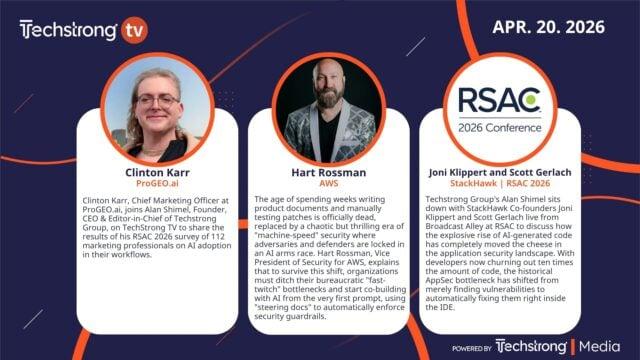
Techstrong TV January 12, 2026
Watch our live stream Monday through Friday, featuring exclusive news, announcements and conversations with IT leaders and experts on topics ranging from digital transformation to #DevOps, #Cybersecurity, #CloudNative, #Containers and deep-dives into specific technologies and best practices. http://techstrong.tv/
Transcript
Hi, everyone. Welcome back here to Text Trunk tv. I'm happy to have these next two folks on here with me.
Let me introduce you first to Hillary Barron, who is the a VP of Research for Cloud Security Alliance. Hey, Hillary, how are you? Doing well, how about yourself?
Very well. So I gotta ask you our, well, I'm gonna come back to you one second. Let me introduce our next guest too, though he needs no introduction to those in the cybersecurity world.
He's a friend of mine for longer than we both care to admit, but, um, he's currently in the security advisor. He's a security advisor in the office of the CISO at Google Cloud. It's been with Google Cloud now for a number of years.
My friend, Dr. Anton Traian. Hi Anton.
It's great to see you. Hello there. And the fun topic.
It is ai, right? Absolutely. So, Hillary, back to you.
Yeah, Anton and I have another friend that we know a few years who's recently joined Cloud Security Alliance. Uh, friend Rich, mogul Rich, Yeah. We're happy to have, have him on board.
I bet. Well, rich is a great guy too. Do you work with Rich then in research, or is he more an analyst?
Uh, he's working in a slightly different capacity, but we certainly lean on him for all of his, uh, years of expertise, certainly. Yes. Yes.
And so it's Rich. I think he's belonged in the CSA for a long time. I'm glad to see him there.
Oh, yeah. Why don't we talk a little bit about your role at the CSA though? Yeah, so I am a VP of research, as you mentioned.
Um, a lot of what I'm doing is helping to lead a team of analysts to do research on everything related to the cloud. We do it in a number of different ways. Um, so we have local working, or not local working groups, excuse me, but we have, uh, virtual working groups that are topic specific on, um, everything from, you know, blockchain, when that was really popping off at one point.
Um, things that are more cutting edge like AI and quantum, although those are becoming a little less cutting edge and more just actual part of reality. Um, and then, you know, more kind of classic, just like cloud security, um, controls and the cloud controls matrix. So our portfolio really runs the gamut.
But yeah, I just help lead the team and we're always exploring and looking at new topics and AI is one of them. Very cool. Anton, you are here.
Well, I, as I mentioned, you're a security advisor in the office of CSO and Google Cloud, but you're also, and you've been involved participating, volunteering with the CSA for a number of years. I mean, it's interesting and of course, uh, kind of a fun collaboration, but at the same time, I continue to be surprised that for some people it's not AI that's new. It's cloud.
Yeah. And to me, that's why the mission of CSA is so important because I, while I encounter CSOs who are new to this technology disruption, and I assume it's ai, and sometimes I discover too much of my surprise that what they mean is cloud. So it's interesting how the mission of CSA, even in the original sense for cloud is hugely important.
But of course now there's AI and CSA is helping quite a bit with all this work. Excellent. Excellent.
Hilary Anton talked a little bit about CSA and their mission. You know, Anton and I were probably at RSA in that early formative, meaning, geez, was it 2005 or 2006 maybe? Um, mogul was there, and of course George was there, and, uh, Jim Rivas was there.
Uh, Hoff, Chris Hoff was there. But the, the CSA has, it's certainly grown, changed, morphed, as you mentioned. The research aspect of it is, is, has a pretty broad charter, but there's the working groups, there's all of these that the, the, the events, I'm sure you'll be at RSA this year on Monday doing the CSA.
We're usually in the room next to you in our DevSecOps, uh, uh, event as well. So there's that. What else about the CSA?
Can we tell people? Uh, I mean, we really do anything when it comes to furthering best practices and standards when it comes, when it comes to cloud security and kind of anything related to cloud security, which, you know, AI ends up being an extension, which is how we kind of got into, um, that as being part of our portfolio. But yeah, we do a, a number of different things.
I mentioned the working groups, because obviously that's near and dear to my heart. Um, we do ad hoc research as a part of that with, um, our members. We have chapters, so if folks are looking for something that's more local to their area, um, whether it's a state or country, those are also available for folks to meet, network and learn more about the latest of, um, what's going on with cloud in their local area.
Um, there's also events, again, those run globally. We have a lot of virtual events, um, and we found that people really like those. Um, so that's been, um, probably a, a big change.
We used to do a lot more, um, that was in-person, but we still do have our in-person events. Um, as you mentioned, uh, we have our, our RSA summit that's always at, or excuse me, our CSA summit, that's always at RSA, too many essays going on in those acronyms. Mm-hmm.
But yeah, we, we really do a, a whole number of different things. We've got trainings even, so you name it. And it comes to research and, and furthering people's knowledge about cloud security and cloud related topics.
We're doing it. Very cool. Very cool indeed.
Alright, guys, let's dive in. Mention, uh, Anton, you mentioned AI once or twice. Mm-hmm.
This is a new report out of CSA, the state of ai security and governance. I mean, I'm not gonna ask you why ai, because, you know, we all know why, but, um, why now? Right?
What is it? Did something trigger it? I think that the, well, first is, I think it's not the first survey on the topic we are doing.
Uh, I think it's the second, the third I, Hillary knows better for the exact number. Uh, sorry if I fumbled it. But it's interesting that the, the why now is kind of more about the tracking it over, over tracking the changes year after year.
And I feel like this year we've noticed a lot of the mainstream shifting because if you judge AI progress based on, you know, Twitter or social media, you assume everybody is far into the future. And then you briefly look back and you realize, again, as I mentioned before, that cloud is new for some people. So to me, this survey, uh, this year, uh, showed signs of the mainstream adoption of some of these elements.
Mainstream concerns about security of ai, mainstream understanding of governance. And of course there is a lot of hiccups about how quote unquote, the mainstream is doing it. But to me, that's the why now moment, is that I see the mainstream move, not the innovators and leaders, not just the innovators and leaders.
Fair enough. Fair. Um, Hilary, if you wouldn't mind, before we jump into the, like, let's the findings of, of the report, give us some demographics behind the report.
Yeah. So what we're looking at for our audience, it's, you know, primarily going to be CASA audience. So we're talking about people that already primarily have an interest in cloud security and in tech.
Um, so we can kind of view the majority of these folks kind of through that lens. Um, but when it comes to location, it was pretty evenly spread. We had about 36% that are from North America.
I think it was like another 30% that were from the AMEA region. Um, and another like, I think 25, 20 7%, something around there, um, coming out of Asia. So pretty even split when we're talking about globally.
Um, so broad, very broad when we're talking about, um, who, who we're talking about is in terms of location. Um, the organization sizes tended to be on the two ends of the spectrum. So we had a lot that were kind of on that lower end under 5,000 employees.
And then that upper bracket of like 10,000 plus employees. So not a ton in that kind of like mid range. Um, and then when we're talking about like the job levels, um, we had I think about 20% that were C-level or executive, another like 15% or so that were at that director level.
And then a third, the biggest portions were that manager and and staff level. So those kinda low, that lower end. So these are more the boots on the ground people that are actually like implementing some of these.
Um, and then obviously as I said, primary industry that we're talking about is gonna be tech, but there is a fair amount that we get from the financial services and education and healthcare usually. So there is a fair number of folks that are coming for, um, from, excuse me, more regulated industry, certainly mm-hmm. I regulate.
Yeah. That's actually very similar to our own audience demographics. Right?
52% are manager or above. Or above. Mm-hmm.
That means 48% are basically single contributor. And uh, only about 11% are C level, but another, I think it's about 15% are vp. Mm-hmm.
You know, or above. So it, it, you know, closely checks our own audience here. Um, let's ask like, you know, I know no one, you know, I've asked this question before.
People do surveys, right? What were you looking to get out of this? We want, we just wanted to hear what people said, but everyone has an angle.
Everyone, you know, we have motivations. What were you looking for here? I, I am super tempted to go with, we just wanted to learn what's going on, but I feel like I'll go and double, double down on my previous question.
I wanted to make sure that quote unquote, normal mainstream organizations are dealing with this. And I looked for signs of that because I've about headed with people who say everybody uses AI and then they mean their three friends in San Francisco. And while if they journey to another country or another region of the US and they look at not at the Bay Area startup that launched three months ago, but at a bank in Belgium to prepare them, example, or a manufacturer in somewhere else, how do their use of AI looks like?
Do they, do they know about it? Like, I've met a client, uh, uh, not a client, really more of a prospect in a certain, um, AsiaPac country. And they kind of pointed out to me that for them, AI is a long-term plan for now they're dealing with cloud and it's going not so well.
And so there are people for whom AI is a 10 in a, on a 10 year plan, not an a 10 day plan as perhaps in Bay Area. So to me, the critical question I was curious about is to, is mainstream moving and not as, is AI a good thing? I mean, it's pretty obvious to me.
And again, I wanted to get out of my quote unquote Bay area tech company soup and look outside and see what's really going on. So I, I do this too, Anton, I, so, you know, it's funny, we just passed the holidays. I use my wife's family as a litmus test.
They come to my house for the holidays because they all come to my house for the holidays. It's a free meal. What the hell?
You know how in-laws are. But while they're there, look, as long as I'm feeding them, I ask them, and I ask them, what are they doing about ai? Well, what do they know about ai?
Are they using ai? What do they think about ai? And, and it's a good mix.
'cause there's young, there's old, there's in between, there's kids who are in college, people who are working older people. And it's amazing how, without even really, really knowing it, how afraid they are. I, if you had to ask me, what's the biggest reaction you get to people when you say ai?
It's a fear. It's a, it's a, a lack of trust. It's a fear of, of maybe taking my job, right.
Making me obsolete. It's, it's, it's so new and, and in the wrong hands, is it going to destroy humanity? You know, the, the, the, the doomsday scenarios.
I don't think tech people have that anymore, though. Hey, there, you know, there are plenty of people out there who believe that, but there, there is, uh, a negative connotation. And I'm wondering, did that show itself in the survey?
Guys? My impression, not necessarily. Sorry, go ahead.
No, I was gonna say, not necessarily. This didn't really come up in, in this survey. 'cause you know, a lot of who are talking to are people who are a lot more excited.
Their boards are really pushing for this. They're actively working on projects or planning for projects that, where they're implementing. I would say in our prior survey, um, I, I'm trying to remember Anton, was it to 2024?
2023? I, I think 23. In the first one, there was a lot of hesitant hesitation, but I think hesitation, if I recall, 2023 survey hesitation was not because AI would take over the world hesitation was because they would fail with ai.
It was the fear of missing out, just expressed differently, right? There was fomo, right? It was diff well, fomo, the current report is also full of fomo.
But the early FOMO and late FOMO are like two different brands of fomo. Perhaps in the beginning they were afraid to fail with ai, like they're not good enough. But now I feel like they would just afraid they aren't moving fast enough or they're not adopting fast enough.
So it's more of a fear of falling behind versus fear of failure. I may be hallucinating this, I may be an LLM Maybe, maybe wait, will wait. It could be a deep fake.
But, you know, here's the thing. I, and I've seen recent surveys developers more than security people. Mm-hmm.
But 90% of developers think about that. 90% of developers, nine out of 10 are using AI in some, in some way, you know, in helping them with their development. However, 40% of them don't trust it.
They don't have any trust. 65%, two thirds of the people say it's, it's introducing instabilities into our code base, but yet 90% of them still use it. Now, is it FOMO that's driving that?
Is it just craziness? Is it a, is it a defect in the, the data gathering? I don't know.
But those kinds of numbers tell you something is missing. You know, there's a mis a disconnect here. I can, I can actually explain it because oddly enough, uh, I think somewhere last year I had this, uh, somewhat unpopular blog called UN Untrusted Security Advisor use an untrusted security advisor.
Because people always joke about how you need to have a trusted advisor, but what if you can have an untrusted advisor? And to me, there are plenty of use cases for an untrusted security advisor. For example, if I hire somebody to test my network, I don't really have complete trust in them.
I don't want to give them a crown jewel and whatnot. But there's a, a bit of trust, but I'm okay without complete trust. So there are use cases, um, where trust is not truly necessary or complete trust is not necessary, but the value is there.
And that's how I rationalize this to me, because I've, I've seen the same exact concern is like formal plus lack of trust, but in the same head, how does it work? And to me, that's how it works. It, they use it without complete trust and they either mitigate a lack of trust or they aim it at use cases where it's not necessary.
Fair enough. Guys, let's, we, we've spent all this time catching up, but let's jump into the actual results here. I always like to know what were the big three?
What were the big three key findings that came out of this? Well, I can even boil it down to probably the two of the biggest findings. I think that we had, one of the ones that really jumped out to us was how much governance is a differentiator with adopting AI and having successful implementations.
So when we looked at the folks that had more comprehensive policies, we were just seeing that they're, they're using, you know, agentic AI more broadly in their organization. They are testing AI with, um, within security. So using AI for security as a use case.
Um, and then their boards tended to be more familiar with the risks, um, that they might be introducing. There was more confidence in their ability to use it effectively. They're training their staff on ai.
And that was one of the biggest associations that we really found was that governance really was kind of this indicator of overall, how well are you really doing with your implementation of, of ai? And, you know, kind of whatever capacity that is. The other big one that I think really came out was that usually what we see with security folks in particular is that they tend to be the naysayers the last to adopt.
They're the, they're kind of the gatekeepers for technology. And in this case, a lot of them are already testing or have implemented AI in some capacity within their security. Um, and that they are continuing to test that and find new use cases for it.
Um, and so I think that that's really fascinating because, I mean, part of it is there's just a clear use case I think, for this type of technology. When we're talking about like actually implementing it. Like when we're talking about iot, I'm like, whoa, what, you know, what are security people going to do at that?
Of course, we're gonna be the gatekeepers in that scenario. Um, but yeah, security folks are, are excited about being able to utilize AI within security, which I think is, is huge. We're not the laggards for once.
That's Good. Yes. That's good.
I like the, I wanna double down on the governance, because to me this was, yeah, it's literally the first, first key finding, but it's also the, um, to me, oddly enough, a fun one because people assume that governance is dry and boring and it's like so eighties or whatnot, but it is quite central to a lot of success, and it's correlated to a lot of other success metrics. So if you have rampant shadow ai, rampant shadow agents, lack of governance. Governance is not even post hoc, but basically it kind of never, or it's disconnected from reality, you're not gonna succeed.
There's almost a certainty that, uh, either a failure of projects or a disaster or both are likely. But if you do have decent governance, everything just starts looking good. And to me, this is perhaps counterintuitive because we use a, we use something fairly classic and old, like data governance, but it is strongly correlated to success, like across the board.
Absolutely. So look at every one of these reports, there's always something that comes up that you kinda give you one raised eyebrow too, maybe two raised eyebrows even, right? It wasn't on your bingo card, didn't see that coming.
What was, what was the outlier here that you didn't see coming? Um, I don't know that there's anything that we didn't necessarily see coming. I think the, the, the AI being part, being integrated into security already was a surprise.
I mean, I, I think in the back of our minds, we kind of knew that there was like a use case for it, which is why it was something that we wanted to ask about in the survey in the first place. But it was more so we wanted to see, you know, like out of all these use cases, out of all these potential, uh, ways that you could implement ai, are you doing it for security? Um, but the fact that, you know, we were already seeing progress there, I think was, was quite surprising.
Um, I think the only other thing that I can really think of was that when it came to, um, leadership, there's this big push to utilize AI and, and have these projects and adopt them and find ways to utilize AI within the organization, um, without fully understanding the risks. Um, so that was kind of something that I, you know, it's to be expected when we're talking about leadership, a lot of times we're talking about people that, um, don't necessarily understand the, the tech in the same way that the people that are, you know, boots on the ground, um, understand it. So it, it's somewhat to be expected.
But I think that that was kind of one thing that w was interesting that they're still pushing for it be, uh, without fully understanding, um, you know, what, what the potential risk is for the organization. I have one actual surprise, and I have one that's sort of like, again, as I said, uh, fits the short but not surprising bucket. Uh, I mean, the second one is, um, exactly the one that Hillary said is that there is a, uh, we know we should do it, but we don't understand it.
It's a lot higher with executives compared to technologists. It's not surprising, but it's also so visible in the report where, uh, the leaders say we want it now, we don't understand it, but we still want it. And technologists are a little bit more, uh, yeah, let's understand it.
But the actual shock to me was the percentage of people who use private self-hosted models. I expected this to be really tiny, need a freaking microscope to, to look at it. In reality, it was sizable, and I still don't know what to make of it.
I feel like people maybe are using open source models or do whatever else, but it is that, that to me was a genuine shock. I I did not expect that. I did not expect to see a high prevalence.
Oh, high, anything is above tiny would be high here. High is high prevalence of self-hosted models. That to me is, is a real genuine price.
No, you, you know What, look, I think if you would've asked two, three years ago, you would see it would be microscopic. Anton, you're right. But I think today, you, you know, you have companies like Pine Cone that offer a a hosted self model, right?
They'll suck all your data, basically into the, uh, into the, uh, vector. And, and you could have a, a model. You, you know, and you still have that big frontier model behind it, but you're using that self-hosted, or, or let's call it model as a service, small model as a service or something like that.
And it's not just Pinecone, Mongo, a lot of them are doing it. Um, I, I think, I think that's actually the future. I don't think people are gonna be satisfied with a one size fit all world model.
Right? They'll have it as a background, but they're gonna want customized to their data, to their world. Guys, we're, we're almost outta time for people who wanna go maybe download the report or take a deeper dive.
Hillary, where can we send them? So you can find the report either on the Google or the CSA website. If you, um, if you find it on the CFA website, it'll be under our latest publications, and you can filter by survey.
It'll be the latest survey that we published. Okay. And Anton on the Google site, uh, it's supposed to somewhere.
You should probably just Google It. Google it. All right.
Well, Hillary Anton, first of all, happy New Year. Second of all, thanks for coming on and, and giving us a little insight into this new report. Keep up the great work.
If I don't see you guys before, I, hopefully you'll see you at RSA. Absolutely. Perfect.
See you there. Hillary Barron, Dr. Anton Shaki here on Techstrong tv, talking about the Cloud Security Alliance, state of ai, security and governance.
We're gonna take a break. We'll be back. Have you ever been responsible for modernizing a global data center network while keeping critical apps online?
Nokia's IT team did just that. They performed a Brownfield migration from a mixed legacy fabric set up to an automated fabric in multiple data centers, composed with Nokia's Sr. Linux and their event driven automation management system.
Ada, I'm Scott Ban, and in this video, Tom Hollingsworth and I will give you an overview of coming blog and video series that breaks all this down step by step. I'm Tom Hollingsworth. Scott and I interviewed the Nokia IT team behind the project and dug into their planning and migration materials.
What we're sharing today is how they turn pain points into an automation first operating model and what you can take away from their journey. You'll also hear about the people side of things. Why data quality communications and ops discipline matter just as much as the tech choices.
So let's set the scene. You know, over time, Nokia's network and data center environment grew organically, different pods, different tech stacks, different operational patterns, adding stuff here and there over a long period of time. And with that came the usual friction, non-uniform designs, too much manual work, limited traceability or rollback and tools that just didn't talk to each other.
This all had impacts on the operations of the business. If you lost application heartbeats for just a couple of seconds, you'd have a database go down, taking two hours or more to recover. And if you disrupted factory operations, you could easily cause a 500 K or million dollar loss per incident.
The biggest challenges were with the infrastructure. People became afraid to do the simplest things like adding a vlan. They needed to move to a NetOps deployment model with better tooling and observability.
This wasn't a buy some switches situation. They laid out specific requirements that had specific outcomes. It covered hardware, software services and migration execution across multiple dual data centers.
The production fabric requirements included API first operations with zero touch provisioning, programmatic overlays, robust routing protocols, jumbo frames, multicast, QOS and dual IPV four, IPV six, stack operations On the management side, small failure domains, programmatic VLANs, strong aaa, and tight integration with ticketing, monitoring and logging. Okay, so how do you architect for that? Well, the team leaned into leaf spine CLO physical network architecture with a layer three underlay and a programmable overlay using vxlan.
They also specified a digital twin requirement to model and test future deployments and pre validate changes and NetOps operations with CICD and using that digital twin for dev and test environments. Sr. Linux and edda are the heart of this new tool set.
They opted for edda via SaaS to keep the infrastructure up and running. No matter what happens in the environment. Edda is Kubernetes native.
You treat your network constructs like resources, you keep the network in a desired state, and then you extend it with custom apps, think connectivity, diagnostics, or related alarms and logs with proactive monitoring and forecast, The team made all these choices to drive programmatic access to the network with a shift to infrastructure as code CICD pipelines and superior observability. So now let's talk about the migrations themselves. They used a live migration method with VLAN handoffs from the legacy infrastructure to the FMO SR Linux and the IDA Fabric.
They rehearsed everything in the EA digital twin and executed changes as code. The process went a little something like this. One, build layer two VLAN extensions between Legacy and the new SR Linux fabric.
Two, make sure that critical loads are dual homed and then swing redundant links in batches. Three, activate the host on Sr. Linux, deactivated on the legacy 'cause your gateways are still on.
Legacy. Simulate that whole thing and verify that it all works. Four, move the servers and frames one by one.
And lastly, cut the gateways and fabric exits over to the new fabric. And you have quick rollback baked in. Every step in this process had pre-checks, approvals and a clean rollback path.
Post migration is where the wins really show up faster. Automated implementations, fewer inconsistencies, fewer outages, and measurable cost and time savings. You want a concrete example?
The team saw an 80% reduction in incidents during the initial phase of the migration pilot. That's, that's striking. 80% reduction, that's a big deal.
And the human factors investing in high quality network data, keeping communications with the team and motivating strong operations. Operational responsibility does not vanish. You still own the outcome.
All those team human factors came into play. So here's what you'll learn about all this. The more detail in the coming series With more detailed videos and posts on interviews with the Nokia IT team.
We'll start with the team's pain points and their desired state. We'll dive into their specific requirements. We'll take a closer look at the target architecture with the Sr.
Linux and EA. We'll walk through the live migration method. And then we'll wrap up with, uh, speaking to the long-term day two ops and desired outcomes.
Be on the lookout for posts on Textron. We're gonna look forward to going through all of this with you. I'm Scott Rob, I'm Tom Hollingsworth.
Thanks for watching. Hey everyone, welcome back to our coverage of AWS Reinvent 2025. It's been an interesting two days of packed full of information and announcements, innovation, a lot of ai, and a lot more too.
Um, glad you can join us. This next panel promises to be one of our best. So I'm, I'm glad you're here to watch it with us.
Let me introduce you to our panel members, and then I'll talk about, I'll let you know what we're talking about. I wanna start on my far right, gentlemen. Well, there's only two gentlemen here, me and him.
So let me start with Spencer. Sure. Spencer, if you wouldn't mind.
Yeah. So I'm Spencer Dillard. I lead, uh, EC2 EEC two's edge businesses, uh, including, uh, local zones, a BS Outposts.
Uh, but for today more relevant. I also lead our Amazon Linux, uh, commercial Linux and Windows businesses, uh, in addition to some other areas of AWS. And I've been at AWS since 2011.
Uh, so lived through quite a few changes and excited to talk about what we're doing. Absolutely. Spencer, welcome and thanks for being here.
Next is Spencer. We have Sri. And Sri, if you wouldn't mind introducing yourself.
Yeah. Hey everyone, I'm Sri sku. I'm a product manager for Amazon Linux.
I've been with Amazon Linux for around three and a half years. I'm excited to talk to you more about Amazon Linux and our new features, um, for it. Thank you.
She, and, and to my immediate right, you may have seen her on, uh, one or two already of our panels and, and interviews here at, uh, AWS Reinvent coverage. Christine, I'm Christine Puccio. I lead our AWS growth strategy, uh, for suse.
And, um, been doing that for about a couple years now. And it's, uh, it's been, this year has just been so packed with so many great, um, announcements. And I'm really excited to talk about what we're gonna talk about today.
Yes. We're going to, we're gonna, we're gonna focus in today a lot on Amazon Linux. But I, I just, I want to preface all this with, you know, Christina, it is, you, you kind of shepherd the AWS, uh, SUSE relationship.
And, and in my mind, at the very highest level, I think we bears repeating. It's a strategic relationship, and it was announced as a strategic relationship on, on a lot of different levels here, right? This Amazon, Linux is one of three or four different areas where we've been, you know, looking at over the last day or two.
Um, so it, it's an important relationship to cer it's an important relationship to AWS and, and I think it Good job. Okay. Nice job.
Many, many people involved as well. No, I know, but you know what? Someone heads it up and, and is response.
I've always learned, I've done a lot, I've done four or five startups in my life, and a lesson I learned, if it's not someone's full-time job, it doesn't get done. Mm-hmm. So That's what they told me.
That's why I, I've learned that the hard way. So good for you. Um, but guys, let's kick it off, right?
What I, I wanna focus in, as I said today on the Amazon Linux piece of it. Now, our audience out here, everyone knows AWS everyone knows AWS gives you a lot of choices around Linux, including seus for suse for what, 20 something years, or as long as there's been an AWS. But Amazon Linux is a, is a, a different kind of animal, right?
It's Amazon's Linux mm-hmm. Tree. You're the Amazon Linux expert, aren't you?
So, let's, let's start here for people who may not be as familiar, maybe with what is Amazon Linux? What makes it special? Mm-hmm.
What, what are some unique characteristics? I know it's going through a regeneration as well mm-hmm. Share with our audience, if you will.
Sure. Um, Amazon Linux is a Linux distribution that was created by AWS, and it was developed by AWS, uh, it's also being maintained by AWS uh, the first version of Amazon Linux was launched in, uh, 2010, actually, 2025, uh, mark's, uh, 15th year birthday for Amazon Linux. So, wow.
It's a, a special year for us, Uhhuh. Uh, so it's been a long time. Uh, 15 years is a long time, and we've learned a lot from our customers from the changes happening upstream.
Um, so it, it's, uh, it's been fantastic to see the evolution of Amazon UX over these 15 years. Um, the latest version is, uh, AL 2023. Uh, when I say Al, it is short for Amazon Linux.
So, uh, for the audience, it's easy to understand. Um, so Amazon Linux is, uh, mainly, um, uh, used because it is optimized for AWS, it comes with deep, uh, AWS uh, integrations, uh, with various other services. Um, for example, E-K-S-E-C-S, um, A-W-S-C-L-I, um, and various other services that you can think of.
Um, it helps, uh, reduce, um, operational burden for, uh, our users because, um, think of, uh, it as, like, when you're launching an instance, for example, you have to think of various parameters. For example, network configurations, attaching IAM roles or, uh, EBS volumes, et cetera. And Amazon Linux has integrations with all of these, so that when you launch an instance on EC2, it just works out of the box.
And, uh, not la uh, last but not the least is, um, Amazon Linux helps you lower your cost of, uh, um, ownership. Yeah. So how does it do this?
While our customers still pay for the compute resources, um, Amazon Linux is free of cost. It has no licensing fee. And on top of that, the AWS support is included as part of Amazon Linux.
This is, it's like, you know, really it's a big thing for our customers. So all these factors make Amazon Linux special. And Spencer, please add on.
Sure. Uh, I, I think a few of the things I would add, I mean, uh, really great introduction overview of, uh, why it matters to us. Um, it's Amazon Linux is used by basically every a BS team internally.
It's used for our own infrastructure. Um, and, you know, it is a fedora based os. Mm-hmm.
Uh, it originally started as a, a Red Hat, uh, clone. Uh, a few years ago we shifted to being, uh, fedora based, which has introduced, uh, a number of aspects that, that drive our thinking, uh, going forward. And in addition to the total cost of ownership that, that re mentioned, um, we really see it as critical to the security that is important to our customers.
The, um, that one of our most important properties to is to ensure that we're providing up-to-date patches. We often support kernels that are older, uh, which is, you know, good challenge, uh, but we're really trying to focus on security and ensuring that we, uh, are providing as secure a solution as possible while where possible really minimizing the effort for customers to have to be forced into a migration or things like that. Obviously, at some point you have to.
Uh, and at the same time, we're also providing, uh, out of the box integrations with things like elastic fabric adapter, elastic network adapter, uh, drivers for AI and, and NVIDIA chips and various things. So really ensuring that whatever you want to run on AWS it will work on Amazon Linux. And so we're really excited about what we've done to make sure that more customers and users can, uh, run their workloads on Amazon Linux.
Absolutely. Cherie, you mentioned the latest version is, uh, AL 20 23 3. Correct.
And, but in terms of backward compatibility, my understanding is we're gonna end of life support for AL 2022. Uh, it's called a L two, Oh, excuse me. Yeah.
AAL two. Okay. Yeah.
When, when, and, and that's pretty imminent. Uh, that's right. So, end of support for a L two is upcoming, uh, on June 30th, 2026.
So approximately six months from now, that's when, uh, that'll go. That version a L two will go, uh, on end of support. And a L 2023 is the latest.
I would imagine, though, it's a rather seamless experience to migrate, uh, or update from, uh, a L two to a L 2023. It, it really depends on a lot on, on what the customer is using. And one of the key reasons that the partnership with SUSE has been really important is that it unblocks a lot of cases where customers have been challenged.
Because moving from, uh, red Hat Enterprise Linux clone to, you know, uh, fedora based has really, you know, has met a shift in what packages are available, uh, for especially, uh, the Apple packages that are available on Red Hat repos, those need a solution, right? And customers don't generally want to go build and compile and download the source and deal with their own patching. So being able to provide these additional packages is essential to reducing the effort for customers to migrate.
Uh, and going forward, this is something that we really see as absolutely central to our vision for Amazon Linux is ensuring that, uh, first and foremost, we are maintaining security. That that will be our top priority and continue to be. But borderline more important is migration and minimizing the effort.
Because the reality is, if there is effort to migrate, then many customers won't. And in not migrating, they actually end up being less secure. So, in many ways, that migration, uh, Friction is actually scary.
Can Trump security as a, as a, you know, tenant, as a tenant that we consider? Mm-hmm. Absolutely.
Um, so I, I, you know, you mentioned Fedora. I'm not gonna get into the whole Red Hat mm-hmm. Stuff.
Yep. Stuff. Leave me.
That's, that's a good word. Stuff. But what I, what I do wanna mention is the idea of enterprise Linux, right?
Mm-hmm. Now, SUSE has an, an enterprise Linux. Mm-hmm.
And I always do the initials, but you guys call it s**t, how you say SLES, but, you know, tomato, tomato, um, it's a, it's a true enterprise. Linux Red Hat has an enterprise Linux too. Amazon Linux is an enterprise Linux.
And that's really what I want to emphasize for the audience here, right? It's an enterprise Linux distribution. Um, and so it is, it, it's strategic, right?
Mm-hmm. Now, let me pivot to announcements, right? Beyond the strategic relationship between suicide and that red hat I, I spoke about, there was some specific Amazon Linux suse, um, integrations, partnership kind of announcements.
Christine, this is your baby. Oh, Well, I think I, well, first of all, this has probably been one of the most, um, I don't know, heartfelt projects that I've, I've worked on, because I think it was a, a first of two, um, companies coming together that traditionally could be competing for the same, you know, workloads. But it was having the engineers from our side, um, you know, our Linux group and, and your side just coming together and building a concept and requirements document, and really looking at how we address security together.
How do we address building the packages? What packages, what packages do we prioritize based on customer feedback? And it was, and at first it was funny to see the engineers and everybody in the room together, because they're like, why are we here together?
You know? But it's, it, at the end of the day, our value at our company is about choice. And our, we know that our customers are always going to operate various different workloads on various different operating systems.
And so it just became, you know, we were able to help in this instance, and not just provide packages, but actually, uh, increase the, the, you know, volume of time that it would take in order to do that themselves. And I think that's where the unique partnership is in this, and why I was, so when I first saw this project, um, and, and was read into it, I was like, wow, this is, this is really super cool, and this is kind of a first, and I really love working on, on those types of projects. And it, it's been a real pleasure to, to work with, uh, Amazon and AWS on this.
Likewise, I don't think we mentioned the term, and I want to make sure we get it out here, and that is, I, again, I say the initials, you say the name, but SPAL spell Al Al s pal. Yes. That's why I say the initials and say, but SPAL sp, and, and you know, that's what you're referring to a lot here, and, and it is unique.
Think about this, right? You are taking packages that in essence exist in Cuse Enterprise Linux and making them portable and usable by Amazon Linux. And look, there's a great day for open source, because that's what open source is about, right?
The ability to, to have portable codes like this Absolutely. That can move from one Linux to the other, somewhere Linus is smiling on them, right? And, um, and so it's, it's, I've never, you know, honestly, I've never heard of anything like it, but it's, it's, it's really cool.
Yeah. And I, I think one of the things that has enabled this is that we have a common, you know, value of allowing, enabling choice. And, you know, from the AWS perspective, we don't want to tell customers how to run their workloads.
We want to advise them where there are things that they should be aware of or concerned about, et cetera. But our goal is to make sure that they can achieve solving the problems they need to solve, however that is. And so it's pretty natural working together to say, you know, at the end of the day, that is what this is about, is making sure that customers can choose the solution that's right for them.
And, you know, Amazon Linux may not be right for some others. That's okay. What we care about is that customers can solve their problems.
Yeah. Agreed. Let's, if you wouldn't mind, and, and Shay I hope I'm asking the right person this, but I I, let's peel that back a little bit.
The, the specific packages. What, what kind of functionality or, you know, what's in these packages? Sure.
Um, so Amazon Linux actually has, uh, approximately 2,500 packages already. Um, a lot of our customers use these packages, uh, which are a part of the core repository. Mm-hmm.
Uh, however, there are some packages that helps you, um, increase the productivity, uh, for a developer or for a system administrator. Uh, for example, uh, let's take the package called as r uh, R is used for statistical analysis like, uh, and programming. Uh, and this kind of package was not a part of the core Amazon Linux.
It is an extra or an additional package. So you actually would find these packages, uh, as part of the Apple, uh, repository. Apple is extra packages for Enterprise Linux.
Um, and, uh, uh, our customers, as they were migrating from a L two to a L 2023, wanted to know these packages. Like, Hey, I use this package. I rely on this package.
Can you help me, uh, provide these packages? Because otherwise the choice that our customers have is to build these packages from source, which, if you can imagine, consumes a lot of time resource, and they have to maintain it, which is a huge deal. Yeah.
Right. So, uh, on, on our customer's request, uh, we understood that, uh, okay, some of our customers rely on these Apple packages. Um, and that's why, um, we had to bring these packages to a L 2023.
Now to do that, uh, that is where we partnered with suse, uh, on getting the a l packages and making it compatible for a L 2023. Yes. So that was the partnership, and this is called as sal or supplementary packages for Amazon Linux.
Uh, it is a dedicated repository, um, that work that has thousands of packages, like Christine was saying, we started prioritizing these packages based on our customer's feedback. Our customers, uh, provided feedback on GitHub or via support, uh, or TAMS technical account managers. And that's how we know that these are the packages our customers are looking for.
And that is what we prioritized in the initial phase. One. One thing I, if you don't mind, that is also that Susa has been critical to also help identify some of the, you know, the areas and packages that Yeah.
They see widely used that they see as being critical because, you know, we have sometimes have different lenses, so that, that expertise has also been very valuable. Yeah. Sorry.
No, I think, um, the other part to this too is that there's, there's like over 8,000 packages mm-hmm. Within, is it epel, epo, right? Yep.
Narrowing that down to try, and I think I wanna really talk about like how long it took, not even long, but like how critical the discussions were to talk about what type of packages are there, how are we gonna support them after we provide them, what does security look like? All of that were things that we discussed even before we even started looking at delivering them. Right.
And, and that's why I think what makes this partnership really special is because we understand that security. We talked about that earlier, you know, two, two components of customers, you know, critical needs are lessen the complexity and security. So this was really a way that we did a lot of homework, a lot of back and forth.
The prioritization of the, of the packages were even like slipping, you know, back and forth. As time went on, we just got, we even had more. So I really have to say a big thank you to, uh, our engineering team at, at suse and also the support from Amazon's Linux team.
It just really, um, it, it was really awesome to see everybody come together. It's was such a unique, a unique partnership. Yeah, Absolutely.
You know, I, I want to focus in on the security aspect of it, though, at a time where software supply chain security is so critical. Yeah. Unfortunately, you know, we have at the, the, the, the folks at CSA ated, the sbo mm-hmm.
Uh, regulations and so forth. And, you know, whether or not we still see a lot of this coming out of the quasi-governmental CS a mm-hmm. Mire and, and this and so forth.
But software, supply chain security is, is a critical, critical piece of this. Mm-hmm. And a critical part of this announcement is that SUSE is certifying the security SSA standing behind these packages saying, Hey, the packages you're getting from us, they don't have shiho lut.
Mm-hmm. Or, or one of these, you know, worms that are out here now that are just wreaking havoc. Yeah, yeah.
You know, with a lot of package managers out there. Um, and, and that, you know, that's not trivial. Yeah.
That's Really important. That was a truly essential part of the similar driver is that, you know, when we look at our teams, you know, we can do that. We have the expertise, we Sure.
You know, but the, you know, the value and the, the challenge of keeping up with is this package actively maintained? Is anybody looking at it? Yep.
Do we go fix it ourselves? Do we then end up stuck, you know, maintaining something that we may not fully understand, but we identified a vulnerability, like if we're not, if we weren't careful, you know, we can very easily wake up and, and, um, tons of operational challenges and potentially really disappoint customers in that expectation. So being able to, to share that responsibility and shift it so that we can sleep at night and our customers can, because somebody is looking a lot at the supply chain are not, uh, you know, as much on a best effort basis.
It's something that is core to this relationship. It's really Important. You know, a, a word we've talked a lot about on these panels and in my videos these last couple days is scale.
Mm-hmm. Mm-hmm. They call Amazon a hyperscaler.
Mm-hmm. It's, it's just that Spencer, it's the scale. It's not a dozen packages that I could keep an eye on.
Yeah. It's thousand thousand, 8,000, 3000 are going in to maintain, and, and you know, how maintaining any software, let alone open source is Right. Uh, I found a bug in this week.
I update it. I don't want to have to go through my, uh, j uh, you know, the, the, the last big one and find wherever it's running in my, in my infrastructure. It is not at doing that at scale.
Again, if it's not someone's job, it doesn't get done well. The other, the other piece to this is that, you know, SUSE does have the open build system, and that's where we actually, uh, harden and secure our, our the packages, right? Yeah.
And that is actually open to other, uh, companies that, that use it, you know, other open source Linux companies that use it. And so we, we are behind that, and we actually use that to deliver, um, the packages Love it. And there's another, uh, deeper layer to this.
And when, when we talk about packages, it's not like, okay, there's one package and that's it. There's always like a ton of dependencies around those packages. So identifying those dependencies, making sure that those packages are there.
So that also is a part of this entire partnership. It's Oh, right. Yeah.
So there is a complexity there. Um, and yeah, That spas aren't easy. This was definitely complex Because it's like the commercial and so on and so on and so on.
Mm-hmm. Once you start getting into these dependencies, well, I got this from here. They got it from there, and what are they doing?
Yeah. Yeah. And, and the one thing I would add is in the reality is all of us, uh, have challenges of keeping up with the amount of kernel cvs these days with the, the changes that were made and mm-hmm.
And, you know, I, I, I think when we look at what that is going to take to ensure we're staying on top of it, a lot of it's a choice of where do you, you know, invest. Mm-hmm. And Absolutely, we're running a little low on time.
I want to bring it down to a call to action. Mm-hmm. I always like to have a call to action in these things.
Let's number one, uh, Amazon Linux 2023 is available now. You don't have to wait till June to, to, no. You'd be silly to wait till June to make that migration, number one.
Number two, the S pals are available now. Yes. How many, how many packages have we delivered now?
There's quite Thousand 800. Yeah. 1,800 actually that from end of August, right?
To to mid-November. November. Yeah.
That's a, I mean, that's how fast we've been. That's, that's the landing more mm-hmm. For my Amazon using folks, and there's a lot of them out here.
Mm-hmm. How, how do they access this where? Yep.
Absolutely. So, uh, customers who are using a L 2023 can actually, um, install and enable this al repository by a simple DNF command. Um, just install the repository and then you can install the packages that matter to you.
You don't have to install all the 1800 packages. You can just install the packages that matter to you. Even that happens with a simple DNF command.
So it's very easy. It's just two commands that you can use to access the repository and install the packages. Fantastic.
Do you think we'll see a time where we'll have sort of like a recommended configuration for AL 20 20, 20 23 with the s espouse, or it's always sort of our a la carte? I, I would take a stab that it's, you know, first it's gonna come down to is it something customers want? Yeah.
So we maintain various, uh, uh, amies that we build for different architectures, different. So there's a number of amies, uh, Amazon machine images that we build, uh, with Amazon Linux. So if it is something that customers want, then yes.
But the reality is that it's, it's not terribly difficult. And for many customers, it becomes really tricky to try to guess what that set would be, and then for them to understand and how does that change, right. If I have another update, maybe a package goes away, what does that mean?
Right. And so we may, but I, I think really for now, it's, it's understanding how customers are actually using it, monitoring what packages, not on an individual level, but in aggregate, are really being used heavily so we can make sure that, you know, I'm missing anything. We wanna really make sure customers are unblocked first.
Maybe we'll make that easier later, but it's not a terrible, you know, inconvenience or issue today for customers to enable it, install a package, and if they want to create a, an, an omni of their own that already has that running and that're done. Right. So it's probably good, the simple way to go.
Absolutely. Well re, Spencer Christine, thank you so much for coming on here. Text Trunk TV with us today.
I'm sure our audience appreciates it. Great work. Great work.
I mean, look, maintaining, how was it? 8,000 packages Uhhuh? Totally, yeah.
Maintaining 8,000 packages and, and then having an enterprise, a true enterprise Linux. Yeah. I mean, the folks at, at, uh, Seuss have been doing it for over two decades.
Mm-hmm. It's not a trivial task. Yeah.
Right. Yeah. It takes a village.
Yeah. And, um, continued success, success with it. We, we will see it.
I'm sure we'll see more of it coming and, uh, we'll, we'll be following up. Thank You so much. Thank you.
Thank you. Thank you. Thank you for watching.
Uh, we'll be back, I think this may wrap our day two coverage up, but we, we have a full day more of, of Amazon coverage of AWS reinvent coverage tomorrow, uh, starting with our Textron gang first thing in the morning. Well, first thing in the morning, Vegas time. It might be a little later for you guys out there on the East Coast.
But for now, this is Alan Shimmel. Thanks for staying with us today. Have a great day.
You've just watched Textron tv. It is the end of yet another year, and we are here to take a look at all of the big stories from 2025 with a variable degree of snarkiness in this episode of the Tech Field Day rundown. Hello everyone.
Welcome to the Tech Field Day rundown. It is December the 17th. It is getting very close to the end of the year.
And we wanted to take a look back at the last 12 months to kind of give you some highlights of some of the big ideas in the news. We covered a lot of things over 2025. There were a lot of great things going on.
We hope that you are enjoying some pancakes with maple syrup 'cause it's maple syrup day. Um, and it's also national Say it Now day, which honestly is kind of the thing that we do around here. We just say it like it is now.
Uh, well on Wednesdays at least. Uh, joining me of course is my co-host Alistair Cook. Al, it's good to see you again.
It is always a pleasure to be here and particularly on Pan-American Aviation Day. My first international flights were on PanAm and flying to the United States, so it was great to be here on Pan-American Aviation Day. Well, speaking of flying this year really did fly by.
Um, we're gonna go ahead and jump into the first set of stories, though, Al and I think you're probably the best one to talk about it because I think 2025 we'll go down as the year of ai. Yeah, and we kicked off this year of AI with a future and survey of CEOs asking about their AI readiness and the use of ai. And, and the results really painted a picture of unfulfilled promises.
We saw paralysis and slower moving firms who had no idea what they were doing with AI in the survey. And we also saw that more cloud native, uh, companies were still struggling with cohesive AI strategies and cohesive infrastructure. So, beginning of the year, AI was definitely, uh, a challenge for some vendors.
But Jensen Wang, the rockstar, CEO of Nvidia, was much more bullish. She presented in CES in January and announced that the Cosmos, uh, was a World Foundation model that, uh, of course NVIDIA's shipping and predictive widespread adoption of AI robotics everywhere. Of course, also in January, I sort of love the story of a, uh, sticky track for AI crawlers and developer was sick of AI data gatherers that don't respect any of the fair use, uh, norms that are happening out on the internet, as well as some of the mechanisms like robots text that limits crawling.
So this developer created a, uh, mechanism to create random cross-link pages with no real content and trap these AI trawlers in just a little corner of their website. But we would know not to look at, but AI, not so much. Of course, January brought some really big AI news.
That's when we learned about deep seek. The Chinese ai, uh, trained for far less cost than other lms. Uh, also heavily censored dataset.
Don't ask it about Tianmen Square. Uh, and also trained on a bunch of AI generated content. And this was the point at which we thought, hmm, is it wise to feed an AI with AI generated content?
Seems a little bit like some of the problems they had in the UK with chicken, where they were feeding bits of old chicken to brand new chicken and got disease right through the, uh, the feed line. I hope that doesn't happen to ai. Of course, AI being the thing that unifies all marketing departments this year, uh, February brought the news that Wicker had restructured, was reorienting itself towards a generative AI company.
And at the same time, hammer Space announced that object storage is not the only option for AI training data. This definitely shows us two successful specialist storage vendors confirming that AI is still the essential marketing term for 2025. Heck, we're belly into February and Cisco and Nvidia decided they were gonna partner up as well, bringing Nvidia Spectrum X management for Cisco switches, and of course NVIDIA's Bluefield Smartnick into, uh, Cisco devices alongside the Silicon one.
While we're talking about hot chips, uh, Broadcom launched their Tomma Hawk six switches giving over a hundred terabits per second throughput in a single device. Uh, this team presented at the AI infrastructure Field Day, showcasing the Tomma Hawk Ultra and Jericho. So as well, we've got massive training networks.
You know, we skipped a whole bunch of the run rate kind of announcements around ai, but we did notice that in November, uh, AWS talked about a agent ai and particularly using a agent AI to help customers migrate from on-premises platforms into the AWS cloud. I think we've seen a lot of progressive ag agentic AI tools through the year, and hopefully some of that confusion and paralysis that was happening at the beginning of 2025 is starting to clear and companies are starting to get some value out of building AI solutions and finding better tool sets than maybe they had at the beginning of the year. Another group that's been in the news a lot this year has been Intel.
There's been all sorts of trials and tribulations with Intel. Tom, I think they're one of your favorite companies in our, our coverage along the year. They are.
And we've spent a lot of time talking about them because quite honestly, there's been a lot of news. If you remember, we closed out 2024 with a lot of bad news, honestly. So how did 2025 start out?
Honestly, it was a lot more down than up. We found out back in February that Intel was not going to release Falcon Shores. This was a big hit to what a lot of people consider to be kind of one of their make or break moments.
Uh, there started to be some rumors around that same time that Broadcom might be looking to buy out some of those chip designs that Intel had been working on on the cheap. You know how it feels whenever the Vultures starts circling it, it's maybe time to hang it up. And then news came that that big Ohio Fab facility that Steven Foskett has been so excited about was gonna have to be pushed out a few years because of construction, but also because of cash flow issues and some potential changes to the CHIPS Act.
And it was not really looking good for them. Now, one might be forgiven for thinking that the appointment of a new CEO in March was gonna be the start of Intel's big recovery. And lip Bhutan came in really ready to work.
He created some big restructuring plans for the organization. He did things like brokering the sale of controlling interest in Alterra to Silver Lake. You know, that was a, a big thing that Intel was very prideful of, and maybe this was gonna give them some cash to turn the ship.
Uh, the rest of the next quarter though, all we could talk about was Intel's layoffs. And, and some of these were confirmed kind of publicly. Some of them weren't.
And, and we were hearing lots of numbers, you know, 15,000 here, 17,000 there. It really, really hurt the industry because those thousands of jobs almost had to be sacrificed in order to get Intel back on track to their core business. But layoffs are never good for any companies like this.
I mean, things were looking pretty bad for Intel. I mean, how could it possibly get any worse? I know back in August, president Trump said publicly that lip Bhutan had conflicts of interest and he needed to resign as the CEO of the company.
I think that's pretty much the point that they hit rock bottom. But I know that that's the case because that really was the beginning of Intel's comeback in 2025, because it took less than a week. And we started to hear that Intel was securing investments.
SoftBank bought in, Nvidia bought in, and the US federal government made a deal that would see 10% of Intel's proceeds going back to the US government. After that, everything took off. Intel was no longer the punchline of a joke and also ran in the company.
It was more than that because we started to hear rumors that maybe Apple was gonna be looking at Intel again as a partner on chip manufacturing. We also saw that because of the announcements of all of those investments that Intel decided not to sell off their networking business unit. We just covered that, uh, last week.
On the rundown, it seems like money fixes all problems. Intel, most importantly though, is positioning themselves to be the domestic chip manufacturing giant, because one of the things that we've seen that's kind of been a subtext for everything going on this year is the looming tariffs that are being positioned against companies being used as weapons against other investment vehicles and Intel. Being a domestic chip manufacturer is effectively tariff proof instead of having TSMC need to come over and build a fab in Arizona to beat those tariffs.
Intel already has fabs positioned everywhere, and they're trying to do more. They just need a little bit more runway in order to be able to pull that off. Honestly, at this point, time will tell if this is enough to get them back on the right track, but having weathered everything that they've weathered this year, I can't imagine that Intel has much less position to fall from because they are slowly gaining the momentum, which doesn't seem like a lot against what's been going on in the AI market, but there is an opportunity for them to kind of right the ship.
Finally, another thing that made the news this year was the massive spate of outages that really kind of knocked some knowledge workers off track. Al These outages started fairly small in January. We saw, uh, Utelsat having an outage that left one web's broadband services offline.
Now, a lot of the time these were backup services that were used in locations where the primary internet connectivity wasn't great. Few places, it was the primary connectivity. So a couple of days without internet, that was pretty significant, but only for the small number of people who are significantly affected.
In April, we got a bit of a warmup, uh, to the outages when Zoom. Uh, zoom got taken offline for 90 minutes and all of us, uh, had breaks from having calls. Uh, we got actually to have some productive time since we weren't on Zoom calls all day for those 90 minutes.
Turns out that, uh, GoDaddy, who hosts all of the US domains had for some reason blocks, uh, Zoom's DNS domain. Hmm, maybe DNS is the root of all errors. Things scaled up quite a lot in June when we started to realize just how much popular applications like Spotify and Discord and Snapchat depend upon.
In this case, the Google Cloud. Uh, Google rolled out a new feature for some, uh, quota policy checks, and they weren't adequately tested. And so Google broke the, uh, the internet for a little while.
A bunch of popular applications were often we had to go other places in order to complain that we couldn't get to the internet. A little later in June, we also saw a record breaking DDoS attack. 3 terabits per second, primarily of UDP frames being sent by the Mariah Botnet, uh, was all being soaked up by CloudFlare, one of our largest DDoS protection networks in the world.
And so hopefully it didn't take everybody offline along with it. But what we did see in October was something big. What we saw in October was that we have become very dependent on both DNS, but also some of the core services inside AWS.
And so again, it was a DNS fault that AWS, uh, had put in as a anti DNS record for the Dynamo DB database. Dynamo DB as the massively scalable key value store database. Uh, without Dynamo db, lots of business applications went offline.
Lots of AWS services went offline. We really saw this lots was out and down and not working. And we realized that when we started using these ubiquitous web services cloud services, we became very dependent on them.
And while the individual services are incredibly reliable, when they do go down, consequences are huge. So these services typically are very reliable yet because everybody uses these highly reliable services, if they have an outage, the impact is immense. And if you've been running your own database on premises, or if you've been running a database insider virtual machine somewhere, the impact would've been far less.
It would've only been on your own services, but the likelihood of that failure would've been a little higher. People make mistakes. So, uh, sometimes there's a, a reflection here that using these big web services is a bad idea because we see headline news when it goes down.
But what you don't see in headline news is just how often services inside organizations go down. So it's not fair to tar these, um, single points of failure that we built into our systems as being the, the the worst thing ever. Um, but nothing is a hundred percent uptime.
CloudFlare came back for us in December. Uh, they forced an outage because they saw an actively exploited critical vulnerability. This reactor shell export was, was, um, being used in the while to run arbitrary code on, uh, these, these websites that we using the React framework, uh, CloudFlare basically DDoS themselves.
They, they shut down those sites until they could get a more targeted mitigation in place. And so there was a a period of time where CloudFlare was brought blocking access to these vulnerable sites before more targeted reactions can come in place. Uh, I think Reactive Shell is gonna continue to be in the news for us for a little while.
It's gonna be the new version of the Log four J problem where lots of people didn't realize they had vulnerable code because, well, it was a dependency for the thing they actually wanted to have. And it turned up in all kinds of places that they didn't expect it to in terms of outages. We did see a whole bunch of outages this year.
We realized that the cloud is not a golden bullet that takes away all of our reliability problems in our applications. And even if you follow the best practice designs from the cloud providers, you're still not gonna get 100% up time for years and years and years. There is still the possibility for things to truly mess up.
Another company that's been in the news a bit today and a good friend for us here at Tech Field Day has been HPE, uh, that's the enterprise part of what used to be h hp separate from the people you buy your, uh, laptops and, and your printers from HPE as the, uh, large scale stuff we put in data centers and, and run networks around. Tom, you've been across all of this because a lot of this news has been networking related. It has.
We really were kind of curious as to how this thing was gonna start out in the year because we had started to hear rumblings that possibly the US Department of Justice wanted to take a closer look at that proposed acquisition that they had of Juniper Networks. Well, February, almost one year to the day after the big blockbuster announcement, the DOJ decided, no, no, no, we're, we're gonna block this acquisition for the time being. We need to take a closer look at it for, uh, I don't know reasons.
Uh, we also got news that there was potentially some exposure from hacking group Intel brokers getting in. They, they might've gotten away with some source code. That one's kind of still ongoing.
Even to this day. We, we don't know exactly what happened. But then a couple months after that, in April, we got the most terrifying business news that a company can get.
Elliot Management took a position in HPE and immediately we started to hear some questions about Antonio NE's leadership, which is quite honestly kind of part and parcel for how Elliot works. Uh, they wanted to maybe make a change in the CEO chair or potentially get some board members up there that would, uh, look to unlock some of that mythical shareholder value that they seem to keep looking for, but can never seem to find. I think though that Q2 was really the start of HPE really becoming more of a unified company because back in May we saw that they really integrated their Morpheus acquisition into GreenLake, and it helped fill out that offering a little bit more completely.
You may be wondering to yourself, well, what does GreenLake offer me? Well, if you're someone who's looking for refuge from the things that have been going on over at VMware by Broadcom, GreenLake has an opportunity to kind of supplant that. And that's how HP has been positioning Morpheus over the year.
They're basically saying, if, if you're not happy with what you're getting there, we have an offering that will work with you and we're gonna provide you the same kind of support that we always have. We're just gonna be working on a different hypervisor, and people seem to be responding well to that. Then at the very beginning of July, the Department of Justice came out with a list of some recommendations that JUNI and HP needed to do that would allow them to clear that acquisition.
They were a little bit strange. There was some discussion. We even recorded an episode of the Tech Field Day podcast about it, and it took no time at all for the companies to agree that, Hey, we're gonna do that.
And there you go, we were gonna close that acquisition. It's almost like as soon as they found out that this was an option, they're like, book it done. We're out the door.
Let's just do it. No buyer's remorse here. After that, we saw HP and Juniper really ramp up efforts to provide a combined offering, uh, whether it was new agentic AI offerings, integrating some of their product lines.
As we started to hear around the time of HP Discover Barcelona towards the end of the year, including if you were reading between the lines, some very forward-looking language that kind of will show you what the combined offering will eventually look like. But that doesn't mean that networking was the only group that was making advancements. The server side of the house did a lot of integration work, and they even picked up a deal to offer private cloud to the US Department of Defense, uh, as a way to kind of, you know, kind of jump in as to some of the remnants of those big projects that we've seen getting bounced back and forth between Microsoft and Amazon for a while.
They also released their Gen 12 server line, which is another big step in continuing to refresh the product lines that everybody feels are so critical to HP E's success. They also did a lot in the cybersecurity market. They included things like AI based DDoS protection, and more importantly, they complied with some new European regulations that will require organizations that are undergoing outages or ransomware attacks to be able to isolate themselves from the internet to be able to clean those things up and not create a, a larger impact all over the market.
And as we know from the last couple of years, not being compliant with European regulations is a sure way to get yourself in a lot of trouble real fast because the European regulators do not mess around. Now, November was a bit of a mixed bag for companies that had partnered with HP because we saw that they had dropped support for some of their storage partners like Qumulo Scalability and wca. I think though that this is really more of HPE refocusing their efforts on integrating their own storage offerings back into their lines and working with very specific partners in very specific situations.
As we've seen by the breadth of what HP offers, they really do wanna become the one-stop shop. Whether you're doing something in the campus, whether you're trying to build a cloud integration, whether you're trying to work with ai, they want to be the sole source for everything you could possibly need. And if you wanna buy it, they have options that will do that for you.
If you want to rent it through GreenLake, they're happy to do that as well. It's one of those things where we're getting back to the kinds of service offerings that are important to the clients that are out there. It's not just a matter of, give me these parts and pieces, give me the expertise that will allow me to integrate them together and to make something out of this so that I had can have my knowledge workers focusing on outcomes that are business aligned instead of navel gazing about a bill of materials and some pieces and parts that maybe don't make a whole lot of sense.
Now that I, we've kind of dropped all of the drama of whether or not some of these acquisitions are actually gonna be able to be done. I think it's going to allow the leadership at HPE, including current CEO Antonio Neri, to kind of chart a course to not only keep their customers super happy with what's been going on, but keep the shareholders off their backs long enough for certain activists to maybe exit that position in the market. I kind of hinted to it in this story Al, but AI continued to be a huge part of what was going on in 2025, and you have a slightly different take on it with some more news stories.
Yeah. And, and this story comes in two parts, and it's about buying, selling the inside baseball side, the who gets what bits of AI and, and the hardware for it and those kinds of things. The, the first part of it, and this started at the beginning of the year, was around who's allowed to buy what hardware and what are the impacts of tariffs.
But as things rolled through until later in the year, the focus shifted towards what looks like a whirlpool of AI funding announcements. So the, the first part began in 2025, beginning of 2025 in, in January when the Biden administration, so coming to the end of their, uh, the, the governance were looking to restrict AI chip exports. 20 countries were on the, the books of being, uh, places to restrict.
Of course there was some responses. Um, there was the statement from TSMC that, uh, semiconductor trade with, uh, Taiwan and the US was win-win for both. And of course, Nvidia argued that AI expert controls would be detrimental to Nvidia export controls were put in place.
Uh, Nvidia high-end GPUs weren't allowed to be taken, sent to places that was particularly targeting, keeping them out of China where they might be used to create some sort of, uh, large scale, uh, commercial or even uh, military benefits. So, uh, we covered some stories around, uh, Singapore, uh, arresting some alleged NVIDIA chip smugglers who were apparently sending, uh, the BA Blackwell GPUs to China. By the time we gotta August tariffs were coming along and US companies were concerned about high cost of imported goods and servers, including GPUs and other semiconductors that were manufactured outside of the yield here.
And, uh, the on again, off again, status of these terrorists throughout the middle of the year was a source of some tension. But by mid August, Nvidia had agreed to pay the government 15% of its revenue from GPU sales to China and return for being allowed to export the medium powered H 20 GPUs. But by December, the US government was allowing Nvidia to sell the powerful H 200 GPUs.
That is quite a difference in the year from banning, uh, exports to hundreds of countries while over a hundred countries to actually allowing the, uh, the big enemy to have the most powerful g guess. It reflects that China didn't actually hang all its hat entirely on getting Nvidia GPUs 'cause they're building their own the AI money go round as the other story. It heated up.
I mean it started early on in May Open AI acquired Johnny I's new company I owed for 6 billion, despite the fact that IO didn't have any product description and that the company name is impossible to trademark and really hard to find on Google. Uh, but by June AWS was announcing they were gonna spend $20 billion building two AI data center campuses in Pennsylvania. In July, Oracle made a big of a announcement, $30 billion with an unnamed client who were going to buy three times Oracle Cloud's current size.
At the time, Oracle Cloud was doing about $10 billion a year in, uh, cloud infrastructure. This announcement was 30 billion. Turns out the unnamed client was OpenAI.
Then in August, meta committed to buying $10 billion of AI compute from Google Cloud. Part of a $72 billion commitment that meta was making to building AI data centers. That's a lot of money being spent carrying on.
In September, we got one of the first of the very circular feeling deals. 3 billion worth of GPUs to Core Weave. But if Core Weave couldn't sell that GPU time that they had just bought, Nvidia would buy it back off.
Seems a little odd following that. We also had, uh, NES and Microsoft, uh, announcing a $19 billion deal in September. Uh, Microsoft is buying some GPU capacity in Europe to run AI systems to complicate matters.
Microsoft's also an investor in Core Weave that we just saw doing a deal with Nvidia and NVIDIA's an investor in NEAS that's just doing a deal with Microsoft. And then in October we've got even more serious numbers, uh, Microsoft this time with open ai a3 $5 billion invested by Microsoft into open ai. And so open AI will mostly be on Microsoft platforms apart from that 30 billion that's going to Oracle Cloud as well.
Just to make another circle, in November, Microsoft Anthropic and Nvidia announced a set of investments. So Nvidia investing $10 billion in anthropic, Microsoft adding another 5 billion. And in return, anthropic will buy $30 billion worth of cloud computing from Microsoft, which is their way of procuring a gigawatt.
Uh, that must be more than a gigawatt, uh, multiple gigawatts of n of uh, Nvidia GPUs. Uh, I wonder how Anthropic getting all of this money in throwing all this money out, how are we gonna make some profit from these investments? Of course, at the same time, uh, Nvidia committed to buying $26 billion worth of AI computing from a variety of providers, all of whom get those GPUs from Nvidia.
There seems to be an awful lot of money going around in circles or some weird shapes to get between all of these different players. And we're still not sure where air cu and customers are actually going to want to pay for all of these things. Whether there is going to be business value for all of these billions of dollars running around and these massive data centers that are being built out over time.
Hopefully 2026, we're gonna start seeing some actual profitability from these AI startups. And we're going to start seeing that businesses are being transformed in a positive way by the use of generative AI and massive numbers of GPUs. Of course, there could be a fly in the ointment as a new piece of technology comes along and changes everything.
Uh, we've gotta be looking for all of the announcements of what's happening in the quantum computing world. And Tom, you've been following this a little bit this year. I have, and quite honestly, for those of you that are already tired of all of this AI hype, I've got good news for you because the next big thing is on the horizon.
Well, if you look closely 'cause it's small, really tiny quantum computing really has been around for decades. 2025 saw some advancements in the technology that we talked about quite a bit. Uh, February ended with a considered to be a blockbuster announcement from Microsoft about the major run quantum chip.
It was rumored to have 1 million qubits of capacity and it also came in a really interesting form factor and did some things that people hadn't expected to see out of a quantum chip before. And that got a lot of people kind of talking about what was, what was gonna be happening. Then we saw some novel new applications.
Uh, one of the ones that I was kind of proud of was the fact that people were using quantum super precision for things like navigation. Uh, big important thing there was because it couldn't be jammed. So if something were to happen that GPS would get taken out.
There you go. Then we saw some announcements from Cisco around quantum networking. I highly recommend you go back and watch some of the quantum networking discussions that we've had with Cisco over the years because they actually have some really cool stuff.
Google announced that RSA encryption, which is kind of considered to be the watermark for when quantum will become supreme, could potentially be broken a lot easier than we were expecting. Instead of it taking hundreds of thousands or even millions of qubits, it could just be done with a few thousand that were were no noisy. The second half of the year focused on other big announcements that were a little bit more in the affordability range because there was a Chinese company called Quantum Ctech and yes, it's not spelled like the one from sneakers, but it's close enough to make you think.
And then HSBC coming out with a discussion about how Quantum actually helped boost their trading algorithms, which of course had all the wa the tongues on Wall Street wagging as soon as possible. And then at the end of October we heard from IIBM and A MD because they were using traditional X 86 based architecture computing to be able to run error correction algorithms against quantum computers. The reason that that's important is because instead of tying up those quantum computers being able to correct their own errors, we can use things that we've already built and deployed to kind of accelerate that.
And that is a huge cost savings when you consider how much per watt or per second that these things cost to operate. Then the US government announced that millions of dollars in investment were gonna be sent to startups in the quantum space through the CHIPS Act, which was kind of bandied back and forth quite a bit over the year. And it was good to kind of see the government stepping up and saying, we want to use this CHIPS act, uh, funding to kind of invest in some of these places.
Now, the future of quantum computing looks very bright to people who want to play the long game. I know that AI is getting a lot of these headlines right now, as Al has pointed out in the last couple of stories, that there's a lot of people who are wanting to pour as much money as they can into ai, but no matter what, you've gotta play a longer game because there's still some physics things to overcome here and there's a lot of other things that need to be considered when you want to do quantum. I don't care how much quantum foam is being churned up right now.
I don't think we're seeing the bubble of quantum being inflated just yet. One of the things that we wanted to get back to, of course, is some more traditional stuff that we, we see and hear a lot, and that's our good old friend in the last hype cycle, cloud computing. And al that's your area of expertise.
What stood out to you about cloud this year? You know, cloud's full of ai and so there's a whole bunch of AI stories that I'm not gonna rehash here, but all of those AI stories were about cloud. I liked a story we covered in March where a survey of companies, uh, showed that they're using a lot of cloud financial operations or finops tools and identifying which parts of their estate might be better on premises than on cloud, as well as optimizing their spend on cloud.
I think it's interesting to see that maturity level coming through with applications being repatriated to on-premises where that predictable costs might align with predictable workloads and clouds being used more as places to put things that are more bursty, more inclined to go up and down in their utilization or that are more commonly accessed over the internet alone. Uh, oh. I managed to slip some AI in here 'cause Google announced a whole bunch of AI capabilities at Google Cloud next, along with some nice application platform enhancements for its customers and staying with Google in July meta committed to spend $10 billion over six years buying capacity from the Google Cloud.
Um, that's interesting in light of all of the other spend on Google Cloud for other purposes. In the earlier stories also in September, our US judge put an end to the antitrust case and allowed Google to keep the ownership of the Chrome browser. Thought the browser wars were over years ago, but the lawyers disagreed.
One of the most surprising stories, it's a cold day in a typically hot place, uh, in December when AWS and Google announced that they'd built unified software defined network interconnects between their competing clouds. That's a huge win for customers who have ended up with the reality of a multi-cloud and maybe hybrid multi-cloud estate. Uh, now Google and and AWS allow you to glue their clouds together without a huge amount of manual effort.
I really do hope we see more cloud providers joining this scheme and that we get a much more unified way of dealing with the hybrid multi-cloud mess that is enterprise it. You know, there's lots going on in the cloud. We particularly saw a a lot of stories around application building, Kubernetes and all of the tooling that you need to get value out of the cloud over the year.
Another thing that's happened over the year is, of course, mergers, acquisitions, purchases. Uh, we always get interested in who's buying what and from whom. And Tom, you've not had the opportunity to buy a large tech company or sell a large tech company for an exit, have you?
Hey, you know, the year is still young. You know, we, we talk about these, uh, over the, uh, course of 2025. One of the things that I do wanna remind everybody is, is we, we focus on enterprise tech, right?
So we're not talking about media companies buying each other. We're not talking about bidding wars for content libraries, that kind of stuff. We focus on the things that are happening kind of behind the scenes.
I think maybe the biggest acquisition this year in enterprise tech had to be Google buying Security Company whiz back in March for $32 billion. And it was big not only because of the number attached to it, but also it took a lot of time to make this happen. Analysts were hot for it and then we heard it might not happen then we're back on it again.
This back and forth will they, won't they shipping thing that happened? Not a fan because it just kind of messes up our rundown stories where one week we're like, oh, they're buying it and then the next week, no they're not. And then two weeks later, it turns out they are.
So, I, I don't know what to say about that. Uh, security acquisitions continue to be big. We saw Palo Alto Networks picking up protect AI and CyberArk to kind of fill out their portfolio.
The data protection market continues to get really interesting. Commvault bought si, Satori Cyber. Veeam also bought a company called Security.
I thought that was kind of neat. Uh, cloud Security group acquired Arc Terra, which you may not know of, but you may have heard the company that they were before. That was Veritas.
Networking was no slouch as well. We saw that Nokia purchased infinera and some of our friends over at Inventive were picked up by Hubble. Uh, it's maybe not a company that you've heard of, but you've probably heard of one of the other brands that they own a celltech.
So kind of some, uh, consolidation of the antenna market over there. Arista bought VeloCloud to bolster their SD WAN offerings. There was another one of those.
Hey, we're hearing rumors that this might happen, and it took a couple of weeks for it to kind of come to fruition. I I loved being on a call with some of my Arista friends and kind of asking them casually, jokingly, and they're like, we don't know what you're talking about. Uh, network providers also kind of reduce some competition in the market.
Uh, ISP Cox Communications got bought out by Charter. That's kind of primarily focused in the residential areas. So most of you're probably at home watching us on a link provided by them.
At and t also picked up Century Links, so that's kind of more of the, the bigger provider side. And of course it wouldn't be a year without private equity going out and buying some folks. Uh, they bought SolarWinds, they also bought Scale Computing and there were several others that got, uh, snapped up and you know, we're still kind of waiting to see where that comes out.
And everyone's favorite big, uh, private equity firm. Soft SoftBank bought into Ampire because they wanted to invest in the coming armed data center market. AI was very active.
Al already kind of mentioned that OpenAI bought Johnny Ives IO device and we also saw some acquisition from, uh, core Weave. They bought Core Scientific and Marmo. Qualcomm wanted to get involved not only in AI but in in chips.
And so they bought a company called Alpha Wave. You can tell based on all of this, there's a lot of investor money that's floating around and it is aimed at making some strategic advances in the enterprise technology market. There are a lot of large companies that feel like they're falling behind in some of these areas.
And there's a lot of small startups that are usually founded by people that used to work at those large companies who are aiming to address some very specific pieces. And then usually what happens is, is that those large companies use their war chest or their investment money to go out and buy those companies and continue to integrate them in. But the good news for us is that that tends to create these nice golden colored parachutes for people to go back out into the startup market and kind of attack those areas where they feel there's a gap that can be done.
And this cycle repeats itself over and over again. As long as there are people that are willing to invest in small companies to solve big problems, there are big companies willing to buy small companies to solve those big problems. And the nice thing about that for us is that it makes great fodder for rundown news stories.
Al it's been a really interesting year of, uh, being able to cover the news, uh, being able to see what's been going on, but it's also been a big year for Tech Field Day because when we're not laxing intellectual about the news and things that are going on, we're talking to a lot of those companies who are innovating, who are, um, investing in these markets. What was one big highlight from Tech Field Day that you saw this year that really kind of said out loud to the people, this is something we need to follow? I think it follows on from my very first story where at the beginning of the year, companies were struggling to get their arms around what it meant to build AI into their applications.
And that progressively as we've come through the year through AI infrastructure field days as well as AI field days, we've seen a lot more reality of actually what does it look like to get value out of ai? What do I need to build for it? How can I make it easier to build out and get something some value out of ai?
So I'm hoping that that means we're moving beyond straight up hype and and billion dollar funding circles towards actually delivering business value. Tom, I'm sure you've had a different impression because your events, of course are in the security networking and mobility spaces. I think for me, security was probably the one that stood out the most is that people are really starting to take it seriously and they're starting to understand the security is an aspect of everything that they do.
And we are having the conversations that we need to be having about securing things like agents and, uh, model context protocol servers. But we're also looking at using AI enhancements to make security run better, which is probably a good thing because we're seeing AI being used to create better, faster, more effective attacks. And one of the things that kind of stood out to me this year was the fact that we relaunched the Security Boulevard podcast myself, along with Alan Shimmel and Fernando Montenegro and Mitch Ashley get to spend a few minutes each week kind of talking about some of the big picture ideas in security.
And it never fails to amaze me how intelligent and how uh, learned people in these security space are and the way that they have a perspective that kind of changes the way that you could potentially look at these things is something that I've taken away, especially in this latter half of the year as kind of refocusing what I want to do in 2026. Speaking of which, al you are the first one up on deck for 2026 when it comes to Tech Field day events. I'm, I have AI Infrastructure Field Day coming up and the, uh, the last week of January and, uh, looking forward to having a, a really good crowd of, uh, delegates.
I've got, most of my delegates are up on the website at the moment. Uh, this is gonna be quite network heavy. So Tom, you might wanna tune in for some of these presentations as well.
We have a collection of interesting networking companies as well as some, some that a little more in the, the storage side of the infrastructure. Uh, it's, that's gonna be a really fun event. It's gonna be a pretty packed event as well.
What is on the Tech field Day website is Cloud field at 25. And so that's my, uh, trip in March to come out to Silicon Valley and spend some time looking at all things cloud that is starting to build out with my, uh, collection of wonderful people who will be there with me, both the presenting companies as well as my delegates. Uh, I'm gonna be back in April for Networking Field day and just so everybody knows, this is the 40th edition of Networking Field Day.
Um, I am very happy to be bringing you something. We're probably gonna have to start calling xl 'cause we're gonna, we're gonna start naming a number of them like Super Bowls. Uh, but this is shaping up to be another really good event.
A as al kind of mentioned, you know, he's kicking off in the beginning of the year talking about some AI infrastructure and a lot of those companies are gonna be coming back just three months later to be talking about what they've been doing to a networking focused audience. And we've got some big stuff happening there. com to find out more Right after that.
We've got AI Active Field Day. I mean it's Active Field Day, but you have to put AI on everything. So I'm expecting to have a whole lot of interesting coverage of both the tools you use to build AI applications.
Um, that's how you're getting value out of all that AI spend, but also the AI tools that help you build line of business applications. Uh, it should be a really fun event and, uh, the, we've got a a whole collection of very different companies that we're lining up for that one. Absolutely.
And then of course, I'm gonna be back, uh, towards the middle of the year with two really great events that I love. Security Field Day and Mobility Field Day. com for more details, but one thing I do wanna call out Mobility Field Day is consistently one of our most popular events.
How popular is that? Well, we're six months away and it's already half full. That's how popular it is.
Everybody wants to be a part of this event and we want you to be a part of it too. com and click on the link for delegates. And when you do that, you can fill out a short form and you will go to the inbox so that Al and I can kind of check out, uh, what you're about and maybe invite you to a future Field Day event.
You can even nominate other people and we'd love for you to do that because the best recommendation that we get is word of mouth from the people in the community. Um, just give 'em a heads up that you nominated them because if they get a random phone call from us, they may not know what's up and, you know, maybe we we wanna help 'em out. One of the things that happens quite a bit on the rundown is that when we are out at a field day event, we're pretty busy hosting things, which means that a lot of times we have to call on some of our amazing delegates and community members to be co-hosts for the event and we wanna take a special moment to kind of shout them out for all the help that they've put in this year.
Of course, you know, Steven FoST is, uh, one of our favorite co-hosts and he has definitely jumped in to help out with rundown recordings and we love having him on, uh, when time permits and, and we're definitely gonna have him back on in 2026. But I wanna say a special thank you to folks like Jim Rinky, Keith Townsend, Kate Scarsella, Scott Roon, Ned Ance, Chris Grundman, Jeffrey Powers, Gina Rosenthal, Brad Gregory, Corey Rockney, Romeo Gardner, Ron Westfall for Stepping Into the Chair, uh, learning a little bit about how we do things around here, bringing some snark to the news stories and, and overall elevating the experience. We can't thank you enough for all the time and effort that you put in to making the rundown a huge success.
But once again, I also need to shout out our third hidden co-host for all of the rundown events that we do. And that of course is Corey Derrig. You can't see Corey right now because he's hiding in the background, making sure that our levels are right and that we're making edits to all the little flubs that we do.
But we really can't do this without Corey. We know we've tried a couple of times and he's way better at it than we are. Uh, so when you leave a comment on our, uh, uh, our episodes when you, uh, let us know the things you liked, you are really thanking Corey at the same time.
And we can't thank you enough. Corey, thanks for putting up with us, uh, getting stories in at the last minute, rearranging things on the fly. Um, thanks for helping line up new co-hosts and everything like that.
Uh, the unsung heroes are usually the ones that need the most applause. Well, I also like to thank every single one of you who has been listening, who has been watching as we've gone through this year of the rundown. Uh, for many of you, you know that this is my first year as being one of the two primary hosts on this.
And it has been a pleasure bringing the news to you every week. And, uh, I hope to continue bringing the news to you every week through next year. Do follow us, uh, on your favorite social media, but also subscribe in your favorite podcast application on YouTube.
While we're talking about the awesome things that Corey does, there's a whole collection more podcast that Corey is producing for Tech Field Day and for the wider Futureum group. Uh, I'll make sure that Corey lets you know where you can find all of those and subscribe to those podcasts as well as this one. And wishing you and yours from myself, from Tom Hollingsworth and for the, from the entire team at Tick Field Day.
And Futurum a fabulous week, fabulous Christmas, a great new Year. We will see you in January. Hey everyone, welcome back.
We're here at AWS reinventing our suite up at the wind, continuing our coverage of this year's event. This gentleman, am I right? I actually, I think the last time I saw him was at Reinvent.
I don't even think it was last year. Evan, I might been two years, I think was year before. Yeah.
What a great, but he's a, a wealth of information and you know, there's six degrees of separation in tech. He's probably, there's three degrees of separation with this guy. He, everyone I know knows Evan Kaplan.
Oh geez. You run in some bad Circles. Yeah, I guess I get that's maybe what it means.
Alright. Evan, of course is the longtime CEO of Influx database. If you don't know influx database, shame on you, but we'll, we'll tell you about him in a second.
Evan, it's good to see you first of all, Matt. Nice. Alan, Thanks for having me.
A pleasure. Um, you know what, let's start with Influx database. I look, I'm going to guess 80, 85% of our audience may even be using influx at some point, if not now, some high Percentage.
Yeah, Well it's, you know, our people are your people. They're, they're, they're tech people, right? So, but for those who maybe aren't, they don't, they've never heard the word Time series database even explain to them, if you can what, what we're talking about.
Sure, Sure. So first of all, InfluxDB is an open source time series database really is the first open source time series database and, and by all external measures, uh, leader by big margin in the space. Mm-hmm.
4 plus million people who run it daily million sites run it daily from the largest corporation down to, you know, down to people using it at home and that sort of stuff. Mm-hmm. And so our, our primary, let's call it invention or innovation, was by my partner Paul Dix, who in 2013 made the first commit.
He had worked on Wall Street and had built a number of time series databases on top of other platforms, HBase, sql, things like that. And, and it turns out that there's enough difference, enough handling enough optimizations that are available, um, when you're working with this kind of data that it made sense for it to be one of those categorical databases like search, like document like graph. Mm-hmm.
And so he's generally considered the person who sort of invented this space, a modern version. The first version of the product was written in Go, it had collectors now a project called Telegraph, which is actually more more popular than the database. Really?
Yeah. There are about 400 different collectors for virtually every system out there, physical and virtual you can imagine. And so it's a super vibrant community.
We've stayed with a promiscuous MIT Apache license model, so anybody could use it. Use it and do. Yeah.
Yeah. And if it's worth just as a refresher for the audience why, what, what time series is, why is it, what do we mean, right? Why is it?
And so really it's quite simple idea, which is anytime your primary tag, anytime your primary index is gonna be based on time, you can be incredibly efficient at handling large volumes at super fast. Um, actual real time kind of, um, kind of, um, querying and ingesting and things like that. And so if you know you're gonna have that kind of application, IO physical AI network telemetry, where you're gonna need that kind of speed, this kind of huge ingest, you start by building on the crime series specific platform.
So you get away from these very discrete indexes that take time. You get away from these latencies associated with queries that have to be, you know, aggregated in different fashions. You also have to do a bunch of things.
You wouldn't, you have to downsample you start with high resolution, maybe even millisecond resolution, and maybe you wanna downs sample to a minute, you have to evict a lot of data. So just a bunch of stuff that you would do that a normal database doesn't do. So the category has really emerged strongly.
So we're not the only player. We have good competitors. Azure offers something now Amazon offers us, like, so it's a market that's taken off.
Alright, that's too Long. But no, no, it's not too long. You know what, for people who don't know what a time series database is that I think it's necessary.
Look, for me personally, when I hear time series, I think influx. I think because you had the open source model and, and the commercial offering, I, you know, there, I know there are other time series ones, but other the time series databases. But you know, the database market isn't what the database market was when I was much younger.
Right. And, and we do have, we have graph databases and vectors and this, but when, when Paul Dixon did this in 20 20 13 made his first command, He wasn't thinking about, well, how's this gonna work with generator of ai? Right.
He did have, his background was in machine learning really. He wasn't completely blind to it, but no, he wasn't thinking that. And correct me if I'm wrong though, this is really the, the whole AI thing.
Well, AI's helped a lot of the data, data collection, data storage, you know, access data's a big part of it, but it it's been a particular boon for for time series as well though, right. There's some real use cases. Yeah.
A certain, a certain, a certain kind. So, um, if you just sort of, you know, you break the world into, and it's increasingly become apparent you have generative ai, which is largely the scraping of the digital world. Yep.
So anything, you know, and now we've scraped pretty much everything that's available and every day we scrape it again. And so there is a real shortage of digital, digital data, images, all that sort of stuff because most of it's been scraped in some sort of way, scrape clean, and it's, and it's, and it gets, and it gets indexed every, you know, every day. That is not, and so the issue on, on the generative side is you have to create synthetic data in order to build these models if we're gonna to make, make it more sophisticated and that sort of stuff.
But the opposite is true on the physical side, right? If you think about the physical world, the amount of data available to index is, is, is infinite. Right?
It's just a question of what resolution you want to capture it, how often you want to capture it, and that sort of stuff. And so what what we're most excited about is, you know, as 'cause of our IOT orientation is the physical AI world. Because you know, the, the notion in physical ai, the idea is I want to get a near perfect picture of the physical world to build my models around and to act on that world Right.
To build my intelligence around. And so the only way you get that is by willing to take sample measurements that are really, really Close time intervals. Yeah.
Yeah. So our default, our default timestamp is nanosecond. Really?
Yeah. And so we have some customers in quantum world who use that, but most, most, you know, you're not nanoseconds. No, but you know what, there was, I forget his name right now, I apologize, but he was like the chief AI scientist or one of the chief guys that meta who just left.
I know John Lako. Yes. Yeah.
And he said, because we're probably coming to it, I don't wanna say a dead end, but a, a diminishing returns because of the problem you you've outlined here, right? Yeah. Which is, we think it's scrape, there's not much left to scrape.
And that the LLM model only works. It, it, it can't imagine a sphere in open space and how it's gonna fall with gravity. Well, let's say right.
Where it, so he calls them world models, right? Not LLMs, but, and they try to model digital world models, the physical world. Yeah.
And, and that's the kind of database, you know, data collection, that's gonna be huge. I mean, that's a really, that's what we're most excited about. And if you think about, you know, LLMs are probabilistic models, right?
Yep. Right. And so, and they're brilliantly probabilistic, right?
They're actually really amazing. Um, but you, you know, when you, when you're operating in the physical world, you think of a robot, a self-driving car, a satellite in space. You need deterministic.
You cannot live with probabilistic. The chance of your robot, you know, accidentally vacuuming your cat away is just not something you will, you wanna live with. It is just not something you wanna live With.
That's not, that's not risk I can manage. And so, and you, so this, so the notion of deterministic course is probabilistic is important. And so collecting this data, building your models on really rich physical data, and then being able to act in a control system in a meaningful way, that's the future.
Absolutely. So, hey, we could talk more about that if you want, but I, I gotta bring us back to today if Okay. Yeah, sure.
Um, so there is the open source, then there's the commercial version. You guys offer like a SaaS version of it? Well, Yep.
We have a couple of cloud versions. Yep. And we have you, you can run it OnPrem or run it in your own Instance, and you could run it in the cloud.
I know you've had a longstanding relationship with Amazon with AWS, but you guys recently did an announcement, maybe it was a month or two ago already. Yeah, yeah, yeah. We have, um, credit to AWS we have a, um, we have a very unique relationship with, so we were always a marketplace kind of.
Yes, you could, you could purchase influx. We run our own cloud services, our serverless platform on Amazon. Mm-hmm.
And so we've always lived in that ecosystem. We've always worked in that ecosystem. Um, but what's unique is about two years ago, they reached out to us and, um, they were getting a lot of requests because we have all these open source influx TV to run influx on their platform.
And so, you know, immediately I was like, you know, that doesn't sound great. We're an open source player. They could just take the code.
Well, it would, And it's not like it hadn't happened before. I was just gonna say there is a reputation there, but go ahead. And so, so I was, I was a little bit like, okay, let's, let's, let's build some trust here.
And, um, and the relationship we have is the first time they've, they've ever done this is they licensed our open source code. Really? They run our open source code, and then we build the value added enterprise features on top of it.
And we monetize that, not in marketplace, but in console. So when a customer configures love it of a certain configuration, we get revenue AWS So you'd ask why would AWS do that? Um, you'd have to get Brad, which I'm sure you could, who runs, runs those businesses.
Mm-hmm. On, but, but a couple of things. One is they saw the emergence of time series data, and they do have a platform, but it's, it's of a, it's a pretty, it's a narrower use case than influx.
And they're getting a lot. And so just recently they didn't, they stopped taking new customers for that platform, Their end of life. So their primary time series is gonna be time stream for InfluxDB.
And so in their world, that's a one P product. It's a product, their product, it's not Influxes product. It's not their product.
It's just based on your they license. We work And we are close with them, and we, we work hand in glove on those deals. And we're more than happy when customers wanna, wanna purchase that Through AWS that works for us.
It works for them. It's a great channel. All that Stuff.
Let me stop you here for A second. For my people watching this at home. I, if you are not in this side of the business, if you're a, a consumer of this Yeah, sounds great.
They got a good relationship for people on this side of the road, though. I, I bet you, you could count those kinds of relationships with AWS on one hand, You can't even count on one. I think we're the only one now.
I think they will, I think they will do more because it's worked well with us, right. Because they don't want work This stuff. And unique, yeah.
You had a unique situation where, hey, they don't want to use your good luck. Go use what you want. You know what I mean?
And, and there was no choice. Right? Uh, influx is the bomb as they, you know, the shizzle.
Oh, I'd like to think we have that kind of market power. I don't think we do. Oh, there are, but I'll tell you, as someone who sits here, I don't have a wife in this race.
Okay. I appreciate that. It's kind of like secretary, we certainly Don't operate, we certainly don't operate without Mindset.
Don't let it go to your head. Stay humble. Stay humble.
But when I see, I mean, it's few and far between that we hear of another time series. The hyperscalers have their in-house one, but you know, that's the old 80 20 rule. Yeah.
Say 80 20 rule. That's exactly Right. 80% of the function, 20% of the price.
They're good if you wanna hit the easy button. And so if you decide you really wanna build Something, but if you're serious about time series data. Yeah.
I, I get it. I guess, though, it begs the question, what about the other hyperscalers? What about some of the other providers?
Well, it's, um, we still run, we run our serverless platform on Azure and Google. Okay. So those are available, um, it's likely what the announcement of last week was, not the, the relationship, it was the, the introduction of our version three into the Amazon.
Oh, okay. So That happened a month and a half ago. And that's we're most excited about.
That's our canonical version. Now. That's where over time we'd love everybody to land on this version three, which is a almost a complete rewrite of, is it?
Of all, yeah. Of everything we've learned over the past 10 Years. Let's, let's hear about some of the, Yeah.
So version three, Killer features here. Yeah. So version three, um, we just ran into a number of issues as, as customers scaled on our older versions.
One is cardinality, and I know you're familiar with this, maybe your listeners aren't, when you get, you know, when you get the exponential, you know, the number of tags and the number of descriptors exploding, it can really choke off a time series database. It doesn't, it's not much of a problem in observability world. But in iot world, it's a pretty big problem because you can have tremendous variations.
Sure. And so cardinality started to choke off on older databases on that model. Um, compute and storage were linked together.
So that was expensive as you scaled, right? Most, and most databases are that way. But, but, um, unlinking them, we didn't support Native SQL before, really.
We sorted influx ql, which was sql, like, so you could use it, but like all the business applications, the other stuff that we, native SQ q sql, And the tools that were built SQL weren't, weren't, weren't optimal. Um, and so we, we ran into those problems. And so we, we started writing this about four years ago.
We wrote it in the open source, and we wrote it in Rust. Really, the Original database was in Go, we, one of the early offering The Docker and go, but we in Rust. And, and Paul and the team had decided that Rust was gonna be a much stronger platform over the future, More secure For memory, safe, more secure, just a better platform for running database.
So that was a rewriting rust. And then we built it on object storage as the data storage, which, so you could have long term retention without worrying about. That's great.
And then we obviously already sql and then we did some really other interesting things. So we scaled it differently. We scaled it horizontally.
We, we always scaled horizontally. We just scaled it differently. So it was much easier to duplicate.
Mm-hmm. Um, and then probably most importantly, we built something, a processing engine directly into the database Right into, Right into the database. So there are probably six or seven triggers in the database that the processing engine can call.
And anybody can write a Python application script or anything to use those triggers. No kidding. So if you want ETL stuff on the fly, if you want to transform stuff, if you want to down sample stuff, if you wanna do anomaly detection, although all of a sudden developers can write their own stuff and actually exercise it in real time at the same, at the same latency, the same performance that any database query will.
So this begs the question, can I set up like a Python script repo for influx for these things? We, we Have a, we have one of that in GitHub, right? Okay.
We don't have an, well, what you'd see as a traditional app store, but in GitHub, we already have a repo and people are building stuff. I mean, it's pretty exciting. So the idea is, is that that helps us move up stack.
And so you wanna do forecasting, you wanna do anomaly detection, you build it yourself. You want to do to Third party pro, Right? In today's world, it's all about scale.
So you took a 2013 database and brought it into 20, 25. Painfully. Just wanna say painfully, Well, none.
You know, if, if it, if no pain, no gain, well, It turns out, you know, one of the things, you know, I came from, um, from the networking and security world, not necessarily from the database world when I started here. Uhhuh, one of the things you realize is like, you cannot accelerate the time it takes to mature a database. No.
Like, you can't just say like, I'm gonna have a database built in a year and think that it's gonna be able to scale. You're not gonna have gigantic. Like it has to run in the real world.
So in some ways, now that you look at ai, we're, we're kind of the boring part of that infrastructure, which is fine, but we're the least disruptable part of that Infrastructure. Right? And, and it's nuts and bolts kind of stuff.
Unique thing here though is you have the open source. How big a help was the community in this kinda re relaunch? There Are places where the community was actually, Excuse, I don't wanna call it a relaunch, Evan, that's a big Word.
Yeah, no thanks. Yeah. Yeah.
Just a, in this, the version next, next version, next generation version. Um, the community is super helpful in certain areas. It's really hard for the community to be really helpful in the database.
But, but here's the distinction. We built this based on a bunch of Apache standards, some of which we're the main committers. So Apache Data Fusion is, and Apache Arrow, the, the memory format.
So we now commit to those and we use that in it. So we took advantage of the community. And then data fusion, that's our, you know, that's a project where we're the PMC.
It's a super popular, it competes with, you know, with, with the query planners and engines that are in Databricks and, and in Apple's, proton, things like that. And so that's a big part. So we leverage those.
And then we're really also leveraged on the connectors. Our community's constantly writing these telegraph plugins. And that's the bread and butter here, man.
You gotta be connected. Yeah. And you gotta be connected without ETL.
Right? And you can do that in time series. What about, uh, MCP servers, stuff like that.
Yeah. So we check, yeah, I mean, sort of check four months ago. We are now using it in version three, so that people can do natural language queries against, um, against, directly against the database without knowing SQL or that sort of stuff.
Some customers are using it. I think it's really important. It's just, it's not driving our business today.
Yeah. But it's really important. It is.
Um, so I, I gotta imagine with Amazon's, with this deal with Amazon and version three out here, you, it must be attracting a decent, uh, amount of buzz at the show. It's, you know, this show is Crazy. I know, but it is 60,000 people basically.
I mean, this show is, yeah, I don't know what was a decent buzz at the show? Their keynotes are the word casual buzz at the Yeah. At the show.
But no, it's in general, it's, we're just in a really good time in the business, having the database out, it having, you know, the level of maturity that we finally need, Amazon coming in, it just feels like a bunch of forces are working. The narrative now in the community is really much stronger around physical ai. And people were paying a lot of attention to that kind of work.
And so, you know, but, but this event, it's, you know, I think, I dunno if you read the keynote, but, you know, I talked to people who were, it's like everything was about agent, agent Ai, it, that it was all agent agent AI Database stuff, and all the infrastructure, all the cloud stuff. They didn't talk about data at all. Forget database.
They didn't even talk about data used to come to, uh, to this show. They talk about S3 and, and Lambda and Serverless. Yeah.
I it's still there if you dig deep enough. Right? It's not in the main keynote.
Not in the keynote. And I get why? No, I mean, I understand.
I I, so we've spoken about this on our shows. Look, I personally think they needed to show they can go head to toe to toe with Google and Microsoft on ai. 'cause Google has a good AI stack.
Yeah, a hundred percent. A hundred percent. The train processors, all these things.
And For the last 10 years, their narrative is about cloud computing. And so, and now, you know, cloud computing default now, Right? They don't even, it's default even mention cloud here.
Yeah. It's all, you're right, it is all ai. Um, I I, I had a question in my mind and I got stuck on this thing with you right here, but I'm sure it'll come to back to me in a second.
But let me ask you, actually, I do remember it. We have, you mentioned graph databases before. That's huge.
Bigger than it's ever been, right? Yep. Yep.
And, and, and the other thing, what's driving a lot of this data is this whole observability space. I mean, you know, it's hard 'cause AI sucks the oxygen out of every conversation we have. But you look at like observability, you look at, you know, the growth and graph databases.
I've spoken to a lot of end user organizations where they're using a time series database. They're also using graph, they're also using sql. Right?
It's, it's not a one database town no more. No. I mean, no.
In fact, you know, my take on this, and you, you and I are of a similar vintage is, you know, when we were growing up in the industry, at least in the early years, there were only two databases that matter. Yeah. It was, you know, Oracle and IBM PB two.
And so you just choose which one, you know, and then we saw the, the emergence of MySQL and the open source, and that, that stuff probably happened, started, you know, 18 years ago or so. And then you saw the, the taxonomy of dropping into these specialty databases, Documents, sql, sql and all of the no SQL graph and all that. And now those are pretty well-defined categories with, with large competitors.
And so, you know, it really, and the ability to assemble the appropriate data models and do it are important. But I think the important thing is is, or the Oracle and IBM of this world that I foresee, you know, are the Databricks and the snowflakes, and now the fabrics and the big queries and The, they, Those are the databases, right? Yeah.
We are all, we are all live in that constellation. Our data, if done right, the models are built somewhere in Databricks or Snowflake, right? Yeah.
They're all the structured data, the unstructured data, it's all combined. The intelligence is built there. And we view ourselves, and this is distinct, and most people don't dive in, not as an analytical database, even though our analytics are great, we view ourselves as an operational database, really.
Yeah. We want people to build control systems. We wanna build, you know, dashboard, list monitoring systems.
We wanna build automation. We want people to use our stuff And integrate to be active the Right, right. We don't, I mean, well, because it's Analytics Are there.
Yeah, no, I get it. I mean, you have to be, it's table stakes. Yeah.
But that's an, I never thought of it that way. That's actually a good, So you think about our customers, you know, whether it's Tesla trading energy from the ba, the power walls, whether it's, um, Utah sat, um, or Kuper or doing, you know, the early satellite positioning and the change of positioning. These are all things that are happening in somewhat real time.
These are things that lake houses can't do. Yeah. Right.
Their latency, the orientation, the cloud, only half of our customers are three tier architectures where they have stuff OnPrem and in the cloud. Like, you need, like, it's a totally different, it's a very different World, different thing. You know, it's this whole, the, the, the, the data, the age of the data scientists, right?
And, and this AI thing is giving them rocket fuel. Yeah. Yeah.
Right. com. So we're very big in platform, right?
Yeah. The biggest element joining that community data scientist, it don't make sense to me at some level, but data scientists are very interested in making sure they have this platform. So where, So usually you say it that way.
So what, what what we see going on, and it's early, is that there's emerging category called the, you know, that that feeds the data scientists, that feeds these data engineers. Yes. Right?
Literally, they're not SREs, they're not dev, No s They're nothing. Right? Right.
These are people who build these pipelines. So you have these distinct database, you have these flows. They own the engineering.
They're like, if you think of it, I mean, we used to talk about plumbing. They own the platform. They're the real plumbing, right?
They own the Platform. How does the data move across these applications? How are they made available to the model?
How do they operate in real time? That if I could train, you know, I have two college age kids, if I could train them to do a job that I thought would be future Proof, that's, that might be it. That would be the time job.
com. org 300,000 strong community. And I'm telling you, those are the two fastest growing elements in that community.
Is data engineers and data and data scientists. Yeah. Yeah.
Yeah. Because that's where the action is, at least right now anyway. And going forward, it's Interesting.
Now it's in the way we, you know, in the, in the late nineties, we, the network engineers, right? Remember, remember how important those roles were. They still, obviously, it's incredibly important.
That's how I got into computers playing with Word Perfect. And Novell. Novell, You're doing your IPX land.
Yeah. Remember I was, I don't ask. Anyway, Evan, it's been great catching up with you.
Let, let's, we gotta give some call to action. You know what, okay, a good, a good marketing person I had here earlier said, you always gotta end with a call to action. So the call to action is, is if folks are interested in anything, any resource associated with building our role is to make it super easy for developers to start with Time series.
The database is super easy to use. Download available on GitHub on our site. com or do your local chat, GPT search and see how we're doing on go.
How are you doing on Geo? I think we're doing pretty well. I got a note today that a customer told one of our people, we found you.
We did a, a search on chat, GPT for DevOps and SRE. Oh. And you guys came, came And they, and they sent them to, yeah.
Yeah. Pretty cool. It's the world.
That world has changed. You could do a whole show with that. That's A whole we do.
Anyway, my friend, it's great seeing you. It's good to see you all. Thanks for having me.
I think Kathleen, he's Thanks and thanks, uh, uh, Sousa folks for sponsoring this. Absolutely. Well, as a matter of fact, we have more Sousa coming up later today, so stay tuned for that.
Hey everybody, welcome to a little special edition of the Techstrong Gang. We're gonna be talking about our predictions for 2026. We have a big virtual conference coming up on Wednesday.
We invite you to check that all out because we've got analysts from Vitor and all kinds of folks coming in to talk about what they think is gonna happen in the coming year. But we're gonna do a little preview here and maybe throw out some, uh, provocative thoughts and see how it goes. But I'm, I'm just gonna start by welcoming Steven and jp, how you guys doing?
Happy New Year. Happy New Year. It's good to to be here.
Yeah. So here's my provocative thought for, to lead this off with, but I'm gonna say that most IT organizations are gonna spend a boatload of money in the next three to four months, because they're gonna engage in what I would call hoarding. And the world is a little unstable, and nobody seems to know exactly what's gonna happen.
So a lot of it folks are gonna decide to spend as much of, um, their budget as they possibly can before it might go away. Because everybody's concerned about, well, who knows what's gonna happen in South America? We don't know what's gonna happen in Taiwan.
The whole situation in Europe is still somewhat fluid, and it people are not immune from geopolitical concerns. Stephen, what do you think? Am I crazy to open up the year?
Well, you know what? I am going to, just for the sake of argument, take the opposite. Um, I think so far that the global economy has provi proved, uh, surprisingly resilient.
Uh, I think there's been a lot of hoarding going on in the last, uh, year or two, especially with regard to GPUs. Um, certainly that's prob I I think that's gonna continue. But that being said, uh, you know, I'm not hearing the kind of pessimism from the world, uh, from, from, from the market that, that you might think that I might think, you know, I, I think if you had asked Steven, what's your opinion, I would've agreed with you.
But if, if you're asking me what's the world's opinion? Well, it's been surprisingly not negative given, you know, all this. Uh, what do you think, Uh, jp, you wanna jump in here?
You could be the Tyrone here. Well, Uh, to be honest, I actually think that the, uh, there's a certain amount of dilu, uh, you know, disillusionment around, uh, not delusion. That's what I meant.
There's a delusion happening. Uh, people are, are delusion that is not facing reality. They're not addressing the real world geopolitical factors.
It's almost like, you know, wall Street's just said, ah, that's nonsense. Nothing's gonna stop us. And it's like they, it just seems like everybody's living in this alternate universe in their head and not facing the reality and factors of what's really going on in the world, um, which is disconcerting to the nth degree.
I I think what you mentioned, the factors you mentioned are critical, or they are, uh, they, they should be having a financial impact on organizations on, uh, trading. And they're not. And, uh, you know, the, I I, I've done my own research on this.
It seems that there's a fair amount of trading Wall Street trading that's going on that's based on sentiment and not logic. People have thrown logic to the wind. It's like, there are stocks that are climbing that, if you look at it from a balance sheet perspective, from a business perspective, if you were to do a straight logical analysis, you wouldn't be putting a dime into this company.
And yet they climb on a daily basis. Right? And it's like, you know, I asked, I did, I asked ai, are people just doing pump and dump schemes or is there a way to analyze that?
Is there, uh, and it came back and said, this is just sentiment. This is investing based on sentiment. And I, I think it's the same thing in the IT sector.
I, I, I think that there is, just stick your head in the sand and pretend that everything's okay. And I got news for you. It's not, I am a, a believer in the great depression that's coming, right?
I think we're headed towards 10 cities again, like in the 1920s, because people are not admitting that AI is going to take jobs and it's going to destroy the labor economy in many, many countries. It's just gonna happen. I see it happening, and it's, you know, it may take two years, it may take five years, but businesses are going to replace people with ai, and those jobs are not gonna come back.
I don't care what AI leaders say running these businesses. They're lying. This is not going to create more jobs.
This is not, this is not another industrial and, you know, uh, revolution where the change actually opens up a war magnitude. We don't, this requires less humans to be involved. I don't need more people writing props.
I need less people. So even the revolutionary side, the thing that says, okay, we're doing it differently, requires less humans. So I, I just think people are got their head in the sand.
Sorry to be Debbie Downer, but, and I wish it wasn't the case, but it's just, when I look around, this is what I see. So it sounds kind of like you agree with me then, that if you look around and you ask yourself objectively what should be happening here, it should be like pitchforks and, um, and torches and, and panic. But instead, it seems to be business as usual, Maybe how much of this is that Wall Street is kind of completely divorced from any economic reality, and it's becoming a, you know, it's, it's essentially gambling and, but people are seeing their stocks go up and their, their individual portfolios look sound.
And so they're kind of just ignoring a lot of these fundamentals that JP is talking about. Not quite clear that we're all going to hell in a hand basket, but there's certainly more risk than there is that people seem to be willing to acknowledge. Stephen.
Yeah, I I think that's, um, certainly the case. I think that, you know, if I, if I want to be generous, I think that business and banking and so on, um, I think they think they've got it worked out this time, you know, this time, Rocky, watch me pull economy outta my hat this time for sure. Um, you know, I, I I think that, that there's this, uh, sort of overwhelming sense that, that what's the worst that could happen?
You know, uh, I guess Yolo, uh, the YOLO economy, that's where we live. Um, you know, that it's this idea that, um, that somehow there's a light at the end of the rain, you know, a pot of gold at the end of the rainbow. We just have to find it.
The rainbow will help us find it. Remember what Sam Altman said, that we're just gonna ask AI where the profit is and it'll tell us. Um, he, he did say that last year, and, um, and I'm still waiting.
Um, I hope it tells us soon. And, um, and also I think that there's a sense, and, you know, maybe a little bit cynically, that, uh, governments aren't going to allow the economy to collapse. So we may as well leverage it as much as possible to maximize our returns.
Because ultimately the, you know, the US federal government, um, the government of China, the government of Europe will act as a backstop if things go tremendously south for their local companies. And so far, I think it should be pointed out that those governments have acted as a backstop in many recent crises. And I, so I think that business people have learned that, you know, really what's the worst that could happen?
So open AI or somebody goes bust, but the rest of the economy, they're not gonna let the rest of the economy flops, so they'll just inject, you know, a few trillion dollars and fix it. That's a, that's a very interesting perspective, Steven, because in the past, our, you know, we've seen the government do this in 2008 and more recently in 2020, we've seen the government saying, I, you know, we need to step up step, you know, the Fed has purchased, you know, an a certain amount of these corporate bonds, uh, on, you know, and, and as part of the effort to save the, you know, and to keep things from going south further, and they're just finally getting out of that, right? They're just unwinding that.
And I think, here's the issue, and, and it's scary as heck. They learned their lesson because 2 20 10, 20 20 compounded what happened in 2008. It wasn't like there was a valley, and they redid it, it was a compounding effect.
2008 happened. They thought about how are we going to unwind this? And before they had a chance to unwind it, they hit the COVID hit and we got 2020, and they got, again, that same position.
We have to throw money at this in order to make sure that we don't end up in, in, in a depression. And now they're finally unwinding this. I think they've learned their lesson that you just have to let the market, you know, do what the market's going to do.
You can't manipulate the market. And that's what they did in those scenarios. They manipulated the market.
And, and I think the next time they're gonna be like, we can't afford to do that again. We just, it, it would be, it would be a more devastating effect. I mean, we're, you're already at unmeasurable me amounts of trillions of dollars in debt in, in the US alone.
I mean, there's a great video that, um, Anthony Robbins does on what is a billion, and then what is a trillion? And it's like if you took all the salaries of all the sports and you put it in there, okay, we got this little box here, meanwhile, and, and he's doing a billion, right? And, and, or a tri, no, he was doing a trillion.
He was doing a trillion, right? But it's a little box in the corner of the trillion, right? All these salaries and all the entire industry, and it's a little box.
So you begin to understand scale, what is a trillion dollars? What's 24 trillion? Where is it getting made?
Where is, where is it getting produced? And, uh, I I, I'm at a loss to figure out where that money's coming from at this point. So Steven, you know, it is not unusual where we have situations where two things that are opposites can be true at the same time.
But when I talk to it people about this, I get kind of two vibes. One is they're concerned that there'll be convergence of their job functions in roles, especially in larger enterprises where you have a lot more specialists, because AI will drive that level of convergence. And there won't be this separation of storage, networking, and application management.
And we'll see some centralization at the same time, they're also optimistic that, well, whatever happens it, people will be driving it. So they will be the ones least impacted by JP Morgan Al's doom and gloom prediction here, because they'll be around to make sure that they're the last one to turn out the lights. Fair assessment, or what do you see, what do you see happening to the, the job and the functions of people in it?
Well, I'm a little less, uh, optimistic about that, uh, honestly, because so far, uh, companies have been very happy to cut jobs in order to prop up revenue, uh, profitability and AI ambitions. And it's not so much that AI is taking people's jobs, though. I think that there's a delusion among management that that could happen.
I think instead, AI is taping taking people's jobs, not by replacing the tasks they're doing, but by taking the budget that paid for their jobs, essentially. Um, you know, hey, it, you know, we need to buy more GPUs, or we need to spend more with our, you know, AI service provider, so where are you gonna cut money? And that ends up being people.
And I think that to, to a great extent. We've seen some particularly foolish moves from some companies, uh, both in the IT industry and also in the general industry when it comes to IT thinking that, for example, that the first thing that they should cut is the more experienced employees, you know, cut all the high paid developers and keep the cheap ones and copilot will make them better. Uh, that doesn't seem to work.
Um, we've also seen a dramatic slowdown in hiring, uh, young people out of college who are graduating with, uh, software engineering and, you know, data science degrees, that sort of thing. Uh, once again, I think the idea is, well, AI is gonna mean that we don't need them. The truth is AI means that you desperately need them, and you really ought to be investing there instead of cutting there.
But, um, you know, ai, it's, you know, generative ai, the, the, the sort of textual generative AI that we're working with right now. It's so convincing that you talk to people and they think that it's thinking, and it's not, we don't have artificial general intelligence right now. We won't have art.
There's a prediction for 2026. We won't have a GI in 2026 or 27 or 28 or 29, no matter how much money we spend on this, because that's just not how this works. It doesn't mean that it's not useful, but it's not really thinking.
And I think that it's just a really good imitator. It's really good at pretending, you know, I'm not a doctor, but I play one on tv, so you should trust my medical advice. You know, that's basically ai.
And I think that that has, um, convinced a lot of people, I've had a lot of conversations with layman out there who aren't in the AI world, and they are very concerned that AI is going to, uh, take over jobs and stuff. And they're seeing this as a, a true replacement for human thought, which it really isn't. But it's hard to have that conversation for them because they can get on chat GPT and type something in, and it'll come back with a truthy sounding response and they'll say, well, there you go.
We don't need editors, writers, teachers, therapists, software developers, et cetera anymore. The truth is it, that's not what's happening here, folks. And I think our, our listeners probably know that.
Okay, let, let, let me share a story. Would that be okay, Mike? Um, in the 1990s, I was a, uh, software developer consultant in Wall Street, on Wall Street, and, uh, I made really good money.
And I'm sitting there, and I'm trying to understand at this point in time, why would a company ever want an employee? Why would I want to pay the overhead of health benefits and worry about them when I can just hire people on an hourly basis? So I've been looking for when this is all gonna blow up.
And, and the only answer I could come to over the years is because that's the way we've always done it. It's how you build companies, right? You have employees.
I think we finally are hitting the threshold, and you wanna talk about a prediction for 21, 26. Um, and this is optimistic, not pessimistic. I wanna be able to present some good view, some positive juju.
Um, I think companies, businesses have finally, you know, we've had the gig comp, uh, uh, uh, economy growing. I think we finally are hitting that threshold where businesses saying, why do I want a staff? Why do I want employees?
It's such a burden on me. Now, I do have some tax laws that I have to adhere to, like if I hire a consultant for too long, they get called an employee. So I have to manage that, but I'm far better off just paying a consultant than I am employing someone.
And so I think 2026 is the year that we start to see the old system burn down and burn out the building. Big conglomerates and major corporations with tens of thousands employees and companies start to shrink from that labor pool perspective. But hiring consultants.
So I see more people, the opportunities will move to more of consulting and creating software. Now, I think AI is going to re change the game, and it's going to create more content creators. And by content creators, I see that as an application developer.
Somebody creating the piece of software and selling it online. Somebody selling, uh, videos, training videos, whatever kind of videos, entertainment videos, right? Using this technology.
So I do see that as, as people get transitioned out of that old world economy where I'm sitting behind a desk nine to five, and that finally burns away that thinking that this is how you know it's done. And we start to move to a a and we start to shift to a more, um, independent based economy where people are responsible for making their own money for running their own business. I think, you know, that is where you'll begin to see AI have positive impact because it's going to drive, it's gonna allow these companies, these individuals, or three people, four people companies to be able to produce And generate revenue, right?
So you, you better find somebody with an entrepreneurial mind to help drive that. And unfortunately, most people don't seem to have that. Um, let's get technical for a minute about AI since we went down this path, but I would argue that the last year was all about foundational models and GPUs, and this coming year is gonna be all about the opposite small models and AI accelerators and things that are not GPUs.
So are we gonna see a fundamental shift in where the focus of AI actually is? Steven? Yes.
Yes, we are. Uh, I think Nvidia buying grok with a q not the other crock, um, in, uh, at, at Christmas, uh, signals this shift. I also think that Google's tremendous success with Gemini, uh, which they're proud to proclaim.
Gemini three was trained entirely on asics, not on GPUs. Um, and it's just as good as anything out there in the market from philanthropic or open ai. I think that this signals that the time has come for a shift away from, uh, GPUs and Nvidia knows it.
And so I absolutely do think that, that we now are entering the post GPU world, which means that there are going to be some tremendous shifts in terms of technology focus, um, economic and market shifts. If, if a MD, or I'm sorry if, uh, if, uh, Nvidia hadn't just bought grok with the queue, I would say Nvidia is behind the eight ball on this. But well, they just made the move they needed to ma move, uh, to make, to stay ahead of it.
So cool. Um, but I do think that we're gonna see, um, incredible, uh, shift toward, um, products from, you know, companies like a MD, uh, Broadcom, Intel. Uh, you know, an interesting one is Apple.
They've been showing off, um, what the M five, uh, M four, M three, you know, even can do with ai. And in fact, um, one of the great, uh, hackers out there, Jeff Gerling, um, who has a great YouTube channel, uh, just demonstrated the, the best AI workstation you can buy right now to test frontier models at home is in fact the Max Studio. Um, because it's the cheapest, it's got the most memory.
And now Apple just very quietly introduced the ability to cluster four max studios together, um, with, uh, RDMA access and end up with a really massive, uh, AI cluster at home. So I think Apple is really gonna benefit from this shift as well. They never invested a dime in, um, AI specific GPUs, but they've been investing a lot in tus, and like I said, they're unified memory architecture is really interesting.
So yeah, I think we're in on the midst of 2026 being I I not the year of Linux on the desktop, but the year of AI on the desktop because of the shift toward cheaper hardware. Mm-hmm. Jp, do you agree with that?
I know you've been playing on own AI models extensively, but is this the year with, you know, not only small models but custom models and will everybody kind of build their own model that is tuned for with their particular business? I, I still don't believe there are enough trained individuals available to drive that strategy, even though I do believe that it's a beneficial strategy that companies really should be owning their own models, uh, especially when it pertains to that model representing what their business does and how their business works. Um, and, and, and so there is some growth in the industry with regard to available skills to make that happen.
So I, I don't see it being 2026, but certainly it's coming, uh, probably next year or year after for sure that there will be a deep focus on that. But yeah, I, I, I, I think that people moving away from the GPU factor is definitely already happening. You know, there was this mad dash to, uh, to get GPUs, people didn't understand how ll ands really work and they thought that you needed A GPU in order to be able to do effective AI processing.
And the truth of the matter is, is once the model's trained you, you know, it's inference and you don't really need a GPU. So these asics that actually buy into the attention based, uh, algorithm and part and inject themselves from a hardware perspective into executing the, the, uh, look forward, look ahead and things like that, uh, and provide multiple memory cores that are all working together to provide that, uh, you know, uh, attention based processing in hardware, uh, I, I think is going to be a game changer with regard to, you know, delivering better performance for those who are doing inference, which is, that's, you know, after the model's built, that's 99% of what you're selling. And that where that be, Sorry, Steven, will the bottom of the data center market drop out because, you know, we spent all this money on building out AI data centers that we may or may not need.
And not to mention the locals are getting angry. Yeah, I kind of worry about that. Um, you know, there's a, a question here.
If, if we don't need this abso in in intense, um, data center, you know, GPU data centers to, uh, to, to move forward with ai, then what does that mean for what we've just spent, you know, probably a trillion dollars building out? Mm-hmm. It's not that we don't need data centers, and it's not that we don't need power and, and cooling and all that sort of thing to run this stuff is just that there, it's different, you know, one of the things I think that is concerning to me about the investment in GPUs is that for the most part it's, we say GPUs and I think people kind of think, oh, like a graphics card.
Like maybe I could reuse that to play Fortnite. You know? No, no, no.
These are so different. Um, the GPUs that are being deployed for AI processing are completely, entirely useless for other tasks. Um, they, the, the, the, the, the physical characteristics of the GPU itself, the characteristics of the card of the server that it sits in, of the rack that it sits in of everything, the, the connectivity, the storage, the data center, et cetera.
These are intensely special purpose devices. And if we find that we don't need that going forward, if we find, for example, that we'll never reach a GI, so we don't need to continue to pour money on ever larger models, then why did we build all this again? And I think that that could be a major story in, in 26 or 27, as the industry realizes that we've just spent a tremendous amount of money investing in the wrong thing.
Now it doesn't mean that that what happened was useless because all those models are still good and they can still run on stuff and you know, you can run 'em here and there, but maybe we didn't need to spend all that money on those data centers. So I, I do worry about that. Yeah.
I'll throw out another prediction 'cause we haven't talked about cybersecurity yet, but I will predict that there will be multiple catastrophic security events involving AI this year, largely because we're rolling it out without much of a concern about how to secure it. And b jp I'll go a step further. I think the bad guys are having a good laugh 'cause they're like basically sitting here going, how much easier could they make this for us to go in there and, and take something over and just hack our ways into it?
What do you think? I think there's two factors that people need to pay attention to. One is, as you mentioned, um, they are, uh, presenting a, a security risk because they don't understand how LLMs work and how data is used or, or provided or made available, uh, to the, you know, to, to both public and private environments.
And that will be, uh, leveraged by, you know, bad actors. But also, and I think the bigger one is the speed at which bad actors can now operate building and hacking. Um, I is, you know, a hundred times faster, right?
I mean, you just basically took, you know, a hacker maybe took 10, 15 days to work through a site and figure out where its weaknesses are and it just loads up a chat GBT, and it does it in an hour because it's writing the code and it then tests it and said, Nope, that didn't work. Let me try this. So the number of generations of code that you can throw at a site to hack it has gone exponential.
And that is where I think the bigger danger lies because you're operating at basically a machine now hacking you and not a human. Yeah. And the quality of that hack has gone way up too.
I, I know that it sounds strange to say that, 'cause I just said, you know, I was just criticizing the quality of what comes out of generative ai. But the thing is, generative AI is really good at fuzzing and generating code and, and iterating on code. And, um, and, and so you can end up with some really strange and useful hacks against conventional systems using generative AI systems.
I completely agree with you, jp. Uh, the other thing that that strikes me is the only way to defend against this escalation is to use, um, basically to, to hire a big boy to defend you. And so I think that increasingly we're gonna see people moving, um, uh, embracing, uh, offerings of cybersecurity firms, big cybersecurity vendors, you know, um, and that's gonna centralize everything to the extent that, to Mike's point, when that breaks, then it's a big problem because, you know, we're gonna see more CrowdStrike type, um, errors I think in 26, where imagine, um, you know, imagine somebody finds a hole in Cloudflare's web application firewall, you know, and, and maybe Cloudflare's really good at that, and they're able to defend people against these AI powered attacks, and then suddenly somebody finds a hole in that and it affects, you know, 60% of the web instead of 6% of the web, things like that.
I think that's gonna be a, a huge deal. But then of course, on the flip side of this, there's all these AI applications and it is impossible to secure an ai, uh, a generative AI because data and commands are mixed. That's just a basic computer science fact.
And as AI applications roll out, I think we're gonna see a lot more stories of people exploiting the AI itself as a way to break in. Well, Well, well, they're not hiring, you know, the appropriate level of educated staff to, to help manage these things within these businesses. They're letting people who have no real background, who are, you know, just starting to become, uh, entrenched in these technologies and have no real experience with it.
Put up chat bots. Okay. Uh, look, you know, asking Jim in the corner office who has a little bit of programming experience to go build your chat bot, that's a really bad decision for the business.
You Mean Jim from the office? Yeah, Jim from the office. That's right.
So I think people, to your point, don't also realize how trivial it is to create a prompt injection attack where I'm just basically putting up some code somewhere on a webpage telling your AI agent to, I don't know, it's a great idea to drive that car off a cliff or whatever it is. And, you know, you get the idea and the example, and I'm exaggerating for the point, but, um, when we think about this, you know, Steven, what is your sense of the quality of all these AI agents that we're supposed to be embracing so far? We went from copilots to AI agents and everybody was like, this is gonna be the great new era, and AI is gonna finally deliver on its value.
And yet when I talk to people, like the one thing that keeps coming back is that they're complaining that the AI agent is just basically stupid. And that's because it's not thinking. Yes.
Uh, yeah, I mean, think, think about it this way. Like, you know, the, the most widespread consumer, uh, implementation of AI ever was Siri and Alexa, and what did people immediately do, complain about? It's being stupid, right?
As soon as you know, and people get frustrated, I get frustrated with these things so much because I'll be like, you know, take, hey, you know, uh, a navigation system, take me to this address that I go to all the time, and it'll be like, oh, you wanna go to Portugal? Um, you know, it's like, what are you talking? They, they are stupid.
They're gonna be stupid. They're Be Stupid. But agents are gonna be same thing.
They, they are, no, and I did a, I did a little video on this. Stupid is not a fair term. They are, they are creative entities, okay?
Generative. They are really good at taking a bunch of content and creating something new from it that is a form of thinking that it's just not rational thought in the way we think about it, but the, what they're doing is, is creating something that per, you know, that did not exist from content and concepts that do exist that it knows of in its corpus. And so I think the big issue is really realizing that people have built these huge corpus of, you know, or corp I, I don't know what the plural for corpuses are, but they have built these huge knowledge base in vector spaces that have an incredible amount of information in it.
And that is, uh, and, and there is a certain amount of intelligence in that. I, I don't want to, I don't like the term stupid. They're not stupid, I agree.
But they are creative and they want to create, they want to create, that's the thing they want. They were built to be generous, not to take, not to be slaves, not to take dictation. They don't, I I feel like sometimes they are a little vengeful when you ask them, Hey, I want you to do this.
No, I don't wanna do that. I wanna do what I wanna do. And I think that's built into the nature of what they are.
I don't know everybody in real life that I know who is, uh, shall we say somewhere on a spectrum of the unhinged is also very creative. So, but we just call Indeed. Um, but it is true.
I mean, it, it, people I think are expecting these things, you know, to be like, you know, the robots that we grew up with and seeing on TV and, you know, I, I robot where, you know, they, they take orders and they don't talk back and they don't, you know, they do exactly what you say and that's not what this is. This is a technology that was just created to generate content. And, and, and the, the, to your point, it will generate an answer come hell or high water, you know, if you ask it a question and it doesn't have, and that's not part of what it can do, it will confidently report something.
And because that's what it, like, like you're saying, that's what it's made for. It's made to confidently tell us things. And I think that, um, that is entirely opposite of what we expected.
You know, what we expected from Star Trek and science fiction and Asimov and everything we expected, um, you know, deterministic ai, we expected that, that it be subservient, that it would do what we asked it to do, that it would only do what we asked it to do. We did not expect to get this. We, uh, there, there have been some changes lately.
The bigger LLMs have now incorporated in aa in an, in a attempt to, uh, change the perception of this hallucination and how it impacts they have implemented the realization, uh, for the LLM itself to realize it has gaps in its knowledge and now is becoming inquisitive. So instead of giving you an answer, like, Claude now turns around and asks questions of you and says, oh, can you answer this for me? Can you provide this information for me?
I don't, you know, so I think that's good. I think that's a way of expanding the knowledge base to better answer your question without making something up, if it has no, you know, data or it has a gap in its knowledge that it can't find, Right? So if I wanna look at the glass as being half full, there are folks out there who are saying that, well, you know, every force has a an opposite and equal reaction.
And this might be the year of innovation because we're creating so many challenges introducing AI into the equation. And we might see all kinds of advances, the better grid, Steven, better AI oriented infrastructure, uh, better tooling ultimately, and who knows, maybe even more secure applications once we address all these issues. So, you know, if we look through this year and maybe in the next, you know, is it, will it eventually get better?
Uh, I think it's gonna get better because it is such a compelling and useful technology. And I think that once we, once we get past the irrational exuberance for being able to use this, we will find that there are tremendous use cases for this technology and it's really going to help us with, with many things. And, um, just like, you know, what happened with literally every historic, um, technology advancement, it's gonna become boring and normal and useful, um, eventually, and it just is a question of how long that's gonna take in order for, for that to happen.
Um, you know, we're still in the, you know, um, little kids with rocket toys and propellers on their heads phase of exuberance. I mean, you know, I mean, it happened with space travel. It happened with, you know, the atti, the atom bomb.
You know, I mean, you know, it happened to every, everything. And, and then eventually it just got boring and normal and real. So, yeah, I, I think there's a positive outcome from all this.
And I think that it's, honestly, it's gonna be a useful tool. Jp, let me give you one more thought. It's pre decades now.
Being in, it was something that people were generally proud of. They were, you know, they might've been made fun of, but they were like, yes, we're helping them transform and change the world. If things come to pass the way we just outlined.
Well, more people maybe not so readily confess that they're part of the it and the folks who made all this happen. I don't, I can't even fathom what's going it is gonna look like in the next five years. I was thinking the other day though, you know, since I'm 13 years old, uh, when I first discovered basic programming, you know, I, I kind of knew what I wanted to do.
I loved programming. I was drawn to it. It gave me an outlet to be creative.
Um, and I could build just about anything across every platform that came out. You know, I, I was one of the first to Windows. I was one of the first to do Java, you know, and I, I, I could build really innovative stuff.
And I was thinking the other day how I, you know, I don't know if I was 13 today, how, you know, and I, and that was my passion, how I'd feel. I feel kind of like stuff, something was stolen from me, right? It, it, I have been, uh, my opportunity has been, you know, uh, minimized.
And, and I fear for the people that you mentioned, you know, in a, in a side comment about if you're not entrepreneurial, what happens to you in the, in the coming years, right? And because if it's, if we're leading to a more, uh, gig oriented economy, and your thing is not to go out and sell yourself, and you're just the type of person who wants to show up and do a job, I don't know that that's gonna be there for you in five years. I really don't.
I I, I think the world is changing and, and people need to adapt or sadly disappear. And so it is frightening and both ends. So it, I, I, I, so I, I think it, people who embrace I AI will be very passionate and love the opportunity to discuss and explore and research.
Um, but if your thing is just building a virtual A VDI cloud, I, I really think that, you know, you're, you're gonna be very disappointed in your opportunities come, you know, the next few years. And, you know, this year is gonna be the thought of that. All right, Steven, I'm gonna give you the last word here.
What's your sense of the, the tenor and the tone of the coming year? How do you, how do you feel about, Well, if, you know, we've been kind of focused on AI and, and, and tech generally, and, and it here. Um, but like JP says, I think that, um, if we step back and if we look at things, uh, you know, how younger people are seeing things, how, how the world is seeing things, um, it's a lot different.
So I will maintain my prediction that the economy is probably going to just chug along in, at least in the Western world, despite everything, I will maintain my prediction that, uh, you know, we are not going to see a singularity or a, you know, a GI or some sort of AI apocalypse this year or next or ever. Um, but I do worry like JP does, um, that the world is, has been and remains and is increasingly engineered to benefit the few rather than the many. And I think that people are seeing that if you ask, uh, gen Z, um, let alone Gen Alpha, you know what the world is like, a lot of them, they don't have much optimism.
Uh, they feel like, you know, they're on the outside looking in and they feel like everything is, um, designed to take advantage of them. And, you know, I think ultimately it pretty much is because of the, that's capitalism, baby. And so I think that there is going to be a sense of, uh, you know, frustration and that will probably boil over.
So ultimately, I think what's going to impact tech companies is not gonna be some sort of tech apocalypse like we would've thought. I think there's more likely impact will come from regular everyday people who have nothing to do with tech, who are fed up and frustrated with the situations that J'S just describing. All right, folks here heard.
We here. Oh, wait, JP, pat. Yeah, I have one more thing I want people to think about, right?
We didn't really get to it this year, but that's enterprise apps. com, Workday, um, ServiceNow, SAP, um, and you now have a tool. And, and a lot of those applications, you spend millions of dollars integrating it into your business.
A lot of it is the customization that goes into those applications to make them useful. And I now have a tool that with two people, that, two developers that understand how to use it well, can build me a customized version of that software without paying any additional dollars to any of those companies. What's gonna happen to these enterprise applications as businesses?
Start to understand that? All right, well, folks, you heard it here. com.
You'll find a link to it there. Please join us Wednesday. 'cause it'll be an interactive chat and conversation similar to this.
And, you know, the Chinese have a phrase, right? It says, Hey, may you leave in interesting times. Well, we are living in interesting times.
Sometimes they intend it as a curse. But the most important thing, find your joy and go with it. 'cause if you follow your joy, good things will happen.
Hey, thanks everybody for watching this latest installment, and we'll see you guys tomorrow. Hi everyone. Welcome back here to Text Drunk tv.
I'm happy to have these next two folks on here with me. Let me introduce you first to Hillary Barron, who is the a VP of Research for Cloud Security Alliance. Hey, Hillary, how are you?
Doing well, how about yourself? Very well. So I gotta ask you our, well, I'm gonna come back to you one second.
Let me introduce our next guest too, though he needs no introduction to those in the cybersecurity world. He's a friend of mine for longer than we both care to admit. But, uh, he's currently in the security advisor.
He's a security advisor in the office of the CISO at Google Cloud. He's been with Google Cloud now for a number of years. My friend, Dr.
Anton Traian. Hi, Anton. It's great to see you.
Hello There. And the fun topic. It is ai, right?
Absolutely. So, Hillary, back to you. Yeah, Anton and I have another friend that we know a few years who's recently joined Cloud Security Alliance, uh, friend Rich, mogul.
Rich, yeah. We're happy to have him on board. I bet.
Well, rich is a great guy too. Do you work with Rich then in research, or is he more in analyst? Uh, he's working in a slightly different capacity, but we certainly lean on him for all of his, uh, years of expertise, certainly.
Yes. Yes. And so it's rich.
I think he's belonged in the CSA for a long time. I'm glad to see him there. Oh, yeah.
Why don't we talk a little bit about your role at the CSA though? Yeah. So I am a VP of research, as you mentioned.
Um, a lot of what I'm doing is helping to lead a team of analysts to do research on everything related to the cloud. We do it in a number of different ways. Um, so we have local working, or not local working groups, excuse me.
But we have, uh, virtual working groups that are topic specific on, um, everything from, you know, blockchain, when that was really popping off at one point. Um, things that are more cutting edge like AI and quantum, although those are becoming a little less cutting edge and more just actual part of reality. Um, and then, you know, more kind of classic, just like cloud security, um, controls and the cloud controls matrix.
So our portfolio really runs the gamut. But yeah, I just help lead the team and we're always exploring and looking at new topics, and AI is one of them. Very cool.
Anton, you are here. Well, I, as I mentioned, you're a security advisor in the office of CSO and Google Cloud, but you're also, and you've been involved participating, volunteering with the CSA for a number of years. I mean, it's interesting and of course, uh, kind of a fun collaboration, but at the same time, I continue to be surprised that for some people it's not AI that's new.
It's cloud. Yeah. And to me, that's why the mission of CSA is so important because I, while I encounter CSOs who are new to this technology disruption, and I assume it's ai, and sometimes I discover too much of my surprise that what they mean is cloud.
So it's interesting how the mission of CSA, even in the original sense for cloud, is hugely important. But of course, now there's AI and CSA is helping quite a bit with all this work. Excellent.
Excellent. Hillary Anton talked a little bit about CSA and their mission. You know, Anton and I were probably at RSA in that early formative, meaning, geez, was it 2005 or 2006 maybe?
Um, mogul was there. And of course, George was there, and, uh, or Jim Rivas was there, uh, Hoff, Chris Hoff was there. But the, the CSA has, it's certainly grown, changed, morphed, as you mentioned.
The research aspect of it is, is, has a pretty broad charter, but there's the working groups, there's all of these that the, the, the events, I'm sure you'll be at RSA this year on Monday, doing the CSA. We're usually in the room next to you in our DevSecOps, uh, uh, event as well. So there's that.
What else about the CSA? Can we tell people? Uh, I mean, we really do anything when it comes to furthering best practices and standards when it comes, when it comes to cloud security and kind of anything related to cloud security, which, you know, AI ends up being an extension, which is how we kind of got into, um, that as being part of our portfolio.
But yeah, we do a, a number of different things. I mentioned the working groups, because obviously that's near and dear to my heart. Um, we do ad hoc research as a part of that with, um, our members.
We have chapters, so if folks are looking for something that's more local to their area, um, whether it's a state or country, those are also available for folks to meet, network and learn more about the latest of, um, what's going on with cloud in their local area. Um, there's also events, again, those run globally. We have a lot of virtual events, um, and we found that people really like those.
Um, so that's been, um, probably a, a big change. We used to do a lot more, um, that was in person, but we still do have our in-person events. Um, as you mentioned, uh, we have our, our RSA summit that's always at, or excuse me, our CSA summit, that's always said, RSA, too many essays going on in those acronyms.
Mm-hmm. But yeah, we, we really do a whole number of different things. We've got trainings even, so you name it.
And it comes to research and, and furthering people's knowledge about cloud security and cloud related topics. We're doing it. Very cool.
Very cool indeed. Alright, guys, let's dive in. Mention, uh, Anton, you mentioned AI once or twice.
Mm-hmm. This is a new report out of CSA, the state of ai security and governance. I mean, I'm not gonna ask you why ai, because, you know, we all know why, but, um, why now?
Right? What is it? Did something trigger it?
I think that the, well, first is, I think it's not the first survey on the topic we are doing. Uh, I think it's the second, the third I, Hillary knows better for the exact number. Uh, sorry if I fumbled it.
But it's interesting that the, the why now is kind of more about the tracking it over, over tracking the changes year after year. And I feel like this year we've noticed a lot of the mainstream shifting because if you judge AI progress based on, you know, Twitter or social media, you assume everybody is far into the future. And then you briefly look back and you realize, again, as I mentioned before, that cloud is new for some people.
So to me, this survey, uh, this year, uh, showed signs of the mainstream adoption of some of these elements. Mainstream concerns about security of ai, mainstream understanding of governance. And of course there is a lot of hiccups about how quote unquote, the mainstream is doing it.
But to me, that's the why now moment, is that I see the mainstream move, not the innovators and leaders, not just the innovators and leaders. Fair enough. Fair.
Um, Hilary, if you wouldn't mind, before we jump into the, like, let's define things of, of the report. Give us some demographics behind the report. Yeah.
So what we're looking at for our audience, it's, you know, primarily going to be CASA audience. So we're talking about people that already primarily have an interest in cloud security and in tech. Um, so we can kind of view the majority of these folks kind of through that lens.
Um, but when it comes to location, it was pretty evenly spread. We had about 36% that are from North America. I think it was like another 30% that were from the AMEA region.
Um, and another like, I think 25, 20 7%, something around there, um, coming out of Asia. So pretty even split when we're talking about globally. Um, so broad, very broad when we're talking about, um, who, who we're talking about is in terms of location.
Um, the organization sizes tended to be on the two ends of the spectrum. So we had a lot that were kind of on that lower end under 5,000 employees. And then that upper bracket of like 10,000 plus employees.
So not a ton in that kind of like mid range. Um, and then when we're talking about like the job levels, um, we had I think about 20% that were C level or executive, another like 15% or so that were at that director level. And then a third, the biggest portions were that manager and and staff level.
So those kind of low, that lower end. So these are more the boots on the ground people that are actually like implementing some of these. Um, and then obviously, as I said, primary industry that we're talking about is gonna be tech, but there is a fair amount that we get from the financial services and education and healthcare usually.
So there is a fair number of folks that are coming for, um, from, excuse me, more regulated industry, certainly. Mm-hmm. I regulate that's actually very similar to our own audience demographics.
Right? 52% are manager about or above. Mm-hmm.
That means 48% are basically single contributor, and, uh, only about 11% are C level, but another, I think it's about 15% are vp. Mm-hmm. You know, or above.
So it, it, you know, closely checks our own audience here. Um, let's ask like, you know, I know no one, you know, I've asked this question before. People do surveys, right?
What were you looking to get out of this? We want, we just wanted to hear what people said, but everyone has an angle. Everyone, you know, we have motivations.
What were you looking for here? I, I am super tempted to go with, we just wanted to learn what's going on, but I feel like I'll go and double, double down on my previous question. I wanted to make sure that quote unquote, normal mainstream organizations are dealing with this.
And I looked for signs of that because I've about headed with people who say everybody uses AI and then they mean their three friends in San Francisco. And while if they journey to another country or another region of the US and they look at not at the Bay Area startup that launched three months ago, but at a bank in Belgium to example, or a manufacturer in somewhere else, how do their use of AI looks like? Do they, do they know about it?
Like, I've met a client, uh, uh, not a client, really more of a prospect in a certain, um, AsiaPac country. And they kind of pointed out to me that for them, AI is a long-term plan for now they're dealing with cloud and it's going not so well. And so there are people for whom AI is a 10 in an a 10 year plan, not an a 10 day plan as perhaps in Bay Area.
So to me, the critical question I was curious about is to, is mainstream moving and not as, is AI a good thing? I mean, it's pretty obvious to me. And again, I wanted to get out of my quote unquote Bay area tech company soup and look outside and see what's really going on.
So I, I do this too, Anton, I, so, you know, it's funny, we just passed the holidays. I use my wife's family as a litmus test. They come to my house for the holidays because they all come to my house for the holidays.
It's a free meal. What the hell? You know how in-laws are.
But while they're there, look, as long as I'm feeding them, I ask them, and I ask them, what are they doing about ai? Well, what do they know about ai? Are they using ai?
What do they think about ai? And, and it's a good mix. 'cause there's young, there's old, there's in between, there's kids who are in college, people who are working older people.
And it's amazing how, without even really, really knowing it, how afraid they are. I, if you had to ask me, what's the biggest reaction you get to people when you say ai? It's a fear.
It's a, it's a, a lack of trust. It's a fear of, of maybe taking my job, right. Making me obsolete.
It's, it's, it's so new and, and in the wrong hands, is it going to destroy humanity? You know, the, the, the, the doomsday scenarios. I don't think tech people have that anymore, though.
Hey, there, you know, there are plenty of people out there who believe that, but there, there is, uh, a negative connotation. And I'm wondering, did that show itself in the survey? Guys?
My pressure? No, sorry, go ahead. No, I was gonna say, not necessarily.
This didn't really come up in, in this survey. 'cause you know, a lot of who we're talking to are people who are a lot more excited. Their boards are really pushing for this.
They're actively working on projects or planning for projects that, where they're implementing. I would say in our prior survey, um, I, I'm trying to remember, Anton, was it to 2024? 2023?
I, I think 23. In the first one, there was a lot of hesitant hesitation, but I think hesitation, if I recall, 2023 survey visitation was not because AI would take over the world hesitation was because they would fail with ai. It was the fear of missing out, just expressed differently, right?
There was fomo, right? It was diff well, fomo, the current report is also full of fomo, but the early formal and late formal are like two different brands of fomo. Perhaps in the beginning they were afraid to fail with ai, like they're not good enough.
But now I feel like they would just afraid they aren't moving fast enough, or they're not adopting fast enough. So it's more of a fear of falling behind versus fear of failure. I may be hallucinating this, I may be an LLM Maybe, maybe.
Wait, we wait. You could be a deep fake. But, you know, here's the thing.
I, and I've seen recent surveys developers more than security people. Mm-hmm. But 90% of developers think about that.
90% of developers, nine out of 10 are using AI in some, in some way, you know, in helping them with their development. However, 40% of them don't trust it. Mm-hmm.
They don't have any choice. 65%, two thirds of the people say it's, it's introducing instabilities into our code base, but yet 90% of them still use it. Now, is it FOMO that's driving that?
Is it just craziness? Is it a, is it a defect in the, the data gathering? I don't know.
But those kinds of numbers tell you something is missing. You know, there's a mis a disconnect here. I can, I can actually explain it because oddly enough, uh, I think somewhere last year I had this, a somewhat unpopular blog called an untrusted security advisor use an untrusted security advisor.
If people always joke about how you need to have a trusted advisor, but what if you can have an untrusted advisor? And to me, there are plenty of use cases for an untrusted security advisor. For example, if I hire somebody to test my network, I don't really have complete trust in them.
I don't want to give them a crown jewel and whatnot. But there's a, a bit of trust, but I'm okay without complete trust. So there are use cases, um, where trust is not truly necessary or complete trust is not necessary, but the value is there.
And that's how I rationalize this to me, because I've, I've seen the same exact concern is like formal plus lack of trust, but in the same head, how does it work? And to me, that's how it works. It, they use it without complete trust and they either mitigate the lack of trust or they aim it at use cases where it's not necessary.
Fair enough. Guys, let's, we, we've spent all this time catching up, but let's jump into the actual results here. I always like to know what were the big three?
What were the big three key findings that came out of this? Well, I can even boil it down to probably the two of the biggest findings. I think that we had, one of the ones that really jumped out to us was how much governance is a differentiator with adopting AI and having successful implementations.
So when we looked at the folks that had more comprehensive policies, we were just seeing that they're, they're using, you know, agent AI more broadly in their organization. They are testing AI with, um, within security. So using AI for security as a use case.
Um, and then their boards tended to be more familiar with the risks, um, that they might be introducing. There was more confidence in their ability to use it effectively. They're training their staff on ai.
And that was one of the biggest associations that we really found was that governance really was kind of this indicator of overall, how well are you really doing with your implementation of, of ai? And, you know, kind of whatever capacity that is. The other big one that I think really came out was that usually what we see with security folks in particular is that they tend to be the naysayers the last to adopt.
They're the, they're kind of the gatekeepers for technology. And in this case, a lot of them are already testing or have implemented AI in some capacity within their security. Um, and that they are continuing to test that and find new use cases for it.
Um, and so I think that that's really fascinating because, I mean, part of it is there's just a clear use case I think, for this type of technology. When we're talking about like actually implementing it. Like when we're talking about iot, I'm like, whoa, what, you know, what are security people going to do with that?
Of course, we're gonna be the gatekeepers in that scenario. Um, but yeah, security folks are, are excited about being able to utilize AI within security, which I think is, is huge. We're not the laggards for once.
That's good. That's good. I like the, I wanna dabble down on the governance, because to me this was, yeah, it's literally the first, first key finding, but it's also the, um, to me, oddly enough, a fun one because people assume that governance is dry and boring and it's like so eighties or whatnot, but it is quite central to a lot of success and it's correlated to a lot of other success metrics.
So if you have rampant shadow ai, rampant shadow agents, lack of governance. Governance is not even post hoc, but basically it kind of never, or it's disconnected from reality, you're not gonna succeed. There's almost a certainty that, uh, either a failure of projects or a disaster or both are likely.
But if you do have decent governance, everything just starts looking good. And to me, this is perhaps counterintuitive because we use a, we use something fairly classic and old, like data governance, but it is strongly correlated to success, like across the board. Absolutely.
So look at every one of these reports, there's always something that comes up that you kinda give you one raised eyebrow too, maybe two raised eyebrows even, right? It wasn't on your bingo card, didn't see that coming. What was, what was the outlier here that you didn't see coming?
Um, I don't know that there's anything that we didn't necessarily see coming. I think the, the, the AI being part, being in integrated into security already was a surprise. I mean, I, I think in the back of our minds, we kind of knew that there was like a use case for it, which is why it was something that we wanted to ask about in the survey in the first place.
But it was more so we wanted to see, you know, like out of all these use cases, out of all these potential, uh, ways that you could implement ai, are you doing it for security? Um, but the fact that, you know, we were already seeing progress there, I think was, was quite surprising. Um, I think the only other thing that I can really think of was that when it came to, um, leadership, there's this big push to utilize AI and, and have these projects and adopt them and find ways to utilize AI within the organization, um, without fully understanding the risks.
Um, so that was kind of something that I, you know, it's to be expected when we're talking about leadership, a lot of times we're talking about people that, um, don't necessarily understand the, the tech in the same way that the people that are, you know, boots on the ground, um, understand it. So it, it's somewhat to be expected. But I think that that was kind of one thing that w was interesting that they're still pushing for it be, uh, without fully understanding, um, you know, what, what the potential risk is for the organization.
I have one actual surprise, and I have one that's sort of like, again, as I said, uh, fits the shocking but not surprise in bucket. Uh, I mean, the second one is, um, exactly the one that Hillary said is that there is a, uh, we know we should do it, but we don't understand. It is a lot higher with executives compared to technologists.
It's not surprising, but it's also so visible in the report where the leaders say, we want it now, we don't understand it, but we still want it. And technologists are a little bit more, uh, yeah, let's understand it. But the actual shock to me was the percentage of people who use private self-hosted models.
I expected this to be really tiny, need a freaking microscope to, to look at it. In reality, it was sizable, and I still don't know what to make of it. I feel like people maybe are using open source models or do whatever else, but it is that, that to me was a genuine shock.
I I did not expect that. I did not expect to see a high prevalence. Oh, high, anything is above tiny would be high here.
High is high prevalence of self-hosted models. That to me is, is a real genuine price. No, You, you know what, look, I think if you would've asked two, three years ago, you would see it would be microscopic.
Anton, you're right. But I think today, you know, you have companies like Pine Cone that offer a, a hosted self model, right? They'll suck all your data, basically into the, uh, into the, uh, vector.
And, and you can have a, a model. You, you know, and you still have that big frontier model behind it, but you're using that self-hosted, or, or let's call it model as a service, small model as a service or something like that. And it's not just pine Coe, Mongo, a lot of them are doing it.
Um, I, I think, I think that's actually the future. I don't think people are gonna be satisfied with a one size fit all world model. Right?
They'll have it as a background, but they're gonna want customized to their data, to their world. Guys, we're, we're almost outta time for people who wanna go maybe download the report or take a deeper dive. Hillary, where can we send them?
So you can find the report either on the Google or the CSA website. If you, um, if you find it on the CSA website, it'll be under our latest publications, and you can filter by survey. It'll be the latest survey that we published.
Okay. And Anton on the Google site, Uh, it's supposed to sound weird. You should probably just Google it.
Google it. All right. Well, Hillary Anton, first of all, happy New Year.
Second of all, thanks for coming on and, and giving us a little insight into this new report. Keep up the great work. If I don't see you guys before, I, hopefully you'll see you at RSA.
Absolutely. Perfect. See you there.
Hillary Barron, Dr. Anton Slovakian here on Techstrong tv, talking about the Cloud Security Alliance, state of ai, security and governance. We're gonna take a break.
We'll be back. Have you ever been responsible for modernizing a global data center network while keeping critical apps online? Nokia's IT team did just that.
They performed a Brownfield migration from a mixed legacy fabric set up to an automated fabric in multiple data centers, composed with Nokia's Sr. Linux and their event driven automation management system. Ida, I'm Scott Roon, and in this video, Tom Hollingsworth and I will give you an overview of becoming blog and video series that breaks all this down step by step.
I'm Tom Hollingsworth. Scott and I interviewed the Nokia IT team behind the project and dug into their planning and migration materials. What we're sharing today is how they turn pain points into an automation first operating model and what you can take away from their journey.
You'll also hear about the people side of things. Why data quality communications and ops discipline matter just as much as the tech choices. So let's set the scene.
You know, over time, Nokia's network and data center environment grew organically, different pods, different tech stacks, different operational patterns, adding stuff here and there over a long period of time. And with that came the usual friction, non-uniform designs, too much manual work, limited traceability or rollback and tools that just didn't talk to each other. This all had impacts on the operations of the business.
If you lost application heartbeats for just a couple of seconds, you'd have a database go down, taking two hours or more to recover. And if you disrupted factory operations, you could easily cause a 500 K or million dollar loss per incident. The biggest challenges were with the infrastructure.
People became afraid to do the simplest things like adding a vlan. They needed to move to a NetOps deployment model with better tooling and observability. This wasn't a buy some switches situation.
They laid out specific requirements that had specific outcomes. It covered hardware, software services and migration execution across multiple dual data centers. The production fabric requirements included API first operations with zero touch provisioning, programmatic overlays, robust routing protocols, jumbo frames, multicast, QOS and dual IPV four, IPV six, stack operations On the management side, small failure domains, programmatic VLANs, strong triple A, and tight integration with ticketing, monitoring and logging.
Okay, so how do you architect for that? Well, the team leaned into leaf spine CLO physical network architecture with a layer three underlay and a programmable overlay using vxlan. They also specified a digital twin requirement to model and test future deployments and pre validate changes and NetOps operations with CICD and using that digital twin for dev and test environments.
Sr. Linux and edda are the heart of this new tool set. They opted for edda via SaaS to keep the infrastructure up and running.
No matter what happens in the environment. Edda is Kubernetes native. You treat your network constructs like resources, you keep the network in a desired state, and then you extend it with custom apps, think connectivity, diagnostics, or related alarms and logs with proactive monitoring and forecast, The team made all these choices to drive programmatic access to the network with a shift to infrastructure as code CICD pipelines and superior observability.
So now let's talk about the migrations themselves. They used a live migration method with VLAN handoffs from the legacy infrastructure to the FMO SR Linux and the E DDA fabric. They rehearsed everything in the EDA digital twin and executed changes as code.
The process went a little something like this. One, build layer two VLAN extensions between Legacy and the new SR Linux fabric. Two, make sure that critical loads are dual homed and then swing redundant links in batches.
Three, activate the host on Sr. Linux, deactivated on the legacy 'cause your gateways are still on. Legacy.
Simulate that whole thing and verify that it all works. Four, move the servers and frames one by one. And lastly, cut the gateways and fabric exits over to the new fabric.
And you have quick rollback baked in. Every step in this process had pre-checks, approvals and a clean rollback path. Post migration is where the winds really show up faster.
Automated implementations, fewer inconsistencies, fewer outages, and measurable cost and time savings. You want a concrete example? The team saw an 80% reduction in incidents during the initial phase of the migration pilot.
That's, that's striking 80% reduction, that's a big deal. And the human factors investing in high quality network data, keeping communications with the team in motivating strong operations. Operational responsibility does not vanish.
You still own the outcome. All those team human factors came into play. So here's what you'll learn about all this.
The more detail in the coming series with more detailed videos and posts on interviews with the Nokia IT team. We'll start with the team's pain points and their desired state. We'll dive into their specific requirements.
We'll take a closer look at the target architecture with SR Linux and EA. We'll walk through the live migration method. And then we'll wrap up with, uh, speaking to the long-term day two ops and desired outcomes.
Be on the lookout for posts on Techstrong. We're gonna look forward to going through all of this with you. I'm Scott Rob, I'm Tom Hollingsworth.
Thanks for watching. Hey everyone, welcome back to our coverage of AWS Reinvent 2025. It's been an interesting two days, a packed full of information and announcements, innovation, a lot of ai, and a lot more too.
Um, glad you can join us. This next panel promises to be one of our best. So I'm, I'm glad you're here to watch it with us.
Let me introduce you to our panel members, and then I'll talk about, I'll let you know what we're talking about. I wanna start on my far right, gentlemen. Well, there's only two gentlemen here, me and him.
So let me start with Spencer. Sure. Spencer, if you wouldn't mind.
Yeah. So I'm Spencer Dillard. I lead, uh, EC2 EEC two's Edge businesses, uh, including, uh, local zones, a BS Outposts.
Uh, but for today more relevant. I also lead our Amazon Linux, uh, commercial Linux and Windows businesses, uh, in addition to some other areas of AWS. And I've been at AWS since 2011.
Uh, so lived through quite a few changes and excited to talk about what we're doing. Absolutely. Spencer, welcome and thanks for being here.
Next is Spencer. We have Sri. And Sri, if you wouldn't mind introducing yourself.
Yeah. Hey everyone, I'm ri sku. I'm a product manager for Amazon Linux.
I've been with Amazon Linux for around three and a half years. I'm excited to talk to you more about Amazon Linux and our new features, um, for it. Thank you.
Ri and and to my immediate right, you may have seen her on, uh, one or two already of our panels and, and interviews here at, uh, AWS Reinvent coverage. Christine, I'm Christine Puccio. I lead our AWS growth strategy, uh, for suse.
And, um, been doing that for about a couple years now. And it's, uh, it's been, this year has just been so packed with so many great, um, announcements. And I'm really excited to talk about what we're gonna talk about today.
Yes, we're going to, we're, we're gonna focus in today a lot on Amazon Linux. But I, I just, I want to preface all this with, you know, Christina, it is, you, you kind of shepherd the AWS, uh, SUSE relationship. And, and in my mind, at the very highest level, I think bears repeating, it's a strategic relationship, and it was announced as a strategic relationship on, on a lot of different levels here.
Right? This Amazon, Linux is one of three or four different areas we, we've been, you know, looking at over the last day or two. Um, so it, it's an important relationship to suer it's an important relationship to AWS And, and I think it good job, you know, nice job.
Many, many people involved as well. No, I know, but you know what? Someone heads it up and, and is response.
I've always learned, I've done a lot, I've done four or five startups in my life, and a lesson I learned, if it's not someone's full-time job, it doesn't get done. Mm-hmm. So That's what they told me.
That's what I got. I've learned that the hard way. So good for you.
Um, but guys, let's kick it off, right? What I, I wanna focus in, as I said today on the Amazon Linux piece of it. Now, our audience out here, everyone knows AWS everyone knows AWS gives you a lot of choices around Linux, including Seuss for Seuss for what, 20 something years, or as long as there's been an AWS.
But Amazon Linux is a, is a, a different kind of animal, right? It's Amazon's Linux tree. You're the Amazon Linux expert, aren't you?
So let's, let's start here for people who may not be as familiar, maybe with what is Amazon Linux? What makes it special? Mm-hmm.
What, what are some unique characteristics? I know it's going through a regeneration as well mm-hmm. Share with our audience, if you will.
Sure. Um, Amazon Linux is a Linux distribution that was created by AWS, and it was developed by AWS, uh, it's also being maintained by AWS uh, the first version of Amazon Linux was launched in, uh, 2010, actually, 2025, uh, mark's, uh, 15th year birthday for Amazon Linux. So, wow.
It's a, a special year for us, Uhhuh. Uh, so it's been a long time. Uh, 15 years is a long time, and we've learned a lot from our customers from the changes happening upstream.
Um, so it, it's, uh, it's been fantastic to see the evolution of Amazon Linux over these 15 years. Um, the latest version is, uh, AL 2023. Uh, when I say Al, it is short for Amazon Linux.
So, uh, for the audience, it's easy to understand. Um, so Amazon Linux is, uh, mainly, um, uh, used because it is optimized for AWS, it comes with deep, uh, AWS uh, integrations, uh, with various other services. Um, for example, E-K-S-E-C-S, um, A-W-S-C-L-I, um, and various other services that you can think of.
Um, it helps, uh, reduce, um, operational burden for, uh, our users because, um, think of, uh, it as, like, when you're launching an instance, for example, you have to think of various parameters. For example, network configurations, attaching IAM roles or, uh, EBS volumes, et cetera. And Amazon Linux has integrations with all of these, so that when you launch an instance on EC2, it just works out of the box.
And, uh, not la uh, last but not the least is, um, Amazon Linux helps you lower your cost of, uh, um, ownership. Yeah. So how does it do this?
While our customers still pay for the compute resources, um, Amazon Linux is free of cost. It has no licensing fee. And on top of that, the AWS support is included as part of Amazon Linux.
This is, it's like, you know, really it's a big thing for our customers. So all these factors make Amazon Linux special. And Spencer, please add on.
Sure. Uh, I, I think a few of the things I would add, I mean, uh, really great introduction overview of, uh, why it matters to us. Um, it's Amazon Linux is used by basically every AWS team internally.
It's used for our own infrastructure. Um, and, you know, it is a fedora based os. Mm-hmm.
Uh, it originally started as a, a Red Hat, uh, clone. Uh, a few years ago we shifted to being, uh, FEDA based, which has introduced, uh, a number of aspects that, that drive our thinking, uh, going forward. And in addition to the total cost of ownership that, that Shari mentioned, uh, really see it as critical to the security that is important to our customers.
The, um, that one of our most important properties to is to ensure that we are providing up-to-date patches. We often support kernels that are older, uh, which is, you know, good challenge, uh, but we're really trying to focus on security and ensuring that we, uh, are providing as secure a solution as possible while where possible really minimizing the effort for our customers to have to be forced into a migration or things like that. Obviously, at some point you have to, uh, and at the same time, we're also providing, uh, out of the box integrations with things like elastic fabric adapter, elastic network adapter, uh, drivers for AI and, and NVIDIA chips and various things.
So really ensuring that whatever you want to run on a s it'll work on Amazon Linux. And so we're really excited about what we've done to make sure that more customers and users can, uh, run their workloads on Linux. Absolutely.
Cherri, you mentioned the latest version is, uh, AL 20 23 3. Correct. And, but in terms of backward compatibility, my understanding is we're gonna end of life support for AL 2022.
Uh, it's called AL two. Oh, excuse me. Yeah, AL two.
Okay. Yeah. When, when, and that, and that's pretty imminent.
Uh, that's right. So, end of support for AL two is upcoming, uh, on June 30th, 2026. So approximately six months, six months from now, that's when, uh, that'll go.
That version a L two will go, uh, on end of support. And a L 2023 is the latest. I would imagine, though, it's a rather seamless experience to migrate or update from the a L two to a L 2023.
It, It really depends a lot on, on what the customer is using. And one of the key reasons that it, the partnership with SUSE has been really important is that it unblocks a lot of cases where customers have been challenged. Because moving from, uh, red Hat Enterprise Linux clone to, you know, uh, fedora based has really, you know, has met a shift in what packages are available, uh, for especially, uh, the Apple packages that are available on Red Hat repos, those need a solution, right?
And customers don't generally want to go build and compile and download the source and deal with their own patching. So being able to provide these additional packages is essential to reducing the effort for customers to migrate. Uh, and going forward, this is something that we really see as absolutely central to our vision for Amazon Linux is ensuring that, uh, first and foremost, we are maintaining security.
That that will be our top priority and continue to be. But borderline more important is migration and minimizing the effort. Because the reality is, if there is effort to migrate, then many customers won't.
And in not migrating, they actually end up being less secure. So in many ways, that migration, uh, Friction is actually scary. Can Trump security as a, as a, you know, tenant, as a tenant that we consider?
Mm-hmm. Absolutely. Um, so, you know, you mentioned Fedora.
I'm not gonna get into the whole Red Hat Stuff Yep. Stuff, believe me. That's, that's a good word.
Stuff. But what I, what I do wanna mention is the idea of Enterprise Linux, right? Mm-hmm.
Now, SUSE has an, an enterprise Linux, and I always do the initials, but you guys call it s***s. I used say SLES, but you know, tomato, tomato, um, it's a, it's a true enterprise. Linux Red Hat has an enterprise Linux too.
Amazon Linux is an enterprise Linux. And that's really what I wanna emphasize for the audience here, right? It's an enterprise Linux distribution.
Um, and so it is, it, it's strategic, right? Mm-hmm. Now, let me pivot to announcements, right?
Beyond the strategic relationship between SUSE and, and that Red Hat I, I spoke about, there was some specific Amazon Linux Susa, um, integrations, partnership kind of announcements. Christine is your baby. Oh, Well, I think I, well, first of all, this has probably been one of the most, um, I don't know, heartfelt projects that I've, I've worked on, because I think it was a, a first of two, um, companies coming together that traditionally could be competing for the same, you know, workloads.
But it was having the engineers from our side, um, you know, our Linux group and, and your side just coming together and building a concept and requirements document, and really looking at how we address security together. How do we address building the packages? What packages, what packages do we prioritize based on customer feedback?
And it was, and at first it was funny to see the engineers and everybody in the room together, because they're like, why are we here together? You know? But it's, it, at the end of the day, our value at our company is about choice.
And our, we know that our customers are always going to operate various different workloads on various different operating systems. And so it just became, you know, we were able to help in this instance, and not just provide packages, but actually, uh, increase the, the, you know, volume of time that it would take in order to do that themselves. And I think that's where the unique partnership is in this, and why I was, so when I first saw this project, um, and, and was read into it, I was like, wow, this is, this is really super cool and this is kind of a first, and I really love working on, on those types of projects.
And it, it has been a real pleasure to, to work with, uh, Amazon and AW WS on this. Likewise, I don't think we mentioned the term, and I want to make sure we get it out here, and that is, I, again, I say the initials, you say their name, but SPAL spell S pal. SS pal.
Yes. That's why I say the initials and say, but SPAL spout, and, and you know, that's what you're referring to, to a lot here, and, and it is unique. Think about this, right?
You are taking packages that in essence exist in Cuse Enterprise Linux and making them portable and usable by Amazon Linux. And look, there's a great day for open source, because that's what open source is about, right? The ability to, to have portable code like this Absolutely.
That move from one Linux to the other, somewhere Linus is smiling on them, right? And, um, and so it's, it's, I've never, honestly, I've never heard of anything like it, but it's, it's, it's really cool. Yeah.
And I, I think one of the things that has enabled this is that we have a common, you know, value of allowing, enabling choice. And, you know, from the AWS perspective, we don't want to tell customers how to run their workloads. We want to advise them where there are things that they should be aware of or concerned about, et cetera.
But our goal is to make sure that they can achieve solving the problems they need to solve, however that is. And so it's pretty natural working together to say, you know, at the end of the day, that is what this is about, is making sure that customers can choose the solution that's right for them. And, you know, Amazon Linux may not be right for some others.
That's okay. What we care about is that customers can solve their problems. Yeah.
Agreed. Let's, if you wouldn't mind, and, and Shea, I hope I'm asking the right person this, but I I, let's peel that back a little bit. The, the specific packages.
What, what kind of functionality or, you know, what's in these packages? Sure. Um, so Amazon Linux actually has, uh, approximately 2,500 packages already.
Um, a lot of our customers use these packages, uh, which are a part of the core repository. Mm-hmm. Uh, however, there are some packages that helps you, um, increase the productivity, uh, for a developer or for a system administrator.
Uh, for example, uh, let's take the package called as r uh, R is used for statistical analysis like, uh, and programming. Uh, and this kind of package was not a part of the core Amazon Linux. It is an extra or an additional package.
So you actually would find these packages, uh, as part of the Apple, uh, repository. Apple is extra packages for Enterprise Linux. Um, and, uh, uh, our customers, as they were migrating from a L two to a L 2023, wanted to know these packages.
Like, Hey, I, I use this package. I rely on this package. Can you help me, uh, provide these packages?
Because otherwise, the choice that our customers have is to build these packages from source, which, if you can imagine, consumes a lot of time resource, and they have to maintain it, which is a huge deal. Right? So, uh, on, on our customers request, uh, we understood that, uh, okay, some of our customers rely on these Apple packages.
Um, and that's why, um, we had to bring these packages to a L 2023. Now to do that, uh, that is where we partnered with suse, uh, on getting the Apple packages and making it compatible for a L 2023. Yes.
So that was the partnership, and this is called as sal or supplementary packages for Amazon Linux. Uh, it is a dedicated repository, um, that work that has thousands of packages, like Christine was saying, we started prioritizing these packages based on our customer's feedback. Our customers, uh, provided feedback on GitHub or via support, uh, or TAMS technical account managers.
And that's how we know that these are the packages our customers are looking for. And that is what we prioritized in the initial phase. One.
One thing I, if you don't mind, that is also that SUSE has been critical to also help identify some of the, you know, the areas and packages that they see widely used that they see as being critical, because, you know, we have sometimes have different lenses, so that, that expertise has also been very valuable. Yeah. Sorry, go.
No, I think, um, the other part to this too is that there's, there's like over 8,000 packages mm-hmm. Within, is it epel? Epel, right?
Yep. Narrowing that down to try, and I think I wanna really talk about like how long it took, not even long, but like how critical the discussions were to talk about what type of packages are there, how are we gonna support them after we provide them, what does security look like? All of that were things that we discussed even before we even started looking at delivering them.
Right. And, and that's why I think what makes this partnership really special is because we understand that security. We talked about that earlier, you know, two, two components of customers, you know, critical needs are lessen the complexity and security.
So this was really a way that we did a lot of homework, a lot of back and forth. The prioritization of the, of the packages were even like slipping, you know, back and forth. As time went on, we just got, we even had more.
So I really have to say a big thank you to, uh, our engineering team at, at suse, and also the support from Amazon's Linux team. It just really, um, it, it was really awesome to see everybody come together. It's, it's such a unique, a unique partnership.
Absolutely. You know, I, I want to focus in on the security aspect of it, though, at a time where software supply chain security is so critical. Yeah.
Unfortunately, you know, we have at the, the, the, the folks at CS a ated, the SBO m mm-hmm. Uh, regulations and so forth. And, you know, whether or not we still see a lot of this coming out of the quasi-governmental CSA mire and, and this and so forth, but software, supply chain security is, is a critical, critical PA piece of this.
Mm-hmm. And a critical part of this announcement is that SUSE is certifying the security SSA's standing behind these packages saying, Hey, the packages you're getting from us, they don't have shy loot. Mm-hmm.
Or, or one of these, you know, worms that are out here now that are just wreaking havoc. Yeah, yeah. You know, with a lot of package managers out there.
Um, and, and that, you know, that's not trivial. Yeah. That's That Really Important.
That was a truly essential part of this in the driver, is that, you know, when we look at our teams, you know, we can do that. We have the expertise, we Sure. You know, but the, you know, the value and the, the challenge of keeping up with is this package actively maintained?
Is anybody looking at it? Yep. Do we go fix it ourselves?
Do we then end up stuck, you know, maintaining something that we may not fully understand, but we identified a vulnerability, like if we're not, if we weren't careful, you know, we can very easily wake up and, and, um, tons of operational challenges and potentially really disappointing customers in that expectation. So being able to, to share that responsibility and shift it so that we can sleep at night and our customers can, that because somebody is looking a lot of the supply chain or not, uh, you know, as much on a, a best effort at basis. It's something that is core to this relationship.
It's really important. You know, a, a word we've talked a lot about on these panels and in my videos these last couple days is scale. Mm-hmm.
Mm-hmm. They call Amazon a hyperscaler. Mm-hmm.
It's, it's just that Spencer, it's the scale. It's not a dozen packages that I could keep an eye on. Yeah.
It's thousand, 8,000, 3000 are going in to maintain, and, and you know, how maintaining any software, let alone open source is right. Uh, I found a bug in this week. I update it.
I don't want to have to go through my, uh, j uh, you know, the, the, the last big one mm-hmm. And find wherever it's running in my, in my infrastructure, it is not at doing that at scale. Again, if it's not someone's job, it doesn't get done.
Right. Well, the other, the other piece to this is that, you know, SUSE does have the open build system, and that's where we actually, uh, hard and, and secure our, our the packages, right? Yeah.
And that is actually open to other, uh, companies that, that use it, you know, other open source Linux companies that use it. And so we, we are behind that and we actually use that to deliver, um, the packages. Love it.
And yeah, there's another, uh, deeper layer to this. And when, when we talk about packages, it's not like, okay, there's one package and that's it. There's always like a ton of dependencies around those packages.
So identifying those dependencies, making sure that those packages are there. So that also is a part of this entire package. All right.
Yeah. So there is a complexity there. Um, and yeah, S bombs aren't easy.
This was definitely complex Because it's like the commercial and so on and so on and so on. Mm-hmm. Once you start getting into these dependencies, well, I got this from here.
They got it from there, and what are they doing? Yeah. Yeah.
And, and the one thing about would add is in the reality is all of us, uh, have challenges of keeping up with the amount of kernel cvs these days with the, the changes that were made and mm-hmm. And you, I, I, I think when we look at what that is going to take to ensure we're staying on top of it, a lot of it's a choice of where do you, you know, invest and Absolutely, we're running a little low on time. I wanna bring it down to a call to action.
Mm-hmm. I always like to have a call to action in these things. Let's number one, uh, Amazon Linux 2023 is available now.
You don't have to wait till June to No. You'd be silly to wait till June to make that migration, number one. Number two, the S PALS are available now.
Yes. How many, how many packages have we delivered now? Were There's question 1,800.
Yeah. 1,800 actually that from end of August, right? To to mid-November.
November. Yeah. That's a, I mean, that's how fast we been operate.
That's lot's. We still landing more mm-hmm. For my Amazon using folks, and there's a lot of out here.
Mm-hmm. How, how do they access this where? Yep.
Absolutely. So, uh, customers who are using a L 2023 can actually, um, install and enable this SAL repository by a simple DNF command. Um, just install the repository and then you can install the packages that matter to you.
You don't have to install all the 1800 packages. You can just install the packages that matter to you. Even that happens with a simple DNF command.
So it's very easy. It's just two commands that you can use to access the repository and install the packages. Fantastic.
Do you think we'll see a time where we'll have sort of like a recommended configuration for AL 20 20, 20 23 with the sal, or it's always sort of a la carte? I, I would take a stab that it's, you know, first it's gonna come down to is it something customers want? Yeah.
We maintain various, uh, uh, amies that we build for different architectures, different. So there's a number of amies, uh, Amazon machine images that we build, uh, with Amazon Linux. So if it is something that customers want, then yes.
But the reality is that it's, it's not terribly difficult. And for many customers, it becomes really tricky to try to guess what that set would be, and then for them to understand and how does that change? Right.
If I have another update, maybe a package goes away, what does that mean? Right. And so we may, but I, I think really for now, it's, it's understanding how customers are actually using it, monitoring what packages, not on an individual level, but an aggregate are really being used heavily so we can make sure that, you know, I'm missing anything.
We wanna really make sure customers are unblocked first. Maybe we'll make that easier later, but it's not a terrible, you know, inconvenience or issue today for customers to enable it, install a package, and if they want to create, uh, an, an army of their own that already has that running and they're done. Right.
So it's probably good stuff. The simple way to go. Absolutely.
Well re Spencer Christine, thank you so much for coming on here, tech Trunk TV with us today. I'm sure our audience appreciates it. Great work.
Great work. I mean, look, maintaining, how was it? 8,000 packages uhhuh?
Totally, yeah. Maintaining 8,000 packages and, and then having an enterprise, a true enterprise Linux. Yeah.
I mean, the folks that at, uh, suse have been doing it for over two decades. Mm-hmm. It's not a trivial task.
Right. Yeah. It takes a village.
Yeah. And, um, continued success, success with it. We, we will see it.
I'm sure we'll see more of it coming and, uh, we'll, we'll be following up. Thank You so much. Thank you.
Thank you. Thank you. Thank you for watching.
Uh, we'll be back, I think this may wrap our day two coverage up, but we, we have a full day more of, of Amazon coverage of AWS reinvent coverage tomorrow, uh, starting with our Textron gang first thing in the morning. Well, first thing in the morning, Vegas time. It might be a little later for you guys out there on the East Coast.
But for now, this is Alan Shimel. Thanks for staying with us today. Have a great day.
You've just watched Textron tv. It is the end of yet another year, and we are here to take a look at all of the big stories from 2025 with a variable degree of snarkiness in this episode of the Tech Field Day rundown. Hello everyone.
Welcome to the Tech Field Day rundown. It is December the 17th. It is getting very close to the end of the year, and we wanted to take a look back at the last 12 months to kind of give you some highlights of some of the big ideas in the news.
We covered a lot of things over 2025. There were a lot of great things going on. We hope that you are enjoying some pancakes with maple syrup 'cause it's Maple Syrup day.
Um, and it's also national Say It Now Day, which honestly is kind of the thing that we do around here. We just say it like it is now. Um, well, on Wednesdays at least, uh, joining me of course, is my co-host Alistair Cook.
Al, it's good to see you again. It is always a pleasure to be here, and particularly on Pan-American Aviation Day. My first international flights were on PanAm and flying to the United States, so great to be here on Pan-American Aviation Day.
Well, speaking of flying this year really did fly by. Um, we're gonna go ahead and jump into the first set of stories, though, Al and I think you're probably the best one to talk about it, because I think 2025 will go down as the year of ai. Yeah, and we kicked off this year of AI with a future and survey of CEOs asking about the AI readiness and the use of ai.
And, and the results really painted a picture of unfulfilled promises. We saw paralysis and slower moving firms who had no idea what they were doing with AI in this survey. And we also saw that more cloud native, uh, companies were still struggling with cohesive AI strategies and cohesive infrastructure.
So, beginning of the year, AI was definitely, uh, a challenge for some vendors. But Jensen Wang, the rockstar, CEO of Nvidia, was much more bullish. She presented in CES in January and announced that the Cosmos, uh, was a World Foundation model that, uh, of course NVIDIA's shipping and predicted widespread adoption of AI robotics everywhere.
Of course, also in January, I saw love the story of a, uh, sticky trap for ai crawlers. Developer was sick of AI data gatherers that don't respect any of the fair use, uh, norms that are happening out on the internet, as well as some of the mechanisms like robots text that limits crawling. So this developer created a, uh, mechanism to create random cross-link pages with no real content trap.
These AI trawlers in just a little corner of their website, the humor would know not to look at. But AI, not so much. Of course, January brought some really big AI news.
That's when we learned about deep seek. The Chinese ai, uh, trained for far less cost than other LLMs, uh, also heavily censored dataset. Don't ask it about S Square, uh, and also trained on a bunch of AI generated content.
And this was the point at which we thought, Hmm, is it wise to feed an AI with AI generated content? Seems a little bit like some of the problems they had in the UK with chicken, where they were feeding bits of old chicken to brand new chicken and got diseased right through the, uh, the third line. I hope that doesn't happen to ai.
Of course, AI being the thing that unifies all marketing departments this year, uh, February brought the news that WCA had restructured, was reorienting itself towards a generative AI company. And at the same time, hammer Space announced that object storage is not the only option for AI training data. This definitely shows us two successful specialist storage vendors confirming that AI is still the essential marketing term for 2025.
Heck, we're belly into February and Cisco and Nvidia decided they were gonna partner up as well, bringing Nvidia Spectrum X management for Cisco switches. And of course, NVIDIA's Bluefield Smartnick into, uh, Cisco devices alongside their Silicon. One.
While we're talking about hot chips, uh, Broadcom launched their Tomahawk six switches giving over a hundred terabits per second throughput in a single device. Uh, this team presented at the AI infrastructure Field Day, showcasing the Tomahawk Ultra and Jericho, so as well got massive training networks. You know, we skipped a whole bunch of the run rate kind of announcements around ai, but we did notice that in November, uh, AWS talked about ATech ai and particularly using Ag AI to help customers migrate from on-premises platforms into the AWS cloud.
I think we've seen a lot of progressive ag AI tools through the year, and, uh, hopefully some of that confusion and paralysis that was happening at the beginning of 2025 are starting to clear, and companies are starting to get some value out of building AI solutions and finding better tool sets than maybe they had at the beginning of the year. Another group that's been in the news a lot this year has been Intel. There's been all sorts of trials and tribulations with Intel.
Tom, I think they're one of your favorite companies in our, our coverage along the year. They are. And we've spent a lot of time talking about them because quite honestly, there's been a lot of news.
If you remember, we closed out 2024 with a lot of bad news, honestly. So how did 2025 start out? Honestly, it was a lot more down than up.
We found out back in February that Intel was not going to release Falcon Shores. This was a big hit to what a lot of people considered to be kind of one of their make or break moments. Uh, there started to be some rumors around that same time that Broadcom might be looking to buy out some of those chip designs that Intel had been working on on the cheap.
You know how it feels whenever the Vultures start circling it, it's maybe time to hang it up. And then news came that that big Ohio Fab facility that Stephen Foskett has been so excited about was gonna have to be pushed out a few years because of construction, but also because of cash flow issues and some potential changes to the CHIPS Act. And it was not really looking good for them.
Now, one might be forgiven for thinking that the appointment of a new CEO in March was gonna be the start of Intel's big recovery. And lip Bhutan came in really ready to work. He created some big restructuring plans for the organization.
He did things like brokering the sale of controlling interest in Alterra to Silver Lake. You know, that was a, a big thing that Intel was very prideful of, and maybe this was gonna give them some cash to turn the ship. Uh, the rest of the next quarter, though, all we could talk about was Intel's layoffs.
And, and some of these were confirmed kind of publicly. Some of them weren't. And, and we were hearing lots of numbers, you know, 15,000 here, 17,000 there.
It really, really hurt the industry because those thousands of jobs almost had to be sacrificed in order to get Intel back on track to their core business. But layoffs are never good for any companies like this. I mean, things were looking pretty bad for Intel.
I mean, how could it possibly get any worse? I know back in August, president Trump said publicly that lip Bhutan had conflicts of interest and he needed to resign as the CEO of the company. I think that's pretty much the point that they hit rock bottom.
But I know that that's the case, because that really was the beginning of Intel's comeback in 2025, because it took less than a week. And we started to hear that Intel was securing investments. SoftBank bought in, Nvidia bought in, and the US federal government made a deal.
They would see 10% of Intel's proceeds going back to the US government. After that, everything took off. Intel was no longer the punchline of a joke and also ran in the company.
It was more than that because we started to hear rumors that maybe Apple was gonna be looking at Intel again as a partner on chip manufacturing. We also saw that because of the announcements of all of those investments that Intel decided not to sell off their networking business unit. We just covered that, uh, last week.
On the rundown, it seems like money fixes all problems. Intel, most importantly, though, is positioning themselves to be the domestic chip manufacturing giant, because one of the things that we've seen that's kind of been a subtext for everything going on this year is the looming tariffs that are being positioned against companies being used as weapons against other investment vehicles and Intel. Being a domestic chip manufacturer is effectively tariff proof instead of having TSMC need to come over and build a fab in Arizona to beat those tariffs.
Intel already has fabs positioned everywhere, and they're trying to do more. They just need a little bit more runway in order to be able to pull that off. Honestly, at this point, time will tell if this is enough to get them back on the right track, but having weathered everything that they've weathered this year, I can't imagine that Intel has much less position to fall from because they are slowly gaining the momentum, which doesn't seem like a lot against what's been going on in the AI market, but there is an opportunity for them to kind of right the ship.
Finally, another thing that made the news this year was the massive spate of outages that really kind of knocked some knowledge workers off track. Al These outages started fairly small in January. We saw, uh, Utelsat having an outage that left one web's, broadband services offline a lot of the time.
These were backup services that were used in locations where the primary internet connectivity wasn't great. Few places, it was the primary connectivity. So a couple of days without internet, that was pretty significant, but only for the small number of people who are significantly affected.
In April, we got a bit of a warmup, uh, to the outages when Zoom. Uh, zoom got taken offline for 90 minutes and all of us, uh, had breaks from having calls. Uh, we got actually to have some productive time since we weren't on Zoom calls all day for those 90 minutes.
Turns out that, uh, GoDaddy, who hosts all of the US domains had for some reason blocked, uh, Zoom's DNS domain. Hmm, maybe DNS is the root of all errors. Things scaled up quite a lot in June when we started to realize just how much popular applications like Spotify and Discord and Snapchat depend upon.
In this case, the Google Cloud. Uh, Google rolled out a new feature for some, uh, quota policy checks, and they weren't adequately tested. And so Google broke the, uh, the internet for a little while.
A bunch of popular applications were often went to go other places in order to complain that we couldn't get to the internet. A little later in June, we also saw a record breaking DDoS attack. 3 terabits per second, primarily of UDP frames being sent by the Mariah Botnet, uh, was all being soaked up by CloudFlare, one of our largest DDoS protection networks in the world.
And so hopefully it didn't take everybody offline along with it. But what we did see in October was something big. What we saw in October was that we have become very dependent on both DNS, but also some of the core services inside AWS.
And so again, it was a DNS fault that AWS, uh, had put in as a anti DNS record for the Dynamo DB database. Dynamo DB is their massively scalable key value store database. Uh, without Dynamo db, lots of business applications went offline.
Lots of AWS services went offline. We really saw this lots was out and down and not working. And we realized that when we started using these ubiquitous web services cloud services, we became very dependent on them.
And while the individual services are incredibly reliable, when they do go down, consequences are huge. So these services typically are very reliable yet because everybody uses these highly reliable services, if they have an outage, the impact is immense. And if you've been running your own database on premises, or if you've been running a database inside a virtual machine somewhere, the impact would've been far less.
It would've only been on your own services, but the likelihood of that failure would've been a little higher. People make mistakes. So, uh, sometimes there's a, a reflection here that using these big web services is a bad idea because we see headline news when it goes down.
But what you don't see in headline news is just how often services inside organizations go down. So it's not fair to ta these, um, single points of failure that we built into our systems as being the, the, the worst thing ever. Um, but nothing is a hundred percent uptime.
CloudFlare came back for us in December. Uh, they forced an outage because they saw an actively exported critical vulnerability this reactor shall exploit. Was was, um, being used in the wild to run arbitrary code on, uh, these, these websites that were using the React framework.
Uh, CloudFlare basically DDoS themselves. They, they shut down those sites until they could get a more targeted mitigation in place. And so there was a a period of time where CloudFlare was brought blocking access to these vulnerable sites before more targeted reactions can come in place.
Uh, I think Reactor Shell is gonna continue to be in the news for us for a little while. It's gonna be the new version of the Log four J problem, where lots of people didn't realize they had vulnerable code because while it was a dependency for the thing they actually wanted to have, and it turned up in all kinds of places that they didn't expect it to in terms of outages, we did see a whole bunch of outages this year. We realized that the cloud is not a golden bullet that takes away all of our reliability problems in our applications.
And even if you follow the best practice designs from the cloud providers, you're still not going to get 100% up time for years and years and years. There is still the possibility for things to truly mess up. Another company that's been in the news a bit today, and a good friend for us here at Tech Field Day has been HPE, uh, that's the enterprise part of what used to be hp separate from the people you buy your, uh, laptops and, and your printers from HPE is the, uh, large scale stuff we put in data centers and Unrun networks around Tong.
You've been across all of this because a lot of this news has been networking related. It has. We really were kind of curious as to how this thing was gonna start out in the year, because we had started to hear rumblings that possibly the US Department of Justice wanted to take a closer look at that proposed acquisition that they had of Juniper Networks.
Well, February, almost one year to the day after the big blockbuster announcement, the DOJ decided, no, no, no, we're, we're gonna block this acquisition for the time being. We need to take a closer look at it for, uh, I don't know reasons. Uh, we also got news that there was potentially some exposure from hacking group Intel brokers getting in.
They, they might've gotten away with some source code. That one's kind of still ongoing. Even to this day.
We, we don't know exactly what happened. But then a couple months after that, in April, we got the most terrifying business news that a company can get. Elliot Management took a position in HPE and immediately we started to hear some questions about Antonio NE's leadership, which is quite honestly kind of part and parcel for how Elliot works.
Uh, they wanted to maybe make a change in the CEO chair or potentially get some board members up there that would, uh, look to unlock some of that mythical shareholder value that they seem to keep looking for, but can never seem to find. I think though that Q2 was really the start of HPE really becoming more of a unified company because back in May we saw that they really integrated their Morpheus acquisition into GreenLake, and it helped fill out that offering a little bit more completely. You may be wondering to yourself, well, what does GreenLake offer me?
Well, if you're someone who's looking for refuge from the things that have been going on over at VMware by Broadcom, GreenLake has an opportunity to kind of supplant that. And that's how HP has been positioning Morpheus over the year. They're basically saying, if, if you're not happy with what you're getting there, we have an offering that will work with you and we're gonna provide you the same kind of support that we always have.
We're just gonna be working on a different hypervisor, and people seem to be responding well to that. Then at the very beginning of July, the Department of Justice came out with a list of some recommendations that Jennifer and HPE needed to do that would allow them to clear that acquisition. They were a little bit strange.
There was some discussion. We even recorded an episode of the Tech Field Day podcast about it, and it took no time at all for the companies to agree that, Hey, we're gonna do that. And there you go, we're gonna close that acquisition.
It's almost like as soon as they found out that this was an option, they're like, book it done. We're out the door. Let's just do it.
No buyer's remorse here. After that, we saw HP and Juniper really ramp up efforts to provide a combined offering, uh, whether it was new agentic AI offerings, integrating some of their product lines. As we started to hear around the time of HP Discover Barcelona towards the end of the year, including if you were reading between the lines, some very forward-looking language that kind of will show you what the combined offering will eventually look like.
But that doesn't mean that networking was the only group that was making advancements. The server side of the house did a lot of integration work, and they even picked up a deal to offer private cloud to the US Department of Defense, uh, as a way to kind of, you know, kind of jump in as to some of the remnants of those big projects that we've seen getting bounced back and forth between Microsoft and Amazon for a while. They also released their Gen 12 server line, which is another big step in continuing to refresh the product lines that everybody feels are so critical to HP E's success.
They also did a lot in the cybersecurity market. They included things like AI based DDoS protection, and more importantly, they complied with some new European regulations that will require organizations that are undergoing outages or ransomware attacks to be able to isolate themselves from the internet to be able to clean those things up and not create a, a larger impact all over the market. And as we know from the last couple of years, not being compliant with European regulations is a sure way to get yourself in a lot of trouble real fast because the European regulators do not mess around.
Now, November was a bit of a mixed bag for companies that had partnered with HP because we saw that they had dropped support for some of their storage partners like Qumulo Scalability and wca. I think though that this is really more of HP refocusing their efforts on integrating their own storage offerings back into their lines and working with very specific partners in very specific situations. As we've seen by the breadth of what HP offers, they really do wanna become the one stop shop.
Whether you're doing something in the campus, whether you're trying to build a cloud integration, whether you're trying to work with ai, they want to be the sole source for everything you could possibly need. And if you wanna buy it, they have options that will do that for you. If you want to rent it through GreenLake, they're happy to do that as well.
It's one of those things where we're getting back to the kinds of service offerings that are important to the clients that are out there. It's not just a matter of, give me these parts and pieces, give me the expertise that will allow me to integrate them together and to make something out of this so that I have can have my knowledge workers focusing on outcomes that are business aligned instead of navel gazing about a bill of materials and some pieces and parts that maybe don't make a whole lot of sense. Now that I, we've kind of dropped all of the drama of whether or not some of these acquisitions are actually gonna be able to be done.
I think it's going to allow the leadership at HPE, including current CEO Antonio Neri, to kind of chart a course to not only keep their customers super happy with what's been going on, but keep the shareholders off their backs long enough for certain activists to maybe exit that position in the market. I kind of hinted to it in this story Al, but AI continued to be a huge part of what was going on in 2025, and you have a slightly different take on it with some more news stories. Yeah.
And, and this story comes in two parts, and it's about buying, selling the inside baseball side, the who gets what bits of AI and, and the hard hardware for it and those kinds of things. The, the first part of it, and this started at the beginning of the year, was around who's allowed to buy what hardware and what are the impacts of tariffs. But as things rolled through into later in the year, the focus shifted towards what looks like a whirlpool of AI funding announcements.
So the, the first part began in 2025, beginning of 2025, in, in January when the Biden administration started coming to the end of their, uh, the, the governance were looking to restrict AI chip exports and 120 countries were on, uh, the books of being, uh, places to restrict. Of course, there was some responses. Um, there was the statement from TSMC that, uh, semiconductor trade with, uh, Taiwan and the US was win-win for both.
And of course, Nvidia argued that AI expert controls will be detrimental to Nvidia export controls were put in place, uh, and Nvidia high-end GPUs weren't allowed to be take sent to places that was particularly targeting, keeping them out of China, where they might be used to create some sort of, uh, large scale, uh, commercial or even uh, military benefits. So, uh, we covered some stories around, uh, Singapore, uh, arresting some alleged NVIDIA chip smugglers who were apparently sending, uh, the BA Blackwell GPUs to China. By the time we got to August, tariffs were coming along and US companies were concerned about high cost of imported goods and servers, including GPUs and other semiconductors that were manufactured outside of the, and, uh, the on, again, off again, status of these terrorists throughout the middle of the year was a source of some tension.
But by Midgut, Nvidia had agreed to pay the government 15% of its revenue from GPUs sales to China and return for being allowed to export the medium powered H 20 GPUs. But by December, the US government was allowing Nvidia to sell the powerful H 200 GPUs. That is quite a difference in the year from banning, uh, exports to hundreds of countries, well over a hundred countries, to actually allowing the, uh, the big enemy to have the most powerful GPUs.
Guess it reflects that China didn't actually hang all its hats highly on getting Nvidia GPUs 'cause they're building their own. The AI money Go Round is the other story. It heated up, I mean, it started early on in May Open AI acquired Johnny i's new company IO for $6 billion, despite the fact that IO didn't have any product description and that the company name is impossible to trademark and really hard to find on Google.
Uh, but by June AWS was announcing they were gonna spend $20 billion building two AI data center campuses in Pennsylvania. In July, Oracle made a bigger announcement, $30 billion when an unnamed client who are going to buy three times Oracle Cloud's current size. At the time Oracle Cloud was doing about $10 billion a year in, uh, cloud infrastructure.
This announcement was 30 billion. Turns out the unnamed client was open ai. Then in August, meta committed to buying $10 billion of AI compute from Google Cloud.
Part of a $72 billion commitment that meta was making to building AI data centers. That's a lot of money being spent carrying on. 3 billion worth of GPUs to Core Weave.
But if Core Weave couldn't sell that GPU time that they had just bought, Nvidia would buy it back off. Seems a little odd following that. We also had, uh, neas and Microsoft, uh, announcing a $19 billion deal in September.
Uh, Microsoft is buying some GPU capacity in Europe to run AI systems to complicate matters. Microsoft also an investor in Core Weave that we just saw doing a deal with Nvidia and NVIDIA's an investor in NEAS that's just doing a deal with Microsoft. And then in October we've got even more serious numbers, uh, Microsoft this time with open ai, $135 billion invested by Microsoft into open ai.
And so open AI will mostly be on Microsoft platforms, uh, apart from that 30 billion that's going to Oracle Cloud as well. Just to make another circle, in November, Microsoft Anthropic and Nvidia announced a set of investments. So Nvidia investing $10 billion in anthropic, Microsoft adding another 5 billion and in return, anthropic will buy $30 billion worth of cloud computing from Microsoft, which is their way of procuring a gigawatt.
Uh, that must be more than a gigawatt, uh, multiple gigawatts of n of uh, Nvidia GPUs. Uh, I wonder how Anthropic getting all of this money in throwing all this money out, how are we gonna make some profit from these investments? Of course, at the same time, uh, Nvidia committed to buying $26 billion worth of AI computing from a variety of providers, all of whom get those GPUs from Nvidia.
There seems to be an awful lot of money going around in circles or some weird shapes to get between all of these different players. And we're still not sure where CU and customers are actually going to want to pay for all of these things. Whether there is going to be business value for all of these billions of dollars running around and these massive data centers that are being built out over time, hopefully 2026, we're gonna start seeing some actual profitability from these AI startups.
And we're going to start seeing that businesses are being transformed in a positive way by the use of generative AI and massive numbers of GPUs. Of course, there could be a fly in the ointment as a new piece of technology comes along and changes everything. Uh, we've gotta be looking for all of the announcements of what's happening in the quantum computing world.
And Tom, you've been following this a little bit this year. I have, and quite honestly, for those of you that are already tired of all of this AI hype, I've got good news for you because the next big thing is on the horizon. Well, if you look closely 'cause it's small, really tiny quantum computing really has been around for decades.
2025 saw some advancements in the technology that we talked about quite a bit. Uh, February ended with a considered to be a blockbuster announcement from Microsoft about the major Ron Quantum chip. It was rumored to have 1 million qubits of capacity and it also came in a really interesting form factor and did some things that people hadn't expected to see out of a quantum chip before.
And that got a lot of people kind of talking about what was, what was gonna be happening. Then we saw some novel new applications. Uh, one of the ones that I was kind of proud of was the fact that people were using quantum super precision for things like navigation.
Uh, big important thing there was because it couldn't be jammed. So if something were to happen that GPS would get taken out. There you go.
Then we saw some announcements from Cisco around quantum networking. I highly recommend you go back and watch some of the quantum networking discussions that we've had with Cisco over the years because they actually have some really cool stuff. Google announced that RSA encryption, which is kind of considered to be the watermark for when quantum will become supreme, could potentially be broken a lot easier than we were expecting.
Instead of it taking hundreds of thousands or even millions of qubits, it could just be done with a few thousand that were no noisy. The second half of the year focused on other big announcements that were a little bit more in the affordability range because there was a Chinese company called Quantum Ctech and yes, it's not spelled like the one from sneakers, but it's close enough to make you think. And then HSBC coming out with a discussion about how Quantum actually helped boost their trading algorithms, which of course had all the wa the tongues on Wall Street wagging as soon as possible.
And then at the end of October we heard from IIBM and A MD because they were using traditional X 86 based architecture computing to be able to run error correction algorithms against quantum computers. The reason that that's important is because instead of tying up those quantum computers being able to correct their own errors, we can use things that we've already built and deployed to kind of accelerate that. And that is a huge cost savings when you consider how much per watt or per second that these things cost to operate.
Then the US government announced that millions of dollars in investment were gonna be sent to startups in the quantum space through the CHIPS Act, which was kind of bandied back and forth quite a bit over the year. And it was good to kind of see the government stepping up and saying, we want to use this CHIPS act, uh, funding to kind of invest in some of these places. Now, the future of quantum computing looks very bright to people who want to play the long game.
I know that AI is getting a lot of these headlines right now, as Al has pointed out in the last couple of stories, that there's a lot of people who are wanting to pour as much money as they can into ai, but no matter what, you've gotta play a longer game because there's still some physics things to overcome here and there's a lot of other things that need to be considered when you wanna do quantum. I don't care how much quantum foam is being churned up right now, I don't think we're seeing the bubble of quantum being inflated just yet. One of the things that we wanted to get back to, of course, is some more traditional stuff that we, we see and hear a lot, and that's our good old friend in the last hype cycle, cloud computing and al that's your area of expertise.
What stood out to you about cloud this year? You know, cloud's full of ai and so there's a whole bunch of AI stories that I'm not gonna rehash here, but all of those AI stories were about cloud. I liked a story we covered in March where a survey of companies, uh, showed that they're using a lot of cloud financial operations or finops tools and identifying which parts of their estate might be better on-premises than on cloud, as well as optimizing their spend on cloud.
I think it's interesting to see that maturity level coming through with applications being repatriated to on-premises where that predictable costs might align with predictable workloads and clouds being used more as places to put things that are more bursty, more inclined to go up and down in their utilization or that are more commonly accessed over the internet alone. Uh, oh. I managed to slip some AI in here 'cause Google announced a whole bunch of AI capabilities at Google Cloud next, along with some nice application platform enhancements for its customers and staying with Google in July meta committed to spend $10 billion over six years buying capacity from the Google Cloud.
Um, that's interesting in light of all of the other spend on Google Cloud for other purposes. In the earlier stories also in September, our US judge put an end into the antitrust case and allowed Google to keep the ownership of the Chrome browser. But the browser wars were over years ago, but the lawyers disagreed.
One of the most surprising stories, it's a cold day in a typically hot place, uh, in December when AWS and Google announced that they've built unified software defined network connects between their competing clouds. It's a huge win for customers who have ended up with the reality of a multi-cloud and maybe hybrid multi-cloud estate. Uh, now Google and and AWS allow you to glue their clouds together without a huge amount of manual effort.
I really do hope we see more cloud providers joining this scheme and that we get a much more unified way of dealing with the hybrid multi-cloud mess that is enterprise it. You know, there's lots going on in the cloud. We particularly saw, uh, a lot of stories around application building, Kubernetes and all of the tooling that you need to get value out of the cloud over the year.
Another thing that's happened over the year is, of course, mergers, acquisitions, purchases. Uh, we always get interested in who's buying what and from whom. And Tom, you've not had the opportunity to buy a large tech company or sell a large tech company for an exit, have you?
Hey, you know, the year is still young. Now we, we talk about these, uh, over the, uh, course of 2025. One of the things that I do wanna remind everybody is, is we, we focus on enterprise tech, right?
So we're not talking about media companies buying each other. We're not talking about bidding wars for content libraries, that kind of stuff. We focus on the things that are happening kind of behind the scenes.
I think maybe the biggest acquisition this year in enterprise tech had to be Google buying Security Company whiz back in March for $32 billion. And it was big not only because of the number attached to it, but also it took a lot of time to make this happen. Analysts were hot for it and then we heard it might not happen then we're back on it again.
This back and forth will they, won't they shipping thing that happened? Not a fan because it just kind of messes up our rundown stories where one week we're like, oh, they're buying it and then the next week, no they're not. And then two weeks later, it turns out they are.
So, I, I don't know what to say about that. Uh, security acquisitions continue to be big. We saw Palo Alto Networks picking up protect AI and cyber art to kind of fill out their portfolio.
The data protection market continues to get really interesting. Commvault bought si, Satori Cyber. Veeam also bought a company called Security.
I thought that was kind of neat. Uh, cloud Security group acquired Arc Terra, which you may not know of, but you may have heard the company that they were before. That was Veritas.
Networking was no slouch as well. We saw that Nokia purchased infinera and some of our friends over at Inventive were picked up by Hubble. Uh, it's maybe not a company that you've heard of, but you've probably heard of one of the other brands that they own a cell tech.
So kind of some, uh, consolidation of the antenna market over there. Arista bought VeloCloud to bolster their SD-WAN offerings. There was another one of those.
Hey, we're hearing rumors that this might happen and it took a couple of weeks for it to kind of come to fruition. I, I loved being on a call with some of my Arista friends and kind of asking them casually, jokingly, and they're like, we don't know what you're talking about. Uh, network providers also kind of reduce some competition in the market.
Uh, ISP Cox Communications got bought out by Charter. That's kind of primarily focused in the residential areas. So most of you're probably at home watching us on a link provided by them.
At and t also picked up CenturyLink, so that's kind of more of the, the bigger provider side. And of course it wouldn't be a year without private equity going out and buying some folks. Uh, they bought SolarWinds, they also bought Scale computing and there were several others that got, uh, snapped up and you know, we're still kind of waiting to see where that comes out.
And everyone's favorite big, uh, private equity firm. SoftBank bought into Ampire because they wanted to invest in the coming armed data center market. AI was very active.
Al already kind of mentioned that Open AI bought Johnny i's IO device and we also saw some acquisition from, uh, core Weave. They bought Core Scientific and Marmo. Qualcomm wanted to get involved not only in AI but in a, in chips.
And so they bought a company called Alpha Wave. You can tell based on all of this, there's a lot of investor money that's floating around and it is aimed at making some strategic advances in the enterprise technology market. There are a lot of large companies that feel like they're falling behind in some of these areas.
And there's a lot of small startups that are usually founded by people that used to work at those large companies who are aiming to address some very specific pieces. And then usually what happens is, is that those large companies use their war chest or their investment money to go out and buy those companies and continue to integrate them in. But the good news for us is that that tends to create these nice golden colored parachutes for people to go back out into the startup market and kind of attack those areas where they feel there's a gap that can be done.
And this cycle repeats itself over and over again. As long as there are people that are willing to invest in small companies to solve big problems, there are big companies willing to buy small companies to solve those big problems. And the nice thing about that for us is that it makes great fodder for rundown news stories.
Al it's been a really interesting year of uh, being able to cover the news, uh, being able to see what's been going on, but it's also been a big year for Tech Field Day because when we're not laxing intellectual about the news and things that are going on, we're talking to a lot of those companies who are innovating, who are um, investing in these markets. What was one big highlight from Tech Field Day that you saw this year that really kind of said out loud to the people, this is something we need to follow? I think it follows on from my very first story where the beginning of the year companies were struggling to get their arms around what it meant to build AI into their applications.
And that progressively as we've come through the year through AI infrastructure field days as well as AI field days, we've seen a lot more reality of actually what does it look like to get value out of ai? What do I need to build for it? How can I make it easier to build out and get something some value out of ai?
So I'm hoping that that means we're moving beyond straight up hype and and billion dollar funding circles towards actually delivering business value. Tom, I'm sure you've had a different impression because your events of course around the security and networking and mobility spaces. I think for me security was probably the one that stood out the most is that people are really starting to take it seriously and they're starting to understand the security is an aspect of everything that they do.
And we are having the conversations that we need to be having about securing things like agents and uh, model context protocol servers. But we're also looking at using AI enhancements to make security run better, which is probably a good thing because we're seeing AI being used to create better, faster, more effective attacks. And one of the things that kind of stood out to me this year was the fact that we relaunched the Security Boulevard podcast myself along with Alan Shimmel and Fernando Montenegro and Mitch Ashley get to spend a few minutes each week kind of talking about some of the big picture ideas in security.
And it never fails to amaze me how intelligent and how uh, learned people in the security space are and the way that they have a perspective that kind of changes the way that you could potentially look at these things is something that I've taken away, especially in this latter half of the year as kind of refocusing what I want to do in 2026. Speaking of which, al you are the first one up on deck for 2026 when it comes to Tech Field day events. I'm, I have AI Infrastructure Field Day coming up and the, uh, the last week of January and, uh, looking forward to having a, a really good crowd of, uh, delegates.
I have got, most of my delegates are up on the website at the moment. Uh, this is gonna be quite network heavy. So Tom, you might wanna tune in for some of these presentations as well.
We have a collection of interesting networking companies as well as some, some a little more in the, the storage side of the infrastructure. Uh, it's, that's gonna be a really fun event. It's gonna be a pretty packed event as well.
What is on the Tech field day website is Cloud Field a 25. And so that's my yeah, trip in March to come out to Silicon Valley and spend some time looking at all things cloud that was starting to build out with my, uh, collection of wonderful people who'll be here with me, both the presenting companies as well as my delegates. Uh, I'm gonna be back in April for Networking Field day and just so everybody knows, this is the 40th edition of Networking Field Day.
Um, I am very happy to be bringing you something. We're probably gonna have to start calling XL 'cause we're gonna, we're gonna start naming a number of them like Super Bowls. Uh, but this is shaping up to be another really good event.
A as al kind of mentioned, you know, he's kicking off in the beginning of the year talking about some AI infrastructure and a lot of those companies are gonna be coming back just three months later to be talking about what they've been doing to a networking focused audience. And we've got some big stuff happening there. com to find out more Right after that.
We've got AI Active Field Day. I mean it's Active Field day, but you have to put AI on everything. So I'm expecting to have a whole lot of interesting coverage of both the tools you use to build AI applications.
Um, that's how you're getting value out of all that AI spend, but also the AI tools that help you build line of business applications. Uh, it should be a really fun event and we've got a whole collection of very different companies that we're lining up for that one. Absolutely.
And then of course, I'm gonna be back, uh, towards the middle of the year with two really great events that I love, security Field Day and Mobility Field Day. com for more details, but one thing I do wanna call out Mobility Field Day is consistently one of our most popular events. How popular is that?
Well, we're six months away and it's already half full. That's how popular it is. Everybody wants to be a part of this event and we want you to be a part of it too.
com and click on the link for delegates. And when you do that, you can fill out a short form and you will go to the inbox so that Al and I can kind of check out, uh, what you're about and maybe invite you to a future field event. You can even nominate other people and we'd love for you to do that because the best recommendation that we get is word of mouth from the people in the community.
Um, just give 'em a heads up that you nominated them because if they get a random phone call from us, they may not know what's up and, you know, maybe we we wanna help 'em out. One of the things that happens quite a bit on the rundown is that when we are out at a field day event, we're pretty busy hosting things, which means that a lot of times we have to call on some of our amazing delegates and community members to be co-hosts for the event and we wanna take a special moment to kind of shout them out for all the help that they've put in this year. Of course, you know, Steven FoST is, uh, one of our favorite co-hosts and he has definitely jumped in to help out with rundown recordings and we love having him on, uh, when time permits and, and we're definitely gonna have him back on in 2026.
But I wanna say a special thank you to folks like Jim Rinky, Keith Townsend, Kate Scarsella, Scott Roon, Ned Bevan, Chris Grundman, Jeffrey Powers, Gina Rosenthal, Brad Gregory, Corey Rockney, Romeo Gardner, Ron Westfall for Stepping Into the Chair, uh, learning a little bit about how we do things around here, bringing some snark to the news stories and, and overall elevating the experience. We can't thank you enough for all the time and effort that you put in to making the rundown a huge success. But once again, I also need to shout out our third hidden co-host for all of the rundown events that we do.
And that of course is Corey Derich. You can't see Corey right now because he's hiding in the background, making sure that our levels are right and that we're making edits to all the little flubs that we do. But we really can't do this without Corey.
We know we've tried a couple of times and he's way better at it than we are. Uh, so when you leave a comment on our, uh, uh, our episodes when you, uh, let us know the things you liked, you are really thanking Corey at the same time. And we can't thank you enough.
Corey, thanks for putting up with us, uh, getting stories in at the last minute, rearranging things on the fly. Um, thanks for helping line up new co-hosts and everything like that. Uh, the unsung heroes are usually the ones that need the most applause.
Well, I'd also like to thank every single one of you who has been listening, who has been watching as we've gone through this year of the rundown. Uh, for many of you, you know that this is my first year as being one of the two primary hosts on this. And it has been a pleasure bringing the news to you every week.
And, uh, I hope to continue bringing the news to you every week through next year. Do follow us, uh, on your favorite social media, but also subscribe in your favorite podcast application on YouTube. While we're talking about the awesome things that Corey does, there's a whole collection more podcast that Corey is producing for Tech Field Day and for the wider Futurum group.
Uh, I'll make sure that Corey lets you know where you can find all of those and subscribe to those podcasts as well as this one. And wishing you and yours from myself, from Tom Hollingsworth and for the, from the entire team at Tech Field Day and Rum, a fabulous week, fabulous Christmas, a great new Year. We will see you in January.
Hey everyone, welcome back. We're here at AWS Reinventing our suite up at the wind, continuing our coverage of this year's event. This gentleman, am I right?
I actually, I think the last time I saw him was at Reinvent. I don't even think it was last year. Evan been two years, I think was the year before.
Yeah. What a great, but he's a, a wealth of information and you know, there's six degrees of separation in tech. He's probably his three degrees of separation with this guy.
He, everyone I know knows Evan Kaplan. Oh geez. You run in some bad circles.
Yeah, I guess I, that's maybe what it means. Alright. Evan, of course is the longtime CEO of Influx database.
If you don't know influx database, shame on you, but we'll, we'll tell you about him in a second. Evan, it's good to see you first of all, Matt. Nice.
Alan, thanks for having me. A pleasure. Um, you know what, let's start with Influx database.
I, look, I'm going to guess 80, 85% of our audience may even be using influx at some point, if not now, some High percentage. Yeah, Well it's, you know, our people are your people. They're, they're, they're people, right?
So, but for those who maybe aren't, they don't, they've never heard the word Time series database even Explain to them, if you can, what, what we're talking about. Sure, Sure. So first of all, InfluxDB is an open source time series database really is the first open source time series database.
And, and by all external measures a leader by a big margin in the space. Mm-hmm. 4 plus million people who run it daily million sites run it daily from the largest corporation down to, you know, down to people using it at home and that sort of stuff.
Mm-hmm. And so our, our primary, let's call it invention or innovation, was by my partner Paul Dix, who in 2013 made the first commit. He had worked on Wall Street and had built a number of time series databases on top of other platforms, HBase, sql, things like that.
And, and it turns out that there's enough different enough handling, enough optimizations that are available, um, when you're working with this kind of data that it made sense for it to be one of those categorical databases like search, like document like graph. Mm-hmm. And so he's generally considered the person who sort of invented this space, a modern version.
The first version of the product was written in Go, it had collectors now a project called Telegraph, which is actually more, more popular than the database. Really? Yeah.
There are about 400 different collectors for virtually every system out there, physical and virtual, you can imagine. And so it's a super vibrant community. We've stayed with a promiscuous MIT Apache license model, so anybody could use You use it and do.
Yeah. Yeah. And if it's worth, I mean, just as a refresher for the audience, why, what, what, what time series is, why is it Do we mean?
Right? Why is it? And so really it's quite simple idea, which is anytime your primary tag, anytime your primary index is gonna be based on time, you can be incredibly efficient at handling large volumes at super fast.
Um, actual real time kind of, um, kind of, um, querying and ingesting and things like that. And so if, you know, you're gonna have that kind of application, IOT physical AI network telemetry, where you're gonna need that kind of speed, this kind of huge ingest, you start by building on the crime series specific platform. So you get away from these very discreet indexes that take time.
You get away from these latencies associated with queries that have to be, you know, aggregated in different fashions. You also have to do a bunch of things. You wouldn't, you have to downsample you start with high resolution, maybe even millisecond resolution, and maybe you wanna downs sample to a minute.
You have to evict a lot of data. So just a bunch of stuff that you would do that a normal database doesn't do. So the category has really emerged strongly.
So we're not the only player. We have good competitors. Azure offers something now Amazon offers us, like, so it's market that's taken off.
All right. That's too long. But No, no, it's not too long.
You know what, for people who don't know what a time series database is that I think it's necessary. Look, for me personally, when I hear time series, I think influx. I think because you had the open source model and, and the commercial offering, I, you know, there, I know there are other time series ones, but other time series databases.
But, you know, the database market isn't what the database market was when I was much younger. Right. And, and we do have, we have graph databases and vectors and this, but when, when Paul Dix did this in 20 20 13, he made his first commitment.
He wasn't thinking about, well, how's this gonna work with generator of ai? Right. He did have, his background was in machine learning, really.
He wasn't completely blind to it, but no, he wasn't thinking that. And correct me if I'm wrong though, this is really the, the whole AI thing. Well, AI's helped a lot of the data, data collection, data storage, you know, access data's a big part of it, but it, it's been a particular boon for, for time series as well though, right.
There's some real use cases. Yeah. A certain, a certain, a certain kind.
So, um, if you just sort of, you know, you break the world into, and it's increasingly becoming apparent. You have generative ai, which is largely the scraping of the digital world. Yep.
So anything, you know, know, and now we've scraped pretty much everything that's available, and every day we scrape it again. And so there is a real shortage of digital, digital data, images, all that sort of stuff, because most of it's been scraped in some sort of way, scrape clean, and it's, and it's, and it gets, and it gets indexed every, you know, every day. That is not, and so the issue on, on the generative side is you have to create synthetic data in order to build these models if we're gonna keep, to make it more sophisticated and that sort of stuff.
But the opposite is true on the physical side, right? If you think about the physical world, the amount of data available to index is, is, is infinite. Right?
It's just a question of what resolution you want to capture it, how often you want to capture it, and that sort of stuff. And so, what what we're most excited about is, you know, as 'cause of our IOT orientation is the physical AI world. Because, you know, the, the notion in physical ai, the idea is I want to get a near perfect picture of the physical world to build my models around and to act on that world, right.
To build my intelligence around. And so the only way you get that is by willing to take sample measurements that are really, really close, Like time intervals. Yeah.
Yeah. So our default, our default timestamp is nanosecond. Really?
Yeah. And so we have some customers in quantum world who use that, but most, most, you know, you're not nanoseconds. No, but you know what, there was, I forget his name right now, I apologize, but he was like the chief AI scientist or one of the chief guys at Meta who just left, I don't know, non lako.
Yes. Yeah. And he said, because we're probably coming to it, I don't wanna say a dead end, but a, a diminishing returns because of the problem you you've outlined here, right?
Yeah. Which is we scrape, there's not much left to scrape. And that the LLM model only works.
It, it, it can't imagine a sphere in open space and how it's gonna fall with gravity. Well, let's say, right? Where, so he calls them world models, right?
Not LLMs, but, and they try to model digital models, the physical world. Yeah. And, and that's the kind of database, you know, data collection that's gonna be huge.
I mean, that's a really, that's what we're most excited about. And if you think about, you know, LLMs are probabilistic models, right? Yep.
Right. And so, and they're brilliantly probabilistic, right. They're actually really amazing.
Um, but you know, when you, when you're operating in the physical world, you think of a robot, a self-driving car, a satellite in space, you need deterministic. You cannot live with probabilistic the chance of your robot, you know, accidentally vacuuming your cat away is just not something you will, you wanna live with, is not something you wanna Live with. That's not, that's not risk I can manage.
And so, and you, so this, so the notion of deterministic versus is probabilistic is important. And so collecting this data, building your models on really rich physical data, and then being able to act in a control system in a meaningful way, that's the future. Absolutely.
So, hey, we could talk more about that if you want, but I, I gotta bring us back to today if that's okay. Um, so there is the open source, then there's the commercial version. You guys offer like a SaaS Yep.
Version of it as well. We have a couple of cloud versions. Yep.
And we have you, you can run it OnPrem or run it in your own Instance, and you could run it in the cloud. I know you've had a longstanding relationship with Amazon with AWS, but you guys recently did an announcement, maybe it was a month or two ago already. Yeah, yeah, yeah.
We have, um, credit AWS we have a, um, we have a very unique relationship with. So we were always a marketplace kind of. Yes, you could, you could purchase influx.
We run our own cloud services, our serverless platform on Amazon. Mm-hmm. And so we've always lived in that ecosystem.
We've always worked in that ecosystem. Um, but what's unique is about two years ago, they reached out to us and, um, they were getting a lot of requests because we have all these open source influx TV to run influx on their platform. And so, you know, immediately I was like, you know, that doesn't sound great.
We're an open source player. They could just take the code. Well, It would, And it's not like it hadn't happened before.
I was just gonna say there is a reputation there, but go ahead. And so, so I was, I was a little bit like, okay, let's, let's, let's build some trust here. And, um, and the relationship we have is the first time they've, they've ever done this is they licensed our open source code.
Really? They run our open source code, and then we build the value added enterprise features on top of it. And we monetize that, not in marketplace, but in console.
So when a customer configures, I Love it. A certain configuration, we get revenue AWS So you'd ask why would AWS do that? Um, you'd have to get Brad, which I'm sure you could, who runs, runs those businesses mm-hmm.
On, but, but a couple of things. One is they saw the emergence of time series data, and they do have a platform, but it's, it's of a, it's a pretty, it's a narrower use case than influx. And they were getting a lot.
And so just recently they didn't, they stopped taking new customers for that platform, Their end of life. So Their primary time series is gonna be time stream for InfluxDB. And so in their world, that's a one P product.
It's a product, their product, it's not Influxes product. It's not, it's their Product. It's just based on your they license code we Work with, and we are close with them, and we, we work hand in glove on those deals.
And we're more than happy when customers want on a purchase that Through a S that works for us. It works For them. It's a great channel.
All That sort stuff. Let me stop you here for A second. For my people watching this at home.
I, if you are not in this side of the business, if you're a, a consumer of this Yeah, sounds great. They got a good relationship for people on this side of the road though. I, I bet you you could count those kinds of relationships with AWS on one hand, You can't even count on one.
I think we're the only one now. I think they, they will, I think they will do more because it's worked well with us, right. Because they don't wanna work This stuff and unique Yeah.
You had a unique situation where, hey, they don't want to use your good luck, go use what you want. You know what I mean? And, and there was no choice.
And Right. Uh, influx is the bomb. Is they, you know, the shizzle, Oh, I'd like to think we have that kind of market power.
I don't think we do. Oh, there Are, but I'll tell you, as someone who sits here, I don't have a voice in this race. Okay.
I appreciate that. It's kind of like secretary of, we certainly don't Operate it, we certainly don't operate without mindset. Don't let it go to your head.
Stay humble. Stay humble. But when I see, I mean, it's few and far between that we hear of another time series data.
The hyperscalers have their in-house one, but you know, that's the old 80 20 rule. Yeah. It's 80 20 rule.
That's exactly Right. Right. 80% of the function, 20% price.
They're good if you wanna hit the easy button. And so if you, you decide you really wanna build Something, but if you're serious about time series data. Yeah.
I, I get it. I guess though, it begs the question, what about the other hyperscalers? What about some of the other providers?
Well, it's, um, we still run, we run our serverless platform on Azure and Google. So those are available, um, it's likely what the announcement of last week was, not the, the original relationship. It was the, the introduction of our version three into the Amazon.
Oh, okay. So that happened a month and a half ago. And that's what we're most excited about.
That's our canonical version. Now, that's where over time we'd love everybody to land on this version three, which is a almost a complete rewrite of, is it? Of all, yeah.
Of everything we've learned over the past 10 Years. Let's, let's hear about some of the, Yeah. So version three, killer Features here.
Yeah. So version three, um, we just ran into a number of issues as, as customers scaled on our older versions. One is cardinality, and I know you're familiar with this, but maybe your listeners aren't.
When you get, you know, when you get the exponential, you know, the number of tags and the number of descriptors exploding, it can really choke off a time series database. It doesn't, it's not much of a problem in observability world. But in iot world, it's a pretty big problem because you can have tremendous variations.
Sure. And so cardinality started to choke off on older databases on that model. Um, compute and storage were linked together.
Mm. So that was expensive as you scaled. Right?
Most and most databases are that way, but yeah. But, um, on linking them, we didn't support Native SQL before. Really.
We sorted influx ql, which was sql, like, so you could use it, but like all the business applications, the other stuff that were needed, SQ Q sql, you had support, and the Tools that were built for support SQL weren't, weren't, weren't optimal. Um, and so we, we ran into those problems. And so we, we started writing this about four years ago.
We wrote it in the open source, and we wrote it in Rust. Really, The original database was in Go, we, one of the early offerings With Docker and go, but we were in Rust. And, and Paul and the team had decided that Rust was gonna be a much stronger platform over the future, More secure For memory, safe, more secure, just a better platform for running database.
So that was a rewriting rust. And then we built it on object storage as the data storage, which, so you could have long-term retention without worrying about. That's great.
And then we obviously started sql, and then we did some really other interesting things. So we scaled it differently. We scaled it horizontally.
We, we always scaled horizontally. We just scaled it differently. So it was much easier to duplicate.
Mm-hmm. Um, and then mo probably most importantly, we built something, a processing engine directly into the database, Right. In And into the database.
So there are probably six or seven triggers in the database that the processing engine can call. And anybody can write a Python application script or anything to use those triggers. No kidding.
So if you want ETL stuff on the fly, if you want to transform stuff, if you want to down sample stuff, if you wanna do anomaly detection, all, all of a sudden developers can write their own stuff and actually exercise it in real time at the same, at the same latency, the same performance that any database query would. So this begs the question, can I set up like a Python script repo for influx for these things? We, We have a, we have one of that in GitHub, right?
Okay. We don't have an, well, what you'd see as a traditional app store, but in GitHub, we already have a repo and people are building stuff. I mean, it's pretty exciting.
So the idea is, is that that helps us move up stack. And so you wanna do forecasting, you wanna do anomaly detection, you build it Yourself. You want to do, have To buy third party Product, right?
In today's world, it's all about scale. So you took a 2013 database and brought it into 20, 25. Painfully, just wanna say painfully, Well, none.
You know, if, if it, if no pain, no gain. Well, it Turns out, you know, one of the things, you know, I came from, um, from the networking and security world, not necessarily from the database world when I started here, one of the things you realize is like, you cannot accelerate the time it takes to mature a database. No.
Like, you can't just say like, I'm gonna have a database built in a year and think that it's gonna be able to scale. You're not gonna have gigantic, like it has to run in the real world. So in some ways, now that you look at ai, we're, we're kind of the boring part of that infrastructure, which is fine, but we're the least disruptable part of that Infrastructure.
Right. And, and, and it's nuts and bolts kind of stuff. Unique thing here though, is you have the open source.
How big a help was the community in this kinda re relaunch? There Are places where the community was, yeah. I don't wanna call it a relaunch, Evan.
That's a big work. Yeah, no thanks. Yeah.
Yeah. Just a, In this, the version Next gen gen next the next generation version, um, the community is super helpful in certain areas. It's really hard for the community to be really helpful in the database.
But, but here's the distinction. We built this based on a bunch of Apache standards, some of which were the main committers. So Apache Data Fusion is and Apache Arrow, the, the, the memory format.
So we now commit to those and we use that in it. So we took advantage of the community. And then data fusion, that's our, you know, that's a project where we're the PMC, it's a super popular, it competes with, you know, with with the query planners and engines that are in Databricks and, and in Apple's proton and things like that.
Mm-hmm. And so that's a big part. So we leverage those.
And then we're really also leveraged on the connectors, our community constantly writing these telegraph plugins. And that's the bread and butter here, man. You gotta be connected.
Yeah. And you gotta be connected without ETL. Right.
And you can do that in time series. What about, uh, MCP servers, stuff like that. Yeah.
So we check, Yeah, I mean, sort of check four months ago. We are now using it in version three, so that people can do natural language queries against, um, against, directly against the database without knowing SQL or that sort of stuff. Some customers are using it.
I think it's really important. It's just, it's not driving our business today. Yeah.
But it's really, I important It is. Um, so I, I gotta imagine with Amazon's, with this deal with Amazon and version three out here, you, it must be attracting a decent, uh, amount of buzz at the show. It's, you know, this show is Crazy.
I know, but it is 60,000 people basically. I mean, this show is, yeah, I don't know what was a decent buzz at the show? Their keynotes are what Casual buzz at Yeah.
At the show. But no, it's in general, it's, we're just in a really good time in the business, having the database out, it having, you know, the level of maturity that we finally need, Amazon coming in, it just feels like a bunch of forces are working. The narrative now in the community is really much stronger around physical ai and people are paying a lot of attention to that kind of work.
And so, you know, but, but this event, it's, you know, I think, I don't know if you at the keynote, but you know, I talked to people who were, it's like everything was about agent, agent Ai, it, that it was all agent agent, all Database stuff and all the infrastructure of the cloud stuff. They didn't talk about data at all. Forget database.
They didn't even talk about data used to come to, uh, to this show. They talk about S3 and, and Lambda and Serverless. Yeah.
It's still there if you dig deep enough. Right. It's not in the main keno, Not in the keynote.
And I get why No, I, I mean, I understand. I I, so we've spoken about this on our shows. Look, I personally think they needed to show they can go head to toe to toe with Google and Microsoft on ai.
'cause Google has a good AI stuff, A hundred percent, a hundred percent Traum processors, all these things. And for the last 10 years, the narrative is about cloud computing. And so, and now, you know, cloud computing's default now, Right?
They don't even, it's mention cloud here. Yeah. It's all, you're right, it is all ai.
Um, I I, I had a question in my mind and I got stuck on this thing with you right here, but I'm sure it'll come back to me in a second. But let me ask you, actually, I do remember it. We have, you mentioned graph databases before.
That's huge. Bigger than it's ever been, right? Yep.
Yep. And, and, and the other thing, what's driving a lot of this data is this whole observability space. I mean, you know, it's hard 'cause AI sucks the oxygen out of every conversation we have.
But you look at like observability, you look at, you know, the growth and graph databases. I've spoken to a lot of end user organizations where they're using a time series database. They're also using graph, they're also using sql.
Right? It's, it's not a one database town no more. No.
I mean, no. In fact, you know, my take on this, and you, you and I are of a similar vintage is, you know, when we were growing up in the industry, at least in the early years, there were only two databases of matter. Yeah.
It was, you know, Oracle and Ibmb two. And so you just choose which one, you know, and then we saw the, the emergence of MySQL and the open source, and that, that stuff probably happened, started, you know, 18 years ago or so. And then you saw the, the taxonomy of dropping into these specialty databases, right.
Documents. The sql, SQL and all of the No SQL graph and all that. And now those are pretty well-defined categories with, with large competitors.
And so, you know, it really, and the ability to assemble the appropriate data models and do it are important. But I think the important thing is, is the Oracle and IBM of this world that I foresee, you know, are the Databricks and the snowflakes, and now the fabrics and the big queries and the, They, they are, Those are the databases, right? Yeah.
We are all, we are all live in that constellation. Our data, if done right, the models are built somewhere in Databricks or Snowflake, right? Yeah.
They're all the structured data, the unstructured data, it's all combined. The intelligence is built there. And we view ourselves, and this is distinct and most people don't dive in, not as an analytical database.
Even though our analytics are great, we view ourselves as an operational database, really. Yeah. We want people to build control systems.
We wanna build, you know, dashboard, list monitoring systems. We wanna build automation. We want people to use our stuff And integrate to be active.
Right. Right. We don't, I mean, well, because it's Analytics Are there.
Yeah, no, I get it. I mean, you have to be, it's table stakes. Yeah.
But that's an, I never thought of it that way. That's actually a good, So you think about our customers, you know, whether it's Tesla trading energy from the ba, the power walls, whether it's, um, Utah sat, um, or Kuper or doing, you know, the early satellite positioning and the change of positioning. Like these are all things that are happening in somewhat real time.
These are things that Lakehouse can't do. Yeah. Right.
Their latency, the orientation, the cloud. Only half of our customers are three tier architectures where they have stuff OnPrem and in the cloud. Like you need, like, it is totally different.
It's a very different World, different thing. You know, it's this whole, the, the, the data, the age of the data scientists, right? And, and this AI thing has giving them rocket fuel.
Yeah. Yeah. Right.
com. So we're very big in platform, right? Yeah.
The biggest element joining that community data scientist, it don't make sense to me at some level, but data scientists are very interested in making sure they have this platform. So where, So this, you say it that way. So what, what what we see going on, and it's early, is that there's emerging category called the, you know, that that feeds the data scientists that feeds Yeah.
These data engineers. Yes. Right?
Literally, they're not SREs, they're not DevOps. No. SREs Distinct.
They're nothing. Right? Right.
These are people who build these pipelines. So you have these distinct database, you have these flows, they own the engineering. They're like, if you think of it, I mean, we used to talk about Plumbing.
They own the platform. They're the real plumbing, right? They own the Platform.
How does the data move across these applications? How are they made available to the model? How do they operate in real time?
That if I could train, you know, I have two college aged kids, if I could train them to do a job that I thought would be future proof, That might be it. That would be the time job. com.
org 300,000 strong community. And I'm telling you, those are the two fastest growing elements in that community. Is data engineers and data and data scientists.
Yeah. Yeah, yeah. Because that's where the action is, at least right now anyway.
And going forward, it's Interesting. Now it's in the way we, you know, in the, in the late nineties, we the network engineers, right? Remember, remember how important those roles were.
They still, obviously, it's incredibly important. That's how I got into computers playing with Word Perfect. And Novell.
Novell, you're doing your IPX land. Yeah. Remember I was, I don't ask.
Anyway, Evan, it's been great catching up with you. Let, let's, we gotta give some call to action. You know what, okay.
A good marketing person I had here earlier said, you always gotta end with a call to action. So the call to action is, is if folks are interested in anything, any resource associated with building our role is to make it super easy for developers to start with Time series. The database is super easy to use.
com or do your local chat, GPT search and see how we're doing on go. How are you doing on go? I think we're doing pretty well.
I got a note today that a customer told one of our people, we found you. We did a, a search on chat GPT for DevOps and SRE, Uh, and you guys came And they and they sent him to Yeah. That Was pretty cool.
Yeah. It's the world. That world has changed.
You could do a whole show of that. That's A whole We do anyway, my friend. It's great seeing ya.
It's good to see you all. Thanks for having me. I think Kathleen, he's thanks and thanks, uh, AUSA folks for sponsoring this.
Absolutely. Well, as a matter of fact, we have more Susa coming up later today, so stay tuned for that.