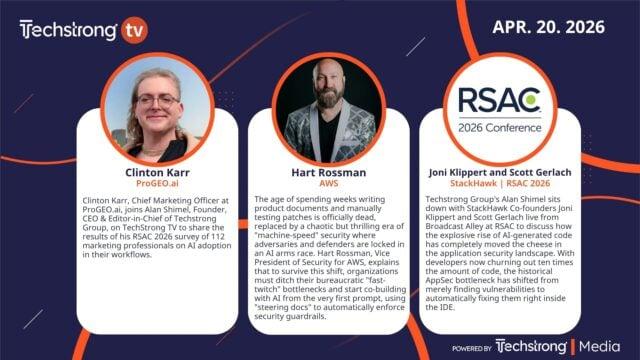
Techstrong TV February 25, 2026
Beyond the Perimeter: BlackFog CEO Darren Williams explains why anti-data exfiltration is replacing legacy DLP as the new cybersecurity standard, citing a 47% surge in ransomware and AI-powered reconnaissance targeting high-value sectors.
The End of Ingress NGINX: Solo.io’s Lin Sun outlines how the retirement of Ingress NGINX reflects a broader shift toward AI-native gateways built for agents, real-time inference and dynamic cloud-native traffic patterns.
Utilizing AI Ep. 15: Stephen Foskett and Jon Swartz, joined by Frederic Van Haren, examine how AI is transforming healthcare and manufacturing safety through improved reliability, automation and risk mitigation.
Cisco Nexus Hyperfabric: A look at Cisco’s cloud-managed platform for building scalable, repeatable AI pods—designed to simplify deployment and operations for enterprise AI clusters beyond hyperscale environments.
Transcript
Hey, everyone. Welcome back here to Tech Drunk tv. I'm really happy to introduce you to our, my next guest.
His name is Darren Williams. Darren is the founder and CEO of a company called Black Fog. You might have heard of them, if not, not to worry.
We're gonna bring you up to speed. But first, let's welcome Darren. Darren, thanks for coming on Tech Drunk tv.
It's great to have you on here. Thank you, Alan. Pleased to be here.
All right, so Darren, I, I mentioned you're the founder and CEO of Black Fog. Why don't you give our audience a peek behind the curtain of who they're listening to? How did you, what, you know, no one wakes up one morning and says, yeah, it's a good day to start a company, right?
Yeah. We, there's something that drives us as, as someone who's co-founded a bunch and founded a bunch of companies myself, I know this, right? You're driven, you, you're passionate.
Tell us a little bit of your story and where this passion came from. Well, I've always been interested in computers from a very early age. And, you know, I remember building my first computer when I was like 12 years old back in the day, right?
The IBM, xts and all that sort of stuff. So I was always interested in computers, but, you know, my education took me another direction, actually. And I ended up becoming, I ended up getting my PhD in pharmacology of all things really.
But one of the things I did on the way through was I always did software on the way through. So I always did a parallel task in medicine and then a bit of computer software. And I realized that, uh, I was actually pretty good at, um, software engineering generally, and wrote a few algorithms, put that in my PhD, et cetera.
And then I remember finishing my degree, was ready to get, do a postdoc. And my professor come up to me and he said, Darren, I'm gonna make a couple of observations here. 9 outta 10 computer scientist, and I'm just gonna leave that with you.
So he left that with me as a, as a thing. And I said, sat on that probably for like nine months to a year. And then I said, God damnit, he's right.
And so I decided, and I went down that direction, and then everything changed for me. Basically, I ended up becoming the, um, director of the multimedia, um, faculty in the University of Melbourne. Um, and that sort of started my career.
And then I ended up going commercial after that. Uh, started my first company, uh, got funded really quickly. That was down in Australia.
And then from there, um, I ended up selling it within the first two years at the peak of, you know, the market to a company called Quest Software based in, uh, Irvine, California. Sure. And then basically then after that, uh, after about a year with those comp, that company, I decided, decided that, Hey, I'm bored.
I need to go do something else. So started my next company, which this is how it gets into cybersecurity. But basically we, I got, um, I started a company called Lifetime Software, and it was acquired by a company called Absolute Software, which was a cybersecurity company, still is actually.
Mm-hmm. And that gave me the, uh, concept actually originally for Black Fog as it stands today. We were, so it is interesting, absolute software as a company, they were really all about, um, uh, bios, persistence.
So they had a technology, which is pretty cool, where it sits in the bios and was able to protect your laptop from theft. And we thought that was a really good idea. They're quite our company.
And then while we were there, we think it's interesting that no one worries about the data. Everyone's just worried about the theft of these very expensive assets. And so instead of ensuring them, they would buy the software, which would protect the laptop.
And then we thought, why doesn't anyone worry about the data? Because really that's all people really care about if you boil it down. And so I sat with that for a while, and then after my transition there for two years, I said, why don't we investigate that concept?
And that's how we come out with Black Fog. So it was all about anti data exfiltration or stopping data flows off the device. 'cause traditional cybersecurity is defensive based technology where it's always about the data coming into the device.
You know, you see a bad guy coming towards you, you try and take him out from, from the front. But honestly, most of the technol, most of the attacks and ransomware we see, it's all about taking data out. That's what they used to extort you, that's what they do to steal information generally.
And so that, and now, and now with shadow ai, it's a whole different concept altogether. So that's how we, how Black Fog started effectively. Great story.
You know, I, I think what you described, I I've seen it firsthand myself. We, we, and not just security, but almost the whole tech stack focused on the platform, right? Mm-hmm.
Yep. Form factor platform. Then it focused on the app.
It was all about how can I break into, how can I prevent someone from breaking into my app, whether that app was on my local device or in the cloud buffer overflows script, you know, it was about breaking into the app. And, and for a long time we, we forgot that it's all about the data. Stupid, right?
The data is the crown jewel, the data is the value. And, and then Correct. Sometime around COVID, I think we started seeing a, a reemergence of emphasis on protecting the data.
Not, not the app, not even the platform, the data. And, and, and you can't separate the data from the platform and the data from the app, right? And, and, and try to try to do that.
But, you know, Darren, back in, in the day, and I, I've been in security 30 years, there was this whole concept of what we call DLP, data loss prevention, right? And, um, mm-hmm. Quite frankly, it never worked so good, right?
I mean, a lot of people, a lot of people have thrown their hat in there. Yeah. A lot of people Feel that a lot.
And DLP left because the concept, though, is actually good, but, and yeah, no, it makes, but what we find in practice is I've never come across an organization that's implemented it successfully because it's too difficult. Now, the concept is great, but in reality, what happens is nobody has the manpower or resources to staff the amount of data classification that needs to be done to make these things work. Yep.
And it also sits on the edge of the network. So what happens when I go home or in a, in a hybrid work environment, which everybody is these days, it doesn't really play out, right? What, what, well, with the death of the perimeter, right?
Remember the old Moton Castle kind of thing? There is no such no perimeter, you have no edge, you have no DLP. So how's Black Fog difference?
How's spell Black fog different? Yeah, so, so we, we always appreciated the concept and the theory behind DLP. And we thought, well, it's interesting.
Why haven't, why hasn't anyone solved all of the major problems? And first of all, it needs to be on the endpoint itself. That's where the game is played.
That's where the data is stolen from. Why don't we do that? Why don't we auto classify the data to begin with?
And what we're doing is working at the packet layer, watching the data flow off the device, and we're using a lot of ai, you know, and, and ML algorithms to actually monitor that data flow. So without actually having to go inside the packet, which is a breach of security in its own right, we're able to actually see the intent and the ANA and doing the intent analysis on that, where it's going, what it's doing, and why it's doing it. And effectively, that's what we do at Black Fog, and we stop the data, the unauthorized data league in the device.
So we're able to solve all those problems of DLP, basically. Excellent, excellent. Um, and the management becomes easy too.
And is this, so, so is it like an agent that goes on the device? Is it sas? Yeah.
It's a Piece of software that sits on your device. Exactly. And the other, the other important concept that actually is often overlooked here is that we do everything on the device.
We do all the algorithmic detection on the device. We don't send it up to the cloud. Like there's most EDR vendors that you'll come across these days.
They're all sending it back over to their cloud. So you're losing your data. So where's the attack vector now?
The attack vector is actually looking at where the data is. There is no coincidence. Let's just say that VPNs are the most attacked vector these days, because guess what?
That's where all the data's flowing. So they're, all the attackers are always gonna look for those, um, places to expose. So we're able to minimize that effort by doing it on the device.
And we only show you when we block something, then we send that to the cloud and say, Hey, look what we just did. Got it. So that's how we just Ourselves.
It's minimizing the attack surface as well. Exactly. And that's what we're all about.
And it's also about privacy too. I mean, I don't really want to be under all these other, well, there's a lot of governance laws that are still being implemented, don't want to expose private data. We don't really care about it.
Frankly, what we care about is stopping the bad guys. Ultimately, we don't wanna see all your data. It's a lot of data.
We're gonna manage it. So there's all sorts of problems associated with that too. So it allows us to go into highly secure environments like government and, um, finance without the problems associated with saying, Hey, we have your data.
How are we gonna manage and handle your data? We don't have to deal with that either. Sure.
Excellent. Good for us, too. Excellent.
Darren, for people who maybe want to get a little more information, what's the URL for? The Black fog site? com, as just as it sounds.
So it's pretty easy to get the data. Yep. Alright, let us, let us kind of pivot, if you will.
And you guys recently released your state of ransomware 2025 annual report port, correct. You know, look, we're coming into RSA season RSAs in about another month, month and a week. I'm sure we're gonna see a bevy of reports right.
On breaches and ransomware and vulnerabilities and everything else. If you don't mind, give us some of, you know, the key findings of, actually before we get into the key findings, how long have you been doing this report? Why do you do it right?
What, what should people take outta that? Uh, we've been doing it for 2000 and since 2020. So we've been doing it for quite a long time before anyone was really doing these types of reports, actually, specifically on ransomware.
Actually, the reason we did it was actually we're doing it for our own internal research purposes anyway, because we change our algorithms dynamically based on what we see out in the, in the world. And so that's why we produce these reports. So we decided, well, why don't we just publish this so everyone can get benefit out of it and sort of share back to the community if you will as well.
Because a lot, there wasn't any, um, really recording of these stats before us. And so there are people that are now trying to replicate this, but we've got the historical data, we've got a lot of data points on this as well. And we like to see the trends.
We like to see what's going on in the glo, you know, macro economic view of the world, if you will. And that's why we publish 'em. So onto the report itself, I mean, some of the, we've seen the dramatic increase in, in attacks as everybody has every year, but this year we saw, you know, 47% increase over 2025, which was a record in itself.
Um, so the attacks have gone up, but, um, I mean, everyone's sort of used to that these days. But what are some of the bigger trends we're seeing? I would say it's really the focus on industry specific targets or sector specific targets that we've never seen before.
And we sort of attribute that to the use of AI and the reconnaissance that is able to be done. That wasn't possible before. So in the old, the old mechanism was basically just attack as many as you can, look for the weakest spots and extract the data and extort them for the in, you know, for the, for their information.
And now we're seeing a concerted effort by these attackers to go after industries, which are very well resourced and have a lot of money behind them and go after specific targets. Manufacturing's a great example this year. So this year we've seen a concerted effort to attack the manufacturing sector.
And, uh, we've seen that with the great examples, um, like, um, the, um, marks and Spencer attack, uh, in the retail sector as well. So there's been some really, really big breaches, and these have been devastating. We've, we saw that also with Land Rover, the Range Rover attack.
That was a really big one as well. So really targeted. And the reason they're able to get in a lot of the time is they can easily use AI to really do some reconnaissance work on targeting individuals themselves.
We know you're interested in cars, or you're a pat guy, whatever it happens to be. And we will know, you'll click that link, which will generate the payload that we need to really go in and attack that organization. So that's one of the other big things.
And then the general use of ai generally, people often think about AI for how we can use it to make our company more efficient, but people fail to realize that the bad guys also have access to this technology. And they're utilizing it really well by developing really great new algorithms. So we're seeing some really efficient attack vectors that we've never seen before.
And what they're doing is they're analyzing the code bases of all the stuff that's been effective and consolidating an into centralized, um, code, which can be deployed for attack purposes. And we're seeing bigger and bigger trends like that every day. And I think we'll continue to see that throughout the year.
Yeah, I mean, look, I, I think as you mentioned, ransomware really started to pop onto our horizons around 2020 COVID, right? All of a sudden it, it really just took off, blew up, Blew up. And then, you know, we've seen some interesting things happen, ransomware over the last five, six years.
First of all, cyber insurance companies, you know, for a while there was sort of the primary, uh, negotiators, if you will, I'm trying to get ransom data back. And, but they also became the people with the big stick, right? Who, Hey, if you want us to insure you, you're going to need to have a black fog.
You're going to need to have correct. Some anti somewhere. Yeah.
And, and that was, you know, it's not a bad thing. Sometimes you need a big stick to get people to, to do things mm-hmm. To do the right things for themselves.
Um, but then on top of that, of course, we've seen ai, right? And ai, uh, uh, you know, just increases attack surfaces, make, makes this thing its scale. The bad guys use AI as well as we do.
And it, and it just, it blows that up. But the other thing, and this, I guess a good thing is that people are understanding, hey, with ai, not, not just with ai, with ransomware, I, it's imperative that we have a clean data set somewhere that it can't be reached, you know, through our regular network. So that worst case scenario, we're not, we, you know, we, we can't just throw it out and start over again.
And without that clean data set somewhere that's really insulated. And I think more and more people have done that, right? They, they are, I, I hope they are.
Anyway, I wonder if that comes out in your, in your, uh, report and in your surveying and, and research. Are people making sure that they have a, a clean quote unquote clean set of data that is untainted or would be untainted in a ransomware attack? Um, we're seeing mixed, I would say, I think it's still very early days as far as AI goes in general, you know, corporate America, I mean, we are seeing some significant investment by CEOs.
We're saying, we are hearing things like this. We CEOs know and they've got the message, AI is the future. And so they're saying, you know what?
Here's $3 million. Let's go implement some AI inside the company and get that 30% efficient so I can get the top line revenue growth. And so that's what's going on.
And so with that, what happens is that we are seeing very broad rollouts in all sorts of departments because they've got access to money to go and buy some new tools, for instance. But they're bypassing the security department and the CISO's office and director of it. And they're saying, and the CEO's saying, I don't care.
I want 30% growth. My investors are asking for 30% growth, go work that stuff out for me, right? So while in the meantime, the race horses out and they've gone and implemented stuff, and they're trying to pick up the pieces.
So as part of picking up the pieces, I think your point is valid that people should be looking at clean rooms and, and really protecting their data, but they have to try and protect what's actually going on in their org and have some visibility. Because frankly, most of these people don't know what's going on inside their business. They don't know how many people are using board versus chatt PT versus office, you know, the copilot stuff.
It's a, it's a real minefield out there. So we're seeing a lot of trauma in IT departments because of what the top level executives are doing to the organization. And if you then extrapolate that, now, we're only in the very early stages of this phase, but things like, um, open Chlor, great example, right?
Open Chlor is the, um, a, a AI agent that people can download to their laptops and actually automate their entire life. They can say, you know what? I haven't spoken to Alan in about three weeks.
You probably should send him an email. Would you like me to do that for you? Oh, and let's, maybe we should have a beer session tonight.
Could you, can I organize that for you? And so, but what you're not seeing here is that yes, it sounds like a fantastic tool, but what it's doing is opening up channels of communication to all these LMS out there that, and is basically connecting all the data to all the other data on your laptop, and then placing it in an open folder on your, on your computer somewhere, which attackers can actually access. So there's all these MCP architectures out there, which is their API protocol that they talk between each other is being totally exposed.
And so we are not there yet. I'm not saying that you need to worry today, but I would say in six to 12 months, this is gonna be probably the biggest thing we deal with. So it's interesting area.
Absolutely. Uh, we we're running low on time, but there was one other metric I saw in the report that I wanted to bring out, and that is that 86% overwhelming majority, eight, eight outta 10, almost nine outta 10 of these ransomware attacks went undisclosed. Yeah.
We're seeing more and more of that, Alan. It's a really good pickup. Um, we, we used to think that was going go down.
So you remember about two years ago now, the SEC put out a regulation which said that there was mandatory reporting Yes. If you had an attack. And so all these public companies started doing that.
But then what happened was there was an increase in volume of attacks, and then all these small businesses that aren't under those, uh, guidelines decided that it would be better to save their job than disclose that we had an attack. Because then there was all these repercussions for these IT executives to say, it doesn't, I don't want it to be on my watch. And so they weren't disclosing and are still not disclosing as a result of that.
And so I think there's that undercurrent going on that we're not actually seeing, um, that's why we measure these numbers in the first place, actually. Uh, people are just trying to protect their jobs, and if they can hide it under the map and maybe pay these guys off, then maybe we don't have to tell anyone it ever happened in the first place. And that's what those numbers reveal to us.
Got it. Got it. It's scary, but that's what's happening.
It's a scary world, my friends. You know, it's, it's not a time for, uh, unfortunately, it's the world we live in, in many, many different ways. Darren, we're about outta time.
com is the website for the company mm-hmm. Off the front page, maybe they can get to this report. Yeah.
For, it's on the header right in the below the first, uh, pa first section. So Yeah, for sure. They can just click on it and, uh, download the report.
I love it. Hey, keep up the great work. You know, sometimes, sometimes toiling in cybersecurity feels unrewarding, right?
'cause you get these numbers, 49% more attacks, a hundred, you know, year over year kind of, and, and you just, you feel like sometimes you're shoveling sand against the tide. Right? But there's always a new company, Alan.
Every day we see another one, so well, Right. Well, there's always someone who's right. Who thinks they've got a better mouse chop.
Exactly. But The mice keep it's getting smarter too. Does do.
Exactly Right. Good point. And, uh, but, you know, it keeps us honest and, um, you know, I wouldn't be doing anything else.
I enjoy getting outta bed every day, and that's all you can hope for. Better than the alternative to her. Exactly right.
Thank you. Come back on and keep us posted. Okay.
Will do. Thanks, Alan. Thanks for your time.
All right. Darren Williams, founder, CEO of Black Fog here on, uh, tech Drunk tv. We're gonna take a break.
We'll be back in a moment. Hey guys, thanks for the throw. io, and we're having a little chat about, well, this Nginx ingress controller that's about to be retired and what we should all maybe be doing about that next.
Lynn, welcome to the show. Thank you. Thank you so much for having me, Mike.
I think at first glance when people looked at this announcement, they're pretty much like, well, I should get a different Ingers controller, and I'll go from there. But there's other ways of thinking about this thing, right? The whole space has evolved a little bit.
There are gateways now and other things that we might use. So what are my options to go forward here if I'm gonna have to replace that controller? That's a great question.
I, I think you're absolutely right. I actually first heard about this, uh, at Cube calling Atlanta, right? So the team kind of set, uh, uh, uh, archive data.
I remember it's approaching end of next month, uh, right. And they said they're not going to maintain it after that date. So, uh, timing is everything.
So as user are looking at replacement of ingress, INE XI believe they want to look at a couple of categories. So first, uh, the maintainance, if I remember correct. So when I was reading the announcement, the maintenance definitely recommends stay on the standards, which is the Kubernetes gateway, API.
Right? So that's the recommendation, uh, from the community, the cloud native community, the maintenance, um, C network, and even the maintenance, I think, uh, who put out that post out, uh, uh, ingress, nexts req, uh, retirement. Um, so I, I do think you want to pick out a implementation of Kubernete gateway APIs, first of all.
Also, that's an important check marks because you won. Make sure you are adopting open standards. I think the second check marks is you want to look at, um, the features of what you need with your, um, what you have today with whether the new one you're gonna pick supporting those features.
Does it have the conversion tool right? To help you easily convert from your existing, um, configuration to the new one with Kubernete Gateway, API, and potentially some project specific, um, uh, extensions. The third thing I think is the performance, uh, is always a big thing, right?
As people looking at, uh, another option for replacement for Nginx ingress, you know, how is the gateway performing in terms of throughput, CPU memory latency in terms of the time to translate the configuration and make it live, uh, in the proxy. So those are the important metrics people should look at. Uh, the first thing I would say is the community momentum, right?
You certainly want to pick a project that's in a foundation, uh, which has a better chance to success, and also check out the diversity, right? Um, whether the project have maintainance from multiple different companies, you know, whether the project is growing steadily and healthy, whether the project team, uh, are responsive to your questions, if you ever have a question. So those are the four things.
I think it's, uh, it's important to check it out. Mm-hmm. I also think, you know, it's maybe not always like for like, I mean, I had a controller, but if there's something called a gateway that's a little more elaborate, maybe I go that route because the gateway does more than just the controller, and I have to think about it a little more broadly.
Yeah. I mean, there's really two pieces of the puzzle, right? So one is the, the proxy that's actually doing the work, uh, which is Nginx proxy, right?
Uh, so the other piece of the puzzle is the control plane who is programming that proxy. So whether you stay with Nginx as your proxy, or whether you pick Envoy as your proxy, or whether you pick a new high performance proxy like Asian gateway, for instance, which is completely written from scratch, um, based on rust for AI to adopt the rapid change of AI agents and MCP, uh, all these new protocols to allow us to innovate and iterate a lot faster. So, um, so the, that's another important piece.
As people looking at their requirements, are they looking at, you know, adopting, doing the same thing as they were doing in the past 10 years? Or are they looking at adopting MCP, you know, adding a agent conversation into some of their, um, front facing, uh, API with their users? So that's going to be critical.
Are they consuming large language models and adding intelligence to their applications? Is this also maybe a good time to start thinking about things like, I don't know, IPV six? I mean, should we migrate as part of this thing?
Or how, how ambitious should we get? That's a great question. You know, honestly, I do think, uh, you want to be, uh, you want to be thoughtful as your migration and probably not taking too many risks set up one time.
It's like you don't put your eggs in one basket, right? In a sense, um, the IP V six migration, I do think you could potentially migrate, uh, relative smoothly once you decide what is your replacement project, right? Like, you don't have to migrate to IP V six in day one once you decide this is the new project you're going with.
The challenging, though, is you don't want to have too many variations as part of your migration. Um, you want to identify what is the critical parts of your migration and then face it out. I think that's probably a more viable approach because we're not talking at, uh, about you have a lot of time to migrate.
Um, 'cause the, 'cause the end of March is approaching right after that. You will not see like fixed packs or, um, CVE releases, uh, for ingress nginx. So there is a present timeline approach.
So I personally wouldn't recommend unless you are really like adventurous and willing to, you know, like eat all your sandwich together. There you go. It might be too ambitious.
It's good to have a long-term plan, but maybe not all at once. That's right. Yeah.
I think we have seen, at least in the last year, a lot more clusters and fleets of clusters. So have we reached some sort of tipping point now where the networking between those clusters has become more critical? Because I think a lot of people, you know, if I had one or two clusters and they were running stuff in isolation, I didn't think too hard about it.
But I think now we've crossed some sort of Rubicon there. Yeah, I, I definitely agree with that. And the gateway is a critical piece of that puzzle, right?
Um, so we've seen, uh, at least, uh, working at Solo and also some of our open source users, we've seen tremendous interest around beyond one cluster, right? Because typically people can roll one single cluster themself, uh, follow open source documentation. What they need, enterprise help a lot of times is when they have more than one cluster.
And when they actually having cluster talking to each other, they want to either do failover or secure communication or join their, um, different trust domain together and still have that boundary of trust. Um, so that's, uh, where we think Gateway can play a huge role in these type of scenarios where the gateway can help you to apply policies, connect traffic across different clusters seamlessly, and provide that visibility observability as the traffic travel through, uh, multiple, uh, different clusters. Yeah.
Um, what is your best advice for managing all this stuff today? And I'm asking this question because historically in a lot of larger enterprises, there's been this networking team and sometimes a separate security team, and then there's the DevOps teams and the guys who build the applications. Should that be all centralized or, you know, do we need to figure out how to kind of manage all these things in isolation and the networking people need to take more responsibility for the network controllers and gateways and all the things that connect those Kubernetes clusters, not only to each other, but the rest of the enterprise?
Yeah, I think it really depends on how many, uh, how large is your organization. I've seen sometimes when the organization are not super big, the network team and the develop team, uh, the platform team could emerge, right? But if your organization, the number of cluster, the number of the teams are big, I can see a clear separation between the two.
I do think what's important though is, uh, we probably going to change how people work together, uh, soon if it hasn't happened already, right? Same as right now. Uh, I remember a year ago, um, I just learned about, okay, I can use natural language to ask, um, ask cursor or, you know, Claude to actually help me develop my applications for me, write code for me, right?
So, um, which is great, and I'm really impressed to see the speed of the innovation in software engineer with AI agents and large language models. Um, now if we think about networking engineer, developer engineer and application development or deployer, right? That experience I've constantly heard from network engineer and platform engineer is what they had to put the guard rail in place.
They had to constantly educating, onboarding, uh, new application developer who is, you know, developing things in the environment. They have to constantly educating them. These are the rules, uh, for these are the polls can be open, these are the resources constraints.
Uh, you have to go through this repository and do this and do X, Y, and Z before you can deploy in production, right? So all these rule books that may be on paper in the past, I think we're mo we're seeing moving that more into a agent flow where AI agents along with MCP and agent skills can potentially play a really key role here to be that guard rail person, uh, to manually guide you instead of having a person manually guide you through either, whether it's, um, you know, a cookbook, um, but it can be more programably through natural language, uh, through, uh, agents. I think that's going to be, uh, tremendously helpful to change how people going to interact, uh, between different type of roles.
Mm-hmm. Um, well you mentioned platform teams, and I guess I wonder if, you know, I I get past four or five Kubernetes clusters, does that force the platform engineering conversation because teams will go, we gotta rethink how we manage all this stuff? I think so, right?
Because, uh, having that skill of platform engineer, you don't need everybody to gain that skill, right? To be able to stand up the Kubernetes cluster, to manage the health of the Kubernetes cluster to, you know, watch and having the right governance in place, that's a skill you don't necessarily want whoever developing application focus on business innovation to learn, you want to kind of abstract that's, um, for the application developer so they can focus on ship code faster so they can focus on how can they make their application more user friendly if it's the business needs. Um, so I think that line is certainly very useful.
What I've, we've seen though in the past, uh, with application developer can iterate a lot faster now, and I see this with myself. Uh, I could, you know, rip off my application and redo it in a different language and to see if it performs better. Um, so the ability to ship is a lot faster now.
Uh, so I think that abstraction provided by the platform engineer is critical and also can potentially enable platform engineer to support way more application developers, uh, with, uh, with their guard rail. We talk about through AI agents and MCP and agent skills. What do you see people doing today when it comes to Kubernetes and networking?
That kind of just makes you shake your head a little bit and go, folks, maybe we should be a little bit smarter than that. That's a really cool, uh, interesting question. Uh, I would say people are definitely frustrated when there are problems, and problems do exist a lot of times, unfortunately.
I think things works really well on paper and when you try it in the POC environment, but a lot of times in production, uh, things can get a little bit wired. And I think as a human, you know, our brain is, uh, focused on one thing at a time. Uh, it's harder for us to, you know, think completely and think very fast.
Like when you're developing, uh, depo debugging a problem, right? You might be thinking about X but not thinking about the impact of Y on X. And here you finish looking at X and then start to looking at a, at a different angle to see if that could have been the problem.
So, um, one of the example I run into myself was, I remember I was deeply debugging a problem, a networking problem in my cluster, and it was, uh, it has like 10 moving pieces. Like I was loading a new version of software. I was noting a new version of my gateway stack.
I also de was developing, uh, deploy MCP servers. It has like two moving pieces, and I got frustrated with my debugging. Um, but at the end, it turned out to be a very simple problem, but somehow I didn't look at that problem.
I didn't thought it would be wrong. And, uh, in hindsight, I actually thought that it would be really nice if I actually had a debugging agent looking at the most fundamental problems I had and could potentially actually spot out the problem for me. But because I was frustrated myself, I didn't think about looking for the agent.
I think I overestimate what I could potentially do. Uh, I went, I bugged a lot of people for help. I did find out what the issue, it took me a few hours, but I know, um, my agent, um, could potentially spot that a lot faster because the fact that the agent is, uh, it can check things a lot faster and it doesn't, it wouldn't be afraid of check some of the most dumb mistake, which we all are human and we could potentially make mistakes too.
So, So I also can't help but wonder if developers are kinda ignoring the physics of networking. And I asked the question because they're building more distributed applications and there's latency, but I think that they somehow think that magically, you know, all these distributed clusters and networks will just somehow or other, you know, account for all that latency when in fact, maybe we need to think about the network more as we build and deploy our applications. Yeah, that's absolutely right.
I think the goal is, uh, the network can be disappearing for developers, right? But that's a aspiration. I don't think we will be getting there.
Uh, I mean, it, there will be latency for sure. I think the question is, is the latency small or tiny enough that we don't need to talk about it, right? I think, um, this is also why we started the aging gateway from ground up because we've been amazed with some of the performance number from aging Gateway, and we're talking about like a way less than milliseconds of latency, uh, when the proxy is on the load, right?
'cause to a lot of people with concurrency traffic, when the latency is like zero point, uh, one milliseconds, a lot of time it's, uh, it's, uh, it's so minor that you may not think any latency at all, right? So that, that's kind of the goal we always wanted to achieve. But in reality, there is that hub.
You have to, um, think about how to minimize the hub as little as possible. There's also like the networking, the cable, um, bandwidth, if it's across region, right? If it's within the zone and region, it could be faster.
So that, um, networking latency across region is always going to be existing. And then on top of that, depends on how many proxy hops you have and how performing your proxy is. That's when it's getting really important, which is also why I would definitely encourage people to locate at the Asian gateway.
It's one of the best, it's actually the best, uh, performing, uh, in terms of network speed latency in terms of, uh, CPU and memory utilization in terms of the moment you programming your gateway, API resources into the controller and how fast it actually programmed the gateway proxy of aging gateway, it's like the fastest in the industry. So, uh, that, that that's the way to, you know, minimize your network ency as much as possible is choosing the best performing, uh, gateway. Uh, in between your network hub.
You mentioned ai, and I'm gonna ask the question, um, is AI gonna ultimately be the means where we achieve that goal? You described where we make the network kind of transparent to the developer, and will the AI agent kind of just magically take care of all these latency issues? No, I don't think AI would magically take care of the latency issue.
The latency will always be there. Like I mentioned, it's just how much latency it is, is, is, uh, tiny enough that's, that's not talking about, right? I think the AI could potentially play a huge role in how help us to be more intelligence, help us debugging problems, uh, help us overlook issues we didn't thought about looking or maybe faster than us to look out those issues, helping us onboarding new members that help us delegate the works we don't want to do because it's repetitive work.
I'd rather have somebody else who, um, can do it and onboarding new members, uh, you know, so that I can focus my energy on learning, doing new stuff, and for the stuff I already know how to do. Um, I want to build that as recipes to my agent skills and con, you know, config my agents to do some of that work for me. I think that's going to be, um, uh, important way to make us more efficient, but I really don't think it's going to, you know, making our, um, network of gateway faster.
Um, unless, unless, you know, AI can beat some of our best engineers, uh, improving infrastructure. Maybe we'll get there one day, but, uh, but right now I don't see it yet. Well, folks, you heard it here, even in the age of ai, the laws of physics have not been suspended, and we still need to figure out how to make all those networks work.
Lynn, thanks for being on the show. Well, thank you so much, Mike, for the chat. Appreciate it.
All right, and back to you guys in the studio. AI advertising is here with advertisements for AI about ai and using AI taking center stage during an otherwise lackluster football game. Went after open ai, which reportedly plans to incorporate advertisements into chat, GPT and AI assisted video was everywhere.
We expect that generative AI will lead to mass customization of advertising with ads being more integrated and personalized than ever before. That's the topic as we take up this episode of utilizing ai. Welcome to utilizing ai, the podcast focused on practical applications of artificial intelligence from the Futurum Group.
Every Wednesday, we explore news and use cases of the ways in which AI is transforming enterprise IT and the industries it serves. I'm your host, Steven Foskett, president of Tech Field Day business unit here at the Futurum Group. Before we dive into this discussion, let's meet who's on the panel with me today.
Hey, I'm John Swartz. I'm the West Coast Bureau Chief for Techstrong. I write about ai, it occasionally Security Boulevard.
That's where you can find most of my work. Yeah, thanks for having me. I'm Frederick Van Herrin, the founder and CTO of ens, and we provide HPC and AI Consulting Services.
Well, thanks for joining us today, both of you. Um, as we are recording this, uh, it is just a few days after the, uh, let's call it the big game at risk of losing any, uh, trademark or, uh, lawsuits, you know, the, the, the, the litigious NFL here. Um, and of course, uh, a lot of the buzz was about the ads during the, the, the, the, the big game, which included, of course, lots of ads for about and with ai.
And I think that that maybe leads us into an interesting corner here. Uh, we saw, uh, those of us in the industry, I think were perhaps best prepared to see Anthropic going after open AI with an ad that focuses on open AI's, um, forthcoming, let's say, uh, in chat GPT advertisements. And of course, they went after it with a, um, an ad that, uh, that would focus on that.
I found, honestly, that that ad was a little bit challenging. Um, the people that I was watching the game with, in fact looked at me and said, what was that an ad for? I don't understand that, because I think most people are so jaded already with the internet and advertising that they just assumed that ads were everywhere in chatbots, even if maybe they aren't.
Uh, John, let's start with you. Uh, what was your impression of, uh, anthropic going after OpenAI during the, uh, big game, uh, advertising? So in the spirit of Super Bowls, we saw Apple go after IBM with the Big Brother a 42 years ago, and I think this was the same idea, is to, to poke fun at your, your biggest rival, but it's a little bit ironic, don't you think?
Um, Steven and Frederick, that anthropic, which was criticizing open AI or pivoting hard to advertising was advertising. And then in fact, I think the, uh, the, the, the woman who's generated in the anthropic gad was AI generated, or that was the idea at least. Um, it was a kind of an inside attack because most people, honestly, in the greater viewing world, don't really know the history between these two companies.
Um, I think the idea is that OpenAI said it would never advertise, and yet it would, it did during the game. There's even a debate. They had a very vanilla ad in the game, or before the game, excuse me, before they, they were, there was, there was a rumor that OpenAI was gonna run an ad during the game.
That may have given us a hint at what Johnny Ive was working on. That's a wild rumor. But nonetheless, it, it's interesting.
I mean, I, I think what it did with ING did was they brought attention to this idea that both that o open AI will be advertising quite a bit, and that we should fear and distrust it. Um, I'm not sure how effective their ad was. It was humorous.
It was a little bit scathing. I think what helped that Adver advertising more than anything was Sam Alton's reaction to it. He saw the ad before it aired on the Super Bowl, and he went on a four 50 word screed about it, in which he attacked it, which in, in a sense, he gave it more oxygen and, and publicized it.
So I think we're gonna see a lot more. I mean, you can mention, I think, Steven, you mentioned a couple of ads that you found very spooky that were in the game, that were game obviously AI generated. But I think it's something that is gonna become much more common.
And I can talk about, we can talk about later, like some i ideas of what they might do. Some things I've been seeing on reels I think are gonna be, become AI generated, uh, super Bowl ad type of, of, uh, themes. But, uh, it opened the floodgates and we're gonna see a lot more of this during big events like the Oscars, the, the Grammys, what, what have you, big events.
Yeah, I think from an advertisement perspective, I mean, this is the, the biggest stage, right? You can have. So if you, if your intention is to make a point from an advertisement perspective, then that's probably the place to be.
And I think John, I think the, the adver, the, the advertisement from Tropic really is kind of based on the, the, the rivalry between Open AI and Tropic and their different approaches, not just the advertisement, um, charge that, that OpenAI will pursue, but I, I, I do see two things right from, from these, these advertisements. The first one is, is the, um, the fact that OpenAI and and Tropic are really competitors and that they really wanted to make a point. And then the second piece is to use AI in advertisement.
I mean it, at, at what point is the game gonna generated as opposed to on field? So I think it's, it's important, um, to see and make a distinction between the two, right? If actors will also not be replaced by ai, right?
Do we need, do we need actors playing, um, roles in advertisement, or will that be completely, uh, done by AI anyways? I think it's, I think it was, it was funny to see, uh, at the biggest stage what companies are doing and what they're capable of doing from a technology perspective. Well, yeah, I was gonna mention really quickly Frederick that.
Um, yes. So the history is the, these are key intense rivals, and they, the, the, the idea is one represents some i one idea of ai. The other represents an entirely different one is based on your interpretation, but I think as you, as you were mentioning going forward, I think you're gonna see AI replacing officials.
So AI will be able to use the eagle eye, they'll be able to interpret plays in the future. And I also, when I was mentioning earlier, the whole idea of advertisements, you know, you start seeing all these kind of retro, uh, videos on reels and, and TikTok where you see these, these, these actors, they've been de aged and they're, they set up these fictitious meetings between Jimi Hendrix and Bob Dylan and M**k Jagger when they're in their twenties. And it's just this complete fantasy.
And you're gonna probably see the same type of thing in advertisements with celebrities, with the celebrities signing off on it, where they are represented by their younger selves, maybe with their voices. You're gonna see this whole kind of fantasy world where you're not sure what's real and what isn't. And, uh, we won't know.
It's not real, but it's gonna be really hard to tell just by the naked eye. And I think that we're already at the point where, uh, a lot of these AI video generators can generate really, um, let's say, realistic looking video. But I think there's still a bit of a caviness factor to it from, uh, folks who object to eliminating, uh, the traditional artistic talent that's used in producing, uh, video, especially, um, advertisements to the sort of unreal nature of the thing.
Um, I know that there was some, uh, pushback on, uh, one of the ads for, uh, being a bit gross as a, uh, an Android drinks, uh, red liquid, and it spills down the front of the thing. I mean, it's, it's just like, uh, did nobody look at that and say, yeah, that's not a good message for my, my company. Um, and, and I think that that's sort of a natural result of the haphazard use of these AI video generators.
Apparently. Um, I didn't see it because I'm not in the market, but apparently a, um, one company that is trying to specifically build a platform to generate AI generated advertisements advertised during the game for their platform and, and boasted that they were able to put together an AI ad for their AI ad service in a couple of days. Um, and, and my question on hearing about that was, is that a good thing?
Do I want to just dash off a Super Bowl ad in a couple of days? Or should maybe we be thinking about this, uh, Frederick? Yeah, I, I think, I mean, if you look at advertisement, the goal of advertisement is to target a certain audience and, and to make a point, right?
And so the, the issue with advertisements today is that you have to prerecord them, right? So you, although you're using ai, you're kind of trying to guess on what your audience is gonna be. I, I, if I had to predict a little bit, I would say that in the future, it's more gonna be a time to market where advertisements can change on the spot where, where it's not pre cant, but it's basically targeted on what's happening, maybe something that happened on the field, if it's a sports event, and use that in an advertisement.
So I do think that ai, using ai, so to speak, uh, in a real time fashion, which should be really interesting to, to advertisers because you can really narrow down to your target audience with real life, uh, events. You know, one thing we mentioned, uh, is OpenAI. With soa, there's an agreement with Disney, right?
So, so we careful all these possibilities of all these Disney characters being used in, in, perhaps even in advertisements. And I think our producer Corey just mentioned that James Earl Jones already sold his voice to Disney for Darth Vader, so we could see that being used. Um, and it's interesting, Frederick, that that the concept you said about how the ads could be changed and tweaked by the, by the second based on, uh, what, what they're saying.
And again, you know, you're, I think the cost was $10 million for 30 seconds, something like that, something outrageous. But this disability to, to change your advertisements on the, on the, on the run, uh, would create, uh, all sorts of flexibility in terms of advertising, in terms of the markets, and would be almost interesting to see variations of the same ad for, for different demographics, right? Rather than one ad for everyone.
We would see 10 variations of that ad, not necessarily maybe one major version for the Super Bowl, and then nine other versions that find their way onto YouTube or what, what have you. Um, I mean, it, I it gives a certain, it gives an incredible flexibility to the advertisers and, um, they also, I think it save a hell of a lot of money not spending on production values or on the, or gaining the rights or gaining the, the, the celebrity's time. You can just recreate the celebrity with them signing off.
Yeah. And on, on the point of, of the cost, I think think it's worth mentioning too, that it depends on the market that the ad is presented to. Um, I heard about, um, 4 0 4 media, uh, they managed to run a Super Bowl ad, uh, for $2,550.
And how they did it was they selected the smallest media market in America and targeted their ad only there, uh, just so that they could say, Hey, we ran a Super Bowl ad, which is kind of funny, you know? Um, but to your point, John, uh, you know, that makes me think about this whole concept of, um, you know, uh, tiered pricing and, uh, mass customization and this trend that we've seen for a long time in, um, advertising especially that, um, and I think a lot of people see through this, but you know, you, you go to the, to the, to the website and it says, you know, do you want us to personalize your ads, personalize your ad experience, whether that's at Google or at Amazon or Apple or pretty much any other, um, advertising focused website. And the idea would be that if you share your personal data with us, we will give you more relevant and interesting advertisements, which sounds great as long as it is.
But honestly, I think a lot of us understand that what we're really doing is just giving up our personal data and, and that's that. But I, I could see a situation where generative, um, you know, generative AI could actually live up to that. It could create custom ads, it could create ads that would appeal to Frederick, particularly not to Frederick and John and me in a way that, well, I I'm wondering there would be probably a, a, a backlash.
Frederick, what do you think? Do you want to see, um, I don't know, ads for cars that say, you know, Frederick, we know that you currently have this car and we think that you'd like this other one. Does that sound like a good time to you?
Well, well, I think natively when, when we want something we want targeted for us, right? I might be more interested in sedans while John might be interested in pickup track, right? So the, so obviously we would like to have the answer to be more appropriate, but I think that's the holy grail of AI is where the three of us could ask the exact same question, but we could get three different answers based on, on our information.
Um, and, and to your point about data sharing, I mean, I think, aren't we past the fact that we should give permission to access our data? Isn't that already happening today? No matter what you do, I mean, ev every time you use the system, you're, you're kind of giving up your data.
But I think if we, if we look at what chat bots will do for us, which is personalized, you, you can draw the line to advertisements where the advertisements, if you like, advertisements, advertisements that are targeted to you. And, and I see a future where in the, where a Super Bowl ads might not be the same to everybody, right? Maybe the advertisement that is being played to the team that's on the field, winning or losing might get a, a different kind of advertisement that is more interesting to them than something something else.
So I definitely think that the holy grail of personalized results of answers, um, is, is really what we want, right? We want something that fits the, the, the context, not something that, that is interesting to somebody else's context. Yeah.
Let me, let me hop in on that one. Frederick, that's actually a really good point because it's technically feasible to do what you're describing simply because most people are now watching, um, sporting events, not on conventional broadcast systems, but on, um, ip, you know, over the top IP based, uh, video systems. Um, you know, I mean, I watched on the Peacock app, um, I think probably a lot of people did.
And I think that that is likely to enable that kind of customization in a way that would be very surprising to people, Right? I mean, it could start with something very simple where, where the the speaker is, uh, uses the accent of the region where you're trying to target, right? Yeah.
You know, in a sense, we're already doing this, right? If, when I watch YouTube based on what I watch, if it's a music video or what have you, or a news program, I'm, I'm offered, um, similar types of programming or clips on the right side of my screen. Uh, the same applies I guess with the algorithm on, on any type of social media like-minded comments will populate where, where I'm looking in my newsfeed, for me at least.
And I, I actually think we're used to this idea we're we're open to the idea, and I'm actually would like to customize that. I buy a lot of books on, uh, thrift books or use Amazon. It suggests to me what I'm doing.
So we're already conditioned for this. So if you're watching on your streaming device, you might get a very highly tailored advertisement, and I think most people would probably be open to it. But the one, you know, the one thing I wanna ask you just, it makes me think about our reaction to some of these generated AI generated ads is that it's, it's interesting, I think we embrace it as kind of a novelty, but I wonder if, if we're inundated with these type of things, it reminds us of the influence AI has on us, or if there's even a sense of a backlash to this kind of forced fiction that we're watching.
Um, sometimes I don't even know what to believe when I see online, because especially on X, there's so many fake posts, um, especially very, very persuasive posts using video, using photo, using images. Um, and I'm just wondering if inevitably we overuse ai whether it creates this backlash or resentment among the viewing audience. Right?
I mean, I think that on the topic of fake, I mean, even if we have conversations with individuals, I mean, there's always the risk that the information being provided by humans is, is not really totally correct. Um, I, I think on the, the, the interesting point about AI is AI definitely can do something based on our, the context and the data we provide in the past. Um, there is a second, uh, there's a second site to which, which is, it can try to predict what you think you're gonna need, which might not necessarily be fully based on what you have done in the past, but maybe what other people have been doing.
So it, it reminds me a little bit, I mean, many, many years ago when there was this, this, this conversation where CVS was sending coupons for, for diapers or whatever it was to people that didn't realize they were pregnant, right? Yeah. It's, that's, that's kind of the, the, the, the interesting side of it where it's not just based on what you know, but it's also based on what you dunno.
Well, and on that, on that point, back to the Super Bowl ads, um, one of the ones that actually got, um, I heard positive feedback on was the Google, uh, Gemini ad where it showed a, uh, family moving to a new house and it showed them using Gemini to show what their, um, you know, what they could do with the house and how they could decorate it, how they could make it feel like a home. It really was a feel good ad, but just think about the implication of that. Gemini could certainly have been saying, you should buy new appliances from this particular company, or Wouldn't it be amazing if you used this paint color that you can only get from Sherwin Williams?
Or, you know, you know, wouldn't it be incredible if you, uh, you know, and, and already, I think, and, and to my point at the top of the show, the people that were watching the, um, the Anthropic ad with the, the weightlifter that pitches, um, I don't know, I think it was like lifts for your shoes or something. Their, their feedback after that ad, I kid you not like, looked at me and they were like, because I was like, oh, you know, what did you all think of that ad? 'cause I knew it was coming.
You know, you know, what do you think of it? You know, tropics going after, you know, chat GPT for having ads, and their, their reaction was that Uni universal what? Like, of course AI is going to pitch ridiculous things at me that I don't want, because I assume that that's already happening.
They completely missed that. They just are already, they're already living in this world that we're describing where AI is, is pitching things at you and trying to make you buy things. Um, I don't think we quite live there yet.
'cause I don't think that that is yet built into these chatbots unless I'm wrong. Um, but I do think it's coming. Can I, Can I, so so Corey mentions, there's, there's already a backlash with, uh, the creative and animation crowd against ai.
They're moving into other areas and they're, they're striking, they're, they're signing petitions about this. And my fear is like we, we talk about AI slop in terms of content, maybe written content or some video content. And I, I wonder if you're almost fast tracking the belief that a lot of these advertisements or communications or selling of marketing of things is considered AI slop, and that's counterproductive.
And we want more of a human touch. Like for instance, I'll mention during the Super Bowl there was the Budweiser ad, and which was, I thought, a terrific ad about the, uh, Clydesdale in a sense helping raise this eagle. And it, it was just heartwarming.
It was something, it was original. It was, uh, it had a very human humanistic touch. And I don't think AI is capable of doing that yet.
And I, I wonder, I wonder if people, um, will start seeing the difference between that, like, they would see the difference between AI generated text and an original story. Um, I always fear this is gonna happen, and I think it's gonna happen a lot faster than we, we think, given the animus that the general public has and the fear they have of ai, especially those who never use it or don't understand what it can do. And it can do a lot of great things, but there are a lot of people who still are on the camp that they absolutely won't consider it, and they can, they won't consider using it, and they also consider it a threat.
It's also, it, it's, it's more a generational problem, right? I mean, me, I would like to see life existing people advertise for something, um, while the more the, the, the younger generation has absolutely no problem with AI generated content. They don't need, they don't need to feel or, or recognize a particular individual.
Um, and, and I think from that perspective, you can see the, the advertisers kind of debating how much AI can it be fully ai and, and also probably who, who, whose audience you're targeting. But, but, um, you know, even I, I, I, when I watch advertisement, I really stop caring too much. If it's, if it's a, if it's a life person or not, my gut feeling is I would prefer a life person.
But it's, it's a matter of acceptance. And I think in the future, because advertisements will become more and more real time, you know, as opposed to can't as a result of this, I think AI is the only way to do this in seconds or milliseconds versus recording a, an advertisements, which might take days or weeks. I, I don't know how long it takes, but I'm pretty sure it's, it's more than seconds.
Well, yeah, that's, that's absolutely true. And, and, and I think that that was another one of the, uh, uh, there was a sort of build your own ad that featured clips of stars and everything. Um, apparently that was a massive undertaking with, you know, video crews and, um, you know, tons of staff and everything.
It was, it was a huge deal to, to create that. Whereas what you're describing is, is a completely different world. Um, you know, far be it for me to speak for another person, let alone another generation.
But, um, again, the Gen Zs in my midst, uh, when we were watching this, um, you know, I don't think that they're more accepting of, um, of AI generated video and content so much as they're just jaded about it. I think that they, you know, they grew up, they've grown up in a world of attention based, influencer based, um, you know, advertising everywhere. And, you know, the, the, what I'm hearing is that they're more sort of just, you know, kind of thrown up their hands and accepting of the fact that everything is fake and everything is ads and everything is targeted.
And yet what I hear from them as well is that they place a huge amount of value into real people and real experiences and real things. You know, my, um, you know, my daughter is, is she loves to do things like sewing and cooking that you would think were, um, you know, uh, passe in this world of fast fashion and delivery food. Um, but it's not about, um, you know, gratification or even quality.
It's so much as it is about just kind of a search for something real. And I wonder if this, um, you know, AI generated, uh, advertising infested world that we're describing will actually be, uh, face a backlash, or maybe not even a backlash. Maybe just we might see, uh, greater value placed on real people doing real things as opposed to generative ai.
So my daughter sounds like your daughter, Steven. My daughter cooks a lot. She likes hand.
She, she likes real realism. She likes reading books. She likes, uh, uh, creating crafts.
And, and I wonder, I wonder if there's a point where not just advertising, but we actually conceivably would see halftime entertainment, the Super Bowl halftime show would have some sort of AI generation, um, maybe in the sets or maybe the performers, because we already see people who are willing to pay to see a hologram of Prince or Abba or Freddie Mercury perform alongside real people. Um, I think maybe, maybe is there a backlash? Maybe there's indifference or maybe people just tune it out because they become so, so battered that they, they, they don't, they become numb to the whole situation.
I just, I really do hope that we, we, if we do see AI use, it's not over the top and it's not a sledgehammer approach. And I, I almost, in a weird way, think that open ai, which kind of fancies itself as being a latter day Apple, in some cases, tries to do that with their advertising. I know it sounds weird, but I, I actually do think with this, when this device comes out, they're gonna, they're gonna advertise it, but I think they're gonna try to humanize it as much as possible to, to, to appeal to the older crowd as well as the younger crowd.
I mean, to a certain degree, it all comes down to presentation, right? So you use the example of cooking and sewing in the end. You, you wanna learn something that's the content.
And if, if the content is being done by an automated or an AI generated person, or, or you in person to a certain degree, I feel like the, the focus is on the content, not on the, the presentation by an individual. But you know, it, it's so fascinating. It's sometimes it's very difficult to figure out what's real and what's not real, right?
Was bad Bunnies presentation? Was that real? Or was that ai, right?
Um, anyways, I mean, that's, it's more a rhetorical question, but yeah, I I wasn't sure. I mean, there were, there were certain elements of it. Like, this can't be real.
I mean, it was such an elaborate, lavish design. I mean, it looked like a movie set. And I'm sure we're gonna find out later that parts of it may have been generated that way.
I mean, it was almost like a magic act. I thought it was fascinating. I mean, I liked the music, but I, I was, I, I thought it was such an incredible presentation, um, that I think you're gonna see larger scale versions of that same type of halftime show by him, by, by others in the future.
Um, cast to thousands, may, whether they're there or not, maybe it's a totally different experience for the people who were actually at, at the Super Bowl. So, uh, uh, full disclosure, I went to a Super Bowl years ago, and the halftime show was pretty straightforward. It was a, it was a lousy show.
It was Maroon five, it was in Atlanta. But comparing that to what we saw a couple of days ago, as we tape this, as we record this, it was another world. And I think we are gonna have these mind blowing presentations and halftime shows in the future.
Yeah, it, it, it is, uh, an interesting thing to think about. And, and maybe if I can sort of sum up this conversation, um, on that point, John, you know, one of the things that struck me about this was that, that halftime show was not a halftime show. It was produced not for the people in the stadium.
It was very much produced for the people who are watching at home. All halftime shows have been that way. But I think that nobody had yet said, you know what, forget that.
Forget the people in the stadium. They're not the audience. And so they included things that were obviously recorded at other times and places, and cut them in.
You know, there was, uh, you know, the, the, the first person camera work and so on made you, made you realize that most of the people in the stadium probably couldn't even see what was going on the whole time unless they watched the screens too. And, you know, that's sort of, I guess, what we're talking about here. Uh, you know, if we take a step back, that also is this sort of, uh, turn toward mass customization toward personalization, towards small screens, toward, you know, over the top video toward everything that's happening right now in the industry.
And, um, I think that that's something that we're gonna be continuing to look at here as we continue, uh, with our weekly, uh, utilizing AI series to see how AI is transforming really, really all of the world. So, uh, we do have to, uh, to, to run. Now.
Um, before we go, I wanna give you all a chance, um, uh, John Frederick, uh, tell us where can we continue this conversation with you? So, as I mentioned earlier, I'm on Textron Ai, AI a lot. I, I use LinkedIn quite a bit.
Um, I use basically those two areas. Um, again, it's Techstrong group. Um, if you go to the website, there's a techno tech strong AI section.
So I write mainly for that, but I write to the other sections as well. Yeah, So you can find me on LinkedIn and on our website com. And of course, you'll also find, uh, Frederick and I on, uh, eight seasons of, uh, utilizing tech, uh, prior to this, uh, new, uh, podcast with a very similar name.
Uh, so Frederick, thank you so much for collaborating in the past and, and, and in an ongoing basis. Also, we are working on our AI Field Day event planning. Uh, that's gonna be coming up soon.
So check out tech field day com to learn more about that. Thank you for listening to utilizing AI today. If you enjoyed this discussion, please do subscribe in your favorite podcast application and consider giving us a rating and a review.
And also, please do reach out to, to me, to John, to Frederick and the rest of the crew. We would love to hear from you. Uh, we know that folks are watching, we can see the stats, um, and we would love to hear what you think of what we're doing here.
This podcast is brought to you by the analysts and experts at the Futurum Group, where insights meet ai. For show notes and more episodes, go over to Textron ai, the website John mentioned, uh, the utilizing AI YouTube channel, or of course, the Textron TV app on your smart tv as we were discussing. Thanks for listening, and we will catch you next week.
As Dan Backman, I work, uh, with Cisco on the Hyper Fabric team. Uh, so I've been involved with Hyper Fabric for about three years now since we originally, uh, specked out and built out the product. And we're happy to talk about what we're doing with ai.
I'm joined by my partner in crime here, Alex Berger. Hello. And Alex has, uh, been working on a lot, lot of the AI deployments with our early beta customers, and we're happy to kind of dig into exactly some of the things that we're building out and why.
Um, I'm Not sure you can put up a logo like that without explaining it There. There's also little stickers back there that we're happy to share as well. Moral Imperative.
So originally Hyper Fabric was called Project Tortuga. Mm-hmm. Uh, and Project Tortuga, uh, involved like the overall product creation, and its sort of expansion into AI as well.
Um, the question came up is a Tortuga like Spanish for Turtle, or is a Tortuga, like Pirates of the Caribbean? Ah, so we decided why not both. So ever since then, a pirate Turtle has been our theme.
Uh, so you'll actually see, um, uh, just if you want a little bit more information, we did a tech field day on this about a year ago, uh, in Amsterdam. Uh, and at that point we focused a little bit more on what is hyper fabric and how it works. If you want to know any more details about that, there's a full session.
Uh, I'll give you the very quick TLDR and what hyper fabric is. So hyper fabric, you can think of it as a Meraki like experience for deploying data center networks. So what we focused on is it's a different operational model and a different workflow.
The idea is you can stand up a fabric, pre-design it, and cloud plug in switches. They connect to cloud, and they will dynamically provision the entire fabric. In fact, as soon as you plug in the switches, we will dynamically build the actual network model.
And it's actually a full EVPN VXLAN fabric with a substantial amount of capabilities that serves both enterprise customers as well as AI scenarios. As we go through this, just, uh, the, the key thing to think about is it's a different way of deploying and managing these clusters. Now, we did wanna spend a little bit of time talking about AI clusters in the enterprise.
And the important part of this discussion is really, we are seeing a lot of different AI cluster deployments. And one of the things we wanted to share with you is everything that you see, a lot of the marketing material, we're talking about huge AI factories, we're talking about, uh, about hundreds of megawatts. I'm still waiting for us to get to one point 21 gigawatts of power.
We'll get there soon. Um, but in many cases, something this big usually starts off with a question of which nuclear power planter you're co-located next to what body of water you're gonna sink the heat into, and where are you building the new building for all these racks? Because none of the requirements fit into a traditional data center.
So there's a lot of work happening on this, and it's really important to keep up on where that technology is going. But one of the things we've been focusing on a lot is we are starting to see enterprises deploy more and more AI clusters. And I know, uh, I, I know at least one of you is talking about running several clusters in sort of the 256 node or less area.
And that's really where we're seeing a lot of the growth here. And we see that there's an opportunity. There are differences, though.
These are smaller fabrics, they still need the ability to grow. But there's a really interesting thing that we're seeing in that customers are building out multiples of these smaller fabrics, not always the really big fabric. And we'll talk about some of the reasons behind this.
So we actually entitled this AI clusters for the rest of us, because there are people out there who are building AI factories, and honestly, you're not gonna listen to us to tell you how to build them. But what we are seeing is that there's a lot of our customers that are putting their toe in the water and having to build some incredibly complex network designs where we have the opportunity to actually help them deploy these that actually speed the workflow. And we'll talk about why we built that.
So let me also get in front of the other obvious questions. So Megan had a fantastic presentation talking about how we build and maintain large AI clusters. One of the things you see is there's a lot of details around understanding RAs, understanding the right class of service.
These are all the details that you want. The ability, if you want to control these, fine tune the networks. We need the technology to allow you to scale up and also fine tune how these networks build.
But we also have a lot of customers that time is of the essence. They need to, to deploy these quickly, fast and repeatably. And that's really the difference of why we build hyper fabric.
If you want deep low level CLI config control, we have tools that allow you to do that. And we as Cisco have the benefit of being big enough that we have different customers of different sizes. We need, we also have to give right size solutions for what they build, which is why we're talking about hyper fabric here.
Um, the other important thing that, that you're gonna see is these enterprise AI clusters are looking at what some of the bigger technology is doing. They're slowly coming along. Like right now, most of these clusters are fitting inside of ex existing data centers.
If you can find the right amount of power, most of them are still air cooled, but we know even those clusters are gonna start moving to liquid cooling and start to need some new power, uh, build outs. The other thing that we see, especially on the small side in the enterprise, people want ethernet. We've already proven that ethernet can give the, give the actual performance that you need to support the actual backend network connectivity.
Uh, so we know that ethernet is the right tool for the job, but it's also the tool that enterprises understand. So one of the other major things that we've seen is a big focus on that. Mm-hmm.
So what have we really learned about these AI clusters? Well, there's a few interesting things that we didn't really expect at first. One, we are seeing in general, not just in ai, but in data center in general, a lot of workloads coming back from cloud, but when they're coming back from cloud, they're coming back to specific locations for specific reasons.
And that has a big impact in how people are building these AI clusters. We're also seeing that enterprises tend to do these in a project or application specific build out. It's not just building out a single shared infrastructure.
'cause the money comes with the project, not generally from a big IT budget. Third, the other thing that we're seeing is obviously the technology is evolving really quick. And this is actually the other part that the other reason why we seek enterprises doing so many more of these deployments, because obviously if you get done with one, by the time you deploy the next one, the technology has changed.
And you actually have to revisit even things like the network architecture and the actual hardware architecture. And in the end, if you haven't done this before, everybody in this room understands a lot of the complexities of an AI cluster. But if you are an AI or if you're a standard network practitioner, there's a lot to know about these architectures.
These are one of the most complex, dense networks. You've seen Ray Leese, Silverton Consulting. Do you know why they're rehoming those applications?
Yeah, we'll talk about that right here, actually. Um, so good question. So one of, and uh, and I'm gonna invite in, Alex worked with a lot of our customers who are doing this.
Um, there's primarily two reasons. It's either size or sensitivity of the data. So Alex, you've worked with a couple of customers.
What was causing them to actually bring these workloads for AI on cloud or back from cloud Rather? Yeah. So in general, we've, a couple of the customers we've been talking with and working with, um, some of them have incredibly large data sets.
Like, uh, one of the healthcare research companies that we've been working with has like, in some cases, like a petabyte worth of data per like, you know, data set that they actually need to process. And trying to get that into the cloud can be really difficult, especially if like that imaging is done locally. Um, in some other cases we've seen customers have, you know, sensitive information, maybe it's intellectual property, and they've been wanting to try to keep that as localized as possible.
Um, those are the two core reasons. So usually size a dataset. And then a lot of times the type of data, um, is becoming less and less ideal to have hosted And distributed inference as well.
If you're doing like inference on video, you wanna be able to move that inference directly into the, uh, source of the video instead of having to backhaul it. Yeah. Yeah.
Fred inherent and Hy Fence Consulting, that's exactly what we were going to say is it seemed like it was heavily focused on training, right? Where large data sets are coming back. And you kind of already started answering it on the, on the inference side.
So even on the inference side, you see this coming back. I mean, the public clouds are very popular with elasticity. Oh, They are.
But it's a question to where's your data, right? So in many cases what we're seeing is there are people who want to have a little bit more control over this. And instead of deploying sort of a public cloud instance or trying to pipe that video back, you may be able to, you may, there's, everybody always talks about latency.
There's not a lot of cases that we've found where latency really matters that much. But if you're trying to make decisions on video, uh, on video or other data feeds, that's a place where latency really matters. So that's a place where we've seen people try to move it closer.
Right. And then, and then maybe an additional question, when they think in small clusters, do you see them building small clusters that do both training and inference? Or do you see those clusters being separated?
I think we see them target a little bit of both. What have you seen and who are the and the folks we're working with? Yeah.
So in a lot of cases, like training jobs take a long period of time and can fan across in a significant amount of the resources available. Uh, so it depends on kind of, it's an, it depends answer, but a lot of cases they're separate so that you can keep things that need that run quickly in one place and then longer term, um, you know, operations that can kind of sit in their own bubble, Right? Because the design is different, right?
One more batch, the other one is latency. And so you can't really have both, right? Yeah.
You can try to optimize some things, especially in the network side. You can deliver a network optimized for both. But what we're, one of the big things that we're seeing though, is that you're seeing more and more of these clusters get built because the elephant in the room is right now, most of our enterprises don't exactly know what they need their clusters for.
There's a lot of exploration happening. So the other piece that we're seeing is they're gonna build out a cluster. The reason for building out the first cluster is like our CIC, our CIO said we needed to do it, what do we do with it?
And then as people start using it, they start figuring out what they want to do with it. And then they start looking at scale. We're seeing these this incremental build out.
And especially for the case that you're looking at, that's where they would say, oh, well I'm already, I already have this cluster full of training. I need a new one so that I can start to do inference. So it actually comes back to the fact that we're not seeing these single big build outs.
We're seeing lots of little ones. And I think the other really important part, Alex mentioned this from one of the customers that we work with, that's a research institution. I never would've thought of this.
If you have all of your GPU resources that are being rented in cloud, it's actually discouraging research. If all of your researchers need to worry about how much they're paying per token, they're gonna start holding back from the exploration that you need to do to actually figure out how to develop the technology. So especially for research institutions, the reason you wanna bring it in is you CapEx it once and you get to run it as long as you want.
You can lifecycle it for a long time, hand it down to graduate students, and it really allows much more research to happen than you ever would if you're actually paying, uh, at, uh, for the usage on those, uh, clusters. Mm-hmm. Pete, um, this is very interesting to me because it explicitly, uh, recognizes something that I think has been coming more and more conscious over the last couple months, which is the whole cost driver.
Maybe the giants with their AI clouds is not what everybody needs, and particularly the security confidentiality of the data has all of a sudden, it seems to me anyway, come onto the horizon as a real big driver. And what a couple of us have talked about offline is just, uh, the problem of the huge data and getting near your data and all the different models where you might have edge data mm-hmm. As opposed to this petabyte in one place.
And that starts getting pretty challenging. Absolutely. And, and also, let's just be super clear for the audience.
A lot of this is gonna happen in cloud. Everybody starts at cloud. 'cause this takes a lot of money to build one of these.
You're not gonna build these till, you know you need it. But again, I'm, I'm really glad to hear that. 'cause we are seeing the fact that people are really saying we really need to start insourcing a lot of this.
Well, I have a pet hobby horse, which is, I'm sort of suspicious of large models, uh, run by the cloud providers. They're great for natural language type stuff. Mm-hmm.
But I'm wondering whether we're gonna see a proliferation of topically specific smaller models, because you can be much more efficient. Yeah. You have have the training cost and, but you also have a unique data set so you're not spinning cycles on, uh, the whole world, so to speak, or all of language.
And it just seems like that might be a, a possible trend here. Absolutely. Yeah.
And I, we are very curious to see how this goes. We're network geeks, so it's really fascinating to see what the researchers and, and the customers are doing with these models. Um, Hey, Dan, uh, Brad, Greg?
Yes, sir. You comes saying strategies. I'm a network geek too.
So, uh, one of the questions that, that, uh, I get asked a lot. I'm, I've worked with a couple of startups mm-hmm. Uh, realistically, you know, when we talk about building these EastWest clusters and stretching them mm-hmm.
What latency wise, I mean, how much can you stretch a cluster? Because one of the, you know, we're starting to see it more in the US but the, the startup I was talking about specific, specifically in the uk, they're actually just out, uh, buying real estate, right? Mm-hmm.
And they actually wanna stay below a certain, uh, power threshold. I think 500 k for some regulatory things in the uk I'm not familiar with, familiar with. But, um, their solution is, you know, customer calls up and says, I want, you know, a, uh, I want five gig of capacity, right?
Or whatever. Um, they say, okay, they go find 10 of these buildings that are, that are out there and start stitching 'em together. So real realistically, how big of a ring, how, how big of a, you know, a wan space can you realistically expect to do EastWest training for GPUs?
I'm gonna give you an answer you don't like, that's not my expertise. Alright. I don't know.
Second where stands I I can, I can tell you what I've seen though. Yeah. Um, and in general, there's sort of two ways to deal with it.
And there's actually three things to think about. Um, number one, we've seen from some of the really large build outs, either the AI factories or some private people that are doing interesting stuff with them. Um, what you tend to see is no matter what, when you build out one of these clusters, if you go for sort of a multi scalable unit design, by definition, none of those fit inside a one building.
Yeah. So you're gonna start to get, uh, get into scenarios where, okay, okay, these pods are in this hall, these pods are in this hall. You have to build a tremendous amount of fiber and interconnect between those to maintain that subscription level.
But at that case, you're looking at like fractions of milliseconds in terms of latency, but you're, but you still have links that are longer than the others, right? Yeah. And that starts to look like a super spine deployment.
So at that point, what people start to do is start to consider affinity for locality for these GPUs when they start doing these jobs. But that's one way to do it. And especially in the really big build outs, what you see a lot of times those are also multi-tenant.
So the, the actual workload management systems that are doing tenant allocation will want to understand the affinity of where those GPUs are located and then try to do best fit for those multi-tenants. Um, on the other side, there's other, there's a couple other things to consider. One of the big ones is how do you actually start to peer these fabrics together?
Yeah. That's one of the things that we've been spending most of our time looking at. So for us, we know that we can build fabrics very, very large.
We can go to super spine, but at some point you need to peer these fabrics either northbound with existing networks. So you can get multiple tenants in. You can integrate that with an external network, or you may have different data center build outs.
And in our case we're, we, wait, we went straight to EVP and VX land. 'cause it gives us tr tremendous amount of flexibility in the underlay network model without a really big penalty in terms of overhead. But at that point we can actually start to leverage things like border gateway so we can natively peer fabrics even in different locations together over a third party network.
Yeah. Kind of a stretch super spine if you think about it. Yep.
So we are, we're actually putting a lot of investment in building multi-site capability just so that we can actually start to grow these fabrics. So just on the network side, that's how we are looking at it. Yeah.
But I think, you know, we played a big game of Tetris with within the data center, now we gotta play that big game of Tetris I these fabrics all over The place. I think that's absolutely valid. And I, I'm, I'm waiting intently to hear what the actual latency boundaries are.
'cause I know even in even traditional virtualization, people spout a bunch of figures about vMotion latency and I've seen it go for hundreds of milliseconds, so. Right. Thank you.
Uh, no worries. Thank you for the question. And, uh, Andy Banta, uh, just a, a question going the other direction.
Uh, you're, you're talking about how you can go larger and go into, you know, multi-data center. Uh, can you talk a little bit about, um, where you're headed for the density story or, um, attempting to make things more compact and, uh, less power hungry? Um, I can touch on that a little bit.
It's a little bit that's more of a generic Cisco question. There is this constant work on how big, how, how do you improve switch radis? How do you get more bandwidth?
Uh, I can tell you that definitely Cisco is continuously working on how do we get better silicon? How do we put together better systems? What we've generally found is scaling up these networks are generally best done in these discrete devices.
So we're focusing mostly on fabric based technologies where you can easily start to linear or to, uh, horizontally scale those out. But we, we have a long roadmap of increasing, uh, overall size of silicon. We're leveraging spectrum four as well as we talked about in the 9,100 series.
So what you'll see is there's gonna be continuous evolution there, but what we see is that's gonna keep on happening. But the operating model is where we see a lot of the pain. Okay.
Well then to ask, uh, another question based on, on, you know, spreading these things out, uh, are you starting to build, uh, ultra ethernet considerations into any of your topologies or, um, structures or infrastructure? Uh, so absolutely. I mean, ultra ethernet is a big moving target with lots of pieces.
So one of the things that we are doing is we're actually tackling a lot of discrete technologies inside. So we're starting off with sort of the obvious lossless capabilities, P-F-C-E-C-N, uh, lossless capabilities, uh, WDRR weighting so that we can protect things like, uh, ECN packets back there. There's things like that that we're building in.
We're also, we'll talk about it a little bit later. Well, so working closely with NVIDIA for their adaptive routing support, which gives us really very simple, uh, and highly effective load balancing across these fabrics. So there's a lot of pieces that are very similar to ultra ethernet.
Um, as that technology evolves, we will intercept that as well. We believe ethernet is the right answer. There's a bunch of things like packet trimming and things like that that are happening.
Assume that all of that is on our radar on the development scope as well. Right. And it's, it seems that, uh, there would be some opportunity to actually, uh, slim down the amount of, um, network that you need between various different buildings and whatever and data center if you actually do use some of the technology available.
So I would, uh, my question is, uh, when you're building out these architectures, are you actually thinking about building some of these capabilities into the, the architecture to take advantage of, uh, like packet spraying, uh, you know, out of order delivery, that type of thing? So that's actually something that we can already do today, uh, by leveraging the work that we're doing with adaptive routing with nvidia. So that actually does leverage packet spray.
It does, uh, it is actually tolerant to out of order packets. So that's stuff that's already happening. It does actually happen end to end in conjunction with, with the, uh, actual nicks in the server.
So there's uh, some Nvidia technology in there as well, but we're already working on that. We're also looking at adding packet trimming for improving a lot of these, uh, scenarios. In the end, one of the biggest things we can do though is increase the bandwidth because, uh, no amount of quas gives you more bandwidth.
Okay. Um, so with this, I'm gonna speed through the next ones 'cause we covered these a little bit, but I think this is really important from what we're seeing. The other key thing that we see, if the, if the hypothesis is we're seeing enterprises build a lot more smaller fabrics.
The other reason is this, every year there's new hotness that gets announced that it's about to come up in, in a couple months we're gonna hear about a new generation of asics. Mm-hmm. So what we tend to see is because there's this constant turnover, what we're seeing is our enterprises say, well, maybe I don't want to invest all my money in 2026.
I wanna save some so I can build a new cluster in 2027 to take advantage of that new technology coming out. So I think this is actually one of the things that we're seeing is that at least the customers that we're dealing with are starting to take a very lifecycle view for these clusters. Um, I won't touch much on this, but the other thing is, if you are new to AI clusters, especially if you're a network guy, these eras are very powerful and declarative, but they're not always written for network guys.
Uh, there is a fair amount of detail that you have to suss out from these and a, a fair amount of, uh, work that you have to do to really figure out how you want to build and scale these topologies. Then one of the things that we see is if you're starting to do a lot of these, every one of these cluster build outs is a pretty significant investment. So if we can help our customers, just, it sounds kinda lame, but you gotta figure out what the right answer is before you click the order button.
If we can help our customers with that to help them deploy that, we think that there's a lot of value there. And then sort of the last piece, I think, uh, Megan covered this really well, but uh, there it is. It was a little slow.
Uh, uh, what are the, what are the key things here is the network really is the glue between these. And one of the things you find is on deployment side, there is a fair amount of detail in the topologies that you're deploying. You have to plug everything in correctly.
Um, you do have to make sure that our DMA is working everywhere. Uh, these are not simple network topologies and as any network guy knows, it's always layer one asterisk unless it's DNS. Right?
But there's a lot of layer one in these. Um, and this happens both day, day, day zero in design. It happens day one in deployment.
If you're plugging in hundreds of cables, that's a non-trivial task. Mm-hmm. And troubleshooting that and getting that right, this is the part that people really kind of glance over when they look at this.
I like this diagram. I think, Alex, you did this one. This is fantastic.
Um, this gives you an idea if you're a network guy. Wow, that's laggy. Uh, you're about to see a diagram with lots and lots of wires on it.
Uh, but this is really kind of what you're in. Uh, what you're in for is a sm even a small cluster can have hundreds of interconnects. And if it's done on fiber, then it's literally double that in terms of transceivers.
But anyway, this is basically, we like to show this to customers because this is what you're in for. You gotta build this. And it's not, you gotta design it, you gotta order the components, you have to install it.
Then once it's up and running you have to keep it working. So, can I ask something really quick? Oh yeah, please go ahead.
Regina Rosenthal from Digital Sunshine Solutions. And you, I love that you're saying all this and you're so worried about the customers. What are some of the most common things they ask?
I see, like for me as a, from a product marketing view, I see a lot of, um, talking and how how do we compare? Like they're, they're already the knowledge they have about networking. 'cause a lot of this looks like it's layer one.
It's like how do we compare to call it an AI cluster? What does that really mean? What are the key things that like trip them up that are different from normal networking?
Um, I will give an answer to this and Alex is gonna give a better answer to this. So in general, when I talk to customers about this, it's um, unlike a typical network, it's a highly optimized system. So first it's a system.
So everything really does work end to end. And most of the troubleshooting that you're gonna get into has to do with application behavior. And you have to kind of suss out what the problems are underneath if you're not getting that right.
So I think the amount of signal that you get as a network engineer is lower in one of these clusters. 'cause you're gonna get a call that says, my job completion time went from, you know, two weeks down, uh, down to four weeks. What did, what, what went wrong?
And it could be GPU that had a problem. It could be a server that had a problem, it could be a software issue, it could be a network problem, it could be drops in our DMA. And it's up to you as a network person to have to figure it out.
Because the unfortunate truth is just like it's always layer one or DNS. Exactly. It's always the network first until you can prove that it isn't.
So on our side, what we are trying to do is look at for that experience for, for our users, because the designs are very, very detailed and have to get done just right. You are basically, in many cases spatially engineering traffic in the topology and then matching that to the right class of service config. These are the things that most people have done a little bit in their CCIE lab, but generally in most enterprise networks, bandwidth takes care of a lot of cost problems.
And you tend not to run into as many of these flow overlaps. Like network guys aren't, in many cases, aren't ready for the fact that you can have a fat 400 gig flow from one GPU to another that could actually go for a long time. Mm-hmm.
And if you're load balancing on 400 gig links, you only have one chance to get that right. Once you have two of those that land on the same link, no amount of cloth is gonna double your bandwidth. So these are some of the discussions that we would have.
Alex, you have these discussions with customers and I said too much. Um, what are, what are you hearing from them? Well, one of the, one of the first things I heard, which is kind of fun is most people are used to lossy traffic.
Like, you know, TCP makes it really easy to have even a poorly designed network look good. Um, with lossless traffic, any amount of inconsistency can cause Cascading effects to the topology. Especially around like, you know, running workloads.
Like we were doing some, uh, we've been doing these EFTs with customers and working with them and our CX organization was doing some load testing and it was kind of fun. You'll find out really quickly, um, or not really quickly within a few minutes of running a test that everything looked really good and then it nose dives. If you have a MIS cable, maybe an optic failing or even then if you've improperly mapped like a, you know, DSCP value for lossless traffic.
And so the biggest difference I think is just that things are like, it's really important to get things right and know exactly how things are deployed. Um, and there's not a lot of tolerance for any amount of like kind of inconsistency config wise. So, And the answer to your question would actually be, this is the first thing I would talk to somebody about is this slide.
So we put this together for this discussion, but we've kind of, we've intuitively known this, but we realized like we actually wanted to graphically show this. Okay. Very famous guy gets up on stage a few miles away and introduces a new set of GPUs.
Start your CIO says I want a cluster. Okay, so it's on you. What do you gotta do?
There's a design phase. You have to look at the eras, figure out what your overall design is and you have to know exactly what your design is before you order something. If you haven't done this before, this is not a day long project.
This could be weeks or longer. You may want to consult with people, you may wanna understand that you're interpreting these eras correctly. Okay.
And at that point, now you start to order the gear. This is high performance stuff. This doesn't show up overnight.
There's lead time on getting the gear. I was Gonna say, I think you need a bigger gap between order and install. I was trying to be as conservative as I can.
I was trying to keep this inside of a year. And most people what we're seeing, if you put all these together, it's six plus months for all these phases to get done before you get to handoff. And that's if things go well.
Mm-hmm. And little stuff has huge impacts. Alex is gonna show you a demo where we do things like cable plans and figure out transceivers.
It sounds really silly, but that's the thing that causes delay at that install time. If you've ordered a whole bunch of transceivers and you suddenly realize these have MPO plugs, but all your structured cabling has lc. Hmm.
How long does that take you to fix? Like getting in front of this stuff and realizing that you're on a timetable matters Because in the end, the time before handoff, this is your time to first token or time to first value. And you as a practitioner are going to be judged on that.
Okay, well that's just the first piece. Once you've gotten that, now your cluster's in production, yay, everybody's happy. Okay, now your researchers are starting to worry about or starting to work on it.
And now when you talk to your accountants, then they're trying to start to think about the depreciation cycle. 'cause you bought this gear, so it's gonna depreciate probably over three years. But first of all, how much of that depreciation cycle was in that time to first token that's if you take forever to deploy this cluster, you're losing the intrinsic value of those very expensive GPUs that you bought.
Well, everybody who's deploying one of these clusters has one goal and that is get to handoff before the next generation gets announced. Right. This is, this is one of the things you wanna be careful of because if it takes you a year to deploy this, there's already a new generation of ass out.
Mm-hmm. And by the way, as you continue to go through this, this is gonna keep on happening. The one thing that doesn't really change here though is that you have as an operations team, an ongoing burden of running this cluster.
These clusters are not set it and forget it. There's enough components that are running very, very hot. It's not quite as bad, but it's, if you remember the, if if, if you go to the computer to history museum, they'll tell you about the old mainframe days where they had people that were swapping out tubes.
Every day you're gonna spend a non-zero amount of time troubleshooting transceivers that died or GPUs that died. There is a fair amount of work that actually continuously happens. So as these continue to lifecycle, this does, this problem doesn't go away.
So what we're seeing is, if you look at everything we've talked about, we're seeing more and more of these clusters. But because of all these factors, what you're seeing is more and more of these build outs. So a lot of the work that you see is starting to multiply for our customers.
And that's really where we see this come in. And I'm gonna hand it over to Alex to show you some of the things we've done in hyper fabric to address that Before you go down that path. Ray ese Silver Drink Consulting is a hyper fabric a professional solution, professional services solution, is it a SaaS solution?
Is it just how your gooey works? Oh, it's, it's a great, uh, great question. Hyper Fabric is a SaaS solution.
It is a cloud controller. It is a user workflow that Alex is gonna walk you through. It builds the network, it extends visibility into the servers themselves.
So we have network layer end-to-end visibility inside the cluster. And it allows you to actually go through day zero to day in and lifecycle manage the cluster and one product. So let me get in front of the other question.
We talked about it a little bit earlier, like Cisco has different products for these things. We have hyper fabric. If you're gonna go through this a lot and you need a guaranteed outcome, we've built something that'll help you lifecycle and get these deployed right the first time.
This is something that if you know what you want, we can help speed it up. We also have products where if you're trying to fine tune and get detailed configuration control, that's where we have products that allow you to actually get that level of control. But at the same time, there's sort of more to do on that deployment.
So I know, I'm sure that question was gonna come up, so I wanted to put that out there. But Alex, what don't you? Yes, yes.
So let's say you had, I don't know, a 96 GPU 12 server environment. How long would hyper fabric take to get that configured, I guess is really the answer? Yeah, Let's do a demo.
I was gonna say also, if we, um, just from some of the work we've been doing with like our own internal IT teams, um, if we look at a 256 GPU deployment, uh, they were able to go from obviously having the hardware but having everything deployed in about a week, maybe plus a couple days. And that includes like all the cabling, um, burn in and getting things like ready to, So the order configuration was done long before that week began. Well, Yeah.
So I, I'll walk you through like what we, what we've done to try to speed up things so it's very cookie cutter and easy to get going, but in that case, like it, yeah, I'll, I'll walk you through it. It, but we've tried to do things to make sure that it's not like a six month project to get to get things out the door. So, as Dan was mentioning, um, this is a SaaS service.
Um, everything in hyper fabric starts with what we call a blueprint. And a blueprint is going to be, um, everything from the design to the actual operating environment that you'll manage and build configurations with. com if you have a Cisco login and you can actually go and build blueprints and start working with it.
You don't have to buy anything. And the main reason behind that was we wanted to give customers, partners and folks the ability to start getting, um, you know, in the actual dashboard itself, but also be able to use this as a tool for building out designs and then turning those into orders. And so you can actually go and for instance, I can click add new fabric.
And if I click new from template, we have just common data center fabrics, but we've also got this tab here for AI clusters. The idea behind this was we worked with Nvidia and we have like an enterprise reference architecture for hyper fabric. We've also got others for, uh, nexus dashboard and the rest of our data center portfolio.
But we worked with Nvidia to make sure we could build out and have templates that match the NVIDIA ERA compliant designs with the appropriate hardware speeds, et cetera. And so we've got a few different options. Um, as Dan was mentioning this is we tried to do something that's repeatable, consistent, and so we have anything from like a small cluster, which in this case, you know, is about 4G PU servers or an NVIDIA scale unit.
Um, but if I scroll down here, um, you know, one of our larger clusters is like a 256 GPU, um, template. And so I'll click here, select, once I click select, we give you the ability to make modifications so it's not like a template you're locked in, can't do anything different. Um, you could get in here and you could actually know, increase the number of switches in the backend.
For instance, we could modify, you know, maybe you want port side intake for air. Turns out a lot of people like having their switches all mounted the same direction. Um, some don't though.
So we had to give some optionality there. Mm-hmm. And then we even get into things like, uh, you know, the GPU servers.
So today we have support for the our HGXH 200, Cisco 8 85 chassis. We are gonna be adding some others like the smaller form factor 8 45 with the RTX, uh, GPUs. But we give you the ability to change quantities, change values, as well as we have a storage, um, provider.
We're working with vast. And so we have our C two 20 fives running vast storage. And so you can actually then build out also the storage environment.
And so if we don't wanna make any modifications, we could easily go down here and you'll notice this nice little matrix of connectivity. So if I, for instance, wanted to modify connections between different groups of devices, I could come in here and we've already predetermined the optics that we wanted to use. And in this case, these are 800 gig to 800 gig nicks that we're gonna be interconnecting.
But if you needed to, and let's say we had another 800 gig optic, you could come in here and make a modification and save that. And then we're actually gonna give you the ability to export this to a bill of materials. And so let's just say that everything here looks good.
I'm gonna click save fabric blueprint. And right now what we're doing is we're actually calculating that, uh, a lot of this really useful information that me as a person that doesn't like to build a bill of materials and I don't like excel enough to build cable plans. Um, really appreciate.
And so I'm gonna run cabling. Did you have a comment? Yeah, No.
As, as Alex is doing this, the key here is what's really Happening is we're taking this template, but we're actually turning it into a data structure that is the configuration for the entire network. There is no difference between the blueprint and a config. You could even have things like BGP peering, actual network definitions, multi-site definitions, all as part of that.
It's actually generating the full network all at once. And the cabling is done procedurally that work that you have to do to figure out that port on that switch goes to that port on that switch. The reason we're running cabling is every one of those cabling groups, we are procedurally building those testing and actually putting in testing that the right transceivers will fit inside of that and doing all that work that you would normally do at the design time.
So at that design time, we've done this in, what, 10 seconds or so? Yes, sir. So 10 seconds to do, uh, three days worth of cabling, At least design plan.
We haven't plugged it in yet. Plan, I should say three days worth of, uh, beating your head against the table due to excel, um, for a cable plan. Um, sorry.
I worked with, uh, a couple different groups that were like, no, no, no, I need this in Excel format. And I'm like, oh, come On. Really?
Right. But do you print out the labels? We've had that request.
I'm not surprised. Did you tell me quantity and length of cables to order? Hmm.
Like specifically, like is it gonna be at the top end versus the bottom end? Hmm, Absolutely. Yeah.
So one of the things I wanted to point out, and then I'll show you, uh, like the, kind of some of the things we've, uh, added on here. But in this case, this is just the backend fabric connectivity for the GPUs for the east west traffic. And since we ran that auto cabling, we're actually gonna give you a step-by-step list of all of the different port to port connections that need to be present, including the rail group assignments.
But before we get there, let's say this design looks great, yes, let's spend a lot of money, um, we can go to this deployment tab, and this is where we've actually built out a list of every single PI and quantity that you need to actually order. And so you, we can scroll down here and you'll notice this thing scrolls for a while, which I had to build one of these by hand before we had this done. Um, I don't, I don't enjoy that at all.
It took a lot of work. And, you know, you can easily fat finger like an optic and then have something that is completely different than what you expected. Um, but not only do we give you this list here, we actually give you the ability to request an estimate ID and that'll go right into CCW.
And the nice thing there is then I know I didn't make any mistakes. I didn't for the audience what's CCW, sorry, Cisco Commerce Workspace, which if you're a customer, you may not ever see CCW, but this is a big thing for partners and for Cisco to quote out and then provide, you know, order ability. Thank you for that.
Mm-hmm. I always forget that acronym is not necessarily well known. Um, so anyway, we, we use this, uh, as a way to help make sure that you, hopefully it won't make any mistakes in what you order.
And especially if you just take this right into that, um, estimate. We've already vetted all of these optics, all these cables will all interoperate and work correctly. Yes.
Oh, wow. I got a minute. Sweet.
All right. Gimme one second here. So I just wanted to give an example of an environment that's operational because I wanted to talk through a couple things that are important.
We are a network management platform, but with these AI pods, we also need to be able to provide visibility into the server side. And so with a hyper fabric AI pod deployment, we also have agents that actually live on those storage appliances and on the GPU nodes so that we can see connectivity and validate cabling. And so if we go to like the onsite interface, this is actually a, um, a link you can share and allow for like L one text to follow through and see and get feedback that they're plugging the right thing into the right peer using the right optics.
Things are online, all the hardware's present. And if, for instance, we have an issue, we're gonna highlight a nice little red box here saying like, Hey, check this optic and make sure that it is the correct optic. And so we give you a very procedural process to deploy those fabrics.
Even if you don't understand like how the network works as an L one tech, you could follow through this entire thing and then, you know, have things cabled correctly. Yes. A feature like, uh, the capability to, to, uh, flash the next port that you're supposed to be plugging into.
We don't yet. That's a good idea though. Put that in my pocket.
Okay. I appreciate that. No, um, we don't necessarily have anything that's gonna flash the interface, but we will tell you if you did plug it in the wrong one.
Um, 'cause that will give you immediate feedback if that interface came up with the right optic inserted. Okay. But I mean, that means that you actually have to be looking at your screen while you're plugging stuff in rather than, So it could be, so it is mobile, um, available.
And let me, I know I don't have a ton of time here. Your text can actually bring up a page on their mobile phone that shows them real time what steps they have to do. And when they plug in a cable, it goes green on their phone.
Yeah. So at most you could have like your phone and be plugging things in and just checking as you're plugging them in the optic. Um, let me pop back.
So imagine that you're working with smart hands at a data center. You literally take that URL, you put that in the ticket and say, send in your text, open up this URL log in, and they will give a set of steps for everything you need to plug in. And it starts with literally plug in the servers, plug in the switches, plug them in together, it'll walk through building the network, it'll walk through getting the servers up and running, and it'll walk through every one of those physical layer connectivity, uh, every one of those physical layer connections.
And when everything is green, they actually see that it's green and they can close the ticket. Yeah, I don't think it'd be handy if you actually flashed the, the port. That's a, that's a, that's a very good suggestion as well.
Yeah. The last thing I was gonna say, 'cause I know I'm over and I don't wanna, you know, make anyone mad. Um, I did mention that the, uh, you know, we have agents running and like, this is an example of one of the vast nodes in the storage cluster.
Um, you'll notice here that we've got, you know, information on connectivity, we're gonna continue to point out like what's connected to what, but we also try to pull in information that's relevant to network people. Because, you know, like for myself, I, it is kind of handy to be able to see, you know, what this host sees from a route perspective. So, um, maybe there's something misconfigured on the actual server.
Um, we also, and this is a huge one, is pluggable statistics. As Dan mentioned, there's any issues in the topology. I've got tons of optics, some of 'em are gonna fail.
It's guaranteed. So we proactively track and we also alert on, um, you know, optic statistics so that you can get in here. And if you're troubleshooting a server that seems to have flaky connectivity, you'd easily get in and get your digital optical monitoring data even from the server side.
And so it kind of extends down into the actual, you know, compute end of the spectrum there. So Have you considered going one level up into nickel libraries and making sure that those connect and talk? It's a wonderful idea.
Um, please not yet. Okay. So, um, thank you for this.
Uh, we're, we wanna be c we wanna be conscious of time. Really appreciate the time, really appreciate the feedback. Um, again, uh, if you wanna know more about hyper fabric, we do have the other session, or feel free to reach out to any of us and we're happy to dive into any of this.
So really enjoyed talking to you guys. Thank you. Thank You.
Hey everyone, it's Alan Hummel from Techstrong. Welcome to our next session in our dynamic series of conversations between, uh, select thought leaders at Microsoft, as well as the some of the analysts from the Futurum group. In this session, we have Tiffany Tracy, VP of product management for the power platform at Microsoft, and as well as analysts from Futurum Group, Keith Kirkpatrick, the session.
This ti this session is titled Agentic Automation. In this session, Tiffany is gonna lead us on a deep dive into the operational realities of agentic automation. It's a world where apps, agents and chat are converging to reshape enterprise execution.
We hope you'll discover how AI empowers everyone with a special focus on those who need accessibility and disability support. You're gonna learn how business users supervise autonomous agents that execute, escalate, assist driving inclusive productivity, expect insights into multi-agent orchestration, human in the loop governments, and chat led transformation across support and product activation. So another great session.
Here's Tiffany and Keith. Thanks, Alan. I'm Keith Kirkpatrick, research director with the RUM Group covering enterprise software and digital workflows.
Today we're gonna be talking about a agentic automation and how it is reshaping enterprise execution where apps, agents and chat functionalities are conversing to assist across workflows driving the external engagement through the delivery of personalized intelligent experiences and streamlining interactions. And, hello, my name is Tiffany Tracy and I'm the VP of product management for the power platform core, which covers our power apps, power automate power pages, RPA, and process mining. I've been with Microsoft for 25 years in a variety of product roles.
And looking forward to the conversation today, As we're both aware, we really can't get away from a discussion about today's technology without talking about ag agentic ai. And I wanted to first start off by asking you about some of the ways in which AG agentic AI is changing the way customers are engaging with businesses on a day-to-day basis. Basis.
Yeah, so I think it's great if we first start with the fact that agentic AI is going to change the way we work, right? We're moving much more into these human led agent operated environments. And some of the big changes that come with that are, we're gonna move much more from this very task-based focus to a more intent and goal-driven focus.
And we're gonna move from working like in a particular app to really working across apps with that we'll see this synergy of humans that are, uh, you know, driving what we're gonna do. They're adding business intelligence, they're guiding, we're gonna have agents that really do a lot of the, the execution work. We're gonna have intelligent apps where these agents and humans can dock in to manage everything.
And we're still gonna have automations like we have today for very deterministic workflows. When we put all of that together, what we get from a customer experience is they're going to get much more personalized and contextually relevant experiences, uh, much faster and with a lot less effort on their part. And in fact, in many cases, we see that customers, uh, organizations will able to expand the audiences that they can actually serve with this technology.
So like a simple example that, that might be, I'm on a flight, turns out I'm gonna miss my connecting flight. You know, today when I land I might get a, a text message that I've missed my connecting flight. But you see, very quickly I'll land, the airlines has already rebooked me with an agent.
They're gonna let me know what my new flight is, and then if that doesn't work for me, they're gonna gimme a human to escalate. That's going to change in these kind of customer experiences. Can you talk to me a little bit about how we're going to see all of this automation, uh, intelligent automation be managed?
So one of the powers of this a age agentic transformation is you begin to get intelligence on tap. So you have these different agents that you can leverage for different business functions. A level one agent, I think most of us have probably experienced in this point, and that is AI, is maybe we're asking it questions or it's giving us a set of information.
And then you have level two where the human is actually directing the agent to conduct some sort of task. And then the business rules, um, dictate when the, the human will get involved and maybe just giving the human information so they can make a better decision. And then level three is where you see these agents actually taking action aligned to the business rules and the human being in the loop aligned to whatever business rules you set.
So what you'll find is that the goal of how we're thinking about agentic AI is we want humans to continue to work in the way they do today. We want them to have a personal assistant that transcends with them throughout their day, whether they're in their business data, their productivity data, whatever tasks they're doing. And then they will have intelligent apps, let them manage some of these autonomous agents, but those agents can dock into their personal assistant, they can dock into their agents.
So we really want that humans continue to work the way they do today, that this AI will sort of collaborate seamlessly with them. And that's why you see that using both intelligent apps and kind of copilot in this chat interface have their place depending on what the human's trying to accomplish. And so we want this all to kind of slot in more seamlessly versus thinking about it as like they, they have to change as much the way they work.
Right, that makes sense. But I guess one thing that I'm, I'm particularly curious about is as we move into this world where we have agents that work alongside of humans, and there are obviously gonna be agents that work sort of autonomously, obviously still with in a human in the loop to make sure that, that they, that they don't go off the rails. How do you actually coordinate multiple AI agents across a platform to make sure that, you know, the agents do what they're supposed to do when they're supposed to do it?
Yeah, it's an excellent question. It, it's very inherent in, in the platform we're building, uh, uh, across both copilot studio and power platform, and of course some of the pieces in Azure. But it is very straightforward to design for a particular agent, what its rules are, what it's allowed to do, what knowledge it has, what memory it has, what kind of guardrails it needs to follow.
Mm-hmm. And what we see as customers are moving to these level three agents is the really thinking through their business processes and chunking those up into reusable components. So maybe for instance, you, you interact to gather information from an external company, and you do that for several business processes.
You might build a dedicated agent that does that and and gathers that information that will have a set of business rules that you set for that agent. It will have a set of points where you escalate to a human or where the agent can actually take action and then that agent may talk to another agent. Again, you define what that communication is and the business rules.
So it's very configurable to what your business policies are, what your risk tolerance is, depending on the, on the impact. The other piece is it's quite straightforward to evolve those business rules. So maybe for instance, you start with an agent that makes recommendations on approving insurance claims or approving purchase orders.
You might say that when you start, every single one of those has to be validated by human, then maybe you say, wow, that's going really well. If it's, you know, under such amount a thousand dollars, the agent can auto approve if it's over that the human still has to make that decision. And then you keep ratcheting that up as you build confidence in the, the agentic system you've created.
And those things are very straightforward to configure and continuing to evolve Actually. How does power platform help to sort of manage that, that, as you're talking about multi-agent orchestration across different modalities, whether we're talking about chats, uh, applications and backend systems, because that seems like that's gonna be a core sort of, uh, requirement as organizations, whether they're dealing with regulated industries or not. Absolutely.
So when you think about the power platform one, we, we have a tremendous amount of line of business, large scale apps running on the platform today. And I think it's really important to note for those customers, we are going to bring AI to where they're working today and let them use AI to add even more value to the, the applications they have today. Then we're introducing new tools, uh, for building agents and some of these intelligent apps that will, will dock the agents in.
All of that will still run on the power platform managed environments. So all of the governance that you're used to in the power platform will extend to this agentic transformation so that customers have confidence that they are running in a managed environment, that they have the ability to set the policies to manage it, to audit it, to understand RAI, all of the different components they need. But that will be within the, the core platform that they have come to, to trust in in managed environments.
Yeah. Tiffany, you just mentioned something that's really interesting and, and you've been talking about it throughout our conversation about the idea of human in the loop governance. I'm curious, how do you actually embed that into agentic workflows without sort of slowing down automations or creating unnecessary bottlenecks?
So human in the loop can be orchestrated at any milestone in the process that makes sense for that process or that business. This is one of the places that we think intelligent power apps is going to play a large role. So you can imagine that I might have, you know, a thousand automations or a thousand agents that are running, and I have this intelligent app that lets me go through and quickly approve, guide, change, whatever needs to happen to ensure that the human is guiding but not slowing down the process.
And I think this is one of the roles we see for intelligent apps as we go forward. What about, you know, the other thing I've heard about is the use of adaptive risk models and how that might help ensure that agents just remain compliant with any kind of regulatory or even indu or even, uh, business guidelines. Can you talk to me a little bit about that?
So for every agent solution, the organization really needs to think through a concept we call evals. And those evals are what are letting you know that the quality, the functionality, the reliability is all within your guidelines. And so it depends on the agent solution, but you are going to have metrics that tell you the functionality and the reliability.
It's gonna let you know the quality of the response. If it's a agent that's creating some sort of UX or interface, you're gonna have metrics that let you test if that is, is high quality and functional. Um, and then of course you're going to have evals around responsible ai.
And so depending on the solution, one of the first things you want to do as you get started is define for the type of solution you have, what are the areas that will be key and what are the metrics and tests you want to use? And then there'll be multiple ways to ensure that those metrics are on track. So we've heard a lot about Agen ai, but one of the things that I hear from talking with companies is that there's still a little bit of fuzziness or confusion around what sets, uh, agentic AI apart from some of the chatbots or assistance that we become, become accustomed to dealing with in our everyday lives.
There's a number of things. One is that an agent, if you give it to them, has memory so they can remember previous conversations with you. They can remember previous context.
The second is that the agent can learn, you can continue to train it on knowledge and it can continue to learn and help be more and more helpful as it goes along. It also has not just the initial, uh, knowledge that you trained it on, but it has generative ai, which helps it to fill in the knowledge that you've given it. So you can think of it has all the power of the, the orchestration and the LLM or the larger language model with your specific information on top to personalize it.
All of those are things that chatbots could not do. Chatbots also could not take action. So chatbot was really, it was a great at the time, but it's really more of like a q and a with very curated answers.
When we get to LLM, it has all of these richer capabilities and so it's not only quicker to get the information back to the human, but it also can do more of that on its own because of the context, the shared memory, the knowledge, and the fact it can take actions. Well, one of the things I think that age Agentic AI is really sort of building on is that chat modality where you're able to use natural language to interact with it. Uh, do you see that as being sort of, you know, another sort of real selling point for using age agentic ai?
Because you are able to, you know, anyone can interact with it. You don't need to have, you don't need to program, you don't need to remember specific terms or anything like that. Natural language interfaces are going to have a large role in ag agentic ai because as humans, that's an interface that we like, we enjoy and has a much lower barrier for people to participate in.
So I think natural language and being able to, you know, type what you want an app to do, or what you want an agent to do for you and be able to go create that will absolutely have a large role in that. Again, I think it will depend on the business solution. We also know that humans are more comfortable in sort of like a personal assistant, like a co-pilot realm talking back and forth because that's how they interact with their other coworkers.
And so we really want as much as possible to have the human still work and the way that they're accustomed to working. So they might, you know, ping a coworker to ask a question. Now they might ping their, their personal assistant to ask that question.
There will be places where they'll actually go into an intelligent app because that's the best interface for them. And then they may continue to ask their personal assistant questions about that app. So they will be much quicker to learn about that app and what they're doing.
But then natural language interface is definitely gonna play a key role because of the way it lowers the barrier and allows humans to continue to interact with the technology in a way that they're most comfortable. So It sounds like what you're describing is sort of an agent first or, or assistant first, uh, approach to interacting with systems. Is that kind of what we're, we're moving toward?
I would kind of flip it around. I think it's a human first, a human led. I think that human is going to have a personal assistant like copilot that transcends their day with them, understands their productivity context, their business context, you know, how they like to communicate, how they don't like to communicate.
It's gonna be more kind of, I'll call it, connected with the human and their personality. And then I think there's gonna be a set of intelligent apps and agents that mm-hmm. Dock into those places.
Agents may dock into your apps, agents may dock into your personal assistant depending on what they do, all that together we'll build kind of the new tapestry of how we work and how we move forward. But I think it's the human at the center with these technologies helping to make them more productive and giving them more time to think strategically, to be creative and to think about what they can do next. We, we know from all kinds of studies that 80% of of people in organizations say they don't have enough time to do what they wanna do, to think about the things they wanna think.
So we're thinking about how we empower that human and how they now have more time for those strategic creative things. And then this technology is, is really helping them along the way. Tiffany, one thing you mentioned is that AI should be for everyone.
And I'm curious if you could talk a little bit about how a agentic automation can help ensure that people with disabilities aren't just included, but actively empowered as they're working and using enterprise workflows. Yeah, this is an area I feel extremely passionate about, what we've seen so far with, uh, particularly copilot and, and some of the automations that have been done in, in teams and some other places. So, you know, there's lots of different situations that, that people with disabilities face.
Um, you may have someone who has hearing loss and now with the transcript on a meeting they can fill in where something wasn't quite clear to them. You may have, uh, someone who has a DHD who focusing on the meeting and the notes. Um, they feel like they miss out in both fronts.
I think. I think that's a human experience across the board now with meeting notes and the transcription, like you can stay a hundred percent focused on the conversation, the meeting, and know the rest of that is going to be there for you. You could flip this over to other environments like schools or education where the concept of meeting notes can help students take notes in lectures and they can have it all there.
So they're focused on their learning in the moment. I meant a lot of these, uh, agentic AI pieces are gonna help humans be fully present in the moment and know all this other stuff is there for them to use later, but they're not having to multitask in the moment. And the the numbers are showing, uh, people see the real impact to that.
They feel like the quality of their work is better. They feel like they are more included, they feel like they have better performance and they feel like the meaning of their work has actually gone up. We're just seeing the beginning of all the impact that this is going to have for us.
Tiffany, can you gimme an example where a agentic AI has provided an outsized impact above and beyond what you either might have expected or what we could have previously done? Yes. We see many times that the spark for starting with AI is around efficiency or productivity, but what we're hearing from customers is they're seeing a number of other vectors of impact.
Um, accessibility and inclusion has been a really strong one, which I'll talk about. Uh, being able to upskill and learn has been another one that's come up quite strongly. In fact, ey uh, Ernst and Young recently did, uh, a study where they interviewed over 300 people who had been using Microsoft copilot, uh, asking them how did it impact their work.
All of these 300 people identified as having a disability. Mm-hmm. And over 75% of them said they felt like copilot had made them more productive at work.
They kind of laid that along three lines. One was removing barriers, 88% said they were doing better communications by using copilot than they had in the past. They also talked about feeling more included and feeling like the quality of their work had gone up.
That was over 85%. And they also talked about feeling like they were getting more meaning out of their work because of their productivity and the quality. So that is just a tremendous, uh, like additional benefit that we're seeing from AI where organizations are able to ensure that every team member is bringing their best selves to work and doing the best role that they can.
And I think we will just see more and more of this as we move forward because as co-pilot and some of the other AI continues to learn even more and more and becomes more personalized, it can even help in other ways that will be very valuable for people. Tiffany, I was wondering if you could share some examples about how agen technology is being designed with accessibility in mind. Yeah.
So as you know, Microsoft's had a a long history of thinking about accessibility features in our products, whether that's been sort of an Xbox, an assistive controllers or office and, and the many accessibility features we provide there, that same sort of mission is, is moving into a Gentech ai. So we can think about what are the new accessibility features that maybe in the past weren't as feasible that now we can bring to the forefront. Some of them are already out.
You think about teams meetings, teams, transcripts. You think about things like co-pilot being able to ask questions across all of your graph data. As we move forward, we see even new opportunities.
For example, the teams team is thinking about how today in a team's transcript you have whatever has been said verbally, you know, might be another language, might be in English, might be in multiple languages, but it's what was spoken in the future. What they wanna do is include what was signed in the meeting into the transcript. So everybody has a complete transcript, whether that was spoken or whether that was signed.
And that's just one example of the many type of ag agentic AI features that we feel like is now feasible that we're exploring. So I was wondering if you could tell me about how ag agentic automation has really streamlined very personal or sensitive, uh, processes and procedures. One of the areas that would be a, a great example of this might be human onboarding.
So we each come to a new role or a a a new set of work with various, uh, backgrounds with strengths and places, things we know nothing about. And agentic AI can really personalize helping that human on board in a way that they feel completely comfortable. They can ask many questions, they can get access to many resources, they can get recommendations and guidance that will help them learn at a much quicker pace, but not something, whereas in the past, they would've had to share very broadly with their new team that they didn't understand a concept or they didn't have this experience.
Or maybe it's very difficult in a, a large conference room to to hear, uh, the, the voices. And so Agen AI has an opportunity to really help speed up that onboarding, personalize that onboarding, and do it in a way that is really taking the human into account and helping them do that in the best way possible in a way that's sensitive to things and very positive and productive. Well, thank you very much Tiffany, for a great conversation and real insight into the world of ag agentic technology.
Thank you, Keith. I really enjoyed our conversation today. It's always fun to talk about the transformation that's ahead of us and how agentic AI is gonna help all of us move forward.
Today. We heard a lot about agents and I think some of the things that really resonated with me was the fact that ultimately to have success, you need to start with humans looking at processes and goals and then bring in the technology. Now of course, there's a need for platforms that can really provide an orchestrated agent experience across intelligent apps, agents, and of course all of the workflows that are integral to really driving real business benefits.
And ultimately the other thing that really, really sort of, uh, resonated for me is the ability of technology to improve the experience of people who may have disabilities and to do it in a way that really takes into account how they're feeling and not really kind of separating them from the rest of the employee base or other customers, but to do it in a way that's empathetic and again, can really drive outcomes.