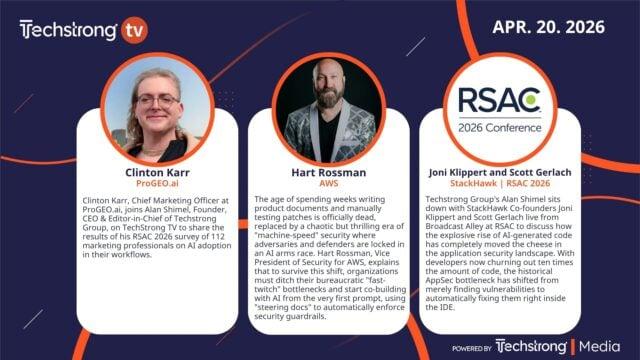
Techstrong TV – February 20, 2025
Watch our live stream on Monday through Friday, featuring exclusive news, announcements and conversations with IT leaders and experts on topics ranging from digital transformation to DevOps, cybersecurity, cloud native, containers and deep-dives into specific technologies and best practices.
Transcript
Hey everybody. I'm Mike Bazar. Today we've got everything from generative AI adoption rates to things about how we're gonna reimagine the way where you do research for just about everything.
And finally, a little chat about database sprawl. You're watching Textron Gang. We'll be back in a minute.
All right, let me introduce our guest today. We have way out there in the, the wilds of New Mexico. Tracy Reagan is with us again today.
Tracy, how you doing? Hey, twice in the week. I'm doing great.
This is good. We are fortunate. How you going?
Also continuing out West, we're with Lisa Martin, who's joining us from the Valley. Again, she's the CMO advisor for the Future Group and is an expert at all things related to not just marketing, but AI and all kinds of fun stuff. Lisa, welcome to show.
Thanks, Mike. Great to be here. Excited for today's commentary.
And finally, we have Guy Courier, who's, uh, also with Tuum Group and is the CTO for the Visible Impact arm and also an analyst there. And I must say, just to sheer disclosure for everybody, guy, I think you and I have known each other for 30 years, so if we have some inside jokes between each other, forgive us. Yes, exactly.
Exactly. And, uh, uh, that makes, uh, means we met in grade school, of course. 'cause everybody knows we're in our thirties.
Uh, I have to say that every time, um, great to be here, um, in the frigid, uh, central Texas, you know, of Austin, where I am, second day in a row of a very cold day. As you can see, we don't wear sweaters a lot out here. And really delighted to be on with, uh, both Tracy and Lisa.
All right, well, it's 15 degrees here in New York, so It's not much warmer here, man. Which it's just, that's, that's like upside down world. But anyway, There you go.
Well, that, that's a good lead in upside down world. So, um, we have, this survey is up there on Techstrong ai, and it was put together by the folks at Orix, and they're a data security company along with some help from Intel. And it shows that nearly every executive that they talked to is still excited about Gen ai, still putting funding together, still planning on putting these projects together despite some issues.
And the issues are not just security. It seems like we don't know exactly where to apply these generative AI tools within processes and workflows. But Guy, what's your assessment of where are we on this adventure?
We went from irrational exuberance, but where are we now? Wasn't really irrational exuberance. I I kind of feel like it was rational exuberance because the, the possibilities from since November, 2023 were just so, they're just so obvious.
And the dangers too, are pretty obvious right from the beginning. Now, obvious amongst us versus amongst everybody. This is one of these sort of like, you know, uh, there's two lenses that I, I try to take to everything that's going on, because our own lens, doing these shows like this one being in the industry, talking to folks who are implementing and all that stuff, it is really like the top 2% or 1% of people thinking about trying, implementing, and using ai.
Um, so, uh, one of the, one of the ideas right now is that, you know, we've, we've, we've left the hype or in the part of the hype cycle now, where people are starting to get down to work and be practical. Um, and I don't think that's true. I think we're still very high up in the hype cycle, uh, uh, right now.
And there's a lot of fomo and there's a lot of exuberance. And, um, I, I don't think most of it is really irrational. I just, I mean, I loved the survey.
This was a great survey because it showed all these contradictory things going on. Um, you know, this vast majority of enterprises and organizations pedal to the metal adopting ai. I will note, as I often say, when these things come up, that 70% or whatever of organizations playing to adopt AI doesn't mean that they're going deep.
They may be going really broad and really shallow. So, so the degree of spending and investment going on we know is big, but we just, it's, you know, we we're not getting that from this survey. At the same time, two thirds of them are more are saying, ah, well, you know, there's security problems here that we're not really being addressed.
So, you know, maybe we should be cautious about doing some of this stuff. At the same time that nearly a hundred percent of them are saying, oh, well, I personally use AI all the time. I'm doing it for all kinds of things for work.
Um, so it is a wild, wild west, still the wildest wild west, I think, ever, um, until the next one, of course. Um, so, so, you know, where, where are we at? That was your question.
Where are we at? Um, I think, uh, we're, we're still, um, trying all kinds of, well, so first of all, the, the, the organizations and customers and users are trying all kinds of different things, rolling with every new update and upgrade and just doing stuff. And, um, meanwhile the vendors are incorporating it all over the place and creating new models and new models of models.
Um, like the latest hotness is what the small language models. Um, and for me, my personal favorite latest hotness is AI at the edge. So it's just all kinds of stuff happening all the time.
What was the name of that movie? Everything Everywhere, all At Once. That's where we're at.
You, You know what I, what I think when we're going, what we're going through right now in the, this whole AI discussion and the ai ai innovation that's going on is, um, the word ignoramus. Um, we don't know what we don't know. So we are looking for the answers.
And that's what spurs all science, right? That's what, you know, that's what put, uh, Columbus on a boat to sell around the world. He didn't, we don't know what we don't know.
Science is driven by that, that thought ignoramus. And so it feels to me that, you know, I would've been surprised if the executives would've said, fewer executives would've said, yeah, we're, we're, you know, we're not, we're not doing anything with ai, even if they're just playing with it and exploring it at this point in time. Um, as I always has, I've always said, if it's gonna make a profit, then we're gonna go do it.
We're gonna reinvest our funds to make a profit off of AI if we can figure out a way to do that. So we're trying to figure out a way to do that. And my complaint continues to be that these, that the tools have not been really driven down far enough to the consumer.
We've, that's where money's gonna be made. Not just money may be saved or, or, or processes being, uh, shrunk down, which is all important and it saves money, but how does it make a profit? And I don't know necessarily if we've figured that out yet.
I don't think open AI has made a profit yet. So we have a lot to do. It's an ignor state right now.
So traits, both things can be true, though. Both things can be true. And I'd love to hear Lisa's perspective on this.
'cause this is really her specialty area. Both of these things can be true. It's wild West, all kinds of crazy things happening.
A lot of people are just going well, doing things, creating things or whatever. And the level of maturity of understanding and of the tool sets and everything is very low, but people are full steam ahead at the same time, like you say, any one of our viewers, anybody who is being just a tiny bit thoughtful about this, can do effective, interesting, productive things. Even if, especially in an environment where nobody's gonna go and say, what's the ROI?
Right now there's nobody's saying what's the ROI really on it because they just see it as a good thing on its own. So, but anyway, I kind of asked Lisa a question. Yeah.
Actually, in the marketing world, it is all about ROII talk to CMOs regularly on my podcast marketing, art, and science. And I've talked to several that are leading AI councils, some of them the second time at different companies. And so what they are seeing is ROI, with respect to increased conversions, for example, that convert into revenue.
So there, there are, they are able to use data science to determine and analytics where their investments in generated AI are actually driving faster conversions through the pipeline. Um, and also being able to get like better messaging into the hands of, of young SDRs, for example, to have better conversations with customers to then go through that funnel faster, get to sales, and then they convert to wins. So it it, we've been talking about ROI for a long time, and I, I think it would, would be, I would say guy, like the last year we're starting to see more CMOs that are really dialed into metrics based outcomes, and they're having successes and they're having lots of hand raisers and marketing.
I wanna be next in the council to try my idea. So there's a lot of, um, just a strong interest. Now to your point, one of the points that was made a minute ago, is it, is it deeper?
Is it broad? It's probably broad. The depth level is something that's gonna have to be understood as is.
Where else outside of marketing and ops and finance and things is AI being used to understand the overall impact of the organization, but the marketers are leaning into being able to show that ROI Well, that, that's cool. I think I was referring to a different one, which was the question that gets asked when somebody says, I want to try this new and interesting thing that I discovered. And then the answer is, sure.
Explain what the, what you expect the ROI is going to be and what the metrics are, what you're describing. Sounds, um, sounds like the next phase. So I guess what I'm saying is, uh, uh, I mean, thanks for the correction, surely, but I'm saying like, nobody's gonna say no to, let's try AI for this right now.
And, and it's almost like I feel like, you know, the ROI is is, it's a, that's a welcome maturity in how you're using it, but it's not a prerequisite to get the funding. You know, he was having a chat with the folks over at the COO Unisys and he was diving into this very question, and it is at the heart of the thing, it's the depth issue. And he was pointing out that when they do jump into these experiments, they're trying to apply it to processes that are deterministic in the sense that they gotta be done the same way every time.
And gen AI doesn't do that, and everybody struggles with how to kind of insert it into something that is deterministic. So it works great for creative stuff, marketing, I'm gonna create a press release. It doesn't have to be the same way every time, per se.
I can train it to use my language and my nomenclature. But deeper into that, it seems like folks are struggling with how to kind of actually put this into something that will have a consistent outcome because the models themselves weren't designed for that in mind. So, guy, I don't know, I think, I feel like we're gonna get into a lot of things that there isn't gonna be an ROI and we're gonna pull back because it was, the tool wasn't designed for the job.
Yeah. So generated AI is a simulation of, uh, what someone would, what a person would create, generate. It doesn't have to just be writing, um, based on a, a given context in a given input, the so-called prompt, it's a simulation, it's imitative, it's, you're right, you're right.
It's non-deterministic, um, is a terrific imitation. Um, and getting better. Um, what what what strikes me is this, this maturity level, this increasing maturity, once you get over the, the, the not get over, actually, once you grasp that, you're gonna input a bunch of stuff and you're gonna get an output of a bunch of stuff.
Like you say, marketing materials could be marketing materials or whatever it is. And you can apply that to a lot of different areas. Then you start to realize that there are lots of flavors and ways to do this.
It's almost like a framework instead of a tool itself. One of the really interesting things from that interview that, that you had, which I watched, was this idea that, um, I just mentioned small language models a moment ago, right? Small language models are not an easy replacement for large language models.
They just fit better in other, in certain scenarios. Um, and the data element of AI is getting more attention as well, where the quality of the input data, or the style or the type of input data has an important effect on what outputs you get. Um, so, so there's several factors going on that are showing a greater understanding of, and, and, and maybe a, a, an opportunity to Tracy's point for a little more thoughtfulness in what you're doing.
Instead of just saying, grab an AI sho, you know, shove your prompt in there. Take the output, move on with your life. You're so much more productive.
You're producing 22 blogs now in a day instead of only one. Um, because you can, you can, uh, apply generative AI to almost anything to make it work in some way that's better or faster or what have you. But you still need to shape it.
You still need to architect it, you know, along these lines. And we still have to worry about data breaches. This is, you know, was part of that.
The article that we were referred to is that, you know, we, we, we still don't have a way to protect databases from data breaches, much less now understanding if the data breach impacted an LLM or not. Um, there, there's a lot of work that we have yet to do in this space. Um, but it's, it a very exciting space.
And, you know, it's, we're teaching open a, you know, a chat. GBT is teaching an entire generation of school kids how to do research in a very, very different way. I would've loved to have it when I was head.
Can you imagine being, it's so much easier. You know, I had encyclopedias when I was in sixth grade. Yeah.
Remember going to The library making photocopies and spending all your change on photocopies of encyclopedia. Oh my goodness. The amount of the amount of copies I made in college was just ridiculous.
So it is, we are, it is a behavioral change. We are, the culture around data in our relationship with data is changing because of, uh, of generative ai. There is just, there's no, there's no other way around to see it.
And because of that, it's gonna move at a lightning speed. And we are going to make huge mistakes. The data's gonna be wrong.
5%. How wrong was that? Right, Exactly.
Then reality intrudes. Yes. Mike, you talked about, Mike, you talked about non-deterministic versus deterministic and probabilistic and all that other sort of thing, right?
Um, uh, do you think that that, that there is this, 'cause you talk to a lot of these, you know, you know, vendors and, and, and also, you know, their customers and that sort of thing all the time. Do you think that there's this kind of recognition of that element of it and that maybe, um, I wouldn't, maybe it's other flavors or other ways less, less probabilistic, more deterministic, uh, uh, ways to implement AI that are important, that are a good opportunities right now? Is that the sense you're getting?
I think the rank and file in these organizations has a better understanding of that particular issue than the C-level executives do, who don't necessarily know exactly how every process works within their organizations. So I think, you know, when you ask somebody who's a C-level says, you know, yeah, we're all in and we're adding budget to this thing. Yes.
But I think when you go talk to the rank and file about, you know, the person running the customer service desk who's trying to implement this thing, they're probably scratching their heads a little bit about how to actually make that a reality that's consistent. But there is something in that data point from the survey that I wanted to ask Tracy about that's related to this conversation. If I added up all the people who said that they are building versus buying, I get to about two thirds who say they're gonna be building something that feels like an AI agent.
Um, do you, Tracy A, does that sound reasonable to you? It seems like those things are gonna be a little bit more complex than people realize, and or will people kind of give up? I think they, they will give up.
You know, uh, in the early days of my career, I was working for a bank who'd actually try to build a relational database. Very, right? I was on that team and it was like, why are we doing this?
We can just get it from Oracle. Um, so I think that they will try, I think that they will find out that buying is going to be better than building in so many ways that that's the answer with any of these kinds of tools. But in the beginning, I think that people believe that it'll save money in the long run to do so.
So let 'em try. Maybe we'll come up with some interesting, uh, products, right? We, we never know.
I think part of the issue then becomes, and I circle back, this is the same issue we have every time we go buy anything as an application or a SaaS application. None of these things at tuned to really fit my processes, Lisa. So do I gotta go back in and customize all these AI agents that I'm gonna get from SAP or Salesforce or whatever, but I don't have access to the way they were trained.
So how do I kind of, you know, make that elephant dance the way I want it to. That's a great point. And I think we are gonna see customizations.
I think that's just gonna speaks to human nature. Um, so are things gonna go rogue? I think probably, I love Tracy, your analogy ignoring ignoramus, because I think that's, that's spot on.
I think we're gonna see people want, want to make the agents do what they need it to do without understanding the background from a development standpoint. Will they break things? Probably, um, but ultimately if it helps them go faster, be more productive, stay a cost, I think we're gonna see people, um, in a, in a leading maybe rogue way, stepping in and putting their pedal to the middle Guy would say, I have all these agents from vendors and ones that I customize and ones that I've built myself.
Do you think organizations will have the capability and insights to orchestrate all of that into something that automates the process end to end? And will all these things talk to each other in some way that customers enjoy? Or is that gonna wind up being so hard that we might not see any of this stuff in production for another year?
Two? Well, a year or two would be great, actually. I think that's pretty fast.
Uh, um, of course, you know, then no, no contractor got a contract by saying it'll take me a year or two. They get the contract by saying it'll take three months and then they take a year or two. Um, this is really interesting.
It's a really interesting question because the technology itself provides the tools to accomplish what you just described. I mean, I keep coming back to the, the, the, the shot across the bower, the slap in the face, or whatever you want to call it, the Satya Naela gave us a couple of months ago by say, Hey, you know, SAS doesn't really exist anymore. It's just AI agents now.
Right? Why is that? That is sort of taking to a, a, a, a logical, if, possibly slightly absurd conclusion, this idea that once you start building agents, agents don't require prompts.
They make prompts. They are not truly creative, but they are designed to discover and incorporate without being explicitly told to do so. And so by the same token, the the kind of operational automation, uh, that you're talking about, and the incorporation of AI in a more automated way and allowing things to integrate properly and all the other sort of stuff for most technologies we've had so far that's been long on promise and short on delivery.
Um, which is why we're still using a whole lot of non-cloud and, uh, you know, a whole lot of, uh, uh, you know, less modern systems still. But AI seems to have the, and I mean generative ai, I don't mean general intelligence, which is coming later. I mean, just the simulative ai, generative AI stuff has the ability to do, you know, trial and error and trial and piloting and that sort of stuff at a faster rate.
And still having the human supervision, the operational supervision, and not withstanding the obvious security issues that Tracy brings up routinely and the lack of all those other dangers. You know, we could, we could get there, I don't know, in a year or two, but we, we could get there. We could get there because the automation gets automated Potentially.
But just a cautionary tale, we should consider how, what we look like right now when we come to Kubernetes cloud native decoupled environments. We really haven't figured that out quite yet. And now we're gonna be adding, um, agents, and agents will have versions.
Uh, this was, this is not an easy, uh, configuration to manage overall. So while we might be producing these products, we haven't really gotten better at managing these massive decoupled environments where we have agents running in lots of places. I complain about agents all the time because I understand the, the complexities of them.
And we, we Just standard agents, right? Platform AI agents. Those Are platform just regular agents.
Yeah, regular agents, just what we're managing now, right now, let's add the, you know, the, the, uh, the AI agents to the, the puzzle. We are c creating lots of dependencies, lot, which the death star is growing and growing and growing. And that is possibly why the platform engineering is getting more and more attention because it's becoming more and more complex.
And while we sit there and we talk about a, you know, generative AI and, you know, LLMs and AI agents, we aren't really talking about how it really impacts our production environments and supporting it, maintaining it, tracking security, IT issues and data breaches. That conversation has to happen at the same time. But guess what?
It's not often profitable. So we don't spend money on it until we absolutely have to. And that is going to be the downfall of a lot of this, uh, this new technology is that we're not able to keep up.
Here's my closing prediction on this conversation. I think a lot of organizations are gonna discover that when they apply AI to their processes, the processes have more exceptions than rules. And therefore they're gonna be like, well, what do we do if this, then that and the other thing?
And it's just not gonna scale the way we hope. We'll see how it all turns out, but doesn't mean we shouldn't keep doing this stuff. But I think we, we need to go in with our eyes wide open.
Anyway, we'll be back in a minute. Discover techron Group, the epicenter of tech innovation. We are your go-to for reaching IT leaders and practitioners worldwide.
Our secret impactful content that sparks awareness, engagement, and top quality leads with us. You'll access editorial websites, streaming videos, virtual events, custom content analyst research, and more. Join our satisfied clients.
Let's revolutionize your tech journey. Contact us today and tell your story to the world in the most powerful way with Textron Group. Alright, folks, we're back and we're gonna talk a little bit more about ai, but this time in the context of well researching stuff, and we all do it every day.
We go shopping online, we look around for stuff, we basically hack our way through search results and occasionally call a friend. But, um, now we see Perplexity is the latest gen AI company to join this race, to create these research tools for people where I basically can now log into these tools, type in what I need, and it will come back with all kinds of fun and interesting stuff that is better than a search engine. Lisa, is this changing the way we're gonna shop in this world and on our whole online experience?
Oh, I think so, definitely. I look at it though, when I read it through an academic lens, what Tracy mentioned in a block. I just got these visions, and I'm going up to my alma mater, San Francisco state today to meet with the Dean of life sciences to talk about tech and science.
It's where I got my masters, and it reminded me of all the hours I spent in the library. This is in the late nineties, early two thousands photocopying and thought, what if I had a tool like this to help me with my research? How much faster would I've gotten through the program?
So I kind of looked at that from that perspective. But you're right, Mike, it is gonna change shopping. So perplexity, deep research AI tool was launched on Valentine's Day.
What a romantic thing to give to your Valentine, uh, in a freemium version. But what it's doing is performing dozens of searches, reading hundreds of sources and reasoning through this material to deliver a, a comprehensive report. It's, I also read that it's, it's accuracy is about 21%, whereas chat GPT is about 26%.
But I see some huge benefits here from a time saving standpoint. Um, you know, it's built for people right now who are doing like really intensive work in fields like finance and science and policy. And that's why I brought up the whole science reference there, um, that need precise, reliable research, but also discerning shoppers looking for what we all have an expectation for is I'm gonna get this hyper personalized experience with really relevant recommendations that typically require a lot of deep research, like on cars or appliances, things like that, that require us to go well beyond a casual search.
So I do think we are gonna see a changing the overall shopping experience for especially things like cars and appliances, but also other things as well. I also think it's gonna change academia, which I, like I said, I just, boy, I can't imagine what would've happened if I'd had anything like this back 20 years ago when I was doing my master's degree. So it's an exciting time.
And there's also a lot of benefits in it for marketers that we can unpack too, Right? We just gotta perplex The, I think the interesting thing about the perplexity is, uh, is that it's actually taking the next step in creating a PDF for me, which I actually love that idea. If I get something that's right, I want to, uh, create a final document.
And I do think this is something for researchers. This is ac very academic in terms of shopping. Let's just chat about that for a minute until they can figure out emotional how to, to kind of, um, connect to the, the emotion of a shopper.
I do not think research makes that big of a difference. Now that being said, I know consumer report shoppers, they wanna know every single bit of it, and they will buy the car even if it is dog ugly because, you know, a consumer report or you know, a driver magazine sits the top car of the year because that's how they shop. But that's not the majority of people, and that's not how we are bringing up, uh, the new, uh, age of shoppers, which is a TikTok shopper.
Great point. So how is AI going to, you know, start pulling in that kind of information? Because this content generator convinced, you know, all the young ladies to wear a particular kind of lipstick because they look so good on TikTok, and that's how most shopping is done.
So we have a long way to go before we really can marry between a consumer's emotion, you know, and, and real data. Because we do not shop, we do not even elect based on data anymore. So there's a, there, there's a big gap between the reality of data and how we just make decisions.
Can I challenge you on that a little bit? Sure. I would love for you to tell me more better, Just, I, I, I kind of feel like you're right, but as a, uh, as a, as a good AI commentator and analyst, I have to say like that's context it context is, is, uh, maybe the most critical component of an AI prompt.
So if you have a system that's not really using context, that's one thing, but if it can use context that is personalized to you, um, doesn't that at least partially address the, the Don't underestimate the influencer? Yeah, I don't know influencer, I'm gonna go, I'm gonna go back in time and remember a computer shopper and you used to kind of go looking for gear. Yes.
Looking for gear. Yeah. I worked there in, In grade school and looking for stuff and you know, it, it, I'll be honest, it was with a heavy sigh that I opened up computer shopper because it was kinda like, okay, now I gotta read through like all this stuff in here to figure out which of these devices and PCs might be the one that I'm gonna want best.
And there's all these kind of recommendations, but there's more recommendations that are conflict with each other. So it was, it was difficult, but guy, you were there for that time. And if I still look out on the web, there's still all this, you know, buying advice content stuff out there that those websites just go away and they become like headless data services for these kind of research calls.
It's so touching a nerve with me. This is where I get so confused. Okay.
You know the story like, uh, you know, the, the, the acolyte ask the, the guru, like, you know, what is the world based on? And the guru says, it's on the back of an elephant. And then, well, what, what is the elephant standing on that's on the back of a, I don't know, a duck, I don't remember, sorry.
But ultimately the guru says, you know, that, that that animal's on the, on standing on a turtle, and then the acolytes says, well, what is the turtle stand on? And after a pause, the guru says, well, it's turtles all the way down at that point, you know, what are we ba So this is, I get, this is where I get confused. Okay, so where does this end up?
The AI are being trained on, uh, online data that is commentary from, normally from people on other things that were ultimately created by people that eventually became digitizations or commentary on things that were offline, like computer shopper. Great. We still need that stuff, right?
AI can't create original stuff. It's a simulation even, you know, artificial general intelligence, which is a GI, which is coming, and supposedly that'll be able to think and create original stuff maybe at that point. But by that point, it's what this I I'm my mind melts it is, it is a re it is a self perpetuating machine of 'cause then you have sim what's it called?
Uh, synthetic data to help train ai. Synthetic data isn't real data. Like, is this just, everything's gonna turn into tropes and cliches and, and we're just not gonna notice every recommendation is gonna be, it's like the Waze problem.
If, if Waze routes everybody around the traffic, well, now there's traffic where wa routed everybody to I, I'm a little, that's, I'm, I'm babbling at this point. I, you know what I'm talking about There. There's never been time even in software where the, let's just use the software for example, where the best tool actually wins.
You know, A Oh my God, Tracy, why are you saying that? That's exactly what I've been thinking about for like three months. This is, this is, I gotta talk to you later because I've Been, al pointed it out to us a couple of shows ago.
He, when I talked about the democratization of, of venture capital, and he said, it doesn't work that way. And I said, I know. And that's part of the problem because we will go for the top three and that's where all the money goes.
And once those top three have been defined, they don't have to be the best tool. They just have to be the one that most people are investing in. And that's the tool that we get served.
This is part of the problem with everything that we're doing in our culture right now. Right? It is a, a, um, it's, it's a, it's a, it's a mass, you know, run to the, to what we believe to be the top, even though it's not.
That's why I'm saying AI and shopping is gonna be difficult because there's so much emotion and so much that doesn't make sense that we end up getting served the top three tools that may not be the best. So let me pause at this to Lisa here. 'cause to guy's point about, you know, how the models get trained.
Imagine a world like that goes like this though, right? So instead of the AI model looking for some website, uh, hoover up the data from what if we just, you know, punch the data directly into the model from the people who created it in the first place and then train the model to analyze the data to come up with the recommendations. But couldn't we skip a step here, which is, you know, I don't need to enter a boatload of data into a website like computer shopper just saying, I dunno, that's a good question.
I wonder if, if you, we did it the dumping the data into the l LM route, would that be more bias? Would that produce more bias rather than being able to go out and, and, and trove the web for data that way? I I do really wanna, um, point out what Tracy said, the emotional part.
I'm not a TikTok shopper. I am an Instagram shopper, which probably is just as bad. But you bring up a great point about the emotion piece because a lot of people make decisions emotionally and not on data, depending on what they're buying.
But I think ultimately, um, the, the research tool, being able to go out and pull data from the web, I think, I think it might be less bias. I'm not sure as from a, not being a technologist, but I, I just, the bias thing comes up in my mind. Well, I mean, to Tracy's point, if, uh, things worked out as they should based on capabilities, we should all be running OS two on our risk platform, right?
About an hour, right? And, and, you know, and, and, and yeah, and, and, and watching training videos on our beta max. Yeah, I don't know about that.
But OS two should have been king. I, I'm gonna hold to to that point And risk. I'm a huge risk fan.
Oh, risk was awesome. I know. Well, What happens sequence.
I mean, arm is, arm is risk. It's arguably, you know, like there's a lot to be said for risks. So, All right, well, I have to say, I spend some time in the channel, so I know why the best thing doesn't always win, but it has nothing to do exactly with technology as much as it has to do with routes to market and who made what available when.
But we'll come back to that on another day. We're gonna come back in a minute and chat about what's going on with databases. Stay tuned.
com is the leading resource for news analysis and education on challenges facing the cybersecurity industry. com covers all aspects of cybersecurity, including data security, DevSecOps, cloud security, application security, network security, security threats, and more. com has the largest selection of security content featuring breaking news, blog posts, podcasts, and more.
com to learn more. com. Home of security bloggers network.
All right, if we haven't made your head spin, we are about to now, Oh, my head's still spinning, made my head spin. There is a thing happening in the world of databases, and every time we turn around, there's a new data type. And this is not a new phenomenon, but there's a lot more of 'em lately and starter most recently with maybe all this vector stuff and graph databases.
And the challenge then becomes, do I need a database for each type of these things? Or do I do these multimodal databases? And there's arguments for both sides of this thing.
But Tracy, let's start with, you're closest to this thing. Do we have too many database types and can we consolidate these things or do we need 'em all? Well, the conservative side of me says we have too many, um, the more, um, curious side of me says, we don't have enough.
Uh, you know, the, we have been struggling with the data deluge for forever. This is, this is never, this conversation has never stopped, um, from the beginning when we were trying to figure out how to search a flat file faster to moving into relational databases, to, you know, uh, graph databases. We are always struggling with data.
And I really believe that the AI conversation has caused that to be more important, how to manage data. Uh, but I do like the idea of having, you know, different databases based on the life cycle is a bad idea. Let's just put put it out there.
I have never supported having, you know, a, you know, a Postgres database being used in development and then moving everything over to an Oracle database and test and production. That is just a bad lifecycle management process. But the idea of having different databases for different domains and storing data in different ways as it needs to be stored as a, as a, that is appropriate, is something that we really should be looking at in a, in a deeper way.
But as I talked about in our earlier session, we have this issue with these very complex configurations and how to manage them across the life cycle. When we think about technology, we often stop thinking, we think about the cool part of the technology, but we don't think about the implementation and the ongoing maintenance and the sustainability of it. So the more we have these very different databases, the more we need to get that, we need to get better at that whole conversation around platform engineering.
And the problem is, DBAs have never been part of that story. They have sat in their own side of the house and wanted to control the data. And I, I have seen companies that wouldn't even let a developer, uh, you know, uh, check in a, a SQL statement for goodness sakes, to make a single change on a table.
So there's a lot in our culture that we will have to adapt if we are going to improve on how we are managing data. So conservatively, I think is a bad idea from a pure technology growth. It's time that we have these multimodal databases.
Um, it's time. We have different types of databases depending on what we're storing. And it's time for the DBAs to get, become part of the lifecycle so that we can start managing it.
Because if we can't manage it, we are, it's going to be hell Guy. Every time I turn around, somebody is complaining about the total cost of it. And I almost invariably trace it back to all these databases that we're supporting and all these different data types.
So, um, you know, are we kind of our own worst enemies? We absolutely are our own worst enemies because we are tinkerers, we are engineers at at least, you know, in spirit. Uh, we got into this because we like systems and how they work and directing them and organizing them and all that sort of thing.
Um, I think another one of these perpetual conversations is, uh, business value of it, so to speak. Like connecting those things, uh, making statements about the systems and, and, you know, investments and all that sort of stuff that, that is, um, not a technical benefit of it. If it happened that it happens faster, but the, the business or organizational benefit of we can enter new markets, we can serve larger constituencies.
And so, um, there's this gravity, we were actually talking about it earlier. There's this real DIY gravity, and I think to some degree that's this, multiple databases versus single databases discussion. The, the use of single database.
Um, I, I have a lot of affection for that sort of thing, that sort of approach, because it's simple and, and, uh, so love, as you could tell Tracy, talking about lifecycle and operations, because so many times problems are engendered early in development that only get, you know, seen and addressed, you know, in ops. And so what I was saying was that single database, single, single, uh, system, um, can be a huge, uh, uh, uh, si time and money saver because it shifts a lot of the burden on ops and it, it, it shifts the shifts the burden of service resiliency and of efficiency and of continuity and all those things. It it more in one place than in multiple places.
Um, but yeah, Mike, you know, you, you, you're right. Um, it, we don't want to take the creativity out of it by any means. And, uh, flexibility and freedom of choice all through the whole application chain, uh, engenders that and enables it, but it also builds cost and it builds risk.
Mm-hmm. So, I don't know, is that even solvable? I'm not sure, Lisa, I've said this before.
When we have these very IT oriented issues, it's really your fault. And let me explain why. Okay?
Please do important marketing. All these different departments that we have, go out and hire developers, and then they go build some application for the marketers who are enamored with some new data type, whether it's video or whatever it may be, or now it's Vector for LLM without ever considering the fact that none of this stuff aligns with their existing IT investments. And then they go build this lovely app and they play with it and run it for about six months before they get tired of it and hand it off to an IT ops team that Tracy described that already has a bunch of databases.
And two things happen. Either one, they just suck it up and manage that database, or b, they try to convert it into something that they were already running with mixed results. This is at the heart of the divide between business and it is there, can we do something about this, Have to be done.
It's in it's collaboration from, from the C-suite down businesses, bus lines of business have to be aligned with it. They have to understand what each other's doing, because to your point, the sprawl that you just talked about, it becomes a huge problem, becomes a cost, uh, to organizations. And it ultimately can result in inefficiency and impacted productivity, which is the complete opposite of why, say the marketing folks decided to spin up these apps in the first place.
So I really think it speaks to an ELT being highly collaborative and, and the lines of business, not just marketing, but ops, finance, others, et cetera, sales needs to be in lockstep with it. This is what we need to do, this is what we want to do to deliver this. Is this the right thing?
What do we already have in our environment that might help already solve this problem in a better, more, um, integrated way? But so we ultimately think it's behavioral, it's it's people and it's collaboration absolutely needed. There's always Behavioral emotion, right?
There's always, there's always what I like to call an internal Bill Gates at every company. And it's probably a developer who's worked really hard, written some really interesting code, and that internal Bill Gates gets to go and he will pitch something to his director who will get very excited and pitch it to the CTO. Now the CTO's excited about it, and they go ahead and they move forward with it without bringing in everybody it, and it's just that it only takes one kind of hot shot to make that decision for the whole company.
And that's how we do business. That is how software, that's how we move forward. That has always been the case and always will be the case.
But on another topic in this area, there is, you know, there's different kinds of databases, but there's also different kinds of data. The more that we can start looking at our data and how we write software, even if when it comes to microservices, the more we can start defining domains and building building systems based on domain-driven design, the better we will get at deciding what type of database should be used, where we wanna store the data. And even if it's the same database that we're using across the whole organization for just basic data, I totally believe in distributed databases.
I believe that we should break up the data because I believe that that will help manage data breaches because they don't have as deeper reach. Once you, you, you, you condense the information. Even if we had the addresses, right, the address and phone numbers separate from the name, and it was connected based on an ID that pre prevents security breaches that are gonna impact our identity.
So we don't think of that because as I said in the earlier one, it doesn't, it's not necessarily profitable, but it makes sense for the, in the, for the consumer to start thinking of how we can build data around a just a domain model. And if we do that, then we are able to say, well, this domain has this kind of data and it may need a different kind of database. So just to have a, just to have this, this multimodal, um, database environment, it only makes sense if we can figure out the why we need to do it.
And sometimes the, the internal Bill Gates guy, he's not thinking about the why he is thinking about, it's really cool to take apart your mother's stove. I've done it before and it doesn't work out too well. Yeah.
And sometimes that's super exciting idea. It turns out that there's three commercial products for it, and two of them are, I mean, I'm, you know, I'm, maybe you're not talking about that case, but, you know, there's lots of ways to what, what's the, uh, Tim Tote? That's the, uh, that's the pearl expression.
There's more than one way to do it, right? Tracy, you made this point, and I just wanna bring it home a little bit. So how come the DBAs don't wanna join the DevOps club, man?
Is there, are they just too cool for school or what's going on there? I have never understood that. Is it a, is it power data is, has power.
Um, they don't want other, you know, okay. If we go back to the culture of DBAs, there was a point in time that DBAs were the highest people paid in the organization by far. Um, I can remember, 'cause I was a consultant starting in about 27.
I hated doing, working on databases, but my girlfriend was making almost three times as much as me. 'cause she was a DBA and I'm coding, right? Um, and so there's power and money and the culture, I believe started that way.
And it's never changed. Um, the DBAs have always been separate from the rest of the, uh, development organization. Uh, you know, deploy hub, uh, part of our product was to help manage database, uh, configurations as part of a deployment.
DBAs didn't wanna do that. They wanted to have a, they wanted someone to send an email and say, this is what we need done, and they wanted to do it themselves. I don't know why that stayed that way.
I would love to know the answer to that, but I really believe it starts from the very beginning when d when, uh, d relational databases hit the market, there were really high paid DBAs and they were set as a class of citizens within the culture. Very different from the development team. They owned it.
It's Not, it's isn't it because, or is it possible that it's because, um, that that kind of a role attracts someone who is exacting and controlling and controlling in a, controlling is the wrong word that has such a negative connotation. But just someone who, uh, who crosses t's dots i's checks, grammar, checks, everything like very, uh, detail and quality oriented, which in some ways, like the move fast and break things idea sounds anathema to me to a database or DBA mindset where, where quality, continuity, and control are extremely important. And DevOps in a lot of ways is a way of saying like, you know, uh, you know, let's, let's get things done quickly and fix them later such that they need to be fixed.
Let's have something minimally viable. We know that there's a lot of improvement to be made. That's a mindset and a culture that seems really different to me.
Yeah, di I think the word you're looking for, it begins with an A ends with an L and has four letters and you can figure out the rest from there. Um, I'm going to kind of end this conversation here, but I would just point out one thing. We in it, we all seem to take pride in how rational we are, but once you get past that person, let tear, That's the biggest trope.
Come on. Where as irrational as anybody else there is out there. Hey, if Not more.
So There you go. Hey guys, thanks for being on the show today. You guys were awesome.
I wanna thank everybody for watching this show. You can find more and apol on Text Strong tv. We invite you to check all that stuff out 'cause it's just another great day of content for us.
Take care. We'll see you next time. This is Textron tv.
Hey everyone, welcome back here to techron tv. You know, I am so excited. I can't, I can barely contain myself.
It's for our next guest to be on here. I've wanted to bring them on text on TV for a long time. You know, I, I've had a almost 25 year relationship with the RSA conference.
I think I went to my first RSA conference in 2002. And, um, so just a little short of 25 years, it is by far my favorite place, my favorite conference to go to. My friends and my friends are older now though.
I make new friends every year. But a lot of the people I broke in with in security, we've all been going to RSA. And it is traditionally a time where we renew our acquaintances, renew our friendships, renew our war stories, and, and fetching and moaning and everything else we all do in security.
Because no one takes security, you know, serious enough for us. I've done so many things over the years, speaking there, exhibiting there, partying, their, the, my security bloggers network parties, there every so much of my security persona and my own persona is wrapped around that. It, I, I'm thrilled to still be involved with it.
This next guy feels the same way. So much so that he went out and helped make a new, bigger, better RSA conference organization or than there ever was before. And it's put it on a, a really solid footing.
Let me introduce you to Hugh Thompson, you as the executive chairman for RSA conference, RSAC as we call it, and the program committee chair for RSA conference. Hugh, welcome to Text Drug tv. I hope I didn't embarrass you, but you know, I don't care what anyone says.
I love going to RSA conference, man. It's the greatest. Aw, Alan, it is so great to see you and thanks so much for having me on.
And, you know, I share your feelings and passion about RSA conference. It's, it's, it's just got this community feel to it. And, you know, I've been a program chair now for 17 years, right?
So it's like really, really long time. And just to see the outpouring from the community every year at the conference and the call for speakers, the program committee that has the thankless task of going through all those submissions and making the agenda, it's, it's awesome. It's like a reunion, like you said, when people show up in person.
So great to get to spend time with you and talk about it here. Absolutely. You know, Hugh, when I think back, I think it was the second or third RSAI went to, you guys moved it, well, I don't know if you were even associated then, but it moved from San Francisco to San Jose that year, remember?
Oh yeah. We, we used to switch used to oscillate. Yeah.
Between the two uhhuh. Yeah. Yeah.
com bubble head burst. I remember being an exhibitor there. I used to think we were like Star Wars style and one of the outer rims of the galaxy.
It's not in the court where the big ones are, where the big exhibitors are, but Things happen. Good things happen. That's where the action is.
And if you don't go to RSA, you don't know that. You wanna see what's happening, go to the outer rim. But anyway, we were getting more resumes than we were of sales inquiries that year.
It was a bad time. But, um, and then of course we moved back to San Francisco. But that, I think back to the size of the show then, versus the size that it's e it, it was easier to have that sense of community when it was 10, 12, 15,000 people at most.
Now we're 40, 45,000 plus people. But you haven't lost the community. There's still the community.
How, how do, how do you do it? How do you do it? Oh my gosh, I, I can't take credit for it.
It is the community that has made that so, right? Mm-hmm. And any incredible folks that work for RSA conference, you know, Linda and Brita and the many other folks that you've had on your show, you know, they are so dedicated to the ethos of RSA conference.
And even in internal meetings, first thing we talk about in the last thing we talk about is the community. What does the community want? How can we better serve the community?
And we've always been community driven. And I think it's because of that. You can't really fake that.
It's like, you either are that or you aren't that. And I think people sense that when they come to the conference, that they have helped to build this thing that they're now sitting in and they're now experiencing. And I think about that, you know, over all these years.
And one of the things I've always asked myself is, there's a lot of people that wanna come to the conference, even though we've got like 45,000 of them there, they can't, like, they, they can't get budget. Like hotels are expensive in San Francisco. They come one year and you know, it's not my turn now and my group.
And how do we take the same feeling that folks that go there and the people that they meet and just the relationships that they build and the learning that they get and how can we extend it? And that's been a huge focus for the last 18 months in terms of the team and what we've been thinking. Yeah, you speak of the team, one of the things, and I've told this to people over the years, you know, it kind of Wizard of the Wizard of Adish, you know, you've got this huge event, huge 40,000 plus people, the people behind RSA, like the actual full-time RSA conference employees.
I remember it was just a couple years ago, I think there were like six or eight full-time RSA conference people. Oh my Right. That was women, by the way, a conference that was put on by women for anybody out there who wants to talk about diversity and then everything else, right?
These were six powerhouse women who Oh my gosh. So talented. Yeah.
Who just rocks it, rock it in year in, year out, everything else. But the, the future is brighter than the past in a lot of ways. There's, so the recently last six months, you talk about the last 15 months, you've been planning that long, but we've seen in the last, let's say four months, a lot, a lot of news coming out, right?
Well, we could go back, I guess maybe two years ago, q when you led the charge of, of taking RSA private, not that it was public per se, but taking a private, so to speak, setting it up on solid financial ground, on, on a real course as a, as a business. Not just an appendage to someone else's business or what have you, but really a, a standalone organization. And, and, you know, and there's been a plan since then.
And if people are following the bouncing ball at home, they've seen it. But you give us, give us the timeline if you don't mind. Yeah, sure.
So, uh, you phrased it right for a long time. RSA conference sat inside the RSA corporation and RSA then, you know, through various periods of time, sat inside of other places like EMC and then EMC Dell inside of Dell. And so, but to the credit of all of the folks that ran the RSA parent company, they always had this idea of keeping RSA conference as independent, right?
It had an independent program chair, which is me, had an independent program committee, which is all kinds of representatives from the community and what those folks say, at least a program committee folks on these specific tracks of what gets in and what doesn't. It's up to them. Like, there is no other influence on 'em than, than their opinions.
But, you know, all of that being said, we saw some significant potential in making the conference itself a standalone entity. So Crosspoint Capital made an investment in this standalone entity of RSA conference, pulled it out of the RSA parent and it's now a fully fledged, you know, you mentioned the kind of six or eight core people that were there. They're still there, all of 'em.
And we've now got, you know, a lot of folks that have joined them. So I think we're up to 50 people now that are full-time employees of, of RSAC, which is super exciting. And what we've wanted to do is ask how we can double down on what already has been done.
So the spirit of community, you know, the way that we gather people together, how can we serve you getting shaped by the community, but could we extend the conference from just being a thing that you go to for a week to something that can help you all year long? And maybe it's not just the people that go, it's all of these cyber professionals. It might be new that they just don't have the opportunity to be there.
And that's what most of those new folks have been working on for, you know, call it 15, 18 months now, is how do we create something that has the same spirit, is true to the community, helps the community, and they can use it all year round. I love it. You know, crystal, all you mentioned RSA and, and the, the, the kind of good shepherding that they did, I, I'd be bereft if we didn't mention we lost Armit urine.
Ah, what, what a Huge loss to this community. Yeah, just an and he was, He was, you know, he led RSA through many years of probably of your time there as well as my time there. Yeah, for sure.
And, um, so just a, a shout out a loss there, but most recently we've, we've seen this plan come into place to extend RSA, let's say, beyond the four walls of the Moscone Center. Right? And, but there's also money going and resources being poured into making the onsite activities better and more exciting than ever.
Um, you know, I want to specifically you, if you, we wouldn't mind talking about you guys have, you know, set aside and able to raise with partners a $50 million fund, I guess that's the right word to call it, a $50 million fund that's gonna go to the, uh, internet sandbox or the in, excuse me, innovation Sandbox finalist, which, you know, if you look over the years, I think is the 19th or 20 year for Sandbox, um, yeah. One years. Yep.
I mean, the companies that have come through, there's a who's who of security, right? This year we're actually gonna put some money behind this talk. Talk about that.
It's, it's an exciting year for, for our state conference in general. And I think folks will, will, will feel it, right? You know, we're doing a bunch of new stuff, a bunch of additive things, but innovation sandbox, Alan, I can't even tell you.
If you wound a clock back 20 years ago and you went to that first Innovation Sandbox, or even the second one or the third I did. Oh, did you really? Yeah, I did.
Yeah. I was in startup world then. You know, I wasn't always the media guy.
Oh my gosh. That, you know, you, you'll, you'll then viscerally feel what I'm about to say. It was a small room.
There were, you know, companies, there were good companies that were up there, but then if you looked at the audience, almost everybody, not everybody, but almost everybody was in employee of those of Their companies. Yeah. Yeah.
'cause like, they're like, what is this? Like, I don't know. Mm-hmm.
Some, some startups and what are they doing? They're competing. But I don't quite get it.
If you fast forward to now, it is like the mentor of the next generation of cybersecurity companies. It's amazing. Like the submissions that come in, the amazing companies that have come through the door, you know, you think about Imperva as an example.
Sentinel One is an example. Know Whiz is an example. All of these people that have been in the top 10 finalist group of RSA conference and to see how many exits those companies have had, it's, it's truly remarkable.
And if you look back and you talk to these folks, I'm sure you've had many of these people on before, and you've talked to 'em directly, many of them would say that the publicity that they get from being in the top 10 was a huge impactor to their business. Sure. Was in, in a positive way, right?
Because it's a noisy space. You're looking for differentiation. Why, why are you better than the next company that says they're doing the same thing as you?
And it was something that gave you a stamp. It's always been judged by an independent group of judges. We've got an amazing group for 2025, I think five of them are all returning judges.
And there's one sixth new judge, Dave Chen from Morgan Stanley. And you're right, there is a big difference this year in that we will be giving a $5 million safe note to each of the top 10 finalists, which is a huge change. And it's a huge amount of money that's 50 million bucks, you know, going out the door effectively to that top 10.
And why would we do that? Because Crosspoint Capital, the company that owns R-S-A-C-R-S-A conference is, is basically has no role in deciding who's in the top 10. It's all in the hands of these independent judges.
But if you look over time, the process of independence, the process of batting on the community has yielded unbelievable results. And so that's why we feel super confident about doing that. And I can't, what happens?
I can't wait to see what happens Either, could I I we'll be watching it, you know, generally, so we always, we always interview Cecile. Yeah, Cecile, yeah. Yeah.
She's amazing. Yeah. Mar And then she, and turn, when the finalists are announced, we try to get as many of the finalists on Text Strong TV as we can.
We'll do it this year. Well, look, we're $5 million. It's $5 million.
Whether they win or not. Right. You know, you always hear this at contest, everyone's a winner.
If you make the finalist, you're a winner. Yeah. But they really are this year.
Right. If you make the finalist, you're a winner, man. You got $5 million.
So that's fantastic, man. And, and it, it, it's gonna get real interesting there, but that we didn't stop there. You guys have come up with the new logo because, you know, we, we do our thing every Monday at RSA, the DevSecOps Connect event, this year's cybersecurity and AI on app dev.
Um, so we've putting, we had to redo everything with the new logo, right? Oh, yeah. Sorry.
Sorry About that. Yeah, Sorry. No, don't be sorry.
I'm glad we did. Okay. The new RSA logo and the new website, and then I've seen it, uh, webinars throughout the year learn you, I, we call webinars here, Textron Learning Events.
So you have RSA learning events consistently through the year. So the learning doesn't stop, the teaching doesn't stop. The spreading of that security knowledge doesn't stop.
You guys are doing that. Um, am I missing it? What else do we got going on as part of this?
Yeah, no, I think I, I think you called it outright. And so, you know, we, you mentioned us changing the logo and, you know, sort of changing the framing. The goal is to build a bigger tent, right?
Right. Now we have RSA conference, and then we were thinking about, geez, well, what do we call the company that does the conference? We'll continue to invest in the conference.
I mean, geez, last year, for example, we had Alicia Keys close it, the Secretary of State open it, and, you know, amazing mm-hmm. Magic Johnson this year, right? That's right.
And he's only the first that we have announced. Okay. Very cool.
Oh, so yeah. Well, I've seen Magic Key Note before. Oh, really?
To go see. Oh, I love, I saw him do a keynote about how he became truly wealthy, not just rich from playing basketball, but wealthy in business. Amazing.
He's an amazing, you probably know this already too, but anyway, yes. Magic's only the first. I can't wait to hear more.
Yeah, no, he's, he is gonna be great. And so we're continuing to invest in the conference, but how do we create this bigger tent that we can have the conference as the annual event, and then also be able to service people with, with other offerings through the year, things to do training and education, and also connect people with each other. That's one of the biggest things you struggle with in security, is how do I find a peer that's going through the same dilemma as me, and like, I gotta write a new LLM policy for the company.
Well, geez, I'd love to know what five peers are doing on that front. How can we connect 'em together? And so we went around a bunch of different, you know, kind of corners of what do, what do we call this thing?
And we landed on RSAC, which is something we use today to abbreviate RSA conference. But I really think over the years, the SEA has become so much more than just conference. It's the connections that you make when you're at the conference, it's the content that's there.
But most importantly, it's the community. And so that's what RSAC means to us, and that's why you see the new branding. That's why you see, you know, the new website that'll be sort of a central hub that can then point you to RSA conference and point you to other things in the future.
I'm really, really excited about it. I think it's gonna be awesome. So am I.
So am I. Hey, we only got a minute or two left, but Hugh, I, we waited this long. AI is sucking the oxygen out of every conversation I have.
How do you think AI is gonna affect the RSA conference and RSAC going forward? Oh my gosh. It, it is everywhere.
I can tell you, like, geez, all the submissions that we got, even for Innovation Sandbox, by the way, record number of submissions for Innovation Sandbox this year was very exciting. Uh, but it's permeated everything and in, in so many different ways. There's, how can we as security profess professionals use ai and in particular, these LLMs, to make what we do better, right?
To defend against the bad guys to do forensics, do pen testing, you know, you name it. But then obviously significant concern is how are the adversaries going to use it against us and the rest of the world? And then there's all these concerns around these L LMS themselves.
Have they been tampered with? You know, can, can you verify what it was trained on? All of these questions that are related to security and governance of the LLMs.
I think from a conference perspective and from an RSAC perspective, we see it as a huge opportunity. We see it as an opportunity, for example, to take some of the content that we have, make it even more digestible to users and to people that would come in and, you know, wanna watch a video. Do they want it summarized?
Do they want to see it, you know, in a different light? Like, what is this person saying versus what this person is saying? So we think it's something really interesting.
It's gonna be manchin, I would guess in almost every talk that you go to at Our, yes, it will be the blast, no doubt any indication. So it's gonna be really interesting to see where things land, uh, at, at the end of April at, at RSA conference. Well, every day it just, I mean, the, the timeframe is so condensed here.
What the of changes happening, this deep sea thing from China a couple weeks ago, kind of, it was kinda like a Sputnik moment, if you will. And, but it also made us realize there's two sides to this AI thing. One is we wield it as a sword, but with our other hand, we need a shield from it.
Right? Because, you know, the bad guys never miss an opport. That's the lesson we've learned in security, right?
The bad guys never miss an opportunity to take an opportunity. And, um, we, we've gotta be on guard. And that means, you know, using it where we can, but being able to defend against potential threats from it.
I, I, I, I completely agree. And I, I just a last thought on AI to leave you with, you know, we've had other disruptions before Cloud, for example, right? Sure.
I remember the CSA launching at RS 1,006. Yeah, yeah, yeah. Hoff with Chris Hoff and, and Reeves, everyone.
Yeah. Yes, I remember I was there. And, but, and, but the time between sort of the introduction of it as a term and then these huge providers, and then full scale adoption.
It's a little bit spread out. It's pretty quick, but a little bit spread out. This AI slash LLM attack surface is expanding so fast because adoption is happening so quickly.
More than I've ever seen any other technology get adopted. We gotta be vigilant. We gotta be on top of it.
That's gonna be a big topic. Amen. You, I wish I had another hour to sit here and chat with you.
Awesome. Hey, we've got a few months before RSA, so you could come back on and we can continue this conversation anytime. Love to, Would love To any, look, we do this every day.
So anytime I'm, you know, anytime you got some time to talk, come on and talk, man. Um, but in the meantime, congratulations on everything going on with not just the RSA conference, but with RSAC, the, the industry welcomes it and is excited by it. You're doing God's work, man.
So keep it up. Thank you very much for coming here on Textron TV as well. So great to see you, Alan, and thanks for everything you do for this community every day.
I really, It's part of being in the community, man. All right. Hugh Thompson, executive chairman for RSAC, and the program committee chair for RSA conference here on Techstrong tv.
We're gonna have a lot more RSA conference news leading up to, to, uh, was it April 28th? Is the first day. Is that Monday?
Right? Um, so very excited, Hugh. Take care.
It was great seeing you. We're gonna take a break here on Text Drunk tv. We'll be back in a minute.
Hi everybody, this is Mitch Ashley. And I'm Alan Shiel. And you're listening to Security Boulevard out on the Boulevard.
Yeah. Baby Chats on the Boulevard. Welcome.
Welcome. Good to be talking Security with you, Alan. Absolutely.
Mitch. It's been too long. You know, whenever I say out on the Boulevard, I always get mixed up between a Bruce Springs thing song and The Kinks.
And The Kinks. And then, uh, spell Heroes Pro. What about Boulevard Out on the Boulevard?
Know, maybe that's what it is. Sheryl. K you know, I saw her on, I, was it the Grammys or another show?
She looks great. She's still, man. Yeah.
She's still making great music and performing. Yeah. I gotta be honest.
I'll make a confession. I always had sort of a crush on Sheryl Crow. Well, we didn't, you know.
Great. Oh, okay. Why everyone did.
I thought it was just me. No, I, I checked online. Everybody does not.
Alright. Just saying. Alright.
I can see we, we made the right at the fork. I guess we should have taken the left fork. Yeah.
Boy, this is a different podcast that's not just Yeah. But it's good to be back on Security Boulevard and, and you know, hopefully we'll get back into things here on a more regular cadence. Yeah.
Because there's so much, so much as usual going on in the world of cyber. Um, you know, we're coming back into a conference season and we've already announced our RSA lineup and RSA event for this year where we'll be doing AI and cybersecurity on a, and its influence on, or its effect on app dev. That's Monday of RSA week.
So very excited with that. Um, well, hey, I wanna, I wanna put a plug in for that too. 'cause the speakers at this thing, I mean, I thought last year was great, but I mean, you're talking about, you know, the, uh, CSO from Anthropic and from, um, open ai, open ai, you know, um, and Llama or Meta Lama Meta AWS will be there.
Yes. Well, we have, we have a, it's a leader from AWS, she lives down here in Miami, actually, who's written all kinds of books and spoken to Ted's. And she's a rockstar, rockstar, rockstar.
She hasn't done, if you to Text Hitch got into AI or something. I forgot what the book is called. It's not that.
com, you can get all of the speakers. You know, Mitch, I think you're gonna do the panel there this year, right? Yeah.
I'm doing the panel and, uh, I'm excited because we're working on what the topic will be working with the panelists on that. But, you know, I think it, I always like to take kind of a, so what does this mean approach and how do we, what is it, what do we have to do to prepare organizations, or how do we adopt this? Or where are we and what are the challenges we're running into?
Um, so trying to bring some, okay, I wanna take something away in that respect as well as listening to, you know, these, these other thought leaders on this. So it, it, it's gonna be a fantastic event, and it's free if you're registered for RSAC, you're invited, you know, come join the party, right? Even if you just have an expo.
Only as, as a matter of fact, even if you don't, we will be publishing a code for a free expo only pass that'll get you into our show Monday, as well as the expo during the week. And, you know, if you've never been to RSA, it, I, there's usually you're only one of 40 or 45,000 people that'll be there if you're, if you, if you're even mildly interested in cybersecurity, I, I highly, highly recommend it. Put a link, put a link in the descriptions folks can go and pre-register to get Absolutely.
Very cool. Um, but Mitch, let, let's turn out, you know, gates to cybersecurity. We were talking earlier in DevOps Unbound that overall IT job growth, or at least unemployment has gone up as of the end of the review at the end of 2024.
First time in a long time that we've seen unemployment tick up for it in, in, you know, recent memory. Oh, forever. I don't remember.
I mean, other than maybe 2008 kind of time, you know, where it might have, I don't even know if that it necessarily took to head. I don't remember. It'd have to go check the number.
Yeah. 7%. And, but at the same time, the projection of security people that we need, the resources in the town that we need for security is like still climbing through the roof.
You know, it's not going down. I mean, employment needs are still there. And you could say, well, why is that?
I mean, yes, we have more attacks and more security, more things to secure. Lots of good reasons. Some people point to AI and how we're gonna secure AI and all the new skills that we're going to need for that as well.
So we've kind of piled onto what already was, uh, we can't hire enough good folks in security to now we need that skill on top of it. You know, I thought about that a little bit, Mitch and I, I mean, look, when we look at AI and security, there's kind of two aspects to two sides of the coin. One I call ai, his friend, one I call AI is foe, right?
Mm-hmm. From the friend point of, and I don't mean the Vietnamese noodle soup, um, from the friend let's far so easy for us to get distracted, right? Guys.
It is squirrel. So from the friend point of view, harnessing AI to make our security more effective is giving a shot of innovation into the whole AI ecosystem. How do we use AI to better spot intrusions, to better respond to security incidents, to, you know, to do things faster with greater efficiency.
Right? And that in itself is game changing. Mm-hmm.
Mm-hmm. Of course, the other side, you know, Dr. Jekyll, Mr.
Hyde, the other side of it is the bad guys use it too. And they're doing some new amazing things, right? You know, the ings and the text, this, this, the, what do they call text message spam?
Uh, yeah. I don't know what it's called. I get to this phishing, uh, smishing Smishing.
SMSI, you know, I got, I was getting some last week from, you know, purporting to be like, uh, EPAs and Sun Pass, like the, the tall companies. Yeah. I just got one of that, uh, you know, the, uh, I was gonna get penalties if I didn't click here and pay.
You gotta look at the URLs real close Mm. To see that they're, you know, both fake URLs. Um, you know, so I think it just what we need make make security harder, but that's the, that's the reality of it.
And bigger. Yeah. It, yeah.
Um, it's interesting, you know, I I I've said before, sorry, don't, you know, don't mean to defend anybody, but security is languished in terms of real innovation, I think. I mean, it's, there's so much of what we do now is a variation of an evolution of what you and I did, you know, 20, 25 years ago. And, uh, you know, blockchain, as innovative as it was, and as much, it was gonna change everything.
Yeah. It changed some things for crypto and a few other applications, but it didn't change. You know, that wasn't the magic silver bullet to, uh, solving our security problems by any stretch.
And so the, the real innovation, I think happens on the attacker side. They're the first early adopters. They're adopting AI first to attack us with it.
And, you know, we're, I think we're slow to respond and how we use AI to our advantage. And not only defense, but in response, and I'm not saying we aren't working on it, but dang it, folks, let's, let's get on the front end of this curve and get aggressive about solving some of these challenges. And let's, let's really innovate.
Let's out innovate the, the attackers instead of just responding to attackers. That's my position. You know, Mitch, we've spent so much money on prevention and, you know, keep, if you're a stranger, what you can get in and out of our systems.
To me, the, the, the Achilles heel still, uh, and the root of all evil or 80% of our security issues are, are stolen credentials. Mm-hmm. Most people don't brute force their way in.
They get in because they already have the credentials, the username and passwords. Right. I think whether, you know, is that how ransomware is delivered?
Someone clicks on a bad link or it somehow gives up their credentials. Uh, so whether it's ransomware or, or, uh, you know, low and slow sort of attacks or, or what have you, it's still that weakest link in the chain. And even though two factor authentication and, and biometrics and, you know, all of these things we've tried to put in place that strengthen that user credential sign our single sign on zero off, it's still the, the weakest link in the chain it seems.
Well, it's, you know, it's attackers are like water damage. They'll find whatever the easiest way to get in and, you know, fill your basement or the, the one place that in your car window where the, where, where the lining isn't quite matching the window and it'll find its way in. Um, and it's not that it's finding the rare exceptions.
It's finding the easiest place to get in or easiest place to people and credentials and things like that. And, you know, it's been true. It's still true.
And, you know, we use passwords for how long? Well at least are they, at least there aren't, you know, tele that unencrypted, you know, text going across the wire, but oh, we, right, we went through that stage. We did.
Yeah. Do you still allow you telenet on your network? Yeah.
Um, but it, it certainly is. And I think, you know, if you think about, okay, well if that's still the, the people, the human element is still, I don't wanna say the weakest point, but the easiest entry point, um, at the same time, what we have access to it is individuals is infinitely expanded. Right?
Think of everything that available on our cell phone or on our laptop. We don't use a VPN now to get in, right? We use VPN technology embedded within applications and networking, but still the things that are located on our laptops and cell phones.
And now you don't have to get to the directory to have, you know, the golden credentials for everything. It might be sitting here in a Excel file on your laptop. So it, it's, the things you can get to are so much greater as an attacker, uh, rather than, I need just, I've got to get to that one server that's gonna let me escalate upwards instead of, you know, horizontally, laterally.
Agreed. Um, I, Mitch, I, I, you know, the, I I get so, so you're, you're that, you got that Midwestern calm thing. I get so frustrated by the whole thing, because to me, this is something we, we should, we should have licked already.
Oh, I, we have the means to lick it, but we just don't seem to be able to do it. Um, I'm sorry. The, the other thing, Mitch, I wanted to talk about in the same vein, right, for many of us, the whole software supply chain security issue mm-hmm.
Sort of started with the SolarWinds attack. Mm-hmm. Yeah.
That was it. At least di visibly to the broader market. That was true.
And it had happened before that. But, you know, someone which was paid attention of, of bad software getting pushed out to customers, well, the Yes, that happened, that was the end result. The, the real attack was into the software build process and attackers getting in that through developer credentials and then hiding themselves sufficiently so that when a build kicked off, they would kick off their, their code to insert, uh, you know, air code into the build.
Un, unless, you know, something was snooping around, might get their attention, then they would go back and acquiesce for a while. Oh. Pretty sophisticated stuff.
But that's what got into this. Like, that's what got into the water supply that eventually poisoned, you know, the downstream and nothing's been the same. Right.
But here's an interesting story. I I, we discussed it on text drawing, gang gang. 4 billion and, uh, taking it private mm-hmm.
With the idea of, I don't know, loading dead artists as PEs like to do, right? Because they finance these deals on debt costs, right? I mean, they like, right.
And then shedding costs, and then, I don't know, maybe some m and a activity and then maybe, maybe taking it back public again. Uh, and here's an interesting fact to it. The price of SolarWinds today, the day we recorded this is about the same price it was when it first went public, I think in 2018.
So before the, before the, uh, incident, the security issue. Mm-hmm. So it went public in 2018.
It went up, it went down, it went below that, 2018 came back up and it's right where it was then. And now some PE companies gonna buy it. But you know the story with PE companies, Mitch, right?
They break some eggs to make those outlets. You don't know if SolarWinds is going to survive. Will it ever be public again?
Maybe, you know, what are the odds of it being public versus the odds of it being dismembered or sold off piecemeal to some other company? I don't know. Um, or combined with other companies, I hesitate to make this comparison 'cause it's not, you know, truly faithful.
But you think about what Musk's approach is of buying a company and getting there and ripping it apart and finding out what's in it and getting rid of a bunch of stuff. Maybe that to an extreme of how he does it, but maybe not. That's a lot of what PE firms do of here's what it looks from the outside and from as much as you can learn from due diligence, now you get inside and you can say, well, here's economy so we can make, here's wasteful spending, quote unquote, and what we don't think we need to be spending on and personnel changes and, you know, synergies, you know, all that kind of thing.
It, what comes out doesn't, isn't what started when it came in. It isn't just to make it bigger and better. It's to make it profitable and sometimes profitable selling off parts of it.
Sometimes it's emerging as, you know, whatever the next generation of the company's gonna be, but it usually looks pretty different than where it started. There's a reason why they got bought by a pe PE firm. Right.
Not because they're doing fantastically and don't eat other people's money. It's, uh, stock price, things like that. Sure.
I, I mean, you know, what's something worth? Well, whatever, someone will pay for it. So they, this PE firm obviously thinks at that price.
4 billion is gonna be financed mm-hmm. And dead added to the balance sheet. Mm-hmm.
Right. It may be that, you know, very little real money, you know, not that it's not real money, very little, you know, new money's being put into it. You, you don't know.
Or it might be little debt, I don't know. Yeah. But it'll be interesting to see.
And you know, you mentioned Musk is, is this going to be a model we see what security companies, um, where, uh, people go into these so-called zombie companies that really, you know, are living off of VC or PE money and, and you gotta, you know, do an Elon Musk on, I mean, you cut 75, 80% of the people run, run the systems on a shoes stringing and try to get cash flow positive as quickly and, and as positively as you can. Mm-hmm. Um, you know, Mitch, another friend of ours, Sam mm-hmm.
Wrote me this week and the company he was working at had a 10% layoff. And, um, it was interesting that he po he pointed me to a looking glass. Is that the page where you go write about employees, employees get to write about next door, next door, probably you're talking about Yeah.
Glass Door. I knew it was something with glass in it. Um, oh, glass Story.
I don't remember what it is. I don't look at it, but yeah. But, um, you know, some interesting things on there about it.
You know, again, same kind of story. And I, I wonder if this is gonna be something we see again and again and again, uh, in, in the, in the marketplace. I mean, there's a lot of security companies out there, and I don't know how many of them are still innovating, still viable.
And I'm not saying that, uh, SolarWinds is not, or any of these companies, it falls into that category. Yeah. I'm just saying that this is, this could be a tread we see happening in security.
Right. Uh, because the right, wrong, indifferent or not, I think we're in a very turbulent time of change, and there'll be winners and losers. Like there always is, I read, read an article, and I don't remember where it was from, but talking about the deal market changing substantially, um, and how fewer deals that we're seeing m and a, you know, whether it's PE or IPO, that kind of thing, acquisitions, um, primarily because, you know, sort of the dust is starting to settle and people are saying, well, what's this gonna mean whether it's tariffs or these cuts or whatever it is that's happening in, in a new administration and, you know, in, in, in uncertain times.
Right. That's when money gets tight just because of uncertainty. Right.
Well, absolutely. And that's always been true. Uncertainty is the worst because you don't know whether the spend or cut, and so you tend to get paralysis by analysis.
Exactly. And the stock go down and, you know, all tens in, you know, that's so fun thing. So it, it, it, it will be some turbulent times.
There'll be a growth phase too, you know, we'll come out, uh, at some point as well. So, agreed. Mitch, one more thing before we wrap up.
I did wanna mention, you know, you are of course FU and VP analyst, DevOps and DevSecOps Fus recently announced the, uh, hiring, uh, joining of the firm by Fernando Montenegro. Montenegro. Mm-hmm.
Who I actually have known a long time. As it turns out, I didn't put all the pieces together and, uh, Fernando might be joining us on the Boulevard Yeah. Or are some discussions about, um, where we might take the Boulevard next.
And, uh, Krista case is also working in security at fu and between the three of us, you know, we cover, let's say the broad spectrum of, of security, data security and protection, privacy, and of course software supply chain DevSecOps. And the nice thing is, um, you know, you and I have noted it, you know, which year was it at RSA two or three years ago when suddenly we're talking about software security, you know, when we've been, been expecting to do that and now that is much more commonplace. So when you think about security, you've got now add AI to that as well.
So, we'll absolutely. I you we'll and make some announcements as we further those conversations about what we might do here on this podcast, but, um, I'm excited about working with both. Oh, absolutely.
So Mike, both of other folks at the future and good stuff. Alright, Mitch, that's all I've got. Me too.
Well hang in there and we'll talk, talk about deep seek next time or we, we have to save that for another one. Yeah. Now there might be some other Chinese, you know, nuclear fusion plants.
They're building heard nuclear fusion plants. Exactly. Let's see, what, until then, Mitch, let's wrap up.
Alright, you wrap it up. Go ahead. Well, you know, signing off, this is Mitch Ashley and, and Alan Humel, and you've been listening to Security on the Boulevard Security Shots.
Baby Boulevard Chats. There you go. Bye everybody.
Hi everybody. Thanks for joining us for another episode of Techstrong Women, where we feature amazing women doing amazing things in tech. I'm Jody Ashley, executive producer here at Techstrong, here with my co-host Tracy Reagan, creator and CEO of Deploy Hub.
And in her spare time, she does a lot of work with the Linux Foundation. Before I introduce today's guest, I'm gonna give you a quick update about what's happening here at techron. com.
Be sure to go check it out. I'm launching a series to go along with it on texturing TV with webinars and, um, biweekly episodes. So you definitely wanna tune into that.
We're gonna, we're getting that rolling in the next, uh, two or three weeks, so it should be ready for you when, after you see this episode. Uh, we have virtual events coming up. We're gonna be at CubeCon and London, come, uh, April.
So if you're around, be sure and check in and say hi. And if you're interested in doing an interview, reach out to Text Strong and, and we can hook you up with that. tv for all of our great shows and interviews.
All right, Tracy, what's on your mind today? Well, I think I would be mistaken not to say that, uh, deep Seek is on my mind. Uh, and in particular, you know, if it's true what they're saying about Deep Seek and they have a, they, you know, they have a different way of building these models, and a couple of university students with $6 million was able to do it.
Um, we won't talk about, you know, the, the, um, the, the, the, the funding that went behind them, and if they shorted, um, Nvidia, that's a, you know, an interesting topic. But the, the, the really, I think the lesson learned here is we're always disrupted, right? We're constantly being disrupted.
And in this case, if what they're saying is true, um, it proves that our current VC model and our funding model for companies is not working in the us. Uh, SoftBank just announced there in talks with OpenAI to do a $40 billion round for OpenAI, which means that there's a lot of money not going to other smaller companies that might be able to disrupt OpenAI. Now, I understand that they're in there to make money and they're trying to build up the biggest company that they possibly can, but funding is a, a limited resource.
It, it's not infinite, right? It's not, there's not just this infinite amount of money, um, that's coming through the channels that people can get. When 40 billion goes into one company, it's at the risk of maybe losing out on a company that's small, that may have a great idea and that may be able to build something better.
Uh, and not always, you know, spend a whole lot of money doing it. I mean, $40 billion is a huge chunk of cash. So I, I have to use the term, the democratization of VCs, right?
If we're not looking and we're not, if we're not really doing the research that we need to do, and we're just saying we wanna put as much money behind the guy that we think is gonna make it work, I think we're missing out. So that's my thought today, and it makes me sad. Yeah, it's been a big topic, I think, and I think it's brought, been brought up on every episode of Text Strong Gang this week.
So it's, uh, it's definitely a big deal. Sorry. Um, well I am excited to introduce our guest today, um, Carolyn Nash.
Carolyn, tell us a little bit about yourself. Hey ladies, thank you so much for having me today. Um, so my name is Carolyn Nash.
I am the Chief Operating Officer at Red Hat, and I know you two are big fans of the open source world. And so, um, you know, excited to be here. Um, and, and part of Red Hat, you know, which is, which is really founded on open source principles.
We, we develop and we, and we, uh, support open source software that fuels, I think it is 90% of Fortune 500 companies. So, um, at any rate, it's a pleasure. Just a little bit of it out there, right?
So, Carolyn, I really wanna first start this question off, you know, what are your thoughts about the, the potential of deep seek and is it really going to disrupt what we thought we had a future in building these massive AI data centers, you know, where, you know, from a, you know, from a personal point of view, not from a Red Hat point of view, where do you think this thing's going? You know, is this just really gonna disrupt how we see AI and demystify it? Yeah, it's, it's a great question and I, I mean, I have be honest, I feel like every couple of weeks or something that that is like, we didn't see that coming.
I mean, right? Like, AI is changing at the speed of light and what we knew a month ago is different from what we knew six months ago is different from what we knew a year ago. So Lord knows where this is gonna take us.
Um, but it is disruptive. Um, I think there's no question about it, but I think it's more of a question of what do we, um, you know, companies in the United States, other companies do about it. And does that fuel a new, I mean, I loved your point about VCs, right?
Like, does that fuel a new app? Like, don't rest on our laurels with ai. We have to continue to innovate and continue to think about how we can do this, and we can do this energy efficient, we can do this cheaper, we can do this faster.
And, uh, but it, it, it will disrupt. But I, uh, belief, and I'm gonna take the optimistic, uh, stance on this that, that, uh, that our companies are going to react and, uh, and come out even stronger in the end. Well, let's hope that is the case, is, you know, and now let's talk about it from a OpenShift perspective.
Mm-hmm. How is OpenShift adapting to these AI models and how are, what are, what are you seeing from your customers in terms of what they're asking for? Yeah.
Well, I'll tell you, I'm gonna speak in terms of, uh, uh, open shift's number one customer, and that's me. Um, so, you know, it's, I think about Red Hat technology. I mean, I run operations, so that's including, you know, including it.
And, and we run with every single, every single Red Hat product and, and many of the IBM products, uh, for reference point. But, um, as I look at it and I look at OpenShift ai, um, we're in a position where u we're using it. We're, we're no different than any other company as we're looking to do things faster, cheaper, um, safe safely.
And so with OpenShift and OpenShift ai, we're building, um, models and we're using them to change the way we run our business internally and how we support our customers as well. And we're not only, you know, using LLMs of course, but we're taking on something that's looking at smaller LLMs. And so basically we're taking them and creating a number of smaller LLMs that are really fit for purpose for what we're trying to use internally.
And that is all powered on OpenShift. And uh, and the benefit of that is it really does address things in a faster, cheaper way. You're, you have to use less energy, you have to use less power, less GPUs in order to tap into these, these smaller models.
And that's exactly what we're talking about with our customers. 'cause again, we're, we're sort of our, our, our customer in a zero, we call it our red Hat on Red Hat. And, you know, from a, uh, from a security perspective on LLMs, I always felt that having those smaller models and having do models that have domain expertise, and if you could build a multi, uh, um, what do they call a multimodal LLM system where those are passing information to them, there's, it is almost a way to encapsulate it and, and protect it better, right?
There's a better, it is easier to do security around a small LLM than a, you know, I don't know, a 40 billion parameter LLMI don't know what they're up to, but Yeah, exactly. It's huge. Yeah, That's exactly it.
And you think about, like, so say like, let's talk about like internal support for any given company. You know, if you have something that's going in and, and you need whatever, I'm an employee and I'm trying to get some HR information on myself, right? If you think about safety and security and personal information, um, you wanna make sure you have a small, large language model that's really focused more on those, you know, HR type of topics as opposed to, and gets routed to the, the ask ar, you know, ask hr, um, uh, support desk rather than being routed over to help me understand this customer contract and the terms and conditions on this one.
And so it, it, it not only makes it work more efficiently, but it protects our data better. And, and with the regulations and, and so much that we have to protect, it absolutely is a safety mechanism for us. Kind of interesting that we, and at the same time that we're talking about building Kubernetes decoupled architectures and getting away from the monolith we, in ai, it's all monolithic.
Oops, are we, you know, sometimes I think that we don't listen to ourselves with what we're saying. So I think it's, I think that model will be more interesting for enterprises to have small LLMs. Yeah.
Yeah. But then we have a lot of agents, aren't we? Like, you know, I'm, I do not like the ideal of agents because I think it complicates the stack quite a bit.
And I understand that maybe we can't do it any other way, but there are other agents in the stack that we may not need. And I feel like there's quite a few, there's quite a bit being thrown into production, even to do security scanning, opening up a container in production to see what open source packages were used, maybe some of that we can start scaling back on and pulling from the, you know, from where it was created at the DevOps pipeline and start building more intelligence into that and have a DevOps LLM. Why not?
Right? I love it. I love that concept.
Yeah. We do have to scale back too, because you mean, you think of it, it's um, you know, you can build and build and build and build, um, but if we're not using everything we're building as well, I mean, we gotta do a little bit of cleaning, like cleaning out your garage, right? Like every now and then, you gotta go in and you gotta pull everything out, figure out what you're not using, what you don't need anymore, and then put it back into the garage, all organized and, uh, available for greater use.
And you know what, it takes companies so long to do that, and they fight it and they struggle with doing it. It's like, talk about hoarding mentality. Yeah.
And, and it throws, you know, it creates just this great discussion around governance as well. And, uh, yeah, because everybody is excited. Everybody wants to try these things.
Everybody wants to do these things, but the more you create, the more, uh, how do, how are we making sure that as we're building and creating, that the experiments that don't work and that we don't want to continue with are actually getting edited back and removed. Um, and it's just, you know, it's almost like, in a way it's governance, portfolio management, whatever you wanna call it, but making sure that, um, we're doing that in the right way. Yeah.
I don't think we figured that out yet, especially around security and at all. You know, we have SaaS, we have das, but we still have vulnerabilities that make it to production and we're not remediating them very fast. The whole idea of chaos engineering and being able to respond to this, uh, to, to respond to a problem or vulnerabilities, I think it has been underserved and needs to get more attention because it's not really about, you know, root cause analysis all the time.
And especially as we start doing more AI work and we haven't figured out how to secure that. We just gotta get really fast at fixing things. Yep.
You can't prevent vulnerabilities, but you sure can react to them very quickly and, uh, and respond to them, uh, quickly and, and, and, and safely before, um, you know, damage is done. Yeah. I don't think we could, I talk to our customers.
I'm, I'm in the Boston office where our executive briefing center is, and, and I'm talking to various customers. Security is one of those top things. I mean, cost and efficiency and all of that has always been a topic, but security is, is more often than not something that really has to, you know, they wanna, they wanna discuss and they wanna find out what options they have.
Well, and what I think is interesting is just in the last few years, there was, there was a lot of push and pull. Um, we do a lot of security stuff here and I would hear these conversations that people would literally argue about, but we should be able to prevent everything. And then everyone else was like, no, we can't prevent everything we've got.
We've gotta be prepared and we've gotta be agile and be able to work through it quickly. And I've seen that we can prepare for everything, just kind of disappear pretty quickly, especially as the AI has kicked in. Um, 'cause that's a tool that helps you respond really quickly, right?
Faster than ever before. But that argument is definitely move away. We, Yeah, no, That's, it's Just not possible.
It's not, It's prepared, it's not possible. It's not you, you can't, you just have to be prepared to react is is what it is. And, you know, And I feel like there's a culture of complacency.
Um, so for example, uh, deep seek gets released and then Wizz goes and says, Hey, we can see that, you know, a ton of data has been exposed. Um, but does anybody care anymore? Does do they, do people really care?
There was even an article I read, um, I think it was maybe it been the Navy or the Army that basically said, yeah, we know we should be watching for vulnerabilities, but if we need to get something out, we need to get it out. And I'll take the risk even if I don't understand what that risk is. But it's a, it's a statement to say we're not doing, we're not serving the community in, in terms of security.
We haven't figured it out yet. And the worst part, the worst part of all this is my opinion is we need investment to get it done. But when you have $40 billion going to OpenAI, there's not gonna be a lot of investment in security or cybersecurity in any way because we've become complacent.
Yeah, it's so true. And I, and I really appreciate your point about taking risks, because I think this is the, the, the balancing, you know, that we everybody's trying to do is how do you innovate at a crazy fast pace, but do it safely and take some risks, but take the right amount of risks in an area that is completely, you know, new to, to so many. And, uh, and, and you know, I think again, in internally even things we'd, we've created a policy like every company has, right?
Everybody has their AI policy, but it's like version, I don't know what five or six now, because we have to keep changing it. Like, oh no, we, we over rotated and now we're saying no to everybody. Well, no, that's not the right approach, right?
And so then you're trying to tweak it, but, um, you really, you, you really don't know, but you also have to take risks. And, um, but just knowing, knowing where to, to place that risk pendulum is, is really the important point there. I think it's interesting though, how quickly companies, nations have responded to deep seek.
Like, we've let all this AI come and everyone's like, should we be worried? Should we not? Months and months go by, I mean, this week, Italy, bandit, Ireland, bandit, Congress, it, everybody from the government, from downloading it.
Um, you know, I think I'm, I'm just interested, and you wonder now if we're just, we flew to the other end of the extreme, but I'd rather see the other end of the extreme. Like Tracy was talking about all this vulnerabilities that people immediately noticed. Um, I thought, I just thought it was interesting.
Every, every couple hours I'm hearing another company or another Com country that says, we're banning it for now. We'll see how long that lasts. But I just think we're, the response has been, I know, but I think the response has been really quick.
Really quick. Yeah. But yeah, well, it's culture right now and, uh, not following rules, not following policy.
Oh yeah. Taking big risk is where we are in our culture, so that's where we find ourselves. However, talking about taking big risk, you know, I was looking through your resume and you've made some big jumps in your career.
I sure have. How you do that. Talk to us a little bit about, you know, your background, how you, you know, climbed the ladder to become the COO of Red Hat.
That's an impressive job. And it's great to see a woman in that role, right? Because it's taken a long time for us to get women in C-level positions.
Yeah. Well, thank you. Thank you for that.
Sure. So, you know, it's, um, I mean, I started my career quite a while ago, but, um, I, I actually started out in public accounting, so I was, I was an accounting major in college. Scratch that, I was an engineering major for a bar chapter and this, No, I can't, no, pointing is way more up my alley.
But at any rate, I, I spent, um, a good bit of time in public accounting, which I absolutely loved, and I think it became a, a great foundation for my career. Um, because I mean, I, public accounting, it sounds really boring, but the reality is, like what you do when you're in audit is you have to understand how data flows through processes, through flows, through systems to ultimately end up as a financial statement. So it actually is an incredible foundation for how you learn about how companies make money and build assets.
Um, but at any rate, I went into, um, into finance and, um, after I left public accounting, and I was living in Silicon Valley at the time, and so thought tech has got to be the place I go. I wouldn't go anywhere else if I'm living in Silicon Valley. And so, um, got into finance there and how I actually pivoted out of, of finance was when I was starting a family.
And I have, um, I have twins, uh, they're now adult. But, uh, at, at the time I really wanted to continue working, but I needed some more flexibility. So I went part-time and I talked to my boss about it, and he agreed that like, you know, the, the finance and accounting doesn't really offer you that much flexibility.
At least it didn't at the time in the role I was in. So he flipped me into more of an operational role, more projects, things like that. Um, that gave me a ton of flexibility, allowed me to raise my children, and, uh, but also gave me this great experience and exposure to the intersection between finance, between it, between the business.
And I really just loved playing in that space, kind of building on all that old public accounting days, but, um, building in that space. And really from there, it just opened up my eyes to so many more possibilities beyond the track I was originally on. Um, I got into data and analytics.
I got into sales operations, um, and played it. That's Where I saw the risk. I mean, you went from hp, I think you went from, wait, you went from Hp?
Yeah. KPMG to hp, to Cisco, To Cisco in sales operations. Yeah.
I started That's Different than public accounting. Okay. Very different.
Seems maybe I'm wrong. Absolutely, Absolutely. Still got the dollar signs though.
Yeah, yeah. No, it would, my time at Cisco is a wild ride. I mean, uh, Cisco is a great environment to really, they, they allow you, they encourage you to bounce around and try new things and continue to push yourself outta your comfort zone.
I actually had a fantastic boss at Cisco, and his point was always Carolyn, when you start to get comfortable in a role, like if you start to come into that little circle of comfort, it's time for you to go look for something new, go take on a new project, just ask for more scope, get something, never get in your comfort zone and never be complacent about your, your, your growth journey. Um, always be learning and growing and being just at a minimum, minimum mildly uncomfortable. And so it was really at Cisco where I took a, a tremendous amount of risk in, in leaving finance, yeah.
Sales, operations, data and analytics, business services. And, uh, and that I think gave me the confidence when I came, you know, I took a, um, I that gave me the confidence to leave Cisco after 16 years and go to Red Hat. And I thought, this isn't gonna be a new type of company.
Something that I was really passionate about. I mean, because Red Hat's such a cool company, you know, built upon the whole open source communities and development model. It's also an open source culture for me is just been a blast.
And, and it's also a company that really encourages you, just helps you open up those opportunities. And that's where I actually bounce back into finance, believe it or not. And, um, and, and grew my career in finance back up and to become CCFO.
And then at that point there was some leadership turnover. And my, my boss at the time had asked me to take on it and security and a whole other things. I'm like, sure.
Right. Again, you don't wanna get comfortable. And I can't say, since I've been at Red Hat I've ever been in my comfort zone, it's been always right on that outside of comfort, which is how I know I'm at a, a great place.
So, um, so I, my, you know, my role as COO, you know, I paused it first, right? It as many of these things, like you got the little, I mean, who doesn't have the imposter syndrome? The little person sitting on your shoulder, talking in your ear like, no, Carolyn, you're not technical enough for it.
Well, you know what? I don't need to be technical enough for it. I need to be a great leader who can build super smart people around me who are willing to explain things to me, teach me, um, allow me to ask the right questions and dig into an appro appropriate amount of detail to make sure that I am driving the business forward in an aggressive and, and also safe way.
So yeah, You need to do a Ted Talk and you need to write a book, honey, man. No kidding. No, it's, you're inspiring to me because it's just, it's just amazing, like your energy and, and just the way your brain works.
It sounds like you've had some really great mentorship and bosses along the way that have really supported, like, gosh, we don't hear the, they supported me through raising twins story a lot. No, We don't. I mean, I can go into a lot more, but I, I mean, I've had some exceptional mentors, sponsors, bosses, and not only had they, um, got me through my early years with my twins, and, um, but in addition, uh, I mean, my current boss is amazing.
He helped get me through the loss of my husband. My husband passed away two years in the midst of a lot of leadership changes here. And, um, and just really, uh, yeah, I'm, I'm still here and I'm still charging forward.
And it got me through one of the most diff the most difficult time in my life. Um, and it allowed me the space to do what I needed to do and, uh, but also welcomed me back and brought me back up. So I, I am really grateful for my leadership and my, my people, my tribe, um, my, my personal board of directors who have I feel like have surrounded me, you know?
And that's, um, yeah, it's really, uh, it, it, you know, I'm like, oh, I'm getting emotional. Oh, what a really, like, to have great people around you is, that's why I have my energy, because I have great people, um, ar around me, and, you know, and Carolyn, I'm so sorry to hear you went through that. Yeah, thank God you have the entourage around you to help you.
We all need that. We really do. Thank you.
Thank you. I really appreciate that. And, um, you know, in, in, you know, 35 years and most of that in tech, being a female is also, you know, quite a journey as well.
And again, I, I feel myself lucky that I've had, uh, you know, amazing female sponsors around me, amazing male sponsors around me, people who, um, you know, who have just pushed me and, and flick that little imposter off my shoulder. And, uh, and I also think I've been, uh, look, I'll pat myself on the back to say that I think I choose my companies and my bosses very wisely. And, uh, my choices along the way, and most recently being at Red Hat has been, uh, you know, one of the best decisions, career decisions I've made.
I love the open source community. I'm sure it is amazing place to be a company that it's o an OA company built on open source like Red Hat. You know, I'm, I'm a big open source band.
That's why in my, in intro, it's always, Tracy does a lot with the Linux Foundation, but boy, open Source has taken a beating recently. You know, we're getting blamed for a lot of security issues, which probably is correct. But, um, we've known this for quite some time, right?
Mm-hmm. And maybe it's open source that's gonna get us out of this problem. Um, but I feel like there's a lot of stuff being written and we're not doing much with it.
Adoption of these security tools and for open source will be a challenge. Um, how do you guys talk to your community about, about security? How do you navigate that?
Yeah. Uh, I mean, it's a, it's a very important thing. But, you know, the thing with, with Red Hat is, you know, when you think about the open source and, and we, you know, we live and breathe in the, in the open source, but it actually creates, I mean, our whole open source development model is taking these projects in the community, but bringing them and hardening them into enterprise supported products.
And, um, and that's part of the beauty of it. I mean, when there have been some of the bigger, larger vulnerabilities out, um, red Hat's been one of the first ones, and the Red Hat and the Red Hat community has been the first ones to raise their hand and say, we've identified it and we figured it out. Because I think that is the power of open source, is you are not only in a enterprise grade hardened product, but you have access to the community, um, that has that, that is using it along the way.
So, I mean, I think it's a benefit. I mean, I'm, I, I, I for sure have been, um, living and breathing it. And, and I, I also, you know, going back to the culture piece of it, I believe, you know, you can talk even more generically about security, and you can talk about security and the enterprise from a non-technical standpoint.
And I believe the open source, um, culture really starts to weed out these things as well. You know, when you are taking ideas and inputs from all different places, you're also getting people to raise their hand to say, I have a concern. And like at Red Hat, even internally, we have company-wide mailing lists where people frequently debate and discuss different topics, controversial topics, but they, things that bubble up that, like, we as a leadership team, we're always monitoring it because some of the really, like, woo, okay, that's an interesting idea, or that's a really valid concern, or we might need to dig into that a little bit more.
That's open source too. And that's kind of the sa, you know, you talked about in your personal journey, being able to, to take a risk and staying, staying outside of a comfort zone or just staying just a slightly outside of that comfort zone circle. Um, companies are doing that with open source, right?
They're, they may have, it may be pushing them a little bit, but I'm hoping where it pushes them, they can't get away with writing software without open source that, you know, that cat's out of the bag, it's not gonna happen. It would take a lot of coding. It would take a lot of work, and they wouldn't be able to keep up on the, what, what's new in AI without it.
So how do we as an open source community, make them feel okay about continuing to step out of that circle of comfort saying, okay, I'm only gonna use these particular packages, I'm not gonna try to use anymore. I know these are secured. Uh, how do we do that?
How do we bring open source back into conversation that people don't say, oh, there's a security issue with it From a, from a broad community perspective. I know it's a big question, but Yeah. From I know, and I immediately go into just buy Red Hat, come on.
I'm like, no, I know you're trying to go broad on me. But that, I mean, but I think that is, it is understanding what is it that you're using it for? And is, are you accepting a level of risk in the open source, um, in the open source community that you are comfortable with?
What is, you know, a small startup company is different from a governmental agency or a banking, I mean, the, I I think it depends on where you are in the continuum, but, but if you're one of these larger companies that's trying to stay, um, and keep yourself more secure than maybe your mom and P'S need to be, that is where you need to still embrace the open source, but make sure it is enterprise wide grade, uh, open source, and that it's, it's hardened and has the security that you need necessary to make your regulators comfortable to make the, the various agencies comfortable. Um, but, but open source is, we've proven that it is secure. Absolutely.
And I, you know, I think more and more, um, some of the tooling that is being developed, open source tooling, by the way that's being developed, will, will help solve this problem. Um, and I'm hoping that, uh, we start embracing more and more through the DevOps, uh, you know, pipeline, adding more tooling and consuming the data and getting smart about it, because I love open source, and I would hate to see it go away, even though I don't think it's going away in any more than the mainframe ever went away. And there's legacy open source out there, and there's new being written every single day.
And we have to be outside of our comfort zone and start and consume it, because that's the only way we're gonna really build, um, innovation in this country is to accept it. Mm-hmm. Right.
It's just, I mean, it's, it's tied right there with ai. I mean, open source AI is, is an incredibly powerful tool. It is incredibly powerful.
That's just gonna unlock a ton of innovation, I think, unlike anything that we have seen before. What do they say? This is, this is gonna unlock more than, than, you know, the invention of electricity.
Uh, it really will. But, uh, I think, I believe that ai, our through open source is just gonna be exponential. I would agree.
And it's way beyond our comfort zone right now. It is so beyond it, but we have to go there, right? We, we really do have to go there.
Yeah. And, and we have to, I mean, go beyond the, you know, it's gonna happen in six months. You don't, I mean, you just have to keep pushing the boundaries and pushing the boundaries and, and, and doing what's, what's, uh, you know what I was gonna say, what you're comfortable with, not what you're not comfortable with.
But, but you, you can't, you can't, you no longer can do a year long roadmap. A roadmap doesn't make any sense here. It's gotta be just fast innovation, iteration and learning.
And again, I don't wanna, I don't wanna lose sight of the governance component of this, um, because it is, um, it, it's something left unchecked could be, could be quite scary. So I know we're gonna, we probably we're gonna run out of time. Oh, we're good.
We're good. So tell us what's new? What, what's new and what's, what's happening at Red Hat that we might wanna know about or that you can share with us?
Is there, you know, what's exciting? We don't tell anyone. Yeah.
We won't tell anybody. We wanna know what's exciting at Red Hat that the team is super, super jazzed about. Oh my goodness.
Well, I mean, we were just, I'll tell you, we've been talking about it. I, I think the thing that is coming out of our mouths in every single meeting, in every single investment decision, in every single, you know, just, um, interaction we have is, is around ai. And it is how do we, you know, bring our customers to the next level?
And again, I'm looking at how do we bring ourselves to the next level, uh, but, but doing so in a way that, you know, other companies just haven't thought of. I mean, we had just had something really cool, uh, a couple of months ago. We were looking at some of our models and, um, some of our LLMs and we actually had, uh, somebody from our team go and load up inclusive language, um, standards into our LLMs, right?
And so you think about things like that, um, how just all of a sudden now, you know, something that we were a little bit nervous with about ai, now you load up into those standards, this is inclusive language, and, and all of a sudden it just changes the game a little bit. Um, the other thing that I think is really cool is just skills development. And I think a lot about people and, uh, and where are we gonna go?
And we talked about, we don't even know what's gonna happen in two months, right? Six months a year. Well, we have to assume that every single role we have will not look the same in two years, in three years.
So a lot of people talk about, well, does that mean these jobs can go away? Well, what we believe is we really have to re-skill for, for these, um, for these shifts that are gonna happen. And so we've been creating a good bit of training curriculum and looking at, okay, what are the roles and the skills that we have today?
What are the roles and the skills that we are going to, we anticipate that we're going to need? And let's take that, create curriculum, create experiences, projects, um, innovation days to help people move along that continuum so that they will be ready when we get there, not if we get there. And I, I just think that's been really cool, something we're really excited about here.
Um, so that, that just does, we Have work with universities. Mm-hmm. Very much so.
Yeah. It's, um, yeah, we have some local partnerships and, uh, so we work very closely with them. And, and I mean, our belief is you gotta go get the great university talent.
Um, they're getting, you know, uh, not only are we importing talent from the universities, but we're partnering on a lot of projects with them while they're in university. Um, and, and investing in that because, uh, again, that's where the innovation is coming from. It seems like the university system can be really slow to put together curriculums and get new classes offered.
Yeah. Uh, I think that's my biggest frustration with, with some of the students that are coming outta university is that they're, they're somewhat prepared, but they're not prepared for tomorrow. Yeah.
Well, we are, we do, um, you know, we have various internship programs where we bring them in, we give them projects, but we, you know, we give them loose projects because what we're seeing out of these, um, you know, university minds is that they can approach a problem in a very different way than historically we probably would've thought. So we do believe in the practical experience, but, you know, we've also been investing into those to make sure that it's not necessarily just a traditional classroom experience for this type of innovation. Yeah.
I think we learned that with SEAT versus OpenAI, right? There was a couple of universities, the students had thought about it differently with the less money, and they were just motivated. Yeah.
And we're also trying to get, uh, you know, we are, we are partnering with, um, some of the local high schools and middle schools and, and trying to, you just ensure that we are, uh, getting the word out on the importance of STEM to, uh, the younger folks. So we, we often host like middle schoolers coming in here, and, you know, we'll do a little pitch on what is Red Hat. But what we will talk about a lot is just, um, what STEM roles look like in a high tech company.
And even if maybe you're not, you know, maybe you're not an engineer, well, still, there is a career path for you in stem. Um, and we show them what that could look like at a Red Hat. And so we break out into smaller groups.
What does a product manager look like? What does an engineer, what does a software developer look like? So that we're trying to also spark that excitement.
We give them projects to do that excitement, that sense of innovation at the very early age. And, you know, in addition to just getting, um, middle schoolers there, um, we, you know, we focus on underserved communities. Uh, we certainly wanna make sure that we're getting our young girls really excited about this and that we don't I was gonna say that.
Tell me, reaching out in middle school that really does help young girls Yeah. Maybe redefine who they are and how they could participate in a, in a world where they believe it's dominated by men, which it is. I'm not, you know, we're not gonna deny it.
Yep, Yep. It is, it is dominated by men. Um, but, you know, that is, that is shifting and, um, and it is, it's shifting and it's, it's getting better and the environments are becoming more inclusive, and I feel like, you know, voices are being heard.
And again, it's one of the, the, the great things that I love about where I am at Red Hat, because that is, we, we very much try to create that environment where you can show up as your authentic self and your voice can be heard, and you can use that to push Red Hat forward. I think men always show up with, with their authentic self. I don't think they know how not to, 'cause they're, they, they've been, they're allowed to.
I mean, they don't worry about putting on makeup at 14. Right. You know, they don't worry about getting facelifts at 55.
Right. They're totally Okay. Oh, they're worrying about that more and more, more than you think.
Well, maybe so, but women all, They're just not as vocal about it. They're not as vital. They attack amongst themselves like we do.
You know, you don't really know that the Botox is going in and, uh, come on, let's face it. It's, it's a thing. See That macera on there?
We, you I've seen the makeup closely, I think. Well, and there's a lot of painted nails, which I love. I think it's fun.
Um, back to the conversation about job elimination. I think when we're talking about these kids, especially college age, I think the incorporation of the AI is what's gonna help. But it's also terrifying to these kids that they hear all this, you know, older folks saying, well, AI is gonna take all of our jobs, and then we wanna make sure we're encouraging them and saying, no, it's not, it's just gonna evolve what they look like.
We just have to push that. 'cause even my kids, they're in their twenties, early thirties, and, you know, we've had that conversation, is AI gonna eliminate all these jobs of our friends and people we know? And we just keep telling 'em, no, it's just gonna change what they look like.
We still need humans. Yeah. You still need humans and people who understand AI and, and yeah.
And I, you know, I have two kids in college, and that's something that I'm like, you gotta understand digital skills. You need to understand critical thinking. You need to understand the way the human mind works, right?
Like, you need to understand these things because these are the important skills that will be necessary in a world going forward that will have ai, you know, it just, it, it looks different and you've gotta be prepared. And it's not just a college, it has to be lifelong learning. Um, you have to be keeping yourself up on this all the time.
And we all do. And, and, you know, you just don't think that your growth opportunity is learning in the job that you have today. It's not, I mean, it is.
Totally. Yeah. Uh, so it's lifelong learning and, and pushing the boundaries of those skills that will always be needed.
And we always need good critical thinking. So I'm the one who, who goes off the track here. Um, before we finish, we've only got a few more minutes, I wanna hear about the Elizabeth Nash Foundation.
Oh, Thank you so much for asking Matt. I didn't even see that one. Um, so, Um, I mentioned I lost my husband, um, and, uh, he had cystic fibrosis.
He ended up passing away of something else, but cystic fibrosis. And his sister also had cystic fibrosis and passed away. And after she passed away back in 2003, we started up a nonprofit, um, foundation aimed at improving the lives of people with cystic fibrosis.
And we, we kicked it off originally with, um, scholarships for people, uh, based on, you know, a whole variety of things. But people with cystic fibrosis, we, um, uh, invest in research, specific research for it. And, um, most recently we're, we're taking an additional amount of scope where we've created, uh, a fellowship program.
And what we're trying to do is, there have been so many medical innovations, uh, with cystic fibrosis that fortunately people are living and they're living longer lives. But what's happening is other things are coming up that they're, they're starting to lose their life to other things, but they're also aging. You know, it's like new aging issues for people with cystic fibrosis that does not look the same as it does in a healthy body.
So we've created a fellowship program where we are focusing on addressing the whole person with cystic fibrosis and making sure that as they age, they have the right healthcare and the right culture within the healthcare to make sure their needs are being addressed, and they can live a long, healthy, and meaningful life. That's awesome. That's great.
Thank you for sharing that. Um, I Appreciate you asking. It's, uh, it's been a labor of love, and I'm really proud of what we've been able to accomplish and, uh, yeah.
More, more great things to come. And because you've been through it, you have the insight that's needed to be able to create a map of what can help people. Yeah, Yeah.
You really wanna take a very patient, you know, a, a person first, right? You can start with the medical, you can start with the, the research. You can start with this, but we're gonna try and start with the patient, right?
Start with the human being first. It's, it's their experiences that are really driving our work. And from what you've told us today, I think it defines who you are.
I think you're very person focused. Absolutely. Thank you.
I try to be. Okay. So before we get cut off, is there a book recommendation that you can give to our audience?
Oh, um, so we have a little book club going on in my team here, and, um, the one, so we're just finished up, uh, think Again by Adam Grant, uh, for all your Adam Grant fans. It's just such a great book. I, we talked a lot about taking risks and thinking differently, and, uh, a great book highly recommended it if you haven't, haven't read it.
Um, the other one by Andrew McAfee. Ma McAfee is, um, the Geek Way. So that's a really, really good one too.
You asked for one, I gave you two, but yeah, I'm gonna Give you one for your book Hub. You have one? Uh, we do, it was a book that I can't remember, one of our guests recommended it, but it's called The Logic of Failure.
Oh, okay. It is really, really good. It is.
Um, one, you know, I read it to the, the, I don't remember who gave it to us. Might have been, might have been. Was it?
No, we always need to remember, we always forget. She said she read it more than once. And, you know, I just got it on my phone and I read it pretty quickly, and then I was like, I gotta read this again.
Because there's so much in it, in how the mind thinks, and so many good example examples of how the logic of failure works. It's a really good one. But is like, based on the acknowledgement that failure isn't a bad thing, it's a good thing, and that, you know, but how you reactive, there's Really no, it's really, um, how we do, how we make decisions, how emotion can get involved in making decisions, how we don't follow the logic as far as we need to, to understand of successes at the end.
Okay. Okay. Kind of similar to the Geek Way, you know, some, some parallels there about Fastest Making Basket.
You read The Geek Way though. I'm Gonna, I'm gonna read the, I'm gonna download it on Audible and listen to it this afternoon. Yeah.
This is our question at the end of every interview. So we have quite the book list. I should like compile it Tracy and, and write a, write who, who recommended it for us.
But, um, I Should put a blog out there. I love it. Updated.
Yeah, absolutely. Well, thank you so much. This was just a wonderful, wonderful time.
Thank you for Well, I know you're super busy and we appreciate you carving out this time to, to join us and, um, I know our audience is gonna love it. So thank you again for being here. We really appreciate it.
Thank You both. This was, uh, this was a lot of fun. Great conversation.
I really appreciate it. Well, we enjoyed having you. It was really insightful, and everybody remember, stay out of your comfort zone.
Exactly. Thanks everybody for tuning into another episode of Text Strong Women. Stay tuned for lots more great programming on Text Strong tv.
We'll see you next time. Thanks. ai series.
I'm your host, Mike bn. Today we're with Joe Minick, who is COO of DataBank and Vlad Freeman, who's CTO of DataBank. And we're talking about the rise of AI infrastructure.
There's lots of GPUs now. We're run an inference engines and, and the way we manage it is fundamentally changing along the way. Gentlemen, welcome to show.
Thank you. Glad to be here. Yeah, thank you.
Joe. I don't know if a lot of people know who DataBank is. Exactly.
So maybe you might want to start with, uh, you know, why this conversation matters to you guys, and, um, how much are we seeing these inference engines these days in production Environ? So, uh, data Bank is a data center provider. So when you think about all of your infrastructure, interconnected infrastructure that is happening, anything from the applications on your phones to your interconnected devices, uh, to your computers, laptops, the web, all of that stuff runs through a data center.
All the backend infrastructure that is supporting that, that sits on those servers, the data centers provide that infrastructure and connectivity to support that infrastructure. And so Data Bank is a US-based, uh, data center company. We have the largest geographic footprint in the US of any of our, uh, any of other pride providers.
We're in about, uh, we have about 70 locations spread across about 27 geographies, um, in the us. And so we see a lot of, you know, the adoption and change and, uh, technology that goes through into the data centers and what's kind of coming about. So we see a lot of ai, a lot of movement in AI from anywhere is from kind of the, the AI companies themselves, uh, through hyperscalers as well as down into, uh, the enterprise level and where their adoptions and pieces are sitting.
And so we do see an influx of, of that happening where, you know, they are launching their AI aspects, or which is higher level of compute, which requires more cooling and power in our data centers. But it, uh, we can see that kind of deployment happening and the adoption kind of happening through there, which is exciting for us to be a part of and continue to help that grow. Well, initially, um, it seemed like data science teams were doing everything here and they were training the models and then deploying these things.
But I feel like that shifting their responsibility for the inference engine and the processors that it runs on, is that running more over towards a, uh, traditional IT team now that has to kind of manage this stuff at scale? And are the roles and responsibilities kind of shifting? You know, I absolutely, but I think we're seeing old patterns play out kind of today where, you know, as the cloud came about, folks would leverage the cloud or initially to run a lot of their experiments, right?
Figure out what's the right technology, what's the right engine, what's the right software to use. Um, as those started to mature, that's where we've actually started to see enterprise take these AI workloads back into the corporate data center and, you know, have their teams really manage that because it's, it's an affordable alternative to actually operating in the cloud. Joe, a lot of people have a kind of a natural default to a hyperscaler for these kinds of things.
Why, you know, does, why run the data bank for this kind of thing? What is different about what you guys provide than I might see from, you know, one of the big three that everybody seems to know. So we Don't really provide, uh, competition to the hyperscalers.
The hyperscalers will actually utilize, uh, our data centers in the backend and enterprises will use our data centers in the backend. What I think you're seeing is that, as Vlad had kind of mentioned, you're seeing adoption of the AI platforms being internal to the enterprises. Um, as with the cloud, there's use cases that make it feasible to outsource.
And then there's use cases where you wanna have it in source to manage. And predominantly from what we see that comes from the information that is used to train the LMS as being proprietary information for those companies. So they'll bring it in-house and then need that data center capacity, uh, typically through us or, or others.
But, uh, we like that they come to us and manage through, uh, building that out and that infrastructure out so they can support their own internal information and code and what they're trying to utilize that AI to solve for. And then it's not exposed or they don't feel it's exposed, uh, to outside sources. Well, and we hear a lot of people are trying to use these GPUs, but there's also alternative processors out there.
And now I think there's more flavors of GPUs out there. Am I able to use different classes of processes for different types of AI workloads? And what the, what are the drivers for that decision?
What's reasonable and what may be a little too much to expect? Uh, sure. I, I think it's, it's early right?
IT with Amazon, for example, coming out with their own chips. Uh, and really that's about driving efficiency. I think really at a software level, the, you know, the place where enterprises really care about, I think really it's just about controlling costs.
I don't really see too much of a functional difference, whether it's a GPU platform and our, or a different type of ARM platform that they're leveraging to run the, the ai. 'cause AI is just software, right? And you're providing a compute behind the scenes.
So I think it's a matter of folks are looking for ways to practically apply ai. As you start to do that at scale, the costs start to grow, and the processing options are really about driving efficiency into the process versus driving a different result. Joe, we hear a lot about GPU scarcity these days.
I mean, can you get an access to enough of these GPUs? Are they still hard to come by? Or is that situation getting better?
Yeah, my understanding is that the, the market for GPUs is still still constrained. Um, you know, they're, they're releasing the H one hundreds and people are getting those, the, the next rev and version of H two hundreds, they've got a backlog that NVIDIA has. And so there's, uh, definitely an an, you know, demand and adoption that people are wanting these.
So I think there's still constraint in the market for that today, Brian. Are the models themselves getting better? And I'm asking this question from the context of are they more efficient?
Are they consuming the infrastructure better than they were initially? 'cause early on my sense was, you know, data science folks, they didn't know whether this thing was gonna make it into production or not. So it might not have been their highest priority.
But now as you IT ops teams look at this thing, they probably have a whole other set of metrics. And are the developers getting more efficient? I can tell you absolutely yes.
You know, we, we started early experiments, you know, with large language models some time ago when it was new. And, you know, a lot of our development teams, uh, attempted to leverage them. And they, I can't really tell you that they were truly satisfied with the results.
You know, with more, with modern, uh, LLMs, I can tell you my teams are using them on a daily basis to help us write more efficient code to help us write, you know, better test cases. But you still have to be mindful, right? The AI doesn't understand intent.
And the best analogy I've heard is it's like having a million interns that perfectly understand syntax, but not what you want. So it still takes, you know, good developers to truly understand the result, evaluate the result prior to applying it in production. But I have seen cases where folks can get 300%, 500% increases in productivity just by using AI to compliment their skill sets.
Now, with that consumption, um, I would tell you, I, I believe the AI chips are being more efficiently used because I think in the beginning, folks are trying to figure out how to use them effectively now that they're being practically applied more often. You know, I'm certain that consumption's going up. Joe can speak to, you know, our consumption within our data centers around AI workloads are certainly growing.
But I, you know, I don't believe the technology is sitting idle. It is being consumed. It is driving meaningful value into the equation to accelerate businesses and drive productivity.
Well, thanks bud. 'cause that was where we were going next, Joe. Um, what is the energy footprint look like?
Because there's a lot of folks talking about how we simply will not have enough electricity to fund all these workloads in the current form. They are. And they might get bigger if we do things like, um, you know, agent AI or the next generation of AI where AI is smarter than of, of us all.
But, um, how do we keep all this, uh, energy consumption reasonable? Yeah, that is, uh, one of the largest challenges we have today. You know, when you, when you look at the kind of in the US and the energy footprint, you have, uh, about 4% of the total US energy being consumed by data centers.
And that's expected to double. And some even our estimating triple I'm hearing now in, in, in the marketplace, you know, but that goes to eight to 12%. Consumers take over 30% and are projected to go well over 50% of the consumption.
And when you look at our technology today and just general consumers or you know, everybody has an electric car or they're getting pushed to electric cars. Everybody has a phone, everybody's got electric devices, the consumption is large. And then data centers coming in with these AI loads, they're putting spot loads on areas that are already constrained.
If you recall going to California, everybody come home, turn on the air conditioners, and you'd have brownouts, you know, they're experiencing these problems in Atlanta and Phoenix, you know, other places all around the country have had these problems. And now you add these large power consumption aspects for the data centers, which is still a small percentage of overall, but it's a point load in a populace zone that is already experiencing issues. And to build out that distribution of that power, it takes years, 10 years, 20 years in some cases.
Um, and you wanna drive energy efficiency through all of this as well. So, you know, we're shutting down coal plants and trying to be environmentally conscious, um, but we don't have replacements of that power. Green energy is great, but the wind doesn't blow all the time and the sun doesn't shine all the time.
So getting some of that renewable stuff is also problematic. So we're seeing a lot of advent into the nuclear space and what they call SMRs, um, which are small modular reactors that can kind of fit on a site and give that dedicated power and alleviate those aspects from the grids. But those are still years out.
And so it is definitely a challenge that we have to manage in order to continue to have this technology adoption in front of us. But are people coming to you and asking for a little more help to secure these AI models? I think it's becoming a bigger conversation out there, and they're worried about also the safety of these things.
But, so there's a lot that goes into these inference engines. 'cause there's these things called cyber criminal syndicates that we just love to steal an AI model here and there wherever they can. So how do we kinda protect these things that we put a lot of time and energy into building?
Uh, you know, I think it's a great question. You know, I can't really speak to the, you know, backend proprietary technology. But one of the things we talk about a lot, especially, you know, my group and our information security group under our CISO is, you know, how do we keep our data safe?
How do we understand the policies of the company that's providing the AI service? How do we make sure that there isn't a co-mingling of data so we don't put something into our ai and all of a sudden someone asks a question and out pops our confidential information? I'm using our in a broad more, you know, broad sense for, for organizations.
So we actually go through and invest a considerable amount of time every time that we're letting up a new a AI product to understand what will they be doing with our data, how do we protect our data, how do we make sure that we validate our data isn't being co-mingled with others and used to actually train the model in a way they can get out there and potentially reveal confidential information. And I think those are the questions everybody should be asking. It's really another reason why you see, um, a number of these enterprises driving to a co-location footprint.
Because at that point they can really control what happens. They can control the flow of data, they can control how they train it, and they have assurances that that, uh, trained model with proprietary information isn't getting out there into the marketplace. Joe, who's in charge, and I'm asking this question because there are CIOs, CTOs now there's chief AI officers, there's CEOs involved and throw in a few data engineers and it takes a frigging village to do anything with ai.
So who's making the call and the decision? Oh, that's a, that's a little bit of a loaded question, right? So everybody's got their expertise and, and their area, and I think, you know, those are weighed in on, uh, how we approach it.
Um, typically you're gonna usually go up to the CEO of a company, right? And they're gonna make a call on what is what's being used. That's, that's ultimately their responsibility.
And everyone underneath is gonna have pieces that are going to, they're gonna manage and they're gonna talk about what the benefits are, what the ROI is, what those, uh, what the costs are gonna be, and what's something that can con, you know, conform to. So it has to kind of go through what all of those applications are. And so that's why it does take that team to understand what the varying vectors are for the business, to manage it the right way.
And then they put that at a consolidated view to make the right business decision Bond. Is there something you wish that customers knew before they showed up at your door? And yeah, do you feel like there's conversations you're having over and over again that maybe should just be table stakes at this point?
I mean, um, I'm sure every customer is different, but, um, what is that kinda one thing that you wish everybody kind of already had under their belt Y You know, it's, I think that AI isn't a magic bullet. It's a tool. And just because you show up and you know, you, you with a, a large number of GPUs doesn't mean that tool is effective.
You still need to figure out how to practically apply that tool to solve a real world business problem in the, and take data, turn it into information that's really actionable. So I think folks are looking for, you know, here's a platform, it's ai, it's magic, I'm just gonna throw it some kind of problem and it's gonna spit out a solution. I think the talented engineers along the way from all of these enterprises are a key component of actually make it to make the AI do something useful for the enterprise.
Joe, if I look back, 2023 was kind of the year of irrational AI exuberance, and 2024 was the year of let's do a million experiments. Um, have we gotten to a point now where we kind of need to just pick two or three things that we can afford to do and kind of put all the wood behind a couple of projects? I Don't think we're quite there yet.
It takes a while for these models to really be fine tuned, really be able to understand the data and to really be able to give you results, right? So we continually are running the inference aspects where it's collecting all of this data and those large language models are learning and how to manage through that. And as we give it more and more data, it's gonna fine tune what we can do.
Now there's, you know, there's aspects, what they call hallucination where it gives you the wrong answer because it's got too much data in what it's trying to compile. So I think it's gonna take us a, a couple more years to really fine tune some of this stuff and really start seeing where some of these advancements can impact us the most. So it's a little too early to tell, uh, in the environment of like what big one or two are gonna be the most successful ones.
And then bud, I'm gonna give you the last question, but we hear a lot about, uh, the models themselves are getting bigger, but we also hear that there are small language models being built for different use cases. As you kinda look out through the coming year, how much are we gonna see, you know, what we're calling LLMs and how much are we gonna see something that we might call, uh, a small language model? And I'll make something up here, maybe there's something in the middle here, and they're all t-shirt sizes, small, medium and large.
You know, I think what you're gonna see is a hybrid. It's a little bit different than what you asked. It's not gonna be around, do I wanna, you know, a small parameter model, a medium parameter model, or a large parameter model?
I think what's really changing in the structure of how these LLMs are being built is the fact that I think they will all be large language models, but they'll be compartmentalized. Because as we talk about the power usage from ai, what winds up happening is the power usage is really from a chunking through vast amounts of data and a massive database and, you know, with billions of parameters. And I think the fundamental change you're seeing that's coming around the corner now is these AI companies is have figured out how to create a directional model.
So if I'm asking a question about puppies, I have one database, and if I'm asking a question about SQL Server or Snowflake, I have another database. So what it really does is it narrows the number of parameters quickly to drastically minimize the size of the data set that it's working with to make itself more efficient. But all of those models are combined into one large LLM.
So you don't have to say, here's my LLM for this, or here's my LLM for that. It's about dynamically reducing the base of data, which makes it more efficient. And that's what I mean by hybrid.
It's almost the aggregation of different training data sets together with a directional engine that points you in the right place before going to answer your question. Alright, folks, you heard it here. Not all AI models are created the same, but they have a lot more in common than you might appreciate.
Gentlemen, thanks for being on the show. Thank you. Thanks.
So thanks so much. All right, well thank you for all watching the latest episode of the Techstrong AI video series. You can find this episode and others on our website.
Please check them out. Until then, we'll see you next time. Hello everyone.
I am here to talk about state of art software development in 2030 and beyond. Have you ever thought about what software development look like in 2030? How AI will participate in shaping the future of software engineering?
And what will be our major problems or challenges by then? What will be the visionary ideas for overcoming those problems and challenges? Obviously, I will not have all the answers today, but I'm going to talk about DevOps plus for 2025, which could answer some of these questions and keep you ahead of the technology curve.
Welcome to Predict 2025. If you're interested in my talk. I am Garima bpe, founder for the Canada DevOps Community of Practice, producers of Summits Canada chair for the Ambassador program at Condensed Delivery Foundation.
I was awarded DevOps Executive of the Year by DevOps dozen last year. My two progressive books, um, strategizing Condensed Delivery in Cloud and CICD Design patterns. My call to action is leadership practices and communities.
And if you wanna connect with me, my LinkedIn handle as well as my communication email is at the bottom of the slide. So if you have been following me on social media, I often start my talks with very basic fundamental understanding about the topic. So let's, uh, go back in time, a decade back.
And why DevOps? What are the core values of DevOps and why did the teams, organizations, and leaders lean upon DevOps? Uh, so obviously there, uh, there has a lot has happened during one decade, but the key, you know, outline or values remain the same.
Um, DevOps emphasizes collaboration, building a culture that unblocks the potential of the teams through collaboration and harnessing relationships to maximize business outcome. And in the context of in the era of ai. Now, we would also have to build collaboration with human machine, uh, engagements, lean, considering lean practices to eliminate waste and add efficiency, avoid overproduction context switching, eliminate management overhead.
And this all was a in the principles of DevOps, sharing, setting clear goals, uh, making it shareable, preparing the teams, breaking down the lateral horizontal and he barriers and developing a goal oriented cross-functional approach, which naturally brings alignment. DevOps also fostered automation by understanding the critical flow, complementing it with tooling and upskilling and modeling integrity into the system while becoming more transparent and consistent. And lastly, I would say measurement mechanism to communicate and analyze how improvements have helped achieve business outcome and supporting cultivation of best practices.
And obviously, um, in a decade's time, we have, um, come a long way. We have accomplished a lot, but now, uh, in 2025, I would advocate that DevOps strategy needs a facelift. And during my talk today, we will actually gather some inputs and some insights on the facelift and the market outlook of the facelift.
So, uh, starting from the basics, 74% of the organizations already have, uh, been implementing DevOps in some capacity as reported by puppet lab. 01 billion by 2026 according to markets and markets. DevOps market size has been projected to grow by 20%, CGR from 2023 to 2032, driven by the rising need of reducing software development cycle and accelerating dev, um, delivery of software.
Obviously there is one other aspect, which is everybody's talking about AI and, you know, ri riding on the top of AI wave. So $1 trillion, uh, in development of AI initiatives in the next five years, and how DevOps can foster that strategic initiative through a tooling application through the capability which we have, uh, inculcated in a decade's time. So I'll talk about a little bit, uh, more about, you know, know how the trends are looking like, what kind of, you know, facelift, uh, we are looking at 2025 and what are strategic objectives as DevOp practitioners and leaders in the next few slides.
But starting from our favorite Dora report and applying insights from dora. So what Dora is suggesting, uh, from 2024 report is, and some of these, um, findings are, uh, surprising, like AI is hurting delivery performance, and, um, it reflected that effect on delivery. Throughput is small, but likely negative.
The ne negative impact of delivery stability is larger. So there is, uh, some, you know, work which needs to be done in terms of how we join hands with this AI movement and how do we, um, integrate learnings and AI assistant technology into DevOps. Another aspect is platform engineering.
Uh, through this report, uh, Dora emphasized that internal development platform users had 8% higher levels of individual productivity and 10% higher levels of team performance. Moreover, organization software delivery and operation performance increased by 6% when using a platform. So obviously platform engineering is a clear winner through the Do Dora report a decade ahead.
Dora also predicts as a technology landscape continues to evolve. Con DevOps community is committed to do the fundamental shift and the fundamental principles that have always been part of the DevOps movement, which is culture, collaboration, automation, learning, and using technology to achieve business goal, which stake can stay around. So what they also have reflected is, uh, when the DevOps label exists and does it matter.
And of course, I mean, if you see that during a decades of, you know, fostering that collaboration and you know, bringing DevOps forward with, you know, uh, the mindset of the practitioners and the leaders, we have seen that it has become a status scope. So now what is next for DevOps practitioners and, uh, organizations who are looking at like fostering more collaboration through DevOps practitioners? I would say DevOps plus for engineering leaders, and I will indicate four definite, you know, areas where DevOps leaders or engineering leaders should pay attention.
The first is the big leap of open source. I'll talk more about it. I am engaged in, uh, various open source initiatives.
So I have a very detailed outlook of, uh, the open source community. We also see a lot of traction with data, machine learning and ai, and how DevOps practitioners will not only leverage data machine learning and ai, but also foster more collaboration with AI to deliver better outcomes, security and regulations with, uh, security and regulations. A lot has been changing in the past year.
People have started to talk about post quantum security and regulatory, um, you know, uh, actions. And also, uh, a lot of, uh, more tooling needs to be kind, kind of in be in place. So we can talk about that, uh, in detail.
And the fourth pillar is DevOps tools and technologies. So what is the next, you know, next futuristic things, which would, you know, craft, uh, you know, the next five years for DevOps practitioners? That is also something which we will talk about during this talk.
So projecting the possible future with open source, open source solutions, uh, are becoming more and more popular with businesses and organizations as they look towards cutting cost, reducing vendor lock-in and increasing flexibility. There has been a noticeable trend in some of the areas, for example, licenses. So permissive licenses for open source, uh, is, uh, uh, trending in contrast to copy left licenses, particularly those in the GPL family, which have decreased in usage permissive licenses, imposed minimal restrictions on software users, allowing them to incorporate the software into proprietary applications without disclosing the source code.
So this is one of the key areas of, you know, um, uh, futuristic areas to look at. Licensing models have Uh, um, you know, there will be a lot of, uh, changes and a lot of, uh, you know, a new, um, you know, uh, action on the licensing from the licensing community. So we have to watch out for that.
Open source software represents the paradigm shift that fosters collaboration and transparency and community driven innovation. 9% from 2032, uh, 2023 to 2030. According to a new report by Grandview Research, DevOps teams often use open source tooling and platform to streamline development workflows, improve efficiency, and leading to increased demand for open source, uh, uh, services.
And if you are not hiring beneath the rock, you must be following the open source movement, uh, which is happening in the DevOps, uh, ecosystem. There are many big, you know, and small, uh, companies, applications, tools, which are fostering that, uh, collaboration for the DevOps, uh, organizations. We will also talk about some key trends, uh, on the, uh, in the open source, uh, ecosystem, starting from localized open source.
And, you know, this is, um, misunderstood term. So when we talk about localized open source, the open source software community is witnessing a remarkable surge in adoption across developing countries. And that is what this whole, you know, paradigm shift is reflecting.
This trend is driven by the need for cost-effective, scalable solutions that can be tailored to local needs. With 80% of companies report increased utilization of open source technologies over past years. It empowers local developers to contribute to global projects, reaching the community with diverse perspectives and innovation.
Another trend is AI driven open source projects. And, uh, if you are con, uh, contributing to open source projects, you should pay attention to this. The integration of AI and ML into open source software is a significant trend, and primarily driven by the need of more efficient and intelligent development processes.
The AI integration of AI ML in open source tooling is not just a trend, but also transformation offering at times either completely new capabilities or new ways to contribute. So watch out for this trend. Cross industry support and sponsorship.
So obviously, um, open source is, uh, uh, being adopted by many industries as we speak. Many industry segments cross industry partnerships have become a hallmark for open source software communities. Companies from diverse sectors are joining forces to leverage open source technology.
And lastly, I would say community to commercialization. So business model for open source is also maturing from support and services to open core in the past. And now commercialization of open source.
We'll see developer driven growth instead of relying on founder roadmap. And in turn, what it will mean is new licensing models will emerge, and we will see a shift in the traditional approaches of, you know, how open source licenses, uh, were working and what kind of new models emerge from there. Developer driven evolution of commercial models for open source.
Also, uh, coordinating a lot of organic growth of open source projects and leading to enterprise sales. Well. Uh, and it's also driving new business models and new roles in the open source community.
There's an article, uh, which is, um, you know, uh, at the bottom of the slide if you're interested in, uh, this topic more you can refer to this article. So let's, uh, talk about now more opportunities and roles into open source, um, ecosystem. So one of the opportunities which I see is expansion of open source program offices.
And, and this will bring new job oppor opportunities. For example, if you have not heard about OPO plus plus, it's institutionalizing open source globally. Uh, OPO plus plus is a global network and a community of collaborative open source program offices focused on supporting the core mission of an objective where universities, government, civic organizations come together and, uh, join forces and collaborate, right?
So there is also a link in the slide if you're interested to know more about it, open source implementers and advisors. This is also a new segment of job roles, which is in creation or in making to support practical action oriented approach that helps address the nuances and challenges of open source, uh, technology adoption, let's say, within government, within public organization, with within more restrictive, you know, mission critical, um, landscape and, uh, regulated sectors. So you will see a lot of these job roles coming up and in demand.
Another interesting area is open source, uh, support desk, a new segment of professionals, which will ensure a smooth user experience and enhanced collaboration with open source project communities. And lastly, I would say open source academy, building open source skills and awareness and set up a community of practice, for example, for an organization or a public sector or policy makers. It's also on the cart.
So these are very interesting areas, um, to look into. Now, we also have talked about the second pillar, which is a data machine learning and ai and big game changer AI is likely to be. 7 trillion to global economy in 2030.
So what it means for develop DevOps professionals, and how should we, um, you know, assess n also leverage this movement. So I would suggest that, you know, start looking at DevOps and AI as you know, two, uh, companions in this journey. DevOps, a collective journey towards evolution of software practices and AI enhanced predictive and adaptive decision making.
So new ways to use data sources, for example, how do you inculcate, uh, that kind of philosophy into your, uh, day-to-day DevOps, uh, you know, practices, the approach to human machine interaction. How do you collaborate with, uh, the open source development community, the 19 million plus developers out there? Um, we have talked about open source and also, um, uh, we also see that it's not only faster, but more valuable software, which counts, right?
So all this has also, um, um, made us think as leaders that how do should we design our organizations, which are AI driven? So you will see a lot of AI native companies, you know, spinning off from this AI movement. So designing an AI driven software engineering team, how could it look like?
Um, there is a lot of initial investment in developing training and integrating AI systems for software development. And that can be substantial. Not only, uh, initial investment, but also continuous maintenance update training of AI systems to keep them effective can also incur significant cost.
So what we will see, um, in the near future is that, um, obviously ai, assistant coding is on the cards for every organization. We also have seen a lot of traction and, uh, you know, trends around agents, right? So how software development agents or product management agents or operation support agents or research agents would help us crafting or designing an operational model for an AI driven software engineering team.
It'll be very interesting for the leaders to kind of take a deep dive into, uh, the, uh, current of existing operational model and see how it can shift from a technology capability perspective, how we can bring more, uh, technology, uh, companions into our journey for software development and lifecycle management. And AI agents or AI assistant code coding would also be part of your operation model. So obviously new methods are prospected to be considered in the software development processes.
Um, it also will, um, create some new possibilities for easy and human friendly software obstruction layers, which could make the coding process much more easier. And it can be a job for any person. So AI systems and moderators, we have talked about that, um, will be one of the new job roles, which, uh, can kind of, you know, help your organization steer the needle in the right direction and foster that collaboration for the next generation operating model.
AI systems also are envisioned to, uh, to be used for creating codes by exporting or reusing already existing codes. So obviously that movement had already started, but we, we'll also see a shift in that approach, how the legacy code can be transformed into, you know, next generation application. That is something which we will also see, uh, happening as we go along with this movement.
And lastly, I would say hyper assistance, uh, suggestions for improving developer working routine by 2030. So, um, things would obviously substantially shift or change and upscaling would be needed in order to sustain that technology revolution, which we are seeing. So as leaders, what our job would be is to balance the effort we're into securing AI initiatives while building momentum into AI based innovation, collaborating with security experts early and often in the development process.
How do you protect, uh, US against AI vulnerabilities, for example, specific threats for AI environments like modeling, invasion or data poisoning, or functional extraction and advancements like malicious cousins of Chad GPT and, uh, for example, bomb GPT, right? If you haven't heard about it, you can kind of search, uh, this, these steps. Integrating e evolving regulatory requirements, ensuring responsible use of third party applications and mandate partners to use responsible AI and creating and evolving AI security processes and policies aligned with existing upcoming regulations.
So for, from a practitioner perspective, uh, there is a lot happening from a leader's perspective also, it is a lot on the table. Now, we also talk about technologies and their impact on job creation. So there was a report by World Economic Forum, a 30 to 35% increase in demand for roles such as data analysts, scientists, big data specialists, business analyst, data and network professionals and data engineers.
That is driven by the advancement and the growth in the adoption of frontier technologies, which rely on big data. So I think that would also foster some change in terms of how DevOps professionals take that next leap or next step into the future. Now, we talk about the third pillar, which is evolution of practices and what DevOps Plus would mean.
And I have, uh, on the right hand side, put the hype cycle of Agile and DevOps. And I have also looked at site reliability engineering, uh, hype cycle for 2024. And after researching, I've put some of the interesting concepts, which I think I'm very excited about.
Uh, for 2025. Um, I've divided this into two parts. Operational practices, including, uh, practices like, and tools like Open SLOs or SLO management, AI assistance, law monitoring and analysis can resilience or automation.
And the second part or second, uh, aspect is feedback loop. So how do we, um, optimize delivery from, by managing progressive delivery, observability driven development, managing AI generated trust, et cetera. So these are, uh, some of the interesting aspects, which I will talk about today.
So some developments, uh, for DevOps practitioners in terms of tooling applications, what kind of changes you would see in 2025, infrastructure from code, not infrastructure as code. So what we have seen as infrastructure as code is where you as a developer needs to explicitly define infrastructure resources in a separate file, say cloud formation server as framework, or YML files, or CDH stacks, right? Infrastructure from code is a way of creating applications such that at deploy time, your cloud provider inspects your application code and then automatically takes care of your provisioning, whatever underlying infrastructure your application code needs.
And this is not science fiction. There are tools available already in the market, uh, for such kind of self-provisioning capability for infrastructure from core. So new tools like Anchor, shuttle, mortal, all these tools, um, um, are available.
And of course, uh, there are references and there are materials to look at. Um, I have, uh, some links in the slide if you are interested to, uh, read through. I also talk about policy code.
Policy code is not new. Policy code refers to a practice of managing and implementing policy decisions through code and making that enforceable and verifiable in the environment. Why we are talking about this today is, uh, due to the changes in the possible regulatory, the security posture, and also aligning a lot of like process around, you know, practitioners, it would be more relevant.
And it becomes a lot more critical that we start to rely on common set of as code skills for policy. And, um, we will see more and more of this, uh, in 2025 and beyond. I talk about, uh, some key considerations around cost.
Cost are at crossroads for organizations who have started to spend, um, on cloud. So currently cloud spending represents approximately 30% of overload. 3 trillion by 2025 according to Dave McCarthy.
So unmonitored cloud usage, for example, our unused cloud licenses, which are left, uh, accidentally during night times or weekends, or variable cycle cost, depending on the number of processes used to run code, et cetera. Um, these will add up to your cost. And that, um, is something which, uh, you know, the leadership, uh, people should watch out for.
Gartner also advises CIOs to negotiate commercial terms with their cloud providers, such as volume or time-based commitments, and other options to move from on demand to reserve like instances. There are other things which are happening in this space, which I will not talk about, uh, today, but there is a blog, which I have written for, uh, the strategic shift from cloud first to cloud minimalism, and now post minimalism, like how people are reacting to this AI movement and what is entailed for us as leaders when we talk about capabilities, um, of data, and, you know, in, uh, leveraging AI into our, you know, ecosystem and how we foster that collaboration with cloud providers. Augmented finops is another area where, you know, there will be a lot of action, which is building upon traditional finops by infusing it with artificial intelligence and machine learning.
And these technologies enable autonomous and, uh, continuous optimization of data infrastructure, shifting freight from reactive cost management to proactive strategic planning, AI assistance. We have talked about it in the past, uh, slides. So, um, there will be a lot of traction around artificial intelligence infrastructure as code, a new approach to automate, uh, the generation of, uh, let's say infrastructure as code templates, configurations, utilities, uh, queries and more using open AI APIs, for example.
So there will be a lot of, uh, you know, traction, uh, on this through AI assistance. I'll talk about open observability. One of my favorite topics for 2025 open observability is the idea of capturing telemetry signals from many different technology, leveraging open standards, open source tools, application program interfaces.
And a lot is happening in this space. 70% of new cloud native applications, uh, will adopt open telemetry for observability rather than vendor specifications. So open observer becomes, uh, even more important.
There is, uh, other ideas like bring your own storage backend to enable more flexibility and efficient utilization of infrastructure insertion of LLMs to simplify the user experience and enhance both analytics and downstream automation. So there is a lot of action happening in this space, one of my favorite areas for 2045. Now, we are coming to the end of, uh, this discussion.
There's a lot more to talk about, but I will conclude my talk, uh, with this slide. Like, how will technology jobs look like in 2030? So, uh, I'm quoting McKenzie and Co a cooperation titled Skill Shift Automation and the Future of Workforce, uh, demand for Higher Cognitive Skills such as Creativity, critical thinking, decision making, and Complex Information Processing will grow through 2030.
Some of, uh, the practical tips, if employees who are journalists with broad skills, with no contemporary areas like cloud or cyber, et cetera, of subject matter expertise, will likely struggle to remain relevant in current and future positions. Those who excel in individual programming languages currently, uh, might feel that sense of security, but there's a need to understand multiple languages and it'll grow quickly in the next five years. And some of the IT skills which are nearing end of life cycle, including, let's say manual testing or, you know, S Square and those kind of things, I think these are being progressively replaced by ux, ui, cross-functional team members with automated test skills and cloud-based engineers.
So, probably things to watch out for concluding my talk leadership in the age of AI is critical leaders play an important instrumental role in creating effective governance strategies built upon various pillars. As discussed in this talk, DevOps still remains a center focal point or core fundamental capability to enable that ecosystem of emerging technology. DevOps practitioners should look out for the facelift, try to include, uh, a lot of progressive tools in your, um, capability.
Um, also try to kind of, uh, see what kind of upskilling needs you, you and your staff has, and, uh, start to think about the new operating model with these AI assisted tools, AI agents, and how do you foster human machine collaboration. With that, uh, we come to the end of the stock. Thank you for listening today and have a great day at Predict 2025.
The six five is back, and we are back from Davos, Switzerland. This is our first podcast that we're doing here. It's great to be back, Dan.
And boy, we talked a lot of AI when we were out there. Uh, a lot of the discussions, right, were, were the, the, the, the one two punch, and that was, okay, we wanna bring this AI in, but we wanna make sure it's resilient. We want to make sure it's safe.
And that even carries through, uh, with client computing. Yeah, it absolutely does. And you know, companies right now, they're trying to find the efficiencies.
They're trying to find the productivity, they're trying to find the reliability, they're trying to find the security, you know, they're really tying threads together. Pat, I talk a lot about IROI and that being a big part of the year, but look, the blocking and tackling the core ability for your workforce to be productive is massive, and taking it out to the edge, bringing it on device, pat, uh, do not be mistaken. Everyone.
Client is a big thing. It's important, and it's really where a lot of the work gets done. Yeah, it's, it, it's amazing.
Uh, things like resiliency and, and security, uh, get a lot of lip service sometimes when it comes to the forefront, is when there are our outages, but there are technologies to limit your risks in, increase your resiliency, and I can't imagine a better person to have this conversation with. Then Nove from Intel. Veen, great to see you.
Great to be Back. Oh, it's great to have you on the show. I mean, as Pat and I were kind of saying in the preamble, I mean, there's not a topic right now that's more front and center than ai, but of course it just, that, it's like, that requires so many different partitions, right?
Of what AI is and where it takes place and how it works. And, you know, something we got to spend some time about when we were actually with you in Santa Clara doing a series of six, five videos about a I PCs was, we spent a lot of time talking about the management. I remember that was around the time that there was that massive outage with CrowdStrike, and there was, you know, some significant, uh, determinations of kind of how to blame, how to fault, how to fix, what to do and go forward.
We had some great conversations. And so, you know, I want to, you know, pivot Pat, if you both are okay. And talk a little bit about vPro with you.
Talk a little bit about this topic, because frankly, it's refreshing to talk a little bit about more, more about something other than just ai, but like, you know, the refresh, for instance, is a hot topic. The IPC is driving part of it. Um, you know, how do you see the ability for organizations to kind of balance the, the forging ahead with the most advanced AI enabled tools, but also ensuring that some of those core manageability and functionality tools are still being put into place to optimize performance?
Yeah, absolutely. So someone to, uh, when we talked last time, you know, when you think about AI coming into the, uh, enterprise, there's things like content creation and productivity, but really we're, we're focused on what it means for it as well, right? Um, and for it, you can kind of split it in a few different ways.
One is around intelligence on the PC delivering this predictive proactive style PC where it's not it reacting to issues, but rather being more proactive and, and, uh, highlighting what is going on on the PC and taking action to remediate it. And we've seen progress even since last time we talked. Um, you know, we've been working with, uh, Lakeside who is in the digital employee experience space, and you know, they, they just, uh, announced at CS with us around optimizing for that AI PC hardware that we're delivering into the market.
And so what customers are gonna be able to see is AI and intelligence on the PC driven in a efficient way that gives employees a better experience and then delivers cost savings for it. And that's in the, I would say, more insight space, but as we'll, we'll probably talk a little bit more about today when we think about like, remediation, you know, that's like the meat and potatoes of what you need to be able to deliver, uh, in your enterprise. And so that's, that's the, the, the heart of vPro, if you will, in that vPro manageability space where you can get your devices back up and running in a matter of minutes.
And so, when we think about the outage from, uh, from a few months ago, you know, many, many customers of vPro were able to get back up and running in a matter of minutes, uh, because they could reach those devices regardless of where they are in the world. And OS was down, get it patched back up and running, you know, so it's pretty amazing. So let's do a double, let's do a drill down, uh, on that.
You know, we pointed out, you know, you had Delta big disruptions. American seemed to recover a lot faster, uh, as in like, not weeks, but um, hours. And, you know, I do my best research, uh, on social media platforms.
That's a joke. Uh, but my snarky comment that I had wi immediately within minutes of seeing this is, okay, it's either old PCs, uh, or old or new PCs that, that they didn't turn on, uh, certain features or they bought brands of PCs that didn't have features where you could do, uh, a fast rollback, right? Or if you put, you know, something got corrupted in the bios, you could update that.
But, but I'm curious, let's get a little bit more specific. How exactly does vPro, uh, assist? And, and I feel I, I know that you've made it easier, uh, as well because there's a lot of organizations who buy it, uh, and some, some don't turn it on.
That's right. Yeah. So with vPro, um, and baked into the hardware, we give customers the ability to, to reach that device regardless of the OS state.
So that means, you know, say you can't boot into Windows, what are you gonna do? Right? Um, and you're either gonna go hunt that device down and manually go in and, and take action.
That's not efficient, right? Um, and largely, uh, a lot of folks, uh, dealing with the outage from a few months ago had to do that, and it's in incredibly painful. Uh, but with vPro, what you end up doing is using, you know, the software either directly from Intel or from, um, your UEM provider, getting direct access to vPro on your own terms, right?
You, you go in and activate it and you, you control that flow. Uh, but what it gives you the ability to do is do remote KVM, um, at a hardware level, so you can frankly go into bios if you wanted, um, or recovery mode, uh, remotely. So, um, in that outage scenario where you couldn't boot into the os, uh, folks were going into recovery mode remotely, um, because that device is in constant connection with, uh, um, with the software.
So it was fantastic to see those, uh, customers who have vPro and have turned on the management capability, get right in there, get those devices back up and running, um, and like we said in a matter of minutes, uh, versus sending somebody out there touching every single device in your fleet trying to get it back up and running. Yeah, we're gonna, we're gonna drill on that in a minute. Naveen, pat, all I could think about when you were asking the question, talking about the airlines, was you and I standing in line in Zurich when we were leaving Davos, and we were trying to, you know, head home and watching this, them trying to turn these terminals on and check people in, and it was like eight people in two hours to check in.
I mean, it was just incredible. And all, you know, you think about, you know, sometimes how, uh, much this equipment ages out and how poorly it's managed at times. And then, you know, the risk, and it's just, to me, I mean, I think we were trying to do the, the math Novem, but I mean, it, it had to be a eight to nine figure difference between American and Delta, both near and long term.
Because the thing is, is like you can kind of equate the loss of having be the time you were down and the refunds you had to give, which you can't, uh, immediately equate is the actual cost of customer that just absolutely was fed up with the situation, uh, employees that took abuse that decided to leave and not come back. And all of this could have been fixed with a simple manageability tool, which, you know, just absolutely blows my mind. So, you know, that's one use case, but there's obviously a lot of less severe use cases where just having vPro can deal with basic things like intrusion, detections and risk managements, and of course, optimization of, of the user.
It can drive ROI it can drive cost savings. You know, you've been looking at this more holistically. What do you see typically when it comes to the value that this tool implementation can create?
Yeah, typically what we see, um, is around a two XROI, uh, on, on their investment, which is fantastic, right? I mean, because you're gonna buy, uh, a PC for your employees anyways, right? So the incremental adder, um, you know, buying a a, a vPro system, you're gonna recoup.
Um, and, and that incremental investment, like I said, you see a two extra turn on it, not just because, you know, it essentially protects you out of a global outage like we've been talking about. But on your day to day, um, you know, uh, environment, you have employees that run into issues, corruption that may not be triggered by a global outage, you still need to be able to step in and remediate those PCs. And the alternative is productivity loss or setting a device back in, or, you know, um, you're going into a IT shop to try to fix it, give 'em a loaner device.
None of that is frankly a good employee experience, let alone the cost of trying to ship a device back in and, and get a new device back out. Um, and so we give, uh, our customers ability to really just get in there, remediate as fast as possible, and get employees back up and running. Uh, it's interesting, we talk about, you know, that global outage, we've seen, uh, estimates of, you know, $5 billion plus, uh, uh, you know, in terms of business loss.
Those are direct business losses, let alone productivity loss and things like that. So when you think about making, um, the choice around what, what PCs you're issuing, um, it's that holistic picture, the day-to-day, you know, how do you get people back up and running, and then the, the assurance that you can deal with the significant outage, um, and get your business back up and running. So that's, that's, uh, what we end up, um, discussing a lot with our customers.
Um, and, and that's where they see the value. So we talked a lot about, uh, airlines and maybe, uh, I forced that in, uh, with the Davos conversation here, but, um, and all the trains, planes and automobiles, uh, we were having, but I, I would suppose that the applicability of vPro is not just for aviation, it, it's for other industries. Maybe, uh, any place that you see an industrial pc, uh, is a, uh, used by, uh, back office, uh, back office workers, seems like there would be some applicability.
Uh, do you have a lot of customers in other industries? Yeah, I mean, we see it all across the board, but I'll give you a specific example. You know, um, back to that outage, I had, uh, a couple, um, hospital networks give me a call during that outage.
Like Naveen, I have to send a IT person into an operating room to get a a PC back. I mean, they've got the, the small form factor PCs plugged into a screen, right? Um, they're, they were having to send it folks into operating rooms to get those backup and running.
So I mean, you never want that to happen, right? Not when I'm getting surgery done, that's for sure. For my family members.
Exactly. So my point there is, uh, you, you see a lot of this, it's not just employees that are dealing with, um, with some of these pains. It's, it's across the board.
I mean, there's PCs and every nook and cranny of a, of a, um, company. And so you gotta ensure that you can reach those devices, um, and remediate whatever issue might happen. And again, it, it doesn't have to be a global outage, right?
If that operating room, uh, PC goes down, do you still wanna send an IT person out there to go fix it or, uh, remediate it remotely? Um, and so it, the applicability is across the board. But, you know, just to highlight on a, a, a real world example, um, in the, in the hospital network, so Navin, you know, our team is, uh, collectively working on some research that's trying to do a little bit more hypothetical evaluation of what's going on here, customer use cases, um, as well as kind of real, the real consequences, everything we've already talked about throughout this conversation.
Um, you know, you've, you've been involved and been interacting throughout this process. Curious, kind of, what are some of the insights that, that you found most interesting and what are some of the implications that you're really focused on in terms of how this can help communicate better going forward to get more people to, to work with Intel and with vPro? Yeah, the one thing that we've heard loud and clear is the simplicity of what customers are asking for.
You know, you rewind, um, you know, let's say five years ago to get this remediation capability. Um, it was frankly a, a a difficult process, right? To right, setting up servers and, uh, installing, uh, software in order to gain access to the out-of-band capability today, right?
We've, we've invested so much in modernizing vPro and making it, uh, cloud connected that, uh, you know, we've, we've looked to make it as simple as possible. Um, and one of the things that we just announced, uh, a couple weeks ago is, um, called vPro Fleet Services. com, log in and, uh, activate vPro manageability, and then, uh, gain access to their power control and remote KVM directly from, uh, that console.
So we, we try to make it as simple as possible. My, my challenge to the team was I wanna see my 8-year-old be able to pull up the site and, uh, and be able to activate vPro and then click the button to get, um, remote KVM. And we've done that.
Uh, and so we've really been investing in making sure that, uh, vPro is simple to deploy, simple to use, uh, so that everybody is taking advantage of the manageability capability. So you're gonna see a lot more, uh, from us in this space to ensure that it's dead simple to use, um, because, um, you know, our customers say they, they're, they need the out-of-band capability. They just need a simple way to get access to it.
Well, Naveen, I, I wanna thank you so much for taking the time and going through all this with us. We see this as a very important trend. We know that the inflection around the next generation of ai, PCs and copilot PCs is going to bring a wave of enthusiasm as software continues to proliferate.
Um, we want thinner, we want lighter, we want faster, and of course we want more manageable. Um, and I think sometimes that that last part maybe gets missed. And hopefully everybody that's out there listening to us right now and, and, and joining in this conversation, reading Patrick and my commentary, reading the collective commentaries from our firms, um, really understands this.
And the fact is that there's 7, 8, 9 figure risks that go with large fleets and deployments, because really keeping systems up and running is a much bigger deal than just access to your pc. So Naveen, let's do this again sometime soon. Thanks so much for joining the six five.
Uh, it was great to see you. Yeah, great to see you guys again. And thank you everybody for tuning into this episode of this six five, this special webcast brought to you in partnership with Intel.
We appreciate everybody tuning in, being part of our community, subscribe, join us for all of the great content here on the six five. We gotta say goodbye for now. But we'll see you all really soon.
Bye-bye. Hey everybody, I am Mike Baard. Today, we've got everything from generative AI adoption rates to things about how we're going to reimagine the way we do research for just about everything.
And finally, a little chat about database sprawl. You're watching Strong Gang. We'll be back in a minute.
All right, let me introduce our guests today. We have way out there in the, the wilds of New Mexico. Tracy Reagan is with us again today.
Tracy, how you doing? Hey, twice in the week. I'm doing great.
This is good. We are fortunate how you go. Also, continuing out West, we're with Lisa Martin, who's joining us from the Valley.
Again, she's the CMO advisor for the Tuum Group, and is an expert at all things related to not just marketing, but AI and all kinds of fun stuff. Lisa, welcome show. Thanks, Mike.
Great to be here. Excited for today's commentary. And finally, we have Guy Courier, who's, uh, also with Futureum Group and is the CTO for the Visible Impact arm, and also an analyst there.
And I must say, just a sheer disclosure for everybody, guy, I think you and I have known each other for 30 years, so if we have some inside jokes between each other, forgive us. Yes, exactly. Exactly.
And, uh, uh, that makes, uh, means we met in great school, of course. 'cause everybody knows we're in our thirties. Uh, I have to say that every time, um, great to be here, um, in the frigid, uh, central Texas, you know, of Austin, where I am, second day in a row of a very cold day.
As you can see, you don't wear sweaters a lot out here, and really delighted to be on with, uh, both Tracy and Lisa. All right, well, it's 15 degrees here in New York, so It's not much warmer here, man, which it's just, that's, that's like the upside down world. But anyway, There you go.
Well, that, that's a good lead in upside down world. So, um, we have, this survey is up there on Techstrong ai, and it was put together by the folks at Bix, and they're a data security company along with some help from Intel. And it shows that nearly every executive that they talk to is still excited about Gen ai, still putting funding together, still planning on putting these projects together despite some issues.
And the issues are not just security. It seems like we don't know exactly where to apply these generative AI tools within processes and workflows. But guy, what's your assessment of where are we on this adventure?
We went from irrational exuberance, but where are we now? What's a really irrational exuberance? I, I kind of feel like it was rational exuberance because the, the possibilities from since November, 2023 were just so, they're just so obvious.
And the dangers too, are pretty obvious right from the beginning. Now, obvious amongst us versus amongst everybody. This is one of these sort of like, you know, uh, there's two lenses that I, I try to take to everything that's going on, because our own lens, doing these shows, like this one being in the industry, talking to folks who are implementing and all that stuff, it is really like the top 2% or 1% of people thinking about trying, implementing, and using ai.
Um, so, uh, one of the, one of the ideas right now is that, you know, we've, we've, we've left the hype. We're in the part of the hype cycle now where people are starting to get down to work and be practical. Um, and I don't think that's true.
I think we're still very high up in the hype cycle, uh, uh, right now, and there's a lot of fomo and there's a lot of exuberance. And, um, I, I don't think most of it is really irrational. I just, I mean, I loved the survey.
This was a great survey because it showed all these contradictory things going on. Um, you know, this vast majority of enterprises and organizations pedal to the metal adopting ai. I will note, as I often say, when these things come up, that 70% or whatever of organizations plan to adopt AI doesn't mean that they're going deep.
They may be going really broad and really shallow. So, so the degree of spending and investment going on we know is big, but we just, it's, you know, we we're not getting that from this survey. At the same time, two thirds of them or more are saying, uh, well, you know, there's security problems here that we're not really being addressed.
So, you know, maybe we should be cautious about doing some of this stuff. At the same time that nearly a hundred percent of them are saying, oh, well, I personally use AI all the time. I'm doing it for all kinds of things for work.
Um, so it is a wild, wild west, still the wildest wild west, I think, ever, um, until the next one, of course. Um, so, so, you know, where, where are we at? That was your question.
Where are we at? Um, I think, uh, we're, we're still, um, trying all kinds of, well, so first of all, the, the, the organizations and customers and users are trying all kinds of different things, rolling with every new update and upgrade and just doing stuff. And, um, meanwhile the vendors are incorporating it all over the place and creating new models and new models of models.
Um, like the latest hotness is what the small language models. Um, and for me, my personal favorite latest hotness is AI at the edge. So it's just all kinds of stuff happening all the time.
What was the name of that movie? Everything Everywhere, all at once. That's where we're at.
You know what I, what I think when we're going, what we're going through right now in the, this whole AI discussion and the ai ai innovation that's going on is, um, the word ignoramus. Um, we don't know what we don't know. So we are looking for the answers.
And that's what spurs all science, right? That's what, you know, that's what put, uh, Columbus on a boat to sell around the world. He didn't, we don't know.
We don't know. Science is driven by that, that thought ignoramus. And so it feels to me that, you know, I would've been surprised if the executives would've said, fewer executives would've said, yeah, we're, we're, you know, we're not, we're not doing anything with ai, even if they're just playing with it and exploring it at this point in time.
Um, as I always has, I've always said, if it's gonna make a profit, then we're gonna go do it. We're gonna reinvest our funds to make a profit off of AI if we can figure out a way to do that. So we're trying to figure out a way to do that.
And my complaint continues to be that these, that the tools have not been really driven down far enough to the consumer, we've, that's where money's gonna be made, not just money may be saved or, or, or processes being, uh, shrunk down, which is all important and it saves money, but how does it make a profit? And I don't know necessarily if we've figured that out yet. I don't think open AI has made a profit yet.
So we have a lot to do. It's an ignor state right now. So traits, both things can be true, though.
Both things can be true. And I'd love to hear Lisa's perspective on this. 'cause this really her specialty area, both of these things can be true.
It's wild west, all kinds of crazy things happening. A lot of people are just going well and doing things, creating things or whatever. And the level of maturity of understanding and of the tool sets and everything is very low, but people are full steam ahead at the same time, like you say, any one of our viewers, anybody who is being just a tiny bit thoughtful about this, can do effective, interesting, productive things.
Even if, especially in an environment where nobody's gonna go and say, what's the ROI? Right now there's nobody's saying what's the ROI really on it because they just see it as a good thing on its own. So, but anyway, I kind of asked Lisa a question.
Yeah. Actually, in the marketing world, it is all about ROII talk to CMOs regularly on my podcast marketing, art, and science. And I've talked to several that are leading AI councils, some of them the second time at different companies.
And so what they are seeing is ROI, with respect to increased conversions, for example, that convert into revenue. So there, there are, they are able to use data science to determine and analytics where their investments in generated AI are actually driving faster conversions through the pipeline. Um, and also being able to get like better messaging into the hands of, of young SDRs, for example, to have better conversations with customers that then go through that funnel faster, get to sales, and then they convert to wins.
So it it, we've been talking about ROI for a long time, and I, I think it would, would be, I would say guy, like the last year we're starting to see more CMOs that are really dialed into metrics based outcomes, and they're having successes and they're having lots of hand raisers in marketing. I wanna be next in the council to try my idea. So there's a lot of, um, just a strong interest.
Now to your point, one of the points that was made a minute ago, is it, is it deeper? Is it broad? It's probably broad.
The depth level is something that's gonna have to be understood as is. Where else outside of marketing and ops and finance and things is AI being used to understand the overall impact to the organization, but the marketers are leaning into being able to show that ROI Well, that, that's cool. I think I was referring to a different one, which was the question that gets asked when somebody says, I wanna try this new and interesting thing that I discovered.
And then the answer is, sure. Explain what the, what you expect the ROI is going to be and what the metrics are, what you're describing. Sounds, um, sounds like the next phase.
So I guess what I'm saying is, uh, uh, I mean, thanks for the correction, surely, but I'm saying like, nobody's gonna say no to, let's try AI for this right now. And, and it's almost like I feel like, you know, the ROI is is, it's a, that's a welcome maturity in how you're using it, but it's not a prerequisite to get the funding. You know, he was having a chat with the folks over at the CO of Unisys, and he was diving into this very question, and it is at the heart of the thing, it's the depth issue.
And he was pointing out that when they do jump into these experiments, they're trying to apply it to processes that are deterministic in the sense that they gotta be done the same way every time. And gen AI doesn't do that, and everybody struggles with how to kind of insert it into something that is deterministic. So it works great for creative stuff, marketing, I'm gonna create a press release.
It doesn't have to be the same way every time, per se. I can train it to use my language and my nomenclature, but deeper into that, it seems like folks are struggling with how to kind of actually put this into something that will have a consistent outcome because the models themselves weren't designed for that in mind. So, guy, I don't know, I think, I feel like we're gonna get into a lot of things that there isn't gonna be an ROI and we're gonna pull back because it was the tool wasn't designed for the job.
Yeah. So generated AI is a simulation of, uh, what someone would, what a person would create, generate. It doesn't have to just be writing, um, based on a, a given context and a given input, the so-called prompt, it's a simulation, it's imitative, it's, you're right, you're right.
It's non-deterministic, um, is a terrific imitation. Um, and getting better. Um, what what what strikes me is this, this maturity level, this increasing maturity, once you get over the, the, the not get over, actually, once you grasp that, you're gonna input a bunch of stuff and you're gonna get an output of a bunch of stuff.
Like you say, marketing materials could be marketing materials or whatever it is, and you can apply that to a lot of different areas. Then you start to realize that there are lots of flavors and ways to do this. It's almost like a framework instead of a tool itself.
One of the really interesting things from that interview that, that you had, which I watched, was this idea that, um, I just mentioned small language models moment ago, right? Small language models are not an easy replacement for large language models. They just fit better in other, in certain scenarios.
Um, and the data element of AI is getting more attention as well, where the quality of the input data or the style or the type of input data has an important effect on what outputs you get. Um, so, so there's several factors going on that are showing a greater understanding of, and, and, and maybe a, a, an opportunity to Tracy's point for a little more thoughtfulness in what you're doing. Instead of just saying, grab an AI sho, you know, shove your prompt in there.
Take the output, move on with your life. You're so much more productive. You're producing 22 blogs now in a day instead of only one.
Um, because you can, you can, uh, apply generative AI to almost anything to make it work in some way that's better or faster or what have you, but you still need to shape it. You still need to architect it, you know, along these lines. And we still have to worry about data breaches.
This is, you know, it was part of the, the article that we were referred to is that, you know, we, we, we still don't have a way to protect databases from data breaches, much less now understanding if the data breach impacted an LLM or not. Um, there's a lot of work that we have yet to do in this space. Um, but it's, it a very exciting space.
And, you know, it's, we're teaching open a, you know, chat. GBT is teaching an entire generation of school kids how to do research in a very, very different way, way. I would've loved to have it when I was head.
Can you imagine being able, it's so much easier. You know, I had encyclopedias when I was in sixth grade. Yeah.
Remember going to the library and making photocopies and spending all your change on photocopies of encyclopedias. Oh my goodness. The amount of the amount of copies I made in college was just ridiculous.
So it is, we are, it is a behavioral change. We are, the culture around data in our relationship with data is changing because of, uh, of generative ai. There is just, there's no, there's no other way around to see it.
And because of that, it's gonna move at a lightning speed, and we are going to make huge mistakes. The data's gonna be wrong. 5%.
How wrong was that? Right, Exactly. Then reality and truths, it's Mike, you talked about, Mike, you talked about non-deterministic versus deterministic and probabilistic and all that other sort of thing, right?
Um, uh, do you think that that, that there is this, because you talk to a lot of these, you know, you know, vendors and, and, and also, you know, their customers and that sort of thing all the time. Do you think that there's this kind of recognition of that element of it? And that may be, um, I wouldn't, maybe it's other flavors or other ways less, less probabilistic, more deterministic, uh, uh, ways to implement AI that are important, that are a good opportunities right now?
Is that the sense you're getting? I Think the rank and file in these organizations has a better understanding of that particular issue than the C-level executives do, who don't necessarily know exactly how every process works within their organizations. So I think, you know, when you ask somebody who's a C-level says, you know, yeah, we're all in and we're adding budget to this day, yes.
But I think when you go talk to the rank and file about, you know, the person running the customer service desk who's trying to implement this thing, they're probably scratching their heads a little bit about how to actually make that a reality that's consistent. But there is something in that data point from the survey that I wanted to ask Tracy about that's related to this conversation. If I added up all the people who said that they are building versus buying, I get to about two thirds who say they're gonna be building something that feels like an AI agent.
Um, do you believe Tracy A, does that sound reasonable to you? It seems like those things are gonna be a little bit more complex than people realize, and or will people kind give up? I think they'll, they will give up.
You know, uh, in the early days of my career, I was working for a bank who'd actually try to build a relational database. I was on that team, and it was like, why are we doing this? We, you just get it from Oracle.
Um, so I think that they will try, I think that they will find out that buying is going to be better than building in so many ways that that's the answer with any of these kinds of tools. But in the beginning, I think that people believe that it'll save money in the long run to do so. So let 'em try.
Maybe we'll come up with some interesting, uh, products, right? We, we never know. I think part of the issue then becomes, and I circle back to this, is the same issue we have every time we go buy anything as an application or a SaaS application.
None of these things are tuned to really fit my processes, Lisa. So do I gotta go back in and customize all these AI agents that I'm gonna get from SAP or Salesforce or whatever, but I don't have access to the way they were trained, so how do I kind of, you know, make that elephant dance the way I want it to. That's a great point.
And I think we are gonna see customizations. I think that's just gonna speaks to human nature. Um, so are things gonna go rogue?
I think probably, I, I love Tracy, your analogy ignoring us, because I think that's, that's spot on. I think we're gonna see people want, want to make the agents do what they need it to do without understanding the background from a development standpoint. Will they break things?
Probably, um, but ultimately if it helps them go faster, be more productive, save costs, I think we're gonna see people, um, in a, in a leading maybe rogue way, stepping in and putting their pedal to the middle Guy would say, I have all these agents from vendors and ones that I customize and ones that I've built myself. Do you think organizations will have the capability and insights to orchestrate all of that into something that automates a process end to end? And will all these things talk to each other in some way that customers enjoy?
Or is that gonna wind up being so hard that we might not see any of this stuff in production for another year or two? Well, year or two would be great, actually. I think that's pretty fast.
Uh, um, of course, you know, then no, no contractor got a contract by saying it'll take me a year or two. They get the contract by saying it'll take three months and then they take a year or two. Um, this is really interesting.
It's a really interesting question because the technology itself provides the tools to accomplish what you just described. I mean, I keep coming back to the, the, the, the shot across the bower, the slap in the face, or whatever you want call it. The sat nadella gave us a couple of months ago by saying, Hey, you know, SAS doesn't really exist anymore.
It's just AI agents now. Right? Why is that?
That is sort of taking to a, a, a, a logical, if, possibly slightly absurd conclusion, this idea that once you start building agents, agents don't require prompts. They make prompts. They are not truly creative, but they are designed to discover and incorporate without being explicitly told to do so.
And so by the same token, the the kind of operational automation, uh, that you're talking about and the incorporation of AI in a more automated way and allowing things to integrate properly and all the, the sort of stuff for most technologies you've had so far that's been long on promise and short on delivery. Um, which is why we're still using a whole lot of non-cloud and, uh, you know, a whole lot of, uh, uh, you know, uh, less modern systems still. But AI seems to have the, and I mean generative ai, I don't mean general intelligence, which is coming later.
I mean, just the simulative ai, generative AI stuff has the ability to do, you know, trial and error and trial and piloting and that sort of stuff at a faster rate. And still having the human supervision, the operational supervision, and notwithstanding the obvious security issues that Tracy brings up routinely and the lack of all those other dangers, we could, we could get there, I don't know, in a year or two, but we, we could get there. We could get there because the automation gets automated Potentially.
But just a cautionary tale, we should consider how, what we look like right now when we come to Kubernetes cloud native decoupled environments. We really haven't figured that out quite yet. And now we're gonna be adding, um, agents, and agents will have versions.
Uh, this was, this is not an easy, uh, configuration to manage overall. So while we might be producing these products, we haven't really gotten better at managing these massive decoupled environments where we have agents running in lots of places. I complain about agents all the time because I understand the, the complexities of them.
And we, we Platform, oh, these just standard agents, right? Not AI agents. Those Are just regular agents.
Yeah, regular agents. Just what we're managing now. Right now, let's add the, you know, the, uh, the AI agents to the, the puzzle.
We are creating lots of dependencies, lot, which the death star is growing and growing and growing. And that is possibly why the platform engineering is getting more and more attention because it's becoming more and more complex. And while we sit there and we talk about the, you know, generative AI and, you know, LLMs and AI agents, we aren't really talking about how it really impacts our production environments and supporting it, maintaining it, tracking security, IT issues and data breaches.
That conversation has to happen at the same time. But guess what? It's not often profitable.
So we don't spend money on it until we absolutely have to. And that is going to be the downfall of a lot of this, uh, this new technology is that we're not able to keep up. Here's my closing prediction on this conversation.
I think a lot of organizations are gonna discover that when they apply AI to their processes, the processes have more exceptions than rules. And therefore they're gonna be like, well, what do we do if this, then that and the other thing? And it's just not gonna scale the way we hope.
We'll see how it all turns out, but doesn't mean we shouldn't keep doing this stuff. But I think we, we need to go in with our eyes wide open. Anyway, we'll be back in a minute.
Discover Techron Group, the epicenter of tech innovation. We are your go-to for reaching IT, leaders and practitioners worldwide. Our secret impactful content that sparks awareness, engagement, and top quality leads with us.
You'll access editorial websites, streaming videos, virtual events, custom content analyst research, and more. Join our satisfied clients, let's revolutionize your tech journey. Contact us today and tell your story to the world in the most powerful way with Textron Group.
All right, folks, we're back and we're gonna talk a little bit more about ai, but this time in the context of well researching stuff, and we all do it every day. We go shopping online, we look around for stuff. We basically hack our way through search results and occasionally call a friend.
But, um, now we see Perplexity as the latest gen AI company to join this race, to create these research tools for people where I basically can now log into these tools, type in when I need, and it will come back with all kinds of fun and interesting stuff that is better than a search engine. Lisa, is this changing the way we're gonna shop in this world and on our whole online experience? Oh, I think so, definitely.
I look at it though, when I read it through an academic lens, what Tracy mentioned in a block. I just got these visions and I'm going up to my alma mater, San Francisco state today to meet with the Dean of life sciences to talk about tech and science. It's where I got my masters, and it reminded me of all the hours I spent in the library.
This is in the late nineties, early two thousands photocopying and thought, what if I had a tool like this to help me with my research? How much faster would I've gotten through the program? So kind of look at that from that perspective.
But you're right, Mike, it is gonna change shopping. So perplexity, deep research AI tool was launched on Valentine's Day. What a romantic thing to give to your Valentine, uh, in a freemium version.
But what it's doing is performing dozens of searches, reading hundreds of sources and reasoning through this material to deliver a, a comprehensive report. It's, I also read that it's, it's accuracy is about 21%, whereas chat GPT is about 26%. But I see some huge benefits here from a time saving standpoint.
Um, you know, it's built for people right now who are doing like a really intensive work in fields like finance and science and policy. And that's why I brought up the whole science reference there, um, that need precise, reliable research, but also discerning shoppers looking for what we all have an expectation for is I'm gonna get this hyper-personalized experience with really relevant recommendations that typically require a lot of deep research, like on cars or appliances, things like that, that require us to go well beyond a casual search. So I do think we are gonna see it changing the overall shopping experience for especially things like cars and appliances, but also other things as well.
I also think it's gonna change academia, which I, like I said, I just, boy, I can't imagine what would've happened if I'd had anything like this back 20 years ago when I was doing my master's degree. So it's an exciting time. And there's also a lot of benefits in it for marketers that we can unpack too, Right?
We just gotta That perplex. The, I think the interesting thing about the perplexity is, uh, is that it's actually taking the next step in creating a PDF for me, which I actually love that idea. If I get something that's right, I want to, uh, create a final document.
And I do think this is something for researchers. This is ac very academic in terms of shopping. Let's just chat about that for a minute until they can figure out emotional how to, to kind of, um, connect to the, the emotion of a shopper.
I do not think research makes that big of a difference. Now that being said, I know consumer report shoppers, they wanna know every single bit of it, and they will buy the car even if it is dog ugly because, you know, a consumer report or you know, a driver magazines, that's the top car of the year because that's how they shop. But that's not the majority of people, and that's not how we are bringing up, uh, the new, uh, age of shoppers, which is a TikTok shopper point.
So how point is AI going to, you know, start pulling in that kind of information because this content generator convinced, you know, all the young ladies to wear a particular kind of lipstick because they look so good on TikTok and that's how most shopping is done. So we have a long way to go before we really can marry between a consumer's emotion, you know, and, and real data because we do not shop, we do not even elect based on data anymore. So there's a, there, there's a big gap between the reality of data and how we just make decisions.
Can I challenge you on that a little bit? Sure. I would love for you to tell me more better.
I, I, I kind of feel like you're right, but as a, uh, as a, as a good AI commentator and analyst, I have to say like that's context it context is, is uh, maybe the most critical component of an AI prompt. So if you have a system that's not really using context, that's one thing, but if it can use context that is personalized to you, um, doesn't that at least partially address the, the Don't underestimate the influencer? Yeah, I don't know influencer, I'm gonna go, I'm gonna go back in time and remember computer shopper and used to kind of go looking for gear.
Yes. Looking for gear. Yeah.
I worked there in, in Grade school and looking for the stuff, and you know, it, I'll be honest, it was with a heavy sigh that I opened up computer shopper because it was kinda like, okay, now I gotta read through like all this stuff in here to figure out which of these devices and PCs might be the one that I'm gonna want best. And there's all these kind of recommendations, but there's more recommendations that are conflict with each other. So it was, it was difficult, but guy, you were there for that time.
And if I still look out on the web, there's still all this, you know, buying advice content stuff out there that do those websites just go away and they become like endless data services for these kind of research calls. It's so touching a nerve with me. This is where I get so confused.
Okay. You know the story like, uh, you know, the, the, the acolyte ask the, the guru, like, you know, what is the world based on? And the guru says, it's on the back of an elephant.
And then what, what, what is the elephant standing on that's on the back of a, I don't know, a duck, I don't remember, sorry. But ultimately the guru says, you know, that, that that animal's on the, on standing on a turtle, and then the acolytes says, well, what does the turtle stand on? And after a pause, the guru says, well, it's turtles all the way down at that point, you know, what are we ba So this is, I get, this is where I get confused.
Okay, so where does this end up? The AI are being trained on, uh, online data that is commentary from, normally from people on other things that were ultimately created by people that eventually became digitizations or commentary on things that were offline, like computer shopper. Great.
We still need that stuff, right? AI can't create original stuff. It's a simulation even, you know, artificial general intelligence, which is a GI, which is coming, and supposedly that'll be able to think and create original stuff maybe at that point.
But by that point it's what a, this I I'm my mind melts It is, it is a re it is a self perpetuating machine of 'cause then you have sim what's it called? Uh, synthetic data to help train ai. Synthetic data isn't real data like I is.
This just, everything's gonna turn into tropes and cliches and, and we're just not gonna notice every recommendation is gonna be, it's like the wa problem. I if ways routes everybody around the traffic. Well now there's traffic where ways is everybody too.
I I'm a little, that's, I'm, I'm babbling at this point. You know what I'm talking about There. There's never been a time even in software where the, let's just use the software for example, where the best tool actually wins, you know?
Oh my God. Tracy, why are you saying that? That's exactly what I've been thinking about for like three months.
This is, this is, I gotta talk to you later because I've Been, okay, Al pointed it out to us a couple of shows ago. He, when I talked about the democratization of, of venture capital and he said, it doesn't work that way. And I said, I know.
And that's part of the problem because we will go for the top three and that's where all the money goes. And once those top three have been defined, they don't have to be the best tool. They just have to be the one that most people are investing in.
And that's the tool that we get served. This is part of the problem with everything that we're doing in our culture right now. Right.
It is a, um, it's, it's a, it's a, it's a mass, you know, run to the, to what we believe to be the top, even though it's not. That's why I'm saying AI and shopping is gonna be difficult because there's so much emotion and so much that doesn't make sense that we end up getting served the top three tools that may not be the best. So let me pause at this to Lisa here.
'cause to guy's point about, you know, how the models get trained. Imagine a world like that goes like this though, right? So instead of the AI model looking for some website to hoover up the data from, what if we just, you know, punch the data directly into the model from the people who created in the first place and then train the model to analyze the data to come up with the recommendations.
But couldn't we skip a step here, which is, you know, I don't need to enter a boatload of data into a website like computer shopper just saying, I dunno, that's a good question. I wonder if, if you, we did it the dumping the data into the l LM route, would that be more bias? Would that produce more bias rather than being able to go out and, and, and trove the web for data that way?
I I do really wanna, um, point out what Teresa said, the emotional part. I'm not a TikTok shopper. I am an Instagram shopper, which probably is just as bad.
But you bring up a great point about the emotion piece because a lot of people make decisions emotionally and not on data, depending on what they're buying. But I think ultimately, um, the, the research tool, being able to go out and pull data from the web, I think, I think it might be less bias. I'm not sure as from a, not being a technologist, but I, I just, the bias thing comes up in my mind.
Wow. I mean, to Tracy's point, if, uh, things worked out as they should based on capabilities, we should all be running OS two on our risk platform right about now. Right?
And, and you know, and, and, and yeah, and, and, and watching training videos on our Betamax. Yeah, I don't know about that, but OS two should have been king. I, I'm gonna hold to to that point And risk.
I'm a huge risk fan. Oh, risk was awesome. I know.
Well, it what happened? Sequence, I mean, arm is, arm is risk. It's arguably, you know, like there's a lot to be said for risks.
So, All right, well, I have to say, I spend some time in the channel, so I know why the best thing. It doesn't always win, but it's has nothing to do exactly with technology as much as it has to do with routes to market and who made what available when. But we'll come back to that on another day.
We're gonna come back in a minute and chat about what's going on with databases. Stay tuned. com is the leading resource for news analysis and education on challenges facing the cybersecurity industry.
com covers all aspects of cybersecurity, including data security, DevSecOps, cloud security, application security, network security, security threats, and more. com has the largest selection of security content featuring breaking news, blog posts, podcasts, and more. com to learn more.
com. Home of security bloggers network. All right, if we haven't made your head spin, we are about to now, Oh, my head's still spinning, made my head spin.
There is a thing happening in the world of databases, and every time we turn around, there's a new data type. And this is not a new phenomenon, but there's a lot more of 'em lately and starter most recently with maybe all this vector stuff and graph databases. And the challenge then becomes, do I need a database for each type of these things?
Or do I do these multimodal databases? And there's arguments for both sides of this thing. But Tracy, let's start with you.
You're closest to this thing. Do we have too many database types and can we consolidate these things or do we need 'em all? Well, the conservative side of me says we have too many, um, the more, um, curious side of me says, we don't have enough.
Uh, you know, we have been struggling with the data deluge for forever. This is, this is never, this conversation has never stopped, um, from the beginning when we were trying to figure out how to search a flat file faster to moving into relational databases, to, you know, uh, graph databases. We are always struggling with data.
And I really believe that the AI conversation has caused that to be more important, how to manage data. Uh, but I do like the idea of having, you know, different databases based on the lifecycle is a bad idea. Let's just put put it out there.
I have never supported having, you know, a, you know, a Postgres database being used in development and then moving everything over to an Oracle database and test and production. That is just a bad lifecycle management process. But the idea of having different databases for different domains and storing data in different ways as it needs to be stored as a, as is appropriate, is something that we really should be looking at in a, in a deeper way.
But as I talked about in our earlier session, we have this issue with these very complex configurations and how to manage them across the lifecycle. When we think about technology, we often stop thinking, we think about the cool part of the technology, but we don't think about the implementation and the ongoing maintenance and the sustainability of it. So the more we have these very different databases, the more we need to get that, we need to get better at that whole conversation around platform engineering.
And the problem is, DBAs have never been part of that story. They have sat in their own side of the house and wanted to control the data. And I, I have seen companies that wouldn't even let a developer, uh, you know, uh, check in a, a SQL statement for goodness sakes to make a single change on a table.
So there's a lot in our culture that we will have to adapt if we are going to improve on how we are managing data. So conservatively, I think is a bad idea from a pure technology growth. It's time that we have these multimodal databases.
Um, it's time. We have different types of databases depending on what we're storing. And it's time for the DBAs to get, become part of the lifecycle so that we can start managing it.
Because if we can't manage it, we are, it's going to be hell Guy. Every time I turn around, somebody is complaining about the total cost of it. And I almost invariably trace it back to all these databases that we're supporting and all these different data types.
So, um, you know, are we kind of our own worst enemies? We absolutely are our own worst enemies because we are tinkerers, we are engineers at at least, you know, in spirit. Uh, we got into this because we like systems and how they work and directing them and organizing them and all that sort of thing.
Um, I think another one of these perpetual conversations is, uh, business value of it, so to speak. Like connecting those things, uh, making statements about the systems and, and, you know, investments and all that sort of stuff that, that is, um, not a technical benefit of it. If it happened that it happens faster, but the, the business or organizational benefit of we can enter new markets, we can serve larger constituencies.
And so, um, there's this gravity, we were actually talking about it earlier. There's this real DIY gravity, and I think to some degree that's this, multiple databases versus single databases discussion. The, the use of single database.
Um, I, I have a lot of affection for that sort of thing, that sort of approach, because it's simple and, and, uh, so love, as you could tell Tracy, talking about lifecycle and operations, because so many times problems are engendered early in development that only get, you know, seen and addressed, you know, in ops. And so what I was saying was that single database, single, single, uh, system, um, can be a huge, uh, uh, uh, si time and money saver because it shifts a lot of the burden on ops and it, it, it shifts the shifts the burden of service resiliency and of efficiency and of continuity and all those things. It it more in one place than in multiple places.
Um, but yeah, Mike, you know, you, you're right. Um, it, we don't want to take the creativity out of it by any means. And, uh, flexibility and freedom of choice all through the whole application chain, uh, engenders that and enables it, but it also builds cost and it builds risk.
Mm-hmm. So, I don't know, is that even solvable? I'm not sure, Lisa, I've said this before.
When we have these very IT oriented issues, it's really your fault. And let me explain why. Okay?
Please do poor marketing, All these different departments that we have go out and hire developers and then they go build some application for the marketers who are enamored with some new data type, whether it's video or whatever it may be, or now it's Vector for LLM without ever considering the fact that none of this stuff aligns with their existing IT investments. And then they go build this lovely app and they play with it and run it for about six months before they get tired of it and hand it off to an IT ops team that Tracy described that already has a bunch of databases. And two things happen.
Either one, they just suck it up and manage that database, or b, they try to convert it into something that they were already running with mixed results. This is at the heart of the divide between business and IT is there, can we do something about, this Has to be done. It's in its collaboration from, from the C-suite down businesses, bus lines to business have to be aligned with it.
They have to understand what each other's doing, because to your point, the sprawl that you just talked about, it becomes a huge problem, becomes a cost, uh, to organizations. And it ultimately can result in inefficiency and impacted productivity, which is the complete opposite of why, say the marketing folks decided it to spin up these apps in the first place. So I really think it speaks to an ELT being highly collaborative and, and the lines of business, not just marketing, but ops, finance, others, et cetera, sales needs to be in lockstep with it.
This is what we need to do, this is what we want to do to deliver this. Is this the right thing? What do we already have in our environment that might help already solve this problem in a better, more, um, integrated way?
But I, so we ultimately think it's behavioral, it's it's people and it's collaboration Absolutely needed. It's always is behavioral and emotion, right? There's always, uh, there's always what I like to call an internal Bill Gates at every company and is probably a developer who's worked really hard, written some really interesting code, and that internal Bill Gates gets to go and he will pitch something to his director who will get very excited and pitch it to the CTO.
Now the CT o's excited about it, and they go ahead and they move forward with it without bringing in everybody it, and it's just that it only takes one kind of hot shot to make that decision for the whole company. And that's how we do business. That is how software, that's how we move forward.
That has always been the case and always will be the case. But on another topic in this area, there is, you know, there's different kinds of databases, but there's also different kinds of data. The more that we can start looking at our data and how we write software, even if when it comes to microservices, the more we can start defining domains and building building systems based on domain driven design, the better we will get at deciding what type of database should be used, where we wanna store the data.
And even if it's the same database that we're using across the whole organization for just basic data, I totally believe in distributed databases. I believe that we should break up the data because I believe that that will help manage data breaches because they don't have as deeper reach. Once you, you, you, you condense the information.
Even if we had the addresses, right, the address and phone number separate from the name and it was connected based on an ID that pre prevents security breaches that are gonna impact our identity. So we don't think of that because as I said an earlier one, it doesn't, it's not necessarily profitable, but it makes sense for the, in the, for the consumer to start thinking of how we can build data around a dis a domain model. And if we do that, then we are able to say, well, this domain has this kind of data and it may need a different kind of database.
So just to have a, just to have this, this multimodal, um, database environment, it only makes sense if we can figure out the why we need to do it. And sometimes the, the internal Bill Gates guy, he's not thinking about the why he is thinking about, it's really cool to take apart your mother's stove. I've done it before and it doesn't work out too well.
Yeah. And sometimes that's super exciting idea. It turns out that there's three commercial products for it and two of them are, I mean, I'm, you know, I'm, maybe you're not talking about that case, but you know, there's lots of ways to what, what's the, uh, Tim Tote?
That's the, uh, that's the pearl expression. There's more than one way to do it, right? Tracy, you made this point and I just wanna bring it home a little bit.
So how come the DBAs don't wanna join the DevOps club, man? Is there, are they just too cool for school or what's going on there? I have never understood that.
Is it a, is it power data is as power? Um, they don't want other, you know, okay. If we go back to the culture of DBAs, there was a point in time that DBAs were the highest people paid in the organization by far.
Um, I can remember, 'cause I was a consultant starting in about 27. I hated working on databases, but my girlfriend was making almost three times as much as me. 'cause she was a DBA and I'm coding, right?
Um, and so there's power in money and the culture, I believe started that way and it's never changed. Um, the DBAs have always been separate from the rest of the, uh, development organization. Uh, you know, deploy hub, uh, part of our product was to help manage database, uh, configurations as part of a deployment.
DBAs didn't wanna do that. They wanted to have a, they wanted someone to send an email and say, this is what we need done, and they wanted to do it themselves. I don't know why that stayed that way.
I would love to know the answer to that, but I really believe it starts from the very beginning when d when, uh, d uh, relational databases hit the market, there were really high paid DBAs and they were set as a class of citizens within the culture. Very different from the development team. They owned it.
It's Not it, isn't it because, or is it possible that it's because, um, that that kind of a role attracts someone who is exacting and controlling and controlling in a, controlling is the wrong word that has such a negative connotation. But just someone who, uh, who crosses t's dots i's checks, grammar, checks, everything like very, uh, detail and quality oriented, which in some ways, like the move fast and break things idea, I sounds anathema to me to a database or DBA mindset where, where quality, continuity, and control are extremely important. And DevOps in a lot of ways is a way of saying like, you know, uh, you know, let's, let's get things done quickly and fix them later such that they need to be fixed.
Let's have something minimally viable. We know that there's a lot of improvement to be made. That's a mindset and a culture that seems really different to me.
Yeah, DI think the word you're looking for begins with an A ends with an L and has four letters and you can figure out the last from there. Um, I'm going to kind of end this conversation here, but I would just point out one thing. We in it, we all seem to take pride in how rational we are, but once you get past that first tier, That's the biggest trope.
Come on. Where Is irrational as anybody else there is out there? Hey, if Not more.
So There you go. Hey guys, thanks for being on the show today. You guys were awesome.
I wanna thank everybody for watching this show. You can find more and a follow on text drawing tv. We invite you to check all that stuff out 'cause it's just another great day of content for us.
Take care. We'll see you next time.