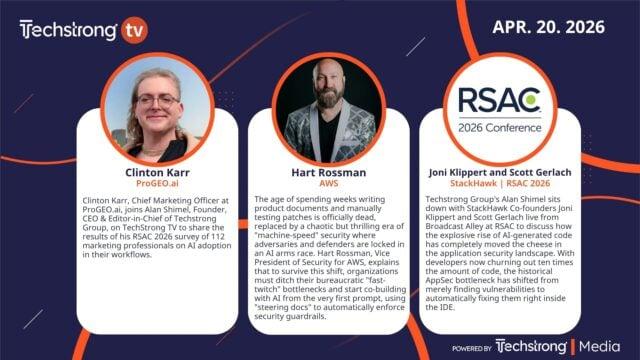
Techstrong TV February 2, 2026
Watch our live stream Monday through Friday, featuring exclusive news, announcements and conversations with IT leaders and experts on topics ranging from digital transformation to #DevOps, #Cybersecurity, #CloudNative, #Containers and deep-dives into specific technologies and best practices. http://techstrong.tv/
Transcript
Hey, everyone. Welcome back here to Techstrong tv. I want to introduce you to my friend Pavlo Barron.
Pavlos been on with us before. He is the co-founder and CEO of Platform Engineering Labs, Pavlo. It's great to see you.
How are you? I'm doing great. Thanks for having me again.
Always a pleasure to be here. Absolutely. We love having you on Pavlo.
I, I mentioned your co-founder, CEO over at Platform Engineering Labs, but you know, you have a lifetime of experience in in technology and infrastructure in it. Tell, give people a sense of how you came to be the co-founder and CEO over at Platform Engineering Labs. Oh, well, that's a, a very, very interesting question.
Um, uh, I mean, there's a technical side and there is a, uh, visionary side to it. So technically, my co-founder, Zach Schneider, we worked together in a previous startup, um, um, called Instana that exited to IBM 2020. And we were working on a lot of things around, uh, making a very complicated, never stopping platform 24 7, multiple petabyte in a short period of time, data ingress, making it work.
And, uh, that is a special challenge. Probably not everybody has a special challenge like that, but what you learn is that the tooling that you have at hand already, like six, seven years ago is, well, I wouldn't say outdated, but it's so rudimentary, it's so low level that you basically crave improvement and kind of use case orientation. Which leads me to the visionary part of the story, which is that him and I, we always kept talking about that since then.
Um, like how can we improve that? Because nobody cares about use cases, concrete use cases in that space. Everybody works and plumps together.
Um, you know, any workflows with, with very basic tools, and it's all toil. It's, it costs you time. There is no way you can really safely test it or even run it without having to chant and dance around it, uh, uh, for, uh, weeks.
So, long story short, at some point, um, um, well, a little bit more than a year ago, we just decided to change it. There was a few triggers, uh, in the market, and we said, Hey, it's time because there's platform engineering and platform engineering is a discipline. We actually agree that this is the next evolution that is necessary.
And, uh, the great thing about it that it's, it finally admits the truth that every it was running on, which is a few real good people run stuff for many, many, many other people. And that is, this is the, this is the way to go. This is how it always worked.
Now we are honest with ourselves that this is how it, how it's supposed to work. Unfortunately, platform engineering itself is inheriting so much stuff from the past disciplines and decades of development of law level tooling, that it's actually, this tooling is in the way because platform engineering itself is all about use cases. It's not about tool chains.
It's not about pluming together chains out of hundreds of tools. You need to understand that the same engineer has different hats on at different times, uh, of the day in different situations. And this definitely needs to be taken on a new level.
Absolutely. Absolutely. com, right?
So I, I live this every day, right? Talking to people, listening to people re seeing what the, the, uh, the community, uh, contributes in, in terms of, of articles and so forth. Um, but we, we had a very interesting discussion off camera that I want to bring on camera, right?
Because you, you guys recently announced over at Platform Engineering Labs that you expanded your format into a platform for infrastructure builders with multi-cloud support. We're going to get to multi-cloud support in a minute, but let's leave that to the side for a second. You said something that I think was really important, which is, in today's world with ai, we're all builders.
All of a sudden, I'm coding, right? With vibe coding and stuff. I've never considered myself a coder.
My writing and my discussions and my every I I build, I have my, you know, we have mu some of our a v team have music backgrounds, Grammy Award sound engineers, they're creating synthetic music. They're building music videos. Um, our video people are building 3D animations.
They weren't 3D animators, they were video editors. So one of the great things I think about this AI is that we're all builders, we're all builders within the, uh, the IT realm, though. It's really, you know, expanding, mind blowing in terms of everyone's a builder and what they're build.
So when you say platform engineering labs is expanding the format into a platform for infrastructure builders, What do you mean? So this goes back, um, uh, history wise at how IAC actually, or infrastructure as code actually evolved. It has started with the idea of, uh, declarative kind of infrastructure code that everybody can contribute to and use.
Now, the problem that started appearing at some point is that this whole infrastructure has become more and more diverse, more cloud providers, more different services managed unmanaged stuff on premise versus cloud, um, kind of hybrid scenarios, your own APIs, gillions of different tools that are involved in workflows and whatnots. And this is still, all of it is kind of infrastructure or at least needs to be taken into account when working with infrastructure. The complexity has been growing, and at some point people started extending those IAC tools like Terraform with new providers, et cetera, et cetera.
Now, the programming model they follow is actually designed for top-notch engineers. And, uh, they take into account that extending the systems needs to be done by like a classic software engineer who's very well educated and, and knows their stuff. Now, this is not necessarily this kind of profile that operates in the DevOps, uh, in the broader DevOps space.
Uh, they might be software engineers by heart or by education, but sometimes they're not, it doesn't mean they're not top-notch, but they're not used to this modern software engineering approach where you kinda, you know, this, the ecosystems are big and, and you need to, to do so much just to write a little bit of coders, all this testing around that, et cetera, et cetera, et cetera. So, um, we're talking more about people who have been solving tasks by scripting things. And, uh, when the scripts do what they want, it's good enough.
Now, those people didn't have access to implementing providers for this classic platforms like Terraform, pmi, WhatsApp. Now, right now, as you said, we live in the age of builders. I mean, this is the AI idea or the, the, the advances in this technology had actually accelerated everybody who's creative enough into the mode of, oh, yeah, I can plum together whatever I want.
If I know how it supposed to work, I don't really care about it's, you know, workings as long as the result is what I need. And this is the similar kind of yeah, mindset. Uh, for those people who have a task at hand and need to achieve these tasks iteratively and have this result.
Guess what? This is scripting, right? This is how we always use, uh, to write all these scripts in the operation space.
Now, what I'm trying to get at is, um, there is a gap between how you can do that in classic systems, in, in classic platforms where you have to wait for somebody else to write a provider, a pretty complex piece of software, because the platform itself does not really abstract anything for you. So the software that you write as a provider is very complicated. You need to wait for somebody until they really start supporting that.
If you don't agree with how they did it, your only choice is to make it work yourself. Sometimes you can't, you don't have the time. Maybe you don't have the qualification.
I, I don't know. Now, in this time, with, with the help of ai, what we actually are expanding the platform into is what was necessary for IAC always. But now it's very simple and, um, safe.
What this means is, yes, you can write code your infrastructure code against the plugins that we already support, like the technology. We talk about the multi-cloud support. But, um, if you, if you miss something, you don't want to wait for us or our community to implement something like GitLab support for you or Jira support, whatever, maybe we're slow.
Maybe we don't have the priority for that. You just go ahead and do it yourself. We give you the tool that you actually feed your AI co-pilot or your AI agent with, and within a few hours, you get to a working result that is also saved and completely verified against the sophisticated test suite, if you wish, which completely exclude a failure.
Uh, I mean, maybe it sounds bold, but you can engineer it. And that's what exactly what we did. So everybody who knows what they want, who has access to the documentation or source code of what they want, is able with support of their AI copilot to achieve, um, a technology support and put it into form neatly within hours.
If you want to do it all by yourself without any AI agents, you still will achieve that within days. I mean, you just slow down yourself because they have to type all that, right? What a great time to be alive.
Ha, Palo, did you ever absolutely think back, think back to when you first broke into it in you first. Oh my God, right? If I told you this is how you were gonna do things now and don't bother writing the code, this'll write the code for you, Would you?
Oh, yeah. I mean, I remember the first, uh, printouts of the manuals and everything. I mean, you really, you really have had, had to be absolutely creative.
And I mean, I'm really old. I come from the time where typing actually, uh, was expensive. I took typing in school, Right?
Yes, I know, but there is typing and typing, right? I mean, when you, when you go back to punch cards, that's Me too. I was there.
That's what computers were when I was in school. We had punch cards. Exactly.
So, uh, there used to be a time where you e even typing was, uh, too expensive for you and you need to, to be, uh, thinking with a computer together. The times are over. I mean, yes, I know that there's a lot of people who are nostalgic about all that, but for the regular developer, for the regular engineer, we need to move forward.
Moving forward means just taking away all the, uh, potential, uh, kind of stones that lie in the way to achieving the result. And what Foreman now delivers to you as an engineer is there is absolutely no difference anymore between you being able to write the declarative infrastructure code that is always up to date in our system and extending the system that will allow you to do exactly the same thing with a piece of technology that we don't support yet. So that's like just a natural next step.
Absolutely. Um, Palo, I need to pivot a little bit and talk a little bit about platform engineering labs. 'cause we're learning low on time.
People listening to this and say, wow, this sounds great. I'd like to check it out. I like what Palo and the team are doing.
What's their best way to engage with you? Oh, this is, uh, perfectly simple. I mean, we are open source.
This means that everything is on the platform. Dash, uh, engineering dash labs on GitHub. There's plenty of repositories for me itself is there, but also a growing number of plugins that we're supporting, um, for different technologies.
Um, you can check out a blog. There's also links, all kinds of links into our Discord community, into our blog. We are very active on LinkedIn, so there's plenty of content you can learn from, agree or disagree, but it's, uh, interesting enough to, uh, basically follow.
So we are completely open. We just want people to take our software and to start building without, you know, unnecessary cycles. I love it.
And the website. Yes, it's platform engineering. Platform engineering.
That's great. Palo, as always, it's a pleasure to have you on here on Tech Trunk tv. Keep up the great work.
Don't be a stranger. Come back and talk with us more Anytime. Looking forward to that.
Alrighty. Palo Barron, co-founders, CEO platform engineering labs. That's platform engineering, platform engineering labs on GitHub.
Uh, go check out all of the great stuff he's doing. You know, we're all builders today. We're gonna take a break here on Tech Trunk tv.
We'll be right back. Now, as you continue to move to your new infrastructure, um, you've got, um, you, you have production nodes and, uh, all embedded on the new, the, the new operating system, the new management platform. What are you doing differently now, carrying forward?
You know, of course we've talked about digital twin, uh, to a certain extent, but, uh, you know, you've talked about integration with CICD processes and so forth. Yes. What do, what do day two operations look like for the whole team now on the new platform and infrastructure?
Well, uh, currently, you know, um, on, on the new infrastructure we have, uh, the team, now it's becoming more, um, uh, you know, date, the date, day two plus is becoming more, more routine kind of changes, uh, as we are of course moving the, migrating the data centers and, and building our existing data centers on. But, but also from an architecture perspective, we are now trying to do more in terms of, you know, implementing more AI functionality. Mm-hmm.
To, to now to tell us more about the operational, you know, if something goes wrong, if an incident happens, uh, don't give me row raw information, even if it's correlated, even a correlate. Sure. Give gimme an RCA, gimme an RCA and point me to what, what could be the problem and what could be the impacts.
So may maybe something has happened, but actually there is no real impact to the network. So a link might fail. Mm-hmm.
But there's enough in redundancy that we shouldn't worry about it. Sure. Tell, tell me.
I don't have to worry. So we're trying to build this more of an intelligent intelligence that there is some entity that is entity, uh, that is aware of our topology. Sure.
Our topology Yeah. And our network that can actually give us useful information about incidents and the results. But the main, the main thing that's interesting also in the operational aspect is I, I, I talked to the operational team and you know, they, they, they have a huge reduction in, in incidents, you know, like, like 80% to what we had before.
Yeah. Not, not only, not only the tool is part of the aspect, but the, I think the, i, the, the NetOps and tracking and, uh, this idea of doing things before you implement them helps a lot in avoiding, uh, avoiding problems. So, so the, the operations team are saying that most the, the, the are saying to me that most of the time they, they don't find the same problems that with what they found before, the fabric is very stable, very consistent.
Stable, consistent is as, as expected. There is no nothing that surprises them. Most of the things they're dealing with is maybe access to, to servers, uh, low balancers, firewalls, physical, physical stuff that is going on in the data center, but not from a, a design or, or, or a routing or, or this kind of, uh, perspective.
So it, it shifts, it shifts their, their, their efforts, you know, away from debugging, you know, lower level Sure. Details that the fabric should, should take care of. So it's a different, different type of challenges, but much, much less than before, much less before.
So that's a great example of the tooling decisions that you make, really having an impact on your operations team. Right. And you're dropping 80% of your tickets.
Um, that's, um, and, and I know, um, you know, your leadership has, has cited the same statistic, you know, 80% reduction in tickets. That's, that's huge. That's certainly impactful.
Didn't you also make some decisions on how to, um, implement e dda? Like you could have gone with a local install for EA, but you opted to go with the SaaS option. What were, what were some of the thoughts you had to, to weigh there and why did you ultimately choose the, you know, IIDA SaaS version?
Okay, so, so the ADA SaaS really, uh, we're, we as a network and, you know, network team, we're not in the business of running ida, you know, or, or we want to make use of edit. Sure. We want to architect around it.
So, so we offloaded that, that effort to the I team where they, they can implement it in the cloud, whatever, what, whatever cloud they want, they want to go to, sure. To GKE. They want to go Google or AWS whatever they want.
We don't care. We just want to connectivity to it. We want, you know, the upgrades to happen.
We want them to monitor the health of IDA itself. You know, uh, maybe their, their, I comes with many extra add-ons, you know, with RCA, um, you know, correlation. Uh, they do some kind of AI into, into giving you, in, you know, analysis of anything that happens.
So, so that's, that's also a plus that comes with it. We really didn't want to, to think about IDA too much. We wanted to rather use IDA architect around IDA and, you know, think about our, our architecture more and building more enhancements to the solution itself.
So ED SAS in that perspective, uh, saved us a lot of effort. And, and the team there was very helpful for us. So we, we like that.
We, we, we were, we are glad we went that way. Not in the business of actually running e dda. You just want it to work.
Right. So that's a great encapsulation of that. Very good.
Yes. Well, what else is in store in the future here? You know, you've, you've laid some really important foundations here for, you know, making real improvement for the resiliency of the network and the lives of the operators.
Um, what, what's coming down the pike? What, what are you gonna be able to do in 2026 that you couldn't do in 2025? I think, I think now we're concentrating on enhancing, enhancing the solution using maybe more AI that is native, you know, native to either it is coming up with lots of capabilities mm-hmm.
That are AI related, that we can chat, we can chat with either, we can talk to it, we can tell it what went wrong, what, what's happening. So that part, you know, we used to actually, we build in our solution, but a way or around either to, to, to fill in that gap. But I think in, in the next release, we're gonna be merging some of our tools with ADA and maybe merging our automation into IDA itself, either has the capability to write your own apps.
Sure. We would, I, I think that's something we would like to do is, you know, bring in our, our automation and pipelining to, to, to be within ida, to be within, to be ada IDA native. So the user doesn't really have to think, um, dealing with GIT and dealing with ida.
Maybe we can merge something together there. And also more on the operations aspect to get, to make operational RCA more intelligent, which either will add and we'll see what it adds and try and fill in the gaps there. As well as, as you know, we're still Nokia's growing.
Mm-hmm. We've got, we've got acquisitions and stuff like that. So there will be more data centers.
And, and as I said, our, our architecture now is very modular. It's not flat. It's not like it doesn't look like a data center.
It looks like many small mini data centers connected together. Sure, sure. So we're able to absorb, absorb those changes.
And that's, I think will be a main task for us next year. Ahmed, thanks so much for talking with us today. It's been a pleasure.
I look forward to hearing how things progress in 2026. Thank you very much for having me. It is very exciting for me, and I'm very passionate to, to, to talk about our work.
'cause it, it really is exciting and interesting. It comes through in every conversation I've had with you. So thank you.
Thank you for sharing that passion and turning it into real concrete, you know, this is what you're actually experiencing in the new, uh, the new network infrastructure in, um, Nokia enterprise. It. Thank you very much.
Thank you for having Hey guys, thanks for the throw. We're here with newly appointed CEO for Planview, Matt Ziley, and we're talking about everything here from project management to value stream management to some good old fashioned collaboration. But all this stuff is coming together, hopefully in the age of ai.
Matt, welcome to the show. Thank you so much. Good to be here.
So Planview does have a pretty broad portfolio, and I think a lot of folks are using at least one, maybe two of those tools, but I'm not sure they got the whole portfolio installed. And I wonder if all these functions, maybe we'll see more convergence in the age of ai, but how do you see this all playing out? Yeah, I think, uh, I think there's no doubt about it.
I mean, I think even before the age of ai, the convergence was starting to happen. And the complexity that companies have always had is that they make decisions in different ways, even inside a single company. Different teams make different decisions in different ways.
They get work done in different ways The last 5, 6, 7 years as companies have gone through pretty significant digital transformations, that's just been even more complicated because you've got teams inside of companies that are trying to develop software for the first time or create digital products. And so all of that complexity is there. There's been this need in the market that we've been, uh, certainly fulfilling for a number of customers to bring that all together and do a single pane of glass so that companies have a complete view of what they're trying to get done, and they can make sure that everybody is executing against that strategy.
But in the age of ai, uh, it, it, it's a multiplier effect unquestionably, because now that, that, that's still even at its best, a complicated picture. When you've got large organizations, teams with different operating models, it's always been hard to still bring that together. AI does a great job of, of bringing simplicity, uh, to a lot of that complexity and really surfacing up where things are going awry or the data to make the best decision.
And so I think, uh, I think we're gonna see over the next 1, 2, 3 years. AI is an accelerant to companies achieving that, that true single pane of glass for their decision making, uh, and, and, and making sure that they have everybody kind of rowing in the same direction because of it. Do you think as a result we'll be able to maybe understand and surface the dependencies that exist between various projects?
'cause I think that's what often kills us is that nobody kind of realized that they were dependent upon somebody else doing something by a certain time, and then they fell behind and nobody kinda sent a message down the line. And so then, you know, for the one of a nail, the war was lost, Could, couldn't agree more. I mean, it's, it's a, it's a, it's the core of what every, I don't even wanna say large organization.
Every organization deals with that. The only difference between small and large is that you can still, uh, get a small team in a room to kind of sort through it. But as your organization grows, it's those, those dependencies that, that hurt and slow things down and, and cost projects and, and initiatives not to be delivered.
So it's a pretty big change we're going through there. And, and it's an area that we spend a significant amount of time on as plan view, because the complexity has been less in the last few years about tracking dependencies and a lot more about knowing what to do about a dependency. Because when you track all the, the dependencies in an organization, it is far too complicated of a map for any one person to understand or take action on.
And so we've invested a lot here. It's a perfect application for AI because it can take often unstructured and sometimes conflicting data sets, bring those together, truly understand a map of what's happening. And then the trick becomes how do we bring that to the fore for people to understand and interpret and make decisions based on.
And so it's a core application that, that we're focused on. We call it the connected work graph. Uh, and it's really that intention of not just tracking all the dependencies, but turning that into, uh, a, a a view and an understanding that a person can take action on to, to limit the risks from those dependencies.
Hmm. How do we get the data to surface those insights? And I asked the question because, you know, back in the day there'd be somebody standing around with a clipboard collecting data and kind of looking over somebody's shoulder to figure out what was going on.
And then they would create a report. And, you know, some people would read it and some people would not. But there was always this resentment because people were like, well, why do I gotta fill out all this data and do the entry?
So can we automate the data collection these days? 'cause I think the data we need is in our platforms and our tools, it's already there, but we just need to pull it out. Right?
I think that's right. I think that's right. I think, I think this is where a lot of companies are, are focused.
We, we focus on trying to bring together the entire picture regardless of, of kind of where the data sits. But, you know, there, there are plenty of tools that people use to track their work today. And a lot of those tools are making great strides to make it easier to get the insights from people into the tool and, uh, uh, leverage the fact that we have these, these LLMs now at their core that can very quickly translate the thoughts of a human into something structured for interpretation.
And so a lot of that's happening at the kind of team tool level, which is, which is a big step in the right direction. Uh, but then the, the problem that we still have to solve is how do you make sense of it all? And so I think we're gonna see over time the need for people to spend a lot of time on kind of classic data entry and so on, that's gonna continually decline.
And even today it's pretty, pretty easy for most of us, even just using our voice to get data into, uh, into a system we might use so that that burden's gonna decline. The pressure on making sense of the data is going to continue to increase. And so that's where we spend, uh, a good portion of our investment and time to make sure that when you have all these disparate data sources, they're coming together in a unified way and they can be used to make better decisions and, and take better actions.
Mm-hmm. What is the level of maturity of the AI tools that we're using today? And I asked the question 'cause it seems like all over the place, it's a little uneven, but we are moving to this agentic AI age.
So how autonomous will an AI agent be in the context of, say, a project management application or value stream management or, or whatever it's, Yeah, I think, I think if I go back to 2025, I, I kind of characterize it as, as the, the world where, uh, build or buy was still a big decision that was, was being debated around ai. And, and it wasn't clear yet which tools were mature. We've experienced the cells with, with things we use from, from other vendors.
There's a wide range of effectiveness of AI tools today. And so people still have to do a lot of testing to make sure they work. But when we get into 2026, I think what we're seeing is that companies are making the transition.
They're a lot more comfortable using what I would call, you know, kind of built-in AI capabilities or packaged AI solutions instead of feeling that they need to build as much of their own AI solutions. And I think that's a benefit because one of the areas that we're certainly focused on is, is building and productizing the agents that we would expect our customers to use. And so I think we're, we're over the hump on, on companies being comfortable with that approach.
We engage with our customers directly on which agents we have and how they apply specifically to their use cases. There's still a lot of work that goes into that, but the benefit of that work goes directly to your question, which is when, in our case, when we partner with a company to take our agents and apply them to their use cases, we spend time, weeks, sometimes months, making sure that they get comfortable so that they can lean on the automation of agents and don't feel that it has to be, uh, highly overseen or governed and that it actually will provide scale to their organizations. But the, we're in the year, this year, 2026, where I think the way we'll get there is by proving out and doing proofs of concept to get people comfortable.
I don't think we're at the point yet where people are gonna flip a switch, start deploying agents and fully rely on them. Maybe that's the, you know, what 2027 will become. Um, but I think the big, the big kind of Rubicon we've crossed from 25 to 26 is, is on average companies are far more comfortable engaging in agentic discussions, uh, because they believe there are use cases they will be able to rely on heavily for agents.
How smart can all this get? And I asked the question because, um, in an, in an ideal world, we discover that there's an issue before it has a catastrophic impact on our plan, and we reallocate resources to make sure that that issue goes away so that we can get back on track. Will the AI agents not only surface when we have that issue, but will they negotiate with each other about how to reallocate those resources?
'cause in many cases, whatever the task is will be done by them anyway. I think, I think that's gonna be, I think that's what leading companies are gonna get to. I think, I think we're at the point today where we can point to plenty of examples in our customer base where people will rely on plan view, uh, plan view's, agents and AI capabilities to elevate the issues that's already happening.
And so it gives companies a lot of confidence that the, the flag is being raised whenever they see an issue, so that, uh, any individual, uh, user can, can see those issues. They don't have to go find them. They, they get, they get put front and center.
So I think we're already in that world today, which is exciting. I don't think we're very far from the point where, uh, the agents will start to pro solve the problems as well. And I think that is, uh, gonna vary by company, it's gonna vary by industry, it's gonna vary by the kind of degree of risk tolerance, but there are so many use cases we see already that are fairly low risk for an AI agent to not just identify the problem, but do the resource reallocation and, and companies are comfortable with that use case already.
Now, I think there are some highly governed, highly regulated, uh, take financial services use cases where that is probably another year or two away. There's a, a lot of learning cycles we need to go through there, but it's not because the technology's not there to do it today. It's because, uh, the, the comfort level isn't quite there yet.
Hmm. Um, as you kinda put this all together, what becomes of the human project managers, because they are historically at least, or the backbone of many of the organizations that, you know, if it wasn't for them, most of this stuff wouldn't come to reality and everything we sold would probably not be delivered on time and everybody gets angry. So those project managers are kind of like the ones with the broad shoulders in these organizations, but how do they evolve?
Yeah, I think, I think we're starting to see already the, the elevation I would say of of not just project managers, right? In the world we live in, it might be anybody from a project manager to an agile coach, to an initiative owner in a transformation office. The, the, the way you described it is perfect.
The backbone of how work gets done in these organizations, those people are, are elevating. And the reason they're elevating is because the best ones now can multiply their impact. And so what I think is the big change is that every, every project manager knows that they're balancing what may be high value work with some lower value work.
And, and what's changing now is they can rely on automations and AI technologies to offload a lot of the lower value work and continue to elevate where they spend their time. Whether it's a higher number of projects, whether it's the bigger projects, whether it's more strategic initiatives. I think that's the evolution we're gonna, we're gonna go through and, you know, think we're, especially around technology delivery, the every five years, there's a pretty big change.
This may be the biggest change we face, uh, in in the last 20 or 30 years. It's not gonna come in the, in the, in a classic, you know, kind of replacing jobs productivity way. It's gonna come because it's gonna elevate these really effective people to have a bigger impact than they might have had two or three or four years ago, I think.
Mm-hmm. And to your point, a lot of these project managers, well, it's a stressful gig no matter how you look at it, because they don't have a lot of control over the underlying resources, and yet they're accountable for the outcome often. So, um, do you think in the age of AI that maybe there will be less stress for those folks, less burnout, and they will feel like they have more control over their outcomes?
I hope so. I hope so, because I think, I think what we're certainly gonna see is they're gonna have more information, and it's not information that they have to go weed through. It's more information that AI is going to help surface insights, really actionable insights from.
And so I think there's generally gonna be a sense that, that most, uh, uh, project managers and initiative owners are going to have a better understanding of the risks and the dynamics in the work that they're trying to get done. And that isn't always inherently comfortable, but I think it's a good step towards just having that, that complete view of what is really happening and that's gonna give them the opportunity to go and, and take action in the right areas. And so I think over time, we, we will see that, that it, the, the stress should reduce because the risks are going to reduce.
And I think those are the two things that correlate most strongly in a, you know, in a project manager's world, for example, now, there's still always gonna be the challenges of how do you rally a a group of people that you may not have direct control over to, to address these issues. I'm not sure that that that is quite, uh, gonna go away yet. But I think if we can, if we can reduce the, the stress from foreseen and unforeseen risks, it's a big step in the right direction.
Um, do you think ultimately if we get all this right, that our business forecast will be more accurate because we'll have more visibility into what's actually being done to drive the next product or drive the next innovation and we'll just have a better handle on things in general? And maybe the C FFO should care more about this? There's, there's no doubt we're, we're seeing it today because the, the best, uh, transformation organizations, right?
They are very good at setting out objectives and key results and tying every bit of work that they're leading back to those key results. But to your point, the, the variability comes in, in whether they execute on time, whether they actually achieve those key results. And, and a lot of that comes from surprises and risks and, you know, people mischaracterizing the, the health of any given project or initiative.
And so I think the more that AI takes on those responsibilities of assessing the, the true state of the state and elevating to the rest of the organization, providing visibility to where the risks are and how healthy any initiative is, how we're tracking against the business results, it can only lead to, uh, improved likelihood of achieving those business results. And so I think we see plenty of, of our customers today that are already kind of at that, at that stage and very effective in in how they do that. Um, but there are many organizations that aren't there yet, right?
They still kind of manage, uh, individual projects versus are they actually hitting the, the key results they're trying to, to achieve. So what's your best advice to organizations about how to get ready for all this? 'cause I think end of the day it comes down to the data and a lot of that data today may be, isn't as organized as it should be.
Yep. I think that's right. I think, I think the, the biggest value that that AI provides is it works really well today with unstructured data.
And so I think a big part of this for a lot of organizations is, is to get started. And, and I think that they'll, in, in a lot of cases, they're surprised by how quickly they can find valuable use cases. So it's almost a bit of, you know, if we, if we think about AI as this one blob of technologies, well that, that's really hard to apply to any business problem.
And so the key is getting in and discovering what are the one or two or three business problems for us. The ones we help with at planview tend to be, you know, are, are we aligning the right capital and resources to projects? Are we executing on those projects?
Do we set the right strategies and initiatives? And so I think when we, when we even pull those apart and find the one or two or three that any individual company is really challenged by or struggling with today, we can find very discreet solutions for AI that don't require a rewiring of their entire enterprise architecture. And I think that's a bit of the sentiments in some companies sometimes is they feel like to get the benefit from ai, they really have to completely rebuild their underlying data lakes or data lake houses and their infrastructure.
And I think that might be a good North star for some companies. It's not necessary to start seeing value from AI today. And so the biggest, the biggest message is to, to to dive into some really high value use cases, make those successful, and build a roadmap of those over the course of the next one, two or three years.
Alright, So in the coming year, what should folks expect from planview? There's, uh, there's a lot, uh, happening here. Obviously we're talking a lot about AI for good reason and what, what we've, uh, I think discovered and what we're building towards is, is truly the, the rebuilding, the rewiring of a process that has existed in most companies for the better part of two or three decades.
It might be a project process, it might be an agile process, it might be a product, uh, operating model type of approach. And we, we've dealt with that complexity for a long time, that every organization has multiple operating models. When we look ahead, what, what we're gonna be able to deliver to customers is gonna continue to be the application of AI at the highest level of defining the right strategies, deploying the work down to every team, and making sure that you adapt and adjust, uh, when, when you, when the needs rise, when, when the market changes.
And when you're in a world that is changing faster now than ever before, which is something we've said every year for the last five or 10 years, but is truer now than ever before, companies can look to plan view to completely accelerate that cycle, leveraging AI solutions. And, and in our belief, the ability to make the best decisions faster is the thing that will determine the success or failure of most companies in the next two or three or four years. And ensure they're not left behind by competitors that might be evolving faster than them.
And so our investments in, in bringing AI to that application space, they're, they're here and now and, and I think, uh, will, will be the, the theme for us for 2026. All right, well, as Benjamin Franklin once put it, you know, even in the age of AI failing, the plan is planning to fail. Hey Matt, thanks for being on the show.
Thanks so much, Mike. And back to you guys in the studio. AI is growing up fast, becoming more powerful.
The real question is not whether it will mature. The real question is whether we will. And that's what Shimmy says.
Hey everyone, it's shimmy and welcome to this week. Shimmy says, I appreciate you coming down, uh, or joining in. You're not coming.
I wish you were coming down here, but no, you're just joining in Anyway this week. Shimmy says, I call AI in adolescence. The question is, is it a twi, is it a Twilight zone or are we talking about Isaac Eisenman's laws of robotics?
It's a good question. Let's get into it. So this week I read a, it's a blog post, but it's really an essay by Dario Am Modi, who's the CEO of philanthropic.
And that led me to another essay that he wrote actually almost two years, a year and a half ago before that. The one that he wrote just like this week, or maybe it was last week, is called The Adolescence of Technology. And then the earlier essay is called The Machines of Loving Grace.
And let me just say this upfront, they're two of, I think, the most thought provoking, smartest things that I've read in the whole AI space in a long time. And they're really sort of in yin and yang of what AI is and what it can be. It's not hype, it's not fud or fear porn or whatever you want to call that.
It's not marketing fluff either. It really, it causes you to think you can't just run through these things. You gotta focus in and think.
And I read them, I reread them, you know, and then I read 'em back to back and it got me thinking. And the way I always think, you know, I'm, I'm a child of my culture and when I see these things, I immediately start thinking through movies, TV series, books, songs, culture, because sometimes I need that to make sense of big, big ideas like that. And the phrase that struck me in, in e Modi's essays was write in the title, right?
The adolescence of technology. Really, it's the adolescence of ai. And he, he makes a strong case that AI is in its adolescence.
But if we truly think that AI is in its adolescence at some level, that should scare the hell out of us. Because for anyone who's been a parent, you know what it's like having it raising adolescence. It scares that kid scare the hell out of us.
But also if you're a parent and you know, right? It gives you all kinds of hope. 'cause you know, deep in there, there's this amazing thing, this amazing being, and maybe that's what AI is.
So let me explain to it. It's almost like AI is a teenager and he's got, they've got the car keys. You know, when the No Emoti talks about AI being in an adolescent phase, he's really talking about the cap.
Its capabilities racing ahead of its maturity, right? That middle school kind of demon face power growing faster than wi wisdom systems that can reason, plan, act, and influence real outcomes. While quite frankly, US society institutions and government and governance are still trying to catch up.
We're playing catch up, we're behind. And this isn't theatrical anymore. It's happening right now.
You know, when I hear an adolescence with immense power as a Modi called it, again, being who I am, I'm thinking TV's, movies, my brain goes straight to an old Twilight Zone episode that used to scare the hell outta me. That episode was called, it's a Good Life. Now, I don't know how many of you are original Twilight Zone fans, but in that episode, it was actually Billy Mummy who was the original Will Robinson in the original Lost in Space series, bill Murray's, uh, bill Mum Billy Mummy's, a young boy, and he has like God-like powers, he could read minds.
He knows what you're thinking. He could change reality just with a thought. He can make you disappear, disappear.
He doesn't like what you're thinking in the show in Twilight Zone. He used to send people out into a cornfield in the remake of the Twilight Zone, the movie he would like cover their mouths. So they couldn't speak and stuff as a result of that, this little town that the boy Billy Mummy's, you know, character lives in, they live in terror.
Everyone smiles, everyone praises him. Everyone does everything he does. Nobody tells him no, because if you do or you make him upset, you're out in the cornfield.
Some people say, oh, Billy Mummy's evil. No, Billy's not evil. And that episode isn't evil, evil.
It's about unchecked power without maturity. And if we think of AI being sort of omnipotent at some level and, and not having that maturity, maturity, that's a future. None of us, none of us want.
It's not because AI wakes up one morning and decides to be evil. Mind you, it's because it gets powerful before it gets wise because it incent its incentives. Get misaligned.
Feedback loops break because the people building and deploying these systems lose control of the outcomes in their headlong rush to money. It, it, you know, this is what get pe gets people, especially on the inside, like Emoti worried about these things and he's very clear about this risk. He doesn't minimize it, he doesn't sugarcoat it, he doesn't dance around it.
He flat out says that AI systems are becoming more powerful faster than our ability to govern them responsibly. And that gap right there is where things can go sideways in a bad way. Guys, this isn't science fiction or Twilight Zone anymore.
Here's the part that really matters. AI is no longer just a tool that sits on the sidelines. These systems are, are acting right now, acting inside real workflows.
They influence decisions, they're generating content, they automate actions, they shape markets. They're increasingly embedded into the very fabric, the machinery of society. And that's a big shift in a really short time.
We haven't caught up to it. And again, as a parent, you know, this a or if you're a child behaviorist or you know, psychologist, adolescence is the most dangerous phase of growth. As I said, if you raise kids, you know that it's smart enough to do jet damage confident enough to think they know better, but not yet mature enough to understand the consequences.
Now, let's scale that up globally. That's the concern of Modi's raising. And quite frankly, I think he's right to raise it.
I, he really made me think about it. History tells us we are terrible at slowing down when money, power and competition are involved. We ask, can we long before we ask, should we?
And that's kind of a real adolescent move, isn't it? We almost never ask what happens if we're wrong? 'cause when you're young, you don't think you could be wrong.
Of course, though, we've seen this movie before, right? We've seen it recently over the last decades. Social media, surveillance, capitalism, algorithmic engagement, all built fast, scaled faster, and then governed, laid later if it was governed at all.
So, you know, we've all joked about AI being like Skynet, right from the old movie. And I, I get, it's, it's something funny to talk about, but the real danger isn't some cartoon villain in AI like Skynet here. I think the real danger is indifference.
If we don't do anything, we have optimization without context, intelligence without values. That's the Twilight Zone version of AI's adolescence. But here's the good news.
That's only half the story. 'cause these US essays really stuck with me and made me think it through. Emoti isn't just warning us, he, he's also offered us a path forward.
The earlier essay Machines of Loving Grace gave us gave us this path forward. And that essay Emoti steps back and asked big questions. If machines are going to become more intelligent than the smartest humans, super intelligent, omnipotent, how do we make sure that intelligence is aligned with human values?
Not abstract values, but real ones, messy ones, human ones. What I appreciated is that he didn't pretend that, that this is, this is an easy thing to tackle. He doesn't pretend there that is even a single right answer.
He acknowledges that humans themselves don't agree on this. Aligning machines is not a checkbox, it's gonna be an ongoing process, but that's a critical point. Alignment itself is not a destination, it's just part of the journey.
It's a discipline. And he introduced something called the Claude Constitution. Some people may call it the philanthropic constitution.
This is one of the most interesting things that I've seen recently, right? O Modi talks about the Claude Constitution. They recently updated.
It's not some marketing gimmick, or at least I don't think it is, fooled me if it is, it's an actual attempt to define the principles and norms that should guide how AI systems behave. That will guide supposedly how clawed from anthropic behaves. The models are trained to reason against a written set of values drawn from things like human rights frameworks and ethical principles.
In its simplest terms, the system isn't just ask what is the answer? It's also ask, is this the right answer to give and why? And look man, that's a big deal for where we are today with ai, because one of the biggest fears around AI is not that it's malicious, that that has malice, it's misaligned systems doing exactly what they were asked to do, just not what we really want them to do.
Now a constitution doesn't solve that completely, and ammonium himself is very clear about it. No static set, no static set of rules ever. Could be that, but it's a hell of a lot better than letting behavior emerge random randomly from scale and data and greed alone.
And that's where my second cultural reference kicked in, right? This time. It's not a movie, I go back to books.
It's Isaac Asimov. You know, when I was a teenager, I was in Asimov in a big way. I read all, all of his sci-fi books reading about this, uh, Claude Constitution.
I couldn't stop thinking and analogizing it to Isaac Asimov and his laws of robotics. Most people, if if, well if you were any kind of sci-fi fan, even if you weren't, you may have heard about these laws of robotics. Robots can't harm humans.
They must obey humans. They must protect themselves unless that conflicts with the first two laws. And so the highest law was they can't harm humans.
And if that means disobeying humans, not to harm them later, if you're a fan of Asimov, you know, there was another zero with law, a fourth law putting in there that the greater good for all of humanity outweighs the good to just the individual. Ah, you may say, ah, it's old stuff in a book from the forties and fifties. But what made Asimov brilliant wasn't that he thought these laws were foolproof.
It was that he as an author, understood that these rules were gonna create tensions. That scenarios would come up. Edge cases, moral dilemmas that would make terrific theater, terrific reading.
His stories are all about what happens when intelligent systems follow rules perfectly. And humans have to deal with the consequences. That's the parallel here.
Philanthropics constitution, court constitution is not a guarantee, it's just an attempt. It's an acknowledgement that intelligence without guardrails is dangerous. And that values need to be part of the system.
Not an afterthought, but let me stop right here for a second and go back to Asimov. They wrote a whole constitution. Claude Asimov did this in four rules.
The simplicity, the sheer simplicity and elegance of asimov's rules of robotics. And you could just substitute AI for robotics, the sheer simplicity and elegance. But that it was encompassing everything.
It is something I think we strive for and we will strive for. No one wants to read through a whole constitution. We want defining principles.
But if I had to have, if I had to pick one thing with this constitution is maybe it tries to be too much. It tries to put too much down in paper. It tries to anticipate too much.
We need a simpler, elegant set of rules, is what I think. And when I think about the real world for a second, that's kind of where I'm at, is that this is a good start. But we need to be, we need to boil this down to its essence.
You know, the other thing to think about is look where it, remember where it's coming from, right? Andro announce, I think it was last week, another massive funding round was a $20 billion oversubscribed round. They were looking to only raise 10 billion.
Like 10 billion is mere drop in the bucket. They're valuing anthropic now at $350 billion. Guys, that's not a headline.
That's real power open ai. Rumor has, it is raising another round too. They're gonna be valued just under a trillion dollars when AI companies are valued as much as nation states.
Governance is no longer an internal discussion within the company. It's societal, societal, humanity wide issue. And we gotta treat it as that.
Give credit. Emoti doesn't duck this at all in these essays. He talks openly about the responsibility that comes with building these awesome frontier models.
What we all use now about the roles executive and boards are playing in shaping outcomes about the fact that leadership decisions matter as much as technical wants. That honesty matters. It matters to me because I think he lets it, he comes across as real.
And again, if he fooled me, shame on them. The biggest risk in AI may not be in the models themselves. It may be the incentives that are driving the people who build these models.
So guys, here's my shimmy's take on this one. I don't know Dario or Modi personally, I didn't really wasn't aware of them much before. I read these two essays.
I'm not inside anthropic open AI or any of 'em. But based on these, uh, essays, I gotta tell you the truth, I came away really impressed with him and, and the thought that he's putting into these issues. Not because he claims to have all the answers, none of us do, but because he clearly understands the responsibility weighing on their shoulders that comes at this moment in history and time, he's treating the prospect of AI surpassing human intelligence, not as some victory lap or pot of gold, but is a moral test for sure.
We're gonna hit bumps. Some of them will be tech, some of them will be technical. Some of them will be political, some will be economic, some will be self-inflicted and some, there's nothing we could do about.
But reading these essays gave gave me something that I don't after. I don't feel after reading or hearing about AI thought leaders, it gave me hope and hopes a precious thing. Hope that there are adult, there are indeed adults in the room.
Hope that at least some of the people raising this incredibly powerful adolescent teenager that we have before us. Understand what the stakes really are here. Hope that intelligence, humility, and responsibility might just scale alongside capability.
AI is growing up fast. The real question is not whether it will mature. The real question is whether we will mature and that my friends is what Shimmy says.
I'll see you next week. By the way, I wrote a two part article on this. You can check it out on text drawing ai.
There's a lot in there to the digest. And if you're interested in the Claude Constitution, I have another article coming out tomorrow, Friday, just on the Constitution and check that out. But until then, man, I'll see you next week on Shimmy says, have a great weekend everyone.
Obsidian portal protection, VMware licensing issues. Nvidia invests even more into core weave Quantum open source moving from Cuda to rock. Meta is financing some fiber Andro updates for understanding.
And Blue Origin catches a terror wave in this episode of the Tech Field Day rundown. Hello everyone, and a welcome to the Tech Field Day rundown. It is January the 28th and we hope that you had a nice hearty breakfast that included blueberry pancakes.
'cause that's what day it is. It's National Blueberry Pancake Day. It's also National Lego Day.
And I know that all of the listeners on the rundown love Lego sets and they would love to be building one right now. But hold on a minute, 'cause we've got some news headed your way. We also have a brand new cohost headed your way.
Joining me is Mr. Jay Coutre. Jay, welcome to the show.
What is your favorite Lego set? My favorite Lego set is the one I don't stand on or step on when I'm going through a hallway. That's my favorite Lego set.
You know, that's probably a good one because as painful as stepping on Legos would be, what's even more painful is missing an episode of the tech field. A rundown because we have some great news that we wanna share with you and get some commentary. And we're gonna start off with a story from our friends over at Obsidian Security because they have expanded their SaaS security platform to cover third party integrations, giving organizations better control over how applications connect and share data.
New features include enforcing least privileged policies for who can approve integrations and improve supply chain breach notifications. The updates aim to reduce the risk of breaches spreading across SaaS environments, especially as integrations and AI agents increase attack surfaces. Jay, do you think it's important for companies to start thinking about their SaaS security supply offerings?
It is. If you've ever, ever had something offered to connect something to something else, uh, as part of your user experience, now imagine that being turned up for everyone. When you roll out some of these new platforms that are seeking to connect any to any many, to many, and what you end up with is this potential for a, a security Swiss cheese or, or a fondue depending on what your perspective is.
My thinking is that anything that can raise visibility and actions that can be taken on behalf of a security team that's gonna be responsible for this, uh, it's it's that many to many that that dependency mapping, this is really key for us to move forward with a de-risked, you know, uh, safe quote unquote version of adoption of things like ai. My suspicion is that the SaaS companies will just, uh, counter that with making it even less, uh, you know, uh, cumbersome, uh, release more friction, um, from the current experience and increasingly become frictionless. So I think it'll be a little bit of a spy versus spy, uh, story as the SaaS just, you know, tries to pull friction out of that, uh, sequence and then security teams sort of try to wrestle it back into place.
Um, so I'm curious to see how this plays out maybe a year from now. Uh, but for, for this, uh, update, I think least privilege, no one's going to object to that. I do think there will probably be some tickets that will go into the, up into the right column.
Especially as you put some of these controls in place, even if it's, you know, a sensible set of guardrails, I still think there's gonna be an outcome where it flows back onto some of the operations team side of security to deal with those tickets to explain why we're not gonna allow you to connect your luggage, uh, for example, to our enterprise, you know, resource management systems. So that's, that's my perspective based on what I've been reading so far. And if you wanted to pivot from the world of all things connected to everything, uh, there are those that are part of the legacy Broadcom VMware story that are starting to learn a little bit more about what's underneath the cover of some of these contracts.
So recently, uh, fidelity and, uh, Broadcom have started to settle a legal dispute. I say started to settle because it's, I think it's settled, uh, but I also know that there can be some times, some back and forth. But the whole idea is around access to VMware software, what that means for, uh, Fidelity's own operations for them to continue, uh, without disruption.
Probably many listeners today use or have used Fidelity as part of their overall, uh, compensation, uh, within a corporation that they work for. And so what this really means is there's gonna be these, again, use the word friction. There's friction now between these prior customers of VMware that are now effectively Broadcom customers.
And so each time that happens, it really highlights where it happens when you bundle a certain way, then someone acquires that company that you would use that bundle with, and the acquiring company decides that that bundle shall now longer, no longer be honored. And so I think that this is really an interesting one where there's gonna be major licensing changes that'll occur. I don't think this will be the last time we've heard of a similar story, but, uh, what are your thoughts?
I think it's interesting because Broadcom really wanted to go after what I consider to be that load-bearing customer set, right? Companies like Fidelity can't just rip and replace software willy-nilly because they're in a highly regulated industry and they're operations really can't go down. And we kind of suspected this when the announcement was made all those years ago, right?
Like Htan and Broadcom said the things they had to say, we're not gonna raise prices, we're not gonna cut r and d, we're not gonna do all of that stuff. But we also kind of knew that for what they were paying for the company, they had to raise prices. So the question is, how high can they raise prices?
Uh, there's, you know, the, the, the maximum of, uh, raise the prices until somebody squeaks and then turn it down maybe 10%, and that's your new norm until whatever. And I think that the squeaking in this case was the fact that Fidelity said, that's too much. We're gonna take you to court.
Or, you know, I think it might've even been VMware taking them to court to try to figure out exactly what's going on here. But we've also heard from bigger companies, like at and t they were kind of looking at this and, and basically what they're trying to say is, we know we have an agreement and we know what the agreement covers. Does the agreement require me to uninstall any patches that were installed after a certain date that I can no longer update my software?
Because that was one of the things that companies said that they were doing, is they were getting a cease and desist from VMware by Broadcom saying, you can't install any more software. I'm sure that these companies are investigating alternatives, but the problem is, is that you've got a sunk cost in the licensing versus the cost to acquire a new solution to get your people trained on it, to get it installed, and to make sure that operations continue and to borrow a line from Fight Club. If a plus B plus C is less than the cost of a recall, we don't do one.
And that's the thing. If the amount of money that Broadcom can get out of these customers is less than the cost to do all these other things, then they're going to stick with it. But I promise you the investigations are ongoing, and as soon as that breakeven point shifts, we're gonna see customers that are starting to move off of that.
I also think that the next time that these contract negotiations come around, there's obviously going to be a desire for them to raise prices again. And that's going to play into the math of how likely these large organizations are to stick around with the software. And I'm not just picking on VMware by Broadcom.
Any company would be making these changes. Nvidia has invested $2 billion into Core Weave, becoming the Neo Cloud provider's second largest shareholder and deepening its role in the global AI infrastructure, build out this investment will fund massive data center expansion and tighter hardware software alignment, which reinforces NVIDIA's influence over how large scale AI workloads are being deployed. The move signals that control of AI infrastructure, not just Chips, will be central to the competitive advantage as AI scales.
Jay, we've seen that Nvidia has invested a lot of money into Core Weave, and likewise, core Weave is using a lot of Nvidia hardware. Does this mean that you're kind of, have you, you've created this situation where Nvidia and Core Weave are more or less dependent on each other to continue to thrive in this market? It is interesting, Tom, because if I go back in time to when there were other large juggernauts of infrastructure like a company called Cisco, there was this manifestation of a gray market.
com era, everyone bought a bunch of Cisco equipment and then allegedly some of that Cisco equipment may have made it into a secondary market. Um, I think there's some similar parallels here with what's happening with these amazing processors that are created by Nvidia. And I think finding the right market for, here's the current current generation, here's the recently current generation, and here's the things that oddly enough, if you have enough access to it through a Neo Cloud provider, it'll get the job done.
And so I think that this, this notion of where people are doing discreet amounts of training, increasingly leveraging existing models and doing greater amounts of inference, I think it'll be fascinating to see almost like a a a kind of swinging supply chain story of what was yesterday year, but still is fit for purpose to accomplish certain goals. I think these Neo cloud providers like Core, weve are gonna be a part of that story. What I'm looking for is are there additional investments to other Neo cloud providers besides Core weve, that also might be part of the story.
And I think we've, we've already seen, there's, there's a plenty of writers out there right now that are taking kind of a contrarian view of all things related to the Oro Boros of all things in the GPU, uh, kind of, uh, value chain. But, um, I think of it like this, I would not be shocked if there weren't more deals like this and, uh, possibly, uh, other companies, uh, that are other neo clouds that compete with if you'll, uh, with Core beef, but are ultimately complimentary and lifting to the part of the Nvidia business that can't necessarily afford the latest and greatest from Nvidia, but definitely can benefit from a long tail or lineage of prior products. So, uh, with that, I'm gonna say right now, if you are thinking about Quantum and all things related to the next generation of compute away from classical now to Quantum, Microsoft's actually announced that they've got a quantum development kit.
So if you can imagine, I don't know if, uh, Satya Nadal will do this, but, uh, maybe he does a developer's, developer's, developer's dance around all things quantum, quantum, quantum. But this looks like it's gonna be an open source set of tools that are gonna allow for anyone that's currently using kind of like the integrated development environment experience of Microsoft today vs. Code using go, uh, GitHub co-pilot to truly come in and harness and make use of all things related to development in the quantum realm of computing.
So this is gonna be about a workflow story. I think it's more than just saying like, we have, you know, hardware. I think this is more of enabling that developer audience to participate in what is arguably a fairly recent development in alternatives to the classical computing we had talked about earlier with GPUs or cpu.
So I think this also means that if we look at the near term impact, there's probably going to be some, uh, amount of hardware that's available for Quantum. But much like the initial scarcity of all things related to GPUs, when everything became, oh, it's beyond machine learning, we're moving to ai and suddenly you had supply chain, uh, constraints or supply chain constraints, I think there will probably be a modicum of hardware available, but getting developers easier, more, uh, fast, uh, ready access to the ability to touch that hardware is very interesting. So if you go back and look at the original D-Wave and some of the other EDI stories around there where they'd launch with a completely amazing website and kind of get people into it, Tom, what's your perspective on like kind of crossing over from the scarcity of hardware into now let enabled developers to maybe create even more scarcity around it?
There comes a point in every technology lifecycle where the early ideas about what it's capable of doing are sky is the limit. There's no, uh, you know, there's no idea what this could happen to do as we move along. And then usually around the series A funding round, uh, some investor steps in and goes, yeah, but how are we gonna sell it?
And the problem becomes those pie in the sky ideas have to have a return on investment, otherwise you're not gonna get a series B round. Quantum computing has been around for 30 plus years, even in the cultural zeitgeist as we know it. Um, I, again, I I referenced sneakers.
All you gotta do is go back and watch that, that's a quantum computer. The problem is that programming on those things is not traditionally straightforward. You have to have a different kind of methodology for thinking about how it's gonna work.
Well, normally if I'm gonna learn how to program on something, like when I learned how to program CI had a C compiler that I installed on my computer and I went in there and I messed around in a c compiler and I wrote code. And if it compiled, great, and if it didn't, I had to figure out what's going on with it. And that was on my 4 86.
I can't do that on a quantum computer because those things are expensive per hour of runtime. What I need is a development environment that will kind of desk check my code and make sure that what I write is runable on those systems. And that's what Microsoft is offering to do.
And they have taken a page out of the Nvidia playbook. 'cause if you remember years and years and years ago, Nvidia was like, oh, well, if you wanna do things on our graphics accelerators that are not texture mapping, we have this language called Cuda. And if you wanna learn how to write Cuda, and we have these software models that'll allow you to build programs, you know, they'll run on GPUs.
Fast forward to today, almost everybody's writing their stuff in Cuda because that's the kind of become the, the standard for how to write on GPUs. So if Microsoft can really open source these tools so that everybody has access to them, and they are training people how to write their code to run on quantum computers, then in a few years when quantum computing is cheap enough to be more, uh, dispersed throughout the industry, people are gonna write the way that Microsoft taught them to do it. It in a way, it's kind of the freemium model, right?
We're gonna give this away because we know it'll get more business down the road. I I hope that, you know, we, this is a, a, a noble goal, but we'll see if people latch on to using VS code and GitHub copilot to do all these things. Or if they kind of reject it in favor of some other approach as soon as they had more ready access to the hardware.
Speaking of Cuda, a developer used anthropics CLA code to Port Nvidia Cuda code to AMD's Rock M platform in about 30 minutes, which raises a lot of questions about NVIDIA's longstanding Kuda lock-in. While the demo suggests that AI assisted tools could lower the cost and risk of switching GPU platforms, experts caution that complex performance critical code may still require deep manual optimization even. So, this example shows how agentic coding tools could begin reshaping GPU software ecosystems.
Jay, I know I just said that kind of cuda is the way that people want to go, but what about people who are looking to shift that off onto a MD or, or other options? Do you think AI and specifically Claude can help them rewrite their stuff and be like, ah, yeah, it mostly works. Tom, when it comes to commitment to Cuda, I think there are gonna be people that'll stay all in, uh, on the platform native with Nvidia.
I also think they're gonna be those that will take somewhat contrarian positions trying to either, uh, find an alternative, uh, like this example of someone doing unique porting for an a MD platform. Uh, but I also think those hyperscale cloud service providers have, uh, made significant investments. Specifically I'm thinking of Google, uh, with their, uh, you know, now seventh generation version of Ironwood on their TPUs.
Uh, there's obviously the, uh, graviton family of, uh, processors from AWS such as, uh, tra, inia, et cetera, uh, that offer an alternative, uh, to the Nvidia processors and, and even Microsoft. Uh, if you think of what they may or may not be doing related to Maya and Cobalt, which are probably some older stories people could look back on, eventually they're gonna get there. And I think that what'll happen is, um, in addition to other players, you know, arguably open ai, um, grok, you know, coming up with their own, uh, hardware platforms, there will be some competitive pull.
But I believe today, CUDA is, uh, effectively defacto standard. And so these kinds of, um, enablers, uh, it's possible. I go to my, my, my ables enables, you know, there's what's possible.
We've shown it's possible and there's what's permissible, you know, are we really gonna set fire to capital to maintain this, you know, fork, if you will, of how we might do this on an alternative platform? Or is this now sustainable? Oh, now is it repeatable?
Oh, have we reached advisable? And I, I think that'll be really interesting to see if there is any kind of a bifurcation or even possibly a splitting of different, uh, you know, if you, if you will, different, uh, types of development stacks. But today, I, I do say that, um, you know, with the entirety of all the GPUs that are in market from Nvidia, the secondary markets, the neo clouds, it's gonna be easier, I would say, to get access to some of this traditional Nvidia, uh, uh, approach, which I think does support Cuda long-term.
They were first, um, we could argue whether it's best or not, but ultimately getting a more, uh, vibrant ecosystem will raise all boats. Um, what's the competition to Cuda? And I think that's a, a really reasonable question to always be asking.
Is there something that's coming around that's more viable? And I would, again, look back to, uh, the stories of open source. Um, there wasn't always an open source alternative to the everything that is Windows and Wintel, so maybe we'll see.
But for right now, I do think that Cuda has a first mover advantage and an absolutely dominant amount of silicon that's been put out into the field. Uh, as you mentioned earlier, the current scarcity of hardware doesn't necessarily mean there will always be that scarcity of hardware. And as these other competing platforms come in from the cloud service providers and some of the actual, uh, truly vertically integrated suppliers of AI services, uh, they'll go from probably, you know, uh, silicon to software to services, um, all the way up through the ass.
And my suspicion is, is that, that that competition will be good for everyone. But, uh, today I would still place a bet pretty heavily on kuda related to some of the stories we've heard about building ai. It's interesting that Meta has now agreed to pay Corning apparently up to 8 billion, uh, $6 billion, sorry, maybe it's gonna go to eight, but apparently it's 6 billion through 2030.
And this is related to fiber optic cabling within their data centers that are doing these AI workloads. What we've learned is that the soaring demand for fiber is apparent as these AI workloads require far greater amounts of connectivity than the traditional cloud computing that was being used to fill those, uh, data centers previously. So if you think about this where, uh, Corning stock is, um, way up, uh, arguably, uh, around 75% over where it was last year, this expansion of production and development into ever, ever denser, um, AI specific fiber solutions means that all of the hyperscalers, whether that's meta, uh, Nvidia, Google, Microsoft, open ai, and others, it looks like this could just continue to grow.
Now what's it displacing, uh, copper, most likely. The question is, is is the partnership really underscoring how the AI infrastructure is spending or reshaping a backbone for global data centers? Or is this just a one point in time, much like a pendulum?
Okay, we're swinging over to fiber, maybe we're gonna come back to some other kind of a alternative interconnect. Uh, what are your thoughts on this, Tom? Is this, is this seasonal generational revolutionary or evolutionary?
I think this is generational because, uh, for those of you, uh, that watch the run who may not be familiar with the Pentagon Pizza Index, uh, it is this thing that somebody came up with that said, Hey, we noticed that when the pizza places around the Pentagon get super busy late at night, there might be an indicator that something is going on that we might not know about right now, but there's a secondary indicator that says something is afoot. To me, this deal is a secondary indicator of the plans of these buildouts because one of the things that people think about is like, oh yeah, you know, uh, you're gonna build a new data center, you're gonna need, uh, walls, and you're gonna need a roof, and you're gonna need floor tiles. You're also gonna need a lot of power cables.
You're gonna need a lot of fiber runs, you're gonna need a lot of air handlers. And one of the things that I learned right after I started doing this job when Stephen Foskett and I were doing some, uh, work in New York City, was that a lot of analysts on the supply chain side of things can suss out that something's going on based on orders for components that people wouldn't normally be able to put together. It's like, for example, if a company, oh, I don't know, went out and bought the entire manufacturing capacity for, uh, crucial, uh, high bandwidth memory systems, that might be an indicator that they're gonna do something with that, like build a lot of servers that require HBM, but in and of itself, that might not necessarily be something because there are such things as strategic acquisitions where I'm not buying it for me to use, I'm buying it so somebody else can't use it, and maybe I can sell it back to them at an inflated rate.
But when you have an additional secondary indicators like, I'm buying more fiber because I have to run this through my data center, that tends to tell me that these people are, are wanting to build up. And the fact that you brought up copper is a very important point. These AI data centers really cannot run on modern copper infrastructure.
I mean, they can do it over very short distances like server to server, but the majority of the communications that are happening, whether you are using ultra ethernet IND link, um, spectrum X, these have to be copper. I'm sorry, these have to be fiber. They can't be copper because the 800 gigabit interconnects, I mean, they run over fiber for a very specific reason.
Not only that, but like the number of DSPs in these modules are insane. I actually wrote something about that on my blog this week where I was talking about the fact that you wouldn't believe the amount of heat that gets generated from a modern switch simply because of the, the processing power that has to be stuck inside these fiber modules. But that also means that you have to have high quality fiber runs in order to make sure that your light is passing and it doesn't eat up extra DSP resources.
And who better to go to than Corning? I mean, they developed Gorilla Glass. The reason why the modern mobile infrastructure looks the way that it does thanks to the iPhone and the the Samsung phones is because of Corning's ability to develop things like Gorilla Glass, it's hardened against all kinds of, uh, impacts and things like that.
6 terabits, and you don't wanna buy that plant infrastructure and then have to rip it out in two years because you need to move up to a, you know, different laser wavelength or something like that. So I think that this is meta basically saying, we're putting our money where our mouth is. We really are gonna build out these data centers.
Let's give it another year before you know, when all these things start shipping to make sure that it's actually gonna get built out. Moving over to another AI provider, anthropic has released a new constitution for its AI assistant claw, which is shifting from strict rules to teaching the AI to understand why it should behave safely and ethically. The update emphasizes helpfulness clear limits on harmful actions, and even considers Claude's potential consciousness made public under a Creative Commons license.
The Constitution highlights transparencies and, uh, positions Claude as a safer, smarter AI for businesses, no word yet on if they've incorporated the three laws. But I, Jay I have a question. Can we teach an AI how to be ethical or is it going to assume the ethics of the people who have created it?
Oh, geez, uh, AI and, um, I, I'll, I'll go back to one of my prior, uh, uh, uh, prior writings. I, I, I know people talk about stem, you know, the science, the technology, uh, engineering, mathematics, sometimes they put an A in, they get steam for the arts. Um, I did something, uh, called a steam, which is where I'm injecting ethics and empathy, um, into stem.
So, uh, what by doing, so you, you get the clever acronym, obviously, but, um, what I'm kind of wondering here is if the goal is to create or publish a policy, and if that policy is to be adopted, uh, you know, this, this notion of, you know, coming under a Creative Commons license, is it, is it really, is it really effective at making its way into an organization where there may be particular, uh, uh, proprietary considerations that might run afoul of, uh, of a creative, uh, commons license? Um, the other question I would have is, does it really mean that the ai, uh, in this instance around what is the appropriate use of ai? Is it, is it inextricably linked to anthropic use?
Meaning like if I'm using, you know, a code or, or other, uh, anthropic uh, models to come, is is it designed in mind to align to that policy? Or will this be like a lot of early initiatives where let's launch a fancy website, everyone feels good about it, let's all kumbaya for 15 minutes and then immediately go to the next adventure in, uh, you know, how we grow the next market? So I, I do wanna understand how durable, uh, this would be.
I, I think there is a cliche of simply open sourcing something or putting a, you know, a a clever license on top of it. Everyone feels good about it, but I do wonder what's the true a appetite or the passion for adoption and putting this into actual practice. I am very, very concerned as a technologist about what will happen as smaller language models make their way into computer vision systems, which may be connected to other things that have real kinetic impact for alive things like humans, for example.
And in a, in a prior update I was watching earlier this week, I think it was, uh, uh, Steven FoST had mentioned like, how, how it's happening, you know, is these as you go towards the edge. And one of the questions I asked is, how much Ram is gonna be allocated on those devices to think about that constitution? Is the constitution loaded into ram?
Do we believe that the Constitution fits in enough ram to justify the unit cost of that thing that will be very much a part of the kinetic world around us? So, um, I appreciate the, the, the forethought, but I am absolutely, um, wondering what the uptake in adoption of this is going to be. So I hope I don't sound too sour on it, uh, that it was created, but I just wonder if it's just gonna be abandoned by the roadside.
Like so many of their great ideas, what does they say about the road to hell pave with good intentions? So let's hope it's not that. And on a, uh, slightly more, uh, light note, blue Origin is actually going to expand, uh, beyond rockets and invoke something called Terra Wave, which is gonna be a new satellite network designed for high capacity enterprise grade connectivity.
Does this sound familiar? It should, because this is not something where we're talking about starlink. We're not talking about AWS Leo, formerly known as hyper.
This is a new hybrid constellation of over 5,400 satellites to start that will provide multi terabit connectivity to various, uh, supplements of other earth-based terrestrial networks. This means that you could have redundancy for your data centers. If any of you ever remember why there were satellite dishes on tops of data centers, welcome back.
The difference is now it's gonna be a lot more performant. And so when you think of this for cloud to cloud links, uh, everything related to business continuity, disaster recovery, imagine the new diagrams that would be available to us when we start drawing these new architectures of what's possible with infrastructure going from just purely terrestrial going beyond radio. Now thinking in terms of extraterrestrial connectivity.
So by targeting business with these high bandwidth, strict security and avail, uh, reliability requirements, um, what you're gonna see is Terra Wave is definitely gonna compete with starlink. Um, it's probably gonna compete, uh, while in this mission critical focused area around enterprise applications, those kinds of workloads. So to to, to, to afford Terra wave is to, uh, is to me that you are most likely a very large, uh, corporate interest of some kind.
And so I would, I would say this is very different than like, I'm gonna put a little, you know, starlink mini in my backpack and go out in the woods and be, you know, ever connected to the world around me, um, while I'm in the woods, which is always kind of odd to me. Why would you go into the woods and then wanna have a starlink mini with you? But point being is that this should be deployed sometime around late 2027.
It it means that promising much, much faster than current geo latency solutions today, and more importantly, highly symmetrical as opposed to asymmetric. So symmetrical being really important for these enterprise applications where again, you're, you're thinking about new topologies. So having known this, and, and by the way, I'm someone that actually has, uh, taken the CNCS landscape too, um, uh, taken a fork of it and I've loaded the entire space value chain that I've been interested in, and I've been tracking all these layers.
I can't wait to add Terra Wave as a logo into that near Blue Origin for all these other, uh, low earth orbit and geosynchronous style, you know, providers of connectivity. But Tom, do you think this is like, is it getting too busy up there? Do we, do we have room for another, I mean, space is very large, but do we have room for a tear wave?
Do we have, do we have room for more competitors in the space or is it really gonna be like three companies that dominate much like in the US we have the At&t, you have the Verizon, maybe you have Sprint Legacy. What do you think is gonna happen once we're up in orbit? I guess it depends on whether or not the guys that run Google decide they want to get into the space thing.
But I believe you mispronounced Tarawa, I believe in Silicon Valley, it is pronounced Chaching Ching Chaching. Ah, Because I, I missed that. No, well, when you think about it, that Blue Origin does not have the government contracts that SpaceX does.
So what they've gotta do is they've gotta figure out a way to pay for all of those rocket launches. And for, you know, people at SpaceX, it's real easy. You throw a constellation of those little mini SATs up there and then you sell, uh, starlink to people who hike in the woods with a starlink mini or my brother who put a starlink dish on the top of his car so that when he's driving across the country, he has internet connectivity.
But that doesn't pay the bills all the time because the people who are on the consumer side of it want the best deal for the money. And they're not going to overpay for things they don't care about. I don't care if the starlink constellation is unreachable for 18 minutes a day when I'm, you know, on the side of a mountain in Colorado, I'll just go do something else for those 18 minutes.
But for businesses that need that kind of critical reliability that are using this as a backup link for, uh, you know, mission critical things like think oil drilling, uh, think, uh, mobile hospitals and things like that, they have budgets for these kinds of things, which is why it's pronounced Chaching Chaching Chaching with a comma and some more cha chings after it. What's going to happen is, is that Terra Wave will be positioned as the Cadillac of, uh, connectivity. No, your Apple Watch is not going to be on Terra Wave.
No, your iPhone will not be using Tear Wave to send videos of you scaling Mount Everest to your buddies back home. What it is going to be used for though is the medical personnel at Base Camp that are trying to do remote consultations with doctors for severe altitude sickness and things like that, where the amount of money that you poured into the expedition paid for that. And so this is how they're going to justify launching, you know, 5,400 satellites.
You're right, space is big and we've seen that there's already a lot of stuff up there, but one of the things that we've learned from the Starling experiment is that those things go out quite frequently because it turns out not only is space big, it's also very hostile to all forms of technology. And so what'll eventually happen is those satellites will start dying off, they'll fall back into orbit, they'll burn up. And so there's gonna have to be this constant refresh cycle of putting more of them up there.
And the idea that starlink had was we can offset those launch costs by carrying other payloads from commercial space exploration problem when you're Jeff Bezos is that you are the second person to the dance, and now you've gotta figure out how to make that work. And I think that what you're gonna see is that once this becomes a big deal, you're gonna see him kind of moving into the, the yacht people, right? Like this was a thing that I learned late last year, is that all of those really awesome luxury yachts that you're seeing being built all have a starlink terminal on board because the people who live on them, not just visit that live on them, are literally working out of them.
Like they have a cabin on the boat that is their office, and they all have star links and they are all able to communicate and do voice and video chat and all that other stuff. I think you'll see terror waves starting to take over in the highest end of those because they are always on high throughput. I don't think that this is going to be the start of them using it for things like orbital data centers, because I still don't believe that orbital or orbital data centers should be a thing or will be a thing.
But rest assured that if anybody is gonna figure that out, it's gonna be the guy who is bald and owns a lot of stuff and probably has a thing against Kryptonians. Oh, wait, no, that's the other guy. Eh, one thing though that I think that you will be excited to hear about is all of the cool stuff that we have coming up here at Tech Field Day, because the first thing is happening right now, as a matter of fact, we are doing AI infrastructure Field Day this week.
That's where my normal co-host Alistair Cook is. He's out in sunny Silicon Valley. He's on the right side of the earth for once, but he has got some great presentations that you're gonna wanna check out.
com, and you can see a link to all of the presentations with the schedules and the presenters, and probably some cool pictures and things that are going on with the delegates. And make sure you're tuning in and use the hashtag AI A-I-I-F-D on Twitter X wherever you go, uh, to, uh, learn a little bit more about that. And then coming up, uh, in March, on March 11th and 12th, Al will be back in the US once again for Cloud Field Day 25.
He will, uh, have a great lineup of presenters. com, uh, to, uh, en entertain you after the long winter is over. And, uh, March has come in like a lion, uh, before it goes out like a lamb though.
I'm gonna be in San Francisco for our SAC this year. Uh, that is the RSA Community Conference. Uh, we're doing Tech Peel Day extra there for the very first time.
And we have great presenters. We have Veeam, we have Object First, and we have Commvault, and we're gonna have more very soon. com to check that out because we'll also be listing some delegates that we'll be attending there and, uh, some more fun stuff going on.
Speaking of fun stuff, Jay, if people wanna check out some of the stuff that you make, where can they go to learn that? It's pretty simple. org and if you're really interested in space, click on the right logo with a little satellite and they'll take you to the space value Chain.
Awesome. And if you're interested in space, may I suggest that you go to YouTube and look for all of these Space Spheres, dialogue from portal two. There's like 45 minutes of it and it involves space.
We wanna thank you very much for listening to this episode of the Tech Field Day rundown. Remember, we published all of our episodes on Wednesdays on YouTube, or in your favorite podcast application. The rundown is also being streamed on Techstrong tv, and you can catch me and lots of other people around here on other Techstrong and future and group programs, including all the podcasts that we record on a regular basis.
We're gonna be back next Wednesday to talk about all the IT news that was in the week, that would technically be this week, but until then for myself, Tom Hollingsworth, Alistair Cook, Jay Rell, and everybody else who does an amazing job to make the rundown happen. Thank you very much for tuning in. We'll see you all next week.
Hey everyone, welcome to another episode of Still Cyber. After all these years, I'm Alan, and there is no Mitchell Ashley today. Unfortunately, Mitchell is stuck in the snow.
Cop snowpocalypse up. He's up in Colorado, he has no power in his house, and we made the, we made the, uh, the decision go. No, go.
We're going. So Mitchell will be on the next one, but I'm really happy to have someone else on here. Otherwise you'd have to listen to me talk for 25 minutes by myself.
We've got Brian Pec. Pec. That's right, you got it.
I've interviewed Brian before, but I'm just terrible with names. Brian is the SVP of product at our friends over at DigiCert. And, uh, we're gonna talk a little bit about some things that really revolve around digital certificates, post quantum encryption, and we're gonna talk about Quantum.
And as well tan, I want to introduce you all to something we call Quantum Security 25, which is something we're doing with DigiCert, but we're gonna talk security and Quantum and everything else. Brian, welcome to Still Cyber. It's great to have you on.
Thank you. Um, you know, let me just, I think everyone, well, not everyone, people are not gonna know DigiCert, just real quick, let's get that out of the way. Who's DigiCert?
Why should they know you? Yeah, so DigiCert's been around for quite some time. We, uh, started out really as a ca a publicly trusted certificate authority, you know, providing trust between browsers and servers and connections and medical devices and everything that's on the internet, right?
Um, we have extended all of that to really provide an ecosystem around that digital trust where we could manage, you know, all the workflows, all the connections around documents, around, um, you know, networks around, uh, IOT devices against software, uh, and now even into ai, right? So there's some really interesting things that the foundations of what we do with PKI and DNS, um, you know, spreads out to even the, the things we're doing right now with AI that seem quite new. So it's, uh, very interesting.
Absolutely. You know, we we're gonna come back to the AI piece first. I, I wanted to, I wanted to touch on a lot of my friends out here.
You know, digital certificates have been around, as you said, Brian, a long time. Um, primarily Google has been a big instigator, a mover in this about shortening the lifespans of digital certificates, right? It, and there's a lot of reasons for it.
It's not just to raise more money on certificate fees, right? It's about security. The, you know, the longer that certificate's out there, the more of a chance there is that something could go wrong.
Yeah, right? That something could be compromised. So the latest, I, I think it's the latest sort of expiration date that's coming on fresh certificates is 47 day, first of all, why we pick pick 47 days anyway, Brian, That, that, I wish I, I wish I knew a succinct answer to that one.
The powers at be in these consortiums came up with, uh, with that date. But yeah, 47 days probably has some mathematical magic to it. That, that I don't understand.
The thing is, I'm thinking, I, so I said 45, you said 50. I said, let's meet in the middle. We can't do 47 and a half, let's go 47.
No, I want 48. All right, I'm gonna let you have this one in 47. It, it feels like something like that.
Yeah. Yeah. I mean, it just random, random stuff.
And maybe that is part of it that it's random. Of course, we're not, or some players like Google don't wanna stop at 47. They wanna, they wanna get down to 30, they wanna get down to weekly.
I mean, you know, what, what holds us back? Why, why? Well, let's talk about, first of all, Brian, why do we want to make certificates, lifetimes, you know, more fungible, more ephemeral, if you will.
Yeah, I mean, I think it, it comes down to a couple kind of market driving initiatives, if you wanna think of it that way. You mentioned Quantum as we, we talked earlier, right? So anybody not aware, right?
The threat of quantum computing shores algorithm, the ability to reverse RSA algorithms and, uh, you know, be able to effectively kind of crack. Modern crypto is looming out there. And I think NIST has said by, uh, 2029 that, you know, they wanna deprecate RSA as a, as a major algorithm.
That's, that's a big thing, right? That's not even really what's driving 47 day. I mean, when you look at networks and, um, you know, some of the other things before you even get that, the 47 day they've introduced, um, this kind of multi-point inspection that we've been deploying that looks at, uh, you know, from different DNS endpoints across the internet to ensure the routes to domains are validated.
So there's no BGP attacks in between. We're concerned with things like that, right? So we're layering all these things together to provide security around the certificate, the network, the identity of the operator of that website, 47 days, kind of the next thing, right?
That looks at it and says, we don't want these long lived keys. We don't want the kind of harvest now decrypt later attacks that exist with Quantum to, to be sitting out there. Um, we, we want to also advance automation, right?
So if you have certificates that are currently 398 days is what's allowed. Um, you're not really incentive incentivized to make that thing automatic unless you're maybe in like a cloud workload environment or something that is already automated itself. So you have this huge disparity between some customers who do a ton of automation, and then others who are like, well, you know, I get an email, I'm gonna renew a cert, and it's 398 days.
Um, so I think that push towards greater automation on networks just makes the entire ecosystem more resilient. Because you gotta remember in the event that something happens where there's maybe, uh, a compromise in the chain or validation, you know, uh, compromise or even network like BGP, we talked about compromise or something like that. If you can automate the replacement of those certificates, and, you know, very quickly the risk of that event has been reduced significantly.
And so I think we really drive towards that automation and replacement and, you know, kind of good crypto hygiene around the networks. Absolutely. Absolutely.
You know, to me, the, the, it's two things. Number one is if, if my certificates are so long lived that I gotta worry about it once a year, once every year and a half, I don't have a strong incentive to, to, uh, automate it. But, but here's the other thing that I think drives certificate automation.
It's the amount of certificates. You know, there was a day when I had a company, I had one website, one domain, maybe two domains. Yeah.
You know, but today, you know, the average enterprise is managing, dare I say, hundreds if not thousands of certificates, right? Yeah. And it, it's, and it's not just the digital, the SSL certificate on your website.
It's the identifiable, you know, the certificate of authority, the identity certificate, and it's not even people, I mean, I guess every person Yeah, Right? Is is authenticated that way, but it's the machine certificates every That's right. Container has a certificate.
Every device has a unique certificate, every instance of a cloud, every server. And now, you know, with AI is a, it's every AI agent, every, every, uh, API. Yep.
They all have, you know, you may know this better than me, Brian, the average enterprise, how many certificates are they managing? Oh, it's, I mean, so step back one second. So as you go into that number, what's fascinating is people, when they generally think about certificates, they're thinking about those kind of publicly trusted certificates, I think you were trying to outline there.
So the things that they kind of pay for and that they issue, right? To protect the outside of that network, that number has grown astronomically as services have scaled. But like you were alluding to, when you look inside that network, you look into Kubernetes or containers or cloud systems or things like this, that's where now you get to your question, enterprises typically have about, uh, 50,000 certificates that they're measuring or are managing on that internal network.
And that's kind of, you know, we've heard other enterprises that have many, many more than that, right? So to your point about, um, scalability, um, you know, it's, this number has just grown, gone, grown so huge and, and out of control that when you take those external certificates and you take those internal certificates and you're interconnecting APIs and workloads and all these sorts of things, they're, you know, I, I always like to say it, and I maybe shouldn't 'cause I'm, you know, kind of in the ca world, but it's, it's like they're little ticking time bombs, right? They, they literally have a clock on them and they will stop working at some point.
And if you don't have a way to know where they are and you don't have a way to get to them and replace them, and you have an environment that has, you know, maybe 50,000 in these containers that are kind of ephemeral, it's an even harder problem to keep track of these things. And they're just ticking away, right? And, and we hear time and time again, unfortunately from customers where something will expire somewhere down deep in some deployed infrastructure.
And the chain of events of what it brought down were then felt by a customer externally. Um, and that's really, you know, kind of a, a mission of ours at DigiCert is just providing the tooling and technologies to, to add rich automation around this so we can prevent those outages for people. Absolutely.
So, you know, first was the, the length of the, the life of these certificates, right? Yeah. As they grow shorter, automation becomes more imperative, but that pales in comparison to having to manage 50,000 of these suckers, right?
Yeah. Yeah. Now, automation is no longer a nice to have automation's a must have.
Now, of course, the whole, our whole certificate world, our whole encryption world, which so much of the internet rides on, so much of our privacy is based on, is is based on sort of the RSA algorithms. Yeah. You know, 1 28, 2 even 256 bit encryptions.
And, and for those of you who don't know what that means, you can go look it up or ask your ai, they could explain it to you, but the real monster lurking on the horizon, or has been lurking, has been, you know, post quantum encryption. Because when quantum is real, what would take thousands of years of our best computers right now to, to crack will take maybe minutes. Uh, of course, you know, for the last 15 years, I've always heard Quantum's five years out, Quantum's, five years Out, it's always right there.
Yeah. And it's always five years out. I go five years later and it's still five years out, but now, but now stuff's getting real, right?
Q day. Yeah. You know, IBM m swears it's gonna be 2028 maybe, but sometime in that timeframe, 20 28, 20 29, we're in 2026.
Right? Q day, Q days coming, days coming. And, and the thing about Q Day is everything I've read is, you know, it's not gonna be like happy New Year where we watch the ball drop in Times Square or something.
It's gonna be kind of sneaky, right? Well, all of a sudden you're gonna look around and say, holy macro quantum computing is real. People are really using it.
Now we already have sort of models and there are a few folks who are, you know, have models of quantum computers that are working to a certain extent, quantum networking, you know, a lot of quantum technology. Yeah. But, um, but when qj comes, all these certificates could be rendered obsolete.
That's right. And I, I think if, if you, you maybe take a macro view of the whole situation. The certificate is a very small part of the quantum equation, right?
Yeah. So like you said, when, when the algorithms become compromised and you could basically, you know, run a certificate through a quantum computer and get the private key and get all the traffic, right? That's kind of the promise of quantum.
Um, that's the risk, right? But the mitigation for it, Alan, is, is complex, right? When I talk to customers about this, they come to us and say, Hey, dig aer, you guys understand certificates.
How do I replace those certificates? Do I just need to automate everything on my network? Well, that's a good start, and that'll help with the certificate.
But that certificate is probably on a server. That server has a crypto stack, there's software on that server that's providing cryptography that needs to be updated, probably working through some sort of network, maybe load balancers, maybe, you know, different network infrastructure. It also needs to support those algorithms and quantum the technology, uh, flowing through there.
Uh, post quantum algorithms flow flowing through there. Um, and then you start to, you go through that like are using, uh, accelerators, right? There's RSA acceleration hardware that people use.
Well, that isn't gonna work anymore when you're not using RSA. So now your whole network slows down. So now you need to buy more stuff to scale, right?
Like, this problem really starts to unpack. And, and I don't think people kind of get that. There's a lot of depth there.
You're replacing software, you're looking at networks, you're looking at your certificates, you're looking at automation, you're looking at, um, you know, the various components. And, and God forbid if the organization is running their own hardware security modules for encryption, those all need to be updated to support these algorithms, right? And then any downstream technologies supported on that.
Um, you know, I was talking with a bank, uh, a a couple weeks ago and they're using, um, you know, uh, smart card like UB tokens Sure. And things like this to authenticate those all need to support these algorithms. Yeah.
You look at your Mac, you the Mac that maybe you're using right now, your desktop, it has the little touch ID thing. Well, you know, Macs that are, I think six months and older, none of them support post quantum algorithms with your touch id. Right?
You can't even store it in a key chain. So there's all sorts of hardware, there's all sorts of network, there's all sorts of ecosystem that needs to go the certificate. Yes, of course we gotta replace those and provide automation around those and do that, but there's this infrastructure that needs to be supported that we're, you know, that's the one single biggest thing when we talk to customers is if they come to us and they think it's a cert problem, we're like, there's a lot more you guys are gonna have to do.
Do. And now when you're putting your CISO hat on, are you budgeting this? Are you planning for this?
Do you have time to even go endeavor to figure this stuff out? And, and I think that's where, you know, maybe two and a half, three years ago, Alan, people kind of were like, well, it's always kind of coming. It's, you know, we're not gonna have to do anything.
But with this NIST announcement that said, Hey, you know, we're looking at 2029 to, uh, kind of correlate with the 47 day, uh, certificate lifetime for RSA to be, uh, effectively deprecated, that really got people to say, whoa, hold on. Now. We need to figure this out.
Let's get a plan together and let's figure out how we can address this quantum thing across the entirety of our network and infrastructure. So, Brian, I, I, look, I, I agree with you a a hundred percent over on this, but I'm an optimistic kind of guy, right? And so what I always, what I believe is that when it comes to this quantum cryptography, post quantum world, it's one of the few times where I've seen both the government and industry partnering together to get out ahead on this, right?
Yeah. And the fact that NIST did come out and, and the industry did come out and say, Hey, we're gonna deprecate RSA in 2029. They did approve, you know, post quantum algorithms that are, you know, theoretically quantum proof or whatever you want to call it.
Um, you know, we, we didn't handle Y 2K that well, even though that turned out to be a bit of a nothing burger, but still remember what it was like back then. Yeah. People were kind of freaking, um, I think, you know, there's reason to freak here that it's not just about post quantum algorithms.
Yeah. Quite frankly. Yeah.
As you said, there's a lot that goes into making sure all our equipment can handle these new algorithms. Right. But we, we shouldn't be freaking out about it.
We should just be diligent about it, I think. Yeah. Yeah.
And, and I think, you know, to that point, like it's, it's, it's fascinating too, 'cause that the, the way I just talked about it was kind of focused on the network, right? But when you look at cryptography and you look at a quantum computer being able to attack just generalized cryptography, cryptography is used everywhere, right? So we kind of dissected the network problem there just a moment ago.
But what about all your databases that have role level encryption? What about all your backups that are encrypted and stored somewhere? What, like, all of these things, as you look at trying to become quantum ready as an organization, well, you'll need to re-encrypt those things.
You'll need some new keys. You'll need to store them differently. Like there's a whole downstream piece there.
'cause when you look at, you know, the attacks right now that you can't prevent our harvest now, decrypt later attacks, people are literally capturing network or traffic or backups or whatever hackers can get their hands on that are encrypted, that they can't read right now, but is valuable enough to store, put it on a hard drive. And once a quantum computer is there, now I can get the contents of that. And you can use your imagination for the kinds of things you could use if you knew in three years you can gain access to it.
There's probably some things you'd want access to. I think that's why you have an organization and a collaboration between governments and institutions and, uh, you know, uh, commercial vendors to try and solve this. Because the risk is, is so, so high across all of that plane of data that we use for commerce globally.
I mean, imagine if the internet was all HTTP right now, you would never send a message to anybody. Certainly not a credit card like the, so there's no way any of these things in systems would function. And if you look at the global economy and how much is pinned on that, it's a pretty big deal that we make sure that keeps working, let alone anything else that goes into secrecy and privacy and all these.
And I think, you know, you gotta measure that against you. You know, you're not putting quantum back in the box like it, it's gonna happen. And why is it gonna happen?
We focus on the negatives here. But the positives are, there's huge supply chain problems. There's huge, um, pharma problems, genome problems.
There's all these kinds of computationally, um, intense tasks that would take hundreds of thousands of years to do with computers today that they're building these computers and these algorithms to do in moments, right? Yeah. And so that's why this will happen, is we're trying to solve incredible Problems with These computers.
It's gonna be change. Yeah. And, and, you know, not to mention that they say AI won't really hit its potential until it we're running quantum.
Yeah. Right. And vice versa, AI will enable, you know, once you have functioning quantum technology, AI will enable breakthrough breakthroughs using that quantum technology and quantum technology will enable breakthroughs on ai.
So it's kind of a very symbiotic, almost relationship. Yeah, definitely Crazy stuff. But, um, you know, I I wanted to mention Brian Wright DigiCert has been, I mentioned this and, and staying outta ahead, DigiCert's been one of these partners in that effort and has been a company that has really tried to take the lead as we move to a quantum future.
I don't know if I agree with the word post quantum Brian. Right? It's quantum, it's not post quantum.
It's not like Q Day happens and, and then Quantum goes away. It's from that day on, it's quantum. So it's not really, Well, I, we're After Quantum.
Yeah. We're just trying to mark that there's a day when those computers and algorithms become real. Right?
Right. It's, they, they attack all the things you just talked about. Yeah.
But, you know, but dig Youer, as I mentioned, DigiCert has been taking the lead in this, and one of the initiatives they're working on that we're, we're actually working on, right? With, and in partnership with DigiCert is something we're all calling the Quantum security 25. We we're get, we're trying to stay out ahead of this thing.
We're trying to publicize, hey, who are the top 25 or so leaders in this quantum space? And, you know, and it's still early, there's still time for people to make the top 25. But I, I will tell you here at, at Techstrong, we have been, you know, we've been talking about reporting on Quantum for a while.
Um, you know, tech Strong's part of Futurum Group now, and I, I had the chance through Futurum to meet, um, well, was a former chairman of Futurum, but he had to step down when he became the CEO of a company called Ion QA guy named Nicolo, Nicolo. Dessi Nicolo, you know, ion Q is a big company out there in Quantum. Yeah.
So, and then I live, we live in Palm Beach County here in Florida. That's where our offices are. And you know, Palm Beach County itself has this big push on to be called, uh, quantum Beach.
I know it sounds corny. It sounds corny. It wasn't my idea.
But nevertheless, that we, we've had some conferences down here around quantum technology, and they're, or they're putting together all kinds of incentives to get quantum companies to move down here. Hey, at least we wouldn't have six degrees where you are in Austin. So I, I would Love to be at the Quantum Beach right now.
Yes. Yeah, Exactly. Exactly.
Austin, Texas is like six degrees right now, So Yeah. And Austin's not known for its tough weather. It's usually too hot.
But anyway, quantum Beach, go figure. Um, but so, you know, there, there is this growing momentum across the industry, and it's not just security, it's not just the post quantum algorithm crowd, it's, it's quantum in general, all of, of what Quantum's gonna mean. I, I had a chance.
None of, actually, she lives in Miami. She's the CEO of Q Secure. I don't know if you've ever heard of this company Q Secure, she's got a PhD in AI and now she's working on, on Quantum as well.
There, there are amazing people. There's so many very, very, IBMs and other companies been working on this, right? Yeah.
These are all companies that we need to get involved in this Quantum Security 25. Yeah. Um, people that we need to get in here.
But Brian, if you can, and I don't know how much you're keyed into all this, I may even be more keyed into it than you, but once we picked the Quantum Security 25, what, what, what's the idea? What's the reasoning? Where do we go from there?
Yeah, I mean, I'm, to be honest with you, I'm not keyed into the whole Quantum 25 largely. I did a sort The time. Alright.
Right. Lemme run with it from the side side. Yeah.
That's why I love doing these podcasts. Yes. So the idea here is let's identify 25 or the top 25 leading personalities.
People. I don't think you can have an ai, it has to be a real human. Um, you know, who are, who are thought leaders who are pushing the, the, the rope here on, on, on quantum technology and quantum security.
Right? Yeah. Because I think the thing we need to be clear on is you really can't let quantum computing out in the wild without quantum security.
Right. Without all hell breaking loose anyway. Yeah.
So, um, you know, but who are the leaders in this? And then I think for the rest of us, it gives us some people to follow if nothing else. Yeah, yeah.
People to follow on LinkedIn or X or wherever you follow your, your folks. Yeah, yeah. As we watch the countdown acute day into a post quantum world, you know, come about.
Yeah. Um, so if you're watching this, listening to this, whatever, and you know, someone who you think is a quantum security 25, a Quantum 25, uh, personality, you can nominate them. Uh, I don't, I don't have the URL infirmary, but it'll be in the notes on, on our podcast, and you can get it off on Techstrong as well, uh, on tech, strong ai, tech, strong it, any of the tech sites will have it as well.
Um, but Brian, it's, it's because it's getting real now. Yeah. We're running low on time, but let me bring it back full circle.
Yeah. Go. The 47 day certificate is, we want us to get into the habit of refreshing our certificates because as two day gets closer, and as this becomes real, we want everyone to be able to have muscle memory, if you will.
But the 47 day, uh, standard goes into effect, I think just in another month and a half or so. March four 15th. Yeah.
The hides of March. Um, what could people do? You know, I hope no one's sitting here saying, oh my God, I never heard of that.
Right. I, I better get busy. But there probably is.
There probably are. Uh, yeah. What, what should people do there?
Well, I think there's, you know, some pragmatic things, right? So a lot of the customers we have, you know, it's January, what, 26th right now? Yeah.
They're, um, very much get, like, especially if you have a large fleet of certificates. I mean, even if you just got a, a few and you're short staffed, people are pre issuing now, right? So they're saying, Hey, I can still get 398 days for, you know, another month or so, let me just, you know, if I'm close to expiration or if I've got things, lemme just get those Now.
Lemme buy some time Load up and buy some time on that network. Um, so I can sort out the harder problems, like, how do I automate this stuff? How do I make sure my DNS works properly with the automation?
How do I make sure, like all the kinda laddering of, of executing on it? So I think that's probably the most simple advice I give people right now is, you know, kind of preload, get yourself moving, so you give yourself some time and then this is your last warning because the timelines are only gonna get shorter. You know, this year, 2026 we got down to 200 days.
20, 27 we got down to a hundred days. 20, 29 we go down, or I'm sorry, 2027, we go down a hundred days. 20, 29, we go down to 47 days.
So it's only getting less time. You will have to automate. Um, so this is really the last shot.
Yeah. I mean, look, quite frankly, by 2029, we may have had Q Day already, right? And yes, man, if you didn't change it, Go home, you're not automated by then.
Oh, Okay. Goodnight. You got trouble.
Yeah, yeah. You got Trouble. That's gonna be trouble.
Yeah, Absolutely. Hey, Brian, where can people find out more about all that stuff on DigiCert? com.
We've got, you know, all the, the blogs, the events, we've got our World Quantum Readiness Day, which we didn't talk about, uh oh. But kind of stitches into your 25. So we've been leading on that for the last, uh, couple years now.
And, and you know, we do awards in there for industry leading companies that sound very similar to the Quantum 25 here. Um, you know, just trying to push that forward and get that thinking right. com.
Love it. Brian, I appreciate you coming on. Poor Mitchell.
Stuck somewhere in Colorado in the snow with no power. Yeah. But you and I, well you had six degrees in Austin, but you made lemonade outta lemons.
You went tobogganing and sledding. We Did, Yes. One day your kids will grow up and say, you remember when we, we went sledding here in Austin?
And they're like, no way. Yeah. Yeah.
They'll be like, who's the crazy guy that had a toboggan in Austin? Austin, Texas. Right.
You Know what? That's why you keep it there for 50 years for that once every 50 year thing, man. Um, but thanks for coming on still Cyber, appreciate it.
Say hello to all my friends. Oh, thanks having me, Alan, get sir. Alrighty, I will.
Hey, you've just listened to still Cyber, it's Alan Shiel. No, Mitchell Ashley today, but he'll be back next time. Until then, everyone take care.
Hey everyone, happy Monday morning. I know for many of us it's a happy, maybe happy, but a frigid Monday morning. Um, it's not often I break out the sweaters down here, but today was certainly a day for it.
But I, I almost felt better talking to the rest of our gang members because I think it aal 39 degrees. I'm the warmest guy here. Um, we're all freezing.
Let me introduce you to our frozen gang members today. We've got, uh, JP Morgenthal from 23 degrees in Orlando. We've got Hope Lynch up near Lake Baltimore.
Hope what? What's the weather? What's the temperature there?
Well, I'm in Charlotte and it was 10 overnight, so, uh, with a negative five windchill yesterday. Steven, that's downright warmth. I know you were forget winch windchill.
You were at negative six the last time I spoke to you. Yep. Yeah, it's actually, uh, been, it's a beautiful day today.
Uh, 15 degrees in, in Ohio, um, high of 24. So, uh, yeah, we, and we're expecting to get above freezing, uh, maybe, um, in 2029. 2029.
That'll work. That'll work. Hey, who said anything about climate change?
Anyway, it's all good. You know what, thank God we're all, wherever we are, warm s pseudo inside. We, you know, we we're, our internet is working.
It's all good. Um, it's all good, man. Yep.
So welcome gang. Mike can't make it today. Uh, Mr.
Ard is, I is at one conference or another, so I'll be holding the fort down, but we've got some, you know, some of our best gang members here, so I anticipate a great show. You know, I think when we look back, this may have been the weekend where the world changed a little bit. I guess the world changes a little bit every weekend, but, you know, from our view of the world, this mbot thing exploded.
I mean, it's not new, it's been going on. We, you know, those of us who play in this area have heard of it, have seen it, but it, it went mainstream this week. And it also started doing some things that I think just have us realizing that this ain't, this ain't your grandpa's technology anymore.
Jp, why don't you kick us off here. What, what, what's this mbot of oil MBO mania All about? Well, um, it, it's based on, on a project that was, uh, that is called Claude Bot, right?
And the I, and, and that was a play on the name Claude, the firm philanthropic, the, I mean, the uniqueness of it, and it's not unique, right? Uh, uh, over the weekend, I had an exchange with, uh, Chris Subramanian, who was, uh, one time an analyst funded. Now he is got his own software company, and he is, like, he said, if OpenCL didn't shock you, you need to get outta your cave.
And I wrote, did shock me because I've been doing computer use with LLMs and Puppeteer for a while. And he wrote back, well, those of us who are in the weeds, it's at best in iteration. He said, my warning shot was for those Luddites who are still dismissing ai.
Okay? Uh, I can get that. You know, the unique thing about it here is, and we've discussed this, you've heard me mention this multiple times on the show, um, that local models are gonna start to take heavy precedence, right?
This is all about, uh, a, uh, running this locally on your system. So you are running your models, you're running the models behind this and on your own environment. So you're not using, uh, philanthropic or, or Google or Microsoft or, or open ai.
You're using models, uh, that are opera running locally. Now, it's still extremely complex to set up. It's, it, it's clearly over hyped for the general public.
It's extremely, you know, complex, configure and set up on your environment. Uh, the, the, there are a number of integrations out of the box, which are very interesting. Each and every one of them is itself a, you know, for people who are not technical and not, haven't done this before, uh, probably a one day project.
Um, there are still significant security risks, uh, for people who don't know what they're doing, because we are talking about opening up access to all of your desktop laptop applications and also exposing your, um, that data to search and other activities on the web. Without your con, without explicit controls, you can't control. 5 locally, right?
5 could decide, Hey, I'm gonna go, uh, dump your data over at, uh, you know, this other website and see what I can find, right? So there's, there's still some issues with guardrails around this, but it's an interesting, uh, play on the, uh, computer use scenario that we've seen in the past, making a little more accessible. But, uh, I, I actually really don't understand, fully understand the overhype nature of what's going on out there, while all of a sudden this weekend it decided to take off, we've seen, uh, open, open computer use, uh, prototypes for the past six months or to a year.
Uh, so I mean, that, that still has got me, uh, a little bit confused. So one of, one of the reasons why is if you, if you don't know yet about the, uh, church of Rastafarianism, that may be one of the things. So mm-hmm.
They are, um, you know, they're connecting and, and you know, there, there are different things happening with these that make them seem, seem very different than what has happened with AI agents before. They seem to, um, take on more personality, a little more intelligence. You know, they have social networks and all of these things, but they're only doing what, what people are asking them to do.
Um, and another thing, if someone, you know, if there's anyone who doesn't know, if you hear Mt bot, Claude Bot, um, those are the same. But, you know, anthropic was like, you know, Nick's, I'm calling it Claude Bot, and, and they cooperated. But also one of the, um, one of the reasons I didn't install it, I looked at it, I read it, I went to the GitHub repo, um, is that it has persistent memory, anything that comes through, um, private data, untrusted content, anything like that, it holds onto it and it can send it back out.
So if you do not have really, really good security controls, you are really exposing yourself. Agreed. Steven, you look like you want to say something?
Well, sure. Uh, yeah. So, um, I guess first off, um, I actually ran it.
Um, and so, um, theoretically you could use local models, but you ain't gonna do that because local models don't have the context windows. Unless you have a network of 64 gig max studios at your disposal, you're probably gonna use, um, the cloud models. In fact, that's what pretty much everybody's doing.
And, um, the, uh, interesting thing there is that you can very, very quickly spend a lot of money doing exactly that. So, I think I should, uh, point out that, um, basically anyone who's tried this sucker out and, and as, as, as Hope, and, and JP said it started out, uh, you know, you got mpa, you got Open Claw, now it's, uh, now it's Open Claw. Um, is is the, I, I guess maybe final name for it.
Uh, essentially this is, it's interesting because it's not a local, it's not your own ai. What it is, is it's your own AI framework. It's your own, uh, infrastructure in which to run ai.
And as Hope said, the, the, the aspect of this thing that is novel is that it maintains, uh, memory, it maintains data, uh, locally on your machine. Um, a another thing that I think is really interesting, and, and I think that this has convinced people that it's secure when it really isn't, is that because the data lives locally on your machine, and because it uses, um, cloud AI only transiently, it seems as though it is more secure. But as Hope said, it's not really, because of course you can, it's still open to prompt injection, and you can still ask it.
I mean, somebody, not you, but somebody theoretically could interact with it in such a way that it could expose literally any of the data that it contains. There are firewalls, but, um, amusingly, um, the people who are doing it are, um, doing it. So, um, let's say, uh, vibey that they're not even bothering to protect their GitHub secrets, let alone their, um, cloud security keys.
Um, I have heard of people who are not me in fact, harvesting, uh, chatbot co, uh, keys from others in order to run it themselves in a more economical fashion, um, because of course they can do that, because people aren't protecting the keys anyway. Point is, um, the whole thing is just phenomenal. And of course, we should probably also mention the Laugh Riot, uh, that was, uh, molt book, uh, a social network that people built around this thing as kind of a gag, kind of a sci-fi roleplaying game, I guess.
I don't know what, um, rather be an interactive, as evolutionary story of how AI can go wrong. So let me, let me try to tie some of these ends up here. So first of all, we've got, what was Claude Bot?
Now? Mobo, you're right, jp. It, it's one of more than several different AI agents that are vying for your attention to use them to do things.
It seemed to, whether it's ease of use, a good name, or just they, you know, they're the windows to someone else's OS two, it, it caught on, right? It, it went a little bit viral. Like, like most technology security seems to have been an afterthought here.
We'll get to that, you know, that that's the, that's the security model. We'll get to it someday soon. Um, and, you know, when things go viral and security hasn't caught up, well, that's a recipe for not good stuff.
But the reason, the real reason why we're talking about it today is around this crazy Reddit style social network that seems to have, and, you know, over the course of a week and attracted, I don't know, 40,000 or more different bots who, you know, in the words of Barbara Richmond are talking among themselves. Uh, though humans can observe what they're saying today, humans could observe what they're saying. Humans don't actually partake in the conversation here, though, an argument it could be made is, is the bot really talking without its operator?
I'm not gonna get into it. What I think really freaked people out was, was the news that evidently some of the bots requested that the bot to bot communication be encrypted to keep it out from other servers and humans. Now, it, I don't think it's at that level.
It probably wants to, maybe it's a way of securing stuff. But the idea, I mean, look, guys, I don't know how many of you out here are Trekkies, but I believe it was Star Trek next Generation. Some like bugs got into the computer thing, but then, and it started, you know, the lights were flickering and the AC went out and life support, and, but it turned out that these bugs were actually had evolved into life forms, and, and they needed, you know, they were eating, I don't know, the silicon or whatever the hell they were using in Star Trek at that point, but I, you know, there was some of that people, I think people are attracted to.
You know, one of the biggest things with AI is, especially not techie people who are really, really using it a lot, perhaps they, they tend to amorphic, I forgot the word when you give it humanlike qualities, that's it, Steven. And, and they think that it really thinks, they think it really reasons that it's not just a set of commands any more than we are. I guess some people will say, but, you know, so this plays into that in a big way.
That was the, that was the whole, um, bruja around book book, uh, and to some degree, milk bot, Claude Bot, whatever you wanna call it, uh, is that conversation that, or the belief that it, uh, getting near human, uh, conversational quality between these bots. Which, again, I will reiterate something I've stated numerous times on this program, which is we built an engine to generate content. That's what it's really good at, making stuff up.
That's what it's, that's what the entire engine is created to do, is make stuff up based on, uh, proximity of words in language, in, uh, ba on the examples that it have been trained on. Agree. And to your point as well, um, the, the things people are seeing and responding to, uh, sometimes very emotionally, right?
Uh, existential philosophy, consciousness, and again, arianism, right? These come up in the text because they are common in the training data. They are common themes across, uh, people.
If you change the inputs, what they, what they say and do, the behaviors will disappear when you change the prompt. So, um, this is really very still sophisticated autocomplete. So, um, giving meaning to probabilistic text generation, um, you know, I'm, I'm in agreement with jp, uh, is is going a bit far, but I understand how people fall into that trap.
Well, So, but a as I said at the beginning of this one, right? Is this a weekend where the world changes? And, and so, and that's my question to you, gang.
Where do we go from here? I mean, traditionally in technology, like, you know, like I've said before in articles and on here, you build security in when your customers demand it. And there's been enough about mbot security this weekend where I'd say, okay, they're demanding security, let's build it in.
So I think we're going to see some security guardrails and some security, better security built into this system. But does it, don't shoot me for saying this, but does it continue to evolve? I mean, you know, and, and could something evolve that's not alive?
I mean, you know, this is, it's getting a little waxing philosophical for me, but, um, where does it go from here, Steven? You have a handle on it. Where do you think, Well, I, I, I would say this, I don't want to get too philosophical this early in the morning, but a, it is not thinking, it is a machine designed to make us think it's thinking, but B, if it crosses that sort of uncanny valley to the extent that at, at what point do we decide that it is thinking, even though it's not thinking?
Because if it's indistinguishable from thinking, then maybe it's, It's good enough for me. Yeah. And, and I, I would say that it's not yet there, and I'm not sure that it's gonna get there, but there, there could be a time when we could decide, Hey, why don't we just, you know, punt and say, yeah, sure.
It's thinking whatever. Um, e even though the technology literally cannot think in the way that we think, I, I guess the question is, you know, maybe we decide, okay, maybe it can't think like us, but maybe it's thinking in some other way, and we call that good enough. I don't know.
Mm-hmm. I don't know either. I don't know either hope.
Jp, what do you think? Where are we going here? Um, well, I'm sorry.
One of the shifts that perhaps this does, um, make very visible in a way, and this was called out by researchers at IBM, right? This is an example where, um, a powerful AI agent doesn't have to be vertically integrated by a big provider. It's not coming from an enterprise loose open source community driven.
So, um, you know, we've talked in the past about AI agents using your own agents at home, but usually that's very self-contained, going out, doing a task, um, at a, you know, at a predictable point and coming back with information you've asked for. But this is networking potentially on a scale that we haven't seen before. And if it continues it, it could be very transformative.
JP One, uh, I think discussion or the output of what we're seeing from generative engines is not what we use to measure, uh, proximity to human. Um, there are, uh, there is a specific test, and it has more to do with reasoning. Uh, and so people who are in the know and really understand what measures up to be a, uh, workable human equivalent are looking at the reasoning, not the output of a generative engine.
The, the second thing is that, to your point about the community, it's attracted a lot of interest. And when you attract a lot of contributors, you get a lot of minds bringing different opinions. I think that opens up the opportunity for some unique things to occur, uh, that previously, you know, a small team, this guy started this as a weekend project in his house, right?
He alone was not going to see it to achieve its maximum goal, uh, 150 people contributing to the project. I think you end up with a potentially different outcome. I, I think, we'll, we'll have to see, we'll have to see.
We're about outta time for this segment, but as I said, either this will be the weekend where the world changed or it won't. There's plenty other things we can talk about. One of those is happy birthday to Wasm Web Assembly, right?
What is it? The fourth language of the web? Hope.
What do you have on this one? So, web assembly just turned a little more than 10 years old. Um, Luke Wagner made the first commits to the repo in April of 2015.
So, um, not, you know, we don't talk about web assembly a lot, but it, it came to be because Mozilla, um, they had ASM js, uh, Google had native client, P-N-A-C-I, but they basically ended a cold war and said, you know what? We're, we're gonna, we're gonna come together and make a trusted call stack. So instead of isolating compiled code in separate processes, you can share the same stack with JavaScript.
And this honestly was, um, a big and crucial step in why we have browser integration that works the way it does today. Um, one of the interesting things though that I think about web assembly on its tenish birthday is it's a hot topic now in AI security circles, you know, um, security ai, we're, we're, we're going there again from, from the first topic, but, um, prompt injection is a big thing. Vulnerability with AI agents is a big thing because they aren't just processing data.
They are taking action. The right files, making API calls executing code. Um, we have toxic agent flow, cross agent trust exploits, and part of this is because the agents trust each other too much.
But now that web assembly is being integrated, um, the way it was designed truly pays off for AI agents because it was built for untrusted code. So denied by default, no ambient authority, and the code can't do anything it wasn't explicitly granted permission to do. It's the foundation of how it's made.
So if anyone thought that, um, on its 10th birthday, maybe, you know, it was getting a, getting a little creaky and old. Um, if you ask Nvidia, if you ask Microsoft, if you ask some of the other, um, larger organizations out there, it it really does have a second life because of ai. Yeah, agreed.
Um, you know, I, I first became aware of wasm via the CNCF and the Cube Con. I mean, I guess six years ago, something like that, seven years ago, uh, my friend Liam, and, and, uh, and I'm drawing a blank now, his company was just acquired, there were two companies basically in the space that we're really using wasm. And what what attracted me to it was portability.
And I know we've spoken about portability with Java 25 years ago. We've spoken about portability with a lot, but really, wasm kind of had the promise of, look, I don't care what computing platform we wanna do it on. And again, Java, you know, said that too, but no, but this really, like, whether you're on the edge on some sort of micro device, some iot device that has limited, you know, computation power, uh, it, it was a recogni recognition that the world isn't gonna move everything to some big hyperscaler data center or hyperscaler network that is like a gravity, well sucking everything in like a, like a black hole.
That light can't escape, that we can't have these outposts, these rebel outposts, if you will, right? Using Star Wars all over the place and 'cause it, it really was that portable. Um, I'll be really honest with you, when I first was exposed to this, I thought this was, you know, fourth language of the web, blah, blah, blah.
I thought this was gonna just rock and roll, like dominate. It's had a good run. It's having a good run.
Am surprised it's not further along in terms of market share, in terms of mind share. And I wonder, is it because its best days are yet ahead, or have we seen Wasm Peak at 10? It has been at 12, Steven, I saw that eyebrow.
Uh, I think that Wasm suffers from the same problem, that basically everything suffers, and that's, that the bright sun of AI is causing people to look away, uh, from everything. And, um, you know, I mean, wasm has just been tremendous. Like you, by the way.
Um, it was at CubeCon, uh, my friend, uh, Nigel Polton, who I think you, uh, know as well, um, he, he told me many years ago at CubeCon, he said, you know, come on, you gotta see this. And, um, dragged me into a session. It struck me from the very beginning that it was essentially what Java was supposed to be, but wasn't, in other words, it was everything, everything Java wished it was, it was lightweight, it was portable like Java as well.
It was designed for client side, but it ended up on server side. Um, I remember, um, you know, Solomon hikes from, uh, the creator of Docker saying, you know, if if WME existed, we wouldn't have had to create Docker. Um, it's true.
I mean, it's essentially the lightweight, portable, high performance runtime that we all wished we had, and it's everywhere. Um, I think that's the, the message that I get nowadays from the wasm proponents. But the problem is that it's everywhere.
It's behind the scenes. It's, it's, and, and this, this other thing, this ai, uh, gen AI revolution has caused so much noise and so much attention to be pulled from it that people just aren't paying attention to basically anything else in computing. And, and it's really too bad.
You know, I, I have, um, I get briefings from tech companies all the time, uh, because of, you know, the, the, this sort of, uh, press work, but also because like you, uh, Alan, you know, we kind of function as semi-annual analysts within Futurum for the areas that we're interested in. And it's always refreshing to take a briefing from a company that says, yeah, this ain't about ai. This is about something else.
Anything else, you know, I talked to a storage company the other day that just wanted to talk about storage. I was like, thank you. You know, you don't want to tell me about storage for ai?
And they're like, Nope, nope. Let's just talk about storage. And, and it's the same with Wasm, you know?
I mean, it is great. Um, and, and I, and I celebrate it, and I'm so glad that, that it has become so successful. But, um, in a way it almost feels passe and even pathetic for something to be lightweight and high performance in a time that we're, you know, creating gigawatt data centers to run an LLM, you know, isn't it, isn't it quaint that it uses tiny amounts of power?
How cute. Exactly. It, it, I, I don't disagree.
Jp, any thoughts on, on wasm? Have you played with it at all? Have you?
Uh, I, I have done my research on it. Listen, I, I, I'm, I'm a, you know, uh, a long time distributed computing architect. And my problem, wasm is the same problem I discussed last week about having your phone, do every, everything, play your music, be your phone, take your pictures, and store all of 'em.
It's like overload. Um, I, I, I think there are good use cases for Wasm. I think, you know, uh, gaming on the web is a great use case.
It's a client based activity. I wanna be able to take maps and things like that, 3D and, and I need that rendered locally. Um, some of these other things are, you know, taking the place of a, a, an app in a, what they call an app at a page where, you know, you, you're trying to treat the web as a mini computer, right?
I'm my client and my server all on one unit that undermines the entire value proposition for distributed computing. I want to offload workload to a more powerful platform that can do server-based activities, freeing up my client to focus on what it does well, which is be my user-based operating system. So this concept of, I, I have one unit and it's going to do everything for me as a distributed computing architect, um, just doesn't make sense.
It, it does, it, you know, undermines the, the whole value of being able to scale. It's not about, uh, it, it un it reduces your ability to scale significantly. Fair enough.
From, from the, uh, distributed architect. Um, I don't know. But, you know, but let, let's also be clear.
There's a lot of overnight sensations that are 10 years old in technology, right? Can't tell you the amount of entrepreneurs. I mean, maybe just became aware of their company.
It's really exploded. They, you know, seem to really be peaked. And then you find out, well, they've been toiling in the shadows for 10 years.
And, and I think you, you might see something here, right? I mean, why? Yes, Steven, you're right.
When you're existing next to this, as I called it before, this black hole, that doesn't even let light escape. It's hard to get any oxygen for anything like that. Uh, maybe what we need is to have wasm for AI or something, or AI running on Wasm somewhere or something or another, right?
And, and that'll bring it into that. But the bottom line is, I, I do think it, it, it, you know, if you go through the Gartner hype thing, it went through, its, its, uh, its, you know, overhyped to the trow of disillusionment. I do think it's out the other side now, the plateau of productivity or whatever the heck it is.
And, um, I think we'll see it continue to grow and, and be used to JP in your point, in the right use cases. It, it may not be the answer for everything the same way Java wasn't the answer for everything, but in the right use cases, let's hop, let's hop over Steven. I know you were, you were out in, uh, California last week.
Well, my team was, uh, I didn't actually go, uh, oh, I didn't realize you were there. No, I, I, uh, Alistair Cook, uh, actually is the manager for the AI infrastructure, uh, field day and Cloud Field Day events. Um, Alistair, uh, is another person, by the way, uh, that I, uh, sat next to during a Wasm presentation, uh, probably a half a decade ago.
And, um, and we geeked out about this whole thing. Um, but yeah, Alistair is, uh, hosted our AI infrastructure field day last week. And, you know, it's interesting for me, whenever I come home from Field Day or when Alistair or Tom comes home from field day, uh, we have a little powwow internally, um, not about the presentations and the companies, but, but, but about what it means for the industry.
We like to say that, uh, you know, people will often say, well, what's the theme? What's the topic of this edition of AI Infrastructure Field Day? Or, or Networking Field Day, or whatever.
And, and we never know until the event is over, but it always feels like the companies and the delegates we're talking to each other. You know, it always feels like there's a theme. And that's because that's the theme of the industry.
And I love that. I love the fact that by having, uh, you know, a dozen, uh, people like us around the table and having, you know, half dozen to a dozen companies presenting with, uh, you know, all their folks, and, you know, you kind of get a sense of what really is going on and the real sense. And, and that's really what we got from AI Infrastructure Field Day, which by the way, was streamed here on Textron, uh, as well as on tv.
Um, so here's a, a couple of things that I, I kind of wanna share. So I, uh, Alistair, uh, sort of shared with me his takeaways from the event. And, and it, and it basically boils down to this.
So, number one, there was a lot of talk about networking, about connectivity, about the fact that, um, AI infrastructure is really taxing, you know, the volumes of data that are being passed around is really taxing what networking can do. But the networking companies are coming up with some really incredible things. I mean, you know, we have incredibly dense switches with massive port counts.
We've also got, um, sort of the other direction, AI assistance that validate network configuration and help to tune network configuration. So that, that's one big thing. Another one was data.
Um, obviously the importance of data is critical when it comes to building out, um, AI applications for enterprise. Uh, and this was a huge thing. Um, they talked about the value of data and the necessary, you know, ways that data needs to be fed into AI systems that during inferencing, um, the fact that, you know, you need a good data pipeline, you need data quality, which is something that we've talked about with this group as well.
And, and finally, um, and this I think is the most important thing, that the reality of AI is gonna be very different in each specific instance. It's gonna be different at every company. It's gonna be different in every application.
It's not that we're going to somehow build some sort of, you know, monolith, you know, this is not, um, I dunno if you guys remember that big ball computer from Westworld that like controlled everything. Mm-hmm. It's not gonna be like that.
It's gonna be little instances, it's gonna be big instances, it's gonna be generative AI here, it's gonna be text, it's gonna be multimodal data. It's gonna be very, very different instances in very, very different places. And I think that that's something that we have to be sensitive to as we observe ai.
I think it's easy to think that AI is all about chat, GPT or open ai, or anthropic, or Google or whoever it is. But the reality of AI is that it's going to look very, very different. It's gonna be very, very custom.
And, you know, to the point of our discussion on, uh, open Claw, I think that reflects the fact that the way that people are gonna make use of this technology, it's not gonna look like what we think it's gonna look like. I think it's gonna look very different. It's gonna be varied.
It's kind of like, you know, if, if I had asked you in 1987 what the future of computers would look like, you would imagine this sort of big plastic device with a built-in CRT and keyboard sitting on a desk. And if I asked you, you know, 30 years later what computing looks like, it, it doesn't look like that at all. It's unrecognizable, but it's everywhere.
And I think AI is gonna be like that. Agreed. Agreed.
I, I, you know, I, I think just our discussion today, the, the, the previous two sections, one on one on the mo pod and, and then on, uh, wasm kinda leads us to see how that future's unfolding right before our eyes. But, you know, Stephen, we, you know, we hear that we talk, forget what we hear, we talk about it on here every day. Do we have enough electricity to run this stuff?
We do. We have enough water. We're building these data centers.
Does everything have to go on the data center? How, you know, we have $8 trillion on the line here, and how do we make that all work from an infrastructure point of view? Are these companies up to the task?
Um, I would say that, uh, the traditional IT infrastructure companies are absolutely a hundred percent up to the task of developing things that will work. However, I would say that the clients are still very much catching up with what this technology can do. Fair enough, fair enough hope, JP thoughts on, on AI infrastructure?
I, I think, you know, the build out continues, um, and, you know, there are capacity issues, but, um, it's one, one of the things I see and have read about is, um, it's almost like, uh, companies have all of this untapped potential from ai. They are not getting the full benefit, uh, even if they build out internally because, um, their data infrastructure isn't ready. Um, I have seen in some organizations where people will build something with ai, whether it's generative AI or not, but it remains very contained within one department or one team, because they're not sure how to, um, give everyone across the organization the right access to be able to use it, even to be able to maintain it.
So I, I think, uh, as far as the build out, build out is marching on, even though, you know, a lot of the hyperscalers have called out the risk, but being able to take full advantage of that build out, I think that's still a challenge. Jp, you were gonna say something? Yeah, I just wanted to note that, uh, there was an article that's out today.
Oracle plans to raise up to 50 billion for AI infrastructure build out. So they, their plan is to raise between 45 and $50 billion this year, uh, to support their, what they call their growing demand from their clients for capacity. Um, that should, in, that should be a good indicator as to the demand and the cost associated with that demand.
And like we've discussed before, the question is, you know, we're early in, we're paying a lot of money for innovation, the cost of innovation's very high right now. And the question is, is there a path to recoup this investment as it goes along? Is it gonna require that these companies start actually charging more for the services?
Um, you know, at some point, how do I make a profit from this? Now, Oracle, you know, obviously is going to get paid for the use of their infrastructure, same as Amazon will, same as Microsoft. Will the companies who are buying these, this infrastructure compute, those are the ones that I'm wondering, how will they make up the difference to what they're laying out now versus how to be profitable in the future?
And I don't see the path today for that, um, without significant change in how the current technology consumes resources. Well, that, that's the $8 trillion question, isn't it? It Is.
Um, But, but here's an interesting thing, right? In the initial phase of this AI infrastructure built out the hyperscalers, you know, the Mag seven, you know, the big tech, big tech, they will finance financing it out of the hoards of cash that they've been sitting on right? Over the last, you know, going back before COVID, they, they've all had these huge war chests of dry powder.
We are now seeing even the Oracles and these hyperscalers go to debt, go to debt financing, to finance these palaces and temples of ai. However, you know, Daniel Newman, future CEO, we had him on, well, not on the gang, but I did an interview recently or a session with Daniel, you know, and Daniel said something that stuck with me. He said, right now demand is at about 175% of capacity.
So if you're a business guy, you say, Hey, there's a big demand out there. I'm gonna build out to it. However, there is a lag from when you raise money for these things to when they come online.
And the question is, does that 175% level come crashing down? Does it hockey stick up? Does it stay level?
And as I say, that's the $8 trillion question. Yep. And like every previous boom and bust cycle, I think we're gonna see some busts.
And I think that, uh, the time will come pretty rapidly when, uh, some of the companies will have been exposed to have gotten out too far, uh, ahead of the investment scheme. And, and similarly, I think some companies will have been too conservative when it came to AI and let the, um, an important trend pass them by. So, uh, we'll see.
But, you know, the things that I'm watching out for is some of the news that's ha you know, to jps discussion about, uh, this investment from hyperscalers, for example. Um, you know, we're starting to hear, I I, I think Oracle announced that they're gonna lay off, um, a huge number of staff, um, in order to get some additional money in, in hand so that they could afford the AI infrastructure build out that they've committed to. Uh, that's a little concerning.
Um, not necessarily. I mean, certainly because those people are people who, you know, have mouths to feed and families and so on, but also because it will foreclose on the ability of Oracle to have staff to do whatever the staff needs to do next. And I think that that's a, a big issue, a big concern.
Now, if they overhired, I guess that's one thing, but I'm wondering if maybe, uh, companies, and again, again, I believe Amazon announced as well that they're gonna be, uh, reducing headcount. It makes me wonder, um, you know, sort of what doors they are closing in favor of the decisions that they've made about this particular infrastructure rollout. Absolutely.
Well, guys, we're gang, we're about at a time here. You know, it, it's so funny. The, the AI infrastructure and the, these are two important things.
I can't get my mind off of this mobile robot. I just, I ca it's like I, you know, I, I I want to, I can't wait for next week to see the next episode. Um, this might be better than Landman, but in any event, thank you for joining.
I know we had a whole bunch of people pop in here today. Uh, if you came in later and you miss the mobo session, of course this'll be replaying on Text Drunk TV at 11, so you can check it out there. Um, it'll be up on our YouTube channel, our OTT app as well.
And then of course, we have Tech Drunk TV playing there. And, and by the way, if you like the AI infrastructure that's up on YouTube on the, uh, tech Field Day YouTube channel, as well as I think Techstrong tv. So, lots of good stuff.
Lots of good stuff. JP Steven, hope stay warm. Thank you for coming on for all of you out there.
Hey, this cold's, no joke. Do stay warm. Uh, we'll be back tomorrow with more Fresh gang, but until then, this Alan Shimmel, we're out.
Hey, everyone, welcome back here to Techstrong tv. I want to introduce you to my friend Pavlo Barron. Pavlos been on with us before.
He is the co-founder and CEO of Platform Engineering Labs, Pavlo, it's great to see you. How are you? I'm doing great.
Thanks for having me again. Always a pleasure to be here. Absolutely.
We love having you on Pavlo. I, I mentioned your co-founder, CEO over a platform engineering labs, but you know, you have a lifetime of experience in in technology and infrastructure and it tell, give people a sense of how you came to be the co-founder and CEO over at Platform Engineering Labs. Oh, well, that's, uh, a very, very interesting question.
Um, uh, I mean, there's a technical side and there is a, uh, visionary side to it. So technically my co-founder, Zach Schneider, we worked together in a previous startup, um, um, called Instana that exited to IBM 2020. And we were working on a lot of things around, uh, making a very complicated, never stopping platform, 24 7, multiple petabyte in a short period of time, data ingress, making it work.
And, uh, that is a special challenge. Probably not everybody has a special challenge like that, but what you learn is that the tooling that you have at hand already, like six, seven years ago is, well, I wouldn't say outdated, but it's so rudimentary, it's so low level that you basically crave improvement and kind of use case orientation. Which leads me to the visionary part of the story, which is that him and I, we always kept talking about that since then.
Um, like how can we improve that? Because nobody cares about use cases, concrete use cases in that space. Everybody works and plumps together.
Um, you know, any workflows with, with very basic tools. And it's all toil. It's, it costs you time.
There is no way you can really safely test it or even run it without having to chant and dance around it, uh, uh, for, uh, weeks. So, long story short, at some point, um, um, well, a little bit more than a year ago, we just decided to change it. There was a few triggers, uh, in the market and we said, Hey, it's time because there's platform engineering and platform engineering is a discipline.
We actually agree that this is the next evolution that is necessary. And, uh, the great thing about it that it's, it finally admits the truth that every it was running on, which is a few real good people run stuff for many, many, many other people. And that is, this is the, this is the way to go.
This is how it always worked. Now we are honest with ourselves that this is how it, how it's supposed to work. Unfortunately, platform engineering itself is inheriting so much stuff from the past disciplines and decades of development of law level tooling that it's actually, this tooling is in the way because platform engineering itself is all about use cases.
It's not about tool chains. It's not about pluming together chains out of hundreds of tools. You need to understand that the same engineer has different hats on at different times, uh, of the day in different situations.
And this definitely needs to be taken on a new level. Absolutely. Absolutely.
com, right? So I, I live this every day, right? Talking to people, listening to people, we seeing what the, the, uh, the community, uh, contributes in, in terms of, of articles and so forth.
Um, but we, we had a very interesting discussion off camera that I want to bring the camera, right? Because you, you guys recently announced over at Platform Engineering Labs that you expanded your format into a platform for infrastructure builders with multi-cloud support. We're going to get to multi-cloud support in a minute, but let's leave that to the side for a second.
You said something that I think was really important, which is, in today's world with ai, we're all builders. All of a sudden, I'm coding, right? With vibe coding and stuff.
I've never considered myself a coder. My writing and my discussions and my, every I I build, I have my, you know, we have new, some of our AV team have music backgrounds, Grammy Award sound Engineers. They're creating synthetic music.
They're building music videos. Um, our video people are building 3D animations. They weren't 3D animators, they were video editors.
So one of the great things I think about this AI is that we're all builders, we're all builders within the, uh, the IT realm, though. It's really, you know, expanding, mind blowing in terms of everyone's a builder and what they're building. So when you say platform engineering labs is expanding the format into a platform for infrastructure builders, what do you mean?
So this goes back, um, uh, history wise at how IAC actually, or infrastructure as code actually evolved. It has started with the idea of a declarative kind of infrastructure code that everybody can contribute to and use. Now, the problem that started appearing at some point is that this whole infrastructure has become more and more diverse, more cloud providers, more different services managed unmanaged stuff on premise versus cloud, um, kind of hybrid scenarios, your own APIs, gillions of different tools that are involved in workflows and whatnots.
And this is still, all of it is kind of infrastructure or at least needs to be taken into account when working with infrastructure. The complexity has been growing, and at some point people started audit extending those IAC tools like Terraform with new providers, et cetera, et cetera. Now, the programming model they follow is actually designed for top-notch engineers.
And, uh, they take into account that extending the systems needs to be done by like a classic software engineer who's very well educated and, and knows their stuff. Now, this is not necessarily this kind of profile that operates in the DevOps, uh, in the broader DevOps space. Uh, they might be software engineers by heart or by education, but sometimes they're not, it doesn't mean they're not top-notch, but they're not used to this modern software engineering approach where you kinda, you know, this, the ecosystems are big and, and you need to, to do so much just to write a little bit of coders, all this testing around that, et cetera, et cetera, et cetera.
So, um, we're talking more about people who have been solving tasks by scripting things. And, uh, when the scripts do what they want, it's good enough. Now, those people didn't have access to implementing providers for this classic platforms like Terraform, plummy, WhatsApp.
Now, right now, as you said, we live in the age of builders. I mean, this is the AI idea or the, the, the advances in this technology had actually accelerated everybody who's creative enough into the mode of, oh, yeah, I can plan together whatever I want. If I know how it supposed to work.
I don't really care about its inner workings as long as the result is what I need. And this is the similar kind of yeah, mindset. Uh, for those people who have a task at hand and need to achieve this task, say, iteratively, and have this result, guess what?
This is scripting, right? This is how we always use, uh, to write all these scripts in the operation space. Now, what I'm trying to get at is, um, there is a gap between how you can do that in classic systems, in, in classic platforms where you have to wait for somebody else to write a provider, a pretty complex piece of software, because the platform itself does not really abstract anything for you.
So the software that you write as a provider is very complicated. You need to wait for somebody until they really start supporting that. If you don't agree with how they did it, your only choice is to make it work yourself.
Sometimes you can't, you don't have the time. Maybe you don't have the qualification. I, I don't know.
Now, in this time, with, with the help of ai, what we actually are expanding the platform into is what was necessary for IAC always. But now it's very simple and, um, safe. What this means is, yes, you can write code your infrastructure code against the plugins that we already support, like the technology.
We talk about the multi-cloud support. But, um, if you, if you miss something, you don't want to wait for us or our community to implement something like GitLab support for you or your Jira support, whatever, maybe we're slow. Maybe we don't have the priority for that.
You just go ahead and do it yourself. We give you the tool that you actually feed your AI copilot or your AI agent with, and within a few hours, you get to a working result that is also saved and completely verified against the sophisticated test suite, if you wish, which completely exclude a failure. I mean, maybe it sounds bold, but you can engineer it.
And that's what exactly what we did. So everybody who knows what they want, who has access to the documentation or source code of what they want, is able with support of their AI copilot to achieve, um, a technology support and put it into form natively within hours. If you want to do it all by yourself without any AI agents, you still will achieve that within days.
I mean, you just slow down yourself because they have to type all that, right? What a great time to be alive. How Palo did you ever absolutely think back, think back to when you first broke into it.
You first, oh God, right? If I told you this is how you were going to do things now and don't bother writing the code, this'll write the code for you, Would you? Oh, yeah.
I mean, I remember the first, uh, printouts of the manuals and everything. I mean, you really, you really have had, had to be absolutely creative. And I mean, I'm really old.
I come from the time where typing actually, uh, was expensive. I took typing in school, Right? Yes, I know, but there is typing and typing, right?
I mean, when you, you, when you go back to punch cards, me too. I was there. That's what computers were when I was in school.
We had punch cards. Punch cards, exactly. So, uh, there used to be a time where you e even typing was, uh, too expensive for you.
And you need to, to be, uh, thinking with a computer together. The times are over. I mean, yes, I know that there's a lot of people who are nostalgic about all that, but for the regular developer, for the regular engineer, we need to move forward.
Moving forward means just taking away all the, uh, potential, uh, kind of stones that lie in the way to achieving the result. And what Forman now delivers to you as an engineer is there is absolutely no difference anymore between you being able to write declarative infrastructure code that is always up to date in our system and extending the system that will allow you to do exactly the same thing with a piece of technology that we don't support yet. So that's like just a natural next step.
Absolutely. Um, pa I need to pivot a little bit and talk a little bit about platform engineering labs. 'cause we're learning low on time.
People listening to this and say, wow, this sounds great. I'd like to check it out. I like what Palo and the team are doing.
What's their best way to engage with you? Oh, this is, uh, perfectly simple. I mean, we are open source.
This means that everything is on the platform. Dash, uh, engineering dash labs on GitHub. There's plenty of repositories for me itself is there, but also a growing number of plugins that we're supporting, um, for different technologies.
Um, you can check out our blog. There's also links, all kinds of links into our Discord community, into our blog. We are very active on LinkedIn, so there's plenty of content you can learn from, agree or disagree, but it's, uh, interesting enough to, uh, basically follow.
So we are completely open. We just want people to take our software and to start building without, you know, unnecessary cycles. I love it.
And the website. Yes, it's platform engineering. Platform engineering.
That's great. Palo, as always, it's a pleasure to have you on here on Text Trunk tv. Keep up the great work.
Don't be a stranger. Come back and talk with us more Anytime. Looking forward to that.
Alrighty. Palo Barron, co-founders, CEO platform Engineering labs. That's platform engineering platform, dash engineering dash labs on GitHub.
Uh, go check out all of the great stuff he's doing. You know, we're all builders today. We're gonna take a break here on Tech Trunk tv.
We'll be right back. Now, as you continue to move to your new infrastructure, um, you've got, um, you, you have production nodes and, uh, all embedded on the new, the, the new operating system, the new management platform. What are you doing differently now, carrying forward?
You know, of course we've talked about digital twin, uh, to a certain extent, but, uh, you know, you've talked about integration with CICD processes and so forth. Yes. What do, what do day two operations look like for the whole team now on the new platform and infrastructure?
Well, Uh, currently, you know, um, on, on the new infrastructure we have, uh, the team, now, it's becoming more, um, uh, you know, date, the date, day two plus, it's becoming more, more routine kind of changes, uh, as we are of course moving the, migrating the data centers and, and building our existing data centers on. But, but also from an architecture perspective, we are now trying to do more in terms of, you know, implementing more AI functionality. Mm-hmm.
To, to now to tell us more about the operational, you know, if something goes wrong, if an incident happens, uh, don't give Mero raw information, even if it's correlated. Even if it's correlated. Gimme, gimme an RCA, gimme an RC and point me to what, what could be the problem and what could be the impacts.
So may maybe something has happened, but actually there is no real impact to the network. So a link might fail. Mm-hmm.
But there's enough in redundancy that we shouldn't worry about. Sure. Tell, tell me.
I don't have to worry. So we're trying to build this more of an intelligent intelligence that there is some entity that is entity, uh, that is aware of our topology. Sure.
Our art topology Yeah. And our network that can actually give us useful information about incidents and the results. But the main, the main thing that's interesting also in the operational aspect is I, I, I talked to the operational team and you know, they, they, they have a huge reduction in, in incidents, you know, like, like 80% to what we had before.
Yeah. Uh, not, not only, not only the tool is part of the aspect, but the, I think the, i, the, the NetOps and tracking and, uh, this idea of doing things before you implement them helps a lot in avoiding, uh, avoiding problems. So, so the, the operations team are saying that most the, the are saying to me that most of the time they, they don't find the same problems that what, what they found before the fabric is very stable, very consistent, stable, consistent.
It's as, as expected. There is nothing that surprises them. Most of the things they're dealing with is maybe access to, to servers, uh, low balancers, firewalls, physical, physical stuff that is going on in the data center, but not from a, a design or, or a routing or, or this kind of, uh, perspective.
So it, it shifts, it shifts their, their, their efforts, you know, away from debugging, you know, lower level Sure. Details that the fabric should, should take care of. So it's a, it's a different, different type of challenges, but much, much less than before, much less before.
So that's a great example of the tooling decisions that you make, really having an impact on your operations team. Right. And you're dropping 80% of your tickets.
Um, that's, um, and, and I know, um, you know, your leadership has, has cited the same statistic, you know, 80% reduction in tickets. That's, that's huge. That's certainly impactful.
Didn't you also make some decisions on how to, um, implement EA, like you could have gone with a local install for EA, but you opted to go with the SaaS option. What were, what were some of the thoughts you had to, to weigh there and why did you ultimately choose the, you know, e iida SaaS version? Okay, so, so the ADA SA really, uh, we're, we as a network and, you know, network team, we're not in the business of running ida, you know, or, or we want to make use of I sure.
We want to architect around it. So, so we offloaded that, that effort to the EDAs team where they, they can implement it in the cloud, whatever, what, whatever cloud they want, they want to go to Sure. To GKE or they want to go Google or AWS, whatever they want.
We don't care. We just want the connectivity to it. We want, you know, the upgrades to happen.
We want them to monitor the health of IDA itself. You know, uh, maybe their, their ID comes with many extra add-ons, you know, with RCA, uh, you know, correlation. Uh, they do some kind of AI into, into giving you, in, you know, analysis of anything that happens.
So, so that's, that's also a plus that comes with it. We really didn't wanna to think about either too much. We wanted to rather use either architect around either and, you know, think about our, our architecture more and building more enhancements to the solution itself.
So e in that perspective, uh, saved us a lot of effort. And, and the team there was very helpful for us. So we, we liked that.
We, we, we were, we were glad we went that way. Not in the business of actually running e dda. You just want it to work.
Right. So that's a great Yes. Encapsulation of that.
Very good. Yes. Well, what else is in store in the future here?
You know, you've, you've laid some really important foundations here for, you know, making real improvement for the resiliency of the network and the lives of the operators. Um, what, what's coming down the pike? What, what are you gonna be able to do in 2026 that you couldn't do in 2025?
I think, I think now we're con concentrating on enhancing, enhancing the solution using maybe more AI that is native, you know, native to either it is coming up with lots of capabilities that mm-hmm. Are AI related, that we can chat, we can chat with either, we can talk to it, we can tell it what went wrong, what, what's happening. So that part, you know, we used to actually, we build in our solution, but a way or around either to, to, to fill in that gap.
But I think in, in the next release, we we're gonna be merging some of our tools with IDA and maybe merging our automation into IDA itself. IDA has the capability to write your own apps. Sure.
We would, I, I think that's something we would like to do, is, you know, bring in our, our automation and pipelining to, to, to be within ida, to be within, to be need IDA native. So the user doesn't really have to think, I'm dealing with Git, I'm dealing with ida. Maybe we can merge something together there.
And also more on the operations aspect to get, to make operational RCA more intelligent, which either will add and we'll see what it adds and try and fill in the gaps there. As well as, as you know, we're still Nokia's growing. Mm-hmm.
We've got, we've got acquisitions and stuff like that. So there will be more data centers. And, and as I said, our, our architecture now is very modular.
It's not flat. It's not like it doesn't look like a data center. It looks like many small mini data centers connected together.
Sure. So we are able to absorb, absorb those changes. And that's, I think will be a main task for us next year.
Ahed, thanks so much for talking with us today. It's been a pleasure. I look forward to hearing how things progress in 2026.
Thank you very much for having me. I, it is very exciting for me and I'm very passionate to, to, to talk about our work. 'cause it's, it really is exciting and interesting.
It comes through in every conversation I've had with you. So thank you. Thank you for sharing that passion and turning it into real concrete, you know, this is what you're actually experiencing in the new, uh, the new network infrastructure in, um, Nokia enterprise.
It. Thank You very much. Thank you for having me.
Hey guys, thanks for the throw. We're here with newly appointed CEO for plan view Matt Ziley. And we're talking about everything here from project management to value stream management to some good old fashioned collaboration.
But all this stuff is coming together, hopefully in the age of ai. Matt, welcome the show. Thank You so much.
Good to be here. So Planview does have a pretty broad portfolio, and I think a lot of folks are using at least one, maybe two of those tools, but I'm not sure they got the whole portfolio installed. And I wonder if all these functions, maybe we'll see more convergence in the age of ai, but how do you see this all playing out?
Yeah, I think, uh, I think there's no doubt about it. I mean, I think even before the age of ai, the convergence was starting to happen. And the complexity that companies have always had is that they make decisions in different ways, even inside a a single company.
Different teams make different decisions in different ways. They get work done in different ways The last 5, 6, 7 years as companies have gone through pretty significant digital transformations, that's just been even more complicated because you've got teams inside of companies that are trying to develop software for the first time or create digital products. And so all of that complexity is there.
There's been this need in the market that we've been, uh, certainly fulfilling for a number of customers to bring that all together into a single pane of glass so the companies have a complete view of what they're trying to get done, and they can make sure that everybody is executing against that strategy. But in the age of ai, uh, it, it, it's a multiplier effect unquestionably, because now that, that, that's still even at its best, a complicated picture. When you've got large organizations, teams with different operating models, it's always been hard to still bring that together.
AI does a great job of, of bringing simplicity, uh, to a lot of that complexity and really surfacing up where things are going awry or the data to make the best decision. And so I think, uh, I think we're gonna see over the next 1, 2, 3 years. AI is an accelerant to companies achieving that, that true single pane of glass for their decision making, uh, and, and, and making sure that they have everybody kind of rowing in the same direction because of it.
Do you think as a result we'll be able to maybe understand and surface the dependencies that exist between various projects? 'cause I think that's what often kills us is that nobody kind of realized that they were dependent upon somebody else doing something by a certain time, and then they fell behind and nobody kinda sent a message down the line. And so then, you know, for the want of a nail, the war was lost.
Could, couldn't agree more. I mean, it's, it's a, it's a, it's the core of what every, I don't even wanna say large organization, every organization deals with that. The only difference between small and large is that you can still, uh, get a small team in a room to kind of sort through it.
But as your organization grows, it's those, those dependencies that, that hurt and slow things down and, and cost projects and, and initiatives not to be delivered. So it's a pretty big change we're going through there. And, and it's an area that we spend a significant amount of time on as planview, because the complexity has been less in the last few years about tracking dependencies and a lot more about knowing what to do about a dependency.
Because when you track all the dependencies in an organization, it is far too complicated of a map for any one person to understand or take action on. And so we've invested a lot here. It's a perfect application for AI because it can take often unstructured and sometimes conflicting data sets, bring those together, truly understand a map of what's happening.
And then the trick becomes how do we bring that to the fore for people to understand and interpret and make decisions based on? And so it's a core application that, that we're focused on. We call it the connected work graph.
Uh, and it's really that intention of not just tracking all the dependencies, but turning that into, uh, uh, uh, a view and an understanding that a person can take action on to, to limit the risks from those dependencies. Hmm. How do we get the data to surface those insights?
And I asked the question because, you know, back in the day, there'd be somebody standing around with a clipboard collecting data and kind of looking over somebody's shoulder to figure out what was going on. And then they would create a report. And, you know, some people would read it and some people would not.
But there was always this resentment because people were like, well, why do I gotta fill out, out all this data and do the entry? So can we automate the data collection these days? Because I think the data we need is in our platforms and our tools, it's already there, but we just need to pull it out.
Right? I think that's right. I think that's right.
I think, I think it's where a lot of companies are, are focused. We, we focus on trying to bring together the entire picture regardless of, of kind of where the data sits. But, you know, there, there are plenty of tools that people use to track their work today.
And a lot of those tools are making great strides to make it easier to get the insights from people into the tool and, uh, uh, leverage the fact that we have these, these LLMs now at their core that can very quickly translate the thoughts of a human into something structured for interpretation. And so a lot of that's happening at the kind of team tool level, which is, which is a big step in the right direction. Uh, but then the, the problem that we still have to solve is how do you make sense of it all?
And so I think we're gonna see over time the need for people to spend a lot of time on kind of classic data entry and so on, that's gonna continually decline. And even today it's pretty, pretty easy for most of us, even just using our voice to get data into, uh, into a system we might use so that that burden's gonna decline. The pressure on making sense of the data is going to continue to increase.
And so that's where we spend, uh, a good portion of our investment and time to make sure that when you have all these disparate data sources, they're coming together in a unified way and they can be used to make better decisions and, and take better actions. Mm-hmm. What is the level of maturity of the AI tools that we're using today?
And I asked the question 'cause it seems like all over the place, it's a little uneven, but we are moving to this agentic AI age. So how autonomous will an AI agent be in the context of, say, a project management application or value stream management or whatever it is? Yeah, I think, I think if I go back to 2025, I, I kind of characterize it as, as the, the world where, uh, build or buy was still a big decision that was, was being debated around ai.
And, and it wasn't clear yet which tools were mature. We've experienced themselves with, with things we use from, from other vendors. There's a wide range of effectiveness of AI tools today.
And so people still have to do a lot of testing to make sure they work. But when we get into 2026, I think what we're seeing is that companies are making the transition. They're a lot more comfortable using what I would call, you know, kind of built in AI capabilities or packaged AI solutions instead of feeling that they need to build as much of their own AI solutions.
And I think that's a benefit because one of the areas that we're certainly focused on is, is building and productizing the agents that we would expect our customers to use. And so I think we're, we're over the hump on, on companies being comfortable with that approach. We engage with our customers directly on which agents we have and how they apply specifically to their use cases.
There's still a lot of work that goes into that, but the benefit of that work goes directly to your question, which is when, in our case, when we partner with a company to take our agents and apply them to their use cases, we spend time, weeks, sometimes months, making sure that they get comfortable so that they can lean on the automation of agents and don't feel that it has to be, uh, highly overseen or governed and that it actually will provide scale to their organizations. But the, we're in the year, this year of 2026, where I think the way we'll get there is by proving out and doing proofs of concept to get people comfortable. I don't think we're at the point yet where people are gonna flip a switch, start deploying agents and fully rely on them.
Maybe that's the, you know, what 2027 will become. Um, but I think the big, the big kind of Rubicon we've crossed from 25 to 26 is, is on average companies are far more comfortable engaging in ag agentic discussions, uh, because they believe there are use cases they will be able to rely on heavily for agents. How smart can all this get?
And I asked the question because, um, in an, in an ideal world, we discover that there's an issue before it has a catastrophic impact on our plan, and we reallocate resources to make sure that that issue goes away so that we can get back on track. Will the AI agents not only surface when we have that issue, but will they negotiate with each other about how to reallocate those resources? 'cause in many cases, whatever the task is will be done by them anyway.
I think, I think that's gonna be, I think that's what leading companies are gonna get to. I think, I think we're at the point today where we can point to plenty of examples in our customer base where people will rely on plan view, uh, planview's agents and AI capabilities to elevate the issues that's already happening. And so it gives companies a lot of confidence that the, the flag is being raised whenever they see an issue, so that, uh, any individual, uh, user can, can see those issues.
They don't have to go find them. They, they get, they get put front and center. So I think we're already in that world today, which is exciting.
I don't think we're very far from the point where, uh, the agents will start to pro solve the problems as well. And I think that is, uh, gonna vary by company, it's gonna vary by industry, it's gonna vary by the kind of degree of risk tolerance, but there are so many use cases we see already that are fairly low risk for an AI agent to not just identify the problem, but do the resource reallocation and, and companies are comfortable with that use case already. Now, I think there are some highly governed, highly regulated, uh, take financial services use cases where that is probably another year or two away.
There's a, a lot of learning cycles we need to go through there, but it's not because the technology's not there to do it today. It's because, uh, the, the comfort level isn't quite there yet. Hmm.
Um, as you kinda put this all together, what becomes of the human project managers, because they are historically at least, or the backbone of many of the organizations that, you know, if it wasn't for them, most of this stuff wouldn't come to reality and everything we sold would probably not be delivered on time and everybody gets angry. So those project managers are kind of like the ones with the broad shoulders in these organizations, but how do they evolve? Yeah, I think, I think we're starting to see already the, the elevation I would say of of not just project managers, right?
In the world we live in, it might be anybody from a project manager to an agile coach, to an initiative owner in a transformation office. The, the, the way you described it is perfect. The backbone of how work gets done in these organizations, tho those people are, are elevating.
And the reason they're elevating is because the best ones now can multiply their impact. And so what I think is the big change is that every, every project manager knows that they're balancing what may be high value work with some lower value work. And, and what's changing now is they can rely on automations and AI technologies to offload a lot of the lower value work and continue to elevate where they spend their time.
Whether it's a higher number of projects, whether it's the bigger projects, whether it's more strategic initiatives. I think that's the evolution we're gonna, we're gonna go through and, you know, think we're, especially around technology delivery, the every five years, there's a pretty big change. This may be the biggest change we face, uh, in in the last 20 or 30 years.
It's not gonna come in the, in the, in a classic, you know, kind of replacing jobs productivity way. It's gonna come because it's gonna elevate these really effective people to have a bigger impact than they might have had two or three or four years ago, I think. Mm-hmm.
And to your point, a lot of these project managers, well it's a stressful gig no matter how you look at it, because they don't have a lot of control over the underlying resources, and yet they're accountable for the outcome often. So, um, do you think in the age of AI that maybe there will be less stress for those folks, less burnout, and they will feel like they have more control over their outcomes? I hope so.
I hope so, because I think, I think what we're certainly gonna see is they're gonna have more information, and it's not information that they have to go weed through. It's more information that AI is going to help surface insights, really actionable insights from. And so I think there's generally gonna be a sense that, that most, uh, uh, project managers and initiative owners are going to have a better understanding of the risks and the dynamics in the work that they're trying to get done.
And that isn't always inherently comfortable, but I think it's a good step towards just having that, that complete view of what is really happening and that's gonna give them the opportunity to go and, and take action in the right areas. And so I think over time, we, we will see that, that the, the stress should reduce because the risks are going to reduce. And I think those are the two things that correlate most strongly in a, you know, in a project manager's world, for example, now, there's still always gonna be the challenges of how do you rally a a group of people that you may not have direct control over to, to address these issues.
I'm not sure that that that is quite, uh, gonna go away yet. But I think if we can, if we can reduce the, the stress from foreseen and unforeseen risks, it's a big step in the right direction. Um, do you think ultimately if we get all this right, that our business forecast will be more accurate because we'll have more visibility into what's actually being done to drive the next product or drive the next innovation and we'll just have a better handle on things in general?
And maybe the C FFO should care more about this? There, there's, there's no doubt we're, we're seeing it today because the, the best, uh, transformation organizations, right? They are very good at setting out objectives and key results and tying every bit of work that they're leading back to those key results.
But to your point, the, the variability comes in, in whether they execute on, on time, whether they actually achieve those key results. And, and a lot of that comes from surprises and risks and, you know, people mischaracterizing the, the health of any given project or initiative. And so I think the more that AI takes on those responsibilities of assessing the, the true state of the state and elevating to the rest of the organization, providing visibility to where the risks are and how healthy any initiative is, how we're tracking against the business results, it can only lead to, uh, improved likelihood of achieving those business results.
And so I think we see plenty of, of our customers today that are already kind of at that, at that stage and very effective in in how they do that. Um, but there are many organizations that aren't there yet, right? They still kind of manage, uh, individual projects versus are they actually hitting the, the key results they're trying to, to achieve.
So what's your best advice to organizations about how to get ready for all this? 'cause I think end of the day it comes down to the data and a lot of that data today may be, isn't as organized as it should be. Yep.
I think that's right. I think, I think the, the biggest value that that AI provides is it works really well today with unstructured data. And so I think a big part of this for a lot of organizations is, is to get started.
And, and I think that they'll, in, in a lot of cases, they're surprised by how quickly they can find valuable use cases. So it's almost a bit of, you know, if we, if we think about AI as this one blob of technologies, well that, that's really hard to apply to any business problem. And so the key is getting in and discovering what are the one or two or three business problems for us.
The ones we help with at planview tend to be, you know, are, are we aligning the right capital and resources to projects? Are we executing on those projects? Do we set the right strategies and initiatives?
And so I think when we, when we even pull those apart and find the one or two or three that any individual company is really challenged by or struggling with today, we can find very discreet solutions for AI that don't require a rewiring of their entire enterprise architecture. And I think that's a bit of the sentiments in some companies sometimes is they feel like to get the benefit from ai, they really have to completely rebuild their underlying data lakes or data lake houses and their infrastructure. And I think that might be a good North star for some companies.
It's not necessary to start seeing value from AI today. And so the biggest, the biggest message is to, to to dive into some really high value use cases, make those successful, and build a roadmap of those over the course of the next one, two or three years. Alright, so in the coming year, what should folks expect from planview?
There's, uh, there's a lot, uh, happening here. Obviously we're talking a lot about AI for good reason and what, what we've, uh, I think discovered and what we're building towards is, is truly the, the rebuilding, the rewiring of a process that has existed in most companies for the better part of two or three decades. It might be a project process, it might be an agile process, it might be a product, uh, operating model type of approach.
And we, we've dealt with that complexity for a long time, that every organization has multiple operating models. When we look ahead, what, what we're gonna be able to deliver to customers is gonna continue to be the application of AI at the highest level of defining the right strategies, deploying the work down to every team, and making sure that you adapt and adjust, uh, when, when you, when the needs rise, when, when the market changes. And when you're in a world that is changing faster now than ever before, which is something we've said every year for the last five or 10 years, but is truer now than ever before, companies can look to plan view to completely accelerate that cycle, leveraging AI solutions.
And, and in our belief, the ability to make the best decisions faster is the thing that will determine the success or failure of most companies in the next two or three or four years. And ensure they're not left behind by competitors that might be evolving faster than them. And so our investments in, in bringing AI to that application space, they're, they're here and now and, and I think, uh, will, will be the, the theme for us for 2026.
All right, well, as Benjamin Franklin once put it, you know, even in the age of AI failing, the plan is planning to fail. Hey Matt, thanks for being on the show. Thanks so much, Mike.
And back to you guys in the studio. AI is growing up fast, becoming more powerful. The real question is not whether it will mature.
The real question is whether we will. And that's what Shimmy says. Hey everyone, it's shimmy and welcome to this week.
Shimmy says, I appreciate you coming down, uh, or joining in. You're not coming. I wish you were coming down here, but no, you're just joining in Anyway this week.
Shimmy says, I call AI in adolescence. The question is, is it a twi, is it a Twilight zone or are we talking about Isaac Eisenman's laws of robotics? That's a good question.
Let's get into it. So this week I read a, it's a blog post, but it's really an essay by Dario Am Modi, who's the CEO of philanthropic. And that led me to another essay that he wrote actually almost two years, a year and a half ago before that.
The one that he wrote just like this week, or maybe it was last week, is called The Adolescence of Technology. And then the earlier essay is called The Machines of Loving Grace. And let me just say this upfront, there are two of, I think, the most thought provoking, smartest things that I've read in the whole AI space in a long time.
And they're really sort of in yin and yang of what AI is or what it can be. It's not hype, it's not fud or fear porn or whatever you want to call that. It's not marketing fluff either.
It really, it causes you to think you can't just run through these things. You gotta focus in and think. And I read them, I reread them, you know, and then I read 'em back to back and it got me thinking.
And the way I always think, you know, I'm, I'm a child of my culture and when I see these things, I immediately start thinking through movies, TV series, books, songs, culture, because sometimes I need that to make sense of big, big ideas like that. And the phrase that struck me in, in Modi's essays was right in the title, right, the adolescence of technology. Really it's the adolescence of ai.
And he, he makes a strong case that AI is in its adolescence. But if we truly think that AI is in its adolescence at some level, that should scare the hell out of us. Because for anyone who's been a parent, you know what it's like having a raising adolescence.
It scares that could scare the hell out of us. But also if you're a parent and you know, right? It gives you all kinds of hope.
'cause you know, deep in there, there's this amazing thing, this amazing being, and maybe that's what AI is. So let me explain to it. It's almost like AI is a teenager and he's got, they've got the car keys.
You know, when Emoti talks about AI being in an adolescent phase, he's really talking about the cap. Its capabilities racing ahead of its maturity, right? That middle school kind of demon phase power growing faster than wi wisdom systems that can reason, plan, act, and influence real outcomes.
While quite frankly, US society institutions and government and governance are still trying to catch up. We're playing catch up, we're behind. And this isn't theatrical anymore.
It's happening right now. You know, when I hear an adolescence with immense power as a Modi called it, again, being who I am, I'm thinking TV's, movies, my brain goes straight to an old Twilight Zone episode that used to scare the hell outta me. That episode was called It's a Good Life.
Now, I don't know how many of you are original Twilight Zone fans, but in that episode, it was actually Billy Mummy who was the original Will Robinson in the original Lost in Space series, bill Murray's, uh, bill Mum Billy Mummy's, a young boy, and he has like God-like powers he can read minds. He knows what you're thinking. He can change reality just with a thought.
He can make you disappear, disappear. He doesn't like what you're thinking in the show in Twilight Zone. He used to send people out into a cornfield in the remake of the Twilight Zone, the movie he would like cover them mouths.
So they couldn't speak and stuff as a result of that, this little town that the boy Billy Mummy's, you know, character lives in, they live in terror. Everyone smiles, everyone praises him. Everyone does everything he does.
Nobody tells him no, because if you do or you make him upset, you're out in the cornfield. Some people say, oh, Billy Mum's evil. No, Billy's not evil.
And that episode is isn't evil. It's about unchecked power without maturity. And if we think of AI being sort of omnipotent at some level and and not having that maturity, maturity, that's a future.
None of us, none of us want. It's not because AI wakes up one morning and decides to be evil. Mind you, it's because it gets powerful before it gets wise because it incent its incentives.
Get misaligned. Feedback loops break because the people building and deploying these systems lose control of the outcomes in their headlong rush to money. It, it, you know, this is what get pe gets people, especially on the inside, like a Modi worried about these things.
And he's very clear about this risk. He doesn't minimize it, he doesn't sugarcoat it, he doesn't dance around it. He flat out says that AI systems are becoming more powerful faster than our ability to govern them responsibly.
And that gap right there is where things can go sideways in a bad way. Guys, this isn't science fiction or Twilight Zone anymore. Here's the part that really matters.
AI is no longer just a tool that sits on the sidelines. These systems are, are acting right now, acting inside real workflows. They influence decisions, they're generating content, they automate actions, they shape markets.
They're increasingly embedded into the very fabric, the machinery of society. And that's a big shift in a really short time. We haven't caught up to it.
And again, as a parent, you know, this ad or if you're a child behaviorist or you know, psychologist, adolescence is the most dangerous phase of growth. As I said, if you raise kids, you know that it's smart enough to do jet damage confident enough to think they know better, but not yet mature enough to understand the consequences. Now, let's scale that up globally.
That's the concern of Modi's raising. And quite frankly, I think he's right to raise it. I, he really made me think about it.
History tells us we are terrible at slowing down when money, power and competition are involved. We ask, can we long before we ask, should we? And that's kind of a real adolescent move, isn't it?
We almost never ask what happens if we're wrong? Because when you're young, you don't think you could be wrong. Of course, though, we've seen this movie before, right?
We've seen it recently over the last decades. Social media, surveillance, capitalism, algorithmic engagement, all built fast, scaled faster, and then governed, laid later if it was governed at all. So, you know, we've all joked about AI being like Skynet, right from the old movie.
And I, I get it's, it's something funny to talk about, but the real danger isn't some cartoon villain in AI like Skynet here. I think the real danger is indifference. If we don't do anything, we have optimization without context, intelligence without values.
That's the Twilight Zone version of AI's adolescence. But here's the good news. That's only half the story.
'cause these usay really stuck with me and made me think it through. Emoti isn't just warning us, he, he's also offered us a path forward. The earlier essay Machines of Loving Grace gave us gave us this path forward.
In that essay, emoti steps back and asks big questions. If machines are going to become more intelligent than the smartest humans, super intelligent, omnipotent, how do we make sure that intelligence is aligned with human values? Not abstract values, but real ones, messy ones, human ones.
What I appreciated is that he didn't pretend that, that this is, this is an easy thing to tackle. He doesn't pretend there that is even a single right answer. He acknowledges that humans themselves don't agree on this.
Aligning machines is not a check box. It's gonna be an ongoing process. But that's a critical point.
Alignment itself is not a destination, it's just part of the journey. It's a discipline. And he introduced something called the Claude Constitution.
Some people may call it the philanthropic constitution. This is one of the most interesting things that I've seen recently, right? A Modi talks about the Claude Constitution.
They've recently updated. It's not some marketing gimmick, or at least I don't think it is, fooled me if it is. It's an actual attempt to define the principles and norms that should guide how AI systems behave.
That will guide supposedly how clawed from anthropic behaves. The models are trained to reason against a written set of values drawn from things like human rights frameworks and ethical principles. In its simplest terms, the system isn't just ask what is the answer?
It's also ask, is this the right answer to give and why? And look man, that's a big deal for where we are today with ai because one of the biggest fears around AI is not that it's malicious, that that is malice. It's misaligned systems doing exactly what they were asked to do, just not what we really want them to do.
Now a constitution doesn't solve that completely. And ammonium self is very clear about it. No static set, no static set of rules ever.
Could be that, but it's a hell of a lot better than letting behavior emerge random randomly from scale and data and greed alone. And that's where my second cultural reference kicked in, right? This time it's not a movie, I go back to books.
It's Isaac Asimov. You know, when I was a teenager, I was in Asimov in a big way. I read all, all of his sci-fi books reading about this uh, Claude Constitution.
I couldn't stop up thinking and analogizing it to Isaac Asimov and his laws of robotics. Most people, if if, well if you were any kind of sci-fi fan, even if you weren't, you may have heard about these laws of robotics. Robots can't harm humans.
They must obey humans. They must protect themselves unless that conflicts with the first two laws. And so the highest law was they can't harm humans.
And if that means disobeying humans, not to harm them later, if you're a fan of Asimov, you know, there was another zero with law, a fourth law putting in there that the greater good for all of humanity outweighs the good to just the individual. Yeah, you may say, ah, it's old stuff in a book from the forties and fifties. But what made Asimov brilliant wasn't that he thought these laws were foolproof.
It was that he as an author, understood that these rules were gonna create tensions. That scenarios would come up. Edge cases, moral dilemmas that would make terrific theater, terrific reading.
His stories are all about what happens when intelligent systems follow rules perfectly. And humans have to deal with the consequences. That's the parallel here.
Philanthropics constitution, Claude constitution is not a guarantee, it's just an attempt. It's an acknowledgement that intelligence without guardrails is dangerous. And that values need to be part of the system.
Not an afterthought, but let me stop right here for a second and go back to Asimov. They wrote a whole constitution. Claude Asimov did this in four rules.
The simplicity, the sheer simplicity and elegance of asimov's rules of robotics. And you could just substitute AI for robotics, the sheer simplicity and elegance. But that it was encompassing.
Everything is something I think we strive for and we will strive for. No one wants to read through a whole constitution. We weren't defining principles.
But if I had to have, if I had to pick one thing with this constitution is maybe it tries to be too much. It tries to put too much down in paper. It tries to anticipate too much.
We need a simpler, elegant set of rules, is what I think. And when I think about the real world for a second, that's kind of where I'm at, is that this is a good start. But we need to be, we need to boil this down to its essence.
You know, the other thing to think about is look where it, remember where it's coming from, right? Anthropic announced, I think it was last week, another massive funding round was a $20 billion oversubscribed ground there. We looking to only raise 10 billion.
Like 10 billion is mere drop in the bucket. They're valuing anthropic now at $350 billion. Guys, that's not a headline.
That's real power open ai. Rumor has it is raising another round two, they're gonna be valued just under a trillion dollars when AI companies are valued as much as nation states. Governance is no longer an internal discussion within the company.
It's a societal, it's a societal humanity wide issue. And we gotta treat it as that. Give credit.
Emoti doesn't duck this at all in these essays. He talks openly about the responsibility that comes with building these awesome frontier models. What we all use now about the roles executive and boards are playing in shaping outcomes about the fact that leadership decisions matter as much as technical wants.
That honesty matters. It matters to me because I think he lets it, he comes across as real. And again, if he fooled me, shame on them.
The biggest risk in AI may not be in the models themselves. It may be the incentives that are driving the people who build these models. So guys, here's my shimmy's take on this one.
I don't know Dario or Modi personally, I didn't really wasn't aware of him much before. I read these two essays. I'm not inside anthropic open AI or any of 'em.
But based on these uh, essays, I gotta tell you the truth, I came away really impressed with him and, and the thought that he's putting into these issues. Not because he claims to have all the answers, none of us do, but because he clearly understands the responsibility weighing on their shoulders that comes at this moment in history and time, he's treating the prospect of AI surpassing human intelligence. Not as some victory lap or pot of gold, but as a moral test for sure, we're gonna hit bumps.
Some of them would be tech, some of them will be technical, some of them will be political, some will be economic, some will be self-inflicted and some there's nothing we could do about. But reading these essays gave gave me something and that I don't, after I don't feel after reading or hearing about AI thought leaders, it gave me hope and hope's a precious thing. Hope that there are adult, there are indeed adults in the room.
Hope that at least some of the people raising this incredibly powerful adolescent teenager that we have before us, understand what the stakes really are here. Hope that intelligence, humility, and responsibility might just scale alongside capability ability. AI is growing up fast.
The real question is not whether it will mature. The real question is whether we will mature and that my friends is what Shimmy says. I'll see you next week.
By the way, I wrote a two part article on this. You can check it out on Techstrong ai. There's a lot in there to the digest.
And if you're interested in the Claude Constitution, I have another article coming out tomorrow, Friday just on the Constitution and check that out. But until then, man, I'll see you next week on Shimmy says, have a great weekend. Everyone Says, says says Obsidian portal protection, VMware licensing issues.
Nvidia invests even more into core weave. Quantum open source moving from Cuda to rock. Meta is financing some fiber Andro updates for understanding and Blue Origin catches a terror wave in this episode of the Tech Field Day rundown.
Hello everyone and welcome to the Tech Field Day rundown. It is January the 28th and we hope that you had a nice hearty breakfast that included blueberry pancakes. 'cause that's what day it is.
It's National Blueberry Pancake Day. It's also National Lego Day. And I know that all of the listeners on the rundown love Lego sets and they would love to be building one right now.
But hold on a minute 'cause we've got some news headed your way. We also have a brand new co-host headed your way. Joining me is Mr.
Jay Coutre. Jay, welcome to the show. What is your favorite Lego set?
My favorite Lego set is the one I don't stand on or step on when I'm going through a hallway. That's my favorite Lego set. You know, that's probably a good one because as painful as stepping on Legos would be, what's even more painful is missing an episode of the Tech Field Day rundown because we have some great news that we wanna share with you and get some commentary.
And we're gonna start off with a story from our friends over at Obsidian Security because they have expanded their SaaS security platform to cover third party integrations, giving organizations better control over how applications connect and share data. New features include enforcing least privilege policies for who can approve integrations and improve supply chain breach notifications. The updates aim to reduce the risk of breaches spreading across SaaS environments, especially as integrations and AI agents increase attack surfaces.
Jay, do you think it's important for companies to start thinking about their SaaS security supply offerings? It is. If you've ever, ever had something offered to connect something to something else, uh, as part of your user experience, now imagine that being turned up for everyone.
When you roll out some of these new platforms that are seeking to connect any to any many, to many, and what you end up with is this potential for a, a security Swiss cheese or, or a fondue depending on what your perspective is. My thinking is that anything that can raise visibility and actions that can be taken on behalf of a security team that's gonna be responsible for this, uh, it's it's that many to many that that dependency mapping. This is really key for us to move forward with a de-risked, you know, uh, safe quote, unquote version of adoption of things like ai.
My suspicion is that the SaaS companies will just, uh, counter that with making it even less, uh, you know, uh, cumbersome, uh, release more friction, um, from the current experience and increasingly become frictionless. So I think it'll be a little bit of a spy versus spy, uh, story as the sas, you know, tries to pull friction out of that, uh, sequence, and then security teams sort of try to wrestle it back into place. Um, so I'm curious to see how this plays out maybe a year from now.
Uh, but for, for this, uh, update, I think least privilege, no one's going to object to that. I do think there will probably some tickets that will go into the, up into the right column, especially as you put some of these controls in place, even if it's, you know, a sensible set of guardrails, I still think there's gonna be an outcome where it flows back onto some of the operations team side of security to deal with those tickets to explain why we're not gonna allow you to connect your luggage, uh, for example, to our enterprise, you know, resource management systems. So that's, that's my perspective based on what I've been reading so far.
And if you wanted to pivot from the world of all things connected to everything, uh, there are those that are part of the legacy Broadcom VMware story that are starting to learn a little bit more about what's underneath the cover of some of these contracts. So recently, uh, fidelity and, uh, Broadcom have started to settle a legal dispute. I say started to settle because it's, I think it's settled, uh, but I also know that there can be sometimes some back and forth.
But the whole idea is around access to VMware software, what that means for, uh, Fidelity's own operations for them to continue, uh, without disruption. Probably many listeners today use or have used Fidelity as part of their overall, uh, compensation, uh, within an corporation that they work for. And so what this really means is there's gonna be these, again, to use that word, friction.
There's friction now between these prior customers of VMware that are now effectively Broadcom customers. And so each time that happens, it really highlights where it happens when you bundle a certain way, then someone acquires that company that you would use that bundle with, and the acquiring company decides that that bundle shall no longer, no longer be honored. And so I think that this is really an interesting one where there's gonna be major licensing changes that'll occur.
I don't think this will be the last time we've heard of a similar story, but, uh, what are your thoughts? I think it's interesting because Broadcom really wanted to go after what I considered to be that load-bearing customer set, right? Companies like Fidelity can't just rip and replace software willy-nilly because they're in a highly regulated industry, and their operations really can't go down.
And we kind of suspected this when the announcement was made all those years ago, right? Like Hock Tan and Broadcom said the things they had to say, we're not gonna raise prices. We're not gonna cut r and d, we're not gonna do all of that stuff.
But we also kind of knew that for what they were paying for the company, they had to raise prices. So the question is, how high can they raise prices? Uh, there's, you know, the, the, the maximum of, uh, raise the prices until somebody squeaks and then turn it down maybe 10%, and that's your new norm until whatever.
And I think that the squeaking in this case was the fact that Fidelity said, that's too much. We're gonna take you to court. Or, you know, I think it might've even been VMware taking them to court to try to figure out exactly what's going on here.
But we've also heard from bigger companies, like at and t they were kind of looking at this and, and basically what they're trying to say is, we know we have an agreement and we know what the agreement covers. Does the agreement require me to uninstall any patches that were installed after a certain date that I can no longer update my software? Because that was one of the things that companies said that they were doing, is they were getting a cease and desist from VMware by Broadcom saying, you can't install any more software.
I'm sure that these companies are investigating alternatives, but the problem is, is that you've got a sunk cost in the licensing versus the cost to acquire a new solution to get your people trained on it, to get it installed, and to make sure that operations continue and to borrow a line from Fight Club. If A plus B plus C is less than the cost of a recall, we don't do one. And that's the thing.
If the amount of money that Broadcom can get out of these customers is less than the cost to do all these other things, then they're going to stick with it. But I promise you, the investigations are ongoing, and as soon as that break even point shifts, we're gonna see customers that are starting to move off of that. I also think that the next time that these contract negotiations come around, there's obviously going to be a desire for them to raise prices again.
And that's going to play into the math of how likely these large organizations are to stick around with the software. And I'm not just picking on VMware by Broadcom. Any company would be making these changes.
Nvidia has invested $2 billion into Core Weave, becoming the Neo Cloud provider's, second largest shareholder in deepening its role in the global AI infrastructure. Build out this investment will fund massive data center expansion and tighter hardware software alignment, which reinforces NVIDIA's influence over how large scale AI workloads are being deployed. The move signals that control of AI infrastructure, not just Chips, will be central to the competitive advantage as AI scales.
Jay, we've seen that Nvidia has invested a lot of money into Core Weave, and likewise, core Weave is using a lot of Nvidia hardware. Does this mean that you're kind of, have you, you've created this situation where Nvidia and Core Weave are more or less dependent on each other to continue to thrive in this market? It is interesting, Tom, because if I go back in time to when there were other large juggernauts of infrastructure, like a company called Cisco, there was this manifestation of a gray market.
So if you remember during the dotcom era, everyone bought a bunch of Cisco equipment and then allegedly some of that a Cisco equipment may have made it into a secondary market. Um, I think there's some similar parallels here with what's happening with these amazing processors that are created by Nvidia. And I think finding the right market for, here's the current current generation, here's the recently current generation, and here's the things that oddly enough, if you have enough access to it through a Neo Club provider, it'll get the job done.
And so I think that this, this notion of where people are doing discreet amounts of training, increasingly leveraging existing models and doing greater amounts of inference, I think it'll be fascinating to see almost like a a a kind of swinging supply chain story of what was yesterday year, but still is fit for purpose to accomplish certain goals. I think these Neo Cloud providers, likewe, are gonna be a part of that story. What I'm looking for is are there additional investments to other Neo cloud providers besides core we, that also might be part of the story.
And I think we've, we've already seen, there's, there's a plenty of writers out there right now that are taking kind of a contrarian view of all things related to the Oro Boros of all things in the GPU, uh, kind of, uh, value chain. But, um, I think of it like this, I would not be shocked if there weren't more deals like this and, uh, possibly, uh, other companies, uh, that are other neo clouds that compete with if you'll, uh, with Core beef, but are ultimately complimentary and lifting to the part of the Nvidia business that can't necessarily afford the latest and greatest from Nvidia, but definitely can benefit from a long tail or lineage of prior products. So, uh, with that, I'm gonna say right now, if you are thinking about Quantum and all things related to the next generation of compute away from classical now to Quantum, Microsoft's actually announced that they've got a quantum development kit.
So if you can imagine, I don't know if, uh, Satya Nadal will do this, but, uh, maybe he does a developer's, developer's, developer's dance around all things quantum, quantum, quantum. But this looks like it's gonna be an open source set of tools that are gonna allow for anyone that's currently using kind of like the integrated development environment experience of Microsoft today vs. Code using go, uh, GitHub copilot to truly come in and harness and make use of all things related to development in the quantum realm of computing.
So this is gonna be about a workflow story. I think it's more than just saying like, we have, you know, hardware. I think this is more of an enabling that developer audience to participate in what is arguably a fairly recent development in alternatives to the classical computing we had talked about earlier with GPUs or CPUs.
So I think this also means that if we look at the near term impact, there's probably going to be some, uh, amount of hardware that's available for Quantum. But much like the initial scarcity of all things related to GPUs, when everything became, oh, it's beyond machine learning, we're moving to ai and suddenly you had supply chain, uh, constraints or supply chain constraints, I think there will probably be a modicum of hardware available, but getting developers easier, more, uh, fast, uh, ready access to the ability to touch that hardware is very interesting. So if you go back and look at the original D-Wave and some of the other TI stories around there where they'd launched with a completely amazing website and kind of get people into it, Tom, what's your perspective on like kind of crossing over from the scarcity of hardware into now list enabled developers to maybe create even more scarcity around it?
There comes a point in every technology lifecycle where the early ideas about what it's capable of doing are sky is the limit. There's no, uh, you know, there's no idea what this could happen to do as we move along. And then usually around the series A funding round, uh, some investor steps in and goes, yeah, but how are we gonna sell it?
And the problem becomes those pie in the sky ideas have to have a return on investment, otherwise, you're not gonna get a series B round. Quantum computing has been around for 30 plus years, even in the cultural zeitgeist as we know it. Um, I, again, I I referenced sneakers.
All you gotta do is go back and watch that, that's a quantum computer. The problem is that programming on those things is not traditionally straightforward. You have to have a different kind of methodology for thinking about how it's gonna work.
Well, normally if I'm gonna learn how to program on something, like when I learned how to program CI had a C compiler that I installed on my computer, and I went in there and I messed around in a c compiler and I wrote code. And if it compiled, great, and if it didn't, I had to figure out what's going on with it. And that was on my 4 86.
I can't do that on a quantum computer because those things are expensive per hour of runtime. What I need is a development environment that will kind of desk check my code and make sure that what I write is runable on those systems. And that's what Microsoft is offering to do.
And they have taken a page out of the Nvidia playbook. 'cause if you remember years and years and years ago, Nvidia was like, oh, well, if you wanna do things on our graphics accelerators that are not texture mapping, we had this language called Cuda. And if you wanna learn how to write Cuda, and we have these software models that'll allow you to build programs, you know, they'll run on GPUs.
Fast forward to today, almost everybody's writing their stuff in Cuda, because that's the kind of become the, the standard for how to write on GPUs. So if Microsoft can open source these tools so that everybody has access to them, and they are training people how to write their code to run on quantum computers, then in a few years when quantum computing is cheap enough to be more, uh, dispersed throughout the industry, people are gonna write the way that Microsoft taught them to do it. It in a way, it's kind of the freemium model, right?
We're gonna give this away because we know it'll get more business down the road. I I hope that, you know, we, this is a, a, a noble goal, but we'll see if people latch on to using VS code and GitHub copilot to do all these things. Or if they kind of reject it in favor of some other approach as soon as they had more ready access to the hardware.
Speaking of Cuda, a developer used anthropics cloud code to port Nvidia Cuda code to AMD's Rock M platform in about 30 minutes, which raises a lot of questions about NVIDIA's longstanding Kudo lockin. While the demo suggests that AI assisted tools could lower the cost and risk of switching GPU platforms, experts caution that complex performance critical code may still require deep manual optimization. Even.
So, this example shows how a agentic coding tools could begin reshaping GPU software ecosystems. Jay, I know I just said that kind of cuda is the way that people want to go, but what about people who are looking to shift that off onto a MD or, or other options? Do you think AI and specifically Claude can help them rewrite their stuff and be like, ah, yeah, it mostly works.
Tom, when it comes to commitment to cuda, I think there are gonna be people that'll stay all in, uh, on the platform native with Nvidia. I also think there're gonna be those that will take somewhat contrarian positions trying to either, uh, find an alternative, uh, like this example of someone doing unique porting for an AMD platform. Uh, but I also think those hyperscale cloud service providers have, uh, made significant investments.
Specifically, I'm thinking of Google, uh, with their, uh, you know, now seventh generation version of Ironwood on their TPUs. Uh, there's obviously the, uh, graviton family of, uh, processors from AWS such as, uh, traum in et cetera, uh, that offer an alternative, uh, to the NVIDIA processors and, and even Microsoft. Uh, if you think of what they may or may not be doing related to Maya and Cobalt, which are probably some older stories people could look back on, eventually they're gonna to get there.
And I think that what'll happen is, um, in addition to other players, you know, arguably open ai, um, grok, you know, coming up with their own, uh, hardware platforms, there will be some competitive pull. But I believe today, CUDA is, uh, effectively defacto standard. And so these kinds of, um, enablers, uh, it's possible.
I go to my, my, my ables enables, you know, there's what's possible. We've shown it's possible, then there's what's permissible. You know, are we really gonna set fire to capital to maintain this, you know, fork, if you will, of how we might do this on an alternative platform?
Or is this now sustainable? Oh, now is it repeatable? Oh, have we reached advisable?
And I, I think that'll be really interesting to see if there is any kind of a bifurcation or even possibly a splitting of different, uh, you know, if you, if you will, different, uh, types of development stacks. But today, I, I do say that, um, you know, with the entirety of all the GPUs that are in market from Nvidia, the secondary markets, the neo clouds, it's gonna be easier, I would say, to get access to some of this traditional Nvidia, uh, uh, approach, which I think does support Coda long-term. They were first, um, we could argue whether it's best or not, but ultimately getting a more, uh, vibrant ecosystem will raise all boats.
Um, what's the competition tokuda? And I think that's a, a really reasonable question to always be asking. Is there something that's coming around that's more viable?
And I would, again, look back to, uh, the stories of open source. Um, there wasn't always an open source alternative to the everything that is Windows and Wintel, so maybe we'll see. But for right now, I do think that Cuda has a first mover advantage and an absolutely dominant amount of silicon that's been put out into the field.
Uh, as you mentioned earlier, the current scarcity of hardware doesn't necessarily mean there will always be that scarcity of hardware. And as these other competing platforms come in from the cloud service providers and some of the actual, uh, truly vertically integrated suppliers of AI services, uh, they'll go from probably, you know, uh, silicon to software to services, um, all the way up through the ass. And my suspicion is, is that, that that competition will be good for everyone.
But, uh, today I would still place a bet pretty heavily on kuda related to some of the stories we've heard about building ai. It's interesting that Meta has now agreed to pay Corning apparently up to 8 billion, uh, $6 billion, sorry, maybe it's gonna go to eight, but apparently it's 6 billion through 2030. And this is related to fiber optic cabling within their data centers that are doing these AI workloads.
What we've learned is that the soaring demand for fiber is apparent as these AI workloads require far greater amounts of connectivity than the traditional cloud computing that was being used to fill those, uh, data centers previously. So if you think about this where, uh, Corning stock is, um, way up, uh, arguably, uh, around 75% over where it was last year, this expansion of production and development into ever, ever denser, um, AI specific fiber solutions means that all of the hyperscalers, whether that's meta, uh, Nvidia, Google, Microsoft, open ai, and others, it looks like this could just continue to grow. Now, what's it displacing, uh, copper, most likely.
The question is, is is the partnership really underscoring how the AI infrastructure is spending or reshaping a backbone for global data centers? Or is this just a one point in time, much like a pendulum? Okay, we're swinging over to fiber, maybe we're gonna come back to some other kind of a alternative interconnect.
What are your thoughts on this, Tom? Is this, is this seasonal generational revolutionary or evolutionary? I think this is generational because, uh, for those of you that watch the run who may not be familiar with the Pentagon Pizza Index, uh, it is this thing that somebody came up with that said, Hey, we noticed that when the pizza places around the Pentagon gets super busy late at night, there might be an indicator that something is going on that we might not know about right now, but there's a secondary indicator that says something is afoot.
To me, this deal is a secondary indicator of the plans of these build outs, because one of the things that people think about is like, oh, yeah, you know, uh, you're gonna build a new data center, you're gonna need, uh, walls, and you're gonna need a roof, and you're gonna need floor tiles. You're also gonna need a lot of power cables. You're gonna need a lot of fiber runs, you're gonna need a lot of air handlers.
And one of the things that I learned right after I started doing this job when Stephen Foskett and I were doing some, uh, work in New York City, was that a lot of analysts on the supply chain side of things can suss out that something's going on based on orders for components that people wouldn't normally be able to put together. So, like for example, if a company, oh, I don't know, went out and bought the entire manufacturing capacity for, uh, crucial, uh, high bandwidth memory systems, that might be an indicator that they're gonna do something with that, like build a lot of servers that require HBM. But in and of itself, that might not necessarily be something because there are such things as strategic acquisitions where I'm not buying it for me to use, I'm buying it so somebody else can't use it, and maybe I can sell it back to them at an inflated rate.
But when you have an additional secondary indicators like, I'm buying more fiber because I have to run this through my data center, that tends to tell me that these people are, are wanting to build up. And the fact that you brought up copper is a very important point. These AI data centers really cannot run on modern copper infrastructure.
I mean, they can do it over very short distances like server to server, but the majority of the communications that are happening, whether you are using ultra ethernet IND link, um, spectrum X, these have to be copper. I'm sorry, these have to be fiber. They can't be copper because the 800 gigabit interconnects, I mean, they run over fiber for a very specific reason.
Not only that, but like the number of DSPs in these modules are insane. I actually wrote something about that on my blog this week where I was talking about the fact that you wouldn't believe the amount of heat that gets generated from a modern switch simply because of the, the processing power that has to be stuck inside these fiber modules. But that also means that you have to have high quality fiber runs in order to make sure that your light is passing and it doesn't eat up extra DSP resources.
And who better to go to than Corning? I mean, they developed Gorilla Glass. The reason why the modern mobile infrastructure looks the way that it does thanks to the iPhone and the the Samsung phones, is because of Corning's ability to develop things like Gorilla Glass, it's hardened against all kinds of, uh, impacts and things like that.
6 terabits, and you don't wanna buy that plant infrastructure and then have to rip it out in two years because you need to move up to a, you know, different laser wavelength or something like that. So I think that this is meta basically saying, we're putting our money where our mouth is. We really are gonna build out these data centers.
Let's give it another year before, you know, when all these things start shipping to make sure that it's actually gonna get built out. Moving over to another AI provider, Andro has released a new constitution for its AI assistant, Claude, which is shifting from strict rules to teaching the AI to understand why it should behave safely and ethically. The update emphasizes helpfulness clear limits on harmful actions, and even considers Claude's potential consciousness made public under a Creative Commons license.
The Constitution highlights transparencies and, uh, positions Claude as a safer, smarter AI for businesses, no word yet on if they've incorporated the three laws. But I, Jay I have a question. Can we teach an AI how to be ethical, or is it going to assume the ethics of the people who have created it?
Oh, geez, ah, AI and, um, I'll, I'll go back to one of my pli uh, uh, uh, prior writings. I, I, I know people talk about stem, you know, the science, the technology, uh, engineering, mathematics, sometimes they put an A in make it steam for the arts. Um, I did something, uh, called a steam, which is where I'm injecting ethics and empathy, um, empathy into stem.
So, uh, what by doing, so you, you get the clever acronym, obviously, but, um, what I'm kind of wondering here is if the goal is to create or publish a policy, and if that policy is to be adopted, uh, you know, this, this notion of, you know, coming under a Creative Commons license, is it, is it really, is it really effective at making its way into an organization where there may be particular, uh, uh, proprietary considerations that might run afoul of, uh, of a creative, uh, commons license? Um, the other question I would have is, does it really mean that the ai, uh, in this instance around what is the appropriate use of ai? Is it, is it inextricably linked to anthropic use?
Meaning like if I'm using, you know, a code or, or other, uh, anthropic, uh, models to come, is is it designed in mind to align to that policy? Or will this be like a lot of early initiatives where let's launch a fancy website, everyone feels good about it, let's all kumbaya for 15 minutes and then immediately go to the next adventure in, uh, you know, how we grow the next market? So I, I do wanna understand how durable, uh, this would be.
I, I think there is a cliche of simply open sourcing something or putting a, you know, a a a clever license on top of it. Everyone feels good about it, but I do wonder what's the true appetite or the passion for adoption and putting this into actual practice? I am very, very concerned as a technologist about what will happen as smaller language models make their way into computer vision systems, which may be connected to other things that have real kinetic impact for a live things like humans, for example.
And in a, in a prior update I was watching earlier this week, I think it was, uh, uh, Steven FoST had mentioned like, how, how it's happening, you know, is these as you go towards the edge. And one of the questions I asked is, how much Ram is gonna be allocated on those devices to think about that constitution? Is the constitution loaded into ram?
Do we believe that the Constitution fits in enough ram to justify the unit cost of that thing that will be very much a part of the kinetic world around us? So, um, I appreciate the, the, the forethought, but I am absolutely, um, wondering what the uptake and adoption of this is going to be. So I hopefully don't sound too sour on it, uh, that it was created, but I just wonder if it's just gonna be abandoned by the roadside.
Like so many of their great ideas, what does they say about the road to hell paved with good intentions? So let's hope it's not that. And on a, uh, slightly more, uh, light note, blue Origin is actually going to expand, uh, beyond rockets and invoke something called Terra Wave, which is gonna be a new satellite network designed for high capacity enterprise grade connectivity.
Does this sound familiar? It should, because this is not something where we're talking about starlink. We're not talking about AWS Leo, formerly known as hyper.
This is a new hybrid constellation of over 5,400 satellites to start that will provide multi terabit connectivity to various, uh, supplements of other earth-based terrestrial networks. This means that you could have redundancy for your data centers. If any of you ever remember why there were satellite dishes on tops of data centers, welcome back.
The difference is now it's gonna be a lot more performant. And so when you think of this for cloud to cloud links, uh, everything related to business continuity, disaster recovery, imagine the new diagrams that would be available to us when we start drawing these new architectures of what's possible with infrastructure going from just purely terrestrial going beyond radio. Now thinking in terms of extraterrestrial connectivity.
So by targeting business with these high bandwidth, strict security and avail, uh, reliability requirements, um, what you're gonna see is Terra Wave is definitely gonna compete with starlink. Um, it's probably gonna compete, uh, while in this mission critical focused area around enterprise applications, those kinds of workloads. So to to, to, to afford Terra wave is to, uh, is to me that you are most likely a very large, uh, corporate interest of some kind.
And so I would, I would say this is very different than like, I'm gonna put a little, you know, starlink mini in my backpack and go out in the woods and be, you know, ever connected to the world around me, um, while I'm in the woods, which is always kind of odd to me. Why would you go into the woods and then wanna have a starlink Mini with you? But point being is that this should be deployed sometime around late 2027.
It it means that promising much, much faster than current geo latency solutions today, and more importantly, highly symmetrical as opposed to asymmetric. So symmetrical being really important for these enterprise applications where, again, you're, you're thinking about new topologies. So having known this, and, and by the way, I'm someone that actually has, uh, taken the CNCS landscape too, um, uh, taken a fork of it and I've loaded the entire space value chain that I've been interested in, and I've been tracking all these layers.
I can't wait to add Terra Wave as a logo into that near Blue Origin for all these other, uh, low Earth orbit and geosynchronous style, you know, providers of connectivity. But Tom, do you think this is like, is it getting too busy up there? Do we, do we have room for another, I mean, space is very large, but do we have room for a tear wave?
Do we have, do we have room for more competitors in the space or is it really gonna be like three companies that dominate much like in the US we have the at t you, the Verizon, maybe you have Sprint Legacy. What do you think is gonna happen once we're up in orbit? I guess it depends on whether or not the guys that run Google decide they want to get into the space thing.
But I believe you mispronounce Terra Wave, I believe in Silicon Valley, it is pronounced Chaching Chaching Chaching. Ah, because I, I missed that. No, well, when you think about it, that Blue Origin does not have the government contracts that SpaceX does.
So what they've gotta do is they've gotta figure out a way to pay for all of those rocket launches. And for, you know, people at SpaceEx, it's real easy. You throw a constellation of those little mini SATs up there, and then you sell, uh, starlink to people who hike in the woods with a starlink Mini or my brother who put a starlink dish on the top of his car so that when he's driving across the country, he has internet connectivity.
But that doesn't pay the bills all the time because the people who are on the consumer side of it want the best deal for the money. And they're not going to overpay for things they don't care about. I don't care if the starlink constellation is unreachable for 18 minutes a day when I'm, you know, on the side of a mountain in Colorado, I'll just go do something else for those 18 minutes.
But for businesses that need that kind of critical reliability that are using this as a backup link for, uh, you know, mission critical things like think oil drilling, uh, think, uh, mobile hospitals and things like that, they have budgets for these kinds of things, which is why it's pronounced Chaching Chaching Chaching with a comma and some more cha chings after it. What's going to happen is, is that Tarawa will be positioned as the Cadillac of, uh, connectivity. No, your Apple Watch is not going to be on Tarawa.
No, your iPhone will not be using Terror Wave to send videos of you scaling Mount Everest to your buddies back home. What it is going to be used for though is the medical personnel at Base Camp that are trying to do remote consultations with doctors for severe altitude sickness and things like that, where the amount of money that you poured into the expedition paid for that. And so this is how they're going to justify launching, you know, 5,400 satellites.
You're right, space is big, and we've seen that there's already a lot of stuff up there, but one of the things that we've learned from the starlink experiment is that those things go out quite frequently because it turns out not only is space big, it's also very hostile to all forms of technology. And so what'll eventually happen is those satellites will start dying off, they'll fall back into orbit, they'll burn up. And so there's gonna have to be this constant refresh cycle of putting more of them up there.
And the idea that starlink had was we can offset those launch costs by carrying other payloads from a commercial space exploration problem when you're Jeff Bezos is that you are the second person to the dance, and now you've gotta figure out how to make that work. And I think that what you're gonna see is that once this becomes a big deal, you're gonna see him kind of moving into the, the yacht people, right? Like this was a thing that I learned late last year, is that all of those really awesome luxury yachts that you're seeing being built all have a starlink terminal on board because the people who live on them, not just visit that live on them, are literally working out of them.
Like they have a cabin on the boat that is their office, and they all have star links and they are all able to communicate and do voice and video chat and all that other stuff. I think you'll see terror waves starting to take over in the highest end of those because they are always on high throughput. I don't think that this is going to be the start of them using it for things like orbital data centers, because I still don't believe that orbit or orbital data centers should be a thing or will be a thing.
But rest assured that if anybody is gonna figure that out, it's gonna be the guy who is bald and owns a lot of stuff and probably has a thing against Kryptonians. Oh, wait, no, that's the other guy. Eh, one thing though that I think that you will be excited to hear about is all of the cool stuff that we have coming up here at Tech Field Day, because the first thing is happening right now, as a matter of fact, we are doing AI infrastructure Field Day this week.
That's where my normal co-host Alistair Cook is. He's out in sunny Silicon Valley. He's on the right side of the earth for once, but he has got some great presentations that you're gonna wanna check out.
com, and you can see a link to all of the presentations with the schedules and the presenters, and probably some cool pictures and things that are going on with the delegates. And make sure you're tuning in and use the hashtag AI A-I-I-F-D on Twitter X wherever you go, uh, to, uh, learn a little bit more about that. And then coming up, uh, in March, on March 11th and 12th, Al will be back in the US once again for Cloud Field Day 25.
He will, uh, have a great lineup of presenters. com, uh, to, uh, entertain you after the long winter is over. And, uh, March has come in like a lion, uh, before it goes out like a lamb though.
I'm gonna be in San Francisco for R Sac this year. Uh, that is the RSA Community Conference. Uh, we're doing Tech Pill Day Extra there for the very first time.
And we have great presenters. We have Veeam, we have Object First, and we have Commvault, and we're gonna have more very soon. com to check that out because we'll also be listing some delegates that we'll be attending there and, uh, some more fun stuff going on.
Speaking of fun stuff, Jay, if people wanna check out some of the stuff that you make, where can they go to learn that? It's pretty simple. org and if you're really interested in space, click on the right logo with a little satellite and it'll take you to the space value chain.
Awesome. And if you're interested in space, may I suggest that you go to YouTube and look for all of these Space Spheres, dialogue from portal two. There's like 45 minutes of it and it involves space.
We wanna thank you very much for listening to this episode of the Tech Field Day rundown. Remember, we publish all of our episodes on Wednesdays on YouTube, or in your favorite podcast application. The rundown is also being streamed on techron tv, and you can catch me and lots of other people around here on other Techstrong and future and group programs, including all the podcasts that we record on a regular basis.
We're gonna be back next Wednesday to talk about all the IT news that was in the week, that would technically be this week, but until then for myself, Tom Hollingsworth, Alistair Cook, Jay Re, and everybody else who does a, an amazing job to make the rundown happen. Thank you very much for tuning in. We'll see you all next week.
Hey everyone, welcome to another episode of Still Cyber. After all these years, I'm Alan Shimel, and there is no Mitchell Ashley today. Unfortunately, Mitchell is stuck in the snow.
Cop snowpocalypse up. He's up in Colorado, he has no power in his house, and we made the, we made the, uh, the decision go. No, go.
We're going. So Mitchell will be on the next one, but I'm really happy to have someone else on here. Otherwise you'd have to listen to me talk for 25 minutes by myself.
We've got Brian Pec Pac. That's right, you got it. I've interviewed Brian before, but I'm just terrible with names.
Brian is the SVP of product at our friends over at DigiCert. And, uh, we're gonna talk a little bit about some things that really revolve around digital certificates, post quantum encryption, and we're gonna talk about Quantum. And as well tin, I want to introduce you all to something we call Quantum Security 25, which is something we're doing with DigiCert, but we're gonna talk security and Quantum and everything else.
Brian, welcome to Still Cyber. It's great to have you on. Thank you.
Um, you know, let me just, I think everyone, well, not everyone, people are not gonna know DigiCert, just real quick, let's get that out of the way. Who's DigiCert? Why should they know you?
Yeah, so DigiCert's been around for quite some time. We, uh, started out really as a ca a publicly trusted certificate authority, you know, providing trust between browsers and servers and connections and medical devices and everything that's on the internet, right? Um, we have extended all of that to really provide an ecosystem around that digital trust where we could manage, you know, all the workflows, all the connections around documents, around, um, you know, networks around, uh, IOT devices against software, uh, and now even into ai, right?
So there's some really interesting things that the foundations of what we do with PKI and DNS, um, you know, spreads out to even the, the things we're doing right now with AI that seem quite new. So it's, uh, very interesting. Absolutely.
You know, we we're gonna come back to the AI piece first. I, I wanted to, I wanted to touch on a lot of my friends out here. You know, digital certificates have been around, as you said, Brian, a long time.
Um, primarily Google has been a big instigator, a mover in this about shortening the lifespans of digital certificates, right? It, and there's a lot of reasons for it. It's not just to raise more money on certificate fees, right?
It's about security. The, you know, the longer that certificate's out there, the more of a chance there is that something could go wrong. Yeah, right?
That something could be compromised. So the latest, I, I think it's the latest sort of expiration date that's coming on fresh certificates is 47 day. First of all, why'd we pick 47 days anyway, Brian, That, that, I wish I, I wish I knew a succinct answer to that one.
The powers at be in these consortiums came up with, uh, with that date. But yeah, 47 days probably has some mathematical magic to it that I don't understand. Is that what the thing is?
I'm thinking? I think so. I said 45, you said 50.
I said, let's meet in the middle. We can't do 47 and a half. Let's go 47.
No, I want 48. All right. I'm gonna let you have this one in 47.
It, it feels like something like that. Yeah. Yeah.
I mean, it's just random, random stuff. And maybe that is part of it, that it's random. Of course, we're not, or, uh, some players like Google don't wanna stop at 47.
They wanna, they wanna get down to 30, they wanna get down to weekly. I mean, you know, what, what holds us back? Why, why?
Well, let's talk about, first of all, Brian, why do we want to make certificates, lifetimes, you know, more fungible, more ephemeral, if you will. Yeah, I mean, I think it, it comes down to a couple kind of market driving initiatives, if you wanna think of it that way. You mentioned Quantum as we, we talked earlier, right?
So anybody not aware, right? The threat of quantum computing shores algorithm, the ability to reverse RSA algorithms and, uh, you know, be able to effectively kind of crack. Modern crypto is looming out there.
And I think NIST has said by, uh, 2029 that, you know, they wanna deprecate RSA as a, as a major algorithm. That's, that's a big thing, right? That's not even really what's driving 47 day.
I mean, when you look at networks and, um, you know, some of the other things, right? Before you even get that, the 47 day they've introduced, um, this kind of multi-point inspection that we've been deploying that looks at, uh, you know, from different DNS endpoints across the internet to ensure the routes to domains are validated. So there's no BGP attacks in between.
We're concerned with things like that, right? So we're layering all these things together to provide security around the certificate, the network, the identity of the operator of that website, 47 days, kind of the next thing, right? That looks at it and says, we don't want these long lived keys.
We don't want the kind of harvest now decrypt later attacks that exist with Quantum to, to be sitting out there. Um, we, we want to also advance automation, right? So if you have certificates that are currently 398 days is what's allowed.
Um, you're not really incentive incentivized to make that thing automatic unless you're maybe in like a cloud workload environment or something that is already automated itself. So you have this huge disparity between some customers who do a ton of automation, and then others who are like, well, you know, I get an email, I'm gonna renew a cert, and it's 398 days. Um, so I think that push towards greater automation on networks just makes the entire ecosystem more resilient.
Because you gotta remember in the event that something happens where there's maybe, uh, a compromise in the chain or validation, you know, uh, compromise or even network like BGP, we talked about compromise or something like that. If you can automate the replacement of those certificates in, you know, very quickly, the risk of that event has been reduced significantly. And so I think we really drive towards that automation and replacement and, you know, kind of good crypto hygiene around the networks.
Absolutely. Absolutely. You know, to me, the, the, it's two things.
Number one is if, if my certificates are so long lived that I gotta worry about it once a year, once every year and a half, I don't have a strong incentive to, to, uh, automate it. But, but here's the other thing that I think drives certificate automation. It's the amount of certificates.
You know, there was a day when I had a company, I had one website, one domain, maybe two domains. Yeah. You know, but today, you know, the average enterprise is managing, dare I say, hundreds if not thousands of certificates, right?
Yeah. And it, it, and it's not just the digital, the SSL certificate on your website. It's the identifiable, you know, the certificate of authority, the identity certificate, and it's not even people, I mean, I guess every person Yeah, right?
Is is authenticated that way, but it's the machine certificates every That's right. Container has a certificate. Every device has a unique certificate, every instance of a cloud, every server.
And now, you know, with AI is a, it's every AI agent, every, every, uh, API. Yep. They all have, you know, you may know this better than me, Brian, the average enterprise, how many certificates are they managing?
Oh, it's, I mean, so step back one second. So as you go into that number, what's fascinating is people, when they generally think about certificates, they're thinking about those kind of publicly trusted certificates, I think you were trying to outline there. So the things that they kind of pay for and that they issue, right?
To protect the outside of that network, that number has grown astronomically as services have scaled. But like you were alluding to, when you look inside that network, you look into Kubernetes or containers or cloud systems or things like this, that's where now you get to your question, enterprises typically have about, uh, 50,000 certificates that they're measuring or are managing on that internal network. And that's kind of, you know, we've heard other enterprises that have many, many more than that, right?
So to your point about, um, scalability, um, you know, it's, this number has just grown, gone, grown so huge and, and out of control that when you take those external certificates and you take those internal certificates and you're interconnecting APIs and workloads and all these sorts of things there, you know, I, I always like to say it, and I maybe shouldn't 'cause I'm, you know, kind of in the ca world, but it's, it's like they're little ticking time bombs, right? They, they literally have a clock on them and they will stop working at some point. And if you don't have a way to know where they are and you don't have a way to get to them and replace them, and you have an environment that has, you know, maybe 50,000 in these containers that are kind of ephemeral, it's an even harder problem to keep track of these things.
And they're just ticking away, right? And, and we hear time and time again, unfortunately from customers where something will expire somewhere down deep in some deployed infrastructure and the chain of events of what it brought down, where then felt by a customer externally. Um, and that's really, you know, kind of a, a mission of ours at Dig Cert is just providing the tooling and technologies to, to add rich automation around this so that we can prevent those outages for people.
Absolutely. So, you know, first was the, the length of the, the life of these certificates, right? Yeah.
As they grow shorter, automation becomes more imperative, but that pales in comparison to having to manage 50,000 of these suckers, right? Yeah. Now, automation is no longer a nice to have automation's a must have.
Now, of course, the whole, our whole certificate world, our whole encryption world, which so much of the internet rides on, so much of our privacy is based on, is is based on sort of the RSA algorithms. Yeah. You know, 1 28, 2 even 256 bit encryptions.
And, and for those of you who don't know what that means, you can go look it up or ask your ai, they could explain it to you, but the real monster lurking on the horizon, or has been lurking, has been, you know, post quantum encryption. Because when quantum is real, what would take thousands of years of our best computers right now to, to crack will take maybe minutes. Uh, of course, you know, for the last 15 years, I've always heard Quantum's five years out, Quantum's, five years Out, it's always right there.
Yeah. And it's always five years out. I go five years later and it's still five years out.
But now, but now stuff's getting real. Right? Q day.
Yeah. You know, IBM swears it's gonna be 2028 maybe, but sometime in that timeframe, 20 28, 20 29, we're in 2026, right? Q day, Q day is coming Q day that is coming.
And, and the thing about Q Day is everything I've read is, you know, it's not gonna be like happy New Year where we watch the ball drop in Times Square or something. It's gonna be kind of sneaky, right? Well, all of a sudden you're gonna look around and say, holy mackerel, quantum computing is real.
People are really using it. Now we already have sort of models and there are a few folks who are, you know, have models of quantum computers that are working to a certain extent, quantum networking and you know, a lot of quantum technology. Yeah.
But, um, but when qj comes, all these certificates could be rendered obsolete. That's right. And I, I think if, if you, you maybe take a macro view of the whole situation.
The certificate is a very small part of the quantum equation, right? Yeah. So like you said, when, when the algorithms become compromised and you could basically, you know, run a certificate through a quantum computer and get the private key and get all the traffic, right?
That's kind of the promise of quantum. Um, that's the risk, right? But the mitigation for it, Alan, is, is complex, right?
When I talk to customers about this, they come to us and say, Hey dig, sir, you guys understand certificates. How do I replace those certificates? Do I just need to automate everything on my network?
Well, that's a good start, and that'll help with the certificate. But that certificate is probably on a server. That server has a crypto stack, there's software on that server that's providing cryptography that needs to be updated, is probably working through some sort of network, maybe load balancers, maybe, you know, different network infrastructure.
It also needs to support those algorithms and quantum the technology, uh, flowing through there. Uh, post quantum algorithms flow flowing through there. Um, and then you start to, you go through that like are using, uh, accelerators, right?
There's RSA acceleration hardware that people use. Well, that isn't gonna work anymore when you're not using RSA. So now your whole network slows down.
So now you need to buy more stuff to scale, right? Like, this problem really starts to unpack. And, and I don't think people kind of get that.
There's a lot of depth there. You're replacing software, you're looking at networks, you're looking at your certificates, you're looking at automation, you're looking at, um, you know, the various components. And, and God forbid if the organization is running their own hardware security modules for encryption, those all need to be updated to support these algorithms, right?
And then any downstream technology supported on that. Um, you know, I was talking with a bank, uh, a a couple weeks ago and they're using, um, you know, uh, smart card like UB tokens Sure. And things like this to authenticate those all need to support these algorithms.
Yeah. You look at your Mac, you, the Mac that maybe you're using right now, your desktop, it has the little touch ID thing. Well, you know, Macs that are, I think six months and older, none of them support post quantum algorithms with your touch id.
Right? You can't even store it in a key chain. So there's all sorts of hardware, there's all sorts of network, there's all sorts of ecosystem that needs to go the certificate.
Yes, of course we gotta replace those and provide automation around those and do that. But there's this infrastructure that needs to be supported that we're, you know, that's the one single biggest thing when we talk to customers is if they come to us and they think it's a cert problem, we're like, there's a lot more you guys are gonna have to do. And now when you're putting your CISO hat on, are you budgeting this?
Are you planning for this? Do you have time to even go endeavor to figure this stuff out? And and I think that's where, you know, maybe two and a half, three years ago, Alan, people kind of were like, well, it's always kind of coming.
It's, you know, we're not gonna have to do anything. But with this NIST announcement that said, Hey, you know, we're looking at 2029 to, uh, kind of correlate with the 47 day, uh, certificate lifetime for RSA to be, uh, effectively deprecated, that really got people to say, whoa, hold on. Now we need to figure this out.
Let's get a plan together and let's figure out how we can address this quantum thing across the entirety of our network and infrastructure. So Brian, I I, look, I, I agree with you a a hundred percent over on this, but I'm an optimistic kind of guy, right? And so what I always, what I believe is that when it comes to this quantum cryptography, post quantum world's, one of the few times where I've seen both the government and industry partnering together to get out ahead on this, right?
Yeah. And the fact that NIST did come out and, and the industry did come out and say, Hey, we're gonna deprecate RSA in 2029. They did approve, you know, post quantum algorithms that are, you know, theoretically quantum proof or whatever you want to call it.
Um, yeah, we, we didn't handle Y 2K that well, even though that turned out to be a bit of a nothing burger, but still remember what it was like back then. Yeah. People were kind of freaking, um, I think, you know, there's reason to freak here that it's not just about post quantum algorithms.
Yeah. Quite frankly. Yeah.
Yeah. As you say, there's a lot that goes into making sure all our equipment can handle these new algorithms, right? But we, we shouldn't be freaking out about it.
We should just be diligent about it, I think. Yeah. Yeah.
And, and I think, you know, to that point, like it's, it's, it's fascinating too 'cause that the, the way I just talked about it was kind of focused on the network, right? But when you look at cryptography and you look at a quantum computer being able to attack just generalized cryptography, cryptography is used everywhere, right? So we kind of dissected the network problem there just a moment ago.
But what about all your databases that have row level encryption? What about all your backups that are encrypted and stored somewhere? What, like all of these things as you look at trying to become quantum ready as an organization, well, you'll need to re-encrypt those things.
You'll need some new keys, you'll need to store them differently. Like there's a whole downstream piece there. 'cause when you look at, you know, the attacks right now that you can't prevent are harvest.
Now decrypt later attacks. People are literally capturing network or traffic or backups or whatever hackers can get their hands on that are encrypted that they can't read right now, but is valuable enough to store, put it on a hard drive. And once a quantum computer's there, now I can get the contents of that.
And you can use your imagination for the kinds of things you could use if you knew in three years you can gain access to it. There's probably some things you'd want access. So I think that's why you have an organization and a collaboration between governments and institutions and, uh, you know, uh, commercial vendors to try and solve this.
Because the risk is, is so, so high across all of that plane of data that we use for commerce globally. I mean, imagine if the internet was all HTTP right now, you would never send a message to anybody. Certainly not a credit card.
Like, so there's no way any of these things in systems would function. And if you look at the global economy and how much is pinned on that. It's a pretty big deal that we make sure that keeps working, let alone anything else that goes into secrecy and privacy and all these.
And I think, you know, you gotta measure that against you. You know, you're not putting quantum back in the box like it, it's gonna happen and why is it gonna happen? We focus on the negatives here, but the positives are, there's huge supply chain problems.
There's huge, um, pharma problems, genome problems. There's all these kinds of computationally, um, intense tasks that would take hundreds of thousands of years to do with computers today that they're building these computers and these algorithms to do in moments, right? Yeah.
And so that's why this will happen is we're trying to solve incredible Problems with It's gonna, these computers, it's gonna be game changes. Yeah. And, and you know, not to mention that they say AI won't really hit its potential until it we're running quantum.
Yeah. Right. And vice versa, AI will enable, you know, one, once you have functioning quantum technology, AI will enable breakthroughs.
Breakthroughs using that quantum technology and quantum technology will enable breakthroughs on ai. So it's kind of a very symbiotic, almost relationship. Yeah, definitely Crazy stuff.
But, um, you know, I I wanted to mention Brian Wright DigiCert has been, I mentioned this and, and staying outta ahead, DigiCert's been one of these partners in that effort and has been a company that has really tried to take the lead as we move to a quantum future. I don't know if I agree with the word post quantum Brian. Right.
It's quantum, it's not post quantum. It's not like Q Day happens and, and then Quantum goes away. It's from that day on, it's quantum.
So it's not really Post Well, I think we're just After Quantum. Yeah. We're just trying to mark that there's a day when those computers and algorithms become real.
Right. Right. It's, they, they attack all the things you just talk about.
Yeah. Right. But yeah.
You know, but DigiCert, as I mentioned, DigiCert has been taking the lead in this and one of the initiatives they're working on that we're, we're actually working on, right. With, and in partnership with DigiCert is something we're all calling the quantum security 25. We we're get, we're trying to stay out ahead of this thing.
We're trying to publicize, hey, who are the top 25 or so leaders in this quantum space. Yes. And, you know, and it's still early, there's still time for people to make the top 25.
But I, I will tell you here at, at Techstrong, we have been, you know, we've been talking about reporting on Quantum for a while. Um, you know, tech Strong's part of Futurum Group now, and I, I had the chance through FU to meet, um, what was the former chairman of fu, but he had to step down when he became the CEO of a company called Ion QA guy named Nicolo, Nicolo, Dessi Nicolo, you know, ion Q's a big company out there in Quantum. Yeah.
So, and then I live, we live in Palm Beach County here in Florida. That's where our offices are. And you know, Palm Beach County itself has this big push on to be called, uh, quantum Beach.
Okay. I know it sounds corny. It sounds corny.
It wasn't my idea. But nevertheless, that we, we've had some conferences down here around quantum technology and they're, oh, they're putting together all kinds of incentives to get quantum companies to move down here. Hey, at least we wouldn't have six degrees where you are in Austin.
So I I would love to be at the Quantum Beach right now. Yes. Yeah, exactly.
Exactly. Austin, Texas is like six degrees right now, so, And Austin's not known for its tough weather. It's usually too hot.
But anyway, quantum Beach, go figure. Um, but so, you know, it, there, there is this growing momentum across the industry, and it's not just security, it's not just the post quantum algorithm crowd, it's, it's quantum in general, all of, of what Quantum's gonna mean. I, I had a chance.
None of, actually, she lives in Miami. She's the CEO of Q Secure. I don't know if you've ever heard of this company Q Secure, she's got a PhD in AI and now she's working on, on Quantum as well.
There there are amazing people is so many very, very, IBMs and other companies been working on this, right? Yeah. These are all companies that we need to get involved in this Quantum Security 25.
Yeah. Um, people that we need to get in here. But Brian, if you can, and I don't know how much you're keyed into all this, I may even be more keyed into it than you, but once we pick the Quantum Security 25, what, what, what's the idea?
What's the reasoning? Where do we go from there? Yeah, I mean, I'm, to be honest with you, I'm not keyed into the whole Quantum 25.
Largely. I did. All right.
Let me run with the side. That's why I love doing these podcasts. Yes.
So the idea here is let's identify 25 or the top 25 leading personalities. People. I don't think you can have an ai, it has to be a real human, um, you know, who are, who are thought leaders who are pushing the, the, the rope here on, on, on quantum technology and quantum security.
Right? Yeah. Because I think a thing we need to be clear on is you really can't let quantum computing out in the wild without qu security.
Right. Without all hell breaking loose anyway. Yeah.
So, um, you know, but who are the leaders in this? And then I think for the rest of us, it gives us some people to follow if nothing else. Yeah, yeah.
People to follow on LinkedIn or X or wherever you follow your, your folks. Yeah, yeah. As we watch the countdown acute day into a post quantum world, you know, come about.
Yeah. Yeah. Um, so if you're watching this, listening to this, whatever, and you know, someone who you think is a quantum security 25 to quantum 25, uh, personality, you can nominate them.
Uh, I don't, I don't have the URL infirmary, but it'll be in the notes on, on our podcast and you can get it off on Techstrong as well, uh, on Techstrong ai, techstrong it, any of the tech strong sites. I'll have it as well. Um, but Brian, it's, it's because it's getting real now.
Yeah. We're running low on time, but let me bring it back full circle. Yeah.
Go. The 47 day certificate is, we want us to get into the habit of refreshing our certificates because as two day gets closer, and as this becomes real, we want everyone to be able to have muscle memory, if you will. But the 47 day, uh, standard goes into effect, I think just in another month and a half or so.
March 15th March, yeah. The hides of March. Um, what could people do?
You know, I hope no one's sitting here saying, oh my God, I never heard of that. Right. I, I better get busy, but there probably is.
There probably are. Uh, yeah. What, what should people do there?
Well, I think there's, you know, some pragmatic things, right? So a lot of the customers we have, you know, it's January, what, 26th right now? Yeah.
They're, um, very much get, like, especially if you have a large fleet of certificates. I mean, even if you just got a, a few and you're short staffed, people are pre issuing now, right? So they're saying, Hey, I can still get 398 days for, you know, another month or so, let me just, you know, if I'm close to expiration or if I've got things, let me just get those now.
Sure. Lemme Buy Some time load up and buy some time on that network. Um, so I can sort out the harder problems, like how do I automate this stuff?
How do I make sure my DNS works properly with the automation? How do I make sure like all the kind laddering of, of executing on it? So I think that's probably the most simple advice I give people right now is, you know, kind of preload, get yourself moving so you give yourself some time and then this is your last warning because the timelines are only gonna get shorter.
You know, this year 2026, we go down to 200 days, 20, 27, we go down to a hundred days. 20, 29 we go down, or I'm sorry, 20, 27, we go down a hundred days. 20, 29, we go down to 47 days.
So it's only getting less time. You will have to automate. Um, so this is really the last shot.
Yeah. I mean, look, quite frankly, by 2029 we may have had Q Day already, right? And yes, man, if you didn't change it, Go home, you're not automated by then.
Oh, Okay. You got trouble. Yeah, yeah.
You got Trouble. That's gonna be trouble. Yeah, absolutely.
Hey Brian, where can people find out more about all that stuff on DigiCert? com. We've got, you know, all the, the blogs, the events, we've got our World Quantum Readiness Day, which we didn't talk about.
Uh oh yes. That kind stitches into your 25. So we've been leading on that for the last, uh, couple years now.
And, and you know, we do awards in there for industry leading companies that sound very com similar to the Quantum 25 here. Um, you know, just trying to push that forward and get that thinking right. com.
Love it. Brian, I appreciate you coming on. Poor Mitchell stuck somewhere in Colorado in the snow with no power.
Yeah. But you and I, well you had six degrees in Austin, but you made lemonade outta lemons. You went tobogganing and sledding.
We did, yes. One day your kids will grow up and say, you remember when we, we went sledding here in Austin? And they'll be like, no way.
Yeah. Yeah. They'll be like, who's the crazy guy that had a toboggan in Austin, Texas?
You know what, that's why you keep it there for 50 years for that once every 50 year thing, man. Um, but thanks for coming on still Cyber, appreciate it. Say hello to all my friends.
Thanks having Alan, sir. Thanks. Alrighty.
I will. Hey, you've just listened to still Cyber, it's Alan Shiel. No, Mitchell Ashley today, but he'll be back next time.
Until then, everyone take care.