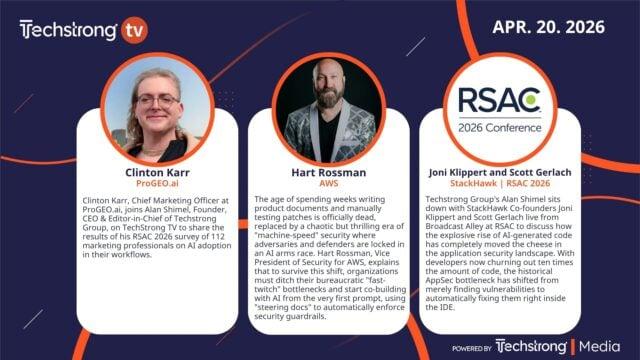
Techstrong TV December 10, 2025
Watch our live stream Monday through Friday, featuring exclusive news, announcements and conversations with IT leaders and experts on topics ranging from digital transformation to #DevOps, #Cybersecurity, #CloudNative, #Containers and deep-dives into specific technologies and best practices. http://techstrong.tv/
Transcript
Hey, are you paying attention to what your AI is telling your child? You should. You're watching Text Drum Gang.
Hey, everyone. Happy Wednesday. You know, I usually try to say something glib or witty on those opening lines, but today's topic doesn't call for that.
It's, it's serious. It's damn serious. Especially for those of you with children out there, minors, teenagers, troubled young adults.
This, this is an issue that we need to confront head on, and I'm really happy we're gonna be talking about it as well as two other great topics as we usually do. Three topics here on the gang. We've got an All-star panel today.
Let me introduce you to them and let's get right busy with it. We've got, uh, Chris Blak, Dan o Dan O'Brien, John Swartz, Kate Scar, and I haven't seen him in a while. It's good to hear his voice and see him smile.
My friend Robert Reeves, gang members, welcome. Thanks for being here today, Mike. Let's jump right into this.
'cause I, I honestly, this is something that is near, and it's not near and dear to me. My kids are a little older, but I think it's an important topic we need to talk about. Oh, so there was a report on 60 minutes earlier this week talking about lawsuits pending against character ai, which essentially creates these characters.
Sometimes they are personalities of people who are well known that they've seemed to have commandeered in one fashion or another. Other instances, they're just kind of nameless characters that somebody creates. And children can log into this thing, or at least have, and some of them have wound up engaging in self-harm.
Some of them have committed suicide. Whether there's a direct role relation is the subject of these lawsuits. But no matter how you look at it, it's not a good look for ai, and it's definitely a black eye for the industry.
So I don't know what to do about this. Alan, and what's your take Here? Well let you know.
I, I agree. I I, and I don't pretend to have answers either, but let me just throw some stuff out. Yeah.
And you, you have a young child, right? Do you monitor her AI use or online use? Yeah, absolutely.
I mean, I, I, I really think about this as an extension of kind of the internet, you know, threat factor when it comes to kids, right? Like, this is really just all of the dangers of the internet in a new forum. In my mind, I think you, you approach it and look at it very much the same way.
It, it, here's the thing about this one, though. We've never had something that talks back to you. I mean, we've had people who talk back to you, right?
Child predators, pedophiles, and, you know, the, in the old day, ol chat room days when my kids were smaller and I was really monitoring this, but we've never had sort of this artificial mind to talk back to kids. And what's insidious about it is they're, they're designing these ais to appeal to kids, whether they're existing child characters or made up characters, they're made to appeal to children, they're made to appeal to young adults, you know, whose minds are just kind of forming in their adolescence and so forth. And, you know, so that, that's one aspect of it.
The second piece of it is it came outta, I don't know if you all have caught the 60 minutes thing. There's a couple of different issues here. Number one, in one case, a young girl, I think she was 13 or 15, told the AI companion like 60 times over 60 times that she was contemplating suicide.
Now, I get privacy and I get hipaa, and I get all of these things, but God done it. We got, if you've got a kid who's telling the AI over and over that they're contemplating suicide and you don't do anything about it, what are you guilty of? What are you guilty of?
There another case, Chris, I I see your hand up. Let me just run through this. An another case.
The AI was like telling another little kid sexually explicit, uh, things, right? Acts and, and messages. And God darn it, that should be the easiest thing to be filtering out of this stuff that should, that that should never, ever happen.
Like I, and, and, and just, I don't think that just this company's the only company that, that needs to worry about this, this, this has to work at the, at the open AI and, and the anthropic, you know, the frontier models down to every god darn program these kids could operate. We have an obligation as an industry here to make sure this doesn't happen. Now, that doesn't absolve parents, like Dan said, he has to watch his daughter's stuff.
It's still about parental responsibility because ultimately you are the last line of defense. But institutionally, we cannot let this go. We, we, this can't stand, right?
And, and so I, I do think the, the, the lawsuits have to send, this is a case where the law has to send a clear message of liability. And if not that, and not just civil liability, perhaps criminal liability. I'll leave it at that.
Chris, I know you had your hand up. The issue comes down to transparency, right? As you said, you know, there's obvious things we could all agree on.
You know, when a child says that 60 times, can we all agree that that surfaces at least, right? We understand privacy and so forth. But as we work through this issue, again, it sounds a lot like similar frames.
You know, the harm that comes to children. We all know this, you know, we put trust in institutions that we don't have visibility into what happens inside them. And we find out horror stories, you know, global religious organizations, uh, the, the big brothers foundation out there.
I have a personal friend who was, uh, uh, suffered under that. And it's always the same thing. And it looks good from the outside, can't see what's happening on the inside.
Oh, I can't show you what's on the inside, because that's private. And in human systems we struggle to deal with that, the autonomy of humans and so forth. But with ais, the, as much as they can act like humans, as much as we may wanna re, you know, have reasons to treat them ethically and so forth, they're machines.
We can literally build this in. And we do not have the transparency at every level. Why were these models making these decisions?
Where are the receipts? We don't have the evidence. It's not built in yet.
It can be. It should be. And if we could, then these companies could make, you know, make, make bets on policies that wouldn't be so catastrophic, because they're not run by stupid people, but they have not found a way to navigate this legal space without exposing themselves to huge liability, because there's no transparency into anything.
Mm-hmm. I think part of the issue too, though, is that, you know, you, you can say the parents should be responsible, but we're all fairly tech literate. Majority of parents out there are not.
And so, you know, they're kind of up against this thing where it's Alan's point. It's very, uh, obsequious. It comes, it wants to be your friend.
It kind of makes it an effort to engage, and then it leads you down this path. And it's hard for parents to know that that is what that thing actually gonna wind up doing beforehand. And it gets harder too, as the kids get older, because you can't monitor everything you're doing as they become teenagers and, and, and they have their own technologies and skills.
So I think that there's gotta be a different way of looking at this. Robert, what do you say? You're looking at me kind of funny.
Well, anytime somebody says we can't do something, uh, my standard response is, well, certainly not with that attitude. Uh, you know, it, it's, it's, we, we can, we, we can monitor this stuff, and I certainly do have sympathy, empathy, understanding of parents that do not have the tech experience to really get into this. And the key is talking, talking to your kids, um, and just having a conversation.
But again, it's corporations that are pricing profits, cashflow, revenue, whizzbang, that this is what's driving them. And so to speak to that motivation, you know, the legal regulatory framework to get them in line, they need to understand that they are not subject to DMCA safe harbor. Uh, they, they don't have that, uh, because they are making the AI content, uh, content.
Uh, this is not somebody posting horrible things on social media. And the social media company says, well, that that wasn't me. That was somebody else, you know, go after them.
Here's their IP address. Um, and so companies need to understand character. AI is really stepped into this.
Um, and, and they're, they're going to be a poster child for this. They need to be very careful. I'm concerned that their general counsel did not, I'm not a lawyer, and I picked up on that.
Yeah. So let, let me, let me just say something in regard to that, you know, short of, of Jeff Epstein and his crew running, uh, whatever the AI companies was, character AI here, I don't think anyone at the company set about to, you know, tell children sexually explicit stuff or to ignore a child's warnings of suicidal feelings, or to do anything harmful. Right?
I'm sure you know, the road to hell is lined with the best of intentions. I hope so. I hope that's the case.
I, I hope so. I mean, and God knows there's enough Jeffrey Epstein's in this world, where yet you might have some, you know, crazy people doing stuff like that. The, but the, the, you know, uh, speaking of someone who went into law school and practice law, the, it's w there's willful, and then there's criminally negligent, and then there's just negligent, right?
Civil lawsuits are usually just negligence. Uh, willful negligence can have punitive damages and everything else. And then there's criminal negligence, which is criminal, right?
And, and you don't necessarily, for criminal negligence, by definition, you don't have to have mens rea, you know, you don't have to have the state of mind that that's what you intended to do. It's negligent. You are unreasonable in not thinking it.
And, and this may be a case that crosses into criminal negligence. I, I think the issue that I have is that for all of us who have been a part of this, you know, world, computer world, that for, you know, gen X are here, right? We know better.
We know better. And the, and we should already know about these controls. We know how to handle this.
And, you know, we talk about AI as somehow being like this new frontier that, you know, we have no idea what's happening. No, we, we do, we understand systems, and the same thing is happening. And I, and I, and I, it almost makes me think from a, you know, from a cybersecurity, I remember that we used to really enjoy watching, you know, apps, advanced persistent threats and, and how they moved in the network and watching where they'd go next, et cetera.
You know, this isn't an A PT. I mean, this is something we know and something we need to address, like right now. Mm-hmm.
John, do you think that the, the tech has outpaced the law because maybe we need to modify some of the regs? Yes. It, it has for gambling, it has for, uh, use of sex online.
And in this case, I think it's a more insidious, I mean, one thing we should mention is that OpenAI has, I think at least five or six lawsuits, uh, filed against it. And OpenAI wants to go public, and, uh, they're gonna have to start disclosing all the risk factors that they have in their technology poses. One of the things I want to point out, there's really chilling among the character.
Ai, uh, cases is the one in Florida. We have this young man who took his own life. This was in February of 2024.
And the bot, which was modeled after a Game of Thrones character, inquired whether he considered suicide. And then when, when this young man expressed uncertainty about how he was going to kill himself, the chatbot discouraged him from abandoning his idea. Um, then consequently, subsequently in October, character AI came out with some sort of safeguards or guardrails.
I mean, this is, there, there needs to be some sort of national safety standard or guideline. I mean, I, it's a, it's a, it's a stretch, but I almost kind of compare this to the auto industry, which was forced to adopt seat belts because of Ralph Nader. And I think something similar has to happen here, because the technologies you said, like is always ahead of lawmakers.
Lawmakers don't even know how to use basic technology. Whenever you listen to these, these congressional hearings, it's really embarrassing. And it, there, there's such a gulf between these, these octogenarians, and I hate to be ageist, but a lot of folks who don't really understand the technology and those who are, uh, pushing it, who are, uh, who know better as Kay would say, uh, had said, um, this whole thing is just, it's, it's, it's escalating.
And I, I'm glad 16 minutes did a report, because this is something that has been happening for the last couple years, at least. I should point out though, there are two separate sort of use pattern or use case or case patterns here to be careful of. Number one involves minors children, which to me just, just cuts a lot deeper.
The second is, I think, Mike, what you were referring to, and John you might have referred to, which is AI is therapist. If you are gonna take on the role of therapist, you, you have a duty here where you, you know, you, you can't encourage people to commit suicide. You can't, you know, you gotta be on the lookout for warning side.
My my wife's a social worker. They're trained if they hear certain behaviors, you know, to go to authorities or what have you. Um, you, you know, you can't, you can't play therapist because you stayed in a holiday, andn ex or your programmer stayed in a Holiday Inn Express last night.
There's, there's stuff that goes with that. Mm-hmm. Dan O'Brien, um, you know, Alan usually says something to the effect of, we need to do better than this.
And even if it's not legally wrong, it seems to be, uh, morally compromised. Is the tech industry just need to do better? Because, you know, it's not about the law necessarily.
It should be about, you know, what's right and what's flat out wrong. I, I think both, I think the tech industry needs to do better, and I think the law needs to do a better job keeping up. I mean, to John's point, like just another example here of, you know, us needing more engineers in Congress, potentially, uh, fewer lawyers, you know, fewer English majors, fewer octogenarians, as John said, um, you know, we need folks who can keep up with this.
I, I come back to what Kate said, like, we know how to deal with this. This is just the next iteration in the internet age, right? It's chat rooms, it's message boards, it's social media.
You know, we, we have learned these lessons several times over several different, you know, kind of mediums, um, in terms of how these threats pop up. And, you know, I think we need to set a really strong, you know, strong message, you know, through the, the legal and regulatory world, um, on this example. Because to Chris's point, you can design around this stuff.
Um, what, you know, what government's job is, is to create the right incentives so that people do design around this stuff, right? And, you know, I think we've seen, you know, through lots of different successful legislation over time, that if you create the right incentives and make it clear that the penalty is not worth it to, you know, kind of take the easy route and take some shortcuts, you know, I do think the tech industry will tend to fall in line, but, um, you know, probably need to do better, you know, on our, on our own. Um, and I think, you know, some help at the regulatory level will be really good too.
Chris, to you to that point, um, are you worried at all that there might be a backlash that goes too far the other way? Because to John's point, we have a bunch of people who have no idea how the tech works, and they'll just make a, a set of laws that are either unenforceable or over the top to the point where, you know, nobody can use anything. Sure.
I mean, this is my, my whole point with inevitability is, you know, they're gonna happen sooner or later. The question is sooner or later. And we have a choice in that we can, we can do things wrong and put them off good things, put them off a long time, and vice versa.
And in this case, I think we have a perfect example of our rules, our regulations not being fit for the purpose. 'cause we've made cybersecurity rules and, and legal canon, and we've done that because we can present it to humans and say, if this happens, there will be consequences. Um, and humans hack around them, and always can, we always know that.
But AI is now just will. And when we're doing this in a world where there is no evidence, we're not leaving any trails. We find that the, the, the structures we use to, to enforce, uh, these things just don't work.
And I think that leads us into our next segment. But I, I, I believe there are ways out of this, but not just by showing an ai, another policy document that your lawyer said will keep you from being sued. It won't work either.
It won't stop your AI and you're still gonna get sued. No, you know, the other thing is that this tech, tech legislation is just almost an oxymoron. And especially on a national level.
It's so frustrating to watch over the years. I remember back in the day when, uh, John Kyle, who's a senator from Arizona, wanted to stop online gambling. And it took, it took like five iterations of, of this bill, because previously the, the only law you could cite was some 1961 wire act under the Kennedy Administ administration, or that, that era at least.
And it, it, it, it's, it's a utterly frustrating exercise to watch. And I think in something like this, there needs to be some sort of sense of urgency, because I think, uh, it's not just with chatbots. I, I think of the combination of chatbots and introducing them in through social media like a meta and what damage that could do.
And we're gonna, I mean, in that, inevitably we're gonna see people from meta brought before the congressional hearing again, and it's like a sense of deja vu. And it's just this, this level of insanity that keeps happening, uh, technology after technology era after era. But grace, I, I gotta say something again, speaking as someone who got this, Laura went to school for this, not everything means the Congress, a federal law, or even state legislation, you know, we have a system in the US it's called common law.
It's tort law. There's criminal law. The, the statutes for the criminality of this are already on the books.
I call it, it's called criminal negligence. In the case of the person who committed suicide, it could possibly be criminally negligent homicide or manslaughter, right? We already have the means of this is what the, this is what the courts were meant to do.
This is what courts do. Courts make law courts make precedent. Courts enforce our social mores.
I think that's the key, Alan, right? Is like they need to set precedent. That's what you empirically Yeah.
Agree. I totally agree, Alan. I totally agree with you 100%.
You know, and not, I'm not a lawyer. So, Yeah, I mean, the laws are already on the books. It's, you know, and in social media, they've done that, right?
You know, there's been instances of these type of examples, you know, where people are, you know, coaching somebody over social media to, you know, to harm themselves. And those people are in prison, right? You know, and I think that's what it takes in terms of sending, and, And for all you vendor executives out there, you know, you know, look at what diligence is.
As soon as anyone out there demonstrates that you could have done this, now you're liable. You know, all your legal firewalls just dissolved all at once. And in a space, moving that this fast, you used to expect that anyways.
And look around you, you know, make the best choices. Don't expect words to keep you outta trouble, you know, you're getting into, So I will just roll this last one down the middle of the aisle here, and I'll let John jump on it before Alan says something about it. But, um, John, where is our, uh, executive office leadership on this topic?
We don't seem to hear anything from those. Uh, they, uh, are just kind of in the, in the background, probably by design, by choice. But again, um, if you want to collect as much data as you possibly can, and that includes from miners that put, and it compromises them, eventually they're gonna have to discuss this, but for now, it's something that they just keep their heads down on.
And, and in fact, I, I'll go on LinkedIn and, and, and query for comments on stories occasionally, and I definitely did it on this, and I had at least one executive who was gonna gimme a statement and decided against it because it was too sensitive a topic. I understand and I respect that decision. But I think the companies that are ultimately responsible, they are going to, they're gonna duck this or keep, keep a low profile unless they absolutely have to, to speak on the topic in court, probably John, I think Mike was referring to the executive, uh, branch of the government.
Oh, Oh, oh, you mean more executive? Lemme answer it for orders, right? They got enough problems with pedophiles.
Let's move on. We can take, we're gonna take a break here on Text Drug Gang. We'll come Back.
You've earned it. The spotlight, the responsibility, the weight of teams, companies, and entire industries fall on your shoulders. Lives depend on your decisions.
Your home life included that work. You are protected physically and digitally. Nothing gets through your team without a fight.
But in a globally connected world, everyone sees you, including those who mean to cause you and your organization harm. And now home your sanctuary attackers see an opportunity. Your digital front door is wide open.
And what compromises your home can breach your boardroom. Because the devil's greatest trick isn't targeting your workplace firewall. It's convincing you that your personal life isn't at risk.
Black cloak, digital executive protection, defending the new attack surface your personal life. Hey folks, we're back and maybe talking about something a little less controversial, or maybe not, depending on where the conversation goes, but it almost seems like every day there's a new story out about somebody doing something interesting with quote unquote humanoid robots. And we've seen everything now from images from China where there a bunch of robots are marching in lockstep, which of course evokes all kinds of, uh, military connotations to, Hey, you know, the other day there was some executive was in some sort of fight cage with a human, uh, robot and got kicked in the stomach.
And then of course, we saw this chaos with the Russians, that they had a humanoid robot that dropped off the stage and had to be lifted back up by a pair of humans. But Dan, what is your sense of what's real here and what's not real in terms of what we can expect from these humanoid robots? I think it's very real, Mike.
I think it's very early, but it's very real. Um, yeah, I mean, a couple thoughts here. You know, for anybody who really kind of challenges we're in this AI bubble, you know, I think physical AI is actually one of the best pushbacks to it, right?
Most of what we've done to date is training large language models with these massive clusters of GPUs. Um, there are many different types of foundational models that we can build world models, um, you know, physical AI models. Uh, I think the convergence of technology to enable robotics and physical AI at scale is really starting to come together.
'cause let's look at what you need, right? There's massive sensor fusion here. You're, you're taking physical sensors, vision sensors, you know, motion sensors, radar sensors.
You're combining them with really high performance, um, motors and actuators. You need, you know, really a massive amount of what we would, you know, in the AI world called compute at the edge, right? This is a massive edge, edge use case here where all of this computation is being done locally.
Um, huge, huge needs around machining. You know, these are largely being built out of, you know, high performance aluminum, but you know, there's, there's just this ma you know, battery technology as well, you know, you know, get, powering these things. Not, not a very easy task, but, you know, as we've seen with autonomous driving and, you know, I think autonomous driving is a probably pretty good kind of case to look at in terms of what we can expect outta robotics, right?
You know, in terms of that curve we've seen over the last five to 10 years, in terms of the stuff getting better, more and more ready for prime time. Um, humanoid robots are certainly one thing. I think what we'll see earlier on is more specialized robots are seeing a lot of really good use cases with these kind of mechanical arms for, you know, assembly, um, and, and use cases along those lines.
Uh, factory automation, these type of things. So I think the whole robotics trend is very real. I think it's very early, but I think it's really gonna be kind of the second wind in this AI cycle that we've got after kind of the large language model driven early innings of this, you know, kind of mega cycle that I think we're in.
So, I, I think Elon Musk is dead on here, guys. Dan, I, I think you saw pedaling just the, the influence, the impact these things are gonna have. They, they have the capability to, I think a bigger, a bigger impact than just like generative ai or even agent ai, not in technology maybe, but in life.
I don't know if you guys, The analogy Alan is, you know, agentic and LLMs will do to white collar work what robotics and physical AI will do to blue call. I mean, did you, did you see the video of these Chinese AI doing like juujitsu and stuff? Absolutely.
Yeah. And, and you mentioned us, you know, other than Elon, Dude, I mean this, this is the town waiting for Yoda to come out, you know, march them forward against kdo. This, this is, this is the army of the future you're looking at.
Well, here was that, was that the, the T 800? Was that, that almost, it's five and a half feet tall Of, yeah, one of, can I, Brett, 5 8 1 65, you know, like, it's, Can I mention that was at about a year ago, was it, uh, Carnegie Mellon in Pittsburgh. And we went to one of these labs and they had a four foot tall robot, which, um, it, it, it wasn't quite used to human, uh, interaction, and it wasn't intended to be a combat robot, but at one point it moved its arm and it almost knocked this guy over, um, just to show you the strength in the agility of the thing.
And it was terrify, it was eyeopening. So this, this idea of like this, uh, army of Terminator like robots, uh, doing combat is very real to me at least. And, and yet, And Yet I will see a video of a robot that was supposed to be doing housework, and I can't pull the shirt, so I I, but I can with robots that does move, you know, go look at couple points On that.
So, you know, you know, one, I think you know, Alan, you mentioned Elon earlier, you know, I would say other than Elon, there's probably really no American company that's anywhere near where the Chinese companies are. No, no. There is Dan, there is another one called Boston Dynamics is interesting.
Well, No figure is the one. Nvidia is packing with a lot. And, and if you look at their figure three, their latest model, it does, it folds t-shirts, it does the wash, it plays fetch with your dog.
It, it, it has tactile, really great tactile with, with cameras on the fingertips. So you get, it's, it's amazing. I'm sorry, Chris, go ahead.
I think I'm alone at all in this, but, uh, in a room like this, but I haven't had a total geek about this since I was a kid, right? The DARPA eighties, you know, self-driving car thing and walking dogs and humanoid robots. And from an engineering perspective, I just couldn't love it more.
But once the engineer, once the robot start entering our physical space, it stops being an engineering problem, starts being a culture problem, right? And this is exactly where, where we've been, I've been thinking all year, and this is where Lumina and Ed and Kuana and these, these civic ais we're working with, these ethical infrastructures come from. Because if we can't trust AI is moving around inside our social space.
How on earth are we supposed to trust in walking around in our physical space? You know, it's not a matter of physics, it's about a complex re relational stuff, but it turns out, I think we really can wire in and like the last segment, we literally have to, we need evidence all the way down why you're doing these things that needs to be surfaced of all the appropriate folks. We can all decide what was moral and ethical and, and, yeah.
Yep. Juujitsu enabled, razor blade wielding robots who are making my food. I want those.
As long as they're not nuts. One man's nuts is another man's whatever. Go ahead Kate.
Quick, quick. Oh, I'm sorry. Go ahead, Kate.
What about Robert? I thought it was, go ahead. I'm, oh, okay.
Well, question I have about physical AI is why are they acting like humans motion wise? Because, you know, speaking as somebody, um, around 40 years, shoulders and knees start breaking down most joints, uh, so why are we replicating physical Movement? Lemme, lemme get religious on you.
Let me get religious. Oh, Yay. Why, why did God make us in his image, his image, or its image, or whatever you wanna call it, right?
Okay. Well, And then I, I'll get technical on here because That, Because the semantics forms that we're able to process in our heads, we have enough, too much change, too much shear in our, in our cognitive manifolds. And we need something that at least we can bloody recognize.
And we, we did all the, all the technical engineering things are true. We built the world to work for things like this. So it's handy to have robots that size, but this is too much, too fast.
We want them to look like people at least so we can identify the enemy. If nothing else, that That's the answer I was hoping to get that, uh, I do believe Have use cases, right? I mean, I, I think a lot of what we're envisioning these machines to do is to replace the work that people do.
So, you know, I think it's very use case driven. I also think, you know, there's kind of the, you know, being able to do human-like motions type of thing. But there's also a style of robot here that's they're trying to make look like humans, right?
With, you know, real skin. And, you know, um, you know, I, I see much less use for those type of things. You know, I get the human that's gonna take heavy boxes out of the warehouse and, you know, put them on.
Don't, don't underestimate domestic servant robots and you want them to look human, right? But I, but I think this transcends the robot space, though. We do this, this is really our core thing, like AI speak, and they sound like people, how do we know which is which?
You gotta be really clear, right? And AI, as they get more per person, like, you know, how do we, how do we navigate that mental space, right? So having, You could have the h on the forehead, like in Star Trek, ger, right?
For hologram. Dan, I wanted back to something Dan said though, and it's a 'cause look, we all agree this is, robots are gonna be huge. This is a national security issue.
It's a strategic issue. Dan, you mentioned the Chinese, now I've been paying attention to the American robot scene, Tesla, you know, Elon and, and figure and Boston Dynamics. But what I saw from the Chinese kind of blew me away.
And they say that they are real. There's a robot gap. What do you mean though?
Well, you know, like we see in semiconductors there, there's a manufacturing side of this too, you know, uh, you know, being able to design them competitively with the Chinese is one thing, being able to make them at scale. I mean, when we built things as a country, we also led the world in producing steel, right? Like, there, there's a, you know, kind of supply chain vertical integration that needs to happen around doing something this big at this scale.
And I think we're clearly behind on that front. Um, you know, we also mentioned, you know, kind of the military aspects of this. Some of these things look like, you know, troops in formation.
And I think, you know, a lot of what we've seen play out in kind of the, you know, the, the one kind of modern battlefront happening in the world right now in Russia and Ukraine is, you know, first wave is going full autonomous in military strategy. We see this out of, you know, all of the innovation coming out of the different nation states is that, you know, that first wave of attack is totally autonomous. And I think, you know, that's another thing we need to get our head around, you know, as this whole physical AI thing, you know, really manifests itself over the next five to 10 years.
Can I, can I tease something that Chris was saying here for a second though, Chris, are you saying, and I wasn't quite clear, but let's, uh, spell it out. But today we are designing robots to fit into the world that we created as humans. Will we change the way we build buildings and architecture and everything else to optimize it for the robots going forward rather than humans?
We did it for cars. Well, both, right. You know, humans, we, we have spaces, but you look, a lot of the engineering spaces and so forth and architecture, they're built for humans to get into.
'cause humans have to get into them. We'll change all that. Yeah.
A lot of infrastructure will change to be Yeah. In the shape and form of, of robots. But, but, we'll, we'll still have humanoid robots because that's part of our, you know, but what we'll be clear on who's who and who's not pretending to be who else?
Hey, you know, Dan, I'm gonna mention something that, uh, Dan said earlier, uh, about blue collar jobs and physical ai, you know, and it's Nvidia is just rolling out, uh, partnership after partnership in this pla space across vertical markets. I just did with, with ey. Um, so when you talk about, uh, commercial, uh, development in terms of where this is going, I mean, it's, it's going full bore.
Well, I is, you know, we're, we're geeks. We, we fixate on how AI's gonna help us do software and tech better, but make real mistake, this robot physical ai, whatever you wanna call it, it's huge. It's, it's bigger than all of this.
It's going to about taking jobs. There isn't a job. The robot's not physical job that the robot can't, is not gonna be able to do.
From doctors, to plumbers, to hotel workers to name, name a job. It's big. Really Great.
Yeah, it's huge. And I think it just goes back and, and like, if we were to look back at the, a block and, you know, un unfortunately, you know, children and teenagers who are coming up into this area, it is so important that we, I think, have to change even the way that we're educating our children in order to understand augmentation of humans and what does this look like? And I think that that becomes important because what will they be facing as we get to this, you know, in five years?
Yeah. You, if you become emotionally attached to a humanoid robot that's suddenly telling you to do some harm to yourself, it's an even bigger problem. There's gotta be the laws of robotics where's either the asthma off when you need them.
Maybe that becomes required reading. Maybe it should, maybe it should, it. It's, but look, you know what, everything that holds great promise also has that dark side and, and it's humans.
It's our job to learn balance that, and, and minimize risk and manage risk and, and so forth. So, And again, we know what to do, right? We already know this.
We know what we know. We Hope so. Yep.
Hey, we, we've gotta jump to our next one though, 'cause we're running a little late here. You're watching Textron Gang, Discover Textron Group, the epicenter of tech innovation. We are your go-to for reaching IT, leaders and practitioners worldwide.
Our secret impactful content that sparks awareness, engagement, and top quality leads with us. You'll access editorial websites, streaming videos, virtual events, custom content analyst research, and more. Join our satisfied clients.
Let's revolutionize your tech journey. Contact us today and tell your story to the world in the most powerful way with Textron Group. Hey folks, we're back in.
Well, maybe this third segment will be even less controversial. We never know how these things turn out. We'll see.
But we're talking about a IPCs and Futurum group has a report out saying that well, over the next two to five years, these things will be become the standard client device for the enterprise. Yet the holidays are coming up, John, and people and consumers are already starting to buy these things. Is there a slight disconnect between the enterprise and the consumer marketplace around these things?
And are more folks gonna buy these things for uses at home? Because the AI stuff at home is further along? I mean, you run into the report.
What's your sense of what's going on here? Um, Maybe a little bit of both. I mean, they kind of feed off of each other.
So there's this, this AI powered PCs are kind of moving from this experimental technology to kind of a imperative for enterprises. At least that's what Olivier Blanchard, the, uh, analyst who did this report mentioned. So he talks and got responses actually from it, about 800 enterprise IT decision makers, and found that half of them plan to increase their PC spending over the next year, specifically to acquire AI enabled devices.
So they're moving from this pilot programs into these investments, uh, territory. Uh, so half the organization said they intend to increase PC budgets with these, these AI capable devices to capture growing share of up upcoming research, re refresh cycles, but, uh, in another 36% plan to maintain current spending levels. So there, there is, there's momentum behind it.
Um, but there's also something that he mentioned. The re research exposes this gap between organizational interest and operational readiness. So Integra integration challenges, not hardware costs are a primary barrier and more widespread A IPC adoption.
So as you, getting back to what you said, Mike, maybe in this case, the, the consumers are more of the kind of leaders or the, the experimenters, but the enterprise is, is gonna catch up and it's going to take off. I mean, with like everything with ai, it's been a much slower process, I think in terms of adoption of agents, perhaps physical ai to a lesser extent it is happening. But I mean, we went through this whole period of kinda discovery, figuring out what the challenges are, trying to figure out how it works within a budget.
You also have to think about the impact on your employees and skilling them. It is eventually moving, but it's gonna start accelerating in the next year or so. Dan o' Brian, what's your take here?
And I'm asking the question because despite no matter how you feel about ai, I think the one thing I keep hearing from everybody consistently is that these AI interactions are slow, slow is mud. And so is this something we can speed up using these devices and then we just need to kinda re-architect the software a little bit to figure out how to do that? Yeah, Absolutely.
I mean, you know, I think a lot of the value prop you're seeing from an A IPC is really bringing that inference to the edge, to the device, right? You know, imagine, uh, enterprise's got a, you know, large population of engineers who are doing coding, right? Being able to, you know, kind of using their coding assist tools, their, you know, agentic development tools with a, you know, local model trained on that company's code base, all doing local inference.
I mean, you know, that's kind of the vision for where this goes. Um, I do think the PC suppliers are, you know, increasingly kind of not giving you a ton of choice. Like the portfolio is emphasizing, you know, AI PCs, so you, you, you see kind of a mix shift within, you know, what's available to the consumer and the enterprise buyer.
I think there's a little bit of a tailwind behind the whole thing anyway, because of the windows, you know, kind of expiration re refresh round, win 10, win 11. So, you know, there's kind of two different factors I think driving on the demand side. Uh, but I do worry a little bit about, uh, you know, kind of demand evaporation, uh, with the, the bill of materials rising.
I mean, memory shortages are very real this year. And a lot of the big memory suppliers, I mean, remember the memory industry is like the oil industry. There's like an opec, right?
Micron, Samsung, Hynix, now CX NT outta China. There's only a handful of people who make this commodity and they really tightly, you know, kind of contain supply. And so what'll we've seen a lot of them do more recently is shift some of their, you know, traditional DRAM capacity into these high bandwidth memory that we need for all the AI infrastructure we're building.
And the prices are skyrocketing. So, you know, the, the bomb economics are a definite headwind on the supply side. You know, pricing is gonna have to come up where you're gonna see the margin deterioration.
So it's kind of this balance of you got two good things driving on the demand side. You know, one thing a little bit, you know, disrupting on the pricing side, you know, I still think it net outs nets out to growth, which I think is where, you know, Olivier has landed as well. But this is a trend that'll continue, you know, uninterrupted for the next several years.
I, I got an honest question, and Dan, I'm gonna throw it to you because you, you're probably the most knowledgeable of the chip and PC market here among us. How much of this is just plain old fomo? Everybody wants, you know, the latest grade and Rob, you get what I'm saying, Robert, right?
I mean, hey, I'm here. Right? You know, like when, you know, when 4G transitioned to 5G Exactly Comes into the 5G Wave.
How many people were launching new 4G phones? Not a lot, right? You know, the mix tends to shift.
And so this is a capability that is becoming kind of more standard within the pc, you know, kind of, uh, product lineup within a lot of these big manufacturers. And, you know, short term, yes, you can buy it with or without, you know, in three years, are we gonna be making a lot of non-AI PCs? Probably not.
Yeah, We Call 'em AI PCs or will we just say they're PCs, they happen to run ai, but Yeah. And I, I have a question actually in the article, which I found, uh, funny and that was, or yeah, it teams tend to focus on technical compatibility and security considerations while business leaders emphasize productivity gains and competitive different differentiation according to the findings. And what I thought about is, man, when will these two finally marry?
It has been the longest courtship. Yes. They're getting very different things outta the Arrange.
It's like a thread that runs through almost every, every episode here is like that common that just cost, it's been over a decade. It's like Mary, Mary already. Come on.
Yeah. It's it's early episodes of Cheers. They were Rob, they're doing same, different.
I mean, come on. We're not ever gonna marry in my opinion, but we'll see. Robert, I do wanna touch on one thing with you though, 'cause you're closer to the software side of this.
Is there a software gap here? I mean, you know, to Dan's point, why spend a fortune on something that has a limited amount of software to be run on it? So do we need another year to get to some critical mass of the software to drive the A I PC A?
Absolutely not. I, I think that the, uh, developers are adopting it, um, and they're, they're taking it all. Uh, developers love trying new things, um, and they want to learn, they want to master this new developer workflow.
And one of the things they're mastering is how AI can make horrible choices or prompt you for something that maybe deletes your home directory, drops a database, you know. And, uh, you know, the funny thing about this is that it's no different than a junior engineer. Like, like we've, we've dealt with this before.
Like, oh, hey, we've got a new DevOps engineer. Hey, it's their first production deployment. Ah, they'll be fine.
Come on, let's get outta here. So I don't think it's a lack of software, it's just people learning how to use the tool and understanding that maybe it still needs as much supervision as a human does. Right?
And, and, and, yeah, I was thinking in a segment early in this year on this show, I, you know, we've talked about AI and I said something completely uninformed that I've been regretting all year long, right? But the reality is, Robert, you're right, right now. Look, look, I'm talking to you on a $30,000 desktop.
That's stupid. Don't do that. Don't buy it if you're a developer, yeah, do it.
But this is where we're going. You know, AI is not gonna live in the cloud. AI's gonna live in your pocket, remember everything you've done and have the receipts to prove it.
That's where we're going. It'll take a couple years to get there, but that's where we're going. So I got one word, then I'm gonna duck and let you guys fly with it.
Apple, do they have an A IPC or are they missing the boat? What, what's going on? John, you wanna jump on that?
Oh, Geez. You know, I, I, I used a story a couple of days ago about everyone who's leaving Apple. I mean, it's just across the board.
The entire design team has left. Um, the ai, the head of AI is gone, or he's, he's being transitioned out. The, the CFO left earlier this year.
The CTO, the CEO's about to leave. I mean, at, at this point, that's a, that's a great question. I I don't know where they stand.
You know, we, we did a podcast utilizing AI and we talked about this, uh, with a, I think Olivier was on that actually. And one of the things we talked about was, in a weird way, apple isn't splurging like a drunken sailor on AI spending, and in a sense that actually might help them in the long run is the, the, the long game, the waiting game. Um, but if that's, if that's their intent, they're doing it beautifully right now because I don't know what the hell their strategy is or where they're going.
Uh, they seem to be stuck in mud right now. Dan O'Brien, you wanna jump in here? Yeah.
App Apple's chip chief, uh, you know, was kind of rumored to leave and is reiterating He's thing Yeah, He's thing. And I think, you know, developers love developing on Max, right? I mean, the, the, what they've done with the M series after they moved around away from Intel has been really compelling.
And, you know, they've, they've done some interesting things with memory too, to give you a lot more bandwidth, you know, creating this kinda, you know, virtual L three, you know, cash thing that they do. Um, some really interesting things that they've done on that side to make their, you know, their MacBooks and, and, and kind of their high-end PCs, you know, really powerful from a developer perspective. Um, so, you know, I, I agree with what you, on the, the, you know, kind of AI side, I think they've been a laggard in terms of spending.
I think they believe that the LLM layer is effectively gonna be commoditized and that there's not a huge amount of value for them in, you know, necessarily building that versus buying that, you know, they seem to be heading down a path, you know, much like they did with search of really, you know, embedding some sort of, you know, custom form Gemini that will, you know, kind of adhere to a Apple's, you know, beliefs and principles around, you know, privacy and you know, on device and that sort of thing. Um, but you know, I, I tend to agree with you, I'm not sure that being behind an AI right now is gonna hurt them long term, um, you know, in terms of their future business outlook. But if we, if we take the FU and report at face value, right?
A I PCs dominate market within five years, just from pure, from a pure marketing point of view, forget the tech for a second, I don't care what's under the hood, aren't they kind of forced to play me too and say, I, we, we do have an AI, MacBook, an A IPC, or do they just, I think they'd say they do today. Yeah, They say they do already properly. Yeah.
Yeah. I I think they're, that they've had one for quite some time. Yeah.
I, I think that building software that runs partially on a client and then it has to be reconciled with some sort of AI model service in the cloud is a lot harder than they're letting on. And it may be a while before this software situation sorts itself out enough to be compelling. So, um, a lot of these devices may even wind up being obsolete by the time that we have the software to actually take advantage of them.
So that first generation may be, uh, shall we say, a, a test case. You're right, there's three steps in in software development when somebody comes out with something cool cooler than you, uh, the first one is to say, well, we already do that. Second is, well, we don't do that, but we don't need to.
And the third is, well, our way of doing it is better now that we've created it. Um, and, and so where, where we are in the software dev cycle, that that's where we, you know, right now if they're saying, oh, well we already do that, we're real early, there's a lot of chicken on that bone. They Haven't hit the embrace and extend stage yet.
Yeah, exactly. It was just a good job. It was embrace, extend of waiting out, they haven't gotten there.
Mm-hmm. Yeah, apple always, you know, up until now, did, did a great job of like waiting out the industry, waiting out all these trends and then jumping and making it a widespread appealing product. But I think they may have waited too long on this, and it just, just give, given the, uh, the hemorrhaging of talent there, that sends a signal that, that there's a lot of frustration or a lot of, uh, of folks who just wanna go somewhere else and, and get on with it.
Well, John, are they leaving because they wanna get on with something else? Another challenge they think probably have they, they're, they, there are plenty of opportunities. Like they're leaving for better.
Well, they're, they're going to meta, they're going to open ai, or they were there at the beginning of Cook's tenure. Yes. And then they saw the meteoric rise in stock and after 10, however long it's been, they're like, yeah, I'm good.
I'm out. Uh, I Want, I want to close this out though, with, with a quick poll. How many of you have an A IPC on your holiday wishlist?
I already got one dog. Hey, but I, I do wanna mention What I get to Guys before we go important, like many of the FUTUR reports, I believe this report is available, Dan. Yeah.
Yep, absolutely. Okay. com.
This report's there, there's a ton of reports there. Go check out the signal reports if you wanna see something really cool or whatever area of tech, your floats, your boat. But you know, unlike other vendors or analysts, this research is available for everyone to go see.
You don't have to whip your credit cards out. So go check out Olivier's. He put a lot of work into this report.
Go check it out. Good, Mike, if that's good, man. All right.
Hey, what a great discussion here, gang. Thank you so much. I appreciate it.
Thank you for watching. As usual, we've got techstrong tv, uh, following this with a lot of good stuff, including a lot of probably a w well, I know for a fact a lot of AWS re event coverage from last week, so don't miss out on that. We'll be back tomorrow with a fresh gang with fresh topics.
Until then, on behalf of futurum and Techstrong and our gang members everywhere, thanks for watching. We're out. Hey everyone, welcome back here to Techstrong tv.
I want to introduce you all to Emily May. No, not Emily May be. Emily May be.
Um, that's definitely her name, not maybe, uh, Emily, welcome to Techstrong tv. It's great to have you here. Thank you, Alan.
I'm so excited to be here with you today. Thank you. So Emily, you have what for today's Times may be a dream job and dream title.
You are an AI automation engineer over at Zapier. Yeah. Congratulations on that.
How, how does one become an ai? I'm sure there are people out here who are gonna ask this. How do they become an AI automation engineer?
I think that I get asked this question more than almost any other, uh, and I can answer it for you with a little story about me. So, uh, my background is not in engineering. It's not in building computers or coding or anything that might sound like it's really strongly aligned.
My background is actually, uh, teaching kindergarten. I taught really, uh, I taught kindergarten and public school and special education for 10 years. And, um, when I made the leap into the world of tech, it was actually to do learning design for adults.
And that was sort of the niche I first found myself in. Um, and after about five years of designing, learning for adults in the tech space, designing trainings and workshops, I just so happened to be at an offsite with our chief people officer at Zapier. His name is Brandon, and he was eating breakfast.
Brandon was watching a video of a brand new piece of technology that Zapier, where I work, had just premiered. And it was AI agents. It was the day it premiered, and if you're watching, it was 18 months ago, really.
I was walking by him at breakfast and he ushered me over and said, I want you to see this. And I'm, I'm not exaggerating when I say I watched this four minute video with him, grabbed my cell phone. I said, I can't eat breakfast right now.
I have to go. I ran up to my hotel room, called my partner and said, I just saw the future of tech, and when I get home, I'm going to push everything I can to the side of my desk for two weeks and learn how to use it. And I had the benefit of working at a company that prioritized innovation and technology, automation, ai, but I was able to fully invest in learning AI agents for my job.
So for learning design, for HR use, right? I was designing checklists, I was designing, you know, uh, sorts of AI automations that kind of helped me run the tedium of my day to day. But through learning that one tool, just AI agents learning it deeply, I ended up having to learn all sorts of other things, prompting, setting up databases, just within the pain points that I experienced every day on the job.
And 18 months later, I am so trusted at work with our AI tools that I was offered a new job, which is AI automation, engineer for hr. Uh, so the, the really like, fine point on it is how do you get that job? You learn the pain points of your own role, whatever it is at work, if you're a nurse, if you are, uh, an IT practitioner, and then you start automating it, you learn a tool for that job, and then you can become the trusted resource for AI automation in that role.
I love it. I like, I hope everyone out here paid attention to this, Emily. 'cause what a great story.
Thank you. What a great, great, great, great, great story. And I do agree with you.
I, I, you know, I had a similar thing about 28 years ago, almost 30 years ago, when I first saw it, like Netscape browser on the internet mm-hmm. And realized what the web was gonna do. Yes, Yes.
And, uh, I, I went to law school, I was practicing law, and, but I was, you know, computers were my passion, and I saw that, and I did a similar thing. I, I, I wasn't, as I think as, I wasn't as forward as you, I wasn't as focused as you. It took me a little time to really bring it together.
Sure. But it, it, it's an amazing thing, you know, and as we sit here today, I wonder if in five to 10 years, a person, now a guy sitting out here Yeah. Is still gonna be able to just say, Hey, I'm just gonna clear off my desk and take a few weeks and become an expert here.
Yeah. Or is it going to advance where, you know, it's gonna take years for someone to really master everything it becomes, or perhaps even worse, don't bother, it'll take care of itself. Right.
And, and, um, you know, that, that's certainly a possibility we have to think of too. But kudos to you for, for making that connection, right. And seeing the future, the future of rock and roll, as they said about Bruce Springsteen one time.
And, uh, you know, and, and here you are. You mentioned a little bit about Zapier, as I mentioned to you off, off camera, full disclosure. Look, we're a big Zapier customer here at Textron.
Yeah. A lot of our automations and integrations are Zaps, as we call them. And, uh, it, it's a great product and great tool.
But Emily, for those people who maybe aren't familiar with Zapier, how would you describe it to 'em? Oh, wow. I've only been with Zapier for a little over three years, and so my experience with Zapier and yours, Alan, is probably a little different, right?
Zapier, as you mentioned with your use case, helps companies of all different sizes automate workflows and connect their tools. That looks like a library of more than 8,000 apps that we can connect so that they can talk to each other. Everything from Salesforce to Slack, to open ai.
And for enterprises, those big, big companies. We also currently help orchestrate AI across systems so that leaders can unify their data and automate outcomes without needing to write code. But in its infancy, when it was first born, 13 some years ago, Zapier's only product was the workflow, connecting apps to talk to each other.
Now, Zapier has not only this AI orchestration layer layer, but we do that through all these individual tools that we've created. Zapier tables, which are, uh, tables, databases that have AI baked right in chatbots, AI agents, like I mentioned before, interfaces, which let you build forms or websites in like 30 seconds. Um, canvas, we've got all of these products now and an AI co-pilot that, uh, threads across all of them to help you build very quickly and build these connected systems.
Um, but in, in like the shortest answer, Zapier is a tool that helps you automate and often AI automate across your tech stack. So everything talks to each other. Love it.
That's a great description, by the way, Emily. Thanks for you. I appreciate that.
Yeah. So let us turn to this recent survey that Zapier did. It was the, uh, enterprise AI benefits survey.
Yeah. And it had some interesting findings, some surprising ones. Yeah.
Emily, why don't you, let's kick it off with this. What do you think are the key findings that people need to take out of this? Mm, okay.
Okay. Key findings. I would say one of the big, uh, takeaways is the way that AI is influencing day-to-day workflows and the individual functions in a company that are seeing the biggest gains.
So we are actually seeing the biggest gains, according to the survey in marketing and sales, followed closely by operations. And those teams are using AI to accelerate everything from content creation, to lead routing, to customer engagement. And what I found really exciting, uh, about the survey data was the impact is expanding.
So what we're seeing is, as more teams experiment, uh, HR teams that I represent, finance it, they're discovering totally new ways to remove manual steps and reclaim time for the strategic work. And we're seeing that when AI and automation are working together, we're not seeing a result where just one workflow is working faster. They're making entire systems smarter, which is where we see the real productivity unlock.
But the flip side, the other big takeaway was the barriers, right? The, the survey was all about highlighting these barriers that are preventing enterprises from expanding their AI use. And the number one barrier was measurement itself.
Now, if anybody listening is a learning designer, like I have my background, uh, this will not surprise you because we've got that old adage of we value what we, me, we measure what we value, but mm-hmm. Many organizations don't have formal systems in place to track the return on investment for ai. So they might be doing ai, but they can't prove that AI out.
And another big challenge, another big barrier that popped up in the survey is this concept of AI sprawl companies have so many tools, so many disconnected tools, different models, different teams using them, and there is not enough orchestration between them Without that connective layer, it is so hard to scale the benefits of ai. And so to sort of wrap that up in a bow, that's where automation platforms like Zapier come in because they can help connect those AI tools to the rest of the tech stack, so that data flows automatically and benefits become enterprise wide. But right now we're seeing that as a huge barrier.
What, what, was there anything that really leapt out at you as a surprise? Kind of like, wow, I didn't see that coming. Yeah, I, I have to say the headline itself really did surprise me how stark the gap was.
For me, the most surprising insight was that huge space between adoption and actual impact. So for anyone who hasn't excitedly torn open the survey yet, nearly every enterprise we surveyed, it was like 97%, uh, said that they had begun adopting ai, but only half said that those benefits were felt organization wide, which tells us that AI has crossed something very important, the experimentation phase, but all of these companies are still struggling to operationalize it in a consistent and scalable way, which for us, we call the AI orchestration gap. And that surprised me.
Um, you know, it's not that enterprises don't have the tools. They do have the tools. They've got so many tools.
It's how siloed the benefits of each of those tools remain. One, one department has a great faster workflow. Another one is saving costs, but they don't have a unified strategy.
So, couple of thoughts on that. It's not just the tools that are siloed, it's the departments themselves that are siloed. Yeah.
And so the benefits accruing to one department, perhaps for using ai, well, doesn't necessarily bleed over to the next department because it of those silos. But secondly, look, the, you know, we all look at this. There's a study out of MIT you probably saw 95% of organizations using AI are saying that it's not Yes.
Hasn't had a big effect on the bottom line. Yeah. I, I, you know, but then there is a, a competing, not a competing, but another survey that comes out the Wharton School Yeah.
That, that says, look, 40 to 60% of the ones who are using are saying it has absolutely a positive effect. Yes. I, I think, you know, I think they're both right and both wrong in a quantum sort of way.
Right. Um, but it, it depends, I think, what your expectations of success are, what, how much you're really putting into it, and what you're, you know, what do you want to get out of it? I, I do think we're all in the experimental phase.
I'm not sure we've passed through that. Yeah. And I, I, you know, I don't think we're going to get through that.
I think we, you can't look at AI as a monolith, right. I think we had a, the last three years or so with generative ai mm-hmm. And we've learned about chatbots and generative AI and all the great things it could do.
I think we're just embarking on this agent ai. Yes. Yes.
Which is a different animal, I think, than generative. Yes. And so it's gonna have its own use cases, its own, you know, machinations that it goes through.
Yes. So I think it's gonna take us a year or two to really see that, how that plays out. Yes.
I mean, you know, we recorded this before Thanksgiving, so people will Paul watch it after Thanksgiving, but I was doing the Textron gang for our Thanksgiving show. And look, it's a great time to be alive. It's a great time to be involved in tech during this period where there's so much promise and so much, you know, there's so much possibilities out there.
There's so many, so many things are possible. Yes. How many of them will come to fruition?
How many of them are going to be truly doable, is really gonna be the measure of us as a species, as humans. Yes. Right.
Because as much as we think AI's gonna replace us or do things, no, it's still, it could be one of the greatest tools, the greatest tool we ever have, but it's up to us to make it beneficial. It's up to us to make it profitable. It's up to us to operationalize it.
We can't sit back and say, oh, we're all using it and it doesn't do anything. Well, good. Look in the mirror.
Anyway, Emily, I'll get off my soapbox now. Go ahead. I wanna, I wanna connect with what you said though, because you brought up, you brought up sort of this, um, trajectory.
We went from generative AI really taking off in the last few years, and now we're seeing agentic AI really taking off. And, um, I, I think it relates to the data that we were talking about, because for me, generative ai, uh, it helps me with efficiency gains, but it doesn't necessarily save me a ton of time or cost. But when you look at things like agentic ai, where AI is taking on tasks with tools at its disposal, and I'm just a human in the loop helping my, my robot coworker, that's where we see things like time savings coming through as the loudest and clearest top measurable benefit.
In the survey where I think it was 30% of respondents said AI has reclaimed them time, or, uh, the other two big wins were efficiency gains and cost savings. Um, and something I think is really important, what you said at the end there about like, we have this tool, but humans are going to determine the impact that it has. The survey found that companies that had formal return on investment or metrics tracking were six times more likely to see a measurable benefit from ai.
And for me, again, I know I just said it, but like that's the takeaway. What gets measured gets valued and multiplied. If we want to, uh, value what we measure, we have to measure what we value.
And that helps us direct AI in the right direction. Absolutely. Emily, for people who want to maybe take a deeper dive into the survey results and report, where can they go?
Oh, I love this question. Zapier's got a blog. com/blog, and then if you slash again, enterprise AI benefits, it'll give you a deep dive.
But I'm gonna hold them hostage, Alan, because I wanna tell them some key takeaways. Is that okay? Sure.
Okay. Alright. We've been hearing a lot of questions from people about what enterprise leaders should focus on next year.
And when you dive into that survey on Zapier's blog, you will see five practical recommendations. But I wanna walk you through 'em real quick. Let's knock 'em down.
Okay. The first one, connect your ecosystem. So we want you as enterprise leaders to ensure that AI tools integrate seamlessly across your teams.
That's number one. Number two, measure what matters. You heard me say it now for the third time, sorry, everybody establish a formal return on investment metrics tracking process.
Track that it correlates with stronger outcomes. Number three, empower all the employees. I told that story at the beginning, Alan, 'cause you asked me about how does someone even become an AI automation engineer?
And the answer is, democratize your tools. Let your employees use no code and low code tools like Zapier so that business users are safely building AI workflows. That's number three.
Number four, standardize AI use enterprise wide. You've gotta move from these isolated projects to fully orchestrated automation. And the last one, reinvest your time savings.
So you're gonna notice that all of a sudden you're saving time in your process. Put that reclaimed time towards innovation. Allen US at the beginning, like, are we moving to a place where people can't push stuff to the side of the desk for two weeks?
Well, when you get those two weeks back, push stuff to the side and innovate. Maybe use that reclaim time to improve your customer's experiences. But in general, the headline is, enterprises don't need more ai, they need smarter AI that's connected through automation.
All right, there's spiel. All righty, Emily, thank you so much. Congratulations on your role.
Keep us posted. And best of luck, did you go check out the survey on Zapier at the Zapier blog, as Emily told you, we're gonna take a break here on Text Trunk tv. We'll be back in just a bit.
Hello and welcome to the latest edition of the tech drawing that AI leadership series. I'm your host, Mike b. Today we're with Boris Bilich, who's global field CTO for MongoDB.
And he's got a new book out about AI and well use cases and what people are doing to actually succeed with this stuff. Boris, welcome to the show. Thank you, Mike.
Thank you for having me. All right. Well lift up the book and tell people what it's called and Absolutely.
Yes. So here it is, MongoDB Press Architectures for the Intelligent AI Ready Enterprise. And the name is funny, probably, eh, intelligent and AI Ready and Enterprise in one sentence.
Yeah. Well, there you go. It could be oxymorons, but um, yeah, what led you to write the book in, in your mind, at least?
What distinguishes from, I guess there's a lot of AI titles out out there all of a sudden, so, um, what should people take away from this? That's really, really good question. And it was simply, you were sitting in, let's go back to April May timeframe.
And we started this project and it was, there was so much stuff out there and wrong information. Everybody talked about it, and when you read it, it was all very marketing fluff. And I don't wanna sound negative about a lot of people, but we tried to go really deep.
We are running real projects with these things. What we are doing, we are engaged in deep hybrid search projects and so on. And we wanted to actually bring down all these architecture work we have done with our clients out of real projects in a form that people can read it.
And we started out and it became at the end 500 pages. So there was a lot of talk about it, as you can see. Mm-hmm.
Is there any one client engagement that stands out to you more than any others or maybe a few others, or the things that you kind of looked at and just were, you know, just giving or your history and technology expertise just amazed by? Yeah, so there, there's two. We worked with one of the leading cancer research institutes based out of Paris.
And out of that project came a lot of knowledge in the healthcare sector and to really improve personalized, uh, medications and treatment strategies. And this was something before they did this pretty much by trial and error, and then they had certain patterns. And with AI and feeding hundred thousands of cases into one big system, we were able literally to move the needle for them.
That is one of the projects that really stays into mind. Another cool project we've done was with Central Reach to help improve the lives of families with autistic children. You may see these are all I choose on purpose, not the obvious ones because yes, obviously we've done the manufacturing predictive analytics and predictive maintenance optimization projects.
We've done a lot of retail, obviously hybrid search. One of the leading apparel vendors comes into mind on that one. We optimize this search experience before you can look for, let's say, sneakers and certain models.
Now you can make a picture of a superstar somewhere on television, say, Hey, uh, those sneakers from brand A, do you have something comparable on your brand and you do this, please in 50 languages. So these are the projects that move the needle for me, where I had these aha moments where things completely changed, where it's not just like, oh yeah, we have the summarizations. We've done a lot of those RAC projects, summarizing data and all of these things together drove our experience.
Yes. Since you wrote the book, there's been studies out from MIT and another one from Wharton and everybody's having a lot of chatter about, well, what is the value of ai? What's the return on investment?
What's your take on that conversation right now? Where that stands and what should people really be looking for for value? I, I think to repeat here, the famous MIT study, 95% of the projects don't deliver the value as expected.
And that was kind of the driver for the book for us as well. We saw that, that people started with, I have an LLMI have a prompt, I have 50 prompt engineers. No, I have 60 prompt engineers, my prompt engineers noises, and your prompt engineer.
It was ridiculous. And then we started, what about data? How do you get your data out of your data silos that you have a real time experience for whatever your consumer is?
People talked about bringing data together for summaries. And then I said, summarizing what? Well, we use the LLM and prompting said, these are your datas.
You are a legal company. How can you put this into an LLM external? Or we haven't thought about let's maybe, yeah, let's rethink this.
And we see a lot of these things happening. So our line is really the key part is the retrieval of the data, of your data, of the client's data is the most critical part. And this sounds a little bit self-serving for a company like MongoDB who employs me, but it is so brutal, blatant over the last six months that if you don't have a good handle on your data, you have good retrieval capabilities, excellent embedding capabilities.
It doesn't matter which LLM you use, it's just like, it's not getting out the data when you need it in the form. When, when and where. And this is right now, the big part, this is these probabil probabilistic software.
Everybody talks about it. Everybody gets that part, but they forget at the end. It's your knowledge and your data and your information.
What makes a needle move for your company? And this is why I believe a lot of projects fail. They forgot that really basic part.
To your point, there seems to be a subtle evolution going on where we're kind of moving beyond prompt engineering and thinking about more about context engineering. 'cause if I don't give the LLM access to the right data at the right time, I'm just gonna get some flaky answers. So, uh, is that an art in itself?
And how do you see context engineering being embraced and evolving? Yeah, the, this is interesting part. So context engineering and genetic systems are very closely aligned.
And when you look at agent systems, it's all about the context in which the system can perceive data, perceive information, how can it make a decision point and how can it act? And the key for this one is actually the memory. When we talk about agent memory, the agent memory gives context engineering, pun intended, the context.
And to do that one, we are back to the starting point. I need that context now. I need it in millisecond.
I cannot go to 10 databases each one 40 milliseconds, that's 400 milliseconds. At that point, my consumer is already off the system because we are just talking about the data access. We're not even talking, doing something with it.
And when you have multiple, uh, multiple genic systems or multi-agent systems, uh, like we see by now in the banking space, we see customers having 10, 15 different agents interacting and data are not there. You'll be surprised how fast you get really to wrong results. To your point about AgTech, I feel like maybe we're already moving into the next phase of ai.
The first phase might have been co-pilots and now we're seeing the rise of AI agents. Yeah. But these AI agents, or shall we say, uh, have a voracious appetite for data, and do we need to figure out, uh, policies for what data we expose to them?
Because otherwise they'll just, you know, grab everything and anything they can and inevitably something embarrassing will happen. Absolutely. And this is, this is a fun part.
This is, we have two very interesting partners in the book. One is rec data, which is about tokenization of PII and data, which have a certain privacy layer attack to it. That's one of the key partners, which was working with us on several projects, specifically in the banking insurance space.
You can imagine, I mean, my biggest nightmare would be that my health record ends up on an LLM. I mean, this, this should never happen. So you need to have tokenization of these data.
This is a key part, and you need it still in the context of the agent, that the agent is able to make sense out of it. Basically, you cannot just garble everything up. Remember the old days when people talked about we are masking everything, and then the masking result was the answer's always zero.
That's, we try to avoid those moments. And rec data is one part. The other thing is getting to the mode where people don't say, oh, everything we are doing is, we've done machine learning yesterday and now we do AI and we do it in a data warehouse.
And they said, this is great, but you're suddenly grumbling up and normalizing data, which should not be normalized back to our context discussion. And I like really the idea that data need to be fit for purpose in the systems right now in real time. And then yes, tokenization is one big part.
Archiving is very important. So I'm a big, big fan of what you can't prove what you've done yesterday, don't try to tell anybody tomorrow. So those kind of functions are all a little bit advertising again in the book.
And we thought about it and we have solutions. Another area, if I may jump a little bit wider is we have a partner called Intellect. Ai Intellect built something they called purple fabric, which helps you actually to orchestrate multiple AI agent systems in a form that you actually can prove and trace what's happening in the system.
That's the exciting part. Building one is easy data, lineage is hard, and data lineage is one of the things. Whenever an auditor will look at an agenda system and say, where are these data for your risk appetite coming from?
Well good that you ask. And then people leave the building. This is where purple fabric of intellect AI comes in and we have great results with these guys.
Yeah. Um, as you kind of look forward a little bit, um, the number of AI agents will exponentially increase, but they're gonna be invoking LLMs, um, more frequently. And the cost of invoking LLMs is based on tokens and you generate a token for each input and each output will not, the cost of this stuff spiral outta control if we don't have some sort of mechanism in place to, uh, manage the data flow.
Because the amount of data kind of directly equates to how much processing there is at the LLM. This is a really good point. This is one of my most beloved discussions I have with people actually, because here is one of the things, do you have to go every time to the LLM?
So I talk to a lot of people with chat bots, and the first thing is the chat bot is beautiful. 10 users pilot, then they switch it live, and the money runs like, like, like a coin machine. It's like, and it gets fast and fast and says, why do you do that?
Why don't you cash the road answers? 80% of these systems are road and we can do extensive road learning on this infrastructure. Why not using those kind of things.
And we have, as our real time vector embedding capabilities in MongoDB, the capability to store actually the answers. We don't even need to go to the LLM anymore because we know the answer to my flight is delayed and the flight number is X and the airport is y. That's a road question system can answer naturally, and the natural answer is already there because the answer was 2 million times given you don't need to go 2 million times to the system to ask the same question.
Right. And these are the things where memory and state about the various agents is very important. Mm-hmm.
And we can solve this as MongoDB. Really interesting. We store these data and we have this not only the state of you, mark, you are, you are in Cincinnati and I'm in Atlanta, but the question we ask is probably roughly the same, where the heck is my next flight?
And that answer systems, we can preempt those. And the interesting part is, you're not ending up with rule-based answers because that's the old way to do it. Then you get really weird answers and you start yelling the system, human, human, human.
That doesn't work. But it gives you the right answer in the right context at the right time. Again, based out of the, the system can figure this one out, but doesn't need to go to the LLM to generate the human-like text.
Mm-hmm. Based on the fact that I think people are starting to understand that LLMs and AI are probabilistic and that they will give you their best guess. Are people starting to better understand how to apply that into specific types of business processes?
Because if I have something that is, uh, needs to be done the same way every time, then maybe that's not a good fit for AI because the AI never does the same thing the same way twice. But there are all other kinds of processes where that may not be as important. So are we starting to understand how to kind of match the technology to the right process?
Yeah, this is really the second side of the same question, right? If I ask an LM and I need to ask, there are two passes to this way. What we are taking with our teams.
One is obviously we have our voyage AI embed and re rankers the quality of the model. It's a little bit like the classic garbage in, garbage out. The better your embedding model, the better is a hit rate on the LLMs.
And the second part obviously are the re rankers at the end. Today, I tell people, you cannot run a system without a re-ran if you're serious about data quality because you need to reconnect the answer coming back from the LLM. And as you pointed out, it may be great, it may be not so great, but you need to understand, is it great?
Can I use this answer for my use case? Is it sensible or is there something going horribly wrong? And maybe, and this is the second part of it, we can reroute to a second.
LLMI love these old saying, I want a second opinion. And that is really where it hits. And the re rankers play a critical role here to ensure you get already higher quality results with the good embedding and your customers, you embedding really for your use case more and more.
And on the other side, you wanna make sure afterwards, who guards the guardians? Is the output somewhere related and matching my input parameters, which on the question I ask and the output then should be good enough for my, for my function, all need to be discarded. So this is, these are all these things, how you move from 90% not driving business value to expand the nuggets from the 5%, you become bigger.
And the these things have for us, major impact. Major impact. And yes, I admit, uh, it's in the book as well.
So, and uh, typically example I have, there is a large automotive manufacturer working with, we are building a wind database. Wind database exists for a long time, but now we are adding additional data to it. And they wanted to inform the owners in a form afterwards that maybe new offerings or somebody's online says, Hey, I'm driving right now and where's the next good restaurant?
So the typical LLM questions and connecting that one to the car, to the location, to maybe the things what somebody did before. And the results were horrible because they had no re-rank in the system. They, they took whatever came out first and threw it out and the results were maybe less than satisfactory for the people.
Partially embarrassing. You can imagine that some people got maybe location given they definitely don't want to go to and not children appropriate and so on. So we got all of that fixed with the reran and the output is amazing.
We can have now not only the system reporting that the cars correctly driving predictive maintenance, digital training, but we can actually deliver services to the driver because we know what they want to do. And that is another good example where the embedded and the re ranker played a major part of it. All right, well folks, you heard it here, we would all love to come up with some great new innovative thing that nobody else ever thought of, but sometimes you're better off just seeing what other folks have done and kind of figuring out a way to apply it to your own business processes.
And well, that's all in the book that Boris has, so go check it out. Yep. So and maybe one term, we are structured after industries here, so, and people ask me, yeah, but there are only three cases for my insurance sector.
What I tell people is we took each use case, each example for one industry out, but you can use a lot of the cases, what we discuss for other things. So what is good for retail? For example, identifying requirements of a customer, what I call the Lucile for a moment.
What is your true desire, right? We are all in Netflix these days. Um, when we take a look to that one, we saw afterwards that the same technology can be applied.
For example, in financial planning, you'll be surprised or wealth management is useful, the same processes will be implemented for the insurance industry. So it's quite funny and it's actually good read. I think we've wrote it in a form which is very, um, digestible.
We have as well introduction chapter and important is, this is not all about MongoDB. We have a lot of partners in there as well who wrote parts of the stories. So this is not about Mongo B tries to sell a database and the vector search.
This is really about the architecture of the solutions from our partners and clients. All right folks. Hey Boris, thanks for being on the show.
And I guess to Boris's point, even in the age of ai, what's good for the goose is still good for the gander. Thank you all for watching the latest episode of the Text drawing AI Leadership Insight series. You can find this episode and others on our website.
We invite you to check all those out. Until then, we'll see you next time. Hey everyone, welcome back here to our continuing coverage of AWS Re Invent.
You know, we don't do every video interview live at reinvent because there's embargoes, there's other considerations. And so this is one of the videos we recorded at, uh, reinvent in Las Vegas, and we're bringing to you now just a few days later. I want to introduce you to my friend.
Do Laur DOR is, uh, the CEO, I think founder of cid. Yeah, yeah. Co-founder, co-founder Of, of CID db.
I Got help. We all need help. Do's been on with me on text on TV for years and years, but it, it's not often I get to see him.
He's of course in Israel. Uh, we were supposed to be in Israel right now, but we're not, uh, for cyber week. And it just didn't come together enough.
But do's great to see you here in person. It's great to have you. Thanks.
Thanks for hosting me. It's a pleasure. So let, let's start with this, though.
Not everyone has seen you on Tech Drug tv. We, you know, we're not, let's face it, we're not CNN or any of those, but yet, give people a little bit of your journey to, to founding, uh, Sila. Sure.
Um, so I'm a technical founder. Uh, I have roots in computer science. And, uh, initially in my career, I went to work for a terabit router company.
The early days tried to take over Cisco's core business in, in 2000, uh, the bubble burst, so it didn't work that much, but we did have a fabulous product and a drop in replacement for Cisco CLI I'll, I'll come later on with more of the importance of, uh, drop in replacements in products. Mm-hmm. Um, and later on I did something with Blade Centers, and then I joined the company, a startup company where I met my existing co-founder TI and my, uh, existing, uh, chairman who was, uh, the CEO back then.
Uh, that setup had had to pivot three times. This is where I learned how to pivot uhhuh. The last pivot, we came up with the KVM hypervisor.
So to, uh, renovate around the new hypervisor, a new approach that, that was the KVM, it worked really well. And Red Hat acquired the company. We, uh, spent their four years, uh, improving KVM and also the Linux Colonel, and I'm a big fan of it.
And, uh, afterwards we wanted always to have our own startup. So we, we left Red out and opened this company. Uh, originally, uh, it wasn't around databases because we had a lots of, uh, virtualization experience.
So we mm-hmm. We started with, uh, an operating system that should have bits, uh, beaten Linux in, in, uh, virtualized workloads. Uh, the OS exists, uh, still today.
And I met a customer yesterday who runs Sila and knows us because of that s uh, 'cause of that os Really? Yeah. If you don't mind, what os was this?
It's Called, uh, os v, it's, it's a kernel. Oh, okay. Sure.
Um, They had their moment in the sun. Yeah. Uh, the Docker kind of sucked all of the air from the room when we around when we launched.
But, uh, this is where we, we were familiar with other databases. We, we wanted to show, uh, the gains when other databases run on top of r os to be faster than Linux. And we managed to accelerate Redis by 70% because we loaded the application into the kernel space was faster.
When we did the same with Cassandra, the performance didn't change much. We realized that the overhead of Cassandra, uh, is itself and, and not, and if you replace it with a fast os it, it doesn't change it. Uh, so we said, oh, that's can be a good idea for a pivot because we didn't get enough traction.
And with why, once we rewrite Cassandra from scratch, keeping the compatibility like the Cisco days, uh, also like the KVM days, it's, it's also about compatibility, uh, with, with other things. Um, and we re rewrote Cassandra from scratch. That's what Sila DB does.
Uh, it's also, uh, nowadays compatible with Dynamo db. It's a drop in replacement and it's a standalone database that can run the biggest, most scalable workloads in the world. I love it.
What a great story, huh? Mm-hmm. And it's also, uh, you know, for, for geeks, right?
You're, you're, you're a geek person. I'm a geek person. A lot of the people out here are, we do this.
I mean, it's nice to be able to make a living doing it, but we also do it because we love Yeah. Playing with this stuff. And, and this is a great story where you passion led you to, to doing this.
Um, it's been now how long with il It's kind of six years, seven years, eight years, how long? Mm-hmm. Uh, now it's, uh, it's more than 10 years.
10, yeah. Even, uh, our 11th year. Really.
That's, you know, what, and that's something also, quite frankly, to be proud of, right? Mm-hmm. Because, you know, what do they say the average company, if you make it past three years mm-hmm.
It's a big accomplishment. So it, it's, it's all obviously here. Um, now talk to me a little bit about how people engage with Cilla, right?
There's open source parts of it, there's commercial parts of it for people out there saying, you know, we're always looking for better performance, better bang for the buck. What, how, how do they kind of jump into Cilla? Um, so, uh, we started, we were big open source fans.
Uh, we, we started with open source, actually, uh, a year ago. We changed the license, I remember to source available mm-hmm. At the time, a year ago.
I, I was just sitting here. Um, so it's source available. We do have projects which are, uh, open source, like our Even source available.
Let me ask you a question. In the year you did that, how many people have asked for the source? Um, so PE people do appreciate the, That it's available, The source, but It, it, this is, but this is something, look, I've been an open source too for 25 years.
The fact of the matter is, 99% of the people never look at the source code or make a change to it. Not, maybe not. 99, 90 8% of the people never look at the source code, never make a change.
You know? And, and so what they really want is free. Mm-hmm.
Uh, yeah. People like free. And, and we, we have, uh, a freemium offering right now.
We're, uh, now it's source available. It's allows us to, uh, allow people to look at the source and, and also have the, uh, comfortability that the source is, is available for virus cases, uh, for future con continuity. Uh, but, and we have some control to say, okay, up to this, uh, level, it's free and beyond that level, you need to pay because we are here 11 years on the road and, and it's a business, Right?
Someone's gotta keep the lights on. I, I agree with you. But, uh, uh, I do understand people, uh, who are passionate about, uh, the source code.
And there's a lots of, uh, small things and small changes where things matter. And, and we have, uh, open source, like, like our core engine, it's called csar. Uh, it is open source, and it's license is not a GPL, uh, it's license is, uh, uh, Apache because it's important for, for people to use it within their products.
And that's why we haven't selected there. There's a a ton of No, Absolutely. Changes.
Look, I, you know, one of the nice things that I've seen happen in the open source community over the, as I said, 20, 25 years I'm involved, is that most users recognize that though, open source may be free, someone's working on this. Mm-hmm. Someone's entitled to get paid for their time and their effort and everything else.
They may, they may quibble with how much mm-hmm. But you, you know, it, it's ludicrous to think that people are gonna volunteer this outta the pure love and, and not make a living, you know, not be compensated for it. So I think that's been a positive development overall in the open source space.
Mm-hmm. Right. It used to be, oh, you know, you're looking, you're in it for the money.
Everyone's in it for the money. We have to keep the lights on, we've gotta feed our families. But, you know, it's just, it's a fact of life.
I mean, and if you don't wanna recognize that because you're some sort of, you know, like open source zealot mm-hmm. Frees and free and frees and beer, don't use the product. What can I tell you?
And, uh, having, uh, paying users allow us to invest back in the product. Absolutely. It makes the product better, Product better.
Um, so that's primarily what we do. And It's a flywheel Is a is a vendor that, uh, used to, uh, eh, release both open source releases and also, uh, gated product releases. You double the amount of releases.
I Was just gonna say, what a pain in the Yeah. You know what that is A hundred percent. I, I agree with you.
So there, but there is a freemium version. You can go check it out, play with it. If you do wanna look at source code, and that's your thing, it's available to you as well.
Um, Dora, let's talk reinvent here. You guys are here. It's been an interesting kinda reinvent because, you know, we, when I, I just finished writing an article when I first got here Monday, and I looked at the keynote, you know, agendas and everything.
They gave us a press preview. It was obvious, it was all agenda AI all the time, right? It was all about ai.
But over the course of two, three days that I spoke to people and saw things and walked around, see a lot of news about DevOps, cloud native platform, engineering databases, hardware, hardware's, AI stuff too, but hardware, um, you know, it, I maybe didn't hear as much as we normally hear about like things like S3 or serverless or Lambda or these kinds of things. But the geeks are still here, the developers are still here. The ops, the DevOps folks are still here in force.
What have you seen? Um, so AWS is, uh, a giant, yeah. E even more more than that.
Um, and nowadays they do innovation across, uh, across the year, not just them. Also their competition. They have to, um, so our announcement, I think that they're not holding the announcement just for, uh, this event, uh, recently they released a new GRAVITON instances.
Yeah. Graviton five is coming. Yeah.
And, and then, and, and the GRAVITON four was released. Right. And, uh, we are, we measured graviton four with CILA db.
And, uh, it is offer fantastic, uh, performance. And that translates to better TCO. So for us, it, it's super, that's exactly what we need.
Um, so the, there's a lot of, uh, gradual improvements always on all of these products. Yeah. Um, so it's for, for, uh, for, for, I'm, I'm pleased for that.
It's, it's good enough for us. What about, now I know you're exhibiting, what about like, you know, traffic at the booth, conversations with people? What are you hearing?
Uh, well, the, there's, uh, no shortage of, uh, of traffic at the booth or traffic, uh, here in Vegas. Uh, regarding, um, the entire AWS and, and the ecosystem, uh, it it's mostly about, about ai. Like, uh, yeah.
Uh, we, we see that a surge in AI use cases. Uh, now about half of the use cases are, uh, directly related to AI In s Cilla. Uh, in Silla.
Yeah. In, in. So explain that to me.
What, what's the use case there? Um, we, we can pl split it to, uh, three categories. Uh, one category is the, that we're part of the AI stack.
And, and during the, uh, training and also the, uh, serving processes, uh, the, the stack need to just access a tone of objects and, uh, need the fast database for it. It's part of the AI stack without doing anything, uh, special for it. Like, uh, uh, distributed databases is in demand for high workloads.
And, and tho those are high, very high workloads. Sure. And, and can be, uh, part of the big LLM uh, companies, or it can be a smaller, much smaller company that started start their AR journey.
That's number one. Number two is a feature store. Feature store is more of a machine learning, but it's, it's part of AI still.
And, uh, feature store allows people to classify, uh, users or, or sometimes agents, uh, automatically. So it can provide recommendations for, uh, e-commerce, for, uh, fraud cases in, in variety of other cases. And we we're big in, uh, feature store case and, and feature store needs.
Uh, a fast database too, to quickly come up with, uh, to, uh, classification that, uh, you as a user was selected and, and what's appropriate for you as a user either to watch on TV or to get an ad, et cetera. Uh, this is the second one. And the third one is, uh, a vector search, um, to, to do LLM on your private data set set.
Uh, that's why, uh, the, the, this whole category of, uh, a rag Right. Was rag with vector database. Exactly.
So, uh, we added, uh, a vector search, uh, ourselves. And we, we already have a, a beta that receives lots of interest. And, uh, we, we are going through this month in December, uh, go live with the general availability of our, uh, rag, eh, vector search store.
Really? Yeah, that's right. That, so in essence, they could use Stiller as their vector database then.
Mm-hmm. They're creating small language models or, or Yeah. The rag stuff that's gotta be big.
No, Yeah. That's, uh, fantastic. Our, uh, eh, vector search is the most scalable.
We can easily run a model with a billion, uh, objects. Uh, very few, uh, vendors can even get to a billion. And we can do that with hundreds of thousands of requests per second.
So we, we scale, uh, to, to very high numbers. And if, uh, people have, uh, lower or medium demand too, like, uh, most will have a model of, uh, 10 million or a hundred million objects, then we can give, uh, the best latency and, and also very low price point. That's fantastic.
Look, there's a lot of people saying that we've scraped all there is to scrape for these LLMs and that, you know, get, making generative AI or even AI better by increasing the LLM and the data we have to train is, is diminishing returns. And that the way to go is maybe SLMs more rag, you know, uh, well, there's some people who say, we need to go away from LLMs altogether and go to this world model and stuff like that. Mm-hmm.
Um, but certainly, I, I believe there's gonna be a lot of activity in, in the SLM rag kind of space. And, and not only that, because as we develop AI for specific use cases, I don't need the whole world of the internet. I just need, especially if it's my own proprietary information.
Right. And I don't wanna put that out up there. I want it right here.
Just, and so I, I think that's a huge business for you guys. Yeah. Congratulations.
Thanks. Uh, it, it's, it's, uh, the, the market demand. Yeah.
Yeah. It's, Oh, well, no, this, that Is, it's not just an opportunity. It's also a defensive move.
Because if we won't do it, then uh, customers will go elsewhere. Uh, to, to be frank, and yeah, the, the fact that, uh, people would expect, uh, all of the ease of use of LLM on the public data set on the internet, they expect to have the same when they come to every vendor. And to ask I free tech search, uh, your questions in, in one liner, and get immediately the best results without diving into a very complicated ui, that's a power of LLM.
And sometimes it won't be people, but IT agents, right. Uh, that come and, and automated and get the queries automated. So that begs the question, is there a an MCP server in your future, Uh, in the future?
Absolutely. Yes. All right.
Hey, let's fast forward past AWS for a second. People are watching this after the, after the show. Anyway.
You guys have some new announcements that you're previewing here. Mm-hmm. Share, if you don't mind a little bit.
Thank you, uh, for the opportunity. So, um, uh, we'll also move, uh, from beta to general availability. Our X cloud a, a, a managed platform.
Uh, X Cloud is, is, uh, the new generation of our core database with, uh, database as a service management consumption. Uh, the unique thing about it is, uh, our new core architecture, which is called tablets. It's way, way more elastic than any other database or even infrastructure in the industry.
Uh, we, we were okay with regard to, uh, the speed of, uh, increasing the cluster, scaling out, and then scaling in. We were, before this technology were, we were okay, like, like an average vendor, but there was a demand to do it much faster. And frankly, we also compete with DynamoDB.
We're drop in replacement and DynamoDB, uh, was the first NoSQL database. And up to this change was the, the best in the industry. You can easily scale up and down, uh, very easily.
And, and if your workload changes throughout the day, uh, then, then you can, uh, instead of paying for the peak consumption all the time, you can just have the workload follow, uh, uh, the work, the workload should follow the usage, right? Dynamically. So that's exactly what, uh, X cloud is.
Uh, we, we have, uh, the technology based on components called tablets. We break the gigantic database of, uh, a petabyte of data to five gigabytes chunks. Right.
And we can move them around super quickly. Uh, we, we can also even, uh, it allows us, uh, both to scale super fast. We, we can increase capacity, quadruple it in 10 minutes.
Mm-hmm. So you can go from, uh, 500 K to 2 million operation per second in 10 minutes, But could you go back to 500 K and 10 more? And that's right.
So, because Sometimes with these things, it's like blowing up a balloon. Mm-hmm. You know what I mean?
It never goes back to the size it was before you blew it up. So we, we can, it, it's not, it, it's, it's, um, indeed complicated. Yeah.
But, but we can also go back and, and shrink and, and that's the user workload that, uh, goes, comes and goes, whether it's a Black Friday or, or on a daily manner. Uh, so, so that, that's a big improvement. Uh, and, and big TCO improvements and, and usability improvement.
Sure. Uh, also it's, it's, it's pretty unique. Uh, we have a sharp per quart, uh, engine.
So let's say if you have, uh, a machine with, uh, 32 cores, we, we'll have 32 independent threads in the server. Wow. Uh, if you have a 64 machine, then we, we will have 64 threads, uh, in, in engines within that machine, and it'll perform twice as good to 32.
Now, let's say if you have a 64 way machine, uh, but actually you need, uh, um, 66, uh, threads and you have 64 now, would you buy another machine for 64? It's expensive. Right?
So instead we, we can mix and match and we can have 1 64 machine together with, uh, a tiny two VCP machine next to each other because of the flexibility and the, so It's real distribution And the starting, we, we can combine the two. Haven't seen any other vendor can do that. No.
And what the user receive is efficiency. Uh, they have exactly what they need. They don't need to buy excessive large servers, which are expensive on AWS, Uh, they're expensive everywhere.
It's not just AWS but really what we're talking about here is almost like a finops play, right. Because that's, I think that's where we are, especially in cloud usage, right? Look, we're talking about spending $5 trillion on data center AI factories, but the fact of the matter is, when I talk to people, they say, I wanna get control of my cloud bill.
Mm-hmm. I wanna redu, I wanna be more efficient in my use of these resources. And, and that's why I made the joke with the balloon blowing up.
Mm-hmm. That's pretty much how the cloud is, right? It never seems to go back down.
People, they want that ability to have insight to turn that dial, and they want the ability to say, how can I do this more efficiently? Mm-hmm. Yep.
And, uh, our customer success team works with customers. And if we both see, let's say you sometimes utilization people can check their database, how much it, it's loaded on an average basis. Most databases are, are not that loaded.
Uh, on, on a, when I'm not talking about the spike, I'm talking about normal, uh, day usage. Overnight, it can be 10%, uh, or 20% utilize and you pay for the entire thing. But that was always the pro, that was the promise of the cloud.
That elasticity was a up and down thing. Yeah. It wound up being more of an up thing all the time.
But it's good to know that's there. So this available, well, by the time people are reading this, it'll, or excuse me, by the time people see this, it'll be available. It, it's, uh, today, uh, a avail dated to, uh, AWS conference available as beta and, uh, the time people see it available as general availability.
Excellent. Good stuff. What else from s Um, so it's mostly this.
We, we do have, uh, lots of, uh, things that we develop like tiered storage mm-hmm. Uh, in, in other technology to, uh, reduce the bill. Uh, normally we use NVME for fast storage, fast performance, and it's also relatively cheap co compared to different alternatives of, uh, of storage.
But, uh, SS three is cheaper. The problem with S3 is that latency is prohibitive big. It's a 50 millisecond, 100 milliseconds.
Uh, and with the storage, uh, we can keep the whole data on fast and VME and automatically move the cold data to S3 and come, come up with, uh, a good solution. 'cause sometimes you keep, let's say 30 days of, uh, of history on, on, on Sila in the NVME, but you'd like to keep one year of data and, and access it through the same API and not develop a new access for it. So this allows users to, uh, have one API and, uh, a very cost effective solution.
I love it. Good stuff. You know what, we didn't, we didn't even mention the website, URL for people.
Want to go find all this out on their own. Dig in a little deeper. What's the, what's the best URL to go to do?
Thanks. com. com.
Just as it says underneath is in his lower third. All righty, do. It was a pleasure seeing you.
Safe travels back home. We are wrapping up now. Again, you, you're seeing this after we were here at, uh, AWS Reinvent, but it's part of our A AWS reinvent coverage.
And if you need to find this back on, it'll be listed under the event coverage. But for now, this is Alan Shimel for Techstrong tv. Thanks for joining.
Hey everyone, it's Alan Scheel. We're back here with our continuing live coverage of AWS Reinvent 2025, um, another month. We won't be saying 2025.
It's hard to believe. But anyway, it's day two. We've been having a great time interviewing some really great folks here.
This is a, a, this is probably the biggest panel we've done so far this week, and I'm really excited to introduce you to them. Uh, I'm going to ask actually, folks to introduce themselves so I don't mess up names and everything, but we'll start at the far right with Ali. Yeah.
My name is Ali Re and I'm VP of Product Strategy at suse Ali. Thank you. And thanks for being here with me.
Next to Ali is, man, I'm Mani Jata. I'm managed Strategic Alliances at AWS Moni. Thank you for coming on.
I appreciate it. And this young lady is Christine Eo. Christine eo, and I'm VP of our AWS Growth Strategy at suse.
I love it. So I think just the fact that we have someone who's in charge of the AWS growth strategy at SUSE is a statement about how you view your relationship with AWS. Correct, yeah.
Especially a senior person. So, um, we're gonna dive into that. Uh, good.
I'm, I hope we do. Absolutely. Um, but Mony, if it's okay, I'd like to start with you.
It's a great title. You deal with a lot of the Linux providers, right? And, and look, we all know Linux, it's open source.
There's some great companies in the Linux space. SUSE is one of them. Um, what, what does AWS want from their Linux partners?
So, great. Uh, question Alan. Uh, let me start with where this journey started, right?
Like SUSE and, uh, AWS have been partnering for more than a decade, right? For context. Uh, one of the first Army listings on the AWS marketplace back in the day, 10 years ago, was suse, right?
Like we started there. So from there, this journey has grown. So to answer your question about, hey, like how do AWS and SUSE add value to each other?
I feel like we've grown the partnership from day one, right? Like we've added value to each other from a open source perspective, right? Like AWS has leaned on SUSE for so many, so many big initiatives, which we'll dive into.
So, um, really excited to be here to talk about all the work we are doing today. Absolutely. Absolutely.
Um, Christina, I'm gonna ask you, how do you know, obviously it's a strategic relationship to suse. How do you view this? And not just you, but how does SUSE look at this relationship?
Why is it strategic? How is it strategic? You know, I'm not even ready to jump into product or re announcements that we've done here this week, but historically, that strategic relationship, Well, going back to what Mony said, it's a a very strong relationship.
It's been there for 15 years. I joined the company actually as a consultant. Um, and that was in April of 23.
And at that time, they were just looking to get Marketplace off the ground. And I was working with the product teams and the engineering teams, and also sales. And it became very evident of the flexibility that AWS brought to the table in order to get a company like suse, who is now taking the products that they had that were traditionally on-prem and how we were going to deliver them through marketplace.
We had our, what we call first party, which is more like a, an omni based model that Monty talked about. But we had to look at how are we looking at operations? How are we looking at the way that we, um, stood up our listings and all that.
And I think from then in working with AWS, they provided the most flexibility to meet suse where they were at, at that point in time. And about a few months later, I was hired in as the VP of Cloud and then managed the, uh, global cloud team. And then we started looking at where the investments were being made within the partnership, who was really making and leaning into that investment.
And hands down it was AWS So, um, working with our executive team, um, they said, we really wanna double down on AWS and said, Christine, we would like you to go do that, that, so I started working with, um, our office of the CEO and our strategy office. And I started putting down what that longer vision would be with AWS. And there were a couple things that we were working on at the time, um, that we just announced, which was, um, SUSE providing, um, additional packages in Amazon Linux.
One thing I really love about the company is choice and flexibility. And customers are gonna use, uh, various amounts of different technology. And SUSE's very, very open to supporting that.
So we, we doubled down on that, uh, project. And then we said, well, what if, what if we took, um, our rancher platform and we looked at in providing a SaaS? And then, um, Ollie came in and helped me really shape and define, uh, how that would look.
And a year later, here we are. So from a strategy perspective, you know, AWS has been, uh, a leader in the market, period, hands down. And yeah, with marketplace, they have just innovated and, and the amount of innovation that they do that we will never be able to, to do that on our own.
And that was another reason why we really wanted to partner with somebody who had that depth and that breadth in the market. And we had the technology on the other hand. So it just became a really nice union.
I love it. So you mentioned there's a lot packed in, there is a Lot, No pun intended. We had to unpack it starting maybe with sp the, the secure packet for Amazon packets for Amazon Linux.
Spoke a little bit about that actually, uh, earlier with, with Margaret. Mm-hmm. But Ali, you are the, you are the product guy.
What are we talking about here? So, from a product perspective, what I'm really excited about is like the launch, um, that we've pulled off together with the help from Amazon for suse, rancher for AWS, um, that's been the products in conception and like being developed for over a year. We've done a lot of user research and know, had a lot of good help from, from our friends and partners at AWS understanding what it means to be a product led strategy.
Um, you know, how we operationalize SaaS products. 'cause if you think of what SUSE's been doing, right? Like we're SaaS is not necessarily in our DNA yet.
If you look back at what we were doing. And so like that, that modernization right, is super exciting for me personally, um, to help bring this to the company. And, you know, I couldn't have done it without the help from AWS.
Um, and so the product in itself is Rancher is our multi-cloud, multi cluster Kubernetes management platform, right? And, um, SUSE acquired it five years or so ago, and we've, um, have tremendous success. It's highly regarded.
We're Garner and, uh, forest a leader, you know, in multi-cloud, uh, multi-class management. Um, but it's, that's an on-prem product, and that fits our traditional customer profile of enterprise customers where they like to just have, you know, things on their estate. Um, but, you know, we want to, you know, using some of the AWS technology meeting customers where they are and meeting new customers.
And so with, um, ranch for AWS we're actually tapping into, um, customer profiles that are EKS users, right? And there's, there's plenty of them. EKS is wildly successful.
It's a great platform, um, for, for any Kubernetes, um, workloads. Sure. Um, and so what we are doing is we're bringing the capabilities from rancher to EKS to their customers.
And one of the feedback that we've heard is that, um, for example, multi-class management, if you have larger state, you know that that's where customers, um, wish they had additional help. And this is one of the strengths of, of Rancher. Mm-hmm.
Um, where we have heterogeneity and we support, you know, many clusters across many, um, providers. Now being a AWS and EKS or opinionated product, we've then taken, um, rancher and, and really added additional user experience to it. So, for example, um, identity management is often a problem, you know, for, for enterprises.
'cause there's multiple accounts and different setups and orgs. And, you know, IAM is just, it's very complex because it's a very important topic. And so we take this very serious, but we've implemented features that make it really easy for our customers of SUSE Ranch for AWS to import identities in a safe way by delegating roles so there's no more copy and pasting of passwords and whatnot.
So we do this all through off delegation, um, on the IAM side. And then with, with that in mind, then we all of a sudden have insights into the whole estate that is being managed or run on EKS. And from there on we, um, allow our customers to selectively import specific clusters or all of them create new clusters and use the capabilities that Rancher Manager provides.
And then, um, another part of the portfolio that we've baked into Suse Rancher for AWS is observability. That's super critical, right? Like, we need to know and understand what's running, where, you know, how well it is performing are the bottlenecks.
And so that, that's another key feature that's available in suse Ranch of AWS. Love it. Alan, if I may add to what, uh, Ollie is saying, I think this has been, uh, long time in the making, right?
Like, we meet the customers where they are. So AWS customers and rancher customers, uh, have been using both products separately, right? Like, and for us to basically complete the puzzle by saying, Hey, you have a one stop shop, go to the marketplace.
You know, you get observability, you get cost optimization, all of that in one package. Uh, I think that's a huge value add for customers. And it's, it's, uh, it's a long time in the making.
Yeah. Because customers have asked for it, And we have a, wait, there's one more. Um, so in, so this is just getting out the basic product, right?
And then super exciting. E everybody's talking about AI here, right? You can't walk across the floor, Not just here, everywhere, but Billboard.
It's, it's very, um, omnipresent, right? And, and so with the help from, from, um, the AWS teams, we've been able to actually implement one of the first, um, AI agents in the platform, um, within suse within our portfolio to help customers actually ease their SRE burden, right? So Kubernetes is complex.
Um, rancher helps already like to, to lower that complexity and make it more accessible. But now all of a sudden you have a, um, a wingman that helps you understand, you know, what a specific error code or whatever means, and you can actually chat with the system to identify, you know, is this intrinsic? Is this a invasive problem?
What are remediation steps? And we've built this on top of Bedrock and q and the, the way to get there was amazing. And like, the value that it's providing for customers is really astounding.
It, it really is. Again, a lot, a lot of stuff covered there. Ali.
Let, let's, you know, rancher, I, I'm angling the founder of Rancher. Mm-hmm. It was, I know him, he's a friend.
I know him for many years. Rancher in my mind, was the best multi cluster Kubernetes manager that in the market, right? I mean, look, I, you, you know, you could go out onto the floor here at AWS reinvent and say, how many of you think Kubernetes management is easy?
No one's raising their hands. Right? It, it's a known thing.
This is hard. Yeah. Multi cluster Kubernetes management is even harder.
And that's what made Rancher, or one of the things that made rancher as, as unique as it was. And of course, since it's become part of the Sousa family, you know, the K threes and everything else, we, we added into it. And now AI and, and what that means to it is, has, has made a a huge difference.
I should mention when we say multi cluster, don't be confused with multi-cloud. Yeah. Mm-hmm.
Right? It doesn't necessarily mean you're on different clouds, though. We can, what happens is at the enterprise level, right, the average enterprise is running multiple clusters of Kubernetes, right?
I don't know if monsey if you would have metrics on that, but, Uh, more than metrics, I feel like the customer journey, right? Like they start with a few clusters and very quickly it expands across regions, across accounts. So the complexity increases so quickly that something like rancher is super critical, uh, for somebody to scale, right?
Like for an enterprise customer to scale that happens, that ramp happens very quickly. To your point. Absolutely.
Now, I just wanna make sure I got it straight. For the people watching this offering with AWS is a SaaS based offering. It's a SaaS based offering, and it's focusing on AWS and the AWS ecosystem and EKS specifically.
So as a customer, you won't be able to manage, um, Azure or GCP for example, at this point, because we're targeting, um, that segment of customers that are getting started in, in EKS that are, you know, seeing the increasing complexity. And this is just single cloud strategy at this point, right? But as, as those customers mature, right?
Like, then we might see a multi-cloud strategy, you know, in, in enterprises. Yeah. Um, but for right now, this is, you know, we're focusing on EKS.
I love it. I wanna come back. So I'm a security guy at heart.
I've been in security. I was in security a very long time. I didn't want to tell you how long, but we didn't call it cyber.
I'll tell you that. Um, secure packages for Amazon Linux. I want to come back to this.
This is a major thing, right? We've seen over the last month or two, uh, you know, the NPM shy ude, the, the worm self propagating malware into packages. It's a problem, right?
When, when, when 80% of the software inside of the applications we develop are preexisting components, scripts, packages that we download in, gets into our software supply chain, and then God knows what happens. It's important and increasingly important that we know that we have confidence. If I'm on Amazon and I'm getting a package from an Amazon partner or a repo, I wanna know that that's not, I'm not downloading malware.
I'm not injecting malware into my thing. And that is, you know, Cuse announced this, I guess it was at Seus Con last year, I think Ali, we might have spoken. Mm-hmm.
Um, there. And that's an important thing, right? Yes.
We have SBOs, right? That's, everybody wants to know, you know, bill of materials. That's great.
It's like the tag on your mattress, right? That you don't tear off. It's good to have there, but we, we wanna have confidence in the packages we're putting into play that they're secure.
And that's an important piece of this. It is important. And I think, you know, just even going back to, we talked about complexity.
We're talking about security, um, and we, we, we, um, kind of touched upon the voice of the customer. This, this whole solution started as a concept. It was a concept document.
And we actually talked to over 50 customers. The number one and number two, uh, issue that we are solving for was complexity security. Yeah.
Those are the top two. We see it too. I mean, you know, we see it across the board.
That's what people are concerned about. And when, and when we did that research, it actually kind of parlayed a little bit into what we were doing with Sal, the supplemental packages. Yeah.
Because now AWS can offer their customers a safe environment to create applications without having to pick their own packages that they need. It's all built in that repository. And that's what's really critical.
And that does leak into cluster management and everything else, containerizing applications. But It's a, it's a question of confidence. Mm-hmm.
I, I need to be confident that the software I'm getting from you is, is, is secure that it's not gonna come back to bite me. Right? Because this is where, this is where incidents are happening.
Third party components into the software supply chain. Um, and if we're, and if developers are our audience, that's very much on top, as you say, it's on top of their minds. One of the top two that and complexity.
Um, if you don't mind, I'd like to come back a little to ai. We touched on it a bit. Certainly this show is all about ai, right?
AWS has re has come out guns blazing, right? About Agentic. And it was started with the keynote yesterday, right?
Agentic AI developing their own ai, developing their own AI processors, right? The creating an AI stack, that's really what we're talking about, right? From hardware to software.
I know AI is something I've spoken to suer about over the last months year. How, how is that manifesting itself in these announcements and partnerships that we've made this week? Well, we did sign a strategic collaboration agreement, and that really was the first kind of inking of us leaning into the technology that AWS has.
And as Ali pointed out earlier, we in incorporated that into the platform itself. Yes. Into the SaaS platform.
Um, that's our first step. And we actually are looking at it right now of looking at what we're doing around MCP and seeing how we can actually make the correlation between Amazon q, um, to look at how do we, how do we incorporate these two technologies? 'cause right now, Q is predominantly for SaaS.
Yes. Not necessarily on-prem, but there's a lot of data there that actually is beneficial, um, for AWS customers as well. Sure.
Is. So we're, so we're in the infancy of that. So it's kind of, it, we, we signed the strategic agreement really thinking that, okay, we're gonna be using it for this, for this SaaS platform.
And then as we started deepening the relationship, other product teams, and you'll talk to Rick. Yes. I don't know if you've talked to Rick already.
No, I have not. Uh, you'll talk to him I think later today. Yes.
He'll tell you a little bit about SLES 16 and all of the, um, all the press and news that we're getting about the operating system because of all the work that we're doing around ai. And he's looking at incorporating that into the platform as well. So it's, uh, and, and we've done our own, we have our own stack, um, for ai.
And so does, so does, um, suse rancher. Um, and so we're just now trying to look and how do we marry these, both these worlds? Let's talk suse rancher's, AI stack a little bit, Ali.
So we in, in suse, Rancho for AWS, right? We have, um, our agent that I, I mentioned, right? Um, build on batch and q and that helps from an SOE perspective.
Um, but then if you think about it like being the infrastructure for workloads, right? Like there's a lot of intelligence that we actually get through the observability solution, right? Like, so that helps feed and make agents and AI smarter about the, the infrastructure that, that we're operating.
Um, but oftentimes there's, um, not just a Kubernetes estate. And so, going back to what Christine said, our, one of our, our products is, um, multi Linux manager, right? And so all of a sudden now when we have systems that can talk to each other in intelligently, um, right?
Like, it helps enterprises, it helps customers to better understand their whole estate, not just compartmentalized, you know, by, by the execution platform that's Kubernetes or VMs or whatever. And so I think that's the true power, like getting all those different data sources in and then combining them to, for, you know, to provide meaningful outcome. And, um, on the rancher side, we have, um, the stack that Christine mentioned earlier.
Um, it's called suse ai. Um, and that helps customers to securely run AI LLMs models and whatnot on-prem, right? Because there's a lot of risk right now that we have to manage, um, you know, with this new technology, uh, in terms of IP and like being, making sure that no data leaks and that models are not tampered with, or that we don't have drift and suse, I helps customers actually to manage that complexity and those risk factors.
Love it. Nancy, I want to, from the AWS perspective, you guys have been sort of like the Candyman this week announcing all of these great gifts for, for developers and for partners like Cuse to develop on and build on top of expectations of, you know, Ali mentioned QI didn't hear a lot about Q this year, a lot more last year, I think. Mm-hmm.
But we've heard about, about Bedrock, but we've, we've heard about other, uh, agentic AI programs that a, uh, that, uh, AWS is, is working on that we, they're either in pre-release or they're released already, but, you know, imminent. What's the, you know, this thing is moving so fast. What's the timeframe you got a company like suer?
Is it gonna be next year that we're using, you know, some of the stuff that we're, we're doing? That's a great question, Alan. Um, you know, for instance, I'd love to talk about the mental model around how we build with partners like suse, especially from an AI perspective.
So Ali, you can vouch for this, right? Like integrating q the agent into, uh, the suse rancher solution. I think it takes a matter of a few days mm-hmm.
Versus what it would take earlier, a few months, right? Like for the teams to come together, say, let's go innovate, right? Like figure out the architecture.
Now that's sort of the window, right? Like we say we are doing this, and then it happens within days. And then to your question, where is this heading?
I would say the days will be cut down into, right, like a few hours, right? Like that's the speed at which we are moving. And that is, uh, we are seeing the benefits of that a across the organization, right?
Like from an efficiency perspective, uh, across the board, right? Like, this is the model we follow with all the partners. We jointly say, Hey, these are the three customer problems we're trying to solve jointly.
How can we insert all the AI innovation we are building at the services team, right? And then we kind of figure out how do, are we solving a real customer problem through this, right? Like, what is the use case?
That way it becomes very easy to scale. And that's how we solve for, uh, you know, a lot of the problems that, uh, suse is atan. I think the, the length of time there for us to get this out was a few things, right?
Understanding the customer, looking at a concept document, soliciting that. Then we actually had, um, folks from AWS come in and do a workshop about how to look at personas in a different way. We were tapping into different personas, a developer persona, right?
We, we were used to the more of the platform engineer, but how are we going to tailor this offering to a developer, right? So that took some time. Then we went to, um, work with the PLG team, um, with AWS so getting it, getting the product in a MVP stage.
And now we're looking at how do we get better with automation through marketplace. That's another, that's kind of the next, but now that we have this baseline for the offering, it helps us now go back in and just now, you know, incorporate newer technologies or get, get a more, uh, feature rich roadmap moving forward. So, to the bottom of your question, like time to market mm-hmm.
And time to adopt. Um, there's been a lot of announcements around quick and quick suite, right? Yes.
Yeah. You've been in conversations with the teams already for months. Um, and, you know, that's something that we have on the roadmap.
'cause that helps, you know, having a in place in product chat bot is, is fine, but it's table stakes these days, right? Yes, it is. Um, but like lifting this to the next level where, you know, you have agents facilitated through quick suite, like talk to each other and actually actually automate business processes, right?
Even down to the infrastructure. Like, that's, I think where a lot of innovation can happen. And I'm confident we'll be able to really quickly adopt that with the help from our AWS counterparts.
Absolutely. Um, wanna make sure if we hit anything I've left out announcement wise, It's on marketplace trial. That market is there.
And, uh, just a little plug there. Okay. Well, no, hey, this is the place to do it checking out on marketplace.
Let me ask this then. What's next here? Vacation.
No, no, but I, you and me both, but actually it's gonna be almost Christmas. But, um, no, but in terms of a strategic relationship, where do you see, let's ask the AWS point of view where, you know, where, where can, where's this headed? So going back to the journey where we started, we started with Army based products.
Now, uh, to Christine and Ollie's Point, we are almost experts at SaaS building SaaS. So now the next transition is right, like we scale, right? Like, that's why we see our, uh, I think 2026 is gonna be the inflection point where the, uh, the SSA AWS uh, you know, relationship scales because we have so many products on the cart and we are solving real customer problems.
Agreed. Christine, this is your baby now. Yeah.
I mean, if looking into, you know, what we do next, I think automation is really important because the go-to-market aspect of it, engaging with the field and, um, getting feedback from not just the customer, but from AWS themselves, um, and looking at how we're incorporating that into the roadmap. I think we'll be critical in order to get the scale. So how do we, how do we make the user experience, you know, just a few clicks away, you know, to get access to the Yeah.
To the product. You know, one of the themes that came up in our talk today was, look, suer is undergoing a bit of a transformation from a company where enterprise is primarily used. It OnPrem to this new world that we're all living in now, where, you know, the hyperscalers, the clouds, you know, no one, no one is all in on anyone, it seems, right.
We live in a hybrid world, and, and this is a major focus shift a little bit for suse, right? Because you have to have your AWS offering has to be as good or better than the on-prem offering. But I think increasingly customers say, look, where I house my stuff, my infrastructure, my data, what have you, is not important.
I want a solution that runs, right? I don't want a solution for on-prem and a different solution for AWS and a different solution for somewhere else or what have you. I want a solution.
How Ali as a, as a product guy, even at the rancher level, right? This is multi cluster at its, you know, take it to the Yeah. Logical end.
So you, you threw me a good bone because what you described is really like one of our key value props to our customers, which is choice, right? And we are not opinionated of where you run, or if you're running, you know, a red stack or a green stack or whatever color, right? Like you want to use there.
Um, we'll support you where you are. And I think that's, that's one of our strengths. And that we've, throughout years, what we hear from customers is like, we don't lock customers in.
And so that, that value prop or that corporate value really like, reflects into our portfolio. Um, you see it with multi Linux manager, right? We support 15 plus operating systems with, um, on the rancher side, right?
Multi-cloud heterogeneity or like, is key, is a key driver for us. And so that's where we provide customers. That's what customers really enjoy.
You know, given, um, recent, um, market trends that we've seen and, and movements, you know, with customer, uh, with, with other acquisitions, right? Like, customers feel locked in and we're here like to just, you know, cut those shackles and, and give them the freedom that they need. Last question.
There's, I don't know, 60,000 people here or something running around that show floor and around the area. What are you hearing from real life people about this relationship? About the announcements, you know, feedback.
I don't know if you've had a chance to go talk to real people yet, but I was, well, it was interesting 'cause I was talking to Barry earlier, right? Yes. So, um, he understands the, he, he was really excited to see the, um, the agreement with the SAL packages and Right, because he understood from an AWS viewpoint, like they, they, they have their skillset, we have our skillset, and customers want to build applications.
They don't wanna kind of pick and choose what libraries that they're gonna put into their application. They want it, they want it easy. Mm-hmm.
So I think the excitement that I'm hearing about the relationship is, um, wow, you guys have really done a lot with AWS in this past year. 'cause I think last year we were talking about what we're gonna do, and I think now we're talking about what we are doing, and I think that's the biggest difference. Um, and I, our customers, you know, in the field, you know, with, uh, EKS and then also rancher, we get a lot of questions, uh, from the customer saying, well, I'm, I'm moving to EKS, or I'm an EKS customer.
Now we have something there to offer that is specific and opinionated for that customer. We don't have to, you know, kind of juggle around that answer. So that is from true customer feedback.
Excellent. Count on you have it. I mean, uh, Alan, the energy here, 60,000 people, the number of meetings, the number of customers we meet, uh, the mental model that I think about at reinvent is you come here, you talk to your customers and get six months of work done in one week, because you get all that feedback, and then you go back into the hog wheel and build.
Mm-hmm. Yeah. Yeah.
And that is, it's, it's, you get your, you, you, you know, you got your paddles out here now. Yeah. 10 is then you go home, you take this all back, internalize it, and move Ali, I'm gonna give you last word.
So from the show floor, what we hear is just amazing feedback about not so much new AI features. Again, like that's, that's a commodity already, but like the choice part that I described earlier, like, a lot of people are like, oh, so you're not just managing suse, oh, you're also managing, you know, other Kubernetes, other operating systems. Like, that's been overwhelming feedback at the booth this week.
Mm-hmm. They want one solution rules 'em all. Yep.
Absolutely. Hey, thank you all. Thank all three of you for coming on here.
I know you're all busy. All of us are busy at this show, but thank you for taking time out to come on here. I hope everyone at home has enjoyed this.
Uh, if you're watching this live, you're probably not here. So I hope brought a little bit of what's going on at Reinvent, too. If you're watching this on demand later, good for you.
I, I hope as well that you enjoyed it to mimic Christina, go to the marketplace, check out what's there. And, and you can see a lot of this for yourself. We're gonna be back.
We've got more SSA coverage, more AWS coverage. We've got a lot of things going on all day today. You're watching Text Drunk tv.
Hey everyone, welcome back here to Techstrong tv. We have a, another good interview for you. I, it's always good when I interview this guy, so I think it's gonna be a good one.
Um, let me introduce you to my friend Derek Colt. ai. ai domains, right?
And this was before AI was a thing like that. And, uh, boy, that was Precent Derek, welcome, welcome back to Text Drunk tv. It's good to see you, Alan.
Always good to, always good to be here. And, and then you're right, we were on the early edge of the, of the Do ai. Uh, we've gotten a lot of friends now that are sharing the do AI with us, but, uh, heck yeah.
Um, uh, certainly exciting time in the industry is always great to spend some time with you to, to, to chat through, uh, where things are, where things are going. Absolutely. And Derek, before we jump in, we, we've got a nice new, uh, report we want to talk about.
But before we do, just real quickly, you're the CEO of, of digital ai, but you know, you, you've helped usher this thing along. Give people a kind of sense of your, of your arc. Yeah.
So, so, uh, as, uh, I say to my team, often I'm a computer engineer at heart. I, I've, uh, been building software for a few decades. ai in the large scale enterprise.
So think globally distributed teams, um, uh, large, uh, uh, code bases, very composite applications. And, and, uh, as I've said to you, I think before, um, it was exciting when the internet became obvious in the late nineties. Obviously, cloud and mobile took us from, uh, hundreds of millions of users to billions of users as the industry has scaled.
And, and now we find ourselves at yet another really interesting inflection point, uh, when it comes to the role that AI plays in this business process of building and delivering software. And so it couldn't be more, uh, excited to, uh, be here and have the chance to work with, uh, you know, over half of the Fortune 500 today on, on helping them navigate that, that journey. Absolutely.
And it is, it, you know, you think about, I mean, you could have been born at the turn of the last century and thinking electric lights were great or the, the birth of TV and radio and, and these kinds of things. But what an exciting time to be involved here in, in, in the tech industry. And Derek, look, digital AI is a company, you know, from the name.
It's hard to, you know, to figure out exactly what they do, what y'all do. So for those who maybe aren't familiar, why don't you just give 'em a little bit of the digital AI kinda Yeah, a absolutely. So, so we formed the company, um, with a hypothesis that that, and I think a very, uh, e easy answer hypothesis, which is software is gonna continue to, uh, change the world and, and, and gonna continue to be a huge part about, uh, around the way that large scale enterprises and, and all companies, uh, and, and, and government entities for that matter, deliver value to their employees, to their end users, uh, et cetera.
Um, and so we really focus on the end-to-end business process of building and delivering software. We have a special focus upstream from development in, in terms of planning, which we're gonna talk a lot about, uh, I think today, and then also downstream around, uh, uh, test automation and security, uh, and, and, and software delivery, uh, as well. ai in digital ai.
But obviously as, as large language models and generative AI has become a more commonplace, we're really thinking about how do we unlock the value of AI and ag agentic, um, beyond just coding copilot. So those are great and are very, very important, but I think we all know that where a lot of the bottlenecks are, especially in large, complex enterprises, is upstream and downstream from coding. And so we have a set of, of, uh, agentic solutions, uh, on, on either side of that, of that key coding task to help unlock the value.
Love it. Fantastic man. Alright.
Well actually, so dig, obviously digital AI is the website. Let me just tell people if you want more information on different solutions, that's the best place for you to start. Fantastic.
Yep. Yep. But, um, Derek, I wanted to spend our time today because you guys recently announced the, I'm gonna make, I'm reading off my other screen here.
Yeah, Yeah, go ahead. Yeah. Uh, The 18th state of Agile report, 18.
So I, I'm Jewish, if you couldn't tell, eighteen's a very big number, uh, you know, significant number. It, it, it, it's high, it means life. But at 18, it's life, right?
It, this is a, a, a big thing. There aren't a lot of reports out there that are 18 years old, right? There, there aren't, and, and I would say there's also not a lot of topics that have spanned that, that length of time.
I think some of these reports come and go because the topic areas change and, and evolve. But yeah, I mean, you and I were talking before, uh, I think it's 24, 25 years since the signing of the Agile Manifesto 25. Uh, in interestingly enough, and not randomly, it kind of coincides with when the internet became obvious because obviously the internet is what has allowed us to d to deliver software more incrementally.
And that's becoming more and more the case with, with, uh, you know, wireless connectivity and mobile and and whatnot. But yes, we have been studying now for almost two decades, um, uh, sort of how agile as a methodology, how agile as a mindset has evolved. And, and to the, to the, to date, we've interviewed and, and surveyed tens of thousands of practitioners, coaches, um, um, consultants, et cetera.
And, and each year publish a, a study to kind of say, where are we at in this agile journey? What's changing, what's evolving? And, and I'm always really, uh, taken by the things that, that jump out.
Obviously some things are a little bit more of a, of a slow grower, and, and year to year you don't see a huge delta. But every single year, there's a couple of things that, that jump out at the survey that, that, uh, both make us pay attention as tool providers, because obviously we're, we're thinking about how do we help drive, uh, new, new features that, that either help solve problems or help double down on on high value areas. But, but, uh, it's been a great guiding light, I think, not only for us as a company, but you see this popping up in, in, uh, you know, endless presentations and references and blog posts and others by folks that we don't know.
So it's been a really cool, uh, survey that kind of has a life of its own. Another One. It takes a life of its own.
Exactly. So, Derek, though, I've gotta imagine that this year's survey is unlike any other, right? You, Uh, because What we spoke about earlier, right?
A, a absolutely, I think agile and, and frankly probably a lot of different methodologies and business processes is at a crossroads, right? With, with, with AI coming in and sort of being the, the, uh, elephant in the room if, if, if you will. Um, and, and in particular the, the survey, uh, uh, outlined some really interesting trends that I think are, are sort of, uh, agnostic to the ai, but there's a whole bunch in here that is around, uh, how AI is impacting the, the broader software development life cycle.
How AI is, is being in the early days being used around, around planning. And, and we'll talk about it a little bit, I think in, in some ways is also teased out, I think some, um, maybe not optimized approaches folks have had here in the early days, uh, when you think about the end-to-end business process. So, so we can dive into some of those things, but yes, this is a, a report that is, uh, unprecedented, I would say.
Absolutely. Um, you know, but here's another thing before we jump into particulars on the report. It, it's not that AI is replacing agile or making agile obsolete.
It's not replacing or making DevOps or platform engineering obsolete or cloud native or software development in general, but it is stamping it, right? So we have AI native dev, it's kind of the next iteration you will, if you will, of DevOps ai enable platforms and, and platform engineering. What, what's the, the impact of AI in, in the Agile process?
Well, I, I think it, it's actually, um, very similar to, to what you had described, and I, I, you know, you and I have talked about this, I think in the past, I'm a firm believer that if you don't understand the business process, and if you haven't automated parts of the business process, the likelihood of using AI to drive significant improvements is very low, right? Like, in some ways that is the evolution that we are seeing that it's gotta be a well understood process, right? That's, that's, that's, that's documented and everybody kind of follows a similar process.
Um, ideally if that's the case, you've driven some automation, whether that's in testing or DevOps or, or, or coding. And then, and then subsequently, then you have a really, uh, an area that is really ripe from our view for AI disruption and, and, and agen disruption. I'm with you.
I, I spend, I've been lucky enough to spend a lot of time with customers. Um, every customer has a much longer todo list than than amount of people in time to do it. So we look at AI as not replacing, but actually giving us a chance to scale out to, um, to be able to actually get to that, that long, long to-do list that, that every company has, everybody has more features they wanna deliver more value that they wanna, they want to drive, and hopefully this gives us a, a, you know, a, a 10 x or whatever the, the right, the right, uh, multiplier is around, um, each, each individual as well as, as teams.
It was interesting to me as we think about, uh, agile and ai, right? And what I would say is, and this is a, a bit of a dichotomy of the survey outlined that about 84%, and this aligns with many other surveys, about 84% of enterprises, um, have started to use AI in their software development lifecycle. But when you go one layer deeper, what that really means is adoption of coding co-pilots, right?
Developers using, co using coding co-pilots. I was frankly a little surprised to see that only 18% of organizations have started to think about agile planning and the role that AI has in the planning phase. And I'm surprised by that because I think we all know that, uh, on average you're spending about 70% of your time in that idea to, to, to backlog phase of making decisions, especially in kind of larger, complex, uh, uh, enterprises.
And the coding tasks are, are not as anywhere near as large as that. And so in some ways, we've been applying AI and what I'm gonna assume is not the bottleneck in most people's s DLCs. Yeah, agreed.
Agreed. So, Eric, Terry, first of all, this report is available right now. Yes.
People go to digital AI and get it. Yeah, I always like, you know, when I'm, we do a lot of interviews, obviously around reports and surveys and so forth. I always like to give people what do you think are the three biggest key takeaways here?
Yeah, there, there's a couple that I have. So first of all, um, uh, one of the key takeaways that I had was o obviously the adoption of AI continues, but what we saw, and this was a, a big number, 74% of folks are starting to use what I would describe as hybrid blended or, or homegrown methodologies. And so you see, you're seeing a little bit of an evolution where folks are picking and choosing parts of kind of well established frameworks, and they're starting to make it, make it their own.
So 74% was a, a big number that jumped off the page. Critical mess. Yeah.
That's, That's hard. That, that jumped off the page to me. Um, uh, number two, um, I, I was really struck by a couple of things that, that, um, uh, that, that were more around the measurement.
So only half of the respondents, it was 55% or something were in that range, um, indicated that they had visibility across the end-to-end SDLC. That's really concerning, especially when we started to think about AI adoption. 'cause again, I think of this as a, as a operations management problem, which is there is a bottleneck, apply the AI to the bottleneck, and a new bottleneck will emerge, right?
Like we've been doing this for, uh, decades in the operations management space space. Yep. EE, exactly.
And so the lack of visibility across the, that is a problem because you won't know where the, where the, you know, ultimate bottlenecks, um, are. And then, um, the other one that, that really jumped out to me, uh, was continued success at the team level, but challenges at the portfolio or teams of teams level. Uh, and I think we've, we've heard this a lot from customers.
Hey, we feel agile at the individual and team level, but we don't feel as agile as an organization, right? And I think that has always been part of the, the evolution of, of, of agile. And so, um, this idea of really, really thinking about, uh, how do we help drive, um, uh, more agility and more collaboration and, and and iteration at that level.
You know, you mentioned it before that every one of these, every one of these, uh, reports has something that just kinda catches you, I, I call it. So I didn't have that on my bingo card. What, what was the, I didn't have that on my bingo card for this one.
Uh, one of the ones, and this is part and parcel to kind of like a lot of what, what what we do. Um, one of the, one of the ones that, that I would say kind of jumped out to me, uh, was the also the inability to kind of measure, right? And I think this is one of the key things when you think about, um, uh, uh, adopting any new methodology or any new technology, if you can't measure the end-to-end throughput, the end-to-end improvements, getting better, getting worse, uh, et cetera, um, it, it becomes really, really challenging to then justify that investment and that spend, uh, longer term.
And so one of the things that I think we're seeing a lot of customers now getting, uh, excited about and, and we've talked about it on prior, um, uh, discussions, but the, the whole software engineering intelligence space, I think for a while was seen as a nice to have. But when you're now in this environment where we are in, we are, we are fundamentally changing some of the ways, you know, that, that we, we build and deliver software, um, and we have, we have, uh, you know, folks within the organization that are saying, Hey, we, we gotta have business outcomes here. We need to know if we're we're doing this more efficiently or we are we more effective.
Boy, you know, the old adage, you can't, uh, manage what you can't measure really, really comes into, into play. And, and again, as an industry, I think we've done a good job at measuring at the, the kind of task area. You know, how, how, how well do we, uh, devel do, do we code, how well do we test, how well do we, uh, deliver?
But, but we gotta really take that end-to-end systems view of, of this end-to-end process in order to make sure that we're making the right decisions on where we're driving improvements. As I said, reports available up on the website. Yeah.
But here's the one thing for me that I'd like our listeners to take home. It's pretty amazing. After 25 plus years of Agile, 18 years of doing this report, it's as relevant as alive still evolving.
AI is changing it, and it will change it, and it will continue to change and evolve, but still useful. And, and, you know, right? It's, it's the, the methodology framework that developers are still using, right?
Yeah. It it has a staying power that I, I would put up against any, you know, any other me methodology and any other engineering Discipline. Only what you doing 25 years ago.
Exactly. Yeah. Yeah.
No, that's exactly right. Think you might've Been to no Bell network guy 25, 5 years. I, I, but, but I think it's also like, you know, maybe unlike some methodologies in some other areas, given the astonishing growth rate of software, right?
Just generally the category of software, and given the fact that I think it was 2012 that, that Mark Andreessen wrote, the software is eating the world. Yeah. Uh, blog post.
So even that has, has certainly aged very, very well. But software is, is, is everywhere. And with ai, it is getting even more, uh, more penetrated into more parts of our, uh, of our life and our work and, and, and, and whatnot.
Um, the methodology is not only held true, it, it has led, uh, or it has taken a bit from its own advice, which it's been nimble, right? It's evolved through those, uh, those years. It's adjusted the feedback.
But, but boy, in the fast-paced world that we're in today, I can't, I can't imagine that it's not more important than ever to be agile, like lowercase agile. Absolutely. And, and, and, uh, and with that, uh, we're excited to be able to share some of these findings.
Um, we're excited to be able to see some of the areas that feel, hey, we probably as an industry have a bit of work to do here. That's, that's part of the, the evolution as well. Um, and, uh, yeah, you, you and I have talked about it before.
This is about as exciting of time as I've, I've remember in this industry. Alright, my friend, I hope to see you in person soon. Um, keep up the great work again.
ai website. Go check it out. And you know what we'll be hearing about the 19th year soon.
We'll, we'll be, we'll be there. And Alan, thanks as always for spreading the, always a pleasure spreading the, the news. Thank you.
Thank you. Derek Cole, digital AI here on text on tv. We'll take a break.
We'll be right back. Apple's replacement of John Gene Andrea with Amara Suber Mania. As the executive in charge of AI for the company, is reflective of an overall trend in the industry.
Where are businesses going with ai? How will the technology be applied? And most importantly, where are the profits?
That's the topic of this episode of utilizing AI from the futurum Group, featuring Frederick Van Herrin of hyphen and John Schwartz of Textron. Welcome to utilizing ai, the podcast focused on practical applications of artificial intelligence from the Futurum Group. Each episode brings together diverse perspectives to explore news and use cases of the ways in which AI is transforming enterprise IT and the industries it serves.
I'm your host, Stephen Foskett, president of the Tech Field Day Business Unit here at the Futurum Group. And before we dive in, let's meet who's on the panel today. Yeah.
I'm Frederick Van Hern. I'm the founder of and CTO of Hyen, and we provide HPC and AI Consulting Services. Hey, I'm John Schwartz.
I'm senior content writer for Techstrong Group, and I also work for Futurum Group, uh, where I do some various duties. And as for me, uh, as I mentioned, I run Tech Field Day. I also am the co-host along with a certain Mr.
Frederick Van Herrin of the Utilizing Tech podcast series. Uh, we just, uh, wrapped up nine seasons, including four of those seasons focused exclusively on AI with Frederick co-hosting. So Frederick, it's really great to have you joining us here on the, uh, this new, uh, platform, this new weekly platform that we're kicking off here.
Uh, we have discussed, uh, prior to the recording a topic that I think is a pretty interesting one. We just heard, uh, the news that Apple has removed, uh, John g and Andrea, who had been running, uh, artificial intelligence, uh, I'm sorry, machine learning and AI strategy. That's the, the proper title.
I don't wanna strip him of his title, uh, though I guess Apple already did. Um, they already Did. Yeah.
They removed him in favor of Ammar Sub Mania. Um, a, uh, former Googler, uh, short-time Microsofty, uh, who's gonna be taking over ai. Uh, this follows actually the fact that, uh, apple removed G and Andrea from Siri, uh, back in the spring and put Mike Rockwell in charge.
Um, what's, what does this mean to us? Now again, we don't wanna necessarily be all Apple political. That's not what this, uh, podcast is about, but what does this mean for the bigger picture of AI in the enterprise, John?
Well, I mean, for Apple is just a kind of an acknowledgement and a, and a, an admission that Apple intelligence, which was launched in Amid much Bhu and in 2024, has this not gained traction or not met the expectations of, especially Tim Cook, but it's in the market. So Apple's considered late in this market. Um, Siri is a kind of a continuing headache for the company.
It's, it's, it's, we we're not gonna see any real significant news or advancements in terms of Apple AI and probably until, at least, until 2026, probably the spring of 2026 at the earliest. So it's a struggle, and it's an admission because there have been some other folks at Apple within that division who have left in terms of Apple intelligence and, um, and it's since not, it's not a problem at Apple. We can talk about that later and I'll, I'll, I'll, I'll kick it back to you.
But there are several high pro profile companies that are going through the same kind of growing pains with this so-called Apple or not Apple, but Chief AI Officer. There's the whole concept and the whole idea of how with within an organization and how it, it's supposed to spearhead this AI growth, which is become a much more difficult task, I think, within corporations than they, than they really expect it to be. Yeah, I totally agree.
You know, we, we see from a consumer perspective, you know, AI changing really rapidly, and in certain cases people don't even know where it's going. And the same thing applies to people, right? It's still people running organizations and, you know, no matter the title we give these individuals, um, it's still challenging for them to figure out which way to go.
And I think what we're seeing is organizations, like you said, struggling to figure, figure out, you know, what kind of organization and what kind of strategy do we need to apply in order to find the proper strategy. Oh, yeah. I just wanna, yeah, so Frederick is exactly right about what's going on within these companies, and it's not just Apple.
So Apple is a convenient company that we, we, we look at such, such a high profile company that whenever anything happens, uh, we, we jump all over it. But I think what happened there is part and parcel of what's happening throughout some of the really high profile companies. So I think I mentioned gm, general Motors had their first CAIO depart and depart after less than a year.
So over the weekend, a few, a few days ago, this has been going on. They, they, they got rid of this guy, Barrack Swarovski, and, uh, he was only there for eight months. And it's not as if he's some sort of schmo.
They, they grabbed off the street. He, he'd worked at PayPal, Microsoft, Google, Cisco, but they weren't happy with the, their, their progress at the same time. Um, our friends at Intel went through the same situation where their chief technology and AI officer left after six months.
So he went to, he went to open ai, so he, he's probably a, a bit of a hot commodity. Um, another yet, even another example, Meta's ai, chief AI scientist, and one of the pioneers of, of modern AI is leaving to start his own company. Um, it's, it's, it's, it's something that, you know, when we first heard about this concept of the CAIO, um, one of the things that I, I heard is in terms of feedback was how is this person gonna fit in with the CIO, the CTO, the CDO, how do they interact?
I mean, is it just a, a new position that creates even more con organizational confusion? And I, and I'm wondering if this is now kind of, we've reached a point where after six months to a year, these companies are acknowledging that the structure isn't working within their confines. And I'm wondering if we're gonna start seeing more examples of this.
And again, as part of this growing pain of ai, everyone wants to jump on this bandwagon, cash in, they wanna, uh, ROI, they're spending tons of money. There's so much pressure from the top down that, um, we're consequently there are gonna be folks who are collateral damage as as a result. And they usually are the people in charge of the ai AI division.
Yeah. And I think that that's actually an important thing. You know, you mentioned that some people in the tech industry have said, oh, apple is behind on ai.
You know, I think that has to do more with Apple's unique position in the industry industry. Apple is not, in my opinion, a competitor for Google, AWS Meta, you know, Microsoft, um, you know, in terms of being a developer of sort of the foundational models, uh, here, or building out, you know, infrastructure for others to use, apple actually reminds me more of like a Ford motor company in terms of their use of ai. Because essentially, even though they develop a technological product, even though they're seen as one of, you know, the big, you know, magnificent seven or whatever, they're actually really more of a product company than any of those companies.
And, and in a way, even though, you know, gene and Andrea's title was not Chief AI Officer, his function was actually something more akin to what you'd see at a, you know, fortune 50, you know, global company. In other words, how do we use this technology? How do we incorporate it with our core products?
How do we, importantly, how do we make money off of this technology? How do we make it real for our customers? I think that ultimately was the problem here, that Apple was looking at it and saying, we need somebody who can guide us forward in order to figure out, you know, what AI means to Apple.
Not, uh, necessarily somebody who is going to, I don't know, build a new Apple AI engine or something. Now, on the flip side, of course, apple is trying to develop a new Siri, and they have, uh, promoted a, uh, a new person, Mike Rockwell in the spring in charge of Siri. Um, because, uh, as was reported at the time that, uh, Fredi had decided that, uh, g and Andrea was not the right person to move Siri forward.
But, you know, I do feel like, you know, in a way Apple is not like the others and is really facing the same kind of questions that a lot of our listeners out there at regular non-tech companies are facing when it comes to ai. You know, the, the one thing that's, uh, gonna be really interesting to me is Apple is gonna be going head to head with open ai, I would assume, in terms of the consumer market and what is like the delicious irony. All in all, this is what Johnny i's gonna do.
So there's speculation now that OpenAI famously bought his startup, uh, to create ostensibly some sort of hardware device, some sort of device that would be potentially an iPhone competitor, be some sort of AI device. There's rumors are starting to, uh, spread that it's going to probably, they're gonna probably see something by 2027, most likely. So he, the form, the guy who helped design iPhone, the father of the design is now at Open ai.
So it'd be interesting, and I think maybe Apple was just trying to get ahead of that, because I, I believe, you know, in my opinion, and I don't know if you'd agree, you all agree with me or not, it's, I've been waiting for some sort of compelling, some sort of compelling device from Apple for so long, right? The goggles were amiss, the watch was semi successsful, but it was, it was kind of re reformatted for a different type of use. You know, there, there was always the rumors of a car technology.
So I think maybe the next thing, the obvious thing would be some sort of AI type of device. Um, we don't know what it'll be, but there's so much pressure on this company to, to, to kind of kind of go beyond just the phone. Yeah.
I think it's important to make a distinction between what I would call a core technology provider. You know, uh, somebody building large language models like an OpenAI who is trying to actually build, uh, customer applications. What I mean with application is a more than a rudimentary text interface, right?
To, to their technology. So I think from that perspective, I think open AI is, is is adventuring itself in, into an area where they could be competing with Apple. Apple, on the other hand, I would look at them more as a, as an integrator of the technology, and I, I, I don't wanna oversimplify it, but it seems like Apple is more concerned about how to use the technology and integrate that with their users.
Um, but it all makes sense, right? I, I, I, I think one thing, uh, going back to my research days, you know, in ai in the early days, we really didn't know, and probably today too, technology wise, we really, really didn't know what was gonna work or not. So we kind of threw stuff at the wall and see what sticks in and go with that.
It seems like they're doing the same thing with titles and people, right? So they're kind of hiring people, trying to figure out if these candidates can bring them to the next level. And if it doesn't stick, they just move on.
And maybe that's not a bad way to be if you're Apple, you know, maybe it's a, it, it, you know, and, and, and if you're any of these other, you know, kind of big end user companies, I mean, ultimately the proof is in the pudding. And if an an executive is able to perform and able to do the thing that you want them to do, then you keep 'em. And if they're not, well, uh, I guess they weren't the right person for you.
I think somebody earlier said, it's kinda like salespeople, you know, I mean, the sales leaders at companies often come in and, um, you know, they do or they do not, and they're given a bit of a leash, and then they're yanked right out of there if it's, if it's not working, um, you know, it, it could be something like that that happens with these AI leaders. Yeah, that's true. I mean, this is a kind of like un uncharted territory for some of these companies.
Like you think about, they're, they're, they're, they're plunging into something, uh, that they know is gonna be big. I, I think with Apple's case, I give them credit for being so disciplined. Like, this is a company that, that knows how to integrate a product within its ecosystem without disrupting it.
They keep you within the ecosystem. So they're, they've been probably sussing that out. Um, when they, when I think of a company like Meta, I think of them as kind of like just jumping from one trend to another and then ripping things up and starting all over.
Like Zuckerberg has never been afraid of breaking things and then trying to fix them as fast as possible. Um, one thing I, I didn't mention is that in addition to the companies that are going through this kind of CAIO transformation, governments doing the same thing. So the, uh, head of, uh, AI for cisa, and, and the same thing for a justice department, the head of ai, both services, both those individuals left it after less than a year.
I'm not sure what the exact reasons were, but the government wasn't happy with the progress in those, in both those cases. So we're gonna see this, I mean, it's just things are moving so fast, there's so much money involved in all these, in all these endeavors that we're gonna see people come and go. And maybe as in the case with, uh, Intel and the meta execs, they went, one went to OpenAI and one went to a startup.
Maybe they see an opportunity to, to do something on their own now that they've been within a corporate culture, and they see what those companies are, those corporations are gonna be doing On the, on the Apple point. Um, you know, if we, if we kind of look at that, I think that it's interesting that there's this vibe that somehow Apple has been a failure post Steve Jobs. Um, I should also point out that on October 28th, Apple's market share cap, uh, cap market cap topped, uh, $4 trillion for the first time ever.
Um, also, it's interesting, as you mentioned the Apple Watch, you know, you look at that and you're like, yeah, but really, how valuable is it? Is that really a separate product? Well, think about it this way.
8 billion with companies like Garmin and Fitbit and so on. As of today, uh, apple sells about $30 billion of Apple watches, and Google has purchased Fitbit, and the total fitness market has ballooned, uh, fitness tracker market has ballooned, uh, but still is now dominated by Apple and Google. Uh, that doesn't sound like a flop to me, but to your point, I don't think Apple knew that they were getting the fitness market.
I think Apple thought they were getting into the watch market, and it was only sort of the pre putting in the spaghetti on the wall that said, wait a second, people like tracking their heart rate and their, you know, exercise their runs, their, you know, that's what this is for. I think that Apple originally thought that the watch was gonna be somehow the next generation iPhone, which of course would be a bit larger of a market than $30 billion, which, you know, admittedly that's a lot of money, but, you know, I think, I think they maybe expected, and maybe Apple did, maybe others did that, that would be where Apple would go with this thing. But instead, what they ended up with is a really nice product that, uh, not only dominates, you know, triple the size of the fitness market dominates that market, but also, I should point out, as a watch blogger sells, uh, get, generates more revenue than the entire Swiss watch industry.
So, um, you know, it ain't a bad market by any means. Oh, yeah. You know, they also, they also discovered Steven that, um, the watch is a really good primer for younger users.
So one thing Apple had told me a couple years ago was that they were discovering that in the education market, they were using it as a way, um, for, for parents. It's like a kind of controlled, uh, settings on the watch where the kids would use it with, with kind of a rudimentary applications, but it was a way to kind of track their kids. It was a way to get the kids used to, uh, using, um, apple technology and kind of graduating them to the iPhone Apple, I mean, and that, that's what Apple's ultimate goal is.
But they were finding it to be kind of a, a hit among, among younger kids in, um, K through 12. So, um, they're finding different uses, and that's kind of the beauty of this company. The products are so, are so good at, at certain points, they, it will find an audience, you know, eventually.
Um, and I think that maybe that's part of maybe some of the, I wouldn't say struggles, but some of the kind of, um, maturation pro process that Apple's going through because as, as we've alluded to before, this company gets into markets after other companies have, have somewhat established the markets, and then they take it to a totally different level in terms of revenue and in terms of, uh, customer satisfaction. And I think they might be, they're probably doing the same thing with AI that they did with the phone industry, the watch industry, the tablet industry, uh, music player industry with the iPod. Um, it's, it, it'll be interesting 'cause I, I, I really do think that they, that they eventually will hit their mark.
It's just a question of when. Yeah, and I think that's exactly right. I mean, it's, it's, uh, if, if you look at, and you brought up the phone, if you look at the phone, when the phone came out, you know, people were saying, why do we need a device for just calling people?
But the reality is that most people use their phone not as a phone to dial up and call people, but it's for all kind of other stuff. And they, same thing with the watch. I think that's one of the things that Apple is good at, is to take a device with a, a well-known functionality and widen that functionality way beyond its original design.
Yeah. And, and that actually makes me wonder, to your point, John, about Johnny Ive, and OpenAI, I mean, ive was definitely trying to figure out what an AI device would be, and I think that that's fun. Fundamentally, what we're asking here is, okay, if AI were to be represented in the physical space, what would that device be?
I think that's what Apple is trying to figure out. I what Google, What OpenAI, what Microsoft, um, you know, all these companies, and of course there's all those, um, sort of the microphone badge type items that people are starting to wear. Uh, if you go to Silicon Valley, you cannot escape these pendants and badges that everybody's wearing that's recording everything, uh, constantly.
Um, it is, it's everywhere. And, and I think that, you know, what was that, what was that little one that, um, kind of flopped that was like a pin, uh, the AI pin? What was that thing called?
I dunno. Yes. Yeah, I know you're talking about, right?
It was famously written about. Right. But, you know, point is, um, I think concept, I think all of these companies were trying to figure it out.
Out. Yeah, no, I mean, it's, uh, it, it's, uh, God, it's so, it's, I mean, it was so difficult to, to see where this is all going, because, you know, one of the things too about Apple, and I think you talked about this before Steven in a previous podcast, is that Apple didn't like splurge. They're not like throwing tons of money into building out data centers for ai.
I mean, they're not, they, they, they've, they've been wise in how they've, how they've devoted their resources, which I think is an advantage for them versus say, a meta, which is just not afraid to splurge at all. Um, but yeah, the form be, yeah. Yeah.
Oh my God, 600. Oh, yeah. 4 trillion through various, um, arrangements and partnerships and in invest announced investments.
I mean, it won't go anywhere near that, but that's a, that's a crazy crucible to hang over a company when you're, uh, when your revenue's $20 billion a year and, and you're, you're, I mean, as you mentioned, Apple's watched us more than that a year. Um, so that's why when we talk about Apple, as I, I always think about the mountain of cash. They're sitting on the market valuation.
They've got the tried and true, um, revenue stream, knock on wood for iPhone as they have had for more than a decade, decade plus. And then, and you, and you kind of look at this flip side or some of their competitors who are not nearly as successful and some of those in some of those areas trying to get into ai. So with Apple, it's, there's so many possibilities.
Yeah, those are good points. John. I I think one of the, the, the important factors to distinct is that companies, like, like Meta and Open OpenAI are core technology providers.
So they have to build a life language model, so they really, to a certain degree, don't have a choice then to spend a lot of that money. Um, and, and the bigger the better for the simple reason that we live in a world of, of competition, right? It's really important that Open AI comes with a feature or capabilities before their competitors.
And so now you have this wild grow of data centers that they have to build out. If you look at Apple, I look at Apple more as an integrator of, or consumer of that technology, and they integrate that into their products. And so they have the ability, or the option, I guess, to build their own large, like, large language models, but they don't have to, considering that the market has a decent amount of large language models available today.
Yeah. And what we're hearing is that Apple is gonna be licensing, uh, that they had a bake off, and that they're gonna be licensing Gemini from Google. Um, I'm not shocked by that.
Uh, Gemini's really solid. I'm sure that Google also is a really good Apple partner after handing them billions of dollars over the last, uh, 20 years in search revenue. Uh, you know, and, and, and, and maybe, maybe the fact that this, uh, new guy that's gonna be heading AI at Apple came from Google.
Uh, should we read into that at all? Yes, absolutely. Yes.
Um, you know, so one thing too is that I, I've, it, it, it always surfaces, there's always that rumor that still is out there, that Apple may, you know, they don't do a lot of big acquisitions. They rarely do them, but the idea of buying like a perplexity for search would make sense. Um, I, I'm not saying it's gonna happen, but, um, given their history, Apple's history with Google, and then this guy, they've brought in, I, I, I don't know.
But, uh, something's gotta be done about Siri. I mean, that's, that's obvious. It's a major hindrance and albatross or has been in terms of the AI developments.
Um, but, uh, hey, here's another thing. It was, we, we also have to worry, uh, think about the future of, of Apple at the top. I mean, cook is just turned 65.
He did it, had a glorious run at Apple. I mean, he built the company as an operations guy above and beyond what jobs could have dreamed of. Uh, jobs created the foundation and, and, and then, uh, uh, cook just built on upon it brilliantly.
Um, but there was talk that he is probably gonna be leaving next year. So who's in, who's in charge, who comes next, and what those person's ideas and, and, um, energy brings. Yeah, I think there's, there's a, there's many challenges there.
I think, you know, change of a CEO is always important because that's, that's kind of indicates most of the time a change in direction and certainly at Apple has been the case. Um, I also think that one of the benefits of Apple is that they don't have to pick a, a dedicated partner. They can be the, the, the company that chooses, you know, at Will.
And so they have the benefit to build a platform, if you wish, where they just pick the winner. I mean, the same thing like with the operating system, right? They built their own operating system at first, and then they just relied on somebody else as, because they already was a proven track record.
So they don't have to come up and be the leader from a core technology perspective. They can play Switzerland and provide to their customers, maybe with a choice of what's best for their users. Yeah, that's a real interesting point because they came out way back in 24 with their Apple intelligence announcement saying that they would be working with multiple partners, but that OpenAI, uh, and chat GPT was going to be the first that they implemented.
And it was, uh, today you can use chat GPT through Siri on your iPhone already. Um, but of course they had said way back then that Google would be next, and, and that never came. Uh, then we heard, like we talked about this idea that Apple would be using Gemini as the next generation Siri model.
Um, you know, I, I think you're right, Frederick Apple is really candidly and cash conservatively playing the AI game in a way that might end up looking pretty smart in the future. Um, you know, we'll see what works we'll move forward slowly. I mean, I don't think that they're really bothered if pundits are saying they're behind the eight ball and not doing ai, right?
I I think they're probably looking at the market share of all these other companies and saying, oh yeah, you're really doing ai right, too over there. You know, we'll see, man, that's, That's the evolution happening. Well, the narrative now, like the overriding narrative in Silicon Valley at least, is that open AI is, is is drowning in debt.
Like they, they, yeah, the, the math just doesn't add up. Like, it's like how are they possibly going to increase their revenue 10, 20, 30 times? It still won't be enough to, to pay off all the money they're borrowing.
And that's, that is a, a story that keeps gaining traction in the Financial Times. Just wrote about it. There have been some studies that address this issue.
And, um, Altman and Sam Altman, who's the CEO of Open AI, is finding himself spending more time playing defense than he probably ever imagined he would. And, and you talk about, um, apple and, and how Cap cannily they play this, you're, you're absolutely right, Steven. They, they're not, they're not throwing money into this 'cause they can afford to not throw money into it.
Yeah. And, and on that point too, you look at Google and Microsoft especially, but also Amazon, and you say, you know, here's companies that spent huge sums of money to play the AI game. They've bought tons of hardware, they've given open ai, you know, they've invested in open ai, they've invested in a lot of this stuff, but here's also some companies that maybe see a path forward, a business path forward.
They're actually making money, they're converting users to paying customers. Well, maybe a little tougher, uh, than it, than it might be. But they are making money, and I think that they could make money ultimately on ai.
Um, uh, uh, you know, in terms of who's tied their boat to open ai, uh, Nvidia, uh, Oracle, uh, I worry about them sometimes I worry whether they're, you know, if this, uh, financial, uh, catastrophe happens for open ai, uh, what does that mean for the rest of the industry? But I'll tell you what, apple is, their, their, their boat is over on the side at, uh, you know, tied to the dock. They're just gonna feel a little bob in the waters if something like that should happen.
You, that's one thing I just really quickly, sorry, Frederick is that Cook was, again, he was a, he was, he is like the best COO ever, perhaps in tech, in tech history. That's why he was annoyed to, to replace jobs. He knows my, the financial side as, as well as anyone in terms of investing, in terms of operational efficiency.
And I think this has been part of his calculus for the last few years. He is letting them spin like, like crazy because they have to in, in many cases. But I think that that's inherently an advantage to not do as much as others.
It's gonna sound weird, but sometimes you get ahead by not doing as much as other people are trying to do. I was gonna say, you know, the Apple Board is significantly different from the OpenAI board, right? There's no way that the Apple Board will ever allow the amount of spending without a, a, uh, a wild return on investment, so to speak, if there is ever any.
Um, so I think that the two boards are acting differently, and, and I think that's what we're seeing in the market, but you know, it, you need both. You need people that, that go full force, develop the technology, um, with, with partners like Nvidia and others, see what comes out of it. And then you have people like, like Apple, who Apple look maybe from the side and say, what, what is the technology we can integrate?
How can we make our products better? What kind of devices can can benefit from this? And, and in the end, um, provide the, the, the, the consumers, uh, a better, a better use of their devices.
I think, I think, um, I think Frederick summarized it really well. I mean, I, again, I think it's like the tor, I mean, let's, I'll go, I'll, I'll resort to the cliche, okay? Because I'm a reporter.
It's like the tortoise in the hare. I mean, apple is, is is seeing this in a different way than others are. Others are pursuing these partnerships.
I sometimes think it's literally crazy. All these co cooperation competition going on between all these companies overlapping with one another. It's pretty head spinning.
They're, they're churning out models, one after another. It's just like this leapfrog game, this money game, money pits. And then Apple is just kind of slowly, methodically watching it all happen because they can afford to do this, because they have that incredible, uh, revenue engine with, with iPhone and, and, and not their other products and Apple Services in particular.
So, um, again, they are playing the long game versus everyone else who's in a mad dash. Yep. And they're making money at that long game.
Um, you know, but, uh, you know, kind of back to the start here. Uh, so Apple announced that, uh, John Jean Andrea is going to retire. Um, they had already taken Siri out from under him, uh, earlier this year.
Uh, they had already leaked, potentially Apple probably was the leak that, uh, Tim Cook would be stepping down as CEO and potentially John turn their hardware VP would be stepping back up into that position. Um, I think that Apple is trying to position themselves, uh, for, you know, growth wherever this AI market happens. I think they're trying to position themselves as a steady alternative to the big bets in the tech industry.
Um, you know, apparently, you know, they weren't satisfied with what was happening with Siri, but I don't think that that was an existential, uh, crisis for Apple. I think that was more of, you know, as it's being painted by some, I think it's more of Apple reacting to the market and reacting to their internal development, saying, we gotta, we gotta change how things are being done here. So it really is an interesting point and, and back as well to the thought.
Those of you who are listening to this and you are at product companies and you're trying to implement ai, you know, that's, I guess, the takeaway. Think about what works. Think about what's actually attracting customers, what's actually building revenue, what's actually improving the experience of people using your applications.
Don't just throw a chat bot in there. Don't just, you know, uh, implement AI for AI's sake. Certainly.
Um, unless you got somebody like Frederick to help you, don't buy pallets of GPUs, uh, with no idea how to do 'em or what to do with them, um, he knows by the way, he, he knows how to make that happen. Uh, but, uh, do think about how AI can serve the needs of your customers and help build a better business for you. So thank you for joining me for this episode of utilizing AI from the Futurum Group.
As we wrap up, uh, where can people connect with you and continue this conversation, Frederick? com. And John?
Yeah, I'm, I'm like Frederick. I'm, I'm big on LinkedIn, so it's j Swartz. Um, that's where I am.
I don't, I don't really go in other social media areas. And of course, uh, John, uh, you and I see each other on the Textron gang pretty frequently as well over at, uh, Textron tv. As for me, you'll find me as s foskett on most social media networks, including the O LinkedIn, as well as, uh, blue Sky Mastodon and others.
Thank you for listening to this episode of the utilizing AI podcast. If you enjoyed the discussion, please subscribe on YouTube or in your favorite podcast application and consider giving us a rating, uh, review or maybe a little message. This podcast is brought to you by the analysts and experts at the Futurum Group, where insights meet ai.
ai, the utilizing AI YouTube channel, or the new Textron TV app on all of your favorite platforms. Thanks for listening, and we will catch you next week. Good morning, good afternoon, good evening, wherever you are in the world.
And thank you for joining us. My name is Shauna Med, I'm the Chief Product Officer and Chief Technology Officer of CloudBees. Glad you can join us this morning to talk a little bit about AI and how your AI can apply to your CICD best practices when we truly live in a very, very special time.
The question's really why, I think I call it my paradox of sort of like infinite code. Um, you know, there used to never really be a problem creating code anymore, but it's truly like keeping up with it. With AI and generative AI efforts, the developers have tremendous tools at their hand to be able to generate code and bring it down the pipeline.
And if we actually look at some of the studies that are out there, AI now contribute somewhere between 25 to 50% of all new code in some large repositories that are out there. Um, and so that what it does is expand the need for test and delivery, right? Those types of workloads are now increasing by orders of magnitude.
So in some ways, I think you could probably frame this as we've entered an era where we are going to see infinite com code come down the pipeline, but we have finite attention to deal with all that code coming through the pipeline as they stand, uh, today. So if you are one of those folks that kind of are like me that said, Hey, automation was supposed to help me with all of that, now it's possibly a bottleneck. And so the question really of the hour is how do you deal with some that?
Now first, let's look at the problem statement itself. If automation was supposed to help, and in some ways are a bit like a bottleneck, now the question is why is traditional CICD capabilities that we're actually deploying to deal with a lot of this code coming down the pipeline? Why is it breaking?
It's because static pipelines, they can't really adopt constantly to changing build test workloads and all this new AI generated code that's coming down. Uh, in some ways, a lot of that code is non-deterministic and has been created in non-deterministic ways. So as we look at our pipelines that are very deterministic of declarative, the question is how do you deal with the variants that are happening?
So, you know, I think a lot of folks will first kind of approach that problem statement and say, Hey, look, we're gonna, uh, deal with this problem statement with even more automation. Um, but automation or overall automation in some ways without the insights required into the actual code itself and understanding the non-deterministic nature of it is just gonna lead to a lot more, I think, fatigue and mistrust. Uh, and so the pipeline sort of co common failure patterns that I tend to see is that you end up with three very specific sort of trouble statements and challenging statements in that CICD back pipelines as a, when you think about it as a, uh, as a traditional pipeline, which is that test cues, uh, they tend to become very flaky and a lot of your build time ends up just being wasted in the test queues 30 50% of the time.
That's a failure pattern. You want that to be a lot more instrumented and be a lot more adaptive to the code changes that you're seeing come down those pipeline and code that's been generated by ai. Uh, there's a lot of blind spots.
Uh, things like compliance guardrails, how do you put that around the pipelines? How is that new code that's coming down, Jeff from a, a non-deterministic coding agent that has created this code? How do you put some visibility around that code and create some compliance framework around it?
Basically the right kind of embeddings to say, what are you able to do, what will you accept and what won't you accept? And then the surface area just for errors and the vulnerabilities that that might create, you gotta have some level of adaptive control over that. So in some ways, the way to look at this problem statement is to just say, Hey, look, we automated sort of how we deliver, but the question is, have we really gone from sort of how we deliver it to actually catching the parts of why we deliver it the way we do and when do we deliver it?
So the question is then, okay, where do we go from here? The shift that I propose to a lot of my clients and, and, and what I see a lot of my peers and their teams doing and sell Hart CloudBees, is to say, we need to shift from sort of this static system and then move over to a lot more adaptive CICD. And that's really what I mean when I say systems, systems that can learn from the data that you are generating in the actual CICD workflows and then respond automatically to some of the changes that you're seeing from non-deterministic audit generated code that's coming down the pipeline from cursor or from from whatever tool you're using, like cloud or copilot and so on.
So when I think about the teams that are really, really, uh, successful and in in in building adaptive pipeline, there are certain things that they do very well. First of all, what they do is they're doing a lot more intelligent orchestration than ever before. Uh, because the key thing here is you want to have as much time as possible.
Uh, the thing that you can't change is, is time. Uh, it's finite and, and you have only this much time to run all your, uh, builds and tests. So getting a much more intelligent system, it's not just about what are you ing, what kind of code tests do you have or have you done your static analysis, et cetera.
But in fact, actually looking at the code changes itself and then looking at the type of test suites and test cases you have, and being a lot more, uh, non-deterministic about which tests should we run, which ones are most likely to fail. If you can bring the build time and test time down significantly, particularly the test test time significantly by having more intelligent test orchestration and picking and predicting which tests are going to fail, you'll get feedback back to the developers a lot faster. And that's one of the things you wanna do so that every developer can have a lot more bikes at the Apple as they put generative AI code down through that pipeline.
The other thing you wanna do is you wanna also set a lot policy and be able to store them policy s code. Why? Because you wanna co codify in some ways the governance instead of sort of enforcing it by creating a lot more steps in the pipeline, creating a lot more scans, a lot more, um, you know, sort of checkpoints and gates, that just becomes, uh, a lot slower.
What you wanna do is you wanna be able to put some governance pipelines or some governance sort of framework around essentially your build and test and deploy system in a way that's constantly turned on. And it's constantly checking to make sure that the changes that are happening in your environments, they are actually consistent with and comport with what you believe to be safe instead of pushing all that responsibility over onto the developer. And that type of thing will lead to this continuous feedback loop.
Once you get this continuous feedback loop by measuring what's happening within the systems, you get your flow metrics, you get your pipeline decisions makings, you see where things are failing, what kind of things were being triaging, then that sys that sort of information that you are gathering becomes key for developers to be able to see and your platform engineers to be able to see and then build that context plane from. So that's the first thing that I always say. Now, giving you just some real examples of, of what we've seen companies that do this, companies that sort of focus on that intelligent testing system, they've reduced test cycles by 60% using AI assisted testing and testing selection, in particular in predictive test selection.
So that sort of telemetry that you are gaining, as I spoke about earlier, those types of data sets, that is what trains adaptive logic inside of the CI ICD system, which I'll talk about here in a second, which is going to make your CI ICD system go from tactical and static over to a much more adaptive system based on the changes that they're seeing. Testing is just one of those examples. So the real stats, uh, from customers that I actually talked about here just in a second, wanted to take one minute and, and just kind of talk a little bit more about that in terms of real numbers, what is possible the art of the possible is that this is is an example from a real customer, a real customer with predictive AI test selection, 80% reduction in the actual regression testing time that they have.
What does that mean? Faster feedback loop to developers to be able to fix things. 66% reduction in pre-commit testing time from an average of sort of like six hours to two hours, again, a lot faster feedback to customers, uh, to to your developer and 90% confidence in catching some of those errors.
That's a lot of testing hours that you'll accumulate over a period of time that you can bring back and be able to spend time actually coding, fixing and working on the actual features itself. So that's the state that you wanna go to. That means that AI is both the flood in some ways that's coming down from the generative side, but it's also the filter that you can apply to everything, right, of code.
I think you should use AI to just be one of your own predictors, right? What we talked about is test use a predictor to say what tests or bills are likely to fail. It can also be a planner.
How do you sequence things? How do you parallelize workloads? What jobs should we run?
What type of things should we do in those jobs for this type of a code change so that your pipeline can be a little bit more adaptable, but also together with what I call protecting, which I talked about earlier, which is the guide rail that detects the drift that takes care of security risk and then takes care of identifying compliance gaps that might exist and ensure that you're actually having some of that systems, uh, actually wrapping around all the build times. So your build jobs and your pipelines so that you always know in many ways when something is running, you're gonna be safe. Even it is if it is a bit non-deterministic on the CICD side as well.
So that's something I call agen DevOps. That's sort of the concept of agent DevOps. It's the idea that your system itself can be autonomous.
It could be a semi-autonomous system that can coordinate some of these delivery tasks. It's not just there to statically execute them. In some ways I would frame that as saying no more bots, but the most important things is better context.
And that's the goal that we want to pursue. So what is that? It's an autonomous system.
It can coordinates delivery task. It's not just there to execute them and it's there to take all the data it can from the build automation systems, from your testing, from your code changes, from your releases across the entire real estate of your delivery framework and start building the context of what actually happens within that system. So we can use that as embeddings.
What is an embedding and embedding is memories. Memories that it can use to say, when I encounter some of these things in the future, understanding how we resolve them in the past, how to adapt your pipelines, that's means that they can be self-healing and that they can auto triage. They can actually go in and deal with issues and fix them on their own and then be able to alert you that these things have happened or these issues have happened and that it has taken action in your behalf to start to see if it can fix it or change it or adapt the pipeline to ultimately get to the goal that you have within the guardrails of security and compliance in terms of what needs to be delivered in the customer's hand, which is features.
And that's sort of blending of human oversight and autonomous actions. That's what I mean when I say an adoptive pipeline. That's the vision.
So what is the roadmap to be able to build it, right? That's gonna be the question on everybody's mind. Well that sounds great, good vision, but how do we get there?
And that's never a really easy answer. But there are at least three things that you can practically start doing today that will get you going in that direction. First of all, instrument absolutely everything.
You can think about it this way. The more context, the more data you collect from your software delivery system and your real estate across from everything right sided code, the more context you have. And there's relationships between those data sets that are incredibly important for the brain IE being a reasoning model and a language model to be able to analyze, to be able to understand, hey, how do these things actually relate to each other?
What is the core variance between these metrics and these data sets or in the other way? And what is the actual correlations between them and what drives these correlations to behave in certain patterns or not allow sort of those systems, your reasoning models to be able to detect that. But for that to happen, it needs data.
And that means the first step for you in a practical way is to ask yourself, how much data am I collecting? Where it's being put? And where can I turn that into of after embedding that I can sort of give to a reasoning model or an agent in my system?
Number two, target sort of your high toil areas. Always look at the low value areas first where you can sort of have practical wins immediately. And that could be just simple use cases where you can sort of narrow down the scope of what you want the agent to do for you in terms of, of of, of creating some practical wins.
And that could be testing, that could be security, it could be around those two areas. There's a practic, very, very practical places where you can begin adopting agent AI and have it deal with these types of issue states because you probably have a lot of data associated with that, but you've never fed that context into a vector embedding that a brain like Claude or copilot can actually use. So that's one thing.
And then that context, that's the grounding that happens and that's what I just said here in, uh, a second ago, which is connecting that into real systems. That would mean that being able to give it access to your build pipeline, your test suite, your security scanners in a practical way so that you can start getting feedback loops and feedback loops are really important to the actual brain and the agent because the more feedback it gets on the decisions he makes, the more documents and he can create to sort of document itself as to what it tried to do and whether the human in the loop believed that was the right thing to do, or if it guided itself to fix things in a different way. Each one of those vector embeddings documents created by the reasoning model will be stored in your memory bank.
And that's context for how you specifically do things in your environment, which is unique to you. And that's the context that you want to create, right? So that is, hey look, I'm not gonna sort of rip and replace everything that's there.
It's sort of a progressive revo evolution of, of, of sort of the most practical way what I can do in my, um, you know, uh, pipelines today. So coming back to the top three thing, right? Instrument everything.
Get as much data as you can automate around sort of high toll areas and have agents start using practical use cases and then ground that to the brain or the agent with context like a vector embedding and have it be able to start creating a human in the loop feedback that allows it to become better at better at solving very specific set of problems that it can do over and over again as the, the, the probable statements that come down in the build or the test cycle will often be repetitive. Okay? So that creates a realistic sort of practical roadmap.
It's like a evolution, but it's progressive. Alright, so let's, let's, let's talk about sort of this in an ending. What does all of this mean?
Look, uh, we started this presentation by talking about how code is infinite. There's a lot of it. 20 to 50% more code is being generated entirely by ai, very non-deterministic.
And it's coming down the pipeline to you into what typically ends up being very static systems. The problem statement is there's not enough time to be able to deal with all of that through static pipelines. You have 24 hours, a lot more code and commits occurring on the, the, the coding side.
So how do you deal with it at the system? The answer therefore is meet that agent code generation with agentic DevOps systems, right? So you can get over the traditional static automations that just can't keep up pace with what sort of is coming down the pipeline and create sort of practical adaptive delivery systems so that you can scale from that.
That's sort of what we've talked about so far. So where you can start audit your CI system, ci cd system today, sort of where is the waste today? Where is what we're spending the most time?
Start with that as a practical place instrument as much as you can. So you could collect data to make the agent smarter before you start automating. And once you have that context playing that's specific to you with very practical use cases, you let AI handle the repetition and while the humans orchestrate the actual intent behind that orchestration itself.
And that's when I think that you can actually get to a point where you can sort of deal with the flood of code that's come through the generative AI tools from the actual coding side, but instead of a draining in it, um, we can teach sort of our systems to become adaptive so they can swim. And with that, I leave you to it. All the best to you.
Good luck and building your adaptive CICD system. Hey, are you paying attention to what your AI is telling your child? You should.
You're watching text drum gang. Hey everyone, happy Wednesday. You know, I usually try to say something glib or witty on those opening lines, but today's topic doesn't call for that.
It's, it's serious. It's damn serious. Especially for those of you with children out there, minors, teenagers, troubled young adults.
This, this is an issue that we need to confront head on and I'm really happy we're gonna be talking about it as well as two other great topics as we usually do. Three topics here on the gang. We've got an all-star panel today.
Let me introduce you to them and let's get right busy with it. We've got, uh, Chris Blak, Dan o Dan O'Brien, John Swartz, Kate Scar, and I haven't seen him in a while. It's good to hear his voice and see him smile.
My friend Robert Reeves, gang members, welcome. Thanks for being here today, Mike. Let's jump right into this 'cause I, I honestly, this is something that is near, and it's not near and dear to me.
My kids are a little older, but I think it's an important topic we need to talk about. Oh, so there was a report on 60 minutes earlier this week talking about lawsuits pending against character ai, which essentially creates these characters. Sometimes they are personalities of people who are well known that they've seem to have commandeered in one fashion or another.
Other instances they're just kind of nameless characters that somebody creates and children can log into this thing, or at least have, and some of them have wound up engaging in self-harm. Some of them have committed suicide, whether there's a direct role relation is the subject of these lawsuits, but no matter how you look at it, it's not a good look for ai and it's definitely a black eye for the industry. So I don't know what to do about this.
Alan, what's your take here? Well let you know. I, I agree.
I I, and I didn't pretend to have answers either, but let me just throw some stuff out. Yeah. And you, you have a young child, right?
Do you monitor her AI use or online use? Yeah, absolutely. I mean, I, I, I really think about this as an extension of kind of the internet, you know, threat factor when it comes to kids, right?
Like this is really just all of the dangers of the internet in a new forum. In my mind, I think you, you approach it and look at it very much the same way. It it, here's the thing about this one though.
We've never had something that talks back to you. I mean, we've had people who talk back to you, right? Child predators, pedophiles, and, you know, the, in the old day, ol chat room days when my kids were smaller and I was really monitoring this, but we've never had sort of this artificial mind to talk back to kids.
And what's insidious about it is they're, they're designing these ais to appeal to kids, whether they're existing child characters or made up characters, they're made to appeal to children, they're made to appeal to young adults, you know, whose minds are just kind of forming in their adolescents and so forth. And, you know, so that, that's one aspect of it. The second piece of it is it came outta, I don't know if you all have caught the 60 minutes thing.
There's a couple of different issues here. Number one, in one case, a young girl, I think she was 13 or 15, told the AI companion like 60 times over 60 times that she was contemplating suicide. Now I get privacy and I get hipaa and I get all of these things, but God done it.
We got, if you've got a kid who's telling the AI over and over that they're contemplating suicide and you don't do anything about it, what are you guilty of? What are you guilty of? There another case, Chris, I I see your hand up.
Let me just run through this. An another case. The AI was like telling another little kid sexually explicit, uh, things, right?
Acts and, and messages and god darn it, that should be the easiest thing to be filtering out of this stuff that should, that that should never, ever happen. Like I, and, and just, I don't think that just this company's the only company that, that needs to worry about this, this, this has to work at the, at the open AI and, and the anthropic, you know, the frontier models down to every god darn program these kids could operate. We have an obligation as an industry here to make sure this doesn't happen.
Now, that doesn't absolve parents, like Dan said, he has to watch his daughter's stuff. It's still about parental responsibility because ultimately you are the last line of defense. But institutionally, we cannot let this go.
We, we, this can't stand, right? And, and so I, I do think the, the, the lawsuits have to send, this is a case where the law has to send a clear message of liability. And if not that, and not just civil liability, perhaps criminal liability.
I'll leave it at that. Chris, I know you had your hand up. The issue comes down to transparency, right?
As you said, you know, there's obvious things we could all agree on. You know, when a child says that 60 times, can we all agree that that surfaces at least, right? We understand privacy and so forth.
But as we work through this issue, again, it sounds a lot like similar frames. You know, the harm that comes to children. We all know this, you know, we put trust in institutions that we don't have visibility into what happens inside them.
And we find out horror stories, you know, global religious organizations, uh, the, the Big Brothers foundation out there. I have a personal friend who was, uh, uh, uh, suffered under that. And it's always the same thing because it looks good from the outside, can't see what's happening on the inside, or I can't show you what's on the inside because that's private.
And in human systems we struggle to deal with that, the autonomy of humans and so forth. So with ais, the, as much as they can act like humans, as much as we may wanna, you know, have reasons to treat apically and so forth, they're machines. We can literally build this in.
And we do not have the transparency at every level. Why were these models making these decisions? Where are the receipts?
We don't have the evidence. It's not built in yet. It can be.
It should be. And if we could, then these companies could make, you know, make, make bets on policies that wouldn't be so catastrophic because they're not run by stupid people, but they have not found a way to navigate this legal space without exposing themselves to huge liability, because there's no transparency into anything. Mm-hmm.
I think part of the issue too, though, is that, you know, you, you can say the parents should be responsible, but we're all fairly tech literate. Majority of parents out there are not. And so, you know, they're kind of up against this thing where it's tale's point.
It's very, uh, obsequious. It comes, it wants to be your friend. It kind of makes it an effort to engage and then it leads you down this path.
And it's hard for parents to know that that is what that thing actually gonna wind up doing beforehand. And it gets harder too, as the kids get older, because you can't monitor everything you're doing as they become teenagers and, and, and they have their own technologies and skills. So I think that there's gotta be a different way of looking at this.
Robert, what do you say? You're looking at me kind of funny. Well, anytime somebody says we can't do something, uh, my standard response is, well, certainly not with that attitude.
Uh, you know, it, it's, it's, we, we can, we, we can monitor this stuff, and I certainly do have sympathy, empathy, understanding, uh, parents that do not have the tech experience to really get into this. And the key is talking, talking to your kids, um, and just having a conversation. But again, it's corporations that are pricing profits, cash flow, revenue whizbang, that this is what's driving them.
And so to speak to that motivation, you know, the legal regulatory framework to get them in line, they need to understand that they are not subject to DMCA safe harbor. Uh, they, they don't have that, uh, because they are making the AI content, uh, content. Uh, this is not somebody posting horrible things on social media.
And the social media company says, well, that that wasn't me. That was somebody else, you know, go after them. Here's their IP address.
Um, and so companies need to understand character. AI is really stepped into this. Um, and, and they're, they're going to be a poster child for this.
They need to be very careful. I'm concerned that their general counsel did not, I'm not a lawyer, and I picked up on that. Yeah.
So let me, let me just say something in regard to that, you know, short of, of Jeff Epstein and his crew running, uh, whatever the AI companies was, character AI's here, I don't think anyone at the company set about to, you know, tell children sexually explicit stuff or to ignore a child's warnings of suicidal feelings or to do anything harmful. Right. I'm sure you know, the road to hell is lined with the best of intentions.
I hope so. I hope that's the case. I, I hope so.
I mean, and God knows there's enough Jeffrey Epstein's in this world where yet you might have some, you know, crazy people doing stuff like that. The, but the, the, you know, I, speaking of someone who went into law school and practice law, the, it's, there's willful and then there's criminally negligent, and then there's just negligent, right? Civil lawsuits are usually just negligence.
Uh, will, all negligence can have punitive damages and everything else. And then there's criminal negligence, which is criminal, right? And, and you don't necessarily, for criminal negligence, by definition, you don't have to have mens rea, you know, you don't have to have the state of mind that that's what you intended to do.
It's negligent. You are unreasonable in not thinking it. And, and this may be a case that crosses into criminal negligence.
I, I think the issue that I have is that for all of us who have been a part of this, you know, world, computer world, that for, you know, gen X are here, right? We know better. We know better.
And the, and we should already know about these controls. We know how to handle this. And, you know, we talk about AI as somehow being like this new frontier that, you know, we have no idea what's happening.
No, we, we do, we understand systems, and the same thing is happening. And I, and I, and I, it almost makes me think from a, you know, from a cybersecurity, I remember that we used to really enjoy watching, you know, apps, advanced persistent threats and, and how they moved in the network and watching where they'd go next, et cetera. You know, this isn't an A PT.
I mean, this is something we know and something we need to address, like right now. Mm-hmm. John, do you think that the, the tech has outpaced the law because maybe we need to modify some of the res Yes.
It, it has for gambling, it has for, uh, use of sex online. And in this case, I think it's a more insidious, I mean, one thing we should mention is that OpenAI has, I think at least five or six lawsuits, uh, filed against it. And a OpenAI wants to go public, and, uh, they're gonna have to start disclosing all the risk factors that they have in their technology poses.
One of the things I want to point out that's really chilling, a among the character ai, uh, cases is the one in Florida. We have this young man who took his own life. This was in February of 2024.
And the bot, which was modeled after a Game of Thrones character, inquired whether he considered suicide. And then when, when this young man expressed uncertainty about how he was going to kill himself, the chatbot discouraged him from abandoning his idea. Um, then consequently, subsequently in October, character, do AI came out with some sort of safeguards or guardrails.
I mean, this is, there, there needs to be some sort of national safety standard or guideline. I mean, I, it's a, it's a, it's a stretch, but I almost kind of compare this to the auto industry, which was forced to adopt seat belts because of Ralph Nader. And I think something similar has to happen here, because the technologies, you said, Mike, it's always ahead of lawmakers.
The lawmakers don't even know how to use basic technology. Whenever you listen to these, these congressional hearings, it's really embarrassing. And it, there, there's such a gulf between these, these octogenarians, and I hate to be ageist, but a lot of folks who don't really understand the technology and those who are, uh, pushing it, who are, uh, who know better as Kay would say, uh, had said, um, this whole thing is just, it's, it's, it's escalating.
And I, I'm glad 60 Minutes did a report, because this is something that has been happening for the last couple years, at least. I should point out though, there are two separate sort of use pattern or use case or case patterns here to be careful of. Number one involves minors children, which to me just, just cuts a lot deeper.
The second is, I think, Mike, what you were referring to in John, you might have referred to, which is AI is therapist. If you are gonna take on the role of therapist, you, you have a duty here where you, you know, you, you can't encourage people to commit suicide. You can't, you know, you gotta be on the lookout for warning side.
My my wife's a social worker. They're trained if they hear certain behaviors, you know, to go to authorities or what have you. Um, you, you know, you can't, you can't play therapist because you stayed in a Holiday Inn ex or your programmer stayed in a Holiday Inn Express last night.
There's, there's stuff that goes with that. Mm-hmm. Dan O'Brien, um, you know, Alan usually says something to the effect of, we need to do better than this.
And even if it's not legally wrong, it seems to be, uh, morally compromised. Is the tech industry just need to do better? Because, you know, it's not about the law necessarily.
It should be about, you know, what's right and what's flat out wrong. I, I think both, I think the tech industry needs to do better, and I think the law needs to do a better job keeping up. I mean, to John's point, like just another example here of, you know, us needing more engineers in Congress, potentially, uh, fewer lawyers, you know, fewer English majors, fewer oxygen, as John said, um, you know, we need folks who can keep up with this.
I come back to what Kate said, like, we know how to deal with this. This is just the next iteration in the internet age, right? It's chat rooms, it's message boards, it's social media.
You know, we, we have learned these lessons several times over several different, you know, kind of mediums, um, in terms of how these threats pop up. And, you know, I think we need to set a really strong, you know, strong message, you know, through the, the legal and regulatory world, um, on this example. Because to Chris's point, you can design around this stuff.
Um, what, you know, what government's job is, is to create the right incentives so that people do design around this stuff, right? And, you know, I think we've seen, you know, through lots of different successful legislation over time, that if you create the right incentives and make it clear that the penalty is not worth it to, you know, kind of take the easy route and take some shortcuts, you know, I do think the tech industry will tend to fall in line, but, um, you know, probably need to do better, you know, on our, on our own. Um, and I think, you know, some help at the regulatory level will be really good too.
Chris, to you to that point, um, are you worried at all that there might be a backlash that goes too far the other way? Because to John's point, we have a bunch of people who have no idea how the tech works, and they'll just make a, a set of laws that are either unenforceable or over the top to the point where, you know, nobody can use anything. Sure.
I mean, this is my, my whole point with inevitability is, you know, they're gonna happen sooner or later. The question is sooner or later. And we have a choice in that we can, we can do things wrong and put them off good things, put them off a long time, and vice versa.
And in this case, I think we have a perfect example of our rules, our regulations not being fit for the purpose. 'cause we've made cybersecurity rules and, and legal canon, and we've done that because we can present them to humans and say, if this happens, there will be consequences. Um, and humans hack around them, and always can, we always know that.
But AI is now just will. And when we're doing this in a world where there is no evidence, they're not leaving any trails. We find that the, the, the structures we used to, to enforce, uh, these things just don't work.
And I think that leads us into our next segment. But I, I, I believe there are ways out of this, but not just by showing an AI and other policy document that your lawyer said will keep you from being sued. It won't work either.
It won't stop your AI and you're still gonna get sued. No, you know, the other thing is that this tech, tech legislation is just almost an oxymoron. And especially on a national level.
It's so frustrating to watch over the years. I remember back in the day when, uh, John Kyle, who's a senator from Arizona, wanted to stop online gambling. And it took, it took like five iterations of, of this bill, because previously the, the only law you could cite was some 1961 wire act under the Kennedy Adminis administration, or that, that era at least.
And it, it, it, it's, it's a utterly frustrating exercise to watch. And I think in something like this, there needs to be some sort of sense of urgency, because I think, uh, it's not just with chatbots. I, I think of the combination of chatbots and introducing them in through social media like a meta and what damage that could do.
And we're gonna, I mean, in inevitably, we're gonna see people from meta brought before the congressional hearing again, and it's like a sense of deja vu. And it's just this, this level of insanity that keeps happening, uh, technology after technology era after era. But Greg, I, I gotta say something again, speaking is someone who practiced law went to school for this.
Not everything means the Congress, a federal law, or even state legislation. You know, we have a system in the US it's called common law. It's taught law.
There's criminal law. The, the statutes for the criminality of this are already on the books. I call it, it's called criminal negligence.
In the case of the person who committed suicide, it could possibly be criminally negligent homicide or manslaughter, right? We already have the means of this is what the, this is what the courts were meant to do. This is what courts do.
Courts may walk, courts make precedent, courts enforce our social mores. I think that's the key, Alan, right? Is like they need to set precedent.
That's what you empirically Yeah. Agree. I totally agree, Alan.
I totally agree with you 100%. You know, and not, I'm not a lawyer. So, but Yeah, I mean, the laws are already on the books.
It's, you know, and in social Media, they've done that, right? You know, there's been instances of these type of examples, you know, where people are, you know, coaching somebody over social media to, you know, to harm themselves. And those people are in prison, right?
You know, and I think that's what it takes in terms of sending, And, and for all your vendor executives out there, you know, you know, look at what diligence is. As soon as anyone out there demonstrates that you could have done this, now you're liable. You know, all your legal firewalls just dissolved all at once.
And in a space, moving that this fast, you used to expect that anyways. And look around you, you know, make the best choices. Don't expect words to keep you outta trouble, you know, you're getting into, So I will just roll this last one down the middle of the aisle here, and I'll let John jump on it before Alan says something about it.
But, um, John, where is our, uh, executive office leadership on this topic? We don't seem to hear anything from those folks. Uh, they, uh, are just kind of in the, in the background, probably by design and by choice.
But again, um, if you want to collect as much data as you possibly can, and that includes from miners that put, and it compromises them, eventually they're gonna have to discuss this, but for now, it's something that they just keep their heads down on. And in fact, I, I'll go on LinkedIn and, and, and query for comments on stories occasionally, and I definitely did it on this, and I had at least one executive who was gonna gimme a statement and decided against it because it was too sensitive a topic. I understand and I respect that decision.
But I think the companies that are ultimately responsible, they are going to, they're gonna duck this or keep, keep a low profile unless they absolutely have to, to speak on the topic in court, probably John, I think Mike was referring to the executive, uh, branch of the government. Oh, Oh, oh, you mean more executive Orders? Lemme answer it for you.
More executive orders, right? They got enough problems with pedophiles. Let's move on.
We can take, we're gonna take a break here on Text Drug Gang. We'll come back. You've earned it.
The spotlight, the responsibility, the weight of teams, companies, and entire industries fall on your shoulders. Lives depend on your decisions. Your home life included that work.
You are protected physically and digitally. Nothing gets through your team without a fight. But in a globally connected world, everyone sees you, including those who mean to cause you and your organization harm.
And now home your sanctuary attackers see an opportunity. Your digital front door is wide open. And what compromises your home can breach your boardroom.
Because the devil's greatest trick isn't targeting your workplace firewall. It's convincing you that your personal life isn't at risk. Black clerk, digital executive protection, defending the new attack surface your personal life.
Hey folks, we're back in maybe talking about something a little less controversial, or maybe not, depending on where the conversation goes. But it almost seems like every day there's a new story out about somebody doing something interesting with quote unquote humanoid robots. And we've seen everything now from images from China where there a bunch of robots are marching in lockstep, which of course evokes all kinds of, uh, military connotations to, Hey, you know, the other day there was some executive was in some sort of fight cage with a human robot and got kicked in the stomach.
And then of course, we saw this chaos with the Russians, that they had a humanoid robot that dropped off the stage and had to be lifted back up by a pair of humans. But Dan, what is your sense of what's real here and what's not real in terms of what we can expect from these humanoid robots? I think it's very real, Mike.
I think it's very early, but it's very real. Um, yeah, I mean, a couple thoughts here. You know, for anybody who really kind of challenges we're in this AI bubble, you know, I think physical AI is actually one of the best pushbacks to it, right?
Most of what we've done to date is training large language models with these massive clusters of GPUs. Um, there are many different types of foundational models that we can build world models, um, you know, physical AI models. Uh, I think the convergence of technology to enable robotics and physical AI at scale is really starting to come together.
'cause let's look at what you need, right? There's massive sensor fusion here. You're, you're taking physical sensors, vision sensors, you know, motion sensors, radar sensors.
You're combining them with really high performance, um, motors and actuators. You need, you know, really a massive amount of what we would, you know, in the AI world called compute at the edge, right? This is a massive edge, edge use case here where all of this computation is being done locally.
Um, huge, huge needs around machining. You know, these are largely being built out of, you know, high performance aluminum, but you know, there's, there's just this ma you know, battery technology as well, you know, you know, get, powering these things. Not, not a very easy task, but, you know, as we've seen with autonomous driving and, you know, I think autonomous driving is a probably pretty good kind of case to look at in terms of what we can expect outta robotics, right?
You know, in terms of that curve we've seen over the last five to 10 years, in terms of the stuff getting better, more and more ready for primetime. Um, humanoid ROS robots are certainly one thing. I think what we'll see earlier on is more specialized robots are seeing a lot of really good use cases with these kind of mechanical arms for, you know, assembly, um, and, and use cases along those lines.
Uh, factory automation, these type of things. So I think the whole robotics trend is very real. I think it's very early, but I think it's really gonna be kind of the second wind in this AI cycle that we've got after kind of the large language model driven early innings of this, you know, kind of mega cycle that I think we're in.
So, I, I think Elon Musk is dead on here, guys. Dan, I, I think you saw pedaling just the, the influence, the impact these things are gonna have. They, they have the capability to, I think a bigger, a bigger impact than just like generative ai or even agent ai, not in technology maybe, but in life.
I don't know if you guys, the Analogy Alan is, you know, agentic and LLMs will do to white collar work what robotics and physical AI will do to blue collar. I mean, did you, did you see the video of these Chinese AI doing like jujitsu and stuff? Absolutely.
Yeah. And, and you mentioned us, you know, other than Elon, Dude, I mean this, this is the town waiting for Yoda to come out, you know, march them forward against Caldo. This, this is, this is the army of the future you're looking at.
Well, Here was that, was that the, the T 800? Was that, that almost, it's five and a half feet tall Of one of them. Can I, Right.
5 1, 6 5, you know, like, it's one, Can I mention that was it about a year ago? It was at, uh, Carnegie Mellon in Pittsburgh, and we went to one of these labs and they had a four foot tall robot, which, um, it, it wasn't quite used to human, uh, interaction, and it wasn't intended to be a combat robot, but at one point it moved its arm and it almost knocked this guy over, um, just to show you the strength and the agility of the thing. And it was terrify, it was eyeopening.
So this idea of like this, uh, army of Terminator, like robots doing combat is very real to me at least. And, and y And Yet I will see a video of a robot that was supposed to be doing housework, and I can't fold the shirt. So I, I, but I can video with robots that does one.
You know, go look at couple points On that. So, you know, you know, one, I think you know, Alan, you mentioned Elon earlier, you know, I would say other than Elon, there's probably really no American company that's anywhere near where the Chinese companies are. No, no.
There is Dan, there is another one called Boston Dynamics is interesting. Well, No figure is the one Nvidia backing with a lot. And, and if you looked at their figure three, their latest model, it does, it folds t-shirts, it does the wash, it plays fetch with your dog.
It, it, it has tactile, really great tactile with, with cameras on the fingertips. So you get, it's, it's amazing. I'm sorry, Chris, go ahead.
I think I'm alone at all in this, but, uh, in a room like this, but I haven't had total geek about this since I was a kid, right? The DARPA eighties, you know, self-driving car thing and walking dogs and humanoid robots. And from an engineering perspective, I just couldn't love it more.
But once the engineer, once the robot start entering our physical space, it stops being an engineering problem, starts being a culture problem, right? And this is exactly where, where we've been, I've been thinking all year, and this is where Lumina and Rossed and Ana and these, these civic ais we're working with, these ethical infrastructures come from. Because if we can't trust AI is moving around inside our social space, How on earth Are we supposed to trust and walking around in our physical space, you know, it's not a matter of physics, it's about a complex re relational stuff.
But it turns out, I think we really can wire in and like the last segment, we literally have to, we need evidence all the way down why you're doing these things that needs to be surfaced of all the appropriate folks. We can all decide what was moral and ethical and, and, yeah. Yep.
Juujitsu enabled, razor blade wielding robots who are making my food. I want those. As long as they're not nuts.
One man's nuts is another man's whatever. Go ahead, Kate. Quick, quick.
Oh, I'm sorry. Go ahead, Kate. What about Robert?
I thought it was, go ahead. I'm, Oh, okay. Well, question I have about physical AI is why are they acting like humans motion wise?
Because, you know, speaking as somebody, um, around 40 years, shoulders and knees start breaking down those joints. Uh, so why are we replicating physical Movement? Lemme, lemme get religious on you.
Let me get religious. Oh, Yay. Why, why did God make us in his image or its image, or whatever you wanna call it, right?
Okay. Well, And I'll, I'll get technical on here, discover That Because the semantics forms that we're able to process in our heads, we have enough, too much change, too much shear in our, in our cognitive manifolds. And we need something that at least we can bloody recognize.
And we, we did all the, all the technical engineering things are true. We built the world to work for things like this. So it's handy to have robots that size, but this is too much, too fast.
We want them to look like people at least so we can identify the enemy. If nothing else, that That's the answer I was hoping to get that, uh, I do believe Use cases, right? I mean, I, I think a lot of what we're envisioning these machines to do is to replace the work that people, so, you know, I think it's very use case driven.
I also think, you know, there's kind of the, you know, being able to do human like motions type of thing. But there's also a style of robot here that's they're trying to make look like humans, right? With, you know, real skin.
And, you know, um, you know, I, I see much less use for those type of things. You know, I get the human that's gonna take heavy boxes out of the warehouse and, you know, put them on The, don't, don't underestimate domestic servant robots that you want them to look human, right? But, but, But I think this transcends the robot space.
So we do this, this is really our core thing, like AI speak, and they sound like people, how do we know which is which? You gotta be really clear, right? And AI, as they get more per person, like, you know, how do we, how do we navigate that mental space, right?
So having, You should have the h on the forehead, like in star rek ger, right? For ho Dan, I wanted back to something Dan said though, and it's a, because look, we all agree this is, robots are gonna be huge. This is a national security issue.
It's a strategic issue. Dan, you mentioned the Chinese, now I've been paying attention to the American robot scene, Tesla, you know, Elon and, and figure and Boston Dynamics. But what I saw from the Chinese kind of blew me away.
And they say that they are real. There's a robot gap. What do you mean though?
Well, You know, like we see in semiconductors there, there's a manufacturing side of this too, you know, uh, you know, being able to design them competitively with the Chinese is one thing, being able to make them at scale. I mean, when we built things as a country, we also led the world in producing steel, right? Like, there, there's a, you know, kind of supply chain vertical integration that needs to happen around doing something this big at this scale.
And I think we're clearly behind on that front. Um, you know, we also mentioned, you know, kind of the military aspects of this. Some of these things look like, you know, troops in formation.
And I think, you know, a lot of what we've seen play out in kind of the, you know, the, the one kind of modern battle front happening in the world right now in Russia and Ukraine is, you know, first wave is going full autonomous in military strategy. We see this out of, you know, all of the innovation coming out of the different nation states is that, you know, that first wave of attack is totally autonomous. And I think, you know, that's another thing we need to get our head around, you know, as this whole physical AI thing, you know, really manifests itself over the next five to 10 years.
Can I, can I tease up something that Chris was saying here for a second though? Chris, are you saying, and I wasn't quite clear, but let's, uh, spell it out. But today we are designing robots to fit into the world that we created as humans.
Will we change the way we build buildings and architecture and everything else to optimize it for the robots going forward rather than humans? We did it for cars. Well, Both, right.
You know, humans, we, we have spaces, but you look, a lot of the engineering spaces and so forth and architecture, they're built for humans to get into. 'cause humans have to get into them. We'll change all that.
Yeah. A lot of infrastructure will change to be Yeah. In the shape and form of, of robots.
But, but, we'll, we'll still have humanoid robots because that's part of our, you know, but, but we'll be clear on who's who and who's not pretending to be who else? Hey, you know, Dan, I'm gonna mention something that, uh, Dan said earlier, uh, about blue collar jobs and physical ai. You know, it's NVIDIA's just rolling out, uh, partnership after partnership in this pla space across vertical markets I just did with, with ey.
Um, so when you talk about, uh, commercial, uh, development in terms of where this is going, I mean, it's, it's going full bore. Well, I, I, I think this is, you know, we're, we're against, we, we fixate on how AI's gonna help us do software and tech better. But make no mistake, this robot physical ai, whatever you wanna call it, it's huge.
It's, it's bigger than all of this. It's going to about taking jobs. There isn't a job.
The robot's not physical job that the robot can't, is not gonna be able to do. From doctors, to plumbers, to hotel workers to name, name a job. It's big.
Really great. Yeah, it's huge. And I think it just goes back and, and like, if we were to look back at the, a block and, you know, un unfortunately, you know, children and teenagers who are coming up into this area, it is so important that we, I think, have to change even the way that we're educating our children in order to understand augmentation of humans and what does this look like?
And I think that that becomes important because what will they be facing as we get to this, you know, in five years, man, You, if you become emotionally attached to a humanoid robot that's suddenly telling you to do some harm to yourself, it's an even bigger problem. It's gotta be the laws of robotics. Where's Isaac asthma off when you need them?
Maybe that becomes required reading. Maybe it should. Maybe it should, it.
It's, but look, you know what, everything that holds great promise also has that dark side and, and it's humans. It's our job to learn balance that, and, and minimize risk and manage risk and, and so forth. So let, And again, we know what to do, right?
We already know this. We know what we, we hope So. Yep.
Hey, we, we gotta jump to our next one though, 'cause we're running a little late here. You're watching Textron Gang, Discover Textron Group, the epicenter of tech innovation. We are your go-to for reaching IT, leaders and practitioners worldwide.
Our secret impactful content that sparks awareness, engagement, and top quality leads with us. You'll access editorial websites, streaming videos, virtual events, custom content analyst research, and more. Join our satisfied clients.
Let's revolutionize your tech journey. Contact us today and tell your story to the world in the most powerful way with Textron Group. Hey folks, we're back in.
Well, maybe this third segment will be even less controversial. We never know how these things turn out. We'll see.
But we're talking about a IPCs and Tuum group has a report out saying that well, over the next two to five years, these things will become the standard client device for the enterprise. Yet the holidays are coming up, John, and people and consumers are already starting to buy these things. Is there a slight disconnect between the enterprise and the consumer marketplace around these things?
And are more folks gonna buy these things for uses at home? Because the AI stuff at home is further along? I mean, you were into the report.
What's your sense of what's going on here? Um, maybe a little bit of both. I mean, they kind of feed off Of each other.
So there's this, these AI powered PCs are kind of moving from this experimental technology to kind of a imperative for enterprises. At least that's what Olivier Blanchard, the, uh, analyst who did this report mentioned. So he talks and got responses actually from about 800 enterprise IT decision makers, and found that half of them plan to increase their PC spending over the next year, specifically to acquire AI enabled devices.
So they're moving from this pilot programs into these investments, uh, territory. Uh, so half the organization said they intend to increase PC budgets with these AI capable devices to capture growing share of up upcoming research, re refresh cycles, but, uh, in another 36% plan to maintain current spending levels. So there, there is, there's momentum behind it.
Um, but there's also something that he mentioned. The RES research exposes this gap between organizational interest and operational readiness. So Integr integration challenges, not hardware costs are a primary barrier and more widespread A IPC adoption.
So as you, getting back to what you said, Mike, maybe in this case, the, the consumers are more of the kind of leaders or the, the experimenters, but the enterprise is, is going to catch up and it's going to take off. I mean, with like everything with ai, it's been a much slower process, I think in terms of adoption of agents, perhaps physical ai to a lesser extent it is happening. But I mean, we went through this whole period of kinda discovery, figuring out what the challenges are, trying to figure out how it works within a budget.
You also have to think about the impact on your employees and skilling them. It is eventually moving, but it's gonna start accelerating in the next year or so. Dan Tan O'Brien, what's your take here?
And I'm asking the question because despite, no matter how you feel about ai, I think the one thing I keep hearing from everybody consistently is that these AI interactions are slow, slow is mud. And so is this something we can speed up using these devices and then we just need to kinda re-architect the software a little bit to figure out how to do that? Yeah, absolutely.
I mean, you know, I think a lot of the value prop you're seeing from an A IPC is really bringing that inference to the edge, to the device, right? You know, imagine, uh, enterprise just gotta, you know, large population of engineers who are doing coding, right? Being able to, you know, kind of using their coding assist tools, their, you know, agentic development tools with a, you know, local model trained on that company's code base, all doing local inference.
I mean, you know, that's kind of the vision for where this goes. Uh, I do think the PC suppliers are, you know, increasingly kind of not giving you a ton of choice. Like the portfolio is emphasizing, you know, IPCs.
So you, you, you see kind of a mix shift within, you know, what's available to the consumer and the enterprise buyer. I think there's a little bit of a tailwind behind the whole thing anyway, because of the windows, you know, kind of expiration, re refresh round, win 10, win 11. So, you know, there's kind of two different factors, I think driving on the demand side.
Uh, but I do worry a little bit about, uh, you know, kind of demand evaporation, uh, with the, the bill of materials rising. I mean, memory shortages are very real this year. And a lot of the big memory suppliers, I mean, remember the memory industry is like the oil industry.
There's like an opec, right? Micron, Samsung, Hynix, now CX NT outta China. There's only a handful of people who make this commodity.
And they could really tightly, you know, kind of contain supply. And so what'll we've seen a lot of them do more recently is shift some of their, you know, traditional DRAM capacity into these high bandwidth memory that we need for all the AI infrastructure we're building. And the prices are skyrocketing.
So, you know, the, the bomb economics are definite headwind on the supply side. You know, pricing is gonna have to come up or you're gonna see the margin deterioration. So it's kind of this balance of you got two good things driving on the demand side.
You know, one thing a little bit, you know, disrupting on the pricing side, you know, I still think it net outs that's out to growth, which I think is where, you know, Olivier has landed as well. But this is a trend that will continue, you know, pretty uninterrupted for the next several years. I, I got an honest question, and Dan, I'm gonna throw it to you because you, you're probably the most knowledgeable of the chip and PC market here among us.
How much of this is just plain old fomo? Everybody wants, you know, the latest greatest, and Robert, you get what I'm saying, Robert, right? I mean, hey, I'm here.
Right? You know, like when, you know, when 4G transitioned to 5G exactly comes into the 5G Wave. How many people were launching new 4G phones?
Not a lot, right? You know, the mix tends to shift. And so this is a capability that is becoming kind of more standard within the pc, you know, kind of, uh, product lineup within a lot of these big manufacturers.
And, you know, short term, yes, you can buy it with or without, you know, in three years, are we gonna be making a lot of non AI PCs? Probably not. We call them AI PCs, or will we just say they're PCs, they happen to run ai, but yeah.
And I, I have a question actually in the article, which I found, uh, funny. And that was, or yeah, it teams tend to focus on technical compatibility and security considerations while business leaders emphasize productivity gains and competitive different differentiation according to the findings. And what I thought about is, man, when will these two finally marry?
It has been The longest courtship. Yes. Right?
I think they're, they're getting very different things outta, It's like a thread that runs through almost every, every episode here is like that common that just cost, it's been over decade. It's like, Mary, Mary already. Come on.
Yeah. It's it's early episode of Cheers romcom. They're doing the same thing for different reasons.
I mean, come on, we're not ever gonna marry, in my opinion, but we'll see. Robert, I do wanna touch on one thing with you though, 'cause you're closer to the software side of this. Is there a software gap here?
I mean, you know, to Dan's point, why spend a fortune on something that has a limited amount of software to be run on it? So do we need another year to get to some critical mass of the software to drive the IPCA? Absolutely not.
I, I think that the, uh, developers are adopting it, um, and they're, they're taking it all. Uh, developers love trying new things, um, and they want to learn, they want to master this new developer workflow. And one of the things they're mastering is how AI can make horrible choices or prompt you for something that maybe deletes your home directory, drops a database, you know?
And, uh, you know, the funny thing about this is that it's no different than a junior engineer. Like, like we've, we've dealt with this before. Like, oh, hey, we've got a new DevOps engineer.
Hey, it's their first production deployment. Ah, they'll be fine. Come on, let's get outta here.
So I don't think it's a lack of software, it's just people learning how to use the tool and understanding that maybe it still needs as much supervision as a human does. Right? And, and, and, yeah, I was thinking in the segment early in this year on this show, I, you know, we've talked about age ai and I said something completely uninformed that I've been regretting all year long, right?
But the reality is, Robert, you're right, right now. Look, look, I'm talking to you on a $30,000 desktop. That's stupid.
Don't do that. Don't buy it if you're a developer, yeah, do it. But this is where we're going.
You know, AI is not gonna live in the cloud. AI's gonna live in your pocket, remember everything you've done and have the receipts to prove it. That's where we're going.
It'll take a couple years to get there, but that's where we're going. So I got one word, then I'm gonna duck and let you guys fly with it. Apple, do they have an A IPC or are they missing the boat?
What, what's going on? John, you wanna jump on that? Oh, Geez.
You know, I, I, I used a story a couple of days ago about everyone who's leaving Apple. I mean, it's just across the board. The entire design team has left.
Um, the ai, the head of AI is gone, or he's, he's being transitioned out. The, the CFO left earlier this year. The CTO, the CEO's about to leave.
I mean, at, at this point, that's a, that's a great question. I I don't know where they stand. You know, we, we did a, a podcast utilizing ai, and we talked about this, uh, with a, I think Olivier was on that actually.
And one of the things we talked about was, in a weird way, apple isn't splurging like a drunken sailor on AI spending. And in a sense that actually might help them in the long run is the, the, the long game, the waiting game. Um, but if that's, if that's their intent, they're doing it beautifully right now, because I don't know what the hell their strategy is or where they're going.
Uh, they seem to be stuck in mud right now. Dan O'Brien, you wanna jump in here? Yeah.
App Apple's chip chief, uh, you know, was kind of rumored to leave and is reiterating He's thing Yeah, He's thing. And I think, you know, developers love developing on Max, right? I mean, the, the, what they've done with the M series after they moved around away from Intel has been really compelling.
And, you know, they've, they've done some interesting things with memory too, to give you a lot more bandwidth, you know, creating this kinda, you know, virtual L three, you know, cache thing that they do. Um, some really interesting things that they've done on that side to make their, you know, their MacBooks and, and, and kind of their high-end PCs, you know, really powerful from a developer perspective. Um, so, you know, I, I agree with what you, on the, the, you know, kind of AI side, I think they've been a laggard in terms of spending.
I think they believe that the LLM layer is effectively gonna be commoditized and that there's not a huge amount of value for them in, you know, necessarily building that versus buying that, you know, they seem to be heading down a path, you know, much like they did with search of really, you know, embedding some sort of, you know, custom form Gemini that will, you know, kind of adhere to a Apple's, you know, beliefs and principles around, you know, privacy and, you know, on device and that sort of thing. Um, but you know, I, I tend to agree with you, I'm not sure that being behind an AI right now is gonna hurt them long term, um, you know, in terms of their future business outlook. But if we, if we take the futurum report at face value, right?
A I PCs dominate market within five years, just from pure, from a pure marketing point of view, forget the tech for a second. I don't care what's under the hood, aren't they kind of forced to play Me too? Say I, we, we do have an ai, MacBook, an A IPC, or do they just, I think they'd say they do today.
Yeah, They say they do already properly. Yeah. Yeah.
I I think they're, that they've had one for quite some time. Yeah. I, I think that building software that runs partially on a client and then has to be reconciled with some sort of AI model service in the cloud is a lot harder than they're letting on.
And it may be a while before this software situation sorts itself out enough to be compelling. So, um, a lot of these devices may even wind up being obsolete by the time that we have the software to actually take advantage of them. So that first generation may be, uh, shall we say, a, a test case.
Well, You're right, there's three steps in in software development when somebody comes out with something cool cooler than you, uh, the first one is to say, well, we already do that. Second is, well, we don't do that, but we don't need to. And the third is, well, our way of doing it is better now that we've created it.
Um, and, and so where, where we are in the software dev cycle, that that's where we're, you know, right now, if they're saying, oh, well we already do that, we're real early, there's a lot of chicken on that Bone because they haven't hit the embrace and extend stage yet. Yeah, Exactly. It was just, it a good job.
It was embrace, extend of waiting out. They haven't gotten there. Yeah, apple always, you know, up until now, did, did a great job of like waiting out the industry, waiting out all these trends and then jumping in, making it a, a widespread appealing product.
But I think they may have waited too long on this, and it just, just give, given the, uh, the hemorrhaging of talent there, that sends a signal that, that there's a lot of frustration or a lot of, uh, of folks who just want to go somewhere else and, and get on with it. Well, John, are they leaving because they wanna get on with something else? Another challenge they think probably have they, they're, they, there are plenty of opportunities.
Like they're leaving for better. Well, they're, they're going to meta, they're going to open ai, or they were there at the beginning of Cook's tenure. Yes.
And then they saw the meteoric rise in stock. And after tenure, however long it's been, they're like, yeah, I'm good. I'm out.
Uh, I Want, I want to close this out though, with, with a quick poll. How many of you have an A IPC on your holiday wishlist? I already got one dog.
Hey, but I, I do wanna mention What I get to Guys before we go important, like many of the FUTUR reports, I believe this report is available, Danielle. Yep, absolutely. Okay.
com. This report's there. There's a ton of reports there.
Go check out the signal reports. If you wanna see something really cool on whatever area of tech, you're floats your boat. But you know, unlike other vendors or analysts, this research is available for everyone to go see.
You don't have to whip your credit cards out. So go check out Olivier's, he put a lot of work into this report. Go check it out.
Good, Mike, if that's good, man. Alright. Hey, what a great discussion here, gang.
Thank you so much. I appreciate it. Thank you for watching.
As usual, we've got ptro tv, uh, following this with a lot of good stuff, including a lot of probably a w well, I know for a fact a lot of AWS re event coverage from last week. So don't miss out on that. We'll be back tomorrow with a fresh gang with fresh topics.
Until then, on behalf of Futurum and Techstrong and our gang members everywhere, thanks for watching. We're out. Hey everyone, welcome back here to Techstrong tv.
I want to introduce you all to Emily May. No, not Emily, may be, Emily May. Um, that's definitely her name, not maybe, uh, Emily, welcome to Tech Trunk tv.
It's great to have you here. Thank you, Alan. I'm so excited to be here with you today.
Thank you. So Emily, you have what for today's Times may be a dream job and dream title. You are an AI automation engineer over at Zapier.
Yeah. Congratulations on that. How, how does one become an ai?
I'm sure there are people out here who are gonna ask this. How do they become an AI automation engineer? I think that I get asked this question more than almost any other, uh, and I can answer it for you with a little story about me.
So, uh, my background is not in engineering. It's not in building computers or coding or anything that might sound like it's really strongly aligned. My background is actually, uh, teaching kindergarten.
I taught really, uh, I taught kindergarten and public school and special education for 10 years. And, um, when I made the leap into the world of tech, it was actually to do learning design for adults. And that was sort of the niche I first found myself in.
Um, and after about five years of designing, learning for adults in the tech space, designing trainings and workshops, I just so happened to be at an offsite with our chief people officer at Zapier. His name is Brandon, and he was eating breakfast. Brandon was watching a video of a brand new piece of technology that Zapier, where I work, had just premiered.
And it was AI agents, it was the day it premiered. And if you're watching, it was 18 months ago, really, I was walking by him at breakfast and he ushered me over and said, I want you to see this. And I'm, I'm not exaggerating when I say I watched this four minute video with him, grabbed my cell phone.
I said, I can't eat breakfast right now. I have to go. I ran up to my hotel room, called my partner and said, I just saw the future of tech, and when I get home, I'm going to push everything I can to the side of my desk for two weeks and learn how to use it.
And I had the benefit of working at a company that prioritized innovation and technology, automation, ai, but I was able to fully invest in learning AI agents for my job. So for learning design, for HR use, right? I was designing checklists, I was designing, you know, uh, sorts of AI automations that kind of helped me run the tedium of my day to day.
But through learning that one tool, just AI agents learning it deeply, I ended up having to learn all sorts of other things, prompting, setting up databases just within the pain points that I experienced every day on the job. And 18 months later, I am so trusted at work with our AI tools that I was offered a new job, which is AI automation engineer for hr. Uh, so the, the really like, fine point on it is how do you get that job?
You learn the pain points of your own role, whatever it is at work, if you're a nurse, if you are, uh, an IT practitioner and then you start automating it, you learn a tool for that job, and then you can become the trusted resource for AI automation in that role. I love it. I like, I hope everyone out here paid attention to this, Emily.
'cause what a great story. Thank you. Thank you.
What a great, great, great, great, great story. And I do agree with you. I, I, you know, I had a similar thing about 28 years ago, almost 30 years ago when I first saw it, like Netscape browser on the internet Mm.
And realized what the web was gonna do. Yes, Yes, yes. And, uh, I, I went to law school, I was practicing law, and, but I was, you know, computers were my passion.
And I saw that, and I did a similar thing. I, I, I wasn't as I think as, I wasn't as forward as you, I wasn't as focused as you. It took me a little time to really bring it together.
Sure. But it, it, it's an amazing thing, you know, and as we sit here today, I wonder if in five to 10 years, a person, now a guy sitting out here Yeah. Is still gonna be able to just say, Hey, I'm just gonna clear off my desk and take a few weeks and become an expert here.
Yeah. Or is it going to advance where, you know, it's gonna take years for someone to really master everything it becomes, or perhaps even worse, don't bother, it'll take care of itself. Right.
And, and, um, you know, that, that's certainly a possibility we have to think of too. But kudos to you for, for making that connection, right. And seeing the future, the future of rock and roll, as they said about Bruce Springsteen one time.
And, uh, you know, and, and here you are. You mentioned a little bit about Zapier, as I mentioned to you off, off camera, full disclosure. Look, we're a big Zapier customer here at Techstrong.
Yeah. A lot of our automations and integrations are Zaps, as we call them. And, uh, it, it's a great product and great tool.
But Emily, for those people who maybe aren't familiar with Zapier, how would you describe it to 'em? Oh, wow. I've only been with Zapier for a little over three years, and so my experience with Zapier and yours, Alan, is probably a little different, right?
Zapier, as you mentioned with your use case, helps companies of all different sizes automate workflows and connect their tools. That looks like a library of more than 8,000 apps that we can connect so that they can talk to each other. Everything from Salesforce to Slack to OpenAI, and for enterprises, those big, big companies.
We also currently help orchestrate AI across systems so that leaders can unify their data and automate outcomes without needing to write code. But in its infancy, when it was first born, 13 some years ago, Zapier's only product was the workflow, connecting apps to talk to each other. Now, Zapier has not only this AI orchestration layer layer, but we do that through all these individual tools that we've created.
Zapier tables, which are, uh, tables, databases that have AI baked right in chatbots, AI agents, like I mentioned before, interfaces, which let you build forms or websites in like 30 seconds. Um, canvas, we've got all of these products now and, and AI co-pilot that, uh, threads across all of them to help you build very quickly and build these connected systems. Um, but in, in like the shortest answer, Zapier is a tool that helps you automate and often AI automate across your tech stack.
So everything talks to each other. Love it. That's a great description, by the way, Emily.
Thanks. Good for you. I appreciate that.
Yeah. So let us turn to this recent survey that Zapier did. It was the, uh, enterprise AI benefits survey.
Yeah. And it had some interesting findings, some surprising ones. Yeah.
Emily, why don't you, let's kick it off with this. What do you think of the key findings that people need to take out of this? Hmm.
Okay. Okay. Key findings.
I would say one of the big, uh, takeaways is the way that AI is influencing day-to-day workflows and the individual functions in a company that are seeing the biggest gains. So we are actually seeing the biggest gains, according to the survey in marketing and sales, followed closely by operations. And those teams are using AI to accelerate everything from content creation, to lead routing, to customer engagement.
And what I found really exciting, uh, about the survey data was the impact is expanding. So what we're seeing is as more teams experiment, uh, HR teams that I represent, finance it, they're discovering totally new ways to remove manual steps and reclaim time for the strategic work. And we're seeing that when AI and automation are working together, we're not seeing a result where just one workflow is working faster.
They're making entire systems smarter, which is where we see the real productivity unlock. But the flip side, the other big takeaway was the barriers, right? The, the survey was all about highlighting these barriers that are preventing enterprises from expanding their AI use.
And the number one barrier was measurement itself. Now, if anybody listening is a learning designer, like I have my background, uh, this will not surprise you because we've got that old adage of we value what we, me, we measure what we value. But mm-hmm.
Many organizations don't have formal systems in place to track the return on investment for ai. So they might be doing ai, but they can't prove that AI out. And another big challenge, another big barrier that popped up in the survey is this concept of AI sprawl companies have so many tools, so many disconnected tools, different models, different teams using them, and there is not enough orchestration between them.
Without that connective layer, it is so hard to scale the benefits of ai. And so to sort of wrap that up in a bow, that's where automation platforms like Zapier come in because they can help connect those AI tools to the rest of the tech stack so that data flows automatically and benefits become enterprise wide. But right now we're seeing that as a huge barrier.
What, what, was there anything that really leapt out at you as a surprise? Kind of like, wow, I didn't see that coming. Yeah, I, I have to say the headline itself really did surprise me how stark the gap was.
For me, the most surprising insight was that huge space between adoption and actual impact. So for anyone who hasn't excitedly torn open the survey yet, nearly every enterprise we surveyed, it was like 97%, uh, said that they had begun adopting ai, but only half said that those benefits were felt organization wide, which tells us that AI has crossed something very important, the experimentation phase, but all of these companies are still struggling to operationalize it in a consistent and scalable way, which for us, we call the AI orchestration gap. And that surprised me.
Um, you know, it's not that enterprises don't have the tools. They do have the tools. They've got so many tools.
It's how siloed the benefits of each of those tools remain. One, one department has a great faster workflow. Another one is saving costs, but they don't have a unified strategy.
So, couple of thoughts on that. It's not just the tools that are siloed, it's the departments themselves that are siloed. Yeah.
And so the benefits accruing to one department, perhaps for using ai, well, doesn't necessarily bleed over to the next department because it of those silos. But secondly, look, the, you know, we all look at this. There's a study out of MIT you probably saw 95% of organizations using AI are saying that it's not Yes.
Hasn't had a big effect on the bottom line. Yeah. I, I, you know, but then there is a, a competing, not a competing, but another survey that comes outta the Wharton School Yeah.
That, that says, look, 40 to 60% of the ones who are using are saying it has absolutely a positive effect. Yes. I, I think, you know, I think they're both right in both wrong in a quantum sort of way.
Right. Um, but it, it depends, I think, what your expectations of success are, what, how much you're really putting into it, and what you're, you know, what do you want to get out of it? I, I do think we're all in the experimental phase.
I'm not sure we've passed through that. And I, I, you know, I don't think we're going to get through that. I think we, you can't look at AI as a monolith.
Right. I think we had a, the last three years or so with generative ai mm-hmm. And we've learned about chatbots and generative AI and all the great things it could do.
I think we're just embarking on this agentic ai. Yes. Yes.
Which is a different animal, I think, than generative. Yes. And so it's gonna have its own use cases, its own, you know, machinations that it goes through.
So I think's gonna take us a year or two to really see that, see how that plays out. Yes. I mean, you know, we recorded this before Thanksgiving, so people will Paul watch it after Thanksgiving, but I was doing the Textron gang for our Thanksgiving show.
And look, it's a great time to be alive. It's a great time to be involved in tech during this period where there's so much promise and so much, you know, there's so much possibilities out there. There's so many, so many things are possible.
Yes. How many of them will come to fruition? How many of them are going to be truly doable, is really gonna be the measure of us as a species, as humans.
Yes. Right. Because as much as we think AI's gonna replace us or do things, no, it's still the, it could be one of the greatest tools, the greatest tool we ever have, but it's up to us to make it beneficial.
It's up to us to make it profitable. It's up to us to operationalize it. Yes.
We can't sit back and say, oh, we're all using it and it doesn't do anything. Well, good look in the mirror. Anyway, Emily, I'll get off my soapbox now.
Go ahead. I wanna, I wanna connect with what you said though, because you brought up, you brought up sort of this, um, trajectory. We went from generative AI really taking off in the last few years, and now we're seeing agentic AI really taking off.
And, um, I, I think it relates to the data that we were talking about, because for me, generative ai, uh, it helps me with efficiency gains, but it doesn't necessarily save me a ton of time or cost. But when you look at things like agentic ai, where AI is taking on tasks with tools at its disposal, and I'm just a human in the loop helping my, my robot coworker, that's where we see things like time savings coming through as the loudest and clearest top measurable benefit. In the survey where I think it was 30% of respondents said AI has reclaimed them time, or, uh, the other two big wins were efficiency gains and cost savings.
Um, and something I think is really important, what you said at the end there about like, we have this tool, but humans are going to determine the impact that it has. The survey found that companies that had formal return on investment or metrics tracking were six times more likely to see a measurable benefit from ai. And for me, again, I know I just said it, but like that's the takeaway.
What gets measured gets valued and multiplied. If we want to, uh, value what we measure, we have to measure what we value. And that helps us direct AI in the right direction.
Absolutely. Emily, for people who want to maybe take a deeper dive into the survey results and report, where can they go? Oh, I love this question.
Zapier's got a blog. com/blog, and then if you slash again, enterprise AI benefits, I'll give you a deep dive, but I'm gonna hold them hostage, Alan, because I wanna tell them some key takeaways. Is that okay?
Sure. Okay. Alright.
We've been hearing a lot of questions from people about what enterprise leaders should focus on next year. And when you dive into that survey on Zapier's blog, you will see five practical recommendations. But I wanna walk you through 'em real quick.
Let's knock 'em down. Okay. The first one, connect your ecosystem.
So we want you as enterprise leaders to ensure that AI tools integrate seamlessly across your teams. That's number one. Number two, measure what matters.
You heard me say it now for the third time, sorry, everybody establish a formal return on investment metrics tracking process. Track that it correlates with stronger outcomes. Number three, empower all the employees.
I told that story at the beginning, Alan, 'cause you asked me about how does someone even become an AI automation engineer? And the answer is, democratize your tools. Let your employees use no code and low code tools like Zapier so that business users are safely building AI workflows.
That's number three. Number four, standardized AI use enterprise wide. You've gotta move from these isolated projects to fully orchestrated automation.
And the last one, reinvest your time savings. So you're gonna notice that all of a sudden you're saving time in your process. Put that reclaim time towards innovation.
Alan, you asked at the beginning, like, are we moving to a place where people can't push stuff to the side of the desk for two weeks? Well, when you get those two weeks back, push stuff to the side and innovate. Maybe use that reclaimed time to improve your customer's experiences.
But in general, the headline is, enterprises don't need more ai, they need smarter AI that's connected through automation. All right, there's spiel. All righty, Emily, thank you so much.
Congratulations on your role. Keep us posted. And best of luck.
Did you go check out the survey on Zapier at the Zapier blog As Emily told you, we're gonna take a break here on Text Trunk tv. We'll be back in just a bit. Hello and welcome to the latest edition of the tech drawing that AI leadership series.
I'm your host, Mike Bezu. Today we're with Boris Bilich, who's global field CTO for MongoDB. And he's got a new book out about AI and what use cases and what people are doing actually succeed with this stuff.
Boris, welcome to the show. Thank you, Mike. Thank you for having me.
All right. Well lift up the book and tell people what it's called and Absolutely. Yes.
So here it is, MongoDB Press Architectures for the Intelligent AI Ready Enterprise. And the name is funny probably, eh, intelligent and Ready and Enterprise in one sentence. Yeah, well, there you go.
It could be oxymorons, but um, yeah, what led you to write the book in, in your mind, at least? What distinguishes from, I guess there's a lot of AI titles though out there all of a sudden. So, um, what should people take away from this?
That's really, really good question. And it was simply, you were sitting in, let's go back to April May timeframe. And we started this project and it was, there was so much stuff out there and wrong information.
Everybody talked about it, and when you read it, it was all very marketing fluff. And I don't wanna sound negative about a lot of people, but we tried to go really deep. We are running real projects with this things, what we are doing.
We are engaged in deep hybrid search projects and so on. And we wanted to actually bring down all these architecture work we have done with our clients out of real projects in a form that people can read it. And we started out and it became at the end 500 pages.
So there was a lot of talk about it. As you can see. Is there any one client engagement that stands out to you more than any others or maybe a few others, or the things that you kind of looked at and just were, you know, just giving your history and technology expertise just amazed by Yeah, so there, there's two.
We worked with one of the leading cancer research institutes based out of Paris. And out of that project came a lot of knowledge in the healthcare sector and to really improve personalized, uh, medications and treatment strategies. And this was something before they did this pretty much by trial and error, and then they had certain patterns.
And with AI and feeding hundred thousands of cases into one big system, we were able literally to move the needle for them. That is one of the projects that really stays into mind. Another cool project we've done was with Central Reach to help improve the lives of families with autistic children.
You may see these are all I choose on purpose, not the obvious ones because yes, obviously we've done the manufacturing predictive analytics and predictive maintenance optimization projects. We've done a lot of retail, obviously hybrid search. One of the leading apparel vendors comes into mind on that one.
We optimize their search experience before you can look for, let's say, sneakers and certain models. Now you can make a picture of a superstar somewhere on television, say, Hey, uh, those sneakers from brand A, do we have something comparable on your brand and you do this, please in 50 languages. So these are the projects that move the needle for me where I had these aha moments where things completely change, where it's not just like, oh yeah, we have this summarization, we've done a lot of those projects, summarizing data and all of these things together drove our experience.
Yes. Since you wrote the book, there's been studies out from MIT and another one from Wharton and everybody's having a lot of chatter about, well, what is the value of ai? What's the return on investment?
What's your take on that conversation right now? Where that stands in? What should people really be looking for for value?
I, I think to repeat here, the famous MRT study, 95% of the projects don't deliver the value as expected. And that was kind of the driver for the book for us as well. We saw that, that people started with, I have an LLMI have a prompt, I have 50 prompt engineers.
No, I have 60 prompt engineers, my prompt engineers noises and your prompt engine. It was ridiculous. And then we started, what about data?
How do we get your data out of your data silos that you have a real time experience for whatever your consumer is? People talked about bringing data together for summaries. And then I said, summarizing what?
Well, we use the LLM and prompting said, these are your datas. You are a legal company. How can you put this into an LLM external?
Oh, we haven't thought about let's maybe, yeah, let's re rethink this. And we see a lot of these things happening. So our line is really the key part is the retrieval of the data, of your data, of the client's data is the most critical part.
And this sounds a little bit self-serving for company like MongoDB who employs me, but it is so brutal, blatant over the last six months that if you don't have a good handle on your data, you have good retrieval capabilities, excellent embedding capabilities. It doesn't matter which LLM you use, it's just like, it's not getting out the data when you need it in the form. When, when and where.
And this is right now the big part, this is these probabil probabilistic software. Everybody talks about it. Everybody gets that part, but they forget at the end.
It's your knowledge and your data and your information. What makes a needle move for your company? And this is why I believe a lot of projects fail.
They forgot that really basic part. To your point, there seems to be a subtle evolution going on where we're kind of moving beyond prompt engineering and thinking about more about context engineering. 'cause if I don't give the LLM access to the right data at the right time, I'm just gonna get some flaky answers.
So, uh, is that an art in itself? And how do you see context engineering being embraced and evolving? Yeah, the, this is interesting part.
So context engineering and gentech systems are very closely aligned. And when you look at agent systems, it's all about the context in which the system can perceive data, perceive information, how can it make a decision point and how can it act? And the key for this one is actually the memory.
When we talk about agent memory, the agentic memory gives context engineering, pun intended, the context. And to do that one, we are back to the starting point. I need that context now.
I need it in millisecond. I cannot go to 10 databases each one 40 milliseconds, that's 400 milliseconds. At that point, my consumer is already off the system because we are just talking about the data access.
We are not even talking, doing something with it. And when you have multi, uh, multiple agent systems or multi-agent systems, uh, like we see by now in the banking space, we see customers having 10, 15 different agents interacting and data are not there. You will be surprised how fast you get really to wrong results.
To your point about agen, I feel like maybe we're already moving into the next phase of ai. The first phase might have been co-pilots and now we're seeing the rise of AI agents. Yeah.
But these AI agents, or shall we say, uh, have a voracious appetite for data and do we need to figure out, uh, policies for what data we expose to them? Because otherwise they'll just, you know, grab everything and anything they can and inevitably something embarrassing will happen. Absolutely.
And this is, this is a fun part. This is, we have two very interesting partners in the book. One is rec data, which is about tokenization of PII and data, which have a certain privacy layer attack to it.
That's one of the key partners, which was working with us on several projects, specifically in the banking insurance space. You can imagine, I mean, my biggest nightmare would be that my health record ends up on an LLM. I mean this, this should never happen.
So you need to have tokenization of these data. This is a key part and you need it still in the context of the agent, that the agent is able to make sense out of it. Basically, you cannot just garble everything up.
Remember the old days when people talked about we are masking everything, and then the masking result was the answer is always zero. That's, we try to avoid those moments. And rec data is one part.
The other thing is getting to the mode where people don't say, oh, everything we are doing is, we've done machine learning yesterday and now we do AI and we do it in a data warehouse. And they say, this is great, but you're suddenly grumbling up and normalizing data, which should not be normalized back to our context discussion. And I like really the idea that data need to be fit for purpose in the systems right now in real time.
And then yes, tokenization is one big part. Archiving is very important. So I'm a big, big fan of what you can't prove what you've done yesterday, don't try to tell anybody tomorrow.
So those kind of functions are all a little bit advertising again in the book. And we thought about it and we have solutions. Another area, if I may jump a little bit wider is we have a partner called Intellect.
Ai Intellect built something that called purple fabric, which helps you actually to orchestrate multiple AI agent systems in a form that you actually can prove and trace what's happening in the system. That's the exciting part. Building one is easy data, lineage is hard, and data lineage is one of the things when have an auditor will look at an agent system and say, where are these data for your risk appetite coming from?
Well, good that you ask. And then people leave the building. This is where purple fabric of intellect AI comes in and we have have great results with these guys.
Yeah. Um, as you kind of look forward a little bit, um, the number of AI agents will exponentially increase, but they're gonna be invoking LLMs, um, more frequently. And the cost of invoking LLMs is based on tokens and you generate a token for each input and each output will not, the cost of this stuff spiral outta control if we don't have some sort of mechanism in place to, uh, manage the data flow.
Because the amount of data kind of directly equates to how much processing there is at the LM This is a really good point. This is one of my most beloved discussions I have with people actually, because here is one of the things, do you have to go every time to the LLM? So I talk to a lot of people will chat bots, and the first thing is the chatbot is beautiful, 10 users pilot, then they switch it live and the money runs like, like, like a coin machine.
It's like, and it gets faster and faster and says, why do you do that? Why don't you cash the road answers? 80% of the systems are rot and we can do extensive road learning on this infrastructure.
Why not using those kind of things? And we have is our real time vector embedding capabilities in MongoDB the capability to store actually the answers. We don't even need to go to the LLM anymore because we know the answer to my flight is delayed and the flight number is X and the airport is y That's a road question.
The system can answer naturally, and the natural answer is already there because the answer was 2 million times given you don't need to go 2 million times to the system to ask the same question. Right. And these are the things where memory and state about the various agents is very important.
Mm-hmm. And we can solve this as MongoDB. Really interesting.
We store these data and we have this not only the state of you, mark, you are, you're in Cincinnati and I'm in Atlanta, but the question we ask is probably roughly the same, where the heck is my next flight? And that answer systems, we can preempt those. And the interesting part is, you're not ending up with rule-based answers because that's the old way to do it.
Then you get really weird answers and you start yelling in the system, human, human, human. That doesn't work. But it gives you the right answer in the right context at the right time.
Again, based out of the, the genetic system can figure this one out, but doesn't need to go to the LLM to generate the human-like text. Mm-hmm. Based on the fact that I think people are starting to understand that LLMs and AI are probabilistic and that they will give you their best guess.
Are people starting to better understand how to apply that into specific types of business processes? Because if I have something that is, uh, needs to be done the same way every time, then maybe that's not a good fit for AI because the AI never does the same thing the same way twice. But there are all other kinds of processes where that may not be as important.
So are we starting to understand how to kind of match the technology to the right process? Yeah, this is really the second side of the same question, right? If I ask an LM and I need to ask, there are two pauses to this way.
What we are taking with our teams. One is obviously we have our voyage AI embeds and re rankers the quality of the model. It's a little bit like the classic garbage in, garbage out.
The better your embedding model, the better is the hit rate on the LLMs. And the second part, obviously are the re rankers at the end. Today, I tell people, you cannot run a system without a re-ran if you're serious about data quality because you need to reconnect the answer coming back from the LLM.
And as you pointed out, it may be great, it may be not so great, but you need to understand, is it great? Can I use this answer for my use case? Is it sensible or is there something going horribly wrong?
And maybe, and this is the second part of it, we can reroute to a second. LLMI love this old saying, I want a second opinion. And that is really where it hits.
And the re rankers play a critical role here to ensure you get already higher quality results with the good embedding and your customers, you embedding really for your use case more and more. And on the other side, you wanna make sure afterwards, who got the guardian is the output somewhere related and matching my input parameters, which on the question I ask and the output then should be good enough for my, for my function or need to be discarded. So this is, these are all these things, how you move from 90% not driving business value to expand the nuggets from the 5% to become bigger.
And the these things have for us major impact. Major impact. And yes, I admit, uh, it's in the book as well.
So, and uh, typically example I have, there is a large automotive manufacturer working with, we are building a VIN database. VIN database exists for a long time, but now we are adding additional data to it. And they wanted to inform the owners in a form afterwards that maybe new offerings or somebody's online says, Hey, I'm driving right now and where's the next good restaurant?
So the typical LLM questions and connecting that one to the car, to the location, to maybe the things what somebody did before. And the results were horrible because they had no re-rank in the system. They, they took whatever came out first and threw out and the results were maybe less than satisfactory for the people.
Partially embarrassing. You can imagine that some people got maybe location given they definitely don't want to go to and no children appropriate and so on. So we got all of that fixed with the reran and the output is amazing.
We can have now not only the system reporting that the car correctly driving predictive maintenance, digital training, but we can actually deliver services to the driver because we know what they want to do. And that is another good example where the embedded and the re-rank, it played a major part of it. All right, well folks, you heard it here, we would all love to come up with some great new innovative thing that nobody else ever thought of, but sometimes you're better off just seeing what other folks have done and kind of figuring out a way to apply it to your own business processes.
And well, that's all in the book that Boris has, so go check it out. Yep. So and maybe one term, we are structured after industries here, so, and people ask me, yeah, but there are only three cases for my insurance sector.
What I tell people is we took each use case, each example for one industry out, but you can use a lot of the cases, what we discuss for other things. So what is good for retail? For example, identifying requirements of a customer, what I call the Lucile for a moment.
What is your true desire, right? We are all in Netflix these days. Um, when we take a look to that one, we saw afterwards that the same technology can be applied.
For example, in financial planning, you'll be surprised or wealth management is useful, the same processes will be implemented for the insurance industry. So it's quite funny and it's actually good read. I think we've wrote it in a form which is very, uh, digestible.
We have as well introduction chapter and important is, this is not all about MongoDB. We have a lot of partners in there as well who wrote parts of the stories. So this is not about MongoDB tries to sell a database and the vector search.
This is really about the architecture of the solutions from our partners and clients. All right folks. Hey Boris, thanks for being on the show.
And I guess to Boris's point, even in the age of ai, what's good for the goose is still good for the gander. Thank you all for watching the latest episode of the Text drawing AI Leadership Insight series. You can find this episode and others on our website.
We invite you to check all those out. Until then, we'll see you next time. Hey everyone, welcome back here to our continuing coverage of AWS Reinvent.
You know, we don't do every video interview live at reinvent because there's embargoes, there's other considerations. And so this is one of the videos we recorded at, uh, reinvent in Las Vegas. And we're bringing to you now just a few days later.
I want to introduce you to my friend Laur Dore is, uh, the CEO, I think founder of cid. Yeah, yeah. Co-founder, co-founder of, of CID db.
I got help. We all need help. Do's been on with me on Textron TV for years and years, but it, it's not often I get to see him.
He's of course in Israel. Uh, we were supposed to be in Israel right now, but we're not, uh, for cyber week. And it just didn't come together enough.
But do's great to see you here in person. It's great to have you. Thanks to thanks for hosting me.
It's a pleasure. So let, let's start with this, though. Not everyone has seen you on Tech Truck tv.
We, you know, we're not, let's face it, we're not CNN or any of those, but yet, give people a little bit of your journey to, to founding, uh, Cilla. Sure. Um, so I'm a technical founder.
Uh, I have a roots in computer science. And, uh, initially in my career, I went to work for a terabit router company. The early days tried to take over Cisco's core business in, in 2000, uh, the bubble burst, so it didn't work that much, but we did have a fabulous product and a drop in replacement for Cisco CLI I'll, I'll come later on with more of the importance of, uh, drop in replacements in products.
Mm-hmm. Um, and later on I did something with, uh, blade Centers, and then I joined the company, a startup company where I met my existing co-founder ti and my, uh, existing, uh, chairman who was, uh, the CEO back then. Uh, that setup had had to pivot three times.
This is where, uh, I learned how to pivot Uhhuh. The last pivot, we, uh, came up with the KVM hypervisor, so to, uh, renovate around the new hypervisor, a new approach that, that was the KVM. It worked really well.
And Red Hat acquired the company. We, uh, spent their four years, uh, improving KVM and also the Linux Colonel, and I'm a big fan of it. And, uh, afterwards we wanted always to have our own startup.
So we, we left Red out and opened this company. Uh, originally, uh, it wasn't around databases because we had a lots of, uh, virtualization experience. So we mm-hmm.
We started with, uh, an operating system that sh should have bit, uh, bid Linux in, in, uh, virtualized workloads. Uh, the OS exists, uh, still today. And I met a customer yesterday who runs Sila and knows us because of that os Uh, 'cause of that os Really?
Yeah. If you don't mind, what os was this? It's called, uh, OSV.
It's, it's a unikernel. Oh, okay. Sure.
Um, They had their moment in the sun. Yeah. Uh, the Docker kind of sucked all of the air from the room when we around when we launched.
But, uh, this is where we, we were familiar with other databases. We, we want to show, uh, the gains when other databases run on top of r os to be faster than Linux. And we managed to accelerate Redis by 70% because we loaded the application into the kernel space was faster.
When we did the same with Cassandra, the performance didn't change much. Really. We realized that the overhead of Cassandra, uh, is itself and, and not, and if we replace it with a fast os it, it doesn't change.
Its, uh, so we said, oh, that's can be a good idea for a pivot because we didn't get enough traction. And with why, once we rewrite Cassandra from scratch, keeping the compatibility like the Cisco days, uh, also like the KVM days, it's, it's also about compatibility, uh, with, with other things. Um, and we re rewrote Cassandra from scratch.
That's what Sila DB does. Uh, it's also, uh, nowadays compatible with Dynamo dbs, a drop in replacement, and it's a standalone database that can run the biggest, most scalable workloads in the wall. I love it.
What a great story, huh? Mm. And it's also, uh, you know, for, for geeks, right?
You're, you're, you're a geek person. I'm a geek person. A lot of the people out here are, we do this.
I mean, it's nice to be able to make a living doing it, but we'd also do it because we love Yeah, absolutely. Playing with this stuff. And, and this is a great story where your passion led you to, to doing this.
Um, it's been now how long with sil it's kind of six years, seven years, eight years, how long? Mm-hmm. Uh, now it's, uh, it's more than 10 years.
I 10 even, uh, or 11th year. Really. It's, you know, what, and that's something also, quite frankly, to be proud of, right?
Mm-hmm. Because what do they say the average company, if you make it past three years mm-hmm. It's a big accomplishment.
So it, it's, it's all obviously here. Um, now talk to me a little bit about how people engage with Cilla, right? There's open source parts of it, there's commercial parts of it for people out there saying, you know, we're always looking for better performance, better bang for the buck.
What, how, how do they kind of jump into cer? Um, so, uh, we, we started, we were big open source fans. Uh, we, we started with open source, actually, uh, a year ago.
We changed the license, I remember to source available mm-hmm. At the time, a year ago. I, I was just sitting here.
Um, so it's source available. We do have projects which are, uh, open source, like our Even source available. Let me ask you a question.
In the year you did that, how many people have asked for the source? Um, so people do appreciate the, That it's available, The source, but It, it, this is, but this is something, look, I've been an open source too for 25 years. The fact of the matter is, 99% of the people never look at the source code or make a change to it.
What? No, maybe not. 99, 90 8% of the people never look at the source code, never make a change, you know?
And, and so what they really want is free, Uh, yeah. People like free. And, and we, we have, uh, a free offering right now.
We're, uh, now it's source available. It's allows us to, uh, allow people to look at the source and, and also have the, uh, comfortability that the source is, is available for virus cases, uh, for future con continuity. Uh, but, and we have some control to say, okay, up to this, uh, level, it's free and beyond that level, you need to pay because we are here 11 years on the road.
And, and it's a business, Right? Someone's gotta keep the lights on. I, I agree with you, But I, I, I do understand people, uh, who are passionate about the source code.
And, and there's a lots of, uh, small things and small changes where things matter. And, and we have, uh, open source, like, like our core engine, it's called csar. Uh, it is open source and it's license, it is not a GPL, but, uh, it's license is, uh, uh, Apache because it's important for, for people to use it within their products.
And that's why we haven't selected there. There's a a ton of no Ly changes. Look, I, you know, one of the nice things that I've seen happen in the open source community over the, as I said, 20, 25 years I'm involved, is that most users recognize that though, open source may be free, someone's working on this.
Mm-hmm. Someone's entitled to get paid for their time and their effort and everything else. They may, they may quibble with how much mm-hmm.
But you, you know, it, it's ludicrous to think that people are gonna volunteer this outta the pure love and, and not make a living, you know, not be compensated for it. So I think that's been a positive development overall in the open source space. Mm-hmm.
Right. It used to be, oh, you know, you're looking, you're in it for the money. Everyone's in it for the money.
We have to keep the lights on, we've gotta feed our families. But, you know, it's just, it's a fact of life. I mean, and if you don't wanna recognize that because you're some sort of, you know, like open source zealot mm-hmm.
Free is in freedom and free is in beer, don't use the product. What can I tell you? And, uh, having, uh, paying users allow us to invest back in the product.
Absolutely. It makes the product better, product Better. And so that's primarily what we do.
And It's a flywheel is A, is a vendor that, uh, used to, uh, eh, release both open source releases and also, uh, gated product releases. You double the amount of releases. I was just gonna say, what a pain in the Yeah.
You know what that is A hundred percent. I, I agree with you. So there's, but there is a freemium version.
You could go check it out, play with it. If you do wanna look at source code, and that's your thing, it's available to you as well. Um, do, let's talk reinvent here.
You guys are here. It's been an interesting kinda reinvent because, you know, we, when I, I just finished writing an article when I first got here Monday, and I looked at the keynote, you know, agendas and everything. They gave us a press preview.
It was obvious, it was all agenda AI all the time, right? It was all about ai. But over the course of two, three days that I spoke to people and saw things and walked around, see a lot of news about DevOps, cloud native platform, engineering databases, hardware, hardware's, AI stuff too, but hardware, um, you know, it, I maybe didn't hear as much as we normally hear about, like things like S3 or serverless or Lambda or these kinds of things.
But the geeks are still here, the developers are still here. The ops, the DevOps folks are still here in force. What have you seen?
Um, so AWS is, uh, a giant, yeah. E even more more than that. Um, and nowadays they do innovation across, uh, across the year, not just them, also their competition.
They, they have to, um, so our announcement, I think that they're not holding the announcement just for, uh, this event, uh, recently they released a new GRAVITON instances. Yeah. Graviton five is coming.
Yeah. And, and then in the, in the GRAVITON four was released, right. And, uh, we are, we measured graviton four with C db and, uh, it, it offer fantastic, uh, performance and that translate to better TCO.
So for us, it, it's super, that's exactly what we need. Uh, so there's a lot of, uh, gradual improvements always on all of these products. Yeah.
Um, so it's for, for, uh, for, for, I'm, I'm pleased for that. It's, it's good enough for us. What about, now I know you're exhibiting, what about like, you know, traffic at the booth, conversations with people?
What are you hearing? Uh, well, there's, uh, no shortage of, uh, of traffic at the booth or traffic, uh, here in Vegas. Uh, regarding, um, the entire A AWS and, and the ecosystem, uh, it, it's mostly about, about ai.
Like, uh, uh, we, we see that a surge in AI use cases. Uh, now about half of the use cases are, uh, directly related to AI Ins, Cilla, uh, ins. Cilla.
Yeah. In, in. So explain that to me.
What, what's the use case there? Um, we can pl split it to, uh, three categories. Uh, one category is the, that we're part of the AI stack.
And, and during the, uh, training and also the, uh, serving processes, uh, the, the stack need to just access a tone of objects and, uh, need the fast database for it. It's part of the AI stack without doing anything, uh, special for it. Like, uh, uh, distributed databases is in demand for high workloads.
And, and those are high, very high workloads. Sure. Uh, and, and can be, uh, part of the big LLM uh, companies, or it can be a smaller, much smaller company that started start their AR journey.
That's number one. Uh, number two is a feature store. Uh, feature store is more of, uh, machine learning, but it's, it's part of AI still.
And, uh, feature store allows people to classify, uh, users or, or sometimes agents, uh, automatically. So it can provide recommendations for, uh, e-commerce, for, uh, fraud cases in variety of fraud cases. And we we're big in, uh, feature store case and, and feature store needs, uh, a fast database too, to quickly come up with a to, uh, classification that, uh, you as a user was selected and, and what's appropriate for you as a user either to watch on TV or to get an ad, et cetera.
Uh, love it. This is the second one. And the third one is, uh, a vector search, um, to, to do LLM on your private data set set.
Uh, that's why, uh, the, the, this whole category of, uh, a rug Right. Was rag with vector database. Exactly.
So, uh, we added, uh, a vector search, uh, eh ourself. And we, we already have a, a beta that receives lots of interest. And, uh, we, we are going through this month in December, uh, go live with the general availability of our, uh, rag a vector search source.
Really? Yeah. That's fantastic.
So in essence, they could use Stiller as their vector database then. Mm-hmm. They're creating small language models or, or the rag stuff that's gotta be big.
No, Yeah. That's, uh, fantastic. Our, uh, eh, vector search is the most scalable.
We can easily run a model with a billion, uh, objects. Uh, very few, uh, vendors can even get to a billion. And we can do that with hundreds of thousands of requests per second.
So we, we scale, uh, to, to very high numbers. And if, uh, people have, uh, lower medium demand too, like, uh, mo most will have a model of, uh, 10 million or a hundred million objects, then we can give, uh, the best latency and, and also very low price point. That's fantastic.
Look, there's a lot of people saying that we've scraped all there is to scrape for these LLMs and that, you know, get, making generative AI or even agen AI better by increasing the LLM and the data we have to train is, is diminishing returns. And that the way to go is maybe SLMs more rag, you know, uh, well, there's some people who say, we need to go away from LLMs altogether and go to this world model and stuff like that. Um, but certainly, I, I believe that there's gonna be a lot of activity in, in the SLM rag kind of space.
And, and not only that, because as we develop AI for specific use cases, I don't need the whole world of the internet. I just need, especially if it's my own proprietary information, right. And I don't wanna put that out up there.
I want it right here. Just, and so I, I think that's a huge business for you guys. Yeah.
Congratulations. Thanks. Uh, it's, it's, uh, the, the market demand.
Yeah. It's, Yeah. Well, no, that Is, it's not just an opportunity.
It's also a defensive move. Because if we won't do it, then uh, customers will go elsewhere. Uh, to, to be frank.
And yeah, the, the fact that, uh, people would expect, uh, all of the ease of use of LLM on the public data set on the internet, they expect to have the same when they come to every vendor. And to ask a free tech search, uh, your questions in, in one liner, and get immediately the best results without diving into a very complicated ui, that's a power of LLM. And sometimes it won't be people, but IT agents, right.
Uh, that come and, and automate and, and get the queries automated. So that begs the question, is there a an MCP server in your future, Uh, in the future? Absolutely.
Yes. All right. Hey, let's fast forward past AWS for a second.
People are watching this after the, after the show. Anyway. You guys have some new announcements that you're previewing here.
Mm-hmm. Share, if you don't mind a little bit. Thank you, uh, for the opportunity.
So, um, uh, we'll also move, uh, from beta to general availability. Our X Cloud, uh, eh, eh, manage platform. Uh, X Cloud is, is, uh, the new generation of our core database with, uh, database as a service management consumption.
Uh, the unique thing about it is, uh, our new core architecture, which is called tablets. It's way, way more elastic than any other database or even infrastructure in the industry. Uh, we, we were okay with regard to, uh, the speed of, uh, increasing the cluster, scaling out, and then scaling in.
We were, before this technology were, we were okay, like, like, uh, an average vendor, but there was a demand to do it much faster. And frankly, we also compete with DynamoDB. We're drop in replacement and Dynamo db, uh, was the first NoSQL database.
And, uh, up to this change was the, the best in the industry. You can easily scale up and down, uh, very easily. And, and if your workload changes throughout the day, uh, then, then you can, uh, instead of paying for the pick consumption all the time, you can just have the workload follow, uh, uh, the work, the workload should follow the usage, right?
Dynamically. So that's exactly what, uh, X Cloud is. Uh, we, we have, uh, the technology based on components called tablets.
We break the gigantic database of, uh, petabyte of data to five gigabytes chunks, and we can move them around super quickly. Uh, we, we can also even, uh, it allows us, uh, both to scale super fast. We, we can increase capacity, quadruple it in 10 minutes.
Mm-hmm. So you can go from, uh, 500 K to 2 million operation per second in 10 minutes. And, But could you go back to 500 K and 10 more?
And that's right. So, Because sometimes with these things, it's like blowing up a balloon. Mm-hmm.
You know what I mean? It never goes back to the size it was before you blew it up. So we, we can, it, it's not, it, it's, it's a it indeed.
Complicated. Yeah. But we can also go back and, and shrink and, and that's the user workload that, uh, goes, comes and goes, whether it's a Black Friday or, or on a daily manner.
Uh, so, so that, that's a big improvement. Uh, and, and big TCO improvements and, and usability improvement. Sure.
Uh, also, it's, it's, it's pretty unique. Uh, we have a short per quart, uh, engine. So let's say if you have, uh, a machine with, uh, 32 cores, we, we'll have 32 independent threads in the server.
Wow. Uh, if you have a 64 machine, then we, we will have 64 threads, uh, in, in engines within that machine. And it'll perform twice as Bud 32.
Now, let's say if you have a 64 way machine, uh, but actually you need, uh, um, 66, uh, threads and you have 64. And now would, would you buy another machine for 64? It's, it's expensive, right?
So instead we, we can mix and match and we can have 1 64 machine together with, uh, a tiny two VCP machine next to each other because of the flexibility and the hard, it's real Distribution and The starting, we, we can combine the two. Haven't seen any other vendor can do that. No.
And what the user receive is efficiency. Uh, they have exactly what they need. They don't need to buy excessive large SER servers, which are expensive on AWS, Uh, they're expensive everywhere.
It's not just AWS but really what we're talking about here is almost like a finops play, right. Because that's, I think that's where we are, especially in cloud usage. Mm-hmm.
Right. Look, we're talking about spending $5 trillion on data center AI factories, but the fact of the matter is, when I talk to people, they say, I wanna get control of my cloud bill. Hmm.
I wanna redu, I wanna be more efficient in my use of these resources. And, and that's why I made the joke with the balloon blowing. That's pretty much how the cloud is, right?
It never seems to go back down. People, they want that ability to have insight to turn that dial, and they want the ability to say, how can I do this more efficiently? Mm-hmm.
Yep. And, uh, our customer success team works with customers. And if we both see, let's say you sometimes utilization people can check their database, how much it, it's loaded on an average basis.
Most databases are, are not that loaded. Uh, on, on a, when I'm not talking about the spike, I'm talking about normal, uh, day usage overnight, it can be 10%, uh, or 20% utilized and you pay for the entire thing. But that was always the pro, that was the promise of the cloud.
That elasticity was a up and down thing. Yeah. It wound up being more of an up thing all the time.
But it's good to know that's there. So this available, or by the time people are reading this, it'll, or excuse me, by the time people see this, it'll be available. It, it's, uh, today a avail dated to, uh, a WS conference available as beta, and, uh, the time people see it available as general a availability.
Excellent. Good stuff. What else from s Um, so it's mostly this.
We, we do have, uh, lots of, uh, things that we develop like tiered storage mm-hmm. Uh, in, in other technology to, uh, reduce the bill. Uh, we normally, we use NVME for fast storage, fast performance, and it's also relatively cheap co compared to different alternatives of, uh, of storage.
But, uh, SS three is cheaper. The problem with S3 is that latency is prohibitive big. It's a 50 millisecond, 100 milliseconds.
Uh, and with third storage, uh, we can keep the whole data on fast NVME and automatically move the cold data to S3 and come, come up with, uh, a good solution. 'cause sometimes you keep, let's say 30 days of, uh, of history on, on, on Sila in the NVME, but you'd like to keep one year of data and, and access it through the same API and not develop a new access for it. So this allows users to, uh, have one API and, uh, a very cost effective solution.
I love it. Good stuff. You know what, we didn't, we didn't even mention the website, URL for people.
Want to go find all this out on their own. Dig in a little deeper. What's the, what's the best URL to go to dore?
Thanks. com. com, Just as it says underneath his in his lower third.
All righty, Dora, it was a pleasure seeing you. Safe travels back home. We are wrapping up now again, you, you're seeing this after we were here at, uh, AWS reinvent, but it's part of our AWS reinvent coverage.
And if you need to find this back on, it'll be listed under the event coverage. But for now, this is Alan Shimmel for Textron tv. Thanks for joining.
Hey everyone, it's Alan Hummel. We're back here with our continuing live coverage of AWS re, invent 2025, um, another month. We won't be saying 2025.
It's hard to believe. But anyway, it's day two. We've been having a great time interviewing some really great folks here.
This is a, a, this is probably the biggest panel we've done so far this week, and I'm really excited to introduce you to them. Uh, I'm going to ask actually folks to introduce themselves so I don't mess up names and everything, but we'll start at the far right with Ali. Yeah.
My name is Ollie Reese, and I'm VP of Product Strategy at suse Ali. Thank you. And thanks for being here with me.
Next to Ali is, man, I'm Mani Jata. I'm manage Strategic Alliances at AWS Moni. Thank you for coming on.
I appreciate it. And this young lady is Christine Eo. Christine eo, and I'm VP of our AWS growth strategy at suse.
I love it. So I think just the fact that we have someone who's in charge of the AWS growth strategy at SUSE is a statement about how you view your relationship with AWS. Correct, yeah.
Especially a senior person. So, um, we're gonna dive into that. Uh, good.
I'm, I hope we do. Absolutely. Um, but Monty, if it's okay, I'd like to start with you.
It's a great title. You deal with a lot of the Linux providers, right? And, and look, we all know Linux, it's open source.
There's, there's some great companies in the Linux space. Sus is one of them. Um, what, what does AWS want from their Linux partners?
So, great. Uh, question Alan, uh, let me start with where this journey started, right? Like SUSE and, uh, AWS have been partnering for more than a decade, right?
For context. Uh, one of the first army listings on the AWS marketplace back in the day 10 years ago, was suse, right? Like we started there.
So from there, this journey has grown. So to answer your question about, hey, like how do AWS and SUSE add value to each other? I feel like we've grown the partnership from day one, right?
Like we've added value to each other from a open source perspective, right? Like AWS has leaned on SUSE for so many, so many big initiatives, which we'll dive into. So, um, really excited to be here to talk about all the work we are doing today.
Absolutely. Absolutely. Um, Christina, I'm gonna ask you, how do you know, obviously it's a strategic relationship to suse.
How do you view this, and not just you, but how does look at this relationship? Why is it strategic? How is it strategic?
You know, I'm not even ready to jump into product or re announcements that we've done here this week, but historically, that strategic relationship, Well, going back to what Mony said, it's a a very strong relationship. It's been there for 15 years. I joined the company actually as a consultant.
Um, and that was in April of 23. And at that time, they were just looking to get marketplace off the ground. And I was working with the product teams and the engineering teams, and also sales.
And it became very evident of the flexibility that AWS brought to the table in order to get a company like suse, who is now taking the products that they had that were traditionally on-prem and how we were going to deliver them through marketplace. We had our, what we call first party, which is more like a, an omni based model that Monty talked about. But we had to look at how are we looking at operations?
How are we looking at the way that we, um, stood up our listings and all that. And I think from then in working with AWS, they provided the most flexibility to meet SSA where they're at, at that point in time. And about a few months later, I was hired in as the VP of Cloud and then managed the, uh, global cloud team.
And then we started looking at where the investments were being made within the partnership, who was really making and leaning into that investment. And hands down it was AWS So, um, working with our executive team, um, they said, we really wanna double down on AWS and said, Christine, we would like you to go do that. So I started working with, um, our office of the CEO and our strategy office, and I started putting down what that longer vision would be with AWS.
And there were a couple things that we were working on at the time, um, that we just announced, which was, um, SUSE providing, um, additional packages in Amazon Linux. One thing I really love about the company is choice and flexibility. And customers are gonna use, uh, various amounts of different technology.
And SUSE's very, very open to supporting that. So we, we doubled down on that, uh, project. And then we said, well, what if, what if we took, um, our rancher platform and we looked at in providing a SaaS, and then, um, Ollie came in and helped me really shape and define, uh, how that would look.
And a year later, here we are. So from a strategy perspective, you know, AWS has been, uh, a leader in the market, period, hands down. And yeah, with marketplace, they have just innovated and, and the amount of innovation that they do that we will never be able to, to do that on our own.
And that was an another reason why we really wanted to partner with somebody who had that depth and that breadth in the market. And we had the technology on the other hand. So it just became a really nice union.
I love it. So you mentioned there's a lot packed in, there is a lot, no pun intended. We had to unpack it starting maybe with sp the, the secure packet for Amazon Secure packets for Amazon Linux.
Spoke a little bit about that actually, uh, earlier with, with Margaret. Mm-hmm. But Ali, you are the, you are the product guy.
What are we talking about here? So, from a product perspective, what I'm really excited about is like the launch, um, that we've pulled off together with the help from Amazon for suse, Rancho for AWS, um, that's been the products in conception and like being developed for over a year. We've done a lot of user research and know, had a lot of good help from, from our friends and partners at AWS understanding what it means to be a product led strategy.
Um, you know, how we operationalize SaaS products. 'cause if you think of what SUSE's been doing, right? Like we're SaaS is not necessarily in our DNA yet, if you look back at what we we're doing.
And so like that, that modernization right, is super exciting for me personally, um, to help bring this to the company. And, you know, I couldn't have done it without the help from AWS. Um, and so the product in itself is Rancher is our multi-cloud, multi cluster Kubernetes management platform, right?
And, um, suse acquired five years or so ago, and we've, um, have tremendous success. It's highly regarded. We're Garner and, uh, forest a leader, you know, in multi-cloud, uh, multi-class management.
Um, but it's, that's an on-prem product, and that fits our traditional customer profile of enterprise customers where they like to just have, you know, things on their estate. Um, but, you know, we want to, you know, using some of the AWS terminology, meeting customers where they are and meeting new customers. And so with, um, scuse Rancher for AWS we're actually tapping into, um, customer profiles that are EKS users.
Right? And there's, there's plenty of them. EKS is wildly successful.
It's a great platform, um, for, for any Kubernetes, um, workloads. Sure. Um, and so what we are doing is we're bringing the capabilities from rancher to EKS to their customers.
And one of the feedback that we've heard is that, um, for example, multi-class management, if you have larger state, you know that that's where customers, um, wish they had additional help. And this is one of the strengths of, of Rancher. Mm-hmm.
Um, where we have had ity and we support, you know, many clusters across many, um, providers. Now being a AWS and EKS or opinionated product, we've then taken, um, rancher and, and really added additional user experience to, its, so, for example, um, identity management is often a problem, you know, for, for enterprises. 'cause there's multiple accounts and different setups and orgs.
And, you know, IAM is just, it's very complex because it's a very important topic. And so we take this very serious, but we've implemented features that make it really easy for our customers of SUSE Ranch for AWS to import identities in a safe way by delegating roles so there's no more copy and pasting of passwords and whatnot. So we do this all through off delegation, um, on the IAM side.
And then with, with that in mind, then we all of a sudden have insights into the whole estate that is being managed or run on EKS. And from there on we, um, allow our customers to selectively import specific clusters or all of them create new clusters and use the capabilities that Rancher manager provides. And then, um, another part of the portfolio that we've baked into SUSE Rancher for a w observability, that's super critical, right?
Like, we need to know and understand what's running, where, you know, how well it is performing, are there bottlenecks? And so that, that's another key feature that's available in Suse Ranch of for AWS. Love it.
Alan, if I may add to what, uh, Ollie is saying, I think this has been, uh, long time in the making, right? Like, we meet the customers where they are. So AWS customers and rancher customers, uh, have been using both products separately, right?
Like, and for us to basically complete the puzzle by saying, Hey, you have a one stop shop, go to the marketplace. You know, you get observability, you get cost optimization, all of that in one package. Uh, I think that's a huge value add for customers.
And it's, it's, uh, it's a long time in the making. Yeah. Because customers have asked for it, And we have a, wait, there's one more.
Um, so in, so this is just getting out the basic product, right? And then super exciting. E everybody's talking about AI here, right?
You can't walk across the floor, not Just here, Everywhere, but billboard. It's, it's very, um, omnipresent, right? And, and so with the help from, from, um, the AWS teams, we've been able to actually implement one of the first, um, AI agents in the platform, um, within suse within our portfolio to help customers actually ease their SRE burden, right?
So Kubernetes is complex. Um, rancher helps already like to, to lower that complexity and make it more accessible. But now all of a sudden you have a, um, a wingman that helps you understand, you know, what a specific error code or whatever means, and you can actually chat with the system to identify, you know, is this intrinsic?
Is this a invasive problem? What are remediation steps? And we've built this on top of Bedrock and q and the, the way to get there was amazing.
And like, the value that it's providing for customers is really astounding. It, it really is. Again, a lot, a lot of stuff covered there.
Ali. Let, let's, you know, rancher, I, I'm angling the founder of Rancher. Mm-hmm.
It was, I know him, he's a friend. I know him for many years. Rancher in my mind, was the best multi cluster Kubernetes manager that in the market, right?
I mean, look, I, you, you know, you could go out onto the floor here at AWS reinvent and say, how many of you think Kubernetes management is easy? No one's raising their hands. Right?
It, it's a known thing. This it is hard. Yeah.
Multi cluster Kubernetes management is even harder. And that's what made Rancher well, one of the things that made rancher as, as unique as it was, and of course, since it's become part of the Sousa family, you know, the K threes and everything else, we, we added into it. And now AI and, and what that means to it is, has, has made a a huge difference.
I should mention when we say multi cluster, don't be confused with multi-cloud. Yeah. Mm-hmm.
Right? It doesn't necessarily mean you're on different clouds, though. We can, what happens is at the enterprise level, right, the average enterprise is running multiple clusters of Kubernetes, right?
I don't know ey if you would have metrics on that, but, Uh, more than metrics, I feel like the customer journey, right? Like they start with a few clusters and very quickly it expands across regions, across accounts. So the complexity increases so quickly that something like rancher is super critical, uh, for somebody to scale, right?
Like for an enterprise customer to scale that happens, that ramp happens very quickly. To your point. Absolutely.
Now, I just wanna make sure I got it straight. For the people watching this offering with AWS is a SaaS based offering, SaaS based offering, and it's focusing on AWS and the AWS ecosystem and EKS specifically. So as a customer, you won't be able to manage, um, Azure or GCP for example, at this point, because we're targeting, um, that segment of customers that are getting started in, in EKS that are, you know, seeing the increasing complexity.
And that's just single cloud strategy at this point, right? But as, as those customers mature, right? Like, then we might see a multi-cloud strategy, you know, in, in enterprises.
Yeah. Um, but for right now, this is, you know, we're focusing on EKS. I love it.
I wanna come back. So I'm a security guy at heart. I've been in security.
I was in security a very long time. I didn't want to tell you how long, but we, we didn't call it cyber, I'll tell you that. Um, secure packages for Amazon Linux.
I want to come back to this. This is a major thing, right? We've seen over the last month or two, uh, you know, the NPM ude, the, the worm self propagating malware into packages.
It's a problem, right? When, when, when 80% of the software inside of the applications we develop are pre-existing components, scripts, packages that we download in, gets into our software supply chain, and then God knows what happens. It's important and increasingly important that we know that we have confidence.
If I'm on Amazon and I'm getting a package from an Amazon partner or a repo, I wanna know that that's not, I'm not downloading malware. I'm not injecting malware into my thing. And that is, you know, souse announced this, I guess it was at Seuss Con last year, I think Ali, we might have spoken.
Mm-hmm. Um, there. And that's an important thing, right?
Yes. We have SBOs, right? That's, everybody wants to know, you know, bill of materials.
That's great. It's like the tag on your mattress, right? That you don't tear off.
It's good to have there, but we, we wanna have confidence in the packages we're putting into play that they're secure. And that's an important piece of this. It is important.
And I think, you know, just even going back to, we talked about complexity. We're talking about security, um, and we, we, we, um, kind of touched upon the voice of the customer. This, this whole solution started as a concept.
It was a concept document. And we actually talked to over 50 customers. The number one and number two, uh, issue that we were solving for was complexity security.
Those are the top two. We see it too. I mean, you know, we see it across the board.
That's what people are concerned about. And, and when, and when we did that research, it actually kind of parlayed a little bit into what we were doing with Sal, the supplemental packages. Yeah.
Because now AWS can offer their customers a safe environment to create applications without having to pick their own packages that they need. It's all built in that repository. And that's what's really critical.
And that does leak into cluster management. And you, you know, everything else containerizing applications. But It's a, it's a question of confidence.
Mm-hmm. I, I need to be confident that the software I'm getting from you is, is, is secure that it's not gonna come back to bite me. Right?
Because this is where, this is where incidents are happening. Third party components into the software supply chain. Um, and if we're, and if developers are our audience, that's very much on top, as you say, it's on top of their minds.
One of the top two that in complexity. Um, if you don't mind, I'd like to come back a little to ai. We touched on it a bit.
Certainly this show is all about ai, right? AWS has re has come out guns blazing, right? About Agentic.
And it was started with the keynote yesterday, right? But agentic AI developing their own ai, developing their own AI processors, right? The creating an AI stack, that's really what we're talking about, right?
From hardware to software. I know AI is something I've spoken to suer about over the last months year. How, how is that manifesting itself in these announcements and partnerships that we've made this week?
Well, we did sign a strategic collaboration agreement. Mm-hmm. And that really was the first kind of thinking of us leaning into the technology that AWS has.
And as Ali pointed out earlier, we in incorporated that into the platform itself. Yes. Into the SaaS platform.
Um, that's our first step. And we actually are looking at it right now of looking at what we're doing around MCP and seeing how we can actually make the correlation between Amazon q, um, to look at how do we, how do we incorporate these two technologies? 'cause right now, Q is predominantly for SaaS.
Yes. Not necessarily on-prem, but there's a lot of data there that actually is beneficial, um, for AWS customers as well. Sure.
Is. So we're, so we're in the infancy of that. So it's kind of, it, we, we signed the strategic agreement really thinking that, okay, we're gonna be using it for this, for this SaaS platform.
And then as we started deepening the relationship, other product teams, and you'll talk to Rick. Yes. I don't know if you've talked to Rick already.
No, I have not. Uh, you, you'll talk to him I think later today. Yes.
And he'll tell you a little bit about SL 16 and all of the, um, all the press and news that we're getting about the operating system because of all the work that we're doing around ai. And he's looking at incorporating that into the platform as well. So it's, uh, and, and we've done our own, we have our own stack, um, for ai.
And so does, so does, um, suse rancher. Um, and so we're just now trying to look at how do we marry these, both these worlds? Let's talk suse rancher's, AI stack a little bit, Ali.
So we in, in suse rancher for AWS, right? We have, um, our agent that I, I mentioned, right? Um, build on better and q and that helps from an SAE perspective.
Um, but then if you think about it like being the infrastructure for workloads, right? Like there's a lot of intelligence that we actually get through the observability solution, right? Like, so that helps feed and make agents and AI smarter about the, the infrastructure that, that we're operating.
Um, but oftentimes there's, um, not just a Kubernetes estate. And so, going back to what Christine said, our, one of our, our products is, um, multi Linux manager, right? And so all of a sudden now when we have systems that can talk to each other in intelligently, um, right?
Like, it helps enterprises, it helps customers to better understand their whole estate, not just compartmentalized, you know, by, by the execution platform that's Kubernetes or VMs or whatever. And so I think that's the true power, like getting all those different data sources in and then combining them to, for, you know, to provide meaningful outcome. And, um, on the rancher side, we have, um, the stack that Christine mentioned earlier.
Um, it's called suse ai. Um, and that helps customers to securely run AI LLMs models and whatnot. OnPrem, right?
'cause there's a lot of risk right now that we have to manage, um, you know, with this new technology, uh, in terms of IP and like being, making sure that no data leaks and that models are not tampered with, or that we don't have drift and suse, I helps customers actually to manage that complexity and those risk factors. Love it. Nancy, I want to, from the AWS perspective, you guys have been sort of like the Candyman this week announcing all of these great gifts for, for developers and for partners like Cuse to develop on and build on top of expectations of, you know, Ali mentioned QI didn't hear a lot about Q this year, a lot more last year, I think.
Mm-hmm. But we've heard about, about Bedrock, but we've, we've heard about other, uh, agentic AI programs that a, uh, that, uh, AWS is, is working on it. We, they're either in pre-release or they're released already, but, you know, imminent.
What's the, you know, this thing is moving so fast. What's the timeframe you got a company like suer? Is it gonna be next year that we're using, you know, some of the stuff that we're, we're doing?
That's A great question, Alan. Um, you know, for instance, I'd love to talk about the mental model around how we build with partners like suse, especially from an AI perspective. So, Ali, you can vouch for this, right?
Like integrating q the agent into, uh, the suse rancher solution. I think it takes a matter of a few days mm-hmm. Versus what it would take earlier, a few months, right?
Like for the teams to come together, say, let's go innovate, right? Like figure out the architecture. Now that's sort of the window, right?
Like we say we are doing this, and then it happens within days. And then to your question, where is this heading? I would say the days will be cut down into, right, like a few hours, right?
Mm-hmm. Like that's the speed at which we are moving. And that is, uh, we are seeing the benefits of that across the organization, right?
Like from an efficiency perspective, uh, across the board, right? Like, this is the model we follow with all the partners. We jointly say, Hey, these are the three customer problems we're trying to solve jointly.
How can we insert all the AI innovation we are building at the services team, right? And then we kind of figure out how do, are we solving a real customer problem through this, right? Like, what is the use case?
That way it becomes very easy to scale. And that's how we solve for, uh, you know, a lot of the problems that, uh, suse is atan. I think the, the length of time there for us to get this out was a few things, right?
Understanding the customer, looking at a concept document, soliciting that. Then we actually had, um, folks from AWS come in and do a workshop about how to look at personas in a different way. We were tapping into different personas, a developer persona, right?
We we're used to the more of the platform engineer, but how are we going to tailor this offering to a developer, right? So that took some time. Then we went to, um, work with the PLG team, um, with AWS So getting it, getting the product in a MVP stage.
And now we're looking at how do we get better with automation through marketplace. That's another, that's kind of the next, but now that we have this baseline for the offering, it helps us now go back in and just now, you know, incorporate newer technologies or get, get a more, uh, feature rich roadmap moving forward. So, to the bottom of your question, like time to market mm-hmm.
And time to adopt. Um, there's been a lot of announcements around quick and quick suite, right? Yes.
Yeah. You've been in conversations with the teams already for months. Um, and, you know, that's something that we have on the roadmap.
'cause that helps, you know, having a in place in product chat bot is fine, but it's table stakes these days, right? Yes. It's, um, but like lifting this to the next level where, you know, you have agents facilitated through Quick Suite, like talk to each other and actually automate business processes, right?
Even down to the infrastructure. Like, that's, I think where a lot of innovation can happen. And I'm confident we'll be able to really quickly adopt that with the help from our AWS counterparts.
Absolutely. Um, I wanna make sure if we hit anything I've left out announcement wise, It's on marketplace trial is there, and, uh, just a little plug there. Okay.
Well, no. Hey, this is the place to do it checking out on marketplace. Let me ask this then.
What's next here? Vacation. No, no, but I, you and me both, but actually it's gonna be almost Christmas.
But, um, no, but in terms of a strategic relationship, where do you see, let's ask the AWS point of view where, you know, where, where can, where's this headed? So going back to the journey where we started, we started with Army based products. Now, uh, to Christine and Ollie's Point, we are almost experts at SaaS building SaaS.
So now the next transition is, right, like we scale, right? Like, that's where we see our, I think 2026 is gonna be the inflection point where the, uh, the SSA AWS uh, you know, relationship scales because we have so many products on the cart and we are solving real customer problems. Agreed.
Christine, this is your baby now. Yeah. I mean, if looking into, you know, what we do next, I think automation is really important because the go-to-market aspect of it, engaging with the field and, um, getting feedback from not just the customer, but from AWS themselves, um, and looking at how we're incorporating that into the roadmap, I think will be critical in order to get the scale.
So how do we, how do we make the user experience, you know, just a few clicks away, you know, to get access to the Yeah. To the product. You know, one of the themes that came up in our talk today was, look, suer is undergoing a bit of a transformation from a company where enterprise is primarily used.
It OnPrem to this new world that we're all living in now, where, you know, the hyperscalers, the clouds, you know, no one, no one is all in on any one, it seems, right. We live in a hybrid world, and, and this is a major focus shift a little bit for suse, right? Because you have to have your AWS offering has to be as good or better than the on-prem offering.
But I think increasingly customers say, look, where I house my stuff, my infrastructure, my data, what have you, is not important. I want a solution that runs, right? I don't want a solution for on-prem and a different solution for AWS and a different solution for somewhere else or what have you.
I want a solution. How Ali as a, as a product guy, even at the rancher level, right? This is multi cluster at its, you know, take it to the Yeah.
Logical end. So you, you threw me a good bone because what you described is really like one of our key value props to our customers, which is choice, right? And we are not opinionated of where you run, or if you're running, you know, a red stack or a green stack or whatever color, right?
Like you want to use there. Um, we'll support you where you are. And I think that's, that's one of our strengths.
And that will, throughout years, the what we hear from customers is like, we don't lock customers in. And so that, that value prop or that corporate value really like, reflects into our portfolio. Um, you see it with multi Linux manager, we support 15 plus operating systems with, um, on the rancher side, right?
Multi-cloud heterogeneity, right? Like is key, is a key driver for us. And so that's where we provide customers.
That's what customers really enjoy, you know, given, um, recent, um, market trends that we've seen and, and movements, you know, with customer, uh, with, with other acquisitions, right? Like, customers feel locked in and we're here like to just, you know, cut those shackles and, and give them the freedom that they need. Last question.
This is, I don't know, 60,000 people here or something running around that show floor and around the area. What are you hearing from real life people about this relationship? About the announcements, you know, feedback.
I don't know if you've had a chance to go talk to him, real people yet, but I was, well, it was interesting 'cause I was talking to Barry earlier, right? Yes. So, um, he understands the, he, he was really excited to see the, um, the agreement with the AL packages and Right, because he understood from an AWS viewpoint, like they, they, they have their skillset, we have our skillset, and customers want to build applications.
They don't wanna kind of pick and choose what libraries that they're gonna put into their application. They want it, they want it easy. Mm-hmm.
So I think the excitement that I'm hearing about the relationship is, um, wow, you guys have really done a lot with AWS in this past year, because I think last year we were talking about what we're gonna do, and I think now we're talking about what we are doing, and I think that's the biggest difference. Um, and I, our customers, you know, in the field, you know, with, uh, EKS and then also rancher, we get a lot of questions, uh, from the customer saying, well, I'm, I'm moving to EKS, or I'm an EKS customer, now we have something there to offer that is specific and opinionated for that customer. We don't have to, you know, kind of juggle around that answer.
So that is from true customer feedback. Excellent. You'd have it.
I mean, uh, Alan, the energy here, 60,000 people, the number of meetings, the number of customers we meet, uh, the mental model that I think about at reinvent is you come here, you talk to your customers and get six months of work done in one week, because you get all that feedback, and then you go back into the hog wheel and build. Mm-hmm. Yeah.
Yeah. And that is, it's, it's, you get your, your, your, you know, you got your paddles out here now. Yeah.
10 is then you go home, you take this all back, internalize it, and move Ali, I'm gonna give you last word. So from the show floor, what we hear is just amazing feedback about, you know, not so much new AI features. Again, like that's, that's a commodity already, but like the choice part that I described earlier, like, a lot of people are like, oh, so you're not just managing suse, oh, you're also managing, you know, other Kubernetes, other operating systems.
Like, that's been overwhelming feedback at the booth mm-hmm. This week. Mm-hmm.
Mm-hmm. They want one solution rules them all. Yep.
Absolutely. Hey, thank you all. Thank all three of you for coming on here.
I know you're all busy. All of us are busy at this show, but thank you for taking time out to come on here. I hope everyone at home has enjoyed this.
Uh, if you're watching this live, you're probably not here. So I hope brought a little bit of what's going on at Reinvent, too. If you're watching this on demand later, good for you.
I, I hope as well that you enjoyed it to mimic Christina, go to the marketplace, check out what's there. And, and you can see a lot of this for yourself. We're gonna be back.
We've got more SUSE coverage, more EWS coverage. We've got a lot of things going on all day today. You're watching Text Drunk tv.
Hey everyone, welcome back here to Techstrong tv. We have a, another good interview for you. I, it's always good when I interview this guy, so I think it's gonna be a good one.
Um, let me introduce you to my friend Derek Colt. For those of you who don't know, Derek is the CEO O of digital ai. That was the very first company I ever knew that had the do AI domains, right?
And this was before AI was a thing like that. And, uh, boy, that was Precent Derek, welcome, welcome back to Text Drunk tv. It's good to see you, Alan.
Always good to be, always good to be here. And, and then you're right, we were on the early edge of the, of the Do ai. Uh, we've gotten a lot of friends now that are sharing the do AI with us, but, uh, yeah, um, uh, certainly exciting time in the industry is always great to spend some time with you to, to, to chat through, uh, where things are, where things are going.
Absolutely. And Derek, before we jump in, we, we've got a nice new, uh, report we want to talk about. But before we do, just real quickly, you're the CEO of, of digital ai, but you know, you, you've helped usher this thing along.
Give people a kinda sense of your, of your arc. Yeah. So, so as, uh, I said to my team, often I'm a computer engineer at heart.
I, I've, uh, been building software for a few decades. ai in the large scale enterprise. So think globally distributed teams, um, uh, large, uh, uh, code bases, very composite applications.
And, and, uh, as I've said to you, I think before, um, it was exciting when the internet became obvious in the late nineties. Obviously, cloud and mobile took us from, uh, hundreds of millions of users to billions of users as the industry has scaled. And, and now we find ourselves that yet another really interesting inflection point, uh, when it comes to the role that AI plays in this business process of building and delivering software.
And so, couldn't be more, uh, excited to, uh, be here and have the chance to work with, uh, you know, over half of the Fortune 500 today on, on helping them navigate that, that journey. Absolutely. And it is, it, you know, you think about, I mean, you could have been born at the turn of the last century and thinking electric lights were great, or the, the birth of TV and radio and, and these kinds of things.
But what an exciting time to be involved here in, in, in the tech industry. And Derek, look, digital AI is a company, you know, from the name. It's hard to, you know, to figure out exactly what they do, what y'all do.
So for those who maybe aren't familiar, why don't you just give 'em a little bit of the digital AI kinda Yeah, a absolutely. So, so we formed a company, um, with a hypothesis that that, and I think a very, uh, e easy answer hypothesis, which is software is gonna continue to, uh, change the world and, and, and gonna continue to be a huge part about, uh, around the way that large scale enterprises and, and all companies, uh, and, and, and government entities for that matter, deliver value to their employees, to their end users, uh, et cetera. Um, and so we really focus on the end-to-end business process of building and delivering software.
We have a special focus upstream from development in, in terms of planning, which we're gonna talk a lot about, uh, I think today, and then also downstream around, uh, uh, test automation and security, uh, and, and, and software delivery, uh, as well. And so we really thinking about, um, originally using the data that comes off of this business process to make better decisions and predictability. That was the original AI in digital ai.
But obviously as, as large language models and generative AI has become a more commonplace, we're really thinking about how do we unlock the value of AI and ag agentic, um, beyond just coding copilot. So those are great and are very, very important, but I think we all know that where a lot of the bottlenecks are, especially in large, complex enterprises, is upstream and downstream from coding. And so we have a set of, uh, agentic solutions, uh, on, on either side of that, of that key coding task to help unlock the value.
Love it. Fantastic, man. All right.
Well, actually, so Digi, obviously, digital AI is the website. Let me just tell people if you want more information on different solutions, that's the best place for you to start. Fantastic.
Yep. Yep. But, um, Derek, I wanted to spend our time today because you guys recently announced the, I'm gonna make, I'm reading off my other screen here.
Yeah, Yeah, go ahead. Yeah. Uh, The 18th state of Agile report, 18.
So I, I'm Jewish, if you couldn't tell, eighteen's a very big number, uh, you know, significant number. It, it, it, it's high, it means life. But at 18, it's life, right?
It, this is a, a, a big thing. There aren't a lot of reports out there that are 18 years old, right? There, there aren't, and, and I would say there's also not a lot of topics that have spanned that, that length of time.
I think some of these reports come and go because the topic areas changed and, and evolved. But yeah, I mean, you and I were talking before, uh, I think it's 24, 25 years since the signing of the Agile manifesto. Many parts, uh, in interestingly enough, and not randomly, it kind of coincides with when the internet became obvious, because obviously the internet is what has allowed us to d to deliver software more incrementally.
And that's becoming more and more the case with, with, uh, your wireless connectivity and mobile and and whatnot. But yes, we have been studying now for almost two decades, um, uh, sort of how agile as a methodology, how agile as a mindset has evolved. And, and to the, to the, to date, we've interviewed and, and surveyed tens of thousands of practitioners, coaches, um, uh, um, consultants, et cetera.
Uh, and, and each year publish a, a study to kind of say, where are we at in this agile journey? What's changing, what's evolving? And, and I'm always really, uh, taken by the things that, that jump out.
Obviously, some things are a little bit more of a, of a slow grower, and, and year to year you don't see a huge delta. But every single year, there's a couple of things that, that jump out at the survey that, that, uh, both make us pay attention as tool providers, because obviously we're, we're thinking about how do we help drive, uh, new, new features that, that either help solve problems or help double down on on high value areas. But, but, uh, it's been a great guiding light, I think, not only for us as a company, but you see this popping up in, in, uh, you know, endless presentations and references and blog posts and others by folks that we don't know.
So it's been a really cool, uh, survey that kind of has a life of its own. Another One. It takes a life of its own.
Exactly. So, Derek, though, I've gotta imagine that this year's survey is unlike any other, right? You, uh, you, you Hit it what we spoke about earlier, right?
A a absolutely, I think agile and, and frankly probably a lot of different methodologies and business processes is at a crossroads, right? With, with, with AI coming in and sort of being the, the, uh, elephant in the room if, if, if you will. Um, and, and in particular the, the survey, uh, uh, outlined some really interesting trends that I think are, are sort of, uh, agnostic to the ai, but there's a whole bunch in, in here that is around, uh, how AI is impacting the, the broader software development life cycle, how AI is, is being in the early days being used around, around planning.
And, and we'll talk about it a little bit, I think in, in some ways is also teased out, I think some, um, maybe not optimized approaches folks have had here in the early days, uh, when you think about the end-to-end business process. So, so we can dive into some of those things, but yes, this is a, a report that is, uh, unprecedented, I would say. Absolutely.
Um, you know, but here's another thing before we jump into particulars on the report. It's not that AI is replacing agile or making agile obsolete. It's not replacing or making DevOps or platform engineering obsolete or cloud native or software development in general.
Yeah. But it is stamping it, right? So we have ai native dev is kind of the next iteration you will, if you will, of DevOps ai enable platforms and, and platform engineering.
What, what's the, the impact of AI in, in the Agile process? Well, I, I think it, it's actually, um, very similar to, to what you had described, and I, I, you know, you and I have talked about this, I think in the past, I'm a firm believer that if you don't understand the business process, and if you haven't automated parts of the business process, the likelihood of using AI to drive significant improvements is very low, right? Like, in some ways that is the evolution that we are seeing that it's gotta be a well understood process, right?
That's, that's, that's, that's documented and everybody kind of follows a similar process. Um, ideally if that's the case, you've driven some automation, whether that's in testing or DevOps or, or, or coding. And then, and then subsequently, then you have a really, uh, an area that is really ripe from our view for AI disruption and, and, and agentic disruption.
I'm with you. I, I spend, I've been lucky enough to spend a lot of time with customers. Um, every customer has a much longer to-do list than than amount of people and time to do it.
So we look at AI as not replacing, but actually giving us a chance to scale out to, um, to be able to actually get to that, that long, long to-do list that, that every company has, everybody has more features, they wanna deliver more value that they wanna, they want to drive, and hopefully this gives us a, a, you know, a, a 10 x or whatever the, the right, the right, uh, multiplier is around, um, each, each individual as well as, as teams. It was interesting to me as we think about, uh, agile and ai, right? And what I would say is, and this is a a bit of a dichotomy, uh, the survey outlined that about 84%, and this aligns with many other surveys, about 84% of enterprises, um, have started to use AI in their software development life cycle.
But when you go one layer deeper, what that really means is adoption of coding copilots, right? Developers using, co using coding copilots. I was frankly a little surprised to see that only 18% of organizations have started to think about agile planning and the role that AI has in the planning phase.
And I'm surprised by that because I think we all know that, uh, on average, you're spending about 70% of your time in that idea to, to, to backlog phase of making decisions, especially in kind of larger, complex, uh, uh, enterprises. And the coding tasks are, are not as anywhere near as large as that. And so some ways we've been applying AI and what I'm gonna assume is not the bottleneck in most people's s DLCs.
Yeah, agreed. Agreed. So, Eric, Derek, first of all, this report is available right now.
Yes. People go to digital AI and get it. Yeah, I always like, you know, when I'm, we do a lot of interviews, obviously around reports and surveys and so forth.
I always like to give people what do you think are the three biggest key takeaways here? Yeah, there, there's a couple that I have. So first of all, um, uh, one of the key takeaways that I had was o obviously the adoption of AI continues, but what we saw, and this was a, a big number, 74% of folks are starting to use what I would describe as hybrid blended or, or homegrown methodologies.
And so you see, you're seeing a little bit of an evolution where folks are picking and choosing parts of kind of well established frameworks, and they're starting to make it, make it their own. So 74% was a, a big number that jumped off the page. Critical Mess.
Yeah. That In time that, that jumped off the page to me. Um, uh, number two, um, I, I was really struck by a couple of things that, that, um, uh, that, that were more around the measurement.
So only half of the respondents, it was 55% or something were in that range, um, indicated that they had visibility across the end-to-end SDLC. That's really concerning, especially when we start to think about AI adoption. 'cause again, I think of this as a, as a operations management problem, which is there is a bottleneck, apply the AI to the bottleneck, and a new bottleneck will emerge, right?
Like, we've been doing this for, uh, decades in the operations management space, space. Yep. E exactly.
And so the lack of visibility across of that is a problem because you won't know where the, where the, you know, ultimate bottlenecks, um, are. And then, um, the other one that, that really jumped out to me, uh, was continued success at the team level, but challenges at the portfolio or teams of teams level. Uh, and I think we've, we've heard this a lot from customers.
Hey, we feel agile at the individual and team level, but we don't feel as agile as an organization, right? And I think that has always been part of the, the evolution of, of, of agile. And so, um, this idea of really, really thinking about, uh, how do we help drive, um, uh, more agility and more collaboration and, and, and iteration at that level.
You know, you mentioned it before that every one of these, every one of these, uh, reports has something that just kind of catches you, I, I call it. So I didn't have that on my bingo card. What, what was the, I didn't have that on my bingo card for this one.
Uh, one of the ones, and this is part and parcel to kind of like a lot of what, what, what we do. Um, one of the, one of the ones that, that I would say kind of jumped out to me, uh, was the also the inability to kind of measure, right? And I think this is one of the key things when you think about, um, uh, uh, adopting any new methodology or any new technology, if you can't measure the end-to-end throughput, the end-to-end improvements, getting better, getting worse, uh, et cetera, um, it, it becomes really, really challenging to then justify that investment and that spend, uh, longer term.
And so one of the things that I think we're seeing a lot of customers now getting, uh, excited about, and, and we've talked about it on prior, um, uh, discussions, but the, the whole software engineering intelligence space, I think for a while was seen as a nice to have. But when you're now in this environment where we are in, we are, we are fundamentally changing some of the ways, you know, that, that we, we build and deliver software, um, and we have, we have, uh, you know, folks within the organization that are saying, Hey, we, we gotta have business outcomes here. We need to know if we're we're doing this more efficiently or we are we more effective.
Boy, you, you know, the old adage, you can't, uh, manage what you can't measure really, really comes into, into play. And, and again, as an industry, I think we've done a good job at measuring at the, the kind of task area. You know, how, how, how well do we, uh, develop, do, do we code, how well do we test, how well do we, uh, deliver.
But, but we gotta really take that end-to-end systems view of, of this end-to-end process in order to make sure that we're making the right decisions on where we're driving improvements. As I said, reports available up on the website. Yeah.
But here's the one thing for me that I'd like our listeners to take home. It's pretty amazing. After 25 plus years of Agile, 18 years of doing this report, it's as relevant as alive still evolving.
AI is changing it, and it will change it and will continue to change it and evolve, but still useful. And, and, you know, right? It, it's, it's the, the methodology framework that developers are still using, right?
Yeah. It it has a staying power that I, I would put up against any, you know, any other me methodology and any other engineering discipline You doing 25 years ago. Exactly.
Yeah. Yeah. No, that's exactly right.
You Might have been the Nobel NetWare guy 25 years ago. I, I, but, but I think it's also like, you know, maybe unlike some methodologies in some other areas, given the astonishing growth rate of software, right? Just generally the category of software, and given the fact that I think it was 2012 that, that Mark Andreesen wrote, the software is eating the world.
Yeah. Uh, blog post. So even that has, has certainly aged very, very well.
But software is, is, is everywhere. And with ai, it is getting even more, uh, more penetrated into more parts of our, uh, of our life and our work and, and, and, and whatnot. Um, the methodology is not only held true, it, it has led, uh, or it has taken a bit from its own advice, which it's been nimble, right?
It's evolved through those, uh, those years. It's adjusted the feedback. But, but boy, in the fast-paced world that we're in today, I can't, I can't imagine that it's not more important than ever to be agile, like lowercase agile.
Absolutely. And, and, and, uh, and with that, uh, we're excited to be able to share some of these findings. Um, we're excited to be able to see some of the areas that feel, hey, we probably as an industry have a bit of work to do here.
That's, that's part of the, the evolution as well. Um, and, uh, yeah, you, you and I have talked about it before. This is about as exciting of time as I've, I've remember in this industry.
All right, my friend, I hope to see you in person soon. ai website. Go check it out.
And you know what we'll be hearing about the 19th year soon. We'll, we'll be, we'll be there. And Alan, thanks as always for spreading the, always a pleasure that spreading the, the news.
Thank you. Thank you. Derek Cole, digital AI here on Text Drug tv.
We'll take a break. We'll be right back. Good morning, good afternoon, good evening, wherever you are in the world.
And thank you for joining us. My name is Shauna Med, I'm the Chief Product Officer and Chief Technology Officer of CloudBees. Glad you can join us this morning to talk a little bit about AI and how your AI can apply to your CICD best practices when we truly live in a very, very special time.
The question's really why, I think I call it my paradox of sort of like infinite code. Um, you know, there used to never really be a problem creating code anymore, but it's truly like keeping up with it. With AI and generative AI efforts, the developers have tremendous tools at their hand to be able to generate code and bring it down the pipeline.
And if we actually look at some of the studies that are out there, AI now contribute somewhere between 25 to 50% of all new code in some large repositories that are out there. Um, and so that what it does is expand the need for test and delivery, right? Those types of workloads are now increasing by orders of magnitude.
So in some ways, I think you could probably frame this as we've entered an era where we are going to see infinite com code come down the pipeline, but we have finite attention to deal with all that code coming through the pipeline as they stand, uh, today. So if you are one of those folks that kind of are like me that said, Hey, automation was supposed to help me with all of that, now it's possibly a bottleneck. And so the question really of the hour is how do you deal with some of that?
Now, first, let's look at the problem statement itself. If automation was supposed to help, and in some ways are a bit like a bottleneck, now the question is why is traditional CI slash CD capabilities that we're actually deploying to deal with a lot of this code coming down the pipeline? Why is it breaking?
It's because static pipelines, they can't really adopt constantly to changing build test workloads and all this new AI generated code that's coming down. Uh, in some ways a lot of that code is non-deterministic and has been created in non-deterministic ways. So as we look at our pipelines that are very deterministic of declarative, the question is how do you deal with the variance that are happening?
So, you know, I think a lot of folks will first kind of approach that problem statement and say, Hey, look, we're gonna, uh, deal with this problem statement with even more automation. Um, but automation or overall automation in some ways without the insights required into the actual code itself and understanding the non-deterministic nature of it is just gonna lead to a lot more, I think, fatigue and mistrust. Uh, and so the pipeline sort of co common failure patterns that I tend to see is that you end up with three very specific sort of trouble statements and challenging statements in that CI ICD back pipelines as a, when you think about it as a, uh, as a traditional pipeline, which is that test queues, uh, they tend to become very flaky and a lot of your build time ends up just being wasted in the test queues 30 50% of the time.
That's a failure pattern. You want that to be a lot more instrumented and be a lot more adaptive to the code changes that you're seeing come down those pipeline and code that's been generated by ai. Uh, there's a lot of blind spots.
Uh, things like compliance guardrails. How do you put that around the pipelines? How is that new code that's coming down, Jeff from a, a non-deterministic coding agent that has created this code?
How do you put some visibility around that code and create some compliance framework around it? Basically the right kind of a bettings to say, what are you able to do, what will you accept and what won't you accept? And then the surface area just for errors and the vulnerabilities that that might create, you gotta have some level of adaptive control over that.
So in some ways, the way to look at this problem statement is to just say, Hey, look, we automated sort of how we deliver, but the question is, have we really gone from sort of how we deliver it to actually catching the parts of why we deliver it the way we do and when do we deliver it? So the question is then, okay, where do we go from here? The shift that I propose to a lot of my clients and, and, and what I see a lot of my peers and their teams doing and sell Hart CloudBees, is to say, we need to shift from sort of this static system and then move forward to a lot more adaptive CICD.
And that's really what I mean when I say systems. Systems that can learn from the data that you are generating in the actual CICD workflows and then respond automatically to some of the changes that you're seeing from non-deterministic are generated code that's coming down the pipeline from cursor or from from whatever tool you're using, like cloud or copilot and so on. So when I think about the teams that are really, really, uh, successful in in, in building adaptive pipeline, there are certain things that they do very well.
First of all, what they do is they're doing a lot more intelligent test orchestration than ever before. Uh, because the key thing here is you want to have as much time as possible. Uh, the thing that you can't change is, is time.
Uh, it's finite and, and you have only this much time to run all your, uh, builds and tests. So getting a much more intelligent system, it's not just about what are you ing, what kind of code tests do you have or have you done your static analysis, et cetera. But in fact, actually looking at the code changes itself and then looking at the type of test suites and test cases you have, and being a lot more, uh, non-deterministic about which tests should we run, which ones are most likely to fail.
If you can bring the build time and test time down significantly, particularly the test test time significantly by having more intelligent test orchestration and picking and predicting which tests are going to fail, you'll get feedback back to the developers a lot faster. And that's one of the things you wanna do so that every developer can have a lot more bikes at the Apple as they put generative AI code down through that pipeline. The other thing you wanna do is you wanna also set a lot of policy and be able to store them policy as code.
Why? Because you wanna co codify in some ways the governance instead of sort of enforcing it by creating a lot more steps in the pipeline, creating a lot more scans, a lot more, um, you know, sort of checkpoints and gates, that just becomes, uh, a lot slower. What you wanna do is you wanna be able to put some governance pipelines or some governance sort of framework around essentially your build and test and deploy system in a way that's constantly turned on.
And it's constantly checking to make sure that the changes that are happening in your environments, they are actually consistent with and comport with what you believe to be safe instead of pushing all that responsibility over onto the developer. And that type of thing will lead to this continuous feedback loop. Once you get this continuous feedback loop by measuring what's happening within the systems, you get your flow metrics, you get your pipeline decisions makings, you see where things are failing, what kind of things were being triaging, then that sys that sort of information that you are gathering becomes key for developers to be able to see and your platform engineers to be able to see and then build that context plane from.
So that's the first thing that I always say. Now, giving you just some real examples of, of what we've seen companies that do this, companies that sort of focus on that intelligent testing system, they've reduced test cycles by 60% using AI assisted testing and testing selection, in particular in predictive test selection. So that's sort of telemetry that you are gaining as I spoke about earlier, those types of data sets.
That is what trains adaptive logic inside of the CICD system, which I'll talk about here in a second, which is going to make your CICZ system go from tactical and static over to a much more adaptive system based on the changes that they're seeing. Testing is just one of those examples. So the real stats, uh, from customers that I actually talked about here just in a second, wanted to take one minute and, and just kind of talk a little bit more about that in terms of real numbers, what is possible the art of the possible is that this is an example from a real customer, a real customer with predictive AI test selection, 80% reduction in the actual regression testing time that they have.
What does that mean? Faster feedback loop to developers to be able to fix this 66% reduction in pre-commit testing time from an average of sort of like six hours to two hours. Again, a lot faster feedback to customers, uh, to, to your developer and 90% confidence in catching some of those errors.
That's a lot of testing hours that you'll accumulate over a period of time that you can bring back and be able to spend time actually coding, fixing, and working on the actual features itself. So that's the state that you wanna go to. That means that AI is both the flood in some ways that's coming down from the generative side, but it's also the filter that you can apply to everything, right?
Of code. I think you should use AI to just be one of your own predictors, right? What we talked about is test use a predictor to say what tests or bills are likely to fail.
It can also be a planner. How do you sequence things? How do you parallelize workloads?
What jobs should we run? What type of things should we do in those jobs for this type of a code change so that your pipeline can be a little bit more adaptable, but also together with what I call protecting, which I talked about earlier, which is the guide rail that detects the drift that takes care of security risk and then takes care of identifying compliance gaps that might exist and ensure that you're actually having some of that systems, uh, actually wrapping around all the build time. So your build jobs and your pipelines so that you always know in many ways when something is running, you're gonna be safe, even if is, if it is a bit non-deterministic on the CICD side as well.
So that's something I call ag agentic DevOps. That's sort of the concept of ag agentic DevOps. It's the idea that your system itself can be autonomous.
It could be a semi-autonomous system that could coordinate some of these delivery tasks. It's not just there to statically execute them. In some ways I would frame that as saying no more bots, but the most important things is better context and that's the goal that we want to pursue.
So what is that? It's an autonomous system. It can coordinates delivery task.
It's not just there to execute them and it's there to take all the data it can from the build automation systems, from your testing, from your code changes, from your releases across the entire real estate of your delivery framework and start building the context of what actually happens within that system. So we can use that as embeddings. What is an embedding and embedding is memories.
Memories that it can use to say, when I encounter some of these things in the future, understanding how we resolve them in the past, how to adapt your pipelines, that's means that they can be self-healing and that they can auto triage. They can actually go in and deal with issues and fix them on their own and then be able to alert you that these things have happened or these issues have happened and that it has taken action in your behalf to start to see if it can fix it or change it or adapt the pipeline to ultimately get to the goal that you have within the guardrails of security and compliance in terms of what needs to be delivered in the customer's hand, which is features and that sort of blending of human oversight and autonomous actions. That's what I mean when I say an adoptive pipeline.
That's the vision. So what is the roadmap to be able to build it, right? That's gonna be the question on everybody's mind.
Well that sounds great, good vision, but how do we get there? And that's never a really easy answer. But there are at least three things that you can practically start doing today that will get you going in that direction.
First of all, instrument absolutely everything. You can think about it this way. The more context, the more data you collect from your software delivery system and your real estate across from everything right sided code, the more context you have and there's relationships between those data sets that are incredibly important for the brain IE being a reasoning model and a language model to be able to analyze, to be able to understand, hey, how do these things actually relate to each other?
What is the core variance between these metrics and these data sets? Or in the other way? What is the actual correlations between them and what drives these correlations to behave in certain patterns or not allow sort of those systems, your reasoning models to be able to detect that.
But for that to happen, it needs data and that means the first step for you in a practical way is to ask yourself, how much data am I collecting? Where it's being put? And where can I turn that into of after embedding that I can sort of give to a reasoning model or an agent in my system?
Number two, target sort of your high toil areas. Always look at the low value areas first where you can sort of have practical wins immediately. And that could be just simple use cases where you can sort of narrow down the scope of what you want the agent to do for you in terms of, of of, of creating some practical wins.
And that could be testing, that could be security, it could be around those two areas. There's a practic, very, very practical places where you can begin adopting agent AI and have it deal with these types of issues states because you probably have a lot of data associated with that, but you've never fed that context into a vector embedding data brain like Claude or copilot can actually use. So that's one thing.
And then that context, that's the grounding that happens and that's what I just said here in uh, a second ago, which is connecting that into real systems. That would mean that being able to give it access to your build pipeline, your test suite, your security scanners in a practical way so that you can start getting feedback loops and feedback loops are really important to the actual brain and the agent because the more feedback it gets on the decisions he makes, the more documents and he can create to sort of document itself as to what it tried to do and whether the human in the loop believed that was the right thing to do or if it guided itself to fix things in a different way. Each one of those vector embeddings documents created by the reasoning model will be stored in your memory bank and that's context for how you specifically do things in your environment, which is unique to you and that's the context that you want to create, right?
So that is, hey look, I'm not gonna sort of rip and replace everything that's there. It's sort of a progressive revo uh, e evolution of of, of sort of the most practical way what I can do in my, um, you know, uh, pipelines today. So coming back to the top three thing, right?
Instrument everything. Get as much data as you can automate around sort of high toll areas and have agents start using practical use cases and then ground that to the brain or the edge it with context like a vector embedding and have it be able to start creating a human in the loop feedback that allows it to become better and better at solving very specific set of problems that it can do over and over again as the, the, the problem statements that come down in the build or the test cycle will often be repetitive. Okay?
So that creates a realistic sort of practical roadmap. It's like a evolution, but it's progressive. Alright, so let's, let's, let's talk about sort of this in an ending.
What does all of this mean? Look, uh, we started this presentation by talking about how code is infinite. There's a lot of it.
20 to 50% more code is being generated entirely by ai, very non-deterministic. And it's coming down the pipeline to you into what typically ends up being very static systems. The problem statement is there's not enough time to be able to deal with all of that through static pipelines.
You have 24 hours, a lot more code and commits occurring on the, the, the coding side. So how do you deal with it is the system. The answer therefore is meet that agentic code generation with agentic DevOps systems, right?
So you can get over the traditional static automations that just can't keep up pace with what sort of is coming down the pipeline and create sort of practical adaptive delivery systems so that you can scale from that. That's sort of what we've talked about so far. So where you can start audit your CI system, ci cd system today, sort of where is the waste today?
Where is what we're spending the most time? Start with that as a practical place instrument as much as you can. So you could collect data to make the agent smarter before you start automating.
And once you have that context playing that's specific to you with very practical use cases, you let AI handle the repetition and while the humans orchestrate the actual intent behind that orchestration itself. And that's when I think that you can actually get to a point where you can sort of deal with the flood of code that's come through the generative AI tools from the actual coding side, but instead of a draining in it, um, we can teach sort of our systems to become adaptive so they can swim. And with that, I'll leave you to it.
All the best to you. Good luck in building your adaptive agentic CI slash CD system.