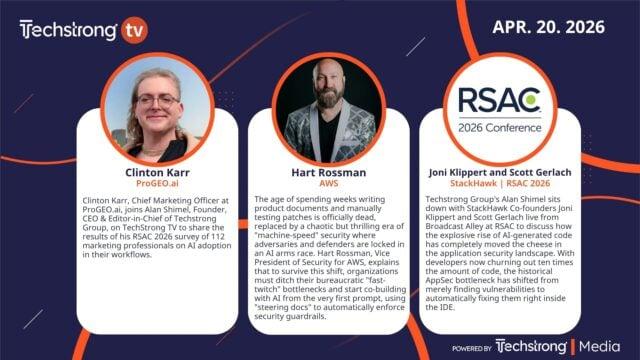
Techstrong TV August 26, 2025
Watch our live stream Monday through Friday, featuring exclusive news, announcements and conversations with IT leaders and experts on topics ranging from digital transformation to #DevOps, #Cybersecurity, #CloudNative, #Containers and deep-dives into specific technologies and best practices. http://techstrong.tv/
Transcript
Us becomes a partner in Intel. What do they know about the restaurant business you're watching? Textron Gang.
Hey everyone, it's Alan Shimel. Welcome to Tuesday on Textron Gang. You know, we've got, we've got a hardcore gang today.
There's just three of us. I'm happy, but we'll be moving quickly, so it'll be good. Let me introduce you to our gang members for today.
We've got JP Morgenthal and Steven Foskett. Steven jp, welcome. Thank you.
Thanks for joining you today. You know, yesterday was a busy day. This weekend was a busy weekend.
Last week was a busy week. There is so much news. I we can only pick out three things to cover a day, but we'll try to do some of it justice.
Um, guys, the big news and it, you know, was from, it actually probably started last Tuesday, so a week ago, I, I think when, uh, uh, Intel's CEO was at the White House. That was the day before they wanted a Lynch him. Then they said he was such a great guy.
Now we find out he was such a great guy. 'cause he gave, made the US a 10% partner in this, in this in Intel. So, let me, guys, if you don't mind, I'm gonna start it off.
'cause I wrote an interesting article about this. Interesting to me. Anyhow, funny how, you know, when I first heard this story, I couldn't help but think of the movie Goodfellas, right?
One of the mobs, one of the mobsters beats up some guy from a, who owns the restaurant. Tommy. Tommy beats up a guy who owns a restaurant.
The guy goes crying to big Donny, I mean, poorly and, and, uh, and says, Paul, I, I, this guy's gonna kill me. I need your help. Why don't you be my partner in the restaurant business?
So Tommy won't bother me and poorly smoking a cigar says, very coy, be your partner. What, what do I know about the restaurant business in his best gangster is, what do I know about the restaurant business? And of course, he's being coy.
He doesn't have to know about the restaurant business. This is the way the mafia does. The mob does things, right?
They become your partner. They use the, the, the asset to run up bills, to clear fence goods, to do all kinds of things. And then when it's, there's nothing left to it, they just kind of set it on fire and collect the insurance.
I feel like you're spoiling the movie, man. People should see the film. Well, if you've never seen $20, dude, right?
I mean, this is a classic. Martin Scorsese fil Sorry, man. It a, a after, after five years, all spoiler Bets are off, man, right?
All right. Yeah. But, but, you know, seriously, I, I couldn't help but think that, first of all, let's face it, they bought this with $10 billion that was already sort of pledged to Intel, or was earmarked, if you want for Intel number.
You know, I, I laid, I, in my article on this, I laid out five or six things that I think are terribly wrong here. Number one, I was a political science major in school. There's two kinds, two forms of government where government actually owns means of production.
One is socialism and one is fascism. Socialism is usually done for equity, right? Make it equitable.
We all own, because we all are part of the government, right? The government is us. And fascism is usually in a nationalistic kinda way, which this sounds nationalistic.
So, you know, we're a country that is Jews excused, socialism and Nash and fascism. Why? What are we doing here?
We point to Taiwan, Russia as examples of go of, of, uh, Singapore, where companies own, where government owns means of production, but they're still democracies that these are countries where people have given up their personal freedoms. It's just, it's not who we are, number one. Number two, how are we gonna build a competitive market?
If, if we've put our finger on the scale and Intel's the house brand, right? Will we ever develop another chip maker in the US who can compete on the world stage? Or have we have, we just anointed the, the chosen one, and that's it.
Number three, how's the rest of the world gonna look at this? Right? For so long, we have, we have, you know, beat the drum about, we're not gonna do bid.
You know, it's not fair. Uh, Japanese steel companies, Chinese steel companies, Korean steel companies have been propped up by the government, unfair labor and unfair trade. And, and that's a reason why we've used to keep companies out of our economy.
Well, now, these same countries are gonna turn around and keep Intel out of their economy because the perception, not the perception. The reality is it's a government owned entity. The market, the market should have blown up on.
I mean, this morning, we should have woken up to, uh, the Dow over a thousand points down on this news. It's, it's, it, it, it shows that the market is just gonna play along and, and take, and take the, the kickbacks and, and feed off of the greed, because I mean, it's anti-competitive. Uh, uh, on any front, you, you look at it, this is anti-competitive.
Uh, you know, it's, it's, it's funny when you said the market should have blown up on this. I thought you were gonna go in the other direction. Essentially, essentially, Intel stock should have shot up, and the market should be on fire because it shows that the US is actively involving itself in the, in the, in the market, and that the US is not going to allow Intel to fail.
I actually thought that's where you were going when you said that, jp, because, you know, my perspective on this is, you know, I mean, uh, setting aside, um, name calling, descriptive or otherwise about what form of government or what, uh, uh, movie metaphors this represents. Uh, you know, if you look at it purely from a capitalist investor standpoint, this is the US government saying, number one, intel will not fail. Uh, Intel has the blessing of the US government.
Number two, uh, you know, the challenge, the biggest challenge for lip Bhutan and Intel has been finding a 14 nanometer client. Um, that's partly because there's concern over the stability of their, uh, and the, you know, the, Their ability to deliver it, Ratio of delivery for the, the 14 nanometer chips. But also because, you know, people I think are a little nervous about betting too heavily on that when, you know, T-S-C-M-C is right there with a decent, you know, alternative.
Um, but having Trump say this and having the administration and the US government, uh, take this share in Intel, what it says to me, and what it would say to me if I was a contract manufacturer, anyone from Apple to arm, to, you know, one of these up and coming, AI Accelerator Pro, you know, whatever, Cisco, I mean, all these companies that make chips by designing them and then have somebody else make them for them, I would immediately jump on board with the Intel BA bandwagon, because that's a way to curry favor with the administration and to show that you're on board with the, with this, I honestly don't understand why Don't, why Isn't going crazy on this news and why people, investors aren't saying, oh my gosh, like, here we go. Let's do this instead of, instead it seems like they're saying, meh, which is shocking. Well, here, this is not America, man.
Well, here's the thing. I think when you live in a market where there's shocking chaos every day, eventually deit desensitized sets in, right? You're, you're not, you're just nothing.
And and That's The biggest problem. And I think, by the way, is part of the governing philosophy here, right? It's just keep the chaos cloud moving, so you can't focus on any one thing.
'cause you know, last week it was, we're gonna charge you a 15% export fee court fee to sell to countries this week. The hell with it, we're just taking over the company itself. Now, let me ask you another question.
This isn't a bailout. Let, let's Differentiate. This is not a bailout.
This is a land grab. We, we had, we've had the US government use treasuries to Bail. Yeah, I was gonna bring that up.
Y they have this different, but that there, you had very specific, when, when, when the government pulls back out, it was not a permanent thing. But who, who's running Intel isn't Donald Trump? Because after all, only he, only he can deliver us.
And who knows the semiconductor market better than Trump, than someone Trump, who never heard of Nvidia until last month. And he knows restaurants too, And restaurants. What does he know about the restaurant?
That's the point here, right? Yeah. He's Paul Or he is acting like it.
This is, this is all kidding aside, forget what I learned in political theory and, and poli sci. This is, this is the Putin model. Well, you, you know, it's a, it's an oligarchy.
It's a, that that's what this is. This is it, it, it, it doesn't bode well, it doesn't bode well. And what happens if Intel can't do the 14 nanos, what's gonna happen is the US just gonna write or write it off, and Donald Trump will blame it on Joe Biden somehow.
I mean, and, And there's another aspect to this too that I wanna bring up here too. And that's that Trump is going around saying, we got $11 billion, a 10% share of Intel for nothing. Nothing.
He walked into, he walked into the White House and begged me and said, sir, give, you know, please help me out. And, and, and he gave me a share. That is not what happened here.
Uh, what happened here, actually, it, it is very similar, as JP pointed out to the, uh, Chrysler bailout back in, I believe, 2008, when the US government, I think took like a percent, it Wasn't just Chrysler, GM two. No, but, but specifically with Chrysler, they took a share in the company in exchange for the bailout dollars. Um, she Had too.
It reminds me of that, like, people going around saying, oh, this is socialism, whatever. Uh, no, this is kind of what the US has done before. But what's Weird here, it's not Stephen, it's very different.
The money is coming from funds that had already been allocated by Congress as part of the CHIPS act. And so it's, it's, it's a weird case where Trump basically said, oh, you want that money that you've already been allocated? Well, you're gonna have to, and, and lip Bhutan, to be honest, I mean, again, to be a a, a swashbuckling capitalist here, uh, came in there and said, huh, okay, sure.
We'll make you our partner. And, and again, like I said, now, if I was lutan, I would be going out to every American computer company and saying, you've gotta work with us. Or else I'm gonna tell Uncle Don, Steven, I, I don't think, I don't, it's not Uncle Donny.
It's big Donny. But, but here's the deal. You've got this one wrong.
And I'll tell you why. Let, Let me I get Ahead, jp. I'm on, I'm, I'm unclear on the details of, of, but it, uh, specifics, uh, of how it worked.
But I'm pretty sure with the Chrysler, that was not money from Congress. That was the treasury. It was treasury money, but it was, it was clearly earmarked that we're gonna take an equity stake, but upon financial health, and this is how we define it, that we could sell it for a profit.
We will, which they did. And by the way, they did the same thing. They did the same thing with the banks, right?
All the most of the, you know, because what you had in oh 8, 0 9 is all the investment banks got bought by, by JP Morgan, and C and so forth, JP Morgan initiative, investment banks, that that initiative was based on, um, almost, weren't they based on like bond sales? Like, it, it acted like, no, It wasn't bond sales. I think there were t bills put up behind it.
Like, like guarantees, whatever it was, it was US money, government money, government credit. But here's, here's the deal here. This is more like big poorly and Goodfellas than 2008.
Because what happened was, the day or two before Lip Bond came to Washington, they were beating the hell outta this guy. Just like the guy in Goodfellas has the patch on his eye and his arm, and the cast, Donald Trump and his, and his, his gang, right? Were calling for this man's head.
They wanted him rode outta town on a rail tarred and feathered. They were saying he was in bed with the Chinese Communist Party. He did all these bad things.
This guy came limping into the White House. If they would've told him he has to do this, standing on his head, whistling Dixie backwards, he would have done it. He didn't have a choice.
This is, I'm from New York, I'm not jp, so are you. This ain't, this is not a new script. This is how these guys work.
That's how they do. They, this guy had no leverage. You want to call it the art of the deal.
This is not the art of, this is the art of the mafia. This guy had no leverage. What choice did he have?
Donald Trump said, look, should have Stepped down, is what he should have done. You got six and a half billion coming to you from the CHIP Act. I don't think we should give it to you.
And I hear there's another three and a half coming from DOD. I don't know if we should do that, too. You'd like that money, wouldn't you?
Or what? Maybe you should just resign or make me your partner. What do I know about the restaurant business?
And in that, That's what happened here, Mario, if your restaurant business is populated by the mafia, you know, what are you gonna do? Burn it down, or you're gonna welcome a new partner? What, what choice did Lipman have?
He had no choice. He had no choice. Now that my, my question is, so I, I happen to believe that, that he is actually a very qualified CEO for Intel.
If we didn't have this mob related, you know, cabal running the government, but is he gonna be allowed to run Intel if what he wants to do with the fabs, does he have to go get big Donny's permission? Do we have to have a sit down, you know, over in Howard Beach or something before he could open a fab somewhere? Are we gonna open Fabs based upon whether they're red states or blue states, or who voted for who?
Or are we gonna open Fabs where we have the best chance of it being successful? This is, this is a, this is a problem, guys. I'm sorry, I I agree with jp.
Steven, I'm sorry. Yeah, I, I, I'm, uh, you know, to be honest, I'm, I'm, I'm a bit being the, uh, devil's advocate here. I know You are.
Um, and, and all I'm saying is that if you were that restaurant owner and that guy's sitting across the table from you, what are you gonna say? You're gonna say, sure, come on in. Hello, Partner, Hello partner.
And that's what, and that's what Lip Butan did. And now that the government is Intel's partner, or the, the other thing that we have to keep in mind here is that this ain't a done deal. Like, uh, for, by all accounts, this is a suggestion, a verbal agreement, a Donny deal, Who knows?
But that's all deals Are like, no, but what are the papers gonna say? When does the treasury get these shares? Are they voting shares?
Are they not voting shares? So I don't What It's really gonna look like. Yeah, I don't think in, I don't think this necessarily moves Intel out of the woods, I tell you.
But anyway, there's a lot written about it. In addition to my article, we have, I don't know, three other articles up on either Textron it and Textron AI on this subject. You are free to form your own opinions.
We, it is just, here's the other thing. Where's the people in this country who scream socialism? Anytime we wanna do something.
That's what I'm wondering, man. It's like All of a sudden it's great, right? Yeah.
All of a sudden, uh, it's fine. Or I don't know, you just pretend that it's Not actually, I, I know sometimes I feel like red pill or blue pill. What's it going to be?
Because maybe this whole thing is some AI induced Look, you end of the day, the, the strategy, or, or yeah, we'll call it a strategy is not new with regard to, uh, supporting, you know, and ensuring that a large US corporation doesn't go under that, the jobs that made it the, but when you, there's a way to do it. And clearly, well, We, we don't do it usually with Ownership. That template is not being followed here.
Let, there is no transparency. Yeah. Let me throw an, let me throw another kind of just wild ass capital I capitalist idea out at you by doing this.
We're propping up a loser. Intel Fair and Square on the world stage, got their ass kicked. They were the, they were a monopoly for most of all three of our careers, right?
Wintel. And they missed the boat. They, they carried off their game.
They got old. We all get old time for a new King of the Hill time for fresh growth. Yeah.
The biggest, according to Intel themselves, the biggest mistake they ever made was telling Apple to go get bent. When they came to say, do you wanna supply the iPhone chip? They, they missed mobile.
They, they late to ai, all of these things. So if they're not, if they're not on their game, the, the way the market works is they deserve to fall off the wagon, because that clears the forest for new growth. But by doing this, you're propping up, you know, your c your C plus student, your D plus student, and we know who was a D plus student and everything, but you're propping up your C plus D plus students at the expense of, of raising up the new, the new new, Yeah, new this.
This is not about saving jobs. This is not about, no, this is, this is clearly a market. This, this, this is a i is going to affect the markets.
This, this is market manipulation, end of story. This is market manipulation. You know, let the best companies win.
I, I, I'd like to see who the next intel is, right? That, and we may never know now. Anyway, let's take a break on techron gang.
We're gonna come back and talk about feeling the vibe, vibe, coding. You're watching the gang Discover Techron group, the epicenter of tech innovation. We are your go-to for reaching IT, leaders and practitioners worldwide.
Our secret, impactful content that sparks awareness, engagement, and top quality leads with us. You'll access editorial websites, streaming videos, virtual events, custom content analyst research, and more. Join our satisfied clients.
Let's revolutionize your tech journey. Contact us today and tell your story to the world in the most powerful way. With Textron Group.
Hey, everyone, we're back here on the gang. You know, I've seen a lot of technology come in the front door and the back door of enterprises over my time and vibe. Coding seems to be one of those.
It's coming in through the windows, even front door, back door, second floor seller all over the place. What's a digital leader to do? Jp, what's your take on this?
Well, you know, it's a, it's an interesting, uh, technology. We, I actually had a great talk, uh, with some of the, uh, individuals at AI for the recent event out in Vegas. Uh, the AI conference.
And this was a great topic of discussion because we talk a lot over the years, an enterprise about the IT iceberg, right? You have what's above the iceberg and what's below the iceberg. And w we all know, and we've been in this industry since the beginning of dinosaur, is that, you know, what's below the iceberg tend below the waterline tends to get ignored because it's expensive.
And usually, and people don't see the outcome. They don't, they don't, it's important, but they don't see it. So it gets less investment, gets less attention, whereas something above the waterline very visible, right?
And someone gave you the example of the internet when it came out, right? Very visible, consumer oriented above the waterline. Lot of attention.
Well, this same thing is going on with ai. You have something that is incredibly invasive. It is generally available to the public.
It has, uh, immediate, i, I impact by using it. You can actually see, uh, you know, the, the impact that it provides. And so therefore, you are looking economically, you know, at, you know, the, from a market perspective, something that's very visible, and you're looking at the ability to do an effect change for by people who in the past had, didn't have the skills to do so, right?
And so you have to assume that this is gonna have, uh, like anything else, tremendous visibility, tremendous impact. And that's what we're seeing. We're seeing that because of it, it's getting a lot of attention.
There's a lot of training out there. There are YouTube videos. People who have never coded, uh, are using these tools to build themselves applications now.
Uh, and, you know, they are seeing an effecting change on a level we haven't seen before. So vibe coding really is an outgrowth of that. It, it's that immediacy.
It's that media gratification and the ability to talk, do and affect things that you could not before. You just didn't have the skillset. It required a specialized skillset in order to be able to take advantage of that.
And, um, and for, and on the in, you know, on the side where this is a business, what I do is write software. Uh, I am seeing executives that are getting it more, more than I'm seeing executives that are not. I, I do believe in the boardroom that CEOs are gonna get, the CEOs who are not gonna survive the next three years are the ones who don't have a plan for bringing AI and leveraging AI in their organization.
And so, I'm not seeing pushback. I'm seeing adopt, adopt, adopt, use it as much as possible, make us faster, make us quicker. Um, and so I, I, I think you know it, this is, this is not unexpected based upon what this technology is and can do.
Now, there are side effects, and that's the thing, right? If this were a, you know, a drug commercial on tv, you know, you'd have a 30 minute, you know, you'd have a three second commercial and a 32nd Side effects. So This drug include this because, you know, uh, there are a lot of issues if you don't know how, if you don't understand what this thing produces.
And that's, I think the, the, the thing, the house of cards that's being set up is that great technology usable by mass audience, but it needs people who understand what it's producing to really leverage it. And we, and that's where I think we're gonna end up seeing, uh, the, it ultimately blow up and, and causing a trauma of it, uh, disillusionment. Well, and, and let me just hear what you just said is honestly, I think it's true.
First off, I think you're dead on. Technically, this is potentially useful technology that needs to be wielded by a smart and professional audience to do good work. That's true of most AI tools.
However, the first part of your sentence is, the part I think that people are worried about this is technology that's usable by anyone, not just that qualified individual who's gonna do a good job with it. And that's the problem that I'm hearing. I mean, you know, I, I worry that essentially vibe coding, and I'm not trying to say we should lock coding up behind the walls and only let qualified coders code.
What I'm saying is that if we encourage non coders to code, and we give them tools that make them think they're coding when they're not, then what do we end up with? Right? Especially because it still needs to be debugged.
I think that there are ways of getting around this technically. Like I could imagine a vibe coding startup that allowed non coders to code, but then had like another step that was, you know, sort of proofreading it and evaluating it and doing debugging and doing testing before deployment. But instead, it often seems like what we're doing is the home nuclear reactor kit.
And, and that I don't think that's safe. Yeah. What could possibly happen, you know, well, I mean, so agentic networks, people who are learning to use, and the tools are starting to support this, um, will allow you to build the agent to go check the fir the, the code is work, and then they will, and then you could have the QA agent who actually runs the test.
And so you get test coverage. There are ways to mitigate, but the question is, who really has that knowledge? That's software development life cycle.
Now you're talking, right? I, I build, uh, I have test driven development. I have somebody who actually understands how to, even if the AI's doing the work, you know, build, how do I guide it to do the right testing?
How do I guide it to ensure that the code that was built is of high quality? My favorite quote so far of somebody is like, I pointed like code X at one of my code bases, and I told it to go and refactor, uh, the code and make it faster and leaner. And it said, he said, it spent all this time, it did all this great work.
It abstracted this, it created new base classes, it did tremendous amount of work. It looked beautiful. If only it worked, the application that would came out, the other end was didn't work, right?
It's like, and I've seen this personally, 'cause I do this for a living. Uh, uh, it will, um, tend to leave out business logic, right? I, you give it, I, look, here's the business logic.
Boom. I hand it to you. I want you to incorporate this.
I just want you to modify the ui. And you come out the other side and you're like, well, the UI doesn't, when I click the button, nothing happens. Why I gave you this.
I gave you the code. All you had to do was stop It. But it, it does the same thing.
If you've ever asked it to make graphics, I, I was, I asked it to make a graphic the other day. There were three words that were in the graphic. First, it left a letter off of one word.
I said, you spelled that word wrong. Please put that letter back. It did, and then made left a letter off another word instead.
So it, it, it's incredibly frustrating. But here's the point I think that we want to talk about here. I wanna bring it back to leadership.
Vibe, coating's here to stay, right? It, it it, same way open source came in and the cloud came in. Vibe coding is here to stay.
The question is, as a leader, are you gonna try to stamp your feet and talk about all these shortfalls JP that you brought up? Or do you say, yes, we can. Yes we can.
Here's how we're gonna do it. Here's how we could put guardrails in there. Here's how we could test stuff before.
Here's how we have a process. Before any vibe coded app is, is deployed, these are the tests that it has to go on. How do we, how do we make it legit?
Do you know what you're saying? Makes sense? Um, the issue is who's going to build those guidelines?
Who's going to create the body of work that allows, uh, that, that informs, uh, the ai, you know, to follow these things? And then you have, there is, by the way, and this'll be fixed, but the size of the context windows are still an issue. I find that the, you know, when using a lot of instructions that it tends to forget the earlier ones when doing the work.
And I'm like, I know this was in the instruction pack I gave you, and I told you explicitly follow the instructions. But by the time the context window filled up, it, you know, it was, it, it had completely forgotten to do that. Right?
And then you, you say how you were instructed to do this. Oh, you're right. Let me go back and fix that.
Like, you know, if you don't know what you're expecting on the outcome, if you don't have a good idea of what your expectations should be, you could easily miss that. You would have no idea. 'cause you think you told it to do it.
Somebody's gotta write these guidelines. But then again, they also need to know how to use the tools, which means keep 'em small, do things in short, tiny windows. Not not big whole cold bases, which is kind of what I, Maybe that's part of the guideline.
Yeah. Eh, it could be. But that's unfortunately exactly what people are doing with some of these tools.
You know, I mean, happily guide vibe coders probably aren't, they're probably writing real short, small to the point things that are probably written, written before and probably will work. But, uh, you know, the, the, uh, I think the, what JP Iss saying is, well, first it's technically accurate, but also, unfortunately, it's not really what's happening out there. The other thing is, if you wanna be, uh, accurate as to vibe coating, the term vibe coating has been commandeered by the market.
The original vibe coating was, I'm, it was almost experimental. It was like, I'm just gonna start asking, Yeah, let's play around a little bit. Let's Play around.
Let's see what he feel. Tim Timothy Leary experimented too, but, you know, that's great. Turn on, turn off.
And whatever it was, It, it, it, it went from being this like experimental. Let's see what AI creates. I don't know what I'm gonna do today, you know, to, you know, now it's a science, and the last thing it is right now is a science.
I, I agree with that. But, you know, and is a good segue into our next thing. When we're gonna be talking about an AI bubble.
The vibe coding you see today is not the vibe coding we will have tomorrow. There's a, you know, what's the song from, uh, from, uh, defying Gravity? Oh, see, I thought you were talking Fleetwood Mac or something here.
Don't stop Drinking about Tomorrow. Don't stop tomorrow. No, no.
You know, this thing, this thing is defying Gravity. Gravity, right? Oh, when I say this thing, I mean the whole AI thing, but vibe coding, certainly part of it.
And you know, of course, if you are a science person, you know that you can't defy gravity, or at least not with our, maybe it's in Quantum, I don't know. But, um, it's, but it's going to get better. It will, it'll continue to evolve and get better.
I, I think, you know, how much better, how fast is the question? And then again, to me it's about how do we manage this, this rocket ship so that it takes us to the moon and doesn't blow us all to smither rains? And that's, that's what makes leaders, right?
Leaders have to, you know, who's gonna do it? Jp the leaders have to put that in place. And that, that's my point.
Anyway, we're over time. There's certainly a safety factor. Absolutely.
There is. You know, and there's a risk. It's a risk, you know, you gotta manage that.
Anyway, let's take a break. com is the leading resource for news analysis and education on challenges facing the cybersecurity industry. com covers all aspects of cybersecurity, including data security, DevSecOps, cloud security, application security, network security, security threats, and more.
com has the largest selection of security content featuring breaking news, blog posts, podcasts, and more. com to learn more. com.
Home of Security Bloggers Network. So, Alan, in the last segment, you talked about a, uh, famous Broadway Hit Defying Gravity. I, I don't know if you've, I, I assume you've seen Wicked and you've seen Galinda floating in on her big, let's say, conveyance.
Um, do you recall what that conveyance, uh, resembled a Huge, Massive bubble. And here we are with a huge, massive bubble defying gravity. And I'm not the one saying that, you know, who's saying this is a bubble?
Um, let's take a look at who's saying this is a bubble. Um, somebody named Sam Altman. Who's that?
Uh, I heard of him. I heard him. Have you heard of this guy?
I think he has something to do in the AI market, doesn't he? Yeah. Does is he involved in We did something, I dunno.
Yeah. In any of these companies. Yeah, so Just another one of those billionaires.
He is the CEO and cheerleader in chief over at Open ai, uh, which is the company that, uh, more than anyone is driving. I mean, he's galinda in the bubble, um, defying gravity. Meanwhile, we've got Jensen Wang at Nvidia, who's, um, I guess is he the, um, wizard in my metaphor, I don't know.
Isn't isn't he the guy with the motorcycle jacket problem? He's the one making all the money. Yeah.
How Exactly He Exactly, he's the one making all the money. $4 trillion. So here's the thing.
So yeah, Sam Ottman was just for CC to clarity here. He was caught at, at a, at an investor dinner saying, yes, there is an AI bubble. Um, he further went on to clarify that it looks like a bubble because we haven't yet found the profitable application for this technology.
And then he, he talked about how there is going to be a profitable industry built on ai, which I honestly think many of our viewers may be amenable to believing that there's gonna be some profitable applications built on this technology. And then he kind of talked about super intelligence and artificial, and, and one of the funniest things he said was, EF effectively, that at the end of the day, what we're gonna do is we're gonna ask our super intelligent AI overlo, what is the profitable application of you? And whatever it is that's going to work, because it's super intelligent, QED, if it is super intelligent, then it can come up with a use case that is profitable, because otherwise it wouldn't be Q anyway.
The point is, we are in a situation where we have undoubtedly an AI bubble to the point that if you talk to anyone at any AI company who is willing to talk to you and, and be straight, if you talk to investors, if you talk to hedge fund managers, every one of them says, yes, but, and the but is, but it hasn't burst, and we're still making tons of money, and maybe there's a profitable use case for this technology out there. The problem is that we as an industry, well, number one, we haven't found that use case yet. In fact, of the companies that claim to be using generative AI to generate money, the only one, no kidding, the only company that claims to have made with actually audited financial statements that they made money on, this is a company called Cursor, which is an AI code generation company.
And yet Cursor was being subsidized by Anthropic in, in, in, in, which just jacked up their rates by a multiple, like a, like a more than a hundred percent kind of kind of thing in order to not be pouring money into this unrelated company. And, um, sta you know, propping them up to be profitable, cursor went, raised the prices on all their, all their customers. And now maybe Cursor is still profitable, hopefully, maybe could be.
Um, but, but the point is, we haven't, I think we can all safely say we haven't yet found a profitable use for this technology, number one. And number two, that the true cost of this technology is not yet reflected in the market because companies like Meta and Microsoft and even Nvidia are propping up that subsidy by literally passing money to their customers. That then gets spent back on the product in order to build this thing out there.
I feel that there is a bubble, it will burst, and then we will finally see the true cost of some of this technology. And that doesn't necessarily mean this technology is useless and worthless, and we should just all go back to stone knives and Bearskins. What it means is that it's about time.
There's a reckoning, so that we learn the true cost of this technology Thing is, I, I think it's, if you were to really see the true cost to pass along to customers, I think this is far too expensive a technology to use right now. Yeah. One, one of the guys said a hundred thousand dollars per developer, something like that.
Uh, possibly. I don't think, I mean, I think that number just came outta the air, but I can tell you from experience, you know, it's, you know, I spent $200, $250, and I built a fairly complex application with Claude. If I were to, and I imagine that based on what I paid a token, if I had been charged a profitable rate, that would've been closer to probably 3000, $4,000.
And if it was three or 4,000, and I, I, you know what? I think probably, and I, I wouldn't have done it. Yeah.
Would you, that Was my question. Would you have done it And no. Well, what, what would you have done instead?
Wouldn't have built it. Probably wouldn't have built it. But if I really felt like there was something there, I would've had to code it myself.
You would've done it yourself. And what do you think your time is worth to build, do something like that? Well, probably more, but I saw how, how do you get, alright, so you can go offshore, right?
I mean, that's another option you can hire Off. That's always fun. I love getting offshore development always works out Well, No, always.
It has. It's, it has its history, the campaign. But, but the, The, the, the, the economy of scale is the fact that you can do five to $10,000 worth of work for $250.
Yeah. Guys, You lose that economy of scale. I think you have an implosion.
So I'm old fashioned. I believe in science, I believe in economics market. And I also believe that this is not very different than other waves that we've seen.
Right? And I, I believe in gravity and Stephen, you said something about defying gravity under our present understanding of physics, we can't defy gravity. The only way we defy gravity is pure horsepower, like escape velocity to get a, a rocket to the moon, let's say, or, you know, into outer space.
And that's the way we're doing it with AI right now. We are just pumping out the biggest satin five, whatever Elon's big one is, you know, the biggest rockets we can to try to escape gravity, defy gravity. Sooner or later what goes up must come down Well, and, and don't, but don't forget, and let's not, uh, position this in a way that, um, illustrates that the industry is under, uh, one direction pressure, right?
There are organizations and groups who have demonstrated that they can be much more efficient in their code. Yeah. But, But forget, I'm not talking about the individual companies.
I'm talking about the market in general here. What you have here is a classic Allen Greenspan, irrational exuberance. Irrational exuberance that all of the great things AI's gonna do for us.
And you know what I'm here to give, let me tell you the good news, the bubble bursting here wouldn't be such a bad thing Now. And, and I'm, I'm on that team, Alan, because I do believe that this technology that's being built has potential applications. I will say right now, th they will not create artificial general, actual general intelligence or super intelligence on the basis of LLMs.
I don't think that that's really what's happening. They're Doing called brute force. Well, let's just call it brute force.
Yeah. That's not where it's gonna happen. In fact, I'm not sure it's ever gonna happen.
But that Being said, this te Is useful, right? And there Are other we need ought to be successful. Steven, I think we're saying the same thing.
I, I, I wrote about this and I, I said if we, if we stop the AI evolution right now, we never got to super intelligence or a GI, what we have right now is pretty damn cool. And we haven't even scratched the surface on how to, our vibe coating was a great example of it. We haven't even scratched the surface on how to use that better, how to make better coat, how to write better stuff.
But I know from what I personally am doing using it, that this is an amazing technology right now. But in typical and, and, and guilty, right? In typical tech industry fashion, all three of us are tech boys, right?
We've all spent our careers in this. We're, we are never satisfied with what goes on right now. We're always looking for that next shiny bobble that we're going to, you know, grab onto.
I can't wait to combine it. The quantum isn't that, what, Isn't that really, isn't that really where this investment I is coming? Is, is, is that why this investment has come in at a level that it has it, they're certainly not buying the, you know, generative ai, uh, because, you know, those valuations are great, but they're not necessarily billion dollar run rates Irrational, exuberant.
I'll say it again. You know, and I was not an Alan Greenspan fan for the record, right? It cost me dearly.
com thing. I was, you know, I helped take a company public, and it, I thought it the biggest, it's irrational, Irrational exuberance, but it Is irrational. I mean, you can't let, let's let this thing prove itself a little bit before you bet the farm.
And I think that there's gonna be some, I think there's gonna be some teething pains. I think there's gonna be some fail failures. It some starts.
I think there's gonna be some big explos, some you mentioned, uh, Mr. Musk's big rocket, which by the way, is supposed to take off today. I, as we're recording this, we'll see what happens.
But, um, just like that big rocket, um, I think we're gonna have some fireworks before we settle out into a real cadence of, of using this thing. But, But is that abnormal? I mean, isn't that, let me rephrase that.
Isn't that normal? Well, it, it all, to me it all depends on sort of what the collateral damage is. You know, if, if, um, if that big rocket blows up above New York City and rains down and kills a bunch of people and stuff, well, probably not.
Okay. Um, you know, and, and similarly, if AI ends up, ends up taking out the global economy because, uh, so much of the economic growth of the last decade is built into Nvidia and supporting, you know, AI supporting companies. And if the pushback ends up, uh, crushing their stock and net crushes everybody's retirement savings and, and it sends the world into a global recession, well, that's probably an, a sign that, uh, maybe this irrational exuberance was dangerous.
I blame Joe Biden. It's, um, yeah, I I think it's really Obama's fault. Obama come one of them.
Yeah. Maybe Hillary Clinton, Let's not even go there. Al Gore invented all this stuff.
Yeah. I mean, come on. It's clearly His faults.
Yeah. That if you're gonna blame anyone, let's blame Al Al Gore. But, you know, but, but let me, let me end on the good news.
And I'm, I, 'cause I wanna emphasize this. You could have both a bubble that collapses and a perfectly useful, valuable technology here. They're not mutually exclusive.
One is totally based, as we've said on irrational exuberance, investors, you know, fanboy thinking about what could be. The other is hard progress makes based upon what is What you'll see. And you know, this though, is when a market implodes, all the investment in for that marketplace will dry up for quite a while.
And that will affect who can come to market with something and who will have funds to do research and development to bring the next level or the next generation. Yeah. Ultimately, I think that's what the AI companies are betting on in this bubble.
They're betting on that they're gonna be the ones that's gonna have a bank account big enough to sustain this thing, dry Baby dry powder And come out on the other Side. And if you don't think they're all stocking up on dry powder, you're crazy. Right?
That's what they're banking on. Anyway, guys, we're over time today for three guys. We certainly did talk an awful lot, huh?
Well, I wanted, I really wanted to quote more wicked lyrics, but You wanted to quote more, Steve, I didn't hear you Steven. I wanted quote More lic wicked lyrics. Uh, there's a, there's a lot I can work with in there.
Yeah, no, there's, but go ahead. You know what I would ask a i to write up something in the style of Wicked for you, and, and they do that. Maybe that's the killer app.
Yeah. But the true cost of that song is gonna be more like a thousand dollars. I'm not sure I wanna spend that much money on that.
No, you're right. You're right, you're right. Look who makes money in the music business today, Spotify.
They, they take Keep it all. Steve, jp, thanks for joining me. We will of course, continue talking about some of these topics day in and day out.
We'll be talking about them on Techstrong TV all day today too. So stay tuned for that. com, security Boulevard cloud native.
Now, um, if you wanna watch this, again, it's on YouTube Techstrong tv, YouTube text, strong TV website. Or if you really cool, download the OTT app on iOS or Android, Google, um, uh, apple tv, Roku or Amazon Fire. No shortage of ways to watch any of our text drawing content here, or our tech field day content.
'cause every one of those sites I just mentioned has the full tech Field day library as well. So check it out until tomorrow. On behalf of JP and Steven and the rest of the gang, have a great day, everyone.
We're out. Hey everyone, welcome back here to Textron tv. My next guest is, he's been with us before.
New comp, not new company, new product. We're gonna talk today, but let me introduce you to Kumar Chico. ai, which is actually a subsidiary of Sera Kumar.
First of all, welcome back to Text Drunk tv. It's great to have you on here. First Of all, thank you for your time, Ellen, and, uh, great, great to connect with you again and, uh, thanks for your Time.
Always. Alright, Kumar, I I feel like we need to bring this along chronologically, if you will. Yeah.
So first there was up Sarah. Yes, right? You're one of the CE uh, one of the co-founders of of Sera.
com coverage for Yeah. Since you launched. Yes.
I remember when you, you know, you're a new company, but, uh, SER is a DevOps DevSecOps platform, correct? Yes, Yes. Okay.
So now that we've got that established, what is Code Glide? Yeah, so let me give you that. First of all, thank you once again.
So let me give you a little bit of background of Sera just quickly. We are a, a AI power DevOps and devs platform. Where in which we meet the customers where they are protect investment.
Our vision is to enable empower enterprise companies to make the software delivery faster, better, secure, which we are still sticking to the vision, our goal, and we do making good progress there. And, uh, we launched the VA features last year and, uh, called Hummingbird ai and which is where we revamped, uh, some of the AI capabilities and, uh, launched it last year and, uh, last few months as well. So as part of the AI transformation, we ran into a stumble block, which is, uh, how can we convert our A PS into MCP servers?
So that, which is the why MCP servers important in the first place. As you, if you take a step back, most of the data is sitting in a backend and those data has been accessed by APAs, good old APAs, right? Those APAs are not designed for AI or LLL, not, they're not context aware, no memory.
And then they're not designed for, uh, in intent. And, uh, they, they basically like a ps you have to write a special glue code to connect with the LLMs. As you know, LLMs are changing every week, almost every, every month.
So it's hard for enterprises to connect the data expose to APIs, to LLMs. And that is where tropic release the, uh, MCP model context protocol. And this is catching right now because model context protocol is another layer that is coming and is providing the memory intent aware and also context aware so that citizen developers are the business analysts, business users can interact with the data much more efficiently as opposed to going to the API and engaging a bunch of, uh, blue code in between.
And as a result, every company, every enterprise, they have to not abandon MPA PS A PS will continue to stay, but they introduce another layer. MCP servers. We struggled our way into creating initially.
And because of the way the tools are not available, market is not mature enough to even enable that. We saw an opportunity, we struggle through that. How can we enable an enterprises in the same format where we can, where we can create our own, our own MCP server?
And more importantly, how can we offer a full scale m CCP server lifecycle platform? It's not so much with creation of M CCP server. How can we make sure that every time the AP change and secure we create the CP server securely, make sure the lifecycle is managed or end-to-end from the time inception to the delivery of the server, connecting to the model, making sure that enterprises can be ready with the ai.
That's the intent. We that launching the code later ai. So that's the journey and story so far in the last, uh, few months.
I love it. And thank you for that in depth sort of, uh, explanation here. So looking at the material, listening to you look from where I sit, it's amazing MCP, right?
Uh, Andro came out with MCP, I think it was just in January. Here we are in August and it's already like the de facto standard for how agent interaction and agent API interaction works. What I'd like to understand about Code Glide is what, you know, everybody seems to be putting on an MCP server, right?
Yes. We're hearing every day that this, this one, that one. What, what, what makes Code Glide unique?
You, you claiming it's the first continuous M-P-M-C-P server. Uh, and it's a platform, not just a server. Yes.
What do you mean there? Yeah, great question. So if we take a step back, yes, every company public APAs, they will create, they have to create that one of another form factor.
As I mentioned. A PS are not going to go away. You have to have expose A MCP to interact with models.
Whatever you're interacting with the APAs, you'll continue to stay unless you re reformat reprogramming. It's like a cloud migration. If you take analogy of cloud migration and when you, when the cloud came into the foray and the AWS Azure GCP people started moving the data center applications into cloud thinking that it's automatically solved the problem.
If you don't refactor them, if you don't and uh, redesign them to the cloud, you'll end up taking the huge bill and you paying the huge tax and penalty. Same thing with a PS. You cannot expect the a Ps to connect to the models and expect, put a glue code and expect it to work.
It'll break every time you a model changes and it's gonna break. So that's the reason we are calling it a continuous MCP server because you make a change to the model, you make a change to the API, you make a change to the automatically MCP server gets automatically created. You don't have to worry about it.
It's not a one-time creation. It's ongoing creation. And the second thing is, uh, why we are different.
We are offering a secure MCP server at scale as a enterprise company. You're not only exposing APIs outside, but also internally as well. 7 billion APAs exist in the market.
Not all of them are actively used. And, uh, an average enterprise for 10,000 people, we see anywhere between 10,000 to 12 15,000 APAs that they serve today. Again, they have a degrees of variation.
About about one fourth of them are internal APAs because the applications internally they interact the data with, with their own internal application, sales, marketing, engineering and, uh, legal hr so on, so finance and so on, so forth. They have to be in a position to, uh, include the A-P-S-M-C-P server to extract the value of the data through AI generated AI to models that they have. As a result, they need to have a platform they can and just continue to create a one one micro one MCP server.
It's API to MCP server need to be mapped as a result. The problem is not about onetime activity, it's ongoing activity. We are offering a full scale MCP server platform, lifecycle platform as a result.
Enterprises can take it by the way, developers can try it out. Code Lab AI today, they can create five CP server for free, no strings attached. All they have to do is connect with GitHub.
We built on GitHub ecosystem. There is another reason why it is unique because GitHub has about four 40 million repos today outta them. Like about 10 to 15% of them are APIs.
Repos, like if you do the map, about 50 to 60 million repos are sitting there in a p. They have to convert it into MCP servers. It's not gonna happen in over in a single day.
Even if you try to do it, it's ongoing activity. That is where we want to tap into it. Reach out to developers, helping enterprises with the full scale MCP lifecycle platform so that they can manage it continuously without throwing consultants blue code and wasting the time and worrying about the, whether it's gonna work or not.
So our agent framework inside MCP server as, but not least we, most of the APAs are not written properly. They're written very poorly. They're not running open a PS standards.
1. They don't have a documentation and they don't have a swagger doc swagger information. Sera, in this case code light that we created.
We with the agent approach, it automatically switches the latest open API and creates a swagger and run the security scanning, ensure that no secret keys, passwords enabled, and also create, look for the, uh, any vulnerabilities and then go through the whole process, create the MCP server instantaneously. And it imagine that if you don't have a code light, it would take any smart developer both two, three days to create AMC in MCP server to maintain that it takes even more time and to make it work with the model, it's take additional resources and time and tax So just to recap, we built on a hundred percent GitHub ecosystem and we building a secure MCP servers at scale. And the third one is, it's a continuous thing.
And the last, but not least, people don't have to worry about whether my API documentation is there. How do I make sure that the APIs, the basic foundation is available? We will help enterprises to fix the gap that is already created by other people because it's been 15 years in APIs that in the market.
And then, uh, you see, if we go back and look at the history, lot of people don't even have an inventory. And we can also go the discovery inventory and then extend the, our goal is to create a marketplace where enterprises can manage the internally and externally as well. So we, we have an, we have a plans.
We can talk about it subsequently. I love it. I think another Kumar, again, a great explanation there.
Um, you know, I didn't realize the scope of how much as we, as we move, I mean, we call it the API economy, but it's really gonna be moving to an MCP agentic AI economy, and all, all of these, all the dollars time code that was, that was put into, you know, these APIs. Yes. And, and, and, you know, uh, the connectors for them and everything, we're gonna have to, it's a huge undertaking.
A huge undertaking. Absolutely. Because it's not going to be, like I said, it's a, the problem is monumental, right?
The 'cause even APIs are growing even in the economy. And then basically the con, they continue to be there, the tam that based on what the research is, MCP based a p infrastructure is about 45 to $60 billion. And, uh, when all said and done, because of the agent play area generated, AI is fueling this economy and fueling this opportunity because it's a race, right?
Every enterprise, they have to find a way to, uh, expose the data, get the value of the data, and ha be competent with the market and be able to get the answers instantly. That's the expectation. Now.
And to do achieve that, you have to be, meet the models where they are, expose the data in a secure way, ensure that your data is not ing without adding the blue code. 'cause how do we achieve that? That's where we've thought about how can we help enterprises and the developers to achieve things faster?
The enterprises running in the production and the non-production developers, meeting them at the ideal layer, help them create it, test it, ensure that their code and then their activity has been validated. So when they push the code to the non-product production or get to the non-product production, it automatically available for them to use it. Totally.
ai is a website, is the website as well. So people want to get more information. They can go right there.
Yeah, yeah. Basically there are two, we have two offerings. One is SaaS offering for somebody wanna play around with it.
Any public repo, you just take it. We, by the way, we also, for the just sake of, uh, our testing, right, we created a bunch of 2030 prominent, uh, like GitHub, Salesforce, and, uh, you give Google Maps and, uh, Stripe and Notion, bunch of other things. And the workday, we created those APAs to MCP servers.
We left it there for people to consume it, just to build the confidence. And it is available to SaaS up to five MCP servers. Or we also have a GitHub marketplace, GitHub access Marketplace, where enterprises don't want to expose any of the data to, uh, code light.
They can download it, put it out there exactly the same steps, but instead of SaaS, they can do it on-prem and the on-prem or GI ecosystem using GitHub login and GitHub actions. And the GitHub advanced security of secret scanning. So everything's built around GitHub so that they have a high degree of confidence of testing internally or testing public repos externally as well.
So we give the public and favored combination so they can consume it both ways for free. The up to five M MCP servers knows things attached. They can keep it for forever.
Really. Yes. Very cool.
Excellent. I'm, I'm gonna be interested to see how this catches on in there because, so I haven't seen this model Yes, for free. We, as I said, we've covered a lot of MCP, but Because we ran a unique problem because our, we, we are DevOps, DevOps, we have 150 plus integrations.
How can we expose this MCP servers in, in a secure way? When we stumbled upon it, we ran and we ran it, we discovered this problem in a hard way. And as soon as we discovered the problem, we realized that how can we help enterprises to achieve the same goal that we achieved?
Excellent. Alright, Kumar, you know, you haven't been on in a while, so I'm glad you're coming on and we, and you're coming on regarding this new product Code Glide ai. Don't be away so long.
Come back and keep us posted. Yeah, Absolutely. Thank you Aaron, for your time and opportunity.
And, uh, just a la last plugin. People can go to WW dot code AI or get marketplace, download this, uh, GitHub actions of code led ai, test it out, provide the feedback, and I just, uh, we want you to create as many MCP service as possible. I put it on marketplace.
Thank you. I love it. Kumar, co-founder, CEO of Code Glide ai and up Sarah as well.
ai, and uh, thanks again for all you do. We're gonna take a break here on Textron. Hey guys, thanks.
Smith throw, we're here with Mark Ryland, who's head of security for Amazon Web Services, and we're talking about this novel technique that has emerged for, um, leaking, I guess is the best phrase for guest data from a hypervisor. And AWS has some ways of thinking about how to prevent that from happening. Mark, welcome to the show.
Thanks. It's great to be here. Appreciate it.
Not everybody is up on this technique. So walk us through what's going on here and what are we gonna do to kind of prevent it? Well, if you roll back the clock to, uh, in 2018 when the member, member of the industry was rocked by the specter meltdown research, which discovered that through these techniques, they're called speculative execution, where the modern CPUs will, in order to optimize performance, they'll actually go down a code path that's not a, a legitimate one, and then realize later they weren't supposed to do that, and then they can roll back and not express any of those changes to the, the next layer of the architecture.
But that speculative execution does cause changes in the underlying state of the system. And researchers found ways to use that, uh, reality to then do what are called side channel attacks, where you can extract memory without directly reading the information. You can still determine the information through timing and other mechanisms so that that whole world opened up.
And since then, there's been a lot of research on, uh, ways in which these side channels can, can impact customer, uh, privacy and confidentiality. So the most recent one that we're talking about was a very interesting combination of two previously known bugs. One was called Specter, um, and the other was called a level one, uh, terminal fault.
Uh, but no one ever thought to combine those two. So even though the industry had created some mitigations for, for both of those separately, um, there weren't existing mitigation specifically aimed at the two when combined. So that was really the innovative research, uh, that that happened.
Uh, but fortunately because of our defense in depth strategy and the care we take in trying to design systems which defend against even, uh, vulnerabilities that we're not aware of yet, we are able to, uh, protect customer confidentiality through that design. Before we get into that, has any of this been seen in the wild yet? Or is this still in the land of researchers have discovered this and we're just waiting for the bad guys to figure it out?
I think it's fair to say this isn't happening in the wild or hasn't prior to the publication of the research anyway. Um, it's very, very sophisticated. These are, you know, advanced computer scientists working on, or you're working on their doctorates or with their doctorates, um, looking for, for these very subtle and interesting problems in computer architecture.
So, uh, once they're revealed, of course, then it's possible that, uh, bad actors will begin to try to exploit these. But I think, uh, it's very unlikely that, that this happened in a while prior to the, the research being published. So at the core of the AWS platform is this nitro service, I guess that you call it, but, um, what is it about the way that that's constructed that kind of prevents these attacks from happening in the first place?
Yeah, so as you, as you note, our core virtual machine service, which it is the heart of almost everything that happened on a cloud, although we build and others build many other layered services on top, in the end, you still need some con virtual, some compute system in which, in this case, a virtual compute system, which you can, you can build sort of from the bottom up. And so for us, that bottom layer is, is the EC2 system and the Nitro architecture, which is a modernization that occurred, um, gosh, now almost eight years ago when, when we first launched Nitro for, for EC2. So Nitro is a complete re-imagining of how virtualization should happen, uh, on an X 86 or, uh, you know, armed processor.
Uh, what we do is we, um, strip the hypervisor down to the absolute minimum piece of software that only ex, um, only splits up the CPU and memory into the different, uh, compartments needed for the virtual machines. But we offload from the main CPUs all of the other software that you need for virtualization. So we offload the virtual networking, virtual storage, all the other components run on separate computers co-located in the same physical enclosure, but they're actually different computers with different code, um, much more protected from, from the core compute that customers then run.
Um, and one of the things that we did in that, uh, hypervisor design was to try to anticipating problems like this, I'll be used a technique that's called secrets hiding, which is a kind of a, sounds a little bit more of a, a, you know, spy game type of name. But essentially what it means is minimize the amount of information that the night, that the hypervisor even has access to in the first place. Because it's possible in the future that if someone can get hypervisor code to execute some instructions on their behalf that could cause problems.
Then the hypervisor, it's literally not able to see, uh, huge portions of the memory of that computer. Uh, it can't, there's nothing you can do, for example, but pull the pages that you're trying to examine into the cache, which is how all these late hacks work. So we developed this technique many years ago, um, and we modified our version of the open source KVM hypervisor to do this, this secret hiding technique.
And the, the, the good news is when this attack was, um, the researchers launched this attack and successfully exploited on other, both on-premises KBM kind of off the shelf PLM as well as another cloud platform. Our hypervisor already had this protection name, namely that when they were able to get the hypervisor to speculate into, uh, tried to get it to speculate into memory that belonged to other guests, not the one they were operating from, it simply was not able to do that because in the process of setting up the, the, the whole system memory map, the, our hypervisor had removed, uh, all of its act all of its references to the pages of other guests from its memory tables. So that was the reason that this, uh, speculative execution attack failed in our case.
Yeah, Sometimes they say luck is the residue of good design, and we talk a lot about, um, building security by design. Is that what is really isolating all the different components really at the core of that? And that level of isolation is what gives you the protection from not just these types of attacks, but others that might try similar things?
Absolutely. I mean, even the original spectrum meltdown, um, bugs that surprised it, I think almost everyone in the industry, uh, we already had a number of protections that we had just simply by creating a very conservative, very secure by design, uh, system. Even even, you know, when it first launched, for example, nitro Hyperizer would never Co-Schedule two different guests on the same CPU, like alternating the running of the code on the same CPU.
We'd always break up a harbor into specific CPUs allocated to specific, uh, customer dms. Um, and if there was only 16 processors on that physical hardware, there could only be 16 virtual machines, so to speak. Um, so that would was one of the ways we already had a number of simple protections.
And similarly, there's a technique that was used a lot in the, in the industry, if you have on-premises VMware and you figure, Hey, everybody trusts everybody on this, on the system, you would enable a feature called, uh, page coalescing where the hypervisor, when it had fair CPU cycles would scan memory and look for pages that have the, they would, you know, do basically hash each memory page and say, Hey, this is identical to that memory page over there that belongs to a different guest. And it would actually change the memory pointer tables to point all those references to the, that one same physical page, and you could save a lot of memory that way and, and run more efficiently. But the problem is that now you've created sort of shared state shared fate between two VMs and which would enable these kinds of, uh, speculative attacks to be much more likely and more successful.
So those were kind of the kinds of design decisions we made early on. Never, never do those page coalescing never Co-Schedule VMs on the same CPU. Um, and all those protections have stood us in good stead, but this is kind of a step beyond in terms of, uh, the secrets hiding approach, uh, that we were able to bring to market.
And in this case was able to afford a pretty, uh, sophisticated attack. Now, there's a bit of a paradox in all of this conversation, at least in my mind, because every time you turn around out there, you'll hear people say, well, we're not moving stuff to the cloud because of security concerns. And yet when I look in their on premise environments, there's nothing quite like nitro in there already.
And so are they more or less secure on premise? It's seems like maybe less, I don't know. Well, maybe you shouldn't ask a cloud provider to answer that question, but I have spent a lot of time in my career at AWS, in fact, for many years I worked in our public sector, uh, sales organization as a technical leader there.
And so, um, people asked me, how did you get into the security world? And I said, well, I sold cloud to government for six years and then became a security expert. That was the only thing anybody wanted to talk about.
Understandably, it's a new paradigm, it's a new set of concepts. It sounds kind of scary when you say public cloud, which is kind of a terrible name really, for the multi-tenancy architecture. Um, but the, the truth of the matter is, I mean, I've worked with so many customers over the years, and the first, they might be reluctant or concerned and, but as, as they gain familiarity, as they experiment with less sensitive workloads and, and kind of set, you know, ramp up their own skills of their own teams, eventually they do come to come to, they frequently come to the conclusion that, Hey, I feel more confident in security of my file-based workloads and my on-premises workloads.
And that's a very common experience our customers have. So I do think that there's a lot to be said for that point of view. Um, and I think there's a lot of facts and data to back that up.
Mm-hmm. Has the mindset of the customer changed a little bit in your conversations over the years? And I asked you because It's changed a lot over the 12 almost.
Yeah, I think 13 years coming up next month at AWS, uh, I, an old timer year, big, big change in, in attitude. And, and very seldom now do we, uh, you know, encounter customers that think the cloud is like a scary place. Now there's still, um, some reluctance or sensitivity if they're kind of new, um, to the environments.
And understandably, it's, it's a learning curve. You have to understand the technology, get your teams to understand it, work with them to build the best practice around it. And of course, there's no magic silver bullet.
It's not like cloud is automatically better or more secure. It depends on how you use it, but there's so, there's so many security controls that we just take care of automatically that your experts can concentrate on a smaller portion of the overall, uh, attack surface. And that is a, a big win for customers.
And so even though, um, yeah, the conversations shamed a lot, um, and people still have a, a bit of a, typically a bit of a slow start, but once they get rolling and once they get familiar with the technology, then uh, things ramp up and, and they're generally very, very happy with their security. Yeah. And in that context, are they having that conversation upfront?
Because, you know, at least a few years ago, it was always like, let's go put something up in the cloud and then we'll do that, and then we'll figure out if it's secure or not. But I wonder if security's become more of a front end part of the process in terms of evaluating which platform to use in the first place. I think it has become much more upfront.
I mean, in the early days, it was what was called shadow. It was an issue, right? Where teams eager to get stuff done would just open pilot accounts and start working and, you know, kind of outside the purview of the more central it, um, you know, security teams, what, what have you.
And now I think that's, um, much less common because the central teams realize that, hey, you'd be better, have some policies in place that make it both relatively easy to adopt cloud, but still allow us to have some oversight and control. And I think the customers we've seen very successful have that, uh, you know, kind of best of both worlds where it's easy to get started. Um, but once you do get started, they provide you with some central toolings and central compliance and configuration over oversight.
Um, and therefore you're most less likely to make configuration errors and what have you. So it, it's, it's a good, it's a good evolution of the, of the industry in that regard. Yeah.
So as you look at all this, what's your best advice to folks? I mean, obviously besides you want them to put workloads in AWS but are there things that you wish more it people would think about from a security perspective that you sometimes maybe you just shake your head a little bit and go, folks, we can be a little bit smarter than that? Well, I will say, you know, one of the thing we didn't specifically mention about Nitro, but it's very important, is that we have also removed all human access, no operator access to the platform.
So literally, it's impossible for any of our administrators to, to log in and see customer content or data. And that provides a very strong assurance, especially in circumstances such as with our European allies who are very concerned about, um, sovereignty, data sovereignty, and so forth. And we have these poor services such as our management service and piece of two, nitro and others that allow you to build systems that are so, they're so locked down that there's no way for even AWS to see any of your content, any of your data.
Therefore, we can't respond to things like port orders with regard to that data. So there's a lot of technology that exists that, that, you know, people can, can feel, feel and really build that confidence on. Um, but my recommendation is to really think about, um, you know, obviously, hey, use cloud.
We have a lot of these powerful capabilities, but even if you're not using cloud, you can adopt some of the practices that have become common in the cloud world, such as a secure development pipeline. Instead of, you know, pushing code or having people log in and configure systems directly, create a, a software pipeline which, you know, has a, a, a, a formal process for code check-ins, um, you know, uh, unit testing, integration testing, uh, deploying the code into a, a gamma or staging environment, do some testing there, then deploy the code into production with easy rollback. All these techniques that people use to, you know, get humans away from directly interacting with production systems.
All, all these things increase both, um, operational, you know, quality and, you know, the es chance of, of the errors of humans typing the wrong thing, but also security, because now you're keeping humans away from the data. The data's only in the production system that humans are working on these pre-production pipeline systems. Um, and you automate that process end to end as much as possible, and that's possible on premises as well as in the cloud.
Um, and so we do see customers adopting those kind of cloudy type practices that using, using those practices, uh, wherever they build and deploy systems. All right, well, folks, you heard it here. The bad guys are always evolving their tactics and techniques.
So that's nothing we can do about that. That's always gonna happen. The question is, how secure is the foundational platform to thwart most of those attacks even before they get started?
Mark, thanks for being on the show. Absolutely. Yeah, thanks a lot.
It's been great to chat and appreciate taking the time with us. All right, and back to you guys in the studio. Hey everyone, it's Alan Hummel.
We're back here at Textron tv covering Black hat on the show floor. We hope it's not too loud, but this is the first video we're doing since they opened the floor. So it's probably a little louder than what we've done today.
We're here at the booth of a company called En Enable. Let me show you how that's spelled N dash A-B-L-E-N enable. You get what it says though there.
Let me introduce you to Robert Johnston and Vi Vikram Raquesh. Ramesh Ramesh, we tried, let me say that again. Let me introduce you to Robert Johnston and Vikram Ramesh, Robert Vikram, welcome to Tech Drunk tv.
Robert, we're gonna start with you 'cause you have the mic in your hand. Give people a little bit of your background, what you do at Enable, and how you got here. Yeah, absolutely, Alan.
Thank you. Um, so Robert Johnston, I'm the general manager of the Ad Lumen Business Unit, uh, here at Enable. Uh, ad Lumen was acquired by Enable in November of 2024, and we, uh, spearhead the managed detection and response and extended detection response product line, uh, here at, at enables broader cyber resiliency platform.
I'm a security practitioner by trade, an engineer by trade. Actually, I was the original founder of Ad Lumen. Great.
And, uh, and you know, we built that business over the years and I, I spent about eight years in the Marine Corps doing mostly cyber cybersecurity intelligence type work, brief stint at CrowdStrike, and then, and then founded, uh, ad Lumen in, in 2017. And it's been a great ride. And now we get to, to, you know, accelerate the incredible journey that we had, uh, at Ad Lumen under the Enable umbrella, uh, into, you know, their customer base worldwide.
Fantastic. I've, I've been down that road as a founder who sold my company and then helped stayed on and helped build it all the way through to IPO, so I I know that journey. Yeah.
Yeah. And it's journey. It's a great ride.
And there's so many exciting steps along the way and, and to see the product grow, to see the company grow, and then now to see Enable grow as well. Uh, it's a, it's an amazing experience. We're doing such great things in the marketplace and I can't wait to talk about 'em.
We're today With you. We're gonna talk about it, but first, let's introduce Vikram. Thank you Alan.
And, uh, great to be here with Techron tv. Uh, Vikram Ramesh, I'm the Chief Marketing Officer here at Enable. I joined Enable through the Ad Lumen acquisition, where I was the CMO at Ad Lumen as well.
My background is about 25 years in cyber. I'm also a security engineer by trade. Uh, but I went to the dark side, or depending on who you ask, I came from the Dark side.
I went to the Dark Side Uhhuh. My background is, um, working at companies like Mandy and where I was A CMO, which led to the Google acquisition, helped build Google Security marketing team. Uh, been doing a lot of, uh, enterprise mid-market and SMB Security.
Really excited to be here at Enable, where Enable is in this, uh, stage of transformation to a cybersecurity company. And with Ad Lumen and other awesome solutions that we have in place, we have a phenomenal opportunity to be that cyber resilience provider for the mid-market. So guys, I gotta tell you, I feel right at home.
I have about 30 years in, in, uh, cyber myself. That's amazing. I've started a few cyber companies.
It's not often you get, you know, there's a lot of Johnny come lately. Cyber became cool. We were doing this when we called it security, right?
That's right. And, and that's a big difference. I'm afraid our, I don't wanna confuse our audience, Robert Vikram, either one of you give us like top down enable what they do, and then it sounds like there's been a few acquisitions in here with different product categories.
Give me that. You're the CMO Vikram, we're gonna make you do this if it's okay. Alright.
Give me that overview from the top down on on Enable. Sure. So Enable, uh, originally started as an IT management and monitoring provider.
So it was a spinoff from SolarWinds and they, they were an MSP business selling to about 25,000 MSPs globally. They also have, uh, we also have a backup and recovery business that is doing, helping customers do cloud-based backups, is a native cloud-based backup solution. Help them recover in case there's an attack and manage the whole entire it.
SA about 18 months back enable OM ad Lumens XDR and MDR platform. And they sold the security operation solution to their end customers last year when the acquisition happened. Enable, uh, is has this vision of becoming the cyber resilience provider for the SMB and the mid-market.
So what we have is a unified cyber resilience platform that helps customers manage, secure and recover their IT and security estate. So if you break that down, uh, one step further, we have a unified endpoint management business that helps IT teams do one management, patching, monitoring and management of all their endpoints, make sure they're up to date. And they are, they have the highest level of security.
We have a security operations business, which came in through Ad Lumen, which has the XDR platform, and we offer that as a managed service. This platform is unique in the sense that it, it is security agnostic or tool agnostic. We wanna meet the customers where they are with the tool they have to drive the best outcome.
So we outta the box, we support about 27 different EDRs. Wow. Right?
So from all the way from, uh, CrowdStrike Falcon to Malwarebytes integrate with environment and provide value as an XDR and MDR platform. And then we have a data protection business, which I call as backup recovery. But what we are actually doing is data protection, right?
So if you look at the Lifecycle Protect endpoints, make sure there are no attacks on them in case there's an attack, get them back up and running, delivering resilience across every single stage endpoint. Resilience, security, resilience and data resilience. And that makes our end-to-end cyber resilience platform.
It's a ransomware proof kind of, uh, business, huh? Yeah, it's important to where, where our fundamental thesis sits is there's, there's a convergence happening and what this company is building of IT operations and security operations are becoming one certainly in the channel and in the mid market. Mm-hmm.
And if you look at Enable as a three pillared platform, that unified Endpoint management, that's doing vulnerability, right? It's doing patching, it's doing endpoint management, proactive security, very proactive in nature, right? You have the data recovery business cove, right?
Backup and recovery is essential to ransomware recovery, essential to the recovery of from any security incident, right? And then the SecOps platform, M-D-R-X-D-R, there's mail assurance, there's a, a variety of threats stopping power. And, and the three pillars we believe make one of the strongest, uh, security platforms, cyber resiliency platforms in the market today.
I love it. com? Is that the website or nothing?
That's right. Just wanna make sure we get that right. Let's talk, we're here at Black Hat AI's all over the place.
Everybody's talking about ai, but black, I've been coming a black hat for about 25 years over at Caesar's Palace, if you remember in the day. Right. What about this show kinda resonates with Enable and the various lines of business?
Yeah. The, the most significant one to me is probably no surprise. The, the, the rise in AI capabilities that are now making their way into, into every product category that exists in security.
And, and the efficiencies that, that will be gained from that. Mostly the beneficiary of that is, is the customer. When we look at the MDR business, our managed detection response, our job is fundamentally to find threats and stop threats as fast as possible.
It is unequivocally true that an AI operation center, an AI SecOps operations platform can do that faster than a human being, and it can do it more accurately than a human being. And these new capabilities are making their way into, into our platform like many other vendors here, uh, at Black Hat. And I, I think that's gonna fundamentally change the way security is implemented, uh, at at customers.
It'll change, it'll, it'll be as impactful as Cloud was to the way security was delivered. AI it will fundamentally change the way security is delivered as well to end customers. And I think that's the theme this year, and it will be the theme probably for the next five years, are the leaps forward that, that technology makes.
That's Bold. Yeah. Who could look five years?
I I, I'm, I'm lucky even two to three years, five years, it might be Quantum, who knows? That's right. Right.
But what, um, so at RSA this year, we launched our state of the SOC report. I was looking at our SOC with the thousands of customers that we are supporting to see what is the experience they're having. 'cause we have AI built into the tooling before it was called AI soc and we've been leveraging it for threat hunting, right?
What is interesting is all in a production environment with thousands of customers, 70% of threat hunting and all our SOC operations are already automated ai. Right. And now there are more capabilities that we are seeing where, how do I make my threat hunting team more efficient and more faster?
They focus on the things that matter. While the AI SOC focus on other things, I don't think it's, it's gonna replace the human element, but it's AI meets hi or however you wanna call it, but that I see is the future of the soc. Absolutely.
Absolutely. I know that the show floor just opened, but blackout's been going on now, you know, over the weekend it started. Uh, what are you hearing from people, like from the attendees, the security pros out here?
Yeah. It's, it's, uh, this year especially, right? And, and it's not that it's a big surprise.
You, you initially alluded to that it's about ransomware, it's about credential based attacks that keeps in increasing enable as a company's focused on SMB and the mid-market space. Yes. Right.
And we launched our inaugural threat intel report at blackhead this year. What we've seen is it's almost been a 200 fold increase in attacks to the SMB space. Right?
Now, the attackers are not saying I have to target only enterprises. They're going down market. And Well, I, I think it's because the enterprises are wise to ransomware.
They have the resources to kind of ransomware proof themselves. Unfortunately, most SMBs don't. Right.
And it's probably the same IT person also managing security. Right. And that's where I think you, it's stone out need a solution like, which is unified, which can say, you know what?
I can manage across the board, still deliver the value you can while improving your posture, giving you enterprise class security at a mid-market price. Right. Agreed.
You know, when I first started in this business, there was no cyber crime. There was no ransomware and ecr, this was a game played by nation states. Right?
Now, today it's much different. Today you almost barely hear about nation states. It's predominantly the criminal side of, of cyber that that's broken out.
Some nation states are doing it for the financial state. This very true. You could come to Lake North Korea, they estimate 30% of their GDP Very True comes from hacking.
Very true. Very true. But the, with that shift, right?
Nation states typically care about hacking other nation states. But with that shift e crime, right? What what has happened is the, the targets have shifted to the SMB in the, in the mid-market.
They're just easier targets. Very true. I think fundamentally they view them as as weaker long hanging Fruit.
Yeah. Which companies like ours to make that not a reality. Right?
Yeah. And, and look, for as long as I've been, insecurity, tell you a funny story. I started a company called Still Secure, 2001 outta Boulder, 2007.
I went to my board, said, security's too hard for most SMBs, it's just too hard. We should become an MSSP and do it for them. 'cause we, we had something called a NAC network access control, vulnerability management, intrusion prevention, UTM, all that.
And we, we bought a, uh, an MSSP and we started looking at buying others and growing organically, fundamentally, that has, that equation hasn't changed. The SMBs just they don't have the resources to fight this on their own, Or the time, or the time. Probably the most valuable asset Time's the resource.
Yeah. You got time, you got people, you got tools, people, process, technology. It hasn't changed.
So, and it's always been a, uh, a solution starved market at this level. Yep. If you look at the car customers that we support and how we sell through, we sell, we have 25,000 MSPs as customers that are servicing this market.
Right? So that's your channel, and that's a huge value. Right?
Absolutely. If you look at that market, they've traditionally bought IT solutions fifth, uh, with the rate at which MDR is growing, but only 25% of that MSP base is even adopting this. Right.
So there's a huge upside to say, you know what, let me secure you with an enterprise class security and also give you resilience by making sure there's data protection so then you can manage it. Right. And if you look at platformization, which is thrown about with all, every enterprise vendor out there, I think it applies more to the mid-market and SMB space because they don't have the resources.
They'd love to get a single vendor that can give you Absolutely. And they've been, you know, the, the flip side of it is, if you didn't have that 25,000 strong channel going after, I forgot what it was, four or 6 million SMBs in the world, right? It's like herding cats to a certain extent.
But when you have that strong channel you can offer, you know, to the people they're already dealing with, and that, that's a key piece of it. And that channel's important. 'cause when you look at the SMB, you, you're talking a, a small credit union or a community bank or dentist office, that that individual that's there doesn't under secure understand security doesn't have a clue.
He, he does dentistry. Right, Right. I was gonna say, doesn't understand it.
Let on Security. Yeah. And, and so they rely on that channel to be their trusted advisor, to, to be the decision maker that makes the right decision, that protects their business so they can get back to being a dentist or a community bank.
It's funny you said this, I learned this lesson. We, so we became an MSSP, all of a sudden we started signing up all these orthodontists, you know? Yeah.
I don't know if your kids ever got braces or if you have kids that the facts. Yeah. So braces are somewhere between five and $10,000.
Where I live in Boca. The kids go through two brace periods, the pre braces, and then braces. Turns out no one pays for their braces and one fell through.
You pay your orthodontist every month, whatever it is, I figure $150 or whatever, every orthodontist either keeps that credit card number in a spreadsheet, or if they're very secure, they write it on paper. And some poor lady pulls out that paper every month that does the billing. We were doing PCI audits.
It's a nightmare. It's a disaster waiting to happen. And, and, but this is the entire orthodontics industry.
This is how they work. So a solution like this, it, it's really is a godsend to them. And what we found out is they had one IT person who's not a full-time, it's a hired IT person, an MSP, who comes in and does their it, their security, their email, their network.
And this, this is the state of art. I mean, this is what it Is. And if you back it up, uh, a layer to the MSP, you have the, the, the problem where security is very much a 24 hours a day, seven day a week War.
You're not set for that With, with a very specific set of expertise that you need in order to fight that battle. And the managed service providers, they were providing help desk desktop support. They are security centric now, and they're evolving, but they're, they're oftentimes not equipped.
They need to be partner for that 24 hour a day, seven day a week war. Oh yeah. A hundred percent.
Yeah. And it's been an ev ongoing thing. Hey, this sounds like a great market.
I hope you enjoy the rest of Black Hat. Thanks for coming on and, and getting us smart. A little bit about n Enable.
Yeah. Thank you. We, we'll be talking more soon.
Yeah. All right. We here at Black Hat at the Enable Booth.
We'll be back with another interview in just a minute. You're watching Tech Drunk tv. Hello.
I'm the latest edition of the Techron AI Leadership Insights series. I'm your host, Mike Baard today with Justin Borgman, who, CEO of Starburst. And we're talking about well, user interfaces, SaaS applications, and the impact AI agents are about to have on them all.
Justin, welcome to show. Thanks for having me. I think we're all starting to appreciate the power of AI agents and the things that they can do, but I'm not sure we're fully cognizant of what that's gonna do to our workflows.
And I bring this up because so much of what we do today is wrapped around SaaS applications. Each one has their own gui, and we spend an enormous amount of time and effort stitching these things together to create something that feels like a business outcome. Is now that about to change Justin?
I think it is. Uh, I think it, it very much will. Um, and I think you'll start to see that pretty quickly here, uh, in the coming months and years.
And, and what I mean by that is the user interface itself becomes, uh, irrelevant for a lot of use cases. I think everything is going to be, uh, uh, a, a agentic and, uh, you know, interactive in a conversational interface, uh, where, you know, those agents will be able to bypass the, the typical user interfaces and the dashboards that you might have otherwise clicked through and interacted with yourself. Mm-hmm.
In that context, will a lot of these SaaS applications therefore become what we used to call headless services, and there'll be a bunch of AI agents that are invoking those things. But as far as the backend is concerned, I may never actually see it. I think that's exactly the direction that we're going in, whether that's MCP servers or other agent to agent, uh, protocols.
I think you're going to see exactly as you described, where these services are ultimately invoked, uh, based on the context and intent that is captured in the, the, the chat in the interactive, uh, conversation that you're having with, with those agents. So the, the, the SaaS applications themselves become, uh, essentially headless as you described. Mm-hmm.
Um, will this also maybe reduce the amount of time and effort we spend on integration today? I think it's one of those dirty little secrets of it, but for every dollar spent on an app, I think we wind up spending two or three times as much of money on the integration effort. Yeah, I think that's right.
I, I think that, um, you know, increasingly we will be thinking in a, in a modular context, uh, we'll wanna preserve optionality in our architecture. And, you know, the agents will be the glue that allows for communication across different, uh, components. Um, whether that's, uh, providing access to the data that's needed wherever that may live, uh, and the various other, you know, services that are, uh, necessary to, you know, complete the task at hand.
How will all that get governed? And I asked the question because there'll be a lot of AI agents, they'll all have some level of autonomy, and they might all be signed cast to do some things, and some cases they may overreach, and in other cases they may conflict with each other. So how do I kind of bring some order to that potential chaos?
Yeah, I think that's one of the most important questions people should be asking right now. Um, governance is absolutely essential, and there are multiple layers to that. There's the data access itself and, and the access controls that ensure that only the, the right people and the right agents are accessing the right data that's available to them.
But then there's also the, the model access management as well, and ensuring that the right models are being fed, uh, data that is compliant and safe to, to pass on. And what we're seeing, especially in large enterprises, is, uh, multiple LLMs being deployed for different types of tasks. Um, you know, for certain, particularly sensitive or, or security conscious, uh, or PII conscious, uh, workloads, you know, some customers are deploying their own LLMs, maybe it's a, a, a llama, um, on, on, on-prem in an air gapped, uh, type of architecture.
And, uh, and we think making sure that the right data is being passed to the right LM is, is also an important part of that overall governance question that you bring up. How cognizant of the underlying LLMs am I gonna need to be? Or will the AI agents kind of be tied to them?
Or will we have AI agents that are kind of using multiple LLMs and for that matter may not be tied to any specific application. Yeah, I think, I think the goal is, uh, for you as the end user to not have to know, um, a where, where the data is originating, um, a as well as which model that data is UL ultimately being passed to, but rather for us to have, you know, mod modular systems in the middle that are, you know, uh, hidden from view that are able to enforce the right, you know, con access control policies and data privacy policies, uh, for you behind the scenes based on, again, your, your privileges and the data that you're trying to access. Mm-hmm.
How will agents negotiate with each other? It's one thing to provide some level of governance, but they may be assigned competing tasks and across different organizations, and one agent might, for instance, be designed to optimize the purchasing of something while the other agent is designed to optimize the selling of the thing. How will they kind of come to some sort of agreement?
Uh, that's an excellent question, and I think you're right, that that is the future that we see is, is specialized agents who are, uh, particularly adept at a very specific task, much the way that we've had specialization in the human workforce over, you know, centuries, if you will. I think agents will also evolve in that direction. Uh, and that means that that agent, agent communication is very important and that each agent knows what the other agent is particularly good at.
And I think some of those protocols are still to be defined, but, um, you know, uh, I, I think, I think that's, that's the next frontier. Mm-hmm. So how does this all impact the way we think about SaaS application platforms going forward?
Will there be a wave of consolidation and then maybe extensions that people are invoking through headless services or could go the other way? Maybe there'll be, uh, thousands of headless flowers are blooming and the AI agents will just pick and choose from them as they decide? Yeah, I, I think that's a phenomenal question.
I, I do think there will be a, uh, multitude of, of sort of headless, uh, data sources of which, uh, SaaS applications will be among them. Uh, but I think also for some of those application providers, they're asking themselves, are we going to become a data platform company, an agent company, uh, as we transform to evolve our own business, um, and try to continue to remain front and center in front of the customer, right? If you think of, let's say, A-A-A-C-R-M SaaS application, um, you know, if customers are going to likely be interacting with that through a agent perspective, who's going to be providing that agent?
Is it the SaaS vendor? Is it another third party that is, uh, having access to that CRM along with many other data sources? I think that's the frontier where you're going to see intense competition in the months and, and years that follow for kind of ownership of that, uh, agentic layer, that agentic interface for the enterprise in particular.
Um, because a, as I think you've, you've appropriately noted, you know, any SaaS vendor today represents only one data source ultimately within that enterprise fabric. And your agents are only going to be as good as the data that they have access to. So who's going to be providing that connectivity to all of the data outside that one individual, uh, SaaS platform?
And, and I think that's a, that's gonna be an interesting part of the part of the future. And frankly, that's where we hope Starburst will play an important role, because from our earliest foundations, we've been a DA data platform that provides federated access to all the data sources within an enterprise. And so that complexity, you know, happens to be one of our specialties and we think positions us well for this new future.
We, of course, have spent years debating the merits of various user interfaces. Um, is that argument all but over now because it's gonna leaning heavily on AI agents and, um, maybe I don't care what that graphical look and feel is. I, I think part of that is changing, but I don't think it will ever completely go away, because there is still an element of visualization in particular that is a, um, you know, incredibly fast and powerful way of conveying information to, to humans, uh, for, for, you know, understanding and interpretation.
Uh, and so I think that will, that visualization component will always be important as a means to express data. But, uh, I do think the, you know, buttons and, and menus and clicking around, uh, that is probably going to quickly change here, uh, uh, very soon, Put it all together. What do you think will be the ultimate impact on productivity?
Will we finally realize this promise of ai? Because, well, it folks have our reputation for making promises about productivity that at least historically we have not quite seen delivered. So is is, is this the proverbial bullwinkle moment this time?
For sure. I actually think it is. And I think one reason for that very specifically is this notion of democratization to analytics and insights, which has been a buzzword for a long time.
Uh, people have, have talked about that for a decade or more, but you know, ai, uh, specifically generative AI now offers that reality. Now everybody has a Google-like interface, you know, from from which they can interact with the data regardless of their particular sophistication around, you know, data itself. And, and that's really powerful that now everyone in the enterprise is, uh, very soon going to be able to ask questions of their own enterprise data without being a data scientist or a data analyst or someone who's deeply trained in those, those, uh, capabilities.
I think that's gonna solve a, a gap that we've been wrestling with for years, uh, from a talent perspective of people who are truly literate in these technologies that literacy is now becoming, you know, ubiquitous because you, you, you not only need to be literate in your, in your natural language, you know, English or whatever the case may be for you. So I think that's going to drive a very powerful and, and very rapid transformation in terms of productivity within the enterprise, specifically around data and, and its understanding, Are we maybe on the cusp of also, um, running businesses and decisions and processes at speeds that humans cannot keep up with anyway? I mean, we see that sometimes in Wall Street already, but will that be Chrome more commonplace?
And I asked the question then because, well, there's one way I could put it. It's one thing to be wrong, it's another thing to be wrong at scale. Yeah, that's a good point.
Uh, that's a great point. And I think that the thing that is still important and will always be important, uh, for humans in this loop is to be the, the editor in chief, if you will, to be the, the principle reviewer of the work here. Um, you know, we, we can't let the machines do everything unchecked here.
We've gotta be paying attention and ensuring that, um, you know, that it's accurate, that it makes sense, sanity checking it, uh, applying the appropriate guardrails. So, uh, I think humans are absolutely going to be essential. But there has been a lot of discussion around, you know, will we see the first, you know, one person unicorn?
You know, this idea of one individual is gonna go start a company and through ai, like AI is gonna run all the different departments and different functions and you know, they're gonna, you know, have the first billion dollar company, uh, with an employee of one. Uh, I think it's an interesting thought exercise and, and maybe it will be achieved in, in very specific circumstances, but, uh, I think that's gonna take some time. And I think ultimately, again, humans play a critical, uh, role in the evaluation, the review, the editing, uh, of these tasks.
And I think that makes it not dissimilar to a number of other advancements in industrial technology over the years where that thing that we used to do by hand in a very physical way, uh, whether that's in agriculture or manufacturing or what have you, gets replaced with machines, doesn't necessarily replace us. It now gives us more of that oversight role, uh, where we're making sure the machines are still doing the right things and, and, um, you know, driving the right outcomes for the business and, and, and for our customers. All right, folks, you heard it here.
It's not so much that AI agents are gonna replace you as much as you and I are gonna find yourself at the head of an army of them, and we'll see what happens from there. Hey Justin, thanks for being on the show. Thank you, Mike.
It's been a pleasure. And thank you for watching the latest episode of the Techstrong AI Leadership Insight series. You can find this episode and others on our website when you might should check them all out until in, we'll see you next time.
Hey everyone, it's Alan Shimel. Welcome to another edition of the Platform Engineering Show. I have to apologize.
We've been, we've been negligent the last couple weeks. I've been traveling, Luke's been traveling, doing our things, and, uh, we try to do these every other week, but sometimes just life gets in the way. But Luca, how are you, man?
It's good to see you. We're back. How's everything?
Yes, I'm good. I'm good. I've actually, you know, I've actually been traveling less than usual.
Yeah, well you, yeah, you, you lead a vagabond life usually, man. You're all over it. Yeah, Exactly.
Exactly. But no, yeah, I'm in, uh, I'm in very, very hot Milan right now, um, for, for a few more days than Greece. Greece, good for you.
Where Greece are you going? Uh, MTOs, you know, it's like a little island in front of Italy. Oh, so you are in the Ionian Sea?
That is right. Yeah. Yeah.
Very quiet. I haven't been, I haven't been on those islands yet. Yeah, but sounds like it's gonna be good.
I heard it's really, really hot in Europe right now. It Is really hot, in fact, like on that island. Um, so my mom's there already and she sent me a picture yesterday.
It was like massive wildfire. Um, so it is very hot. Although, you know, like they keep saying those are, are like man started, uh, which really sucks.
I never understand people that start fires. Yeah. Well, I mean, some, sometimes they're not on purpose, right.
Obviously they're not on purpose. This Is saying it was on purpose. Purpose because it was like, it started like six in the morning.
It was like, oh, you know, and it's like, ow, how do you start fir Six in? Yeah. Because they think they're just gonna do a little burn off here so they could plant or whatever, and then stuff gets outta control.
Yeah. Maybe, Maybe. Um, yeah, I mean, you know, we have problems out west with that all the time in California, in Colorado, and most of them are man started like carelessness and ridiculousness.
Yeah. But there's ways I, you know, depending who you believe there's ways of doing your forestry so that it's easier to contain these things. Absolutely, absolutely.
Yeah. Yeah, Yeah. Right.
Because, you know, fires are a natural part of the cycle, right. We, we can make it to platform engineering and technology. There, you, you know, you burn down, you get new growth and, and so it's, it's not bad necessarily.
It's bad if it's your land that's burning, but, you know. Yeah. Then it's bad.
You've Gotta be insured. Yeah. It's part of the cycle of life, man.
The circle of life, right? Yeah. So that's where that is.
Yeah. Anyway, hey, um, well That's what I wanna talk about today, right? The, the cycle of life and software engineering burning the Ball.
Exactly. It was a good, it was a good segue. We didn't even plan that.
I love, so I loved it. It works. Sometimes it just works.
I was like, Damn smooth. org, and it was written by, I think it was like the field CTO of GitLab, Brian, Brian Ross, Brian Ross. And, and it was about bottlenecks in, in, uh, platform engineering running in, running into bottlenecks.
And I read it and, you know, it struck me, I, I get the point and, and we all strive to remove bottlenecks. Mm-hmm. But it, it reminded me of, of lessons learned.
You know, I, um, I forgot who it was. I think it was my friend Brad Feld, when we had started, one of our companies made everyone on the executive team read this book, the Goal, and I always forget the author's name, uh, of the gold doctor. Someone, someone, but I'll, I'll to figure out the name, a Ilial Goldratt, Right?
Gold Goldratt. Right? Goldratt.
Yeah. And this, right there was a time where this book was like mandatory reading at every MBA class MBA program in the world, and it's eliahu gold, gold rat. And it's really, it introduced the theory of constraints, which is kind of his thing, right?
And, and though it was really written for a manufacturing kind of business, it has direct, uh, application to it. As a matter of fact, you know, this is when I first met Gene Kim, and he showed me a, a manuscript of what became the Phoenix Project. He, he told me the Phoenix Project, which is of course, like the Bible for DevOps, is, is, is really an it version of the goal, right?
Of the goal. It's the same thing. But the lesson of the theory of constraints and the goal, and, and, and the Phoenix project is sometimes we see a bottleneck and it looks like the world's biggest problem.
And we, and we put a lot of resources into that bottleneck, and then we are, we're removing the bottleneck, and then we remove the bottleneck only to find out that there's another bottleneck behind it. Mm-hmm. And we remove that bottleneck.
There's another bottleneck behind that. And, and so I, I think sometimes we suffer from, if we can only do this, that'll open the flood waters, right? That'll Yeah.
Break the dam. It, it don't work like that. Yeah.
It don't work like that. I, I think part of being a mature IT person is recognizing that your job is, and I don't wanna bum anyone out, but it's, it's to go from bottleneck to bottleneck to bottleneck. Yeah.
Yeah. You knows thing. Go Ahead.
Yeah, sorry. So there's, there's, there's this, um, there's this other book that I really recommend, uh, to people. It's called The Beginning of Infinity by David Des.
Um, and there's a lot of interesting stuff from there, but one of the, of these concepts is this like inevitability of problems, right? Where it's like, you know, by, by progressing as humanity, um, you're, you're constantly like creating new technologies, new things. And by doing so, you're creating new problems.
Um, and then you basically need to then solve those problems. And, and then it's interesting because it's like, it kind of reframes a lot of the, you know, the modern thinking around, you know, climate change. And like, some of these, you know, very real, like, current challenges as like, yeah, of course that's real, but it's not the last problem.
It's just our problem. You know? Um, and, and, and, and, and it's, it's, I think it's a half way of thinking about it.
'cause to your point, you really realize just like, our lives are just like a series of problems that you need to solve. And that's okay. That's, that's the beauty of it.
And you also says essentially, you know, so problems are inevitable. That's kind of the first kind of candidate. And then the second one is, all problems are solvable as well.
Um, you know, unless you need to violate the, the laws of physics somehow to Physics. Like, it's just, but even then, like you, so, you know what, it's funny you bring this up. I I, I was reading something else about like sci-fi traveling faster than the speed of light.
Mm-hmm. We may have to somehow violate the laws of physics, right? 'cause according to Einstein, nothing goes faster than the speed of light.
Yeah. But yet that does to, to humans. And, and what you just described is really the essence of humanity, right?
Which is no matter how big the problem is, we keep chipping away at it. We keep chipping away at it and think that it's solvable because every problem is solvable, we believe. Yeah.
Right. Exactly. Which is, and, and not to get all philosophical, but that's a very different kind of human way of looking at the world versus sort of primitive man who said, oh, must be God.
Right? Yeah. Got we, why is it raining?
Why did it get dark? Yes. Why does it get light?
Because there's gods at play there, right? Yeah. The God made the sun come up and the God, you know.
But as we've, as we've progressed and learned science and learned all these things, we recognize, no, it, there's very totally, it's not supernatural reasons. It's Yeah. They're all problems.
And we just, There's no other authority, right? Essentially. Right.
And that's, and that's actually the, the, the, the title of the book is the Beginning of Infinity. The beginning is the Scientific revolution, uh, according to David Doch, right? Because it's like, that's, if you then apply this method of learning and progressing, that's the beginning of like an infinite, uh, progress essentially, and process of like, constantly doing that.
Right? So bringing it back through platform engineers. Oh, I was Just gonna say, okay, Luca, we're way, way up here.
Let, let's, Yeah, yeah, yeah. Let's bring it back. It's bring back.
I think, you know, I, I read the article, but Brian, I thought it was very, very interesting. Um, you know, I think like, um, one of the, um, and I would love to hear your thoughts on this because like, one of the, the interesting things that he points out, of course is like, you know, we've always had this bottlenecks, right? And now because of ai, you know, this bottlenecks are emphasize, right?
Because if I had, I think he gives this example of like, I push out like five prs, maybe on average as a human team. If I, now I have a bunch of bots or coding and, you know, have all this like agent workflow, whatever, I can push out like a hundred times that, uh, in terms of pr, right? But then you have certain CI and certain CD bottlenecks, and, and, and while maybe that was like a, a small bottleneck, now it becomes this jam bottleneck because it's just like completely blocking everything.
Um, and so that's, that's obviously very interesting, which is why I keep saying, I really believe that while AI is really overshadowing and sort of like, quote unquote killing a lot of other trends within it, enterprise IT and so on, I really believe that it's actually really powering, um, platform engineering because everybody's realizing, well, I need that standardization. I need that, you know, those golden paths that are really stable, right? Not just kind of like shaky golden paths, but like really solid, uh, paved roads that, you know, I, I can, I can have like five people running on.
I can have like a a thousand people running on really, really fast because they're really solid roads. Right? And I think that's, that's really important.
And, and I guess, like, I'd be curious to hear, um, how you think, um, you know, the, you know, that that applies vis, because, you know, you mentioned the Phoenix project, um, and, and how is bays and sig manufacturing principles, right? Um, and, but the interesting thing I would say is, for me, I really look at platform engineering as actually this kind of like industrialization moment for this like software factory, right? This, this, this manufacturing line of, of, of, of workloads and applications and so on.
But that is in reaction to DevOps, actually, right? And how DevOps was a lot more of a, um, I guess like almost like artisanal approach to, to, to, to, to software creation. So like, like how do you square that, right?
Because if they were building, I didn't know that they were building this, their philosophy, right? In a Phoenix project on top of, um, essentially like a manufacturing, you know, industrialization book. Yeah.
So I think that's where DevOps never having like a manifesto or a, a a, you know, it was, it was ill-defined on purpose. Patrick wanted it ill-defined he didn't, him and some of the other folks who started the movement didn't want to have a standard definition. If you look at the Phoenix project as perhaps a manifesto or a, a, you know, a DevOps, how to you begin to realize that it was built on manufacturing principles, that it was built on bringing predictability to the development process.
Because, you know, before DevOps, what you really had, you know, you developers were, it was chaos developers. I, you know, I I I liken them to like 18th century, 19th century German craftsman, or Swiss Swiss cuckoo clock people, right? Yeah, yeah, yeah.
They make beautiful cuckoo clocks, right? You look at some of those old cuckoo clocks they made, and they're like, my God, what a piece of work and art and engineering that is repeatable, mass produced, can't do it. Yeah.
Right? Yeah. Because each one is a, a unique piece of work.
I, I think the, the, you know, the Phoenix project is no, we, we can't have that. And we can't have one person be the fountain head of all knowledge, right? In, in the Phoenix project.
It's the guy, Brent, everything has to flow through Brent, and Brent becomes the bottleneck. Right? Right.
And, and so the idea behind DevOps and the Phoenix project anyway, was that we need to, um, we need to democratize that knowledge. Everybody has to have that knowledge, that developing software into like, you know, what became what we call CICD pipelines, how to be more industrialized, how to be more normalized, how to be more that's automated. That's the first like assembly line in the, in the software factory, right?
It was the CICD pipeline. That's right. To see that right before everything.
Well, remember Agile came first. Mm-hmm. Mm-hmm.
So if you go talk to developers and say, what was life like before Agile? Mm-hmm. You know, scrum and, and all of those things, they'll tell you it was worse then it was really bad then, right?
Because then it was like individuals working, not even the developer team. Yeah. Yeah.
I, I, I think, you know, if you look at a timeline, agile makes individual developers into a developer, a Teams into A team. Yeah. And then DevOps makes teams between dev and op on, On the assembly line.
Yeah. Right? So it's the next, it's the bottleneck paradigm.
Yes. It's the theory. Yes.
First you gotta get the developers together, then you get the developers together with the ops people. Now we need, okay, but wait a second, what about the SREs? What about security?
What about, Hey, we need a platform for all this. Yeah, exactly. Right?
And then hence platform engineering. Yeah. Right.
And I, I, I, I look at that as, as the factory floor essentially, right? Absolutely. Was It's os for the factory.
Exactly. Exactly. And before we went, I think to to, to continue your analogy, right?
Like we went, we went from this like, you know, very small factory, right? That had like one, one line, essentially very Simple one line, they only made one model. Yeah.
You Can get it and you can get that car black, or if you don't like it, you can get it black. Exactly. And, and, and you can Exactly.
You don't have the flexibility. And then you wanna start adding that complexity, right? Like, and, and the complexity is both in terms of things that go into the car, for example, and you know, what the outputs of different types of models of cars and different cars, different options, whatever.
Mm-hmm. And complexity. And complexity.
And to handle that complexity, that's where you need like a centralized, um, uh, you know, orchestration through all these assembly lines. And that's really what the backend usually of the platform is, right. Is the thing that is actually, and, and, and the thing that to go back to, to the, to your initial point on, on bottlenecks, right?
Is the thing that really should be designed to minimize this, you know, the, the, the impact of this bottlenecks, not necessarily to eliminate the bottlenecks, because we said like, it's not really possible to just eliminate them entirely. Right. But really to minimize the impact that they have on each other, right?
And, and, and, and this is why, for example, you know, we, we've spoken a lot before in the pod about, um, you know, the importance of, you know, starting from the backend of your platform and really, you know, getting clear, a clear business logic, um, for, for all this like components in this golden paths. Because otherwise, the parent that we've seen a lot of plans and that we've discussed here before is this idea of like, starting from the front end, which is really basically starting with like, um, you know, it, it's as if I, I I, I was saying like, okay, well, you know, I only care about like, you know, the, the, the different colors of the cars, but I don't care like how I get there. Like what are the problems to, to output the scholars, right?
And, and that's where, um, and that's where like, you know, I think like a very helpful exercise for platform teams in general, but in, you know, organizations, any, any type of organization is really to like, map out what the current state of these paths is looking like, right? Mm-hmm. And then essentially have like a repository of like, okay, um, you know, you know, these are paths that, that kind of work, this need to be fixed, this word, like acknowledging and ignore and whatever.
And then within those paths, like really understanding, uh, what is the most painful thing, you know? And, and, and, and then, and it's, it's interesting, but like a lot of times, you know, apart from teams make this mistake of, you know, looking at a path, for example, chronologically, which is normally how you look at it, right? Like, this needs to come before that and so on.
Um, and then it's like, okay, let's fix the first thing, even if, like, the first thing is not necessarily like the, the most important thing, right? Yeah. And so it's then the question's like, well, how do you, how do you find the most important thing?
How do you find a bottleneck? And, and it's actually, you know, it's, it's by, it's by talking to people mostly, right? And, and figuring out, well, look, you know, person X is spending, like, why am out of hours doing this step?
And person Z is spending a amount of hours, you know, on the same step. Then you multiply that, right? And you can do this for like, every step of every path.
And essentially that gives you like a, a metrics, uh, you know, view basically of like where the, you know, you can even have like a heat map, for example, right? And it, it will tell you like, well, there's a, there's a big concentration of hours on this step, right? Which A tells you, okay, well that's if, you know, if we, if we alleviate that, we already save a lot of time.
Um, but then b it's like, well, and, and this goes back to Brian's article, right? Like, if we then like 10 x the throughput of this thing that goes from like being red to being like, you know, purple, right? And it's like, okay, then, then it becomes an even an even worse bottle.
com, what you just described is the reason for ai. Because instead of looking at this in a linear fashion, a chronological fashion, step one to step two, which is, you know, that's, that's theory of constraints, bottlenecks. Yeah.
Right? We gotta get through this bottleneck before I could get to the next bottleneck. 'cause I may not see that bottleneck until this bottleneck is is cleared.
Yes. I think Ai AI looks at it differently. AI looks at it instead of linear, almost in parallel.
Yeah. And, and tries to handle that, or at least the promise of AI when it works. Right, right.
Tries to handle that holistically, if you will. And, and, and takes care of multiple bottlenecks. Right.
Well, he finds it finds different patterns that our brains don't. Right. But we don't recognize, we Don't recognize 'cause it's looking at it more holistically like that.
Exactly. Exactly. And, and that, you know, um, but, but here's the other thing too, is, you know, I was listening to you talk, I, I just wrote another article.
I, I think it just got published today's, um, Wednesday, right? The, the 12th or something? The 13th, I forget.
Yeah. 13th. Yeah.
I, I just published it. It's based on a study I read from my friends at JumpCloud about the ever-growing complexity of it in general. And that the only way for us to deal with it is AI and to try to simplify it.
So what you just described is the, the complexity of the factory, the complexity that these platforms to do it to work at scale. Yeah. Need to have, and we're constantly, it's out.
It's the human in us that's constantly trying to say, this is so complex. I gotta, I gotta simplify it. Yes.
I gotta make it manageable. I gotta make it, you know, step 2, 3, 4, 5. And, and I could do that.
Well, it's the same problem in all of it, whether we're talking about security or identity, you know, in, in, in that piece of it or, or cloud and everything else. Well, in All of enterprise really, like Yeah. Beyond it like marketing teams of the same problems, right?
Like Absolutely. So, yeah. You know, bringing it full circle back to the book.
Yeah. What is it about infinity, the o the day, the age of the Beginning. Beginning of infinity.
Beginning of infinity. Yeah. Yeah.
Maybe that, that is the, the world. We, you know, like one of the physical laws is that things keep getting more complex and we're constantly striving To make them more Yeah. Entropy, right?
Yeah. The tro py Factor. But I, but I totally, I totally agree with you because like, I was just listening to a podcast literal, like two hours ago, you know, the guy, the, the Google DeepMind guy?
Yes. De Des that I remember. Mm-hmm.
I don't remember how he pronounce his name. Um, but, you know, he recently won this like Nobel Prize, right? For like alpha fold, like protein folding problem.
Yes. And this type of stuff. And, and it's interesting because, you know, he was, he was basically talking about, um, for example, how example, how with, you know, there nowadays with ai, you can start modeling like really hard problems that before were thought to be untractable from, um, um, kinda like traditional computing, right?
Uh, so like determin in computing, which is what we, what we, what we, what we currently use, right? And it's like, well, you, well you really need like a quantum com computer essentially to solve like complex fluid dynamics and all these kind of things. And instead what they're, what they're showing actually is like, well, yes, if you try to brute force things, which is again, is a little bit the, the, the, the, you know, what we do as humans to like break it down and encrypt the group force, but like, actually, like you already see again deterministic neur networks, not quantum neur networks that are already, um, you know, like finding their own pattern.
So for example, he, he was giving an example like VO three, which is this new like, uh, video generation thing by Google, right? Where like if you look at like, the way they, you know, it handles like fluid, uh, and fluid dynamics, right? Well, actually it's already like very, very close to reality.
And it's not that they built in any sort of like, um, physics, uh, you know, uh, kind of like formulas into it, it just figured out by watching YouTube videos, basically. Yeah. Crazy.
And, and so it recognizes some sort of other pattern matching, right? That then it can use to then extrapolate things that actually look very, very real. Right?
So I think it's, it, what you're saying is, it's very interesting because obviously, you know, as much as corporate cultures and, you know, all these dynamics between people are complex systems. I don't believe them to be as complex as like, you know, uh, modeling, uh, fluids and stuff. So it, you know, I definitely, we could be not too far from, from actually having kind of like, again, AI solvings AI problems, right?
Going back to the, to the same thing. It's like we're advancing, we're generating this new bottlenecks, this new problems, and then the, the, you know, the solution can actually be recursive in a sense. So I was at Black Hat last week, I, we spoke offline about it.
I met with a company, a quantum company out there. Oh wow. Luca, it's coming a lot sooner than you think, you know, 'cause they're already doing stuff.
And he explained, I don't know how much you understand about how cubits like pure cubits, real cubits work mm-hmm. And how much processing we could do in a qubit. Yeah.
Yeah. Right? Basically in one qubit it's, it's two to the 64th power.
Crazy. And so you generate in one cubit in a millisecond more than we generate in a year right now. Right.
On regular computers. So yeah, it's brute forcing, but it's gonna change like fluid dynamics, protein folding, all of this stuff. Yeah.
I rhythmic Blown away. I I, I actually wrote an article on Techstrong AI about that, about, Hey Bri, forget AI for a second. Look in your rear view mirror, that's quantum and it's coming fast.
Yeah. But, uh, yeah, it was, it was mind expanding. You know, this was some guy from Stanford and you know, they Q Secure was the company QU secure, but very, very interesting stuff.
Anyway, hey man, we're about out time. I felt like I've been on a trip with you today, man. It was, it was a lot of fun.
Luca, we, we'll make sure we keep doing these every other week though. Yes, sir. Just a quick dead article by Brian Ross is on, uh, platform engineering dot org's, uh, blog.
Yeah. com. I'll go all these other articles.
Yeah, well I thought it was, yeah, I was just responding to it. But hey, enjoy your trip to the, uh, IE. And isles there.
Stay away from fires and I'll be in touch. Thank you. I'll, alright, Tyler.
Okay everybody. Bye-Bye Luca. Hope you've enjoyed it.
This is the Platform engineering show on Alan Shovel. We're out. AI is taking the world by storm by, are we ready to turn our networks over to a software program to tell us the best way that we should be doing things?
Is there a better solution? Or has complexity finally conquered our ability to model and manage networking? In this episode of the Tech Field, a podcast networks need a agentic ai.
Welcome to the Tech Field Day podcast, where we bring together a group of influential IT technical experts to discuss single idea or premise about topics in enterprise it. This podcast features a variety of perspectives from members of the Tech Field Day delegate community, and is often associated with one of our events. Tech Field Day is a part of the Future Room group, and this podcast is also published on our sister company's website at Techstrong tv.
In this episode, brought to you by HPE Juniper Networks, we're gonna be talking about networking and age agentic ai. But before we get to that, I'd like to take a moment for our guest to introduce themselves so you know who we're talking to, starting with Keith. Hi, my name's Keith Parsons.
I run a company called Wireless Line Professionals and we do wifi. I've been doing it for o over two decades now, and I'm glad to be here as part of MFD. Alright, And Sun.
Hi everybody. Super excited to be here. This is Sunol VP products, uh, as part of the now new combined HPE Juniper HP Networking Business Unit.
I'm here to talk to Tom and Keith about, uh, simplifying network operations with some really cool new tech. And I'm Tom Hollingsworth event lead here at Tech Field Day. Let's jump into the premise for this episode.
No doubt you have heard all about how AI is going to change the world, and there's some big picture ideas out there about what we're using it for, but we still have to operate the things that AI runs on top of. And that means networking. What if we had some kind of thing that could help us make our networks better?
What if there was something out there that could give us all the information we needed and reduce the amount of time it took to diagnose problems? Well, that's not a what if anymore because Ag agentic AI is here. And in this episode we are going to debate the premise that networks need agentic ai.
Now, I've been doing Tech Field Day for a very long time and I've seen a lot of things come and go, but I can honestly say that I've never seen more discussion around AI than I have well ever really. But AI seems to be a hot topic that is really capturing people's attention because it is a very visible representation of what we want a computer to do, right? We, we want the Star Trek model, we want the computer to answer a question and give us information and do something.
And historically we haven't been able to do that. There's a lot of typing involved, a lot of head scratching, a lot of, well, I didn't think it was gonna do that. So I, I kind of want to turn this over to, to Keith and Cini.
What is it about AI that makes people feel so excited about where we are going in the future? We've been on the AIOps journey for simplifying network operations for the last 10 years, and we have seen it give visible benefits to network operators. And I think the premise of does AI as a tool help simplify network operations has been proven in the sense of when issues happen and we know issues always happen.
Like Keith, you mentioned, right? You've been in the wifi industry since forever, the problems haven't changed. People still say wifi sucks, but the question still remains, how do I solve that problem?
Right? How do I know why wifi sucks? And it could be a wifi problem, could be a wired problem, could be a van problem, a user device problem, or an application problem.
But how do you know? There are various ways that we have tried to demystify why wifi sucks. It could be anything in the network stack.
AI seems to be helping us accelerate that journey of how can we understand what is causing this bad experience an agent take AI seems to be the new, uh, kid on the block or the new shiny toy that can really help us accelerate that journey to truly identifying user experience problems and maybe even one day automatically fixing, fixing them with self-driving. Well, I, I have a comment and I'd like Sun Lady to come and answer it. I've been attending Juniper missed presentations for a long time and, and, and, and love the AI journey.
And just lately in the last round of presentations you've been using this term AG ai and I, and, and the first time I heard it, I had to go look it up in the middle of the presentation just to even know what you're talking about. So maybe our audience doesn't really know what age agentic AI means. Could you tell us the difference between that and what we've had before?
Oh, absolutely. I think that's, that's a great topic to dive deeper into. So agent take AI essentially is a framework where you're using artificial intelligence for reasoning, reflection, thinking, and recommendations, right?
And that is exactly today what a human does, whether it's a personal situation or a big problem in networking, right? We are looking at all the information as we, you know, we talked about our AI journey, the insights, the data, and then we reflect on the data, we analyze the data, then we reason the data. Why is the data saying what it's saying?
What is the conclusions I can draw? And then we come up with the conclusion that says, oh, here's the root cause of why there was a problem in the network impacting users. That's exactly what the agentic AI framework, when we put it in a networking paradigm comes to the fore to communicate, right?
Because now the thought process is what we were doing with standard AI ml, what we were doing with reinforcement learning, with unsupervised machine learning, with supervised machine learning, with deep learning with various models. Can I now leverage LLMs? Can I now leverage agents interacting with LMS in this sort of non-linear programming language to automatically get the data, analyze the data, reason, reflect, think, and come back with a recommendation as to what is causing a bad user experience, right?
So agent take care essentially is nothing but a conglomeration of agents, each agent doing a certain aspect of the problem solving statement, how we then take it in and apply it to networking because again, the problems haven't changed, just the ways to solve it are changing every month, every quarter, every year. That is where agent AI comes in to help us solve problems much faster, faster and potentially even resolve them, uh, automatically. So you bring up a good point and it's some, I wanna go back to something that you had said when you discussed this originally that I I latched onto.
And it's this idea that we hear that the problems are all the same and, and you used a very good general one, the wifi sucks, that's what we always hear, right? I I would posit that that's not a problem, that's a symptom. The problems change behind the scenes all the time to influence what the symptom is.
And I've been doing this job not as long as Keith, but I've been doing it long enough to remember that in the old days it was bad free relay configurations and rip routing poisoning issues. And now we're doing completely different networking stuff on that side, and you have multiple different spectrums that you're trying to analyze and, and things like that. And the easiest analog that I can think of for this is if you've ever had a problem with your car and you've gone to Google and you tried to Google what that problem is, you know, very quickly you have to be very specific about it.
You have to put the year and the model of your car in, because sometimes you'll get really weird results like, oh, well your carburetor jets are out of alignment, but you have to know that your car doesn't have a carburetor because it's not that old. What, I guess my question is, does EnTec AI have enough intelligence to kind of take a look at that knowledge base and say, okay, I can immediately eliminate these 18 problems as being the root cause because these aren't configured or we don't do these things anymore. And it it, it prevents people from getting locked into a, a troubleshooting, um, set that will not produce an outcome because there's no way you will ever be able to configure these things on a version of software that's like 19 years old at this point.
Yeah, I think that's a, that's a great point, Tom, because this concern that you just brought up of TI take me in the right direction or the wrong direction, actually also came up about two years ago when Gene I first came to the fore, right? When GPT sort of changed the world December, 2023, everybody was going to chat GPT to ask the, the most silly question to the most serious question. And sometimes you got the right answer, sometimes you got the wrong answer.
Similarly, when you take that, you know, two years fast forward agent a KI, there is always, uh, a risk of hallucination, right? Because the LLMs know what they know, but they don't know what they don't know, right? And therefore, it's not a simple lift and shift of, hey, if I create a bunch of agents and expose them to an LLM, life is good and all my problems are solved.
They're not, as you rightly said, networking, the symptoms are the same. It all comes down to wifi sucks or my apps not working. But behind the scenes, there's a lot more complexity in what that network entails because apps are now sitting in the data center, apps are sitting, uh, SaaS applications.
I have multiple van circuits with the whole SD van play of people moving from MPLS to, uh, to multiple, you know, circuits. So there is a lot more data that needs to be analyzed to be able to figure out what is causing that symptom of wifi sucks. And that is where just creating agents is not the be all end all end of the day.
You have to make sure that the efficacy's high. So there are always some guardrails around the agent de I framework. So the levers you have are the right prompt, like you said, right?
When you're looking about solving an issue with a car, you have to give it the right model, the right year to get a more specific answer that's more relevant to you versus general car problems. Exactly the same way from a networking domain perspective, there has to be some domain expertise and some feedback built in to make sure that when the agent is reasoning, reflecting and thinking it is giving you the more relevant specific conclusions versus here is my API, here is my MCP server and I'm gonna use a new term here. The the MCP concept that's also taking the world by storm recently, it's part of the new automation, but just having a model context protocol where users can now interact with all my APIs by agents is not going to really help move the needle with high efficacy.
For high efficacy. You need a human in the loop, you need some guardrail, you need to train the agents to look for exactly what type of data based on the prompt. And that is what leads to the right answer.
I, I think a question on agent ai from a, uh, a personal point of view, many of us have been doing networking for a long time and how is that gonna affect us in our jobs and our careers? Is it gonna take over? I mean, if we go back years, Cisco used to sell something and say it's a network engineer in a box and it it'll do it all for you.
And, and we learned that that didn't happen, is is it about time that this is actually going to be a network engineer in a box? That's a very interesting debate, Keith, right? There is, uh, one point of view that says that, um, support is no longer a necessary function because AI will do that support for you, right?
That being said, it really cannot solve everything, right? Taking it back to the concept that Tom mentioned earlier about is ai, the be all end all, you know, do we, is it gonna give me the right answers all the time? It, it won't, it needs guard rail, it needs training, it needs human feedback to make sure it's always being course corrected, right?
So will it relegate all of us and take away our jobs? My viewpoint? I don't think so.
What will make us do though is become more productive and more efficient to get to that root cause much faster. So what took us hours and hours and sometimes days and days and weeks and weeks will now take us maybe minutes to get to the right answer, and therefore we can get to operating more networks, operating more networks more efficiently, and creating more applications on that network for users to use. So it's not so much a, a bane of our existence, it becomes a boon because we can now do more right?
And more of the right things of innovating and creating more services versus doing the sustaining aspect of networks, which is where most of the time goes today when customers running their networks. What are your thoughts on that? Oh no, I I, I, I agree.
I I see it as a, as a benefit. Um, but I, but I wonder if it has any of the downsides that humans bring to networking and that, uh, we had this experience years ago and that we remember it, and that little piece of knowledge can be incredibly useful in solving this problem or could cause us to go down the wrong path. Because last time I did this, and, and that's not the problem today, as humans, we, we have these memories of when, uh, Tom used to work at Gateway and he had this one thing and it comes back and you had to set IRQ.
Well, we, like you said, we don't have set IQs anymore, but does that as a human, sometimes we go down the wrong path. Well, having AI do this, make it so we go down less wrong paths as, is there less of a chance for that personality to, to bring that kind of crazy memory in? Uh, great point.
So let's take a a look at how AI operates, right? At another very high level framework. End of the day, the AI is as good as the data it's fed right now, if you look at what data it's fed, it's fed data in terms of the actual network operations.
So what is the telemetry coming for? Every user, every minute across wallet, wireless, across wired, across wan, it's also looking at all the data that's publicly available on all the issues found in the past, right? Specific to, let's say a Juniper network or a Cisco network or, or whatever the case might be.
So if the data is there and there's enough weightage to the right data points, the right elements vis-a-vis those, those, uh, offshoots of memory like you just mentioned, you know, in the human case there is a law of large numbers efficacy that will come into play that will always correct it in the right direction versus taking us in a hallucinatory path, right? So it all comes down to the right data. For example, one of the key things you've heard us talk about here at hp, Juniper is all about AI driven support, right?
So in addition to the network operations, the network configuration, the telemetry coming for every user every minute. So one of the key things we have to look at is the ability for us to ingest that support ticket data, right? The whole concept of Marvis efficacy that you've heard about before from Mist Juniper has been about feeding it the information that comes from our customer tickets and seeing if Marvis can answer the question and the Marvis not answer the question we go into saying, Hey, did Marvis have the data but did not have the signature to identify that same problem?
Or did Marvis not have the data at all? Therefore, need to get right the right data into cloud. But NetNet by looking at the customer network itself, the telemetry coming from the customer net network and looking at the corpus of support tickets, you've already had the whole goal here that AI has substantive information to make it go in the right direction versus feeding off wanting of thought, which, you know, our, as humans sometimes suffer from and go down troubleshooting that path.
It has a much larger data corpus to look at to give us the right direction of how to solve a problem. So it all comes down to the right data. So, So I wanna jump in here and ask the question.
Based on what we've heard so far, using Egen AI to solve existing problems seems like a no-brainer, right? We, it will speed time to resolution, it will ensure that we're, we're doing the right thinking around things. But what happens when AG agentic AI runs into a problem that it doesn't know anything about it, it, this is a new issue, or it's so cutting edge that, that we've never seen this before.
How can agentic AI help speed time for a human to reach a resolution, not knowing anything about what's going on? And that's a great point, and again, I'll go back to the framework for agentic ai because the, the symptoms have not changed. Like you said, the root cause may keep on changing, but oftentimes or not, the root cause also seems to be in the same way, right?
There is a loop in the network, there's an MTO mismatch negotiation, failed bad cable, you know, authentication issues, things like that abound across, uh, network operations. But if there is a use case that agent KI has not come across before example, there's no support ticket for it and therefore there's no data for it to react to. That is where what it'll still do is it'll, with the various agents that you develop as part of this framework, one agent called another in a non-linear fashion and tries to at least gather all the data.
So its reasoning and conclusion may be not in the not as high efficacy as we want, but it'll still be able to present the user, Hey, here's everything I know about this problem based on the information I have access to. But it, it may still require a human, the loop to go say, okay, this is what the actual problem was based on this data, and that is what the agent I will learn from. Because now when it knows this new problem came in, I could get the data for it, but I couldn't really get to the right root cause because the customer said, eh, you did not gimme the right answer, that's fine.
But that's where when you ask the agent to now relearn, uh, and retry that question or that query, it'll give the right answer. And that's again, another benefit of TKI, whether it's a reasoning and reflection. If it gives, if it reasons the wrong answer and you ask it to reflect on it, it'll then come back with a better answer because it knows what it did in the past was the wrong thing.
So from the human's point of view, when that failed, what did human receive to give it help? Other than that's just, does human just say that's wrong, try again? Or does it give the information, uh, about that problem?
E Exactly. So what a human would do in that case is the levers we have, again to get the right answer is the prompt, right? You engineer the prompt in such a manner.
So when you ask it the first time, you give it a prompt, it gives you an answer, but the answer's not quite up to par, the answer could be just flat out wrong or the answer could be incomplete or in the answer could be great. In the case of the answer being incomplete, you essentially say you give it a thumbs down and say, Hey, go reflect again because this was not fully answered, and it's gonna go back into all the data, look at other areas of data which were a match to the query, and try and come back with more responses. In the case of when it's absolutely wrong, you essentially tell it, I'm giving you a thumbs down, this was not the right answer.
Go redo the whole analysis all over again. And that at that point in time, it's gonna take a complete different approach. So the agents that we're interacting with the reflection agent, the reasoning agent, the analysis agent will go retrigger that whole cycle again to retwe itself to say, okay, what I did in the past does not quite work.
Here is my new answer based on the whole new mitigation art cycle with a different prompt, right? End of the day it's the data and it's the prompt engineering that we do that helps the NLM engine and the agent a KI agents, so to say, reason in the right way. So, but the one key part that, that I also wanna touch upon as part of the agent take ai, right?
So far we've been talking about how can agent take AI frameworks and you know, this plethora of agents that are interacting with each other and reasoning by themselves and reflecting, analyzing and coming up with recommendations. How can I use them to actually self-drive a network, right? Like you, Tom, you talked about your car example again, you know, self-driving cars are reality now, right?
With Waymo and, and Teslas and everything. Self-driving networks are now a reality too because what we are talking about is not just being able to find the issue based on a prompt. Imagine a world where based on all the signals coming into the network, that the agents can automatically autonomously find an issue and automatically autonomously if you've given it permission, fix the issue for you, right?
We've been doing this already, as you know, in the juniper missed framework with Marvis actions where, you know, with the port stuck, we'll bounce support whether when it's a a firmware non-compliant issue, we will operate the firmware for you if you give us permission. So there is a trust aspect as well because obviously as much as we all love cell driving networks, we also want to make sure there's a human the loop to give permission to trust the maus action to take the full self-driving loop. But the key part is as we add more and more such self-driving actions today, we are looking at the self-driving being all about the network itself.
For example, if I have a missing wheel lan, if I have an MTU mismatch, if I have a lie detected issue, can I go shut off the port? Can I go change the configuration and add the VLAN automatically? Because I've already found the issue That is, again, where agents could come into play and make the, make us enable this whole self-driving framework much faster.
But think about in the world of agents, even in across the entire networking stack, right? You have, uh, DHCP, you have authorization, you have application servers. If the, the Marvis agent finds an issue that is leading to a conclusion of saying it's, it's a problem on the DHCP server side, wouldn't it be nice if it, if the pharmacy agent could interact with the DHCP service agent and say, Hey, go fix this issue or increase the number of leases that you have because your DCP pool is already, uh, you know, uh, consumed and therefore user are not able to get an IP address.
And that could be truly self-driving end to end across the network, right? So that is again, where we are seeing a paradigm shift that this technology could enable where not just within the, the net the core networking stack itself, but even beyond the network when adjacencies cause issues, can agents interact with third party agents and self drive the whole network stack end to end, right? That's the really exciting part.
So You just have extended that level of trust outside of the network and say, oh, not only do I trust my agentic agents to do their job within the network, I also trusted to go talk to the SaaS server or to the outside servers. Um, I, I like the idea, but that that's, that's another trust level that you have to be really con confident before you turn that part on. Absolutely.
And, and that's what I think, again, going back to your point of will US humans still have a job? I think we still will because we still have to give it that permission to say, yes, I trust you to be able to go do this, right? I trust you within my network domain.
Do I trust you beyond it? Do I trust you to interact with a third party system to enable this? So, and is this the right conclusion?
So that aspect I think will always be there of human and AI always interacting together. I I do worry that this process, it is fixing the, the sup bottom layer support gets fixed very easily, but where are the humans that started in support? Many of the great engineers I know today started in support and that job is basically gonna be gone.
So how will we build the next generation of network engineers when they don't have that, that baseline to start from? It has nothing to do with this topic. It just came out.
So Tom, what do you think? Well, My curious, Keith brings up a really good point here that you, there's a level of trust that a lot of people have with the way that things are done. And we've already seen that network operations and engineering teams are cautiously optimistic about trusting AI to automatically do things.
And, and, and there's also, there's levels in there of like, here's the suggested fix. Do you wanna do it? Versus I did the fix.
Do you wanna look at what I did and, and back it off if necessary, but then it's the idea that these systems are talking to each other because one of the things that we've seen over the years is this territorial IT problem, right? Where well, DHCP is technically a server function, so it belongs to the server team and you guys can't touch the servers without permission and your boss has to talk to my boss and, and you're effectively saying, we're gonna eliminate that permission chain, if you will, by having the systems talk to each other, which in theory fixes a lot of problems, right? Problems in practice though, your technological advances bump into organizational issues, if you will.
And I can remember when we first started talking about automation, this was the whole thing of, oh, you're gonna try to produce, uh, deploy those, uh, changes in live without a maintenance window, without people sitting over your shoulder making sure everything's gonna work. Oh, that'll never fly. And we've slowly gotten to the point where we, we trusted the systems enough to do that.
Do you feel like there's gonna need to be a policy discussion at a higher level to help IT teams understand that agents are doing what they think is best and that by creating layers of policy approval above that you're potentially impacting reliability in, in those kinds of things? I think those concerns are definitely valid because you are right? I mean the organizations when there are different domains of control, it always comes down to you're not touching my system.
You know, even though you are saying my system is a problem, you always have to prove why that's a problem. So processes and policies will change where they will allow for more and more automation to self drive the entire end-to-end spectrum. However, it has to gain that level of trust.
And again, it all comes back down to the efficacy and the right data and the right model to give the right answer. And I, you know, the feedback we've been getting from customers is when you know that an end user is in distress, when that traffic is getting black hole, don't wait for me and my teams to come together and do a change control window because the customers or the end user already in distress, just fix it, right? If you know a camera feed is not going through and you know it's it's mission, you know, it's, it's very mission critical for me.
Um, bounce support. If you know that you're having issues on an end user where we know that it's caused because of a missing VLAN and the voice call is dropping and it's going into la la land and the voice call is not going through, go fix the missing vlan, right? These were not trust aspects that we got right on day one, right?
It took us three to four years of proving the efficacy and showing our customers, Hey, this is the issue that you, that you talked about. This is what Marrus already found for you. And right now we are, you know, in the driver assist mode where we are notifying you, but more and more they're saying, if you know it's a problem, just go fix it.
Now that has definitely changed in the last two to four years in the networking domain itself for just campus and branch. But slowly but surely, Tom, I feel that this will happen across system that are even not controlled by the same organization, right? Like we talk about end-to-end assurance.
We talk about from an end-to-end assurance perspective for end users when they are using application be a DCP service or some other that's sitting in the data center or a SaaS application and we know that's causing issues to the end user, how can I fix it end to end, right? So right now where we are in campus and branch, we are still driving where it's, when it's beyond campus and branch, these ex adjacent services, we just go into driver assist mode and say, Mr. Network operator, or Mr.
Network operator, here's the problem. And please then escalate to the respective teams to go solve the problem with all the evidence that that problem can be solved. But I think surely as agent take, I evolve and as more and more systems start supporting agents, you will see a more agent to agent interaction, right?
Like what you and I were talking earlier when the session start started is agent take I the new form of automation, IT potentially is, and it has a lot of scope given the reasoning and reflection beyond the manual workflows we would automate earlier. Right now we're talking about automated workflows happening with agents and configurations getting fixed automatically. But yes, it'll take time, it'll take time to earn that trust, but we'll get there.
As you can see, it's very exciting in the world of networking because we are making technological advances above and beyond anything we thought could possibly be a thing we needed to worry about. We have software programs that are doing diagnosis for us and we are reducing the complexity on the people who are learning about how networks should operate. That to me is the definition of a paradigm shift.
We're not doing the same things the same way repetitively over and over again. We're doing things at a much different, faster, more exciting level. And I think honestly, a lot of the solutions that HP Juniper networking has been developing for years are the way that we're gonna make that happen.
Sini, I know that people are probably very curious to hear about what you're doing as well as our good friend Marvis. If people wanna learn a little bit more about that, where can they go? I'm very excited to talk about this virtual event we are doing in September.
Please do come and visit us at AI native now the new era, um, on September 16th and 17th. We will send out the details of ING for the event, but that's where you'll come and learn more about how we are leveraging Agent DKI to deliver self-driving networks and making sure the user experience is the best possible. And We'll make sure to include that link in the show notes as well as links to the recent presentations from HPE Juniper Networking from Mobility Field Day, and from other events.
We wanna thank you very much for listening to this episode of the Tech Field Day podcast. If you enjoyed this discussion, please make sure you subscribe to our YouTube channel or in your favorite podcast application so you don't miss an episode, and consider giving us a rating or review and even a comment about the topic that we discussed today. This podcast is brought to you by HP Juniper Networking and Tech Field, A, the Home for IT experts from across the enterprise, which is a part of the Futurum Group.
com/podcast or find us on Techstrong tv. Thanks for listening in and we will see you next week.